
Article

Mechanical Milling on the Activation and Phase Transformation of Nanocrystalline Pseudoboehmite
by
Aime Gutiérrez Peralta
1,*,
Fernando Daniel Cortés Vega
2 and
Susana Meraz Dávila
3,*
1
Facultad de Ciencias Químicas, Universidad Autónoma de Querétaro, Querétaro 76017, Mexico
2
Centro de Investigación y Estudios Avanzados del I.P.N., Unidad Querétaro, Querétaro 76230, Mexico
3
Universidad Politécnica de Santa Rosa Jáuregui, Querétaro 76220, Mexico
*
Authors to whom correspondence should be addressed.
Ceramics 2026, 9(3), 35; https://doi.org/10.3390/ceramics9030035
Submission received: 24 February 2026 / Revised: 15 March 2026 / Accepted: 19 March 2026 / Published: 22 March 2026

Abstract

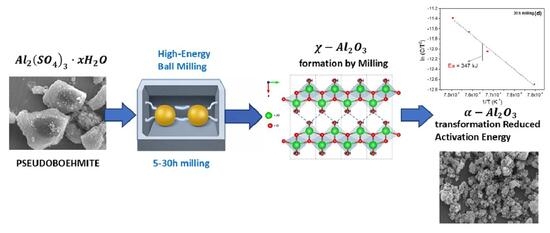
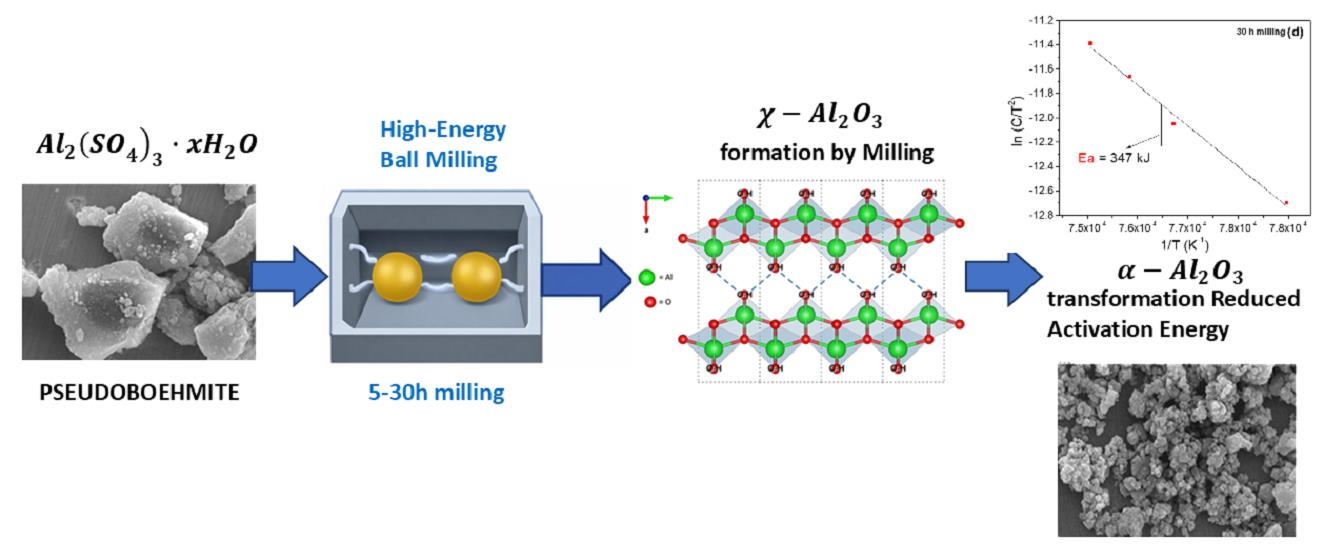
This work investigates the effect of high-energy mechanical milling on the activation and phase transformation of synthetic pseudoboehmite powders. The approach aims to provide a clean, solvent-free route with potential industrial relevance for alumina production. Mechanical processing proved effective in inducing the transition from pseudoboehmite to χ-Al2O3 solely through milling. The process yielded nanometric particles with low levels of contamination. The subsequent conversion to α-Al2O3 was achieved through controlled heat treatments, while phase evolution was monitored by differential scanning calorimetry (DSC). A reduction of approximately 110 °C in the α-Al2O3 formation temperature was observed after 30 h of milling. This shift was accompanied by a marked decrease in the activation energy, from 526 kJ·mol−1 for the raw powder to 347 kJ·mol−1 for the milled sample. These results demonstrate the strong mechanochemical activation of pseudoboehmite, highlighting mechanical milling as an effective and scalable route for energy-efficient processing of alumina phases.

Graphical Abstract

1. Introduction

Mechanical milling is a well-established technique widely used to reduce the particle size of powdered materials and to process particles across a broad range of materials. This technique induces solid-state transformations (changes in material structure without melting), alloying, grinding, material conditioning, and functionalization (the addition of new properties or functions to a material) for both research and industrial applications [1,2,3,4,5,6].
Materials processed in high-energy mills often exhibit higher internal energy, which facilitates phase transformations; in many cases, this milling process is sufficient to reduce the transformation temperature in metallic and ceramic systems [5,7,8].
Mechanical activation modifies the physicochemical properties of powders, thereby reducing the activation energy required for reactions to occur. Several previous studies have reported mechanochemically induced reactions such as phase transitions and the formation of solid solutions, at room temperature, even in immiscible systems [9,10,11]. Kozawa et al. [12] reported that boehmite can be transformed into χ-Al2O3 and κ-Al2O3 by mechanical milling at room temperature; this transformation was also observed by Tonejc et al. [13]. However, the level of contamination generated during the milling process limited its application.
The χ -Al2O3 phase is a promising candidate for various applications, such as coating inkjet-printed substrates [14,15,16] and catalytic supports [9]. χ -Al2O3 is a suitable substrate, with the potential to enhance catalytic activity due to improved dispersion of active species compared with conventional γ-Al2O3 supports [10,11,12,13].
χ -Al2O3 is typically synthesized using complex methods such as sol–gel, hydrothermal, microwave, emulsion evaporation, plasma, solvothermal, and solid-state reactions methods. Many of these processes are costly and can generate toxic waste. On the other hand, we propose a unique methodology to produce χ-Al2O3 from pseudoboehmite through mechanical milling, followed by heat treatment to obtain α-Al2O3. It was found that the transformation temperature differs from that obtained by means of conventional methods.
Although mechanochemical transformations of boehmite into transition alumina phases have been previously reported, most studies have focused on the qualitative observation of phase evolution during milling. For example, Tonejc et al. [14] reported that prolonged mechanical milling of boehmite can induce structural transformations and ultimately lead to the formation of α-Al2O3. Similarly, Kozawa and Naito [15] demonstrated that mechanical milling can generate metastable alumina phases due to crystal deformation and structural disorder induced by mechanical impact. However, these studies did not provide a detailed analysis of the mechanochemical activation process or its effect on the subsequent thermal transformation behavior.
In this work, we demonstrate that high-energy milling of synthetic pseudoboehmite promotes the formation of χ-Al2O3 with low contamination levels and significantly reduces both the transformation temperature and the activation energy required for the formation of α-Al2O3. Additionally, the structural evolution during milling is analyzed using XRD, BET, TEM, and thermal analysis, providing further insight into the mechanochemical activation of pseudoboehmite.

2. Materials and Methods

2.1. Synthesis of Pseudoboehmite

Controlled and reproducible synthesis conditions were used in this work to prepare pseudoboehmite. The synthesis was carried out using commercial hydrated aluminum sulfate (Al2(SO4)3·xH2O) from Sigma-Aldrich, St. Louis, MO, USA, and anhydrous ammonia (NH3) from Matheson, Basking Ridge, NJ, USA. The synthesis consisted of heating an aqueous solution of aluminum sulfate (0.2 M) at 60 °C under stirring. During the synthesis, commercial ammonia gas (NH3) was pumped into the solution to achieve a pH of 9 and 10. The precipitates were filtered and washed three times with warm distilled water (40–60 °C) to remove any remaining sulfate. The product obtained was pseudoboehmite (hereinafter referred to as raw material) in the form of a translucent white colloid, which was dried and pulverized in a mortar to remove agglomerated particles.

2.2. Processing by SPEX Mechanical Milling

The mechanical milling of pseudoboehmite was performed in a high-energy SPEX 8000 mill (SPEX SamplePrep, Metuchen, NJ, USA) with stainless steel grinding media. The entire process was carried out using balls with different diameters of 6 and 10 mm. The steel vials were loaded with 5 g of pseudoboehmite at room temperature and milled for 5, 10, 20, and 30 h. The raw powder was labeled as 0 h. No additional process control agents were added to the milling vial.
The ball-to-powder ratio (BPR) was approximately 10:1. Milling was carried out under ambient air. The use of balls with different diameters promotes a broader distribution of impact energies, which facilitates particle fragmentation and mechanochemical activation during high-energy milling.

2.3. Structural Characterization

A Siemens D5000 diffractometer (Siemens AG, Munich, Germany) with Bragg–Brentano geometry and Cu-Kα radiation (λ = 0.15418 nm) was employed for structural characterization. X-ray diffraction analyses were performed with a step size = 0.02°, t = 0.5 s, and 10 ≤ 2θ ≤ 80. The morphology of the powders before and after processing was analyzed using a JEOL 6400 (JEOL Ltd., Tokyo, Japan) scanning electron microscope (SEM). A FEI Tecnai F20 Phillips (FEI Company, Hillsboro, OR, USA) transmission electron microscope (TEM) was used to take bright-field images of the milled powders. The powder samples analyzed by SEM and TEM were pre-dispersed in isopropyl alcohol and ultrasonicated for 30 min in an ultrasonic bath. Surface area measurements were performed with nitrogen adsorption using a Quantachrome Instruments, Boynton Beach, FL, USA, operated with TouchWin™ software ((v2.4.0)). Before each measurement, the powder sample was degassed under vacuum at 120 °C for 2 h.

2.4. Differential Scanning Calorimeter (DSC) and Thermogravimetric Analysis (TGA)

A TA Instrument simultaneous thermal analyzer (TGA/SDTA 851e) (TA Instruments, New Castle, DE, USA) was used to measure the heat flow and weight loss profiles of the powders. The milled powders at 0 h and 30 h were selected as representative unmilled and highly activated conditions, and were analyzed in air up to a maximum temperature of 1200 °C with a heating rate of 3 °C/min.

3. Results and Discussion

3.1. SEM and EDS

Figure 1 shows the SEM images of the 0 h and 30 h milled samples. The unmilled powder consists of large agglomerates, which are typical of this synthesis route (Figure 1a). After mechanical milling, the powder exhibits a noticeable reduction in particle size and a more fragmented morphology, which is commonly associated with higher surface energy due to the generation of fresh surfaces and structural defects (Figure 1b) [16,17]. Figure 1c shows a selected area of the powder milled for 30 h, while Figure 1d presents the corresponding EDS elemental map. EDS analysis was performed to evaluate potential contamination introduced during the milling process; only 1.5 wt.% Fe was detected. The relatively low contamination compared with previous reports [14] may be attributed to the soft, lamellar nature of pseudoboehmite. The lamellar structure of pseudoboehmite (Figure 1e) suggests weak interlayer interactions dominated by hydrogen bonding and van der Waals forces, which may facilitate interlayer sliding during mechanical milling. This behavior can produce a lubrication effect between the powder particles and the milling media, potentially reducing wear of the milling tools and contributing to the relatively low contamination observed [18]. Similar behavior has been reported for other aluminum hydroxides with layered structures [19].

3.2. Surface Area Measurements

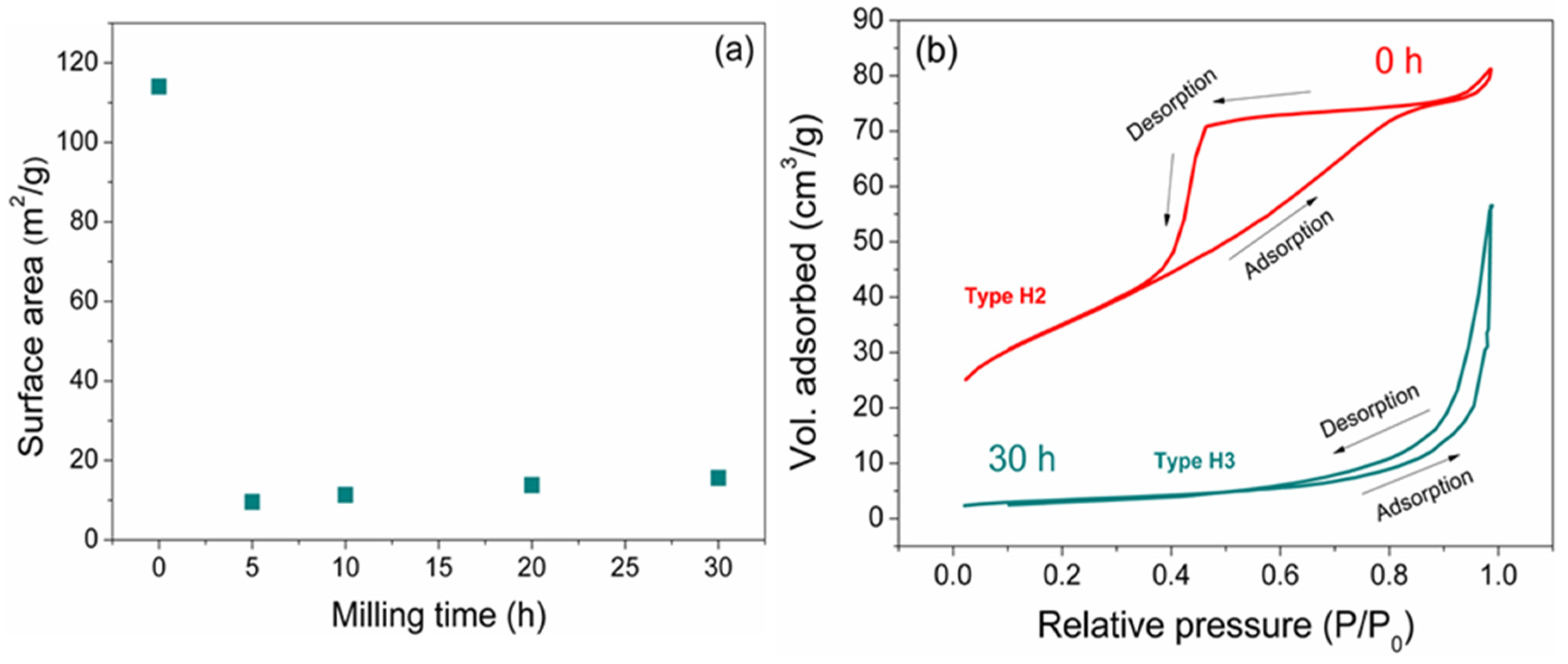
Figure 2a shows the evolution of the BET specific surface area as a function of milling time. The unmilled pseudoboehmite powder exhibits a high specific surface area of 114 m2/g, characteristic of pseudoboehmite obtained via precipitation routes [21]. The surface area values were determined from N2 adsorption–desorption isotherms using the BET method. After only 5 h of milling, the specific surface area decreases dramatically to 9.6 m2/g. This behavior may initially seem contradictory, considering that mechanical milling is usually associated with particle size reduction. However, this phenomenon has been frequently observed in mechanically milling ceramic systems.
During high-energy milling, two opposing mechanisms occur simultaneously: particle fracture and agglomeration [6]. Particle fracture promotes size reduction and the formation of new surfaces, while particle agglomeration causes particle coalescence and densification of agglomerates. As a result, the surface area may decrease despite mechanical refinement of the powder. Rudolph et al. [22] reported similar behavior in mechanically milled materials, where repeated impacts between the milling media and the powder lead to agglomeration and structural rearrangements.
For longer milling times, the surface area gradually increased, reaching approximately 11.5 m2/g (10 h), 14 m2/g (20 h), and 15.6 m2/g after 30 h of milling. Therefore, the evolution of the BET surface area observed in this work probably reflects the combined effects of particle agglomeration, fragmentation, and mechanically chemically induced structural transformations that occur during the milling process [23].
Figure 2b presents the N2 adsorption–desorption isotherms and hysteresis loops for the unmilled (0 h) and 30 h milled powders. Since the isotherms obtained for 5, 10, 20, and 30 h are very similar, only the 30 h sample is discussed as representative of the milled condition. According to the IUPAC classification of hysteresis loop types (H1–H4), the raw sample exhibits a loop resembling H2, whereas the milled powders (e.g., 30 h) show an H3-type hysteresis loop. This behavior suggests that porosity is mainly associated with slit-shaped pores, typically related to aggregates of plate-like particles [12,24].

3.3. XRD Study

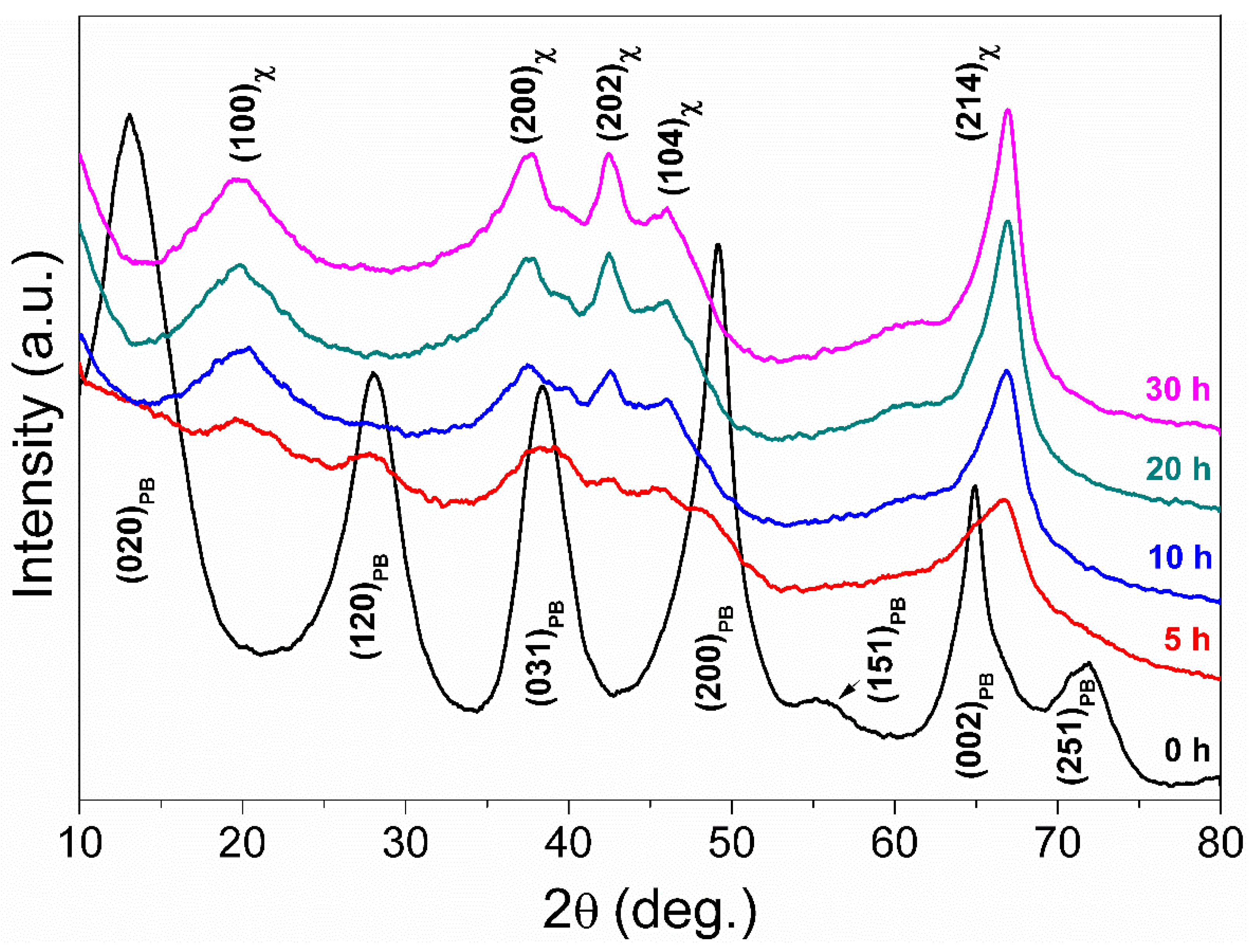
Figure 3 displays the phase evolution from pseudoboehmite to χ-Al2O3 induced by mechanical milling. The initial pseudoboehmite powder (0 h) shows seven broad reflections located at approximately 2θ ≈ 14.5°, 28.2°, 38.3°, 49.2°, 55.2°, 65.0°, and 72.0°, which are indexed to the (020), (120), (031), (200), (151), (002), and (251) planes, respectively, corresponding to the reference pattern (JCPDS Card No. 21-1307; Pseudoboehmite (AlO(OH)); International Centre for Diffraction Data (ICDD): Newtown Square, PA, USA.) [25]. The presence of χ-Al2O3 is first detected after 5 h of milling by the emergence of broad features at approximately 2θ ≈ 37.3° and 42.6°, corresponding to the (200)χ and (202)χ reflections. These peaks become more clearly distinguishable after 10 h, indicating the onset of the χ-Al2O3 phase formation. With longer milling times (20–30 h), the χ-Al2O3 phase becomes more evident, showing reflections at approximately 2θ ≈ 37.3°, 42.6°, 46.3, and 67.0°, associated with the (200)χ, (202)χ, (104)χ, and (214)χ planes, respectively, with greater peak intensity and improved peak definition, suggesting enhanced crystallinity (JCPDS Card No. 13-0373; χ-Al2O3; International Centre for Diffraction Data (ICDD): Newtown Square, PA, USA.) [25].
Unlike the phase transformation pathway normally observed in heat treatment, in which pseudoboehmite evolves through PB→γ→θ→α [16], the energy supplied by mechanical milling leads to the formation of χ-Al2O3. Kozawa and Naito [15] reported similar results for the mechanochemical transformation of commercial boehmite into χ -Al2O3. They proposed that the structure of boehmite is partially transformed into a gibbsite-like arrangement during mechanical milling, which favors the formation of χ-Al2O3 instead of γ-Al2O3.
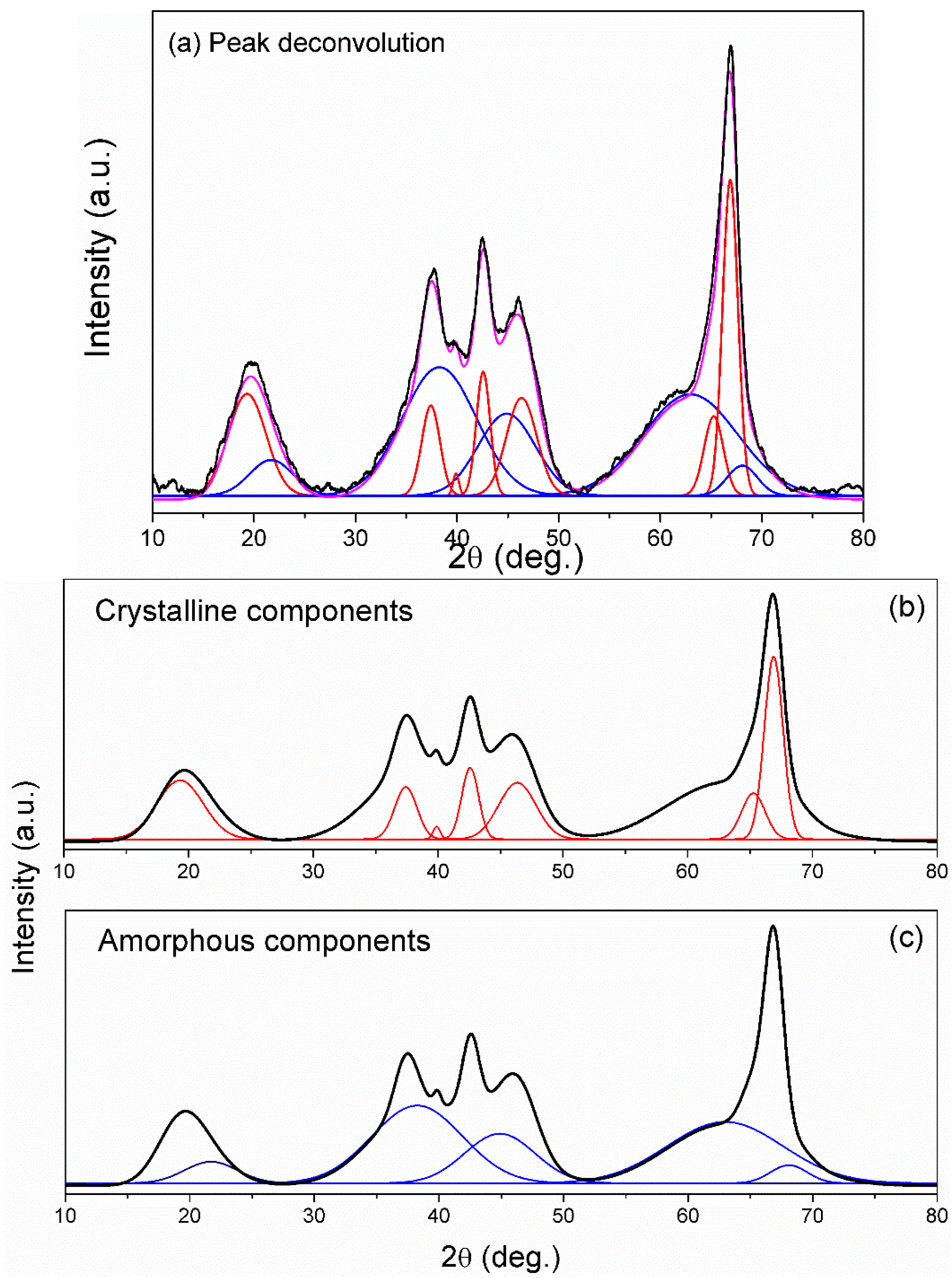
The pseudoboehmite reflections become almost indistinguishable after 10 h of milling. The poor definition of the peaks and the broad background suggest the presence of both crystalline and amorphous contributions, which were quantified using the RulandVonk method [26,27,28,29,30]. This method estimates the relative fractions of crystalline and amorphous domains by deconvoluting peaks. Figure 4a shows the peak deconvolution of the powder milled for 30 h, as well as the theoretical fit. Figure 4b,c shows the contribution of the deconvoluted crystalline and amorphous components separately. After deconvolution, when calculating the ratio between the crystalline area and the total area, a crystallinity index of 0.43 was obtained, indicating that a significant portion of the milled powder comprised amorphous material. Mechanical milling is known to introduce a high density of structural defects, including dislocations, crystal lattice distortions, and grain boundary defects, which promote partial amorphization of the material [8,31]. The accumulation of these defects increases the stored internal energy and improves the chemical reactivity. Consequently, the presence of an amorphous component may be key in facilitating the phase transformations observed during subsequent heat treatments [32,33].

3.4. TEM

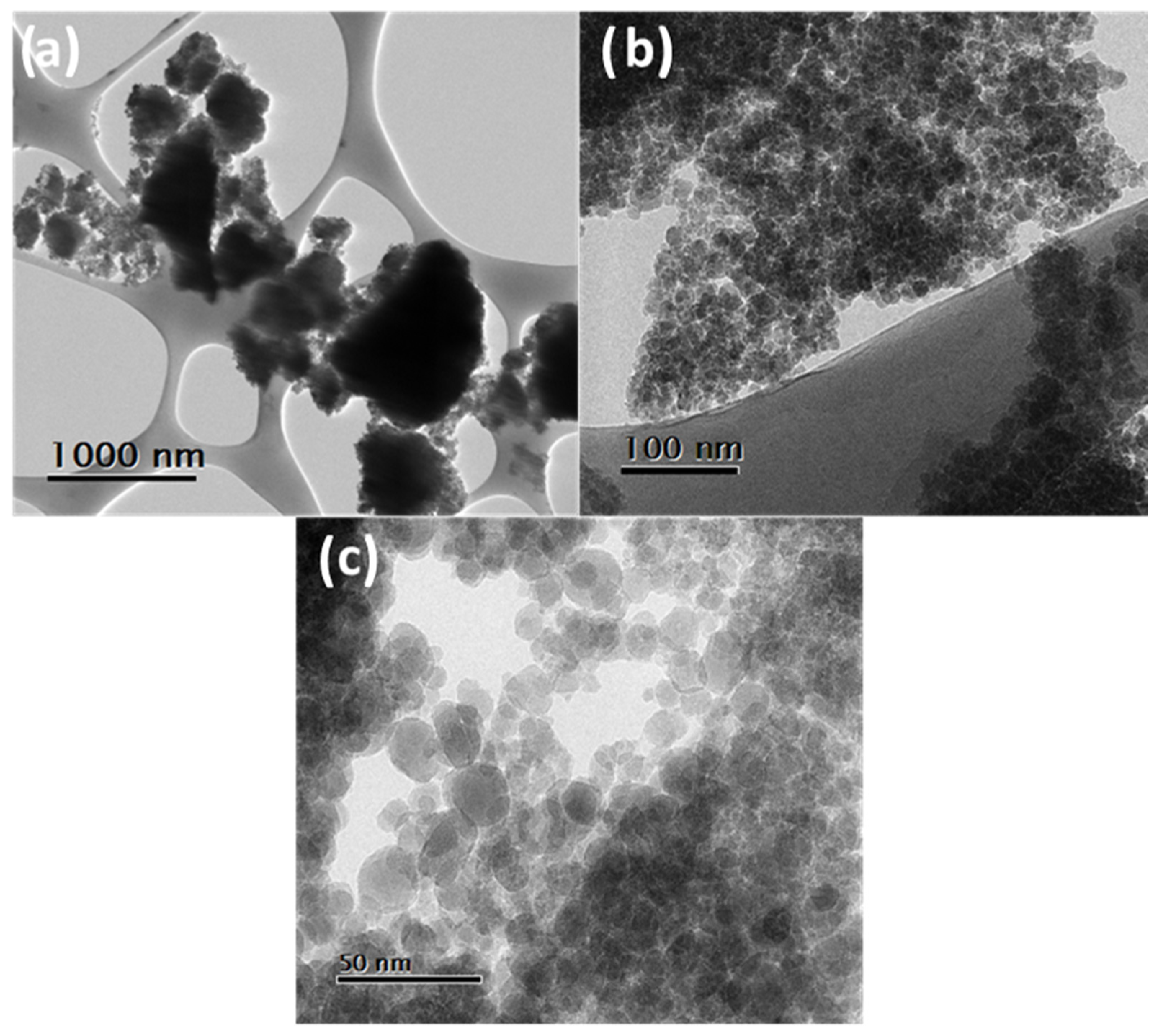
Figure 5 shows the TEM results of the powder milled for 30 h, which corresponds to the sample with the highest crystalline quality among the milled powders. As observed in Figure 5a, the particles form large agglomerates, in agreement with the SEM observations shown in Figure 1. In Figure 5b, the agglomerated structure is still evident; however, the presence of smaller particles at the nanometric scale can be clearly observed, although their morphology is not yet well defined. In contrast, Figure 5c reveals individual particles with a roughly rounded or flake-like morphology and sizes below 50 nm.
SEM observations display that the milled powder forms agglomerates; however, TEM images reveal that these agglomerates are composed of nanometric particles, highlighting the nanostructure of the milled material.

3.5. Thermal Decomposition

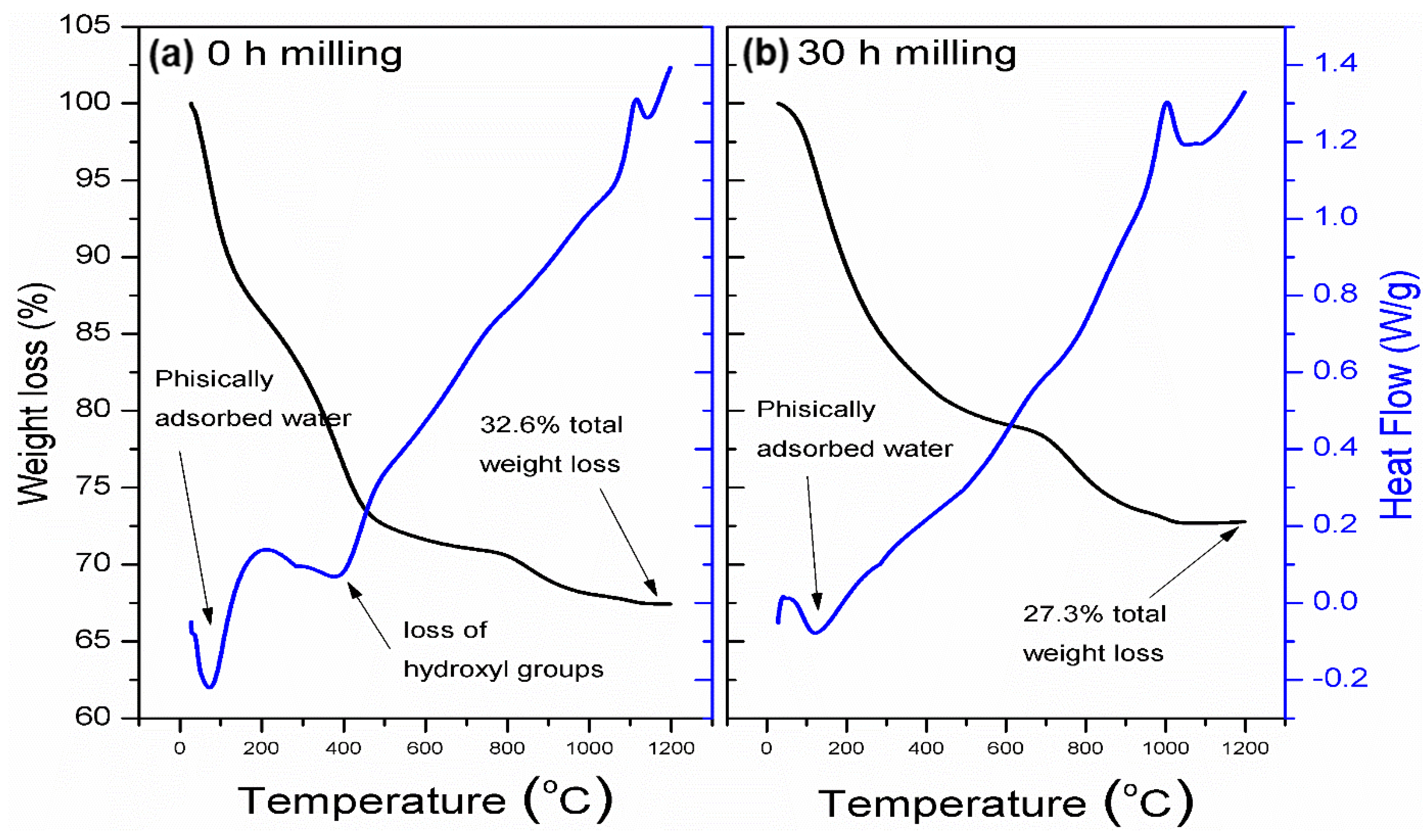
Figure 6 shows a comparative analysis of the DSC/TGA thermal decomposition for the 0 and 30 h milled samples. The 0 h powder allows us to identify the main phase transitions that occur during the conventional heat treatment of pseudoboehmite, which are similar to those observed in well-crystallized boehmite [14,34,35,36]. The heat-flow profile of the 0 h sample exhibits two main endothermic transitions. The first, around 100 °C, is associated with the release of physically adsorbed water. The second transition, observed near 400 °C, is attributed to the dehydroxylation process leading to the formation of γ-Al2O3. As the temperature increases, a new phase transition appears at approximately 1120 °C, which corresponds to the formation of α-Al2O3. The intermediate δ- and θ-Al2O3 phases involve transitions with relatively low enthalpy changes and are therefore not easily detected by DSC.
In contrast, the endothermic transition associated with γ-Al2O3 observed in the 0 h sample is not detected in the powder milled for 30 h. This behavior is attributed to the partial release of hydroxyl groups during the milling process, as the pseudoboehmite structure is progressively broken down. This mechanical dehydroxylation, combined with the structural distortion produced by repeated impacts between the milling media and the powder, promotes the formation of χ-Al2O3, as represented by the following reaction:
2 AlO ( OH ) n H 2 O χ - Al 2 O 3 + n H 2 O ,
On the other hand, the 30 h milled sample shows a significant reduction in the transformation temperature to α-Al2O3 compared with the unmilled powder. The α-Al2O3 transition occurs at approximately 1120 and 1010 °C for the 0 h and 30 h samples, respectively, corresponding to a reduction of about 110 °C. This decrease in transformation temperature is attributed to the increase in internal energy and the high concentration of structural defects introduced during milling.
The TGA profiles show that the total weight loss for the 0 and 30 h samples is 32.6% and 27.3%, respectively. The lower weight loss observed for the 30 h sample provides further evidence of the partial dehydroxylation of pseudoboehmite occurring during mechanical milling.
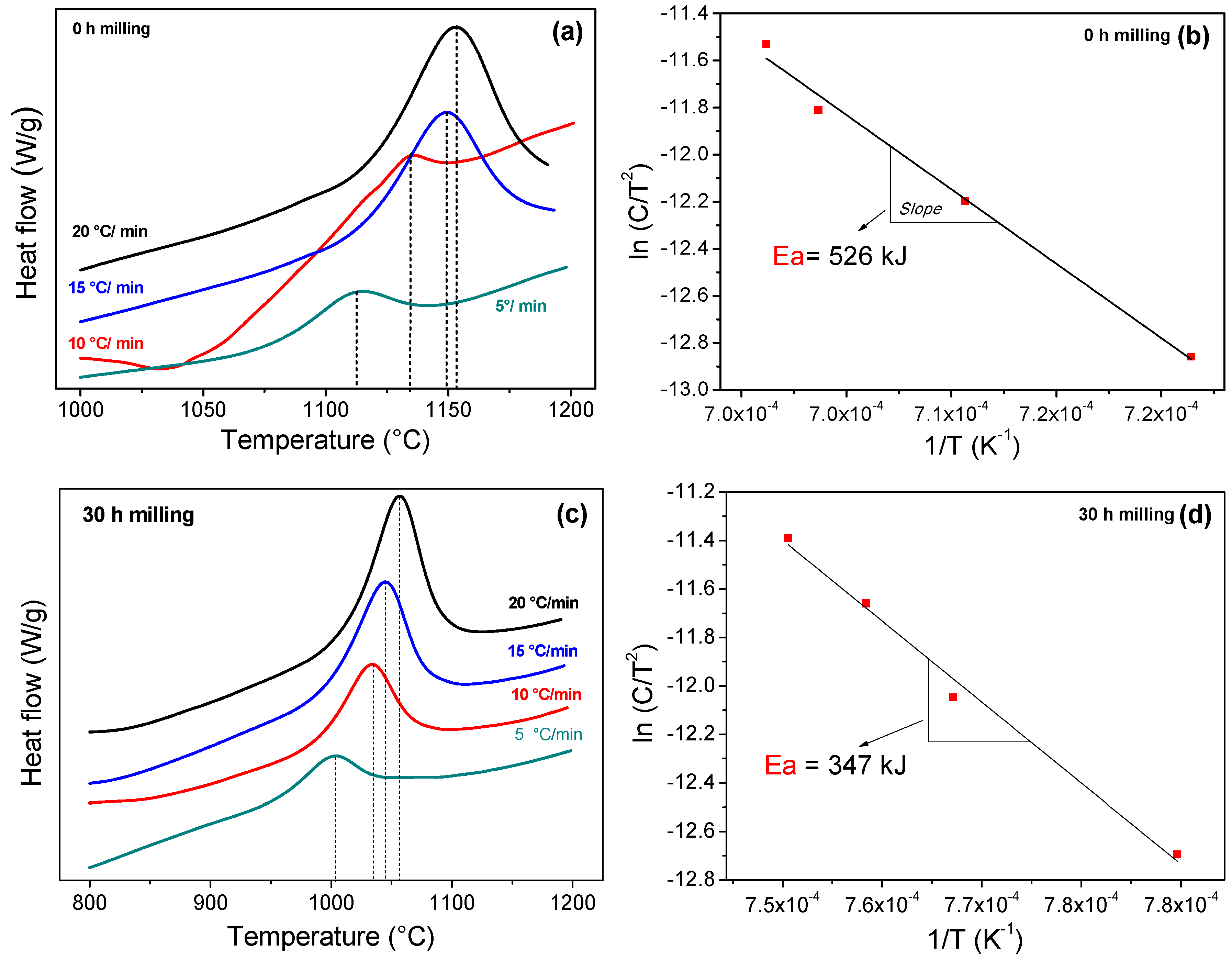
All DSC curves obtained at different heating rates exhibited a single exothermic peak associated with the α-Al2O3 transformation, enabling the application of the Kissinger method. The activation energy of the powder was evaluated for the α-Al2O3 transformation using the Kissinger equation (Equation (2)) [37]:
ln C T p 2 = E a R T p + A ,
where C is the heating rate, Tp is the peak transformation temperature, Ea is the activation energy, R is the gas constant, and A is a constant.
For the estimation of the activation energy, different heating rates of 5, 10, 15, and 20 °C/min were used to determine the peak temperature associated with the exothermic α-Al2O3 transformation (see Figure 7c). The activation energy was calculated from the slope of the linear fit of l n C T p 2 versus 1 T p (Figure 7b,d).
The activation energy obtained for the unmilled powder (526 kJ/mol) is consistent with values reported for the transformation of transition alumina into the thermodynamically stable α-Al2O3 phase. Previous studies have reported activation energies in the range of ~400–520 kJ·mol−1 for alumina phase transformations depending on the precursor and experimental conditions. For instance, Alex et al. [35] reported high activation energies associated with the thermal transformation of mechanically activated boehmite due to the significant structural rearrangement. Similarly, Udhayabanu et al. [37] observed that mechanical activation can substantially modify the kinetic parameters of alumina-forming reactions, reporting a reduction in activation energy from 277 kJ·mol−1 in unmilled powders to 150 kJ·mol−1 after milling. In this work, the significantly lower activation energy obtained for the milled sample (347 kJ/mol) confirms the strong mechanochemical activation induced by high-energy milling. This reduction can be attributed to the high density of defects, nanostructuring, and partial amorphization generated during milling, which increased the stored internal energy and facilitated atomic diffusion during the phase transformation process.

4. Conclusions

High-energy mechanical milling proved to be an effective strategy for activating nanocrystalline pseudoboehmite and inducing its phase transformation. The mechanochemical treatment promoted the progressive transformation from pseudoboehmite to χ-Al2O3; the first detectable formation of the χ phase occurred after 5 h of milling, with enhanced crystallinity observed with longer milling times.
Structural and microstructural analyses revealed that the milled powders consist of agglomerates formed by nanometric particles, accompanied by partial amorphization and mechanical dehydroxylation. Despite prolonged milling, the EDS results showed a low contamination level (1.5 wt.% Fe), demonstrating that this method can produce relatively clean χ-Al2O3.
Thermal analyses indicated that mechanical activation significantly reduces both the transformation temperature and the activation energy of the α-Al2O3 phase. The α-transition temperature decreased by approximately 110 °C, while the activation energy dropped from 526 to 347 kJ/mol after 30 h of milling.
These results confirm that mechanical milling is an effective and scalable route for the formation of nanocrystalline pseudoboehmite and the controlled production of χ-Al2O3.

Author Contributions

Conceptualization, A.G.P., F.D.C.V. and S.M.D.; methodology, A.G.P. and F.D.C.V.; validation, S.M.D. and A.G.P.; formal analysis, A.G.P. and F.D.C.V.; investigation, A.G.P.; resources, S.M.D.; data curation, F.D.C.V.; writing—original draft preparation, A.G.P.; writing—review and editing, A.G.P., F.D.C.V. and S.M.D.; visualization, S.M.D.; supervision, S.M.D.; project administration, S.M.D. All authors have read and agreed to the published version of the manuscript.

Funding

This research received no external funding.

Institutional Review Board Statement

Not applicable.

Informed Consent Statement

Not applicable.

Data Availability Statement

The original contributions presented in this study are included in the article. Further inquiries can be directed to the corresponding author.

Acknowledgments

The authors thank the Universidad Autónoma de Querétaro, Universidad Politécnica de Santa Rosa Jáuregui, and Centro de Investigación de Estudios Avanzados del I.P.N., Unidad Querétaro, for providing access to their facilities and resources.

Conflicts of Interest

The authors declare no conflicts of interest.

References

  1. Virieux, D.; Delogu, F.; Porcheddu, A.; García, F.; Colacino, E. Mechanochemical Rearrangements. J. Org. Chem. 2021, 86, 13885–13894. [Google Scholar] [CrossRef] [Scilit]
  2. Mancillas-Salas, S.; Hernández-Rodrígueza, P.; Reynosa-Martínez, A.C.; López-Honorato, E. Production of Aluminum Nanoparticles by Wet Mechanical Milling. MRS Adv. 2020, 5, 3133–3140. [Google Scholar] [CrossRef] [Scilit]
  3. Sherif El-Eskandarany, M.; Al-Hazza, A.; Al-Hajji, L.A.; Ali, N.; Al-Duweesh, A.A.; Banyan, M.; Al-Ajmi, F. Mechanical Milling: A Superior Nanotechnological Tool for Fabrication of Nanocrystalline and Nanocomposite Materials. Nanomaterials 2021, 11, 2484. [Google Scholar] [CrossRef] [Scilit]
  4. Güler, Ö.; Evin, E. Effect of Milling Type on Formation of Carbon Nanostructures. Fullerenes Nanotub. Carbon Nanostructures 2015, 23, 463–470. [Google Scholar] [CrossRef] [Scilit]
  5. Padhan, A.M.; Ravikumar, P.; Saravanan, P.; Alagarsamy, P. Enhanced Magnetic Properties of NiO Powders by the Mechanical Activation of Aluminothermic Reduction of NiO Prepared by a Ball Milling Process. J. Magn. Magn. Mater. 2016, 418, 253–259. [Google Scholar] [CrossRef] [Scilit]
  6. Prasad Yadav, T.; Manohar Yadav, R.; Pratap Singh, D. Mechanical Milling: A Top Down Approach for the Synthesis of Nanomaterials and Nanocomposites. Nanosci. Nanotechnol. 2012, 2, 22–48. [Google Scholar] [CrossRef] [Scilit]
  7. Dolmatov, O.; Zakusilov, V.V.; Kuznetsov, M.S.; Pimenov, N.; Chursin, S. Mechanical Activation Influence on the Morphological Properties of La2O3-TiO2-B. IOP Conf. Ser. Mater. Sci. Eng. 2016, 124, 012120. [Google Scholar] [CrossRef] [Scilit]
  8. Mucsi, G. A Review on Mechanical Activation and Mechanical Alloying in Stirred Media Mill. Chem. Eng. Res. Des. 2019, 148, 460–474. [Google Scholar] [CrossRef] [Scilit]
  9. Zheng, L.; Li, Z.; Fu, P.; Sun, F.; Liu, M.; Guo, T.; Fan, Q. Development of Mo-Modified Pseudoboehmite Supported Ni Catalysts for Efficient Hydrogen Production from Formic Acid. ACS Omega 2022, 7, 27172–27184. [Google Scholar] [CrossRef] [Scilit]
  10. Chaitree, W.; Jiemsirilers, S.; Mekasuwandumrong, O.; Jongsomjit, B.; Shotipruk, A.; Panpranot, J. Effect of Nanocrystalline χ-Al2O3 Structure on the Catalytic Behavior of Co/Al2O3 in CO Hydrogenation. Catal. Today 2011, 164, 302–307. [Google Scholar] [CrossRef] [Scilit]
  11. Chotigkrai, N.; Panpranot, J.; Praserthdam, P. Comparison of the Effects of χ Phase- and Si- Modified γ-Al2O3 Supported Pt Catalysts in CO Oxidation. Catal. Commun. 2014, 56, 92–95. [Google Scholar] [CrossRef] [Scilit]
  12. Meephoka, C.; Chaisuk, C.; Samparnpiboon, P.; Praserthdam, P. Effect of Phase Composition between Nano γ- and χ-Al2O3 on Pt/Al2O3 Catalyst in CO Oxidation. Catal. Commun. 2008, 9, 546–550. [Google Scholar] [CrossRef] [Scilit]
  13. De Bellis, J.; Ochoa-Hernández, C.; Farès, C.; Petersen, H.; Ternieden, J.; Weidenthaler, C.; Amrute, A.P.; Schüth, F. Surface and Bulk Chemistry of Mechanochemically Synthesized Tohdite Nanoparticles. J. Am. Chem. Soc. 2022, 144, 9421–9433. [Google Scholar] [CrossRef] [Scilit]
  14. Tonejc, A.; Tonejc, A.M.; Bagović, D.; Kosanović, C. Comparison of the Transformation Sequence from γ-AlOOH (Boehmite) to α-Al2O3 (Corundum) Induced by Heating and by Ball Milling. Mater. Sci. Eng. A 1994, 181–182, 1227–1231. [Google Scholar] [CrossRef] [Scilit]
  15. Kozawa, T.; Naito, M. Mechanically Induced Formation of Metastable χ- and κ-Al2O3 from Boehmite. Adv. Powder Technol. 2016, 27, 935–939. [Google Scholar] [CrossRef] [Scilit]
  16. Chicinaş, H.F.; Jucan, D.O.; Marinca, T.F.; Neamțu, B.V.; Conțiu, G.; Götze, P.; Eckert, A.; Popa, C.O. Influence of Milling Media on the Structure and Agglomeration Behaviour of Some Hardmetal Powder. Powder Metall. 2018, 61, 342–347. [Google Scholar] [CrossRef] [Scilit]
  17. Nichols, G.; Byard, S.; Bloxham, M.J.; Botterill, J.; Dawson, N.J.; Dennis, A.; Diart, V.; North, N.C.; Sherwood, J.D. A Review of the Terms Agglomerate and Aggregate with a Recommendation for Nomenclature Used in Powder and Particle Characterization. J. Pharm. Sci. 2002, 91, 2103–2109. [Google Scholar] [CrossRef] [Scilit] [PubMed]
  18. Baker, B.R.; Pearson, R.M. Water Content of Pseudoboehmite: A New Model for Its Structure. J. Catal. 1974, 33, 265–278. [Google Scholar] [CrossRef] [Scilit]
  19. Shin, J.; Choi, C.-J.; Kim, T.-H.; Oh, J.-M. Phase Transformation from Brucite to Highly Crystalline Layered Double Hydroxide through a Combined Dissolution–Reprecipitation and Substitution Mechanism. Cryst. Growth Des. 2018, 18, 5398–5405. [Google Scholar] [CrossRef] [Scilit]
  20. Momma, K.; Izumi, F. VESTA 3 for Three-Dimensional Visualization of Crystal, Volumetric and Morphology Data. J. Appl. Crystallogr. 2011, 44, 1272–1276. [Google Scholar] [CrossRef] [Scilit]
  21. Zhang, C.; Liu, Y.; Li, Y.; Guo, S.; Wang, S.; Cheng, S.; Shen, H. Study on Controlled Synthesis of Mesoporous Pseudoboehmite via Carbonation Reaction. Ind. Eng. Chem. Res. 2024, 63, 5655–5665. [Google Scholar] [CrossRef] [Scilit]
  22. Rudolph, M.; Salomon, A.; Schmidt, A.; Motylenko, M.; Zienert, T.; Stöcker, H.; Himcinschi, C.; Amirkhanyan, L.; Kortus, J.; Aneziris, C.G.; et al. Thermally Induced Formation of Transition Aluminas from Boehmite. Adv. Eng. Mater. 2017, 19, 1700141. [Google Scholar] [CrossRef] [Scilit]
  23. Wu, F.; Zhang, H.; Liu, W.; Zhang, Q.; Li, Q.; Zheng, S.; Li, P. Transformation Process of Boehmite to γ-Al2O3 Induced by High-Energy Ball Milling. CrystEngComm 2024, 26, 1099–1105. [Google Scholar] [CrossRef] [Scilit]
  24. Thommes, M.; Kaneko, K.; Neimark, A.V.; Olivier, J.P.; Rodriguez-Reinoso, F.; Rouquerol, J.; Sing, K.S.W. Physisorption of Gases, with Special Reference to the Evaluation of Surface Area and Pore Size Distribution (IUPAC Technical Report). Pure Appl. Chem. 2015, 87, 1051–1069. [Google Scholar] [CrossRef] [Scilit]
  25. Favaro, L.; Boumaza, A.; Roy, P.; Lédion, J.; Sattonnay, G.; Brubach, J.B.; Huntz, A.M.; Tétot, R. Experimental and Ab Initio Infrared Study of χ-, κ- and α-Aluminas Formed from Gibbsite. J. Solid State Chem. 2010, 183, 901–908. [Google Scholar] [CrossRef] [Scilit]
  26. Freitas, R.R.M.D.; Botaro, V.R. Biodegradation Behavior of Cellulose Acetate with DS 2.5 in Simulated Soil. Int. J. Chem. Mol. Eng. 2018, 12, 347–351. [Google Scholar]
  27. Isogai, A.; Usuda, M. Crystallinity Indexes of Cellulosic Materials. Sen’i Gakkaishi 1990, 46, 324–329. [Google Scholar] [CrossRef] [Scilit]
  28. Park, S.; Baker, J.O.; Himmel, M.E.; Parilla, P.A.; Johnson, D.K. Cellulose Crystallinity Index: Measurement Techniques and Their Impact on Interpreting Cellulase Performase. Biotechnol. Biofuels 2010, 3, 10. [Google Scholar] [CrossRef] [Scilit]
  29. Sami, A.; David, E.; Fréchette, M. Procedure for Evaluating the Crystallinity from X-Ray Diffraction Scans of High and Low Density Polyethylene/SiO2 Composites. In Proceedings of the 2010 Annual Report Conference on Electrical Insulation and Dielectic Phenomena, West Lafayette, IN, USA, 17–20 October 2010; pp. 2–5. [Google Scholar] [CrossRef] [Scilit]
  30. Ji, Y.; Wu, Y.; Li, L. Synthesis and Characterization of Pseudoboehmite by Neutralization Method. Ceram. Int. 2021, 47, 15923–15930. [Google Scholar] [CrossRef] [Scilit]
  31. Kim, L.; Dobra, G.; Isopescu, R.; Iliev, S.; Cotet, L.; Boiangiu, A.; Filipescu, L. Short Review on Mechanical Activation in Non-Metallurgical Alumina Production. Rom. J. Ecol. Environ. Chem. 2022, 4, 62–79. [Google Scholar] [CrossRef] [Scilit]
  32. Alex, T.C.; Kumar, R.; Roy, S.K.; Mehrotra, S.P. Mechanical Activation of Al-Oxyhydroxide Minerals–A Review. Miner. Process. Extr. Metall. Rev. 2016, 37, 1–26. [Google Scholar] [CrossRef] [Scilit]
  33. Ma, H.; Cen, S.; Yu, Z.; Xing, X.; Chen, J.; Wang, D.; Dong, C.; Mao, Z. One-Step Mechanochemical Transformation of Bulk Pseudo-Boehmite into Nanosized α-Al2O3. Ceram. Int. 2022, 48, 35480–35485. [Google Scholar] [CrossRef] [Scilit]
  34. Lamouri, S.; Hamidouche, M.; Bouaouadja, N.; Belhouchet, H.; Garnier, V.; Fantozzi, G.; Trelkat, J.F. Control of the γ-Alumina to α-Alumina Phase Transformation for an Optimized Alumina Densification. Bol. la Soc. Esp. Ceram. y Vidr. 2017, 56, 47–54. [Google Scholar] [CrossRef] [Scilit]
  35. Alex, T.C. An Insight into the Changes in the Thermal Analysis Curves of Boehmite with Mechanical Activation. J. Therm. Anal. Calorim. 2014, 117, 163–171. [Google Scholar] [CrossRef] [Scilit]
  36. Boumaza, A.; Favaro, L.; Lédion, J.; Sattonnay, G.; Brubach, J.B.; Berthet, P.; Huntz, A.M.; Roy, P.; Tétot, R. Transition Alumina Phases Induced by Heat Treatment of Boehmite: An X-Ray Diffraction and Infrared Spectroscopy Study. J. Solid State Chem. 2009, 182, 1171–1176. [Google Scholar] [CrossRef] [Scilit]
  37. Udhayabanu, V.; Singh, N.; Murty, B.S. Mechanical Activation of Aluminothermic Reduction of NiO by High Energy Ball Milling. J. Alloys Compd. 2010, 497, 142–146. [Google Scholar] [CrossRef] [Scilit]
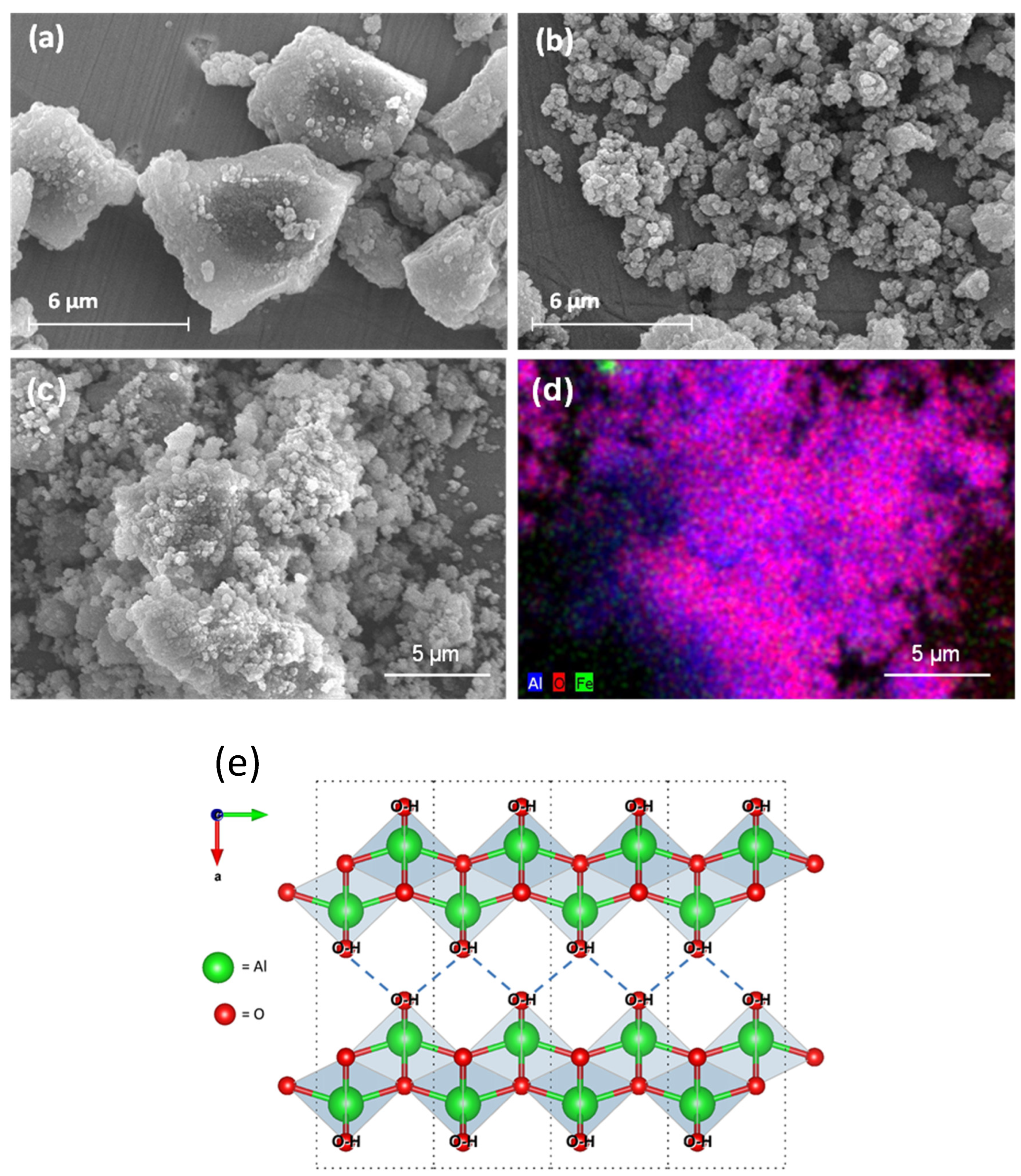
Figure 1. SEM images of pseudoboehmite: (a) 0 h, (b) 30 h milled powder, (c) selected zone of 30 h milled powder, and (d) corresponding EDS mapping. The lamellar crystal structure (e) of pseudoboehmite was rendered using VESTA (version 3.5.0, National Institute for Materials Science, Tsukuba, Japan) [20]. SEM images (ac) were acquired in SEI mode.
Ceramics 09 00035 g001
Figure 2. (a) The BET specific surface area of pseudoboehmite powders as a function of milling time. (b) N2 adsorption–desorption isotherms of the unmilled (0 h) and 30 h milled samples, showing the corresponding hysteresis loops and their evolution after mechanical processing.
Ceramics 09 00035 g002
Figure 3. XRD patterns of pseudoboehmite powders as a function of milling time (0, 5, 10, 20, and 30 h), showing the mechanochemically induced phase transformation from pseudoboehmite (PB) to χ-Al2O3. The indexed reflections correspond to PB (JCPDS Card No. 21-1307) and χ-Al2O3 (JCPDS Card No. 13-0373).
Ceramics 09 00035 g003
Figure 4. (a) Peak deconvolution of the diffraction pattern for the 30 h milled powder, showing the experimental data (black line), the fitted profile (pink line), and the individual deconvoluted peaks (red and blue curves). (b) Crystalline component and (c) amorphous components were obtained from the deconvolution analysis.
Ceramics 09 00035 g004
Figure 5. TEM images of the 30 h milled powder. (ac) Images were obtained at different magnifications and different areas of the milled powder.
Ceramics 09 00035 g005
Figure 6. DSC/TGA analyses of (a) 0 h and (b) 30 h milled powders.
Ceramics 09 00035 g006
Figure 7. Heat flow profiles and Kissinger plots for (a,b) 0 h and (c,d) 30 h milled powders.
Ceramics 09 00035 g007
Disclaimer/Publisher’s Note: The statements, opinions and data contained in all publications are solely those of the individual author(s) and contributor(s) and not of MDPI and/or the editor(s). MDPI and/or the editor(s) disclaim responsibility for any injury to people or property resulting from any ideas, methods, instructions or products referred to in the content.