Skip to Content
CeramicsCeramics
  • Article
  • Open Access

18 March 2026

Cold Sintering of Hydroxyapatite/Niobium–Phosphate Glass Ceramics as an Alternative Route to Pressureless Sintering


,
and
Department of Materials Science and Engineering, Military Institute of Engineering—IME, Rio de Janeiro 22290-270, RJ, Brazil
*
Author to whom correspondence should be addressed.

Abstract

Hydroxyapatite (HAp) is a key bioceramic for biomedical applications, but conventional pressureless sintering (PS) requires high temperatures that can promote phase degradation. Here, we compare PS (1100 °C/180 min) and cold sintering process (CSP) (150 °C/450 MPa/30 min) for pure HAp and an HAp composite containing 4 wt.% niobium–phosphate bioglass (BG), using a 2 M H3PO4 transient liquid (10 wt.%). CSP increased relative density from 73.10% to 79.92% for HAp and from 68.43% to 83.54% for HAp/BG, representing up to a 22.1% gain compared with PS. One-way ANOVA confirmed a significant effect of processing route/composition on relative density (F(3,24) = 919.69, p < 0.05), and Tukey HSD indicated that all groups differed statistically. SEM revealed a markedly more consolidated and homogeneous microstructure for CSP, particularly for HAp/BG, consistent with enhanced dissolution–reprecipitation and pore filling. XRD showed that PS at 1100 °C led to partial HAp degradation with β-TCP formation, whereas CSP preserved the HAp phase with broader peaks, smaller crystallite size, and higher specific surface area. These results demonstrate CSP as an efficient low-temperature alternative for densifying HAp-based bioceramics, with BG addition further improving consolidation.

1. Introduction

Hydroxyapatite (HAp—Ca5(PO4)3(OH)) is one of the most important bioceramics employed in Materials Science and Engineering and in biomedical applications because of its remarkable bioactive behavior. As a calcium phosphate-based material, HAp can be produced through several synthesis routes, including wet precipitation, sol–gel processing, and hydrothermal methods [1]. Owing to its hexagonal crystal structure, it exhibits high chemical stability and excellent compatibility with biological tissues, which favors cell adhesion and proliferation. These characteristics make hydroxyapatite highly suitable for applications such as bone fillers, bioactive coatings for metallic implants, and drug delivery systems [2,3].
Among the available processing routes, sintering plays a central role in the consolidation of HAp-based materials. Conventionally, this process is performed at high temperatures, generally in the range of 900–1300 °C, under controlled heating conditions, so that densification occurs through diffusion-driven mechanisms [4]. Through sintering, open porosity can be reduced, mechanical performance can be improved, and a more suitable interface between the material and surrounding cells can be achieved without eliminating its bioactive character [5]. However, the thermal processing of hydroxyapatite remains challenging. Strict control of the Ca/P ratio is required to preserve phase purity, which means that both synthesis and sintering parameters must be carefully adjusted [6]. In addition, exposure to elevated temperatures may trigger the decomposition of HAp and promote the formation of unwanted secondary phases, such as β-tricalcium phosphate (β-TCP) and α-TCP, thereby increasing the complexity of processing. In response to these limitations, alternative sintering strategies have been investigated, including microwave sintering, spark plasma sintering, and pressure-assisted techniques, since they may reduce treatment time and temperature while improving microstructural control and phase preservation [7,8].
In this context, the cold sintering process (CSP) has emerged as a promising route for hydroxyapatite processing, particularly because it offers the possibility of lowering the thermal budget while minimizing degradation phenomena. First reported in 2016 by the Pennsylvania State University group, CSP introduced a new perspective for ceramic consolidation. In contrast to conventional sintering methods, which usually require temperatures above 1000 °C, CSP enables densification at temperatures below 300 °C by combining uniaxial pressure with the presence of a transient liquid phase, typically water-based [9,10,11]. Under these conditions, the liquid phase assists local dissolution of the particle surfaces, followed by reprecipitation, which promotes densification through mechanisms such as solution–precipitation transport and particle rearrangement [12,13].
For hydroxyapatite, this approach is especially attractive because it can suppress the thermal decomposition commonly associated with high-temperature sintering and thus help maintain phase stability, surface features, and bioactive behavior. Recent investigations have explored the applicability of CSP to HAp and the resulting effects on its structural and functional properties [14]. Reported strategies include the use of PVA-containing transient phases, the fabrication of transparent HAp through pseudo-biomineralization in simulated body fluids, the incorporation of chitosan as an organic reinforcing phase, and additive-free processing routes based on amorphous or partially hydrated powders that facilitate densification [15,16]. These studies indicate that the performance of HAp during CSP is strongly dependent on parameters such as composition, applied pressure, temperature, holding time, and the initial physicochemical condition of the powders.
In addition, previous studies have shown that the incorporation of niobium phosphate glass into hydroxyapatite can improve densification and mechanical strength, highlighting the potential of this additive for the development of HAp-based bioceramics [17]. Based on this background, the present work aims to evaluate the effect of incorporating a bioactive niobium–phosphate glass into the hydroxyapatite matrix and to compare the resulting microstructural evolution under conventional sintering and cold sintering conditions. In this way, the study seeks to advance an alternative processing route for hydroxyapatite-based materials.

2. Materials and Methods

2.1. Synthesis of Hydroxyapatite via the Wet Route

The method used to obtain hydroxyapatite was based on precipitation in an aqueous medium [1,18]. An aqueous solution containing 0.5 M suspended calcium hydroxide and 1 M lactic acid was kept under magnetic stirring for 30 min. Next, a 0.3 M orthophosphoric acid solution was slowly added dropwise at a rate of 8 mL/min to the previously prepared solution. After 60 min of magnetic stirring, a 1.2 M sodium hydroxide solution was added, raising the pH to 12 and inducing hydroxyapatite precipitation. After 24 h, the precipitate was vacuum-filtered and washed with deionized water until the final pH reached 7. The precipitate was then collected and dried at 60 °C for 24 h.

2.2. Synthesis of the Niobium–Phosphate Glass

The synthesis of the bioactive niobium phosphate bioglass (NbP-BG) from the P2O5–Nb2O5–CaO–CaF2 system was carried out based on the methodology of Prado da Silva et al. [19], using H3PO4 (MERCK, 85%), CaF2 (Riedel-de Haën, 99% purity), Nb2O5 (CBMM, 85% purity), and CaCO3 (MERCK, 99% purity) as precursors. The precursor powders were mixed for homogenization and then placed in a platinum crucible and transferred to a cold furnace, which was heated to 1300 °C at a rate of 5 °C/min, with a holding time of 120 min. The molten material was rapidly quenched in water. The resulting frit was milled in an Al2O3 ball mill and sieved to a particle size below 63 μm.

2.3. Cold Sintering Processing of HAp-BG Ceramics

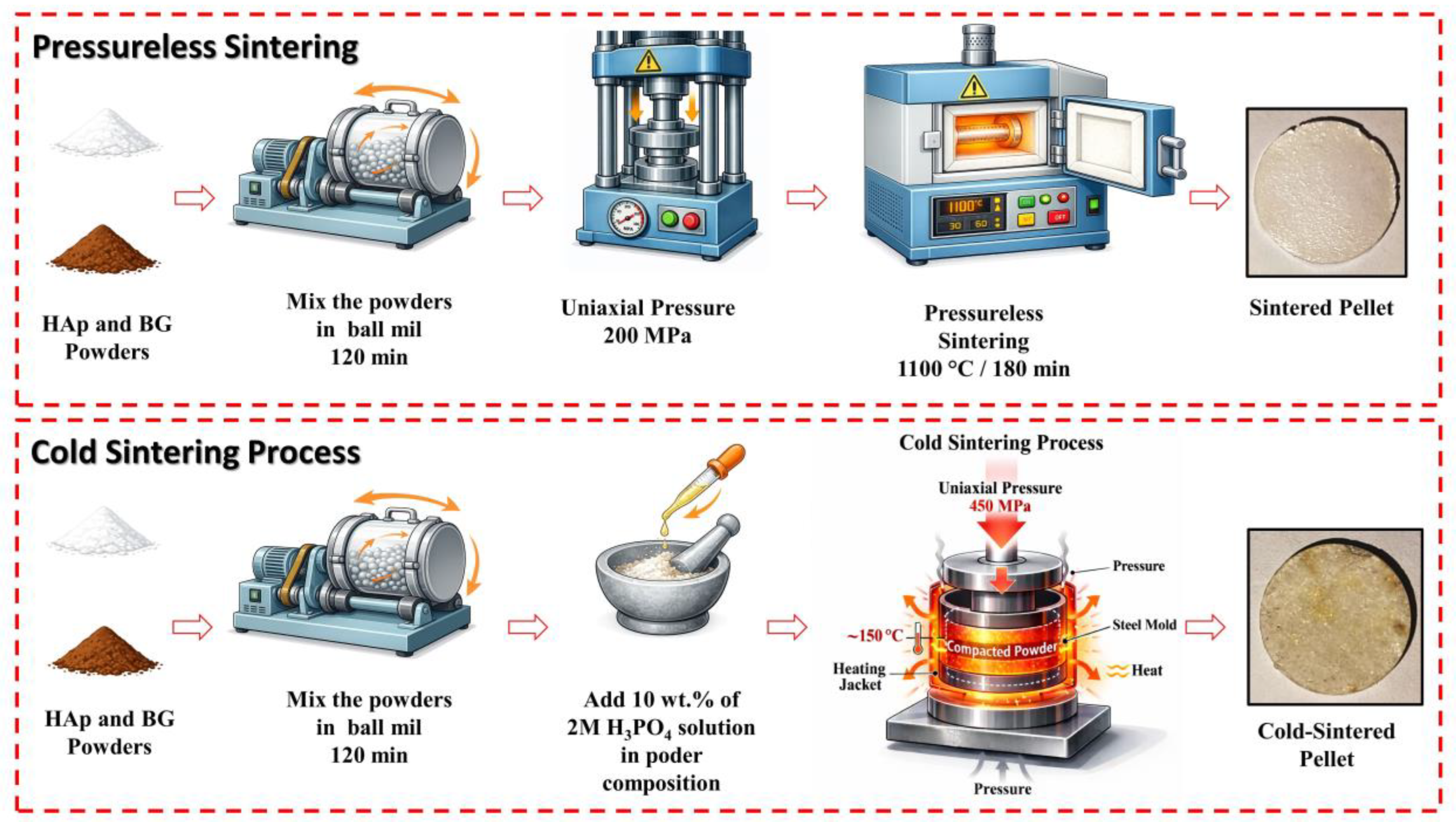
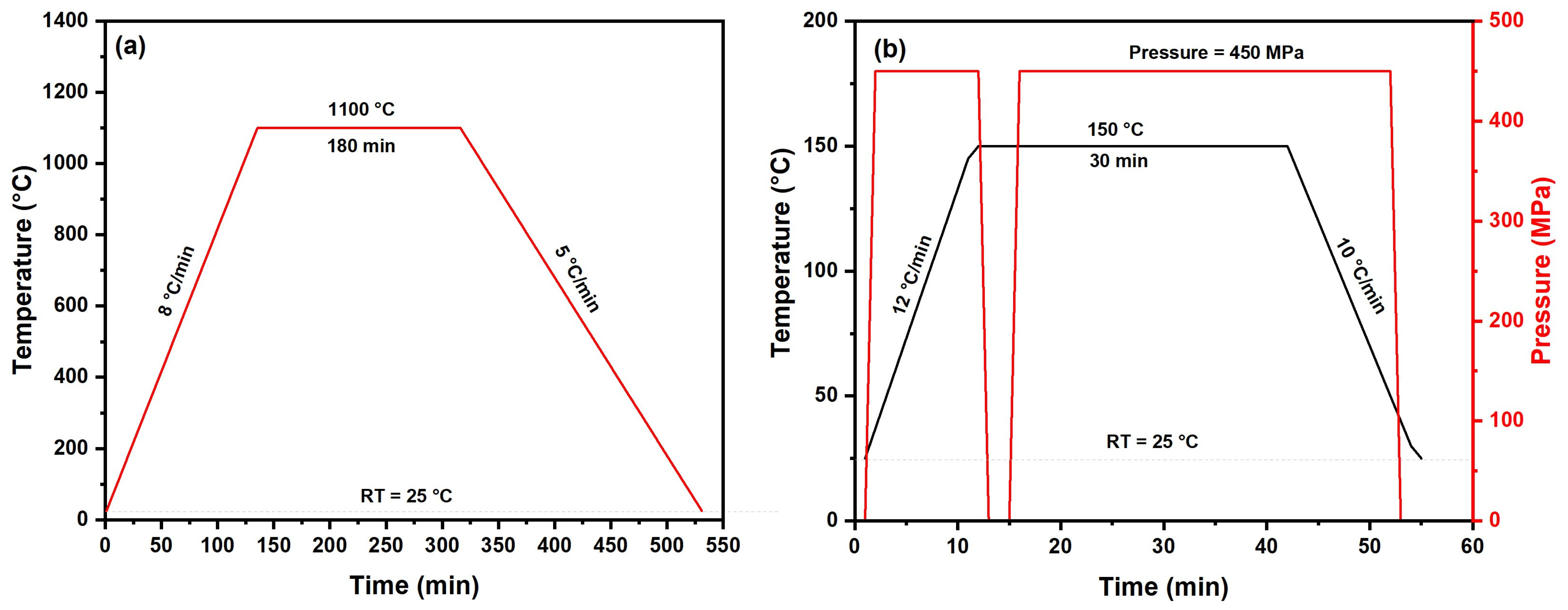
After the synthesis of the HAp and niobium–phosphate bioglass (BG) powders, two groups were prepared in terms of composition: the first consisted of pure HAp, and the second was composed of 96 wt.% HAp and 4 wt.% BG. Based on the rule of mixtures, the adopted density values were 3.16 g/cm3 for HAp and 2.956 g/cm3 for BG, resulting in a theoretical density of 3.1518 g/cm3 for the mixture. The HAp + BG powders were mixed in a ball mill for 120 min. Two different sintering routes were investigated for both materials: (i) conventional sintering and (ii) a novel cold sintering route, both illustrated in Figure 1. For pressureless sintering, the powders were first pressed into discs with a diameter of 13 mm using uniaxial pressing at 200 MPa. The green bodies were then sintered in a furnace at 1100 °C, with a heating rate of 8 °C/min, a holding time of 180 min at 1100 °C, followed by cooling at 5 °C/min down to room temperature. This route was adapted from the work of Feng et al. [20]. Figure 2a illustrates the heating schedule adopted for the pressureless sintering process.
Figure 1. Scheme illustrating the steps for the pressureless sintering and cold sintering process of HAp/BG ceramics.
Figure 2. Sintering ramps used in this paper: (a) pressureless sintering; (b) cold sintering process.
Cold sintering of the HAp and HAp/BG ceramics was carried out using a system consisting of a cylindrical metal die, a hydraulic press, and a collar-type heating element positioned around the die to provide localized heating. A 2M aqueous phosphoric acid solution was added at 10 wt.%, and the mixture was manually blended in an agate mortar to form a homogeneous paste. After mixing the powder with the phosphoric acid solution, no additional holding or aging time was applied before pressing. The mixture was homogenized and immediately transferred to the die for compaction. Cold sintering process was performed under simultaneous application of temperature and pressure, maintaining the samples at 150 °C under a uniaxial pressure of 450 MPa for 30 min. The heating schedule is shown in Figure 2b. This condition enabled the combined action of the three main cold sintering factors: moderate temperature, high mechanical pressure, and the presence of a transient liquid phase. As can be seen in Figure 1, the samples exhibited different appearances. The sample produced by pressureless sintering showed a white color, which is typical of specimens processed by this technique. In contrast, the samples produced by CSP exhibited a more yellowish coloration, along with a pearlescent appearance.

2.4. Characterization

2.4.1. Density Determination by the Archimedes Method

The apparent density of the sintered samples was determined based on Archimedes’ principle. For the density measurements, an analytical balance equipped with a specific density determination kit was used. The apparent density (ρ) was calculated from the mass of the dry sample (Mdry) and the mass of the sample immersed in liquid (Mimmersed). Water was used as the immersion liquid, and the analysis was carried out at room temperature, without vacuum, while the balance enclosure prevented air flow during the test. Equation (1) used to determine the density is shown below:
ρ = M D r y M D r y M i m m e r s e d ρ w a t e r

2.4.2. Scanning Electron Microscopy (SEM)

The fracture surfaces of the sintered specimens were examined by scanning electron microscopy (SEM) using a Quanta FEG 250 microscope (Hillsboro, OR, USA). The equipment, fitted with a field-emission electron source, was operated in high-vacuum mode at an accelerating voltage of 30 kV. All micrographs were acquired at a magnification of 6000× in order to evaluate the microstructural features and morphology of the ceramics investigated in this work. In addition, compositional observations were performed by energy-dispersive X-ray spectroscopy (EDX) at the same magnification. Before analysis, the samples were coated with a thin gold layer using a Leica ACE 600 sputter coater (Wetzlar, Germany) for 30 min to improve surface conductivity.

2.4.3. X-Ray Diffraction (XRD)

The phase and structural characterization of the samples was performed by X-ray diffraction (XRD) using an X’Pert Pro diffractometer (Malvern Panalytical B.V., EA Almelo, The Netherlands). The diffraction patterns were collected in the 2θ range from 15° to 80°, using a step size of 0.02° and a counting time of 2 s per step. The measurements were carried out with Co-Kα radiation, under operating conditions of 40 kV and 40 mA. The average crystallite size of hydroxyapatite was estimated from the diffraction data through the Debye–Scherrer equation (Equation (2)).
D = 0.9 λ β c o s θ
where D is the crystallite size (nm), λ is the wavelength of the incident radiation, β is the full width at half maximum (FWHM, in radians), and θ is the Bragg angle corresponding to the analyzed crystallographic plane. It should be noted that the values estimated from crystallite size do not represent the true accessible surface area of the partially sintered porous bodies, as would be obtained by a direct adsorption technique such as BET. Instead, they should be understood as comparative parameters derived from the crystallite size, assuming an idealized particle geometry and theoretical density. The specific surface area was calculated based on Equation (3) [21]:
S = 6 10 3 ( d ρ )
where S is the specific surface area, d is the average particle (or crystallite) size, and ρ is the material density.

2.4.4. Statistical Analysis

The density values obtained by the Archimedes method were statistically analyzed in order to verify the existence of significant differences among the evaluated groups. For this purpose, Analysis of Variance (ANOVA) was applied, adopting a 95% confidence level. Seven experimental results were considered for each group. This statistical procedure makes it possible to determine whether the differences observed among the group means are actually significant or can be attributed only to the random variability inherent to the measurements. The analysis was carried out using OriginPro 2021 software.
After ANOVA, Tukey’s HSD (Honestly Significant Difference) test was used for multiple comparison of the means. This complementary test was employed to identify specifically which pairs of groups showed statistically significant differences, while controlling the Type I error associated with multiple comparisons. The calculations adopted for Tukey’s HSD test are presented below [22]:
H S D = q E M S r

3. Results and Discussion

3.1. Density Results of HAp and HAp/BG Ceramics

The results for apparent density and densification of the samples are presented in Table 1.
Table 1. Density results of the sintered samples.
Data analysis shows that the samples processed by cold sintering exhibited higher apparent density and densification than those obtained by conventional sintering, regardless of composition. For pure hydroxyapatite, densification increased from 73.10% (pressureless) to 79.92% (CSP), corresponding to an increase of approximately 9.3%. For the sample containing 4 wt.% niobium–phosphate bioglass, densification rose from 68.43% to 83.54%, representing a pronounced increase of about 22.1%. This result highlights the effectiveness of cold sintering even at temperatures far below those used in conventional processing.
In addition, an inversion in the relative behavior between the pure samples and those containing 4 wt.% bioglass is observed. Under conventional sintering, pure hydroxyapatite showed higher densification than the BG-containing composition. Conversely, under cold sintering, the addition of BG led to higher densification compared to the BG-free sample.
This behavior can be attributed to intensified chemical interactions promoted by the presence of the niobium–phosphate bioglass during cold sintering, which employs a transient liquid phase (2 M H3PO4 solution, 10 wt.%). Under simultaneous heating and pressure, the acid promoted surface dissolution of hydroxyapatite grains, and the presence of BG, by increasing heterogeneity and interparticle contact area, enhanced the dissolution–reprecipitation mechanism. This resulted in more efficient consolidation and, consequently, higher final densification [23]. In the pressureless sintering route, no clear evidence of chemical interaction between HAp and BG was observed. Therefore, the densification behavior of the composite may be interpreted mainly as the result of the superposition of the individual sintering responses of each component, rather than the formation of a new reactive phase. A similar rationale has been used in other ceramic systems, where the final densification depends strongly on the intrinsic sintering behavior and spatial distribution of the starting phases [24]. Under CSP conditions, the improved densification observed for HAp/BG suggests that the presence of bioglass may have favored mass transport, possibly by modifying the local ionic environment and enhancing dissolution–reprecipitation phenomena in the phosphoric acid medium. However, this interpretation remains indirect in the present work. Further studies, particularly dissolution experiments involving BG in H3PO4 under conditions simulating CSP, would be valuable to clarify the effective role of the glass phase during densification.
Table 2 presents the one-way ANOVA results for the relative density of the analyzed groups. The analysis indicates a statistically significant effect of processing condition/composition on relative density (F(3,24) = 919.69, p = 6.79 × 10⁻²⁵, α = 0.05), confirming that the differences observed among the four sintered conditions are not due to random experimental variability. The very high proportion of explained variance (η2 = 0.991) further suggests that the treatment factor dominates the response, while within-group dispersion is comparatively small.
Table 2. Variance analysis (one-way ANOVA) for relative density (α = 0.05).
To identify which specific pairs differed, Tukey’s HSD post hoc test (Table 3) was applied (α = 0.05). All pairwise comparisons were significant (p < 0.05), indicating that each group constitutes a statistically distinct condition in terms of relative density. In practical terms, the ranking HAp/BG-CSP > HAp-CSP > HAp-PS > HAp/BG-PS was statistically supported, demonstrating not only the superiority of cold sintering over pressureless sintering, but also the marked positive role of the niobium–phosphate bioglass under CSP conditions. Conversely, under pressureless sintering, BG addition led to a significant reduction in relative density compared with pure HAp, reinforcing the inversion in behavior previously discussed.
Table 3. Tukey HSD (α = 0.05): pairwise comparison of mean relative density (%).
These statistical outcomes strengthen the microstructural interpretation: under CSP, the transient liquid phase promotes a dissolution–reprecipitation pathway that is intensified by the BG addition, yielding more effective pore filling and interparticle bonding, which translates into a measurable and statistically robust densification gain. Under pressureless sintering, however, the same BG addition likely disrupts diffusion-driven neck growth and/or promotes residual porosity in this composition range, resulting in a significantly lower relative density. Overall, the ANOVA/Tukey results provide quantitative confirmation that both processing route and BG addition significantly modulate densification, with the CSP route delivering the most favorable outcome—particularly for the HAp/BG composite.

3.2. Morphological Analysis (SEM/EDX)

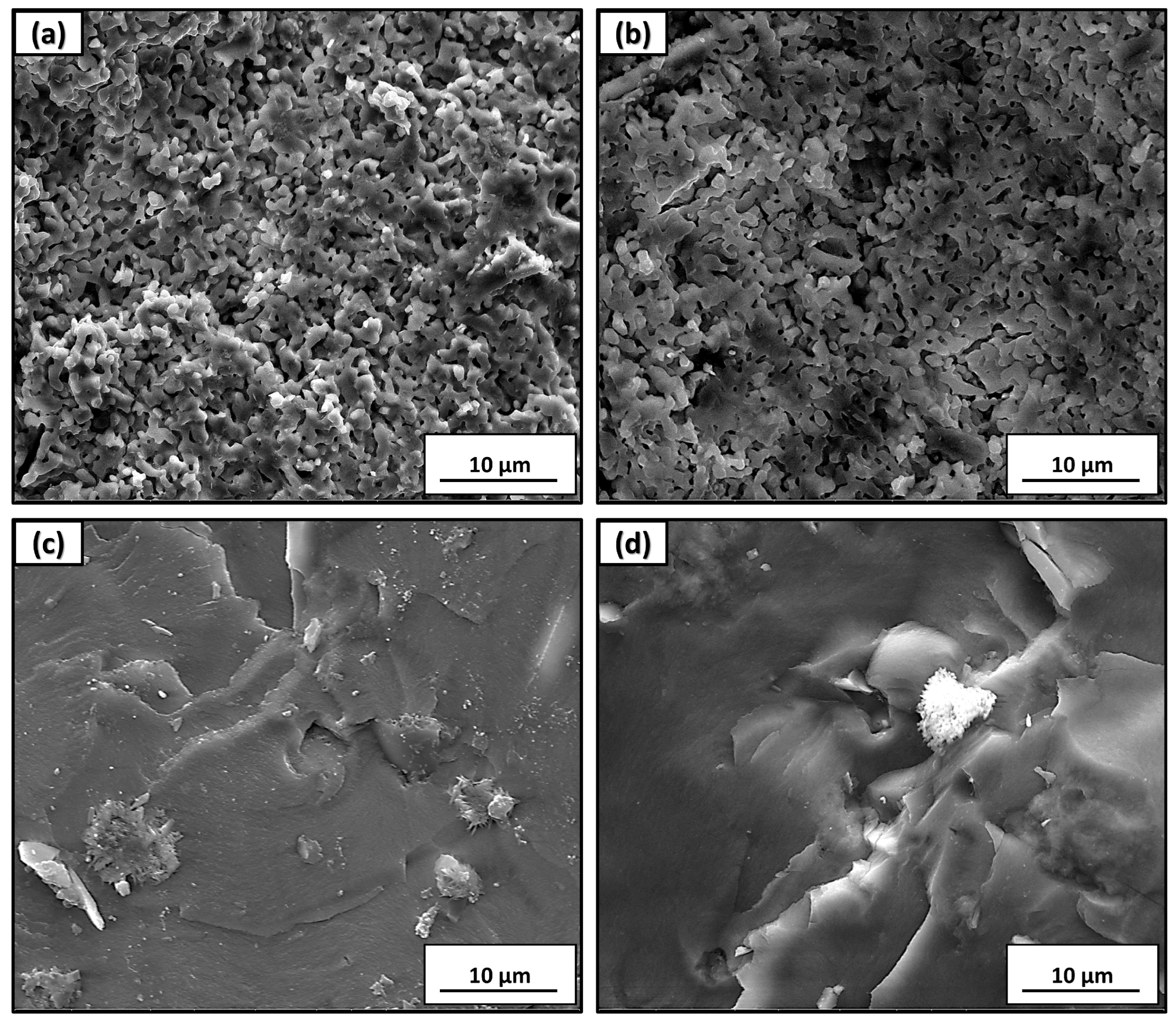
The SEM micrographs in Figure 3 highlight clear microstructural differences between pressureless-sintered (PS, 1100 °C) and cold-sintered (CSP, 150 °C) HAp-based ceramics.
Figure 3. SEM micrographs of HAp and HAp/BG ceramics: (a) HAp-PS; (b) HAp/BG-PS; (c) HAp-CSP; (d) HAp/BG-CSP.
For the PS samples, both HAp-PS (Figure 3a) and HAp/BG-PS (Figure 3b) exhibit a markedly porous microstructure, with abundant intergranular voids and a network of interconnected pores at the ~10 µm scale. The microstructure is dominated by loosely bonded grains and limited neck development, consistent with incomplete pore elimination. In HAp/BG-PS, the pore network remains pronounced and the surface appears similarly heterogeneous, indicating that the addition of 4 wt.% BG does not provide an effective densification aid under pressureless conditions at 1100 °C, corroborating the lower relative density measured for this group.
In contrast, the CSP samples are substantially more consolidated. HAp-CSP (Figure 3c) shows a much denser surface with broad, smooth regions and only sparse residual defects, suggesting effective particle bonding and pore filling. The effect is even more evident in HAp/BG-CSP (Figure 3d), which displays a highly compact and continuous morphology with reduced open porosity; local bright clusters can be observed, consistent with BG-rich regions or reprecipitated products associated with the transient liquid-assisted mechanism. Overall, the CSP microstructures are compatible with a dissolution–reprecipitation-driven consolidation pathway promoted by the 2 M H3PO4 transient liquid, and the presence of BG appears to intensify interparticle bonding and porosity elimination—visually confirming the densification ranking obtained experimentally (HAp/BG-CSP > HAp-CSP > HAp-PS > HAp/BG-PS).
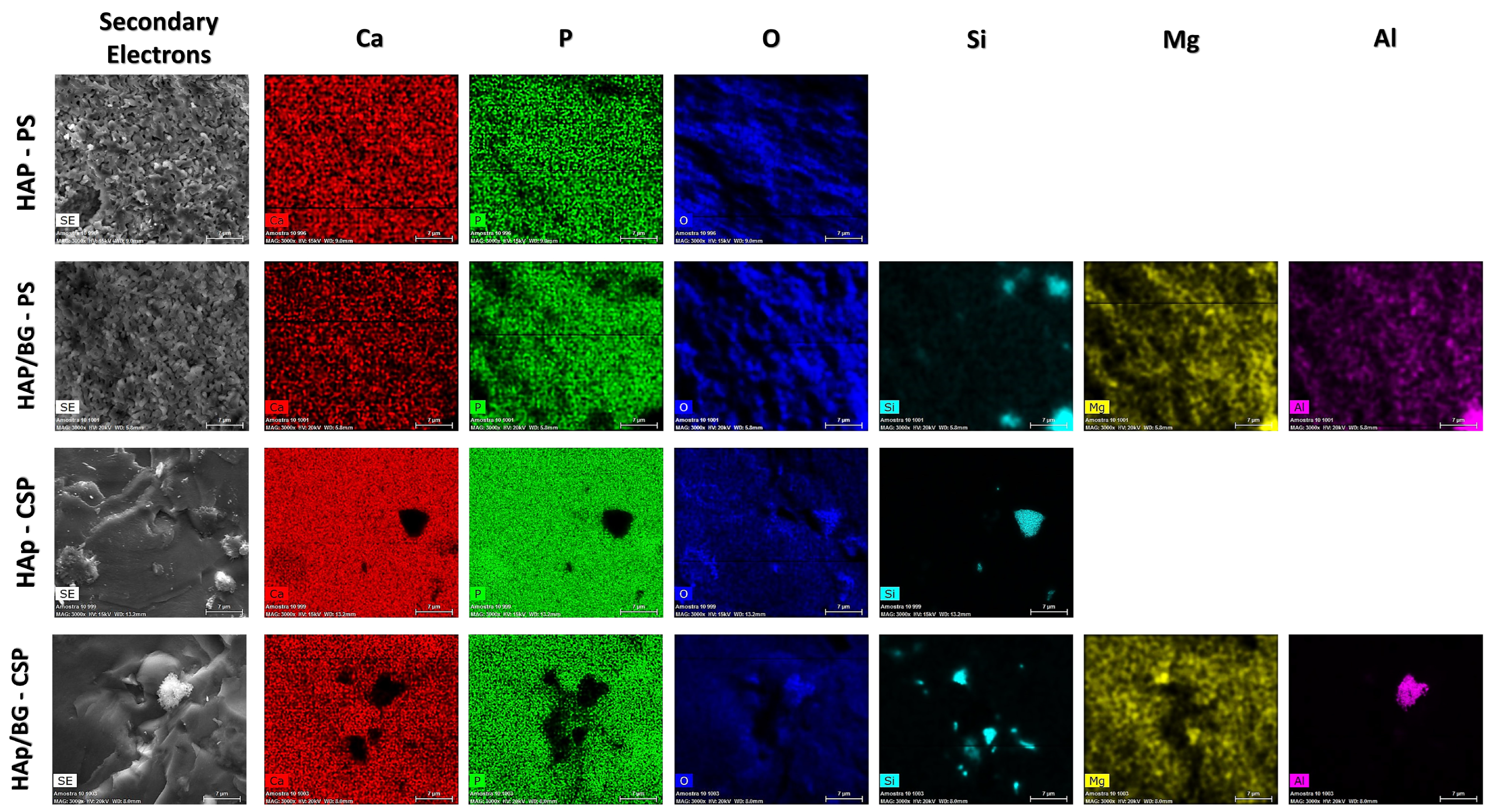
The EDS analyses shown in Figure 4, together with the semi-quantitative results in Table 4, allow the SEM-observed microstructure to be correlated with the elemental composition of the samples, highlighting differences between the sintering methods and the influence of the BG addition on the composition of HAp.
Figure 4. Compositional maps of HAp e HAp/BG ceramics.
Table 4. Weight concentration of the elements present in the sintered samples.
In the HAp samples, cold sintering promoted changes in the ratio among the main elements. For the sample sintered at 1100 °C, the Ca, P, and O contents were 47.37%, 21.88%, and 30.75%, respectively, whereas the sample processed at 150 °C exhibited 46.61% Ca, 29.20% P, and 23.57% O. A 33.5% increase in the phosphorus content is observed for the cold-sintered sample, accompanied by a decrease in oxygen, suggesting a stronger contribution of the transient liquid phase to the reconstruction of the calcium–phosphate structure and improved chemical rearrangement, consistent with the higher densification observed.
For the samples containing 4 wt.% BG, the presence of Si, Mg, and Al becomes evident. Under conventional sintering, the composition was 54.97% Ca, 20.13% P, and 23.48% O, with 1.05% Si, 0.36% Mg, and 0.01% Al. Under cold sintering, the distribution was 51.82% Ca, 27.05% P, and 20.29% O, with 0.44% Si, 0.20% Mg, and 0.21% Al. Cold sintering promoted greater elemental homogenization, with reduced Si and Mg contents, possibly due to improved incorporation of BG into the matrix, and a 34.5% increase in P relative to conventional sintering.
It is worth noting that the detection of small amounts of Si and Al, even at very low levels, may be associated with minor contamination introduced during powder handling and processing. In particular, the presence of Al may plausibly be related to wear from the Al2O3 milling media used during bioglass preparation, rather than exclusively to contamination during liquid-phase preparation in the beaker. This interpretation is supported by the absence of Si- and Al-rich phases in the nominal composition of pure HAp and by the very low concentrations detected.

3.3. Microstructural Analysis

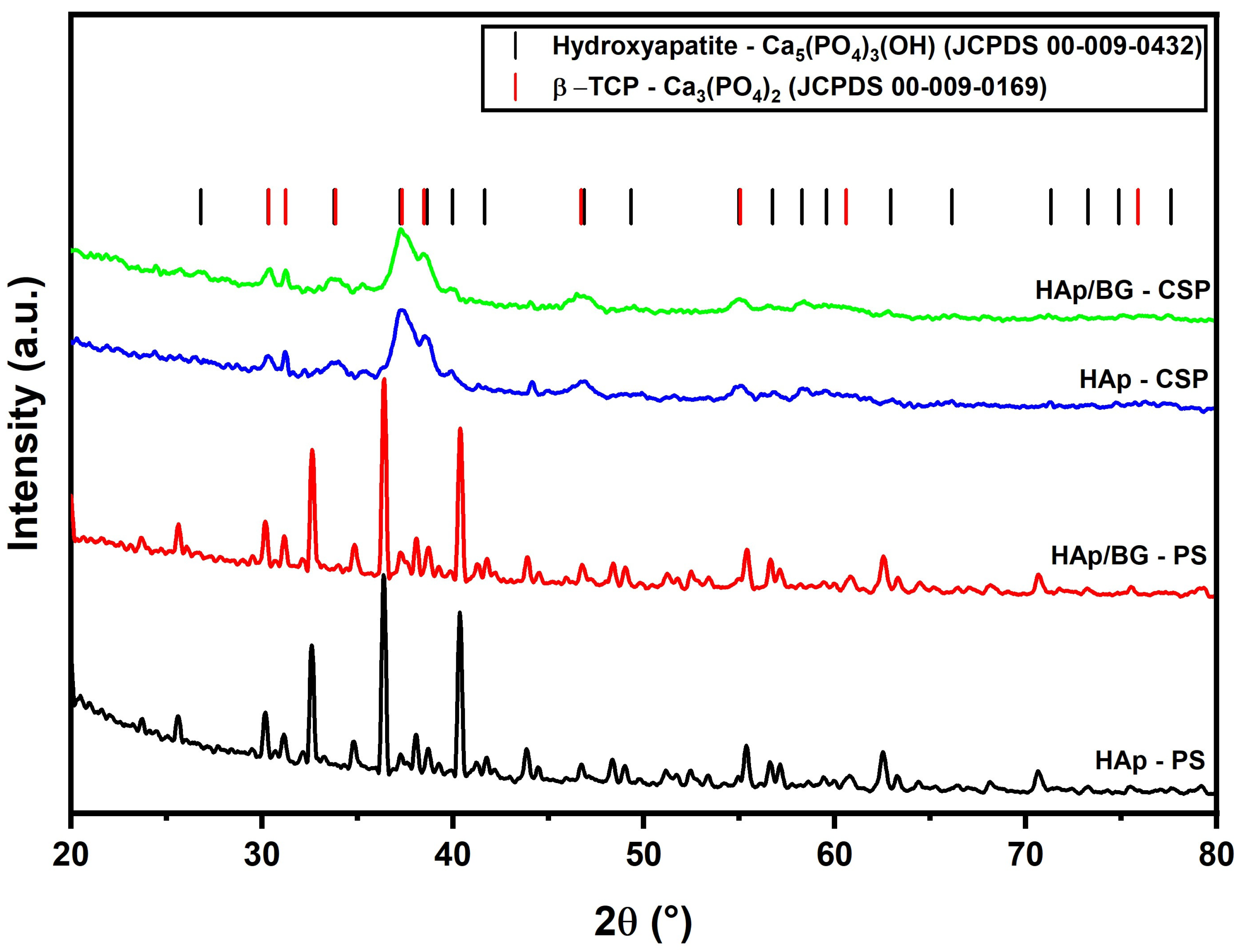
Figure 5 shows the XRD patterns of HAp and HAp/BG sintered by conventional and cold sintering routes, while Table 5 presents the mean crystallite size and surface energy results for the samples.
Figure 5. XRD patterns of HAp and HAp/BG ceramics.
Table 5. Crystalite size and specific surface area obtained by XRD for HAp and HAp/BG ceramics.
For the PS samples (1100 °C), the diffractograms present sharp and high-intensity reflections, characteristic of highly crystalline materials. Peak indexing confirms the presence of hydroxyapatite (HAp, Ca5(PO4)3(OH); JCPDS 00-009-0432) [25] as the main phase, together with additional reflections assigned to β-tricalcium phosphate (β-TCP, Ca3(PO4)2; JCPDS 00-009-0169) [26]. The emergence of β-TCP indicates partial HAp decomposition at high temperature, consistent with the known loss of HAp phase stability above ~900 °C. The narrower and more intense peak profiles also imply reduced peak broadening, which is directly associated with crystallite coarsening; this trend agrees with the larger crystallite sizes obtained for PS samples (26.74 ± 11.37 nm for HAp and 30.10 ± 5.48 nm for HAp/BG) and the concomitant reduction in surface energy (85.20 ± 39.53 m2/g and 64.42 ± 8.74 m2/g, respectively), as diffusion-driven sintering promotes grain growth and lowers specific surface area.
In contrast, the CSP samples (150 °C) exhibit diffractograms with broader and less intense peaks, a signature of nanometric domains and lower long-range crystallinity. Their peak profile closely resembles that commonly observed for HAp powders obtained by wet precipitation, supporting the interpretation that CSP preserves a nanostructured character rather than inducing substantial grain growth. It is important to emphasize that only the HAp phase (JCPDS 00-009-0432) was detected in the samples processed by CSP, with no reflections attributed to β-TCP, indicating that, under the conditions employed, cold sintering preserved the phase integrity of hydroxyapatite and avoided the thermal transformations normally associated with heating at elevated temperatures. This behavior is consistent with the mild nature of CSP processing, which limits the dehydroxylation and thermal decomposition of HAp, while also restricting crystal growth [27,28,29]. As a consequence, the samples obtained by CSP exhibited smaller crystallite sizes (19.36 ± 7.15 nm for HAp and 17.68 ± 6.13 nm for HAp/BG), which also contributes to higher surface energy values due to the higher surface area-to-volume ratio characteristic of finer crystallites.
Notably, no crystalline phases attributable to the niobium–phosphate bioglass (BG) were identified in any condition. This may indicate that the BG fraction remains amorphous and/or below the XRD detection limit, and/or that its constituents undergo partial dissolution in the transient liquid during CSP. Under PS, the absence of BG-related crystalline peaks may similarly reflect amorphization, dissolution–reaction with the Ca–P matrix, or redistribution during high-temperature exposure, yielding products that are either amorphous or present at levels insufficient for detection.

4. Conclusions

This study demonstrates that the cold sintering process (CSP) is an effective low-temperature route for consolidating hydroxyapatite (HAp) and HAp/niobium–phosphate bioglass (HAp/BG) composites, outperforming pressureless sintering (PS) in densification while preserving phase stability. Under CSP conditions (150 °C/450 MPa/30 min with 2 M H3PO4, 10 wt.%), relative density increased from 73.10% to 79.92% for pure HAp and from 68.43% to 83.54% for HAp/BG, reaching up to a 22.1% improvement over PS (1100 °C/180 min). Statistical analysis (ANOVA followed by Tukey HSD) confirmed that all groups differ significantly, supporting the ranking HAp/BG-CSP > HAp-CSP > HAp-PS > HAp/BG-PS.
Microstructural observations by SEM corroborated the densification data, with CSP producing more consolidated and homogeneous structures, particularly when BG was added, consistent with intensified dissolution–reprecipitation and enhanced pore filling. XRD results further showed that PS promoted partial HAp degradation with β-TCP formation, whereas CSP preserved the HAp phase, yielding broader peaks associated with smaller crystallite size and higher specific surface area. Overall, CSP offers a promising alternative for processing HAp-based bioceramics, and the addition of a small fraction of niobium–phosphate BG is especially beneficial under CSP, enabling improved consolidation without high-temperature-induced phase decomposition.

Author Contributions

Conceptualization, P.H.P.M.d.S. and M.H.P.d.S.; methodology, P.H.P.M.d.S. and A.M.d.A.; software, P.H.P.M.d.S. and A.M.d.A.; validation, P.H.P.M.d.S.; M.H.P.d.S.; and A.M.d.A.; formal analysis, P.H.P.M.d.S. and A.M.d.A.; investigation, P.H.P.M.d.S. and A.M.d.A.; resources, P.H.P.M.d.S. and M.H.P.d.S.; data curation, P.H.P.M.d.S. and A.M.d.A.; writing—original draft preparation, P.H.P.M.d.S.; writing—review and editing, P.H.P.M.d.S. and M.H.P.d.S.; visualization, A.M.d.A. and M.H.P.d.S.; supervision, P.H.P.M.d.S.; project administration, P.H.P.M.d.S.; funding acquisition, P.H.P.M.d.S. All authors have read and agreed to the published version of the manuscript.

Funding

The authors acknowledge the Carlos Chagas Filho Foundation for Research Support of the State of Rio de Janeiro (FAPERJ), grant number E-26/202.081/2025 and E-26/210.517/2025 for the financial support.

Institutional Review Board Statement

Not applicable.

Data Availability Statement

The original contributions presented in this study are included in the article. Further inquiries can be directed to the corresponding author.

Conflicts of Interest

The authors declare no conflicts of interest.

References

  1. da Silveira, P.H.P.M.; Lopes, I.J.V.R.; Ribeiro, S.B.N.; Le Sénéchal, N.V.; dos Santos, J.L.; da Rocha, D.N.; da Silva, M.H.P. Synthesis and characterization of lithium fluoride-doped hydroxyapatite by aqueous precipitation. Contrib. Cienc. Soc. 2024, 17, 8293. [Google Scholar] [CrossRef]
  2. Yang, C.-C.; Lin, P.-Y.; Dey, G.; Maity, J.P.; Sharma, R.K.; Wang, C.-W.; Ali, S.; Chen, C.-Y. Hydrothermal synthesis of hydroxyapatite nanoparticles using biosurfactant and application on mesenchymal stem cells. Ceram. Int. 2025, 51, 19091–19101. [Google Scholar] [CrossRef]
  3. Bertocco, A.; Capela, M.; Caetano, A.P.F.; Nito, A.; Quarta, A.; Seabra, M.P.; Pullar, R.C. Porous hydroxyapatite–β-tricalcium phosphate ceramics produced from a rapid sol-gel process. Sci. Rep. 2025, 15, 16422. [Google Scholar] [CrossRef] [PubMed]
  4. Chen, X.; Li, H.; Ma, Y.; Jiang, Y. Calcium Phosphate-Based Nanomaterials: Preparation, Multifunction, and Application for Bone Tissue Engineering. Molecules 2023, 28, 4790. [Google Scholar] [CrossRef]
  5. Karalkeviciene, R.; Raudonyte-Svirbutaviciene, E.; Zarkov, A.; Yang, J.-C.; Popov, A.I.; Kareiva, A. Solvothermal Synthesis of Calcium Hydroxyapatite via Hydrolysis of Alpha-Tricalcium Phosphate in the Presence of Different Organic Additives. Crystals 2023, 13, 265. [Google Scholar] [CrossRef]
  6. Kamal, M.M.; Mahmud, S.; Plabon, I.A.; Kader, M.A.; Islam, M.N. Effects of sintering temperature on the physical, structural, mechanical and antimicrobial properties of extracted hydroxyapatite ceramics from Anabas testudineus bone and head scull for biomedical applications. Results Mater. 2024, 22, 100590. [Google Scholar] [CrossRef]
  7. Chen, H.; Lo, W.-L.; Lee, S.-Y.; Lin, Y.-M. Controlling sintering temperature for biphasic calcium phosphate scaffolds using submicron hydroxyapatite slurries for LCD 3D printing. Ceram. Int. 2024, 50, 11060–11074. [Google Scholar] [CrossRef]
  8. Ressler, A.; Zakeri, S.; Dias, J.; Hannula, M.; Hyttinen, J.; Ivanković, H.; Ivanković, M.; Miettinen, S.; Schwentenwein, M.; Levänen, E.; et al. Vat photopolymerization of biomimetic bone scaffolds based on Mg, Sr, Zn-substituted hydroxyapatite: Effect of sintering temperature. Ceram. Int. 2024, 50, 27403–27415. [Google Scholar] [CrossRef]
  9. Grasso, S.; Biesuz, M.; Zoli, L.; Taveri, G.; Duff, A.I.; Ke, D.; Jiang, A.; Reece, M.J. A review of cold sintering processes. Adv. Appl. Ceram. 2020, 119, 115–143. [Google Scholar] [CrossRef]
  10. Galotta, A.; Sglavo, V.M. The cold sintering process: A review on processing features, densification mechanisms and perspectives. J. Eur. Ceram. Soc. 2021, 41, 1–17. [Google Scholar] [CrossRef]
  11. Mamaghani, K.R.; Parvin, N. Cold sintering for in-space materials fabrication: A science, engineering, and future directions. Multiscale Multidiscip. Model. Exp. Des. 2026, 9, 86. [Google Scholar] [CrossRef]
  12. Marín-Cortés, S.; Biesuz, M.; Bhandari, S.; Franchin, G.; Enríquez, E.; Fernández, J.F.; Sglavo, V.M. Cold sintering of complex-shaped ceramic materials. J. Eur. Ceram. Soc. 2024, 44, 116813. [Google Scholar] [CrossRef]
  13. Biesuz, M.; Taveri, G.; Duff, A.I.; Olevsky, E.; Zhu, D.; Hu, C.; Grasso, S. A theoretical analysis of cold sintering. Adv. Appl. Ceram. 2020, 119, 75–89. [Google Scholar] [CrossRef]
  14. da Silveira, P.H.P.M.; Lima, A.M.; de Azevedo, A.M.; Eltom, A.E.; Lima, E.S.; Ferreira, C.L.; Ribeiro, A.A.; da Silva, M.H.P. Cold sintering process of graphene oxide-reinforced hydroxyapatite composites. J. Eur. Ceram. Soc. 2026, 46, 118052. [Google Scholar] [CrossRef]
  15. Hassan, M.U.; Akmal, M.; Ryu, H.J. Cold sintering of as-dried nanostructured calcium hydroxyapatite without using additives. J. Mater. Res. Technol. 2021, 11, 811–822. [Google Scholar] [CrossRef]
  16. Gunawan; Arifin, A.; Yani, I.; Oemar, B.; Sudarsono; Ramli, M.I.; Wijayanto, I.G. Preparation and Characterization of Hydroxyapatite Based Composite Material via Cold Sintering Process. J. Adv. Res. Micro Nano Eng. 2024, 21, 127–136. [Google Scholar] [CrossRef]
  17. Navarro da Rocha, D.; de Oliveira Cruz, L.R.; do Prado Neto, J.L.; Ayad, N.M.E.; de Andrade Gobbo, L.; Prado da Silva, M.H. Production and Characterization of Hydroxyapatite/Niobo Phosphate Glass Scaffold. Key Eng. Mater. 2014, 587, 128–131. [Google Scholar] [CrossRef]
  18. Da Silva, M.H.P.; Lima, J.; Soares, G.; Elias, C.; de Andrade, M.; Best, S.; Gibson, I. Transformation of monetite to hydroxyapatite in bioactive coatings on titanium. Surf. Coat. Technol. 2001, 137, 270–276. [Google Scholar] [CrossRef]
  19. Prado da Silva, M.H.; Ramirez, C.M.; Granjeiro, J.M.; Rossi, A.M. In vitro assessment of new niobium phosphate glasses and glass ceramics. Key Eng. Mater. 2007, 361–363, 229–232. [Google Scholar] [CrossRef]
  20. Feng, P.; Niu, M.; Gao, C.; Peng, S.; Shuai, C. A Novel Two-Step Sintering for Nano-Hydroxyapatite Scaffolds for Bone Tissue Engineering. Sci. Rep. 2014, 4, 5599. [Google Scholar] [CrossRef]
  21. Kumar, K.C.V.; Subha, T.J.; Ahila, K.G.; Ravindran, B.; Chang, S.W.; Mahmoud, A.H.; Mohammed, O.B.; Rathi, M.A. Spectral characterization of hydroxyapatite extracted from Black Sumatra and Fighting cock bone samples: A comparative analysis. Saudi J. Biol. Sci. 2021, 28, 840–846. [Google Scholar] [CrossRef] [PubMed]
  22. Nanda, A.; Mohapatra, B.B.; Mahapatra, A.; Mahapatra, A.A.P.K. Multiple comparison test by Tukey’s honestly significant difference (HSD): Do the confident level control type I error. Int. J. Stat. Appl. Math. 2021, 6, 59–65. [Google Scholar] [CrossRef]
  23. Kumar, M.; Achour, M.A.B.; Lasgorceix, M.; Quadros, P.; Mincheva, R.; Raquez, J.-M.; Leriche, A. Densification of hydroxyapatite through cold sintering process: Role of liquid phase chemistry and physical characteristic of HA powder. Open Ceram. 2024, 17, 100566. [Google Scholar] [CrossRef]
  24. Xu, P.; Wang, H.; Zheng, K.; Chen, B.; Yang, M.; Chen, Q.; Wang, B.; Tu, B.; Wang, W.; Fu, Z. Novel Transparent ZnO·3Al2O3 Ceramics Prepared by Reactive Hot Isostatic Pressing. J. Eur. Ceram. Soc. 2022, 42, 724–728. [Google Scholar] [CrossRef]
  25. de Wolff, P. Calcium Phosphate Hydroxide (Hydroxyapatite); Technisch Physische Dienst: Delft, The Netherlands, 1959; ICDD Grant-in-Aid; Data available in Powder Diffraction File (PDF 00-009-0432), International Centre for Diffraction Data (ICDD). [Google Scholar]
  26. de Wolff, P. Calcium Phosphate; Technisch Physische Dienst: Delft, The Netherlands, 1957; ICDD Grant-in-Aid; Data available in Powder Diffraction File (PDF 00-009-0169), International Centre for Diffraction Data (ICDD). [Google Scholar]
  27. Kamieniak, J.; Kelly, P.J.; Banks, C.E.; Doyle, A.M. Mechanical, pH and Thermal Stability of Mesoporous Hydroxyapatite. J. Inorg. Organomet. Polym. Mater. 2018, 28, 84–91. [Google Scholar] [CrossRef]
  28. Nilen, R.W.N.; Richter, P.W. The Thermal Stability of Hydroxyapatite in Biphasic Calcium Phosphate Ceramics. J. Mater. Sci. Mater. Med. 2008, 19, 1693–1702. [Google Scholar] [CrossRef] [PubMed]
  29. Zhu, Q.; Ablikim, Z.; Chen, T.; Cai, Q.; Xia, J.; Jiang, D.; Wang, S. The Preparation and Characterization of HA/β-TCP Biphasic Ceramics from Fish Bones. Ceram. Int. 2017, 43, 12213–12220. [Google Scholar] [CrossRef]
Disclaimer/Publisher’s Note: The statements, opinions and data contained in all publications are solely those of the individual author(s) and contributor(s) and not of MDPI and/or the editor(s). MDPI and/or the editor(s) disclaim responsibility for any injury to people or property resulting from any ideas, methods, instructions or products referred to in the content.

Article Metrics

Citations

Article Access Statistics

Multiple requests from the same IP address are counted as one view.