
Next Article in Journal
Tuning Oxygen Reduction Kinetics in LaSrCoO4 with Strained Epitaxial Thin Films and Wrinkled Freestanding Membranes
Next Article in Special Issue
The Influence of Different Zirconium Oxide Processing Variants on Selected Parameters of Roughness, Surface Wettability, and Phase Transformations
Previous Article in Journal
The Effect of Ni Doping on the Mechanical and Thermal Properties of Spinel-Type LiMn2O4: A Theoretical Study
Previous Article in Special Issue
The Influence of Graphene Oxide Concentration and Sintering Atmosphere on the Density, Microstructure, and Hardness of Al2O3 Ceramics Obtained by the FFF Method
 
 
Due to scheduled maintenance work on our servers, there may be short service disruptions on this website between 11:00 and 12:00 CEST on March 28th.
Article

Sustainable Production of Mullite Grogs from Industrial By-Products
1
Department of Environmental Engineering, Faculty of Mining and Geology, VSB—Technical University of Ostrava, 708 00 Ostrava, Czech Republic
2
Czech Geological Survey, Geologická 577/6, 152 00 Prague, Czech Republic
*
Author to whom correspondence should be addressed.
Ceramics 2026, 9(1), 6; https://doi.org/10.3390/ceramics9010006

Submission received: 20 November 2025 / Revised: 26 December 2025 / Accepted: 7 January 2026 / Published: 12 January 2026
(This article belongs to the Special Issue Advances in Ceramics, 3rd Edition)

Abstract

This study focuses on preparing mullite grogs derived from selected waste materials and kaolin treated with advanced technologies to achieve high thermal resistance and low thermal expansion. The investigated waste materials include dust removal RON, slurry DE, feldspar dust removal from Halamky, and waste generated during the feldspar grinding at the Halamky I deposit. These materials (Red kaolin from Vidnava, Slurry DE, Dust-off RON, Feldspar dust-off Halamky) were processed into grogs and subsequently applied for the production of high-mullite ceramics. The influence of cristobalite admixture was also assessed. The chemical composition was determined by X-ray fluorescence (XRF), while the phase composition was analysed by X-ray diffraction (XRD). Amorphous mullite grogs with mullite contents greater than 40% were successfully prepared. Despite the relatively high iron content, the resulting products exhibited the desired white colour after firing and demonstrated properties that make them promising candidates for advanced refractory applications. The study highlights the potential to valorise industrial waste materials for high-value ceramic applications.

1. Introduction

The extraction of mineral resources always has an impact on the environment (deterioration of environmental quality), and for this reason, mining itself (surface quarries) is problematic from an environmental point of view. Mining generates mining waste, such as overburden, interlayers, and deposit defects, which do not meet the requirements for usable raw materials. These materials are stored in tailings ponds or waste piles. Currently, legislation requires that the amount of waste generated during mining be reduced as much as possible. It is for this reason that the field of applied research dealing with the use of waste materials is developing. Another reason for the development of this area of research is the need to minimise the environmental impact of human industrial activity. These typically include recycled waste, drift dust, ground dust, and liquid waste sediments [1,2].
Refractory grogs serve as components in ceramic bodies in addition to plastic clay (ball clay or kaolin) and flux melting agents (feldspar or pegmatite) [3]. The industry currently produces high-refractory grogs based on high-alumina kaolins with a high kaolinite content (Al2O3·2SiO2·2H2O), but increasing prices and environmental concerns require the use of waste material [4].
Various secondary materials have been investigated, including ceramic production sludges containing kaolin, feldspar, and quartz sand [5], waste from kaolinitic raw material extraction [6,7], and sludge water for wet grinding [8]. Other tested materials include lime production dust, fly ash, coal clay [4,9], granite and quartz aggregate dust [10,11], burnt porcelain shards as flux substitutes [12,13] or strength enhancing grogs [14], and various industrial wastes [2,15,16,17].
Alternative processing technologies, such as fluidised bed separation instead of energy-intensive elutriation, offer additional sustainability improvements [18,19]. Currently, recycled materials are mainly used for lower-quality products such as bricks [4], stoneware pipes [5], and tiles [14,20,21,22]. The use of these materials for high-mullite refractory grogs, however, remains an underexplored area of research and application. Even waste porcelain materials with as little as 20% mullite content have found successful application as flux substitutes [14].
Industrially, high-mullite materials are typically obtained by burning kaolinite or Al2O3-rich precursors, with the resulting refractory properties strongly influenced by precursor characteristics, particularly the mineralogical composition and structural arrangement of kaolinite [23,24]. When kaolinite is fired above 1000 °C, it transforms into metakaolinite, spinel, and primary mullite, which subsequently converts to secondary mullite accompanied by cristobalite formation at 1350–1450 °C [25,26]. The presence of cristobalite is generally undesirable. Mineralisers such as Na, K, Ca, Mg, Fe, and Ti oxides markedly affect mullite formation; K2CO3 promotes mullite growth, whereas Fe2O3 causes brown discolouration [26,27]. At temperatures of 1600–1700 °C, Fe2O3 further influences crystal morphology and the resolution of lattice defects [28].
This study aims to prepare mullite grogs from waste materials and specially treated kaolins exhibiting high thermal resistance and low thermal expansion, comparing grogs containing cristobalite—which affects expansion but enhances SiO2 bonding—with those without cristobalite.

2. Materials and Methods

Waste materials are typically incorporated directly into ceramic bodies to manufacture the final product. However, this study explores an alternative approach: using waste materials as raw materials for grog production. This requires preliminary processing of waste materials into shapeless grogs (typically crushes), which are then indirectly incorporated into refractory-shaped product manufacturing.

2.1. Used Materials

Kaolin: Red kaolin from the Vidnava deposit was used as a representative of high-alumina, low-alkaline kaolins. Two grain size fractions were used as follows: 0–63 µm and 0–100 µm, both characterised by an elevated ferric oxide content (Fe2O3). These kaolins were prepared using specialised dry sorting technologies [18].
Waste Materials: Various waste materials generated during the production of raw materials in the ceramic industry were utilised. A detailed description of the materials is provided in Table 1. All selected materials exhibit high Al2O3 content, with the exception of feldspar dust-off, which serves as a flux component.

2.2. Experimental Design

Feldspar dust-off was incorporated into formulations in varying proportions to evaluate its effect on mullite formation and cristobalite elimination:
  • 0%—Control samples without flux addition (V1, V5, V9, V13).
  • 4%—Optimal flux content for mullite formation (V2, V6, V10, V14).
  • 8%—Optimal flux content for cristobalite elimination (V3, V7, V11, V15).
  • 16%—Excessive flux content example (V4, V8, V12, V16).
The inclusion of excessive flux formulations was intentional, as extreme additions may cause unwanted mullite dissolution while potentially contributing to beneficial cristobalite dissolution, improving material safety. The specific composition of individual recipes is shown in Table 2.

2.3. Loss of Ignition (L.O.I.)

Loss of ignition was determined gravimetrically according to CSN 72 0103 [29], and based on sample weight determination before and after ignition [30]. Samples were first dried to constant weight at 105 °C in porcelain crucibles, which were also pre-dried to constant weight at 105 °C. The actual ignition was performed at 1100 °C in an electric laboratory kiln.

2.4. X-Ray Fluorescence Analysis (XRF)

The chemical composition was determined using a DELTA Professional handheld X-ray fluorescence spectrometer (Olympus Corporation, Tokyo, Japan) designed for metals, alloys, and other materials analysis. The instrument features a miniature X-ray tube (4W, max. 200 µA current) and a large area Silicon Drift Detector (SDD), ensuring high sensitivity and low detection limits for light elements including Mg, Al, Si, P, and S. Results were evaluated and quantified using Innov-X Delta Advanced PC software (Innov-X Systems, version 2.5, Waltham, MA, USA).

2.5. X-Ray Diffraction Analysis (XRD)

The mineralogical composition was determined using powder X-ray diffraction on a Bruker D8 Advance powder X-ray diffractometer (Bruker AXS, Karlsruhe, Germany), in a Bragg-Brentan configuration. CuKα radiation, a position-sensitive Lynx Eye XE detector, and Soller apertures (2.5°) were used in the primary and secondary beams. The diffraction record was taken in the angular range of 4 to 80° 2Θ with a step of 0.015°, with an automatic divergence aperture (ADS 10 mm) and a reading time of 0.8 s per step. X-ray diffraction patterns were qualitatively evaluated using Diffrac.Eva software version V7 (Bruker AXS, 2015, Billerica, MA, USA) with the PDF-2 database (ICDD 2018, Newtown Square, PA, USA). Quantitative phase analysis was performed using the Rietveld method [31]. Implemented in Topas 5 software (Bruker AXS, 2014). Crystal structure models were obtained from the ICSD database (FIZ 2021, Eggenstein-Leopoldshafen, Germany). The sum of all the phases determined was normalised to 100% by weight. The detection limit of the method ranges from approximately 0.2 to 2% by weight, depending on the nature of the phase and its crystallinity.

3. Results

3.1. Chemical Composition of Input Materials

Chemical analysis of input materials (Table 3) revealed similar Al2O3 contents across all materials, except feldspar dust from Halamky I, which served as flux. The primary distinction between materials was Fe2O3 content: Vidnava red kaolins (fractions 0–63 µm and 0–100 µm) contained significantly higher Fe2O3 proportions compared to waste materials, which contained less than 3.7% Fe2O3.

3.2. Mineralogical Composition

Mineralogical analysis of input materials (Table 4) showed that despite chemical detection of iron, no iron minerals were identified in X-ray diffraction analysis. XRD patterns for raw materials are listed in the Supplementary Materials “Attachment part 1”.
This suggests iron presence in the amorphous fraction of the investigated materials. For red Vidnava kaolin (0–100 µm fraction), iron likely resides in the 10% amorphous phase. In the 0–63 µm fraction with less than 10% amorphous phase, iron presumably forms amorphous coatings or nanoscale aggregates on kaolinite plates, making ti undetectable by XRD [32]. Waste materials (dust-off RON and slurry DE) contained poorly ordered kaolinite, which was expected to exhibit higher reactivity and smaller particle size [33,34].

3.3. Recipe Development and Sample Preparation

Model refractory grog recipes utilised Vidnava kaolins and alternative waste materials from industrial raw material processing. Following Kong’s research approach [35], recipes included flux additions. Unlike previous studies, Halamky I feldspar dust-off served as flux, containing minimal iron but offering advantages through high feldspar content, small particle size (D50 17.96 µm), and secondary raw material nature, affecting pricing positively.
Individual recipes (V1–V16) were prepared with V1, V5, V9, and V13 representing control samples without flux addition. Raw materials were dry-mixed according to Table 2 proportions, moistened to 15% water content, and formed into test specimens using plastic moulds through stamping. All samples underwent firing at 1380 °C for one hour. Selected samples (V1, V2, V4, V5, V7, V8, V10, V11) were re-prepared and fired at 1700 °C for one hour in programmable electric kilns with 2 °C/min heating rate. Firing temperatures were selected based on Roy’s Al2O3-SiO2 phase diagram [36], with both firings conducted in an oxidising atmosphere.

3.4. Chemical Analysis of Fired Samples

Chemical composition and ignition loss for individual recipes are presented in Table 5. Samples V1–V4 showed slightly higher Fe2O3 proportions than V5–V8, which is consistent with the hypothesis of iron binding in kaolin as amorphous coatings or aggregates [35]. Notably elevated TiO2 contents in samples V9–V12 resulted in decreased refractoriness at 1700 °C compared to other samples. Increasing flux proportions elevated melting oxides, causing mullite dissolution in the amorphous phase when present excessively, and was most pronounced in sample V11 fired at 1700 °C.

3.5. Firing Results and Mineralogical Analysis

3.5.1. 1380 °C Firing Results

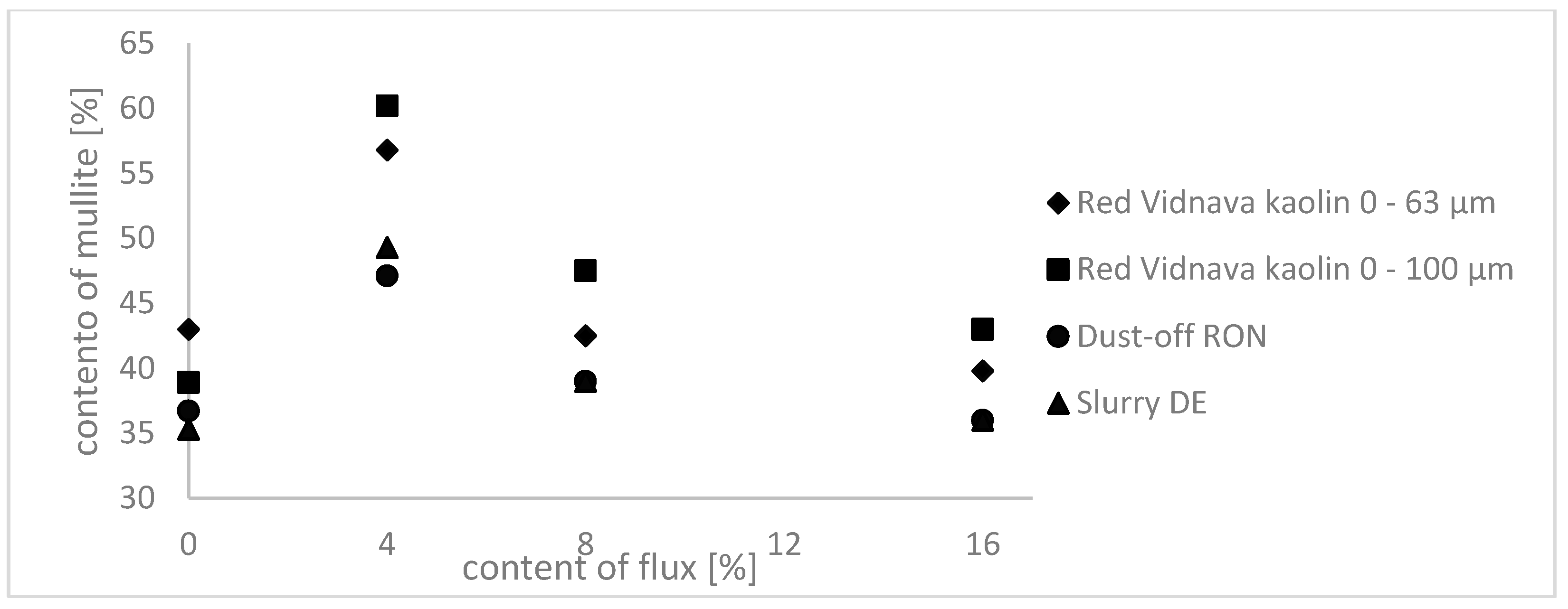
Samples V1–V16 fired at 1380 °C in an oxidising atmosphere showed optimal 4% flux addition for mullite formation (Table 6). XRD patterns for all grog samples are listed in the Supplementary Materials “Attachment part 1”. This effect was most evident in samples V5–V8: V5 (no flux), V6 (4% flux with maximum mullite content but 5.3% cristobalite present), V7 (8% flux with decreased mullite but practically eliminated cristobalite), and V8 (16% flux with slight mullite decrease due to dissolution in amorphous phase).
Cristobalite content variations (Table 6) showed the highest proportions in flux-free samples (V1, V9) or 4% flux samples (V6, V14). Based on these results, two grog types can be prepared as follows: high-mullite grogs with approximately 5% cristobalite, or cristobalite-free mullite grogs using recipes V3, V7, V11, and V15 with lower mullite content due to amorphous phase dissolution. The 8% Halamky I feldspar dust addition proved optimal for cristobalite elimination while maintaining relatively high mullite content. This is illustrated by the Figure 1.

3.5.2. 1700 °C Firing Results

For 1700 °C firing, samples V4, V8, V12, and V16 were omitted due to high flux proportions, and samples V2, V6, V10, and V14 due to similar cristobalite content as control samples when fired at 1380 °C. Given that the aim was to prepare mullite grog with a high mullite content and a low cristobalite content, samples V2, V6, V10, and V14 were discarded precisely because the amount of flux (4%) was not sufficient to eliminate cristobalite. The decrease in cristobalite content caused by the 4% flux addition in samples (V2, V6, V10, and V14) was not significant enough when compared to samples without flux addition (V1, V5, V9, and V13) to make it necessary to test these samples at a temperature of 1700 °C. Mineralogical analysis (Table 7) demonstrated dissolution of cristobalite even in flux-free samples (V1, V5, V9, V13) at higher temperatures, with increased mullite content, which is consistent with Roy’s findings [36].
Most samples showed diminished flux influence at 1700 °C, except V9 and V11, where flux presence significantly decreased mullite content, possibly due to higher TiO2 proportions acting as additional flux and promoting mullite dissolution into the amorphous phase alongside other melting oxides.
Montoya studied the effect of TiO2 on mullite formation. According to the information published by Montoya, as little as 2% TiO2 is sufficient to influence the mullitisation process in favour of secondary mullite. Most of the TiO2 remains unreacted and dissolves in the melt, reducing its viscosity and promoting the formation of secondary mullite. TiO2 also influences the formation of SiO2-rich areas [37].
If we look at the mullite content in sample V9 at a firing temperature of 1380 °C (36.7% mullite) and at a firing temperature of 1700 °C (37.0% mullite), it is clear that the influence of TiO2 on the amount of mullite is completely negligible due to the absence of feldspars as a flux in this sample. The opposite is true for sample V11, which contains 8% feldspar. At a firing temperature of 1380 °C (39% mullite) and at a firing temperature of 1700 °C, the amount of mullite decreases to 27.0%. This decrease in the amount of mullite may be caused by the dissolution of mullite grains in a low viscosity melt [37].

3.6. Mullite Content Comparison

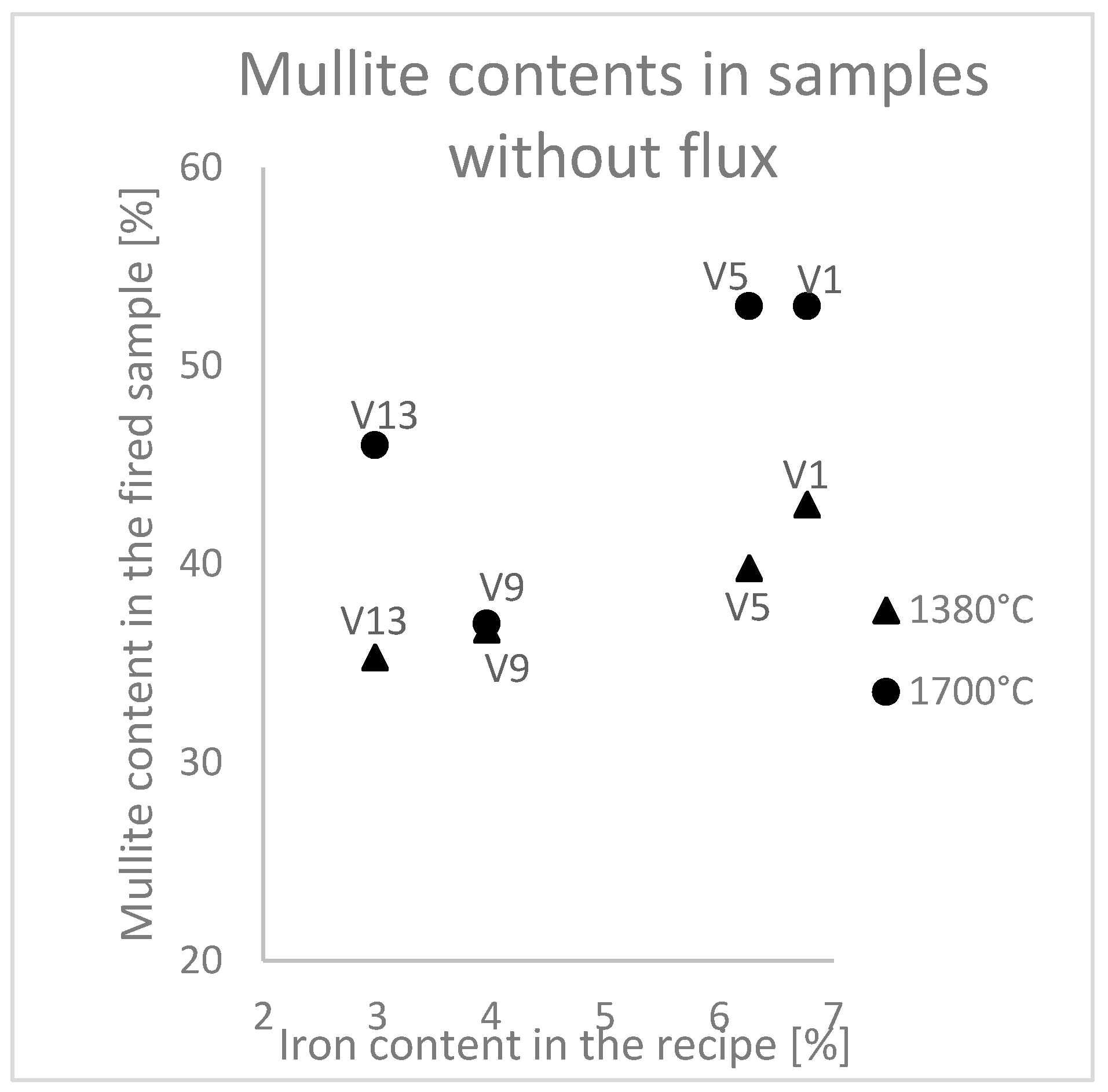
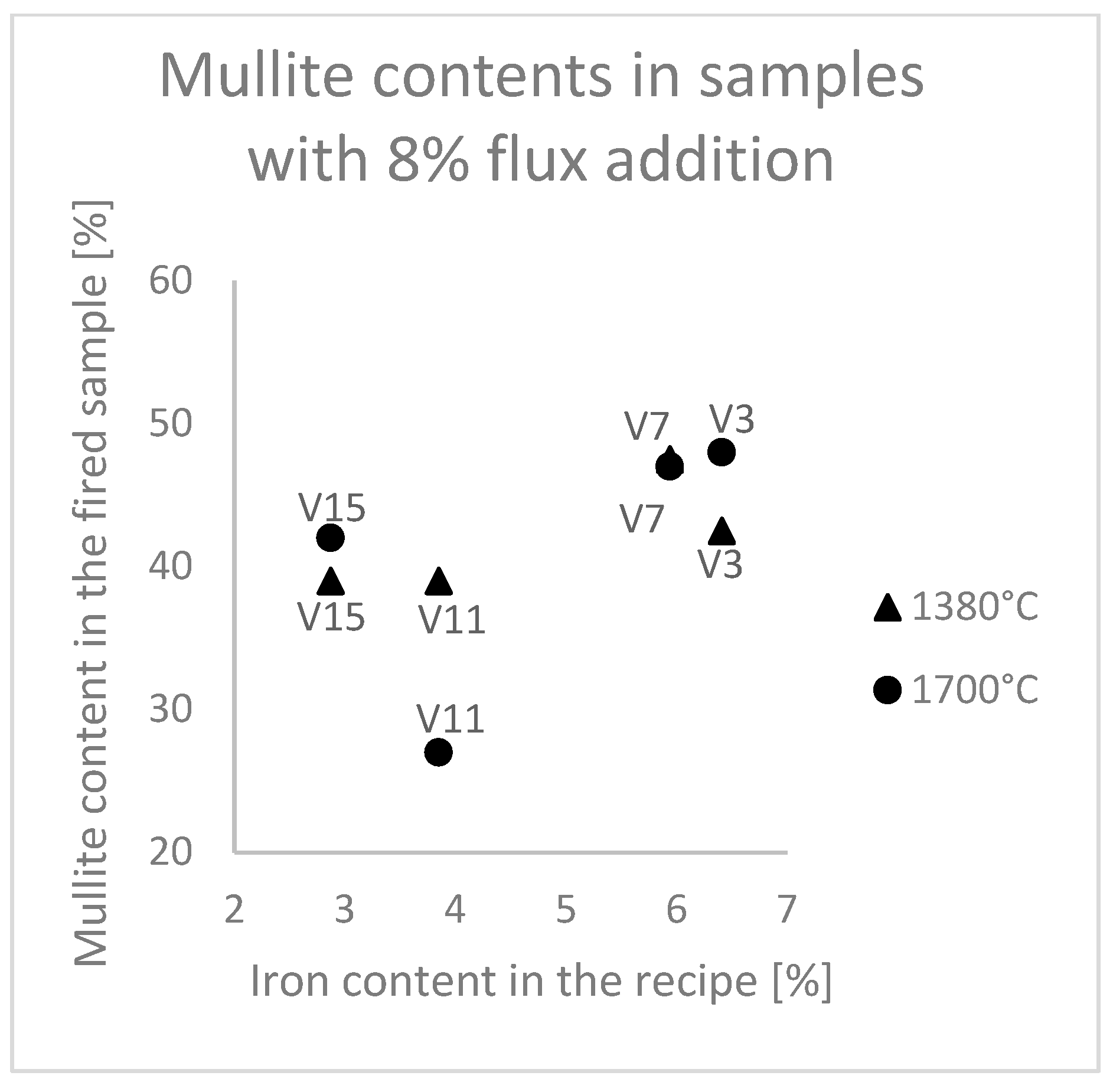
Figure 2 and Figure 3 compare mullite content at 1380 °C and 1700 °C firing temperatures. At 1380 °C without flux, mullite content increased with Al2O3 content despite relatively high Fe2O3 proportions (exceeding 6% in V1, V5). At 1700 °C, mullite increases occurred in practically all flux-free recipes, with temperature differences between Vidnava kaolin fractions becoming negligible (V1, V5 achieving identical mullite content).
Recipe V9 remained virtually unchanged between firing temperatures, while V7 showed excellent results at both temperatures. At 1700 °C, only recipe V3 (red Vidnava kaolin, 0–63 µm) surpassed V7 in mullite content. Conversely, V11 showed higher mullite at 1380 °C but a sharp decrease at 1700 °C due to amorphous phase dissolution.

3.7. Material Classification and Colour Assessment

Almost all 1380 °C-fired recipes classify as chamotte grogs with 30–45% Al2O3 content. Practically, these grogs classify as low water absorption shales (2–3%) with higher Al2O3 contents, or dense, sintered kaolinitic chamottes. Recipes V2, V6 with >55% mullite content qualify as high-mullite grogs with cristobalite content. Only slurry DE with 16% flux falls into the acid fireclay category (10–30% Al2O3, <85% SiO2).
Colour assessment revealed 1380 °C-fired samples exhibited white-grey colouration, except V9–V12 showing light brown due to iron presence. Despite V1–V8 containing nearly double the iron content while maintaining white-grey colour, suitable waste material At 1700 °C firing, all examined samples (V1, V3, V5, V7, V9, V11, V13, V15) showed significant dark brown discolouration. The coloration of individual grog samples is shown in the Supplementary Materials “Attachment part 2”.

4. Discussion

This study demonstrates the practical feasibility of utilising waste materials as input raw materials for refractory grog preparation. Through appropriate waste material selection based on final product requirements, properties comparable to those achieved with primary raw materials can be obtained.
The scope of waste material utilisation extends beyond materials generated during raw material treatment and processing to include waste produced directly during mining operations. Red kaolin from the Vidnava deposit exemplifies this potential, exhibiting excellent parameters regarding mullite content after processing into refractory grogs. Notably, these materials achieved higher mullite phase proportions than waste from kaolin treatment processes (slurry DE), demonstrating superior performance characteristics.
The aim of the study was to prepare a highly refractory mullite abrasive with the lowest possible cristobalite content and a high-mullite content. These two properties are best met by grog samples fired at 1380 °C with an 8% addition of flux (feldspar dust-off Halámky). The amount of mullite in these samples (V3, V7, V11, V15) exceeds 40% mullite, and the cristobalite content is around 0.5%. If we do not require grogs without cristobalite, it is possible to prepare grogs with a mullite content higher than 55% (samples V2 and V6), that is, high-mullite grogs. These high mullite abrasives were prepared with a 4% flux addition and a firing temperature of 1380 °C.
When fired to a maximum temperature of 1700 °C, samples based on red kaolins (V1, V3, V5, and V6) show a significant increase in the amorphous phase. This phenomenon is a result of firing at a higher temperature, which causes a slight increase in the mullite content, but at the same time a significant increase in the amorphous phase as a result of the dissolution of cristobalite, but also iron minerals. The dissolution of SiO2 (quartz) with increasing firing temperature was also observed by Karamanov [14]. Similar observations, in which the dissolution of crystalline phases occurs with increasing firing temperature, were recorded by Carvalho [16]. In the case of sample V11, when the firing temperature is increased from 1380 °C to 1700 °C, mullite dissolves in the melt. This result is consistent with the observations made by Montoya [37].
The primary limitation for applied use of these materials is colouration, which becomes evident when fired at 1700 °C across all tested recipes, while manifesting only in RON waste dust-based recipes when fired at 1380 °C. This colour development correlates directly with iron content and firing temperature, with red Vidnava kaolin remaining light and yellowish up to 1450 °C firing temperatures.
From an application perspective, refractory materials prepared from various fractions of red kaolin from the Vidnava deposit show the greatest promise for industrial practice. Despite high iron content resulting in brown colouration at elevated temperatures, these materials demonstrate significant potential for specific applications.
The temperature-dependent colouration behaviour opens opportunities in common industrial practice where products such as stoneware, technical porcelain, and cordierite products are typically fired at temperatures not exceeding 1400 °C. In these applications, refractory grogs based on high Fe2O3 content red kaolins prepared through non-traditional processing methods (fluidized bed sorting) could be successfully implemented.
This approach offers dual benefits: environmental impact reduction through waste material utilisation and potential cost advantages through secondary raw material use. The successful development of high-performance refractory grogs from waste materials represents a sustainable solution that addresses both environmental concerns and industrial needs while maintaining product quality standards.
The findings support the broader implementation of waste-based refractory materials in industrial applications, particularly where firing temperatures remain below 1400 °C, thereby expanding the circular economy principles within the ceramic and refractory industries.
The limitation of this study is the fact that the materials turn reddish-brown at temperatures reaching 1700 °C. This issue will require further research into the behaviour of ferrous minerals during firing, particularly in the range between 1450 and 1700 °C.

5. Conclusions

This study demonstrates that waste materials can be successfully utilised for producing high-quality mullite-containing refractory grogs. Red kaolin from the Vidnava deposit proved particularly promising, achieving higher mullite phase proportions than waste from conventional kaolin treatment processes. The main limitation is iron-induced brown colouration at temperatures of about 1700 °C, which restricts its use in grogs that require light-coloured shards.

Supplementary Materials

The following supporting information can be downloaded at https://www.mdpi.com/article/10.3390/ceramics9010006/s1, Attachment-part 1: XRD patterns; part 2: figures of samples.

Author Contributions

Conceptualization, J.Š. and F.P.; methodology, J.Š.; validation, F.P. and I.J.; formal analysis, J.Š.; investigation, J.Š.; resources, F.P. and I.J.; data curation, J.Š.; writing—original draft preparation, J.Š.; writing—review and editing, I.J. and R.K.; visualisation, J.Š.; supervision, I.J. and F.P.; funding acquisition, R.K. All authors have read and agreed to the published version of the manuscript.

Funding

This research was conducted as part of the project CGS TACR RENS 225010. This research was funded by the Student Grant Competition financed by the Faculty of Mining and Geology, VSB, Technical University of Ostrava, within project “Research into the elimination of PFAS from wastewater” (No. SP2025/024).

Data Availability Statement

The original contributions presented in this study are included in the article/Supplementary Materials. Further inquiries can be directed to the corresponding author.

Conflicts of Interest

The authors declare no conflicts of interest. The funders had no role in the design of the study; in the collection, analyses, or interpretation of data; in the writing of the manuscript; or in the decision to publish the results.

Abbreviations

The following abbreviations are used in this manuscript:
L.O.I.Loss of Ignition
XRFX-ray Fluorescence Analysis
XRDX-ray Diffraction Analysis
Max.Maximum

References

  1. Galhano, C.; Lamas, P.; Seixas, D. Use of Industrial Waste for the Optimization of Ceramic Construction Materials. KnE Eng. 2020, 4, 36–48. [Google Scholar] [CrossRef]
  2. Veiga Simão, F.; Chambart, H.; Vandemeulebroeke, L.; Cappuyns, V. Incorporation of Sulphidic Mining Waste Material in Ceramic Roof Tiles and Blocks. J. Geochem. Explor. 2021, 225, 106741. [Google Scholar] [CrossRef]
  3. Niepce, J.-C.; Boch, P. (Eds.) Ceramic Materials: Processes, Properties and Applications; ISTE: London Newport Beach, CA, USA, 2007; ISBN 978-1-905209-23-1. [Google Scholar]
  4. Zhang, L. Production of Bricks from Waste Materials—A Review. Constr. Build. Mater. 2013, 47, 643–655. [Google Scholar] [CrossRef]
  5. Al Hoseny, N.F.; Amin, S.K.; Fouad, M.M.K.; Abadir, M.F. Reuse of Ceramic Sludge in the Production of Vitrified Clay Pipes. Ceram. Int. 2018, 44, 12420–12425. [Google Scholar] [CrossRef]
  6. Alves, H.P.A.; Silva, J.B.; Campos, L.F.A.; Torres, S.M.; Dutra, R.P.S.; Macedo, D.A. Preparation of Mullite Based Ceramics from Clay–Kaolin Waste Mixtures. Ceram. Int. 2016, 42, 19086–19090. [Google Scholar] [CrossRef]
  7. Brasileiro, M.I.; Rodrigues, A.W.B.; Menezes, R.R.; Neves, G.A.; Sant, L.N.L. The Kaolin Residue and Its Use for Production of Mullite Bodies. In Sustainable Development—Energy, Engineering and Technologies—Manufacturing and Environment; Ghenai, C., Ed.; InTech: Singapore, 2012; ISBN 978-953-51-0165-9. [Google Scholar][Green Version]
  8. Manfredini, T.; Marzola, G.; Nunziello, S.; Pellacani, G.C.; Pozzi, P.; Tubertini, O. The Recycling of Ceramic Sludges in the Production Process: An Option for Ceramic Tile Factories to Reach Zero Pollution. Environ. Technol. 1991, 12, 927–934. [Google Scholar] [CrossRef]
  9. Kumar, S.; Singh, K.K.; Ramachandrarao, P. Effects of Fly Ash Addition on the Mechanical and Other Properties of Ceramic Tiles. J. Mater. Sci. 2001, 36, 5917–5922. [Google Scholar] [CrossRef]
  10. Roslee, A.B.; Jamal, N.A.S.; Othman, N.H.; Abdul Razak, N.A.; Alias, N.H.; Mat Shayuti, M.S.; Marpani, F.; Mohd Razlan, M.R.; Jumahat, A.; Othman, M.H.D.; et al. Fabrication of Low-Cost Granite Dust Ceramic Hollow Fibre Membrane: Effects of Sintering Temperature. Mater. Today Proc. 2023, 72, 1234–1241. [Google Scholar] [CrossRef]
  11. Torres, P.; Manjate, R.S.; Quaresma, S.; Fernandes, H.R.; Ferreira, J.M.F. Development of Ceramic Floor Tile Compositions Based on Quartzite and Granite Sludges. J. Eur. Ceram. Soc. 2007, 27, 4649–4655. [Google Scholar] [CrossRef]
  12. El-Fadaly, E. Characterization of Porcelain Stoneware Tiles Based on Solid Ceramic Wastes. Int. J. Sci. Res. (IJSR) 2013, 4, 602–608. [Google Scholar]
  13. Tarhan, B.; Tarhan, M.; Aydin, T. Reusing Sanitaryware Waste Products in Glazed Porcelain Tile Production. Ceram. Int. 2017, 43, 3107–3112. [Google Scholar] [CrossRef]
  14. Karamanov, A.; Karamanova, E.; Ferrari, A.M.; Ferrante, F.; Pelino, M. The Effect of Fired Scrap Addition on the Sintering Behaviour of Hard Porcelain. Ceram. Int. 2006, 32, 727–732. [Google Scholar] [CrossRef]
  15. Bazhin, V.Y.; Glaz’ev, M.V. Combined Refractory Materials with Addition of Technogenic Waste for Metallurgical Assemblies. Refract. Ind. Ceram. 2021, 61, 644–648. [Google Scholar] [CrossRef]
  16. Carvalho, A.C.; Raupp-Pereira, F.; Rodrigues Neto, J.B.; Novaes De Oliveira, A.P. A New Source for Production of Ceramic Filters. Mater. Lett. 2015, 145, 250–252. [Google Scholar] [CrossRef]
  17. Mohit, M.; Sharifi, Y. Ceramic Waste Powder as Alternative Mortar-Based Cementitious Materials. ACI Mater. J. 2019, 116, 107–116. [Google Scholar] [CrossRef]
  18. Pticen, F.; Zítko, V. A Method of Treating Soft or Decay Silicate Raw Materials and Waste Products of Raw These Materials. 2017. Available online: https://isdv.upv.gov.cz/webapp/resdb.print_detail.det?pspis=PT/2014-138&plang=EN (accessed on 6 January 2026).
  19. Gowan, M.; Comyns, R.A. Water in the China Clay Industry. Water Environ. J. 1987, 1, 123–128. [Google Scholar] [CrossRef]
  20. Ke, S.; Wang, Y.; Pan, Z.; Ning, C.; Zheng, S. Recycling of Polished Tile Waste as a Main Raw Material in Porcelain Tiles. J. Clean. Prod. 2016, 115, 238–244. [Google Scholar] [CrossRef]
  21. Yuan, Q. Possible recycling options of waste materials in manufacturing ceramic tiles. GEOMATE 2021, 20, 73–80. [Google Scholar] [CrossRef]
  22. Saif, S.; Mubin, S.; Abbass, W.; Aslam, F.; Alyousef, R. Utilizing Machine Learning to Integrate Silica-Based Production Waste Material in Ceramic Tiles Manufacturing: Progressing toward Sustainable Solutions. Ceram. Int. 2024, 50, 18880–18906. [Google Scholar] [CrossRef]
  23. Dubois, J.; Murat, M.; Amroune, A.; Carbonneau, X.; Gardon, R. High-Temperature Transformation in Kaolinite: The Role of the Crystallinity and of the Firing Atmosphere. Appl. Clay Sci. 1995, 10, 187–198. [Google Scholar] [CrossRef]
  24. Nasr, I.; Abdel-Kader, F.M.; Embabi, H.K. Properties of Some High Alumina Refractories Obtained from Different Alumina Sources. Ceram. Int. 1981, 7, 60–64. [Google Scholar] [CrossRef]
  25. Pticen, F.; Laufek, F.; Lang, K.; Bohdálek, P. Topaz Jako Potenciálně Využitelná Surovina Získávaná Při Úpravě. In Proceedings of the Konference SUROVINY 2023, Prague, Czech Republic, 17–18 May 2023; Česká silikátová společnost: Prague, Czech Republic, 2023. [Google Scholar]
  26. Schneider, H.; Komarneni, S. (Eds.) Mullite; Wiley-VCH Verlag GmbH & Co. KGaA: Weinheim, Germany, 2005; ISBN 978-3-527-30974-0. [Google Scholar]
  27. Lecomte-Nana, G.; Bonnet, J.-P.; Soro, N. Influence of Iron on the Occurrence of Primary Mullite in Kaolin Based Materials: A Semi-Quantitative X-Ray Diffraction Study. J. Eur. Ceram. Soc. 2013, 33, 669–677. [Google Scholar] [CrossRef]
  28. Ye, H.; Li, Y.; Sun, J. Study on Formation Mechanism and Morphology Evolution of Iron-Exsolution Mullite. Mater. Lett. 2019, 246, 9–12. [Google Scholar] [CrossRef]
  29. ČSN 72 0103 (720103); A Basic Procedure for Silicate Analysis—Determination of Loss on Ignition. Office for Technical Standardization, Metrology and State Testing: Praha, Czech Republic, 2009.
  30. Santisteban, J.I.; Mediavilla, R.; López-Pamo, E.; Dabrio, C.J.; Blanca Ruiz Zapata, M.; José Gil García, M.; Castaño, S.; Martínez-Alfaro, P.E. Loss on Ignition: A Qualitative or Quantitative Method for Organic Matter and Carbonate Mineral Content in Sediments? J. Paleolimnol. 2004, 32, 287–299. [Google Scholar] [CrossRef]
  31. Bish, D.L.; Post, J.E. Modern Powder Diffraction; Reviews in mineralogy; Mineralogical Society of America: Washington, DC, USA, 1989; ISBN 978-0-939950-24-9. [Google Scholar]
  32. Guillemin, F.; Lecomte-Nana, G.; El Hafiane, Y.; Peyratout, C.; Smith, A. Influence of the Firing Atmosphere onto the Thermal Transformation of Iron-Enriched Kaolin. Appl. Clay Sci. 2024, 258, 107512. [Google Scholar] [CrossRef]
  33. Sutheimer, S.H.; Maurice, P.A.; Zhou, Q. Dissolution of Well and Poorly Crystallized Kaolinites; Al Speciation and Effects of Surface Characteristics. Am. Mineral. 1999, 84, 620–628. [Google Scholar] [CrossRef]
  34. López, P.V.; Hernández, M.F.; Richard, D.; Conconi, M.S.; Rendtorff, N.M. Porous Acicular Mullite Ceramics Produced from Well and Poorly Crystallized Kaolinite. Appl. Clay Sci. 2023, 238, 106937. [Google Scholar] [CrossRef]
  35. Kong, L.B.; Chen, Y.Z.; Zhang, T.S.; Ma, J.; Boey, F.; Huang, H. Effect of Alkaline-Earth Oxides on Phase Formation and Morphology Development of Mullite Ceramics. Ceram. Int. 2004, 30, 1319–1323. [Google Scholar] [CrossRef]
  36. Roy, R.; Das, D.; Rout, P.K. A Review of Advanced Mullite Ceramics. Eng. Sci. 2022, 18, 20–30. [Google Scholar] [CrossRef]
  37. Montoya, N.; Serrano, F.J.; Reventós, M.M.; Amigo, J.M.; Alarcón, J. Effect of TiO2 on the Mullite Formation and Mechanical Properties of Alumina Porcelain. J. Eur. Ceram. Soc. 2010, 30, 839–846. [Google Scholar] [CrossRef]
Figure 1. Dependence of mullite content on flux addition when fired at 1380 °C.
Ceramics 09 00006 g001
Figure 2. Mullite content in individual recipes without added flux.
Ceramics 09 00006 g002
Figure 3. Mullite content in individual recipes with 8% added flux.
Ceramics 09 00006 g003
Table 1. Waste materials.
MaterialDescription
Slurry DEBy-product of kaolin production (hydrocyclone drop, 50 mm fraction)
Dust-off RONUnburned fly ash from rotary kilns (600–1000 °C), produced during shale burning up to 1350 °C in České lupkové závody
Feldspar dust-off HalamkyWaste dust generated during feldspar grinding at Halamky I deposit
Table 2. Model recipes of individual heat islands. All results are given in [%].
Labelling SampleRed Vidnava Kaolin
0–63 µm
Red Vidnava Kaolin
0–100 µm
Dust-Off RONSlurry DEFeldspar Dust-Off Halamky
V1100 0000
V2960004
V3920008
V48600016
V50100 000
V6096004
V7092008
V80860016
V900100 00
V10009604
V11009208
V120086016
V13000100 0
V14000964
V15000928
V160008616
Table 3. Partial chemical composition of selected waste materials and kaolins treated with special technology. All results are given in [%].
SampleChemical Composition After Drying [%]
SiO2Al2O3Fe2O3TiO2CaOK2OL.O.I.
Kaolin Vidnava red 0–63 µm42.6836.565.870.510.120.9213.35
Kaolin Vidnava red 0–100 µm46.1334.695.490.450.100.8712.20
Dust-off RON51.8233.633.702.850.590.876.00
Slurry DE51.5031.802.540.660.031.4612.00
Feldspar dust-off Halamky I 170.2615.172.580.370.478.100.75
1 Halamky feldspar dust-off contains an additional 2% Na2O, see Table 4.
Table 4. Mineralogical composition of selected waste materials (in dried state). All results are given in [%].
SampleRed Vidnava Kaolin 0–63 µmRed Vidnava Kalolin 0–100 µmDust-Off RON 1Slurry DE 2Feldspar Dust-Off Halamky
Mineral
Kaolinite94.182.142.055.5
Mica3.112.34.019.07.0
Quartz2.55.67.05.013.3
Na—Ca feldspar 23.1
K—feldspar 56.6
Anatase 0.50.5
Calcite0.3
Mullite 11.5
Amorphous phase <10.0<10.035.019.0<10.0
1 Poorly ordered kaolinite–kaolinite with imperfectly developed kaolinite crystal structures. 2 Poorly ordered kaolinite, sample contains <0.5% siderite and <0.5% rutile.
Table 5. Chemical composition (compositions of raw material recipes) of samples fired at 1370–1380 °C and 1700 °C (chemical composition of samples converted to the annealed state). All results are given in [%].
RecipeSiO2Al2O3Fe2O3TiO2CaOK2OL.O.I
Red Vidnava kaolin
0–63 µm
V149.2542.196.770.590.141.0613.35
V250.2841.016.590.580.151.3912.85
V351.3139.836.410.570.171.7112.34
V453.3337.536.050.550.202.3411.33
Red Vidnava kaolin
0–100 µm
V552.5839.546.260.510.110.9912.20
V653.4638.496.100.510.131.3211.74
V754.3337.455.940.500.151.6411.28
V856.0435.395.630.490.182.2710.37
Dust-off RONV955.4535.983.963.050.630.936.00
V1056.1535.143.912.940.631.245.79
V1156.8534.303.852.830.621.555.58
V1258.2532.633.742.610.612.165.16
Slurry DEV1358.5336.142.890.750.031.6612.00
V1459.1435.242.880.730.051.9511.55
V1559.7534.352.870.720.072.2411.10
V1660.9532.592.850.690.112.8210.20
Table 6. Mineralogical composition of the samples fired at 1380 °C. All results are given in [%].
RecipeAmorphous Phase [%]Mullite [%]Quartz [%]Cristobalite [%]
Red Vidnava kaolin
0–63 µm
V124.043.026.07.0
V225.656.813.34.3
V34342.514.00.5
V451.039.810.00.2
Red Vidnava kaolin
0–100 µm
V532.938.923.25.0
V625.760.28.85.3
V742.047.5100.5
V849.843.07.00.2
Dust-off RONV940.836.718.73.8
V1035.147.115.62.2
V1154.039.07.00.0
V1256.036.08.00.0
Slurry DEV1355.235.39.50.0
V1435.849.3140.9
V1555.039.06.00.0
V1658.036.06.00.0
Table 7. Mineralogical composition of the samples fired at 1700 °C. All results are given in [%].
RecipeAmorphous Phase [%]Mullite [%]Quartz [%]
Red Vidnava kaolin
0–63 µm
V143.053.04.0
V349.048.03.0
Red Vidnava kaolin
0–100 µm
V544.053.03.0
V750.047.03.0
Dust-off RONV945.037.018.0
V1150.027.023.0
Slurry DEV1346.046.08.0
V1554.042.04.0
Disclaimer/Publisher’s Note: The statements, opinions and data contained in all publications are solely those of the individual author(s) and contributor(s) and not of MDPI and/or the editor(s). MDPI and/or the editor(s) disclaim responsibility for any injury to people or property resulting from any ideas, methods, instructions or products referred to in the content.