
Article

Self-Propagating High-Temperature Synthesis of High-Entropy Composite in a Ti–Cr–Mn–Co–Ni–Al–C System

1
A.B. Nalbandyan Institute of Chemical Physics, NAS RA, 5/2 P. Sevak St., Yerevan 0014, Armenia
2
Faculty of Chemistry, Yerevan State University, 1 Alek Manukyan St., Yerevan 0025, Armenia
3
Department of Mechanical and Industrial Engineering, Tallinn University of Technology, Ehitajate Tee 5, 19086 Tallinn, Estonia
*
Author to whom correspondence should be addressed.
Ceramics 2025, 8(4), 137; https://doi.org/10.3390/ceramics8040137
Submission received: 26 September 2025 / Revised: 7 November 2025 / Accepted: 10 November 2025 / Published: 12 November 2025
(This article belongs to the Special Issue Advances in Ceramics, 3rd Edition)

Abstract

High-entropy materials have emerged as promising candidates for high-temperature structural, magnetic, and electrochemical applications due to their unique combination of compositional complexity, thermal stability, and tailored functionality. In this study, self-propagating high-temperature synthesis (SHS) was employed to fabricate high-entropy composite in a Ti–Cr–Mn–Co–Ni–Al–C multicomponent system with a focus on elucidating the effect of titanium content on the combustion parameters, as well as on the phase and structure formation patterns of the resulting materials. In situ profiling enables evaluating the maximum combustion temperature of 1560 °C, combustion wave propagation velocity ranging from 0.22 to 4.3 mm/s depending on titanium content, and heating and cooling rates of 300–2000 °C/s and 3 °C/s during synthesis. The synthesized powders exhibited a bimodal particle size distribution, with ~90% of particles below 25 μm and a D50 of 5.38 μm. Post-synthesis densification via spark plasma sintering (SPS) at 1250 °C under 45 MPa yielded dense bulk samples, which exhibited a high relative density and high Vickers microhardness of 1270 ± 35 HV10 attributed to fine TiC dispersion and secondary carbide formation. Thermogravimetric analysis performed under air flow with a heating rate of 20 °C/min showed enhanced thermal stability for both the powder and the sintered bulk. These findings demonstrate the efficacy of SHS for rapid, energy-efficient fabrication of high-entropy composites and underscore the critical role of composition in tailoring their structural and mechanical properties.

1. Introduction

High-entropy materials (HEMs) represent a rapidly evolving class of multi-principal element compounds, typically comprising five or more elements in equimolar or near-equimolar ratios, each contributing between 5 and 35 atomic percent. Since the high-entropy alloy (HEA) concept was first introduced in 2004, the field has expanded to encompass not only metallic systems but also ceramics and composites, due to the remarkable microstructural features and exceptional physical, mechanical, and thermal properties [1,2,3]. Their unique configurational entropy plays a critical role in stabilizing simple solid-solution phases over complex intermetallic compounds, giving rise to a wide spectrum of superior properties, including high strength, exceptional thermal stability, corrosion resistance, and fracture toughness [4,5,6,7].
More recently, research has shifted toward second-generation HEAs, which are designed not only for phase stability and mechanical robustness but also with targeted functionalities in mind—such as high-temperature oxidation resistance, good creep strength, and phase stability during sintering or thermal cycling [8,9,10,11]. These alloys often contain some elements (such as Ti, Al, Fe, etc.) in elevated concentrations and are engineered to exhibit specific crystal structures (e.g., B2-ordered, FCC/BCC) and microstructural features to meet advanced performance criteria [12,13]. Titanium- and aluminum-rich compositions have garnered particular interest for their compelling balance of structural performance, low density, and high-temperature capability. Titanium provides excellent strength-to-weight ratio, corrosion resistance, and a high melting point, while aluminum serves to reduce overall density and improve oxidation resistance, particularly at elevated temperatures [14,15,16]. Recent studies have demonstrated that Ti-Al-rich HEAs are formed in body-centered cubic (BCC) and/or face-centered cubic (FCC) structures depending on the elemental combinations and processing routes, which can be tailored to enhance specific mechanical or thermal properties [13]. Furthermore, the incorporation of other transition metals such as Cr, Mn, Co, and Ni can further refine phase stability and multifunctionality, allowing for tunable performance across a wide range of applications [17,18,19]. Despite these advantages, significant challenges persist in controlling the synthesis process, achieving phase purity, and understanding phase stability under varying processing conditions.
In this context, self-propagating high-temperature synthesis (SHS), also known as combustion synthesis, emerges as a promising technique. SHS is a rapid, energy-efficient, and self-sustaining process in which highly exothermic reactions between reactants provide the thermal energy required for product formation without continuous external heating [20,21]. This method has been extensively applied to fabricate a broad spectrum of advanced materials, including carbides, nitrides, borides, silicides, intermetallics, composites, MAX phases and, more recently, high-entropy materials [22,23,24,25]. The key advantages of SHS include high energy efficiency, short reaction times, scalability, and the ability to produce highly pure products with fine microstructures and, in many cases, unique metastable phases that are difficult to achieve by conventional processing. Furthermore, SHS allows flexible control of the reaction pathways by adjusting reactant composition, particle size, and green density, enabling the design of novel materials with tailored properties.
In the present study, SHS was employed to synthesize high-entropy composites in the Ti–Cr–Mn–Co–Ni–Al–C system by systematically varying the titanium content. The latter plays a regulatory role for the SHS process due to heat release via the Ti + C reaction and subsequent TiC formation (thus influencing maximum combustion temperature and wave velocity) as the titanium content directly controls the thermal regime of the reaction. It is well documented that at low Ti levels, the exothermic output from the Ti + C reaction may lead to front extinction, while at higher Ti contents, increased heat release ensures stable wave propagation. Moreover, it affects the balance between the TiC phase and the metallic binder, influencing the heat transfer processes ahead of the front [26,27,28]. This system is particularly promising because titanium also enhances high-temperature strength, while the incorporation of other transition metals contributes to solid-solution formation and configurational entropy stabilization. The aim of this work is to elucidate the combustion-driven formation mechanisms, microstructural evolution, and mechanical properties of the resulting composite material, with a focus on identifying the processing conditions that promote the stabilization of high-entropy solid solutions as opposed to the formation of undesired secondary phases. The results are expected to shed light on the potential of SHS as a scalable route for producing multifunctional high-entropy composites with superior mechanical and thermal performance.

2. Materials and Methods

Commercial pure grade titanium (PTM, Rare-Metal, Novosibirsk, Russia, 99% purity), chromium (PCh-1M, Tulachermet, Tula, Russia, 99% purity), Mn (Thermo Scientific, Gothenburg, Sweden, >325 mesh, 99.3% purity), Co (Thermo Scientific, Gothenburg, Sweden, 1.6 μm, 99.8% purity), Ni (PNE 1, MetallEnergoHolding, Yekatirinburg, Russia, 45–250 μm, 99.5% purity), aluminum (ASD-4, Metallsplav, Kyiv, Ukraine, particle size < 40 μm, purity 99.9%) and carbon black (P-803, Techcarbon, Ivanovo, Russia, particle size <0.1 μm) were used as precursors. The powders were manually mixed in a ceramic mortar for 20 min and cylindrical samples were prepared with ~2.4–2.7 g/cm3 of density (Ro), height of ~30 mm and 30 mm in diameter by 5 kN uniaxial pressing. The constant pressure reactor (CPR-3.5 L) was evacuated and purged with argon (purity 99.97%, oxygen content less than 0.02%) at a pressure of 0.5 MPa.
The adiabatic combustion temperature (Tad) and equilibrium composition of the combustion products were estimated through thermodynamic modeling using ISMAN-THERMO software [29]. Two C-type (W-5Re/W-20Re, 100 μm in diameter) thermocouples were inserted in the sample at certain heights and the output signals were recorded by a computer. The combustion temperature (Tc, ±10 °C), velocity (Uc, ±5%), heating and cooling rates (Vh, Vc) were deduced from temperature profiles (Table 1, Figure 1). The combustion wave propagation velocity (Uc) was calculated using the equation: Uc = ΔL/Δt, where ΔL (mm) is the distance between the two thermocouples, and Δt (s) is the time required for the combustion front to travel this distance.
X-ray diffraction analysis was performed to characterize phase composition using MiniFlex 600 Rigaku Smart Lab SE diffractometer (Rigaku Corporation, Tokyo, Japan, D/teX Ultra 250 1D detector). PDF-2 database was employed to identify materials from the patterns. The scanning electron microscope (Prisma E, Thermo Fisher Scientific, Waltham, MA, USA) was used to examine microstructure (morphology, particle size, homogeneity, etc.) and topology of samples.
Particle size distribution of the powders was determined using an Analyzette Next Nano22 analyzer (Fritsch, Bavaria, Germany). The oxidation stability of the powder samples was assessed via differential scanning calorimetry (DSC) using a Mettler Toledo instrument, with measurements conducted from 25 °C to 1500 °C at a heating rate of 20 °C/min in air.
Carbon content of powders was determined using Carbon/Sulfur Analyzer ELEMENTRAC CS-i (ELTRA Elemental Analyzers, Haan, Germany). The element analyzer burns the sample with oxygen in a high-temperature induction furnace (above 2000 °C) using a catalyst, forming gaseous oxides (CO2, SO2) that are sequentially detected by infrared absorption. Nanocrystalline powders produced by combustion synthesis were consolidated in a graphite mold (inner diameter: 20 mm) using a spark plasma sintering system (FAST-SPS HP D 10, FCT Systeme GmbH, Frankenblick, Germany) with pulsed DC current (5500 A) at 7.2 V, Ton/Toff = 12/2 ms (62.5 Hz). The process was carried out under vacuum at a temperature of 1250 °C, an applied pressure of 45 MPa for duration of 10 min. The heating rate was set to 100 °C/min, and the cooling rate to 200 °C/min.
The density of the compacted samples was measured using the Archimedes method (ViBRA HT 124RCE HTDK). Microhardness was evaluated using a INDENTEC Hardness Testing Machine–Model 5030 SKV Lab (Indentec Hardness Testing Machines Ltd., Brierley Hill, England, UK).

3. Results and Discussion

Prior to the experimental studies, a thermodynamic analysis was conducted to evaluate the thermodynamic characteristics of the Tix-Cr-Mn-Co-Ni-Al-C system, where x = 0, 0.4, 0.9. The computational results indicated that an increase in titanium content results in a corresponding rise in the adiabatic temperature, ranging from 1220 °C to 1910 °C. Accordingly, the exothermic effect of the reaction is sufficient to initiate and sustain combustion, as well as to regulate the combustion temperature, and phase formation in the (Tix-Cr-Mn-Co-Ni)–Al–C system. When mixtures vary in the content of titanium (Ti), significant influence on the overall behavior of the combustion reaction (Table 1) was observed. The combustion of 0.3Cr-0.3Mn-1.2Co-1.2Ni-2Al-2C (when x = 0 mole) mixture proceeds comparatively slow (Uc = 0.22 mm/s). This mixture also experiences a lower combustion temperature and a lower heating rate during the SHS process (Figure 1a).
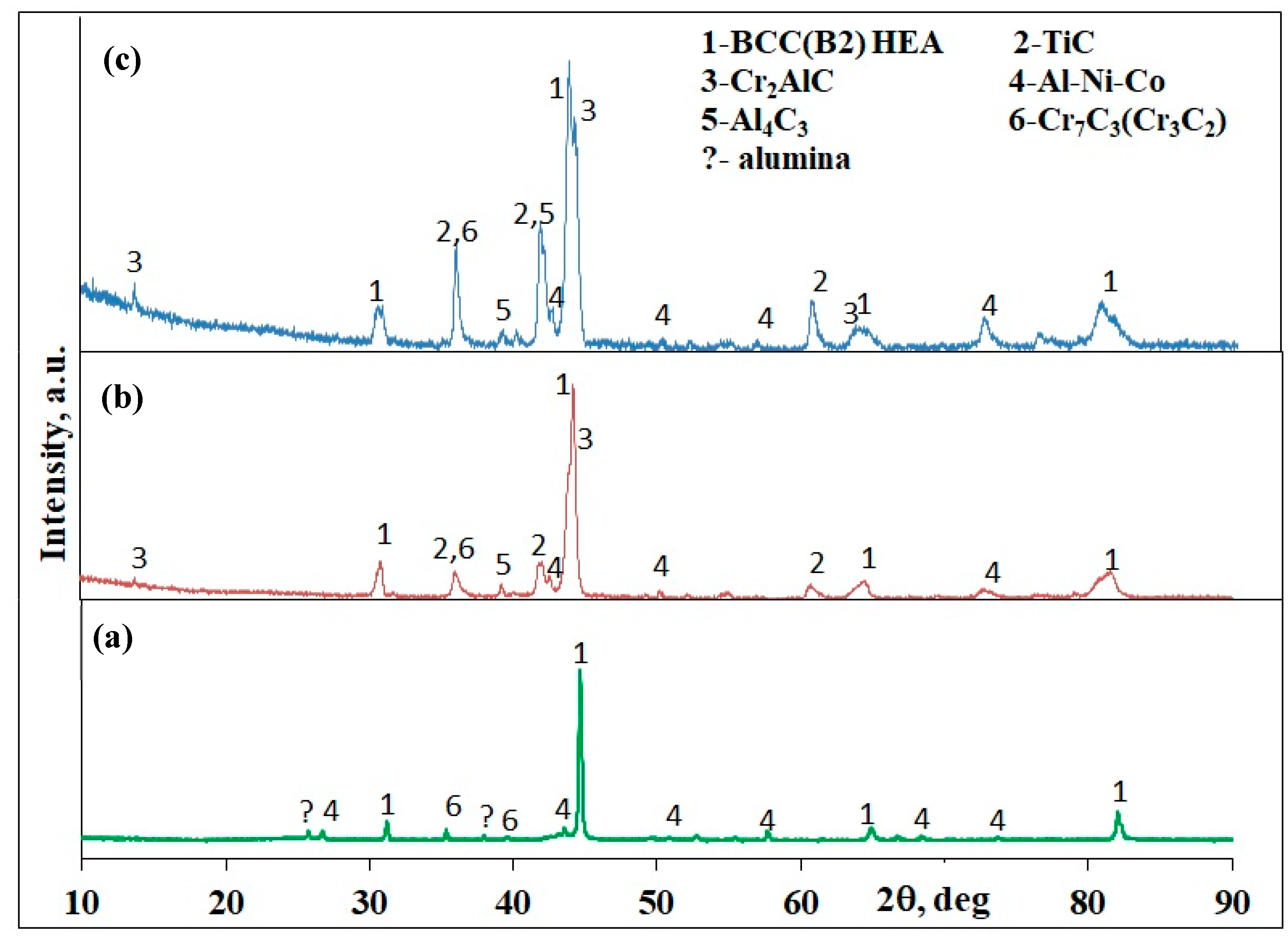
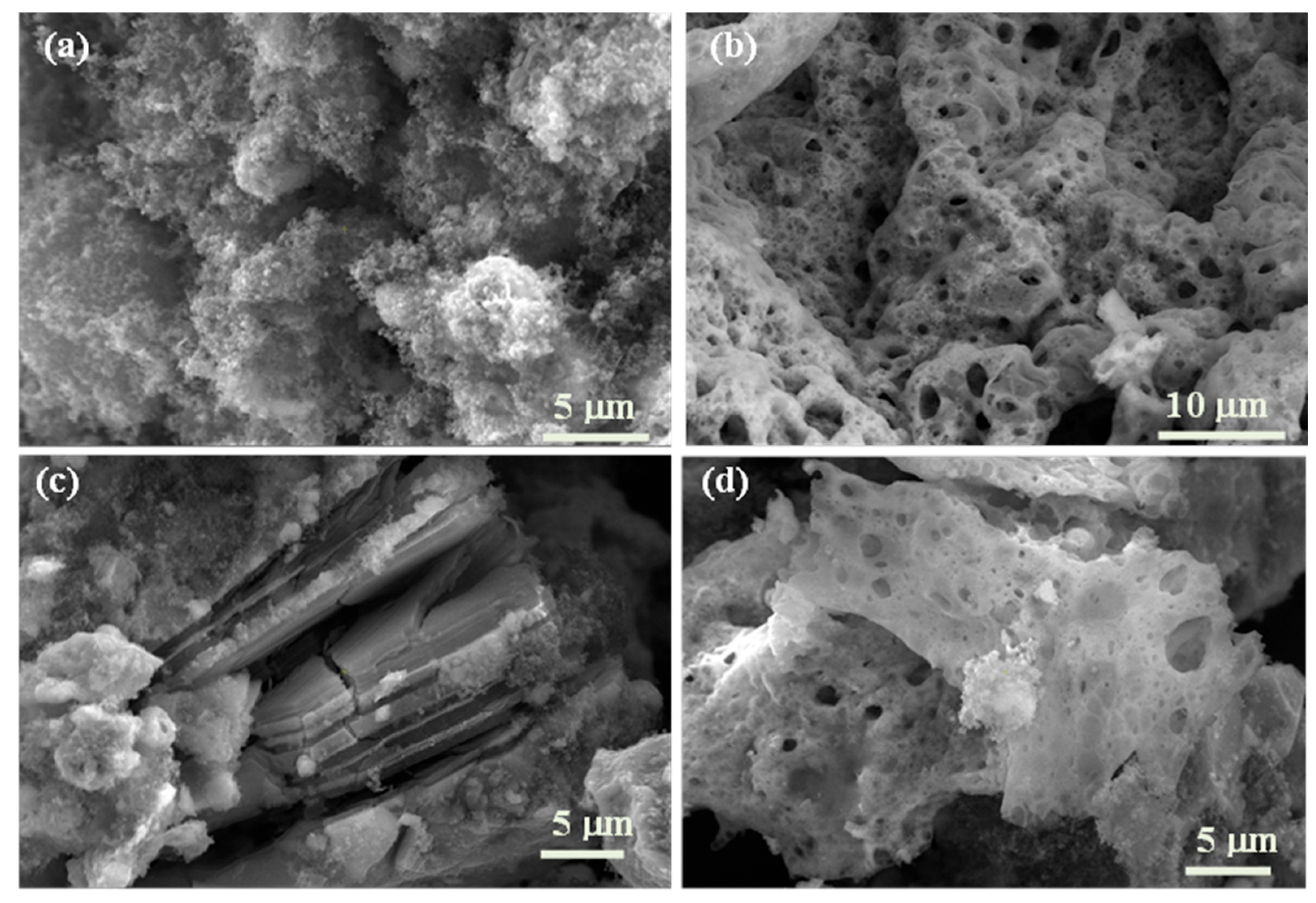
Figure 2 shows the X-ray diffraction (XRD) patterns of the combustion products. The dominant phase is a high-entropy alloy (HEA) with a body-centered cubic (BCC) crystal structure. Alongside the primary phase, a small quantity of binary or ternary intermetallic compounds was detected, together with trace amounts of chromium carbide (Figure 2a), suggesting carbide formation during post-combustion solidification. The product resulted in the formation of a distinctive cotton-like morphology (Figure 3a) likely a result of intense gas evolution-primarily from aluminum or volatile reaction byproducts combined with rapid solidification after the SHS reaction. The high thermal gradients and localized exothermicity of SHS lead to the formation of sponge-like frameworks.
The combustion temperature of the titanium containing 0.4Ti-0.4Cr-0.4Mn-0.4Co-0.4Ni-1.5Al-1C mixture was 1520 °C and front propagation velocity-0.7 mm/s, which is three times higher than that for titanium-free mixtures. Moreover, the titanium-rich 0.9Ti-0.6Cr-0.6Mn-0.6Co-0.3Ni-2Al-2C mixture is characterized by moderate combustion temperature, but relatively high combustion velocity and heating rates. Cooling rates of the samples under study fall in the same range (Table 1, Figure 1b,c).
In the combustion products of both titanium-containing mixtures, the primary phase formed is a high-entropy alloy exhibiting a BCC structure. Some amount of the 211 type MAX phase (Cr2AlC), intermetallics and carbides were also identified in the XRD patterns (Figure 2b,c). The main characteristic peaks of the MAX phase (hexagonal, P63/mmc) were observed at 2θ ≈ 13.74 (hkl 002) and 2θ ≈ 43.63 (hkl 006) (Figure 3b,c). When the amount of titanium and carbon was changed in the range from 0.4 to 0.9 and 1 to 2 moles, respectively, the amount of titanium carbide significantly increased (Figure 2c). According to Rietveld refinement it contains 27.4%TiC, 49%HEA, 6.1%Cr2AlC, 6.9%Al4C3, 10.6%Cr7C3. SEM analysis confirmed the simultaneous presence of different phases, in particular the layered structures and porous plates (Figure 3c,d and Figure S1). The average carbon content in the 0.9Ti system was 9.34 ± 0.10 wt%, while the theoretically calculated carbon content of the mixture was 10.08 wt%, likely due to carbon loss though oxidation during processing.
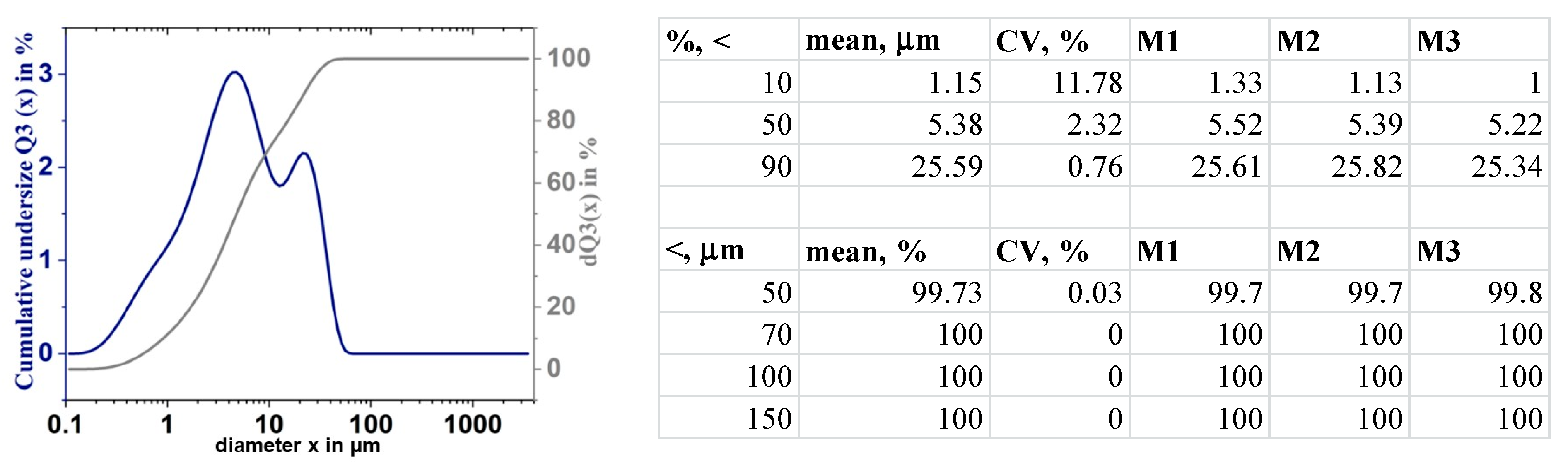
Particle size distribution analysis revealed a bimodal distribution, with approximately 90% of particles measuring less than 25 μm (Figure 4), 99% below 50 μm. Measurement reproducibility was assessed based on the coefficient of variation (CV, %) from three identical measurements.
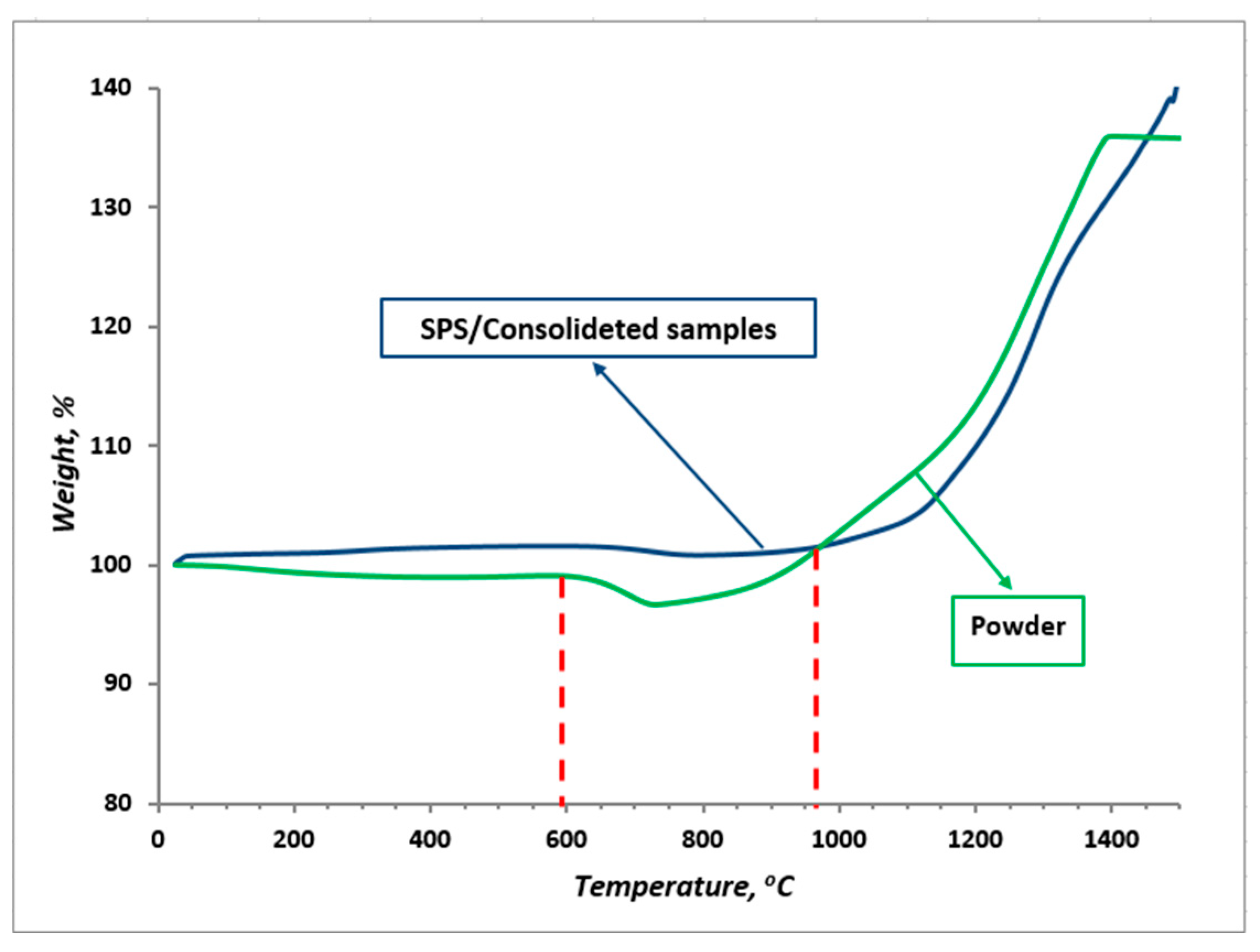
The oxidation stability of the powder was evaluated under heating in an air flow at a rate of 20 °C/min. The results demonstrated that the combustion product remains stable up to 600 °C (Figure S2a and Figure 5), a characteristic feature of TiC. Upon completion of oxidation at 1500 °C, the product was composed of titanium oxide, a mixed manganese–cobalt oxide, cobalt aluminate, and high-entropy alloy (Figure S2b). The stable mass profile below 600 °C confirms that the surface oxide film is compact and continuous, effectively limiting oxygen penetration. These phases, particularly the spinel TiO2 (Figure S3), are known to impart excellent chemical and thermal stability, suggesting that the composite can maintain structural integrity during intermediate-temperature service.
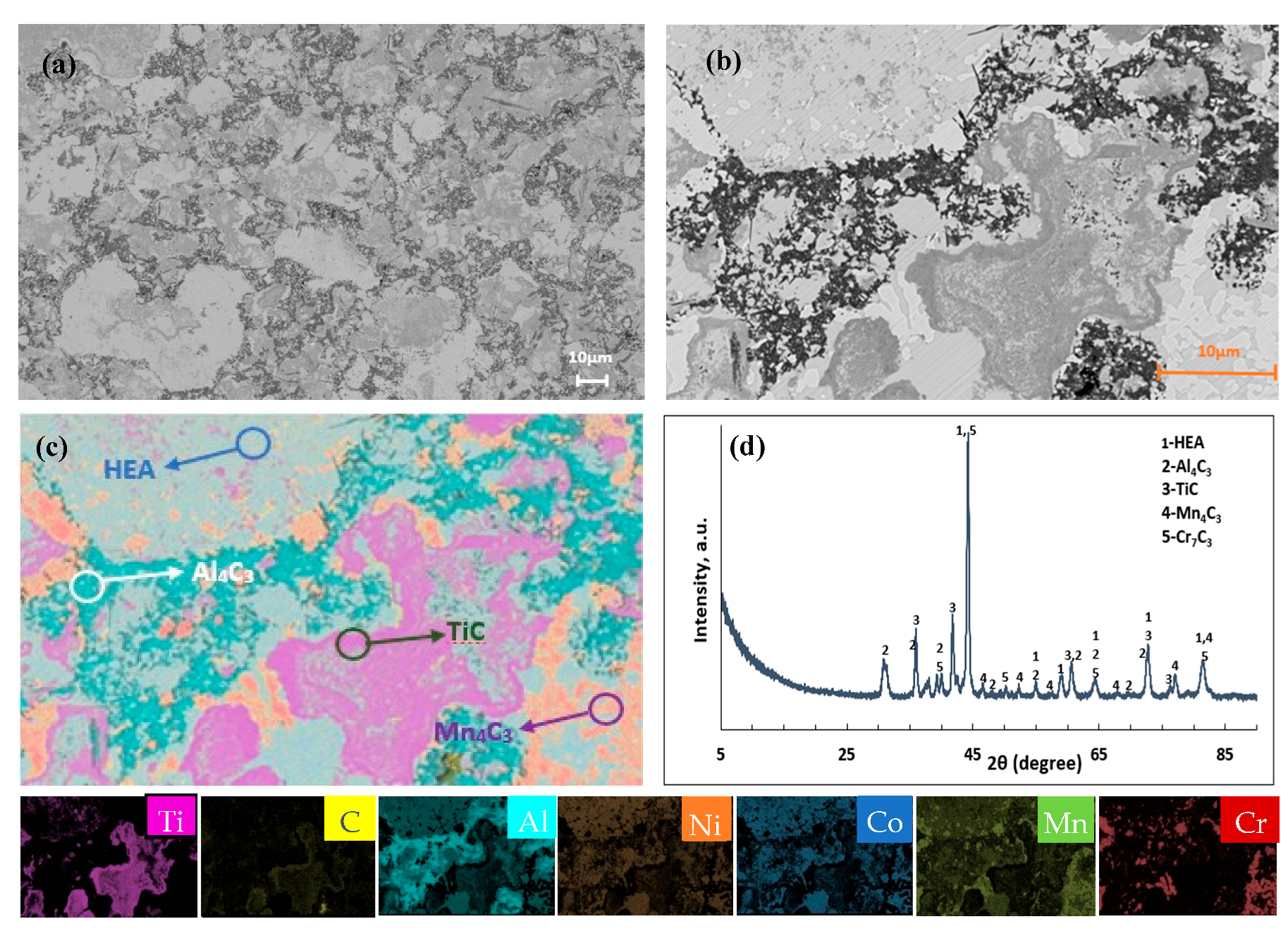
Based on the DSC curve of the sintered sample it can be observed that the material exhibits oxidation stability up to around 1000 °C, afterward, a progressive oxidation occurs leading to the formation of stable oxides. Bulk samples fabricated by spark plasma sintering (SPS) achieved a relative density of 5.21 g/cm3, indicating successful densification. Microstructural examination (Figure 6a,b) revealed the presence of well-sintered regions interspersed with distinct structural features, reflecting a heterogeneous microstructure characteristic of TiC-reinforced high-entropy alloys (HEAs).
The elemental distribution analyses via EDX combined with XRD confirmed the retention of the BCC-structured HEA along with TiC phases after sintering. Furthermore, phase evolution during the sintering process was evidenced by the decomposition of the MAX phase, leading to the formation of chromium, manganese, and aluminum carbides. (Figure 6c,d). The increased intensity of aluminum carbide reflections compared to those in the precursor powder indicates significant phase transformation and redistribution of elements under the thermal and electrical conditions of SPS. This phase evolution is consistent with the literature reporting the thermal behavior of Cr2AlC, which remains stable in the 1200–1500 °C temperature range depending on the sample form, impurities, treatment atmosphere, etc. [30,31,32]. The decomposition of hot-sintered Cr2AlC into Al8Cr5 and Cr23C6 occurs above 1500 °C in inert atmosphere. In comparison, Cr2AlC powders begin to decompose at significantly lower temperatures (~1073 K) in nitrogen, with an activation energy of 108.93 kJ·mol−1, indicating higher reactivity due to increased surface area. The observed carbide phases in this study suggest sintering temperatures likely exceeded Cr2AlC’s thermal stability range, and the presence of Mn further influenced the formation of complex carbides.
The measured microhardness of 1270 ± 35 HV10 is notably higher than values typically reported for TiC-reinforced high-entropy alloy (HEA) composites and significantly higher than laser-clad HEA/TiC coatings (~6–9 GPa) [33]. For comparison, TiC/FeCrNiCu composites have exhibited hardness values around 800 HV, while TiC/FeCoNiCuAl composites have demonstrated hardness up to 768 HV [34,35]. The superior hardness of the sample can be attributed to the in-situ formation of composite during combustion synthesis and dispersion TiC reinforcing particles in the HEA matrix. Additionally, the formation of chromium and aluminum carbides during sintering likely contributes to secondary strengthening, thereby further enhancing the material’s overall performance. These findings are consistent with broader trends in the development of TiC-reinforced HEAs, where the incorporation of ceramic particles has emerged as an effective strategy for improving both strength and hardness. However, the overall effectiveness of TiC reinforcement depends heavily on several interconnected factors, including the composition of the matrix alloy, the method of TiC incorporation, the volume or weight percentage of reinforcement, and the processing conditions such as heating rate, cooling rate and fabrication technique. The in situ reinforcement has privilege among the examined studies, as significant improvement is evident in the performance metrics of these composites. Liu et al. [36] showed ex situ reinforced TiC-HEA preparation under high-pressure sintering with severely limited plastic deformation capacity. In contrast, Wu et al. [34] pursued an in situ approach for forming TiC within a FeCrNiCu matrix with more balanced mechanical performance attributed to the fine and homogeneous distribution of TiC particles formed during the in situ reaction. In another notable contribution, authors reported reinforced CoCrNi HEA with varying TiC contents up to 30 wt% [37]. However, the microstructure revealed that at high TiC fractions, the particles began to coarsen and agglomerate, sometimes forming interpenetrating networks that contribute to brittle fracture behavior under stress. The study on the oxidation behavior of (AlCoCrFeNi)92(TiC)8, aiming to understand high-temperature stability provided valuable insights into the role of TiC in forming protective oxide scales and enhancing oxidation resistance [38]. The results suggest that TiC not only contributes to hardness but also affects environmental stability, making it a viable candidate for high-temperature applications. Mechanical alloying followed by spark plasma sintering (SPS) to produce CoCrFeMnNi composites with up to 10 wt% TiC yielded samples of high hardness (~830 HV), respectable strength (~820 MPa), and good thermal expansion behavior, with relatively stable properties up to 800 °C [39]. Across these studies, several overarching trends become evident. First, increasing TiC content generally leads to a rise in hardness and strength, though not always proportionally, and often at the expense of ductility. Second, in situ synthesis of TiC tends to produce finer and more homogeneously dispersed particles than ex situ methods, improving the mechanical synergy between matrix and reinforcement. Moreover, the processing technique strongly influences particle distribution, interfacial bonding, and the occurrence of defects such as porosity or segregation. Therefore, the combined effects of refined microstructure, hard ceramic phase dispersion, and secondary carbide precipitation collectively result in the observed performance of the sintered composite.

4. Conclusions

In this study, the TiC reinforced high-entropy alloy (CrMnNiCoAl) composite was successfully synthesized using a self-propagating high-temperature synthesis (SHS) method. Structural and microstructural analyses via XRD and SEM confirmed that the incorporation of titanium promotes the in-situ formation of TiC, resulting in a dual phase HEA–TiC composite powder suitable for further densification. Increasing titanium content enhances the combustion temperature and the propagation velocity of the combustion front, facilitating the formation of BCC HEA and TiC, along with minor quantities of intermetallic and MAX phases. The synthesized composite powders exhibited oxidation stability up to 600 °C in air, whereas sintered compacts were stable up to 1000 °C primarily due to the protective effect of TiC, while the HEA phase remained structurally stable. Upon spark plasma sintering, the decomposition of the MAX phase led to the formation of secondary carbides, contributing to additional strengthening mechanisms. The resulting sintered composites exhibited a microhardness of (1270 ± 35 HV10), which is significantly higher than laser-clad HEA/TiC coatings, while also demonstrating excellent oxidation stability up to 1000 °C for the compact material. It is attributed to the synergistic effects of in-situ TiC formation, fine particle distribution, and secondary carbide precipitation. Optimizing the Ti content and sintering temperature could further control phase balance and carbide morphology, improving the synergy of mechanical and chemical properties. These findings highlight the effectiveness of SHS as a rapid, energy-efficient, one-step method for producing advanced TiC-reinforced HEA composites with excellent mechanical properties and high thermal stability, making them promising candidates for structural applications in extreme environments.

Supplementary Materials

The following supporting information can be downloaded at: https://www.mdpi.com/article/10.3390/ceramics8040137/s1, Figure S1: SEM image and EDS elemental distribution of the combustion product of the 0.9Ti-0.6Cr-0.6Mn-0.6Co-0.3Ni-2Al-2C mixture; Figure S2: Oxidation behavior of the combustion product of (a) 0.9Ti-0.6Cr-0.6Mn-0.6Co-0.3Ni-2Al-2C mixture in air flow, V = 20 °C/min, (b) XRD patterns after complete oxidation; Figure S3: SEM/EDS mapping of the combustion product of 0.9Ti-0.6Cr-0.6Mn-0.6Co-0.3Ni-2Al-2C mixture after DSC/TG oxidation studies (quenched at 1500 °C).

Author Contributions

Conceptualization, A.Z., A.G., R.I., I.H. and S.A.; Methodology, A.Z. and S.A.; Software, A.Z. and S.A.; Validation, A.Z. and S.A.; Formal Analysis, A.Z., A.G. and R.I.; Investigation, A.Z., A.G. and S.A.; Resources, S.A. and I.H.; Data Curation, A.Z. and S.A.; Writing—Original Draft Preparation, A.Z.; Writing—Review and Editing, I.H. and S.A.; Visualization, A.Z. and S.A.; Supervision, S.A.; Project Administration, I.H. and S.A.; Funding Acquisition, I.H. and S.A. All authors have read and agreed to the published version of the manuscript.

Funding

This work was supported by the Committee of Science of the Republic of Armenia (grant number 23LCG-2F001) and the Horizon Europe Project BEETHOVEN which has received funding from the European Union’s Horizon Europe research and innovation program under GA No 101129912, and Estonian Research Council (PSG220 S. Aydinyan, PRG643, PRG3028, I. Hussainova).

Data Availability Statement

The original contributions presented in this study are included in the article/Supplementary Materials. Further inquiries can be directed to the corresponding author.

Conflicts of Interest

The authors declare no conflicts of interest.

References

  1. Yeh, J.W.; Chen, S.K.; Lin, S.J.; Gan, J.Y.; Chin, T.S.; Shun, T.T.; Tsau, C.H. Nanostructured High-Entropy Alloys with Multiple Principal Elements: Novel Alloy Design Concepts and Outcomes. Adv. Eng. Mater. 2004, 6, 299–303. [Google Scholar] [CrossRef]
  2. Zhang, Y.; Zuo, T.T.; Tang, Z.; Gao, M.C.; Dahmen, K.A.; Liaw, P.K.; Lu, Z.P. Microstructures and Properties of High-Entropy Alloys. Prog. Mater. Sci. 2014, 61, 1–93. [Google Scholar] [CrossRef]
  3. Huang, P.K.; Yeh, J.W.; Shun, T.T.; Chen, S.K. Multi-Principal-Element Alloys with Improved Oxidation and Wear Resistance for Thermal Spray Coating. Adv. Eng. Mater. 2004, 6, 74–78. [Google Scholar] [CrossRef]
  4. Wang, Z.; Guo, S.; Liu, C.T. Phase Selection in High-Entropy Alloys: From Nonequilibrium to Equilibrium. JOM 2014, 35, 711–718. [Google Scholar] [CrossRef]
  5. Youssef, K.M.; Zaddach, A.J.; Niu, C.; Irving, D.L.; Koch, C.C. A Novel Low-Density, High-Hardness, High-Entropy Alloy with Close-Packed Single-Phase Nanocrystalline Structures. Mater. Res. Lett. 2015, 3, 95–99. [Google Scholar] [CrossRef]
  6. Miracle, D.B.; Senkov, O.N. A Critical Review of High-Entropy Alloys and Related Concepts. Acta Mater. 2017, 122, 448–511. [Google Scholar] [CrossRef]
  7. George, E.P.; Raabe, D.; Ritchie, R.O. High-Entropy Alloys. Nat. Rev. Mater. 2019, 4, 515–534. [Google Scholar] [CrossRef]
  8. Li, Z.; Pradeep, K.G.; Deng, Y.; Raabe, D.; Tasan, C.C. Metastable High-Entropy Dual-Phase Alloys Overcome the Strength–Ductility Trade-Off. Nature 2016, 534, 227–230. [Google Scholar] [CrossRef]
  9. Sonar, T.; Koli, D.K.; Agrawal, A.; Vashishtha, N.; Sonar, S. An Overview of Microstructure, Mechanical Properties and Advanced Applications of High-Entropy Alloys. J. Mater. Res. Technol. 2024, 29, 4822–4844. [Google Scholar] [CrossRef]
  10. Yu, B.; Wu, Z.; Li, Y. Recent Progress in High-Entropy Alloys: A Focused Review. Prog. Nat. Sci. Mater. Int. 2024, 34, 347–368. [Google Scholar] [CrossRef]
  11. Ren, J.; Kumkale, V.Y.; Hou, H.; Kadam, V.S.; Jagtap, C.V.; Lokhande, P.E.; Pathan, H.M.; Pereira, A.; Lei, H.; Liu, T.X. A Review of High-Entropy Materials with Their Unique Applications. Adv. Compos. Hybrid Mater. 2025, 8, 195. [Google Scholar] [CrossRef] [PubMed]
  12. Caramarin, S.; Badea, I.C.; Mosinoiu, L.F.; Mitrica, D.; Serban, B.A.; Vitan, N.; Cursaru, L.M.; Pogrebnjak, A. Structural Particularities, Prediction, and Synthesis in High-Entropy Alloys. Appl. Sci. 2024, 14, 7576. [Google Scholar] [CrossRef]
  13. Nutor, R.K.; Cao, Q.; Wang, X.; Zhang, D.; Fang, Y.; Zhang, Y.; Jiang, J.-Z. Phase selection, lattice distortions, and mechanical properties in high-entropy alloys. Adv. Eng. Mater. 2020, 22, 2000466. [Google Scholar] [CrossRef]
  14. Ghasemi, A.; Eivani, A.R.; Abbasi, S.M.; Jafarian, H.R.; Ghosh, M.; Anijdan, S.H.M. Al-Co-Cr-Fe-Ni-Ti high entropy alloys: A review of microstructural and mechanical properties at elevated temperatures. J. Alloys Compd. 2025, 1010, 178216. [Google Scholar] [CrossRef]
  15. Zhao, X.; Huang, H.; Su, Y.; Qiao, L.; Yan, Y. Exploring high corrosion-resistant refractory high-entropy alloy via a combined experimental and simulation study. npj Mater. Degrad. 2024, 8, 77. [Google Scholar] [CrossRef]
  16. Chen, W.; Li, X. Microstructure, wear and corrosion resistance mechanism of as-cast lightweight refractory NbMoZrTiX (X = al, V) high-entropy alloys. J. Mater. Res. Technol. 2024, 31, 1215–1228. [Google Scholar] [CrossRef]
  17. Zhang, Y.; Zhu, J.; Hao, Z.; Hao, W.; Mo, Z.; Li, L. Tunable magnetic phase transition and magnetocaloric effect in the rare-earth-free Al-Mn-Fe-Co-Cr high-entropy alloys. J. Mater. Des. 2023, 229, 111894. [Google Scholar] [CrossRef]
  18. Daniel, R.; Zalesak, J.; Matko, I.; Baumegger, W.; Hohenwarter, A.; George, E.P.; Keckes, J. Microstructure-dependent phase stability and precipitation kinetics in equiatomic CrMnFeCoNi high-entropy alloy: Role of grain boundaries. Acta Mater. 2022, 223, 117470. [Google Scholar] [CrossRef]
  19. Fedorov, M.; Wróbel, J.S.; Fernández-Caballero, A.; Kurzydłowski, K.J.; Nguyen-Manh, D. Phase stability and magnetic properties in fcc Fe-Cr-Mn-Ni alloys from first-principles modeling. Phys. Rev. B 2020, 101, 174416. [Google Scholar] [CrossRef]
  20. Merzhanov, A.G. History and recent developments in SHS. Ceram. Int. 1995, 21, 371–379. [Google Scholar] [CrossRef]
  21. Merzhanov, A.G.; Borovinskaya, I.P. Historical retrospective of SHS: An autoreview. J. Self-Propagating High-Temp. Synth. 2008, 17, 242–265. [Google Scholar] [CrossRef]
  22. Kuskov, K.V.; Nepapushev, A.A.; Aydinyan, S.; Shaysultanov, D.G.; Stepanov, N.D.; Nazaretyan, K.; Moskovskikh, D.O. Combustion Synthesis and Reactive Spark Plasma Sintering of Non-Equiatomic CoAl-Based High-Entropy Intermetallics. Materials 2023, 16, 1490. [Google Scholar] [CrossRef] [PubMed]
  23. Nikolay, E.; Filippov, V.; Linnik, A.; Mironov, A. Self-Propagating High-Temperature Synthesis of Hf–Ti–Fe–V–Cr–N High-Entropy Ceramic Material. Mater. Lett. 2023, 344, 134434. [Google Scholar] [CrossRef]
  24. Bai, D.; Wang, Q.; Deng, B.; Li, Y.; Huang, A.; Cheng, Z.; Zhao, Y.; Li., J.; Li., Y.; Yao., W.; et al. Liquid metal assistant self-propagating high-temperature synthesis of S-containing high-entropy MAX-phase materials. J. Mater. Sci. Technol. 2025, 209, 1–8. [Google Scholar] [CrossRef]
  25. Aydinyan, S. Combustion synthesis of MAX phases: Microstructure and properties inherited from the processing pathway. Crystals 2023, 13, 1143. [Google Scholar] [CrossRef]
  26. Seplyarskii, B.S.; Abzalov, N.I.; Kochetkov, R.A.; Lisina, T.G.; Kovalev, D.Y. Combustion synthesis of TiC-high entropy alloy CoCrFeNiMn composites from granular mixtures. Ceram. Int. 2024, 50, 39159–39166. [Google Scholar] [CrossRef]
  27. Rogachev, A.S.; Vadchenko, S.G.; Kochetov, N.A.; Kovalev, D.Y.; Kovalev, I.D.; Shchukin, A.S.; Gryadunov, A.N.; Baras, F.; Politano, O. Combustion synthesis of TiC-based ceramic-metal composites with high entropy alloy binder. J. Eur. Ceram. Soc. 2020, 40, 2527–2532. [Google Scholar] [CrossRef]
  28. Zhang, G.; Yang, X.; Zhao, Y.; Yang, Z.; Li, J. Microstructure and mechanical properties regulation and control of in-situ TiC reinforced CoCrFeNiAl0.2 high-entropy alloy matrix composites via high-gravity combustion route. J. Alloys Compd. 2022, 899, 163221. [Google Scholar] [CrossRef]
  29. Mamyan, S.S. Thermodynamic analysis of SHS processes. Key Eng. Mater. 2001, 217, 1–8. [Google Scholar] [CrossRef]
  30. Xiao, L.O.; Li, S.B.; Song, G.; Sloof, W.G. Synthesis and thermal stability of Cr2AlC. J. Eur. Ceram. Soc. 2011, 31, 1497–1502. [Google Scholar] [CrossRef]
  31. Xing, G.; Wan, H.; Deng, C.; Di, J.; Ding, J.; Ma, B.; Wang, Z.; Zhu, H.; Yu, C. Thermal stability and selective nitridation of Cr2AlC in nitrogen at elevated temperatures. Ceram. Int. 2022, 48, 33151–33159. [Google Scholar] [CrossRef]
  32. Ge, M.; Wang, X.; Li, G.; Lu, C.; Zhang, J.; Tu, R. Synthesis of Cr2AlC from elemental powders with modified pressureless spark plasma sintering. J. Wuhan Univ. Technol.-Mater. Sci. Ed. 2019, 34, 287–292. [Google Scholar] [CrossRef]
  33. Gao, Z.; Niu, Z.; Gao, Z.; Li, J.; Bai, G.; Ke, L.; Yu, Y.; Zhang, C. Microstructure and wear behavior of in-situ synthesized TiC-reinfirced CoCrFeNi high entropy alloy prepared by laser cladding. Appl. Surf. Sci. 2024, 670, 160720. [Google Scholar] [CrossRef]
  34. Wu, H.; Huang, S.R.; Zhu, C.Y.; Zhang, J.F.; Zhu, H.G.; Xie, Z.H. In Situ TiC/FeCrNiCu High-Entropy Alloy Matrix Composites: Reaction Mechanism, Microstructure and Mechanical Properties. Acta Metall. Sin. 2020, 33, 1091–1102. [Google Scholar] [CrossRef]
  35. Zhu, T.; Wu, H.; Zhou, R.; Zhang, N.; Yin, Y.; Liang, L.; Huang, W. Microstructures and Tribological Properties of TiC Reinforced FeCoNiCuAl High-Entropy Alloy at Normal and Elevated Temperature. Metals 2020, 10, 387. [Google Scholar] [CrossRef]
  36. Liu, B.; Wang, J.; Chen, J.; Fang, Q.; Liu, Y. Ultra-High Strength TiC/Refractory High-Entropy-Alloy Composite Prepared by Powder Metallurgy. JOM 2017, 69, 651–656. [Google Scholar] [CrossRef]
  37. Cai, Y.; Tong, Y.; Hu, Y.; Huang, H.; Zhang, X.; Hua, M.; Xu, S.; Mei, Y.; Ma, C.; Li, Z. Wear-Resistant TiC Strengthening CoCrNi-Based High-Entropy Alloy Composite. Materials 2021, 14, 4665. [Google Scholar] [CrossRef]
  38. Zhang, C.; Zheng, M.; Zhu, M.; Yao, L.; Jian, Z. Oxidation Behavior of (AlCoCrFeNi)92(TiC)8 High-Entropy Alloy at Elevated Temperatures. J. Mater. Eng. Perform. 2023, 32, 8100–8110. [Google Scholar] [CrossRef]
  39. Nagarjuna, C.; Dewangana, S.K.; Lee, K.; Ahn, B. Mechanical and thermal expansion behaviour of TiC-reinforced CoCrFeMnNi high entropy alloy prepared by mechanical alloying and spark plasma sintering. Powder Metall. 2023, 66, 613–622. [Google Scholar] [CrossRef]
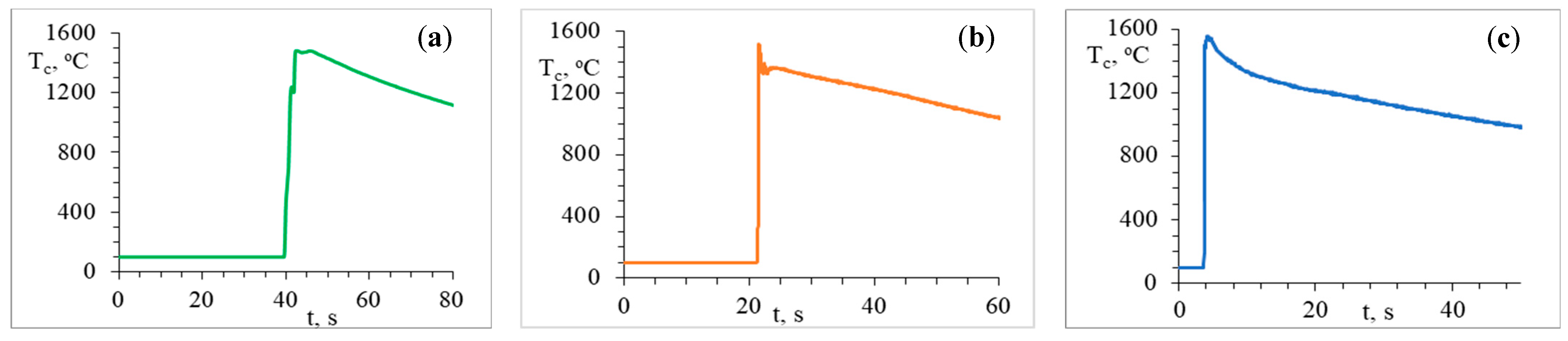
Figure 1. Combustion thermograms of the mixtures: (a) 0.3Cr-0.3Mn-1.2Co-1.2Ni-2Al-2C, (b) 0.4Ti-0.4Cr-0.4Mn-0.4Co-0.4Ni-1.5Al-1C, (c) 0.9Ti-0.6Cr-0.6Mn-0.6Co-0.3Ni-2Al-2C.
Ceramics 08 00137 g001
Figure 2. XRD patterns of the combustion products of the (a) 0.3Cr-0.3Mn-1.2Co-1.2Ni-2Al-2C, (b) 0.4Ti-0.4Cr-0.4Mn-0.4Co-0.4Ni-1.5Al-1C, (c) 0.9Ti-0.6Cr-0.6Mn-0.6Co-0.3Ni-2Al-2C mixtures.
Ceramics 08 00137 g002
Figure 3. SEM images of the combustion products of the (a) 0.3Cr-0.3Mn-1.2Co-1.2Ni-2Al-2C, (b) 0.4Ti-0.4Cr-0.4Mn-0.4Co-0.4Ni-1.5Al-1C, (c,d) 0.9Ti-0.6Cr-0.6Mn-0.6Co-0.3Ni-2Al-2C mixtures.
Ceramics 08 00137 g003
Figure 4. Particle size distribution of combustion product of 0.9Ti-0.6Cr-0.6Mn-0.6Co-0.3Ni-2Al-2C mixture.
Ceramics 08 00137 g004
Figure 5. Oxidation behavior of the combustion product of 0.9Ti-0.6Cr-0.6Mn-0.6Co-0.3Ni-2Al-2C mixture and bulk samples in air flow, V = 20 °C/min.
Ceramics 08 00137 g005
Figure 6. (a,b) SEM images of different magnifications, (c) EDS image and (d) X-ray diffraction pattern of the consolidated combustion product of the 0.9Ti–0.6Cr–0.6Mn–0.6Co–0.3Ni–2Al–2C mixture.
Ceramics 08 00137 g006
Table 1. The combustion temperatures (Tc), front propagation velocities (Uc), heating and cooling rates (Vh, Vc) deduced from temperature profiles.
SystemTc, °CUc, mm/sVh, °C/sVc, °C/s
0.3Cr-0.3Mn-1.2Co-1.2Ni-2Al-2C1480 ± 100.22 ± 0.01292 ± 152.9 ± 0.2
0.4Ti-0.4Cr-0.4Mn-0.4Co-0.4Ni-1.5Al-1C1520 ± 100.70 ± 0.01882 ± 443.2 ± 0.3
0.9Ti-0.6Cr-0.6Mn-0.6Co-0.3Ni-2Al-2C1560 ± 104.30 ± 0.021726 ± 862.9 ± 0.2
Disclaimer/Publisher’s Note: The statements, opinions and data contained in all publications are solely those of the individual author(s) and contributor(s) and not of MDPI and/or the editor(s). MDPI and/or the editor(s) disclaim responsibility for any injury to people or property resulting from any ideas, methods, instructions or products referred to in the content.