
Article

Phase Formation Study of Solid-State LLZNO and LLZTO via Structural, Thermal, and Morphological Analyses

1
Institute for Ceramic Materials and Technologies (IKMT), University of Stuttgart, Allmandring 7B, 70569 Stuttgart, Germany
2
Imerys Technology Center, 86 Muning Road, Tianjin 300450, China
3
Imerys Technology Center, 1 Rue Le Chatelier, 38090 Vaulx-Milieu, France
4
Imerys Technology Center, Seebach 2, 9523 Villach, Austria
*
Author to whom correspondence should be addressed.
Ceramics 2025, 8(4), 132; https://doi.org/10.3390/ceramics8040132
Submission received: 25 September 2025 / Revised: 21 October 2025 / Accepted: 24 October 2025 / Published: 28 October 2025
(This article belongs to the Special Issue Advances in Ceramics, 3rd Edition)

Abstract

Garnet-type Li7La3Zr2O12 (LLZO) is a solid electrolyte candidate for ASSLBs, owing to its wide electrochemical window and intrinsic safety. Yet phase-pure LLZO remains difficult because secondary phases form, and the transition towards the tetragonal phase, aliovalent doping, mitigates these issues. Still, the phase formation pathway is not fully understood. Here, we present comparative in situ and ex situ studies of Nb- and Ta-doped LLZO (LLZNO and LLZTO) that were synthesized by a solid-state reaction. In situ/ex situ XRD reveals that the lithium precursor dictates the reaction path: differing decomposition temperatures of the lithium precursor define reaction windows that control cubic-phase purity and particle morphology. In air, limited Li diffusion favors oxycarbonates and pyrochlore, necessitating 950–1050 °C to achieve phase-pure cubic LLZO. Under N2, faster Li availability and diffusion enable uniform nucleation and a route to cubic LLZO without detectable secondary phases. These findings demonstrate the coupled effects of temperature, precursor, dopant, and atmosphere, guiding process optimization and scalable production.

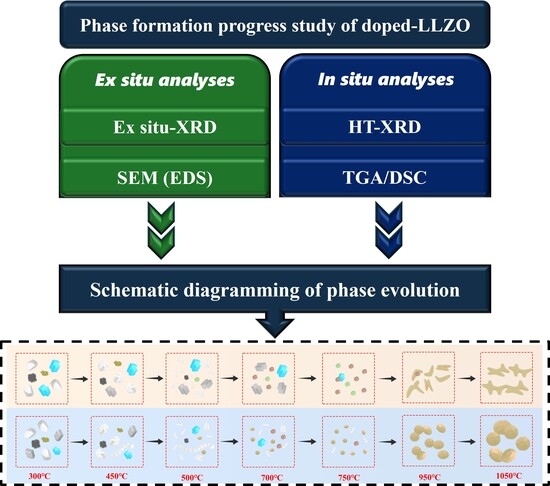
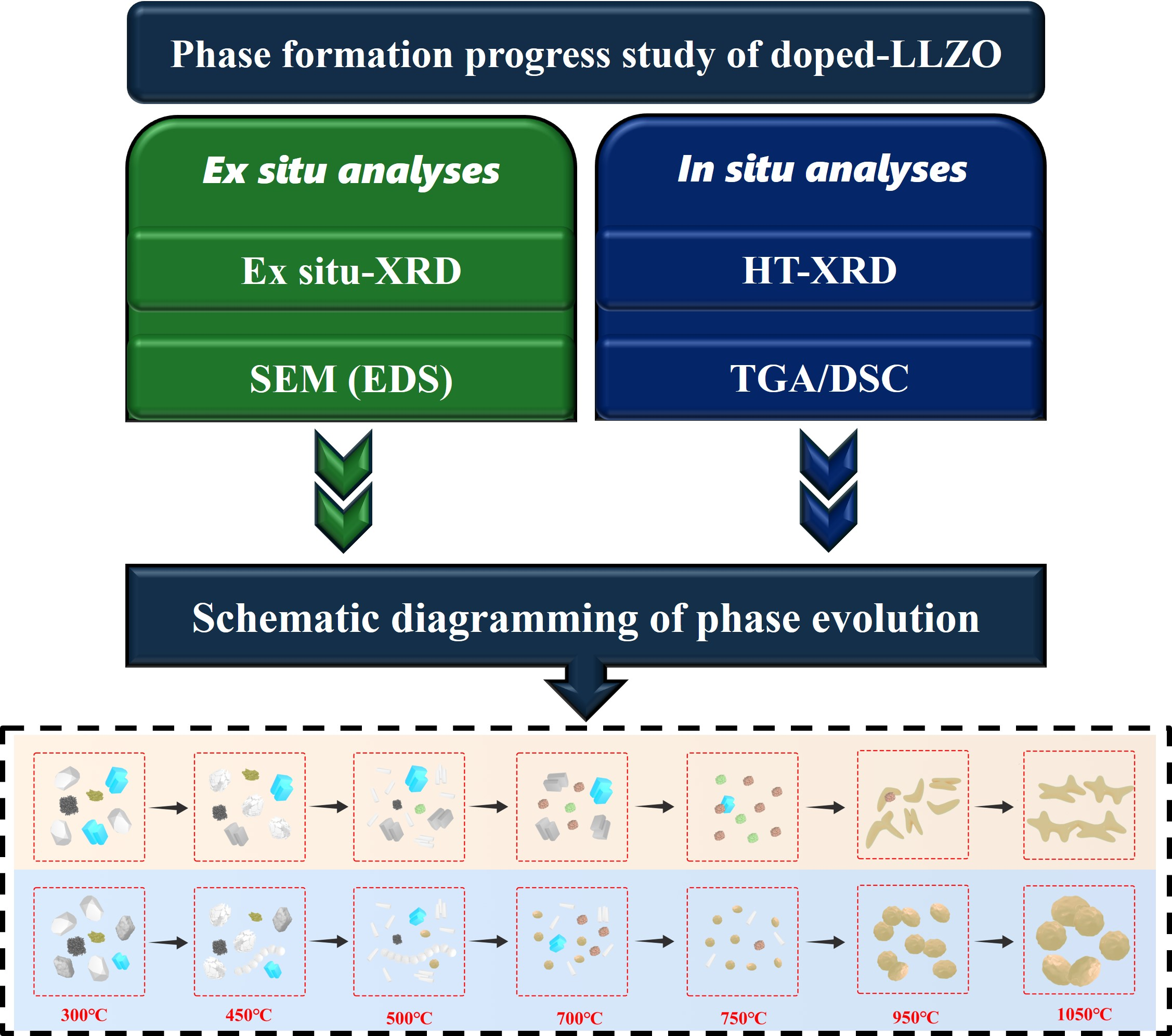
Graphical Abstract

1. Introduction

In recent years, the rapid expansion of electric vehicles and large-scale energy storage systems has accelerated interest in all-solid-state lithium batteries (ASSLBs), owing to their high energy density and excellent cycling stability [1]. In ASSLBs, the solid electrolyte is critical for Li+ transport, replacing flammable organic electrolytes with safer materials that offer wide electrochemical stability windows [2,3]. Among various candidates, oxide-based electrolytes stand out for their superior chemical and electrochemical stability [4]. In particular, garnet-type Li7La3Zr2O12 (LLZO) has gained considerable attention for its relatively high ionic conductivity (10−3–10−4 S/cm) in the cubic phase, wide electrochemical window, and excellent compatibility with Li metal electrodes [5,6].
The disordered distribution of Li+ and vacancies in the cubic garnet lattice provides a 3D Li+ conduction pathway [7,8]. However, LLZO exhibits two polymorphs, i.e., cubic (c-LLZO, Ia 3 ¯ d) and tetragonal (t-LLZO, I41/acd), and undoped LLZO stabilizes as the poorly conducting tetragonal phase at room temperature [9,10]. To stabilize c-LLZO, aliovalent doping at Li, La, or Zr sites is commonly employed to engineer Li-vacancy concentrations and maintain the cubic framework under ambient conditions, thereby enhancing ionic conductivity [11,12]. For example, Al3+ or Ga3+ substitution at Li sites creates two Li+ vacancies per dopant [13,14,15,16], whereas Rb3+ substitution at La sites increases Li+ concentration [17]. At the Zr site, Nb5+ or Ta5+ substitution has been shown to stabilize the cubic structure [18,19,20]. Beyond suppressing the low-conductivity tetragonal phase, eliminating deleterious intermediates/secondary phases is essential for high-conductive LLZO synthesis [7,13,14,21,22,23]. Doping can alter secondary-phase chemistry; for instance, Al doping may reduce La2Zr2O7 but introduce La2Li0.5Al0.5O4 and LaAlO3 [13,23,24], both of which are poor Li-ion conductors that lower bulk conductivity and increase activation energy [25,26]. Accordingly, precursor reaction pathways and intermediate-phase evolution should be systematically resolved. In situ high-temperature studies have provided valuable insights, particularly for Al-doped LLZO. Gullbrekken et al. [24] observed La2Zr2O7 and LaAlO3 during the crystallization of Pechini-derived Al-doped LLZO by HT-XRD. With the help of HT-XRD and NPD investigations coupled with SEM/EDS observations, Parascos et al. [27] reported persistent La2Li0.5Al0.5O4 from 700 to 950 °C during the solid-state synthesis process. Matsui et al. [28] investigated the phase stability of LLZO by HT-XRD and TG-DTA, showing that undoped LLZO exhibits a non-quenchable high-temperature cubic phase, whereas Al3+ substitution at Li sites destabilizes the ordered Li sublattice in t-LLZO and thereby stabilizes the cubic phase at ambient temperature.
In contrast to the extensive work on Al doping, systematic in situ studies on Nb- and Ta-doped LLZO are limited, with most research focusing on synthesis/sintering strategies or compositional optimization to improve the final performance [18,19,20,29], while phase-formation pathways and influencing factors remain poorly understood. To address this gap, this work systematically investigates the phase formation processes of Nb- and Ta-doped LLZO that were prepared with two lithium precursors (Li2CO3 and LiOH), using in situ high-temperature X-ray diffraction (HT-XRD) and thermogravimetric analysis (TGA-DSC), complemented by ex situ XRD, morphological, and composition analyses (SEM/EDS). The results elucidate the coupled effects of the calcination temperature, lithium source, dopant species, and reaction atmosphere on the reaction window, phase evolution, and microstructure, and reveal the mechanisms of secondary-phase formation across composition systems. These insights provide mechanistic guidance for the controlled synthesis of high-purity cubic LLZO and establish a foundation for scalable manufacturing of high-performance oxide solid electrolytes for ASSLBs.

2. Materials and Methods

2.1. Sample Preparation

In this work, four LLZO-based compositions were synthesized and investigated: Nb-doped LLZO (LLZNO), prepared using Li2CO3 and LiOH, and Ta-doped LLZO (LLZTO), prepared using Li2CO3 and LiOH.

2.1.1. Raw Materials

Regarding the raw materials used in this work, the monoclinic zirconia (ZrO2 + HfO2, ≥99%) was sourced from Imerys. Two industrial battery-grade lithium sources, lithium carbonate (Li2CO3, ≥99%) and lithium hydroxide monohydrate (LiOH, ≥56.5%), were obtained from Shandong RuiFu Lithium (China) and Beijing TongSheng (China), respectively. Lanthanum oxide (La2O3, ≥99.999%) was obtained from Shanghai Panya (China), while the doping materials, Niobium Pentoxide (Nb2O5, ≥99.5%) and Tantalum Pentoxide (Ta2O5, ≥99.5%), were sourced from Aladdin Biochemical (China).

2.1.2. Preparation of Precursor Powders

All precursor powders were prepared by mixing stoichiometric amounts of Li2CO3 (dried at 120 °C) or LiOH·H2O, La2O3 (dried at 900 °C), and ZrO2 (dried at 120 °C). For the Nb- and Ta-doped powders, Nb2O5 and Ta2O5 were used as doping agents. An excess of 20% Li source was added to each precursor mixture to compensate for Li loss during the high-temperature treatment. The mixtures were ball-milled in a zirconia milling chamber using a PULVERISETTE 5 planetary ball mill (Fritsch) for 4 h under 300 rpm, with isopropanol used as the milling medium and ∅ = 3 mm zirconia balls. The suspensions were dried in a drying oven at 70 °C.

2.1.3. Preparation of Calcined-Doped LLZO Powders

For each composition, 20 g of the dried doped LLZO precursor powder was placed in a MgO crucible and calcined in a box furnace at selected temperatures of 300 °C, 450 °C, 500 °C, 700 °C, 750 °C, 950 °C, and 1050 °C. Each calcination was performed for 2 h with a constant heating rate of 5 °C/min.

2.2. Characterization

An in situ high-temperature analysis of the doped LLZO precursor powders was conducted to investigate phase evolution during the calcination process. In addition, the structural and microstructural characteristics of the doped LLZO powders calcined at defined temperatures were systematically examined.

2.2.1. In Situ High-Temperature XRD of Precursor Powders

High-temperature X-ray diffraction (HT-XRD) analysis was performed using a D8 Advance diffractometer (Bruker) that was equipped with Cu Kα radiation (40 kV, 40 mA), a LynxEye XE-T detector, and a high-temperature chamber HTK 2000N (Anton Paar). Precursor powder samples were dispersed in isopropanol and loaded onto a platinum sample holder. All measurements were performed under continuous nitrogen (N2) flushing (0.2–0.3 NL/min). The samples were heated from 25 °C (room temperature, RT) to 1200 °C at a constant heating rate of 5 °C/min. XRD data were collected at selected temperatures. From RT to 700 °C, measurements were taken at 100 °C intervals (i.e., RT, 100, 200, 300, 400, 500, 600, and 700 °C). From 700 °C to 1200 °C, data were collected at 50 °C intervals. At each target temperature, a 30 min XRD scan was acquired over a 2θ range of 15–60°. After reaching 1200 °C, the sample was cooled to RT at the same rate of 5 °C/min, and a final scan was performed at room temperature. Phase identification was carried out using DIFFRAC.EVA software, and Rietveld refinement was performed with the Total Pattern Analysis Solutions (TOPAS V6) software.

2.2.2. TGA/DSC Analysis of Precursor Powders

Thermogravimetric analysis (TGA) and differential scanning calorimetry (DSC) analyses were performed with a thermal analyzer TGA/DSC 3+/1600HT (Mettler Toledo). Approximately 40 mg of each precursor powder sample was heated up in a small MgO crucible from RT to 1300 °C with a constant nitrogen (N2) gas flow rate of 30 mL/min.

2.2.3. Structural and Microstructural Analyses of Calcined Powders at Various Temperatures

X-ray diffraction (XRD) was employed to identify and quantify the crystalline phases of the calcined-doped LLZO powders using a D8 Advance diffractometer (Bruker) equipped with Cu Kα radiation (40 kV, 40 mA) and a LynxEye XE-T detector, as well. Data were collected over a 2θ range of 5° to 80° with a step size of 0.02°. Phase analysis and Rietveld refinement were performed using DIFFRAC.EVA and TOPAS, respectively. The microstructures of the calcined-doped LLZO powders were examined using a field emission scanning electron microscope (SEM, JSM-IT800, JEOL) coupled with an energy-dispersive X-ray spectroscopy (EDS) system (JEOL) for elemental composition analysis.

3. Results

To ensure clarity and consistency in the presentation and discussion of the results, the Nb-doped and Ta-doped LLZO samples are hereafter referred to as LLZNO and LLZTO, respectively. Likewise, materials synthesized using lithium carbonate (Li2CO3) and lithium hydroxide (LiOH) are denoted as LCO and LOH, respectively, throughout the following figures, results, and discussions.

3.1. Phase Formation of Doped LLZO During HT-XRD Analysis

HT-XRD enables the in situ analysis of the structural composition and phase evolution of LLZO precursor powders as a function of temperature. This technique allows for the direct observation of the reaction mechanisms, as well as the formation and decomposition behaviors of LLZO phases. In this study, four compositions: LLZNO-LCO, LLZNO-LOH, LLZTO-LCO, and LLZTO-LOH, were subjected to HT-XRD analysis. The investigation not only focuses on the effects of different dopant systems (Nb5+ and Ta5+) on LLZO phase formation, but it also aims to elucidate the specific role of each lithium source (Li2CO3 vs. LiOH) in the formation mechanism of LLZO under N2 atmosphere.
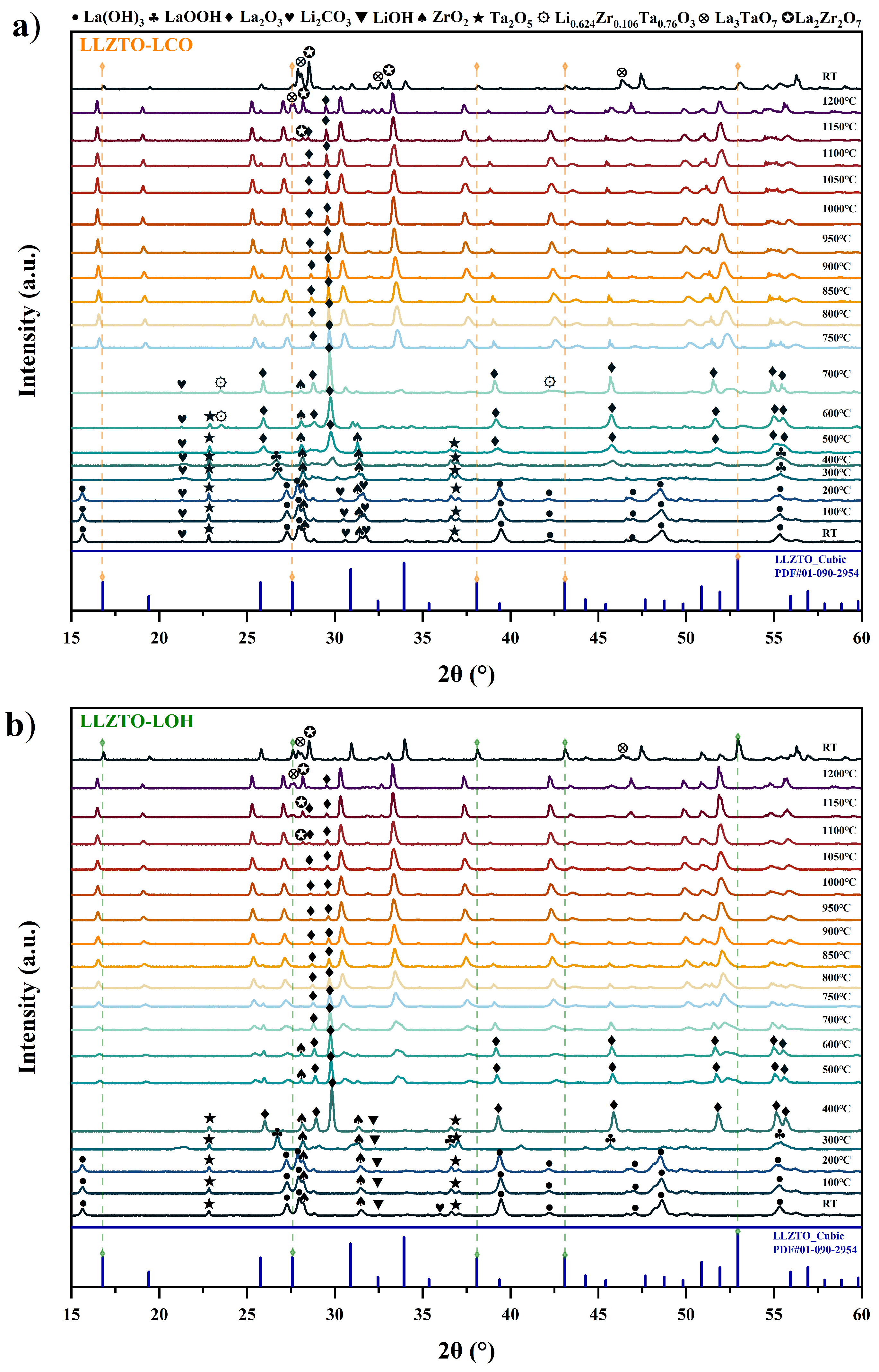
Figure 1 and Figure 2 show the HT-XRD patterns for all systems investigated. A noticeable leftward shift in the diffraction peaks was observed with an increasing temperature (see representing dash line at 16.78654°, 27.57824°, 38.10173°, 43.10467°, and 51.93995°), which is a direct consequence of thermal lattice expansion. As the material is heated, the interplanar spacing increases, leading to a decrease in the diffraction angle θ according to Bragg’s Law. Consequently, the diffraction peaks shift towards lower 2θ values on the XRD patterns. Moreover, the thermal expansion of the platinum sample holder induces non-linear peak shifts, particularly at higher diffraction angles, where angular deviations become more pronounced due to accumulated systematic errors [30,31]. While such peak shifts can complicate phase identification, accurate interpretation remains feasible by referencing high-temperature PDF databases, tracking the appearance or disappearance of characteristic peaks (indicative of phase transitions), and employing Rietveld refinement via TOPAS to adjust and fit the peak positions.
Figure 1 presents the in situ high-temperature XRD (HT-XRD) patterns of the LLZNO precursor powders that were synthesized using lithium carbonate (LLZNO-LCO) and lithium hydroxide (LLZNO-LOH), elucidating the phase evolution from room temperature (RT) up to 1200 °C. In the LLZNO-LCO system (RT–200 °C), distinct precursor phases, including Li2CO3 (PDF#00-24-1141), ZrO2 (PDF#00-88-2390), and Nb2O5 (PDF#00-27-1313), were clearly observed. Notably, La was identified as La(OH)3 (PDF#00-36-1481) rather than La2O3, which is attributed to the hygroscopic nature of La2O3, which readily transforms into La(OH)3 after milling and drying in ambient conditions [32]. A similar set of precursor peaks (LiOH (PDF#00-85-1064), La(OH)3, ZrO2, and Nb2O5) appeared in the LLZNO-LOH system, accompanied by minor Li2CO3 formations due to the partial carbonate formation from LiOH upon exposure to air during the drying process [33]. These converted Li2CO3 residues persist in the structure until their decomposition at higher temperatures. Given the small quantity of this byproduct, the corresponding peak intensity in Figure 1b is relatively weak. Between 300–400 °C, both systems exhibited the disappearance of La(OH)3 and the emergence of LaOOH (PDF#00-77-2349), an intermediate phase prior to conversion into La2O3 upon further heating [32,34]. At this stage, the differences between the LCO and LOH systems remained minimal, primarily reflecting the decomposition of precursor phases.
In the intermediate temperature region (500–750 °C), previous studies indicated that the relatively low reactivity of Li2CO3 can lead to the formation of secondary phases, such as Li2ZrO3 and pyrochlore-type La2Zr2O7, particularly under lithium-deficient conditions [7,13,21,22]. However, these phases were not clearly detected in LLZNO-LCO (Figure 1a). Instead, minor peaks corresponding to Li0.774Zr0.057NbO3 (PDF#00-042-0243), an orthorhombic perovskite-like phase [35], appeared at 600–700 °C, indicating limited intermediate reaction pathways. The majority of raw materials remained unreacted until 750 °C, at which Li2CO3 decomposed to release Li2O [36], promoting the initial crystallization of LLZNO through reactions with other precursors, with La2O3 (PDF#00-74-1144) as the only detectable residual phase. At elevated temperatures (800–1150 °C), cubic LLZNO peaks became increasingly pronounced, matching well with the reference pattern (PDF#04-025-9435). Peak sharpening and intensification indicated effective nucleation and crystal growth, coinciding with a decrease in residual La2O3 peaks. However, at excessively high temperatures, decomposition of LLZO could occur, generating phases such as La2O3 and La2Zr2O7 [37,38]. As shown in Figure 1a, at 1200 °C, decomposition of the cubic LLZNO phase occurred due to lithium volatilization, generating the appearance of secondary phases such as La2Zr2O7 (PDF#00-73-0444) and La3NbO7 (PDF#01-83-0393). These phases persisted as stable constituents in the sample and were further confirmed by RT-XRD after cooling.
In contrast, the LLZNO-LOH system (Figure 1b) exhibited a notably cleaner diffraction pattern between 500–600 °C, with minimal intermediate-phase formation. Early LLZNO formation, evidenced by weak peaks at approximately 2θ ≈ 16.79°, commenced concurrently with LiOH decomposition to Li2O at a lower temperature [39]. Upon further heating to 700–750 °C, no La2Zr2O7 was detected. Concurrently, decomposition of residual Li2CO3 completed the lithium supply, promoted direct reactions among the precursors, and thereby facilitated LLZNO crystallization. Peak sharpness and intensity of the cubic LLZNO phase significantly increased from 800 to 1150 °C, with minimal residual phases apart from La2O3. Nonetheless, at 1200 °C, LLZNO-LOH decomposition similarly occurred, producing La2Zr2O7 and La3NbO7.
Figure 2 reveals the HT-XRD patterns of LLZTO precursors. Compared with LLZNO systems, similar phase evolution trends were observed for both LLZTO-LCO and LLZTO-LOH compositions. Initial precursor phases (Li2CO3, LiOH, La(OH)3, ZrO2, and Ta2O5 (PDF#00-89-2843)) were observed clearly below 200 °C. Upon heating to 300–400 °C, La(OH)3 converted into LaOOH, and between 500–700 °C in the LOH system, LLZTO began to form through decomposition of LiOH and LaOOH, with slightly enhanced peak intensities compared to LLZNO (e.g., 2θ ≈ 16.79°, 19.40°), suggesting differences in crystallization dynamics. In the LLZTO-LCO system, minor intermediate Li0.624Zr0.106Ta0.76O3 (PDF#00-42-0242) phases appeared around 600–700 °C, analogous to the LLZNO-LCO system, implying that, in this temperature window, Li2CO3, ZrO2, and Nb2O5/Ta2O5 form Li–Zr–Nb/Ta–O perovskite-type intermediates rather than Li2ZrO3. With an increasing temperature, these intermediate phases were further reacted with La2O3 to yield the desired cubic LLZTO phase. From 750 to 1150 °C, the disappearance of Li0.624Zr0.106Ta0.76O3 and the emergence of sharp cubic LLZTO peaks (PDF#01-090-2954) confirmed successful cubic-phase development. Meanwhile, residual La2O3 diminished progressively, evidencing increasing phase purity. LLZTO-LOH achieved dominant cubic-phase formation by approximately 1000–1050 °C, which is earlier than in the LCO system. Interestingly, LLZTO-LOH decomposed slightly earlier (1100 °C) than its Nb-doped counterpart, generating La2Zr2O7 and La3TaO7. Similarly, LLZTO-LCO decomposed earlier (1150 °C) compared to LLZNO-LCO, accompanied by broader decomposition ranges and higher-intensity peaks of secondary phases.

3.2. Thermal Stability Analysis of Doped LLZO

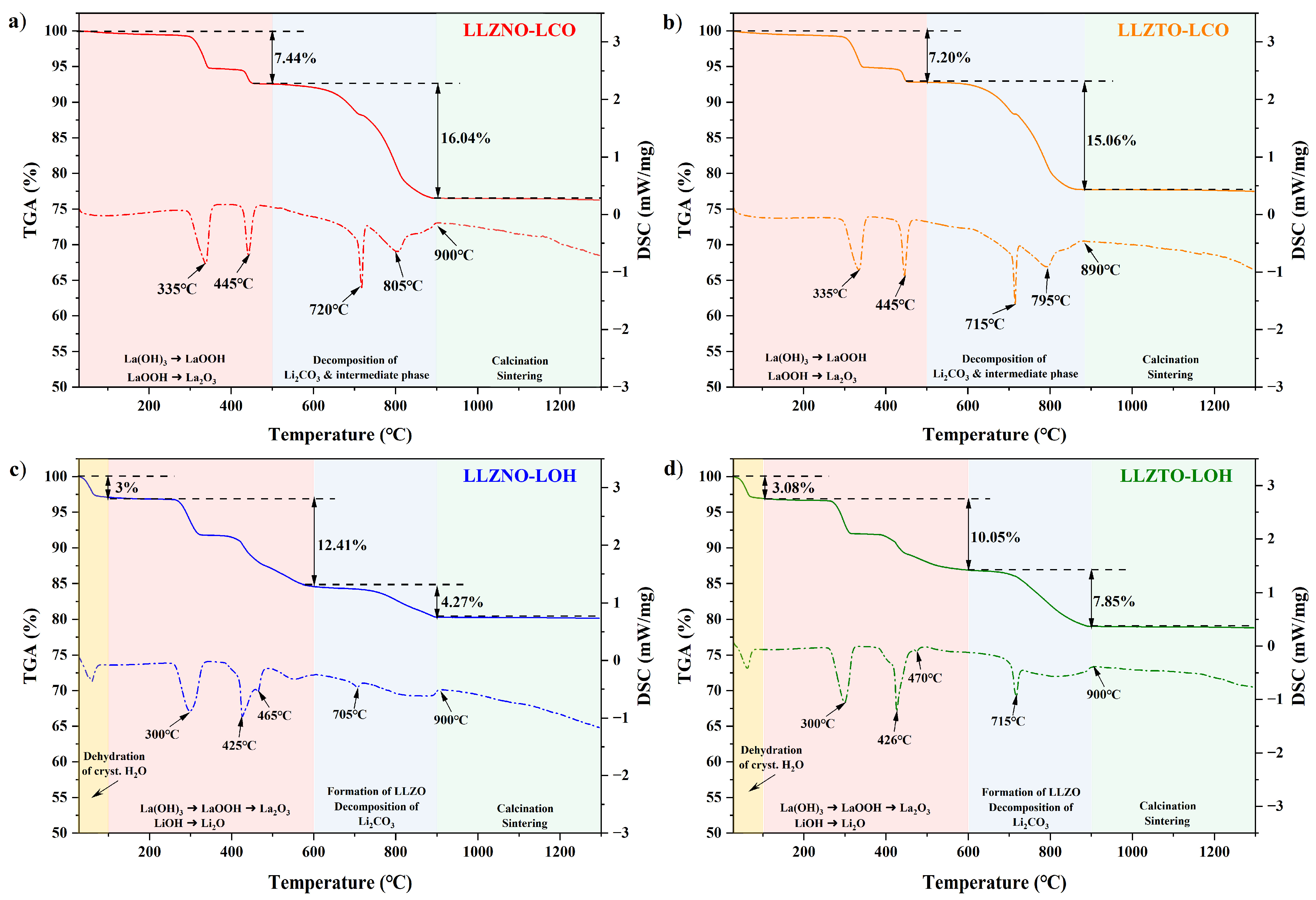
The TGA and DSC analyses of LLZNO and LLZTO precursor powders synthesized using different lithium precursors (Li2CO3 and LiOH) reveal significant differences in their thermal behavior. Although TGA and DSC are generally not sensitive enough to detect the formation of LLZO or other intermediate phases, and some variability may occur across measurements [7,13], the curves still exhibit distinct mass loss and thermal transitions. These endothermic and exothermic signals provide valuable insights into decomposition and synthesis reactions, complementing the HT-XRD results and confirming the calcination behavior of LLZO. Figure 3a–d presents the TGA and DSC curves for each LLZO precursor powder.
As shown in Figure 3a,b, the TGA curves of both doped LLZO-LCO precursor powders exhibited three distinct thermal events that correlated with DSC peaks. Both LLZNO-LCO and LLZTO-LCO displayed an initial gradual weight loss up to approximately 300 °C, with the first endothermic peak at around 335 °C. A subsequent weight loss and another endothermic event occurred near 445 °C. These thermal events and associated mass losses (7.44% for LLZNO-LCO and 7.2% for LLZTO-LCO) could correspond to the two-step dehydration of lanthanum hydroxide: La(OH)3 → LaOOH → La2O3 [32,34]. Following the decomposition of the La-source, a third significant endothermic peak, observed around 715–720 °C, is associated with the melting and decomposition of Li2CO3 into Li2O, releasing CO2 and resulting in substantial mass loss [36]. An additional endothermic peak around 800 °C (805 °C for LLZNO and 795 °C for LLZTO) likely reflects a further decomposition of residual Li2CO3 and a breakdown of intermediate phases formed by precursor reactions; the closely spaced but distinct peaks are attributable to differing dopant effects (Nb vs. Ta). Li2O diffusion following Li2CO3 decomposition likely promotes a further reaction with the remaining raw materials to form LLZO. The second-stage mass losses were 16.04% for LLZNO-LCO and 15.06% for LLZTO-LCO, respectively. The total mass losses for LLZNO-LCO and LLZTO-LCO reached 23.48% and 22.26%, respectively, with mass stabilization occurring around 900 °C, after which slight further losses occurred due to continuous lithium volatilization and partial LLZO decomposition.
The thermal behavior of LOH samples differs notably (Figure 3c,d), involving four distinct stages in LLZO formation. Initially, a small mass loss (~3%) occurred below 100 °C, along with a minor endothermic peak attributed to the removal of crystallization water from lithium hydroxide monohydrate [40]. Around 300 °C, similar to the LCO samples, La(OH)3 decomposed to LaOOH, with the endothermic peak slightly shifted to lower temperatures. Subsequently, two clear endothermic peaks at approximately 425–426 °C and 465–470 °C indicate the simultaneous conversion of LaOOH to La2O3 and decomposition of LiOH into Li2O (LiOH melting point: 450–471 °C) [39]. The earlier availability of Li2O promotes early solid-state reactions among the precursors, aligning well with the HT-XRD observations (Figure 1b and Figure 2b). Mass losses at this stage were 12.41% (LLZNO-LOH) and 10.05% (LLZTO-LOH). From approximately 600 °C onward, an endothermic peak (705 °C for LLZNO-LOH and 715 °C for LLZTO-LOH) signifies the decomposition of Li2CO3, which was intermediately formed from LiOH through proton exchange [33]. The mass losses at this stage were 4.27% (LLZNO-LOH) and 7.85% (LLZTO-LOH), and they were controlled by the amount of Li2CO3 present in the precursor samples, yielding total losses of 19.68% and 20.98%, respectively, which were slightly lower than their LCO counterparts. Despite the more complex reaction pathway and an earlier onset of reactions, the LLZO-LOH samples also reached mass and cubic LLZO phase stability around 900 °C. Thus, for both Nb- and Ta-doped LLZO, negligible weight changes or thermal peaks occurred after 900 °C, indicating stable cubic-phase formation.

3.3. Structural and Morphology Analyses of Calcined-Doped LLZO Powders

In the preceding sections, in situ investigations of LLZO–LCO and LLZO–LOH revealed lithium-source-dependent phase-formation pathways for doped LLZO. For the LCO system, cubic garnet LLZO emerged at ~750 °C, whereas in the LOH system, crystallization began as low as ~500 °C. The distinct decomposition temperatures of Li2CO3 and LiOH define different reaction windows. Nevertheless, both systems achieve a dominant cubic phase by 1000–1050 °C, and TGA/DSC indicates that a well-stabilized cubic phase is reached near 900 °C. It should be noted that HT-XRD can be affected by factors such as sample volume, experimental setup, and atmosphere, and thus may not fully reproduce bulk calcination behavior. Ex situ analyses were undertaken to reassess the phase chemistry.
Accordingly, all doped LLZO precursor powders were calcined in air at selected temperatures from 300 to 1050 °C. A short dwell time of 2 h was used at each step to minimize grain growth while capturing the characteristic reactions and phase transitions. The corresponding XRD patterns and SEM micrographs of the calcined powders are shown in Figure 4, Figure 5, Figure 6 and Figure 7.

3.3.1. Phase Chemistry of Calcined Doped LLZO Powders

Figure 4a–d present the ex situ XRD patterns of the four doped LLZO powders calcined under ambient conditions. Overall, at 300 °C, the precursors remained essentially unreacted, with reflections from La(OH)3, ZrO2, Li2CO3, and LiOH, together with the dopant oxides Nb2O5 and Ta2O5, dominating the XRD patterns.
In the LOH system (Figure 4c,d), partial conversion of LiOH to Li2CO3 led to identifiable Li2CO3 reflections at 300 °C, which was consistent with the findings of Section 3.1. By 450 °C, La(OH)3 transformed to LaOOH, and partial LiOH decomposition had already begun, and weak LLZNO/LLZTO reflections appeared, indicating the onset of LLZO precursor formation that was driven by Li diffusion. At 500 °C, LiOH fully decomposed to Li2O, which reacted with the remaining precursors to form LLZO, corroborating the HT-XRD conclusion that the LOH system nucleates LLZO earlier. Interestingly, at 700 °C, small amounts of La2Zr2O7, which is absent in HT-XRD, were detected together with residual Li2CO3 and La2O3 in the samples calcined for 2 h. After 750 °C (post-carbonate decomposition), trace amounts of La2Zr2O7/La2O3 persisted but were greatly reduced. Comparable studies show La2Zr2O7 forming as low as 600–650 °C and persisting to ~750 °C [21,41], indicating incomplete garnet formation at this stage. At 950 and 1050 °C, both LLZNO-LOH and LLZTO-LOH displayed clean patterns with sharp, intense cubic LLZO peaks and no residual La2O3, reflecting good nucleation and crystallite growth with complete precursor consumption.
Consistent with the in situ results, the LCO system tends to form more secondary phases than the LOH system, primarily due to delayed Li diffusion. This is corroborated by the ex situ XRD patterns of both LCO systems shown in Figure 4a,b. Beyond the dehydration reaction of La(OH)3, an oxycarbonate phase Li0.52La2O2.52(CO3)0.74 (PDF#01-084-1965) isostructural with type-II lanthanide oxycarbonates (hexagonal) was observed between 450–700 °C. It formed via low-temperature reactions of La2O3 with CO2/Li2CO3 and persisted until it decomposed near 750 °C [42,43]. Moreover, two additional secondary phases also emerged, La3NbO7 (PDF#01-083-0393) and La3TaO7 (PDF#00-038-1418). They appeared in small amounts at 500 °C and became prominent by 700 °C. After carbonate decomposition at 750 °C, La3MO7 (M = Nb, Ta) together with La2Zr2O7 dominated the patterns. In addition, small amounts of residual unreacted Li2CO3 were observed as well; however, the corresponding peak intensity was weak due to the low-phase fractions. Interestingly, although Li2ZrO3 has been reported as a main secondary phase at comparable temperatures [13,21], Rietveld refinement in this study revealed only trace amounts of Li2ZrO3 and Li3MO4 (M = Nb, Ta) in the LLZNO- and LLZTO-LCO systems. Their peak intensities were barely discernible—near the background—and the refined weight fractions were essentially negligible (<0.5 wt%). At 950 °C, residual La2Zr2O7 and La2O3 were still detectable, and LLZNO/LLZTO peak intensities remained slightly lower than in the LOH systems, reflecting less effective nucleation due to the lower reactivity of Li2CO3 and delayed Li diffusion. Upon calcination at 1050 °C, however, near-phase-pure cubic LLZO was achieved without detectable secondary phases. Hence, although the dwell time also matters, 950 °C appears insufficient for well-stabilized cubic LLZO formation in the LCO systems, whereas 1050 °C provides a more robust condition to secure cubic LLZO dominance.

3.3.2. Morphology Evolution of Calcined-Doped LLZO Powders

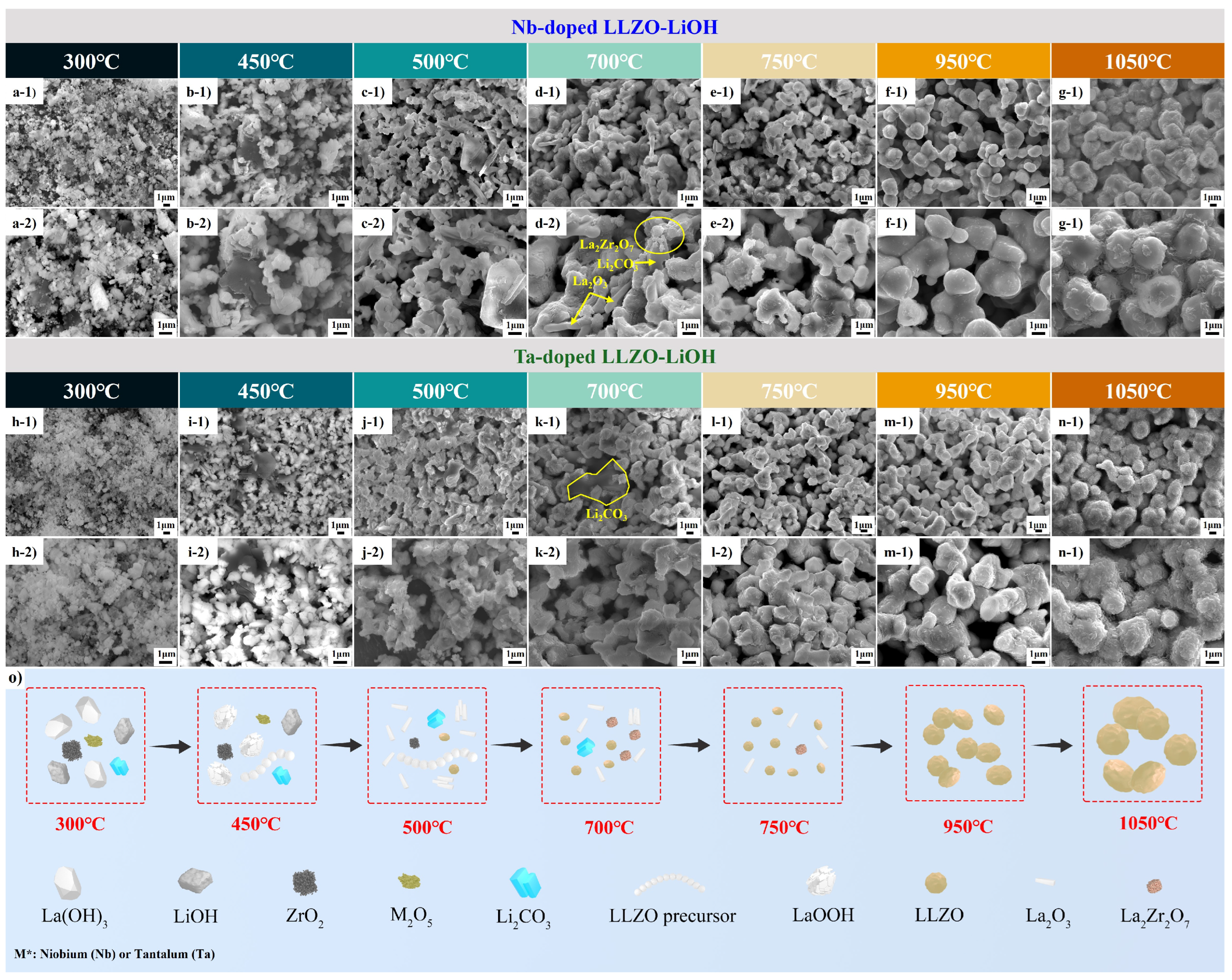
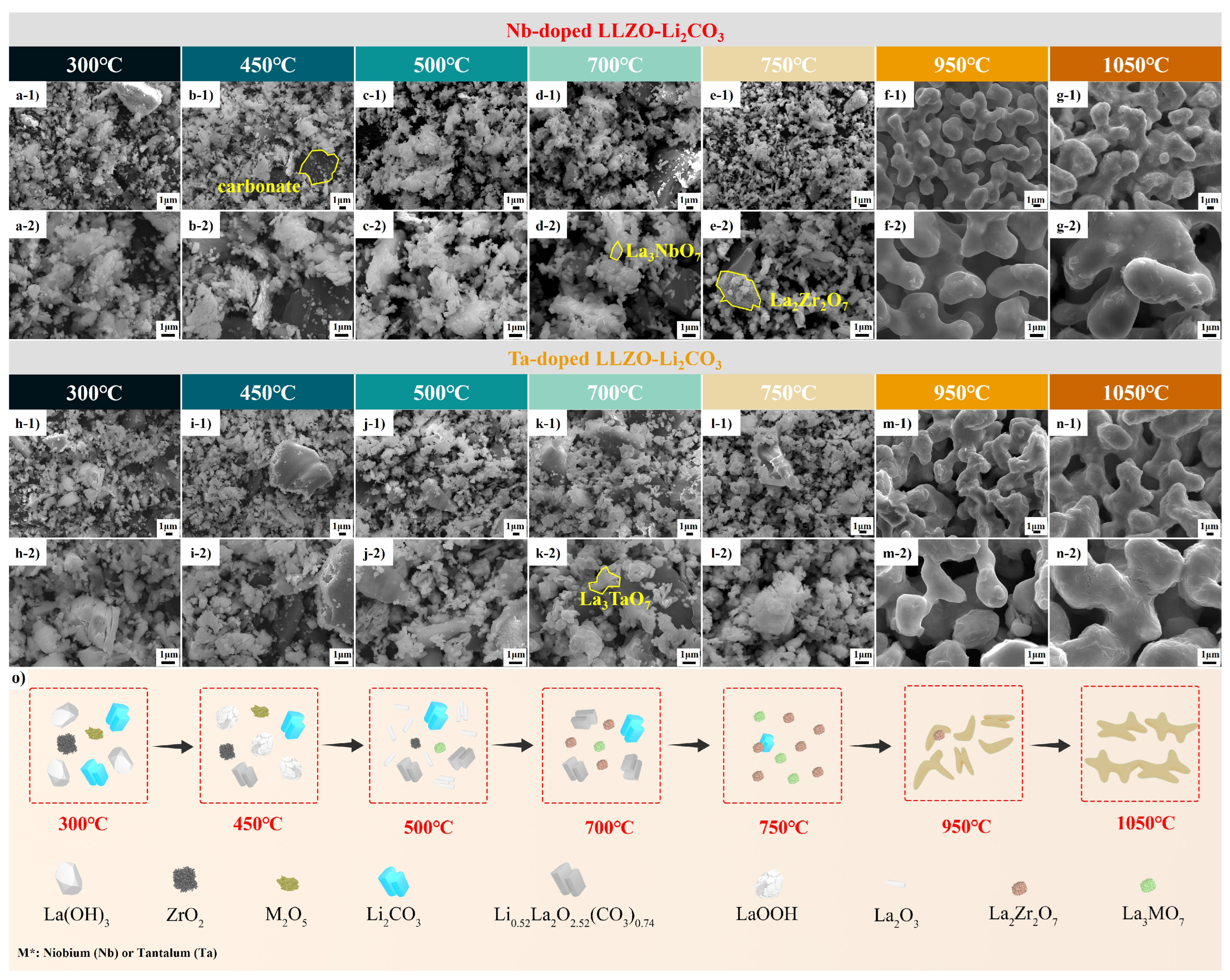
In this study, the morphologies of all calcined powders were examined by SEM, supported by EDS, to investigate the temperature-dependent evolution of different LLZO systems. Although EDS elemental analysis does not precisely quantify the actual elemental compositions, its semi-quantitative nature is still valuable for identifying phases. Figure 5 and Figure 7 illustrate the morphological transformations of the calcined powders across the temperature range of 300–1050 °C, clearly demonstrating significant differences between the LCO and LOH systems.
At 300 °C, the SEM images of the LCO systems revealed a precursor mixture with a uniform distribution of small particles; the reduced particle size and improved homogeneity imparted by wet milling are expected to facilitate subsequent solid-state reactions [27]. At 450 °C (Figure 5b,i), large, angular, dark-contrast particles (2–5 µm) were observed. Although Li is not detectable by EDS analysis, the concurrent C, O, and La signals support their identification as carbon-based phases. Their persistence up to 700 °C (Figure 5b–d,i–k), combined with the XRD results (Figure 4a,b) and the characteristic morphology of raw Li2CO3 [44], suggests that they are carbonate phases, such as Li0.52La2O2.52(CO3)0.74 and Li2CO3. These coarse carbonate/oxycarbonate particles decomposed by ~750 °C, leaving minor residues, which is likely a consequence of the short 2 h dwell time. By 950 °C, the LCO powders exhibited a cubic LLZO microstructure characterized by partially necked grains with an average size of ~2–10 µm. Further calcination at 1050 °C produced pronounced grain coarsening and incipient sintering, with partially sintered grains reaching ~10–20 µm.
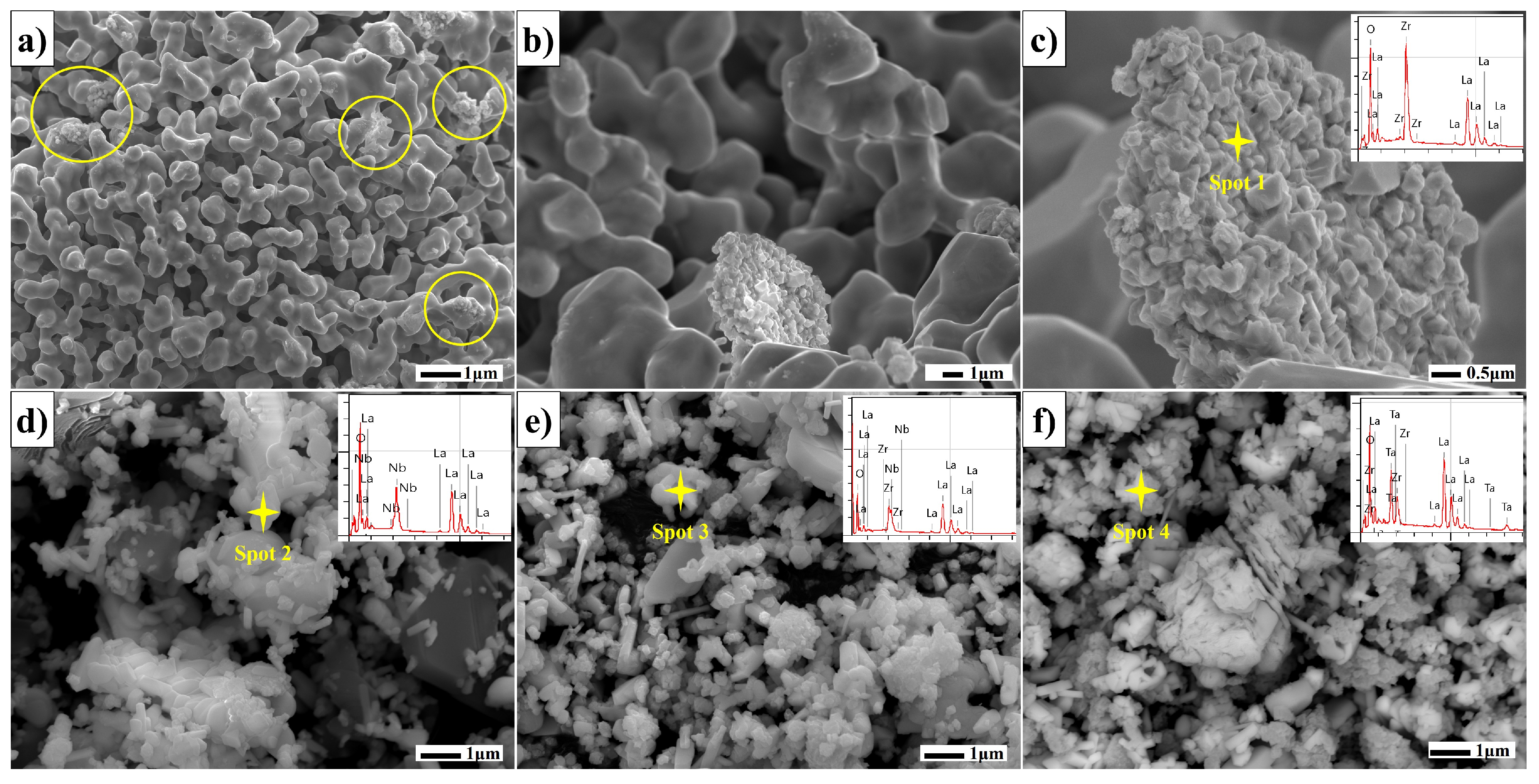
The XRD (Figure 4a,b) analysis indicated residual La2Zr2O7 in the doped LLZO-LCO samples between 700 and 950 °C. Combined with microscopy observations, at higher magnification (Figure 6a–c), submicrometric rhombohedral nanoparticles (≈100–500 nm) were attached to LLZO grains calcined at 950 °C, closely resembling the pyrochlore La2Zr2O7 morphology reported by Parascos et al. [21]. The EDS point analysis yielded an atomic ratio of La:Zr:O ≈ 2:2:7 (Table 1), confirming this assignment. Similar La2Zr2O7 nanoparticles were widespread at 700–750 °C, as shown in Figure 5e-2, capturing an intermediate state prior to lithium insertion into La2Zr2O7. These nanoparticles were dispersed among residual Li2CO3 crystals, which subsequently reacted to form LLZO. The SEM images taken at 700–750 °C (Figure 5d,e,k,l) also revealed numerous angular submicron particles (≈200–500 nm). Together with the XRD results (Section 3.3.1), these could be attributed to La3NbO7 and La3TaO7. The EDS results could further support this, e.g., in the 700 °C LLZNO-LCO sample (Figure 6d, spot 2), the La:Nb:O atomic ratio was ≈3:1:7, which is consistent with the La3NbO7 composition (Table 1). Notably, however, the limited spatial resolution of EDS (~1 µm interaction volume) hinders definitive assignment for submicron features and can mix signals from adjacent phases. At 750 °C (Figure 6e,f), following the decomposition of carbonate phases, only trace amounts of residual Li2CO3 remained in the LCO samples, with such quantities being nearly negligible in terms of weight and undetectable by XRD. Moreover, after excluding carbon contributions from the conductive carbon adhesive tape during EDS quantification, the atomic ratios of the analyzed regions (Table 1, Spot 3–4) correspond closely to the combined theoretical stoichiometries of La2Zr2O7 and La3MO7 (M = Nb, Ta), indicating that the elemental compositions of the LCO samples are well described by mixtures of these two pyrochlore-type phases. Numerous point analyses across different regions showed highly consistent results, corroborating the uniform formation and distribution of these pyrochlore-type secondary phases, which are also in agreement with the XRD findings.
In contrast to the abrupt morphological transformation observed in the LCO system, particularly between 750 and 950 °C (Figure 5e,f,l,m), the LOH system exhibited a distinctly different evolution pathway (Figure 7), indicative of a gradual growth process of LLZO particles. At 300 °C, similar to the LCO system, the LOH samples still comprised uniformly distributed fine particles and remained in an unreacted precursor state. However, by 450 °C, as confirmed by the XRD results (Figure 4c,d), the transformation of La(OH)3 to LaOOH and the partial decomposition of LiOH initiated the formation of LLZO precursors. Correspondingly, SEM images at this temperature revealed the emergence of abundant bright granular features (Figure 7b,i), which could be assigned to LaOOH and LLZO precursors. Upon calcining at 500 °C, with the complete decomposition of LaOOH and LiOH, the formation of LLZO became more evident. However, substantial amounts of unreacted materials (e.g., Li2CO3 and La2O3) remained and were still observable up to 700 °C (Figure 7d,k) due to higher decomposition temperatures. By 700 °C, the LLZO grains had coarsened to ~1–2 µm, which is consistent with the sharper and more intense XRD reflections, reflecting enhanced crystallite growth. Simultaneously, a transformation pathway similar to the LCO system (Figure 5e) was observed: small La2Zr2O7 particles were found attached to residual Li2CO3. This is attributed to the partial conversion of LiOH to Li2CO3, which limits lithium diffusion at 700 °C and thereby promotes the formation of pyrochlore phases. However, with the subsequent decomposition of Li2CO3, Li insertion could facilitate the conversion of La2Zr2O7 to LLZO. Following the decomposition of residual Li2CO3 at 750 °C, lithium sources completely decomposed and diffused, leading to uniformly distributed LLZO particles of approximately 2–4 µm across the LOH samples (Figure 7e,l). Nevertheless, a minor presence of the secondary-phase La2Zr2O7 was observed after 2 h of calcination at 700–750 °C, although its quantity was considerably lower compared to the LCO counterparts. These results indicate that despite the improved garnet crystallinity at 750 °C, the presence of secondary phases makes this temperature still not optimal for achieving phase-pure LLZO in the LOH system. Upon further heating to 950 °C, the LOH samples achieved a highly crystalline cubic LLZO structure with no detectable secondary phases in the XRD patterns. Compared with the LCO system, the microstructures of the LOH samples displayed smaller, more uniform particles (typically 3–5 µm) without abnormally large grains (Figure 7f,m). At 1050 °C, partial sintering occurred, and grains exhibited rougher surfaces and well-defined boundaries, resulting in a generally rounded morphology.
Based on the combined SEM and XRD results, schematic illustrations are provided in Figure 5o and Figure 7o to better visualize the temperature-dependent morphological evolution of the Li2CO3- and LiOH-derived LLZO systems, respectively.

4. Discussion

In this study, an in situ HT-XRD test, coupled with ex situ structural and morphological analyses of calcined powders, was performed to simulate and investigate the phase formation process of LLZNO and LLZTO that were prepared using different lithium sources, aiming to reveal their respective effects on phase formation. The discussion is divided into five sections: formation analysis of secondary phases, the influence of dopants, effects arising from different lithium precursors, impact of gas atmosphere and sample volume, and the discussion of appropriate calcination parameters.

4.1. Emergence of Secondary Phases

The synthesis of pure single-phase cubic garnet LLZO is particularly challenging due to the complexity of the reaction mechanisms and the inevitable formation of secondary phases. Moreover, the impurity phases observed by the in situ HT-XRD and ex situ XRD of calcined powders are not identical, indicating that secondary-phase formation during the solid-state reaction of LLZO is not fixed but is, instead, driven by multiple factors.
Given the scarcity of HT-XRD studies specifically addressing LLZNO and LLZTO systems, this study drew partial comparisons from the available HT-XRD results of Al-doped LLZO. In the present HT-XRD tests, minimal secondary phases were detected in the heating stage, except for minor quantities of Li0.774Zr0.057NbO3 and Li0.624Zr0.106Ta0.76O3 that were observed solely in the LCO systems (see Figure 1a and Figure 2a). This contrasts with the findings of Košir et al. [13], where HT-XRD tests conducted in air revealed more extensive formations of Li2ZrO3, La2Zr2O7, and LaAlO3 in Al-doped LLZO. The discrepancy may arise from two main factors. First, the doping mechanisms differ: Al3+ substitutes for the Li site [15], whereas Nb5+ and Ta5+ substitute for the Zr site [45,46]. Li0.774Zr0.057NbO3 and Li0.624Zr0.106Ta0.76O3 could essentially be understood as Zr4+-doped solid solutions based on LiNbO3 and LiTaO3, and under lithium-deficient conditions, partial replacement of Nb or Ta by Zr can lead to the formation of these non-stoichiometric intermediate phases. However, following the decomposition of Li2CO3, the lithium-rich environment allows these intermediate phases to further react with La2O3, completing the formation of LLZO. Second, apart from these two intermediate phases (Li0.774Zr0.057NbO3 and Li0.624Zr0.106Ta0.76O3), virtually no other secondary phases were observed during the HT-XRD experiments, highlighting the critical influence of the processing atmosphere. In this study, HT-XRD was carried out under an inert N2 atmosphere, where the low-oxygen partial pressure reduced reaction activity and could favor the partial reduction/incorporation of high-valence oxides (e.g., Nb2O5) into the LLZO lattice, thereby suppressing secondary phases. By contrast, in air, the higher oxygen partial pressure enhances cation mobility (La, Zr, Nb) and lithium volatilization, thereby facilitating the nucleation and growth of secondary phases. This atmospheric effect is also supported by Kim et al. [47]. It is worth noting that the HT-XRD results may also be affected by other experimental variables [24], although these are not the focus of the present study.
At elevated temperatures (1150–1200 °C), cubic LLZO exhibited limited thermal stability and could decompose to La2Zr2O7 and La3MO7 (M = Nb, Ta) phases, which were also observed in the ambient calcination samples (Figure 4). In air, accelerated lithium volatilization favors production and stabilization of pyrochlore-type La2Zr2O7 and La3MO7 (M = Nb, Ta). La2Zr2O7 is the most frequently reported impurity phase in LLZO, typically forming between 700–900 °C, particularly under Li-deficient conditions or when La- and Zr-bearing precursors contact before adequate Li diffusion [21]. In contrast, La3NbO7 and La3TaO7 are rarely discussed as secondary phases. Given the well-known compositional flexibility of pyrochlore structures, as demonstrated by Weller and Chan [48], it was initially suspected that the 700–750 °C LCO samples (Figure 4a,b) might contain LaxZryMzOw solid solutions rather than La3MO7 (M = Nb, Ta). However, a comparison with the reference patterns for pyrochlore La3MO7, reported by Egaña et al. [49], together with Rietveld refinements, confirmed that La2Zr2O7 and La3MO7 (M = Nb, Ta) dominated the patterns, with well-matched peak positions. SEM/EDS further revealed near-fixed elemental ratios (see Section 3.3.2). These findings demonstrate that insufficient lithium diffusion promotes the formation of pyrochlore-type secondary phases (reactions 1–3), which adversely impact the ultimate LLZO performance. Although the possible presence of solid solutions cannot be entirely ruled out, dedicated structural analyses would be required to quantify the extent of Nb/Ta substitution into the pyrochlore lattice, which is considered a topic beyond the scope of this study but worthy of future investigation.
L a 2 O 3 + 2 Z r O 2 L a 2 Z r 2 O 7
3 L a 2 O 3 + N b 2 O 5 2 L a 3 N b O 7
3 L a 2 O 3 + T a 2 O 5 2 L a 3 T a O 7
Parascos et al. [27] reported the formation of La2O2CO3 at 600 °C during an in situ XRD study of Al-doped LLZO, attributed to the reaction between residual La2O3 with atmospheric CO2 [50,51]. In contrast, this phase was not observed in the HT-XRD result of this study, owing to the inert N2 atmosphere that limited CO2 exposure and thereby suppressed La2O2CO3 formation. Instead, the ex situ XRD analysis identified the oxycarbonate Li0.52La2O2.52(CO3)0.74, formed via the subsequent reaction of La2O2CO3 with lithium carbonate (reactions 4–5) [43]. This finding underscores that the air atmosphere could not only accelerate lithium volatilization during LLZO synthesis but also promote the formation of an unexpected secondary phase. Although small amounts of Li2CO3 were also present in the LOH compositions, the early decomposition of LiOH facilitated the diffusion of Li2O, promoting the reaction of La2O3 with other precursors to form LLZO. As a result, this oxycarbonate secondary phase was not developed in the LOH samples.
L a 2 O 3 + C O 2 L a 2 O 2 C O 3
0.26 L i 2 C O 3 + L a 2 O 2 C O 3     L i 0.52 L a 2 O 2.52 C O 3 0.74 + 0.52 C O 2
Notably, several secondary phases highlighted in this work (Li0.52La2O2.52(CO3)0.74, La3NbO7, and La3TaO7) are rarely discussed in comparable studies, likely because most studies focus primarily on the synthesis of high-purity cubic LLZO. However, by emphasizing secondary phase formation and transformation during solid-state synthesis, this study provides valuable insights into the influence factors for solid-state synthesis and improving control strategies over the production of high-quality LLZO.

4.2. Comparison of Li2CO3 and LiOH as Lithium Precursor

As discussed above, the reaction atmosphere significantly influences the formation of secondary phases. Interestingly, in both the in situ and ex situ experiments, secondary phases arise predominantly in the LCO systems. This is attributed to the higher decomposition temperature of Li2CO3 (~750 °C), which causes delayed Li diffusion and thereby provides a sufficient reaction window for secondary-phase reactions. Under the air atmosphere, the oxycarbonate phase could initially form at lower temperatures, followed by the generation of pyrochlore-structured secondary phases (such as La2Zr2O7) around ~700 °C. These secondary phases typically require prolonged, high-temperature calcination to be consumed before the garnet phase dominates. In contrast, LiOH features higher chemical reactivity and a lower decomposition temperature, which facilitates earlier lithium diffusion. This narrows the reaction window, promotes uniform LLZO nucleation and crystal growth, and significantly suppresses the formation of undesired secondary phases. As a result, the LOH samples exhibit sharper and more intense XRD reflections (Figure 4), indicating improved crystallinity and cubic-phase purity.
The distinct decomposition mechanisms of Li2CO3 and LiOH not only determine different reaction windows and solid-state reaction pathways but also influence the resulting LLZO morphology. The SEM images (Figure 5 and Figure 7) at 950–1050 °C clearly illustrate that particles derived from Li2CO3 exhibit more necked structures, whereas LiOH-derived samples show uniformly distributed granular morphologies. This morphological difference can be attributed to the fact that the higher decomposition temperature of Li2CO3 affords a broader high-temperature window for LLZO grain growth, facilitating agglomeration and “necked” microstructures, whereas LiOH initiates earlier reactions and higher nucleation densities that constrain growth and yield finer, more uniformly distributed grains. Furthermore, the slightly rougher particle surfaces in LOH-derived powders likely result from rapid gas release during LiOH decomposition, which can locally elevate pressure and induce particle rupture or porous, coarse surface structures.
Our prior work [52] has also demonstrated that the choice of lithium precursor (Li2CO3 vs. LiOH) significantly influences the processability of final LLZO products, subsequently affecting the corresponding particle size, sintering densification, and electrochemical performance. Accordingly, the appropriate selection of the lithium precursor is essential for optimizing LLZO synthesis and properties.

4.3. Comparison of Nb2O5 and Ta2O5 as Dopant

In this study, Nb2O5 and Ta2O5 were employed as dopants in LLZO synthesis. Both follow a similar aliovalent substitution mechanism in which Nb5+/Ta5+ replace Zr4+, generating Li+ vacancies that stabilize the cubic garnet framework while lowering the sintering temperature and enhancing ionic conductivity [18,46,53].
The XRD analysis further revealed dopant-dependent diffraction behavior. For instance, at 2θ ≈ 19.4° and 33.93°, the Ta-doped LLZO samples showed notably higher peak intensities than the Nb-doped counterpart, indicative of a possible difference in preferred orientation. Moreover, the LLZTO samples (Figure 2) exhibited earlier high-temperature decomposition than the LLZNO samples (Figure 1). This difference in thermal stability likely originates from the ionic radius disparity between Nb5+ (64 pm) and Ta5+ (69 pm). The larger ionic radius of Ta5+ results in expanded lattice parameters when incorporated into the cubic LLZO structure [18], thereby increasing interatomic or interionic spacing, reducing interaction forces, and lowering bonding energies, which may consequently reduce the material’s melting point. As a result, Ta doping leads to a lower decomposition onset temperature for LLZTO compared with LLZNO. The difference in dopant effects is also reflected in the microscopic particle morphologies. As observed across both lithium precursor systems (LCO and LOH), the LLZNO particles consistently exhibited smoother particle surfaces than the LLZTO particles (Figure 5 and Figure 7). This phenomenon could be attributed to the smaller ionic radius and higher chemical reactivity of Nb5+ relative to Ta5+ [54], which can accelerate cation diffusion, promote lattice homogenization, and facilitate surface atom rearrangement, resulting in smoother particle surfaces. Furthermore, during calcination, Li2O released from lithium precursors combined with the higher reactivity of Nb2O5 may transiently create localized low-melting or “quasi-liquid” phases, further smoothing particle surfaces and yielding the observed microstructural differences.

4.4. Implications of Gas Atmosphere and Sample Volume

The discrepancies between the in situ and ex situ XRD results can be primarily attributed to different experimental conditions, most notably the atmosphere. In the in situ HT-XRD under N2, the LCO samples formed LLZO directly at 750 °C without detectable pyrochlore, whereas the ex situ calcination in air at the same temperature mostly yielded pyrochlore secondary phases. Although the LOH system exhibited a more complete reaction pathway, accelerated lithium volatilization in air still led to the presence of La2Zr2O7 between 700–750 °C. In contrast, no secondary phases were detected under a N2 atmosphere, owing to the suppression of lithium volatilization [55] and the prevention of CO2-induced side reactions [43], thereby confirming the critical role of atmospheric conditions in governing phase evolution. Some studies proposed that LLZO forms via intermediate phases (e.g., La2Zr2O7) rather than directly from precursors [7,13,21]. However, unlike these studies that focused on a single lithium precursor or atmospheric condition, the side-by-side comparison of lithium precursors and atmospheres in this work reveals that under N2 and with sufficient lithium, LLZO can nucleate directly without intermediate-phase generation. This direct pathway reduces the formation of secondary phases that compromise the final LLZO performance and thus offers a promising strategy for the high-quality synthesis of cubic LLZO. Notably, the higher reactivity and lower decomposition temperature of LiOH make it a more suitable lithium precursor for producing phase-pure cubic LLZO. In contrast, a higher decomposition temperature of Li2CO3 affords a broader window for secondary-phase formation, although N2 can inhibit impurity-phase formation; their mitigation becomes more challenging upon scale-up. It is worth noting that the absence of HT-XRD measurements under air, as well as ex situ calcination experiments under N2, represents a limitation of this study, potentially constraining the discussion on the role of atmospheric conditions in secondary-phase formation pathways. Future in situ and ex situ investigations of LLZNO and LLZTO under varied gas environments are therefore warranted to further elucidate the impact of the atmosphere on phase evolution and to guide process optimization for industrial-scale synthesis.
Beyond the atmospheric effect, sample volume also contributes to discrepancies between the in situ and ex situ XRD results. As reported by Gullbrekken et al. [24], during the synthesis of Al-doped LLZO with Li2CO3, secondary phases that were absent in HT-XRD can emerge after bulk calcination at the same temperature and atmosphere conditions, indicating that, due to the diverse sample volume, HT-XRD may not fully replicate the real calcination processes. In Li2CO3-based LLZO synthesis, the evolved CO2 is not easily dissipated, leading to elevated local CO2 partial pressure. This condition inhibits lithium diffusion, induces transient lithium deficiency, and may also facilitate the formation of secondary phases. Moreover, limited gas transport can result in pronounced surface–interior gradients. While outer regions with faster gas exchange react earlier, the inner regions remain kinetically constrained. Such a spatial gradient suppresses complete phase conversion during scale-up. Although similar diffusion limitations may also exist in the LOH system, its lower reaction onset temperature and broader reaction window afford greater tolerance to sample volume, thereby reducing sensitivity to scale. Consequently, large-scale processing typically demands elevated temperatures and prolonged dwell times to achieve full-phase transformation.

4.5. Influence Factors for the Calcination Processing

Based on the preceding analysis, it is evident that atmospheric conditions, sample volume, and precursor chemistry collectively govern the phase formation behavior during the solid-state synthesis of LLZO. Under an air atmosphere, higher calcination temperatures than in N2 are generally required to extend the reaction window for decomposing secondary phases and drive subsequent reactions with the remaining precursors. Compared with Li2CO3, LiOH enables lower synthesis temperatures owing to its higher reactivity, but its rapid lithium volatilization necessitates a deliberate Li excess to ensure a complete reaction. In large-scale syntheses, elevated calcination temperatures and prolonged dwell times are typically demanded to achieve full-phase transformation, although these conditions could result in surface grain coarsening. Calcining or dwelling at insufficient temperatures can lead to the persistent presence of secondary phases. Even when the lithium precursor decomposes, the thermal energy may still be inadequate to drive LLZO formation, as exemplified by the LCO samples calcined at 750 °C. Conversely, excessively high temperatures may cause partial decomposition or abnormal grain growth, both of which are detrimental to final electrolyte performance. Therefore, the selection of appropriate calcination parameters (calcination temperature, lithium precursor, dopant, processing atmosphere, etc.) is essential for tailoring the properties of LLZO. Although further experimental validation at a larger scale remains necessary, the findings presented in this study provide valuable insights into the thermal processing of LLZNO and LLZTO and offer practical guidance for the further optimization of solid-state reaction routes, paving the way toward the scalable production of high-quality cubic LLZO-based electrolytes.

5. Conclusions

In this work, Nb- and Ta-doped Li7La3Zr2O12 (LLZNO and LLZTO) were synthesized via a solid-state route using two lithium precursors (Li2CO3 and LiOH), and the phase formation behavior, thermal evolution, and microstructural development were systematically studied.
The in situ and ex situ XRD results reveal that the choice of lithium precursors plays a decisive role in determining the phase transition pathway. Owing to its lower decomposition temperature, LiOH promotes early lithium diffusion and uniform nucleation, thereby shortening the reaction window, suppressing secondary phases, and increasing phase purity. Under an inert N2 atmosphere and with sufficient lithium, the LOH system can even yield direct formation of cubic LLZO without detectable intermediate phases. In contrast, Li2CO3 decomposes at higher temperatures, thus providing a broader window for secondary-phase formation. Under a N2 atmosphere, incomplete lithium diffusion may lead to the formation of doped lithium zirconates (Li0.774Zr0.057NbO3 and Li0.624Zr0.106Ta0.76O3). Whereas in an air atmosphere, before lithium diffusion occurs, carbonate intermediates, such as Li0.52La2O2.52(CO3)0.74 and pyrochlore phases (La2Zr2O7, La3NbO7, or La3TaO7), readily form. The TGA/DSC analyses further revealed distinct thermal profiles in the LCO and LOH systems, with major mass losses occurring after lithium precursor decomposition. Despite the higher overall loss in the Li2CO3 composition, both systems reach mass stability near 900 °C, which is consistent with the formation of well-crystallized cubic LLZO. However, based on the in situ and ex situ XRD results (Figure 1, Figure 2, and Figure 4), achieving phase-pure cubic LLZO generally requires calcination temperatures in the range of 950–1050 °C. The elevated nucleation temperature drives grain coarsening and produces larger, necked particles, while LiOH-derived powders consist of smaller, more uniformly distributed particles with rougher surfaces due to rapid gas release during LiOH decomposition. As dopants, Nb and Ta effectively stabilize the cubic garnet. However, LLZTO demonstrates inferior thermal stability, decomposing at lower temperatures than LLZNO, which is likely due to the larger ionic radius of Ta5+ compared to Nb5+, which expands the lattice, weakens atomic interactions, and reduces overall stability.
These insights highlight the critical roles of diverse calcination parameters (including calcination temperature, lithium precursor, dopant, processing atmosphere, etc. ) in LLZO phase formation, offering practical guidance for designing high-quality garnet-type solid electrolytes and accelerating their scalable application in all-solid-state lithium batteries.

Author Contributions

Conceptualization, C.L. (Chengjian Li) and C.P.; methodology, C.L. (Chengjian Li) and F.K.; investigation, C.L. (Chengjian Li), L.L. and C.L. (Chunfeng Liu); writing—original draft preparation, C.L. (Chengjian Li); writing—review and editing, C.L. (Chengjian Li), F.K. and A.B.; visualization, C.L. (Chengjian Li); supervision, A.B., C.P. and F.K.; project administration, A.B. and C.P.; funding acquisition, C.P. All authors have read and agreed to the published version of the manuscript.

Funding

This research received no external funding.

Data Availability Statement

The original contributions presented in this study are included in the article. Further inquiries can be directed to the corresponding author.

Acknowledgments

The authors would like to thank Frédéric Lacoue from Imerys Technology Center Lyon for the high-temperature XRD scanning test. We would also like to thank Qiujuan Guo and Yuliang Wang from Imerys Analytical Team for their SEM observations and XRD analyses.

Conflicts of Interest

The Authors Chengjian Li, Lianmeng Liu and Chunfeng Liu were employed by the company Imerys (Tianjin) New Material Technology Co., Ltd. Author Christopher Parr was employed by the company Imerys Centre Technologique Lyon. Author Andreas Börger was employed by the company Imerys Villach GmbH. Imerys provided raw materials (monoclinic zirconia (ZrO2 + HfO2, ≥99%)) for this research. The remaining authors declare that the research was conducted in the absence of any commercial or financial relationships that could be construed as a potential conflict of interest.

References

  1. Sheng, O.; Jin, C.; Ding, X.; Liu, T.; Wan, Y.; Liu, Y.; Nai, J.; Wang, Y.; Liu, C.; Tao, X. A decade of progress on solid-state electrolytes for secondary batteries: Advances and Contributions. Adv. Funct. Mater. 2021, 31, 2100891. [Google Scholar] [CrossRef]
  2. Chen, S.; Wen, K.; Fan, J.; Bando, Y.; Golberg, D. Progress and future prospects of high-voltage and high-safety electrolytes in advanced lithium batteries: From liquid to solid electrolytes. Mater. Chem. A 2018, 6, 11631–11663. [Google Scholar] [CrossRef]
  3. Manthiram, A.; Yu, X.; Wang, S. Lithium battery chemistries enabled by solid-state electrolytes. Nat. Rev. Mater. 2017, 2, 16103. [Google Scholar] [CrossRef]
  4. Schmaltz, T.; Hartmann, F.; Wicke, T.; Weymann, L.; Neef, C.; Janek, J. A Roadmap for Solid-State Batteries. Adv. Energy Mater. 2023, 13, 2301886. [Google Scholar] [CrossRef]
  5. Wang, C.; Fu, K.; Kammampata, S.P.; McOwen, D.W.; Samson, A.J.; Zhang, L.; Hitz, G.T.; Nolan, A.M.; Wachsman, E.D.; Mo, Y.; et al. Garnet-Type Solid-State Electrolytes: Materials, Interfaces, and Batteries. Chem. Rev. 2020, 120, 4257–4300. [Google Scholar] [CrossRef] [PubMed]
  6. Thompson, T.; Yu, S.; Williams, L.; Schmidt, R.D.; Garcia-Mendez, R.; Wolfenstine, J.; Allen, J.L.; Kioupakis, E.; Siegel, D.J.; Sakamoto, J. Electrochemical window of the Li-Ion solid electrolyte Li7La3Zr2O12. ACS Energy Lett. 2017, 2, 462–468. [Google Scholar] [CrossRef]
  7. Chen, Y.; Rangasamy, E.; dela Cruz, C.R.; Liang, C.; An, K. A study of suppressed formation of low-conductivity phases in doped Li7La3Zr2O12 garnets by in situ neutron diffraction. J. Mater. Chem. A 2015, 3, 22868–22876. [Google Scholar] [CrossRef]
  8. Geiger, C.A.; Alekseev, E.; Lazic, B.; Fisch, M.; Armbruster, T.; Langner, R.; Fechtelkord, M.; Kim, N.; Pettke, T.; Weppner, W. Crystal chemistry and stability of “Li7La3Zr2O12” garnet: A fast lithium-ion conductor. Inorg. Chem. 2011, 50, 1089–1097. [Google Scholar] [CrossRef]
  9. Awaka, J.; Kijima, N.; Hayakawa, H.; Akimoto, J. Synthesis and structure analysis of tetragonal Li7La3Zr2O12 with the garnet-related type structure. J. Solid State Chem. 2009, 182, 2046–2052. [Google Scholar] [CrossRef]
  10. Bernstein, N.; Johannes, M.D.; Hoang, K. Origin of the Structural Phase Transition in Li7La3Zr2O12. Phys. Rev. Lett. 2012, 109, 205702. [Google Scholar] [CrossRef]
  11. Miara, L.J.; Richards, W.D.; Wang, Y.E.; Ceder, G. First-principles studies on cation dopants and electrolyte | cathode interphases for lithium garnets. Chem. Mater. 2015, 27, 4040–4047. [Google Scholar] [CrossRef]
  12. Chen, Y.; Rangasamy, E.; Liang, C.; An, K. Origin of High Li+ Conduction in Doped Li7La3Zr2O12 Garnets. Chem. Mater. 2015, 27, 5491. [Google Scholar] [CrossRef]
  13. Košir, J.; Mousavihashemi, S.; Wilson, B.P.; Rautama, E.L.; Kallio, T. Comparative analysis on the thermal, structural, and electrochemical properties of Al-doped Li7La3Zr2O12 solid electrolytes through solid state and sol-gel routes. Solid State Ion. 2022, 380, 115943. [Google Scholar] [CrossRef]
  14. Cheng, L.; Park, J.S.; Hou, H.; Zorba, V.; Chen, G.; Richardson, T.; Cabana, J.; Russo, R.; Doeff, M. Effect of microstructure and surface impurity segregation on the electrical and electrochemical properties of dense Al-substituted Li7La3Zr2O12. J. Mater. Chem. A 2014, 2, 172–181. [Google Scholar] [CrossRef]
  15. Matsuda, Y.; Sakamoto, K.; Matsui, M.; Yamamoto, O.; Takeda, Y.; Imanishi, N. Phase formation of a garnet-type lithium-ion conductor Li7−3xAlxLa3Zr2O12. Solid State Ion. 2015, 277, 23–29. [Google Scholar] [CrossRef]
  16. Scheld, W.S.; Collette, Y.; Schwab, C.; Ihrig, M.; Uhlenbruck, S.; Finsterbusch, M.; Fattakhova-Rohlfing, D. Ga-ion migration during co-sintering of heterogeneous Ta- and Ga-substituted LLZO solid-state electrolytes. J. Eur. Ceram. Soc. 2025, 45, 116936. [Google Scholar] [CrossRef]
  17. Miara, L.J.; Ong, S.P.; Mo, Y.; Richards, W.D.; Park, Y.; Lee, J.M.; Lee, H.S.; Ceder, G. Effect of Rb and Ta Doping on the Ionic Conductivity and Stability of the Garnet Li7+2x–y(La3–xRbx)(Zr2–yTay)O12 (0 ≤ x ≤ 0.375, 0 ≤ y ≤ 1) Superionic Conductor: A First Principles Investigation. Chem. Mater. 2013, 25, 3048–3055. [Google Scholar] [CrossRef]
  18. Liu, M.; Li, B.; Zhang, S.; Xie, W.; Li, G.; Wang, Y.; Wen, Y.; Qiu, J.; Chen, J.; Zhao, P. Effect of Nb and Ta Simultaneous Substitution on Self-Consolidation Sintering of Li7La3Zr2O12. ACS Appl. Energy Mater. 2022, 5, 7559–7570. [Google Scholar] [CrossRef]
  19. Ji, Y.; Zhou, C.; Lin, F.; Li, B.; Yang, F.; Zhu, H.; Duan, J.; Chen, Z. Submicron-Sized Nb-Doped Lithium Garnet for High Ionic Conductivity Solid Electrolyte and Performance of Quasi-Solid-State Lithium Battery. Materials 2020, 13, 560. [Google Scholar] [CrossRef]
  20. Zhang, C.; Hu, X.; Nie, Z.; Wu, C.; Zheng, N.; Chen, S.; Yang, Y.; Wei, R.; Yu, J.; Yang, N.; et al. High-performance Ta-doped Li7La3Zr2O12 garnet oxides with AlN additive. J. Adv. Ceram. 2022, 11, 1530–1541. [Google Scholar] [CrossRef]
  21. Parascos, K.; Watts, J.L.; Alarco, J.A.; Talbot, P.C. Tailoring calcination products for enhanced densification of Li7La3Zr2O12 Ceramics. J. Eur. Ceram. Soc. 2024, 44, 970–977. [Google Scholar] [CrossRef]
  22. Zhang, Y.; Cai, J.; Chen, F.; Tu, R.; Shen, Q.; Zhang, X.; Zhang, L. Preparation of cubic Li7La3Zr2O12 solid electrolyte using a nanosized core-shell structured precursor. J. Alloys Compd. 2015, 644, 793–798. [Google Scholar] [CrossRef]
  23. Badami, P.; Smetaczek, S.; Limbeck, A.; Rettenwander, D.; Chan, C.K.; Kannan, A.N.M. Facile synthesis of Al-stabilized lithium garnets by a solution-combustion technique for all solid-state batteries. Mater. Adv. 2021, 2, 5181. [Google Scholar] [CrossRef]
  24. Gullbrekken, Ø.; Eggestad, K.; Tsoutsouva, M.; Williamson, B.A.; Rettenwander, D.; Einarsrud, M.A.; Selbach, S.M. Phase Evolution and Thermodynamics of Cubic Li6.25Al0.25La3Zr2O12 Studied by High-Temperature X-ray Diffraction. Inorg. Chem. 2025, 64, 5856–5865. [Google Scholar] [CrossRef]
  25. Deviannapoorani, C.; Ramakumar, S.; Janani, N.; Murugan, R. Synthesis of lithium garnets from La2Zr2O7 pyrochlore. Solid State Ion. 2015, 283, 123–130. [Google Scholar] [CrossRef]
  26. Weller, J.M.; Dopilka, A.; Chan, C.K. Observation of elemental inhomogeneity and its impact on ionic conductivity in Li-conducting garnets prepared with different synthesis methods. Adv. Energy Sustain. Res. 2021, 2, 2000109. [Google Scholar] [CrossRef]
  27. Parascos, K.; Watts, J.L.; Alarco, J.A.; Chen, Y.; Talbot, P.C. Compositional and structural control in LLZO solid electrolytes. RSC Adv. 2022, 12, 23466. [Google Scholar] [CrossRef] [PubMed]
  28. Matsui, M.; Takahashi, K.; Sakamoto, K.; Hirano, A.; Takeda, Y.; Yamamoto, O.; Imanishi, N. Phase stability of a garnet-type lithium ion conductor Li7La3Zr2O12. Dalton Trans. 2014, 43, 1019–1024. [Google Scholar] [CrossRef]
  29. Karuppiah, D.; Komissarenko, D.; Yüzbasi, N.S.; Liu, Y.; Warriam Sasikumar, P.V.; Hadian, A.; Graule, T.; Clemens, F.; Blugan, G. A Facile Two-Step Thermal Process for Producing a Dense, Phase-Pure, Cubic Ta-Doped Lithium Lanthanum Zirconium Oxide Electrolyte for Upscaling. Batteries 2023, 9, 554. [Google Scholar] [CrossRef]
  30. Gu, T.; Qin, S.; Wu, X. Thermal Behavior of Pyromorphite (Pb10(PO4)6Cl2): In Situ High Temperature Powder X-ray Diffraction Study. Crystals 2020, 10, 1070. [Google Scholar] [CrossRef]
  31. Purushotham, N.; Santhy, K.; Suresh Babu, P.; Sivakumar, G.; Rajasekaran, B. In Situ High-Temperature X-ray Diffraction Study on Atmospheric Plasma and Detonation Sprayed Ni-5 wt.%Al Coatings. J. Therm. Spray Technol. 2023, 32, 2091–2103. [Google Scholar] [CrossRef]
  32. Kang, J.G.; Kim, Y.I.; Cho, D.W.; Sohn, Y. Synthesis and physicochemical properties of La(OH)3 and La2O3 nanostructures. Mater. Sci. Semicond. Process. 2015, 40, 737–743. [Google Scholar] [CrossRef]
  33. Yow, Z.F.; Oh, Y.L.; Gu, W.; Rao, R.P.; Adams, S. Effect of Li+/H+ exchange in water treated Ta-doped Li7La3Zr2O12. Solid State Ion. 2016, 292, 122–129. [Google Scholar] [CrossRef]
  34. Tang, B.; Ge, J.; Wu, C.; Zhuo, L.; Niu, J.; Chen, Z.; Shi, Z.; Dong, Y. Sol-solvothermal synthesis and microwave evolution of La(OH)3 nanorods to La2O3 nanorods. Nanotechnology 2004, 15, 1273–1276. [Google Scholar] [CrossRef]
  35. Lu, C.A.; Lin, P.; Wang, S.F. Microstructures and microwave dielectric properties of Li2O–Nb2O5–ZrO2 ceramics. Ceram. Int. 2007, 33, 1389–1393. [Google Scholar] [CrossRef]
  36. Beyer, H.; Meini, S.; Tsiouvaras, N.; Piana, M.; Gasteiger, H.A. Thermal and electrochemical decomposition of lithium peroxide in non-catalyzed carbon cathodes for Li-air batteries. Phys. Chem. Chem. Phys. 2013, 15, 11025–11037. [Google Scholar] [CrossRef] [PubMed]
  37. Huang, X.; Lu, Y.; Guo, H.; Song, Z.; Xiu, T.; Badding, M.E.; Wen, Z. None-mother-powder method to prepare dense Li-garnet solid electrolytes with high critical current density. ACS Appl. Energy Mater. 2018, 1, 5355–5365. [Google Scholar] [CrossRef]
  38. Huang, X.; Lu, Y.; Song, Z.; Rui, K.; Wang, Q.; Xiu, T.; Badding, M.E.; Wen, Z. Manipulating Li2O atmosphere for sintering dense Li7La3Zr2O12 solid electrolyte. Energy Storage Mater. 2019, 22, 207–217. [Google Scholar] [CrossRef]
  39. Kiat, J.M.; Boemare, G.; Rieu, B.; Aymes, D. Structural evolution of LiOH: Evidence of a solid–solid transformation toward Li2O close to the melting temperature. Solid State Commun. 1998, 108, 241–245. [Google Scholar] [CrossRef]
  40. Li, J.; Zeng, T.; Kobayashi, N.; Xu, H.; Bai, Y.; Deng, L.; He, Z.; Huang, H. Lithium Hydroxide Reaction for Low Temperature Chemical Heat Storage: Hydration and Dehydration Reaction. Energies 2019, 12, 3741. [Google Scholar] [CrossRef]
  41. Yi, E.; Wang, W.; Kieffer, J.; Laine, R.M. Flame made nanoparticles permit processing of dense, flexible, Li+ conducting ceramic electrolyte thin films of cubic-Li7La3Zr2O12 (c-LLZO). J. Mater. Chem. A 2016, 4, 12947–12954. [Google Scholar] [CrossRef]
  42. Kang, Y.; Liu, C.; Kuang, X.; Mi, J.; Liang, H.; Su, Q. Synthesis and luminescence properties of the lithium-containing lanthanum-oxycarbonate-like borates. J. Solid State Chem. 2012, 194, 225–232. [Google Scholar] [CrossRef]
  43. Du, P.; Ma, J.; Zhu, Q.; Li, J.G. Phase evolution, structure, and up-/down-conversion luminescence of Li6CaLa2Nb2O12: Yb3+/RE3+ phosphors (RE = Ho, Er, Tm). J. Am. Ceram. Soc. 2020, 103, 2674–2685. [Google Scholar] [CrossRef]
  44. Sulaiman, M.; Rahman, A.A.; Mohamed, N.S. Sol-gel synthesis and characterization of Li2CO3-Al2O3 composite solid electrolytes. Ionics 2016, 22, 327–332. [Google Scholar] [CrossRef]
  45. Zhu, Y.; Connell, J.G.; Tepavcevic, S.; Zapol, P.; Garcia-Mendez, R.; Taylor, N.J.; Sakamoto, J.; Ingram, B.J.; Curtiss, L.A.; Freeland, J.W.; et al. Dopant-Dependent Stability of Garnet Solid Electrolyte Interfaces with Lithium Metal. Adv. Energy Mater. 2019, 9, 1803440. [Google Scholar] [CrossRef]
  46. Eggestad, K.; Selbach, S.M.; Williamson, B.A. Doping implications of Li solid state electrolyte Li7La3Zr2O12. J. Mater. Chem. A 2024, 12, 15666–15675. [Google Scholar] [CrossRef]
  47. Kim, Y.; Waluyo, I.; Hunt, A.; Yildiz, B. Avoiding CO2 Improves Thermal Stability at the Interface of Li7La3Zr2O12 Electrolyte with Layered Oxide Cathodes. Adv. Energy Mater. 2022, 12, 2102741. [Google Scholar] [CrossRef]
  48. Weller, J.M.; Chan, C.K. Pyrochlore nanocrystals as versatile quasi-single-source precursors to lithium conducting garnets. J. Mater. Chem. A 2020, 8, 17405–17410. [Google Scholar] [CrossRef]
  49. Egaña, A.; Cantelar, E.; Tardío, M.; Santiuste, J.M. Muñoz Santiuste, Synthesis and luminescence properties of Er3+ doped La3NbO7 ceramic powder. Opt. Mater. 2019, 97, 109393. [Google Scholar] [CrossRef]
  50. Rao, R.P.; Gu, W.; Sharma, N.; Peterson, V.K.; Avdeev, M.; Adams, S. In situ neutron diffraction monitoring of Li7La3Zr2O12 formation: Toward a rational synthesis of garnet solid electrolytes. Chem. Mater. 2015, 27, 2903–2910. [Google Scholar] [CrossRef]
  51. Bakiz, B.; Guinneton, F.; Arab, M.; Benlhachemi, A.; Villain, S.; Satre, P.; Gavarri, J.R. Carbonatation and Decarbonatation kinetics in the La2O3-La2O2CO3 system under CO2 gas flows. Adv. Mater. Sci. Eng. 2010, 2010, 360597. [Google Scholar] [CrossRef]
  52. Li, C.; Kern, F.; Liu, L.; Parr, C.; Börger, A.; Liu, C. Synthesis and Characterization of LLZNO & LLZTO: Insights into the Impact of Different Lithium Precursors on Properties. Open Ceram. 2025, 24, 100842. [Google Scholar] [CrossRef]
  53. Bezabh, H.K.; Abrha, L.H.; Chiu, S.F.; Nikodimos, Y.; Hagos, T.M.; Tsai, M.C.; Su, W.N.; Hwang, B.J. Enhancing ionic conductivity and air stability of Li7La3Zr2O12 garnet-based electrolyte through dual-dopant strategy. J. Alloys Compd. 2025, 1010, 177277. [Google Scholar] [CrossRef]
  54. Huber, M.E.; Lewis, T.W.; Meta, M.; Ard, S.G.; Liu, Y.; Sweeny, B.C.; Guo, H.; Ončák, M.; Shuman, N.S.; Meyer, J. Ta+ and Nb+ + CO2: Intersystem crossing in ion–molecule reactions. Phys. Chem. Chem. Phys. 2024, 26, 8670–8680. [Google Scholar] [CrossRef]
  55. Paolella, A.; Zhu, W.; Bertoni, G.; Savoie, S.; Feng, Z.; Demers, H.; Gariepy, V.; Girard, G.; Rivard, E.; Delaporte, N.; et al. Discovering the Influence of Lithium Loss on Garnet Li7La3Zr2O12 Electrolyte Phase Stability. ACS Appl. Energy Mater. 2020, 3, 3415–3424. [Google Scholar] [CrossRef]
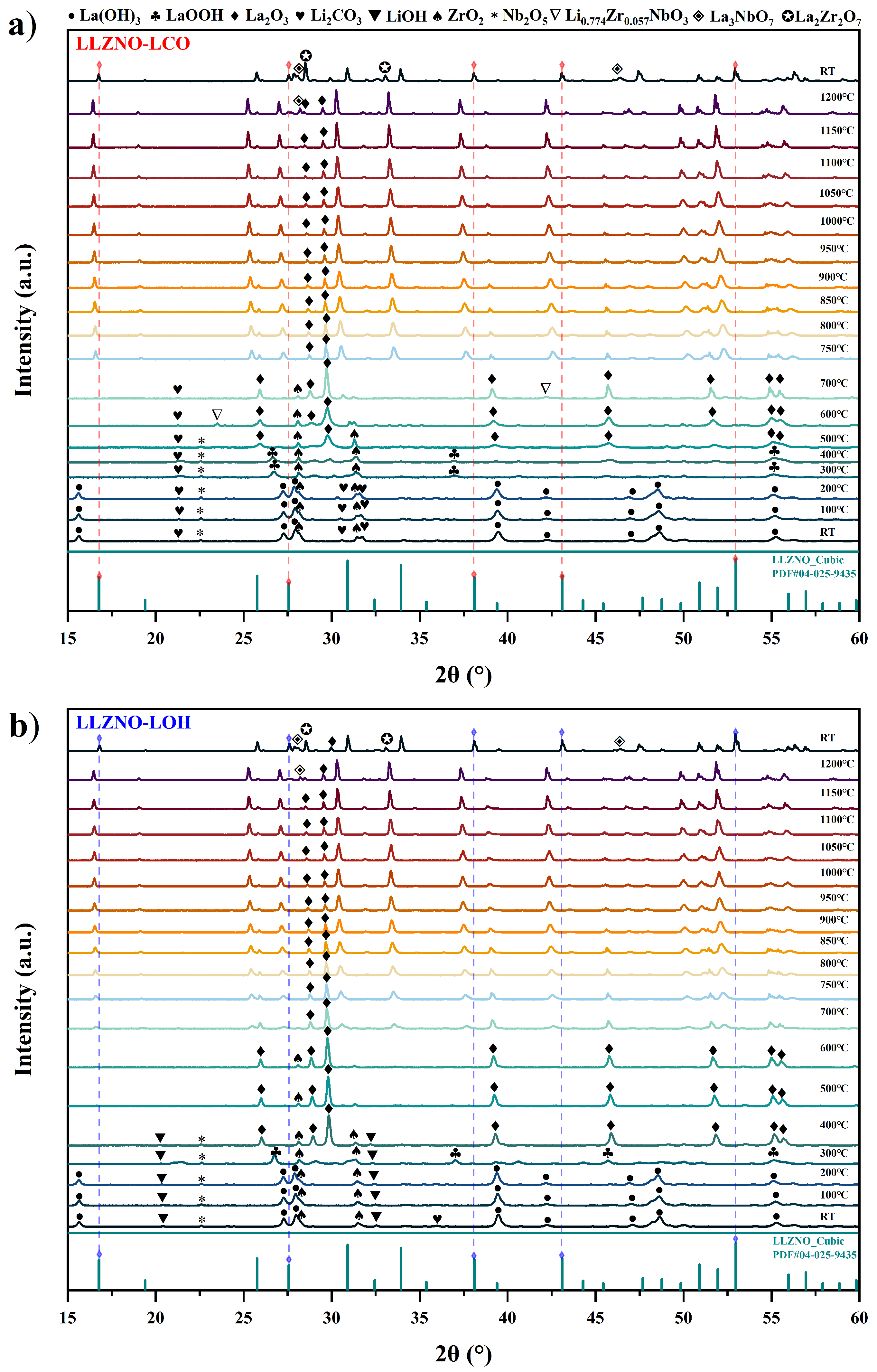
Figure 1. HT-XRD patterns for (a) LLZNO-LCO and (b) LLZNO-LOH precursor powders from RT to 1200 °C and post-cooling at RT.
Ceramics 08 00132 g001
Figure 2. HT-XRD patterns for (a) LLZTO-LCO and (b) LLZTO-LOH precursor powders from RT to 1200 °C and post-cooling at RT.
Ceramics 08 00132 g002
Figure 3. TGA and DSC curves of (a,c) LLZNO precursor powders synthesized from Li2CO3 and LiOH, and (b,d) LLZTO precursor powders synthesized from Li2CO3 and LiOH.
Ceramics 08 00132 g003
Figure 4. XRD patterns of calcined (a,c) LLZNO powders synthesized from Li2CO3 and LiOH, and (b,d) LLZTO powders synthesized from Li2CO3 and LiOH in the temperature range of 300–1050 °C.
Ceramics 08 00132 g004
Figure 5. SEM micrographs of calcined (ag) LLZNO and (hn) LLZTO powders synthesized from Li2CO3 in the temperature range of 300–1050 °C for 2 h, along with the (o) morphology evolution schematic of LCO samples.
Ceramics 08 00132 g005
Figure 6. SEM micrographs of (a) LLZNO-LCO sample calcined at 950 °C, (b) magnified region showing La2Zr2O7 pyrochlore particles attached to LLZNO-LCO sample calcined at 950 °C, (c) submicron La2Zr2O7 pyrochlore particles with EDS spectrum, (d) LLZNO-LCO sample calcined at 700 °C, with EDS analysis of La3NbO7, (e,f) doped LLZO-LCO sample calcined at 750 °C, with EDS analysis of La2Zr2O7/La3MO7 (M = Nb, Ta).
Ceramics 08 00132 g006
Figure 7. SEM micrographs of calcined (ag) LLZNO and (hn) LLZTO powders synthesized from LiOH in the temperature range of 300–1050 °C for 2 h, along with the (o) morphology evolution schematic of LOH samples.
Ceramics 08 00132 g007
Table 1. Calculated quantitative results of atoms in calcined LLZO powders via EDS point analysis.
Point for EDSCompositionAtom Percentage (%)
LaZrNbTaO
Spot 1La2Zr2O718.6218.32--63.06
Spot 2La3NbO727.12-9.06-63.82
Spot 3La3NbO7/La2Zr2O722.229.144.55-64.09
Spot 4La3TaO7/La2Zr2O721.869.19-4.8364.12
Disclaimer/Publisher’s Note: The statements, opinions and data contained in all publications are solely those of the individual author(s) and contributor(s) and not of MDPI and/or the editor(s). MDPI and/or the editor(s) disclaim responsibility for any injury to people or property resulting from any ideas, methods, instructions or products referred to in the content.