
Empowering Educators Through Generative AI: Exploring Self-Regulation, Resilience, and Value Co-Creation in Cloud-Based Learning


Abstract
1. Introduction
2. Literature Review
2.1. Generative AI-Driven Stimuli
2.1.1. Hedonicity
2.1.2. Interactivity
2.1.3. Immersion
2.2. Self-Regulation and Resilience
2.3. Self-Regulation, Resilience, and Value Co-Creation
2.4. Mediating Effects of Self-Regulation and Resilience
3. Research Method
3.1. Data Collection and Sample
3.2. Measures
4. Results
4.1. Measurement Model
4.2. Structural Model and Hypothesis Testing
5. Conclusions and Implications
5.1. Discussion
5.2. Conclusions and Implications
5.3. Limitations and Future Research
Funding
Data Availability Statement
Acknowledgments
Conflicts of Interest
Appendix A

Hedonicity: Adapted from Al-Abdullatif (2024) & Yanit et al. (2023) [2,14]
|
References
- Hussain, K.; Khan, L.M.; Malik, A.A. Exploring audience engagement with ChatGPT-related content on YouTube: Implications for content creators and AI tool developers. Digit. Bus. 2024, 4, 100071. [Google Scholar]
- Al-Abdullatif, A.M. Modeling teachers’ acceptance of generative artificial intelligence use in higher education: The role of AI literacy, intelligent TPACK, and perceived trust. Educ. Sci. 2024, 14, 1209. [Google Scholar] [CrossRef] [Scilit]
- Yue, M.; Jong, M.S.Y.; Ng, D.T.K. Understanding K–12 teachers’ technological pedagogical content knowledge readiness and attitudes toward artificial intelligence education. Educ. Inf. Technol. 2024, 29, 19505–19536. [Google Scholar] [CrossRef] [Scilit]
- Zhang, L. Reviewing the effect of teachers’ resilience and wellbeing on their foreign language teaching enjoyment. Front. Psychol. 2023, 14, 1187468. [Google Scholar] [CrossRef] [Scilit] [PubMed]
- Prilop, C.N.; Mah, D.-K.; Jacobsen, L.J.; Hansen, R.R.; Weber, K.E.; Hoya, F. Generative AI in teacher education: Educators’ perceptions of transformative potentials and the triadic nature of AI literacy explored through AI-enhanced methods. Comput. Educ. Artif. Intell. 2025, 7, 100269. [Google Scholar]
- Zeng, F.; Li, Q.; Cai, S.; Xiao, Z.; Chen, X.; Zhu, W.; Li, J. Cancer patients’ acceptance of virtual reality interventions for self-emotion regulation. Sci. Rep. 2025, 15, 95160. [Google Scholar] [CrossRef] [Scilit]
- Du, H.; Sun, Y.; Jiang, H.; Islam, A.Y.M.A.; Gu, X. Exploring the effects of AI literacy in teacher learning: An empirical study. Humanit. Soc. Sci. Commun. 2024, 11, 559. [Google Scholar] [CrossRef] [Scilit]
- Shi, L. Assessing teachers’ generative artificial intelligence competencies: Instrument development and validation. Educ. Inf. Technol. 2025, 30, 23365–23384. [Google Scholar] [CrossRef] [Scilit]
- Younis, B. The artificial intelligence literacy (AIL) scale for teachers: A tool for enhancing AI education. J. Digit. Learn. Teach. Educ. 2025, 41, 37–56. [Google Scholar] [CrossRef] [Scilit]
- Zimmerman, B.J. Investigating self-regulation and motivation: Historical background, methodological developments, and future prospects. Am. Educ. Res. J. 2008, 45, 166–183. [Google Scholar] [CrossRef] [Scilit]
- Chiu, T.K.F.; Ahmad, Z.; Çoban, M. Development and validation of teacher artificial intelligence (AI) competence self-efficacy (TAICS) scale. Educ. Inf. Technol. 2025, 30, 6667–6685. [Google Scholar] [CrossRef] [Scilit]
- Lucas, M.; Zhang, Y.; Bem-haja, P.; Vicente, P.N. The interplay between teachers’ trust in artificial intelligence and digital competence. Educ. Inf. Technol. 2024, 29, 22991–23010. [Google Scholar] [CrossRef] [Scilit]
- Lee, J.; Park, K. The effects of hedonic shopping values on loyalty towards small retailers: The moderating role of trust. J. Retail. Consum. Serv. 2024, 76, 103615. [Google Scholar] [CrossRef] [Scilit]
- Yanit, M.; Yanit, M.; Wan, F. Right agent, wrong level of hedonism: How high (vs low) hedonic values in AI-performed tasks lead to decreased perceptions of humanlikeness, warmth, and less consumer support. Comput. Hum. Behav. 2023, 147, 107870. [Google Scholar] [CrossRef] [Scilit]
- Rahman, M.S.; Bag, S.; Hossain, M.A.; Abdel Fattah, F.A.M.; Gani, M.O.; Rana, N.P. The new wave of AI-powered luxury brands online shopping experience: The role of digital multisensory cues and customers’ engagement. J. Retail. Consum. Serv. 2023, 72, 103273. [Google Scholar] [CrossRef] [Scilit]
- Vargo, S.L.; Lusch, R.F. From repeat patronage to value co-creation in service ecosystems: A transcending conceptualization of relationship. J. Bus. Mark. Manag. 2010, 4, 169–179. [Google Scholar] [CrossRef] [Scilit]
- Hudson, S.; Matson-Barkat, S.; Pallamin, N.; Jegou, G. With or without you? Interaction and immersion in a virtual reality experience. J. Bus. Res. 2019, 100, 459–468. [Google Scholar] [CrossRef] [Scilit]
- Yu, N.; Huang, Y.T. Why do people play games on mobile commerce platforms? An empirical study on the influence of gamification on purchase intention. Comput. Hum. Behav. 2022, 126, 106991. [Google Scholar] [CrossRef] [Scilit]
- Birt, J.; Vasilevski, N. Comparison of single and multiuser immersive mobile virtual reality usability in construction education. Educ. Technol. Soc. 2021, 24, 93–106. [Google Scholar]
- Chen, Y.L.; Hsu, C.C. Self-regulated mobile game-based English learning in a virtual reality environment. Comput. Educ. 2020, 154, 103910. [Google Scholar] [CrossRef] [Scilit]
- Zimmerman, B.J.; Schunk, D.H. Handbook of Self-Regulation of Learning and Performance; Taylor and Francis: New York, NY, USA, 2011. [Google Scholar]
- Yeh, Y.C.; Chu, L.H. The mediating role of self-regulation on harmonious passion, obsessive passion, and knowledge management in e-learning. Educ. Technol. Res. Dev. 2018, 66, 615–637. [Google Scholar]
- Armstrong, J.S.; Overton, T.S. Estimating nonresponse bias in mail surveys. J. Mark. Res. 1977, 14, 396–402. [Google Scholar] [CrossRef] [Scilit]
- Podsakoff, P.M.; MacKenzie, S.B.; Lee, J.-Y.; Podsakoff, N.P. Common method biases in behavioral research: A critical review of the literature and recommended remedies. J. Appl. Psychol. 2003, 88, 879–903. [Google Scholar] [CrossRef] [Scilit] [PubMed]
- Hair, J.F.; Hult, G.T.M.; Ringle, C.M.; Sarstedt, M. A Primer on Partial Least Squares Structural Equation Modeling (PLS-SEM); Sage: Thousand Oaks, CA, USA, 2017. [Google Scholar]
- Barclay, D.W.; Thompson, R.; Higgins, C. The Partial Least Squares (PLS) approach to causal modeling: Personal computer adoption and use an illustration. Technol. Stud. 1995, 2, 285–309. [Google Scholar]
- Fornell, C.; Larcker, D.F. Evaluating structural equation models with unobservable variables and measurement error. J. Mark. Res. 1981, 18, 39–50. [Google Scholar] [CrossRef] [Scilit]
- Nitzl, C.; Roldan, J.L.; Cepeda, G. Mediation analysis in partial least squares path modeling: Helping researchers discuss more sophisticated models. Ind. Manag. Data Syst. 2016, 116, 1849–1864. [Google Scholar] [CrossRef] [Scilit]
- Hair, J.F.; Howard, M.C.; Nitzl, C. Assessing measurement model quality in PLS-SEM using confirmatory composite analysis. J. Bus. Res. 2020, 109, 101–110. [Google Scholar] [CrossRef] [Scilit]
- Cohen, J. Statistical Power Analysis for the Behavioral Sciences, 2nd ed.; Lawrence Erlbaum Associates: Hillsdale, NJ, USA, 1988. [Google Scholar]

| Variables | 1 | 2 | 3 | 4 | 5 | 6 |
|---|---|---|---|---|---|---|
| 1. Hedonicity | 0.838 | |||||
| 2. Interactivity | 0.447 | 0.806 | ||||
| 3. Immersion | 0.437 | 0.446 | 0.797 | |||
| 4. Self-regulation | 0.501 | 0.442 | 0.555 | 0.871 | ||
| 5. Resilience | 0.599 | 0.510 | 0.591 | 0.690 | 0.867 | |
| 6. Value co-creation | 0.429 | 0.494 | 0.521 | 0.610 | 0.666 | 0.837 |
| Structural Paths | Beta (β) | S.E. | t-Value | 95% CI [LL, UL] | f2 |
|---|---|---|---|---|---|
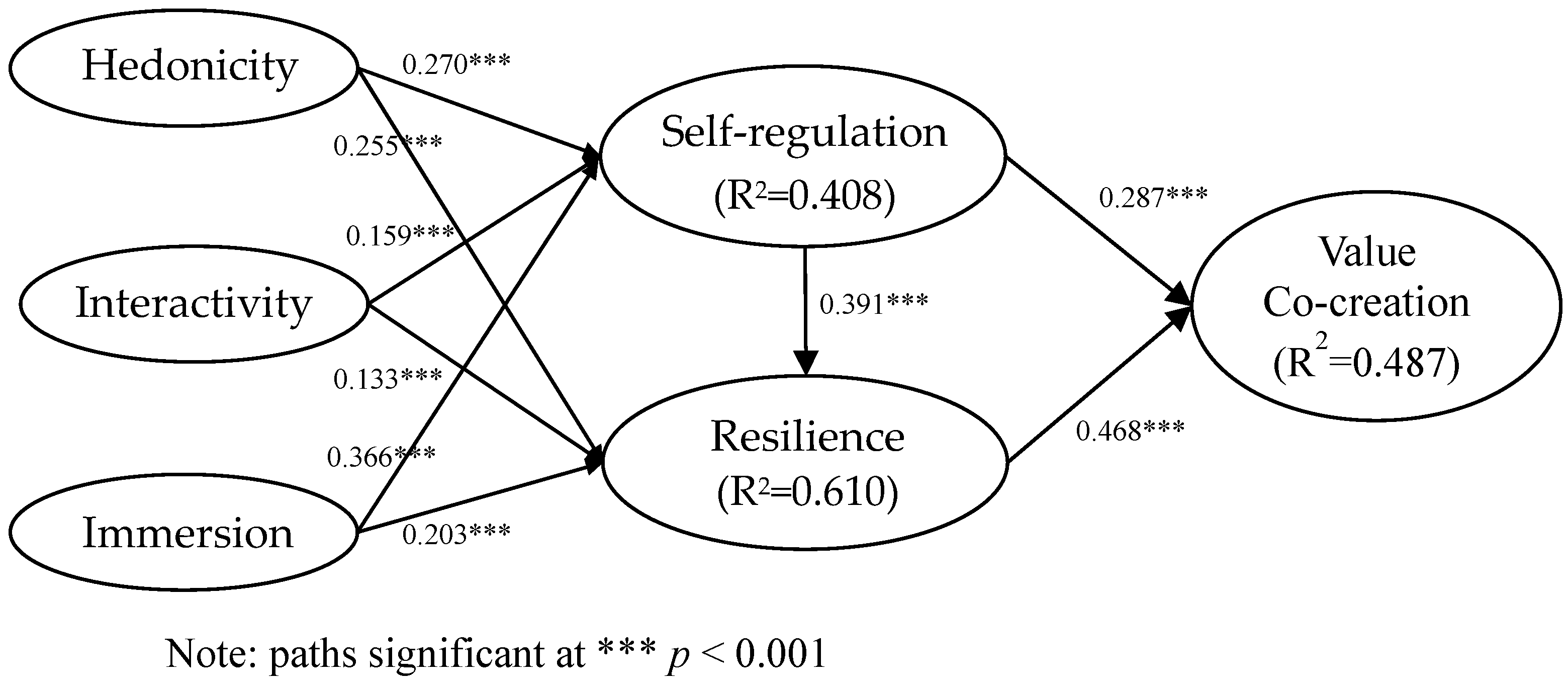
| H1a: hedonicity→self-regulation | 0.270 | 0.038 | 7.026 *** | [0.201, 0.334] | 0.090 |
| H1b: hedonicity→resilience | 0.255 | 0.033 | 7.813 *** | [0.198, 0.312] | 0.112 |
| H2a: interactivity→self-regulation | 0.159 | 0.033 | 4.862 *** | [0.094, 0.224] | 0.031 |
| H2b: interactivity→resilience | 0.133 | 0.026 | 5.198 *** | [0.082, 0.185] | 0.032 |
| H3a: immersion→self-regulation | 0.366 | 0.037 | 9.943 *** | [0.299, 0.439] | 0.165 |
| H3b: immersion→resilience | 0.203 | 0.031 | 6.534 *** | [0.142, 0.264] | 0.066 |
| H4: self-regulation→resilience | 0.391 | 0.038 | 10.266 *** | [0.311, 0.470] | 0.232 |
| H5: self-regulation→value co-creation | 0.287 | 0.039 | 7.275 *** | [0.211, 0.363] | 0.084 |
| H6: resilience→value co-creation | 0.468 | 0.041 | 11.386 *** | [0.378, 0.541] | 0.223 |
| H7: hedonicity→self-regulation→value co-creation | 0.077 | 0.016 | 4.880 *** | [0.053, 0.109] | |
| interactivity→self-regulation→value co-creation | 0.046 | 0.013 | 3.641 *** | [0.024, 0.073] | |
| immersion→self-regulation→value co-creation | 0.105 | 0.017 | 6.247 *** | [0.073, 0.141] | |
| H8: hedonicity→resilience→value co-creation | 0.119 | 0.018 | 6.680 *** | [0.087, 0.158] | |
| interactivity→resilience→value co-creation | 0.062 | 0.014 | 4.316 *** | [0.033, 0.089] | |
| immersion→resilience→value co-creation | 0.095 | 0.018 | 5.261 *** | [0.059, 0.133] | |
| H9: self-regulation→resilience→value co-creation | 0.183 | 0.021 | 8.535 *** | [0.139, 0.228] |
| Hypothesized Relationships | Direct Effect | Indirect Effect | Total Effect | VAF (%) |
|---|---|---|---|---|
| hedonicity→self-regulation→value co-creation | 0.246 | 0.077 *** | 0.323 | 23.84% |
| interactivity→self-regulation→value co-creation | 0.137 | 0.046 *** | 0.183 | 25.14% |
| immersion→self-regulation→value co-creation | 0.267 | 0.105 *** | 0.372 | 28.23% |
| hedonicity→resilience→value co-creation | 0.246 | 0.119 *** | 0.365 | 32.60% |
| interactivity→resilience→value co-creation | 0.137 | 0.062 *** | 0.199 | 31.16% |
| immersion→resilience→value co-creation | 0.267 | 0.095 *** | 0.362 | 26.24% |
| self-regulation→resilience→value co-creation | 0.470 | 0.183 *** | 0.653 | 28.02% |
Disclaimer/Publisher’s Note: The statements, opinions and data contained in all publications are solely those of the individual author(s) and contributor(s) and not of MDPI and/or the editor(s). MDPI and/or the editor(s) disclaim responsibility for any injury to people or property resulting from any ideas, methods, instructions or products referred to in the content. |
© 2026 by the author. Published by MDPI on behalf of the International Institute of Knowledge Innovation and Invention. Licensee MDPI, Basel, Switzerland. This article is an open access article distributed under the terms and conditions of the Creative Commons Attribution (CC BY) license.
Share and Cite
Huang, J.-W. Empowering Educators Through Generative AI: Exploring Self-Regulation, Resilience, and Value Co-Creation in Cloud-Based Learning. Appl. Syst. Innov. 2026, 9, 158. https://doi.org/10.3390/asi9070158
Huang J-W. Empowering Educators Through Generative AI: Exploring Self-Regulation, Resilience, and Value Co-Creation in Cloud-Based Learning. Applied System Innovation. 2026; 9(7):158. https://doi.org/10.3390/asi9070158
Chicago/Turabian StyleHuang, Jing-Wen. 2026. "Empowering Educators Through Generative AI: Exploring Self-Regulation, Resilience, and Value Co-Creation in Cloud-Based Learning" Applied System Innovation 9, no. 7: 158. https://doi.org/10.3390/asi9070158
APA StyleHuang, J.-W. (2026). Empowering Educators Through Generative AI: Exploring Self-Regulation, Resilience, and Value Co-Creation in Cloud-Based Learning. Applied System Innovation, 9(7), 158. https://doi.org/10.3390/asi9070158