


Abstract
Machine learning has become a field of growing interest in asphalt pavement engineering, spanning mix design, material characterization, performance prediction, distress detection, sustainability, quality control, and maintenance planning. However, a lack of transparency can undermine engineering trust, defensibility, and field implementation. This systematic scoping review aims to synthesize explainable artificial intelligence (XAI) and interpretable machine-learning applications for asphalt pavement materials and systems, following the PRISMA-ScR guidelines. Major scientific databases were used to identify relevant peer-reviewed studies, which were screened against a set of inclusion and exclusion criteria and categorized into seven research dimensions. A final library of 163 publications was compiled, comprising 73 core evidence studies and 90 supporting references. The review covers techniques such as SHAP, LIME, partial-dependence analysis, attention mechanisms, surrogate models, sensitivity analysis, symbolic modeling, and physically informed interpretation. The use of XAI in performance prediction, material-property interpretation, and modeling for mix design is well developed, while distress/damage analysis, life cycle sustainability, field validation, uncertainty-aware explanation, maintenance decision support, and human-centered evaluation are still relatively underdeveloped. The main contribution is a five-layer framework linking data provenance, model performance, explanation quality, physical plausibility, and decision utility. The review proposes moving from post hoc feature ranking to validated, physically centered, uncertainty-aware, and engineer-in-the-loop decision support for asphalt XAI.
1. Introduction
Asphalt pavements are vital transportation infrastructure for highways, urban roads, freight corridors, ports, and airport facilities. The long-term serviceability is influenced by mixture design, binder rheology, aggregate gradation and mineralogy, volumetric structure, traffic loading, temperature, moisture exposure, construction quality, aging, and maintenance history [1,2,3]. Traditional engineering design and performance-prediction methods, such as Marshall, Superpave, and mechanistic–empirical methods, are useful and important engineering tools, but they are not always sufficient to address problems where nonlinear interactions between materials, environment, traffic, aging, and construction variability are the primary drivers of pavement response.
Artificial intelligence (AI), machine learning (ML), and soft-computing techniques have thus started to play a more critical role in the prediction of asphalt mix and pavement responses such as rutting, cracking, moisture susceptibility, roughness, stiffness, volumetric properties, Marshall parameters, construction quality, and maintenance-related condition indicators [4,5,6,7,8,9,10,11,12,13]. In recent years, ensemble learning, deep learning, transfer learning, data augmentation, response surface methodology, genetic programming, and hybrid optimization have been applied widely to decrease the experimental workload, enhance the prediction accuracy, and assist the design and management of asphalt pavement [8,9,10,11,14,15,16,17,18,19,20,21]. These developments are part of a larger trend toward data-driven pavement engineering in which pavement models are expected to not only forecast pavement performance, but also to inform material selection, mixture optimization, quality control, sustainability analysis, maintenance planning, and infrastructure decision-making.
This increasing literature has been summarized from a variety of viewpoints in several recent review papers. Leukel et al. [6] conducted a systematic review of ML models used for prediction in the construction of asphalt roads regarding physical properties, and discussed methodological challenges regarding diversity of input variables, use of sensors, model evaluation, and quality of reporting. In a review concerning the application of ANNs in the pavement life cycle, Yang et al. [7] pointed out the need for data collection, parameter optimization, model transferability, and the annotation effort, which are the challenges for the application of ANNs during the pavement life cycle. Yaro et al. [13] conducted a review of the application of response surface methodology and ML in the optimization, modeling, prediction, and sustainability of asphalt pavement. These reviews, collectively, offer a solid foundation for comprehending the evolution of data-based research for asphalt pavement.
In existing reviews, however, focus is primarily on model families, prediction tasks, data sources, optimization strategies, and performance measures [6,7,13]. They are less concerned about whether explanations reflect the trained model, are robust to data perturbations, are physically valid, are uncertainty-aware, can be transferred across pavement contexts, and are helpful for engineering decisions. This distinction is significant since high predictive accuracy does not necessarily mean a model is trustworthy for use in pavement engineering. For applications in asphalt pavement, model outputs can impact mixture design, balanced performance evaluation, quality control, sustainable material usage, timing of treatments, agency budgets, and critical decisions for safety-related infrastructure. Hence, predictions should be interpretable, auditable, and in line with the science of asphalt material and pavement mechanics [22,23,24,25,26,27].
Two of the most popular methods that explain trained ML models in pavement applications are SHapley Additive exPlanations (SHAP) and Local Interpretable Model-Agnostic Explanations (LIME). SHAP provides estimates of the contribution of each input variable to the model prediction, which can be interpreted globally across a dataset, as well as locally for each prediction [23]. LIME approximates the behavior of a complex model at a certain data point with a simpler interpretable model, such as a local linear approximation [22] for individual predictions. In the area of asphalt pavement use, these methods are frequently applied to determine the significant factors, including binder characteristics, grading of the aggregates, air void content, traffic loading, temperature, moisture state, pavement age, and maintenance history. Their outputs, however, must be read with care since feature rankings may change due to correlated features, the nature of the datasets, the preprocessing decisions, the type of model used, and the distinction between global and local explanations.
However, the use of XAI in the field of asphalt mix design and pavement performance prediction is somewhat scattered. Numerous studies present SHAP plots, LIME explanations, partial-dependence plots, attention maps, or feature-importance rankings without checking the fidelity, stability, uncertainty, sensitivity to correlated variables, or consistency with physical mechanisms of the explanations. Others have focused on techniques like interpretable ML, sensitivity analysis, or feature selection, but the explanation is not necessarily tied to an engineering decision. This leaves a gap in methodology and translation: while there are numerous potent models in the literature, there are not enough studies that illustrate how or if explanations translate to being reliable enough to guide mixture design, sustainability assessment, quality control, field-performance interpretation, or maintenance planning.
The need for such reliable, interpretable, and auditable AI tools in asphalt pavement engineering is thus the motivation for this review. With XAI, the engineer can use the models to diagnose behavior, find influential mixture and pavement variables, seek threshold effects, compare design alternatives, find possible model failures, and communicate model-based decisions to stakeholders. But these benefits are credible only if explanations are faithful to the trained model, physically meaningful, uncertainty-aware, and useful for engineering action. Explanations that are inconsistent with binder rheology, aggregate interlock, air void behavior, moisture-damage mechanisms, aging behavior, or pavement deterioration theory should not be used to support engineering decisions.
In this regard, this paper presents an overview of the current state of XAI applications in the fields of asphalt mix design, material characterization, pavement-performance prediction, distress analysis, sustainability assessment, and pavement decision support. The goals are to (i) outline the research landscape and key application dimensions; (ii) classify the XAI and interpretable ML methods applied to the analysis of asphalt pavements; (iii) assess the relation between model explanations and engineering interpretation; (iv) identify gaps in methodology, reporting, validation, and implementation that hinder scientific rigor and practical adoption; and (v) propose a domain-specific framework and research agenda for trustworthy XAI in asphalt pavement systems.
1.1. Contributions and Review Positioning
This review is designed as a systematic scoping review of an emerging and heterogeneous research area and not as a quantitative meta-analysis. It is an extension of ML reviews of previous asphalt pavements with changes in its scope and emphasis. Past reviews have highlighted the advancement of ML, ANNs, response surface methodology, and soft computing in asphalt road construction and pavement engineering for the prediction of physical properties, construction quality control, pavement monitoring and maintenance planning, optimization, and pavement modeling for sustainability purposes [6,7,13]. The studies are useful because they provide a good summary of areas of application, algorithms, datasets, and methodological issues found in the entire pavement ML literature.
The present review asks a different but complementary question as to whether AI and ML models applied to asphalt pavement engineering are explainable and trustworthy enough to be used in engineering interpretation and decision-making. Hence, it identifies accuracy-driven ML research from research that furnishes interpretable/explainable evidence and information relevant to asphalt material or pavement system decisions. It also examines the physical viability and stability of explanations, external validation, uncertainty handling, and usefulness for practical applications, including material selection, balanced mix design, quality control, distress interpretation, sustainability assessment, maintenance planning, and pavement asset management.
This review has three major contributions. First, it identifies XAI and interpretable ML use cases throughout the entire asphalt pavement life cycle, from material characterization, mix design, field performance, and distress detection, to sustainable asphalt systems and maintenance decision-making. Second, it unifies explanation techniques like SHAP, LIME, partial-dependence analysis, sensitivity analysis, attention mechanisms, surrogate models, symbolic models, and physically informed explanations. Third, it highlights aspects not sufficiently covered by current reviews on asphalt ML [6,7,13], such as explanation validation, human-centered interpretation, integration of life cycle sustainability, uncertainty-aware explanation, physical plausibility, longitudinal field transferability, and decision utility.
The review also suggests a feasible five-layer structure for trustworthy XAI in asphalt pavement engineering. The framework does not consider XAI to be a toolbox of visualization tools, but rather an assessment of the explanations based on representative data, robust model performance, validated explanation quality, consistency with pavement mechanics, and clear decision utility. The main rationale is that trustworthy XAI should move beyond feature ranking explanations to decision-oriented explanations that benefit a balanced mix design, sustainable material selection, quality control, condition assessment, maintenance prioritization, and pavement asset management.
While previous reviews of asphalt and pavement models and reviews of ML focus primarily on cataloging model families, prediction targets, optimization workflows, and reported accuracy [6,7,13], the current review attempts to focus on a narrower gap in the science: answering the question of whether model explanations can be sufficiently faithful, stable, physically plausible, uncertainty-aware, transferable, and useful for asphalt pavement-engineering decisions. Hence, the novelty of this review is not only the compilation of the XAI techniques, but also the assessment of the quality of explanations with respect to the behavior of the asphalt material, the mechanics of the pavement, and the use of explanations for mix design, quality control, sustainability assessment, pavement-performance interpretation, and pavement maintenance planning.
1.2. Research Questions
This review follows four research questions:
RQ1: What are the current XAI or interpretable ML applications in the field of asphalt pavement, and what are the remaining areas requiring development?
RQ2: What are the most prevalent explanation methods, and how are they related to engineering interpretation?
RQ3: What is the current state of XAI and interpretable ML research for the purposes of facilitating trustworthy decision-making in asphalt mix design, quality control, sustainability assessment, pavement-performance prediction, and maintenance planning?
RQ4: What gaps exist in the methodology that need to be filled for better explanation fidelity, stability, physical plausibility, uncertainty-awareness, field transferability, human-centered evaluation, and practical decision utility for the field of asphalt pavement engineering?
2. Methodology
2.1. Review Protocol
The review was carried out and reported following the Preferred Reporting Items for Systematic Reviews and Meta-Analyses extension for Scoping Reviews (PRISMA-ScR) guidelines. There was no registered or deposited review protocol before the review was carried out. The review’s search strategy, information sources, eligibility criteria, evidence-classification approach, extracted data items, and qualitative synthesis procedure are reported to assist with the reproducibility and transparency of the review.
PRISMA is a reporting framework designed to improve transparency in systematic reviews and meta-analyses, whereas PRISMA-ScR is intended for scoping reviews that map broad, heterogeneous, or emerging research areas [28,29]. Meta-analysis is a quantitative synthesis in which numerical results from sufficiently comparable studies are statistically pooled to estimate an overall effect or relationship [28]. In contrast, a scoping review is appropriate when the objective is to map the range of available evidence, categorize research themes, and identify knowledge gaps as a basis for future research [29].
A PRISMA-ScR-guided scoping review design was appropriate for the current paper, as the reviewed literature presents a variety of pavement applications, datasets, model families, explanation processes, validation methods, and performance measures. The included studies cover a variety of outcomes, including rutting, cracking, roughness, CTIndex, Marshall properties, moisture susceptibility, distress classification, sustainability indicators, quality-control issues, and maintenance decisions. Therefore, the synthesis focuses on systematic mapping, thematic interpretation, and critical evaluation of the results rather than quantitative aggregation, which is not appropriate for these differences. In this regard, the current review presents the evolution of XAI and interpretable ML in asphalt pavement engineering, outlines the main application areas, rates the maturity of the methods, and highlights research gaps.
The literature search was carried out in Scopus, Web of Science, IEEE Xplore, ACM Digital Library, ScienceDirect, SpringerLink, and Google Scholar databases. The last update of the literature search was in May 2026. There was no predefined minimum year limit for publications. Records were deemed eligible if they met the topical, methodological, peer-reviewed, English language requirements and were available by the final search update. Depending on the database interface, search syntax was adapted: For Scopus, TITLE-ABS-KEY fields were used, for Web of Science TS fields, and for other databases, the title, abstract, keyword, and full-text search options were used. The search used both XAI/IML terms and asphalt/pavement terms, and was supplemented with broader ML terms and both backward and forward citation searching to identify relevant studies on transparent, interpretable, or physically meaningful modeling. Only peer-reviewed publications with final publication metadata available by the final search update were retained.
2.2. Research Dimensions
The studies reviewed were grouped into seven research dimensions that encompass the primary areas where XAI and interpretable machine learning can aid asphalt pavement-engineering decision-making. These seven dimensions were coded as follows: (D1) Asphalt Pavement-Performance Prediction, which included rutting, cracking, roughness, stiffness, moisture susceptibility, and service-life estimation; (D2) Asphalt Mix Design and Optimization, including volumetric-property prediction, asphalt-content estimation, Marshall parameters, balanced mix design, recycled-material proportioning, and multi-objective optimization; (D3) Broader Applications of Machine Learning in Pavement Engineering, which included condition assessment, surrogate modeling, structural-response prediction, sensor-based monitoring, computer vision, and automated model selection; (D4) Asphalt Material Properties and Behavior, focusing on binder rheology, aging, adhesion, moisture damage, microstructure–property relationships, and fracture behavior; (D5) Pavement Distress and Damage Analysis, which included fatigue cracking, rutting, thermal cracking, top-down cracking, reflective cracking, raveling, and image-based distress detection; (D6) Sustainable Asphalt Pavement Systems, such as recycled asphalt pavement, waste-modified mixtures, cold recycling, rejuvenators, industrial byproducts, plastic or rubber modifiers, and sustainability–performance trade-offs; and (D7) pavement maintenance and decision-making, including pavement-management systems, degradation forecasting, treatment timing, maintenance prioritization, quality-control interpretation, reinforcement learning, asset-management analytics, and decision-support workflows. These dimensions were utilized as analytic categories and not mutually exclusive groups. Several studies were used for more than one dimension, and these were included based on the main contribution and then referenced in the appropriate cross-cutting discussion.
The seven dimensions of research were initially identified within the context of the asphalt pavement life cycle and the major application areas reported in previous pavement ML reviews [6,7,13] and subsequently further developed during screening and coding to match the topics covered in the included studies. This approach allowed the separation of wider pavement ML applications and more focused applications, including the prediction of performance, mix design and optimization, behavior of asphalt materials, analysis of distresses and damages, sustainable asphalt, and decision support for maintenance.
2.3. Inclusion and Exclusion Criteria
Studies were only included in the core synthesis if they (1) addressed topics related to the engineering of asphalt pavement, asphalt mixtures, asphalt binders, pavement performance, pavement distress, pavement maintenance, quality control, or other bituminous construction materials; (2) used a model that was interpretable via XAI, interpretable machine learning, sensitivity analysis, feature-importance analysis, symbolic modeling, surrogate modeling, partial-dependence analysis, attention-based interpretation, uncertainty-aware explanation, or another transparent modeling approach; (3) reported on evidence from empirical, laboratory, field, image-based, sensor-based, numerical, or simulation-based studies; (4) provided adequate methodological detail to determine the model, variables, method of interpretation, validation process, and engineering relevance; and (5) were published in English in either a peer-reviewed journal or a conference proceeding.
Since the terminology of ML studies in asphalt pavements is not standardized, the core synthesis separated the XAI/interpretable ML methods from complementary engineering-interpretation tools. Methods like SHAP, LIME, partial dependence, surrogate modeling, symbolic regression, attention-based interpretation, feature-attribution analysis, sensitivity analysis, and uncertainty-aware explanation were considered as XAI or interpretable modeling methods. Other physical characterization or validation tests, such as Marshall testing, FAA, wheel tracking, IDEAL-CT, TSR, dynamic modulus testing, and similar laboratory or field procedures were also regarded as physical characterization or validation tools that aid engineering interpretation rather than XAI methods themselves.
Studies were screened out of the core synthesis if they were either not related to asphalt pavement or bituminous material applications or did not report accuracy of prediction with an interpretable or explainable component, if they lacked sufficient methodological detail, if they were duplicates, or if they were not available as a complete text, or were non-peer-reviewed reports, theses, editorials, or commentaries. Studies were not excluded, however, if they did not explicitly mention the term “XAI” but applied one of the following approaches: transparent modeling, sensitivity analysis, symbolic regression, feature-importance analysis, uncertainty-aware interpretation, or physically meaningful explanation related to pavement engineering.
2.4. Study Selection and Evidence Classification
The study selection process involves identification, screening, eligibility assessment, evidence classification, and thematic synthesis. The screening, eligibility assessment, evidence classification, and data charting were undertaken by the author based on the inclusion and exclusion criteria outlined in Section 2.3, and using a structured extraction form for the extraction of bibliographic information, application area, material or pavement system, data source, model type, output variable, explanation method, validation approach, uncertainty treatment, engineering interpretation, decision-support relevance, and limitations reported in each study.
Records identified after database searching, keyword combinations, and checking for references in relevant review papers were screened for inclusion by the title, abstract, and full text using the inclusion and exclusion criteria outlined in Section 2.3. Studies that met these criteria were deemed to be core evidence studies. The studies were then coded based on the seven research dimensions outlined in Section 2.2, based on the main application area and contribution of the studies. The coded studies were then qualitatively synthesized to look for common findings, explanations, methodological limitations, applicability for decision-making, and implications regarding the provision of trustworthy XAI to the discipline of asphalt pavement engineering.
The difference between core evidence studies, supporting references, and excluded records was based on the evidence each source contributed to the synthesis. The final curated reference library comprised 163 unique publications. Of these, 73 studies were considered core evidence studies, as they specifically dealt with AI, machine learning, XAI, interpretable modeling, transparent prediction, sensitivity analysis, surrogate modeling, symbolic modeling, uncertainty-aware explanation, or data-driven decision support in asphalt pavement or bituminous material-related applications. The remaining 90 publications were kept as background material to support the background on asphalt materials, mechanisms for pavement performance, PRISMA-ScR reporting, general theory of XAI, general positioning of pavement ML, and methodological context, and were not counted as core evidence studies. Records were excluded when they were out of the scope of the asphalt/bituminous, non-peer reviewed, not available as full text, duplicates, and insufficient methodological detail.
A structured coding approach was used for data extraction and data classification. The data extracted for each publication consisted of bibliographic information, the area of pavement application for the model, the material or pavement system, the source of data, the variables of the model, the variables in the output, how the information was interpreted or explained, the validation method, treatment of uncertainty if mentioned, engineering interpretation, relevance for decision-making support, and limitations to the model. The core studies were allocated to a primary research dimension based on the major contribution they provided, with studies on more than one topic also being considered for related cross-cutting discussions.
To enhance transparency, the process that led to the selection of studies and classification of evidence is summarized in the PRISMA-ScR flow diagram in Figure 1, which outlines the process of searching the literature through screening, assessment for eligibility, evidence classification, research dimension coding, and qualitative evidence synthesis. The 73 core evidence studies have been categorized by primary research dimension in Table 1. The intent of this classification was not to imply strict separation between topics, but rather to provide a way to organize the thematic synthesis and distinguish the core evidence related to XAI and/or interpretable ML in the pavement engineering and methodological domains. The PRISMA-ScR checklist and representative electronic search strategy are provided in Supplementary Tables S1 and S2, respectively.
Figure 1.
PRISMA-ScR flow diagram of the study selection, evidence classification, and synthesis process.
Table 1.
Classification of the core evidence studies based on the seven research dimensions.
3. Results
The 73 core evidence studies were not evenly distributed across the seven dimensions of research. Twenty-three studies (31.5%) focused on D1 performance prediction, 15 studies (20.5%) on D4 material properties and behavior, 14 studies (19.2%) on D2 mix design and optimization, 9 studies (12.3%) on D3 broader pavement machine learning applications, 5 studies (6.8%) on D5 distress and damage analysis, 4 studies (5.5%) on D6 sustainable asphalt systems, and 3 studies (4.1%) on D7 maintenance and decision-making. This distribution shows that the XAI and interpretable ML applications are most prevalent in areas such as performance prediction, material-property interpretation, and mix design-related modeling; while distress/damage analysis, sustainability assessment, and maintenance-oriented decision support are relatively underrepresented in the core evidence base of asphalt-XAI.
3.1. Research Landscape and Thematic Evolution
The literature reviewed suggests that the research on ML and XAI related to asphalt has progressed from prediction to more interpretive and decision-focused modeling in order to increase the level of accuracy. However, previous work on pavement has made many of these studies less explicit on the use of a label XAI and rather included sensitivity analysis, transparent regression, symbolic models, or physically indicative variables. Explainable model behavior and engineering interpretation have become an increasingly popular approach in more recent studies that typically rely on SHAP, LIME, attention mechanisms, tree-based ensemble models, data augmentation, interpretable optimization, and climate-aware pavement-performance modeling [8,9,10,11,12,13,22,23,30,31,32,33,54,62,81]. This change acknowledges the current trend of using model predictions in addition to asphalt mix design and performance assessment for purposes of quality control, sustainability assessment, and maintenance planning.
The most advanced application area is that of performance prediction. Rutting, fatigue cracking, roughness, moisture damage, dynamic modulus, pavement-condition indices, and structural responses are common targets since they directly impact pavement design, acceptance, and maintenance decision-making [8,9,16,34,35,36,37,38,39,40,41,42,43,44,45,55,63,64,65,88,89,90,91,92,93,94,95,96,97]. In contrast, applications of XAI to balanced mix design, sustainability optimization, decision support for the life cycle of mix, or maintenance-policy explanation are less evolved. This bias may indicate that a significant portion of progress has been made in accounting for models, yet there is still a way to go in transforming explanations into design standards, quality-control practice, and agency workflow.
Overall, the literature shows a shift from a prediction-centered to a domain-informed and decision-oriented explanation of modeling. One of the challenges is to shift the emphasis of describing variables used in a model towards articulating why they are important for material design decisions, durability, safety, cost, sustainability, or maintenance plans, and if they form appropriate explanations to support defensible engineering decisions.
3.2. Predictive Modeling of Asphalt Pavement Performance
The largest and most mature area covered in the reviewed evidence base is performance prediction. Research within this cluster has demonstrated that interpretability methods can help to better understand the complex pavement behavior while maintaining the predictive accuracy. The best results have been those that have taken data-driven models and sought physically meaningful predictors to test if the model behavior was consistent with the mechanism of the pavement and not simply stated as a list of input variables that were ranked.
Hybrid models combine physical pavement principles and data-driven approaches to enhance the accuracy of predictions and engineering interpretation. Physically meaningful variables can be provided by mechanistic response models, finite-element simulations, and continuum-damage concepts, which can also be used to demonstrate the influence of the variables on the output under varying traffic, temperature, structural, and material conditions [88,89]. The most convincing studies apply explanations to the question of consistency with the existing pavement mechanics, and do not rely solely on ranking of features.
The most popular technique for XAI is feature-importance analysis. SHAP and LIME have the added advantage of being applicable to a vast number of model classes and allowing for both global and local interpretation [22,23]. In all the studies reviewed, factors such as binder grade or stiffness, air void content, structure of the aggregate, traffic loading, age of pavement, temperature, moisture-related factors, maintenance history, and climate factors are common influential factors [8,9,16,34,35,36,37,38,39,40,63,64,90,91,92,93,94]. The feature-importance ranking, however, should not be taken too literally, as it may change depending on the composition of the dataset, the correlations between the features, the nature of the model, and the preprocessing options. A representative example of variable importance interpretation for the prediction of rutting-related performance is shown in Figure 2. In this ANN-based research, the gradation passing a 4.75 mm sieve and theoretical maximum specific gravity were determined to be the most significant inputs in predicting the axial permanent strain, showing how interpretable ML can be associated with the characteristics of the mixture and the susceptibility of permanent deformation [20]. Contribution plots alone will not give causality or describe full interactions, so they should be used alongside sensitivity analysis, SHAP dependence analysis, partial-dependence plots, and engineering judgment.
Figure 2.
Variable-importance interpretation of input contributions in axial permanent strain prediction of asphalt concrete using ANNs [20].
Surrogate modeling offers interpretable approximations to computationally intensive models of pavement. Ref. [41] created artificial neural network surrogate models for asphalt pavement roughness prediction and found that the models achieved high levels of prediction accuracy with less computational effort when compared to mechanistic-empirical models. Using partial-dependence analysis, ref. [42] employed Bayesian neural networks for surrogate construction of 3-D finite-element pavement response models to interpret nonlinear relationships between layer thicknesses and the pavement critical strain responses. These surrogate methods are very convenient for cases where the results of a structural, stiffness-related, or mechanistic simulation are too costly to calculate repeatedly.
There are some ongoing areas of concern. Firstly, the explanation methods should be able to handle temporal degradation processes such as in [43], where attention mechanisms are added to a highway-performance model based on LSTMs to factor in cumulative loading and time-dependent changes. Secondly, the relationship between material properties and environmental exposure conditions is often climate or region-specific, as shown in warm-climate pavement-performance modeling [44]. Thirdly, while a complex ensemble and deep-learning model can improve the predictive accuracy, it adds to the computational burden and interpretable burden as well, for example, the CNN-BiLSTM-Attention-based model [45].
Recent work mitigates these restrictions by using more advanced XAI implementations. Multiple types of distress have been segmented by transformer networks and integrated gradients [55]; data-augmented XAI has been applied to the prediction of pavement roughness, which aims to solve issues with imbalanced historical condition data [9]. SHAP transfer learning and hybrid AI models for asphalt-content prediction have also been presented, showing how to leverage knowledge from previous mixture designs to mitigate the need for data collection for target-specific applications [11]. Recent studies related to LTPP and pavement management also show that explainable ensemble learning can assist IRI and PCI prediction under maintenance/no maintenance conditions, multi-climate stressors, extreme climate indices, and region-specific asphalt pavement conditions [16,30,31,32,33]. These studies show that explainability is not just being applied post-training of models, but is now considered during model development.
Further research works enhance methodological variants of explainable performance prediction. The rutting-susceptibility test methods were compared, and the importance of interpreting the binder parameter relative to field performance was noted by [95]. Strain responses measured on asphalt pavement were analyzed and related to distress-prediction models by [96]. The study of [97] discussed the fatigue and rutting life estimation and highlighted the need to make a correlation between the predicted failure probability in service and maintenance history.
To summarize the above evidence, Table 2 summarizes the key pavement-performance indicators, recurring influential variables, interpretive uses, and representative sources for using XAI and interpretable ML to connect predicted pavement responses of materials, structural conditions, environmental exposure, traffic loading, and maintenance-related decisions.
Table 2.
Frequent variables and interpretative applications in XAI-based pavement-performance prediction.
Generally, the development of XAI is moving beyond the simple ranking of the features to include models that integrate data-based predictions with pavement-engineering knowledge. The consistency of key predictive variables that are summarized in Table 2 is consistent with the principles of pavement design, but also shows some interactions that should be further explored. There are still no standardized measures of explanation fidelity, stability, uncertainty, and engineering usefulness, and more widespread use of hybrid models where physical constraints are embedded in interpretable architectures of ML.
3.3. Data-Supported Asphalt Mix Design Optimization and Mixture Structure Interpretation
XAI-supported asphalt mix design is a smaller, yet important evidence cluster when compared to performance prediction. Research in this area is centered on the use of data to optimize the mix design, while the experimental and computational efforts help to explain the mixture structure, material compatibility, and constructability of the product. These studies demonstrate how data-driven approaches can be used and can benefit traditional mix design, whether it is for optimizing multiple objectives, screening through the laboratory, predicting performance, or interpreting material properties. The most apparent themes are the prediction of volumetric properties, prediction of asphalt content, prediction of Marshal stability and flow, integration of sustainable materials, design of recycled and cold mixtures, aggregate-structure modeling, binder–aggregate adhesion, moisture susceptibility, and performance analysis of compaction [8,10,11,14,15,17,19,20,21,48,49].
A major use is volumetric-property optimization, since air voids, VMA, VFA, binder content, theoretical maximum specific gravity, Marshall stability/flow, retained stability, and aggregate gradation have a strong influence on the performance of the mixture. The interpretable ML approach has been applied to predict volumetric properties based on SHAP-based explanation [14], and symbolic modeling has been used to directly model interpretability for theoretical maximum specific gravity [15]. It has also recently been used to interpret Marshall stability and flow, asphalt-content transfer learning, and prediction of the Retained Stability Index (RSI), which indicates that XAI can be used to support laboratory screening of performance testing before full-scale testing [8,10,11,19,21]. For instance, Dai et al. [14] integrated outlier detection, feature engineering, XGBoost prediction, and SHAP interpretation into a single workflow for volumetric-property prediction. Similarly, ANN-based prediction was extended to dense-graded glasphalt mixtures and utilized mix design, volumetric, binder, aggregate, and waste-glass variables to predict Marshall stability and flow, with parametric analysis used to explain the influence of variables on the predicted mixture performance [49]. As illustrated by the examples, an interpretable ML approach can mitigate the workload in experiments without compromising the interpretability of the engineering problem and can be used to make practical engineering mix-design decisions.
Optimization of sustainable materials and recycled mixtures is another important research area, especially for rubberized asphalt, waste-modified mixtures, cold recycling, and bituminous-stabilized materials. Deep-learning methods have been applied to rubberized asphalts to find optimum formulations and rubber contents that can be used to trade off stiffness and cracking resistance [50]. In cold recycling and bituminous mixtures stabilized with emulsion or foamed bitumen, mix-design frameworks must take into consideration how the presence of emulsion or foamed bitumen influences the way the mixtures behave, the type of gradation, moisture condition, curing procedure, laboratory compaction method, and the triaxle shear properties that affect the structural pavement design [103,104,105,106,107]. As illustrated in these examples, the usefulness of XAI-supported mix design is most pronounced when explanations are tied to a practical constraint, like the need to satisfy specification, constructability, durability, and workload for laboratory testing.
Both the aggregate-characteristic and computational structure studies are important for the support of an interpretable mix design. Based on experimental investigations, the angularity, surface texture, particle shape, and packing property of fine aggregate are correlated with stability, resistance to rutting, and surface performance [108,109]. On the other hand, computational investigations such as image analysis, X-ray CT, finite-element modeling, DEM, and contact-structure analysis relate gradation, particle shape, internal packing, void distribution, and microstructure to the response on the scale of the mixture [110,111,112,113,114]. For instance, [110] described the proposal of an image-based multiscale finite-element approach for the prediction of the mechanical response from gradation and volumetric properties, ref. [112] described a discrete-element simulation approach for evaluating the aggregate packing of porous asphalt, and [114] described the development of a method that correlates aggregate contact structure to rutting performance. These methods offer microstructural information that would be hard to obtain with routine laboratory testing alone.
Interpretable modeling and performance-based evaluation also play a role in binder–aggregate adhesion, susceptibility to moisture, and specialized mixture design and constructability. A predictive adhesion model for asphalt–aggregate and moisture-damage susceptibility was developed as a function of aggregate oxide composition by [66] using pull-off de-bonding test results. Studies on mixture additives, functional layers, dynamic-modulus-based performance criteria, smart compaction, vibratory compaction, and laboratory–field compaction differences have been performed to date [115,116,117,118,119]. These studies demonstrate that, in a wider sense, the interpretability of mixture design can be equally valuable as XAI without models when broadening the understanding of why a mixture is likely to yield better performance or be easier to construct in response to a question of the user.
To summarize the main mix-design and mixture-structure themes discussed above, Table 3 lists the main methods discussed above utilized in the studies reviewed, in relation to their use in the volumetric design, Marshall-property prediction, sustainable-material incorporation, recycled and cold-mixture design, aggregate-structure interpretation, binder-aggregate compatibility, moisture-resistance assessment, and constructability-related decisions.
Table 3.
Representative techniques for optimizing asphalt mix designs and for interpreting the structure of asphalt mixtures.
There are still significant barriers to implementation. Many mix-design studies are based on a small number of data sets, which might not represent the variation in binder source, aggregate mineralogy, plant production conditions, aging state, climate, and regional construction practices. After fitting the model, explanation methods are also commonly employed without regard to the stability of the explanation under resampling, robustness to correlated variables, or physical meaningfulness of the explanation to the mix designer. Hence, future developments of XAI for mix design should be able to incorporate balanced mix design concepts, mechanistic constraints, external validation, calibrated input ranges, and uncertainty-aware explanations, instead of solely high prediction accuracy.
Based on the evidence reviewed, ML can help to shift the paradigm for asphalt mix design toward a more transparent, data-driven process with the inclusion of XAI. These methods can lead to a higher efficiency in optimizations and can be used to further understand the mechanics of asphalt mixtures by modeling the relationship between mixture composition, volumetric properties, material compatibility, constructability, and performance indicators. But the recommendations given by XAI should be used as an output of decision support, rather than a replacement for laboratory verification or engineering judgment. The models need to be accurate, physically meaningful, interpretable, and engineering-practice-friendly; this demands close collaboration between pavement engineers and data scientists for successful implementation.
3.4. Broader Machine Learning Applications in Pavement Engineering
In pavement engineering, ML has found its relevance in performance prediction, material characterization, condition assessment and structural health monitoring, optimization, and maintenance planning. This subsection combines various general ML uses where the technology is not specifically associated with a single property of the asphalt material or distress mechanism. With a focus on interpretable ML, emphasis is placed on how data from different sources, such as lab measurements, pavement images, sensor readings, field-performance records, LTPP/PMS databases, and asset-management data, are combined together. The key methodological developments are the prediction of temporal distress, condition assessment based on images, network-level performance forecasting, design space exploration, sensor-based monitoring, and maintenance-oriented analytics [8,9,12,13,16,43,55,56,57,58,85,86].
One of the most prominent larger-scope ML applications is temporal distress and the prediction of performance. For time-dependent pavement deterioration, LSTM and recurrent neural network models are beneficial, as they can model the sequential dependencies on cumulative traffic loading, climate exposures, and maintenance historical data [43,86]. Even hybrid CNN-BiLSTM attention models have been proposed to integrate feature extraction, temporal modeling, and interpretability with an attention mechanism [45]. These methods overcome the disadvantages of static regression models, as they enable deterioration trajectories to be interpreted over time.
The use of images for distress detection and classification has also progressed quickly. CNNs, transformer models, and hybrid deep-learning architectures can be used to automate the classification, localization, segmentation, and condition assessment of distress from pavement images or inspection data [45,55,57]. For these applications, attention maps, integrated gradients, relevance analysis, and feature visualization are helpful; they enable engineers to check if the model attends to meaningful distress areas or irrelevant image artifacts. The importance of visual explanations is even greater for agency-level quality control and automated pavement inspection.
Tree-based ensemble approaches are often used for non-image field data applications due to their ability to accommodate noisy datasets such as pavement-management and LTPP-type data with interpretability via feature importance and SHAP. In IRI, PCI, and pavement-condition prediction, XGBoost and random forests have been used, and explanations have been used to determine the impact of pavement-condition indicators, surface conditions, pavement type, maintenance history, climate, and traffic loading [30,32,33,38,39]. These studies highlight how XAI can provide insights regarding nonlinear interactions between construction quality, environmental exposure, traffic demand, and maintenance actions.
For these general pavement-engineering applications, Table 4 provides a summary of the key application domains, data sources, methodological innovations, explanation roles, and representative studies that illustrate using interpretable models for temporal prediction, distress assessment from images, network-level forecasting, optimization, estimation of material properties, structural health monitoring, and maintenance analytics.
Table 4.
More general machine learning applications and interpretation with pavement engineering.
Another important and more general direction of ML is optimization and design-space exploration. To minimize laboratory iteration and search for feasible mixture alternatives or rehabilitations, genetic algorithms, surrogate models, and response-surface methods have been employed [48,52]. Together with Pareto interpretation, sensitivity analysis, or design-window screening, these models can provide engineering guidance based on their high-dimensional optimization output instead of only finding a statistically optimum solution.
Material-property prediction and symbolic modeling also aid in various pavement ML applications. Dynamic modulus, stiffness, theoretical maximum specific gravity, and other material properties have been predicted based on mixture, volumetric, and testing variables using random forest, neural network, and symbolic-regression approaches [15,68,69,70]. Interpretability of symbolic expressions, feature importance, and analysis based on partial-dependency can be useful to connect the outputs of the model with the behavior of the materials and to increase the transparency of the material-property estimation.
One such application field is sensor-based structural health monitoring, which is still an emerging field, in which a vibration, deflection, ultrasonic, nondestructive, or field measurement is utilized to evaluate the condition of a pavement or detect potential damage [42,58,59,121]. LIME, PDPs, uncertainty-aware interpretation, and feature-contribution analysis can be used to establish relationships between measured signals and structural condition indicators in such cases. Transferability should not, however, be assumed; protocol trained on one type of sensor, pavement structure, climate region, or measurement protocol must be externally validated before being generalized.
Maintenance and asset-management analytics take ML beyond prediction to decision support. Treatment scheduling, prioritizing interventions, and allocating resources in a network can be done with the aid of reinforcement learning, asset-management databases, condition histories, and decision-policy models [85,86,87]. An explanation is required to make sense of a recommendation (such as a Q-value decomposition, scenario interpretation, or feature contribution analysis), describing how budget or service constraints affect the recommendation and how uncertainty affects the timing of treatment.
Implementation problems are due to data quality, labeling consistency, class imbalance, feature correlation, computational costs, and lack of documentation of data provenance. However, recent work on individual pavements with the use of data augmentation, hybrid explainable classifiers, interpretation of climate model inputs via SHAP, deployable graphical interfaces, and symbolic modeling also demonstrates that transparency should be combined with careful data curation, validation, and reporting of model limitations [9,15,33,54]. These are not just technical problems for deployment: these problems are the problems that decide whether the explanations are still valid when the models are transferred from agency to agency, from sensor to sensor, from climate to climate, from pavement-management databases to other databases, and from material source to material source.
In general, wider use of ML in pavement engineering has progressed from demonstrations to practical, infrastructure analytics applications. The increased focus on XAI is in response to the need for models that can be validated by engineers with domain knowledge, rather than models that optimize statistical accuracy. Future research needs to focus on scalability, reproducibility, data governance, documenting data provenance, external validation, and standardized procedures around assessing the quality of explanations for infrastructure-management scenarios.
3.5. Explainable AI for Asphalt Material Properties and Behavior
By providing a link between composition, microstructure, testing conditions, and performance, XAI has aided in the interpretation of asphalt material properties. The emphasis in this subsection is on the materials-scale features, such as rheological properties, aging characteristics, microstructure property relationships, fracture and cracking resistance, and moisture damage and adhesion. These categories all show how interpretable ML can be used to connect the empirical testing and mechanistic understanding by determining which material properties best predict the behavior and whether those predictions follow from knowledge of the material science of asphalt.
Table 5 summarizes the key domains of asphalt material properties, the key features for predicting or explaining the connection between the domains and the asphalt material performance, the XAI/interpretable techniques used, the engineering interpretation, and representative sources of information to consolidate the evidence at the material scale.
Table 5.
Applications of XAI and engineering interpretation in asphalt material characterization.
The most widely investigated material characteristics application is the prediction of rheological properties. The complex modulus and phase angle, stiffness, rutting and fatigue indicators, and dynamic modulus have been predicted using explainable ML models as a function of the binder grade, polymer modification, binder chemistry, mixture composition, temperature, loading frequency, and aging variables [70,71,122,123,124,125]. Most recent studies on dynamic-modulus interpretation and asphalt-binder rheological prediction further support the use of SHAP, LIME, PDPs, or sensitivity analysis in conjunction with materials knowledge instead of viewing chemical, volumetric, and test-condition variables as statistical inputs [18,70].
Interpretable modeling has also had a positive impact on aging behavior. Ref. [72] correlated asphaltene content with the asphalt-mixture aging properties, while Ref. [126] investigated the microscopic changes in asphalt binder aging by atomic-force microscopy. Aging effects on conventional binders were evaluated by [127] based on reliability criteria. In total, these studies demonstrate the power of using interpretable modeling to separate the influences of the binder chemistry, oxidation, ultraviolet exposure, aging time, modifier type, and climate exposure on stiffness evolution and durability.
Microstructure–property relationships are a frontier field of XAI for asphalt materials. Ref. [114] correlated contact-structure characteristics to rutting performance using image analysis, while Ref. [131] used digital image correlation to investigate deformation properties. Ref. [132] modeled asphalt concrete with imperfect aggregate–mastic bonding, and Ref. [134] correlated the acoustic performance with the porous-asphalt microstructure. These studies demonstrate that contact points, orientation, void structure, permeability, mastic–aggregate bonding, and particle packing can be related to the mechanical, acoustic, hydraulic, and deformation behavior of the mixture through interpretable modeling.
Fracture and cracking-resistance modeling shows the usefulness of XAI for nonlinear damage processes. Ref. [136] conducted a data analysis of semicircular bending test results to identify the mixture variables that influence fracture behavior, ref. [137] developed fracture-energy-based criteria for reflective-cracking performance, and ref. [138] related the low-temperature cracking behavior to the binder and mixture properties. Furthermore, recent interpretable ML studies on the splitting strength of asphalt-concrete mixtures demonstrate the ability of the SHAP analysis to quantify the dominant mixture and gradation parameters, provide the favorable parameter ranges, and facilitate data-driven mixture design in an accessible prediction and explanation workflow [62]. As shown in Figure 3, this framework combines the development of the datasets, the comparison of models, the local and global interpretation using SHAP, the ranking of the features used by the model, the analysis of the dependence of the predictions, and the application with a GUI. These studies suggest that interpretable models have the potential to transcend empirical correlations to elucidate which variables are important for cracking and tensile resistance under various conditions.
Figure 3.
SHAP-based interpretation and GUI-supported application of an interpretable ML framework for the prediction of splitting strength in asphalt concrete [62].
Moisture damage and adhesion are other examples of where interpretable ML can be helpful for interpreting material behavior. For instance, ref. [66] developed a predictive model of the quality of asphalt–aggregate adhesion and moisture-damage susceptibility according to the chemical characteristics of the aggregate, and Ref. [102] investigated the reversible moisture-damage characteristics of asphalt mixtures. Interpretable models can be used to uncover the associations between adhesion, aggregate chemistry, stripping potential, freeze–thaw exposure, asphalt modification, air voids, aggregate absorption, asphalt content, and predicted moisture susceptibility and damage recovery. As seen in Figure 4, the model-based sensitivity trends suggest that the predicted Retained Stability Index (RSI) decreases as filler content, aggregate absorption, and air voids increase, but increases with the increase asphalt content [21]. These trends are model-based associations and should be interpreted along with laboratory evidence, field observations, and known moisture-damage mechanisms prior to consideration for mixture-design decisions.
Figure 4.
Sensitivity interpretation of predicted RSI for mixture variables: (a) filler content; (b) aggregate absorption; (c) asphalt content; and (d) air voids [21].
Additional material characterization studies extend the evidence base to include data on cracking, rutting, stiffness, aging, freeze–thaw deterioration, binder fatigue, binder characterization, raveling performance, RAP interaction, and hydrated-lime effects. For instance, ref. [73] used the Cracking Tolerance Index (CTIndex) to model reclaimed asphalt pavement (RAP) mixes, ref. [74] statistically analyzed factors affecting the laboratory rutting susceptibility of mixes, ref. [75] modeled stiffness and Marshall parameters by adopting a neural network approach, and ref. [141] studied the aging effect of asphalt mixes with electric-arc-furnace steel slag. The other studies looked at freeze–thaw deterioration in cold regions [142], binder fatigue mechanisms in the dynamic shear rheometer [143], binder characterization and viscoelastic properties [144,145], selection of cracking-resistance tests [140], raveling performance and field validation [146], micromechanical models of RAP binder interaction [147], and the effects of hydrated lime on pavement responses [148]. More recent studies that are based on balanced-mix design also apply machine-learning applications to estimate CTIndex and interpret cracking resistance to correlate volumetric and material variables with performance-related specifications [76,77].
Overall, these studies demonstrate the potential of XAI to enhance the understanding of the behavior of asphalt materials at multiple scales. Interpretable models can be used to quantify influential variables and interaction patterns and can be used to guide the selection of materials, binder modification, selection of cracking tests, moisture-susceptibility screening, and prediction of performance. However, more work is still needed to develop standardized interpretation approaches and to validate patterns discovered by XAI with fundamental materials science mechanisms, particularly for aging, moisture damage, fracture behavior, and other damage processes for which laboratory trends are not necessarily applicable to field conditions.
3.6. Explainable AI Applications for Pavement Distress and Damage
As the application of XAI and interpretable ML continues to grow rapidly, pavement distress and damage analysis is becoming increasingly critical. This research direction is different from general performance prediction, as it is about explaining the mechanisms of failure, identifying the drivers of damage, and assisting with decisions on mixture selection, structural design, rehabilitation, and automated condition assessment. The primary methods are mechanistic-XAI hybrid models, laboratory and field distress-prediction models, CTIndex and IDEAL-CT predictions, computer-vision-based distress detection, feature-importance analysis, and time-dependent damage modeling [12,55,57,61,67,73,76,77,78,79,80,98,99,100,101,102,129,130,136,137,138,139,149,150,151,152,153,154].
A significant component of this evidence base is cracking-related studies. Laboratory fracture tests, fatigue-life models, mechanistic–empirical frameworks, statistical models, and interpretable ML approaches have been used to model fatigue cracking, thermal cracking, reflective cracking, top-down cracking, and fracture-related damage. Mousavi Rad et al. [76], for instance, built predictive models for CTIndex based on volumetric variables and mixture-design variables and have shown that interpretable ML can be used for supporting performance-based evaluation of asphalt under long-term aging conditions. Their feature-importance analysis, using XGBoost methods, showed that asphalt PG was one of the most important features in their model predicting CTIndex, demonstrating the importance of binder grade in the predicted cracking resistance. The study shows how a prediction tool that is explainable can be used to correlate mixture composition and binder properties to cracking susceptibility.
Mechanistic-XAI hybrid models are a combination of pavement mechanics and data-driven interpretation. Fracture and strength tests have been adopted to assist in cracking prediction [149], and mechanistic–empirical models have been proposed for top-down cracking initiation [150]. In such scenarios, XAI can help explain the importance of the various factors and variables, such as traffic loading, layer structure, temperature, material properties, and pavement response variables, to enhance the engineering credibility of model predictions. These methods are especially important if explanations are to be used to understand if a predicted failure mode is physically reasonable, not just statistically correct.
Automated distress detection and classification have been improved by computer-vision techniques. Transformer networks have been applied to multi-type pavement distress segmentation and pavement-condition-index prediction [55], and “Vision Transformer Kolmogorov Arnold” network models have been developed for pavement surface-crack classification [57]. In more recent work, a combination of TabNet and CatBoost was developed with distress and roughness input, and SHAP interpretation was applied to classify the pavement surface condition, and alligator cracking was found to be an important factor [54]. Engineers can use attention maps, integrated gradients, relevance analysis, and other visual explanation techniques to compare the focus areas generated by the model with visible distress features, thereby building trust in the automated pavement inspection.
Table 6 summarizes the key pavement distress and damage types, approaches to prediction or assessment, methods for explaining or interpreting results, relevance for decision-making, and representative sources focusing on the use of XAI and the use of interpretable modeling in relation to mapping failure mechanisms to mixture selection, pavement structural design, rehabilitation planning and automated condition assessment.
Table 6.
Applications of XAI and decision relevance in pavement distress and damage analysis.
The analysis of features importance is still one of the focus points of distress and damage interpretation. SHAP, LIME, analysis based on partial dependence, sensitivity analysis, damage-curve interpretation, fracture-mechanics reasoning, and visual explanation methods have been applied to interpret fatigue cracking, thermal cracking, moisture damage, reflective cracking, rutting, top-down cracking, multi-type distress, and aging-related damage, as summarized in Table 6. These techniques can assist in fatigue-life estimation, cracking-risk evaluation, moisture-susceptibility screening, automated distress verification, selecting of overlays, and interpreting the results of rutting tests.
There are other studies, besides those listed in Table 6, which provide further methodological depth. Survival analysis has been utilized to evaluate the risk of fatigue cracking [78], and ordinal logistic regression has been taken advantage of for asphalt overlay cracking [79]. The performance of ML algorithms has also been compared for pavement-distress prediction from road-surface inspection data [61], and ANN modeling has been used to predict HMA cracking from the input variables of temperature, RAP, and fiber content [80]. Further, PVA-fiber-reinforced HMA mixtures have been investigated, with a particular focus on the tensile properties and cracking resistance [115]. In concert, these works demonstrate the link between material design, laboratory testing, field distress assessment, and rehabilitation decision-making, and illustrate how XAI and interpretable modeling can be used to make this link.
Challenges include time-dependent damage accumulation, generalizability of models, and correlating with plausible damage mechanisms. Measured strain responses are useful for enhancing pavement-prediction models [96], and freeze–thaw deterioration is a major issue in cold regions [142]. In these examples, it is clear that traditional post hoc explanations may fail to capture key interactions without being tailored to the type of degradation occurring on the pavement, cumulative loading, exposure to climate, and material aging.
Recent studies indicate a shift towards more integrated XAI applications. Fatigue-life prediction for mixtures with recycled concrete aggregate has been performed in conjunction with monotonic fracture testing [154], and “SHAP-TPE-CatBoost” modeling has been applied to predict the fatigue life for bituminous concrete modified with oil palm clinker [82]. Other CTIndex-based ML research contributes towards balanced mix design, including correlating cracking performance with mixture properties and developing practical prediction tools for agencies to use [73,76,77]. As these examples show, explainability can give insight into the compromises between mechanical performance, recycled-material content, sustainability goals, and distress resistance.
The reviewed studies show the potential for XAI to enhance the analysis of pavement distress and damage by connecting material properties, environmental exposure, loading history, pavement response, and observed distress. However, there are no standard criteria for explanation quality, generalizability, and engineering usefulness for the field. Continued research is recommended in the areas of (1) time-dependent explanation methods for cumulative damage; (2) multiscale models that relate material structure with pavement-scale response; (3) benchmark datasets and evaluation protocols for real-world pavement-management systems; and (4) an explanation method that distinguishes statistical association with plausible failure mechanisms. The above priorities are essential to enable XAI to be used in support of reliable design, performance prediction, rehabilitation planning, and service-life extension.
3.7. Sustainable Asphalt Pavement: Eco-Friendly Mix Design via ML Approaches
ML and XAI can be used to help optimize sustainable asphalt pavement design by quantifying the impact of recycled materials, industrial byproducts, waste-derived additives, fiber reinforcement, and reducing carbon footprint. This subsection summarizes research on fiber- and waste-modified mixtures, RAP optimization, aged-binder rejuvenation, the use of industrial byproducts, plastic-waste modification, cold recycling, and life cycle decision support. Based on the evidence reviewed, it can be concluded that data-driven methods can be used to trade off environmental benefits versus rutting resistance, cracking tolerance, moisture resistance, constructability, durability, cost, and emissions; moreover, these methods can also reveal potential trade-offs that may not be apparent in traditional single-objective mix design approaches [13,17,81,82,83,84,155,156,157,158,159].
One of the main research areas toward sustainability is the use of fiber- and waste-based mixtures. Ref. [83] applied ML in stone mastic asphalt (SMA) incorporating shredded cigarette-butt fibers, and interpreted the factors that control the rutting resistance of the mixture, and Ref. [84] investigated waste glass as a fine-aggregate replacement and employed interpretable models to explain the influence of particle angularity and moisture susceptibility. The parametric interpretation of the ANN-based modeling of dense glasphalt proved to be helpful in selecting the appropriate ranges of waste-glass content, aggregate size, asphalt content, air voids, and VMA for better Marshall stability and flow [49]. This type of research is beneficial because the variability associated with unconventional materials is not completely captured by the conventional mix-design procedures.
To bring together the sustainability-related evidence, Table 7 provides an overview of the key sustainability focus areas, material or system contexts, ML/XAI techniques, design implications, and representative sources related to using interpretable modeling to assess performance sustainability trade-offs in recycled, waste-modified, low-energy, and life cycle-oriented asphalt pavement systems.
Table 7.
Sustainable asphalt pavement applications and design implications using ML/XAI.
ML methods have also been advantageous to RAP optimization and aged-binder rejuvenation. Molecular simulations and interpretable modeling can be used to investigate interactions between rejuvenators and aged asphalt binder; mix-level testing can be used to investigate the relationship between the use of RAP, the amount of rejuvenator used, the rejuvenated binder grade, and performance, such as fatigue, rutting, and moisture resistance [156]. The most helpful XAI contributions to this area are those that do not hide sustainability performance trade-offs within a single input variable, namely, recycled content.
The sustainability design space is further extended with the utilization of industrial byproducts and plastic-waste modification. Ref. [157] studied bauxite-residue-modified asphalt concrete, and Ref. [158] studied recycled-plastic-waste-modified asphalt binder. SHAP-TPE-CatBoost modeling has also been used to evaluate fatigue life in oil palm clinker-modified bituminous concrete [82]. These investigations have demonstrated that modifier ranges that could yield environmental gains without significant compromise in rutting resistance, cracking performance, moisture durability, compatibility, or constructability can be identified using ML and interpretable analysis.
Another sustainable strategy that can be optimized by ML is cold recycling. Studies of cold recycling and asphalt emulsion suggest that the gradation, moisture condition, content of binder, curing time, and compaction procedure have a significant influence over long-term performance [103,104,105,159]. Interpretable models can be used to establish practical curing, moisture, binder content, and gradation control parameters for pavement rehabilitation using a lower-energy method than the traditional hot-mix production process.
Reducing the carbon footprint and life cycle decision support continue to be important and less developed topics related to XAI research for asphalt. Automated, cost-effective, and eco-friendly mix design systems illustrate the ability to simultaneously account for volumetric targets, cost, and CO2 emissions with the help of ML and multi-objective optimization [17]. Finally, recent research on combining explainable ML with LCA for fiber-reinforced asphalt concrete use a combination of SHAP interpretation, causal feature analysis, and LCA outputs to enhance the balance of mechanical performance with environmental and economic considerations [81]. This framework combines data preprocessing, multi-model prediction, SHAP/LiNGAM-based interpretation, life cycle assessment, and design recommendations into a single sustainability-driven decision-support workflow, as illustrated in Figure 5.
Figure 5.
XAI-LCA framework for sustainable asphalt-mixture design [81]. LiNGAM-based causal links are model-dependent and should be verified against method assumptions and asphalt-domain knowledge.
In this context, the causal-inference component should be interpreted as a model-dependent structural interpretation that must be consistent with method assumptions, asphalt-domain knowledge, feasible asphalt-mixture-design behavior, and supporting experimental or field evidence before being used for engineering decision support.
Although these developments have been made, the incorporation of life cycle assessment, uncertainty, constructability, durability, timing of maintenance, and end-of-life circularity into a unified explainable optimization framework has not yet been made in most sustainable-asphalt studies [75,141,142,143,144,145,146,147,155,157]. This is still a significant lack, as sustainable mix design should include the simultaneous assessment of both environmental and mechanical targets instead of an isolated optimization of the percentage of recycled content or a single mechanical laboratory performance index.
One of the key issues is the balance between sustainability and performance. The effectiveness of the rejuvenator may vary depending on the source of the binder and aging condition [156], the performance of waste-glass may vary with particle size distribution and mixture workability [84], and plastic waste modification may introduce compatibility and constructability concerns [155,158]. Thus, in future sustainable mix design, using XAI should be done in parallel to take into account mechanical performance, constructability, durability, cost, emissions, variability of available local materials, timing of maintenance, and end-of-life circularity.
In general, ML and XAI can support sustainable pavement research to shift from exploratory material testing to more transparent, evidence-based design. These methods quantify the relationships between unconventional materials, mixture parameters, performance results, and sustainability indicators, and can aid in decision-making to achieve a balance between environmental and mechanical goals. However, long-term field validation, standardized sustainability metrics, and XAI protocols are yet to be achieved to compare the environmental benefit with durability, compatibility, constructability, and long-term performance risk.
3.8. Pavement Maintenance and Decision-Making: Explainable AI for Infrastructure Management
The demand for transparency and actionable insights in infrastructure management is satisfied by XAI in pavement maintenance and decision-making. In this subsection, interpretable models for performance degradation forecasting, maintenance optimization, asset-management prediction, structural health monitoring, and resource allocation are discussed. Explanations need to be communicated in a way that pavement engineers, asset managers, and decision-makers can understand, since the outputs of these applications could have an impact on treatment timing, budget allocation, network prioritization, and long-term serviceability.
Performance degradation forecasting can be used for proactive maintenance to predict the trajectory of pavement degradation. Temporal patterns in the progression of distress and maintenance-history effects can be identified with explainable LSTM and recurrent neural network models [43,86]. Recent roughness- and condition-prediction studies also confirm that XAI can aid pavement-management decisions with explanations associated with climate diversity, pavement-type heterogeneity, data imbalance, extreme climate indicators, and maintenance-versus-no-maintenance scenarios [8,9,16,30,31,32,33]. The results of these studies show that time-dependent explanations are necessary to provide insight into not only the factors that affect deterioration, but also the time at which these factors are significant in the pavement life cycle.
Another application area being developed is maintenance optimization. Reinforcement learning can be used to learn intervention policies under performance and budget constraints for adaptive treatment scheduling. A model for engineering-adaptive pavement maintenance was proposed by [87] and uses the feedback from the experts and the prediction of pavement performance to optimize the interventions. The cost reductions reported show the potential of learning-based maintenance policies, and explanations at the policy level can be used to link model suggestions to service-level goals, engineering limitations, and agency priorities.
To help bring together the maintenance- and decision-oriented evidence, Table 8 summarizes the main focuses for the maintenance decision, the AI techniques and data sources used, the explanation or interpretation methods used, the manager’s role, and specific sources representing the evidence of the use of XAI for degradation forecasting, treatment optimization, asset-management prediction, structural health monitoring, and resource-allocation decisions.
Table 8.
XAI for pavement maintenance and decision-making.
The goal of asset-management prediction is to assess and prioritize network-level condition for treatment. PCI or condition forecasting can be assisted by data analytics, pavement-management databases, condition-index models, and condition histories at the network level, where maintenance data, traffic data, climate data, and surface condition indicators are available [31,54,85]. In this application, feature-contribution analysis, sensitivity analysis, and scenario interpretation can be used to give agencies insight into the reasons for sections that are predicted to deteriorate sooner or need earlier attention.
Another avenue for maintenance-oriented XAI is through structural health monitoring. The potential damage or structural weakness can be identified using sensor-based ML classifiers, vibrations, deflection data, and nondestructive testing [58,121]. LIME, feature-contribution analysis, PDPs, and uncertainty-aware interpretation can serve to help associate measured signals with damage indicators and to guide sensor-based assessments toward being more understandable and defensible for field implementation.
Variable ranking must not be used as an explanation for resource allocation and timing of treatment. Explanations for deployment should focus on not just the influential predictors, but also the consequences of the decisions: why a certain treatment is recommended, why another treatment is not, why it is recommended at such a time, and how the recommendation differs based on budget, risk, sustainability, or performance constraints. Scenario-based and counterfactual explanations would be especially beneficial to agencies for communicating these trade-offs.
Some of the challenges associated with XAI in maintenance are integration with the current pavement-management practices, accounting for cumulative damage, and cost, performance, sustainability, climate, and risk. Promising directions include the temporal explanations in [43] and the reinforcement-learning framework in [87], which, however, will need to be transparent about assumptions and interpretable decision rules, communicate uncertainty, and be validated with agency-scale data before deployment in practice.
In summary, XAI can lead towards the evolution of reactive, experience-driven decision-making for pavement maintenance towards proactive and auditable infrastructure management. Explanations can facilitate communication between data scientists, pavement engineers, asset managers, and decision-makers. The next step is to verify that explanations are effective at improving treatment selection, reducing unnecessary treatments, supporting budget justification, and building trust in pavement-management systems.
3.9. Cross-Cutting Gaps and Proposed XAI Research Agenda
The primary drawback in the literature examined is not a lack of ML models, but limitations on the validation of explanations of models for engineering decision-making. Many studies show high model predictive performance, and then rely on SHAP, LIME, partial-dependence plots, attention maps, or sensitivity analysis to explain model behavior. Few studies, however, assess the faithfulness of the trained model, the model stability with respect to resampling, the robustness with respect to correlated inputs, the physical plausibility, the transferability across regions and material sources, the uncertainty-awareness, and the usefulness of the model to practicing pavement engineers. This is particularly relevant in the context of using measures of feature importance to justify variable selection, to identify design thresholds, and to provide mixture design recommendations or guide maintenance decisions [162].
Table 9 groups together the key gaps identified in this study, their engineering significance, and suggested research directions to help advance future work on XAI for asphalt from explanation plots to uncertainty-aware, physically grounded, human-centered, and validated decision support that can be transferable to other applications.
Table 9.
Gaps and needed future research for XAI in asphalt pavement engineering.
As a whole, these gaps indicate that future research in asphalt XAI should go beyond simply reporting explanation plots and assess the validity of explanations, including their reliability, physical significance, uncertainty-awareness, and usefulness in real-world engineering applications. These problems need to be tackled using a structured evaluation approach that takes into account the data, the model, the explanation method, the physical interpretation, and the decision outcome in practice. Based on this, the next section suggests a five-layer model for trustworthy XAI in asphalt pavement engineering.
3.10. Towards a Framework for Trustworthy XAI in Asphalt Pavement Engineering
Based on the evidence reviewed, there is a need to assess trustworthy XAI in the context of asphalt pavement engineering, which cannot be done using only prediction accuracy or stand-alone interpretation plots. Rather, XAI should be evaluated as a multi-layer engineering decision support system where data quality and model reliability, explanation validity, physical consistency, and usefulness are all taken together. For pavement engineering, explanations are only useful if they are faithful to the trained model, they are physically meaningful, and they can be used to help make actionable decisions for mix design, quality control, pavement performance, sustainability, or pavement maintenance.
This review thus suggests a five-layer framework for trustworthy XAI in the field of asphalt pavement engineering: (1) data and scope, (2) model and performance, (3) explanation quality, (4) physical plausibility and (5) decision utility. Each of these layers is not independent of the other ones. A model that provides a high level of predictive accuracy can be inappropriate for engineering use if trained on a limited data set, gives poor performance for critical or underrepresented conditions, yields unstable explanations, conflicts with known behavior of asphalt material, or results in an impractical decision. The proposed layers offer a structured foundation for future XAI research and reporting standards, methodological evaluation, and deployment in pavement engineering. They may also serve as a useful checklist for the development, review, and adoption of XAI models for application in asphalt pavement. The overall logic of the proposed five-layer framework is shown in Figure 6.
Figure 6.
Five-layer framework for trustworthy XAI in asphalt pavement engineering.
The progression from data and scope to model and performance, explanation quality, physical plausibility, and decision utility is summarized in Figure 6. The framework highlights the importance of evaluating these interdependent layers collectively to achieve trustworthy XAI, which goes beyond just prediction accuracy. In this structure, the data and scope addresses issues of provenance, coverage, and representativeness of datasets; the model and performance addresses validation, robustness, uncertainty, and predictive reliability of models; the explanation quality addresses fidelity and stability of explanations and uncertainty-aware explanations; the physical plausibility addresses consistency with asphalt material behavior and pavement mechanics; and the decision utility addresses whether explanations are providing actionable support for design, quality control, sustainability and maintenance decisions.
The proposed framework is operationalized in terms of the required evidence, guiding engineering questions, and expected research contribution in each layer, as summarized in Table 10. The table illustrates the systematic assessment of the trustworthiness of XAI, ranging from the representativeness of the dataset to the reliability of the model and the quality of the explanation, physical plausibility, and decision utility.
Table 10.
Prospective framework for trustworthy XAI in asphalt pavement engineering.
The proposed framework can be implemented with a four-level maturity scale for each layer: 0 = not reported, 1 = reported descriptively, 2 = supported by internal checks validation, resampling, sensitivity analysis, or correlated-features diagnostics; and 3 = externally, temporally, physically or field-validated for a specific engineering decision. For physical plausibility, assessment should include a check that explanations are within physically reasonable material-design ranges, consistent with known binder rheology, aggregate-structure behavior, mixture mechanics, and/or pavement-deterioration knowledge, and include identification of cases where explanations are contrary to engineering expectations. The assessment should include, for decision utility, whether explanations enable the specific action, including the definition of a mixture-design range, flagging a quality-control risk, prioritizing maintenance actions, communicating uncertainty, and reducing unnecessary testing without compromising specification compliance.
The maturity scale can be demonstrated using representative core studies with different levels of explanation development and decision orientation. The XGBoost-SHAP volumetric-property workflow [14] and the SHAP-based splitting-strength prediction framework with graphical interface support [62] are examples of internally checked explanation workflows because they combine predictive modeling, model validation, feature-attribution analysis, and engineering interpretation. The XAI-LCA approach for sustainable asphalt-mixture design [81] represents a more decision-oriented application because it integrates prediction, interpretation, life cycle assessment, and design recommendation. In the proposed scale, such examples distinguish studies that describe explanation outputs from studies that connect explanations to validation, physical interpretation, and engineering decision support.
The framework also delineates the primary contribution of this review compared to previous asphalt ML review studies [6,7,13]. While the existing reviews mostly summarize the algorithms, datasets, application areas, and predictive performance, the present review has a focus on assessing the reliability, interpretability, physical grounding, and decision-relevance of the explanations for engineering applications. From a practical perspective, a model that statistically fits the data well to predict rut depth, CTIndex, moisture susceptibility, Marshall stability, or pavement condition does not necessarily imply reliability unless the explanations are stable, physically plausible, externally validated, uncertainty-aware, and useful for actual decisions.
Thus, the proposed framework is oriented towards moving beyond descriptive feature-importance ranking towards an engineering-oriented interpretation. In the context of asphalt pavement systems, this involves the identification of meaningful design thresholds, clarifying sustainability–performance trade-offs, supporting balanced mix design, improving quality control, helping to prioritize maintenance activities, and enhancing the transparency of pavement-management workflows. Future reliable XAI systems should also include uncertainty quantification and confidence-aware explanation to address pavement material and traffic-loading variations, environmental exposure, construction practices, and limited field data. Finally, reliable XAI should not only be a tool for analysis, but also be an open and accountable approach to the decision-making process around pavement materials and infrastructure.
4. Discussion
Based on the synthesis, XAI is emerging as a vital connection between data-driven pavement models and engineering judgement. The best studies not only report the rankings of the features, they relate the explanation outputs to pavement mechanics, behavior of asphalt materials, mixture design, distress mechanisms, sustainability trade-offs or asset-management decisions. This distinction is significant, as explanations can only be useful if they are faithful to the model and make sense in the physical and operational context of pavement engineering.
The literature reviewed also reveals that there is a methodological imbalance. Despite ongoing development, current research and applications of XAI are focused on performance prediction, material-property interpretation, pavement distress analysis, roughness forecasting, and condition assessment, while less work has been performed in the areas of balanced mix design, sustainability-oriented optimization, uncertainty-aware explanation, field-scale validation, and maintenance decision support. Past reviews of asphalt models typically highlight model families, accuracy of predictions, sources of data, and application areas [6,7,13], while this review provides emphasis on explanations that are reliable, physically plausible, and decision-oriented for pavement practice.
Trustworthy XAI can be beneficial for practitioners in the selection of materials, mix design, quality control, prioritization of maintenance, and the use of sustainable materials. However, its applicability depends on the representativeness of datasets, the quality of explanations, the physical plausibility, the transferability to the field, the communication of the uncertainty, and the evidence that the explanations benefit the engineering decisions. Thus, in future studies, explanations in the context of asphalt should be considered as engineering evidence and not as post-processing visualization.
The main methodological concern that arises from this review is that post hoc explanation tools cannot be regarded as direct evidence of mechanisms. Many of the variables in asphalt datasets are mechanically and statistically interdependent, such as air voids, VMA, VFA, asphalt content, gradation, density, stiffness, traffic, aging, and climate. Thus, the use of SHAP values can vary based on how feature dependence is treated, the generation of partial-dependence plots (PDPs) may incorporate unrealistic combinations of mixture variables outside of the feasible design region, and LIME can be unstable when fitting local linear approximations around highly nonlinear behavior of asphalt materials [22,23,162,163]. It is also important to carefully interpret attention mechanisms, as CNN–sequence attention, transformer-based attention, and vision-transformer attention do not yield the same level of faithfulness to the fitted model or explanation [45,55,57]. Specific model interpretability, like symbolic-regression equations or constrained model coefficients, might be more similar to the fitted model than post hoc explanations. However, it still needs to be validated for pavement mechanics, laboratory or field data, and independent data [15,163].
4.1. Limitations
There are several limitations in this review in relation to the review process and the evidence base. First, there is a lack of consistent terminology in the literature: some previous works on pavement used sensitivity analysis, transparent statistical models, symbolic modeling, or physically interpretable variables without mentioning the term XAI explicitly; this might have influenced the number of retrieved studies and the classification. Second, there are significant variations among the studies reviewed about datasets, climatic conditions, laboratory protocols, levels of field validation, model families, methods of explanation, and reporting quality. This heterogeneity makes it difficult to compare the results of studies directly and does not allow for meaningful pooled effect-size analyses.
Third, the popularity of SHAP, LIME, and other post hoc tools might stem partly from publication trends and not be well-suited for every pavement engineering application. Fourth, some of the studies included in this research were used for more than one research dimension, and the choice of the main dimension of each core study was made through a structured interpretation based on the primary application area and contribution of the study. Finally, as the literature reviewed was limited to the peer-reviewed English language literature, some technical reports, agency documents, theses, non-English studies, or very recent preprints may not have been completely covered. These limitations were mitigated by separating core asphalt/pavement evidence from supporting sources, defining inclusion and classification criteria, employing the seven research dimensions as analytical categories rather than as discrete boundaries, synthesizing the findings thematically, and avoiding unsupported quantitative overstatement.
4.2. Future Research and Practice Implications
Future efforts need to be made to advance the reliability, transferability, and usability of XAI for use in the field of asphalt pavement engineering. The main priorities for development are longitudinal field validation, uncertainty quantification, climate-resilience-focused explanation, sustainability-focused XAI that integrates mechanical performance with life cycle assessment, cost, constructability, and material availability, and cumulative damage/aging explanation methods, which are time-dependent. Explanations of models should also be assessed with pavement engineers and asset managers to see if they make better sense in terms of trust calibration, design, QC interpretation, maintenance prioritization, and technical communication.
The complexity of the model should be chosen based on the engineering use case. While some complex multimodal datasets, such as image segmentation and time-series forecasting, might be suited to deep-learning models, other applications, such as many kinds of performance-prediction or mix-design tasks for tabular data, may be best solved using simpler interpretable models, which are easier to validate and implement into practice [163]. Thus, when choosing a model, factors such as model prediction accuracy, model explanation fidelity, model computational cost, data availability, physical plausibility, model uncertainty communication, and model compatibility with pavement-engineering workflows should be taken into account.
In conclusion, XAI should be designed as a decision support tool for engineering, and not as a post-processing visualization tool. Future studies should include not only the prediction of the model and the key variables, but also whether the explanation is reliable, transferable, aware of uncertainty, and actionable, in the context of the specific decision being made with respect to the pavement.
5. Conclusions
This systematic scoping review examined the use of explainable artificial intelligence (XAI) and interpretable machine learning in asphalt pavement engineering, covering asphalt mix design, material characterization, pavement-performance prediction, distress and damage analysis, sustainability assessment, and maintenance planning. The synthesis reveals the most common XAI use cases, such as in performance prediction, material-property interpretation, and modeling of mix design, whereas explanation outputs are more frequently associated with mixture composition, binder properties, volumetric characteristics, structural conditions, environmental exposure, traffic loading, and maintenance history. Conversely, there are areas of XAI that are relatively underdeveloped, such as those associated with XAI-guided balanced mix design, optimization for sustainability, field-scale transferability, uncertainty-aware explanation, maintenance decision support, and human-centered evaluation.
The primary value of the present review is that a domain-specific agenda and a five-layer maturity framework for trustworthy XAI in asphalt pavement engineering have been introduced. The framework highlights the importance of using data provenance, validation strategy, explanation fidelity and stability, handling of correlated pavement variables, physical plausibility within realistic material and pavement-design ranges, uncertainty communication, and explicit decision utility as metrics for evaluating the performance of the asphalt-XAI studies. The framework can be used practically as a structured basis for assessing whether explanations can be used to support mixture design, identification of QC/QA risks, assessment of sustainability trade-offs, interpretation of performance, prioritization of maintenance activities, and engineer-in-the-loop decision support.
Future research efforts should focus on physically constrained and causally informed explanations, unified reporting of explanation quality, longitudinal datasets of field performance of explanations, life cycle- and climate-resilience aware XAI for sustainable pavement design, and engineer-in-the-loop evaluation. These priorities can work toward the transition of XAI from description to defensible, transparent, and actionable material selection, balanced mix design, quality control/monitoring, condition monitoring, sustainability assessment, maintenance planning, and pavement asset management.
On the whole, this review adds value beyond the cataloging of XAI applications. It clarifies the meaning of a trustworthy explanation in the context of asphalt pavement engineering, identifies the current evidence base in the strongest and weakest aspects, and provides a practical framework for how to take interpretable ML from prediction-focused research to reliable pavement-engineering implementation.
Supplementary Materials
The following supporting information can be downloaded at: https://www.mdpi.com/article/10.3390/asi9070133/s1. Table S1: PRISMA-ScR checklist for the systematic scoping review; Table S2: Representative electronic search strategy used for the literature search.
Funding
This research received no external funding.
Data Availability Statement
No new data were generated in this study. The review is based on published literature cited in the manuscript, with supporting information provided in the article and Supplementary Materials.
Conflicts of Interest
The author declares no conflicts of interest.
References
- Fang, M.; Park, D.; Singuranayo, J.L.; Chen, H.; Li, Y. Aggregate gradation theory, design and its impact on asphalt pavement performance: A review. Int. J. Pavement Eng. 2019, 20, 1408–1424. [Google Scholar]
- Cominsky, R.J.; Huber, G.A.; Kennedy, T.W.; Anderson, M. The Superpave Mix Design Manual for New Construction and Overlays; SHRP-A-407; Strategic Highway Research Program, National Research Council: Washington, DC, USA, 1994.
- Rahman, S.; Bhasin, A.; Smit, A. Exploring the use of machine learning to predict metrics related to asphalt mixture performance. Constr. Build. Mater. 2021, 295, 123585. [Google Scholar] [CrossRef] [Scilit]
- Ceylan, H.; Bayrak, M.B.; Gopalakrishnan, K. Neural networks applications in pavement engineering: A recent survey. Int. J. Pavement Res. Technol. 2014, 7, 434–444. [Google Scholar]
- Liu, J.; Liu, F.; Zheng, C.; Zhou, D.; Wang, L. Optimizing asphalt mix design through predicting effective asphalt content and absorbed asphalt content using machine learning. Constr. Build. Mater. 2022, 325, 126607. [Google Scholar] [CrossRef] [Scilit]
- Leukel, J.; Scheurer, L.; Sugumaran, V. Machine learning models for predicting physical properties in asphalt road construction: A systematic review. Constr. Build. Mater. 2024, 440, 137397. [Google Scholar] [CrossRef] [Scilit]
- Yang, X.; Guan, J.; Ding, L.; You, Z.; Lee, V.C.S.; Hasan, M.R.M.; Cheng, X. Research and applications of artificial neural network in pavement engineering: A state-of-the-art review. J. Traffic Transp. Eng. (Engl. Ed.) 2021, 8, 1000–1021. [Google Scholar] [CrossRef] [Scilit]
- Sandamal, K.; Shashiprabha, S.; Muttil, N.; Rathnayake, U. Pavement roughness prediction using explainable and supervised machine learning technique for long-term performance. Sustainability 2023, 15, 9617. [Google Scholar] [CrossRef] [Scilit]
- Erfani, A.; Shayesteh, N.; Adnan, T. Data-augmented explainable AI for pavement roughness prediction. Autom. Constr. 2025, 176, 106307. [Google Scholar] [CrossRef] [Scilit]
- Erten, K.M.; Gurfidan, R. Regression-based performance prediction in asphalt mixture design and input analysis with SHAP. Appl. Sci. 2025, 15, 10779. [Google Scholar] [CrossRef] [Scilit]
- Yang, M.-D.; Kebede, Y.B.; Shikur, H.D. Enhancing asphalt mix design with transfer learning and hybrid artificial intelligence. Case Stud. Constr. Mater. 2025, 23, e05258. [Google Scholar] [CrossRef] [Scilit]
- Fakhri, M.; Pourjafar, S.V.; Daneshvari, M.H. Texture-based image analysis and explainable machine learning for polished asphalt identification in pavement condition monitoring. Sci. Rep. 2025, 15, 43167. [Google Scholar] [CrossRef] [Scilit] [PubMed]
- Yaro, N.S.A.; Sutanto, M.H.; Hainin, M.R.; Habib, N.Z.; Usman, A.; Bello, M.S.; Wada, S.A.; Adebanjo, A.U.; Jagaba, A.H. Soft computing applications in asphalt pavement: A comprehensive review of data-driven techniques using response surface methodology and machine learning. J. Road Eng. 2025, 5, 129–163. [Google Scholar] [CrossRef] [Scilit]
- Dai, M.; Zhang, F.; Dai, S.; Xing, C.; Xiao, S.; Lv, H.; Tan, Y. Optimizing asphalt mix design through predicting volumetric properties using interpretable machine learning. Powder Technol. 2024, 444, 119954. [Google Scholar] [CrossRef] [Scilit]
- Jweihan, Y.S. Predictive model of asphalt mixes’ theoretical maximum specific gravity using gene expression programming. Results Eng. 2023, 19, 101242. [Google Scholar] [CrossRef] [Scilit]
- Yang, Q.; Tian, W.; Dai, X. Machine learning-based highway pavement performance prediction in Xinjiang. Infrastructures 2025, 10, 189. [Google Scholar] [CrossRef] [Scilit]
- Liu, J.; Liu, F.; Wang, L. Automated, economical, and environmentally-friendly asphalt mix design based on machine learning and multi-objective grey wolf optimization. J. Traffic Transp. Eng. (Engl. Ed.) 2024, 11, 381–405. [Google Scholar] [CrossRef] [Scilit]
- Lei, B.; Chen, J.; Yu, Y.; Huang, L.; Yu, L.; Jiang, W. An interpretable model for predicting the performances of asphalt mixtures comprising the chemistry composition of steel slag. Road Mater. Pavement Des. 2025, 18, 2564342. [Google Scholar] [CrossRef] [Scilit]
- Asi, I.; Alhadidi, Y.I.; Alhadidi, T.I. Predicting Marshall stability and flow parameters in asphalt pavements using explainable machine-learning models. Transp. Eng. 2024, 18, 100282. [Google Scholar] [CrossRef] [Scilit]
- Albayati, A.H.; Jweihan, Y.S.; Al-Kheetan, M.J. Utilizing soft computing techniques to estimate the axial permanent deformation of asphalt concrete. Appl. Syst. Innov. 2025, 8, 26. [Google Scholar] [CrossRef] [Scilit]
- Jweihan, Y.S.; Al-Kheetan, M.J.; Rabi, M. Empirical model for the retained stability index of asphalt mixtures using hybrid machine learning approach. Appl. Syst. Innov. 2023, 6, 93. [Google Scholar] [CrossRef] [Scilit]
- Ribeiro, M.T.; Singh, S.; Guestrin, C. “Why should I trust you?” Explaining the predictions of any classifier. In Proceedings of the 22nd ACM SIGKDD International Conference on Knowledge Discovery and Data Mining, San Francisco, CA, USA, 13–17 August 2016; pp. 1135–1144. [Google Scholar] [CrossRef] [Scilit]
- Lundberg, S.M.; Lee, S.-I. A unified approach to interpreting model predictions. Adv. Neural Inf. Process. Syst. 2017, 30. [Google Scholar] [CrossRef] [Scilit]
- Barredo Arrieta, A.; Díaz-Rodríguez, N.; Del Ser, J.; Bennetot, A.; Tabik, S.; Barbado, A.; Garcia, S.; Gil-Lopez, S.; Molina, D.; Benjamins, R.; et al. Explainable artificial intelligence (XAI): Concepts, taxonomies, opportunities and challenges toward responsible AI. Inf. Fusion 2020, 58, 82–115. [Google Scholar] [CrossRef] [Scilit]
- Doshi-Velez, F.; Kim, B. Towards a rigorous science of interpretable machine learning. arXiv 2017, arXiv:1702.08608. [Google Scholar]
- Guidotti, R.; Monreale, A.; Ruggieri, S.; Turini, F.; Pedreschi, D.; Giannotti, F. A survey of methods for explaining black box models. ACM Comput. Surv. 2018, 51, 93. [Google Scholar] [CrossRef] [Scilit]
- Du, M.; Liu, N.; Hu, X. Techniques for interpretable machine learning. Commun. ACM 2020, 63, 68–77. [Google Scholar] [CrossRef] [Scilit] [PubMed]
- Page, M.J.; McKenzie, J.E.; Bossuyt, P.M.; Boutron, I.; Hoffmann, T.C.; Mulrow, C.D.; Shamseer, L.; Tetzlaff, J.M.; Akl, E.A.; Brennan, S.E.; et al. The PRISMA 2020 statement: An updated guideline for reporting systematic reviews. BMJ 2021, 372, n71. [Google Scholar] [CrossRef] [Scilit] [PubMed]
- Tricco, A.C.; Lillie, E.; Zarin, W.; O’Brien, K.K.; Colquhoun, H.; Levac, D.; Moher, D.; Peters, M.D.J.; Horsley, T.; Weeks, L.; et al. PRISMA extension for scoping reviews (PRISMA-ScR): Checklist and explanation. Ann. Intern. Med. 2018, 169, 467–473. [Google Scholar] [CrossRef] [Scilit] [PubMed]
- Adnan, T.; Erfani, A. Explainable AI for predicting pavement roughness under maintenance and no-maintenance scenarios. Results Eng. 2026, 29, 108666. [Google Scholar] [CrossRef] [Scilit]
- Molinero-Perez, N.; Garcia-Segura, T.; Ortiz-Garrido, P.; Heras, S.; Sanz-Benlloch, A. A machine learning framework for pavement performance prediction under extreme climate conditions. Mathematics 2026, 14, 945. [Google Scholar] [CrossRef] [Scilit]
- Song, Y.; Wang, Y.D.; Hu, X.; Liu, J. An efficient and explainable ensemble learning model for asphalt pavement condition prediction based on LTPP dataset. IEEE Trans. Intell. Transp. Syst. 2022, 23, 22084–22093. [Google Scholar] [CrossRef] [Scilit]
- Xu, Q.; Zhang, C.; Geng, S.; Wang, S.; Li, J.; Liu, J.; Chen, K.; Zhang, Y.; Xu, L. An explainable ensemble learning framework for flexible pavement roughness prediction under multi-climate stressors. Case Stud. Constr. Mater. 2025, 23, e05402. [Google Scholar] [CrossRef] [Scilit]
- Yan, C.; Zhang, Y.; Bahia, H.U. Predicting rutting performance of asphalt mixture from binder properties and mixture design variables. Road Mater. Pavement Des. 2022, 23, 62–79. [Google Scholar]
- Alnaqbi, A.J.; Zeiada, W.; Al-Khateeb, G.G.; Hamad, K.; Barakat, S. Creating rutting prediction models through machine learning techniques utilizing the long-term pavement performance database. Sustainability 2023, 15, 13653. [Google Scholar] [CrossRef] [Scilit]
- Karam, J.; Noorvand, H. Developing a rutting prediction model for HMA pavements using the LTPP database. Int. J. Pavement Eng. 2025, 18, 234–250. [Google Scholar] [CrossRef] [Scilit]
- Haddad, A.J.; Chehab, G.R.; Saad, G.A. The use of deep neural networks for developing generic pavement rutting predictive models. Int. J. Pavement Eng. 2022, 23, 4260–4276. [Google Scholar]
- Lv, B.; Gong, H.; Dong, B.; Wang, Z.; Guo, H.; Wang, J.; Wu, J. An explainable XGBoost model for international roughness index prediction and key factor identification. Appl. Sci. 2025, 15, 1893. [Google Scholar] [CrossRef] [Scilit]
- Gong, H.; Sun, Y.; Shu, X.; Huang, B. Use of random forests regression for predicting IRI of asphalt pavements. Constr. Build. Mater. 2018, 189, 890–897. [Google Scholar] [CrossRef] [Scilit]
- Zhang, T.; Smith, A.; Zhai, H.; Lu, Y. LSTM+ MA: A time-series model for predicting pavement IRI. Infrastructures 2025, 10, 10. [Google Scholar] [CrossRef] [Scilit]
- Li, H.; AzariJafari, H.; Kirchain, R.; Santos, J.; Khazanovich, L. Surrogate modelling of surface roughness for asphalt pavements using artificial neural networks: A mechanistic-empirical approach. J. Pavement Eng. 2024, 25, 2434909. [Google Scholar] [CrossRef] [Scilit]
- Okte, E.; Al-Qadi, I.L. Prediction of flexible pavement 3-D finite element responses using Bayesian neural networks. Int. J. Pavement Eng. 2022, 23, 5066–5076. [Google Scholar]
- Sun, X.; Wang, H.; Mei, S. Explainable highway performance degradation prediction model based on LSTM. Adv. Eng. Inform. 2024, 61, 102539. [Google Scholar] [CrossRef] [Scilit]
- Zeiada, W.; Abu Dabous, S.; Hamad, K.; Al-Ruzouq, R.; Khalil, M.A. Machine learning for pavement performance modelling in warm climate regions. Arab. J. Sci. Eng. 2020, 45, 4091–4109. [Google Scholar] [CrossRef] [Scilit]
- Huang, Y.; Chen, C.; Dai, X. A CNN–BiLSTM–Attention-Based Deep Learning Approach for Predicting Asphalt Pavement Performance. Buildings 2026, 16, 1150. [Google Scholar] [CrossRef] [Scilit]
- Choi, S.; Do, M. Development of the road pavement deterioration model based on the deep learning method. Electronics 2019, 9, 3. [Google Scholar] [CrossRef] [Scilit]
- Cheng, M.Y.; Prayogo, D.; Wu, Y.W. A self-tuning least squares support vector machine for estimating the pavement rutting behavior of asphalt mixtures: M.-Y. Cheng et al. Soft Comput. 2019, 23, 7755–7768. [Google Scholar]
- Sebaaly, H.; Varma, S.; Maina, J.W. Optimizing asphalt mix design process using artificial neural network and genetic algorithm. Constr. Build. Mater. 2018, 168, 660–670. [Google Scholar] [CrossRef] [Scilit]
- Jweihan, Y.S.; Alawadi, R.J.; Momani, Y.S.; Tarawneh, A.N. Prediction of Marshall test results for dense glasphalt mixtures using artificial neural networks. Front. Built Environ. 2022, 8, 949167. [Google Scholar] [CrossRef] [Scilit]
- Gazder, U.; Qadir, A.; Islam, M.K.; Arifuzzaman, M. Mathematical Modeling and Sustainable Optimization of Rubberized Asphalt Mix Design Using Deep Learning Approach. Processes 2026, 14, 621. [Google Scholar] [CrossRef] [Scilit]
- Saleh, A.; Gáspár, L. Optimizing foamed bitumen bound asphalt mixture design using neural network. Period. Polytech. Civ. Eng. 2024, 68, 1040–1051. [Google Scholar] [CrossRef] [Scilit]
- Wu, Z.; Li, S.; Wang, D.; Qiu, M.; Fang, C.; Yang, J.; Tang, H. Machine Learning Prediction of Road Performance of Cold Recycled Mix Asphalt with Genetic Algorithm Hyperparameter Optimization. Materials 2025, 18, 5635. [Google Scholar] [CrossRef] [Scilit] [PubMed]
- Behera, H.K.; Das, S.S.; Giri, D.; Panigrahi, S.K. Application of ANN for evaluating WMA Marshall parameters. Mater. Today Proc. 2022, 62, 6708–6721. [Google Scholar] [CrossRef] [Scilit]
- Shikur, H.D.; Yang, M.-D.; Kebede, Y.B. Explainable pavement surface condition classification using a TabNet-CatBoost hybrid machine learning framework. Case Stud. Constr. Mater. 2025, 23, e05333. [Google Scholar] [CrossRef] [Scilit]
- Zhang, Z.; Song, W.; Zhuang, Y.; Zhang, B.; Wu, J. Automated multi-type pavement distress segmentation and quantification using transformer networks for pavement condition index prediction. Appl. Sci. 2024, 14, 4709. [Google Scholar] [CrossRef] [Scilit]
- Guo, X.; Hao, P. Using a random forest model to predict the location of potential damage on asphalt pavement. Appl. Sci. 2021, 11, 10396. [Google Scholar] [CrossRef] [Scilit]
- Wahab Sait, A.R.; Sankaranarayanan, S.; Yu, Y. Vision transformers-Kolmogorov–Arnold networks-based consumer driven surface cracks classification model. Sci. Rep. 2026, 16, 9183. [Google Scholar] [CrossRef] [Scilit] [PubMed]
- Karballaeezadeh, N.; Mohammadzadeh, S.D.; Moazemi, D.; Band, S.S.; Mosavi, A.; Reuter, U. Smart structural health monitoring of flexible pavements using machine learning methods. Coatings 2020, 10, 1100. [Google Scholar] [CrossRef] [Scilit]
- Gungor, O.E.; Al-Qadi, I.L. Developing machine-learning models to predict airfield pavement responses. Transp. Res. Rec. 2018, 2672, 23–34. [Google Scholar] [CrossRef] [Scilit]
- Xiao, W.; Wang, C.; Liu, J.; Gao, M.; Wu, J. Optimizing faulting prediction for rigid pavements using a hybrid shap-tpe-catboost model. Appl. Sci. 2023, 13, 12862. [Google Scholar] [CrossRef] [Scilit]
- Yazdi, A.; Dehnad, M.H. A case study on predicting asphalt pavement distress using advanced machine learning techniques and road surface inspection data. Case Stud. Constr. Mater. 2025, 23, e05291. [Google Scholar] [CrossRef] [Scilit]
- Xing, J.; Tan, X.; Li, Y.; Jin, D.; Guo, P.; Wang, Y.; Niu, H. Interpretable machine learning for predicting splitting strength of asphalt concrete: Insights from SHAP analysis. Materials 2026, 19, 1636. [Google Scholar] [CrossRef] [Scilit] [PubMed]
- Afshin, A.; Behnood, A. Prediction of moisture susceptibility of asphalt mixtures containing RAP materials using machine learning algorithms. Int. J. Pavement Eng. 2024, 25, 2431610. [Google Scholar] [CrossRef] [Scilit]
- Goel, G.; Sachdeva, S.N.; Pal, M. Modelling of tensile strength ratio of bituminous concrete mixes using support vector machines and M5 model tree. Int. J. Pavement Res. Technol. 2022, 15, 86–97. [Google Scholar]
- Kebede, Y.B.; Yang, M.D. A hybrid framework of attention-based tabular network and ensemble learning with generative adversarial network for stiffness modulus prediction. Case Stud. Constr. Mater. 2025, 23, e05401. [Google Scholar] [CrossRef] [Scilit]
- Cala, A.; Caro, S. Predictive quantitative model for assessing the asphalt-aggregate adhesion quality based on aggregate chemistry. Road Mater. Pavement Des. 2022, 23, 1523–1543. [Google Scholar]
- Gupta, L.; Kumar, R.; Chakrabarti, T.; Chakrabarti, P.; Margala, M. Data analytics and modelling in context to determination of moisture susceptibility of reclaimed asphalt foamed bituminous mix. Sci. Rep. 2024, 14, 6924. [Google Scholar] [CrossRef] [Scilit] [PubMed]
- Daneshvar, D.; Behnood, A. Estimation of the dynamic modulus of asphalt concretes using random forests algorithm. Int. J. Pavement Eng. 2022, 23, 250–260. [Google Scholar]
- Eleyedath, A.; Swamy, A.K. Prediction of dynamic modulus of asphalt concrete using hybrid machine learning technique. Int. J. Pavement Eng. 2022, 23, 2083–2098. [Google Scholar]
- Zhang, F.; Falchetto, A.C.; Wang, D.; Li, Z.; Sun, Y.; Lin, W. Prediction of asphalt rheological properties for paving and maintenance assistance using explainable machine learning. Fuel 2025, 396, 135319. [Google Scholar] [CrossRef] [Scilit]
- Uwanuakwa, I.D.; Ali, S.I.A.; Hasan, M.R.M.; Akpinar, P.; Sani, A.; Shariff, K.A. Artificial intelligence prediction of rutting and fatigue parameters in modified asphalt binders. Appl. Sci. 2020, 10, 7764. [Google Scholar] [CrossRef] [Scilit]
- Seitllari, A.; Kumbargeri, Y.S.; Biligiri, K.P.; Boz, I. A soft computing approach to predict and evaluate asphalt mixture aging characteristics using asphaltene as a performance indicator. Mater. Struct. 2019, 52, 100. [Google Scholar] [CrossRef] [Scilit]
- Nguyen, L.N.; Le, T.-H.; Nguyen, L.Q.; Tran, V.Q. Machine learning approaches for predicting Cracking Tolerance Index (CTIndex) of asphalt concrete containing reclaimed asphalt pavement. PLoS ONE 2023, 18, e0287255. [Google Scholar] [CrossRef] [Scilit] [PubMed]
- Hussan, S.; Kamal, M.A.; Hafeez, I.; Farooq, D.; Ahmad, N.; Khanzada, S. Statistical evaluation of factors affecting the laboratory rutting susceptibility of asphalt mixtures. J. Pavement Eng. 2019, 20, 402–416. [Google Scholar]
- Baldo, N.; Manthos, E.; Miani, M. Stiffness modulus and marshall parameters of hot mix asphalts: Laboratory data modeling by artificial neural networks characterized by cross-validation. Appl. Sci. 2019, 9, 3502. [Google Scholar] [CrossRef] [Scilit]
- Mousavi Rad, S.; Sadeghi, M.; Bausano, J.; Vivanco, D.; Elkashef, M. Evaluation of asphalt mixture cracking resistance and development of a machine learning-based application for Cracking Tolerance Index prediction. Constr. Build. Mater. 2025, 490, 142519. [Google Scholar] [CrossRef] [Scilit]
- Shaikh, S.; Gupta, A. Assessing cracking resistance and threshold limits of bituminous mixtures with IDEAL-CT and predictive modeling techniques. Constr. Build. Mater. 2024, 449, 138349. [Google Scholar] [CrossRef] [Scilit]
- Hatoum, A.A.; Khatib, J.M.; Barraj, F.; Elkordi, A. Survival analysis for asphalt pavement performance and assessment of various factors affecting fatigue cracking based on LTPP Data. Sustainability 2022, 14, 12408. [Google Scholar] [CrossRef] [Scilit]
- Wang, Y. Ordinal logistic regression model for predicting AC overlay cracking. J. Perform. Constr. Facil. 2013, 27, 346–353. [Google Scholar] [CrossRef] [Scilit]
- Moniri, A.; Ziari, H.; Amini, A.; Hajiloo, M. Investigating the ANN model for cracking of HMA in terms of temperature, RAP and fibre content. Int. J. Pavement Eng. 2022, 23, 545–557. [Google Scholar]
- Tan, X.; Xing, J.; Mahjoubi, S.; Guo, P.; Wei, Z.; Wang, Y.; Ren, J.; Ai, L.; Meng, W.; Bao, Y. Explainable machine learning and life cycle assessment for sustainable design of fiber-reinforced asphalt concrete. J. Clean. Prod. 2026, 547, 147759. [Google Scholar] [CrossRef] [Scilit]
- Yaro, N.S.A.; Sutanto, M.H.; Habib, N.Z.; Usman, A.; Tanjung, L.E.; Bello, M.S.; Noor, A.; Birniwa, A.H.; Jagaba, A.H. Predicting the influence of pulverized oil palm clinker as a sustainable modifier on bituminous concrete fatigue life: Advancing sustainable development goals through statistical and predictive analysis. Sustainability 2024, 16, 7078. [Google Scholar] [CrossRef] [Scilit]
- Karthik, M.; Varalakshmi, H.A.; Madhura, J.; Sathvik, S.C.; Kumar, R. Eco-friendly asphalt design: Machine learning analysis of stone mastic asphalt containing shredded cigarette butt fibres. Asian J. Civ. Eng. 2025, 26, 5095–5113. [Google Scholar] [CrossRef] [Scilit]
- Joumblat, R.; Taan, Y.; Kassem, H.; Elkordi, A.; Alnaqbi, A.; Al-Khateeb, G. Multi-scale evaluation of waste glass as a fine aggregate replacement in asphalt mixtures: Machine learning interpretation and experimental characterization of performance. J. Umm Al-Qura Univ. Eng. Archit. 2025. [Google Scholar] [CrossRef] [Scilit]
- Piryonesi, S.M.; El-Diraby, T.E. Data analytics in asset management: Cost-effective prediction of the pavement condition index. J. Infrastruct. Syst. 2020, 26, 04019036. [Google Scholar] [CrossRef] [Scilit]
- Deng, Y.; Li, F.; Zhou, S.; Zhang, S.; Yang, Y.; Zhang, Q.; Li, Y. Use of recurrent neural networks considering maintenance to predict urban road performance in Beijing, China. Philos. Trans. R. Soc. A 2023, 381, 20220175. [Google Scholar] [CrossRef] [Scilit]
- Cai, W.; Du, Y.; Wu, D.; Weng, Z.; Liu, C. Engineering-adaptive pavement maintenance decision-making model: A reinforcement learning approach from expert feedback. IEEE Trans. Intell. Transp. Syst. 2025, 26, 10865–10880. [Google Scholar] [CrossRef] [Scilit]
- Gkyrtis, K.; Loizos, A.; Plati, C. A mechanistic framework for field response assessment of asphalt pavements. Int. J. Pavement Res. Technol. 2021, 14, 174–185. [Google Scholar] [CrossRef] [Scilit]
- Choi, Y.T.; Kim, Y.R. Implementation and verification of a mechanistic permanent deformation model (shift model) to predict rut depths of asphalt pavement. Road Mater. Pavement Des. 2014, 15, 195–218. [Google Scholar] [CrossRef] [Scilit]
- Bessa, I.; Vasconcelos, K.; Branco, V.C.; Nascimento, L.A.; Bernucci, L. Prediction of fatigue cracking in flexible and semi-rigid asphalt pavement sections. J. Pavement Eng. Technol. 2023, 16, 563–575. [Google Scholar]
- Wang, Y.D.; Keshavarzi, B.; Kim, Y.R. Fatigue performance analysis of pavements with RAP using viscoelastic continuum damage theory. KSCE J. Civ. Eng. 2018, 22, 2118–2125. [Google Scholar] [CrossRef] [Scilit]
- Wu, S.; Muhunthan, B. A mechanistic-empirical model for predicting top-down fatigue cracking in an asphalt pavement overlay. Road Mater. Pavement Des. 2019, 20, 1322–1353. [Google Scholar]
- Wen, H.; Li, X.; Bhusal, S. Modelling the effects of temperature and loading rate on fatigue properties of hot mixed asphalt. Int. J. Pavement Eng. 2014, 15, 51–57. [Google Scholar]
- Gorkem, C.; Sengoz, B. Predicting stripping and moisture induced damage of asphalt concrete prepared with polymer modified bitumen and hydrated lime. Constr. Build. Mater. 2009, 23, 2227–2236. [Google Scholar] [CrossRef] [Scilit]
- Saboo, N.; Kumar, P. Analysis of different test methods for quantifying rutting susceptibility of asphalt binders. J. Mater. Civ. Eng. 2016, 28, 04016024. [Google Scholar] [CrossRef] [Scilit]
- Ai, C.; Rahman, A.; Xiao, C.; Yang, E.; Qiu, Y. Analysis of measured strain response of asphalt pavements and relevant prediction models. Int. J. Pavement Eng. 2017, 18, 1089–1097. [Google Scholar] [CrossRef] [Scilit]
- Behiry, A.E.A.E.M. Fatigue and rutting lives in flexible pavement. Ain Shams Eng. J. 2012, 3, 367–374. [Google Scholar] [CrossRef] [Scilit]
- Abo-Qudais, S.; Shatnawi, I. Prediction of bituminous mixture fatigue life based on accumulated strain. Constr. Build. Mater. 2007, 21, 1370–1376. [Google Scholar] [CrossRef] [Scilit]
- Cao, W.; Norouzi, A.; Kim, Y.R. Application of viscoelastic continuum damage approach to predict fatigue performance of Binzhou perpetual pavements. J. Traffic Transp. Eng. (Engl. Ed.) 2016, 3, 104–115. [Google Scholar] [CrossRef] [Scilit]
- Luo, X.; Wang, H.; Cao, S.; Ling, J.; Yang, S.; Zhang, Y. A hybrid approach for fatigue life prediction of in-service asphalt pavement. Philos. Trans. R. Soc. A Math. Phys. Eng. Sci. 2023, 381, 20220174. [Google Scholar] [CrossRef] [Scilit]
- Abo-Qudais, S.; Al-Shweily, H. Effect of aggregate properties on asphalt mixtures stripping and creep behavior. Constr. Build. Mater. 2007, 21, 1886–1898. [Google Scholar] [CrossRef] [Scilit]
- Apeagyei, A.K.; Grenfell, J.R.A.; Airey, G.D. Observation of reversible moisture damage in asphalt mixtures. Constr. Build. Mater. 2014, 60, 73–80. [Google Scholar] [CrossRef] [Scilit]
- Aker, S.N.A.; Ozer, H. Cold recycling mix design approach targeting permanent deformation resistance. Constr. Build. Mater. 2023, 400, 132704. [Google Scholar] [CrossRef] [Scilit]
- Kim, Y.; Im, S.; Lee, H.D. Impacts of curing time and moisture content on engineering properties of cold in-place recycling mixtures using foamed or emulsified asphalt. J. Mater. Civ. Eng. 2011, 23, 542–553. [Google Scholar] [CrossRef] [Scilit]
- Niazi, Y.; Jalili, M. Effect of Portland cement and lime additives on properties of cold in-place recycled mixtures with asphalt emulsion. Constr. Build. Mater. 2009, 23, 1338–1343. [Google Scholar] [CrossRef] [Scilit]
- Abed, A.; Thom, N.; Lo Presti, D. Design considerations of high RAP-content asphalt produced at reduced temperatures. Mater. Struct. 2018, 51, 91. [Google Scholar] [CrossRef] [Scilit]
- Jenkins, K.J.; Collings, D.C. Mix design of bitumen-stabilised materials–South Africa and abroad. Road Mater. Pavement Des. 2017, 18, 331–349. [Google Scholar] [CrossRef] [Scilit]
- Ismail, C.M.H.C. Fine aggregate angularity effects on rutting resistance of asphalt mixture. J. Teknol. 2013, 65, 105–109. [Google Scholar] [CrossRef] [Scilit]
- Lin, C.; Tongjing, W. Effect of fine aggregate angularity on skid-resistance of asphalt pavement using accelerated pavement testing. Constr. Build. Mater. 2018, 168, 41–46. [Google Scholar] [CrossRef] [Scilit]
- Arshadi, A.; Bahia, H. Development of an image-based multi-scale finite-element approach to predict mechanical response of asphalt mixtures. Road Mater. Pavement Des. 2015, 16, 214–229. [Google Scholar]
- El Haloui, Y.; Tehrani, F.F.; Absi, J.; Courreges, F.; El Omari, M.; Allou, F.; Petit, C. Modelling of asphalt mixes based on X-ray computed tomography and random heterogeneous generation. J. Pavement Eng. 2020, 21, 1626–1637. [Google Scholar]
- Chen, M.J.; Wong, Y.D. Evaluation of the development of aggregate packing in porous asphalt mixture using discrete element method simulation. Road Mater. Pavement Des. 2017, 18, 64–85. [Google Scholar]
- Kusumawardani, D.M.; Wong, Y.D. The influence of aggregate shape properties on aggregate packing in porous asphalt mixture (PAM). Constr. Build. Mater. 2020, 255, 119379. [Google Scholar] [CrossRef] [Scilit]
- Jiang, J.; Ni, F.; Gao, L.; Yao, L. Effect of the contact structure characteristics on rutting performance in asphalt mixtures using 2D imaging analysis. Constr. Build. Mater. 2017, 136, 426–435. [Google Scholar] [CrossRef] [Scilit]
- Asghar, M.F.; Khattak, M.J. Evaluation of mixture design and tensile characteristics of polyvinyl alcohol (PVA)–fiber reinforced HMA mixtures. Int. J. Pavement Res. Technol. 2024, 17, 258–279. [Google Scholar]
- Suaryana, N. Performance evaluation of stone matrix asphalt using indonesian natural rock asphalt as stabilizer. Int. J. Pavement Res. Technol. 2016, 9, 387–392. [Google Scholar] [CrossRef] [Scilit]
- Huang, J.; Leandri, P.; Cuciniello, G.; Losa, M. Mix design and laboratory characterisation of rubberised mixture used as damping layer in pavements. Int. J. Pavement Eng. 2022, 23, 2746–2760. [Google Scholar]
- Wang, X.; Shen, S.; Huang, H.; Zhang, Z. Towards smart compaction: Particle movement characteristics from laboratory to the field. Constr. Build. Mater. 2019, 218, 323–332. [Google Scholar] [CrossRef] [Scilit]
- Hu, W.; Jia, X.; Huang, B.; Park, H. Evaluation of compactability of asphalt mixture utilizing asphalt vibratory compactor. Constr. Build. Mater. 2017, 139, 419–429. [Google Scholar] [CrossRef] [Scilit]
- Shah, S.A.R.; Hussan, S.; Ben Kahla, N.; Anwar, M.K.; Baluch, M.A.; Nawaz, A. Performance Evaluation and Optimization of Binder-Toner and Mixing Efficiency Ratios in an E-Waste Toner-Modified Composite Mixture Using Response Surface Methodology. Infrastructures 2024, 9, 200. [Google Scholar] [CrossRef] [Scilit]
- du Tertre, A.; Serhan Kırlangıç, A.; Cascante, G.; Tighe, S.L. A non-destructive approach for the predictive master curve of ASPHALT pavements using ultrasonic and deflection methods. J. Pavement Eng. 2022, 23, 1540–1551. [Google Scholar]
- Baldo, N.; Miani, M.; Rondinella, F.; Valentin, J.; Vackcová, P.; Manthos, E. Stiffness data of high-modulus asphalt concretes for road pavements: Predictive modeling by machine-learning. Coatings 2022, 12, 54. [Google Scholar] [CrossRef] [Scilit]
- Shu, X.; Huang, B. Micromechanics-based dynamic modulus prediction of polymeric asphalt concrete mixtures. Compos. Part B Eng. 2008, 39, 704–713. [Google Scholar] [CrossRef] [Scilit]
- Khan, I.; Bilal, M.; Khaliq, W.; Khan, N.; Khahro, S.H.; Memon, Z.A.; Malik, M.A. Evaluating the dynamic response and phase angle behavior of SBS-modified asphalt mixtures for enhanced pavement performance. Sci. Rep. 2024, 14, 29480. [Google Scholar] [CrossRef] [Scilit] [PubMed]
- Fakhri, M.; Ghanizadeh, A.R. An experimental study on the effect of loading history parameters on the resilient modulus of conventional and SBS-modified asphalt mixes. Constr. Build. Mater. 2014, 53, 284–293. [Google Scholar] [CrossRef] [Scilit]
- Li, W.; Hao, P.; Liu, G.; Li, Z.; Le, C.; Wang, C.; Ma, W.; Li, S. Research on the microscopic aging characteristics of asphalt binder based on atomic force microscopy. Polymers 2025, 17, 1000. [Google Scholar] [CrossRef] [Scilit] [PubMed]
- Kumbargeri, Y.S.; Biligiri, K.P. Understanding aging behaviour of conventional asphalt binders used in India. Transp. Res. Procedia 2016, 17, 282–290. [Google Scholar] [CrossRef] [Scilit]
- Remisova, E.; Briliak, D. Evaluation of the effect of thermo-oxidative aging and UV radiation on asphalt stiffness. Materials 2023, 16, 3716. [Google Scholar] [CrossRef] [Scilit] [PubMed]
- Luo, X.; Gu, F.; Lytton, R.L. Kinetics-based aging prediction of asphalt mixtures using field deflection data. Int. J. Pavement Eng. 2019, 20, 287–297. [Google Scholar]
- Prasad, A.N.; Saboo, N.; Pani, A. Assessing the Effect of Aging Periods on the Performance of Hot Mix Asphalt. Int. J. Pavement Res. Technol. 2025. [Google Scholar] [CrossRef] [Scilit]
- Yi-qiu, T.; Lei, Z.; Meng, G.; Li-yan, S. Investigation of the deformation properties of asphalt mixtures with DIC technique. Constr. Build. Mater. 2012, 37, 581–590. [Google Scholar] [CrossRef] [Scilit]
- Zhu, X.; Yang, Z.; Guo, X.; Chen, W. Modulus prediction of asphalt concrete with imperfect bonding between aggregate–asphalt mastic. Compos. Part B Eng. 2011, 42, 1404–1411. [Google Scholar] [CrossRef] [Scilit]
- Zhu, X.; Chen, L. Numerical prediction of elastic modulus of asphalt concrete with imperfect bonding. Constr. Build. Mater. 2012, 35, 45–51. [Google Scholar] [CrossRef] [Scilit]
- Alber, S.; Ressel, W.; Liu, P.; Hu, J.; Wang, D.; Oeser, M.; Uribe, D.; Steeb, H. Investigation of microstructure characteristics of porous asphalt with relevance to acoustic pavement performance. Int. J. Pavement Eng. 2018, 7, 199–207. [Google Scholar] [CrossRef] [Scilit]
- Feng, H.; Pettinari, M.; Hofko, B.; Stang, H. Study of the internal mechanical response of an asphalt mixture by 3-D discrete element modeling. Constr. Build. Mater. 2015, 77, 187–196. [Google Scholar] [CrossRef] [Scilit]
- Hoseinpour-Lonbar, M.; Alavi, M.Z.; Palassi, M. Evaluating the Effects of Mix Ingredients and Properties on the Fracture Behavior of Asphalt Mixes with Semicircular Bending Test. Int. J. Pavement Res. Technol. 2026. [Google Scholar] [CrossRef] [Scilit]
- Oshone, M.; Dave, E.V.; Sias, J.E. Asphalt mix fracture energy based reflective cracking performance criteria for overlay mix selection and design for pavements in cold climates. Constr. Build. Mater. 2019, 211, 1025–1033. [Google Scholar] [CrossRef] [Scilit]
- Teltayev, B.; Radovskiy, B. Predicting thermal cracking of asphalt pavements from bitumen and mix properties. Road Mater. Pavement Des. 2018, 19, 1832–1847. [Google Scholar]
- Das, P.K.; Jelagin, D.; Birgisson, B. Evaluation of the low temperature cracking performance of asphalt mixtures utilizing HMA fracture mechanics. Constr. Build. Mater. 2013, 47, 594–600. [Google Scholar] [CrossRef] [Scilit]
- Sreedhar, S.; Coleri, E.; Haddadi, S.S. Selection of a performance test to assess the cracking resistance of asphalt concrete materials. Constr. Build. Mater. 2018, 179, 285–293. [Google Scholar] [CrossRef] [Scilit]
- Kavussi, A.; Qazizadeh, M.J. Fatigue characterization of asphalt mixes containing electric arc furnace (EAF) steel slag subjected to long term aging. Constr. Build. Mater. 2014, 72, 158–166. [Google Scholar] [CrossRef] [Scilit]
- Si, W.; Ma, B.; Li, N.; Ren, J.; Wang, H. Reliability-based assessment of deteriorating performance to asphalt pavement under freeze–thaw cycles in cold regions. Constr. Build. Mater. 2014, 68, 572–579. [Google Scholar] [CrossRef] [Scilit]
- Hintz, C.; Bahia, H. Understanding mechanisms leading to asphalt binder fatigue in the dynamic shear rheometer. Road Mater. Pavement Des. 2013, 14, 231–251. [Google Scholar] [CrossRef] [Scilit]
- Ou Zhao, M.; Hesp, S.A.M. Performance grading of the Lamont, Alberta C-SHRP pavement trial binders. Int. J. Pavement Eng. 2006, 7, 199–211. [Google Scholar] [CrossRef] [Scilit]
- Radovskiy, B.; Teltayev, B. Viscoelastic Properties of Asphalts Based on Penetration and Softening Point; Springer: Dordrecht, The Netherlands, 2018. [Google Scholar]
- De Visscher, J.; Vanelstraete, A. Ravelling by traffic: Performance testing and field validation. Int. J. Pavement Res. Technol. 2017, 10, 54–61. [Google Scholar] [CrossRef] [Scilit]
- Gundla, A.; Underwood, S. Evaluation of in situ RAP binder interaction in asphalt mastics using micromechanical models. Int. J. Pavement Eng. 2017, 18, 798–810. [Google Scholar]
- Aragão, F.T.S.; Lee, J.; Kim, Y.R.; Karki, P. Material-specific effects of hydrated lime on the properties and performance behavior of asphalt mixtures and asphaltic pavements. Constr. Build. Mater. 2010, 24, 538–544. [Google Scholar] [CrossRef] [Scilit]
- Al-Qadi, I.L.; Said, I.M.; Ali, U.M.; Kaddo, J.R. Cracking prediction of asphalt concrete using fracture and strength tests. Int. J. Pavement Eng. 2022, 23, 3333–3345. [Google Scholar]
- Ling, M.; Luo, X.; Chen, Y.; Gu, F.; Lytton, R.L. Mechanistic-empirical models for top-down cracking initiation of asphalt pavements. Int. J. Pavement Eng. 2020, 21, 464–473. [Google Scholar]
- Chen, H.; Zhang, Y.; Bahia, H.U. The role of binders in mixture cracking resistance measured by ideal-CT test. Int. J. Fatigue 2021, 142, 105947. [Google Scholar] [CrossRef] [Scilit]
- Bairgi, B.K.; Tarefder, R.A.; Ahmed, M.U. Long-term rutting and stripping characteristics of foamed warm-mix asphalt (WMA) through laboratory and field investigation. Constr. Build. Mater. 2018, 170, 790–800. [Google Scholar] [CrossRef] [Scilit]
- Shen, S.; Zhang, W.; Shen, L.; Huang, H. A statistical based framework for predicting field cracking performance of asphalt pavements: Application to top-down cracking prediction. Constr. Build. Mater. 2016, 116, 226–234. [Google Scholar] [CrossRef] [Scilit]
- Wu, S.; Muhunthan, B.; Wen, H. Investigation of effectiveness of prediction of fatigue life for hot mix asphalt blended with recycled concrete aggregate using monotonic fracture testing. Constr. Build. Mater. 2017, 131, 50–56. [Google Scholar] [CrossRef] [Scilit]
- Mensahn, E.S.K.; Lugeiyamu, L. Semi-Mechanistic-Empirical approach to predict the performance of waste polyethylene terephthalate (PET) stone mastic asphalt pavement under static load. Innov. Infrastruct. Solut. 2022, 7, 329. [Google Scholar] [CrossRef] [Scilit]
- Li, D.; Ding, Y.; Wang, J.; Shi, Y.; Cao, Z.; Sun, G.; Huang, B. Multiscale molecular simulations on the rejuvenation of recycled asphalt mixture: An insight into molecular impact of rejuvenators in aged asphalt binders. J. Clean. Prod. 2023, 414, 137621. [Google Scholar] [CrossRef] [Scilit]
- Choudhary, J.; Kumar, B.; Gupta, A. Performance evaluation of bauxite residue modified asphalt concrete mixes. Eur. J. Environ. Civ. Eng. 2022, 26, 978–994. [Google Scholar]
- Dalhat, M.A.; Al-Abdul Wahhab, H.I. Performance of recycled plastic waste modified asphalt binder in Saudi Arabia. Int. J. Pavement Eng. 2017, 18, 349–357. [Google Scholar]
- Zhu, C.; Zhang, H.; Guo, H.; Wu, C.; Wei, C. Effect of gradations on the final and long-term performance of asphalt emulsion cold recycled mixture. J. Clean. Prod. 2019, 217, 95–104. [Google Scholar] [CrossRef] [Scilit]
- Sun, D.; Pang, Q.; Zhu, X.; Tian, Y.; Lu, T.; Yang, Y. Enhanced self-healing process of sustainable asphalt materials containing microcapsules. ACS Sustain. Chem. Eng. 2017, 5, 9881–9893. [Google Scholar] [CrossRef] [Scilit]
- Widyatmoko, I. Digital transformation to improve quality, efficiency and safety in construction of roads incorporating recycled materials. In IOP Conference Series: Earth and Environmental Science; IOP Publishing: Bristol, UK, 2020. [Google Scholar]
- Wang, H.; Liang, Q.; Hancock, J.T.; Khoshgoftaar, T.M. Feature selection strategies: A comparative analysis of SHAP-value and importance-based methods. J. Big Data 2024, 11, 44. [Google Scholar] [CrossRef] [Scilit]
- Molnar, C. Interpretable Machine Learning: A Guide for Making Black Box Models Explainable; Lulu: Raleigh, NC, USA, 2020; ISBN 9780244768522. [Google Scholar]
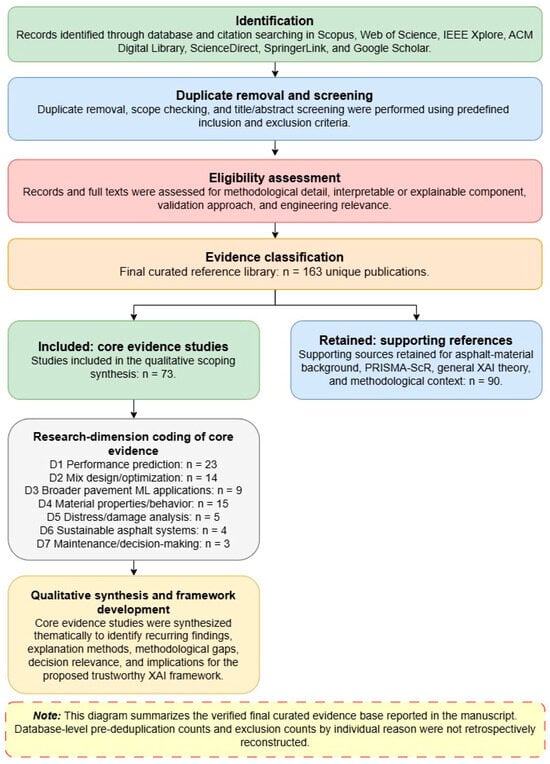
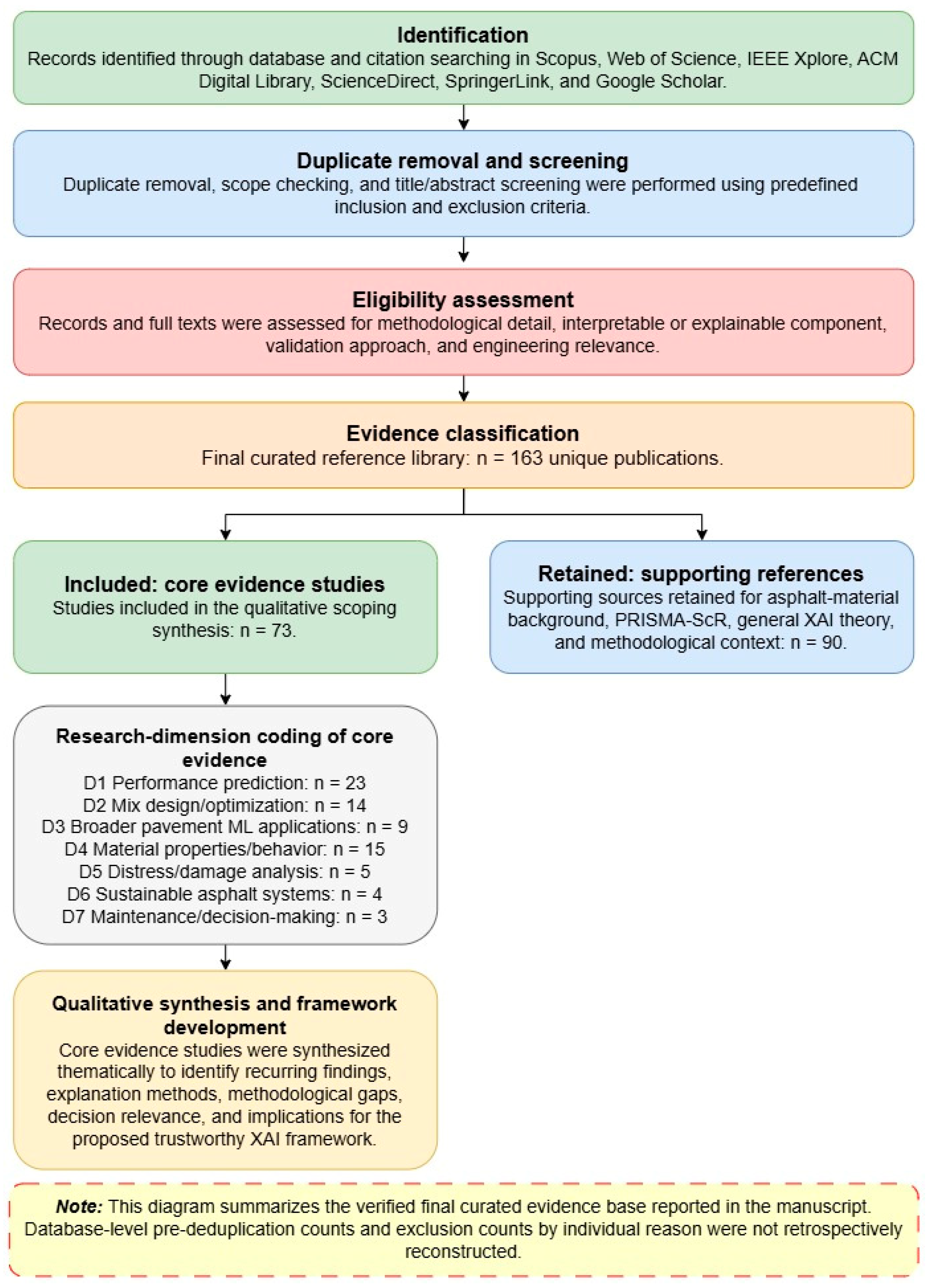
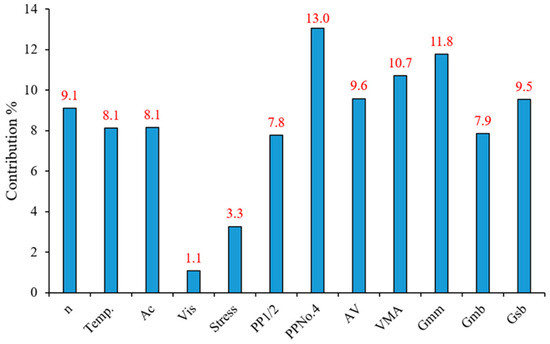
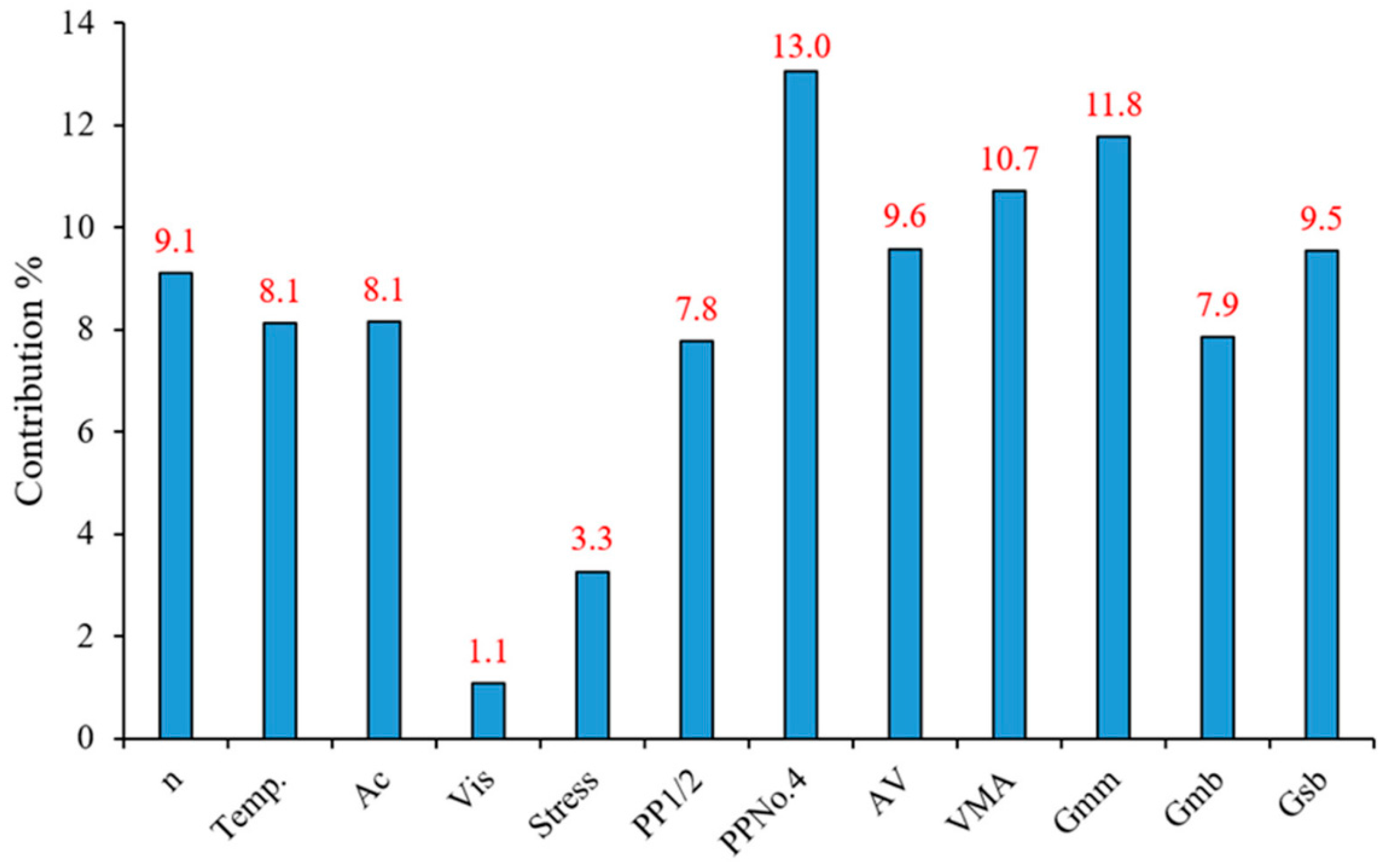
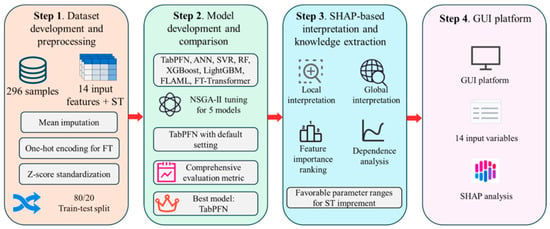
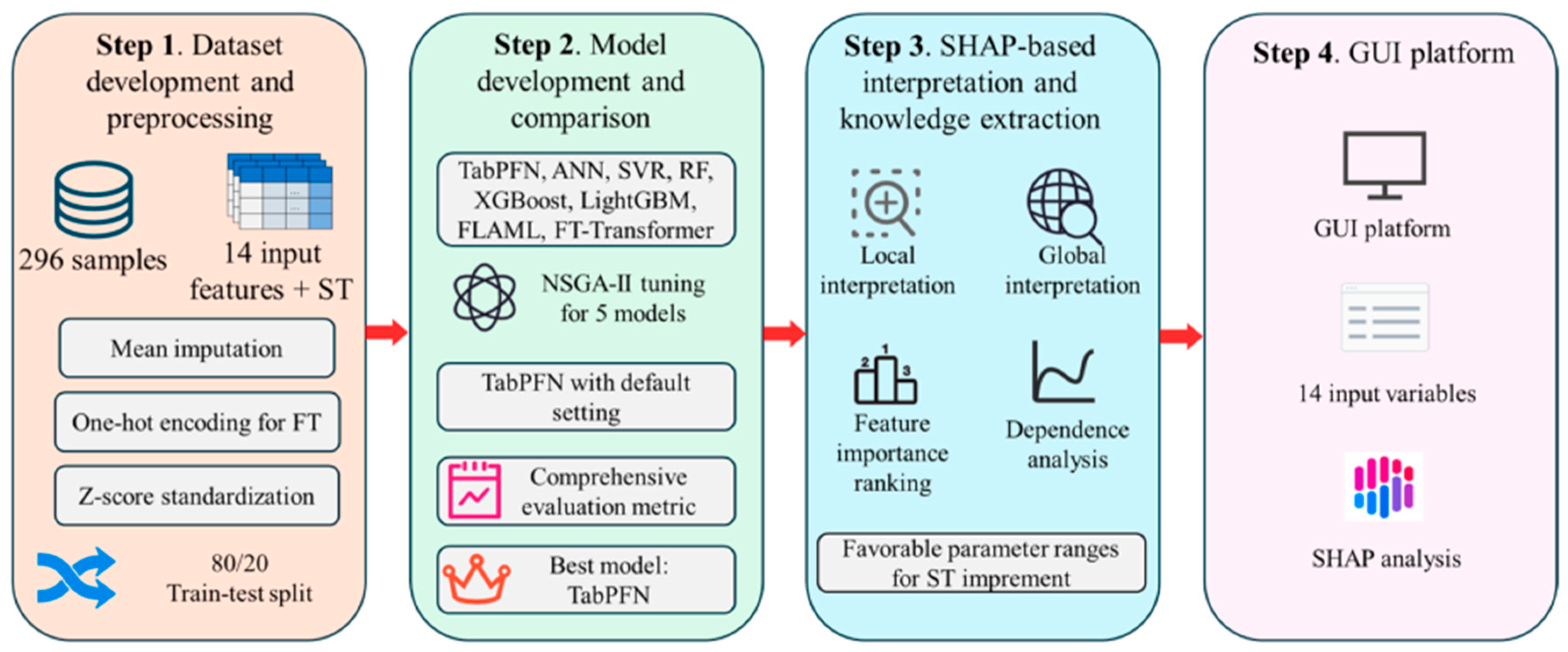
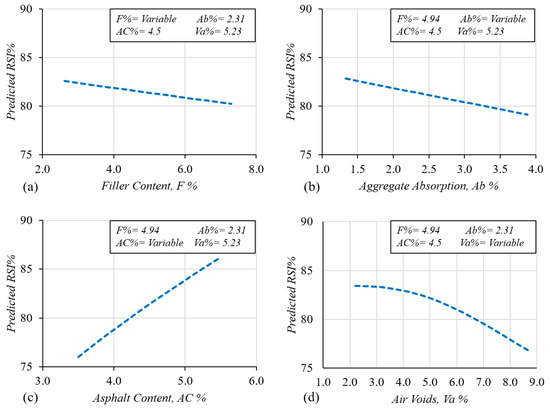
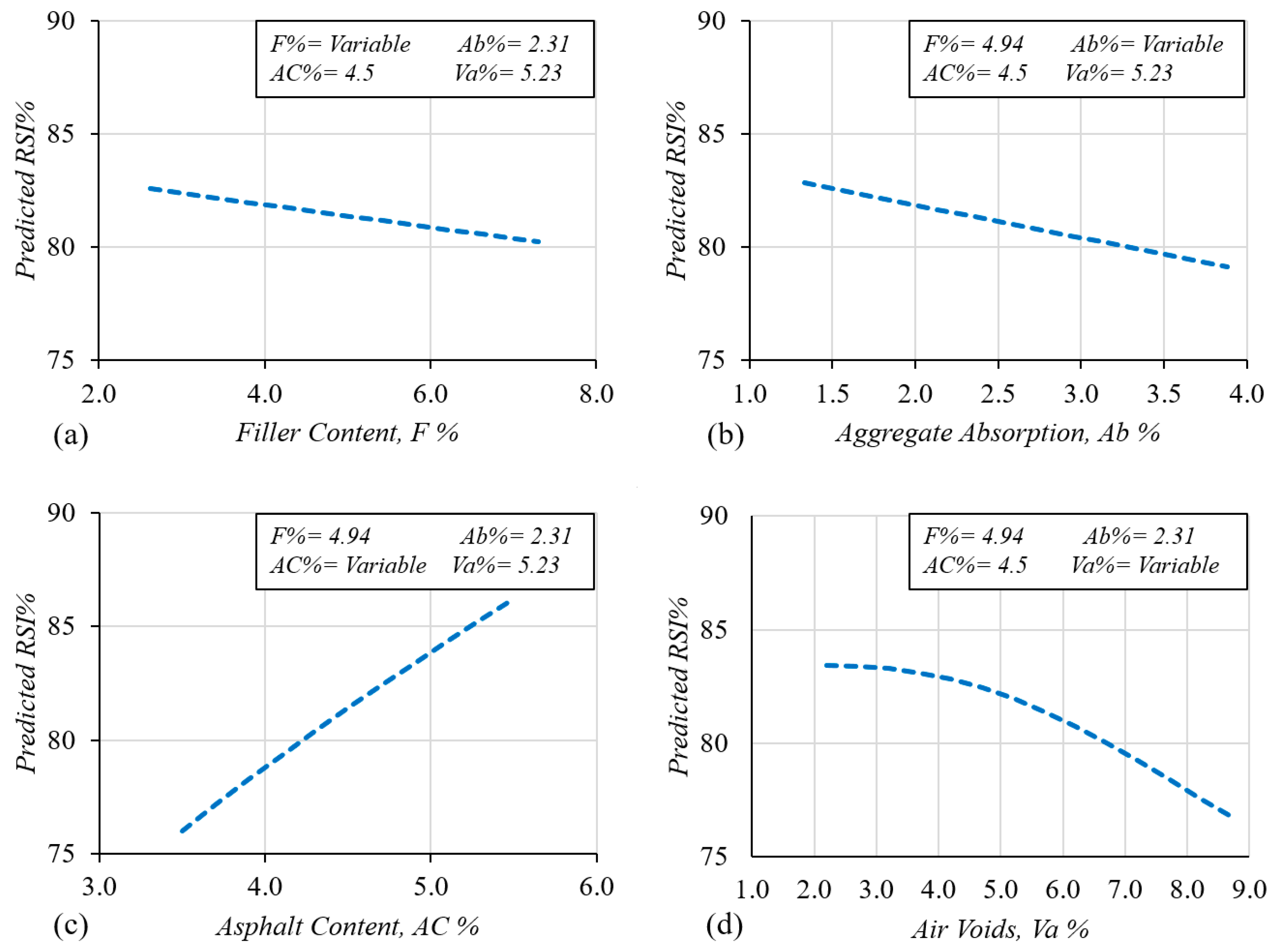
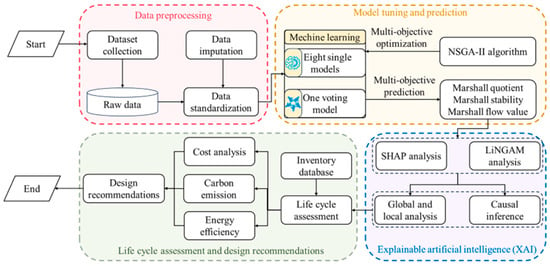
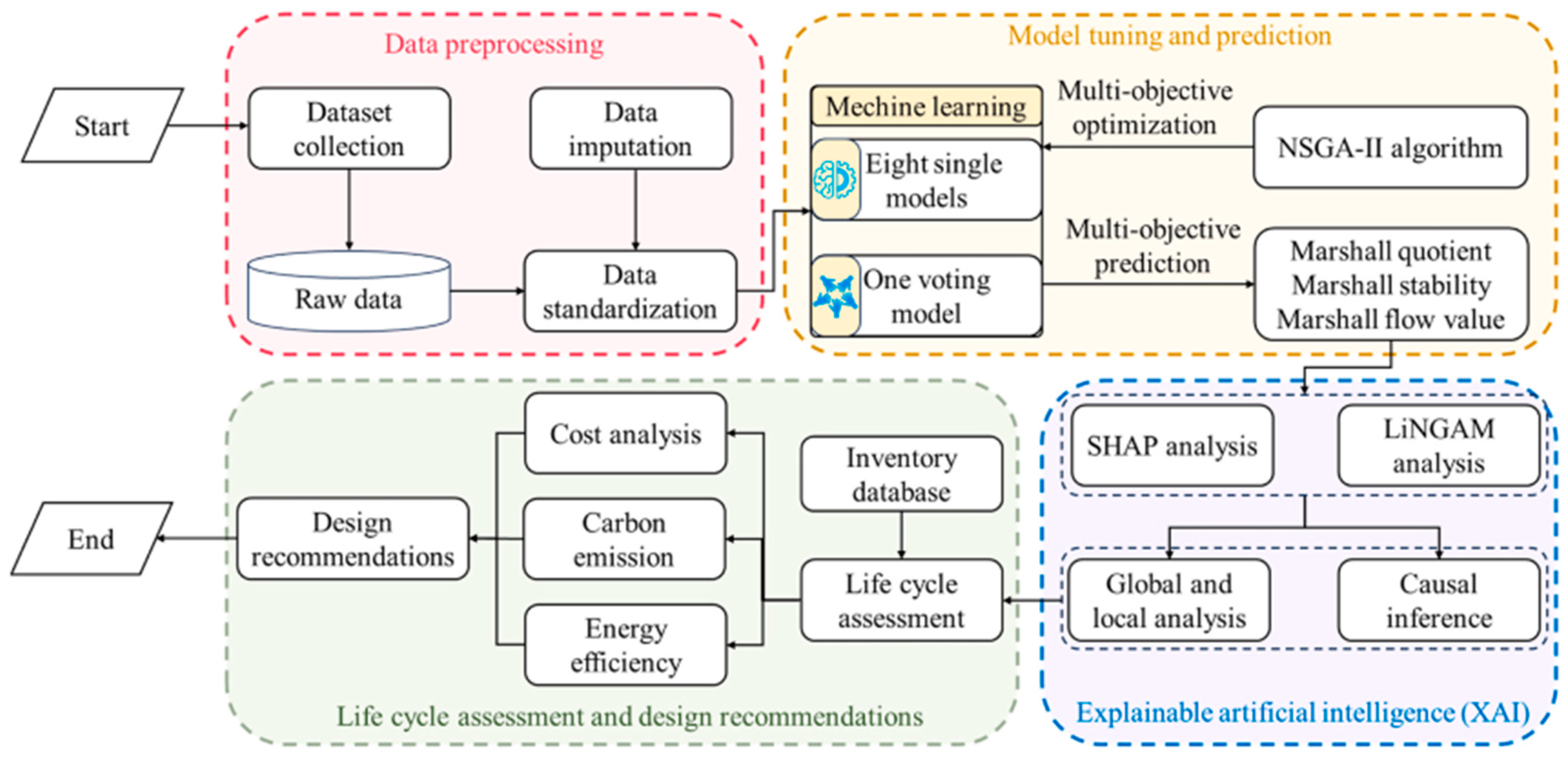
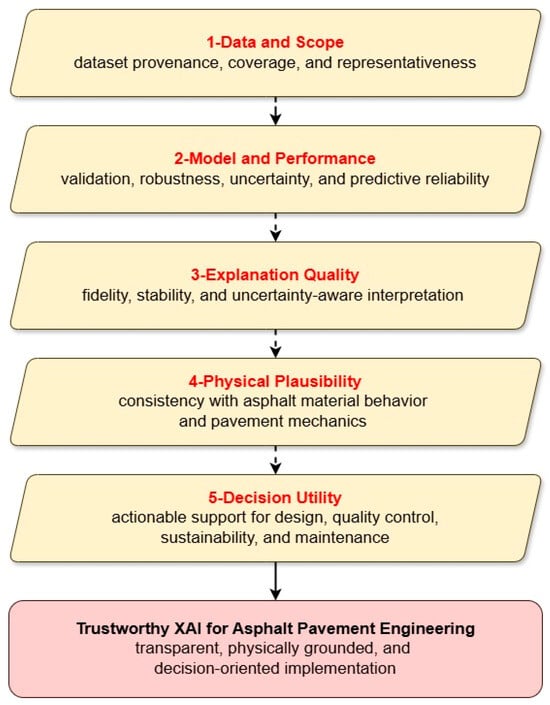
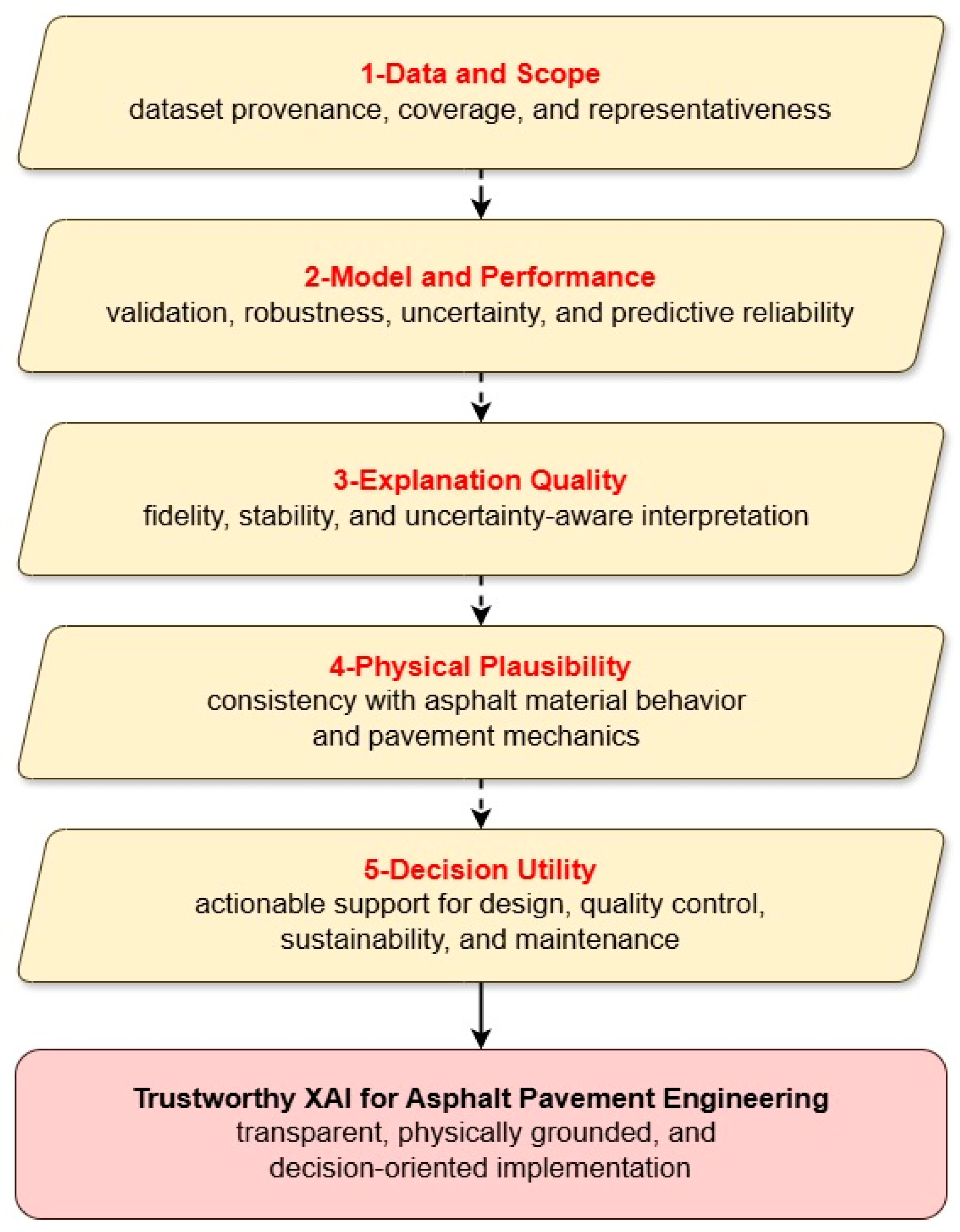

Disclaimer/Publisher’s Note: The statements, opinions and data contained in all publications are solely those of the individual author(s) and contributor(s) and not of MDPI and/or the editor(s). MDPI and/or the editor(s) disclaim responsibility for any injury to people or property resulting from any ideas, methods, instructions or products referred to in the content. |
© 2026 by the author. Published by MDPI on behalf of the International Institute of Knowledge Innovation and Invention. Licensee MDPI, Basel, Switzerland. This article is an open access article distributed under the terms and conditions of the Creative Commons Attribution (CC BY) license.