
Leveraging Self-Sovereign Identity for Certifying Extra-Curricular Competencies and Skills in University Programs

 , , and
Abstract
1. Introduction
- A structured methodology for generating micro-credentials, including well-defined use cases, certification criteria, and proficiency levels for both technical and soft skills.
- A decentralized SSI-based architecture that enables multiple actors (e.g., universities, lecturers, and external organizations) to issue and verify tamper-proof and privacy-preserving credentials.
- A functional prototype implemented using SSI technologies, demonstrating the feasibility of the proposed approach in a realistic academic scenario.
2. Background
2.1. Competencies and Skills in Education
2.2. Micro-Credentials
2.3. Self-Sovereign Identity
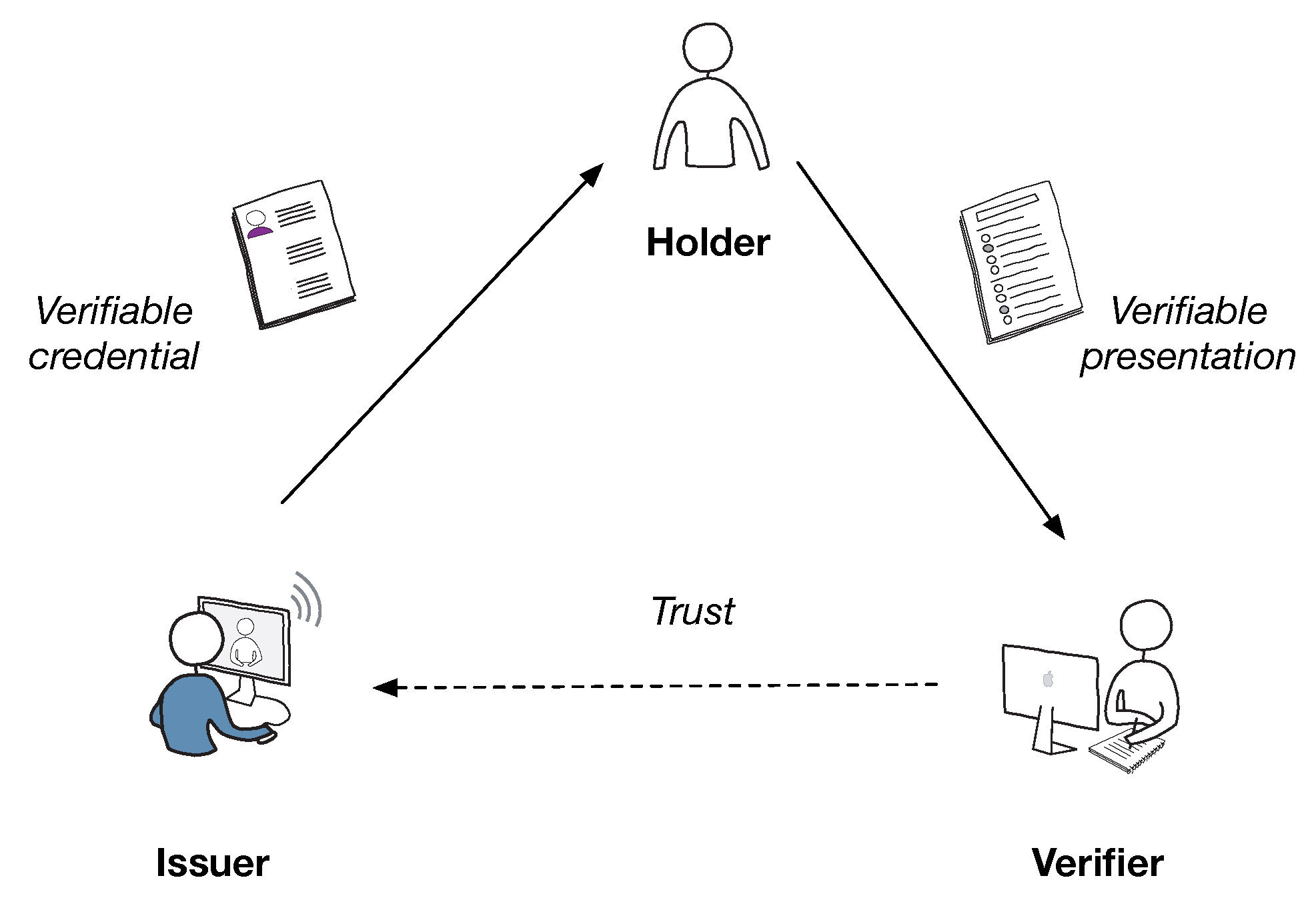
- DIDs are globally unique identifiers that are created and controlled by the user, without dependence on a central authority. Each DID resolves to a DID Document containing cryptographic material (e.g., public keys), service endpoints, and authentication methods. These elements enable secure identification, authentication, and key management in a decentralized environment.
- VCs are tamper-evident, cryptographically signed digital credentials that encode claims about an entity (e.g., a student’s competencies or achievements). VCs follow a standardized data model and can be selectively disclosed by the holder through verifiable presentations, allowing fine-grained control over what information is shared. Cryptographic techniques such as digital signatures and zero-knowledge proofs ensure authenticity, integrity, and privacy.
- VDRs provide a decentralized infrastructure—often implemented using Distributed Ledger Technologies (DLTs)—to anchor DIDs and public keys. Rather than storing personal data, these registries maintain cryptographic proofs and metadata, enabling trust verification without exposing sensitive information. Their immutability ensures that identity-related data cannot be altered or tampered with.
3. SSI-Based Academic Certification Framework
3.1. Micro-Credentials in the Academic Environment
3.2. Methodology for Generating Micro-Credentials
3.2.1. Identification of Certification Scenarios
- Achievement of specific competencies within a course: Micro-credentials are issued when students demonstrate proficiency in well-defined learning outcomes associated with a subject. For example, in a programming course (e.g., Python), students may obtain a credential after successfully demonstrating mastery of concepts such as syntax, control structures, or data types.
- Completion of courses or academic modules: Micro-credentials can certify the successful completion of subjects or specialized training modules. For instance, students completing a Robotics course may receive a credential recognizing the acquisition of integrated technical competencies.
- Demonstration of practical or technical skills: Students who successfully complete laboratory activities, capstone projects, or performance-based assessments may obtain credentials associated with practical competencies. Examples include programming challenges, cybersecurity exercises, or the operation of industrial robots.
- Demonstration of transversal competencies: The framework also supports the certification of soft skills, including communication, teamwork, leadership, adaptability, and community engagement. These competencies may be evaluated through presentations, collaborative activities, mentoring tasks, volunteering, or participation in student organizations.
3.2.2. Definition of Competency Levels
- Excellent: Represents exceptional performance significantly exceeding the expected learning outcomes or evaluation criteria.
- Proficient: Represents advanced performance that is clearly above average expectations.
3.2.3. Specification of Certifiable Competencies and Skills
3.2.4. Credential Issuance and Management
- Assessment: Students are evaluated through examinations, projects, laboratory activities, coursework, or observational assessments designed to measure specific competencies and skills.
- Verification: Assessment results are validated by authorized academic staff, such as lecturers or program coordinators. This process may include reviewing submissions, applying evaluation rubrics, and validating compliance with certification criteria.
- Credential generation and issuance: Once verification is completed, the institution or instructor generates a micro-credential encoded as a W3C Verifiable Credential. The credential is digitally signed using the issuer’s cryptographic keys to guarantee authenticity and integrity.
- Storage and management: Issued credentials are delivered to the student’s SSI wallet, where they remain under the student’s control. The wallet enables secure storage and management of credentials.
- Sharing and verification: Students can selectively share their credentials with external entities, such as employers or educational institutions. Credential verification is performed through cryptographic validation mechanisms without requiring direct interaction with the issuer.
3.3. Architecture
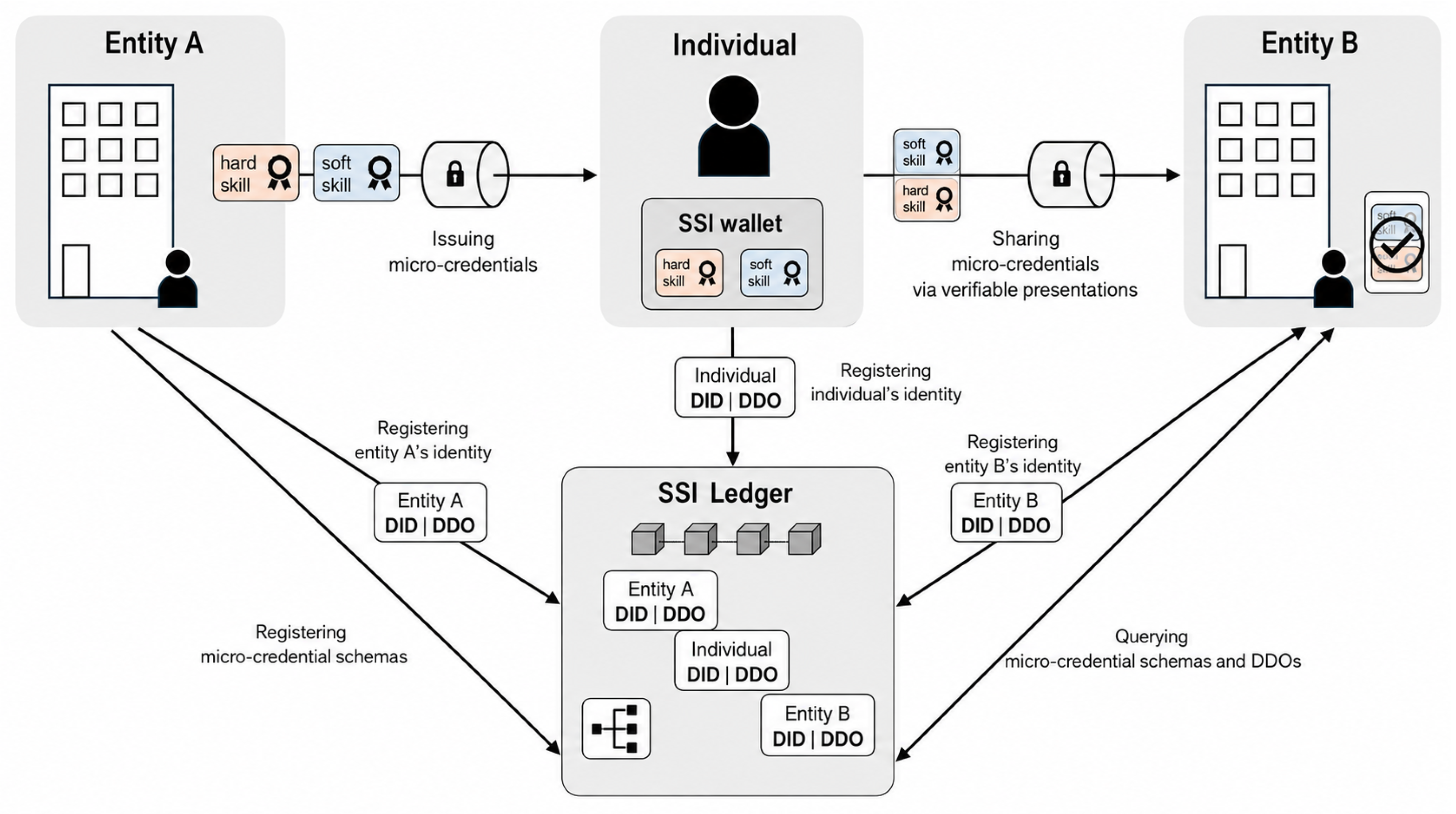
- Identity creation: The holder sets up an SSI wallet, which generates a globally unique DID along with its corresponding pair of cryptographic keys (public and private). This DID functions as the holder’s digital identity within the system. The holder’s DID, along with a DDO containing the public key, is registered on the SSI Ledger, ensuring a secure association between the DID and the public key. This setup enables verifiers to use the holder’s public key for reliable verification of the holder’s credential presentations. Issuers and verifiers also create their own SSI wallets following a similar process.
- Skill acquisition and micro-credential issuance: The holder acquires hard and soft skills through educational programs or professional experiences. Entities where the skills are acquired create micro-credentials to recognize these achievements, adhering to a predefined schema. These micro-credentials are then issued off-Ledger via a secure P2P channel to the holder’s SSI wallet, where they are securely stored. The holder can organize, manage, and prepare these micro-credentials as verifiable presentations for sharing when needed.
- Micro-credential sharing and verification: The holder can share their micro-credentials with multiple verifiers as needed (e.g., when applying for an educational program or job), maintaining control over their digital identity and personal data. To demonstrate competencies to verifying entities, the holder selects the relevant micro-credentials and compiles them into a verifiable presentation. This presentation is signed by the holder and shared off-Ledger with the verifier via a secure P2P communication channel established between the holder and verifier’s SSI wallets. The verifier ensures the authenticity and integrity of the verifiable presentation by validating its digital signatures. First, it verifies the signatures of the micro-credentials contained in the verifiable presentation using the issuers’ public keys. Next, it verifies the signature of the verifiable presentation itself using the holder’s public key. These public keys are retrieved from the corresponding DDOs registered on the SSI Ledger.
3.4. Implementation
4. Illustrative Example
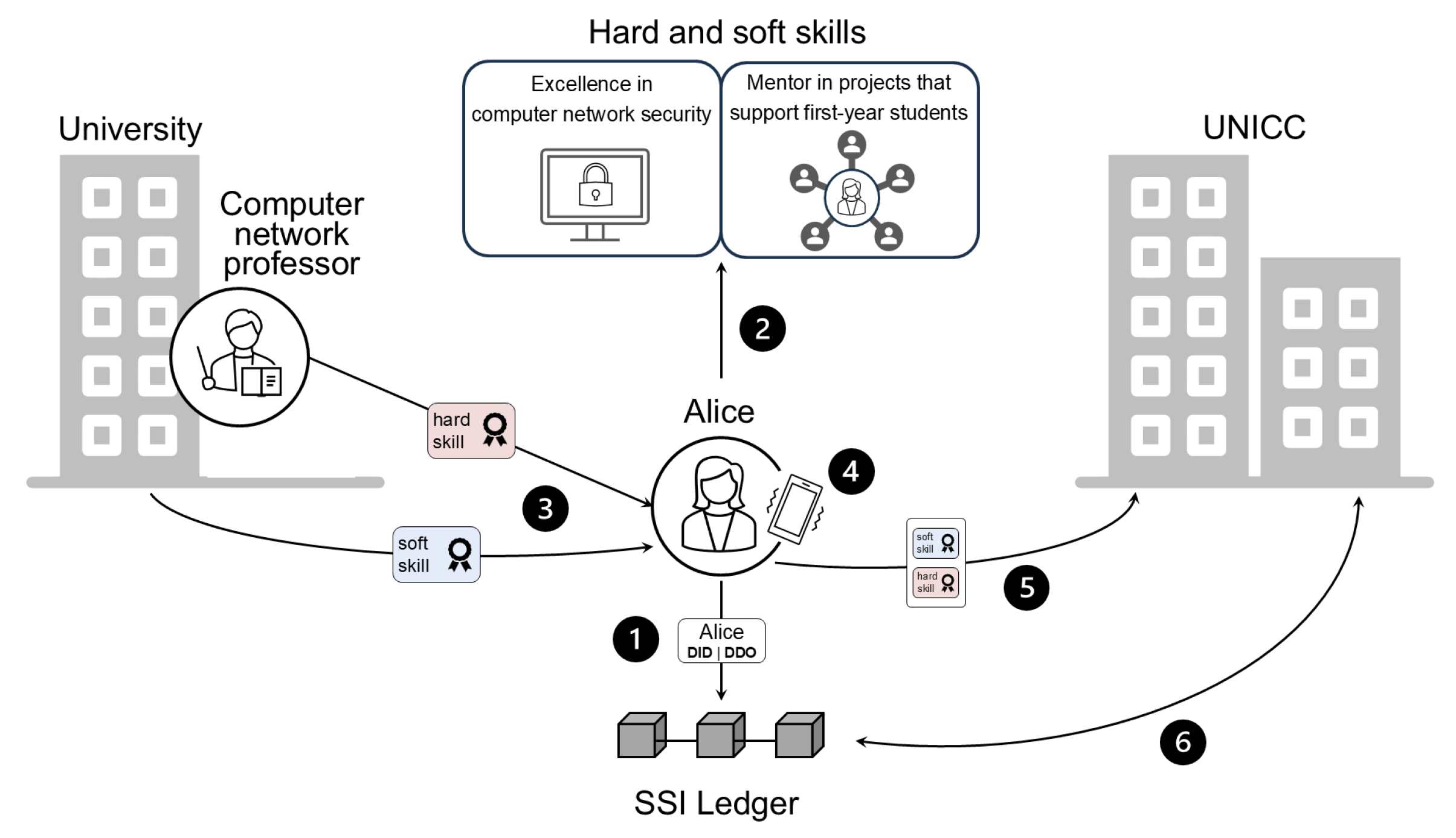
- Step 1: System Initialization and Identity Setup.At the beginning of her studies, Alice creates her self-sovereign identity using the university’s SSI wallet application as part of the standard enrollment process. The wallet generates a DID and its corresponding DDO, which is anchored on the SSI Ledger. In parallel, the university and its authorized staff (e.g., lecturers, program coordinators) are registered as trusted issuers within the system, each associated with their own DIDs. This step establishes the trust framework required for subsequent credential issuance and verification.
- Step 2: Skill Acquisition and Assessment.During the semester, Alice participates in both formal and informal learning activities. In the Computer Networks course, her competencies are assessed through structured evaluation methods, including exams, laboratory exercises, and project-based assignments, mapped to specific learning outcomes such as network security.In parallel, Alice engages in a university mentoring program, where her leadership and communication skills are evaluated using predefined rubrics that combine supervisor feedback, peer assessment, and participation indicators. These evaluation processes are managed through the LMS, ensuring traceability and consistency.
- Step 3: Credential Generation and Issuance.Once Alice meets the predefined evaluation criteria, micro-credentials are generated automatically or semi-automatically through the institutional system. The course instructor issues a credential for “Proficient Computer Network Security”, while the extracurricular program coordinator issues a credential for “Excellence in Leadership and Communication”.Each credential follows a standardized schema and includes metadata such as skill description, proficiency level, issuer identity, and issuance date. The credentials are cryptographically signed using the issuer’s private key and transmitted securely to Alice’s SSI wallet via a peer-to-peer channel.
- Step 4: Credential Management and Composition.Alice stores the received micro-credentials in her SSI wallet, where she can organize them into structured portfolios (e.g., technical skills, soft skills, extracurricular achievements). The wallet enables Alice to compose verifiable presentations by selectively combining credentials depending on the intended use case, supporting flexible and context-aware disclosure.
- Step 5: Credential Sharing.When applying for the Cybersecurity Awareness Leadership Program fellowship at the United Nations International Computing Centre (UNICC), Alice generates a tailored verifiable presentation containing both credentials. The sharing process follows a request–response protocol, where the verifier specifies required attributes and Alice provides only the relevant credentials. Communication is established through a secure peer-to-peer channel between the respective SSI wallets.
- Step 6: Credential Verification.The UNICC verifies the authenticity and integrity of the credentials by validating their digital signatures. This involves retrieving the public keys associated with the university and instructor DIDs from the SSI Ledger and checking the cryptographic proofs embedded in the credentials and the presentation. The process is fully automated and does not require direct interaction with the issuing entities, significantly reducing verification time and administrative overhead.
5. Discussion
5.1. Benefits of SSI-Based Credentialing
5.2. Implementation Challenges
5.3. Ethical Implications
5.4. Implications and Outlook
6. Related Works
7. Conclusions
Author Contributions
Funding
Data Availability Statement
Acknowledgments
Conflicts of Interest
Abbreviations
| CBL | Competence-based Learning |
| DDO | Decentralized Identifier Document |
| DID | Decentralized Identifier |
| DLT | Distributed Ledger Technology |
| DPKI | Decentralized Public Key Infrastructure |
| EBSI | European Blockchain Services Infrastructure |
| GDPR | General Data Protection Regulation |
| IoT | Internet of Things |
| LMS | Learning Management System |
| MIT | Massachusetts Institute of Technology |
| P2P | Peer-to-peer |
| SSI | Self-sovereign Identity |
| STEM | Science, Technology, Engineering, and Mathematics |
| UNICC | United Nations International Computing Center |
| VC | Verifiable Credential |
| VDR | Verifiable Data Registry |
References
- Altbach, P.G.; Reisberg, L.; Rumbley, L.E. Global Perspectives on Higher Education; Johns Hopkins University Press: Baltimore, MD, USA, 2016. [Google Scholar]
- Higgins, J.; Barrie, S. Higher Education and Skills for the Future(s) of Work; Springer: Berlin/Heidelberg, Germany, 2016. [Google Scholar]
- Cengage Group. 2025 Graduate Employability Report. 2025. Available online: https://www.cengagegroup.com/news/press-releases/2025/cengage-group-2025-employability-report/ (accessed on 1 May 2026).
- National Association of Colleges and Employers (NACE). The Gap in Perceptions of New Grads’ Competency Proficiency and Resources to Shrink It. 2024. Available online: https://naceweb.org/career-readiness/competencies/the-gap-in-perceptions-of-new-grads-competency-proficiency-and-resources-to-shrink-it (accessed on 1 May 2026).
- Tushar, H.; Sooraksa, N. Global employability skills in the 21st century workplace: A semi-systematic literature review. Heliyon 2023, 9, e21023. [Google Scholar] [CrossRef]
- Phusavat, K.; Ongkunaruk, P.; Anussornnitisarn, P. Gaining insights into the employability of university graduates: Implications from the students’ inputs. Stud. High. Educ. 2025, 1–19. [Google Scholar] [CrossRef]
- Heckman, J.J.; Kautz, T. Hard Evidence on Soft Skills. Labour Econ. 2018, 29, 91–93. [Google Scholar]
- Brown, P.; Lauder, H.; Cheung, S.Y. Degrees of Difference: Understanding the Value of Higher Education Credentials in the Workforce. J. Educ. Work. 2020, 33, 1–14. [Google Scholar]
- Quesada-Real, F.J.; Perez-Peña, F.; Morgado-Estévez, A.; Ruiz-Lendínez, J.J. Applying active learning by contextualizing robotic applications to historical heritage. Comput. Appl. Eng. Educ. 2024, 32, e22687. [Google Scholar] [CrossRef]
- Tomlinson, M. Forms of graduate capital and their relationship to graduate employability. Educ. Train. 2017, 59, 338–352. [Google Scholar] [CrossRef]
- Holotescu, C. Understanding blockchain opportunities and challenges. In Proceedings of the Conference Proceedings of »eLearning and Software for Education« (eLSE); Carol I National Defence University Publishing House: Bucharest, Romania, 2018; Volume 14, pp. 275–283. [Google Scholar]
- Kanan, T.; Obaidat, A.T.; Al-Lahham, M. SmartCert blockchain imperative for educational certificates. In Proceedings of the 2019 IEEE Jordan International Joint Conference on Electrical Engineering and Information Technology (JEEIT); IEEE: New York, NY, USA, 2019; pp. 629–633. [Google Scholar]
- Capece, G.; Levialdi Ghiron, N.; Pasquale, F. Blockchain technology: Redefining trust for digital certificates. Sustainability 2020, 12, 8952. [Google Scholar] [CrossRef]
- Saleh, O.S.; Ghazali, O.; Rana, M.E. Blockchain based framework for educational certificates verification. J. Crit. Rev. 2020, 7, 79–84. [Google Scholar] [CrossRef]
- Bhaskar, P.; Tiwari, C.K.; Joshi, A. Blockchain in education management: Present and future applications. Interact. Technol. Smart Educ. 2021, 18, 1–17. [Google Scholar] [CrossRef]
- Preukschat, A.; Reed, D. Self-Sovereign Identity; Manning Publications: Shelter Island, NY, USA, 2021. [Google Scholar]
- Grech, A.; Sood, I.; Ariño, L. Blockchain, self-sovereign identity and digital credentials: Promise versus praxis in education. Front. Blockchain 2021, 4, 616779. [Google Scholar] [CrossRef]
- Queiruga-Dios, A.; Bullón Pérez, J.J.; Hernández Encinas, L. Self-sovereign identity in university context. In Proceedings of the 2022 31st Conference of Open Innovations Association (FRUCT); IEEE: New York, NY, USA, 2022; pp. 259–264. [Google Scholar]
- Herbke, P.; Yildiz, H. ELMO2EDS: Transforming educational credentials into self-sovereign identity paradigm. In Proceedings of the 2022 20th International Conference on Information Technology Based Higher Education and Training (ITHET); IEEE: New York, NY, USA, 2022; pp. 1–7. [Google Scholar]
- Al Mansoori, S.; Maheshwari, P. Hei-bct: A framework to implement blockchain-based self-sovereign identity solution in higher education institutions. In Proceedings of the 2022 8th International Conference on Information Technology Trends (ITT); IEEE: New York, NY, USA, 2022; pp. 6–10. [Google Scholar]
- Faizan, M.; Riaz, N.; Saif, U. Transforming university records management: A comprehensive review of blockchain and self-sovereign identity applications. Int. J. Sci. Res. Arch. 2024, 11, 984–996. [Google Scholar] [CrossRef]
- Kiiskilä, P.; Hylli, O.; Pirkkalainen, H. How can European blockchain services infrastructure be used for managing educational digital credentials? In Proceedings of the 14th Scandinavian Conference on Information Systems (SCIS); Association for Information Systems: Atlanta, GA, USA, 2023. [Google Scholar]
- Mulder, M.; Weigel, T.; Collins, K. The concept of competence in the development of vocational education and training in selected EU member states: A critical analysis. J. Vocat. Educ. Train. 2007, 59, 67–88. [Google Scholar] [CrossRef]
- Koenen, A.; Dochy, F.; Berghmans, I. A phenomenographic analysis of the implementation of competence-based education in higher education. Teach. Teach. Educ. 2015, 50, 1–12. [Google Scholar] [CrossRef]
- Van Merriënboer, J.; Kirschner, P.A. Ten Steps to Complex Learning: A Systematic Approach to Four-Component Instructional Design; Routledge: Oxfordshire, UK, 2017. [Google Scholar]
- Mulder, M. Competence-based education and training. J. Agric. Educ. Ext. 2012, 18, 305–314. [Google Scholar] [CrossRef]
- OECD. OECD Skills Outlook 2019: Thriving in a Digital World; OECD Publishing: Paris, France, 2019. [Google Scholar] [CrossRef]
- World Economic Forum. The Future of Jobs Report. 2023. Available online: https://www.weforum.org/reports/the-future-of-jobs-report-2023 (accessed on 1 May 2026).
- Anderson, M. The Growing Demand for Soft Skills in the Workplace. Bus. Educ. Q. 2021, 20, 67–79. [Google Scholar]
- Gauthier, T. The value of microcredentials: The employer’s perspective. J. Competency-Based Educ. 2020, 5, e01209. [Google Scholar] [CrossRef]
- Lemoine, P.A.; Richardson, M.D. Micro-credentials, nano degrees, and digital badges: New credentials for global higher education. Int. J. Technol. Educ. Mark. (IJTEM) 2015, 5, 36–49. [Google Scholar] [CrossRef]
- Halavais, A. Microcredentials on the Open Web; AOIR Selected Papers of Internet Research: Mexico City, Mexico, 2013. [Google Scholar]
- Pickard, L.; Shah, D.; De Simone, J.J. Mapping microcredentials across MOOC platforms. In Proceedings of the 2018 Learning with MOOCS (LWMOOCS); IEEE: New York, NY, USA, 2018; pp. 17–21. [Google Scholar]
- van de Laar, M.; West, R.E.; Cosma, P.; Katwal, D.; Mancigotti, C. The value of educational microcredentials in open access online education: A doctoral education case. Open Learn. J. Open Distance e-Learn. 2024, 39, 373–386. [Google Scholar] [CrossRef]
- Selvaratnam, R.M.; Sankey, M.D. An integrative literature review of the implementation of micro-credentials in higher education: Implications for practice in Australasia. J. Teach. Learn. Grad. Employab. 2021, 12, 1–17. [Google Scholar] [CrossRef]
- Ahsan, K.; Akbar, S.; Kam, B.; Abdulrahman, M.D. Implementation of micro-credentials in higher education: A systematic literature review. Educ. Inf. Technol. 2023, 28, 13505–13540. [Google Scholar] [CrossRef]
- Ahmat, N.H.C.; Bashir, M.A.A.; Razali, A.R.; Kasolang, S. Micro-credentials in higher education institutions: Challenges and opportunities. Asian J. Univ. Educ. 2021, 17, 281–290. [Google Scholar] [CrossRef]
- Rottmann, A.K.; Duggan, M.H. Micro-credentials in higher education. In Handbook of Research on Innovations in Non-Traditional Educational Practices; IGI Global: Hershey, PA, USA, 2021; pp. 223–236. [Google Scholar]
- Thi Ngoc Ha, N.; Spittle, M.; Watt, A.; Van Dyke, N. A systematic literature review of micro-credentials in higher education: A non-zero-sum game. High. Educ. Res. Dev. 2023, 42, 1527–1548. [Google Scholar] [CrossRef]
- Berry, B. Micro-credentials: The badges of professional growth. Educ. Dig. 2017, 82, 21. [Google Scholar]
- Bartz, D.E.; Kritsonis, W.A. Micro-credentialing and the individualized professional development approach to learning for teachers. Natl. Forum Teach. Educ. J. 2019, 29, 1–11. [Google Scholar]
- Hunt, T.; Carter, R.; Zhang, L.; Yang, S. Micro-credentials: The potential of personalized professional development. Dev. Learn. Organ. Int. J. 2020, 34, 33–35. [Google Scholar] [CrossRef]
- Cosby, A.; McDonald, N.; Lovric, K. Designing a skills training pathway for the agricultural workforce from the employer perspective: Skills micro-credentials from seasonal worker to supervisor. J. Agric. Educ. Ext. 2024, 30, 535–552. [Google Scholar] [CrossRef]
- Griffith, B.; Beauchamp, S.; Bates, R. Growing Oklahoma’s Workforce Readiness Through Micro-Credentials. In Career Ready Education Through Experiential Learning; IGI Global: Hershey, PA, USA, 2021; pp. 1–18. [Google Scholar]
- McGreal, R.; Olcott, D., Jr. Micro-Credentials Landscape Report: Transforming Workforce Futures: Strategic Perspectives and Practices for University Micro-Credentials; Technical Report; Athabasca University: Athabasca, AB, Canada, 2021. [Google Scholar]
- European Commission. Council Recommendation on a European Approach to Micro-Credentials for Lifelong Learning and Employability. 2022. Available online: https://eur-lex.europa.eu/legal-content/EN/TXT/?uri=CELEX:32022H0627(01) (accessed on 1 May 2026).
- Digital Credentials Consortium. Building the Digital Credential Infrastructure for the Future; Massachusetts Institute of Technology (MIT): Cambridge, MA, USA, 2020; Available online: https://digitalcredentials.mit.edu (accessed on 1 May 2026).
- Lang, J.; Giglietta, K. Implementing continuing professional education micro-credentials in a university context. In Handbook of Research on Credential Innovations for Inclusive Pathways to Professions; IGI Global Scientific Publishing: Palmdale, PA, USA, 2022; pp. 45–64. [Google Scholar]
- Varadarajan, S.; Koh, J.H.L.; Daniel, B.K. A systematic review of the opportunities and challenges of micro-credentials for multiple stakeholders: Learners, employers, higher education institutions and government. Int. J. Educ. Technol. High. Educ. 2023, 20, 13. [Google Scholar] [CrossRef] [PubMed]
- Ford, B.; Srisuresh, P.; Kegel, D. Peer-to-peer communication across network address translators. In Proceedings of the USENIX Annual Technical Conference, General Track; USENIX Association: Berkeley, CA, USA, 2005; pp. 179–192. [Google Scholar]
- Sporny, M.; Longley, D.; Sabadello, M.; Reed, D.; Steele, O.; Allen, C. Decentralized Identifiers (DIDs) v1. 0; Technical Report; World Wide Web Consortium (W3C): Cambridge, MA, USA, 2022. [Google Scholar]
- Sporny, M.; Longley, D.; Chadwick, D.; Herman, I. Verifiable Credentials Data Model v2.0. W3C Recommendation REC-vc-Data-Model-2.0-20250515, World Wide Web Consortium (W3C), 2025. Available online: https://www.w3.org/TR/vc-data-model-2.0/ (accessed on 1 May 2026).
- Márquez, P.L. Micro-Credentials SSI Prototype. 2026. Available online: https://github.com/Darthpab/micro-credentials/tree/main (accessed on 1 May 2026).
- Hyperledger Foundation. Hyperledger Ursa. 2026. Available online: https://github.com/hyperledger/ursa (accessed on 1 May 2026).
- Hyperledger Foundation. Hyperledger Indy. 2026. Available online: https://github.com/hyperledger/indy (accessed on 1 May 2026).
- Hyperledger Foundation. Hyperledger Aries. 2026. Available online: https://github.com/hyperledger/aries (accessed on 1 May 2026).
- Government of British Columbia. VON Network: A Portable Development-Level Indy Node Network. GitHub Repository. Part of the Verifiable Organizations Network (VON) Project. 2026. Available online: https://github.com/bcgov/von-network (accessed on 1 May 2026).
- Unesco. Recommendation on the Ethics of Artificial Intelligence; United Nations Educational, Scientific and Cultural Organization: Paris, France, 2022. [Google Scholar]
- GDPR. General Data Protection Regulation (EU) 2016/679, 2016. Available online: https://eur-lex.europa.eu/eli/reg/2016/679/oj (accessed on 1 May 2026).
- Wilczynski, A.; Budzik, K. Skillchain: A Service-Oriented Blockchain Platform for Secure and Scalable Microcredential Management. IEEE Trans. Serv. Comput. 2026, 1–14. [Google Scholar] [CrossRef]
- Bruguera, C.; Pagés, C.; Peters, M.; Fitó, A. Micro-credentials and soft skills in online education: The employers’ perspective. Distance Educ. 2025, 46, 56–76. [Google Scholar] [CrossRef]
- Lago Ávila, M.J.; Bartolomé Muñoz de Luna, A.; Martín Gómez, S. Soft Skills, Mentoring and Micro-Credentials: Strategies for the New Role of 21st Century Professors. Multidiscip. J. Sch. Educ. 2024, 13, 373–398. [Google Scholar] [CrossRef]
- Epaphras, N. Bridging the Skills Gap: A Case for Micro-Credentials in Academic Programs in Institutions of Higher Learning. Creat. Educ. 2025, 16, 748–769. [Google Scholar] [CrossRef]
- Moya, F.; Quesada, F.J.; Martínez, L.; Estrella, F.J. CertifIoT: An IoT and DLT-Based Solution for Enhancing Trust and Transparency in Data Certification. In Proceedings of the International Conference on Ubiquitous Computing and Ambient Intelligence; Springer: Berlin/Heidelberg, Germany, 2023; pp. 127–138. [Google Scholar]



| Competencies/Skills | Description |
|---|---|
| Problem-Solving | Ability to analyze complex problems and develop effective solutions |
| Teamwork | Capacity to work collaboratively with others to achieve common goals |
| Communication | Proficiency in conveying ideas clearly, both verbally and in writing |
| Leadership | Ability to guide teams and take responsibility for outcomes |
| Adaptability | Flexibility in responding to new challenges and environments |
| Technical Proficiency | Expertise in engineering tools, software, and methodologies |
| Project Management | Skills in planning and executing projects within constraints |
| Critical Thinking | Ability to evaluate information and make sound decisions |
| Innovation | Creativity in developing new ideas or solutions |
| Time Management | Efficient organization and prioritization of tasks |
| Ethical Judgment | Ability to make responsible and ethical decisions |
| Data Analysis | Competence in interpreting and analyzing data |
| Programming Skills | Proficiency in relevant programming languages |
| Attention to Detail | Precision in executing tasks accurately |
| Sustainability Awareness | Understanding of sustainable practices |
| Community Engagement | Participation in socially responsible activities |
| Work | SSI/Blockchain | Formal Credentials | Extra-Curricular | Soft Skills | Methodology |
|---|---|---|---|---|---|
| Grech et al. [17] | ✓ | ✓ | ✗ | ✗ | ✗ |
| Herbke et al. [19] | ✓ | ✓ | ✗ | ✗ | ✗ |
| Queiruga et al. [18] | ✓ | ✓ | ✗ | ✗ | ✗ |
| Al et al. [20] | ✓ | ✓ | ✗ | ✗ | ✗ |
| Faizan [21] | ✓ | ✓ | ✗ | ✗ | ✗ |
| Kiiskila [22] | ✓ | ✓ | ✗ | ✗ | ✗ |
| Wilczynski et al. [60] | ✓ | ✓ | ✗ | ✗ | ✓ |
| Bruguera et al. [61] | ✗ | ✗ | ✓ | ✓ | ✗ |
| Lago et al. [62] | ✗ | ✗ | ✓ | ✓ | ✗ |
| Epaphras [63] | ✗ | ✗ | ✓ | ✓ | ✗ |
| This work | ✓ | ✓ | ✓ | ✓ | ✓ |
Disclaimer/Publisher’s Note: The statements, opinions and data contained in all publications are solely those of the individual author(s) and contributor(s) and not of MDPI and/or the editor(s). MDPI and/or the editor(s) disclaim responsibility for any injury to people or property resulting from any ideas, methods, instructions or products referred to in the content. |
© 2026 by the authors. Published by MDPI on behalf of the International Institute of Knowledge Innovation and Invention. Licensee MDPI, Basel, Switzerland. This article is an open access article distributed under the terms and conditions of the Creative Commons Attribution (CC BY) license.
Share and Cite
López-Márquez, P.; Zaqueros-Martinez, J.; Ramos-Cruz, B.; Quesada-Real, F.J.; Rodriguez-Garcia, M. Leveraging Self-Sovereign Identity for Certifying Extra-Curricular Competencies and Skills in University Programs. Appl. Syst. Innov. 2026, 9, 115. https://doi.org/10.3390/asi9060115
López-Márquez P, Zaqueros-Martinez J, Ramos-Cruz B, Quesada-Real FJ, Rodriguez-Garcia M. Leveraging Self-Sovereign Identity for Certifying Extra-Curricular Competencies and Skills in University Programs. Applied System Innovation. 2026; 9(6):115. https://doi.org/10.3390/asi9060115
Chicago/Turabian StyleLópez-Márquez, Pablo, Jessica Zaqueros-Martinez, Bruno Ramos-Cruz, Francisco José Quesada-Real, and Mercedes Rodriguez-Garcia. 2026. "Leveraging Self-Sovereign Identity for Certifying Extra-Curricular Competencies and Skills in University Programs" Applied System Innovation 9, no. 6: 115. https://doi.org/10.3390/asi9060115
APA StyleLópez-Márquez, P., Zaqueros-Martinez, J., Ramos-Cruz, B., Quesada-Real, F. J., & Rodriguez-Garcia, M. (2026). Leveraging Self-Sovereign Identity for Certifying Extra-Curricular Competencies and Skills in University Programs. Applied System Innovation, 9(6), 115. https://doi.org/10.3390/asi9060115