

An Intelligent Decision-Support Framework Based on Fuzzy BWM–TOPSIS with Interdependent Criteria for Alternative Selection in Complex Construction Projects

Highlights
- -
- Proposing an interdependency-aware fuzzy BWM for complex multi-criteria decision making.
- -
- Modeling cross-criterion influences via fuzzy nonlinear optimization.
- -
- Preserving individual expert judgments within a transparent group decision-making process.
- -
- Implementing a reproducible framework for weighting and ranking alternatives.
- -
- Demonstrating applicability through a real-world infrastructure case study.
Abstract
1. Introduction
2. Literature Review
2.1. Decision-Support Systems and Modeling Approaches for Scaffolding
2.2. Applications of Multi-Criteria Decision-Making Methods in the Construction Industry
2.3. The Best–Worst Method (BWM) in MCDM
2.4. BWM-Based Modeling of Influences Among Interrelated Criteria
2.5. Positioning Relative to DEMATEL-Based and GBWM-Based Interdependency Models
3. An Integrated FIDBWM–TOPSIS Framework for Decision-Making Under Criterion Interdependency and Uncertainty
3.1. Modeling Uncertainty Using Fuzzy Sets
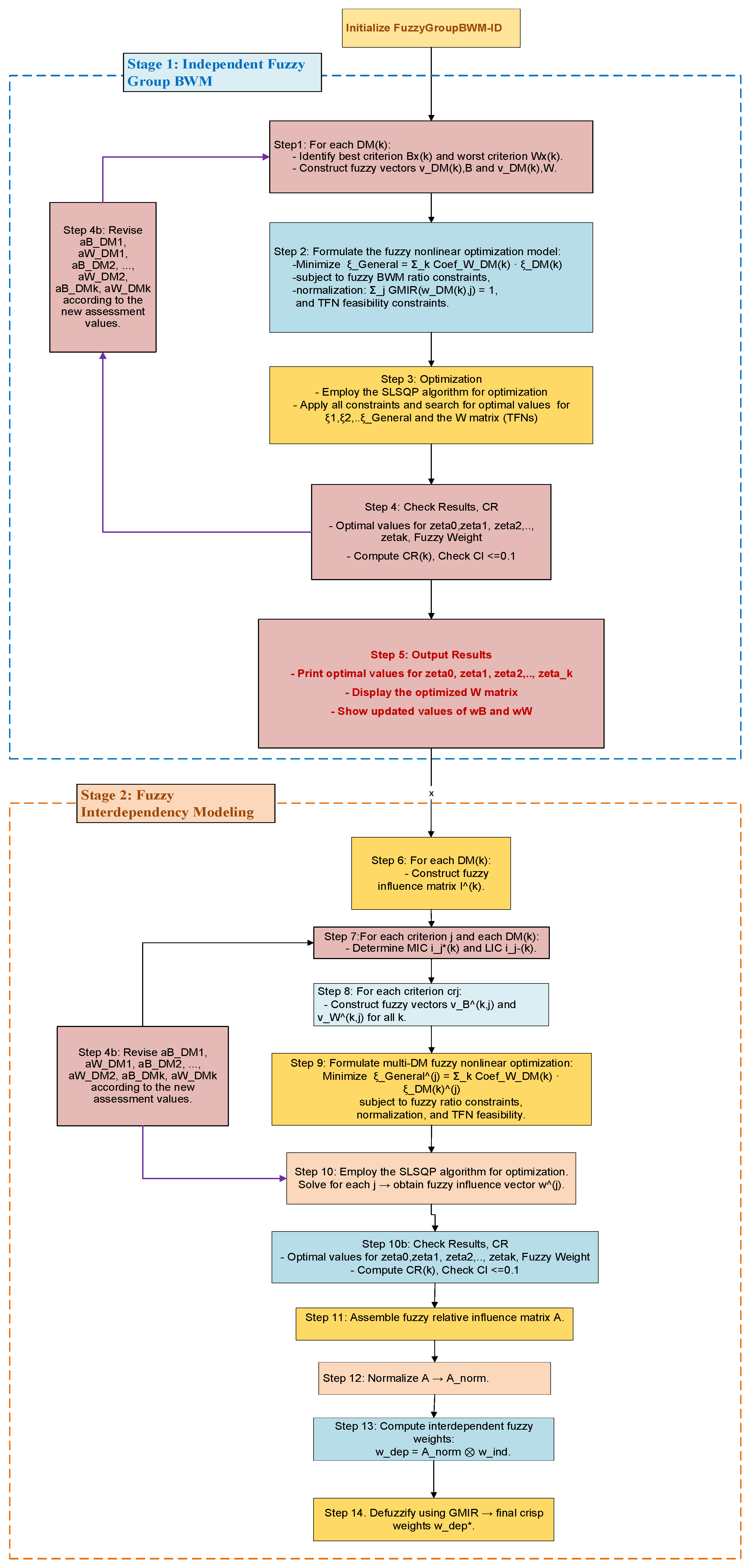
3.2. Fuzzy Group BWM (FGBWM) Model Considering Interdependency and Uncertainty
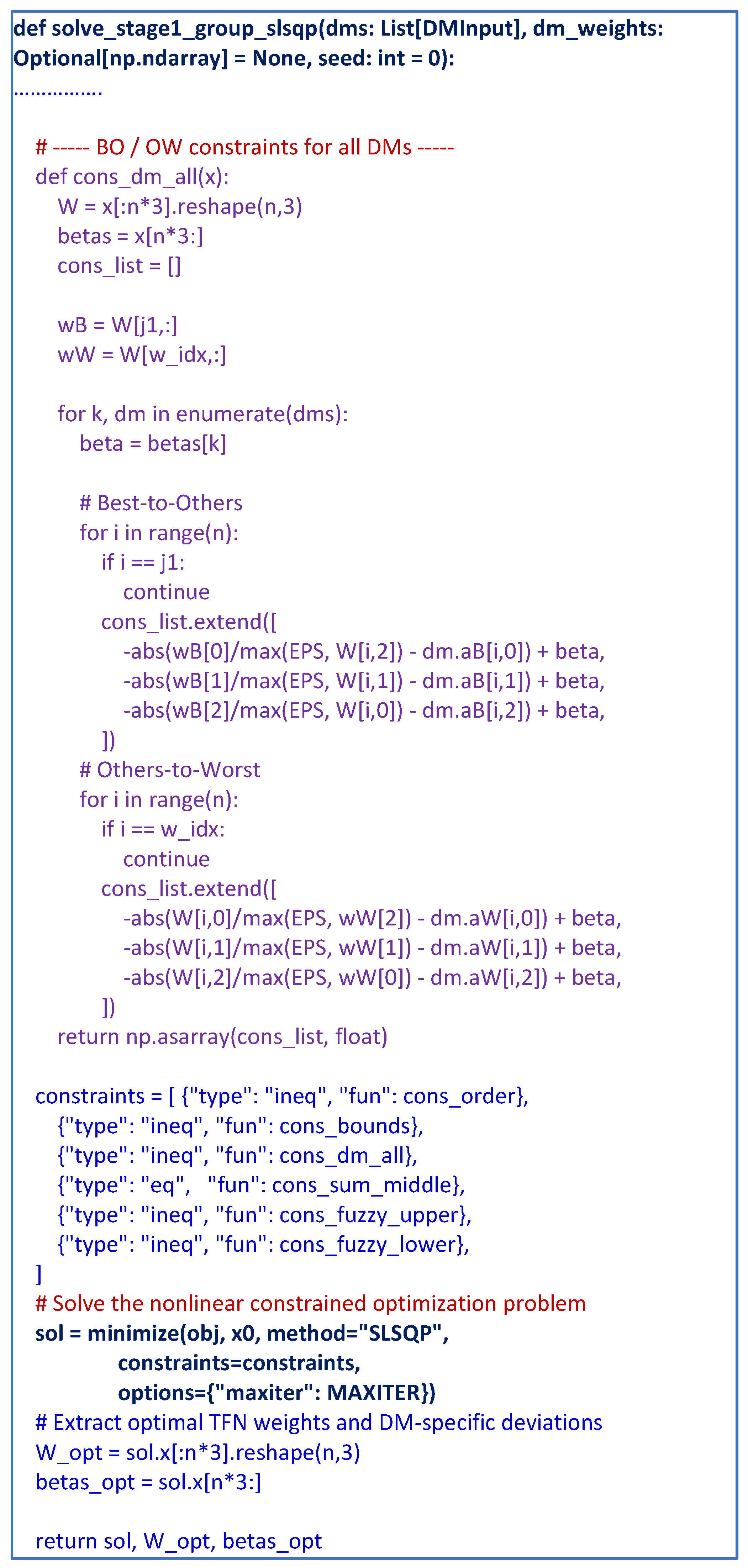
3.2.1. Stage 1 (Implementing FGBWM and Calculating the Independent Criteria Weights)
- : Best-to-others (BO) fuzzy judgments expressed as triangular fuzzy numbers (TFNs), and = ().
- : Others-to-worst (OW) fuzzy judgments expressed as TFNs, and = ().
- and : Indices of the best and worst criteria, respectively.
Fuzzy Best–Worst Consistency Constraints
3.2.2. Stage 2 of the FIDBWM: Interdependency-Adjusted Criteria Weight Computation
| cr1 | cr2 | cr3 | cr4 | cr5 | |
| cr1 | NI | FI | WI | SI | NI |
| cr2 | FI | NI | SI | VSI | SI |
| cr3 | NI | FI | NI | NI | WI |
| cr4 | WI | VSI | NI | NI | FI |
| cr5 | NI | SI | FI | SI | NI |
| cr1 | cr2 | cr3 | cr4 | cr5 | |
| cr1 | (0,0,0) | (1.5,2,2.5) | (0.67,1,1.5) | (2.5,3,3.5) | (0,0,0) |
| cr2 | (1.5,2,2.5) | (0,0,0) | (2.5,3,3.5) | (3.5,4,4.5) | (2.5,3,3.5) |
| cr3 | (0,0,0) | (1.5,2,2.5) | (0,0,0) | (0,0,0) | (0.67,1,1.5) |
| cr4 | (0.67,1,1.5) | (3.5,4,4.5) | (0,0,0) | (0,0,0) | (1.5,2,2.5) |
| cr5 | (0,0,0) | (2.5,3,3.5) | (1.5,2,2.5) | (2.5,3,3.5) | (0,0,0) |
3.3. Fuzzy TOPSIS for Assessing the Performance of Alternatives
3.4. Fuzzy VIKOR
- Cond. 1 (acceptable advantage): (39).
- Cond. 2 (stability): is also ranked best by and .
3.5. Validation of the Proposed MCDM Framework
- (a)
- Comparative analysis of the proposed FIDBWM model.
- (b)
- Validation of the proposed hybrid MCDM model.
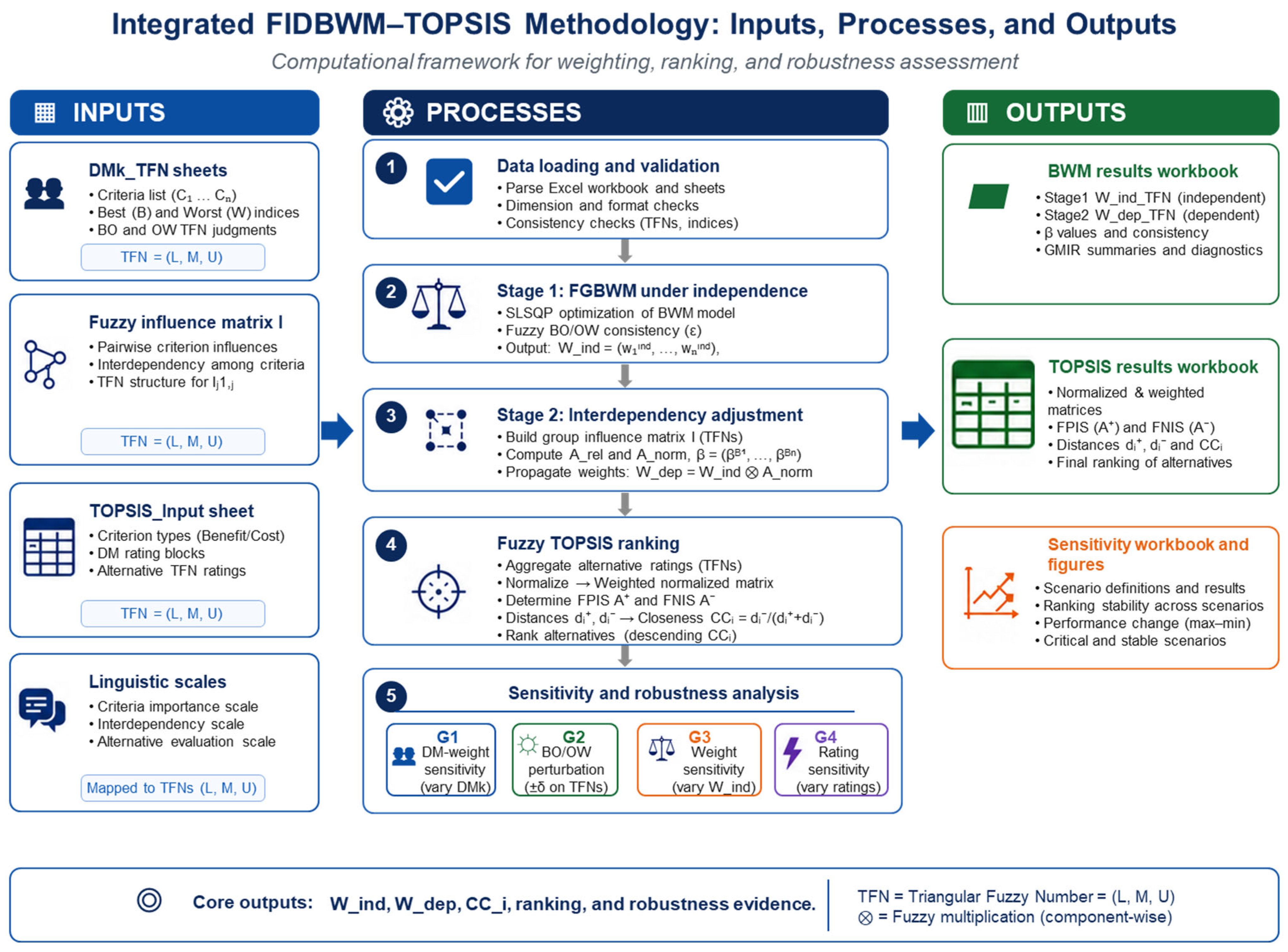
3.6. Integrated FGBWM–TOPSIS and Robustness Assessment Methodology with Computational Pseudocode
3.7. Comparison and Novelty of the Proposed FIDBWM Method
4. Application of the Proposed FIDBWM–TOPSIS Framework
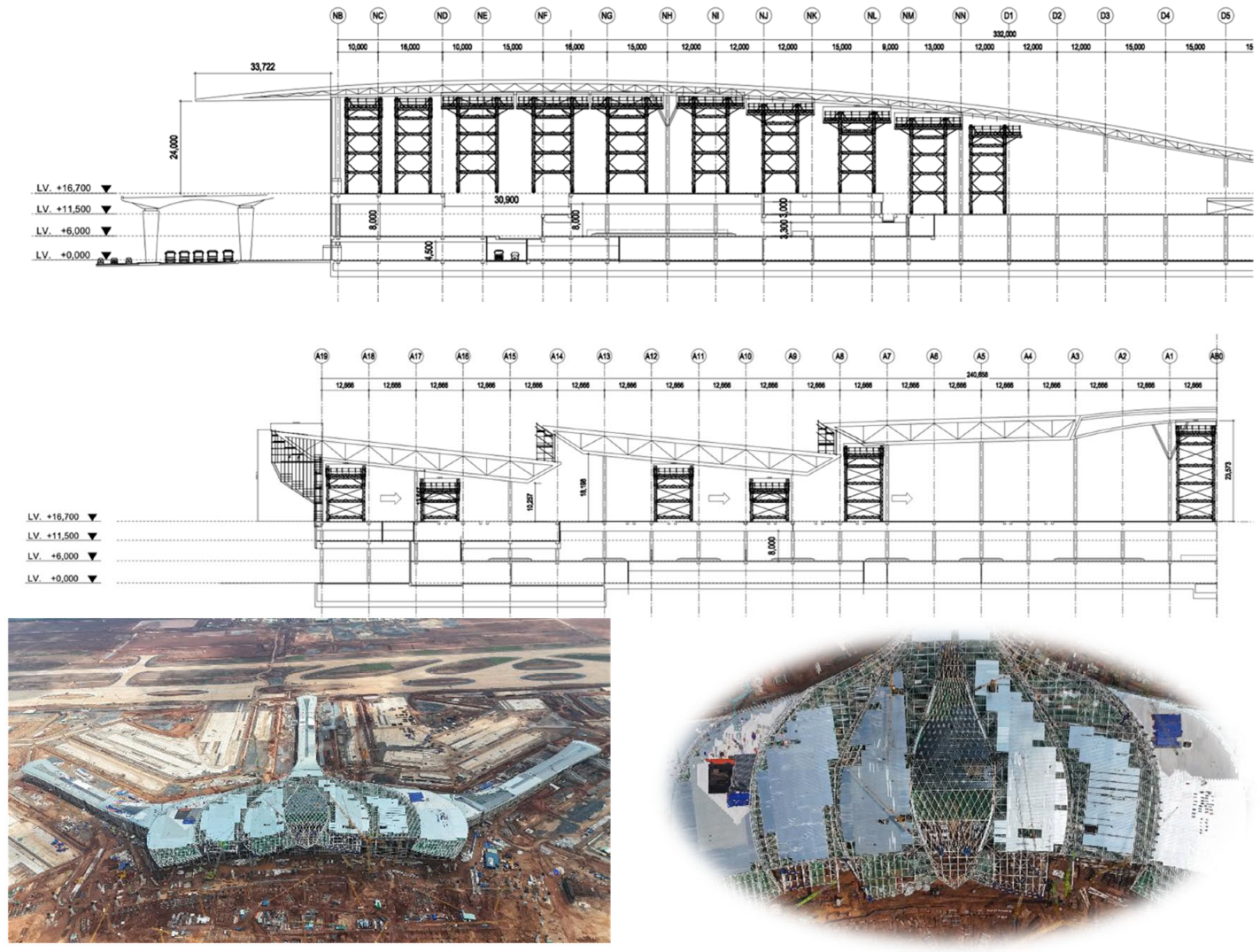
4.1. Project Description
4.2. Application of the Proposed FIDBWM and TOPSIS Model to the Case Study
4.2.1. Identification of Evaluation Criteria for the Case Study
Expert Selection Criteria and Functional Diversity
4.2.2. Stage 1: Criteria Weighting Under the Independence Assumption
4.2.3. Stage 2: Criteria Weighting Under Interdependencies
Discussion of Independent and Interdependent Criteria Weights
4.2.4. Evaluation of Access Platform System Alternatives
Performance Evaluation Using the Fuzzy TOPSIS Method
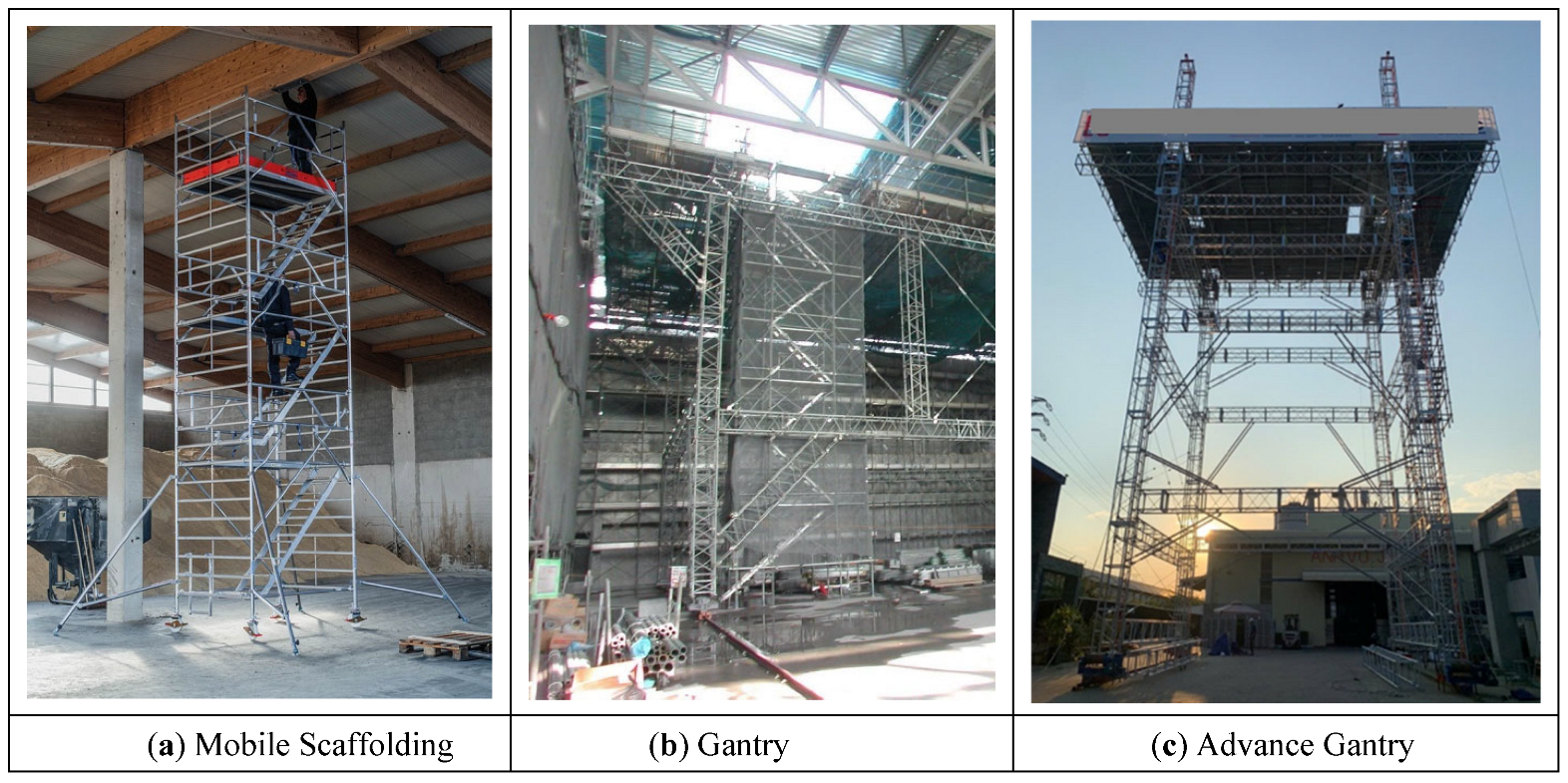
- Alternative 1 (Alt. 1—Mobile Scaffolding): As shown in Figure 5a, mobile scaffolding is a lightweight and modular access system intended primarily for personnel access. Its portability allows flexible deployment in confined or indoor environments, making it suitable for light MEP installation and maintenance tasks.
- Alternative 2 (Alt. 2—Gantry-Based Platform System): Figure 5b presents a gantry-type platform characterized by a robust structural configuration and horizontal mobility along fixed rails. The system is capable of supporting heavy equipment and materials and enables efficient coverage of large working areas.
- Alternative 3 (Alt. 3—Advanced Gantry System): As illustrated in Figure 5c, the advanced gantry system integrates horizontal rail movement with vertical adjustability of the working platform. This configuration provides high load-bearing capacity and enhanced adaptability, allowing rapid adjustments in both elevation and position under complex site conditions.
Evaluation of the Performance Using the Fuzzy VIKOR Method
Model Verification for the Case Study
4.3. SLSQP Convergence and Multi-Start Robustness Assessment
4.4. Expert-Input and Ranking Robustness Analysis
4.4.1. G1. Decision-Maker Weighting Robustness (End-to-End BWM-Driven Test)
4.4.2. G2. BO/OW Input Robustness (End-to-End BWM-Driven Test)
4.4.3. G3. TOPSIS Criterion-Weight Robustness
4.4.4. G4. Alternative-Rating Robustness and Adverse Stress Testing
4.5. Overall Robustness Interpretation
5. Conclusions
Author Contributions
Funding
Data Availability Statement
Acknowledgments
Conflicts of Interest
Appendix A. Comparison Between the Proposed FIDBWM Model and Other Models

| a12 | a13 | a14 | a23 | a43 | |
|---|---|---|---|---|---|
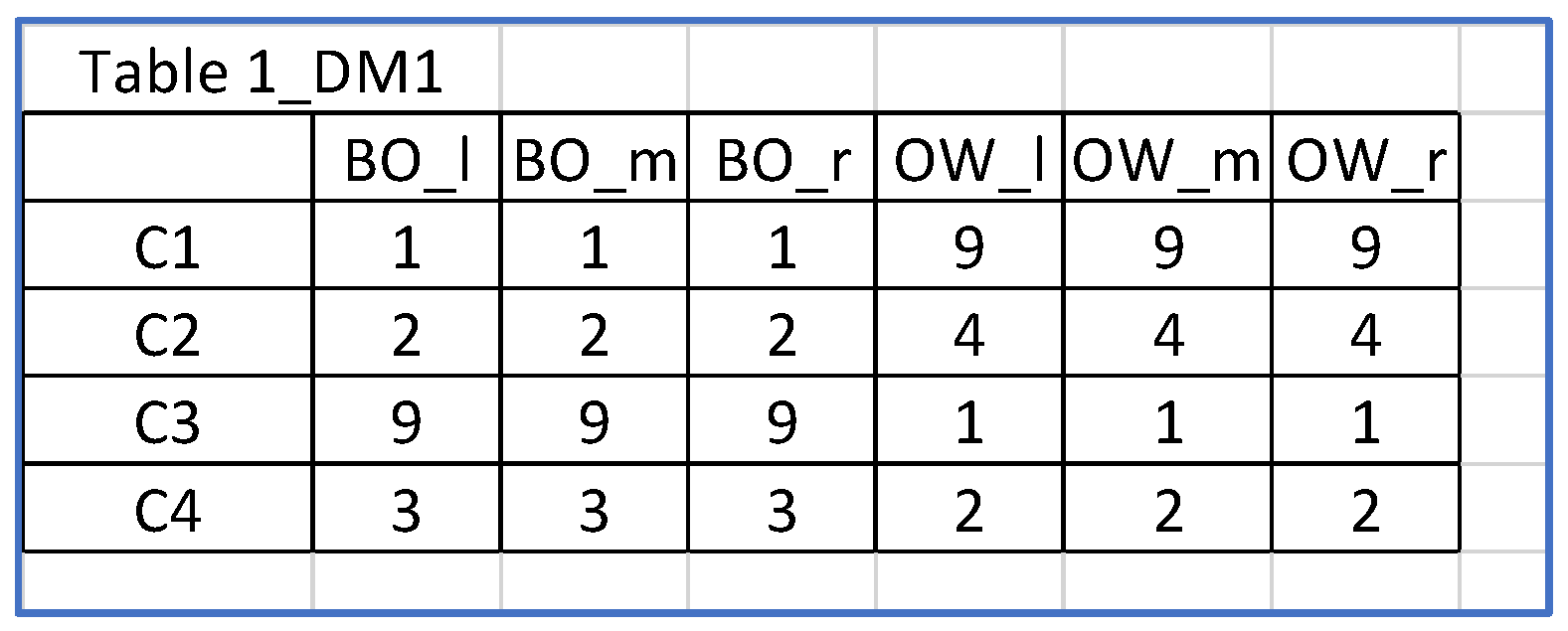
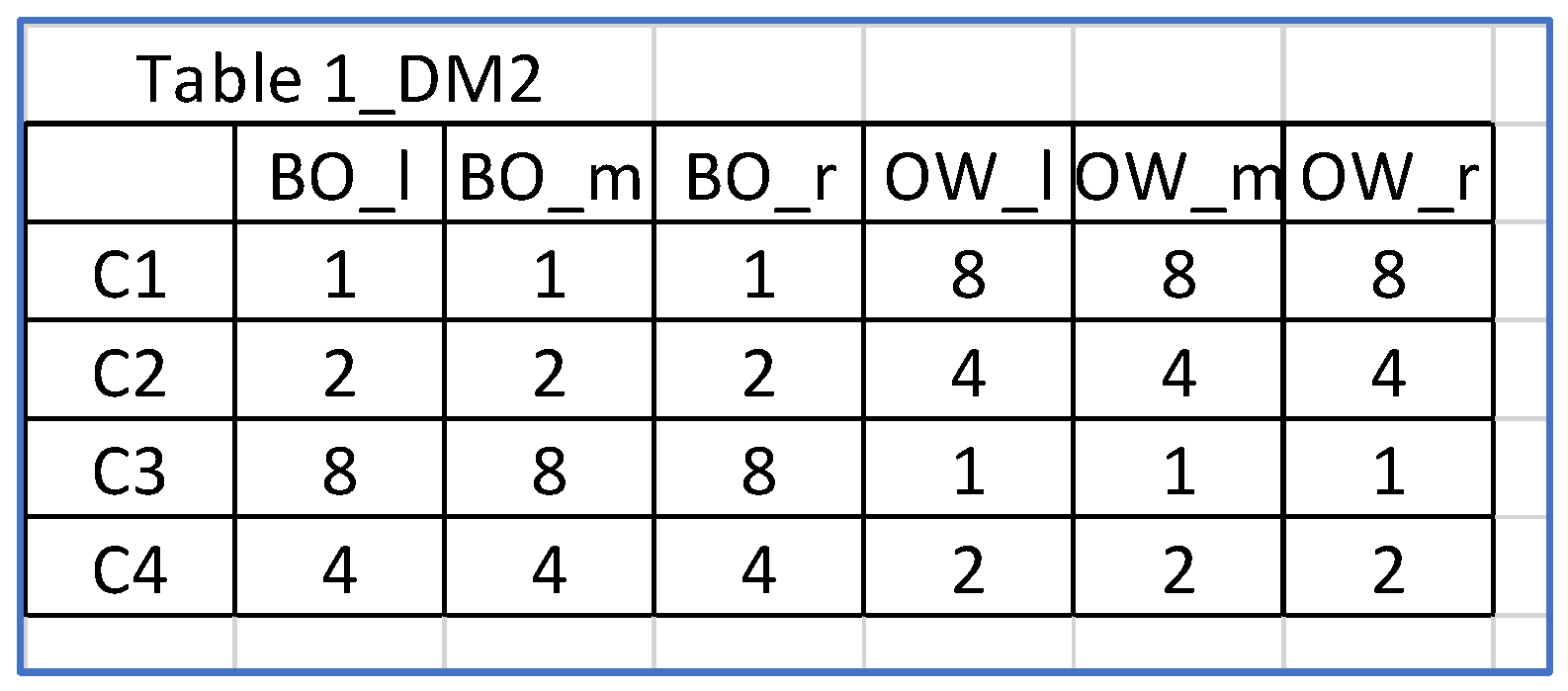
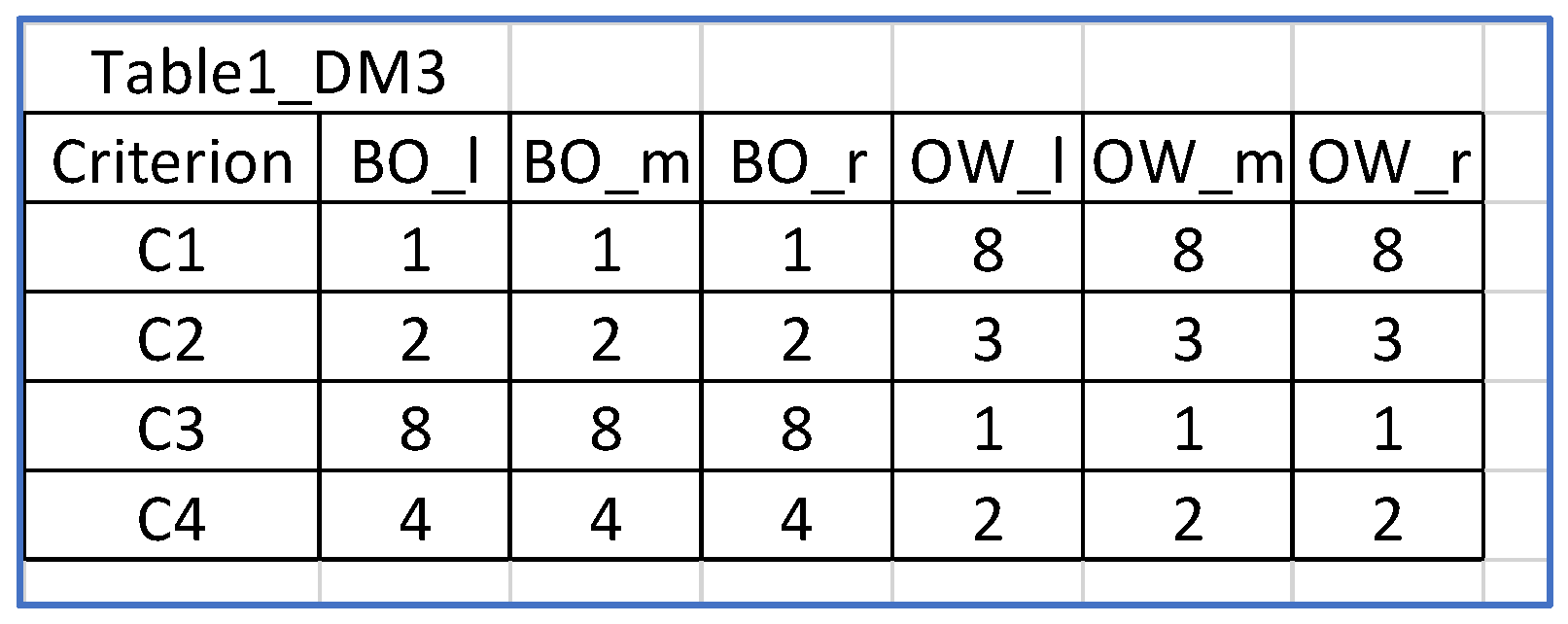
| DM1 | 2 | 9 | 3 | 4 | 2 |
| DM2 | 2 | 8 | 4 | 4 | 2 |
| DM3 | 2 | 8 | 4 | 3 | 2 |


| Description | Safarzadeh et al. [25] Commercial Software | Proposed FBWM_ID |
|---|---|---|
| Optimal ξ | ξ1,2,3 = 0.500, 0.500, 0.500 | ξ1,2,3 = 0.500, 0.500, 0.500 |
| Optimal Weights | w1 = 0.551 | w1 = [0.551 0.551, 0.551] |
| w2 = 0.227 | w2 = [0.227 0.227, 00.227] | |
| w3 = 0.065 | w3 = [0.065 0.065, 0.065], | |
| w4 = 0.157 | w4 = [0.157 0.157, 0.157] |
| BO | OW | |||||
|---|---|---|---|---|---|---|
| Criterion | l | m | r | l | m | r |
| Quality | 2 | 2 | 2 | 4 | 4 | 4 |
| Price | 1 | 1 | 1 | 8 | 8 | 8 |
| Comfort | 4 | 4 | 4 | 2 | 2 | 2 |
| Safety | 2 | 2 | 2 | 4 | 4 | 4 |
| Style | 8 | 8 | 8 | 1 | 1 | 1 |
| Criterion | Quality | Price | Comfort | Safety | Style | ||||||||||
|---|---|---|---|---|---|---|---|---|---|---|---|---|---|---|---|
| l | m | r | l | m | r | l | m | r | l | m | r | l | m | r | |
| Quality | 0 | 0 | 0 | 7 | 7 | 7 | 4 | 4 | 4 | 6 | 6 | 6 | 0 | 0 | 0 |
| Price | 7 | 7 | 7 | 0 | 0 | 0 | 5 | 5 | 5 | 8 | 8 | 8 | 6 | 6 | 6 |
| Comfort | 0 | 0 | 0 | 4 | 4 | 4 | 0 | 0 | 0 | 0 | 0 | 0 | 0 | 0 | 0 |
| Safety | 5 | 5 | 5 | 8 | 8 | 8 | 0 | 0 | 0 | 0 | 0 | 0 | 4 | 4 | 4 |
| Style | 0 | 0 | 0 | 5 | 5 | 5 | 3 | 3 | 3 | 4 | 4 | 4 | 0 | 0 | 0 |
| W_ind_TFN | w_ind_GMIR | |
|---|---|---|
| Quality | (0.211, 0.211, 0.211) | 0.211 |
| Price | (0.421, 0.421, 0.421) | 0.421 |
| Comfort | (0.105, 0.105, 0.105) | 0.105 |
| Safety | (0.211, 0.211, 0.211) | 0.211 |
| Style | (0.053, 0.053, 0.053) | 0.053 |
| Quality | Price | Comfort | Safety | Style | |
|---|---|---|---|---|---|
| Quality | (1.000,1.000,1.000) | (0.292,0.292,0.292) | (0.333,0.333,0.333) | (0.333,0.333,0.333) | (0.000,0.000,0.000) |
| Price | (0.583,0.583,0.583) | (1.000,1.000,1.000) | (0.417,0.417,0.417) | (0.444,0.444,0.444) | (0.600,0.600,0.600) |
| Comfort | (0.000,0.000,0.000) | (0.167,0.167,0.167) | (1.000,1.000,1.000) | (0.000,0.000,0.000) | (0.000,0.000,0.000) |
| Safety | (0.417,0.417,0.417) | (0.333,0.333,0.333) | (0.000,0.000,0.000) | (1.000,1.000,1.000) | (0.400,0.400,0.400) |
| Style | (0.000,0.000,0.000) | (0.208,0.208,0.208) | (0.250,0.250,0.250) | (0.222,0.222,0.222) | (1.000,1.000,1.000) |
| Quality | Price | Comfort | Safety | Style | |
|---|---|---|---|---|---|
| Quality | (0.500,0.500,0.500) | (0.146,0.146,0.146) | (0.167,0.167,0.167) | (0.167,0.167,0.167) | (0.000,0.000,0.000) |
| Price | (0.292,0.292,0.292) | (0.500,0.500,0.500) | (0.208,0.208,0.208) | (0.222,0.222,0.222) | (0.300,0.300,0.300) |
| Comfort | (0.000,0.000,0.000) | (0.083,0.083,0.083) | (0.500,0.500,0.500) | (0.000,0.000,0.000) | (0.000,0.000,0.000) |
| Safety | (0.208,0.208,0.208) | (0.167,0.167,0.167) | (0.000,0.000,0.000) | (0.500,0.500,0.500) | (0.200,0.200,0.200) |
| Style | (0.000,0.000,0.000) | (0.104,0.104,0.104) | (0.125,0.125,0.125) | (0.111,0.111,0.111) | (0.500,0.500,0.500) |
| w_dep_TFN | w_dep_GMIR | |
|---|---|---|
| Quality | (0.219, 0.219, 0.219) | 0.219 |
| Price | (0.356, 0.356, 0.356) | 0.356 |
| Comfort | (0.088, 0.088, 0.088) | 0.088 |
| Safety | (0.230, 0.230, 0.230) | 0.230 |
| Style | (0.107, 0.107, 0.107) | 0.107 |
| w_ind(GMIR) | w_dep(GMIR) | Delta | |
|---|---|---|---|
| Quality | 0.211 | 0.219 | 0.009 |
| Price | 0.421 | 0.356 | −0.065 |
| Comfort | 0.105 | 0.088 | −0.018 |
| Safety | 0.211 | 0.230 | 0.019 |
| Style | 0.053 | 0.107 | 0.054 |
Appendix B. TFN Operations and Scalarization
TFN Operations and Scalarization
Appendix C. The Generic Constrained Nonlinear Optimization Problem Solved by SLSQP
Appendix D. Detailed Sensitivity-Analysis Tables and Figures
| Sc. | DM1/DM2 | Rank | CC1 | CC2 | CC3 | M32 | Δw | ΔCC | Chg |
|---|---|---|---|---|---|---|---|---|---|
| G1-01 | 0.20/0.80 | A3 > A2 > A1 | 0.366 | 0.496 | 0.629 | 0.134 | 0.009 | 0.009 | No |
| G1-02 | 0.25/0.75 | A3 > A2 > A1 | 0.371 | 0.490 | 0.632 | 0.142 | 0.014 | 0.014 | No |
| G1-03 | 0.30/0.70 | A3 > A2 > A1 | 0.370 | 0.490 | 0.632 | 0.143 | 0.014 | 0.014 | No |
| G1-04 | 0.35/0.65 | A3 > A2 > A1 | 0.371 | 0.490 | 0.632 | 0.142 | 0.014 | 0.013 | No |
| G1-05 | 0.40/0.60 | A3 > A2 > A1 | 0.371 | 0.491 | 0.632 | 0.140 | 0.014 | 0.013 | No |
| G1-06 | 0.45/0.55 | A3 > A2 > A1 | 0.371 | 0.490 | 0.631 | 0.141 | 0.014 | 0.013 | No |
| G1-07 | 0.50/0.50 | A3 > A2 > A1 | 0.358 | 0.503 | 0.635 | 0.131 | 0.000 | 0.000 | No |
| G1-08 | 0.55/0.45 | A3 > A2 > A1 | 0.365 | 0.481 | 0.643 | 0.162 | 0.017 | 0.023 | No |
| G1-09 | 0.60/0.40 | A3 > A2 > A1 | 0.363 | 0.483 | 0.643 | 0.160 | 0.015 | 0.020 | No |
| G1-10 | 0.65/0.35 | A3 > A2 > A1 | 0.365 | 0.482 | 0.641 | 0.159 | 0.018 | 0.021 | No |
| G1-11 | 0.70/0.30 | A3 > A2 > A1 | 0.360 | 0.486 | 0.646 | 0.160 | 0.015 | 0.017 | No |
| G1-12 | 0.75/0.25 | A3 > A2 > A1 | 0.364 | 0.480 | 0.644 | 0.164 | 0.019 | 0.024 | No |
| G1-13 | 0.80/0.20 | A3 > A2 > A1 | 0.357 | 0.490 | 0.645 | 0.155 | 0.009 | 0.013 | No |
| Sc. | Pert. | Rank | CC1 | CC2 | CC3 | M32 | Δw | ΔCC | Chg |
|---|---|---|---|---|---|---|---|---|---|
| G2-01 | DM1-Cr2 +1 | A3 > A2 > A1 | 0.361 | 0.483 | 0.641 | 0.158 | 0.019 | 0.021 | No |
| G2-02 | DM1-Cr2 −1 | A3 > A2 > A1 | 0.368 | 0.486 | 0.639 | 0.152 | 0.016 | 0.017 | No |
| G2-03 | DM1-Cr3 +1 | A3 > A2 > A1 | 0.368 | 0.484 | 0.635 | 0.151 | 0.019 | 0.019 | No |
| G2-04 | DM1-Cr3 −1 | A3 > A2 > A1 | 0.368 | 0.487 | 0.636 | 0.148 | 0.017 | 0.016 | No |
| G2-05 | DM1-Cr4 +1 | A3 > A2 > A1 | 0.348 | 0.509 | 0.636 | 0.127 | 0.015 | 0.010 | No |
| G2-06 | DM1-Cr4 −1 | A3 > A2 > A1 | 0.366 | 0.492 | 0.635 | 0.143 | 0.012 | 0.012 | No |
| … | … | … | … | … | … | … | … | … | … |
| G2-25 | DM2-Cr7 +1 | A3 > A2 > A1 | 0.364 | 0.488 | 0.645 | 0.157 | 0.015 | 0.015 | No |
| G2-26 | DM2-Cr7 −1 | A3 > A2 > A1 | 0.361 | 0.498 | 0.636 | 0.139 | 0.007 | 0.006 | No |
| G2-27 | DM2-Cr8 +1 | A3 > A2 > A1 | 0.359 | 0.506 | 0.631 | 0.125 | 0.003 | 0.004 | No |
| G2-28 | DM2-Cr8 −1 | A3 > A2 > A1 | 0.348 | 0.513 | 0.635 | 0.122 | 0.009 | 0.010 | No |
| Sc. | Weight Test | Rank | CC1 | CC2 | CC3 | M32 | Δw | ΔCC | Chg |
|---|---|---|---|---|---|---|---|---|---|
| G3-00 | Baseline w_ID | A3 > A2 > A1 | 0.358 | 0.503 | 0.635 | 0.131 | 0.000 | 0.000 | No |
| G3-EW | Equal weights | A2 > A3 > A1 | 0.432 | 0.568 | 0.497 | −0.071 | 0.082 | 0.138 | Yes |
| G3-01 | Cr1 −30% | A3 > A2 > A1 | 0.380 | 0.504 | 0.612 | 0.109 | 0.050 | 0.022 | No |
| G3-02 | Cr1 −20% | A3 > A2 > A1 | 0.372 | 0.504 | 0.620 | 0.117 | 0.032 | 0.015 | No |
| G3-03 | Cr1 −10% | A3 > A2 > A1 | 0.365 | 0.504 | 0.628 | 0.124 | 0.016 | 0.007 | No |
| G3-04 | Cr1 +10% | A3 > A2 > A1 | 0.351 | 0.503 | 0.642 | 0.138 | 0.015 | 0.007 | No |
| G3-05 | Cr1 +20% | A3 > A2 > A1 | 0.344 | 0.503 | 0.648 | 0.145 | 0.030 | 0.014 | No |
| … | … | … | … | … | … | … | … | … | … |
| G3-16 | Cr7 +10% | A3 > A2 > A1 | 0.355 | 0.507 | 0.637 | 0.131 | 0.012 | 0.003 | No |
| G3-17 | Cr7 +20% | A3 > A2 > A1 | 0.353 | 0.510 | 0.640 | 0.130 | 0.023 | 0.007 | No |
| G3-18 | Cr7 +30% | A3 > A2 > A1 | 0.350 | 0.514 | 0.643 | 0.129 | 0.035 | 0.010 | No |
| Sc. | Rating Stress | Rank | CC1 | CC2 | CC3 | M32 | ΔCC | Chg |
|---|---|---|---|---|---|---|---|---|
| G4-00 | Baseline ratings | A3 > A2 > A1 | 0.358 | 0.503 | 0.635 | 0.131 | 0.000 | No |
| G4-01 | A3-Cr1 −1 | A3 > A2 > A1 | 0.390 | 0.563 | 0.602 | 0.039 | 0.060 | No |
| G4-02 | A3-Cr5 −1 | A3 > A2 > A1 | 0.392 | 0.535 | 0.611 | 0.076 | 0.034 | No |
| G4-03 | A3-Cr7 −1 | A3 > A2 > A1 | 0.358 | 0.503 | 0.563 | 0.059 | 0.072 | No |
| G4-04 | A2-Cr1 +1 | A3 > A2 > A1 | 0.358 | 0.599 | 0.635 | 0.036 | 0.095 | No |
| G4-05 | A2-Cr5 +1 | A3 > A2 > A1 | 0.301 | 0.547 | 0.603 | 0.056 | 0.057 | No |
| G4-06 | A2-Cr7 +1 | A3 > A2 > A1 | 0.339 | 0.529 | 0.594 | 0.064 | 0.041 | No |
| G4-07 | A3 C1,C5,C7 −1 | A2 > A3 > A1 | 0.430 | 0.602 | 0.490 | −0.112 | 0.145 | Yes |
| G4-08 | A2 C1,C5,C7 +1 | A2 > A3 > A1 | 0.283 | 0.670 | 0.560 | −0.110 | 0.167 | Yes |
| G4-09 | A3 −1 & A2 +1 | A2 > A3 > A1 | 0.306 | 0.721 | 0.348 | −0.373 | 0.287 | Yes |
References
- Cho, C.; Kim, K.; Park, J.; Cho, Y.K. Data-Driven Monitoring System for Preventing the Collapse of Scaffolding Structures. J. Constr. Eng. Manag. 2018, 144, 04018077. [Google Scholar] [CrossRef] [Scilit]
- Jin, H.; Goodrum, P.M. Integrated Decision Support Framework of Optimal Scaffolding System for Construction Projects. Algorithms 2023, 16, 348. [Google Scholar] [CrossRef] [Scilit]
- Yin, Z.; Caldas, C. Scaffolding in industrial construction projects: Current practices, issues, and potential solutions. Int. J. Constr. Manag. 2022, 22, 2554–2563. [Google Scholar] [CrossRef] [Scilit]
- Akinci, B.; Fischer, M.; Kunz, J.; Levitt, R. Representing Work Spaces Generically in Construction Method Models. J. Constr. Eng. Manag. 2002, 128, 296–305. [Google Scholar] [CrossRef] [Scilit]
- Jin, H.; Nahangi, M.; Goodrum, P.M.; Yuan, Y. Multiobjective Optimization for Scaffolding Space Planning in Industrial Piping Construction Using Model-Based Simulation Programming. J. Comput. Civ. Eng. 2020, 34, 06019001. [Google Scholar] [CrossRef] [Scilit]
- Long, L.D.; Ohsato, A. Fuzzy critical chain method for project scheduling under resource constraints and uncertainty. Int. J. Proj. Manag. 2008, 26, 688–698. [Google Scholar] [CrossRef] [Scilit]
- Fang, D.; Shen, Q.; Wu, S.; Liu, G. A comprehensive framework for assessing and selecting appropriate scaffolding based on analytic hierarchy process. J. Saf. Res. 2003, 34, 589–596. [Google Scholar] [CrossRef] [Scilit] [PubMed]
- Zhang, J.; Liu, N.; Wang, S. A parametric approach for performance optimization of residential building design in Beijing. Build. Simul. 2020, 13, 223–235. [Google Scholar] [CrossRef] [Scilit]
- Kim, J.; Fischer, M. Formalization of the Features of Activities and Classification of Temporary Structures to Support an Automated Temporary Structure Planning. In Computing in Civil Engineering (2007); Proceedings; American Society of Civil Engineers: Reston, VA, USA, 2007; pp. 338–346. [Google Scholar]
- Kim, J.; Fischer, M.; Kunz, J.; Levitt, R. Semiautomated Scaffolding Planning: Development of the Feature Lexicon for Computer Application. J. Comput. Civ. Eng. 2015, 29, 04014079. [Google Scholar] [CrossRef] [Scilit]
- Kim, K.; Cho, Y.K.; Kim, K. BIM-Based Decision-Making Framework for Scaffolding Planning. J. Manag. Eng. 2018, 34, 04018046. [Google Scholar] [CrossRef] [Scilit]
- Espinoza, A.F.; Erazo-Rondinel, A.; Romani Chavez, J.; Galvan-Lescano, M.; Talavera-Centeno, J. Exploring the implementation of Choosing By Advantages for scaffolding selection in a Construction project. Rev. Ing. Constr. 2024, 40, 1–12. [Google Scholar] [CrossRef] [Scilit]
- Jato-Espino, D.; Castillo-Lopez, E.; Rodriguez-Hernandez, J.; Canteras-Jordana, J.C. A review of application of multi-criteria decision making methods in construction. Autom. Constr. 2014, 45, 151–162. [Google Scholar] [CrossRef] [Scilit]
- Fayek, A.R. Fuzzy Logic and Fuzzy Hybrid Techniques for Construction Engineering and Management. J. Constr. Eng. Manag. 2020, 146, 04020064. [Google Scholar] [CrossRef] [Scilit]
- Wang, T.-K.; Zhang, Q.; Chong, H.-Y.; Wang, X. Integrated Supplier Selection Framework in a Resilient Construction Supply Chain: An Approach via Analytic Hierarchy Process (AHP) and Grey Relational Analysis (GRA). Sustainability 2017, 9, 289. [Google Scholar] [CrossRef] [Scilit]
- Zhao, L.; Liu, Z.; Mbachu, J. Optimization of the Supplier Selection Process in Prefabrication Using BIM. Buildings 2019, 9, 222. [Google Scholar] [CrossRef] [Scilit]
- Mathiyazhagan, K.; Gnanavelbabu, A.; Lokesh Prabhuraj, B. A sustainable assessment model for material selection in construction industries perspective using hybrid MCDM approaches. J. Adv. Manag. Res. 2018, 16, 234–259. [Google Scholar] [CrossRef] [Scilit]
- Pinzon Amorocho, J.A.; Hartmann, T. A multi-criteria decision-making framework for residential building renovation using pairwise comparison and TOPSIS methods. J. Build. Eng. 2022, 53, 104596. [Google Scholar] [CrossRef] [Scilit]
- Rezaei, J. Best-worst multi-criteria decision-making method. Omega 2015, 53, 49–57. [Google Scholar] [CrossRef] [Scilit]
- Rezaei, J. Best-worst multi-criteria decision-making method: Some properties and a linear model. Omega 2016, 64, 126–130. [Google Scholar] [CrossRef] [Scilit]
- Liu, Y.; Li, F.; Wang, Y.; Yu, X.; Yuan, J.; Wang, Y. Assessing the Environmental Impact Caused by Power Grid Projects in High Altitude Areas Based on BWM and Vague Sets Techniques. Sustainability 2018, 10, 1768. [Google Scholar] [CrossRef] [Scilit]
- Rezaei, J.; Nispeling, T.; Sarkis, J.; Tavasszy, L. A supplier selection life cycle approach integrating traditional and environmental criteria using the best worst method. J. Clean. Prod. 2016, 135, 577–588. [Google Scholar] [CrossRef] [Scilit]
- Salimi, N.; Rezaei, J. Evaluating firms’ R&D performance using best worst method. Eval. Program Plan. 2018, 66, 147–155. [Google Scholar] [CrossRef] [Scilit]
- Ghasemian Sahebi, I.; Arab, A.; Sadeghi Moghadam, M.R. Analyzing the barriers to humanitarian supply chain management: A case study of the Tehran Red Crescent Societies. Int. J. Disaster Risk Reduct. 2017, 24, 232–241. [Google Scholar] [CrossRef] [Scilit]
- Safarzadeh, S.; Khansefid, S.; Rasti-Barzoki, M. A group multi-criteria decision-making based on best-worst method. Comput. Ind. Eng. 2018, 126, 111–121. [Google Scholar] [CrossRef] [Scilit]
- Dong, J.; Wan, S.; Chen, S.-M. Fuzzy best-worst method based on triangular fuzzy numbers for multi-criteria decision-making. Inf. Sci. 2021, 547, 1080–1104. [Google Scholar] [CrossRef] [Scilit]
- Guo, S.; Zhao, H. Fuzzy best-worst multi-criteria decision-making method and its applications. Knowl.-Based Syst. 2017, 121, 23–31. [Google Scholar] [CrossRef] [Scilit]
- Li, J.; Wang, J.-q.; Hu, J.-h. Multi-criteria decision-making method based on dominance degree and BWM with probabilistic hesitant fuzzy information. Int. J. Mach. Learn. Cybern. 2019, 10, 1671–1685. [Google Scholar] [CrossRef] [Scilit]
- Mou, Q.; Xu, Z.; Liao, H. An intuitionistic fuzzy multiplicative best-worst method for multi-criteria group decision making. Inf. Sci. 2016, 374, 224–239. [Google Scholar] [CrossRef] [Scilit]
- Pamučar, D.; Petrović, I.; Ćirović, G. Modification of the Best–Worst and MABAC methods: A novel approach based on interval-valued fuzzy-rough numbers. Expert Syst. Appl. 2018, 91, 89–106. [Google Scholar] [CrossRef] [Scilit]
- Zadeh, L.A. Fuzzy sets. Inf. Control 1965, 8, 338–353. [Google Scholar] [CrossRef] [Scilit]
- Bellman, R.E.; Zadeh, L.A. Decision-Making in a Fuzzy Environment. Manag. Sci. 1970, 17, B-141–B-164. [Google Scholar] [CrossRef] [Scilit]
- Aboutorab, H.; Saberi, M.; Asadabadi, M.R.; Hussain, O.; Chang, E. ZBWM: The Z-number extension of Best Worst Method and its application for supplier development. Expert Syst. Appl. 2018, 107, 115–125. [Google Scholar] [CrossRef] [Scilit]
- Cheng, X.; Chen, C. Decision Making with Intuitionistic Fuzzy Best-Worst Method. Expert Syst. Appl. 2024, 237, 121215. [Google Scholar] [CrossRef] [Scilit]
- Asadabadi, M.R.; Ahmadi, H.B.; Gupta, H.; Liou, J.J.H. Supplier selection to support environmental sustainability: The stratified BWM TOPSIS method. Ann. Oper. Res. 2023, 322, 321–344. [Google Scholar] [CrossRef] [Scilit]
- Celik, E.; Gul, M. Hazard identification, risk assessment and control for dam construction safety using an integrated BWM and MARCOS approach under interval type-2 fuzzy sets environment. Autom. Constr. 2021, 127, 103699. [Google Scholar] [CrossRef] [Scilit]
- Tavana, M.; Mina, H.; Santos-Arteaga, F.J. A general Best-Worst method considering interdependency with application to innovation and technology assessment at NASA. J. Bus. Res. 2023, 154, 113272. [Google Scholar] [CrossRef] [Scilit]
- Tian, Z.-p.; Wang, J.-q.; Zhang, H.-y. An integrated approach for failure mode and effects analysis based on fuzzy best-worst, relative entropy, and VIKOR methods. Appl. Soft Comput. 2018, 72, 636–646. [Google Scholar] [CrossRef] [Scilit]
- Wu, Q.; Liu, X.; Zhou, L.; Qin, J.; Rezaei, J. An analytical framework for the best–worst method. Omega 2024, 123, 102974. [Google Scholar] [CrossRef] [Scilit]
- Görçün, Ö.F.; Doğan, G. Mobile crane selection in project logistics operations using Best and Worst Method (BWM) and fuzzy Measurement of Alternatives and Ranking according to COmpromise Solution (MARCOS). Autom. Constr. 2023, 147, 104729. [Google Scholar] [CrossRef] [Scilit]
- Long, L.D. Integrating the group-based fuzzy best-worst method and fuzzy technique for order of preference by similarity to ideal solution for selecting contractors for heritage building renovation projects. Eng. Appl. Artif. Intell. 2025, 142, 109928. [Google Scholar] [CrossRef] [Scilit]
- Yazdi, M.; Khan, F.; Abbassi, R.; Rusli, R. Improved DEMATEL methodology for effective safety management decision-making. Saf. Sci. 2020, 127, 104705. [Google Scholar] [CrossRef] [Scilit]
- Tavana, M.; Mousavi, H.; Khalili Nasr, A.; Mina, H. A fuzzy weighted influence non-linear gauge system with application to advanced technology assessment at NASA. Expert Syst. Appl. 2021, 182, 115274. [Google Scholar] [CrossRef] [Scilit]
- Liang, Y.; Ju, Y.; Tu, Y.; Rezaei, J. Nonadditive best-worst method: Incorporating criteria interaction using the Choquet integral. J. Oper. Res. Soc. 2023, 74, 1495–1506. [Google Scholar] [CrossRef] [Scilit]
- Govindan, K.; Nasr, A.K.; Karimi, F.; Mina, H. Circular economy adoption barriers: An extended fuzzy best–worst method using fuzzy DEMATEL and Supermatrix structure. Bus. Strategy Environ. 2022, 31, 1566–1586. [Google Scholar] [CrossRef] [Scilit]
- Abdullah, F.M.; Al-Ahmari, A.M.; Anwar, S. An Integrated Fuzzy DEMATEL and Fuzzy TOPSIS Method for Analyzing Smart Manufacturing Technologies. Processes 2023, 11, 906. [Google Scholar] [CrossRef] [Scilit]
- Chen, C.-T. Extensions of the TOPSIS for group decision-making under fuzzy environment. Fuzzy Sets Syst. 2000, 114, 1–9. [Google Scholar] [CrossRef] [Scilit]
- Nădăban, S.; Dzitac, S.; Dzitac, I. Fuzzy TOPSIS: A General View. Procedia Comput. Sci. 2016, 91, 823–831. [Google Scholar] [CrossRef] [Scilit]
- Kizielewicz, B.; Bączkiewicz, A. Comparison of Fuzzy TOPSIS, Fuzzy VIKOR, Fuzzy WASPAS and Fuzzy MMOORA methods in the housing selection problem. Procedia Comput. Sci. 2021, 192, 4578–4591. [Google Scholar] [CrossRef] [Scilit]
- Sayadi, M.K.; Heydari, M.; Shahanaghi, K. Extension of VIKOR method for decision making problem with interval numbers. Appl. Math. Model. 2009, 33, 2257–2262. [Google Scholar] [CrossRef] [Scilit]
- Vinodh, S.; Varadharajan, A.R.; Subramanian, A. Application of fuzzy VIKOR for concept selection in an agile environment. Int. J. Adv. Manuf. Technol. 2013, 65, 825–832. [Google Scholar] [CrossRef] [Scilit]
- Rostamzadeh, R.; Govindan, K.; Esmaeili, A.; Sabaghi, M. Application of fuzzy VIKOR for evaluation of green supply chain management practices. Ecol. Indic. 2015, 49, 188–203. [Google Scholar] [CrossRef] [Scilit]
- Wang, Y.-M.; Elhag, T.M.S. On the normalization of interval and fuzzy weights. Fuzzy Sets Syst. 2006, 157, 2456–2471. [Google Scholar] [CrossRef] [Scilit]
- Hwang, C.-L.; Yoon, K. Multiple Attribute Decision Making: Methods and Applications a State-of-the-Art Survey; Springer Science & Business Media: Berlin/Heidelberg, Germany, 2012; Volume 186. [Google Scholar]
- Kim, J.; Fischer, M.; Kunz, J.; Levitt, R. Sharing of Temporary Structures: Formalization and Planning Application. Autom. Constr. 2014, 43, 187–194. [Google Scholar] [CrossRef] [Scilit]
- Li, C.; Song, X.; Liu, Y.; Wang, C.; Ba, P.; Dong, Y. Safety assessment of scaffolding support systems under construction loads: Experimental and numerical investigation. Results Eng. 2025, 28, 107455. [Google Scholar] [CrossRef] [Scilit]
- Rubio-Romero, J.C.; Carmen Rubio Gámez, M.; Carrillo-Castrillo, J.A. Analysis of the safety conditions of scaffolding on construction sites. Saf. Sci. 2013, 55, 160–164. [Google Scholar] [CrossRef] [Scilit]
- Resende, A.; Pereira, S.; Magalhães, F.; Pacheco, P. Continuous monitoring of a large movable scaffolding under operation. Autom. Constr. 2023, 156, 105084. [Google Scholar] [CrossRef] [Scilit]
- Cimellaro, G.P.; Domaneschi, M. Stability analysis of different types of steel scaffolds. Eng. Struct. 2017, 152, 535–548. [Google Scholar] [CrossRef] [Scilit]
- Ramezantitkanloo, A.; Czepiżak, D.; Pieńko, M. Comparative Analysis of Properties and Behaviour of Scaffolding Joints and Anchors. Appl. Sci. 2025, 15, 10371. [Google Scholar] [CrossRef] [Scilit]
- Halperin, K.M.; McCann, M. An evaluation of scaffold safety at construction sites. J. Saf. Res. 2004, 35, 141–150. [Google Scholar] [CrossRef] [Scilit]
- Kim, K.; Teizer, J. Automatic design and planning of scaffolding systems using building information modeling. Adv. Eng. Inform. 2014, 28, 66–80. [Google Scholar] [CrossRef] [Scilit]
- Däbritz, M. Movable Scaffolding Systems. Struct. Eng. Int. 2011, 21, 413–418. [Google Scholar] [CrossRef] [Scilit]
- Lei, Z.; Hu, Y.; Hua, J.; Marton, B.; Marton, P.; Marton, N. An earned-value-analysis (EVA)-based project control framework in large-scale scaffolding projects using linear regression modeling. J. Inf. Technol. Constr. 2022, 27, 630–641. [Google Scholar] [CrossRef] [Scilit]
- Caruso, M.; Buttazzoni, M.; Passoni, C.; Labò, S.; Marini, A.; Pinho, R. An updated multi-criteria decision-making method for the sustainable renovation of buildings including environmental, economic and social life-cycle metrics. J. Build. Eng. 2024, 98, 110967. [Google Scholar] [CrossRef] [Scilit]
- Pons, O.; De la Fuente, A.; Aguado, A. The Use of MIVES as a Sustainability Assessment MCDM Method for Architecture and Civil Engineering Applications. Sustainability 2016, 8, 460. [Google Scholar] [CrossRef] [Scilit]
- Tazmeen, T.; Mir, F.Q. Sustainability through materials: A review of green options in construction. Results Surf. Interfaces 2024, 14, 100206. [Google Scholar] [CrossRef] [Scilit]
- Lourenzutti, R.; Krohling, R.A. TODIM Based Method to Process Heterogeneous Information. Procedia Comput. Sci. 2015, 55, 318–327. [Google Scholar] [CrossRef] [Scilit]
- Gabriel Rasoanaivo, R.; Yazdani, M.; Zaraté, P.; Fateh, A. Combined compromise for ideal solution (CoCoFISo): A multi-criteria decision-making based on the CoCoSo method algorithm. Expert Syst. Appl. 2024, 251, 124079. [Google Scholar] [CrossRef] [Scilit]
- Xue, H.; Xie, H.; Zhao, B.; Wang, J. An integrated multi-criteria decision-making approach with unknown weight information under probabilistic dual-hesitant Pythagorean fuzzy environment and its application to supplier selection. Eng. Appl. Artif. Intell. 2025, 161, 112202. [Google Scholar] [CrossRef] [Scilit]



| Approach | Treatment of Uncertainty | Group Decision-Making | Interdependency Modeling | Main Output |
|---|---|---|---|---|
| Classical BWM [19] | Crisp judgments | Usually single DM or aggregated inputs | Criteria are assumed independent | Independent criterion weights |
| Fuzzy BWM [27] | Fuzzy judgments, often TFNs | Often aggregated or single-DM | Criteria are generally treated as independent | Fuzzy criterion weights |
| DEMATEL–TOPSIS/Fuzzy DEMATEL–TOPSIS [46] | Crisp or fuzzy influence ratings | Often aggregated group matrix | Cause-effect relation through direct and total relation matrices | Causal influence indicators and/or weights for TOPSIS |
| GBWM [37] | Usually crisp setting | Limited or aggregated group treatment | BWM-based interdependency adjustment | Interdependency-adjusted criterion weights |
| Proposed FIDBWM–TOPSIS | TFN-based fuzzy judgments in both weighting and ranking | Embedded multi-DM optimization without premature averaging | BWM-based fuzzy relative influence-intensity modeling and propagation | Independent weights, interdependency-adjusted weights, TOPSIS ranking, and robustness diagnostics |
| Linguistic Variables | EI (Equally Important) | WI (Weakly Important) | FI (Fairly Important) | I (Important) | VI (Very Important) | AI (Absolutely Important) |
|---|---|---|---|---|---|---|
| Membership Functions (TFNs)- | (1,1,1) | (2/3, 1, 3/2) | (3/2, 2, 5/2) | (5/2, 3, 7/2) | (7/2, 4, 9/2) | (9/2, 5, 11/2) |
| Consistency Indices (CIs) [27] | 3 | 3.8 | 5.29 | 6.69 | 8.04 | 9.35 |
| Linguistic Terms | Membership Function (TFNs) | The Interpretative Meanings |
|---|---|---|
| Very Poor (VP) | (1, 1, 1) | Represents the lowest possible rating, denoting a complete absence of desirable attributes. |
| Poor (P) | (1, 2, 3) | Indicates a marginal improvement over “Very Poor,” but still reflects predominantly unfavorable characteristics. |
| Medium Poor (MP) | (2, 3, 4) | Suggests below-average performance, though not the lowest level. |
| Medium (M) | (3, 4, 5) | Denotes an average condition, reflecting neither positive nor negative extremes. |
| Fairly Good (FG) | (4, 5, 6) | Reflects somewhat above-average qualities. |
| Good (G) | (5, 6, 7) | Represents a clearly positive evaluation, with favorable attributes prevailing. |
| Very Good (VG) | (6, 7, 8) | Indicates a strong presence of desirable attributes, with minimal deficiencies. |
| Extremely Good (EG) | (7, 8, 9) | Denotes excellence across most dimensions. |
| Absolutely Good (AG) | (8, 9, 9) | The highest rating, signifying near-perfection or optimal performance. |
| Linguistic Term | Abbreviation | Triangular Fuzzy Number (TFN) |
|---|---|---|
| No influence | NI | (0, 0, 0) |
| Weak influence | WI | (2/3, 1, 3/2) |
| Fair influence | FI | (3/2, 2, 5/2) |
| Strong influence | SI | (5/2, 3, 7/2) |
| Very strong influence | VSI | (7/2, 4, 9/2) |
| Extremely strong influence | ESI | (9/2, 5, 11/2) |
| Component | Integrated Pseudocode | Main Content and Interpretation |
|---|---|---|
| Input workbook | Input: Excel workbook with DM_k_TFN sheets and TOPSIS_Input sheet. # DM_k_TFN contains: criteria row; Best/Worst index rows; BWM input table with Criterion | BO_L BO_M BO_U | OW_L OW_M OW_U; and fuzzy influence matrix I^(k) in wide format: RowCriterion | Cr1_L Cr1_M Cr1_U | … | Crn_L Crn_M Crn_U. # TOPSIS_Input contains: criterion types (Benefit/Cost); alternatives A_i; DM rating blocks using TFNs; and final weights imported from W_dep or passed internally by the TOPSIS module. | Defines the Excel-based input template; preserves individual BO/OW judgments and influence information before optimization. |
| Solver and analysis settings | # Solver and analysis settings: MAXITER = 3000; MIN_W = 1 × 10⁻⁴; EPS = 1 × 10⁻⁹; beta/xi lower bound >= 0; multi-start uses 30 seeds; sensitivity uses G1 DM-weight deltas, G3 weight deltas, and key criteria denoted generically as Cr_key1, Cr_key2, and Cr_key3. | Specifies the numerical configuration for positive fuzzy weights, nonnegative deviation variables, convergence tracking, and robustness testing. |
| 1. Data loading and validation | 1. Read DM_k_TFN sheets and validate criteria, TFN ordering, Best/Worst indices, and matrix dimensions. | Checks workbook consistency before constructing the nonlinear optimization models. |
| 2. Stage 1: FGBWM under independence | 2.1 Build a group nonlinear SLSQP model using all decision makers without premature averaging. 2.2 Minimize the weighted group consistency deviation ξ^General subject to BO/OW fuzzy ratio constraints, TFN ordering constraints, positive lower bounds, and fuzzy-weight normalization. 2.3 Output Stage1_W_ind_TFN/GMIR, beta values, and consistency diagnostics. | Derives independent fuzzy weights W_ind while retaining decision-maker heterogeneity. The objective aggregates DM-specific consistency deviations into one scalar group deviation. |
| 3. Stage 2: Interdependency-adjusted weighting | 3.1 For each target criterion, use the active links in I^(k) to identify influence relationships. 3.2 Construct the group relative-influence matrix A_rel and normalized matrix A_norm. 3.3 Propagate W_ind through A_norm to obtain Stage2_W_dep_TFN/GMIR. 3.4 Output A_rel, A_norm, W_dep, beta values, and interdependency diagnostics. | Transforms independent weights into interdependency-adjusted weights W_dep by considering cross-criterion influence effects. |
| 4. Fuzzy TOPSIS ranking | 4.1 Aggregate DM alternative ratings, normalize the fuzzy decision matrix, and apply W_dep. 4.2 Determine FPIS/FNIS, compute d_i^+, d_i^−, CC_i, and rank alternatives in descending CC_i. 4.3 Output normalized TOPSIS matrices, FPIS/FNIS, distances, closeness coefficients, and final ranking. | Uses W_dep to rank alternatives according to their closeness to the fuzzy positive ideal solution. |
| 5. SLSQP convergence and 30-start robustness | 5.1 Run the full Stage 1 → Stage 2 propagation from 30 initial seeds. 5.2 Record the feasible convergence trace, objective stability, W_ind/W_dep deviations, success status, and final ranking stability to assess sensitivity to initial solutions and local-optimum risk. | Evaluates numerical stability and whether alternative initial solutions produce materially different weights or rankings. |
| 6. Four-group sensitivity analysis | 6.1 G1 varies decision-maker weights to test dependence on expert weighting coefficients. 6.2 G2 perturbs BO/OW BWM judgments to test weighting-input uncertainty. 6.3 G3 perturbs selected TOPSIS criterion weights around Cr_key1, Cr_key2, and Cr_key3. 6.4 G4 applies conservative alternative-rating shifts to test boundary conditions in direct performance ratings. | Provides an end-to-end robustness check covering expert weights, BWM judgments, criterion-weight uncertainty, and direct alternative-rating sensitivity. |
| 7. Export outputs | 7. Export manuscript-ready outputs: Stage1/Stage2 weight sheets, TOPSIS ranking sheets, SLSQP convergence trace, 30-start summary, G1–G4 scenario sheets, ranking-stability summaries, critical scenarios, tables, and figures. | Generates traceable templates for reporting weighting, ranking, computational diagnostics, and sensitivity evidence. |
| Final output | Output: W_ind, W_dep, CC_i, final ranking, convergence evidence, and robustness/sensitivity diagnostics. | Summarizes the core computational products of the integrated FIDBWM–TOPSIS workflow. |
| Comparison Dimension | Classical BWM [19]/Fuzzy BWM [27] | GBWM [37] | DEMATEL-Based Hybrid MCDM [46] | Proposed FIDBWM–TOPSIS | Mathematical Part Clarified as New in This Study |
|---|---|---|---|---|---|
| Core weighting logic | Classical BWM derives criterion weights from Best-to-Others and Others-to-Worst comparisons. Fuzzy BWM extends this logic with fuzzy judgments but usually keeps the same independence assumption. | Extends BWM by allowing criterion interdependency within a BWM-family structure, typically in a crisp or limited group setting. | Uses a direct-relation matrix and a total-relation matrix to represent causal influence, prominence, and cause–effect directions. | Uses Stage 1 to obtain independent fuzzy weights and Stage 2 to adjust them through fuzzy relative influence-intensity modeling. | The new weighting engine explicitly separates W_ind and W_dep, so the intrinsic importance and interdependency-adjusted importance are both retained and interpretable. |
| Treatment of uncertainty | BWM is crisp; fuzzy BWM may use TFNs in BO/OW comparisons, but uncertainty is usually limited to the weighting stage. | Usually developed in a crisp setting; fuzzy uncertainty is not the central mathematical feature. | May use crisp or fuzzy influence ratings, but the main dependency mechanism remains DEMATEL-type matrix transformation. | Uses TFNs in BO/OW judgments, fuzzy influence-intensity evaluations, and fuzzy TOPSIS ratings. | The proposed formulation embeds TFN-based uncertainty across both the weighting and ranking stages, rather than treating fuzziness as a separate pre-processing layer. |
| Group decision-making structure | Often implemented for a single decision maker or by aggregating expert judgments before optimization. | Group treatment is generally limited or based on aggregated inputs. | Typically aggregates experts into a group direct-relation matrix before further computation. | Retains decision-maker-specific BO/OW judgments, influence matrices, and deviation variables inside one group fuzzy nonlinear model. | The new group objective minimizes a weighted scalar deviation while preserving DM-specific consistency deviations, avoiding premature averaging of expert information. |
| Interdependency modeling | Criteria are generally assumed independent; no cross-criterion influence propagation is performed. | Interdependency is represented within the BWM family, but generally without fuzzy multi-DM nonlinear modeling. | Interdependency is mainly interpreted as a causal network through total relation, prominence, and net cause/effect indicators. | For each target criterion, active links in the fuzzy influence matrix are used to construct BWM-style relative influence-intensity comparison vectors. | The new Stage 2 formulation transforms fuzzy influence information into a BWM-compatible relative influence model rather than a DEMATEL total-relation mechanism. |
| Formal mathematical mechanism | Deviation-minimization based on BO/OW ratio consistency; fuzzy BWM uses component-wise fuzzy constraints or equivalent crisp transformations. | Interdependency-adjusted weights are produced using GBWM logic, mainly in a crisp structure. | Matrix normalization and total-relation computation are the main operations; BWM consistency constraints are not the primary dependency engine. | Stage 1 solves a multi-DM fuzzy BWM model; Stage 2 solves target-criterion influence-intensity models and constructs A_rel and A_norm. | The mathematical novelty lies in combining multi-DM fuzzy deviation minimization, fuzzy relative influence-intensity optimization, and column-normalized fuzzy propagation within one BWM-compatible framework. |
| Final weighting and ranking outputs | Outputs independent criterion weights, or fuzzy independent weights in fuzzy BWM. | Outputs interdependency-adjusted criterion weights. | Outputs causal indicators and/or weights that may later be used by TOPSIS or another ranking method. | Outputs W_ind, W_dep, fuzzy TOPSIS closeness coefficients, final ranking, and robustness diagnostics. | The proposed framework directly connects the interdependency-adjusted fuzzy weights to fuzzy TOPSIS and robustness assessment in one end-to-end computational workflow. |
| Computational implementation | Often solved using manual modeling, Excel Solver, LINGO, or problem-specific optimization setup. | Requires explicit construction of interdependency-related model elements. | Computational burden is mainly matrix-based, but causal interpretation and weighting are often separated from ranking. | Python implementation automatically generates fuzzy nonlinear constraints, solves SLSQP models, exports W_ind/W_dep, and performs fuzzy TOPSIS and sensitivity checks. | The implementation operationalizes the mathematical extension at scale by automatically constructing the nonlinear fuzzy constraint system and traceable output templates. |
| Attribute | Expert 1 | Expert 2 |
|---|---|---|
| Years of Experience | 24 years | 21 years |
| Education | Ph.D. in Structural Engineering | M.Sc. in Construction Management; B.Eng. in Structural Engineering |
| Professional Role | Senior Construction Manager/Technical Director (Main Contractor) | Construction Manager/MEP Coordination Manager (Main Contractor) |
| Project Experience | Over 09 large-scale construction projects, including airport terminals and high-rise buildings | Approximately 08 medium- to large-scale projects with intensive MEPF works |
| Core Construction Expertise | Extensive hands-on experience in construction execution, temporary works, construction methods, and high-elevation platform systems | Strong on-site experience in MEPF installation, construction logistics, and coordination between structural and MEP trades |
| Key Capability | Strong leadership in site execution, effective decision-making under construction constraints, and coordination with MEP subcontractors | Efficient site management, strong coordination skills, and effective communication with contractors and stakeholders |
| Code | Criterion | Description for LTIA MEP Roof Works | Supporting References (Related Content) |
|---|---|---|---|
| Cr1 | MEPF Task Compatibility | Ability of platform system to directly support MEPF work and access across variable ceiling heights without workaround | (1) J. Goodrum et al. (2023): integrated decision support for scaffolding selection (site accessibility, worker protection) [2] (2) Espinoza et al. (2024): scaffolding impacts safety, productivity, cost, schedule [12] (3) D. Fang et al. (2003): AHP framework for scaffolding selection [7] (4) Kim et al. (2014): shareable conditions for temporary structures [55] |
| Cr2 | Structural Load Capacity & Stability | Ability to safely sustain static and dynamic loads during MEPF installation without excessive deflection or failure | (1) Li et al. (2025): Safety assessment of scaffolding support systems [56] (2) Espinoza et al. (2024)—scaffolding selection complexity [12] (3) Fang et al. (2003): scaffolding AHP framework including structural factors [7] (4) Rubio-Romero (2013): analysis of scaffolding safety conditions [57] (5) Resende (2023): large movable scaffolding during operation [58] (6) Fang et al. (2003) [7], Cimellaro et al. (2017) [59], Ramezantitkanloo (2025) [60] |
| Cr3 | Safety of Erection & Operation | Performance of scaffold during assembly, reconfiguration, and in-service use, minimizing risk during frequent repositioning | (1) Halperin & McCann (2004): scaffold safety assessment [61] (2) J. Goodrum et al. (2023): integrated decision support for scaffolding selection (site accessibility, worker protection) [2] (3) Espinoza et al. (2024)—selection impacts safety [12] (4) Rubio-Romero (2013): analysis of scaffolding safety conditions [57] |
| Cr4 | Worker Protection & HSE Compliance | Completeness of protective elements (guardrails, fall arrest systems) and readiness to meet health & safety regulations | (1) Halperin & McCann (2004): importance of safety elements [61] (2) Goodrum et al. (2023): worker protection factor [2] (3) Espinoza et al. (2024): structured decision for scaffolding [12] (4) Rubio-Romero (2013): analysis of scaffolding safety conditions [57] |
| Cr5 | 3D Adaptability (Vertical + Horizontal) | Ability to adjust both height and lateral position efficiently maintaining stability in complex ceiling geometry | (1) Goodrum et al. (2023): decision support includes site-accessibility and productivity [2] (2) Espinoza et al. (2024): decision-making complexity [12] (3) Fang et al. (2003): comprehensive scaffolding factor inclusion [7] (4) Kim et al. (2014): recognition of geometric and non-geometric conditions [62] |
| Cr6 | Site Suitability & Interference | Degree to which platform suits site geometry/logistics and minimizes clashes with concurrent trades | (1) Goodrum et al. (2023): site accessibility, interference factors [2] (2) Espinoza et al. (2024): importance of structured decision [12] (3) Fang et al. (2003): scaffolding selection factors include site suitability [7] (4) Kim et al. (2014) [55] |
| Cr7 | Deployment, Changeover & Productivity Efficiency | Degree to which efficient platform deployment and changeover support crew productivity and continuous workfaces under labor-intensive construction conditions. | (1) Goodrum et al. (2023): productivity and efficiency factors [2] (2) Espinoza et al. (2024): structured selection insights [12] (3) Fang et al. (2003) [7] (4) Kim et al. (2014) [55] (5) Däbritz (2011) [63] |
| Cr8 | Cost Efficiency | Degree to which a platform system achieves overall cost efficiency by accounting for investment, operation, maintenance, and productivity-related costs under labor-intensive construction conditions. | (1) Goodrum et al. (2023): includes cost and financial evaluation [2] (2) Espinoza et al. (2024): scaffold selection impact on cost [12] (3) Fang et al. (2003): cost in scaffolding assessment [7] (4) Lei (2022): earned value analysis for large-scale scaffolding projects. [64] |
| Cr9 | Sustainability & Circularity | Environmental impacts, reusability, transport emissions and waste generation | (1) Goodrum et al. (2023): decision support system includes broader performance [2], (2) Other MCDM studies focusing on sustainability integration [65,66,67] |
| Criterion | BO: Cr1 vs. Criterion (Linguistic Variable, l, m, r) | OW: Criterion vs. Cr9 (Linguistic Variable, l, m, r) | ||||||
|---|---|---|---|---|---|---|---|---|
| Cr1—MEPF Task Compatibility | EI | 1 | 1 | 1 | AI | 4.5 | 5 | 5.5 |
| Cr2—Structural Load Capacity & Stability | I | 2.5 | 3 | 3.5 | I | 2.5 | 3 | 3.5 |
| Cr3—Safety of Erection & Operation | I | 2.5 | 3 | 3.5 | FI | 1.5 | 2 | 2.5 |
| Cr4—Worker Protection & HSE Readiness | FI | 1.5 | 2 | 2.5 | I | 2.5 | 3 | 3.5 |
| Cr5—3D Adaptability | WI | 0.667 | 1 | 1.5 | VI | 3.5 | 4 | 4.5 |
| Cr6—Site Suitability & Trade Interference | FI | 1.5 | 2 | 2.5 | I | 2.5 | 3 | 3.5 |
| Cr7—Deployment, Changeover & Productivity Efficiency | FI | 1.5 | 2 | 2.5 | I | 2.5 | 3 | 3.5 |
| Cr8—Cost Efficiency | WI | 0.667 | 1 | 1.5 | VI | 3.5 | 4 | 4.5 |
| Cr9—Sustainability & Circularity | AI | 4.5 | 5 | 5.5 | EI | 1 | 1 | 1 |
| Criterion | BO: Cr1 vs. Criterion (Linguistic Variable, l, m, r) | OW: Criterion vs. Cr9 (Linguistic Variable, l, m, r) | ||||||
|---|---|---|---|---|---|---|---|---|
| Cr1—MEPF Task Compatibility | EI | 1 | 1 | 1 | AI | 4.5 | 5 | 5.5 |
| Cr2—Structural Load Capacity & Stability | I | 2.5 | 3 | 3.5 | I | 2.5 | 3 | 3.5 |
| Cr3—Safety of Erection & Operation | VI | 3.5 | 4 | 4.5 | FI | 1.5 | 2 | 2.5 |
| Cr4—Worker Protection & HSE Readiness | I | 2.5 | 3 | 3.5 | FI | 1.5 | 2 | 2.5 |
| Cr5—3D Adaptability | FI | 1.5 | 2 | 2.5 | VI | 3.5 | 4 | 4.5 |
| Cr6—Site Suitability & Trade Interference | FI | 1.5 | 2 | 2.5 | I | 2.5 | 3 | 3.5 |
| Cr7—Deployment & Changeover Efficiency | WI | 0.67 | 1 | 1.5 | VI | 3.5 | 4 | 4.5 |
| Cr8—Life-Cycle Cost Efficiency | FI | 1.5 | 2 | 2.5 | I | 2.5 | 3 | 3.5 |
| Cr9—Sustainability & Circularity | AI | 4.5 | 5 | 5.5 | EI | 1 | 1 | 1 |
| Criteria Weight | W_ind_TFN | w_ind_GMIR |
|---|---|---|
| (0.197, 0.212, 0.226) | 0.212 | |
| (0.072, 0.089, 0.106) | 0.089 | |
| (0.055, 0.061, 0.069) | 0.061 | |
| (0.072, 0.090, 0.106) | 0.089 | |
| (0.110, 0.130, 0.189) | 0.137 | |
| (0.073, 0.113, 0.125) | 0.109 | |
| (0.110, 0.130, 0.152) | 0.130 | |
| (0.110, 0.137, 0.152) | 0.135 | |
| (0.037, 0.038, 0.038) | 0.038 |
| Parameter | Value |
|---|---|
| Optimal value for the overall system (): | |
| Optimal value for DM1 () | |
| Optimal value for DM2 () |
| From\To | Cr1 | Cr2 | Cr3 | Cr4 | Cr5 | Cr6 | Cr7 | Cr8 | Cr9 |
|---|---|---|---|---|---|---|---|---|---|
| Cr1 | - | FI | FI | SI | VSI | FI | FI | FI | NI |
| Cr2 | NI | - | VSI | FI | FI | NI | NI | SI | NI |
| Cr3 | WI | SI | - | VSI | FI | NI | NI | NI | NI |
| Cr4 | WI | NI | SI | - | NI | NI | NI | NI | FI |
| Cr5 | VSI | FI | WI | NI | - | SI | VSI | WI | NI |
| Cr6 | FI | NI | NI | NI | SI | - | FI | NI | NI |
| Cr7 | FI | NI | NI | NI | VSI | FI | - | VSI | NI |
| Cr8 | NI | FI | NI | NI | FI | NI | FI | - | SI |
| Cr9 | NI | NI | NI | NI | NI | NI | NI | FI | - |
| TFN | Cr1 | Cr2 | Cr3 | Cr4 | Cr5 | Cr6 | Cr7 | Cr8 | Cr9 | ||||||||||||||||||
|---|---|---|---|---|---|---|---|---|---|---|---|---|---|---|---|---|---|---|---|---|---|---|---|---|---|---|---|
| Cr1 | 0 | 0 | 0 | 1.5 | 2 | 2.5 | 1.5 | 2 | 2.5 | 2.5 | 3 | 3.5 | 3.5 | 4 | 4.5 | 1.5 | 2 | 2.5 | 1.5 | 2 | 2.5 | 1.5 | 2 | 2.5 | 0 | 0 | 0 |
| Cr2 | 0 | 0 | 0 | 0 | 0 | 0 | 3.5 | 4 | 4.5 | 1.5 | 2 | 2.5 | 1.5 | 2 | 2.5 | 0 | 0 | 0 | 0 | 0 | 0 | 2.5 | 3 | 3.5 | 0 | 0 | 0 |
| Cr3 | 0.667 | 1 | 1.5 | 2.5 | 3 | 3.5 | 0 | 0 | 0 | 3.5 | 4 | 4.5 | 1.5 | 2 | 2.5 | 0 | 0 | 0 | 0 | 0 | 0 | 0 | 0 | 0 | 0 | 0 | 0 |
| Cr4 | 0.667 | 1 | 1.5 | 0 | 0 | 0 | 2.5 | 3 | 3.5 | 0 | 0 | 0 | 0 | 0 | 0 | 0 | 0 | 0 | 0 | 0 | 0 | 0 | 0 | 0 | 1.5 | 2 | 2.5 |
| Cr5 | 3.5 | 4 | 4.5 | 1.5 | 2 | 2.5 | 0.667 | 1 | 1.5 | 0 | 0 | 0 | 0 | 0 | 0 | 2.5 | 3 | 3.5 | 3.5 | 4 | 4.5 | 0.667 | 1 | 1.5 | 0 | 0 | 0 |
| Cr6 | 1.5 | 2 | 2.5 | 0 | 0 | 0 | 0 | 0 | 0 | 0 | 0 | 0 | 2.5 | 3 | 3.5 | 0 | 0 | 0 | 1.5 | 2 | 2.5 | 0 | 0 | 0 | 0 | 0 | 0 |
| Cr7 | 1.5 | 2 | 2.5 | 0 | 0 | 0 | 0 | 0 | 0 | 0 | 0 | 0 | 3.5 | 4 | 4.5 | 1.5 | 2 | 2.5 | 0 | 0 | 0 | 3.5 | 4 | 4.5 | 0 | 0 | 0 |
| Cr8 | 0 | 0 | 0 | 1.5 | 2 | 2.5 | 0 | 0 | 0 | 0 | 0 | 0 | 1.5 | 2 | 2.5 | 0 | 0 | 0 | 1.5 | 2 | 2.5 | 0 | 0 | 0 | 2.5 | 3 | 3.5 |
| Cr9 | 0 | 0 | 0 | 0 | 0 | 0 | 0 | 0 | 0 | 0 | 0 | 0 | 0 | 0 | 0 | 0 | 0 | 0 | 0 | 0 | 0 | 1.5 | 2 | 2.5 | 0 | 0 | 0 |
| From\To | Cr1 | Cr2 | Cr3 | Cr4 | Cr5 | Cr6 | Cr7 | Cr8 | Cr9 |
|---|---|---|---|---|---|---|---|---|---|
| Cr1 | - | FI | MI | FI | VSI | FI | FI | FI | NI |
| Cr2 | NI | - | VSI | FI | SI | NI | NI | SI | NI |
| Cr3 | WI | HI | - | VSI | SI | NI | NI | NI | NI |
| Cr4 | WI | NI | FI | - | NI | NI | NI | NI | FI |
| Cr5 | VSI | SI | WI | NI | - | VSI | SI | WI | NI |
| Cr6 | FI | NI | NI | NI | FI | - | FI | NI | NI |
| Cr7 | MI | NI | NI | NI | SI | SI | - | HI | NI |
| Cr8 | NI | SI | NI | NI | SI | NI | FI | - | VSI |
| Cr9 | NI | NI | NI | NI | NI | NI | NI | MI | - |
| TFN | Cr1 | Cr2 | Cr3 | Cr4 | Cr5 | Cr6 | Cr7 | Cr8 | Cr9 | ||||||||||||||||||
|---|---|---|---|---|---|---|---|---|---|---|---|---|---|---|---|---|---|---|---|---|---|---|---|---|---|---|---|
| Cr1 | 0 | 0 | 0 | 1.5 | 2 | 2.5 | 2.5 | 3 | 3.5 | 1.5 | 2 | 2.5 | 3.5 | 4 | 4.5 | 1.5 | 2 | 2.5 | 1.5 | 2 | 2.5 | 1.5 | 2 | 2.5 | 0 | 0 | 0 |
| Cr2 | 0 | 0 | 0 | 0 | 0 | 0 | 3.5 | 4 | 4.5 | 1.5 | 2 | 2.5 | 2.5 | 3 | 3.5 | 0 | 0 | 0 | 0 | 0 | 0 | 2.5 | 3 | 3.5 | 0 | 0 | 0 |
| Cr3 | 0.667 | 1 | 1.5 | 3.5 | 4 | 4.5 | 0 | 0 | 0 | 3.5 | 4 | 4.5 | 2.5 | 3 | 3.5 | 0 | 0 | 0 | 0 | 0 | 0 | 0 | 0 | 0 | 0 | 0 | 0 |
| Cr4 | 0.667 | 1 | 1.5 | 0 | 0 | 0 | 1.5 | 2 | 2.5 | 0 | 0 | 0 | 0 | 0 | 0 | 0 | 0 | 0 | 0 | 0 | 0 | 0 | 0 | 0 | 1.5 | 2 | 2.5 |
| Cr5 | 3.5 | 4 | 4.5 | 2.5 | 3 | 3.5 | 0.667 | 1 | 1.5 | 0 | 0 | 0 | 0 | 0 | 0 | 3.5 | 4 | 4.5 | 2.5 | 3 | 3.5 | 0.667 | 1 | 1.5 | 0 | 0 | 0 |
| Cr6 | 1.5 | 2 | 2.5 | 0 | 0 | 0 | 0 | 0 | 0 | 0 | 0 | 0 | 1.5 | 2 | 2.5 | 0 | 0 | 0 | 1.5 | 2 | 2.5 | 0 | 0 | 0 | 0 | 0 | 0 |
| Cr7 | 2.5 | 3 | 3.5 | 0 | 0 | 0 | 0 | 0 | 0 | 0 | 0 | 0 | 2.5 | 3 | 3.5 | 2.5 | 3 | 3.5 | 0 | 0 | 0 | 3.5 | 4 | 4.5 | 0 | 0 | 0 |
| Cr8 | 0 | 0 | 0 | 2.5 | 3 | 3.5 | 0 | 0 | 0 | 0 | 0 | 0 | 2.5 | 3 | 3.5 | 0 | 0 | 0 | 1.5 | 2 | 2.5 | 0 | 0 | 0 | 3.5 | 4 | 4.5 |
| Cr9 | 0 | 0 | 0 | 0 | 0 | 0 | 0 | 0 | 0 | 0 | 0 | 0 | 0 | 0 | 0 | 0 | 0 | 0 | 0 | 0 | 0 | 2.5 | 3 | 3.5 | 0 | 0 | 0 |
| Cr1 | Cr2 | Cr3 | Cr4 | |
| Cr1 | (0.500, 0.500, 0.500) | (0.075, 0.096, 0.105) | (0.103, 0.136, 0.161) | (0.098, 0.159, 0.189) |
| Cr2 | (0.000, 0.000, 0.000) | (0.500, 0.500, 0.500) | (0.130, 0.183, 0.233) | (0.073, 0.115, 0.223) |
| Cr3 | (0.028, 0.045, 0.091) | (0.114, 0.177, 0.203) | (0.500, 0.500, 0.500) | (0.181, 0.226, 0.236) |
| Cr4 | (0.031, 0.057, 0.085) | (0.000, 0.000, 0.000) | (0.103, 0.129, 0.161) | (0.500, 0.500, 0.500) |
| Cr5 | (0.187, 0.187, 0.188) | (0.099, 0.114, 0.152) | (0.036, 0.051, 0.073) | (0.000, 0.000, 0.000) |
| Cr6 | (0.050, 0.109, 0.128) | (0.000, 0.000, 0.000) | (0.000, 0.000, 0.000) | (0.000, 0.000, 0.000) |
| Cr7 | (0.084, 0.101, 0.128) | (0.000, 0.000, 0.000) | (0.000, 0.000, 0.000) | (0.000, 0.000, 0.000) |
| Cr8 | (0.000, 0.000, 0.000) | (0.099, 0.113, 0.152) | (0.000, 0.000, 0.000) | (0.000, 0.000, 0.000) |
| Cr9 | (0.000, 0.000, 0.000) | (0.000, 0.000, 0.000) | (0.000, 0.000, 0.000) | (0.000, 0.000, 0.000) |
| Cr5 | Cr6 | Cr7 | Cr8 | Cr9 |
| (0.107, 0.110, 0.110) | (0.091, 0.123, 0.188) | (0.085, 0.101, 0.110) | (0.000, 0.000, 0.000) | (0.000, 0.000, 0.000) |
| (0.044, 0.062, 0.093) | (0.000, 0.000, 0.000) | (0.000, 0.000, 0.000) | (0.102, 0.119, 0.129) | (0.000, 0.000, 0.000) |
| (0.044, 0.072, 0.094) | (0.000, 0.000, 0.000) | (0.000, 0.000, 0.000) | (0.000, 0.000, 0.000) | (0.000, 0.000, 0.000) |
| (0.000, 0.000, 0.000) | (0.000, 0.000, 0.000) | (0.000, 0.000, 0.000) | (0.000, 0.000, 0.000) | (0.129, 0.183, 0.268) |
| (0.500, 0.500, 0.500) | (0.191, 0.219, 0.238) | (0.144, 0.183, 0.225) | (0.029, 0.045, 0.085) | (0.000, 0.000, 0.000) |
| (0.048, 0.064, 0.093) | (0.500, 0.500, 0.500) | (0.085, 0.104, 0.132) | (0.000, 0.000, 0.000) | (0.000, 0.000, 0.000) |
| (0.102, 0.122, 0.129) | (0.116, 0.158, 0.177) | (0.500, 0.500, 0.500) | (0.215, 0.215, 0.215) | (0.000, 0.000, 0.000) |
| (0.044, 0.069, 0.093) | (0.000, 0.000, 0.000) | (0.085, 0.111, 0.132) | (0.500, 0.500, 0.500) | (0.271, 0.317, 0.332) |
| (0.000, 0.000, 0.000) | (0.000, 0.000, 0.000) | (0.000, 0.000, 0.000) | (0.095, 0.121, 0.129) | (0.500, 0.500, 0.500) |
| Cri Weight | W_ind_TFN | w_ind_GMIR | w_dep_TFN_Normalized | w_dep_GMIR_Normalized | Delta |
|---|---|---|---|---|---|
| (0.197, 0.212, 0.226) | 0.212 | (0.144, 0.178, 0.215) | 0.178 | −0.034 | |
| (0.072, 0.089, 0.106) | 0.089 | (0.064, 0.090, 0.129) | 0.092 | 0.003 | |
| (0.055, 0.061, 0.069) | 0.061 | (0.059, 0.085, 0.118) | 0.086 | 0.025 | |
| (0.072, 0.090, 0.106) | 0.089 | (0.052, 0.071, 0.093) | 0.072 | −0.018 | |
| (0.110, 0.130, 0.189) | 0.137 | (0.133, 0.172, 0.234) | 0.176 | 0.039 | |
| (0.073, 0.113, 0.125) | 0.109 | (0.061, 0.101, 0.128) | 0.099 | −0.010 | |
| (0.110, 0.130, 0.152) | 0.130 | (0.115, 0.149, 0.183) | 0.149 | 0.018 | |
| (0.110, 0.137, 0.152) | 0.135 | (0.086, 0.113, 0.142) | 0.114 | −0.021 | |
| (0.037, 0.038, 0.038) | 0.038 | (0.029, 0.035, 0.039) | 0.035 | −0.003 |
| Cr1 | Cr2 | Cr3 | Cr4 | Cr5 | Cr6 | Cr7 | Cr8 | Cr9 | |
|---|---|---|---|---|---|---|---|---|---|
| DM1 | 0.750 | 0.352 | 0.758 | 0.599 | 0.478 | 0.284 | 0.355 | 0.746 | 0.234 |
| DM2 | 0.750 | 0.314 | 0.741 | 0.601 | 0.722 | 0.383 | 0.311 | 0.753 | 0.432 |
| Criteria | Alt. A1 | Alt. A2 | Alt. A3 |
|---|---|---|---|
| cr1 | Fairly Good (FG) | Good (G) | Very Good (VG) |
| cr2 | Medium (M) | Extremely Good (EG) | Good (G) |
| cr3 | Good (G) | Good (G) | Fairly Good (FG) |
| cr4 | Good (G) | Extremely Good (EG) | Very Good (VG) |
| cr5 | Fairly Good (FG) | Medium (M) | Very Good (VG) |
| cr6 | Very Good (VG) | Fairly Good (FG) | Good (G) |
| cr7 | Fairly Good (FG) | Good (G) | Good (G) |
| cr8 | Very Good (VG) | Very Good (VG) | Fairly Good (FG) |
| cr9 | Very Good (VG) | Good (G) | Fairly Good (FG) |
| Criteria | Alt. A1-1 | Alt. A1-2 | Alt. A1-3 | Alt. A2-1 | Alt. A2-2 | Alt. A2-3 | Alt. A3-1 | Alt. A3-2 | Alt. A3-3 |
|---|---|---|---|---|---|---|---|---|---|
| cr1 | 4 | 5 | 6 | 5 | 6 | 7 | 6 | 7 | 8 |
| cr2 | 3 | 4 | 5 | 7 | 8 | 9 | 5 | 6 | 7 |
| cr3 | 5 | 6 | 7 | 5 | 6 | 7 | 4 | 5 | 6 |
| cr4 | 5 | 6 | 7 | 7 | 8 | 9 | 6 | 7 | 8 |
| cr5 | 4 | 5 | 6 | 3 | 4 | 5 | 6 | 7 | 8 |
| cr6 | 6 | 7 | 8 | 4 | 5 | 6 | 5 | 6 | 7 |
| cr7 | 4 | 5 | 6 | 5 | 6 | 7 | 5 | 6 | 7 |
| cr8 | 6 | 7 | 8 | 6 | 7 | 8 | 4 | 5 | 6 |
| cr9 | 6 | 7 | 8 | 5 | 6 | 7 | 4 | 5 | 6 |
| Criteria | Alt. A1 | Alt. A2 | Alt. A3 |
|---|---|---|---|
| cr1 | Fairly Good (FG) | Good (G) | Very Good (VG) |
| cr2 | Fairly Good (FG) | Extremely Good (EG) | Good (G) |
| cr3 | Good (G) | Fairly Good (FG) | Fairly Good (FG) |
| cr4 | Good (G) | Extremely Good (EG) | Very Good (VG) |
| cr5 | Good (G) | Fairly Good (FG) | Extremely Good (EG) |
| cr6 | Very Good (VG) | Fairly Good (FG) | Fairly Good (FG) |
| cr7 | Good (G) | Very Good (VG) | Very Good (VG) |
| cr8 | Extremely Good (EG) | Very Good (VG) | Good (G) |
| cr9 | Very Good (VG) | Very Good (VG) | Good (G) |
| Criteria | Alt. A1-1 | Alt. A1-2 | Alt. A1-3 | Alt. A2-1 | Alt. A2-2 | Alt. A2-3 | Alt. A3-1 | Alt. A3-2 | Alt. A3-3 |
|---|---|---|---|---|---|---|---|---|---|
| cr1 | 4 | 5 | 6 | 5 | 6 | 7 | 6 | 7 | 8 |
| cr2 | 4 | 5 | 6 | 7 | 8 | 9 | 5 | 6 | 7 |
| cr3 | 5 | 6 | 7 | 4 | 5 | 6 | 4 | 5 | 6 |
| cr4 | 5 | 6 | 7 | 7 | 8 | 9 | 6 | 7 | 8 |
| cr5 | 5 | 6 | 7 | 4 | 5 | 6 | 7 | 8 | 9 |
| cr6 | 6 | 7 | 8 | 4 | 5 | 6 | 4 | 5 | 6 |
| cr7 | 5 | 6 | 7 | 6 | 7 | 8 | 6 | 7 | 8 |
| cr8 | 7 | 8 | 9 | 6 | 7 | 8 | 5 | 6 | 7 |
| cr9 | 6 | 7 | 8 | 6 | 7 | 8 | 5 | 6 | 7 |
| Criteria | Alt. A1-1 | Alt. A1-2 | Alt. A1-3 | Alt. A2-1 | Alt. A2-2 | Alt. A2-3 | Alt. A3-1 | Alt. A3-2 | Alt. A3-3 |
|---|---|---|---|---|---|---|---|---|---|
| cr1 | 4 | 5 | 6 | 5 | 6 | 7 | 6 | 7 | 8 |
| cr2 | 3 | 4.5 | 6 | 7 | 8 | 9 | 5 | 6 | 7 |
| cr3 | 5 | 6 | 7 | 4 | 5.5 | 7 | 4 | 5 | 6 |
| cr4 | 5 | 6 | 7 | 7 | 8 | 9 | 6 | 7 | 8 |
| cr5 | 4 | 5.5 | 7 | 3 | 4.5 | 6 | 6 | 7.5 | 9 |
| cr6 | 6 | 7 | 8 | 4 | 5 | 6 | 4 | 5.5 | 7 |
| cr7 | 4 | 5.5 | 7 | 5 | 6.5 | 8 | 5 | 6.5 | 8 |
| cr8 | 6 | 7.5 | 9 | 6 | 7 | 8 | 4 | 5.5 | 7 |
| cr9 | 6 | 7 | 8 | 5 | 6.5 | 8 | 4 | 5.5 | 7 |
| Weights | 0.150 | 0.191 | 0.230 | 0.062 | 0.087 | 0.128 | 0.059 | 0.085 | 0.118 | 0.052 | 0.071 | 0.093 | ||
| C1 | C2 | C3 | C4 | |||||||||||
| Alt.1 | 0.075 | 0.119 | 0.173 | 0.021 | 0.044 | 0.085 | 0.042 | 0.073 | 0.118 | 0.029 | 0.047 | 0.072 | ||
| Alt.2 | 0.094 | 0.143 | 0.201 | 0.048 | 0.077 | 0.128 | 0.034 | 0.067 | 0.118 | 0.040 | 0.063 | 0.093 | ||
| Alt.3 | 0.113 | 0.167 | 0.230 | 0.034 | 0.058 | 0.100 | 0.034 | 0.061 | 0.101 | 0.035 | 0.055 | 0.083 | ||
| 0.133 | 0.172 | 0.230 | 0.061 | 0.101 | 0.128 | 0.106 | 0.139 | 0.180 | 0.086 | 0.113 | 0.142 | 0.027 | 0.035 | 0.038 |
| C5 | C6 | C7 | C8 | C9 | ||||||||||
| 0.059 | 0.105 | 0.179 | 0.046 | 0.088 | 0.128 | 0.053 | 0.096 | 0.158 | 0.057 | 0.094 | 0.142 | 0.020 | 0.031 | 0.038 |
| 0.044 | 0.086 | 0.153 | 0.031 | 0.063 | 0.096 | 0.066 | 0.113 | 0.180 | 0.057 | 0.088 | 0.126 | 0.017 | 0.028 | 0.038 |
| 0.089 | 0.143 | 0.230 | 0.031 | 0.069 | 0.112 | 0.066 | 0.113 | 0.180 | 0.038 | 0.069 | 0.110 | 0.014 | 0.024 | 0.033 |
| di* | ||||||||||
| Alt. 1 | 0.048 | 0.035 | 0.000 | 0.016 | 0.041 | 0.000 | 0.018 | 0.000 | 0.000 | 0.159 |
| Alt. 2 | 0.024 | 0.000 | 0.006 | 0.000 | 0.061 | 0.025 | 0.000 | 0.010 | 0.002 | 0.128 |
| Alt. 3 | 0.000 | 0.021 | 0.013 | 0.008 | 0.000 | 0.017 | 0.000 | 0.026 | 0.006 | 0.091 |
| C1 | C2 | C3 | C4 | C5 | C6 | C7 | C8 | C9 | ||
| di- | ||||||||||
| Alt. 1 | 0.000 | 0.000 | 0.013 | 0.000 | 0.020 | 0.025 | 0.000 | 0.026 | 0.006 | 0.090 |
| Alt. 2 | 0.024 | 0.035 | 0.010 | 0.016 | 0.000 | 0.000 | 0.018 | 0.018 | 0.004 | 0.126 |
| Alt. 3 | 0.048 | 0.014 | 0.000 | 0.008 | 0.061 | 0.010 | 0.018 | 0.000 | 0.000 | 0.160 |
| C1 | C2 | C3 | C4 | C5 | C6 | C7 | C8 | C9 | ||
| Alt | CCi | Rank |
|---|---|---|
| Alt. 1 | 0.3625 | 3 |
| Alt. 2 | 0.4963 | 2 |
| Alt. 3 | 0.6364 | 1 |
| C1 | C2 | C3 | C4 | C5 | C6 | C7 | C8 | C9 | |
|---|---|---|---|---|---|---|---|---|---|
| A1 | 0.193 | 0.093 | 0.000 | 0.055 | 0.120 | 0.000 | 0.143 | 0.000 | 0.000 |
| A2 | 0.096 | 0.000 | 0.044 | 0.000 | 0.181 | 0.098 | 0.000 | 0.029 | 0.011 |
| A3 | 0.000 | 0.053 | 0.088 | 0.027 | 0.000 | 0.073 | 0.000 | 0.115 | 0.034 |
| S | R | Q | S | R | Q |
|---|---|---|---|---|---|
| 0.605 | 0.193 | 1.000 | 3 | 3 | 3 |
| 0.459 | 0.181 | 0.580 | 2 | 2 | 2 |
| 0.391 | 0.115 | 0.000 | 1 | 1 | 1 |
| Item | Updated Setting |
|---|---|
| Number of criteria/DMs | n = 9; K = 2 |
| Stage-1 variables | 3n + K = 29 |
| Number of starts | 30 |
| Seed list | 0–29 |
| SLSQP settings | maxiter = 3000; ftol = 1.00 × 10⁻⁹ |
| Feasibility tolerance | 1.00 × 10⁻⁶ |
| Stage-2 treatment | Full Stage-2 execution for every Stage-1 multi-start solution |
| TOPSIS treatment | TOPSIS recalculated for each normalized W_dep_TFN |
| Diagnostic Item | Updated Result | Interpretation |
|---|---|---|
| No. starts | 30 | Full Stage-1 + Stage-2 propagation was performed for each start. |
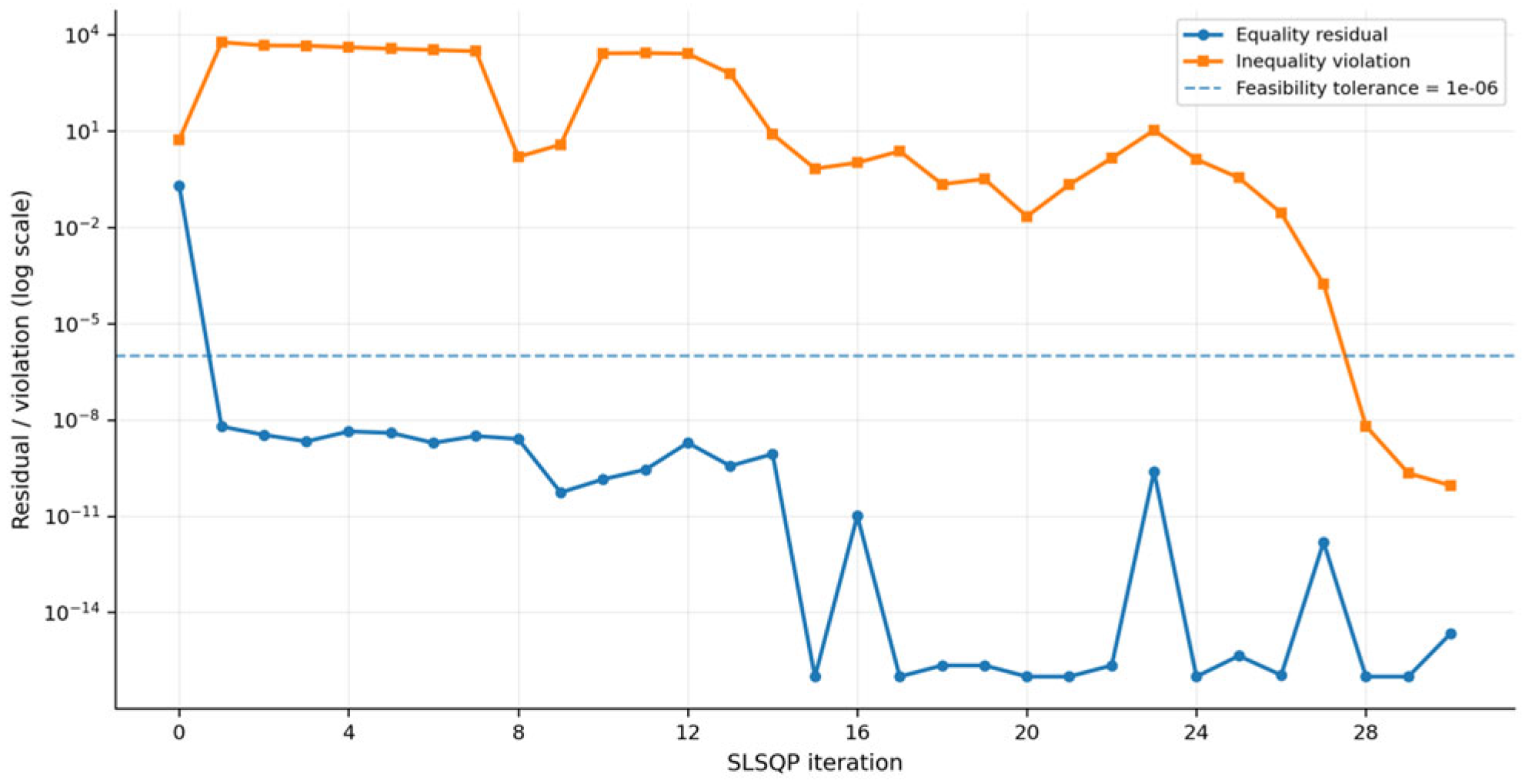
| Stage 1 success/feas. | 30/30; 30/30 | All Stage-1 runs converged and satisfied the feasibility tolerance. |
| Stage 2 success/feas. | 30/30; 30/30 | All Stage-2 column-wise propagations converged and were feasible. |
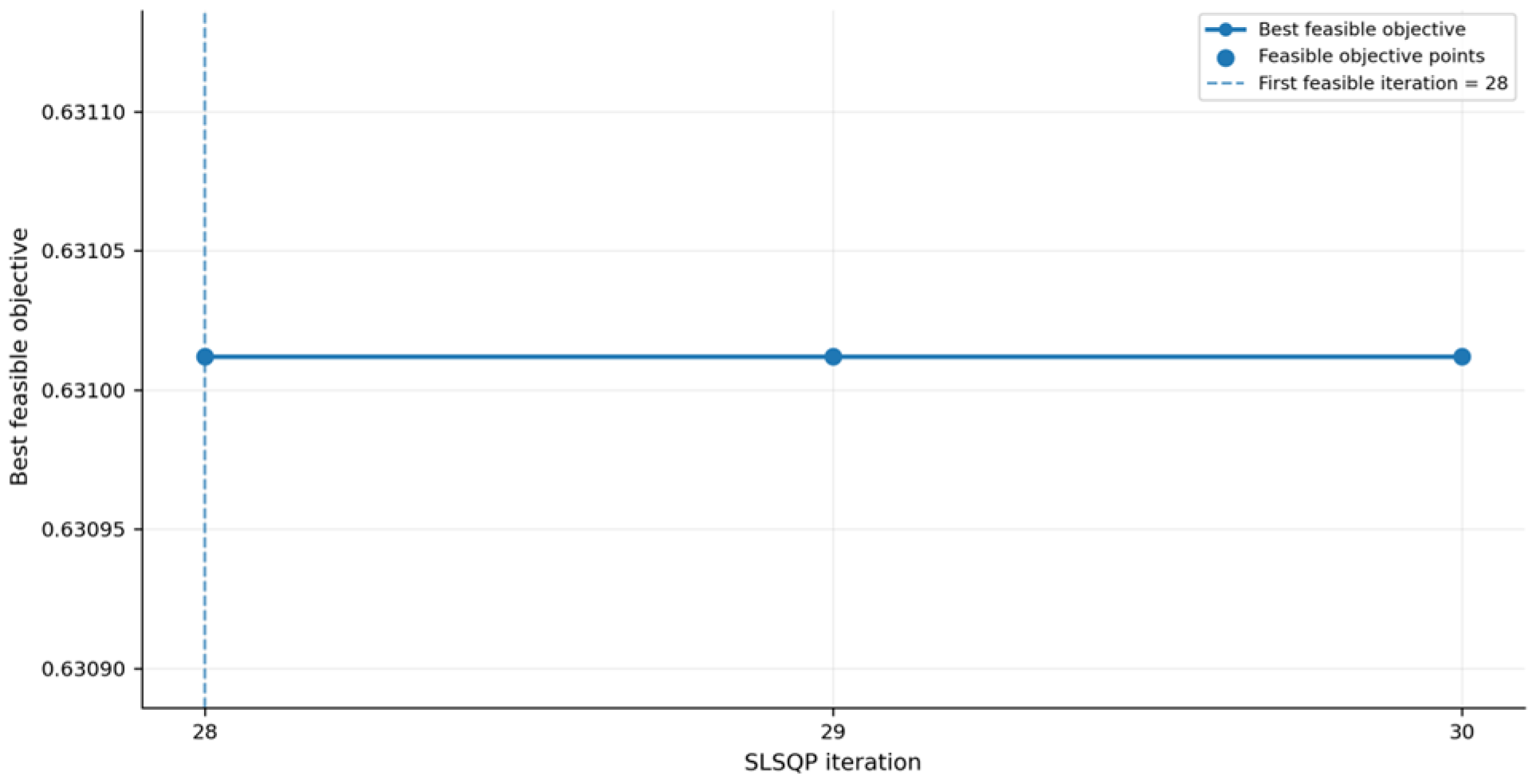
| Stage 1 objective | min = 0.6310; max = 0.6310; range = 4.46 × 10⁻¹⁰ | The objective range is negligible across 30 starts. |
| Stage 1 iterations | min = 8; mean = 20.2; max = 37 | The optimizer converged far below the 3000-iteration limit. |
| Stage 2 iterations | sum/start: min = 62; mean = 62.0; max = 62 | Stage 2 required a stable number of column-wise iterations. |
| Max residuals | S1: r_eq = 6.22 × 10⁻¹⁵, = 3.26 × 10⁻¹⁰; S2: r_eq = 3.52 × 10⁻¹⁴, r_ineq = 3.34 × 10⁻¹⁰ | Residuals are close to numerical precision. |
| CPU effort | mean = 0.874 s/start; total = 26.21 s; range = 0.678–1.131 s | The computational burden is modest for the case study scale. |
| TOPSIS ranking | A3 > A2 > A1 for all starts | The final decision recommendation is unchanged across starts. |
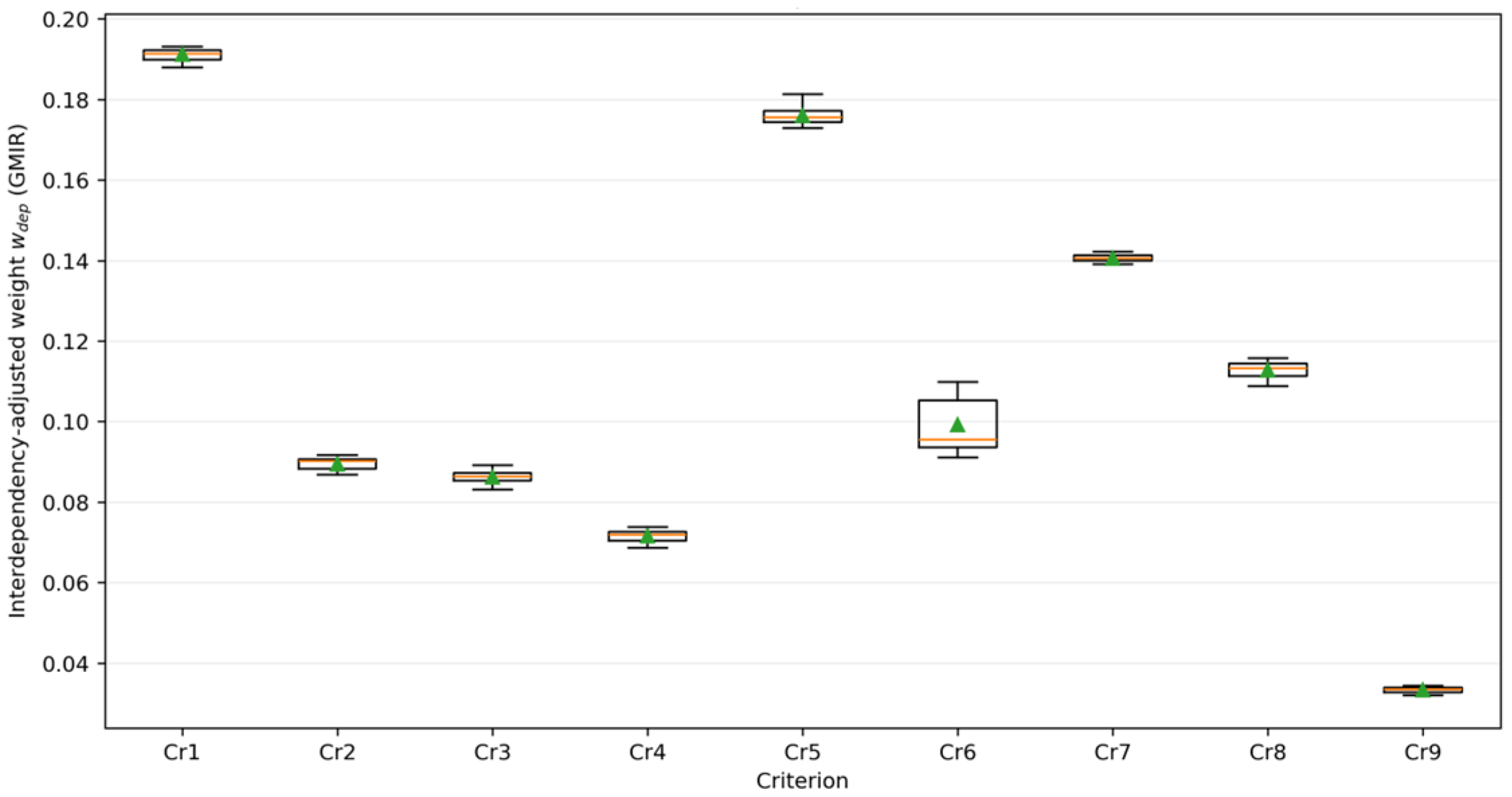
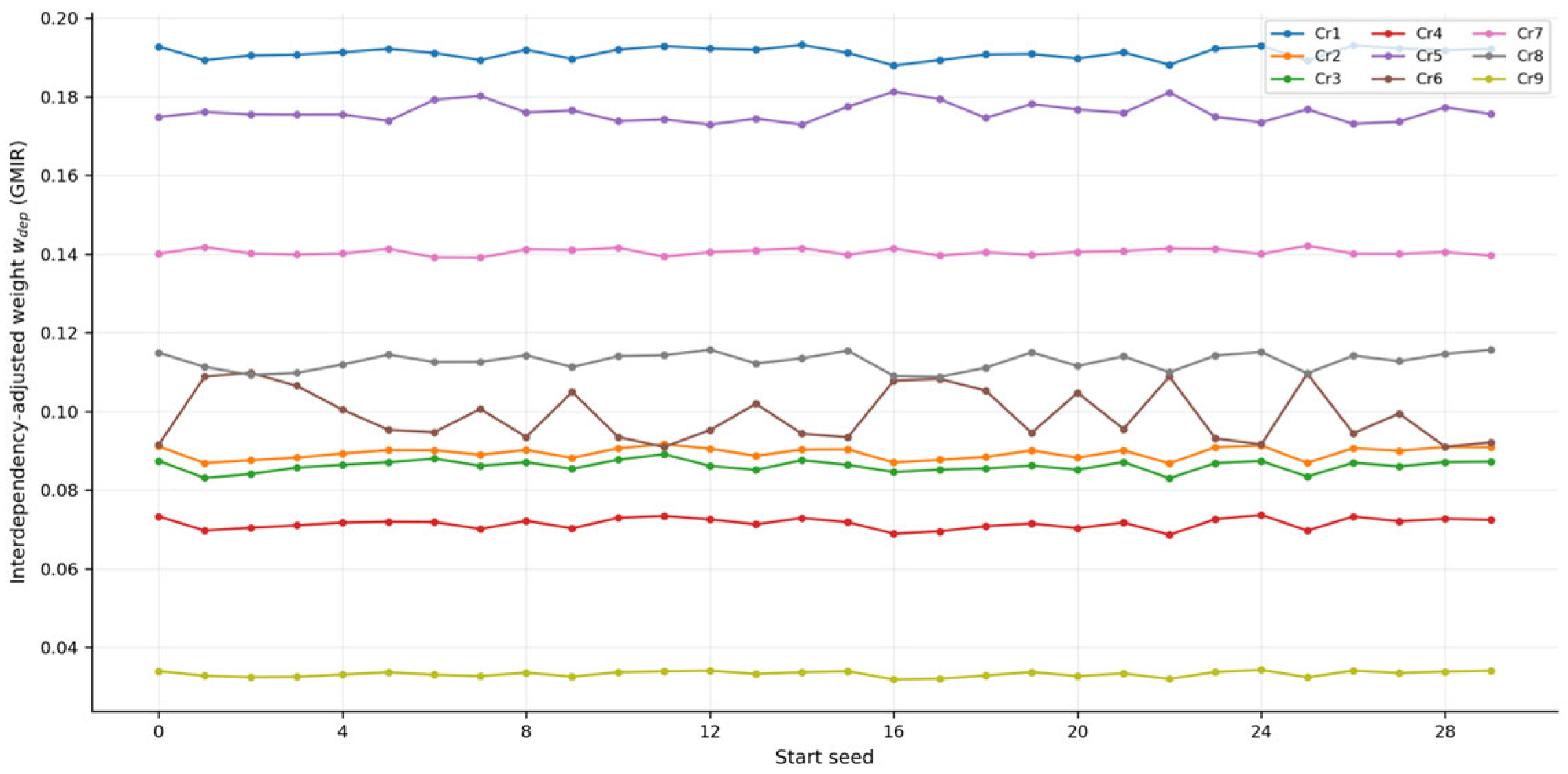
| Cr | Ref | Mean | Min | Max | Range | CV |
|---|---|---|---|---|---|---|
| Cr1 | 0.193 | 0.191 | 0.188 | 0.193 | 0.005 | 0.008 |
| Cr2 | 0.091 | 0.089 | 0.087 | 0.092 | 0.005 | 0.017 |
| Cr3 | 0.087 | 0.086 | 0.083 | 0.089 | 0.006 | 0.017 |
| Cr4 | 0.073 | 0.072 | 0.069 | 0.074 | 0.005 | 0.019 |
| Cr5 | 0.175 | 0.176 | 0.173 | 0.181 | 0.008 | 0.013 |
| Cr6 | 0.092 | 0.099 | 0.091 | 0.110 | 0.019 | 0.067 |
| Cr7 | 0.140 | 0.141 | 0.139 | 0.142 | 0.003 | 0.006 |
| Cr8 | 0.115 | 0.113 | 0.109 | 0.116 | 0.007 | 0.019 |
| Cr9 | 0.034 | 0.033 | 0.032 | 0.034 | 0.002 | 0.021 |
| Alt. | Min CCi | Mean CCi | Max CCi | Range | Std. |
|---|---|---|---|---|---|
| A1 | 0.358 | 0.363 | 0.368 | 0.010 | 0.003 |
| A2 | 0.487 | 0.497 | 0.506 | 0.020 | 0.006 |
| A3 | 0.632 | 0.635 | 0.638 | 0.006 | 0.002 |
| Group | Perturbed Component | No. Scen. | Scenario Design |
|---|---|---|---|
| G1 | DM-weight coefficients | 13 | DM1/DM2 varied from 20/80 to 80/20; end-to-end BWM-driven workflow. |
| G2 | BO/OW BWM judgments | 28 | Selected BO/OW judgments shifted by one linguistic level; BWM weights re-estimated. |
| G3 | TOPSIS criterion weights | 20 | Equal-weight benchmark and one-at-a-time perturbation of Cr1, Cr5, and Cr7 by ±10%, ±20%, and ±30%. |
| G4 | Alternative ratings | 10 | One-level adverse/favorable rating changes for A2/A3 under Cr1, Cr5, and Cr7. |
| Group | Scen. | OK | Chg. | Rate | Max Δw | Max ΔCC | Min M32 | Base Rank |
|---|---|---|---|---|---|---|---|---|
| G1 DMWeight | 13 | 13 | 0 | 0.0% | 0.019 | 0.024 | 0.131 | A3 > A2 > A1 |
| G2 BOOW | 28 | 28 | 0 | 0.0% | 0.023 | 0.029 | 0.111 | A3 > A2 > A1 |
| G3 TOPSISWeight | 20 | 20 | 1 | 5.0% | 0.082 | 0.138 | −0.071 | A3 > A2 > A1 |
| G4 Rating | 10 | 10 | 3 | 30.0% | 0.000 | 0.287 | −0.373 | A3 > A2 > A1 |
Disclaimer/Publisher’s Note: The statements, opinions and data contained in all publications are solely those of the individual author(s) and contributor(s) and not of MDPI and/or the editor(s). MDPI and/or the editor(s) disclaim responsibility for any injury to people or property resulting from any ideas, methods, instructions or products referred to in the content. |
© 2026 by the authors. Published by MDPI on behalf of the International Institute of Knowledge Innovation and Invention. Licensee MDPI, Basel, Switzerland. This article is an open access article distributed under the terms and conditions of the Creative Commons Attribution (CC BY) license.
Share and Cite
Duc Long, L.; Dinh Khanh, V.T.; Quang Trung, N.; Son, T.N. An Intelligent Decision-Support Framework Based on Fuzzy BWM–TOPSIS with Interdependent Criteria for Alternative Selection in Complex Construction Projects. Appl. Syst. Innov. 2026, 9, 108. https://doi.org/10.3390/asi9060108
Duc Long L, Dinh Khanh VT, Quang Trung N, Son TN. An Intelligent Decision-Support Framework Based on Fuzzy BWM–TOPSIS with Interdependent Criteria for Alternative Selection in Complex Construction Projects. Applied System Innovation. 2026; 9(6):108. https://doi.org/10.3390/asi9060108
Chicago/Turabian StyleDuc Long, Luong, Vo Thi Dinh Khanh, Nguyen Quang Trung, and Truong Ngoc Son. 2026. "An Intelligent Decision-Support Framework Based on Fuzzy BWM–TOPSIS with Interdependent Criteria for Alternative Selection in Complex Construction Projects" Applied System Innovation 9, no. 6: 108. https://doi.org/10.3390/asi9060108
APA StyleDuc Long, L., Dinh Khanh, V. T., Quang Trung, N., & Son, T. N. (2026). An Intelligent Decision-Support Framework Based on Fuzzy BWM–TOPSIS with Interdependent Criteria for Alternative Selection in Complex Construction Projects. Applied System Innovation, 9(6), 108. https://doi.org/10.3390/asi9060108