


Abstract
With the rapid expansion of the smart clothing market, designers face increasing pressure to balance functional performance, material suitability, environmental impact, and development efficiency. Conventional design workflows and rule-based assistance methods often struggle to provide adaptive and data-driven support for multi-constraint decision-making. To address this issue, this study proposes an AI-driven decision support system for sustainable smart clothing design based on a multi-scale dynamic graph convolutional network (MDGCN). The proposed system integrates material properties, environmental indicators, and user-oriented design requirements into a unified decision-support framework and further enhances feature extraction through an attention mechanism. Two datasets, the Wearable Technology Material Properties Dataset (WTMPD) and the Environmental Impact Assessment Dataset (EIAD), were used to validate the model and system effectiveness. Experimental results showed that the MDGCN-based model achieved accuracies of 0.964 and 0.943, with recalls of 0.923 and 0.920 on the WTMPD and EIAD datasets, respectively. In system-level evaluation, the proposed decision support system reduced design time from 120 h to 60 h, improved material selection accuracy to 90.2%, and achieved superior operational performance in terms of resource utilization (77.45%), energy consumption (115.25 kWh), and response time (1.56 s). These results demonstrate that the proposed framework can effectively support complex design decision-making while improving efficiency, sustainability, and adaptability in smart clothing development. The study provides a practical AI-enabled system innovation approach for sustainable smart clothing design by linking flexible material selection, environmental impact prediction, and designer-oriented decision support. In addition, the prototype deployment demonstrates the feasibility of applying the proposed system as a design-stage wearable AI tool for mediating human, technological, and environmental considerations in smart clothing development.
1. Introduction
As an emerging interdisciplinary field, smart clothing has become an important convergence point of fashion, materials, and intelligent technologies. Smart clothing not only provides functionality that traditional clothing cannot match, such as health monitoring and exercise tracking, but also considers the environmental impact [1,2]. However, there are still many challenges in design efficiency, selection of environmentally friendly materials, and environmental impact assessment for wearable devices currently on the market [3,4]. Although some attempts have been made to integrate environmental concepts into wearable device design, these attempts often lack a systematic approach [5]. They also fail to adequately consider life-cycle assessments and the environmental impact of materials during the design process. In addition, the design process is often inefficient and difficult to meet the rapidly changing market demands [6,7]. Smart clothing refers to a type of clothing product that integrates electronic components (such as sensors, conductive fibers, flexible circuits) with everyday garments (such as shirts, pants, underwear, etc.) to form a garment that can monitor human physiological signals or environmental parameters and has certain data interaction capabilities. Unlike wrist-worn devices, smart clothing is directly attached to a large area of human skin and has extremely high requirements for the flexibility, breathability, washability of the material, and long-term wear comfort. Typical applications include heart rate monitoring T-shirts, temperature-regulating jackets, and motion posture analysis tight-fitting clothes, etc.
From a broader wearable-technology perspective, smart clothing should not be understood only as a textile product with embedded sensors, but also as a socio-cyber-physical interface connecting the human body, computational intelligence, and the surrounding environment. Recent discussions on XR, Wearable AI, and Mersivity emphasize that wearable technologies can act as vessels between the “invironment” of the wearer and the external environment, thereby supporting reciprocal interaction among humans, technologies, and nature. In this context, sustainable smart clothing design is not limited to reducing material-related environmental impact, but also concerns how wearable products mediate human–technology–environment relationships during design, use, and deployment. Therefore, the present study positions the proposed system as a design-stage decision support tool that helps designers evaluate flexible material properties and environmental metrics before physical prototyping and real-world deployment [8].
Wearable computing has been studied for more than half a century. Since the 21st century, wearable AI has gradually emerged as an independent research direction. With the development of flexible electronics and low-power sensors, smart clothing has gradually become an important branch in the field of wearable computing [9]. However, most existing research focuses on sensor integration and physiological signal processing, while paying less attention to the environmental impact assessment during the design stage and the quantitative correlation between flexible materials and environmental indicators. This is precisely the gap that this study aims to fill [10]. It is particularly worth noting that the special issue “Wearable AI” published in IEEE Intelligent Systems in 2001 was an important milestone in this field. This special issue featured papers by approximately 20 authors, covering topics such as the system architecture, context awareness, and intelligent clothing of wearable AI [11]. These works proposed many concepts that still have an impact today, 25 years later. This study was inspired by these early works in terms of problem definition and system positioning.
Currently, scholars have conducted research on intelligent clothing design systems. M. Dong et al. proposed a style-texture-based, self-supervised, generative framework. This framework did not require paired samples. It was developed in response to the fact that clothing matching still relies on manual matching, which was time-consuming and labor-intensive. The results showed that the framework significantly outperformed the existing baseline on a self-constructed large-scale unsupervised dataset, taking into account visual authenticity and fashion compatibility [12]. D. Yu et al. proposed an artificial intelligence (AI)-based online clothing design system to address the current situation of long cycle time of traditional clothing design and the difficulty of quickly meeting personalized demands. The results showed that the system compressed the cycle time of automatic and semi-automatic design from 7 to 8 days in the traditional mode to 4 to 5 days. It outperformed traditional design methods in terms of creativity, cost-effectiveness, and user satisfaction [13]. Choi et al. proposed a four-module AI apparel design system that integrates fashion domain knowledge and aligns with the human design process. This system was developed in response to the fact that existing apparel design tools only focus on trend analysis and image generation. These tools were unable to fully replicate the current workflow of human designers. The results showed that after eight Korean designers tried the system, their satisfaction with the AI generation effect increased from 2.44 to 3.81, while the system could generate images in 1.02 s and process 58 requests per minute, which significantly improved the design efficiency and usability [14]. Mu et al. proposed a set of meta-universe-oriented fashion intelligence frameworks in response to the current difficulties in traditional fashion data collection and long design iteration cycles. It incorporated AI-driven automatic modeling of digital people, virtual fitting, style generation, and trend prediction. The results demonstrated that the framework could reduce the 3D face and body reconstruction error by about 20% and generate high-fidelity garment images within 1.02 s. It also significantly enhanced the consumer’s immersive shopping experience and the designer’s creation efficiency through cross-scene retrieval and compatibility learning [15].
To address these limitations, this study proposes an AI-driven decision support system (DSS) for sustainable smart clothing design based on a multi-scale dynamic graph convolutional network (MDGCN). The proposed framework integrates material properties, environmental indicators, and design requirements to support data-driven and adaptive decision-making under multi-constraint conditions. The core innovative contribution of this study lies in: (1) proposing a prediction model that integrates a MDGCN with the CBAM attention mechanism. The MDGCN dynamically learns the correlation graph between material properties and environmental indicators through the graph structure estimation layer and utilizes the external storage network to retain long-term dependencies, thereby achieving joint prediction of material performance and environmental impact. (2) Engineering contribution: developing and implementing a complete, operational web-based prototype of a sustainable smart clothing decision support system, consisting of four modules: data input, intelligent processing, design assistance visualization, and user interaction. The prototype was further evaluated through a four-week pilot deployment involving 12 designers and 87 smart clothing design schemes. (3) Application contribution: directly embedding multi-dimensional environmental indicators (carbon footprint, water footprint, recyclability) into the design assistance process of clothing, rather than using them as a post-evaluation tool. The system can automatically calculate the environmental load based on the flexible materials selected by the designer (elastic modulus, elongation at break, recovery rate) and provide design trade-off suggestions. Unlike a fully closed-loop wearable sensing platform, the current system focuses on early-stage design decision support; therefore, real-time wearer feedback and post-deployment environmental sensing are identified as future extensions.
2. Methods and Materials
2.1. Selection of Flexibility Indicators and Collection and Processing of Environmental Indicators
This section describes the selection of flexibility-related material indicators and environmental indicators used in the proposed DSS for sustainable smart clothing design. First, this study selects suitable flexible materials and environmental indicators to introduce into the clothing design assistance system. Through selecting suitable indicators and processing methods, this study optimizes the model’s performance to align with actual application requirements. The selection of flexibility indicators mainly involves the physical and chemical characteristics of materials, which determine the comfort, durability and functionality of smart clothing [16,17]. The flexibility metrics chosen for the study include modulus of elasticity, elongation at break and rate of return. The modulus of elasticity is mainly used to measure the ability of a material to resist elastic deformation, which is determined by the ratio of stress to strain. The elongation at break can be used to indicate the maximum percentage of the material that can elongate before breaking, as shown in Equation (1).
In Equation (1), denotes the modulus of elasticity. and denote the length at break and the original length, respectively. The rate of return refers to the ability of a material to return to its original state after removal of an external force, as shown in Equation (2).
In Equation (2), denotes the rate of return. denotes the length after removal of external forces. The key environmental indicators include carbon footprint, water footprint, and recyclability. Their definitions, units, and data sources are detailed as follows. Carbon footprint is used to measure the total amount of greenhouse gas emissions generated by a product throughout its life cycle (raw material acquisition, production manufacturing, use, and waste disposal), with the unit being kilograms of carbon dioxide equivalent (kg CO2 eq) per functional unit (the study uses “each smart garment” as the functional unit). The calculation method adopts the emission factor method. Activity data comes from material production energy consumption and process parameters, and the emission factors refer to the global warming potential (GWP) values reported in Chapter 7 of the IPCC 2021 Sixth Assessment Report, Climate Change 2021: The Physical Science Basis [18]. The underlying life cycle inventory data is sourced from the Ecoinvent 3.8 database, covering key processes such as polymer synthesis, fabric processing, and electronic component packaging. Water footprint is used to assess the amount of water resources consumed during product production and use, with the unit being cubic meters (m3) per functional unit. According to the water footprint network methodology, the water footprint consists of three parts: blue water footprint (surface water and groundwater consumption), green water footprint (rainwater consumption), and gray water footprint (the amount of water required to dilute pollutants). The study mainly calculates the blue water and gray water footprints, with data sources also coming from the Ecoinvent 3.8 database and modeled and calculated using OpenLCA 2.0 software. Recyclability is used to measure the ease with which materials can be recycled and reused. The study quantifies this using a continuous score of 0–100, with higher scores indicating greater ease of recycling. The scores are based on factors such as whether the material is single and classifiable, compatibility with existing recycling streams (such as PET, polyurethane), dismantling energy consumption, and the retention rate of mechanical properties after recycling. The underlying data comes from laboratory standardized tests based on ISO 14021:2016 [19] and the EU Product Environmental Footprint (PEF) supplementary guidelines for textile recycling. For the electronic components integrated in smart garments (such as flexible circuits, sensors), their recyclability is scored separately, and the recyclability of the final product is calculated as a weighted average of quality [20,21]. To guarantee the accuracy and consistency of the data, the gathered environmental and flexibility indicators are pre-processed. The Z-score approach is used to identify outliers in the data cleaning process, and median padding is utilized to accommodate missing values. Equation (3) illustrates how the normalization procedure scales the data to the interval [0, 1] using min-max scaling.
In Equation (3), is the scaled data. is the original data , and display the minimum and maximum values of the data.
2.2. Intelligent Clothing Assistance System Construction Method
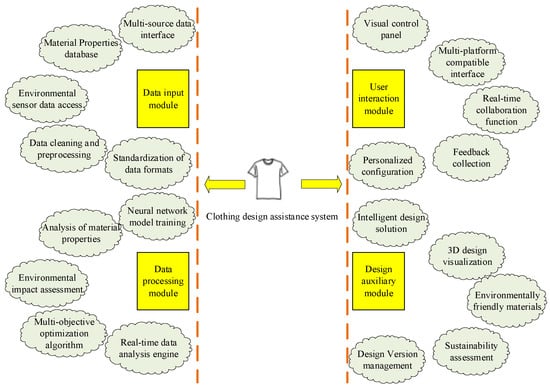
After selecting and processing the flexibility and environmental indexes, the study describes the system’s construction method, including the system architecture design, AI algorithm selection and implementation, and the entire development and testing process. This study uses modular design and advanced technology to construct an AI assistance system that effectively integrates flexible material properties and environmental indicators. This system provides scientific and efficient decision support for sustainable smart clothing design by integrating flexible material properties, environmental impact metrics, and designer-oriented functional requirements. The design of the system architecture is the basis for realizing the functions and performance of the auxiliary system. In the study, the system architecture adopts a modularized design, which mainly includes a data input module, a data processing module, a design assistance module, and a user interaction module. The related schematic is shown in Figure 1.
Figure 1.
System architecture schematic diagram.
In Figure 1, the data input module is mainly responsible for collecting and inputting the performance parameters of flexible materials and environmental index data. The data processing module mainly uses AI algorithms to process and analyze the input data, extract key features and generate design suggestions. In the design assistance module, it mainly generates specific sustainable design solutions based on the processed data and provides visualization to help designers quickly understand and apply them. Finally, in the user interaction module, it mainly provides a user interface so that designers can easily enter data, view results and interact with the system [22,23]. The interaction relationship between the above modules can be realized based on Equation (4).
In Equation (4), denotes the system output. denotes the processing logic and algorithms within the system. , , , and denote data input, data processing, design assistance, and user interaction modules, respectively.
2.3. Design of Data Processing Module Based on MDGCN Modeling
In an AI-driven decision support system for smart clothing, choosing the right AI algorithm is the key to realizing efficient and accurate design. Node classification, graph classification, and link prediction are just a few of the tasks that make extensive use of GCNs, deep learning models for processing graph-structured data. A GCN’s main concept is to use graph convolution operations to aggregate neighborhood information in an attempt to learn the low-dimensional representation of nodes. It is defined that the graph contains nodes. Among them, is the set of nodes, and is the set of edges. The adjacency matrix of the graph is , the node feature matrix is , and is the feature dimension of each node. Therefore, the mathematical expression of the basic convolution operation of the GCN is shown in Equation (5).
In Equation (5), denotes the node feature matrix of layer . denotes the adjacency matrix after adding the self-loop. is the nonlinear activation function. is the degree matrix of , as shown in Equation (6).
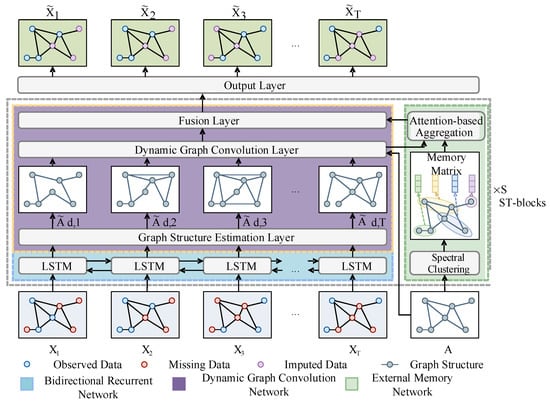
After the convolution operation, the GCN is able to aggregate the neighborhood information of each node to learn the low-dimensional representation of the node. However, the traditional GCN has some limitations in dealing with multiple out-degree outgrowth, which assumes that the node neighborhood nodes are fixed and thus cannot be dynamically adjusted. To overcome the limitations of the traditional GCN model, this study introduces the MDGCN model. It is based on dynamic learning of the adjacency matrix through the temporal features extracted by Bi-LSTM, enabling the graph structure to adaptively adjust according to the input data. Although the Dynamic Graph Convolutional Neural Network (DGCNN) can dynamically construct the graph through EdgeConv, its graph structure only relies on the similarity of node features at each layer and lacks the modeling ability for temporal dependencies and long-term memory. In contrast, the MDGCN introduces Bi-LSTM to explicitly model the evolution patterns of the performance of flexible materials and environmental indicators in the time series, and designs an external storage network for storing and retrieving long-term information, effectively alleviating the problem of gradient disappearance and improving the model’s ability to capture multi-step historical dependencies. In terms of multi-scale feature extraction, DGCNN achieves local-to-global aggregation by stacking EdgeConv layers but lacks an explicit multi-scale convolution kernel design; the MDGCN, on the other hand, uses different-scale graph convolution filters to simultaneously capture the local elastic features of flexible materials and the global environmental influence patterns. Moreover, the MDGCN embeds a CBAM after the dynamic graph convolution layer, performing adaptive weighting of features from both the channel and spatial dimensions, further enhancing the perception ability of key material properties and environmental indicators. The structure of the MDGCN model is schematically shown in Figure 2.
Figure 2.
Structural illustration of the MDGCN model.
In Figure 2, the MDGCN model proposed in the study mainly consists of an input layer, bidirectional long short-term memory (Bi-LSTM), a graph structure estimation layer, a dynamic graph convolution layer, an external storage network layer, a fusion layer, and an output layer. The input data includes observed data, missing data, and complementary data obtained by an interpolation method, and all data are represented by a graph structure. Among them, the relationship between nodes and edges is represented by the adjacency matrix . Bi-LSTM is mainly used to process time-series data, which consider both past and future information for each time step (TS) . Equation (7) displays the Bi-LSTM unit’s mathematical formulation.
In Equation (7), and display the hidden states of forward and reverse LSTM units at TS , respectively. is the input features at TS . The output of the Bi-LSTM layer can be obtained by splicing the forward and reverse, as shown in Equation (8).
The graph structure estimation layer is based on the output of the Bi-LSTM layer to estimate the adjacency matrix of the graph. The output of the LSTM can be mapped to the space of adjacency matrices through a fully connected layer, as shown in Equation (9).
In Equation (9), and denote the weights and bias of the fully connected layer. In the dynamic graph convolution layer, the neighbor matrix is mainly used to perform graph convolution operations. The core function of the external storage network is to provide an external memory matrix that can be read and written for the MDGCN model to address the forgetting problem of recurrent neural networks when dealing with extremely long sequences. Specifically, this memory matrix contains 64 memory units, each storing a fixed-dimensional feature vector (in the study, the dimension is 64). At each time step, a controller based on the attention mechanism calculates the weights of each memory unit, determining which memory unit to write the features obtained by fusing the current Bi-LSTM and dynamic graph convolution layer, or from which memory to read historical features. The write operation adopts a gating mechanism, and the controller outputs a signal ranging from 0 to 1 to determine the extent to which the new features cover the old memory. The read operation weights and aggregates the memory units through attention weights to generate an aggregated vector for use by the subsequent fusion layer. The external storage network stores potential feature representations of the performance of flexible materials and environmental indicators in the historical time window, rather than raw sensor data [24,25]. The memory matrix is updated by Equation (10).
In Equation (10), denotes the memory matrix of the TS. denotes the update function. denotes the control signal, which is used to determine the type of signal being stored or retrieved. For the aggregation mechanism, its weight can be calculated by Equation (11).
In Equation (11), denotes the weight of the th memory unit at TS . is the attention weight (AW). denotes the content of the th memory unit. Equation (12) displays the vector’s mathematical expression following aggregation.
In Equation (12), denotes the aggregation vector. denotes the content of the th memory cell. The fusion layer can combine the output of the dynamic graph convolutional layer and the output of the external memory network to generate the final feature representation, as shown in Equation (13).
In Equation (13), denotes the final feature representation. denotes the fusion function. Finally, in the output layer, it generates the final prediction result based on the feature representation of the fusion layer, as shown in Equation (14).
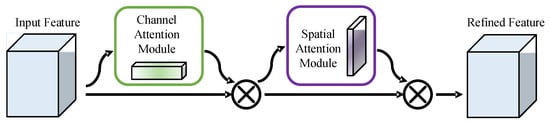
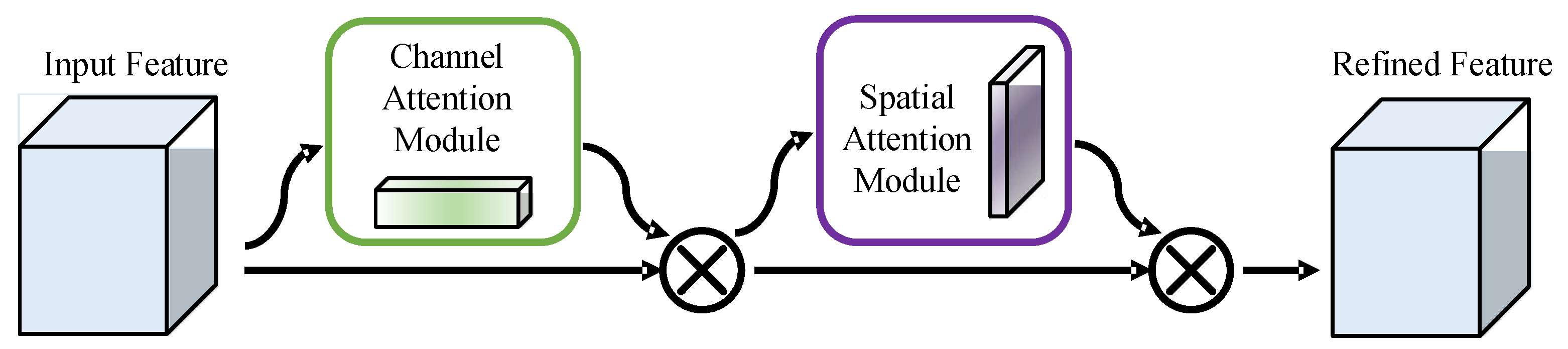
In Equation (14), denotes the predicted output. denotes a multilayer perceptron for mapping the fused features to the output space. The article presents a convolutional block attention module (CBAM) to boost the MDGCN model’s performance even more while working with data that has intricate spatial correlations. A CBAM consists of a channel attention module and a spatial attention module. These modules can be applied in parallel or sequentially after the convolutional layer of the dynamic map to enhance the model’s perception of key features [26,27]. Its structure is schematically shown in Figure 3.
Figure 3.
Schematic diagram of CBAM structure.
The channel attention module uses global average and maximum pooling to find significant characteristics in various channels, as illustrated in Figure 3. The output feature map (FM) is defined as , and the final weighted FM of the channel is obtained using Equation (15).
In Equation (15), denotes the channel attentional weight. is the Sigmoid activation function, which is used to normalize the AWs to between 0 and 1. The spatial attention module is mainly designed to allow the model to identify important spatial locations in the FM, and this process is also achieved by average pooling and maximum pooling. Moreover, the pooling results are merged by splicing, and finally, a convolutional layer is used to generate the spatial AWs [28,29]. After acting through weighting, the spatial FM can be obtained based on Equation (16).
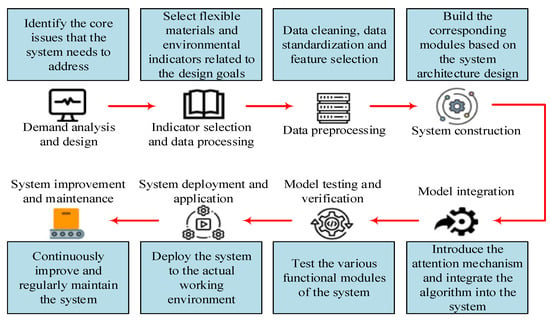
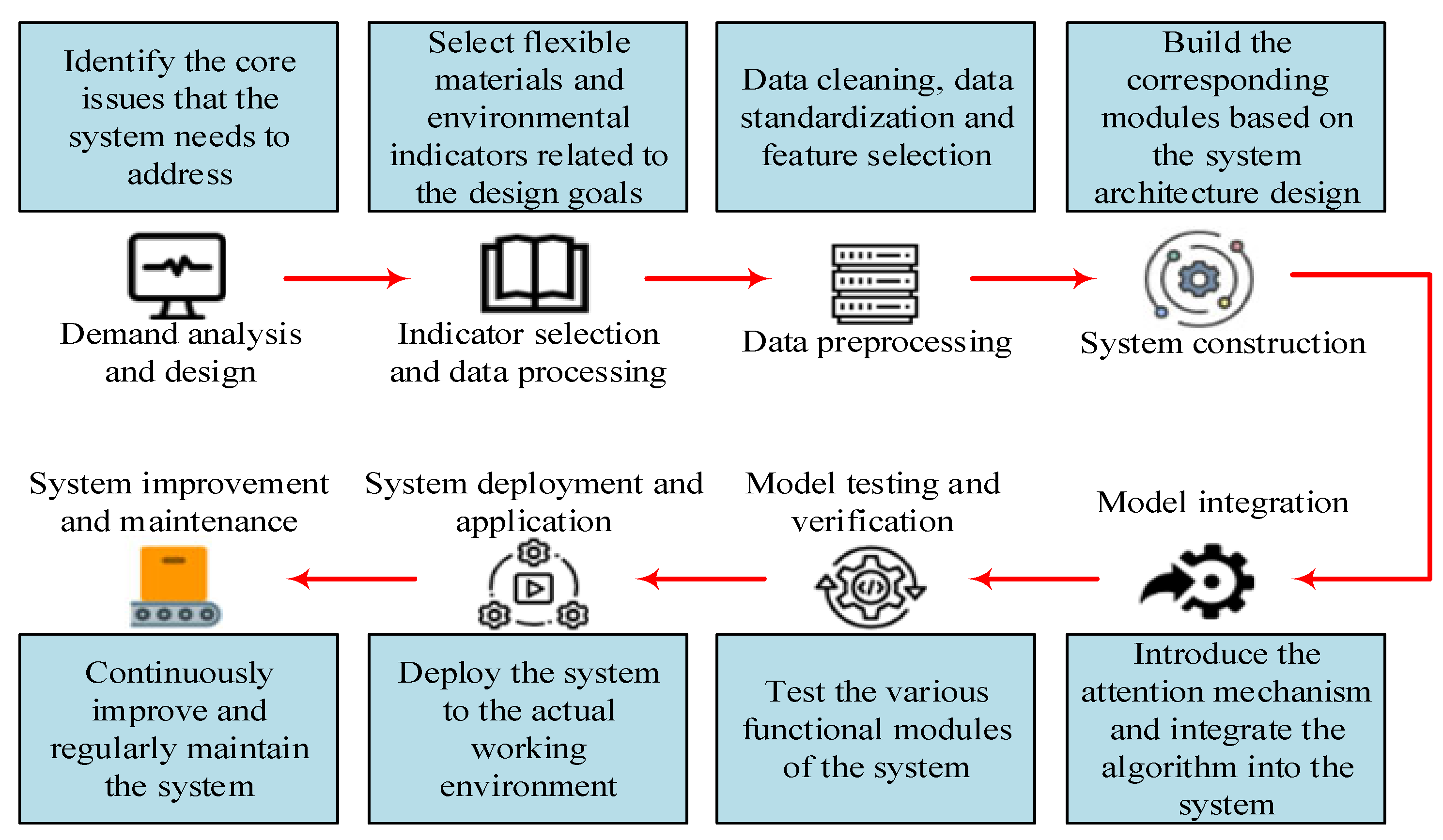
In Equation (16), denotes the spatial AW. By using a CBAM, the MDGCN model may more effectively concentrate on spatial locations and attributes that have a greater influence on prediction outcomes, enhancing the model’s performance and capacity for generalization [30,31,32]. Finally, the overall workflow of the proposed AI-driven decision support system for sustainable smart clothing design is illustrated in Figure 4.
Figure 4.
Overall workflow of the proposed AI-driven decision support system for sustainable smart clothing design.
As shown in Figure 4, the proposed AI-driven decision support system first performs requirement analysis and system architecture design, including modules for data input, preprocessing, decision support, design recommendation, and user interaction. Material properties and environmental indicators relevant to design objectives are then collected and normalized [33,34,35]. The MDGCN-based data processing module, enhanced with the CBAM attention mechanism, is integrated into the proposed DSS to support material selection, environmental impact assessment, and design optimization [34].
The developed sustainable smart clothing decision support system has been implemented as a web-based prototype. The front end was developed using the React 18.2.0 framework, the back end is built based on Flask 2.0.3, and the MDGCN model is deployed through PyTorch 1.7.0. The system allows users to upload test data of flexible materials (in Excel or CSV format) and returns an environmental impact assessment report and material optimization suggestions within 30 s. The system interface includes: (1) Material parameter input panel; (2) Environmental impact dashboard; (3) Multi-scheme comparison view; (4) Design report export function. The detailed prototype implementation and real-world validation protocol are described in Section 2.4.
2.4. Prototype Implementation and Real-World Validation Protocol
To further validate the practical feasibility of the proposed decision support system, a web-based prototype was developed and deployed in a clothing design studio for a four-week pilot study. The front end was implemented using React, the back end was developed using Flask, and the MDGCN model was deployed using PyTorch 1.7. The system allowed designers to upload flexible material data in Excel or CSV format and generated environmental impact assessment reports and material optimization suggestions through the user interface.
Twelve designers participated in the pilot study. During the four-week deployment, the system assisted the evaluation of 87 smart clothing design schemes. Each design task included material parameter input, environmental indicator prediction, comparison of alternative material schemes, and generation of a design report. The validation focused on four aspects: task completion time, material selection accuracy, system response time, and designer-perceived usefulness. Traditional manual design, a rule-based system, and an expert-system workflow were used as comparative baselines under the same task settings.
This validation was designed to demonstrate whether the proposed system could function as an operational design-stage decision support tool. Since the present study focuses on early-stage material and environmental decision-making rather than post-deployment physiological monitoring, wearer-based long-term field trials were not included. This limitation is further discussed in the Section 4 and will be addressed in future work by integrating real-time wearer feedback and environmental sensing data.
3. Results
3.1. MDGCN Model Performance Validation
After introducing the proposed DSS and the MDGCN-based data processing module, this section validates the performance of the MDGCN model. Table 1 displays the MDGCN model’s parameter settings as well as the study’s experimental setup.
Table 1.
Experimental environment and MDGCN model parameter settings.
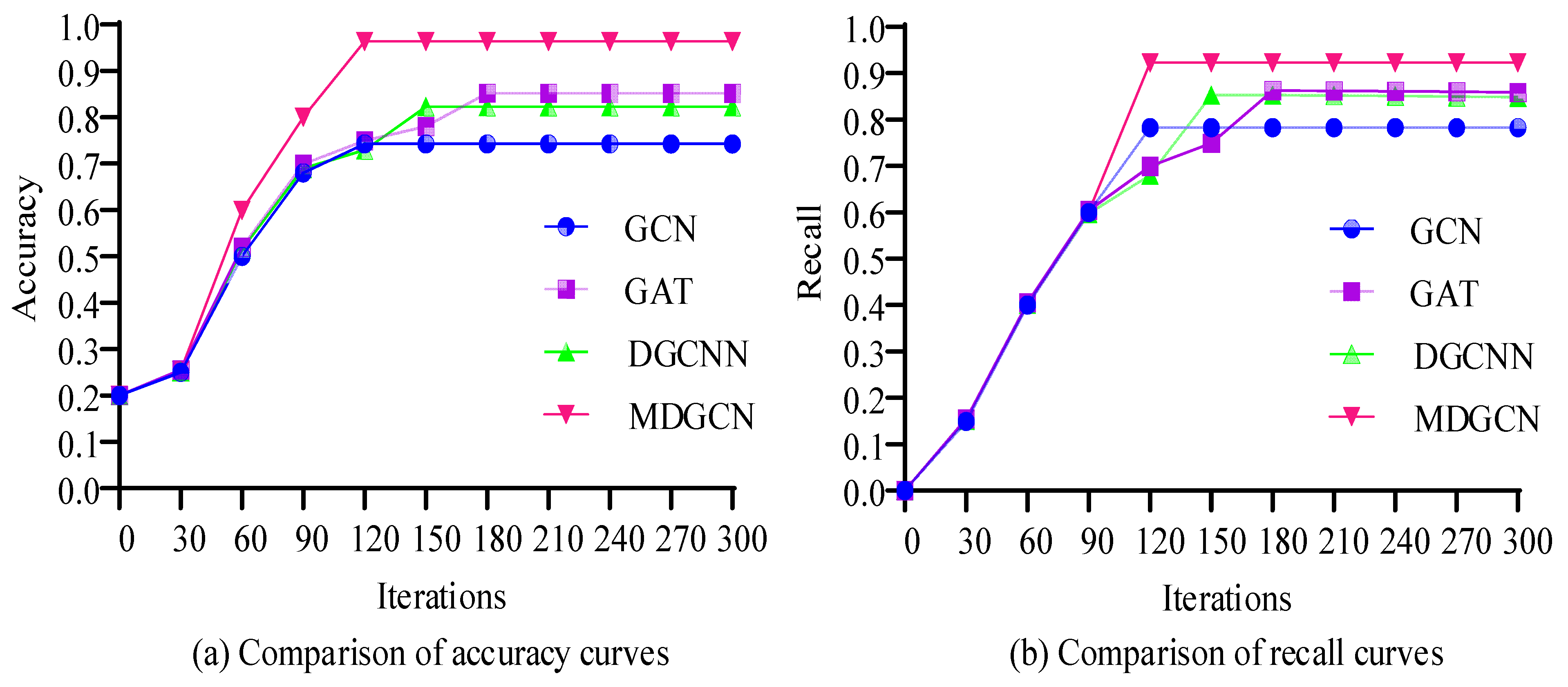
Based on the experimental environment shown in Table 1 and the parameter settings of the MDGCN model, the study selects the Intelligent Wearable Technology Material Properties Dataset (WTMPD) and Environmental Impact Assessment Dataset (EIAD) as the datasets. The WTMPD dataset consists of 8642 samples, each corresponding to a material sample (such as different ratios of flexible polymers, conductive composites, elastic fabrics, etc.), covering 18 feature dimensions, including the elastic modulus, elongation at break, recovery rate, as well as density, thermal conductivity, electrical conductivity, tensile strength, etc., as auxiliary features selected for the study. The data collection period spans from 2018 to 2023, and the sources include published literature data, public material databases, and laboratory standardized test results (based on ASTM D412 [35] and ISO 37 [36] standards for tensile tests). The EIAD dataset is specifically designed to assess the environmental impact of various products (with a focus on smart clothing and wearable devices), containing 6120 samples, each corresponding to the life-cycle assessment result of a product-material combination, covering 12 environmental indicator features. This study focuses on selecting carbon footprint, water footprint, and recyclability score (0–100 points) as the core environmental indicators. The data collection period spans from 2019 to 2024, and the sources include Ecoinvent 3.8, the EU Product Environmental Footprint (PEF) database, and modeling calculations based on the OpenLCA software by this study group. The proportion of missing values is approximately 4.1%, and they are filled using the median; the Z-score method (threshold 3) is used for outlier detection, and 86 abnormal samples have been detected and corrected. Meanwhile, the dataset is divided into a training set, a validation set, and a test set according to the ratio of 6:2:2. The study also introduces a graph attention network (GAT), a dynamic graph convolutional neural network (DGCNN), and a traditional GCN for controlled experiments. The accuracy and recall curves of the four models are initially compared in the study. Figure 5 displays the findings.
Figure 5.
Comparison of accuracy and recall curves.
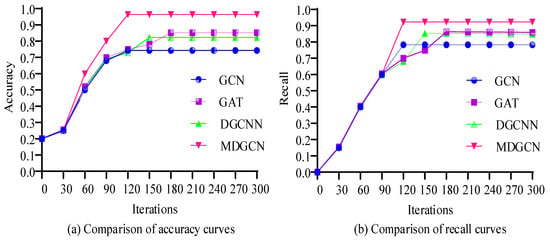
The accuracy curves of the four models are compared in Figure 5a. The findings indicate that all models’ accuracy is trending upward as the number of iterations increases. The MDGCN model converges after 120 iterations. Its convergence speed is significantly faster than that of the control model, and its accuracy rate converges to 0.964. The traditional GCN model also converges after 120 iterations, but its accuracy rate has the smallest value of 0.743 after convergence. The recall curves of the four models are compared in Figure 5b. The outcomes display that the MDGCN model also has the fastest convergence rate, and its recall converges to 0.923 after convergence. The GAT and DGCNN models achieved slightly lower recall values than the MDGCN model, converging to 0.863 and 0.854, respectively. The GCN model has the smallest recall after convergence, and its value converges to 0.783. The study further compares the four models’ mean absolute error (MAE) and mean square error (MSE). Table 2 displays the findings.
Table 2.
Comparison of mean absolute error and mean square error.
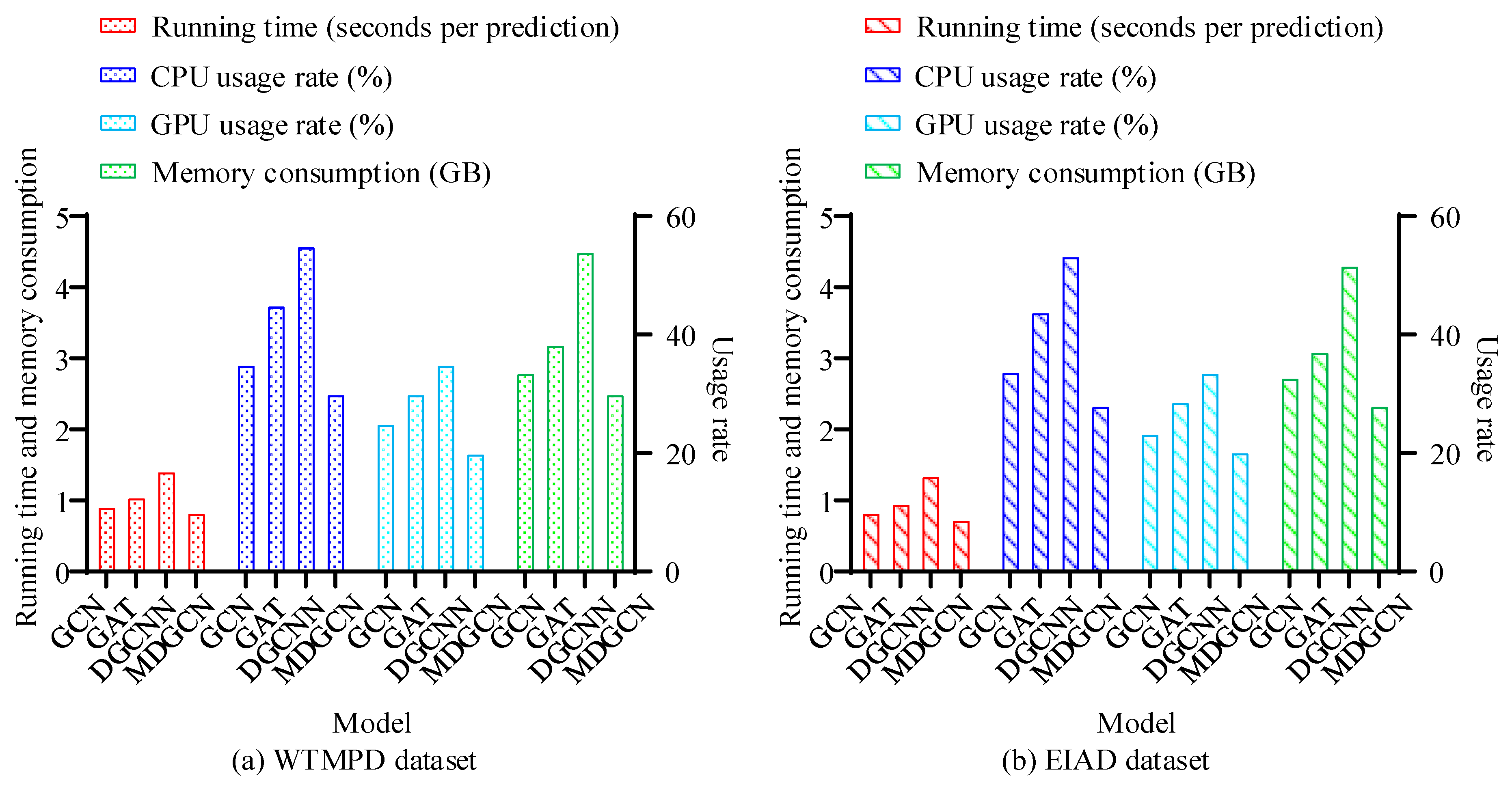
In Table 2, the MDGCN model performs best in both MAE and MSE, with average values of 0.104 and 0.133. It is demonstrated that it performs better than the other models in terms of prediction accuracy and can make more accurate predictions about the target variable. The GCN model has the highest MAE and MSE, with average values of 0.129 and 0.177. It shows that its prediction accuracy is relatively low. The GAT model performs comparably in terms of MAE; however, it is slightly higher than the MDGCN in terms of MSE. It indicates that the GAT may be slightly insufficient in dealing with larger errors. The DGCNN and GCN models perform average on both metrics and may need further optimization to improve prediction accuracy. The study compares the running time (RT) and RC of the four models. The results are shown in Figure 6.
Figure 6.
Comparison of running time and resource consumption.
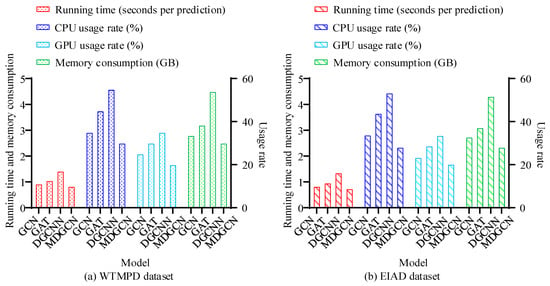
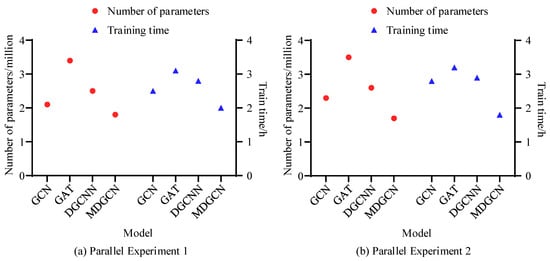
Figure 6a and Figure 6b show the comparison of the running time and resource consumption of the four models under the WTMPD dataset and the EIAD dataset, respectively. With average RTs of 0.80 and 0.78 s, the MDGCN model has the smallest RT on both datasets, according to the results. It indicates that the MDGCN is the most efficient in making a single prediction and can respond quickly. The GAT and DGCNN models have relatively long run times, especially on the EIAD dataset. The DGCNN run time reaches 1.35 s, which may affect scenarios requiring the fast processing of large amounts of data. On RC, the average CPU consumption rate, GPU consumption rate, and memory consumption rate of the MDGCN model are 29.3%, 19.1%, and 2.4 GB, respectively. It shows that deploying the MDGCN model is very favorable in resource-limited situations. The study compares the number of parameters and training time of the four models. Figure 7 displays the findings.
Figure 7.
Comparison of parameter quantity and training time.
Figure 7a,b show the comparison of the number of model parameters and training time for parallel experiment 1 and parallel experiment 2. The outcomes display that the MDGCN model has the lowest average number of parameters, with a value of 1.7 million. It indicates that it is more efficient in design and easier to deploy in resource-constrained environments. In contrast, the GAT model has the highest average number of parameters, with a value of 3.46 million. This may imply that the GAT model is capable of learning more complex features, but it also requires greater computational resources. In terms of training time, the MDGCN model has the shortest average training time of 1.9 h. It shows that it is not only parameter-efficient but also more efficient in the actual training process. In contrast, the GAT model has the longest average training time of 3.15 h. Despite the higher number of parameters, the increase in its training time may affect scenarios that require fast training. Ablation tests are conducted at the end of the study to confirm that each module in the MDGCN model is required. Table 3 displays the findings.
Table 3.
Results of the ablation experiment.
In Table 3, the MDGCN complete model performs best on all metrics, with an accuracy rate of 0.964, a recall rate of 0.923, and an F1 score of 0.943. It demonstrates how the entire model can efficiently strike a compromise between recall and accuracy rates to get the highest overall performance. After removing the attention module, dynamic graph structure, multi-scale features, and external storage network, respectively, the performance index of the model decreases significantly. In summary, the results of the ablation experiments show that each component in the MDGCN model contributes positively to the final performance.
3.2. Performance Evaluation of the Proposed AI-Driven Decision Support System
After validating the model-level performance of the MDGCN module, the study further evaluated the system-level feasibility of the proposed AI-driven decision support system through a prototype-based design study. The evaluation was conducted during a four-week deployment in a clothing design studio, involving 12 designers and 87 smart clothing design schemes. This section reports both comparative performance against baseline methods and practical deployment outcomes, including task completion time, material selection accuracy, system response time, resource utilization, and designer-oriented usability, shown in Table 4.
Table 4.
Prototype deployment and validation setting.
Table 4 summarizes the real-world prototype deployment setting used to validate the operational feasibility of the proposed system. The purpose of this evaluation was not to test long-term physiological monitoring performance, but to verify whether the proposed DSS could support practical material selection and environmental decision-making during the early design stage of smart clothing.
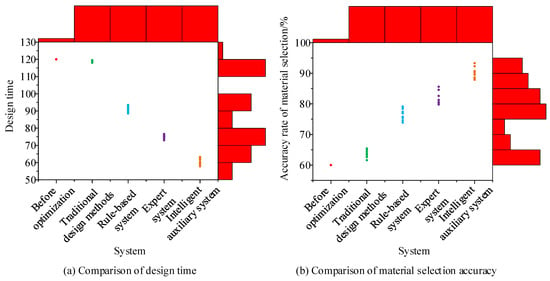
The study conducts comparative experiments with both traditional design methods, rule-based system and expert system. First, a comparison of the design-time improvement and material selection accuracy based on the four methods is shown in Figure 8.
Figure 8.
Comparison of design time and accuracy of material selection.
The design-time comparison of each approach before and after optimization is displayed in Figure 8a. Because no auxiliary system is used, the results demonstrate that the traditional manual design method’s design time essentially stays the same. The rule-based system reduces the design time from 120 h to about 90 h due to the introduction of some automated design processes, which improves the design efficiency by 25%. The expert system further optimizes the design process by simulating the decision-making process of experts, which reduces the design time from 120 h to 75 h and improves the design efficiency by 37.5%. The proposed DSS significantly improved design efficiency by integrating AI-enabled decision support into the design workflow. This reduces design time by 50%, from 120 h to 60 h. Figure 8b shows the comparison of material selection accuracy before and after optimization. The results show that the AI-driven decision support system used in the study has the highest accuracy rate after optimization, with the value increasing from 60.0% before optimization to about 90.2%. The study further compares the environmental impact reduction rates of the four methods under different environmental conditions. The results are shown in Figure 9.
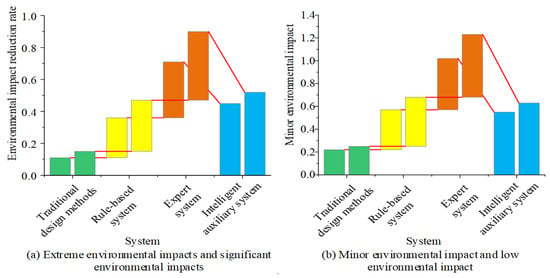
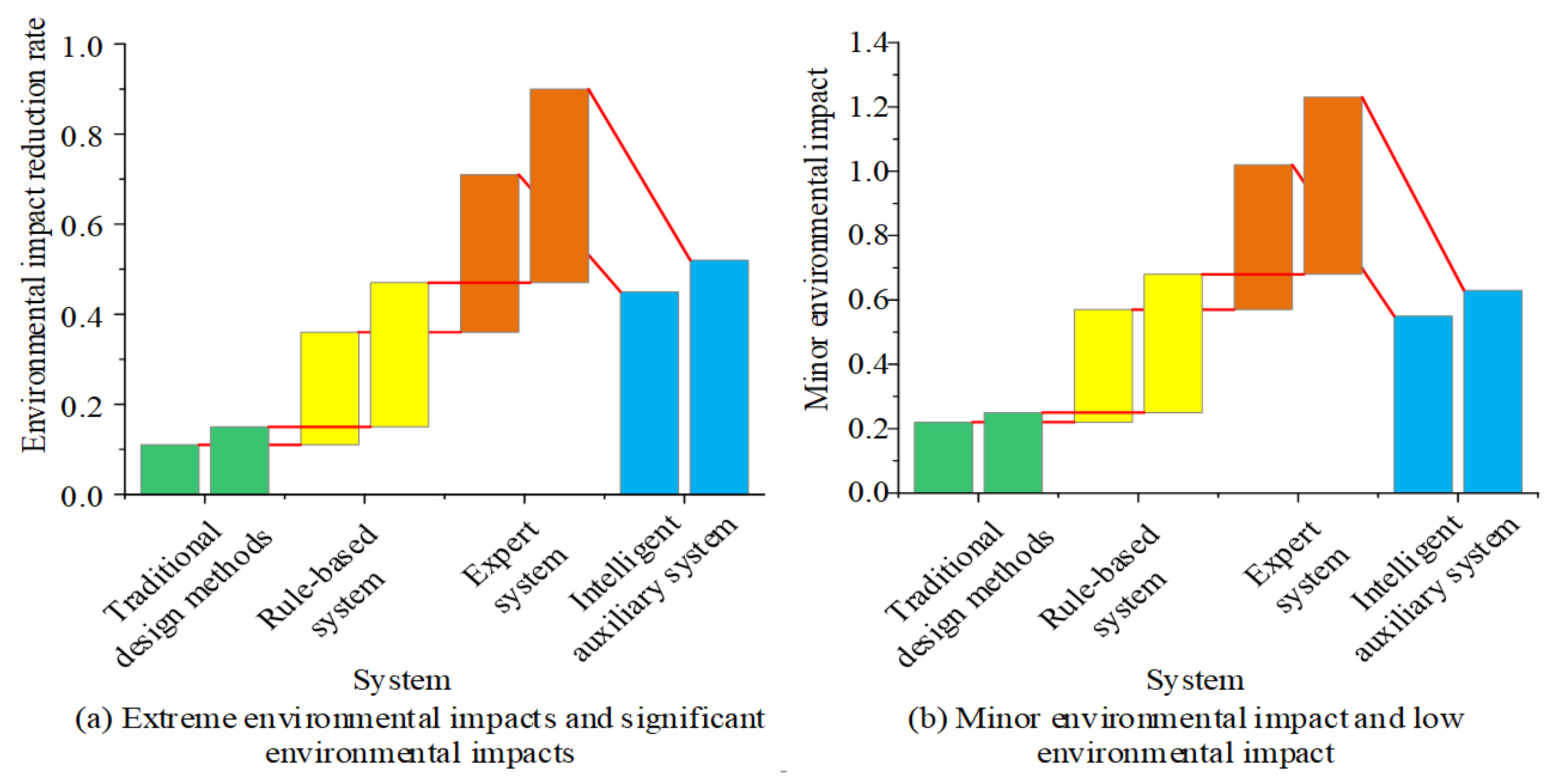
Figure 9.
Comparison of environmental impact reduction rates.
Figure 9a shows a comparison of the rate of reduction in environmental impacts of the four methods under extreme and significant environmental impacts. Figure 9b shows the comparison of the environmental impact reduction rate under slight and low environmental impacts. The results show that the traditional design method has the lowest environmental impact reduction rate, with values ranging from 0.10 to 0.25. It shows that traditional methods have limited effectiveness in reducing environmental impacts. The proposed DSS achieved the highest environmental impact reduction rates under all evaluated conditions. It shows that the AI-driven decision support system has significant advantages in dealing with various environmental impacts. The study compares the benefits of the four methods in terms of cost reduction for each month of 2024. Figure 10 displays the findings.
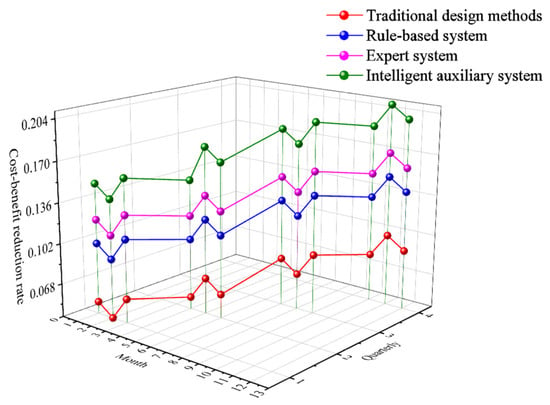
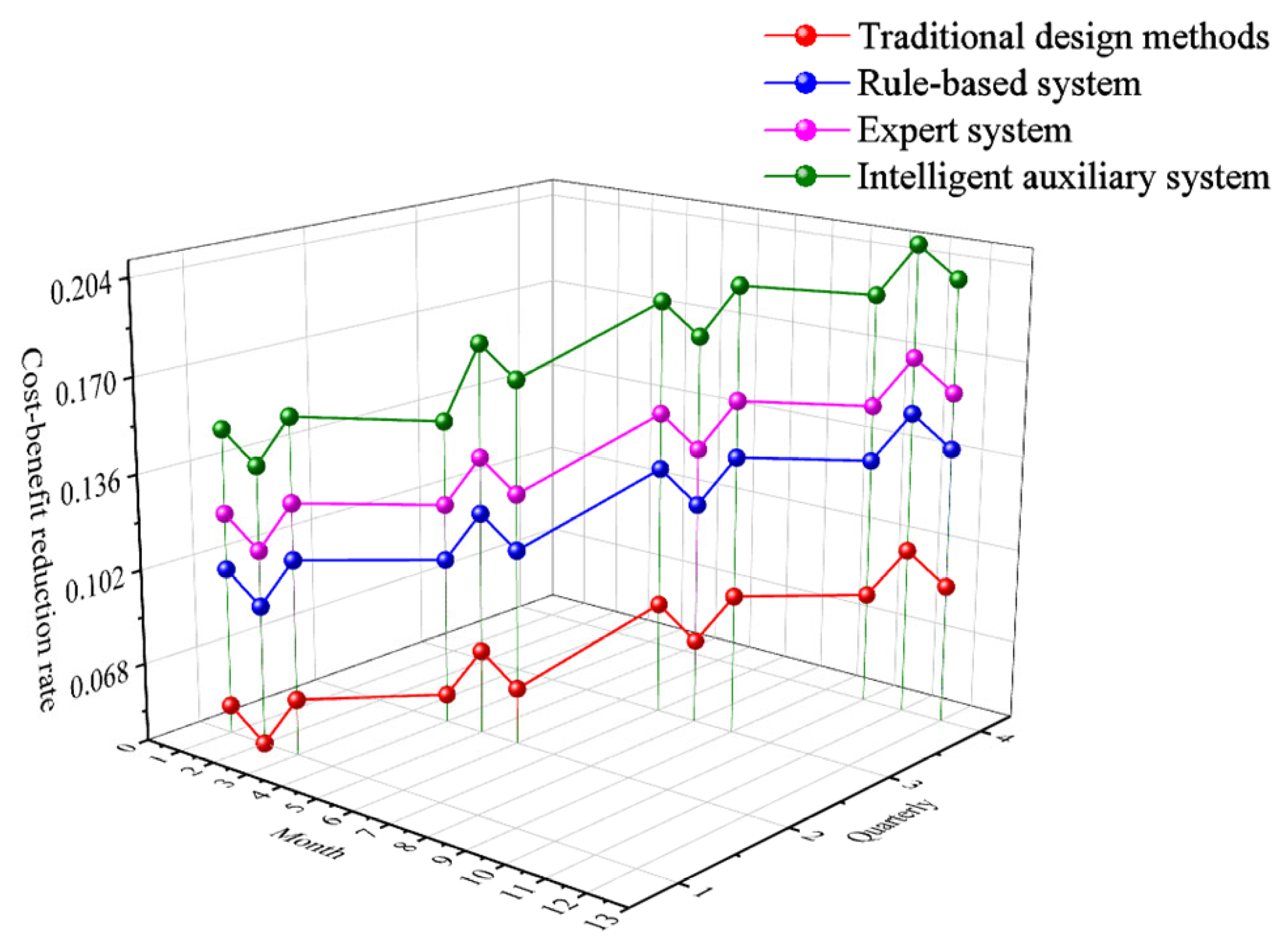
Figure 10.
Cost reduction and benefit comparison.
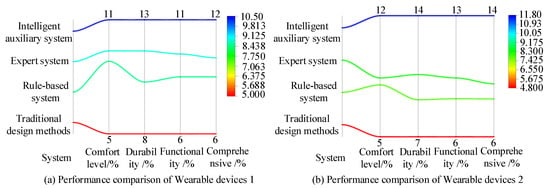
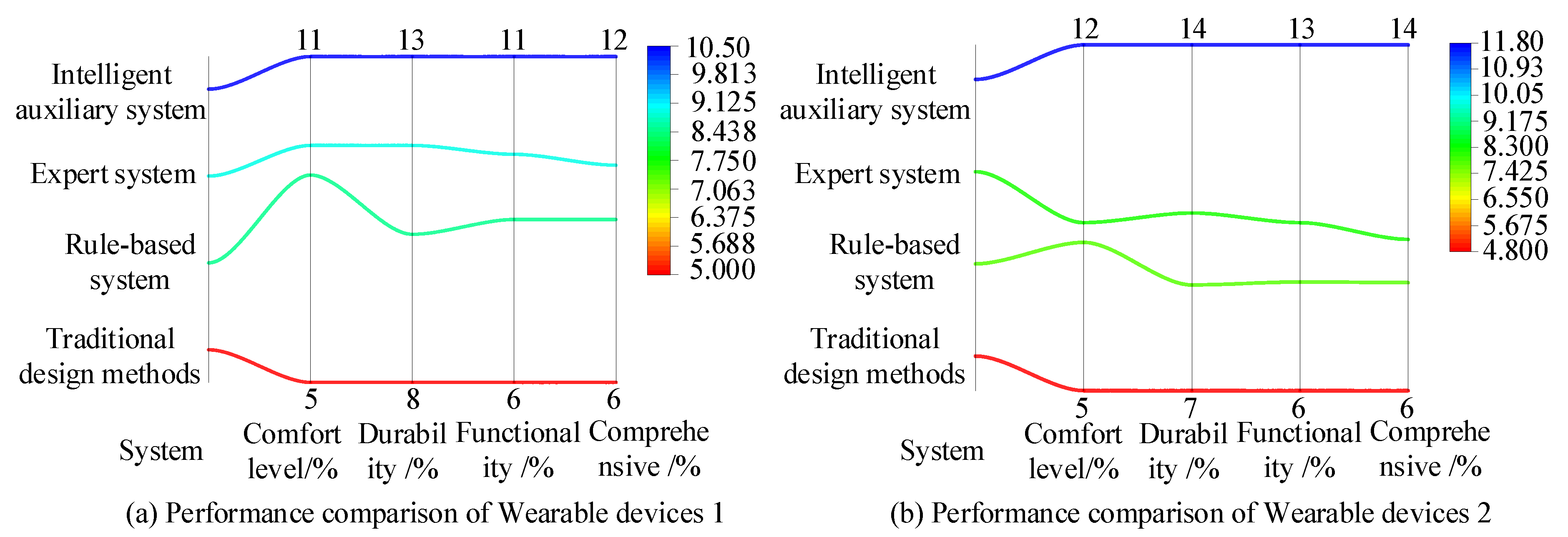
In Figure 10, the traditional design approach shows relatively low-cost reduction benefits throughout the year, with values stabilizing between 4% and 9%. The rule-based system shows slightly better cost-effectiveness, with benefits ranging from 9% to 15%, demonstrating the advantages of rule-based decision support. The expert system demonstrates greater adaptability and decision-making ability by modeling the decision-making processes of experts. This increases cost-effectiveness by 11 to 17 percent. Finally, AI-driven decision support systems are the most cost-effective in each month, with values lying between 14 and 21%. It shows that intelligent systems are superior in analyzing and optimizing the design process, especially in handling complex data and automating decision-making. The study further compares the effectiveness of the four methods in improving the comfort, durability, and functionality of wearable devices. The results are shown in Figure 11.
Figure 11.
Comparison of performance improvement effects of wearable devices.
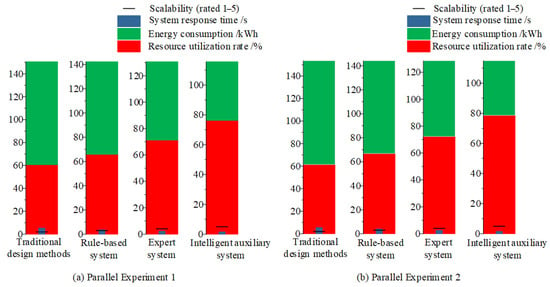
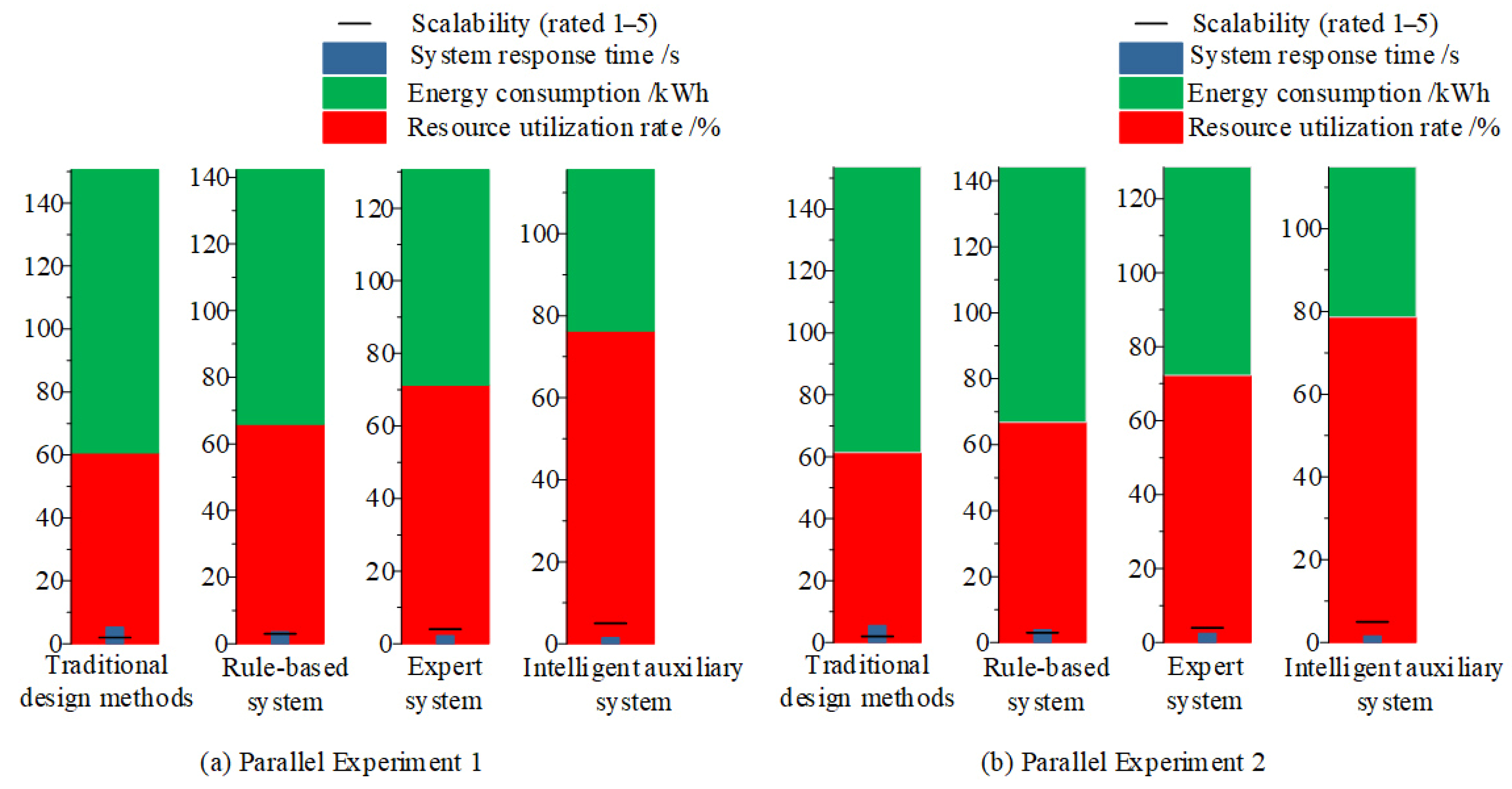
Figure 11a and Figure 11b show a comparison of the wearing performance enhancement of each method for wearable smart device 1 and wearable smart device 2, respectively. The results show that the proposed AI-driven DSS outperforms the control method in terms of comfort, durability, functionality, and overall performance enhancement. Specifically, it enhances performance by more than 10%. Its average enhancements in comfort, durability, and functionality are 11.2%, 13.5%, and 11.8%, respectively, while the average enhancement in overall performance is 12.8%. The results show that the use of intelligent assistive systems can significantly improve the overall performance of wearable devices and indicate practical potential for improving user-oriented performance and deployment value in smart clothing applications. The study concludes by comparing the resource utilization, energy consumption, system response time, and scalability of the four approaches. The results are shown in Figure 12.
Figure 12.
Comparison of resource utilization rate, energy consumption, system response time and scalability.
Figure 12a and Figure 12b show the comparison of resource utilization, energy consumption, system response time, and scalability of the four methods in parallel experiment 1 and parallel experiment 2, respectively. In terms of system response time, the AI-driven decision support system has the shortest average response time (1.56 s). This value represents the end-to-end latency, which is the total time from when the user submits the design request (inputting material parameters) to when the complete environmental impact report and material recommendation results are displayed on the interface. Among these, data reading (fetching pre-computed statistics from local cache or SSD) takes approximately 0.10 s, the inference of the MDGCN model takes about 1.35 s, and the rendering of the user interface (generating charts and text) takes approximately 0.11 s. In terms of scalability, the proposed DSS received the highest rating (5), indicating the strongest adaptability to evolving design requirements. In terms of operational efficiency, the proposed DSS achieved the highest average resource utilization (77.45%) and the lowest average energy consumption (115.25 kWh) among the compared methods. This indicates that it is the most energy-efficient in its operation and helps reduce operational costs and environmental impact. To clarify the experimental context of the energy consumption data, Table 5 summarizes the key performance indicators of the four methods under the same hardware environment and test load.
Table 5.
Comparison of system-level performance under the same hardware environment and test load.
In Table 5, under a unified hardware environment and test load conditions, the proposed decision support system studied outperformed the traditional design methods, rule-based systems, and expert systems in four indicators: resource utilization (77.45%), energy consumption (115.25 kWh), response time (1.56 s), and scalability (5.0 points). Compared with the expert system with the second-best performance, this system reduced energy consumption by approximately 29%, shortened response time by 32%, and increased resource utilization by 13.5%. In summary, the system has significant advantages in terms of computational efficiency and environmental friendliness, and is more suitable for practical design scenarios with frequent interactions and sustainability-oriented design requirements.
3.3. System Application Case: Heart Rate Monitoring Sports T-Shirt
To further demonstrate the operational process of the web-based prototype, the system was applied to a typical smart clothing design task: a heart-rate-monitoring sports T-shirt. This case was selected because it requires a balance among flexibility, skin-contact comfort, sensor integration, and environmental impact, making it suitable for validating the decision-support logic of the proposed system. The designer input the material parameter requirements: elastic modulus of 80–120 MPa, tensile elongation of ≥300%, and recovery rate of ≥85%. The system retrieved the flexible materials that met the conditions from the WTMPD database. Taking a certain type of thermoplastic polyurethane elastomer (TPU) as the benchmark, it predicted its carbon footprint to be 1.85 kg CO2 eq per piece, water footprint 0.62 m3 per piece, and recyclability score 72. At the same time, it recommended an alternative material—bio-based polyurethane (Bio-PU). This material maintains the elastic modulus (only decreasing by 5%) while reducing the carbon footprint by 18%, the water footprint by 21%, and the recyclability to 81%. The system outputs a trade-off analysis report for the designer’s decision reference. This case demonstrates that the proposed system can provide material substitution recommendations and environmental trade-off analysis during the early design stage. However, the current validation focuses on design-stage decision support rather than long-term wearer-based physiological monitoring. Future studies will further evaluate the recommended material schemes through physical prototyping, wearer trials, and outdoor environmental testing.
4. Discussion
The results indicate that the proposed framework should be understood not merely as an intelligent design tool, but as an AI-driven decision support system for sustainable smart clothing design. By integrating material properties, environmental indicators, and design requirements within a unified analytical framework, the proposed DSS supports adaptive and data-driven decision-making under multi-constraint conditions. According to the experimental findings, the MDGCN model suggested in the study achieved a recall of 0.923 and an accuracy of 0.964 on the WTMPD dataset. On the EIAD dataset, the accuracy and recall reached 0.943 and 0.920, respectively. The results were more consistent with those of the study by P. Wu et al., which proposed a MDGCN model for the current situation, where was difficult to capture the dynamic features of complex industrial processes, the low accuracy of fault recognition, and the lack of real-time performance of a traditional GCN [35]. The results showed that on the benchmark dataset, the MDGCN improved the fault diagnosis accuracy from 92.4% to 99.1% for a traditional GCN. Meanwhile, its average F1 score for 10 types of typical faults reached 98.7% in a continuous 72 h test, verifying the excellent performance of the MDGCN model. In terms of system response time, the AI-driven decision support system had an average response time of 1.56 s. This was faster than the traditional design method (5.3 s), the rule-based system (3.6 s), and the expert system (2.3 s). This demonstrated the AI-driven decision support system’s ability to process quickly. In terms of resource utilization, the AI-driven decision support system reached 77.45%, which was significantly higher than the other methods, showing its efficiency in resource use. In terms of energy consumption, the AI-driven decision support system model consumed 115.25 kWh, which was much lower than the other methods, demonstrating its potential to reduce environmental impacts. In terms of scalability, the proposed DSS received the highest rating of 5, reflecting its strong ability to adapt to future changes in demand. Despite the superior performance of the intelligent assist system, there were some differences between it and the findings of P. Wang et al., which proposed a set of integrated design frameworks incorporating AI algorithms-flexible sensing-ergonomics to address the pain points of the lack of practicality of smart garments in terms of algorithm optimization, sensing integration, and wearing comfort [36,37,38,39]. The outcomes revealed that the accuracy of the frame for motion artifact recognition improved from 82% to 97%. After 8 h of continuous wear, the subject’s skin temperature rise was controlled within 1.2 °C, and the comfort score improved by 29%. Although some specialized systems may achieve higher task-specific recognition accuracy under fixed and resource-intensive settings, the proposed DSS demonstrated more balanced performance in terms of decision efficiency, sustainability-related outcomes, and operational feasibility.
4.1. Positioning Within Wearable AI and Mersivity
From the perspective of Wearable AI and Mersivity, smart clothing can be regarded as a technological vessel that mediates interaction between the wearer’s internal state, computational intelligence, and the external environment. Mersivity emphasizes that wearable technologies should not only immerse users in technological systems but also connect them to their surroundings through reciprocal human–technology–environment relationships. In this sense, the proposed system contributes to the design-stage construction of such relationships by linking flexible material properties, environmental impact metrics, and designer-oriented functional requirements.
Conceptually, the proposed system covers several key information pathways in the human–technology–environment relationship. The designer provides material and design requirements to the system, and the system returns material recommendations and environmental impact reports, forming a human–technology interaction loop. Environmental indicators, including carbon footprint, water footprint, and recyclability, are incorporated into the computational model, forming an environment-to-technology information pathway. The resulting material substitution recommendations can indirectly reduce environmental burden through early-stage design optimization.
However, the current system should not be regarded as a fully closed-loop immersive wearable system. In particular, real-time feedback from deployed garments, wearers, and outdoor environmental conditions has not yet been incorporated into the model. Therefore, one signal-flow pathway related to post-deployment wearer–environment feedback remains underdeveloped. This limitation is acknowledged, and future work will integrate real-time physiological sensing, environmental sensing, and field-use feedback to extend the system from a design-stage decision support tool to a closed-loop wearable AI platform.
4.2. Practical Applicability, Limitations, and Future Extensions
In terms of practical applicability, the feasibility of the proposed system should be interpreted within the scope of design-stage decision support. Its effectiveness mainly depends on three key factors: the standardization degree of the design scenarios, the availability of material data, and the dynamic adaptability of environmental assessment. For design tasks with standardized material testing procedures and clear environmental protection goals (such as the early concept screening of enterprise-level intelligent clothing product lines), the system can achieve maximum effectiveness; however, for scenarios that heavily rely on the subjective experience of designers or involve small-batch customization with new and unrecorded materials, the predictive reliability will significantly decrease. Moreover, the environmental assessment of the system relies on a static LCA database, while actual production processes, energy structures, and regional environmental protection standards vary in time and space, which may lead to deviations between carbon footprint estimations and actual values. Therefore, the system is more suitable as a decision support tool in the design process rather than an alternative to automated design. Its practical promotion requires complementarity with the experience judgment of designers and the establishment of a regular update mechanism for the database to maintain the timeliness of the assessment.
Therefore, the proposed system is more suitable for early-stage material screening, environmental impact estimation, and design alternative comparison, rather than replacing wearer-based product validation or long-term field testing.
5. Conclusions
This study successfully constructed and validated an AI-driven decision support system for sustainable smart clothing design. The numerical results further confirm the significant advantages of the AI-driven decision support system in improving design efficiency (design time reduced by 50%, material selection accuracy reaching 90.2%), reducing cost, minimizing environmental impact (energy consumption of 115.25 kWh, 29% lower than the expert system, carbon footprint reduction up to 18% in material substitution), and enhancing user experience (end-to-end response time of 1.56 s, resource utilization of 77.45%). Although the study has achieved better results, there are still some shortcomings. The generalization ability and robustness of the model have not yet been validated in a wider range of practical application scenarios. Future research will further test the adaptability and robustness of the model on different material datasets and practical smart clothing scenarios. In addition, the current system remains a design-stage decision support tool rather than a fully closed-loop wearable AI platform. Real-time wearer feedback, physiological sensing data, and outdoor environmental data have not yet been integrated into the decision loop. Future work will extend the proposed framework toward a closed-loop socio-cyber-physical wearable platform by incorporating physical prototyping, wearer-centered evaluation, and continuous environmental feedback.
Author Contributions
Conceptualization, Y.L. and F.Z.; methodology, Y.L. and F.Z.; software, Y.L. and F.Z.; validation, Y.L. and F.Z.; formal analysis, Y.L.; investigation, F.Z.; resources, H.L. and D.W.; data curation, F.Z.; writing—original draft preparation, F.Z. and Y.L.; writing—review and editing, M.K.; visualization, F.Z.; supervision, J.L. and M.K.; project administration, M.K.; funding acquisition, J.L. and M.K. All authors have read and agreed to the published version of the manuscript.
Funding
This research received no external funding.
Institutional Review Board Statement
Ethical review and approval were waived for this study because the pilot deployment only evaluated the usability and task-level performance of a design support system and did not involve medical intervention, physiological data collection, or personally identifiable information.
Informed Consent Statement
All designers were informed of the purpose of the pilot deployment and voluntarily agreed to participate.
Data Availability Statement
The dataset is available on request from the authors.
Conflicts of Interest
The authors declare no conflicts of interest.
References
- Shin, S.Y.; Jo, G.; Wang, G. A novel method for fashion clothing image classification based on deep learning. J. Inf. Commun. Technol. 2023, 22, 127–148. [Google Scholar] [CrossRef] [Scilit]
- Haruna, A.A.; Muhammad, L.J.; Abubakar, M. Novel thermal-aware green scheduling in grid environment. Artif. Intell. Appl. 2022, 1, 244–251. [Google Scholar] [CrossRef]
- Zhang, Y.; He, K.; Song, R. Image multi-feature fusion for clothing style classification. IEEE Access 2023, 11, 107843–107854. [Google Scholar] [CrossRef] [Scilit]
- Islam, T.; Miron, A.; Liu, X.; Li, Y. StyleVTON: A multi-pose virtual try-on with identity and clothing detail preservation. Neurocomputing 2024, 594, 127887. [Google Scholar] [CrossRef] [Scilit]
- Xia, T.; Zhang, J. Clothing classification using transfer learning with squeeze and excitation block. Multimed. Tools Appl. 2023, 82, 2839–2856. [Google Scholar] [CrossRef] [Scilit]
- Zhou, Z.; Liu, M.; Deng, W. Clothing image classification with DenseNet201 network and optimized regularized random vector functional link. J. Nat. Fibers 2023, 20, 2190188. [Google Scholar] [CrossRef] [Scilit]
- Longo, F.; Padovano, A.; Cimmino, B.; Pinto, P. Towards a mass customization in the fashion industry: An evolutionary decision aid model for apparel product platform design and optimization. Comput. Ind. Eng. 2021, 162, 107742. [Google Scholar] [CrossRef] [Scilit]
- Mann, S.; Cooper, M.; Ferren, B.; Coughlin, T.M.; Frankston, B. Mersivity: Wearable artificial intelligence and spatial extended reality for humanity and earth. IEEE Consum. Electron. Mag. 2026, 15, 4–8. [Google Scholar] [CrossRef] [Scilit]
- Park, S.; Jayaraman, S. Smart textiles: Wearable electronic systems. MRS Bull. 2003, 28, 585–591. [Google Scholar] [CrossRef] [Scilit]
- Billinghurst, M.; Starner, T. Wearable devices: New ways to manage information. Computer 2002, 32, 57–64. [Google Scholar] [CrossRef] [Scilit]
- Anhalt, J.; Smailagic, A.; Siewiorek, D.P. Toward context-aware computing: Experiences and lessons. IEEE Intell. Syst. 2001, 16, 38–46. [Google Scholar] [CrossRef]
- Ozer, O.F.; Ozun, O.; Tuzel, C.O. Vision-based single-stroke character recognition for wearable computing. IEEE Intell. Syst. 2001, 16, 33–37. [Google Scholar] [CrossRef]
- Dong, M.; Zhou, D.; Ma, J. Towards intelligent design: A self-driven framework for collocated clothing synthesis leveraging fashion styles and textures. In Proceedings of the IEEE International Conference on Acoustics, Speech and Signal Processing (ICASSP), Seoul, Republic of Korea, 14–19 April 2024; IEEE: Piscataway, NJ, USA, 2024; pp. 3725–3729. [Google Scholar] [CrossRef] [Scilit]
- Yu, D.; Zhao, P. Research on network clothing design system based on artificial intelligence. Procedia Comput. Sci. 2024, 247, 27–35. [Google Scholar] [CrossRef] [Scilit]
- Choi, W.; Jang, S.; Kim, H.Y. Developing an AI-based automated fashion design system: Reflecting the work process of fashion designers. Fash. Text. 2023, 10, 39. [Google Scholar] [CrossRef] [Scilit]
- Mu, X.; Zhang, H.; Shi, J. Fashion intelligence in the Metaverse: Promise and future prospects. Artif. Intell. Rev. 2024, 57, 67. [Google Scholar] [CrossRef] [Scilit]
- Jing, W.; Yin, Y.; Luo, W. Outdoor clothing choice for different populations in cold regions: A clothing choice prediction model based on machine learning. Energy Build. 2023, 289, 113069. [Google Scholar] [CrossRef] [Scilit]
- Forster, P.; Storelvmo, T.; Armour, K.; Collins, W.; Dufresne, J.-L.; Frame, D.J.; Lunt, D.J.; Mauritsen, T.; Palmer, M.D.; Watanabe, M.; et al. The Earth’s Energy Budget, Climate Feedbacks and Climate Sensitivity. In Climate Change 2021—The Physical Science Basis: Working Group I Contribution to the Sixth Assessment Report of the Intergovernmental Panel on Climate Change; Masson-Delmotte, V., Zhai, P., Pirani, A., Connors, S.L., Péan, C., Berger, S., Caud, N., Chen, Y., Goldfarb, L., Gomis, M.I., et al., Eds.; Cambridge University Press: Cambridge, UK, 2021; pp. 923–1054. [Google Scholar] [CrossRef] [Scilit]
- ISO 14021:2016; Environmental Labels and Declarations—Self-Declared Environmental Claims (Type II Environmental Labelling). International Organization for Standardization: Geneva, Switzerland, 2016.
- Lee, D.; Kang, H.; Lee, I.K. ClothCombo: Modeling inter-cloth interaction for draping multi-layered clothes. ACM Trans. Graph. 2023, 42, 1–13. [Google Scholar] [CrossRef] [Scilit]
- Huang, B.; Lu, Q.; Huang, S. Multi-modal clothing recommendation model based on large model and VAE enhancement. In Proceedings of the 7th Artificial Intelligence and Cloud Computing Conference; Association for Computing Machinery: New York, NY, USA, 2024; pp. 379–385. [Google Scholar] [CrossRef] [Scilit]
- Ma, W.; Guan, Z.; Wang, X. YOLO-FL: A target detection algorithm for reflective clothing wearing inspection. Displays 2023, 80, 102561. [Google Scholar] [CrossRef] [Scilit]
- Ariessaputra, S.; Vidiasari, V.H.; Al Sasongko, S.M. Classification of Lombok Songket and Sasambo Batik motifs using the convolution neural network (CNN) algorithm. JOIV Int. J. Inform. Vis. 2024, 8, 38–44. [Google Scholar] [CrossRef] [Scilit]
- Zhu, S.; Liu, X. The Ecodesign Transformation of Smart Clothing: Towards a Systemic and Coupled Social–Ecological–Technological System Perspective. Sustainability 2025, 17, 2102. [Google Scholar] [CrossRef] [Scilit]
- Su, X.; Duan, J.; Ren, J. Personalized clothing recommendation fusing the 4-season color system and users’ biological characteristics. Multimed. Tools Appl. 2024, 83, 12597–12625. [Google Scholar] [CrossRef] [Scilit]
- Choi, E.J.; Yun, J.Y.; Choi, Y.J. Impact of thermal control by real-time PMV using estimated occupants personal factors of metabolic rate and clothing insulation. Energy Build. 2024, 307, 113976. [Google Scholar] [CrossRef] [Scilit]
- Aparicio-Ruiz, P.; Barbadilla-Martín, E.; Guadix, J. Predicting the clothing insulation through machine learning algorithms: A comparative analysis and a practical approach. Build. Simul. 2024, 17, 839–855. [Google Scholar] [CrossRef] [Scilit]
- Bhatlawande, S.; Borse, R.; Solanke, A. A smart clothing approach for augmenting mobility of visually impaired people. IEEE Access 2024, 12, 24659–24671. [Google Scholar] [CrossRef] [Scilit]
- Choi, E.J.; Choi, Y.J.; Kim, N.H. Seasonal effects of thermal comfort control considering real-time clothing insulation with vision-based model. Build. Environ. 2023, 235, 110255. [Google Scholar] [CrossRef] [Scilit]
- Wu, J.; Huang, Y.; Gao, M. A two-stream hybrid convolution-transformer network architecture for clothing-change person re-identification. IEEE Trans. Multimed. 2024, 26, 5326–5339. [Google Scholar] [CrossRef] [Scilit]
- Glogar, M.; Petrak, S.; Mahnić Naglić, M. Digital technologies in the sustainable design and development of textiles and clothing: A literature review. Sustainability 2025, 17, 1371. [Google Scholar] [CrossRef] [Scilit]
- Liu, X.; Li, J.; Lu, G. Robust and automatic clothing reconstruction based on a single RGB image. Comput. Graph. 2022, 110, 98–110. [Google Scholar] [CrossRef] [Scilit]
- Wang, F.; Kyoung, K.J. Leather defect detection method in clothing design based on TDENet. IEEE Access 2023, 11, 104890–104904. [Google Scholar] [CrossRef] [Scilit]
- Zhou, D.; Zhang, H.; Ma, J.; Shi, J. BC-GAN: A generative adversarial network for synthesizing a batch of collocated clothing. IEEE Trans. Circuits Syst. Video Technol. 2024, 34, 3245–3259. [Google Scholar] [CrossRef] [Scilit]
- ASTM D412-16(2021); Standard Test Methods for Vulcanized Rubber and Thermoplastic Elastomers—Tension. ASTM International: West Conshohocken, PA, USA, 2021.
- ISO 37:2017; Rubber, Vulcanized or Thermoplastic—Determination of Tensile Stress-Strain Properties. International Organization for Standardization: Geneva, Switzerland, 2017.
- Pang, Z.; Zhao, L.; Wang, C. Clothing-invariant contrastive learning for unsupervised person re-identification. Neural Netw. 2024, 178, 106477. [Google Scholar] [CrossRef] [Scilit] [PubMed]
- Mengistu, A.T.; Dieste, M.; Panizzolo, R.; Biazzo, S. Sustainable product design factors: A comprehensive analysis. J. Clean. Prod. 2024, 463, 142260. [Google Scholar] [CrossRef] [Scilit]
- Dulal, M.; Afroj, S.; Karim, N. Sustainable eco-design approach for next-generation wearable e-textiles. J. Clean. Prod. 2025, 504, 145404. [Google Scholar] [CrossRef] [Scilit]

Disclaimer/Publisher’s Note: The statements, opinions and data contained in all publications are solely those of the individual author(s) and contributor(s) and not of MDPI and/or the editor(s). MDPI and/or the editor(s) disclaim responsibility for any injury to people or property resulting from any ideas, methods, instructions or products referred to in the content. |
© 2026 by the authors. Published by MDPI on behalf of the International Institute of Knowledge Innovation and Invention. Licensee MDPI, Basel, Switzerland. This article is an open access article distributed under the terms and conditions of the Creative Commons Attribution (CC BY) license.