Article

A Constrained-Aware Genetic Algorithm for Coverage Optimization in Range-Free Sensor Networks

by
Ioannis S. Barbounakis
,
Ioannis V. Saradopoulos
,
Nikolaos E. Antonidakis
,
Erietta Vasilaki
and
Maria S. Zakynthinaki
*
Department of Electronic Engineering, Hellenic Mediterranean University, Romanou 3, 73133 Chania, Greece
*
Author to whom correspondence should be addressed.
Appl. Syst. Innov. 2026, 9(5), 84; https://doi.org/10.3390/asi9050084
Submission received: 13 February 2026 / Revised: 16 April 2026 / Accepted: 20 April 2026 / Published: 23 April 2026

Abstract

Wireless sensor networks increasingly support time-critical monitoring applications, where coverage optimization must often be performed under limited computational resources. This work addresses a previously underexplored WSN coverage problem involving range-free, angular-limited sensors with transmitter-induced sensing degradation and discrete sector orientation. We formulate a mixed combinatorial problem that jointly optimizes K -out-of- N sensor activation and sector assignment under strict feasibility constraints. A constraint-aware genetic algorithm with repair-based feasibility enforcement is proposed and validated against the global optimum obtained via exhaustive enumeration, enabling direct quantification of optimality. The repair mechanism corrects infeasible offspring after each genetic operation to guarantee that exactly K sensors remain active, eliminating the need for penalty-based constraint handling. A brute-force search is used to establish the global optimum of our small-scale scenario, serving as a ground-truth optimality benchmark for evaluating the proposed method. The purpose of this comparison is not to assess competitiveness against other metaheuristic algorithms, but to quantify how closely the proposed approach approximates the true optimal solution under strict problem constraints. The constraint-aware genetic algorithm is developed using an integer chromosome encoding, two initialization strategies, two crossover pairing schemes, elitism, and per-gene mutation, combined with alternative constraint-handling strategies. Two experimental series evaluate the impact of population size, crossover method, mutation probability, and constraint handling using problem-specific metrics, alongside convergence and fitness statistics. The proposed algorithm reliably reaches near-optimal solutions with significantly reduced computational cost when compared to exhaustive search. By integrating problem-specific constraints directly into the process, the proposed evolutionary optimization method effectively balances solution quality and execution time, making it well suited for scenarios requiring rapid sensor reconfiguration.

1. Introduction

The scope of wireless sensor networks (WSNs) has been expanding all these years to sectors that previously were unimaginable. Information collected by sensors (SRs) is useful for anticipating and giving warnings about unusual occurrences within the monitoring area. Therefore, WSNs support a variety of applications in environmental studies, healthcare, military, industry, agriculture, and IoT.
A thorough literature review on WSN coverage has been performed in [1] highlighting a range of optimization methodologies, from greedy placement and triangulation-based algorithms [2,3] to advanced metaheuristics such as grey wolf optimizers [4]. While these approaches effectively maximize coverage in large-scale WSN with dense SR deployments, they often rely on short-range SRs and require extensive inter-node communication, which differs from our case where SRs operate independently. Surveys such as [5,6] emphasize challenges related to probabilistic coverage, connectivity, and network lifetime, yet often neglect the role of obstacles within the area of interest (AoI). Our work addresses this gap by considering previously detected transmitters (TRs) as obstacles and by employing inertia-type SRs [7,8], whose sensing geometry is unaffected by environmental factors. The research presented in [1,9] refers to the deployment of range-free, angular-limited SRs. Such SRs are suitable for real-time localization of unknown TRs that might enter the AoI, with applications spanning both civilian and military domains.
To illustrate the practical relevance of this coverage optimization, we briefly outline here two representative use cases. In border or perimeter surveillance, a network of directional SRs is deployed along a restricted zone to detect electromagnetic emissions from unauthorized transmitters (e.g., communication devices carried by intruders). In spectrum monitoring within urban or industrial environments, directional SRs are positioned around a facility to detect and localize rogue RF transmitters that may interfere with licensed communication bands. In both scenarios, the optimization framework determines which K SRs to activate and in which angular orientation, maximizing the area covered by three or more SRs and thus the probability of successful localization. Central to both use cases is the range-free nature of the sensing system. While the detectability of a TR by a given SR may depend on received signal strength (which determines whether the transmitter falls within the SR’s effective sensing range), no distance information is extracted from the signal. The SRs measure only the angular direction of incoming signals above a predefined threshold. Consequently, localization is achieved exclusively through the geometric intersection of directional bearings from multiple SRs, and the system is classified as range-free.
In this work, we distinguish between deployment and activation. Deployment refers to the one-time physical installation of an SR at a fixed candidate location. Therefore, all N SRs are assumed to be already deployed and hardware-ready. Activation refers to the operational state transition in which a deployed SR is powered on and assigned a specific angular sector for sensing during a given optimization cycle. While deployment cost typically exceeds the per-cycle activation cost, the latter remains operationally significant as each activation consumes finite energy reserves and introduces mechanical wear.
In practice, both technical and economic constraints often limit the number of SRs that can be simultaneously activated, thus influencing the coverage capability of a WSN. As a result, a practical approach is to activate only K SRs out of a larger set of N   candidate SR locations. In the present study, therefore, we have formulated the following optimization problem: given N potential SR locations, determine the optimal subset of K active SRs (where K   <   N ) that maximizes the spatial coverage of a predefined AoI, considering previously detected TRs. The problem is examined under static conditions, assuming that SR positions, known and newly detected TRs, remain fixed during each optimization cycle. Beyond maximizing coverage, this work also investigates efficient computational strategies capable of producing near-optimal WSR configurations within minimal execution time. This requirement is motivated by practical deployment scenarios in which optimization must be performed at the edge of the WSN, where computational resources and energy availability are inherently limited. Additionally, constraints on response latency and the limited accessibility of high-performance computing infrastructures are taken into consideration, highlighting the need for lightweight, real-time–oriented optimization solutions.
As the objective focuses on maximizing area coverage across all possible combinations of SR placements and their optimal angular orientations, identifying the best configuration efficiently becomes crucial. Here, efficiency encompasses both computational feasibility (minimizing the time and resources required to explore the solution space) and solution quality (achieving optimal or near-optimal coverage without exhaustively evaluating every potential configuration). This is a recurring optimization problem where the combinatorial growth of possible SR configurations, often numbering in hundreds of thousands or even millions [10,11], renders exhaustive search rapidly infeasible. Although brute-force methods guarantee identification of the global optimum [12], the computational demands are in practice prohibitive. Prior studies illustrate this trade-off: improved precision and reduced loss have been demonstrated in neural network training [13], albeit with substantial computational cost, while high accuracy in data search tasks has been confirmed in other work [14]. These findings indicate that brute-force optimization remains valuable when thoroughness is prioritized over efficiency, but practical applications often require alternative approaches.
As is typical with complex optimization problems, there exists a valuable opportunity to apply and rigorously evaluate well-established metaheuristic techniques that have proven effective in analogous domains [15,16,17]. Within the field of WSNs, considerable research has explored how metaheuristic optimization techniques, particularly Genetic Algorithms (GAs), can enhance key performance metrics such as coverage, energy efficiency, and deployment cost [18,19,20]. This is particularly relevant given that WSNs often employ large numbers of short-range SRs, frequently necessitating hundreds of nodes to achieve complete coverage of a designated AoI. GAs offer superior computational efficiency compared to exhaustive methods while maintaining effective exploration of large solution spaces, making them well-suited for SR placement and orientation optimization problems.
The theoretical foundations of GAs trace back to pioneering works in the late 1960s and 1970s with the concept first appearing in Bagley’s doctoral thesis [21] and subsequently developed by Holland [22,23,24] whose work provided the first comprehensive theoretical analysis of evolutionary computation. These foundational contributions were later expanded through influential expositions by Goldberg [16] and Michalewicz [25], establishing GAs as a robust optimization framework across multiple disciplines [26,27]. GAs have proven particularly effective for WSN optimization, addressing critical challenges including energy conservation, node deployment, coverage maximization, clustering, and network lifetime extension [28,29,30,31]. Several studies report that GAs provide a more feasible and efficient option than brute force for complex optimization tasks [20,32]. The effectiveness of GAs stems from their key operators: selection mechanisms that favour high-performing solutions, crossover operations that combine genetic material from parent solutions to create offspring [16,33], mutation operators that introduce random variations to maintain genetic diversity and prevent premature convergence [34], and elitism strategies that preserve the best solutions across generations, consistently improving both solution quality and diversity [35,36]. Recent comprehensive reviews have documented continued advances in GA-based optimization techniques, including hybrid algorithms and enhanced genetic operators [10,37].
The choice of optimization strategy, however, clearly depends on the specific constraints and computational resources of the problem under consideration. In the context of the present study, the specific constraints of the SR selection problem, where exactly K SRs must be selected from N candidate locations, while accounting for obstacle-induced coverage restrictions, necessitate a departure from classical GA implementations. Standard GAs, when applied directly to K out of N selection problems, frequently generate infeasible solutions that violate the cardinality constraint or produce configurations that fail to respect the restrictions. To address these challenges, this work introduces a constraint-aware GA with an integrated repair mechanism, specifically tailored to maintain solution feasibility throughout the evolutionary process. This novel GA approach is designed to ensure that all candidate solutions consistently satisfy the K   out of N constraint, while simultaneously accounting for obstacle-based coverage limitations.
While numerous studies in WSN coverage optimization compare different metaheuristic algorithms, such comparisons are typically performed in large-scale scenarios where the global optimum is unknown. In contrast, the present study adopts a different methodological approach: we focus on a small-to-moderate scale problem instance that allows complete enumeration of the solution space, enabling the computation of the true global optimum. This allows us to evaluate the proposed method in absolute terms, rather than relative to other heuristics, enabling at the same time a stronger, absolute assessment of solution quality. In this study, we employed both brute-force search and a problem-specific, constraint-aware GA within our small-scale SR network scenario. Exhaustive search was first used to determine the global optimum, serving as a reference for evaluating the solution quality of the GA. By integrating repair-based constraint handling and carefully tuning the core GA components (population size, crossover strategy, mutation probability, and elitism) we achieved near-optimal solutions with lower computational cost than brute-force methods. This approach not only ensures robust and efficient performance but also enables real-time adaptation, making it highly suitable for dynamic SR network configurations where exhaustive search is computationally infeasible [38].
It is important to clarify that the objective is not to conduct a comparative benchmarking of multiple metaheuristic algorithms, but rather to develop and evaluate a constraint-aware evolutionary optimization framework tailored to the specific structure of the SR activation and sector assignment problem. The use of exhaustive search in this context serves as a ground-truth benchmark, enabling a direct assessment of how close the proposed method comes to the optimal solution.
The main contributions of the present work are:
  • Obstacle-aware coverage model with TR-induced degradation: Unlike omnidirectional or binary-obstacle models, sensing is locally reduced within angular intervals around TRs, yielding spatially varying blind zones.
  • Joint activation–orientation optimization: We formulate a mixed combinatorial problem that simultaneously selects K active SRs from N and assigns each an optimal discrete sector, differing from standard continuous placement formulations.
  • Constraint-aware GA with repair operator: We design a repair-based feasibility mechanism that enforces the K -out-of- N cardinality constraint and valid sector assignments throughout evolution, avoiding infeasible offspring typical of standard GA operators.
  • Absolute validation via global optimum: By studying an example problem case small enough that the true best solution can be found exactly, we measure how close the GA can get to that known optimum, rather than comparing it to other approximate methods.

2. Materials and Methods

2.1. Problem Statement and Basic Parameter Notation

As discussed in [1], an area is assumed covered only when it is simultaneously covered by at least three SRs, in other words, when it constitutes a 3-SR coverage intersection, a condition defined in this work as triangulation; see also [1,9,39]. However, the detection capability of our SRs is significantly affected by the presence of any TRs within each SR’s sensing range. Each SR’s field of view is influenced by nearby TRs, leading to coverage gaps and a reduction in overall coverage performance. We note that in the classical localization literature, the term ‘triangulation’ refers to position estimation based on angular measurements from known reference points. In our work [1,9,39], we have adopted an operational redefinition of triangulation as the condition whereby a sub-area of the AoI falls within the sensing range of at least three SRs simultaneously. This redefinition is motivated by the geometric requirement of our range-free system. Since each SR provides only directional information, the detection of a new TR necessitates its simultaneous coverage by a minimum of three SRs.
We consider a predefined AoI, monitored by   N SRs strategically positioned at fixed locations outside its boundaries. Each SR, denoted as “ S R i ” (for i = 1 , , N ), is characterized by a maximum sensing distance R i and an angular sector range Φ i . A point within the AoI is regarded as covered by S R i if it lies within both its radial distance R i and its angular sector range Φ i . Figure 1 illustrates an example scenario in which a randomly selected AoI is monitored by a set of N = 9 randomly positioned SRs tasked with scanning it.
To achieve complete coverage of the AoI, each S R i requires a total angular range Δ θ i which can be calculated individually for each SR as Δ θ i = ( θ i e n d θ i s t a r t ) , where:
  • θ i s t a r t   is the starting angle of the total angular range required for S R i , measured from the north, such that the SR’s angular range first intersects the AoI while rotating clockwise.
  • θ i e n d is the ending angle of the total angular range of S R i , also measured from the north, determined such that the SR fully covers the AoI, with both boundaries of its total angular range θ i s t a r t and θ i e n d   being tangent to the borders of the AoI.
If the required angular range exceeds the fixed angular sector range ( Δ θ i > Φ i ), the SR must rotate its sensing sector in discrete angular steps. A common angular turning step θ s t e p is assumed for all SRs. The number of discrete angular sectors required by S R i , denoted as P i , is given by
P i = Δ θ i Φ i θ s t e p ,
where the ceiling operator ensures that P i is an integer.
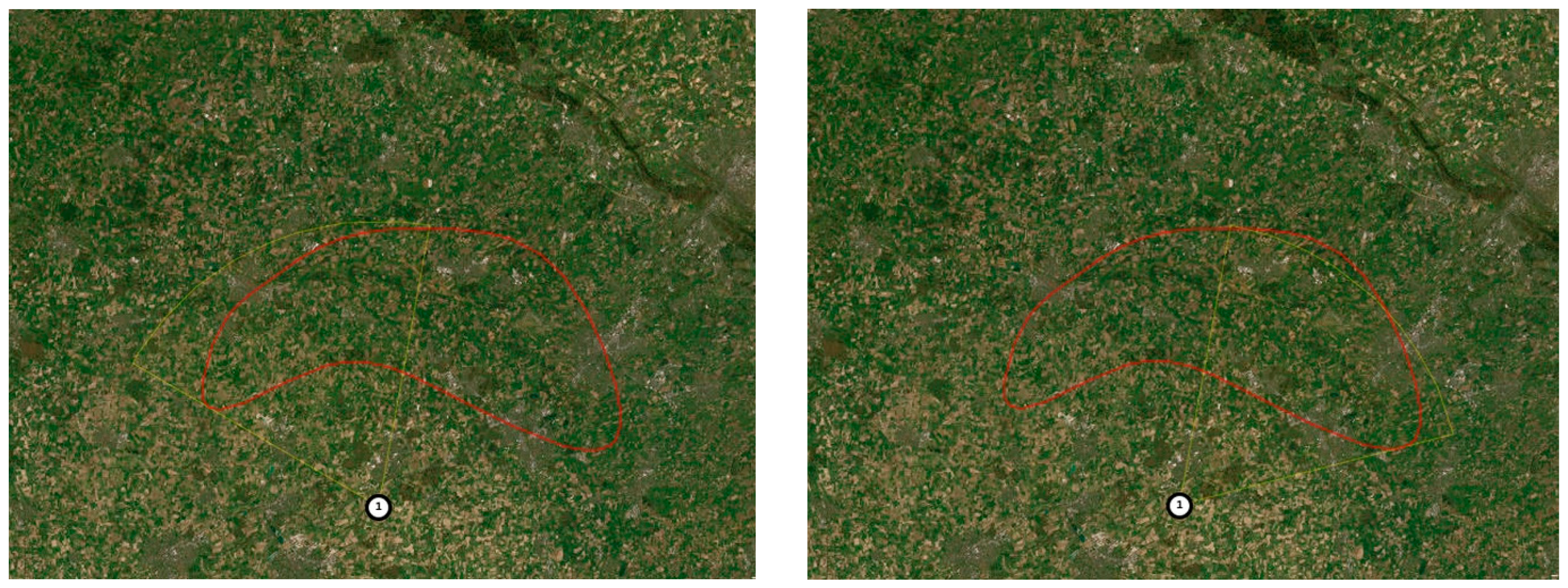
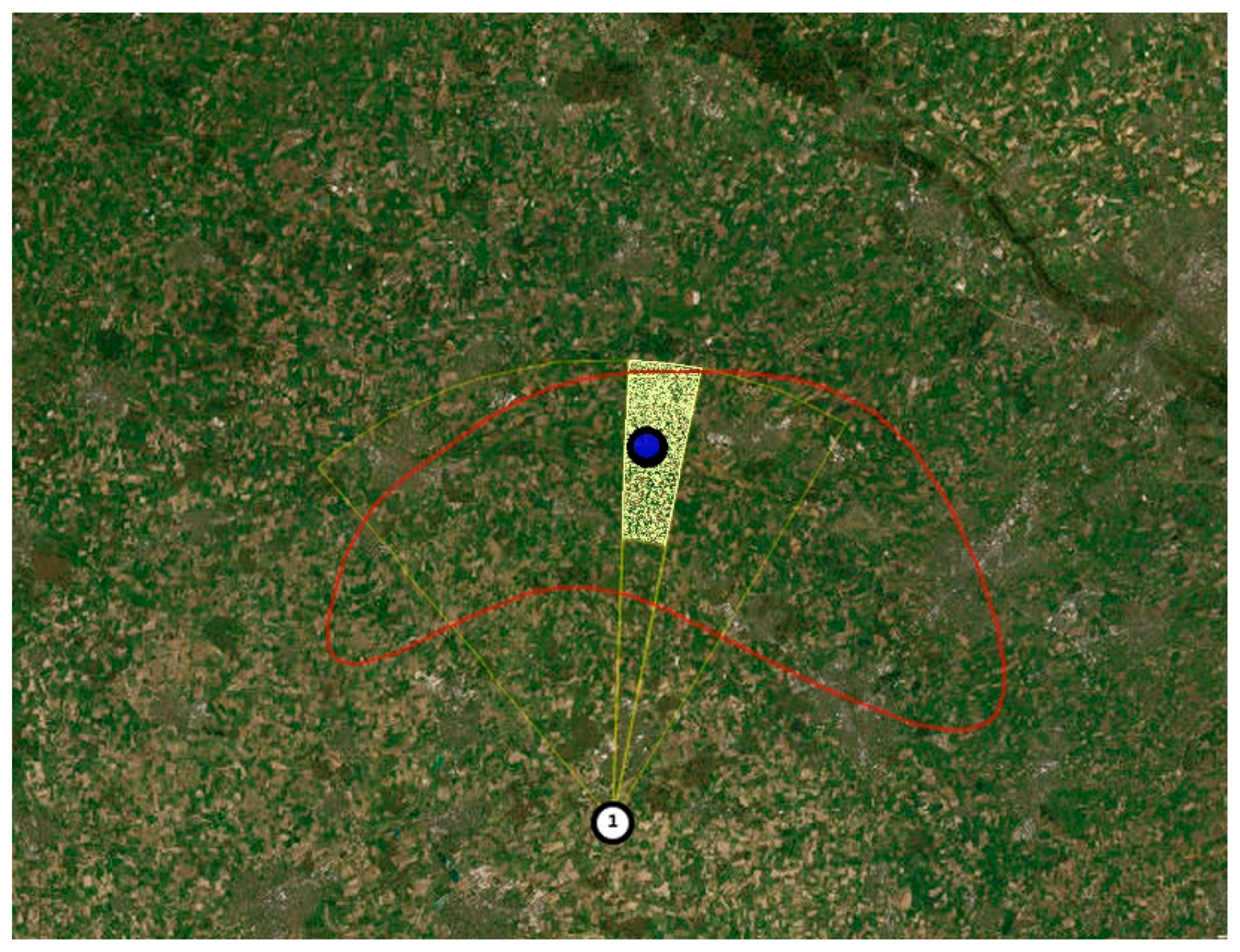
As an example, Figure 2 illustrates S R 1   with Φ 1 = 70 ° . In this specific scenario, assuming angular turning step θ s t e p = 10 ° , it was calculated that S R 1   requires P 1 = 8   discrete angular sectors to fully cover the AoI. Figure 2 displays two of these sectors.
The combination of angular-limited sensing, discrete sector rotation, and TR-induced partial degradation leads to a discrete and tightly constrained search space, which is not addressed by standard WSN coverage formulations.

2.1.1. SR Activation and Sector Assignment

The vector P = P 1 , P 2 , , P N represents the number of discrete angular sectors associated with each of the N SRs. The sector index set of S R i denoted as B i =   [ 1 , 2 , , P i ] contains the indices of all possible discrete angular sectors of that SR.
In practical deployments, only a subset of the N SRs is activated, while the rest of the SRs remain inactive. If exactly K SRs are active ( K N ) , the number W of possible combinations of active SRs is given by the binomial coefficient
W = N K
For each combination j = 1 , 2 , , W , we define the index set G j which has only the indices of the K active SRs. Obviously, there is G j 1 , 2 , , N . If S R i   is active, then i G j and one of its sectors is selected from B i . The total number of possible sector assignments for combination j is
i G j P i .

2.1.2. The Sector Assignment Vector C j

For each combination j , a sector assignment vector C j of length N is defined as
C j ( i ) = b i , i f   i G j   ( active   SR )   and   sector   b i B i   i s   s e l e c t e d 0 , i f   i G j   ( inactive   SR )
where like before, there is j = 1 , 2 , , W and i = 1 , 2 , , N .
Defined this way, the vector C j   encodes the sector assignments of all active SRs, while inactive SRs are explicitly indicated by zeros.

2.1.3. Enumeration of Valid Sector Assignments

The total number of valid sector assignments is obtained by combining
  • the number of possible active SR combinations W ;
  • the number of possible sector assignments within each combination.
Accordingly, the overall number of valid sector assignments is
Z = j = 1 W i G j P i

2.1.4. Impact of the Presence of TRs Within the AoI

Let us now assume that the AoI contains M known TRs with predefined positions. Due to their presence, each S R i experiences a reduced field of view within angular intervals from δ b e f o r e to δ a f t e r degrees (measured clockwise) relative to each TR (SR blindness). The modelling of blind zones as fixed angular intervals of δ b e f o r e and δ a f t e r degrees around each known TR represents a simplified geometric abstraction adopted for the purposes of coverage computation and visualization. This simplification is supported by the physical characteristics of the inertia-type SRs employed in our network. It has been demonstrated [7,8] that, for such SRs, the influence of the environment on signal propagation does not significantly impact the geometry of the SR’s field of view, which can be effectively modelled as a disk of constant radius centred on the SR. Under this condition, the obstruction caused by a known TR can be reasonably approximated as a fixed angular interval, without the need to account for propagation effects, signal strength variation, or environmental influences at this stage of the analysis.
Unlike previous studies [1], which assume complete SR blindness in these regions, we consider that the SRs’ sensing range is reduced but it is not eliminated entirely. Specifically, within these angular regions, each SR is assumed to be able to still cover areas up to a predefined distance from each TR by properly adjusting its sensing range. Such an adjustment creates a more realistic scenario, minimizing coverage gaps caused by the presence of TRs. Each S R i   can now detect any new TRs within its remaining coverage area.
The algorithm that computes the triangulated coverage areas processes each S R i by computing the bearing angles θ i , j to every known T R j within its sensing range; see also [1]. Once the blind zones of each S R i have been determined, Q i circular sector coverage zones remain. These sectors are approximated as polygons through discretization at an angular resolution of ε θ . The dominant cost of the algorithm arises from the identification of triangulated coverage areas. Assuming the worst case of Q = m a x ( Q i ) , the resulting overall complexity of the triangulated coverage calculation can be calculated to be O N 3 Q 3 ε θ l o g 1 ε θ . For an illustrative explanation of the formation of blind zones, please refer to Figure 3, which shows a sector of S R 1 , and the resulting blind zone, where S R 1 ’s sensing range is reduced due to the presence of the TR (with δ b e f o r e = 2 ° and δ a f t e r = 7 ° ).
It should be noted that the present model assumes that known TRs are continuously active throughout each optimization cycle, representing a worst-case scenario. In practice, TRs may exhibit intermittent activity, during which the affected SR could recover full sensing capability in the corresponding angular region. Such temporal partial blindness could be incorporated as a stochastic extension by weighting the blind zone with the TR’s duty cycle or transmission probability. This extension is left for future work.

2.1.5. Triangulated Coverage Optimization

Numerical optimization is a powerful tool for SR network configuration, aiming to find the optimal (or near-optimal) solution by adjusting parameters within a defined domain. The optimal solution is typically determined by optimizing a function known as the fitness function (or objective function). The optimization process fine-tunes variables to ensure that the fitness function reaches its optimal value. The complexity of this process depends on the nature of the function and the constraints imposed on the variables.
In a problem involving K out of N   active SRs, where each S R i has P i   candidate angular sectors, the objective of the optimization is to determine the optimal sector assignment that maximizes the area covered by at least three SRs ( A 3 ). This objective is captured by the chosen fitness function f , which is defined here as the percentage of A 3   relative to the total AoI. Due to the combinatorial structure of the problem and the strict cardinality constraint on active SRs, ensuring feasibility of candidate solutions is non-trivial, motivating the use of constraint-aware optimization techniques rather than generic metaheuristic formulations.

2.2. Brute-Force Approach for Optimal SR Network Configuration

As mentioned in the introduction, brute force is a problem-solving approach that systematically explores all possible solutions to find the optimal one. In the context of finding the optimal sector assignment through the maximization of the fitness function f , a brute-force method would generate all Z valid sector assignments. While this process guarantees finding the optimal sector assignment C o p t (the SR network setup that maximizes A 3 ), its computational complexity grows exponentially with N . For large N the brute force optimization process becomes infeasible, due to the rapid increase in the number of combinations: as N grows, the number Z can reach the order of millions. This makes brute force computationally impractical due to long processing time and memory requirements.
In this study, the brute-force method is not considered as a practical optimization approach, but rather as a ground-truth reference for the global optimum. The relatively small scale of the examined scenario allows complete enumeration of all feasible solutions, providing an exact optimal benchmark. This enables a rigorous evaluation of the proposed evolutionary method in terms of its proximity to the optimal solution—an advantage that is typically not available in larger-scale WSN optimization problems, where only heuristic comparisons are possible.

2.3. Genetic Algorithms (GA)

While GAs are well-established, the novelty here lies in a problem-specific encoding and constraint-handling strategy tailored to the K-out-of-N activation with discrete sector assignment. In particular, a repair-based mechanism (Fix Chromosome) is integrated to ensure feasible offspring after crossover and mutation. This is crucial for this constrained combinatorial setting. The GA is evaluated primarily in terms of its ability to approximate the global optimum identified through exhaustive search, rather than in comparison with other metaheuristic algorithms.
Even for relatively small solution spaces, brute-force methods prove computationally inefficient and thus unsuitable and outpaced by modern metaheuristic optimization techniques [10,18]. To address this in the present study, we adopt a population-based GA framework that evolves a diverse set of candidate solutions over successive generations. This strategy not only promotes broader exploration of the search space but also helps mitigate the risk of premature convergence to suboptimal solutions [15,40]. In the following, our GA implementation is presented step by step.

2.3.1. Chromosome Representation (Encoding)

Each chromosome corresponds to a sector assignment vector encoding both SR activation and sector selection. This representation enables direct application of genetic operators while preserving problem structure. To ensure consistency and comparability among candidate solutions during the GA search, we assume a fixed angular turning step θ s t e p = 10 ° between successive angular sectors. This assumption is both hardware-compliant and computationally efficient, providing a reasonable granularity for the optimization process. This design choice is essential, as the use of metaheuristic optimization is required to determine the most suitable angular sector for each SR, given that, for most setups, no single SR’s field of view can entirely cover the AoI [18,19].
Furthermore, employing entirely non-overlapping angular sectors is impractical for several reasons. Most notably, the total angular span of the target area rarely exceeds twice the angular coverage capability of an individual SR. For instance, if an SR provides an angular coverage Φ   = 90 ° and the AoI spans up to Δ θ   = 180 ° in the worst-case scenario, only two non-overlapping sectors would be sufficient to cover the entire area. However, by introducing θ s t e p = 10 °   between consecutive angular sectors, we increase the number of potential sectors to 10. This enhances the diversity of candidate solutions and enriches the search space available to the GA [16,20].

2.3.2. Population Size Determination

In population-based metaheuristics such as GAs, determining an appropriate population size and employing an effective strategy for generating the initial population are both critical factors influencing convergence performance and solution quality [10,40]. While the choice of population size should ideally reflect the characteristics of the solution space, the literature shows that its impact can vary depending on whether the problem is small- or large-scale [18,38]. For small- to moderate-scale combinatorial search spaces such as our case, it is essential to balance genetic diversity against computational efficiency [11,20].
In this study, the total solution space is determined by the set of all feasible combinations of active SRs and their allowable angular sectors, yielding a search space of size Z . Following recommendations from prior studies [12,13] and commonly adopted heuristics for evolutionary algorithms, an initial population size of 100 individuals was selected. This choice is consistent with established rules of thumb, such as setting the population size proportional to the square root or the logarithm of the total solution space [15]. During the experimental phase, however, it became evident that reducing the population size did not lead to a proportional degradation in convergence performance. Although this was not an initial objective, these observations motivated the inclusion of an additional population size of 50 individuals in the experiments, enabling a more comprehensive evaluation of GA behaviour under different population scales.

2.3.3. Initial Population Creation

To ensure feasibility and diversity of the initial population, two initialization strategies were evaluated:
(i)
Balanced Initialization with Repair, where SRs are randomly assigned active or inactive states, followed by a roulette wheel selection mechanism to enforce the constraint of exactly K active SRs;
(ii)
Progressive Balanced Initialization, where SRs are assigned sequentially until the required number of active or inactive SRs is reached.
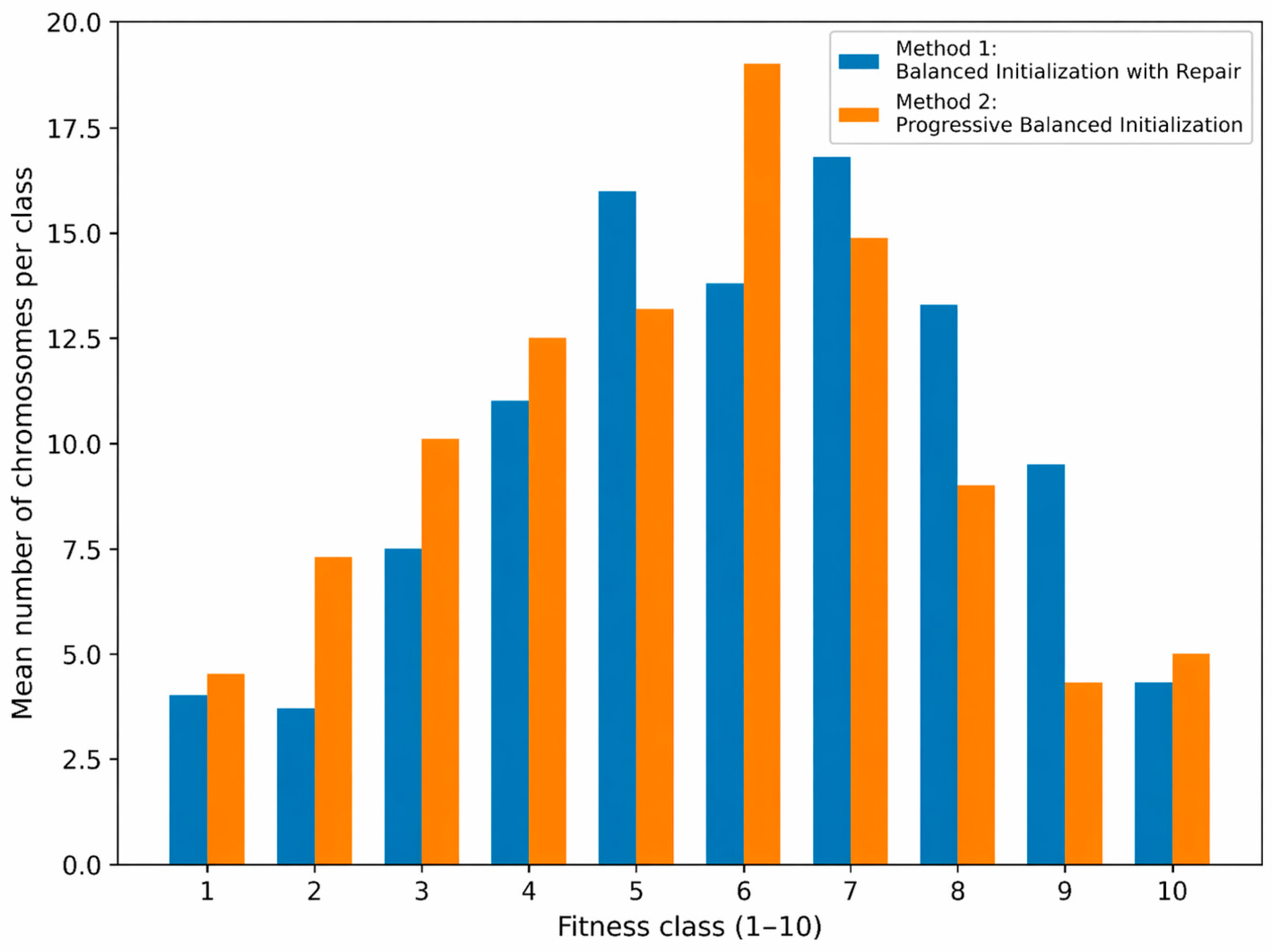
In both methods, active SRs are assigned a valid angular sector, and a duplicate-checking mechanism is applied to maintain population diversity. Both initialization methods were evaluated by generating five independent initial populations of 100 chromosomes and by grouping the chromosomes’ fitness values into ten classes. Afterwards, the mean number of chromosomes per class was computed across five independent populations yielding the chromosome population distributions shown in Figure 4. Based on these results, the Balanced Initialization with Repair method was selected for all subsequent experiments since it produced a more uniform and representative distribution of fitness values across the initial population.

2.3.4. Parent Selection, Pairing and Crossover

In each generation, the population is evaluated using the fitness function, and parent selection is performed via a roulette wheel mechanism. Two crossover strategies were investigated:
(i)
Sequential Overlapping Crossover, where each chromosome is paired with its neighboring individuals;
(ii)
Pairwise Crossover, where chromosomes are grouped into consecutive pairs.
In both cases, offspring are generated using uniform gene-wise recombination, where each gene is inherited from either parent with equal probability. Since crossover and mutation may produce infeasible chromosomes that violate the fixed number of active SRs, two constraint-handling approaches were evaluated:
(a)
a penalty-based approach, where infeasible solutions are assigned low fitness;
(b)
a repair-based approach (Fix Chromosome), which explicitly enforces the cardinality constraint after offspring generation.
The repair-based mechanism [41,42] ensures that all candidate solutions remain feasible throughout the evolutionary process.
The objective of comparing these crossover strategies is to evaluate their impact on convergence speed, solution quality, and population diversity, providing insight into their suitability for constrained coverage optimization problems.

2.3.5. Elitism Incorporation Between Generations

In a subsequent series of experiments, any a priori knowledge of the globally optimal chromosome was deliberately removed, allowing the GA to autonomously explore the search space. Although the algorithm typically identified high-fitness solutions within the first 20 generations, it often failed to preserve these solutions, exhibiting oscillatory behaviour in which convergence to the global optimum was followed by divergence in later generations. This observation led to the introduction of elitism to preserve high-quality solutions across generations. Two elitism rates (6% and 4%) were evaluated, with 4% providing improved stability without limiting exploration.

2.3.6. Mutation Operator

Mutation is applied at the gene level to introduce variability in candidate solutions [43]. For each gene, inactive SRs may become active by receiving a valid sector assignment, while active SRs may change sector or become inactive. Two mutation probabilities (1% and 10%) were evaluated to examine the trade-off between convergence speed and solution robustness. The higher mutation rate (10%) was found to improve convergence reliability and solution quality [44] and was therefore adopted in subsequent experiments.

2.3.7. Maximum Number of Generations

The number of generations was set to 100, which was sufficient for convergence in all tested configurations. Our choice is typical of constrained combinatorial optimization problems, where the feasible search space is reduced and convergence is reached more rapidly [45,46,47].

2.3.8. Implementation

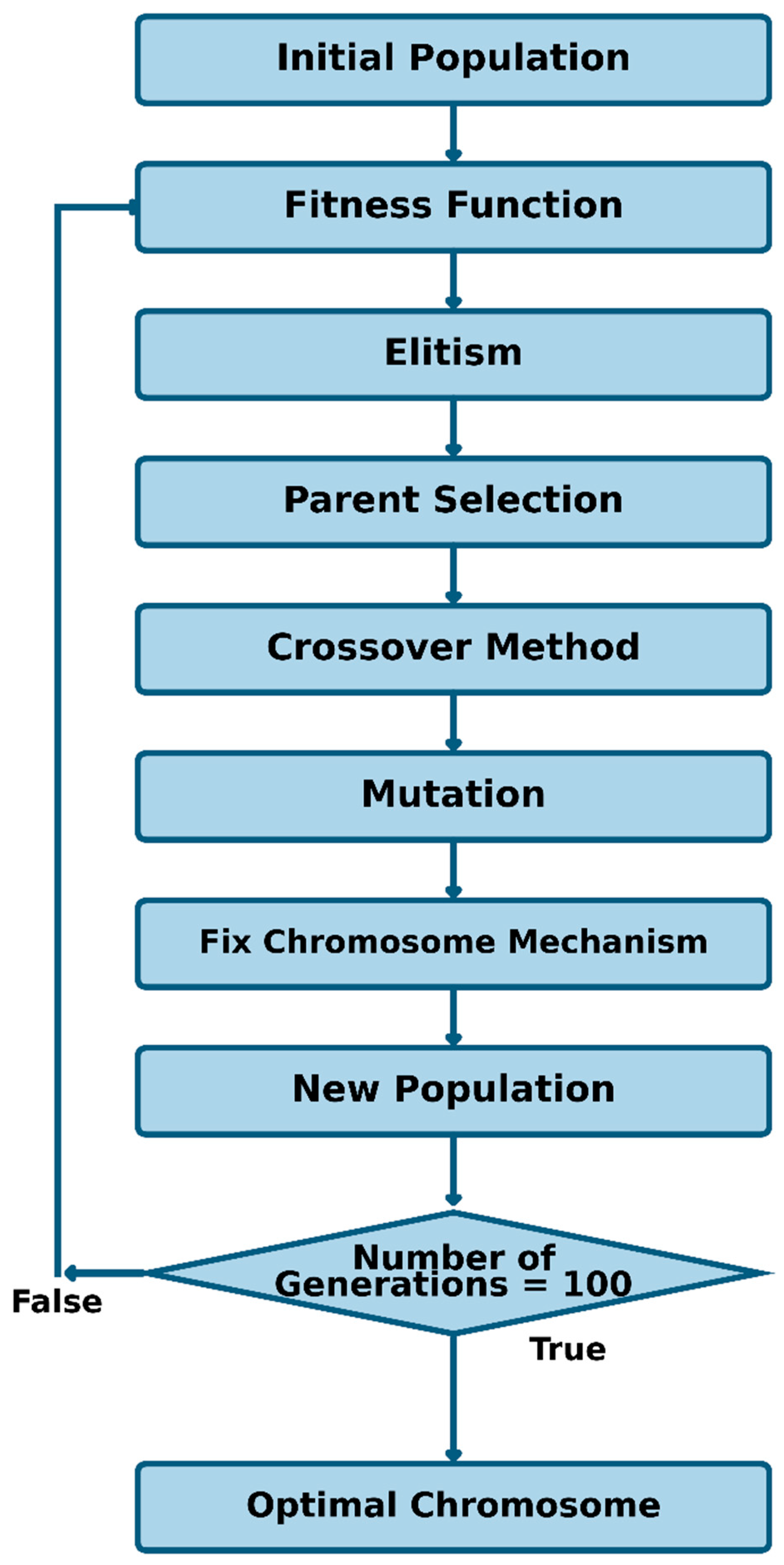
Figure 5 presents a high-level overview of the GA proposed in this study, illustrating the sequence of operations performed from initialization to convergence. The algorithm iteratively evaluates candidate solutions, preserves elite individuals, and generates new populations through selection, crossover, and mutation operators. As mentioned before, constraint-handling mechanisms are applied to maintain solution feasibility. The process repeats until 100 generations are reached.
The implementation of the proposed methodology was developed in Python 3.12.3, making use of several specialized libraries for geospatial analysis, optimization, and data processing. The experimental platform consisted of a desktop computer equipped with an AMD Ryzen 7 7800X3D 8-Core processor (5.05 GHz), manufactured by Advanced Micro Devices, Inc. (Santa Clara, CA, USA), 64 GB DDR5 RAM at 4800 MT/s, manufactured by ADATA Technology Co., Ltd. (New Taipei City, Taiwan), and an ADATA LEGEND 800 2 TB NVMe SSD storage device, also manufactured by ADATA Technology Co., Ltd. (New Taipei City, Taiwan), running Ubuntu 24.04 (64-bit).
The geospatial visualization component employed Folium [48] to generate interactive web-based maps that provide a visual representation of geographical features within the selected study area. Folium, built on the Leaflet.js framework, supports the integration of multiple web-based geospatial data sources, including OpenStreetMap data [49]. In this study, high-resolution satellite imagery was incorporated through the Esri World Imagery basemap (accessed via ArcGIS Online [50], continuously updated service) enhancing both visual interpretability and cartographic context. Supporting libraries include Shapely [51] for geometric operations and spatial analysis, Pyproj [52] for coordinate system transformations and geospatial data projection, and Geopy [53] for geocoding services that enable address-to-coordinate conversions and reverse geocoding functionality, see also [1,54].
The program initializes by loading input data from a configuration file containing SR parameters such as geographical locations, detection ranges, angular coverage sectors, and positions of known TRs (see also [1]). The folium map is then centred at a specified location with interactive pop-up controls added to display real-time mouse position coordinates (latitude–longitude), while known TR locations are marked with distinctive symbols on the map to facilitate spatial analysis of SR coverage areas.
The proposed GA makes use of the PyGAD 3.4.0 library [55], which provides a flexible framework for evolutionary computation with customizable selection, crossover, and mutation operators. Numerical computations and data handling were performed using NumPy 2.3.1 [56] and Pandas 2.3.0 [57], which offer efficient array-based numerical operations and high-level data structures essential for processing geospatial coordinates, fitness evaluations, and population management throughout the evolutionary process.

3. Results

The results presented in this section are structured to evaluate the performance of the proposed GA relative to the global optimum obtained through exhaustive enumeration. This allows for a direct assessment of solution quality and convergence behaviour in absolute terms.

3.1. Example Setup

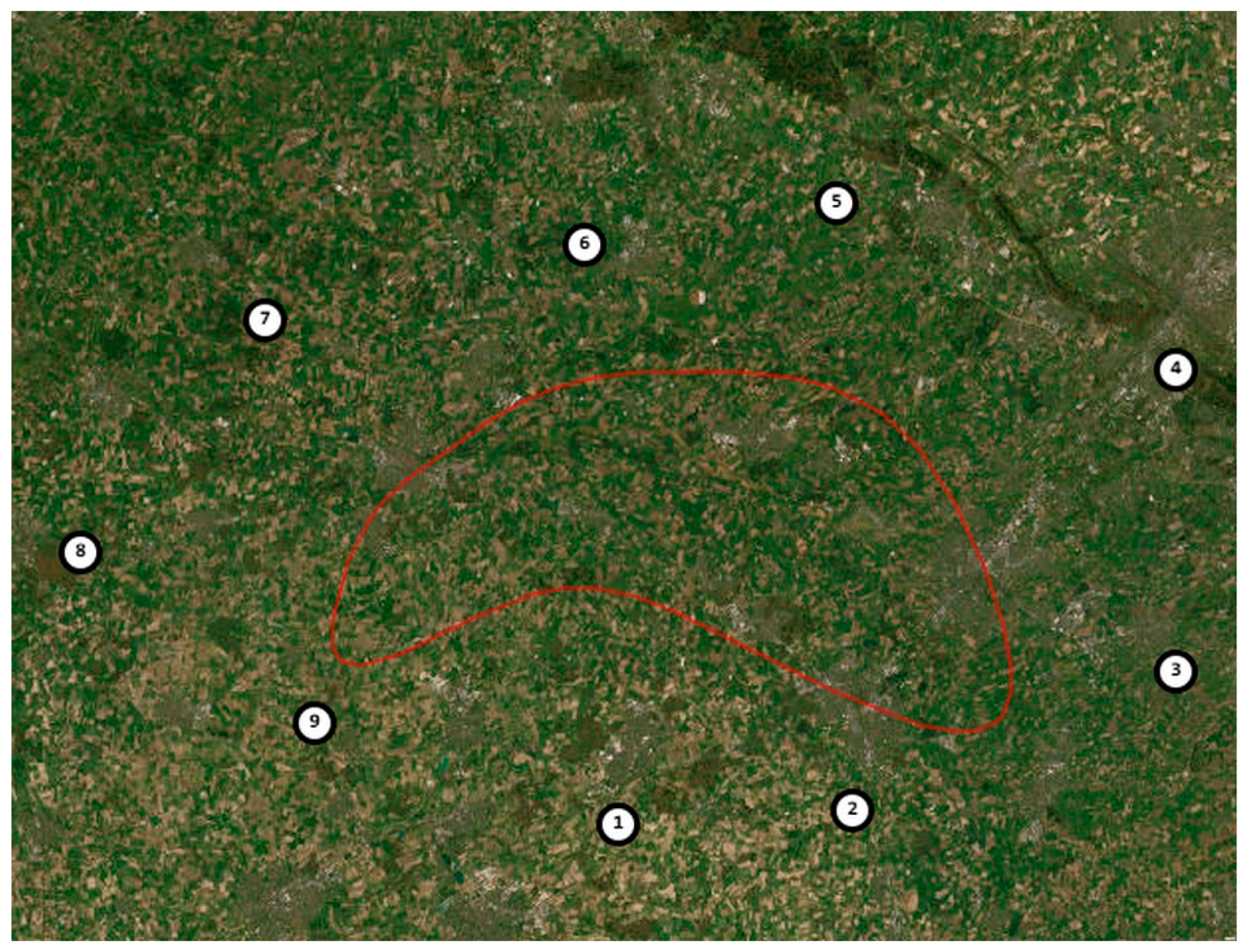
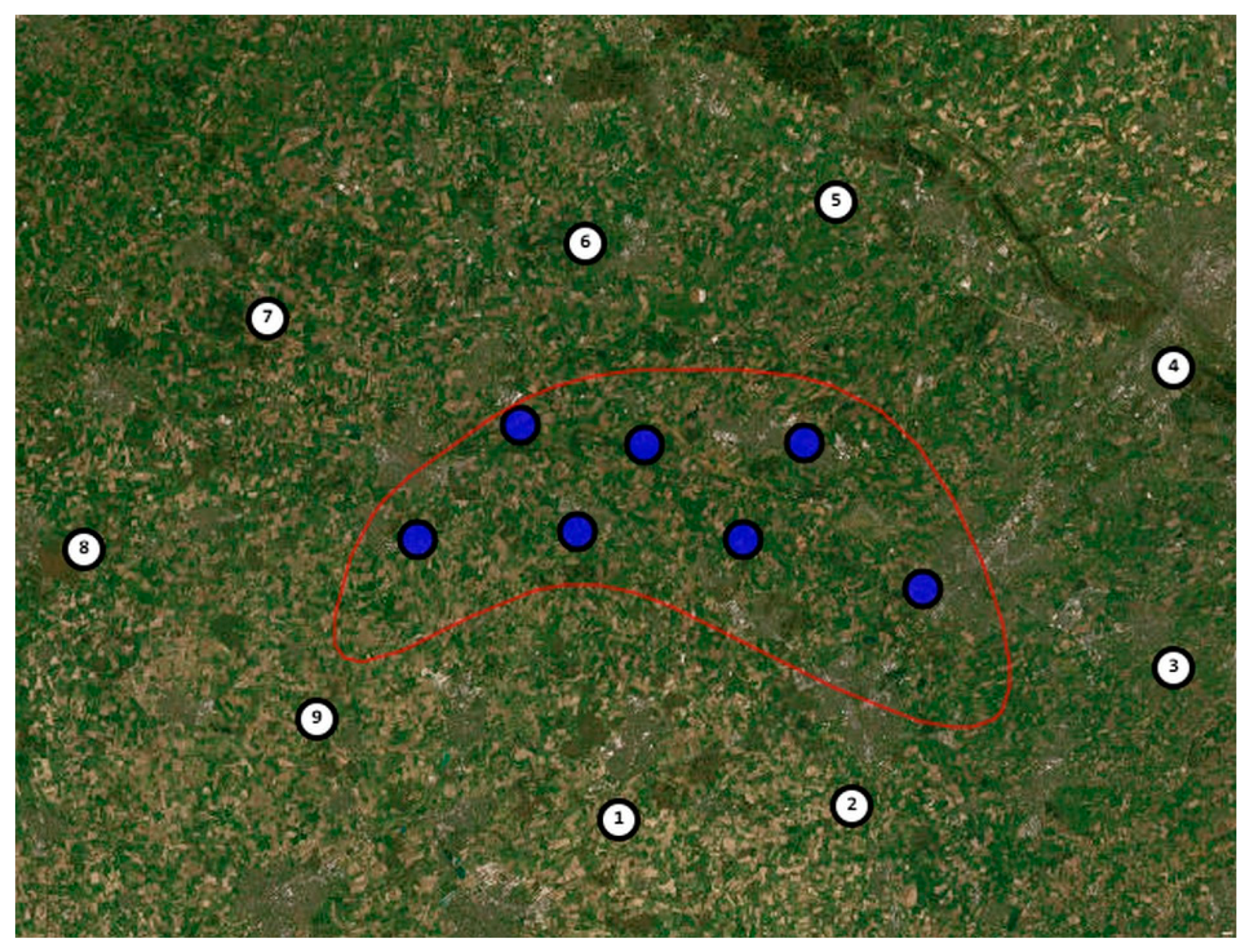
For the computational example used in our demonstration, we selected an AoI with an irregular shape, as illustrated in the previous Figure 1, Figure 2 and Figure 3. The example setup includes N = 9 SRs randomly positioned outside the AoI, and M = 7   TRs randomly located within it. Although the present example places all TRs inside the AoI, the formulation generalizes to TRs located outside it, as the blind-zone computation depends only on the relative SR–TR geometry (Section 2.1.4), with coverage impact determined by the degree of overlap between the resulting blind zone and the AoI.
Figure 6 presents this configuration, where the AoI is outlined by a red closed curve, the TRs are shown as blue circles, and the SRs are shown as white circles, each labelled with its corresponding index.
In this particular example, each SR is assigned a distinct radial sensing distance R i , selected to ensure that it can efficiently cover the AoI given its location. As discussed earlier, when the required sensing angular range of an SR exceeds its fixed angular sector range, the SR must rotate its sensing direction in discrete angular steps. For the specific configuration selected in our numerical example, the vector P below provides the available number of discrete angular sectors for each of the N = 9   SRs:
P = 8 , 8 , 1 , 1 , 2 , 4 , 2 , 1 , 3
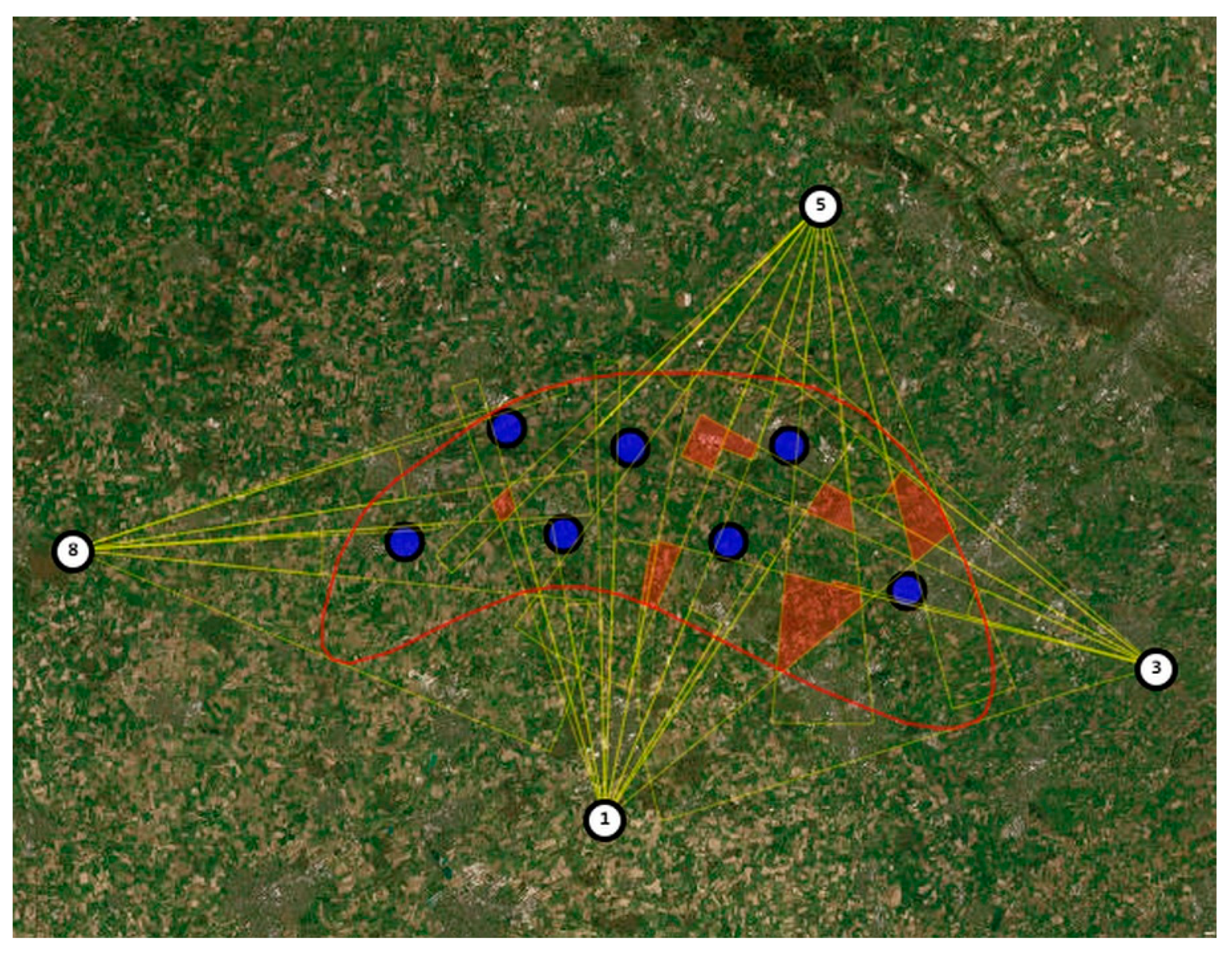
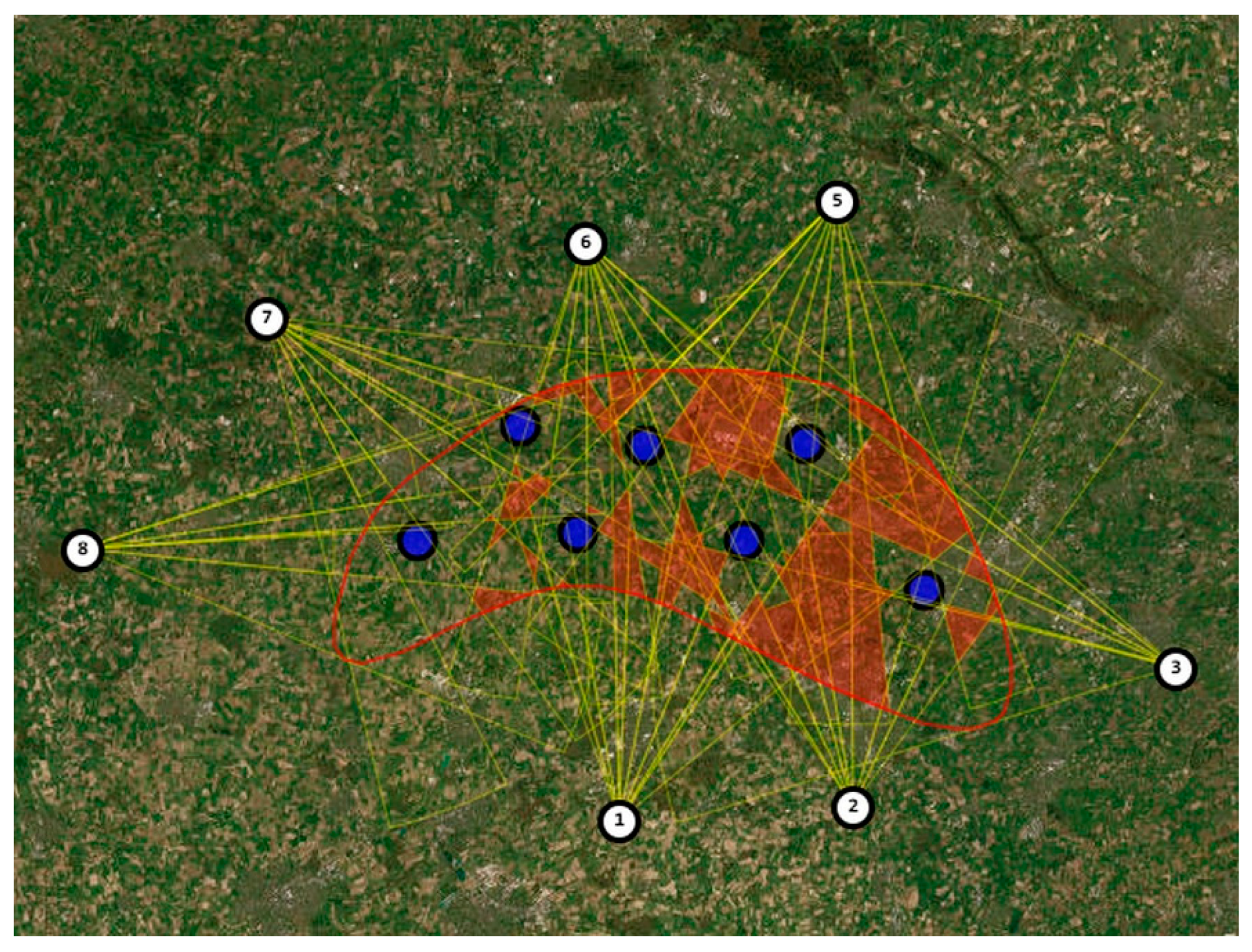
Figure 7 illustrates several deployment scenarios in which only K out of the N = 9   SRs are activated, with K = 4 , 7 and M = 7 TRs. For each SR, one discrete angular sector is randomly chosen from its index set B i , the selected sector index being different among SRs (see Section 2 for the definitions of P and B i ). In each case, the red-coloured region represents A 3 (the area simultaneously covered by three or more SRs). As expected, increasing the number of active SRs results in a larger A 3 . The objective of the optimization is to maximize this value of A 3 , for a specific K .

3.2. Brute Force Optimization

To establish a baseline, the optimization of A 3   was first performed using a brute force approach. In this method, all possible combinations of SR activations and angular sector assignments are exhaustively evaluated. Within the context of maximizing the fitness function f, the brute-force method generated all valid sector assignments Z . As stated previously, each sector assignment corresponds to a unique chromosome. Therefore, the optimization process seeks the chromosome that maximizes A 3 .
Due to the irregular shape of the AoI, the presence of TRs that create locally “blind” regions, and the non-omnidirectional sensing capabilities of the SRs, it was not immediately evident whether increasing the number of active SRs would always yield proportional improvements in coverage. Hence, a brute-force analysis was conducted to examine this effect. For the given example configuration, the total number of possible chromosomes was computed for different values of K, representing the number of active SRs. The results are summarized in Table 1 below.
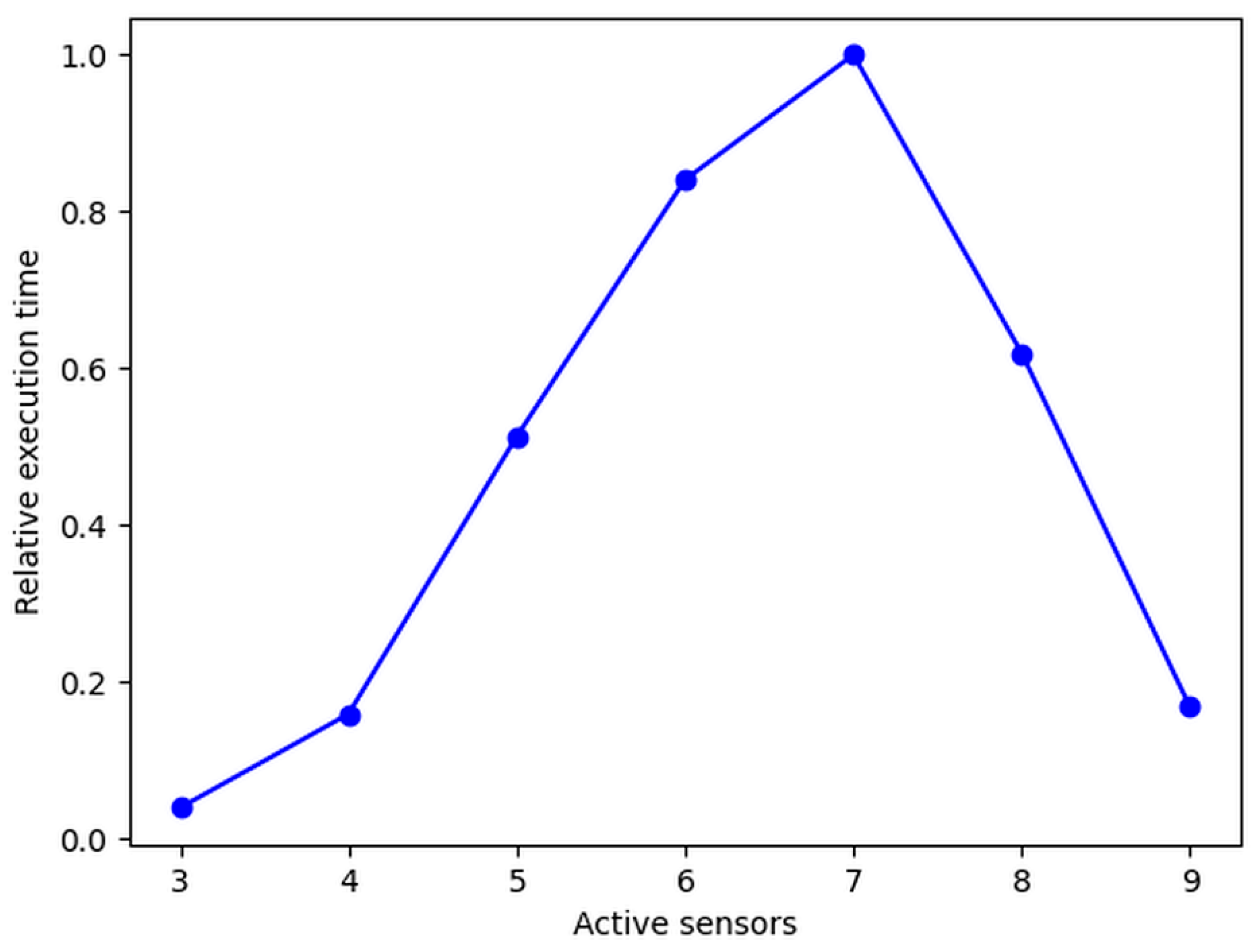
Figure 8 illustrates the computational effort in the example setup (Figure 6), showing the relative brute force execution time for computing A 3   across all SR combinations as K varies, normalized to the most expensive case ( K = 7 ).
The results of the brute-force analysis provide the exact optimal solution for the given configuration, which is used as a benchmark for subsequent analysis.
To evaluate the proposed evolutionary optimization method under the most demanding conditions, we selected K = 7 based on its computational cost. This configuration represents the upper bound of computational complexity in our problem space, ensuring that if the method performs well in this worst-case scenario, it will be effective across all less demanding configurations.

3.3. GA Optimization

To overcome the computational limitations of the brute force method which becomes infeasible as the number of SRs and their possible angular sector combinations increases, our proposed GA was implemented to efficiently approximate the optimal solution. As mentioned in the previous sections, the proposed GA was designed based on the specific chromosome representation used in this study, where each chromosome corresponds to a specific sector assignment for a subset of active SRs.
The optimization objective remains the maximization of A 3 , the area simultaneously covered by three or more SRs. The fitness function f was therefore defined in proportion to A 3 , such that
f = A 3
The GA was initialized with a randomly generated population of chromosomes, each representing a valid combination of SR activations and sector orientations. At each iteration, the population evolved through the application of selection, crossover, and mutation operators. The performance of the GA is assessed by measuring how frequently and how closely it converges to the optimal solution identified in Section 3.2.

3.3.1. Initial Population Creation

The Balanced Initialization with Repair method was selected based on its more uniform fitness distribution across initial populations. Given the relatively small size of the solution space, it is worth noting that the probability of generating chromosome duplicates during initialization is non-negligible, To investigate whether such redundancy had any measurable impact on the average number of generations we adopted a duplicate-rejection mechanism between successive generations, using the optimum solution obtained via the brute force search as a reference for determining whether the GA converges successfully. However, experimental evaluation with 100-chromosome populations showed that any reduction in convergence time was outweighed by the additional computational cost of enforcing chromosome uniqueness.
To ensure a stable and reproducible experimental baseline, fixed sets of initial populations were constructed and reused across GA experiments, rather than regenerating random populations at each execution. This design choice allowed for controlled comparisons between different GA configurations. Specifically, two groups of initial populations were created using Balanced Initialization with Repair, each corresponding to a configuration with 7 active SRs out of 9. The first group consisted of 15 populations with 50 chromosomes each, while the second group comprised 15 populations with 100 chromosomes each. The results of these two groups are summarized in Table 2 for 8 different GA configurations per group. To further enhance statistical reliability, an additional two groups of 50 initial populations were generated with the same SR configuration, again using population sizes of 50 and 100 chromosomes, respectively. The results of the last enhanced groups are summarized in Table 3 for four different GA configurations per group.

3.3.2. Experimental Series

During the experimental evaluation, emphasis was placed not only on achieving the optimal fitness value but also on assessing near-optimal solutions. In practical deployment scenarios, however, solution quality alone is insufficient for evaluating algorithmic effectiveness, as computational efficiency and convergence speed are equally critical. Consequently, a purely binary classification into optimal and suboptimal outcomes may obscure meaningful performance differences. Configurations that consistently achieve solutions within a small percentage (e.g., ≥95%) of the global optimum in significantly fewer generations may be preferable to those requiring substantially higher computational effort to attain absolute optimality. This consideration highlights an inherent trade-off between solution quality and convergence efficiency.
To capture this trade-off more accurately and enable a fair comparison across experimental configurations, two complementary performance metrics were introduced. The first metric ( S c o r e o p t ) quantifies convergence reliability by measuring the proportion of independent populations in which the GA reached the global optimum identified through brute-force evaluation, normalized by the total number of populations ( n ). The second metric ( S c o r e G A ) assesses overall solution quality by computing, for each population, the ratio between the maximum fitness achieved by the GA and the global optimum, and then averaging this ratio over all n independent populations:
S c o r e G A = i = 1 n max   f i t n e s s i ( g l o b a l   o p t i m u m ) n
This metric quantifies how close the obtained solutions were to the optimal fitness value, even in cases where the GA did not consistently reach the global optimum in every independent population. Together, these two metrics provide a more nuanced evaluation framework that simultaneously reflects optimality attainment, near-optimal performance, and computational efficiency.

3.3.3. Crossover Operations

Experimental results indicated that Pairwise Crossover provides slightly better convergence reliability compared to Sequential Overlapping Crossover. Infeasible offspring, i.e., chromosomes violating the fixed active/inactive SR cardinality constraint, were penalized through the fitness evaluation function (Fix Chromosome: No). Alternatively, a repair-based constraint-handling mechanism was applied after crossover and mutation to explicitly enforce the required activation pattern (Fix Chromosome: Yes), as indicated in Table 2 and Table 3.

3.3.4. Elitism

Guided by established literature [58] and practical experience, elitism was therefore introduced to stabilize the evolutionary process, with an elitism rate of 6% applied during the first experimental phase and subsequently reduced to 4% in the second phase.

3.3.5. Population Size

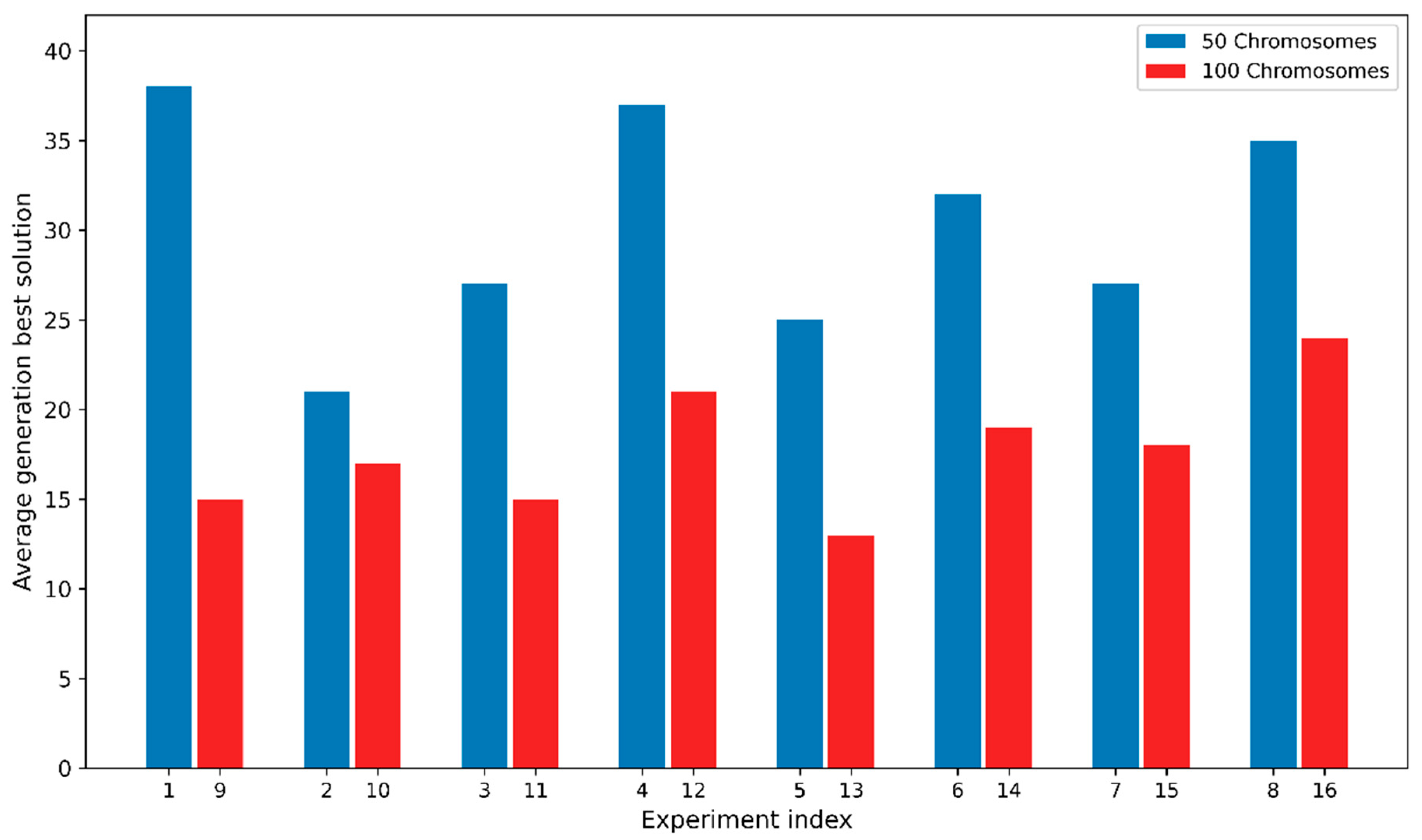
Within the framework of this exploitation-oriented mechanism, additional experiments were conducted using 15 independent initial populations, with sizes of 50 and 100 chromosomes respectively. Experimental pairs (e.g., 1 and 9, 2 and 10, 3 and 11, etc.) utilize identical GA parameters, differing only in the number of chromosomes per generation. As illustrated in the corresponding graph (Figure 9), populations of 100 chromosomes exhibit faster convergence toward an optimal solution; however, this may not necessarily represent the global optimum in fitness value. This rapid convergence is attributed to the higher density of candidate solutions exploring the search space. To address this residual deviation and further enhance convergence reliability, a targeted mutation operator is incorporated to evaluate its effectiveness in mitigating premature convergence and rectifying occasional suboptimal outcomes.

3.3.6. Mutation

Experiments were conducted on both crossover methods with obvious supremacy of the second crossover method. At first, the experiments were conducted without mutation and for 100 generations. Next, the same experiments were enriched with the mutation operation.
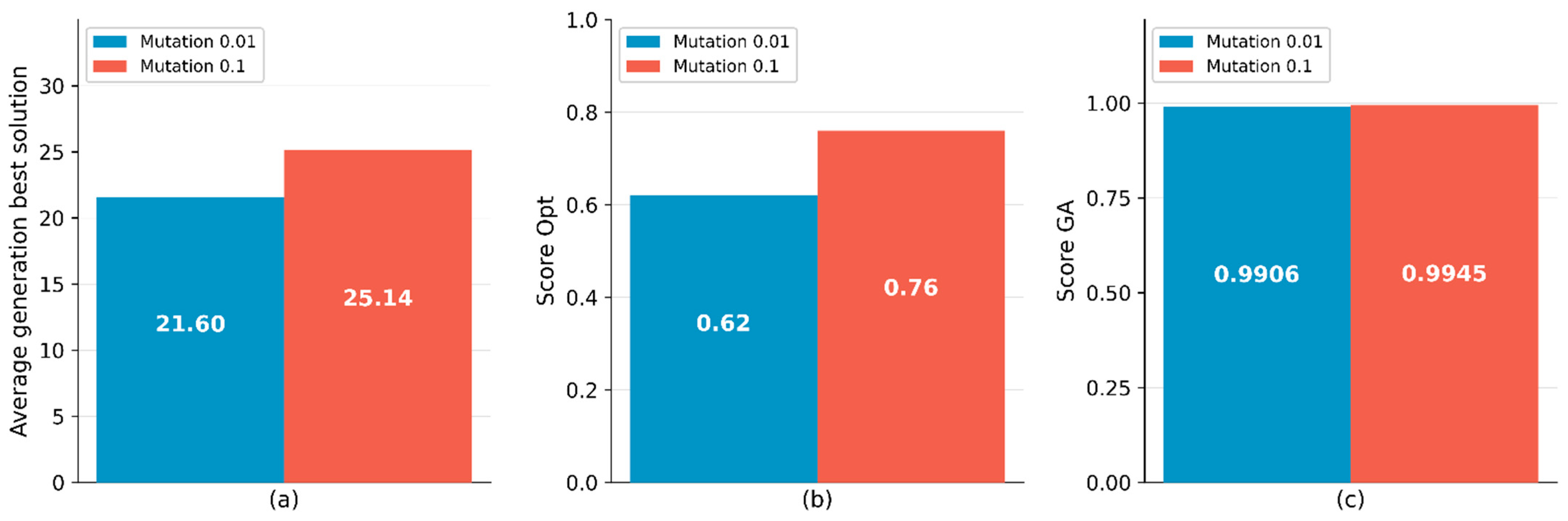
Based on the comparative analysis illustrated in Figure 10a–c, the mutation probability has a clear and measurable impact on both convergence behaviour and solution quality. Very low mutation rates (0.01), which are commonly regarded in the literature as introducing only negligible stochastic variation, lead to faster convergence, with the best solution being identified on average after 21.6 generations, compared to 25 generations for a higher mutation rate (0.1), as shown in Figure 10a. Such very low mutation rates are often considered functionally equivalent to mutation-free evolution, as they introduce insufficient diversity to effectively counteract premature convergence. Consequently, this rapid convergence is achieved at the cost of reduced robustness, as evidenced by the lower convergence reliability ( S c o r e o p t = 0.62) illustrated in Figure 10b. In contrast, a moderate mutation rate (0.1) introduces sufficient stochasticity to promote effective exploration of the search space, resulting in improved convergence reliability ( S c o r e o p t = 0.76) and slightly higher average solution quality ( S c o r e G A : = 0.9945 versus 0.9906), as depicted in Figure 10b,c. This improvement is accompanied by a modest increase in the number of generations required for convergence, reflecting the computational cost of enhanced exploration. Overall, the figures highlight a trade-off between rapid convergence under near-zero mutation and improved robustness under moderate mutation rates, supporting the selection of mutation = 0.1 in scenarios where robustness and solution quality are prioritized over minimal execution time.

3.3.7. Maximum Number of Generations

The choice of 100 generations is experimentally justified by the results summarized in Table 4, specifically by the column labelled ‘Worst Generation’, which denotes the highest generation index—across the 15 independent populations—at which the optimal fitness chromosome was first identified (serving as an indicator of convergence speed rather than global optimality). In all experimental configurations, the optimal fitness chromosome emerged well before the 100th generation, with observed values ranging between 16 and 89 generations. These results indicate that the problem exhibits moderate computational complexity and that the GA converges rapidly under the proposed framework.

3.3.8. Computational Time Comparison of Methods

To investigate and compare the execution time and computational efficiency of the proposed GA relative to the brute-force approach, we measured and recorded the total execution time of each algorithm on a fixed hardware platform. All experiments considered scenarios with nine available SRs, of which exactly seven were selected as active. The evaluation results are summarized in Table 5.
For the brute-force evaluation of all possible configurations involving 7 active SRs out of 9, a total of 30,192 coverage computations were required, each corresponding to an evaluation of the fitness function f . The complete execution time for this exhaustive search on the hardware mentioned in Section 2.3.8 was 11 min, 30 s, and 267 milliseconds.
The GA was executed for 100 generations using pairwise crossover method, the Fix Chromosome mechanism, an elitism rate of 4%, a mutation probability of 10%, and a crossover probability of 90%. Excluding the time required for initial population generation, the total execution time for a population size of 50 was approximately 1 min, 44 s, and 36 milliseconds, representing a speedup of approximately 6.63× compared to brute force. For a population size of 100, the corresponding execution time was approximately 3 min, 27 s, and 771 milliseconds, yielding a speedup of approximately 3.32×.
During these experiments, it was observed that the fitness function f was repeatedly evaluated for identical chromosomes either within the same generation or across different generations. Since the fitness evaluation constitutes the dominant computational cost of the algorithm, a caching mechanism was introduced to store previously computed fitness values. Whenever a chromosome reappeared, its fitness value was retrieved from memory rather than recomputed.
With this optimization in place, the total execution time for 100 generations was reduced to approximately 1 min, 23 s, and 728 milliseconds for a population size of 50, corresponding to a speedup of approximately 8.25× over brute force. For a population size of 100, the execution time decreased to approximately 2 min, 33 s, and 987 milliseconds, yielding a speedup of approximately 4.48×.
On the desktop platform used here, the GA with caching and population size 50 completes the process in 84 s. A Raspberry Pi 5 (Cortex-A76 at 2.4 GHz, up to 16 GB RAM, developed by Raspberry Pi Ltd., Cambridge, England) typically executes Python numerical workloads at roughly 5–10 times slower than a modern desktop CPU, suggesting an estimated execution time of approximately 7–14 min for the same configuration. This remains operationally feasible for scenarios where SR reconfiguration occurs on the order of minutes, as happens with the detection of new TRs that trigger re-optimization.

4. Discussion

In many WSN coverage optimization studies, performance evaluation is conducted through comparisons among different metaheuristic algorithms, as the global optimum is generally unknown. In contrast, the present study adopts a different evaluation strategy by studying a problem configuration for which exhaustive enumeration is feasible. This enables the use of brute-force evaluation as a ground-truth optimality benchmark, allowing a direct quantification of how close the proposed GA approaches the optimal solution. Our approach provides a stronger form of validation than heuristic-to-heuristic comparisons, since it does not rely on relative performance between algorithms but instead evaluates solution quality in absolute terms. While comparisons with other metaheuristics could be considered in larger-scale scenarios, the focus of this work is on methodological validation of a constraint-aware GA under strict feasibility constraints.
The results highlight that constraint handling and representation, rather than the choice of metaheuristic alone, are the dominant factors for this problem. The Fix Chromosome mechanism consistently improves convergence reliability, confirming that feasibility-preserving operators are essential for K -out-of- N combinatorial optimization with discrete orientation variables. The experimental results presented in Section 3 provide a comprehensive basis for evaluating the performance characteristics of the proposed constraint-aware GA, across varying parameter configurations. In this discussion, we systematically analyse the influence of individual parameters of the proposed GA (Fix Chromosome mechanism, mutation probability, crossover strategy, and initial population size) on convergence behaviour and solution quality. By isolating the contribution of each factor, we aim to identify the most suitable configuration for practical coverage optimization and to provide guidance for parameter selection. Throughout the analysis, performance was assessed using the two complementary metrics we introduced: S c o r e o p t , which quantifies convergence reliability as the proportion of initial independent populations reaching the global optimum, and S c o r e G A , which measures the average fitness attained relative to the theoretical maximum.
Two experimental series were conducted to systematically investigate the impact of key GA parameters on convergence behaviour and solution quality. In the first series, two sets of initial populations were used, each comprising 15 independent populations with 50 and 100 chromosomes, respectively. For each initial population, the GA was executed using one of two pairing and crossover methods, one of two alternative strategies for handling chromosomes that violated the active-SR cardinality constraint, and one of two mutation probabilities (10% and 1%), while maintaining a fixed elitism rate of 6%, resulting in 16 distinct experimental configurations. In the second series, two larger sets of initial populations were employed, each consisting of 50 independent populations with 50 and 100 chromosomes, respectively. In this case, both crossover methods and both constraint-handling strategies were again evaluated, while the elitism rate was reduced to 4% and the mutation probability was fixed at 10%, yielding eight additional experimental configurations.
Importantly, empirical observations across both experimental series revealed that reducing the population size by half did not lead to unstable convergence behaviour, with the GA consistently reaching near-optimal solutions. This finding aligns with prior studies indicating that moderate population sizes can preserve sufficient diversity and maintain robust search performance in comparable WSN coverage optimization problems [18,20]. The aggregated results of the two experimental series (Table 2 and Table 3) reveal clear performance trends across GA configurations. Population size and constraint handling (Fix Chromosome Mechanism) emerge as the dominant factors affecting convergence reliability, efficiency, and fitness quality. Across both series, configurations with population size = 100 consistently achieved higher convergence reliability than those with population size = 50. All configurations combining population size 100 with Fix Chromosome mechanism achieved perfect convergence reliability ( S c o r e o p t = 1.00), independent of crossover method or mutation rate. In contrast, configurations without explicit constraint enforcement exhibited significantly lower reliability.
Convergence efficiency further favoured larger populations. Configurations with 100 chromosomes reached the best solution in fewer generations (≈10–26) and with lower variance than those with 50 chromosomes (≈21–38). While enabling the Fix Chromosome mechanism slightly increased the average number of generations, it substantially reduced variance, yielding more stable convergence behaviour.
Fitness performance was consistently high across all configurations ( S c o r e G A > 0.97), indicating that suboptimal cases remained close to the global optimum. The highest average fitness values (≈0.633–0.635) and lowest dispersion were obtained for population size 100 with Fix Chromosome enabled. Crossover Method 2 (Pairwise Crossover) showed a small but systematic advantage in both convergence speed and reliability.

4.1. Impact of the Fix Chromosome Mechanism on GA Performance

Across both experimental series, configurations employing the Fix Chromosome mechanism (Experiments 3, 4, 7, 8, 11, 12, 15, 16 in Series 1 and 2, 4, 6, 8 in Series 2) consistently outperformed those without it (1, 2, 5, 6, 9, 10, 13, 14 and 1, 3, 5, 7, respectively), achieving substantially higher average S c o r e o p t (0.97 vs. 0.62 in Series 1; 0.96 vs. 0.58 in Series 2) and S c o r e G A (0.9980 vs. 0.9858; 0.9992 vs. 0.9902) respectively. The magnitude and consistency of these improvements across independent experimental groups indicate a statistically meaningful effect, demonstrating that explicit repair-based constraint enforcement significantly enhances GA accuracy and convergence reliability compared to fitness-penalty approaches.

4.2. Comparative GA Analysis with Mutation Rates 1% and 10%

To examine the effect of mutation probability, two groups of experiments from the first experimental series were compared. The first group comprised experiments (1, 3, 5, 7, 9, 11, 13, 15), where the mutation probability was set to 0.01, while the second group included experiments (2, 4, 6, 8, 10, 12, 14, 16), where the mutation probability was increased to 0.1. The low-mutation group achieved an average S c o r e o p t of 0.62 and an average S c o r e G A   of 0.9906, whereas the higher mutation group achieved improved averages of S c o r e o p t = 0.76 and S c o r e G A = 0.9945. These results indicate that increasing the mutation probability to 10% significantly enhances GA performance by improving both convergence reliability and overall solution quality, highlighting the critical role of mutation intensity in maintaining genetic diversity and avoiding premature convergence.

4.3. Effect of Either Sequential Overlapping or Pairwise Crossover Methods

Across the first experimental series, Sequential Overlapping crossover (Experiments 1, 2, 3, 4, 9, 10, 11, 12) and Pairwise crossover (Experiments 5, 6, 7, 8, 13, 14, 15, 16) exhibited comparable performance, with the Pairwise method showing a marginally higher convergence reliability ( S c o r e o p t : 0.70 vs. 0.66) while maintaining nearly identical solution quality ( S c o r e G A ≈ 0.992). This trend was confirmed in the second series, where Pairwise crossover (Experiments 3, 4, 7, 8) again slightly outperformed Sequential Overlapping crossover (Experiments 1, 2, 5, 6) in S c o r e o p t (0.79 vs. 0.75) and S c o r e G A (0.9952 vs. 0.9941). Overall, both strategies perform similarly, with a small but consistent advantage of the Pairwise crossover, primarily in convergence reliability.

4.4. Effect of the Initial Population Size

The impact of population size on GA performance was evaluated by grouping experiments according to populations of 50 and 100 chromosomes. In the first experimental series, the 50-chromosome group (Experiments 1–8) achieved mean values of S c o r e o p t = 0.62 and S c o r e G A = 0.9896, whereas the 100-chromosome group (Experiments 9–16) improved to S c o r e o p t = 0.75 and S c o r e G A = 0.9942. A similar trend was observed in the second series, where populations of 50 chromosomes (Experiments 1–4) yielded S c o r e o p t = 0.68 and S c o r e G A = 0.9928, compared to S c o r e o p t = 0.86 and S c o r e G A = 0.9966 for populations of 100 chromosomes (Experiments 5–8).
Overall, larger populations consistently enhanced convergence reliability and solution quality due to increased exploration capability. Nevertheless, the results also indicate that populations of 50 chromosomes provide a reasonable trade-off between computational efficiency and accuracy, making them suitable when execution time is a primary constraint rather than absolute optimality.
Taken together, the experimental findings demonstrate that the proposed repair-based GA reliably converges to near-optimal SR configurations across a wide range of parameter settings. By embedding problem-specific constraints directly into the evolutionary process, this evolutionary optimization method achieves high solution quality while reducing computational cost, establishing it as a practical and efficient alternative to exhaustive brute-force search for coverage optimization in SR networks. The most robust performance is obtained when combining a population size of 100 chromosomes, Pairwise crossover, the Fix Chromosome mechanism, a mutation probability of 10%, and moderate elitism (4–6%). While larger populations improve convergence reliability, the results also indicate that smaller populations (50 chromosomes) offer a favourable trade-off when rapid execution is required. Importantly, these characteristics make the proposed approach well suited for real-time configuration scenarios, in which SR placements must be updated promptly in response to network dynamics. Overall, our findings provide practical guidance for deploying constraint-aware GAs in SR network optimization and establish a foundation for extending the approach to larger-scale networks and dynamic configuration scenarios.

5. Conclusions

This work contributes a constraint-aware evolutionary framework for a previously underexplored WSN coverage problem characterized by angular sensing and transmitter-induced degradation. By validating against the global optimum, we demonstrate that near-optimal solutions can be achieved efficiently. The findings emphasize that problem-specific modelling and constraint handling are more critical than adopting alternative metaheuristics. Moreover, by using exhaustive enumeration via brute-force as a ground-truth benchmark that enables direct evaluation of solution optimality, our work is distinguished from typical WSN optimization studies that rely solely on comparisons among heuristic algorithms. Rather than treating feasibility as a secondary objective, the proposed approach shows that direct constraint enforcement through repair-based mechanisms fundamentally reshapes the search dynamics, leading to substantially improved convergence reliability and robustness.
A key insight of this study is that constraint handling and population structure dominate GA performance more strongly than crossover or mutation design alone. Across all experimental settings, the Fix Chromosome mechanism emerged as the most influential factor, consistently enabling stable convergence and eliminating the performance variability observed under penalty-based approaches. This finding underscores the importance of aligning evolutionary operators with the structural properties of the solution space, especially in tightly constrained combinatorial problems.
The results further reveal that near-optimal solutions can be obtained rapidly and reliably, often within a small fraction of the total evolutionary horizon. From a practical perspective, this confirms that absolute optimality is not always necessary for operational effectiveness; instead, solutions achieving more than 95% of the global optimum with significantly reduced computational effort represent a superior trade-off for real-world deployments. This observation is particularly relevant for edge-computing scenarios, where response time and resource constraints are critical.
Although larger populations improve convergence reliability, the experiments show that moderate population sizes remain viable, offering a balanced compromise between execution speed and solution quality. This flexibility broadens the applicability of the proposed method, allowing practitioners to tailor GA configurations based on available computational resources and timing requirements.
Overall, this study contributes a constraint-aware, empirically validated GA framework that bridges the gap between theoretical optimality and practical deployability in SR network coverage problems. Beyond the specific application addressed here, the findings provide general guidance for designing evolutionary algorithms in constrained, small-to-medium-scale optimization settings.
The representative experimental setup was deliberately chosen to showcase the specific features of the method: the formation of blind zones, the dynamic adaptation to SR relocation, and the computation of triangulated coverage areas. This example scenario served as proof-of-concept demonstration of the proposed optimization algorithm and its integration with the coverage computation tool, rather than as a full statistical evaluation campaign. A sensitivity analysis with respect to key parameters is the subject of a dedicated forthcoming study. Future research will also extend the proposed framework to dynamic environments, more complex coverage geometries, and adaptive reconfiguration scenarios, where rapid convergence under evolving constraints becomes a defining requirement.

Author Contributions

Conceptualization, M.S.Z., I.S.B. and I.V.S.; methodology, M.S.Z., I.S.B. and I.V.S.; software, I.V.S. and M.S.Z.; validation, M.S.Z., I.S.B., I.V.S., N.E.A. and E.V.; formal analysis, I.S.B., I.V.S., M.S.Z. and E.V.; investigation, I.S.B.; resources, I.S.B.; data curation, I.S.B., I.V.S. and E.V.; statistical analysis of data E.V.; writing—original draft preparation, I.S.B. and M.S.Z.; writing—review and editing, I.S.B., M.S.Z., I.V.S. and E.V.; supervision, I.S.B.; funding acquisition, I.S.B. All authors have read and agreed to the published version of the manuscript.

Funding

This project has received funding from the European Union’s Horizon Europe Research and Innovation funding programme under the Grant Agreement ID: 101121288.

Data Availability Statement

The original contributions presented in the study are included in the article; further inquiries can be directed to the corresponding authors.

Acknowledgments

During the preparation of this manuscript, the authors used Anthropic AI Claude (claude-sonnet-4-6; Anthropic, 2025) for the purposes of generating text and graphics. The authors have reviewed and edited the output and take full responsibility for the content of this publication.

Conflicts of Interest

The authors declare no conflicts of interest. The funding sponsors had no role in the design of the study; in the collection, analyses, or interpretation of data; in the writing of the manuscript; or in the decision to publish the results.

Abbreviations

The following abbreviations are used in this manuscript:
WSNWireless Sensor Network
SRSensor
TRTransmitter
AoIArea of Interest
GAGenetic Algorithm
AIArtificial Intelligence

References

  1. Zakynthinaki, M.S.; Barbounakis, I.S.; Antonidakis, E.N. Algorithmic coverage quantification and visualization in range-free sensor networks. Appl. Syst. Innov. 2024, 7, 97. [Google Scholar] [CrossRef]
  2. Dai, L.; Wang, B. Sensor placement based on delaunay triangulation for complete confident information coverage in an area with obstacles. In Proceedings of the IEEE 34th International Performance Computing and Communications Conference (IPCCC), Nanjing, China, 14–16 December 2015; pp. 1–8. [Google Scholar] [CrossRef]
  3. Huang, C.F.; Tseng, Y.C. The coverage problem in a wireless SR network. Mob. Netw. Appl. 2005, 10, 519–528. [Google Scholar] [CrossRef]
  4. Nematzadeh, S.; Torkamanian-Afshar, M.; Seyyedabbasi, A.; Kiani, F. Maximizing coverage and maintaining connectivity in wsn and decentralized iot: An efficient metaheuristic-based method for environment-aware node deployment. Neural Comput. Appl. 2023, 35, 611–641. [Google Scholar] [CrossRef]
  5. Farsi, M.; Elhosseini, M.A.; Badawy, M.; Ali, H.A.; Zain Eldin, H. Deployment techniques in wireless SR networks, coverage and connectivity: A survey. IEEE Access 2019, 7, 28940–28954. [Google Scholar] [CrossRef]
  6. Maheshwari, A.; Chand, N. A survey on wireless sensor networks coverage problems. In Proceedings of the 2nd International Conference on Communication, Computing and Networking, Chandigarh, India, 29–30 March 2018; pp. 153–164. [Google Scholar] [CrossRef]
  7. Vasilaki, E.; Rigakis, I.; Papadoulis, T.; Staridas, A.; Psaroudaki, A.; Frantzeskakis, L.; Makris, Z.; Lazari, D.; Antonidakis, E. Inertia sensor detecting materials using electromagnetic signals. WSEAS Trans. Syst. 2022, 21, 140–146. [Google Scholar] [CrossRef]
  8. Vasilaki, E.; Markoulakis, E.; Lazari, D.; Psaroudaki, A.; Barbounakis, I.S.; Antonidakis, E. A novel low-frequency electromagnetic active inertial sensor for drug detection. Sensors 2024, 24, 3059. [Google Scholar] [CrossRef]
  9. Sfendourakis, M.; Zakynthinaki, M.S.; Vasilaki, E.; Antonidakis, E.; Nilavalan, R. Coverage area of a localization fixed SRs network system with the process of triangulation. WSEAS Trans. Inf. Sci. Appl. 2021, 18, 39–56. [Google Scholar] [CrossRef]
  10. Katoch, S.; Chauhan, S.S.; Kumar, V. A review on genetic algorithm: Past, present, and future. Multimed. Tools Appl. 2021, 80, 8091–8126. [Google Scholar] [CrossRef] [PubMed]
  11. Jiang, N.; Jin, S.; Guo, Y.; He, Y. Localization of wireless sensor network based on genetic algorithm. Int. J. Comput. Commun. Control 2013, 8, 825–837. [Google Scholar] [CrossRef]
  12. Thike, A.M.; Lupin, S.; Vagapov, Y. Implementation of brute force algorithm for topology optimisation of wireless networks. In Proceedings of the 2016 International Conference for Students on Applied Engineering (ICSAE), Newcastle Upon Tyne, UK, 20–21 October 2016; pp. 264–268. [Google Scholar] [CrossRef]
  13. Somefun, T.E.; Owolabi, T.; Longe, O.M. Practical trade-offs in neural network optimization: Brute force search and gradient descent. Eng. Res. Express 2025, 7, 025203. [Google Scholar] [CrossRef]
  14. Riwanto, Y.; Nuruzzaman, M.T.; Uyun, S.; Sugiantoro, B. Data search process optimization using brute force and genetic algorithm hybrid method. IJID (Int. J. Inform. Dev.) 2023, 11, 222–231. [Google Scholar] [CrossRef]
  15. Eiben, A.E.; Smith, J.E. Introduction to Evolutionary Computing, 2nd ed.; Springer: Berlin/Heidelberg, Germany, 2015. [Google Scholar]
  16. Goldberg, D.E. Genetic Algorithms in Search, Optimization and Machine Learning; Addison-Wesley Longman Publishing Co., Inc.: Boston, MA, USA, 1989. [Google Scholar]
  17. Baeck, T.; Fogel, D.B.; Michalewicz, Z. Handbook of Evolutionary Computation; CRC Press: Boca Raton, FL, USA, 1997. [Google Scholar]
  18. Hanh, N.T.; Binh, H.T.T.; Hoai, N.X.; Palaniswami, M.S. An efficient genetic algorithm for maximizing area coverage in wireless sensor networks. Inf. Sci. 2019, 488, 58–75. [Google Scholar] [CrossRef]
  19. Banimelhem, O.; Mowafi, M.; Aljoby, W. Genetic algorithm based node deployment in hybrid wireless sensor networks. Commun. Netw. 2013, 5, 273–279. [Google Scholar] [CrossRef]
  20. Yoon, Y.; Kim, Y.-H. An efficient genetic algorithm for maximum coverage deployment in wireless sensor networks. IEEE Trans. Cybern. 2013, 43, 1473–1483. [Google Scholar] [CrossRef] [PubMed]
  21. Bagley, J.D. The Behavior of Adaptive Systems Which Employ Genetic and Correlation Algorithms. Ph.D. Thesis, University of Michigan, Ann Arbor, MI, USA, 1967. [Google Scholar]
  22. Holland, J.H. Outline for a logical theory of adaptive systems. J. ACM 1962, 9, 297–314. [Google Scholar] [CrossRef]
  23. Holland, J.H. Adaptation in Natural and Artificial Systems: An Introductory Analysis with Applications to Biology, Control, and Artificial Intelligence; The MIT Press: Cambridge, MA, USA, 1992. [Google Scholar]
  24. Goldberg, D.E.; Holland, J.H. Genetic algorithms and machine learning. Mach. Learn. 1988, 3, 95–99. [Google Scholar] [CrossRef]
  25. Michalewicz, Z. Genetic Algorithms + Data Structures = Evolution Programs, 3rd ed.; Springer: Berlin/Heidelberg, Germany, 1996. [Google Scholar]
  26. Davis, L. Handbook of Genetic Algorithms; Van Nostrand Reinhold: New York, NY, USA, 1991. [Google Scholar]
  27. Sharapov, R.R. Genetic algorithms: Basic ideas, variants and analysis. In Vision Systems—Segmentation and Pattern Recognition; Obinata, G., Ed.; IntechOpen: London, UK, 2007. [Google Scholar]
  28. Norouzi, A.; Zaim, A.H. Genetic algorithm application in optimization of wireless sensor networks. Sci. World J. 2014, 2014, 286575. [Google Scholar] [CrossRef]
  29. Njini, I.; Ekabua, O.O. Genetic algorithm based energy efficient optimization strategies in wireless sensor networks: A survey. Adv. Comput. Sci. Int. J. 2014, 3, 1–9. [Google Scholar]
  30. Shahi, B.; Dahal, S.; Mishra, A.; Kumar, S.V.; Kumar, C.P. A review over genetic algorithm and application of wireless network systems. Procedia Comput. Sci. 2016, 78, 431–438. [Google Scholar] [CrossRef]
  31. Egwuche, O.S.; Singh, A.; Ezugwu, A.E.; Greeff, J.; Olusanya, M.O.; Abualigah, L. Machine learning for coverage optimization in wireless sensor networks: A comprehensive review. Ann. Oper. Res. 2023, 1–67. [Google Scholar] [CrossRef]
  32. Jewell, C.; Parlato, C.; Gibson, J.; Fazea, Y. Time optimization algorithm for traveling salesman problem in communication networks. In Proceedings of the 2024 IEEE Opportunity Research Scholars Symposium (ORSS), Atlanta, GA, USA, 15 April–15 July 2024; pp. 92–96. [Google Scholar] [CrossRef]
  33. Mitchell, M. An Introduction to Genetic Algorithms; The MIT Press: Cambridge, MA, USA, 1996. [Google Scholar]
  34. Forrest, S. Genetic algorithms: Principles of natural selection applied to computation. Science 1993, 261, 872–878. [Google Scholar] [CrossRef]
  35. Purshouse, R.C.; Fleming, P.J. Evolutionary many-objective optimisation: An exploratory analysis. In Proceedings of the 2003 Congress on Evolutionary Computation, Canberra, Australia, 8–12 December 2003; Volume 3, pp. 2066–2073. [Google Scholar] [CrossRef]
  36. Mehta, A.; Sharma, A. Observing the effect of elitism on the performance of ga. Int. J. Adv. Res. Comput. Sci. Softw. 2013, 3, 239–243. [Google Scholar]
  37. Aldamani, R.; Aoudia, M.; Abuhani, D.A.; Arif, O. Recent advances in genetic algorithm-based feature selection: A comprehensive survey. Swarm Evol. Comput. 2024, 102, 102318. [Google Scholar] [CrossRef]
  38. Gantovnik, V.B.; Anderson-Cook, C.M.; Gürdal, Z.; Watson, L.T. A genetic algorithm with memory for mixed discrete–continuous design optimization. Comput. Struct. 2003, 81, 2003–2009. [Google Scholar] [CrossRef]
  39. Staridas, A.; Papadoulis, T.; Sarantopoulos, I.; Maragoudakis, A.; Antonidakis, P.; Zakynthinaki, M. Transmitter position estimation using range-free sensors and triangulation algorithms. In Proceedings of the 2025 6th International Conference in Electronic Engineering & Information Technology (EEITE), Chania, Greece, 4–6 June 2025; pp. 1–8. [Google Scholar] [CrossRef]
  40. Ndiritu, J.G.; Daniell, T.M. An improved genetic algorithm for continuous and mixed discrete-continuous optimization. Eng. Optim. 1999, 31, 589–614. [Google Scholar] [CrossRef]
  41. Deb, K. An efficient constraint handling method for genetic algorithms. Comput. Methods Appl. Mech. Eng. 2000, 186, 311–338. [Google Scholar] [CrossRef]
  42. Michalewicz, Z.; Schoenauer, M. Evolutionary algorithms for constrained parameter optimization problems. Evol. Comput. 1996, 4, 1–32. [Google Scholar] [CrossRef]
  43. Srinivas, M.; Patnaik, L.M. Adaptive probabilities of crossover and mutation in genetic algorithms. IEEE Trans. Syst. Man Cybern. 1994, 24, 656–667. [Google Scholar] [CrossRef]
  44. McGinley, B.; Maher, J.; O’Riordan, C.; Morgan, F. Maintaining healthy population diversity using adaptive crossover, mutation, and selection. IEEE Trans. Evol. Comput. 2011, 15, 692–714. [Google Scholar] [CrossRef]
  45. Grefenstette, J.J. Optimization of control parameters for genetic algorithms. IEEE Trans. Syst. Man Cybern. 1986, 16, 122–128. [Google Scholar] [CrossRef]
  46. Srinivas, M.; Patnaik, L.M. Genetic algorithms: A survey. IEEE Comput. 1994, 27, 17–26. [Google Scholar] [CrossRef]
  47. Coello Coello, C.A. Theoretical and numerical constraint-handling techniques used with evolutionary algorithms: A survey of the state of the art. Comput. Methods Appl. Mech. Eng. 2002, 191, 1245–1287. [Google Scholar] [CrossRef]
  48. Folium Development Team. Folium: Python Data Visualization Library (Version 0.14.0) First Released 2013. Available online: https://github.com/python-visualization/folium (accessed on 14 November 2025).
  49. OpenStreetMap Contributors. OpenStreetMap. (Founded 2004). Available online: http://www.openstreetmap.org (accessed on 14 November 2025).
  50. Esri. World Imagery [Basemap]. ArcGIS Online. Available online: https://server.arcgisonline.com/ArcGIS/rest/services/World_Imagery/MapServer (accessed on 14 November 2025).
  51. Shapely Development Team. Shapely (Version 2.0.1) (Released 2023). Available online: https://pypi.org/project/Shapely/ (accessed on 14 November 2025).
  52. Pyproj Development Team. Pyproj (Version 3.7.0) (Released 2024). Available online: https://pypi.org/project/pyproj/ (accessed on 14 November 2025).
  53. Geopy Development Team. Geopy (Version 2.4.0) (Released 2023). Available online: http://pypi.org/project/geopy/ (accessed on 14 November 2025).
  54. Damoulakis, G.; Dimou, I.; Diamantakis, D.; Stefanakis, D.; Staridas, A.; Barbounakis, I. Automated maritime movement analysis for special-interest targets. In Proceedings of the 2025 6th International Conference in Electronic Engineering & Information Technology (EEITE), Chania, Greece, 4–6 June 2025; pp. 1–4. [Google Scholar] [CrossRef]
  55. Gad, A.F. Pygad: An intuitive genetic algorithm python library. J. Open Source Softw. 2021, 6, 2561. [Google Scholar] [CrossRef]
  56. Harris, C.R.; Millman, K.J.; van der Walt, S.J.; Gommers, R.; Virtanen, P.; Cournapeau, D.; Wieser, E.; Taylor, J.; Berg, S.; Smith, N.J.; et al. Array programming with numpy. Nature 2020, 585, 357–362. [Google Scholar] [CrossRef] [PubMed]
  57. McKinney, W. Data structures for statistical computing in python. In Proceedings of the 9th Python in Science Conference, Austin, TX, USA, 28 June–3 July 2010; pp. 56–61. [Google Scholar] [CrossRef]
  58. Bäck, T.; Schwefel, H.-P. An overview of evolutionary algorithms for parameter optimization. Evol. Comput. 1993, 1, 1–23. [Google Scholar] [CrossRef]
Figure 1. Example scenario illustrating a randomly selected AoI (red closed curve) and N = 9 randomly positioned SRs deployed outside it to cover it (depicted as circles), on a real map setup.
Asi 09 00084 g001
Figure 2. Example illustration of the first and the last sector of S R 1 .
Asi 09 00084 g002
Figure 3. Example of the setup of Figure 1 with one TR located inside the viewing range of S R 1 (depicted as a blue circle). The stippled area shows S R 1 s blind zone caused by the TR.
Asi 09 00084 g003
Figure 4. Initial population fitness distribution across ten fitness classes for two initialization methods (mean over 5 populations).
Asi 09 00084 g004
Figure 5. A bird’s-eye view of the proposed GA.
Asi 09 00084 g005
Figure 6. Example setup with N = 9 SRs (white circles) randomly positioned outside the irregular AoI (red closed curve) and M = 7 TRs (blue circles) randomly located within it.
Asi 09 00084 g006
Figure 7. Example scenarios with K = 4 , K = 7 SRs assigned to cover the AoI. The red region represents A 3 , the area covered by three or more SRs.
Asi 09 00084 g007aAsi 09 00084 g007b
Figure 8. Relative execution time of the brute-force method, as a function of the number of active SRs for the example AoI and SR configuration.
Asi 09 00084 g008
Figure 9. Average generation per experiment to converge to the optimal solution (mean over 15 populations).
Asi 09 00084 g009
Figure 10. (a) Effect of mutation probability on convergence speed, expressed as the average generation at which the best solution is obtained. (b) Effect of mutation probability on convergence reliability, measured by the S c o r e o p t index. (c) Effect of mutation probability on average solution quality ( S c o r e G A ).
Asi 09 00084 g010
Table 1. Number of possible chromosomes as the number K of active SRs varies (out of N = 9 ) for the example setup.
Number of Active SRs (K)Number of Possible Chromosomes
32418
49411
522,608
633,692
730,192
814,848
93072
Table 2. Performance summary of the first experimental series (15 populations per configuration, 100 generations, elitism rate = 6%). Bold values indicate the best value per column.
Exp.Population SizeCrossover MethodFix
Chromosome
Mutation RateScoreoptScoreGAAvg. Gen.Std. Gen.Avg.
Fitness
Std. Fitness
1501No0.010.200.979038.36.980.62110.0061
2501No0.100.470.987721.62.150.62670.0077
3501Yes0.010.870.996926.81.540.63080.0092
4501Yes0.100.930.998537.11.680.63020.0096
5502No0.010.200.980323.73.360.62230.0063
6502No0.100.400.986231.74.130.62520.0075
7502Yes0.010.930.988523.81.190.63190.0096
8502Yes0.101.001.000029.71.330.63230.0094
91001No0.010.400.985915.71.810.62680.0055
101001No0.100.470.987717.30.840.62760.0065
111001Yes0.011.001.000015.50.530.63500.0074
121001Yes0.101.001.000020.81.030.63420.0079
131002No0.010.330.984210.60.810.62590.0054
141002No0.100.800.995619.21.570.63170.0071
151002Yes0.011.001.000018.40.630.63440.0079
161002Yes0.101.001.000023.71.280.63360.0079
Table 3. Performance summary of the second experimental series (50 populations per configuration, 100 generations, elitism rate = 4%, mutation rate = 10%). Bold values indicate the best value per column.
Exp.Population SizeCrossover MethodFix
Chromosome
ScoreoptScoreGAAvg. Gen.Std. Gen.Avg.
Fitness
Std. Fitness
1501No0.420.986641.61.290.62440.0083
2501Yes0.880.997536.20.500.62980.0096
3502No0.460.987637.20.970.62500.0086
4502Yes0.960.999339.40.480.63030.0099
51001No0.700.992425.00.620.62930.0068
61001Yes1.001.000028.10.420.63290.0082
71002No0.740.994026.80.590.62990.0073
81002Yes1.001.000025.70.390.63340.0076
Table 4. Worst generation index across independent populations at which the optimal fitness chromosome was first identified.
ExperimentPopulation SizeCrossover MethodFix ChromosomeMutation RateWorst Generation 1
1501No0.0160
2501No0.1044
3501Yes0.0170
4501Yes0.1089
5502No0.0134
6502No0.1085
7502Yes0.0164
8502Yes0.1080
91001No0.0136
101001No0.1024
111001Yes0.0133
121001Yes0.1066
131002No0.0116
141002No0.1078
151002Yes0.0136
161002Yes0.1069
1 Worst Generation denotes the maximum generation index at which the optimal fitness chromosome was first observed. Lower values indicate faster convergence. Best performance is highlighted in bold.
Table 5. Computational time comparison between brute-force and GA-based optimization methods.
MethodExecution Time (s)Reduction vs. Brute Force (%)
Brute Force690.27
GA (50, 100 gen)104.0484.93
GA (100, 100 gen)207.7769.90
GA + Cache 1 (50, 100 gen)83.7387.87
GA + Cache (100, 100 gen)153.9977.68
1 Cache denotes a fitness memorization mechanism in which previously evaluated chromosomes reuse stored fitness values, avoiding repeated execution of the fitness function.
Disclaimer/Publisher’s Note: The statements, opinions and data contained in all publications are solely those of the individual author(s) and contributor(s) and not of MDPI and/or the editor(s). MDPI and/or the editor(s) disclaim responsibility for any injury to people or property resulting from any ideas, methods, instructions or products referred to in the content.