
Systemic Integration of Artificial Intelligence in Financial Project Management: A Systematic Literature Review and BERTopic-Based Analysis




Abstract
1. Introduction
2. Methodology
2.1. Literature Search and Selection
2.2. Corpus Preparation
2.3. BERTopic as an Analytical Subsystem and Topic Representation
2.4. Advanced Thematic Discovery and Keyword Diversity
2.5. Stability Test
2.6. Generative Synthesis via the Hybrid Representation Layer
3. Results
3.1. Overview of Extracted Topics and Socio-Technical Layering
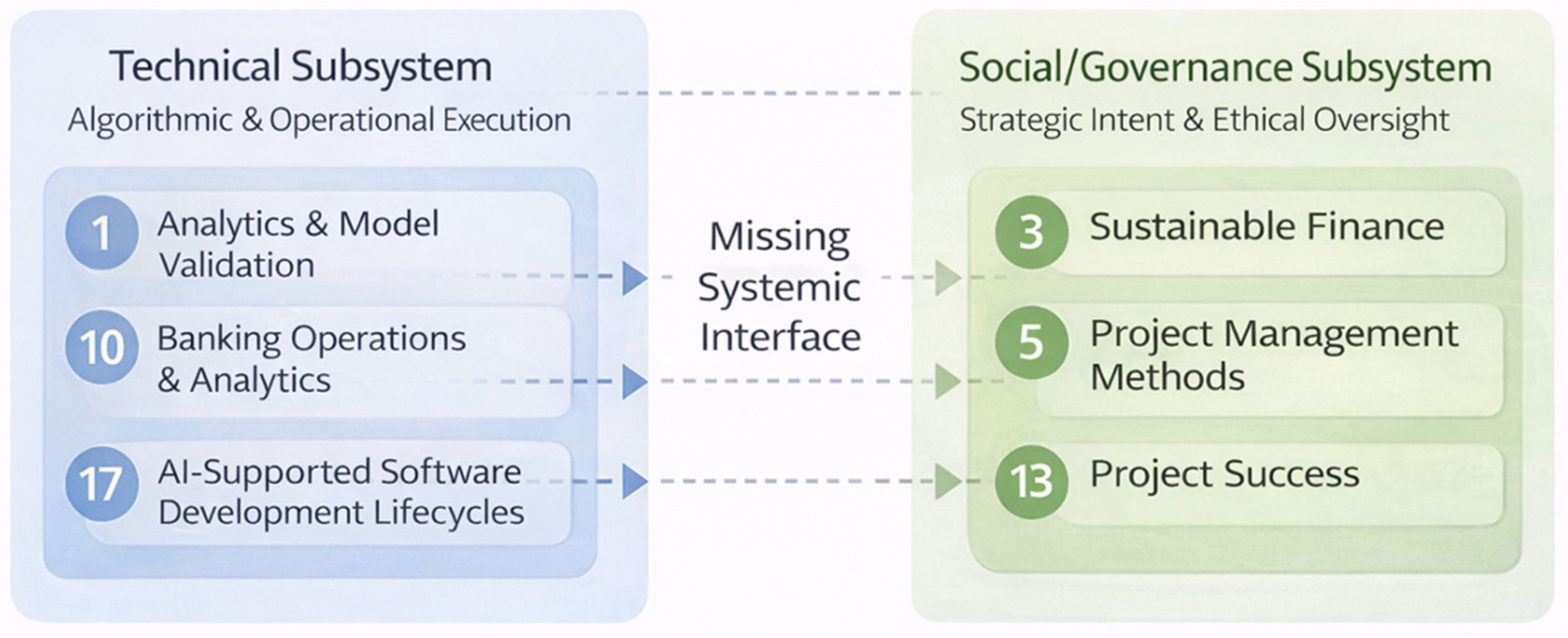
3.2. Socio-Technical Functional Subsystems of AI in Financial Project Management
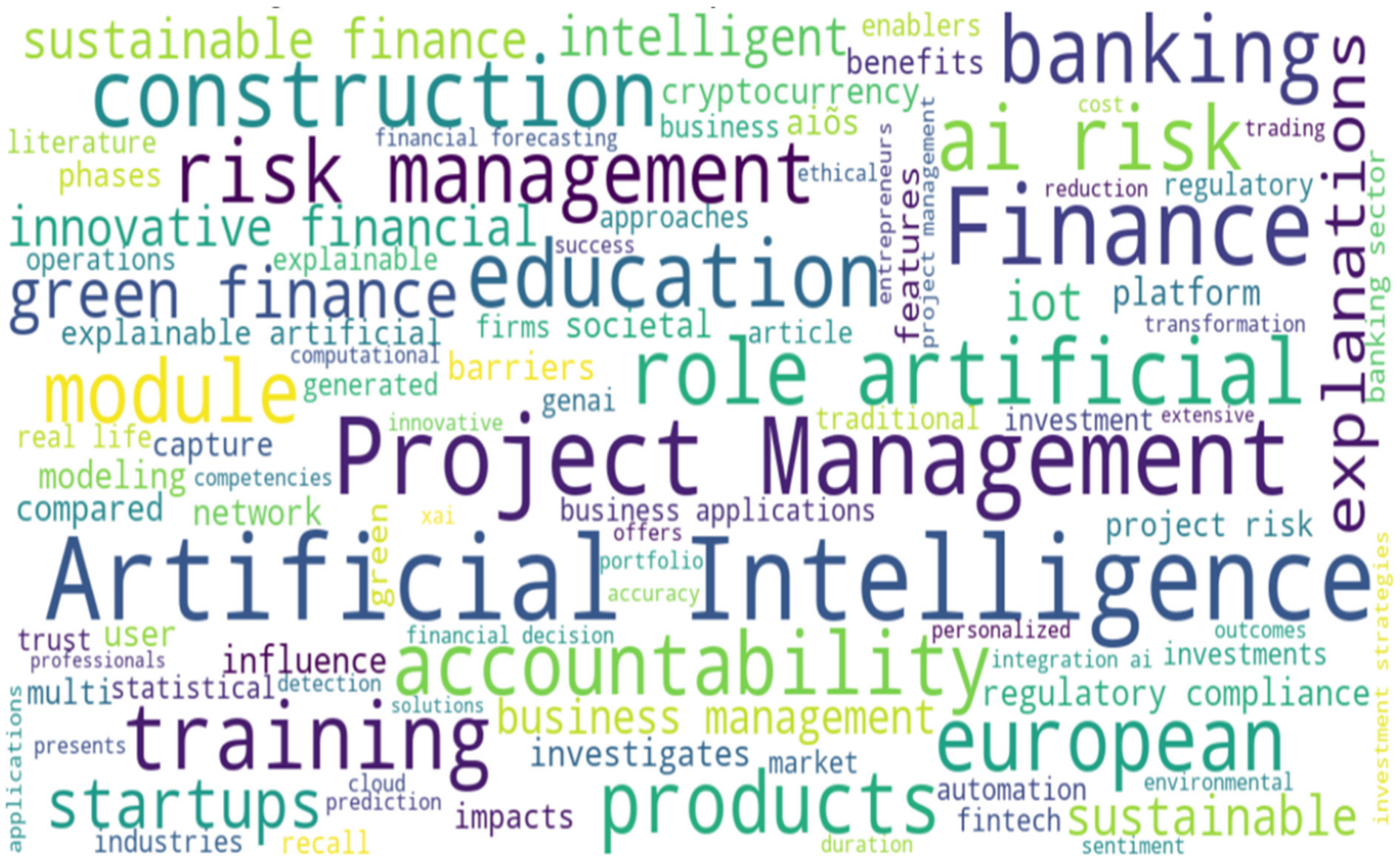
3.3. Word Cloud of Core Research Pillars
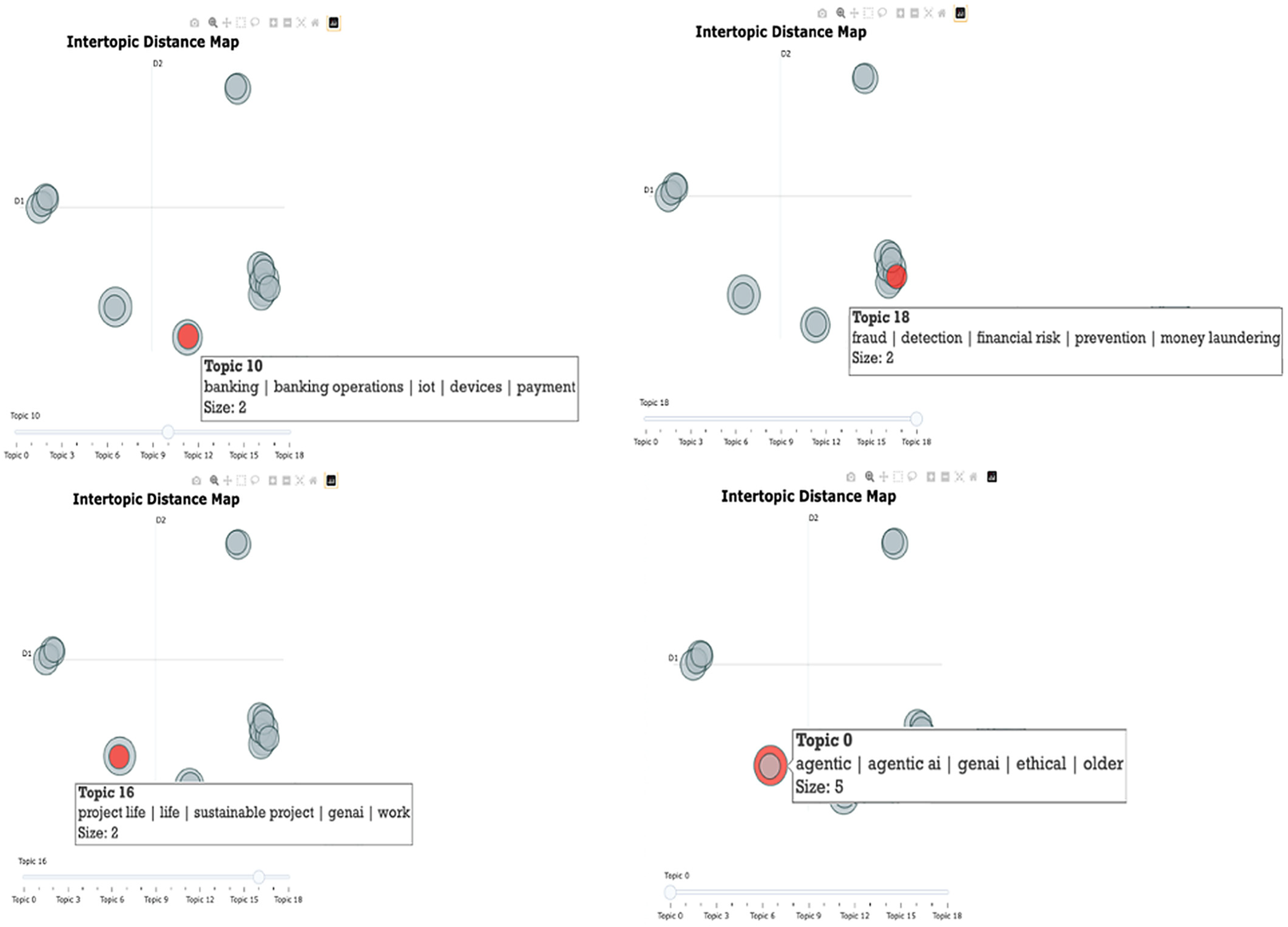
3.4. Topic Relationships and Thematic Structure
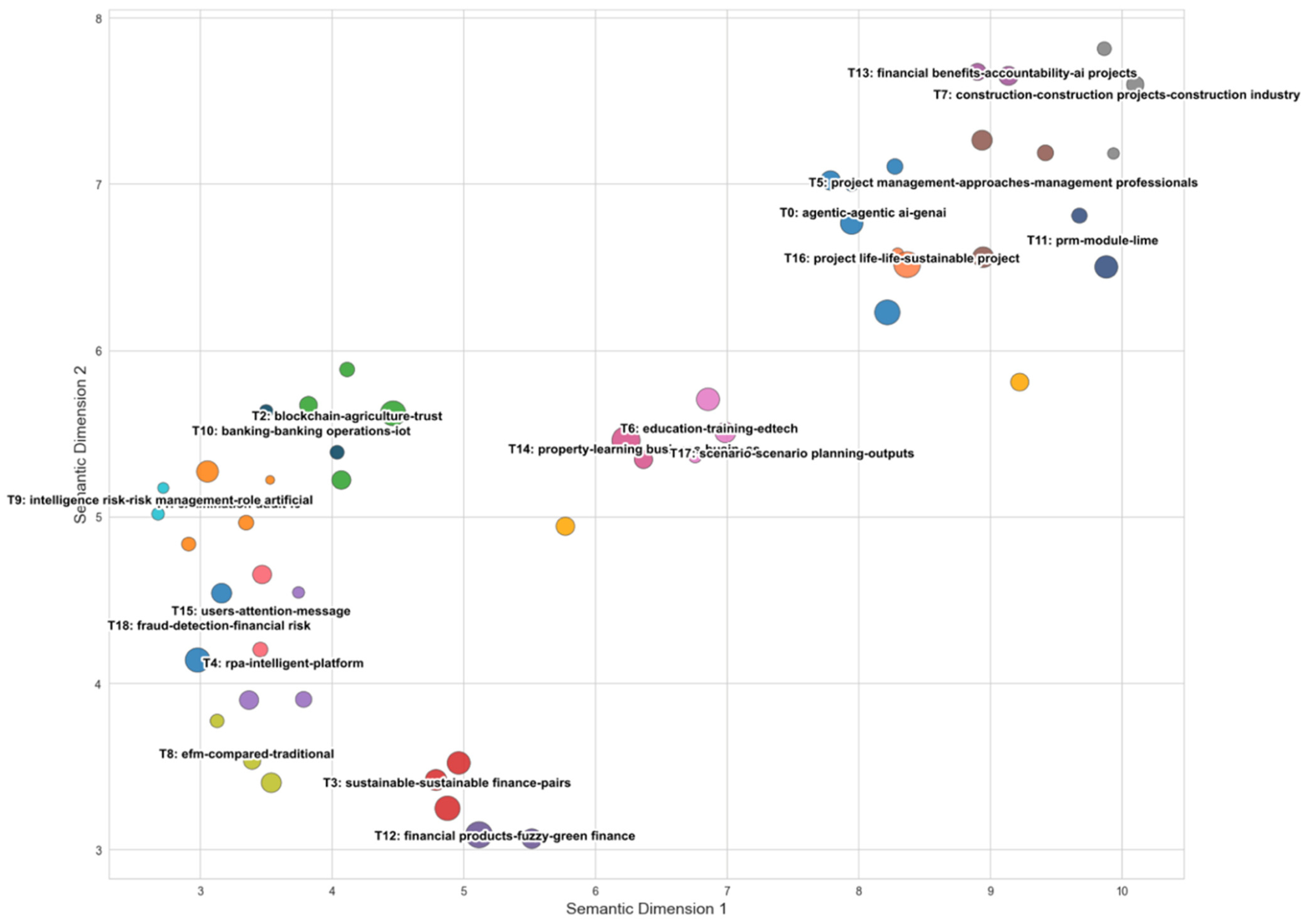
3.5. Spatial Analysis of Thematic Distribution
3.6. Fragmentation of AI and Project Management Research
3.7. Emergence of System-Oriented Perspectives
3.8. Research Gaps
3.9. Practical Implications
4. Discussion
4.1. The Agentic Frontier: A Systematic Paradigm Shift
4.2. Bridging the “Missing Systemic Interface”
- Distributed Decision Authority: Moving beyond simple Robotic Process Automation (RPA) toward systems that can autonomously adjust project portfolios based on shifting ESG priorities (Topic 3).
- Socio-Technical Alignment: Integrating the human-centric dimensions of project management, such as trust and work–life balance (Topic 16), into the design of agentic logic to ensure ethical alignment.
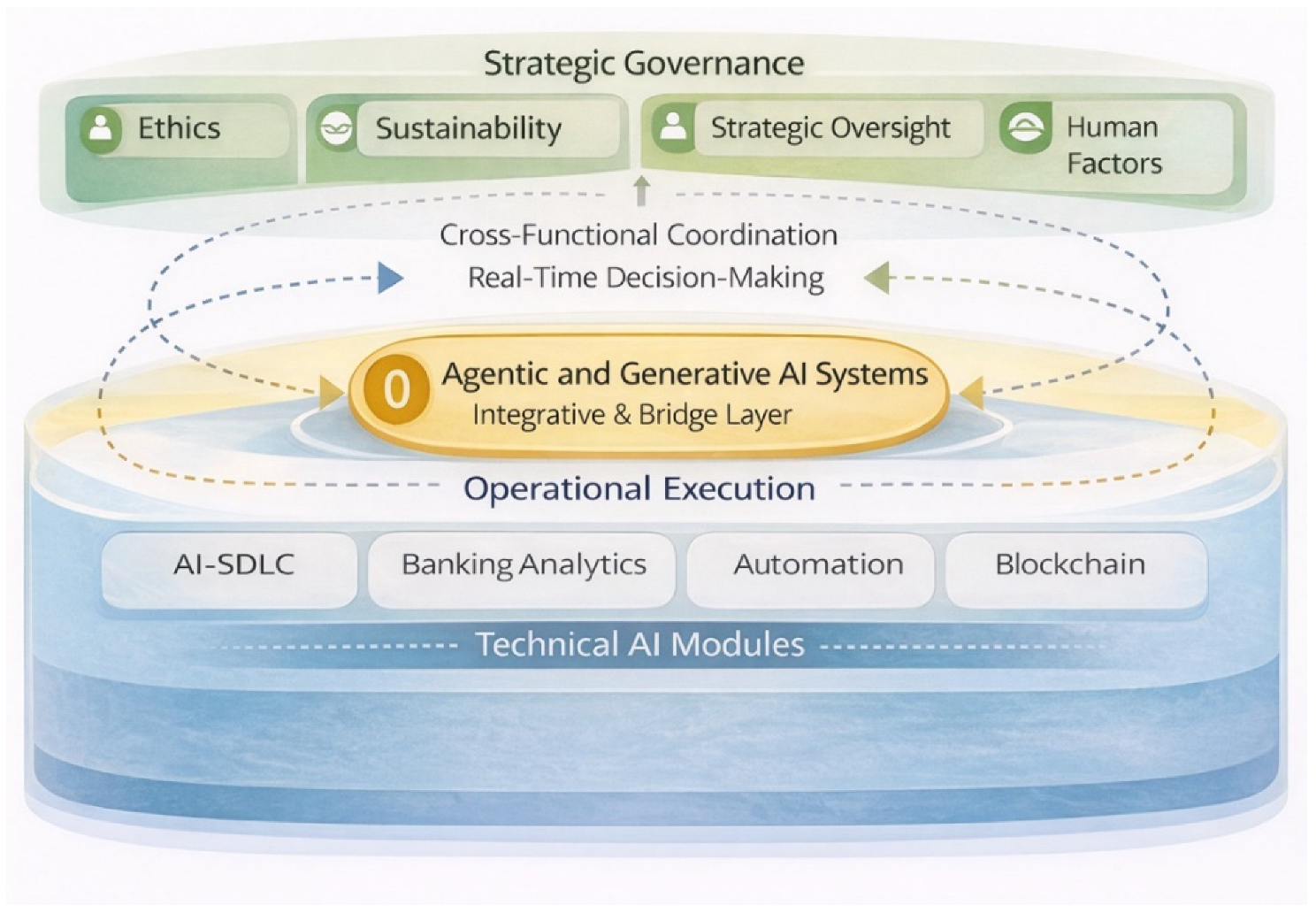
- Governance Synchronization: Developing new accountability structures that recognize the agent as an active participant in the project lifecycle, capable of supporting the “Governance Subsystem” rather than just executing “Technical” tasks.
4.3. Strategic Transformation vs. Operational Efficiency
4.4. The Target Architecture
4.5. Ethical and Governance Implications of Agentic AI in Financial Project Management
4.6. Theoretical Positioning of the Proposed Architecture
5. Conclusions, Limitations and Future Directions
Supplementary Materials
Author Contributions
Funding
Data Availability Statement
Acknowledgments
Conflicts of Interest
Appendix A

Appendix B. PRISMA Checklist
| SECTION | ITEM | PRISMA-ScR CHECKLIST ITEM | REPORTED ON PAGE |
| TITLE | |||
| Title | 1 | Systemic Integration of Artificial Intelligence in Financial Project Management: A Systematic Literature Review and BERTopic-Based Analysis | 1 |
| ABSTRACT | |||
| Structured summary | 2 | This study systematically reviews 62 peer-reviewed articles (2022–2025) on AI integration in financial project management, combining SLR and BERTopic topic modeling for thematic synthesis. Key results, including the emergence of Agentic AI and socio-technical gaps, are presented (Abstract, p. 1). | 1 |
| INTRODUCTION | |||
| Rationale | 3 | AI is increasingly embedded in project management within the financial sector. This review addresses the systemic interface gap by synthesizing technical, governance, and organizational aspects of AI adoption. | 1–2 |
| Objectives | 4 | To systematically identify dominant research themes, conceptualize AI as a systemic driver, and highlight gaps for future research in financial project management (pp. 3–4). | 3–4 |
| METHODS | |||
| Protocol and registration | 5 | No formal review protocol was registered; however, the review followed PRISMA 2020 reporting guidelines and a predefined systematic screening procedure. | 5 |
| Eligibility criteria | 6 | Included peer-reviewed journal articles and conference papers published 2022–2025 in English, focusing on AI applications in financial project management. | 6 |
| Information sources | 7 | Databases searched: Scopus, Web of Science, IEEE Xplore, Google Scholar. Search executed January 2026. | 6 |
| Search | 8 | Boolean search strategy: (‘Artificial Intelligence’ OR ‘Machine Learning’ OR ‘Generative AI’) AND (‘Project Management’ OR ‘Program Management’ OR ‘Portfolio Management’) AND (‘Finance’ OR ‘Banking’ OR ‘Financial Services’). Filters: English, 2022–2025. Full search string detailed in Methods | 6 |
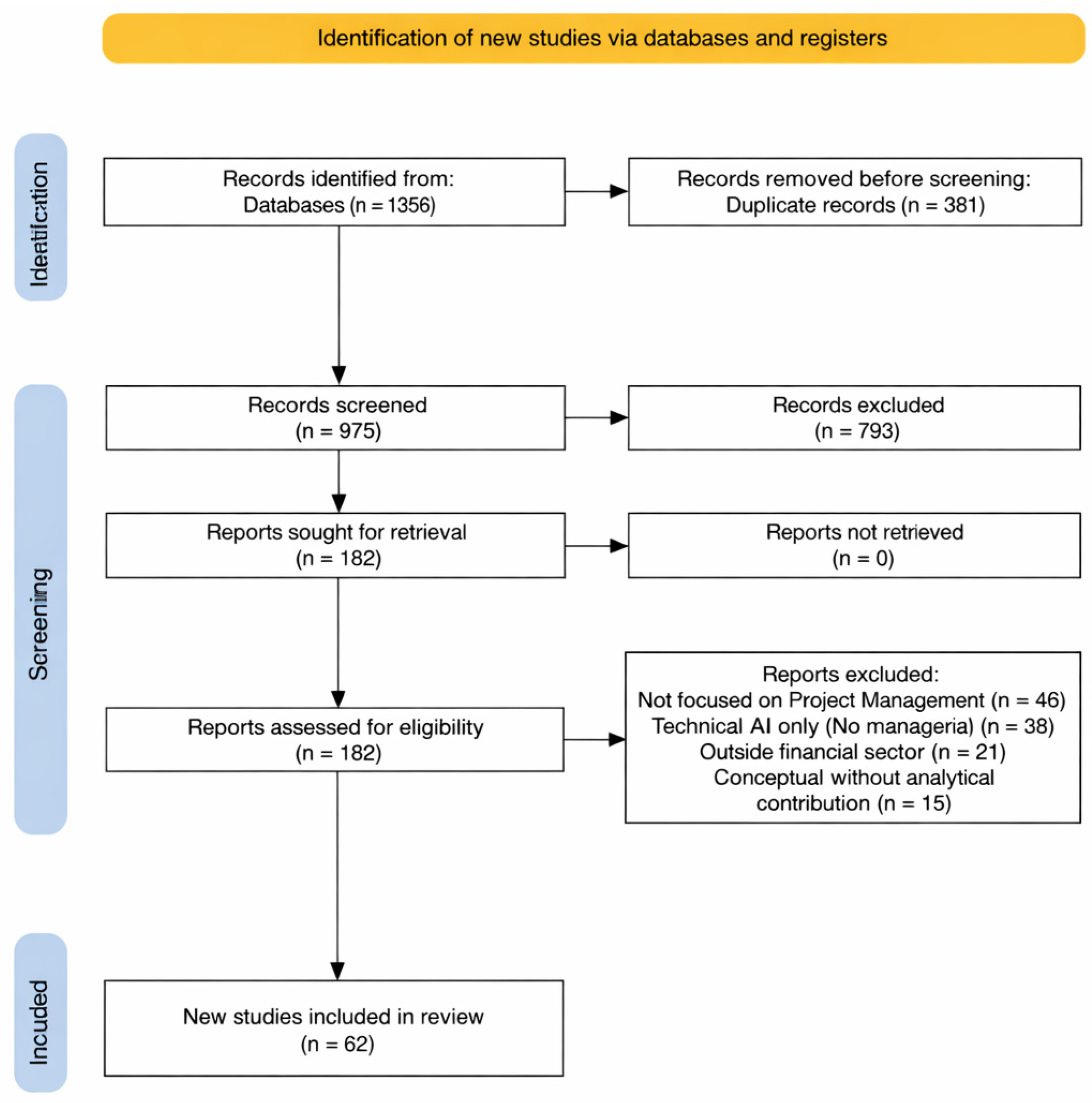
| Selection of sources of evidence | 9 | Title and abstract screening excluded irrelevant studies. Full texts of 182 articles assessed for eligibility; 62 included in final SLR. Screening was conducted by the authors using predefined criteria. | 6–7 |
| Data charting process | 10 | Data extracted into a pre-tested Excel sheet, including authors, AI methods, project management processes, and key findings. Data verified by a second reviewer for consistency | 7–9 |
| Data items | 11 | The following variables were extracted from each study: authors, publication year, AI core technologies, financial applications, project management process areas, methodological approach, and thematic findings. | 7–9 |
| Critical appraisal of individual sources of evidence | 12 | No formal critical appraisal of individual studies was performed. The objective of this review is to map the research landscape and identify thematic trends rather than evaluate intervention quality. | 17 |
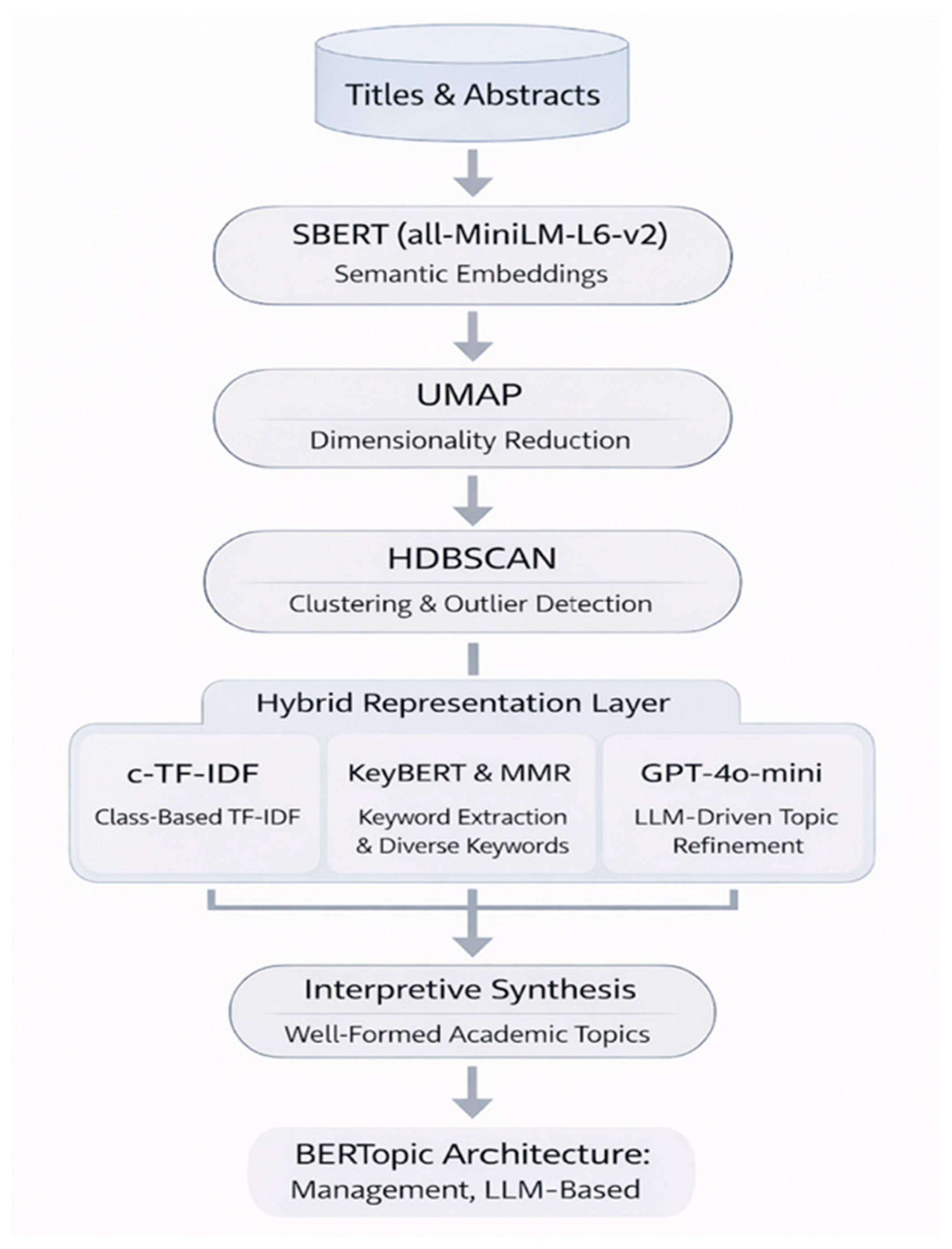
| Synthesis of results | 13 | The data were synthesized using descriptive analysis combined with BERTopic-based topic modeling. BERTopic integrates transformer-based embeddings, UMAP dimensionality reduction, HDBSCAN clustering, and a GPT-4o-mini representation layer to generate interpretable thematic summaries (Section 2.3, Figure 2). | 15–16 |
| RESULTS | |||
| Selection of sources of evidence | 14 | A total of 1356 records were identified through database searches. After removing 381 duplicates, 975 records were screened. 793 records were excluded during title and abstract screening. 182 full-text articles were assessed for eligibility, of which 120 studies were excluded, resulting in a final corpus of 62 included studies. | 16–20 |
| Characteristics of sources of evidence | 15 | Table 1 summarizes the characteristics of the included studies, including authors, publication year, AI technologies, financial applications, and project management process areas. | 16–20 |
| Critical appraisal within sources of evidence | 16 | Not applicable. | |
| Results of individual sources of evidence | 17 | Key characteristics and contributions of the included studies are summarized in Table 1. | 20–25 |
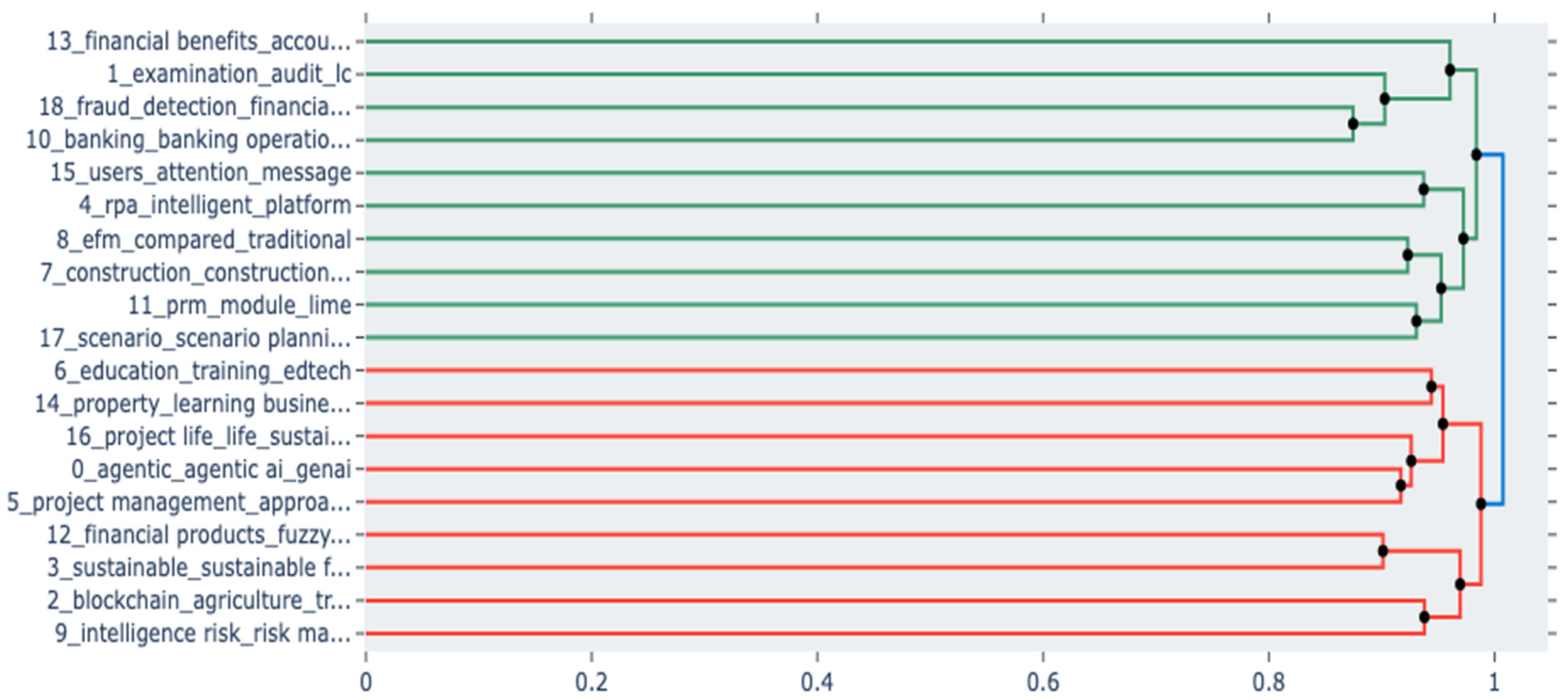
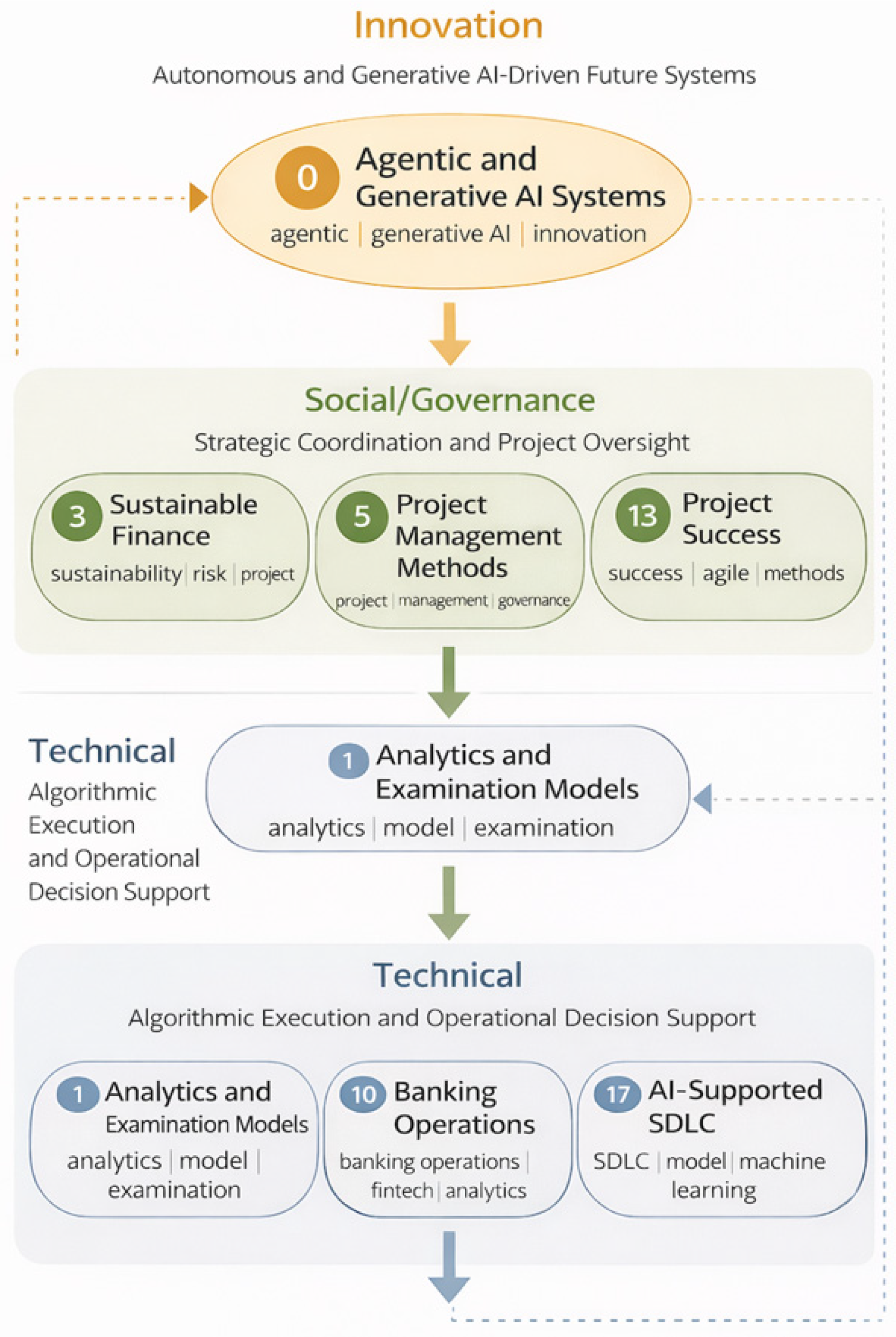
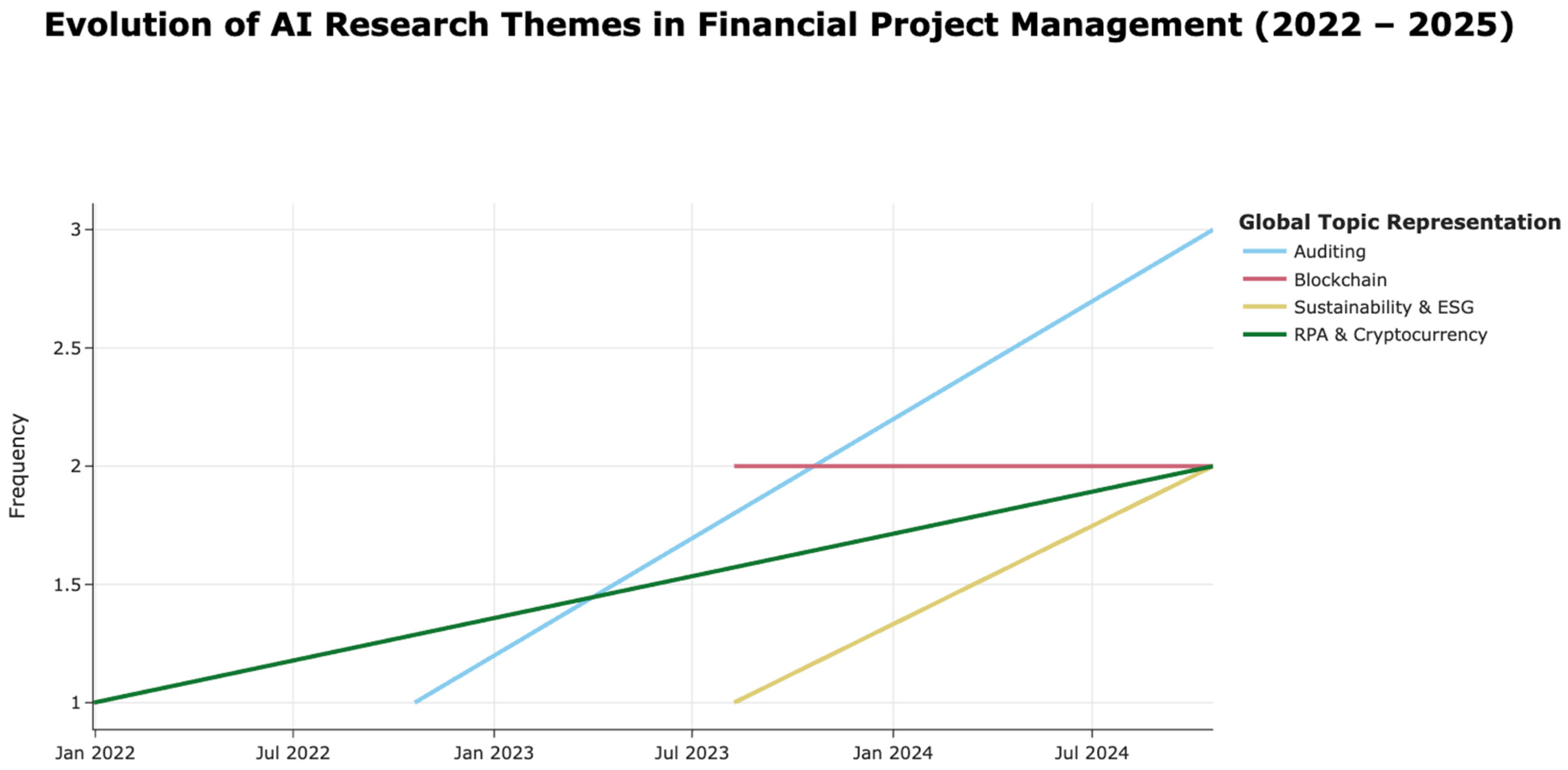
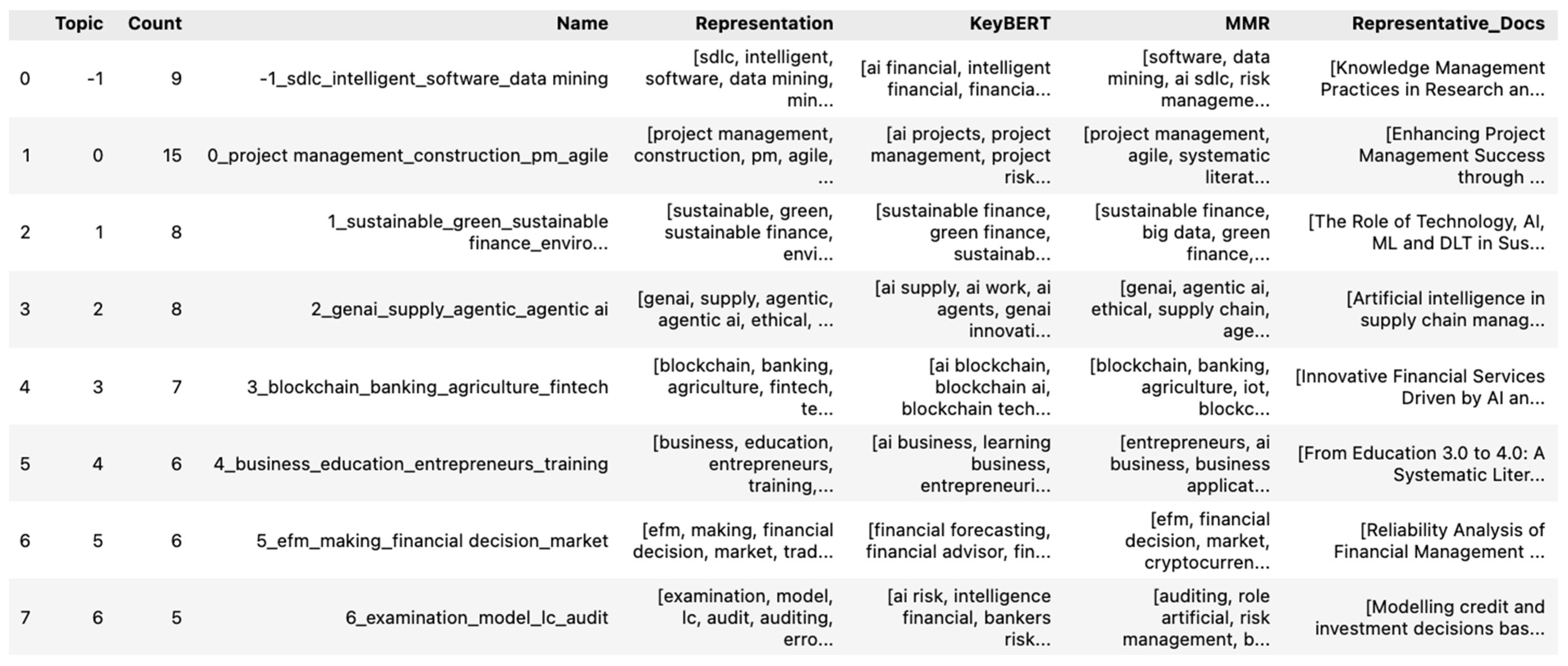
| Synthesis of results | 18 | The BERTopic analysis identified eight consolidated thematic clusters representing major research streams in AI-enabled financial project management. Intertopic distance analysis reveals structural gaps between technical execution themes and governance- or agentic-AI-oriented topics. The thematic structure and conceptual relationships are illustrated in Figure 2, Figure 7, Figure 11 and Figure 14. | 25 |
| DISCUSSION | |||
| Summary of evidence | 19 | The review indicates that systemic integration of AI in financial project management is emerging. Current research is dominated by technical AI applications, while governance mechanisms, human–AI interaction, and strategic coordination remain underexplored. | 26 |
| Limitations | 20 | The study has several limitations, including restriction to English-language publications, the absence of formal critical appraisal of individual studies, potential publication bias, and reliance on BERTopic-driven thematic synthesis within a relatively small corpus. | 29 |
| Conclusions | 21 | The findings provide a conceptual roadmap for integrating Agentic AI as a coordination interface between technical execution and strategic governance within financial project management systems. | 29 |
| FUNDING | |||
| Funding | 22 | No funding was received for this study. | 32 |
References
- Chithiraikannu, M.D.; Arumugam, G.; Moorthy, P.P.; Kannan, K.S.; Packianathan, R. The Impact of Artificial Intelligence (AI) Transformation in Financial Sector. In Shaping Cutting-Edge Technologies and Applications for Digital Banking and Financial Services; Productivity Press: New York, NY, USA, 2025; pp. 378–389. [Google Scholar]
- Ghosh, U.K. Transformative AI Applications in Business Decision-Making: Advancing Data-Driven Strategies and Organizational Intelligence. In AI-Powered Leadership: Transforming Organizations in the Digital Age; IGI Global: Hershey, PA, USA, 2025; pp. 1–40. [Google Scholar]
- Mohammed, I.A.; Madhumithaa, N. Transforming Decision-Making: The Impact of AI and Machine Learning on Strategic Business Operations. Lib. Prog. Lib. Sci. Inf. Technol. Comput. 2024, 44, 3. [Google Scholar]
- Singireddy, J.; Dodda, A.; Burugulla, J.K.; Paleti, S.; Challa, K. Innovative Financial Technologies: Strengthening Compliance, Secure Transactions, and Intelligent Advisory Systems Through AI-Driven Automation and Scalable Data Architectures. J. Financ. Econ. 2021, 1, 123–143. [Google Scholar] [CrossRef]
- Nafiu, A.; Balogun, S.O.; Oko-Odion, C.; Odumuwagun, O.O. Risk management strategies: Navigating volatility in complex financial market environments. World J. Adv. Res. Rev. 2025, 25, 236–250. [Google Scholar] [CrossRef]
- Carreño, A.M. Strategic Alignment in Program Management: A Framework for Sustainable Business Transformation; Institute for Change Leadership and Business Transformation: Washington, DC, USA, 2024. [Google Scholar] [CrossRef]
- Söderlund, J. Knowledge entrainment and project management: The case of large-scale transformation projects. Int. J. Proj. Manag. 2010, 28, 130–141. [Google Scholar] [CrossRef]
- Eyieyien, O.G.; Idemudia, P.O.; Ijomah, T.I. Strategic approaches for successful digital transformation in project management across industries. Int. J. Front. Eng. Technol. Res. 2024, 7, 1–11. [Google Scholar] [CrossRef]
- Selvarajan, G. Leveraging AI-enhanced analytics for industry-specific optimization: A strategic approach to transforming data-driven decision-making. Int. J. Enhanc. Res. Sci. Technol. Eng. 2021, 10, 78–84. [Google Scholar]
- Simen, S.L.N.; Philbin, S.P.; Khanal, B.; Hunter, G. Towards intelligent project management in the finance sector: A scoping review of AI use cases. In Proceedings of the 2025 International Conference on Intelligent Systems: Theories and Applications (SITA), Rabat, Morocco, 20–21 October 2025; pp. 1–8. [Google Scholar]
- Chen, C. Science mapping: A systematic review of the literature. J. Data Inf. Sci. 2017, 2, 1–40. [Google Scholar] [CrossRef]
- Azarian, M.; Yu, H.; Shiferaw, A.T.; Stevik, T.K. Do we perform systematic literature review right? A scientific mapping and methodological assessment. Logistics 2023, 7, 89. [Google Scholar] [CrossRef]
- Atkinson, C.F. Cheap, quick, and rigorous: Artificial intelligence and the systematic literature review. Soc. Sci. Comput. Rev. 2024, 42, 376–393. [Google Scholar] [CrossRef]
- Rogge, A.; Anter, L.; Kunze, D.; Pomsel, K.; Willenbrock, G. Standardized sampling for systematic literature reviews (STAMP method): Ensuring reproducibility and replicability. Media Commun. 2024, 12, 7836. [Google Scholar] [CrossRef]
- Li, D.; Wu, K.; Lei, V.L. Applying topic modeling to literary analysis: A review. Digit. Stud. Lang. Lit. 2024, 1, 113–141. [Google Scholar] [CrossRef]
- Tashakori, E.; Sobhanifard, Y.; Aazami, A.; Khanizad, R. Uncovering Semantic Patterns in Sustainability Research: A Systematic NLP Review. Sustain. Dev. 2025, 33, 399–415. [Google Scholar] [CrossRef]
- Mersha, M.A.; Kalita, J. Semantic-driven topic modeling using transformer-based embeddings and clustering algorithms. Procedia Comput. Sci. 2024, 244, 121–132. [Google Scholar] [CrossRef]
- Galli, C.; Cusano, C.; Meleti, M.; Donos, N.; Calciolari, E. Topic modeling for faster literature screening using transformer-based embeddings. Informatics 2024, 1, 2. [Google Scholar] [CrossRef]
- Mishra, P. Are Unsupervised Text Classification Techniques Sufficient for Categorizing Short Texts like Product Names? In Future of Information and Communication Conference; Springer: Cham, Switzerland, 2024; pp. 429–448. [Google Scholar]
- Chang, C.H.; Ondov, B.; Choi, B.; Peng, X.; He, H.; Xu, H. TopicForest: Embedding-driven hierarchical clustering and labeling for biomedical literature. J. Biomed. Inform. 2025, 172, 104958. [Google Scholar] [CrossRef]
- Janssens, W.; Bogaert, M.; Van den Poel, D. A Comparative Analysis of Topic Reduction Techniques for BERTopic. IEEE Access 2025, 13, 204087–204103. [Google Scholar] [CrossRef]
- Wang, J.; Xie, J.; He, Y.; Chen, N.; Cheng, Z. SETM: A large-scale interactive visualisation of papers based on semantic embedding and topic modelling. J. Inf. Sci. 2025, 51, 1789–1805. [Google Scholar] [CrossRef]
- Karthick, R. Context-Aware Topic Modeling and Intelligent Text Extraction Using Transformer-Based Architectures. J. Sci. Technol. Res. (JSTAR) 2025, 6, 1–13. [Google Scholar] [CrossRef]
- Järvenstrand, R.; Åström, L. Evaluating Thematic Exposures Using Natural Language Processing: An Unsupervised Topic Modeling Approach to Improve Classification and Mitigate Risk. Master’s Thesis, Umeå University, Umeå, Sweden, 2024. [Google Scholar]
- Lai, K.K.; Hsiao, C.W.; Hsu, Y.J. Strategic Management Knowledge Map via BERTopic (1980–2025): Evolution, Integration, and Application. Appl. Syst. Innov. 2025, 8, 142. [Google Scholar] [CrossRef]
- Achkar, P.; Murugaboopathy, S.; Kreuter, A.; Gollub, T.; Potthast, M.; Campbell, Y. From Keyterms to Context: Exploring Topic Description Generation in Scientific Corpora. In Proceedings of the 5th New Frontiers in Summarization Workshop, Suzhou, China, 8 November 2025; pp. 102–122. [Google Scholar]
- Tunca, S. Algorithms of emotion: A hybrid NLP analysis of neurodivergent Reddit communities. Acta Psychol. 2025, 260, 105519. [Google Scholar] [CrossRef]
- Andrade-Cabrera, A.; Ayala-Tipan, C.; Suntaxi, G.; Recalde, L. Literature Reviews with AI: Leveraging Research Rabbit and BERT-Based Models for Efficient Retrieval and Topic Clustering. In International Conference on Smart Technologies, Systems and Applications; Springer: Cham, Switzerland, 2026; pp. 377–391. [Google Scholar]
- Raman, R.; Pattnaik, D.; Hughes, L.; Nedungadi, P. Unveiling the dynamics of AI applications: A review of reviews using scientometrics and BERTopic modeling. J. Innov. Knowl. 2024, 9, 100517. [Google Scholar] [CrossRef]
- Malik, F.S.; Terzidis, O. A hybrid framework for creating artificial intelligence-augmented systematic literature reviews. Manag. Rev. Q. 2025, 1–27. [Google Scholar] [CrossRef]
- Reimers, N.; Gurevych, I. Sentence-bert: Sentence embeddings using siamese bert-networks. In Proceedings of the 2019 Conference on Empirical Methods in Natural Language Processing and the 9th International Joint Conference on Natural Language Processing (EMNLP-IJCNLP); Association for Computational Linguistics: Kerrville, TX, USA, 2019; pp. 3982–3992. [Google Scholar] [CrossRef]
- Grootendorst, M. BERTopic: Neural topic modeling with a class-based TF-IDF procedure. arXiv 2022, arXiv:2203.05794. [Google Scholar]
- McInnes, L.; Healy, J.; Saul, N.; Grossberger, L. UMAP: Uniform Manifold Approximation and Projection. J. Open Source Softw. 2018, 3, 861. [Google Scholar] [CrossRef]
- McInnes, L.; Healy, J.; Astels, S. hdbscan: Hierarchical density based clustering. J. Open Source Softw. 2017, 2, 205. [Google Scholar] [CrossRef]
- Szymczak, P.; Szymczak, A.; Szymczak, M. Computational Analysis of Cyber Risk Management by AI Coaching of Network DDoS Attack Activity in European Industries. In Sustainable Smart Cities and Smart Territories; Springer: Singapore, 2025; pp. 35–48. [Google Scholar] [CrossRef]
- Drydakis, N. AI business applications training and business outcomes: An inclusive intervention for underrepresented entrepreneurs. J. Smart Innov. 2025, 1, 200552. [Google Scholar] [CrossRef]
- Gashi, A.; Vardari, L. The Role of Technology, AI, ML and DLT in Sustainable Finance and a Green Economy. In Sustainable Finance and the Green Economy; Emerald Publishing Limited: Leeds, UK, 2025; pp. 12–35. [Google Scholar] [CrossRef]
- Rakshith, G.; Roopa, S.; Kumar, N. Emerging Trends and Innovation in AI for Business and Management Education: A Future-Ready Approach. In AI-Powered Business Transformation; IGI Global: Hershey, PA, USA, 2025; pp. 210–232. [Google Scholar] [CrossRef]
- Junaedi, D.; Suyanto, S.; Sabariah, M.K.; Utomo, R.G. An Integrated Software Process Framework to Improve Effectiveness and Explainability in Machine Learning Software Application Development in the Finance Sector. In Proceedings of the 2025 International Conference on Software Engineering; ACM: New York, NY, USA, 2025. [Google Scholar] [CrossRef]
- Suganya, S.; Rajasekaran, S. Enhancing Cryptocurrency Market Predictability Using Artificial Intelligence: A Platform for Predicting Prices and Trends of Bitcoin, Ethereum, and Cardano. Int. J. Adv. Sci. Eng. Inf. Technol. 2024, 14, 504–519. [Google Scholar] [CrossRef]
- Tariq, M.U. AI and work-life balance: Transforming employee wellbeing in the modern workplace. In Employee Well-Being and AI; IGI Global: Hershey, PA, USA, 2025; pp. 60–82. [Google Scholar] [CrossRef]
- Gordini, N.; Riva, P. Trustworthiness of AI in Planning and Scheduling: The Experience of the TUPLES Project. In AI for Planning and Scheduling; Springer: Cham, Switzerland, 2025; pp. 412–425. [Google Scholar] [CrossRef]
- Denni-Fiberesima, D.; Miller, C. Critical Success Factors for Project Management Professionals in the Era of AI-Powered Project Portfolio Enterprise Management (PPEM). In AI and Project Management; Springer: Cham, Switzerland, 2025; pp. 1102–1115. [Google Scholar] [CrossRef]
- Alam, M.S.; Ali, R. The Technological Landscape of AI and Sustainable Finance: An Exploration. In Sustainability and AI Finance; Springer: Singapore, 2025; pp. 45–60. [Google Scholar] [CrossRef]
- Narasimhan, V.; Swaminathan, B. Smart Technology Adoption in E-Finance Services. In E-Finance and Smart Tech; Springer: Singapore, 2025; pp. 33–51. [Google Scholar] [CrossRef]
- Parchmann, L.; Scherenberg, V. Evaluation of an AI-Based Clinical Decision Support System for Perioperative Care of Older Patients: Ethical Analysis of Focus Groups with Older Adults. JMIR Aging 2025, 8, e71568. [Google Scholar] [CrossRef]
- Miller, A.; Brown, T. Simultaneous pursuit of accountability for regulatory compliance, financial benefits, and societal impacts in artificial intelligence (AI) projects. Ann. Comput. Sci. Inf. Syst. 2025, 42, 125–134. [Google Scholar] [CrossRef]
- Padgaonkar, S.; Kulkarni, V. AI Based Financial Modeling for Cost Efficiency and Revenue Growth in Road Construction. In Proceedings of the 2025 World Symposium on Unmanned Aerial Systems (WorldSUAS); IEEE: New York, NY, USA, 2025. [Google Scholar] [CrossRef]
- Prakash, M.; Kumar, S. Enhanced Financial Forecasting and Budgeting Accuracy with Advanced AI Algorithms. In Proceedings of the 2025 International Conference on Intelligent Management and Industrial Application (ICIMIA); IEEE: New York, NY, USA, 2025. [Google Scholar] [CrossRef]
- Marcos, J.; Lopez, R. Exploring the Efficiency of AI-Assisted Financial Risk Management for Residential Construction Projects: A Literature Review. In Proceedings of the 2025 International Conference on Business Administration and Software Engineering (ICBASE); IEEE: New York, NY, USA, 2025. [Google Scholar] [CrossRef]
- Kharatmol, A.; Patil, S. AI—Driven Finance Advisor for Personalized Investment Strategies. In Proceedings of the 2025 Conference on Intelligent Technologies (CONIT); IEEE: New York, NY, USA, 2025. [Google Scholar] [CrossRef]
- Lukianchuk, I.; Petrenko, O. Financial Evaluation of Project Solutions Using Building Information Modelling and Artificial Intelligence. In ITPM 2025—IT Project Management 2025, 6th International Workshop on IT Project Management; CEUR Workshop Proceedings; CEUR-WS.org: Aachen, Germany, 2025; Volume 4023, pp. 163–172. Available online: https://ceur-ws.org/Vol-4023/paper15.pdf (accessed on 14 January 2026).
- Alka, S.; Pandey, K. From Education 3.0 to 4.0: A Systematic Literature Review on the Evolution and Trends in EdTech Startups. In Systematic Reviews in Education; Springer: Singapore, 2025; pp. 502–520. [Google Scholar] [CrossRef]
- Sahoo, N.; Jena, R. Intersection of artificial intelligence in agriculture sector management: A critical analysis. In AI in Agriculture Management; CRC Press: Boca Raton, FL, USA, 2025; pp. 182–195. [Google Scholar] [CrossRef]
- Hughes, D.L.; Dwivedi, Y.K. AI Agents and Agentic Systems: Redefining Global IT Management. Int. J. Inf. Manag. 2025, 78, 2524286. [Google Scholar] [CrossRef]
- Arshad, M.; Khan, S. A Comprehensive Framework for Intelligent, Scalable, and Performance-Optimized Software Development. IEEE Access 2025, 13, 3564139. [Google Scholar] [CrossRef]
- Rahi, S.; Alghizzawi, M. Optimizing sustainable project management life cycle using generative AI modeling. In Generative AI for Sustainability; De Gruyter: Berlin, Germany, 2025; pp. 154–170. [Google Scholar] [CrossRef]
- Hoda, R. Keynote on Augmented Agile: Human-centred AI-assisted Software Project Management at FinanSE Workshop (ICSE 2024). In Proceedings of the 2024 International Conference on Software Engineering; ACM: New York, NY, USA, 2024. [Google Scholar] [CrossRef]
- Katamaneni, S.; Rao, P. AI-Based Risk Management in Financial Services. In Proceedings of the 2024 International Conference on Cloud Computing and Trends; IEEE: New York, NY, USA, 2024. [Google Scholar] [CrossRef]
- Likhitkar, S.; Deshmukh, V. Exploring the Intersection of Artificial Intelligence and Financial Decision-Making: A Comprehensive Review. In Proceedings of the 2024 Cyber Communications Conference; IEEE: New York, NY, USA, 2024. [Google Scholar] [CrossRef]
- Al-Shaghdari, F.; Ahmed, H. Risk factors in Islamic green finance and a corporate solution. In Islamic Green Finance; Routledge: London, UK, 2024; pp. 245–266. [Google Scholar] [CrossRef]
- Ahuja, N.J.; Mani, A. Integrating Cloud, Blockchain and AI Technologies—Challenges and Scope. In Cloud and Blockchain Integration; Springer: Singapore, 2024; pp. 412–430. [Google Scholar] [CrossRef]
- Thirumagal, K.; Vijayakumar, V. AI-Enhanced IoT Data Analytics for Risk Management in Banking Operations. In Proceedings of the 2024 International Conference on Recent Trends in Computing; IEEE: New York, NY, USA, 2024. [Google Scholar] [CrossRef]
- Al-Hadi, H.; Al-Shaibany, N.A. AI-driven fraud analytics: Transforming financial security in banking through IoT sensors, big data analytics, and quality-oriented management systems. Kasu J. Comput. Sci. 2024, 1, 653–660. [Google Scholar]
- Channi, H.K.; Singh, A. Big Data Tools for Business and Finance Sectors in the Era of Metaverse. In Metaverse and Finance; CRC Press: Boca Raton, FL, USA, 2024; pp. 44–62. [Google Scholar] [CrossRef]
- Agal, S.; Kumar, R. Innovative Financial Services Driven by AI and Blockchain Synergy for Decentralized Trust and Personalized Solutions. In Proceedings of the 2024 Parallel, Distributed and Grid Computing Conference; IEEE: New York, NY, USA, 2024. [Google Scholar] [CrossRef]
- Stiefenhofer, P.; Zhang, W. The Future of Sustainable Finance: AI-Driven Sustainable Pairs Trading in Market-Neutral Investing. In Sustainable Finance Horizons; Springer: Cham, Switzerland, 2024; pp. 88–104. [Google Scholar] [CrossRef]
- Wu, Y.; Chen, X. Exploring the Efficacy of Artificial Intelligence Models in the Strategic Analysis of Green Finance for Sustainable Environmental Development. In Proceedings of the 2024 International Conference on Smart Computing; IEEE: New York, NY, USA, 2024. [Google Scholar] [CrossRef]
- Rodgers, W.; Murray, J. Modelling credit and investment decisions based on AI algorithmic behavioral pathways. Technol. Forecast. Soc. Change 2023, 189, 122471. [Google Scholar] [CrossRef]
- Ma, L.; Zhang, H. Reliability Analysis of Financial Management Systems Based on Artificial Intelligence Algorithms. In Proceedings of the 2023 International Conference on Information Technology; IEEE: New York, NY, USA, 2023. [Google Scholar] [CrossRef]
- Grzeszczyk, T.A.; Groszkowski, T. Knowledge Management Practices in Research and Development Strategic Projects Undertaken by Banks. In Proceedings of the 24th European Conference on Knowledge Management (ECKM 2023), Lisboa, Portugal, 7–8 September 2023; Academic Conferences International Limited: Reading, UK, 2023; pp. 464–472. [Google Scholar]
- Plotnikova, V.; Dumontier, M. Designing a data mining process for the financial services domain. Int. J. Financ. Serv. Manag. 2022, 11, 245–262. [Google Scholar] [CrossRef]
- Liu, Y.; Wang, Z. Research on “AI + RPA” Interactive Technology of Intelligent Financial Management Platform. In Proceedings of the 2022 International Conference on Wavelet Analysis and Pattern Recognition; IEEE: New York, NY, USA, 2022. [Google Scholar] [CrossRef]
- Soni, G.D. Enhancing Project Management Success through Artificial Intelligence. Int. J. Multidiscip. Res. Growth Eval. 2025, 6, 1036–1046. [Google Scholar] [CrossRef]
- Alshibi, A.S.; Al-Mhdawi, M.K.S.; Al-Sadoon, A.S.; Al-Mhdawi, M.S. The Rise of Artificial Intelligence in Project Management: A Systematic Literature Review of Current Opportunities, Enablers, and Barriers. Buildings 2025, 15, 1130. [Google Scholar] [CrossRef]
- Kuster, J.; Meidert, N. How artificial intelligence will transform project management in the age of digitization: A systematic literature review. Manag. Rev. Q. 2024, 75, 1669–1716. [Google Scholar] [CrossRef]
- Ahmed, M.; Wang, Y. Trends and Applications of Artificial Intelligence in Project Management. Electronics 2025, 14, 800. [Google Scholar] [CrossRef]
- Smith, R.; Johnson, L. Leveraging Artificial Intelligence in Project Management: A Systematic Review of Applications, Challenges, and Future Directions. Computers 2025, 14, 66. [Google Scholar] [CrossRef]
- Tan, L.; Zhang, J. AI-Driven Predictive Analytics for Financial Risk Management and Financial Risk Prevention with Ranking Cost Scheduling. Int. J. Adv. Res. Innov. 2025, 14, 002. [Google Scholar] [CrossRef]
- Brem, A.; Viardot, E.; Nylund, P.A. Artificial intelligence in open innovation project management: A systematic literature review on technologies, applications, and integration requirements. J. Open Innov. Technol. Mark. Complex. 2024, 10, 100445. [Google Scholar] [CrossRef]
- Gupta, A.; Singh, V. Revolutionizing Risk: The Role of Artificial Intelligence in Financial Risk Management, Forecasting, and Global Implementation. In Global Risk Management; Springer: Cham, Switzerland, 2025; pp. 445–462. [Google Scholar] [CrossRef]
- Karakuş, H.; Gündoğdu, K. Innovative financial solutions for sustainable investments using artificial intelligence-based hybrid fuzzy decision-making approach in carbon capture technologies. Financ. Innov. 2024, 10, 115. [Google Scholar] [CrossRef]
- Chen, H.; Xu, W. The role of agentic AI in shaping a smart future: A systematic review. Array 2025, 25, 100399. [Google Scholar] [CrossRef]
- Martinez, J.; Lee, S. An integrated Artificial Intelligence and optimization model for operational efficiency and risk reduction in Letter of Credit examination process. Decis. Anal. J. 2025, 14, 100552. [Google Scholar] [CrossRef]
- Thompson, K. AI-Driven Innovations in Fintech: Applications, Challenges, and Future Trends. Int. J. Electr. Comput. Eng. Res. 2025, 5, 437. [Google Scholar] [CrossRef]
- Brown, M.L. Artificial intelligence in financial auditing: Redefining accuracy and transparency in assurance services. Int. J. Audit. 2025, 70, 1–20. [Google Scholar] [CrossRef]
- Reddy, V.; Prasad, K. Real-Time AI-Cloud Framework for Financial Analytics in SAP-Integrated BMS using Apache Infrastructure. Int. J. Creative Technol. Eng. 2025, 8, 803. [Google Scholar] [CrossRef]
- Okoro, E.; Eze, C. Harnessing Artificial Intelligence for combating money laundering and fraud in the U.S. financial industry: A comprehensive analysis. Financ. Account. Res. J. 2025, 7, 1814. [Google Scholar] [CrossRef]
- Medina, P.C.; Pagnotta, E.S. Using AI and Behavioral Finance to Cope with Limited Attention and Reduce Overdraft Fees. Manage. Sci. 2022, 68, 204–222. [Google Scholar] [CrossRef]
- Liang, X.; Wang, Q. Integrating machine learning into business and management in the age of artificial intelligence. Humanit. Soc. Sci. Commun. 2025, 12, 436. [Google Scholar] [CrossRef]
- Varga, D.; Szabó, B. Banking Transformation Through FinTech and the Integration of Artificial Intelligence in Payments. FinTech 2025, 4, 13. [Google Scholar] [CrossRef]
- Parida, V.; Burström, T.; Visnjic, I.; Wincent, J. Generative AI and the future of innovation management: A human centered perspective and an agenda for future research. J. Open Innov. Technol. Mark. Complex. 2024, 10, 100456. [Google Scholar] [CrossRef]
- Al-Adwan, A.S. The Role of Artificial Intelligence in Risk Management: Practices of the Banking Sector. In FinTech and Banking Strategy; IGI Global: Hershey, PA, USA, 2024; pp. 88–105. [Google Scholar] [CrossRef]
- Zhou, J.; Li, Y. The impact of generative AI on management innovation. J. Ind. Inf. Integr. 2024, 42, 100767. [Google Scholar] [CrossRef]
- Bag, S.; Gupta, S.; Choi, T.M.; Kumar, A. Artificial intelligence in supply chain management: Enablers and constraints in pre-development, deployment, and post-development stages. Prod. Plan. Control 2024, 36, 748–770. [Google Scholar] [CrossRef]
- Nguyen, T.; Park, C. A Multi-Module Explainable Artificial Intelligence Framework for Project Risk Management: Enhancing Transparency in Decision-making. Eng. Appl. Artif. Intell. 2025, 140, 110427. [Google Scholar] [CrossRef]
- Alqahtani, A.; Al-Mohaimeed, M. Integration of AI in Banking Project Management: A Systematic Review. IEEE Access 2024, 12, 4567–4580. [Google Scholar]
- Mani, V. Impact of Artificial Intelligence on Project Management Efficiency in the Financial Sector. Appl. Syst. Innov. 2025, 8, 12–25. [Google Scholar]
- Uğuz, S.; Tülü, Ç.N. Topic Modeling Analysis in the Field of Large Language Models with BERTopic (2020–2024). In Proceedings of the 2024 Innovations in Intelligent Systems and Applications Conference (ASYU), Ankara, Türkiye, 16–18 October 2024; pp. 1–6. [Google Scholar]
- García Cerdán, J. Multilabel Classification and Scientific Evidence Retrieval in Social Media Using Transformer-Based and Large Language Models. Ph.D. Thesis, Universitat Politècnica de València, Valencia, Spain, 2025. [Google Scholar]
- Yang, Z.; Zhou, X.; Jiang, Y.; Zhang, X.; Gao, Q.; Lu, Y.; Yang, A. Human–AI Complementarity in Peer Review: Empirical Analysis of PeerJ Data and Design of an Efficient Collaborative Review Framework. Publications 2025, 14, 1. [Google Scholar] [CrossRef]
- Kawai, V.A.; Leticio, G.R.; Pedronette, D.C. Semi-Supervised Image Retrieval Through Particle Competition and Cooperation Combined with Manifold Learning. In Proceedings of the 2025 38th SIBGRAPI Conference on Graphics, Patterns and Images (SIBGRAPI), Salvador, Brazil, 30 September–3 October 2025; pp. 1–6. [Google Scholar]
- Guo, Y.; Guo, H.; Yu, S.X. Co-sne: Dimensionality reduction and visualization for hyperbolic data. In Proceedings of the IEEE/CVF Conference on Computer Vision and Pattern Recognition (CVPR), New Orleans, LA, USA, 18–24 June 2022; pp. 21–30. [Google Scholar]
- Cheng, X.; Popal, H.; Wang, H.; Hu, R.; Zang, Y.; Zhang, M.; Thornton, M.A.; Ma, Y.; Cai, H.; Bi, Y.; et al. The conceptual structure of human relationships across modern and historical cultures. Nat. Hum. Behav. 2025, 9, 1162–1175. [Google Scholar] [CrossRef]
- Tschisgale, P.; Wulff, P.; Kubsch, M. Integrating artificial intelligence-based methods into qualitative research in physics education research: A case for computational grounded theory. Phys. Rev. Phys. Educ. Res. 2023, 19, 020123. [Google Scholar] [CrossRef]
- Bucovețchi, O.; Voipan, A.E.; Voipan, D.; Stanciu, R.D. Redefining Organizational Resilience and Success: A Natural Language Analysis of Strategic Domains, Semantics, and AI Opportunities. Systems 2025, 13, 999. [Google Scholar] [CrossRef]
- Zhou, D.; Patankar, S.; Lydon-Staley, D.M.; Zurn, P.; Gerlach, M.; Bassett, D.S. Architectural styles of curiosity in global Wikipedia mobile app readership. Sci. Adv. 2024, 10, eadn3268. [Google Scholar] [CrossRef]
- Molchanova, N.; Cagol, A.; Ocampo-Pineda, M.; Lu, P.J.; Weigel, M.; Chen, X.; Beck, E.S.; Tsagkas, C.; Reich, D.S.; Vanden Bulcke, C.; et al. Benchmarking and Explaining Deep Learning Cortical Lesion MRI Segmentation in Multiple Sclerosis. arXiv 2025, arXiv:2507.12092. [Google Scholar] [CrossRef]
- Li, Y.; Geng, A.; Zhou, Z.; Cui, F.; Xu, J.; Meng, Y.; Wei, L.; Zou, Q.; Zhang, Q.; Zhang, Z. AVP-HNCL: Innovative Contrastive Learning with a Queue-Based Negative Sampling Strategy for Dual-Phase Antiviral Peptide Prediction. J. Chem. Inf. Model. 2025, 65, 5868–5886. [Google Scholar] [CrossRef] [PubMed]
- Mor, A.; Orsenigo, C.; Soto Gomez, M.; Vercellis, C. Shaping the causes of product returns: Topic modeling on online customer reviews. Electron. Commer. Res. 2024, 26, 747–781. [Google Scholar] [CrossRef]
- Lu, C.; Zhu, L.; Xie, Y.; Xu, W.; Zhang, C.; Zhao, Y.; Cao, Y. Advancing genetics of agriculture and biomolecules: A BERTopic-based analysis of research evolution in leading agricultural universities. Mol. Cell. Biomech. 2025, 22, 901. [Google Scholar] [CrossRef]
- da Silva, E.F.; Pires, J.; Dantas, D.R.; dos Santos Oliveira, M.; Durão, F.A. A Gated Review Attention Framework for Topics in Graph-Based Recommenders. In Proceedings of the Brazilian Symposium on Multimedia and the Web (WebMedia), Rio de Janeiro, Brazil, 10–14 November 2025; pp. 19–27. [Google Scholar]
- Baby, A.; Vaidehi, V.; Jose, J. Redundancy Reduction and Sentence Prioritisation of the Student Lecture Notes Using Soft Cosine Implemented MMR Algorithm. Veredas do Direito 2025, 22, e223612. [Google Scholar] [CrossRef]
- Kataishi, R. The Technological Trajectory of Semantic Analysis: A Historical-Methodological Review of NLP in Social Sciences. SSRN 2024, 5022988. [Google Scholar] [CrossRef]
- Stănescu, G.; Oprea, S.V. Recent Trends and Insights in Semantic Web and Ontology-Driven Knowledge Representation Across Disciplines Using Topic Modeling. Electronics 2025, 14, 1313. [Google Scholar] [CrossRef]
- Wadawadagi, R.S.; Pagi, V.B. Sentiment analysis on social media: Recent trends in machine learning. In Research Anthology on Implementing Sentiment Analysis Across Multiple Disciplines; IGI Global: Hershey, PA, USA, 2022; pp. 780–799. [Google Scholar]
- Ajayan, A.R. A Study of Multivariate Behaviour and Anomaly Patterns: Tensor Decomposition for Multiway Big Data. Ph.D. Thesis, University of Technology Sydney, Sydney, Australia, 2017. [Google Scholar]
- Guan, C.; Ren, J.; Lim, T. Advancing Green Technologies with Artificial Intelligence: An Integrative, Evidence-Based Review. Evid.-Based Rev. 2025, preprint. [Google Scholar]
- Mishra, M. A holistic review of customer experience research: Topic modelling using BERTopic. Mark. Intell. Plan. 2025, 43, 802–820. [Google Scholar] [CrossRef]
- Rejeb, A.; Rejeb, K.; Simske, S.; Süle, E. Industry 5.0 research: An approach using co-word analysis and BERTopic modeling. Discov. Sustain. 2025, 6, 402. [Google Scholar] [CrossRef]
- Madrid-Garcia, A.; Freites-Nunez, D.; Merino-Barbancho, B.; Pérez Sancristobal, I.; Rodríguez-Rodríguez, L. Mapping two decades of research in rheumatology-specific journals: A topic modeling analysis with BERTopic. Ther. Adv. Musculoskelet. Dis. 2024, 16, 1759720X241308037. [Google Scholar] [CrossRef] [PubMed]
- Singh, M.K. Trends and trajectories in India’s social policy research: A computational review. Int. J. Sociol. Soc. Policy 2025, 45, 786–805. [Google Scholar] [CrossRef]
- Opu, M.N.; Islam, S.; Rouhani, S.; Chowdhury, S. Understanding the Issue Types in Open Source Blockchain-based Software Projects with the Transformer-based BERTopic. arXiv 2025, arXiv:2506.11451. [Google Scholar]
- Al-Hashemi, H.A. Evaluating the role of artificial intelligence and machine learning technologies in developing and improving the quality of electronic financial disclosure. Am. J. Econ. Bus. Manag. 2023, 6, 10. [Google Scholar]
- Arsalan, M.H.; Mubin, O.; Al Mahmud, A.; Khan, I.A.; Hassan, A.J. Mapping Data-Driven Research Impact Science: The Role of Machine Learning and Artificial Intelligence. Informatics 2025, 2, 5. [Google Scholar] [CrossRef]
- Fendt, J. Embracing emergence in qualitative meta-analysis: A guide to higher-order synthesis. Methodol. Innov. 2025, 18, 143–167. [Google Scholar] [CrossRef]
- Khalil, M.; Bravo, A.; Vieira, D.; Carvalho, M.M. Mapping the AI Landscape in Project Management Context: A Systematic Literature Review. Systems 2025, 13, 913. [Google Scholar] [CrossRef]
- Zhang, X.; Antwi-Afari, M.F.; Zhang, Y.; Xing, X. The impact of artificial intelligence on organizational justice and project performance: A systematic literature and science mapping review. Buildings 2024, 14, 259. [Google Scholar] [CrossRef]
- Wamba-Taguimdje, S.L.; Fosso Wamba, S.; Kala Kamdjoug, J.R.; Tchatchouang Wanko, C.E. Influence of artificial intelligence (AI) on firm performance: The business value of AI-based transformation projects. Bus. Process Manag. J. 2020, 26, 1893–1924. [Google Scholar] [CrossRef]
- Schwaeke, J.; Gerlich, C.; Nguyen, H.L.; Kanbach, D.K.; Gast, J. Artificial intelligence (AI) for good? Enabling organizational change towards sustainability. Rev. Manag. Sci. 2025, 19, 3013–3038. [Google Scholar] [CrossRef]
- Coenen, L.; Grillitsch, M.; Hansen, T.; Moodysson, J. An Innovation System Framework for System Innovation Policy: The Case of Strategic Innovation Programs (SIPs) in Sweden; CIRCLE Working Paper; Lund University: Lund, Sweden, 2017. [Google Scholar]
- Boschken, H.L. Aligning a multi-government network with situational context: Metropolitan governance as an organizational systems problem. Am. Rev. Public Adm. 2017, 47, 189–208. [Google Scholar] [CrossRef]
- Villari, B.; Torta, R.; Lin, Z.; Celi, M.; Rodriguez Schon, V.; Sangiorgi, D.; Huda, M. Systemic & futures-oriented service design: Emerging design patterns for complex and uncertain transformations. In Proceedings of the Relating Systems Thinking and Design (RSD13), Oslo, Norway, 16–26 October 2024; pp. 1–24. [Google Scholar]
- de Jesus, A.; Lammi, M.; Domenech, T.; Vanhuyse, F.; Mendonça, S. Eco-innovation diversity in a circular economy: Towards circular innovation studies. Sustainability 2021, 13, 10974. [Google Scholar] [CrossRef]
- Gabutti, I.; Mascia, D.; Cicchetti, A. Exploring “patient-centered” hospitals: A systematic review to understand change. BMC Health Serv. Res. 2017, 17, 364. [Google Scholar] [CrossRef] [PubMed]
- Skypalová, R.; Falat, L.; Valaskova, K.; Madzík, P.; Jayaraman, R.; Antony, J.; Sony, M. Digital technologies and sustainability as evolving business processes–an AI-driven scientific mapping perspective. Bus. Process Manag. J. 2025, 1–30. [Google Scholar] [CrossRef]
- Hossain, M.F.; Dhanekula, A. Smart Continuous Improvement with Artificial Intelligence, Big Data, And Lean Tools For Zero Defect Manufacturing Systems. Am. J. Sch. Res. Innov. 2023, 2, 254–282. [Google Scholar] [CrossRef]
- Joshi, S.; Sharma, M.; Das, R.P.; Rosak-Szyrocka, J.; Żywiołek, J.; Muduli, K.; Prasad, M. Modeling conceptual framework for implementing barriers of AI in public healthcare for improving operational excellence: Experiences from developing countries. Sustainability 2022, 14, 11698. [Google Scholar] [CrossRef]
- Rehman, F.; Anwar, M.; Mujtaba, A.U.; Akhtar, M. Future privacy and trust challenges for AI-based healthcare systems. In Artificial Intelligence-Based Smart Healthcare Systems; Academic Press: Cambridge, MA, USA, 2025; pp. 271–292. [Google Scholar]
- Viskova-Robertson, A. Investigating the Impacts of AI Integration on Workplace Well-Being, an Exploratory Case Study. Ph.D. Thesis, Western Michigan University, Kalamazoo, MI, USA, 2025. [Google Scholar]
- Trist, E.L.; Bamforth, K.W. Some social and psychological consequences of the Longwall method of coal-getting. Hum. Relat. 1951, 4, 3–38. [Google Scholar] [CrossRef]



| ID | Author/Year | AI Core Technology | Financial Application | PM Process Area |
|---|---|---|---|---|
| 1 | Szymczak et al. (2025) [35] | Reinforcement Learning & GNN | Cyber Risk Cost Management | Risk Management |
| 2 | Drydakis et al. (2025) [36] | Machine Learning (Classification) | Entrepreneurial ROI Analysis | Resource Management |
| 3 | Gashi et al. (2025) [37] | Distributed Ledger Technology (DLT) | Sustainable/Green Finance | Quality Management |
| 4 | Rakshith & Roopa (2025) [38] | Natural Language Processing (NLP) | Educational Resource Allocation | Integration Management |
| 5 | Junaedi et al. (2025) [39] | Explainable AI (XAI) | ML Software Lifecycle Costing | Development Lifecycle |
| 6 | Suganya et al. (2024) [40] | Deep Learning (LSTM/RNN) | Cryptocurrency Price Prediction | Risk & Uncertainty |
| 7 | Tariq et al. (2025) [41] | Expert Systems/ Sentiment Analysis | Employee Well-being & Productivity | Resource Management |
| 8 | Gordini et al. (2025) [42] | Automated Planning & Scheduling | Operational Cost Optimization | Schedule Management |
| 9 | Denni-Fiberesima et al. (2025) [43] | Predictive Analytics | Portfolio Optimization (PPEM) | Portfolio Management |
| 10 | Alam et al. (2025) [44] | Big Data Analytics | ESG Performance Tracking | Integration Management |
| 11 | Narasimhan et al. (2025) [45] | Recommender Systems | Digital Banking/ E-Finance UX | Stakeholder Management |
| 12 | Parchmann et al. (2025) [46] | Decision Support Systems (DSSs) | Medical Resource/ Finance Ethics | Risk Management |
| 13 | Miller et al. (2025) [47] | Multi-Objective Optimization | Regulatory Compliance Finance | Procurement Management |
| 14 | Padgaonkar et al. (2025) [48] | Linear Regression/ Random Forest | Cost Estimation (Construction) | Cost Management |
| 15 | Prakash et al. (2025) [49] | Time Series Analysis (ARIMA/FBProphet) | Budgeting & Forecasting Accuracy | Cost Management |
| 16 | Marcos et al. (2025) [50] | Neural Networks (ANNs) | Financial Risk (Construction) | Risk Management |
| 17 | Kharatmol et al. (2025) [51] | Heuristic Algorithms | Personalized Wealth Management | Scope Management |
| 18 | Lukianchuk et al. (2025) [52] | BIM-Integrated AI (Digital Twin) | Asset Valuation & Budgeting | Cost Management |
| 19 | Alka et al. (2025) [53] | Topic Modeling (LDA) | Startup Valuation & Trends | Integration Management |
| 20 | Sahoo et al. (2025) [54] | Computer Vision & IoT | Agribusiness Supply Chain Finance | Quality Management |
| 21 | Hughes et al. (2025) [55] | Intelligent Agents (Agentic AI) | Global IT Asset Management | Integration Management |
| 22 | Arshad et al. (2025) [56] | Microservices-based ML | Scalable Fintech Operations | Integration Management |
| 23 | Rahi et al. (2024) [57] | Generative AI (LLMs/GANs) | Project Lifecycle Cost Optimization | Integration Management |
| 24 | Hoda et al. (2024) [58] | Augmented Agile/ Human-in-the-loop | Human Capital Financial Planning | Resource Management |
| 25 | Katamaneni et al. (2024) [59] | Expert Systems | Credit Risk Assessment | Risk Management |
| 26 | Likhitkar et al. (2024) [60] | Machine Learning (Hybrid Models) | Investment Decision Support | Risk Management |
| 27 | Al-Shaghdari et al. (2024) [61] | Case-Based Reasoning (CBR) | Real Estate ROI Analysis | Scope Management |
| 28 | Ahuja et al. (2024) [62] | Predictive Modeling | Green Bond Risk Factors | Risk Management |
| 29 | Thirumagal et al. (2024) [63] | Distributed Ledger (Blockchain) | Smart Contract Costing | Procurement Management |
| 30 | Al-Hadi et al. (2024) [64] | IoT Analytics & Sensors | Fraud Detection in Banking | Quality Management |
| 31 | Channi et al. (2024) [65] | Big Data/Data Mining | Metaverse Asset Valuation | Cost Management |
| 32 | Agal et al. (2024) [66] | Blockchain-AI Synergy | Decentralized Finance (DeFi) Trust | Stakeholder Management |
| 33 | Stiefenhofer et al. (2024) [67] | Statistical Machine Learning | Sustainable Market-Neutral Investing | Risk Management |
| 34 | Wu et al. (2024) [68] | Strategic AI Modeling | Green Finance Analysis | Integration Management |
| 35 | Rodgers et al. (2023) [69] | Algorithmic Behavioral Pathways | Behavioral Credit Scoring | Risk Management |
| 36 | Ma (2023) [70] | Reliability Engineering AI | System Stability/Financial Auditing | Quality Management |
| 37 | Grzeszczyk et al. (2023) [71] | Knowledge Management Systems | R&D Strategic Budgeting | Integration Management |
| 38 | Plotnikova et al. (2023) [72] | Data Mining (CRISP-DM) | Financial Services Process Design | Development Lifecycle |
| 39 | Liu et al. (2023) [73] | Robotic Process Automation (RPA) | Intelligent Financial Workflows | Resource Management |
| 40 | Soni et al. (2025) [74] | Predictive Analytics | Success Probability/NPV Analysis | Integration Management |
| 41 | Alshibi et al. (2025) [75] | Systematic AI Review | Multi-Sector Opportunity Costing | Risk Management |
| 42 | Kuster et al. (2024) [76] | NLP | Digital Transformation ROI | Integration Management |
| 43 | Ahmed et al. (2025) [77] | Machine Learning (General) | Resource Allocation/ Capital Budgeting | Resource Management |
| 44 | Smith et al. (2025) [78] | Deep Learning | Project Feasibility Finance | Scope Management |
| 45 | Tan et al. (2025) [79] | Cost-Ranking Scheduling | Financial Risk Prevention | Schedule Management |
| 46 | Brem et al. (2024) [80] | Open Innovation AI | External Funding Integration | Stakeholder Management |
| 47 | Gupta et al. (2025) [81] | Predictive Implementation | Global Risk Forecasting | Risk Management |
| 48 | Karakuş et al. (2024) [82] | Hybrid Fuzzy Decision-Making | Carbon Capture Investment ROI | Risk Management |
| 49 | Chen et al. (2025) [83] | Agentic AI | Smart Future Resource Planning | Resource Management |
| 50 | Martinez et al. (2025) [84] | Mathematical Optimization | Letter of Credit (LC) Efficiency | Procurement Management |
| 51 | Thompson et al. (2025) [85] | FinTech Algorithms | Payment Systems Efficiency | Quality Management |
| 52 | Brown et al. (2025) [86] | AI-Assisted Auditing | Financial Transparency/ Assurance | Quality Management |
| 53 | Reddy et al. (2025) [87] | Cloud Infrastructure | SAP Real-time Financial Analytics | Resource Management |
| 54 | Okoro et al. (2025) [88] | Pattern Recognition | Anti-Money Laundering (AML) | Risk Management |
| 55 | Medina et al. (2022) [89] | Behavioral AI | Overdraft Fee Mitigation | Resource Management |
| 56 | Liang et al. (2025) [90] | Machine Learning Integration | Business Process Financialization | Integration Management |
| 57 | Varga et al. (2025) [91] | FinTech Integration | Payment Infrastructure Costing | Quality Management |
| 58 | Parida et al. (2024) [92] | Generative AI | Innovation Management Budgeting | Scope Management |
| 59 | Al-Adwan et al. (2024) [93] | Banking Risk AI | Credit Risk Assessment | Risk Management |
| 60 | Zhou et al. (2024) [94] | Generative Models | Innovation Strategy ROI | Integration Management |
| 61 | Bag et al. (2024) [95] | Supply Chain AI | Logistics Cost Management | Quality Management |
| 62 | Nguyen et al. (2025) [96] | Explainable AI (XAI) | Transparent Risk Decisioning | Risk Management |
| Component | Library/Model | Configuration and Rationale |
|---|---|---|
| Semantic Embedding Model | SentenceTransformer (all-MiniLM-L6-v2) | Generates 384-dimensional contextual sentence embeddings optimized for short academic texts (titles and abstracts). The compact architecture ensures computational efficiency while preserving semantic coherence, making it well-suited for subsequent UMAP projection and BERTopic clustering. |
| Dimensionality Reduction | UMAP (umap-learn) | Parameters: n_neighbors = 8, n_components = 5, min_dist = 0.0, metric = “cosine”, random_state = 42. This configuration prioritizes preservation of local semantic structures while projecting high-dimensional embeddings into a 5-dimensional latent space optimized for density-based clustering. |
| Clustering Algorithm | HDBSCAN | Parameters: min_cluster_size = 2, min_samples = 1, metric = “euclidean” (applied in UMAP space), cluster_selection_method = “leaf”, prediction_data = True. The configuration is calibrated for a medium-sized corpus (n = 62) to retain fine-grained thematic structures while minimizing spurious micro-clusters. |
| Text Vectorization | CountVectorizer (scikit-learn) | Parameters: ngram_range = (1, 2), min_df = 1, max_df = 0.9, with a custom stopword list combining standard English stopwords and domain-specific academic terms. This setup captures meaningful unigrams and bigrams (e.g., “project management”) while reducing high-frequency non-informative terms. |
| Topic Weighting Mechanism | ClassTfidfTransformer (c-TF-IDF) | Parameters: reduce_frequent_words = True, bm25_weighting = True. Enhances discriminative power of topic-specific terms and improves interpretability in short academic documents. |
| Keyword-Based Topic Representation | KeyBERTInspired | top_n_words = 10. Extracts representative and semantically diverse keywords per topic, ensuring traceability to the original document corpus. |
| LLM-Based Topic Labeling | BERTopic OpenAI Representation (GPT-4o-mini) | Applies the prompt: “I have the following documents: [DOCUMENTS]\nThese documents are about the following topic:“ to generate concise, human-readable labels (“Main_Label”) grounded in representative documents. The LLM enhances semantic clarity without modifying cluster boundaries. |
| Metric | Score | Interpretation |
|---|---|---|
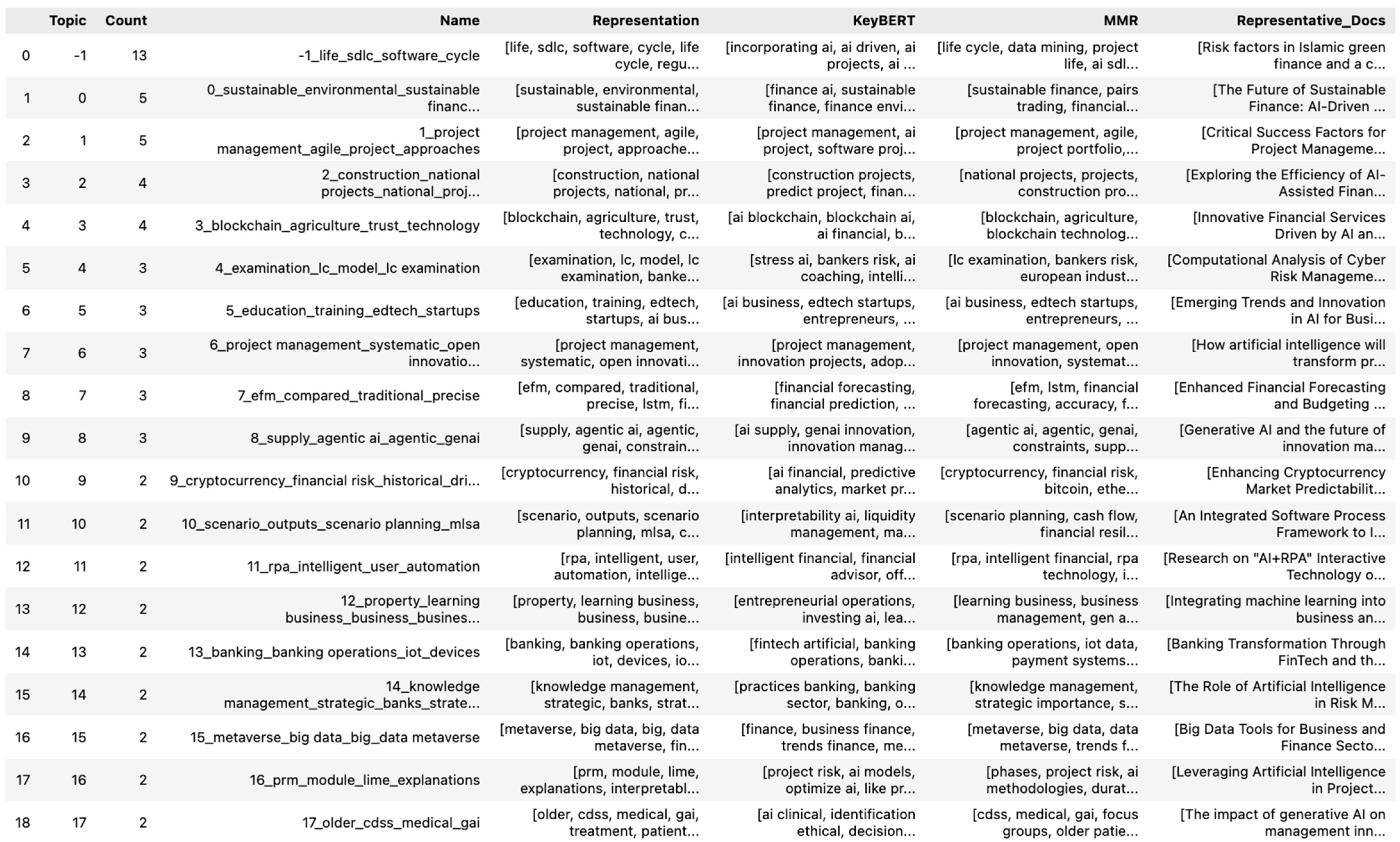
| Topic Coherence (c_v) | 0.38 | Moderate semantic consistency |
| NPMI | −0.13 | Weak co-occurrence structure |
| Silhouette Score | 0.013 | Weak cluster separation |
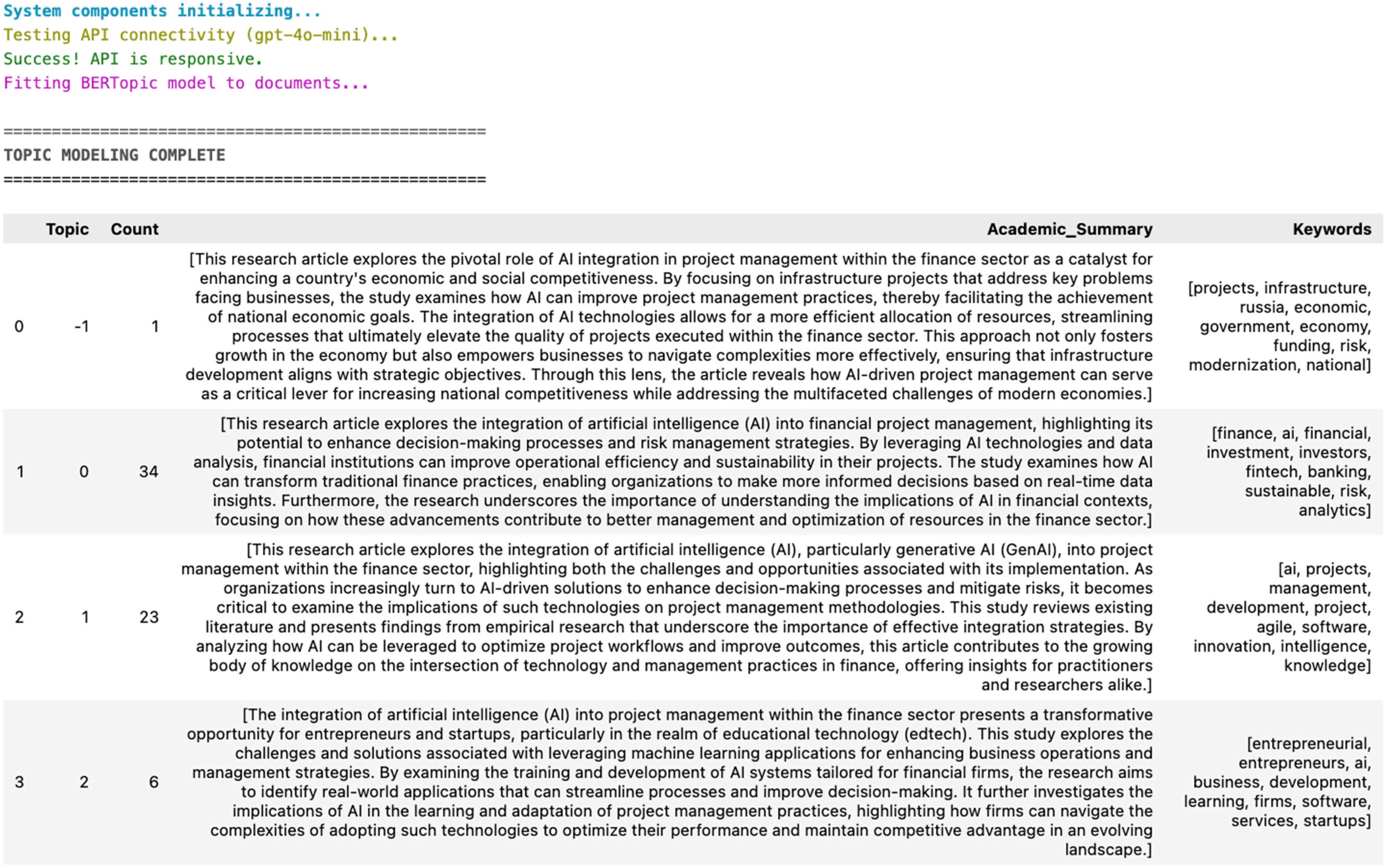
| Topic | Raw Keywords (KeyBERT) | OpenAI Refined Academic Summary (Thematic Synthesis) |
|---|---|---|
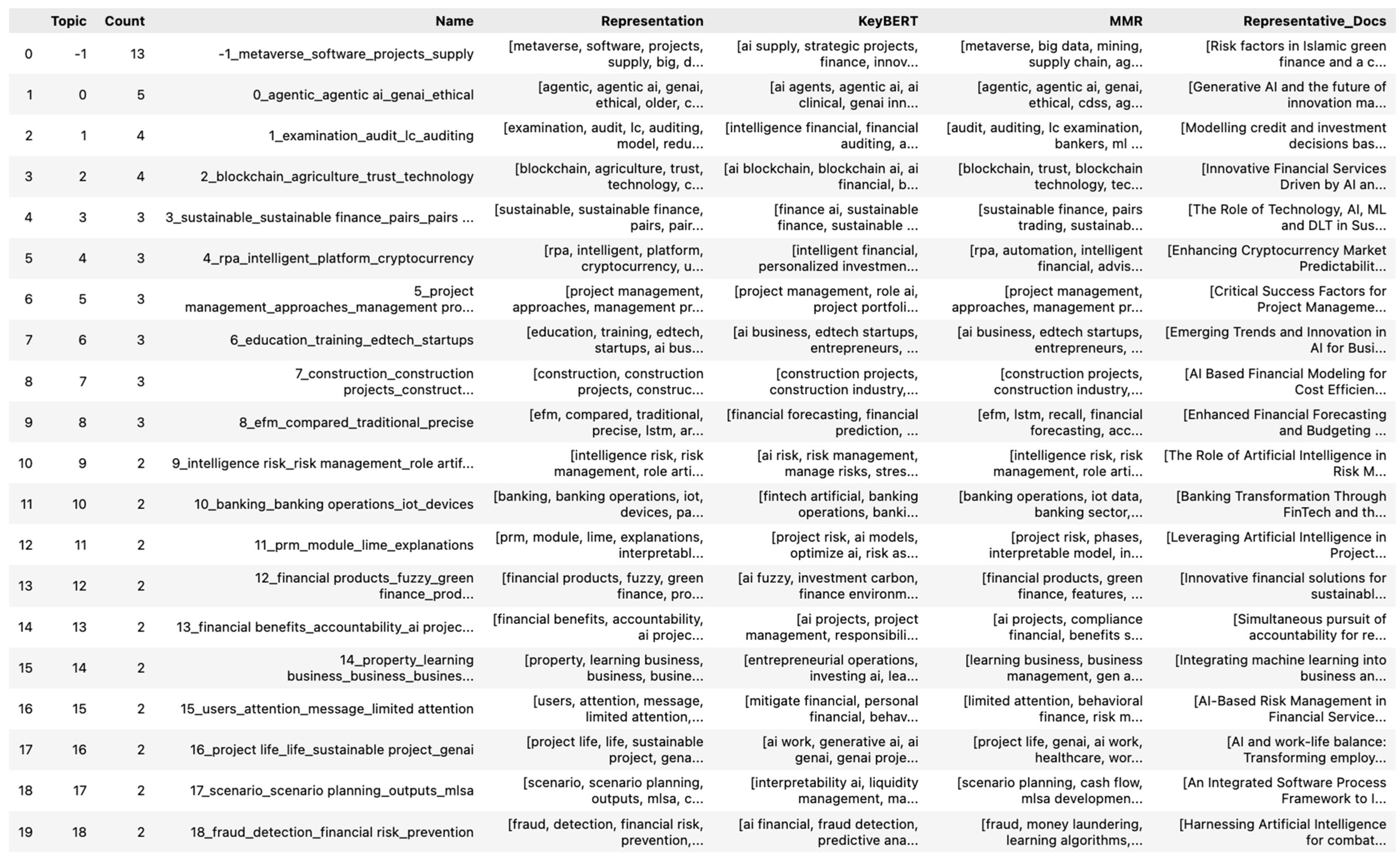
| Topic 0 | Agentic, autonomous, genAI, innovation | Autonomous-Collaborative Frameworks: Synthesizes the shift toward Agentic AI systems that coordinate complex supply chain ecosystems through autonomous decision-making and ethical agent management. |
| Topic 1 | Analytics, predictive, models, methodology, examination | Advanced Predictive Analytics: Focuses on the development, evaluation, and validation of analytics-driven and predictive AI models used to support operational decision-making and execution in financial project environments, emphasizing methodological rigor and reliability. |
| Topic 3 | Sustainable, finance, risk, ESG | Strategic ESG Governance: Integrates AI-enabled risk assessment with long-term sustainability goals, positioning AI as a tool for balancing financial performance with ethical oversight. |
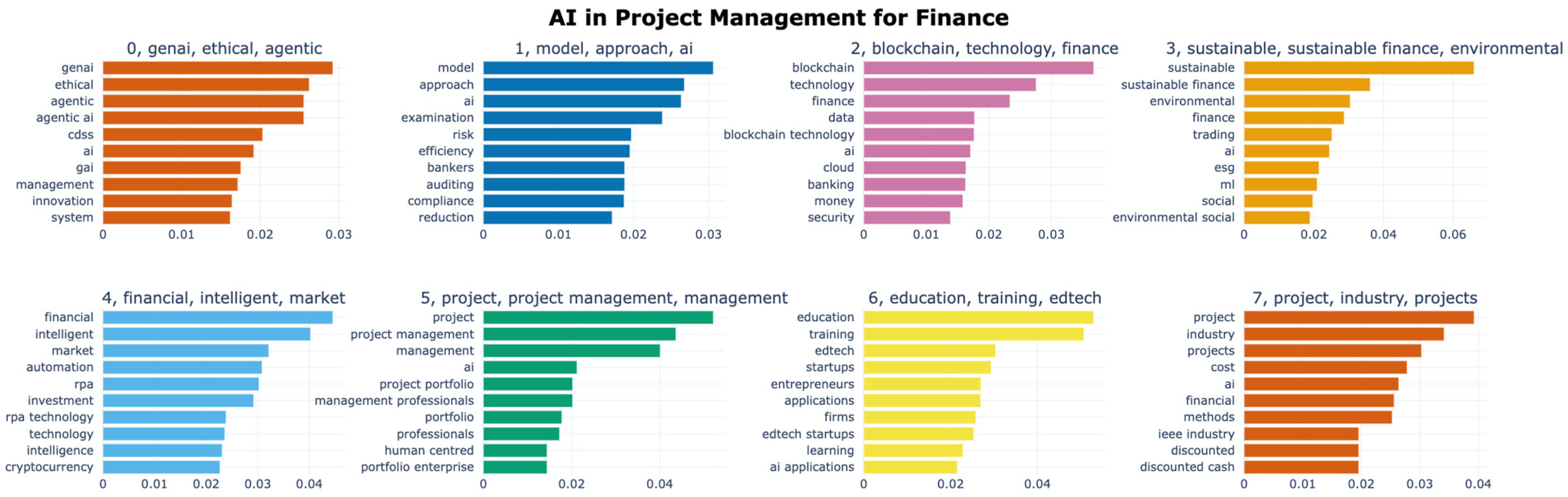
| Subsystem | Cluster ID | Descriptive Label | Representative Keywords (c-TF-IDF) | Strategic Synthesis (LLM-Enhanced) |
|---|---|---|---|---|
| Innovation | 0 | Agentic AI & Ethical Innovation | agentic, genai, ethical, supply | Focuses on autonomous-collaborative frameworks and generative agents as active project participants. |
| Technical | 1 | Model Methodological Rigor | model, ai, examination, predictive | Addresses the validation of algorithmic architectures and technical rigor in financial analytics. |
| Technical | 2 | Data Infrastructure & Blockchain | blockchain, technology, finance, big data | Explores decentralized architectures and big data systems as the backbone of financial PM. |
| Social/Gov | 3 | Sustainable Finance & Strategic Gov | sustainable, finance, environmental, ESG | Positions AI as a tool for balancing financial performance with long-term ESG and ethical oversight. |
| Technical | 4 | Intelligent Markets & RPA | financial, intelligent, market, rpa | Emphasizes the automation of routine execution and operational efficiency via intelligent platforms. |
| Social/Gov | 5 | Management Methodologies & Success | project, management, portfolio, agile | Focuses on evidence-based decision-making and the evolution of PM governance frameworks. |
| Innovation | 6 | EdTech & Startup Innovation | education, training, startup, innovation | Highlights AI’s role in scaling innovation and human capital development in entrepreneurial finance. |
| Technical | 7 | Industry Projects & Cost Optimization | industry, project, cost, estimation | Reflects practical applications in industrial financial projects and resource optimization. |
Disclaimer/Publisher’s Note: The statements, opinions and data contained in all publications are solely those of the individual author(s) and contributor(s) and not of MDPI and/or the editor(s). MDPI and/or the editor(s) disclaim responsibility for any injury to people or property resulting from any ideas, methods, instructions or products referred to in the content. |
© 2026 by the authors. Published by MDPI on behalf of the International Institute of Knowledge Innovation and Invention. Licensee MDPI, Basel, Switzerland. This article is an open access article distributed under the terms and conditions of the Creative Commons Attribution (CC BY) license.
Share and Cite
Ndjonkin Simen, S.L.; Philbin, S.P.; Hunter, G. Systemic Integration of Artificial Intelligence in Financial Project Management: A Systematic Literature Review and BERTopic-Based Analysis. Appl. Syst. Innov. 2026, 9, 68. https://doi.org/10.3390/asi9040068
Ndjonkin Simen SL, Philbin SP, Hunter G. Systemic Integration of Artificial Intelligence in Financial Project Management: A Systematic Literature Review and BERTopic-Based Analysis. Applied System Innovation. 2026; 9(4):68. https://doi.org/10.3390/asi9040068
Chicago/Turabian StyleNdjonkin Simen, Styve L., Simon P. Philbin, and Gordon Hunter. 2026. "Systemic Integration of Artificial Intelligence in Financial Project Management: A Systematic Literature Review and BERTopic-Based Analysis" Applied System Innovation 9, no. 4: 68. https://doi.org/10.3390/asi9040068
APA StyleNdjonkin Simen, S. L., Philbin, S. P., & Hunter, G. (2026). Systemic Integration of Artificial Intelligence in Financial Project Management: A Systematic Literature Review and BERTopic-Based Analysis. Applied System Innovation, 9(4), 68. https://doi.org/10.3390/asi9040068