
Automated Real-Time Detection and Correction of Children’s Kinesthetic Learning Using Expert-User Performance and Smartphones as Wearables

 , , , and
Abstract
1. Introduction
2. Related Work
2.1. Mobile Devices as Wearables
2.2. Human-Movement Error-Correction Systems
2.3. Smartphone Applications for Physical Activity and Technique Training
2.4. Gap and Contribution
3. Materials and Methods
3.1. System Design and Theoretical Foundations
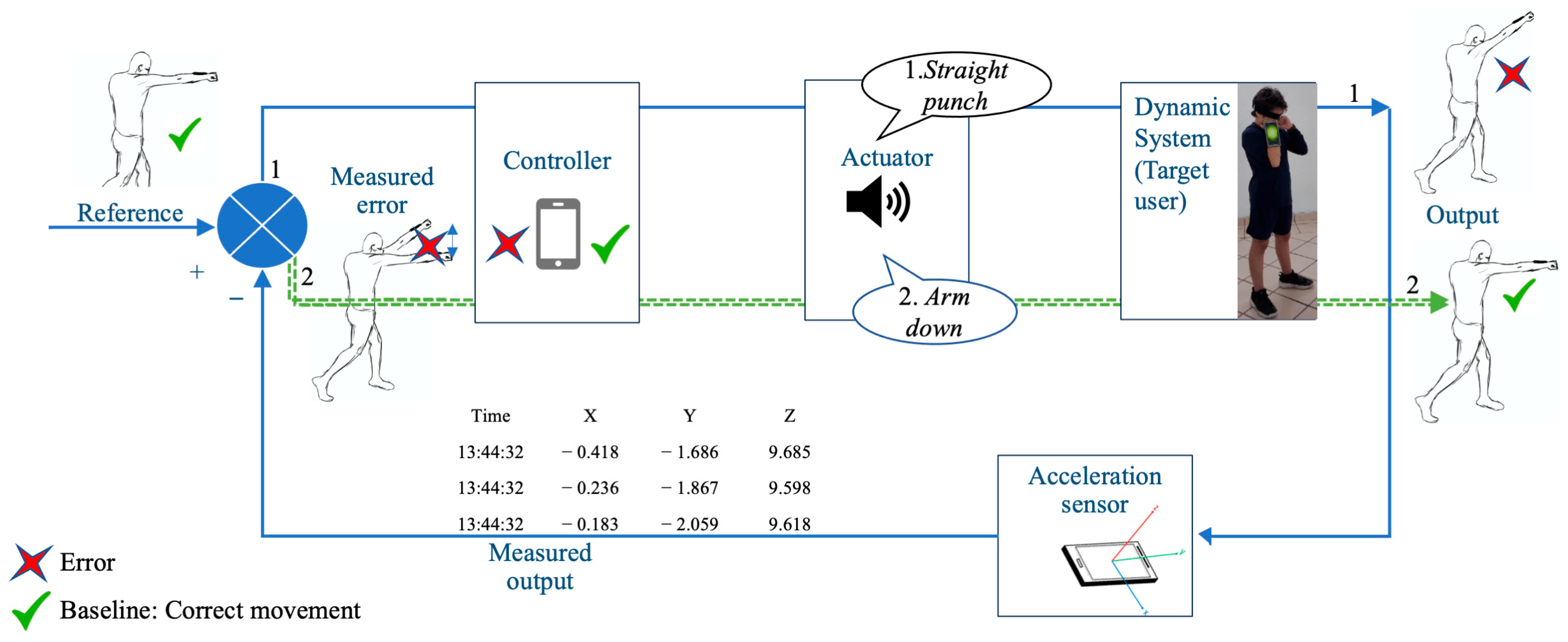
3.1.1. Biomechanical Control Theory
3.1.2. User-Centered Design Framework (ISO 9241-210)
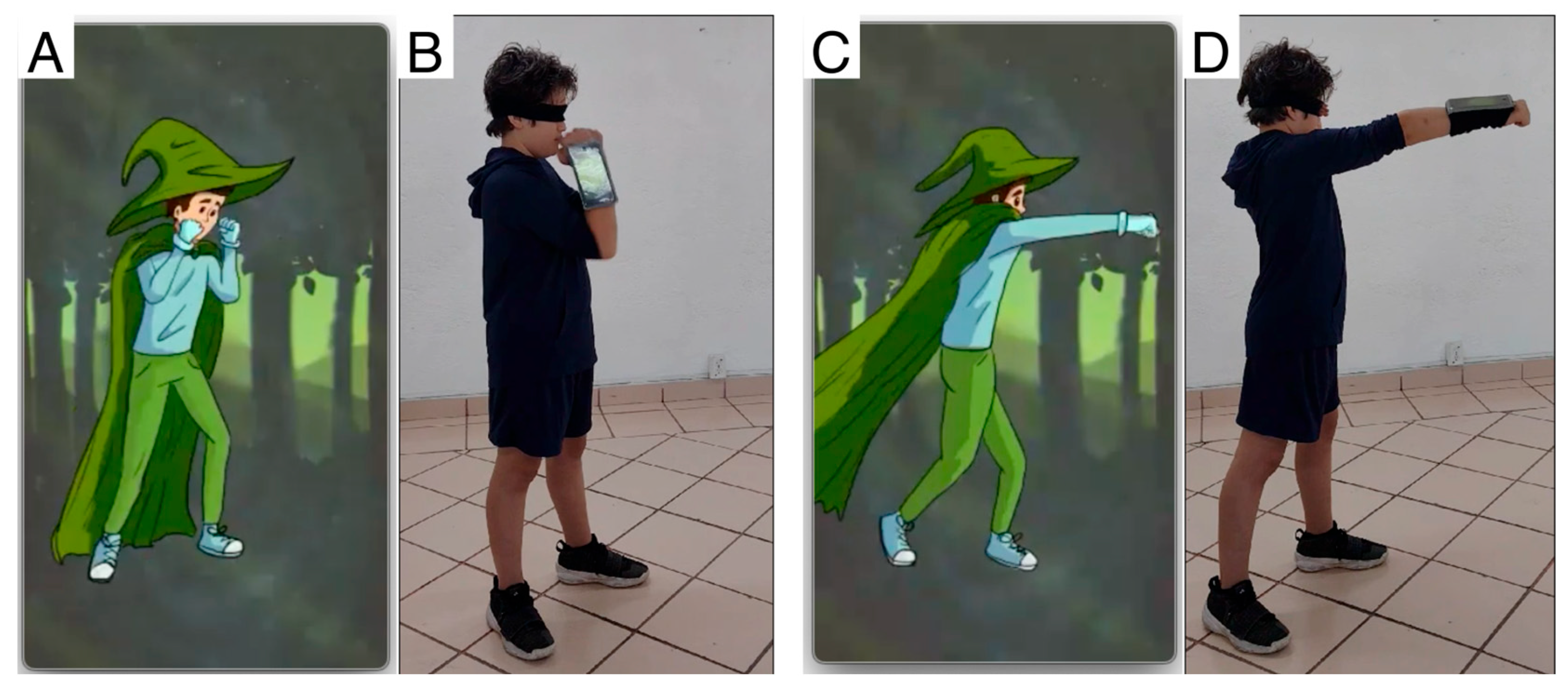
3.1.3. Instructional and Interface Design
3.2. Technical Implementation
3.2.1. Creating Reference Data: Collecting Expert-Performance
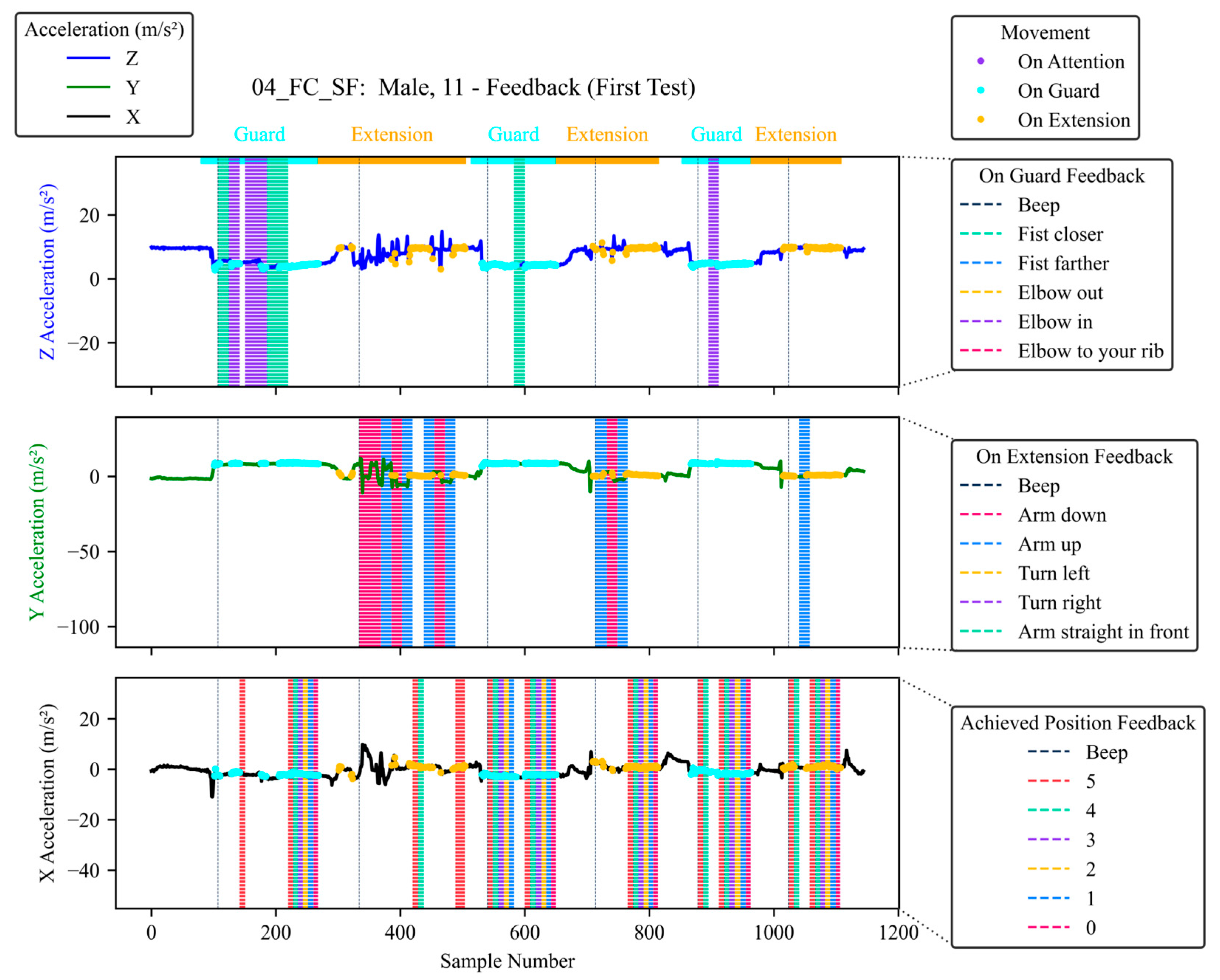
3.2.2. Error Classification and Feedback Model
3.2.3. Accelerometer Function
3.3. User Study
3.3.1. Participants and Recruitment
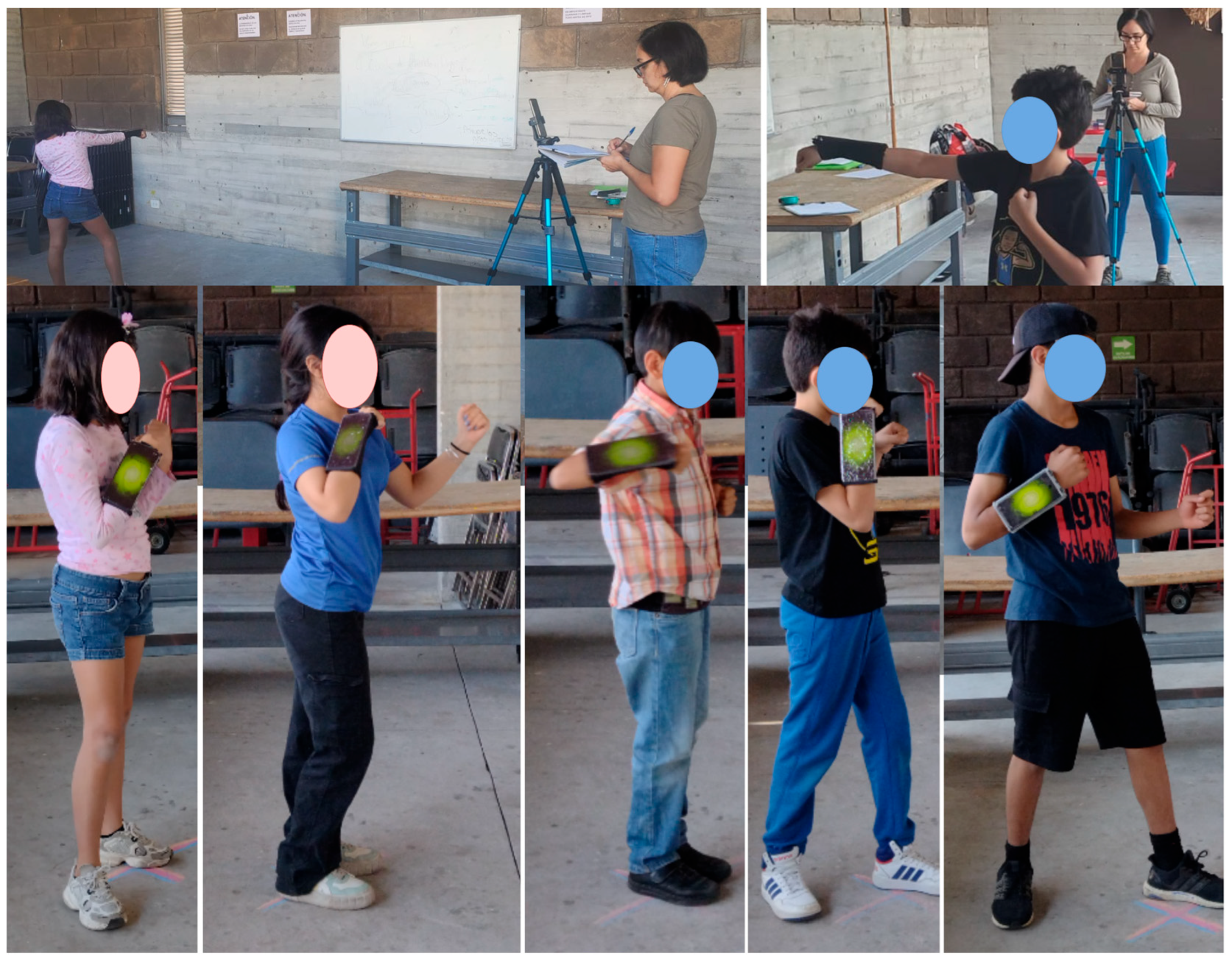
3.3.2. Experimental Design and Procedure
- Group 1: Control (no feedback) → Experimental (feedback)
- Group 2: Experimental (feedback) → Control (no feedback)
3.3.3. Quantitative Measures
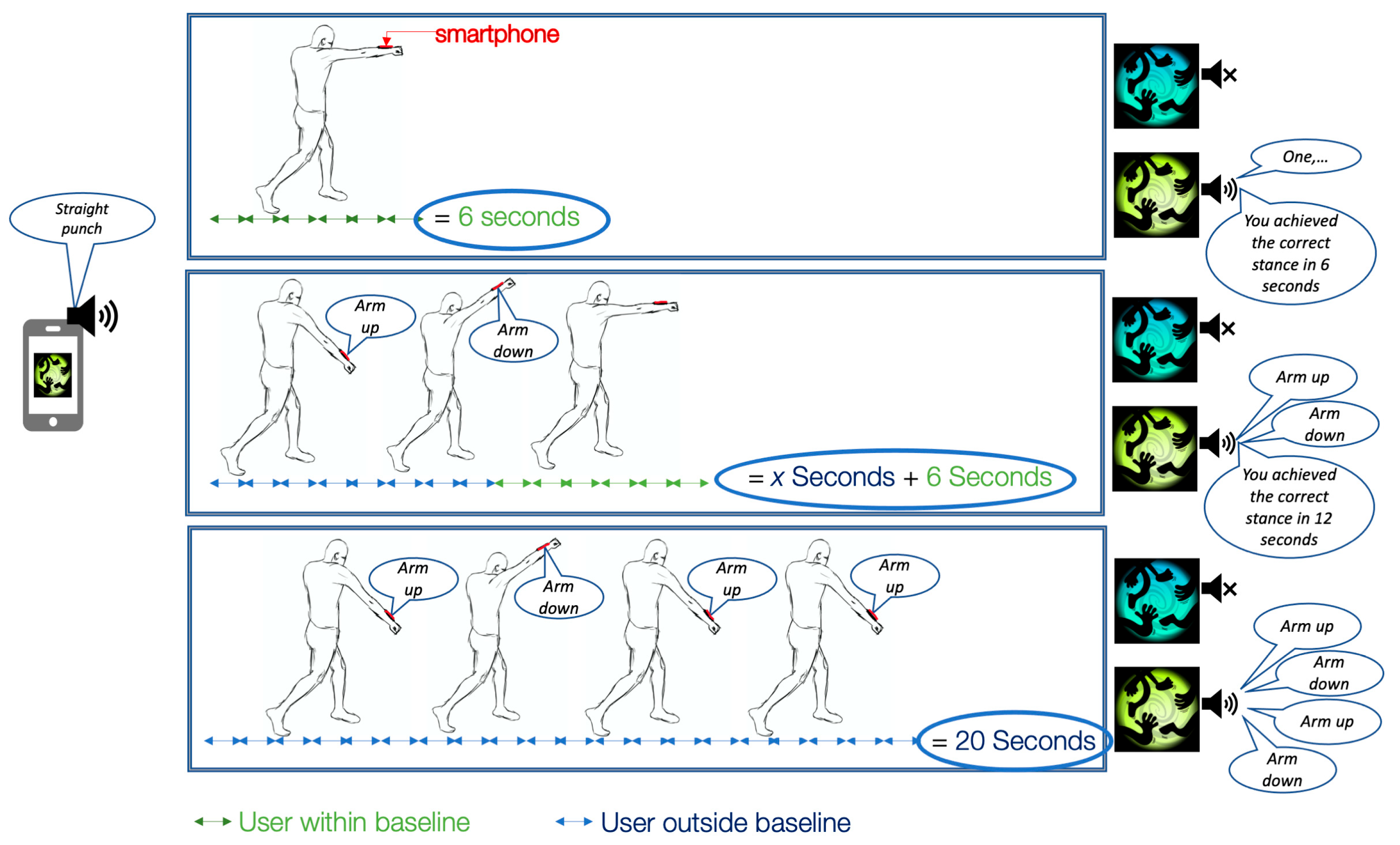
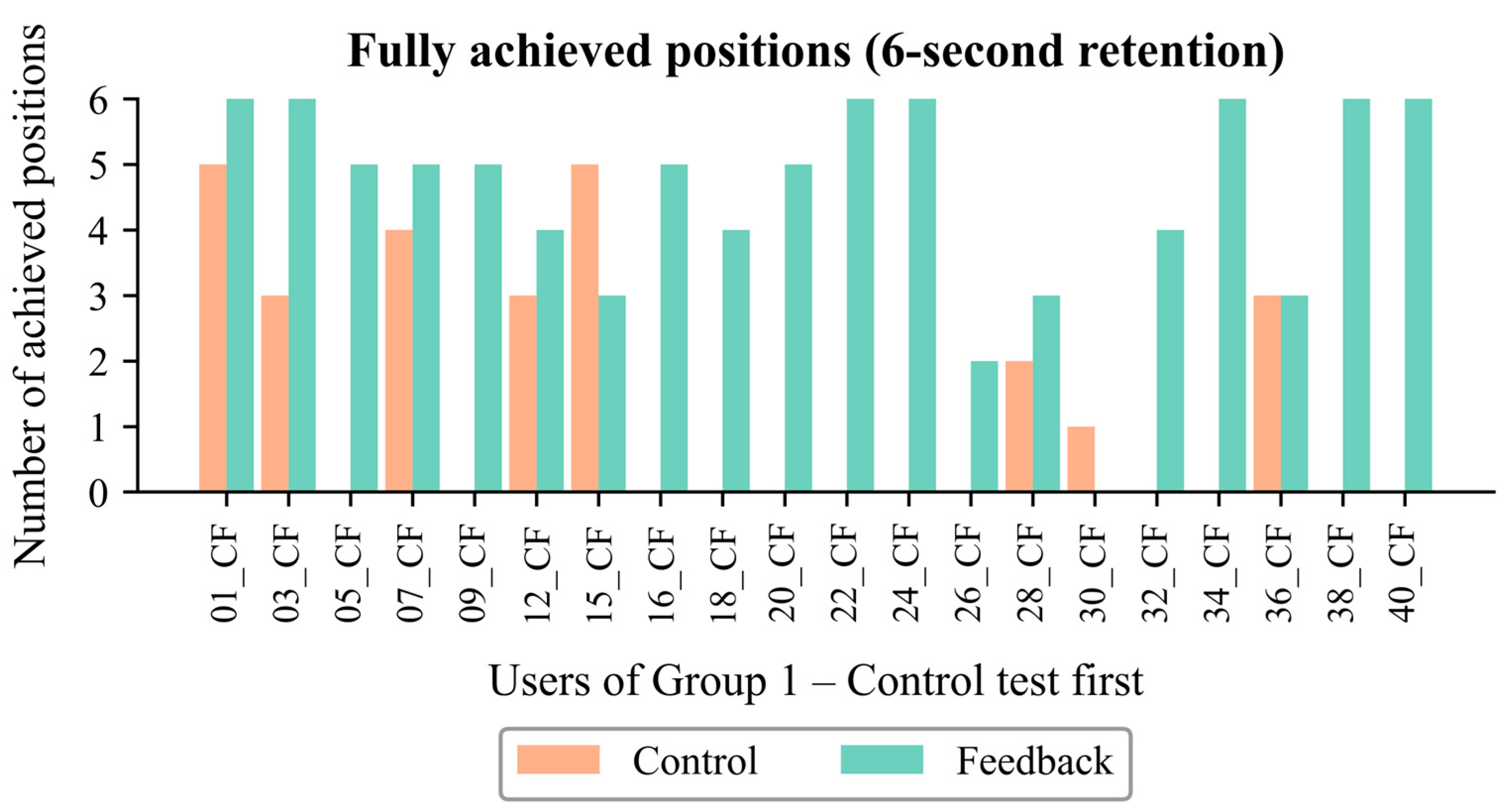
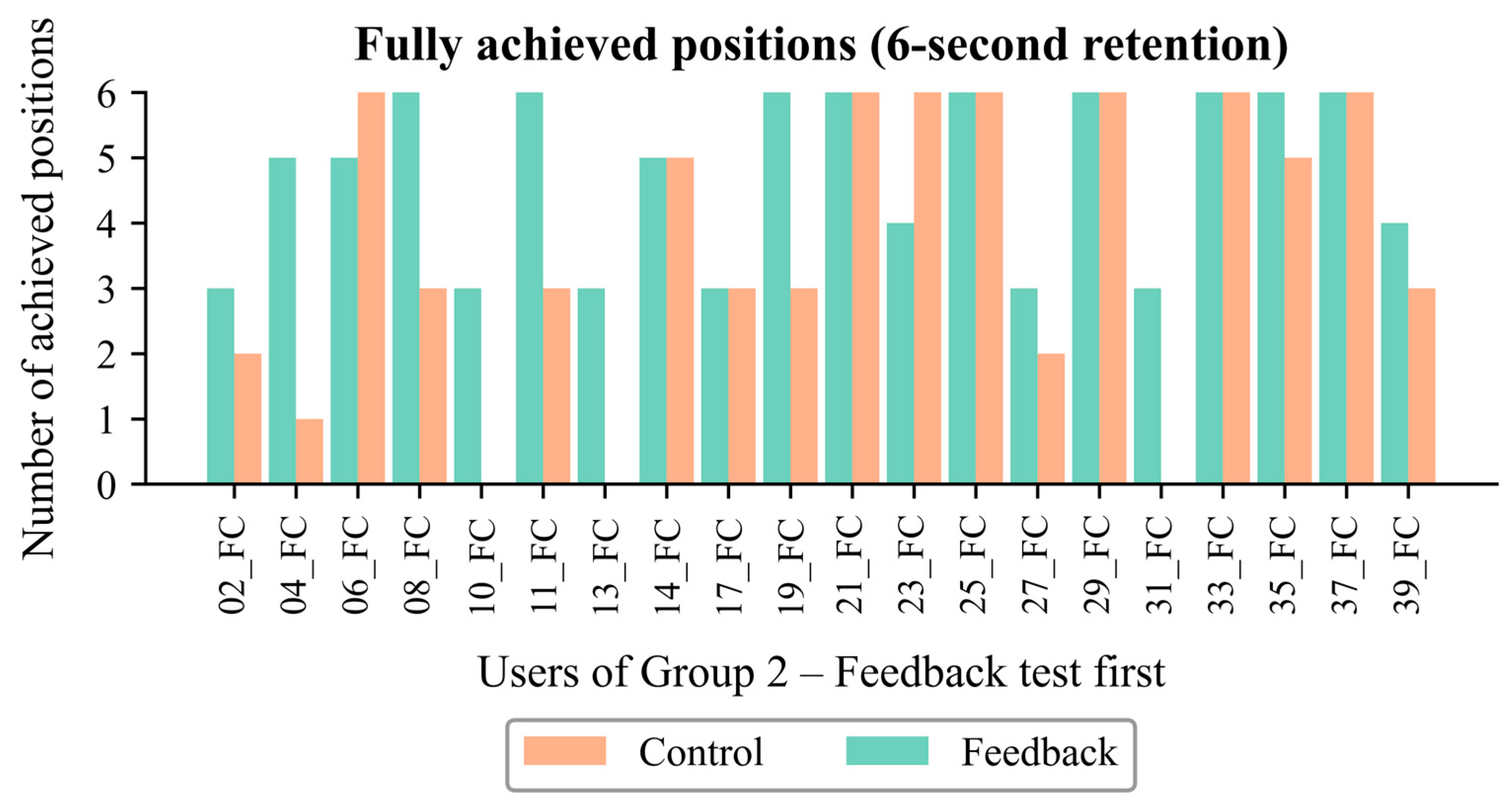
- Posture Achievement Score: The count of six target postures that the participant successfully reached and intentionally stabilized for six consecutive seconds, reflecting discrete task-level motor attainment.
- Time-in-Posture: The total duration for which the child’s limb was within the correct biomechanical range, regardless of the child holding such posture or only passing by. This measure reflects the efficiency with which the correct posture is found and maintained.
3.3.4. Qualitative Measures
3.3.5. Statistical Analysis
4. Results
4.1. Quantitative Evaluation
4.1.1. Within-Group Evaluation
Posture Achievement Score (Within-Group)
Time-in-Posture (Seconds): Descriptive Outcomes
Time-in-Posture (Seconds): Statistical Analysis (Within-Group)
4.1.2. Between-Group Evaluation
Posture Achievement Score (Between-Group)
Time-in-Posture (Seconds): Statistical Analysis (Between-Group)
4.2. Visualization of Order Effects
4.3. Qualitative Evaluation
4.3.1. Likert Questionnaire
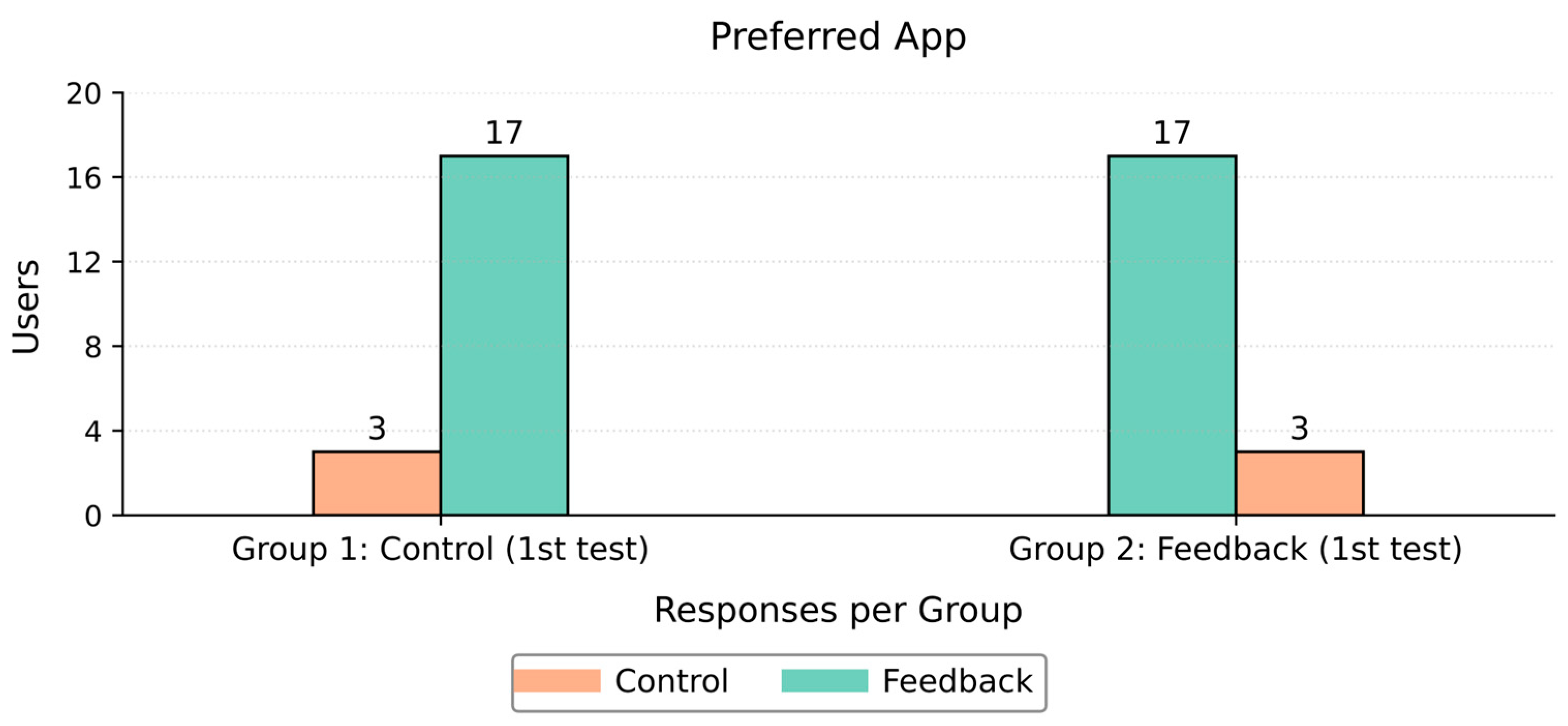
4.3.2. Preferred App
5. Discussion
5.1. Guiding Principles
5.2. Quantitative Findings
5.3. Qualitative Findings
5.4. Design Implications for Smartphone-Based Kinesthetic Feedback
5.5. From Proof of Concept to General Approach
5.6. Limitations
5.7. Practical Implications and Cost Accessibility
6. Conclusions
Author Contributions
Funding
Institutional Review Board Statement
Informed Consent Statement
Data Availability Statement
Acknowledgments
Conflicts of Interest
Abbreviations
| CI | Confidence Interval |
| Cohen’s d | Standardized effect size |
| CV (%) | Coefficient of Variation expressed as a percentage |
| df | Degrees of Freedom |
| df1 | Numerator degrees of freedom |
| df2 | Denominator degrees of freedom |
| F | F-statistic |
| IMU | Inertial Measurement Units |
| ISO | International Organization for Standardization |
| Max | Maximum |
| Min | Minimum |
| MS | Mean Square |
| m/s2 | Meters per second squared |
| N | Sample size |
| η2p | Partial eta squared effect size |
| p | Two-tailed probability value |
| SD | Standard Deviation |
| SEM | Standard Error of the Mean |
| SS | Sum of Squares |
| t | t-statistic |
| V | Variance |
References
- Global Atlas on Childhood Obesity. Available online: https://www.worldobesity.org/membersarea/global-atlas-on-childhood-obesity (accessed on 18 April 2025).
- Hardman, D.K. An Up-Date on the Status of Physical Education in Schools Worldwide: Technical Report for the World Health Organisation; International Council of Sport Science and Physical Education: Berlin, Germany, 2007. [Google Scholar]
- OECD. The Heavy Burden of Obesity: The Economics of Prevention; OECD Health Policy Studies; OECD: Paris, France, 2019; ISBN 978-92-64-33004-7. [Google Scholar]
- Shamah-Levy, T.; Gaona-Pineda, E.B.; Cuevas-Nasu, L.; Morales-Ruan, C.; Valenzuela-Bravo, D.G.; Méndez-Gómez Humaran, I.; Ávila-Arcos, M.A. Prevalencias de sobrepeso y obesidad en población escolar y adolescente de México. ENSANUT continua 2020–2022. Salud Pública México 2023, 65, s218–s224. [Google Scholar] [CrossRef] [PubMed]
- Shamah-Levy, T.; Gaona-Pineda, E.B.; Cuevas-Nasu, L.; Valenzuela-Bravo, D.G.; Morales-Ruan, C.; Rodríguez-Ramírez, S.; Méndez-Gómez-Humarán, I.; Ávila-Arcos, M.A.; Álvarez-Sánchez, C.; Ávila-Curiel, A.; et al. Sobrepeso y obesidad en población escolar y adolescente. Salud Pública México 2024, 66, 404–413. [Google Scholar] [CrossRef] [PubMed]
- Turnbull, B.; Gordon, S.F.; Martínez-Andrade, G.O.; González-Unzaga, M. Childhood Obesity in Mexico: A Critical Analysis of the Environmental Factors, Behaviours and Discourses Contributing to the Epidemic. Health Psychol. Open 2019, 6. [Google Scholar] [CrossRef]
- Guthold, R.; Stevens, G.A.; Riley, L.M.; Bull, F.C. Global Trends in Insufficient Physical Activity Among Adolescents: A Pooled Analysis of 298 Population-Based Surveys with 1.6 Million Participants. Lancet Child Adolesc. Health 2020, 4, 23–35. [Google Scholar] [CrossRef] [PubMed]
- Monge Roffarello, A.; De Russis, L. Coping with Digital Wellbeing in a Multi-Device World. In Proceedings of the 2021 CHI Conference on Human Factors in Computing Systems; ACM: Yokohama, Japan, 2021; pp. 1–14. [Google Scholar]
- OECD. Education at a Glance 2020: OECD Indicators; OECD Publishing: Paris, France, 2020; ISBN 978-92-64-50078-5. [Google Scholar]
- OECD. The State of School Education: One Year into the COVID Pandemic; OECD Publishing: Paris, France, 2021; p. 51. [Google Scholar]
- Pew Research Center. Parenting Kids in the Age of Screens; Pew Research Center: Washington, DC, USA, 2020; p. 86. [Google Scholar]
- Radesky, J.S.; Weeks, H.M.; Ball, R.; Schaller, A.; Yeo, S.; Durnez, J.; Tamayo-Rios, M.; Epstein, M.; Kirkorian, H.; Coyne, S.; et al. Young Children’s Use of Smartphones and Tablets. Pediatrics 2020, 146, e20193518. [Google Scholar] [CrossRef]
- Schleicher, A. The Impact of Covid-19 on Education Insights from Education at a Glance 2020; OECD Publishing: Paris, France, 2020. [Google Scholar]
- Medina García, C.; Jáuregui, A.; Blas, N.; Campos, I.; Macías, N.; López-Ridaura, R.; Barquera, S. Promoción de actividad física en escolares y adolescentes. Salud Pública México 2024, 66, 435–445. [Google Scholar] [CrossRef] [PubMed]
- OECD; WHO. Step Up! Tackling the Burden of Insufficient Physical Activity in Europe; OECD: Paris, France, 2023; ISBN 978-92-64-78810-7. [Google Scholar]
- Grouios, G.; Ziagkas, E.; Loukovitis, A.; Chatzinikolaou, K.; Koidou, E. Accelerometers in Our Pocket: Does Smartphone Accelerometer Technology Provide Accurate Data? Sensors 2023, 23, 192. [Google Scholar] [CrossRef] [PubMed]
- Pereira, A.P.; Machado Neto, O.J.; Elui, V.M.C.; Pimentel, M.D.G.C. Wearable Smartphone-Based Multisensory Feedback System for Torso Posture Correction: Iterative Design and Within-Subjects Study. JMIR Aging 2025, 8, e55455. [Google Scholar] [CrossRef] [PubMed]
- Čaić, M.; Avelino, J.; Mahr, D.; Odekerken-Schröder, G.; Bernardino, A. Robotic Versus Human Coaches for Active Aging: An Automated Social Presence Perspective. Int. J. Soc. Robot. 2020, 12, 867–882. [Google Scholar] [CrossRef]
- Sigrist, R.; Rauter, G.; Riener, R.; Wolf, P. Augmented Visual, Auditory, Haptic, and Multimodal Feedback in Motor Learning: A Review. Psychon. Bull. Rev. 2013, 20, 21–53. [Google Scholar] [CrossRef] [PubMed]
- Wang, H. Coaches’ Feedback Quality and Skill Development of Badminton Athletes in an Institute of Technology in Jiangxi Province, China. Pac. Int. J. 2025, 8, 147–154. [Google Scholar] [CrossRef]
- Del Rosario, M.; Redmond, S.; Lovell, N. Tracking the Evolution of Smartphone Sensing for Monitoring Human Movement. Sensors 2015, 15, 18901–18933. [Google Scholar] [CrossRef]
- Straczkiewicz, M.; James, P.; Onnela, J.-P. A Systematic Review of Smartphone-Based Human Activity Recognition Methods for Health Research. npj Digit. Med. 2021, 4, 148. [Google Scholar] [CrossRef] [PubMed]
- Prudêncio, J.; Aguiar, A.; Lucani, D. Physical Activity Recognition from Smartphone Embedded Sensors. In Pattern Recognition and Image Analysis; Lecture Notes in Computer Science; Sanches, J.M., Micó, L., Cardoso, J.S., Eds.; Springer: Berlin/Heidelberg, Germany, 2013; Volume 7887, pp. 863–872. ISBN 978-3-642-38627-5. [Google Scholar]
- Ahuja, K.; Mayer, S.; Goel, M.; Harrison, C. Pose-on-the-Go: Approximating User Pose with Smartphone Sensor Fusion and Inverse Kinematics. In Proceedings of the 2021 CHI Conference on Human Factors in Computing Systems; ACM: Yokohama, Japan, 2021; pp. 1–12. [Google Scholar]
- Marshall, J. Smartphone Sensing for Distributed Swim Stroke Coaching and Research. In Proceedings of the 2013 ACM Conference on Pervasive and Ubiquitous Computing Adjunct Publication; ACM: Zurich, Switzerland, 2013; pp. 1413–1416. [Google Scholar]
- Dentamaro, V.; Gattulli, V.; Impedovo, D.; Manca, F. Human Activity Recognition with Smartphone-Integrated Sensors: A Survey. Expert Syst. Appl. 2024, 246, 123143. [Google Scholar] [CrossRef]
- Mourcou, Q.; Fleury, A.; Franco, C.; Klopcic, F.; Vuillerme, N. Performance Evaluation of Smartphone Inertial Sensors Measurement for Range of Motion. Sensors 2015, 15, 23168–23187. [Google Scholar] [CrossRef]
- Runkeeper. Available online: https://en.wikipedia.org/wiki/Runkeeper (accessed on 21 May 2025).
- Strava. Available online: https://en.wikipedia.org/wiki/Strava (accessed on 22 May 2025).
- Google Fit. Available online: https://en.wikipedia.org/wiki/Google_Fit (accessed on 21 May 2025).
- Health (Apple). Available online: https://en.wikipedia.org/wiki/Health_(Apple) (accessed on 21 May 2025).
- Kwapisz, J.R.; Weiss, G.M.; Moore, S.A. Activity Recognition Using Cell Phone Accelerometers. ACM SIGKDD Explor. Newsl. 2011, 12, 74–82. [Google Scholar] [CrossRef]
- Longstaff, B.; Reddy, S.; Estrin, D. Improving Activity Classification for Health Applications on Mobile Devices Using Active and Semi-Supervised Learning. In Proceedings of the 4th International ICST Conference on Pervasive Computing Technologies for Healthcare; IEEE: Munchen, Germany, 2010. [Google Scholar]
- Saxon, L.; DiPaula, B.; Fox, G.R.; Ebert, R.; Duhaime, J.; Nocera, L.; Tran, L.; Sobhani, M. Continuous Measurement of Reconnaissance Marines in Training with Custom Smartphone App and Watch: Observational Cohort Study. JMIR MHealth UHealth 2020, 8, e14116. [Google Scholar] [CrossRef] [PubMed]
- HomeCourt. Available online: https://www.homecourt.ai (accessed on 22 May 2025).
- SwingVision. Available online: https://swing.vision/ (accessed on 22 May 2025).
- Uhlrich, S.D.; Falisse, A.; Kidziński, Ł.; Muccini, J.; Ko, M.; Chaudhari, A.S.; Hicks, J.L.; Delp, S.L. OpenCap: Human Movement Dynamics from Smartphone Videos. PLoS Comput. Biol. 2023, 19, e1011462. [Google Scholar] [CrossRef] [PubMed]
- Larsen, A.G.; Sadolin, L.Ø.; Thomsen, T.R.; Oliveira, A.S. Accurate Detection of Gait Events Using Neural Networks and IMU Data Mimicking Real-World Smartphone Usage. Comput. Methods Biomech. Biomed. Engin. 2024, 1–11. [Google Scholar] [CrossRef] [PubMed]
- Miller, G. The Smartphone Psychology Manifesto. Perspect. Psychol. Sci. 2012, 7, 221–237. [Google Scholar] [CrossRef] [PubMed]
- Utz, C.; Becker, S.; Schnitzler, T.; Farke, F.M.; Herbert, F.; Schaewitz, L.; Degeling, M.; Dürmuth, M. Apps Against the Spread: Privacy Implications and User Acceptance of COVID-19-Related Smartphone Apps on Three Continents. In Proceedings of the 2021 CHI Conference on Human Factors in Computing Systems; ACM: Yokohama, Japan, 2021; pp. 1–22. [Google Scholar]
- Hou, X.; Bergmann, J.H.M. HINNet: Inertial Navigation with Head-Mounted Sensors Using a Neural Network. Eng. Appl. Artif. Intell. 2023, 123, 106066. [Google Scholar] [CrossRef]
- Rahn, V.; Zhou, L.; Klieme, E.; Arnrich, B. Optimal Sensor Placement for Human Activity Recognition with a Minimal Smartphone–IMU Setup. In Proceedings of the 10th International Conference on Sensor Networks; Online Streaming; SCITEPRESS—Science and Technology Publications: Setúbal, Portugal, 2021; Volume 1, pp. 37–48. ISBN 978-989-758-489-3. [Google Scholar]
- Straczkiewicz, M.; Huang, E.J.; Onnela, J.-P. A “One-Size-Fits-Most” Walking Recognition Method for Smartphones, Smartwatches, and Wearable Accelerometers. npj Digit. Med. 2023, 6, 29. [Google Scholar] [CrossRef]
- Lind, C.M. A Rapid Review on the Effectiveness and Use of Wearable Biofeedback Motion Capture Systems in Ergonomics to Mitigate Adverse Postures and Movements of the Upper Body. Sensors 2024, 24, 3345. [Google Scholar] [CrossRef]
- Allen d’Ávila Silveira, C.; Kilic Afsar, O.; Fdili Alaoui, S. Wearable Choreographer: Designing Soft-Robotics for Dance Practice. In Proceedings of the Designing Interactive Systems Conference; ACM: New York, NY, USA, 2022; pp. 1581–1596. [Google Scholar]
- Ceballos Rubio, M.A.; Rodríguez Rodríguez, M. Análisis cinemático del golpe recto a la cara a larga distancia, de tres boxeadores de la categoría 13-14 años de la EIDE provincial Guantánamo. Lect. Edu. Física Deport. 2014, 193. Available online: https://www.efdeportes.com/efd193/analisis-cinematico-del-golpe-recto-de-boxeadores.htm (accessed on 18 April 2025).
- Oyebode, O.; Ganesh, A.; Orji, R. TreeCare: Development and Evaluation of a Persuasive Mobile Game for Promoting Physical Activity. In Proceedings of the 2021 IEEE Conference on Games (CoG); IEEE: Copenhagen, Denmark, 2021; pp. 1–8. [Google Scholar]
- Kranz, M.; Möller, A.; Hammerla, N.; Diewald, S.; Plötz, T.; Olivier, P.; Roalter, L. The Mobile Fitness Coach: Towards Individualized Skill Assessment Using Personalized Mobile Devices. Pervasive Mob. Comput. 2013, 9, 203–215. [Google Scholar] [CrossRef]
- Kuribayashi, M.; Kayukawa, S.; Takagi, H.; Asakawa, C.; Morishima, S. LineChaser: A Smartphone-Based Navigation System for Blind People to Stand in Lines. In Proceedings of the 2021 CHI Conference on Human Factors in Computing Systems; ACM: Yokohama, Japan, 2021; pp. 1–13. [Google Scholar]
- Wu, Z.; Yu, C.; Xu, X.; Wei, T.; Zou, T.; Wang, R.; Shi, Y. Lightwrite: Teach Handwriting to the Visually Impaired with a Smartphone. In Proceedings of the 2021 CHI Conference on Human Factors in Computing Systems; ACM: Yokohama, Japan, 2021; pp. 1–15. [Google Scholar]
- Wafi, A.M.; Zaeri, M.A.; Khudier, A.A.; Abushara, A.N.; Adawi, M.M.; Zakri, L.A.; Madkhali, M.H.; Al Othaymeen, A.S.; Qawfashi, W.M.; Alnami, R.M.; et al. Real-Time Vibration Feedback from a Smartphone Application Reduces Sedentary Time but Does Not Increase Physical Activity Among Medical Students. Healthcare 2024, 12, 2133. [Google Scholar] [CrossRef]
- Saaty, M.; Haqq, D.; Toms, D.B.; Eltahir, I.; McCrickard, D.S. A Study on Pokémon GO: Exploring the Potential of Location-Based Mobile Exergames in Connecting Players with Nature. In Proceedings of the Extended Abstracts of the 2021 Annual Symposium on Computer-Human Interaction in Play; ACM: New York, NY, USA, 2021; pp. 128–132. [Google Scholar]
- Kimm, D.; Thiel, D.V. Hand Speed Measurements in Boxing. Procedia Eng. 2015, 112, 502–506. [Google Scholar] [CrossRef]
- Sánchez-Rodríguez, D.A.; Bohórquez-Aldana, A.F. Análisis de la velocidad y la aceleración entre un golpe de boxeo y uno de taekwondo. Rev. UDCA Actual. Divulg. Científica 2020, 23. [Google Scholar] [CrossRef]
- ISO 9241-210:2019; Ergonomics of Human-System Interaction—Part 210: Human-Centred Design for Interactive Systems. International Organization for Standardization: Geneva, Switzerland, 2019.
- Huang, E.; Yan, K.; Onnela, J.-P. Combining Accelerometer and Gyroscope Data in Smartphone-Based Activity Recognition Using Movelets. arXiv 2022, arXiv:2109.01118. [Google Scholar] [CrossRef] [PubMed]
- Huang, E.J.; Yan, K.; Onnela, J.-P. Smartphone-Based Activity Recognition Using Multistream Movelets Combining Accelerometer and Gyroscope Data. Sensors 2022, 22, 2618. [Google Scholar] [CrossRef] [PubMed]
- Huang, E.J.; Onnela, J.-P. Augmented Movelet Method for Activity Classification Using Smartphone Gyroscope and Accelerometer Data. Sensors 2020, 20, 3706. [Google Scholar] [CrossRef]
- Herrera, E.P.; Trujillo, Y.; Alvarez, R.; Sierra, D. Sampling Frequency for Step Detection Based on Smartphone Accelerometry. In Proceedings of the 14th International Symposium on Pervasive Systems, Algorithms and Networks & 2017 11th International Conference on Frontier of Computer Science and Technology & 2017 Third International Symposium of Creative Computing (ISPAN-FCST-ISCC), Exeter, UK, 21–23 June 2017; pp. 409–413. [Google Scholar]
- Wang, L.; Su, D.; Zhang, A.; Zhu, Y.; Jiang, W.; He, X.; Yang, P. Real-Time Fall Detection Using Smartphone Accelerometers and WiFi Channel State Information. IEEE Sens. J. 2025, 25, 23216–23228. [Google Scholar] [CrossRef]
- Wannenburg, J.; Malekian, R. Physical Activity Recognition From Smartphone Accelerometer Data for User Context Awareness Sensing. IEEE Trans. Syst. Man Cybern. Syst. 2017, 47, 3142–3149. [Google Scholar] [CrossRef]
- Gómez-Monroy, C.; Ramírez-Reivich, A.C. Exertion Trainer: Smartphone Exergame Design to Support Children’s Kinesthetic Learning through Playful Feedback. In Proceedings of the Engineering Interactive Computer Systems. EICS 2023 International Workshops and Doctoral Consortium; Springer Nature: Cham, Switzerland, 2024; pp. 166–178. [Google Scholar]
- Fitts, P.M.; Posner, M.I. Human Performance; Brooks/Cole Pub. Co.: Belmont, CA, USA, 1967. [Google Scholar]
- Halfpenny, M. Boxing Coaching Handbook: Part 1; England Boxing: Sheffield, UK, 2022. [Google Scholar]
- Norman, D.A. The Design of Everyday Things; Revised and expanded edition; Basic Books: New York, NY, USA, 2013; ISBN 978-0-465-05065-9. [Google Scholar]
- Ferguson, C.; Lewis, R.; Wilks, C.; Picard, R. The Guardians: Designing a Game for Long-Term Engagement with Mental Health Therapy. In Proceedings of the 2021 IEEE Conference on Games (CoG); IEEE: Copenhagen, Denmark, 2021; pp. 1–8. [Google Scholar]
- Mueller, F.; Khot, R.A.; Gerling, K.; Mandryk, R. Exertion Games. Found. Trends® Human–Comput. Interact. 2016, 10, 1–86. [Google Scholar] [CrossRef]
- Elmanowski, J.; Kleynen, M.; Geers, R.P.J.; Rovelo-Ruiz, G.; Geurts, E.; Coninx, K.; Verbunt, J.A.; Seelen, H.A.M. Task-Oriented Arm Training for Stroke Patients Based on Remote Handling Technology Concepts: A Feasibility Study. Technol. Health Care 2023, 31, 1593–1605. [Google Scholar] [CrossRef]
- Ericsson, K.A.; Krampe, R.T.; Tesch-Römer, C. The Role of Deliberate Practice in the Acquisition of Expert Performance. Psychol. Rev. 1993, 100, 363. [Google Scholar] [CrossRef]
- Ericsson, K.A. Acquisition and Maintenance of Medical Expertise: A Perspective from the Expert-Performance Approach with Deliberate Practice. Acad. Med. 2015, 90, 1471–1486. [Google Scholar] [CrossRef] [PubMed]
- Büscher, N.; Gis, D.; Kühn, V.; Haubelt, C. On the Functional and Extra-Functional Properties of IMU Fusion Algorithms for Body-Worn Smart Sensors. Sensors 2021, 21, 2747. [Google Scholar] [CrossRef] [PubMed]
- McClintock, F.A.; Callaway, A.J.; Clark, C.J.; Williams, J.M. Assessing the Impact of Sensor Orientation on Accelerometer-Derived Angles: A Systematic Analysis and Proposed Error Reduction. Appl. Sci. 2024, 14, 842. [Google Scholar] [CrossRef]
- Incel, O.D. Analysis of Movement, Orientation and Rotation-Based Sensing for Phone Placement Recognition. Sensors 2015, 15, 25474–25506. [Google Scholar] [CrossRef]
- Laugwitz, B.; Held, T.; Schrepp, M. Construction and Evaluation of a User Experience Questionnaire. In HCI and Usability for Education and Work; Lecture Notes in Computer Science; Holzinger, A., Ed.; Springer: Berlin/Heidelberg, Germany, 2008; Volume 5298, pp. 63–76. ISBN 978-3-540-89349-3. [Google Scholar]
- Höök, K. Designing with the Body Somaesthetic Interaction Design; The MIT Press: Cambridge, MA, USA, 2018; ISBN 978-0-262-34832-4. [Google Scholar]
- ISO 9241-110:2020; Ergonomics of Human-System Interaction—Part 110: Interaction Principles. International Organization for Standardization: Geneva, Switzerland, 2020.
- Agrawal, S.K.; Kang, J.; Chen, X.; Kim, M.J.; Lee, Y.; Kong, S.W.; Cho, H.; Park, G.-J. Robot-Enhanced Mobility Training of Children with Cerebral Palsy: Short-Term and Long-Term Pilot Studies. IEEE Syst. J. 2014, 10, 1098–1106. [Google Scholar] [CrossRef]
- ImagetoCartoon. Available online: https://imagetocartoon.com/ (accessed on 1 December 2025).



 |  |  |  |  |  |
| Baseline * | Error | Error | Error | Error | Error |
| On Guard | Hand down | Guard too extended | Guard over-closed | Chicken wing | Inverted elbow |
 |  |  |  |  |  |
 |  |
 |  |  |  |  |  |
| Baseline * | Error | Error | Error | Error | Error |
| On Extension | Flared fist | Overshot punch | Underthrown punch | Forearm pronation | Forearm supination |
 |  |  |  |  |  |
 |  |
| Number of Users | Group (Test Order) | Condition (Feedback or Not) | Stance 1 | Stance 2 | Repetitions |
|---|---|---|---|---|---|
| 20 | Group 1: Control test first | Control (No Feedback) | On Guard | On an extended punch  | ×3 |
| Experimental (Feedback) | |||||
| 20 | Group 2: Feedback test first | Experimental (Feedback) | |||
| Control (No Feedback) |
| Order Within the Algorithm | Accelerometer Axis | What is Being Measured | Under the Correct Range (m/s2) | Correct Range (m/s2) | Above the Correct Range (m/s2) |
|---|---|---|---|---|---|
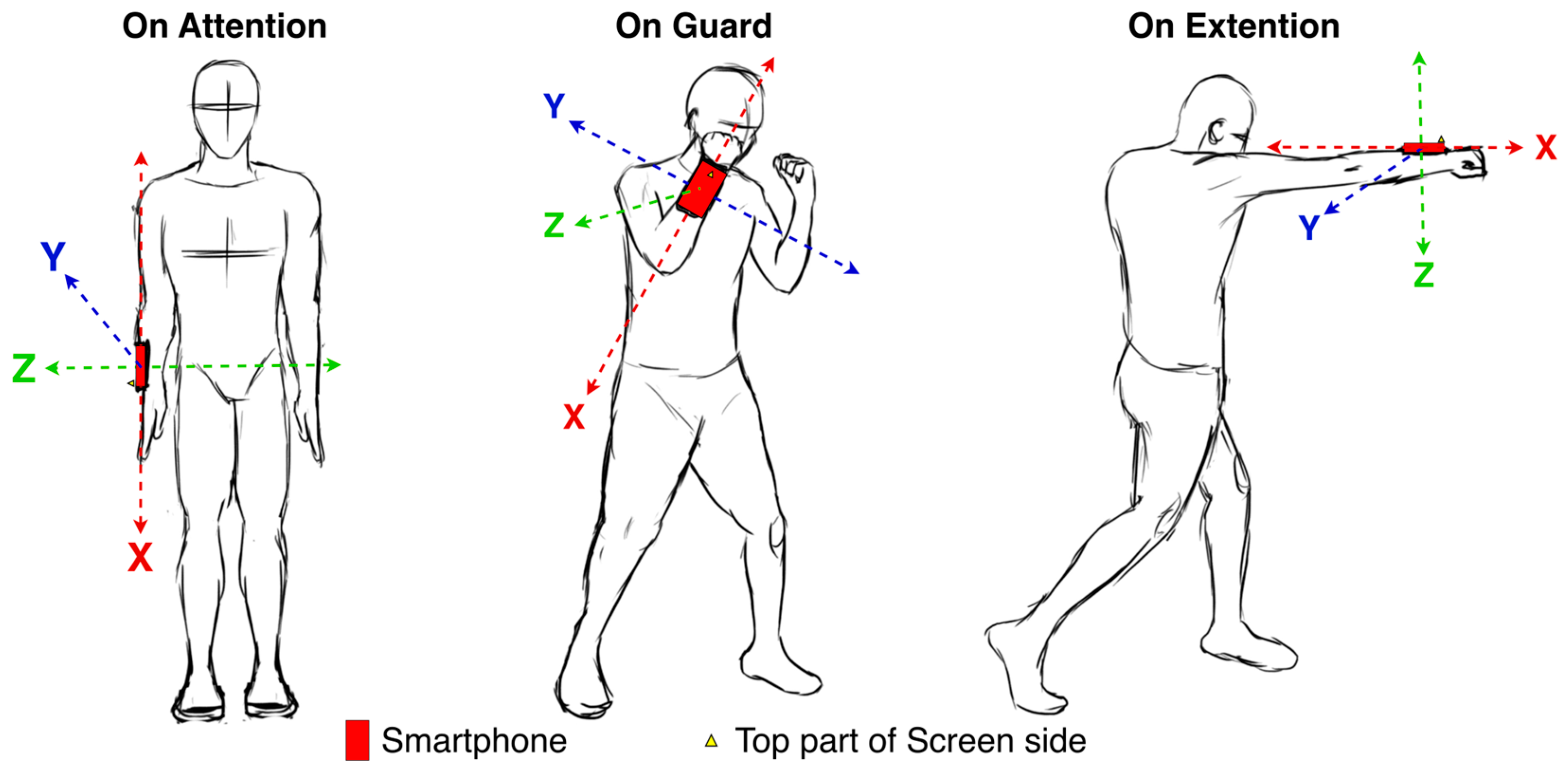
| 2 | X | The in and out inclination (Coronal plane) of the wrist provides the position of the fist in relation to the head. | X < −3 Guard too extended | X ≥ −3 & X ≤ 5 Correct range | X > 5 Guard over closed |
| 1 | Y | Fist up | Y < 0 Fist parallel to the floor or hand down | Y ≥ 0 Correct range | Y ≥ 0 Correct range |
| 3 | Z | The inward or outward inclination (Sagittal plane) of the wrist provides the position of the elbow in relation to the ribs. | Z < 0 Inverted elbow | Z ≥ 0 & Z ≤ 5 Correct range | Z > 5 Chicken wing |
| Order Within the Algorithm | Accelerometer Axis | What is Being Measured | Under the Correct Range (m/s2) | Correct Range (m/s2) | Above the Correct Range (m/s2) |
|---|---|---|---|---|---|
| 3 | X | Wrist orientation | X < −5 Flared fist | X ≥ −5 & X ≤ 5 Correct range | X > 5 Over-rotated |
| 2 | Y | Height of the thrown punch | Y < 0 Underthrown punch | Y ≥ 0 & Y ≤ 2.5 Correct range | Y > 2.5 Overshot punch |
| 1 | Z | The straightness of the arm must be forward | Z < 0 Dropped arm | Z ≥ 0 Correct range | Z ≥ 0 Correct range |
| Test Order | Condition | N | Mean | SD | Min | Max | 95% CI |
|---|---|---|---|---|---|---|---|
| Group 1: Control then Feedback | Control (No-feedback) | 20 | 1.30 | 1.84 | 0 | 5 | [0.44, 2.16] |
| Experimental (Feedback) | 20 | 4.50 | 1.64 | 0 | 6 | [3.73, 5.27] | |
| Group 2: Feedback then Control | Experimental (Feedback) | 20 | 4.75 | 1.33 | 3 | 6 | [4.13, 5.37] |
| Control (No-feedback) | 20 | 3.60 | 2.26 | 0 | 6 | [2.54, 4.66] |
| Group | t | df | p | Mean Difference | Cohen’s d | 95% CI of Difference |
|---|---|---|---|---|---|---|
| Group 1: Control then Feedback | 5.49 | 19 | <0.001 | 3.20 | 1.23 | [1.98, 4.42] |
| Group 2: Feedback then Control | 3.09 | 19 | 0.006 | 1.15 | 0.69 | [0.37, 1.93] |
| Test Order | Condition | N | Mean | SD | SEM | Min | Max | Median | 95% CI | CV (%) | V |
|---|---|---|---|---|---|---|---|---|---|---|---|
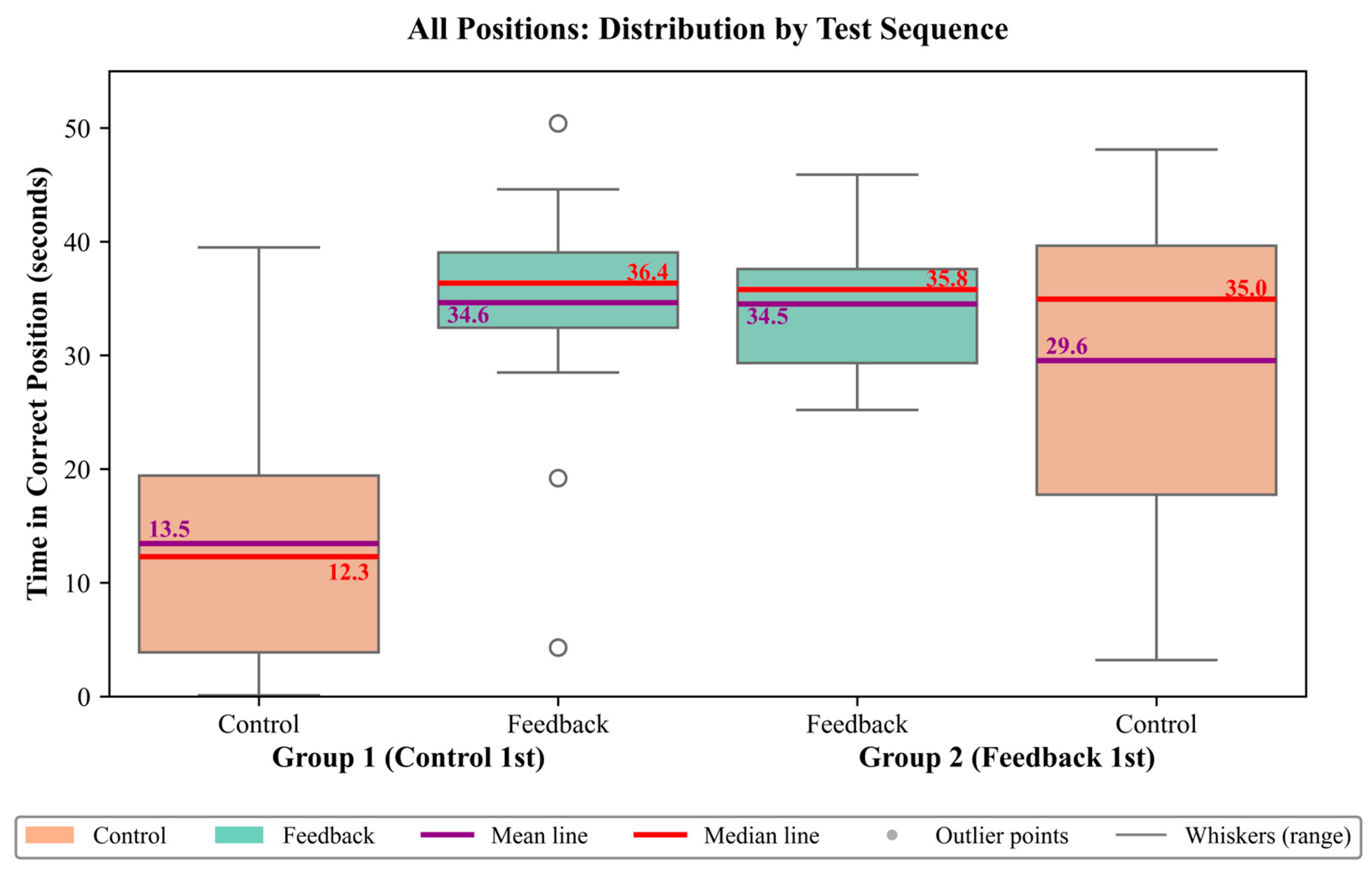
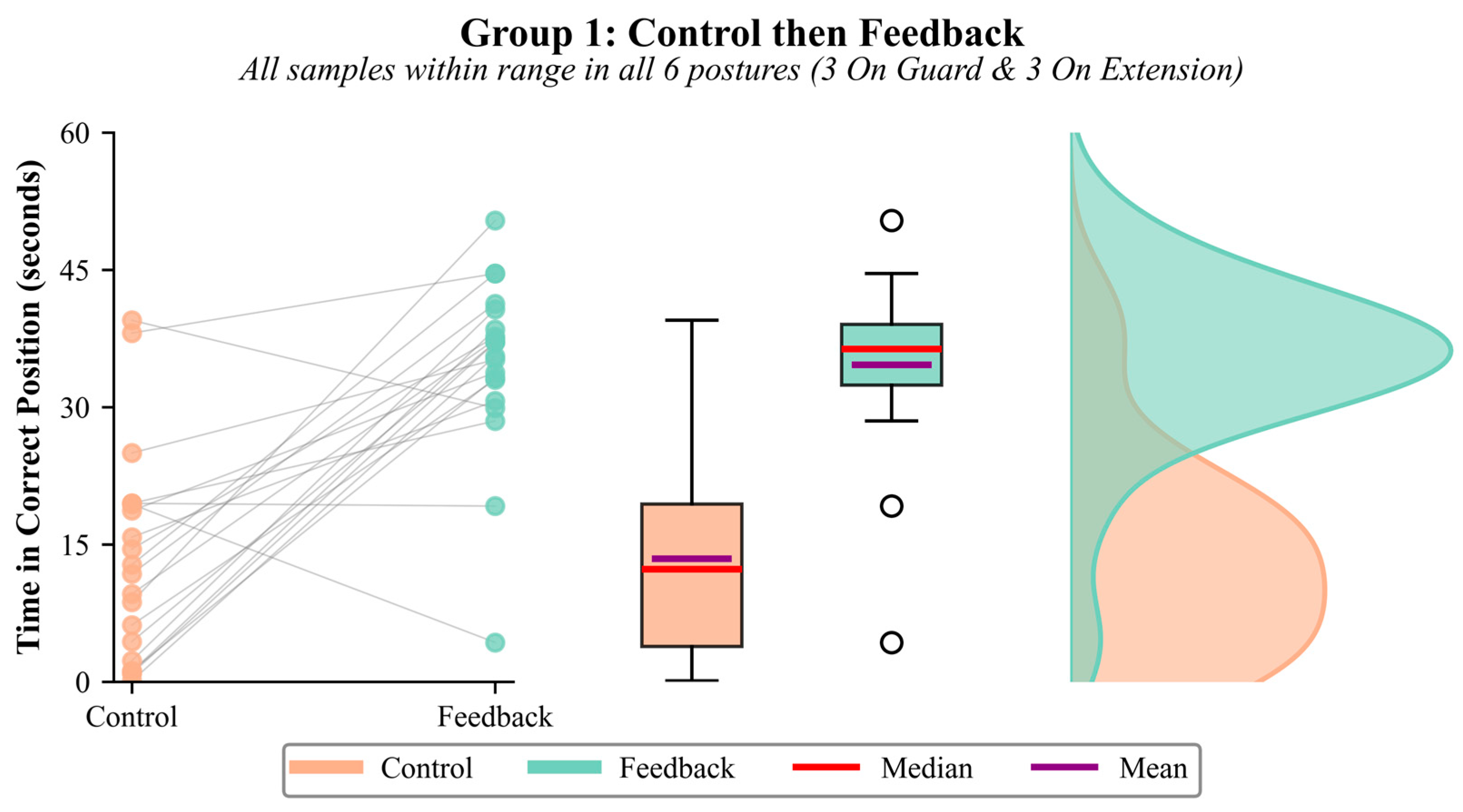
| Group 1: Control then Feedback | Control (No-feedback) | 20 | 13.46 | 11.47 | 2.57 | 0.1 | 39.5 | 12.30 | [8.09, 18.82] | 85.25% | 131.58 |
| Experimental (Feedback) | 20 | 34.64 | 9.77 | 2.18 | 4.3 | 50.4 | 36.35 | [30.07, 39.21] | 28.20% | 95.43 | |
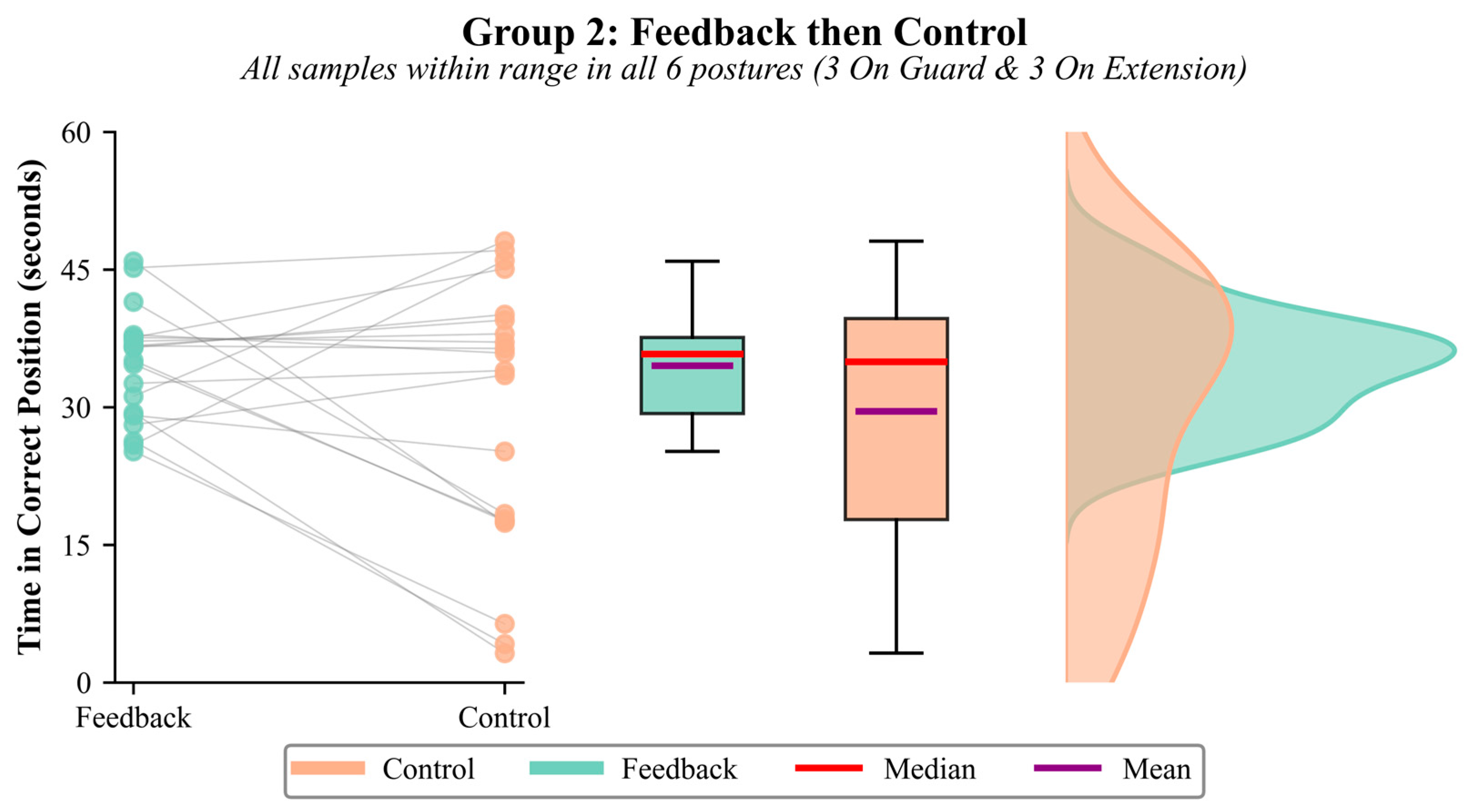
| Group 2: Feedback then Control | Experimental (Feedback) | 20 | 34.52 | 6.00 | 3.27 | 25.2 | 48.1 | 35.80 | [31.71, 37.33] | 17.38% | 36.00 |
| Control (No-feedback) | 20 | 29.55 | 14.64 | 1.34 | 3.2 | 45.9 | 34.95 | [22.70, 36.40] | 49.53% | 214.24 |
| Test Order | t | df | p | Mean Control (No-Feedback) | Mean Feedback | Mean Difference | Cohen’s d | 95% CI of Difference |
|---|---|---|---|---|---|---|---|---|
| Group 1: Control then Feedback | 5.72 | 19 | <0.001 | 13.46 | 34.64 | 21.19 | 1.28 | [13.44, 28.93] |
| Group 2: Feedback then Control | 1.57 | 19 | 0.132 | 29.55 | 34.52 | 4.97 | 0.35 | [−1.64, 11.58] |
| Condition | t | df | p | Mean Group 1 | Mean Group 2 | Mean Difference | Cohen’s d | 95% CI of Difference |
|---|---|---|---|---|---|---|---|---|
| Control (No feedback) | −3.534 | 38 | 0.001 | 1.30 | 3.60 | −2.30 | −1.117 | [−3.618, −0.982] |
| Experimental (Feedback) | −0.529 | 38 | 0.600 | 4.50 | 4.75 | −0.25 | −0.167 | [−1.206, 0.706] |
| Source | SS | df1 | df2 | MS | F | p | η2p |
|---|---|---|---|---|---|---|---|
| Test_order | 1276.00 | 1 | 38 | 1276.00 | 10.62 | 0.0024 | 0.22 |
| Condition | 3420.42 | 1 | 38 | 3420.42 | 28.88 | 0.0000 | 0.43 |
| Interaction | 1314.63 | 1 | 38 | 1314.63 | 11.10 | 0.0019 | 0.23 |
Disclaimer/Publisher’s Note: The statements, opinions and data contained in all publications are solely those of the individual author(s) and contributor(s) and not of MDPI and/or the editor(s). MDPI and/or the editor(s) disclaim responsibility for any injury to people or property resulting from any ideas, methods, instructions or products referred to in the content. |
© 2026 by the authors. Published by MDPI on behalf of the International Institute of Knowledge Innovation and Invention. Licensee MDPI, Basel, Switzerland. This article is an open access article distributed under the terms and conditions of the Creative Commons Attribution (CC BY) license.
Share and Cite
Gómez-Monroy, C.; Ramírez-Reivich, A.C.; Borja, V.; Jimenez-Corona, J.L.; Gonzalez, V. Automated Real-Time Detection and Correction of Children’s Kinesthetic Learning Using Expert-User Performance and Smartphones as Wearables. Appl. Syst. Innov. 2026, 9, 58. https://doi.org/10.3390/asi9030058
Gómez-Monroy C, Ramírez-Reivich AC, Borja V, Jimenez-Corona JL, Gonzalez V. Automated Real-Time Detection and Correction of Children’s Kinesthetic Learning Using Expert-User Performance and Smartphones as Wearables. Applied System Innovation. 2026; 9(3):58. https://doi.org/10.3390/asi9030058
Chicago/Turabian StyleGómez-Monroy, Carla, Alejandro C. Ramírez-Reivich, Vicente Borja, José Luis Jimenez-Corona, and Victor Gonzalez. 2026. "Automated Real-Time Detection and Correction of Children’s Kinesthetic Learning Using Expert-User Performance and Smartphones as Wearables" Applied System Innovation 9, no. 3: 58. https://doi.org/10.3390/asi9030058
APA StyleGómez-Monroy, C., Ramírez-Reivich, A. C., Borja, V., Jimenez-Corona, J. L., & Gonzalez, V. (2026). Automated Real-Time Detection and Correction of Children’s Kinesthetic Learning Using Expert-User Performance and Smartphones as Wearables. Applied System Innovation, 9(3), 58. https://doi.org/10.3390/asi9030058