Article

A Multi-Analytical Archaeometric Approach to Chalcolithic Ceramics from Charneca do Fratel (Portugal): Preliminary Insights into Local Production Practices


by
Ana S. Saraiva
1,2,3,4,*,
Mathilda L. Coutinho
4,
Joaquina Soares
5,6,
Carlos Tavares da Silva
5,6,
João C. Caninas
7,8 and
João Pedro Veiga
1,2,3,*
1
Departamento de Conservação e Restauro (DCR), Faculdade de Ciências e Tecnologia, Universidade Nova de Lisboa, Quinta da Torre, 2829-516 Caparica, Portugal
2
Centro de Investigação em Materiais (CENIMAT/I3N), Faculdade de Ciências e Tecnologia, Universidade Nova de Lisboa, Quinta da Torre, 2829-516 Caparica, Portugal
3
Vidro e Cerâmica para as Artes (VICARTE), Departamento de Conservação e Restauro, Faculdade de Ciências e Tecnologia, Universidade Nova de Lisboa, Quinta da Torre, 2829-516 Caparica, Portugal
4
HERCULES Laboratory—City University of Macau Chair in Sustainable Heritage—Institute for Advanced Studies and Research, IN2PAST—Associated Laboratory, University of Évora, 7000-809 Évora, Portugal
5
MAEDS/AMRS—Museu de Arqueologia e Etnografia do Distrito de Setúbal, Associação de Municípios da Região de Setúbal, Av. Luisa Todi, 162, 2900-451 Setúbal, Portugal
6
UNIARQ—Centro de Arqueologia da Universidade de Lisboa, Faculdade de Letras, Alameda da Universidade, 1600-214 Lisboa, Portugal
7
Associação de Estudos do Alto Tejo, Plataforma de Estudos Arqueológicos do Médio Tejo, Rua de Santana, R/c do Edifício da Segurança Social, 6030-230 Vila Velha de Ródão, Portugal
8
EMERITA, Empresa Portuguesa de Arqueologia, Rua da Mãe D’Água, 28, Cacilhas, 2780-369 Oeiras, Portugal
*
Authors to whom correspondence should be addressed.
Quaternary 2025, 8(4), 72; https://doi.org/10.3390/quat8040072
Submission received: 25 September 2025 / Revised: 5 November 2025 / Accepted: 19 November 2025 / Published: 3 December 2025

Abstract

The archaeological site of Charneca do Fratel, in Vila Velha de Ródão, Portugal, is a fortification that is radiocarbon-dated from the third millennium BCE. The archaeological fieldwork in 1987 revealed the first Chalcolithic settlement on the northern Portuguese bank of the Tagus River. Its architectonic concept is similar to that observed in southern Portugal, proving new insights into the study of the process of Chalcolithisation of western Iberia. Its location close to the Tagus River, in the vicinity of fertile soils, fishing and hunting areas, and sources of raw materials that are probably used to produce stone tools and pottery, indicates a self-sustained society in the frame of an accentuated tendency for sedentarisation. In the present work, 20 samples were submitted to an archaeometric approach to shed light on the technological aspects of Chalcolithic ceramic production techniques on the northern bank of the Tagus River. The obtained results indicate two chemically distinguishable ceramic groups within Fratel’s findings, with a high variation in paste colourations, ranging from dark greyish and bright red. Mineralogical analysis indicates that firing occurred at temperatures between 700 °C and 850 °C. The results point to a local production, with ceramic manufacturing procedures that are analogous to other Chalcolithic settlements.

1. Introduction

Characterised by the regular human manipulation of copper, the Chalcolithic, also known as the Eneolithic or Copper Age, is an archaeological period of drastic changes in Europe. The term Chalcolithic comes from the Greek khalkos (copper) and lithos (stone), and it is used to define the prehistoric transition period between the Stone Age and the Bronze Age. During these times, copper was used alongside flint, but tin bronze was not yet employed in the manufacturing of artefacts [1]. In today’s Portuguese territory, the Chalcolithic has been radiocarbon dated to the third millennium BCE [2].
The first Chalcolithic studies in the Iberian Peninsula emerged in the late years of the 19th century, with the finding of Leceia in 1877 (Oeiras, Portugal) and Los Millares (Almeria, Spain) [3,4]. With these findings, the diffusionist theory gains terrain, and it is the prevailing theory of Chalcolithisation until the mid-20th century, when the first radiocarbon dating studies are performed [2,3]. These new scientific data laid the foundations for the rise in evolutionism and processualism in archaeological theory. This new theory would argue that Chalcolithisation occurred mainly as a result of the autochthonous development [3,4]. In the late 20th century, through a congress organised in Torres Vedras, it came to light that the diffusionist and evolutionist theories are not contradictory, and could have occurred simultaneously at different scales, depending on the location and the trade networks integration [3].
To explain the transition between the Late Neolithic and Chalcolithic periods, the theory of the secondary products revolution, proposed by Andrew Sherratt in 1987, highlighted the role of economics in the cultural change [3,5]. This theory argues that the new technological advances from the Late Neolithic led to an increase in productivity, leading to the emergence of surpluses. In light of this socio-economic theory, some Portuguese archaeologists justify the appearance of fortifications in Portuguese territory, due to the need to protect the surpluses [2,3,4,6]. At the end of the 20th century, a new perspective on the surge in the appearance of fortifications was developed at Oporto University. The defenders of this paradigm, with an idealistic perspective, added a symbolic meaning to the existence of fortifications. They reject the term fortification, only accepting the designation of a walled enclosure with the functions of social aggregation in moments of celebration and as a way of monumentalising the landscape [3,4].
Ceramics are the most abundant elements of material culture and show typological changes that, when combined with stratigraphy, allow us to characterise, in general terms, the periodisation of the Chalcolithic. In the Portuguese Estremadura, where the frequency of decorated ceramics is high, they constituted a “director fossil” of the main phases of the Chalcolithic [7]. The same cannot be applied to the Alentejo and Beira Baixa, where the settlement of Fratel is located. In these regions, ceramics are, in their overwhelming majority, undecorated, and the passage of time can be read above all through the statistical behaviour of a relatively stable morphological repertoire in the Early Chalcolithic (first half of the third millennium BCE) [7] until the appearance and development of the Bell beaker pottery in the third quarter of the third millennium BCE (Late Chalcolithic) [6].
For a more detailed stylistic characterisation of Chalcolithic ceramic productions (especially when decoration is scarce and shapes persist), for knowledge of the sources of supply of raw materials, manufacturing processes, and commercial networks, multi-analytical archaeological studies are of extreme importance.
The first archaeometric analysis of Chalcolithic ceramics in Portugal began sparsely in the first years of the 21st century [8,9,10], and since then, more archaeometric investigations have been completed [3,8,11,12,13,14,15,16,17]. These have provided significant insights regarding all aspects of ceramic manufacturing techniques and practices, along with the establishment of possible trade routes. Notwithstanding these noteworthy studies, the majority of them refer to the Estremadura region, leaving, except for some punctual cases [10,16,17], numerous ceramic findings and archaeological sites to be archaeometrically studied and thus contribute to a better understanding of this period.
The present research contributes to a broader understanding of technological innovation and resource management during the Chalcolithic, offering new perspectives on human adaptation and cultural development in the late prehistory of the Iberian Peninsula. By characterising the technological choices of Chalcolithic potters from the Tagus valley, it provides valuable comparative data for the reconstruction of prehistoric technological systems in Western Iberia.

1.1. Charneca do Fratel Geological and Archaeological Setting

Fratel is the name of a parish in the municipality of Vila Velha de Ródão, situated in eastern Portugal [18]. It is located at approximately 3.5 km from the right bank of the Tagus and roughly 4 km from the left bank of the Ocreza River [18] (Figure 1A,B). In Portuguese, charneca means uncultivated and arid land, where only gorse and creeping plants grow [19,20]. In fact, that is the feature of today’s visible site (Figure 1C). Despite these harsh environmental characteristics, an archaeological site, radiocarbon dated from the 3rd millennium BCE, was found: the Charneca do Fratel [21].
Geologically, this region is mainly constituted by Ante-Ordovician schist and greywacke lands, belonging to the great Beira area [21,23]. Along the Tagus, on both sides, these lands are, in part, covered by arkosic deposits and gravel beds of pebbles from the Ceno-Anthropozoic age [23]. In Fratel’s area, numerous Pliocene gravel pits, mainly characterised by the existence of siliceous elements (quartzite, quartz, licit, etc.), are found. Most of them are based on top of arkose outcrops, but some lay directly on shale. In some places, this base is formed by benches or extensive lentil areas of clay, with or without small pebbles, and is a very bright red. Stones are also involved with a clay paste, whose colour gives the general tone of the geological formation [23]. Shale pebbles are rarely individualised, being easily alterable and not very resistant; all clay material that is found at the base comes from them. Charneca do Fratel is found in one of the highest deposits, in a plateau position at 323 m of altitude: about 260 m higher than the Tagus River [21,23]. The current soils are a result of the previously existing rocks wearing, mainly lithic leptosols, and have a low capacity for cereal production. The sections with better soils (classes A + F, B, and B + C) are in interior regions of the land, framed by detrital tables [21,22]. However, these soils might have been profoundly changed during the Estado Novo wheat campaign (1930s), offering today a lower capacity than that they might have offered during Late Prehistory [22].
The archaeological fieldwork at Fratel arose between September 1987 and August 1988 and was directed by Joaquina Soares and Carlos Tavares da Silva, with the participation of Francisco Henriques and João Caninas [21]. The excavation revealed the first Chalcolithic settlement on the Portuguese northern bank of the Tagus River and provided new insights for the theorisation of the Chalcolithisation process of western Iberia [22].
Throughout Portugal, Chalcolithic fortifications appear on elevations or platforms, taking advantage of natural defence conditions [2]. These constructions had a defensive practical purpose, verified by the successive rebuilding of damaged walls and improvements in the architectural concepts, and would also impose respect or fear in rival communities, reducing their willingness to attack [2]. In the limited excavated area at Fratel, a section of wall and an entrance, flanked by a bastion, were found. These architectural elements have an identical plan to many other coeval Iberian fortifications.
Fratel’s location in proximity to the Tagus River, which is nearby fertile soils, fishing and hunting areas, and close to raw materials sources, was probably used to produce stone tools and pottery; this indicates a self-sustained society in the frame of an accentuated tendency for sedentarisation [21,24]. Focusing on ceramic production, the Chalcolithic domestic pottery from Beira Baixa is not very well known, although it has similarities with contemporary ceramic production from Alentejo and the Algarve [7,21,24,25]. Undecorated ceramics with mostly spherical and ovoid shapes and hemispherical and carinated bowls from Charneca do Fratel also have parallels in the regional megalithic monuments [21,24,26].

1.2. Research Aim

The present study applies a multi-analytical archaeometric approach to a selected assemblage of Chalcolithic ceramic fragments that were unearthed at Charneca do Fratel, aiming to contribute to a more comprehensive understanding of ceramic production technologies on the northern bank of the Tagus River. The research integrates optical microscopy (OM), wavelength dispersive X-ray fluorescence (WDXRF), and X-ray diffraction (XRD) analyses to obtain a detailed material characterisation of the samples. This combined analytical framework seeks to fill the existing gap in the reference collection of ceramic fabrics for this region and period. Specifically, the study aims to evaluate the possible coexistence of distinct ceramic fabrics within the same settlement and define ceramic groups, to identify the composition of the raw materials employed, and to assess the technological choices made at Fratel. Ultimately, we intend to identify possible indicators of technological development within the studied Chalcolithic community of the Tagus valley.

2. Materials and Methods

2.1. Samples

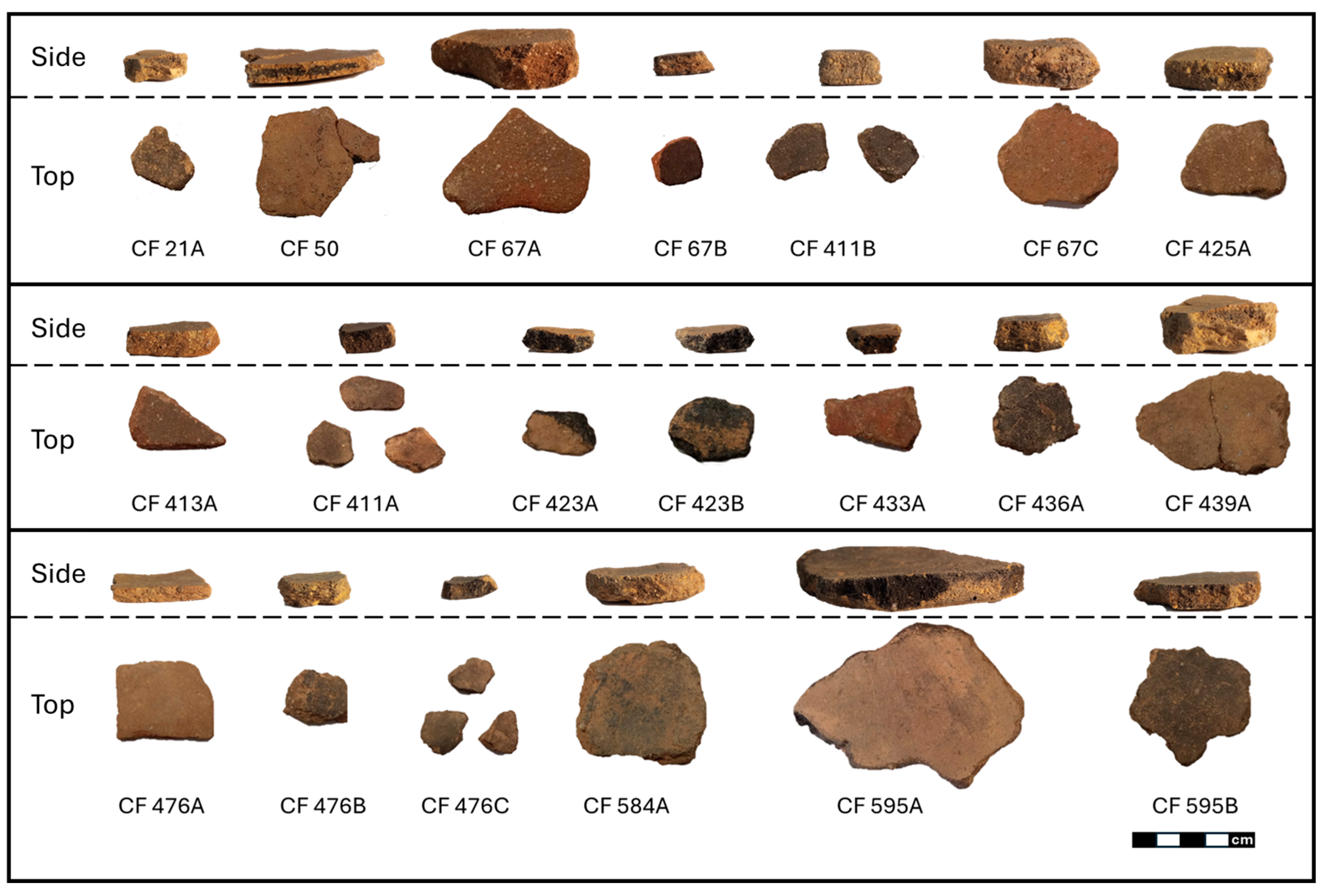
Before the present study, all ceramic fragments retrieved from Charneca do Fratel underwent a macroscopic archaeological analysis, which revealed a remarkable and consistent homogeneity across the assemblage. From this broader collection, 20 fragments (Figure 2) originating from the same archaeological layer were selected for archaeometric analysis to unveil their physicochemical characteristics. Although typologically unidentifiable, these fragments were nonetheless representative of the distinct ceramic materials recovered at the site.

2.2. Sample Preparation and Equipment

All chosen fragments were subjected to textural, chemical, and mineralogical analysis to obtain their material characterisation. Before sampling, thickness measurement was conducted 5 times in different areas of each fragment, using a Mitutoyo© vernier calliper (Mitutoyo Europe GmbH, Berlin, Germany) with a range of 15 cm and 0.05 cm resolution. All fragments were sampled two times; for optical microscopy, a portion (≈ 1 cm3) was cut using a plier and mounted in acrylic resin, then polished with SiC abrasive papers of successively smaller granulometries (P320, P600, P1200, P2500, P4000). And, for the remaining analysis, a second small portion (≈6 g) of each fragment was cut and ground into a homogeneous powder, using a mortar and pestle.
Given the relatively high friability of the ceramic objects in the present study and the risk of sample loss during thin-section preparation, a reflected light optical microscope was chosen to observe the sample’s texture. This equipment can provide relevant information regarding the ceramic pastes’ colours and their variations, and simultaneously allows for visualisation, measurement, and quantification of non-plastic elements that are present [27,28]. OM observations were made with a Leica DMI5000M microscope (Leica Camera, Wetzlar, Germany), coupled with a Leica DFC295 digital camera (Leica Camera, Wetzlar, Germany). Both instruments are connected to a computer equipped with Leica Application Suite (LAS V4.9) software, with multifocus functionality [29]. Images provided by OM were measured and quantified using ImageJ® 1.53h software to obtain quantifications and measures of non-plastic elements of the ceramic pastes and histogram analysis of the fragments’ core ceramic pastes’ colorations [28].
The chemical–elemental characterisation was performed with the wavelength dispersive X-ray fluorescence spectrometer (WDXRF) PANalytical–Axios 4.0 (Bruker, Mannheim, Germany), with a rhodium X-ray tube (20.21 keV), in conditions that were optimised for element quantification. The analysing crystals of LiF220, LiF200, Ge, PE, and PX1 were used for the separation of fluorescent X-ray peaks, covering all measurable range. Analyses were performed on the He flow and spectra deconvolution, using the iterative least-squares method and standardless semiquantitative analysis based on the fundamental parameter approach with the SuperQ IQ+ v.5.3A software package (PANalytical B.V., Almelo, The Netherlands). Chemometric approaches to chemical–elemental data were performed with Chemoface® 1.71 software. The principal component analysis was conducted after employing the autoscale data preprocessing method.
Mineralogical characterisation was achieved by XRD analysis with a Bruker D8 Discover X-ray diffractometer (Bruker, Mannheim, Germany) equipped with a LINXEYE detector (Bruker, Mannheim, Germany) and a germanium primary monochromator providing Cu Kα1 radiation. The analyses were conducted in the 2θ range between 5° and 75°, with a step of 0.05° and a counting time of 0.7 s at each step. The obtained spectra were analysed using the X’Pert HighScore Plus® 3.0.0 software.

3. Results and Discussion

At a macroscopic scale, most of the analysed fragments have coarse textures, surface colourations in the range of browns, and occasionally, reddish and grey surfaces (Table 1). Regularly, core colours tend to be darker than the surface, creating a sandwich-like cross-section that provides clues regarding the employed raw materials’ characteristics and firing procedures.
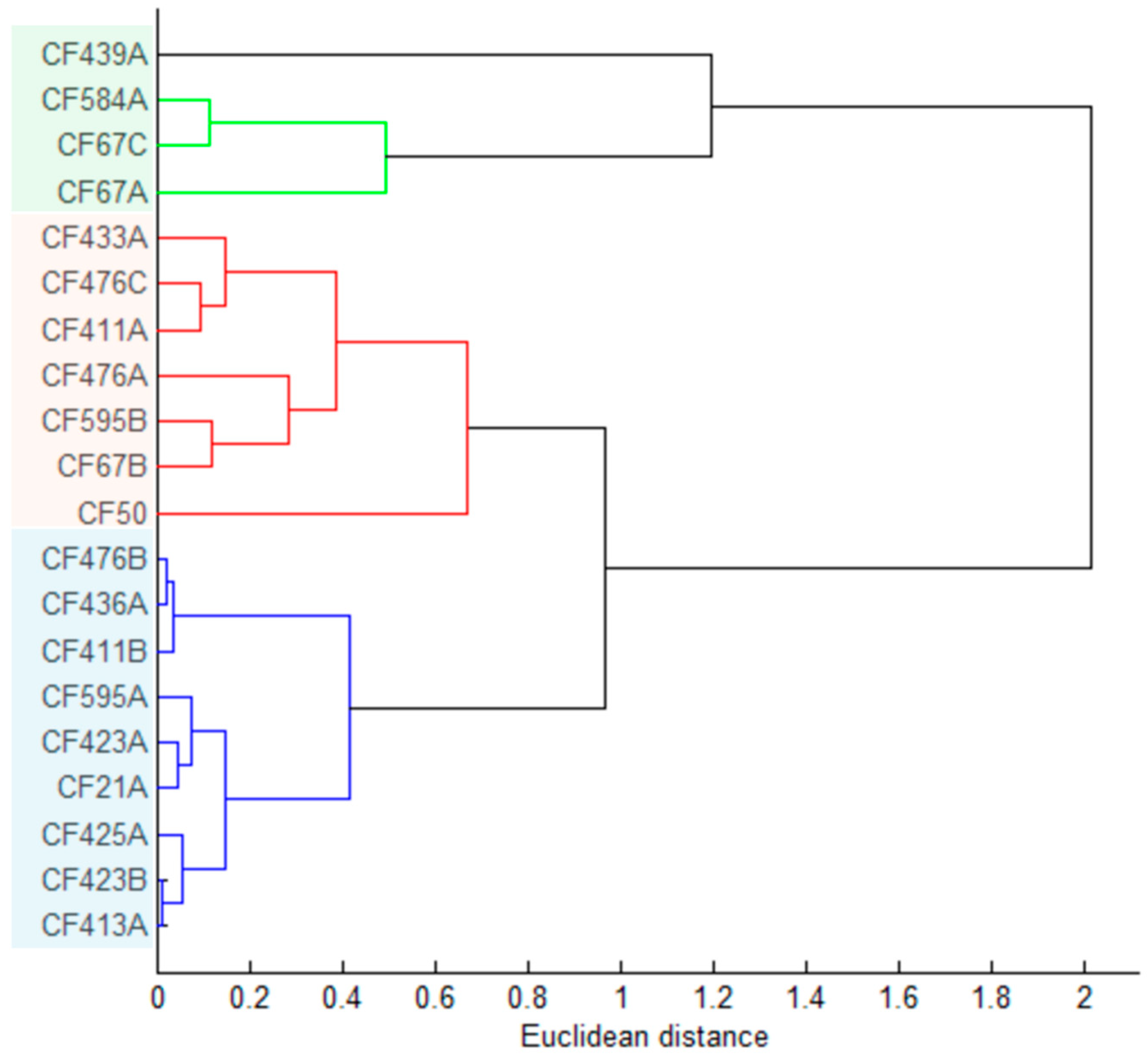
The studied ceramic fragments present thicknesses between 0.5 cm and 1.8 cm, with a noteworthy uniformity within each fragment, suggesting a careful conformation of the piece by the potter’s hands. A hierarchical cluster analysis was conducted, resorting to the samples’ average thicknesses, using the autoscale preprocessing method and calculating the Euclidean distance from the average point to investigate the existence of sub-groups based on these data. The results (Figure 3) show the possibility of three subgroups: the first, underlined in green in the figure, includes the coarser and most friable samples; the second, underlined in red, includes the ones with average textures and the most compact fragments; and the final sub-group, in blue, includes all the remaining fragments with intermediate characteristics.

3.1. Textural Analysis

Ceramic textural analysis is mainly influenced by non-plastic inclusions. These can shed light on possible raw materials sources and pottery-making practices [27,30]. Both the macro- and microscopic analyses performed on all samples facilitated the evaluation of their respective texture characteristics, including the distribution, size, and geometry of the non-plastic elements (Table 2).
The analysis of the non-plastic elements (NPE) showed no preferred orientations, not allowing for the proposal of a modelling technique employed during manufacture. After image analysis, NPEs have an average frequency of (18.7 ± 3.7) %, with dimensions of (0.3 ± 0.2) mm, on average. According to the Wentworth scale [30], the NPE sizes of the ceramics found at Fratel are of a medium size. The addition of these elements was a typical procedure to increase the final object’s stability and to avoid breaking during firing [30,32,33,34]. A notable aspect is the significant uniformization of temper dimensions, suggesting that these were, most possibly, intended additions made by the potter who would carefully crush the temper to its desired size [8,27]. Emphasising this perspective is the fact that the present NPE were identified to be of lithological origin and are very similar within each piece. But contrarily, the absence of grog additions and the tendency for more rounded NPE geometries might indicate that these were natural occurrences from the clay source and not temper that the potter would crush [8,31]. Nonetheless, it is also possible that the potter sifted local sand (naturally more rounded) to refine the grains’ dimensions to their desired size. Further studies on local raw materials sources are needed to address this question.
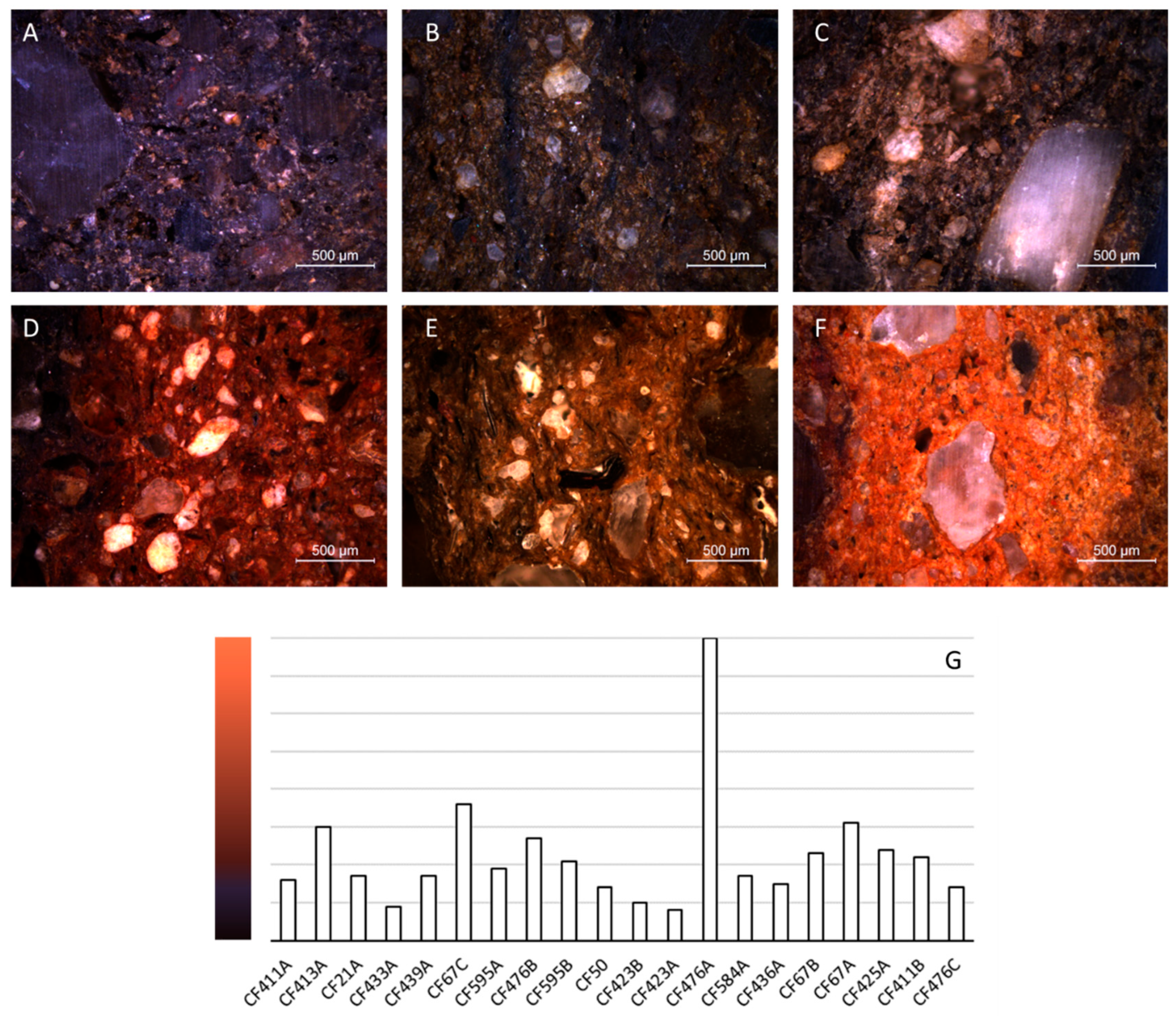
The core of the ceramic fragments after photograph histogram analysis (Figure 4G) shows that the studied ceramic pastes have a wide range of colourations, from bright reddish colours (Figure 4F) to dark greyish (Figure 4A), which are observable through the optical microscope photographs (Figure 4).
The observed variation in the ceramic pastes’ colourations may be a result of variances in the raw materials employed and/or the firing conditions [27,30]. Typically, darker colours are associated with reductive environments, i.e., with low oxygen availability, and, opposingly, the bright reddish colours are linked with oxidising environments [27,30]. Nevertheless, a quick and direct relationship between the colour and the firing environment is not possible, as colour is also a result of the different chemical elements in the original clay mixture and of the firing temperature [30]. In the analysed fragments, the observed colour variations do not appear to be associated with any intentional feature of the final artefacts, as no consistent relationship could be established between the hue and the remaining macroscopic characteristics. This indicates that the observed variations are likely a result of differences in the combinations of firing conditions and raw materials, rather than deliberate potters’ choices.
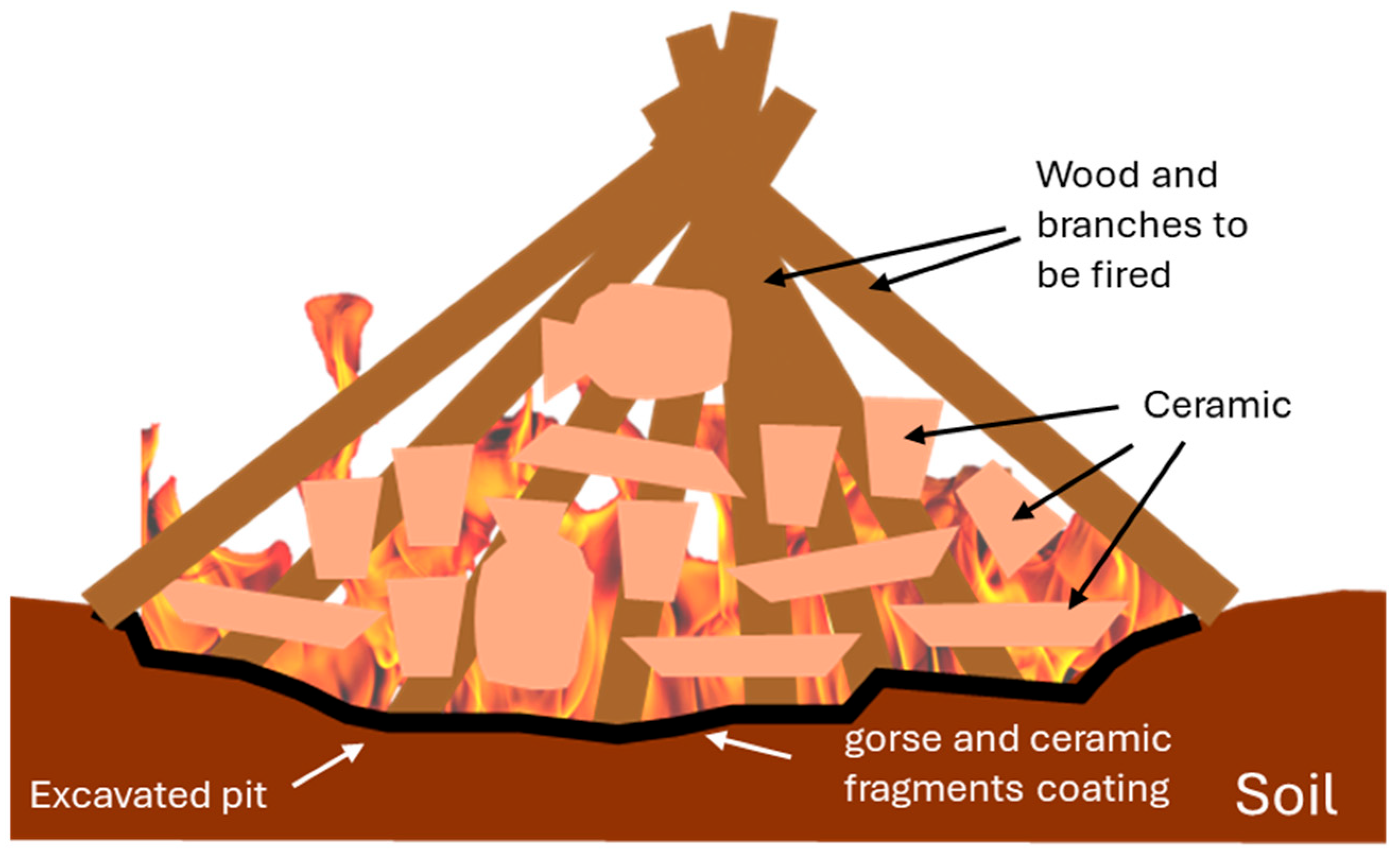
It is commonly accepted that the firing of Chalcolithic ceramics would occur mainly in open-air bonfires at the surface or in small pits (Figure 5) [8,30,32,35]. Bonfires present high environmental variability, depending on the position, type of fuel used, and location of the ceramic pieces in relation to the heat source, as pieces fired closer to the firing wood would not have access to the same oxygen quantities as the pieces in the outer zones that would be exposed to more aerated conditions [36]. The cross-sections with a sandwich-like structure indicate that firing occurred in the aerated conditions due to the reddish colours observed, which were usually caused by the presence of hematite (Fe2O3) [37]. Regarding the darker colours of the core, two possibilities appear: it can be a result of CO2 formed during firing of the organic matter present in the clay that could not be released, forming carbon that gives the black colorations of the core [30,35,38]; or it can be due to low oxygen in the interior areas of the ceramic walls as a result of low firing temperatures and short firing times [35,37,38,39]. Organic matter was frequently utilised to increase the plasticity of the clay and to perform as an opening material, avoiding explosions during firing [32,38]. The presence of voids and pores is also associated with the presence of organic matter burned during firing. In this case, the pores usually present dark colours around the margins [31], as seen in Figure 4E.

3.2. Chemical–Elemental Analysis

The WDXRF analysis results (Table 3) allowed for the identification of SiO2, Al2O3, and Fe2O3 as the major oxides (>7 wt.%), K2O, MgO, P2O5, SO3, CaO, and TiO2 as the minor oxides (0.1 < wt.% < 4), and MnO, ZnO, Na2O, V2O5, Cr2O3, Co3O4, Ga2O3, As2O3, Br, Cl, Rb2O, SrO, ZrO2, Nb2O5, BaO, CeO2, and PbO as the trace oxides (<0.03 wt.%).
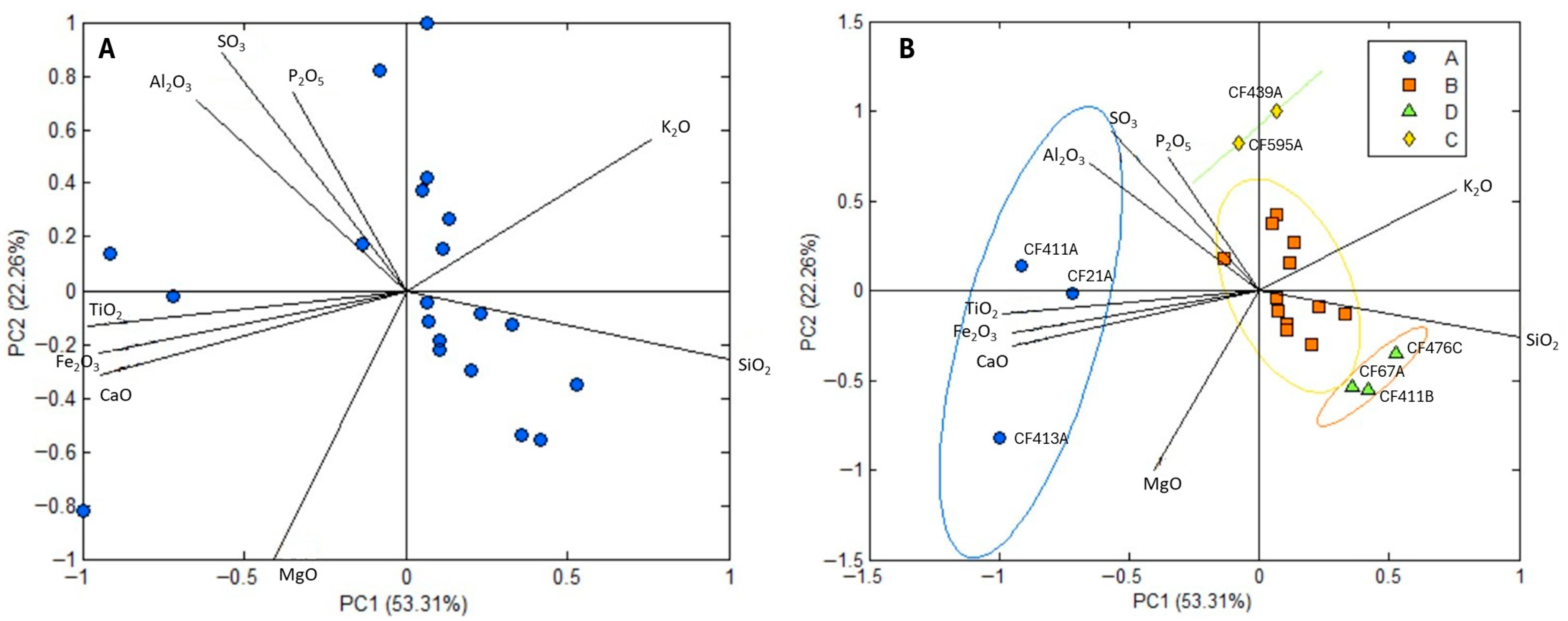
A global observation of the obtained results established that all ceramic pastes are non-calcareous and that some variance is visible between the fragments’ chemical composition. Aiming to better understand possible associations among fragments, which would allow for the determination of distinct ceramic fabric groups, a principal component analysis was performed, resorting to the identified major and minor oxide quantifications (Figure 6).
Focusing on the sample’s distributions that were obtained through the first PCA (Figure 6A), the possible presence of four distinct ceramic fabrics is visible. To further assess this question, the samples were classified into groups A, B, C, and D, and a new PCA was conducted (Figure 6B). The new analysis confirmed, with 95% confidence, due to the non-overlapping of group ellipses, that these four groups are chemically distinguishable through their major and minor oxide contents. Observing the respective loadings, it is visible that the group A samples present higher amounts of Fe2O3, TiO2, and CaO, while the remaining groups present higher quantities of K2O and SiO2. This could indicate the use of at least two different raw material sources, perhaps with varying materials of clay: one richer in calcium and the other richer in potassium. Various sources of temper could also have been added, with Groups B, C, and D being richer in silica and associated with quartz, while Group A seems to be associated with the use of iron and titanium-rich sands as temper.
The existence of more than one ceramic group at Fratel opens the possibility that more than one clay source was used. A comparison between the quantified elemental compositions and data from three Chalcolithic archaeological sites in the Lisbon area [13] reveals that the Fratel fragments exhibit, on average, lower concentrations of aluminium, calcium, and titanium, while showing higher levels of silicon and potassium. In contrast, a separate assemblage of fragments from central Portugal [16] displays the highest calcium and the lowest iron contents among the regions considered. These studies collectively support the hypothesis that locally sourced raw materials were utilised in each of the studied areas, as the compositional features of the samples align with the respective regional geological characteristics. To further explore this question, a deeper study of Fratel’s clays and fragments is crucial.

3.3. Mineralogical Analysis

The mineralogical characterisation, accomplished by XRD, displays a great similarity between the studied ceramic fragments. All samples exhibit high amounts of quartz and K-feldspars: mainly microcline, albite, and occasionally orthoclase. In minor quantities, magnetite and some clay minerals were also identified in several samples (Table 4). These identified minerals follow the geological characteristics of Fratel’s region and the Nisa clay reference analysis [40], once more supporting the theory of the employment of local raw materials.
The presence of large amounts of quartz indicates that firing temperatures were not high enough to form silicates, whose formation reactions start at 700 °C [41]. However, in the present study, it must be considered that powdered XRD analyses were performed with all ceramic constituents, including the temper, which is mainly constituted by quartz.
The presence of clay minerals also verifies the low firing temperatures, as illite begins to destabilise and dehydroxylate between 350 °C and 600 °C, collapsing and rearranging itself into new crystal structures. The final breakdown of illite with the formation of high-temperature phases begins above 900 °C [42,43,44,45], and thus, it is assumed that the detection of illite in an archaeological ceramic fragment implies that these materials should not have been fired above 850 °C [43,46,47]. As in the present study, we are concerned with archaeological materials that have undergone long periods of earthing time; it is likewise possible that clay minerals are a result of post-depositional reactions in humid environments and are capable of the crystallisation of the amorphous phase due to ions circulating in underground fluids [48,49].
Feldspars’ single phases are relatively stable at high temperatures and do not show any alteration in low-fired ceramics. Until 600 °C, both K-feldspars and plagioclases are typically stable; after that, the reactions that occur are dependent on the type of feldspar and overall composition. It is in the range between 800 °C and 1000 °C that feldspars undergo major transformations, with some exceptions that can remain stable even above 1000 °C, as is the case with sanidine. Regarding the remaining feldspars, they can perform the following: transform into sanidine (K(AlSi3O8)), which usually happens to microcline at 950 °C; be replaced by anorthite after a reaction with lime when fired above 850 °C; and trigger the formation of newly formed phases along the rim, which typically occur to albite minerals above 1000 °C [36,50,51,52].
In Fratel’s samples, the presence of albite and microcline and the absence of anorthite and sanidine also imply that neither the temperature nor the firing time was high enough for anorthite to be formed [15,36]. Anorthite is formed in illitic clays containing CaCO3, generally at temperatures between 950 °C and 1000 °C [43,51,52], and microcline disappears at temperatures above 1000 °C when sanidine is formed [36,53].
Iron oxides can be naturally present in the raw material employed or can result from the decomposition of clay minerals containing high iron levels during firing [52]. Typically, the presence of magnetite indicates that iron oxides were heated in a reductive environment [42]. Magnetite, Fe(II), can also form because of organic matter behaviour during firing, producing gases that are locked inside by internal impermeability, thus causing the reduction of iron. This is more evident when firing is quick, and it is observable in the darkening of the interior layer [41]. This effect is heightened by the grain size and the presence of organic matter, and is more likely to occur in raw materials that include montmorillonite and illite [38,41], as is the case with Fratel’s materials.
In summary, the mineralogical analysis indicates a relatively short firing time and a range of obtained temperatures between 700 °C and 850 °C, which are congruent with firing in bonfires, as has been typically associated with Chalcolithic practices [8,30,35].

4. Conclusions

The archaeometric study of ceramic fragments has proven to be a valuable research paradigm, offering answers to questions that are otherwise impossible to address.
The results from Charneca do Fratel reveal a clear chemical and mineralogical consistency among the materials used in pottery production, which aligns well with the local geological context. This indicates that the potters of Charneca do Fratel relied primarily on nearby sources of raw materials. Even so, distinct ceramic groups were identified, suggesting that more than one source of clay and/or temper was employed in the ceramic manufacturing process. Furthermore, the conducted analyses shed some light on the manufacturing procedures employed at Fratel, allowing for its initial inquiry. While the samples share strong chemical similarities, the wide spectrum of colour variation observed under optical microscopy points to differences in firing practices, which are best explained by fluctuations in oxygen availability during this process. It was also determined that the analysed ceramics were fired at temperatures ranging between 700 °C and 850 °C, which was consistent with open-air bonfire firing methods. Such conditions would naturally produce the observed differences in colour, as oxidising and reducing atmospheres could occur simultaneously, depending on the object’s position relative to the heat source.
The comparison of the archaeometric results with the ceramic fragments’ macroscopic attributes of thickness, texture, and friability did not reveal any significant correlation. Assuming that these attributes are related to the intended function of the artefacts, this lack of connection suggests that the selection of raw materials was not determined by typological considerations. Future research focusing on the characterisation of regional raw material sources, alongside the expansion of the archaeometrically studied Fratel’s fragments, is expected to yield crucial evidence for elucidating the technological procedures underlying Chalcolithic ceramic production.

Author Contributions

Conceptualisation, A.S.S., M.L.C., C.T.d.S., J.S., J.C.C. and J.P.V.; Data curation, A.S.S.; Formal analysis, A.S.S.; Investigation, A.S.S., M.L.C. and J.P.V.; Methodology, A.S.S., M.L.C. and J.P.V.; Project administration, J.P.V.; Resources, M.L.C., C.T.d.S., J.S., J.C.C. and J.P.V.; Supervision, J.P.V.; Visualisation, A.S.S.; Writing—original draft, A.S.S.; Writing—review and editing, A.S.S., M.L.C., C.T.d.S., J.S., J.C.C. and J.P.V. All authors have read and agreed to the published version of the manuscript.

Funding

This work was supported by FEDER funds through the COMPETE 2020 Programme and National Funds through FCT Portuguese Foundation for Science and Technology, under the following project references: UIDB/50025/2020-2023 (CENIMAT), UIDB/00729/2020 (VICARTE), UIDB/04449/2020, UID/PRR/04449/2025HERCULES/UE (HERCULES), LA/P/0132/2020 (IN2PAST), 2023.16519.ICDT, LISBOA2030-FEDER-00753900 (Project Glaze), 10.54499/CEECIND/00349/2017/CP1431/CT0004 (M. L. Coutinho), and 2021.04858.BD (Ana S. Saraiva).

Data Availability Statement

The original contributions presented in the study are included in the article; further inquiries can be directed to the corresponding authors.

Conflicts of Interest

Author João C. Caninas was employed by the company EMERITA. The remaining authors declare that the research was conducted in the absence of any commercial or financial relationships that could be construed as a potential conflict of interest.

References

  1. Pearce, M. The “Copper Age”—A History of the Concept. J. World Prehistory 2019, 32, 229–250. [Google Scholar] [CrossRef]
  2. Cardoso, J.L. Pré-História de Portugal; Editorial Verbo: Lisbon, Portugal, 2002. [Google Scholar]
  3. Amaro, G. La Cerámica con Decoración Acanalada y Bruñida en el Contexto Pre-Campaniforme del Calcolítico de la Extremadura Portuguesa: Nuevos Aportes a la Comprensión del Proceso de Producción de Cerámicas en la Prehistoria Reciente de Portugal; BAR International Series; Archaeopress: Oxford, UK, 2012. [Google Scholar]
  4. Jorge, S. Colónias, fortificações, lugares monumentalizados. Trajectória das concepções sobre um tema do Calcolítico peninsular. Rev. Fac. Let. 1998, 11, 447–545. [Google Scholar]
  5. Greenfield, H.J. The Secondary Products Revolution: The past, the present and the future. World Archaeol. 2010, 42, 29–54. [Google Scholar] [CrossRef]
  6. Soares, J. Searching for the Turning Point to Bronze Age Societies in Southern Portugal: Topics For A Debate. In Between the 3rd and the 2nd Millennia BC: Exploring Cultural Diversity and Change in Late Prehistoric Communities; Lopes, S., Gomes, S., Eds.; Archaeopress: Oxford, UK, 2021; pp. 82–104. [Google Scholar]
  7. Tavares da Silva, C.; Soares, J. Contribuição para o conhecimento dos povoados calcolíticos do Baixo Alentejo e Algarve: 43 anos em perspectiva. In Fogo e Morte. Sobre o Extremo sul no 3° Milénio a.n.e.; Sousa, A.C., Ed.; Câmara Municipal de Loulé: Loulé, Portugal, 2024; pp. 181–208. [Google Scholar]
  8. Chaves, R. Cerâmica Calcolítica da Região de Lisboa: Caracterização Arqueométrica de Cerâmica Pré-Histórica. Ph.D. Thesis, Universidade Nova de Lisboa: Almada, Portugal, 2022. Available online: https://run.unl.pt/handle/10362/150112 (accessed on 25 August 2025).
  9. Amaro, G. Continuidade e evolução nas cerâmicas Calcolíticas da Estremadura (um estudo arqueométrico das cerâmicas do Zambujal). Estud. Arqueol. Oeiras 2010, 18, 201–233. [Google Scholar]
  10. Dias, M.I.; Valera, A.C.; Lago, M.; Prudêncio, M.I. Proveniência e tecnologia de produção de cerâmicas nos Perdigões. Vipasca Arqueol. História 2007, 2, 117–121. [Google Scholar]
  11. Amaro, G.; Anunciação, C. Reproducción experimental del proceso de producción de cerámicas calcolíticas de la Extremadura portuguesa. Bol. Arqueol. Exp. 2010, 8, 24–36. [Google Scholar] [CrossRef]
  12. Amaro, G. How to (re)make a “prehistoric pot”? A small synthesis based on the study of chalcolithic pottery of Zambujal (Torres Vedras, Portugal) and also on the current manufacture of mapuche pottery (Lumaco, Chile). Oppidum 2020, 16, 7–22. [Google Scholar]
  13. Chaves, R.C.; Veiga, J.P.; Monge Soares, A. Characterization of Chalcolithic Ceramics from the Lisbon Region, Portugal: An Archaeometric Study. Heritage 2022, 5, 2422–2443. [Google Scholar] [CrossRef]
  14. Chaves, R.C.; Veiga, J.P.; Monge Soares, A. Cerâmicas calcolíticas de Vila Nova de São Pedro (Região de Lisboa)—Caracterização Textural e Química. Estud. Arqueol. Oeiras 2021, 29, 17–24. [Google Scholar]
  15. Vieira Ferreira, L.F.; Barros, L.; Ferreira Machado, I.; Pereira, M.F.C.; Casimiro, T.M. An archaeometric study of a Late Neolithic cup and coeval and Chalcolithic ceramic sherds found in the São Paulo Cave, Almada, Portugal. J. Raman Spectrosc. 2020, 51, 483–492. [Google Scholar] [CrossRef]
  16. Ganiyu, A.; Beltrame, M.; Mirão, J.; Mateus, J. Archaeometric study of the Proto-historic ceramics from the settlement of the Avecasta Cave (Ferreira do Zêzere, Portugal). Estud. Quaternário 2022, 22, 45–84. [Google Scholar] [CrossRef]
  17. Pérez Macías, J.A.; Martins, A.; Fernández, O.R. Primeiras evidências de mineração do cobre em Aljustrel—Um cadinho Calcolítico proveniente do Castelo. Vipasca Arqueol. História 2013, 4, 9–18. [Google Scholar]
  18. Fratel. Grande Enciclopédia Portuguesa e Brasileira; Editorial Enciclopédia: Lisboa, Portugal, 1950; Volume 11, p. 804. [Google Scholar]
  19. Charneca. Grande Enciclopédia Portuguesa e Brasileira; Editorial Enciclopédia: Lisboa, Portugal, 1950; Volume 6, p. 616. [Google Scholar]
  20. Houaiss, A.; Villar, M.; de Mello Franco, F.M.; de Lexicografia, I.A.H.; Charneca. Dicionário Houaiss da Língua Portuguesa; Temas e Debates: Lisbon, Portugal, 2001; Volume II. [Google Scholar]
  21. Soares, J. O Povoado da Charneca do Fratel e o Neolítico Final/Calcolítico da Região Ródão-Nisa—Notícia Preliminar. Alto Tejo 1988, 2, 3–6. [Google Scholar]
  22. Caninas, J.C.; Henriques, F.; Osório, M. Ocupação do Território de Fratel (Vila Velha de Ródão) na Pré-História recente: Ensaio de análise espacial. Sci. Antiq. 2017, 1, 177–208. [Google Scholar]
  23. Ribeiro, O.; Teixeira, C.; De Carvalho, H.; Peres, A.; Fernandes, A.P. Carta Geológica de Portugal na Escala 1/50 000—Notícia Explicativa da Folha 28-B NISA; Direcção Geral de Minas e Serviços Geológicos: Lisboa, Portugal, 1965. [Google Scholar]
  24. Vilaça, R. Registos e Leituras da Pré-história recente e da Proto-história antiga da Beira Interior. In Proceedings of the Pré-história Recente da Península Ibérica; ADECAP—Associação para o Desenvolvimento da Cooperação em Arqueologia Peninsular: Oporto, Portugal, 2000; pp. 161–181. [Google Scholar]
  25. Soares, J. Transformações Sociais Durante o III Milénio AC no Sul de Portugal. O Povoado do Porto das Carretas; EDIA, DRACAL and MAEDS: Lisboa, Portugal, 2013. [Google Scholar]
  26. Pereira da Silva, F.A. Mamoa da Charneca das Canas. Fratel. Câmara Municipal de Vila Velha de Ródão. 1991. Available online: https://www.vaiver.com/castelobranco/mamoa-da-charneca-das-canas/ (accessed on 30 April 2025).
  27. Orton, C.; Hughes, M. Pottery in Archaeology, 2nd ed.; Cambridge Manuals in Archaeology; Cambridge University Press: Cambridge, UK, 2013. [Google Scholar]
  28. Saraiva, A.S.; Coutinho, M.L.; Tavares da Silva, C.; Soares, J.; Duarte, S.; Veiga, J.P. Archaeological Ceramic Fabric Attribution Through Material Characterisation—A Case-Study from Vale Pincel I (Sines, Portugal). Heritage 2025, 8, 84. [Google Scholar] [CrossRef]
  29. Figueiredo, E.; Silva, R.J.; Araújo, M.F.; Fernandes, F.M.B. Multifocus Optical Microscopy Applied to the Study of Archaeological Metals. Microsc. Microanal. 2013, 19, 1248–1254. [Google Scholar] [CrossRef] [PubMed]
  30. Shepard, A.O. Ceramics for the Archaeologist; Carnegie Institution of Washington publication; Carnegie Institution of Washington: Washington, DC, USA, 1956. [Google Scholar]
  31. Little, G.A. The Technology of Pottery Production in Northwestern Portugal During the Iron Age; Unidade de Arqueologia da Universidade do Minho; Cadernos de Arqueologia, no. 4; Universidade do Minho: Braga, Portugal, 1990. [Google Scholar]
  32. Gibson, A.M.; Woods, A. Prehistoric Pottery for the Archaeologist; Leicester University Press: Leicester, UK, 1997. [Google Scholar]
  33. Summerhayes, G.R. Losing Your Temper: The Effect of Mineral Inclusions on Pottery Analyses. Archaeol. Ocean. 1997, 32, 108–117. [Google Scholar] [CrossRef]
  34. Kilikoglou, V.; Vekinis, G.; Maniatis, Y.; Day, P.M. Mechanical performance of quartz-tempered ceramics: Part I, strength and toughness. Archaeometry 1998, 40, 261–279. [Google Scholar] [CrossRef]
  35. Goffer, Z.; Winefordner, J.D.; Dovichi, N.J. Archaeological Chemistry; Chemical Analysis: A Series of Monographs on Analytical Chemistry and Its Applications; Wiley: Hoboken, NJ, USA, 2006; ISBN 978-0-471-91515-7. [Google Scholar]
  36. Gliozzo, E. Ceramic technology. How to reconstruct the firing process. Archaeol. Anthropol. Sci. 2020, 12, 260. [Google Scholar] [CrossRef]
  37. De Bonis, A.; Cultrone, G.; Grifa, C.; Langella, A.; Leone, A.P.; Mercurio, M.; Morra, V. Different shades of red: The complexity of mineralogical and physico-chemical factors influencing the colour of ceramics. Ceram. Int. 2017, 43, 8065–8074. [Google Scholar] [CrossRef]
  38. Maritan, L.; Nodari, L.; Mazzoli, C.; Milano, A.; Russo, U. Influence of firing conditions on ceramic products: Experimental study on clay rich in organic matter. Appl. Clay Sci. 2006, 31, 1–15. [Google Scholar] [CrossRef]
  39. MacKenzie, K.J.D.; Cardile, C.M. A57Fe Mössbauer study of black coring phenomena in clay-based ceramic materials. J. Mater. Sci. 1990, 25, 2937–2942. [Google Scholar] [CrossRef]
  40. Vieira Lisboa, J.V. Argilas comuns em Portugal Continental: Ocorrência e características. In Proveniência de Materiais Geológicos: Abordagens Sobre o Quaternário de Portugal; Dinis, P., Gomes, A., Monteiro-Rodrigues, S., Eds.; APEQ: Coimbra, Portugal, 2014; pp. 135–164. Available online: http://hdl.handle.net/10316/32068 (accessed on 17 October 2025).
  41. Sánchez Ramos, S.; Bosch Reig, F.; Gimeno Adelantado, J.; Yusá Marco, D.; Doménech Carbó, A. Application of XRF, XRD, thermal analysis, and voltammetric techniques to the study of ancient ceramics. Anal. Bioanal. Chem. 2002, 373, 893–900. [Google Scholar] [CrossRef] [PubMed]
  42. Murad, E.; Wagner, U. Clay and clay minerals: The firing process. Hyperfine Interact. 1998, 117, 337–356. [Google Scholar] [CrossRef]
  43. Holakooei, P.; Tessari, U.; Verde, M.; Vaccaro, C. A new look at XRD patterns of archaeological ceramic bodies. J. Therm. Anal. Calorim. 2014, 118, 165–176. [Google Scholar] [CrossRef]
  44. Laita, E.; Bauluz, B. Mineral and textural transformations in aluminium-rich clays during ceramic firing. Appl. Clay Sci. 2018, 152, 284–294. [Google Scholar] [CrossRef]
  45. Jordán, M.M.; Boix, A.; Sanfeliu, T.; de la Fuente, C. Firing transformations of cretaceous clays used in the manufacturing of ceramic tiles. Appl. Clay Sci. 1999, 14, 225–234. [Google Scholar] [CrossRef]
  46. Kristály, F.; Kelemen, É.; Rózsa, P.; Nyilas, I.; Papp, I. Mineralogical investigations of medieval brick samples from Békés County (SE Hungary). Archaeometry 2012, 54, 250–266. [Google Scholar] [CrossRef]
  47. Trindade, M.J.; Dias, M.I.; Coroado, J.; Rocha, F. Firing Tests on Clay-Rich Raw Materials from the Algarve Basin (Southern Portugal): Study of Mineral Transformations with Temperature. Clays Clay Miner. 2010, 58, 188–204. [Google Scholar] [CrossRef]
  48. Maritan, L. Ceramic abandonment. How to recognise post-depositional transformations. Archaeol. Anthropol. Sci. 2020, 12, 199. [Google Scholar] [CrossRef]
  49. Rathossi, C.; Pontikes, Y.; Tsolis-Katagas, P. Mineralogical differences between ancient sherds and experimental ceramics: Indices for firing conditions and Post-burial alteration. In Proceedings of the 12th International Congress Patras, Patras, Greece, 19–22 May 2010; pp. 856–865. [Google Scholar]
  50. Riccardi, M.P.; Messiga, B.; Duminuco, P. An approach to the dynamics of clay firing. Appl. Clay Sci. 1999, 15, 393–409. [Google Scholar] [CrossRef]
  51. Ionescu, C.; Hoeck, V. Firing-induced transformations in Copper Age ceramics from NE Romania. Eur. J. Mineral. 2011, 23, 937–958. [Google Scholar] [CrossRef]
  52. Ouahabi, M.E.; Daoudi, L.; Hatert, F.; Fagel, N. Modified Mineral Phases during Clay Ceramic Firing. Clays Clay Miner. 2015, 63, 404–413. [Google Scholar] [CrossRef]
  53. Cultrone, G.; Rodriguez-Navarro, C.; Sebastian, E.; Cazalla, O.; De La Torre, M.J. Carbonate and silicate phase reactions during ceramic firing. Eur. J. Mineral. 2001, 13, 621–634. [Google Scholar] [CrossRef]
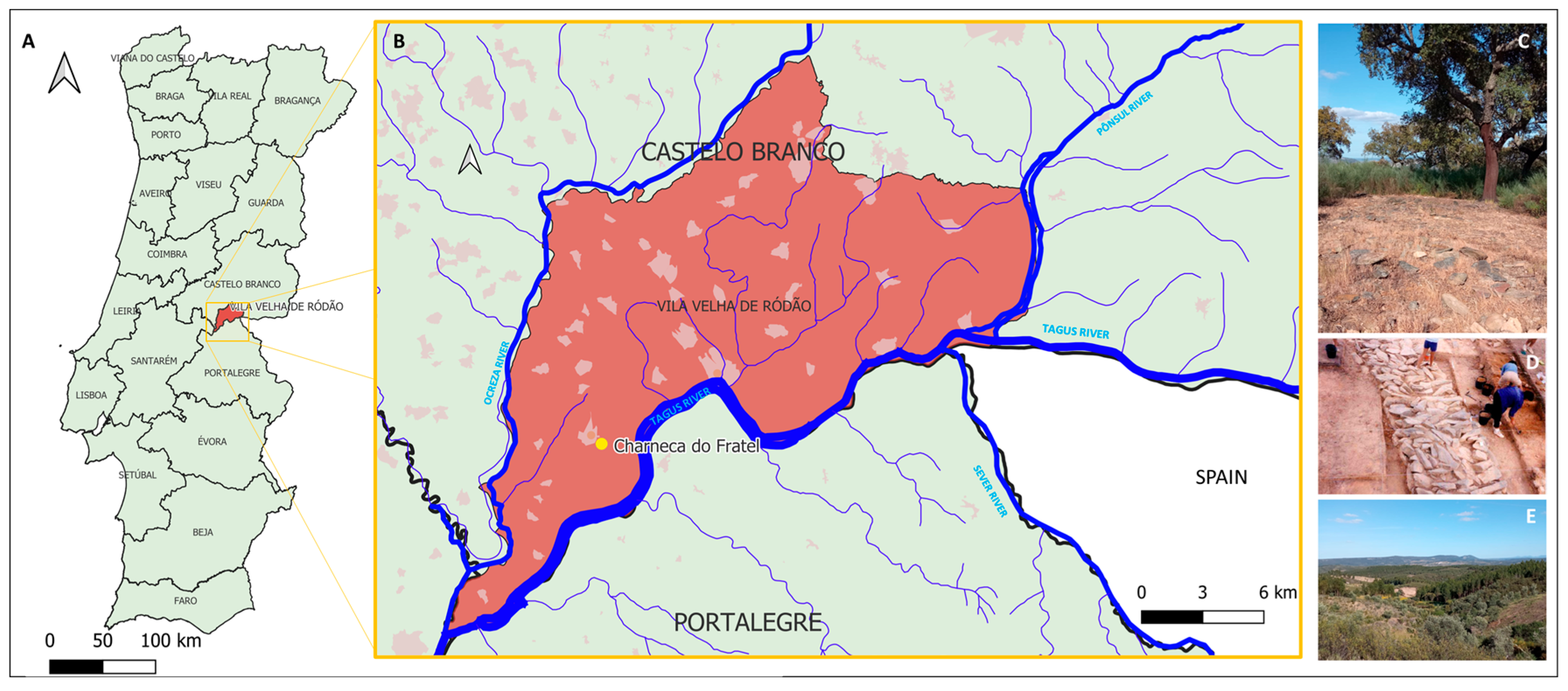
Figure 1. Location of Vila Velha de Ródão Municipality (A); Charneca do Fratel location (B); Charneca do Fratel today (C); Chalcolithic wall during excavations (D) [22]; and view from Charneca do Fratel (E).
Quaternary 08 00072 g001
Figure 2. Photographs of the top and side views of all ceramic fragments from Charneca do Fratel under study in the present work.
Quaternary 08 00072 g002
Figure 3. Dendrogram of all Fratel’s analysed fragments, resorting to each measured average thickness and showing the samples’ sub-grouping, here represented by different colour lines.
Quaternary 08 00072 g003
Figure 4. Representative optical microscope dark field photographs (50×) of the studied samples. CF 411b (A), CF 584a (B), CF 21a (C), CF 413a (D), CF 476b (E), and CF 476a (F). Summary of core ceramic pastes’ colour variation obtained by OM photographs with ImageJ© software. The y-axis coloured bar represents the ceramic pastes’ colour range presented by the studied fragments (G).
Quaternary 08 00072 g004
Figure 5. Schematic representation of a possible ceramic firing pit during Chalcolithic times (based on [11]).
Quaternary 08 00072 g005
Figure 6. Principal component analysis biplots showing PC1 vs. PC2 and respective loadings of all obtained data (A), and after group differentiation with respective 95% confidence interval ellipses (B).
Quaternary 08 00072 g006
Table 1. Macroscopic characteristics of all analysed samples. Each colour’s respective classification in the Munsell Color System is presented.
SampleTextureFriabilitySurface ColourCore ColourThickness (cm)
CF21ACoarseSemi-compactGrey (N3)Light brown (10YR 4/2)1.014 ± 0.066
CF50CoarseSemi-compactLight brown (5YR 5/6)Dark grey (N2)0.569 ± 0.058
CF67AVery coarseCompactReddish brown (2.5YR 4/4)Reddish (2.5YR 4/8)1.322 ± 0.120
CF67BCoarse to averageSemi-friableGrey (N2)Reddish brown (10R 4/10)0.722 ± 0.036
CF67CVery coarseFriableLight brown (10YR 7/6)Light brown (10YR 7/6)1.453 ± 0.063
CF411AAverageSemi-friableGrey (N2)Light brown (10YR 5/6)0.828 ± 0.008
CF411BCoarseCompactGrey (10YR 5/2)Grey (10YR 5/2)1.108 ± 0.061
CF413AVery coarseCompactBrown (10YR 4/6)Brown (10YR 5/6)0.961 ± 0.043
CF423ACoarseVery friableLight brown (10YR 6/6)Black (N1)1.028 ± 0.050
CF423BCoarseVery friableLight brown (10YR 6/8)Black (N1)0.965 ± 0.051
CF425AVery coarseCompactBrown (10YR 5/4)Grey (10YR 3/4)0.980 ± 0.053
CF433ACoarse to averageSemi-friableReddish brown (10R 3/6)Black (N1)0.858 ± 0.083
CF436AVery coarseFriableGrey (N2)Light grey (10YR 3/2)1.116 ± 0.008
CF439AVery coarseFriableBrown (10YR 5/6)Brown (10YR 3/4)1.780 ± 0.082
CF476AAverageCompactLight brown (10YR 6/6)Reddish (2.5YR 5/6)0.655 ± 0.044
CF476BVery coarseFriableGrey (10YR 5/2)Brown (10YR 4/4)1.123 ± 0.011
CF476CAverageSemi-friableLight grey (N4)Grey (N2)0.800 ± 0.037
CF584AVery coarseFriableBrown (10YR 5/4)Dark brown (10YR 3/4)1.487 ± 0.043
CF595ACoarseSemi-compactLight brown (10YR 6/6)Black (N1)0.998 ± 0.047
CF595BCoarseCompactGrey (N3)Brown (10YR 3/4)0.758 ± 0.083
Table 2. Textural characteristics of all analysed samples (NPE—non-plastic elements; 1—the displayed size of NPEs is a mean value of the measurement of the longer axis of each mineral and the respective standard deviation; 2—for the geometry of each NPE, the following scale, proposed by Little [31], was followed: very angular—no round edges, angular—with 1 or 2 rounded edges, sub-angular—more than 2 and less than 4 rounded edges, sub-rounded—more than 4 rounded edges and at least one angular, rounded—no angular edges, well rounded—spherical).
SampleArea of NPE (%)Size 1 (mm)Geometry 2
CF21A20.880.43 ± 0.39Sub-angular
CF5022.370.28 ± 0.18Sub-rounded
CF67A21.170.38 ± 0.22Sub-angular
CF67B18.720.18 ± 0.11Sub-rounded
CF67C19.540.37 ± 0.31Angular
CF411A17.480.49 ± 0.28Angular
CF411B19.790.28 ± 0.09Sub-angular
CF413A21.260.24 ± 0,09Sub-rounded
CF423A13.710.47 ± 0.43Sub-rounded
CF423B12.540.23 ± 0.12Sub-rounded
CF425A22.720.37 ± 0.20Sub-angular
CF433A20.330.30 ± 0.22Sub-angular
CF436A13.900.35 ± 0.16Sub-rounded
CF439A25.060.23 ± 0.09Sub-angular
CF476A19.860.33 ± 0.29Sub-rounded
CF476B16.380.23 ± 0.15Sub-rounded
CF476C23.070.50 ± 0.44Sub-rounded
CF584A17.040.21 ± 0.06Sub-angular
CF595A12.200.12 ± 0.05Sub-rounded
CF595B15.820.26 ± 0.09Sub-angular
TOTAL (avg.)18.7 ± 3.70.3 ± 0.2-
Table 3. Chemical composition of all samples obtained by WDXRF.
SampleSiO2Al2O3Fe2O3K2OCaOTiO2P2O5MgOSO3Others
CF 411A52.80 ± 0.3023.10 ± 0.3014.40 ± 0.103.24 ± 0.051.22 ± 0.032.19 ± 0.041.27 ± 0.031.29 ± 0.050.22 ± 0.010.26 ± 0.05
CF 413A52.84 ± 0.3023.02 ± 0.3015.01 ± 0.101.82 ± 0.042.20 ± 0.041.77 ± 0.041.34 ± 0.031.77 ± 0.060.05 ± 0.010.17 ± 0.03
CF 21A53.51 ± 0.3024.10 ± 0.2013.10 ± 0.203.28 ± 0.081.93 ± 0.061.58 ± 0.041.18 ± 0.030.97 ± 0.040.08 ± 0.010.26 ± 0.08
CF 433A57.59 ± 0.3021.80 ± 0.3013.80 ± 0,104.15 ± 0.060.18 ± 0.010.93 ± 0.030.66 ± 0.020.58 ± 0.030.06 ± 0.010.25 ± 0.04
CF 439A61.11 ± 0.3025.50 ± 0.304.93 ± 0.065.21 ± 0.070.33 ± 0.020.60 ± 0.021.48 ± 0.040.54 ± 0.030.16 ± 0.010.14 ± 0.03
CF 67C61.43 ± 0.3023.31 ± 0.306.66 ± 0.074.98 ± 0.070.11 ± 0.011.03 ± 0.031.40 ± 0.400.76 ± 0.040.05 ± 0.010.25 ± 0.04
CF 595A62.15 ± 0.3023.12 ± 0.205.79 ± 0.104.17 ± 0.100.48 ± 0.030.77 ± 0.032.57 ± 0.050.66 ± 0.030.16 ± 0.010.12 ± 0.04
CF 476B62.90 ± 0.3022.50 ± 0.306.83 ± 0.084.30 ± 0.060.18 ± 0.010.63 ± 0.021.19 ± 0.031.32 ± 0.05<LOD0.17 ± 0.03
CF 595B63.63 ± 0.3021.61 ± 0.308.05 ± 0.083.98 ± 0.060.19 ± 0.010.85 ± 0.030.42 ± 0.020.96 ± 0.040.04 ± 0.010.26 ± 0.05
CF 5063.74 ± 0.3022.72 ± 0.307.41 ± 0.083.84 ± 0.060.19 ± 0.010.80 ± 0.030.14 ± 0.010.90 ± 0.040.06 ± 0.010.19 ± 0.03
CF 423B64.02 ± 0.3021.71 ± 0.207.26 ± 0.084.02 ± 0.060.11 ± 0.010.88 ± 0.031.09 ± 0.030.64 ± 0.040.11 ± 0.010.18 ± 0.03
CF 423A65.15 ± 0.3021.38 ± 0.206.78 ± 0.083.93 ± 0.060.09 ± 0.010.91 ± 0.030.93 ± 0.030.70 ± 0.040.06 ± 0.010.07 ± 0.02
CF 476A66.14 ± 0.3019.31 ± 0.205.97 ± 0.073.87 ± 0.060.08 ± 0.010.84 ± 0.032.70 ± 0.050.79 ± 0.400.05 ± 0.010.23 ± 0.04
CF 584A66.99 ± 0.3017.10 ± 0.208.73 ± 0.083.47 ± 0.050.25 ± 0.010.77 ± 0.031.54 ± 0.041.00 ± 0.040.06 ± 0.010.10 ± 0.02
CF 436A67.36 ± 0.3021.09 ± 0.206.29 ± 0.073.39 ± 0.050.14 ± 0.010.69 ± 0.02<LOD0.90 ± 0.040.02 ± 0.010.12 ± 0.03
CF 67B68.11 ± 0.3019.30 ± 0.206.27 ± 0.073.65 ± 0.060.19 ± 0.010.71 ± 0.030.92 ± 0.030.74 ± 0.040.04 ± 0.010.07 ± 0.02
CF 67A68.11 ± 0.3018.65 ± 0.205.49 ± 0.074.76 ± 0.060.19 ± 0.010.63 ± 0.020.27 ± 0.021.40 ± 0.05<LOD0.54 ± 0.03
CF 425A68.86 ± 0.3018.99 ± 0.205.42 ± 0.074.45 ± 0.060.17 ± 0.010.66 ± 0.020.38 ± 0.020.92 ± 0.040.05 ± 0.010.09 ± 0.02
CF 411B71.02 ± 0.3017.11 ± 0.205.40 ± 0.074.35 ± 0.060.23 ± 0.010.74 ± 0.03<LOD1.06 ± 0.05<LOD0.08 ± 0.02
CF 476C72.06 ± 0.3016.89 ± 0.203.94 ± 0.064.88 ± 0.060.08 ± 0.010.57 ± 0.020.40 ± 0.021.08 ± 0.040.02 ± 0.010.08 ± 0.02
Table 4. Main mineral phases identified by XRD analysis of the fragments under study. The semi-quantification considered the relative intensity of the peaks in the diffractograms (+ to ++++ indicate XRD peaks’ relative intensity from weak to very strong).
FeldsparsIron OxideClay Minerals
SampleQuartzAlbiteMicroclineOrthoclaseMagnetiteIlliteMontmorilonite
CF 411A+++++++--++--
CF 413A+++++++--++--
CF 21A++++-+++---++
CF 433A++++++--+++-
CF 439A++++-+++-++-
CF 67C++++-+++-++++-
CF 595A++++++++++-++--
CF 476B++++-++--+++-
CF 595B++++-++--++-
CF 50++++-+++-+--
CF 423B++++-+++-+++-
CF 423A++++-++-+--
CF 476A++++--+++--
CF 584A++++--+++--
CF 436A++++++--+++-
CF 67B+++++++--++--
CF 67A+++++++--+--
CF 425A++++++++-+--
CF 411B++++++++++-++++-
CF 476C++++-+++-+--
Disclaimer/Publisher’s Note: The statements, opinions and data contained in all publications are solely those of the individual author(s) and contributor(s) and not of MDPI and/or the editor(s). MDPI and/or the editor(s) disclaim responsibility for any injury to people or property resulting from any ideas, methods, instructions or products referred to in the content.