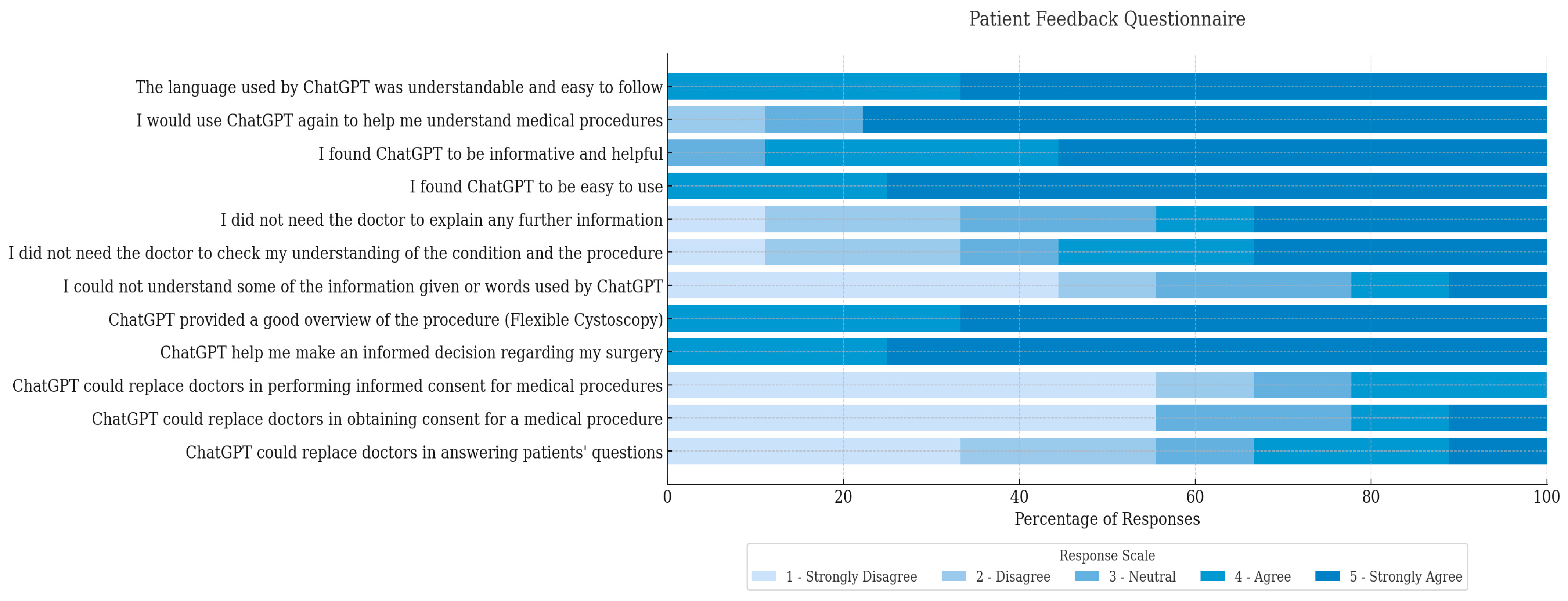

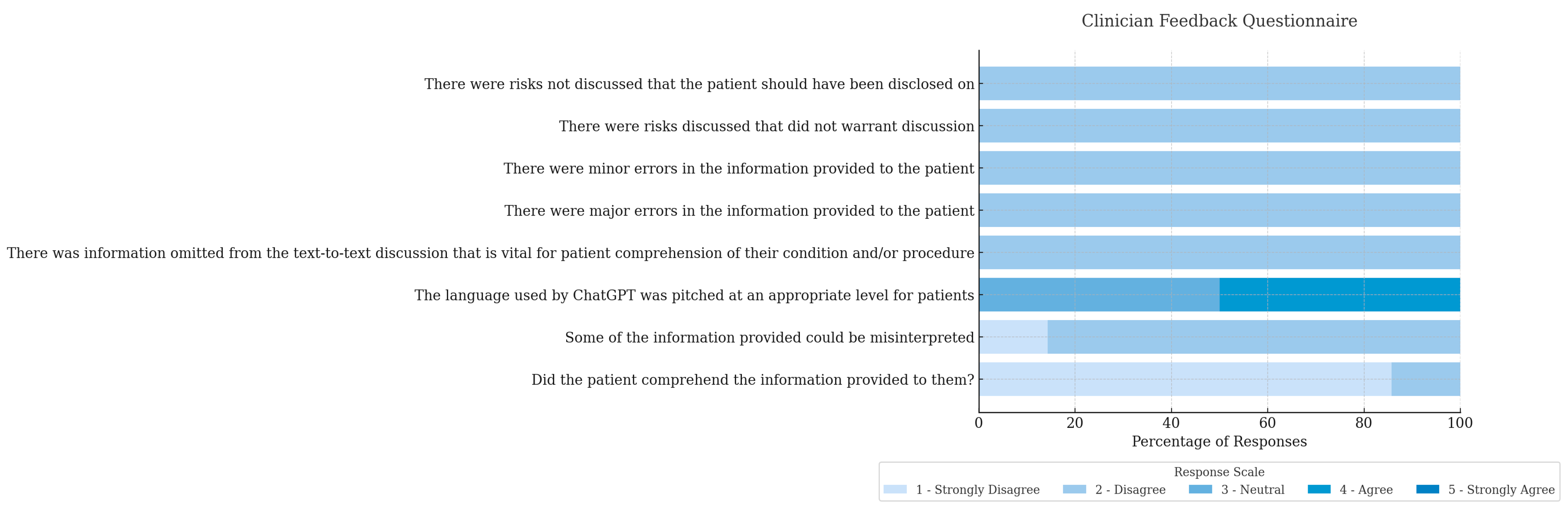
The Clinical Integration of ChatGPT Through an Augmented Patient Encounter in a Real-World Urological Cohort: A Feasibility Study

Abstract
1. Introduction
2. Materials and Methods
3. Results
4. Discussion
5. Conclusions
Supplementary Materials
Author Contributions
Funding
Institutional Review Board Statement
Informed Consent Statement
Data Availability Statement
Acknowledgments
Conflicts of Interest
References
- Aminizadeh, S.; Heidari, A.; Dehghan, M.; Toumaj, S.; Rezaei, M.; Navimipour, N.J.; Stroppa, F.; Unal, M. Opportunities and challenges of artificial intelligence and distributed systems to improve the quality of healthcare service. Artif. Intell. Med. 2024, 149, 102779. [Google Scholar] [CrossRef] [Scilit] [PubMed]
- Raiaan, M.A.K.; Mukta, S.H.; Fatema, K.; Fahad, N.M.; Sakib, S.; Mim, M.M.J.; Ahmad, J.; Ali, M.E.; Azam, S. A Review on Large Language Models: Architectures, Applications, Taxonomies, Open Issues and Challenges. IEEE Access 2024, 12, 26839–26874. [Google Scholar] [CrossRef] [Scilit]
- Hwang, E.J.; Park, J.E.; Song, K.D.; Yang, D.H.; Kim, K.W.; Lee, J.-G.; Yoon, J.H.; Han, K.; Kim, D.H.; Kim, H.; et al. 2023 Survey on User Experience of Artificial Intelligence Software in Radiology by the Korean Society of Radiology. Korean J. Radiol. 2024, 25, 613–622. [Google Scholar] [CrossRef] [Scilit]
- Farič, N.; Hinder, S.; Williams, R.; Ramaesh, R.; O Bernabeu, M.; van Beek, E.; Cresswell, K. Early experiences of integrating an artificial intelligence-based diagnostic decision support system into radiology settings: A qualitative study. J. Am. Med. Inform. Assoc. 2023, 31, 24–34. [Google Scholar] [CrossRef] [Scilit]
- Eckrich, J.; Ellinger, J.; Cox, A.; Stein, J.; Ritter, M.; Blaikie, A.; Kuhn, S.; Buhr, C.R. Urology consultants versus large language models: Potentials and hazards for medical advice in urology. BJUI Compass 2024, 5, 438–444. [Google Scholar] [CrossRef] [Scilit]
- Şahin, B.; Genç, Y.E.; Doğan, K.; Şener, T.E.; Şekerci, Ç.A.; Tanıdır, Y.; Yücel, S.; Tarcan, T.; Çam, H.K. Evaluating the Performance of ChatGPT in Urology: A Comparative Study of Knowledge Interpretation and Patient Guidance. J. Endourol. 2024, 38, 799–808. [Google Scholar] [CrossRef] [Scilit]
- Cocci, A.; Pezzoli, M.; Re, M.L.; Russo, G.I.; Asmundo, M.G.; Fode, M.; Cacciamani, G.; Cimino, S.; Minervini, A.; Durukan, E. Quality of information and appropriateness of ChatGPT outputs for urology patients. Prostate Cancer Prostatic Dis. 2024, 27, 103–108. [Google Scholar] [CrossRef] [Scilit]
- Moulaei, K.; Yadegari, A.; Baharestani, M.; Farzanbakhsh, S.; Sabet, B.; Afrash, M.R. Generative artificial intelligence in healthcare: A scoping review on benefits, challenges and applications. Int. J. Med Inform. 2024, 188, 105474. [Google Scholar] [CrossRef] [Scilit] [PubMed]
- Shen, J.; Zhang, C.J.P.; Jiang, B.; Chen, J.; Song, J.; Liu, Z.; He, Z.; Wong, S.Y.; Fang, P.-H.; Ming, W.-K. Artificial Intelligence Versus Clinicians in Disease Diagnosis: Systematic Review. JMIR Med. Inform. 2019, 7, e10010. [Google Scholar] [CrossRef] [Scilit]
- Gibson, D.; Jackson, S.; Shanmugasundaram, R.; Seth, I.; Siu, A.; Ahmadi, N.; Kam, J.; Mehan, N.; Thanigasalam, R.; Jeffery, N.; et al. Evaluating the Efficacy of ChatGPT as a Patient Education Tool in Prostate Cancer: Multimetric Assessment. J. Med. Internet Res. 2024, 26, e55939. [Google Scholar] [CrossRef] [Scilit]
- Gabriel, J.; Shafik, L.; Alanbuki, A.; Larner, T. The utility of the ChatGPT artificial intelligence tool for patient education and enquiry in robotic radical prostatectomy. Int. Urol. Nephrol. 2023, 55, 2717–2732. [Google Scholar] [CrossRef] [Scilit]
- Chen, Y.; Esmaeilzadeh, P. Generative AI in Medical Practice: In-Depth Exploration of Privacy and Security Challenges. J. Med Internet Res. 2024, 26, e53008. [Google Scholar] [CrossRef] [Scilit] [PubMed]
- Australian Commission on Safety and Quality in Health Care. Informed Consent in Health Care [Internet]. 2020. Available online: https://www.safetyandquality.gov.au/sites/default/files/2020-09/sq20-030_-_fact_sheet_-_informed_consent_-_nsqhs-8.9a.pdf (accessed on 22 November 2024).
- Connors, C.; Gupta, K.; Khusid, J.A.; Khargi, R.; Yaghoubian, A.J.; Levy, M.; Gallante, B.; Atallah, W.; Gupta, M. Evaluation of the Current Status of Artificial Intelligence for Endourology Patient Education: A Blind Comparison of ChatGPT and Google Bard Against Traditional Information Resources. J. Endourol. 2024, 38, 843–851. [Google Scholar] [CrossRef] [Scilit]
- Malak, A.; Şahin, M.F. How Useful are Current Chatbots Regarding Urology Patient Information? Comparison of the Ten Most Popular Chatbots’ Responses About Female Urinary Incontinence. J. Med. Syst. 2024, 48, 102. [Google Scholar] [CrossRef] [Scilit]
- Pietrzykowski, T.; Smilowska, K. The reality of informed consent: Empirical studies on patient comprehension—Systematic review. Trials 2021, 22, 57. [Google Scholar] [CrossRef] [Scilit]
- Gobinath, A.; Manjula Devi, C.; Suthan Raja, S.J.; Prakash, P.; Anandan, M.; Srinivasan, A. Voice Assistant with AI Chat Integration using OpenAI. In Proceedings of the 2024 Third International Conference on Intelligent Techniques in Control, Optimization and Signal Processing (INCOS), Krishnankoil, India, 14–16 March 2024; IEEE: New York, NY, USA, 2024; pp. 1–6. Available online: https://ieeexplore.ieee.org/document/10527726/ (accessed on 4 December 2024).
- Basic, D.; Shanley, C.; Gonzales, R. The Impact of Being a Migrant from a Non-English-Speaking Country on Healthcare Outcomes in Frail Older Inpatients: An Australian Study. J. Cross-Cult. Gerontol. 2017, 32, 447–460. [Google Scholar] [CrossRef] [Scilit]
- Lambert, S.; Schaffler, J.L.; Brahim, L.O.; Belzile, E.; Laizner, A.M.; Folch, N.; Rosenberg, E.; Maheu, C.; Ciofani, L.; Dubois, S.; et al. The effect of culturally-adapted health education interventions among culturally and linguistically diverse (CALD) patients with a chronic illness: A meta-analysis and descriptive systematic review. Patient Educ. Couns. 2021, 104, 1608–1635. [Google Scholar] [CrossRef] [Scilit] [PubMed]
- Moreland, J.; French, T.L.; Cumming, G.P. The Prevalence of Online Health Information Seeking Among Patients in Scotland: A Cross-Sectional Exploratory Study. JMIR Res. Protoc. 2015, 4, e85. [Google Scholar] [CrossRef] [Scilit]
- Ghai, S.; Trachtenberg, J. Internet information on focal prostate cancer therapy: Help or hindrance? Nat. Rev. Urol. 2019, 16, 337–338. [Google Scholar] [CrossRef] [Scilit]
- Lange, L.; Peikert, M.L.; Bleich, C.; Schulz, H. The extent to which cancer patients trust in cancer-related online information: A systematic review. PeerJ 2019, 7, e7634. [Google Scholar] [CrossRef] [Scilit]
- Asafu-Adjei, D.; Mikkilineni, N.; Sebesta, E.; Hyams, E. Misinformation on the Internet regarding Ablative Therapies for Prostate Cancer. Urology 2019, 133, 182–186. [Google Scholar] [CrossRef] [Scilit] [PubMed]
- Wang, J.; Shi, E.; Yu, S.; Wu, Z.; Ma, C.; Dai, H.; Yang, Q.; Kang, Y.; Wu, J.; Hu, H.; et al. Prompt Engineering for Healthcare: Methodologies and Applications. arXiv 2023, arXiv:2304.14670. Available online: https://arxiv.org/abs/2304.14670 (accessed on 3 December 2024).
- Meskó, B. Prompt Engineering as an Important Emerging Skill for Medical Professionals: Tutorial. J. Med. Internet Res. 2023, 25, e50638. [Google Scholar] [CrossRef] [Scilit] [PubMed]


| Characteristics | n (%) |
|---|---|
| Total patients | 9 |
| Males | 3 (33.3) |
| Females | 6 (66.7) |
| Age (in years) | |
| Mean ± SD | 49.2 ± 15.7 |
| Median | 48 |
| Range | 28–70 |
| Education | |
| Bachelor’s degree | 3 (33.3) |
| Certificate or Trade Qualification | 3 (33.3) |
| Secondary education | 2 (22.2) |
| Master’s degree | 1 (11.1) |
| Native English Speaker | |
| Yes | 7 (77.8) |
| No | 2 (22.2) |
Disclaimer/Publisher’s Note: The statements, opinions and data contained in all publications are solely those of the individual author(s) and contributor(s) and not of MDPI and/or the editor(s). MDPI and/or the editor(s) disclaim responsibility for any injury to people or property resulting from any ideas, methods, instructions or products referred to in the content. |
© 2025 by the authors. Published by MDPI on behalf of the Société Internationale d’Urologie. Licensee MDPI, Basel, Switzerland. This article is an open access article distributed under the terms and conditions of the Creative Commons Attribution (CC BY) license (https://creativecommons.org/licenses/by/4.0/).
Share and Cite
Qin, S.; Alpay, E.; Chislett, B.; Ischia, J.; Gibson, L.; Bolton, D.; Woon, D.T.S. The Clinical Integration of ChatGPT Through an Augmented Patient Encounter in a Real-World Urological Cohort: A Feasibility Study. Soc. Int. Urol. J. 2025, 6, 59. https://doi.org/10.3390/siuj6050059
Qin S, Alpay E, Chislett B, Ischia J, Gibson L, Bolton D, Woon DTS. The Clinical Integration of ChatGPT Through an Augmented Patient Encounter in a Real-World Urological Cohort: A Feasibility Study. Société Internationale d’Urologie Journal. 2025; 6(5):59. https://doi.org/10.3390/siuj6050059
Chicago/Turabian StyleQin, Shane, Emre Alpay, Bodie Chislett, Joseph Ischia, Luke Gibson, Damien Bolton, and Dixon T. S. Woon. 2025. "The Clinical Integration of ChatGPT Through an Augmented Patient Encounter in a Real-World Urological Cohort: A Feasibility Study" Société Internationale d’Urologie Journal 6, no. 5: 59. https://doi.org/10.3390/siuj6050059
APA StyleQin, S., Alpay, E., Chislett, B., Ischia, J., Gibson, L., Bolton, D., & Woon, D. T. S. (2025). The Clinical Integration of ChatGPT Through an Augmented Patient Encounter in a Real-World Urological Cohort: A Feasibility Study. Société Internationale d’Urologie Journal, 6(5), 59. https://doi.org/10.3390/siuj6050059