
Biomechanical Phenotyping of Forced Expiration for Precision Pulmonary Rehabilitation: A Machine Learning Approach to Identify Structural and Kinetic Drivers


Highlights
- Machine learning analysis of standard spirometry data revealed three biomechanical phenotypes of forced expiration: Load-Constrained, Mechanically Efficient, and Dynamic Collapse.
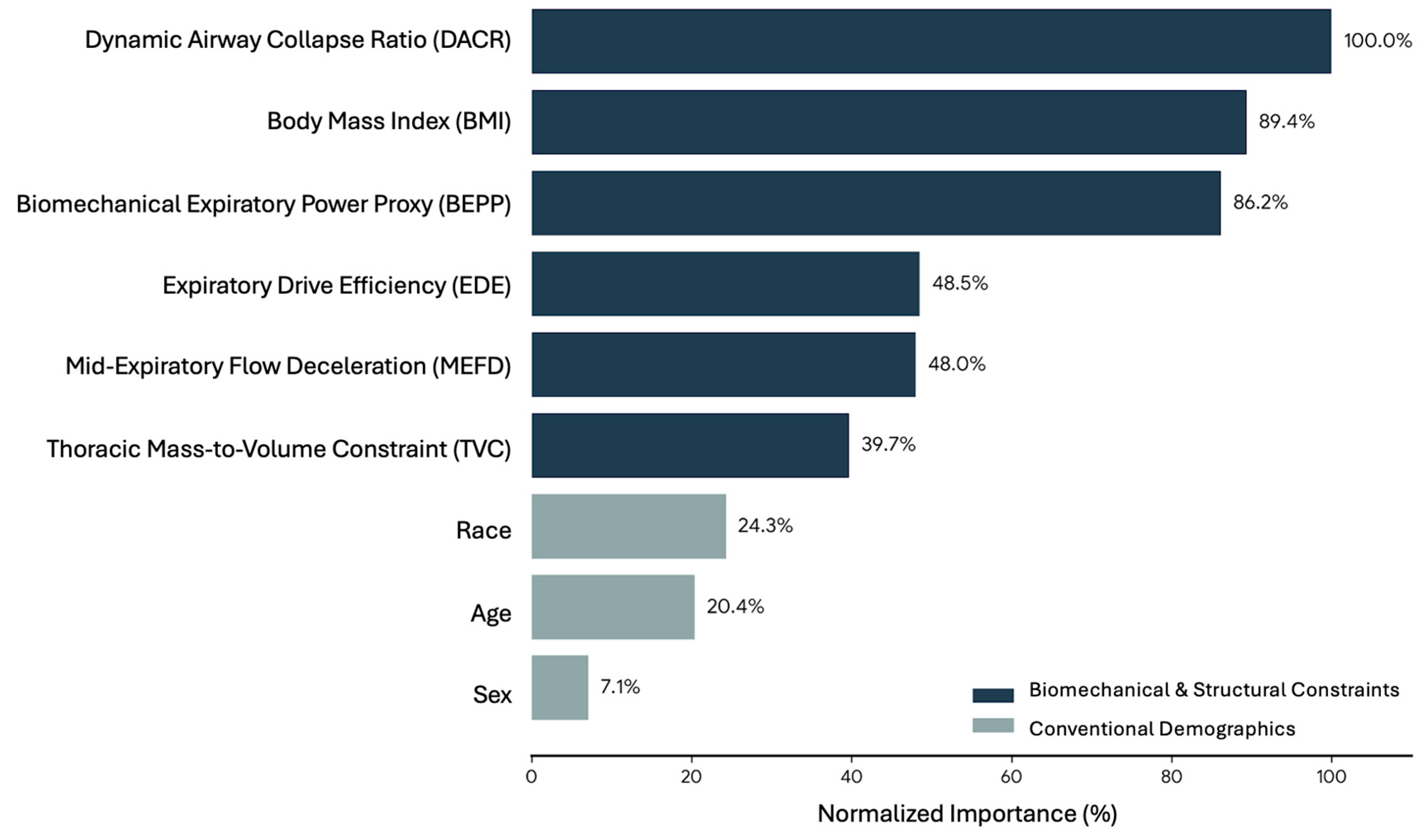
- A neural network model demonstrated that structural mass constraints and dynamic airway instability predict clinical respiratory impairments (93.2% accuracy) significantly better than conventional demographics such as chronological age or biological sex.
- Translating routine volumetric spirometry into kinetic and structural indices shifts the diagnostic paradigm from merely identifying volume loss to pinpointing the specific underlying mechanical failures.
- Classifying patients by these functional phenotypes facilitates precision cardiopulmonary rehabilitation, enabling clinicians to prescribe highly targeted interventions—such as airway patency strategies or thoracic mobility exercises—rather than generic aerobic conditioning.
Abstract
1. Introduction
2. Materials and Methods
2.1. Study Design, Data Source, and Ethical Considerations
2.2. Standard Spirometric Data Acquisition
2.3. Derivation of Novel Biomechanical Respiratory Parameters
2.4. Statistical Analysis and Machine Learning Protocol
2.4.1. Principal Component Analysis (PCA)
2.4.2. Biomechanical Phenotyping via K-Means Clustering
2.4.3. Multivariate Analysis of Covariance (MANCOVA)
2.4.4. Multilayer Perceptron (MLP) Neural Network
3. Results
3.1. Principal Respiratory Synergies
3.2. Biomechanical Phenotypes of Forced Expiration
3.3. Effects of Sex and Aging on Respiratory Biomechanics
3.4. Neural Network Prediction of Respiratory Impairments
4. Discussion
5. Conclusions
Author Contributions
Funding
Institutional Review Board Statement
Informed Consent Statement
Data Availability Statement
Acknowledgments
Conflicts of Interest
References
- Das, N.; Verstraete, K.; Topalovic, M.; Aerts, J.-M.; Janssens, W. Estimating Airway Resistance from Forced Expiration in Spirometry. Appl. Sci. 2019, 9, 2842. [Google Scholar] [CrossRef] [Scilit]
- Stockley, J.A.; Cooper, B.G. Breathing Out: Forced Exhalation, Airflow Limitation. In Pulmonary Function Testing: Principles and Practice; Kaminsky, D.A., Irvin, C.G., Eds.; Springer International Publishing: Cham, Switzerland, 2018; pp. 103–125. [Google Scholar]
- Song, J.H.; Kim, Y. Beyond the Spirometry: New Diagnostic Modalities in Chronic Obstructive Pulmonary Disease. Tuberc. Respir. Dis. 2025, 88, 1–13. [Google Scholar] [CrossRef] [Scilit] [PubMed]
- Poliacek, I. The Cough Motor Pattern. In Cough: Pathophysiology, Diagnosis and Treatment; Zanasi, A., Fontana, G.A., Mutolo, D., Eds.; Springer International Publishing: Cham, Switzerland, 2020; pp. 73–81. [Google Scholar]
- Gideon, E.A.; Cross, T.J.; Cayo, B.E.; Betts, A.W.; Merrell, D.S.; Coriell, C.L.; Hays, L.E.; Duke, J.W. Thoracic gas compression during forced expiration is greater in men than women. Physiol. Rep. 2020, 8, e14404. [Google Scholar] [CrossRef] [Scilit]
- Altarifi, A.; Badr, M.S.; Tzelepis, G.E. Maximal dynamic expiratory pressures with fast and slow inspirations. Eur. J. Appl. Physiol. 2003, 89, 74–78. [Google Scholar] [CrossRef] [Scilit]
- Haynes, J.M.; Kaminsky, D.A.; Stanojevic, S.; Ruppel, G.L. Pulmonary Function Reference Equations: A Brief History to Explain All the Confusion. Respir. Care 2020, 65, 1030–1038. [Google Scholar] [CrossRef] [Scilit]
- Haouzi, P.; McCully, J. The persistent mismeasure of spirometry in women. Lancet Respir. Med. 2024, 12, e31–e32. [Google Scholar] [CrossRef] [Scilit]
- Carvalho, A.R.; Zin, W.A. Respiratory Mechanics: Principles, Utility and Advances. In Anaesthesia, Pharmacology, Intensive Care and Emergency Medicine A.P.I.C.E.; Springer: Milano, Italy, 2011. [Google Scholar]
- Cunha, J.; Domingo, A.; Kolkhorst, F.W.; Rossiter, H.B.; Cannon, D.T. Imposed expiratory resistance, dynamic hyperinflation and locomotor power and fatigue. Exp. Physiol. 2026, 111, 809–819. [Google Scholar] [CrossRef] [Scilit]
- Kaminsky, D.A.; Cockcroft, D.W.; Davis, B.E. Respiratory System Dynamics. Semin. Respir. Crit. Care Med. 2023, 44, 526–537. [Google Scholar] [CrossRef] [Scilit] [PubMed]
- Li, R.; Lewis, J.H.; Jia, X.; Zhao, T.; Liu, W.; Wuenschel, S.; Lamb, J.; Yang, D.; Low, D.A.; Jiang, S.B. On a PCA-based lung motion model. Phys. Med. Biol. 2011, 56, 6009–6030. [Google Scholar] [CrossRef] [Scilit]
- Winner, T.S.; Rosenberg, M.C.; Jain, K.; Kesar, T.M.; Ting, L.H.; Berman, G.J. Discovering individual-specific gait signatures from data-driven models of neuromechanical dynamics. PLoS Comput. Biol. 2023, 19, e1011556. [Google Scholar] [CrossRef] [Scilit]
- Vaz Fragoso, C.A.; Lee, P.J. The Aging Lung. J. Gerontol. Ser. A 2012, 67A, 233–235. [Google Scholar] [CrossRef] [Scilit] [PubMed]
- Prakash, Y.S.; Pabelick, C.M.; Chiarella, S.E. Sex Differences in Respiratory Physiology. In Sex-Based Differences in Lung Physiology; Silveyra, P., Tigno, X.T., Eds.; Springer International Publishing: Cham, Switzerland, 2021; pp. 1–11. [Google Scholar]
- Dominelli, P.B.; Molgat-Seon, Y. Sex, gender and the pulmonary physiology of exercise. Eur. Respir. Rev. 2022, 31, 210074. [Google Scholar] [CrossRef] [Scilit]
- Patel, N.; Chong, K.; Baydur, A. Methods and Applications in Respiratory Physiology: Respiratory Mechanics, Drive and Muscle Function in Neuromuscular and Chest Wall Disorders. Front. Physiol. 2022, 13, 838414. [Google Scholar] [CrossRef] [Scilit] [PubMed]
- Patel, A.S.; O’Donnell, C.; Parker, M.J.; Roberts, D.H. Diaphragm Paralysis Definitively Diagnosed by Ultrasonography and Postural Dependence of Dynamic Lung Volumes after Seven Decades of Dysfunction. Lung 2007, 185, 15–20. [Google Scholar] [CrossRef] [Scilit] [PubMed]
- Gelinas, J.; Harper, M.; Sasso, J.; Wright, S.; Melzer, B.; Agar, G.; Guenette, J.; duManoir, G.; Roman, M.; Rolf, J.D.; et al. Phenotyping Cardiopulmonary Exercise Limitations in Chronic Obstructive Pulmonary Disease. Front. Physiol. 2022, 13, 816586. [Google Scholar] [CrossRef] [Scilit]
- Zavorsky, G.S. A refined spirometry dataset for comparing segmented (piecewise) linear models to that of GAMLSS. Data Brief 2024, 57, 111062. [Google Scholar] [CrossRef] [Scilit]
- Zavorsky, G.S. Debunking the GAMLSS myth: Simplicity reigns in pulmonary function diagnostics. Respir. Med. 2025, 236, 107836. [Google Scholar] [CrossRef] [Scilit] [PubMed]
- CDC/National Center for Health Statistics. NHANES Questionnaires, Datasets, and Related Documentation, CDC/National Center for Health Statistics, 2007–2012. Available online: https://wwwn.cdc.gov/nchs/nhanes/ (accessed on 22 February 2026).
- Miller, M.R.; Hankinson, J.; Brusasco, V.; Burgos, F.; Casaburi, R.; Coates, A.; Crapo, R.; Enright, P.; van der Grinten, C.P.; Gustafsson, P.; et al. Standardisation of spirometry. Eur. Respir. J. 2005, 26, 319–338. [Google Scholar] [CrossRef] [Scilit] [PubMed]
- Nova, A.; Xin, Y.; Victor, M.; Gaulton, T.G.; Alcala, G.C.; Winkler, T.; Gerard, S.E.; Khalid, R.; Gupta, R.; Rezoagli, E.; et al. Biomechanical implications of mass loading in a swine model of acute hypoxemic respiratory failure. J. Appl. Physiol. 2025, 139, 849–862. [Google Scholar] [CrossRef] [Scilit] [PubMed]
- Liu, S.B.; Wilson, T.A.; Schreiner, K. Gravitational forces on the chest wall. J. Appl. Physiol. 1991, 70, 1506–1510. [Google Scholar] [CrossRef] [Scilit]
- Sharp, J.T.; Henry, J.P.; Sweany, S.K.; Meadows, W.R.; Pietras, R.J. Total Respiratory Inertance and Its Gas and Tissue Components in Normal and Obese Men. J. Clin. Investig. 1964, 43, 503–509. [Google Scholar] [CrossRef] [Scilit]
- Zhao, X.; Guo, S.; Xiao, S.; Song, Y. Thorax Dynamic Modeling and Biomechanical Analysis of Chest Breathing in Supine Lying Position. J. Biomech. Eng. 2022, 144, 101004. [Google Scholar] [CrossRef] [Scilit] [PubMed]
- Pedersen, O.F.; Butler, J.P. Expiratory Flow Limitation. Compr. Physiol. 2011, 1, 1861–1882. [Google Scholar] [CrossRef] [Scilit] [PubMed]
- Smaldone, G.C. Excessive Dynamic Airway Collapse: Fact, Fiction, or Flow Limitation. Ann. Am. Thorac. Soc. 2017, 14, 301–302. [Google Scholar] [CrossRef] [Scilit]
- Tammeling, G.J.; Berg, W.C.; Sluiter, H.J. Estimation of the expiratory collapse of the intrathoracic airways. A comparative study of the value of forced expirograms and flow curves in health and in obstructive lung disease. Am. Rev. Respir. Dis. 1966, 93, 238–250. [Google Scholar]
- Hernandez, G.; Brown, A.; Davis, L.; Abdulkader, H.; Sieck, L.; Sieck, G. Effect of aging on maximum shortening velocity, peak power output and endurance of rat diaphragm muscle. Physiology 2023, 38, 5722783. [Google Scholar] [CrossRef] [Scilit]
- Burns, D.P.; O’Halloran, K.D. Diaphragm muscle performance in ageing: A new perspective on an old story. Exp. Physiol. 2019, 104, 993–994. [Google Scholar] [CrossRef] [Scilit] [PubMed]
- Bordoni, B.; Morabito, B.; Simonelli, M. Ageing of the Diaphragm Muscle. Cureus 2020, 12, e6645. [Google Scholar] [CrossRef] [Scilit]
- Alcazar, J.; Aagaard, P.; Haddock, B.; Kamper, R.S.; Hansen, S.K.; Prescott, E.; Alegre, L.M.; Frandsen, U.; Suetta, C. Age- and Sex-Specific Changes in Lower-Limb Muscle Power Throughout the Lifespan. J. Gerontol. Ser. A 2020, 75, 1369–1378. [Google Scholar] [CrossRef] [Scilit]
- Goh, M.H.; Anderson, D.E. Bending properties of human cartilaginous ribs and costal cartilage material vary with age, sex, and calcification. JBMR Plus 2025, 9, ziae153. [Google Scholar] [CrossRef] [Scilit]
- Brown, M.; Fisher, J.S.; Salsich, G. Stiffness and muscle function with age and reduced muscle use. J. Orthop. Res. 1999, 17, 409–414. [Google Scholar] [CrossRef]
- Molgat-Seon, Y.; Dominelli, P.B.; Guenette, J.A.; Sheel, A.W. Modelling the effects of age and sex on the resistive and viscoelastic components of the work of breathing during exercise. Exp. Physiol. 2019, 104, 1737–1745. [Google Scholar] [CrossRef] [Scilit]
- Almazloum, A.A.; Al-Hinnawi, A.-R.; De Fazio, R.; Visconti, P. Assessment of Multi-Layer Perceptron Neural Network for Pulmonary Function Test’s Diagnosis Using ATS and ERS Respiratory Standard Parameters. Computers 2022, 11, 130. [Google Scholar] [CrossRef] [Scilit]
- MacIntyre, N.R. Mechanisms of functional loss in patients with chronic lung disease. Respir. Care 2008, 53, 1177–1184. [Google Scholar] [CrossRef] [Scilit] [PubMed]
- Yentes, J.M.; Liu, W.Y.; Zhang, K.; Markvicka, E.; Rennard, S.I. Updated Perspectives on the Role of Biomechanics in COPD: Considerations for the Clinician. Int. J. Chronic Obstr. Pulm. Dis. 2022, 17, 2653–2675. [Google Scholar] [CrossRef] [Scilit] [PubMed]
- Parkavi, K.; Umarani, R.; Anusha, N.; Rashika, R. Effect of Pursed Lip Breathing on Physiological Cost Index and Functional Exercise Capacity in Patients with Chronic Obstructive Pulmonary Disease. YMER Digit. 2022, 21, 247–254. [Google Scholar] [CrossRef] [Scilit]
- Zin, W.A.; Pengelly, L.D.; Milic-Emili, J. Active impedance of respiratory system in anesthetized cats. J. Appl. Physiol. 1982, 53, 149–157. [Google Scholar] [CrossRef] [Scilit] [PubMed]
- Bates, J.H.; Rossi, A.; Milic-Emili, J. Analysis of the behavior of the respiratory system with constant inspiratory flow. J. Appl. Physiol. 1985, 58, 1840–1848. [Google Scholar] [CrossRef] [Scilit]
- D’Angelo, E.; Calderini, E.; Torri, G.; Robatto, F.M.; Bono, D.; Milic-Emili, J. Respiratory mechanics in anesthetized paralyzed humans: Effects of flow, volume, and time. J. Appl. Physiol. 1989, 67, 2556–2564. [Google Scholar] [CrossRef] [Scilit] [PubMed]
- D’Angelo, E.; Robatto, F.M.; Calderini, E.; Tavola, M.; Bono, D.; Torri, G.; Milic-Emili, J. Pulmonary and chest wall mechanics in anesthetized paralyzed humans. J. Appl. Physiol. 1991, 70, 2602–2610. [Google Scholar] [CrossRef] [Scilit]



| Biomechanical Variable | PC1: Expiratory Power and Thoracic Compliance | PC2: Dynamic Airway Instability |
|---|---|---|
| Biomechanical Expiratory Power Proxy (BEPP) | 0.931 | −0.111 |
| Mid-Expiratory Flow Deceleration (MEFD) | 0.791 | 0.402 |
| Thoracic Mass-to-Volume Constraint (TMVC) | −0.751 | 0.230 |
| Dynamic Airway Collapse Ratio (DACR) | 0.093 | 0.735 |
| Expiratory Drive Efficiency (EDE) | 0.468 | −0.657 |
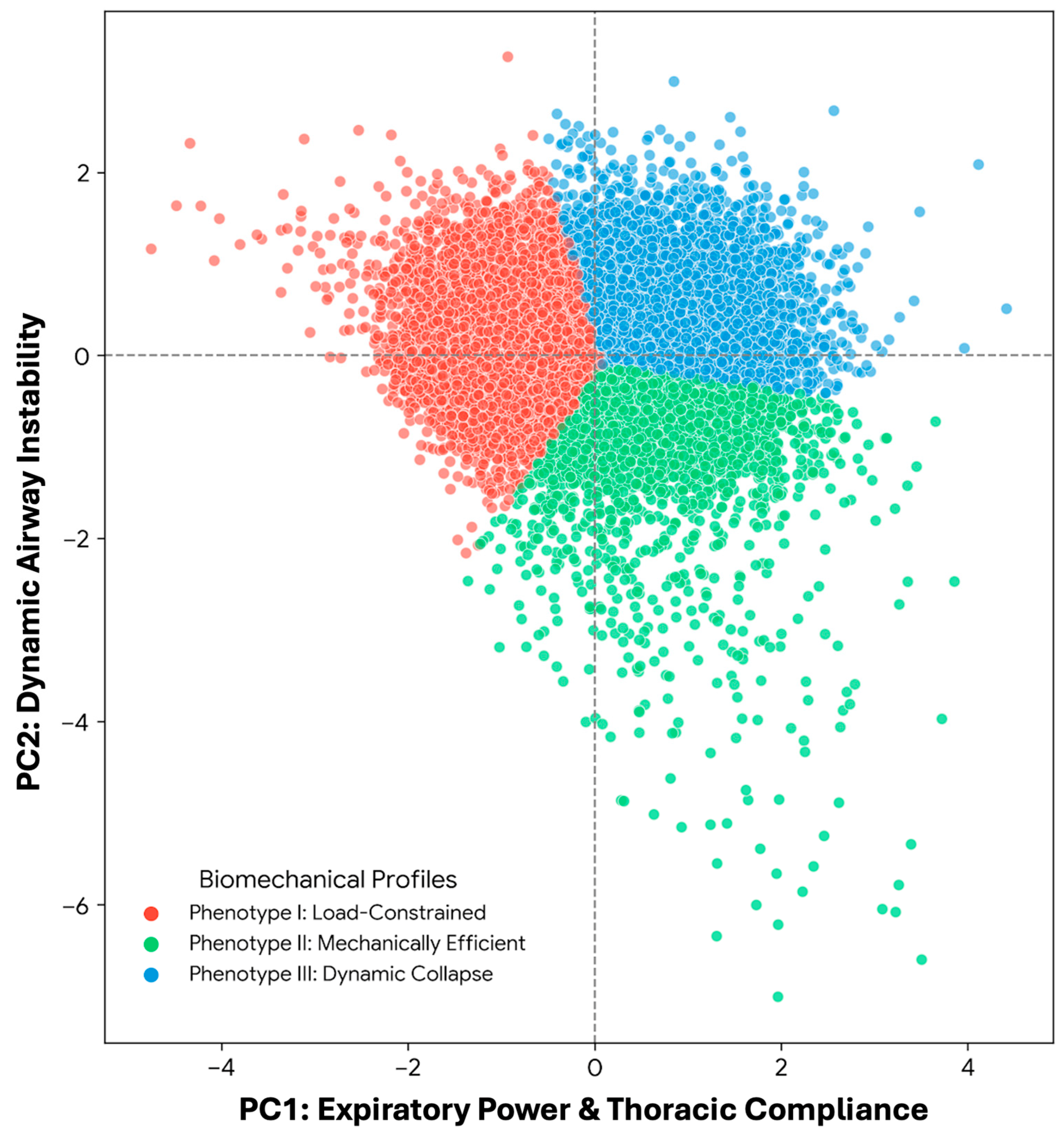
| Phenotype Classification | n (%) | PC1 Center (Power & Compliance) | PC2 Center (Airway Instability) |
|---|---|---|---|
| Phenotype I: Load-Constrained | 7534 (45.4%) | −0.858 | 0.075 |
| Phenotype II: Mechanically Efficient | 3909 (23.5%) | 0.587 | −0.880 |
| Phenotype III: Dynamic Collapse | 5152 (31.0%) | 0.806 | 0.543 |
| Source | Dependent Variable | df | F-Value | p-Value | Partial η2 |
|---|---|---|---|---|---|
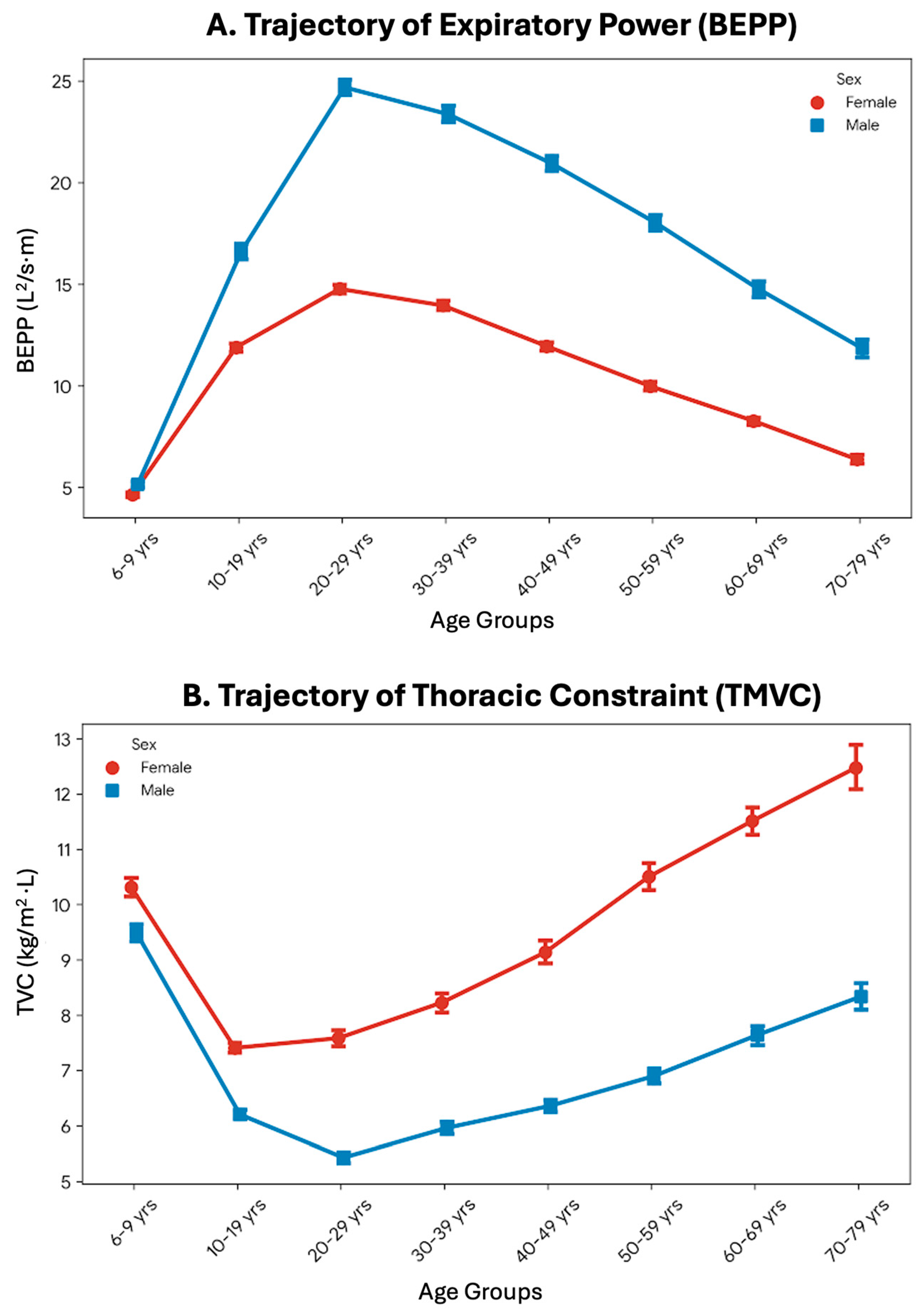
| Age_Groups | TMVC | 7 | 1779.32 | <0.001 | 0.429 |
| BEPP | 7 | 1384.49 | <0.001 | 0.369 | |
| MEFD | 7 | 1199.87 | <0.001 | 0.336 | |
| Sex | TMVC | 1 | 6245.19 | <0.001 | 0.274 |
| BEPP | 1 | 6191.55 | <0.001 | 0.272 | |
| Sex × Age_Groups | BEPP | 7 | 170.71 | <0.001 | 0.067 |
| TMVC | 7 | 160.23 | <0.001 | 0.063 |
| Predictor Variable | Importance | Normalized Importance (%) |
|---|---|---|
| Dynamic Airway Collapse Ratio (DACR) | 0.216 | 100.0% |
| Body Mass Index (BMI) | 0.193 | 89.4% |
| Biomechanical Expiratory Power Proxy (BEPP) | 0.186 | 86.2% |
| Expiratory Drive Efficiency (EDE) | 0.105 | 48.5% |
| Mid-Expiratory Flow Deceleration (MEFD) | 0.104 | 48.0% |
| Thoracic Mass-to-Volume Constraint (TMVC) | 0.086 | 39.7% |
| Race | 0.052 | 24.3% |
| Age | 0.044 | 20.4% |
| Sex | 0.015 | 7.1% |
Disclaimer/Publisher’s Note: The statements, opinions and data contained in all publications are solely those of the individual author(s) and contributor(s) and not of MDPI and/or the editor(s). MDPI and/or the editor(s) disclaim responsibility for any injury to people or property resulting from any ideas, methods, instructions or products referred to in the content. |
© 2026 by the authors. Published by MDPI on behalf of the Polish Respiratory Society. Licensee MDPI, Basel, Switzerland. This article is an open access article distributed under the terms and conditions of the Creative Commons Attribution (CC BY) license.
Share and Cite
Sangkarit, N.; Tapanya, W. Biomechanical Phenotyping of Forced Expiration for Precision Pulmonary Rehabilitation: A Machine Learning Approach to Identify Structural and Kinetic Drivers. Adv. Respir. Med. 2026, 94, 26. https://doi.org/10.3390/arm94020026
Sangkarit N, Tapanya W. Biomechanical Phenotyping of Forced Expiration for Precision Pulmonary Rehabilitation: A Machine Learning Approach to Identify Structural and Kinetic Drivers. Advances in Respiratory Medicine. 2026; 94(2):26. https://doi.org/10.3390/arm94020026
Chicago/Turabian StyleSangkarit, Noppharath, and Weerasak Tapanya. 2026. "Biomechanical Phenotyping of Forced Expiration for Precision Pulmonary Rehabilitation: A Machine Learning Approach to Identify Structural and Kinetic Drivers" Advances in Respiratory Medicine 94, no. 2: 26. https://doi.org/10.3390/arm94020026
APA StyleSangkarit, N., & Tapanya, W. (2026). Biomechanical Phenotyping of Forced Expiration for Precision Pulmonary Rehabilitation: A Machine Learning Approach to Identify Structural and Kinetic Drivers. Advances in Respiratory Medicine, 94(2), 26. https://doi.org/10.3390/arm94020026