1. Introduction
The current view means that we are talking about gender violence with direct reference to violence against women, taking into account the cultural imbalance between the sexes and the desire for control and possession by the male gender over the female gender. The violence exercised by men against women can be of different types: physical, verbal, sexual, economic, psychological, domestic and stalking.
Domestic violence or also defined as Intimate Partner Violence is a gender-based violence that affects one in three women (
WHO 2013;
Heise and Garcia 2002) and consists of a pattern of continuous abusive and coercive behavior over time by the partner or ex-partner in order to obtain total control over the woman’s life.
The abusive relationship becomes the yardstick of one’s personal value, the only meaning of one’s life, leading the victim to maintain a relationship with frustrating partners, who undermine the self-esteem of the other by attributing to the victim the responsibility for the behavior of others, favoring in the latter feelings of guilt to the point of feeling forced into sacrificial acts, remedial trying to always be available towards the other by putting the needs of the other before their own, accepting increasingly unpleasant situations in the face of an inability to refuse inappropriate requests.
A dependent, pathological relationship then develops which leaves to putting aside individuality and which produces closure, alienation, insecurity and in the worst cases death of victims. Data in the literature suggests that violence, including IPV, increases during humanitarian crises and emergencies (
Roesch et al. 2020;
Stark and Ager 2011;
Schumacher et al. 2010;
Bell and Folkerth 2016); this data is confirmed by the trend of new reports received during the health emergency caused by COVID, highlighting an initial block of requests for help from women victims of violence which were only subsequently reinstated.
2. The short, medium and long-term consequences of IPV
The major consequences found cover different areas and are characterized by the chronicity with which they occur. From a behavioral point of view, a tendency towards avoidance, impulsiveness and procrastination has been highlighted (
Matlow and DePrince 2013). Emotionally difficulties such as anxiety, shame, guilt, difficulty regulating and/or managing emotions are particularly present (
Street and Arias 2001;
Barlow et al. 2004;). Psychosomatic reactions (alexithymia resulting from the exceptionally high level of anxiety that from functional becomes chronic and abnormal), intrusive reexperience, hyperreactivity, dulling of sensitivity (they use their energies to avoid the internal sensations that cause stress or to control them by manifesting withdrawal emotional in the form of depression, anhedonia, lack of motivation, dissociative states) and intense emotional reactions (loss of ability to regulate affects with immediate and intense response) (
Liotti and Farina 2011). Attempting to manage a past traumatic emotional experience that tends to be experienced daily as still current (
Ehlers and Clark 2000) can lead to the use of maladaptive strategies aimed at avoiding the intense unpleasant symptomatology experienced. Regarding the cognitive and neuropsychological aspects (
Wong et al. 2014) there are often learning difficulties related to concentration difficulties and physiological hyperactivity (high levels of arousal) which over time with chronicization the difficulty turns into physiological hypoactivity as well as impaired memory and functioning of executive skills; a significant difficulty emerges in the recognition of emotional stimuli such as to determine and maintain difficulties in interpersonal relationships (
Hayward et al. 2018;
Barnawi 2017). Physiologically and cognitively, recent studies have found a particularly high sensitivity threshold regarding emotional and nociceptive stimuli such as to support the normalization of particular acted out and a difficulty in functional reading of the same stimuli (
Invitto et al. 2017;
Almli et al. 2014). Recent discoveries in the field of cognitive neuroscience have highlighted the main brain regions involved in addiction and what role they operate in a pathological condition. Today we can attribute a key role to the following areas: prefrontal cortex, responsible for cognition and planning; ventral tegmental area (VTA) of the midbrain and nucleus accumbens (NAc), both part of the so-called “Circuit of gratification”; amygdala and hippocampus, part of the limbic system, modulator of impulses, emotions and memory (
Young 2007;
Winslow et al. 2003).
Emotional dysregulation appears to be a particularly relevant factor in understanding the development and maintenance of abusive relationships (
Riggs et al. 2000). Many models have been hypothesized to explain emotional dysregulation
Gross 1998;
Lazarus and Folkman 1984). In general, it highlights how the reactivity of the sympathetic nervous system, the serotonergic activity (resistance to stress, sleep regulation, impulse control, conditioned avoidance, aggression and mood) and the limbic nuclei (responsible for the regulation of emotions and fear) following a traumatic event are altered, highlighting an excessive reactivity which often persists over time. Using neuroimaging techniques, recent studies suggest that emotional dysregulation is associated with reduced cortical inhibition of limbic circuits and imbalances in γ-aminobutyric acid (GABA) aminergic and glutaminergic transmission. Therefore, considering the consequences developed following domestic violence, it is reasonable to hypothesize that the mere interruption of the abusive relationship is not sufficient to protect the health of the woman, but that in a condition of health emergency it can be considered a risk factor for the development of management. and adaptation difficulties in the current health emergency. The aim of the following work was therefore to investigate the perceived stress and its relationship with emotional, cognitive, behavioral and sensory functioning during the period of lockdown due to Covid 19 in Puglia in a group of women victims of domestic violence who had already interrupted the abusive relationship.
3. Participants
A sample of 15 women with intimate partner violence, was recruited in a Center Against Violence, the ‘Centro Antiviolenza Renata Fonte’ in Lecce, (Italy). All the participants interrupted the cohabitation and the relationship with the perpetrator before the quarantine. The IPV women were healthy adults (mean age = 41.3; sd ± 9.7). The sample was recruited in the period from 30 April to 30 May 2020; all subjects participated to the study via a link sent to them directly by the operators of the Center Against Violence. All the participants spontaneously joined the research and did not receive any financial compensation following their participation. All data were anonymous, unidentifiable and numerically coded for statistical purposes. All participants read and signed the informed consent before starting the questionnaire, as required by the Helsinki declaration. They have also signed (law no. 675, 676 of 31 December 1996, Official Gazette of 08/01/1997, art. 7 of Legislative Decree 30 June 2003, no. 196 and EU Privacy Regulation 2016/679, General Data Protection Regulation—GDPR) on the processing of personal data and respect for privacy, all data (including sensitive data) have been treated strictly anonymously. The research was approved by the Ethics Commission for Research in Psychology of the University of Salento on 29-04-2020.
4. Materials and Methods
The IPV women compiled, during the Italian lockdown, an online survey. The survey was divided into two section: the first one included questions of personal, socio-economic and exploratory nature regarding the coping methods adopted by women for the management of the emergency period; the second section included a series of behavioral questionnaires aimed at investigating the neuropsychological, cognitive, emotional and perceptive functioning of women.
In particular, the tests administered were: the Perceived Stress Scale (PSS) (
Mondo et al. 2019) a self-administered tool for measuring the perception of stress and to measure the level at which people find their lives unpredictable, uncontrollable or overloaded; PSS item concern feelings and thoughts relating to the last month. For each item, people are asked to indicate how often they felt a certain way (likert scale), the Cognitive Estimates Test (
Mondini et al. 2011) five questions to evaluate the subject’s critical response capacity of requests that do not necessarily require an unambiguous and precise answer but that must be estimated and evaluated with respect to the general knowledge of the world., The Beck Anxiety Inventory (
Sica et al. 2006), a self-assessment scale which allows to assess the severity of anxiety symptoms in adults.
The Body Perception Questionnaire BPQ (
Porges 1993), a self-assessment scale of one’s perceptual and sensorial sensitivity (sight, hearing, taste, smell, touch), and an item on any perceived variation in eating habits.
5. Data Analysis
Descriptive statistics were performed to describe the demographic and socio-demographic characteristics of women. By analyzing the distributions of the data, correlations were carried out in order to evaluate any associations between the variables. In the case of significative correlation, regression analysis was also performed in order to determine the link between the variables. All statistical analyzes were performed using R Studio.
6. Descriptive analysis
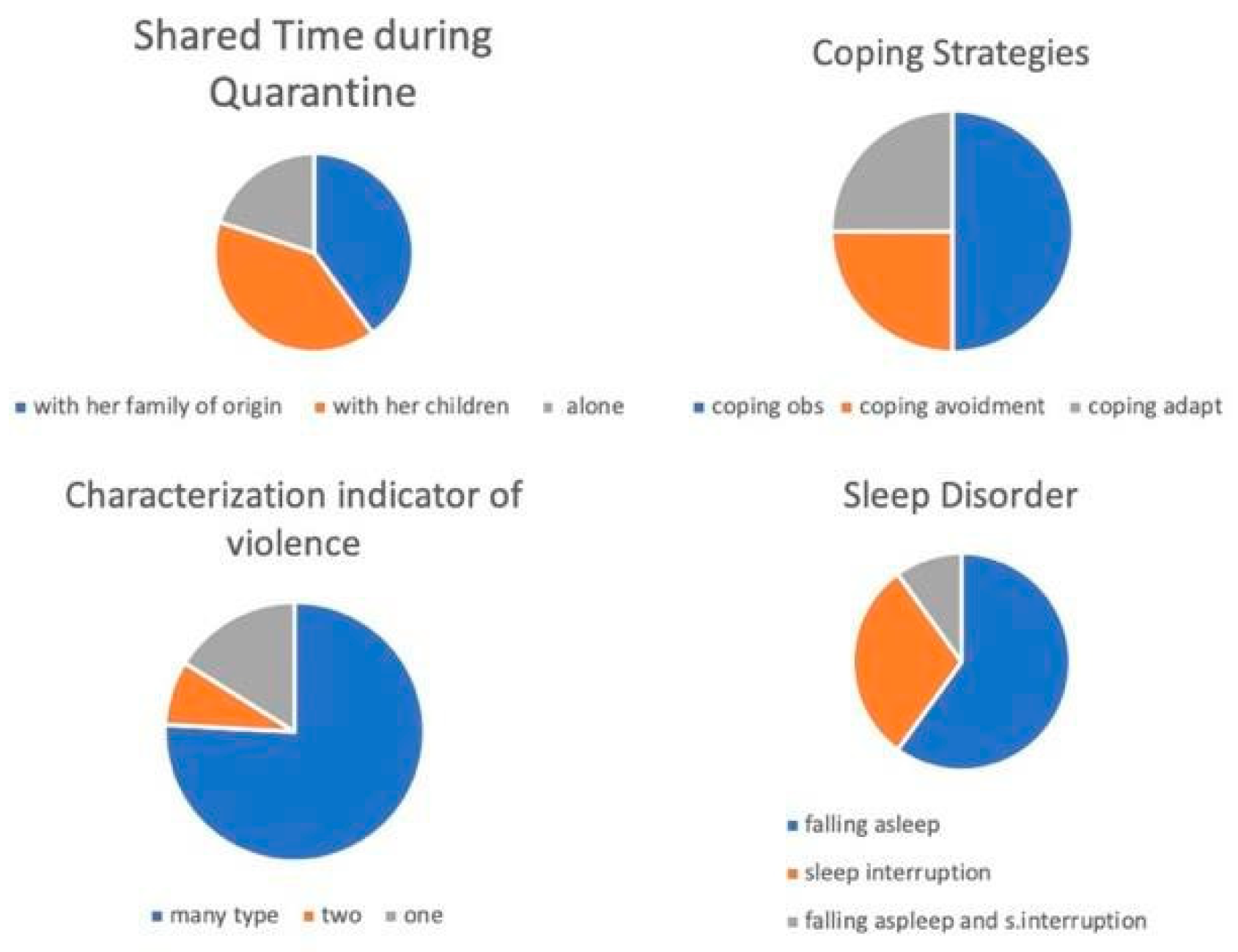
The younger IPV women reported higher educational qualifications, while educational. The greater percentual of the sample (i.e., 66.6%) showed different types of violence. Psychological violence was more evident in the lower age groups (age < 40), while multiple violence was more evident in older women (age > 40).
In relation to the family structure, younger age women spent the quarantine with their family of origin, while older women spent the quarantine alone or with their children. The PSS showed higher values in conditions of sharing the quarantine with the family of origin. IPV women showed sleep disorders, linked to an increased perceived stress in women who developed difficulty in falling asleep. 54% of the sample highlighted obsessive search for information relating to Covid-19 as the strategy used during the quarantine, 27% employed avoidance and the remaining 27% used functional modalities (adaptation of their routines to the new daily life) (
Figure 1).
7. Behavioral Data
Behavioral data analysis showed the PSS values increased, with the use of dysfunctional coping strategies, linked to the development of sleep disorders and a variation in sensory perception (i.e., olfactory perception). Furthermore, the PSS correlated with the use of dysfunctional coping strategies, with the development of sleep disorders and with a decrease of olfactory perception. Therefore, the relationships between the variables investigated were analyzed in order to analyze a possible dependency relationship.
The PSS values were higher in a positive correlation (r = 0.874) of the quality and quantity of violence the IPV group suffered; a positive correlation (r = 0.628) was linked to body sensitivity and the types of violence; the type of violence was positive correlated to an increase of dysfunctional coping strategies (r = 0.687) and sleep disorders (difficulty falling asleep) (r = 0.887); the perceived olfactory capacity decreases according to how many types of violence are be perpetrated on the woman. Furthermore, the frequency with which dysfunctional coping strategies increased with PSS and with the onset of sleep disorders.
Multiple regression analysis found that there is a significant interaction between perceived stress and suffered violence (β1 = 2.09); specifically, stress appears to be higher in conditions in which women have experienced multiple types of violence. Therefore, the hypothesis that the amount of violence suffered would moderate the sensitivity to perceived stress in emergency situations is supported.
Furthermore, the multiple regression analysis found that there is a significant interaction between perceived stress and the use of dysfunctional coping strategies (β1 = 0.252); specifically, the use of dysfunctional coping strategies is more frequent in conditions in which perceived stress is higher. It was also possible to highlight a significant interaction between perceived stress and sleep disturbances (β1 = 0.373); this interaction reveals that the onset of sleep disturbances is higher in conditions in which perceived stress is higher. A significant interaction was also found between perceived stress and olfactory perception (β1 = 0.388). The hypothesis that perceived stress moderates the use of dysfunctional coping strategies, the onset of sleep disturbances and the reduction in olfactory perception is supported.
8. Discussion, Conclusions and future perspectives
This work has made it possible to highlight the close relationship between having experienced domestic violence and the perceived stress during the lockdown caused by the health emergency. Having interrupted the abusive relationship, even though it may be a protective factor, is not sufficient to protect the health of the woman victim of violence. Regardless of the nature of the violence suffered, having suffered different types of violence puts women in a condition of greater sensitivity to stress, resulting in the use of dysfunctional strategies in the management of emergency situations.
In fact, having suffered numerous types of domestic violence causes greater perceived stress during the lockdown as well as greater body sensitivity. The levels of perceived anxiety, on the other hand, are found to be below average. However, high levels of perceived stress in turn have significant consequences in the management of the health emergency situation, consequences of a behavioral, emotional, perceptual and neuropsychological nature. Specifically, from an initial exploratory analysis it emerged that perceived stress was higher in younger women. A greater perceived stress is also found in unmarried women, with higher educational qualifications, with regular employment, but carried out due to the lockdown in smart working mode and in women who have spent the lockdown with numerous families. On the other hand, with the advancing of age there is a lesser awareness of one’s own body reactivity, greater perceived anxiety and greater neuropsychological difficulties. The perceived stress level is therefore configured as a factor correlated with the violence suffered and in a relationship of dependence with a greater frequency in the use of dysfunctional coping strategies (obsessive search for information relating to Covid-19).
In fact, the results obtained show that as perceived stress increases, there is a greater frequency in the use of dysfunctional coping strategies, as women with greater perceived stress have more frequently emitted obsessive behaviors in search of information relating to Covid-19 as well as higher frequency in the incidence of difficulty falling asleep. The consequences experienced by this population in this specific situation of health emergency make daily functioning difficult and reinforce some basic cognitive processes that are recognized in the literature as risk factors in experimenting with domestic violence, making the risk of revictimization higher. However, the small number of the sample, the methods of data collection (self-administration in a single country), the absence of a control group, as well as the absence of an evaluation of the same women before the health emergency, are configured as limits of this work. However, the health emergency conditions resulted in the absence of reference parameters and limited the possibility of data collection to the online mode, thus affecting the characteristics of the survey conducted. However, the work carried out made it possible to explore the functioning of the population in question during that specific period, highlighting the long-term effects of the abuse suffered. Emotional regulation difficulties emerge from perceived stress levels, leading to dysfunctional behavioral consequences. The results achieved also make it possible to highlight the importance of supporting women who are victims of violence even in this period, which cannot end with the interruption of the abusive relationship as this condition is found to be insufficient to protect her health. The achievement of an interoceptive awareness is configured as a protective factor for women, in order to develop a new self-awareness and new meanings to the lived experiences such as to allow the functional management of emergency situations as well as the implementation of functional behavioral actions.