Next Article in Journal
The impact of COVID- 19 in women with intimate partner violence (IPV): a psy-chological and psychophysiological study.
Previous Article in Journal
Training Teachers as Health Promoters
 
 
Journal of Interdisciplinary Research Applied to Medicine is published by MDPI from Volume 6 Issue 1 (2026). Previous articles were published by another publisher in Open Access under a CC-BY (or CC-BY-NC-ND) licence, and they are hosted by MDPI on mdpi.com as a courtesy and upon agreement with University of Salento.
Article

The mechanobiology of the nucleus

1
Laboratory of Clinical proteomics, “Vito Fazzi” Hospital, Lecce, Italy
2
Laboratory of General Physiology, Department of Biological and Environmental Sciences and Technologies, University of Salento, Lecce, Italy
*
Authors to whom correspondence should be addressed.
J. Interdiscip. Res. Appl. Med. 2020, 4(2), 7-14; https://doi.org/10.1285/i25327518v4i2p7 (registering DOI)
Published: 31 December 2020

Abstract

In addition to biochemical and molecular signals coming from the microenvironment, cells are able to sense and integrate mechanical stresses, additional fundamental regulators of cell behaviour. Emerging demonstrations indicate that mechanical cues go far beyond the plasma membrane and the cytoskeleton, since, exerting tension on the outside local microenvironment via adhesions, cells develop an equal cytoskeletal stress on the nucleus inside, leading to 3D nuclear modifications. In this context, dynamic changes in nuclear lamina and the surrounding cytoskeleton modify mechanical properties of the nucleus affecting its structural arrangement, chromatin anchoring, 3D chromosome conformation and gene expression. Here we discuss findings supporting the role of the nucleus in cellular mechanosensing, ranging from how mechanical cues are transduced to the nucleus to how genome organization is influenced by cell mechanics.

1. Introduction

It is well established that cells are able to sense and integrate information from the microenvironment, consequently influencing cell morphology and biological processes, such as development (Mammoto and Ingber 2010), cell migration (Mierke 2020) and tissue homeostasis (Barnes, Przybyla, and Weaver 2017). Beside the biochemical and the molecular composition of the cellular microenvironment, extensively studied as regulators of cell behaviour and cell fate, mechanical forces play an important role in this context (Humphrey, Dufresne, and Schwartz 2014; Iskratsch, Wolfenson, and Sheetz 2014; Cho, Irianto, and Discher 2017; Janmey, Fletcher, and Reinhart-King 2020). Physical forces, to which we are referring, originate from neighbouring cells (cell-cell interactions), from the extracellular matrix (cell-ECM interaction) and from the biofluids that surround cells. Since the discovery of the mutual relationship existing between cells and ECM (Bissell and Aggeler 1987), the molecular mechanisms by which cells sense and respond to ECM mechanical cues have become the subject of intense explorations and several molecular key players have been identified, able to react to mechanical stimulation and to transform these signals in biological response.
Mechanical forces exerted on tissues are sensed by resident cells as stimuli to be processed and transmitted through ECM constituents (collagen and elastin), trans-membrane structures (stretch-activated ion channels, adhesion complexes, cell-cell junctions) and intracellular structures (cytoskeleton). In general, cells are able to sense extracellular mechanical inputs by multiple manner. For instance, the mechanoelectrical transduction of signals, through mechanosensitive channels, leads to the conversion of forces in electrical signals and plays an important role in several physiological dynamics such as hearing, equilibrium, touch and the regulation of blood pressure (Douguet and Honoré 2019). Moreover, integrins trans-membrane receptors (in focal adhesions) connect ECM with actomyosin-cytoskeleton mainly through integrin linker proteins, such as talin and vinculin; likewise, cadherins (in adherent junctions) mechanically connect neighbouring cells. Several demonstrations showed that mechanosensing and mechanotransduction are not only restricted to cell surface, but can take also place in the nucleus, due to determinants linked to the correct interplay between the cytoskeleton and the nucleoskeleton, the integrity of the nuclear lamina and the degree of chromatin compaction.
The first proof describing the mechanical connection between plasma membrane and the nucleus goes back to the discoveries of Maniotis and colleagues, in 1997: mechanical forces exerted on integrins, caused cytoskeletal rearrangements, nucleoli repositioning along the stressed area and nuclei distortion (Maniotis, Chen, and Ingber 1997). Since then, several theories have been developed about the role of the nucleus as cellular mechanosensor and mechanotransducer, recognizing the nuclear envelop as a dynamic force-sensitive connection between cytoplasm and chromatin (Fedorchak, Kaminski, and Lammerding 2014; N. Wang, Tytell, and Ingber 2009; Cho, Irianto, and Discher 2017). Among these, Guilluy and colleagues showed that isolated nuclei, much like plasma membrane, were able to resist to applied tensions by adapting their stiffness, due to a properly-functioning nuclear lamina and the phosphorylation of emerin, a mechanosensitive protein placed in the inner nuclear membrane (Guilluy et al. 2014). The modulation of the 3D nuclear organization leads, as consequence, to the reorganization of chromosomes inside and regulation of gene expression (Lanctôt et al. 2007; Dekker and Mirny 2016).
In this review, we will provide a brief overview about the key players of the nuclear mechanosensing and their modifications, shedding light on how mechanical forces affects chromatin structure and gene transcription.

2. Nucleus, nuclear lamina and lamin A/C

A basic overview of the molecular architecture of the nucleus, and its envelope, may be useful in order to understand how mechanical stresses are transmitted to, and perceived by, the largest organelle of a cell, linking the structure to the function.
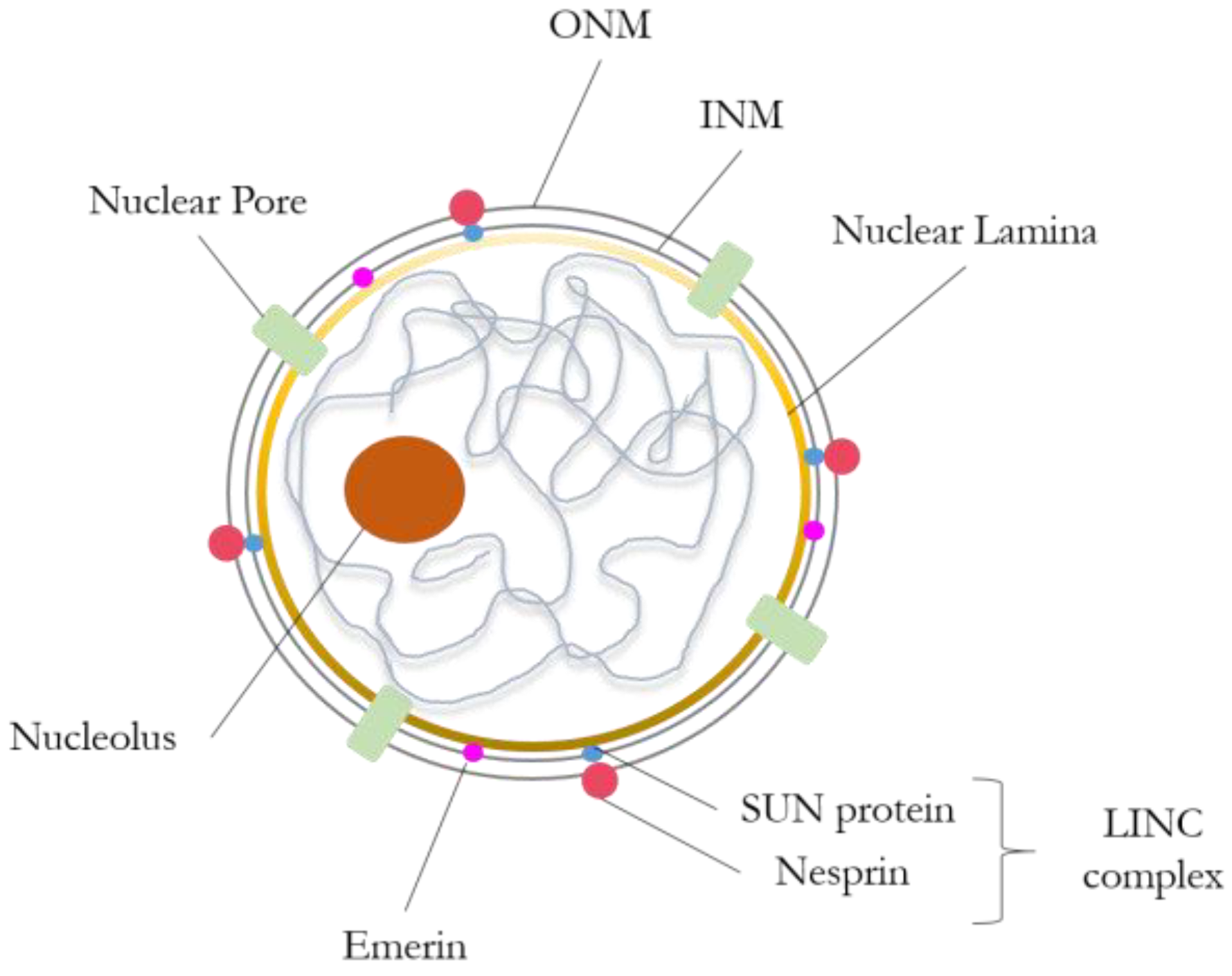
The nucleus is enclosed in the inner (INM) and the outer lipid nuclear membrane (ONM), and nuclear pores connect the cytoplasmic space with the nuclear compartment, allowing the passage of large molecules such as RNA and transcriptional factors (TFs). The nuclear lamina is located immediately below the INM. It consists of a dense fibrillar network (~25-50 nm), mainly built by filamentous lamin proteins, providing mechanical support to the nucleus (Crisp et al. 2006; Versaevel et al. 2014). Importantly, lamin building blocks interact with other nuclear transmembrane proteins, such as LAP-2, emerin and MAN1 (LEM-domain containing members) (Barton, Soshnev, and Geyer 2015), as well as with chromatin domains, regulating its organization and gene expression (Zullo et al. 2012), and with diverse transcriptional factors (Rodríguez et al. 2010; Lloyd, Trembath, and Shackleton 2002; Wilson and Foisner 2010). Lamins connect the nucleus with cytoskeleton through the “linker of nucleoskeleton and cytoskeleton” (LINC) complex, responsible for the transmission of forces from the cell surface to the nucleus (Maniotis, Chen, and Ingber 1997). It consists of nesprin proteins, which are located in the outer nuclear membrane and communicate with all major cytoskeletal components on the cytoplasmic side. The C-terminal KASH domain of nesprin proteins allow them to interact with SUN domaincontaining proteins, in the inner nuclear membrane, which interface with nuclear lamina, nuclear pores and chromatin (Chang, Worman, and Gundersen 2015). Figure 1.
Based on this description, it is easy to deduce how strategic the spatial location, and the interactions, of the nuclear lamin proteins can be. Probably taking inspiration from this, several studies have been published underlying the contribution of its components, as relevant mechanosensitive and mechanotransducer elements. Lamins, members of intermediate filament family, are classified into A- and B- type (Prokocimer et al. 2009). Lamin A and C are the major A-type lamin isoforms represented in mammalian somatic cells, derived by alternative splicing of LMNA gene. Instead, lamin B1 and B2, encoded by LMNB1 and LMNB2 genes respectively, are the major B-type isoforms. As evidenced by diverse works, the lamin A/C seems to have great impact in mechanosensing events, without affecting lamin B1/B2. Mechanical forces, exerted by matrix stiffness on cells and nuclei, or by cells themselves, induce conformational modifications and subsequent changes in phosphorylation state and protein level in lamin A/C dimers (Buxboim et al. 2014). In particular, Swift and colleagues demonstrated that mesenchymal stem cells cultured on soft matrix gels resulted round with wrinkle nuclei, due to the higher phosphorylation of serine and threonine specific residues on lamin A/C, resulting in destabilization and protein turn-over. On the contrary, cells cultured on stiffer matrixes appeared stretched with flattened nuclei, due to lamin A/C conformational changes responsible for sterically hidden serine and threonine phosphorites and subsequent higher stabilization of the dimers. Overall, mechanical tension exerted on nuclei suppresses lamin A/C degradation, while an unstressed condition induced dimers turnover, correlating protein and nucleoskeleton stability with matrix elasticity.
It has been shown that the proper ability to respond to mechanical forces is damaged by nuclear fault. In this context, the role and the functions of lamin A/C on nuclear mechanotransduction have been derived also from the study of LMNA gene mutations-inducing laminopathies. In general, laminopathies are associated with a wide range of disease phenotypes, including metabolic disorders and premature aging syndromes (Maggi, Carboni, and Bernasconi 2016), but the most frequent are linked to skeletal muscle and cardiac muscle, causing diseases like Emery-Dreifuss muscular dystrophy (Vigouroux and Bonne 2002). The dominant association of many LMNA mutations to such mechanically dynamic tissues, further confirms the great implication of these lamin components in the nuclear mechanotransduction machinery, taking part in nuclear stability (Zwerger et al. 2013) and nucleo-cytoskeleton coupling (Folker et al. 2011).

3. Mechanical forces and chromatin organization

The three dimensional nuclear organization has an important role in modulating gene expression, through the control of the relative position of chromosomes inside. Diverse genomic processes, such as transcription (Sutherland H., 2009) and DNA recombination (Misteli T., 2009), are influenced by chromatin topology within the nucleus. Transcriptionally active, and less condensed, euchromatin is mainly distributed in the center of the nucleus and close to the nuclear pores; transcriptionally inactive, and more condensed, heterochromatin typically interacts with nuclear lamina, via lamin-associated domains (LADs), and with nucleoli (Lemaître C., 2015). Based on this, alterations of the dynamic structural conformation of the nuclear lamina affect both nucleus arrangements, as argued before, chromatin anchoring and 3D chromosomes conformation (Bascom G., 2017), getting impact on transcriptional activity without biochemical mediation.
Cells plated on soft matrixes showed high chromatin motility in the nucleus, in addition to a higher nuclear motility, as demonstrated by Makhija and colleagues. Their work highlighted that the reduced interaction between cells and ECM, led to tiny actomyosin structures, reduced lamin A/C expression levels, softer nuclei and increased dynamics of heterochromatin and telomere structures (Makhija E., 2016). The down-regulation of lamin A/C, not only leads to reduced interaction between chromosomes and INM, but also to the establishment of regions of chromosomes intermingling, hosting clusters of genes spatially organized by related TFs and associated with active RNA pol II, optimizeing the mechanical state of the cell (Wang Y., 2017). Moreover, the disruption of actomyosin contractility, through Blebbistatin, resulted in cytoplasmic-to-nuclear translocation of HDAC3, finally resulting in increased chromatin condensation in an actomyosin dependent manner (Jain N., 2013). These works represented pivotal descriptions of the mechanical control of chromatin condensation and gene expression, mediated by the differential positioning of chromosomes, transcriptional factors (TFs) and chromatin modifiers.
Stem cells have been interesting models through which to study the interplay between cytoskeletal and nuclear mechanics. Lamin A/C levels in these cells, indeed, increase with differentiation according with tissue stiffness (Swift J., 2013). Isolation of stem cell nuclei, through micromanipulation methods, showed a nuclear plasticity and a deformation responsivity which progressively decreased as cells undergo differentiation (Pajerowski, J. D., 2007). Later, timelapse experiments showed a progressive chromatin topology stabilization, due to a stiffer and more mature nucleus, and the development of mechanosensitive properties (Mazumder A., 2009) (Heo SJ, 2016).
Such genomic modulations are fundamental for establishing cell type specific organization of chromosomes and their accessibility to TFs and chromatin modifiers.

4. Mechanosensitive TFs

The best-characterized mechanosensitive TFs, downstream transducers of Hippo cascade, are YAP and TAZ (Dupont et al. 2011), whose cellular distribution depends on F-actin cytoskeleton conformation and tension. Aspects related to cell shape, mechanical stress, ECM stiffness and topography are closely correlated to this point (Aragona et al. 2013; Calvo et al. 2013; Halder, Dupont, and Piccolo 2012; Schroeder and Halder 2012). Although it has been shown that YAP and TAZ mechanotransduction require actin cytoskeleton integrity (Piccolo, Dupont, and Cordenonsi 2014), the specific mechanisms by which actin cytoskeleton impact this signaling in the context of mechanotransduction is not clear (Zou et al. 2020). In general, as discussed above, cells plated on large and stiffer substrates appear to spread and with flattened nuclei, due to cytoskeletal tensions generated by high ROCK- and non-muscle myosin II, ultimately resulting in YAP/TAZ nuclear translocation. Conversely, cells appear to have reduced adhesive area on softer substrates, resulting in YAP/TAZ cytoplasm retention (Aragona et al. 2013; Dupont et al. 2011). Phosphorylation by LATS represents the main sequestration-tag of YAP/TAZ in the cytoplasm (Basu et al. 2003), even if this theory is not completely coherent with all the experimental findings (Wada et al. 2011). Nuclear entry of YAP and TAZ can induce a wide range of downstream responses specific for each type of cells and mechanical stress. Cell proliferation is probably one of the best-investigated biological response to YAP/TAZ activity (Mizuno et al. 2012; Zanconato et al. 2015), regulating expression of genes directly (cyclins and mitotic kinases) or indirectly involved in cell cycle (other TFs, such as Myc) (Croci et al. 2017). Furthermore, YAP/TAZ activity was found to be regulated by metabolic pathways (aerobic glycolysis and mevalonate synthesis) which, in turn, determine cellular metabolic reprogramming through the transcriptional regulation of genes involved in nucleotide biosynthesis (Cox et al. 2016), glutamine metabolism (Edwards et al. 2017) and glycolysis enzymes (W. Wang et al. 2015; Zheng et al. 2017). It has been shown that fibroblasts plated on polarized geometries expressed more genes related to cytoskeleton and matrix components and, instead, the same type of cells plated on isotropic geometries expressed more cell cycle and cell-junctions genes, in comparison. This was due to the resulting nuclear import of TFs implicated in serum response pathway and NF-κB pathway, respectively. MRTF (also known as MKL/myocardinlike protein) is a TF bound to G-actin monomers in the cytoplasm. Increased cell polarization results in G-actin polymerization in F-actin stress fibers and consequent increased release of MRTF in the nucleus, where it interacts with serum responsive factor (SRF). A reduced cell polarization, results in actin depolymerization (and resulting reduction in actomyosin contractility), increased concentration of G-actin monomers and MRTF retransfer from the nucleus to the cytoplasm; meanwhile, p65, TF related to NF-κB pathway, translocate from the cytoplasm to the nucleus. In addition, as described previously, actin depolymerization is, accompanied by HDAC3 shuttling to the nucleus making the chromatin more condensed.

5. Conclusions

Since the first evidence proving the mechanical connection between plasma membrane and the nucleus in 1997, significant efforts have been made in understanding the molecular complexity of cellular mechanosensing and mechanotransduction. Many recent studies demonstrate that nuclear lamina, as well as chromatin itself, can sense and integrate mechanical forces exerted on, or by, the cytoskeleton, consequently determining the activation of cell-/tissue- specific molecular dynamics. Alterations of, or lack in, these structures may lead to a variety of recognized diseases. Although many steps forward have been taken, deeper insight are required in order to boost our understanding in these processes as well as new therapeutic approaches for the large number of disease linked to changes in components of nuclear envelope.

References

  1. Aragona, Mariaceleste, Tito Panciera, Andrea Manfrin, Stefano Giulitti, Federica Michielin, Nicola Elvassore, Sirio Dupont, and Stefano Piccolo. 2013. “A Mechanical Checkpoint Controls Multicellular Growth through YAP/TAZ Regulation by ActinProcessing Factors.”. Cell 154(5). [CrossRef]
  2. Barnes, J. Matthew, Laralynne Przybyla, and Valerie M. Weaver. 2017. “Tissue Mechanics Regulate Brain Development, Homeostasis and Disease.”. Journal of Cell Science. [CrossRef]
  3. Barton, Lacy J., Alexey A. Soshnev, and Pamela K. Geyer. 2015. “Networking in the Nucleus: A Spotlight on LEM-Domain Proteins.”. Current Opinion in Cell Biology. [CrossRef]
  4. Bascom, Gavin, and Tamar Schlick. 2017. “Linking Chromatin Fibers to Gene Folding by Hierarchical Looping.”. Biophysical Journal. [CrossRef]
  5. Basu, Subham, Nicholas F. Totty, Meredith S. Irwin, Marius Sudol, and Julian Downward. 2003. “Akt Phosphorylates the Yes-Associated Protein, YAP, to Induce Interaction with 14-3-3 and Attenuation of P73-Mediated Apoptosis.”. Molecular Cell 11(1). [CrossRef]
  6. Bissell, M. J., and J. Aggeler. 1987. “Dynamic Reciprocity: How Do Extracellular Matrix and Hormones Direct Gene Expression?”. Progress in Clinical and Biological Research 249.
  7. Buxboim, Amnon, Joe Swift, Jerome Irianto, Kyle R. Spinler, P. C.Dave P. Dingal, Avathamsa Athirasala, Yun Ruei C. Kao, et al. 2014. “Matrix Elasticity Regulates Lamin-A,C Phosphorylation and Turnover with Feedback to Actomyosin.”. Current Biology 24(16). [CrossRef]
  8. Calvo, Fernando, Nil Ege, Araceli Grande-Garcia, Steven Hooper, Robert P. Jenkins, Shahid I. Chaudhry, Kevin Harrington, et al. 2013. “Mechanotransduction and YAP-Dependent Matrix Remodelling Is Required for the Generation and Maintenance of Cancer-Associated Fibroblasts.”. Nature Cell Biology 15(6). [CrossRef]
  9. Chang, Wakam, Howard J. Worman, and Gregg G. Gundersen. 2015. “Accessorizing and Anchoring the LINC Complex for Multifunctionality.”. Journal of Cell Biology. [CrossRef]
  10. Cho, Sangkyun, Jerome Irianto, and Dennis E. Discher. 2017. “Mechanosensing by the Nucleus: From Pathways to Scaling Relationships.”. Journal of Cell Biology. [CrossRef]
  11. Cox, Andrew G., Katie L. Hwang, Kristin K. Brown, Kimberley J. Evason, Sebastian Beltz, Allison Tsomides, Keelin O’Connor, et al. 2016. “Yap Reprograms Glutamine Metabolism to Increase Nucleotide Biosynthesis and Enable Liver Growth.”. Nature Cell Biology 18(8). [CrossRef]
  12. Crisp, Melissa, Qian Liu, Kyle Roux, J. B. Rattner, Catherine Shanahan, Brian Burke, Phillip D. Stahl, and Didier Hodzic. 2006. “Coupling of the Nucleus and Cytoplasm: Role of the LINC Complex.”. Journal of Cell Biology 172(1). [CrossRef]
  13. Croci, Ottavio, Serena De Fazio, Francesca Biagioni, Elisa Donato, Marieta Caganova, Laura Curti, Mirko Doni, et al. 2017. “Transcriptional Integration of Mitogenic and Mechanical Signals by Myc and YAP.”. Genes and Development 31(20). [CrossRef]
  14. Dekker, Job, and Leonid Mirny. 2016. “The 3D Genome as Moderator of Chromosomal Communication.”. Cell. [CrossRef]
  15. Douguet, Dominique, and Eric Honoré. 2019. “Mammalian Mechanoelectrical Transduction: Structure and Function of Force-Gated Ion Channels.”. Cell. [CrossRef]
  16. Dupont, Sirio, Leonardo Morsut, Mariaceleste Aragona, Elena Enzo, Stefano Giulitti, Michelangelo Cordenonsi, Francesca Zanconato, et al. 2011. “Role of YAP/TAZ in Mechanotransduction.”. Nature 474(7350). [CrossRef]
  17. Edwards, Deanna N., Verra M. Ngwa, Shan Wang, Eileen Shiuan, Dana M. Brantley-Sieders, Laura C. Kim, Albert B. Reynolds, and Jin Chen. 2017. “The Receptor Tyrosine Kinase EphA2 Promotes Glutamine Metabolism in Tumors by Activating the Transcriptional Coactivators YAP and TAZ.”. Science Signaling 10(508). [CrossRef]
  18. Fedorchak, Gregory R., Ashley Kaminski, and Jan Lammerding. 2014. “Cellular Mechanosensing: Getting to the Nucleus of It All.”. Progress in Biophysics and Molecular Biology. [CrossRef]
  19. Folker, Eric S., Cecilia Östlund, G. W.Gant Luxton, Howard J. Worman, and Gregg G. Gundersen. 2011. “Lamin A Variants That Cause Striated Muscle Disease Are Defective in Anchoring Transmembrane Actin-Associated Nuclear Lines for Nuclear Movement.”. Proceedings of the National Academy of Sciences of the United States of America 108(1). [CrossRef]
  20. Guilluy, Christophe, Lukas D. Osborne, Laurianne Van Landeghem, Lisa Sharek, Richard Superfine, Rafael Garcia-Mata, and Keith Burridge. 2014. “Isolated Nuclei Adapt to Force and Reveal a Mechanotransduction Pathway in the Nucleus.”. Nature Cell Biology 16(4). [CrossRef]
  21. Halder, Georg, Sirio Dupont, and Stefano Piccolo. 2012. “Transduction of Mechanical and Cytoskeletal Cues by YAP and TAZ.”. Nature Reviews Molecular Cell Biology. [CrossRef]
  22. Heo, Su Jin, Tristan P. Driscoll, Stephen D. Thorpe, Nandan L. Nerurkar, Brendon M. Baker, Michael T. Yang, Christopher S. Chen, David A. Lee, and Robert L. Mauck. 2016. “Differentiation Alters Stem Cell Nuclear Architecture, Mechanics, and MechanoSensitivity.”. ELife 5 (NOVEMBER2016). [CrossRef]
  23. Humphrey, Jay D., Eric R. Dufresne, and Martin A. Schwartz. 2014. “Mechanotransduction and Extracellular Matrix Homeostasis.”. Nature Reviews Molecular Cell Biology. [CrossRef]
  24. Iskratsch, Thomas, Haguy Wolfenson, and Michael P. Sheetz. 2014. “Appreciating Force and Shape-the Rise of Mechanotransduction in Cell Biology.”. Nature Reviews Molecular Cell Biology. [CrossRef]
  25. Jain, Nikhil, K. Venkatesan Iyer, Abhishek Kumar, and G. V. Shivashankar. 2013. “Cell Geometric Constraints Induce Modular Gene-Expression Patterns via Redistribution of HDAC3 Regulated by Actomyosin Contractility.”. Proceedings of the National Academy of Sciences of the United States of America 110(28). [CrossRef]
  26. Janmey, Paul A., Daniel A. Fletcher, and Cynthia A. Reinhart-King. 2020. “Stiffness Sensing by Cells.”. Physiological Reviews. [CrossRef]
  27. Lanctôt, Christian, Thierry Cheutin, Marion Cremer, Giacomo Cavalli, and Thomas Cremer. 2007. “Dynamic Genome Architecture in the Nuclear Space: Regulation of Gene Expression in Three Dimensions.”. Nature Reviews Genetics. [CrossRef]
  28. Lemaître, Charlene, and Wendy A. Bickmore. 2015. “Chromatin at the Nuclear Periphery and the Regulation of Genome Functions.”. Histochemistry and Cell Biology. [CrossRef]
  29. Lloyd, David J., Richard C. Trembath, and Sue Shackleton. 2002. “A Novel Interaction between Lamin A and SREBP1: Implications for Partial Lipodystrophy and Other Laminopathies.”. Human Molecular Genetics 11(7). [CrossRef]
  30. Maggi, Lorenzo, Nicola Carboni, and Pia Bernasconi. 2016. “Skeletal Muscle Laminopathies: A Review of Clinical and Molecular Features.”. Cells 5(3). [CrossRef]
  31. Makhija, Ekta, D. S. Jokhun, and G. V. Shivashankar. 2016. “Nuclear Deformability and Telomere Dynamics Are Regulated by Cell Geometric Constraints.”. Proceedings of the National Academy of Sciences of the United States of America 113(1). [CrossRef]
  32. Mammoto, Tadanori, and Donald E. Ingber. 2010. “Mechanical Control of Tissue and Organ Development.”. Development 2010. [CrossRef]
  33. Maniotis, Andrew J., Christopher S. Chen, and Donald E. Ingber. 1997. “Demonstration of Mechanical Connections between Integrins, Cytoskeletal Filaments, and Nucleoplasm That Stabilize Nuclear Structure.”. Proceedings of the National Academy of Sciences of the United States of America. [CrossRef]
  34. Mazumder, Aprotim, and G. V. Shivashankar. 2010. “Emergence of a Prestressed Eukaryotic Nucleus during Cellular Differentiation and Development.”. Journal of the Royal Society Interface 7 (SUPPL. 3). [CrossRef]
  35. Mierke, Claudia Tanja. 2020. “Mechanical Cues Affect Migration and Invasion of Cells From Three Different Directions.”. Frontiers in Cell and Developmental Biology. [CrossRef]
  36. Misteli, Tom, and Evi Soutoglou. 2009. “The Emerging Role of Nuclear Architecture in DNA Repair and Genome Maintenance.”. Nature Reviews Molecular Cell Biology. [CrossRef]
  37. Mizuno, T., H. Murakami, M. Fujii, F. Ishiguro, I. Tanaka, Y. Kondo, S. Akatsuka, et al. 2012. “YAP Induces Malignant Mesothelioma Cell Proliferation by Upregulating Transcription of Cell CyclePromoting Genes.”. Oncogene 31(49). [CrossRef]
  38. Pajerowski, J. David, Kris Noel Dahl, Franklin L. Zhong, Paul J. Sammak, and Dennis E. Discher. 2007. “Physical Plasticity of the Nucleus in Stem Cell Differentiation.”. Proceedings of the National Academy of Sciences of the United States of America 104(40). [CrossRef]
  39. Piccolo, Stefano, Sirio Dupont, and Michelangelo Cordenonsi. 2014. “The Biology of YAP/TAZ: Hippo Signaling and Beyond.”. Physiological Reviews 94(4). [CrossRef]
  40. Prokocimer, Miron, Maya Davidovich, Malka Nissim-Rafinia, Naama Wiesel-Motiuk, Daniel Z. Bar, Rachel Barkan, Eran Meshorer, and Yosef Gruenbaum. 2009. “Nuclear Lamins: Key Regulators of Nuclear Structure and Activities.”. Journal of Cellular and Molecular Medicine 13(6). [CrossRef]
  41. Rodríguez, Javier, Fernando Calvo, José M. González, Berta Casar, Vicente Andrés, and Piero Crespo. 2010. “ERK1/2 MAP Kinases Promote Cell Cycle Entry by Rapid, Kinase-Independent Disruption of Retinoblastoma-Lamin A Complexes.”. Journal of Cell Biology 191(5). [CrossRef]
  42. Schroeder, Molly C., and Georg Halder. 2012. “Regulation of the Hippo Pathway by Cell Architecture and Mechanical Signals.”. Seminars in Cell and Developmental Biology. [CrossRef]
  43. Sutherland, Heidi, and Wendy A. Bickmore. 2009. “Transcription Factories: Gene Expression in Unions?”. Nature Reviews Genetics. [CrossRef]
  44. Versaevel, Marie, Jean Baptiste Braquenier, Maryam Riaz, Thomas Grevesse, Joséphine Lantoine, and Sylvain Gabriele. 2014. “Super-Resolution Microscopy Reveals LINC Complex Recruitment at Nuclear Indentation Sites.”. Scientific Reports 4. [CrossRef]
  45. Vigouroux, Corinne, and Gisèle Bonne. 2002. “Laminopathies: One Gene, Two Proteins, Five Diseases.”. In Nuclear Envelope Dynamics in Embryos and. [CrossRef]
  46. Wada, Ken Ichi, Kazuyoshi Itoga, Teruo Okano, Shigenobu Yonemura, and Hiroshi Sasaki. 2011. “Hippo Pathway Regulation by Cell Morphology and Stress Fibers.”. Development 138(18). [CrossRef]
  47. Wang, Ning, Jessica D. Tytell, and Donald E. Ingber. 2009. “Mechanotransduction at a Distance: Mechanically Coupling the Extracellular Matrix with the Nucleus.”. Nature Reviews Molecular Cell Biology. [CrossRef]
  48. Wang, Wenqi, Zhen Dong Xiao, Xu Li, Kathryn E. Aziz, Boyi Gan, Randy L. Johnson, and Junjie Chen. 2015. “AMPK Modulates Hippo Pathway Activity to Regulate Energy Homeostasis.”. Nature Cell Biology 17(4). [CrossRef]
  49. Wang, Yejun, Mallika Nagarajan, Caroline Uhler, and G. V. Shivashankar. 2017. “Orientation and Repositioning of Chromosomes Correlate with Cell Geometry-Dependent Gene Expression.”. Molecular Biology of the Cell 28(14). [CrossRef]
  50. Wilson, Katherine L., and Roland Foisner. 2010. “Lamin-Binding Proteins.”. Cold Spring Harbor Perspectives in Biology. [CrossRef]
  51. Zanconato, Francesca, Mattia Forcato, Giusy Battilana, Luca Azzolin, Erika Quaranta, Beatrice Bodega, Antonio Rosato, Silvio Bicciato, Michelangelo Cordenonsi, and Stefano Piccolo. 2015. “Genome-Wide Association between YAP/TAZ/TEAD and AP-1 at Enhancers Drives Oncogenic Growth.”. Nature Cell Biology 17(9). [CrossRef]
  52. Zheng, Xin, Han Han, Guang- Ping Liu, Yan- Xiu Ma, Ruo- Lang Pan, Ling- Jie Sang, Rui- Hua Li, et al. 2017. “ Lnc RNA Wires up Hippo and Hedgehog Signaling to Reprogramme Glucose Metabolism.”. The EMBO Journal 36(22). [CrossRef]
  53. Zou, Rong, Yahui Xu, Yifan Feng, Minqian Shen, Fei Yuan, and Yuanzhi Yuan. 2020. “YAP NuclearCytoplasmic Translocation Is Regulated by Mechanical Signaling, Protein Modification, and Metabolism.”. Cell Biology International. [CrossRef]
  54. Zullo, Joseph M., Ignacio A. Demarco, Roger PiquéRegi, Daniel J. Gaffney, Charles B. Epstein, Chauncey J. Spooner, Teresa R. Luperchio, et al. 2012. “DNA Sequence-Dependent Compartmentalization and Silencing of Chromatin at the Nuclear Lamina.”. Cell 149(7). [CrossRef]
  55. Zwerger, Monika, Diana E. Jaalouk, Maria L. Lombardi, Philipp Isermann, Monika Mauermann, George Dialynas, Harald Herrmann, Lori Wallrath, and Jan Lammerding. 2013. “Myopathic Lamin Mutations Impair Nuclear Stability in Cells and Tissue and Disrupt Nucleo-Cytoskeletal Coupling.”. Human Molecular Genetics 22(12). [CrossRef]
Figure 1. schematic representation of the nucleus and nuclear envelope.
Jdream 04 4i2p7 g001