Article

Optimized Thyme Oil Single and Double Emulsion for Sustainable Animal Health Applications

by
Costanza Bonnici
1,*,
Maria Federica Marchesi
1,
Ester Grilli
1,2 and
Marijana Dragosavac
3,*
1
Dipartimento di Scienze Mediche Veterinarie (DIMEVET), Università di Bologna, via Tolara di Sopra 50, Ozzano dell’Emilia, 40064 Bologna, Italy
2
Vetagro Inc., 936 SW 1st Ave, Suite 878, Miami, FL 33130, USA
3
Chemical Engineering Department, Loughborough University, Loughborough LE11 3TU, Leicestershire, UK
*
Authors to whom correspondence should be addressed.
Colloids Interfaces 2026, 10(1), 20; https://doi.org/10.3390/colloids10010020
Submission received: 5 November 2025 / Revised: 14 January 2026 / Accepted: 26 January 2026 / Published: 9 February 2026
(This article belongs to the Section Application of Colloids and Interfacial Aspects)

Abstract

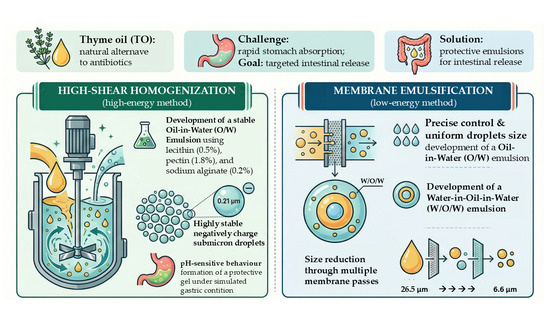
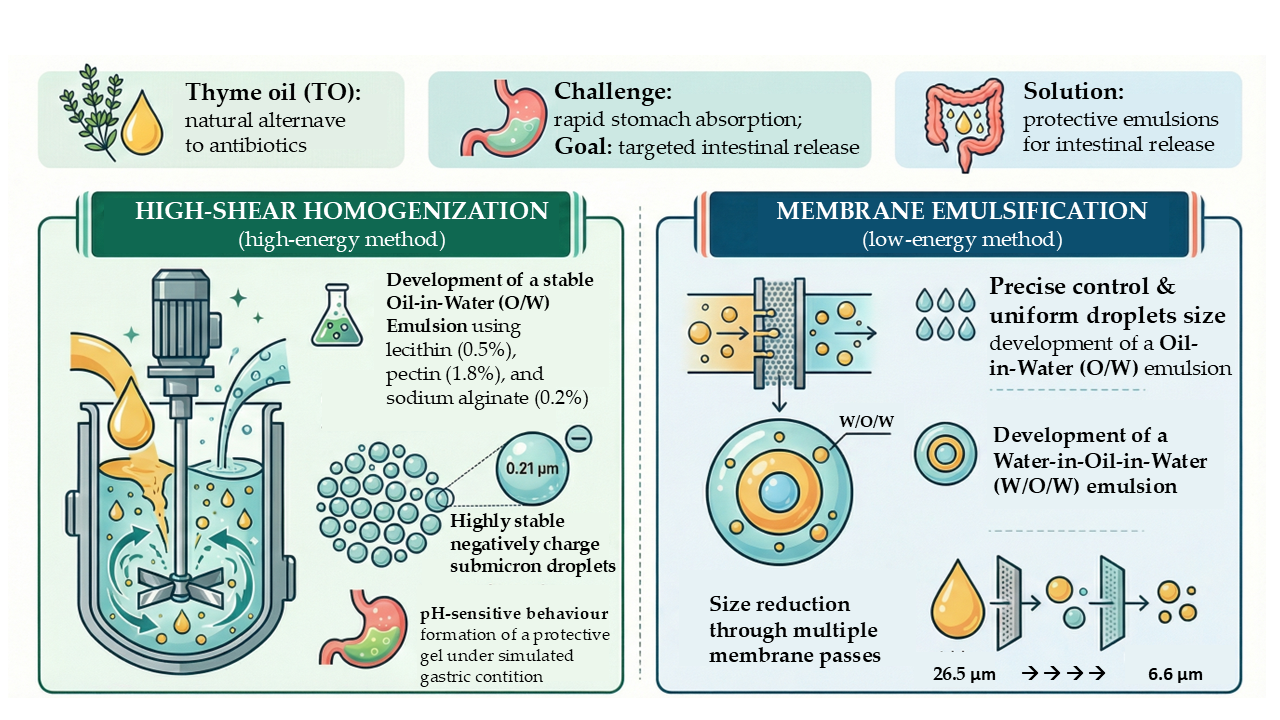
Thyme oil (TO) is emerging as a promising candidate to counteract antimicrobial resistance due to its renowned antimicrobial and anti-inflammatory properties. However, rapid gastric absorption of its bioactive compounds limits its intestinal delivery, where its action is required, so the protection of these components is necessary. This pilot study optimized TO-loaded emulsions for targeted intestinal release. High-shear homogenization and membrane emulsification were compared to formulate single oil in water (O/W) and double water in oil in water (W/O/W) emulsions, screening emulsifiers (lecithin, Tween 20, Tween 80) and functional biopolymers (pectin, sodium alginate). High-shear homogenization with lecithin (0.5%), pectin (1.80%), and sodium alginate (0.2%) yielded stable submicron O/W emulsion (Span = 0.5; d(v,0.5) = 0.21 µm), achieving electrostatic stabilization (ζ-potential = −51.5 ± 1.5 mV) at a target poultry dosage. A pH-responsive behavior was observed: protective hydrogel formed in gastric conditions (d(v,0.5) = 2.64 µm) and maintained stability at intestinal pH (d(v,0.5) = 3.03 µm). Membrane emulsification enabled precise droplet control under mild conditions, producing monodisperse O/W emulsions (d(v,0.5) = 38–59 µm; Span ≤ 1.0) and W/O/W double emulsions (d(v,0.5) = 26.5 µm; Span = 0.6) with ultra-low interfacial tension (0.52 mN·m−1). Repeated membrane passes reduced droplet size to ~6.6 µm. These systems represent a foundational step toward bioactive intestinal delivery, providing a viable antibiotic-free strategy for sustainable livestock production.

Graphical Abstract

1. Introduction

In recent years, antimicrobial resistance has emerged as a global challenge, posing serious risks to human and animal health [1]. Consequently, there is a growing interest in prioritizing the development of natural, sustainable alternatives to conventional antibiotics. Among natural candidates, thyme oil (TO) has emerged as a promising antimicrobial and antioxidant agent, primarily due to its major phenolic constituents, thymol and, its constitutional isomer, carvacrol [2]. The antimicrobial activity of thymol and carvacrol has been extensively documented in literature [3,4,5,6,7]. These phenolic compounds exert potent antibacterial effects primarily through the disruption and depolarization of the bacterial cell membrane, leading to the leakage of intracellular components and cell death. Their activity has been demonstrated against both Gram-positive and Gram-negative bacteria, with evidence of intracellular effects [4]. For example, Giovagnoni et al., 2019, reported significant inhibitory activity of thymol and carvacrol against Clostridium perfringens and Enterococcus cecorum [8]. Later, the inhibition of Salmonella typhimurim was observed in an infection model on Caco-2 cells [9]. Moreover, in vitro studies have demonstrated that thymol and carvacrol effectively reduce the invasion and development of the protozoan parasite Eimeria tenella [10]. Beyond their direct antimicrobial properties, thymol and carvacrol have shown promising effects on animal cells [9,11]. Studies conducted on Caco-2 and HepG2 revealed that these compounds preserve epithelial barrier integrity and reduce inflammatory response and oxidative stress in challenging conditions [9,12]. These protective effects have also been confirmed in vivo. In fact, studies on weaning piglets demonstrated that a microencapsulated botanical blend containing thymol and carvacrol supported animals during inflammatory challenges by modulating liver inflammation and preserving intestinal integrity [12,13].
Despite these beneficial properties, the practical use of TO in animal nutrition is constrained by multiple physicochemical and biological limitations. Its strong odor and taste can compromise feed palatability, while its active constituents are highly hydrophobic and prone to thermal and oxidative degradation [14]. In addition, TO can exert irritant effects on skin and mucous membranes, and direct exposure to the gastric environment may cause premature absorption of its bioactive compounds and reduce the intestinal delivery, limiting its overall gut microbiota efficacy [15]. To overcome these limitations, emulsion-based delivery systems have gained increasing attention [16]. Oil-in-water (O/W) emulsions enhance the aqueous dispersibility of lipophilic bioactives by encapsulating them within surfactant-stabilized droplets, thereby improving both physical stability and bioaccessibility [14,17]. When functional biopolymers such as pectin and sodium alginate are incorporated (materials that form pH-responsive hydrogels under gastrointestinal conditions), these systems enable targeted release in the intestine, facilitating site-specific modulation of gut microbiota [18].
Nevertheless, systematic studies on TO emulsions specifically designed for oral administration in livestock remain limited. In particular, there is a lack of comparative data on how emulsification techniques and formulation components influence key physicochemical attributes such as droplet size distribution and long-term physical stability, parameters critical for performance during storage, feed processing, and transit through the gastrointestinal tract. Moreover, droplet size critically determines the site and rate of payload release along the gut: sub-micron to ≈1 µm droplets undergo more rapid interfacial digestion, due to their higher surface-to-volume ratio and enhanced interaction with bile salts and lipases, tending to release cargo in the proximal intestine, whereas larger droplets (several µm) are degraded more slowly and are therefore likely to persist during gastrointestinal transit, delivering their payloads to distal intestinal regions [19]. High-shear homogenization is widely applied for emulsion production due to its scalability, but it often generates polydisperse droplet populations and can induce the thermal degradation of sensitive compounds [20]. In contrast, membrane emulsification enables low-energy production of uniform droplets, but is slower and more demanding in terms of the formulation and optimization process [21,22]. Despite being two promising techniques, comparative evaluations of these two approaches for TO emulsification in animal nutrition are still missing. Additionally, the choice of emulsifier and the incorporation of natural polysaccharides can significantly affect emulsion stability, rheology, interfacial oil/water tension, and resistance to coalescence, which represent critical factors in the development of optimized emulsions.
This system may be particularly relevant in livestock production, where animals are frequently exposed to enteric pathogen challenges and gastrointestinal disorders [23]. In fact such emulsions, if adequately designed, may offer protection against gastric degradation and promote localized release in the small intestine and ceca, key sites for nutrient absorption and microbial balance [18,24,25]. Given these knowledge gaps, this study aims to be a pilot study to develop TO emulsions suitable for oral administration in livestock, using only generally recognized as safe ingredients (GRAS). It is suggested by the hypothesis that processing method, emulsifier type, and polysaccharide addition can be rationally tuned to obtain TO emulsions with controlled droplet-size distributions and physical stability. Specifically, this study investigated: (i) the effect of emulsification method (high-shear vs. membrane emulsification) and emulsifier type (lecithin, Tween 20, Tween 80) on the droplet-size distribution and stability of TO emulsions; (ii) the modification induced by the incorporation of pectin and sodium alginate on physicochemical properties; and (iii) the combinations of processing method and formulation components that yield TO emulsions with the most robust long-term physical stability. For each formulation variation, interfacial tension, density, and viscosity were measured, and the emulsion’s droplet size distributions were measured for both techniques. Additionally, for the selected high-shear formulation, six-month physicochemical stability under controlled storage was evaluated.

2. Materials and Methods

The oil phase in the oil in water (O/W) and water in oil in water (W/O/W) emulsions consisted of thyme oil (TO) (Merck, Feltham, UK) with density (ρ) of 0.917 g cm−3, viscosity (η) of 0.003 Pa s at 25 °C, and containing 58% thymol and 2.6% carvacrol. The density of both the oil and continuous phase was measured using a Densitopro Portable Density Meter (Mettler Toledo, Leicester, UK) and a manual pycnometer. The viscosity of the oil and continuous phase was measured at 25 °C using a HAAKE Viscotester iQ rheometer (Thermo Scientific, Altrincham, UK). Thymol and carvacrol were identified and quantified using a Jasco LC-4000 series HPLC system (JASCO Corporation, Tokyo, Japan), as described in Section 2.1.7. The equilibrium interfacial tension at the oil/water interface was measured by the rising drop method and analyzed with the Young–Laplace model using a DSA100 tensiometer (KRÜSS, Hamburg, Germany). Emulsions were prepared with 5% (w/w) TO content, employing two distinct emulsification techniques, high-shear homogenization and membrane emulsification, for a comparative evaluation. The physical properties of the individual surfactant solutions and the equilibrium interfacial tension oil/water were measured and are listed in Table 1. Different TO emulsions are listed in Table 2.

2.1. High-Shear Homogenization Technique

All emulsions were prepared with 5% (w/w) TO content. The aqueous phase (containing emulsifiers and/or biopolymers) and oil phase were homogenized using a T18 digital ULTRA TURRAX homogenizer (Ika®, Staufen, Germany) at 12,000 rpm for 3 min. Following preparation, emulsions were transferred to 50 mL polypropylene Falcon® tubes and stored at 4 °C

2.1.1. Emulsifier Selection Strategy

The selection of emulsifiers for high-shear homogenization of thyme O/W emulsions was based on a systematic screening approach targeting different physicochemical mechanisms: interfacial tension reduction, steric stabilization, viscosity modification, synergistic combinations, and hydrophilic–lipophilic balance (HLB) values. All emulsifiers have been chosen among compounds generally recognized as safe (GRAS), ensuring suitability for food and feed applications. Non-ionic surfactants (Merck, Feltham, UK) were selected as the primary screening group due to their proven effectiveness in stabilizing oil-in-water emulsions [16,26]. Tween 20 (polyoxyethylene sorbitan monolaurate) and Tween 80 (polyoxyethylene sorbitan monoleate) were compared to evaluate the impact of the hydrophobic-tail type (chain length and degree of unsaturation) on emulsion stability. Concentrations ranging from 0.5% to 6% (w/w) were tested to determine optimal surfactant loading and identify potential over-processing effects. Lecithin with 90% soybean phospholipids (Thermo Scientific, Altrincham, UK) was chosen as a natural amphiphilic emulsifier due to its reported effectiveness in nutraceutical delivery systems [27]. Lecithin concentrations of 0.5%, 1.0%, 1.5% (w/w) were evaluated based on literature recommendations [27,28].

2.1.2. Preliminary Stability Screening

Initial emulsion stability was assessed using accelerated destabilization testing via centrifugation. Freshly prepared emulsions were centrifuged in 50 mL polypropylene Falcon® tubes (internal diameter 2.8 cm) at 4149× g for 30 min using a GT 2R Expert Centrifuge (Fisher Scientific, Loughborough, UK). The primary stability criterion was the absence of visible phase separation, with secondary evaluation based on the height of any separated oil/water layer, measured with a digital caliper (±0.01 mm precision). This systematic approach enabled a comprehensive comparison of emulsifier performance across different chemical classes and concentration ranges.

2.1.3. Formulation Optimization with Biopolymers

Based on preliminary emulsifier screening (see Results, Section 3.1), combined formulations were developed by incorporating functional biopolymers as stabilizing and delivery-enhancing agents to investigate their synergistic effect with 2% lecithin. Polysaccharides, including medium-viscosity sodium alginate (Merck, Feltham, UK) and low-methoxyl amidated (LMA) pectin (CP Kelco, London, UK), were selected for their dual role in delivery and viscosity modification [25]. Based on the work of Fu-Yin Hsu et al. (2012), the biopolymers were tested at concentrations ranging from 0.5% to 2.0% (w/w), and their effect on continuous-phase rheology and long-term colloidal stability was evaluated [25]. Primary stability tests were performed as described in the preceding section, using accelerated destabilization by centrifugation, with phase separation assessed as the main stability indicator.

2.1.4. Emulsions Characterization

To evaluate the drop-size distribution and droplet diameters, a laser diffraction particle size analyzer, Malvern Mastersizer S (Malvern Panalytical Ltd., Malvern, UK), and a GXM-L 3201 LED CE ROHS FC microscope equipped with a GX camera (GT Vision Ltd., Newmarket, UK) were used. The viscosity of the oil and continuous phase was measured at 25 °C, using a HAAKE Viscotester iQ rheometer (Thermo Scientific, Altrincham, UK). For each emulsion, three separate samples and measurements were performed, and data were reported as mean ± SEM.

2.1.5. Validation at Target Application Dosage

The most promising lecithin–pectin–alginate formulations (see Results, Section 3.1) were diluted to 100 ppm, a concentration suitable for poultry oral administration according to Hamed et al., 2022 [17]. The colloidal stability of the diluted emulsions was assessed by measuring electrophoretic mobility and calculating ζ-potential using a Malvern Zetasizer Ultra (Malvern Panalytical Ltd., Malvern, UK). Measurements were performed at 25 °C in automatic mode with at least three replicate measurements per sample. The Smoluchowski approximation was used to convert electrophoretic mobility to ζ-potential values. Emulsions with |ζ-potential| > 30 mV were considered electrostatically stable.

2.1.6. Stability Assessment in Simulated Gastrointestinal Fluids

The colloidal stability of the optimized emulsion formulation (0.5% lecithin, 1.8% pectin, 0.20% sodium alginate) was evaluated under simulated monogastric gastrointestinal conditions, to assess its resistance to pH-induced destabilization and ionic strength variations during gastric and intestinal transit. Simulated gastric fluid (SGF) and simulated intestinal fluid (SIF) were prepared according to the standardized INFOGEST 2.0 protocol [29], with pH values adjusted to reflect the poultry gastrointestinal physiology [30]. Both fluids were prepared fresh on the day of analysis and stored at 4 °C until use. All chemicals were purchased from Merk (Milan, Italy).
Simulated Gastric Fluid (SGF, pH 2.5):
Electrolyte salts were dissolved in deionized water in the following order: KCl (6.9 mM), KH2PO4 (0.9 mM), NaHCO3 (25 mM), NaCl (47.2 mM), MgCl2(H2O)6 (0.12 mM), (NH4)2CO3 (0.5 mM), HCl (15.6 mM), and CaCl2(H2O)2 (0.15 mM). The solution was brought to a final volume of 400 mL with deionized water. The pH was verified using a calibrated pH meter (±0.01 units) and adjusted to 2.5 ± 0.1 using 1 M HCl as necessary to mimic proventriculus/gizzard conditions in broiler chickens [31].
Simulated Intestinal Fluid (SIF, pH 6.5):
Electrolyte salts were dissolved in deionized water in the following order: KCl (6.8 mM), KH2PO4 (0.8 mM), NaHCO3 (85 mM), NaCl (38.4 mM), MgCl2(H2O)6 (0.33 mM), HCl (8.4 mM), and CaCl2(H2O)2 (0.6 mM). The solution was brought to a final volume of 400 mL with deionized water. The pH was verified and adjusted to 6.5 ± 0.1 using 1 M NaOH as necessary to simulate small intestinal conditions in poultry [30,31].
Stability Test:
The optimized emulsion (previously diluted to 100 ppm TO as described in Section 2.1.5) was further diluted (1:10 v/v) in freshly prepared SGF or SIF to achieve a final concentration of 10 ppm, suitable for dynamic light scattering (DLS) analysis. Samples were gently mixed by inversion to ensure homogeneous distribution. Control samples were prepared by diluting the emulsion in deionized water (pH~7.0, ionic strength~0) under identical conditions. Droplet size (z-average hydrodynamic diameter), polydispersity index (PDI), and ζ-potential were measured using a Malvern Zetasizer Nano-ZS equipped with a 633 nm He-Ne laser (Malvern Panalytical, Malvern, UK). Size and PDI measurements were performed in disposable polystyrene cuvettes DTS0012 (Mavern Panalytical, Malvern, UK) at 25 °C with automatic attenuation optimization and a backscattering detection angle of 173°. Each sample was equilibrated for 2 min before measurement, and data were collected over at least 12 runs of 10 s each. ζ-potential was determined using folded capillary cells DTS1070 (Malvern Panalytical, Malvern, UK) at 25 °C K, with automatic voltage selection. Electrophoretic mobility was converted to ζ-potential values using the Smoluchowski approximation (Henry’s function f(κa) = 1.5, appropriate for aqueous media with moderate to high ionic strength). Each measurement was performed in triplicate on three independent emulsion samples. Emulsions were considered stable if PDI < 0.5 (indicating acceptable monodispersity), and |ζ-potential| > 30 mV (indicating sufficient electrostatic repulsion to prevent flocculation under the tested ionic strength conditions). Images were acquired using an optical microscope B293, equipped with a C-B5 camera (Optika Science, Ponteranica, Italy). Samples were diluted 1:10 with MilliQ water and imaged using a 100× objective. At least four images were acquired for each sample, and representative images are reported.

2.1.7. Long-Term Chemical Stability Assessment

The chemical stability of the main TO bioactive compounds (thymol and carvacrol) was evaluated in pure TO and in the optimized emulsion formulation (0.5% lecithin, 1.8% pectin, and 0.20% sodium alginate). For the emulsion, stability was assessed both immediately after preparation (T0) and after six months of storage (T6). Emulsion samples were stored at 4 °C in polypropylene tubes. For pure TO, samples were prepared by direct dilution in methanol (VWR International, Milan, Italy), whereas TO encapsulated within the emulsion was recovered by liquid–liquid extraction with methanol (1:1, v/v; 3 × 10 mL). After adding methanol at each extraction step, the pectin–alginate coagulum was mechanically broken using a glass rod to improve solvent penetration. The mixture was then centrifuged, and the resulting supernatant from each extraction was collected and combined. The pooled methanolic extracts were finally passed through a 0.45 µm regenerated cellulose acetate syringe filter to remove residual particulate matter before direct injection into the HPLC system. Chromatographic analyses were performed on a Jasco LC-4000 series HPLC, equipped with a PU-4180 quaternary pump, AS-4050 autosampler, CO-4061 column oven, and an MD-4010 PDA detector. Separation was carried out on an 5 µm, 4.6 × 250 mm Atlantis C18 column (Waters Corporation, Milford, MA, USA) under isocratic conditions using water (eluent A) and acetonitrile (eluent B) at a 50:50 ratio. The total run time was 35 min, with a flow rate of 0.6 mL min−1. The column and autosampler were held at 25 °C, and the injection volume was 20 µL. UV detection was set at 270 nm. Thymol and carvacrol content in the emulsion was expressed as percentage recovery relative to the theoretical concentration based on TO composition (58% thymol and 2.6% carvacrol, as determined by GC–MS), and reported as the mean of three independent samples.

2.1.8. Spray-Drying of Optimized Formulations

The most promising lecithin–pectin–alginate formulations (see Results, Section 3.1) were converted into beads by spray-drying in order to avoid water transport, facilitate handling and storage, and enable final application either by redispersion in drinking water or by direct incorporation into commercial feed formulations. Spray-drying was performed using a BÜCHI Mini Spray Dryer B-290 (Fisher Scientific, Loughborough, UK), under the following operating conditions: inlet temperature of 90 °C, aspirator rate of 85%, pump rate of 25%, nozzle cleaning frequency of 5 times·min−1, and measured outlet temperature of 59 °C.

2.2. Membrane Emulsification Technique

The membrane emulsification technique was used to prepare two emulsion types, as reported in Table 2.
First, a single O/W emulsion, containing 5% (w/w) TO, was prepared to screen surfactants (Tween 20 vs. Tween 80 at 2% w/w). Tween 20 and 80 concentration was based on the optimization performed in previous studies [21,32]. The best-performing emulsifier was then selected for the next step. For the W/O/W double emulsion, a premix (1.8% pectin + 0.2% sodium alginate in water) was prepared, as obtained by high-shear homogenization, and an oil phase was made with TO + 5% (w/w) PgPr (Polyglycerol Polyricinoleate). The W/O inner phase consisted of 10% (w/w) premix homogenized into TO with PgPr. The continuous phase was Milli-Q water with 2% Tween 20 (w/w), and the final W/O/W emulsion contained 5% inner phase (v/v) dispersed in the continuous phase. Pectin and sodium alginate were used at the concentrations optimized in the homogenization experiments. At the end of the process, the resulting double emulsion was passed repeatedly through the same membrane to evaluate whether multiple passes reduced oil droplet size toward values comparable to high-shear homogenization. Multiple passes were performed at the optimal flow rate and rotational speed identified in prior experiments.

2.2.1. Membrane Module

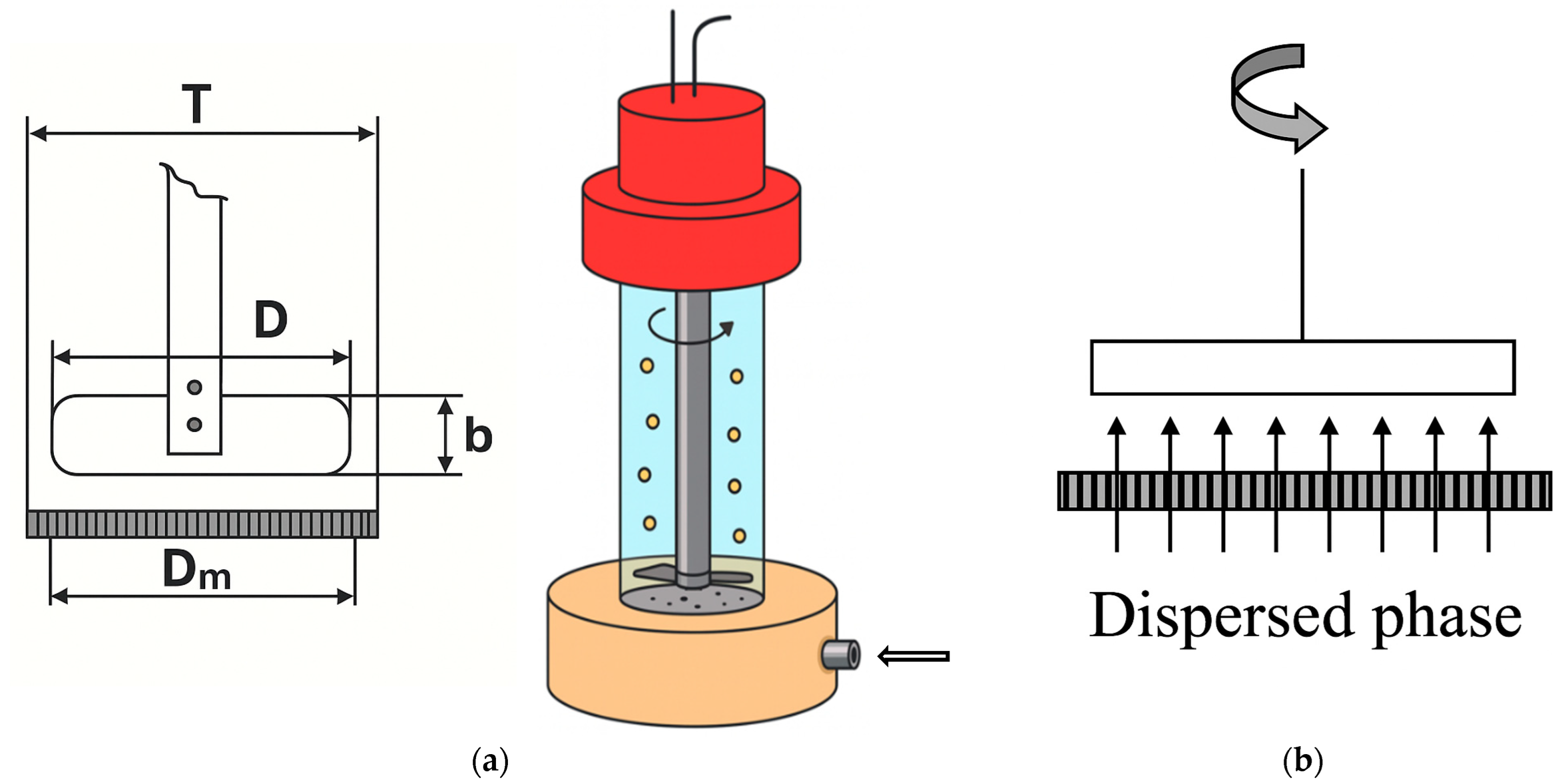
The emulsions were obtained using a stirred cell with a flat disk membrane under a paddle blade stirrer, as shown in Figure 1a,b. Both stirred cells and membranes were supplied by Micropore Technologies Ltd. (Loughborough, UK). The agitator was driven by a 30 V DC electric motor (LASCAR Model PSU 130), and paddle rotation speed was in the range of 12.67 to 25.28 Hz (760 to 1517 rpm), which was controlled by the applied voltage.
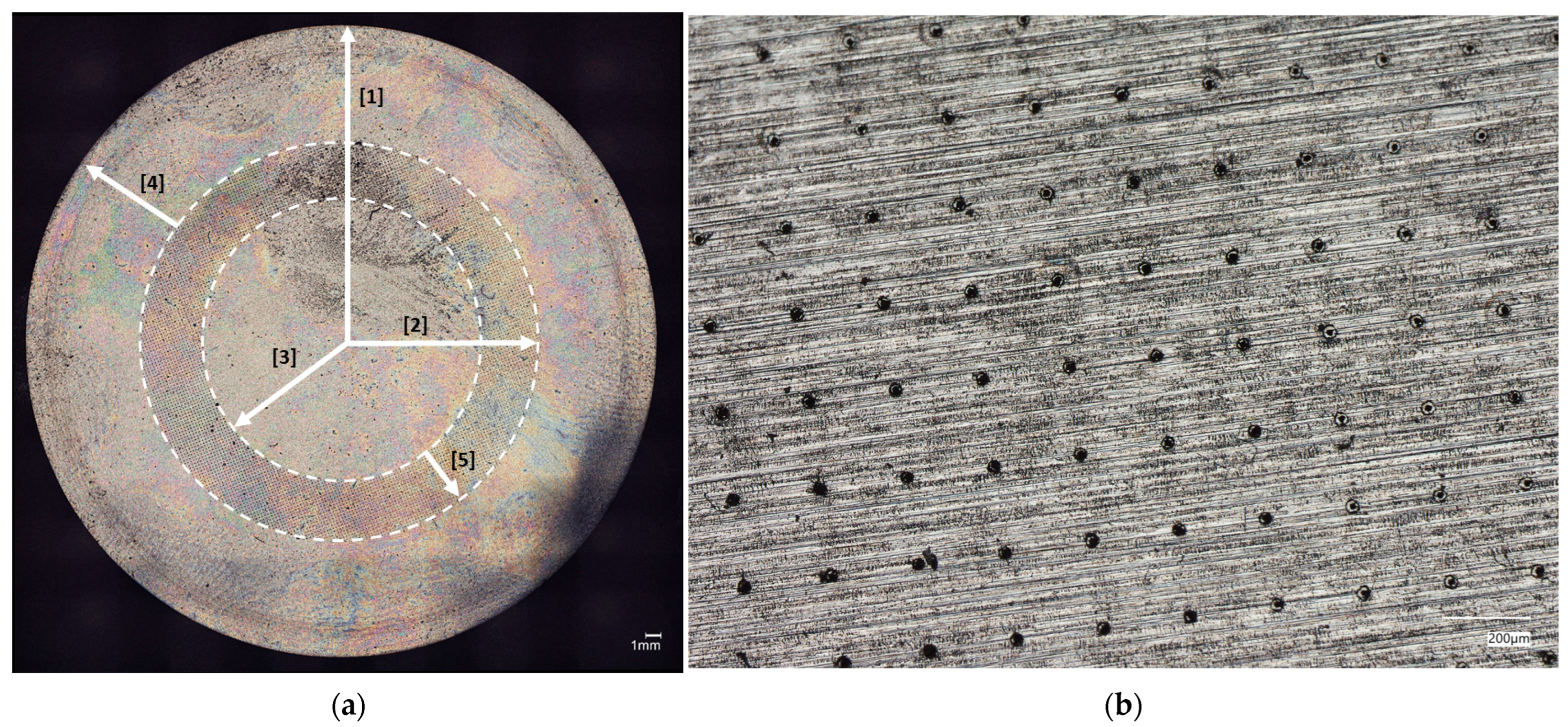
The membrane used in this study was fabricated by galvanic deposition of nickel onto a template formed by a photolithographic technique. It is a nickel membrane with an annular region of uniformly distributed cylindrical pores. The membrane pore diameter was dp = 10 µm, and the center-to-center spacing between pores was L = 200 µm. The membrane porosity was 0.23%, as calculated from Equation (1):
ε   =   π 2 3 d p L 2
where
dp: pore diameter (μm);
L: space between pores (μm).
The injection zone was restricted to the narrow annular region around the transitional radius, as shown in Figure 2a,b. The effective cross-sectional area of the ring membrane was 2.81 cm2, while the number of pores in the injection zone was about 6000. The micrographs of the membrane surface were taken using a VHX 7000N Digital Microscope (Keyence Corp., Osaka, Japan).

2.2.2. Experimental Procedure

Prior to emulsification, the membrane was pre-soaked in a wetting agent, consisting of 5% (v/v) Slither® (De Sangosse Ltd., Newmarket, UK) in acetone, for at least 30 min to increase the hydrophilicity of the surface. The acetone was subsequently removed by evaporation under a stream of compressed air. TO was injected through the membrane using a programmable syringe pump 11 Elite (Harvard Apparatus, Cambridge, UK) at a constant flow rate. The flow rate was 0.5–7.5 mL·min−1 (corresponding to the dispersed phase flux of 22.5–338 L·m−2·h−1), for the single emulsion and 0.5–12.0 mL·min−1 (corresponding to the dispersed phase flux of 22.5–541 L·m−2·h−1), for the double emulsion. The initial volume of continuous phase in the cell was 95 cm3, and the experiments were run until the dispersed phase concentration reached 5% vol. Once the desired amount of oil had passed through the membrane, both the pump and the agitator were switched off, and emulsion samples were collected and analyzed.
After each experiment, the membrane was thoroughly cleaned following a standardized ultrasonic cleaning protocol. It was first cleaned in hot soapy water in an ultrasonic bath for 5 min, then subjected to sequential ultrasonic treatments in 1 M NaOH for 5 min and 1 M acetic acid for 5 min, with intermediate rinses in distilled water. Finally, the membrane was thoroughly rinsed and sonicated in distilled water for an additional 5 min.
To evaluate the drop-size distribution and droplet diameter, as for homogenization, the laser diffraction particle size analyzer Malvern Mastersizer S and the optical GX microscope were used. For each emulsion, three separate samples and measurements were performed, and data were reported as mean ± SEM.
The mean particle size was expressed as the volume median diameter d(v,0.5), which is the diameter corresponding to 50 vol.% on the cumulative distribution curve. The relative Span of the drop size distribution was used to express the degree of drop size uniformity and was calculated from Equation (2):
S p a n = d v , 0.9 d ( v , 0.1 ) d ( v , 0.5 )
where
d(v,0.1): particle diameter below which 10% of the total sample volume is contained;
d(v,0.5) (median diameter): particle diameter at which 50% of the total sample volume comprises smaller particles;
d(v,0.9): particle diameter below which 90% of the total sample volume is contained.

2.3. Rheological Measurements

The rheological properties of the continuous phases were characterized using a HAAKE Viscotester iQ Air rotational rheometer (Thermo Scientific, Altrincham, UK) equipped with a double-gap cylinder rotor (CC27 DG/Ti; inner diameter 27.20 mm, gap 4.0 mm, sample volume 3.0 cm3). Shear-dependent viscosity was measured at 25.0 °C (Peltier-controlled, ±0.1 °C) over a shear rate range of 10–400 s−1 using a two-segment linear ramp protocol: (i) ascending ramp from 10 to 400 s−1 over 1 min (Segment 1), followed by (ii) descending ramp from 400 to 10 s−1 over 1 min (Segment 2). Approximately 3 mL of freshly prepared sample was loaded and equilibrated for 2 min before measurement. Apparent viscosity was calculated by RheoWin software (v4.83.0004) from measured shear stress and applied shear rate.

2.4. Statistical Analysis

All statistical analyses were performed using GraphPad Prism version 10.6 (GraphPad Software, Boston, MA, USA). Potential outliers were identified and excluded using Grubbs’ test (α = 0.05). Data normality was assessed with the Shapiro–Wilk test, and homogeneity of variance was verified using Levene’s test. For emulsions produced by high-shear homogenization, differences in droplet size distribution parameters (Span and d(v,0.5)) among formulations were evaluated using Welch’s one-way ANOVA. For emulsions produced by membrane emulsification, the effects of dispersed-phase flux and stirrer speed on Span and d(v,0.5) were analyzed using two-way ANOVA, followed by Tukey’s multiple comparisons post hoc test. Data were reported as mean ± SEM (n = 3 independent experiments). Statistical significance was defined as p < 0.05 for all analyses.

3. Results

The experimental work was conducted in sequential stages, starting with the optimization of component formulation, followed by the evaluation of process parameters for each emulsification technique.

3.1. High-Shear Homogenization

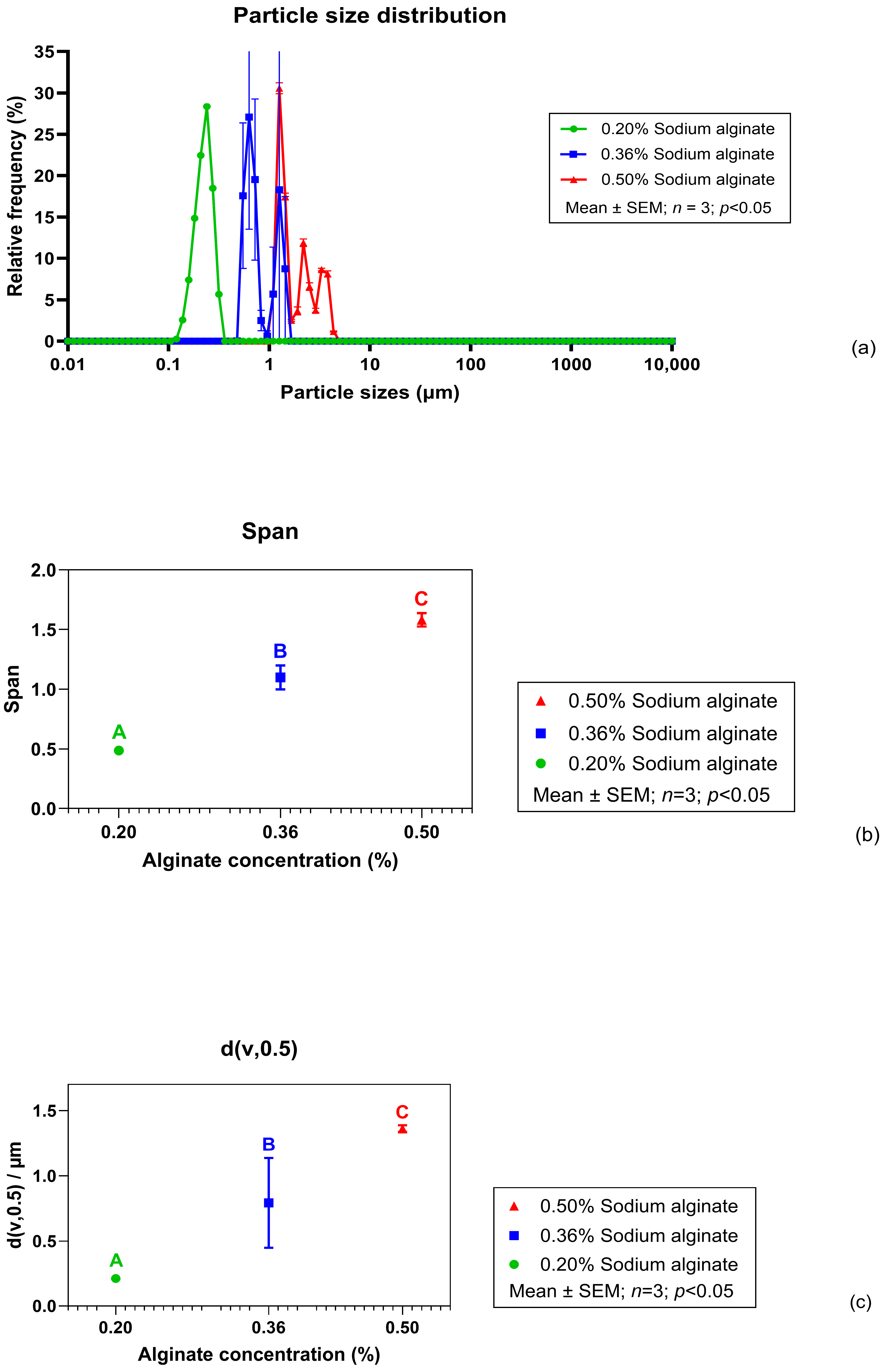
For high-shear homogenization, the experimental results are presented in two main parts: formulation screening and process optimization. The first step consisted of screening surfactants (Tween 20, Tween 80, and soybean lecithin) over a practical concentration range (0.5–6.0% w/w). Emulsion stability was evaluated by centrifugation, and the absence of any visible phase separation was considered the acceptance criterion. Both Tween 20 and Tween 80 required 5% (w/w) concentration to meet this stability threshold, whereas lecithin produced stable emulsions at 0.5% (w/w) concentration. Lecithin was therefore identified as the optimal primary emulsifier, as it conferred the required emulsion stability at the lowest effective concentration. After selection, extensive preliminary testing was performed to screen the combinations and concentration ranges of the carrier agents, using droplet-size metrics (µm) and centrifugation stability as selection criteria. Optimization indicated that the optimal formulation comprised 0.5% (w/w) lecithin, 1.8% (w/w) pectin, and sodium alginate within the tested range (0.20–0.50% w/w), Figure 3a. As shown in Figure 3b, the Span values increased with sodium alginate concentration: 0.49 (0.20%), 1.10 (0.36%), and 1.59 (0.50%). Correspondingly, the modal particle diameter shifted to larger sizes, approximately 0.18–0.25 µm at 0.20% sodium alginate, 0.7–1.0 µm at 0.36% sodium alginate, and 1.2–1.8 µm at 0.50% sodium alginate as reported in Figure 3c. The 0.20% sample exhibited a narrow, monomodal distribution (approx. d(v,0.1)–d(v,0.9) ≈ 0.10–0.60 µm), and the 0.36% sample showed a moderate spread (approx. d(v,0.1)–d(v,0.9) ≈ 0.6–1.6 µm), whereas the 0.50% sample was broader and multimodal (approx. d(v,0.1)–d(v,0.9) ≈ 0.9–6 µm). The d(v,0.5) was 0.21 µm (0.20% sodium alginate), 0.65 µm (0.36% sodium alginate), and 1.36 µm (0.50% sodium alginate). These intervals and medians were derived from Malvern Mastersizer laser-diffraction measurements and exact d(v,0.1), d(v,0.5) and d(v,0.9) values calculated from the raw Mastersizer data. Statistical analysis by Welch’s ANOVA revealed a highly significant effect of sodium alginate concentration on both particle size distribution width (Span p = 0.0004) and median particle size (d50 p = 0.0376), indicating that increasing alginate concentration significantly broadens the size distribution and shifts the median diameter to larger values.
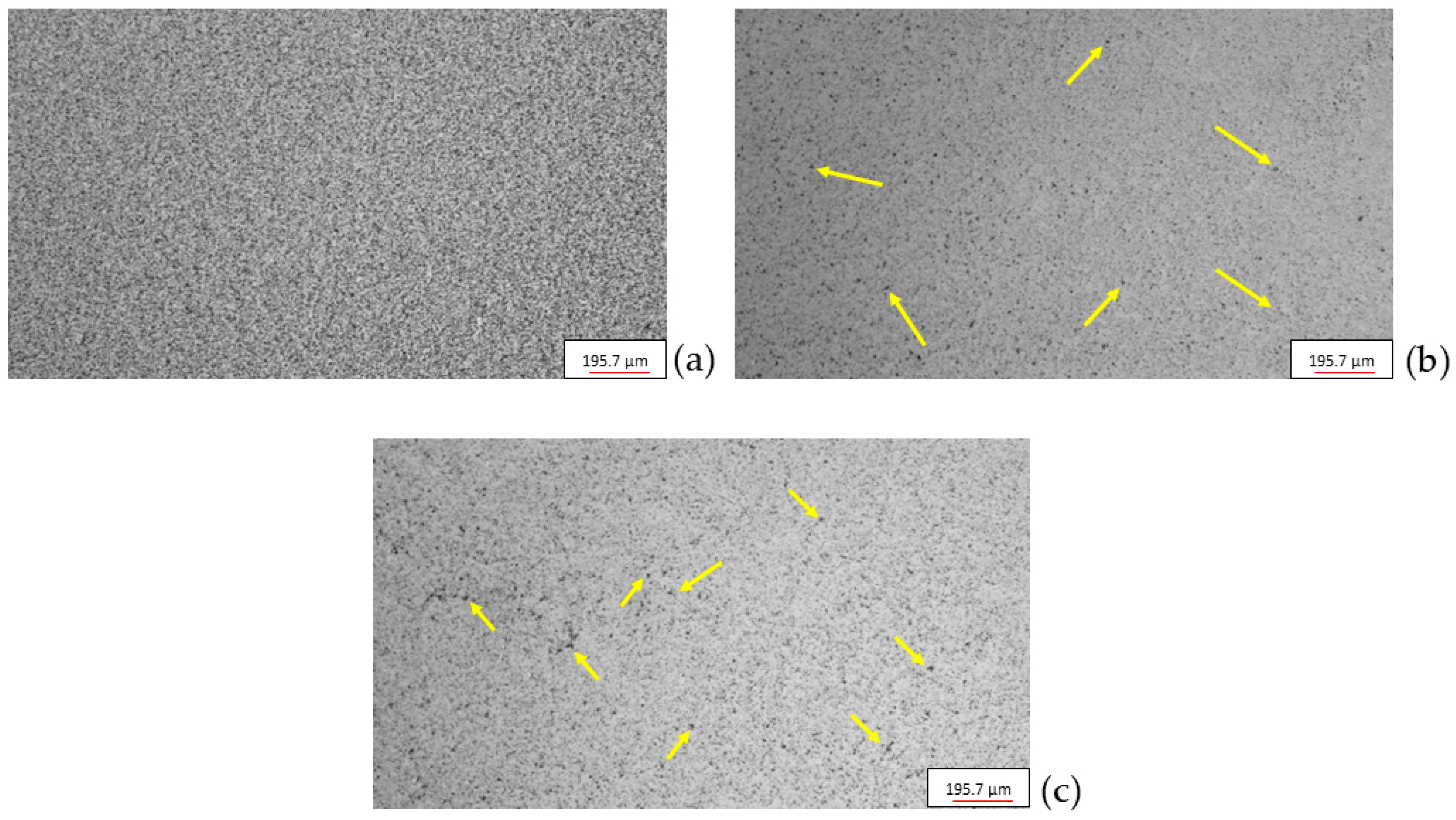
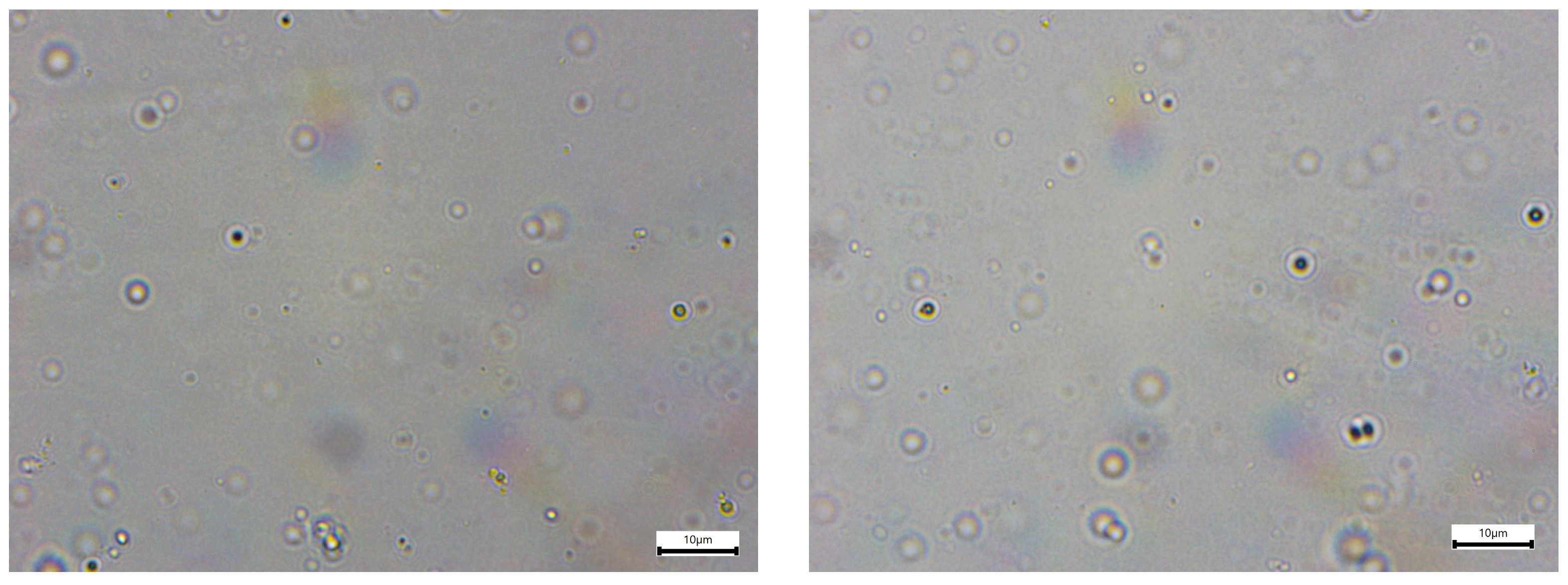
Microscopic observations of the emulsions corroborated these findings. At 0.20% sodium alginate, droplets were consistently submicron and uniformly dispersed, whereas at 0.36% and 0.50% sodium alginate, microscopy revealed progressively larger droplets and visible heterogeneity, as shown in Figure 4a–c. Moreover, these emulsions exhibited no visible phase separation after storage at room temperature for six months.
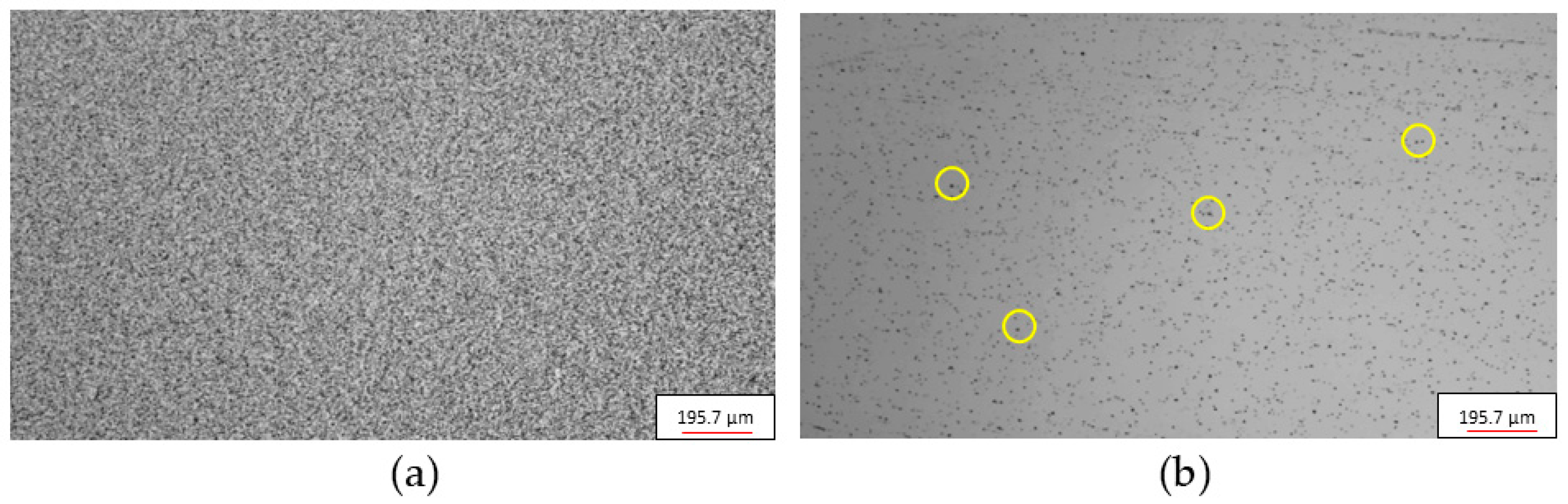
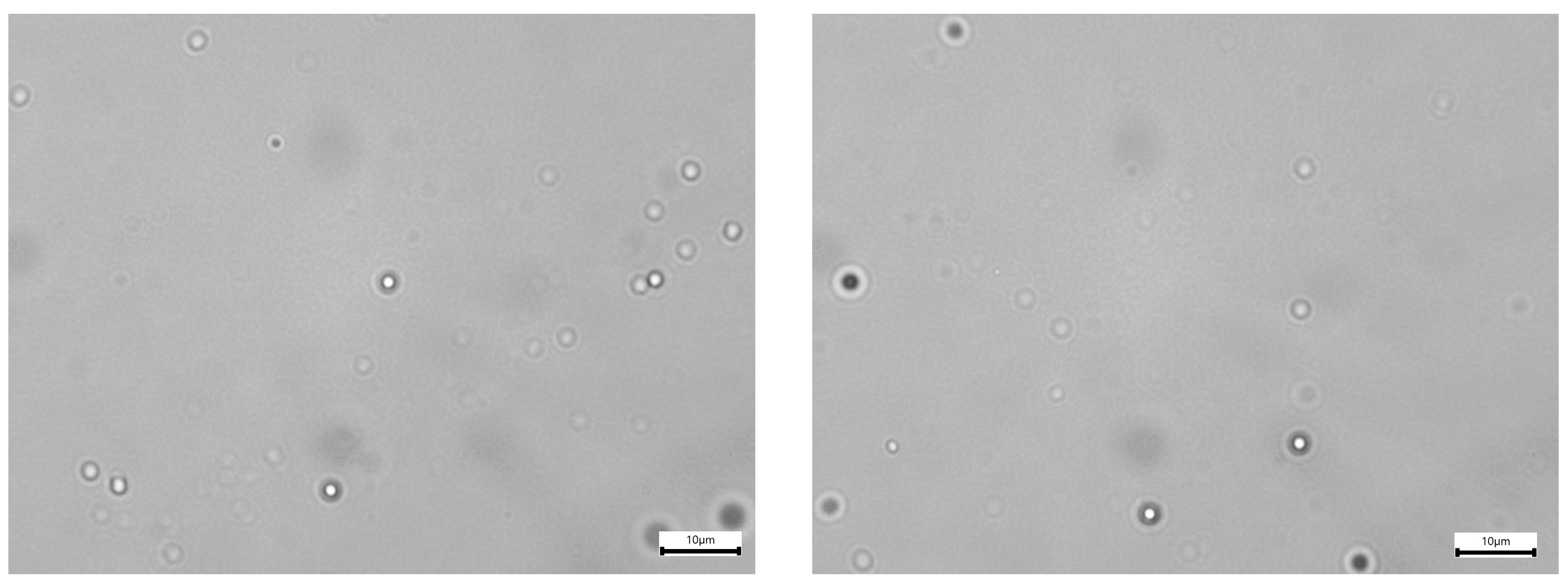
As the 0.20% sodium alginate formulation yielded the most favorable droplet-size distribution, the emulsion was diluted to an appropriate poultry dosage of 100 ppm (100 mg·L−1), as shown in Figure 5, and its colloidal electrostatic stability was evaluated [17]. Despite dilution, discrete emulsion droplets remain observable. Samples were prepared by diluting the primary emulsion in deionized water (pH = 7); no filtration was applied prior to measurement. Measures were carried out at 25 °C with automatic equilibration, using the Smoluchowski approximation to convert electrophoretic mobility to ζ-potential. Malvern Zetasizer measurements (n = 3 independent preparations) gave ζ-potential = −51.5 ± 1.5 mV (mean ± SD; range −52.7 to −49.8 mV), with a corresponding conductivity of 0.0266 mS·cm−1. Wall ζ and peak analyses yielded consistent results (Wall ζ = −55.2 ± 2.1 mV; ζ peak means ≈ −74.4 mV and −50.5 mV), confirming a strongly negatively charged surface and substantial electrostatic stabilization. No perceptible odor and oil separation was detected by operators after dilution. As a final step, this primary emulsion with 0.20% sodium alginate was spray-dried (see Materials and Methods for operating conditions). The powder exhibited no perceptible odor.

3.1.1. Long-Term Physical and Chemical Stability of the Optimized Emulsion

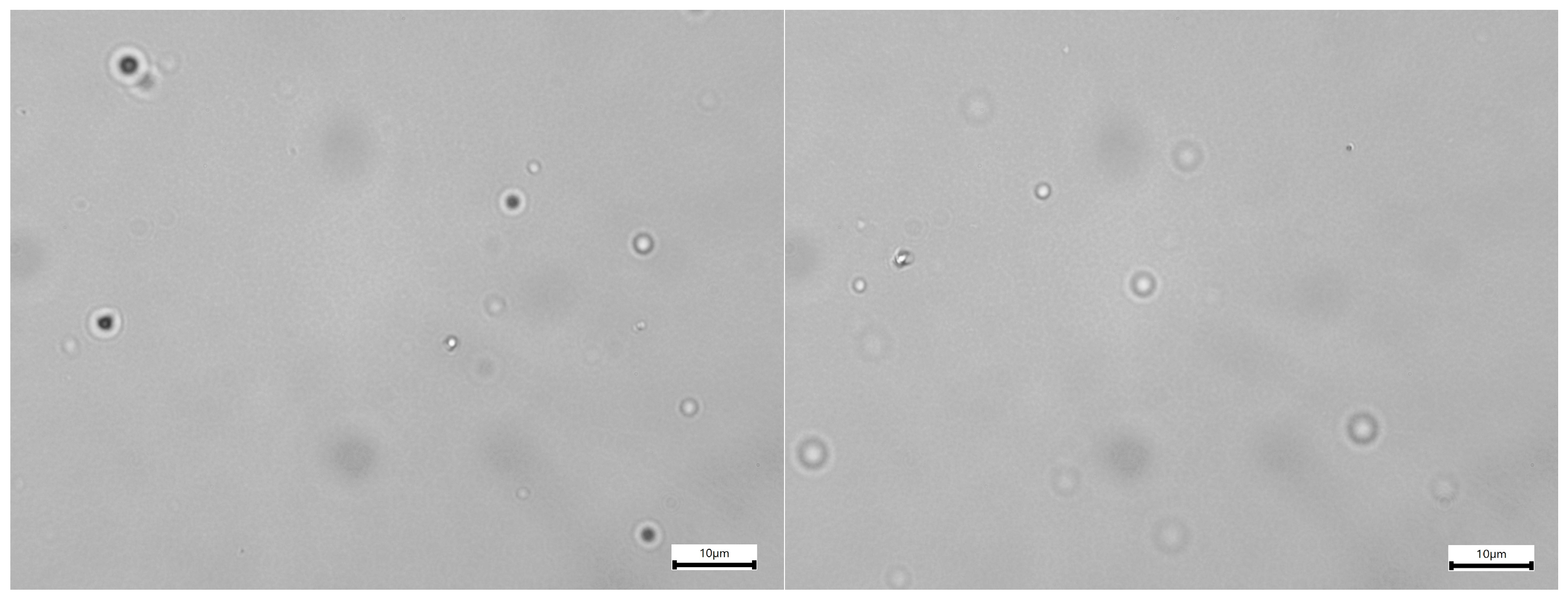
The optimized O/W emulsion (0.5% lecithin, 1.8% pectin, 0.2% sodium alginate) demonstrated good long-term physical stability when stored at 4 °C for six months. As reported in Section 3.1, the initial physicochemical parameters measured immediately after production (T0) were as follows: median droplet diameter d(v,0.5) = 0.21 µm, Span = 0.49, and ζ-potential = −51.5 ± 1.5 mV (measured after dilution to 100 ppm). The emulsion exhibited a narrow, monomodal size distribution with d(v,0.1) ≈ 0.10 µm and d(v,0.9) ≈ 0.60 µm. After six months of storage (T6), the concentrated emulsion diluted in deionized water exhibited moderate structural changes. The median droplet diameter increased to d(v,0.5) = 1.15 µm (representing a 5.5-fold increase from T0), with a correspondingly broader size distribution (d(v,0.1) = 0.94 µm, d(v,0.9) = 1.42 µm). Despite this increase in absolute droplet size, the Span decreased to 0.41 (16.3% reduction from the initial value of 0.49), indicating improved size distribution homogeneity. The polydispersity index measured by dynamic light scattering was PDI = 0.4, confirming that the emulsion maintained acceptable monodispersity (PDI < 0.5) throughout the storage period. Critically, the emulsion retained robust electrostatic stabilization after six months, with ζ-potential measured at −56.40 ± 1.08 mV (mean ± SD; range −57.48 to −55.32 mV). No visible phase separation, creaming, or flocculation was observed throughout the storage period, and microscopic examination confirmed the absence of macroscopic aggregates (Figure 6).The raw autocorrelation function and the corresponding intensity-weighted particle size distribution obtained by dynamic light scattering are reported in the Supplementary Materials (Figure S1).
Parallel HPLC analysis assessed the chemical stability of the main bioactive compounds (thymol and carvacrol) encapsulated within the emulsion matrix. The chromatographic profile of the pure TO confirmed its composition as 58% thymol and 2.6% carvacrol. At T0, the emulsion recovery values were 92% for thymol and 93% for carvacrol, indicating minimal losses (<10%) during the high-shear emulsification and subsequent liquid–liquid extraction processes. After six months of controlled storage (4 °C), recovery decreased to 66% for thymol and 63% for carvacrol, corresponding to total losses of 26% for thymol and 30% for carvacrol over the storage period.

3.1.2. Stability Under Simulated Gastrointestinal Conditions

Emulsion Behavior in Simulated Gastric Fluid
In SGF, the emulsion exhibited a substantial increase in median droplet size compared to the control in deionized water, with d(v,0.5) reaching 2.64 µm (versus 0.21 µm in water), representing a 12.6-fold increase (Figure 7). The size distribution broadened accordingly, with d(v,0.1) = 1.97 µm and d(v,0.9) = 3.53 µm, resulting in a Span of 0.59 (1.2% higher than in water). Despite this increase, the polydispersity index remained low (PDI = 0.3), indicating that the enlarged droplets maintained a relatively narrow size distribution. The ζ-potential decreased to −37.93 ± 0.31 mV, indicating that electrostatic stabilization still persisted. The raw autocorrelation function and the corresponding intensity-weighted particle size distribution obtained by dynamic light scattering are reported in the Supplementary Materials (Figure S2).
Emulsion Behavior in Simulated Intestinal Fluid
In SIF, the emulsion displayed further structural changes, with d(v,0.5) increasing to 3.03 µm (2.6-fold increase relative to water control) and a broader size distribution characterized by d(v,0.1) = 1.22 µm, d(v,0.9) = 3.92 µm, and Span = 0.89 (more than double the value in water). The polydispersity index remained unchanged at PDI = 0.3, and the mean hydrodynamic diameter was 5184 nm (Figure 8). The ζ-potential decreased to −31.97 ± 1.81 mV, indicating that electrostatic stabilization persisted but was significantly weakened compared to neutral pH conditions. The raw autocorrelation function and the corresponding intensity-weighted particle size distribution obtained by dynamic light scattering are reported in the Supplementary Materials (Figure S3).

3.1.3. Rheological Behavior of O/W Homogenized Emulsion

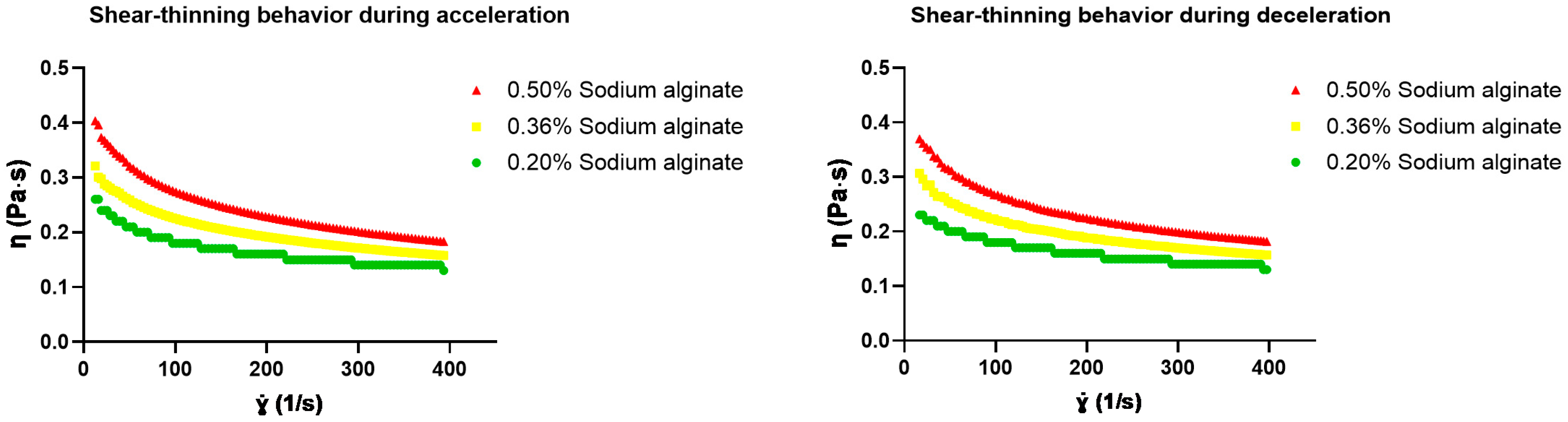
The rheological properties of the continuous phase containing lecithin (0.5%), pectin (1.8%), and varying concentrations of sodium alginate (0.20%, 0.36%, 0.50%) were characterized as shown in Figure 9. All formulations exhibited pronounced shear-thinning behavior, with apparent viscosity (η) decreasing from ≈0.25–0.40 Pa·s at low shear rates ( γ ˙ ≈ 10 s−1) to ≈0.13–0.18 Pa·s at high shear rates ( γ ˙ ≈ 400 s−1). Viscosity at low shear rates increased systematically with alginate concentration: 0.20% (η ≈ 0.25 Pa·s), 0.36% (η ≈ 0.32 Pa·s), and 0.50% (η ≈ 0.40 Pa·s), reflecting enhanced polymer chain entanglement. Minimal hysteresis was observed between ascending and descending ramps, indicating negligible thixotropy. These rheological data directly explain the particle size trends reported in Section 3.1. The lowest alginate concentration (0.20%) provided optimal balance between biopolymer functionality and processing efficiency: the relatively low viscosity (η ≈ 0.13 Pa·s at homogenization-relevant shear rates) enabled efficient turbulent energy dissipation during high-shear homogenization, yielding submicron droplets (d(v,0.5) = 0.21 µm, Span = 0.49). Conversely, elevated viscosity at 0.50% alginate (η ≈ 0.18 Pa·s at high shear) dampened droplet breakup, resulting in larger, more polydisperse emulsions (d(v,0.5) = 1.36 µm, Span = 1.59).

3.2. Membrane Emulsification: Single Oil in Water (O/W) Emulsion

To establish control over droplet size and homogeneity while minimizing thermal generation during the emulsification process, 5% (w/w) thyme O/W emulsions were prepared by membrane emulsification to evaluate whether comparable droplet-size distributions could be achieved under low-energy conditions. Preliminary experiments were conducted to identify the most suitable non-particulate surfactant and to define the operational window for dispersed-phase flux and rotor speed. Lecithin was excluded at this stage due to the risk that insoluble particulates could obstruct membrane pores. Tween 20 and Tween 80 (both at 2% w/w for the screening runs) were compared as reported in Section 3.2.1 and Section 3.2.2. A large range of conditions was tested to identify the optimal flow-rate/rotational-speed (shear stress) combination before moving on to formulation with polysaccharide carriers for obtaining the W/O/W emulsion. Each condition was sampled immediately after production (data reported below refer to freshly produced dispersions).

3.2.1. Tween 20

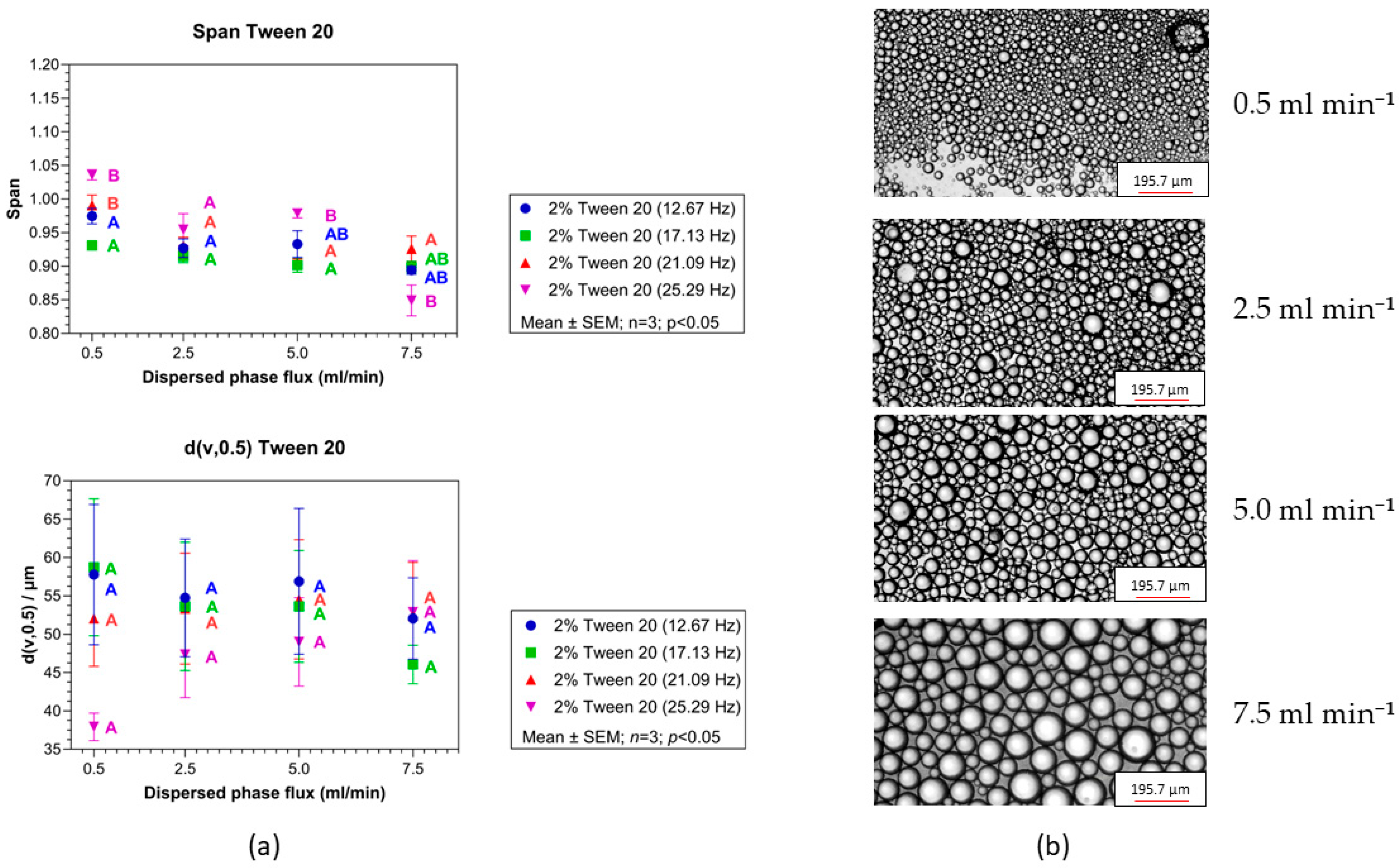
The influence of dispersed phase flux and stirrer speed on the Span and d(v,0.5) of emulsions stabilized with Tween 20 is presented in Figure 10a. Across the examined range of dispersed phase fluxes (0.5–7.5 mL·min−1), Span values remained consistently around 1.0 (≈0.85–1.04), indicating relatively narrow size distributions. Minor variations were observed with increasing flux, but no clear monotonic trend emerged, suggesting that Tween 20 provided steric stabilization and rapid interfacial coverage under all conditions. Median droplet diameters ranged from approximately 38 to 59 µm. The lowest stirring speed (12.67 Hz) tended to produce larger droplets (≈52–58 µm), while higher speeds (17.23–25.29 Hz) generally reduced droplet size, with values approaching ~38 µm at the lowest flux. This behavior is consistent with enhanced shear stresses thinning the interfacial boundary layer and promoting droplet detachment at smaller diameters. However, at the highest flux (7.5 mL·min−1), the size-reduction benefit of speed partially plateaued, likely due to more frequent collisions and less residence time near the membrane. The best compromise between fineness and uniformity was achieved at 25.29 Hz with mid-high flux (≈7.5 mL·min−1), where d(v,0.5) ≈ 52 µm, Span ≈ 0.85, and a monomodal distribution was shown. At 25.29 Hz, increasing the flow rate (0.5, 2.5, 5.0, and 7.5 mL·min−1) was associated with an increase in droplet diameter, as shown in Figure 10b. Under all tested conditions, the emulsions exhibited a monodisperse droplet population. Creaming was observed under all tested conditions, consistent with the relatively large droplet sizes obtained (>25 µm). To assess statistical significance for these trends, a two-way ANOVA and Tukey’s post hoc test were used to analyze both Span and d(v,0.5). For Span, a significant interaction between flow rate and stirrer speed was observed. At 0.5 mL min−1, Span at 25.29 Hz was significantly higher than at all lower frequencies: 12.67 Hz (adjusted p = 0.0188), 17.13 Hz (adjusted p = 0.0207), and 21.09 Hz (adjusted p = 0.0231). In contrast, at 7.5 mL min−1, Span at 25.29 Hz was significantly lower than at 12.67 Hz (adjusted p = 0.0371) and 21.09 Hz (adjusted p = 0.0179). No significant differences in Span were found across frequency at intermediate flow rates (2.5 and 5.0 mL min−1; p > 0.05). For d(v,0.5), although the group means varied across processing conditions, there were no statistically significant main effects or interactions detected by ANOVA (all p > 0.05).

3.2.2. Tween 80

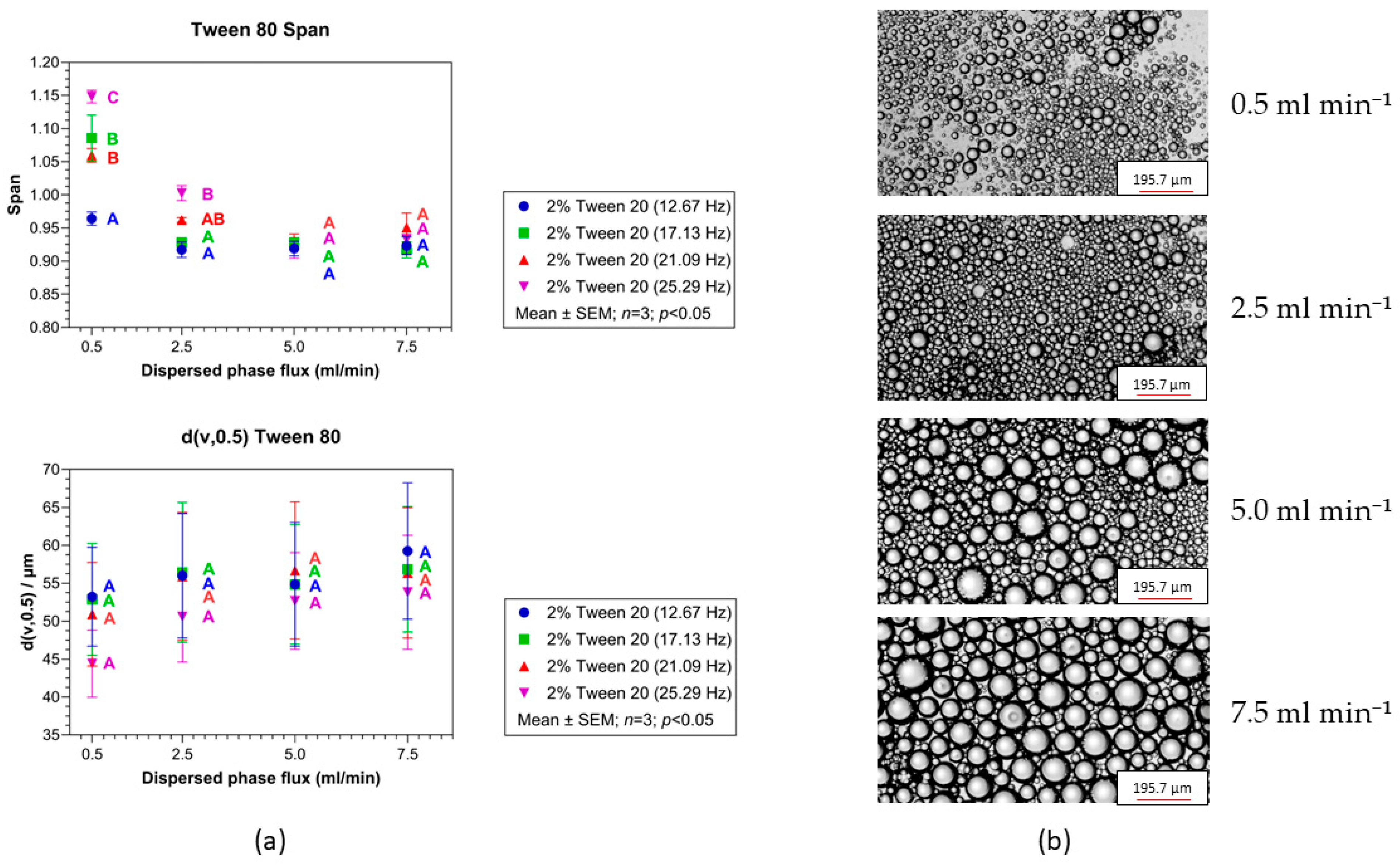
The influence of dispersed-phase flux and stirrer speed on Span and d(v,0.5) for emulsions stabilized with Tween 80 is presented in Figure 11a. Across the full range of dispersed phase fluxes tested (0.5–7.5 mL·min−1), Span values generally remained close to 1.0 (≈0.90–1.15), indicating relatively narrow size distributions. Compared to Tween 20, slightly higher Span values were observed at low flux, especially at higher stirring speeds, suggesting marginally less efficient stabilization with Tween 80 under these conditions. As the dispersed phase flow rate increased, Span tended to decrease, while a higher rotational speed was usually associated with an increase in Span. Median droplet diameters d(v,0.5) ranged from approximately 44 to 59 µm. The largest droplets (≈59 µm) were observed at the lowest stirring speed (12.67 Hz, 7.5 mL·min−1), while increasing stirrer speed (17.13–25.29 Hz) generally reduced median diameter, reaching values near 44 µm at the lowest flux. The most favorable compromise between droplet fineness and uniformity was achieved at intermediate fluxes (≈2.5–5 mL·min−1) and higher stirring speeds (≥17.13 Hz), where d(v,0.5) stabilized between 46 and 55 µm and a Span near 0.90 with a single narrow size distribution was present. Statistical analysis was performed via two-way ANOVA followed by Tukey’s post hoc test. For span, a significant effect of homogenization frequency (shear stress) was found, with interaction by flow rate: at 0.5 mL·min−1, Span at 25.29 Hz was significantly higher than at 12.67 Hz (p < 0.0001), 17.13 Hz (p = 0.0002), and 21.09 Hz (p < 0.0001). At 2.5 mL·min−1, only the comparison between 12.67 Hz and 25.29 Hz reached significance (p = 0.0008); no other pairwise differences were significant at this flow rate. No significant differences among frequencies were observed at 5.0 or 7.5 mL·min−1 (p > 0.05). In contrast, the median droplet diameter demonstrated some statistically significant differences across both shear stress and flow rate conditions. At 0.5 mL·min−1, 25.29 Hz vs. 12.67 Hz: p = 0.0169; at 2.5 mL·min−1, 25.29 Hz vs. 12.67 Hz: p = 0.0037). Nevertheless, for several combinations, no significant differences were detected. Representative optical images of emulsions obtained at 25.29 Hz are shown in Figure 11b. The progressive increase in dispersed phase flow rates (0.5, 2.5, 5.0, and 7.5 mL·min−1) led to larger droplet diameters. Under all tested conditions, emulsions remained monodisperse, displaying narrow and unimodal size distributions as reflected by the span values. Creaming was observed under all tested conditions, consistent with the relatively large droplet sizes obtained (>25 µm).

3.2.3. Membrane Emulsification: Double Water in Oil in Water (W/O/W) Emulsion

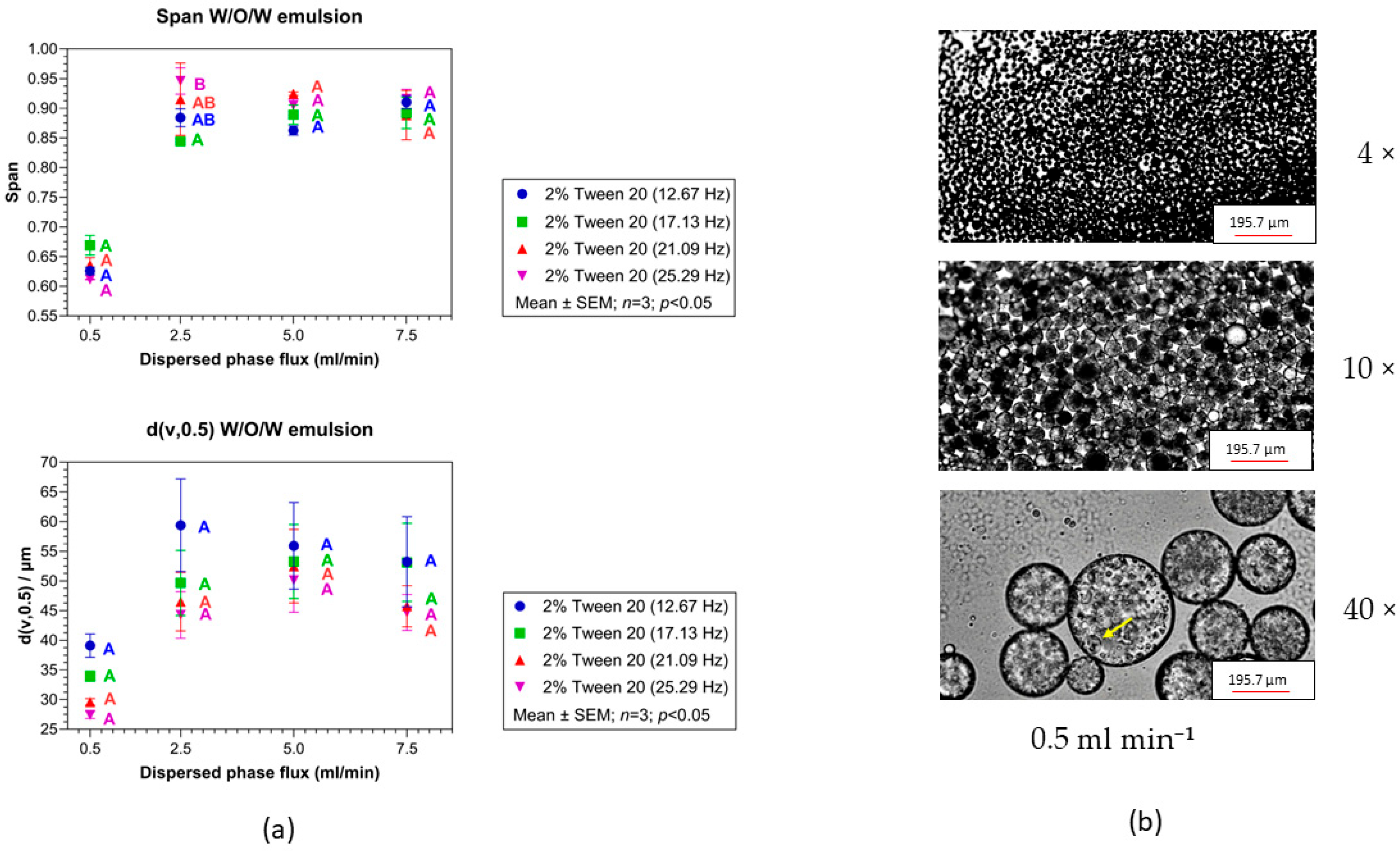
The influence of dispersed phase flux and stirrer speed on both Span and median droplet diameter d(v,0.5) for W/O/W double emulsions is shown in Figure 12a. At the lowest flux (0.5 mL·min−1), Span values were minimal (≈0.62–0.67), indicating very narrow size distributions. As flux increased, Span rose sharply, reaching values of approximately 0.85–0.95 at ≥4 mL·min−1. The trend was consistent across stirring speeds, suggesting that droplets crowding and slightly aggregating during formation at higher flow rates. Median droplet diameters ranged from ≈27 to 60 µm, exhibiting a pronounced dependence on both flux and stirrer speed. At the lowest flux (0.5 mL·min−1), droplet size was smallest, decreasing with increasing rotational speed from ≈40 µm at 12.67 Hz to ≈27 µm at 25.29 Hz. At intermediate fluxes (4–7.5 mL·min−1), d(v,0.5) values increased substantially, reaching 45–60 µm according to stirring condition. At the highest flux (12 mL·min−1), droplet diameters slightly decreased compared to 7.5 mL·min−1, possibly reflecting a balance between shear-induced breakup and droplet coalescence. Overall, Span analysis highlights that the most favorable double emulsions (with narrow distributions and smaller droplets) were achieved at the lowest flux (0.5 mL·min−1) and highest stirring speeds (21.09–25.29 Hz), yielding droplets ≈27–32 µm and span ≈0.61, with a monomodal distribution. All emulsions displayed visually monodisperse populations across tested conditions. Creaming was observed under all tested conditions, consistent with the relatively large droplet sizes obtained (>25 µm). Statistical assessment via a two-way ANOVA followed by Tukey’s post hoc test reconfirmed that both homogenization frequency and flow rate significantly influenced droplet size distribution breadth (Span), while the median droplet diameter (d(v,0.5)) remained statistically invariant across all tested conditions. At 0.5 mL min−1, Span at 25.29 Hz was significantly higher than at 17.13 Hz (p = 0.0016) and 21.09 Hz (p = 0.0168), but not significantly different from 12.67 Hz (p = 0.9678). For all other flow rates (2.5, 5.0, and 7.5 mL·min−1), no significant differences among frequencies were observed (p > 0.05). Moreover, median diameter d(v,0.5) showed no statistically significant variation under any combination of shear stress and flow rate (all pairwise comparisons: p > 0.05), confirming that while polydispersity (Span) was sensitive to processing parameters, the central tendency of droplet size remained unaffected by the tested conditions. Representative optical images of emulsions obtained at 0.5 mL min−1 and 25.29 Hz are shown in Figure 12b.

3.2.4. Effect of Repeated Membrane Passes on W/O/W Emulsion Droplet Size and Span

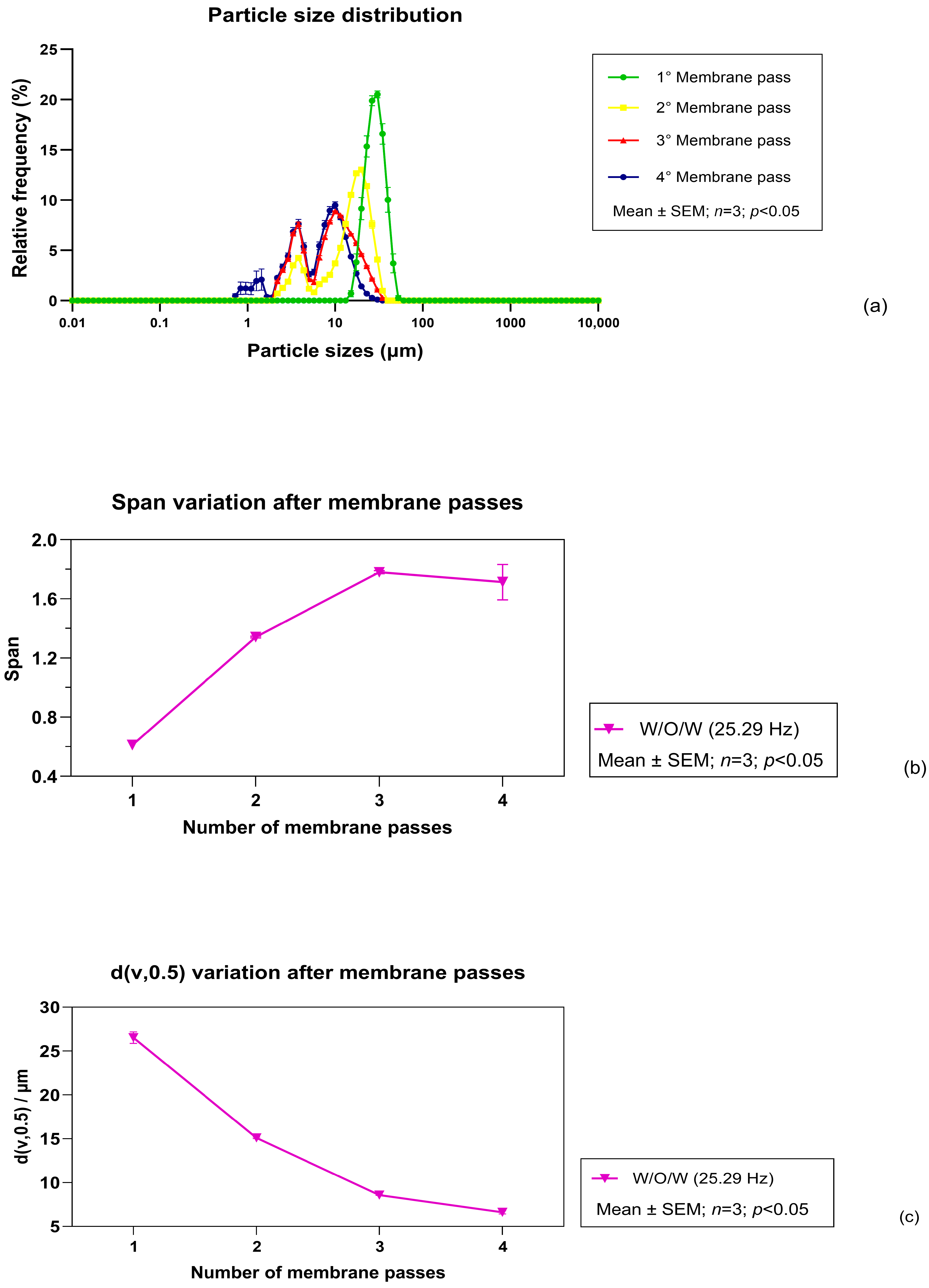
To evaluate whether droplet size could be progressively reduced toward values typical of high-shear homogenization (<10 µm), the W/O/W emulsion prepared under optimal conditions was recirculated through the same membrane up to four times (Figure 13). The median droplet diameter decreased markedly with each pass from 26.5 µm (pass 1) to 12.5 µm (pass 2), reaching 6.6 µm after pass 4. Concomitantly, the Span increased from 0.61 to 1.78, indicating a trade-off between droplet size reduction and distribution uniformity. Although a Span of ~1.78 reflects moderate polydispersity rather than a narrow distribution, it remains operationally more than acceptable for feed-focused applications, especially given the substantial shift in d(v,0.5) into the sub-10 µm regime. Mechanistically, the trade-off is consistent with enhanced droplet–droplet interactions and coalescence during successive recirculation, which counteracts the size-reduction benefit of repeated passage [21,33].

3.2.5. Rheological Behavior of W/O/W Emulsion

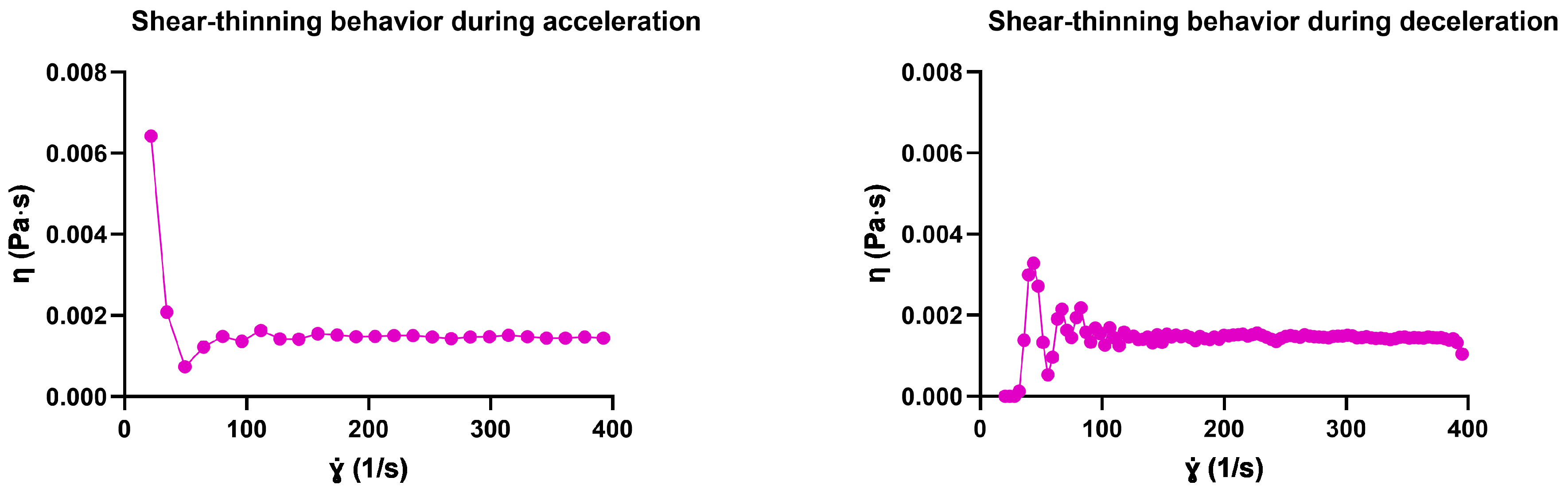
The W/O/W double emulsion exhibited very low viscosity (η ≈ 0.007 Pa·s at γ ˙ = 10 s−1, decreasing to ≈0.0015 Pa·s at γ ˙ = 400 s−1) with mild shear-thinning behavior and minimal hysteresis between ascending and descending shear rate ramps (Figure 14). This low-viscosity profile is determined by the composition of the external aqueous phase (W2: water + 2% Tween 20), which lacks high-molecular-weight biopolymers, rather than by the encapsulated pectin–alginate-rich internal phase (W1). Consequently, the W/O/W system exhibits viscosity values approximately 35-fold lower than the O/W emulsions with pectin–alginate continuous phases, despite containing the same biopolymers in the internal compartment. The lack of significant thixotropy and low viscosity are favorable for membrane emulsification processing, facilitating reproducible droplet formation and uniform shear distribution during repeated membrane passes.

4. Discussion

This study optimized the production of single Oil in Water (O/W) and double Oil in Water in Oil (W/O/W) Thyme Oil (TO) emulsions and clarified how formulation parameters and emulsification methods together influence emulsion structure and properties. Both the chemical nature of the emulsifiers and the hydrodynamic environment during droplet formation played critical roles in determining droplet size, size distribution (Span), and stability. Consistent with the literature, lecithin was found to be an effective food-grade emulsifier for O/W systems, providing stability at relatively low concentrations [34]. By contrast, non-ionic polysorbates (Tween 20, Tween 80) are routinely used in food and feed applications for their safety and robustness, generally requiring higher dosages to achieve comparable physical stability [35]. A direct comparison of high-shear homogenization (high-energy process) and membrane emulsification (low-energy process) revealed that droplet size, polydispersity, and physical stability are co-determined by formulation composition and processing mechanics. These physicochemical attributes are critical determinants of functional performance in animal health applications, as they govern the site and kinetics of TO release along the gastrointestinal tract [19].
High-shear homogenization relies on chaotic turbulent shear forces, capable of producing submicron droplets, making them suitable for high-throughput and large-scale manufacturing [36,37]. However, this approach often yields broader (more polydisperse) size distributions [36]. In this study, high-shear homogenization successfully produced physically stable submicron O/W emulsions, with lecithin emerging as the most efficient emulsifier. In agreement with previous studies [38], lecithin achieved stability at low concentrations (0.5% w/w), outperforming non-ionic polysorbates such as Tween 20 and Tween 80, which required 5- to 10-fold higher dosages. The optimized formulation containing lecithin, pectin, and a low concentration of sodium alginate (0.20%) generated droplets with a median diameter d(v,0.5) = 0.21 µm and a narrow distribution (Span = 0.5). This highly uniform, submicron size suggests efficient energy transfer and rapid stabilization during the homogenization process. Such a small droplet size is crucial, as the initial rate and extent of lipid digestion increase significantly as droplet diameter decreases, primarily due to the greater total surface area available for interaction with digestive enzymes [19]. The ability to control the droplet size and narrow the Span (polydispersity) in high-shear processes is fundamentally linked to the rheological properties of the continuous phase. Furthermore, studies focusing on emulsion formulation stability show that high dispersed phase flow rates during emulsification can lead to larger drops than theoretically predicted by force-balance models, confirming the general sensitivity of droplet size to flow dynamics and viscosity during formation [32,39].
In fact, the experimental data reveal a clear and significant influence of sodium alginate concentration on both droplet size distribution and droplets’ median diameters (Span p < 0.0376; d(v,50) p < 0.0004). Sodium alginate, a hydrocolloid often used in combination with pectin [18,25], significantly increases the viscosity of the aqueous continuous phase, which consequently hinders efficient droplet disruption during turbulent high-shear homogenization. In fact, increasing the sodium alginate concentration leads to a larger d(v,0.5) = 1.36 µm and broader distributions (Span = 1.6), which increase polydispersity. Microscopic observations visually corroborated the quantitative size data, showing uniformly dispersed submicron droplets at 0.20% sodium alginate, contrasting sharply with the progressively larger and heterogeneous populations seen at 0.36% and 0.50% sodium alginate. This result highlights a trade-off in high-shear processing where the thickening effect of the biopolymer, while beneficial for long-term colloidal stability against creaming, simultaneously dampens the turbulent energy dissipation required for effective droplet break-up. A critical finding is that the optimized O/W remained stable when diluted to a suitable poultry dose (100 ppm) [17], exhibiting a robust negative ζ-potential (approx −51.5 ± 1.5 mV), which ensures excellent electrostatic stabilization even upon dilution. In fact, a high absolute ζ-potential (typically > 30 mV) is essential for preventing disperse phase aggregation [22]. The observation is consistent with the anionic nature of both sodium alginate and pectin, whose carboxyl groups (pKa ≈ 3) are deprotonated in aqueous solution (pH ≈ 5.5–7.0), resulting in a net negative surface charge [24]. Moreover, although lecithin is zwitterionic, it often exhibits a net negative charge under neutral to slightly acidic conditions, as its anionic phosphate groups (pKa ≈ 1.5) remain fully deprotonated in this pH range [40]. The resulting small droplet size and robust negative ζ-potential are critical for colloidal stability against aggregation phenomena like flocculation and coalescence, especially when the emulsion is diluted for oral administration [41]. The choice of pectin and sodium alginate is particularly relevant for delivery systems, as these biopolymers are frequently combined to form hydrogel-based carriers or microparticles. Their synergistic gelation, often driven by ionic crosslinking with Ca2+ via the “egg-box” mechanism, provides structural integrity, while their pH-responsive gel-forming properties confer gastric protection and enable targeted delivery of bioactive compounds to the intestinal tract. Specifically, this matrix remained stable under acidic gastric conditions and facilitated release in an alkaline environment simulating the intestine [18,24,25,42]. In fact, our results in simulated gastrointestinal fluids revealed the pH-dependent structural changes characteristic of pectin–alginate systems. In acidic SGF, droplets enlarged to 2.64 µm while retaining negative charge (−37.93 mV). Protonation below the biopolymer pKa values (3.0–4.5) might trigger sol–gel transition, creating a protective hydrogel shell around droplets [43,44]. In SIF, droplets grew further to 3.03 µm with broader distribution (Span = 0.89), attributed to ionic screening from elevated bicarbonate concentration (85 mM) and divalent cation-induced crosslinking where calcium and magnesium ions coordinate between guluronic acid blocks in alginate chains [45,46]. The ζ-potential decreased to −31.97, indicating that electrostatic stabilization was significantly weakened compared to neutral pH conditions and suggesting the onset of a destabilization process that progressively evolves over time. These pH-responsive structural rearrangements show potential for gastric protection and intestinal release, though such physicochemical observations provide only indirect evidence of controlled delivery. Definitive confirmation of site-specific bioactive release would require comprehensive in vitro digestion protocols that simulate the complex enzymatic environment of the gastrointestinal tract. Developing adapted in vitro digestion methodologies that enable simultaneous tracking of both structural evolution (particle size, ζ-potential) and bioactive release kinetics (HPLC quantification) represents a critical but technically demanding next step, requiring specialized equipment and protocol optimization beyond the scope of the present formulation study [33].
Independent of these considerations, the optimized O/W emulsion maintained excellent physical stability over six months at 4 °C, with ζ-potential increasing from −51.5 ± 1.5 mV to −56.40 ± 1.08 mV. This enhancement likely resulted from progressive pectin and alginate chain rearrangement at the interface, exposing more deprotonated carboxyl groups. HPLC analysis showed thymol and carvacrol retention of 66% and 63%, respectively, after six months. However, these recovery values may underestimate actual bioactive retention, as the methanol extraction process induced the formation of a pectin–alginate coagulum that potentially acted as a molecular sponge, entrapping residual thymol and carvacrol despite repeated extraction cycles. This extraction artifact, combined with the documented susceptibility of phenolic monoterpenes to oxidative degradation during prolonged storage [47,48], suggests the true bioactive content likely falls between the measured recovery values and the initial 92–93% encapsulation efficiency. Nevertheless, even the conservative recovery estimates indicate adequate chemical stability for typical feed additive shelf-life requirements (3–12 months) [49]. Future formulations could benefit from incorporating lipophilic antioxidants such as tocopherols to further mitigate oxidative losses [48].
Indeed, the most promising lecithin–pectin–alginate formulations (see Results, Section 3.1), obtained by high-shear homogenization, were converted into beads via spray-drying to avoid water transport, facilitate handling and storage, and enable final application either by redispersion in drinking water or by direct incorporation into commercial feed formulations.
In contrast, membrane emulsification is characterized by controlled hydrodynamic shear stress applied across the membrane surface, leading to the formation of highly uniform droplets with consistently narrow size distributions [14,26,36]. In this case, the dimension of droplet size is highly deterministic, influenced by the balance between the applied shear stress, the flow rate, and the interfacial tension at the emerging droplet surface [21,26,50] In fact, studies employing stirred cell membrane emulsification, such as by Dragosavac et al. (2008), have demonstrated that precise control over particle size distribution is achieved by adjusting parameters such as membrane pore size, dispersed phase flux, and stirrer speed (shear stress) [21]. Under identical processing conditions, Tween 20 produced slightly narrower droplet size distributions than Tween 80 (Span ≈ 0.85–1.05 vs. 0.90–1.15), particularly at low flux and low stirring speed. Median droplet diameters were broadly comparable for the two surfactants (Tween 20: ~38–58 µm; Tween 80: ~40–57 µm), although Tween 80 tended to generate somewhat larger droplets at the lowest stirring speed. This is consistent with the slightly lower interfacial stabilizing efficiency of Tween 80 under mild hydrodynamic conditions. The resulting d(v,0.5) is consistent with what was reported from Pu et al. (2019) on stirred-cell membrane emulsification systems [22,51]. For both surfactants, increasing stirring speed led to a reduction in d(v,0.5), reflecting the expected role of rotor-induced shear in thinning the interfacial film and promoting droplet detachment at smaller diameters. At the highest flux, however, this size-reduction effect appeared to plateau, likely due to increased droplet collisions, crowding, and reduced residence time near the membrane surface. The influence of rotor speed was most pronounced at low dispersed-phase flux, where the highest speeds produced the smallest droplets (down to ~38 µm with Tween 20). This confirms that, under low-flux conditions, rotor-induced shear is the dominant factor controlling droplet breakup. Increasing the dispersed-phase flux generally led to slightly narrower distributions for both surfactants (as reflected by modest reductions in Span), but its effect on d(v,0.5) depended on rotor speed and surfactant type. For Tween 80, low-speed conditions were associated with a progressive increase in median droplet size as flux increased. In contrast, for Tween 20, d(v,0.5) was largely insensitive to flux and was primarily governed by stirring speed. Statistical analysis further supported these observations. For both Tween 20 and Tween 80, Span was selectively affected by processing parameters, with significant differences only under specific combinations of flux and shear. In contrast, for Tween 20, no statistically significant variations in d(v,0.5) were detected across the tested conditions, indicating that the small differences observed experimentally likely reflect intrinsic variability rather than true process effects. Overall, Tween 20 offered a modest advantage in producing tighter size distributions, while both polysorbates responded similarly to shear, enabling comparable target median diameters at intermediate flux and high stirring speed. Based on these considerations, Tween 20 was selected as the surfactant for subsequent optimization experiments involving sodium alginate and pectin.
The W1/O/W2 emulsions produced by membrane emulsification combined PgPr at the inner W1/O interface with Tween 20 at the external O/W2 interface, while pectin and sodium alginate in the internal aqueous phase reduced interfacial tension to an ultra-low 0.52 mN·m−1. This multilayer organization facilitated efficient droplet formation, yielding highly uniform emulsions at low dispersed-phase flux (d(v,0.5) ≈ 27–32 µm; Span ≈ 0.61). Consistent with the behavior observed in single O/W systems, droplet size was statistically unaffected by stirring speed (p > 0.05), whereas Span remained sensitive to shear: the highest rotor speeds (21.09–25.29 Hz) produced significantly narrower distributions compared with intermediate speeds (p < 0.05). These results indicate that, under ultra-low interfacial tension, shear primarily governs the breadth of the size distribution rather than the median diameter. Repeated recirculation through the membrane further reduced droplet size to 6.6 µm, confirming efficient secondary breakup enabled by the low interfacial tension. However, this improvement in fineness came at the cost of distribution broadening: Span increased markedly from 0.61 to 1.78. Such behavior is consistent with reports showing that double emulsions are more susceptible to shear-induced disruption due to their higher internal interfacial area and compositional heterogeneity. Despite this moderate broadening, the final Span remained acceptable for functional feed applications, where broader or mildly multimodal distributions are common and do not impair performance. Overall, these findings underline the importance of calibrating hydrodynamic stress during W/O/W production: while ultra-low interfacial tension promotes small droplet formation, excessive shear during recirculation compromises uniformity. Optimizing this balance is therefore crucial for achieving stable double emulsions suitable for controlled-release or nutrient-delivery applications in animal nutrition.
These results complement previous findings by Pu et al. (2019), who showed that macromolecular emulsifiers such as octenyl succinic anhydride starch or pea-protein isolate improve W/O/W stability compared with small-molecule surfactants like Tween 20 [51]. The present system confirms that while Tween 20 effectively reduces interfacial tension, long-term diffusion stability in double emulsions depends strongly on the viscoelastic strength of the interfacial layer provided by biopolymers.
Despite the promising uniformity achieved through membrane emulsification, all formulations exhibited creaming over time, with the W/O/W system showing the most potential for functional applications. Future work will therefore focus on further refining the W1/O/W2 formulation to prevent creaming and/or exploring coacervation techniques to solidify the internal droplets at the desired size, thereby enhancing long-term physical stability. The systematic comparison presented here demonstrates that emulsification technique and formulation chemistry are not independent variables but rather synergistically determine the physicochemical properties of the final delivery system. The data reveal distinct operational windows for each approach: high-shear homogenization achieves submicron particles only when continuous-phase viscosity remains below a critical threshold (here, ≤0.20% sodium alginate), whereas membrane emulsification requires careful tuning of shear stress and flux to avoid coalescence.
The present study was intentionally designed as a formulation and physical-stability oriented pilot investigation aimed at developing TO emulsions suitable for oral administration in livestock using exclusively GRAS ingredients. The work focused on establishing rational links between processing method, emulsifier type, and polysaccharide incorporation, and their effects on droplet-size distribution and long-term stability. As a consequence, the results of this study should be interpreted primarily in terms of physicochemical robustness and pH-responsive structural behavior, rather than as direct evidence of controlled intestinal release or biological efficacy. While this approach provides essential mechanistic insight into colloidal behavior, additional studies are required to fully elucidate targeted intestinal delivery, release dynamics, and biological efficacy. In particular, structural characterization alone cannot capture diffusion-driven leakage phenomena or predict bioactive release kinetics under gastrointestinal conditions. Accordingly, future investigations will include adapted in vitro digestion models relevant to livestock species, as well as in vivo validation to assess gastrointestinal stability, bioavailability, and biological efficacy. These studies are essential to establish the biological effectiveness of the optimized formulations identified in this work. Upon confirmation of in vivo efficacy, further efforts will focus on assessing emulsion scalability and performance under continuous industrial processing to support industrial-scale implementation. Despite these considerations, the mechanistic framework established in this study provides a rational basis for selecting and optimizing emulsification strategies according to specific delivery requirements in animal nutrition applications.

5. Conclusions

This current study complemented existing literature by confirming that both high-shear homogenization and membrane emulsification are effective tools for designing TO-based delivery systems in animal health applications. High-shear processing enabled the rapid production of physically stable, submicron O/W emulsions, where lecithin at low concentration provided excellent stabilization through combined electrostatic and steric mechanisms. The incorporation of pectin and sodium alginate further enhanced stability, although increased viscosity limited droplet breakup efficiency. In contrast, membrane emulsification allowed precise control of droplet size and distribution by adjusting shear stress and interfacial tension, producing highly uniform droplets under mild, non-thermal conditions ideally suited for thermosensitive compounds such as certain bioactive constituents present in TO. Moreover, this technique facilitated the formation of W/O/W double emulsions with compartmentalized structures, supporting sustained or site-specific release. However, further optimization of formulation parameters is required to improve long-term stability, particularly to minimize creaming phenomena during storage. The choice between the two emulsification methods can therefore be tailored to the desired delivery target within the gastrointestinal tract: smaller droplets obtained via high-shear homogenization are expected to release their contents in the upper gut, while the larger, structured droplets from membrane emulsification may favor delivery to distal intestinal regions. These complementary techniques can also be integrated sequentially to achieve multi-scale control over droplet architecture and release kinetics. Overall, this work establishes a flexible framework for engineering biopolymer-stabilized emulsions capable of delivering essential oils safely and effectively, advancing the development of antibiotic-free strategies for sustainable animal production.

Supplementary Materials

The following supporting information can be downloaded at: https://www.mdpi.com/article/10.3390/colloids10010020/s1, Figure S1. Dynamic light scattering analysis of the optimized thyme oil emulsion after six months of storage at 4 °C. Left panel: Intensity-weighted particle size distribution. Right panel: Raw autocorrelation function. The emulsion sample was diluted to 100 ppm in deionized water prior to measurement. Temperature: 25 °C. Detection angle: 173° (backscattering). Figure S2. Dynamic light scattering analysis of the optimized thyme oil emulsion diluted in simulated gastric fluid (SGF, pH 2.5). Left panel: Intensity-weighted particle size distribution. Right panel: Raw autocorrelation function. The emulsion sample was diluted to 10 ppm in freshly prepared SGF prior to measurement. Temperature: 25 °C. Detection angle: 173° (backscattering). Figure S3. Dynamic light scattering analysis of the optimized thyme oil emulsion diluted in simulated intestinal fluid (SIF, pH 6.5). Left panel: Intensity-weighted particle size distribution. Right panel: Raw autocorrelation function. The emulsion sample was diluted to 10 ppm in freshly prepared SIF prior to measurement. Temperature: 25 °C. Detection angle: 173° (backscattering).

Author Contributions

Conceptualization, C.B.; methodology, M.D. and C.B.; validation, C.B.; formal analysis, C.B.; investigation, C.B.; data curation, C.B.; writing—original draft preparation, C.B.; writing—review and editing, C.B. and M.F.M.; supervision, M.D. and E.G.; funding acquisition, E.G. All authors have read and agreed to the published version of the manuscript.

Funding

This work was supported by Vetagro S.p.A. (Reggio Emilia, Italy).

Data Availability Statement

The data presented in this study are available on request from the corresponding author or other co-authors.

Acknowledgments

The authors gratefully acknowledge Barbara Ruozi and Ilaria Ottonelli (Nanotech Lab, Te.Far.T.I. Laboratory, University of Modena and Reggio Emilia, Italy) for kindly providing access to the necessary instrumentation in conducting additional analyses.

Conflicts of Interest

Ester Grilli serves as an assistant professor at the University of Bologna and is a member of the board of directors of Vetagro, Inc. The remaining authors declare that this research was conducted in the absence of any commercial or financial relationships that could be construed as potential conflicts of interest.

Abbreviations

The following abbreviations are used in this manuscript:
TOThyme Oil
O/WWater in Oil (emulsion)
W/O/WWater in Oil in Water (emulsion)
SGFSimulated Gastric Fluid
SIFSimulated Intestinal Fluid

References

  1. Minarini, L.A.D.R.; Andrade, L.N.D.; De Gregorio, E.; Grosso, F.; Naas, T.; Zarrilli, R.; Camargo, I.L.B.C. Editorial: Antimicrobial Resistance as a Global Public Health Problem: How Can We Address It? Front. Public Health 2020, 8, 612844. [Google Scholar] [CrossRef] [PubMed]
  2. Ocel’ová, V.; Chizzola, R.; Pisarčíková, J.; Novak, J.; Ivanišinová, O.; Faix, Š.; Plachá, I. Effect of Thyme Essential Oil Supplementation on Thymol Content in Blood Plasma, Liver, Kidney and Muscle in Broiler Chickens. Nat. Prod. Commun. 2016, 11, 1934578X1601101031. [Google Scholar] [CrossRef]
  3. Du, E.; Gan, L.; Li, Z.; Wang, W.; Liu, D.; Guo, Y. In Vitro Antibacterial Activity of Thymol and Carvacrol and Their Effects on Broiler Chickens Challenged with Clostridium perfringens. J. Anim. Sci Biotechnol. 2015, 6, 58. [Google Scholar] [CrossRef] [PubMed]
  4. Kachur, K.; Suntres, Z. The Antibacterial Properties of Phenolic Isomers, Carvacrol and Thymol. Crit. Rev. Food Sci. Nutr. 2020, 60, 3042–3053. [Google Scholar] [CrossRef]
  5. Nostro, A.; Papalia, T. Antonia Nostro; Teresa Papalia Antimicrobial Activity of Carvacrol: Current Progress and Future Prospectives. Recent Pat. Anti-Infect. Drug Discov. 2012, 7, 28–35. [Google Scholar] [CrossRef]
  6. Sim, J.X.F.; Khazandi, M.; Chan, W.Y.; Trott, D.J.; Deo, P. Antimicrobial Activity of Thyme Oil, Oregano Oil, Thymol and Carvacrol against Sensitive and Resistant Microbial Isolates from Dogs with Otitis Externa. Vet. Dermatol. 2019, 30, 524-e159. [Google Scholar] [CrossRef]
  7. Rúa, J.; Del Valle, P.; De Arriaga, D.; Fernández-Álvarez, L.; García-Armesto, M.R. Combination of Carvacrol and Thymol: Antimicrobial Activity Against Staphylococcus aureus and Antioxidant Activity. Foodborne Pathog. Dis. 2019, 16, 622–629. [Google Scholar] [CrossRef]
  8. Giovagnoni, G.; Tugnoli, B.; Piva, A.; Grilli, E. Organic Acids and Nature Identical Compounds Can Increase the Activity of Conventional Antibiotics Against Clostridium perfringens and Enterococcus cecorum In Vitro. J. Appl. Poult. Res. 2019, 28, 1398–1407. [Google Scholar] [CrossRef]
  9. Giovagnoni, G.; Rossi, B.; Tugnoli, B.; Ghiselli, F.; Bonetti, A.; Piva, A.; Grilli, E. Thymol and Carvacrol Downregulate the Expression of Salmonella typhimurium Virulence Genes during an In Vitro Infection on Caco-2 Cells. Microorganisms 2020, 8, 862. [Google Scholar] [CrossRef]
  10. Felici, M.; Tugnoli, B.; De Hoest-Thompson, C.; Piva, A.; Grilli, E.; Marugan-Hernandez, V. Thyme, Oregano, and Garlic Essential Oils and Their Main Active Compounds Influence Eimeria tenella Intracellular Development. Animals 2023, 14, 77. [Google Scholar] [CrossRef]
  11. Bonetti, A.; Tugnoli, B.; Rossi, B.; Giovagnoni, G.; Piva, A.; Grilli, E. Nature-Identical Compounds and Organic Acids Reduce E. coli K88 Growth and Virulence Gene Expression In Vitro. Toxins 2020, 12, 468. [Google Scholar] [CrossRef] [PubMed]
  12. Bonetti, A.; Tugnoli, B.; Ghiselli, F.; Markley, G.; Cooper, E.; Piva, A.; Stahl, C.H.; Grilli, E. A Microencapsulated Blend of Botanicals Supports Weaning Piglets during a Lipopolysaccharide Challenge by Modulating Liver Inflammation and Intestinal Integrity. J. Anim. Sci. 2024, 102, skae277. [Google Scholar] [CrossRef] [PubMed]
  13. Bonetti, A.; Toschi, A.; Tugnoli, B.; Piva, A.; Grilli, E. A Blend of Selected Botanicals Maintains Intestinal Epithelial Integrity and Reduces Susceptibility to Escherichia coli F4 Infection by Modulating Acute and Chronic Inflammation in Vitro. Front. Vet. Sci. 2023, 10, 1275802. [Google Scholar] [CrossRef] [PubMed]
  14. Consoli, L.; Hubinger, M.D.; Dragosavac, M.M. Encapsulation of Resveratrol via Spray-Drying of Oil-in-Water Emulsions Produced by Ultrasound or Membrane Emulsification. J. Food Eng. 2023, 350, 111488. [Google Scholar] [CrossRef]
  15. Michiels, J.; Missotten, J.; Dierick, N.; Fremaut, D.; Maene, P.; De Smet, S. In Vitro Degradation and in Vivo Passage Kinetics of Carvacrol, Thymol, Eugenol and Trans-cinnamaldehyde along the Gastrointestinal Tract of Piglets. J. Sci. Food Agric. 2008, 88, 2371–2381. [Google Scholar] [CrossRef]
  16. Rao, J.; McClements, D.J. Formation of Flavor Oil Microemulsions, Nanoemulsions and Emulsions: Influence of Composition and Preparation Method. J. Agric. Food Chem. 2011, 59, 5026–5035. [Google Scholar] [CrossRef]
  17. Hamed, E.A.; Abdelaty, M.F.; Sorour, H.K.; Elmasry, D.M.A.; Abdelmagid, M.A.; Saleh, M.A.M.; AbdelRahman, M.A.A. A Pilot Study on the Effect of Thyme Microemulsion Compared with Antibiotic as Treatment of Salmonella Enteritidis in Broiler. Vet. Med. Int. 2022, 2022, 3647523. [Google Scholar] [CrossRef]
  18. Zhang, N.; Zhang, C.; Liu, J.; Fan, C.; Yin, J.; Wu, T. An Oral Hydrogel Carrier for Delivering Resveratrol into Intestine-Specific Target Released with High Encapsulation Efficiency and Loading Capacity Based on Structure-Selected Alginate and Pectin. Food Funct. 2022, 13, 12051–12066. [Google Scholar] [CrossRef]
  19. Salvia-Trujillo, L.; Qian, C.; Martín-Belloso, O.; McClements, D.J. Influence of Particle Size on Lipid Digestion and β-Carotene Bioaccessibility in Emulsions and Nanoemulsions. Food Chem. 2013, 141, 1472–1480. [Google Scholar] [CrossRef]
  20. Silva, T.M.; Cerize, N.N.P.; Oliveira, A.M. The Effect of High Shear Homogenization on Physical Stability of Emulsions. Int. J. Chem. 2016, 8, 52. [Google Scholar] [CrossRef]
  21. Dragosavac, M.M.; Sovilj, M.N.; Kosvintsev, S.R.; Holdich, R.G.; Vladisavljević, G.T. Controlled Production of Oil-in-Water Emulsions Containing Unrefined Pumpkin Seed Oil Using Stirred Cell Membrane Emulsification. J. Membr. Sci. 2008, 322, 178–188. [Google Scholar] [CrossRef]
  22. Pu, X.; Wolf, B.; Dragosavac, M. Generation of Magnesium Enriched Water-in-Oil-in-Water Food Emulsions by Stirred Cell Membrane Emulsification. J. Food Eng. 2019, 247, 178–187. [Google Scholar] [CrossRef]
  23. Miller, R.S.; Farnsworth, M.L.; Malmberg, J.L. Diseases at the Livestock-Wildlife Interface: Status, Challenges, and Opportunities in the United States. Prev. Vet. Med. 2013, 110, 119–132. [Google Scholar] [CrossRef] [PubMed]
  24. Sande, S.A. Pectin-Based Oral Drug Delivery to the Colon. Expert Opin. Drug Deliv. 2005, 2, 441–450. [Google Scholar] [CrossRef] [PubMed]
  25. Hsu, F.-Y.; Yu, D.-S.; Huang, C.-C. Development of pH-Sensitive Pectinate/Alginate Microspheres for Colon Drug Delivery. J. Mater. Sci. Mater. Med. 2013, 24, 317–323. [Google Scholar] [CrossRef]
  26. Vladisavljević, G.T.; Wang, B.; Dragosavac, M.M.; Holdich, R.G. Production of Food-Grade Multiple Emulsions with High Encapsulation Yield Using Oscillating Membrane Emulsification. Colloids Surf. A Physicochem. Eng. Asp. 2014, 458, 78–84. [Google Scholar] [CrossRef]
  27. Yang, Q.-Q.; Sui, Z.; Lu, W.; Corke, H. Soybean Lecithin-Stabilized Oil-in-Water (O/W) Emulsions Increase the Stability and in Vitro Bioaccessibility of Bioactive Nutrients. Food Chem. 2021, 338, 128071. [Google Scholar] [CrossRef]
  28. Traynor, M.; Burke, R.; Frias, J.M.; Gaston, E.; Barry-Ryan, C. Formation and Stability of an Oil in Water Emulsion Containing Lecithin, Xanthan Gum and Sunflower Oil. Int. Food Res. J. 2013, 20, 2173–2181. [Google Scholar] [CrossRef]
  29. Brodkorb, A.; Egger, L.; Alminger, M.; Alvito, P.; Assunção, R.; Ballance, S.; Bohn, T.; Bourlieu-Lacanal, C.; Boutrou, R.; Carrière, F.; et al. INFOGEST Static in Vitro Simulation of Gastrointestinal Food Digestion. Nat. Protoc. 2019, 14, 991–1014. [Google Scholar] [CrossRef]
  30. Svihus, B. Function of the Digestive System. J. Appl. Poult. Res. 2014, 23, 306–314. [Google Scholar] [CrossRef]
  31. Bindari, Y.R.; Gerber, P.F. Centennial Review: Factors Affecting the Chicken Gastrointestinal Microbial Composition and Their Association with Gut Health and Productive Performance. Poult. Sci. 2022, 101, 101612. [Google Scholar] [CrossRef] [PubMed]
  32. Dragosavac, M.M.; Holdich, R.G.; Vladisavljević, G.T.; Sovilj, M.N. Stirred Cell Membrane Emulsification for Multiple Emulsions Containing Unrefined Pumpkin Seed Oil with Uniform Droplet Size. J. Membr. Sci. 2012, 392–393, 122–129. [Google Scholar] [CrossRef][Green Version]
  33. Jafari, S.M.; Assadpoor, E.; He, Y.; Bhandari, B. Re-Coalescence of Emulsion Droplets during High-Energy Emulsification. Food Hydrocoll. 2008, 22, 1191–1202. [Google Scholar] [CrossRef]
  34. Luo, T.; Wei, Z. Recent Progress in Food-grade Double Emulsions: Fabrication, Stability, Applications, and Future Trends. Food Front. 2023, 4, 1622–1642. [Google Scholar] [CrossRef]
  35. Soni, M.; Yadav, A.; Maurya, A.; Das, S.; Dubey, N.K.; Dwivedy, A.K. Advances in Designing Essential Oil Nanoformulations: An Integrative Approach to Mathematical Modeling with Potential Application in Food Preservation. Foods 2023, 12, 4017. [Google Scholar] [CrossRef]
  36. Reis, D.R.; Ambrosi, A.; Luccio, M.D. Encapsulated Essential Oils: A Perspective in Food Preservation. Future Foods 2022, 5, 100126. [Google Scholar] [CrossRef]
  37. Yammine, J.; Chihib, N.-E.; Gharsallaoui, A.; Ismail, A.; Karam, L. Advances in Essential Oils Encapsulation: Development, Characterization and Release Mechanisms. Polym. Bull. 2024, 81, 3837–3882. [Google Scholar] [CrossRef]
  38. Xue, J.; Michael Davidson, P.; Zhong, Q. Antimicrobial Activity of Thyme Oil Co-Nanoemulsified with Sodium Caseinate and Lecithin. Int. J. Food Microbiol. 2015, 210, 1–8. [Google Scholar] [CrossRef]
  39. Holdich, R.; Dragosavac, M.; Williams, B.; Trotter, S. High Throughput Membrane Emulsification Using a Single-pass Annular Flow Crossflow Membrane. AIChE J. 2020, 66, e16958. [Google Scholar] [CrossRef]
  40. Surh, J.; Jeong, Y.G.; Vladisavljević, G.T. On the Preparation of Lecithin-Stabilized Oil-in-Water Emulsions by Multi-Stage Premix Membrane Emulsification. J. Food Eng. 2008, 89, 164–170. [Google Scholar] [CrossRef]
  41. Shuai, X.; Chen, J.; Liu, Q.; Dong, H.; Dai, T.; Li, Z.; Liu, C.; Wang, R. The Effects of Pectin Structure on Emulsifying, Rheological, and In Vitro Digestion Properties of Emulsion. Foods 2022, 11, 3444. [Google Scholar] [CrossRef]
  42. Jelvehgari, M.; Mobaraki, V.; Montazam, S.H. Preparation and Evaluation of Mucoadhesive Beads/Discs of Alginate and Algino-Pectinate of Piroxicam for Colon-Specific Drug Delivery Via Oral Route. Jundishapur J. Nat. Pharm. Prod. 2014, 9, e16576. [Google Scholar] [CrossRef]
  43. Sriamornsak, P. Application of Pectin in Oral Drug Delivery. Expert Opin. Drug Deliv. 2011, 8, 1009–1023. [Google Scholar] [CrossRef] [PubMed]
  44. Liu, L.; Won, Y.J.; Cooke, P.H.; Coffin, D.R.; Fishman, M.L.; Hicks, K.B.; Ma, P.X. Pectin/Poly(Lactide-Co-Glycolide) Composite Matrices for Biomedical Applications. Biomaterials 2004, 25, 3201–3210. [Google Scholar] [CrossRef] [PubMed]
  45. Braccini, I.; Pérez, S. Molecular Basis of Ca2+-Induced Gelation in Alginates and Pectins: The Egg-Box Model Revisited. Biomacromolecules 2001, 2, 1089–1096. [Google Scholar] [CrossRef]
  46. Grant, G.T.; Morris, E.R.; Rees, D.A.; Smith, P.J.C.; Thom, D. Biological Interactions between Polysaccharides and Divalent Cations: The Egg-box Model. FEBS Lett. 1973, 32, 195–198. [Google Scholar] [CrossRef]
  47. Turek, C.; Stintzing, F.C. Stability of Essential Oils: A Review. Compr. Rev. Food Sci. Food Saf. 2013, 12, 40–53. [Google Scholar] [CrossRef]
  48. Bakry, A.M.; Abbas, S.; Ali, B.; Majeed, H.; Abouelwafa, M.Y.; Mousa, A.; Liang, L. Microencapsulation of Oils: A Comprehensive Review of Benefits, Techniques, and Applications. Compr. Rev. Food Sci. Food Saf. 2016, 15, 143–182. [Google Scholar] [CrossRef]
  49. Windisch, W.; Schedle, K.; Plitzner, C.; Kroismayr, A. Use of Phytogenic Products as Feed Additives for Swine and Poultry. J. Anim. Sci. 2008, 86, E140–E148. [Google Scholar] [CrossRef]
  50. Silva, P.S.; Dragosavac, M.M.; Vladisavljević, G.T.; Bandulasena, H.C.H.; Holdich, R.G.; Stillwell, M.; Williams, B. Azimuthally Oscillating Membrane Emulsification for Controlled Droplet Production. AIChE J. 2015, 61, 3607–3615. [Google Scholar] [CrossRef]
  51. Pu, X.; Linforth, R.; Dragosavac, M.M.; Wolf, B. Dynamic Aroma Release from Complex Food Emulsions. J. Agric. Food Chem. 2019, 67, 9325–9334. [Google Scholar] [CrossRef]
Figure 1. Schematic and perspective views of the experimental set used to inject the dispersed phase. (a) Cross-sectional view of the stirred cell, highlighting the main geometric parameters (T = 37.57 mm, D = 30.08 mm, b = 10.20 mm, blade number = 2, Dm = 41.18 mm). The stirrer shaft and the membrane are shown in grey. The membrane support, which also constitutes the cell base, is shown in light beige. The red component represents the external housing of the stirrer shaft used to seal the cell. The white arrow indicates the direction of dispersed phase inlet into the cell base. (b) Schematic representation of shear surface formation during membrane emulsification using a stirred cell equipped with a flat-sheet membrane. The curved arrow indicates the direction of stirrer rotation, while the upward arrows represent the flow of the dispersed phase through the membrane pores toward the continuous phase. The figure layout and concept were inspired by Dragosavac et al., 2008 [21]. The image was generated using artificial intelligence based on a large language model.
Colloids 10 00020 g001
Figure 2. (a) Top-view optical micrograph of an annular flat-sheet membrane. Dashed white circles delimit the annular region in which pores are present, while the inner and outer membrane areas are non-porous. The reported values correspond to the radial distances from the membrane center: [1] 20.591 mm, [2] 12.892 mm, [3] 8.927 mm, [4] 7.473 mm, and [5] 3.965 mm. Scale bar: 1 mm. (b) Optical micrograph of membrane pores. Scale bar: 200 µm.
Colloids 10 00020 g002
Figure 3. (a) Graphical representation of the volume-based particle size distributions (logarithmic x-axis) as a function of sodium alginate concentration (%). (b) Variation in Span (dimensionless) as a function of sodium alginate concentration (%). (c) Variation in volume–median diameter d(v,0.5) (µm) as a function of sodium alginate concentration (%) Data represent mean ± SEM (n = 3 independent experiments). A Welch’s ANOVA followed by Games–Howell post hoc analysis was performed. Different letters (A, B, C) indicate statistically significant differences (p < 0.05).
Colloids 10 00020 g003
Figure 4. Bright-field optical microscopy images (4× objective) of the emulsions: (a) 0.20% sodium alginate; (b) 0.36% sodium alginate; (c) 0.50% sodium alginate. Images acquired at identical magnification and illumination. Scale bar = 195.7 µm. Yellow arrows indicate locations where larger droplets are observed, contributing to local heterogeneity within the emulsion.
Colloids 10 00020 g004
Figure 5. Bright-field optical microscopy images (4× objective) of the emulsions: (a) 0.20% sodium alginate; (b) 0.20% sodium alginate diluted to 100 ppm. Images acquired at identical magnification and illumination. Scale bar = 195.7 µm. Yellow circles outline the emulsion droplets.
Colloids 10 00020 g005
Figure 6. Bright-field optical microscopy images (100× objective) of the emulsions: 0.5% lecithin, 1.8% pectin, 0.20% sodium alginate diluted in deionized water to 100 ppm. Images acquired at identical magnification and illumination. Scale bar = 10 µm.
Colloids 10 00020 g006
Figure 7. Bright-field optical microscopy images (100× objective) of the emulsions: 0.5% lecithin, 1.8% pectin, 0.20% sodium alginate diluted in SGF. Images acquired at identical magnification and illumination. Scale bar = 10 µm.
Colloids 10 00020 g007
Figure 8. Bright-field optical microscopy images (100× objective) of the emulsions: 0.5% lecithin, 1.8% pectin, 0.20% sodium alginate diluted in SIF. Images acquired at identical magnification and illumination. Scale bar = 10 µm.
Colloids 10 00020 g008
Figure 9. Rheological characterization of emulsions containing lecithin (0.5%), pectin (1.8%), and varying sodium alginate concentrations. Left: ascending shear rate ramp (0 → 400 s−1, acceleration). Right: descending shear rate ramp (400 → 0 s−1, deceleration). Measurements performed at 25 °C.
Colloids 10 00020 g009
Figure 10. (a) Variation in Span and volume–median diameter as a function of dispersed-phase flux for Tween 20. Top panel: Span (dimensionless). Bottom panel: volume–median diameter d(v,0.5) (µm). The x-axis reports dispersed-phase flux (mL·min−1); marker color denotes rotor voltage (12.67–25.29 Hz, see legend). Data represent mean ± SEM (n = 3 independent experiments). Each point corresponds to a single production condition using 5% (w/w) thyme oil and 2% (w/w) Tween 20 during membrane emulsification. A two-way ANOVA followed by Tukey’s post hoc analysis was performed. Different letters (A, B) indicate statistically significant differences (p < 0.05). (b) Optical images (4×) of droplets obtained at 25.29 Hz. As the dispersed phase flow rate increases, a progressive enlargement of droplet diameter can be observed. Scale bar = 195.7 µm.
Colloids 10 00020 g010
Figure 11. (a) Variation in Span and volume–median diameter as a function of dispersed-phase flux for Tween 80 (right column). Top panel: Span (dimensionless). Bottom panel: Volume–median diameter d(v,0.5) (µm). The x-axis reports dispersed-phase flux (mL·min−1); marker color denotes rotor voltage (12.67–25.29 Hz, see legend). Data represent mean ± SEM (n = 3 independent experiments). Each point corresponds to a single production condition using 5% (w/w) thyme oil and 2% (w/w) Tween 80 during membrane emulsification. A two-way ANOVA followed by Tukey’s post hoc analysis was performed. Different letters (A, B) indicate statistically significant differences (p < 0.05). (b) Optical images (4×) of droplets obtained at 25.29 Hz. As the dispersed phase flow rate increases, a progressive enlargement of droplet diameter can be observed. Scale bar = 195.7 µm.
Colloids 10 00020 g011
Figure 12. (a) Variation in Span and volume–median diameter as a function of dispersed-phase flux for W/O/W double emulsion (right column). Top panel: Span (dimensionless). Bottom panel: Volume–median diameter d(v,0.5) (µm). The x-axis reports dispersed-phase flux (mL·min−1); marker color denotes rotor voltage (12.67–25.29 Hz, see legend). Data represent mean ± SEM (n = 3 independent experiments). Each point corresponds to a single production condition using 5% (w/w) thyme oil during membrane emulsification. A two-way ANOVA followed by Tukey’s post hoc analysis was performed. Different letters (A, B) indicate statistically significant differences (p < 0.05). (b) Optical images (4×, 10× and 40×) of droplets obtained at the best conditions (0.5 mL·min−1 25.29 Hz). The yellow arrow indicates oil droplets containing internal water droplets, confirming the W/O/W double emulsion structure. Scale bar = 195.7 µm.
Colloids 10 00020 g012
Figure 13. (a) Effect of repeated membrane passes on Span of W/O/W. (b) Effect of repeated membrane passes on d(v,0.5) of W/O/W. (c) Effect of repeated membrane passes on particle size distribution of W/O/W. All measurements were performed under optimal operating conditions. Data represent mean ± SEM (n = 3 independent experiments).
Colloids 10 00020 g013
Figure 14. Rheological characterization of W/O/W emulsion obtained with 0.5 mL min−1 at 25.29 Hz. Left: ascending shear rate ramp (0 → 400 s−1, acceleration). Right: descending shear rate ramp (400 → 0 s−1, deceleration). Measurements performed at 25 °C.
Colloids 10 00020 g014
Table 1. Density and viscosity of surfactant and emulsifier solutions used in this work, and equilibrium interfacial tension at oil/aqueous phase interface. (Solvent: Milli-Q water, temperature: 25 °C).
GroupEmulsifier in Aqueous Phase HLB *Concentrations
(% w/w)
Density
(g cm−3)
Viscosity
(Pa s)
Interfacial Tensions O/W * (mN m)
Hydrophilic non-ionic surfactantsTween 20~16.70.5%0.9970.00113.82
1.0%0.9990.00213.62
1.5%0.9990.00113.14
2.0%0.9990.00112.72
3.0%1.0000.00112.17
4.0%1.0020.00111.74
5.0%1.0030.00210.27
6.0%1.0030.00211.80
Tween 80~15.00.5%0.9970.00115.00
1.0%0.9980.00114.21
1.5%0.9980.00114.84
2.0%0.9990.00114.12
3.0%1.0000.00113.26
4.0%1.0010.00112.42
5.0%1.0020.00212.38
6.0%1.0020.00212.75
PhospholipidsSoy bean lecithin~3–40.5%1.0750.00232.64
1.0%1.0750.00231.26
1.5%1.0750.00229.78
2.0%1.0760.00229.76
PolysaccharidesSodium alginate
(medium
viscosity)
N/A0.5%1.0760.03531.06
1.0%1.0800.13735.49
1.5%1.0830.33938.73
2.0%1.0830.66741.04
Pectin (LMA) *N/A0.5%1.0760.03332.33
1.0%1.0760.07333.92
1.5%1.0780.07332.50
2.0%1.0820.07333.87
* HLB: Hydrophilic–Lipophilic Balance; O/W: Oil–Water; N/A: not applicable.
Table 2. Density and viscosity of surfactant and emulsifier solutions.
EmulsionPhaseEmulsifiersConcentrations
(% w/w)
Density
(g·cm−3)
Viscosity
(Pa·s)
Interfacial
Tensions
(mN·m)
Single emulsion
(O/W) *
Aqueous
continuous phase
Tween 202.0%0.9990.001O/W: 12.72
Single emulsion
(O/W) *
Aqueous
continuous phase
Tween 802.0%0.9990.001O/W: 14.12
Double
emulsion
(W/O/W) *
Water
premix
Sodium
alginate-
Pectin (LMA)
0.2%
1.8%
1.0040.124O/W: 10.10
Oil
phase
PgPr5.0%0.9203.400N/A
Inner
oily phase
Premix in
oily phase
10%N/AN/AN/A
Continuous
phase
Tween 202.0%0.9990.001O/W: 12.72
Final
emulsion
Inner phase in continuous phase5.0%
Inner phase
N/A N/A W/O/W: 0.52
* O/W: Oil–Water; W/O/W: Water–Oil–Water; N/A: not applicable.
Disclaimer/Publisher’s Note: The statements, opinions and data contained in all publications are solely those of the individual author(s) and contributor(s) and not of MDPI and/or the editor(s). MDPI and/or the editor(s) disclaim responsibility for any injury to people or property resulting from any ideas, methods, instructions or products referred to in the content.