1. Introduction
Emulsions, which help to incorporate, encapsulate, or deliver lipophilic bioactive compounds into various products, are widely utilized in the fields of food, pharmaceuticals, personal care, and cosmetics [
1]. In fact, emulsions are thermodynamically unstable systems consisting of at least two immiscible liquids, one of which is dispersed in the form of droplets in the other, and they tend to break down due to the effects of gravitational separation or creaming, flocculation, drop coalescence, and Ostwald ripening [
2]. However, emulsions can be stabilized by amphiphilic agents, such as traditional surfactants, proteins, or colloidal solid particles, which can reduce interfacial tension, form interfacial films, and prevent droplets from coalescing [
3,
4]. As a kind of novel emulsifier, proteins have attracted great attention due to their biocompatibility, biodegradability, and intrinsic amphiphilic properties [
5]. It is widely accepted that proteins, which are nontoxic, abundant, and biologically sustainable, can replace synthetic surfactants to produce environmentally friendly emulsion products [
6].
Generally, proteins’ intrinsic properties and their concentration, as well as their environmental conditions like pH, temperature, and additives, significantly affect their surface activity, interfacial adsorbed layers, and the resulting emulsion stability [
7,
8]. Increasing protein concentration helps, for example, to increase the adsorption rate and structural rearrangements of bovine serum albumin (BSA) and to shorten the gelation time of monoclonal antibodies (mAb) at oil/water interfaces [
9,
10]. At the isoelectric pH value (pI), BSA and human immunoglobulin G exhibit a minimum interfacial elastic modulus and tension [
11], and emulsions stabilized by BSA or whey proteins exhibit a larger droplet size than at other pH values due to the weakening of the electrostatic repulsions between droplets [
12,
13]. The adsorption layers of potato protein isolate show a major elastic response and a higher ability to produce stable emulsions at pH 8 rather than at pH 2 [
14]. As for BSA, the increase in ionic strength leads to an increased interfacial elasticity, a decrease in the interfacial tension, and an easily packed compact coiled conformation due to the counter-ion screening effect [
11]. β-Lactoglobulin (BLG) can form complexes with cationic alkyltrimethylammonium bromide (ATAB) surfactants and anionic sodium dodecyl sulphate (SDS) surfactant due to electrostatic interactions, but with the increase in surfactant concentration, the surfactant domains begin to govern the interfacial properties after a gradual replacement of the protein molecules from the interface [
15]. Owing to the competitive adsorption of nonionic surfactants, the incorporation of Tween 20 results in a remarkable decrease in the surface shear viscosity of BLG layers at the n-tetradecane/water interface [
16], and the addition of Tween 60 causes a notable reduction in the layer thickness of casein at the soy-oil/water interface [
17].
Silk fibroin (SF), as a fibrous structural protein isolated from domesticated silkworms, exhibits excellent mechanical properties and biocompatibility and minimal inflammatory reactions, and therefore, it has attracted great attention in biotechnological and biomedical applications, and also in the production of functional food [
18,
19,
20]. Depending on the silk processing methods, SF exists in different forms like random coil, α-helix, and crystalline β-sheets [
21], and can be produced as films, gels, membranes, powders, and porous sponges [
22,
23]. SF consists of highly repetitive amino acid sequences with alternating hydrophobic and hydrophilic blocks along the molecular chain [
24,
25], and the resulting amphiphilicity, and hence surface activity, endows SF with the ability to adsorb at oil/water interfaces just like surfactant molecules, form protective viscoelastic layers, and stabilize emulsions [
26,
27,
28,
29,
30,
31]. Biocompatible emulsions stabilized by SF have a promising future for applications in different fields of cosmetics, food, drug delivery and biomedicine [
5]. Moreover, taking advantage of the emulsions stabilized by SF, biodegradable microparticles and microspheres for drug delivery [
32,
33], electrospun nanofibers, and scaffolds for tissue engineering [
34,
35], high-strength shape-memory organohydrogels can be produced [
36]. Different morphologies of SF can produce various emulsions, those stabilized by molecular SF films and Pickering emulsions stabilized by nanostructured SF and SF particles [
31]. Pre-structured SF, such as SF nanofibers, SF nanobrushes, and SF micro- or nanoparticles, can overcome the drawback of SF molecules with unstable conformation transitions during application, and endow the emulsions with a higher stability. In this review, the recent progress in research on SF-stabilized emulsions is summarized and generalized, including a systematic comparison of the stabilization mechanism for SF with different morphologies, and the influences of the emulsion fabrication technique, SF concentration, oil polarity and ratio, pH, and ionic strength on the microstructures and properties of SF-stabilized emulsions. Understanding the stabilization mechanism and influence factors for the emulsion stability is of great significance for the design, preparation, and application of SF-stabilized emulsions.
2. Emulsions Stabilized by Silk Fibroin Molecules
After the extraction of sericin by degumming with a Na
2CO
3 aqueous solution, the dissolution of cocoon fibers with a LiBr aqueous solution, and the dialysis against de-ionized water, SF aqueous solutions with a concentration of 19–21 mg/mL can be achieved from fresh domestic
Bombyx mori cocoons [
26,
27,
36,
37,
38]. The molecular weight of SF is 8–30 kDa, where the low-molecular-weight components result from molecular breakage during the degumming process [
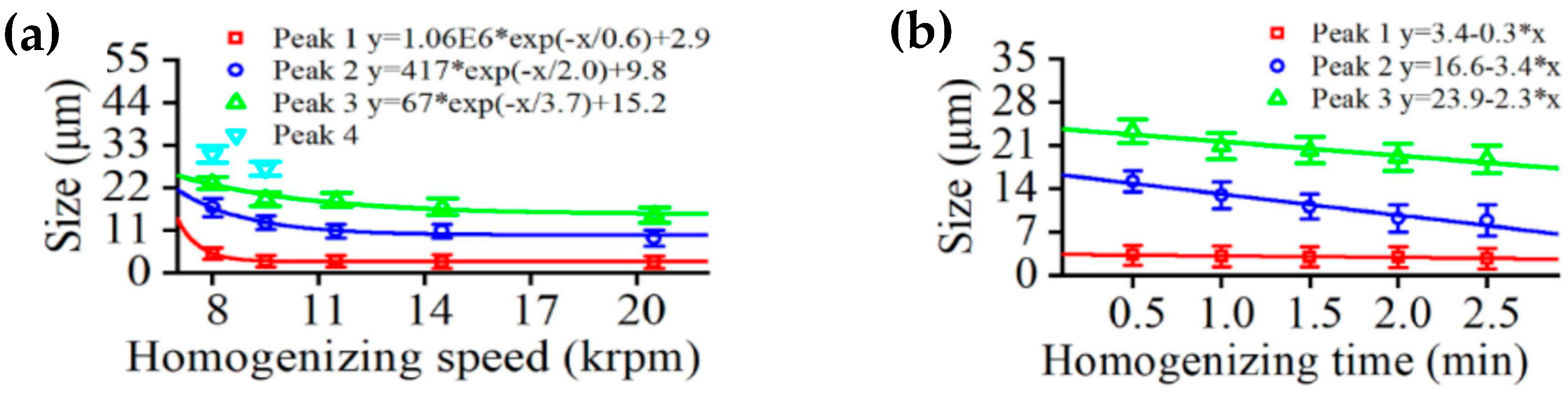
37]. Homogenization is a simple, high-energy method to produce emulsions [
37]. By utilizing high-shear dispersion emulsifiers, SF molecules initially solved in water can emulsify different oil phases, like other proteins. With the increase in homogenization speed and time, the size of emulsion droplets decreases (see
Figure 1), and the droplet coalescence slows down [
37,
38]. Moreover, the emulsions fabricated at higher homogenization speeds exhibit fewer irregular droplets, a faster liquid-gel transition, and less creaming during storage than those obtained at lower homogenization speeds. However, the emulsions fabricated at longer homogenization times show no obvious changes with regard to the creaming stability [
37]. Thus, speeding up and prolonging the homogenization step play an important role in slowing down the droplet coalescence, and therefore are beneficial for producing more stable emulsions with smaller and more regular droplets. However, when the homogenization speed and time exceed a critical value, the emulsions change from a liquid state to a semi-gel [
37].
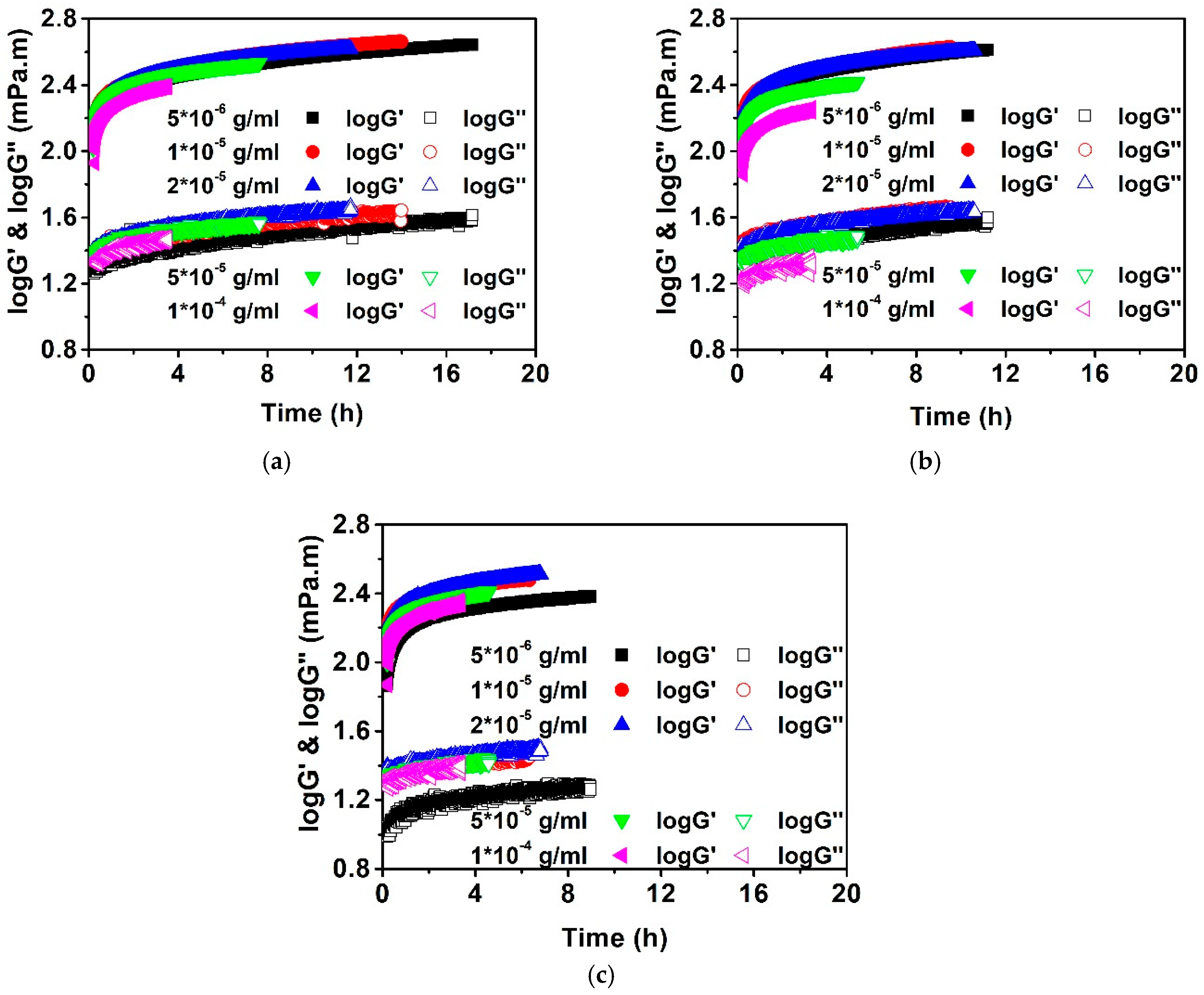
Compared to traditional surfactants, SF molecules diffuse and adsorb more slowly to the oil/water interface. The interface allows only a limited amount of SF molecules to adsorb, and further increase in the SF concentration (
CSF) leads to an excess of SF in the bulk or structural defects in the interfacial networks [
29]. The formation of interfacial films with β-sheet secondary structures after adsorption is very slow, too, and takes several hours to attain equilibrium, especially for high
CSF and more polar oil phases [
29]. Like lysozyme [
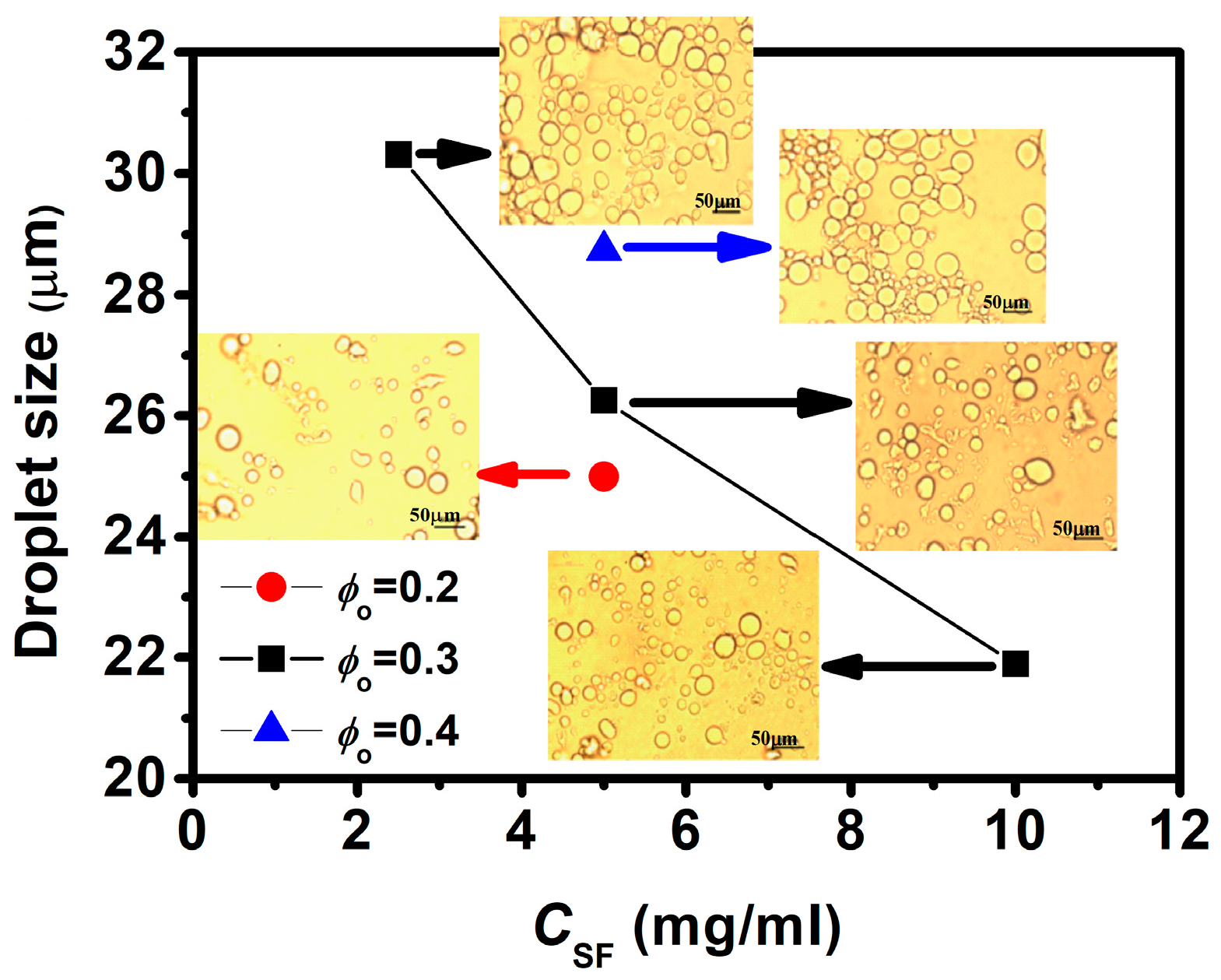
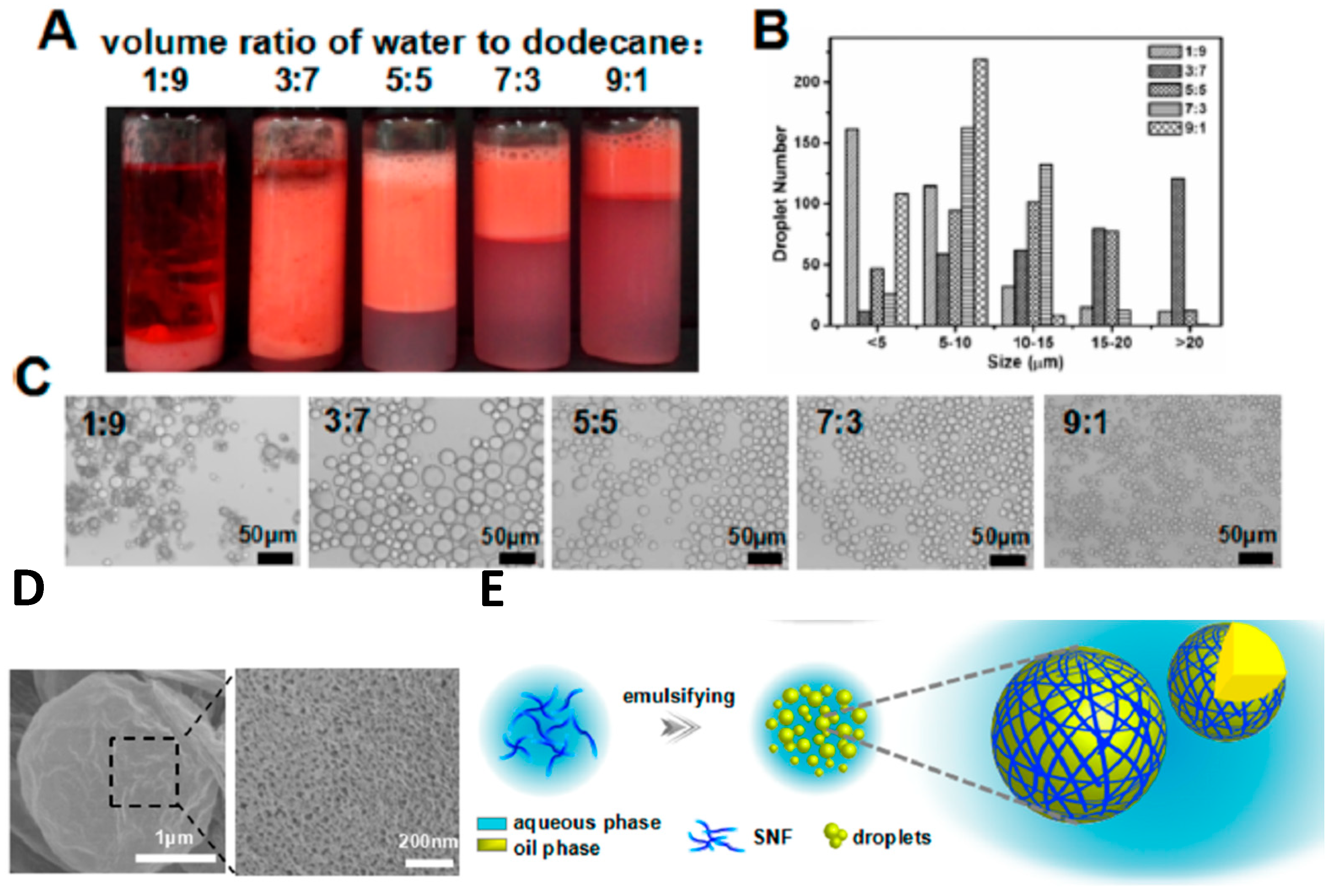
39], not all the droplets of SF-stabilized emulsions exhibit spherical shapes, but rather are elliptical or have even more intricate shapes because of the high interfacial storage moduli (see
Figure 2) [
27,
28,
37]. In addition, an increased oil content can also result in a slight deformation of emulsion droplets at the edge due to the dense packing and squeezing of the droplets [
35]. The size of emulsion droplets decreases with the increase in
CSF [
26,
36,
37,
38], which can be attributed to the enhanced protein adsorption, the strengthening of interfacial elasticity, and the resulting suppression of flow-induced coalescence, in line with the results reported for sweet potato proteins and concentrated flaxseed proteins [
40,
41]. The increase in droplet size with increasing oil/water volume ratio (
ϕo) [
26,
35,
36,
37,
38] is related to the increase in the total droplet surface area and the droplet collision frequency, and the decrease in the amount of adsorbed SF molecules. Taken together, all this results in less robust and protective interfacial layers and, in turn, promotes droplet coalescence [
26]. When the oil content exceeds a certain percentage, the emulsification fails with oil leakage due to the insufficient loading of the droplets by protein molecules [
38]. Moreover, the droplet size decreases with the increase in oil polarity from dodecane to hexanol, which can be attributed to lower corresponding interfacial tension [
42]. However, the dodecane/water emulsion with larger droplets exhibits better dispersed oil droplets in the continuous water phase with less flocs, which was interpreted as a consequence of the higher interfacial modulus of the SF layers formed at the dodecane/water interface than those at other polar oil/water interfaces [
26]. The decrease in initial emulsion droplet size helps to decrease emulsion creaming and improve the emulsion stability [
37]. With an increased storage time, the emulsion droplets become gradually irregular and increase in size because of droplet coalescence [
37].
In general, the emulsion stability can be evaluated by the creaming index (CI), which is obtained by dividing the serum layer height by the total emulsion height [
27]. Creaming, followed by phase separation with released water and/or oil, is one of the destabilization mechanisms of emulsions caused by gravity [
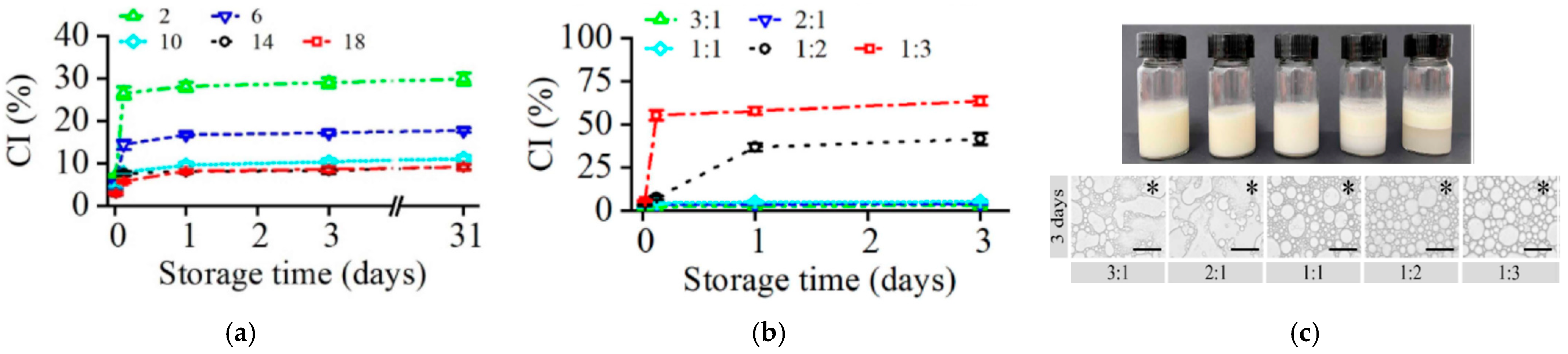
26]. During emulsification, there is a dynamic equilibrium between the droplet disruption and droplet coalescence. Therefore, before reaching a steady state, all O/W emulsions stabilized by SF experience an initial increase in the CI value. CI decreases with the increase in
CSF and
ϕo (see
Figure 3), and it is obvious that the emulsion stability is greatly improved by increasing
CSF and
ϕo [
26,
36,
37]. Before a saturated interfacial adsorption is reached, high
CSF helps to shorten the time to attain adsorption equilibration, and to form denser adsorption layers with stronger colloidal networks, thus leading to a higher interfacial elastic modulus, slower droplet coalescence, and less creaming [
26,
37,
38]. Moreover, denser adsorption layers hinder the droplet movement, which results in higher elastic moduli, a complex bulk viscosity, and yield stress of the emulsions, which all together further enhance the emulsion stability [
26,
27]. However, as
CSF exceeds a critical value, the adsorbed SF molecules can no longer pack well due to the jamming state and nonideal molecular arrangements, which causes the decrease in interfacial elasticity and toughness [
29]. This leads to the change in the emulsions from a liquid state to a semi-gel [
37]. Higher
ϕo leads to a closer packing and stronger interactions between the droplets, thus leading to a faster liquid-gel transition, enhanced elastic modulus, complex viscosity, and yield stress of the emulsion, and to a higher emulsion stability with less creaming [
26,
40,
43]. However, larger
ϕo brings about more irregular droplet shapes and faster droplet coalescence during storage, owing to the decreased SF adsorption and increased number of droplet collisions [
26,
37]. The high internal phase emulsions with more oil are easier to form emulsion gels and have a semi-solid texture. Emulsion semi-gels and gels are widely used in the food industry [
37]. Evidently, it is the enhancement of SF adsorption and the increased packing of oil droplets that promote the modulus, yield stress, and then the emulsion stability [
26,
36,
44]. Moreover, as for the SF-stabilized emulsions, higher oil polarity results in larger storage moduli, enhanced yield stresses, slower equilibration of emulsions, and higher emulsion stability with less water released before reaching a steady state, although the interfacial modulus of SF is lower at polar oil/water than that at nonpolar oil/water interfaces [
26]. It seems that the emulsion system behavior is more complex than the single oil/water interfaces, and sometimes, the impact of SF on the interfacial viscoelasticity and emulsion stability is slightly different upon the change in preparation conditions. The butyl butyrate oil leads to a two-stage creaming process because of its spatial restriction of the ester groups, which affects interfacial molecular arrangements in ways that are negative for emulsion stability [
27]. Although some water or serum is released after emulsification, the remaining emulsions are very stable over several months, owing to the protection by the adsorbed interfacial SF layers that suppress droplet coalescence. The interfacial shear rheological behavior of SF layers shows that the adsorbed SF molecules form elastic networks with β-sheet dominated structures at oil/water interfaces through conformation transitions, structural reorganization, and physical crosslinking [
29,
35], so that the equilibrium shear storage modulus (
Ge’) of the adsorbed SF layers is much higher than those, for example, of mAb,
β-casein, and BLG layers at oil/water interfaces [
10,
45,
46]. The bulk rheological behavior of SF-stabilized emulsions indicates that well-developed three-dimensional elastic network structures also exist in emulsions [
26], and the network formation should be attributed to the close packing and association of droplets [
47], which can be clearly observed in the insets of
Figure 2, especially for emulsions with larger
CSF and
ϕo [
26]. The formed strong elastic networks by SF self-assembly at the oil/water interface significantly enhanced the emulsion stability.
The environmental conditions show a great influence on the stability of emulsions stabilized by SF. The stable emulsion fraction is higher for systems with pure water than with buffer, especially at pH 4, although the interfacial tension at pH 4 shows a faster and more remarkable decrease and the lowest equilibrium values. At pH 4 around the isoelectric point (pI) of SF, the charge-neutralized SF molecules no longer repel each other electrostatically and therefore aggregate more easily and form more rigid interfacial layers with compact structures [
27], which result in a faster molecular adsorption at the interface and a higher modulus of interfacial layers at low
CSF (see
Figure 4). However, the weakening of interfacial ductility directly causes an easier structural rupture and a subsequent droplet coalescence upon small emulsion perturbations [
48,
49], thus providing emulsions with a lower emulsion stability and larger droplet size [
27]. When pH ≥ 8, the increasing electrostatic repulsion among SF molecules disrupts the adsorption of SF at oil/water interfaces, thus making the resulting emulsion less stable and even fail to form at pH 10 [
38]. The emulsion droplet size shows a maximum at pH 4, close to the pI, where the absence of electrostatic repulsion between the droplets promotes coalescence [
27,
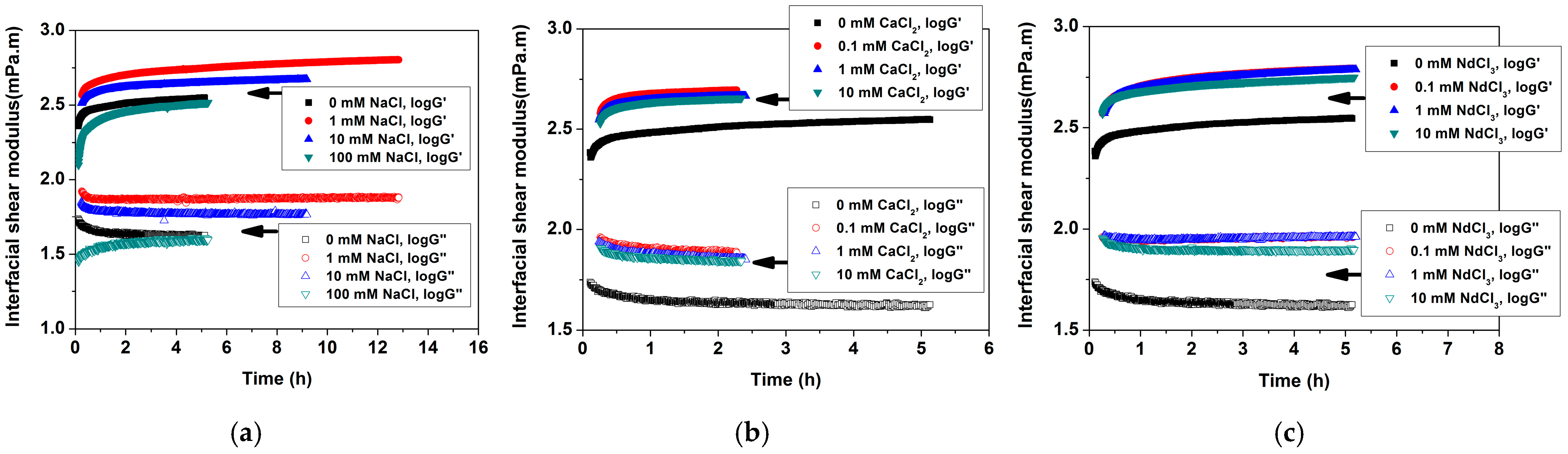
38]. On the other hand, the positively charged ions significantly affect the adsorption and layer properties of SF at the oil/water interface and thus the emulsion stability, as a result of the strong electrostatic interactions between counter-ions and the negatively charged groups of SF (see
Figure 5) [
28]. Higher ionic strength leads to lower interface tension, faster establishment of the adsorption equilibrium, higher interfacial strength, and lower interfacial fracture at large deformation, due to the reduction in the effective charge on SF molecules and enhanced adsorption and intermolecular interaction. However, at higher ion concentrations, the electrostatic screening and ion-binding effects result in SF aggregation, droplet coalescence, and a decreased emulsion stability, owing to the reduction in electrostatic repulsion. The droplet size exhibits a drastic increase with the addition of salt, and the stable emulsion fraction decreases with the increase in salt concentration (C
ion), especially for dodecane/water emulsions. The emulsions are more stable when the added salt is monovalent (NaCl) than when it is divalent (CaCl
2) or even trivalent (NdCl
3). This is in agreement with earlier reports on α-lactalbumin and BLG, where destabilization is attributed to Ca
2+ binding with the free carboxylic groups of aspartic and glutamic acids. This phenomenon can be explained by the stronger elastic modulus of the interfacial SF layers in the presence of NaCl, as evaluated by interfacial shear rheology [
50]. It is found that a suitable addition of negatively charged beet pectin can improve the stability of SF emulsions at pH 4 by covering the surface of positively charged SF-coated oil droplets and thus preventing emulsion aggregation. A low concentration of beet pectin causes charge neutralization and bridging flocculation, and a high concentration of beet pectin causes depletion flocculation of larger droplets, both of which lead to a sharp decline of emulsion stability. Beet pectin can also improve the stability of SF-stabilized emulsions at high salt concentrations at pH 3 by increasing the steric repulsion, that was interpreted by the authors as the consequence of a reduction in van der Waals interactions between the droplets. Besides emulsion stability, beet pectin enhances the oxidative stability of SF-stabilized emulsions during storage [
49]. In practical applications, strong emulsion stability against environmental stress is generally required, because of the coexistance of emulsifiers and additives, and the change in pH and temperature. The sensitivity of SF molecule-stabilized emulsions to pH and ionic strength due to the unstable interfacial conformation changes significantly limits the applications of SF as an emulsifier. Therefore, pre-structured SF may solve this problem, endow the emulsion with a higher stability to resist environmental changes, and widen the applications of SF-stabilized emulsions in various fields.
6. Stabilization Mechanism of SF-Stabilized Emulsions
Like other proteins, SF molecules can stabilize emulsions by adsorbing at the oil/water interface, decreasing the interfacial tension, forming protective films at the droplet surface, and preventing or decelerating droplet coalescence and/or Ostwald ripening. In addition, the SF network structures formed at the interface increase the emulsion viscosity and reduce the encountering frequency of droplets, further contributing to the stabilization of emulsions. At the oil/water interface, the adsorbed SF molecules experience conformational transitions and intermolecular self-assembly and thereby form stable, solid-like interfacial gels with ordered β-sheet structures and high interfacial moduli [
35]. The conformational changes and molecular rearrangements of SF seem very fast without obvious interfacial gel transitions, but the β-sheet formation experiences much slower physical crosslinking and structural reorganization into entangled networks. Higher SF concentrations help to shorten the time to attain adsorption equilibration and to form network structures at the interface with a higher elastic modulus that resist breakage, which leads to a higher emulsion stability with less water released during storage. However, as
CSF exceeds a critical value, the adsorbed SF molecules can no longer pack well due to the jamming state, thus causing the decrease in interfacial elasticity and toughness and even the transition of the emulsion from a liquid to gel state. Interfacial rheology results show that the interface between water and a nonpolar oil, in comparison to a polar oil, supports more SF molecules and promotes the formation of interfacial SF films with higher elastic moduli and greater toughness [
29]. However, macroscopic emulsions with high-polarity oil exhibit higher stability, larger storage moduli, and enhanced yield stresses in the bulk rheology [
26]. This indicates that the interfacial layers formed in bulk oil/water systems may be slightly different from the interfacial layers formed at single oil/water interfaces, bringing about the differences in the impact of oil polarity on the microscopic interfacial stability and the macroscopic emulsion stability.
The stabilization of emulsions with molecular SF as an emulsifier depends on the interfacial self-assembly of SF molecules to form β-sheet structures, while SF nanofibers with typical β-sheet structures can be directly used to stabilize emulsions [
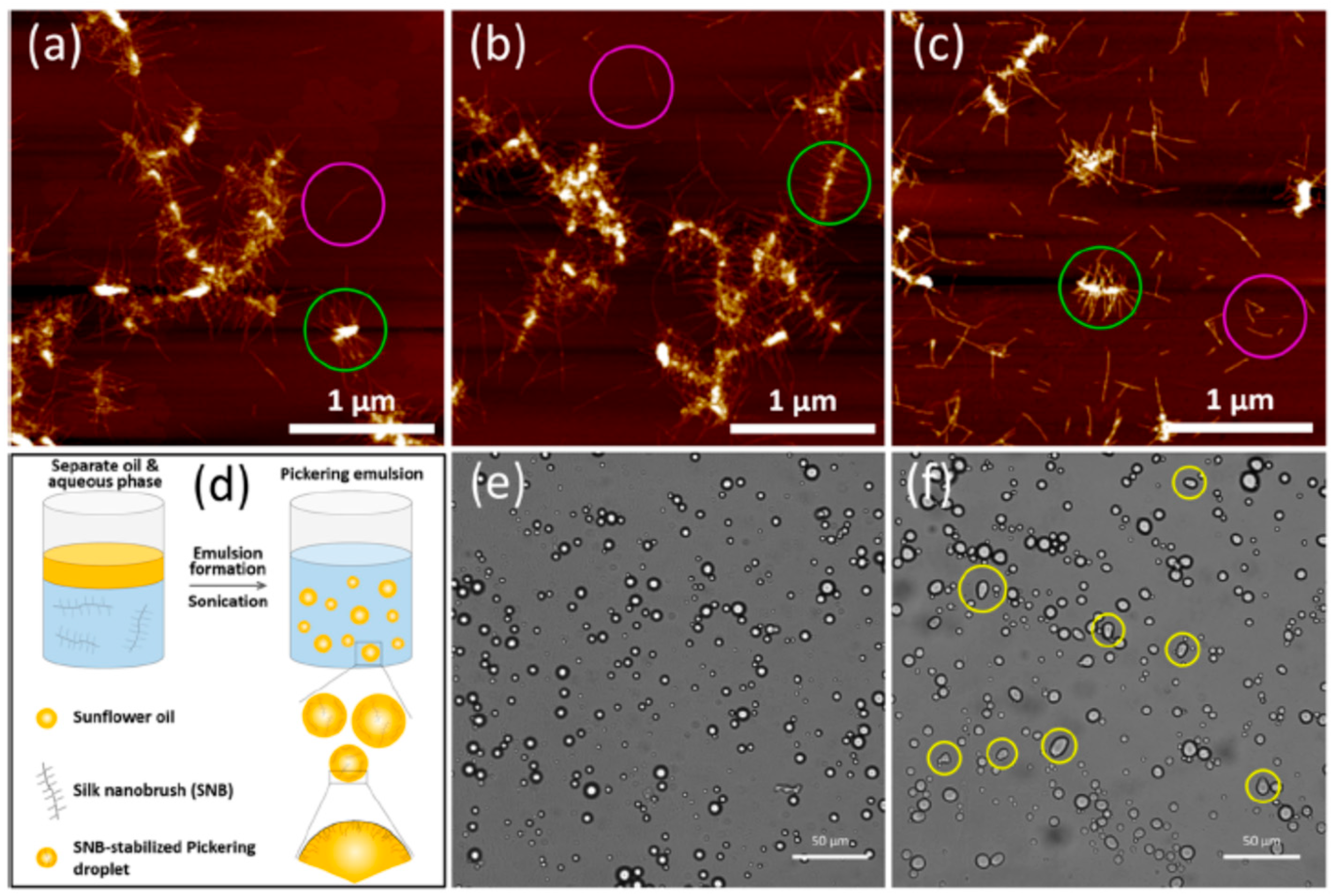
5]. SF nanofibers can form tight physical entanglement networks at the oil/water interface, and endow superior stability. The conformation of SF nanofibers shows no change after emulsion formation, which overcomes the drawback of single SF molecules with uncontrollable conformational transition. Hydrophobic SF nanofibers provide a controllable and reliable material to prepare more stable emulsions, as compared not only with single SF molecules, but also with other peptide nanofibers. The higher stability of emulsions is reached by SF nanofibers with respect to SF molecules because of their tighter and stronger interfacial networks and the force balance between a charge repulsion inside and outside the droplets. At neutral state and without salt addition, the decreased charge repulsion outside the droplets weakens the interaction balance and emulsion stability. With the addition of salt or acid, the charge repulsion inside and outside the droplets is shielded, and the dominant physical entanglements and interactions of SF nanofibers help to recover the emulsion stability. The pore size of the interfacial SF nanofiber networks decreases at higher salt concentrations and lower pH values, and the reduction in the charge repulsion among SF nanofibers strengthens nanofiber interactions and interfacial network structures [
5]. The superior stability of SF nanofiber-stabilized emulsions at high temperature, high salt concentrations, and low pH values helps to widen their applications in various fields. SF nanobrushes, as a nanocomposite of SF nanowhisker backbones and SF nanofiber branches, have a lower interfacial tension than the SF nanofibers and SF nanowhiskers alone. Their peculiar three-dimensional brush-like nanostructure allows SF nanobrushes to form much more sophisticated and interconnected networks than SF molecules and simple SF nanofibers at the oil/water interface, and thus ultra-stable biocompatible emulsions can be obtained for a wide range of concentrations [
51].
Different from SF molecules and SF nanofibers, SF particles stabilize emulsions by forming dense particle layers after irreversible adsorption at the oil/water interface. The resulting strong mechanical barrier prevents droplet flocculation and coalescence. Moreover, the surface charge of SF particles, contributed by the amino-acid sequences of the hydrophilic domains, generates electrostatic repulsion between the emulsion droplets, thus preventing droplet aggregation and enhancing emulsion stability [
38]. SF particles obtain the folded β-sheet secondary structure through the self-assembly of SF molecules during the regeneration process, similar to SF nanofibers and SF nanobrushes. The water-insoluble β-sheets, formed by the folding of hexapeptide sequences in SF molecules, enhance the structural stability against environmental stress and prevent emulsion destabilization [
38]. Therefore, the pre-structuring procedure avoids the unstable structure transition of SF molecules in actual applications, and the emulsions stabilized by SF nanofibers and SF nanoparticles show superior stability at high temperature and high salt concentration.
7. Conclusions
SF concentration, SF morphology, oil polarity, oil/water volume ratio, and environmental conditions play significant roles in the molecular adsorption, structural reorganization, and interfacial viscoelasticity of SF at oil/water interfaces. In turn, these factors, as well as the emulsion fabrication technique, have great influences on the stability of the resulting emulsions. Increasing homogenization speed, time, or pressure helps to promote the emulsification efficiency and to produce more stable emulsions with smaller droplet size and fewer irregular droplets. The time to attain the adsorption equilibrium is shortened with increasing SF concentration, with increasing oil polarity, and with the addition of salt. The interfacial strength and toughness of SF layers and, hence, the emulsion stability can be enhanced by raising SF concentration and adding salt to the aqueous phase. pH values close to the pI or above pH 8 lead to emulsion instability, due to the loss of mutual repulsion caused by charge neutralization or SF desorption caused by the extremely strong electrostatic repulsion.
Nanostructured SF, such as SF nanofibers and SF nanoparticles, possesses β-sheet-dominated secondary structures, and the enhanced structural stability endows them with the capability to resist environmental stresses such as high temperature and high salt concentrations, which overcomes the drawback of isolated SF molecules with unstable conformation transitions during the application. Emulsions stabilized by SF nanofibers can even show superior stability at low pH, because of the formation of tight and strong entangled networks, which endows SF nanofibers with the universality and versatility for various emulsion applications. Although the emulsions stabilized by SF nanoparticles cannot resist extreme pHs, the pH-responsiveness can endow these Pickering emulsions with intelligent features that are very useful for emulsion polymerization and catalyst/emulsifier recycling. SF molecules stabilize emulsions by interfacial molecular self-assembly to β-sheet-structured viscoelastic films, after adsorbing at oil/water interfaces. Nanostructured SF and SF particles, with β-sheet dominated secondary structures, can be directly used to stabilize emulsions by physical entanglement networks or particle adsorption layers formed at the oil/water interface. Compared with other protein-stabilized emulsions, the SF-stabilized emulsions possess great advantages of low cost, controllable microstructure and properties, higher compatibility with biocomponents, and superior stability at high temperatures, high salt concentrations, and extreme pH values, via the regulation of the SF morphology. Biocompatible emulsions stabilized by SF have a promising future for applications in different fields, such as in cosmetics, food, drug delivery, and biomedicine. Some functional food, skin care products, and porous scaffolds have already been commercialized [
20,
54]. The understanding of the relationship between adsorption, interfacial viscoelasticity, and the emulsification properties of SF is very important for the design, preparation, and application of SF emulsions in various fields.