1. Introduction
The Industrial Internet of Things (IIoT) embodies the fusion of Operational Technology (OT) and Information Technology (IT) by bringing about unprecedented capabilities for monitoring, predictive maintenance, and process optimization in industrial environments, including health care, transport, logistics, oil refinery systems and power grids. However, this integration also broadens the attack surface because formerly isolated industrial networks become accessible through IP-based connectivity [
1], which makes them attractive targets for cyber attacks, including large-scale Distributed Denial of Service (DDoS) attacks [
2]. Protecting IIoT systems at the edge is imperative for at least two main reasons. First, industrial control loops demand response times in the millisecond range, which is generally considered to be a real-time response, a requirement that cannot be met by cloud-based analysis due to unavoidable network delays. Second, data sovereignty regulations frequently forbid the transfer of sensitive operational data to external cloud infrastructure. Consequently, intrusion detection must be performed directly on edge gateways, i.e., on devices with limited CPU power, modest memory, and no hardware acceleration [
2]. Traditional signature-based intrusion detection systems are ineffective against previously unseen attack variants, while anomaly-based methods tend to generate excessive false alarms in dynamic industrial settings, which renders them ineffective [
1,
3]. Deep learning models have proven highly effective for network intrusion detection, but their computational demands often exceed the capabilities of edge hardware. Moreover, a model trained on existing datasets, such as the CIC-DDoS2019 [
4] and CICIoT23 [
5] datasets, may generalise well to newer traffic-pattern phenomena, which addresses the issue of domain shift [
6].
To position the present work precisely with respect to the state of the art, we emphasise that its novelty does not lie in any individual building block, since CNNs, attention modules, and transfer learning are individually well established, but in the joint co-design of these building blocks under explicit edge-resource and feature-heterogeneity constraints that, to the best of our knowledge, no existing DDoS detection framework satisfies simultaneously. Existing deep transfer learning detectors either require the source and target domains to share a common feature space or circumvent feature mismatch by converting traffic records into images and fine-tuning large vision backbones such as VGG19 or ResNet [
7,
8,
9], which inflates the inference cost to the 5–30 ms range and frequently necessitates GPU or SmartNIC acceleration [
10,
11]. In contrast, the proposed framework resolves feature-space heterogeneity natively in the tabular domain through a trainable, dataset-specific linear projection layer that is reinitialised per domain while the convolutional extractor is transferred and frozen. This design eliminates both image-conversion overhead and distribution-alignment machinery (e.g., MMD-based adaptation [
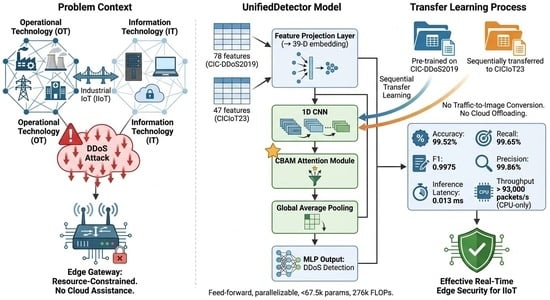
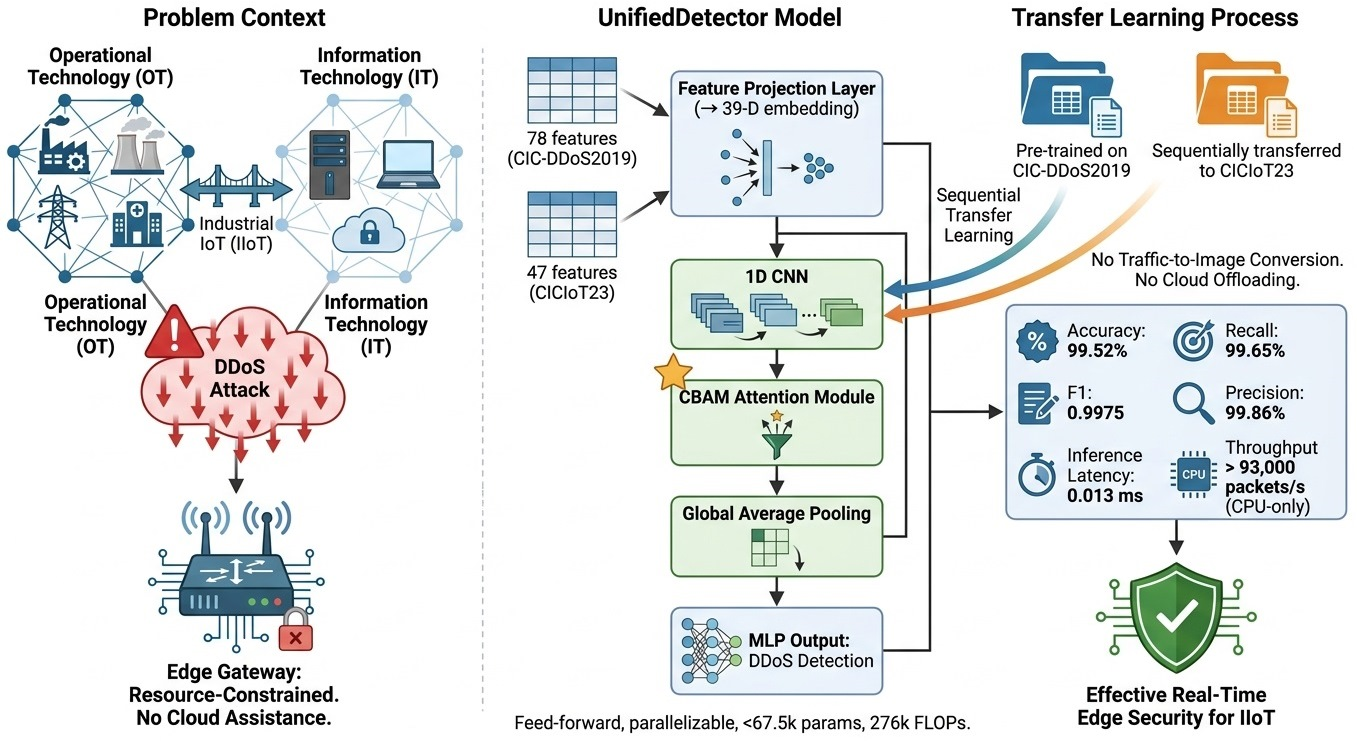
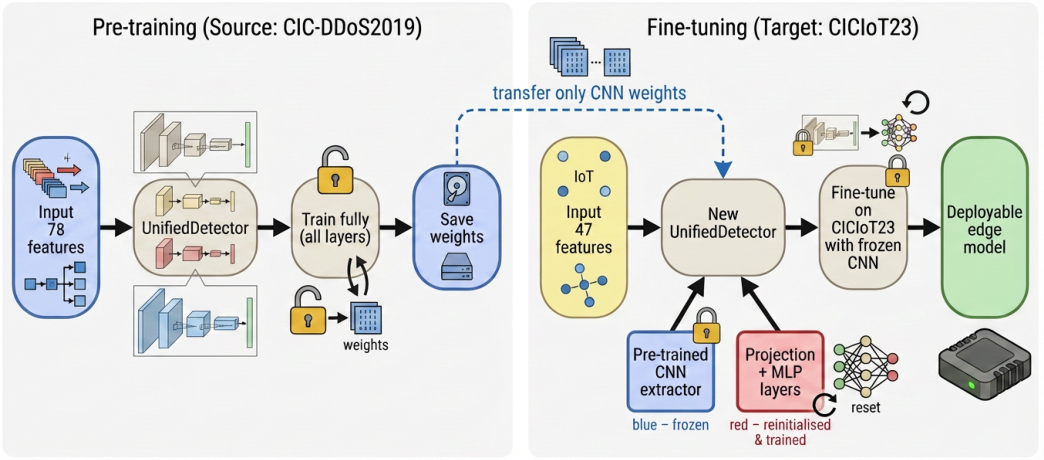
10]) and yields a complete detector of approximately 67,500 parameters and 276,000 FLOPs per inference, executing in 0.013 ms on a CPU-only platform. The specific contributions of the authors are described as follows:
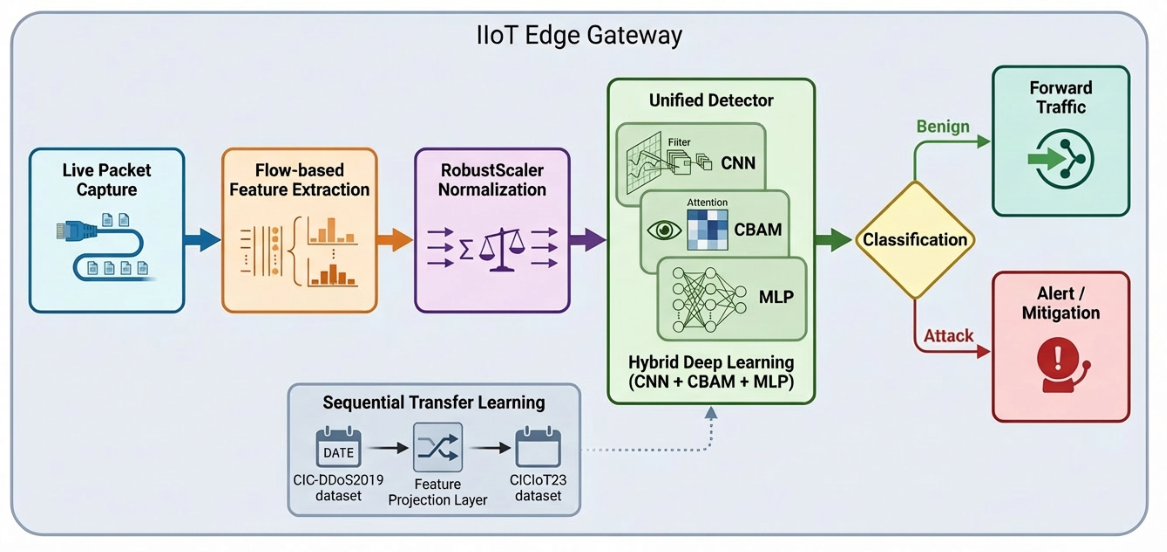
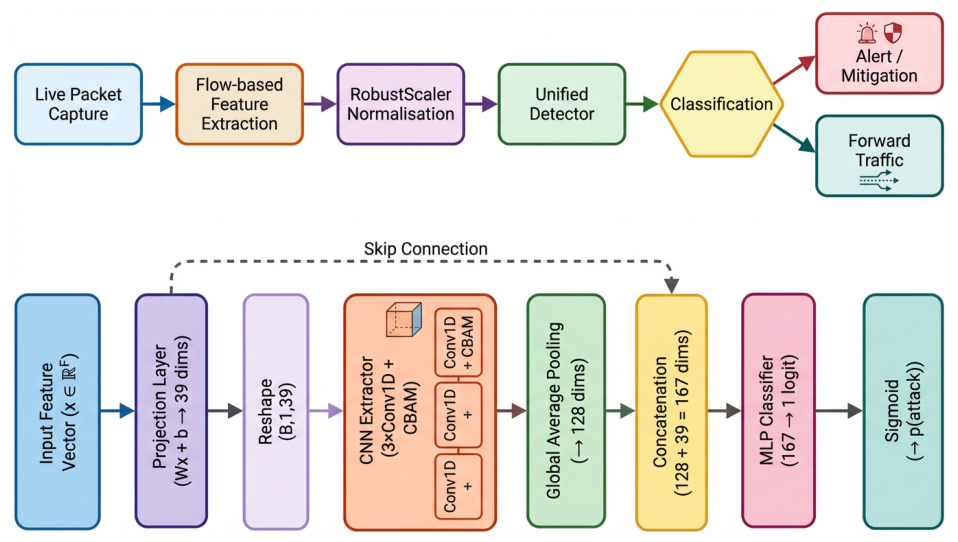
A resource-aware unified architecture: We design UnifiedDetector, a single-pass detector that couples a compact, three-layer 1D CNN with a CBAM attention module, a global average-pooling stage, and a projected-feature skip connection feeding a lightweight MLP head. Unlike recurrent hybrids (CNN-LSTM/GRU) whose sequential dependencies dominate inference time, every component is feed-forward and parallelisable, bounding the cost at approximately 276,000 floating-point operations per inference and enabling CPU-only edge execution without hardware accelerators.
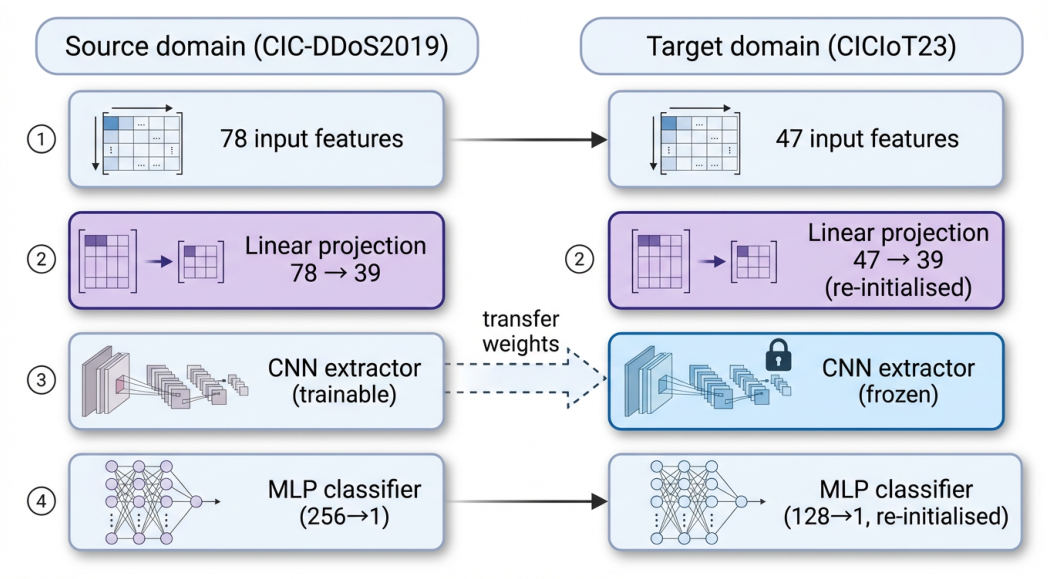
Heterogeneous-feature sequential transfer learning: We introduce a trainable feature projection layer that maps source (78 features) and target (47 features) spaces onto a common 39-dimensional embedding, enabling sequential transfer of the frozen CNN extractor between datasets with incompatible dimensionalities, without traffic-to-image conversion and without cloud offloading. The projection dimension is justified empirically through a dedicated sensitivity sweep (
Section 5.3.2), and the freeze depth is verified through ablation.
Statistically validated, deployment-oriented evaluation: Beyond standard detection metrics (accuracy, precision, recall, F1, AUC, FPR, and TNR), we provide (i) component, projection-dimension, freeze-strategy, and transfer-direction ablations with re-implemented baselines under identical preprocessing, splits, and hardware; (ii) formal statistical significance testing of the proposed model against all baselines using paired tests across seeds with Holm–Bonferroni correction and effect sizes (
Section 5.3.1); and (iii) real-time characterisation comprising average and 99th-percentile latency, inference-only and end-to-end throughput, and a Liu–Layland schedulability analysis—a combination that prior DTL-based DDoS studies do not report [
7,
8,
10,
12].
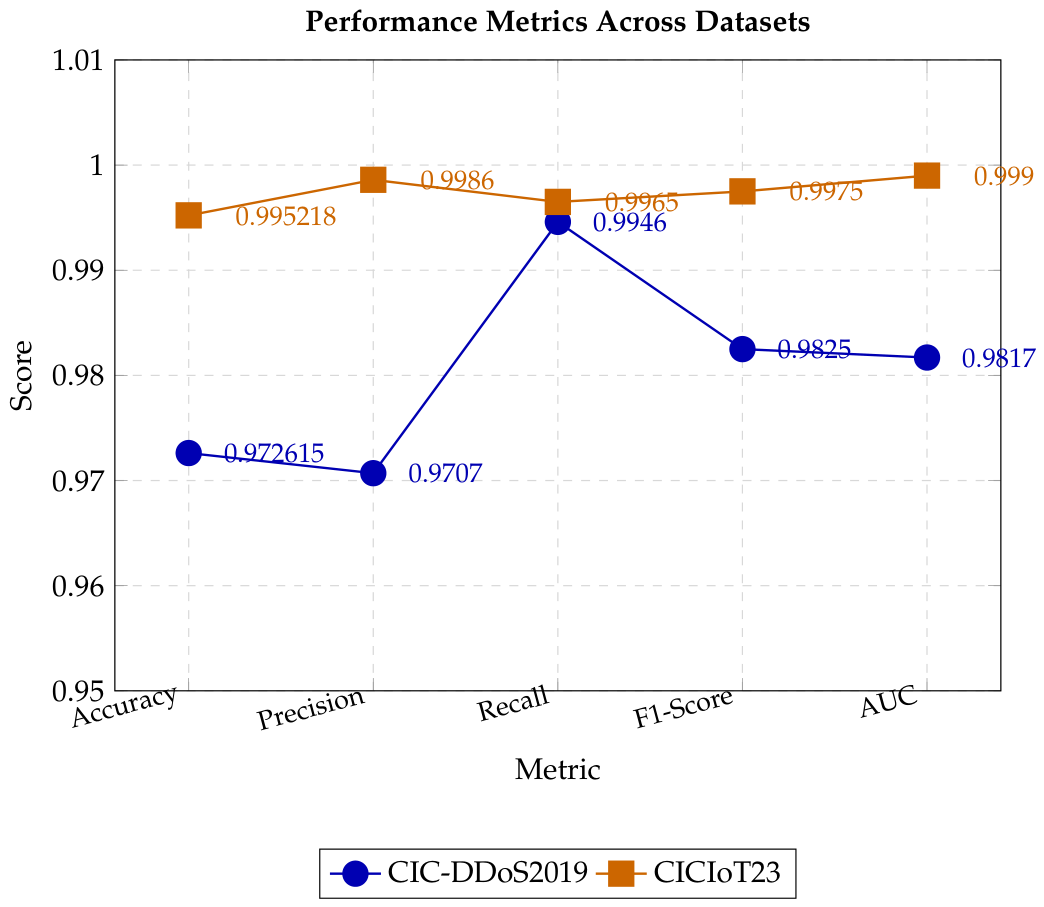
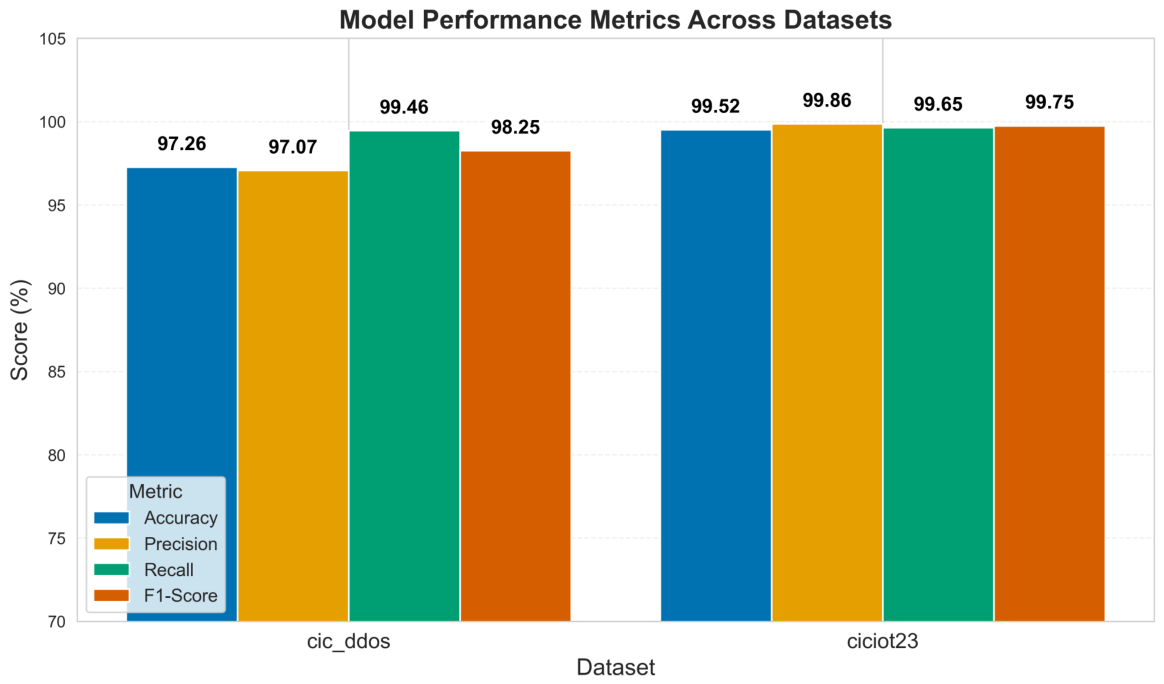
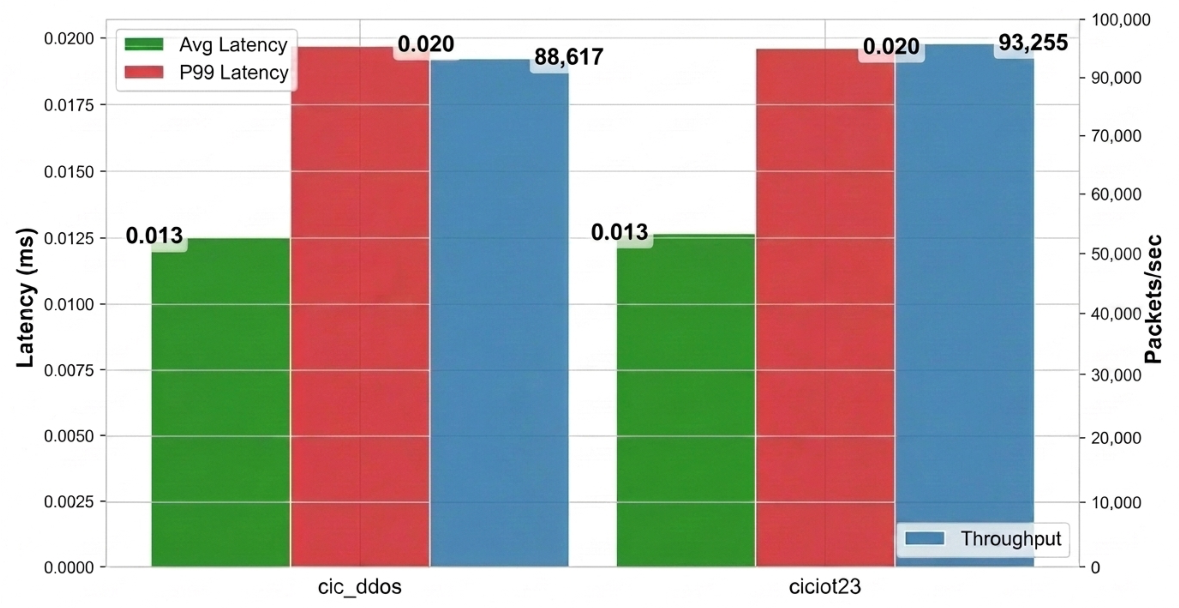
Experimental results show that the proposed approach attains 99.52% accuracy on CICIoT23, with an F1 score of 0.9975, precision of 99.86%, recall of 99.65%, FPR of 5.61%, TNR of 94.39%, average inference latency of 0.013 ms, inference-only throughput exceeding 93,000 packets/s, and end-to-end batch throughput of about 38,000 packets/s, which confirms its viability for resource-constrained IIoT edge gateways.
2. Related Work
Conventional DDoS detection can be broadly divided into signature-based and anomaly-based methods. Signature-based systems compare incoming traffic against a database of known attack patterns [
13]. They are effective for recognised threats but fail against novel attacks. Anomaly-based systems learn a baseline of normal behaviour and flag deviations. While they can detect unknown attacks, they often suffer from high false-positive rates in complex industrial environments [
14]. Deep learning has become a popular tool for network intrusion detection. Convolutional Neural Networks (CNNs) are used to extract spatial features from traffic representations, while Recurrent Neural Networks (RNNs) and Long Short-Term Memory (LSTM) networks capture temporal dependencies. Autoencoders offer an unsupervised approach by learning compact representations of normal traffic and measuring reconstruction errors. Nevertheless, these models are typically computationally intensive and designed for cloud deployment rather than edge execution [
15,
16]. Attention mechanisms help neural networks focus on the most informative parts of their input. The Convolutional Block Attention Module (CBAM) applies sequential channel and spatial attention to highlight salient features. In network security, attention can amplify bursty attack patterns that might otherwise be masked by background traffic [
17,
18].
Transfer learning addresses domain shift by reusing knowledge acquired from a source domain and adapting it to a target domain [
19]. In cybersecurity, transfer learning has been employed to adjust intrusion detection models to new network environments and to alleviate the scarcity of labelled attack data [
20]. However, most existing works do not consider the additional constraints imposed by edge deployment. Recent research has explored lightweight model design for edge deployment through techniques such as pruning, quantisation, and knowledge distillation [
17,
21], yet few studies provide rigorous real-time validation that includes latency measurements and schedulability analysis. The Liu–Layland model offers theoretical bounds for fixed-priority scheduling in real-time systems, enabling verification that detection tasks can meet their deadlines [
22].
The evolution of security architectures for IIoT has shifted from static, centralized paradigms toward autonomous, decentralized frameworks capable of addressing the dynamic nature of modern cyber–physical threats [
23]. Recent research increasingly leverages the intersection of Software-Defined Networking (SDN), Deep Reinforcement Learning (DRL), and Federated Learning (FL) to provide adaptive defences at the network periphery [
15]. However, the deployment of these sophisticated models is often hindered by the inherent resource constraints of edge gateways and the stringent requirement for sub-millisecond response times in critical industrial control loops. This section provides a critical analysis of seminal contributions in the field, following a structured sequence to identify the specific research gaps that the proposed lightweight hybrid approach aims to address [
24].
Farzaneh et al. proposed DTL-5G, a deep transfer learning framework for DDoS detection in 5G-and-beyond networksthat pretrains BiLSTM, CNN, ResNet, and Inception models on a large source dataset from a 5G testbed, then fine-tunes them on the sparse 5G-NIDD target dataset. The study shows that transfer learning improves detection over non-TL baselines, with BiLSTM achieving the strongest gains in accuracy, recall, and F1 score, while Inception achieves the best precision. However, the authors note that the effectiveness of DTL is highly context-dependent when source and target distributions differ and that deciding how many layers to freeze or add increases computational cost. This points to a need for lighter and more adaptive transfer learning strategies that generalize better across heterogeneous 5G and B5G scenarios [
12].
He et al. proposed a deep transfer learning method for small-sample DDoS attack detection that transfers knowledge from a source domain with sufficient SYN-type attack samples to a target domain with limited LDAP-type samples, using a transferability metric to select the best neural network before fine-tuning it on the target data. The study shows that deep transfer learning can substantially reduce the performance drop caused by scarce labelled attacks, with the selected 8LANN model improving target-domain detection performance by about 20.8% after transfer and fine-tuning. Its main limitation is that the evaluation is restricted to a single source-target pair and a tenfold reduction in target samples, so broader generalization across other attack families is not demonstrated [
25].
Anley et al. proposed an adaptive transfer learning framework for DDoS detection that preprocesses network traffic into images and fine-tunes custom CNNs, including Conv4, Conv8, Conv18, alongside pretrained VGG16, VGG19, and ResNet50, across multiple cybersecurity benchmark datasets. The study reports strong transfer performance, with transferred models outperforming single-domain training and VGG19 and Conv18 reaching very high accuracy on binary and multi-class tasks. Its main limitation is sensitivity to source-target mismatch, since transfers from smaller or less complex datasets to larger, more complex ones can reduce accuracy [
7].
Expanding upon sequential networks, Anaga et al. proposed a systematic comparison of hybrid deep learning architectures (CNN, CNN-GRU, and CNN-LSTM) specifically optimised for Software-Defined Networks (SDNs). Their proposed CNN-LSTM hybrid achieved an excellent 99.73% accuracy on the CICDDoS2019 dataset and 99.95% on the InSDN dataset. However, comprehensive computational analysis exposed an underlying bottleneck, with the sequential processing of recurrent layers resulting in a lengthy 70.49 ms average prediction time per sample [
11].
To bypass the intensive data requirements of these sequential variants, deep transfer learning (DTL) paradigms have recently been explored [
26]. Feng and Chen designed an adaptive transfer learning framework leveraging Maximum Mean Discrepancy (MMD) feature alignment coupled with an attention mechanism to locate anomalous traits. While their structural approach successfully mitigated target data scarcity, it introduced a significant 29.00 ms propagation delay within university network security infrastructure [
10].
To circumvent these latency hurdles, Shen et al. combined Fast Fourier Transform (FFT) with a fine-tuned VGG19 framework to capture complex DDoS characteristics. High-dimensional traffic vectors from the CICDDoS2019 dataset were transformed into image arrays, resulting in an accuracy of 99.11%. A primary constraint of this approach is its heavy dependency on GPU-accelerated parallel computing techniques; without serial bypass acceleration, the framework still incurs an average inference latency of 18.30 ms per sample [
8].
Similarly, Bakar et al. utilised transfer learning to map a pre-trained ResNet-18 model to line-rate traffic analysis within an intrusion prevention framework. To protect resource-constrained edge CPUs from severe processing spikes that climbed to 92.6%, the authors offloaded the convolutional calculations to specialised enterprise SmartNIC Data Processing Units (DPUs). While achieving a 99.45% classification yield on CICDDoS2019, the architecture still demanded a 5.50 ms inference window despite hardware acceleration [
9].
Liu et al. proposed a DRL-based Multi-layer IoT-DDoS Defense System (DRL-MLDS) that is distinguished by its adherence to IEEE P2668-compliant [
27] reward metrics. The methodology utilises a novel Time Window-based Traffic-Capturing and Feature-Extraction (TW-TCFE) process to avoid long-term deadlocks and a Power Law-Based Blocking Time Mechanism (PL-BTM) to refine the handling of malicious samples. Experimental evaluations demonstrate a defence accuracy of approximately 97% against multi-layer IoT-DDoS attacks, significantly improving the Industrial Applicability Index (ADex) from 3.2 to 4.4. While the framework provides a robust standardized approach, its primary weakness lies in the inherent processing overhead of the multi-layer capture phase, which may introduce micro-latencies unsuitable for hard real-time industrial applications [
24].
Kheddar et al. provided a comprehensive systematic review of DRL applications in network intrusion detection, focusing on the unique requirements of IoT, IIoT, and Industrial Control Systems (ICS). The authors established a meticulous taxonomy that categorizes algorithms such as DQN, DDQN, and PPO based on their ability to handle non-stationary and partially observable environments. The review highlights that while confusion-matrix metrics remain the evaluation standard, the field lacks a unified benchmark for hardware-specific performance on resource-constrained devices. A significant research gap identified by the authors is the lack of “online” adaptation strategies that can operate effectively without the high computational costs of offline retraining, identifying this as a primary hurdle for edge deployment [
28].
Guo et al. introduced the DRL-based QoS-Aware Secure Routing (DQSP) protocol designed specifically for SDN-IoT architectures. The methodology utilizes an RL agent to learn network flow patterns and dynamically optimize routing policies to bypass malicious nodes involved in grey-hole and DDoS attacks. Simulation results on a 200-node topology indicate that DQSP achieves a relative performance gain of at least 10% over traditional protocols like OSPF in terms of end-to-end delay and the packet delivery ratio. Despite its efficacy in path optimization, the study primarily addresses high-rate DDoS threats. Its main weakness is the potential vulnerability to stealthy, low-rate attacks that do not trigger significant traffic disruptions or QoS alerts [
29].
Zainudin et al. developed an efficient hybrid Deep Neural Network (DNN) for the classification of DDoS attacks within SDN-enabled IIoT networks. Their methodology integrates an extreme gradient boosting (XGBoost) feature selection unit with a hybrid CNN-LSTM architecture to reduce spatial and temporal feature dimensionality before classification. Evaluated on the CICDDoS2019 dataset, the system achieved high precision and accuracy across various attack vectors. The reported computational latency for real-time operations also remains acceptable for industrial applications, with sub-millisecond precision. However the model requires improvement for DNS attack detection [
30].
Ferrag et al. detailed the creation of Edge-IIoTset, a comprehensive and realistic cybersecurity dataset generated from a seven-layer IIoT testbed. The dataset encompasses 14 categories of protocol-related attacks and offers 61 high-correlation features extracted from a total of 1176 attributes to facilitate the training of both centralized and federated learning models. A major strength of this work is the provision of a multi-layer evaluation environment that includes perception, network, and cloud components, reflecting real-world industrial heterogeneity. Nevertheless, as the paper focuses primarily on data generation and baseline algorithm testing, it does not propose a specific optimized hybrid architecture for minimizing the memory footprint on low-power edge gateways [
31].
Zhang et al. introduced the RKD-VNE algorithm, which leverages resource knowledge description and DRL to improve virtual network embedding in IIoT scenarios. The approach utilizes a deep belief network-based cyberattack detection scheme to tune embedding parameters and improve system stability during network fluctuations. While the integration of resource knowledge significantly improves the efficiency of node mapping and security during virtualization, the framework’s primary objective is resource management rather than dedicated DDoS mitigation. This leaves a gap for specialized hybrid models that can perform intrusion detection simultaneously with the real-time resource scheduling tasks typical of IIoT edge devices [
32].
Al-Zewairi et al. proposed the TON_IoT telemetry dataset, which integrates heterogeneous data sources from the perception, network, and OS layers of a large-scale IIoT network. Unlike traditional packet-only datasets, this work includes telemetry data from sensor readings, supporting multi-classification problems with ground-truth labels. The study demonstrates that data-driven methods can identify intruders with high accuracy using this diverse data. However, an identified weakness is that baseline models evaluated on TON_IoT often report high false-positive rates (FPRs) for subtle, low-rate data manipulation attacks, indicating a need for more sensitive temporal feature-capture mechanisms in hybrid model designs [
33].
Abuhasel and Khan proposed a comprehensive security framework for resource management in smart manufacturing environments. The methodology establishes a secure manufacturing cycle by integrating AI-based threat detection with resource-efficient scheduling protocols. While the framework provides a strong theoretical foundation for industrial security and latency issues, its primary weakness is the lack of detailed experimental validation using high-dimensional DDoS datasets. This necessitates further research into specific hybrid deep learning models that can be embedded directly into this manufacturing framework to improve its real-time response capabilities against volumetric threats [
34].
Nguyen et al. investigated the integration of Federated Deep Reinforcement Learning (FDRL) for traffic monitoring in SDN-based IoT networks. The “DeepMonitor” system uses a Double Deep Q-Network (DDQN) to optimize flow-rule match-field policies, allowing for detailed traffic analysis at the network periphery while preserving data privacy. The approach achieved a 22.83% improvement in detection accuracy by capitalizing on the diversity of local data. However, the model’s performance remains sensitive to non-IID data distributions across different industrial nodes, which can lead to model divergence and inconsistent security policies in heterogeneous environments [
35].
Simpson et al. developed a per-host DDoS mitigation strategy using direct-control RL to manage network flow patterns at a granular level. The agent acts on a per-flow basis in a protocol-agnostic manner, allowing it to optimize performance criteria in non-stationary environments. A major strength is the granularity of control, which significantly advances RL-based prevention. Nevertheless, a critical weakness identified by the authors is the difficulty in safeguarding legitimate UDP traffic, which the agent frequently misclassifies as attack traffic during high-burst periods, which highlights a need for more robust traffic classification layers [
36].
Nandanwar and Katarya introduced a DL model specifically for detecting and classifying multi-variant botnet attacks in IIoT environments. The methodology employs an adaptive CNN-GRU model to extract intricate spatial and temporal features from raw network data. The model achieved high accuracy rates of up to 99% on benchmark datasets by learning normal traffic patterns and identifying subtle deviations. Despite its superior precision, a significant weakness is the computational requirement of the GRU layers, which may exceed the memory and power budgets of resource-constrained industrial edge gateways in real-world deployments [
37].
Janabi et al. provided a critical survey of intrusion detection systems in SDN environments, mapping specific attack vectors such as flow-table overflow. The authors evaluated the transition from static, rule-based databases to intelligent machine learning agents, emphasising the potential of leveraging public datasets for model validation. While the survey offers a robust mapping of SDN-specific threats, it highlights a persistent weakness in current implementations: the computational bottlenecks associated with processing large traffic volumes. This underscores the research need for lightweight, hybrid models that can maintain high recall without overloading the controller or the edge gateways during volumetric DDoS events [
38].
Table 1 provides summary of related works discussed above.
Viewed collectively, the transfer learning literature for DDoS detection falls into three methodological families, each with a structural weakness when measured against IIoT edge constraints. The first family fine-tunes within a shared feature space [
12,
25]: it is computationally tractable but cannot, by construction, transfer knowledge between datasets whose feature dimensionalities differ, which is precisely the situation encountered when migrating from CIC-DDoS2019 (78 features) to CICIoT23 (47 features). The second family sidesteps feature heterogeneity by converting tabular flow records into images and fine-tuning large pre-trained vision backbones [
7,
8,
9]: this resolves dimensional mismatch but imports millions of parameters designed for natural-image statistics, inflating inference latency to 5.50–18.30 ms and creating a dependency on GPU or DPU acceleration that typical IIoT gateways do not possess. The third family performs explicit distribution alignment, for example, through MMD-based adaptation [
10]: it offers principled domain adaptation but adds an alignment computation whose 29.00 ms propagation delay exceeds the millisecond-scale deadlines of industrial control loops by more than an order of magnitude. A parallel deficiency cuts across all three families and the broader DL literature [
11,
30,
37]: reported gains are almost never accompanied by statistical significance testing against baselines re-implemented under identical conditions, schedulability evidence, or end-to-end (rather than inference-only) throughput figures, which leaves the practical deployability of these methods unverified. The present work is designed to close these specific gaps: a trainable per-domain projection layer provides heterogeneous feature transfer natively in the tabular domain at negligible cost; the entire detector remains within the range of approximately 67,500 parameters and 276,000 FLOPs so that no accelerator is required, and the evaluation couples re-implemented baselines with paired significance tests, ablations, and real-time schedulability analysis.
In summary, the critical review above identifies four recurring gaps. First, accuracy gains from spatial–temporal and DTL models are routinely purchased with inference latencies (5.50–70.49 ms) that violate the millisecond-scale deadlines of industrial control loops [
8,
9,
10,
11]. Second, no surveyed transfer learning approach handles heterogeneous tabular feature spaces without resorting to image conversion or restrictive same-dimension assumptions [
7,
12,
25]. Third, federated and DRL-based defences remain sensitive to non-IID data and lack hardware-specific benchmarks for constrained gateways [
28,
35]. Fourth, comparative claims throughout the literature rest on figures reported under heterogeneous datasets, hardware, and preprocessing, without re-implemented baselines or statistical significance testing. These gaps jointly motivate the present design: a lightweight hybrid detector with native heterogeneous feature transfer evaluated against baselines re-implemented under identical conditions, along with formal significance testing and real-time schedulability evidence.
4. Experimental Setup
This section describes the datasets, preprocessing procedures, training configuration, baseline implementations, and evaluation metrics used to assess the proposed UnifiedDetector model. The goal is to ensure reproducibility and to evaluate the system under realistic industrial IoT traffic conditions.
4.1. Datasets
Two cybersecurity datasets were used to evaluate the proposed model: CIC-DDoS2019 and CICIoT2023.
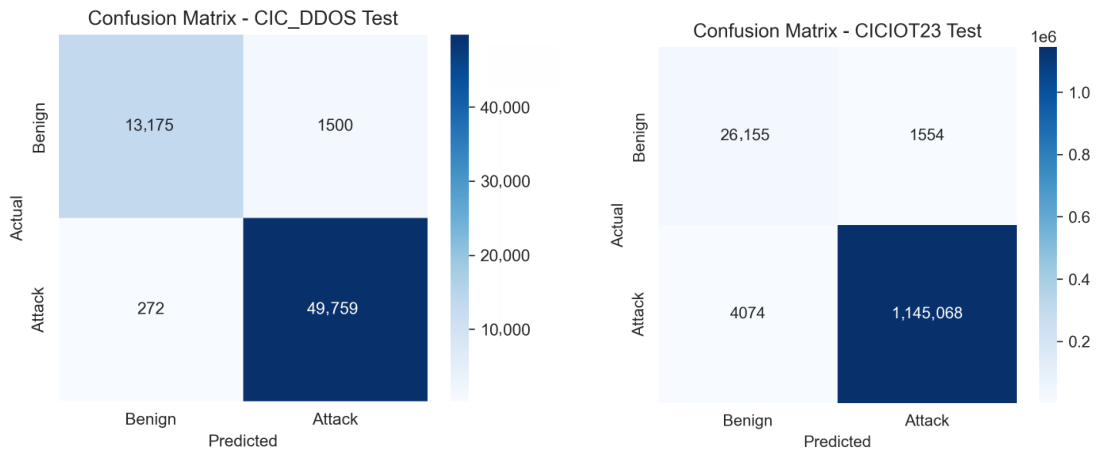
CIC-DDoS2019 dataset: The CIC-DDoS2019 dataset contains modern reflection and amplification attacks captured in 16 PCAP files, covering DNS, LDAP, MSSQL, NetBIOS, NTP, SNMP, and UDP amplification attacks. After loading, we obtained 431,371 samples, each with 78 numerical features. The natural attack ratio is 77.32%. Evaluations on the test set which performed with our final model yield a true-positive (TP) count of 49,759, true-negative (TN) count of 13,175, false-positive (FP) count of 1500, and false-negative (FN) of 272, corresponding to 97.26% accuracy, 97.07% precision, 99.46% recall, a 98.25% F1 score, 10.22% FPR, and 89.78% TNR. The natural class imbalance was preserved to better reflect real-world traffic distributions [
4].
CICIoT2023 dataset: The more recent CICIoT2023 dataset focuses specifically on IoT-oriented attack traffic. It comes pre-split into training, validation, and test sample sets, totalling 7,845,673 samples with 47 numerical features. The attack ratio is 97.65%. Evaluations on the test set yield TP = 1,145,068, TN = 26,155, FP = 1554, and FN = 4074, corresponding to 99.52% accuracy, 99.86% precision, 99.65% recall, a 99.75% F1 score, 5.61% FPR, and 94.39% TNR. The smaller size of the feature set compared to CIC-DDoS2019 motivated the use of the feature projection layer in the transfer learning architecture [
5].
4.2. Data Preprocessing
Prior to training, both datasets underwent identical preprocessing steps to ensure consistency between the pre-training and transfer learning stages. These steps were designed to clean the data, normalise feature distributions, and identify the most informative variables. The preprocessing pipeline consisted of several stages. Missing or infinite values were replaced with zero. Labels were converted to binary format: 0 for benign traffic and 1 for attack traffic. Feature normalisation was performed using RobustScaler, which relies on the median and interquartile range (IQR) to reduce the influence of outliers [
40]. Feature selection was guided by SHAP analysis to identify the most influential features for the classification task [
39].
4.3. Training Configuration
Model training was performed using a consistent configuration to ensure fair evaluation across datasets. The following hyperparameters were used during both the pre-training and fine-tuning stages.
Loss function: Binary Cross-Entropy with Logits (BCEWithLogitsLoss);
Optimiser: Adam;
Learning rates: for pre-training and for fine-tuning;
Batch sizes: 256 for training and 512 for validation/testing;
Early stopping patience: 7 epochs;
Maximum epochs: 25 for pre-training and 20 for fine-tuning.
4.4. Baseline Models and Variance Analysis
To provide a fair comparison, we implemented several baselines under identical preprocessing setups, data splits, and hardware configurations. Each baseline was trained on a 20% stratified subset of the CICIoT23 training set (1,098,394 samples) to keep computation practical, while validation and test sets remained full (1,176,851 samples each). All baselines used the same early stopping (patience 7), learning rate (), and batch sizes.
MLP only: A multilayer perceptron with the same input dimension, architecture (128 → 64 → 32 → 1), and dropout (0.3);
CNN without CBAM: The same architecture as UnifiedDetector but with the CBAM module removed;
Training from scratch: UnifiedDetector trained on CICIoT23 without any pre-training;
Full fine-tuning:Pre-trained weights are loaded, but all layers are unfrozen and trained on the target dataset.
To assess stability, we repeated the proposed selective transfer learning three times with different random seeds (42, 123, and 101,112). The seeds produced consistent results. We report the means and 95% confidence intervals of test F1 score for the three seeds. In addition, the per-seed test F1 scores of the proposed model are compared against each baseline using paired two-tailed
t-tests, with Holm–Bonferroni correction for multiple comparisons and Cohen’s
effect sizes; the full procedure and results are presented in
Section 5.3.1.
4.5. Detection Metrics and Real-Time Performance
The following standard classification metrics were computed:
Accuracy: ;
Precision: ;
Recall: ;
F1 score: ;
AUC: Area Under the ROC curve;
False-Positive Rate (FPR): ;
True-Negative Rate (TNR): .
Threshold Calibration: In industrial control environments, missing an attack may have severe operational consequences. Therefore, we calibrated the detection threshold to prioritise high recall. We set an attack recall target of 95% and selected a threshold that achieves at least this recall while maximising the F1 score on the validation set:
To stabilise probability outputs, temperature scaling with
was applied before probability conversion:
Real-Time Performance Metrics: Since the proposed system is intended for deployment on edge gateways, real-time inference performance was evaluated on CPU-only hardware. We distinguish two metrics: (1) inference-only latency, which is the time required for the neural network to complete a forward pass only; and (2) end-to-end batch throughput, which includes the total time including data loading, normalisation, and inference divided by the number of samples. The latter (≈38,000 packets/s) provides a more realistic lower bound for a complete detection pipeline. Packet capture, flow construction, and mitigation actions are not included in this study and would add additional latency.
Schedulability Analysis: To assess real-time feasibility, the detector was modelled as a periodic task with a period of
ms, representing a typical packet inter-arrival time in industrial networks. The execution time (
C) corresponds to the measured average inference latency. System utilisation is
. For a fixed-priority real-time system with
n tasks, the Liu–Layland schedulability bound is expressed as follows [
42]:
With tasks (detector and background system tasks), . The system is schedulable when . We acknowledge that the Liu–Layland model assumes periodic tasks with fixed priorities and ignores interrupt overhead, queuing delays, OS scheduling jitter, and bursty traffic. In practice, these factors can increase effective utilisation. However, the measured utilisation of 0.013 is two orders of magnitude below the theoretical bound, leaving a large margin for overheads. Therefore, the detector remains schedulable under most realistic conditions, though a more detailed simulation with real-time OS models is recommended for production deployment.