
Comparative Diagnostic Performance of Artificial Intelligence Versus Conventional Approaches for Early Detection of Mosquito-Borne Viral Infections: A Systematic Review and Meta-Analysis, with Evidence Predominantly from Dengue Studies

 , , , , ,
  and
and
Abstract
1. Introduction
2. Materials and Methods
2.1. Study Design and Search Strategy
2.2. Eligibility Criteria
2.3. Study Selection
2.4. Data Extraction
2.5. Data Synthesis and Statistical Analysis
2.6. Risk of Bias Assessment
3. Results
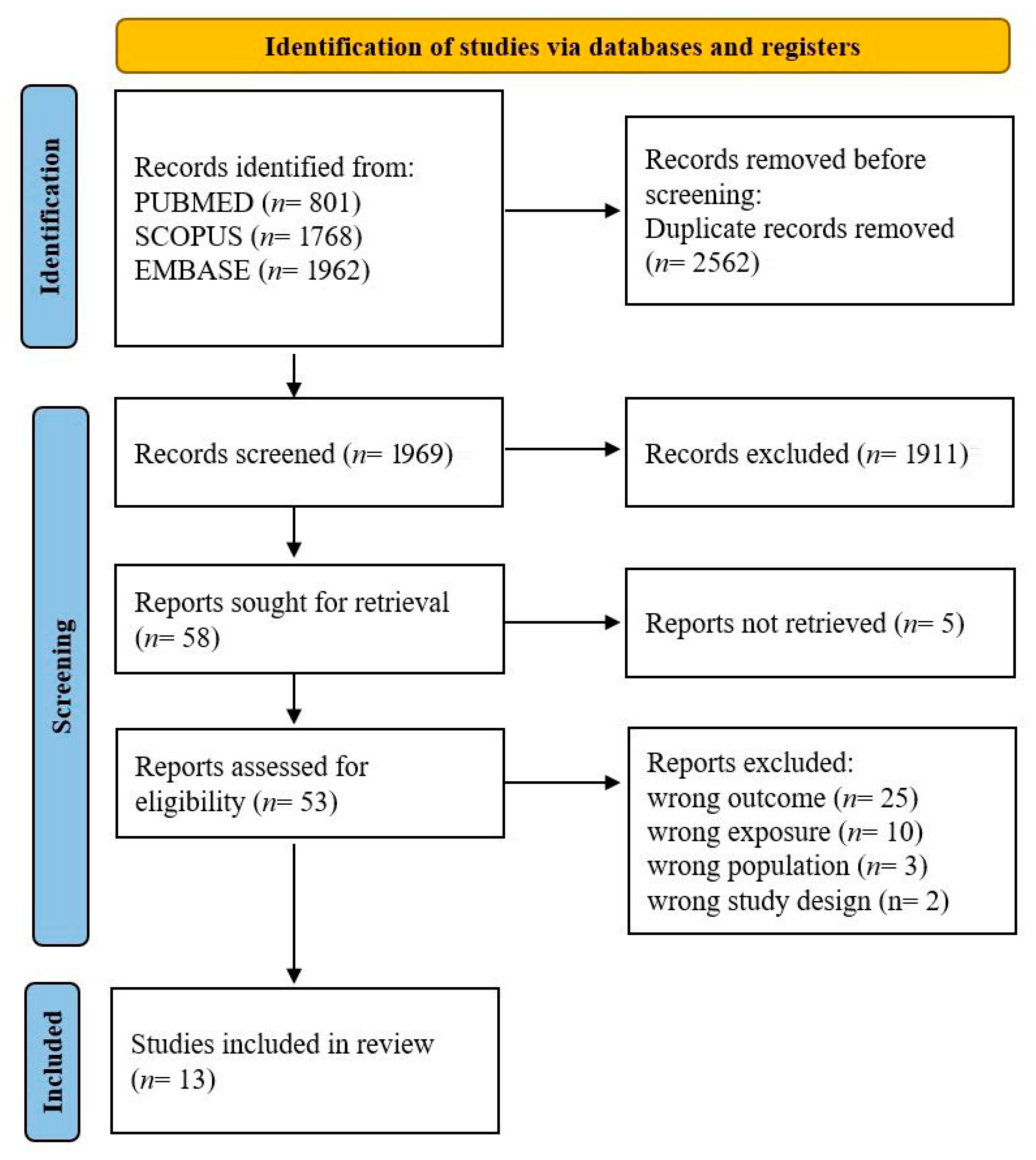
3.1. Literature Search
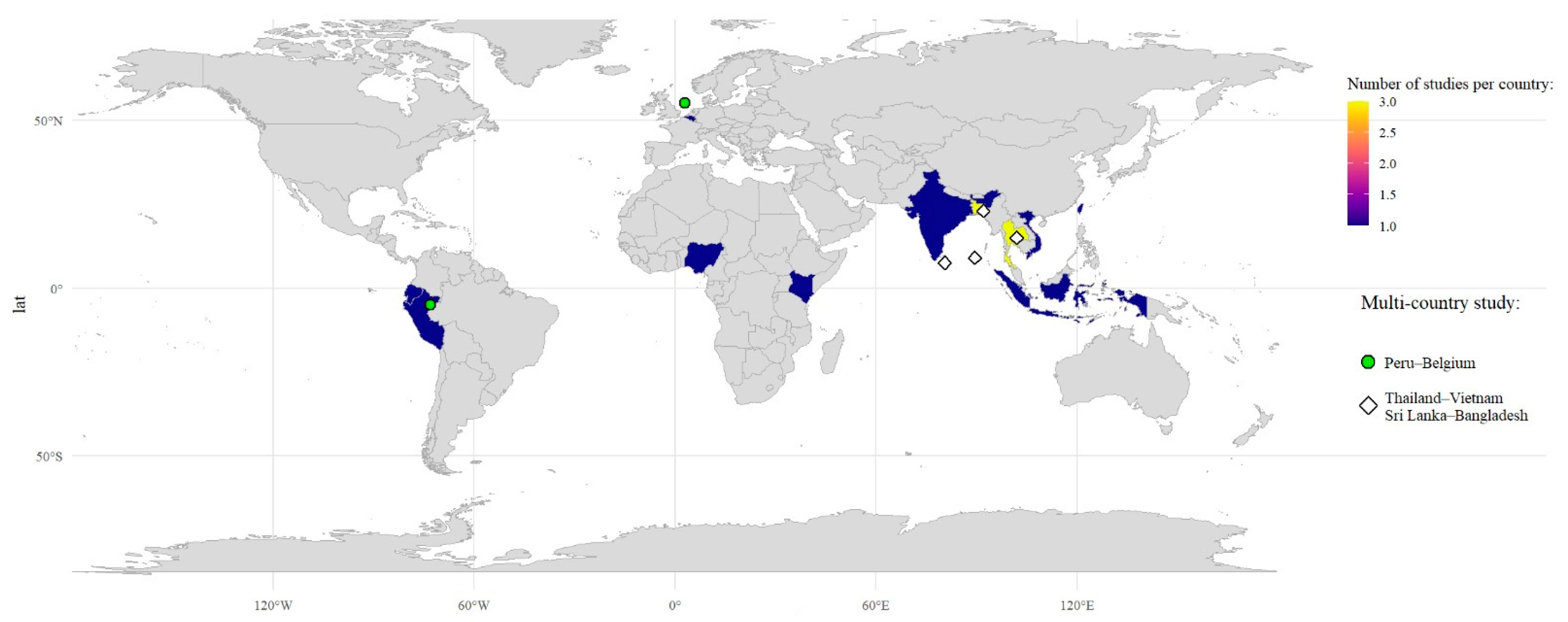
3.2. Geographic Distribution of Studies and Temporal Trends
3.3. Characteristics of the Included Studies
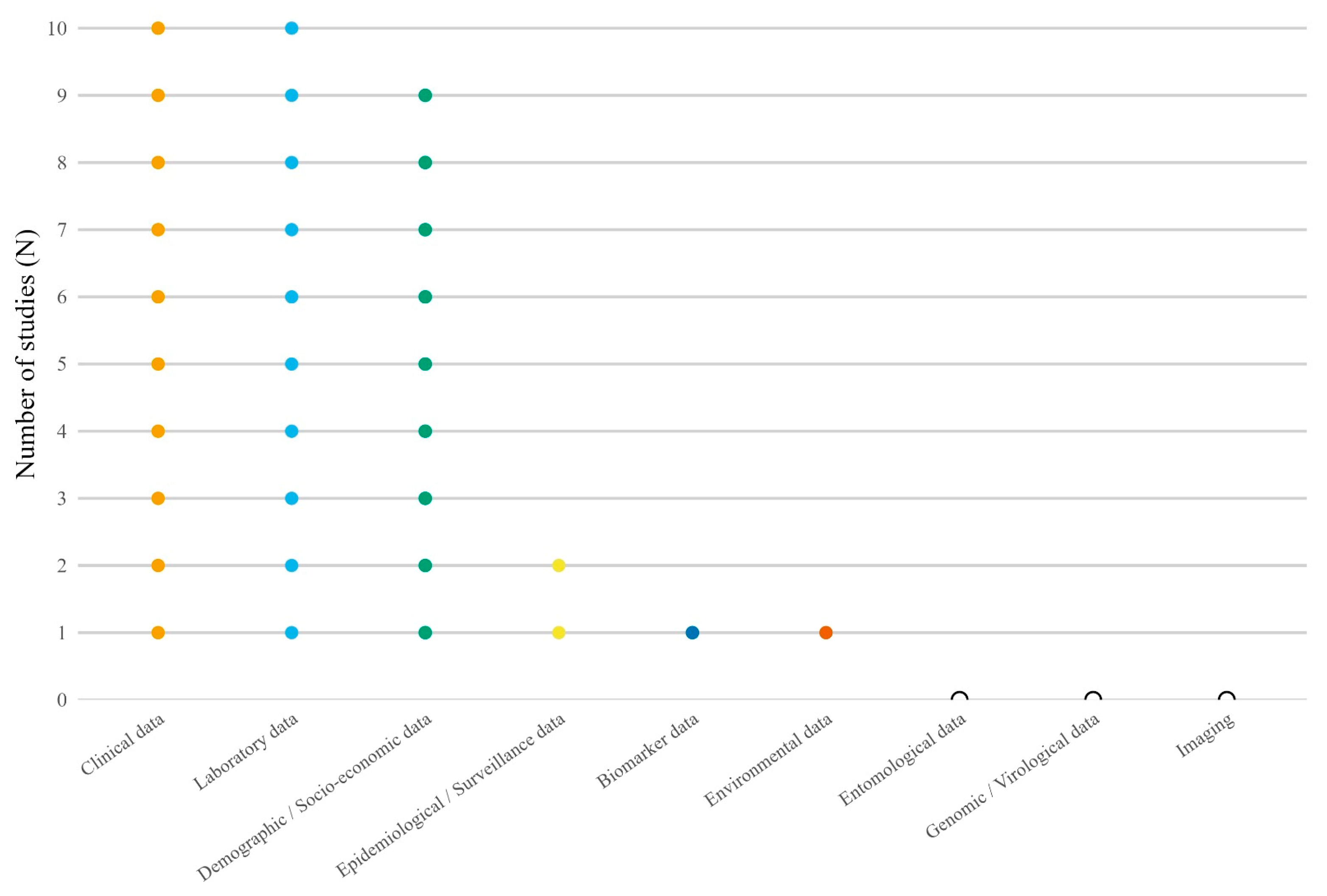
3.4. Feature Categories Used as Predictors
3.5. Classification Performance of AI Models vs. Conventional Comparators
3.6. Data Sources, Model Inputs, Validation Strategy, and Interpretability
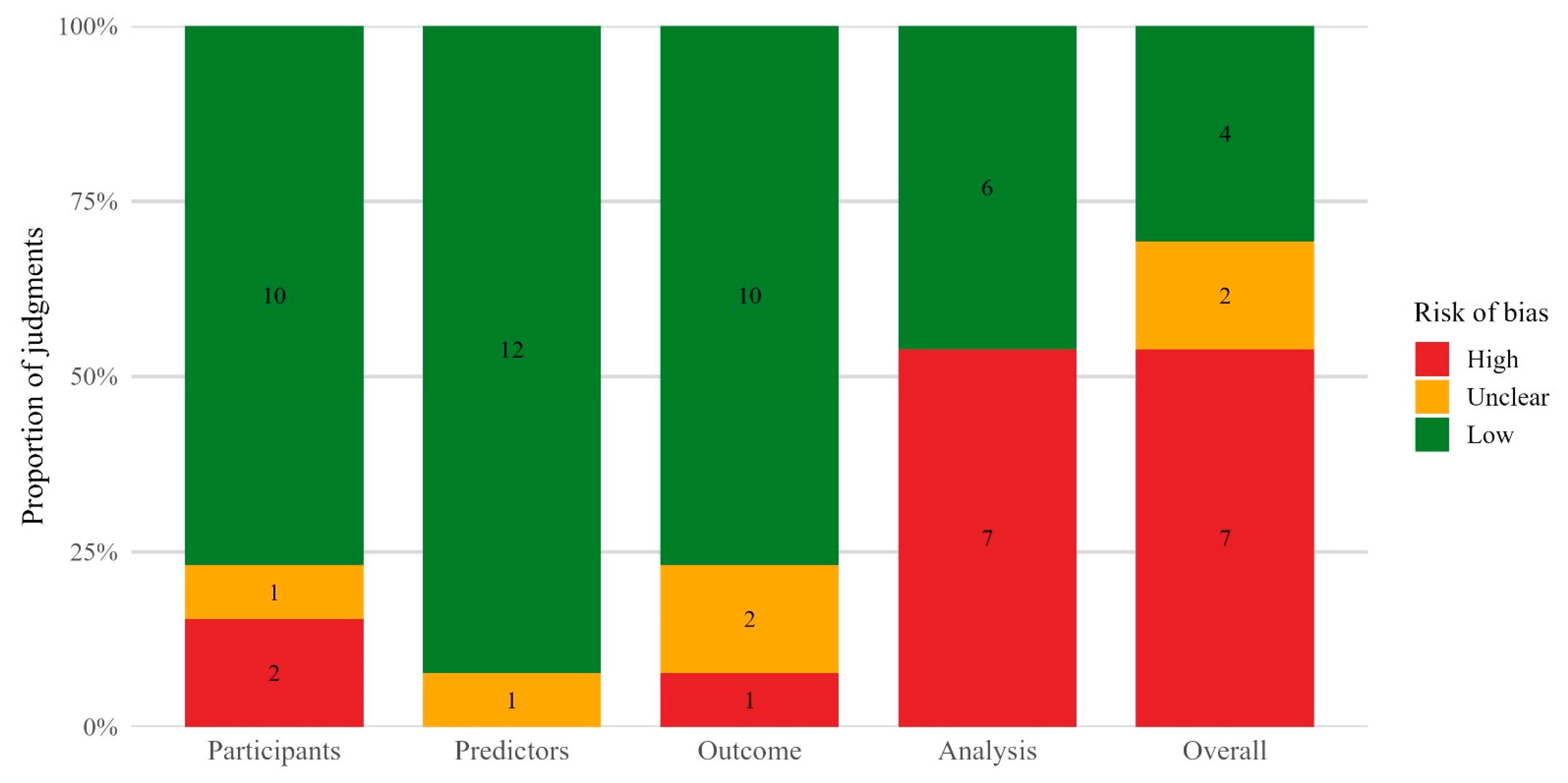
3.7. Assessment of Risk of Bias Using PROBAST
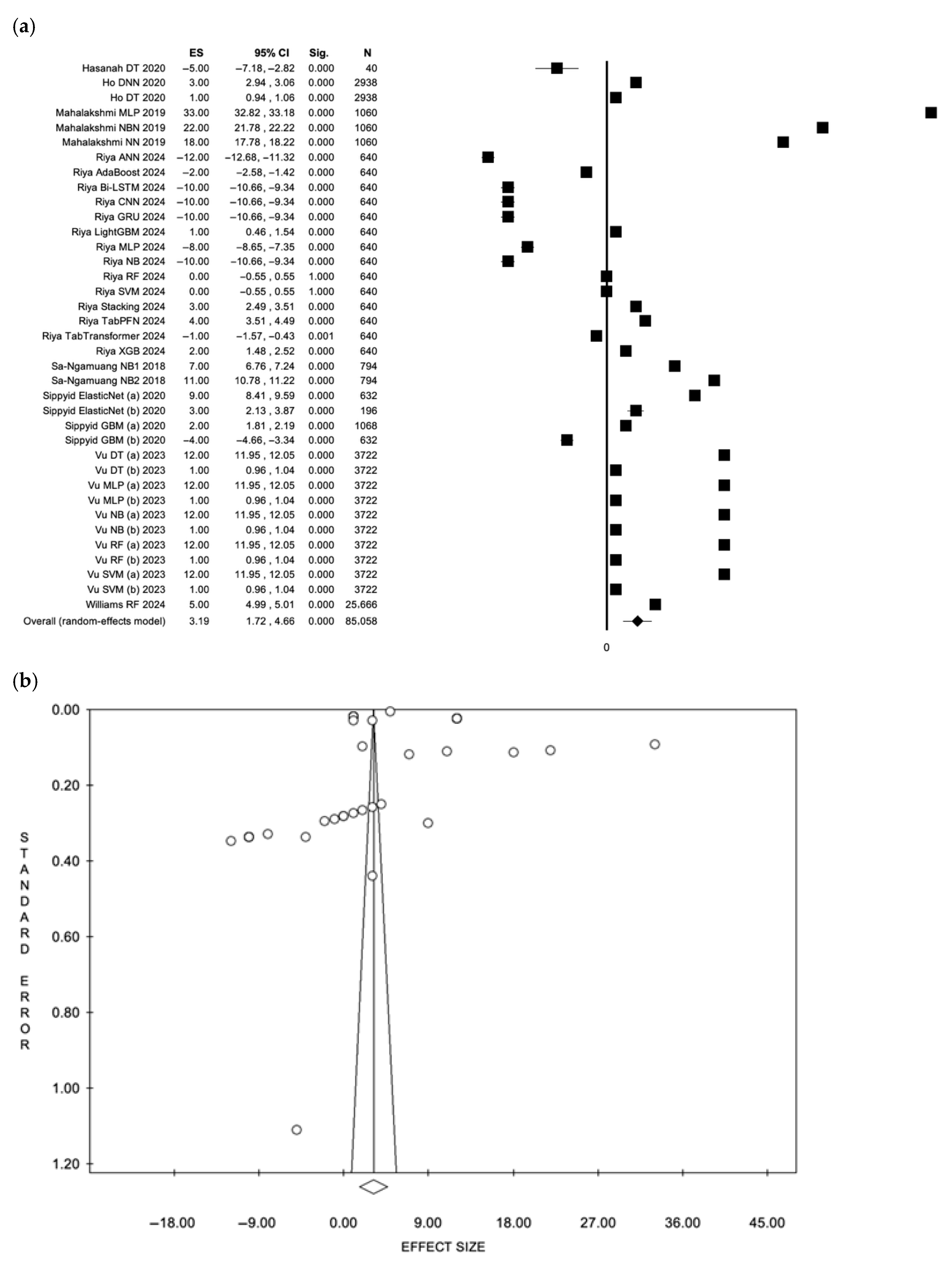
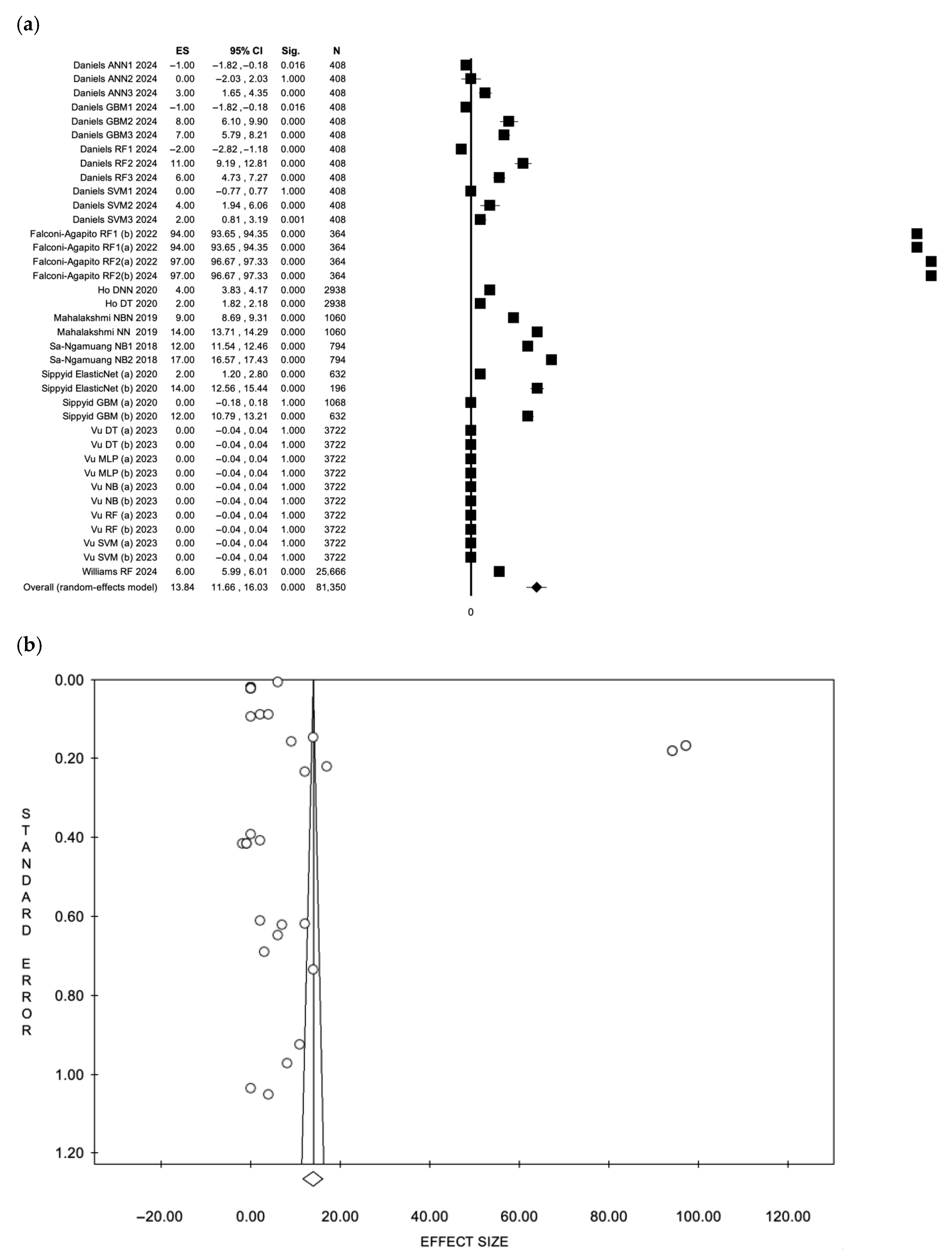
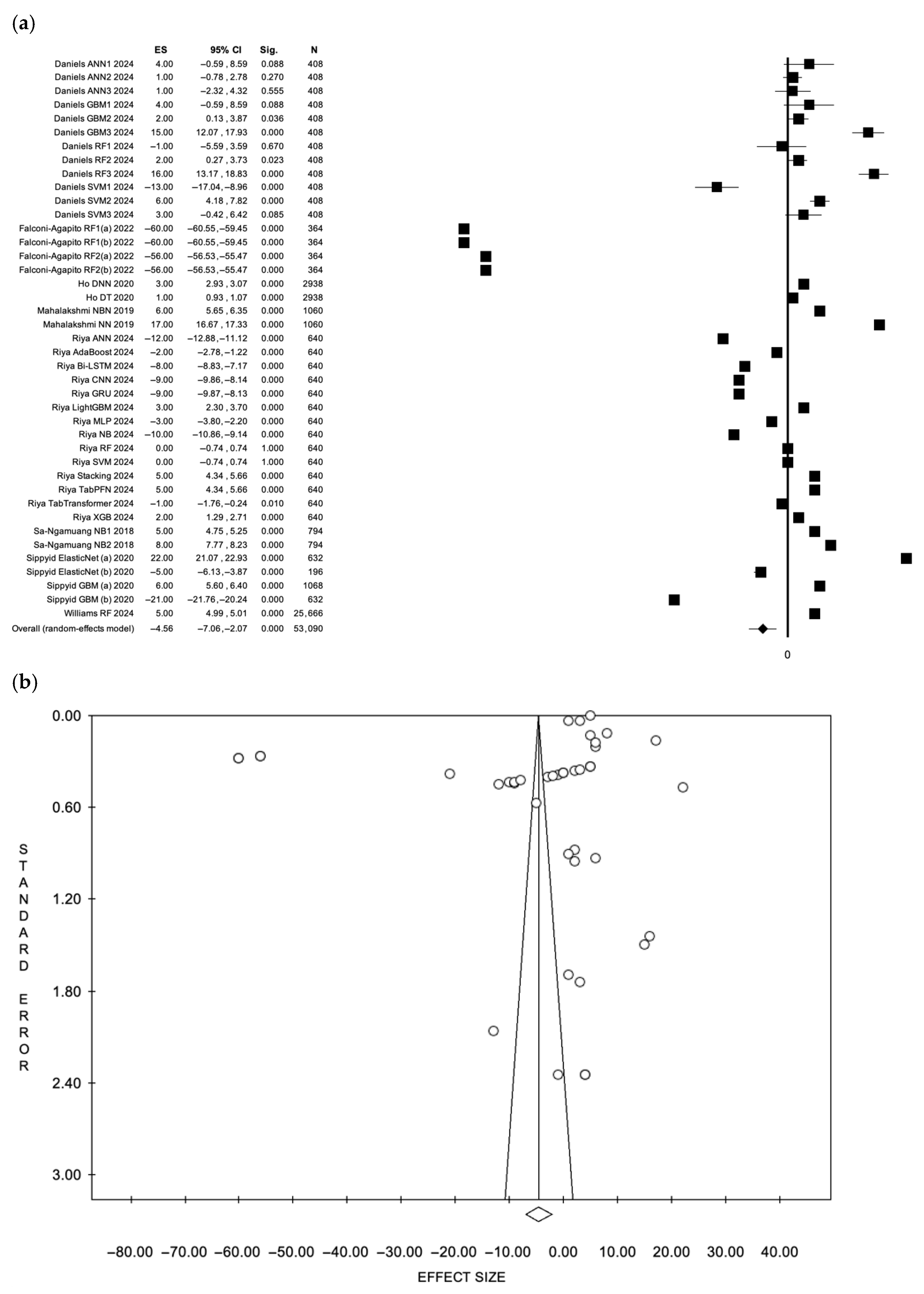
3.8. Statistical Analysis
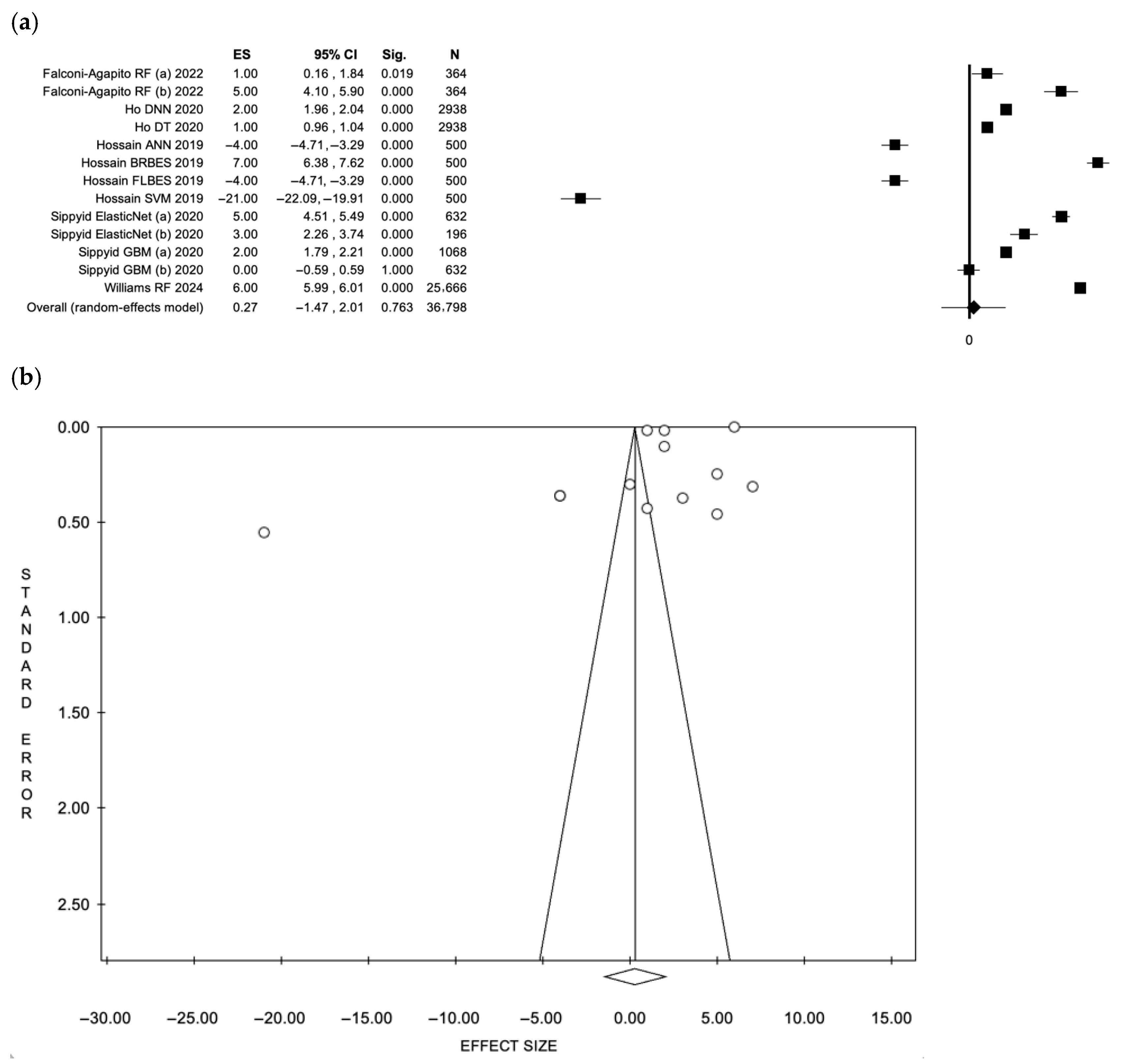
3.8.1. Meta-Analysis
3.8.2. Sensitivity Analysis
4. Discussion
4.1. Main Findings
4.2. Interpretation of Findings
4.3. Implications for Public Health and Clinical Practice
4.4. Strengths and Limitations
4.5. Future Directions
5. Conclusions
Supplementary Materials
Author Contributions
Funding
Data Availability Statement
Conflicts of Interest
References
- Capeding, M.R.; Chua, M.N.; Hadinegoro, S.R.; Hussain, I.I.H.M.; Nallusamy, R.; Pitisuttithum, P.; Rusmil, K.; Thisyakorn, U.; Thomas, S.J.; Huu Tran, N.; et al. Dengue and Other Common Causes of Acute Febrile Illness in Asia: An Active Surveillance Study in Children. PLoS Negl. Trop. Dis. 2013, 7, e2331. [Google Scholar] [CrossRef] [PubMed]
- Ravel, F.; Robert, S.; Djibougou, D.A.; Horo, K.; Tanon, A.; Ango, P.; Lompo, P.F.; Meynier, F.; Brossault, L.; Guler, U.; et al. Improving Management of Viral Febrile Illness and Reducing the Need for Empiric Antibiotics Using VIDAS® Immunoassay for Dengue and Chikungunya: A West African Multicentric Study. Diagnostics 2025, 15, 2269. [Google Scholar] [CrossRef] [PubMed]
- Gianfredi, V.; Nucci, D.; Pennisi, F.; Provenzano, S.; Ferrara, P.; Santangelo, O.E. Knowledge and Attitudes towards Zika Virus: An Italian Nation-Wide Cross-Sectional Study. Ann. Ist. Super. Sanita 2022, 58, 34–41. [Google Scholar] [CrossRef]
- Bustos Carrillo, F.A.; Ojeda, S.; Sanchez, N.; Plazaola, M.; Collado, D.; Miranda, T.; Saborio, S.; Lopez Mercado, B.; Carey Monterrey, J.; Arguello, S.; et al. A Comparative Analysis of Dengue, Chikungunya, and Zika in a Pediatric Cohort over 18 Years. medRxiv 2025, 2025.01.06.25320089. [Google Scholar] [CrossRef]
- Piantadosi, A.; Kanjilal, S. Diagnostic Approach for Arboviral Infections in the United States. J. Clin. Microbiol. 2020, 58, e01926-19. [Google Scholar] [CrossRef] [PubMed]
- Arrubla-Hoyos, W.; Gómez, J.G.; De-La-Hoz-Franco, E. Methodology for the Differential Classification of Dengue and Chikungunya According to the PAHO 2022 Diagnostic Guide. Viruses 2024, 16, 1088. [Google Scholar] [CrossRef]
- Beltrán-Silva, S.L.; Chacón-Hernández, S.S.; Moreno-Palacios, E.; Pereyra-Molina, J.Á. Clinical and Differential Diagnosis: Dengue, Chikungunya and Zika. Rev. Médica Hosp. Gen. México 2018, 81, 146–153. [Google Scholar] [CrossRef]
- da Silva Neto, S.R.; Tabosa Oliveira, T.; Teixeira, I.V.; Aguiar de Oliveira, S.B.; Souza Sampaio, V.; Lynn, T.; Endo, P.T. Machine Learning and Deep Learning Techniques to Support Clinical Diagnosis of Arboviral Diseases: A Systematic Review. PLoS Negl. Trop. Dis. 2022, 16, e0010061. [Google Scholar] [CrossRef]
- Pinto, A.; Pennisi, F.; Odelli, S.; De Ponti, E.; Veronese, N.; Signorelli, C.; Baldo, V.; Gianfredi, V. Artificial Intelligence in the Management of Infectious Diseases in Older Adults: Diagnostic, Prognostic, and Therapeutic Applications. Biomedicines 2025, 13, 2525. [Google Scholar] [CrossRef]
- Pennisi, F.; Pinto, A.; Borgonovo, F.; Scaglione, G.; Ligresti, R.; Santangelo, O.E.; Provenzano, S.; Gori, A.; Baldo, V.; Signorelli, C.; et al. Artificial Intelligence Models for Forecasting Mosquito-Borne Viral Diseases in Human Populations: A Global Systematic Review and Comparative Performance Analysis. Mach. Learn. Knowl. Extr. 2026, 8, 15. [Google Scholar] [CrossRef]
- Attai, K.; Amannejad, Y.; Vahdat Pour, M.; Obot, O.; Uzoka, F.-M. A Systematic Review of Applications of Machine Learning and Other Soft Computing Techniques for the Diagnosis of Tropical Diseases. Trop. Med. Infect. Dis. 2022, 7, 398. [Google Scholar] [CrossRef] [PubMed]
- Ozer, I.; Cetin, O.; Gorur, K.; Temurtas, F. Improved Machine Learning Performances with Transfer Learning to Predicting Need for Hospitalization in Arboviral Infections against the Small Dataset. Neural Comput. Appl. 2021, 33, 14975–14989. [Google Scholar] [CrossRef] [PubMed]
- Cruz-Parada, E.; Vivar-Estudillo, G.; Pérez-Campos Mayoral, L.; Hernández-Huerta, M.T.; Pérez-Santiago, A.D.; Romero-Diaz, C.; Pérez-Campos Mayoral, E.; Montalvo, I.A.G.; Martínez-Martínez, L.; Martínez-Ruiz, H.; et al. Proof-of-Concept Machine Learning Framework for Arboviral Disease Classification Using Literature-Derived Synthetic Data: Methodological Development Preceding Clinical Validation. Healthcare 2026, 14, 247. [Google Scholar] [CrossRef] [PubMed]
- Pennisi, F.; Pinto, A.; Ricciardi, G.E.; Signorelli, C.; Gianfredi, V. The Role of Artificial Intelligence and Machine Learning Models in Antimicrobial Stewardship in Public Health: A Narrative Review. Antibiotics 2025, 14, 134. [Google Scholar] [CrossRef]
- Pinto, A.; Pennisi, F.; Ricciardi, G.E.; Signorelli, C.; Gianfredi, V. Evaluating the Impact of Artificial Intelligence in Antimicrobial Stewardship: A Comparative Meta-Analysis with Traditional Risk Scoring Systems. Infect. Dis. Now 2025, 55, 105090. [Google Scholar] [CrossRef]
- Tabosa de Oliveira, T.; da Silva Neto, S.R.; Teixeira, I.V.; Aguiar de Oliveira, S.B.; de Almeida Rodrigues, M.G.; Sampaio, V.S.; Endo, P.T. A Comparative Study of Machine Learning Techniques for Multi-Class Classification of Arboviral Diseases. Front. Trop. Dis. 2022, 2, 969968. [Google Scholar] [CrossRef]
- Da Silva Neto, S.R.; Tabosa, T.; Medeiros Neto, L.; Teixeira, I.V.; Sadok, S.; De Souza Sampaio, V.; Endo, P.T. Binary Models for Arboviruses Classification Using Machine Learning: A Benchmarking Evaluation. In Proceedings of the 56th Hawaii International Conference on System Sciences, Maui, HI, USA, 3 January 2023. [Google Scholar]
- Page, M.J.; McKenzie, J.E.; Bossuyt, P.M.; Boutron, I.; Hoffmann, T.C.; Mulrow, C.D.; Shamseer, L.; Tetzlaff, J.M.; Akl, E.A.; Brennan, S.E.; et al. The PRISMA 2020 Statement: An Updated Guideline for Reporting Systematic Reviews. BMJ 2021, 372, n71. [Google Scholar] [CrossRef]
- Hanley, J.A.; McNeil, B.J. The Meaning and Use of the Area under a Receiver Operating Characteristic (ROC) Curve. Radiology 1982, 143, 29–36. [Google Scholar] [CrossRef]
- Higgins, J.P.T.; Thompson, S.G.; Deeks, J.J.; Altman, D.G. Measuring Inconsistency in Meta-Analyses. BMJ 2003, 327, 557–560. [Google Scholar] [CrossRef]
- Egger, M.; Davey Smith, G.; Schneider, M.; Minder, C. Bias in Meta-Analysis Detected by a Simple, Graphical Test. BMJ 1997, 315, 629–634. [Google Scholar] [CrossRef]
- Moons, K.G.M.; Wolff, R.F.; Riley, R.D.; Whiting, P.F.; Westwood, M.; Collins, G.S.; Reitsma, J.B.; Kleijnen, J.; Mallett, S. PROBAST: A Tool to Assess Risk of Bias and Applicability of Prediction Model Studies: Explanation and Elaboration. Ann. Intern. Med. 2019, 170, W1–W33. [Google Scholar] [CrossRef]
- Cracknell Daniels, B.; Buddhari, D.; Hunsawong, T.; Iamsirithaworn, S.; Farmer, A.R.; Cummings, D.A.T.; Anderson, K.B.; Dorigatti, I. Predicting the Infecting Dengue Serotype from Antibody Titre Data Using Machine Learning. PLoS Comput. Biol. 2024, 20, e1012188. [Google Scholar] [CrossRef]
- Falconi-Agapito, F.; Kerkhof, K.; Merino, X.; Bakokimi, D.; Torres, F.; Van Esbroeck, M.; Talledo, M.; Ariën, K.K. Peptide Biomarkers for the Diagnosis of Dengue Infection. Front. Immunol. 2022, 13, 793882. [Google Scholar] [CrossRef] [PubMed]
- Goh, B.; Soares Magalhães, R.J.; Ciocchetta, S.; Liu, W.; Sikulu-Lord, M.T. Identification of Visible and Near-Infrared Signature Peaks for Arboviruses and Plasmodium Falciparum. PLoS ONE 2025, 20, e0321362. [Google Scholar] [CrossRef] [PubMed]
- Hasanah, I.; Purwanti, E.; Widiyanti, P. Design and Implementation of an Early Screening Application for Dengue Fever Patients Using Android-Based Decision Tree C4.5 Method. Int. J. Adv. Sci. Eng. Inf. Technol. 2020, 10, 2237–2243. [Google Scholar] [CrossRef]
- Ho, T.-S.; Weng, T.-C.; Wang, J.-D.; Han, H.-C.; Cheng, H.-C.; Yang, C.-C.; Yu, C.-H.; Liu, Y.-J.; Hu, C.H.; Huang, C.-Y.; et al. Comparing Machine Learning with Case-Control Models to Identify Confirmed Dengue Cases. PLoS Negl. Trop. Dis. 2020, 14, e0008843. [Google Scholar] [CrossRef]
- Hossain, M.S.; Sultana, Z.; Nahar, L.; Andersson, K. An Intelligent System to Diagnose Chikungunya under Uncertainty. J. Wirel. Mob. Netw. Ubiquitous Comput. Dependable Appl. 2019, 10, 37–54. [Google Scholar] [CrossRef]
- Mahalakshmi, B.; Suseendran, G. Prediction of Zika Virus by Multilayer Perceptron Neural Network (MLPNN) Using Cloud. Int. J. Recent Technol. Eng. (IJRTE) 2019, 8, 249–254. [Google Scholar] [CrossRef]
- Obot, O.; John, A.; Udo, I.; Attai, K.; Johnson, E.; Udoh, S.; Nwokoro, C.; Akwaowo, C.; Dan, E.; Umoh, U.; et al. Modelling Differential Diagnosis of Febrile Diseases with Fuzzy Cognitive Map. Trop. Med. Infect. Dis. 2023, 8, 352. [Google Scholar] [CrossRef]
- Riya, N.J.; Chakraborty, M.; Khan, R. Artificial Intelligence-Based Early Detection of Dengue Using CBC Data. IEEE Access 2024, 12, 112355–112367. [Google Scholar] [CrossRef]
- Sa-Ngamuang, C.; Haddawy, P.; Luvira, V.; Piyaphanee, W.; Iamsirithaworn, S.; Lawpoolsri, S. Accuracy of Dengue Clinical Diagnosis with and without NS1 Antigen Rapid Test: Comparison between Human and Bayesian Network Model Decision. PLoS Negl. Trop. Dis. 2018, 12, e0006573. [Google Scholar] [CrossRef] [PubMed]
- Sippy, R.; Farrell, D.F.; Lichtenstein, D.A.; Nightingale, R.; Harris, M.A.; Toth, J.; Hantztidiamantis, P.; Usher, N.; Cueva Aponte, C.; Barzallo Aguilar, J.; et al. Severity Index for Suspected Arbovirus (SISA): Machine Learning for Accurate Prediction of Hospitalization in Subjects Suspected of Arboviral Infection. PLoS Negl. Trop. Dis. 2020, 14, e0007969. [Google Scholar] [CrossRef] [PubMed]
- Vu, D.M.; Krystosik, A.R.; Ndenga, B.A.; Mutuku, F.M.; Ripp, K.; Liu, E.; Bosire, C.M.; Heath, C.; Chebii, P.; Maina, P.W.; et al. Detection of Acute Dengue Virus Infection, with and without Concurrent Malaria Infection, in a Cohort of Febrile Children in Kenya, 2014–2019, by Clinicians or Machine Learning Algorithms. PLoS Glob. Public Health 2023, 3, e0001950. [Google Scholar] [CrossRef] [PubMed]
- Williams, R.J.; Brintz, B.J.; Santos, G.R.D.; Huang, A.; Buddhari, D.; Kaewhiran, S.; Iamsirithaworn, S.; Rothman, A.L.; Thomas, S.; Farmer, A.; et al. Integration of Population-Level Data Sources into an Individual-Level Clinical Prediction Model for Dengue Virus Test Positivity. medRxiv 2023, 10, 2023.08.08.23293840. [Google Scholar] [CrossRef]
- Bohm, B.C.; de Borges, F.E.M.; Silva, S.C.M.; Soares, A.T.; Ferreira, D.D.; Belo, V.S.; Lignon, J.S.; Bruhn, F.R.P. Utilization of Machine Learning for Dengue Case Screening. BMC Public Health 2024, 24, 1573. [Google Scholar] [CrossRef]
- Madewell, Z.J.; Rodriguez, D.M.; Thayer, M.B.; Rivera-Amill, V.; Paz-Bailey, G.; Adams, L.E.; Wong, J.M. Machine Learning for Predicting Severe Dengue in Puerto Rico. Infect. Dis. Poverty 2025, 14, 5. [Google Scholar] [CrossRef]
- Liu, B.; Hossain, M.F.; Hossain, S. A Comparative Evaluation of Multiple Machine Learning Approaches for Forecasting Dengue Outbreaks in Bangladesh. Sci. Rep. 2025, 15, 35931. [Google Scholar] [CrossRef]
- Cheong, K.H.; Li, K.; Yu, D.; Zhao, X. Forecasting Dengue Cases through Time-Series Modeling with Google Trends and Deep Neural Networks. Chaos Solitons Fractals 2025, 201, 117290. [Google Scholar] [CrossRef]
- El Kabbani, S.; Saleh, G. Next-Generation Diagnostic Technologies for Dengue Virus Detection: Microfluidics, Biosensing, CRISPR, and AI Approaches. Sensors 2025, 26, 145. [Google Scholar] [CrossRef]
- Vongsouvath, M.; Bharucha, T.; Seephonelee, M.; de Lamballerie, X.; Newton, P.N.; Dubot-Pérès, A. Harnessing Dengue Rapid Diagnostic Tests for the Combined Surveillance of Dengue, Zika, and Chikungunya Viruses in Laos. Am. J. Trop. Med. Hyg. 2020, 102, 1244–1248. [Google Scholar] [CrossRef]
- Lu, B.; Li, Y.; Evans, C. Assessing Generalizability of a Dengue Classifier across Multiple Datasets. PLoS ONE 2025, 20, e0323886. [Google Scholar] [CrossRef] [PubMed]
- Cozzolino, C.; Mao, S.; Bassan, F.; Bilato, L.; Compagno, L.; Salvò, V.; Chiusaroli, L.; Cocchio, S.; Baldo, V. Are AI-Based Surveillance Systems for Healthcare-Associated Infections Ready for Clinical Practice? A Systematic Review and Meta-Analysis. Artif. Intell. Med. 2025, 165, 103137. [Google Scholar] [CrossRef] [PubMed]
- Morone, G.; De Angelis, L.; Martino Cinnera, A.; Carbonetti, R.; Bisirri, A.; Ciancarelli, I.; Iosa, M.; Negrini, S.; Kiekens, C.; Negrini, F. Artificial Intelligence in Clinical Medicine: A State-of-the-Art Overview of Systematic Reviews with Methodological Recommendations for Improved Reporting. Front. Digit. Health 2025, 7, 1550731. [Google Scholar] [CrossRef] [PubMed]
- Ong, S.Q.; Isawasan, P.; Ngesom, A.M.M.; Shahar, H.; Lasim, A.M.; Nair, G. Predicting Dengue Transmission Rates by Comparing Different Machine Learning Models with Vector Indices and Meteorological Data. Sci. Rep. 2023, 13, 19129. [Google Scholar] [CrossRef]
- Chaw, J.K.; Chaw, S.H.; Quah, C.H.; Sahrani, S.; Ang, M.C.; Zhao, Y.; Ting, T.T. A Predictive Analytics Model Using Machine Learning Algorithms to Estimate the Risk of Shock Development among Dengue Patients. Healthc. Anal. 2024, 5, 100290. [Google Scholar] [CrossRef]
- Gianfredi, V.; Bragazzi, N.L.; Nucci, D.; Martini, M.; Rosselli, R.; Minelli, L.; Moretti, M. Harnessing Big Data for Communicable Tropical and Sub-Tropical Disorders: Implications From a Systematic Review of the Literature. Front. Public Health 2018, 6, 90. [Google Scholar] [CrossRef]
- Santangelo, O.E.; Provenzano, S.; Vella, C.; Firenze, A.; Stacchini, L.; Cedrone, F.; Gianfredi, V. Infodemiology and Infoveillance of the Four Most Widespread Arbovirus Diseases in Italy. Epidemiologia 2024, 5, 340–352. [Google Scholar] [CrossRef]
- Ming, D.K.; Hernandez, B.; Sangkaew, S.; Vuong, N.L.; Lam, P.K.; Nguyet, N.M.; Tam, D.T.H.; Trung, D.T.; Tien, N.T.H.; Tuan, N.M.; et al. Applied Machine Learning for the Risk-Stratification and Clinical Decision Support of Hospitalised Patients with Dengue in Vietnam. PLoS Digit. Health 2022, 1, e0000005. [Google Scholar] [CrossRef]
- McCarter, M.; Self, S.C.W.; Ewing, A.; Kanyangarara, M.; Gunter, S.M.; Nolan, M.S. The Evolution of Public Health Statistical Modeling Approaches and How to Advance Their Incorporation into Modern Arboviral Surveillance. J. Med. Entomol. 2026, 63, tjaf127. [Google Scholar] [CrossRef]
- Karolcik, S.; Manginas, V.; Chanh, H.Q.; Daniels, J.; Giang, N.T.; Huyen, V.N.T.; Hoang, M.T.V.; Phan Nguyen Quoc, K.; Hernandez, B.; Ming, D.K.; et al. Towards a Machine-Learning Assisted Non-Invasive Classification of Dengue Severity Using Wearable PPG Data: A Prospective Clinical Study. eBioMedicine 2024, 104, 105164. [Google Scholar] [CrossRef]
- Rocha, F.P.; Giesbrecht, M. Machine Learning Algorithms for Dengue Risk Assessment: A Case Study for São Luís Do Maranhão. Comput. Appl. Math. 2022, 41, 393. [Google Scholar] [CrossRef]
- Haque, M.E.; Nurul Absur, M.; Al Farid, F.; Uddin, J.; Abdul Karim, H. A Novel Interpretable and Real-Time Dengue Prediction Framework Using Clinical Blood Parameters with Genetic and GAN-Based Optimization. Front. Artif. Intell. 2025, 8, 1626699. [Google Scholar] [CrossRef]




| First Author (Year) | Continent | Country | Study Design | Setting | Population | Disease | Case Definition (Clinical Suspicion vs. Laboratory-Confirmed Cases) | Disease Confirmation Method |
|---|---|---|---|---|---|---|---|---|
| Daniels, B.C. (2024) [23] | Asia | Thailand, Vietnam, Sri Lanka, Bangladesh | MD | Community-based (field/surveillance in population) | Children, adolescents | Dengue | DF suspected or identified by seroconversion/known infection | Lab-confirmed (RT-PCR/ELISA) |
| Falconi-Agapito, F. (2022) [24] | South America, Europe | Peru, Belgium | rDTA | Hospital-based/Clinical | Pts (hospital/clinical cases) | Dengue | AFI ≤ 7 d with ≥1 dengue-suggestive symptom (Peru); travelers with suspected dengue (Belgium) | Lab-confirmed (RT-PCR/ELISA) |
| Goh, B. (2023) [25] | Asia | Singapore | rDTA | Hospital-based/Clinical | Pts (hospital/clinical cases) | Dengue | Suspected DF (AFI) | Lab-confirmed (RT-PCR/ELISA) |
| Hasanah, I. (2020) [26] | Asia | Indonesia | MD | Hospital-based/Clinical | Pts (hospital/clinical cases) | Dengue | Pts with dengue-like symptoms in medical records | Clinical + RT-PCR/ELISA |
| Ho, T.S. (2020) [27] | Asia | Taiwan | rDTA | Hospital-based/Clinical | GP | Dengue | Febrile pts with clinical suspicion of DF at ED | Lab-confirmed (RT-PCR/ELISA) |
| Hossain, M.S. (2019) [28] | Asia | Bangladesh | MD | Hospital-based/Clinical | Pts (hospital/clinical cases) | Chikungunya | Pts with fever, arthralgia, headache, myalgia, or joint swelling | Lab-confirmed (RT-PCR/ELISA) |
| Mahalakshmi, B. (2019) [29] | Asia | India | MD | Synthetic dataset | Synthetic dataset | Zika | Synthetic ZVD-like cases (fever, rash, myalgia, arthralgia, joint pain) | NA |
| Obot, O. (2023) [30] | Africa | Nigeria | rDTA | Hospital-based/Clinical | Pts (hospital/clinical cases) | Dengue | Clinically suspected DF | Lab-confirmed (RT-PCR/ELISA) |
| Riya, N.J. (2024) [31] | Asia | Bangladesh | rDTA | Multicenter | Pts (hospital/clinical cases) | Dengue | NA | NA |
| Sa-ngamuang, C. (2018) [32] | Asia | Thailand | pDTA | Hospital-based/Clinical | Adults, adolescents | Dengue | AFI < 14 d with clinical suspicion of DF | Lab-confirmed (RT-PCR/ELISA) |
| Sippy, R. (2020) [33] | South America | Ecuador | pCoh | Community-based (field/surveillance in population) | GP | Dengue, Chikungunya, Zika | AFI with clinical suspicion of DF | Lab-confirmed (RT-PCR/ELISA) |
| Vu, D.M. (2023) [34] | Africa | Kenya | rDTA | Multicenter | Children | Dengue | Pts aged 1–17 y with AFI (T ≥ 38 °C) | Clinical + RT-PCR/ELISA |
| Williams, R.J. (2024) [35] | Asia | Thailand | pDTA | Hospital-based/Clinical | GP | Dengue | AFI (T ≥ 38 °C, ≤ 7 d) with clinical suspicion of DF | Lab-confirmed (RT-PCR/ELISA) |
| First Author (Year) | AI Models | Sample Size (Train/Test/ Validation) | AUC | Sensitivity | Specificity | PPV | NPV | Accuracy | F1-Score |
|---|---|---|---|---|---|---|---|---|---|
| Daniels, B.C. (2024) [23] | RF; GBM; ANN; SVM | 204 | NA | Scenario A: RF 0.48, GBM 0.53, ANN 0.53, SVM 0.65; Scenario B: RF 0.92, GBM 0.90, ANN 0.88, SVM 0.84; Scenario C: RF 0.64, 0.66, 0.57, 0.54 | Scenario A: RF 0.94, GBM 0.96, ANN 0.95, SVM 0.90; Scenario B: RF 0.71, GBM 0.71, ANN 0.72, SVM 0.80; Scenario C: RF 0.92, GBM 0.91, ANN 0.86, SVM 0.87 | Scenario A: RF 0.69, GBM 0.74, ANN 0.74, SVM 0.57; Scenario B: RF 0.79, GBM 0.79, ANN 0.78, SVM 0.83; Scenario C: RF 0.81, GBM 0.80, ANN 0.66, SVM 0.68 | Scenario A: RF 0.91, GBM 0.92, ANN 0.92, SVM 0.93; Scenario B: RF 0.90, GBM 0.87, ANN 0.79, SVM 0.83; Scenario C: RF 0.85, GBM 0.86, ANN 0.82, SVM 0.81 | NA | NA |
| Falconi-Agapito, F. (2022) [24] | RF | 323 | Single peptide (FPG-1): 0.81 | RFM3 0.72; RFG1 0.89; RFG2 0.89; RFG3 0.88 | RF models ≥0.80 | RFM3 0.40; RFG3 0.44 | RFM3 0.95; RFG3 0.98 | NA | NA |
| Goh, B. (2023) [25] | RF; GBM; AdaBoost; SVM; KNN; NB | 4225 (train: 2957; test: 1268) | RF 0.88; GB 0.87; AdaBoost 0.86; NB 0.80; KNN 0.82; SVM 0.85 | RF 0.82; GBM 0.80; AdaBoost 0.78; NB 0.71; KNN 0.76; SVM 0.78 | RF 0.84; GBM 0.83; AdaBoost 0.82; NB 0.77; KNN 0.80; SVM 0.82 | RF 0.81; GBM 0.79; AdaBoost 0.77; NB 0.69; KNN 0.74; SVM 0.77 | RF 0.86; GBM 0.85; AdaBoost 0.83; NB 0.78; KNN 0.81; SVM 0.83 | RF 0.83; GBM 0.82; AdaBoost 0.80; NB 0.75; KNN 0.78; SVM 0.80 | RF 0.81; GBM 0.79; AdaBoost 0.77; NB 0.70; KNN 0.75; SVM 0.77 |
| Hasanah, I. (2020) [26] | DT | Train: 100; test: 20 | NA | NA | NA | NA | NA | 0.95 | NA |
| Ho, T.S. (2020) [27] | DT; DNN | 4894 (train: 3425; test: 1469) | DNN 0.96; DT 0.95 | DNN 0.93; DT 0.91 | DNN 0.89; DT 0.87 | DNN 0.90; DT 0.88 | DNN 0.92; DT 0.90 | DNN 0.91; DT 0.89 | DNN 0.91; DT 0.89 |
| Hossain, M.S. (2019) [28] | BRBES; FLBES; ANN; SVM | 250 | BRBES 0.92; FLBES 0.81; ANN 0.81; SVM 0.64 | NA | NA | NA | NA | NA | NA |
| Mahalakshmi, B. (2019) [29] | MLP; NN; NBN | 530 | NA | MLP 0.98; NN 0.84; NBN 0.80 | MLP 0.97; NN 0.85; NBN 0.73 | NN 0.82; NBN 0.71 | NN 0.86; NBN 0.81 | MLP 0.98; NN 0.83; NBN 0.87 | NA |
| Obot, O. (2023) [30] | RF; XGB; LightGBM; ANN | 820 (train: 656; test: 164) | RF 0.92; LightGBM 0.94; XGB 0.95; ANN 0.91 | RF 0.87; LightGBM 0.89; XGB 0.90; ANN 0.85 | RF 0.88; LightGBM 0.90; XGB 0.91; ANN 0.87 | RF 0.86; LightGBM 0.89; XGB 0.90; ANN 0.84 | RF 0.89; LightGBM 0.91; XGB 0.92; ANN 0.88 | RF 0.88; LightGBM 0.90; XGB 0.91; ANN 0.87 | RF 0.86; LightGBM 0.89; XGB 0.90; ANN 0.84 |
| Riya, N.J. (2024) [31] | SVM; NB; RF; AdaBoost; XGB; MLP; LightGBM; ANN; CNN; GRU; Bi-LSTM; TabPFN; TabTransformer | 320 | Stacking 0.99 | SVM 0.91; NB 0.80; RF 0.90; AdaBoost 0.87; XGB 0.93; MLP 0.83; LightGBM 0.91; Stacking 0.92; ANN 0.78; CNN 0.79; GRU 0.78; Bi-LSTM 0.84; TabPFN 0.95; TabTransformer 0.88 | NA | SVM 0.89; NB 0.79; RF 0.89; AdaBoost 0.87; XGB 0.91; MLP 0.86; LightGBM 0.92; Stacking 0.94; ANN 0.77; CNN 0.80; GRU 0.80; Bi-LSTM 0.81; TabPFN 0.94; TabTransformer 0.88 | NA | SVM 0.91; NB 0.81; RF 0.91; AdaBoost 0.89; XGB 0.93; MLP 0.83; LightGBM 0.92; Stacking 0.94; ANN 0.79; CNN 0.81; GRU 0.81; Bi-LSTM 0.81; TabPFN 0.95; TabTransformer 0.90 | SVM 0.90; NB 0.79; RF 0.90; AdaBoost 0.87; XGB 0.92; MLP 0.83; LightGBM 0.91; Stacking 0.93; ANN 0.77; CNN 0.79; GRU 0.79; Bi-LSTM 0.81; TabPFN 0.94; TabTransformer 0.88 |
| Sa-ngamuang, C. (2018) [32] | NB without NS1; NB with NS1 | 397 (260 dengue; 137 non-dengue) | NB without NS1 0.95; NB with NS1 0.97 | NB without NS1 0.89; NB with NS1 0.93 | NB without NS1 0.91; NB with NS1 0.95 | NB without NS1 0.93; NB with NS1 0.96 | NB without NS1 0.85; NB with NS1 0.90 | NB without NS1 0.90; NB with NS1 0.94 | NB without NS1 0.91; NB with NS1 0.94 |
| Sippy, R. (2020) [33] | GBM; ElasticNet | GBM 534 (154 hospitalized, 380 outpatients); ElasticNet 98 (59 hospitalized, 39 outpatients | GBM 0.91; ElasticNet 0.94 | GBM 0.84; ElasticNet 0.90 | GBM 0.84; ElasticNet 0.92 | GBM 0.71; ElasticNet 0.87 | GBM 0.91; ElasticNet 0.93 | GBM 0.84; ElasticNet 0.91 | GBM 0.77; ElasticNet 0.88 |
| Vu, D.M. (2023) [34] | DT; RF; SVM; NB; MLP | 6208 (train: 4347; test: 1861) | NA | DT 0.01; RF 0.01; SVM 0.01; NB 0.01; MLP 0.01 | DT 1.00; RF 1.00; SVM 1.00; NB 1.00; MLP 1.00 | NA | DT 0.92; RF 0.92; SVM 0.92; NB 0.92; MLP 0.92 | DT 0.92; RF 0.92; SVM 0.92; NB 0.92; MLP 0.92 | NA |
| Williams, R.J. (2024) [35] | RF | 12,833 | 0.87 | 0.82 | 0.79 | 0.74 | 0.85 | 0.80 | 0.78 |
| First Author (Year) | Comparator | Comparator Sample Size (Train/Test/ Validation) | AUC | Sensitivity | Specificity | PPV | NPV | Accuracy | F1-Score |
|---|---|---|---|---|---|---|---|---|---|
| Daniels, B.C. (2024) [23] | Statistical models (MLR) | 204 | NA | Scenario A: 0.65 (95% CI 0.60–0.70); Scenario B: 0.66 (0.61–0.71); Scenario C: 0.64 (0.59–0.69); Scenario D: 0.65 (0.60–0.70) | Scenario A: 0.66 (95% CI 0.62–0.70); Scenario B: 0.67 (95% CI 0.63–0.71); Scenario C: 0.65 (95% CI 0.61–0.69); Scenario D: 0.66 (95% CI 0.62–0.70) | Scenario A: 0.69; Scenario B: 0.71; Scenario C: 0.68; Scenario D: 0.69 | Scenario A: 0.66; Scenario B: 0.68; Scenario C: 0.65; Scenario D: 0.66 | Scenario A: 0.66 (95% CI 0.62–0.70); Scenario B: 0.68 (95% CI 0.64–0.71); Scenario C: 0.65 (95% CI 0.61–0.69); Scenario D: 0.66 (95% CI 0.62–0.70) | NA |
| Falconi-Agapito, F. (2022) [24] | Commercial serologic assays (ELISA, RDT) | 41 DENV patients | IgG ELISA 0.80; IgM ELISA 0.76 | IgG ELISA 0.83; IgM ELISA 0.46 | NA | IgG ELISA 1.00; IgM ELISA 1.00 | IgG ELISA 0.01; IgM ELISA 0.01 | IgG ELISA 0.83; IgM ELISA 0.46 | NA |
| Goh, B. (2023) [25] | Statistical models (LR) | 4225 (train: 2957; test: 1268) | 0.81 | 0.73 | 0.78 | 0.70 | 0.80 | 0.76 | 0.71 |
| Hasanah, I. (2020) [26] | Clinical assessment | Train: 100; test: 20 | NA | NA | NA | NA | NA | 1.00 | NA |
| Ho, T.S. (2020) [27] | Statistical models (LR) | 1469 | 0.94 | 0.89 | 0.86 | 0.87 | 0.88 | 0.88 | 0.88 |
| Hossain, M.S. (2019) [28] | Clinical assessment | 250 | 0.85 | NA | NA | NA | NA | NA | NA |
| Mahalakshmi, B. (2019) [29] | Statistical models (LR) | 530 | NA | 0.68 | 0.69 | 0.64 | 0.72 | 0.65 | NA |
| Obot, O. (2023) [30] | Statistical models (LR) | 820 (train: 656; test: 164) | 0.89 | 0.82 | 0.85 | 0.80 | 0.86 | 0.84 | 0.81 |
| Riya, N.J. (2024) [31] | Statistical models (LR) | 320 | NA | 0.91 | NA | 0.89 | NA | 0.91 | NA |
| Sa-ngamuang, C. (2018) [32] | Clinical assessment | 397 (260 dengue; 137 non-dengue) | NA | 0.85 | 0.80 | 0.89 | 0.74 | 0.83 | NA |
| Sippy, R. (2020) [33] | Statistical models (SISA, SISAL) | SISA 534 (154 hospitalized, 380 outpatients); SISAL 98 (59 hospitalized, 39 outpatients) | SISA 0.89; SISAL 0.91 | SISA 0.81; SISAL 0.85 | SISA 0.83; SISAL 0.90 | SISA 0.66; SISAL 0.93 | SISA 0.91; SISAL 0.80 | SISA 0.82; SISAL 0.88 | NA |
| Vu, D.M. (2023) [34] | Clinical assessment/Statistical models (LR) | 6208 (train: 4347; test: 1861) | NA | Clinical assessment 0.14; LR 0.06 | Clinical assessment 0.85; LR 0.98 | Clinical assessment 0.08; LR NA | Clinical assessment 0.92; LR 0.92 | Clinical assessment 0.80; LR 0.91 | NA |
| Williams, R.J. (2024) [35] | Statistical models (LR) | 12,833 | 0.81 | 0.75 | 0.74 | 0.69 | 0.79 | 0.75 | 0.72 |
Disclaimer/Publisher’s Note: The statements, opinions and data contained in all publications are solely those of the individual author(s) and contributor(s) and not of MDPI and/or the editor(s). MDPI and/or the editor(s) disclaim responsibility for any injury to people or property resulting from any ideas, methods, instructions or products referred to in the content. |
© 2026 by the authors. Licensee MDPI, Basel, Switzerland. This article is an open access article distributed under the terms and conditions of the Creative Commons Attribution (CC BY) license.
Share and Cite
Pennisi, F.; Pinto, A.; Cozzolino, C.; Cozza, A.; Rezza, G.; Signorelli, C.; Baldo, V.; Gianfredi, V. Comparative Diagnostic Performance of Artificial Intelligence Versus Conventional Approaches for Early Detection of Mosquito-Borne Viral Infections: A Systematic Review and Meta-Analysis, with Evidence Predominantly from Dengue Studies. Mach. Learn. Knowl. Extr. 2026, 8, 93. https://doi.org/10.3390/make8040093
Pennisi F, Pinto A, Cozzolino C, Cozza A, Rezza G, Signorelli C, Baldo V, Gianfredi V. Comparative Diagnostic Performance of Artificial Intelligence Versus Conventional Approaches for Early Detection of Mosquito-Borne Viral Infections: A Systematic Review and Meta-Analysis, with Evidence Predominantly from Dengue Studies. Machine Learning and Knowledge Extraction. 2026; 8(4):93. https://doi.org/10.3390/make8040093
Chicago/Turabian StylePennisi, Flavia, Antonio Pinto, Claudia Cozzolino, Andrea Cozza, Giovanni Rezza, Carlo Signorelli, Vincenzo Baldo, and Vincenza Gianfredi. 2026. "Comparative Diagnostic Performance of Artificial Intelligence Versus Conventional Approaches for Early Detection of Mosquito-Borne Viral Infections: A Systematic Review and Meta-Analysis, with Evidence Predominantly from Dengue Studies" Machine Learning and Knowledge Extraction 8, no. 4: 93. https://doi.org/10.3390/make8040093
APA StylePennisi, F., Pinto, A., Cozzolino, C., Cozza, A., Rezza, G., Signorelli, C., Baldo, V., & Gianfredi, V. (2026). Comparative Diagnostic Performance of Artificial Intelligence Versus Conventional Approaches for Early Detection of Mosquito-Borne Viral Infections: A Systematic Review and Meta-Analysis, with Evidence Predominantly from Dengue Studies. Machine Learning and Knowledge Extraction, 8(4), 93. https://doi.org/10.3390/make8040093