
Article

Semantic Image Segmentation Using Scant Pixel Annotations
by
Adithi D. Chakravarthy
1,*,
Dilanga Abeyrathna
1,
Mahadevan Subramaniam
1,
Parvathi Chundi
1 and
Venkataramana Gadhamshetty
2
1
Computer Science Department, University of Nebraska at Omaha, Omaha, NE 68182, USA
2
2-Dimensional Materials for Biofilm Engineering Science and Technology (2DBEST) Center, South Dakota School of Mines & Technology, Rapid City, SD 57701, USA
*
Author to whom correspondence should be addressed.
Mach. Learn. Knowl. Extr. 2022, 4(3), 621-640; https://doi.org/10.3390/make4030029
Submission received: 24 May 2022 / Revised: 15 June 2022 / Accepted: 25 June 2022 / Published: 1 July 2022
(This article belongs to the Section Network)

Abstract

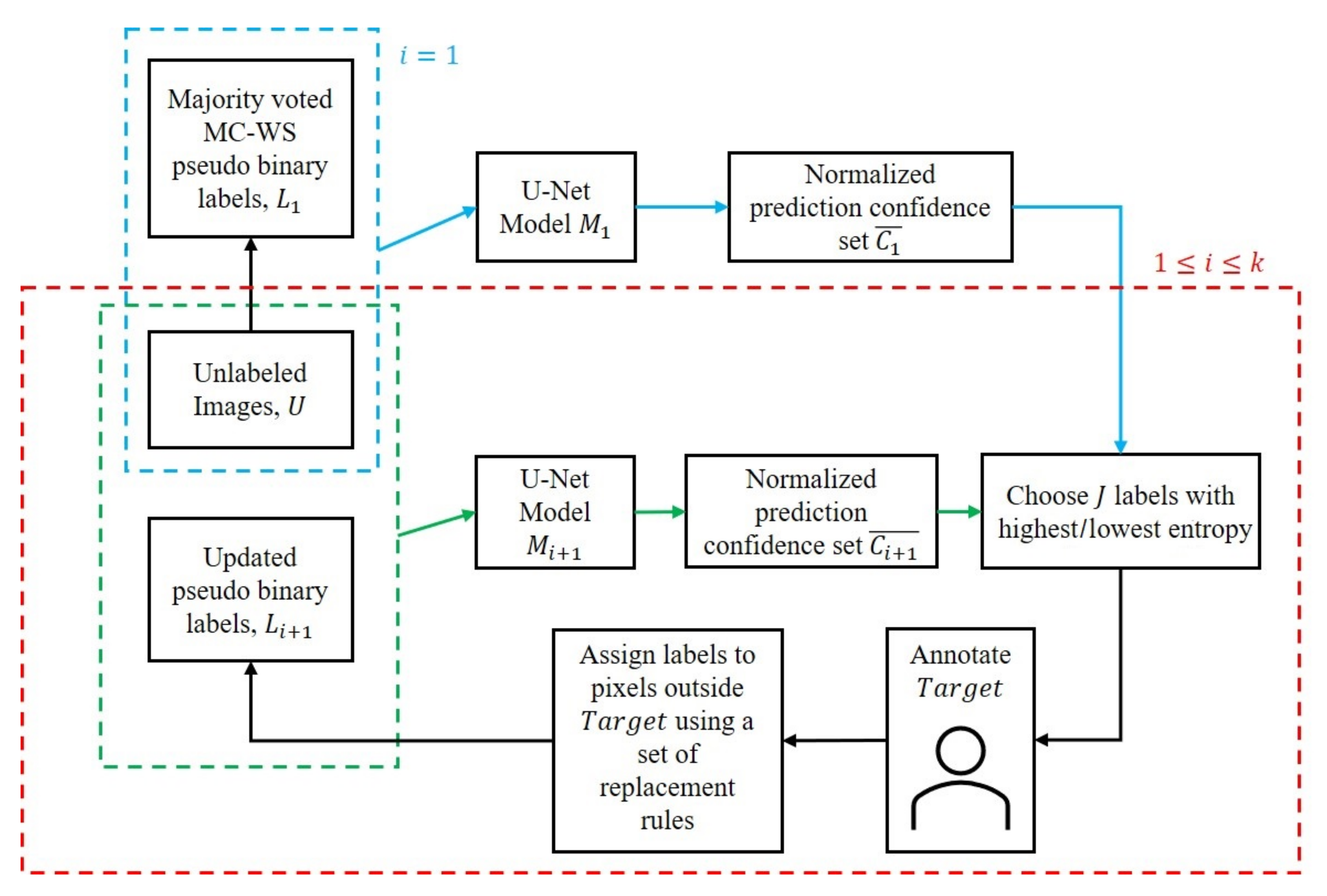
The success of deep networks for the semantic segmentation of images is limited by the availability of annotated training data. The manual annotation of images for segmentation is a tedious and time-consuming task that often requires sophisticated users with significant domain expertise to create high-quality annotations over hundreds of images. In this paper, we propose the segmentation with scant pixel annotations (SSPA) approach to generate high-performing segmentation models using a scant set of expert annotated images. The models are generated by training them on images with automatically generated pseudo-labels along with a scant set of expert annotated images selected using an entropy-based algorithm. For each chosen image, experts are directed to assign labels to a particular group of pixels, while a set of replacement rules that leverage the patterns learned by the model is used to automatically assign labels to the remaining pixels. The SSPA approach integrates active learning and semi-supervised learning with pseudo-labels, where expert annotations are not essential but generated on demand. Extensive experiments on bio-medical and biofilm datasets show that the SSPA approach achieves state-of-the-art performance with less than 5% cumulative annotation of the pixels of the training data by the experts.
Keywords: image processing; image segmentation; machine vision; neural networks; semi-supervised learning image processing; image segmentation; machine vision; neural networks; semi-supervised learning