Article

Effect of Detonation Nanodiamonds on Physicochemical Properties and Hydrolytic Stability of Magnesium Potassium Phosphate Composite


by
Svetlana A. Fimina
1,*,
Nataliya D. Chalysheva
1,
Kseniya Y. Belova
1,
Andrey G. Kazakov
1,
Sergey E. Vinokurov
1 and
Boris F. Myasoedov
1,2
1
Vernadsky Institute of Geochemistry and Analytical Chemistry, Russian Academy of Sciences, Kosygin St. 19, 119991 Moscow, Russia
2
Interdepartmental Center for Analytical Research in Physics, Chemistry, and Biology, Russian Academy of Sciences, Profsoyuznaya St. 65 bld.6, 117997 Moscow, Russia
*
Author to whom correspondence should be addressed.
J. Compos. Sci. 2025, 9(12), 688; https://doi.org/10.3390/jcs9120688
Submission received: 31 October 2025 / Revised: 6 December 2025 / Accepted: 8 December 2025 / Published: 11 December 2025

Abstract

This study focuses on improving the operational properties of a magnesium potassium phosphate (MPP) matrix MgKPO4 × 6H2O for the immobilization of radioactive waste (RW) by introducing detonation nanodiamonds (NDs). The study evaluates the impact of NDs on the phase composition of the resulting composite based on the MPP matrix (further referred to as MPP-ND composite), as well as its compressive and flexural strength, porosity, thermal conductivity, and leaching resistance to actinides (239Pu, 238U) and europium (as a lanthanide simulator). It was found that the optimal content of NDs in the composite is 1 wt%, along with 20 wt% of wollastonite as a reinforcing additive. This MPP-ND composite exhibited high compressive and flexural strengths of 24 and 4 MPa, respectively, a thermal conductivity coefficient of (0.5–1.0) W/(m∙K) in the interval of (47–510) °C, and a minimal open porosity of no more than 5%. An increase in hydrolytic stability to leaching of actinides and europium due to their prior sorption on NDs was observed. The leaching rates of 239Pu, 238U, and Eu from the MPP-ND composite on the 28th day of sample contact with water were 3.5 × 10⁻⁶, 1.5 × 10⁻⁴, and 4.0 × 10⁻⁶ g/(cm2·day), respectively. Thus, for the first time, data on the influence of NDs on the physicochemical properties and hydrolytic stability of MPP-ND composite demonstrating the practical applicability of this composite for RW immobilization have been obtained.

1. Introduction

It is widely recognized that only nuclear energy can fully satisfy the continuously growing demand for electricity. As a result of the rapid advancement of nuclear energy, one of the key challenges is ensuring radiation and environmental safety when dealing with RW generated during the reprocessing of spent nuclear fuel, the decommissioning of nuclear and radiation hazardous facilities, and waste accumulated by industrial enterprises. RW containing long-lived radionuclides poses a particular radioecological hazard to the population and the environment, as these radionuclides can migrate [1].
Currently, for the long-term controlled storage and/or disposal of RW containing long-lived radionuclides, it is recommended to convert them into solid chemically and radiation-resistant matrices to prevent the migration of radionuclides into the environment [2]. To condition RW of high and intermediate activity levels containing long-lived actinides and fission products, matrices based on aluminosilicate/borosilicate glass and Portland cement, respectively, are used on an industrial scale [3]. It should be noted that the use of these matrices for solidifying some RW types is ineffective or impossible due to their complex chemical composition [4]. Additionally, it is noted in [5] that developing new mineral matrices based on alternative cement-like materials for solidifying various RW types will contribute to further development of waste management options.
In recent years, magnesium potassium phosphate (MPP) composite compounds based on the matrix with a composition MgKPO4 × 6H2O have gathered increasing attention as a material for RW solidification [6,7,8,9,10,11]. This compound has many advantages, primarily radiation resistance [11], high mechanical strength, and frost resistance [12]. However, it has low thermal conductivity [13] and moderate resistance to leaching of fission products at elevated temperatures [14]. In this respect, the introduction of a modifier with adequate thermal conductivity for the immobilization of heat-releasing RW and the ability to firmly retain the long-lived components of the waste is promising.
It is known that radionuclide leaching from cement-like materials can be reduced by adding various modifiers with significant sorption capacity. For example, zeolites, bentonites, titanate, and zirconate sorbents are widely used in the solidification of RW [15,16,17]. Recently, there has been significant interest in research focused on incorporating nanomaterials (particle size up to 100 nm) into cement–concrete composites developed as repair materials for structures that can meet the needs of the construction industry. Commonly used materials include carbon and halloysite nanotubes, nano-SiO2, nano-Al2O3, graphene oxide, nanoclay, nano-TiO2, nano-ZnO2, and nano-Fe2O3 [18].
Among these nanomaterials, carbon nanomaterials are the most promising for use as modifiers in the MPP matrix for RW solidification. They are effective sorbents for concentrating radionuclides in RW, possess a developed surface, radiation, and high-temperature resistance [19], and exhibit high thermal conductivity [20].
There are known studies dedicated to exploring the influence of carbon nanomaterials on the properties of cement materials [21,22,23,24,25]. However, very few studies report on the effect of carbon nanomaterials, such as graphene oxide (GO) [26,27], carbon nanotubes (CNTs) [28], and hybrid GO/CNTs [29], on the properties of the MPP matrix. These studies indicate that the incorporation of GO, CNTs, or hybrid GO with CNTs increases the compressive and flexural strengths of the samples, reduces their porosity, and shows no chemical bonding between the carbon nanomaterials and the hydration products of the MPP matrix. Information regarding the impact of other carbon nanomaterials on the properties of the MPP matrix is absent.
An effective carbon nanosized sorbent for radionuclides is nanodiamonds (NDs). This adsorbent is actively being researched for the extraction of radionuclides (Th, U, Np, Pu, Tc, Ac, Ga, Ra, Bi, Y, Sc, Lu) and heavy metals (Pb, Co, Ni, Zn, Cd, Fe, Cu, Cr, W, Mo, Re, Al, Mn). The advantages of NDs include high radiation and thermal resistance, high sorption capacity, non-toxicity, ease of production on an industrial scale, and the capacity for targeted chemical modification of a surface to achieve the required properties [19]. It should be noted that detonation-synthesized nanodiamonds are more readily available and less expensive than GO and CNTs, as they are produced by explosions in a closed chamber during disposal. In the case of solidifying radioactive waste in the MPP matrix, the availability and cost of the sorbent are critical due to the large volumes of cured solutions. However, there are no published data on the solidification of NDs with immobilized actinides in the MPP matrix. All of these factors together make this work novel. Thus, the aim of this study was to evaluate the impact of NDs on the physicochemical properties and hydrolytic stability of the MPP composite.

2. Materials and Methods

2.1. Synthesis of MPP-ND Composite Samples

In this work, experimental samples of the MPP-ND composite were obtained in accordance with reaction (1) at a mass ratio of MgO:H2O:KH2PO4 = 1:2:3 at room temperature during the solidification of liquid RW simulators, including those containing actinides (uranium and plutonium isotopes) and europium as a simulator of the behavior of lanthanides.
MgO + KH2PO4 + 5H2O → MgKPO4 × 6H2O
In accordance with the synthesis method indicated in [30], magnesium oxide (MgO, GOST 4526-75 [31], “Rushim” LLC, Moscow, Russia), calcined at 1300 °C for 3 h in a muffle furnace SNOL 30/1300 (AB UMEGA GROUP, Utena, Lithuania), and potassium dihydrogen orthophosphate (KH2PO4, GOST 4198-75 [32], “Rushim” LLC, Moscow, Russia), ground to a particle size of no more than 0.25 mm, were used to obtain the composite samples. To decrease the rate of reaction (1), boric acid (H3BO3, GOST 9656-75 [33], “JSC REAHIM” LLC, Moscow, Russia) was added to the initial mixture in an amount corresponding to about 1.5 wt% content in the sample.
A commercial sample of detonation NDs from DND-STP (FSUE SKTB Tekhnolog, Saint Petersburg, Russia) was used as a sorbent for preliminary sorption of uranium, plutonium, and europium from liquid RW simulators. The NDs sample was partially characterized in our previous works [19,34,35]. The specific surface area of NDs is 260 m2/g [35], and NDs nanoparticles have a spherical shape and a diameter of no more than 10 nm, which in aqueous solutions aggregate significantly and have average aggregate diameters ranging from 220 to 800 nm (Figure 1a). Figure 1b shows the zeta potential on the surface of NDs particles in solutions with different pH values. It can be seen that the point of zero charge of the NDs used in this work is at pH 7.8 [19].
According to neutron activation analysis, the main impurity in NDs is iron, the content of which is about 2 mg/g; the total content of the remaining impurity elements is negligible and amounts to no more than 0.06 mg/g [19]. According to acid–base titration data, the total content of dissociating functional groups on the surface is 540 μmol/g [34], whereas determination of the entire chemical composition of the surface of NDs by FTIR spectroscopy is significantly complicated due to the overlap of signals from a wide range of functional groups. For this reason, in this work, the chemical composition of the surface was determined by using X-ray photoelectron spectroscopy (XPS) on an Axis Ultra DLD spectrometer (Kratos Analytical, Manchester, UK), with AlKα radiation, calibrated at C1s—284.5 eV.
It was previously noted that before incorporating nanoparticles into a cement compound, they must first be dispersed [36], since only dispersion ensures complete mixing of nanoparticles and a liquid phase [37] and uniform distribution in the cement matrix [26]. Various methods are known for dispersing nanoparticles, but the most common is the ultrasonic treatment method [38]. Preliminary experiments demonstrated the need to use NDs dispersion for effective quantitative sorption of radionuclides. Thus, before synthesizing the MPP-ND composite samples, a homogeneous NDs suspension was obtained by adding distilled water to a sample of NDs powder and further mixing for 30 sec in accordance with the procedure in [34] using a MEF93.T ultrasonic disperser (Melfiz-Ul’trazvuk LLC, Moscow, Russia) with a frequency of 28.00 ± 1.65 kHz and a power of 600 W. Ultrasonic exposure was carried out at maximum power with an intensity of 250 W/cm2. Then, the components necessary for obtaining the composite were successively added to the resulting NDs suspension: KH2PO4 was stirred for 10 min, then H3BO3 was stirred for 5 min, and after adding MgO, it was stirred until the temperature reached 37 °C (usually about 10 min). In addition, samples containing wollastonite grade FW-200 (CaSiO3, Nordkalk, Pargas, Finland) with a particle size of ≤0.16 mm were synthesized, which, as we have previously shown [30], leads to an increase in the stability of the MPP matrix. Wollastonite was added to the mixture before adding MgO and mixed for 10 min. The resulting mixture was placed in PTFE molds measuring 3 × 1 × 1 cm3 and 1 × 1 × 1 cm3. After 24 h, the samples were removed from the molds and kept in the air at room temperature for at least 14 days.
To study the resistance of the MPP-ND composite samples to leaching, samples containing 0.05 wt% uranium and 0.04 wt% europium (uranium and europium were introduced into the RW simulator solution in the form of UO2(NO3)2 × 6H2O and Eu(NO3)3 × 6H2O, respectively), as well as the 239Pu (IV) tracer pre-sorbed on NDs for 24 h, were also obtained. The specific activity of 239Pu in the obtained samples was 3.0 × 10⁵ Bq/g.
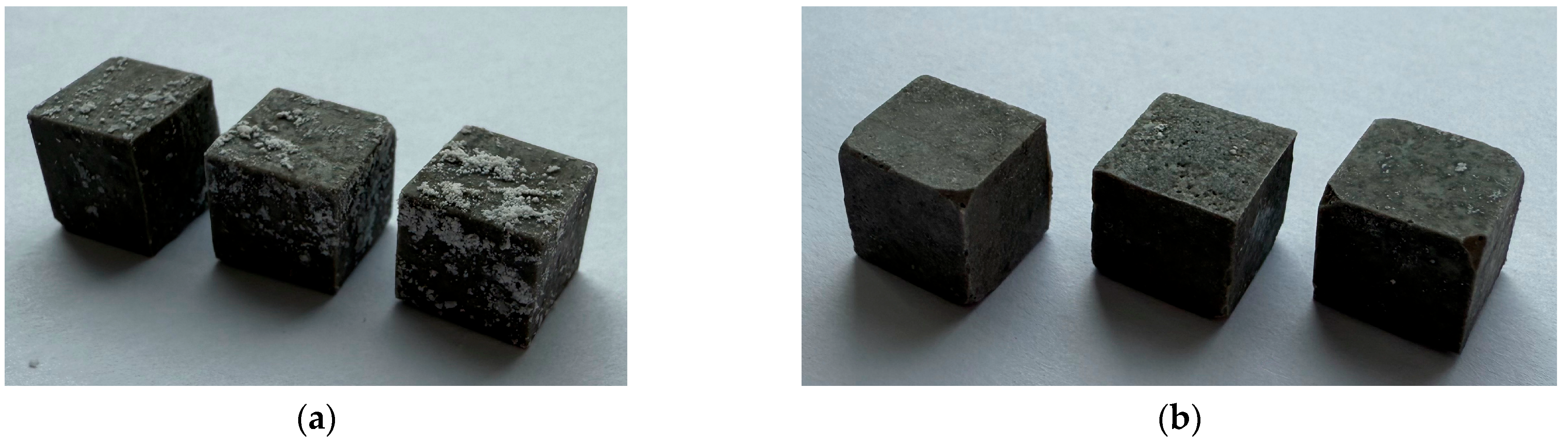
Thus, in this study, cubic MPP-ND composite samples containing up to 1.5 wt% NDs (Figure 2a) and samples containing both NDs and up to 20 wt% wollastonite (Figure 2b) were obtained. At least three samples were obtained in each batch. After storage, the samples were examined for mechanical strength, porosity, thermal conductivity, and resistance to leaching of radioactive waste components.

2.2. Research Methods of Experimental Samples

The phase composition of the obtained MPP-ND composite samples was controlled by powder X-ray diffractometry (XRD) on a MiniFlex 600 diffractometer (Rigaku, Tokyo, Japan). The obtained data were interpreted and the phase analysis of the samples was performed using the Jade 6 software package (MDI, Livermore, CA, USA) with a connected PDF-2 powder database.
The compressive and flexural strength of the samples were determined according to GOST 310.4-81 [39] on Cybertronic 500/50 kN (Testing Bluhm & Feuerherdt GmbH, Berlin, Germany) and IR-5047-50S (Tochpribor, Saint Petersburg, Russia) testing machines, respectively.
In accordance with the regulatory requirements for ensuring safety during the conditioning of RW in Russia [40], the resistance of the MPP-ND composite to thermal cycles was determined, which was assessed according to their compressive strength. For this purpose, samples were kept in an MK-53 heat and cold testing chamber (Binder, Tuttlingen, Germany) for 30 freeze/thaw thermal cycles in a temperature range from –40 to +40 °C.
The porosity of the MPP-ND composite samples was determined by using the water immersion method based on previously published works [41,42]. The apparent (open) porosity (PA) of the samples was determined by Equation (2) as described in our earlier study [41]. The open porosity of the samples is defined as the ratio of the accessible pore volume to the apparent volume of the material [42]. The samples were weighed in a dry state (Mdry). Then, the samples were immersed in water for 24 h until complete saturation. The mass of each sample after saturation with water (Mi,24h) and the mass of each wet sample (Mwet) were determined.
P A = ( M w e t M d r y ) ( M w e t M i , 24 h ) · 100
The coefficient of thermal conductivity was determined by using the laser flash method with a DLF-1200 (TA Instruments, New Castle, DE, USA). Measurements were performed in a nitrogen atmosphere over a temperature range of 47–510 °C. The heating rate was 10 °C/min. The charging voltage of the laser capacitor banks was 1200 V. To reduce losses due to laser radiation reflection, a thin layer of graphite aerosol a “GRAPHITE 200” (Cramolin, Mühlacker, Germany) was applied to the ends of the cylinders, which was completely dried before loading the samples into the setup.
The hydrolytic stability of the obtained MPP-ND composite was determined in accordance with the Russian semi-dynamic test GOST R 52126-2003 [43]. Test conditions were as follows: monolithic sample, leaching agent—double-distilled water, temperature—(25 ± 3) °C, ratio of contact solution volume to open geometric surface area of the sample—from 3 to 10 cm. Samples were placed in a fluoroplastic container and filled with leaching agent, which was replaced after 1, 3, 7, 10, 14, 21, and 28 days. At the specified time, the samples were removed from the container, washed with double-distilled water in a volume equal to the volume of the leaching agent, and combined with the solution after leaching. The content of U and Eu in the solutions after leaching was determined by using inductively coupled plasma mass spectrometry (ICP-MS) on a X Series2 spectrometer (Thermo Scientific, Waltham, MA, USA), and the content of 239Pu was determined by using alpha spectrometry on an Alpha Analyst spectrometer (Canberra, Meriden, CT, USA). The hydrolytic stability of the samples was assessed according to the integral rate (Rint) and degree (D) of leaching of radioactive waste components, which were calculated using Equations (3) and (4), respectively.
R i n t = c · V S · f · t   ,
D = m m 0   · 100 ,
where c—the concentration of element in the solution, g/L; V—the volume of double-distilled water, L; S—the area of the open geometric surface of the sample, cm2; f—the content of element in the sample, g/g; t—the duration of leaching from the beginning of the experiment, days; m—the mass of the element in the solution after leaching, g; m0—the mass of the element in the sample, g.

3. Results and Discussion

3.1. Elemental Composition and Functional Groups of NDs Surface

According to XPS data, the surface of NDs consists of carbon, oxygen, and nitrogen. Table 1 shows the chemical bonds and their content obtained by processing the spectra high-resolution lines of the elements shown in Figure S1 (see Supplementary Materials). The XPS spectra were interpreted using known literature data for carbon [44,45], oxygen, and nitrogen [46,47]. The table shows that the majority of the carbon has a diamond structure, which is the core of any NDs, while another 11% is sp2 carbon, which can be found in the amorphous shell of the core or in functional groups on the NDs surface. Furthermore, 3.2 at% of the carbon is found in carboxyl groups on the surface. Oxygen on the NDs surface is part of C–O and C=O groups, which can be related to carboxyl groups, aldehydes, ketones, anhydrides, and other similar structures, including nitrogen-containing ones (amides). It is noted that 0.7 at% of oxygen is part of metal oxides, which can be attributed to the presence of 2 mg/g of iron impurity, indicating that this impurity is located on the surface. At the same time, the presence of iron was not detected in the XPS spectra, which can be explained by the detection limit of the method. Finally, nitrogen on the NDs surface is part of amino, amide, nitroso, and nitro groups. The presence of both carboxyl and amino groups on the NDs surface determines the amphiphilic nature of the material and the ability to bind both cationic and anionic forms of radionuclides, as well as facilitating NDs aggregation in aqueous solutions. The identified chemical composition and functional groups of the NDs surface are typical of NDs obtained via detonation synthesis, and the obtained XPS data are consistent with previously obtained FTIR spectroscopy (Figure S2) and acid–base titration data.
The NDs surface is mostly hydrophobic, although it contains a small amount of hydrophilic functional groups, which is clearly seen from the data in Table 1. Thus, the surface contains only about 4 at% of carboxyl and amino groups which dissociate sufficiently in aqueous solutions (or 540 μmol/g according to acid–base titration data as indicated in Section 2.1). Also, oxygen-containing functional groups can form hydrogen bonds with water, but the total oxygen content on the surface is only 7.8 at%. We previously determined that NDs powder contains about 5 wt% adsorbed water and/or gases on the surface [28], and based on the data we obtained in this work, it is obvious that water and gases are retained in the NDs pores either by hydrogen bonds or mechanically, but are not bound to the surface by chemical bonds. Thus, the absorption of water by NDs during the formation of the MPP-ND composite is unlikely, since during the formation of the main matrix-forming phase MgKPO4 × 6H2O, water is bound by chemical bonds, whereas only weak physical interactions are possible with the NDs surface.

3.2. Choice of Optimal Filling of MPP-ND Composite by NDs

Optimal filling of the MPP-ND composite by NDs was assessed based on the results of studying the phase composition, compressive strength, porosity, and thermal conductivity of the samples.
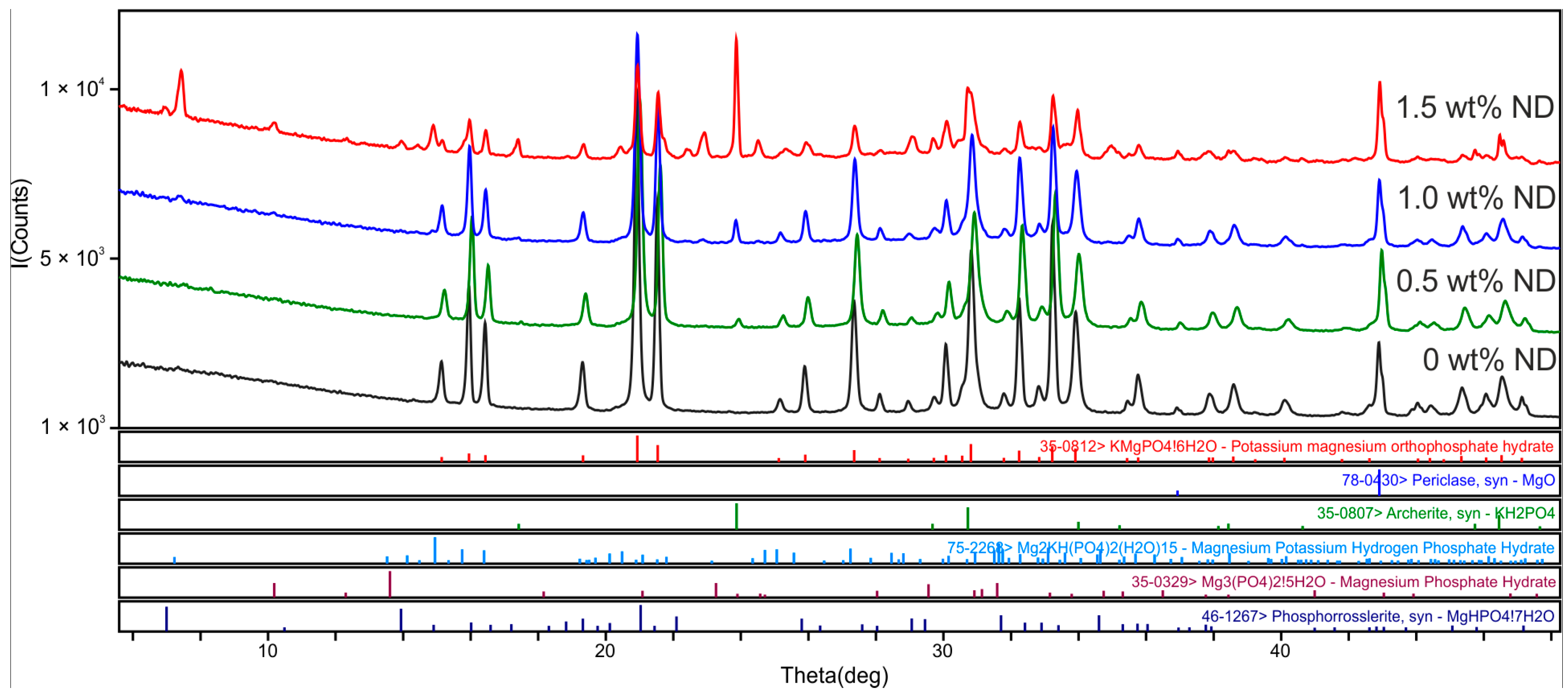
X-ray diffraction patterns of the obtained composite samples with different NDs contents are shown in Figure 3. When studying the phase composition of the MPP-ND composite, it was found that all samples consist of the main matrix-forming phase of MgKPO4 × 6H2O (PDF No. 35-0812), an analog of the natural mineral struvite—K [48]. All samples also contain the MgO phase (PDF No. 78-0430), which is due to its 10% excess relative to the stoichiometric amount in accordance with the method for obtaining the MPP matrix. It was noted that when adding NDs to the composition of the MPP matrix, unreacted KH2PO4 (PDF No. 35-0807) remains present; the intensity of the main peak (23.87 Å) and, consequently, its content increases with an increase in the content of NDs in the samples. In this case, the addition of more than 1.0 wt% of NDs leads to a decrease in the intensity of the main matrix-forming phase and the formation of various magnesium phosphate hydrates of Mg2KH(PO4)2 × 15H2O (PDF No. 75-2268), Mg3(PO4)2 × 5H2O (PDF No. 35-0329), MgHPO4 × 7H2O (PDF No. 46-1267), which are formed as intermediate phases during the hydration of the MPP matrix, as noted in [49,50]. Thus, the addition of more than 1 wt% NDs to the MPP-ND composite has a negative effect on the formation and crystallization of the main matrix-forming phase of MgKPO4 × 6H2O.
Thus, optimal filling of the MPP-ND composite is no more than 1.0 wt% NDs.
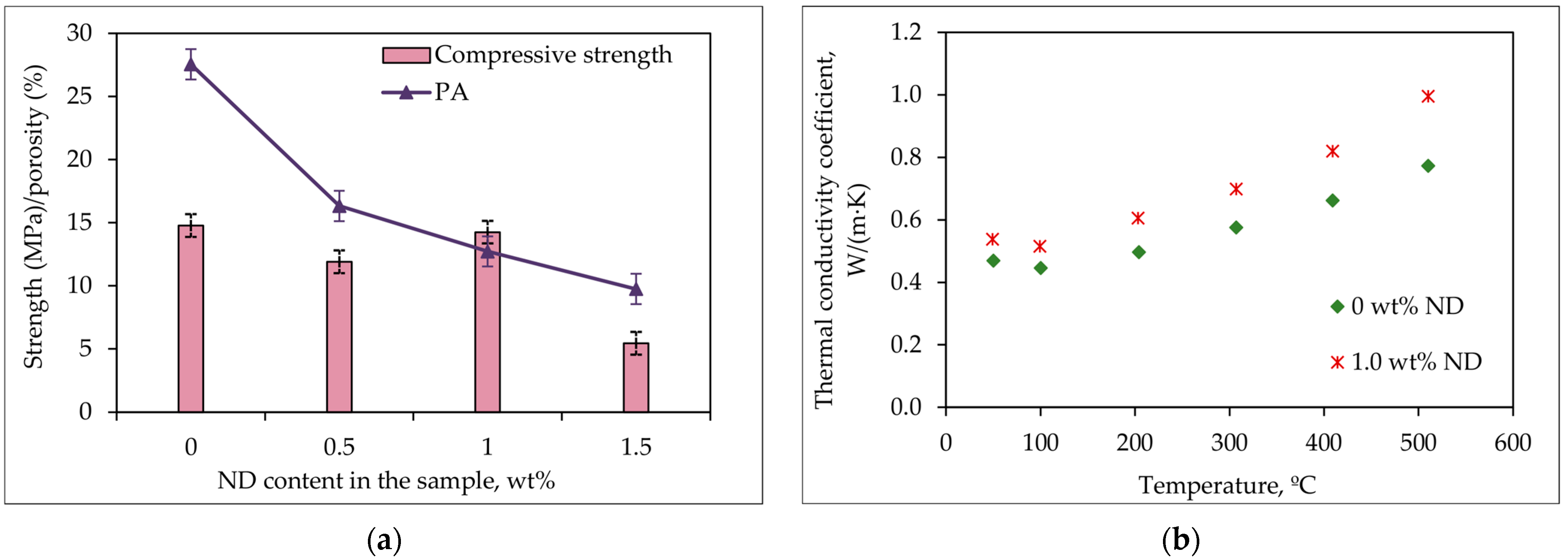
When studying the compressive strength of composite samples with different NDs contents (Figure 4a), it was found that with the introduction of ≤1.0 wt% NDs, the strength of the samples remains virtually unchanged and amounts to values at the level of 12–14 MPa, which is close to the value for a blank sample. With an increase in the NDs content in the composite to 1.5 wt%, the compressive strength of the obtained samples decreases 2.7 times compared to the blank sample, which is probably due to the fact that in addition to the MPP matrix phase, the samples also contain other intermediate phosphate phases (Figure 3).
It should be noted that all samples containing ≤1 wt% NDs are resistant to freeze/thaw thermal cycles. The compressive strength of the samples after thermal cycles decreases by no more than 5% and meets the regulatory requirements for solidified RW in Russia (at least 4.9 MPa [40]).
It can also be seen from Figure 4a that the porosity of the MPP-ND composite samples decreases from 27.5% to 9.7% when adding up to 1.5 wt% NDs to the blank sample. This effect is probably associated with the filling of the pores of the MPP matrix sample with NDs, since, as noted earlier [27], nanosized material easily fills the pores of the cement matrix, which contributes to its compaction. It should be noted that the maximum compressive strength (~14 MPa) of the MPP-ND composite with the addition of 1 wt% NDs in the sample corresponds to its low porosity (~13%).
Figure 4b shows the dependence of the thermal conductivity coefficient of the MPP-ND composite containing 1 wt% NDs on temperature, as well as, for comparison, data for a blank compound that does not contain NDs. It is known that the thermal conductivity coefficient of NDs is about 50 W/(m∙K) [51]. From the data in Figure 4b it can be seen that the thermal conductivity coefficient of the MPP-ND composite increases by 22% with the addition of 1 wt% NDs. The thermal conductivity coefficient of the MPP-ND composite in the range (47–510) °C is at the level of (0.5–1.0) W/(m∙K). It can be noted that these values correspond to the value of the thermal conductivity coefficient for a high-temperature glass matrix ((0.7–1.6) W/(m∙K) [40]), used for the immobilization of heat-generating high-level waste.
Thus, based on the results of the phase composition, compressive strength, porosity, and thermal conductivity of MPP-ND composite samples, it was noted that optimal filling of the MPP matrix is 1 wt% NDs. Therefore, further studies were conducted at the specified NDs content in the samples.

3.3. Choice of Optimal Filling of MPP-ND Composite by Wollastonite

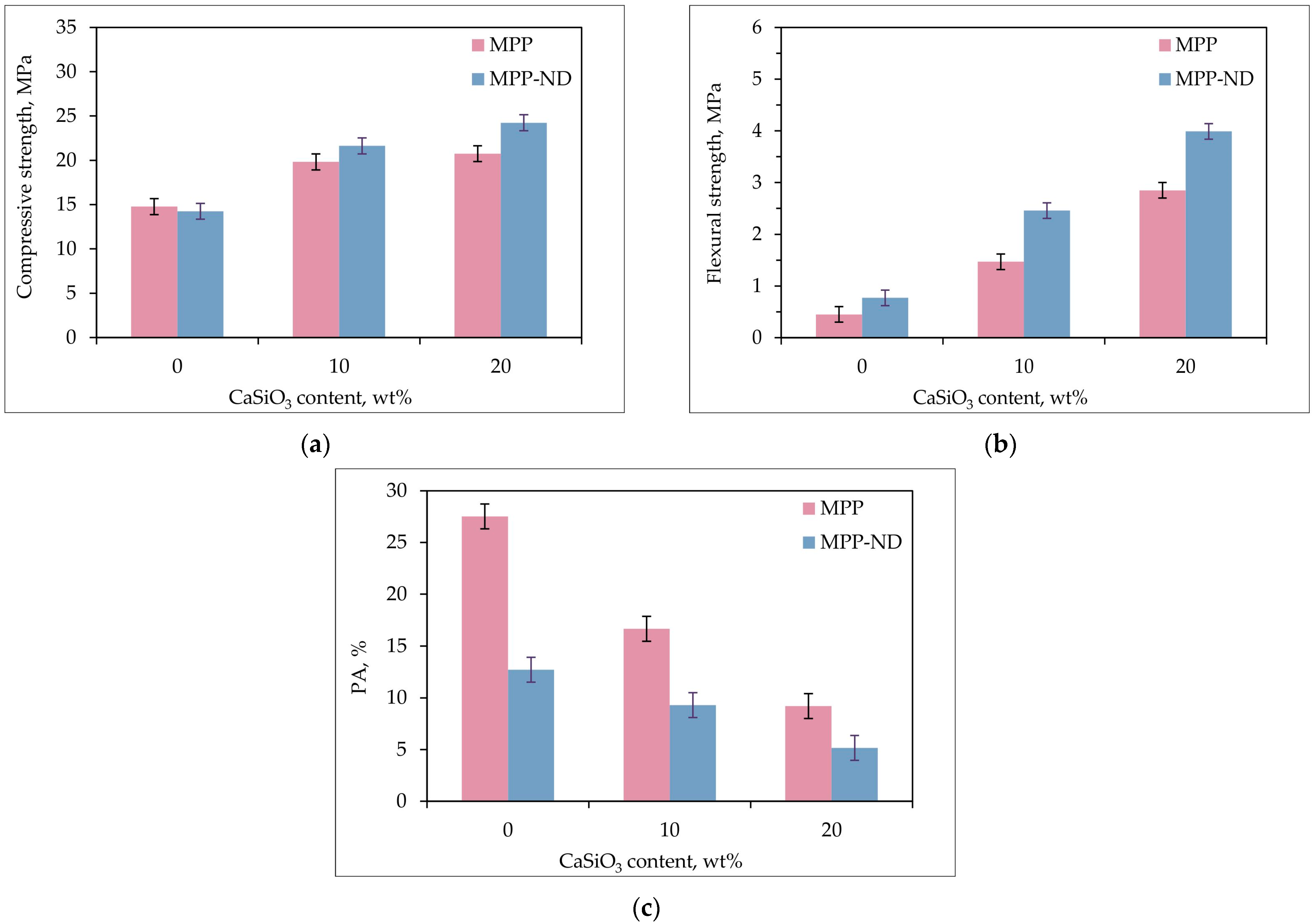
As we have previously noted, the mechanical strength of the MPP matrix can be increased by adding wollastonite [30] due to the needle-shaped form of its crystalline particles [6]. Thus, to determine optimal filling of the MPP-ND composite containing 1 wt% NDs with wollastonite, in this study, the dependance of the compressive strength (Figure 5a), flexural strength (Figure 5b), and porosity (Figure 5c) of the samples on the wollastonite content was investigated. For comparison, the figures also show values for samples without NDs.
From the data in Figure 5 it can be seen that the compressive and flexural strength of the MPP compound samples, including the MPP-ND composite samples containing 1 wt% NDs, increase with an increase in the wollastonite content from 10 to 20 wt%, which confirms its reinforcing effect. Thus, the compressive strength of the MPP compound and MPP-ND composite samples with the introduction of 20 wt% wollastonite is about 21 MPa and 24 MPa, respectively, which is 1.4 and 1.7 times higher than the values recorded for samples without wollastonite (Figure 5a), respectively. It was found that the flexural strength of the MPP-ND composite samples increases 1.7 times with the introduction of 1 wt% NDs, reaching 0.8 MPa (Figure 5b). At the same time, the flexural strength of samples containing 1 wt% NDs and 20 wt% wollastonite increases 5.2 times and is about 4 MPa. The increase in compressive and flexural strength is facilitated by the reduction in apparent porosity of the samples, as shown in Figure 5c. Therefore, wollastonite and NDs fill the pores of the MPP matrix and, due to their combined action, reduce the porosity of the samples from 13% to 5% (Figure 5c).
Thus, it was shown that the MPP-ND composite containing 1 wt% NDs and 20 wt% wollastonite has a maximum compressive strength of 24 MPa (Figure 5a) and a maximum flexural strength of 4 MPa (Figure 5b) with a minimum porosity of no more than 5% (Figure 5c).

3.4. Hydrolytic Stability of MPP-ND Composite

The results of the hydrolytic stability of the MPP-ND composite containing 20 wt% wollastonite and 1 wt% NDs with pre-sorbed 239Pu, 238U, and Eu are shown in Figure 6, Figure 7 and Figure 8. Figure 6, Figure 7 and Figure 8 also show the hydrolytic stability of the MPP matrix containing 20 wt% wollastonite and 239Pu, 238U, and Eu without preliminary sorption of nuclides on NDs.
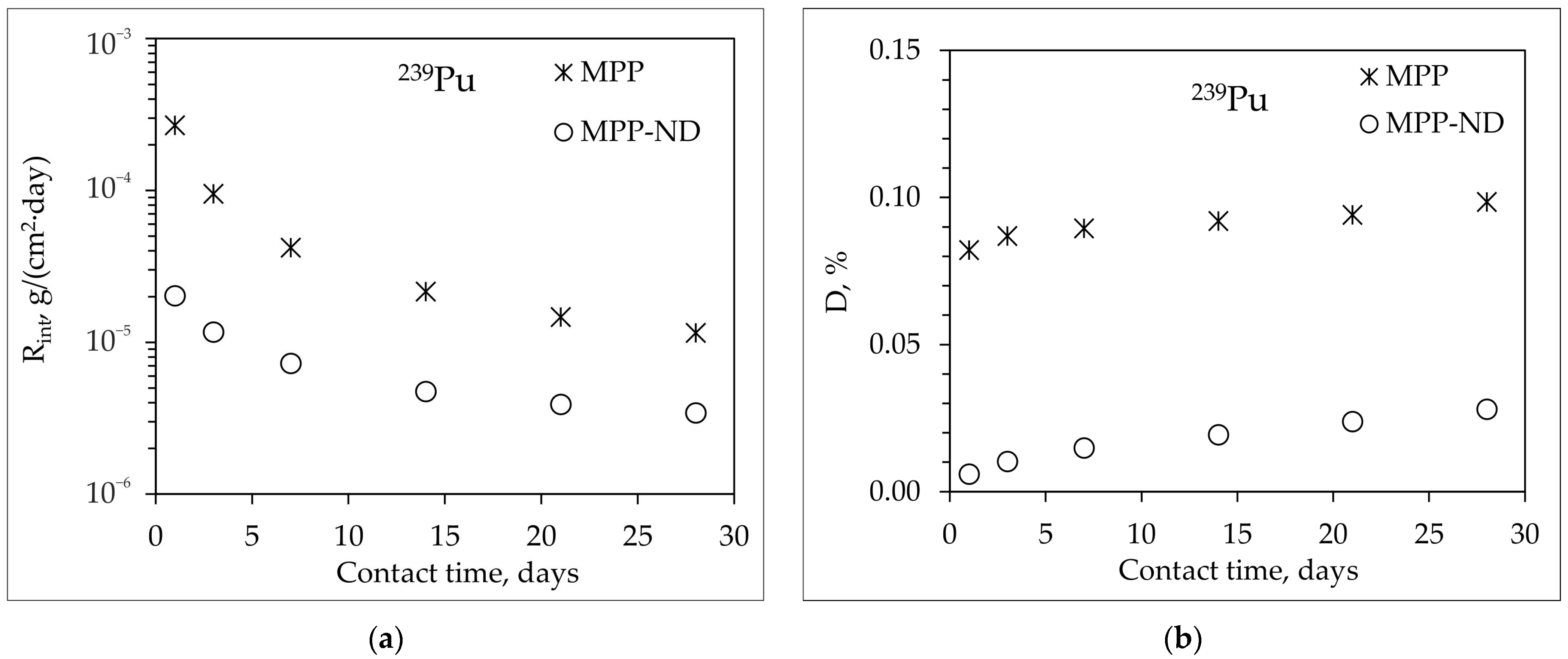
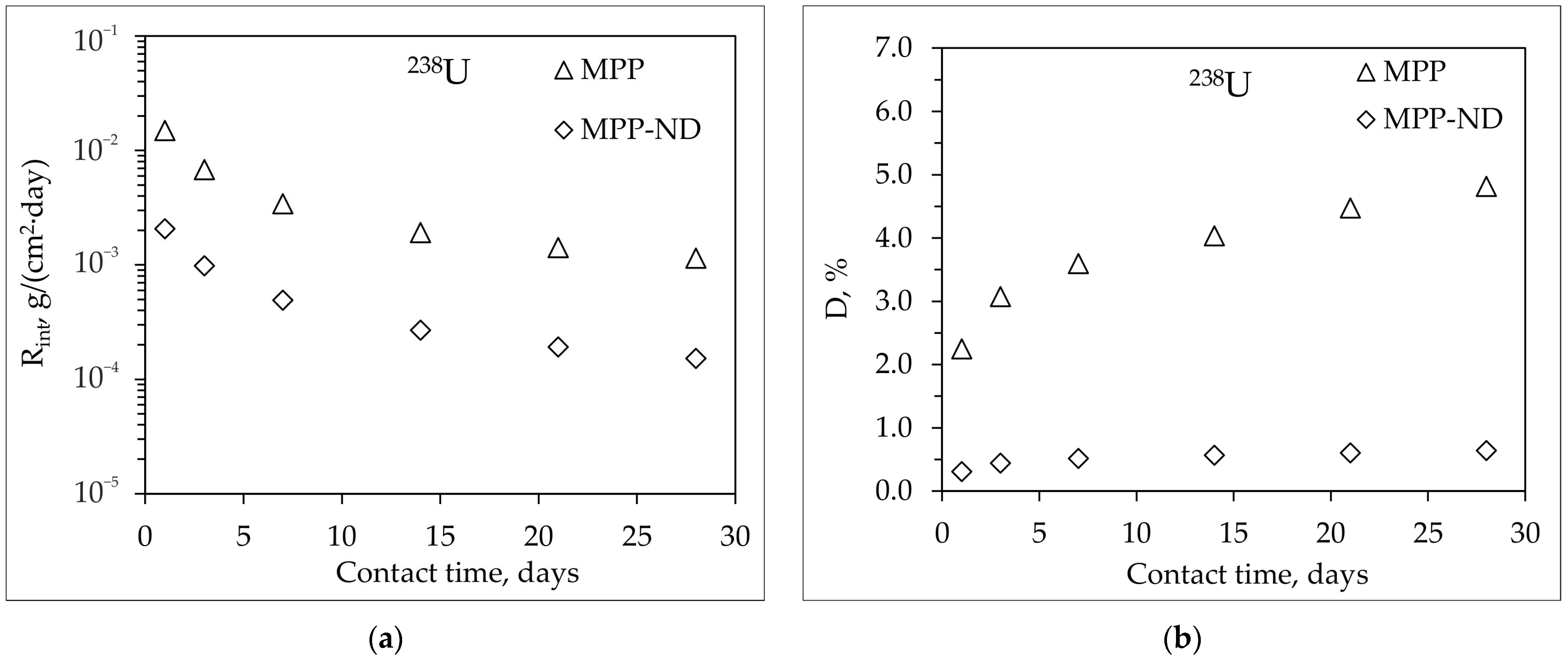
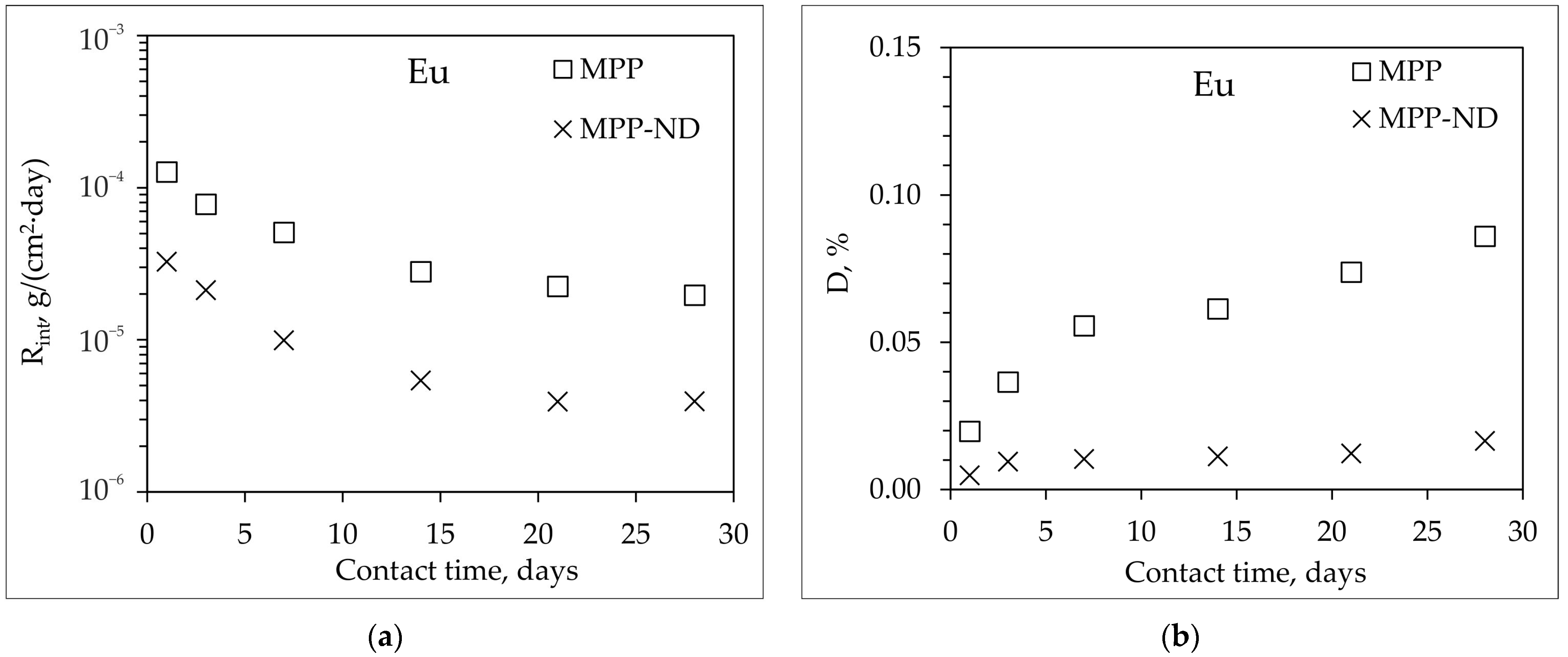
It was found that the addition of 1 wt% NDs to the MPP-ND composite leads to a decrease in the integral rate and degree of 239Pu, 238U, and Eu leaching of 3.5 (Figure 6), 7.5 (Figure 7), and 5 (Figure 8) times, respectively. The leaching rate of 239Pu, 238U, and Eu from the MPP-ND composite samples on the 28th day of contact with water amounted to values at the level of 3.5 × 10⁻⁶ g/(cm2∙day) (Figure 6a), 1.5 × 10⁻⁴ g/(cm2∙day) (Figure 7a), and 4.0 × 10⁻⁶ g/(cm2∙day) (Figure 8a), respectively. Meanwhile, the leaching degree of 239Pu, 238U, and Eu from the MPP-ND composite samples on the 28th day of contact with water was 0.028% (Figure 6b), 0.64% (Figure 7b), and 0.017% (Figure 8b), respectively. Thus, the low values of the rate and degree of leaching of actinides (239Pu, 238U) and europium from the MPP-ND composite confirm the effective action of NDs during RW solidification using the MPP matrix.

4. Conclusions

It was established that the MPP-ND composite containing 1 wt% NDs has mechanical strength, thermal conductivity, and hydrolytic stability that meets the requirements for solidified RW. The conclusions are drawn as follows:
  • The strength of the MPP-ND composite containing ≤1.0 wt% NDs is about 12–14 MPa;
  • All samples containing ≤1 wt% NDs are resistant to freeze/thaw thermal cycles;
  • The porosity of the samples decreases from 27.5% to 9.7% when introducing up to 1.5 wt% NDs into the blank sample;
  • The thermal conductivity coefficient of the MPP-ND composite increases by 22% with the introduction of 1 wt% NDs and amounts to values at the level of (0.5–1.0) W/(m∙K) in the range (47–510) °C;
  • Based on the results of the phase composition, compressive strength, porosity, and thermal conductivity of the MPP-ND composite samples, it was noted that optimal filling of the MPP matrix is 1 wt% NDs;
  • The MPP-ND composite containing 1 wt% NDs and 20 wt% wollastonite has a maximum compressive strength of 24 MPa and a maximum flexural strength of 4 MPa with a minimum porosity of no more than 5%;
  • The addition of 1 wt% NDs to the MPP-ND composite leads to a decrease in the rate and degree of leaching of 239Pu, 238U, and Eu of 3.5, 7.5 and 5 times, respectively.
Thus, the introduction of NDs into the composite compound is a promising way to improve radioecological safety during RW disposal.

Supplementary Materials

The following supporting information can be downloaded at https://www.mdpi.com/article/10.3390/jcs9120688/s1: Figure S1: XPS analysis results of NDs: (a) overview XPS spectrum, including high-resolution spectra of (b) C1s region, (c) N1s region, and (d) O1s region; Figure S2: FTIR spectrum of NDs.

Author Contributions

Conceptualization, S.A.F., A.G.K., S.E.V., and B.F.M.; methodology, S.A.F. and A.G.K.; validation, S.A.F. and S.E.V.; formal analysis, S.A.F. and N.D.C.; investigation, N.D.C. and K.Y.B.; resources, S.E.V. and B.F.M.; writing—original draft preparation, S.A.F.; writing—review and editing, S.E.V.; visualization, S.A.F., N.D.C., K.Y.B., and A.G.K.; supervision, S.E.V. and B.F.M.; project administration, S.E.V. and B.F.M.; funding acquisition, B.F.M. All authors have read and agreed to the published version of the manuscript.

Funding

The study was supported by the grant of the Russian Science Foundation No. 24-13-00430, URL: https://rscf.ru/en/project/24-13-00430/ (accessed on 31 October 2025).

Data Availability Statement

All of the data used to support the findings of this study are included within the article.

Acknowledgments

The authors thank A.V. Zhilkina (Laboratory of Methods for Investigation and Analysis of Substances and Materials, GEOKHI RAS) for carrying out ICP-MS.

Conflicts of Interest

The authors declare no conflicts of interest. The funders had no role in the design of the study; in the collection, analyses, or interpretation of data; in the writing of the manuscript; or in the decision to publish the results.

Abbreviations

The following abbreviations are used in this manuscript:
GOgraphene oxide
CNTscarbon nanotubes
MPP matrixmagnesium potassium phosphate matrix
MPP-ND compositecomposite based on a magnesium potassium phosphate matrix containing nanodiamonds
NDsnanodiamonds
RWradioactive waste
PAapparent porosity
FTIRfourier transform infrared spectroscopy
XPSX-ray photoelectron spectroscopy
XRDX-ray diffraction

References

  1. Malkovsky, V.; Liebscher, A.; Nagel, T.; Magri, F. Influence of tectonic perturbations on the migration of long-lived radionuclides from an underground repository of radioactive waste. Environ. Earth Sci. 2022, 81, 537. [Google Scholar] [CrossRef]
  2. Drace, Z.; Ojovan, M.I.; Samanta, S.K. Challenges in Planning of Integrated Nuclear Waste Management. Sustainability 2022, 14, 14204. [Google Scholar] [CrossRef]
  3. Jantzen, C.M.; Lee, W.E.; Ojovan, M.I. Radioactive waste (RAW) conditioning, immobilization, and encapsulation processes and technologies: Overview and advances. In Woodhead Publishing Series in Energy, Radioactive Waste Management and Contaminated Site Clean-Up; Lee, W.E., Ojovan, M.I., Jantzen, C.M., Eds.; Woodhead Publishing: Cambridge, UK, 2013; pp. 171–272. [Google Scholar] [CrossRef]
  4. Kulikova, S.A.; Danilov, S.S.; Matveenko, A.V.; Frolova, A.V.; Belova, K.Y.; Petrov, V.G.; Vinokurov, S.E.; Myasoedov, B.F. Perspective Compounds for Immobilization of Spent Electrolyte from Pyrochemical Processing of Spent Nuclear Fuel. Appl. Sci. 2021, 11, 11180. [Google Scholar] [CrossRef]
  5. Rakhimova, N. Recent Advances in Alternative Cementitious Materials for Nuclear Waste Immobilization: A Review. Sustainability 2023, 15, 689. [Google Scholar] [CrossRef]
  6. Wagh, A.S. Chemically Bonded Phosphate Ceramics: Twenty-First Century Materials with Diverse Applications, 2nd ed.; Elsevier: Amsterdam, The Netherlands, 2016; pp. 1–422. ISBN 978-0-08-100380-0. [Google Scholar]
  7. Vinokurov, S.E.; Kulikova, S.A.; Myasoedov, B.F. Magnesium Potassium Phosphate Compound for Immobilization of Radioactive Waste Containing Actinide and Rare Earth Elements. Materials 2018, 11, 976. [Google Scholar] [CrossRef]
  8. Lai, Z.; Wang, H.; Hu, Y.; Yan, T.; Lu, Z.; Lv, S.; Zhang, H. Rapid solidification of highly loaded high-level liquid wastes with magnesium phosphate cement. Ceram. Int. 2019, 45, 5050–5057. [Google Scholar] [CrossRef]
  9. Sayenko, S.Y.; Shkuropatenko, V.A.; Pylypenko, O.V.; Karsim, S.O.; Zykova, A.V.; Kutni, D.V.; Wagh, A.S. Radioactive waste immobilization of Hanford sludge in magnesium potassium phosphate ceramic forms. Prog. Nucl. Energy 2022, 152, 104315. [Google Scholar] [CrossRef]
  10. Vinokurov, S.E.; Kulikova, S.A.; Frolova, A.V.; Danilov, S.S.; Belova, K.Y.; Rodionova, A.A.; Myasoedov, B.F. New Methods and Materials in Nuclear Fuel Fabrication and Spent Nuclear Fuel and Radioactive Waste Management. In Advances in Geochemistry, Analytical Chemistry, and Planetary Sciences; Kolotov, V.P., Bezaeva, N.S., Eds.; Springer: Cham, Switzerland, 2023; pp. 579–594. [Google Scholar] [CrossRef]
  11. Fattori, F.; Magugliani, G.; Santi, A.; Mossini, E.; Moschetti, I.; Galluccio, F.; Macerata, E.; de la Bernardie, X.; Abdelouas, A.; Cori, D.; et al. Radiation stability and durability of magnesium phosphate cement for radioactive reactive metals encapsulation. Prog. Nucl. Energy 2024, 177, 105463. [Google Scholar] [CrossRef]
  12. Lazorenko, G.; Kasprzhitskii, A. A review of magnesium-rich wastes and by-products as precursors for magnesium phosphate cements: Challenges and opportunities. Environ. Res. 2025, 285, 122402. [Google Scholar] [CrossRef]
  13. Vinokurov, S.E.; Kulikova, S.A.; Myasoedov, B.F. Hydrolytic and thermal stability of magnesium potassium phosphate compound for immobilization of high level waste. J. Radioanal. Nucl. Chem. 2018, 318, 2401–2405. [Google Scholar] [CrossRef]
  14. Kulikova, S.A.; Danilov, S.S.; Belova, K.Y.; Rodionova, A.A.; Vinokurov, S.E. Optimization of the solidification method of high-level waste for increasing the thermal stability of the magnesium potassium phosphate compound. Energies 2020, 13, 3789. [Google Scholar] [CrossRef]
  15. Plecas, I.; Dimovic, S.; Smiciklas, I. Utilization of bentonite and zeolite in cementation of dry radioactive evaporator concentrate. Prog. Nucl. Energy 2006, 48, 495–503. [Google Scholar] [CrossRef]
  16. Luhar, I.; Luhar, S.; Abdullah, M.M.A.B.; Sandu, A.V.; Vizureanu, P.; Razak, R.A.; Burduhos-Nergis, D.D.; Imjai, T. Solidification/Stabilization Technology for Radioactive Wastes Using Cement: An Appraisal. Materials 2023, 16, 954. [Google Scholar] [CrossRef] [PubMed]
  17. Barbhuiya, S.; Das, B.B.; Qureshi, T.; Adak, D. Cement-based solidification of nuclear waste: Mechanisms, formulations and regulatory considerations. J. Environ. Manag. 2024, 356, 120712. [Google Scholar] [CrossRef]
  18. Abdalla, J.A.; Hawileh, R.A.; Bahurudeen, A.; Jittin, V.; Kabeer, K.S.A.; Thomas, B.S. Influence of synthesized nanomaterials in the strength and durability of cementitious composites. Case Stud. Constr. Mater. 2023, 18, e02197. [Google Scholar] [CrossRef]
  19. Kazakov, A.G.; Pavlova, D.V.; Vinokurov, S.E.; Myasoedov, B.F. Sorption of americium from aqueous solutions of various compositions onto detonation synthesis nanodiamonds. Radiochemistry 2025, 67, 158–165. [Google Scholar] [CrossRef]
  20. Sundar, L.S.; Hortiguela, M.J.; Singh, M.K.; Sousa, A.C.M. Thermal conductivity and viscosity of water based nanodiamond (ND) nanofluids: An experimental study. Int. Commun. Heat Mass Transf. 2016, 76, 245–255. [Google Scholar] [CrossRef]
  21. Wang, B.; Zhao, R. Effect of graphene nano-sheets on the chloride penetration and microstructure of the cement based composite. Constr. Build. Mater. 2018, 161, 715–722. [Google Scholar] [CrossRef]
  22. Jiříčková, A.; Lauermannová, A.-M.; Jankovský, O.; Lojka, M.; Záleská, M.; Pivák, A.; Pavlíková, M.; Merglová, A.; Pavlík, Z. Impact of nano-dopants on the mechanical and physical properties of magnesium oxychloride cement composites—Experimental assessment. J. Build. Eng. 2024, 87, 108981. [Google Scholar] [CrossRef]
  23. Li, X.; Liu, Y.M.; Li, W.G.; Li, C.Y.; Sanjayan, J.G.; Duan, W.H.; Li, Z. Effects of graphene oxide agglomerates on workability, hydration, microstructure and compressive strength of cement paste. Constr. Build. Mater. 2017, 145, 402–410. [Google Scholar] [CrossRef]
  24. Qu, H.; Qian, S.; Liu, X.; Gao, R.; Wang, Z.; Zheng, C.; Zhang, Z. Carbon dots as a superior building nanomaterial for enhancing the mechanical properties of cement-based composites. J. Build. Eng. 2022, 52, 104523. [Google Scholar] [CrossRef]
  25. Liu, Y.; Zhong, X.; Reza, H. Mohammadian Role carbon nanomaterials in reinforcement of concrete and cement; A new perspective in civil engineering. Alex. Eng. J. 2023, 72, 649–656. [Google Scholar] [CrossRef]
  26. Fan, Y.; Zhang, G.; Li, Y. Study on graphene oxide reinforced magnesium phosphate cement composites. Constr. Build. Mater. 2022, 359, 129523. [Google Scholar] [CrossRef]
  27. Lu, Z.; Hou, D.; Ma, H.; Fan, T.; Li, Z. Effects of graphene oxide on the properties and microstructures of the magnesium potassium phosphate cement paste. Constr. Build. Mater. 2016, 119, 107–112. [Google Scholar] [CrossRef]
  28. Li, Y.; Lin, H. Experimental study on the effect of different dispersed degrees carbon nanotubes on the modification of magnesium phosphate cement. Constr. Build. Mater. 2019, 200, 240–247. [Google Scholar] [CrossRef]
  29. Du, Y.; Yang, J.; Thomas, B.S.; Li, L.; Li, H.; Shaban, W.M.; Chong, W.T. Influence of hybrid graphene oxide/carbon nanotubes on the mechanical properties and microstructure of magnesium potassium phosphate cement paste. Constr. Build. Mater. 2020, 260, 120449. [Google Scholar] [CrossRef]
  30. Vinokurov, S.E.; Kulikova, S.A.; Krupskaya, V.V.; Myasoedov, B.F. Magnesium potassium phosphate compound for radioactive waste immobilization: Phase composition, structure, and physicochemical and hydrolytic durability. Radiochemistry 2018, 60, 70–78. [Google Scholar] [CrossRef]
  31. GOST 4526-75; Reagents. Magnesium Oxide. Specifications. IPC Publishing House of Standards: Moscow, Russia, 1975; pp. 1–11.
  32. GOST 4198-75; Reagents. Potassium Dihydrogen Phosphate. Specifications. Standartinform: Moscow, Russia, 2010; pp. 1–16.
  33. GOST 9656-75; Reagents. Boric Acid. Specifications. Standartinform: Moscow, Russia, 2006; pp. 1–10.
  34. Kazakov, A.G.; Pavlova, D.V.; Ekatova, T.Y.; Larkina, M.S.; Varvashenya, R.N.; Yanovich, G.E.; Plotnikov, E.V.; Ushakov, I.A.; Nesterov, E.A.; Zukau, V.V.; et al. Preparation of a nanodiamond suspension with immobilized lutetium-177 and study of its biodistribution. J. Radioanal. Nucl. Chem. 2025, 334, 6029–6041. [Google Scholar] [CrossRef]
  35. Kazakov, A.G.; Babenya, J.S.; Ekatova, T.Y.; Vinokurov, S.E.; Khvorostinin, E.Y.; Ushakov, I.A.; Zukau, V.V.; Stasyuk, E.S.; Nesterov, E.A.; Sadkin, V.L.; et al. The Influence of the Sizes of Nanodiamond Aggregates in Suspensions on the Efficiency of Sorption of 90Y and 177Lu Isotopes for Further Use in Nuclear Medicine. Radiochemistry 2024, 66, 198–205. [Google Scholar] [CrossRef]
  36. Kulagin, V.A.; Kulagina, T.A.; Nikiforova, E.M.; Prikhodov, D.A.; Shimanskiy, A.F. Improvment of mechanical properties of the cement compound in order to increase the degree of its filling. J. Sib. Fed. Univ. Eng. Technol. 2018, 11, 711–731. [Google Scholar] [CrossRef]
  37. Kazakov, A.G.; Garashchenko, B.L.; Yakovlev, R.Y.; Vinokurov, S.E.; Kalmykov, S.N.; Myasoedov, B.F. An experimental study of sorption/desorption of selected radionuclides on carbon nanomaterials: A quest for possible applications in future nuclear medicine. Diam. Relat. Mater. 2020, 104, 107752. [Google Scholar] [CrossRef]
  38. Jeevanagoudar, Y.V.; Krishna, R.H.; Gowda, R.; Preetham, R.; Prabhakara, R. Improved mechanical properties and piezoresistive sensitivity evaluation of MWCNTs reinforced cement mortars. Constr. Build. Mater. 2017, 144, 188–194. [Google Scholar] [CrossRef]
  39. GOST 310.4-81; Cements. Methods of Tests of Bending and Compression Strengths. IPC Publishing House of Standards: Moscow, Russia, 2003; pp. 1–11.
  40. NP-019-15; Federal Norms and Rules in the Field of Atomic Energy Use “Collection, Processing, Storage and Conditioning of Liquid Radioactive Waste. Safety Requirements”. Rostekhnadzor: Moscow, Russia, 2015; pp. 1–22.
  41. Kulikova, S.A.; Belova, K.Y.; Frolova, A.V.; Vinokurov, S.E. The Use of Dolomite to Produce a Magnesium Potassium Phosphate Matrix for Radioactive Waste Conditioning. Energies 2023, 16, 5513. [Google Scholar] [CrossRef]
  42. Zaragoza-Benzal, A.; Ferrández, D.; Barrios, A.M.; Morón, C. Water Resistance Analysis of New Lightweight Gypsum-Based Composites Incorporating Municipal Solid Waste. J. Compos. Sci. 2024, 8, 393. [Google Scholar] [CrossRef]
  43. GOST R 52126-2003; Radioactive Waste. Long Time Leach Testing of Solidified Radioactive Waste Forms. Gosstandart 305: Moscow, Russia, 2003; pp. 1–8.
  44. Diederich, L.; Küttel, O.M.; Ruffieux, P.; Pillo, T.; Aebi, P.; Schlapbach, L. Photoelectron emission from nitrogen- and boron-doped diamond (100) surfaces. Surf. Sci. 1998, 417, 41–52. [Google Scholar] [CrossRef]
  45. Smentkowski, V.S.; Jänsch, H.; Henderson, M.A.; Yates, J.T. Deuterium atom interaction with diamond (100) studied by X-ray photoelectron spectroscopy. Surf. Sci. 1995, 330, 207–226. [Google Scholar] [CrossRef]
  46. NIST X-Ray Photoelectron Spectroscopy Database, Version 4.1—Gaithersburg: National Institute of Standards and Technology, 2012. Available online: http://srdata.nist.gov/xps (accessed on 2 December 2025).
  47. Beamson, G.; Briggs, D. High Resolution XPS of Organic Polymers: The Scienta ESCA 300 Database; John Wiley & Sons: Chichester, UK, 1992; 295p. [Google Scholar]
  48. Graeser, S.; Postl, W.; Bojar, H.-P.; Berlepsch, P.; Armbruster, T.; Raber, T.; Ettinger, K.; Walter, F. Struvite-(K), KMgPO4∙6H2O, the potassium equivalent of struvite—A new mineral. Eur. J. Miner. 2008, 20, 629–633. [Google Scholar] [CrossRef]
  49. Lothenbach, B.; Xu, B.; Winnefeld, F. Thermodynamic data for magnesium (potassium) phosphates. Appl. Geochem. 2019, 111, 104450. [Google Scholar] [CrossRef]
  50. Xu, B.; Cau Dit Coumes, C.; Lambertin, D.; Lothenbach, B. Compressive strength and hydrate assemblages of wollastonite-blended magnesium potassium phosphate cements exposed to different pH conditions. Cem. Concr. Compos. 2023, 143, 105255. [Google Scholar] [CrossRef]
  51. Kidalov, S.V.; Shakhov, F.M.; Vul, A.Y. Thermal conductivity of sintered nanodiamonds and microdiamonds. Diam. Relat. Mater. 2008, 17, 844–847. [Google Scholar] [CrossRef]
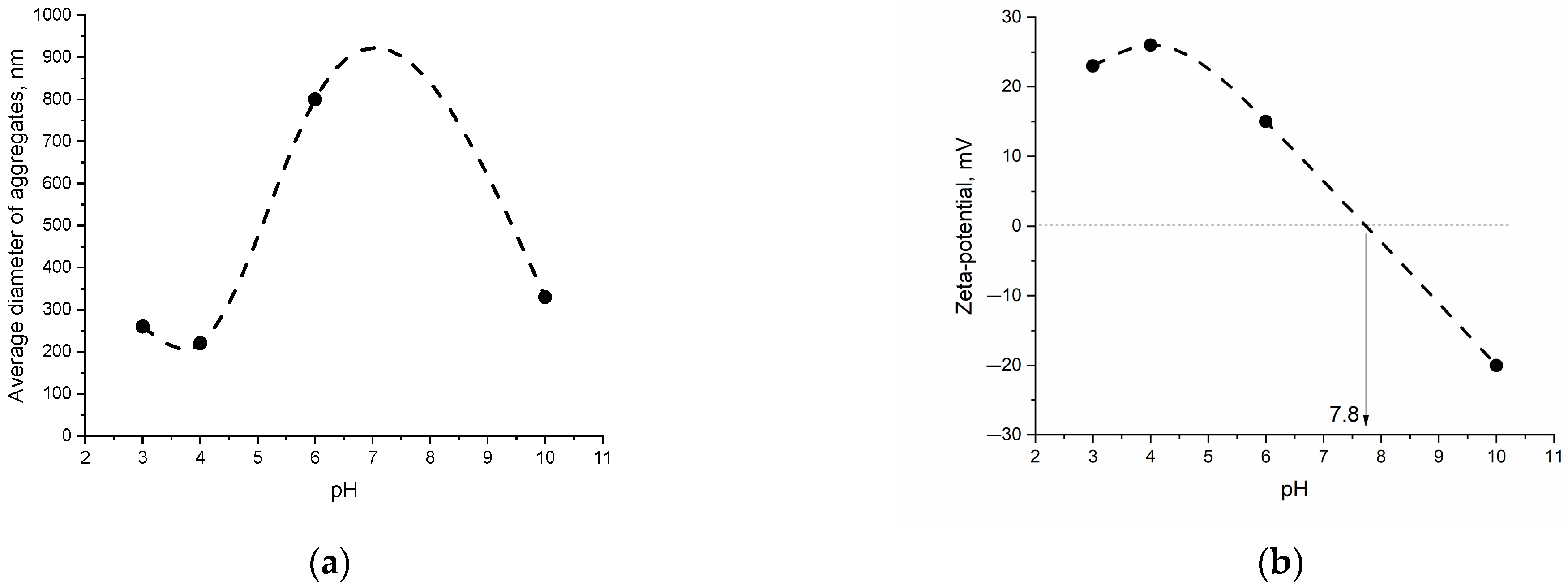
Figure 1. Average diameter of NDs aggregates in HNO3 and NaOH solutions (a) according to dynamic light scattering method, and zeta potential of their surface (b) [16].
Jcs 09 00688 g001
Figure 2. Photos of MPP-ND composite samples containing 1.5 wt% NDs (a), including those containing 20 wt% wollastonite (b).
Jcs 09 00688 g002
Figure 3. The X-ray diffraction patterns of the MPP compound samples, including those containing up to 1.5 wt% NDs.
Jcs 09 00688 g003
Figure 4. Compressive strength/apparent porosity (a) and thermal conductivity (b) of composite samples depending on NDs content.
Jcs 09 00688 g004
Figure 5. Compressive strength (a), flexural strength (b), and porosity (c) of MPP compound samples, including MPP-ND composite samples containing 1 wt% NDs, depending on wollastonite content.
Jcs 09 00688 g005
Figure 6. Kinetic curve of (a) integral rate and (b) degree of 239Pu leaching from samples.
Jcs 09 00688 g006
Figure 7. Kinetic curve of (a) integral rate and (b) degree of 238U leaching from samples.
Jcs 09 00688 g007
Figure 8. Kinetic curve of (a) integral rate and (b) degree of Eu leaching from samples.
Jcs 09 00688 g008
Table 1. Chemical bonds and their content on NDs surface according to XPS data.
SpectrumType of BindingContent, at%
C1sC–C (sp2)11.3
C–C (diamond)40.3
C–C (diamond H-terminated), C–O35.6
O=C–O3.2
C–C (sp2)0.7
O1sO2−3.9
O=C3.2
O–C11.3
N1sNR30.7
NR2C=O0.5
R–N=O0.3
–NO20.3
Disclaimer/Publisher’s Note: The statements, opinions and data contained in all publications are solely those of the individual author(s) and contributor(s) and not of MDPI and/or the editor(s). MDPI and/or the editor(s) disclaim responsibility for any injury to people or property resulting from any ideas, methods, instructions or products referred to in the content.