

A Critical Review of Diffusion—Thermomechanical and Composite Reinforcement Approaches for Surface Hardening of Aluminum Alloys and Matrix Composites

Abstract
1. Introduction
- Compare diffusion-assisted, thermomechanical, and composite-based treatments in terms of mechanisms, processability, and performance outcomes.
- Synthesize advantages, limitations, and trade-offs among methods with respect to hardness–ductility balance, corrosion resistance, hardening depth, and cost–feasibility relationships.
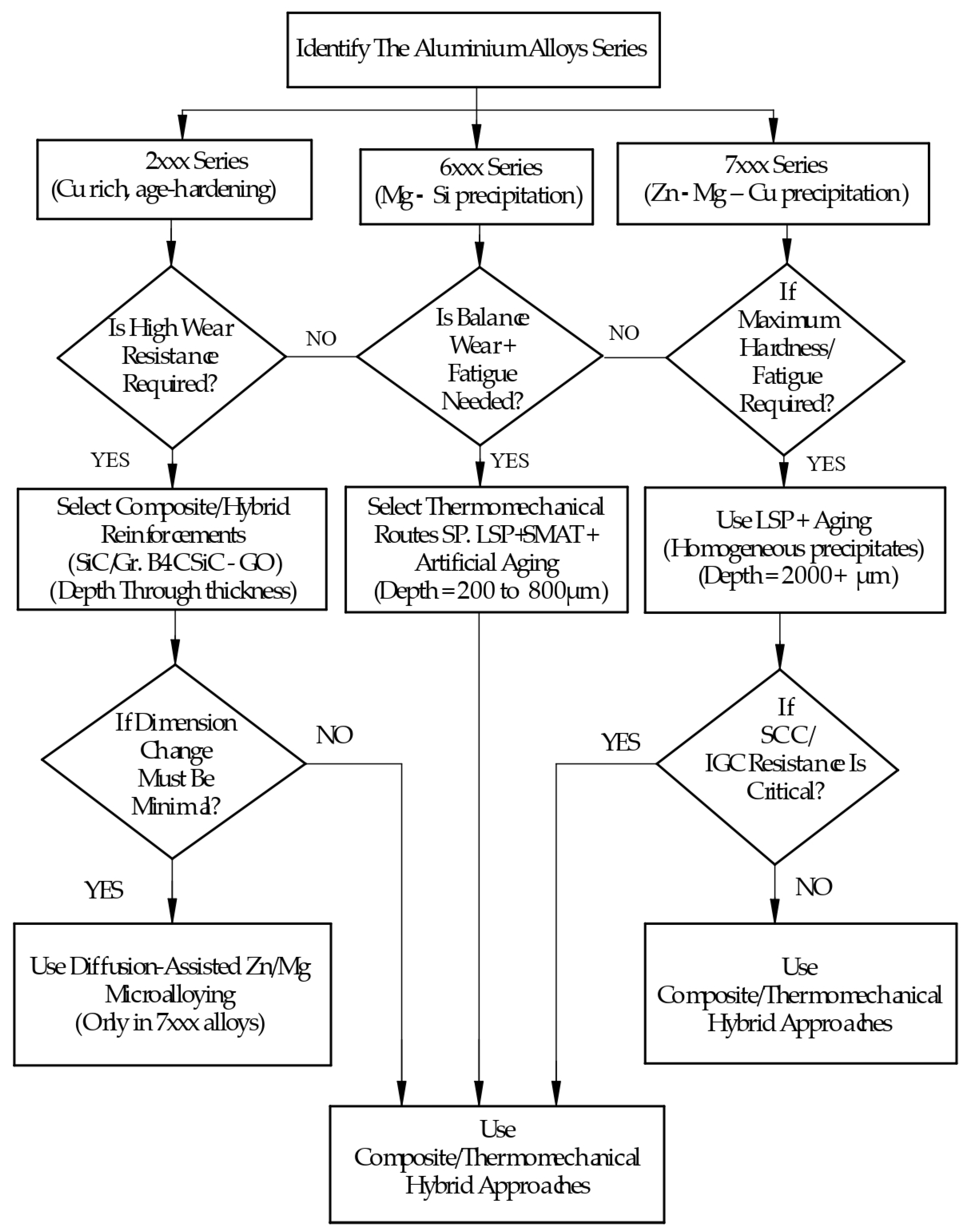
- Present comparative evaluation tables, strengthening mechanism maps, and method selection flowcharts for precipitation hardenable alloy families (2xxx, 6xxx, 7xxx) and commercially pure grades.
- Highlight emerging directions, including hybrid diffusion–composite approaches, rare earth microalloying, gradient microstructures, and sustainability-driven processing strategies.
Scope and Methodology
- Reported experimental, numerical, or mechanistic findings on surface hardening of aluminum alloys or AMCs;
- Provided quantifiable performance metrics such as hardness, wear rate, fatigue life, or corrosion/SCC/IGC behavior;
- Offered mechanistic insights on diffusion kinetics, precipitation pathways, grain refinement, dislocation behavior, or reinforcement–matrix interaction;
- Addressed processing routes of practical interest, including aging treatments, peening, laser processing, stir casting, powder metallurgy, ultrasonic-assisted casting, surface alloying, or hybrid methods.
- Focused exclusively on non-aluminum systems without transferable mechanisms;
- Presented only qualitative outcomes without measurable data;
- Described highly specialized laboratory techniques lacking foreseeable industrial applicability;
- Reproduced existing results without offering new mechanistic understanding.
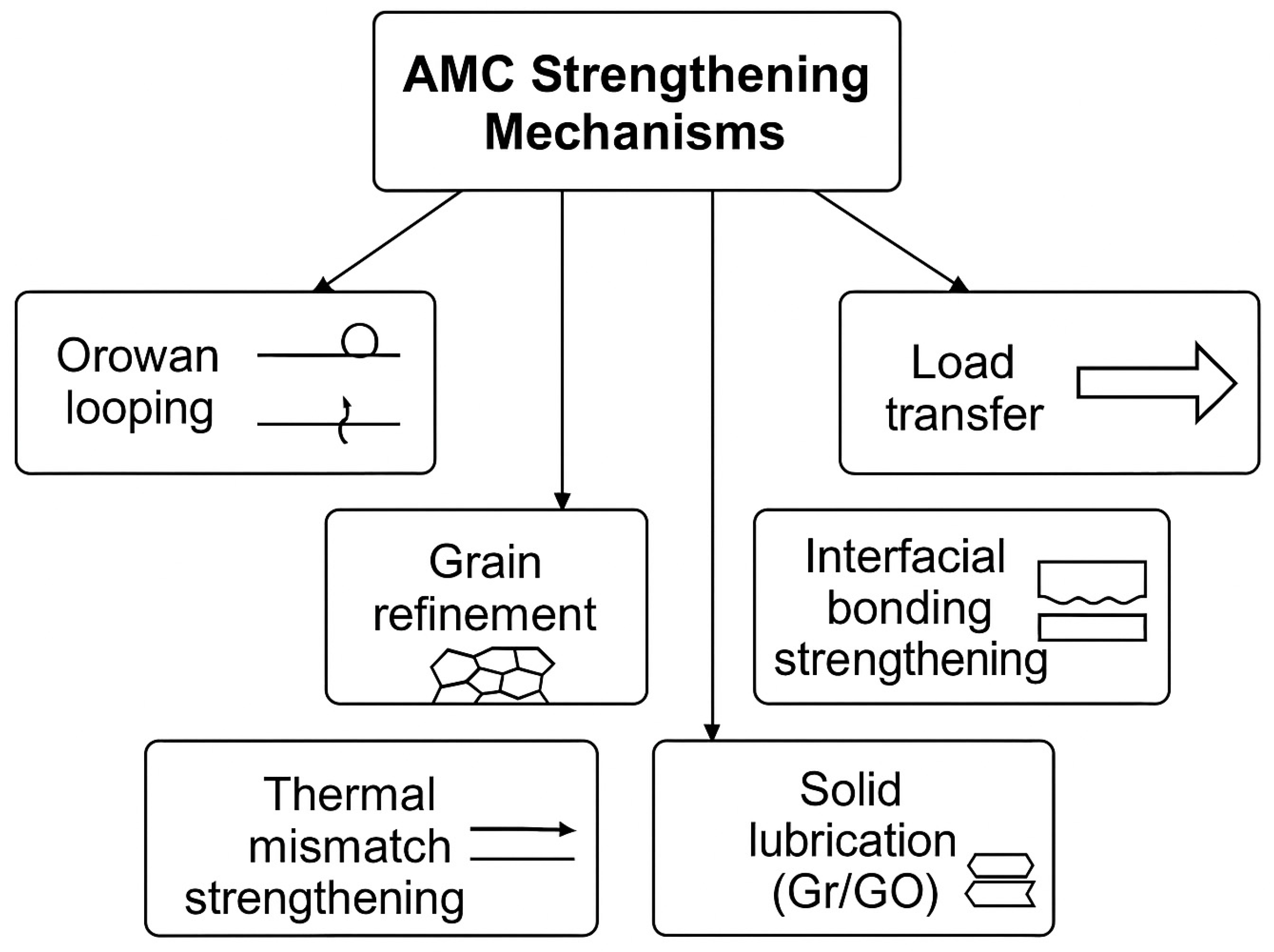
- Strengthening mechanisms: diffusion-induced precipitation, Orowan looping, load transfer, thermal mismatch strengthening, grain refinement, and interface-mediated effects;
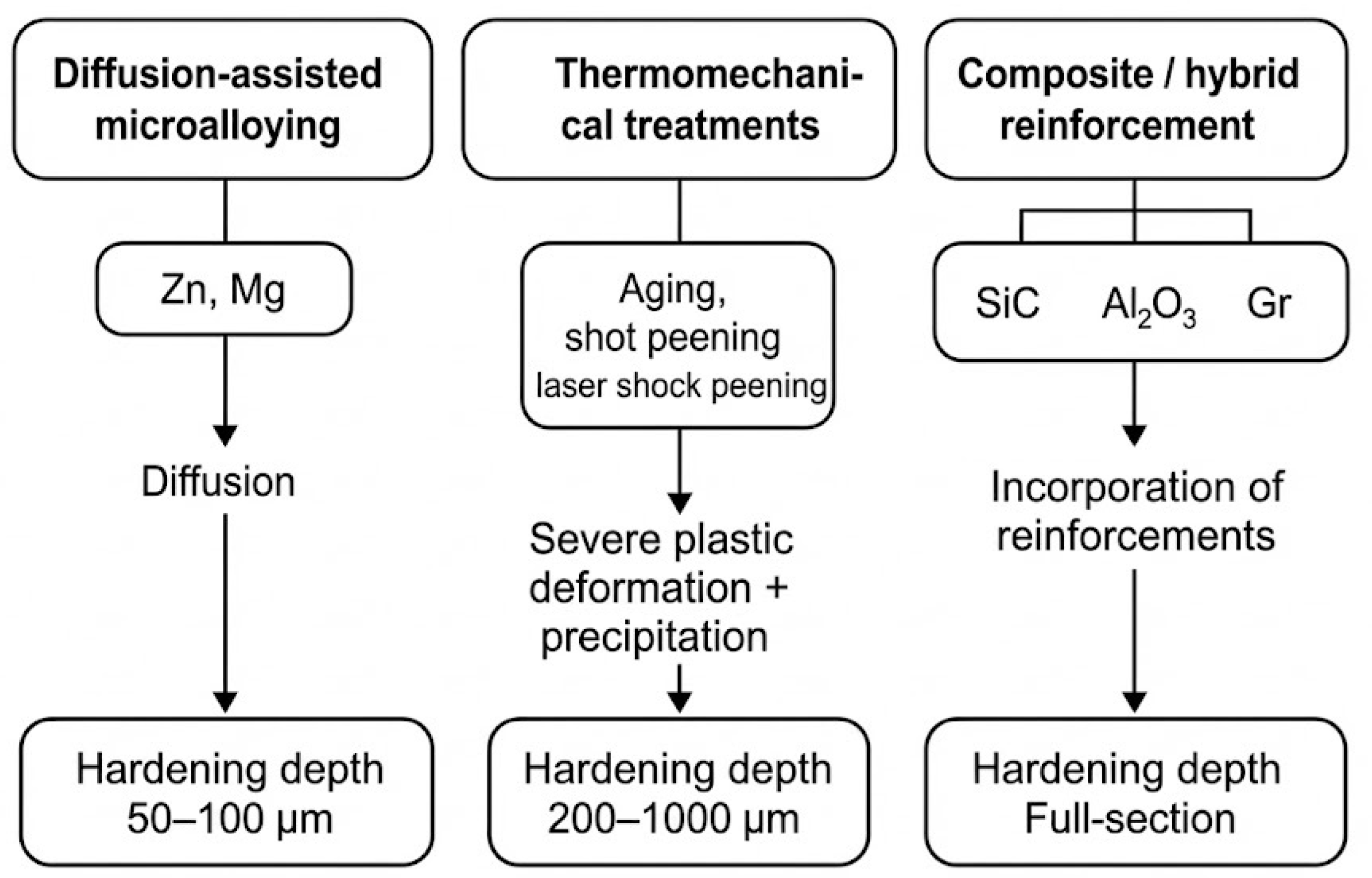
- Hardening depth and gradient development: distinguishing diffusion layers (10–100 µm), thermomechanical deformation layers (200–1000 + µm), and through-thickness reinforcement in AMCs;
- Mechanical and tribological performance: hardness enhancement, ductility retention, wear behavior, frictional response, fatigue and vibration performance;
- Corrosion and SCC behavior: influence of precipitate distribution, solute uniformity, grain structure, and residual stresses on pitting, IGC, and SCC susceptibility;
- Processability and industrial feasibility: cost, energy requirements, reinforcement distribution, interfacial quality, scalability, and compatibility with industrial workflows.
2. Literature Review
2.1. Diffusion-Assisted and Thermomechanical Surface Treatments
2.1.1. Precipitation and Aging Mechanisms Relevant to Surface Hardening
2.1.2. Thermomechanical Treatments: Shot Peening, LSP, and SMAT
2.1.3. Laser-Assisted Surface Modification and Accelerated Precipitation/Diffusion
2.1.4. Diffusion-Assisted Zn/Mg Microalloying: Potential and Limitations
- Meaningful hardening is achievable mainly in high Zn/Mg alloys (7xxx), and Zn-modified Al–Mg sheet systems also demonstrate strong work hardening and ductility improvements due to enhanced solute–dislocation interactions [34].
2.1.5. Corrosion, SCC, and IGC Behavior Under Thermomechanical and Diffusion Treatments
2.1.6. Hybrid Thermomechanical–Diffusion Routes and ML-Based Optimization
2.2. Composite and Hybrid Reinforcement Strategies
2.2.1. Reinforcement Types and Strengthening Mechanisms
- Load transfer: High modulus particles bear part of the applied stress.
- Orowan strengthening: Non-shearable particle pin dislocations, increasing flow stress.
- Thermal expansion mismatch strengthening: Differential contraction generates geometrically necessary dislocations.
- Interfacial strengthening: Strong particle–matrix bonding promotes crack deflection.
- Grain refinement: Particles act as heterogeneous nucleation sites, refining grains.
- Solid lubrication: Graphite, graphene, and CNTs reduce friction and improve wear behavior.
2.2.2. Performance Characteristics and Reinforcement-Dependent Behavior
2.2.3. Comparative Role of Composite Approaches
- Depth of strengthening: MMCs provide through-thickness reinforcement.
- Thermal stability: High melting reinforcements stabilize the matrix under temperature fluctuation.
- Fatigue behavior: Stable interfaces and refined microstructures improve crack initiation resistance.
- Corrosion performance: Reinforcement-dependent; SiC/GO hybrids often outperform monolithic alloys.
2.2.4. Hybrid Composite–Thermomechanical Approaches
- Increased dislocation density around reinforcements,
- Deeper compressive residual stress fields,
- Improved particle–matrix interfacial bonding,
- Enhanced precipitation response during aging.
2.2.5. Alloy Applicability
2.2.6. Synergistic Hybrid Composite–Thermomechanical Approaches and Optimization
2.3. Comparative Evaluation of Surface Hardening Approaches
2.3.1. Mechanistic Comparison
2.3.2. Property-Based Comparison
- Alloy applicability:
2.3.3. Selection Considerations for Practical Applications
2.3.4. Summary of Comparative Insights
- The comparative analysis indicates the following:
3. Future Work
- Mechanistic investigation: Near-atomic-scale studies combining hydrogen microprint technique (HMT), in situ transmission electron microscopy (TEM), and atom probe tomography (APT) to elucidate hydrogen-assisted cracking mechanisms at precipitate interfaces and grain boundaries following hybrid processing [4,5].
- Refining heat treatment schedules: Develop multi-parameter optimization of solution treatment, artificial aging, and potential retrogression–re-aging (RRA) protocols to maximize yield strength and fatigue performance while minimizing SCC/IGC susceptibility through controlled precipitation-free zone (PFZ) engineering and grain boundary chemistry management [36,81].
- Computational design: Leverage machine learning alloy design frameworks integrating thermodynamic predictions, mechanical property surrogate models, and corrosion susceptibility indices to rapidly explore vast compositional spaces and identify Pareto optimal alloys balancing strength, ductility, corrosion resistance, and recyclability [66,81].
- Hot isostatic pressing (HIP): Enables diffusion bonding and pore elimination under elevated temperature and isotropic pressure, ideal for powder metallurgy-based composites; however, processing times (10–50 h) and cost (USD 10,000–50,000 + per cycle) limit scalability.
- Thermal spraying (cold spray, warm spray): High-velocity particle deposition enabling rapid surface layer build up; applicable to composite reinforcements and diffusion-alloyed surfaces, though residual stress and coating adhesion require optimization.
- Trade-offs among processing time, cost, process complexity, and residual stress state must be carefully managed during selection and scale up to balance mechanical performance with economic feasibility.
- Despite significant progress, critical challenges remain regarding oxide barriers and strength ductility trade-offs. Furthermore, the application of LSP to additively manufactured aluminum components (e.g., AlSi10Mg) is emerging as a critical post processing step to effectively neutralize tensile residual stresses and close near surface porosity inherent to laser powder bed fusion (LPBF), thereby significantly enhancing fatigue performance [89].
4. Conclusions
Author Contributions
Funding
Institutional Review Board Statement
Data Availability Statement
Conflicts of Interest
References
- Cao, C.; Zhang, D.; Zhuang, L.; Zhang, J. Improved Age-Hardening Response and Altered Precipitation Behavior of Al-5.2Mg-0.45Cu-2.0Zn (Wt%) Alloy with Pre-Aging Treatment. J. Alloys Compd. 2017, 691, 40–43. [Google Scholar] [CrossRef]
- Matsumoto, K.; Aruga, Y.; Tsuneishi, H.; Iwai, H.; Mizuno, M.; Araki, H. Effects of Precipitation State on Serrated Flow in Al-Mg(-Zn) Alloys. Mater. Trans. 2016, 57, 1101–1108. [Google Scholar] [CrossRef][Green Version]
- Stiller, K.; Warren, P.J.; Hansen, V.; Angenete, J.; Gjønnes, J. Investigation of Precipitation in an Al–Zn–Mg Alloy after Two-Step Ageing Treatment at 100° and 150 °C. Mater. Sci. Eng. A 1999, 270, 55–63. [Google Scholar] [CrossRef]
- Wu, X.; Zhang, W. A Review on Aluminum Matrix Composites’ Characteristics and Applications for Automotive Sector. Heliyon 2024, 10, e38576. [Google Scholar] [CrossRef] [PubMed]
- Singhal, V.; Shelly, D.; Babbar, A.; Lee, S.Y.; Park, S.J. Review of Wear and Mechanical Characteristics of Al-Si Alloy Matrix Composites Reinforced with Natural Minerals. Lubricants 2024, 12, 350. [Google Scholar] [CrossRef]
- Nayak, D.; Rao, S.A.; Gaonkar, S.L.; Kumari, P. Hybrid Metal Matrix Composite: A Comprehensive Review on Its Fabrication, Corrosion Behaviour and Inhibition; Springer International Publishing: Berlin/Heidelberg, Germany, 2025; ISBN 0123456789. [Google Scholar]
- Akgümüş Gök, D.; Bayraktar, C.; Hoşkun, M. A Review on Processing, Mechanical and Wear Properties of Al Matrix Composites Reinforced with Al2O3, SiC, B4C and MgO by Powder Metallurgy Method. J. Mater. Res. Technol. 2024, 31, 1132–1150. [Google Scholar] [CrossRef]
- Sambathkumar, M.; Gukendran, R.; Mohanraj, T.; Karupannasamy, D.K.; Natarajan, N.; Christopher, D.S. A Systematic Review on the Mechanical, Tribological, and Corrosion Properties of Al 7075 Metal Matrix Composites Fabricated through Stir Casting Process. Adv. Mater. Sci. Eng. 2023, 2023, 5442809. [Google Scholar] [CrossRef]
- Shen, G.; Chen, X.; Yan, J.; Fan, L.; Yang, Z.; Zhang, J.; Guan, R. Effects of Heat Treatment Processes on the Mechanical Properties, Microstructure Evolution, and Strengthening Mechanisms of Al–Mg–Zn–Cu Alloy. J. Mater. Res. Technol. 2023, 27, 5380–5388. [Google Scholar] [CrossRef]
- Ameri, M.H.; Ghaini, F.M.; Torkamany, M.J. Investigation into the Efficiency of a Fiber Laser in Surface Hardening of ICD-5 Tool Steel. Opt. Laser Technol. 2018, 107, 150–157. [Google Scholar] [CrossRef]
- Jiru, W.G.; Sankar, M.R.; Dixit, U.S. Laser Surface Alloying of Aluminum for Improving Acid Corrosion Resistance. J. Inst. Eng. Ser. C 2019, 100, 481–492. [Google Scholar] [CrossRef]
- Zhou, J.; Wu, J.; Tang, S.; Li, Y. Review of Laser Texturing Technology for Surface Protection and Functional Regulation of Aluminum Alloys: Wettability, Anti-Icing, Corrosion Resistance, and Wear Resistance. Coatings 2025, 15, 567. [Google Scholar] [CrossRef]
- Chen, W.-L.; Lee, R.-S. Novel Aging Warm-Forming Process of Al-Zn-Mg Aluminum Alloy Sheets and Influence of Precipitate Characteristics on Warm Formability. Metals 2024, 14, 844. [Google Scholar] [CrossRef]
- Yun, J.; Kang, S.; Lee, S.; Bae, D. Development of Heat-Treatable Al-5Mg Alloy Sheets with the Addition of Zn. Mater. Sci. Eng. A 2019, 744, 21–27. [Google Scholar] [CrossRef]
- Cho, K.T.; Song, K.; Oh, S.H.; Lee, Y.-K.; Lim, K.M.; Lee, W.B. Surface Hardening of Aluminum Alloy by Shot Peening Treatment with Zn Based Ball. Mater. Sci. Eng. A 2012, 543, 44–49. [Google Scholar] [CrossRef]
- Zhu, S.; Li, Z.; Yan, L.; Li, X.; Huang, S.; Yan, H.; Zhang, Y.; Xiong, B. Natural Aging Behavior in Pre-Aged Al–Mg–Si–Cu Alloys with and without Zn Addition. J. Alloys Compd. 2019, 773, 496–502. [Google Scholar] [CrossRef]
- Guillon, O.; Gonzalez-Julian, J.; Dargatz, B.; Kessel, T.; Schierning, G.; Räthel, J.; Herrmann, M. Field-Assisted Sintering Technology/Spark Plasma Sintering: Mechanisms, Materials, and Technology Developments. Adv. Eng. Mater. 2014, 16, 830–849. [Google Scholar] [CrossRef]
- Hafenstein, S.; Hitzler, L.; Sert, E.; Öchsner, A.; Merkel, M.; Werner, E. Hot Isostatic Pressing of Aluminum–Silicon Alloys Fabricated by Laser Powder-Bed Fusion. Technologies 2020, 8, 48. [Google Scholar] [CrossRef]
- Vidyuk, T.M.; Dudina, D.V.; Korchagin, M.A.; Gavrilov, A.I.; Bokhonov, B.B.; Ukhina, A.V.; Esikov, M.A.; Shikalov, V.S.; Kosarev, V.F. Spark Plasma Sintering Treatment of Cold Sprayed Materials for Synthesis and Structural Modification: A Case Study Using TiC-Cu Composites. Mater. Lett. X 2022, 14, 100140. [Google Scholar] [CrossRef]
- Lathashankar, B.; Tejaswini, G.C.; Suresh, R.; Swamy, N.H.S. Advancements in Diffusion Bonding of Aluminium and Its Alloys: A Comprehensive Review of Similar and Dissimilar Joints. Adv. Mater. Process. Technol. 2022, 8, 4659–4677. [Google Scholar] [CrossRef]
- Cao, C.; Zhang, D.; He, Z.; Zhuang, L.; Zhang, J. Enhanced and Accelerated Age Hardening Response of Al-5.2Mg-0.45Cu (Wt%) Alloy with Zn Addition. Mater. Sci. Eng. A 2016, 666, 34–42. [Google Scholar] [CrossRef]
- Nicolas, M.; Deschamps, A. Characterisation and Modelling of Precipitate Evolution in an Al–Zn–Mg Alloy during Non-Isothermal Heat Treatments. Acta Mater. 2003, 51, 6077–6094. [Google Scholar] [CrossRef]
- Robson, J.; Jessner, P.; Taylor, M.; Ma, Z. Dynamic Precipitation in Supersaturated Al–Zn–Mg–Cu Alloy During Warm Stretching. Metall. Mater. Trans. A 2023, 54, 1131–1141. [Google Scholar] [CrossRef]
- Chennaiah, M.B.; Babu, G.D.; Sumalatha, M.; Kumar, K.D.; Rao, T.S. Tribological and Mechanical Properties of Al 6061/SiC/GO Hybrid Composites Produced with Stir Casting. J. Mines Met. Fuels 2023, 71, 1262–1270. [Google Scholar] [CrossRef]
- Yunus, M.; Alfattani, R. Assessment of Mechanical and Tribological Behavior of AA6061 Reinforced with B 4 C and Gr Hybrid Metal Matrix Composites. Coatings 2023, 13, 1653. [Google Scholar] [CrossRef]
- Çanakçı, A.; Hasan, A.; Müslim, K. A Study on the Optimization of Nano-B 4 C Content for the Best Wear and Corrosion Properties of the Al-Based Hybrid Nanocomposites. Arab. J. Sci. Eng. 2024, 49, 14625–14641. [Google Scholar] [CrossRef]
- Demisie, L.F.; Getnet, E.; Taddese, G.A.; Rengiah, R.G.; Takele, T.N.; Ayalew, Y.G.; Berihun, E.A. Experimental Analysis on the Mechanical Properties of Al6061 Based Hybrid Composite Reinforced with Silicon Carbide, Bagasse Fly Ash and Aloe Vera Ash. Discov. Appl. Sci. 2024, 6, 491. [Google Scholar] [CrossRef]
- Kumar, P.; Thingujam, S.; Singh, J.; Pratap, N. Experimental Research and Effect on Mechanical and Wear Properties of Aluminium Based Composites Reinforced with Zn/Sic Particles. Discov. Mater. 2023, 3, 9. [Google Scholar] [CrossRef]
- Xie, P.; Chen, S.; Chen, K.; Jiao, H.; Huang, L.; Zhang, Z.; Yang, Z. Enhancing the Stress Corrosion Cracking Resistance of a Low-Cu Containing Al-Zn-Mg-Cu Aluminum Alloy by Step-Quench and Aging Heat Treatment. Corros. Sci. 2019, 161, 108184. [Google Scholar] [CrossRef]
- Verma, R.P.; Lila, M.K. A Short Review on Aluminium Alloys and Welding in Structural Applications. Mater. Today Proc. 2021, 46, 10687–10691. [Google Scholar] [CrossRef]
- Berg, L.K.; Gjønnes, J.; Hansen, V.; Li, X.Z.; Knutson-Wedel, M.; Waterloo, G.; Schryvers, D.; Wallenberg, L.R. GP-Zones in Al–Zn–Mg Alloys and Their Role in Artificial Aging. Acta Mater. 2001, 49, 3443–3451. [Google Scholar] [CrossRef]
- Kaçar, H.; Atik, E.; Meriç, C. The Effect of Precipitation-Hardening Conditions on Wear Behaviours at 2024 Aluminium Wrought Alloy. J. Mater. Process. Technol. 2003, 142, 762–766. [Google Scholar] [CrossRef]
- Meriç, C. Physical and Mechanical Properties of Cast under Vacuum Aluminum Alloy 2024 Containing Lithium Additions. Mater. Res. Bull. 2000, 35, 1479–1494. [Google Scholar] [CrossRef]
- Zhao, L.; Yan, H.; Chen, J.; Xia, W.; Su, B.; Song, M.; Li, Z.; Li, X.; Liao, Y. High Ductility and Strong Work-Hardening Behavior of Zn Modified as-Hot-Rolled Al–Mg Sheets. J. Alloys Compd. 2021, 854, 157079. [Google Scholar] [CrossRef]
- Avramenko, T.; Michel, S.; Kollender, J.; Burda, I.; Hans, U.; Affolter, C. Review on Environmentalally Assisted Static and Fatigue Cracking of Al-Mg-Si-(Cu) Alloys. Metals 2024, 14, 621. [Google Scholar] [CrossRef]
- Yang, Y.; Wu, Y.; Jin, S.; Wang, D.; Zhang, S.; Zha, M. A Brief Review on Stress Corrosion Cracking of Aluminum Alloys: Mechanisms, Prevention, and Future Perspectives. J. Alloys Compd. 2025, 1037, 182430. [Google Scholar] [CrossRef]
- Wang, X.F.; Zhou, X.Y.; Mao, J.L.; Zhu, J.H.; Pei, C. Impact of Laser Shock Peening on High-Strength Aluminum Alloys in Marine Environments. Case Stud. Constr. Mater. 2025, 22, e04719. [Google Scholar] [CrossRef]
- Alemdag, Y.; Beder, M. Effects of Zinc Content on Strength and Wear Performance of Al−12Si−3Cu Based Alloy. Trans. Nonferrous Met. Soc. China 2019, 29, 2463–2471. [Google Scholar] [CrossRef]
- Guo, C.; Zhang, H.; Li, J. Influence of Zn and/or Ag Additions on Microstructure and Properties of Al-Mg Based Alloys. J. Alloys Compd. 2022, 904, 163998. [Google Scholar] [CrossRef]
- Meng, C.; Zhang, D.; Cui, H.; Zhuang, L.; Zhang, J. Mechanical Properties, Intergranular Corrosion Behavior and Microstructure of Zn Modified Al–Mg Alloys. J. Alloys Compd. 2014, 617, 925–932. [Google Scholar] [CrossRef]
- Carroll, M.C.; Gouma, P.I.; Mills, M.J.; Daehn, G.S.; Dunbar, B.R. Effects of Zn Additions on the Grain Boundary Precipitation and Corrosion of Al-5083. Scr. Mater. 2000, 42, 335–340. [Google Scholar] [CrossRef]
- Charalampidou, C.M.; Siskou, N.; Georgoulis, D.; Kourkoulis, S.K.; Zheludkevich, M.; Alexopoulos, N.D. Corrosion of Aluminium Alloy AA2024-Τ3 Specimens Subjected to Different Artificial Ageing Heat Treatments. NPJ Mater. Degrad. 2024, 8, 93. [Google Scholar] [CrossRef]
- Balaško, T.; Nagode, A.; Li, J.; Medved, J. Microstructure Evolution during Solution Annealing of an Al–Zn–Mg–Cu Alloy with La Additions. Sci. Rep. 2025, 15, 3845. [Google Scholar] [CrossRef] [PubMed]
- Sun, Z.; Ma, Y.; Ma, S.; Xiong, H.; Chen, B. Mechanical Properties and Corrosion Resistance Enhancement of 2024 Aluminum Alloy for Drill Pipe after Heat Treatment and Sr Modification. Mater. Today Commun. 2023, 36, 106805. [Google Scholar] [CrossRef]
- Yang, X.; Wang, J.; Xue, C.; Tian, G.; Li, Q.; Li, X.; Su, H.; Miao, Y.; Wang, S. Enhancing Strength and Ductility of Al–Cu–Li Alloys by Microalloying Both Er and Zr to Promote Complete Transformation from Δ′ (Al3Li) to T1 (Al2CuLi) Precipitates. J. Mater. Res. Technol. 2024, 32, 2913–2930. [Google Scholar] [CrossRef]
- Chen, H.; Wu, X.; Ding, X.; Wen, S.; Hong, L.; Gao, K.; Wei, W.; Rong, L.; Huang, H.; Nie, Z. Effect of Er Microalloying and Zn/Mg Ratio on Dry Sliding Wear Properties of Al-Zn-Mg Alloy. Materials 2025, 18, 3541. [Google Scholar] [CrossRef]
- Li, Y.; Yu, M.; Li, X.; Wen, K.; Yan, L.; Zhu, K.; Xiao, W. Enhancing Stress Corrosion Cracking Resistance of Low Cu-Containing Al-Zn-Mg-Cu Alloys by Aging Treatment Control. Materials 2024, 17, 5678. [Google Scholar] [CrossRef]
- Zhou, Y.; Qi, Z.; Cong, B.; Jiang, Z.; Cai, X.; Li, H.; Zhang, J.; Dong, C.; He, X.; Lin, S.; et al. Sc/Zr Microalloying on Strength-Corrosion Performance Synergy of Wire-Arc Directed Energy Deposited Al-Mg. Virtual Phys. Prototyp. 2024, 19, 2358981. [Google Scholar] [CrossRef]
- Valizade, N. A Review on Abrasive Wear of Aluminum Composites: Mechanisms and Influencing Factors. J. Compos. Sci. 2024, 8, 149. [Google Scholar] [CrossRef]
- Aster, P.; Dumitraschkewitz, P.; Uggowitzer, P.J.; Weißensteiner, I.; Tunes, M.A.; Schmid, F.; Stemper, L.; Pogatscher, S. Effect of Long-Term Aging and Cu Addition on Clustering, Strength and Strain Hardening in Al-Mg-Zn-(Cu) Crossover Alloys. Mater. Des. 2025, 257, 114341. [Google Scholar] [CrossRef]
- Lu, Z.; Kapoor, I.; Li, Y.; Liu, Y.; Zeng, X.; Wang, L. Machine Learning Driven Design of High-Performance Al Alloys. J. Mater. Inform. 2024, 4, 21. [Google Scholar] [CrossRef]
- Jiang, L.; Zhang, Z.; Hu, H.; He, X.; Fu, H.; Xie, J. A Rapid and Effective Method for Alloy Materials Design via Sample Data Transfer Machine Learning. NPJ Comput. Mater. 2023, 9, 26. [Google Scholar] [CrossRef]
- Masood Chaudry, U.; Hamad, K.; Abuhmed, T. Machine Learning-Aided Design of Aluminum Alloys with High Performance. Mater. Today Commun. 2021, 26, 101897. [Google Scholar] [CrossRef]
- Nagaraju, S.B.; Somashekara, M.K. Wear Behaviour of Hybrid (Boron Carbide-Graphite) Aluminium Matrix Composites under High Temperature. J. Eng. Appl. Sci. 2023, 70, 124. [Google Scholar] [CrossRef]
- Xiong, Y.; Robson, J.D.; Yao, Y.; Zhong, X.; Guarracino, F.; Bendo, A.; Jin, Z.; Hashimoto, T.; Liu, X.; Curioni, M. Effects of Heat Treatments on the Microstructure and Localized Corrosion Behaviors of AA7075 Aluminum Alloy. Corros. Sci. 2023, 221, 111361. [Google Scholar] [CrossRef]
- Sun, Q.; He, J.; Chen, J.; Chen, C.; Guo, X.; Cao, F.; Wang, S. Hardness and Corrosion Behavior of an Al-2Mn Alloy with Both Microstructural and Chemical Gradients. NPJ Mater. Degrad. 2022, 6, 64. [Google Scholar] [CrossRef]
- Ringer, S.P.; Hono, K. Microstructural Evolution and Age Hardening in Aluminium Alloys. Mater. Charact. 2000, 44, 101–131. [Google Scholar] [CrossRef]
- Cao, X.; Wu, J.; Zhong, G.; Wu, J.; Chen, X. Laser Shock Peening: Fundamentals and Mechanisms of Metallic Material Wear Resistance Improvement. Materials 2024, 17, 909. [Google Scholar] [CrossRef]
- Chen, J.; Liu, H.; Li, J.; Guo, X.; Wu, L.; Cao, F.; Sun, Q. Simultaneously Improve Hardness and Intergranular Corrosion Resistance for 2024 Al Alloy by Using Ultrasonic Shot Peening: A Mechanistic and Comparative Study. Mater. Today Commun. 2025, 42, 111611. [Google Scholar] [CrossRef]
- Wu, Y.; Chen, B.; Xu, P.; Tang, P.; Du, B.; Huang, C. Microstructure and Microhardness of High-Strength Aluminium Alloy Prepared Using High-Speed Laser Fabrication. Metals 2024, 14, 525. [Google Scholar] [CrossRef]
- Wei, C.; Lei, Z.; Du, S.; Chen, R.; Yin, Y.; Niu, C.; Xu, Z. Microstructures and Mechanical Properties of Al-Zn-Mg-Cu Alloys under Multi-Directional Severe Strain and Aging. Materials 2023, 16, 4441. [Google Scholar] [CrossRef]
- Stemper, L.; Mitas, B.; Kremmer, T.; Otterbach, S.; Uggowitzer, P.J.; Pogatscher, S. Age-Hardening of High Pressure Die Casting AlMg Alloys with Zn and Combined Zn and Cu Additions. Mater. Des. 2019, 181, 107927. [Google Scholar] [CrossRef]
- Pan, Y.; Zhang, D.; Liu, H.; Zhuang, L.; Zhang, J. Precipitation Hardening and Intergranular Corrosion Behavior of Novel Al–Mg–Zn(-Cu) Alloys. J. Alloys Compd. 2021, 853, 157199. [Google Scholar] [CrossRef]
- Tao, H.; Cai, Q.; Chen, M.; Zhang, W.; Cao, G.; Zhang, H. Effect of Heat Treatment on the Microstructure and Corrosion Performance of 2219 Al Alloy Cold Sprayed Coatings. Corros. Sci. 2024, 241, 112526. [Google Scholar] [CrossRef]
- Lei, C.; Zhang, N.; Wang, Q.; Ebrahimi, M.; Li, D.; Tang, H.; Cai, H. Effects of Natural Aging on the Artificial Aging Kinetics and Responses of Al–5Mg–3Zn–1Cu (Wt.%) Alloy. J. Mater. Res. Technol. 2023, 25, 7140–7153. [Google Scholar] [CrossRef]
- Valizadeh, A.; Sahara, R.; Souissi, M. Alloys Innovation through Machine Learning: A Statistical Literature Review. Sci. Technol. Adv. Mater. Methods 2024, 4, 2326305. [Google Scholar] [CrossRef]
- Ogura, T.; Aruga, Y.; Kochi, T.; Mayama, N. Age Hardening Behavior and Mechanical Properties of Al-11%Zn-3%Mg-1.4%Cu(-0.2%Ag) Alloys. Mater. Trans. 2024, 65, MT-L2024013. [Google Scholar] [CrossRef]
- Funatani, K. Emerging Technology in Surface Modification of Light Metals. Surf. Coat. Technol. 2000, 133–134, 264–272. [Google Scholar] [CrossRef]
- Polmear, I.J. Light Alloys: From Traditional Alloys to Nanocrystals; Elsevier/Butterworth-Heinemann: Amsterdam, The Netherlands, 2006; ISBN 0750663715. [Google Scholar]
- Jha, R.; Dulikravich, G.S. Solidification and Heat Treatment Simulation for Aluminum Alloys with Scandium Addition through CALPHAD Approach. Comput. Mater. Sci. 2020, 182, 109749. [Google Scholar] [CrossRef]
- Gubicza, J.; El-Tahawy, M.; Lábár, J.L.; Bobruk, E.V.; Murashkin, M.Y.; Valiev, R.Z.; Chinh, N.Q. Evolution of Microstructure and Hardness during Artificial Aging of an Ultrafine-Grained Al-Zn-Mg-Zr Alloy Processed by High Pressure Torsion. J. Mater. Sci. 2020, 55, 16791–16805. [Google Scholar] [CrossRef]
- Halap, A.; Radetić, T.; Popović, M.; Romhanji, E. Influence of the Thermomechanical Treatment on the Intergranular Corrosion Susceptibility of Zn-Modified Al-5.1 Wt Pct Mg-0.7 Wt Pct Mn Alloy Sheet. Metall. Mater. Trans. A 2014, 45, 4572–4579. [Google Scholar] [CrossRef]
- Stemper, L.; Tunes, M.A.; Tosone, R.; Uggowitzer, P.J.; Pogatscher, S. On the Potential of Aluminum Crossover Alloys. Prog. Mater. Sci. 2022, 124, 100873. [Google Scholar] [CrossRef]
- Zhu, Q.; Wu, X.; Cao, L.; Zou, Y.; Song, H.; Liu, Y.; Song, K.; Couper, M.J. Precipitation Evolution of Al-Zn-Mg-Cu-(Ag) Alloys with a Low Zn/Mg Ratio. J. Mater. Sci. Technol. 2024, 195, 177–196. [Google Scholar] [CrossRef]
- Miao, W.F.; Laughlin, D.E. Precipitation Hardening in Aluminum Alloy 6022. Scr. Mater. 1999, 40, 873–878. [Google Scholar] [CrossRef]
- Deschamps, A.; Brechet, Y. Influence of Predeformation and AgEing of an Al–Zn–Mg Alloy—II. Modeling of Precipitation Kinetics and Yield Stress. Acta Mater. 1998, 47, 293–305. [Google Scholar] [CrossRef]
- Hatch, J.E. Aluminum: Properties and Physical Metallurgy; American Society for Metals: Detroit, MI, USA, 1984; ISBN 0871701766. [Google Scholar]
- Fleck, P.; Calleros, D.; Madsen, M.; Trinh, T.; Hoang, D.; Foyos, J.; Lee, E.W.; Es-Said, O.S. Retrogression and Reaging of 7075 T6 Aluminum Alloy. Mater. Sci. Forum 2000, 331–337, 649–654. [Google Scholar] [CrossRef]
- Mukherjee, D.; Roy, H.; Chandrakanth, B.; Mandal, N.; Samanta, S.K.; Mukherjee, M. Enhancing Properties of Al-Zn-Mg-Cu Alloy through Microalloying and Heat Treatment. Mater. Chem. Phys. 2024, 314, 128881. [Google Scholar] [CrossRef]
- Mahan, H.M.; Konovalov, S.V.; Panchenko, I. Effect of Heat Treatment on the Mechanical Properties of the Aluminium Alloys AA2024 with Nanoparticles. Int. J. Appl. Sci. Eng. 2023, 20, 1–6. [Google Scholar] [CrossRef]
- Lin, Z.; Yang, C. Artificial Intelligence Design of Sustainable Aluminum Alloys: A Review. Comput. Materauls Contin. 2025, 86, 1–33. [Google Scholar] [CrossRef]
- Rao, Z.; Bajpai, A.; Zhang, H. Active Learning Strategies for the Design of Sustainable Alloys. Philos. Trans. R. Soc. A Math. Phys. Eng. Sci. 2024, 382, 242. [Google Scholar] [CrossRef]
- Xiong, X.; Zhang, N.; Yang, J.; Chen, T.; Niu, T. Machine Learning-Assisted Prediction of Corrosion Behavior of 7XXX Aluminum Alloys. Metals 2024, 14, 401. [Google Scholar] [CrossRef]
- Ravnikar, D.; Šturm, R.; Žagar, S. Effect of Shot Peening on the Strength and Corrosion Properties of 6082-T651 Aluminium Alloy. Materials 2023, 16, 4976. [Google Scholar] [CrossRef]
- Kafle, A.; Lu, S.; Silwal, R.; Zhu, W. A Review on Material Dynamics in Cold Spray Additive Manufacturing: Bonding, Stress, and Structural Evolution in Metals. Metals 2025, 15, 187. [Google Scholar] [CrossRef]
- Raabe, D.; Ponge, D.; Uggowitzer, P.J.; Roscher, M.; Paolantonio, M.; Liu, C.; Antrekowitsch, H.; Kozeschnik, E.; Seidmann, D.; Gault, B.; et al. Making Sustainable Aluminum by Recycling Scrap: The Science of “Dirty” Alloys. Prog. Mater. Sci. 2022, 128, 100947. [Google Scholar] [CrossRef]
- Liu, D.; Xu, J.; Li, X.; Wei, P.; Liang, Y.; Qin, J.; Sun, H.; Ding, T.; Ding, Z.; Zhong, S.; et al. Influence of Al Foil Interlayer on Performance of Vacuum Diffusion Bonding Joint of 6061 Aluminium Alloy. J. Iron Steel Res. Int. 2024, 31, 2404–2412. [Google Scholar] [CrossRef]
- López Freixes, M.; Zhou, X.; Zhao, H.; Godin, H.; Peguet, L.; Warner, T.; Gault, B. Revisiting Stress-Corrosion Cracking and Hydrogen Embrittlement in 7xxx-Al Alloys at the near-Atomic-Scale. Nat. Commun. 2022, 13, 4290. [Google Scholar] [CrossRef] [PubMed]
- Bumba, F.; Morais, P.; Batalha, R.; Anes, V.; Reis, L. Review on Laser Shock Peening Effect on Fatigue of Powder Bed Fusion Materials. Metals 2023, 13, 1762. [Google Scholar] [CrossRef]
- Zschach, L.G.; Soldera, F.; Marzec, M.; Sokołowski, K.; Sallese, M.; Lasagni, A.F.; Baumann, R. Laser Texturing of AA2024 Alloy: A Simplified Approach to Improve Corrosion Resistance and Achieve Superhydrophobicity. Surf. Coat. Technol. 2025, 513, 132487. [Google Scholar] [CrossRef]
- Xu, Z.; Yip, W.; Dong, Z.; Uddin, M.; Stevens, G. On the Laser Surface Pre-Treatment to Enhance the Surface Texture, Wettability and Adhesion Bonding Strength of Aluminium 7075-T6 Laminates. Compos. Interfaces 2024, 31, 123–141. [Google Scholar] [CrossRef]
- Volpe, A.; Covella, S.; Gaudiuso, C.; Ancona, A. Improving the Laser Texture Strategy to Get Superhydrophobic Aluminum Alloy Surfaces. Coatings 2021, 11, 369. [Google Scholar] [CrossRef]
- Hu, M.; Tan, Q.; Knibbe, R.; Xu, M.; Liang, G.; Zhou, J.; Xu, J.; Jiang, B.; Li, X.; Ramajayam, M.; et al. Designing Unique and High-Performance Al Alloys via Machine Learning: Mitigating Data Bias through Active Learning. Comput. Mater. Sci. 2024, 244, 113204. [Google Scholar] [CrossRef]
- Mishra, R.S.; Ma, Z.Y. Friction Stir Welding and Processing. Mater. Sci. Eng. R Rep. 2005, 50, 1–78. [Google Scholar] [CrossRef]
- Chiang, M.-T.; Chiu, K.-Y.; Wu, P.-C.; Chang, S.-Y.; Sun, Y.-K.; Chuang, T.-H. Improvement of the Mechanical Properties of the Diffusion-Bonded 2024 Aluminum Alloy through Post-Weld Heat Treatments. Metals 2022, 12, 1738. [Google Scholar] [CrossRef]



| Parameter | Diffusion-Assisted | Thermomechanical (SSPD + Aging) | Laser-Assisted | Hybrid (SSPD + Diffusion/Aging) |
|---|---|---|---|---|
| Hardness increase | Moderate | High (20–200%) | Moderate–High | High |
| Hardening depth | 10–100 µm | 200–1000 + µm | 100–500 µm | 200–600 µm |
| Ductility retention | Good | Good–Excellent | Good | Good–Excellent |
| Corrosion behavior | Variable; galvanic gradients possible | Predictably improved | Improved–Neutral | Improved |
| Fatigue performance | Low–Moderate | Strong | Strong | Strong |
| Wear resistance | Slight improvement | Improved | Improved | Strong |
| Industrial feasibility | Low | High (mature) | Medium–High | Medium |
| Process complexity | High | Low–Medium | Medium–High | Medium |
| Cost | High | Low | Medium–High | Medium |
| Alloy compatibility | Requires high Zn/Mg (7xxx) | 2xxx, 6xxx, 7xxx | Broad | 2xxx, 6xxx, 7xxx |
| Reinforcement | Key Properties | Dominant Strengthening Mechanisms | Advantages | Typical Applications |
|---|---|---|---|---|
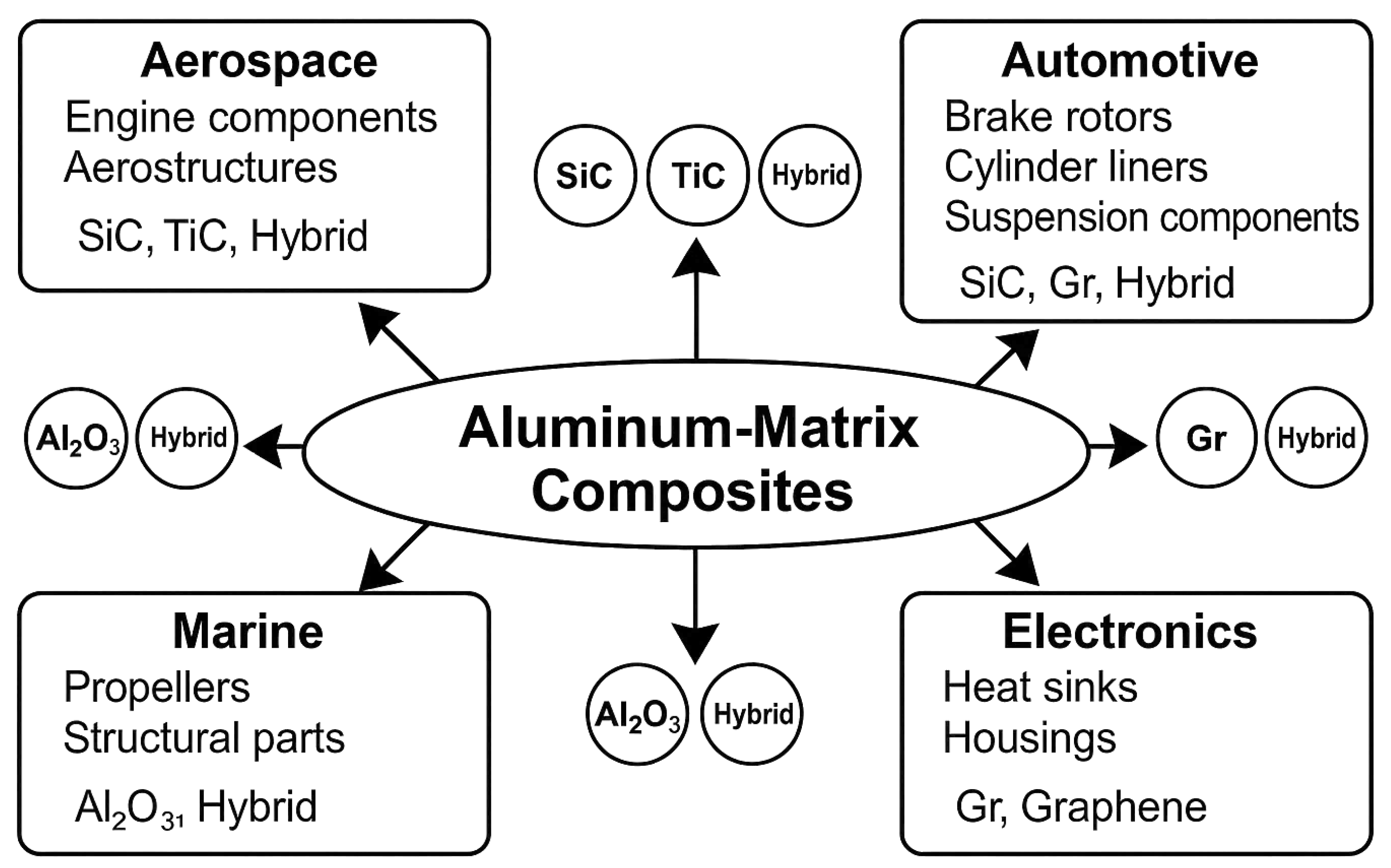
| SiC | High hardness, stiffness | Load transfer, Orowan strengthening | Excellent wear resistance, thermal stability [24,25,26,27] | Pistons, brake rotors, aerospace components |
| Al2O3 | High hardness, chemical stability | Grain refinement, dispersion strengthening | Improved wear + corrosion behavior [24,25,26,27,28] | Marine and structural components |
| B4C | Very hard, low density | Orowan strengthening, matrix constraint | High specific strength [39,40] | Armor, aerospace sliding surfaces |
| TiC | High hardness | Dispersion strengthening | Improved wear resistance [24,25,26,27] | High-temperature aerospace components |
| Graphite (Gr) | Low friction | Solid lubrication, crack deflection | Reduced wear, low friction [24,25] | Bearings, bushings, sliding components |
| Graphene/CNTs | Exceptional tensile strength, conductivity | Load transfer, interface strengthening | High stiffness, vibration damping [26,27] | Vibration resistant aerospace/automotive parts |
| Hybrid (Ceramic + Gr/GO) | Tunable hardness + lubricity | Combined Orowan + lubrication | Balanced stiffness–lubrication [24,25,26,27,28] | Multifunctional aerospace/automotive components |
| Criteria | Diffusion-Assisted Zn/Mg Enrichment | Thermomechanical Routes (SP, LSP, SMAT, Aging) | Composite/Hybrid Reinforcements (AMCs) |
|---|---|---|---|
| Industrial Feasibility | Low; limited by oxide barrier, slow diffusion; only feasible for select 7xxx alloys | Very high; widely used in aerospace/automotive | Moderate; depends on fabrication route (PM, stir casting, ultrasonic processing) |
| Processing Cost | High (long time, high temperatures) | Low–moderate (SP cheapest; LSP moderate) | Moderate–high (reinforcement cost + processing) |
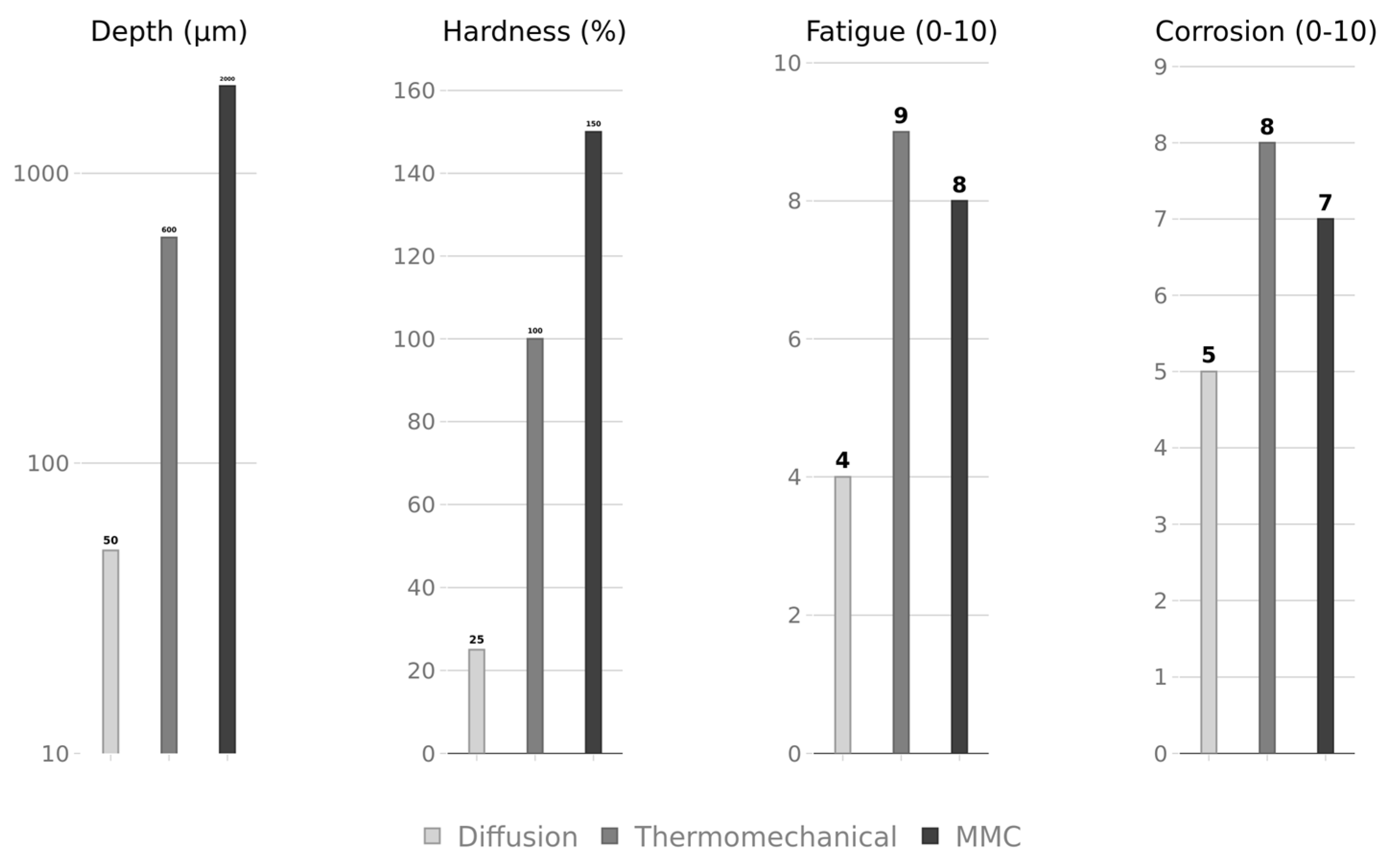
| Hardening Depth | 10–80 µm (shallow) | 200–1000+ µm (deep residual stresses) | Through thickness (bulk strengthening) |
| Hardness Improvement | Low–moderate | High (20–200% increase) | Very high (strong Orowan, load transfer contributions) |
| Fatigue Performance | Limited improvement | Excellent (deep compressive residual stresses) | Good–excellent; graphene and CNT improve damping |
| Wear Resistance | Slight improvement | High improvement | Very high (SiC, B4C, Gr provide strong wear resistance) |
| Corrosion Behavior | Variable; galvanic gradients may form | Often improved (refined grains, uniform precipitates) | Reinforcement-dependent; SiC–GO hybrids best |
| Ductility Retention | Good (surface gradient) | Good–excellent | Moderate (reduces with higher wt.% reinforcement) |
| Dimensional Change | Minimal | Minimal | Moderate (depends on composite processing) |
| Alloy Compatibility | Only for Zn/Mg rich alloys (7xxx) | 2xxx, 6xxx, 7xxx | Works for all series (1xxx–7xxx) |
| Best Fit Applications | Localized surface chemical modification | Fatigue critical aerospace/automotive components | High wear, high load, structural components |
| Sustainability/Energy Demand | High energy requirement | Low energy (SP), moderate (LSP) | Moderate; depends on reinforcement fabrication |
| Research Gap/Challenge | Future Opportunity/Direction | Priority | Ref. |
|---|---|---|---|
| Native Al2O3 oxide film limiting deep alloying element diffusion | Development of nano coatings, surface pretreatments, plasma-assisted diffusion, and nano texturing to enhance solute penetration | High | [69,90,91,92] |
| Strength–ductility trade-off, especially in high Zn/Cu alloys | Alloy design integrating Zn, Mg with minor Sc and Ag additions; application of retrogression and re-aging (RRA) heat treatments for optimized balance | High | [22,23,29,34] |
| Limited understanding of long-term corrosion resistance after diffusion-based aging | Systematic evaluations of IGC and SCC under realistic service conditions; exploration of hybrid thermomechanical and laser-assisted diffusion treatments for durability | Critical | [50,51,52,57,68,72] |
| Industrial scalability challenges due to high cost and energy consumption | Adoption of hybrid thermomechanical and laser-assisted diffusion routes enabling rapid, energy efficient processing | High | [57,60,68,71,76,84,93] |
| Integration of hardened surfaces with bulk alloys | Implementation of consolidation techniques such as hot isostatic pressing (HIP), spark plasma sintering (SPS/FAST), diffusion bonding, and thermal spraying for robust component assembly | Medium | [18,19,20,21,87,94,95] |
| Sustainability and circular economy considerations | Development of machine-learning-guided alloy design and recycling compatible alloys aligned with circular economy principles | Medium High | [17,84,85,86,93] |
Disclaimer/Publisher’s Note: The statements, opinions and data contained in all publications are solely those of the individual author(s) and contributor(s) and not of MDPI and/or the editor(s). MDPI and/or the editor(s) disclaim responsibility for any injury to people or property resulting from any ideas, methods, instructions or products referred to in the content. |
© 2025 by the authors. Licensee MDPI, Basel, Switzerland. This article is an open access article distributed under the terms and conditions of the Creative Commons Attribution (CC BY) license (https://creativecommons.org/licenses/by/4.0/).
Share and Cite
Rangaiah, N.S.; Hegde, A.; Sharma, S.; Channegowda, G.M.; Poojary, U.R.; Rai, N. A Critical Review of Diffusion—Thermomechanical and Composite Reinforcement Approaches for Surface Hardening of Aluminum Alloys and Matrix Composites. J. Compos. Sci. 2025, 9, 689. https://doi.org/10.3390/jcs9120689
Rangaiah NS, Hegde A, Sharma S, Channegowda GM, Poojary UR, Rai N. A Critical Review of Diffusion—Thermomechanical and Composite Reinforcement Approaches for Surface Hardening of Aluminum Alloys and Matrix Composites. Journal of Composites Science. 2025; 9(12):689. https://doi.org/10.3390/jcs9120689
Chicago/Turabian StyleRangaiah, Narayana Swamy, Ananda Hegde, Sathyashankara Sharma, Gowrishankar Mandya Channegowda, Umanath R. Poojary, and Niranjana Rai. 2025. "A Critical Review of Diffusion—Thermomechanical and Composite Reinforcement Approaches for Surface Hardening of Aluminum Alloys and Matrix Composites" Journal of Composites Science 9, no. 12: 689. https://doi.org/10.3390/jcs9120689
APA StyleRangaiah, N. S., Hegde, A., Sharma, S., Channegowda, G. M., Poojary, U. R., & Rai, N. (2025). A Critical Review of Diffusion—Thermomechanical and Composite Reinforcement Approaches for Surface Hardening of Aluminum Alloys and Matrix Composites. Journal of Composites Science, 9(12), 689. https://doi.org/10.3390/jcs9120689