Article

Cross-Linked Biocomposites with Both Matrix and Fillers Made from Soy-Derived Ingredients

Department of Coatings and Polymeric Materials, North Dakota State University, Fargo, ND 58108, USA
*
Author to whom correspondence should be addressed.
J. Compos. Sci. 2025, 9(12), 678; https://doi.org/10.3390/jcs9120678
Submission received: 8 October 2025 / Revised: 1 December 2025 / Accepted: 3 December 2025 / Published: 6 December 2025
(This article belongs to the Special Issue Sustainable Polymer Composites: Waste Reutilization and Valorization)

Abstract

Natural resources, such as wood components (cellulose, hemicellulose, and lignin) and plant oils, have drawn significant interest for the development of polymeric biocomposites. Despite some advantages of soybean hull (SH) and soybean meal (SM), such as high abundance, low cost, and high functionality, both materials lack film-forming properties and mechanical performance and are highly hydrophilic, which makes them incompatible with most polymer matrices. This study demonstrates the suitability of using various ratios of SH and SM in combination with other soy-based derivatives—soy oil-derived polymers—simultaneously in the development of cross-linked biocomposites. For this purpose, we reacted SH or SM with maleic anhydride (via hydroxyl groups) to introduce reactive sites for free-radical polymerization, followed by the bulk polymerization of the maleinized SH and SM in the presence of high-oleic soybean oil-based acrylic monomer (HOSBM). As a result, simultaneous “grafting from” polymerization on the filler surface and formation of the HOSBM homopolymer occur. The synthetic procedure results in a homogeneous distribution of fillers, both modified with soy-derived polymeric chains in the biocomposite matrix (polyHOSBM). In the study, up to 35 wt.% of total SH and SM was incorporated into the biocomposites, further cross-linked via post-polymerization autoxidation of polyHOSBM unsaturated functionalities. The mechanical characterization shows that incorporating 25 wt.% soybean hull leads to an enhanced Young’s modulus and tensile strength in comparison to other investigated biocomposites. Overall, the resulting cross-linked biocomposite films exhibit Young’s modulus in a range of 50–140 MPa, tensile strength of 1–2.9 MPa, and elongation at break of 18–55%. This work demonstrates the potential of the developed synthetic procedure to homogeneously distribute two abundant natural fillers simultaneously in cross-linked biocomposites.

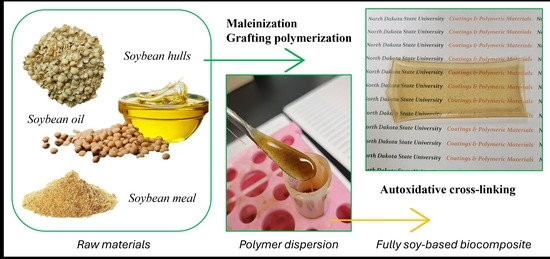
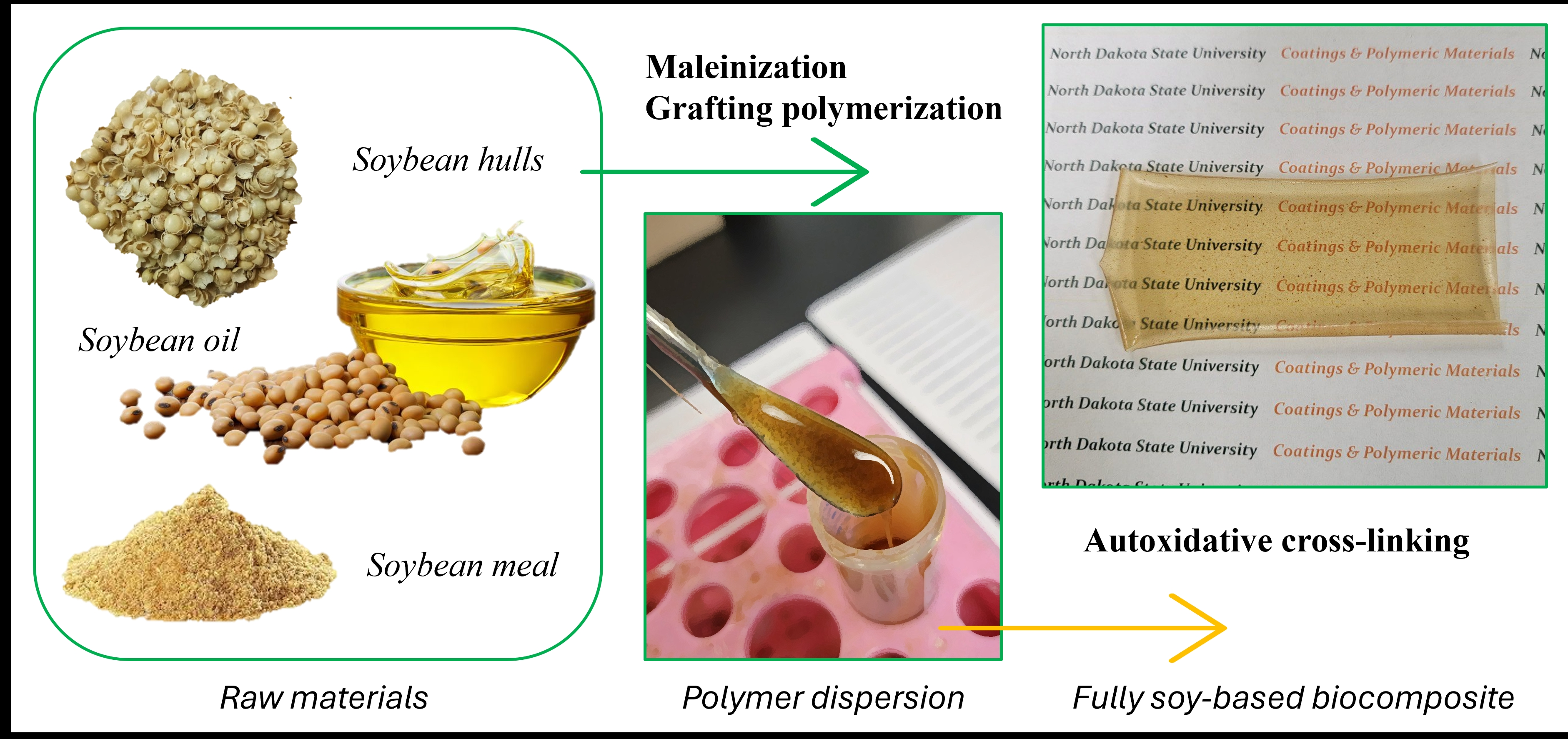
Graphical Abstract

1. Introduction

Produced from biopolymers and biofibers, biocomposites (also known as “green composites”) have become attractive polymeric materials for both academic and industrial communities due to their notable potential to contribute to the circular economy model [1]. From this point of view, if biocomposites are biodegradable (compostable), one can successfully recycle and/or dispose of these materials after their life ends; thus, no environmental danger would be posed, which is not the case with composites produced from fossil-based resources [2].
To date, several investigations have reported on the advanced physical and mechanical properties and performance of biocomposites with thermoplastic biopolymer matrices from polylactic acid (PLA) and poly(hydroxyalkanoates) (PHAs), as well as from thermosetting polyesters or epoxies [3,4,5] reinforced with the addition of one or more bio-derived fibers [6,7].
Obtained from renewable sources (corn, sugarcane, and beet), PLA is one of the most commercially available biobased thermoplastics at present; however, although it is a strong and stiff biopolymer [8,9], it lacks toughness and has a low heat deflection point [10]. To overcome these problems, PLA has been mixed with poly[(3-hydroxybutyrate)-co-valerate] (PHBV, a representative PHA) and in the presence of biofibers to improve the resulting green composite’s performance and reduce its cost [11,12,13,14,15]. A higher length-to-diameter ratio leads to improved performance when utilizing biofibers, as the load is dissipated more efficiently with increasing l/d aspect ratio [16,17,18].
Both plant biofibers (from, e.g., hemp, wood cellulose, rice and corn husks, straw, and flax) [19,20,21] and biofibers from insects and animals (primarily wool and silk fibers) [22,23,24] have been employed as reinforcements in biocomposite materials. The primary role of biofibers is to reinforce the material, thereby enhancing the strength of the final product. In particular, in PLA [25,26,27,28,29] and PHBV [30,31] biocomposites, the advantages of incorporating natural fibers have been demonstrated. However, while promising, the vast majority of such biocomposites still underperform [2], with limited moisture resistance, partial incompatibility with the matrix (especially if incorporated in a more hydrophobic polymer matrix), structural variability, potential issues in supply logistics, and flammability all considered as factors that may lead to the deterioration of the final biocomposite properties (thermal, mechanical), potentially limiting their use in high-performance industrial applications—especially load-bearing ones [32,33]. In particular, for biofibers with a high content of cellulosic ingredients, overcoming the hydrophilicity of these materials is essential to improve interfacial interactions between fillers and the matrix. The surface modification of biofibers using various approaches, such as biological, physical, or chemical treatments to hydrophobize the filler (by either changing the surface topology or chemistry), is currently employed by many academic and industrial scientists [34,35,36].
Soybean hull (SH), the outer coating of a soybean seed [37], is an example of an underused natural fiber byproduct. During the soybean crushing process, the SH is first removed, and then soybean oil is extracted from the rolled flakes, followed by the drying, toasting, and grinding of the flakes into soy meal. SH is a cheap and abundant material (with a large quantity typically being produced) that can be used only as a low-cost feedstock (due to a low amount of protein) or discarded [38,39]. At the same time, based on its high carbohydrate (natural fiber) content, SH is a promising feedstock for biobased polymer composites. SH contains up to 86% carbohydrates (including polysaccharides and oligosaccharides) and 9–12% soy protein [40]. One advantage of SH as a filler is that it can be applied in an already existing procedure without any additional processing, such that no changes in machinery are needed. In fact, according to Business Research Insights, the global market for SH is growing at a rate of 6% per year and is expected to reach USD 3.2 billion by 2033.
Although SH has the same challenges—for example, high moisture adsorption, poor thermal resistance, and low strength and impact properties—as many other natural biofibers, several reports have been published on their incorporation into polymer matrices to obtain biobased composites. The effects of the SH particle size and filler/polymer matrix ratio on the composite’s thermal and mechanical properties have been studied for SH-reinforced materials derived from soybean oil combined with fossil-based counterparts: butyl acrylate and dicyclopentadiene [41]. In another work, the mechanical properties of polyethylene and polypropylene composites in the presence of various amounts of SH have been reported [42], as well as the potential of SH-reinforced bioplastics made from a PHBV and PLA blend [14]. Nevertheless, SH has the potential to be applied as a reinforcing agent in biocomposites, which has not yet been explored.
Therefore, this study explores the suitability of using various ratios of SH in combination with two other soy-based derivatives—soy meal (SM) and soy oil-derived polymers—simultaneously (and, perhaps, synergistically) in the development of biocomposite polymeric materials. One can say that SH and SM are both, to some extent, similar regarding chemical composition—primarily containing mixtures of soy protein and various carbohydrates, although at very different ratios: the protein content in SM is significantly higher (40 to 55%), while it contains up to only 35% carbohydrates (polysaccharides and various mono-, di-, and oligosaccharides) [43]. Research efforts to explore the feasibility of using SM in polymeric biobased materials, including biocomposites, are underway [44,45,46,47]. Overall, due to SM’s high availability and low cost, as well as its physicochemical properties and intrinsic biodegradability, this material is considered a promising candidate for the manufacturing of sustainable thermoplastics.
Considering that SM and SH are highly sensitive to water and brittle, in this study, we employ free-radical polymerization to modify both soy ingredients with plasticizing (to overcome brittleness and make tougher biocomposites) and hydrophobizing (to improve moisture resistance) polymers. These polymers are synthesized from plant oil-based acrylic monomers (POBMs) developed by our group. The developed one-step transesterification process converts fatty acid triglycerides in plant/vegetable oils (including high-oleic soybean oil, as employed in this study) into acrylic monomers suitable for free-radical polymerization. We developed a library of POBMs from oils broadly differing in chemical composition that are capable of free-radical polymerization, including chain copolymerization with petroleum-based and biobased counterparts [48,49]. When incorporated into polymer chains, fatty acid moieties with varying degrees of unsaturation provide strong internal plasticizing and hydrophobizing effects, while the formation of highly ordered (crystalline) morphological domains can be facilitated if the POBM comprises primarily saturated triglycerides. Such compositional variety provides a tool to tune the thermomechanical properties of the resulting sustainable polymers and polymeric materials [50,51].
Although the combination of various matrix polymers and fillers in a composite leads to products with superior properties and performance, most polymers are thermodynamically incompatible. Furthermore, the dispersed phase (filler) must be uniformly distributed within the polymer composite matrix to provide adequate performance. Both issues result from limited interfacial interactions between different composite ingredients (phases); thus, the physical properties of the material deteriorate [52,53,54]. Reactive compatibilization is an approach to overcome incompatibility concerns in high-performance biocomposites. This strategy leverages the concept of in situ grafted or block (co)polymer formation at the interface by selecting a specific polymerization mechanism or process [55,56,57,58]. In this scenario, compatibilizing polymer chains are formed directly at the interface between the composite phases, thereby decreasing the interfacial energy and allowing for the homogeneous dispersion of composite ingredients.
According to Data Bridge Market Research, the SM market is projected to grow at an annual rate of 4.2% and reach USD 128 billion globally by 2029. As mentioned, while SM-based thermoplastics demonstrate some enhanced barrier properties, toughness, and processability, they lack strength, which may be improved if the composites include a higher concentration of natural carbohydrate fibers; in particular, this may be achieved by blending the SM with SH.
To ensure the homogeneous distribution of SM and SH in the biobased polymer composites, we developed an in situ VOC-free bulk polymerization procedure, which ensures that the processed SM and SH have the desired mechanical and film-forming characteristics. These characteristics are achieved by introducing grafted chains of high-oleic soybean oil-based acrylic monomer (HOSBM) containing plasticizing and compatibilizing hydrophobic fatty acid moieties. In the resulting product, modified with grafted soft and flexible hydrophobic HOSBM chains, SH and SM function as reinforcing fillers. At the same time, the non-grafted homopolymer of HOSBM (polyHOSBM) serves as the biocomposite matrix. The developed procedure converts SM and SH constituents (soy proteins, cellulose, and hemicellulose) into processable thermoset biocomposites. To the best of our knowledge, the concept of polymeric materials derived from a combination of three primary soybean ingredients—namely, soybean meal, hull, and oil—has not been previously explored in the context of biobased thermosets and composites.

2. Materials and Methods

Materials: High-oleic soybean oil (ReNu Source, Hartville, OH, USA), N-(hydroxyethyl) acrylamide (stabilized with MEHQ, >98%) (N-HEA, TCI America, Portland, OR, USA, CAS: 7646-67-5), magnesium sulfate (anhydrous, reagent grade) (VWR Chemicals, Solon, OH, USA, CAS: 7487-88-9), soybean hull (SH, Northern Crops Institute (NCI), Fargo, ND, USA), soybean meal (SM, Owensboro Grain, Owensboro, KY, USA), azobisisobutyronitrile (AIBN; [(CH3)2C(CN)]2N2, 98%) (Sigma-Aldrich, St. Louis, MO, USA, CAS 78-67-1), and maleic anhydride (99%) (Thermo Fisher Scientific, Fair Lawn, NJ, USA, CAS: 108-31-6) were obtained. The driers and curing catalysts used were cobalt Ten-Cem (12%) (OM Group (OMG), Westlake, OH, USA, OMG code 115105), zirconium Hex-Cem (12%) (OMG, Westlake, OH, USA, OMG code 115361), calcium Hydro-Cem (5%) (OMG, Westlake, OH, USA, OMG code 115083), and Dri-Rx HF (OMG, Westlake, OH, USA, OMG code 115409). All solvents used were reagent grade or better and were used as received.
Preparation of soybean hull and soybean meal: To increase the accessibility of functional groups, raw soybean hull and soybean meal were milled and dried before maleinization. A grinding machine was used to mill SM directly, while the brittleness of SH was increased by freezing it in liquid nitrogen before milling. Then, the SH and SM were sieved through a standard test sieve (compliant with ASTM E-11 standard) with a sieve size of 106 µm (#140). To remove the excess water naturally present in SH and SM, freeze-drying was performed using a Labconco FreeZone 2.5 L freeze dryer for 72 h.
Maleinization of soybean hull and soybean meal: For the maleinization reaction, SH or SM was mixed with maleic anhydride at a 1:10 weight ratio and dispersed in DMF at 1 wt.% solid content with vigorous stirring (about 800 rpm) for 30 min. The reaction mixture was purged with UHP nitrogen for 10 min, and the reaction was carried out at 90 °C for 4 h with magnetic stirring at 800 rpm. After the reaction, the mixture was washed on a paper filter, first with an excess of methanol and then with water, to remove unreacted maleic anhydride. SH or SM was collected from the paper filter and dried in an oven at 90 °C for 5 h.
Synthesis of high-oleic soybean oil-based monomer (HOSBM): High-oleic soybean oil-based monomer (HOSBM) was prepared in our laboratory using a reaction pathway previously reported by the current research group for other POBMs [59]. In brief, about 115 g of N-(hydroxyethyl) acrylamide was added to 150 g of high-oleic soybean oil (with an acrylamide alcohol to triglyceride molar ratio of 5.9 to 1), 150 mL of tetrahydrofuran, and 0.1 g of 2,6-di-tert-butyl-p-cresol in a two-necked 500 mL round-bottom flask equipped with a mechanical stirrer. The reaction mixture was heated to 40 °C in the presence of a catalytic amount of ground sodium hydroxide (1.5 g), which was added to the reaction mixture with continuous stirring. The reaction mixture was stirred at 40 °C until complete homogenization (approximately 3 h). Then, the reaction mixture was diluted with hexane and purified by washing with brine. After that, the remaining water was removed using anhydrous magnesium sulfate, while the rest of the solvents were evaporated under a vacuum, yielding about 170 g of acrylic monomer (94–96% of the theoretical yield). The resulting monomer contains one acrylic double bond linked to one fatty acid chain, mainly mono-unsaturated oleate.
Grafting of high-oleic soybean oil-based polymer on soybean hull and soybean meal: First, HOSBM was mixed with AIBN (1.5 wt.% per oil phase) and stirred until complete dissolution. Then, under mechanical stirring at 200 rpm, fillers (maleinized SH or SM) were added to the monomer initiator mixture. Different HOSBM-to-filler (SH or SM) weight ratios of 1:10, 1:5, and 1:3 were used. The reaction was conducted at 80 °C for 8 h. After polymerization, the mixture was precipitated in methanol to remove unreacted monomer. The supernatant was collected, and after solvent evaporation, the residual monomer was quantified to calculate the monomer conversion. Purified polymer with filler (SH or SM) was dried under a nitrogen flow and then dissolved in toluene for further film preparation.
Gel permeation chromatography (GPC): The average molecular weight and polydispersity of the polyHOSBM formed during the grafting reaction were determined using gel permeation chromatography (GPC) on a Tosoh Bioscience EcoSEC HLC-8320 instrument (Grove City, OH, USA), which consisted of a Waters 1515 high-performance liquid chromatography pump, a Waters 2410 refractive index detector, and two 10 mm PL-gel mixed-B columns (porous polystyrene/divinylbenzene cross-linked matrix). The samples were eluted at a flow rate of 0.35 mL/min, the column temperature was set at 40 °C, and THF was used as a carrier solvent. An EasiVial polystyrene standard was used to create a calibration curve. To prepare the samples, 0.015 g of the polymer was dissolved in 3 mL of THF and filtered through a 0.22 μm poly(vinylidene fluoride) filter before injection.

Preparation and Characterization of Thermoset Biocomposites

Composite film preparation: To facilitate the cross-linking process through the autoxidation of HOSBM double bonds, primary (Co), secondary (Zr), and auxiliary (Ca) driers, as well as catalysts (Dri-RX), were added to the polymer/filler dispersion (30 wt.% polymer in toluene; polymer was dissolved and filler was dispersed). The driers were added as % metal per polymer and the catalyst as % catalyst per polymer: Co-based, 0.0516; Zr-based, 0.4284; Ca-based, 0.2135; Dri-RX, 0.53. Then, the polymer solution was drawn down on the polytetrafluoroethylene (PTFE) substrate to ensure easy release after curing. A dry film thickness of 100 µm was targeted, and the wet film thickness was adjusted accordingly based on the solid content of the formulation. Toluene was allowed to evaporate to form a solid, tack-free film, and subsequent curing in the oven with continuous airflow was performed for 5 h at 100 °C on each side of the free film. After curing, the samples were cooled and stored under ambient conditions before testing.
Fourier transform infrared spectroscopy: The chemical composition of SH, maleinized SH, polyHOSBM homopolymer, and cross-linked thermoset films was confirmed using a Thermo Scientific Nicolet 8700 Fourier transform infrared (FTIR) spectrometer (Waltham, MA, USA) coupled with an attenuated total reflection (ATR) accessory with a hemispherical Ge crystal. A total of 64 scans were performed in the 600–4000 cm−1 region.
Mechanical characterization (tensile test): Cured polymer films were cut into rectangular samples with dimensions of 25 × 5 mm. The thickness of the films was measured using a digital micrometer before each test. An Instron 5542 tensile tester (Norwood, MA, USA) was used at a constant test speed of 5 mm/min. The sample was fixed in the clamps to obtain a 10 × 5 mm test area (10 mm spacing between clamps) and was pulled at a constant speed until film failure occurred. Young’s modulus was calculated as the slope of the stress–strain curves on a tensile diagram when the material underwent elongation in elastic mode (0.1–1.0% elongation). The reported Young’s modulus and elongation at break values were the averages of at least five measurements. Composite toughness was calculated as the area under the stress–strain curve, as the average of five measurements.
Dynamic mechanical analysis (DMA): A DMA 850 (TA Instruments, Waters Corporation, Milford, MA, USA) dynamic mechanical analyzer in tension mode was used to measure the composite storage modulus and glass transition temperature (Tg). The sample preparation procedure was identical to that used for the tensile test. The dynamic mechanical analysis (DMA) measurements were performed by heating the sample from −70 to 150 °C at a rate of 5 °C/min under a constant frequency of 1 Hz. The Tg of the composite films was calculated as the peak of tanδ.
Thermogravimetric analysis (TGA): To evaluate the thermal stability of the prepared composite films, the Discovery 550 thermogravimetric analyzer (TA Instruments, Waters Corporation, Milford, MA, USA) was used. A sample of cross-linked polymer film was heated from 25 to 600 °C at a temperature ramp of 20 °C/min in a platinum crucible under a nitrogen atmosphere. The reported value represents the temperature at which a 5% weight loss of the composite occurs.

3. Results and Discussion

3.1. Modification of Soybean Hull and Soybean Meal by Grafted Plant Oil-Based Polymers

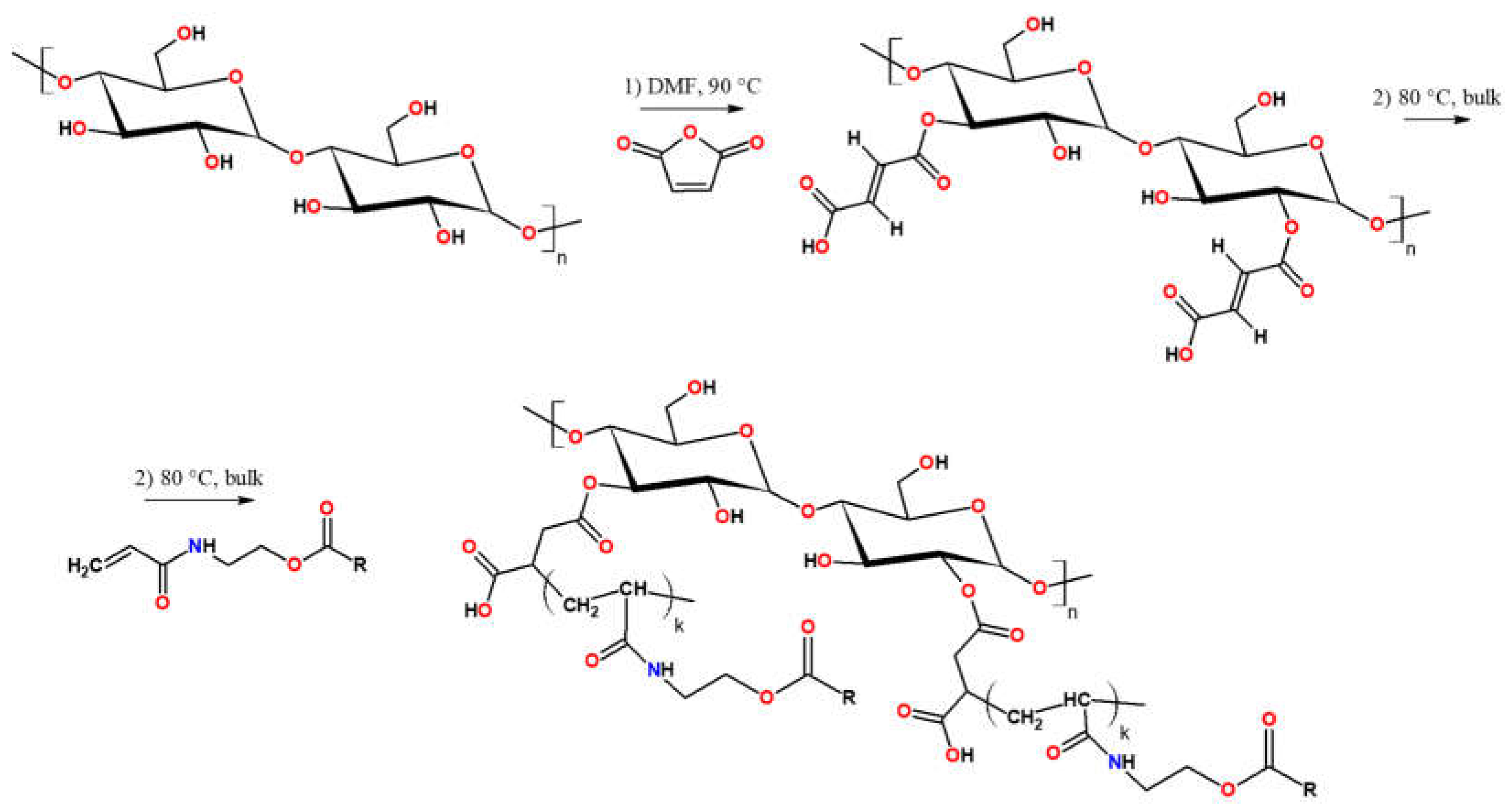
Soybean hull and soybean meal consist of a complex mixture of hydrophilic biopolymers: primarily hemicellulose, cellulose, and proteins, with a negligible fraction of lignin and lipids. Although these biopolymers exhibit high rigidity, they are too brittle to form films and too hydrophilic to be incorporated into the polymer matrix as reinforcing agents. To enhance the compatibility of SH and SM constituents with the polymer matrix, the maleinization and subsequent grafting of the HOSBM-based polymer were performed (Scheme 1). A high abundance of hydroxyl groups can be used in the reaction with maleic anhydride. After ring opening, maleic anhydride is converted into maleic acid, which contains two carboxyl groups, one of which reacts with the SH or SM hydroxyl group. The carbon–carbon double bond in maleic acid is reactive in free-radical polymerization and can be utilized as a reactive center for the “grafting from” reaction.
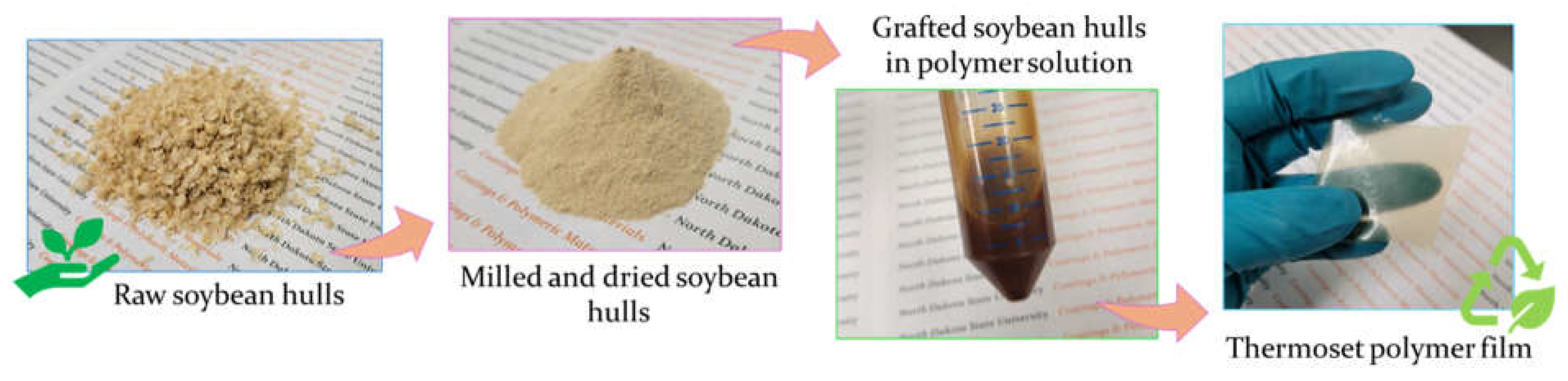
Three products are formed during grafting polymerization: modified SH or SM with grafted chains and a homopolymer of HOSBM (polyHOSBM) (Figure 1). The latter plays the role of a continuous polymer matrix, while the former acts as reinforcing agents. Grafted chains of HOSBM enhance the intermolecular interactions between the modified SM or SH and the matrix, thus increasing the compatibility between the dispersed phase (modified SH or SM) and the dispersion medium (polyHOSBM). Moreover, the allyl double bonds of HOSBM remain intact during the grafting process and can be further used for post-polymerization cross-linking to form thermoset films.
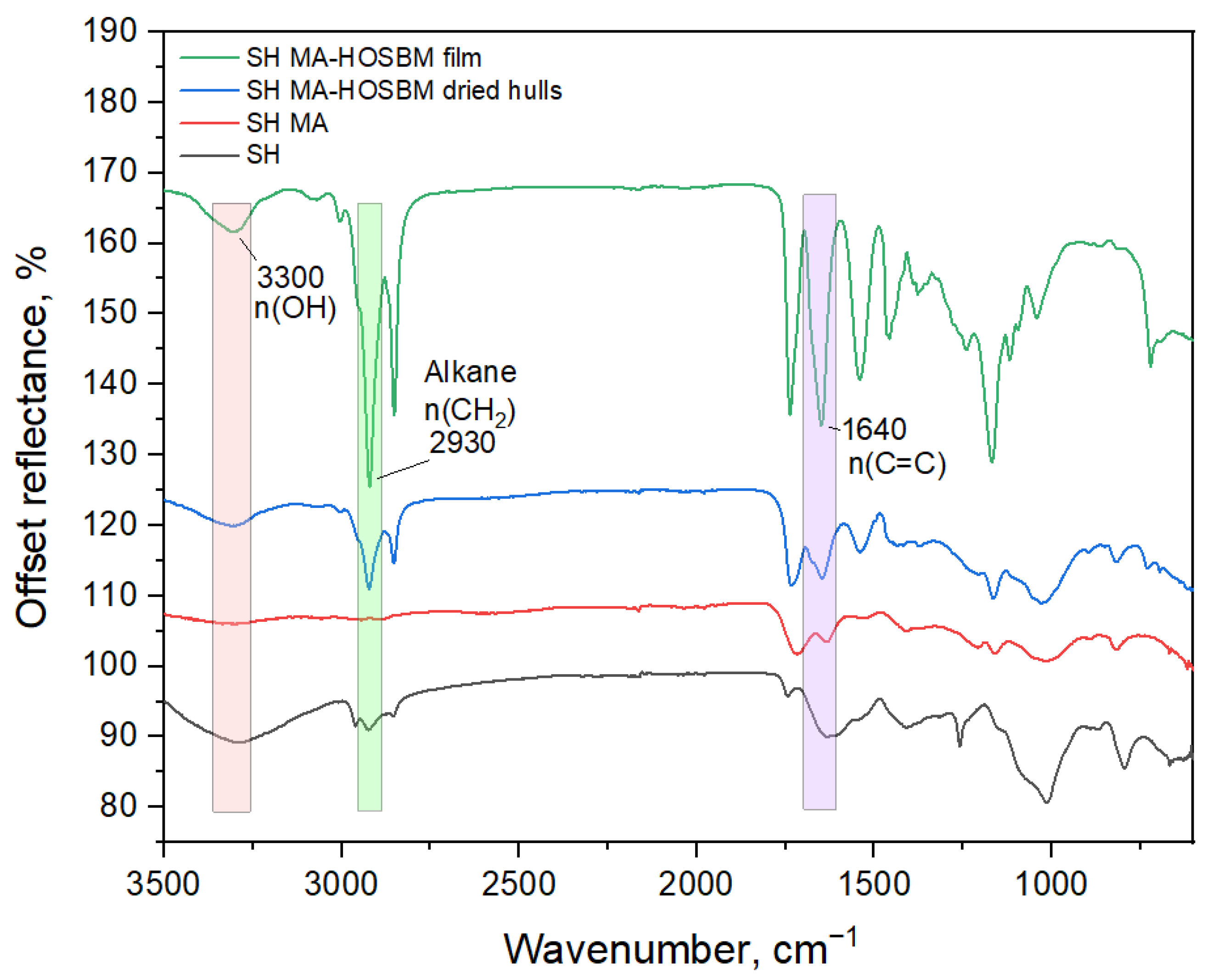
The ATR–FTIR technique was employed to confirm the successful completion of the grafting reaction. It can be observed that after grafting, there was a significant increase in the intensity of the alkane peak at 2930 cm−1, when compared with pristine soybean hull (black curve) and maleinized soybean hull (red curve); this corresponds to the macromolecular chains of the grafted poly(HOSBM) (Figure 2). It is important to note that for the modified soybean hull sample (blue curve), all the homopolymer was removed.
The grafting process was performed via the bulk polymerization of HOSBM (no solvent). This process not only allows for a reduction in VOC content but also enhances the grafting efficiency due to the higher availability of monomer next to the reactive centers (maleinized SH and SM). The monomer conversion after grafting was 61–71%, which is comparable with that in currently used industrial processes and is reasonable for potential industrial application (Table 1).
Furthermore, any unreacted monomer can be reused in the next grafting polymerization batch. Removing unreacted monomers from the system increased the filler content from the theoretical 1:10 (9 wt.%) to 12.5 wt.%, 1:5 (16.7 wt.%) to 24.6 wt.%, and 1:3 (25 wt.%) to 35 wt.%. Based on the results obtained, we can confirm that up to 35 wt.% of modified soybean hull and 12.5 wt.% of soybean meal can be incorporated into the polymer matrix. These results are promising regarding reducing the cost of the final biocomposite, as well as serving as a practical use for a biobased resource currently considered as an agricultural waste (soybean hull), while potentially improving the performance of the prepared thermoset polymer films.
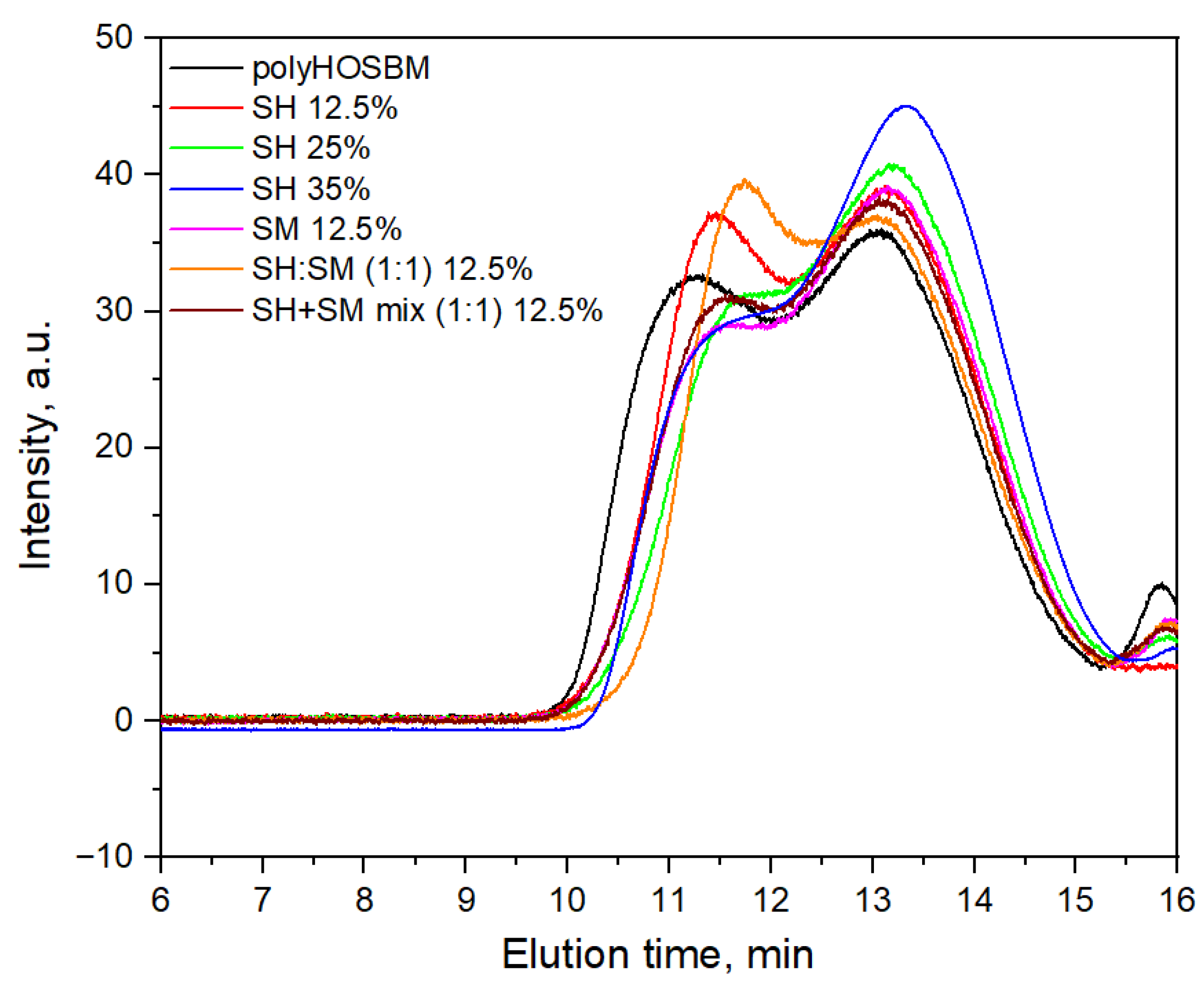
After grafting polymerization and removal of the unreacted monomer, the molecular weight distribution in polyHOSBM samples was evaluated. The GPC measurements revealed a bimodal distribution for all synthesized samples, including polyHOSBM samples obtained through bulk polymerization without filler (Figure 3).
The GPC results are represented in Table 2, indicating the formation of two polymeric fractions during grafting. The lower-molecular-weight fraction of polyHOSBM varies slightly depending on the filler used in bulk polymerization, with the highest value observed for polymerization without filler (Mn = 28,300 g/mol). We attribute this fraction to the synthesized linear macromolecules. At the same time, the second fraction exhibits a significant increase in both Mn and Mw, with a very low PDI (1.3–1.4).
Such an increase in molecular weight can be attributed to the chain transfer reactions on the macromolecules of polyHOSBM, resulting in the formation of a branched macromolecular configuration. Due to the high monomer concentration and thus the extensive presence of unsaturated bonds in bulk, chain transfer becomes even more prevalent. We have previously observed a similar effect of allyl double bonds on the molecular weight of 3-allyl-5-vinyl veratrole (AVV) in solution polymerization [60]. In this case, a higher-molecular-weight fraction formed with increased polymerization time, which can be attributed to chain transfer on the allyl double bonds of the resulting macromolecular chains. Such a phenomenon may also be the case in the current study, although further investigation is required for validation.

3.2. Preparation of Thermoset Biocomposites and Their Appearance

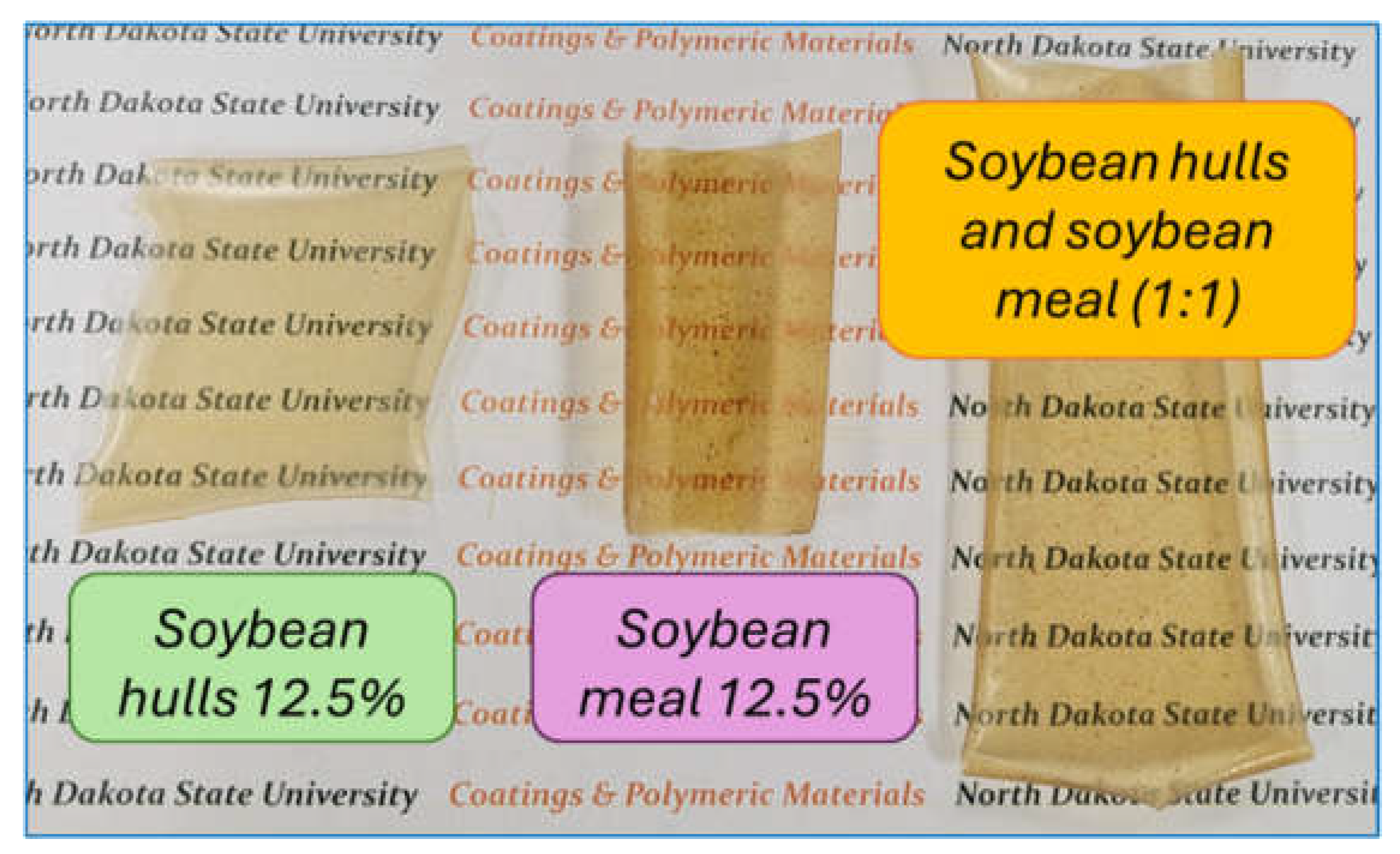
All polymer biocomposite films were optically transparent with yellow discoloration, caused primarily by the cobalt-containing autoxidation catalysts added to facilitate the cross-linking process (Figure 4).
The composite with soybean hull as a filler had the least discoloration and the most homogeneous distribution of filler within the polymer biocomposite film.
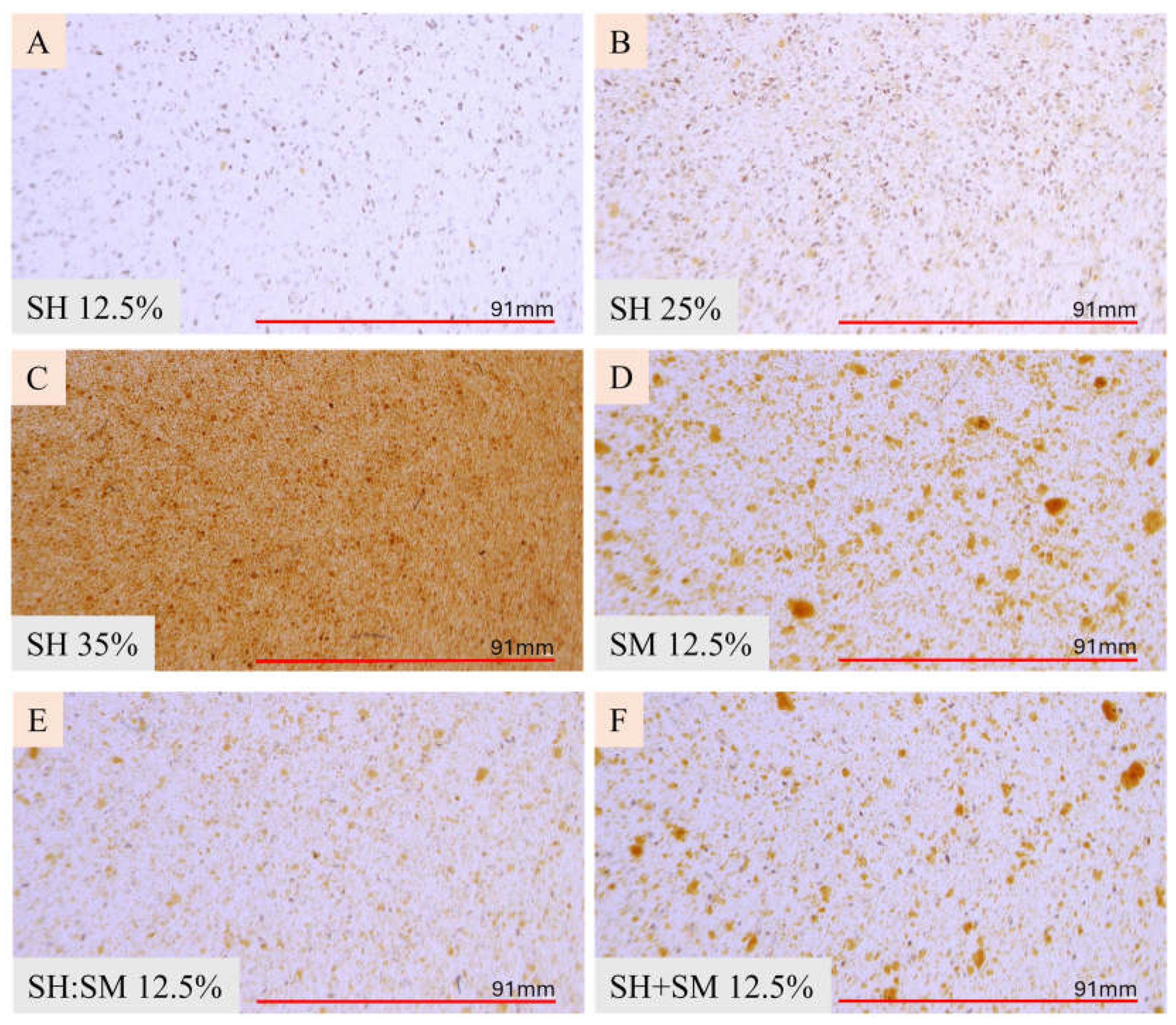
Light microscope images were captured to evaluate the distribution of filler materials within the cured biocomposite films. With the incorporation of soybean hull at 12.5 to 35 wt.%, the films appear darker due to the higher content of opaque filler; however, there is no significant aggregation, and all filler particles appear to be evenly distributed (Figure 5A–C).
At the same time, the application of soybean meal triggers the formation of larger aggregates (Figure 5D). This can happen due to the higher hydrophobicity of SM compared to SH and its partial aggregation in polar solvent (DMF) during maleinization. Due to aggregation and the extensive hydrogen bonding between particles, it is challenging to redisperse them during the grafting process. A similar trend is observed for the films formed by combining separately grafted SH and SM (Figure 5F). As aggregates formed during maleinization, they were further transferred into the grafting process and are present in the final cured films. Interestingly, aggregation did not occur with the simultaneous maleinization of SH and SM (Figure 5E). This may be explained by the structural affinity of SH and SM, with their interactions preventing the SM particles from aggregating.

3.3. Thermomechanical Characterization of Thermoset Biocomposites

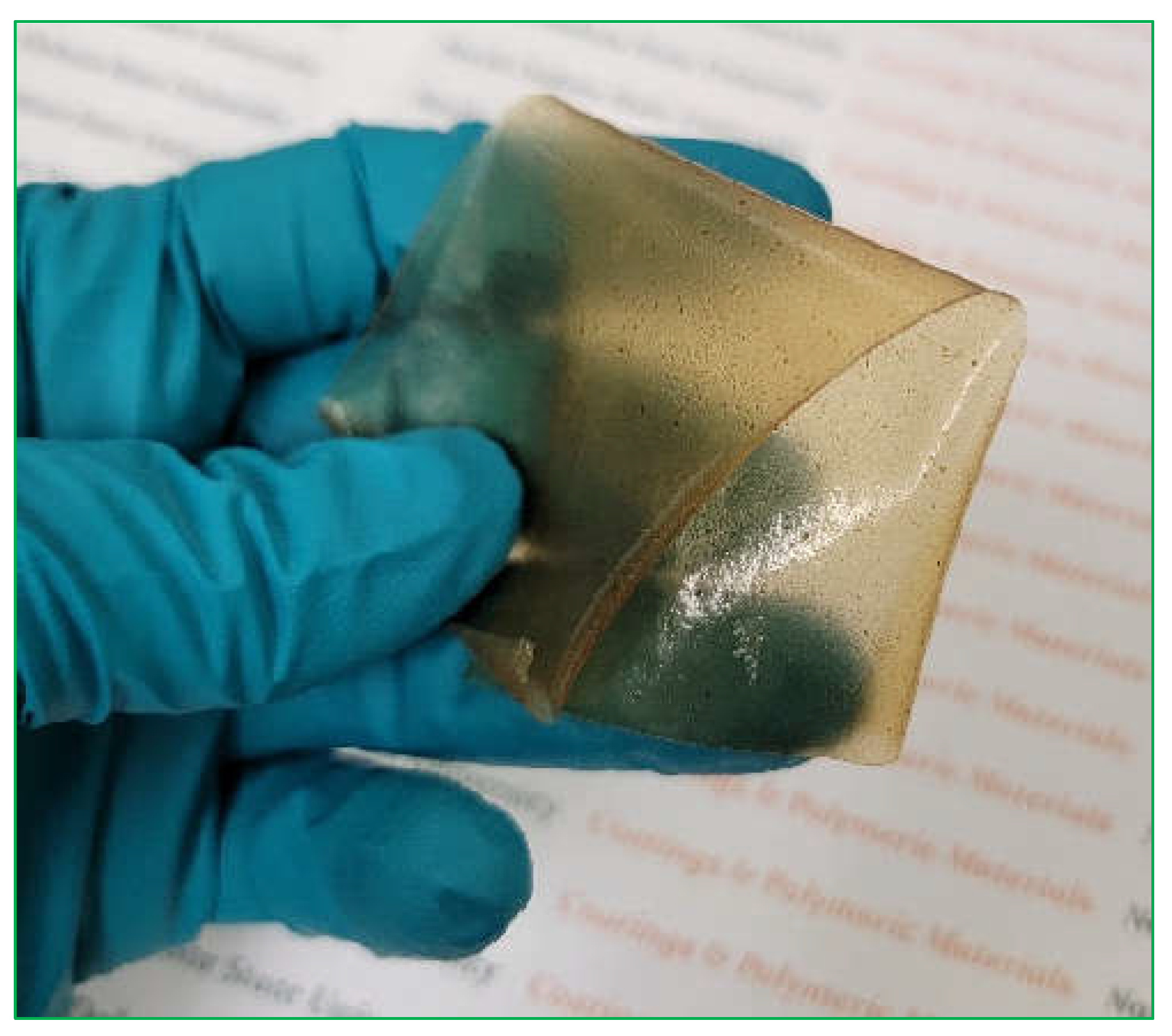
From Figure 6, it can be observed that the cured biocomposite films with SH demonstrated high flexibility and did not fracture when folded—a characteristic often associated with brittle materials.
The mechanical characterization results of the cross-linked polymer biocomposite films are presented in Table 3. Regardless of filler type (SH or SM) and content (12.5 or 25 wt.%), all films exhibit similar elongation at break (εbr), ranging from about 18–23%, except for the one with 35 wt.% SH content. At the same time, polyHOSBM films without fillers showed the highest Young’s modulus (E) and lowest εbr due to the formation of a highly cross-linked network. The incorporation of soybean hull gradually decreased the E and tensile strength (σ). Interestingly, the films with 25 wt.% of SH demonstrated the highest performance compared to other prepared biocomposites. This is a significant result, as it allows the replacement of more expensive polymers with much cheaper fillers, such as modified soybean hull. In such a way, increasing the filler content without compromising the performance of the biocomposite can lead to economic benefits. When increasing the SH content up to 35 wt.%, the biocomposite’s cross-linking density decreased significantly, leading to a more than two-fold increase in elongation at break. Surprisingly, the simultaneous modification and grafting of SH and SM led to similar results for E (102–103 MPa) and σ (2.4–2.9 MPa), while the simple mixing of fillers grafted separately led to a significant reduction in E—presumably due to the difficulty in homogeneously mixing both fillers.
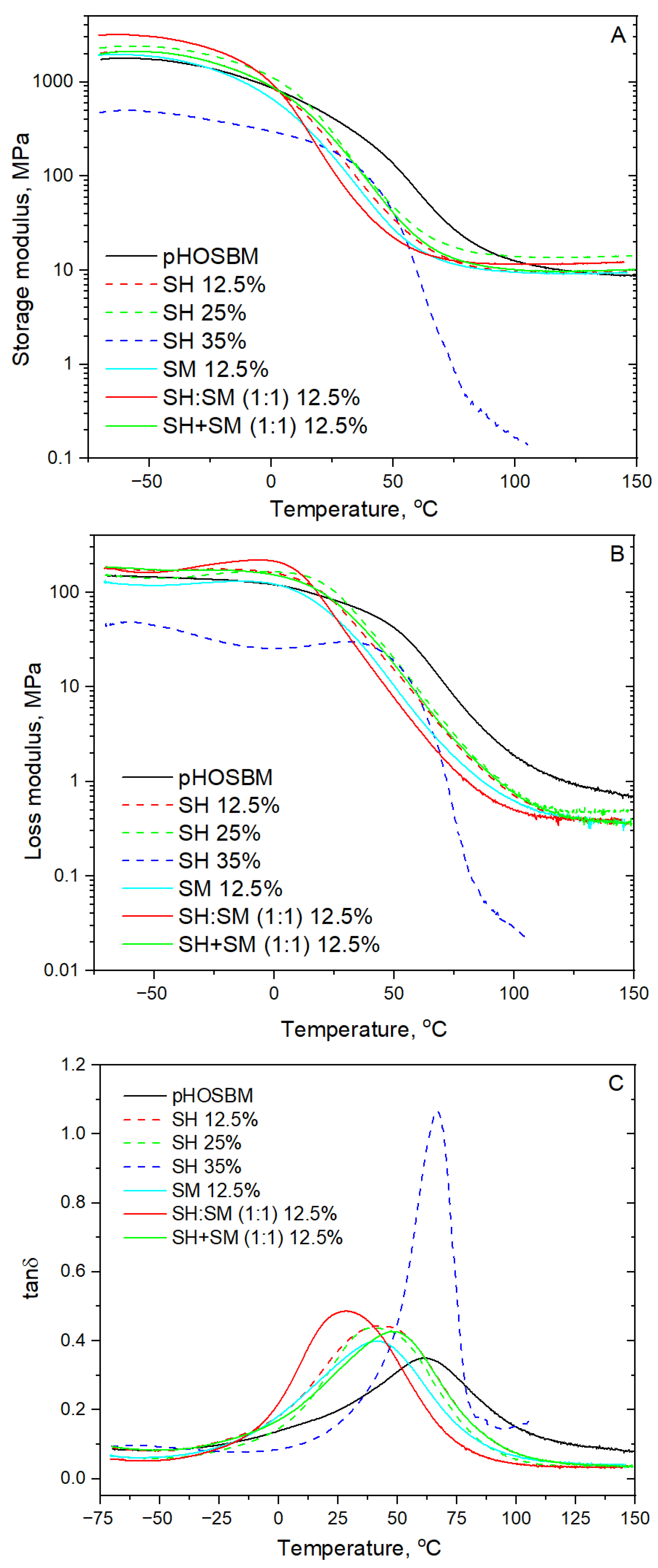
The dynamic mechanical analysis results provide deep insights into the mechanical performance of the prepared biocomposites (Table 4 and Figure 7A–C). The combination of soybean hull and soybean meal at a 1:1 ratio at the maleinization stage and their further grafting allowed the highest value of storage modulus (E′) (3200 MPa) to be achieved in the glassy region, possibly due to the combination of SH that contains rigid cellulose and hemicellulose and SM with high protein content, resulting in a tougher material. Furthermore, the simple mixing of separately modified SH and SM did not bring any beneficial effect, and the obtained E′ was comparable with that of individual fillers at 12.5 wt.% (1900–2100 MPa). E′ at room temperature presented a similar trend as E, with the highest value for crosslinked polyHOSBM without any filler (500 MPa) and the next highest for 25 wt.% SH (420 MPa). It is interesting to note that incorporating 35 wt.% SH reduced the application temperature range of the biocomposite to around 75 °C, at which point it dramatically lost performance. (Figure 7A).
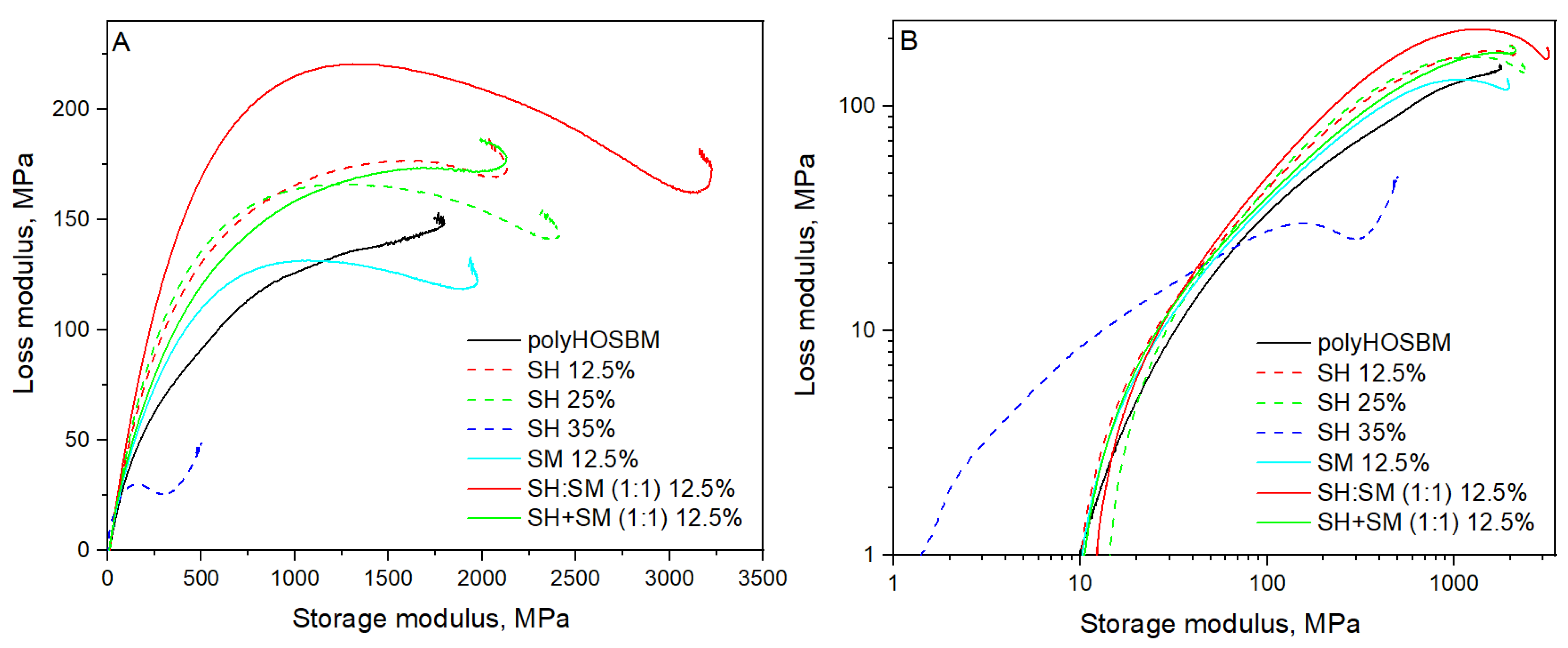
A Cole–Cole plot of E′ versus the loss modulus (E″) can be utilized to determine the filler distribution in the composite [61,62]. From the prepared Cole–Cole plot, it can be seen that all biocomposite samples demonstrated a semicircular curve shape, which indicates a homogeneous distribution of soybean hull and soybean meal within the polyHOSBM matrix (Figure 8A). In a heterogeneous system, a deviation from this shape would be observed. From the logarithmic Cole–Cole plot (Figure 8B), we can see that biocomposites with up to 25% filler behaved similarly to the cross-linked matrix polymer (polyHOSBM). There is good compatibility between the filler and the matrix, as evidenced by the linear shape of the curves in the terminal region (low frequency or high temperature). At the same time, for the 35% filler sample, a significant deviation was observed, confirming that the material becomes more heterogeneous. The slope of a curve in the modified Cole–Cole plot is often used to assess the homogeneity of thermoplastic polymer blends; however, it is not applicable for quantitative evaluation of cross-linked composites.
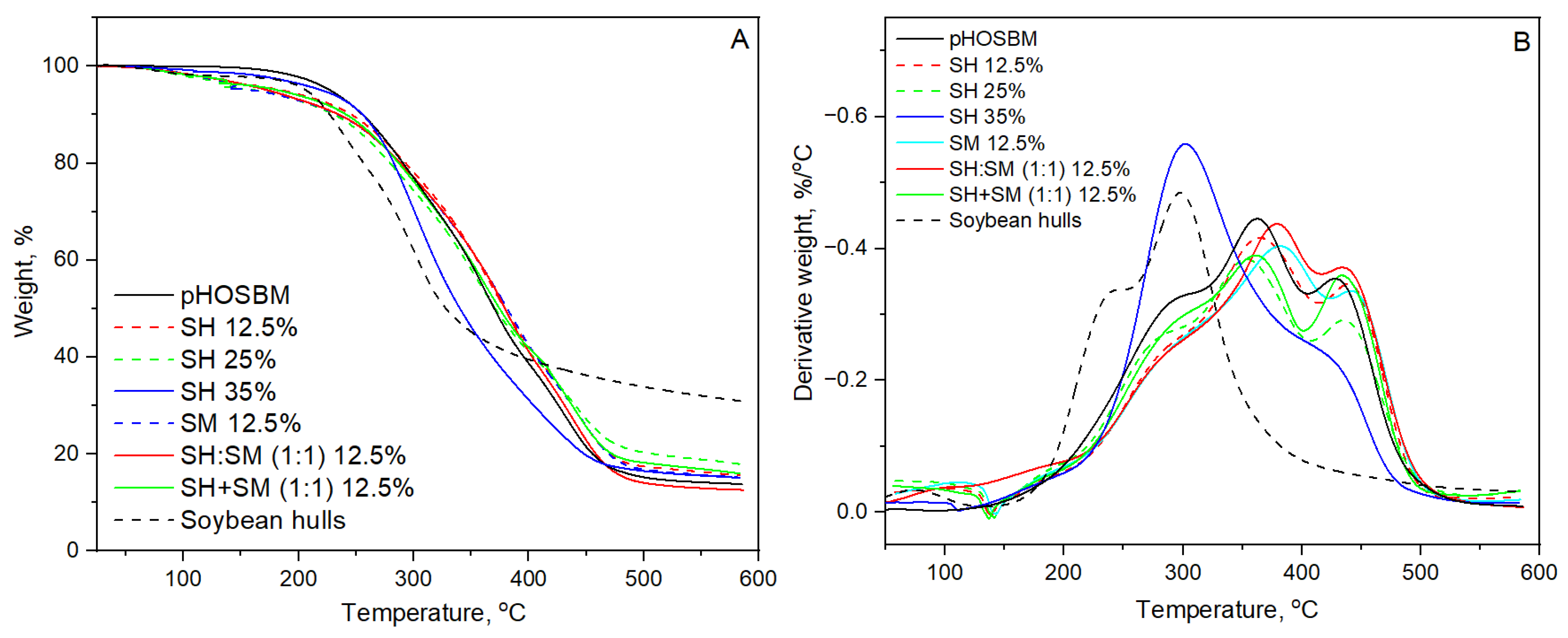
Finally, the thermal stability of the cross-linked films was similar, regardless of the fillers used, and a 5% mass loss was observed in the temperature range of 161–189 °C. This value is lower than that for synthetic thermoplastics, such as polypropylene and polyethylene terephthalate, and can be attributed to the lower thermal stability of SH and SM in the prepared biobased composite. At the same time, all biocomposites showed increased char yield compared to other synthetic thermoplastics (Figure 9). The increased char yield and visual intumescence of the biocomposites after the TGA experiment encourage us to further investigate the feasibility of biocomposites, including SH and SM, as fire-retardant materials.

4. Conclusions

Soybean hull and soybean meal, as natural fillers, were modified with polyHOSBM (homopolymer of high-oleic soybean oil-based acrylic monomer)-grafted macromolecular chains using a “grafting from” bulk polymerization process. The developed procedure enhances the soybean hull and soybean meal’s compatibility with the highly hydrophobic polymer matrix and ensures their homogeneous distribution in the composite matrix. The latter is often challenging to achieve when hydrophilic soybean hull and soybean meal are added to a pre-synthesized polymeric matrix.
The synthesized biobased polymeric materials with up to 35% soy hull and 12.5% soy meal were cross-linked via the autoxidation of high-oleic soybean oil-based polymeric fragments presented in the biocomposites.
The mechanical characterization shows that incorporating 25 wt.% soybean hull leads to an enhanced Young’s modulus and tensile strength compared to other investigated biocomposites. Overall, the resulting cross-linked biocomposite films exhibit a Young’s modulus in a range of 50–140 MPa, tensile strength of 1–2.9 MPa, and elongation at break of 18–55%.

Author Contributions

B.D.: Conceptualization, Data curation, Investigation, Methodology, and Visualization, Writing—original draft, and Writing—review and editing. A.V.: Conceptualization, Validation, Writing—original draft, Writing—review and editing, Supervision, Project administration, and Funding acquisition. All authors have read and agreed to the published version of the manuscript.

Funding

This research was funded by North Dakota Soybean Council.

Data Availability Statement

The raw data supporting the conclusions of this article will be made available by the authors on request.

Conflicts of Interest

The authors declare that they have no known competing financial interests or personal relationships that could have appeared to influence the work reported in this paper.

References

  1. Gurunathan, T.; Mohanty, S.; Nayak, S.K. A review of the recent developments in biocomposites based on natural fibres and their application perspectives. Compos. Part A Appl. Sci. Manuf. 2015, 77, 1–25. [Google Scholar] [CrossRef]
  2. Andrew, J.J.; Dhakal, H. Sustainable biobased composites for advanced applications: Recent trends and future opportunities—A critical review. Compos. Part C Open Access 2022, 7, 100220. [Google Scholar]
  3. Marais, S.; Gouanvé, F.; Bonnesoeur, A.; Grenet, J.; Poncin-Epaillard, F.; Morvan, C.; Métayer, M. Unsaturated polyester composites reinforced with flax fibers: Effect of cold plasma and autoclave treatments on mechanical and permeation properties. Compos. Part A Appl. Sci. Manuf. 2005, 36, 975–986. [Google Scholar] [CrossRef]
  4. Sharma, A.K.; Bhandari, R.; Aherwar, A.; Rimašauskienė, R. Matrix materials used in composites: A comprehensive study. Mater. Today Proc. 2020, 21, 1559–1562. [Google Scholar] [CrossRef]
  5. Yu, T.; Jiang, N.; Li, Y. Study on short ramie fiber/poly (lactic acid) composites compatibilized by maleic anhydride. Compos. Part A Appl. Sci. Manuf. 2014, 64, 139–146. [Google Scholar] [CrossRef]
  6. Bhatia, G.S.; Andrew, J.J.; Arockiarajan, A. Experimental investigation on compressive behaviour of different patch–parent layup configurations for repaired carbon/epoxy composites. J. Compos. Mater. 2019, 53, 3269–3279. [Google Scholar] [CrossRef]
  7. Dicker, M.P.; Duckworth, P.F.; Baker, A.B.; Francois, G.; Hazzard, M.K.; Weaver, P.M. Green composites: A review of material attributes and complementary applications. Compos. Part A Appl. Sci. Manuf. 2014, 56, 280–289. [Google Scholar] [CrossRef]
  8. Jiang, L.; Wolcott, M.P.; Zhang, J. Study of biodegradable polylactide/poly (butylene adipate-co-terephthalate) blends. Biomacromolecules 2006, 7, 199–207. [Google Scholar] [CrossRef]
  9. Zhang, J.; Jiang, L.; Zhu, L.; Jane, J.L.; Mungara, P. Morphology and Properties of Soy Protein and Polylactide Blends. Biomacromolecules 2006, 7, 1551–1561. [Google Scholar] [CrossRef] [PubMed]
  10. Huda, M.; Drzal, L.; Misra, M.; Mohanty, A. Wood-fiber-reinforced poly (lactic acid) composites: Evaluation of the physicomechanical and morphological properties. J. Appl. Polym. Sci. 2006, 102, 4856–4869. [Google Scholar] [CrossRef]
  11. Ferreira, B.; Zavaglia, C.; Duek, E. Films of PLLA/PHBV: Thermal, morphological, and mechanical characterization. J. Appl. Polym. Sci. 2002, 86, 2898–2906. [Google Scholar] [CrossRef]
  12. Iannace, S.; Ambrosio, L.; Huang, S.; Nicolais, L. Poly (3-hydroxybutyrate)-co-(3-hydroxyvalerate)/poly-L-lactide blends: Thermal and mechanical properties. J. Appl. Polym. Sci. 1994, 54, 1525–1535. [Google Scholar] [CrossRef]
  13. Nanda, M.R.; Misra, M.; Mohanty, A.K. The effects of process engineering on the performance of PLA and PHBV blends. Macromol. Mater. Eng. 2011, 296, 719–728. [Google Scholar] [CrossRef]
  14. Nanda, M.R.; Misra, M.; Mohanty, A.K. Mechanical Performance of Soy-Hull-Reinforced Bioplastic Green Composites: A Comparison with Polypropylene Composites. Macromol. Mater. Eng. 2012, 297, 184–194. [Google Scholar] [CrossRef]
  15. Richards, E.; Rizvi, R.; Chow, A.; Naguib, H. Biodegradable composite foams of PLA and PHBV using subcritical CO2. J. Polym. Environ. 2008, 16, 258–266. [Google Scholar] [CrossRef]
  16. Gamstedt, E.; Nygård, P.; Lindström, M. Transfer of knowledge from papermaking to manufacture of composite materials. In Proceedings of the 3rd Wood Fibre Polymer Composites International Symposium, Bordeaux, France, 26–27 March 2007; p. 12. [Google Scholar]
  17. Migneault, S.; Koubaa, A.; Erchiqui, F.; Chaala, A.; Englund, K.; Wolcott, M.P. Effects of processing method and fiber size on the structure and properties of wood–plastic composites. Compos. Part A Appl. Sci. Manuf. 2009, 40, 80–85. [Google Scholar] [CrossRef]
  18. Wolcott, M.P.; Englund, K. A technology review of wood-plastic composites. In Proceedings of the 33rd International Particleboard/Composite Materials Symposium, Pullman, WA, USA, 13–15 April 1999; Washington State University: Pullman, WA, USA, 1999; pp. 103–111. [Google Scholar]
  19. Taj, S.; Munawar, M.A.; Khan, S. Natural fiber-reinforced polymer composites. Proc.-Pak. Acad. Sci. 2007, 44, 129. [Google Scholar]
  20. Vinod, A.; Sanjay, M.; Suchart, S.; Jyotishkumar, P. Renewable and sustainable biobased materials: An assessment on biofibers, biofilms, biopolymers and biocomposites. J. Clean. Prod. 2020, 258, 120978. [Google Scholar] [CrossRef]
  21. Wambua, P.; Ivens, J.; Verpoest, I. Natural fibres: Can they replace glass in fibre reinforced plastics? Compos. Sci. Technol. 2003, 63, 1259–1264. [Google Scholar] [CrossRef]
  22. Bharath, K.; Manjunatha, G.; Santhosh, K. Failure analysis and the optimal toughness design of sheep–wool reinforced epoxy composites. In Failure Analysis in Biocomposites, Fibre-Reinforced Composites and Hybrid Composites; Elsevier: Amsterdam, The Netherlands, 2019; pp. 97–107. [Google Scholar]
  23. Huda, S.; Yang, Y. Feather fiber reinforced light-weight composites with good acoustic properties. J. Polym. Environ. 2009, 17, 131–142. [Google Scholar] [CrossRef]
  24. Sadeghi, S.; Dadashian, F.; Eslahi, N. Recycling chicken feathers to produce adsorbent porous keratin-based sponge. Int. J. Environ. Sci. Technol. 2019, 16, 1119–1128. [Google Scholar] [CrossRef]
  25. Chen, F.; Liu, L.; Cooke, P.H.; Hicks, K.B.; Zhang, J. Performance enhancement of poly (lactic acid) and sugar beet pulp composites by improving interfacial adhesion and penetration. Ind. Eng. Chem. Res. 2008, 47, 8667–8675. [Google Scholar] [CrossRef]
  26. Huda, M.S.; Drzal, L.T.; Mohanty, A.K.; Misra, M. Chopped glass and recycled newspaper as reinforcement fibers in injection molded poly (lactic acid)(PLA) composites: A comparative study. Compos. Sci. Technol. 2006, 66, 1813–1824. [Google Scholar] [CrossRef]
  27. Huda, M.S.; Drzal, L.T.; Mohanty, A.K.; Misra, M. Effect of fiber surface-treatments on the properties of laminated biocomposites from poly (lactic acid)(PLA) and kenaf fibers. Compos. Sci. Technol. 2008, 68, 424–432. [Google Scholar] [CrossRef]
  28. Plackett, D.; Andersen, T.L.; Pedersen, W.B.; Nielsen, L. Biodegradable composites based on L-polylactide and jute fibres. Compos. Sci. Technol. 2003, 63, 1287–1296. [Google Scholar] [CrossRef]
  29. Shibata, M.; Ozawa, K.; Teramoto, N.; Yosomiya, R.; Takeishi, H. Biocomposites made from short abaca fiber and biodegradable polyesters. Macromol. Mater. Eng. 2003, 288, 35–43. [Google Scholar] [CrossRef]
  30. Ahankari, S.S.; Mohanty, A.K.; Misra, M. Mechanical behaviour of agro-residue reinforced poly (3-hydroxybutyrate-co-3-hydroxyvalerate),(PHBV) green composites: A comparison with traditional polypropylene composites. Compos. Sci. Technol. 2011, 71, 653–657. [Google Scholar] [CrossRef]
  31. Singh, S.; Mohanty, A.K.; Sugie, T.; Takai, Y.; Hamada, H. Renewable resource based biocomposites from natural fiber and polyhydroxybutyrate-co-valerate (PHBV) bioplastic. Compos. Part A Appl. Sci. Manuf. 2008, 39, 875–886. [Google Scholar] [CrossRef]
  32. Jawaid, M.; Khalil, H.A. Cellulosic/synthetic fibre reinforced polymer hybrid composites: A review. Carbohydr. Polym. 2011, 86, 1–18. [Google Scholar] [CrossRef]
  33. Stamboulis, A.; Baillie, C.; Peijs, T. Effects of environmental conditions on mechanical and physical properties of flax fibers. Compos. Part A Appl. Sci. Manuf. 2001, 32, 1105–1115. [Google Scholar] [CrossRef]
  34. Cao, X.V.; Ismail, H.; Rashid, A.A.; Takeichi, T.; Vo-Huu, T. Maleated natural rubber as a coupling agent for recycled high density polyethylene/natural rubber/kenaf powder biocomposites. Polym.-Plast. Technol. Eng. 2012, 51, 904–910. [Google Scholar] [CrossRef]
  35. Huda, M.S.; Drzal, L.T.; Mohanty, A.K.; Misra, M. Effect of chemical modifications of the pineapple leaf fiber surfaces on the interfacial and mechanical properties of laminated biocomposites. Compos. Interfaces 2008, 15, 169–191. [Google Scholar] [CrossRef]
  36. Saenghirunwattana, P.; Noomhorm, A.; Rungsardthong, V. Mechanical properties of soy protein based “green” composites reinforced with surface modified cornhusk fiber. Ind. Crops Prod. 2014, 60, 144–150. [Google Scholar] [CrossRef]
  37. Laszlo, J.A. Mineral binding properties of soy hull. Modeling mineral interactions with an insoluble dietary fiber source. J. Agric. Food Chem. 1987, 35, 593–600. [Google Scholar] [CrossRef]
  38. Suszkiw, J. Soybean Hulls Eyed for Wastewater Filtering; Agricultural Research Service, U.S. Department of Agriculture: Washington, DC, USA, 2001. Available online: https://www.ars.usda.gov/news-events/news/research-news/2001/soybean-hulls-eyed-for-wastewater-filtering/ (accessed on 24 February 2025).
  39. Suszkiw, J. A Purrr-Fect Use for Soy Waste? Agricultural Research Service, U.S. Department of Agriculture: Washington, DC, USA, 2023. Available online: https://www.ars.usda.gov/news-events/news/research-news/2023/a-purrr-fect-use-for-soy-waste/ (accessed on 24 February 2025).
  40. Sessa, D.J. Processing of soybean hulls to enhance the distribution and extraction of value-added proteins. J. Sci. Food Agric. 2004, 84, 75–82. [Google Scholar] [CrossRef]
  41. Quirino, R.L.; Larock, R.C. Synthesis and properties of soy hull-reinforced biocomposites from conjugated soybean oil. J. Appl. Polym. Sci. 2009, 112, 2033–2043. [Google Scholar] [CrossRef]
  42. Julson, J.L.; Subbarao, G.; Stokke, D.; Gieselman, H.H.; Muthukumarappan, K. Mechanical properties of biorenewable fiber/plastic composites. J. Appl. Polym. Sci. 2004, 93, 2484–2493. [Google Scholar] [CrossRef]
  43. Ibáñez, M.; De Blas, C.; Cámara, L.; Mateos, G. Chemical composition, protein quality and nutritive value of commercial soybean meals produced from beans from different countries: A meta-analytical study. Anim. Feed Sci. Technol. 2020, 267, 114531. [Google Scholar]
  44. Gautam, S.; Sharma, B.; Jain, P. Green Natural Protein Isolate based composites and nanocomposites: A review. Polym. Test. 2021, 99, 106626. [Google Scholar] [CrossRef]
  45. Li, F.; Liu, T.; Gu, W.; Gao, Q.; Li, J.; Shi, S.Q. Bioinspired super-tough and multifunctional soy protein-based material via a facile approach. Chem. Eng. J. 2021, 405, 126700. [Google Scholar] [CrossRef]
  46. Liu, C.; Zhang, Y.; Li, X.; Luo, J.; Gao, Q.; Li, J. “Green” bio-thermoset resins derived from soy protein isolate and condensed tannins. Ind. Crops Prod. 2017, 108, 363–370. [Google Scholar]
  47. Luo, J.; Li, X.; Zhang, H.; Gao, Q.; Li, J. Properties of a soybean meal-based plywood adhesive modified by a commercial epoxy resin. Int. J. Adhes. Adhes. 2016, 71, 99–104. [Google Scholar] [CrossRef]
  48. Demchuk, Z.; Shevchuk, O.; Tarnavchyk, I.; Kirianchuk, V.; Kohut, A.; Voronov, S.; Voronov, A. Free radical polymerization behavior of the vinyl monomers from plant oil triglycerides. ACS Sustain. Chem. Eng. 2016, 4, 6974–6980. [Google Scholar] [CrossRef]
  49. Demchuk, Z.; Shevchuk, O.; Tarnavchyk, I.; Kirianchuk, V.; Lorenson, M.; Kohut, A.; Voronov, S.; Voronov, A. Free-radical copolymerization behavior of plant-oil-based vinyl monomers and their feasibility in latex synthesis. ACS Omega 2016, 1, 1374–1382. [Google Scholar] [CrossRef]
  50. Demchuk, Z.; Kirianchuk, V.; Kingsley, K.; Voronov, S.; Voronov, A. Plasticizing and hydrophobizing effect of plant oil based acrylic monomers in latex copolymers with styrene and methyl methacrylate. J. Theor. Appl. Nanotechnol. 2018, 6, 29–37. [Google Scholar]
  51. Demchuk, Z.; Kohut, A.; Voronov, S.; Voronov, A. Versatile platform for controlling properties of plant oil-based latex polymer networks. ACS Sustain. Chem. Eng. 2018, 6, 2780–2786. [Google Scholar] [CrossRef]
  52. Stamm, M. Polymer Surfaces and Interfaces. In Characterization, Modification and Applications; Springer: Berlin, Germany, 2008. [Google Scholar] [CrossRef]
  53. Wang, H.; Dong, W.; Li, Y. Compatibilization of Immiscible Polymer Blends Using in Situ Formed Janus Nanomicelles by Reactive Blending. ACS Macro Lett. 2015, 4, 1398–1403. [Google Scholar] [CrossRef] [PubMed]
  54. Xu, Y.; Loi, J.; Delgado, P.; Topolkaraev, V.; McEneany, R.J.; Macosko, C.W.; Hillmyer, M.A. Reactive Compatibilization of Polylactide/Polypropylene Blends. Ind. Eng. Chem. Res. 2015, 54, 6108–6114. [Google Scholar] [CrossRef]
  55. Detyothin, S.; Selke, S.E.M.; Narayan, R.; Rubino, M.; Auras, R.A. Effects of molecular weight and grafted maleic anhydride of functionalized polylactic acid used in reactive compatibilized binary and ternary blends of polylactic acid and thermoplastic cassava starch. J. Appl. Polym. Sci. 2015, 132. [Google Scholar] [CrossRef]
  56. Dong, W.; Wang, H.; He, M.; Ren, F.; Wu, T.; Zheng, Q.; Li, Y. Synthesis of Reactive Comb Polymers and Their Applications as a Highly Efficient Compatibilizer in Immiscible Polymer Blends. Ind. Eng. Chem. Res. 2015, 54, 2081–2089. [Google Scholar] [CrossRef]
  57. Eklind, H.; Schantz, S.; Maurer, F.H.; Jannasch, P.; Wesslén, B. Characterization of the Interphase in PPO/PMMA Blends Compatibilized by P(S-g-EO). Macromolecules 1996, 29, 984–992. [Google Scholar] [CrossRef]
  58. Wang, H.; Fu, Z.; Dong, W.; Li, Y.; Li, J. Formation of Interfacial Janus Nanomicelles by Reactive Blending and Their Compatibilization Effects on Immiscible Polymer Blends. J. Phys. Chem. B 2016, 120, 9240–9252. [Google Scholar] [CrossRef]
  59. Domnich, B.; Lynch, H.; Voronov, A. Effect of molecular weight and its modality on pressure-sensitive adhesives behavior of plant oil-based latexes. Int. J. Adhes. Adhes. 2024, 128, 103574. [Google Scholar] [CrossRef]
  60. Polunin, Y.; Domnich, B.; Tiwari, S.; Thorat, S.; Sibi, M.; Voronov, A. Free radical (Co)Polymerization of aromatic vinyl monomers derived from vanillin. Eur. Polym. J. 2023, 201, 112546. [Google Scholar] [CrossRef]
  61. Amrishraj, D.; Senthilvelan, T. Acrylonitrile butadiene styrene composites reinforced with nanozirconia and PTFE: Mechanical and thermal behavior. Polym. Compos. 2018, 39, E1520–E1530. [Google Scholar] [CrossRef]
  62. Balachandran, M.; Bhagawan, S.S.; Meera Balachandran, S.S.B. Studies on acrylonitrile—Butadiene copolymer (NBR) layered silicate composites: Mechanical and viscoelastic properties. J. Compos. Mater. 2011, 45, 2011–2022. [Google Scholar] [CrossRef]
Scheme 1. Maleinization reaction of SH and SM constituents (cellulose structure as a model) in DMF (1); grafting reaction of HOSBM chains from maleinized SH and SM (2).
Jcs 09 00678 sch001
Figure 1. The process of soy biocomposite preparation: grinding and drying of SH or SM; modification and grafting; and formation of cross-linked polymer films.
Jcs 09 00678 g001
Figure 2. ATR–FTIR spectra of pristine SH, maleinized SH, modified SH, and composite film with polyHOSBM and modified SH (uncross-linked).
Jcs 09 00678 g002
Figure 3. GPC chromatograms of the polyHOSBM samples formed in various grafting reactions.
Jcs 09 00678 g003
Figure 4. Appearance of cross-linked polymer biocomposite films made with soybean hull, soybean meal, and both SH and SM.
Jcs 09 00678 g004
Figure 5. Light microscope images of thermoset biocomposites with varying filler content and type: (A) 12.5% of Soybean Hulls. (B) 25% of Soybean Hulls. (C) 35% of Soybean Hulls. (D) 12.5% of Soybean Meal. (E) 12.5% of Soybean Hulls and 12.5% of Soybean Meal modified simultaneously. (F) 12.5% of Soybean Hulls and 12.5% of Soybean Meal modified separately and mixed.
Jcs 09 00678 g005
Figure 6. Appearance of cross-linked polymer biocomposite film after bending, demonstrating high flexibility.
Jcs 09 00678 g006
Figure 7. (A) Storage modulus (E′) of thermoset biocomposites measured using DMA. (B) Loss modulus (E″) of thermoset biocomposites measured using DMA. (C) Tan δ of thermoset biocomposites.
Jcs 09 00678 g007
Figure 8. Cole–Cole plot of E′ vs. E″ (A) and modified Cole–Cole plot (B) for thermoset biocomposites.
Jcs 09 00678 g008
Figure 9. TGA plot for soybean biocomposite thermosets (A) and derivative weight of TGA (B).
Jcs 09 00678 g009
Table 1. Monomer conversion and filler content after grafting.
SampleTheoretical Filler Content in Composite, wt.%Filler Content in Composite After Grafting, wt.%Monomer Conversion in Grafting, %
polyHOSBM--67.5
SH 12.5%SH, 9.1%12.4%70.8
SH 25%SH, 16.7%24.6%61.3
SH 35%SH, 25.0%35.1%61.7
SM 12.5%SM, 9.1%12.7%68.4
SH:SM (1:1) 12.5%SH + SM, 9.1%12.8%68.0
SH + SM mix (1:1) 12.5%SH + SM, 9.1%12.5%-
Table 2. Molecular weight and PDI of polyHOSBM.
Sample1st Peak2nd Peak
MnMwPDIMnMwPDI
polyHOSBM28,30076,4002.7590,000844,0001.4
SH 12.5%25,40064,5002.5458,100645,1001.4
SH 25%24,10066,2002.7453,100611,7001.3
SH 35%19,50054,0002.8420,400586,4001.4
SM 12.5%25,80073,4002.8536,700726,5001.4
SH:SM (1:1) 12.5%23,00054,7002.4333,000453,7001.4
SH + SM mix (1:1) 12.5%26,40073,6002.8518,600701,2001.3
Table 3. Mechanical performance of thermoset biocomposites.
SampleE, MPaεbr, %σ, MPa
polyHOSBM199 ± 2414 ± 44.6 ± 0.3
SH 12.5%102 ± 922 ± 52.4 ± 0.4
SH 25%142 ± 318 ± 42.9 ± 0.4
SH 35%52 ± 555 ± 41.0 ± 0.03
SM 12.5%103 ± 1219 ± 72.4 ± 0.2
SH:SM (1:1) 12.5%103 ± 1423 ± 52.7 ± 0.5
SH+SM (1:1) 12.5%78 ± 622 ± 42.1 ± 0.2
Table 4. Thermomechanical properties of thermoset biocomposites.
SampleE′ at
−50 °C, MPa
E′ at
20 °C, MPa
tan δ, °CTGA 5% Weight Loss, °CChar Yield at 600 °C, %
polyHOSBM17505006122714
SH 12.5%21003104318915
SH 25%24004204116418
SH 35%5002106722015
SM 12.5%19002304116115
SH:SM (1:1) 12.5%31001902917413
SH+SM (1:1) 12.5%21003604918316
Disclaimer/Publisher’s Note: The statements, opinions and data contained in all publications are solely those of the individual author(s) and contributor(s) and not of MDPI and/or the editor(s). MDPI and/or the editor(s) disclaim responsibility for any injury to people or property resulting from any ideas, methods, instructions or products referred to in the content.