Article

Two Times Faster Glycolysis of Poly(ethylene terephthalate) with CaO Filler-Catalyst

by
Anton N. Potorochenko
,
Artem A. Ovchinnikov
and
Konstantin S. Rodygin
*
Institute of Chemistry, Saint Petersburg State University, 7/9 Universitetskaya Nab., 199034 St. Petersburg, Russia
*
Author to whom correspondence should be addressed.
J. Compos. Sci. 2025, 9(12), 680; https://doi.org/10.3390/jcs9120680
Submission received: 7 November 2025 / Revised: 3 December 2025 / Accepted: 5 December 2025 / Published: 7 December 2025
(This article belongs to the Section Composites Manufacturing and Processing)

Abstract

Poly(ethylene terephthalate) (PET) is a widely used polymer that accumulates in the environment due to its low degradability, requiring efficient recycling strategies. In this study, CaO filler derived from calcium carbide slag (CS) waste was used for the first time as a catalyst for PET depolymerization. PET/CaO composites were prepared via hot extrusion of PET with the finely dispersed CaO filler. The resulting composite demonstrated consistently higher PET conversion (≥95%) and the yields of dimethyl and dibutyl terephthalates (80 and 84%, respectively). Kinetic studies of glycolysis demonstrated that embedding 1 wt% of CaO in the PET matrix doubled the bis(2-hydroxyethyl) terephthalate (BHET) formation rate relative to an externally added CaO catalyst, which resulted in BHET yields of 84.7% and 41.1% after 40 min. SEM and EDX investigations demonstrated good adhesion between the polymer matrix and the filler. The recovered BHET was successfully re-polymerized to produce recycled PET (r-PET). The maximum rate of weight loss of r-PET samples (at Tmax = 438.7–444.7 °C) was comparable to the original materials (at Tmax = 455.3–457.7 °C). In fact, the direct incorporation of CaO catalyst derived from waste into the polymer matrix during additive manufacturing enabled the implementation of an efficient and scalable closed-loop recycling strategy.

1. Introduction

PET is a ton-scale manufactured plastic used in many fields [1,2,3]. The accumulation of PET in the environment constantly increases due to the limited efficiency of recycling processes [4,5]. Despite the high mechanical strength, thermal stability, and processability, the accumulation of PET waste has emerged as a critical environmental challenge due to its chemical stability and slow rate of biodegradation [6,7,8,9,10]. Chemical disassembly of polymers is a promising alternative, providing depolymerization of PET into monomeric or oligomeric BHET or into dialkyl terephthalates, which can be re-polymerized into original quality PET [11,12]. Heterogeneous alcoholysis and glycolysis have attracted particular attention due to relatively mild conditions, high selectivity, and compatibility with various catalysts [13,14]. A wide range of catalytic systems—including metal oxides (ZnO, CaO, MgO) [15,16,17,18,19,20,21], ionic liquids [22,23,24,25,26,27], and other systems [28,29,30,31,32]—have been reported to promote transesterification of PET. However, all existing heterogeneous chemical recycling strategies are based on the addition of external catalysts, which must be delivered and then diffused toward the PET surface before depolymerization. This inherently leads to slow mass transfer between catalyst particles and melted polymer—a limitation that has not been addressed in previous studies. Furthermore, the literature lacks descriptions of approaches in which the catalyst is pre-integrated into the PET matrix to ensure immediate contact upon the reaction.
Additive manufacturing has been rapidly developing in chemistry and materials engineering, enabling the fabrication of complex structures with precise spatial control of composition and functionality [33,34,35,36,37,38,39,40,41,42,43]. In this context, additive manufacturing has opened new opportunities for the design of hybrid polymer-catalytic materials with predefined compositions and structures [44]. However, its potential for designing catalytic polymer matrices specifically for chemical recycling remains largely unexplored. Embedding catalytic species directly within the polymer matrix provides integrated recycling with the catalyst inside [45]. To the best of our knowledge, no previous study has explored the direct embedding of CaO into the PET matrix via extrusion and 3D printing to create an intrinsically catalytic PET composite. This strategy removes the need for external catalyst addition, improves catalyst-polymer contact, and can fundamentally accelerate depolymerization.
Calcium oxide (CaO) is a highly abundant heterogeneous catalyst used in transesterification to produce valuable esters and biofuels [46,47,48,49,50,51,52]. CaO can be obtained from limestone [53,54], biomass waste [55,56,57], and industrial waste—calcium carbide slag (CS) [58,59,60]. CS is produced as a byproduct during the production of acetylene from calcium carbide (CaC2) [61]. Since CaC2 is widely used in chemical and industrial applications [62,63,64,65,66,67,68], large quantities of CS are generated. Accumulation of wastes poses environmental challenges, highlighting the need for sustainable strategies to valorize CS. Incorporating such waste streams into functional materials, for instance, as catalysts in polymer depolymerization, offers a promising approach to reducing environmental impact while enabling circular material flows.
In this work, a sustainable approach to in situ catalyst-integrated chemical recycling of 3D-printed PET materials was investigated. For the first time, CaO derived from CS waste was used as a catalyst for PET depolymerization. The depolymerization of the prepared PET-based composite (PETc) containing finely dispersed CaO from CS was compared to that of virgin PET (PETf) under alcoholysis and glycolysis reactions. The integration of CaO into the polymer matrix decreased the initiation time and facilitated the formation of the monomer in the absence of an external catalyst. The recovered BHET was successfully repolymerized into recycled PET (r-PET), demonstrating the feasibility of a closed-loop recycling strategy for catalyst-modified polymer systems.

2. Materials and Methods

2.1. Materials

CaC2 (granulated, technical, ≥75% purity) was purchased from Sigma-Aldrich. DMSO (pure grade) was purchased from ECOS-1 JSC and used without additional purification. Acetone (analytical grade), hexane (chemically pure grade), EtOAc (chemically pure grade), n-butanol (chemically pure grade) and ethylene glycol (chemically pure grade) were purchased from VECTON JSC and used without additional purification. Methanol was purchased from VECTON JSC, purified by using a standard procedure and stored over type 3Å molecular sieves [69]. Dimethyl sulfone was purchased from Energy Chemicals Inc. Trifluoroacetic acid (TFA) (99%) was purchased from Sigma-Aldrich. Titanium (IV) isopropoxide (Ti(O-iPr)4, 98+%) was purchased from Acros Organics. PET filament (1.75 mm, white) was purchased from eSUN.

2.2. Instrumentation

The LOIP LF-7/13-G2 furnace was used to produce CS900. An IKA A11 basic analytical mill with sieve sizes of 100 and 50 µm was used for grinding CS900. Mixing of CS900 and PET filament and hot extrusion were carried out using a filament extruder (Wellzoom, Shenzhen Mistar Technology Co., Ltd., Shenzhen, China). The PET filament and PET composite filament were stored in an oven at 40 °C overnight before printing.
Three-dimensional models were created using KOMPAS-3D v23, and G-codes were generated using Creality 6.1 software. FDM printing was carried out on a Creality 3D printer (Shenzhen Creality 3D Technology Co., Ltd., Shenzhen, China).
Alcoholysis reactions were carried out in a SITEC high-pressure reactor made of Hastelloy. Column chromatography was performed using Merck silica gel 60 (60–200 mesh) that was preliminarily neutralized with Et3N. Pre-coated TLC sheets ALUGRAM Xtra SIL G/UV254 were used for thin-layer chromatography; a solution of 5% KMnO4 was used for visualization.

2.3. Characterization Techniques

The mechanical properties were tested using a Shimadzu AG-50kNXD testing machine; five tests were performed for each sample in accordance with the requirements of ISO 527-2:2025 (type A2) [70].
X-ray diffraction (XRD) patterns were recorded using a Bruker “D2 Phaser” powder diffractometer operating with X-ray tube radiation—CuKα1+2, wavelengths λCuKα1 = 1.54059 Å, λCuKα2 = 1.54443 Å, tube operation mode 30 kV/10 mA, position-sensitive detector, reflection geometry, Bragg–Brentano focusing scheme, sample rotation speed 20 rpm, diffraction angle interval 2θ = 5(8)–90°, scanning step 0.02°, exposure time of 0.7 s, T = 25 °C, air atmosphere. Quantitative phase analysis of samples (wt%) was carried out using full-profile analysis by the Rietveld method.
TG-DTG was carried out using a NETZSCH TG 209F1 Libra from 30 °C up to 800 °C at a ramping rate of 20 °C/min in an Ar flow using α-Al2O3 as a standard.
SEM images were recorded on Zeiss Merlin and Zeiss EVO-40EP electron microscopes at an accelerating voltage of 4–20 kV. The Zeiss EVO-40EP microscope was equipped with an Oxford INCA 350 energy-dispersive X-ray spectrometer with a detector area of 30 mm2.
XPS measurements were carried out on a Thermo Fisher Scientific ESCALAB 250Xi photoelectron spectrometer equipped with a monochromatic Al Kα X-ray source (Waltham, MA, USA).
NMR spectra were recorded using a Bruker Avance III spectrometer 400 MHz (400 MHz for 1H; 101 MHz for 13C). Chemical shifts δ were reported in ppm using residual protons of CDCl3 and DMSO-d6 as internal standards (1H, δ = 7.26; 13C, δ = 77.16 and 1H, δ = 2.5; 13C, δ = 39.52, respectively). Two-dimensional COSY NMR and 13C DEPT-135 experiments were used to determine the structure and type of monomer unit. Dimethyl sulfone was used as an internal standard for yield calculations. The conversion and yield values in the reactions corresponded to the average value between three independent experimental runs carried out under identical conditions.

2.4. Preparation of CS and CS900 Catalyst

CS was obtained by hydrolysis of CaC2. 9 g of CaC2 were placed in a three-neck flask, and 15 mL of DMSO were added. Distilled water was then added dropwise under vigorous stirring. After hydrolysis was complete, the resulting precipitate was separated from the solution by centrifugation, washed twice with distilled water, then with acetone, and dried at 80 °C in an oven for 0.5 h. The yield of CS was 7.8 g (75%). CS900 was prepared by calcination of CS at 900 °C for 3 h. CS900 was sieved through 100 µm and then 50 µm sieves. Particles with an average diameter of 50–100 µm were used for further studies.

2.5. Preparation of PET-Based Composite Filament

30 g of PET filament were ground in an analytical mill to obtain pieces of 1–4 mm in length. 0.3 g of prepared CS900 was added to the ground filament and mixed for 30 min. The resulting mixture, consisting of the polymer matrix and filler, was placed into an extruder hopper. Extrusion was performed at maximum motor speed at 172 °C through a nozzle with a 1.75 mm diameter. After cooling, the resulting pre-composite was ground into pieces 1–4 mm in length and extruded again at 170 °C. The resulting PET-based composite filament was stored in an oxygen-free atmosphere before further 3D printing.

2.6. Three-Dimensional Printing of PET and PET-Based Composite Samples

For the initial 3D model of the “dog bone” samples, the corresponding G-code was generated using a slicer and was not further modified. The generated G-code was used for 3D printing. The nozzle temperature was 260 °C, and the bed temperature was 80 °C. The nozzle diameter was 0.4 mm, the layer height was 0.2 mm, and the line width was 0.45 mm. The speed of printing was 30 mm/s. The conditions for 3D printing were the same for the pure PET and for the composite. Before printing, the bed surface of the 3D printer was cleaned of dust and treated with commercially available adhesive (the 3D brand) to improve adhesion. Printed objects made of PET filament are hereinafter referred to as PETf, and objects made of PET-based composite are referred to as PETc.

2.7. Depolymerization of PETf and PETc

Before the depolymerization studies, the printed PETf and PETc objects were manually crushed into particles with an average size of no more than 2 mm.

2.7.1. General Procedure for Alcoholysis

PETf (500 mg, 2.6 mmol) and CS900 (1 wt%, 5 mg) (or only PETc (500 mg, 2.6 mmol)) were charged into a steel autoclave (Figure S8 in the Supplementary Materials). Then, the required amount of alcohol (methanol or n-butanol) was added at a molar ratio of 65:1 (alcohol: PET, the amount in mmol of PETf/PETc was calculated based on the average molecular weight of the PET monomer unit—200.9 g/mol), the reactor was sealed and heated with stirring at 200 °C for 3 h. After completion of the reaction, the mixture was immediately cooled. The remaining PET and CaO were separated by vacuum filtration, and the filter was washed with CHCl3 (5–10 mL). The resulting filter solids were dried at 100 °C for 4 h and weighed to calculate the PETf/PETc conversion (Equation (1)):
P E T f   o r   P E T c   c o n v e r s i o n   % = m i m f m i 100
where mi—initial weight of PETf or PETc, mf—weight of unreacted products on the filter.
The filtrate was evaporated, weighed, analyzed by 1H NMR, and the yield of the corresponding esters was calculated using the internal standard (Equation (2)):
Y i e l d   o f   e s t e r   % = I e N s m s m m i x 0.99 I s N e M s m n m r n t 100
where Ie—integral intensity of the ether signal, Is—integral signal intensity of the standard, Ne—number of protons of ester (4HAr), Ns—number of standard protons (6H), ms—mass of standard sample, Ms—molecular weight of the standard, mmix—mass of the reaction mixture, mnmr—sample mass, 0.99—purity of the standard, nt—theoretical number of moles of ester.
Additional purification of the resulting mixtures was carried out: dimethyl terephthalate was purified by crystallization from the alcohol solutions with water (cooled overnight at 4 °C); dibutyl terephthalate was purified by column chromatography (silica gel, hexane/EtOAc = 10:1 (v/v)).
Dimethyl terephthalate: white solid; 1H NMR (400 MHz, CDCl3) δ 8.10 (s, 4H), 3.94 (s, 6H); 13C NMR (101 MHz, CDCl3) δ 166.43, 134.08, 129.70, 52.56; cf. lit. data [71].
Dibutyl terephthalate: colorless oil; 1H NMR (400 MHz, CDCl3) δ 8.08 (s, 4H), 4.34 (t, J = 6.6 Hz, 4H), 1.81–1.70 (m, 4H), 1.54–1.42 (m, 4H), 0.98 (t, J = 7.4 Hz, 6H); 13C NMR (101 MHz, CDCl3) δ 166.00, 134.33, 129.58, 65.37, 30.83, 19.37, 13.85; cf. lit. data [72].

2.7.2. General Procedure for the Glycolysis

PETf (500 mg, 2.6 mmol) and CS900 (1 wt%, 5 mg) (or only PETc (500 mg, 2.6 mmol)) were loaded into a round-bottom flask. Then, the required amount of ethylene glycol was added at a molar ratio of 15:1 (ethylene glycol: PET, the amount in mmol of PETf/PETc was calculated based on the average molecular weight of the PET monomer unit—200.9 g/mol) and heated under reflux with stirring at 198 °C for 3.5 h. After completion of the reaction, a sample was taken, analyzed by 1H NMR, and the yield of BHET was calculated using the internal standard (Equation (3)):
Y i e l d   o f   B H E T   % = I B H E T N s m s m m i x I s N B H E T M s m n m r n t 100
where Ie—integral intensity of BHET, Is—integral signal intensity of the standard, Ne—number of protons of BHET (4HAr), Ns—number of standard protons (6H), ms—weight of the standard sample, Ms—molecular weight of the standard, mmix—weight of the reaction mixture, mnmr—sample weight, nt—theoretical amount of moles of BHET.
The reaction mixture was diluted with boiling distilled water, and the remaining PET and CaO were separated by vacuum filtration. The resulting filter solids were dried at 100 °C for 4 h and weighed to calculate the PETf/PETc conversion (Equation (1)). The resulting solution was heated to boiling (the solution was transparent), a part of the solvent was evaporated, and the product was crystallized by cooling at 4 °C overnight (repeated recrystallization was performed if necessary). Kinetic studies were carried out using the same method with a loading of 1000 mg of the initial PETf or PETc. The yield was calculated (Equation (3)) at the following time points: 10, 25, 40, 60, 90, 120, 150, 180, and 210 min.
BHET: white solid; 1H NMR (400 MHz, DMSO-d6) δ 8.12 (s, 4H), 4.96 (t, J = 5.7 Hz, 2H), 4.35–4.28 (m, 4H), 3.77–3.68 (m, 4H); 13C NMR (101 MHz, DMSO-d6) δ 165.18, 133.76, 129.52, 67.03, 59.00; cf. lit. data [27].

2.7.3. General Procedure for r-PET Preparation by Polycondensation

r-PET1(2) was synthesized via polycondensation reaction (in the absence of a catalyst or in the presence of Ti(O-iPr)4 catalyst). BHET (700 mg, 2.75 mmol) (or BHET (700 mg, 2.75 mmol) and Ti(O-iPr)4 (5 μL)) were charged into a round-bottomed flask equipped with a magnetic stirrer. The mixture was placed under an argon atmosphere, heated to 160 °C, and continuously stirred. Then, the temperature was increased to 280 °C, and the reaction proceeded for 40 min. Then, the system was placed under vacuum (1 mbar), maintaining the temperature at 280 °C, and the reaction was continued for 8 h. The ethylene glycol was distilled off as a result of polycondensation and collected in a trap. After completion of the reaction, the mixture was cooled to room temperature. Then, 30–50 mL of CHCl3 and TFA solution (v:v = 4:1) were added to dissolve the condensation polymer. Methanol was then added to precipitate the product, which was collected by filtration and dried at 70 °C for 24 h.

3. Results and Discussion

3.1. Characterization of Initial CS and CS900

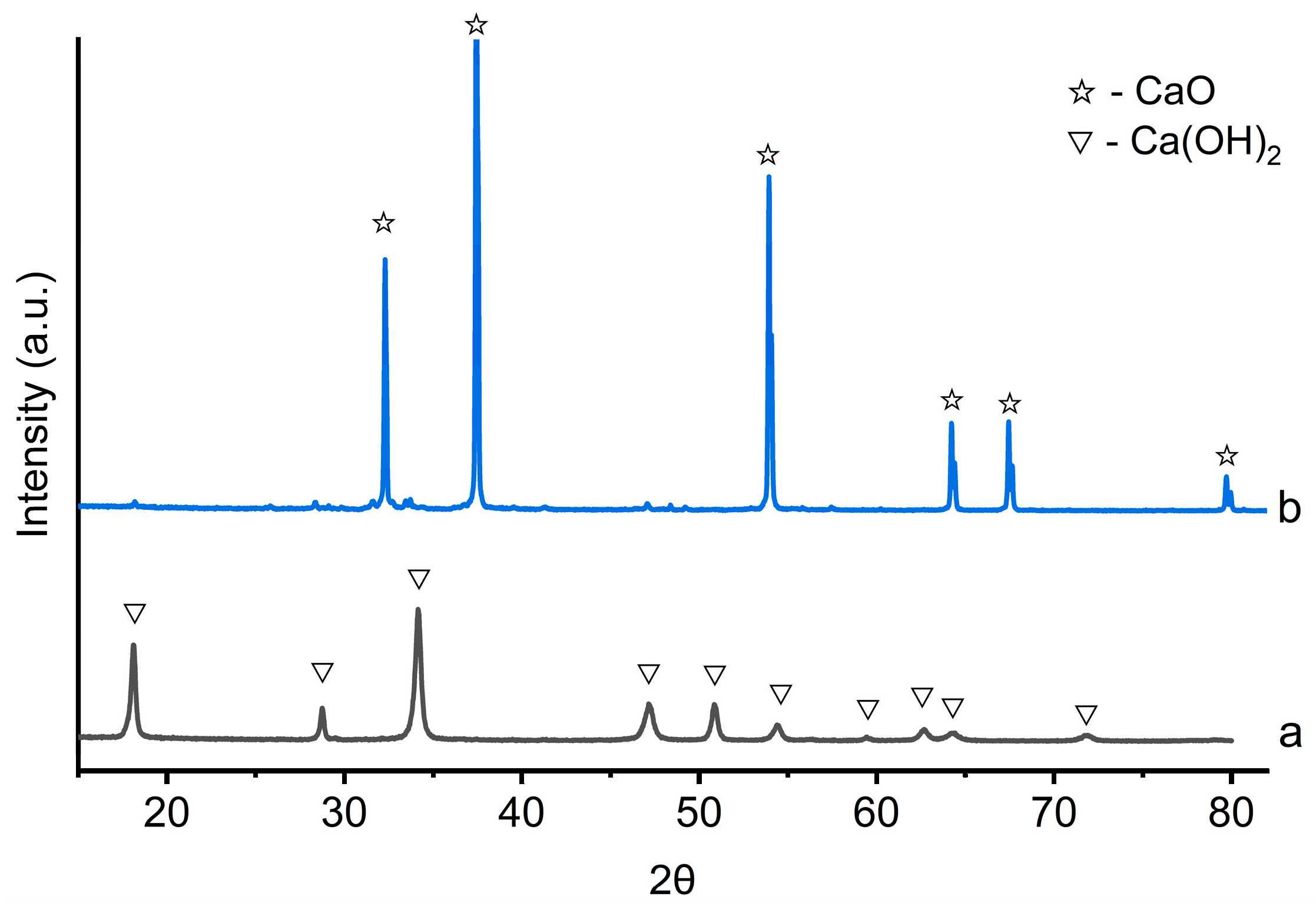
According to XRD, the initial CS included 98.8 wt% of Ca(OH)2 (portlandite) and 1.2 wt% of CaF2 (fluorite) (Figure 1a). Individual XRD patterns and detailed peak correlation are presented in the Supplementary Materials (Figures S1 and S2 and Tables S1 and S2). The X-ray diffraction pattern demonstrated signals of hexagonal Ca(OH)2 (portlandite, ICDD 01-070-5492) with reflections at 2θ = 18.1, 28.7, 34.2, 36.6, 47.2, 50.8, 54.4, 56.3, 59.4, 62.7, 64.2, 71.7 (designated as ▽). After calcination of CS at 900 °C for 3 h, decomposition of Ca(OH)2 to CaO was observed, which changed the diffraction pattern (Figure 1b). The main phase was CaO (98.2 wt%) (lime, ICDD 00-037-1497) with reflections at 2θ = 32.3, 37.4, 53.9, 64.2, 67.4, 79.7 (designated as ☆). Minor phases (less than 2%) were attributed to CaF2 and CaCO3.

3.2. Properties of 3D Printed PETf and PETc Samples

According to 1H, 13C, 13C DEPT-135 and 2D COSY NMR spectroscopy investigations (Figures S9 and S10 in the Supplementary Materials), the original PET filament consisted of 65.5 wt% of PET and 30.5 wt% of poly(isobutylene terephthalate). Since the structure and chemical properties (e.g., in chemical reactions) for these molecular units are similar, the starting material is further designated as PET, and the molecular weight is defined as the average (200.9 g/mol).
The original 3D model of the “dog bone” specimen (type A2) was designed according to the ISO 527-2:2025 with a 0.75-fold decrease in linear dimensions (Figure 2). Mechanical testing of PETf and PETc samples demonstrated that the addition of 1 wt% of CaO slightly changed the strength characteristics of the material. The maximum breaking force increased from 1221.06 N for PETf to 1350.45 N for PETc, while the tensile strength decreased from 54.51 MPa to 49.28 MPa, and Young’s modulus decreased from 1.63 GPa to 1.43 GPa. A slight increase in the relative elongation at break (from 4.16% to 4.32%) indicated the preservation of the material’s ductility. According to the obtained results, well-dispersed CaO particles provided sufficient adhesion at the phase interface and the same values of structural integrity. As a result, a more uniform redistribution of mechanical stresses was achieved in the composite, which explained the observed changes in the mechanical properties.
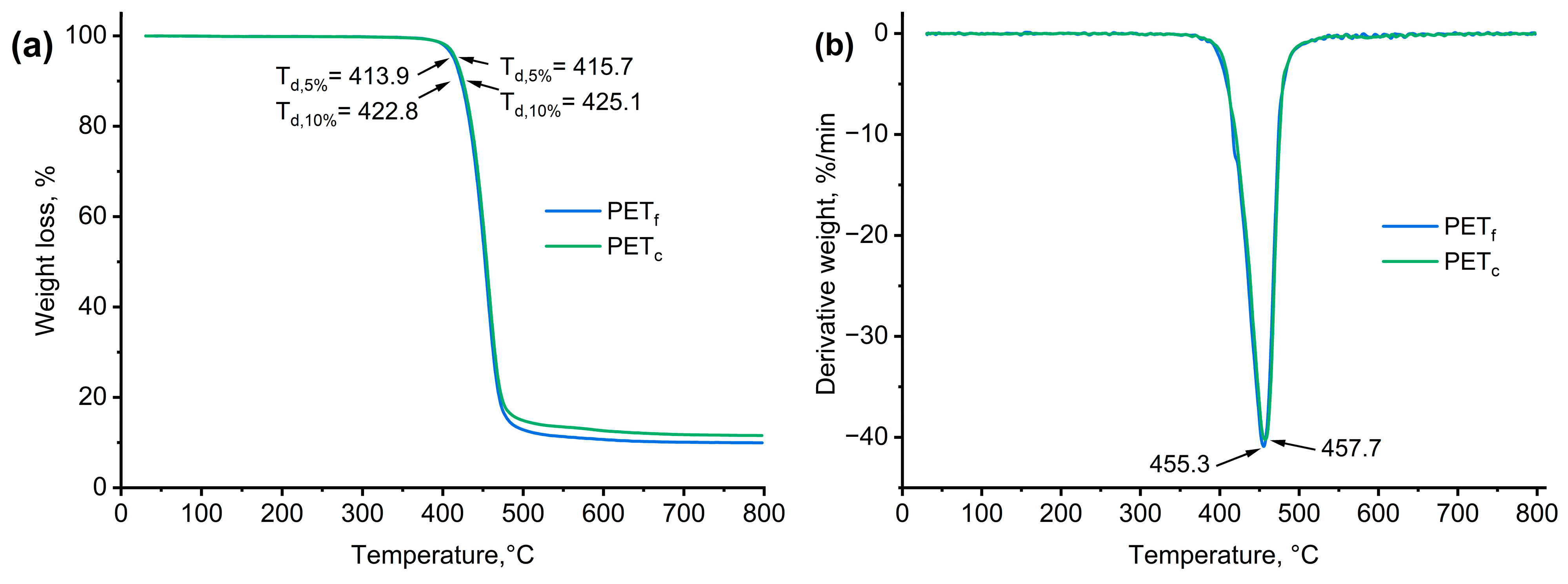
The thermal stability of the PETf and PETc was studied by thermogravimetric analysis under argon atmosphere at 30–800 °C (Figure 3a). Both samples demonstrated similar thermal decomposition profiles, characterized by a single main degradation step, corresponding to the cleavage of the polyester chain. In fact, the addition of a small amount of CaO resulted in the same overall degradation pathway as for pure PET. PETf and PETc started losing weight sharply higher than 400 °C. The start of thermal degradation, defined at 5% weight loss (Td,5%), was observed at 413.9 °C for PETf and at 415.7 °C for PETc. Similarly, the temperatures corresponding to 10% weight loss (Td,10%) were 422.8 °C and 425.1 °C, respectively. The slight increase in temperatures for the composite suggested an improvement in thermal stability due to the presence of CaO particles. The derivative thermogravimetric (DTG) curves (Figure 3b) demonstrated a single sharp peak for both materials, confirming a one-step degradation process typical for PET. The maximum rate of weight loss occurred at 455.3 °C for PETf and 457.7 °C for PETc. Thus, both materials demonstrated excellent thermal stability, with decomposition temperatures higher than typical processing temperatures for pure PET using 3D printing (250–280 °C). The incorporation of 1 wt% CaO insignificantly impacted the thermal resistance of the polymer, providing easy 3D printing using the PET–CaO composite while retaining comparable stability to the original filament.
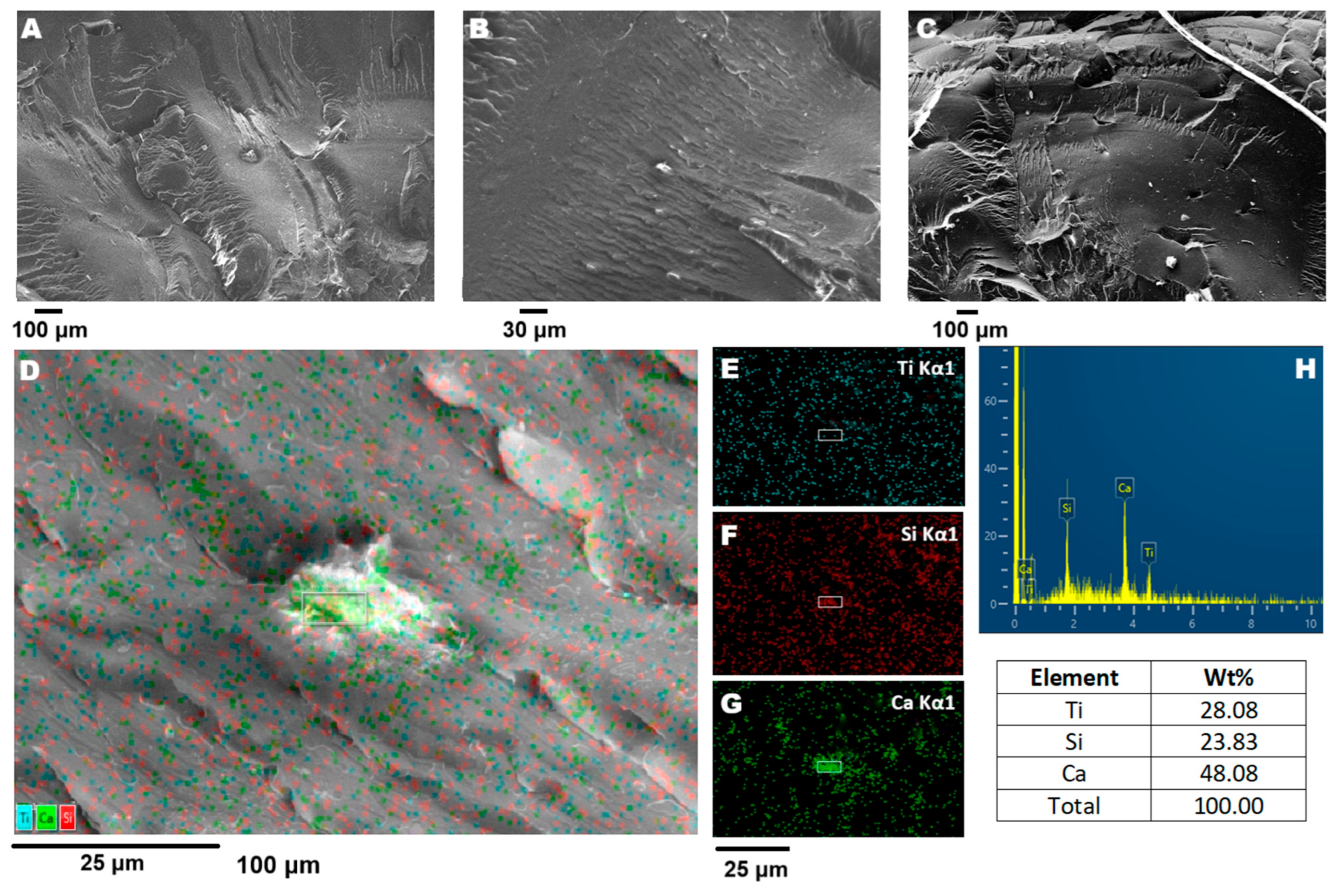
The fracture surface morphology of the PETc matrix was examined using scanning electron microscopy (SEM) combined with energy-dispersive X-ray spectroscopy (EDX) (Figure 4). The fracture surface was obtained by immersing the 3D-printed sample in liquid nitrogen, followed by mechanical fracture, which produced an appropriate, clean, brittle surface for microstructural characterization. The PETc matrix was relatively homogeneous and free of fractures or deep pores (Figure 4A–C), indicating a uniform printing process. The absence of interfacial voids or cracks around the inclusions suggested that strong adhesion was achieved between the polymer phase and the embedded CaO particles (Figure 4D) (additional SEM images are provided in Figures S3–S6 in the Supplementary Materials). To assess the distribution of inorganic components, elemental mapping was recorded (Figure 4D–G). Calcium was evenly distributed throughout the matrix with minor local accumulation zones, confirming the dispersion efficiency during composite preparation and good encapsulation in the polymer. No strong agglomeration of the filler particles was observed (Figure 4G). The Ti signal was attributed to the TiO2 pigment, a part of the commercially available white PET filament, while the detected Si originated from the analytical support. According to the EDX results (Figure 4H), the composite included 48.08 wt% Ca, 28.08 wt% Ti and 23.83 wt% Si. Thus, CaO was successfully incorporated and well-dispersed in the PET phase.
XPS analysis of the PETc composite fracture (Figure S7 in the Supplementary Materials) revealed signals corresponding to C1s (284.02 eV), O1s (531.64 eV), and Ca2p (348.00 eV), with concentrations of 73.54, 23.05, and 3.41 at%, respectively, which is consistent with the organic nature of the PET matrix and the low CaO content. Titanium, previously detected by SEM/EDX, was not observed in the XPS spectrum. Presumably, this was due to the much smaller probing depth of the XPS method and particles containing Ti located inside the polymer volume or not reaching the fracture surface remained inaccessible for detection by this method.

3.3. Chemical Depolymerization

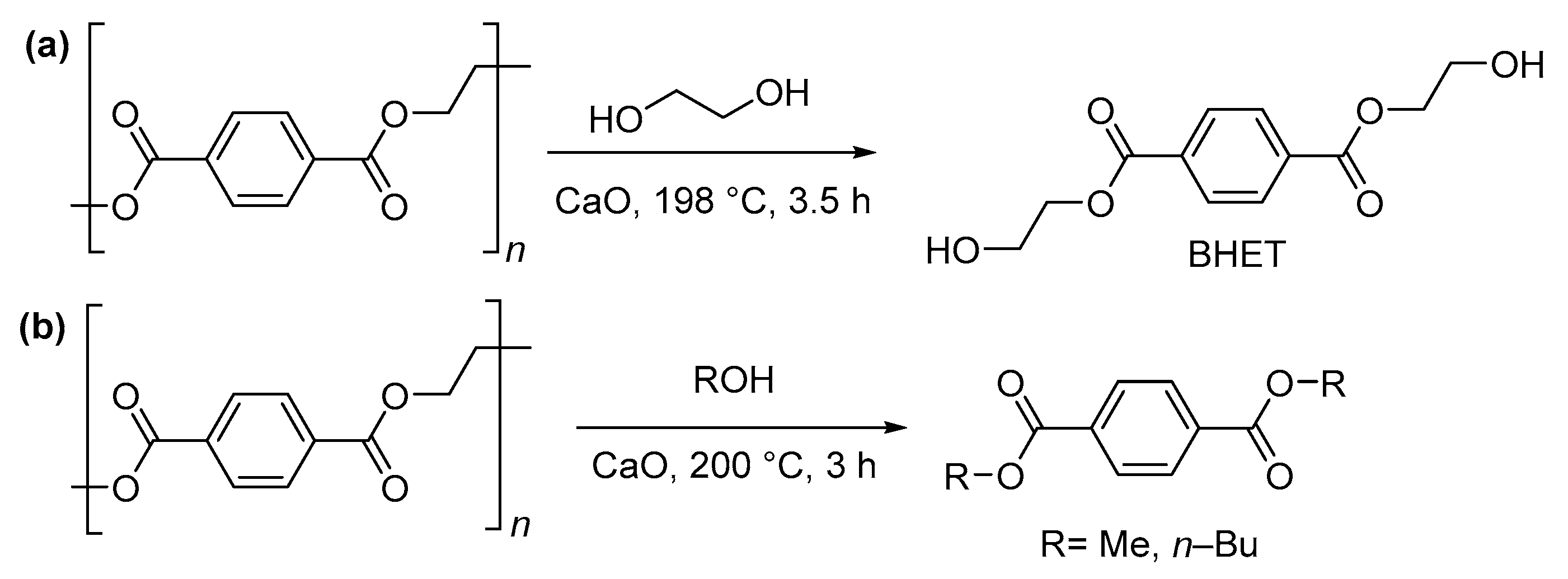
The chemical recycling of PET was carried out using two types of 3D-printed materials: the PET sample (PETf) and the PET-based composite containing dispersed calcium oxide (PETc). These studies aimed to find out the impact of the embedded CaO catalyst on the depolymerization efficiency, product selectivity, and kinetics of the reaction. To assess the impact of CaO distribution within the polymer matrix on PET depolymerization, both 3D-printed materials were subject to two model chemical recycling processes: alcoholysis and glycolysis (Scheme 1).

3.3.1. Alcoholysis

Depolymerization of 3D-printed PETf and PETc samples was carried out by alcoholysis with methanol and n-butanol at 200 °C for 3 h in the presence of CaO in an autoclave (Figure S8 in the Supplementary Materials).
High conversion rates of PET (>93%) into monomeric and oligomeric units were achieved for two types of samples using each alcohol. The incorporation of CaO in the PET matrix resulted in a higher conversion rate and a higher yield of the esters. PET conversion increased with methanol from 93.5% (PETf) to 95.1% (PETc), and the yield of dimethyl terephthalate increased from 77% to 84%. A similar trend was observed with n-butanol: conversion increased from 93.7% to 97%, and the yield of dibutyl terephthalate increased from 75% to 88% (for PETf and PETc, respectively).
The improved performance of the composite filament can be explained by a more uniform distribution of CaO in the polymer matrix. The catalyst was closely embedded in the ester bonds, ensuring more efficient interactions between the active basic sites and the polymer chains under depolymerization. At the reaction temperature, both PET-based materials softened and partially melted before depolymerization. Melting facilitated the diffusion of the alcohol into the polymer matrix and contact with the catalytic sites. In the case of PETc, the reaction started significantly faster due to the uniform incorporation of CaO particles into the polymer structure and the availability of catalytic sites immediately after the polymer softening. In the case of PETf, the externally added CaO catalyst first had to diffuse to the polymer surface.

3.3.2. Glycolysis

The glycolysis of PETf and PETc samples was carried out at 198 °C (reflux) for 3.5 h. The total PET conversion was 95.0% for PETf and 97.3% for PETc, indicating that the embedded CaO in the composite efficiently promoted depolymerization.
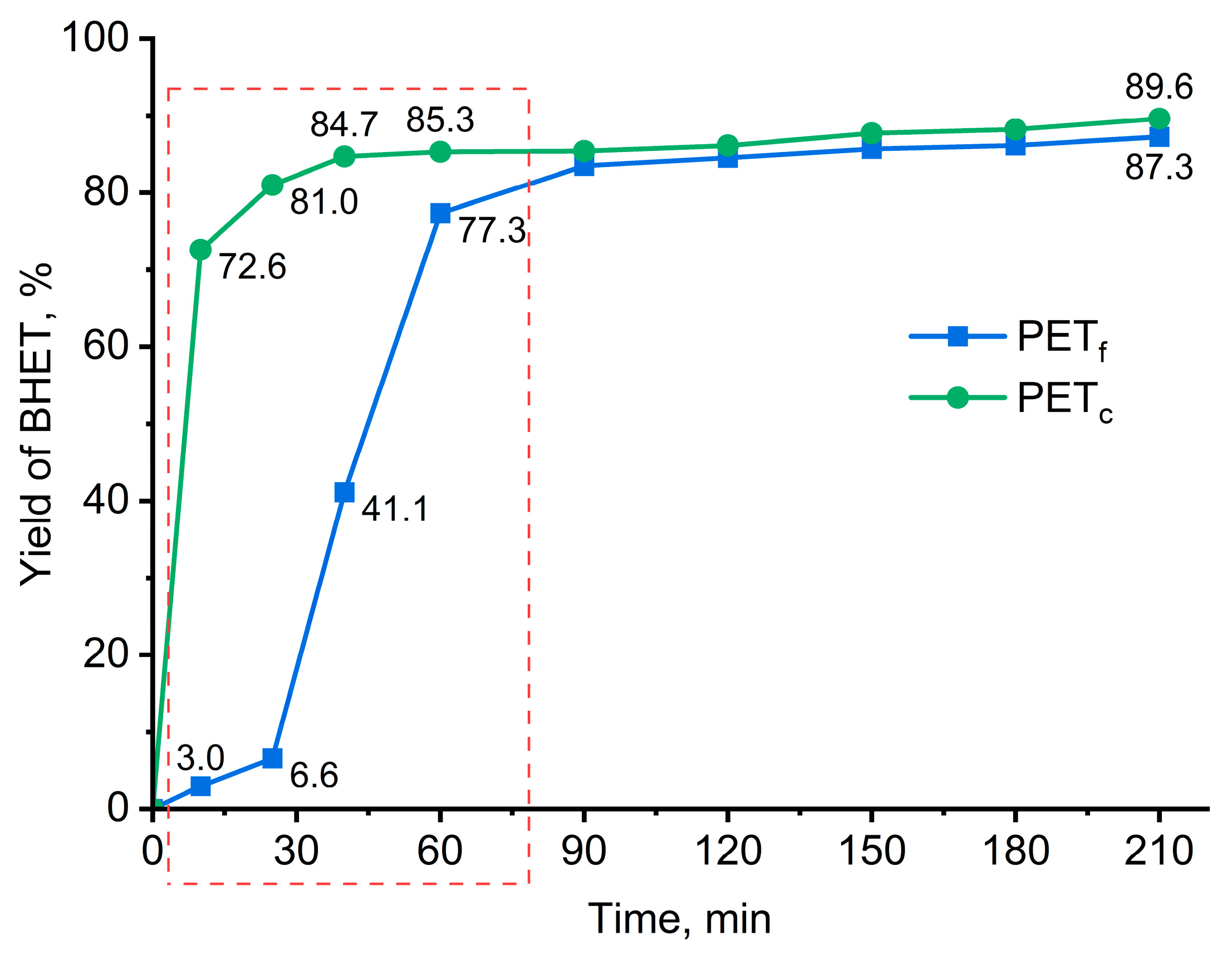
The dependence of BHET yield on reaction time was used to study the kinetics of glycolysis (Figure 5). The systems demonstrated very different kinetic profiles. PETc demonstrated a sharp and rapid increase in BHET yield, reaching approximately 80% for 15–30 min, whereas PETf demonstrated a delayed reaction beginning with a yield lower than 10% for the same period. PETc accumulation stabilized at approximately 84.7% after 40 min, which was twice as fast as for PETf (41.1%). After 90 min, both systems slowly reached maximum yield (≈83–89%), indicating that equilibrium was achieved.
The shape of the kinetic curves demonstrated that the presence and dispersion of CaO were crucial in determining the rate-limiting step. For the PETf glycolysis with added CaO, the induction period was observed for 30–45 min. The delay was due to the time required for the CaO particles to disperse and make an efficient contact with the PETf surface. In the case of PETc with well-dispersed CaO, immediate activation of the catalytic sites and significantly faster cleavage of ester bonds were observed at the beginning of the reaction. As the PETc particles softened and melted, ethylene glycol had direct access to the catalytic sites, resulting in a more rapid increase in depolymerization. In summary, the kinetic study demonstrated that direct incorporation of CaO into the PET matrix fundamentally accelerated the reaction kinetics, resulting in rapid depolymerization, a shorter initial period, and a maintained high conversion rate. This intrinsic catalytic functionality made PETc a promising system for the rapid and energy-efficient chemical recycling of PET.

3.3.3. Polycondensation for Producing Recycled PET (r-PET)

Polycondensation of BHET (in the absence and in the presence of the selected catalysts) obtained from PETc glycolysis was used to investigate PET recycling. NMR spectrum of the polymer after BHET polycondensation in the absence of catalysts (Figure S11b in the Supplementary Materials) demonstrated strong signals at 8.10 ppm and 4.73 ppm corresponding to the aromatic protons of the phenyl groups and -OCH2CH2O- units, respectively, confirming the successful synthesis of r-PET1 from BHET. TFA was added to the NMR vial for better dissolution of the resulting r-PET1. The vapors distilled and condensed under polycondensation were identified as ethylene glycol (Figure S11c in the Supplementary Materials). In the NMR spectrum, the signals were noticed with chemical shifts of 3.39 ppm and 4.45 ppm for -OCH2 and -OH groups, respectively. In the case of polycondensation using the titanium(IV) isopropoxide catalyst, a similar NMR spectrum was recorded (Figure S21 in the Supplementary Materials), which confirmed the successful synthesis of r-PET2 from BHET.
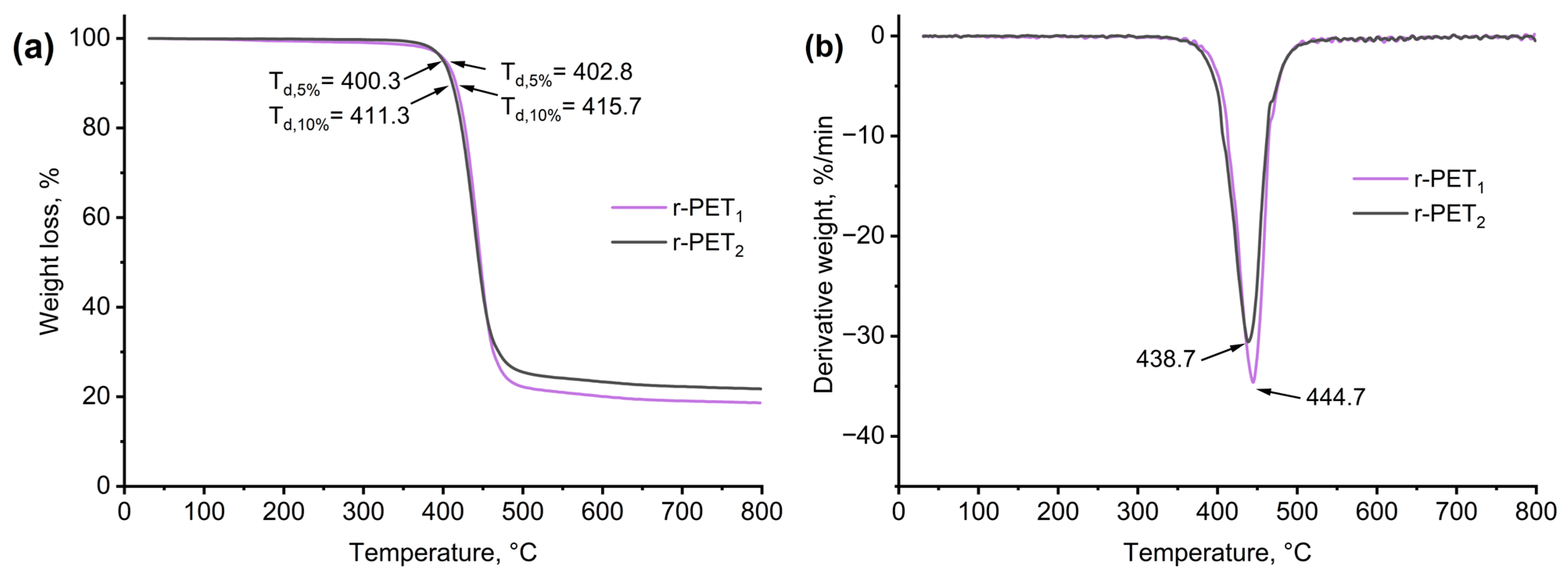
The thermogravimetric and derivative curves of the two re-polymerized samples (r-PET1 and r-PET2) demonstrated a single, well-defined degradation step, indicating that the polyester chain remained the dominant thermally labile phase in both materials (Figure 6). For r-PET1 (polycondensation was carried out in the absence of a catalyst), the temperatures at 5% and 10% weight loss were determined as Td,5% = 402.8 °C and Td,10% = 415.7 °C, respectively, and the maximum rate of weight loss (DTG peak) was observed at Tmax = 444.7 °C. In the case of r-PET2 (polycondensation was carried out in the presence of Ti(O-iPr)4), slightly lower thermal stability was observed: Td,5% = 400.3 °C, Td,10% = 411.3 °C, and Tmax = 438.7 °C. When the results were compared to the original PET materials (see “Section 3.2”), a modest decrease in thermal stability was observed for both recycled samples (≈10–20 °C lower values). The decrease was presumably due to the following reasons: (i) changes in macromolecular characteristics (decreased number-average or weight-average molecular weight and broader molar mass distribution after depolymerization/repolymerization), which commonly lower decomposition temperatures; and (ii) the absence of the TiO2 pigment or other stabilizers in r-PET1(2), according to SEM/EDX results (Figures S12 and S13 in the Supplementary Materials), which were originally presented in the commercially available filament. Importantly, the overall one-step DTG shape was the same for all the samples, indicating that no new major degradation pathways were observed as a result of the recycling procedures. The TG and DTG data demonstrated that the chemical recycling and re-polymerization resulted in materials with similar thermal properties to parent PET with slightly decreased thermal stability. The thermal stability of r-PET samples remained within a range compatible with standard PET processing.

4. Conclusions

In this work, a 3D-printed PET composite containing dispersed CaO (PETc) was created and studied for the potential in integrated chemical recycling. The composite was fabricated via hot extrusion-assisted mixing of PET filament with CaO obtained from calcium carbide slag and demonstrated good dispersion of the oxide in the polymer matrix. For the first time, CaO derived from calcium carbide slag waste was used as a catalyst for PET depolymerization. The PETc demonstrated consistently higher PET conversion (≥95%) and the yields of dimethyl and dibutyl terephthalates (80 and 84%, respectively).
Kinetic studies of glycolysis demonstrated that embedding 1 wt% of CaO in the PET matrix doubled the BHET formation rate relative to an externally added CaO catalyst, which resulted in BHET yields of 84.7% and 41.1% after 40 min. Thus, catalyst incorporation within the polymer facilitated more efficient contact between PET and CaO during the melting stage in a solution. The recovered BHET was successfully re-polymerized to produce recycled PET (r-PET). The maximum rate of weight loss of r-PET1 (at Tmax = 444.7 °C) and r-PET2 (at Tmax = 438.7 °C) was comparable to the original materials (at Tmax = 455.3 °C for PETf and 457.7 °C for PETc), confirming the inertness of the polymer chain.
The developed approach demonstrates a feasible concept of catalyst-integrated circular recycling, combining additive manufacturing and catalysis to enable energy-efficient depolymerization of PET in the absence of additional catalyst. This strategy can be used for other condensation polymers and is considered a promising pathway toward sustainable and closed-loop plastic recycling technologies.

Supplementary Materials

The following supporting information can be downloaded at: https://www.mdpi.com/article/10.3390/jcs9120680/s1, Table S1: Correlation of XRD peaks for CS; Table S2: Correlation of XRD peaks for CS900; Figure S1: XRD pattern of CS; Figure S2: XRD pattern of CS900; Figure S3–S6: SEM image of the fracture site for PETc composite; Figure S7: XPS spectrum of PETc composite; Figure S8: Autoclave used for the alcoholysis of PETf and PETc samples; Figure S9: NMR spectra of the initial PET solution in CDCl3 and TFA: (a) 1H NMR; (b) 13C NMR; (c) DEPT-135; Figure S10: 2D COSY NMR spectra of the initial PET solution in CDCl3 and TFA; Figure S11: NMR spectra: (a) BHET from PETc (in DMSO-d6); (b) precipitated r-PET1 after polycondensation (in CDCl3 and TFA); (c) ethylene glycol after distillation (in DMSO-d6); Figure S12: SEM/EDX results of r-PET1; Figure S13: SEM/EDX results of r-PET2; Figure S14: 1H NMR spectrum (400 MHz, CDCl3) of dimethyl terephthalate; Figure S15: 13C NMR spectrum (101 MHz, CDCl3) of dimethyl terephthalate; Figure S16: 1H NMR spectrum (400 MHz, CDCl3) of dibutyl terephthalate; Figure S17: 13C NMR spectrum (101 MHz, CDCl3) of dibutyl terephthalate; Figure S18: 1H NMR spectrum (400 MHz, DMSO-d6) of bis(2-hydroxyethyl) terephthalate; Figure S19: 13C NMR spectrum (101 MHz, DMSO-d6) of bis(2-hydroxyethyl) terephthalate; Figure S20: 1H NMR spectrum (400 MHz, CDCl3) of r-PET1 (with addition of TFA); Figure S21: 1H NMR spectrum (400 MHz, CDCl3) of r-PET2 (with addition of TFA). References [27,71,72] are cited in the Supplementary Materials.

Author Contributions

Investigation, A.N.P. and A.A.O.; methodology, A.N.P.; visualization, A.N.P.; validation, A.A.O.; writing—original draft preparation, A.N.P. and K.S.R.; supervision, K.S.R.; conceptualization, K.S.R.; writing—review and editing, K.S.R. All authors have read and agreed to the published version of the manuscript.

Funding

This research was funded by Saint Petersburg State University (Pure ID: 128840992).

Data Availability Statement

The original contributions presented in this study are included in the article/Supplementary Material. Further inquiries can be directed to the corresponding author.

Acknowledgments

The authors gratefully acknowledge the Magnetic Resonance Research Center, X-ray Diffraction Research Center, Interdisciplinary Center for Nanotechnology, Center for Innovative Technologies of Composite Nanomaterials, Center for Physical Methods of Surface Research, and Thermogravimetric and Calorimetric Research Center of Research Park of Saint Petersburg State University.

Conflicts of Interest

The authors declare no conflicts of interest.

References

  1. Alaraby, M.; Abass, D.; Velázquez, A.; Hernández, A.; Marcos, R. Occurrence, analysis, and toxicity of polyethylene terephthalate microplastics: A review. Environ. Chem. Lett. 2025, 23, 1025–1059. [Google Scholar] [CrossRef]
  2. Gnoffo, C.; Arrigo, R.; Frache, A. An Upcycling Strategy for Polyethylene Terephthalate Fibers: All-Polymer Composites with Enhanced Mechanical Properties. J. Compos. Sci. 2024, 8, 527. [Google Scholar] [CrossRef]
  3. Diao, J.; Hu, Y.; Tian, Y.; Carr, R.; Moon, T.S. Upcycling of poly(ethylene terephthalate) to produce high-value bio-products. Cell Rep. 2023, 42, 111908. [Google Scholar] [CrossRef]
  4. Muringayil Joseph, T.; Azat, S.; Ahmadi, Z.; Moini Jazani, O.; Esmaeili, A.; Kianfar, E.; Haponiuk, J.; Thomas, S. Polyethylene terephthalate (PET) recycling: A review. Case Stud. Chem. Environ. Eng. 2024, 9, 100673. [Google Scholar] [CrossRef]
  5. Peng, Y.; Yang, J.; Deng, C.; Deng, J.; Shen, L.; Fu, Y. Acetolysis of waste polyethylene terephthalate for upcycling and life-cycle assessment study. Nat. Commun. 2023, 14, 3249. [Google Scholar] [CrossRef] [PubMed]
  6. Lalhmangaihzuala, S.; Rongpipi, M.; Vanlaldinpuia, K.; Rokhum, S.L. Chemo-catalytic recycling of PET waste: Progress and prospects for circular economy and valorization. Next Mater. 2025, 9, 101111. [Google Scholar] [CrossRef]
  7. Zhang, X.; Yin, Z.; Xiang, S.; Yan, H.; Tian, H. Degradation of Polymer Materials in the Environment and Its Impact on the Health of Experimental Animals: A Review. Polymers 2024, 16, 2807. [Google Scholar] [CrossRef] [PubMed]
  8. Szabó, V.A.; Fekete, G.; Dogossy, G. Endothermic–Exothermic Hybrid Foaming of Recycled PET Blends. J. Compos. Sci. 2024, 8, 383. [Google Scholar] [CrossRef]
  9. Fehér, Z.; Kiss, J.; Kisszékelyi, P.; Molnár, J.; Huszthy, P.; Kárpáti, L.; Kupai, J. Optimisation of PET glycolysis by applying recyclable heterogeneous organocatalysts. Green Chem. 2022, 24, 8447–8459. [Google Scholar] [CrossRef]
  10. Sang, T.; Wallis, C.J.; Hill, G.; Britovsek, G.J.P. Polyethylene terephthalate degradation under natural and accelerated weathering conditions. Eur. Polym. J. 2020, 136, 109873. [Google Scholar] [CrossRef]
  11. Umdagas, L.; Orozco, R.; Heeley, K.; Al-Duri, B. Towards sustainable polyethylene terephthalate (PET) recycling: Kinetic modelling, parametric analysis, and process optimisation. J. Environ. Chem. Eng. 2025, 13, 119272. [Google Scholar] [CrossRef]
  12. Volpe, V.; Lanzillo, M.S.; Molaro, A.; Affinita, G.; Pantani, R. Characterization of Recycled/Virgin Polyethylene Terephthalate Composite Reinforced with Glass Fiber for Automotive Applications. J. Compos. Sci. 2022, 6, 59. [Google Scholar] [CrossRef]
  13. Guo, Z.; Wu, J.; Wang, J. Chemical degradation and recycling of polyethylene terephthalate (PET): A review. RSC Sustain. 2025, 3, 2111–2133. [Google Scholar] [CrossRef]
  14. Bohre, A.; Jadhao, P.R.; Tripathi, K.; Pant, K.K.; Likozar, B.; Saha, B. Chemical Recycling Processes of Waste Polyethylene Terephthalate Using Solid Catalysts. ChemSusChem 2023, 16, e202300142. [Google Scholar] [CrossRef] [PubMed]
  15. Clark, R.A.; Shaver, M.P. Depolymerization Within a Circular Plastics System. Chem. Rev. 2024, 124, 2617–2650. [Google Scholar] [CrossRef] [PubMed]
  16. Unruean, P.; Padungros, P.; Nomura, K.; Kitiyanan, B. Efficient chemical depolymerization of polyethylene terephthalate via transesterification with ethanol using CaO catalyst. J. Mater. Cycles Waste Manag. 2024, 26, 731–740. [Google Scholar] [CrossRef]
  17. Yao, H.; Liu, L.; Yan, D.; Zhou, Q.; Xin, J.; Lu, X.; Zhang, S. Colorless BHET obtained from PET by modified mesoporous catalyst ZnO/SBA-15. Chem. Eng. Sci. 2022, 248, 117109. [Google Scholar] [CrossRef]
  18. Kim, Y.; Kim, M.; Hwang, J.; Im, E.; Moon, G.D. Optimizing PET Glycolysis with an Oyster Shell-Derived Catalyst Using Response Surface Methodology. Polymers 2022, 14, 656. [Google Scholar] [CrossRef]
  19. Du, J.-T.; Sun, Q.; Zeng, X.-F.; Wang, D.; Wang, J.-X.; Chen, J.-F. ZnO nanodispersion as pseudohomogeneous catalyst for alcoholysis of polyethylene terephthalate. Chem. Eng. Sci. 2020, 220, 115642. [Google Scholar] [CrossRef]
  20. Putisompon, S.; Yunita, I.; Sugiyarto, K.H.; Somsook, E. Low-Cost Catalyst for Glycolysis of Polyethylene Terephthalate (PET). Key Eng. Mater. 2019, 824, 225–230. [Google Scholar] [CrossRef]
  21. Zhao, Y.; Liu, M.; Zhao, R.; Liu, F.; Ge, X.; Yu, S. Heterogeneous CaO(SrO, BaO)/MCF as highly active and recyclable catalysts for the glycolysis of poly(ethylene terephthalate). Res. Chem. Intermed. 2018, 44, 7711–7729. [Google Scholar] [CrossRef]
  22. Forouzeshfar, F.; Coleman, M.R.; Lawrence, J.G. Glycolysis of poly (ethylene terephthalate) using DBU-based ionic liquid catalysts. Catal. Today 2025, 450, 115187. [Google Scholar] [CrossRef]
  23. Pedrini, L.; Zappelli, C.; Connon, S.J. Ionic Liquid Catalysts for Poly(ethylene terephthalate) Glycolysis: Use of Structure Activity Relationships to Combine Activity with Biodegradability. ACS Sustain. Chem. Eng. 2025, 13, 1424–1430. [Google Scholar] [CrossRef]
  24. Jiang, Z.; Yan, D.; Xin, J.; Li, F.; Guo, M.; Zhou, Q.; Xu, J.; Hu, Y.; Lu, X. Poly(ionic liquid)s as efficient and recyclable catalysts for methanolysis of PET. Polym. Degrad. Stab. 2022, 199, 109905. [Google Scholar] [CrossRef]
  25. Wang, T.; Gong, X.; Shen, C.; Yu, G.; Chen, X. Formation of Bis(hydroxyethyl) terephthalate from waste plastic using ionic liquid as catalyst. Polym. Degrad. Stab. 2021, 190, 109601. [Google Scholar] [CrossRef]
  26. Wang, T.; Zheng, Y.; Yu, G.; Chen, X. Glycolysis of polyethylene terephthalate: Magnetic nanoparticle CoFe2O4 catalyst modified using ionic liquid as surfactant. Eur. Polym. J. 2021, 155, 110590. [Google Scholar] [CrossRef]
  27. Cano, I.; Martin, C.; Fernandes, J.A.; Lodge, R.W.; Dupont, J.; Casado-Carmona, F.A.; Lucena, R.; Cardenas, S.; Sans, V.; de Pedro, I. Paramagnetic ionic liquid-coated SiO2@Fe3O4 nanoparticles—The next generation of magnetically recoverable nanocatalysts applied in the glycolysis of PET. Appl. Catal. B Environ. 2020, 260, 118110. [Google Scholar] [CrossRef]
  28. Sinha, P.; Paul, S.; Maity, S.; Banerjee, S. Selective Depolymerization of Poly(ethylene terephthalate) in Mixed Plastic Waste Using Magnetically Recoverable nZVI Catalyst. Environ. Sci. Technol. 2025, 59, 15766–15776. [Google Scholar] [CrossRef]
  29. Laldinpuii, Z.T.; Khiangte, V.; Lalhmangaihzuala, S.; Lalmuanpuia, C.; Pachuau, Z.; Lalhriatpuia, C.; Vanlaldinpuia, K. Methanolysis of PET Waste Using Heterogeneous Catalyst of Bio-waste Origin. J. Polym. Environ. 2022, 30, 1600–1614. [Google Scholar] [CrossRef]
  30. Cha, Y.; Park, Y.-J.; Kim, D.H. Hydrodynamic synthesis of Fe2O3@MoS2 0D/2D-nanocomposite material and its application as a catalyst in the glycolysis of polyethylene terephthalate. RSC Adv. 2021, 11, 16841–16848. [Google Scholar] [CrossRef]
  31. Scremin, D.M.; Miyazaki, D.Y.; Lunelli, C.E.; Silva, S.A.; Zawadzki, S.F. PET Recycling by Alcoholysis Using a New Heterogeneous Catalyst: Study and its Use in Polyurethane Adhesives Preparation. Macromol. Symp. 2019, 383, 1800027. [Google Scholar] [CrossRef]
  32. Al-Sabagh, A.M.; Yehia, F.Z.; Harding, D.R.K.; Eshaq, G.; ElMetwally, A.E. Fe3O4-boosted MWCNT as an efficient sustainable catalyst for PET glycolysis. Green Chem. 2016, 18, 3997–4003. [Google Scholar] [CrossRef]
  33. Korabelnikova, V.A.; Gyrdymova, Y.V.; Gordeev, E.G.; Potorochenko, A.N.; Rodygin, K.S.; Ananikov, V.P. 3D printing for safe organic synthesis in mixed liquid/gas-phase chemistry. React. Chem. Eng. 2025, 10, 2474–2489. [Google Scholar] [CrossRef]
  34. Pongraktham, K.; Somnuk, K. Heterogeneous Calcium Oxide Catalytic Filaments for Three-Dimensional Printing: Preparation, Characterization, and Use in Methyl Ester Production. ACS Omega 2024, 9, 27578–27591. [Google Scholar] [CrossRef]
  35. Rahman, M.; Islam, K.S.; Dip, T.M.; Chowdhury, M.F.M.; Debnath, S.R.; Hasan, S.M.M.; Sakib, M.S.; Saha, T.; Padhye, R.; Houshyar, S. A review on nanomaterial-based additive manufacturing: Dynamics in properties, prospects, and challenges. Prog. Addit. Manuf. 2024, 9, 1197–1224. [Google Scholar] [CrossRef]
  36. Lotsman, K.A.; Samoylenko, D.E.; Rodygin, K.S.; Ananikov, V.P. 3D Printable Materials Based on Renewable Polymers from Terpene Alcohols and Calcium Carbide. ChemistrySelect 2024, 9, e202401273. [Google Scholar] [CrossRef]
  37. Samoylenko, D.E.; Rodygin, K.S.; Ananikov, V.P. Sustainable application of calcium carbide residue as a filler for 3D printing materials. Sci. Rep. 2023, 13, 4465. [Google Scholar] [CrossRef]
  38. Grande, C.A.; Didriksen, T. Production of Customized Reactors by 3D Printing for Corrosive and Exothermic Reactions. Ind. Eng. Chem. Res. 2021, 60, 16720–16727. [Google Scholar] [CrossRef]
  39. Alimi, O.A.; Meijboom, R. Current and future trends of additive manufacturing for chemistry applications: A review. J. Mater. Sci. 2021, 56, 16824–16850. [Google Scholar] [CrossRef]
  40. Maier, M.C.; Valotta, A.; Hiebler, K.; Soritz, S.; Gavric, K.; Grabner, B.; Gruber-Woelfler, H. 3D Printed Reactors for Synthesis of Active Pharmaceutical Ingredients in Continuous Flow. Org. Process Res. Dev. 2020, 24, 2197–2207. [Google Scholar] [CrossRef]
  41. Iglesias, D.; Tinajero, C.; Marchetti, S.; Roppolo, I.; Zanatta, M.; Sans, V. Multi-step oxidative carboxylation of olefins with carbon dioxide by combining electrochemical and 3D-printed flow reactors. Green Chem. 2023, 25, 9934–9940. [Google Scholar] [CrossRef]
  42. Iglesias, D.; Tinajero, C.; Luis-Gómez, J.; Aranda, C.A.; Martinez Cuenca, R.; Zanatta, M.; Sans, V. 3D printed flow reactors for the synthesis of single crystal perovskites. Mater. Today Energy 2024, 39, 101476. [Google Scholar] [CrossRef]
  43. Lorenzi, E.; Arrigo, R.; Frache, A. Development of a Polypropylene-Based Material with Flame-Retardant Properties for 3D Printing. Polymers 2024, 16, 858. [Google Scholar] [CrossRef]
  44. Greene, A.F.; Vaidya, A.; Collet, C.; Wade, K.R.; Patel, M.; Gaugler, M.; West, M.; Petcu, M.; Parker, K. 3D-Printed Enzyme-Embedded Plastics. Biomacromolecules 2021, 22, 1999–2009. [Google Scholar] [CrossRef]
  45. Khan, I.; Nagarjuna, R.; Dutta, J.R.; Ganesan, R. Enzyme-Embedded Degradation of Poly(ε-caprolactone) Using Lipase-Derived from Probiotic Lactobacillus plantarum. ACS Omega 2019, 4, 2844–2852. [Google Scholar] [CrossRef] [PubMed]
  46. Sharifi, M.; Tangestaninejad, S.; Moghadam, M.; Marandi, A.; Mirkhani, V.; Mohammadpoor-Baltork, I.; Aghayani, S. Metal-organic frameworks-derived CaO/ZnO composites as stable catalysts for biodiesel production from soybean oil at room temperature. Sci. Rep. 2025, 15, 3610. [Google Scholar] [CrossRef] [PubMed]
  47. Potorochenko, A.N.; Rodygin, K. Calcium waste as a catalyst in the transesterification for demanding esters: Scalability perspective. Beilstein J. Org. Chem. 2025, 21, 1520–1527. [Google Scholar] [CrossRef] [PubMed]
  48. Gholami, A.; Pourfayaz, F.; Rodygin, K. Reusable chemical catalysts for sustainable biodiesel production: The role of metallic elements. ChemBioEng Rev. 2025, 12, e202400033. [Google Scholar] [CrossRef]
  49. Macheli, L.; Malefane, M.E.; Jewell, L.L. Waste-derived calcium oxide catalysts in biodiesel production: Exploring various waste sources, deactivation challenges, and improvement strategies. Bioresour. Technol. Rep. 2025, 29, 102021. [Google Scholar] [CrossRef]
  50. Ghosh, N.; Khan, A.M.; Halder, G. Advances in calcium oxide mediated catalytic biodiesel production: A paradigm shift in complying with UN’s SDG7. Appl. Energy 2025, 391, 125954. [Google Scholar] [CrossRef]
  51. Ozor, P.A.; Aigbodion, V.S.; Sukdeo, N.I. Modified calcium oxide nanoparticles derived from oyster shells for biodiesel production from waste cooking oil. Fuel Commun. 2023, 14, 100085. [Google Scholar] [CrossRef]
  52. Basumatary, S.F.; Brahma, S.; Hoque, M.; Das, B.K.; Selvaraj, M.; Brahma, S.; Basumatary, S. Advances in CaO-based catalysts for sustainable biodiesel synthesis. Green Energy Resour. 2023, 1, 100032. [Google Scholar] [CrossRef]
  53. Anjana, P.A.; Niju, S.; Meera Sheriffa Begum, K.M.; Anantharaman, N. Utilization of limestone derived calcium oxide for biodiesel production from non-edible pongamia oil. Environ. Prog. Sustain. Energy 2016, 35, 1758–1764. [Google Scholar] [CrossRef]
  54. Gimbun, J.; Ali, S.; Kanwal, C.; Shah, L.A.; Ghazali, N.H.M.; Cheng, C.K.; Nurdin, S. Biodiesel production from rubber seed oil using a limestone based catalyst. Adv. Mater. Phys. Chem. 2012, 2, 138–141. [Google Scholar] [CrossRef]
  55. Das, S.; Kaushik, B.; Chaudhury, A.P.; Basumatary, S.; Pratap, P.; Mohan, S.; Rano, R.; Rokhum, S.L. Microwave-assisted biodiesel production from WCO using snail shell-derived CaO@Coal fly ash: Optimization via RSM, cost analysis, kinetics, thermodynamics, and bibliometrics. Renew. Energy 2025, 254, 123741. [Google Scholar] [CrossRef]
  56. Ao, S.; Changmai, B.; Vanlalveni, C.; Chhandama, M.V.L.; Wheatley, A.E.H.; Rokhum, S.L. Biomass waste-derived catalysts for biodiesel production: Recent advances and key challenges. Renew. Energy 2024, 223, 120031. [Google Scholar] [CrossRef]
  57. Chandra Kishore, S.; Perumal, S.; Atchudan, R.; Sundramoorthy, A.K.; Alagan, M.; Sangaraju, S.; Lee, Y.R. A Review of Biomass-Derived Heterogeneous Catalysts for Biodiesel Production. Catalysts 2022, 12, 1501. [Google Scholar] [CrossRef]
  58. Potorochenko, A.N.; Gyrdymova, Y.V.; Rodygin, K.S. Waste-Derived Catalyst for Biodiesel Manufacturing in CO2-Free Manner: Preparation, Catalytic Activity, and Reuse Studies. ChemCatChem 2025, 17, e202401607. [Google Scholar] [CrossRef]
  59. Liu, M.; Huang, Y.; Liu, Q.; Hu, X.; Liu, Q.; Chen, H.; Dong, Y.; Zhao, Y.; Niu, S. Ferric oxide as a support of carbide slag for effective transesterification of triglycerides in soybean oil. Energy Convers. Manag. 2019, 198, 111785. [Google Scholar] [CrossRef]
  60. Li, F.-J.; Li, H.-Q.; Wang, L.-G.; Cao, Y. Waste carbide slag as a solid base catalyst for effective synthesis of biodiesel via transesterification of soybean oil with methanol. Fuel Process. Technol. 2015, 131, 421–429. [Google Scholar] [CrossRef]
  61. Shen, Y.; Jiang, X.; Tang, C.; Ma, W.; Cheng, J.; Wang, H.; Zhu, H.; Zhao, L.; Zhang, Y.; Zhao, P. Controlled Multi-Dimensional Assembly of Calcium Carbonate Particles with Industrial By-Product Carbide Slag and CO2. Nanomaterials 2025, 15, 16. [Google Scholar] [CrossRef]
  62. Rodygin, K.S.; Bogachenkov, A.S.; Gyrdymova, Y.V.; Potorochenko, A.N. 13C-Labeling as a Method in Organic Synthesis, Catalysis and Biochemical Applications. Chem. Methods 2025, 5, e202400045. [Google Scholar] [CrossRef]
  63. An, R.; Cui, W.; Gu, P.; Wei, M.-X. Highly stereoselective synthesis of N-sulfonyl amidines with calcium carbide as an acetylene source. Org. Chem. Front. 2025, 12, 6588–6593. [Google Scholar] [CrossRef]
  64. Potorochenko, A.N.; Rodygin, K.S.; Ananikov, V.P. Assembly of (2×C2+C’2)×n Molecular Complexity Using a Sequence of Pt- and Pd-Catalyzed Transformations with Calcium Carbide. Eur. J. Org. Chem. 2024, 27, e202301012. [Google Scholar] [CrossRef]
  65. Gyrdymova, Y.V.; Potorochenko, A.N. Reactions of calcium carbide catalyzed by transition metals: Recent advances and prospects. Russ. Chem. Bull. 2024, 74, 1576–1591. [Google Scholar] [CrossRef]
  66. Wang, Z.; Liu, Z.; Wang, B.; Li, Z. Construction of 2-Methylindoles Using Solid Calcium Carbide as a Substitute for Gaseous Acetylene. Eur. J. Org. Chem. 2024, 27, e202301262. [Google Scholar] [CrossRef]
  67. Wu, J.; Ma, Y.; Wang, Y.; Wang, C.; Luo, H.; Li, D.; Yang, J. Copper-catalyzed direct synthesis of 3-methylene-2-arylisoindolin-1-ones with calcium carbide as a surrogate of gaseous acetylene. Green Chem. 2023, 25, 3425–3430. [Google Scholar] [CrossRef]
  68. Liu, L.; Sun, G.; Zhang, J. Constructing 5-Methyl-2,4-diaryl-1H-imidazoles Using Calcium Carbide as Alkyne Source via A3-Coupling Cyclization. Adv. Synth. Catal. 2023, 365, 1801–1805. [Google Scholar] [CrossRef]
  69. Armarego, W.L.F.; Chai, C.L.L. Purification of Laboratory Chemicals, 6th ed.; Butterworth-Heinemann: Oxford, UK, 2009; pp. 159–160. [Google Scholar]
  70. ISO 527-2:2025; Plastics—Determination of Tensile Properties—Part 2: Test Conditions for Moulding and Extrusion Plastics. International Organization for Standardization: Geneva, Switzerland, 2025.
  71. Lee, J.J.; Kraus, G.A. One-pot formal synthesis of biorenewable terephthalic acid from methyl coumalate and methyl pyruvate. Green Chem. 2014, 16, 2111–2116. [Google Scholar] [CrossRef]
  72. Chenot, E.D.; Bernardi, D.; Comel, A.; Kirsch, G. Preparation of Monoalkyl Terephthalates: An Overview. Synth. Commun. 2007, 37, 483–490. [Google Scholar] [CrossRef]
Figure 1. XRD patterns: (a) initial CS; (b) CS900.
Jcs 09 00680 g001
Figure 2. (A) 3D model and dimensions for “dog bone” specimen (in mm); (B) 3D printed samples.
Jcs 09 00680 g002
Figure 3. TG (a) and DTG (b) curves of PETf and PETc samples.
Jcs 09 00680 g003
Figure 4. (AC) SEM images of PETc fracture surface; (DH) EDX investigations of PETc fracture surface.
Jcs 09 00680 g004
Scheme 1. Depolymerization of 3D-printed PETf and PETc via: (a) alcoholysis with methanol and n-butanol; (b) glycolysis with ethylene glycol.
Jcs 09 00680 sch001
Figure 5. BHET yield (%) at different reaction times (min) for PETf and PETc samples.
Jcs 09 00680 g005
Figure 6. TG (a) and DTG (b) curves of re-polymerized samples: r-PET1 (polycondensation in the absence of catalyst) and r-PET2 (polycondensation in the presence of Ti(O-iPr)4).
Jcs 09 00680 g006
Disclaimer/Publisher’s Note: The statements, opinions and data contained in all publications are solely those of the individual author(s) and contributor(s) and not of MDPI and/or the editor(s). MDPI and/or the editor(s) disclaim responsibility for any injury to people or property resulting from any ideas, methods, instructions or products referred to in the content.