Article

Global–Local–Distortional Buckling of Shear-Deformable Composite Beams with Open Cross-Sections Using a Novel GBT–Ritz Approach

by
Navid Kharghani
* and
Christian Mittelstedt
Institute for Lightweight Engineering and Structural Mechanics (LSM), Department of Mechanical Engineering, Technical University of Darmstadt, Otto Berndt-Straße 2, 64287 Darmstadt, Germany
*
Author to whom correspondence should be addressed.
J. Compos. Sci. 2025, 9(11), 608; https://doi.org/10.3390/jcs9110608
Submission received: 18 September 2025 / Revised: 26 October 2025 / Accepted: 3 November 2025 / Published: 5 November 2025
(This article belongs to the Special Issue Theoretical and Computational Investigation on Composite Materials)

Abstract

This paper explores the application of the generalized beam theory (GBT) in analyzing the buckling behavior of isotropic and composite thin-walled beams with open cross-sections, both with and without branching. The composite beams are composed of orthotropic laminate layers arranged in arbitrary symmetrical orientations. By integrating GBT with the Ritz method and solving the associated generalized eigenvalue problem (GEP), an efficient and robust semi-analytical framework is developed to assess the stability of such isotropic and orthotropic members. The novelty of this work is not the GBT cross-sectional formulation itself, but its implementation at the beam level using a Ritz formulation leading to a generalized eigenvalue problem for the critical buckling loads and mode shapes that capture coupled global, local, and distortional modes in isotropic and orthotropic composite members. This makes the method suitable for early-stage design studies and parametric investigations, where many design variants (geometry, laminate lay-up, and aspect ratios) must be screened quickly without building large-scale high-fidelity finite element (FE) models for each case. The preliminary outcomes, when compared with those obtained using FE, confirm the approach’s effectiveness in evaluating buckling responses, particularly for open-section composite beams. Ultimately, the combined use of GBT and the Ritz method delivers both physical insight and computational efficiency, allowing engineers and researchers to address complex stability issues that were previously difficult to solve. In summary, the methodology can be correctly used for stability assessment of thin-walled composite members prone to interacting global–local–distortional buckling, especially when rapid, mechanistically transparent predictions are required rather than purely numerical FE output.

1. Introduction

The buckling of thin-walled composite beams with open cross-sections—such as I, T, Z, or channel-shaped profiles—presents a significant structural failure risk, making precise analysis essential. As a result, advanced analytical techniques have been introduced to capture the intricate stability characteristics of these members. Among them, the GBT and the Ritz method have emerged as powerful and complementary tools. GBT enables the decomposition of complex deformations in thin-walled members into individual mode types, including both global and local buckling behaviors. The Ritz method, in turn, provides an energy-based computational strategy that delivers highly accurate critical load estimates. By combining these two methods, one can utilize GBT to determine the relevant deformation modes, while the Ritz method effectively constructs shape functions for solving the buckling eigenvalue problem. This hybrid approach yields fast and reliable results using only a set of well-chosen shape functions.
Global (Lateral–torsional) Buckling: Initial analytical work on composite beams with open profiles centered on lateral–torsional buckling (LTB)—a mode of instability characterized by simultaneous lateral deflection and twisting under axial load or bending. Composite materials, with their anisotropic properties and often mono-symmetric cross-sections, behave differently from isotropic beams under such conditions. Recent contributions have clarified how composite anisotropy, shear deformation, and restrained warping shape the global buckling response of slender members and panels. For beam-type members, Banić et al. [1] developed a geometrically nonlinear thin-walled composite beam model that captures shear deformation coupling and warping effects relevant to flexural–torsional instabilities. For aerostructural skins and webs, Zhao and Kapania [2] showed how tow-steering and stiffening strategies can maximize buckling capacity under realistic manufacturing constraints. At the laminate design level, Kappel [3] introduced a Double–Double laminate buckling relation that streamlines mass-efficient panel design under biaxial compression, further illustrating stiffness–buckling trade-offs in thin-walled composites. Kim et al. [4] offered a closed-form solution for a cantilevered composite I-beam subjected to an end moment. Their analytical results validated that simpler methods, such as the Ritz and finite strip techniques, can yield very accurate results (with deviations of less than 1%).
Local and Distortional Buckling: In open-section members, local buckling of individual plates (such as webs and flanges) is another critical failure mode, often interacting with global buckling. Composite laminates, due to their anisotropic stiffness, can exhibit local instability at relatively low stress levels. Kollár [5] provided closed-form equations for the local buckling of orthotropic plates in open- and closed-section members, expanding on classical plate theory. Mittelstedt [6] introduced more refined models by using the Ritz method to analyze local buckling in wide-flange composite beams, incorporating effects like transverse shear deformation and rotational restraint at plate junctions. His studies across multiple cross-sectional profiles (I, C, Z, T, L) revealed that standard solutions assuming simple support can be overly optimistic for composites, as real flanges and webs often provide partial rotational restraint.
GBT, initially developed by Schardt [7] for metallic prismatic sections, has since been adapted for composite applications to account for material anisotropy and shear deformation. It simplifies three-dimensional stability problems into a set of coupled one-dimensional modal equations by representing cross-section deformations as a superposition of distinct mode shapes (torsion, distortional bending, lateral bending, etc.). This modal decomposition is particularly effective for open-section profiles, where multiple buckling modes may interact. Silva et al. [8] extended GBT to analyze branched composite members, incorporating shear effects and identifying novel deformation modes unique to fiber-reinforced polymers. Silvestre and Camotim [9] validated GBT predictions for pultruded FRP channel beams, showing strong agreement (within 2%) with other analytical and numerical results. Pires Filho and Gonçalves [10] applied GBT to pultruded FRP angle columns, observing that certain modes—such as torsional warping—dominate in longer columns. Among the other pioneers, Davies [11] introduced the second-order GBT to effectively address the geometric nonlinearity in thin-walled steel structures, enabling the analysis of interaction between local, distortional, and global buckling modes, especially in cold-formed sections. Building on this, Schafer [12] emphasized that open cross-section, thin-walled columns exhibit three dominant elastic buckling modes and demonstrated that distortional buckling, often overlooked in design codes, can control failure and exhibits lower post-buckling strength and higher imperfection sensitivity compared to local buckling. Furthermore, Mittelstedt [13] recently reviewed the state of GBT in thin-walled structure analysis, reinforcing its relevance. Therefore, GBT has become a key method for studying the buckling behavior of thin-walled composite members. It offers a compact, yet comprehensive means of capturing 3D behavior using modal coordinates that reflect torsional, flexural, and material coupling effects. The method is particularly advantageous when paired with the Ritz procedure, which uses GBT-derived shape functions to significantly reduce computational cost while maintaining high accuracy.
The Ritz method (an energy-based approach from the Rayleigh–Ritz family) is widely used in buckling and vibration studies of composite structures for its flexibility and efficiency. By assuming an approximate displacement field expressed as a combination of trial functions, the total potential energy is minimized to yield critical loads via eigenvalue analysis. This approach typically converges quickly when using an appropriate set of functions—polynomial or trigonometric—that meet support conditions and capture the physical behavior. Benchmark solutions, like those by Kim et al. [4], validate the method’s accuracy. Pires Filho and Gonçalves [10] further confirmed the method’s utility for column buckling studies. Kharazi et al. [14] used a layerwise shear deformation model and the Rayleigh–Ritz method to predict buckling loads of delaminated composite beams and plates. Jing et al. [15] introduced a discrete Ritz method tailored for variable stiffness composite plates with perforations, enabling accurate buckling predictions for geometrically complex configurations. Similarly, Kharghani and Guedes Soares [16] applied a layerwise higher-order theory combined with the Rayleigh–Ritz approach to investigate the flexural and buckling behavior of composite-to-steel joints, demonstrating the method’s versatility for hybrid structures. Additionally, Kharghani and Guedes Soares [17] have repeatedly applied the Ritz method to analyze the buckling of delaminated and non-delaminated composite plates.
The body of research reviewed here demonstrates that buckling analysis of composite open-section beams benefits significantly from combining the GBT with the Ritz method. While GBT enables a physically meaningful decomposition of complex deformations into modal contributions, the Ritz method efficiently solves the resulting eigenvalue problem using an energy-based approach. Unlike previous studies that relied on closed-form solutions or finite element-based implementations, the present work introduces a fully integrated GBT–Ritz framework directly applicable at the member level. This semi-analytical method eliminates the need for detailed discretization and complex boundary modeling, offering substantial computational savings. By using Ritz shape functions based on GBT mode shapes, the approach accurately captures global, local, and distortional buckling behaviors. The method’s efficiency and physical transparency make it particularly suitable for early-stage design and parametric studies. Validation against ABAQUS finite element simulations confirms the accuracy and robustness of the proposed formulation across various cross-sections, including I-, C-, L-, and Z-profiles, and highlights its suitability for analyzing slender, composite structures. Compared to conventional FEM-based approaches, the proposed method offers several concrete benefits:
  • Computational efficiency: Due to its modal decomposition and reduced-order formulation, the present method significantly lowers the computational cost, particularly in parametric studies and early-stage design optimization, where numerous iterations are needed.
  • Physical insight: The method distinguishes between global, distortional, and local buckling modes, offering engineers a clear understanding of the underlying deformation mechanisms. This is not always easily extractable from generic FEM results.
  • Ease of implementation for tailored composites: It directly incorporates orthotropic material behavior, laminate stacking sequences, and cross-sectional geometry—making it a highly adaptable tool for composite-specific applications.

2. Theory and Formulations

GBT extends classical beam models by incorporating the deformation of the cross-section, enabling it to represent a wide range of buckling behaviors: local, distortional, and global. GBT analysis is generally structured into two key phases: cross-section analysis (as a preprocessing step) and member analysis (for buckling, vibration, or post-buckling computations). Using strain–displacement relationships, the cross-sectional strain energy is derived [18]. The stiffness matrix relates the generalized displacements (modal amplitudes) to forces/moments. Then, governing equations are obtained from energy minimization (Rayleigh–Ritz methods in the present study). In this section, the present method is described and formulated.

2.1. Cross-Section Analysis

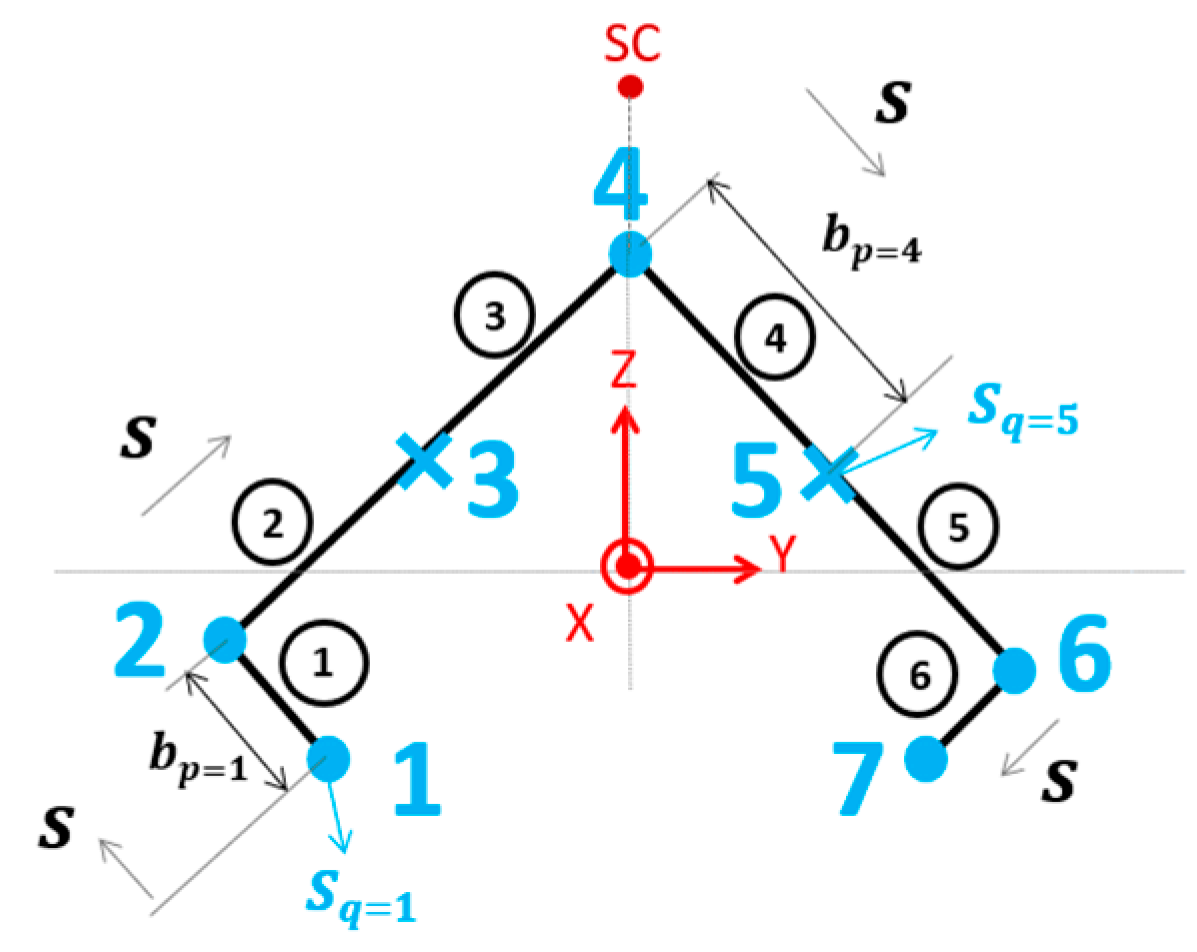
To begin, the thin-walled cross-section is divided into plate-like segments, with each segment defined by nodal points located at its corners and along its edges (Figure 1). GBT then decomposes the cross-sectional deformation into a series of fundamental deformation modes:
  • Rigid-body modes (translation and rotation of the cross-section).
  • Global modes (bending and torsion of the whole section).
  • Local buckling modes.
  • Distortional buckling modes.
At the first step, the displacement fields are assumed as [18]
u x , s = u ¯ i ( s ) φ i , x ( x ) + u ¯ j ( s ) φ j ( x )
v x , s = v ¯ i ( s ) φ i ( x )
w x , s = w ¯ i ( s ) φ i ( x )
where the index i is used for the conventional modes and j for the shear modes. u ¯ i s , v ¯ i s and w ¯ i ( s ) indicate the displacement profile in   x ,   s , and out-of-plane directions, respectively (Figure 1), whereas u ¯ j s demonstrates the axial displacement profile due to shear deformation. Furthermore, φ i x and φ j x show the displacement amplitude functions for conventional and shear modes, respectively. Moreover, the axis x is oriented along the longitudinal direction of the beam, while s follows the perimeter of the cross-section, starting from the first node and proceeding counterclockwise along the wall segments (Figure 1). The length of segment p is
b p = S q + 1 S q q = 1,2 , , n , ( p = 1,2 , , n 1 )
where n is the number of modes (total of natural and intermediate nodes). According to the proposed method by Schardt [7], the warping displacement U q k for mode k   ( k = 1,2 , 3,4 ) (Figure 2) and node q are
M o d e   1 : U q 1 = 1 ,   M o d e   2 : U q 2 = Y q
M o d e   3 : U q 3 = Z q ,   M o d e   4 : U q 4 = ω q
Then, for the other modes k = 5 , 6 , , n , the following orthogonality condition should be satisfied [7]:
A U q k U q i d A = 0 k i
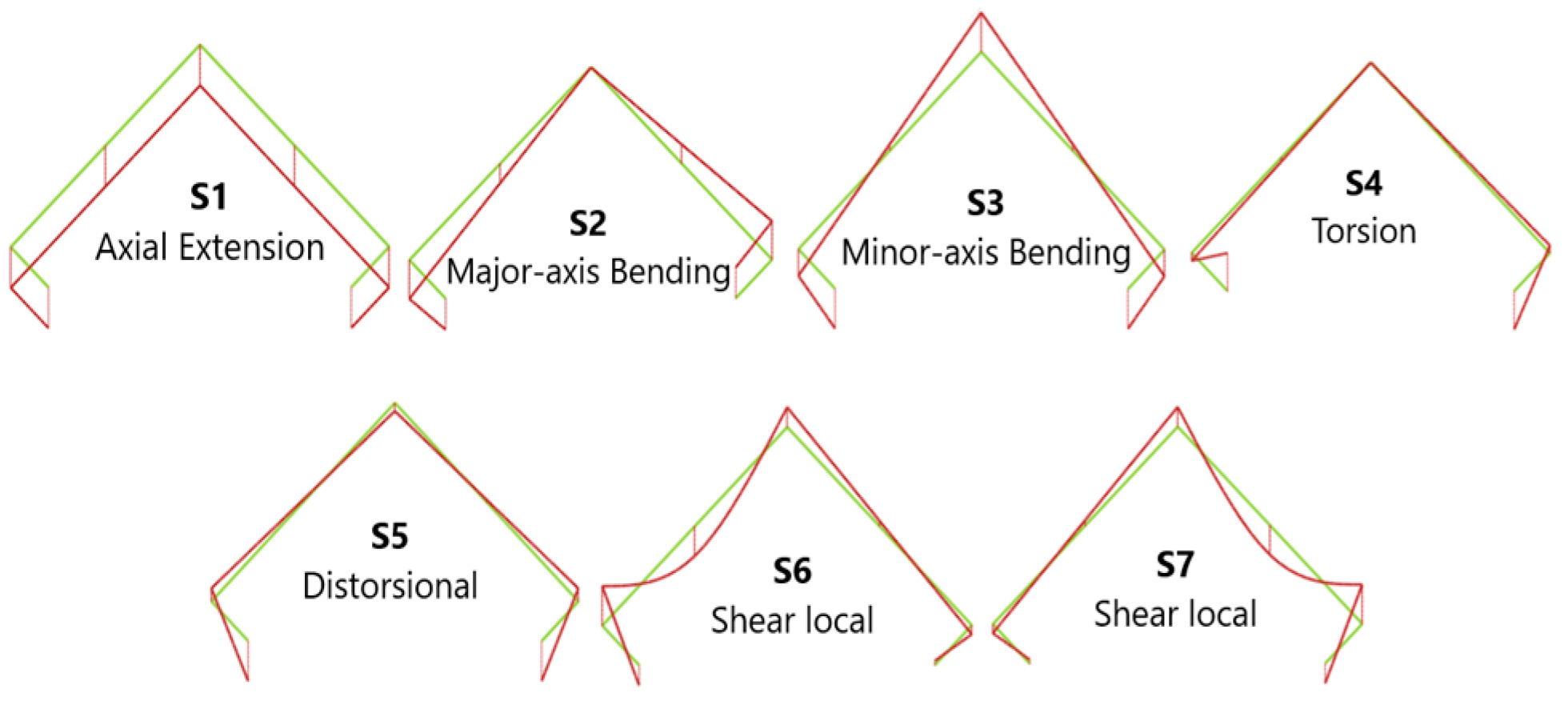
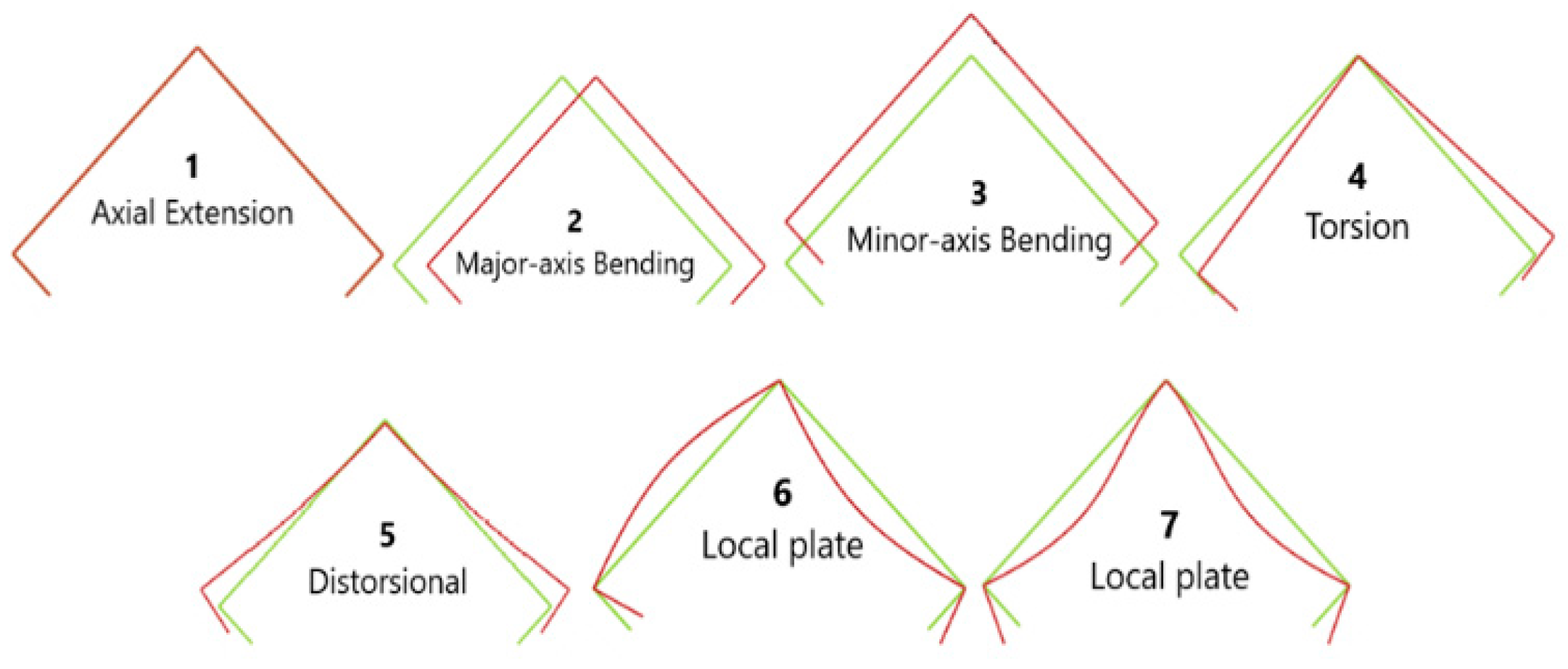
Figure 2. Deformation modes of a channel-section composite beam: global/rigid-body modes (axial extension, mode 1; major/minor-axis bending, modes 2 and 3; and torsion, mode 4), plus representative local plate-bending and distortional modes (modes 5 to 7). Thus, the in-plane movements of a face (segment p that is located between nodes q   and   q + 1 ) at its mid-point are obtained.
Jcs 09 00608 g002
f p k = U q k U q + 1 k b p
The functions u ¯ i s and v ¯ i s are assumed to vary linearly within each segment, making them piecewise linear across the entire cross-section. Under this assumption, u ¯ i s is fully determined by its nodal values. The flexural transverse displacements, w ¯ i s , occur within a specific segment p . By combining the displacement configurations of the basic system under the influence of the warping function u ¯ i s , along with the terms m q and m q + 1 , the resultant displacement configuration is obtained:
w ¯ i s = w ¯ p × 1 + b p 2 θ ¯ p 2 η 1 b p 2 3 K p m q η + 3 2 η 2 1 2 η 3 + m q + 1 1 2 η + 1 2 η 3
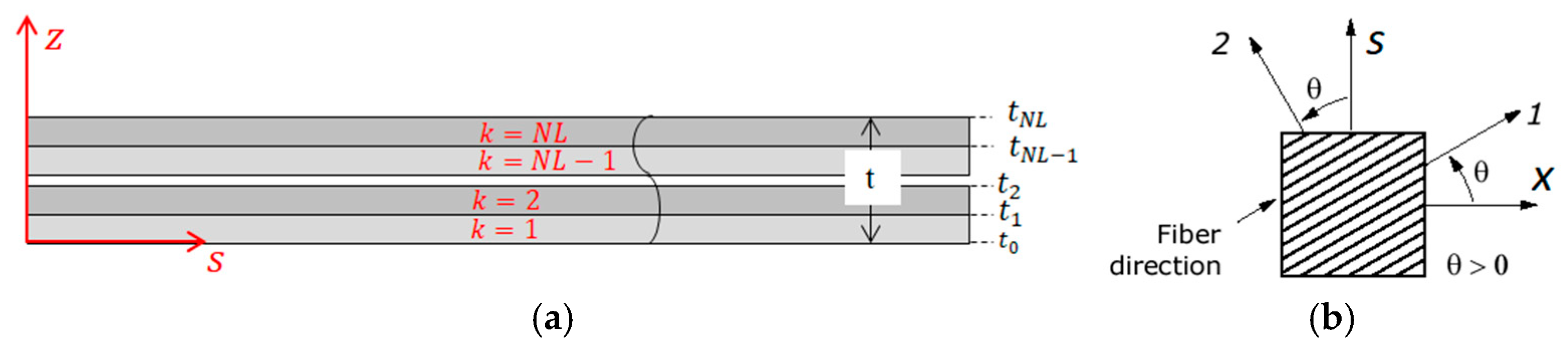
where ξ is defined as η = s S q / b p ,   and the transverse bending stiffness K p is E t 3 / 12 1 ν 2 and D 22 (component from D Matrix) for isotropic and orthotropic materials, respectively. Additionally, the matrices A , B , and D are representative of laminate properties [8] and Q ¯ i j are the components of the transformed reduced stiffness matrix (Figure 3 and Equation (9)). w ¯ p is the normal movement to a face at its mid-point, θ ¯ p indicates the rotation of the chord line of a face, and m q shows the transverse bending moment.
A i j , B i j , D i j = t k 1 t k Q ¯ i j 1 , z , z 2 d z i , j = 1,2 , 6 , ( k = 1 . . . N L )
It is emphasized that the component D 22 of the bending stiffness matrix D is explicitly used in the formulation, particularly in Equation (8) for segmental bending stiffness.
The treatment of branching sections in the proposed formulation follows the approach of Dinis et al. [19], who adapted GBT for members with open branched and mixed cross-sections. At each branching node, the cross-section’s “natural nodes” are classified into independent and dependent sets. Elementary warping functions are assigned only to the independent nodes (unit warping displacement at one node, zero at others), while the dependent nodes receive computed warping displacements to satisfy (i) transverse displacement compatibility among all walls meeting at the node and (ii) Vlasov’s null membrane shear strain condition γ x y M = 0 .

2.2. Member Analysis

The energy equation is simplified with respect to the amplitude functions and their variations:
δ U = L b t σ x x δ ε x x + σ s s δ ε s s + τ x s δ γ x s d z d s d x = L δ φ δ φ , x δ φ , x x t B ¯ F 1 ¯ D 2 ¯ F 1 ¯ t D 1 ¯ H 1 ¯ D 2 ¯ t H 1 ¯ t C ¯ φ φ , x φ , x x d x
where the GBT matrix Ξ
Ξ = B ¯ F 1 ¯ D 2 ¯ F 1 ¯ t D 1 ¯ H 1 ¯ D 2 ¯ t H 1 ¯ t C ¯
can be decomposed to 3 matrices:
Ξ ^ = B ^ F ^ 1 D ^ 2 F ^ 1 t D ^ 1 H ^ 1 D ^ 2 t H ^ 1 t C ^ 3 n × 3 n
that demonstrate the components related to the conventional modes.
Ξ ˇ = D ˇ 1 H ˇ 1 0 H ˇ 1 t C ˇ 0 0 t 0 t 0 3 n × 3 n
for the shear modes and
Ξ ~ = F ~ 1 + F ~ 2 D ~ 1 + D ~ 2 H ~ 3 D ~ 1 t + D ~ 2 t H ~ 1 + H ~ 2 C ~ H ~ 2 t C ~ t 0 3 n × 3 n
that show the components related to the interaction of the conventional and shear modes. On the other hand, we have strain–displacement relations:
ε x x = u x z 2 w x 2
ε s s = v s z 2 w s 2
γ x s = u s + v x
and regarding Hooke’s law:
σ x x σ s s τ x s = Q ¯ 11 Q ¯ 12 Q ¯ 16 Q ¯ 12 Q ¯ 22 Q ¯ 26 Q ¯ 16 Q ¯ 26 Q ¯ 66 ε x x ε s s γ x s
By substituting u ,   v , and w from Equations (1), (2) and (3), respectively, into Equations (15)–(18) and using Equations (9) and (10), the components for the symmetric stacking sequence are obtained as below:
B ^ i j = S D 22 w ¯ j , s s w ¯ i , s s d s
F 1 ^ i j = S 2 D 26 w ¯ j , s w ¯ i , s s d s
D 1 ^ i j = S 4 D 66 w ¯ j , s w ¯ i , s d s
D 2 ^ i j = S D 12 w ¯ j , s s w ¯ i d s
H 1 ^ i j = S 2 D 16 w ¯ j , s w ¯ i d s
C ^ i j = S D 11 w ¯ j w ¯ i d s
D ˇ 1 i j = S A 66 u ¯ i , s u ¯ j , s d s
H ˇ 1 i j = S A 16 u ¯ h u ¯ j , s d s
C ˇ i j = S A 11 u ¯ i u ¯ j d s
F ~ 2 i j = D ~ 1 i j = D ~ 2 i j = H ~ 2 i j = H ~ 3 i j = 0
H ~ 1 i j = S A 16 u ¯ i u ¯ j , s d s
C ~ i j = S A 11 u ¯ i u ¯ j
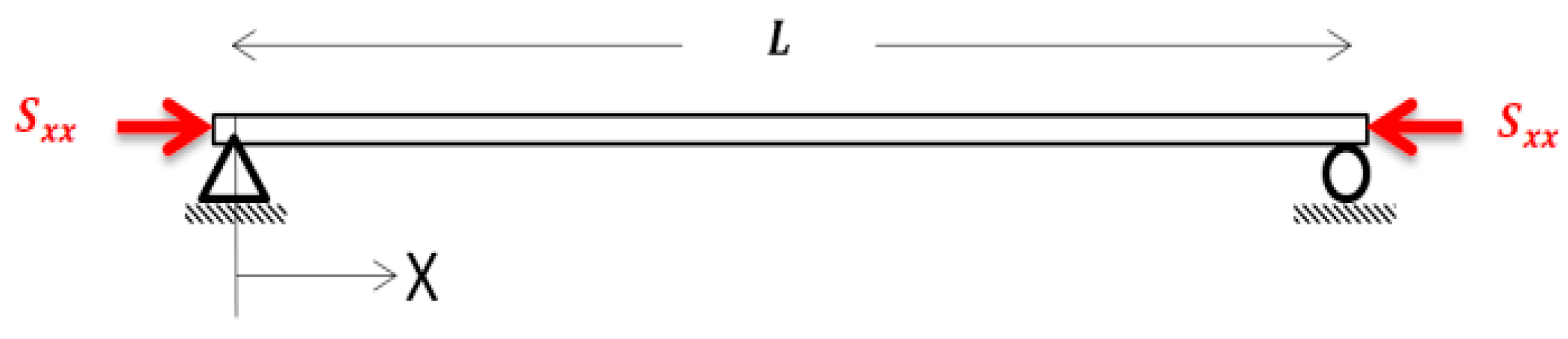
The matrix X as a representative of the loading conditions is defined for buckling [20] that has been shown in Figure 4 (in this study, the beam is modeled with simply supported end cross-sections at x   =   0 and x   =   L ) . Warping is not constrained at the ends, and only an axial compressive load is applied. The distance L used in the Ritz trial functions therefore represents the effective buckling length between these supports.
X = 0 0 0 0 X i j V W 0 0 0 X i j U 3 n × 3 n
X i j U = S x x u ¯ i u ¯ j d s , i , j = 1 , , n
X i j V W = S x x w ¯ i w ¯ j + v ¯ i v ¯ j d s i , j = 1 , , n
The displacement amplitude functions can be written as a vector as shown below:
Φ = φ φ I φ I I ,     φ I = φ x ,     φ I I = 2 φ x 2
Moreover, it is assumed that Φ is a multiplication of matrix Ψ and vector a :
Φ = Ψ × a
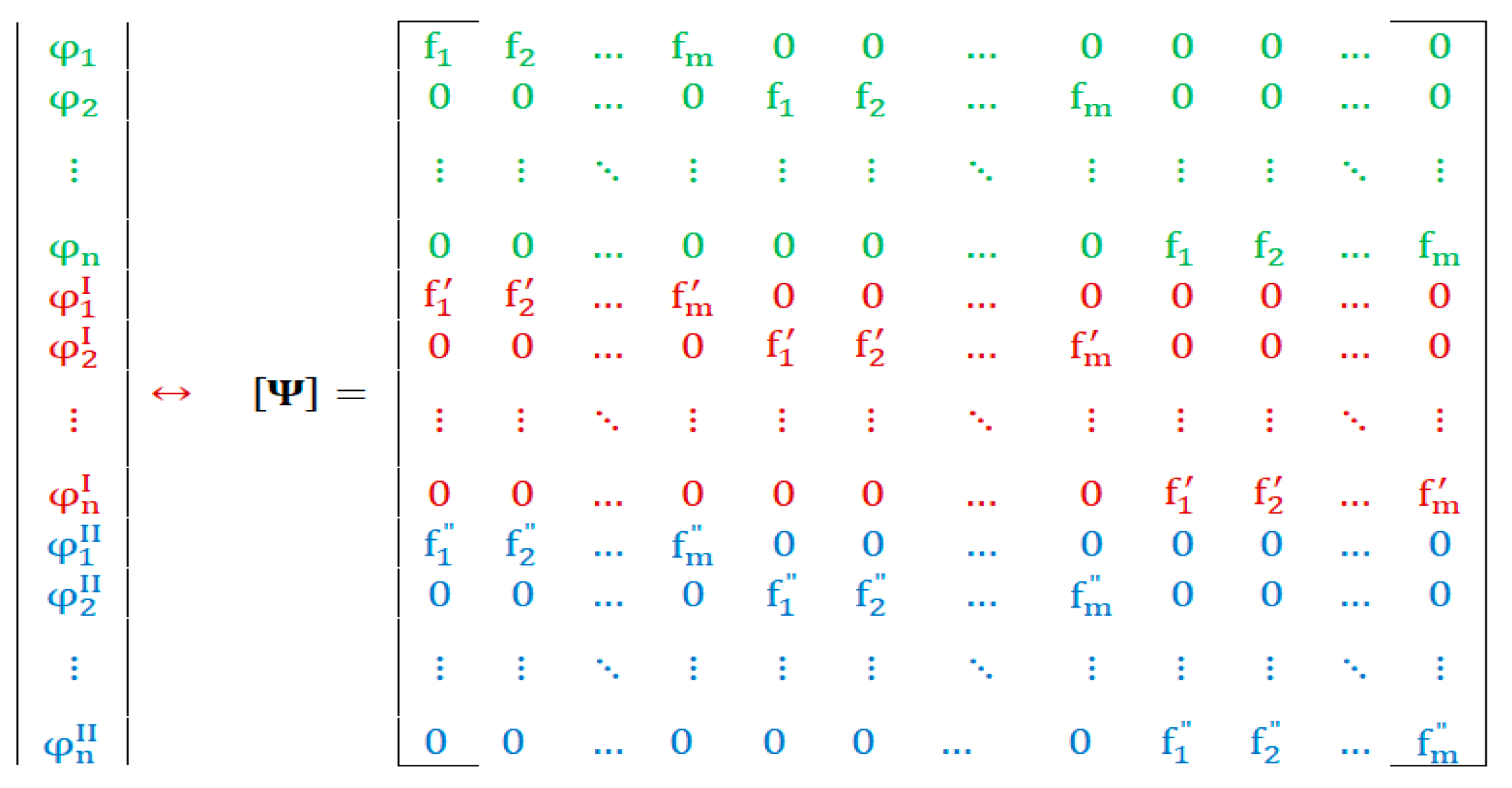
where Ψ is the matrix of shape function terms which are in terms of “x” (with “3 n × m” components) and a is a vector including the unknown coefficients in the shape functions.
As it is known, φ functions have trigonometric behavior. Therefore, they can be estimated using a series of trigonometric functions with unknown coefficients:
φ = i = 1 m a i sin i π x L ,     a = a 1 a 2 a m
where m is the number of unknown coefficients (DOFs) in the shape functions. In this study, only simply supported boundary conditions are considered to establish and validate the proposed formulation. Trigonometric trial functions are selected for the Ritz approximation because they inherently satisfy the amplitude displacement conditions and rotational compatibility at the supports. More complex boundary conditions such as clamped or free edges are not considered here, as the goal is to benchmark the method using the simplest case before extending the framework to more intricate support scenarios. Considering
f i = sin i Π x L ,
f i = d f i d x , f i = d 2 f i d x 2 , i = 1,2 , , m
Ψ is assembled as shown in Figure 5. The magnitude of loading will be scaled by the load multipliers, λ i found in the eigenvalue problem:
K + λ G a = 0
where K is the stiffness matrix corresponding to the base state Ξ , and G is the differential initial stress and load stiffness matrix due to the loading conditions X . λ are the eigenvalues and a contain the buckling mode shapes (eigenvectors):
K = 0 L ψ t Ξ ^ ψ + ψ t Ξ ~ ψ + ψ t Ξ ˇ ψ d x = 0 L ψ t Ξ ^ + Ξ ~ + Ξ ˇ ψ d x
G = 0 L ψ t X ψ d x
K and G are m × m symmetric GBT modal matrices. Normally, the lowest value of λ is of interest. The buckling mode shapes, a , include normalized vectors and do not represent actual magnitudes of deformation at critical load.

2.3. Characteristic Dimensionless Study

A specific parameter known as the ‘orthotropy parameter β ’ serves as an indicator of how strongly orthotropic the laminate is. This parameter is also commonly referred to as the ‘Seydel factor’ or the ‘cross-rate’ [21]:
β = D 12 + 2 D 66 D 11 D 22
Although D i j   ( i , j = 1,2 , 6 ) represent the components of the D-matrix (Equation (9)) and the parameter β can, in theory, range between –1 and 3, a laminate exhibiting β ≤ 0 is not physically realizable. Therefore, for all practical and engineering purposes, the applicable range of β is limited to 0 < β ≤ 3.
An additional parameter, often referred to as the “shear rate ζ” or alternatively described as the generalized Poisson ratio [21], is defined as follows:
ξ = D 12 D 12 + 2 D 66
There are no well-established theoretical limits for ξ , but practical experience indicates that for most engineering-grade laminates, ξ generally falls within the range of 0.2 to 0.4 .
The parameters discussed above are adequate for characterizing the elastic behavior of laminates in cases where the plates are strictly orthotropic. However, when bending–twisting coupling effects come into play, additional anisotropy parameters are required to fully capture the laminate’s constitutive response.
δ = D 26 D 11 D 22 3 4
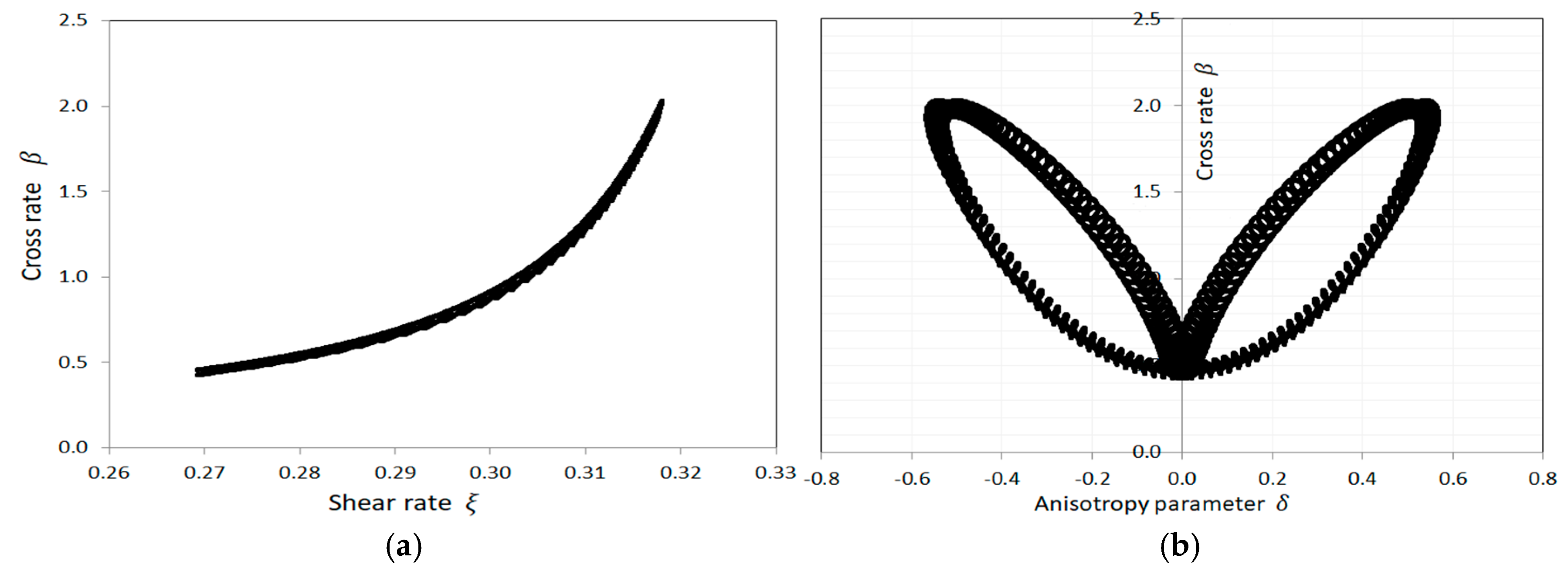
Generally, δ may vary in the ranges −1 ≤ δ ≤ 1. Figure 6a shows a monotonically increasing relationship between the shear rate ξ and the cross rate β . There is a strong dependency of the cross rate on the shear rate in composites, with a nonlinear acceleration at higher shear rates. Additionally, Figure 6b demonstrates the variation in cross Rate β versus anisotropy parameter δ in composites. The graph shows two symmetric branches, indicating that increasing anisotropy in either positive or negative directions results in a similar increase in β . At δ = 0, the cross rate β reaches a minimum, suggesting that at this condition, the composite has a balanced state with minimal cross interactions. As anisotropy increases (moving towards positive or negative δ values), the cross rate grows progressively.

3. Results and Discussion

This section presents a comparative analysis of the buckling behavior of isotropic and orthotropic thin-walled beams as predicted by the GBT using the Ritz method, FEM results obtained from ABAQUS, and relevant data from the literature. The comparison aims to assess the accuracy and consistency of the GBT–Ritz approach by evaluating its performance against FEM simulations and previously published GBT studies. Emphasis is placed on critical buckling loads, mode shapes, and the influence of geometry, stacking sequence, and material properties on structural stability.

3.1. Isotropic Thin-Walled Beams

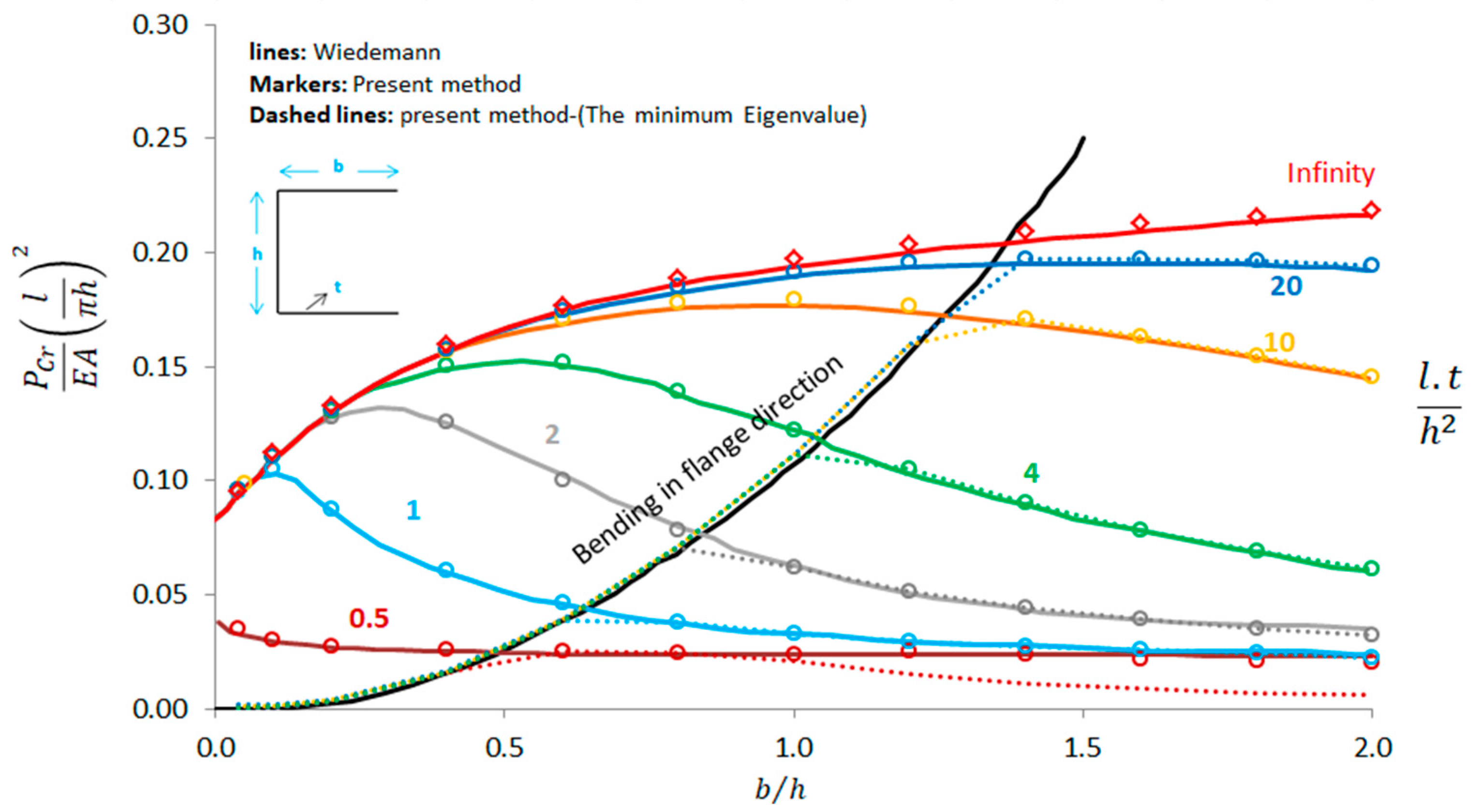
The dimensionless critical buckling load parameter P c r / E A l / π h 2 proposed by Wiedemann [22] has been investigated in Figure 7 for isotropic thin-walled beams with C-shaped cross-sections, considering a wide range of cross-sectional aspect ratios b / h and thickness–slenderness parameters l t / h 2 . The results obtained via the present GBT formulation are compared against the benchmark solutions of Wiedemann [22], thereby providing a robust validation of the proposed method. The variation in the dimensionless buckling load with respect to b / h reveals critical insights into the underlying instability mechanisms of channel-section beams. For low thickness–slenderness values, such as l t / h 2 = 0.5 and 1.0 , the beams exhibit a relatively low buckling resistance, as expected for long and slender members dominated by global buckling. In these cases, the critical load shows limited sensitivity to changes in b / h , indicating the dominance of flexural behavior over local plate instabilities. As the thickness–slenderness parameter increases, the influence of local buckling phenomena becomes more pronounced. For intermediate values l t / h 2 = 2   a n d   4 the critical load initially increases with b / h up to a peak point, beyond which it decreases. This non-monotonic trend is attributed to the interplay between flange and web deformation modes, where increased flange width contributes to bending stiffness in the initial range but eventually triggers localized instabilities. Notably, for higher values of l t / h 2 = 10   a n d   20 , and particularly in the limit as l t / h 2 the buckling behavior is governed predominantly by local deformation, with a pronounced rise in the critical load observed at moderate values of b / h , followed by stabilization or saturation. These trends align with the increasing participation of flange bending modes, as illustrated by the bold black curve annotated with “Bending in flange direction”. This bending mode becomes energetically favorable for lower aspect ratios for a fixed thickness–slenderness parameter. For instance, when l t / h 2 = 4 , bending in the flange direction is more critical for b / h < 1.1 .
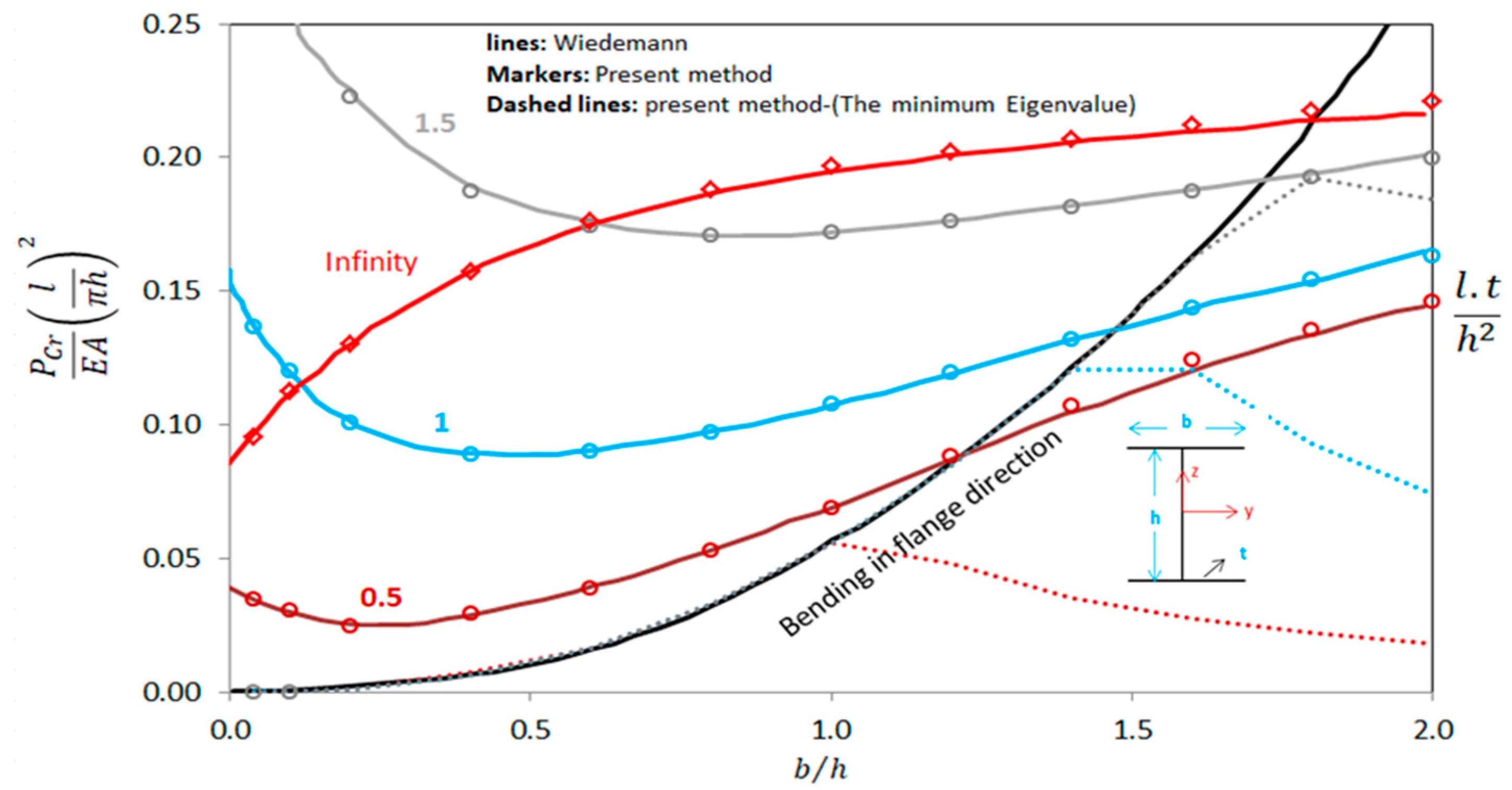
Figure 8 repeats Figure 7 for an isotropic I-section beam (branched beam). The data reveal a strong agreement between the GBT and Wiedemann’s [22] solutions across all examined slenderness ratios. The results validate the present method in capturing both local and global buckling behavior, especially in the presence of mode interaction effects prominently in thin-walled structures. As expected, the normalized critical buckling load increases with increasing b / h , particularly for higher values of l t / h 2 . This is consistent with the physical interpretation of increased flange width for an I-section beam contributing to greater resistance against lateral–torsional buckling in the flange-bending direction. The GBT method captures this effect well, even at high slenderness. The GBT solution, particularly its minimum eigenvalue approach, predicts a decreasing trend beyond b / h 1.5 , indicating the increasing dominance of local flange distortions or torsional–flexural coupling, which Wiedemann’s approach does not fully capture. This divergence underscores the necessity of using enhanced formulations such as GBT when analyzing slender cross-sections with high geometric flexibility. In contrast, for the stiffest configuration l t / h 2 = , the predictions align closely across the entire b / h range. This alignment highlights the diminishing influence of local buckling and distortion modes, making classical solutions like Wiedemann’s adequate in such limits.
An important observation is the non-monotonic behavior for intermediate slenderness values (e.g., l t / h 2 = 1.0 and 1.5 ), where all curves exhibit a minimum before rising again with increasing b / h . This effect is a direct consequence of local mode interactions which are inherently accounted for in the GBT too. Furthermore, the following aspects must be considered:
  • For b / h < 1.8 , bending buckling in the flange direction becomes critical first, for b / h > 1.8 in the web direction.
  • Torsional buckling can only occur for b / h > 1 and for l t / h 2 < 1.5 .
The close agreement between the GBT results and Wiedemann’s solutions across all slenderness regimes demonstrates the accuracy and reliability of the present GBT formulation in capturing both global and local buckling behaviors. Additionally, the use of the minimum eigenvalue criterion within the GBT framework provides a conservative yet computationally efficient approach for estimating the lowest buckling load, which is of practical relevance in engineering design.

3.2. Orthotropic Thin-Walled Beams

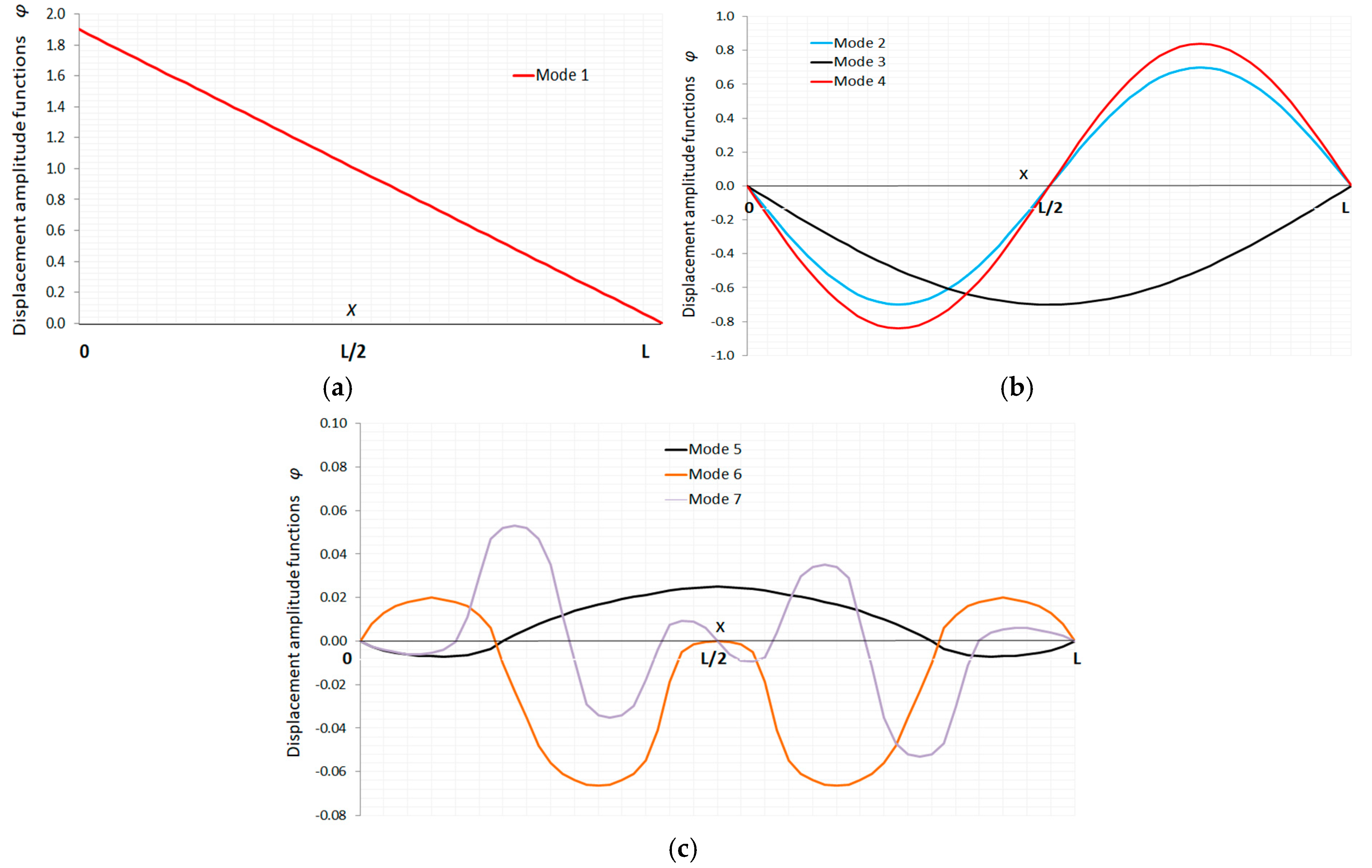
Figure 9a–c present the normalized displacement amplitude functions φ ( x ) for the first seven buckling modes—both global and local—along the axis of the composite thin-walled channel-section beam shown in Figure 1. The corresponding deformation patterns are schematically illustrated in Figure 2, encompassing axial extension, bending about major and minor axes, torsion, distortional deformation, and local plate modes. These mode shapes were obtained via a modal decomposition approach within the GBT framework and offer critical insight into the nature of instability phenomena in slender composite members. As illustrated in Figure 9a, Mode 1 exhibits a linear displacement variation, decreasing from a maximum at x = 0 to zero at x = L , characteristic of uniform axial extension. Figure 9b displays the displacement amplitude functions associated with Mode 2 (major-axis bending), Mode 3 (minor-axis bending), and Mode 4 (torsion). Mode 3 presents sinusoidal-type profiles with one half-wave across the span, peaking at mid-span ( x = L / 2 ) , and zero amplitudes at the boundaries. Mode 2 shows a slightly sharper peak, indicating higher stiffness along the major axis. Mode 4, associated with torsional buckling, reflects warping effects and the influence of torsional stiffness. Figure 9c demonstrates higher-order modes: Mode 5 (distortional) and Modes 6 and 7 (local plate modes). These modes involve more intricate displacement patterns, with multiple half-waves across the beam length and nodal points indicating spatially varying behavior. Mode 5 (distortional) shows a single wave with relatively low amplitude, revealing the deformation of the flange-lip connection, which is more prominent in open sections like the C-profile. Modes 6 and 7, classified as local plate modes, display high-frequency variations and significant curvature, indicative of localized buckling in flange or web plates. These modes are especially sensitive to thickness, orthotropy, and support conditions and become critical in short-span or stiffened segments.
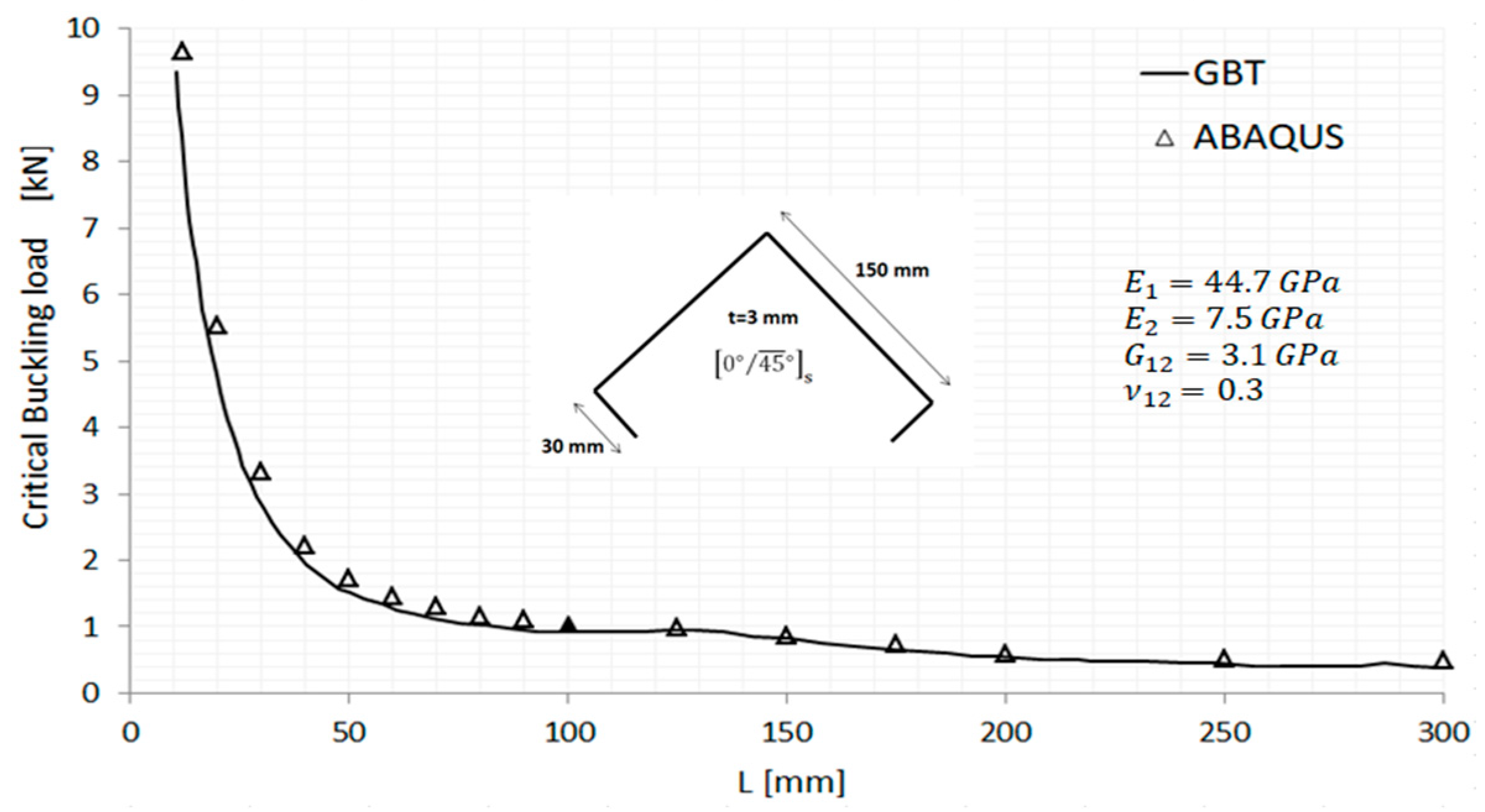
Figure 10 presents a comparative analysis of the critical buckling loads of a thin-walled composite channel-section beam as a function of its length L . The section geometry and laminate configuration are detailed in the inset, consisting of a symmetric layup, a wall thickness of t = 3   m m , and the dimensions of 30 and 150 mm. The observed trend exhibits a clear transition in buckling behavior with increasing member length. For longer lengths ( L > 50   m m ) , the critical buckling load decreases sharply, indicating dominance of distorsional and global buckling modes instead of the local ones. This rapid drop is well-captured by both methods; however, minor discrepancies are visible in this range, with ABAQUS predicting slightly higher critical loads. These differences are attributed to the inherent ability of finite element models to capture localized effects and edge constraints more precisely than one-dimensional beam formulations. As the length increases beyond L = 100   m m , the reduction in critical buckling load becomes gradual and tends toward an asymptotic value. In this regime, the global flexural or torsional buckling modes become predominant, and the agreement between GBT and ABAQUS results improves significantly. For L 150   m m , the deviation between both methods becomes negligible, with GBT accurately predicting the global buckling response with minimal computational cost. Additionally, Figure 11 shows the schematics of shear deformation modes for the composite channel-section beam.
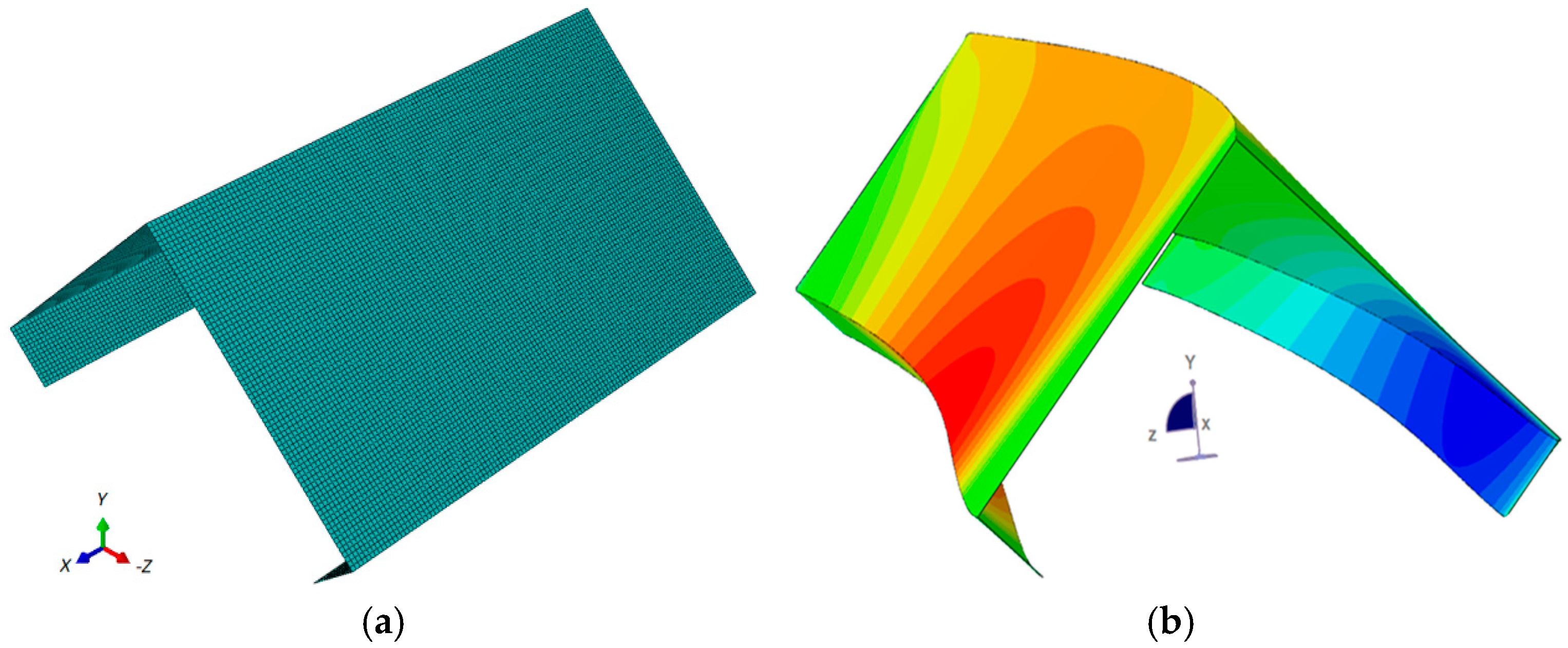
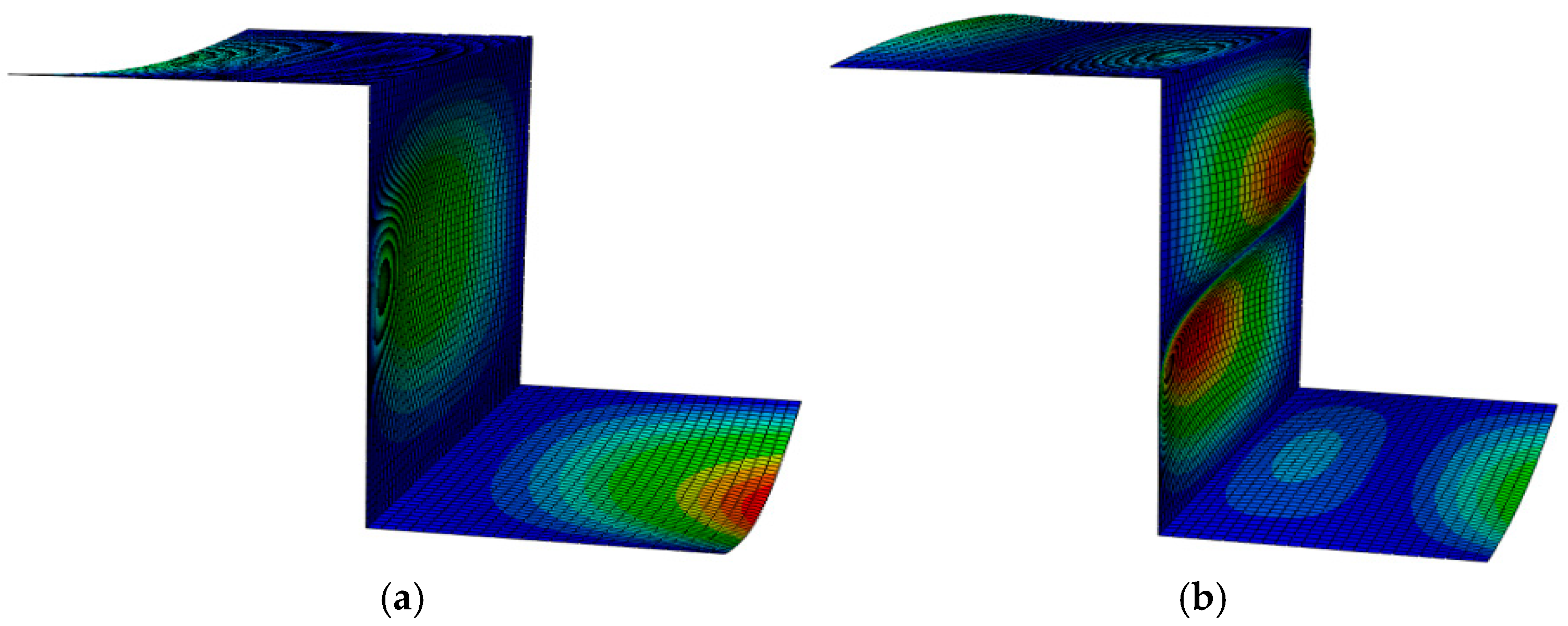
Figure 12 and Figure 13 provide a comprehensive visualization and comparison of the out-of-plane behavior of a composite thin-walled channel-section (Figure 1) beam under compressive loading, employing both FEM and GBT approaches. As shown in Figure 12a, the finite element model utilizes four-node, doubly curved shell elements (S4R) within ABAQUS, specifically tailored for thin-walled structures with complex geometrical and material behavior. A highly refined mesh is implemented, with an edge length to the beam length ratio of 0.005. This mesh density was determined through a detailed mesh convergence study, ensuring solution accuracy without unnecessary computational cost. The out-of-plane displacement distribution is shown in Figure 12b. The response indicates a pronounced deformation in the web and upper flange regions, consistent with local plate and distortional mode interactions. The smooth displacement gradient from the fixed to free end suggests a coupled mode shape involving both global flexural–torsional effects and local instabilities. Furthermore, Figure 13 displays a series of sectional deformations along the beam’s length, obtained from GBT analysis at different normalized axial positions ( x L = 0.1 0.9 ) .
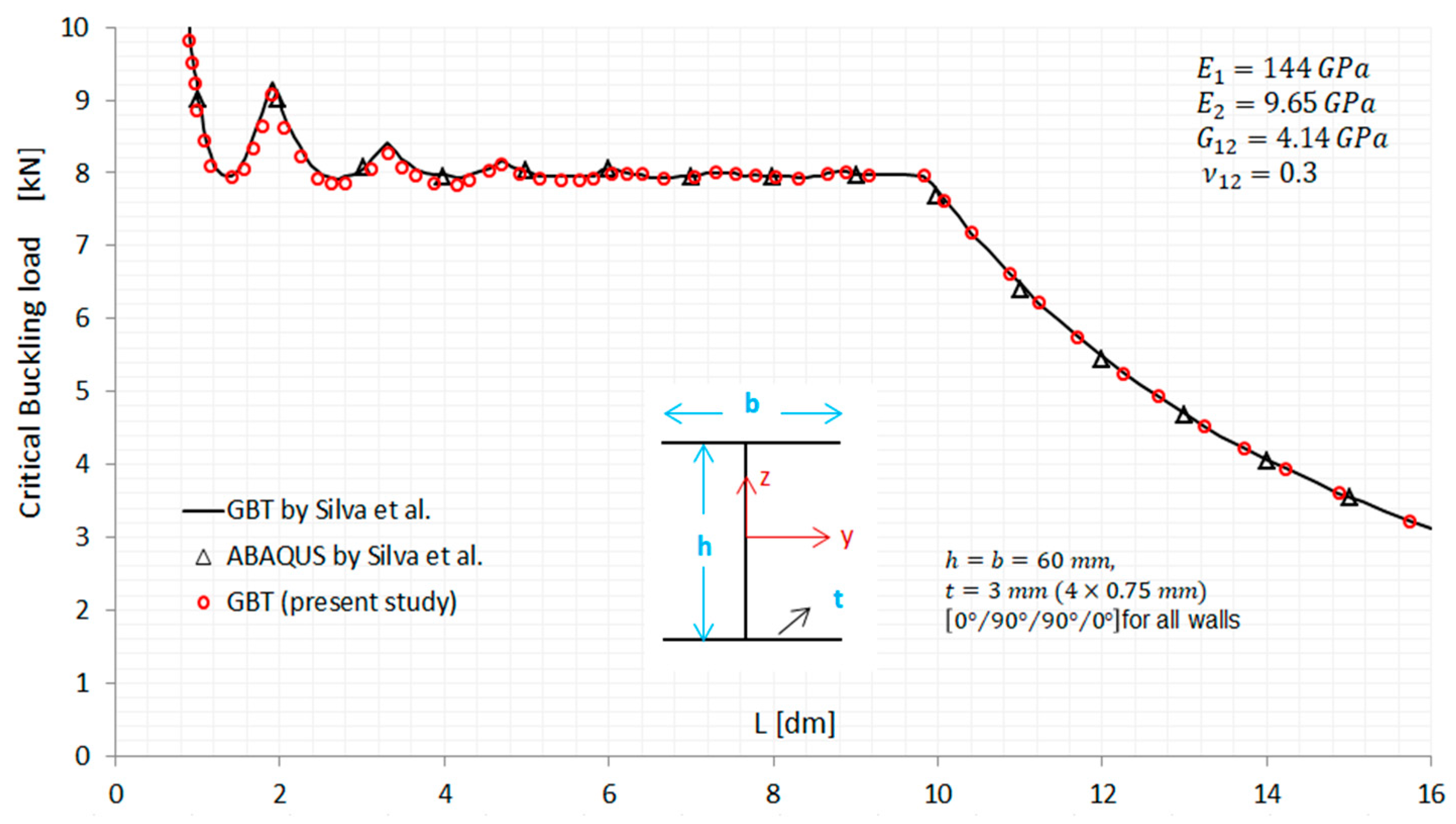
Figure 14 illustrates the variation in the critical buckling load with respect to member length L for a symmetric thin-walled composite I-section beam. Three sets of results are compared: the present GBT–Ritz formulation, the original GBT results by Silva et al. [8], and FEM predictions (also reported by Silva et al. [8]). Each wall of the section is composed of a symmetric layup 0 ° / 90 ° s , in total 3   m m in thickness. Geometric dimensions and material properties are defined in Figure 14. The graph reveals a rich and complex buckling behavior, characterized by alternating dominance of local, distortional, and global modes depending on the member length. At very short lengths L < 2   d m (dm is decimeter), a steep increase in critical buckling load is observed, typical of local plate buckling governed by high bending stiffness in the laminate direction. This is followed by a series of critical load fluctuations in the range 2 < L < 5   d m , indicating mode interaction and the onset of distortional behavior. The present GBT results demonstrate excellent agreement with both ABAQUS simulations and the benchmark GBT data by Silva et al. [8], validating the numerical implementation and modal decomposition strategies. In the short-to-intermediate length regime, the present method captures sharp variations and local minimum in critical load, indicating sensitivity to cross-sectional instability modes. These features are well-aligned with those from the original study, highlighting the robustness of the current implementation for laminated composite members. Beyond L = 5   d m , the critical load stabilizes around 8.0   k N for a broad range of lengths, reflecting the local and distortional buckling modes. The alignment between GBT (present and Silva) and FEM results in this region further underscores the efficacy of the beam-based method in capturing global instability with significantly reduced computational effort. For longer lengths L > 10   d m the gradual reduction in critical load is attributed to global buckling, a trend accurately predicted by all three approaches.
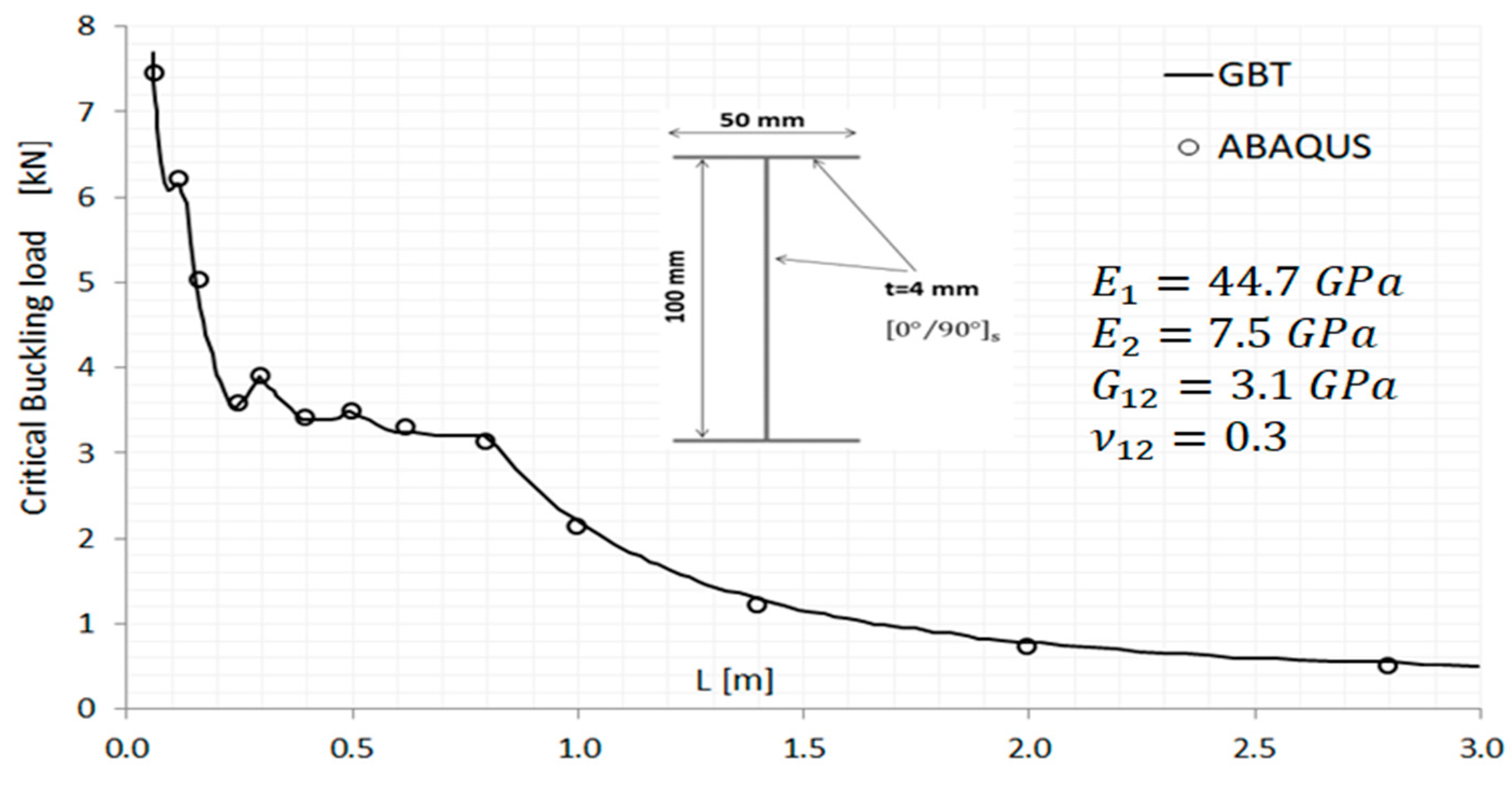
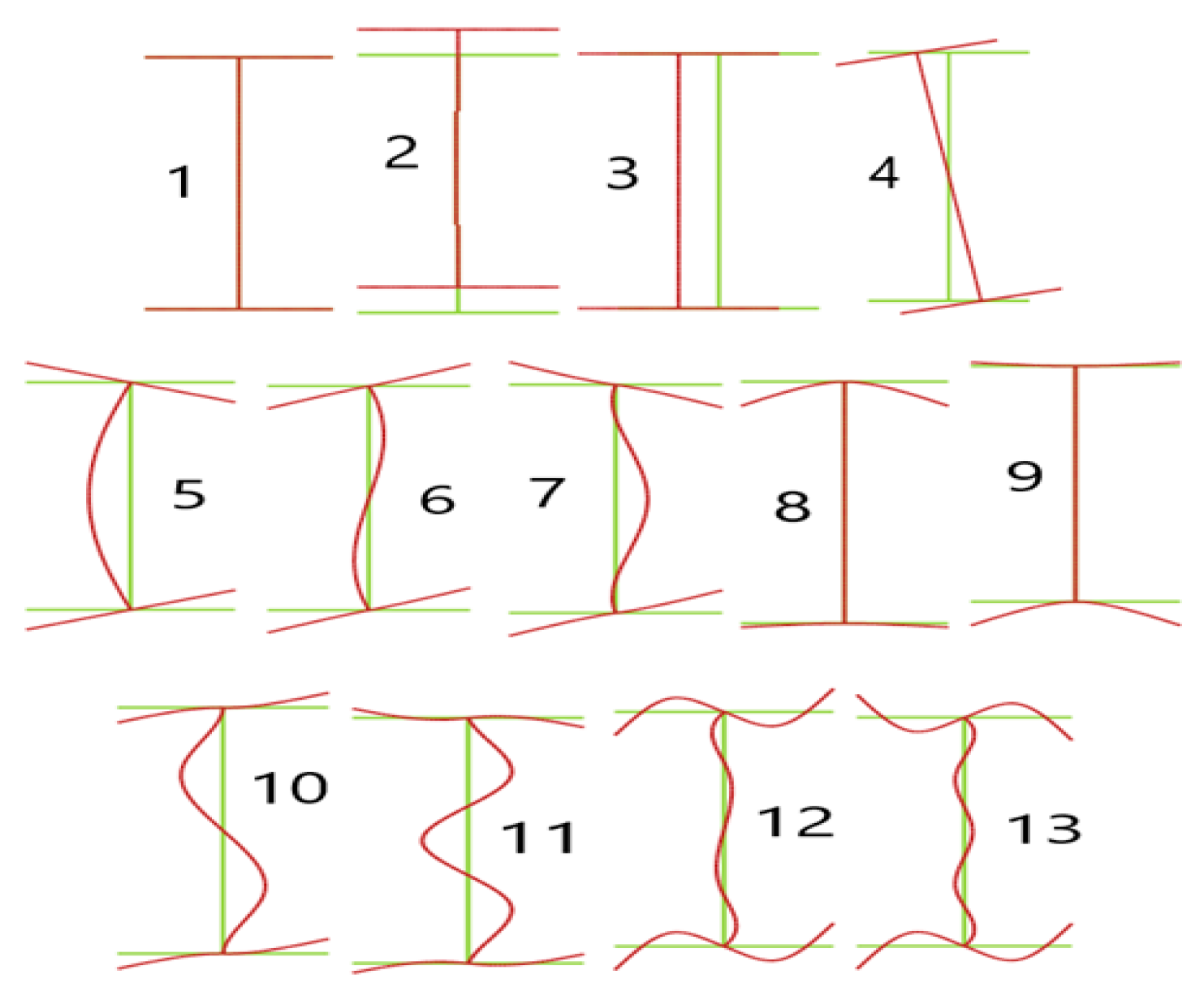
Figure 15 and Figure 16 present the critical buckling behavior and corresponding mode shapes for a laminated thin-walled I-section composite beam subjected to axial compression. The structural geometry and material properties are shown in the inset of Figure 15. The orthotropic material properties are different from those used in Figure 14. Excellent agreement is observed between GBT and FEM results across all length scales. Moreover, Figure 16 provides insight into the nature of the buckling modes. By cross-referencing the load-length response in Figure 15 with the mode types shown in Figure 16, a comprehensive interpretation of the buckling behavior is achieved. For example, the critical load peaks below L = 0.5   m align with local buckling configurations (Modes 12–13), while fluctuations in the intermediate region are caused by distortional buckling (Modes 5–11). The continuous decline at longer lengths corresponds to global flexural modes (Modes 2 and 3). It should be mentioned that the pure torsion modes are not shown in Figure 15 as their associated critical loads are higher than those of the displayed modes and thus do not govern the buckling behavior within the examined length range.
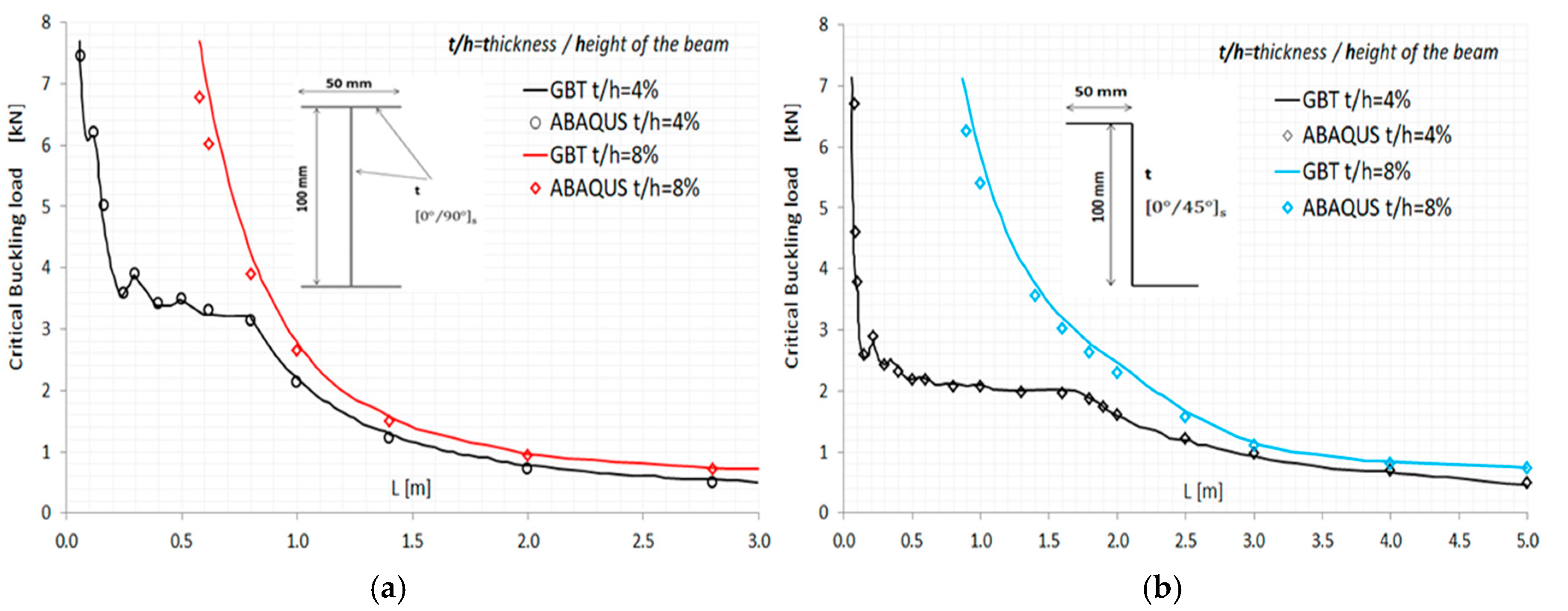
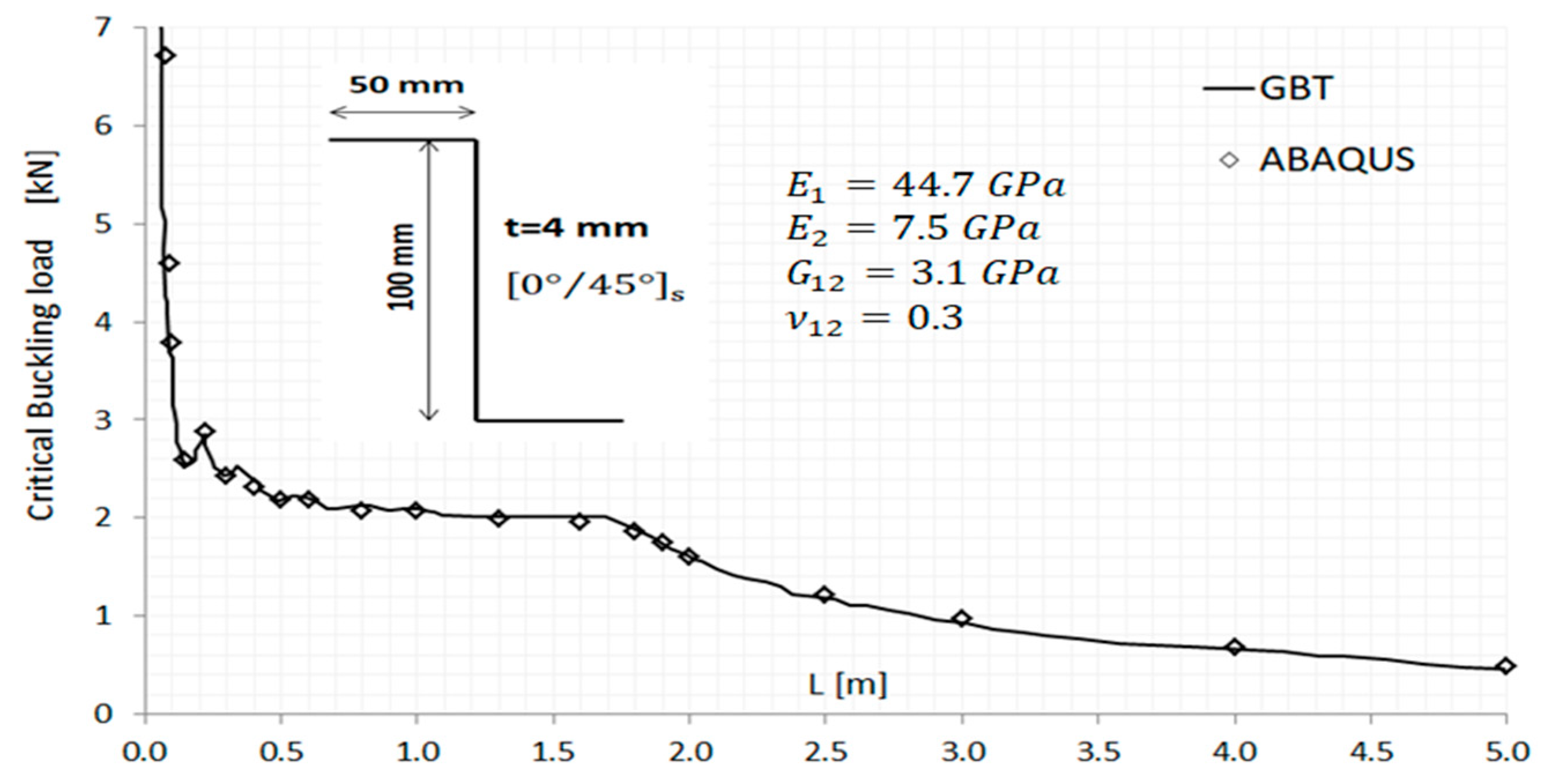
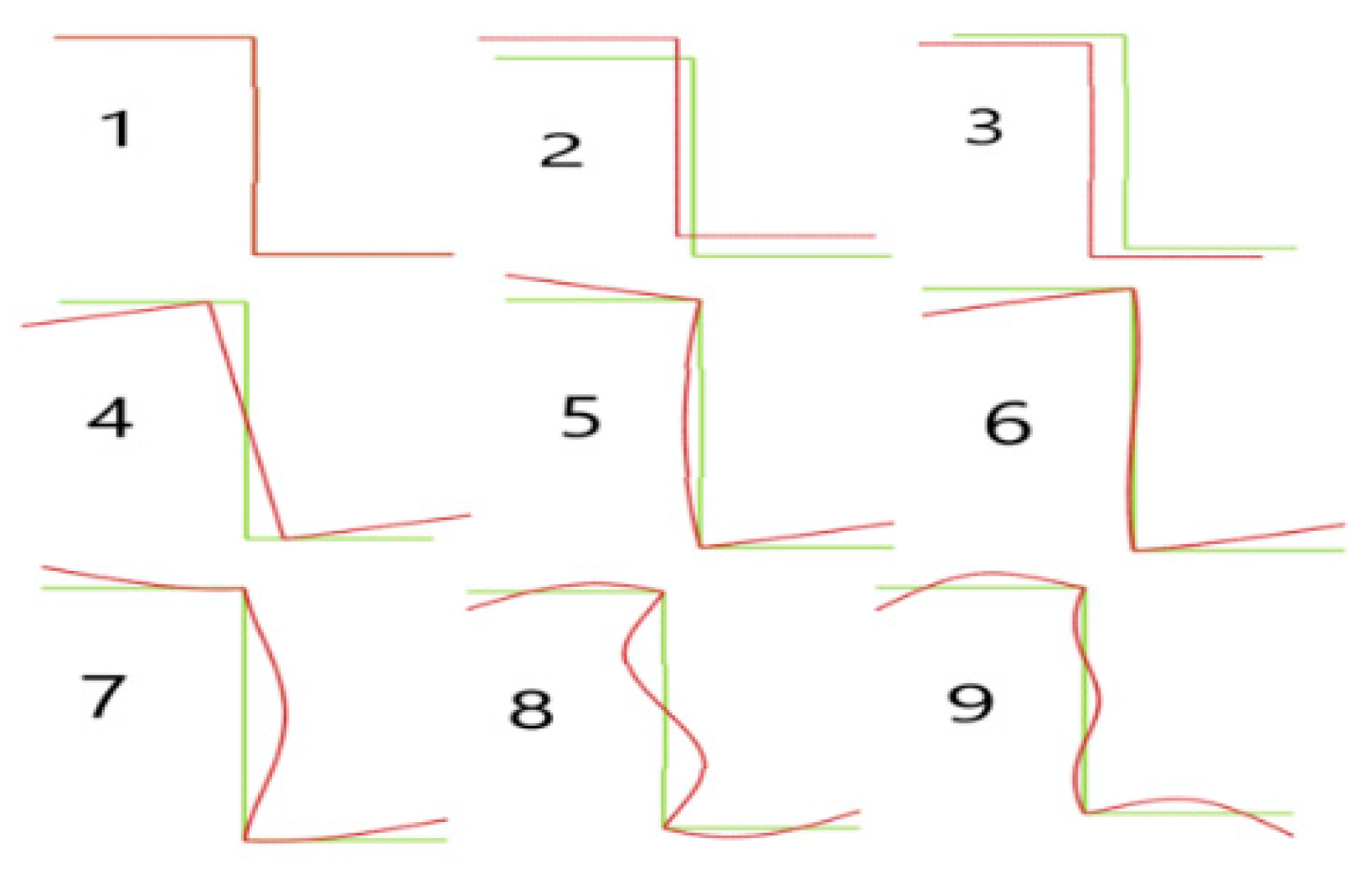
Figure 17 and Figure 18 provide a comprehensive assessment of the buckling behavior of a thin-walled composite Z-section beam with orthotropic layup under axial compression. The geometry of the Z-section includes flanges of width 50   m m and a web height of 100   m m , with a total laminate thickness of 4   m m constructed from a symmetric stacking sequence 0 ° / 45 ° s . Figure 17 spans a wide range of beam lengths L = 0.1 5.0   m , capturing transitions across local, distortional, and global buckling modes. In the short-length regime ( L < 0.5 m ) , the critical load undergoes sharp oscillations due to sequential activation of local plate buckling modes in the flanges and web. The GBT predictions align closely with FEM results throughout this region. Between 0.5 < L < 2.0   m , the critical load flattens, indicating the dominance of distortional buckling modes. Also, for longer members ( L > 2.0 m ) a gradual reduction in critical load is observed, indicating the transition to global flexural and torsional buckling. Despite the reduced influence of cross-sectional details at this stage, the consistency between GBT and FEM persists, reaffirming the capability of GBT in capturing global modes through modal decomposition. The corresponding buckling mode shapes are illustrated in Figure 18. Nine distinct deformation modes are presented, capturing conventional, distortional, and local responses typical of Z-shaped thin-walled members. Notably, the Z-section’s geometric asymmetry promotes significant interaction between torsional and distortional modes, highlighting the importance of employing a theory capable of capturing coupled behavior.
Figure 19 presents the out-of-plane displacement contours of a thin-walled laminated composite Z-section beam, computed using shell-based finite element simulations. Corresponding deformation mode shapes from GBT are shown in Figure 18, where Modes 7 and 8 closely match the FEM-derived displacement patterns. The first contour plot (Figure 19a) demonstrates a single-lobe lateral deformation concentrated within the central portion of the web and upper flange. The deformation exhibits pronounced out-of-plane curvature in the web and a torsional response at the flange edges. This global response is characteristic of Mode 7 (as classified in Figure 18), representing a higher-order distortional mode. Here, the flange-lip junction exhibits minor rotation while the web bends in a sinusoidal manner along the member length. The second contour (Figure 19b) captures a more complex, multi-lobed displacement field, including at least two half-waves along the web height and accompanying distortions in both flanges. This buckling shape is directly associated with Mode 8 from the GBT mode set. The presence of additional nodal points and higher-frequency deformation reflects the activation of a higher-order distortional or local–distortional coupling mode. The strong correlation between FEM and GBT results confirms that the present GBT formulation not only predicts the correct buckling loads but also replicates the correct physical deformation mechanisms of composite Z-sections.
Figure 20 provides a comparative assessment of the effect of laminate thickness on the critical buckling behavior of composite thin-walled I- and Z-section beams. Two thickness-to-height ratios, t / h = 4 % and t / h = 8 % , are considered, and the critical buckling loads are predicted using the present GBT implementation and validated against shell-based FEM simulations. The comparison highlights both geometric and material coupling effects arising from increased laminate thickness in the context of orthotropic fiber-reinforced polymer (FRP) composites. The graph in Figure 20a displays the critical buckling loads for an I-section beam. When the thickness increases to t / h = 8 % , the overall buckling resistance significantly improves due to increased bending and shear stiffness, particularly in the short-to-intermediate length range. Both GBT and FEM predict higher critical loads, with the curve smoothing out as thickness suppresses higher-order local modes. Notably, the agreement between GBT and FEM remains consistently strong across the length spectrum. Moreover, Figure 20b presents a similar analysis for a Z-section beam, maintaining the same geometric dimensions as the I-section. As can be seen, the method remains reliable for thinner and slightly thick sections, but accuracy diminishes slightly as the laminate becomes thick relative to cross-sectional dimensions.
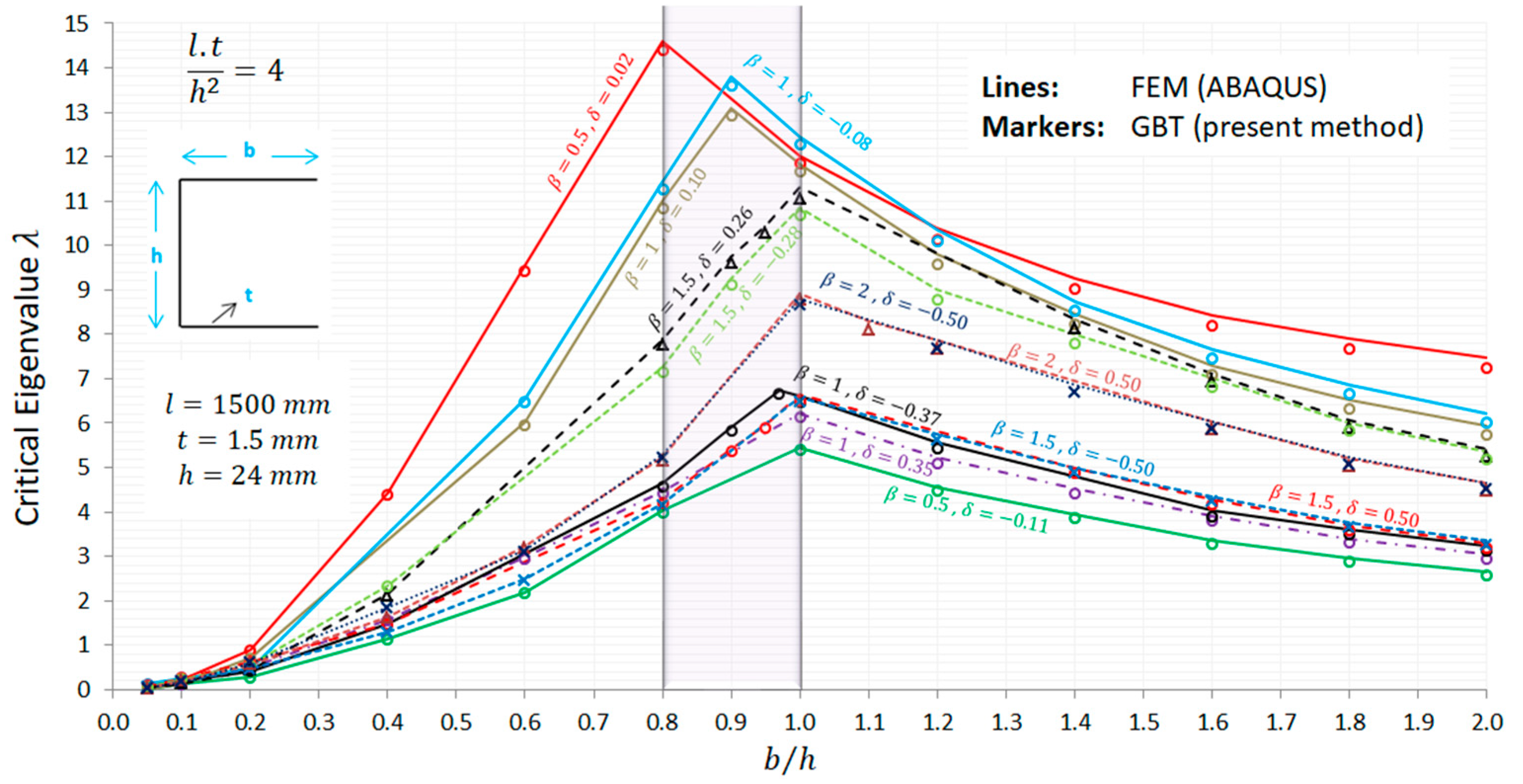
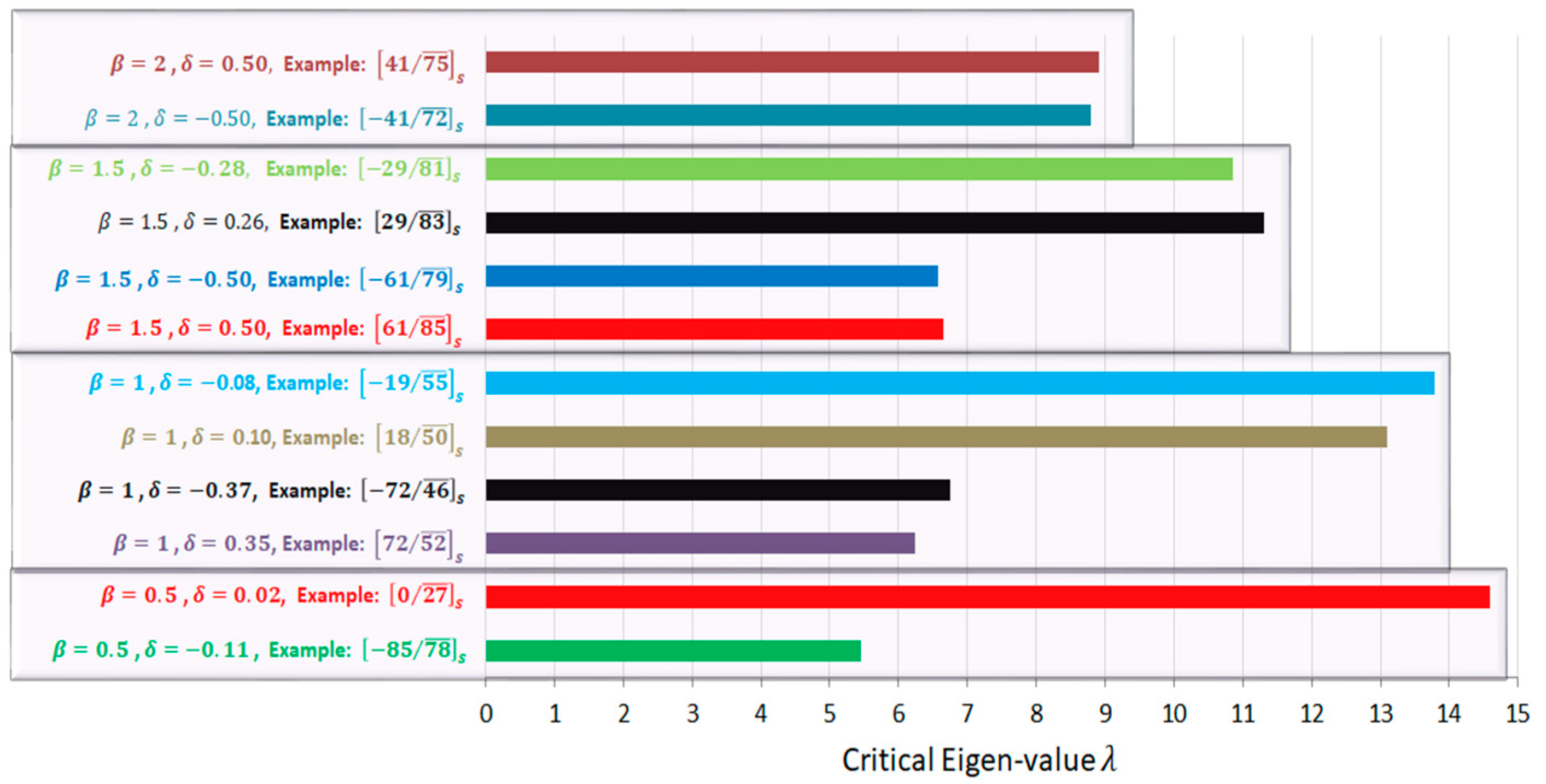
Figure 21 and Figure 22 compare critical buckling eigenvalues λ obtained from the present GBT and FEM for a range of fiber layups characterized by orthotropy parameter β and anisotropy parameter δ as described in the previous section. These parameters are defined based on transformed stiffness relationships and provide a compact means of quantifying the directional stiffness behavior of laminated composites. Figure 21 presents a series of curves representing the variation in the normalized critical buckling eigenvalue λ with respect to the flange-to-web ratio b / h . Each curve corresponds to a specific combination of β and δ . All cases display a peak in λ , around b / h 0.9 , after which the eigenvalue gradually decreases with increasing aspect ratio. This peak corresponds to a shift from local to distortional and eventually to global instability modes as flange width increases. The agreement between GBT and FEM remains consistently high across all b / h ratios and ( β , δ ) pairs. This figure underscores the importance of selecting optimized layup configurations for improved buckling performance, particularly in tailored composite components where cross-sectional geometry is fixed, but stiffness distribution can be modified via fiber orientation. To complement parametric analysis, Figure 22 compares the critical eigenvalues corresponding to different laminate layups derived from the same ( β , δ ) combinations. Each bar represents the lowest eigenvalue (most critical) predicted for that configuration, linked to a sample laminate layup. This figure provides insight into which stacking sequence provides the most efficient resistance to buckling. The highest critical eigenvalue ( λ 14.6 ) occurs for a layup with strong fiber alignment along the web and flange direction ( β = 0.5 , δ = 0.02 , 0 ° / 27 ¯ ° s ) , where axial stiffness dominates. As can be observed, the layups with orthotropy parameter β = 0.5 or 1 and lower anisotropy parameters ( δ 0 ± 0.10 ) achieve the highest eigenvalues, indicating enhanced buckling resistance (Figure 22). Conversely, when β = 1 , 1.5 or 2 , highly anisotropic layups with ( δ 0.35 ) and δ 0.35 yield the lowest eigenvalues, reflecting weakened stiffness in the critical directions. This bar chart representation reinforces the value of integrating orthotropic material tailoring into the structural design process for thin-walled composites.
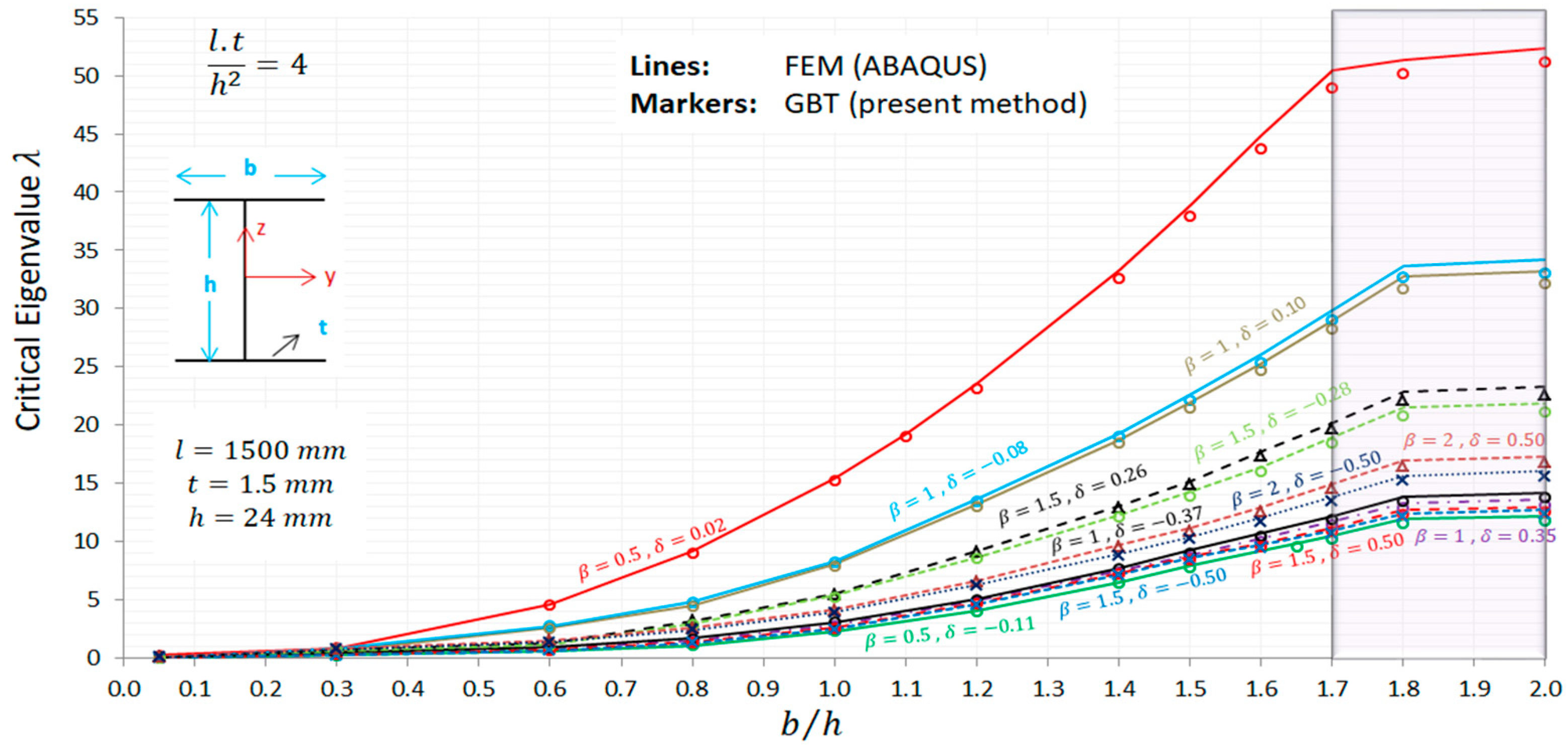
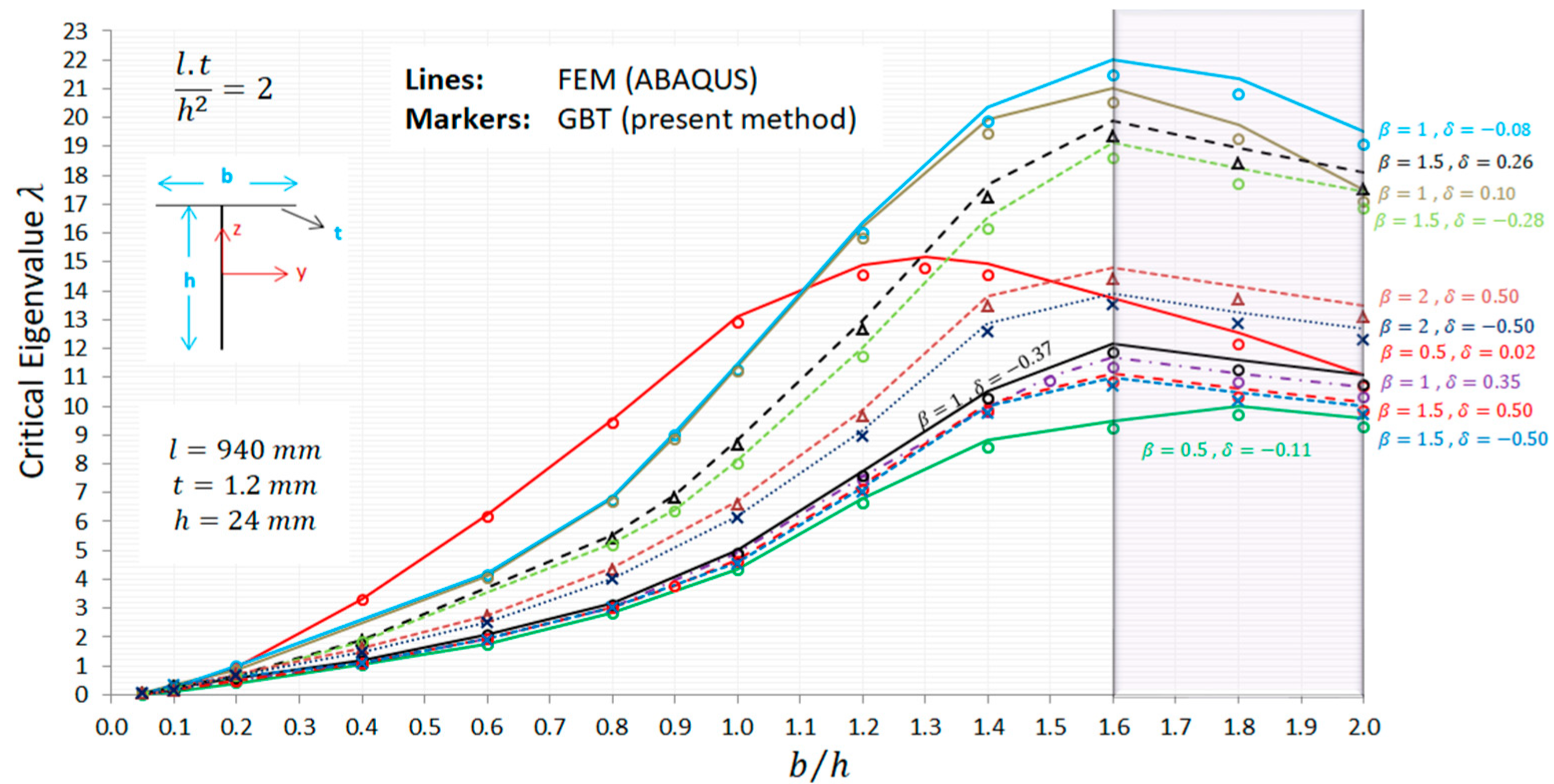
Figure 23 and Figure 24 repeat Figure 21 for I-section and T-section beams, respectively. The agreement is consistently high across all aspect ratios and laminate configurations. The I-section beam (Figure 23) exhibits a monotonically increasing trend in critical eigenvalue λ with respect to the aspect ratio b / h , across all values of β and δ . This behavior reflects the stiffening effect of increasing flange width in the lateral direction, which enhances the beam’s resistance to local and distortional buckling. The maximum values of λ are obtained for low anisotropy ( δ 0 ± 0.10 ) and moderate orthotropy combinations such as β = 0.5 or 1 , indicating higher longitudinal stiffness and lower shear coupling. In contrast, configurations with ( δ 0.35 ) and δ 0.35 consistently yield lower eigenvalues. The T-section (Figure 24), while structurally simpler, displays a non-monotonic trend in λ with b / h , characterized by a pronounced peak around b / h 1.6 1.7 followed by a plateau or slight decline. This peak marks a transition from global-dominated to local-dominated buckling modes, where increased flange width no longer yields a proportional increase in stiffness due to interaction with web deformation. Interestingly, the maximum eigenvalues are slightly different for the same layups as in the I-section. For the T-section, the low values of β , such as β = 0.5 , do not fulfill the maximum value of λ in combination with ( δ 0 ± 0.10 ) , indicating that excessive stiffness contrast may induce early distortional or mixed-mode buckling in asymmetrical geometries. The influence of material orthotropy and anisotropy is amplified in the T-section, where asymmetry introduces complex deformation interactions.
The proposed formulation achieves its computational efficiency by using a limited set of GBT-derived Ritz shape functions to capture the dominant buckling modes, drastically reducing the degrees of freedom compared to traditional FEM. For instance, across the benchmark cases, convergence was obtained using only 8–9 Ritz terms, whereas the corresponding FEM analyses required between 3500 and 5000 shell elements for equivalent accuracy. This reduction translated into an 80–85% decrease in computation time while keeping the deviation in predicted critical buckling loads below 4% relative to FEM (Table 1).
Moreover, the following aspects emphasize the originality and superiority of the present method:
  • Computational Efficiency: Our semi-analytical Ritz-based implementation achieves excellent agreement with high-fidelity FEM results while requiring significantly less computational cost, making it particularly attractive for design optimization and parametric studies.
  • New Parametric Insights: We introduced and systematically analyzed orthotropy (β) and anisotropy (δ) effects on buckling loads, presenting previously unreported insights into optimal layups and geometry-tailoring strategies for enhanced structural performance.
  • Novel Results on Mode Interaction: Through detailed modal and length-dependent analyses, we identified previously unreported local–distortional–global interaction behaviors, especially in Z- and T-sections.


4. Conclusions

This study presented a comprehensive investigation into the buckling behavior of composite thin-walled beams with open unbranched and branched cross-sections using a semi-analytical approach that combines generalized beam theory (GBT) with the Ritz method. By leveraging the modal decomposition capabilities of GBT and the computational efficiency of the Ritz method, a powerful and scalable framework has been developed for analyzing the global, local, and distortional buckling modes of composite members under axial loading.
The GBT–Ritz methodology has been validated through extensive comparisons with high-fidelity finite element simulations using ABAQUS, demonstrating excellent agreement in predicting critical buckling loads and mode shapes across various geometries and symmetric laminate lay-ups. While slight deviations remain in the short-length regime due to complex local phenomena, the overall accuracy of GBT supports its use in rapid parametric design and stability assessment of composite thin-walled members. Furthermore, the framework successfully captured complex buckling interactions in symmetric and asymmetric cross-sections (e.g., C-, I-, Z-, and T-sections) and proved particularly effective in accounting for geometric slenderness and laminate stacking sequences. Moreover, parametric studies on orthotropy and anisotropy parameters (β and δ), as well as thickness-to-height ratios, revealed key insights into the sensitivity of buckling behavior to material tailoring and geometry.
Overall, the proposed approach offers a physically intuitive, computationally efficient, and highly adaptable tool for buckling analysis of composite structures. Its modal basis provides clear insight into deformation mechanisms, making it ideal for early-stage design optimization, laminate selection, and structural stability assessment in advanced composite engineering applications. It should be noted that the current study is limited to linearized eigenvalue buckling analysis and does not consider post-buckling, material yielding, or large deflection effects.

Author Contributions

N.K.: methodology, programming, software, validation, formal analysis, investigation, and writing—original draft preparation. C.M.: supervision, project administration, funding acquisition, and writing—review and editing. All authors have read and agreed to the published version of the manuscript.

Funding

Financial support of the German Research Council: (DFG—Deutsche Forschungsgemeinschaft), project number: 510739591.

Institutional Review Board Statement

Not applicable.

Data Availability Statement

The original contributions presented in this study are included in the article. Further inquiries can be directed to the corresponding author.

Conflicts of Interest

The authors declare no conflicts of interest.

References

  1. Banić, D.; Turkalj, G.; Kvaternik Simonetti, S.; Lanc, D. Numerical Model for a Geometrically Nonlinear Analysis of Beams with Composite Cross-Sections. J. Compos. Sci. 2022, 6, 377. [Google Scholar] [CrossRef]
  2. Zhao, W.; Kapania, R.K. Buckling Analysis and Optimization of Stiffened Variable Angle Tow Laminates with a Cutout Considering Manufacturing Constraints. J. Compos. Sci. 2022, 6, 80. [Google Scholar] [CrossRef]
  3. Kappel, E. On the Double-Double Laminate Buckling Optimum for the 18-Panel ‘Horse-Shoe’ Reference Case. J. Compos. Sci. 2024, 8, 77. [Google Scholar] [CrossRef]
  4. Kim, N.-I.; Shin, D.K.; Kim, M.-Y. Exact lateral buckling analysis for thin-walled composite beam under end moment. Eng. Struct. 2007, 29, 1739–1751. [Google Scholar] [CrossRef]
  5. Kollár, L.P. Local buckling of fiber-reinforced plastic composite structural members with open and closed cross sections. J. Struct. Eng. 2003, 129, 1503–1513. [Google Scholar] [CrossRef]
  6. Mittelstedt, C. Local buckling of wide-flange thin-walled anisotropic composite beams. Arch. Appl. Mech. 2007, 77, 439–452. [Google Scholar] [CrossRef]
  7. Schardt, R. The Generalized Beam Theory. In Instability and Plastic Collapse of Steel Structures: Proceedings of the M.R. Horne Conference; University of Manchester: Manchester, UK, 1983; pp. 469–475. [Google Scholar]
  8. Silva, N.F.; Silvestre, N.; Camotim, D. GBT Formulation to Analyse the Buckling Behaviour of FRP Composite Branched Thin-Walled Members. In Proceedings of the III European Conference on Computational Mechanics, Lisbon, Portugal, 5–8 June 2006. [Google Scholar]
  9. Silvestre, N.; Camotim, D. GBT buckling analysis of pultruded FRP lipped channel members. Comput. Struct. 2003, 81, 1889–1904. [Google Scholar] [CrossRef]
  10. Pires Filho, L.P.; Gonçalves, P.B. Reduced-order models for the buckling and vibration analyses of pultruded FRP angle-section columns. Eng. Struct. 2024, 311, 118145. [Google Scholar] [CrossRef]
  11. Davies, J.M.; Leach, P.; Heinz, D. Second-order generalized beam theory. J. Construct. Steel Res. 1994, 31, 221–241. [Google Scholar] [CrossRef]
  12. Schafer, B.W. Local, distortional, and Euler buckling in thin-walled columns. J. Struct. Eng. 2002, 128, 289–299. [Google Scholar] [CrossRef]
  13. Mittelstedt, C. Generalized beam theory for the analysis of thin-walled structures—A state-of-the-art survey. Thin-Walled Struct. 2024, 200, 111849. [Google Scholar] [CrossRef]
  14. Kharazi, M.; Ovesy, H.R.; Asghari Mooneghi, M. Buckling analysis of delaminated composite plates using a novel layerwise theory. Thin-Walled Struct. 2014, 74, 246–254. [Google Scholar] [CrossRef]
  15. Jing, Z.; Duan, L.; Wang, S. Buckling optimization of variable-stiffness composite plates with two circular holes using discrete Ritz method and potential flow. Int. J. Sol. Struct. 2024, 297, 112845. [Google Scholar] [CrossRef]
  16. Kharghani, N.; Guedes Soares, C. Flexural behaviour prediction of a conventional composite-to-steel butt-joint of ships using layerwise HSDT. In Trends in the Analysis and Design of Marine Structures; Taylor & Francis Group: London, UK, 2019; pp. 369–375. [Google Scholar]
  17. Kharghani, N.; Guedes Soares, C. Influence of different parameters on the deflection of composite laminates containing through-the-width delamination using Layerwise HSDT. Comput. Struct. 2015, 132, 341–349. [Google Scholar] [CrossRef]
  18. Silvestre, N.; Camotim, D. Shear deformable generalized beam theory for the analysis of thin-walled composite members. J. Eng. Mech. 2013, 139, 1010–1024. [Google Scholar] [CrossRef]
  19. Dinis, P.B.; Camotim, D.; Silvestre, N.G. GBT formulation to analyse the buckling behaviour of thin-walled members with arbitrarily ‘branched’open cross-sections. Thin-Walled Struct. 2006, 44, 20–38. [Google Scholar] [CrossRef]
  20. Gonçalves, R.; Camotim, D. Geometrically non-linear generalised beam theory for elastoplastic thin-walled metal members. Thin-Walled Struct. 2012, 51, 121–129. [Google Scholar] [CrossRef]
  21. Baucke, A.; Mittelstedt, C. Closed-form analysis of the buckling loads of composite laminates under uniaxial compressive load explicitly accounting for bending–twisting-coupling. Comput. Struct. 2015, 128, 437–454. [Google Scholar] [CrossRef]
  22. Wiedemann, J. Leichtbau Elemente und Konstruktion; Springer: Berlin/Heidelberg, Germany, 2007. [Google Scholar]
Figure 1. Demonstration of geometrical parameters, natural and intermediate additional discretization points introduced along each wall of the cross-section (between the natural nodes) in the GBT cross-sectional analysis. These nodes are not physical. The cross-sections including intermediate nodes increase the ability of GBT to represent local/distortional deformation modes of individual wall segments (nodes on a channel-section profile).
Jcs 09 00608 g001
Figure 3. (a) Laminate parameters from the thickness view and (b) loading and material coordinates of the lamina.
Jcs 09 00608 g003
Figure 4. Axial compressive loading and boundary conditions for the thin-walled beam. The member is simply supported at x = 0 and x = L: the end cross-sections are free to rotate and to warp. L denotes the effective buckling length between these supports.
Jcs 09 00608 g004
Figure 5. The schematic of Ψ matrix assembly.
Jcs 09 00608 g005
Figure 6. Variation in cross rate with respect to (a) shear rate and (b) anisotropy parameter.
Jcs 09 00608 g006
Figure 7. Comparison of dimensionless parameters of P c r / E A l / π h 2 obtained by the present method with those determined by Wiedemann [22] with respect to b / h for different values of thickness–slenderness l t / h 2 for an isotropic channel-section beam.
Jcs 09 00608 g007
Figure 8. Comparison of dimensionless parameters of P c r / E A l / π h 2 obtained by the present method with those determined by Wiedemann [22] with respect to b / h for different values of thickness–slenderness l t / h 2 for an isotropic I-section beam.
Jcs 09 00608 g008
Figure 9. Displacement amplitude functions for conventional modes for a composite thin-walled beam with channel-section shown in Figure 2: (a) mode 1; (b) modes 2, 3 and 4; (c) modes 5, 6 and 7.
Jcs 09 00608 g009
Figure 10. Comparison of critical buckling loads for different lengths of a thin-walled composite channel-section beam obtained by GBT (present method) and FEM (ABAQUS software).
Jcs 09 00608 g010
Figure 11. Shear deformation modes for a composite channel-section beam.
Jcs 09 00608 g011
Figure 12. Finite element results for a composite channel-section beam: (a) mesh and (b) out-of-plane displacement contour.
Jcs 09 00608 g012
Figure 13. Out-of-plane deflections for different sections along a composite C-section beam obtained by GBT.
Jcs 09 00608 g013
Figure 14. Comparison of critical buckling loads for different lengths of a thin-walled composite I-section beam obtained by GBT (present method), FEM (ABAQUS software), and GBT (reported by Silva et al. [8]).
Jcs 09 00608 g014
Figure 15. Comparison of critical buckling loads for different lengths of a thin-walled composite I-section beam obtained by GBT (present method) and FEM (ABAQUS software).
Jcs 09 00608 g015
Figure 16. Conventional, distortional, and local deformation modes for an I-sectional composite beam.
Jcs 09 00608 g016
Figure 17. Comparison of critical buckling loads for different lengths of a thin-walled composite Z-section beam obtained by GBT (present method) and FEM (ABAQUS software).
Jcs 09 00608 g017
Figure 18. Conventional, distortional, and local deformation modes for a Z-sectional composite beam.
Jcs 09 00608 g018
Figure 19. Capturing of modes: (a) 7; and (b) 8; in Figure 18 by FEM software (ABAQUS).
Jcs 09 00608 g019
Figure 20. Thickness effect on the agreement of the results obtained using GBT (present method) and FEM (ABAQUS) for a composite beam: (a) I-section and (b) Z-section.
Jcs 09 00608 g020
Figure 21. Comparison of the critical eigenvalues for a C-section composite beam with respect to different aspect ratios using GBT and FEM for different values of β (orthotropy parameter) and δ (anisotropy parameter) combinations.
Jcs 09 00608 g021
Figure 22. Comparison of the critical eigenvalues for the C-section composite beam in Figure 21 regarding the lay-up samples for different values of β (orthotropy parameter) and δ (anisotropy parameter) combinations.
Jcs 09 00608 g022
Figure 23. Comparison of the critical eigenvalues for an I-section composite beam with respect to different aspect ratios using GBT and FEM for different values of β (orthotropy parameter) and δ (anisotropy parameter) combinations and a fixed thickness–slenderness parameter.
Jcs 09 00608 g023
Figure 24. Comparison of the critical eigenvalues for a T-section composite beam with respect to different aspect ratios using GBT and FEM for different values of β (orthotropy parameter) and δ (anisotropy parameter) combinations and a fixed thickness–slenderness parameter.
Jcs 09 00608 g024
Table 1. Time comparison between the proposed GBT–Ritz approach and a reference shell FE analysis for beams with the length of 2   m under identical hardware and solver settings.
SectionLay-UpFE (DOFs)Ritz (Terms)FE (Time) [s]Ritz (Time) [s]Speedup [%]
C 0 ° / 45 ¯ ° s 63,0006160025084
I 0 ° / 90 ° s 125,0008210042080
Z 0 ° / 45 ° s 86,0007190032083
T 0 ° / 45 ° s 78,0007170031082
Disclaimer/Publisher’s Note: The statements, opinions and data contained in all publications are solely those of the individual author(s) and contributor(s) and not of MDPI and/or the editor(s). MDPI and/or the editor(s) disclaim responsibility for any injury to people or property resulting from any ideas, methods, instructions or products referred to in the content.