
Article

An Open-Access Fiber Management System for Recycling Filament Wound Structures

M.C. Gill Composites Center, Viterbi School of Engineering, Mork Family Department of Chemical Engineering and Materials Science, University of Southern California, Los Angeles, CA 90007, USA
*
Author to whom correspondence should be addressed.
J. Compos. Sci. 2026, 10(8), 411; https://doi.org/10.3390/jcs10080411
Submission received: 23 June 2026 / Revised: 28 July 2026 / Accepted: 31 July 2026 / Published: 3 August 2026
(This article belongs to the Section Fiber Composites)

Abstract

Composite overwrapped pressure vessels (COPVs) present a tractable recycling target as the production/recovery methods do not require cutting fibers, permitting recovery and re-spooling of continuous fiber tows. To address the gap between lab-scale recycling methods and commercial COPVs as a target application, an apparatus is required to control the unwinding process during recycling. A fiber management system (FMS) was designed and produced to maintain tension in the fiber tows and prevent tangles during unwinding filament-wound structures. To demonstrate the effects of the FMS, vitrimer composite tubes were produced, the matrix was dissolved, and recovered tows were used to produce a second tube. Second-generation specimens, some produced from tows unwound with the FMS as well as some from tows recovered manually, were cut into coupons and the tubular short-beam strength was measured. Specimens remanufactured with recovered tows unwound with the fiber management system exhibited an 11% increase in strength compared to specimens that were manually unwound (p = 0.048) and were statistically indistinguishable from first-generation tubes (p = 0.22). Maintaining control of the fiber tows resulted in full retention of mechanical properties in addition to automating and simplifying the unwinding process.

1. Introduction

Composite materials play an important role in sustainable systems, enabling lighter-weight vehicles, but they are inherently difficult to recycle, and current recycling technology achieves only down-cycling. The literature contains many reports of lab-scale experiments that recover undamaged fibers suitable for re-use, but nearly all fail to demonstrate a remanufacturing pathway to circularity. In this work, we address the gap between lab-scale chemical recycling methods and recycling fibers from filament-wound composite overwrapped pressure vessels (COPVs). COPVs represent a logical (and admittedly convenient) recycling target since unlike most other process routes, the carbon fibers are not cut during manufacturing. To leverage the fiber continuity inherent in COPVs, a fiber management system (FMS) was developed. This system automated the unwinding process and evenly distributed the recovered fibers onto a spool for subsequent reuse.
COPV applications include gas storage, such as hydrogen and natural gas, as well as aerospace uses, such as life support systems and propellants [1]. These applications are increasing as alternatives to petroleum fuels gain traction and space launches become more widespread [2,3]. As more tanks are produced, end-of-life options become increasingly critical, especially given that current recycling methods typically limit recovered carbon fibers to downcycling. In a review of carbon fiber recovery, long fibers were defined as ≥100 mm [4]. In 2021, Weisenberger and Morris presented a cost breakdown for hydrogen COPVs, where 75 kg of carbon fiber was used per tank [5]. Based on the technical data sheet for the fibers, this equates to approximately 95,000 m of carbon fiber per COPV, which is orders of magnitude longer than the capabilities of typical long-fiber recovery from composite recycling techniques [6].
Previous work demonstrated the proof-of-concept for recycling and remanufacturing composite tubes representative of the hoop-wound region of COPVs [7]. A vitrimer epoxy matrix enabled the separation of the composite tows, and second-generation tubes were produced to demonstrate a pathway to complete recycling. The vitrimer matrix can also be returned to its component monomers, enabling reuse of both the reinforcements and matrix components of the composite. Vitrimers represent a class of crosslinking thermoset polymers that contain a covalent adaptable network capable of undergoing bond-exchange reactions that change the molecular topology [8]. Vitrimers have cross-links that impart strength (like thermosets), but are potentially recyclable, like thermoplastics, when exposed to external stimuli, such as heat or dissolution.
In a previous study, two vitrimer formulations were filament-wound for hydrogen COPV applications [9]. The thermomechanical properties of the traditional and vitrimer epoxies were similar, differing only in reaction kinetics, indicating the viability of vitrimer-matrix COPVs. The authors investigated weldability and formability, but did not address fiber recovery or remanufacturing. Unwinding carbon fiber reinforcements from a COPV was demonstrated using a chemical recycling method consisting of water, zinc acetate and acetic acid [10]. While this work unwound a 230 mm-long, fully overwrapped COPV, the matrix was depolymerized in an autoclave at 240 °C, requiring expensive equipment and energy-intensive conditions. The custom unwinding device consisted of a rod supporting the COPV, a resin wash equipped with three rollers, a nip roller, and a final cardboard spool to collect the fibers.
Herein, an open-access fiber management system was introduced to systematically unwind and recover fibers from filament-wound composite structures. The system cost was less than a tenth of the cost of the smallest commercial filament winder [11]. A previously investigated epoxy-based vitrimer was selected as a model to demonstrate the benefits of fiber management during recycling, while the recycling methods were reported previously [7]. Here, we introduce a redesigned apparatus that enables long carbon fiber recovery and potentially remanufacture of filament-wound products. This system can be modified to accommodate other matrix materials, and other chemical recycling methods such as solvolysis, electrolysis, and supercritical fluids, among others [12]. The effects of the FMS were studied by comparing microscopy images, short-beam strength (SBS) and single fiber tensile testing of tubes unwound with the FMS versus a manual (by hand) unwinding of the recovered fibers.

2. Materials and Methods

2.1. Materials

To demonstrate fiber management during recycling, a proprietary vitrimer blend matrix was chosen for preparation of composite samples (Vitrimax VHM (Versatile Hot Melt) Two-Part Resin System, Mallinda Inc., Denver, CO, USA). Resin preparation consisted of mixing the imine with the epoxy at a 1.5:1 ratio, followed by 3 cycles of 2 min mixing and 2 min heating at 80 °C. Carbon fiber reinforcement was selected in accordance with industrial standards for COPVs (T700S, 24K tow count, 50C (1%) sizing, Toray, Tokyo, Japan). Filament winding was used to fabricate the samples using a lab-scale filament winder (4-Axis Model 4X-23, X-Winder, El Prado, NM, USA). The resin bath section was modified by adding polytetrafluoroethylene (PTFE) rollers to direct the fibers through the wet resin. Two tubular mandrels were designed, with diameters of 152.4 mm and 31.75 mm, made from aluminum and silicone, respectively. The silicone mandrel was collapsible, allowing for the removal of a tubular part without cutting the fibers, which was advantageous for the dissolution process. A smaller-diameter mandrel was employed to produce 102 mm-long tubes for dissolution, while a larger-diameter mandrel was used to fabricate 25.4 mm-long tubes for mechanical testing. All the tubes produced consisted of 10 layers.
Filament winding settings included a linear carriage speed of 1.8 mm/s, a mandrel rotation rate of 10 rpm, and a mandrel speed of 79.8 mm/s. Following winding, consumables consisting of peel ply (FIBREGLAST Econostitch Peel Ply, FIBREGLAST, Brookville, OH, USA), perforated release film (AIRTECH A4000P3-001-48″, AIRTECH, Huntington Beach, CA, USA), breather (AIRTECH AIRWEAVE-N10-60″, AIRTECH, Huntington Beach, CA, USA), and shrink tape were applied (HI-SHRINK TAPE 100 yards—Release Coated 220 cR 1.5″, Composite Envisions LLC, Wausau, WI, USA). The shrink tape was activated with a heat gun prior to the cure cycle.

2.2. Fiber Management System Assembly

The FMS was designed to act as a two-axis filament winder while offering a modular, customizable format. A base of aluminum 2020 T-slots (CtopoGo, Shenzhen Guotongda Import & Export Co., Shenzhen, China) was chosen along with corner brackets with screws (US-288, UtySty),to support the subsequent mechanism. Polylactic acid (PLA) was utilized for 3D printing to produce the tensioner arms, delivery fork, motor supports, limit switch holders, fiber tube, tube end caps, and tube attachment points. 3D models of these parts are available in the Supplemental Information. The dissolved fiber tube and accompanying support arms were printed from polyether ether ketone (PEEK) for its high working temperature and chemical resistance. The 3D printed components were designed with a cloud-based CAD software (OnShape, Version 1.218, PTC, Boston, MA, USA).
Stepper motors (NEMA 17, STEPPERONLINE, New York, NY, USA) controlled the rotational and transverse axes of movement with 6 mm GT2 timing belts (HANGLIFE, Shenzhen Xinhang Software Technology Co., Ltd., Shenzhen, Guangdong, China) and 5 mm bore timing pulleys (Saiper). Breadboard jumper ribbon cables (ELEGOO, Shenzhen, Guangdong, China) connected the motors to the motor drivers (TMC2209 V1.3, BIGTREETECH, Longgang District, Shenzhen, China), the drivers to the controller (MEGA 2560 R3 Board with USB Cable, ELEGOO, Shenzhen, Guangdong, China), the limit switch (MXR-PL-YBKG, IRIDESCENT), and breadboard (830 Point Breadboard Kit, ELEGOO, Shenzhen, Guangdong, China). The power supply (24 V 96 W LED Driver 120 V AC to DC 24 V 4 A LED Transformer, iCreatin, Shenzhen, Guangdong, China) and USB hub (Amazon Basics USB 3.2/3.1 Gen 2 Multiport USB C Hub Dock, 10 Gbps, USB-C to 1xUSB-C/3xUSB-A, Amazon, Seattle, WA, USA) were connected to power and a computer, respectively. The rollers were machined from polytetrafluoroethylene rods (8546K14, McMaster-Carr, Elmhurst, IL 60126, USA) and attached with M3 × 70 mm Thread Pitch stainless steel screws (50 Pcs M3 × 70 mm Thread Pitch 0.5 mm Stainless Steel 304 Hex Socket Head Cap, iexcell).

2.3. Electrical Components and Software Controller

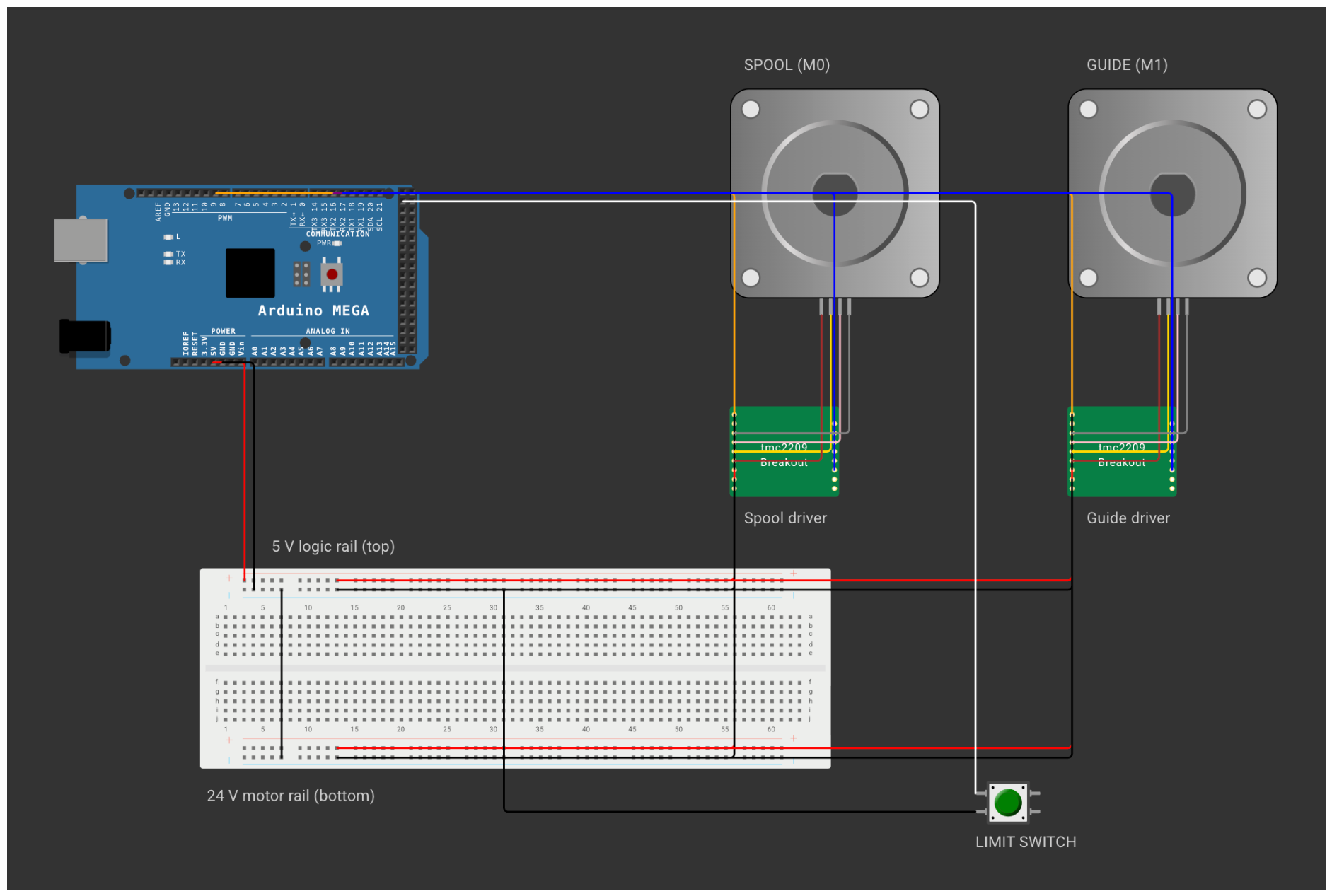
The FMS contained two power supplies: 5 V from the controller board, supplied via USB cable, and 24 V from the power adapter, powering the motors. Each motor was controlled by an individual driver, which had its own serial communication line (UART). The motor controlling the fiber spool used pins 18 and 19, while the delivery head motor used pins 16 and 17. Each motor was controlled via three output pins: an enable line, a direction line, and a step line. The spool motor used Arduino pins 8, 5, and 2 for these three signals, while the delivery head motor used pins 9, 6, and 3. The limit switch was connected between pin 22 and ground, using the embedded resistor within the controller, so that it generated a signal when the delivery head reached the limit switch. A wiring diagram including pin assignments and wire color coding is shown in Figure A1.
A web-based application was developed to connect the FMS to a computer for motor control through a standard USB cable. The interface allowed for the motor speed and travel to be independently set for the recovered fiber spool motor (M0), the guide motor (M1), or both (ALL). Each driver utilized the open-source TMCStepper library to determine default motor settings [13]. The controller’s firmware was written in C++. Additional settings included controls to start, stop, and pause the unwinding process as well as to home the delivery head to the limit switch.

2.4. Testing

ASTM D2344/D2344M-22 was followed to determine tubular short-beam strength of the reinforced coupons tested at 1 mm/min (Instron 5667) with a sample size of 8 coupons per specimen type [14]. Light microscopy (VHX-7100, Keyence, Osaka, Japan) was employed to image polished sections to determine microstructure. The resulting microscopy images were used in conjunction with machine learning algorithms to quantify void content and fiber volume fractions (Dragonfly 2024.1). Void content was measured from 10 images at 150×, while the fiber volume fraction was measured using 10 images 1500× magnification. Single-fiber tensile testing was completed following ISO 11566: 1996(E) to evaluate changes between virgin and recovered fibers [15]. We used manufacturer-reported diameters because matrix residue obscured measurements.

3. Results and Discussion

3.1. Design and Construction

The fiber management system was assembled to maintain tension and systematically unwind fibers from composite tubes representative of the hoop winding section of a COPV overwrap. Figure 1 contains a schematic of the assembly. The FMS allowed for the vitrimer matrix tubes to be dissolved and unwound systematically. The tension along the fibers prevented twisting and tangling during unwinding, ensuring the fibers were ready for remanufacturing. The recovered fibers were used with virgin resin to create tubes suitable for mechanical testing to further investigate the effectiveness of the FMS.
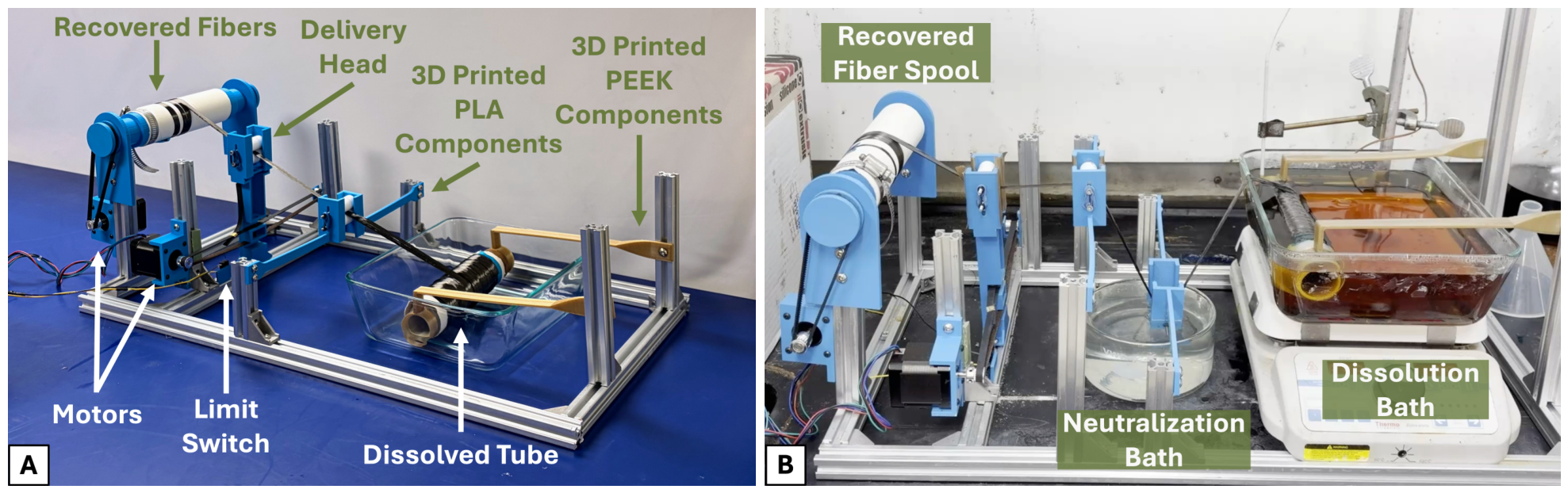
The process started with tubes on the right-hand side of the assembly (shown in the images) before being passed through rollers and a custom delivery head, and finally to the recovered fiber spool. The motion of the delivery head distributed the fibers evenly across the spool to resemble a fiber creel. The base of extruded aluminum framing rails permitted the system to be modular and accept numerous configurations, as standard T-slots allow parts to be repositioned easily. In Figure 2B, a neutralization bath was added to streamline and automate the fiber cleaning process. Following the neutralization bath, the fibers passed through a set of PTFE rollers compressed with elastic bands to apply tension and remove excess resin from the fiber tows.

3.2. Microscopy

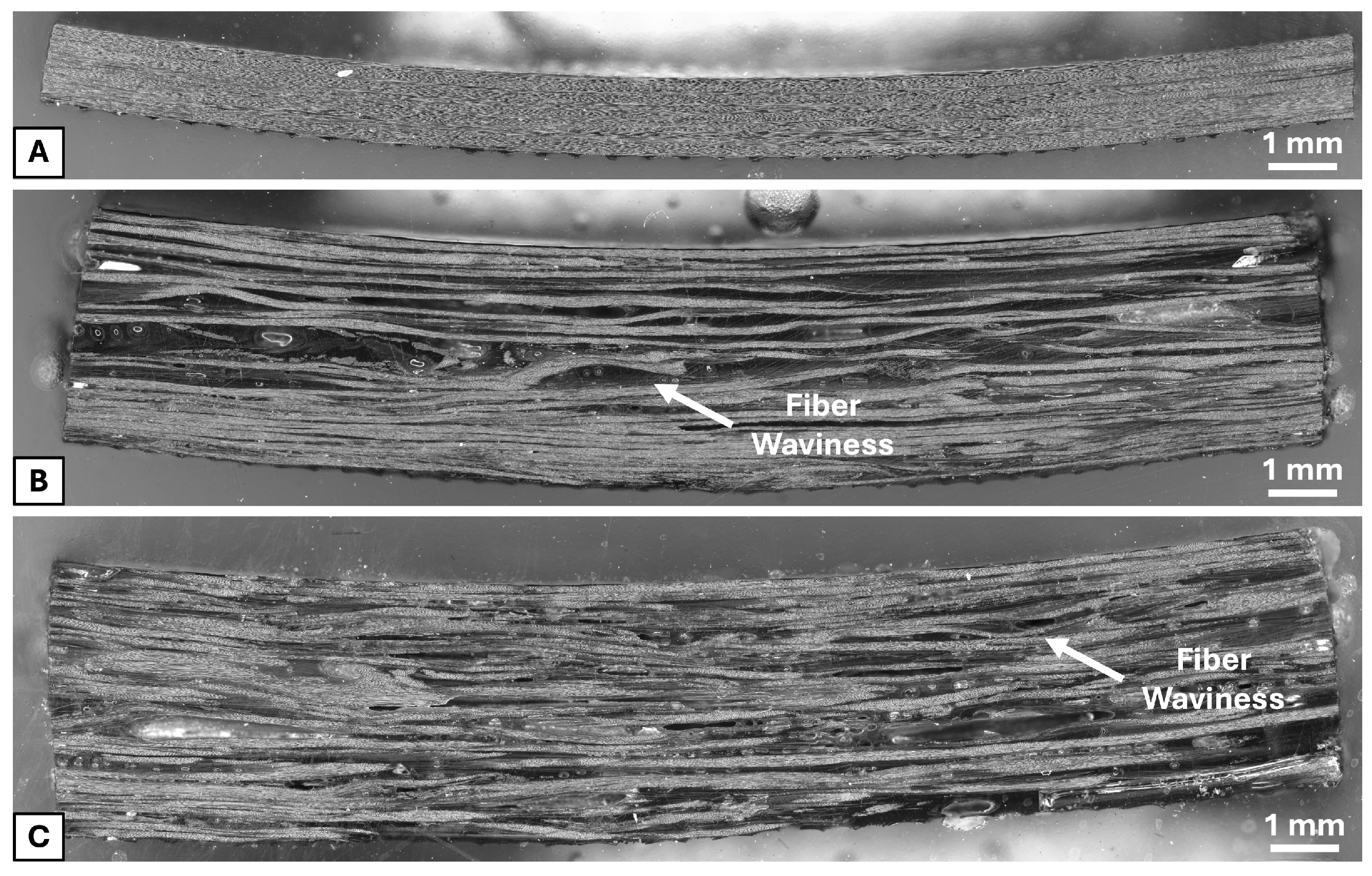
Figure 3 displays images of all three samples. The first-generation coupons showed greater compaction than the remanufactured coupons. The recycling process proceeded for 2 h, chosen because matrix residue on the fibers retained tow integrity and prevented fraying. This residual matrix material remained on the recovered fibers and prevented further resin impregnation during the second filament winding process, which led to an increase in apparent thickness. The control coupons had an average thickness of 1.36 mm, compared to 3.22 mm and 3.64 mm for the manual and managed coupons, respectively. Because all composite specimens consisted of 10 layers of tows, the difference in thickness between sample types reflects differences in fiber packing and resin content. Both remanufactured specimen sets exhibited tow waviness, shown in Figure 3B, C. However, the manual specimens displayed more severe waviness than the managed specimens, because the FMS increased fiber alignment during rewinding.
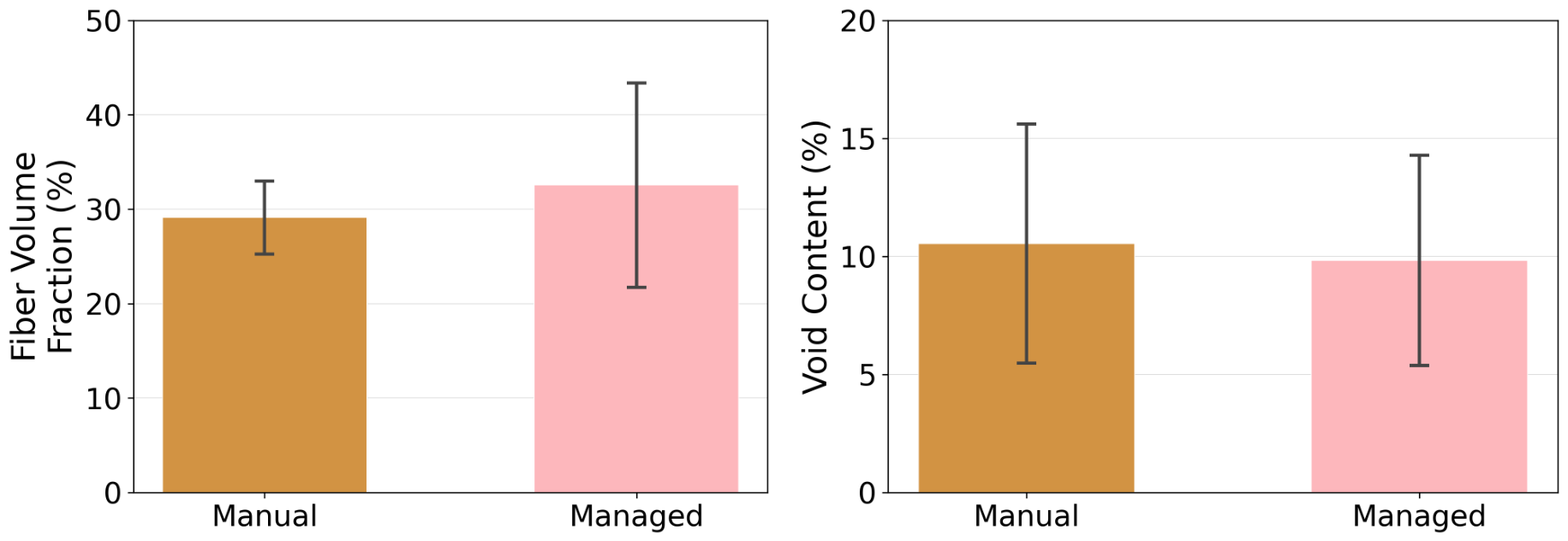
Image segmentation revealed similar fiber volume fractions and void contents between both types of recovered fibers. This data is shown in Figure 4, where the average FVF for the manual coupons was 29% compared to 32.5% for the managed coupons. The void content followed a similar trend—the manual content was 10.5%, and the managed content at 9.8%. Comparing the manual and managed data sets, there is no statistical difference for fiber volume fraction between (p = 0.74) or for void content (p = 0.36) according to a Welch’s t-test with the Holm–Bonferroni method. The control specimen exhibited a void content of 0.71 ± 0.5% and a fiber volume fraction of 56.3 ± 6.2%, which was greater than the remanufactured coupons. We previously demonstrated that the differences between the first- and second-generation parts were due to excess resin [7]. The two specimen types displayed similar defect contents in the matrix and fiber-matrix interface, which were defects typically introduced by filament winding and cure, and not attributable to fiber alignment [16].

Short-Beam Strength

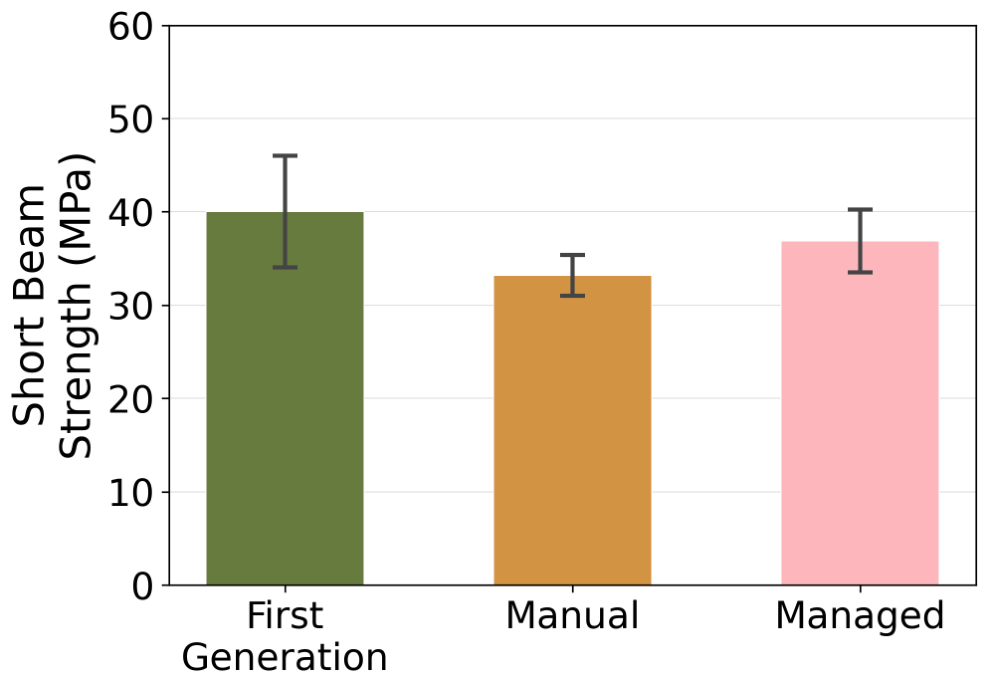
Tubular short-beam strength was selected to incorporate the typical tank geometry. The results of strength testing are shown in Figure 5. The average SBS of the managed coupons (36.9 MPa) was 11% greater than the manual counterpart (33.2 MPa). The difference between the managed and manual data sets was statistically significant (p = 0.0476) following the same statistical analysis that was completed for the microscopy analysis. The strength increase was attributed to greater fiber alignment, which strongly affects short-beam strength [17]. During filament winding, the manually unwound fibers were twisted and coiled during layup, whereas the managed fibers were not. The FMS clearly reduced fiber misalignment and associated defects. The mechanical behavior of the first-generation specimens was statistically indistinguishable from that of the managed specimens (p = 0.2198), indicating that the FMS maintained strength and the specimens had comparable fiber alignment.

3.3. Single-Fiber Tensile Testing

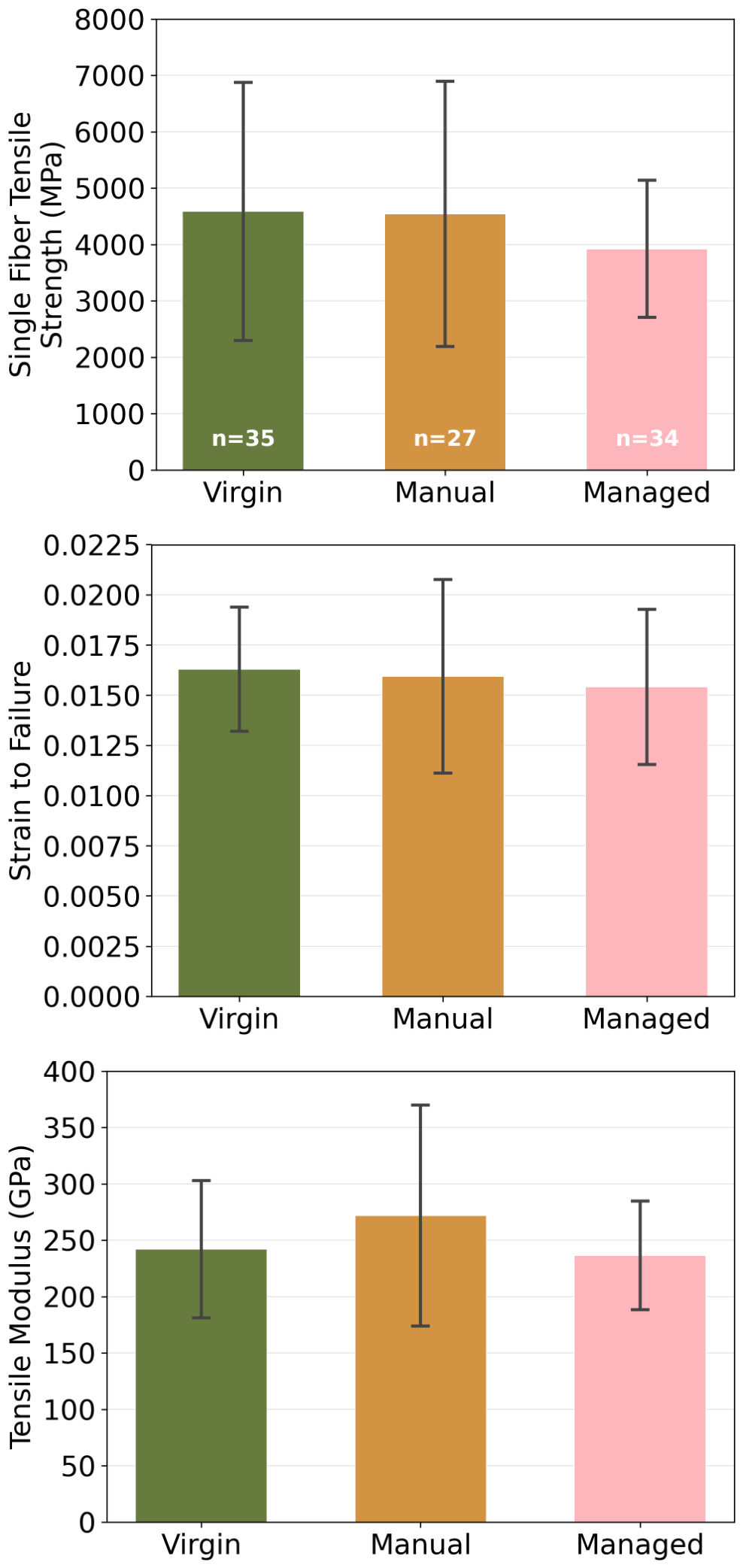
Single-fiber tensile tests were performed to determine the effects of both recycling methods on the recovered fibers. The data from recycled fibers is shown in Figure 6, along with data for virgin fibers. For statistical testing, Welch’s t-test followed by the Holm–Bonferroni method revealed no significant differences in tensile strength, strain-to-failure, or modulus across the three data sets. The average tensile strength of the managed fibers (3921 MPa) was less than that of virgin fibers (4584 MPa) and fell within the 30% scatter commonly associated with single-fiber tensile strength measurements [18]. Thus, the FMS did not introduce fiber damage and required no trade-off between fiber control and strength.

4. Conclusions

As COPV applications expand, end-of-life considerations become increasingly important, particularly because many COPV uses aim to reduce carbon emissions. A scalable fiber management method is essential for recovering high-value CFs and achieving true circularity in composites manufacturing. We reported a low-cost, customizable device to address the gap between composite recycling methods and practical applications. The managed specimens exhibited statistically significant improvements in short-beam strength relative to manually unwound fibers, while single-fiber tensile testing confirmed that the FMS did not introduce damage. These results establish that systematic fiber management during recycling measurably improves the mechanical performance of remanufactured components.
The fiber management system described here represents a proof-of-concept lab-scale prototype. The system features a modular design that can be easily tailored to multiple approaches to chemical recycling. The vitrimer resin formulation was chosen to demonstrate a viable pathway for recycling thermoset COPVs and true circularity, although it is not yet used in commercial COPVs. To extend the system to thermoset matrices, the solvent chemistry must be tailored to the matrix polymer. The features of the system are suitable to scale-up for larger volumes. However, scale-up will require faster reaction kinetics, necessitating more aggressive conditions or forcing stimuli to drive dissolution. COPVs feature large quantities of continuous fibers in relatively small volumes, as the overwrap can be >25 mm thick. This feature will present diffusion challenges for scale-up. The FMS can, in principle, be programmed to automate a layer-by-layer recycling process, separating the wrap structure layer-by-layer.

Supplementary Materials

The following supporting information can be downloaded at: https://www.mdpi.com/article/10.3390/jcs10080411/s1.

Author Contributions

Conceptualization, A.K. and S.N.; methodology, A.K.; validation, A.K.; formal analysis, A.K.; investigation, A.K.; resources, S.N.; writing—original draft preparation, A.K.; writing—review and editing, S.N.; visualization, A.K.; supervision, S.N.; project administration, A.K.; funding acquisition, S.N. All authors have read and agreed to the published version of the manuscript.

Funding

This work was supported by the M.C. Gill Composites Center and the Ershaghi Center for Energy Transition at USC under grant number CA101515-2010621. Funding for this project came from a cy pres award, as part of the distribution of a settlement relating to fuel economy for gasoline-powered vehicles.

Data Availability Statement

The original contributions presented in this study are included in the article. Further inquiries can be directed to the corresponding author.

Acknowledgments

The authors gratefully acknowledge Toray for generously providing materials. We are grateful to Kyle Wang for designing the CAD files for the 3D printed components. We thank Garrett Flynn for assistance with electrical wiring and software development. During this work, the authors used Claude Sonnet 4.6 by Anthropic for coding assistance in the development of the web-based controller for the FMS including firmware and software. The authors have reviewed and edited the output and take full responsibility for the content of this publication.

Conflicts of Interest

The authors declare no conflicts of interest.

Abbreviations

The following abbreviations are used in this manuscript:
CFCarbon fiber
COPVComposite overwrapped pressure vessel
FMSFiber management system
PEEKPolyether ether ketone
PLAPolylactic acid
PTFEPolytetrafluoroethylene
SBSShort-beam strength

Appendix A. Bill of Materials

Table A1. Bill of materials for the FMS. All prices listed in USD at time of purchase.
ComponentDescriptionQty.Unit Price ($)Total ($)
PLA FilamentSUNLU PLA 3D Printer Filament 1.75 mm, 1 kg spool217.9935.98
Aluminum T-slot ExtrusionT Slot 2020 Aluminum Extrusion European Standard Anodized Linear Rail159.9959.99
T-slot Corner Connectors2020 Aluminum Extrusion Corner Brackets 90 deg Right Angle L Connector with T-Slot M5 Bolts Nuts for 2020 Series Aluminum Extrusion Profile Linear Rail28.9717.94
T-slot Nuts and Bolts200 pcs 2020 Series M5 T-Nut and Screw Kit–Sliding and Drop-in T-Nuts, M5x8 mm and M5x10 mm Screws, Washers, Ball-End Hex Wrench–for 6 mm T-Slot Aluminum Extrusion212.9925.98
Stepper MotorsSTEPPERONLINE Nema 17 Stepper Motor Bipolar 2 A 59 Ncm (84oz.in) 48 mm Body 4-Lead W/1 m Cable and Connector213.9927.98
Limit SwitchesSPDT 1NO 1NC Hinge Lever Momentary Push Button Micro Limit Switch AC 5 A 125 V 250 V 3 Pins 12 Pcs14.394.39
Stepper Motor DriversBIGTREETECH TMC2209 V1.3 Stepper Motor Driver, 2.8 A UART/DIR/Step Mode Ultra-Silent Stepstick Drivers122.9922.99
ControllerELEGOO MEGA R3 Board ATmega 2560 + USB Cable122.9922.99
Power Supply24 V 96 W LED Driver 120 V AC to DC 24 V 4 A LED Transformer, AC-DC Power Adapter Supply113.9913.99
Breadboard3 pcs Breadboard 830 Point Solderless Prototype PCB Board Kit, ELEGOO18.998.99
WiresELEGOO 120 pcs Multicolored Dupont Wire 40 pin Male to Female, 40 pin Male to Male, 40 pin Female to Female Breadboard Jumper Ribbon Cables Kit Compatible with Arduino Projects16.986.98
USB HubAmazon Basics USB 3.2/3.1 Gen 2 Multiport USB C Hub Dock, 10Gbps, USB-C to 1xUSB-C/3xUSB-A110.6210.62
GT2 Timing BeltsGT2 Timing Belt with Copper Buckle—3D Printer Open Synchronous Belt (2 mm Pitch) 3D Printer Accessories—6 mm × 2 M (6.6 ft)28.9917.98
GT2 PulleysSaiper GT2 16 Teeth 5 mm Bore Timing Pulley Aluminum Synchronous Wheel for 6 mm Belt16.996.99
PTFE RodChemical-Resistant Slippery PTFE Rod 5/8” Diameter17.867.86
Delivery Head Fasteners50 Pcs M3 × 70 mm Thread Pitch 0.5 mm Stainless Steel 304 Hex Socket Head Cap Screws Bolts Kit19.969.96
RollersCustom-machined rollers 40 mm in length with a 3.4 mm bore415.0060.00
Hose ClampEverbilt—1-3/4–2-3/4 in. Stainless Steel Hose Clamp13.183.18
Rubber BandsAmazon Basics Assorted Size and Color Rubber Bands, Strong Elastic Stretch Office Supplies, 0.5 lb. Variety Assortment15.845.84
Total 370.73

Appendix B. Software and Wiring

The software for controlling the FMS is available at https://kennedycomposites.github.io/rewinder/ (accessed on 30 July 2026). Details of the wiring are presented in Figure A1.
Figure A1. Electrical wiring diagram to control the FMS motors.
Jcs 10 00411 g0a1

References

  1. Gardiner, G. Composites End Markets: Pressure Vessels (2025). CompositesWorld, 8 October 2025. [CrossRef]
  2. Sethia, H.; Priyam, A. Review on hydrogen fuel cells as an alternative fuel. Next Energy 2025, 9, 100460. [Google Scholar] [CrossRef]
  3. Semanik, M.; Crotty, P. International Trade Commission Executive Briefings on Trade. 2023. Available online: https://www.usitc.gov/publications/332/executive_briefings/ebot_us_private_space_launch_industry_is_out_of_this_world.pdf (accessed on 30 July 2026).
  4. Abdi, B.; Wang, Y.; Gong, H.; Su, M. Recycling, Remanufacturing and Applications of Semi-Long and Long Carbon Fibre from Waste Composites: A Review. Appl. Compos. Mater. 2025, 32, 1237–1265. [Google Scholar] [CrossRef] [PubMed]
  5. Weisenberger, M.C.; Morris, E.A. Precursor Processing Development for Low Cost, High Strength Carbon Fiber for Composite Overwrapped Pressure Vessel Applications; University of Kentucky: Lexington, KY, USA, 2021. [Google Scholar]
  6. Toray Carbon Fibers Europe. T700s Carbon Fiber Data Sheet; Toray Carbon Fibers Europe: Lacq, France, 2024. [Google Scholar]
  7. Kennedy, A.; Ghafafian, C.; Nutt, S. Production and Remanufacturing of Vitrimer Matrix Composite Tubes. J. Compos. Sci. 2026, 10, 14. [Google Scholar] [CrossRef]
  8. Montarnal, D.; Capelot, M.; Tournilhac, F.; Leibler, L. Silica-like malleable materials from permanent organic networks. Science 2011, 334, 965–968. [Google Scholar] [CrossRef] [PubMed]
  9. Alms, J.; Sambale, A.K.; Fuchs, J.; Lorenz, N.; Von Den Berg, N.; Conen, T.; Çelik, H.; Dahlmann, R.; Hopmann, C.; Stommel, M. Qualification of the Vitrimeric Matrices in Industrial-Scale Wet Filament Winding Processes for Type-4 Pressure Vessels. Polymers 2025, 17, 1146. [Google Scholar] [CrossRef] [PubMed]
  10. Simmons, K.; Kuang, W.; Trevino, A.; Ramos, J.; Boushab, D.; Zhang, J. Reclamation of Continuous, Pristine Carbon Fibers from Filament Wound Composite Pressure Vessels for Sustainable Hydrogen On-board Storage Applications. SAMPE J. 2025, 61, 70–75. [Google Scholar] [CrossRef]
  11. 4-Axis Model 4X-23 w/2x Delivery Head Conversion Kit—X-Winder LLC. Available online: https://xwinder.com/4-axis-model-4x-23-w-2x-delivery-head-conversion-kit/?srsltid=AfmBOorYDMyLakuRaWmhkg888-FuVosgLq8FGAkz7MCyZe5AHXO4KJZB (accessed on 30 July 2026).
  12. Liu, T.; Shao, L.; Zhao, B.; Chang, Y.C.; Zhang, J. Progress in Chemical Recycling of Carbon Fiber Reinforced Epoxy Composites. Macromol. Rapid Commun. 2022, 43, 2200538. [Google Scholar] [CrossRef] [PubMed]
  13. teemuatlut. TMCStepper. 2021. Available online: https://github.com/teemuatlut/tmcstepper (accessed on 30 July 2026).
  14. D2344/D2344M—22; Standard Test Method for Short-Beam Strength of Polymer Matrix Composite Materials and Their Laminates. ASTM International: West Conshohocken, PA, USA, 2022.
  15. 11566:1996(E); Carbon Fibre—Determination of the Tensile Properties of Single-Filament Specimens. ISO: Geneva, Switzerland, 1996.
  16. Elkolali, M.; Nogueira, L.P.; Rønning, P.O.; Alcocer, A. Void Content Determination of Carbon Fiber Reinforced Polymers: A Comparison between Destructive and Non-Destructive Methods. Polymers 2022, 14, 1212. [Google Scholar] [CrossRef] [PubMed]
  17. Selmy, A.I.; Elsesi, A.R.; Azab, N.A.; Abd El-Baky, M.A. In-plane shear properties of unidirectional glass fiber (U)/random glass fiber (R)/epoxy hybrid and non-hybrid composites. Compos. Part B Eng. 2012, 43, 431–438. [Google Scholar] [CrossRef]
  18. Pardini, L.C.; Manhani, L.G.B. Influence of the Testing Gage Length on the Strength, Young’s Modulus and Weibull Modulus of Carbon Fibres and Glass Fibres. Mater. Res. 2002, 5, 411–420. [Google Scholar] [CrossRef]
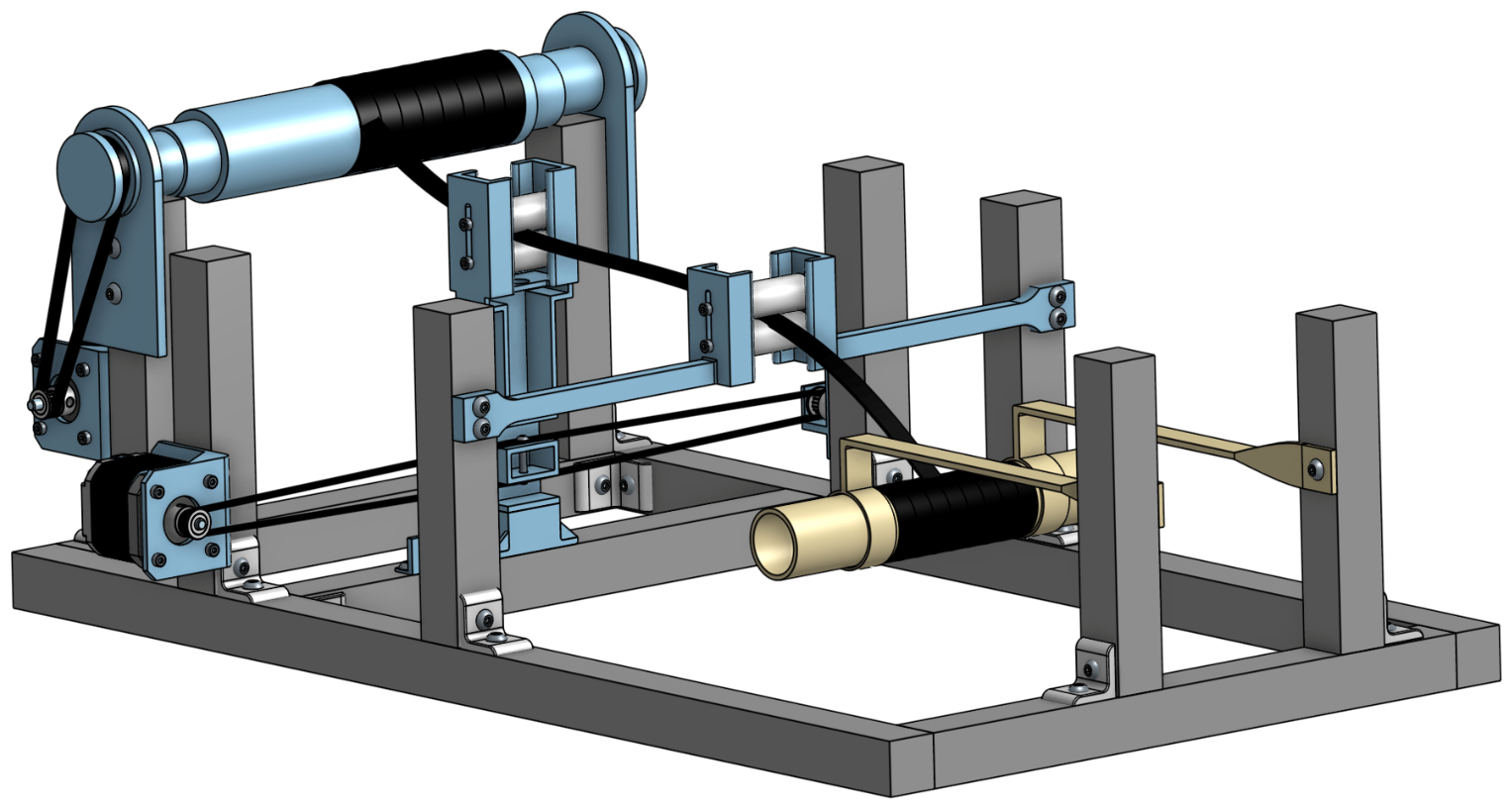
Figure 1. 3D CAD model of the fiber management system.
Jcs 10 00411 g001
Figure 2. The custom fiber management system with components labeled (A) and with recycling process steps (B).
Jcs 10 00411 g002
Figure 3. Light microscopy images of first-generation (A), manual (B), and managed (C) coupons.
Jcs 10 00411 g003
Figure 4. The fiber volume fraction and void contents for manually and managed remanufactured components.
Jcs 10 00411 g004
Figure 5. Tubular short-beam strength of first-generation composite as well as specimens recycled manually and with the fiber management system.
Jcs 10 00411 g005
Figure 6. Single-fiber tensile testing data for virgin fibers, as well as fibers recovered from manual and managed unwinding processes.
Jcs 10 00411 g006
Disclaimer/Publisher’s Note: The statements, opinions and data contained in all publications are solely those of the individual author(s) and contributor(s) and not of MDPI and/or the editor(s). MDPI and/or the editor(s) disclaim responsibility for any injury to people or property resulting from any ideas, methods, instructions or products referred to in the content.