Review

Life Cycle Assessment of 3D Concrete Printed Buildings: A Review of Methodologies, Standards and EPBD Compliance

1
Centre for Critical Infrastructure, School of Civil Engineering, University College Dublin, D04 V1W8 Belfield, Ireland
2
Construct Innovate, School of Civil Engineering, University College Dublin, D04 V1W8 Belfield, Ireland
*
Authors to whom correspondence should be addressed.
J. Compos. Sci. 2026, 10(7), 367; https://doi.org/10.3390/jcs10070367
Submission received: 2 June 2026 / Revised: 27 June 2026 / Accepted: 2 July 2026 / Published: 9 July 2026

Abstract

3D concrete printing (3DCP) is an emerging modern method of construction with potential to improve construction efficiency, reduce labour requirements, and support the delivery of sustainable housing. In Ireland, its recent adoption coincides with increasing policy emphasis on modern methods of construction and the introduction of stricter European requirements for assessing the climate impact of buildings. The recast Energy Performance of Buildings Directive (EPBD) introduces progressive requirements for the calculation and reporting of whole-life Global Warming Potential (GWP) for new buildings, creating a need for Life Cycle Assessment (LCA) methodologies aligned with current regulatory requirements and capable of capturing the specific characteristics of emerging construction technologies. This paper reviews the applicability of the EPBD, EN 15978, EN 15804, Level(s), and relevant Irish methodologies to 3DCP buildings. It also examines existing LCA studies on 3DCP and evaluates their methodological scope, system boundaries, functional units, data sources, and alignment with current regulatory requirements. The review shows that most existing 3DCP LCA studies remain focused on materials, components, or limited life-cycle stages, with cradle-to-gate assessments being particularly common. Consequently, many published studies do not fully align with the whole-building, cradle-to-grave assessment framework introduced under the revised EPBD.. The review also identifies a lack of LCA methodologies specifically tailored to 3DCP buildings, particularly in relation to printable material design, construction-process energy consumption, material efficiency, reinforcement strategy, durability, maintenance, and end-of-life scenarios. These gaps limit the comparability and regulatory relevance of current sustainability assessments. The paper concludes that EPBD-compliant whole-life carbon assessments of complete 3DCP buildings are urgently needed, alongside the development of 3DCP-specific methodological guidance and data to support reliable environmental benchmarking and wider adoption of the technology in Ireland and Europe.

1. Introduction

The Government of Ireland (GoI) recognises that housing is one of the key issues of our time [1]. The need to increase housing supply has led Irish policymakers, the construction sector and the housing market to become increasingly focused on Modern Methods of Construction (MMC) as a means to meet the growing demand for housing while simultaneously contributing to the decarbonisation of construction [2]. 3D concrete printing (3DCP) is an MMC that is an emerging technology in the Irish market—it brings the prospect of significant reductions in time and labour requirements for building construction [3]. In 2025, the GOI declared the Housing Action Plan, which they intend to support the adoption of MMC in the residential construction sector [1]. This presents an opportunity for the wider adoption of 3DCP in Ireland as a potential means to meet housing demand. The adoption of 3DCP in Ireland is recent, and the first inhabited 3D printed house in Ireland was completed in November 2024 in Dundalk [4]. However, there is little research into the sustainability aspects of complete 3DCP houses. The widespread adoption of 3DCP in Ireland requires not only economic feasibility but also demonstrable contributions to the country’s long-term climate objectives, particularly the reduction in greenhouse gas emissions.
In 2024, the European Union (EU) released the recast Energy Performance of Buildings Directive (EPBD). This directive is a legal framework for the decarbonisation of buildings in Europe [5]. The directive will make it mandatory for all new building projects to declare a whole-life Global Warming Potential (GWP) value for the building. This requirement begins in 2030, with all new buildings over 1000 m2 floor area having to declare GWP starting in 2028 [6]. This creates a legal requirement in Ireland and across the rest of the EU to conduct life cycle assessments of new buildings to calculate their GWP. The directive allows for flexibility within the method of LCA calculation of the GWP of structures, provided it meets a number of minimum requirements [6]. This provides the possibility for the creation of an LCA methodology tailored specifically for use with 3DCP that accounts for the unique aspect of the technique while meeting all the requirements for LCAs.
Most studies on 3DCP indicate that cement, used as the primary binder, dominates material production and is the main source of environmental impacts, while factors such as printing energy consumption and process-related emissions are less consistently considered [7,8]. To reduce the emissions from the greatest contributor of cement, many studies are into replacing the cement with alternative low-carbon binders [9,10,11]. This involves utilising low-carbon binders in the 3DCP process, which makes it more sustainable. Additionally, current LCA studies often use basic system boundaries and lack the consideration of process-specific parameters such as rheology control and machine utilisation [12,13]. Also, existing literature on LCA of 3DCP has mainly focused on comparative assessments with traditional construction methods, often describing reductions in GWP and other sustainability indicators [7]. An appropriate LCA methodology can work as a lean operational approach that supports sustainable construction technology in 3DCP [14].
Further, the existing literature on LCA of 3DCP primarily follows standardised methodological frameworks, with differences generally evolving from the selection of system boundary conditions. Process-based parameters significantly influence the methodology of 3DCP, as evidenced by their direct impact on key performance aspects, such as printability, buildability, interlayer bonding, and overall structural integrity [15]. Most findings implement a process-based LCA approach, defined around the four key phases: goal and scope definition, life cycle inventory, life cycle impact assessment, and interpretation, in accordance with ISO 14040/14044 [16]. Based on boundary conditions, these studies can be broadly categorised into cradle-to-gate, cradle-to-grave, and cradle-to-cradle assessments. Cradle-to-gate categories are the most reported in 3DCP literature, concentrating on material production stages (modules A1–A3). This module (A1–A3) evaluates the environmental impact of printable mixes of the binder compositions [17]. However, more inclusive assessment methodologies based on the EN 15978 and EN 15804 frameworks remain limited for 3DCP applications. Such methodologies extend the system boundary from material-level assessment to the building level by incorporating the construction stage, use stage, and end-of-life stage. In this context, BIM-based modelling can support more comprehensive environmental assessments of 3DCP applications [18,19].
This review aims to provide a comprehensive examination of current LCA methodologies relevant to 3D concrete printing (3DCP) houses. It reviews the European standards and legislation governing LCA, with particular attention to the associated rules and requirements. Existing LCA approaches in Ireland are also examined, alongside the construction methods currently used for 3DCP housing. The review identifies key knowledge gaps and highlights areas where existing sustainability assessments of 3DCP structures can be improved. By developing a thorough understanding of these topics, the study provides a basis for conducting accurate and legally compliant LCAs of 3DCP houses. This, in turn, can support the wider adoption of 3DCP by providing reliable information on the environmental performance and sustainability of such houses.

2. Review Strategy

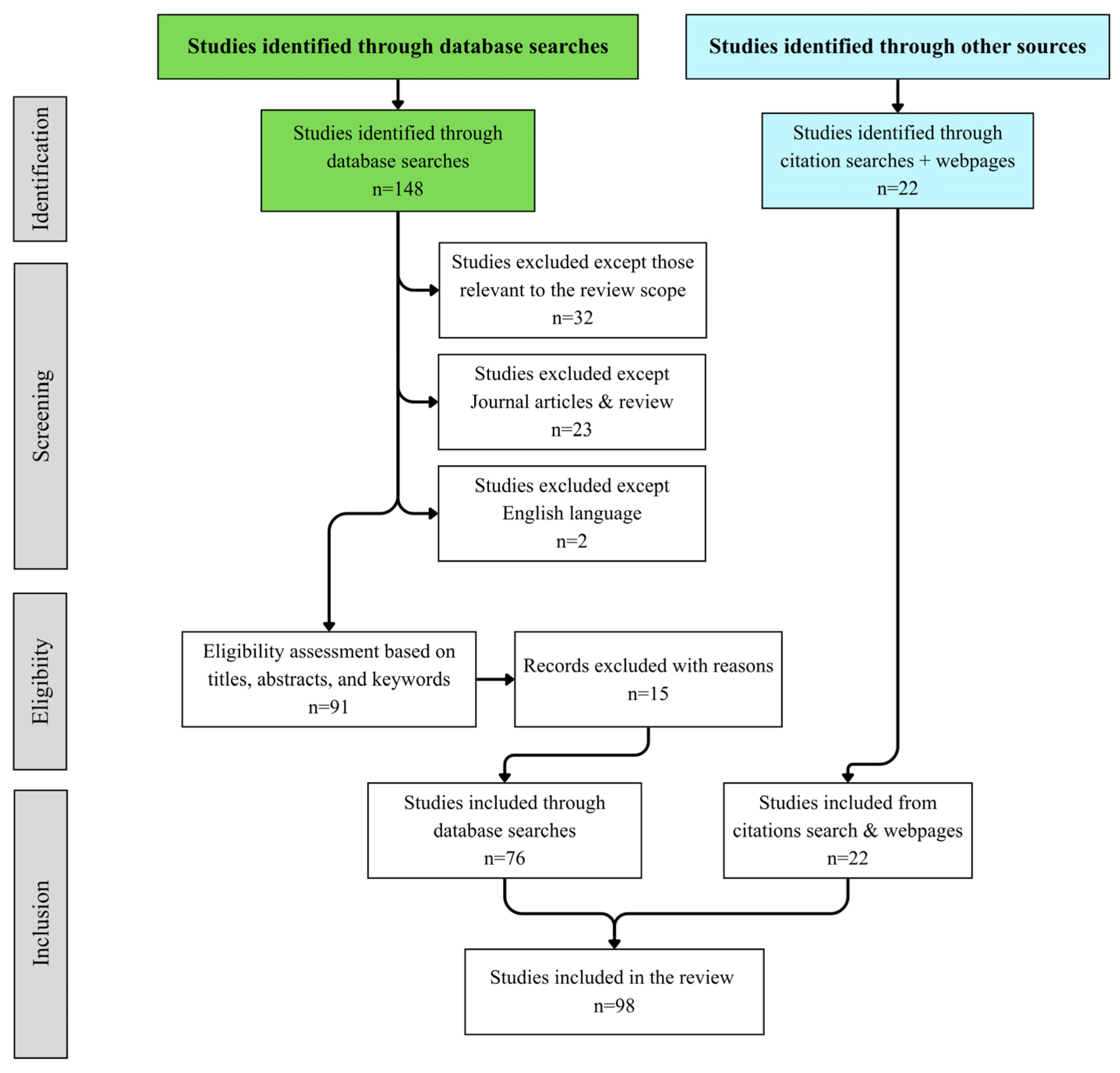
The Preferred Reporting Items for Systematic Reviews and Meta-Analyses (PRISMA) approach was employed to systematically identify and review relevant literature. The PRISMA framework consists of four stages: identification, screening, eligibility assessment, and inclusion. A flowchart illustrating the literature selection process adopted in this study is presented in Figure 1. The selection of an appropriate database is a critical step in ensuring the retrieval of reliable and comprehensive literature. Among the commonly used databases, Web of Science (WoS) and Scopus were evaluated. Following a comparison of search results obtained using different keyword combinations, Scopus was found to provide broader coverage of relevant publications than WoS. The use of Scopus as the primary database is also supported by previous studies [20,21]. Consequently, Scopus was selected to identify literature related to the life cycle assessment of 3DCP. The search string used was “Life Cycle Assessment OR Energy Performance of Buildings Directive OR Global Warming Potential AND 3D concrete printing”, which returned 148 records in Scopus as of December 2025.
The retrieved records were screened to retain only the most relevant documents, as illustrated in Figure 1. The Scopus search results were exported as a CSV file containing bibliographic information, citations, keywords, and abstracts, which were subsequently assessed for eligibility. The inclusion criteria focused on studies related to LCA, GWP, whole-life carbon assessment, environmental performance assessment, the Energy Performance of Buildings Directive (EPBD), and the sustainability aspects of 3DCP. Studies that did not provide relevant information on LCA methodologies, environmental assessment frameworks, or carbon assessment approaches applicable to 3DCP were excluded. To ensure the quality and reliability of the review, only peer-reviewed journal articles and review papers published in English were considered, while conference papers, book chapters, theses, reports, and non-English publications were excluded. The full texts of the selected documents were then reviewed in detail. In addition, several relevant publications were identified through citation tracking and manual screening, while selected webpages and online resources were included where they provided reliable information not readily available in the academic literature. This process is represented in the PRISMA flowchart (Figure 1) as “Studies identified through other sources.” After incorporating 22 additional sources identified through citation searches and webpages, a total of 98 documents were included in the review and analysed in the following sections.

3. Key Methodological Considerations in LCA

LCA is defined by the Sustainable Energy Authority of Ireland (SEAI) as a “methodology for assessing environmental impacts associated with all the stages of the life cycle of a commercial product, process, or service” [22]. LCA allows environmental impacts to be quantitatively assessed in a standardised manner. The aspects and key parameters that need to be identified to conduct an LCA are outlined in this section. The techniques and methods used in LCA are defined by a range of standards and legislative frameworks, which are reviewed in Section 3.

3.1. Impact Indicators

The purpose of an LCA is to assess environmental impacts, as a product can affect the environment in many ways throughout its life cycle. According to the European standards, EN 15978 and EN 15804, these environmental impacts are categorised into a number of discrete “impact indicators” [23,24]. Table 1 shows the core indicators as per these standards.
An impact indicator is a quantifiable measure representing a specific way in which a product affects the environment. Examples from Table 1 include how much ozone depletion the product will cause or how much water it will use. These indicators are expressed numerically, enabling comparison and analysis to determine how a product affects the environment and how those impacts can be minimised. The EPBD requires the mandatory calculation of GWP, as it is considered the most significant of the impact indicators [6]. Additionally, GWP is a globally recognised indicator and the most applied indicator across LCA methodologies.
Greenhouse gases (GHGs) trap heat inside the atmosphere and cause global warming [25]. GWP is the measure of how much heat a greenhouse gas traps in the atmosphere compared to CO2 over a specific time period [22]. Different gases trap different amounts of heat, so a unit of CO2 equivalent (CO2eq.) is used as a standardised representative of all other gases. It represents how many kgs of CO2 would be required to trap the same amount of heat as all the gases released by the product combined. The unit used to quantify GWP according to the EN 15978, EN 15804 standards and specified in the EPBD is kg CO2eq [6,23,24]. This unit represents the amount of GHGs emitted over the life cycle of a product, expressed in kilograms of CO2 equivalent to account for different gases. GWP should be distinguished from embodied carbon. In the EPBD context, life cycle GWP refers to the total greenhouse gas emissions and removals associated with the building over its life cycle. It includes embodied emissions from materials, construction, maintenance, replacement and end-of-life processes, as well as operational emissions such as energy use during the building’s service life. Embodied carbon is therefore a major part of life-cycle GWP, but it is not the same as total GWP [22].

3.2. Life Cycle Stages

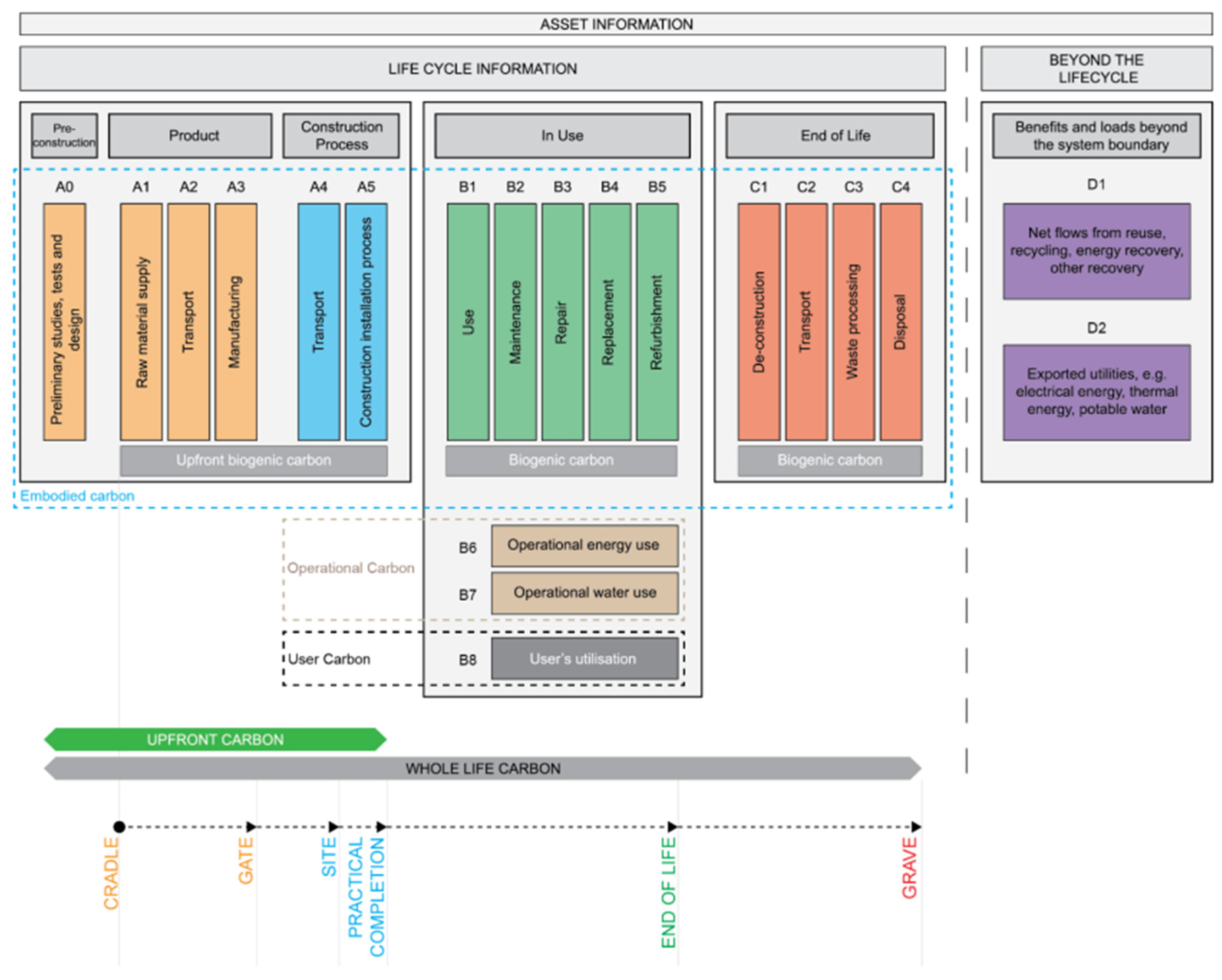
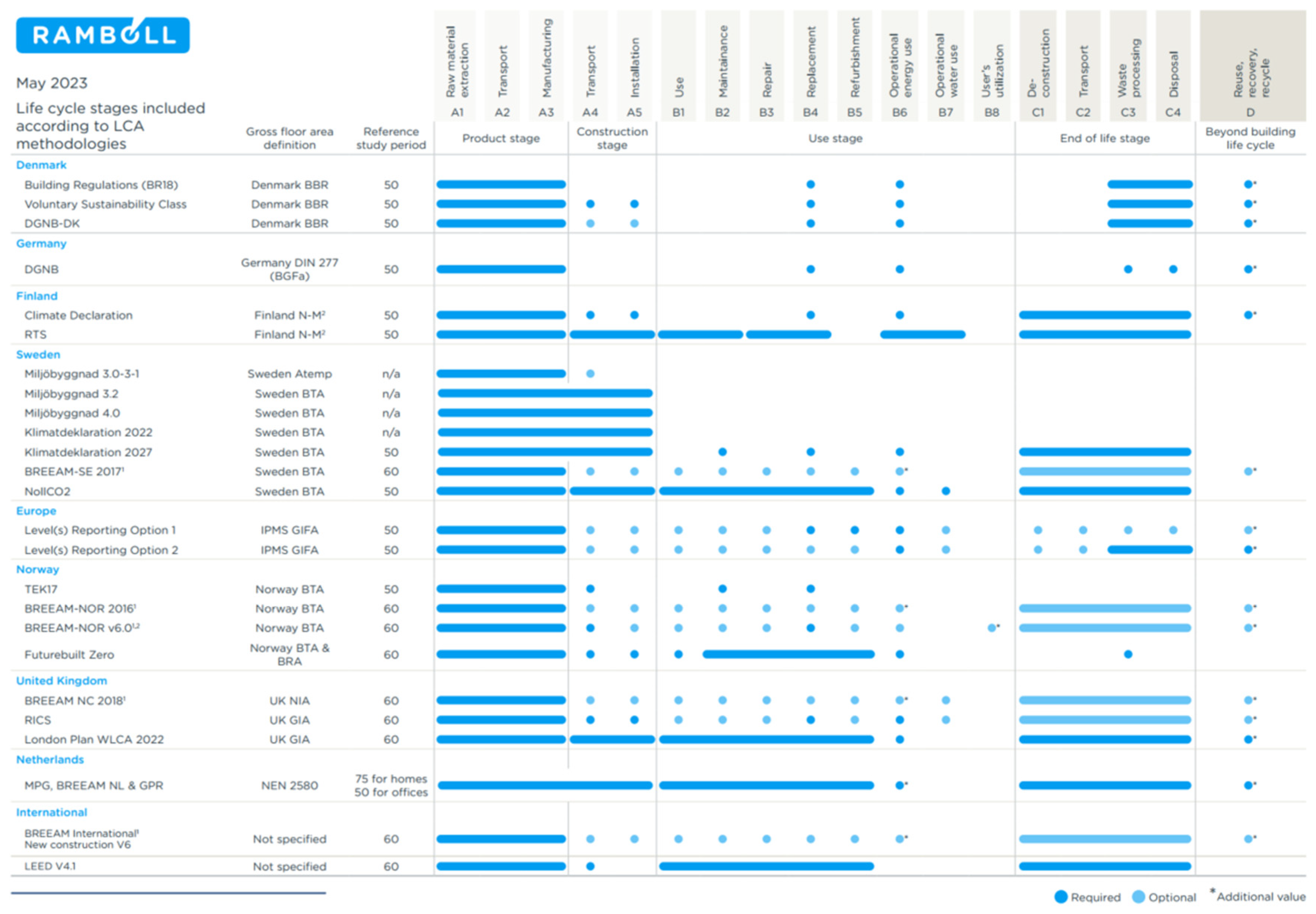
EN 15978 establishes a methodology for calculating environmental impact indicators using a module-based approach. The life cycle of a product is divided into several modules that account for a specific part of the product’s life. These modules are further grouped into stages. Figure 2 from the Institute of Structural Engineers (IStructE) presents these modules and stages. The life cycle stages, as defined in Figure 2, are as follows:
Pre-construction stage: (Module A0). This stage is not specified in EN 15978 but is included in many common methodologies. This stage is included to account for processes that take place before construction, such as design work, testing, surveying, etc [26]. For buildings, the emissions in this stage are assumed to be zero [27].
Product stage: (Modules A1–A3). This stage covers the extraction, transportation and manufacturing processes necessary to produce any construction products, including components and MEP, required to construct the structure [27]. It should be noted that the use of recycled content in construction materials, such as recycled aggregate, affects the emissions in this stage [26].
Construction process stage: (Modules A4–A5). It accounts for construction processes, including transport of materials/products to the site, energy usage due to activities on site and the transportation and processing of materials wasted on site [26].
In use stage: (Modules B1–B8). This stage accounts for emissions due to use, maintenance, repair, replacement, refurbishment, operational energy and water, and user impacts [26]. Module B8 is not specified by the current EN 15978, but is commonly included to account for user emissions not covered by the other modules, such as emissions due to users commuting to the building [27].
End-of-life stage: (Modules C1–C4). It starts when the building is decommissioned and is not intended to have any further use [22]. It covers emissions released during decommissioning, stripping out, demolition, deconstruction, transportation of materials away from the site, waste processing and disposal of materials at the end of the building’s life [26].
Beyond the life cycle: (Modules D1–D2). After the building is decommissioned, certain components may be reused or recycled, and energy may be recovered (for instance, recycling steel members or burning timber for fuel) [27]. This stage quantifies the net environmental benefits or loads resulting from reuse, recycling and energy recovery, resulting from the net flows of materials and exported energy exiting the system [22]. It should be noted that these benefits are gained outside of the system being studied; the use of recycled members, etc., in the building being assessed, is accounted for in modules A1–A3 as discussed [27].
A revision to EN 15978 is in its final stages before official adoption. It is expected that modules such as A5 and B4 will be broken down into further sub-modules, e.g., A5.1–A5.4, B4.1–B4.2 [28]. These sub-modules allow for a more detailed assessment of aspects of the building’s life cycle. For example, module A5 covers construction processes; breaking it down into sub-modules allows GWP of each specific process, such as waste management and equipment usage, to be assessed individually [26]. Furthermore, B8 is also expected to become an official module in EN 15978 after this revision. The EPBD accounts for the upcoming revision of EN 15978, and so it includes sub-modules.

3.3. System Boundaries

The system boundary establishes the scope of the assessment by specifying the life-cycle processes and stages to be included in the analysis [26]. Not all life-cycle modules are included in every LCA, as different methodologies vary in terms of which modules are considered mandatory. The selected modules define the system boundary by specifying the processes and life-cycle stages of the product that are included in the LCA study. The Inventory of Carbon and Energy (ICE) defines the terminology and modules associated with commonly used system boundaries as follows: [29]:
Cradle: The cradle is defined as being the earth, i.e., material deposits within the ground. This is the starting point for all materials and resources that are used during the life cycle of the product.
Cradle-to-gate: (Modules A1–A3). Encompasses all input and output flows (as applicable from the system boundaries) between the confines of the cradle up to the factory gate of the final processing operation.
Cradle-to-gate + End-of-life: (Stages A, C, and D). Cradle-to-gate plus the end-of-life processes. This excludes the use phase.
Cradle-to-grave: (Stages A–D). Cradle-to-gate plus operation plus end-of-life processes. A complete study.
Cradle-to-site: (Modules A1–A4). Cradle-to-gate plus delivery to the site of use (installation site). This boundary condition is ambiguous when it comes to construction site energy and material waste.
Cradle-to-practical completion: (Modules A1–A5). Cradle-to-gate plus delivery to the site of use (installation site), site energy and embodied carbon of material waste.
The selection of the system boundary for the LCA is significant, as it directly affects the final GWP value reported; for example, a full cradle-to-grave assessment typically yields a much higher GWP than a cradle-to-gate assessment for a typical building. A review of academic papers containing LCA studies for 3DCP components in the last five years is presented in Table 2. The majority of 3DCP LCA studies adopt an A1–A3 (cradle-to-gate) system boundary, reflecting the predominant interest in material production impacts. However, this scope excludes construction-phase energy use (A4–A5), operational performance, and end-of-life considerations, which may significantly alter the environmental profile of printed structures. Studies extending to A–D [30,31,32] or A1–A5 [33,34] capture a broader picture but remain the minority, limiting cross-study comparability. The variability in system boundaries across the reviewed literature, therefore, cautions against direct numerical comparisons of reported GWP or embodied carbon values, and this may limit the accuracy of the results [35].
The EPBD requires a full cradle-to-grave (A–D) system boundary. The EPBD specifies that modules B5, B7, and B8 are the only optional modules. Sub-module A5.1 (pre-construction activities) is also optional [6]. This type of assessment is commonly referred to as a whole-life carbon or life-cycle GWP assessment, as it includes embodied carbon, operational carbon, and end-of-life impacts [46]. Accordingly, most existing LCA studies on 3DCP components do not satisfy the EPBD requirements regarding system boundaries.

3.4. Functional Unit

To provide meaningful results of LCA assessment, the results need to be normalised. There are many common ways to normalise results, such as by providing GWP per unit of floor area or per year of service life. It is necessary to normalise the results to facilitate comparison between assessments. The normalised unit used for the LCA is called the functional unit [26]. The functional unit specified by the EPBD is kg CO2eq/m2 of “useful floor area” over 50 years. This means that the final reported GWP is the total amount of GHG emissions released over 50 years, divided by the useful floor area of the building [6].

3.5. Floor Area

The EPBD specifies the use of “useful floor area” to calculate GWP. Both the Level(s) framework and the EPBD recommend the use of the International Property Measurement Standards (IPMS), developed by the International Property Measurement Standards Coalition guidelines [6,47] or an equivalent standard to calculate floor area. The IPMS were developed by an international committee with the goal of standardising property measurement techniques [48].
In the IPMS 3 (Residential Buildings) [49], guidelines are provided for the consistent measurement of floor areas in residential properties, including houses and apartments. This standard defines methods for calculating internal floor areas by specifying how spaces such as balconies, garages, staircases, and areas with limited headroom should be treated. IPMS 3 mainly focuses on measuring the exclusive internal area occupied by a residential unit while also allowing separate reporting of ancillary and shared spaces. These standardised approaches improve the accuracy, transparency, and comparability of residential property measurements across different regions and applications. In the Irish context, the SEAI recommends the use of method IPMS 3B, which is similar to a traditional gross internal floor area (GIFA) measurement [22]. The standard provides detailed rules on which parts of a building should be included in the floor-area calculation, including whether measurements should be taken to the internal or external face of walls. Since 3DCP houses are residential buildings, their floor-area calculation falls under the rules outlined in IPMS 3B. In the context of 3DCP, standardising the floor area metric is highly critical. Because 3DCP structures frequently feature double-wall geometrics, they can diverge significantly from conventional masonry concrete systems.

3.6. Reference Period

The reference period is the period over which the time-dependent characteristics of the object of assessment are analysed [22]. The selection of the reference period affects several aspects, such as the total operational energy use of the building and the assumption of how many times the building will undergo maintenance and repair in its life. The reference period required in different methodologies can vary; however, the EPBD specifies that the GWP is to be calculated over a period of 50 years [6].

3.7. Building Elements

For LCA results to be compared fairly, the exact building elements included in the assessment must be standardised. The EPBD uses a tier-based method to classify building elements as provided in Table 3. Tier 1 is high-level core, shell, and external; tier 2 is more specific in substructure, non-structural architecture, heating equipment, etc.; tiers 3 and 4 continue to increase the specifications of the classifications. The minimum requirement in the EPBD is that all elements in tier 2 are considered, and nations are free to classify tiers 3 and 4 based on their requirements [6]. Building elements should be incorporated in an LCA if they are exclusively or partially the responsibility of the building owner. Elements that are external and structurally independent from the main building need to quantify their embodied carbon, but their floor area is not considered as part of the total floor area [6].
In Ireland, the use of the International Cost Management Standards (ICMS) is recommended by the Society of Chartered Surveyors Ireland for standardised cost measurement and reporting practices [48]. The standard ICMS “Global Consistency in Presenting Construction Life Cycle Costs and Carbon Emissions” (ICMS 3) was developed to standardise building measurement and embodied carbon reporting [50]. It includes a scope of building elements, organised into groups and subgroups, and provides a standardised method of labelling and reporting these elements. ICMS has been mandatory for use on all public projects in Ireland since 2024 under the Capital Works Management Framework [51], and the level(s) framework is still under development to align more closely with the minimum scope of building elements with the ICMS scope [28]. This standard could be used for LCA studies, provided that the included elements still meet the Tier 2 requirements of the EPBD. To quantify emissions associated with replacement and maintenance within life cycle modules, the expected service life of building components must be established [27]. If product-specific information is available, it should be used as the preferred source. However, Level(s) also provides default service life values for building components, which should be used in the absence of more specific data [46].

3.8. Biogenic Carbon

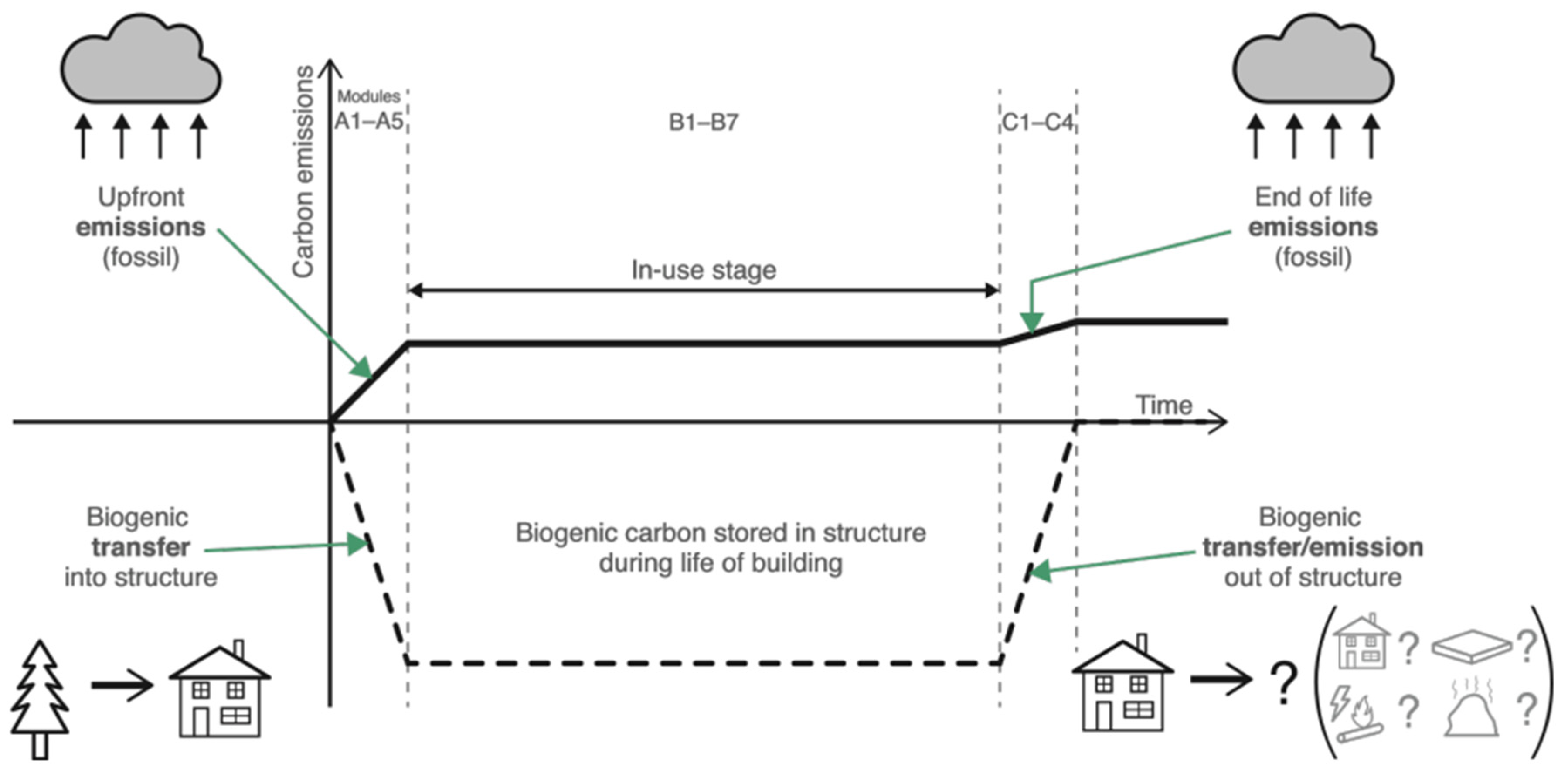
Biogenic carbon is carbon removals associated with carbon sequestration into biomass, as well as any emissions associated with this sequestered carbon [27]. Sequestration is the process by which CO2 is removed from the atmosphere and stored within a material [26]. When trees grow, for example, they sequester carbon within the wood that grows [26]. This means that timber products will have biogenic carbon content as well as the embodied carbon due to the production of the timber elements, etc. Additionally, at the end of the life of the timber product, when it decomposes or is incinerated, the sequestered carbon will be released back into the atmosphere [26], this makes accounting for timber in an LCA more complex.
Locking biogenic carbon into a timber structure provides climatic benefits for as long as the carbon remains stored within the structure or the timber is reused [23]. Therefore, understanding the source of the timber and its end-of-life scenario is essential for accurate LCA accounting [26]. Figure 3 indicates the process of sequestration and release of biogenic carbon. Most methodologies suggest that biogenic carbon should be calculated and reported separately from other sources of embodied carbon so that its effects can be clearly understood [26].

3.9. Impact Indicator Calculations

EN 15978 describes the method used to calculate the numerical value of impact indicators. The basic principle of this routine consists of multiplying each product and service quantified in a module of the life cycle of the building by its respective value of any environmental indicator [23]. The value referenced in the standard is known as a ‘carbon factor’, which is the kg CO2eq per unit of product, often with units of kg CO2eq/kg or kg CO2eq/m3 [26]. Each life cycle module will have a carbon factor associated with it for each product and material in the building. Equation (1) is used for calculating GWP or embodied carbon, depending on the life-cycle modules included in the assessment [26].
M a t e r i a l   Q u a n t i t y   k g   o r   m 3   ×   C a r b o n   F a c t o r k g   C O 2   e q k g   o r   m 3   =   E m b o d i e d   C a r b o n   ( k g   C O 2   e q )
To carry out the calculations, the quantity of each material or product in the building must be known; therefore, determining a complete inventory of building elements is essential. Additionally, the IStructE emphasised the importance of including elements that are often only partially modelled, such as instrument coverings, steel connections, rebar laps, concrete blinding, etc., as these elements can have a significant impact on the embodied carbon of the building [26]. The second value required for the calculations is the carbon factor for each material across each life cycle module; this can result in a significant number of values in a complex building.
A carbon factor can be a positive or negative value; a positive value represents a release of GHGs into the atmosphere, while a negative carbon factor represents the extraction or storage of GHGs from the atmosphere [27]. For example, the production of cement releases GHGs and so has a positive factor, while reusing a steel beam at the end of its life will have the effect of avoiding some GHG emissions and so has a negative factor to account for this benefit to the environment, whereas biogenic carbon has a negative carbon factor as well. As an example, if the subject of study were a masonry wall, the quantity of each component in the wall (blocks, insulation, bricks, mortar, and wall ties) would be multiplied by its associated carbon factor to find the GWP for one life cycle module of the wall. This process is repeated for each module being considered, using the appropriate carbon factors, and the sum of the values is the total whole life GWP for the wall [52].

3.10. Calculation Tools for LCA

The calculation of life-cycle GWP becomes more complicated when multiple materials, components, life-cycle modules and carbon factors are involved. Tools to assist in carrying out such calculations are available in different forms [26]. They simplify the process of an LCA by automatically performing calculations, enabling the values of material quantities and carbon factors to be updated as the project develops, and allowing for clear visualisation and reporting of results. The Level(s) framework assumes that, in most cases, a software calculator tool will be used for LCAs and provides some minimum requirements for tools, such as alignment with EN 15804 [46].
A wide range of companies and bodies have developed LCA tools. These tools vary in several aspects, including the scope of the system boundary, the applicable geographic region and Building Information Modelling (BIM) integration [26]. Alongside the Level(s) framework, the EU published a list of LCA tools that align with Level(s) requirements [53] and the IStructE also outlined a number of common tools in their LCA guidance [26]. For Ireland, the Irish Green Building Council (IGBC) has published a number of recommended tools [54]. The following is an outline of the tools that are considered relevant in the Irish context:
Methodology-specific tools: Some bodies that have developed LCA methodologies or guidance also provide Excel-based calculation tools that align with their specific methodology. For instance, the IStructE, SEAI and IGBC provide tools for their methodologies. These tools are highly useful for performing calculations that are intended to align exactly with the specific methodology, as the assumptions and omissions are incorporated into that tool [22,26,55].
OneClick LCA: There are many general-purpose LCA tools. These tools allow for controlling over the specific system boundaries, data sources, and other aspects of LCA. Further, they have common methodologies, so that LCAs can be performed in alignment with those methodologies. OneClick LCA is the leading software option for LCA; the tool is used in more than 170 countries, including Ireland as it is recommended by the IGBC [54]. OneClick LCA contains a large number of built-in LCA datasets and support for common methodologies, such as the RICS GWP calculation method [56].
OpenLCA: OpenLCA is an open source, widely used openLCA 2.6.2 software for conducting life cycle assessment studies across various sectors, including construction and building materials. Like other general-purpose LCA tools, it allows users to define system boundaries, select databases, and customise impact assessment methodologies according to project requirements. The software supports internationally recognised standards such as ISO 14040/14044 and can integrate multiple databases, including ecoinvent, GaBi, and Environmental Product Declarations (EPDs). Due to its flexibility, transparency, and compatibility with different datasets and methodologies, openLCA is commonly used in both academic research and industry applications.
SimaPro: SimaPro 10.4 is one of the most established and comprehensive software tools for life cycle assessment and sustainability analysis. The software enables detailed modelling of product systems by allowing users to define system boundaries, material flows, impact categories, and assessment methods. SimaPro supports widely adopted impact assessment methodologies such as ReCiPe, CML, TRACI, and EN 15804, making it particularly suitable for environmental assessments in the construction sector.
Revit tools: There are many tools that can perform LCAs for buildings modelled directly in Revit 2026.3 (or other BIM software) [26]. These include tools such as the OneClick LCA plugin and Tally. BIM is a fundamental part of the 3DCP process, so using these tools could provide an easy means to perform LCA for 3DCP houses. However, in this case, the accuracy of the LCA depends on the comprehensiveness and accuracy of the model; if building elements are not included or if components are modelled inaccurately, the results will not be realistic [27].
Manual calculations: Calculations can be performed manually, but due to the required scope and complexity of whole-building LCA studies, manual calculations are not recommended.
Because 3DCP is fundamentally rooted in digital fabrication, integrating software is a highly streamlined path for conducting automated LCAs. However, this reliance introduces specific methodological vulnerabilities into 3DCP research:
  • Early-stage modelling inaccuracies: If specialised 3DCP elements (such as internal void printing paths, reinforcement, or non-standard binders) are poorly defined or inaccurately modelled in the early design stages, the resulting LCA outputs will fail to reflect realistic environmental impacts.
  • Methodological rigidity: Standard general-purpose LCA tools are optimised for traditional construction components. They often struggle to dynamically adapt to the fluid, optimised material volumes and custom concrete mix designs that characterise advanced 3DCP.

3.11. Reporting Template

The EPBD provides a standardised reporting table (as provided in Table 4) for presenting GWP results within the building’s Energy Performance Certificate (EPC). Total GWP is reported separately for each of the life cycle stages [6].
Level(s) and bodies such as RICS and the IStructE recommend reporting biogenic carbon separately from other sources of carbon [46]. Additionally, Level(s) includes GWP for “land-use and land-use change”, which accounts for activities such as forestry [46]. The GWPs for each of the life cycle stages are reported separately; some methodologies are more specific and suggest reporting each module individually. For the purposes of an academic LCA study, reporting the results for each module or sub-module separately would provide greater clarity in the results. EN 15978 also recommends the use of a tabular form of reporting template for the GWP values, and it also makes note of the importance of including the sources of data used, information on the objects of assessment, and any assumptions made for the LCA. EN 15978 states that if any modules are excluded from assessment, then this should be stated, and a reason for the exclusion should be provided [23]. Adhering to a consistent reporting template and recording the required information ensures the results of the LCA are relevant and useful. The EPBD model for reporting total GWP is divided into different life cycle stages. For 3DCP, this stage-by-stage calculation separates key environmental compromises, balancing the high embodied carbon of specialised printing mortars (A1–A3) against the efficiency and material savings of automated on-site construction (A4–A5), which is necessary to analyse the comprehensive benefit of the 3DCP.

3.12. Environmental Product Declaration (EPDs)

A building is constructed from many individual products and materials, for example: timber trusses, precast floor slabs, windows, the specific concrete mix designs, etc. To perform an LCA, the environmental impacts of each individual building element must first be assessed and corresponding carbon factors determined. However, carrying out such detailed calculations for every construction component is highly impractical and may also introduce significant uncertainty and potential errors into the results. An EPD is a document that clearly shows the environmental performance or impact of any product or material over its lifetime [27]. Manufacturers of products can complete their own LCAs of their products and then share the results with the public in a document called an EPD [57]. An LCA of the building, with new or already existing products, is calculated using the carbon factors provided by the manufacturers, which are also available in the EPD. Through this EPD, the LCA process is made simple.
EPDs should comply with the EN 15804 standard, which gives guidelines for the required information by the manufacturers to calculate and include in the EPD document [24]. EN 15804 supports EN 15978 by providing the product-level EPD rules and information modules that EN 15978 uses in whole-building environmental assessment. Hence, EPDs will declare carbon factors for each of the life cycle modules described in EN 15978, allowing EPDs to be easily incorporated into building LCA [23]. EN 15804 requires that EPDs report on the quality of data used, and all EPDs are verified by an independent third party—this ensures that the quality of EN 15804-compliant EPDs is high [24].
In a typical EPD, a carbon factor is provided for each life cycle module; the results for more than one impact indicator are often shown to allow more complex LCAs to be performed [46]. One important aspect of using an EPD is the functional unit used in the document. There is no single standard unit used in EPDs. For example, one concrete manufacturer may report carbon factors per tonne, while another may report results per cubic metre. The unit used in an EPD is referred to as the declared unit. It is important to understand the declared unit when using carbon factors from an EPD, as conversions may be required to align the data with the intended application [58].
Several EU regulations establish requirements for the reporting of carbon data for products. The Construction Products Regulation, which was published in a revised version in 2024, provides rules for marketing construction products [59]. This encompasses the requirements for data needed to be published, such as performance specifications, fire safety and environmental data. This revised version requires that the GWP of products be reported starting from January 2026. Annex II of the regulation contains a list of the required impact indicators that need to be reported for the construction product. GWP, representing climate change impacts, is one of the required indicators. Total GWP, fossil GWP, biogenic GWP, and land-use GWP are all required to be reported, while the remaining indicators will become mandatory by 2032 [59]. This data is typically published in the form of an EPD providing carbon factors for each life cycle module. Products that adhere to this regulation will receive a CE standard marking, which guarantees the compliance and accuracy of the disclosed data. Products marketed within the European Economic Area, which includes Ireland, and are covered by a harmonised technical specification, are required to have a CE mark [59]. There are harmonised technical specifications for hundreds of construction products, from cement and steel to windows and doors [60]. This ensures a significant portion of all products and materials used in construction will have accurate and reliable LCA data available.
The Ecodesign and Energy Labelling regulation, published in 2017, creates a framework for labelling the energy efficiency of products and provides minimum standards to ensure products are sustainable. The labelling declares the energy consumption of the product and is graded in the form of a letter A-G, with A being the most efficient. Only products that fall into categories that have been covered by specific delegated acts require this labelling before they are marketed [61]. However. There are delegated acts for many common appliances and types of equipment, such as air conditioning and heaters. The labelling allows the energy use of products to be accurately and reliably determined; this provides useful data when considering a whole-life LCA study. The EPBD considers data from sources adhering to these two regulations to be of the highest quality [62].

3.13. Databases

The choice of carbon factors is important to ensure accurate results of an LCA [26]. In practice, these carbon factors are usually gathered from a variety of databases. There are several bodies that have created databases of carbon factors for different materials in the aspects of their usage in building construction. The construction practices, transport distances, manufacturing, etc., differ from country to country, so the best practice is to use sources that are specific to the country’s guidelines [46]. The following is an overview of the primary databases and sources that the IGBC and SEAI recommend utilising with Irish building projects:
EPDs: EPDs can often be accessed on manufacturers’ websites or by contacting the manufacturer. The IGBC has created a database of Irish-specific EPDs. This is not a comprehensive source for EPDs, but is a useful reference for the products commonly used in Ireland [63].
IGBC national generic database: The IGBC has created a database of generic material carbon factors for Ireland. The databases contain stage A1–A3 carbon factors for 285 common building materials [64].
SEAI national embodied carbon database: Alongside the national GWP calculation methodology, the SEAI is developing a national database for carbon factors. This database has not yet been released; however, it is expected to be a valuable reference, as the SEAI has been officially mandated by the government to develop this national database [22].
ICE database: The Inventory of Carbon and Energy is an international database created by Circular Ecology consultants. The IGBC recommends this database for generic data, as it contains A1–A3 carbon factors for a wide variety of materials [29].
SEAI energy carbon factors: The SEAI provides values for the embodied carbon of different energy sources, including electricity and petroleum-based fuels. These values are calculated based on the share of renewables in the Irish grid and the sources of Ireland’s oil and gas, etc., and it is more reliable as it accurately represents the GWP of energy used in Ireland [65].
Irish water carbon factor: Within the IGBC methodology, they include a carbon factor for water usage due to pumping and treatment. This value was provided to the IGBC by Irish Water based on their processes [55].
Transport distances: Within the national methodology, the SEAI proposes default transport distances for products, ranging from locally manufactured to globally manufactured products. The methodology also includes carbon factors for transport emissions per km of travel for various means of transport [22]. These provided a reasonable estimate for transport emissions in Ireland, even if the actual travel distances are unknown.
Wastage rates: To account for wastage of materials during construction, the SEAI national methodology includes suggested wastage rates for various building elements and materials. This value is expressed in percentage, and it is assumed that an equivalent percentage of the material quantity is wasted on-site in typical Irish construction processes [22].
Energy use: The energy use of a building for the B6 life cycle module can be approximated using the calculated value of the Building Energy Rating certificate of the buildings [22].
Disposal/ waste processing: For stage C carbon factors, the IGBC recommends using the values published by the UK Department for Energy Security and Net Zero (DESNZ), they publish a database of carbon factors associated with common disposal practices [66]. The SEAI also suggests that UK-specific carbon factors for stage C will likely align with Irish values and are appropriate for use until an Irish-specific database is created [22].
Stage D: Stage D carbon factors depend on the assumed end-of-life scenario of the building. Annex D of EN 15804 provides a method to directly calculate stage D carbon factors [24], and the SEAI simply recommends following this procedure [22]. The IStructE has calculated and published stage D carbon factors from common end-of-life scenarios for various materials [26].
MEP: The SEAI and IGBC recommend using the Chartered Institution of Building Service Engineers (CIBSE) guidance for GWP related to MEP (Mechanical, Electrical, and Plumbing) services in buildings [22,55]. The CIBSE TM65 embodied carbon methodology includes information about refrigerant leakage and carbon factors, for instance [67].
The EPBD has a clear hierarchy of data sources for use in an LCA: EPDs and product- and project-specific values should always be used if they are available. Otherwise, generic and default values can be used. The EPBD requires member states to develop and maintain reliable databases of generic and default data, enabling the preparation of building LCAs in cases where project-level data is unavailable. It is the responsibility of member states to ensure that these databases are consistent and reliable [6].
The Level(s) framework recognises the importance of the choice of database for LCA information. Alongside the framework, a document was published with a list of European databases that align with the Level(s) requirements [53]. The list is not comprehensive; it does not contain any Irish-specific databases, and some of the sources are not published in the English language. Therefore, these databases should not be treated as the primary source of information. However, they can provide useful data and EPDs that comply with the Level(s) framework standards and can only be used when Irish-specific sources are limited or unavailable. Additionally, it can be noted that the Ecoinvent carbon factor database [68] was the most popular database referenced in the academic papers reviewed. This is an international database, so it is not favoured for use, but can be considered due to its prevalence in the literature.
The dependence on these established databases exposes a critical way for 3DCP sustainability research on LCA. The National Generic Databases (e.g., IGBC, SEAI) entirely lack specific data profiles, i.e., carbon factors for the specialised, high-binder mixes required for 3DCP. An international repository (e.g., ICE, ecoinvent) fails to capture localised supply chain dynamics, transport distances, and regional grid mixes, e.g., SEAI electricity carbon factors. Whereas standardised default assumptions regarding transport and wastage fail to account for the unique characteristics of 3DCP, where transport impacts for highly specialised mixes may be elevated. This data deficit forces researchers to rely heavily on proxy data from conventional high-strength concrete mixes or to rely on international databases such as ecoinvent. Furthermore, assessing the operational energy (Module B6) remains highly uncertain. Because long-term recycling pathways for printed concrete components are not yet empirically established within national frameworks, mapping these phases relies on assumptions borrowed from traditional demolition practices, potentially misrepresenting the true cradle-to-cradle profile of 3DCP buildings.

3.14. Critical Limitations of LCA Methodology

LCA is not a perfect technique and has several limitations [69]. It has been demonstrated that LCA results can have high levels of uncertainty due to large amounts of measured and simulated data, assumptions, and the selection of input values [69]. Level(s) states that the degree of confidence that can be placed in the results of an assessment depends on the level of precision and detail of the data and information used to model the building [46]. This dependence on the quality of input data is a significant limitation of the LCA method, as it affects the accuracy of the results. However, the accuracy of an LCA improves over time as more design and construction information becomes available. Consequently, completed buildings provide the most accurate case studies, as the data required for an LCA can be determined with a high degree of certainty [27].
In addition, the selection of functional units, impact assessment methods, life cycle stages, and environmental indicators can significantly influence the interpretation of LCA results [70]. Different studies may adopt varying functional units, such as per cubic metre of concrete, per tonne of material, or per building lifespan, making direct comparisons between studies difficult. Similarly, variations in environmental indicators, including global warming potential (GWP), acidification, eutrophication, and resource depletion, may result in inconsistent conclusions regarding sustainability performance [71]. The complexity of modelling transportation distances, recycling credits, end-of-life scenarios, and waste allocation approaches further contributes to uncertainty in LCA studies [71]. Furthermore, many LCAs focus mainly on environmental impacts while often overlooking economic, social, and long-term durability considerations. Nevertheless, the reliability of LCA studies generally improves as more detailed design, operational, and construction information becomes available, with completed projects often providing the most accurate case studies for environmental assessment.


4. Regulatory and Methodological Framework for Building’s LCA

The following sections provide an overview of the major international, EU, and Irish frameworks, standards, and legislation governing the application of LCA within the construction sectors:

4.1. International Standards

The following is an overview of the main international standards that govern LCA methodologies and studies.

4.1.1. ISO 14040

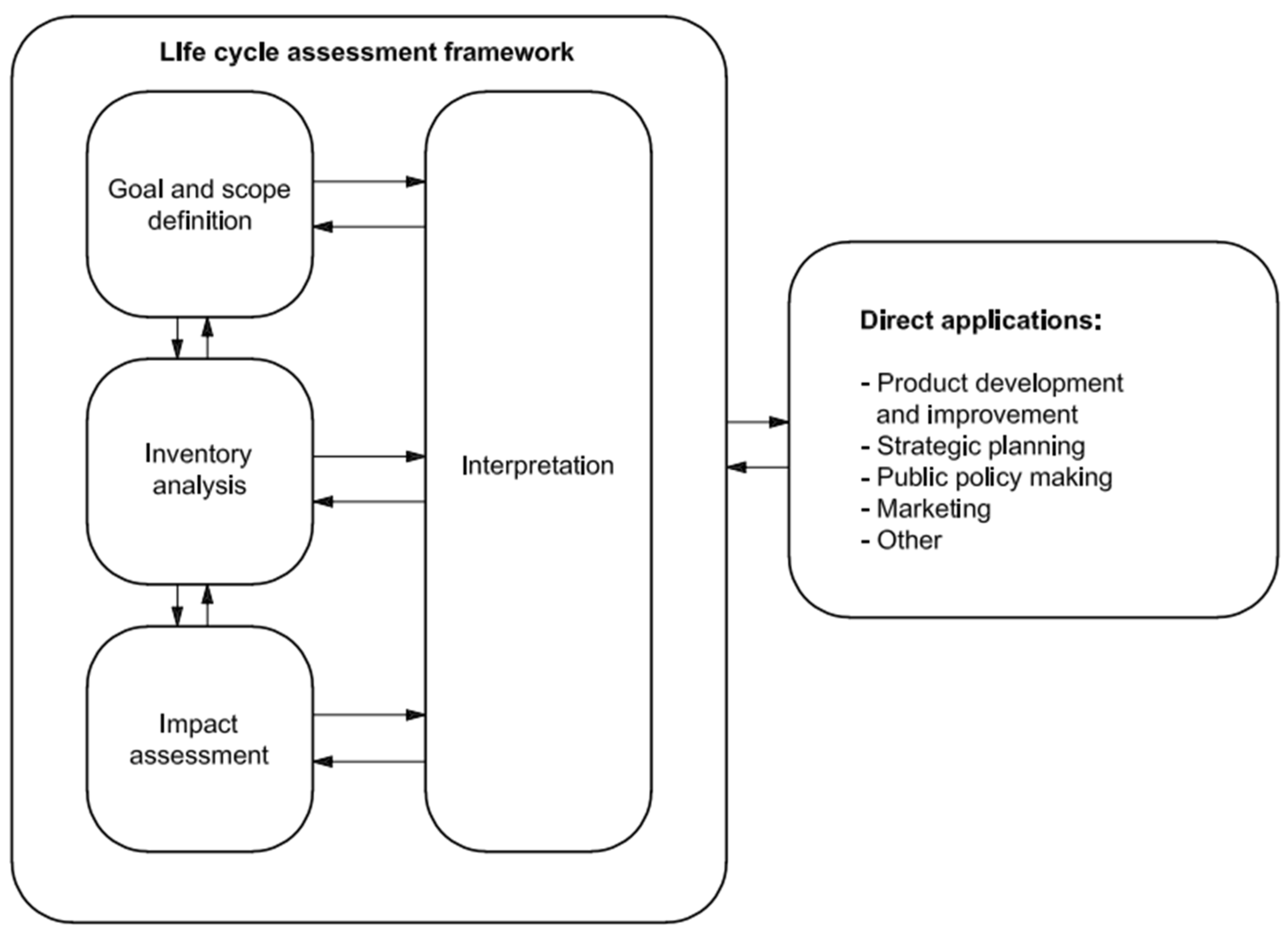
ISO 14040 was released by the International Organization for Standardization (ISO) in 2006. ISO 14040 (Environmental management—Life cycle assessment—Principles and framework) and ISO 14044 (Environmental management—Life cycle assessment—Requirements and guidelines) together form the primary reference standards for LCA methodologies globally [72,73,74]. ISO 14040 describes the principles and framework for the life cycle assessment of any product or service, while ISO 14044 provides requirements and guidelines for LCA studies, describing the practical implementation of ISO 14040 [28]. ISO 14040 defines LCA as a four-stage process [72] Figure 4 depicts these stages:
Goal and scope definition: This stage involves establishing the scope of the LCA, including the goals, objectives and intended applications of the assessment. Determining the system boundary, functional unit, impact indicators, and other aspects of the LCA are part of this stage.
Inventory analysis: This involves data collection and calculation procedures to quantify relevant inputs and outputs of a product system. This means determining the materials and energy inputs, etc., that will be considered in the LCA, as well as the emissions, discharges, and waste products that are produced during the life cycle of the product defined in the goal and scope definition stage.
Impact assessment: It is the process of evaluating the significance of potential environmental impacts using the results of the inventory analysis stage. When the inventory of inputs and outputs is determined, the effect they have on the environment can be quantified using specific impact indicators. For example, once the total GHG emissions generated throughout the life cycle of a product are determined, they can be expressed as a GWP value to evaluate the product’s contribution to global warming.
Interpretation: The interpretation stage focuses on analysing and comprehending the environmental implications revealed by the LCA findings by carefully examining the results to identify significant environmental impacts throughout the life cycle of construction materials.
ISO 14040 places significant emphasis on data quality. As discussed, this represents a major limitation of the technique. The standard states that LCA is an iterative approach and that, as the project develops and information/data about the product improves, the LCA should be updated accordingly [72]. These four steps are defined very broadly, and ISO 14040 provides no specific guidance on any of the aspects of the LCA. However, this standard clearly defines what LCA is and outlines its key components.

4.1.2. ISO 14044

ISO 14044 is a companion standard to ISO 14040 and was released in 2006 [73]. It expands on the four stages in ISO 14040 and provides specific rules for LCA. ISO 14044 does not provide any quantitative methods or specific calculation requirements for the four stages. However, it provides more detailed explanations of each of the LCA stages, which facilitates the practical implementation of the principles in ISO 14040 [28]. For example, the inventory analysis stage is further elaborated by providing specific guidance on data collection procedures, data quality requirements, and the criteria for determining system boundaries, thereby offering greater clarity on what is expected within this phase [73]. In combination, ISO 14040 and ISO 14044 provide a qualitative guideline to conduct LCA and provide a foundation for methodological consistency globally. Every academic paper reviewed followed the four-stage process in these two standards.

4.1.3. ISO 14025

The purpose of ISO 14025:2006 (Environmental labels and declarations—Type III environmental declarations—Principles and procedures) is to standardise the reporting of LCA information internationally [75]. An ISO 14025 provides rules and regulations for “Type III environmental declarations”, which are also known as EPDs. The standard includes rules about the information that needs to be reported in an EPD, rules regarding data quality, third-party verification, and more [75]. This standard provides a baseline standard for the quality of EPD information.

4.1.4. ISO 14067

ISO 14067:2018 (Greenhouse gases—Carbon footprint of products—Requirements and guidelines for quantification) provides a standardised framework for calculating and reporting the carbon footprint of a product [76]. The standard provides rules regarding how to align with each of the four LCA stages when calculating carbon footprints. Additionally, there are guidelines for functional units, biogenic carbon, and other GWP-specific aspects that are not covered in ISO 14040 and ISO 14044. This standard is analogous to the Level(s) framework, as its goal is to standardise how the carbon footprint or GWP of products is calculated and reported. However, Level(s) contain significantly more details that allow the framework to be implemented practically, such as recommendations of additional standards and exact specification of values (example: reference life) [46]. Additionally, the Level(s) framework is specifically referenced within the EPBD, indicating that it takes precedence over ISO 14067 for building-related life cycle assessment applications under the directive.

4.2. EU Frameworks

4.2.1. EPBD

The EPBD is a legal EU framework for the decarbonisation of the European building stock by 2050, with intermediate steps to reduce GHGs and energy consumption by 2030 [6]. A revised version of the directive came into force in May 2024 and is required to be transposed into Irish law by May 2026 [77]. The EPBD covers many areas, including renovations and energy demand for buildings. It also creates a new requirement for the reporting of GWP for building projects, which is of relevance to this review. Starting in 2028, all new buildings over 1000 m2 will be required to report the GWP, and in 2030, all new buildings, irrespective of the area, will have to report the GWP [6].
The EPBD provides rules and requirements for the calculation and reporting of GWP. The value of GWP will be included in the energy performance certificate (also known as a Building Energy Rating (BER) certificate). In Annex III of the initial release of the EPBD, there was a small number of basic requirements, such as the functional unit and reference life. It also explicitly states that the requirements and methods outlined in EN 15978 and Level(s) must be adhered to while calculating GWP [6]. In December 2025, an additional delegated act was released that provides more information regarding requirements for GWP calculation, including specific requirements for system boundaries, floor area, building elements, data and many of the key aspects of an LCA detailed in Section 2 of this article [62,78]. The EPBD provides a consistent baseline methodology for LCA that will be adopted across the EU. This will improve the quality and consistency of LCA studies going forward.

4.2.2. Level(s) Framework

Level(s) is a framework released by the EU in 2020. It is an assessment and reporting tool for improving the sustainability of buildings [78]. Level(s) provides guidance on 16 core indicators that define the sustainability of buildings; indicator 1.2 is GWP [79]. As shown in Section 2, Level(s) provides guidance for many aspects of GWP calculation. The purpose of this framework is to provide a standard baseline for calculating GWP across Europe; this will help to facilitate international benchmarking of construction projects and move the industry closer to the EU’s climate goals [46]. Level(s) is not an LCA methodology; it does not provide a specific calculation method for conducting an LCA. For this, it requires compliance with EN 15978 [23], instead of Level(s) outlines the preferred scope of LCAs for buildings and how to report the results of an LCA. Specific attention is given to data quality and selection of data sources, which, as discussed in Section 2, is a major limitation of LCA studies. Level(s) provides a quantitative method of representing data quality called the Data Quality Index. This is a numerical value that can be calculated based on the types of data sources used and how specific they are to the project in the study [46]. Level(s) then provides a minimum value for the Data Quality Index to ensure the LCA study is acceptably accurate.
Together, level(s) indicator 1.2 and EN 15978 establish the framework, methodology, and scope for assessing the environmental performance of buildings. According to the EPBD, any LCA methodologies developed by individual countries or professional organisations are required to align with these standards [23,28,46].

4.2.3. EN 15978

EN 15978:2011 (Sustainability of construction works—Assessment of environmental performance of buildings—Calculation method) was released by the European Union [23]. The standard was developed to expand the principles of ISO 14040 and ISO 14044. EN 15978 provides a standardised methodology for calculating the life-cycle environmental impact of buildings, both for new construction and renovation. It uses the base framework from the ISO standards and provides an exact quantitative methodology for LCA of buildings. EN 15978 defines the module-based LCA method described in Section 2. It also includes guidance on setting system boundaries, selecting appropriate data, and ensuring consistency and transparency in reporting. While EN 15978 provides an overarching framework for conducting a building’s Life Cycle Assessment, several “grey areas” remain that can lead to variations in scope across different methodologies [28]. One of these grey areas relates to the selection of life cycle modules that are considered mandatory within an LCA. Figure 2 illustrates the life cycle modules defined in EN 15978.
It should be noted that a revised version of EN 15978 was proposed in 2021 and is expected to be published as EN 15978:2026 (A harmonised method to assess the environmental performance of buildings). The updated standard introduces several modifications to the life cycle assessment framework, including the addition of a new module B8 and the introduction of sub-modules to provide greater granularity and detail in LCA results [28]. As discussed in Section 2, this standard is significant to understand the context of LCA in Ireland. The EPBD requires that GWP be calculated in alignment with EN 15978. Therefore, the new Irish national methodology and methodologies from other member states are being developed to align with this standard [22]. Additionally, other commonly used methodologies are based on EN 15978, such as the IStructE and RICS methodologies, and all of the data sources recommended in Section 2 are EN 15978 compliant [26,27].

4.2.4. EN 15804

EN 15804: 2012 (Sustainability of construction works—Environmental product declarations—Core rules for the product category of construction products) [24] is a companion to EN 15978. This standard governs the rules for creating EPDs. Similar to EN 15978, it expands upon the existing ISO standards and creates a quantitative method for producing EPD data. EN 15804 follows the same modular methodology as EN 15978 and provides rules for the calculation and reporting of the results reported in EPDs. This ensures that environmental information is presented in a standardised, credible and comparable way across construction products. Level(s) specifies that EPDs used for LCAs need to adhere to the requirements of EN 15804 [46]. Additionally, the EPBD values data from EPDs as a high priority to use if available [6]. EN 15978 and EN 15804 work together to create a comprehensive framework for assessing the environmental performance of construction products and buildings. The rules and requirements of these standards must be adhered to by any LCA methodology suitable for use in Ireland.

4.3. Irish National Plans

4.3.1. Climate Action Plan 2025 (CAP 2025)

The Climate Action Plan 2025 (CAP) is the Irish government’s roadmap of actions that will enable the country to meet its national climate objectives. Within CAP 2025, the government of Ireland recognises the EPBD and its requirements for GWP reporting. The government delegates the task of creating and developing a national GWP calculation methodology to the SEAI [80].

4.3.2. Housing Action Plan 2025–2030

In 2025, the Irish government published the housing action plan for 2025–2030. A significant section of this plan was focused on Modern Methods of Construction (MMC); the government recognises the potential benefits that could be gained by wider MMC adoption for meeting the housing demand, including 3DCP. This plan, at this stage, focuses primarily on improving skills and training for MMCs, as well as implementing standardisation and data collection to support future improvements in sustainability and cost efficiency. The inclusion of MMC in the housing plan and the recognition of its benefits support the goal of increasing the adoption of methods such as 3DCP in Ireland [1].

4.4. Related Standards for Property Measurement

IPMS and ICMS

The International Property Measurement Standards Coalition is a group of non-profit professional organisations from around the world with the goal of standardising how properties are measured [48]. In 2014, the Coalition released the first updated and developed International Property Measurement Standards (IPMS) [49]. Among other areas, these standards define rules for calculating the floor area of buildings.
Similarly, the International Cost Management Standard Coalition is a group of non-profit professional organisations from around the world with the primary goal of standardising how construction project costs are measured and reported [48]. The first International Cost Management Standard (ICMS) was released in 2017, and the standards have undergone further development since 2021. ICMS 3 is the latest version of the International Cost Management Standards, developed to integrate carbon emissions and sustainability considerations into construction cost reporting. In addition to traditional cost management, ICMS 3 provides a framework for measuring and reporting embodied carbon and GWPs throughout the life cycle of built assets [50]. Among other areas, the ICMS has rules for what scope of building components should be included when reporting GWP.
These standards provide a consistent method of measuring and determining the scope of a building structure, which is a necessary part of an LCA study. Level(s) and the EPBD recommend the use of IPMS for calculating floor area for GWP reporting [6,46], and Level(s) is currently in development to align with ICMS as well [28]. In the Irish context, the Society of Chartered Surveyors of Ireland (SCSI) recommends both of these standards for property measurements, and the SEAI incorporated these standards into their LCA methodology [22,48].

4.5. LCA Methodologies for GWP Calculation

Several methodologies have been developed to calculate GWP that align with all relevant standards. However, due to the “grey areas” and freedoms in scope allowed within Level(s) and EN 15978, these methodologies still have differences in specific details [28]. The following is an outline of the major EN 15978-aligned methodologies of LCA within the Irish context.

4.5.1. SEAI Methodology

The SEAI developed the national GWP calculation methodology, “Life-Cycle Global Warming Potential Calculation Methodology”, for the purposes of meeting the requirements of the EPBD. The first version of this methodology was released in April 2025. The SEAI provide an Excel tool and develops a national database for use with the methodology [81]. This methodology was specifically tailored for the Irish construction industry. It includes recommended values and factors that are relevant to Ireland, e.g., default transport distances for materials. Table 5 shows a summary of the scope of the SEAI methodology. This table indicates the values or sources of information for aspects of the LCA.
This methodology was tailored based on recommendations from industry stakeholders, the legal requirements for GWP calculation and available data in Ireland. Life cycle modules may be excluded either because their contribution to total GWP is low or because the available data is not reliable enough to produce meaningful results. However, module B3 is required under the European Parliament’s delegated act of the EPBD, so this methodology will need to be revised to include B3. [6].

4.5.2. IGBC Methodology

The IGBC developed a methodology, which was released in 2024, to act as a prototype that could inform the actual methodology from the SEAI [55]. The IGBC provides an Excel tool for use with the methodology [82] and a database of Irish-specific carbon factor data [64]. Table 6 shows a summary of the scope of the IGBC methodology; it has a reduced scope compared to the SEAI methodology and does not use sub-modules, which limits the granularity of the results.
This methodology was tailored using similar criteria to the SEAI; modules were excluded if they were considered to contribute a negligible amount to total GWP or if the currently available data for that module were insufficient to create meaningful results. Additionally, the IGBC excluded Stage D from its methodology, as the benefits associated with this stage are realised only after the end of the building’s service life and were therefore considered outside the scope of the assessment. However, this exclusion does not fully align with the requirements of the EPBD, which requires Stage D to be included in whole-life carbon assessments.

4.5.3. IStructE Methodology

The IStructE developed a methodology titled “How to calculate embodied carbon”, which focuses mainly on embodied carbon calculation for buildings. The primary goal was to create a methodology tailored for use by structural engineers in the UK. The first version of this methodology was released in 2020, and the current version 3 was released in January 2025 [26]. The IStructE created an accompanying Excel tool with a built-in UK-specific database [83]. Table 7 shows a summary of the scope of the IStructE methodology. This methodology is cited by the SEAI as one of the sources that informed the development of the national methodology [22]. This methodology is one of the most popular for use in industry practice; however, it does not align exactly with the requirements of Level(s) and the EPBD.
The IStructE tailored the methodology to reflect the scope and responsibilities of structural engineers. As Modules B6, B7, and B8 relate to the operational energy and water use of a building, which are generally outside the direct control of structural engineers, these modules were excluded from the assessment. However, this approach is not fully aligned with the EPBD, which now requires the inclusion of Module B6. In addition, differences exist in other key aspects of the methodology, including the reference study period, floor area measurement approach, and classification of building elements [6].

4.5.4. RICS Methodology

RICS released the first version of their methodology, “Whole life carbon assessment for the built environment”, in 2017 to create a more consistent method for whole-life carbon assessment in the built environment to aid in meeting the UK’s national climate goals. The current version (version 3) was released in 2024 [27]. RICS does not provide a dedicated software tool or database; however, there are many data tables for a variety of information included within the methodology documents. This information is well-regarded and commonly replicated in other methodologies. Table 8 shows a summary of the scope of the RICS methodology. Being one of the earlier methodologies created to standardise the application of EN 15978, it is one of the most popular and is cited extensively over other methodologies in this review, including the SEAIs national methodology [22,26,27,67].
This methodology was developed as a comprehensive, general-purpose framework for building LCA. Consequently, RICS did not exclude any life cycle modules or tailor the methodology to a specific discipline or application. This enables a more complete assessment of a building’s environmental impacts across its entire life cycle. However, certain aspects of the methodology, including the recommended reference study period and building category classifications, would need to be updated to achieve full alignment with the EPBD [6].
RICS added an additional element called a contingency factor to the calculation method, which is a percentage increase to the final GWP value based on the stage of design and the quality of data [27]. The contingency factors are provided in a simple table contained within the methodology document. This is not a requirement in EN 15978, so this element shows how RICS added to the baseline requirements of the standards to tailor the methodology for a more general-purpose use case.

4.5.5. CIBSE TM65 Methodology

CIBSE TM65 is a methodology developed by the Chartered Institution of Building Services Engineers (CIBSE) for estimating the embodied carbon of building services equipment, especially when a product-specific Environmental Product Declaration (EPD) is not available. It was published in 2021 and remains an active CIBSE guidance document. CIBSE recognised a lack of information regarding the LCA of mechanical, electrical, and plumbing (MEP) equipment and, therefore, developed a methodology entitled “Embodied carbon in building services: a calculation methodology TM65:2021” in 2021 to fill this gap [67]. CIBSE does not provide a specific calculation tool or database associated with the TM65 methodology. However, TM65 includes data tables containing MEP-specific information, such as carbon factors for refrigerants. Table 9 shows a summary of the scope of the TM65 methodology. It differs from the others listed methodologies because it is for MEP equipment rather than infrastructure. Despite this, it is still compliant with EN 15978 [23]. TM65 is cited by the SEAI, IGBC and RICS as the recommended methodology for the LCA of MEP systems in buildings [22,27,57].
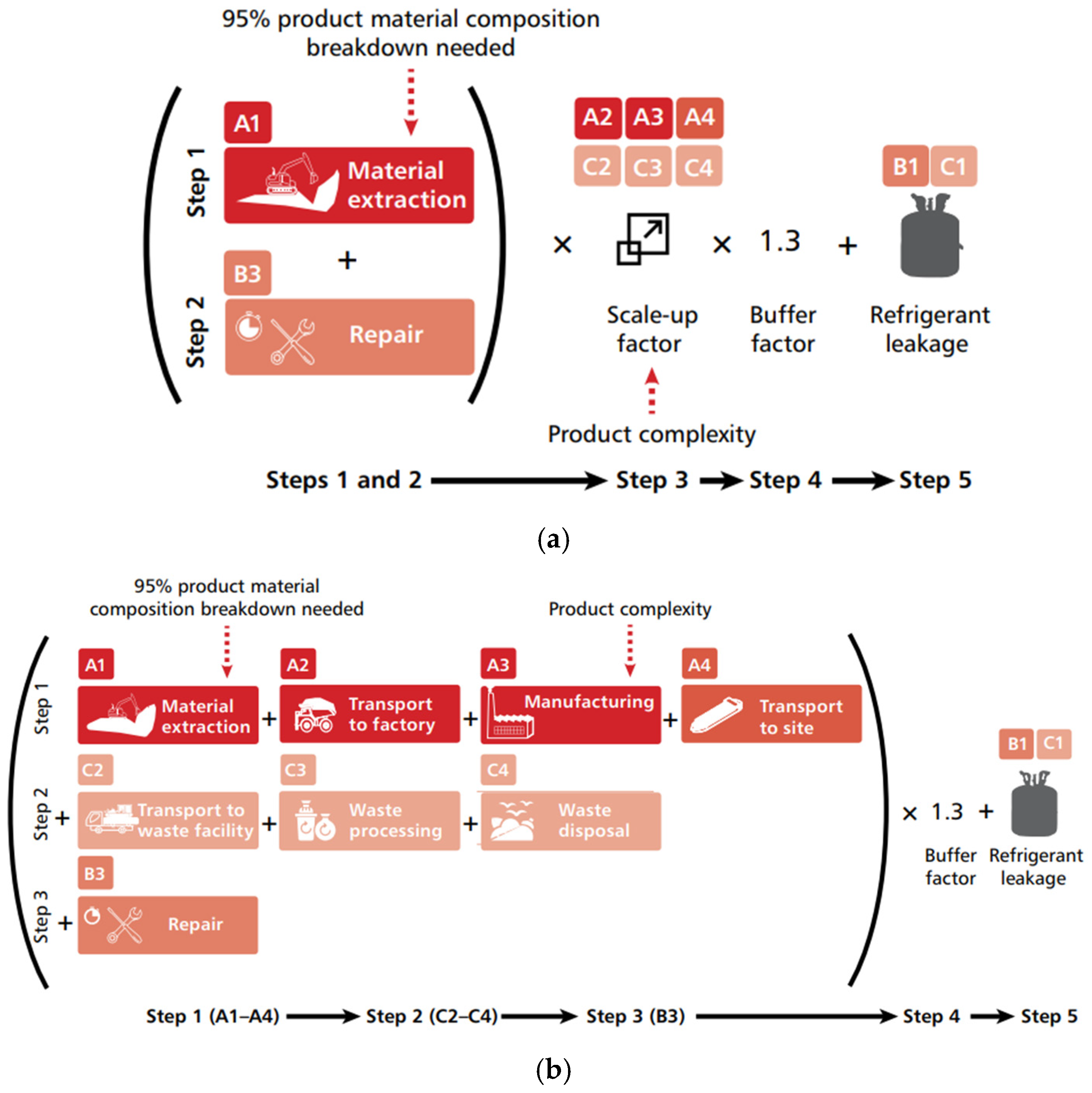
Reviewing this methodology is valuable because it illustrates how embodied-carbon assessment can be adapted to address the specific requirements of a particular construction sector. The methodology also provides detailed guidance on accounting for MEP-specific elements, including refrigerants. Additionally, CIBSE recognised the limited availability of EPDs for MEP products and therefore introduced two alternative approaches for calculating GWP when EPD data is unavailable. These are the basic method, which relies primarily on product weight and material composition, and the mid-level method, which incorporates additional information such as manufacturing energy consumption, transport distances, and refrigerant leakage rates to provide a more detailed assessment. CIBSE also includes a “buffer factor” to scale up the results due to uncertainty in the LCA data [67].
Figure 5a shows the first of the two methods; if almost no EPD data are available, then this method is suggested as a good approximation of GWP. Six modules are excluded from the calculations and are instead replaced by simply multiplying the result by a “scale-up” factor. Figure 5b shows the suggested method when more data is known. In both cases, as stated, the “buffer” or contingency factor is applied to account for inherent uncertainty in MEP carbon data. Several modules are excluded as they are not relevant to MEP equipment, such as A5 for construction processes. This is a unique methodology that still complies with EN 15978 and shows the potential for alterations to the baseline methodology to better tailor an LCA methodology for a specific purpose [67].
The five reviewed LCA methodologies, SEAI, IGBC, IStructE, RICS, and CIBSE TM65 disclose a common establishment in EN 15978 and ISO 14040/14044, yet vary in ways that significantly affect reported GWP values and limit cross-study comparability. The most consequential difference lies in system boundary selection: while SEAI, IStructE, and RICS adopt an A–D boundary encompassing the full life cycle, including beyond-boundary benefits, the IGBC explicitly excludes Stage D on the grounds that its benefits are realised post-service life, a pragmatic position that nonetheless conflicts with EPBD requirements and may understate the long-term environmental benefit of circular material strategies by 10–25%. CIBSE TM65 further restricts its boundary to A–C, reflecting the service-life focus of MEP equipment. This implies that end-of-life recovery potential for refrigerants and mechanical systems is often significant and entirely excluded from the assessment. A second source of methodological uncertainty arises from module omissions: all five methodologies exclude at least some life-cycle modules for different reasons. The IStructE excludes B6 (operational energy use) because it falls outside the structural engineer’s direct control, while the IGBC omits B3 (repair) despite it being a mandatory requirement under the EPBD delegated act, a gap that will necessitate revision of that methodology. These selective exclusions mean that two buildings assessed under different methodologies could report substantially different GWP values even under identical physical performance. A third source of uncertainty concerns the functional unit and floor area measurement: the SEAI reports GWP in kg CO2eq/m2 using IPMS floor area, the IGBC uses kg CO2eq/m2/year with ‘usable floor area’, and CIBSE TM65 reports total kg CO2eq per product. Finally, uncertainty quantification approaches differ significantly: RICS introduces a contingency factor applied to the final GWP based on design stage and data quality, and CIBSE applies a buffer factor to account for limited EPD availability for MEP equipment, whereas SEAI and IGBC incorporate no explicit uncertainty provisions, despite relying on databases that are still in development. Collectively, these methodological divergences in boundary scope, module selection, functional unit definition, and uncertainty treatment mean that the absence of a single harmonised Irish national methodology continues to generate results that are difficult to compare for regulatory compliance verification under the EPBD.

4.6. Life Cycle Impact Assessment (LCIA)

There are a number of methods that can be described as LCIA methods, the third phase of LCA in ISO 14040 [72]. Once all inputs, discharges, emissions, waste products, etc., associated with the product’s life cycle are known, these methods can be used to quantify the environmental impacts of the product.
The environmental footprint method [84] is an LCIA method created by the EU to quantify the environmental impacts of products and services. Level(s) explicitly mention this method as the recommended calculation technique if an LCIA is required to enable the calculation of GWP [46]. One of the most common methods in academic literature is ReCiPe 2016 [85], and still there are many other methods [74,86]. These are used when researchers want to quantify the impact of a new product or examine the impacts of an existing product. ReCiPe 2016 contains tables of values that allow the conversion of different GHGs into CO2eq. For example, this allows a researcher to quantify the GWP of a product due to all the GHGs released during its life cycle.
For most methodologies, including those discussed previously, the LCIA method is not explicitly specified, as it is generally assumed that the necessary environmental impact data has already been obtained and characterised prior to the assessment. The increasing use of EPDs and the creation of databases for generic LCA data mean that it is not generally necessary to conduct an impact assessment of products before performing an LCA. Additionally, the quality and volume of data required to conduct an accurate LCIA are high, and this would cause major inaccuracies in the results if an LCIA were attempted.

4.7. Comparison of LCA Methodologies and Future Development

For this review, studies comparing the scope of different LCA methodologies were identified and examined. The key sources that include such comparisons are summarised below.

4.7.1. Industry Reports

In the Irish context, the SEAI’s development of the proposed national GWP calculation methodology was assisted by several engineering industries and stakeholders, including the Rural Planning Service (RPS) and Ramboll. In order to inform the SEAI’s new methodology, RPS assessed the existing LCA methodologies and provided recommendations to the SEAI based on their findings. The report containing these findings is publicly available [28]. RPS considered 15 aspects when preparing the recommendations. The first seven were called technical information (reference period, functional unit, floor area, biogenic carbon, calculation tools, databases, data quality). The second eight were called scope (site boundary, Stages A1–A3, Stages A4–A5, Stage B, Stage C, Stage D, component classification, component coverage). The relevant standards and legislation for each of these aspects were reviewed, and RPS provided recommendations to the SEAI for the national methodology. For example, they suggested that ICMS 3 be used to define building elements [50]. Additionally, they provided recommendations on life cycle modules to include in the methodology.
Standardised Design Approaches also suggested that further research is required for several modules in order to develop more reasonable assumptions, as the currently available data are not fully sufficient [28]. The report also provides a brief comparison of the system-boundary requirements across six different methodologies; however, this comparison is limited to the boundary level and does not extend to other methodological aspects. Although the report addresses themes similar to those considered in this review, two important aspects were not considered. First, the EPBD delegated act was not included, as it had not been published at the time of the report’s release [78]. Second, the report does not contain any specific provisions for MMCs or 3DCP. As a result, the recommendations developed for the national methodology were not tailored to account for the unique characteristics of these construction approaches, highlighting an opportunity for further research in this area.
Ramboll, an engineering consultancy, was also consulted by SEAI on specific aspects of the national GWP calculation methodology. In addition, Ramboll has contributed to the development of several widely used LCA methodologies, including the RICS Whole Life Carbon Assessment (WLCA) methodology [87]. In 2023, before their involvement with the SEAI, Ramboll published a comparison of a number of European LCA methodologies and sustainability rating schemes [88]. The primary goal of that report was to compare differences in the scope of these methodologies; they assessed differences in system boundary, building elements, floor area definition, reference period, and impact categories across methodologies, and outlined the mandatory inclusions. Figure 6 shows one of the key results, the variability in system boundaries, for these methodologies. This report by Ramboll is the only source identified that contains any quantitative comparison of the results using different methodologies. An example is provided of LCA results using the Danish methodology, which uses an A–C system boundary, and the Swedish methodology, which only requires stage A. The final GWP for the Danish methodology is considerably higher for the same building.
The findings of these reports show that methodologies developed prior to the EPBD requirements differ significantly in their scope and assumptions [6]. The quantitative example provided in the Ramboll report further illustrates that these methodological differences can lead to considerable variation in the outcomes of LCA studies [88]. The EPBD, associated standards, and frameworks will eliminate most of these differences and provide more consistent results for LCA studies across the EU, enabling fair comparison of results. Examining the recommendations provided by RPS for the Irish national shows a clear example of methodology for a specific use case in the Irish construction industry. It also provides information on each aspect of LCA that is affected when considering it in an Irish context. However, the RPS report does not contain any consideration for MMCs, including 3DCP [28]. This shows that the national methodology has not been developed to account for the unique aspects of MMCs, which provides an opportunity to research and recommend alterations to achieve this goal.

4.7.2. Academic Literature

Some studies have reviewed the scope of previous LCA research, with a primary focus on the functional unit, databases, software tools, LCIA methods, and impact indicators [35,89,90]. This research did not assess alignment with the EPBD, EN 15978, or Level(s) framework requirements. A limited number of studies have examined differences between LCIA methods, such as ReCiPe 2016 and the Environmental Footprint method, as well as the influence of the selected LCIA method on the calculation of carbon factors [75,86]. As discussed, these LCIA methods are not directly relevant when considering an LCA methodology defined by the EPBD.
The review of these papers reveals several key gaps in the existing academic literature [28,87,88,89]. Firstly, there is a lack of consideration for compliance with the EPBD and related standards. Moving forward, studies intended for application within the EU context will need to adhere to these requirements; therefore, it is important to clearly identify which methodologies are compliant with the relevant regulations and standards. Secondly, none of the studies identified any quantitative comparison of the results using different LCA methodologies. Research into differences in the scope of an LCA methodology affects the numerical results, could highlight which aspects of LCA are most important to define comprehensively and allow for the provision of useful data for the creation of new methodologies or revision of old ones. Lastly, no studies were concerned with alterations to the baseline requirements that were included in the methodologies. Alterations and additional factors in a methodology provide the opportunity to tailor the methodology for a specific use case. There is little research to determine the alteration when tailoring a methodology; this is an area which is significant.

4.7.3. Irish LCA Studies

In August 2025, the Housing Agency of the Irish government released an LCA study of different housing typologies with the goal of informing the government on the carbon footprint of different types of dwellings [91]. This study states that it applies a methodology compliant with EN 15978 and the Level(s) framework to conduct LCAs of houses. However, the assessment was limited to an A1–A5 system boundary, as these modules account for a large proportion of embodied carbon. The study considered only traditional construction methods and did not examine modern methods of construction (MMC), such as 3D concrete printing (3DCP). The findings highlight two important points. First, they show that government-led studies recognise the importance of aligning LCA methodologies with EN 15978 and the Level(s) framework. Second, they reveal a gap in the consideration of MMC when assessing low-carbon housing options.
In October 2025, the Irish government published a report entitled “Standardised Design Approaches”, which examines a number of MMCs and suggests standardised approaches for house construction using each method [92]. The goal of this standardisation is to improve the cost efficiency, sustainability, and quality of construction using MMCs. Although 3DCP is recognised as an MMC in the introduction, it is not included in the report’s analysis. The report acknowledges the requirements of the EPBD; however, it was published before the delegated act was released. In addition, the finalised Irish national GWP methodology had not yet been published. Therefore, the LCAs were conducted using the RICS methodology, with One Click LCA used as the assessment tool [27]. The system boundary of the LCAs is limited to modules A1–A5. The building elements considered are 1 m2 of a typical wall build-up and 1 m2 of a typical floor build-up for each MMC. All LCA results and assumptions are provided in the report. However, the report recognises that this represents only a “partial review” of embodied carbon and identifies two key shortcomings in the analysis. First, due to the simplified scope of the building elements considered, the report states that “it will not be possible to use this study to predict the total emissions of a building”. Second, the system boundary is limited to stage A. The report, therefore, acknowledges that the results do not meet the requirements of the EPBD and states that compliance “will require a full life cycle embodied and whole life carbon calculation to be undertaken”.

5. LCA Approaches in 3DCP Literature

Table 10 shows a summary of the methodologies referenced in academic papers from the last five years that contain LCA studies of 3DCP elements. The majority of papers referred to ReCiPe 2016 [85]. As discussed with LCIA methods, this shows that studies were mostly concerned with examining how the inputs and outputs of the 3DCP process affected the environment, often using multiple impact indicators, as opposed to determining and reporting GWP specifically. Only a few studies referred to the EN 15978 methodology [32,39], and also mentioned RICS within their study as a whole-life carbon methodology [27]—No research has referred to Level(s). This shows that a significant amount of existing LCA studies of 3DCP elements are not aligned with the new requirements from the EPBD [6]. This limits the relevance of the results and identifies a need for more studies that are compliant with the new requirements. Additionally, no studies reviewed or attempted to upgrade the existing methodologies to better represent 3DCP; this highlights another potential area for more research.
Recent advances in 3D concrete printing have extended beyond process optimisation to encompass structural and material innovations. Notable developments include the characterisation of 3D-printed functionally graded concrete plates, which exploit layer-by-layer deposition to improve the 3DCP capacities of load bearing and deformations. The application of Engineering Cementitious Composites (ECC) as a reinforcing layer in 3DCP structures significantly enhanced both the load-carrying capacity and deformation performance [93]. The compressive behaviour of FRP-confined 3D-printed samples demonstrates the impact of FRP confinement layers on the axial compressive performance of 3DCP. FRP wrapping significantly improves the strength and deformation capacity of 3DCP ultra-high-performance concrete. The highest compressive strength was observed in the X-direction, while the lowest strength was recorded in the Z-direction [94]. Furthermore, studies on bond performance between FRP bars and 3D-printed high-performance concrete have addressed bar integration. However, the study encountered a decrease in bond strength, which is slightly affected by the alterations in the concrete strength [95]. Together, these developments signal an evolution of 3DCP research toward structurally engineered, high-performance applications that carry direct implications for the material and system boundary assumptions, highlighting LCA frameworks.

6. Methodological Gaps and Implications for 3DCP

Table 11 shows the scopes outlined in the EPBD [6], EN 15978 [23], and Level(s) [46]. While these frameworks do not prescribe a specific LCA methodology, they establish the fundamental requirements and boundaries for conducting building LCAs. By comparing existing methodologies against these baseline frameworks, it is possible to identify the adaptations, assumptions, and modifications introduced to suit specific applications or contexts. However, none of the methodologies examined includes specific considerations or adaptations for MMC, including 3DCP. This gap presents an opportunity to propose a methodology tailored specifically to 3DCP. Additionally, existing methodologies offer recommendations that can be used to build upon and extend the baseline requirements.
Comparing existing academic methodologies against these baseline frameworks exposes three specific practical gaps, along with what is needed to close each one:
  • Indicator and functional unit mismatch: Most 3DCP literature relies on a multi-indicator LCIA framework, such as ReCiPe 2016, covering categories like ‘ecotoxicity’ or ‘resource scarcity’. The EPBD, however, mandates a single reported metric: GWP in kg CO2eq/m2. For 3DCP research to meet regulatory expectations, studies need to report standardised GWP figures alongside other broader indicators.
  • System boundary inconsistencies: EPBD and Level(s) describe a full LCA across modules A–D, excluding submodules B5, B7, and B8. Much of the current 3DCP literature instead stops at a cradle-to-gate boundary, covering material production but not use-phase or end-of-life impacts. Closing this gap means extending future assessments to a whole-structure, cradle-to-grave scope over the mandated 50-year reference period.
  • Spatial quantification standards: EPBD and Level(s) calculate floor area using IPMS, while 3DCP engineering studies tend to use generic gross floor area or raw volumetric measurements instead. Aligning 3DCP functional units with IPMS boundaries would allow compliance data to be benchmarked against conventional construction on equal terms.

7. Discussion and Future Recommendations

Further adoption of 3DCP in the Irish market could provide an efficient means of helping to meet housing demand while also aligning with the government’s objective of increasing the use of modern methods of construction (MMC). However, alongside the financial viability of the method, the sustainability of 3DCP structures needs to be proven in a way that aligns with all EU and Irish government regulations. The new EPBD, in combination with EN-15978, provides a framework that outlines a methodology for GWP calculation, with several key minimum requirements. All the relevant aspects of an LCA detailed in this review are outlined by these new regulations, which provide a baseline for future LCA methodologies across the EU that should result in consistent GWP reporting, which is favourable for international carbon benchmarking of projects and makes designing for low-carbon easier. It should also be noted that within these requirements, there is some flexibility in scope that creates an opportunity for methodologies to be tailored for specific purposes, such as better representing MMCs like 3DCP. A significant number of existing LCA studies of 3DCP components do not comply with the latest requirements, which limits the relevance of their data within an EU context. Additionally, the lack of studies on complete 3DCP structures, such as houses, limits the use of existing research for informing future carbon benchmarking and comparisons.
Table 12 Key 3DCP printing parameters and their influence on calculating LCA, categorised by energy consumption-driven and material consumption-driven pathways. It is demonstrated that layer height and print speed govern energy-consumption-dominated indicators (GWP, TA) while infill density dominates material-consumption-driven categories (FRS, OFHH) using SHAP-based explainable AI analysis [96].

Methodological Considerations of 3DCP Versus Conventional Reinforced Concrete Construction

While many LCA principles are applicable to all building types, several environmental key points differ substantially between 3DCP buildings and conventionally constructed reinforced concrete (RC) buildings. Additionally, the layer-by-layer fabrication process enables optimised structural geometries and more efficient material use, potentially reducing overall material consumption and construction waste. However, these advantages may be partially offset by the higher binder contents often required to achieve printability and buildability, which can increase embodied carbon emissions. Furthermore, unlike conventional construction, 3DCP involves the use of robotic printing systems and associated equipment, introducing additional energy demands that should be considered during environmental assessments. Reinforcement strategies also differ between the two construction methods, with 3DCP frequently employing alternative reinforcement approaches that may influence environmental impacts. Consequently, environmental assessments of 3DCP buildings should explicitly account for technology-specific factors, including printer energy consumption, printable mix design characteristics, reinforcement methods, and reduced material waste, rather than relying solely on conventional building LCA methodologies.
In summary, 3DCP has potential as an efficient and sustainable construction method, but detailed analyses are required to better quantify the sustainability of 3DCP structures in a manner that satisfies the latest legislation. Future work that could be done to meet this goal should focus on the following areas:
  • The end-of-life scenarios for 3DCP structures are not well understood due to the relatively new construction method. Future research should aim to enhance the prediction of end-of-life scenarios for these structures, particularly with respect to decommissioning and demolition processes, while aligning with relevant policy frameworks and strategies established by the EU and national authorities. This would facilitate more accurate LCA results for 3DCP structures.
  • Part of the EPBD requirements is the development of national databases for generic and default values to facilitate GWP calculation. Work should be done to develop generic data suitable for 3DCP and other MMCs. If included in the national database, this could facilitate easier adoption of the methods, aligning with the government’s goals, and provide more accurate LCA results.
  • LCA methodologies created before the EPBD was published may not comply with the full scope of new requirements; work should be done to update any existing methodologies if they are intended to be used for future LCAs. Additionally, the EPBD requires EU member states to develop national GWP calculation methodologies. In Ireland, this process is currently being led by organisations such as the SEAI. These methodologies, along with the associated databases and calculation tools, should be finalised before the EPBD deadline for mandatory GWP reporting. Efforts should also be made to ensure that they are comprehensive and robust enough to account for a wide range of construction methods, including emerging technologies such as 3DCP.
  • Existing LCA studies and carbon benchmarking need to be updated to ensure the calculation methodologies comply with the EPBD’s requirements. For example, the government’s recent publication on standardised design approaches indicates that the completed LCAs do not adopt the required system boundaries and, therefore, are not compliant with the EPBD. Additionally, future work should be focused on producing compliant whole-life carbon assessments of complete structures, not just isolated elements, which will allow for better benchmarking of future structures.
  • Future studies could examine the scope permitted by the EPBD and propose a new methodology that better represents 3DCP or propose alterations to existing methodologies for the same purpose.
  • Almost limited work has been completed on quantitative comparisons of existing LCA methodologies; only the Ramboll report was identified in this review [90]. Most of the existing studies are focused on qualitative comparisons of the differences in scope and do not consider the effect these differences have on the numerical results of LCA studies. Future work could therefore be focused on this quantitative analysis and comparison, which would provide data to better inform future LCA methodologies.
  • Several papers identified in this review performed LCA studies on 3DCP components. However, as outlined, the scope of these studies is not sufficient within an EU context when considering new requirements. There is a possibility of future work to complete more LCA studies for a variety of 3DCP components that meet the requirements of the EPBD. This will provide relevant data that could be used to inform on the sustainability of a variety of additive manufacturing applications.
  • Within the Irish context, there has been almost no work completed on the sustainability of 3DCP structures. This can be seen clearly by the absence of additive manufacturing in the government’s recent standardised design approaches publication. Future work should be focused on producing complete and accurate LCAs of 3DCP structures in Ireland that adhere to the new requirements. This will provide data for future carbon benchmarking and facilitate increased adoption of the construction method.
  • Future studies should adopt probabilistic frameworks, integrating sensitivity analyses, Monte Carlo simulations, and scenario modelling to mitigate data variability and enhance the reliability of environmental baselines.
  • Integration of structural performance, service life, and material degradation mechanisms into the LCA framework to provide a more comprehensive and realistic long-term sustainability assessment is considered in the future scope of this study.
  • Recommendations for researchers and practitioners, particularly in terms of standardising LCA procedures, are standardising boundaries, prioritising high-quality data and environmental product declarations (EPDs), enhancing transparency, shifting to whole-structure assessments, quantifying methodological impacts, and engaging with national databases.

8. Conclusions

3DCP is a new technology in the Irish market that provides potential for decreased construction time and labour; however, recent EU legislation has imposed stricter requirements for LCAs that many existing studies of 3DCP elements do not meet. This review examines the current state-of-the-art on LCA methodologies, including the latest legislation and standards that govern their adoption. The focus of this review is on the key aspects that define an LCA methodology and the effect of the latest legislation, such as the EPBD. This review has also highlighted a need for further LCA studies of 3DCP structures to facilitate upcoming carbon benchmarking. The main conclusions from this review are the following:
  • The EPBD, EN 15978, and other relevant standards have created a comprehensive baseline LCA methodology that will be adopted across the EU. Future LCA studies will provide consistent results that will improve consistency and facilitate international benchmarking and comparison of projects.
  • The recommendations also account for data used in LCA studies, with EPBD and product-specific data being considered the highest value. Therefore, the continued creation and publication of high-quality EPDs by manufacturers is important. Generic and default data are considered the least valuable, but member states are required to create and publish databases of such data. When these databases are published, they should be reviewed to ensure that they include relevant data to 3DCP and other MMCs, as this would allow them to perform LCAs accurately.
  • As demonstrated, most existing methodologies and the LCA results derived using them do not fully alignwith the updated requirements of the EPBD, with system boundary scope and data quality hierarchy being the most common points of non-compliance.
  • Some methodologies include additional steps or techniques in their calculation which are not a part of EN 15978 or the requirements of other associated standards. For example, the contingency factor from the RICS methodology. These additions tailor the methodology in a way that produces more representative LCA results while still meeting all baseline requirements for LCAs.
  • The review identified a significant knowledge gap in the sustainability assessment of 3DCP structures. A significant number of LCAs do not fully align with the new guidelines from the EPBD, such as using a full cradle-to-grave system boundary. This means the results of these studies are not immediately useful for comparison and benchmarking.
  • It was also identified that very little research has been done on the quantitative comparison of LCA methodologies. Most comparisons have been qualitative comparisons of elements of the scope. A quantitative study of this kind would provide useful data for the creation and revision of future methodologies.
  • The review also identified a lack of LCA studies conducted on complete 3DCP structures, with most existing research focusing on individual components or simplified case studies. The results of comprehensive LCA studies of full 3DCP structures are necessary for accurate comparison with other types of construction, future carbon benchmarking, and to incentivise increased adoption of the construction method. Furthermore, the literature provides limited evidence to support recommendations for modifying existing LCA methodologies specifically for 3DCP..
  • Collectively, the new EU legislation provides a comprehensive baseline for future LCA methodologies. It is recommended to perform EPBD-compliant whole-life LCAs of complete 3DCP structures to better quantify their sustainability and provide data for future benchmarking, which could contribute to greater adoption of the technique.

Funding

This publication is supported by the Construct Innovate Technology Centre: Grant Code: CISFC1-24_018 and by Ecocem Ireland.

Data Availability Statement

No new data were created or analyzed in this study. Data sharing is not applicable to this article.

Acknowledgments

The authors gratefully acknowledge the support of the Construct Innovate Technology Centre (Grant Code: CISFC1-24_018) and Ecocem Ireland for supporting this research.

Conflicts of Interest

The authors declare no conflict of interest. This company (Ecocem Ireland) had no role in design of the study; in the collection, analyses or interpretation of data; in the writing of the manuscript; or in the decision to publish the results.

References

  1. Rialtas na hÉireann. An Action Plan on Housing Supply and Targeting Homelessness; Department of Housing, Local Government and Heritage: Dublin, Ireland, 2025.
  2. National Economic and Social Council. Boosting Ireland’s Housing Supply: Modern Methods of Construction; National Economic and Social Development Office: Dublin, Ireland, 2024.
  3. CRH. Exploring the Potential of 3DCP. 2025. Available online: https://www.crh.com/news-and-insights/innovation/exploring-the-potential-of-3dcp/ (accessed on 28 October 2025).
  4. HTL. 3d Construction Printed Social Housing Scheme to be Unveiled in Co. Louth. 2024. Available online: https://www.htl.tech/news-blog/3d-construction-printed-social-housing-scheme-to-be-unveiled-in-co-louth (accessed on 8 December 2025).
  5. Kythreotis, C.; Melero, P.C.; Veliskaki, A.; Koltsios, S.; Fokaides, P.A. A Data-Driven Framework for Operational Energy Performance Certification Aligned with Directive (EU) 2024/1275; EDP Sciences: Paris, France, 2026; p. 01014. [Google Scholar]
  6. European Union. Directive (EU) 2024/1275 of the European Parliament and of the Council of 24 April 2024 on the energy performance of buildings (recast). In Official Journal of the European Union; Publications Office of the European Union: Luxembourg, 2024. [Google Scholar]
  7. Mohammad, M.; Masad, E.; Al-Ghamdi, S.G. 3D concrete printing sustainability: A comparative life cycle assessment of four construction method scenarios. Buildings 2020, 10, 245. [Google Scholar] [CrossRef]
  8. Tinoco, M.P.; de Mendonça, É.M.; Fernandez, L.I.C.; Caldas, L.R.; Reales, O.A.M.; Toledo Filho, R.D. Life cycle assessment (LCA) and environmental sustainability of cementitious materials for 3D concrete printing: A systematic literature review. J. Build. Eng. 2022, 52, 104456. [Google Scholar] [CrossRef]
  9. Si, W.; Khan, M.; McNally, C. Rheological optimization and mechanical performance assessment of high-volume GGBS-silica fume mortars for 3D printing. J. Build. Eng. 2026, 117, 114805. [Google Scholar] [CrossRef]
  10. Bradshaw, J.; Balasubramanian, S.; Si, W.; Khan, M.; McNally, C. Towards Greener 3D Printing: A Performance Evaluation of Silica Fume-Modified Low-Carbon Concrete. Buildings 2025, 15, 3919. [Google Scholar] [CrossRef]
  11. Si, W.; Hopkins, B.; Khan, M.; McNally, C. Towards Sustainable Mortar: Optimising Sika-Fibre Dosage in Ground Granulated Blast Furnace Slag (GGBS) and Silica Fume Blends for 3D Concrete Printing. Buildings 2025, 15, 3436. [Google Scholar] [CrossRef]
  12. Saade, M.R.M.; Yahia, A.; Amor, B. How has LCA been applied to 3D printing? A systematic literature review and recommendations for future studies. J. Clean. Prod. 2020, 244, 118803. [Google Scholar] [CrossRef]
  13. Muñoz, I.; Alonso-Madrid, J.; Menéndez-Muñiz, M.; Uhart, M.; Canou, J.; Martin, C.; Fabritius, M.; Calvo, L.; Poudelet, L.; Cardona, R.; et al. Life cycle assessment of integrated additive–subtractive concrete 3D printing. Int. J. Adv. Manuf. Technol. 2021, 112, 2149–2159. [Google Scholar] [CrossRef]
  14. Raza, M.; Kravchenko, E. 3D printing of recycled materials for sustainable construction: A comprehensive economic and life cycle assessment. Renew. Sustain. Energy Rev. 2025, 223, 116059. [Google Scholar] [CrossRef]
  15. Si, W.; Khan, M.; McNally, C. A Comprehensive Review of Rheological Dynamics and Process Parameters in 3D Concrete Printing. J. Compos. Sci. 2025, 9, 299. [Google Scholar] [CrossRef]
  16. Kokare, S.; Oliveira, J.P.; Godina, R. Life cycle assessment of additive manufacturing processes: A review. J. Manuf. Syst. 2023, 68, 536–559. [Google Scholar] [CrossRef]
  17. Kamali, M.; Hewage, K.; Sadiq, R. Conventional versus modular construction methods: A comparative cradle-to-gate LCA for residential buildings. Energy Build. 2019, 204, 109479. [Google Scholar] [CrossRef]
  18. Kocaer, O. Environmental assessment of waste-derived materials in 3D concrete printing and cast-in-place construction through a BIM-integrated multi-scale life cycle assessment framework. J. Build. Eng. 2026, 120, 115554. [Google Scholar] [CrossRef]
  19. Obrecht, T.P.; Jordan, S.; Legat, A.; Ruschi Mendes Saade, M.; Passer, A. An LCA methodolody for assessing the environmental impacts of building components before and after refurbishment. J. Clean. Prod. 2021, 327, 129527. [Google Scholar] [CrossRef]
  20. Udomsap, A.D.; Hallinger, P. A bibliometric review of research on sustainable construction, 1994–2018. J. Clean. Prod. 2020, 254, 120073. [Google Scholar] [CrossRef]
  21. Zakka, W.P.; Lim, N.H.A.S.; Khun, M.C. A scientometric review of geopolymer concrete. J. Clean. Prod. 2021, 280, 124353. [Google Scholar] [CrossRef]
  22. SEAI. Life-Cycle Global Warming Potential Calculation Methodology; Sustainable Energy Authority of Ireland: Dublin, Ireland, 2025.
  23. CEN. Sustainability of Construction Works—Assessment of Environmental Performance of Buildings—Calculation Method; European Committee for Standardisation: Brussels, Belgium, 2026. [Google Scholar]
  24. CEN. Sustainability of Construction Works—Environmental Product Declarations—Core Rules for the Product Category of Construction Products; European Committee for Standardisation: Brussels, Belgium, 2012. [Google Scholar]
  25. Met Éireann. Climate Change. 2025. Available online: https://www.met.ie/climate/climate-change (accessed on 9 December 2025).
  26. IStructE. How to Calculate Embodied Carbon, 3rd ed.; The Institution of Structural Engineers: London, UK, 2025. [Google Scholar]
  27. RICS. Whole Life Carbon Assessment for the Built Environment, 2nd ed.; The Royal Institution of Chartered Surveyors: London, UK, 2024. [Google Scholar]
  28. RPS. Recommendation on a National Global Warming Potential (GWP) Calculation Methodology; RPS Group: Abingdon, UK, 2025. [Google Scholar]
  29. Circular Ecology. Inventory of Carbon and Energy Advanced Database. 2025. Available online: https://circularecology.com/embodied-carbon-footprint-database.html (accessed on 25 November 2025).
  30. Roux, C.; Kuzmenko, K. Life cycle assessment of a concrete 3D printing process. Int. J. Life Cycle Assess. 2023, 28, 1–15. [Google Scholar] [CrossRef]
  31. Taylor, C.; Roy, K.; Dani, A.A. Delivering Sustainable Housing through Material Choice. Sustainability 2023, 15, 3331. [Google Scholar] [CrossRef]
  32. Moghayedi, A.; Malachi, J. Revolutionizing affordable housing in Africa: A comprehensive technical and sustainability study of 3D-printing technology. Sustain. Cities Soc. 2024, 105, 105329. [Google Scholar] [CrossRef]
  33. Fernandez, L.; Caldas, L.; Reales, O. Environmental evaluation of 3D printed concrete walls considering the life cycle perspective in the context of social housing. J. Build. Energy 2023, 74, 106915. [Google Scholar] [CrossRef]
  34. Han, Y.; Yang, Z.; Ding, T.; Xiao, J. Environmental and economic assessment on 3D printed buildings with recycled concrete. J. Clean. Prod. 2021, 278, 123884. [Google Scholar] [CrossRef]
  35. Heywood, K.; Nicholas, P. Sustainability and 3D concrete printing: Identifying a need for a more holistic approach to assessing environmental impacts. Archit. Intell. 2023, 2, 12. [Google Scholar] [CrossRef]
  36. Abdalla, H.; Fattah, K.P.; Abdallah, M.; Tamimi, A.K. Environmental Footprint and Economics of a Full-Scale 3D-Printed House. Sustainability 2021, 13, 11978. [Google Scholar] [CrossRef]
  37. Albrecht, S.V.; Hellerbrand, S.; Weininger, F.; Thiel, C. Strategies for Minimizing Environmental Impact in Construction: A Case Study of a Cementitious 3D Printed Lost Formwork for a Staircase. Materials 2025, 18, 825. [Google Scholar] [CrossRef] [PubMed]
  38. Bianchi, I.; Volpe, S.; Fiorirto, F.; Forcellese, A. Life cycle assessment of building envelopes manufactured through different 3D printing technologies. J. Clean. Prod. 2024, 440, 140905. [Google Scholar] [CrossRef]
  39. Ebrahimi, M.; Mohseni, M.; Aslani, A.; Zahedi, R. Investigation of thermal performance and life-cycle assessment of a 3D printed building. Energy Build. 2022, 272, 112341. [Google Scholar] [CrossRef]
  40. Gislason, S.; Bruhn, S. Porous 3D printed concrete beams show an environmental promise: A cradle to grave comparative life cycle assessment. Clean. Technol. Environ. Policy 2022, 24, 2639–2654. [Google Scholar] [CrossRef]
  41. Khan, S.; Jassim, M. 3D printing of circular materials: Comparative environmental analysis of materials and construction techniques. Case Stud. Constr. Mater. 2023, 18, e02059. [Google Scholar] [CrossRef]
  42. Patel, A.; Raphael, B. Reducing Carbon Emissions in 3D Printed RCC Slabs. In Proceedings of the 42nd International Symposium on Automation and Robotics in Construction, Montreal, QC, Canada, 28–31 July 2025. [Google Scholar]
  43. Ramesh, A.; Navaratnam, S.; Rajeev, P.; Sanjayan, J. Thermal performance and life cycle analysis of 3D printed concrete wall building. Energy Build. 2024, 320, 114604. [Google Scholar] [CrossRef]
  44. Wilson, T.T.; Mativenga, P.T.; Marnewick, A.L. Sustainability of 3D Printing in Infrastructure Development. In Proceedings of the 56th CIRP Conference on Manufacturing Systems, Cape Town, South Africa, 24–26 October 2023. [Google Scholar]
  45. Zhang, H.; Liu, X. Comparative eco-efficiency assessment of 3D-printed recycled aggregate concrete structure for mid-rise residential buildings. J. Build. Energy 2024, 95, 110349. [Google Scholar] [CrossRef]
  46. Joint Research Centre. Level(s) Indicator 1.2: Life Cycle Global Warming Potential (GWP); European Commission: Brussels, Belgium, 2021.
  47. Joint Research Centre. Level(s)—A Common EU Framework of Core Sustainability Indicators for Office and Residential Buildings, User Manual 2; European Commission: Brussels, Belgium, 2021.
  48. SCSI. IPMS/ICMS. 2025. Available online: https://scsi.ie/ipms-icms/ (accessed on 9 December 2025).
  49. IPMSC. International Property Measurement Standards: Residential Buildings; International Property Measurement Standards Coalition: London, UK, 2016. [Google Scholar]
  50. ICMSC. ICMS: Global Consistency in Presenting Construction Life Cycle Costs and Carbon Emissions, 3rd ed.; International Cost Measurement Standard Coalition: London, UK, 2021. [Google Scholar]
  51. Rialtas na hÉireann. SCSI Publish ICMS Explanatory and Guidance Material. 2023. Available online: https://cwmf.gov.ie/en/news/scsi-publish-icms-explanatory-and-guidance-material/ (accessed on 9 December 2025).
  52. RICS. Methodology to Calculate Embodies Carbon of Materials, 1st ed.; Information Paper; The Royal Institution of Chartered Surveyors: London, UK, 2012. [Google Scholar]
  53. Joint Research Centre. Criteria for Analysis of LCA Software Tools and Databases for Buildings; European Commission: Brussels, Belgium, 2020.
  54. IGBC. Life Cycle Assessment Tools and Other Useful Links. 2025. Available online: https://www.igbc.ie/life-cycle-assessment-tools/ (accessed on 22 November 2025).
  55. IGBC. Benchmarking Embodied Carbon Baselines for Buildings in Ireland (Updated); Irish Green Building Council: Dublin, Ireland, 2024. [Google Scholar]
  56. OneClick LCA. RICS WLCA (2nd Edition) for the Built Environment. 2025. Available online: https://oneclicklca.com/regulations/rics-whole-life-carbon-assessment-wlca-2nd-edition (accessed on 9 December 2025).
  57. IGBC. What is Embodied Carbon? 2025. Available online: https://www.igbc.ie/what-is-embodied-carbon/ (accessed on 14 November 2025).
  58. IStructE. How to Read an EPD: Basics for the Structural Engineer; The Institution of Structural Engineers: London, UK, 2021. [Google Scholar]
  59. European Union. Regulation (EU) 2024/3110 of the European Parliament and of the Council of 27 November 2024 laying down harmonised rules for the marketing of construction products and repealing Regulation (EU) No 305/2011. In Official Journal of the European Union; Publications Office of the European Union: Luxembourg, 2024. [Google Scholar]
  60. European Union. Summary of References of Harmonised Standards Published in the Official Journal—Regulation (EU) No 305/2011; European Comission: Brussels, Belgium, 2026.
  61. European Union. Regulation (EU) 2017/1369 of the European Parliament and of the Council of 4 July 2017 setting a framework for energy labelling and repealing Directive 2010/30/EU. In Official Journal of the European Union; Publications Office of the European Union: Luxembourg, 2017. [Google Scholar]
  62. European Union. Annex to Commission Delegated Regulation (EU) Amending Annex III to Directive 2024/1275/EU of the European Parliament and of the Council as Regards the Union Framework for the National Calculation of Life-Cycle Global Warming Potential; European Commission: Brussels, Belgium, 2025.
  63. EPD Ireland. EPD Search. 2025. Available online: https://www.igbc.ie/epd-search/ (accessed on 23 November 2025).
  64. IGBC. National Inventory of Generic Construction Materials Data. 2023. Available online: https://www.igbc.ie/generic-data/ (accessed on 25 November 2025).
  65. SEAI. Conversion Factors. 2025. Available online: https://www.seai.ie/data-and-insights/seai-statistics/conversion-factors (accessed on 18 November 2025).
  66. DESNZ. Greenhouse Gas Reporting: Conversion Factors 2025. 2025. Available online: https://www.gov.uk/government/publications/greenhouse-gas-reporting-conversion-factors-2025 (accessed on 26 November 2025).
  67. CIBSE. Embodied Carbon in Building Services: A Calculation Methodology; The Chartered Institution of Building Services Engineers: London, UK, 2021. [Google Scholar]
  68. ecoinvent. ecoinvent Database. 2026. Available online: https://ecoinvent.org/database/ (accessed on 26 March 2026).
  69. Toniolo, S.; Borsoi, L.; Camana, D. Mehthods in Sustainability Science; Elsevier: Amsterdam, The Netherlands, 2021. [Google Scholar]
  70. Cabeza, L.F.; Rincón, L.; Vilariño, V.; Pérez, G.; Castell, A. Life cycle assessment (LCA) and life cycle energy analysis (LCEA) of buildings and the building sector: A review. Renew. Sustain. Energy Rev. 2014, 29, 394–416. [Google Scholar] [CrossRef]
  71. Häfliger, I.-F.; John, V.; Passer, A.; Lasvaux, S.; Hoxha, E.; Saade, M.R.M.; Habert, G. Buildings environmental impacts’ sensitivity related to LCA modelling choices of construction materials. J. Clean. Prod. 2017, 156, 805–816. [Google Scholar] [CrossRef]
  72. ISO. Environmental Management—Life Cycle Assessment—Principles and Framework; International Organisation for Standardisation: Geneva, Switzerland, 2006. [Google Scholar]
  73. ISO. Environmental Management—Life Cycle Assessment—Requirements and Guidelines; International Organisation for Standardisation: Geneva, Switzerland, 2006. [Google Scholar]
  74. Tascione, V.; Simboli, A. A comparative analysis of recent life cycle assessment guidelines and frameworks: Methodological evidence from the packaging industry. Environ. Impact Assess. Rev. 2024, 108, 107590. [Google Scholar] [CrossRef]
  75. ISO. Environmental Labels and Declarations—Type III Environmental Declarations—Principles and Procedures; International Organisation for Standardisation: Geneva, Switzerland, 2006. [Google Scholar]
  76. ISO. Greenhouse Gases—Carbon Footprint of Products—Requirements and Guidelines for Quantification; International Organisation for Standardisation: Geneva, Switzerland, 2018. [Google Scholar]
  77. CCAC. EU Energy Performance of Buildings Directive Fact Sheet; Climate Change Advisory Council: Dublin, Ireland, 2025. [Google Scholar]
  78. European Union. Level(s) European Framework for Sustainable Buildings. 2025. Available online: https://green-forum.ec.europa.eu/green-business/levels_en (accessed on 9 December 2025).
  79. Joint Research Centre. Level(s)—A Common EU Framework of Core Sustainability Indicators for Office and Residential Buildings, User Manual 1; European Commission: Brussels, Belgium, 2021.
  80. Rialtas na hÉireann. Climate Action Plan 2025; Department of Climate, Energy and the Environment: Dublin, Ireland, 2025.
  81. SEAI. SEAI Life-Cycle Global Warming Potential Calculation Workbook for Buildings. 2025. Available online: https://www.seai.ie/EPBD/life-cycle-global-warming-potential-methodology (accessed on 12 November 2025).
  82. IGBC. Whole Life Carbon Calculator. 2024. Available online: https://www.igbc.ie/lca/lifecyclegwp-methodology-ireland/ (accessed on 25 November 2025).
  83. IStructE. The Structural Carbon Tool. 2025. Available online: https://www.istructe.org/resources/guidance/the-structural-carbon-tool/ (accessed on 25 November 2025).
  84. European Union. Commission Recommendation (EU) 2021/2279 of 15 December 2021 on the use of the Environmental Footprint methods to measure and communicate the life cycle environmental performance of products and organisations. In Official Journal of the European Union; Publications Office of the European Union: Luxembourg, 2021. [Google Scholar]
  85. Huijbregts, M.A.J.; Steinmann, Z.J.N.; Elshout, P.M.F. ReCiPe2016: A harmonised life cycle impact assessment method at midpoint and endpoint level. Int. J. Life Cycle Assess. 2017, 22, 138–147. [Google Scholar] [CrossRef]
  86. Zhao, S.; Zhang, G. Comparative Analysis of Life Cycle Impact Assessment Methodologies for Toxicity: A Case Study of Soil Remediation Technology in China. ACS Sustain. Chem. Eng. 2024, 12, 16857–16868. [Google Scholar] [CrossRef]
  87. Ramboll. Review of EPD Programmes and EPD Databases; Ramboll: Copenhagen, Denmark, 2025. [Google Scholar]
  88. Ramboll. Comparing Differences in Building Assessment Methodologies; Ramboll: Copenhagen, Denmark, 2023. [Google Scholar]
  89. Khan, M.; Ahmed, A. Comprehensive review of 3D printed concrete, life cycle assessment, AI and ML models: Materials, engineered properties and techniques for additive manufacturing. Sustain. Mater. Technol. 2025, 43, e01164. [Google Scholar] [CrossRef]
  90. Motalebi, A.; Khondoker, M.; Kabir, G. A systematic review of life cycle assessments of 3D concrete printing. Sustain. Oper. Comput. 2024, 5, 41–50. [Google Scholar] [CrossRef]
  91. Comerford, P. Embodied Carbon and the Climate Impact of our Housing; The Housing Agency: Dublin, Ireland, 2025.
  92. Rialtas na hÉireann. Standardised Design Approaches Promoting Greater Adoption of MMC; Department of Housing, Local Government and Heritage: Dublin, Ireland, 2025.
  93. Sun, H.-Q.; Zeng, J.-J.; Hong, G.-Y.; Zhuge, Y.; Liu, Y.; Zhang, Y. 3D-printed functionally graded concrete plates: Concept and bending behavior. Eng. Struct. 2025, 327, 119551. [Google Scholar] [CrossRef]
  94. Yan, Z.; Zeng, J.-J.; Zhuge, Y.; Liao, J.; Zhou, J.-K.; Ma, G. Compressive behavior of FRP-confined 3D printed ultra-high performance concrete cylinders. J. Build. Eng. 2024, 83, 108304. [Google Scholar] [CrossRef]
  95. Zeng, J.-J.; Sun, H.-Q.; Deng, R.-B.; Yan, Z.-T.; Zhuge, Y. Bond performance between FRP bars and 3D-printed high-performance concrete. Structures 2025, 73, 108377. [Google Scholar] [CrossRef]
  96. Zhu, Y.; Abali, B.E.; Völlmecke, C. Explainable AI analysis of printing parameter effects on life cycle assessment for sustainable material-extrusion additive manufacturing. Virtual Phys. Prototyp. 2026, 21, e2632456. [Google Scholar] [CrossRef]
Figure 1. PRISMA-Based Methodology for Literature Identification and Selection.
Jcs 10 00367 g001
Figure 2. Life cycle stages adapted from EN 15978 [26].
Jcs 10 00367 g002
Figure 3. Process of biogenic carbon storage and release [26].
Jcs 10 00367 g003
Figure 4. Stages of an LCA from ISO 14040 [72].
Jcs 10 00367 g004
Figure 5. CIBSE calculation method: (a) basic calculation, (b) mid-level calculation [67].
Jcs 10 00367 g005
Figure 6. Comparison of system boundaries for selected European LCA methodologies [88].
Jcs 10 00367 g006
Table 1. Core environmental impact indicators from I.S. EN 15804:2012 + A2:2019 and AC:2021 [24].
Impact CategoryIndicatorUnit (Expressed per Functional Unit or per Declared Unit)
Climate change—totalGlobal Warming Potential total (GWP-total)kg CO2eq.
Climate change—fossilGlobal Warming Potential of fossil fuels (GWP-fossil)kg CO2eq.
Climate change—biogenicGlobal Warming Potential biogenic (GWP-biogenic)kg CO2eq.
Climate change—land use and land use changeGlobal Warming Potential land use and land use change (GWP-luluc)kg CO2eq.
Ozone DepletionDepletion potential of the stratospheric ozone layer (ODP)kg CFC 11eq.
AcidificationAcidification potential, Accumulated Exceedance (AP)mol H+ eq.
Eutrophication of aquatic freshwaterEutrophication potential, fraction of nutrients reaching freshwater end compartment (EP-freshwater)kg Peq.
Eutrophication aquatic marineEutrophication potential, fraction of nutrients reaching the marine end compartment (EP-marine)kg Neq.
Eutrophication terrestrialEutrophication potential, Accumulated Exceedance (EP-terrestrial)mol Neq.
Photochemical ozone formationFormation potential of tropospheric ozone (POCP)kg NMVOCeq.
Depletion of abiotic resources—minerals and metalsAbiotic depletion potential for non-fossil resources (ADP-minerals & metals)kg Sbeq.
Depletion of abiotic resources—fossil fuelsAbiotic depletion for fossil resources potential (ADP-fossil)MJ, net calorific value
Water useWater (user) deprivation potential, deprivation-weighted water consumption (WDP)m3 world eq. deprived
Table 2. Review of LCA methodologies in 3DCP literature: system boundary.
ReferenceSystem BoundaryExplanations
[36]A–BCradle to Use stage (approximate)
[37]A1–A3Cradle to Gate (Product Stage)
[38]A1–A3Cradle to Gate (Product Stage)
[39]A–BCradle to Use stage (approximate)
[33]A1–A5Cradle to Practical Completion (Product + Construction Stage)
[40]A1–A3Cradle to Gate (Product Stage)
[34]A1–A5Cradle to Practical Completion (Product + Construction Stage)
[41]A1–A3Cradle to Gate (Product Stage)
[32]A–DCradle to Use stage (approximate)
[13]A1–A3Cradle to Gate (Product Stage)
[42]A1–A3Cradle to Gate (Product Stage)
[43]A1–A3Cradle to Gate (Product Stage)
[14]A1–A3Cradle to Gate (Product Stage)
[30]A–DCradle to Use stage (approximate)
[31]A–DCradle to Use stage (approximate)
[44]A1–A3Cradle to Gate (Product Stage)
[45]A and CProduct Stage + End-of-Life only
Table 3. Tier-based classification of building elements under the EPBD framework [6].
TierDescriptionExample Elements
Tier 1High-level categoriesShell, Core, External works
Tier 2Mandatory minimum scope under EPBDSubstructure, structural frame, façade, roofs, internal walls, HVAC, heating and electrical systems
Tier 3More detailed classificationFoundation types, floor systems, partitions, ventilation units, pipework
Tier 4Highly detailed/component-level classificationPiles, reinforcement, insulation layers, fixtures, fittings, ducts, controls
Table 4. Recommended GWP reporting format from the EPBD [6].
Product Stage (A1–A3)Construction Process Stage (A4–A5)Use, Maintenance, Replacement Stage (B1–B4)Operational Energy Use Stage (B6)End-of-Life Stage (C1–C4)Reuse, Recycling, Recovery Potential (D1)Potential Benefit and Loads from Exported Utilities (for Example, Electrical Energy, Thermal Energy, Potable Water) (D2)
GWP-total-------
Table 5. Summary of SEAI methodology [22].
Methodology CharacteristicsDescription
Impact IndicatorGWP
System BoundaryA–D
Includes Sub-ModulesYes
Omitted ModulesA0, A5.4, B3, B5, B7, B8
Functional Unitkg CO2eq/m2
Floor AreaIPMS
Reference period50 years
Building elementsProvided in Methodology
Specific ToolYes
Incorporated DatabaseIn Development
Table 6. Summary of IGBC methodology [56].
Methodology CharacteristicsDescription
Impact IndicatorGWP
System BoundaryA–C
Includes Sub-ModulesNo
Omitted ModulesA0, B2, B3, B5, D1, D2
Functional Unitkg CO2eq/m2/year
Floor Area“Useable Floor Area”
Reference period50 years
Building elementsLevel(s)
Specific ToolYes
Incorporated DatabaseYes (A1–A3)
Table 7. Summary of IStructE methodology [26].
Methodology CharacteristicsDescription
Impact IndicatorGWP
System BoundaryA–D
Includes Sub-ModulesYes
Omitted ModulesB6, B7, B8
Functional Unitkg CO2eq/m2
Floor AreaNot Specified—GIA
Reference period60 years
Building elementsRICS—Building Element Categories
Specific ToolYes
Incorporated DatabaseYes
Table 8. Summary of RICS methodology [27].
Methodology CharacteristicsDescription
Impact IndicatorGWP
System BoundaryA–D
Includes Sub-ModulesYes
Omitted ModulesNone
Functional Unitkg CO2eq/m2
Floor AreaNot Specified—GIA
Reference period60 Years
Building elementsRICS—Building Element Categories
Specific ToolNo
Incorporated DatabaseNo
Table 9. Summary of CIBSE methodology [68].
Methodology CharacteristicDescription
Impact IndicatorGWP
System BoundaryA–C
Includes Sub-ModulesNo
Omitted ModulesA5, B2, B4, B5, B6, B7, D1, D2
Functional Unitkg CO2eq (Total GWP)
Reference periodService Life of MEP Product
Specific ToolNo
Incorporated DatabaseNo
Table 10. Review of LCA methodologies in 3DCP literature.
ReferenceMethodologyImpact Indicator TypeEPBD Alignment BasisCompliance
[14]ReCiPe 2016LCIA/multi-indicatorLCIA method only—no EPBD/EN 15978 linkageNon-compliant
[36]ReCiPe 2016LCIA/multi-indicatorLCIA method only—no EPBD/EN 15978 linkageNon-compliant
[13]Stepwise2006LCIA/multi-indicatorLCIA method only—no EPBD/EN 15978 linkageNon-compliant
[37]EN 15804Multi (product-level)Product-level EN standard; not building LCAPartially compliant
[42]n/aNot reportedMethodology not specified in the studyNon-compliant
[38]n/aNot reportedMethodology not specified in the studyNon-compliant
[43]ReCiPe 2016LCIA/multi-indicatorLCIA method only—no EPBD/EN 15978 linkageNon-compliant
[39]ReCiPe 2016LCIA/multi-indicatorLCIA method only—no EPBD/EN 15978 linkageNon-compliant
[33]EN 15978Multi (GWP reportable)EPBD-referenced framework (EN 15978)Partially compliant
[30]ReCiPe 2016LCIA/multi-indicatorLCIA method only—no EPBD/EN 15978 linkageNon-compliant
[40]EN 15804Multi (product-level)Product-level EN standard; not building LCAPartially compliant
[31]n/aNot reportedMethodology not specified in the studyNon-compliant
[34]JGJ/T 222Non-EU national standardChinese national standardNon-compliant
[44]ReCiPe 2016LCIA/multi-indicatorLCIA method only—no EPBD/EN 15978 linkageNon-compliant
[41]TRACILCIA/multi-indicatorLCIA method only—no EPBD/EN 15978 linkageNon-compliant
[45]ReCiPe 2016LCIA/multi-indicatorLCIA method only—no EPBD/EN 15978 linkageNon-compliant
[32]RICSGWP/Whole-life carbonEPBD-aligned, whole-life carbon methodologyPartially compliant
Table 11. Summary of the EPBD, EN 15978 and Level(s) [6,23,46].
Standard/FrameworkEPBDEN 15978Level(s)
Impact IndicatorGWPMultiMultiple Possible
System BoundaryA–DNone SpecifiedA–D
Includes Sub-ModulesYes (With FprEN 15978)Not CurrentlyNo
Omitted ModulesB5, B7, B8NoneNone
Functional Unitkg CO2eq/m2None Specifiedkg CO2eq/m2
Floor AreaIPMS“Gross Floor Area”IPMS
Reference period50 YearsNone Specified50 Years
Building elementsTier 2 ElementsBasic RequirementsSuggested in Methodology
Specific ToolNoNoNo
Incorporated DatabaseNoNoNo
Table 12. Key 3DCP printing parameters and their influence on calculating LCA.
Printing ParameterPrimary LCA PathwayEnvironmental Indicators AffectedDirection of Effect
Layer HeightEnergy consumption GWP, TA (dominant);
FRS, OFHH (secondary)
Increasing layer height decreases GWP and TA.
Print SpeedEnergy consumptionGWP, TAIncreasing speed decreases print time and energy-related impacts.
Infill DensityMaterial consumptionFRS, OFHH (dominant); GWP, TA (minor)Increasing infill increases material consumption and increases FRS and OFHH approximately linearly.
Nozzle DiameterBoth energy consumption and material consumptionAll indicatorsA wider nozzle allows fewer layers, which decreases print time and energy use. This affects surface quality and material deposition rate.
Extrusion TemperatureEnergy consumptionGWP, TAHigher temperatures increase heating energy demand; thermal control dynamics affect average power draw.
Printer Utilisation RateEnergy consumptionGWP, TALow utilisation rates amortise machine-embodied impacts over fewer parts, and this will increase the environmental burden.
Note: GWP = Global Warming Potential; TA = Terrestrial Acidification; FRS = Fossil Resource Scarcity; OFHH = Ozone Formation-Human Health.
Disclaimer/Publisher’s Note: The statements, opinions and data contained in all publications are solely those of the individual author(s) and contributor(s) and not of MDPI and/or the editor(s). MDPI and/or the editor(s) disclaim responsibility for any injury to people or property resulting from any ideas, methods, instructions or products referred to in the content.