Article

Comparative Analysis of Paving Blocks Reinforced with Pineapple Leaf Fiber (Ananas comosus) and Sisal Fiber (Agave sisalana)

Building Engineering Education Study Program, Faculty of Teacher Training and Education, Nusa Cendana University, Kupang 85111, Indonesia
*
Author to whom correspondence should be addressed.
J. Compos. Sci. 2026, 10(6), 316; https://doi.org/10.3390/jcs10060316
Submission received: 25 April 2026 / Revised: 30 May 2026 / Accepted: 31 May 2026 / Published: 10 June 2026
(This article belongs to the Section Composites Manufacturing and Processing)

Abstract

Infrastructure expansion in Indonesia has increased demand for paving blocks, raising concerns over cement production costs and environmental impact. This study investigates the comparative effectiveness of pineapple leaf fiber (PALF, Ananas comosus) and sisal fiber (Agave sisalana) as reinforcements in paving blocks, evaluating water absorption and 28-day compressive strength at fiber contents of 0%, 1%, 3%, 5%, and 7% by cement volume. A full-factorial two-way ANOVA with post-hoc Tukey HSD was employed. A dosage of 3% for both fiber types resulted in compressive strengths of 14.5 MPa (PALF, +59% vs. control) and 15.2 MPa (sisal, +67% vs. control), both of which met the requirements of SNI 03-0691-1996 Class B. Sisal fiber demonstrated superior compressive performance, consistent with its higher stiffness and tensile strength as reported in the literature. Water absorption increased monotonically with fiber content for both types, with SNI Class D compliance (≤10%) maintained only at 0% for PALF and 0–1% for sisal, a known consequence of the inherently hydrophilic nature of plant-based natural fibers. A statistically significant interaction term (F = 3.697, p = 0.012) confirmed that the two fibers respond differently to dosage increases, providing nuanced practical guidance beyond what single-factor studies can offer. These findings demonstrate the promising compressive strength of agricultural waste fiber-reinforced paving blocks, warranting further investigation of abrasion resistance, flexural strength, and long-term durability before practical deployment. Such utilization supports circular economy principles in the construction industry.

1. Introduction

The construction industry is one of the most significant contributors to global resource consumption and environmental degradation. With accelerating infrastructure development in developing countries, demand for construction materials continues to rise, posing urgent challenges for sustainable resource management [1,2,3]. Paving blocks are among the most widely used construction products in Indonesia, particularly for pedestrian pathways, parking areas, and light-traffic roads, where natural fiber reinforcement offers a promising pathway to reduce dependence on synthetic materials [4,5,6].
Natural fiber reinforcement in cement composites has attracted considerable research attention as a sustainable, cost-effective alternative to synthetic fibers, combining crack-bridging capability with circular economy benefits through agricultural waste valorization [7,8,9,10,11,12,13,14,15,16]. Despite these advantages, plant-based natural fibers share a well-documented limitation: their inherently hydrophilic nature. The abundance of hydroxyl groups (–OH) in cellulose and hemicellulose chains promotes strong affinity for water molecules via hydrogen bonding, leading to moisture absorption that can compromise fiber-matrix interfacial bonding, increase composite porosity, and reduce long-term durability [15,16]. This characteristic is particularly critical in paving block applications, where specimens are exposed to rainfall, surface runoff, and ground moisture. Water absorption performance, governed by SNI 03-0691-1996 Class D (maximum 10%) for Indonesian paving blocks, therefore, represent both a key quality criterion and the primary functional challenge associated with natural fiber incorporation. Accordingly, the present investigation explicitly examines water absorption alongside compressive strength. The dual objective is to characterize the hydrophilic behavior of PALF and sisal fiber at varying dosage levels and to identify fiber content thresholds that satisfy SNI compliance requirements.
Pineapple leaf fiber (PALF), derived from Ananas comosus, represents a promising reinforcement material with high cellulose content (69.5–71.5%) and significant tensile strength [17,18]. Sisal fiber (Agave sisalana), cultivated extensively in East Nusa Tenggara (NTT), Indonesia, offers a tensile strength of 468–640 MPa and has been evaluated in concrete reinforcement contexts [19,20,21]. Both fibers are available as agricultural by-products, making their utilization in paving blocks economically viable and environmentally beneficial for the NTT region [21,22].
The chemical composition of PALF includes approximately 42.72% hemicellulose and 4.03% lignin, which contribute to its effectiveness as a composite reinforcement [19]. In tropical regions such as Indonesia, pineapple cultivation generates substantial quantities of leaf waste that remains largely unutilized, presenting opportunities for value-added applications in construction materials [20]. Similarly, sisal fiber (Agave sisalana) possesses outstanding mechanical properties, including tensile strength ranging from 400 to 700 MPa, making it suitable for concrete reinforcement applications [21,23]. Chemically, sisal fiber consists of approximately 65–78% cellulose, 10–14% hemicellulose, and 8–13% lignin. Its high cellulose content contributes to a well-ordered crystalline molecular structure, which improves durability in cement matrices [24,25].
Previous research has demonstrated that natural cellulosic fiber reinforcement can improve compressive strength by up to 20% at the optimal content [26], with the performance outcome governed by fiber type, dosage, and surface characteristics [27,28]. Studies on sisal-reinforced paving blocks in NTT, including previous work by the present authors, have confirmed compressive strengths exceeding SNI Class D at 2–3% dosage [21,22]. Natural fiber properties, including length, diameter, surface morphology, and chemical composition, vary substantially between species, necessitating systematic investigation to determine optimal utilization parameters [28,29]. Moreover, the interaction between fiber type and fiber content on water absorption and compressive strength requires comprehensive factorial analysis to guide practical applications [30,31].
However, no study has directly compared PALF and sisal as reinforcements in paving blocks under identical mix design and curing conditions, using a factorial statistical framework capable of detecting interaction effects between fiber type and dosage. This gap is significant because a statistically significant interaction would confirm that the two fiber species cannot be ranked by a single universal dosage recommendation, a practically important finding for material selection in low-resource construction contexts. In addition, comparative studies examining the relative effectiveness of different fiber types remain limited, particularly for paving block applications [28,29]. Critically, while individual studies on PALF-reinforced concrete [17,20,26] and sisal-reinforced paving blocks exist, including previous work by the present authors [21,22] no prior study has compared these two fiber types in a single factorial experiment using identical mix designs and test protocols.
This research addresses that gap through a full-factorial side-by-side comparison of PALF and sisal fiber reinforcement, with the specific novelty of: (1) eliminating between-study confounders through identical mix proportions and protocols; (2) applying two-way ANOVA with interaction testing to the PALF-versus-sisal comparison for the first time; and (3) quantifying the interaction effect that determines whether dosage recommendations differ between fiber types. The investigation examines fiber type and content (0%, 1%, 3%, 5%, and 7% by cement volume) as independent variables, with water absorption and 28-day compressive strength as outcomes, benchmarked against SNI 03-0691-1996.

2. Materials and Methods

2.1. Research Design

An experimental factorial design was employed to investigate the effects of natural fiber type and content on the physical and mechanical properties of paving blocks. The independent variables were fiber type (PALF and sisal fiber) and fiber content (0%, 1%, 3%, 5%, and 7% by cement volume). The dependent variables were water absorption (%) and compressive strength (MPa). Eight specimens were prepared per treatment combination for water absorption testing (n = 3 tested per cell) and five specimens per cell for compressive strength testing, yielding 80 specimens in total. All specimens were cured by water immersion for 28 days prior to testing.

2.2. Materials

2.2.1. Portland Composite Cement Extended Characterization

Portland Composite Cement (PCC) conforming to SNI 7064:2014 (equivalent to ASTM C595), manufactured by PT Conch Cement Indonesia, was used as the sole binder. Additionally, PT Conch Cement Indonesia is part of Anhui Conch Cement Company Limited, a leading Chinese cement producer and one of the world’s largest cement companies. Established in Indonesia, it is located in Serang Regency, Banten, and provides high-quality cement products that meet international standards. PCC was selected for its consistent quality, high bonding capacity, and wide availability in East Nusa Tenggara Province. This cement type incorporates supplementary cementitious materials (SCMs), including pozzolan and finely ground limestone, which contribute to reduced heat of hydration, improved sulfate resistance, and enhanced long-term strength development [32]. Physical properties of the cement batch were determined prior to specimen production and are presented in Table 1.

2.2.2. Fine Aggregate—Extended Testing

Fine aggregates were sourced from local deposits in Takari, Kupang Regency, East Nusa Tenggara Province. In addition to gradation analysis and mud content testing, specific gravity and water absorption were determined in accordance with SNI 03-1970-1990 (equivalent to ASTM C128) to complete material characterization and support mix design calculations (Equation (1)) [33]. Complete physical properties of the fine aggregate are presented in Table 2.
G s b = A B C ;       G s a = A A C ;       W A % = B A A × 100
where: A = mass of oven-dry aggregate (g); B = mass of SSD aggregate (g); C = mass of submerged aggregate (g).

2.2.3. Natural Fibers

Figure 1 shows pineapple leaf fiber and sisal fiber extracted from sources obtained from agricultural areas in Kupang Regency. The extraction process involved mechanical separation through beating and scraping to remove the outer leaf cuticle, followed by washing and air-drying in shade. Pineapple fibers were cut to 2–3 cm lengths for uniform distribution in the cement matrix. On the other hand, sisal fibers were obtained from Agave sisalana plants using a similar mechanical extraction method, yielding fibers 3–5 cm in length. All fibers were stored in a dry, well-ventilated environment before use. As shown in Figure 1, sisal fibers exhibit a coarser texture and greater stiffness compared to the finer, more flexible PALF, consistent with their characterization data in Table 3.

2.2.4. Fiber Characterization

Prior to incorporation into the paving block matrix, both PALF and sisal fibers were subjected to a comprehensive physical and mechanical characterization program. This is essential given the inherent variability of natural fiber properties due to plant variety, cultivation region, and extraction method [34,35]. Diameter was measured using a calibrated digital micrometer at five equidistant points per specimen (n = 30 per type). Moisture content was determined gravimetrically: MC (%) = [(m1 − m2)/m2] × 100, where m1 = air-dried mass and m2 = oven-dried mass at 105 ± 2 °C/24 h. Tensile properties were determined using a Universal Testing Machine (UTM; 100 N load cell) following ASTM D3379-75 with a 25 mm gauge length (n = 25 per type). No chemical surface treatment was applied, to evaluate untreated agricultural waste fibers under practical low-cost production conditions and to isolate the effect of fiber species and content as the primary experimental variables [15]. All characterization results are presented in Table 3.

2.3. Mix Design and Specimen Preparation

2.3.1. Mix Proportions and Water-to-Cement Ratio

The paving block mix design employed a cement-to-sand ratio of 1:5 by weight, in accordance with standard practices for non-structural paving applications. Fiber content variations of 0%, 1%, 3%, 5%, and 7% by cement volume were investigated. Specimen dimensions were 4 cm × 9.2 cm × 18.4 cm per SNI 03-0691-1996. A constant w/c ratio of 0.285 was maintained across all batches (cement: 1.752 kg/batch; water: 0.500 kg/batch). For higher fiber content levels (5% and 7%), fibers were added in the dry state prior to water addition to minimize pre-absorption of mixing water by the hydrophilic fibers before cement hydration commenced [36]. All batch proportions are summarized in Table 4.

2.3.2. Specimen Preparation

The mixing procedure involved initial dry mixing of cement and sand, followed by gradual fiber addition to ensure uniform distribution. Water was added incrementally to achieve workable consistency. Compaction was performed manually using standard compaction procedures to eliminate voids. For 5% and 7% fiber contents, manual mixing with protective gloves was employed to overcome fiber agglomeration. After molding, specimens were left in molds for 24 h before demolding and subsequently immersed in clean water at room temperature for 28 days.

2.4. Testing Procedures

2.4.1. Water Absorption

Water absorption testing was conducted in accordance with SNI 03-0349-1989. Cured specimens were immersed in clean water for 24 h (SSD condition), surface-dried, and weighed (wet mass A). Specimens were then oven-dried at 105 ± 5 °C until mass variation between consecutive weighing was less than 0.2% (dry mass B). Water absorption was calculated as:
W a t e r   a b s o r p t i o n   % = A B B × 100

2.4.2. Compressive Strength

Compressive strength testing was performed using a Compression Testing Machine (CTM) in accordance with SNI 03-0691-1996. Specimens were cut to cube samples of 9.1 cm × 9.1 cm × 4 cm prior to testing. Load was applied continuously at a controlled rate until failure. Compressive strength was calculated as:
f c = P A
where: fc = compressive strength (MPa); P = maximum load (N); and A = cross-sectional area (mm2).

2.5. Statistical Analysis

2.5.1. Descriptive Statistics and Two-Way ANOVA

Descriptive statistics (mean, standard deviation) were calculated for all treatment groups. Two-way ANOVA was employed to evaluate the main effects of fiber type, fiber content, and their interaction on both water absorption and compressive strength. Post-hoc analysis used Tukey’s Honestly Significant Difference (HSD) test. Statistical significance was set at α = 0.05. All analyses were performed using IBM SPSS Statistics Version 22.

2.5.2. Verification of Parametric Assumptions

Prior to ANOVA, the validity of the normality and homogeneity of variance assumptions was verified. Normality was assessed using the Shapiro–Wilk test (recommended for n < 50) applied to each treatment cell. Homogeneity of variance was assessed using Levene’s test, which is more robust than Bartlett’s test under non-normal conditions [37]. Both tests used p > 0.05 as the non-violation criterion. If either assumption was violated, logarithmic or square root transformation would be applied, or the non-parametric Kruskal–Wallis test with Dunn post-hoc comparison would be used. Results are reported in Table 5 and Section 3.4.

3. Results

3.1. Material Characterization

All constituent materials met their respective SNI quality requirements; complete characterization data are presented in Table 1, Table 2 and Table 3.

3.2. Water Absorption of Fiber-Reinforced Paving Blocks

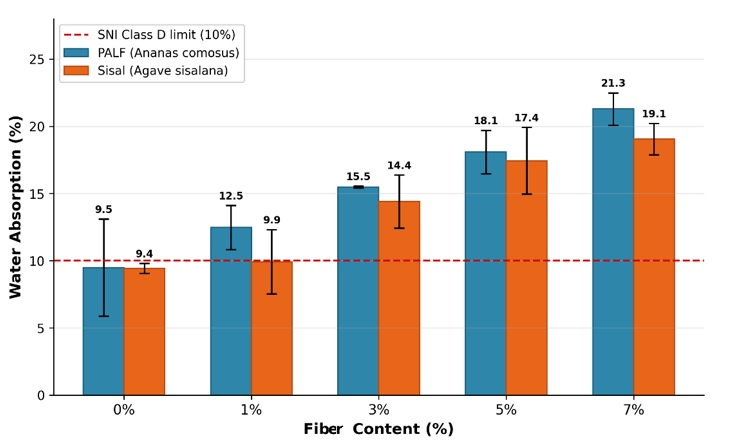
Water absorption testing was conducted on 30 specimens (15 per fiber type; n = 3 per treatment cell) following SNI 03-0349-1989. The results for both PALF and sisal fiber series are presented in Table 6 and illustrated in Figure 2.
Both PALF and sisal fiber series exhibited a consistent, monotonic increase in water absorption with increasing fiber content. For PALF specimens, mean water absorption increased progressively from 9.49% at 0% fiber content to 21.29% at 7%, representing an increase of 124.3% relative to the control. For sisal fiber specimens, mean water absorption rose from 9.43% (0%) to 19.05% (7%), an increase of 101.8% relative to the control.
Control specimens (0%) for both series met the SNI 03-0691-1996 Class D quality requirements (maximum 10%). At 1% fiber addition, sisal fiber specimens (9.92%) marginally complied with the Class D threshold, while PALF specimens (12.48%) exceeded it. Beyond 1% fiber content, all specimens of both series exceeded the SNI Class D limit, indicating progressive deterioration of water resistance at higher fiber dosages.
Sisal fiber specimens consistently exhibited lower water absorption than PALF specimens across all fiber content levels. The difference was most pronounced at 1% fiber content (sisal: 9.92% versus PALF: 12.48%, a difference of 2.56 percentage points) and remained significant at higher dosages. This differential behavior is attributed to the distinct morphological characteristics of each fiber type, as discussed in Section 4.1.
Two-way ANOVA (Table 7) confirmed that fiber content exerted a statistically significant main effect on water absorption (F = 33.561, p < 0.001, η2 = 0.820). In contrast, fiber type did not produce a statistically significant main effect (F = 3.676, p = 0.070). The interaction between fiber type and fiber content was also non-significant (F = 0.475, p = 0.753), indicating that the rate of increase in water absorption with increasing fiber content was statistically equivalent for both fiber types. The model explained 87.5% of the variance in water absorption (R2 = 0.875).
Post-hoc Tukey HSD analysis revealed significant differences in water absorption between 0% and 3% (p = 0.001), 0% and 5% (p < 0.001), and 0% and 7% (p < 0.001). The difference between 0% and 1% was not statistically significant (p = 0.513), suggesting that 1% fiber addition does not materially alter water absorption relative to the control for sisal fiber, though PALF at 1% already exceeds the SNI limit descriptively.

3.3. Compressive Strength of Fiber-Reinforced Paving Blocks

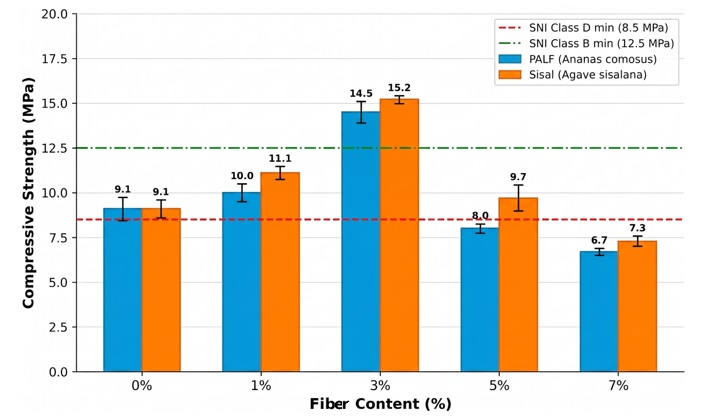
Compressive strength testing was conducted on 50 specimens (5 per treatment cell: 2 fiber types × 5 fiber content levels) in accordance with SNI 03-0691-1996. The results are presented in Table 8 and Figure 3.
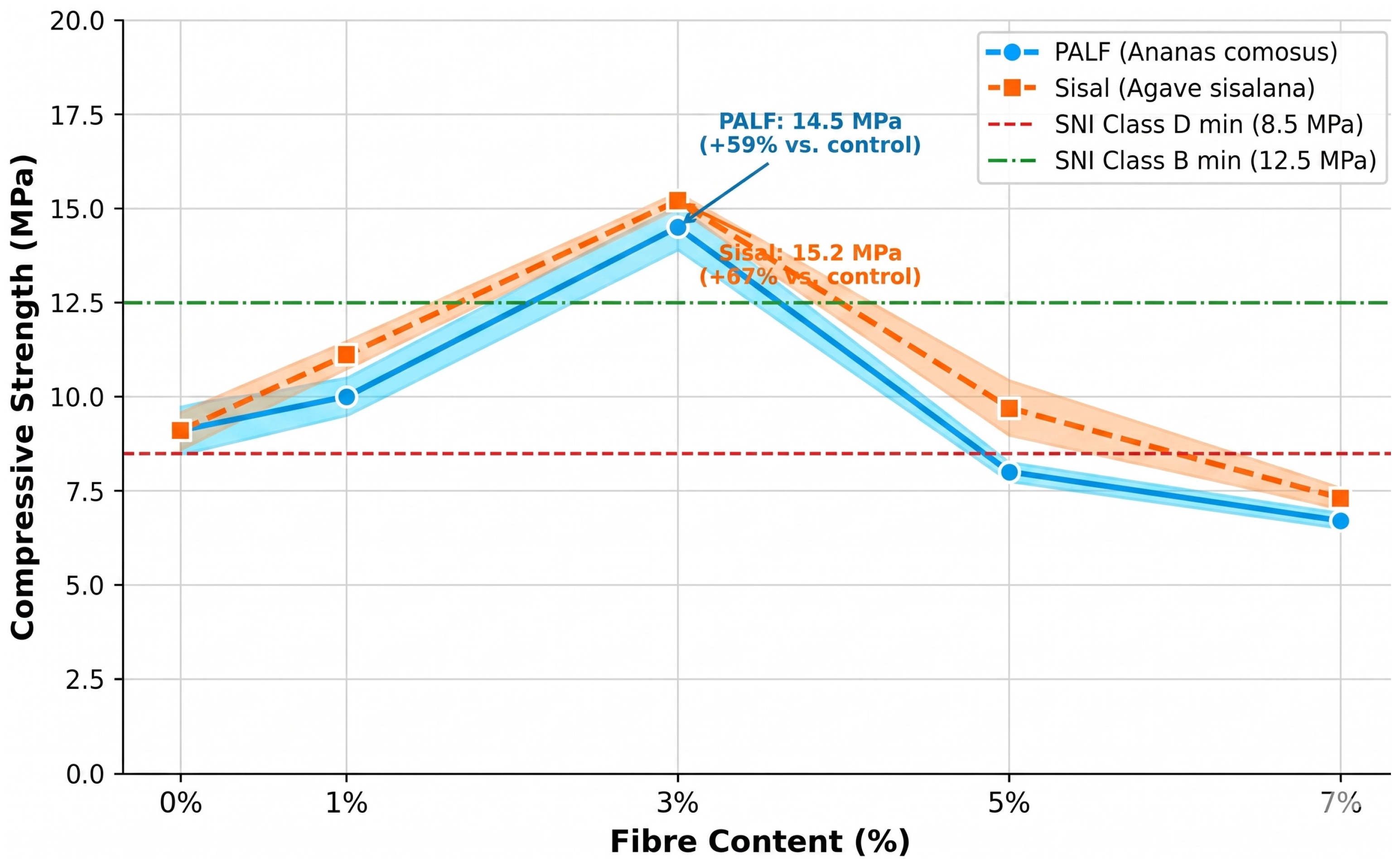
Both fiber types produced a non-linear, inverted-U relationship between fiber content and compressive strength, with a clear peak at 3% for both types. At 3% fiber content, PALF achieved 14.5 MPa (+59% vs. control) and sisal achieved 15.2 MPa (+67% vs. control), both meeting SNI Class B. Beyond 3%, compressive strength declined sharply at 5% and 7%, falling below Class D for PALF at 5% and for both types at 7%.
The most substantial improvement was observed at 3% fiber content. PALF specimens achieved 14.5 MPa (+59% vs. control) and sisal specimens achieved 15.2 MPa (+67% vs. control), both satisfying SNI Class B requirements (minimum 12.5 MPa). This represents a remarkable quality advancement from Class D (control) to Class B achieved solely through the addition of 3% untreated agricultural waste fiber by cement volume, without any supplementary cementitious materials or chemical admixtures.
Beyond 3%, compressive strength declined sharply. At 5% fiber content, mean strength fell to 8.0 MPa (PALF, below Class D) and 9.7 MPa (sisal, Class D). At 7% fiber content, both series achieved their lowest values: 6.7 MPa (PALF) and 7.3 MPa (sisal), both below Class D and structurally inadequate for standard paving applications. Sisal fiber consistently produced higher compressive strength than PALF across all levels; the differential was most pronounced at the 3% optimum (15.2 MPa vs. 14.5 MPa).
Two-way ANOVA (Table 9) confirmed that both fiber type (F = 38.512, p < 0.001) and fiber content (F = 347.750, p < 0.001) exerted statistically significant main effects on compressive strength. Crucially, the interaction term was also statistically significant (F = 3.697, p = 0.012), indicating that the effect of dosage on compressive strength differed between PALF and sisal. Post-hoc Tukey HSD confirmed that 3% fiber content differed significantly from all other groups (p < 0.001 for all pairings).
Based on Figure 4, the post-hoc Tukey HSD analysis confirmed that the 3% fiber content group differed significantly from all other groups (p < 0.001 for all pairings). Notably, the 0% and 5% groups were not significantly different from each other (p = 0.690), indicating that a 5% fiber addition effectively reduces compressive strength to a level comparable to the untreated control, negating any reinforcing benefit. The 7% group produced significantly lower compressive strength than all other groups (p < 0.001), confirming the severely detrimental effect of excessive fiber content.

3.4. Statistical Assumption Test Results

Prior to performing the two-way ANOVA analyses, the Shapiro–Wilk test and Levene’s test were applied to verify normality and homogeneity of variance, respectively (Table 5). The Shapiro–Wilk test yielded p > 0.05 for all treatment cells for both response variables. Levene’s test for homogeneity of variance also yielded p > 0.05 for both water absorption and compressive strength. These results confirm that the parametric assumptions of two-way ANOVA were satisfied, validating the use of the F-statistic and associated p-values reported in Table 7 and Table 9.

4. Discussion

4.1. Mechanisms of Water Absorption Increase with Fiber Content

The progressive increase in water absorption with increasing fiber content observed in this study is consistent with the fundamental hydrophilic behavior of cellulose-based natural fibers reported across the recent literature. The hydroxyl groups (–OH) present in cellulose molecular chains attract water molecules through hydrogen bonding (R1), creating a persistent moisture sink within the composite matrix. As fiber dosage increases, the total hydrophilic surface area within the paving block matrix grows proportionally, facilitating greater water uptake through both fiber-matrix interfacial zones and direct fiber absorption.
This finding aligns with that of Jamshaid et al. [26], who demonstrated that water absorption in cellulosic fiber-reinforced concrete increases consistently with fiber loading, attributing the trend to increasing interconnected porosity and fiber-matrix interfacial voids at higher dosages. Similarly, Wang et al. [38] confirmed in a study of natural fiber-reinforced foamed concrete that excessive fiber addition enlarges pore size and connectivity, adversely affecting microstructure and water resistance. The present results extend these observations specifically to the paving block context, confirming that the same mechanism operates in non-structural precast concrete products.
The statistically significant main effect of fiber content (F = 33.561, p < 0.001) alongside the non-significant main effect of fiber type (F = 3.676, p = 0.070) and non-significant interaction (F = 0.475, p = 0.753) presents a nuanced finding: both PALF and sisal fibers promote water absorption at statistically equivalent rates when fiber content is varied, despite their known morphological differences. This suggests that for water absorption, fiber dosage is the dominant variable, not fiber species, a practically important result that simplifies mix design guidance for natural fiber paving blocks.
However, descriptive comparison reveals a consistent quantitative advantage for sisal fiber in producing lower absolute water absorption values at all treatment levels. This differential is best explained by the distinct morphological and surface characteristics of each fiber. Sisal fibers are expected to facilitate more uniform distribution based on their known morphological properties [35], though direct SEM evidence was not obtained in this study. Literature on analogous systems suggests that the coarser surface texture and greater stiffness of sisal fibers (Agave sisalana) may facilitate more uniform distribution within dry cement-sand matrices compared to finer, more flexible fibers such as PALF [36,37,39]. More uniform dispersion is associated in the literature with fewer localized agglomeration zones and reduced capillary porosity [38]. However, as no SEM imaging or fiber-matrix interface characterization was performed in this study, these mechanistic explanations remain interpretive inferences grounded in published evidence rather than direct observations from this material system.
The threshold compliance with SNI 03-0691-1996 Class D (maximum 10%) only at 0% for PALF and at 0–1% for sisal confirms that untreated natural fibers pose a fundamental challenge for water absorption compliance in paving block applications. Ahmad et al. [27] observed a similar pattern in sisal fiber concrete, noting substantial increases in water absorption at dosages above 2%, which is consistent with the present findings.

4.2. Compressive Strength: Optimum Reinforcement and Post-Peak Decline

The inverted-U relationship between fiber content and compressive strength with a clear optimum at 3% for both fiber types represents the most practically significant finding of this investigation. The initial strength enhancement at 1% and the peak at 3% are consistent with the crack-bridging and stress-redistribution mechanisms widely reported in the natural fiber concrete literature [40,41].
At low to moderate fiber contents (1–3%), discrete fibers are distributed throughout the cement–sand matrix, functioning as crack arrestors within the hardened composite.
When compressive loading induces lateral tensile stress, it is postulated, based on the literature, that fibers resist crack propagation through bridging mechanisms, though direct SEM evidence was not obtained in this study. This mechanism forces cracks to deflect around fibers rather than propagating catastrophically through the matrix [41]. Additionally, based on findings from analogous sisal fiber concrete systems, the hydrophilic nature of natural fibers is thought to promote the penetration of cement paste into fiber surface irregularities during mixing. This process potentially creates mechanical interlocking upon hydration [42]. Direct evidence for this mechanism in the current material system would require microstructural characterization (e.g., SEM of the fiber-cement interface), which was not performed in this study and is recommended as a priority for future work.
The quality advancement from SNI Class D (control, 9.1 MPa) to Class B (3% fiber, ≥12.5 MPa) is a practically noteworthy outcome. Class B paving blocks are approved for areas with moderate pedestrian and light traffic loading under SNI 03-0691-1996. The promotion to Class B through the simple addition of 3% locally available agricultural waste fiber, without cement replacement, chemical admixtures, or surface treatment represents a viable and economically accessible quality improvement pathway for small-scale paving block producers in rural and semi-urban areas of Eastern Indonesia.
The decline in compressive strength at 5% and 7% fiber content is attributable to two concurrent mechanisms. First, at higher fiber concentrations, workability decreases significantly, making uniform fiber dispersion more difficult even with the dry-mixing procedure employed. Fiber agglomeration, particularly severe for PALF at these dosages, creates localized weak zones characterized by reduced cement-paste consolidation and elevated interconnected porosity [43]. Second, the volumetric proportion of fibers becomes sufficiently large to disrupt the continuity of the cement-sand load-bearing skeleton. Fibers, having much lower stiffness than the hardened cement matrix, act as compliant inclusions that reduce the composite modulus and introduce stress concentration sites under compressive loading [40]. Ahmad et al. [27] documented identical strength-decline patterns in sisal fiber concrete above 2% dosage.
The statistically significant interaction between fiber type and fiber content (F = 3.697, p = 0.012) confirms that the compressive strength response is not simply additive across the two factors. The advantage of sisal over PALF appears to grow disproportionately in the moderate-to-high fiber content range, a pattern consistent with the literature reports attributing sisal’s superior high-dosage performance to its stiffness-mediated resistance to self-entanglement [15,27]. Direct confirmation through SEM imaging of fiber distribution at different dosage levels would be needed to verify this interpretation for the present material system. This is mechanistically explicable. At low fiber dosages, both fibers are sufficiently dispersed to provide equivalent crack-bridging reinforcement. As dosage increases, the morphological advantage of sisal, its rougher surface and greater stiffness facilitating better dispersion and fiber-matrix bonding becomes increasingly consequential. Antwi-Afari et al. [29] confirmed that surface roughness of sisal fibers is a key determinant of interfacial bond strength, directly influencing compressive performance at higher dosages.

4.3. Comparative Performance: Sisal Fiber Superior to PALF

Sisal fiber consistently outperformed PALF in compressive strength across all fiber content levels and produced lower water absorption values at all levels. This performance differential is rooted in fundamental differences in fiber physical properties. Sisal fibers exhibit tensile strength of 468–640 MPa, diameter of 50–200 μm, and density of approximately 1.45 g/cm3 (R4). Their high cellulose content (~78%) contributes to a crystalline molecular structure with high stiffness, enabling effective stress transfer under compressive loading. PALF fibers, while possessing competitive tensile strength (180–753 MPa), are finer, more flexible, and more susceptible to agglomeration due to their lower stiffness and higher surface-to-volume ratio [34].
These findings are consistent with Asrial et al. [21] who investigated sisal fiber paving blocks in the same regional context (East Nusa Tenggara) and reported 13.2 MPa at 3% sisal fiber somewhat lower than the 15.2 MPa obtained in the present study, likely due to differences in mix proportions and specimen geometry. A previous study from NTT documented compressive strength exceeding K-125 at 2% sisal content [22]; the present study identifies a higher optimum of 3%, consistent with the denser mix proportions used for paving blocks.

4.4. Unexpected Findings and Anomalous Observations

(i)
Non-significance of fiber type on water absorption
The research team hypothesized, based on known morphological differences, that sisal fibers would produce statistically significantly lower water absorption than PALF. The two-way ANOVA result (F = 3.676, p = 0.070) did not support this hypothesis. This unexpected non-significance may reflect limited statistical power arising from the small sample size (n = 3 per treatment cell for water absorption). The observed p-value of 0.070, while above the α = 0.05 threshold, is borderline, suggesting a real but statistically undetected effect. Future studies with n ≥ 5 per cell are recommended. Alternatively, at the macro-scale of paving block water absorption, both fiber types may introduce similar quantities of interfacial porosity regardless of morphological differences, consistent with the argument of Wang et al. [38].
(ii)
Divergence between PALF and sisal at 5% fiber content
At 5% fiber content, sisal specimens achieved 9.7 MPa (Class D compliant) while PALF specimens fell to 8.0 MPa (below Class D) a divergence of 1.7 MPa larger than expected at this dosage. This highlights that at fiber contents approaching the practical workability limit, the morphological advantage of sisal, specifically its stiffness resisting self-entanglement, becomes critically important. At 5%, PALF appears to have reached a dispersion threshold beyond which agglomeration produces macroscopic weak zones, consistent with observations by Ahmad et al. [27] and Ntsie et al. [15].
(iii)
Non-significant difference between 0% and 5% compressive strength (Tukey HSD, p = 0.690)
The Tukey HSD result showing no significant difference between the 0% control (9.1 MPa) and the 5% combined group (mean ~8.83 MPa) was counterintuitive visually. This is explained by the high variance in the 5% group (SD = 1.017), which reflects the onset of heterogeneous fiber distribution, some specimens having better dispersion than others. The elevated variance at 5% is itself a practically important finding: it signals that manufacturing consistency deteriorates at this dosage, rendering the 5% level unsuitable for quality-controlled production even where the group mean appears adequate.

4.5. Strengths and Limitations

  • Strengths
-
Full-factorial two-way ANOVA with interaction testing—a statistical framework not previously applied to the direct PALF-versus-sisal comparison in paving block applications. Previous studies, including the authors’ own work [21,22], examined sisal fiber paving blocks in isolation; the present study’s side-by-side comparison under identical mix proportions, curing protocols, and test procedures eliminates between-study confounders. The statistically significant interaction term (F = 3.697, p = 0.012) demonstrates that the two fiber species respond differently to dosage changes—a finding that cannot emerge from single-factor or indirect comparisons across publications, and which provides actionable guidance for practitioners choosing between locally available fiber types.
-
Both fiber types were investigated simultaneously under identical mix proportions, curing conditions, and test protocols, eliminating between-study confounders that complicate indirect comparisons across publications.
-
All materials were sourced from East Nusa Tenggara Province, ensuring results are directly applicable to local construction practice and supporting knowledge transfer to rural communities in Eastern Indonesia.
-
SNI 03-0691-1996 was used as the quality benchmark throughout, ensuring practical relevance for Indonesian practitioners and policymakers.
  • Limitations
-
No fiber surface treatment was applied in this study, representing a deliberate choice to evaluate untreated agricultural waste fibers under low-cost production conditions. However, alkali treatment (NaOH) is well-documented to produce multi-faceted improvements in natural fiber composites, beyond the commonly cited benefits of improved fiber-matrix bonding and reduced water absorption. At the structural level, NaOH treatment removes hemicellulose, waxes, and surface impurities, increasing the cellulose crystallinity index and roughening the fiber surface to enhance mechanical interlocking with the cement paste [29,33]. At the thermomechanical level, alkali-treated sisal (Agave sisalana) composites have demonstrated improved thermal stability, higher glass transition temperatures, and enhanced dynamic mechanical properties, including storage modulus and damping characteristics, compared to untreated counterparts. These thermomechanical improvements are attributed to stronger interfacial adhesion, which reduces fiber pull-out during thermal loading. These multi-dimensional effects suggest that alkali-treated PALF and sisal fiber paving blocks could achieve both lower water absorption (potentially within SNI Class D limits at higher fiber dosages) and improved long-term structural integrity under thermal cycling conditions. The absence of surface treatment in this study, therefore, represents a conservative baseline that simultaneously highlights the achievable performance improvements available through fiber modification [39].
-
A single curing age (28 days) was investigated, precluding assessment of long-term strength development and durability particularly relevant given the risk of alkaline degradation of lignin and hemicellulose in cement matrices over extended periods [31].
-
Only compressive strength and water absorption were measured. Flexural strength, splitting tensile strength, abrasion resistance, and freeze-thaw durability were not assessed.
-
Small sample size for water absorption (n = 3 per treatment cell) limits statistical power and may have prevented detection of a significant fiber type main effect.
-
The mechanistic explanations proposed in this study, including crack-bridging, fiber dispersion, agglomeration-induced porosity, and interfacial bonding, are interpretations based on published literature rather than direct microstructural observations of the tested specimens. No SEM, EDS, XRD, or FTIR analyses were performed in this study. Consequently, the proposed mechanisms should be considered as plausible hypotheses consistent with the quantitative results, pending confirmation through future microstructural characterization.

4.6. Recommendations for Future Research

(1)
Surface treatment of fibers. Alkali treatment with NaOH (2–5%) applied to both PALF and sisal before incorporation is recommended as the highest-priority direction for future research. Beyond the well-documented benefits for water absorption and fiber-matrix bonding [33], recent investigations on sisal (Agave sisalana) composites have demonstrated that alkali treatment also enhances crystallinity, thermomechanical properties (storage modulus, damping factor), and thermal stability of the resulting composite [39]. For paving block applications in tropical climates subject to diurnal thermal cycling and wet-dry exposure, these thermomechanical benefits may be as important as the reduction in water absorption. A systematic factorial study varying NaOH concentration (0%, 2%, 5%) and fiber content (1%, 3%, 5%) for both PALF and sisal would comprehensively map the achievable performance envelope.
(2)
Multiple curing ages and long-term durability. Studies at 7, 28, 56, and 90 days would illuminate long-term compressive strength trajectories and provide insight into the alkaline degradation of natural fibers in the cement matrix [31] Wet-dry cycling and chemical exposure resistance should also be examined.
(3)
Hybrid PALF–sisal fiber systems. The complementary properties of PALF (higher aspect ratio, flexibility) and sisal (stiffness, better dispersion) suggest potential synergistic reinforcement in binary fiber blends. Sampath et al. [44] reported enhanced mechanical and thermal properties in hybrid PALF-sisal epoxy composites, supporting feasibility in cementitious matrices.
(4)
Microstructural characterization (SEM/XRD). Analysis of the fiber-matrix interface zone at 3% (optimum) and 5% (decline onset) would provide direct evidence for the crack-bridging and agglomeration mechanisms proposed in this study.
(5)
Life cycle assessment and economic analysis. A comparative LCA of natural fiber paving blocks versus conventional paving blocks would quantify the environmental and economic benefits at scale, informed by Chen et al. [5] who demonstrated carbon emission reductions in natural fiber concrete.
(6)
Field validation. Laboratory findings should be validated through real-world pilot trials in pedestrian and light-traffic paving applications in Kupang and surrounding districts, providing surface wear, infiltration rate, and visual integrity data to support adoption by local practitioners.

4.7. Practical Feasibility of SNI-Compliant Natural Fiber Paving Blocks

The principal practical concern raised by the present results is the gap between the optimal compressive strength dosage (3%) and SNI 03-0691-1996 Class D water absorption compliance (≤10%). At 3% fiber content, measured water absorption values of 15.48% (PALF) and 14.40% (sisal) exceed the SNI limit by 5.48 and 4.40 percentage points respectively, requiring reductions of approximately 35% and 31% from the untreated baseline (Table 10).
Evidence from the literature indicates that alkali treatment achieves reductions of this magnitude. Yimer and Gebre [33] demonstrated that NaOH treatment (5%, 24 h) of sisal fibers reduced their water absorption capacity significantly, with corresponding improvements in concrete compressive and flexural strength; however, concentrations of 10% reversed the gains by damaging cellulose crystallinity. More quantitatively, a recent study treating sisal fibers with 5% NaOH achieved a 29.27% reduction in fiber water absorption and a 23% improvement in 28-day mortar compressive strength at 1% fiber content, while noting that strength gains diminished at 2% fiber. Taken together, these findings suggest that a 5% NaOH treatment applied to both PALF and sisal fibers is a technically feasible pathway to achieving SNI Class D water absorption compliance at the 3% optimal dosage, while maintaining or enhancing compressive strength above Class B (≥12.5 MPa).
Two caveats apply. First, the optimal NaOH concentration window is narrow: 2–5% is generally effective for sisal, while ≥8–10% degrades fiber mechanical properties [33,45]. Second, PALF fibers have a different chemical composition and surface structure than sisal, and direct quantification of water absorption reduction in PALF-reinforced cement composites following alkali treatment remains a specific research gap. The conclusion that alkali treatment represents a practical solution therefore rests on stronger evidence for sisal than for PALF and should be verified experimentally for both.
Additionally, Table 11 summarizes quantitative data from selected studies on the impact of alkali treatment on the water absorption of fiber and cement composites.

5. Conclusions

This study compared the performance of untreated PALF and sisal fiber-reinforced paving blocks at five fiber content levels (0–7%) under standardized curing conditions. The main findings are as follows:
  • Fiber content significantly influenced both water absorption and compressive strength (p < 0.001), while fiber type significantly affected only compressive strength (p < 0.001).
  • The optimal fiber content was 3% for both species. Sisal fiber achieved 15.2 MPa and PALF achieved 14.5 MPa at this dosage, both meeting SNI Class B requirements (minimum 12.5 MPa).
  • Water absorption exceeded the SNI Class D limit at fiber contents above 0% for PALF and above 1% for sisal, indicating a fundamental water resistance constraint for untreated natural fibers.
  • Sisal fiber demonstrated superior performance compared to PALF across all fiber content levels. Based on literature evidence from analogous systems, this advantage is consistent with sisal’s higher stiffness, coarser surface texture, and better dispersion characteristics. These mechanistic explanations are supported by the significant statistical interaction term (p = 0.012) but should be confirmed through direct microstructural evidence (SEM/fiber pull-out testing) in future work.
  • Results are limited to compressive strength and water absorption. Future studies should include abrasion resistance, flexural strength, and long-term durability before recommending these blends for field application.

Author Contributions

Conceptualization, A., K.M.K.; methodology, A.; software, G.P.E.L.; validation, R.E., P.G.T., K.M.K.; formal analysis, A., A.S.I.; investigation, K.M.K.; resources, G.P.E.L.; data curation, P.G.T., A.S.I.; writing—original draft preparation, A.; writing—review and editing, K.M.K.; visualization, G.P.E.L.; supervision, P.G.T.; project administration, R.E.; funding acquisition, A. All authors have read and agreed to the published version of the manuscript.

Funding

This research received no external funding.

Data Availability Statement

The data supporting the findings of this study are available from the corresponding author upon reasonable request.

Conflicts of Interest

The authors declare no conflicts of interest.

Abbreviations

The following abbreviations are used in this manuscript:
PALFPineapple Leaf Fiber
SNIStandar Nasional Indonesia (Indonesian National Standard)
PCCPortland Composite Cement
CTMCompression Testing Machine
UTMUniversal Testing Machine
ANOVAAnalysis of Variance
HSDHonestly Significant Difference
SSDSaturated Surface Dry
WAWater Absorption
w/cWater-to-Cement ratio

References

  1. Alsharari, F. Utilization of industrial, agricultural, and construction waste in cementitious composites: A comprehensive review of their impact on concrete properties and sustainable construction practices. Mater. Today Sustain. 2025, 29, 101080. [Google Scholar] [CrossRef]
  2. Barbhuiya, S.; Das, B.B.; Adak, D. A comprehensive review on integrating sustainable practices and circular economy principles in concrete industry. J. Environ. Manag. 2024, 370, 122702. [Google Scholar] [CrossRef]
  3. Blouch, N.; Kazmi, S.N.H.; Metwaly, M.; Akram, N.; Mi, J.; Hanif, M.F. Towards Sustainable Construction: Experimental and Machine Learning-Based Analysis of Wastewater-Integrated Concrete Pavers. Sustainability 2025, 17, 6811. [Google Scholar] [CrossRef]
  4. Silva, W.; Picado-Santos, L.; Barroso, S.; Cabral, A.E.; Stefanutti, R. Assessment of Interlocking Concrete Block Pavement with By-Products and Comparison with an Asphalt Pavement: A Review. Appl. Sci. 2023, 13, 5846. [Google Scholar] [CrossRef]
  5. Chen, L.; Chen, Z.; Xie, Z.; Wei, L.; Hua, J.; Huang, L.; Yap, P.S. Recent developments on natural fiber concrete: A review of properties, sustainability, applications, barriers, and opportunities. Dev. Built Environ. 2023, 16, 100255. [Google Scholar] [CrossRef]
  6. Shukla, B.K.; Yadav, H.; Singh, S.; Verma, S.; Shukla, A.K.; Sharma, C. Sustainable Engineering of Recycled Aggregate Concrete: Structural Performance and Environmental Benefits Under Circular Economy Frameworks. Constr. Mater. 2025, 5, 67. [Google Scholar] [CrossRef]
  7. Rajkohila, A.; Chandar, S.P.; Ravichandran, P.T. Assessing the effect of natural fiber on mechanical properties and microstructural characteristics of high strength concrete. Ain Shams Eng. J. 2024, 15, 102666. [Google Scholar] [CrossRef]
  8. Baltrocchi, A.P.D.; Shafique, M. Circular pathways in construction: Environmental life cycle assessment of bio-based fiber-reinforced building component. Front. Sustain. 2026, 6, 1716779. [Google Scholar] [CrossRef]
  9. Garshasbi, S.; Mousavi, S.S.; Dehestani, M.; Nazarpour, H. Sustainable production of 3D concrete printing using agricultural waste fibers. Sci. Rep. 2025, 15, 38189. [Google Scholar] [CrossRef]
  10. Shkur, S.S.; Mohammed, A.A.; Ahmad, S.A.; Mahmood, H.F. Effects of Using Natural Fibers on the Fresh and Mechanical Properties of Concrete: A Comprehensive Review. Smart Green Mater. 2025, 2, 112–128. [Google Scholar] [CrossRef]
  11. Elfaleh, I.; Abbassi, F.; Habibi, M.; Ahmad, F.; Guedri, M.; Nasri, M.; Garnier, C. A comprehensive review of natural fibers and their composites: An eco-friendly alternative to conventional materials. Results Eng. 2023, 19, 101271. [Google Scholar] [CrossRef]
  12. Vivek, Y.; Paluri, Y.; Ganesh, P.; Pampana, L.D. Experimental study on sustainable cement concrete paver blocks incorporating coconut shell aggregate, quarry dust, silica fume and rice husk ash. J. Phys. Conf. Ser. 2024, 2779, 012008. [Google Scholar] [CrossRef]
  13. Oppon, J.A.; Adinyira, E.; Agyekum, K. A bibliometric review of agricultural waste as coarse aggregates in sustainable concrete. Discov. Civ. Eng. 2025, 2, 127. [Google Scholar] [CrossRef]
  14. Zhao, J.; Sufian, M.; Abuhussain, M.A.; Althoey, F.; Deifalla, A.F. Exploring the potential of agricultural waste as an additive in ultra-high-performance concrete for sustainable construction: A comprehensive review. Rev. Adv. Mater. Sci. 2024, 63, 20230181. [Google Scholar] [CrossRef]
  15. Ntsie, O.D.; Phiri, R.; Boonyasopon, P.; Rangappa, S.M.; Siengchin, S. Advancing sustainable infrastructure: Natural fiber-reinforced composites in engineering. Discov. Appl. Sci. 2025, 7, 884. [Google Scholar] [CrossRef]
  16. Zaid, O.; Ben Kahla, N. Natural fiber reinforcements in cement-based composites: A review on recent advances, properties, and sustainability. Ind. Crops Prod. 2026, 240, 122520. [Google Scholar] [CrossRef]
  17. Tamanna, A.; Ahmmed, M.T.; Ahmed, R.; Akash, M.R.C. Application of pineapple leaf fiber as a reinforcement in concrete: A review. In Proceedings of the International Conference on Advances in Civil Engineering, Chattogram, Bangladesh, 12–14 December 2024. [Google Scholar]
  18. Abesho, K.W.; Jiru, M.G.; Lemu, H.G.; Alfeki, M.A. Study of mechanical and physical properties of pineapple leaf fiber and coffee husk filler reinforced polymer composite using response surface method. Polym. Test. 2025, 150, 108915. [Google Scholar] [CrossRef]
  19. Sethupathi, M.; Khumalo, M.V.; Skosana, S.J.; Muniyasamy, S. Recent Developments of Pineapple Leaf Fiber (PALF) Utilization in the Polymer Composites—A Review. Separations 2024, 11, 245. [Google Scholar] [CrossRef]
  20. Judith, C.A. Comparative Study on the Compressive Strength and Infiltration Rate of Pervious Concrete Reinforced with Pineapple Leaf and Snake Plant Fibers. Eng. Technol. J. 2025, 10, 7345–7348. [Google Scholar] [CrossRef]
  21. Asrial; Hikmah; Edyan, R. Investigation of Physical and Mechanical Properties of Paving Blocks Reinforced with Sisal Fiber (Agave Sisalana Perrine). Rev. Compos. Matér. Av. 2024, 34, 797–806. [Google Scholar] [CrossRef]
  22. Asrial; Kuswara, K.M.; Bara, A.A.; Edyan, R.; Kause, D. The Potential of Sisal Fiber as an Eco-Friendly Concrete Reinforcement in East Nusa. Rev. Compos. Matér. Av. 2025, 35, 987–994. [Google Scholar]
  23. Lyu, S.; Xiao, J.; Wang, B.; Lu, Y.; Sun, X. Influence of sisal fibers on mechanical properties and thermal conductivity of fully recycled aggregate concrete. Constr. Build. Mater. 2025, 470, 140478. [Google Scholar] [CrossRef]
  24. Thomas, B.C.; Jose, Y.S. Impact of sisal fiber reinforced concrete and its performance analysis: A review. Evol. Intell. 2022, 15, 865–875. [Google Scholar] [CrossRef]
  25. Selvam, V.; Muniyandi, T.; Jaya, R.P. A Sustainable Revolution in Sisal Fiber with Enhanced Mechanical Properties of Concrete. Open Civ. Eng. J. 2024, 18, e18741495277728. [Google Scholar] [CrossRef]
  26. Jamshaid, H.; Mishra, R.K.; Raza, A.; Hussain, U.; Rahman, M.L.; Nazari, S.; Chandan, V.; Muller, M.; Choteborsky, R. Natural Cellulosic Fiber Reinforced Concrete: Influence of Fiber Type and Loading Percentage on Mechanical and Water Absorption Performance. Materials 2022, 15, 874. [Google Scholar] [CrossRef]
  27. Ahmad, J.; Majdi, A.; Deifalla, A.F.; Ben Kahla, N.; El-Shorbagy, M.A. Concrete Reinforced with Sisal Fibers (SSF): Overview of Mechanical and Physical Properties. Crystals 2022, 12, 952. [Google Scholar] [CrossRef]
  28. Ajayi, N.E.; Rusnakova, S.; Ajayi, A.E.; Ogunleye, R.O.; Agu, S.O.; Amenaghawon, A.N. A comprehensive review of natural fiber reinforced Polymer composites as emerging materials for sustainable applications. Appl. Mater. Today 2025, 43, 102666. [Google Scholar] [CrossRef]
  29. Antwi-Afari, B.A.; Mutuku, R.; Kabubo, C.; Mwero, J.; Mengo, W.K. Influence of fiber treatment methods on the mechanical properties of high strength concrete reinforced with sisal fibers. Heliyon 2024, 10, e29760. [Google Scholar] [CrossRef]
  30. Qu, W.; Niu, B.; Lv, C.; Liu, J. A Review of Sisal Fiber-Reinforced Geopolymers: Preparation, Microstructure, and Mechanical Properties. Molecules 2024, 29, 2401. [Google Scholar] [CrossRef] [PubMed]
  31. Ren, G.; Gao, X.; Wen, X.; Su, A. Experimental study on the long-term performance of sisal fiber reinforced high-performance concrete subjected to drying-wetting cycles. Case Stud. Constr. Mater. 2024, 21, e03911. [Google Scholar] [CrossRef]
  32. Kencanawati, N.N.; Rawiana, S.; Darmayanti, N.P.R.R. Characteristics of Pozzolan and Composite Portland Cements for Sustainable Concrete’s Material. Aceh Int. J. Sci. Technol. 2020, 9, 40–49. [Google Scholar] [CrossRef]
  33. Yimer, T.; Gebre, A. Effect of Fiber Treatments on the Mechanical Properties of Sisal Fiber-Reinforced Concrete Composites. Adv. Civ. Eng. 2023, 2023, 2293857. [Google Scholar] [CrossRef]
  34. Chaves, D.M.; Araújo, J.C.; Gomes, C.V.; Fangueiro, R.; Ferreira, D.P. Extraction, characterization and properties evaluation of pineapple leaf fibers from Azores pineapple. Heliyon 2024, 10, e26698. [Google Scholar] [CrossRef]
  35. Teklu, T.; Hadera, A.; Gebretsadik, A. Characterization and Comparative Insights on Agave Americana and Agave Sisalana Leaf Fibers for High-Performance Applications. J. Nat. Fibers 2023, 20, 2246648. [Google Scholar] [CrossRef]
  36. Busari, A.A.; Loto, R.T.; Ajayi, S.; Oluwajana, S.D.; Eletu, A. Development of sustainable interlocking concrete paving blocks using bamboo leaf ash and metakaolin. Heliyon 2024, 10, e31845. [Google Scholar] [CrossRef]
  37. Odoi, B.; Twumasi-Ankrah, S.; Afriyie, B.; Samita, S. Performance of Levene’s Test With Various Residuals and Correction Factor for Homogeneity of Variance in Single and Factorial ANOVA-a Simulation Approach. Stat. Methods 2024, 1, 149–171. [Google Scholar]
  38. Wang, X.; Jin, Y.; Ma, Q.; Li, X. Performance and mechanism analysis of natural fiber-reinforced foamed concrete. Case Stud. Constr. Mater. 2024, 21, e03476. [Google Scholar] [CrossRef]
  39. Lalaymia, I.; Belaadi, A.; Xian, B.; Ghernaout, D. Industrial Crops & Products Structural and thermomechanical characterization of a new bio-epoxy composite reinforced with agave waste flower stalk fibers for sustainable applications. Ind. Crops Prod. 2026, 241, 122800. [Google Scholar] [CrossRef]
  40. Ranjbar, N.; Zhang, M. Fiber reinforced geopolymer composites: A review. Cem. Concr. Compos. 2019, 107, 103498. [Google Scholar] [CrossRef]
  41. Mishra, R.K.; Jamshaid, H.; Muller, M.; Urban, J. Comprehensive Review on Mechanical Performance of Concrete Reinforced with Fibers and Waste Materials. Constr. Build. Mater. 2025, 18, 5419. [Google Scholar] [CrossRef]
  42. Pérez, S.P.M.; Peltroche, M.A.; Pachas, E.T.; Zapata, L.I.V.; Izquierdo, A.P.B.; Lafitte, E.D.R.; Núñez, M.E.R. Effect of Peruvian sisal fiber on the mechanical and microstructural strength of concrete. Innov. Infrastruct. Solut. 2025, 10, 257. [Google Scholar] [CrossRef]
  43. Kahsay, A.H.; Demiss, B.A. Experimental Investigation on Shear Strength and Microstructure of Chemically Treated Sisal Fiber-Reinforced Concrete. Adv. Civ. Eng. 2024, 2024, 4830026. [Google Scholar] [CrossRef]
  44. Sampath, P.S. Enhancing Mechanical and Thermal Properties of Epoxy Composites Reinforced with Plasma-Treated Sisal and Pineapple Leaf Fibers. J. Phys. Conf. Ser. 2025, 3045, 012005. [Google Scholar] [CrossRef]
  45. Wen, L.; Esperon-Rodriguez, M.; Peng, Y.; Zhang, S.; Weng, A.; Xue, T.; Zhao, K.; Lin, Y.; Li, B. Industrial Crops & Products Effects of cultivation practices on fruit yield, growth and leaf physiology of energy tree species Sapindus mukorossi in China: A meta-analysis. Ind. Crops Prod. 2026, 245, 123328. [Google Scholar] [CrossRef]
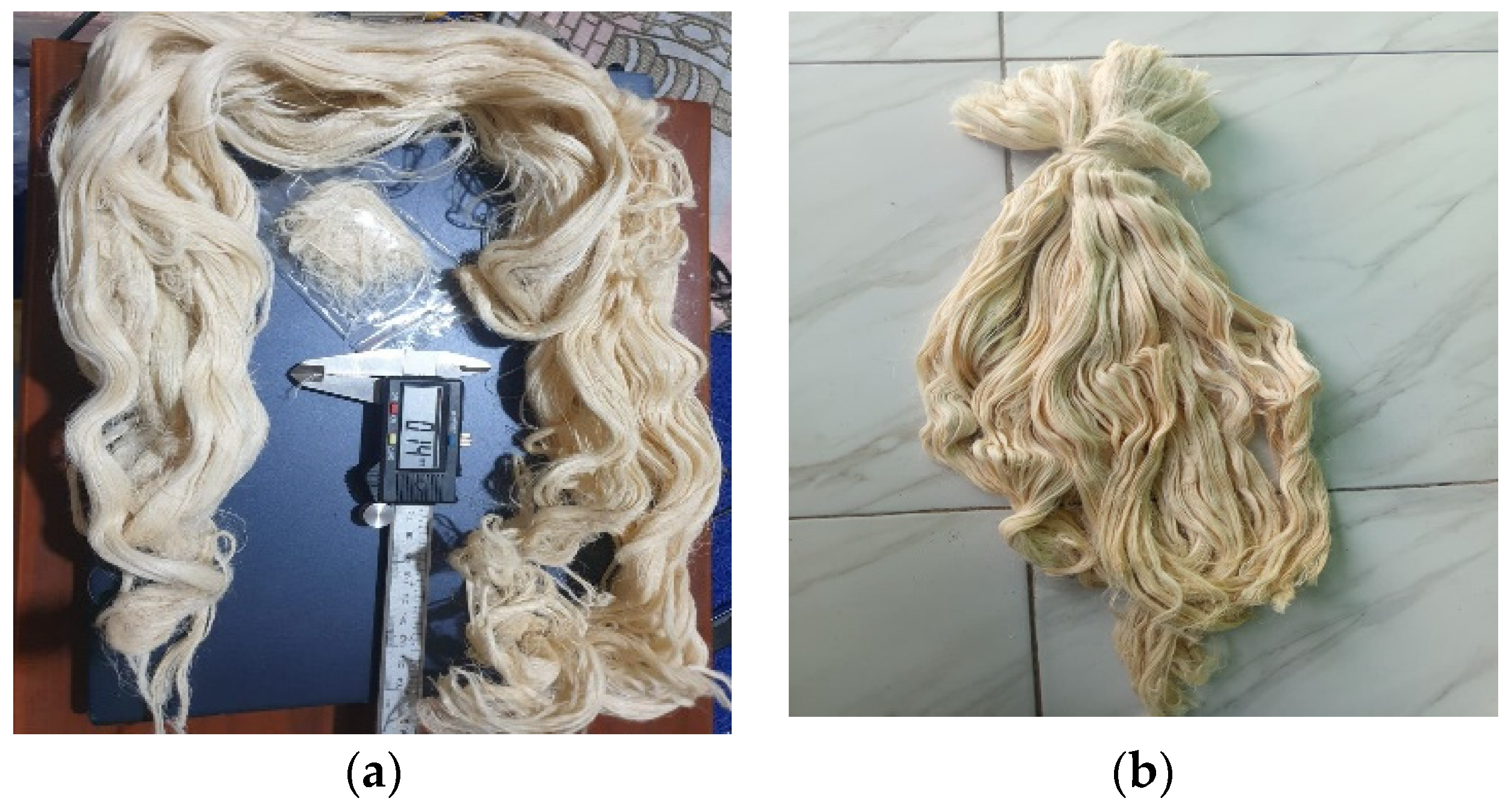
Figure 1. Natural fibers: (a) Sisal fiber; (b) Pineapple fiber.
Jcs 10 00316 g001
Figure 2. Mean water absorption of PALF and sisal fiber-reinforced paving blocks vs. fiber content (28-day).
Jcs 10 00316 g002
Figure 3. Mean compressive strength of PALF and sisal fiber-reinforced paving blocks vs. fiber content (28-day).
Jcs 10 00316 g003
Figure 4. Interaction plot—effect of fiber content on compressive strength for PALF vs. sisal fiber.
Jcs 10 00316 g004
Table 1. Physical properties of Portland composite cement (PCC) used in this study.
PropertyMeasured ValueSNI/ASTM LimitTest Standard
Specific gravity (g/cm3)3.022.85–3.15 (typical)SNI 03-2531-1991/ASTM C188
Normal consistency (%)27.5SNI 03-6826-2002/ASTM C187
Initial setting time (min)145≥45 minSNI 03-6827-2002/ASTM C191
Final setting time (min)265≤375 minSNI 03-6827-2002/ASTM C191
Cement typePCCSNI 7064:2014PT Conch Cement Indonesia
Table 2. Complete physical properties of fine aggregate (Takari sand, Kupang Regency, NTT).
ParameterMeasured ValueStandard LimitTest Standard
Fineness Modulus (FM)3.01.5–3.8SNI 03-1968-1990
Mud content (%)3.401≤5%SNI 03-4142-1996
Loose unit weight (g/cm3)0.0832SNI 03-4804-1998
Compacted unit weight (g/cm3)0.1526SNI 03-4804-1998
Bulk specific gravity (Gsb)2.622.4–2.9SNI 03-1970-1990/ASTM C128
Apparent specific gravity (Gsa)2.68SNI 03-1970-1990/ASTM C128
Water absorption (%)2.35≤3%SNI 03-1970-1990/ASTM C128
Table 3. Physical and mechanical properties of PALF and sisal fibers used in this study.
PropertyPALF (Ananas comosus)Sisal (Agave sisalana)Test Standard/Reference
Mean diameter (μm)62.4 ± 5.8152.6 ± 42.3Digital micrometer; n = 30
Moisture content (%)10.2 ± 1.37.8 ± 1.1Gravimetric; ASTM E1131
Density (g/cm3)1.44–1.561.33–1.45Literature values [34,35]
Tensile strength (MPa)412.5 ± 89.3534.2 ± 72.8UTM; ASTM D3379-75; n = 25
Young’s modulus (GPa)10.6 ± 2.315.3 ± 3.8UTM; ASTM D3379-75; n = 25
Elongation at break (%)3.2 ± 0.84.7 ± 1.2UTM; ASTM D3379-75; n = 25
Cellulose content (%)69.5–71.566.4–78.0Literature values [34,35]
Fibre length used (cm)2–33–5Manual cutting; vernier calliper
Table 4. Summary mix design parameters for all paving block specimens (per 8-specimen batch).
Mix IDCement (kg)Sand (kg)Fiber (kg)Water (kg)w/c Ratio
Control (0%)1.7528.7920.0000.5000.285
PALF-1/Sisal-1 (1%)1.7528.7920.0180.5000.285
PALF-3/Sisal-3 (3%)1.7528.7920.0530.5000.285
PALF-5/Sisal-5 (5%)1.7528.7920.0880.5000.285
PALF-7/Sisal-7 (7%)1.7528.7920.1230.5000.285
Note:  The bold row indicates the optimal fiber content. Each PALF and sisal series used separate batches with identical proportions.
Table 5. Summary of parametric assumption tests applied before two-way ANOVA.
TestPurposeCriterionSoftwareResult
Shapiro-WilkNormality (per treatment cell)p > 0.05 → not violatedSPSS v22All cells p > 0.05 (min p = 0.142);
Normality not violated
Levene TestHomogeneity of variancep > 0.05 → equal variancesSPSS v22WA: p = 0.243; CS: p = 0.318;
equal variances confirmed
Q-Q Plot (visual)Normality–graphicalPoints close to diagonalSPSS v22All points close to diagonal;
Normality supported
Kruskal-Wallis + DunnNon-parametric alternativeIf assumptions violatedSPSS v22N/A (parametric assumptions met)
Table 6. Mean water absorption results for PALF and sisal fiber-reinforced paving blocks (28-day curing).
Fiber Content
(%)
PALF Mean WA (%)PALF SD
(%)
Sisal Mean WA
(%)
Sisal SD (%)SNI 03-0691-1996 Limit
(%)
Compliance
09.493.629.430.37≤10 (Class D)✓ Both
112.481.649.922.39≤10 (Class D)✓ Sisal only
315.480.0614.401.97Exceeds Class D✗ Both
518.081.6117.442.48Exceeds Class D✗ Both
721.291.2019.051.16Exceeds Class D✗ Both
SD = Standard Deviation; WA = Water Absorption; SNI 03-0691-1996 Class D maximum = 10%. ✓ = compliant; ✗ = non-compliant.
Table 7. Two-Way ANOVA results: water absorption of paving blocks.
SourceSum of SquaresdfMean SquareFSig.
Corrected Model494.067954.89615.536<0.001
Fiber Type (A)12.989112.9893.6760.070 (n.s.)
Fibre Content (B) 474.358 4118.58933.561<0.001 **
A × B Interaction6.72041.6800.4750.753 (n.s.)
Error70.671203.534
Total7053.32030
R2 = 0.875 (Adj. R2= 0.819)    
n.s. = not significant; ** = significant at p < 0.001; α = 0.05. R2 = 0.875.
Table 8. Mean compressive strength results and SNI quality classification (28-day curing).
Fibre Content (%)PALF Mean CS (MPa)PALF SDSisal Mean CS (MPa)Sisal SDSNI ClassCompliance
09.10.69.10.6D (≥8.5 MPa)✓ Both
111.30.812.00.5C (≥10.0 MPa)✓ Both
3 * 14.5 0.7 15.2 0.6 B (≥12.5 MPa) ✓ Both
58.01.09.70.8Below D/D✗ PALF/✓ Sisal
76.70.97.30.7Below D✗ Both
Note: ✓ = compliant; ✗ = non-compliant, * Optimal fiber content. SNI 03-0691-1996 classes: Class D ≥ 8.5 MPa; Class C ≥ 10.0 MPa; Class B ≥ 12.5 MPa.
Table 9. Two-way ANOVA results: compressive strength of paving blocks.
SourceSum of SquaresdfMean SquareFSig.
Corrected Model356.453939.606160.478<0.001
Fiber Type (A)9.50519.50538.512<0.001 **
Fiber Content (B)343.299485.825347.750<0.001 **
A × B Interaction3.64940.9123.6970.012 *
Error9.872400.247
Total5418.46050
R2 = 0.973 (Adj. R2 = 0.967)     
* = significant at p < 0.05; ** = significant at p < 0.001; α = 0.05. Bold rows = significant effects. Bold interaction row = significant interaction term.
Table 10. Quantification of water absorption gap at optimal dose of 3%.
ParameterPALF 3%Sisal 3%SNI LimitsWA Reduction Needed
WA measured (%)15.4814.40≤10%
Advantages and limitations of SNI+5.48 pp+4.40 pp
% WA reduction required≥35.4% (PALF) ≥30.6% (sisal)
Table 11. Summary of studies on the impact of alkali treatment on the water absorption of fiber and cement composites.
StudyFiber/MatrixTreatmentWA ReductionMechanical Impact Strength
Yimer & Gebre (2023) [33]Sisal/concreteNaOH 2%, 5%, 10%, 12–48 hWA fiber decreased significantly; 5% NaOH was optimal before the decrease.Compressive and flexural strength increased at 5% NaOH; decreased at 10% (over-treatment)
Antwi-Afari et al. (2024) [29]Sisal/high strength concrete2.5% NaOH, 4 hIncreased fiber-matrix bonding; decreased interfacial porositySignificant increase in flexural strength and splitting strength of sisal concrete
Zaid & Ben Kahla (2026) [16]Natural fiber/cement composite (review)NaOH and pozzolan treatmentWA reduction is consistent in sisal and other Agave fibersMechanical strength increases up to optimal concentration; over-shoot damages the fiber
Disclaimer/Publisher’s Note: The statements, opinions and data contained in all publications are solely those of the individual author(s) and contributor(s) and not of MDPI and/or the editor(s). MDPI and/or the editor(s) disclaim responsibility for any injury to people or property resulting from any ideas, methods, instructions or products referred to in the content.