Article

Optimization of Tribological Properties in Cement Dust and Rock Wool Reinforced Composites: Experimental Study and Decision-Making Analysis


1
Faculty of Informatics, ELTE Eötvös Loránd University, 1117 Budapest, Hungary
2
Amrita School of Business, Amrita Vishwa Vidyapeetham, Bengaluru 560035, India
3
Allied Nippon Private Limited, Sahibabad 201010, India
4
Department of Biomedical Engineering, Faculty of Engineering, The Hong Kong Polytechnic University, Hong Kong, China
5
Department of Materials Science and Mechanical Engineering, Széchenyi István University, 9026 Győr, Hungary
*
Author to whom correspondence should be addressed.
J. Compos. Sci. 2026, 10(6), 317; https://doi.org/10.3390/jcs10060317 (registering DOI)
Submission received: 17 April 2026 / Revised: 7 June 2026 / Accepted: 8 June 2026 / Published: 12 June 2026
(This article belongs to the Section Composites Applications)

Abstract

This study investigates the effect of waste cement dust (CD) and rock wool (RW) inorganic fiber on the tribological performance of brake friction composite materials. Five formulations were fabricated by varying CD from 65 to 45 wt.% and RW from 5 to 25 wt.% and evaluated for tribological properties on a Chase friction testing machine in accordance with IS 2742 test procedures. The results show that composites containing higher CD and lower RW exhibited higher coefficients of friction, lower friction variability, and improved fade resistance. In contrast, composites containing higher RW and lower CD showed improved recovery characteristics and substantially enhanced wear resistance. The performance coefficient of friction decreased from about 0.521 to 0.442 as the formulation shifted from CD-rich to RW-rich compositions, while the variability coefficient increased from about 0.364 to 0.516. The highest wear was recorded for the composite containing 65 wt.% CD and 5 wt.% RW inorganic fiber, whereas the lowest friction fluctuations were obtained for the composite containing 55 wt.% CD and 15 wt.% RW inorganic fiber. Finally, a simple ranking process-based decision-making technique was employed to evaluate the overall performance of all the composites, suggesting 55 wt.% CD as the optimal content. These findings confirm the potential of waste CD as a viable functional constituent in brake friction composites when combined with RW inorganic fiber in an optimized manner.

1. Introduction

Brake friction materials are required to maintain stable friction, low fade, reliable recovery, and acceptable wear resistance over repeated braking cycles [1]. Achieving this balance remains challenging because friction materials are heterogeneous multi-phase composites in which binders, fibers, fillers, abrasives, lubricants, and modifiers interact in varying concentrations [1,2,3]. The designed formulations directly impact the performance of the end product. The literature has consistently shown that changes in composition may improve one performance attribute while deteriorating another, making friction material design an inherently multi-response materials problem [4,5]. Consequently, understanding and optimizing these formulations remains challenging, as performance is influenced by multiple, often competing factors. Beyond tribological behavior, additional concerns such as noise generation and particle emissions must also be considered, further complicating the design process [6,7,8]. As a result, recent studies have increasingly concentrated on discovering innovative material compositions that harmonize these conflicting performance characteristics while fulfilling stringent regulatory requirements [9,10]. At the same time, these efforts aim to align with the United Nations Sustainability Goals, such as responsible consumption and production (Goal 12) and climate action (Goal 13), outlined in the 2030 Agenda for Sustainable Development [11].
In recent years, the development of sustainable brake friction materials has attracted growing attention due to the need to reduce dependence on mineral resources and to valorize industrial and natural waste streams [12,13]. Waste-derived ingredients have increasingly been explored as partial or full substitutes for conventional fillers and modifiers in friction materials [14,15]. The use of waste materials offers a twofold benefit in terms of cost and environmental impact [16]. Previous studies have shown that industrial wastes can be incorporated into brake composites while providing acceptable tribological response, particularly when combined with suitable fibrous reinforcement. For instance, Zheng et al. [17] investigated the effect of waste foundry sand on the tribological properties of brake friction composite materials. The study concluded that waste foundry sand was effective in improving the friction performance and heat-fade resistance of the brake material, but at the cost of reduced wear resistance. The potential of aluminum anodizing waste to stabilize the friction, wear, and emission characteristics of brake friction composite materials was investigated by Straffelini et al. [18]. In [19], the authors investigated the influence of red mud on the tribological performance of brake friction composites. The study concludes that the friction performance remains best for 35 wt.% red mud-based composites, while composites with ≤30 wt.% red mud content demonstrate excellent wear rate stability. However, when the red mud content exceeds 35 %, the composites’ wear rate increases markedly. Gehlen et al. [20] developed friction composite materials using clam shell waste in 15 wt.% and 30 wt.%. The study concludes that clam shell waste composites achieve comparable performance to barite and calcite, and 15 wt.% seashell offers the best balance between friction stability, wear resistance, and emissions. The potential of blast furnace slags in stabilizing the tribological and emission characteristics of brake friction materials was highlighted by Jayashree et al. [21]. Recent work on eco-friendly friction materials has further demonstrated that alternative agro-waste-derived ingredients, such as Cardiospermum halicacabum [22], rice husk and rice stalk [23], maize husks, palm kernel, melon, and cocoa bean shells [24], loofah fiber [25], and agro-waste combinations [26] can perform comparably to conventional constituents when the formulation is carefully optimized.
Cement dust (CD) is an ultrafine byproduct of clinker production in the cement industry, and substantial amounts are landfilled, thereby increasing its environmental impact [27]. In 2024, global cement production reached 4.0 billion tons, according to the United States Geological Survey [28]. Reports indicate that CD production rates range from 20 to 150 kg per ton of clinker [29]. The anticipated global cement production is projected to rise to 4.83 billion metric tons by 2030, while worldwide waste CD generation is expected to approach 220 million ton in the same year, leading to significant global accumulation [29,30]. Cement’s importance extends beyond construction, as it promotes urbanization and national economies. Nonetheless, the production of cement is a major contributor to carbon dioxide emissions and plays a crucial role in the ongoing degradation of the global environment, with profound effects on human health and ecosystems [31,32]. Nonetheless, identifying uses of CD that minimize its environmental footprint presents a significant challenge. Consequently, numerous investigations have been conducted using CD waste in diverse industrial applications to mitigate its environmental impacts and reduce disposal costs [33,34,35,36]. One potential application of this waste is its use in automotive brake friction materials. Few studies have analyzed the tribological performance of CD-filled friction materials [37]. Furthermore, rock wool (RW) inorganic fiber is recognized as an essential reinforcing component in contemporary asbestos-free formulations, attributed to its superior thermal stability, ability to improve frictional stability, and its role in maintaining the structural integrity of the friction composite under elevated temperatures [38,39]. It also plays a crucial role in the formation of a third body layer, which significantly enhances friction recovery and minimizes wear [40,41]. Nonetheless, information on the impact of CD-RW combinations on the braking performance of brake friction materials is limited. This research seeks to investigate the synergistic effects of CD-RW combinations on the tribological characteristics of friction materials. The tribological parameters were assessed using a Chase machine (Pyramid Precision Engineering, Chennai, India) utilizing the brake lining quality test protocol, in compliance with the IS 2742 standard [42]. The main challenge in the design of composites for automotive braking applications lies in their composition, as the amounts and types of ingredients significantly affect the desired performance of the end product. Therefore, a simple ranking process (SRP)-based decision-making approach was used to propose the best composite with optimal tribological properties.
Accordingly, the novelty of this work lies in establishing an integrated experimental and decision-based framework to evaluate the combined use of waste CD and RW inorganic fiber in brake friction composites. Unlike previous studies that largely focus on single waste additives or isolated tribological responses, this study investigates how progressive substitution between CD and RW inorganic fiber influences friction level, friction stability, fade, recovery, and wear simultaneously under standardized test conditions. By keeping the combined CD-RW fraction fixed and varying only their relative proportions, the study isolates the formulation trade-off between friction effectiveness and durability-related performance. In addition, the use of SRP enables the identification of an optimum composition based on multiple conflicting tribological requirements rather than a single response variable. Therefore, this work contributes both experimentally and practically by advancing the valorization of CD in friction materials and by offering a structured route for selecting balanced, waste-based brake composite formulations.

2. Materials and Methods

2.1. Materials and Composite Preparation

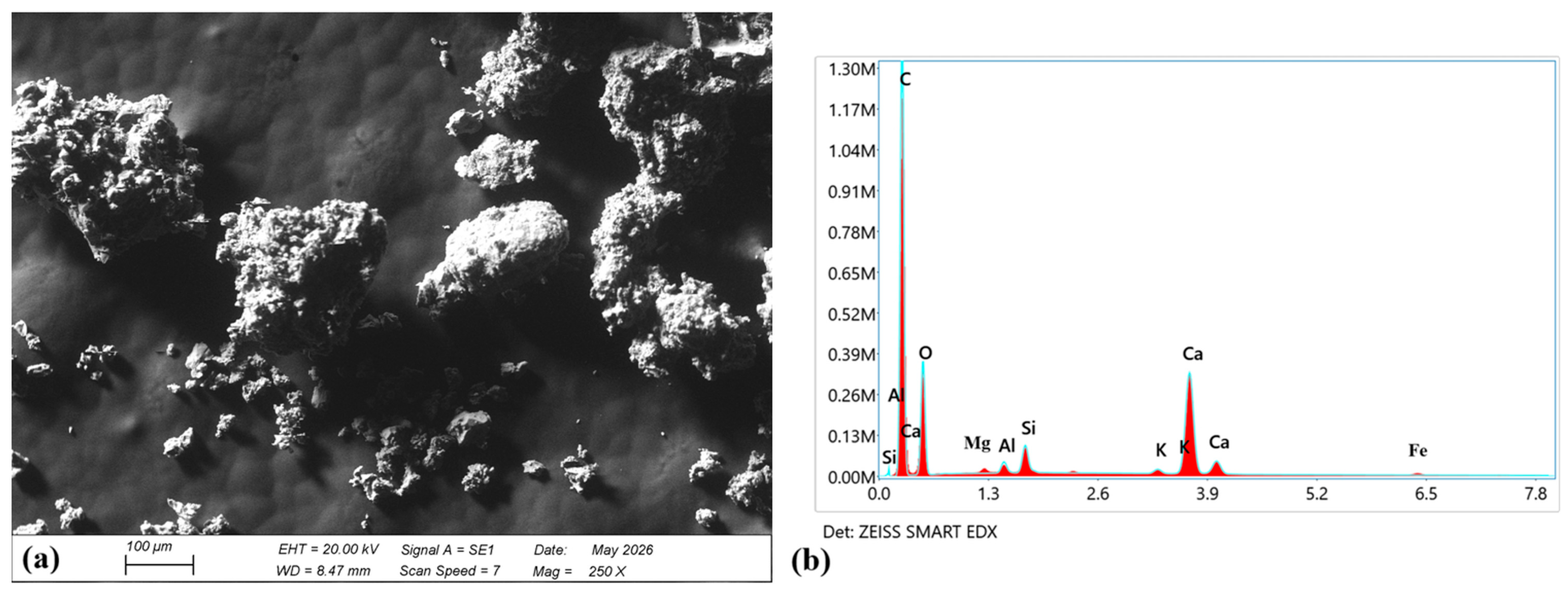
Brake friction composites were developed using waste CD and RW inorganic fiber as the principal variable constituents. The fixed composition of 30 wt.% includes phenol formaldehyde (phenolic) resin (JA 10 grade, Apex Phenolics, Delhi, India), graphite (Sky Minerals, Delhi, India), vermiculite (Bharat Industries, Delhi, India), alumina (Hindalco Industries, Delhi, India), and aramid fiber (Labon technical textile group Co., ltd., Yancheng, China). The remaining 70 wt.% was adjusted by varying the CD and RW inorganic fiber content. RW was purchased from Lapinus Intelligent (Delhi, India). The CD (#140 mesh size) was collected from a cement plant located in Himachal Pradesh, India. The scanning electron microscope (SEM) image and energy-dispersive X-ray (EDX) spectrum of the CD are presented in Figure 1a,b, respectively. Five formulations, designated CDR-1 to CDR-5, were prepared by varying the relative contents of CD and RW while keeping their total fraction fixed at 70 wt.%. In all formulations, phenolic resin, aramid fiber, alumina, graphite, and vermiculite were fixed at 30 wt.%. CD was decreased from 65 to 45 wt.%, and RW inorganic fiber was increased from 5 to 25 wt.% across the formulation series. The complete compositional detail is given in Table 1. The ingredients were weighed according to the designed formulations and blended in a shear-type mechanical mixer for 10 min to achieve uniform macroscopic homogeneity. The mixing sequence involved initial blending of phenolic resin with aramid fiber and RW, followed by incorporation of the powder constituents. The homogeneous mixture was then transferred into a mold and hot-compressed at 155 °C under 15 MPa for 10 min. During hot compression, four breathing cycles were used to facilitate the removal of entrapped volatile species. The molded composites were subsequently post-cured in an oven at 160 °C for 3 h to complete resin curing and relieve residual stresses. Finally, test specimens of dimensions 25 × 25 × 8 mm3 were cut from the molded composites for tribological evaluation.

2.2. Friction and Wear Testing

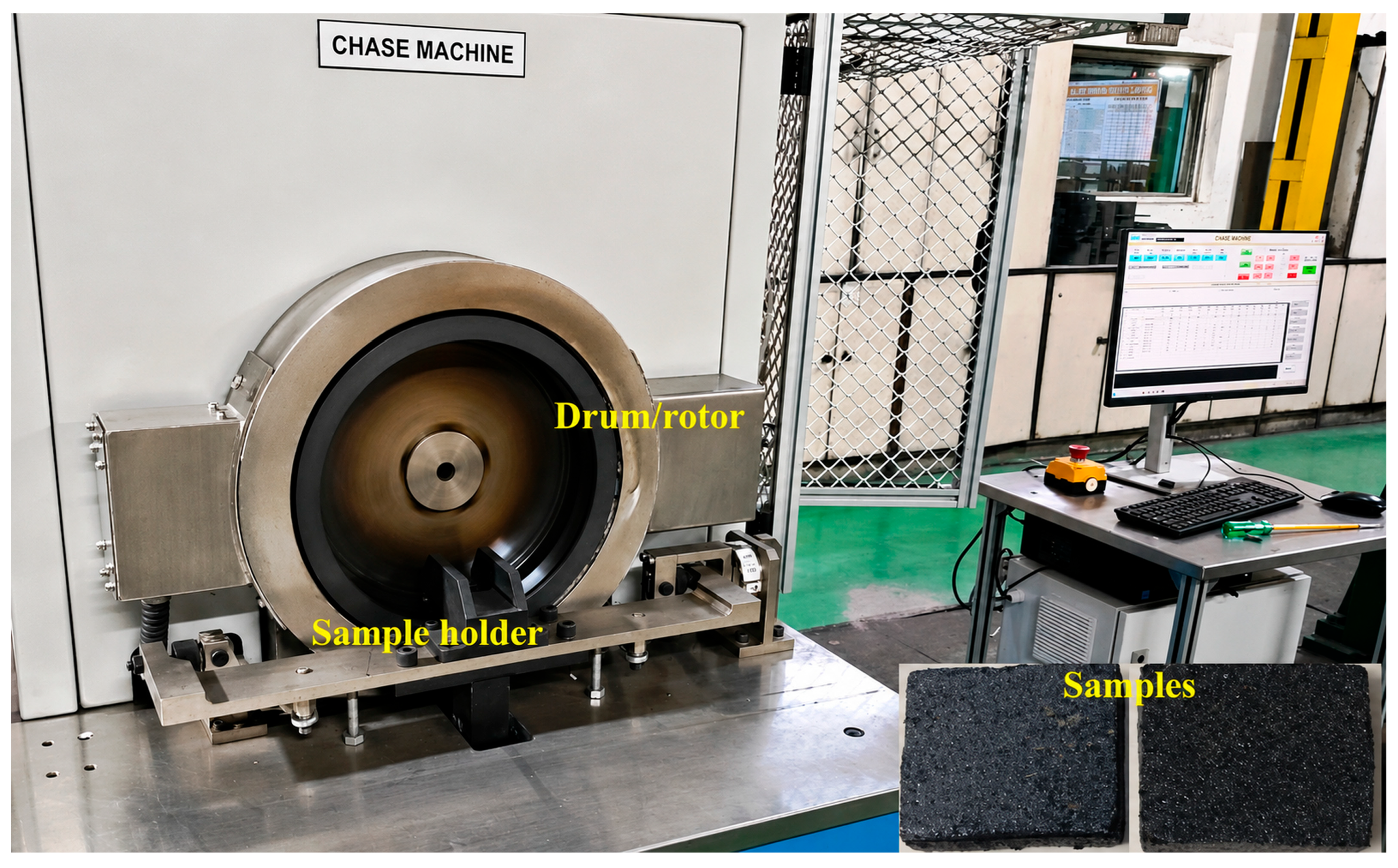
The friction and wear performance of the developed composites was evaluated using a Chase friction testing machine (Figure 2) in accordance with IS 2742 (Part 4) procedures [43]. The test schedule included burnish, reset, baseline, fade, recovery, wear, and final baseline cycles, as listed in Table 2. This study primarily focuses on a tribological analysis that includes two fade cycles and two recovery cycles. Throughout the fade–recovery cycles, the drum speed was set to 411 rpm, while the applied load remained constant at 660 N. During the 1st fade cycle, the drum temperature was elevated from 82 °C to 289 °C, with the coefficient of friction (COF) documented at 28 °C intervals, commencing at 93 °C. Upon finishing the 1st fade cycle, the heating element was deactivated, and cooling commenced, with COF values documented at intervals of 56 °C, beginning at 261 °C. During the 2nd fade cycle, the drum temperature was elevated from 82 °C to 345 °C, and similarly to the first cycle, the COF was documented at 28 °C intervals, commencing at 93 °C. In the course of the 2nd recovery cycle, cooling commenced, and COF values were documented from 317 °C down to 93 °C at intervals of 56 °C.

2.3. Evaluation of Tribological Performance Parameters

The friction and wear data obtained from the Chase testing was used to determine the following performance characteristics [39,43].
Normal COF (µN): The mean of COF values for the second fade cycle at temperatures of 93 °C, 121 °C, 149 °C, and 205 °C is represented as µN.
μ N = μ 93 + μ 121 + μ 149 + μ 205 f a d e 2 4
Hot COF (µH): It is the average COF corresponding to the temperatures 149 °C and 205 °C of the first recovery cycle, 233 °C, 261 °C, 289 °C, 317 °C, and 345 °C of the second fade cycle, and 149 °C, 205 °C, and 261 °C of the second recovery cycle.
μ H = μ 149 + μ 205 r e c o v e r y 1 + μ 233 + μ 261 + μ 289 + μ 317 + μ 345 f a d e 2 + μ 149 + μ 205 + μ 261 r e c o v e r y 2 10
Performance COF (µP): It is an average of COF values after 100 °C in all fade and recovery cycles.
Fluctuations in COF (Δµ): It is calculated as the difference between the maximum ( μ m a x ) and minimum ( μ m i n ) COF of all fade and recovery cycles.
μ = μ m a x μ m i n
Stability coefficient: It is calculated using the following formula:
S t a b i l i t y   c o e f f i c i e n t = μ P μ m a x
Variability coefficient: It is calculated using the following formula:
V a r i a b i l i t y   c o e f f i c i e n t = 1 μ m i n μ m a x
Fade COF of first cycle (µF1): It is the lowest COF value recorded for the first fade cycle after 200 °C.
Fade percentage of first cycle (Fade-1%): It is determined using the following formula:
F a d e 1 % = μ P   μ F 1 μ P × 100
Fade COF of second cycle (µF2): It is the lowest COF value recorded for the second fade cycle after 200 °C.
Fade percentage of second cycle (Fade-2%): It is determined using the following formula:
F a d e 2 % = μ P   μ F 2 μ P × 100
Recovery COF of first cycle (µR1): It is the highest COF value recorded for the first recovery cycle after 100 °C.
Recovery percentage of first cycle (Recovery-1%): It is determined using the following formula:
R e c o v e r y 1 % = μ R 1 μ P × 100
Recovery COF of second cycle (µR2): It is the highest COF value recorded for the second recovery cycle after 100 °C.
Recovery percentage of second cycle (Recovery-2%): It is determined using the following formula:
R e c o v e r y 2 % = μ R 2 μ P × 100
Wear analysis: Wear was determined on a mass and thickness basis using the following equations:
W e a r   b y   m a s s   ( % ) = I n i t i a l   w e i g h t F i n a l   w e i g h t I n i t i a l   w e i g h t × 100
W e a r   b y   t h i c k n e s s   ( % ) = I n i t i a l   t h i c k n e s s F i n a l   t h i c k n e s s I n i t i a l   w e i g h t × 100

2.4. MCDM Evaluation of Composites

Newly developed methods, namely “method based on the removal effects of criteria” (MEREC) and “simple ranking process” (SRP), have been used to rank the developed friction composites. MEREC is a new approach for determining criterion weights, developed by Keshavarz-Ghorabaee et al. [44]. Instead of considering data fluctuations in the decision matrix, MEREC calculates the “removal effect.” MEREC determines criterion weights based on the impact of removing each criterion on the overall performance of the alternatives. Moreover, it requires no input from decision-makers, making it immune to personal bias in the weighting process. SRP is one of the simplest multi-attribute decision-making methods due to its straightforward computational procedure [45]. The novelty and main advantage of SRP are that it operates directly with criterion weights; no normalization procedure is necessary [46]. The ranking scores for the different composites were calculated using MEREC-SRP after constructing a decision matrix for the composite alternatives (p) and evaluation criteria (q) using the following steps [44,45,46].
Step 1: Decision matrix construction ( X )
X = x i j p × q ; i = 1 , 2 , , p ;   j = 1 , 2 , , q
Step 2: Rank matrix construction ( X * )
X * = R i j
where R i j defines the rank of the ith composite alternative for the jth criterion in the decision matrix. For beneficial criteria, a greater value of x i j ( m a x 1 i p x i j ), and for non-beneficial criteria, the lower value of x i j ( m i n 1 i p x i j ) serve as the basis for the ranking procedure.
Step 3: Weighted ranking matrix construction ( ϖ i j )
ϖ i j = R i j × ω j
where ω j represents the importance/weight of each criterion in the decision matrix and is determined using the MEREC approach.
Step 4: For weight calculation, first, the decision matrix is normalized as follows.
X ^ = n i j p × q ; n i j = m i n ( x j ) x i j ;     j     b e n e f i c i a l   c r i t e r i a n i j = x i j m a x ( x j ) ;     j     n o n b e n e f i c i a l   c r i t e r i a
After decision matrix normalization, the overall performance of the alternatives is determined by applying Equation (16).
Ψ i = ln 1 + 1 q j = 1 q ln n i j
Thereafter, the solution performance is estimated after removing individual criteria using Equation (17).
Ψ ^ i j = ln 1 + 1 q k = 1 , k j q ln n i j
Next, the sum of absolute deviation for the criteria determined using Equation (18).
Δ j = i = 1 p Ψ ^ i j Ψ i
Finally, the criteria weight is computed using Equation (19).
ω j = Δ j j = 1 q Δ j
Step 5: Calculation of composite alternatives’ ranking score ( φ i )
φ i = p j = 1 q ϖ i j
The composite alternatives are arranged in order of decreasing φ i values in the last step. The higher value of φ i indicates the higher rank.

3. Results

3.1. COF Behavior During Fade–Recovery Cycles

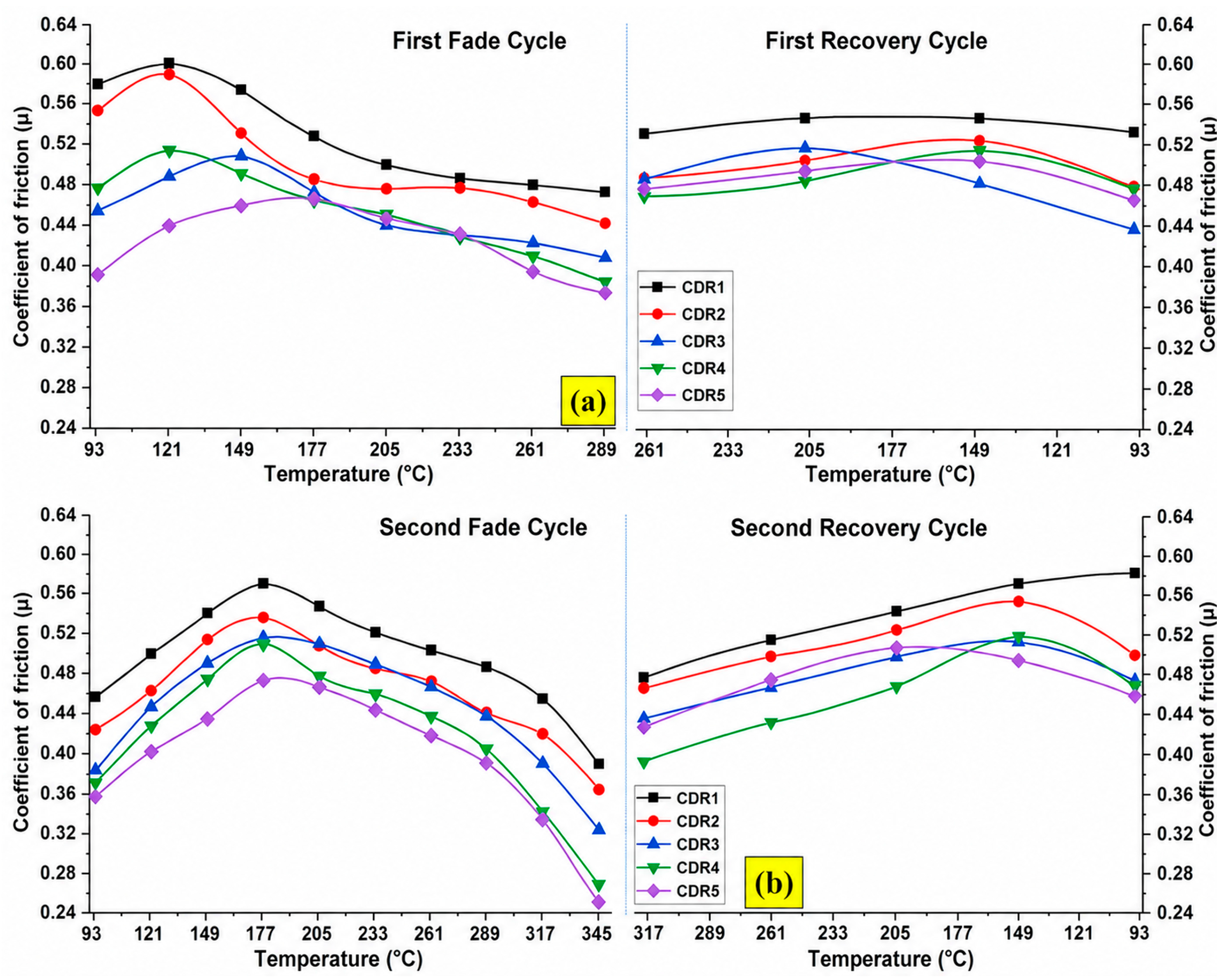
Figure 3 illustrates the changes in the COF throughout the fade and recovery cycles. In the first fade cycle (Figure 3a), the COF was assessed across a 93 °C to 289 °C temperature range. For evaluated formulations, COF began to decline after 149 °C for CDR-1/CDR-2/CDR-4 and after 149 °C for CDR-4/CDR-5, indicating thermally induced deterioration of the friction response. However, the magnitude of this reduction depended strongly on the relative proportions of CD and RW inorganic fiber. The composites with higher CD and lower RW inorganic fiber, namely CDR-1 and CDR-2, showed rapid peaking at 149 °C and a steep decrease up to 177 °C. Thereafter, CDR-1/CDR-2 shows a comparatively gradual decline from approximately 0.511 ± 0.020 to 0.464 ± 0.015 by the end of the cycle.
On the other hand, CDR-3, CDR-4, and CDR-5 displayed a steeper reduction, with friction decreasing from about 0.476 ± 0.004 to 0.398 ± 0.017 between 177 °C and 289 °C. This indicates that higher CD content contributes to improved friction retention under thermal loading, whereas increasing RW inorganic fiber content at the expense of CD reduces the friction level at elevated temperatures. In the initial recovery cycle (Figure 3a), the heating was disabled, and the drum was cooled. The COF values were documented at 261 °C, 205 °C, 149 °C, and 93 °C during the cooling process. In general, the COF recovered modestly as the temperature decreased, which is desirable for brake friction materials subjected to intermittent thermal exposure. Except for CDR-3, all formulations showed a gradual increase in friction during cooling to 149 °C, followed by a slight decline at lower temperatures. CDR-3 exhibited a distinct intermediate maximum near 205 °C before decreasing. Although all formulations retained a measurable recovery response, the magnitude and profile of recovery were composition-dependent, indicating that the CD-RW ratio influences not only friction loss during fade but also the degree of friction regeneration during recovery. A similar but more severe trend was observed during the second fade cycle (Figure 3b). In this cycle, the COF initially increased to approximately 177 °C and then declined with a further temperature increase. Between 205 and 289 °C, the decrease was progressive for all composites, but beyond 289 °C, the RW-rich formulations showed a much sharper deterioration. In particular, CDR-4 and CDR-5 exhibited a steep drop from about ~0.404 ± 0.007 at 289 °C to nearly 0.262 ± 0.01 at 345 °C. These results show that the higher RW, lower CD formulations are considerably more vulnerable to friction loss. The second recovery cycle again produced an initial build-up in friction across all formulations, followed by stabilization, then a slight reduction toward the end of the cycle. Peak friction was observed near 149 °C for all compositions. The highest recovery friction, about 0.575 ± 0.015, was observed for CDR-1 and CDR-2, whereas CDR-3, CDR-4, and CDR-5 recovered only to around 0.512 ± 0.011. Thus, the relative advantage of the CD-rich formulations persisted during recovery, confirming that higher CD content and lower RW inorganic fiber content promoted a stronger friction response under the present test conditions. Taken together, the fade–recovery profiles indicate a clear trade-off between composition and performance. Increasing CD content supports friction retention and improves resistance to thermal degradation, whereas increasing RW inorganic fiber content reduces the friction level during both fade cycles, especially at elevated temperatures. At the same time, all formulations retained measurable recovery, which suggests that the thermal damage was only partially irreversible under the conditions.

3.1.1. Frictional Attributes of the Composites

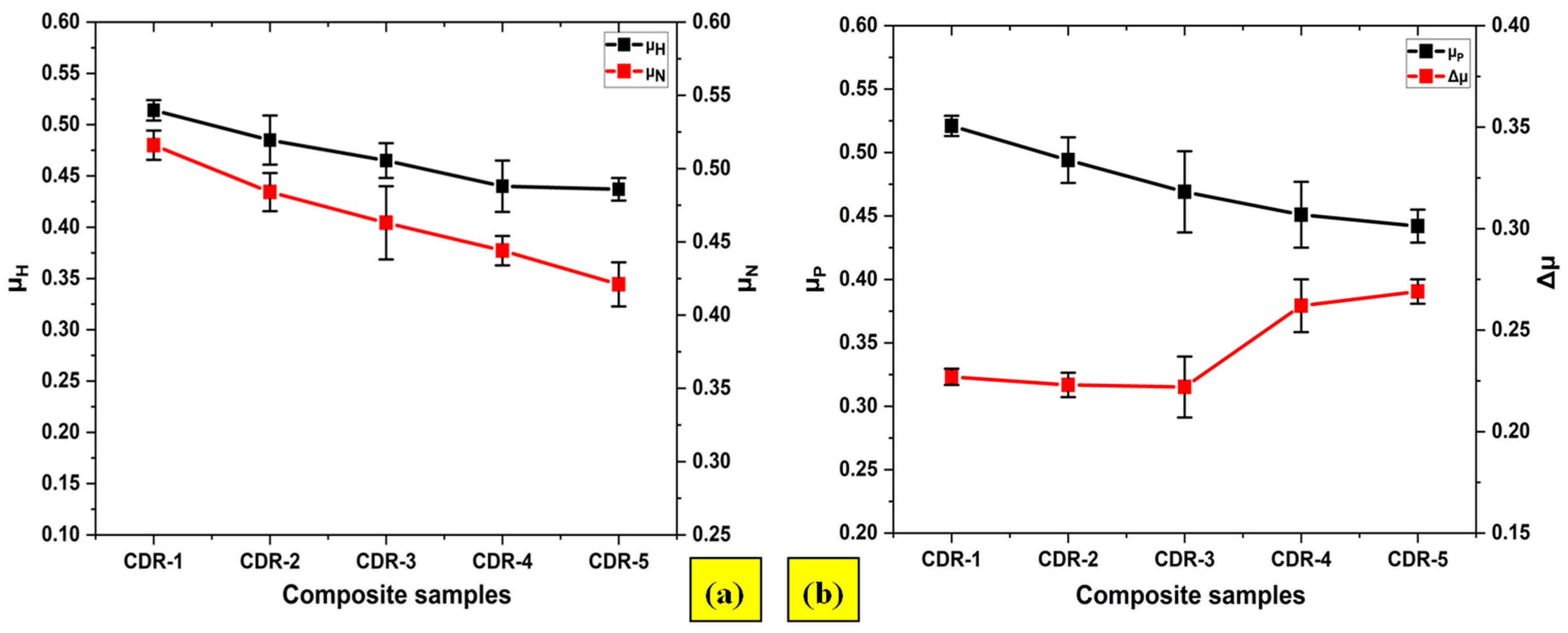
For a better understanding and insight into the frictional behavior obtained for fade and recovery cycles of the investigated composite samples (Figure 3), various performance attributes such as normal COF (µN), hot COF (µH), performance COF (µP), fade COF of first cycle (µF1), fade COF of second cycle (µF2), recovery COF of first cycle (µR1), recovery COF of second cycle (µR2), friction fluctuation (Δμ), stability, and variability coefficients were determined, as discussed in Section 2.3. The variation in µN and µH is shown in Figure 4a. Both parameters decreased systematically with increasing RW content and decreasing CD content. The composites containing at least 55 wt.% CD, namely CDR-1, CDR-2, and CDR-3, exhibited µN and µH values around 0.490 ± 0.026, whereas CDR-4 and CDR-5, containing 50 wt.% or less CD and 20 wt.% or more RW inorganic fiber, showed lower values near 0.432 ± 0.012. Although the differences between adjacent formulations are not extreme, the overall downward trend showed that increasing RW inorganic fiber at the expense of CD lowers both the µN and µH responses of the investigated formulations. The friction characteristics of the composites, regarding µP and Δμ, are illustrated in Figure 4b. The value of μP decreased from 0.521 for CDR-1 to 0.442 for CDR-5 as the formulation shifted from CD-rich to RW-rich compositions, indicating that higher CD content contributes to improved overall friction performance.
The high µP of the composite, such as in CDR-1/CDR-2/CDR-3, is attributed to its high fraction (≥55 wt.%) of CD. The powdery constituents, such as CD particles in friction composites, are readily released from the composite surface as wear debris. This wear debris could act as a third body during braking and increase the composite’s friction performance through the rolling abrasion mechanism. Similar results for improved friction performance with increased fly ash waste loading have been reported in the literature. Öztürk and Mutlu [47] have reported the highest friction performance for 60–65 wt.% fly ash-added composites. Similarly, Sugözü [48] reported increased friction performance with increased fly ash concentration. Friction performance is also reported to improve with waste foundry sand, as noted by Zheng et al. [17]. Also, the µP is noted to decrease with increased RW inorganic fiber content and fluctuates in the range of ~0.446 ± 0.005 for CDR-4/CDR-5 composites having higher (≥20 wt.%) content. Generally, during braking, fibers such as RW inorganic fiber aid in forming contact plateaus and help maintain the composite’s structural integrity, thereby reducing friction performance. Corresponding results for decreased friction performance were reported by Liu et al. [41] for increased mineral and Dadkar et al. [38] for rock fiber-based brake composite materials. By contrast, Δμ first decreased with decreasing CD content, then reached a minimum for CDR-3 composition, and subsequently increased from 0.222 to 0.269 with further decreases in CD content. The higher CD formulations, particularly CDR-1 to CDR-3, exhibited lower Δμ values of ~0.224 ± 0.004, whereas the lower CD and higher RW formulations, CDR-4/CDR-5, showed higher fluctuation values of ~0.265 ± 0.004. The noted increase in friction fluctuation values alongside a rise in inorganic fibers and a decrease in waste materials aligns well with the existing literature [38,49]. Rajan et al. [49] observed that Δμ rose as the slag waste content diminished. Dadkar et al. [38] reported a rise in friction fluctuation associated with a reduction in fly ash and an increase in rock fiber content. These results indicate that the CD-rich composites not only provide higher friction but do so more consistently with reduced friction fluctuations. The corresponding fade and recovery coefficients (µF1, µF2, µR1, and µR2) are plotted in Figure 5.
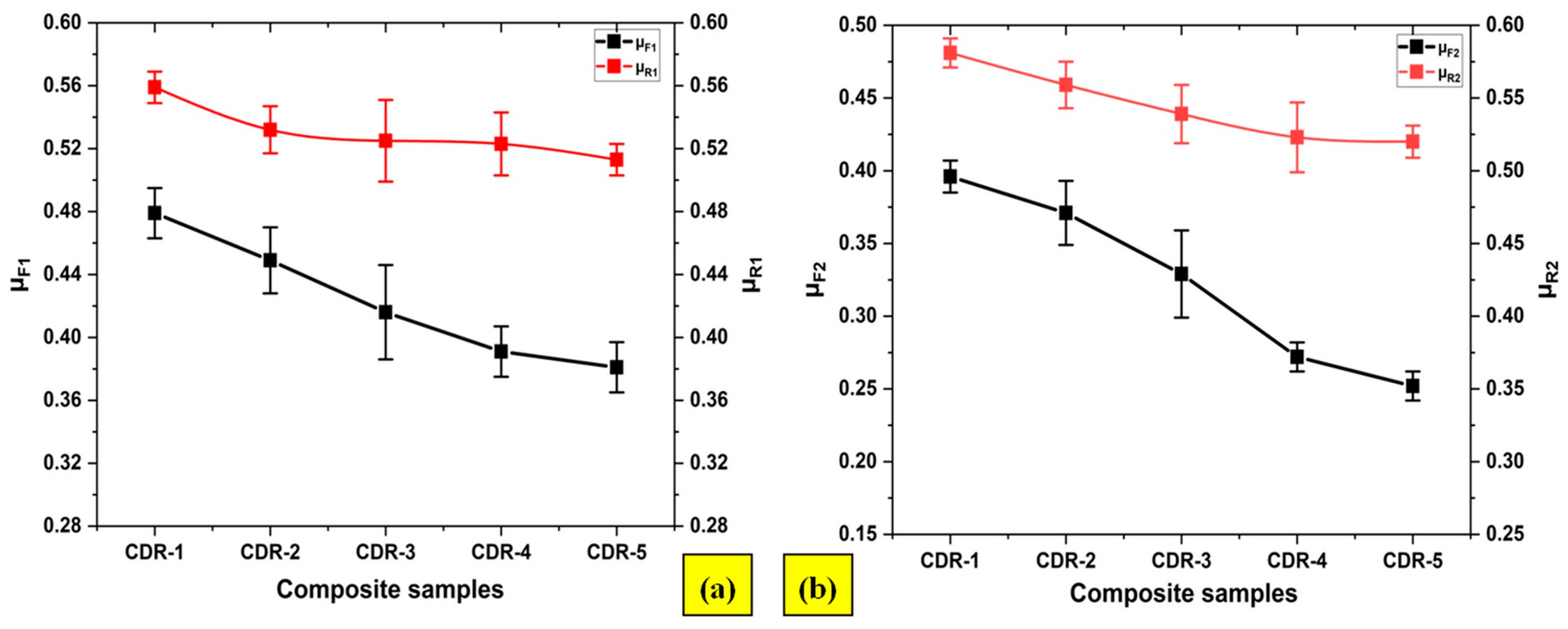
As shown in Figure 5a, both the µF1 and µR1 decreased with decreasing CD content. The µF1 values remained relatively high for CDR-1, CDR-2, and CDR-3, around 0.448 ± 0.031, but fell to approximately 0.386 ± 0.005 in CDR-4 and CDR-5. Likewise, µR1 decreased from 0.559 for CDR-1 to 0.513 for CDR-5. Similar results for fade and recovery friction coefficients were reported in [38,49]. In [38], the authors reported improvements in fade friction coefficients with increased fly ash, with a corresponding decrease in rock fiber content in composites. Rajan et al. [49] reported that both fade and recovery friction coefficients increased with increased slag waste loadings in the formulations. Figure 5b shows that the same tendency persisted in the second cycle, with a more pronounced fall in µF2 for the higher RW formulations. This confirms that decreasing CD lowers the friction retained during fade and also limits the friction performance at higher temperatures. Compared with µF1, a steep decrease in µF2 was observed for CDR-3/CDR-4/CDR-5 composites when the CD content decreased to ≤50 wt.%. For CDR-1/CDR-2/CDR-3 formulations, µF2 was in the range of 0.363 ± 0.033, but fell to approximately 0.262 ± 0.01 in CDR-4 and CDR-5. Also, a gradual decrease in µR2 from 0.581 for CDR-1 to 0.520 for CDR-5 was noted with decreased CD content. Overall, the various frictional aspects (µN, µH, µP, µF1, µF2, µR1, and µR2) of the evaluated composites were noted to decrease with increased RW inorganic fiber and decreased CD particles. Generally, during braking, fibers such as RW aid in forming contact plateaus and help maintain the composite’s structural integrity, thereby reducing friction and fade while improving recovery characteristics. Conversely, powdery components like CD particles in friction composites tend to detach from the composite surface and function as third bodies during braking. This interaction leads to the abrasion and degradation of friction film/contact plateaus, resulting in higher friction performance and fade resistance accompanied by reduced recovery and wear characteristics of the investigated formulations.
Inorganic fibers, such as RW, contribute to the tribological behavior of the composites mainly through their fibrous reinforcement effect. During braking, RW inorganic fibers help maintain the structural integrity of the friction composite and support the formation of contact plateaus. The formed plateaus assist in compacting wear debris into a more continuous friction layer, thereby reducing ingredient pull-out and improving recovery and wear resistance (corroborated in Section 3.1.4). However, in the present formulation series, increasing the RW inorganic fiber also decreases the amount of CD, which is a more abrasive powdery constituent. Therefore, the net effect of higher RW inorganic fiber content is a reduction in friction magnitude because the abrasive third-body contribution of CD is reduced, and the surface becomes more protected by a relatively stable friction film. Consequently, RW-rich formulations demonstrate enhanced recovery and wear resistance but exhibit reduced COF and fade resistance.

3.1.2. Stability and Variability Coefficients

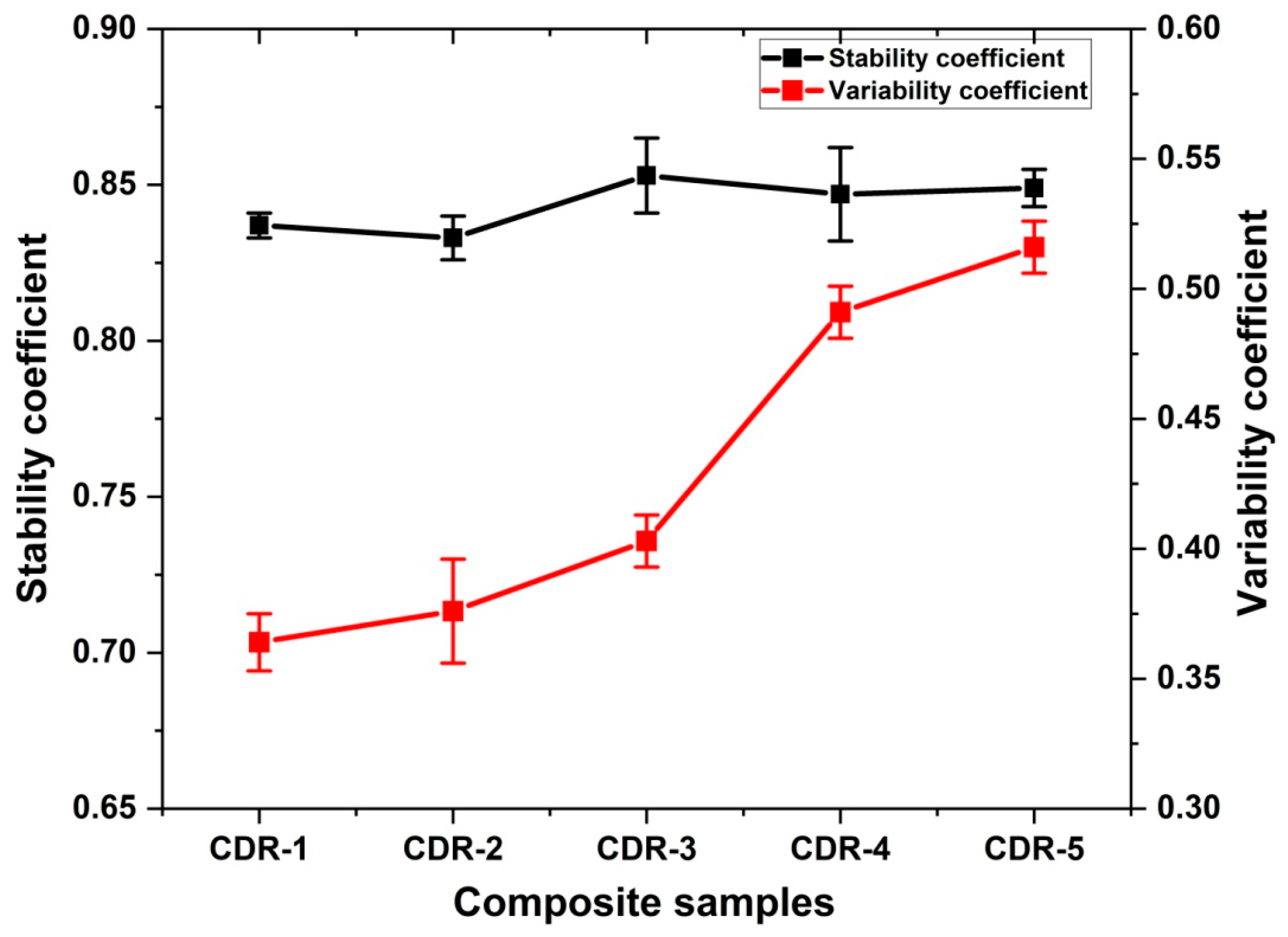
The stability and variability coefficients of the composite samples were determined using Equations (4) and (5) and are presented in Figure 6. For a good friction material, lower variability and higher stability are generally required. The stability coefficient is observed to fluctuate within a narrow range of 0.833–0.849, whereas the variability coefficient is lowest for CDR-1 (0.364) and highest for CDR-5 (0.516). The trend indicates that replacing CD with excessive RW inorganic fiber reduces the consistency of the friction response, as reflected by the increase in the variability coefficient from CDR-1 to CDR-5. Similar observations with increased slag waste content for friction stability and increased friction variability were reported by Rajan et al. [49]. In [50], the author reported that the stability coefficient fluctuated around 0.85, while the variability coefficient increased with increasing volcanic rock content in the formulations. Overall, the results show that formulations with higher CD and lower RW inorganic fiber provide a more favorable friction profile, combining higher µP, µN, and µH with reduced fluctuations and lower variability. This indicates that CD plays a more active role in sustaining friction performance.

3.1.3. Fade–Recovery Aspects of the Composites

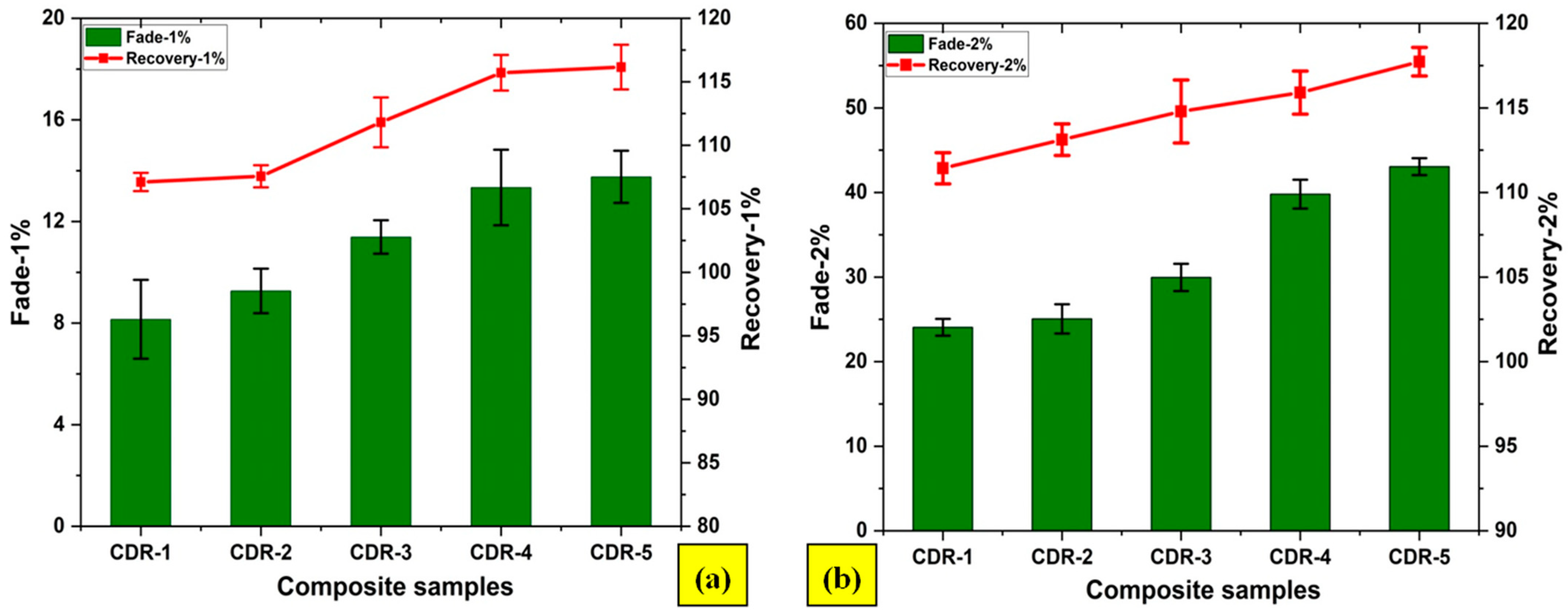
The fade and recovery behavior of the composites, expressed as cycle-wise percentages, is shown in Figure 7. Lower fade and higher recovery are generally preferred because they indicate better thermal stability during braking and stronger restoration of friction after heating. As shown in Figure 7a, the first-cycle fade percentage, i.e., Fade-1%, remained low for CDR-1 and CDR-2, around 8.71 ± 0.56%, while the corresponding recovery percentage, i.e., Recovery-1%, was about 107.33 ± 0.23%. When CD content decreased to 55 wt.% and below, Fade-1% increased to around 12.58 ± 1.18%, and Recovery-1% also improved (~113.98 ± 2.18%), indicating a trade-off between fade resistance and recovery behavior. The composite, CDR-5, with the maximum Fade-1% of 13.76%, has also exhibited the maximum Recovery-1% of 116.16%. Thus, lower CD and higher RW formulations experienced greater friction loss during the fade stage, but they also displayed stronger relative friction restoration. The trends noted in fade-% and recovery-% align with the literature. According to Dadkar et al. [38], the fade-% improved with a higher proportion of fly ash, whereas the recovery-% showed an increase with higher rock fiber content. Rajan et al. [49] observed that the fade-% of the friction composites decreased while recovery-% increased as the slag waste content decreased.
A similar trend was observed in the second cycle, although the severity of fade increased substantially. For CDR-1, CDR-2, and CDR-3, containing ≥55 wt.% CD, the Fade-2% values ranged from 24.06% to 29.96%. However, for CDR-4 and CDR-5, containing 50 wt.% CD or less, Fade-2% rose sharply to about 41.43 ± 1.63%. Recovery-2% ranged from 111.43% to 117.73% and increased with increasing RW and decreasing CD content. Accordingly, the RW-rich composites recovered a larger fraction of their friction after cooling, but only after undergoing substantially greater friction deterioration during the fade cycle. This dual response highlights an important implication for materials design. In general, CD-rich formulations are superior when resistance to friction loss during braking is the primary objective. In contrast, RW-rich formulations are superior when post-fade friction restoration is given greater weight. Because brake performance depends on both properties, formulations in the intermediate range, especially those containing 10–15 wt.% RW and 55–60 wt.% CD, appear to offer the best compromise between fade resistance and recovery response.

3.1.4. Wear Performance

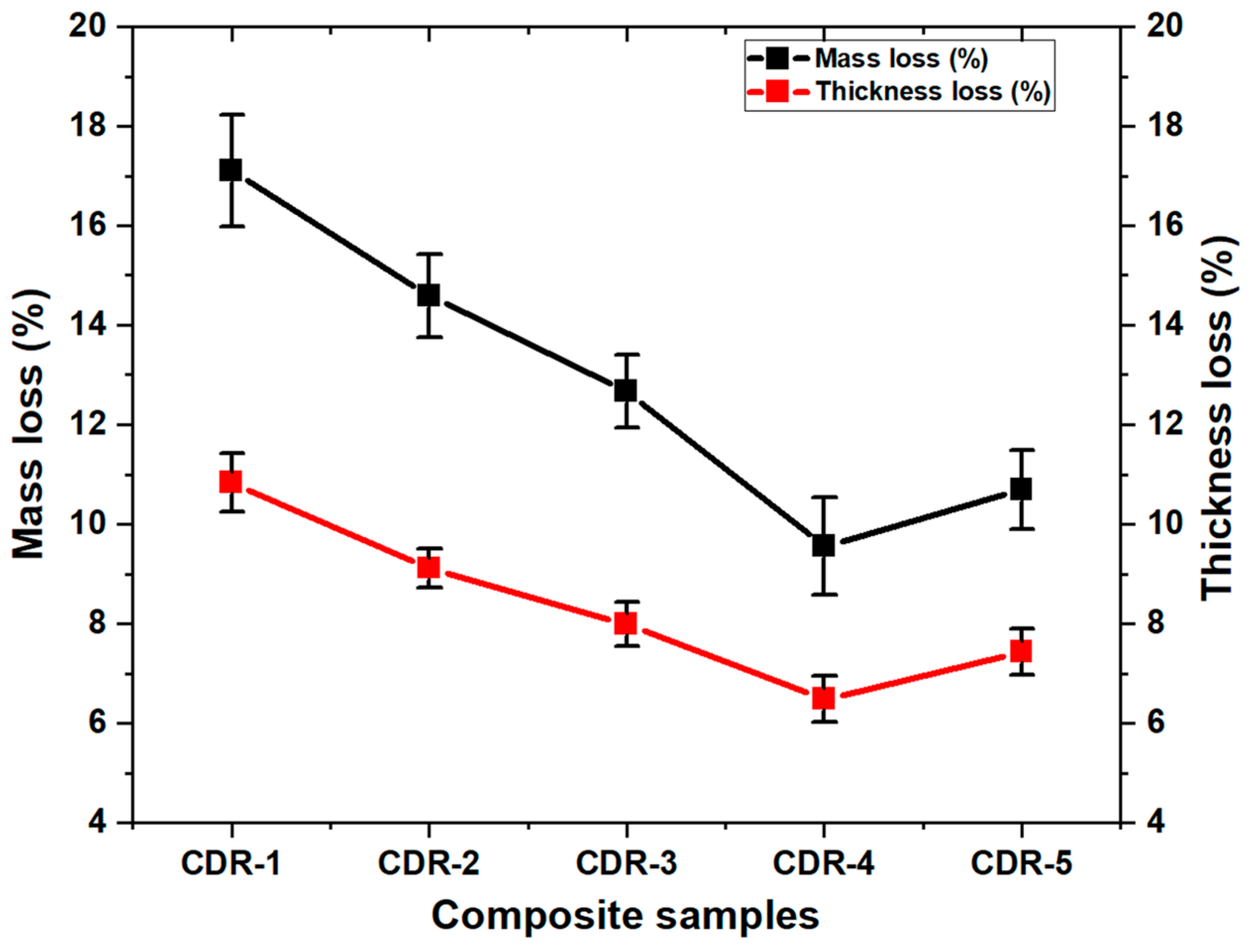
The wear behavior of the composites, assessed in terms of mass loss and thickness loss, is shown in Figure 8. In contrast to the friction results, wear resistance improved progressively with decreasing CD content and increasing RW inorganic fiber content. The composite CDR-1, containing 65 wt.% CD and 5 wt.% RW inorganic fiber, exhibited the highest wear, with mass and thickness losses of 17.10% and 10.84%, respectively. A similar trend of increased wear for waste–slate–powder (40–60 wt.%)-filled friction composites was reported by Binda et al. [51]. Jayashree et al. [52] also concluded that the wear rate of metallurgical-slag-based friction composites increased with increasing slag content. Zheng et al. [19] and Gehlen et al. [20] similarly reported increased wear in composites filled with red mud and clam shell waste, respectively. As the CD content decreased from 65 to 50 wt.% and the RW content increased from 5 to 20 wt.%, both wear metrics decreased, reaching minimum values of 9.56% mass loss and 6.48% thickness loss for CDR-4. Although CDR-5 showed a slight increase in wear compared with CDR-4, its wear loss remained lower than that of the CD-rich formulations. Relative to CDR-1, the CDR-4 formulation exhibited approximately 44% lower mass loss and 40% lower thickness loss. This clearly demonstrates that a higher RW inorganic fiber content enhances the resistance of the composite to material removal during repeated sliding and thermal cycling.
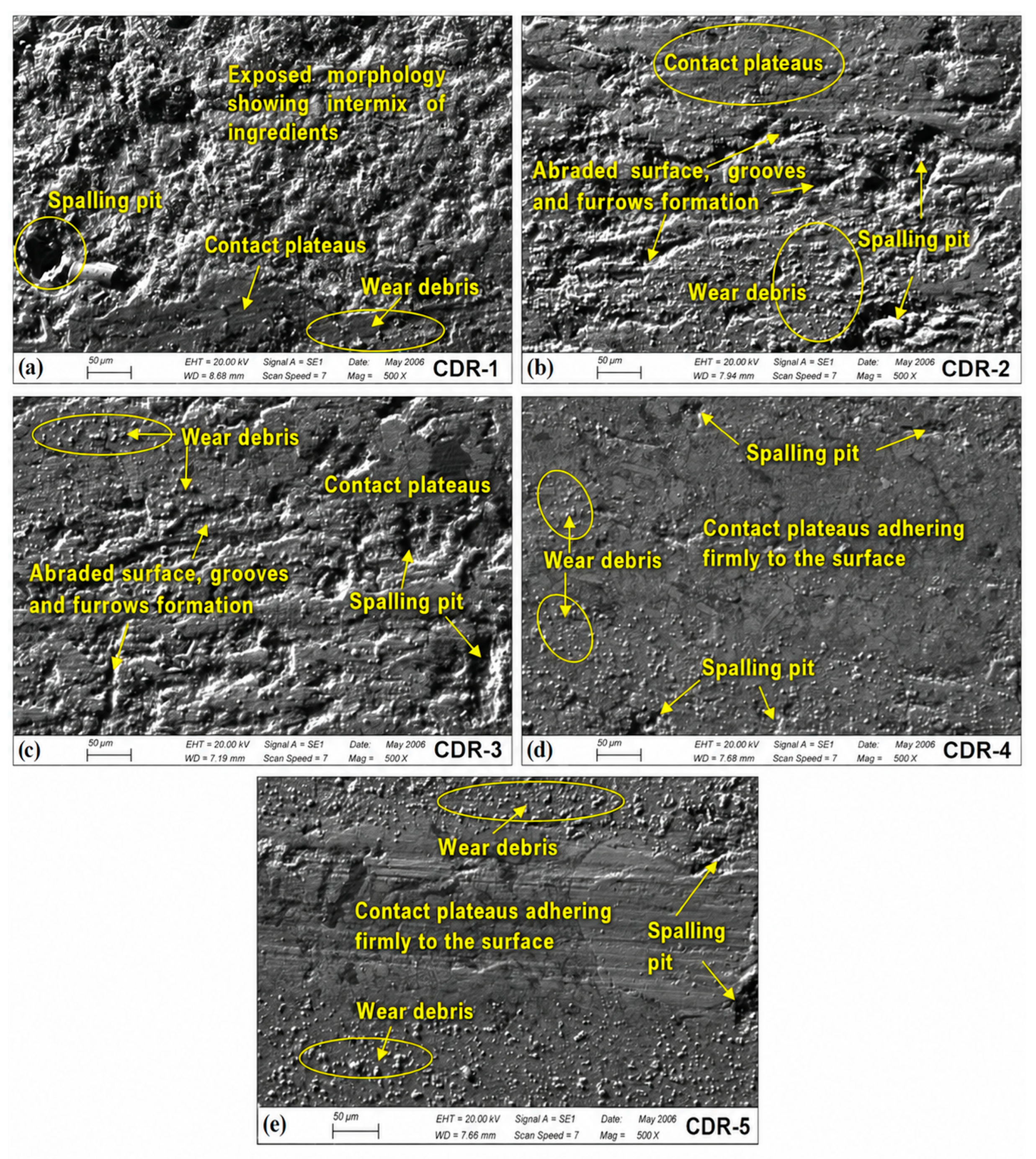
The friction and wear performance of the composites is closely associated with the development of contact plateaus/friction film on the surface [53,54]. The morphology of the worn surfaces of the friction composites was further observed using SEM and is shown in Figure 9a–e. During braking, fibers aid in the formation of friction film and contact plateaus and help maintain the structural integrity of the friction composite, thereby making the detachment of ingredients as wear debris difficult and reducing composite wear [55]. As presented in Figure 9a, the worn surface of CDR-1 was very rough and severely damaged. Large detached regions and spalling pits were observed, with negligible formation of stable contact plateaus. The absence of a compact and smooth friction layer suggests that the wear debris was not effectively compacted into protective plateaus. Instead, the surface constituents were dislodged and removed as wear debris during subsequent sliding. This explains the higher COF and higher wear loss observed for the CDR-1 composite.
Figure 9b,c show that the worn surfaces of CDR-2 and CDR-3 were less rough than that of CDR-1, although both still exhibited shallow grooves, furrows, spalling pits, fine wear debris, and some locally detached regions. The contact plateaus were slightly more developed than those of CDR-1, but the compacted debris remained insufficient to form a continuous, protective friction layer. Consequently, the debris accumulated in the detached cavities could easily break away during sliding. The presence of extracted fibers, pulled-out CD particles, pits, and dispersed fine debris supports the relatively high friction and wear behavior of CDR-2 and CDR-3. A clear change in the wear mechanism was observed as the RW inorganic fiber content increased and the CD content decreased. In contrast to CDR-1, CDR-2, and CDR-3, the CDR-4 and CDR-5 composites (Figure 9d,e) showed comparatively smoother worn surfaces with greater wear-debris compaction. The worn surfaces of CDR-4 and CDR-5 were significantly covered by friction film and contact plateaus, indicating that the incorporation of higher RW fiber content (>15 wt.%) restricted the peeling off of large wear debris. These plateaus covered the original friction surface, minimizing ingredient loss during sliding. Although a few pulled-out particles were still observed, the higher RW content improved the quality and continuity of the protective friction film. This surface protection is the main reason for the reduced wear loss of CDR-4 and CDR-5.
Overall, the wear mechanism of the investigated composites is governed by abrasive third-body formation and the development of protective friction film/contact plateaus. In CD-rich composites, especially CDR-1, CDR-2, and CDR-3, powdery CD particles are more easily released from the matrix during sliding. These detached particles act as hard third-body abrasives, which increase friction but also intensify surface damage, particle pull-out, groove formation, and pit development. As a result, CD-rich composites exhibit higher COF but also higher mass and thickness loss. In contrast, increasing the RW content improves the integrity of the friction layer by reinforcing the matrix and supporting the development of stable contact plateaus. These plateaus protect the underlying surface, reduce ingredient detachment, and restrict severe abrasive wear. Therefore, RW-rich composites exhibit lower wear loss and improved recovery behavior, although their friction levels decrease due to reduced abrasive contribution from CD.
Thus, although lower CD contents reduce friction magnitude and fade resistance, they simultaneously exhibit enhanced wear resistance with increased RW fiber content. The wear results therefore reinforce the composition-dependent trade-off. High CD content is beneficial for maintaining higher friction and better fade resistance, whereas high RW fiber content is beneficial for minimizing wear. In practical terms, the optimum formulation depends on whether the application demands superior frictional effectiveness, superior durability, or a balanced combination of both. Therefore, a structured decision-making framework is crucial for identifying the most appealing formulation from a comprehensive design perspective. This should encompass a high and stable COF, minimize severe fade, significantly reduce wear, and ensure optimal recovery.

3.2. Ranking of the Composites

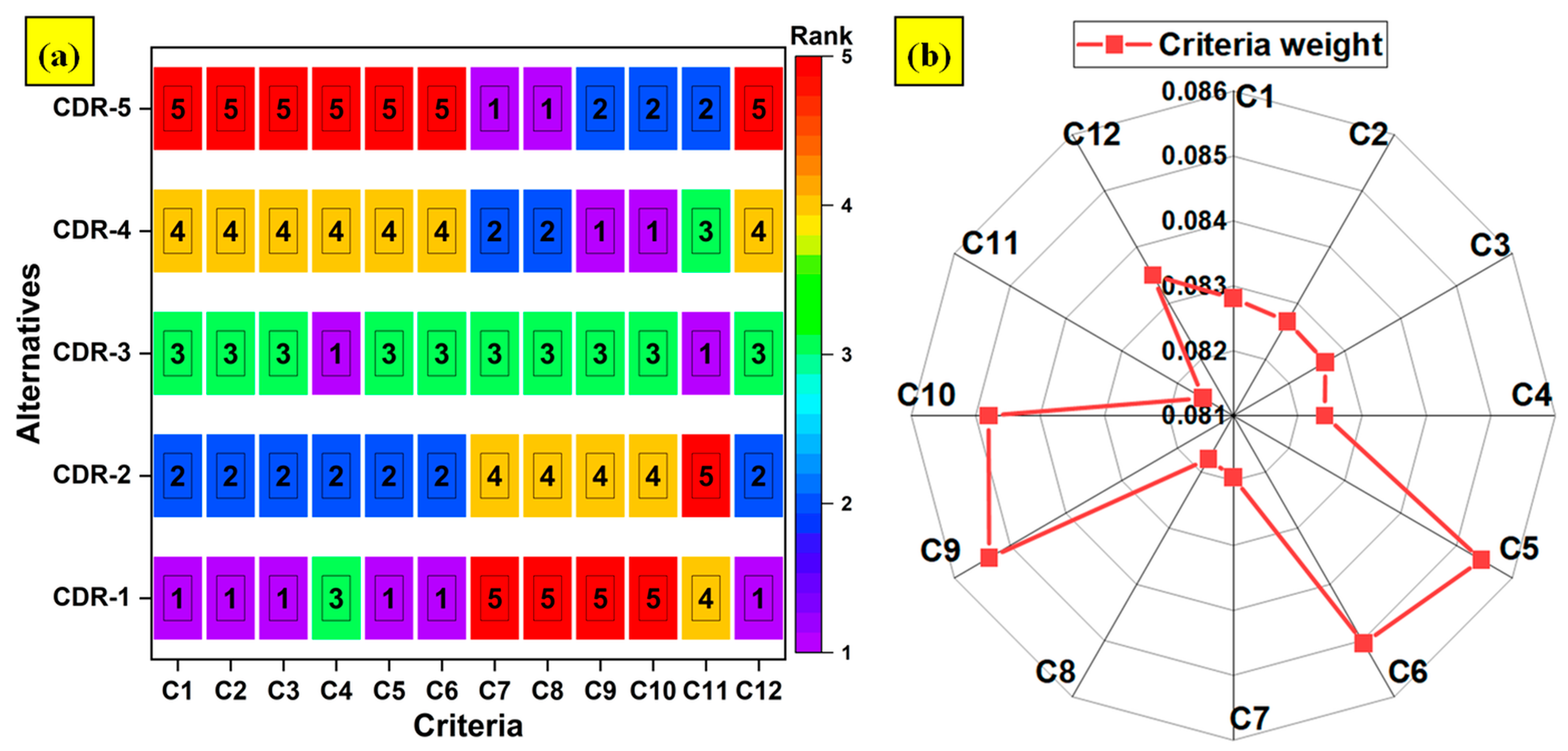
Determining the optimal composition for the tribological performance of the analyzed composites presents a significant challenge. As an illustration, the composite CDR-1 exhibited the highest μN, μH, μP, along with the lowest fade-% and variability coefficient. But the same formulation stands poorest in recovery-%, wear, and friction stability. The highest recovery-% was observed with formulation CDR-5, whereas wear was lowest with formulation CDR-4. The formulation CDR-3 proved best for friction fluctuations and friction stability. The findings indicate that there is no composite that concurrently satisfies the requirements of high μP and recovery-%, while also exhibiting the lowest wear and fade-%, as well as minimal friction fluctuations. Therefore, it becomes necessary to analyze the composites’ overall effectiveness with respect to the assessed tribological parameters. Consequently, the SRP approach was employed to evaluate and rank the composites in order to identify one that satisfies all of these conflicting requirements at once. The criteria for composites ranking were selected as C1 (µN, beneficial), C2 (µH, beneficial), C3 (µP, beneficial), C4 (Δµ, non-beneficial), C5 (Fade-1%, non-beneficial), C6 (Fade-2%, non-beneficial), C7 (Recovery-1%, beneficial), C8 (Recovery-2%, beneficial), C9 (mass loss%, non-beneficial), C10 (thickness loss%, non-beneficial), C11 (stability coefficient, beneficial), and C12 (variability coefficient, non-beneficial). The results of the various performance criteria used to construct the decision matrix are presented in Table 3. After decision matrix construction, the rank matrix was generated using Equation (13) and presented in Figure 10a. For the weighted normalized matrix, the criteria weights are determined using Equations (15)–(19) as presented in Figure 10b. The ranking score ( φ i ) for each alternative was derived using Equation (20) and is presented in Table 4. The CDR-3 composite containing 55 wt.% CD and 15 wt.% RW exhibited the highest φ i value of 2.33, signifying its superiority in meeting the maximum performance criteria for optimal functionality. In contrast, composite CDR-5 with a φ i value of 1.42 demonstrated the lowest preference. The ranking obtained in this study should be interpreted as a comprehensive preference order based on the MEREC-SRP score rather than as a simple ranking of individual tribological properties. Since the selected criteria include beneficial and non-beneficial responses, the final ranking reflects the overall balance among friction level, friction stability, fade–recovery response, wear resistance, stability coefficient, and variability coefficient. Therefore, CDR-3 was selected as the optimum formulation because it provides the best compromise among conflicting tribological requirements. Small differences between adjacent alternatives, such as CDR-1 and CDR-2, should be interpreted as ranking preferences rather than direct evidence of statistically significant separation across all individual responses.

4. Conclusions

Brake friction composite materials containing different combinations of cement dust and rock wool were developed and subjected to tribological evaluation. Their friction performance, fade and recovery characteristics, and wear behavior were assessed using a Chase friction testing machine in accordance with the IS 2742 standard. The findings from this study can be concluded as follows.
  • The evaluation of friction performance indicated that composites containing a high proportion of cement dust and a lower amount of rock wool demonstrate superior friction performance along with reduced fluctuations in friction.
  • The best fade resistance was observed in the composite sample with higher cement dust content. On the other hand, recovery and wear performance increased with increasing rock wool content.
  • Based on the MEREC-weighted SRP comprehensive performance score, the overall ranking of the developed composites was obtained as CDR-3 > CDR-1 > CDR-2 > CDR-4 > CDR-5. The CDR-3 formulation, containing 55 wt.% CD and 15 wt.% RW fiber, offered the best compromise among friction performance, fade resistance, recovery, wear resistance, stability, and variability.
Finally, it can be concluded that the composites with higher cement dust and lower rock wool content proved effective in enhancing the coefficient of friction and fade performance, while reducing friction fluctuations. In contrast, composites with higher rock wool content and lower cement dust content showed improved wear resistance and enhanced recovery performance.

5. Limitations and Future Research Directions

Although the present study provides useful insights into the tribological performance of CD-RW-based brake friction composites, it has certain limitations. The tests were conducted using a Chase friction testing machine on small specimens, and the results were not validated using full-scale inertia dynamometer tests or real vehicle road trials. The wear mechanism was analyzed mainly through SEM observations; however, three-dimensional surface profiling, quantitative wear-volume measurement, detailed tribofilm chemistry, and particulate-emission analysis were not included. In addition, the MEREC-SRP method provides an objective multi-criteria ranking of the developed formulations, but it does not generate a predictive regression model. Future studies should therefore include full-scale braking validation, 3D wear-profile analysis, particle-emission measurement, tribofilm chemical characterization, and factorial or response-surface-based experimental design for predictive modeling and optimization.

Author Contributions

Conceptualization, T.S., V.S. and S.A.; methodology, T.S., V.S., S.A. and M.W.; validation, T.S., S.A., V.S., M.W. and G.F.; formal analysis, T.S., S.A., V.S., M.W. and G.F.; investigation, T.S., S.A. and G.F.; resources, T.S. and S.A.; data curation, S.A.; writing—original draft, T.S. and V.S.; writing—review and editing, T.S., S.A., V.S., M.W. and G.F.; visualization, T.S., S.A. and V.S.; funding acquisition, V.S. All authors have read and agreed to the published version of the manuscript.

Funding

This research received no external funding.

Data Availability Statement

All data generated or analyzed during this study are included in this article. Any queries related to the article can be raised to the corresponding author.

Conflicts of Interest

Sharafat Ali was was employed by Nippon Private Limited. The remaining authors declare that the research was conducted in the absence of any commercial or financial relationships that could be construed as a potential conflict of interest.

References

  1. Essam, M.A.; Abdeltawab, N.M.; Fathy, A.; Elmahdy, M. Brake pads automotive industries, formulations, characteristics and testing: A review. Next Res. 2026, 3, 101153. [Google Scholar] [CrossRef]
  2. Borawski, A.; Szpica, D.; Mieczkowski, G. Polytetrafluoroethylene and aluminum powder as an alternative to copper in car brakes composite friction materials. Materials 2025, 18, 589. [Google Scholar] [CrossRef]
  3. Daimon, E.; Ito, Y. Effects of titanate on brake wear particle emission using a brake material friction test dynamometer. Lubricants 2024, 12, 387. [Google Scholar] [CrossRef]
  4. Bellini, C.; Di Cocco, V.; Iacoviello, D.; Iacoviello, F. Temperature Influence on Brake Pad Friction Coefficient Modelisation. Materials 2024, 17, 189. [Google Scholar] [CrossRef]
  5. Xin, H.; Shen, W.; Feng, L.; Wu, Y.; Wang, H.; Qin, F.; Peng, H.-X.; Xu, P. Efficient Prediction and Enhancement in Friction Wear Performance of Synthetic Brake Pads Using Machine Learning. J. Compos. Sci. 2026, 10, 193. [Google Scholar] [CrossRef]
  6. Guibert, R.; Thévenot, M.; Lemesle, J.; Coustenoble, L.; Brunel, J.-F.; Dufrénoy, P.; Bigerelle, M. Multiscale and Multiphysics Topographical Analysis of Brake Friction Material Related to Friction Performance. Lubricants 2026, 14, 139. [Google Scholar] [CrossRef]
  7. Pacino, A.; La Rocca, A.; Brookes, H.I.; Haffner-Staton, E.; Fay, M.W. Comparative Study of the Morphology and Chemical Composition of Airborne Brake Particulate Matter from a Light-Duty Automotive and a Rail Sample. Atmosphere 2026, 17, 34. [Google Scholar] [CrossRef]
  8. Al Wasif-Ruiz, T.; Sánchez-Martín, J.A.; Barrios-Sánchez, C.C.; Suárez-Bertoa, R. Particle Emissions Characterization from Non-Asbestos Organic Brake Pads During On-Road Harsh Braking. Sustainability 2026, 18, 4463. [Google Scholar] [CrossRef]
  9. Hoff, M.; Chen, Y.-M.; Meunier, L.; Bressot, C.; Morgeneyer, M. Effect of friction material on vehicle brake particle emissions. Atmosphere 2025, 16, 1075. [Google Scholar] [CrossRef]
  10. Hoff, M.; Bressot, C.; Chen, Y.-M.; Meunier, L.; Morgeneyer, M. Reduction in brake wear emissions with Cr2O3 and WC-CoCr coatings for cast iron discs. Environments 2025, 12, 341. [Google Scholar] [CrossRef]
  11. Anaya-Mancipe, J.M.; Cruz, R.D.O.S.D.; Caetano, D.G.; Costa, M.F.D.; Kotik, H.G. Recycling Expanded Polystyrene Waste into Microfibers by Air Jet Spinning Using a Partially Bio-Based D-Limonene Solvent System. Processes 2026, 14, 1106. [Google Scholar] [CrossRef]
  12. Jayashree, P.; Candeo, S.; Leonardi, M.; Fidelio, C.; Straffelini, G. Effect of the addition of waste generated during the plasma cutting of aluminum products on the friction and emission properties of a commercial friction material formulation. Atmosphere 2022, 13, 2056. [Google Scholar] [CrossRef]
  13. Wang, C.; Li, R.; Lin, H.; Yuan, S.; Wang, L.; Ma, Y. Preparation and properties of brake friction materials reinforced with coconut fiber and Dypsis Lutescens fiber. Materials 2024, 17, 3926. [Google Scholar] [CrossRef]
  14. Borawski, A.; Szpica, D.; Mieczkowski, G. The possibility of using components of plant origin as reinforcements in composite friction materials-A simulation-based braking process study. Materials 2024, 17, 5834. [Google Scholar] [CrossRef]
  15. Mehta, V.; Kumar, N.; Algahtani, A.; Tirth, V.; Al-Mughanam, T.; Chau, K.-W. Comparative study of chemically treated sugarcane and kevlar fiber to develop brake resistance composites. Molecules 2023, 28, 4861. [Google Scholar] [CrossRef]
  16. Confiengo, G.G.; Faga, M.G. Ecological transition in the field of brake pad manufacturing: An overview of the potential green constituents. Sustainability 2022, 14, 2508. [Google Scholar] [CrossRef]
  17. Zheng, K.; Lin, Y.; Lai, T.; Gao, C.; Liu, M.; Ren, Z. Replacing copper in composites with waste foundry sand: A novel approach for Cu-free resin-based braking material. Tribol. Int. 2024, 191, 109110. [Google Scholar]
  18. Straffelini, G.; Jayashree, P.; Barbieri, A.; Masciocchi, R. Tribological Behavior of Friction Materials Containing Aluminum Anodizing Waste Obtained by Different Industrial Drying Processes. Lubricants 2024, 12, 173. [Google Scholar] [CrossRef]
  19. Zheng, K.; Zheng, F.; Lin, J.; Ren, Z.; Lin, Y. Utilization of red mud as copper substitute in eco-friendly resin-based brake composites: Performance evaluation and machine learning prediction. Tribol. Int. 2026, 214, 111324. [Google Scholar]
  20. da Silva Gehlen, G.; Carlevaris, D.; Straffelini, G.; Gialanella, S. Clam shell waste as a filler ingredient for sustainable brake pad friction materials. Wear 2026, 586, 206465. [Google Scholar] [CrossRef]
  21. Jayashree, P.; Matějka, V.; Leonardi, M.; Straffelini, G. The influence of the addition of different kinds of slags on the friction and emission behavior of a commercially employed friction material formulation. Wear 2023, 522, 204705. [Google Scholar] [CrossRef]
  22. Raghunathan, V.; Sathyamoorthy, G.; Ayyappan, V.; Singaravelu, D.L.; Rangappa, S.M.; Siengchin, S. Effective utilization of surface-processed/untreated Cardiospermum halicababum agro-waste fiber for automobile brake pads and its tribological performance. Tribol. Int. 2024, 197, 109776. [Google Scholar]
  23. Kılıç, H. Performance assessment of agricultural waste based eco-friendly brake friction composites. Polym. Compos. 2024, 45, 16317–16334. [Google Scholar] [CrossRef]
  24. Adeyemi, O.I.; Kirwan, K.; Tuersley, I.; Coles, S.R. Comparative assessment of the performance of friction materials based on different agricultural wastes. Tribol. Int. 2024, 191, 109130. [Google Scholar] [CrossRef]
  25. Yavuz, H. Comparison of Performance Criteria of Vehicle Brake Pad Biopolymers Derived from Renewable Biomass. Polymers 2026, 18, 950. [Google Scholar] [CrossRef] [PubMed]
  26. Tian, Y.; Huang, K.; Xu, Z.; Zhuansun, Y.; Ma, Y. Synergistically Reinforced Copper-Free Friction Materials with Agricultural Wastes and Carbon Fibers: Evaluation of Tribological Performance. Materials 2026, 19, 1941. [Google Scholar] [CrossRef]
  27. Lim, J.; Yoo, Y.; Lee, J.; Park, J.; Kim, J.; Cho, H. Design of a cement kiln dust recovery process for CO2, SOx, and NOx capture and utilization using a microbubble scrubber. J. Environ. Chem. Eng. 2025, 13, 115983. [Google Scholar] [CrossRef]
  28. Global Cement Top 100 2026. Available online: https://www.globalcement.com/magazine/articles/1390-global-cement-top-100-2026 (accessed on 7 April 2026).
  29. Ahmed, H.M.; Hefni, M.A.; Ahmed, H.A.M.; Saleem, H.A. Cement kiln dust (CKD) as a partial substitute for cement in pozzolanic concrete blocks. Buildings 2023, 13, 568. [Google Scholar] [CrossRef]
  30. Akintayo, B.D.; Olanrewaju, O.A.; Olanrewaju, O.I. Life cycle assessment of ordinary portland cement production in South Africa: Mid-point and end-point approaches. Sustainability 2024, 16, 3001. [Google Scholar] [CrossRef]
  31. Ige, O.E.; Moloi, K.; Kabeya, M. Sustainability assessment of cement types via integrated life cycle assessment and multi-criteria decision-making methods. Sci 2025, 7, 85. [Google Scholar] [CrossRef]
  32. Hosen, K.; Bărbulescu, A. Cement industry pollution mitigation: A comprehensive review on reducing environmental and health impacts. Toxics 2026, 14, 138. [Google Scholar] [CrossRef]
  33. Pietrzak, A.; Ulewicz, M. The mechanical strength of ecological cement mortars based on fly ash from the combustion of municipal waste and cement kiln dust. Appl. Sci. 2025, 15, 3215. [Google Scholar] [CrossRef]
  34. Elmaadawy, K.; Hamed, M.R.; Al-Hazmi, H.; Hassan, G.K. Utilizing cement kiln dust as an efficient adsorbent for heavy metal removal in wastewater treatment. Water 2025, 17, 40. [Google Scholar] [CrossRef]
  35. Donkor, S.A.A.O.; Razavi, M.; Wilson, C.M.D.; Abankwa, B.; Otoo, R.; Armah, A. Long-term effects of cement kiln dust (CKD) on the permeability of a treated soil slope. Geotechnics 2025, 5, 87. [Google Scholar] [CrossRef]
  36. Dulaimi, A.; Kadhim, Y.N.; Issa, H.A.; Hashim, R.A.; Kashesh, G.J.; Andrade, J.M.D.A.; Bernardo, L.F.A. Effect of cement kiln dust on the mechanical and durability performance of asphalt composites. J. Compos. Sci. 2025, 9, 312. [Google Scholar] [CrossRef]
  37. Singh, T. An integrated multicriteria decision making framework for the selection of waste cement dust filled automotive brake friction composites. Sci. Rep. 2024, 14, 6817. [Google Scholar] [CrossRef]
  38. Dadkar, N.; Tomar, B.S.; Satapathy, B.K.; Patnaik, A. Performance assessment of hybrid composite friction materials based on flyash-rock fibre combination. Mater. Des. 2010, 31, 723–731. [Google Scholar] [CrossRef]
  39. Wang, N.; Liu, H.; Huang, F. Effects of hybrid rockwool-wood fiber on the performance of asbestos-free brake friction composites. Lubricants 2023, 11, 27. [Google Scholar] [CrossRef]
  40. Mineral Fibres for Automotive. Available online: https://coresolutions.rockwool.com/solutions-and-applications/mineral-fibres-for-automotive/ (accessed on 5 June 2026).
  41. Liu, Y.; Ma, Y.; Lv, X.; Yu, J.; Zhuang, J.; Tong, J. Mineral fibre reinforced friction composites: Effect of rockwool fibre on mechanical and tribological behavior. Mater. Res. Express 2018, 5, 095308. [Google Scholar] [CrossRef]
  42. IS 2742: Part 4; Automotive Vehicles—Brake Linings, Part 4: Co-efficient of Friction—Method of Test. Bureau of Indian Standards (BIS): New Delhi, India, 1994.
  43. Vijay, R.; Rajan, B.S.; Sathickbasha, K.; Hariharasakthisudhan, P.; Singaravelu, D.L.; Manoharan, S.; Balaji, P.; Ahmed, A.B.M.A.; Sethupathi, P.B. Influence of metal sulfide coated steel fibers on the friction and wear performance of brake friction composites. Tribol. Int. 2022, 176, 107924. [Google Scholar] [CrossRef]
  44. Keshavarz-Ghorabaee, M.; Amiri, M.; Zavadskas, E.K.; Turskis, Z.; Antucheviciene, J. Determination of objective weights using a new method based on the removal effects of criteria (MEREC). Symmetry 2021, 13, 525. [Google Scholar] [CrossRef]
  45. Zakeri, S.; Chatterjee, P.; Konstantas, D.; Ecer, F. A decision analysis model for material selection using simple ranking process. Sci. Rep. 2023, 13, 8631. [Google Scholar] [CrossRef]
  46. Mian, S.H.; Nasr, E.A.; Moiduddin, K.; Saleh, M.; Abidi, M.H.; Alkhalefah, H. Assessment of consolidative multi-criteria decision making (C-MCDM) algorithms for optimal mapping of polymer materials in additive manufacturing: A case study of orthotic application. Heliyon 2024, 10, e30867. [Google Scholar] [CrossRef]
  47. Öztürk, B.; Mutlu, T. Effects of zinc borate and fly ash on the mechanical and tribological characteristics of brake friction materials. Tribol. Trans. 2016, 59, 622–631. [Google Scholar] [CrossRef]
  48. Sugözü, B. Tribological properties of brake friction materials containing fly ash Available to Purchase. Ind. Lubr. Tribol. 2018, 70, 902–906. [Google Scholar] [CrossRef]
  49. Rajan, R.; Tyagi, Y.K.; Singh, S. Waste and natural fiber based automotive brake composite materials: Influence of slag and coir on tribological performance. Polym. Compos. 2022, 43, 1508–1517. [Google Scholar] [CrossRef]
  50. Singh, T. Tribological performance of volcanic rock (perlite)-filled phenolic-based brake friction composites. J. King Saud Univ.-Eng. Sci. 2024, 36, 638–645. [Google Scholar] [CrossRef]
  51. Binda, F.F.; Oliveira, V.A.; Fortulan, C.A.; Palhares, L.B.; Santos, C.G. Friction elements based on phenolic resin and slate powder. J. Mater. Res. Technol. 2020, 9, 3378–3383. [Google Scholar] [CrossRef]
  52. Jayashree, P.; Matějka, V.; Leonardi, M.; Straffelini, G. A novel path towards limiting non-exhaust particulate matter emissions of a commercial friction material through the addition of metallurgical slag. Sci. Rep. 2023, 13, 666. [Google Scholar] [CrossRef] [PubMed]
  53. Gehlen, G.S.; Neis, P.D.; Barros, L.Y.; Poletto, J.C.; Ferreira, N.F.; Amico, S.C. Tribological performance of eco-friendly friction materials with rice husk. Wear 2022, 500–501, 204374. [Google Scholar] [CrossRef]
  54. Verma, P.C.; Aswathi, P.; Straffelini, G.; Gialanella, S. Carbonaceous decomposition products at high temperatures and their interfacial role in the friction behaviour of composite brake material. Lubricants 2024, 12, 399. [Google Scholar] [CrossRef]
  55. Gehlen, G.S.; Nogueira, A.P.G.; Carlevaris, D.; Barros, L.Y.; Poletto, J.C.; Lasch, G.; Straffelini, G.; Ferreira, N.F.; Neis, P.D. Tribological assessment of rice husk ash in eco-friendly brake friction materials. Wear 2023, 516–517, 204613. [Google Scholar]
Figure 1. (a) SEM and (b) EDX spectrum of CD.
Jcs 10 00317 g001
Figure 2. Chase friction machine.
Jcs 10 00317 g002
Figure 3. (a,b) Variations in COF of the composites throughout fade–recovery cycles.
Jcs 10 00317 g003
Figure 4. Friction response: (a) µN and µH and (b) µP and Δμ of the investigated composites.
Jcs 10 00317 g004
Figure 5. Friction response: (a) µF1 and µR1 and (b) µF2 and µR2 of the investigated composites.
Jcs 10 00317 g005
Figure 6. Stability and variability coefficients as a function of composition.
Jcs 10 00317 g006
Figure 7. (a) Fade-% and (b) recovery-% results.
Jcs 10 00317 g007
Figure 8. Wear behavior of the composites.
Jcs 10 00317 g008
Figure 9. (ae) Worn surface micrographs of the composites.
Jcs 10 00317 g009
Figure 10. (a) Rank matrix and (b) criteria weight.
Jcs 10 00317 g010
Table 1. Compositional details.
Ingredients (wt.%)Composite Designation
CDR-1CDR-2CDR-3CDR-4CDR-5
Resin1010101010
Aramid fiber55555
Alumina55555
Graphite55555
Vermiculite55555
Rock wool510152025
Cement dust6560555045
Note: Resin acts as the binder, holding the composite ingredients together. Aramid fiber provides reinforcement and improves structural integrity. Alumina acts as an abrasive/friction modifier, contributing to friction generation. Graphite acts as a solid lubricant, helping reduce friction and wear. Vermiculite acts as a filler and thermal stabilizing component. Rock wool acts as an inorganic fibrous reinforcement, supporting contact plateau formation and improving recovery and wear resistance. Cement dust acts as a waste-derived filler/friction modifier and contributes to third-body abrasive action during braking.
Table 2. IS 2742 Part 4 procedure [43].
Test CycleLoad (N)Speed (RPM)Temperature (°C)Brake AppliationsOn Time (s)CoolingHeating
Burnish4403089311200OffOff
Reset220205931600OffOff
Baseline-I66041182–1042010/brakeOffOff
First fade66041182–2891600OffOn
First recovery660411261–93410/brakeOnOff
Wear660411193–20410010/brakeOffOff
Second fade66041182–3451600OffOn
Second recovery660411317–93510/brakeOnOff
Baseline-II66041182–1042010/brakeOffOff
Table 3. Decision matrix for SRP analysis.
C1C2C3C4C5C6C7C8C9C10C11C12
CDR-10.5160.5140.5210.22708.1524.07107.11111.4317.1010.840.8370.364
CDR-20.4840.4850.4940.22309.2525.05107.58113.1514.599.110.8360.373
CDR-30.4640.4650.4690.22211.3929.96111.81114.7912.677.990.8530.403
CDR-40.4440.4400.4510.26213.3439.80115.71115.9009.566.480.8470.491
CDR-50.4210.4370.4420.26913.7643.06116.16117.7310.697.430.8490.516
Table 4. SRP ranking score ( φ i ) and rank of the composite alternatives.
CDR-1CDR-2CDR-3CDR-4CDR-5
Ranking   score   ( φ i )2.252.082.331.921.42
Rank23145
Disclaimer/Publisher’s Note: The statements, opinions and data contained in all publications are solely those of the individual author(s) and contributor(s) and not of MDPI and/or the editor(s). MDPI and/or the editor(s) disclaim responsibility for any injury to people or property resulting from any ideas, methods, instructions or products referred to in the content.