
Article

Machine Learning-Assisted Estimation of Interfacial Properties from Acoustic Emission Features During Microdroplet Pull-Out Tests

1
Defense and Safety Protection Reliability Assessment Center, Korea Institute of Convergence Textile (KICTEX), Iksan 54588, Republic of Korea
2
Research Institute for Green Energy Convergence Technology (RIGET), Gyeongsang National University, Jinju 52828, Republic of Korea
3
Department of Materials Engineering and Convergence Technology, Gyeongsang National University, Jinju 52828, Republic of Korea
*
Author to whom correspondence should be addressed.
J. Compos. Sci. 2026, 10(6), 294; https://doi.org/10.3390/jcs10060294
Submission received: 8 May 2026 / Revised: 25 May 2026 / Accepted: 27 May 2026 / Published: 28 May 2026
(This article belongs to the Section Composites Modelling and Characterization)

Abstract

Evaluation of fiber–matrix interfacial properties is essential for understanding composite performance and exploring the feasibility of real-time diagnostic approaches. In this study, the interfacial behavior between glass fiber and epoxy resin was examined using acoustic emission (AE) features obtained during microdroplet pull-out tests. Four AE features (amplitude, energy, rise time, and Fast Fourier transform peak frequency) were used as input variables to Random Forest models for both regression and classification tasks, targeting interfacial shear strength estimation and failure mode identification (interfacial debonding vs. fiber fracture). In regression analysis, energy and amplitude showed stronger associations with interfacial shear strength, although overall regression performance remained limited. In classification analysis, amplitude alone provided the most stable discrimination between fiber fracture and interfacial debonding, while combining multiple features offered only a marginal additional benefit due to feature redundancy. These results suggest that intensity-related AE parameters are closely associated with interfacial debonding behavior and failure modes. Overall, this exploratory study indicates that AE-based machine learning can serve as a supplementary tool for indirect and trend-level assessment of fiber–matrix interfacial behavior, with potential relevance to real-time monitoring applications.

1. Introduction

The fiber–matrix interface plays a critical role in determining the mechanical performance and durability of composite materials [1,2,3]. Interfacial properties, particularly the interfacial shear strength (IFSS), are widely recognized as key indicators for assessing the effectiveness of stress transfer between the reinforcement and the matrix [4,5]. Conventional experimental approaches, such as microdroplet pull-out and fragmentation tests, have been extensively used to evaluate IFSS and related interfacial characteristics [6,7]. Although these methods provide valuable information, they are destructive, labor-intensive, and limited in their ability to capture real-time interfacial behavior during loading.
Microscopic and spectroscopic techniques have also been employed to investigate the interface between fiber and matrix, including scanning electron microscopy (SEM), X-ray photoelectron spectroscopy (XPS), and Fourier-transform infrared spectroscopy (FT-IR) [8,9,10]. These techniques are powerful for characterizing morphological and chemical aspects of the interface, but they often require expensive equipment and provide only indirect or static observations of interfacial phenomena. As a complementary approach, contact angle measurements have been applied to evaluate surface energies and predict adhesion between fibers and matrices [11,12]. However, the correlation between work of adhesion and IFSS is not always consistent, and static methods may fail to fully capture interfacial dynamics [13].
In this context, acoustic emission (AE) has emerged as a promising technique to monitor damage processes in composite materials [14,15,16,17]. AE signals are generated by interfacial debonding, fiber fracture, and other micro-damage events, providing real-time information on underlying failure mechanisms. Previous studies have examined correlations between AE features (e.g., amplitude or energy) and interfacial properties, suggesting that AE may serve as an indirect tool for assessing IFSS [18]. Nevertheless, most approaches remain limited to simple load–signal relationships, and systematic use of AE as predictive variables for interfacial analysis has not been fully established.
Recent advances in machine learning (ML) have provided new opportunities for extracting patterns from complex experimental data [19,20,21]. Among various algorithms, Random Forest (RF) is particularly effective for handling nonlinear relationships and variable interactions while maintaining interpretability [22]. By combining AE signal features with ML models, it becomes possible not only to explore associations with IFSS but also to support the classification of interfacial failure modes such as interfacial debonding and fiber fracture. Such an approach may extend the utility of AE from a passive monitoring tool to a data-driven, supplementary means for interpreting interfacial behavior. Unlike previous AE-based studies that primarily relied on simplified load–signal correlations or post hoc interpretation, the present study explores the use of multiple physically interpretable AE features as active input variables within a machine-learning framework to assess interfacial shear strength and failure modes in an exploratory manner [23]. Most previous studies have primarily focused on AE monitoring for qualitative damage detection or post-fracture interpretation in composite materials and systems [24,25]. To clearly understand the interfacial properties of composite materials, it is essential to determine the IFSS, with the microdroplet pull-out test being a representative experimental method [26]. However, conducting this study was made possible because integrating an AE sensor while maintaining this specific evaluation method, alongside establishing a meaningful dataset for clear signal analysis, requires a high level of specialized technical expertise. In addition, previous machine learning studies in composites mainly relied on macroscopic laminate-scale damage analysis using pre-existing datasets. By contrast, the present study focuses on microscale fiber–matrix interfacial behavior during microdroplet pull-out testing using directly measured AE signals as physically interpretable machine-learning input variables. Furthermore, unlike conventional AE monitoring approaches, the present work simultaneously investigates both IFSS estimation and failure mode discrimination using experimentally integrated AE-assisted microdroplet pull-out testing. Therefore, the novelty of the present study lies not only in the application of machine learning itself, but also in the experimentally integrated AE–interfacial evaluation framework and the physically interpretable analysis of interfacial fracture behavior using AE intensity-related descriptors.
In this study, microdroplet pull-out tests with simultaneous AE monitoring were conducted on glass fiber/epoxy systems as the experimental basis for evaluating interfacial behavior. The microdroplet pull-out test was conducted to monitor the load response and failure modes, including interfacial debonding and fiber fracture. Four AE features (peak amplitude, energy, rise time, and FFT peak frequency) were extracted and applied as input variables to RF models. The relationship between these AE features and IFSS was investigated, and their ability to discriminate between interfacial debonding and fiber fracture was evaluated.

2. Experimental

2.1. Materials and Specimens

Bisphenol A-type epoxy resin and amine-type hardener (KFR-121/KFH-141, Kukdo Chemical Co., Ltd., Seoul, Republic of Korea) were used in this research. The mixing ratio of epoxy to hardener was ‘100/30’. E-Glass fiber (SE-1500, Owens Corning, Toledo, OH, USA) with an average diameter of 14.7 µm was used as reinforcement. In the liquid state, epoxy microdroplets of different sizes were formed on glass fibers and cured at 70 °C for 6 h.

2.2. Methodologies

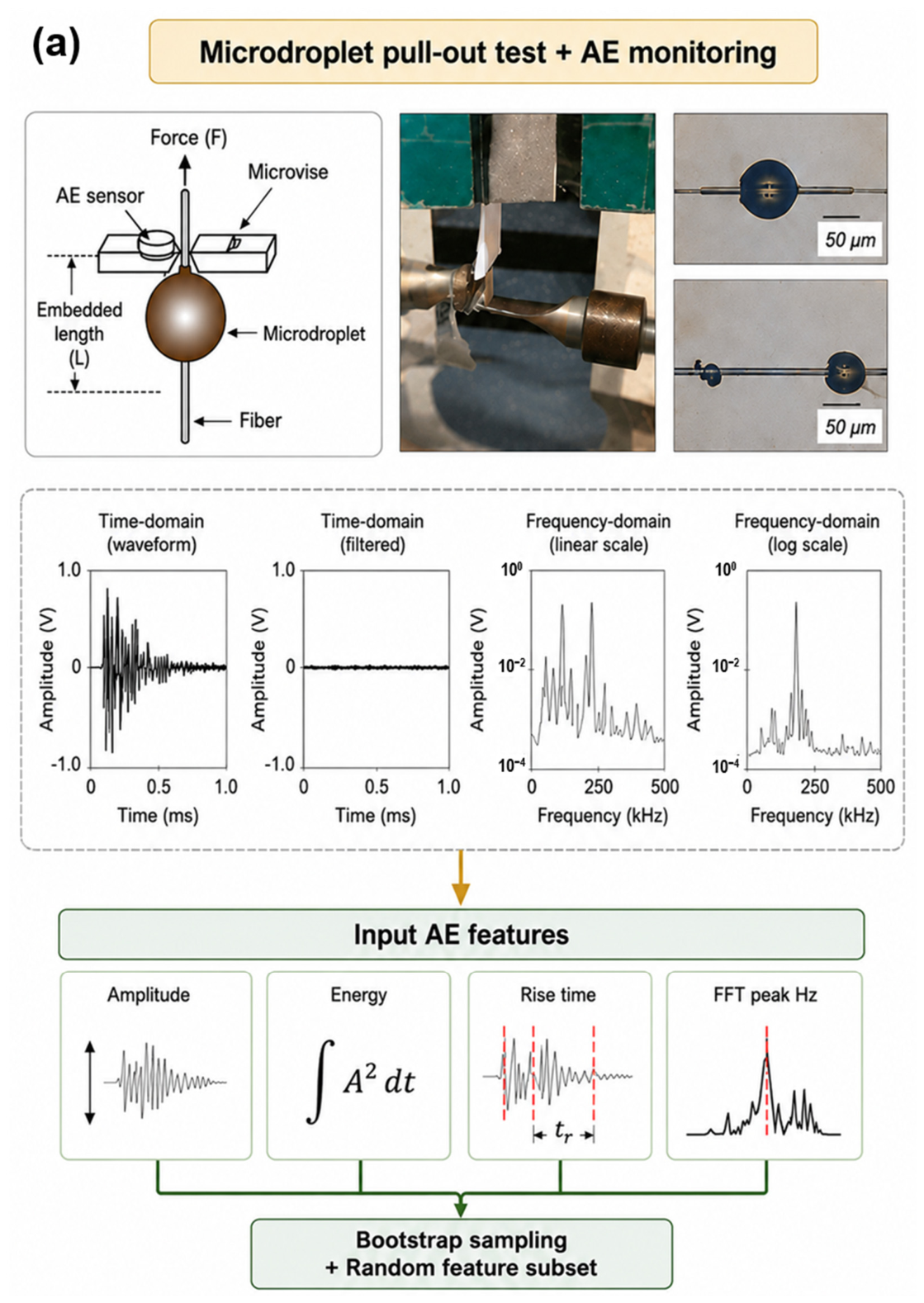
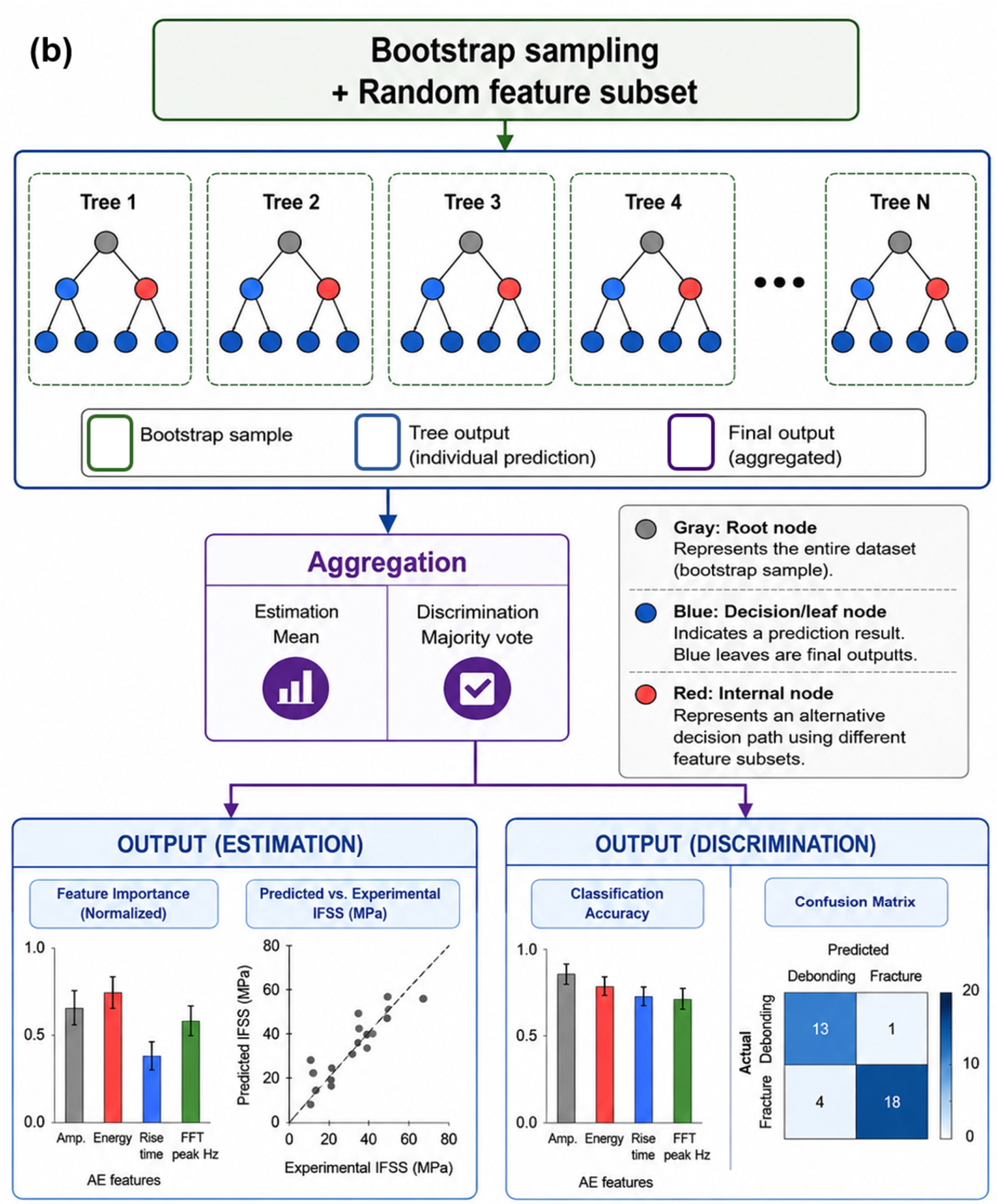
A schematic workflow of the microdroplet pull-out test, AE monitoring, and subsequent ML analysis is shown in Figure 1.

2.2.1. Microdroplet Pull-Out Test

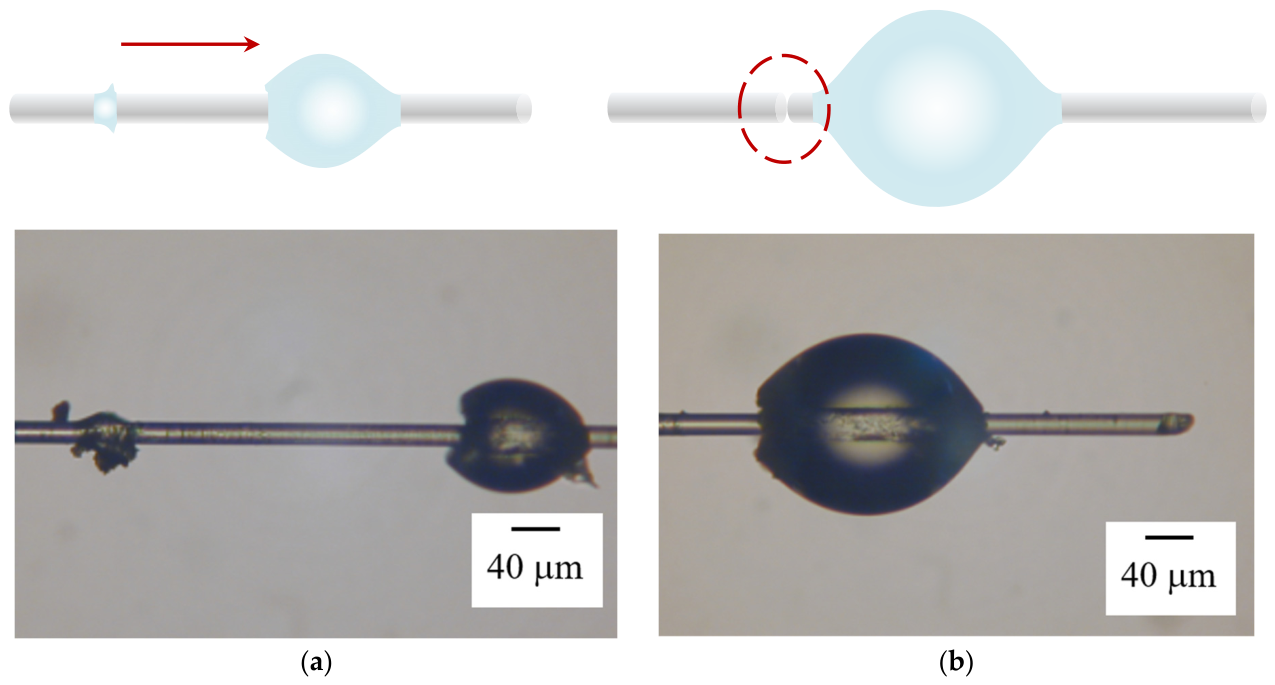
The IFSS between a glass fiber and epoxy resin was measured using the microdroplet pull-out test. An advantage of the microdroplet technique is that the force can be directly measured at the moment of failure [27]. The schematic illustration and optical images of the microdroplet pull-out test and representative failure modes are shown in Figure 2 and were used as reference cases for interpreting the AE signal characteristics and failure mode classification discussed in the following sections. For testing, each microdroplet specimen was fixed in a specially designed microvise mounted on one crosshead of the universal testing machine, while the fiber was pulled by the opposing crosshead. The IFSS was calculated from the measured maximum pull-out force, F, according to Equation (1):
I F S S = F π D f L
where Df and L denote the fiber diameter and embedded length, respectively [26]. Microdroplet pull-out tests were performed using a miniature universal testing machine (UTM) with a crosshead speed of 1 mm/min.

2.2.2. AE Monitoring During Microdroplet Pull-Out Test

To evaluate fracture behavior during microdroplet pull-out tests, AE monitoring was performed. Elastic waves generated by interfacial debonding and fiber fracture were detected using a wideband miniature sensor (WD model, Physical Acoustics Co., Princeton Junction, NJ, USA) with a peak sensitivity of 55 V/(m/s) [62.5 V/mbar] and a resonant frequency range of 125–650 kHz. The sensor was mounted near the microdroplet region of the fiber, using vacuum grease as a coupling agent to ensure stable signal transmission. The sensor output was amplified by 40 dB through a preamplifier and filtered with a band-pass range of 100–1000 kHz, while the detection threshold was set at 30 dB. The AE signals were digitized at 2 MHz and recorded using a PCI-2 AE system (Physical Acoustics Co., Princeton Junction, NJ, USA). The acquired waveforms were then converted into voltage signals and parameterized into standard AE features.
From the raw waveforms, four AE features were extracted and used as inputs for ML analysis: peak amplitude (maximum voltage of the waveform), energy (area under the rectified signal envelope), rise time (time from the first threshold crossing to peak amplitude), and FFT peak frequency (frequency at maximum spectral intensity). Representative raw AE waveforms were collected for both interfacial debonding and fiber fracture events, and the complete dataset is provided in Table S1.

2.2.3. Data Preprocessing

A total of 102 microdroplet pull-out experiments with simultaneously monitored AE signals were conducted in this study. After excluding invalid or non-interpretable signals, the remaining valid datasets were categorized into interfacial debonding and fiber fracture cases for regression and classification analyses. The complete dataset used in the present study is provided in Table S1. For regression analysis, the target variable was defined as IFSS, calculated from the maximum pull-out force and embedded length. For classification analysis, the target labels were defined as interfacial debonding (0) and fiber fracture (1). The dataset was randomly split into training and test sets at a 50:50 ratio, using a fixed random seed (42) to ensure reproducibility. No additional normalization or scaling of AE features was applied, since RF models are insensitive to feature scaling.

2.2.4. ML Workflow and Evaluation

RF models were employed to analyze the relationship between AE features and interfacial properties. Two separate tasks were defined: (i) regression to estimate IFSS and (ii) classification to distinguish failure modes (interfacial debonding vs. fiber fracture). The input vector x consisted of four AE features: peak amplitude, energy, rise time, and FFT peak frequency. For regression, the target variable was IFSS (MPa), and for classification, the target labels were interfacial debonding (0) and fiber fracture (1). The RF regression model predicts IFSS by averaging the outputs of multiple decision trees, as expressed in Equation (2):
τ ^ I F S S ( x ) = 1 B b = 1 B T b ( x )
where B is the number of trees and Tb(x) denotes the prediction of the b-th tree. For classification, the probability of each failure mode was calculated by majority voting among trees, as shown in Equation (3):
p ^ ( y = 1 x ) = 1 B b = 1 B p b ( y = 1 | x ) ,     y ^ = 1 [ p ^ 0.5 ]
where pb(y = 1∣x) denotes the probability estimated by the b-th tree, and y ^ is the final decision (1 for fiber fracture, 0 for interfacial debonding).
The models were implemented in Python (v3.10) using the scikit-learn library (v1.3.0). In the Random Forest models, the number of estimators was set to 100, and the random seed was fixed at 42. Regression models were evaluated using the coefficient of determination (R2) and mean absolute error (MAE), while classification models were evaluated using accuracy, F1 score, and confusion matrix. Given the relatively small experimental dataset (102 datasets), excessively complex hyperparameter optimization was intentionally avoided to reduce the risk of overfitting and maintain physically interpretable feature trends. Therefore, a conventional Random Forest configuration with 100 estimators and a fixed random seed was adopted as a baseline exploratory framework for evaluating the relationships between AE features and interfacial behavior.

3. Results and Discussion

3.1. IFSS Prediction Using Individual AE Features

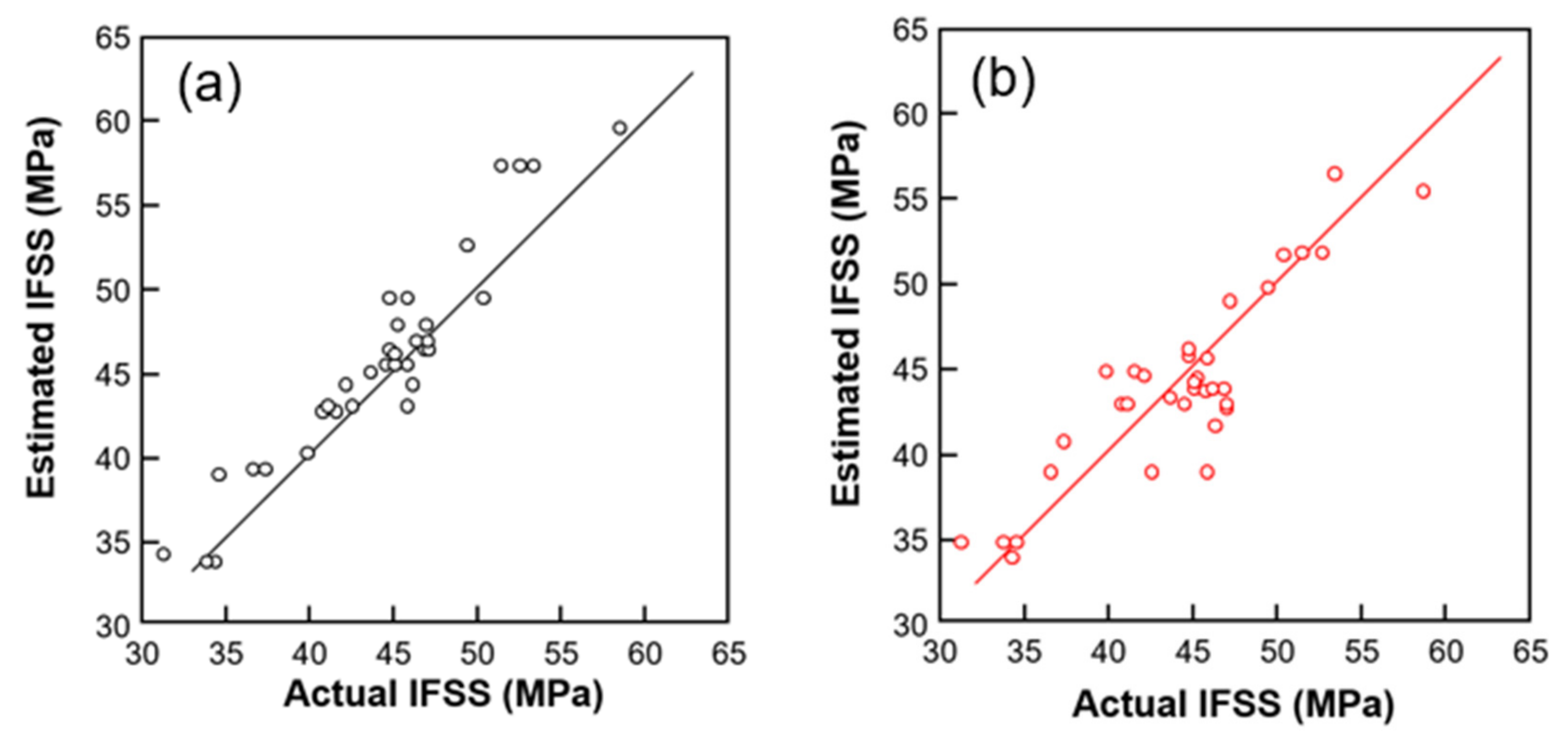
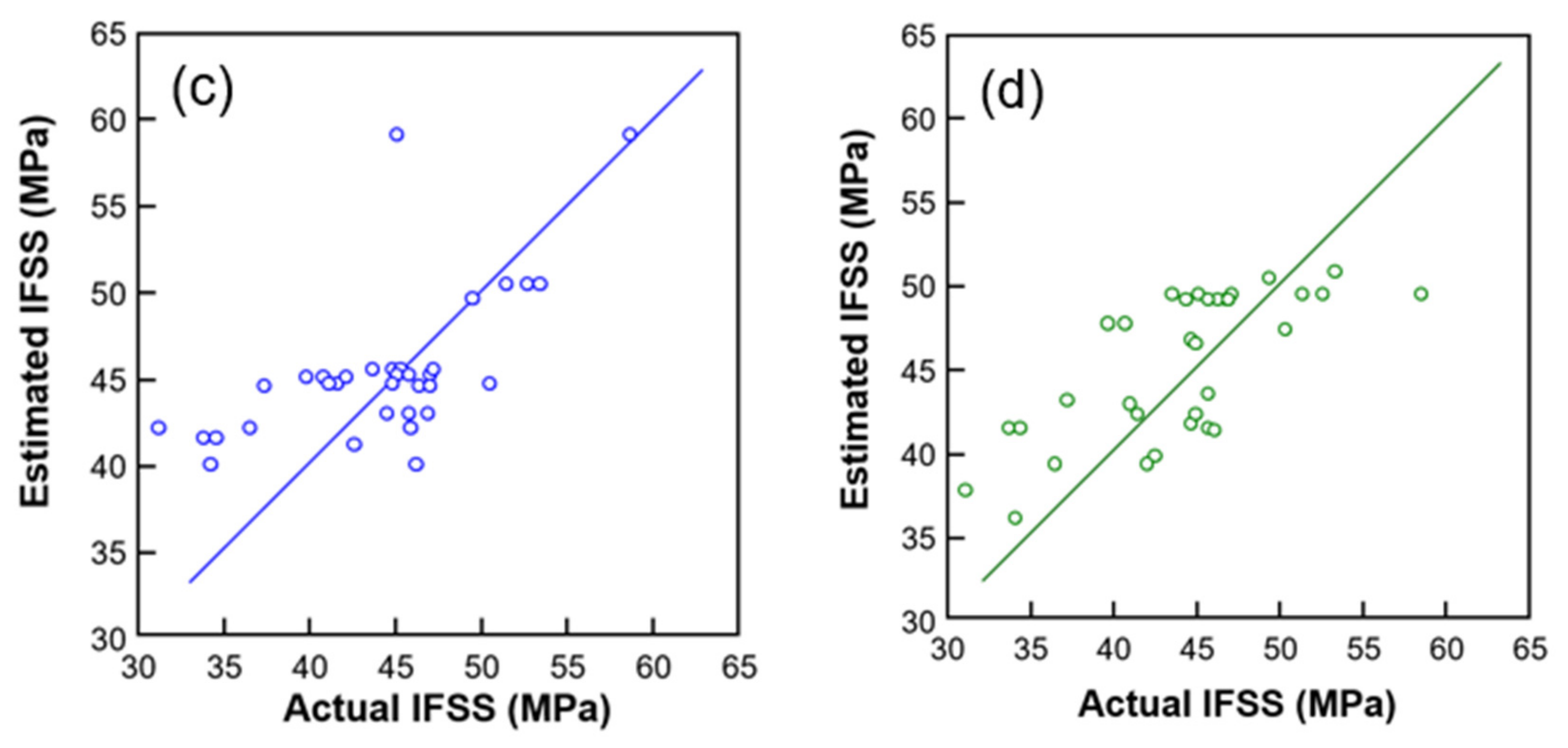
Figure 3 shows scatter plots comparing the actual and predicted IFSS values for each AE feature when used independently as input to the RF regression model. Among the four features, intensity-related parameters, particularly peak energy and peak amplitude, exhibited clearer associations with IFSS. Peak energy showed the strongest trend-level agreement with IFSS, whereas peak amplitude demonstrated a moderate correlation. In contrast, rise time and FFT peak frequency showed little sensitivity to IFSS, resulting in widely scattered predictions or values clustered within a narrow range. In addition, a tendency toward underestimation at higher IFSS values relative to the 1:1 line suggests that single-feature regression is less sensitive in the high-IFSS regime.
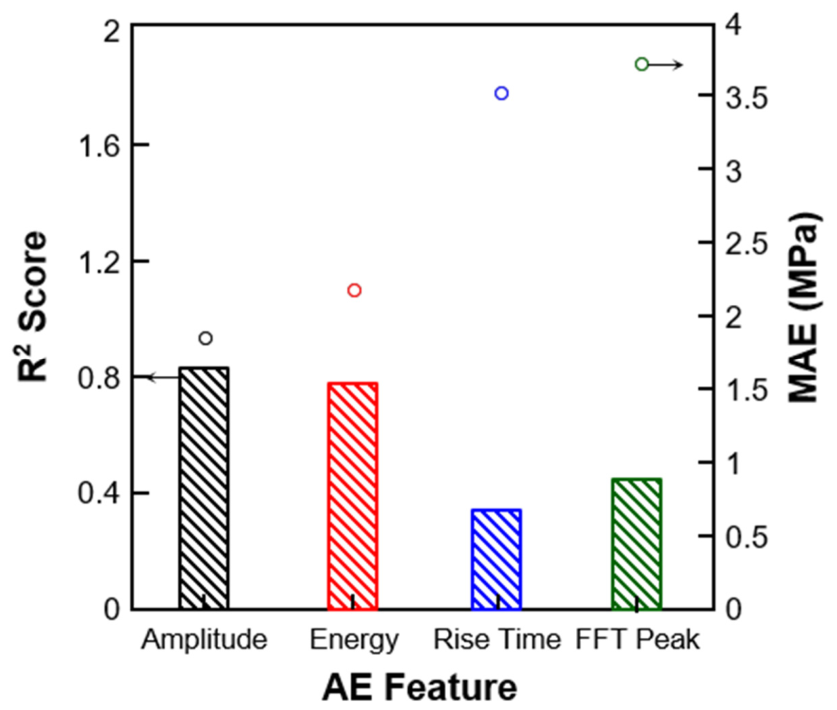
Figure 4 summarizes the regression performance of the single-feature RF models in terms of R2 and MAE. Among the evaluated AE descriptors, amplitude exhibited the highest R2 value (0.833) together with a relatively low MAE (1.87 MPa), indicating the strongest trend-level agreement with IFSS. Energy also showed strong predictive performance, with an R2 of 0.782 and an MAE of 2.20 MPa. In contrast, the rise time and FFT peak frequency yielded substantially lower R2 values (0.346 and 0.452, respectively) and larger MAE values exceeding 3.5 MPa, suggesting limited sensitivity to interfacial shear behavior.
The superior performance of amplitude and energy implies that intensity-related AE parameters are more closely associated with stress-transfer and debonding processes occurring at the fiber–matrix interface during microdroplet pull-out. Since AE amplitude and energy are directly related to the magnitude of elastic energy released during local fracture events, stronger interfacial resistance and higher IFSS values may generate more pronounced AE responses. Consequently, these intensity-based descriptors appear to better reflect interfacial damage progression than temporal or spectral features.
By comparison, rise time and FFT peak frequency exhibited relatively poor regression capability, indicating that time-domain and frequency-domain characteristics alone are insufficient to represent IFSS variations under the present experimental conditions. These features are likely influenced by additional factors such as signal attenuation, waveform dispersion, sensor response characteristics, and localized wave propagation behavior in microscale specimens. Therefore, the results in Figure 4 suggest that signal-intensity descriptors are more relevant and robust for trend-level estimation of interfacial properties in AE-based microdroplet pull-out analysis.
Amplitude and energy are directly associated with the magnitude of elastic strain energy released during local interfacial fracture events. Therefore, larger fracture events occurring during fiber debonding or fiber breakage tend to generate stronger AE wave intensity and increased accumulated signal energy. By contrast, rise time and FFT peak frequency are more strongly influenced by wave attenuation, signal dispersion, local sensor coupling conditions, and microscale geometric effects during wave propagation. Consequently, these parameters may exhibit lower sensitivity and less consistent relationships with interfacial shear behavior under the present experimental conditions.
To quantitatively evaluate feature redundancy, Pearson correlation analysis was additionally performed among the extracted AE descriptors. As shown in Table S1, amplitude and energy exhibited a strong positive correlation (r = 0.92), indicating that both descriptors contain partially overlapping intensity-related information associated with elastic strain energy release during fracture events. By contrast, rise time showed relatively weak correlations with the other AE descriptors.

3.2. Regression with Combined AE Features

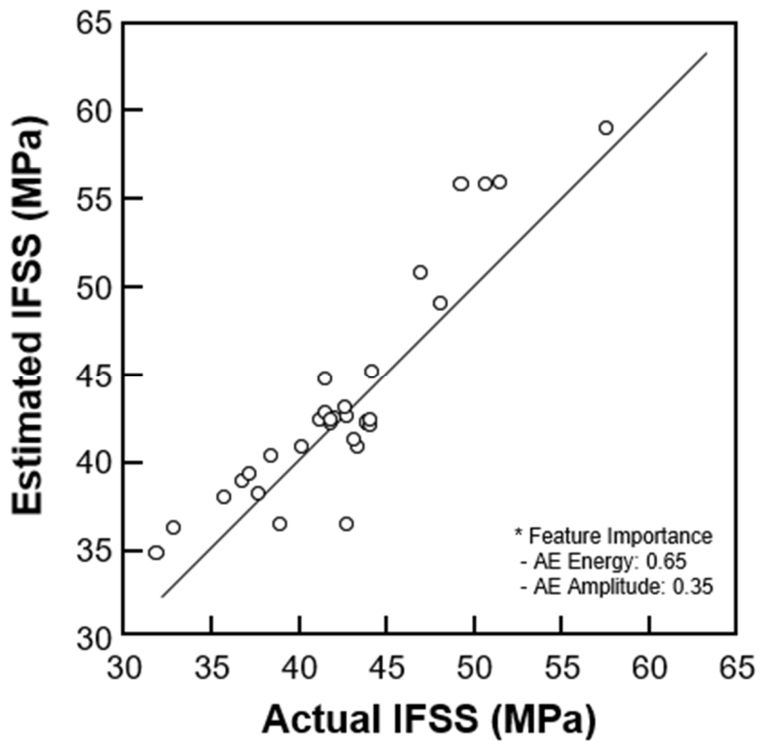
To evaluate the effect of feature combination on IFSS estimation, peak amplitude and energy were used simultaneously as input variables in the RF regression model. As shown in Figure 5, the predicted IFSS values generally followed the overall experimental trend and were distributed relatively close to the 1:1 reference line. However, noticeable scatter remained in several regions, particularly at higher IFSS values, where deviations between predicted and experimental results became more pronounced. This tendency suggests that the combined-feature model retained trend-level sensitivity to interfacial behavior but still lacked precision in accurately capturing local IFSS variations.
Compared with the single-feature models summarized in Table 1, the combined amplitude–energy model showed only a marginal improvement in regression performance (R2 = 0.852, MAE = 1.77 MPa). The limited enhancement indicates that combining these two AE descriptors did not provide substantial additional predictive information beyond the individual intensity-related features. Feature importance analysis further revealed that energy contributed more dominantly to the regression process, whereas amplitude contributed comparatively less, suggesting that the combined model’s behavior was largely governed by the energy descriptor.
This behavior is likely attributed to the strong physical correlation between amplitude and energy, since both parameters are associated with the magnitude of elastic energy release during interfacial fracture and debonding events. As fracture intensity increases, both signal amplitude and accumulated AE energy tend to increase simultaneously, resulting in partially overlapping physical information. To quantitatively evaluate feature redundancy, correlation analysis was additionally performed among the extracted AE descriptors. The results showed that amplitude and energy exhibited a relatively strong positive correlation, indicating that both parameters contain partially overlapping intensity-related information associated with elastic strain energy release during fracture events. By contrast, rise time and FFT peak frequency showed comparatively weaker correlations with the intensity-related descriptors. Amplitude and energy exhibited a strong positive correlation (Pearson’s r = 0.82).
Consequently, the RF model may receive redundant rather than complementary information when both features are used together. In RF-based regression, adding highly collinear variables does not necessarily improve model generalization or prediction stability. Because amplitude represents the peak intensity of the AE waveform while energy reflects the accumulated waveform magnitude, both descriptors are simultaneously influenced by elastic strain energy release during fracture events. Consequently, a similar trend-level pattern and partial collinearity were observed between the two parameters in the present experimental dataset.
Therefore, the results in Figure 5 suggest that the predictive performance of the current AE-based RF framework is more strongly influenced by the intrinsic physical relevance of the selected descriptor to interfacial damage behavior than by the simple increase in the number of input features [28,29]. Given the relatively small experimental dataset used in the present study, the reported regression and classification performances should be interpreted primarily as exploratory trend-level indicators rather than fully generalized predictive metrics. A balanced 50:50 train–test split was adopted to maintain sufficient data representation in both the training and testing subsets while preserving independent evaluation reliability. Although additional validation strategies, such as cross-validation or repeated random splitting, may further improve statistical robustness, the present framework still demonstrated consistent tendencies regarding the physical relevance of intensity-related AE descriptors to interfacial behavior. In particular, amplitude and energy consistently exhibited similar trend-level relationships with IFSS and failure mode discrimination across the present dataset, suggesting that the observed AE behavior was not solely dependent on a specific random data split.

3.3. Failure Mode Discrimination Using Individual AE Features

Figure 6 presents the distributions of AE features for the two failure modes observed during the microdroplet pull-out test: interfacial debonding and fiber fracture. Among the evaluated AE descriptors, amplitude and energy showed relatively distinct distribution differences between the two failure modes. In particular, fiber fracture events tended to exhibit higher amplitudes and energies than interfacial debonding events, indicating that fiber breakage generated stronger AE activity and greater elastic energy release during fracture. In contrast, interfacial debonding generally produced lower-intensity AE signals associated with localized interface separation.
By comparison, rise time and FFT peak frequency exhibited substantial overlap between the two failure modes, making clear separation difficult. The distributions of these features did not show consistent trends corresponding to failure mode transition, suggesting limited sensitivity to the underlying interfacial fracture behavior. This result implies that time-domain and frequency-domain descriptors are more strongly influenced by signal propagation characteristics and experimental variability than by the fracture mechanism itself under the present microscale pull-out conditions.
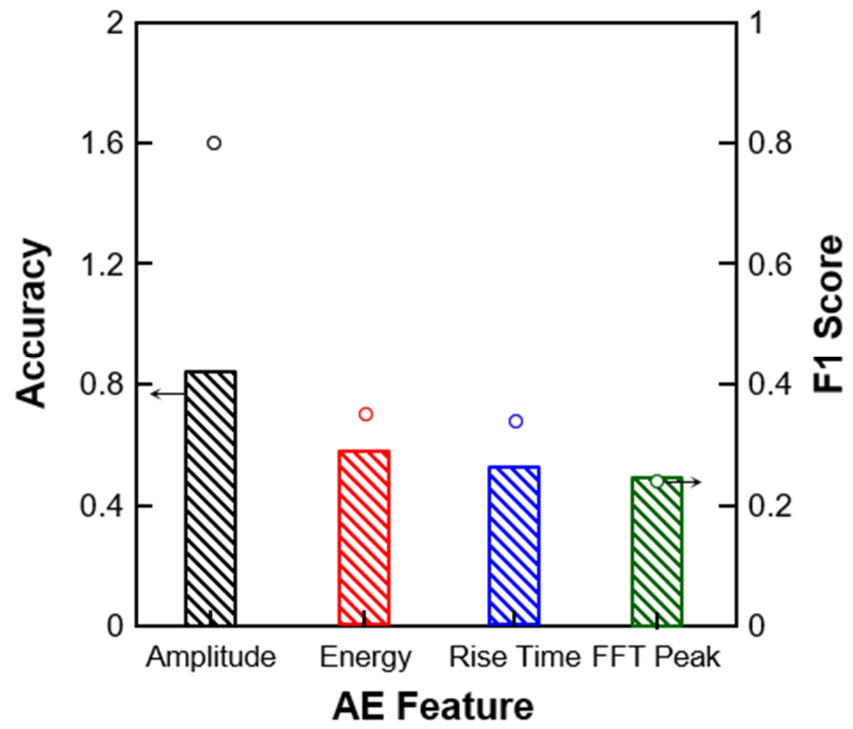
The discrimination performance summarized in Figure 7 further supports these observations. Among the individual AE features, amplitude exhibited the highest classification performance, indicating the most effective separation tendency between fiber fracture and interfacial debonding. Energy also showed relatively high discrimination capability, whereas rise time and FFT peak frequency resulted in comparatively lower classification performance. These results suggest that intensity-related AE descriptors contain more relevant information associated with fracture severity and interfacial damage evolution than temporal or spectral parameters. Therefore, within the current experimental framework, signal-intensity-based AE features appear to provide more robust indicators for failure mode discrimination during microdroplet pull-out testing. In microscale pull-out configurations, frequency-domain and time-domain AE features may also become increasingly sensitive to localized wave reflections, specimen geometry, and propagation distance effects, thereby reducing their direct correlation with interfacial fracture severity.

3.4. Discrimination with Combined AE Features

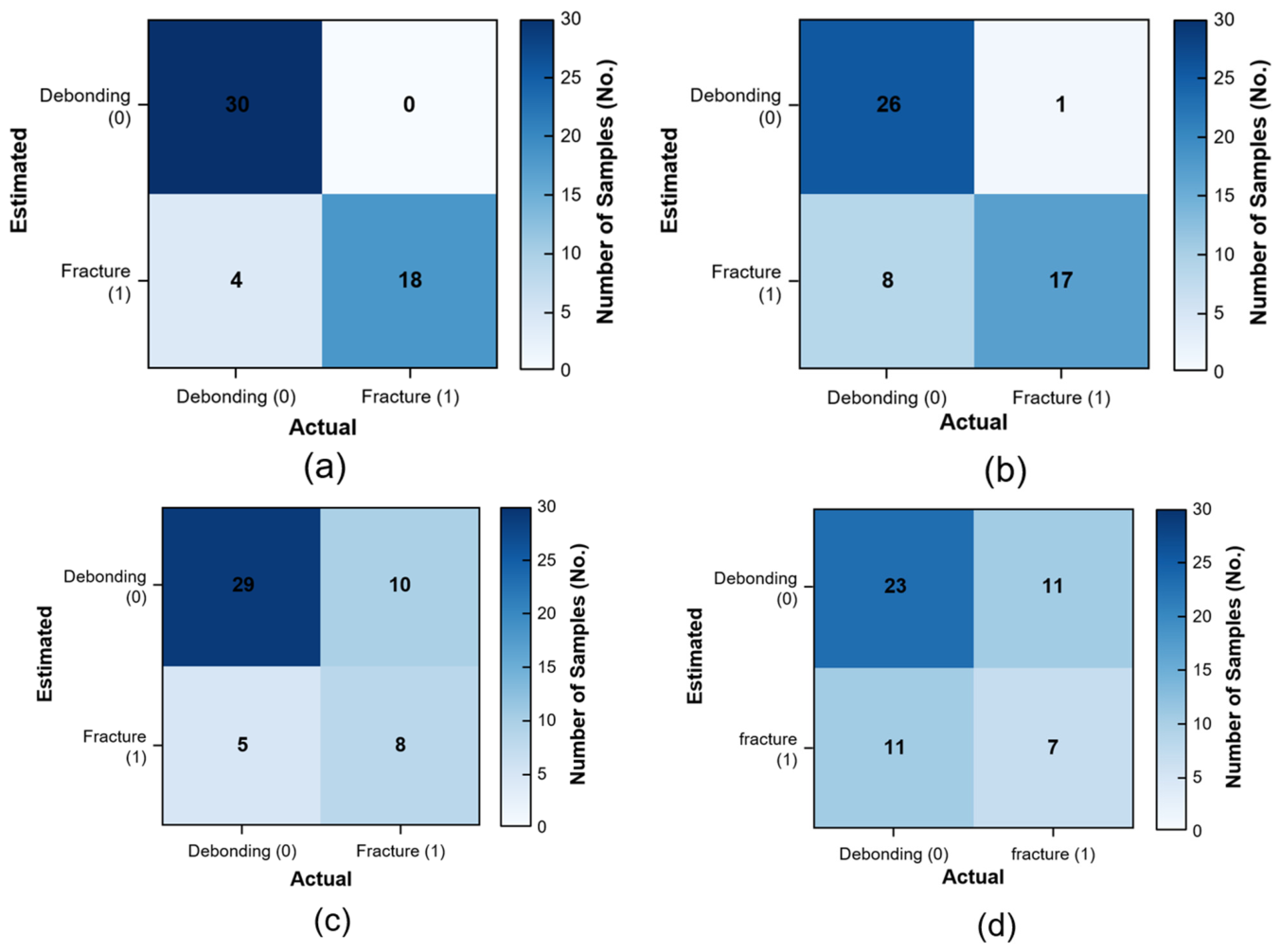
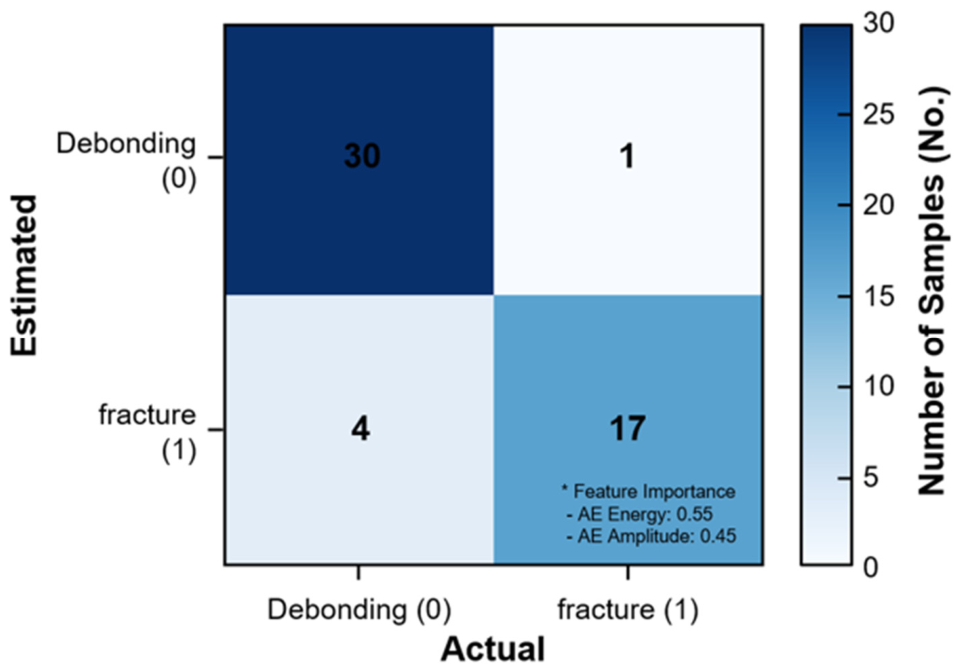
Figure 8 presents the confusion matrix for failure mode discrimination using the combined AE features of amplitude and energy as input variables for the RF classification model. The results show that most fiber fracture events were correctly classified into the corresponding category, indicating that high-intensity AE responses generated during fiber breakage were effectively recognized by the model. In contrast, interfacial debonding cases exhibited a relatively larger degree of overlap and misclassification, suggesting that the AE characteristics associated with debonding were less distinct than those generated by fiber fracture.
The classification performance summarized in Table 2 indicates that the combined-feature model achieved an accuracy of 0.904 and an F1 score of 0.872, demonstrating relatively stable discrimination capability. However, this performance did not exceed that of the amplitude-only model, which showed the highest classification accuracy (0.923) and F1 score (0.900) among all evaluated descriptors. These results suggest that amplitude alone already contains sufficient information on fracture severity and AE signal intensity to distinguish the two failure modes.
The limited improvement observed in the combined-feature model is likely related to the strong correlation between amplitude and energy, since both descriptors primarily reflect the magnitude of elastic energy release during fracture events. As a result, the simultaneous use of these two intensity-related features may introduce partially redundant information rather than complementary discriminatory characteristics. Consequently, the RF classifier did not achieve a substantial enhancement in classification performance despite the increase in the number of input variables.
These observations are consistent with the regression analysis discussed previously, where combining amplitude and energy also resulted in only marginal improvement in IFSS prediction performance. Therefore, the results in Figure 8 suggest that, within the present experimental framework, the discriminatory capability of AE-based ML models is governed more by the intrinsic physical relevance and independence of the selected descriptors than by simple feature combination.
The regression and classification analyses indicate that AE features contain relevant information associated with fiber–matrix interfacial behavior during the micro-droplet pull-out test. Among the evaluated descriptors, intensity-related AE parameters showed stronger relationships with interfacial responses than time- or frequency domain features. Amplitude and energy exhibited the highest trend-level agreement with IFSS, while amplitude provided the clearest discrimination between interfacial debonding and fiber fracture.
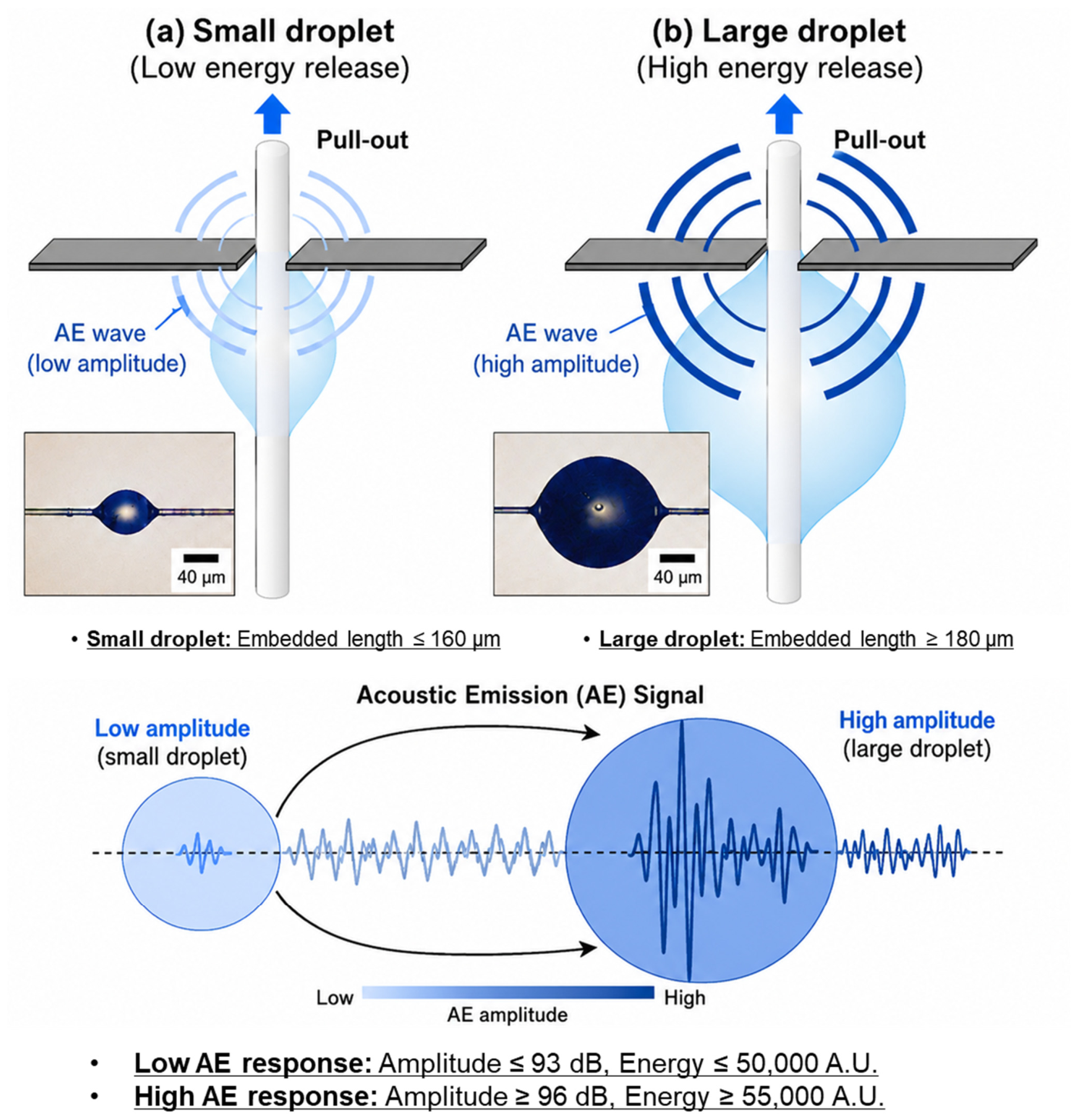
As shown in Figure 9, interfacial debonding generated relatively low-amplitude AE signals under lower load conditions, whereas fiber fracture produced significantly higher-amplitude signals due to larger elastic energy release. Amplitude represents the peak intensity of the AE waveform, whereas energy reflects the accumulated signal magnitude over the entire waveform duration. Because both parameters are governed by the elastic strain energy released during fracture events, larger interfacial failure events tend to simultaneously generate higher-amplitude signals and increased accumulated AE energy. Consequently, partially correlated tendencies were observed between amplitude and energy during the microdroplet pull-out process.
These observations suggest that AE signal intensity is closely related to fracture severity and interfacial damage behavior. In this study, small and large droplets were operationally classified based on embedded length rather than droplet volume. Embedded lengths below approximately 160 μm were considered small droplets, whereas values above approximately 180 μm were considered large droplets. Similarly, AE responses were classified as low-intensity when the amplitude was ≤93 dB, high-intensity when the amplitude was ≥96 dB, and as a transition range when the amplitude was 94–95 dB. These classifications were used only for schematic interpretation of the present dataset. Although amplitude and energy showed similar tendencies, combining the two parameters did not significantly improve the regression or classification performance. This is likely because both descriptors contain overlapping intensity-related information. Although the quantitative predictive capability remains limited, the present results demonstrate the potential of AE-based machine learning as an auxiliary approach for indirect and real-time assessment of interfacial behavior in composite systems. Despite the limited dataset size, the observed classification tendencies remained physically consistent with the experimentally observed interfacial debonding and fiber fracture behaviors.

4. Conclusions

This study investigated the potential of AE features for evaluating fiber–matrix interfacial behavior in glass fiber/epoxy systems during microdroplet pull-out tests. AE signals obtained during the tests were analyzed using RF models for both IFSS estimation and failure mode discrimination.
  • Among the evaluated AE descriptors, amplitude and energy exhibited the strongest associations with IFSS, indicating that intensity-related AE parameters are more closely associated with interfacial shear behavior than time- or frequency-domain features. For failure mode discrimination, amplitude showed the clearest separation tendency between interfacial debonding and fiber fracture.
  • The results further demonstrated that fiber fracture generated higher-intensity AE responses than interfacial debonding due to increased elastic strain energy release during fracture events. Consequently, AE signal intensity was found to be closely related to fracture severity and the evolution of interfacial damage. Although amplitude and energy showed similar trends, combining these two descriptors did not significantly improve regression or classification performance, suggesting that they contain partially redundant intensity-related information.
  • These consistent observations across both regression and classification analyses indicate that intensity-based AE descriptors contain physically meaningful information related to interfacial strength and failure mechanisms. Therefore, the present study suggests that AE-assisted microdroplet pull-out testing can provide a more rapid and objective methodology for indirect interfacial characterization in composite systems.
  • Although the quantitative predictive capability and generalizability remain limited due to the use of a single glass fiber/epoxy system and a relatively limited experimental dataset, the present work still demonstrates the exploratory potential of AE-based machine learning as an auxiliary and data-driven approach for real-time interfacial behavior assessment.
Future studies will expand the proposed framework to various fiber and matrix systems, environmental conditions, and optimized ML parameters to establish a more generalized AE-based interfacial evaluation methodology.

Supplementary Materials

The following supporting information can be downloaded at: https://www.mdpi.com/article/10.3390/jcs10060294/s1, Table S1. Raw AE data collected during microdroplet pull-out tests.

Author Contributions

Conceptualization, P.-S.S. and D.-J.K.; methodology, Y.-M.B.; validation, Y.-M.B., S.B.Y.; investigation, S.B.Y.; resources, Y.-M.B.; writing—original draft preparation, P.-S.S.; writing—review and editing, P.-S.S. and D.-J.K.; visualization, S.B.Y.; supervision, D.-J.K.; project administration, P.-S.S. and D.-J.K.; funding acquisition, D.-J.K. All authors have read and agreed to the published version of the manuscript.

Funding

This research was supported by the Regional Innovation System & Education (RISE) program funded by the Ministry of Education (MOE) and local governments through the Jeonbuk RISE Center (2025-RISE-13-WSU) and the Gyeongsangnam-do RISE Center (2025-RISE-16-001), Republic of Korea. This work was supported by the Ministry of Trade, Industry and Energy (MOTIE) and the Korea Institute for Advancement of Technology (KIAT) through the International Cooperative R&D Program (Project No. P0030227).

Institutional Review Board Statement

Not applicable.

Informed Consent Statement

Not applicable.

Data Availability Statement

The data presented in this study are available on request from the corresponding author.

Conflicts of Interest

The authors declare no conflicts of interest.

References

  1. Ji, P.; Lei, X.; Fu, Q.; Liu, B.; Chen, S. Effect of Fiber Type on the Ablation Resistance of Sharp Leading-Edge C/C-Zrb2-Sic Composites: Mesophase Pitch Carbon Fibers vs. Pan-Based Fibers. Compos. Commun. 2025, 59, 102582. [Google Scholar] [CrossRef]
  2. Wang, Y.; Dong, X.; Li, N.; Chen, Y.; Yu, J.; Hu, Z.; Zhu, M. Surface Modified Uhmwpe Fibers with Functional Interfacial Layers: A Strategy for Enhanced Composite Interfacial and Mechanical Performance. Compos. Part A Appl. Sci. Manuf. 2026, 200, 109300. [Google Scholar] [CrossRef]
  3. Li, L.; Li, X.; Wang, B.; Tao, J.; Shi, K. A Review on Interfacial Bonding Behavior between Fiber and Concrete. J. Build. Eng. 2025, 105, 112455. [Google Scholar] [CrossRef]
  4. Wang, H.; Zhang, X.; Duan, Y.; Meng, L. Experimental and Numerical Study of the Interfacial Shear Strength in Carbon Fiber/Epoxy Resin Composite under Thermal Loads. Int. J. Polym. Sci. 2018, 2018, 3206817. [Google Scholar] [CrossRef]
  5. McCarthy, E.D.; Soutis, C. Determination of Interfacial Shear Strength in Continuous Fibre Composites by Multi-Fibre Fragmentation: A Review. Compos. Part A Appl. Sci. Manuf. 2019, 118, 281–292. [Google Scholar] [CrossRef]
  6. Thomason, J.L.; Jenkins, P.G.; Xypolias, G. Microbond Testing of the Interface in Glass Fibre Vinylester Composites. Compos. Interfaces 2022, 29, 695–709. [Google Scholar] [CrossRef]
  7. Dsouza, R.D.; Di Vito, D.; Jokinen, J.; Kanerva, M. Mutual Dependence of Experimental and Data Analysis Features in Characterization of Fiber-Matrix Interface via Microdroplets. Polym. Compos. 2023, 44, 7611–7630. [Google Scholar] [CrossRef]
  8. Huang, S.; Fu, Q.; Yan, L.; Kasal, B. Characterization of Interfacial Properties between Fibre and Polymer Matrix in Composite Materials—A Critical Review. J. Mater. Res. Technol. 2021, 13, 1441–1484. [Google Scholar] [CrossRef]
  9. Liu, L.; Du, M.; Liu, F. Recent Advances in Interface Microscopic Characterization of Carbon Fiber-Reinforced Polymer Composites. Front. Mater. 2023, 10, 1124338. [Google Scholar] [CrossRef]
  10. Ghaffari, S.; Seon, G.; Makeev, A. In-Situ Sem Based Method for Assessing Fiber-Matrix Interface Shear Strength in Cfrps. Mater. Des. 2021, 197, 109242. [Google Scholar] [CrossRef]
  11. Lin, S.; Ye, B.; Peng, C.; Ran, M.; Jie, D.; Du, Y.; Yin, D. Enhancing Interfacial Bonding and Mechanical Properties of Cf/Ep Composites through Low-Temperature Jet Plasma Treatment. Int. J. Adhes. Adhes. 2025, 141, 104067. [Google Scholar] [CrossRef]
  12. Qiu, S.; Wang, J.; Zhang, D.; Van Vuure, A.W.; Seveno, D.; Fuentes, C.A. Wetting Dynamics and Surface Energy Components of Single Carbon Fibers. J. Colloid Interface Sci. 2019, 557, 349–356. [Google Scholar] [CrossRef]
  13. Plichta, T.; Sirjovova, V.; Zvonek, M.; Kalinka, G.; Cech, V. The Adhesion of Plasma Nanocoatings Controls the Shear Properties of Gf/Polyester Composite. Polymers 2021, 13, 593. [Google Scholar] [CrossRef]
  14. Barile, C.; Casavola, C.; Pappalettera, G.; Vimalathithan, P.K. Damage Characterization in Composite Materials Using Acoustic Emission Signal-Based and Parameter-Based Data. Compos. Part B Eng. 2019, 178, 107469. [Google Scholar] [CrossRef]
  15. Almeida, R.S.; Magalhães, M.D.; Karim, M.N.; Tushtev, K.; Rezwan, K. Identifying Damage Mechanisms of Composites by Acoustic Emission and Supervised Machine Learning. Mater. Des. 2023, 227, 111745. [Google Scholar] [CrossRef]
  16. Muir, C.; Swaminathan, B.; Almansour, A.S.; Sevener, K.; Smith, C.; Presby, M.; Kiser, J.D.; Pollock, T.M.; Daly, S. Damage Mechanism Identification in Composites via Machine Learning and Acoustic Emission. npj Comput. Mater. 2021, 7, 95. [Google Scholar] [CrossRef]
  17. Huang, Y.; Liu, Y.; Zhou, C.; Xu, S.; Hu, J.; Zhao, J. Damage Monitoring of Carbon/Glass Hybrid Composites under Tensile Load Based on Digital Image Correlation and acoustic Emission Technology. Polym. Compos. 2025, 46, 16063–16079. [Google Scholar] [CrossRef]
  18. Shin, P.-S.; Kwon, D.-J.; Kim, J.-H.; Lee, S.-I.; DeVries, K.L.; Park, J.-M. Interfacial Properties and Water Resistance of Epoxy and Cnt-Epoxy Adhesives on Gfrp Composites. Compos. Sci. Technol. 2017, 142, 98–106. [Google Scholar] [CrossRef]
  19. Butler, K.T.; Oviedo, F.; Canepa, P. Machine Learning in Materials Science; Acs in Focus; American Chemical Society: Washington, DC, USA, 2021. [Google Scholar]
  20. Mobarak, H.; Mimona, M.A.; Islam, A.; Hossain, N.; Zohura, F.T.; Imtiaz, I.; Rimon, I.H. Scope of Machine Learning in Materials Research—A Review. Appl. Surf. Sci. Adv. 2023, 18, 100523. [Google Scholar] [CrossRef]
  21. Zhong, X.; Gallagher, B.; Liu, S.; Kailkhura, B.; Hiszpanski, A.; Han, T.Y.-J. Explainable Machine Learning in Materials Science. npj Comput. Mater. 2022, 8, 204. [Google Scholar] [CrossRef]
  22. Allen, A.E.A.; Tkatchenko, A. Machine Learning of Material Properties: Predictive and Interpretable Multilinear Models. Sci. Adv. 2022, 8, eabm7185. [Google Scholar] [CrossRef]
  23. Zhang, S.; Li, H.; Sun, D.; Jin, Y.; Pang, L.; Li, S.; Qin, X. AE-driven machine learning framework for CFRP damage mode identification and energy-based damage assessment. Compos. Struct. 2026, 389, 120439. [Google Scholar] [CrossRef]
  24. Sikdar, S.; Liu, D.; Kundu, A. Acoustic emission data based deep learning approach for classification and detection of damage-sources in a composite panel. Compos. Part B Eng. 2022, 228, 109450. [Google Scholar] [CrossRef]
  25. Shin, P.-S.; Kim, J.-H.; Park, H.-S.; Baek, Y.-M.; Kwon, D.-J.; DeVries, K.L.; Park, J.-M. Advanced interfacial properties of glass fiber/dopamine-epoxy composites using a microdroplet pull-out test and acoustic emission. J. Adhes. 2021, 97, 438–455. [Google Scholar] [CrossRef]
  26. Lee, D.; Kim, J.-H.; Lee, S.J.; Kim, M.; Kwon, D.-J. Microdroplet pull-out testing: Significance of fiber fracture results. Polym. Test. 2024, 141, 108631. [Google Scholar] [CrossRef]
  27. Kang, S.; Lee, D.; Choi, N. Fiber/Epoxy Interfacial Shear Strength Measured by the Microdroplet Test. Compos. Sci. Technol. 2009, 69, 245–251. [Google Scholar] [CrossRef]
  28. Breiman, L. Random Forests. Mach. Learn. 2001, 45, 5–32. [Google Scholar] [CrossRef]
  29. Kuhn, M.; Johnson, K. Applied Predictive Modeling; Springer: Berlin/Heidelberg, Germany, 2013; Volume 26. [Google Scholar]
Figure 1. Schematic workflow: (a) microdroplet pull-out test, AE feature extraction, (b) Random Forest modeling.
Jcs 10 00294 g001aJcs 10 00294 g001b
Figure 2. Schematics and optical images of the microdroplet specimens showing two failure modes: (a) interfacial debonding, (b) fiber fracture.
Jcs 10 00294 g002
Figure 3. Actual vs. estimated IFSS (MPa) using AE amplitude as input to the Random Forest regression: (a) amplitude, (b) energy, (c) rise time, (d) FFT peak Hz.
Jcs 10 00294 g003aJcs 10 00294 g003b
Figure 4. Regression metrics (R2 and MAE) for single AE feature-based IFSS estimation using Random Forest models.
Jcs 10 00294 g004
Figure 5. Actual vs. estimated IFSS (MPa) using combined AE features (Amplitude + Energy) with Random Forest models.
Jcs 10 00294 g005
Figure 6. Distribution of AE feature values according to failure modes (debonding vs. fracture): (a) amplitude, (b) energy, (c) rise time, (d) FFT peak Hz.
Jcs 10 00294 g006
Figure 7. Classification metrics for failure mode discrimination using individual AE features.
Jcs 10 00294 g007
Figure 8. Confusion matrix for failure mode discrimination using combined AE features (Amplitude + Energy).
Jcs 10 00294 g008
Figure 9. AE response during microdroplet pull-out test; low load induces interfacial debonding with low-amplitude AE waves, while high load causes fiber fracture/interfacial debonding with high-amplitude AE waves.
Jcs 10 00294 g009
Table 1. Regression metrics obtained from Random Forest analysis using AE features for IFSS assessment.
AE FeaturesR2 ScoreMAE (MPa)
Amplitude0.8331.87
Energy0.7822.20
Rise Time0.3463.56
FFT peak frequency0.4523.76
Amplitude + Energy0.8521.77
Table 2. Discrimination metrics obtained from Random Forest models for failure mode analysis.
AE FeaturesAccuracyF1 Score
Amplitude0.9230.9
Energy0.8270.790
Rise Time0.7120.516
FFT peak frequency0.5770.516
Amplitude + Energy0.9040.872
Disclaimer/Publisher’s Note: The statements, opinions and data contained in all publications are solely those of the individual author(s) and contributor(s) and not of MDPI and/or the editor(s). MDPI and/or the editor(s) disclaim responsibility for any injury to people or property resulting from any ideas, methods, instructions or products referred to in the content.