
Article

Dynamic Analysis of Sandwich Plates with Auxetic Honeycomb Core and Laminated FG-CNTRC Facesheets Using a PB-2 Ritz Formulation

1
Faculty of Building and Industrial Construction, Hanoi University of Civil Engineering (HUCE), 55 Giai Phong Road, Hai Ba Trung District, Hanoi 10000, Vietnam
2
Frontier Research Group of Mechanics of Advanced Materials and Structures (MAMS), Hanoi University of Civil Engineering (HUCE), 55 Giai Phong Road, Hai Ba Trung District, Hanoi 10000, Vietnam
*
Author to whom correspondence should be addressed.
J. Compos. Sci. 2026, 10(5), 277; https://doi.org/10.3390/jcs10050277
Submission received: 20 April 2026 / Revised: 8 May 2026 / Accepted: 12 May 2026 / Published: 20 May 2026
(This article belongs to the Section Composites Modelling and Characterization)

Abstract

This paper analyzes the vibrational characteristics of a novel sandwich plate configuration composed of an auxetic honeycomb (AH) core and laminated functionally graded carbon nanotube-reinforced composite (FG-CNTRC) face sheets, hereafter referred to as the SD-AuCNT plate. Based on Reddy’s third-order shear deformation theory (SDT), which accurately accounts for transverse shear effects without requiring shear correction factors, the equations of motion are derived using Hamilton’s principle and subsequently solved using a pb-2 Ritz formulation combined with the Newmark time integration scheme for dynamic response analysis. By combining an auxetic core with negative Poisson’s ratio characteristics and laminated FG-CNTRC face sheets featuring tailored CNT distribution patterns and orientations, the hybrid SD-AuCNT plate can improve structural stiffness, energy absorption, and dynamic performance; however, it has not been thoroughly investigated in the existing literature. After verifying the accuracy of the proposed computational procedure, the effects of auxetic core geometry, CNT distribution patterns, thickness ratios, and boundary conditions on the natural frequencies and transient responses of the plate are comprehensively investigated. The results provide new insights into the dynamic behavior of advanced sandwich plates and offer practical guidance for the design of high-performance lightweight structures in aerospace, marine, defense, and other engineering applications.

1. Introduction

Sandwich structures are widely used across various industries, including aerospace, nuclear power, transportation, maritime, civil engineering, and defense, due to their superior advantages over traditional monolithic structures, such as high specific strength and stiffness, excellent thermal and acoustic insulation, and outstanding energy absorption capacity. A typical sandwich structure consists of a lightweight porous core layer bonded between two high-strength, high-stiffness face sheets. This configuration enables a significant enhancement in flexural stiffness and load-bearing capacity while maintaining a low weight, thereby optimizing the balance between structural performance and material efficiency [1,2].
The overall performance of sandwich structures is strongly governed by the selection of materials for the face sheets and the core, which should be designed to meet specific application requirements. The face sheets primarily carry the applied loads and protect the structure from environmental effects; therefore, a wide range of materials can be employed, including isotropic materials, composite materials, functionally graded materials (FGMs), and piezoelectric materials. For the core layer, commonly used materials include foams or periodic cellular structures, such as polymeric or metallic foams, honeycombs, lattices, and truss-based architectures. Among these, auxetic materials, characterized by a negative Poisson’s ratio, have emerged as a promising option for core applications. Unlike conventional materials with a positive Poisson’s ratio, auxetic materials exhibit lateral expansion when subjected to tensile loading. This unusual deformation behavior enhances shear stiffness, improves indentation resistance, and provides superior energy dissipation. These unique mechanical properties make auxetic materials particularly attractive for sandwich structures subjected to dynamic, impact, or blast loading [3,4,5].
Within the class of auxetic structures, re-entrant configurations are often preferred due to their simple geometry and the more pronounced and stable negative Poisson’s ratio they exhibit. Owing to these advantageous characteristics, sandwich structures incorporating auxetic honeycomb (AH) cores combined with conventional (typically isotropic or homogeneous) face sheets have attracted considerable research attention in recent years. For instance, Lira et al. [6] introduced the transverse shear properties of multiple AH configurations through analytical modeling and finite element (FE) analysis. Wahl et al. [7] evaluated shear stresses in the aluminum AH core layer of sandwich plates with aluminum face sheets using both analytical methods and finite element modeling, and then validated the results against experimental investigations. Strek et al. [8] developed an FE model to evaluate the effective properties and vibrational characteristics of sandwich panels with auxetic cores (re-entrant honeycomb/rotating square, and filler materials) and two thin solid face sheets. Jin et al. [9] conducted a numerical investigation into the dynamic behavior and blast resistance of honeycomb sandwich structures under blast loading using LS-DYNA, in which the auxetic core was characterized by an aluminum re-entrant unit cell configuration, and the face plates were made of an aluminum alloy. Utilizing Reddy’s third-order shear deformation theory (SDT), Nguyen and Pham [10] analyzed the nonlinear dynamic behavior and vibration response of sandwich plates with an aluminum auxetic honeycomb core and face sheets under blast loading, with the governing equations solved using the Galerkin method and a fourth-order Runge–Kutta algorithm. Employing Reddy’s third-order SDT accounting for von Kárman geometric nonlinearity, Zhu et al. [11] conducted an analytical study on the frequency and energy characteristics of AH sandwich plates with isotropic face sheets, solved using the Galerkin method. Based on the first-order SDT, Tran et al. [12] examined the vibrational behavior of AH sandwich plates with isotropic face sheets using the FEM. The sandwich plate rests on an elastic substrate and is exposed to traveling oscillatory forces. Quoc et al. [13] utilized a cell-based smoothed discrete shear gap method within the framework of the first-order SDT to model the dynamic behavior of AH sandwich plates with skin layers made of isotropic aluminum materials. Based on zig-zag theory, Khoshgoftar et al. [14] investigated the flexural response of a simply supported sandwich plate incorporating a re-entrant lattice core and orthotropic face sheets using analytical, numerical (FEM) and experimental approaches. The developed model was assessed against several established methods, including three-dimensional elasticity solutions, the first-order SDT, and FE simulations. In addition, the theoretical results were validated through experimental measurements on additively manufactured sandwich structures. Using edge-based smoothed FEM (ES-MITC3) in conjunction with an artificial neural network (ANN), Pham et al. [5,15] examined the free vibration behavior of AH sandwich plates with FGM face sheets within the framework of higher-order SDT. Pakrooyan et al. [16] examined the vibrational behavior of AH sandwich plates with aluminum face sheets serving as fluid tank walls. In their formulation, Frostig’s second model was applied to the core, whereas the first-order SDT was utilized for the face sheets. Jiang et al. [17] performed both numerical and experimental investigations to analyze the free vibration of AH sandwich plates with laminated carbon fiber composite face sheets based on zig-zag theory. Karrimi et al. [18] proposed an analytical formulation to analyze the static behavior of AH sandwich plates with isotropic face sheets based on different plate theories. Wang and Chen [19] analytically investigated the sound insulation performance of sandwich plates with a re-entrant auxetic core and isotropic face sheets based on the first-order SDT.
While re-entrant auxetic cores have been extensively studied, other auxetic structures have also been explored to further improve structural performance. Among these, chiral auxetic cores, composed of circular nodes interconnected by ligaments where nodal rotation induces auxetic behavior, have attracted considerable attention due to their unique deformation mechanisms and enhanced mechanical performance [20,21,22].
In parallel with the development of advanced core architectures, the performance of sandwich structures can be further enhanced by employing advanced materials for the face sheets. Among these, nanocomposite materials have emerged as a promising option. These materials typically consist of polymer matrices reinforced with carbon-based nanomaterials, such as carbon nanotubes (CNTs), graphene platelets (GPLs), and graphene oxide (GO), which offer high stiffness, strength, and improved multifunctional properties. The reinforcement phase can be distributed within the matrix according to specific volume fraction distributions and functional patterns. Such materials are often modeled as a class of functionally graded materials (FGMs), commonly referred to as FG-CNTRC and FG-GPLRC, enabling enhanced tunability of structural performance.
Numerous studies have investigated the differences in the mechanical performance of sandwich plates with conventional cores and face sheets made of advanced materials [23,24,25], as well as, more recently, AH sandwich plates with face sheets made of advanced materials. For instance, Nguyen et al. [26] analyzed the buckling, vibration, and dynamic instability behaviors of AH sandwich plates with FG-GPLRC face sheets using higher-order SDT. Hajmohammad et al. investigated the blast response of visco-elastic AH sandwich plates with agglomerated CNT-reinforced face sheets using refined zigzag theory (RZT) and an energy-based approach [27], and subsequently extended their work by employing the differential cubature method in conjunction with a sinusoidal SDT [28]. Pham et al. [29], employing Reddy’s third-order SDT in combination with FEM, studied the vibrational characteristics of AH sandwich plates featuring laminated three-phase polymer/GNP/fiber face sheets subjected to blast loading. Yang and colleagues [30] investigated the impact behavior of AH sandwich plates with FG-CNTRC skin layers via the Ritz method and first-order SDT. Using the analytical method, Mirfatah et al. [31] provided a nonlinear geometric analysis of shallow AHS panels reinforced with nanocomposites (CNT and GPL) under both periodic and impulsive excitations. Sarafraz et al. [32] explored the free vibration and buckling responses of AH sandwich plates with three-phase GNP/fiber/polymer skin materials using a numerical solution and a sinusoidal SDT.
Despite extensive research on the aforementioned topics, several practical issues remain unresolved. The combined effects of an auxetic honeycomb core and multilayer FG-CNTRC face sheets, with different CNT distribution patterns and CNT orientations, on the dynamic response of SD-AuCNT sandwich panels have not been systematically investigated. Furthermore, more efficient computational tools for modeling sandwich panels are still needed to expand the range of available analytical and numerical approaches.
Motivated by these gaps, the present study introduces a novel sandwich plate configuration, referred to as the SD-AuCNT plate, which integrates an auxetic honeycomb core with laminated FG-CNTRC face sheets. The auxetic core, characterized by its negative Poisson’s ratio, offers enhanced shear stiffness, improved energy absorption, and superior deformation compatibility under transverse loading. In parallel, the FG-CNTRC face sheets provide tunable stiffness through tailored CNT distributions, leading to improved bending rigidity, strength, and dynamic performance compared to conventional homogeneous materials. Unlike previous studies that consider these features independently, the present work explicitly investigates their coupled interaction, aiming to determine whether the combination of auxetic deformation mechanisms and CNT-induced stiffness enhancement can yield a measurable improvement in the overall structural response. The theoretical formulation is developed within the framework of RTSDT to ensure high accuracy in capturing transverse shear effects. The governing equations of motion are derived using Hamilton’s principle and solved using the pb-2 Ritz method, which provides excellent flexibility in handling various boundary conditions. The transient dynamic response of the structure under step loading is then evaluated using the Newmark direct integration scheme.
Following validation against available benchmark solutions, a comprehensive parametric study is conducted to examine the influence of key geometric and material parameters on the natural frequencies and transient responses of the proposed SD-AuCNT plates. The results of this study are expected to provide new insights into the design and optimization of advanced sandwich structures with enhanced dynamic performance.

2. Theoretical Model

2.1. Auxetic-Core Sandwich Plate with Laminated FG-CNTRC Skins

The present study examines a rectangular SD-AuCNT plate with length a, width b, and total thickness h, as schematically illustrated in Figure 1. The structural configuration consists of a two-dimensional re-entrant auxetic honeycomb core of thickness hc, sandwiched between two laminated FG-CNTRC face sheets, each of thickness hf.
The auxetic core is characterized by a periodic re-entrant unit cell geometry, which imparts a negative Poisson’s ratio and enhances the shear flexibility and energy absorption capability of the structure. The face sheets are composed of multiple FG-CNTRC laminae, in which the effective material properties vary continuously through the thickness according to prescribed CNT distribution patterns. Four representative CNT distribution types are considered, namely uniform distribution (UD), functionally graded V-type (FG-V), X-type (FG-X), and O-type (FG-O). These distribution profiles enable systematic tailoring of the stiffness characteristics of the face sheets, thereby influencing the overall static and dynamic responses of the sandwich plate.

2.1.1. Material Properties of FG-CNTRC Face Sheets

The FG-CNTRC face sheets of the SD-AuCNT plate are fabricated by embedding single-walled carbon nanotubes (SWCNTs) within a polymer matrix. The effective material properties of the nanocomposite are evaluated using an extended rule of mixtures, as reported in [33]:
E 11 = ξ 1 V C N T E 11 C N T + V m E m ; ξ 2 E 22 = V C N T E 22 C N T + V m E m ; ξ 3 G 12 = V C N T G 12 C N T + V m G m ; ν 12 = V C N T * ν 12 C N T + V m ν m ; ρ = V C N T ρ C N T + V m ρ m ; V C N T * = w C N T w C N T + ( ρ C N T / ρ m ) ( ρ C N T / ρ m ) w C N T ;
where E 11 C N T , E 22 C N T , G 12 C N T and ν 12 C N T denote the Young’s modulus, shear modulus, and Poisson’s ratio of the CNTs, respectively, while E m , G m and ν m correspond to those of the matrix material. The CNT efficiency parameters ξ i (with i = 1,2,3) are introduced to account for scale-dependent effects and load transfer mechanisms and are determined from molecular dynamics simulations; their values are listed in Table 1. The volume fractions of CNTs and matrix are denoted by V m and V C N T , respectively, and are related to the CNT mass fraction w C N T through the material densities ρ C N T and ρ m .
Depending on the selected CNT distribution pattern, the volume fraction V C N T through the thickness of each FG-CNTRC layer can be expressed by the following relations [33,34]:
V C N T = V C N T * ( UD ) V C N T = 2 V C N T * z h b k h t k h b k ( FG-V ) V C N T = 2 V C N T * 2 z h b k h t k h t k h b k ( FG-X ) V C N T = 2 V C N T * 1 2 z h b k h t k h t k h b k ( FG-O )
where h t k ,   h b k are the top and bottom coordinates of the kth FG-CNTR layer, respectively.

2.1.2. Mechanical Characteristics of Auxetic Honeycomb Core

The core layer of the SD-AuCNT plate consists of a re-entrant AH structure exhibiting a negative Poisson’s ratio. The representative unit cell, as illustrated in Figure 1a, is characterized by the geometric parameters l0, h0, θ, and t, corresponding to the inclined rib length, vertical rib height, cell angle, and rib thickness, respectively. To enable efficient analysis, the discrete honeycomb is modeled as an equivalent orthotropic continuum using homogenization techniques widely adopted in the literature [35,36,37,38]. This approach is valid when the unit-cell size is sufficiently smaller than the global plate dimensions, ensuring that the structural response is governed by macroscopic deformation modes. The adopted formulation incorporates transverse shear deformation through equivalent shear moduli derived from the unit-cell geometry. It should be noted, however, that local cell-level effects and size-dependent behavior are not explicitly captured, and thus the model is most appropriate for predicting the global response of the structure. The effective mechanical properties of the auxetic core are expressed as follows [12,39]:
E 1 C = E η 3 3 cos θ η 1 + sin θ sin 2 θ ; E 2 C = E η 3 3 η 1 + sin θ cos 3 θ ; ν 12 C = cos 2 θ η 1 + sin θ sin θ ; G 12 C = E η 3 3 η 1 + sin θ η 1 2 2 η 1 + 1 cos θ ; G 13 C = G η 3 cos θ η 1 + sin θ ; G 23 C = G η 3 1 + 2 sin 2 θ 2 cos θ η 1 + sin θ ; ρ C = ρ η 3 η 1 + 2 2 cos θ η 1 + sin θ ; η 1 = h 0 l 0 , η 3 = t l 0
where E, G and ρ denote the Young’s modulus, shear modulus, and mass density of the base (solid) material of the honeycomb, respectively.

2.2. Displacement Field and Stress–Strain Relations

According to Reddy’s third-order SDT, the displacement field can be expressed as follows [40]:
U x , y , z , t = U 0 x , y , t + z Φ x x , y , t k 1 z 3 Φ x + W 0 x ; V x , y , z , t = V 0 x , y , t + z Φ y x , y , t k 1 z 3 Φ y + W 0 y ; W x , y , z , t = W 0 x , y , t
where t denotes the time variable; U 0 , V 0 , W 0 denote the displacements at a point on the mid-plane in the x-, y- and z-directions; Φ x , Φ y are transverse normal rotations about the y- and x-axes, respectively; and k 1 = 4 3 h 2 .
The in-plane normal and shear strains, as well as the transverse shear strains, are expressed as follows:
ε x x ε y y γ x y = ε x x 0 ε y y 0 γ x y 0 + z ε x x 1 ε y y 1 γ x y 1 + z 3 ε x x 3 ε y y 3 γ x y 3 ; γ x z γ y z = γ y z 0 γ x z 0 + z 2 γ y z 2 γ x z 2 ;
where
ε 0 = ε x x 0 ε y y 0 γ x y 0 = U 0 x V 0 y U 0 y + V 0 x ; ε 1 = ε x x 1 ε y y 1 γ x y 1 = Φ x x Φ y y Φ x y + Φ y x ;
ε 3 = ε x x 3 ε y y 3 γ x y 3 = k 1 Φ x x + 2 W 0 x 2 Φ y y + 2 W 0 y 2 Φ x y + Φ y x + 2 2 W 0 x y ;
γ 0 = γ y z 0 γ x z 0 = Φ y + W 0 y Φ x + W 0 x ; γ 2 = γ y z 2 γ x z 2 = k 2 Φ y + W 0 y Φ x + W 0 x .
and k 2 = 3 k 1 = 4 h 2 .
The stress components of the k-th linear elastic layer can be expressed as:
σ x x σ y y σ x y ( k ) = Q 11 ( k ) Q 12 ( k ) 0 Q 21 ( k ) Q 22 ( k ) 0 0 0 Q 66 ( k ) ε x x ε y y γ x y ; σ x z σ y z ( k ) = Q 44 ( k ) 0 0 Q 55 ( k ) γ y z γ x z
For the auxetic core layer (k = C), the constitutive relations are given by:
Q 11 ( C ) = E 1 ( C ) 1 ν 12 ( C ) ν 21 ( C ) ; Q 22 ( C ) = E 2 ( C ) 1 ν 12 ( C ) ν 21 ( C ) ; Q 12 ( C ) = ν 12 E 2 ( C ) 1 ν 12 ( C ) ν 21 ( C ) ; Q 66 ( C ) = G 12 ( C ) ; Q 55 ( C ) = G 13 ( C ) ; Q 44 ( C ) = G 23 ( C ) ;
For the FG-CNTRC face sheets corresponding to upper (U) and lower (L) layers (k = U, L), the constitutive equations can be expressed as:
Q 11 ( i ) = E 11 1 ν 12 ν 21 ; Q 22 ( i ) = E 22 1 ν 12 ν 21 ; Q 12 ( i ) = ν 12 E 1 1 ν 12 ν 21 ; Q 66 ( i ) = G 12 ( i ) ; Q 44 ( i ) = G 23 ( i ) ; Q 55 ( i ) = G 13 ( i ) ; i = U , L
Since the FG-CNTRC face sheets are composed of multiple layers with different CNT orientation angles relative to the local coordinate system of each layer, the material stiffness components Qij must be transformed into the corresponding transformed stiffness coefficients through coordinate transformation. The parameter φ k denotes the rotation angle between the global and local coordinate systems of the k-th layer [33]:
Q ¯ 11 k = Q 11 k cos 4 φ k + 2 Q 12 k + 2 Q 66 k sin 2 φ k cos 2 φ k + Q 22 k sin 4 φ k Q ¯ 12 = Q 11 k + Q 22 k 4 Q 66 k sin 2 φ k cos 2 φ k + Q 12 k sin 4 φ k + cos 4 φ k Q ¯ 22 = Q 11 k sin 4 φ k + 2 Q 12 k + 2 Q 66 k sin 2 φ cos 2 φ k + Q 22 k cos 4 φ k Q ¯ 16 k = Q 11 k Q 12 k 2 Q 66 k sin φ k cos 3 φ k + Q 12 k Q 22 k + 2 Q 66 k sin 3 φ k cos φ k Q ¯ 26 k = Q 11 k Q 12 k 2 Q 66 k sin 3 φ k cos φ k + Q 12 k Q 22 k + 2 Q 66 k sin φ k cos 3 φ k Q ¯ 66 = Q 11 k + Q 22 k 2 Q 12 k 2 Q 66 k sin 2 φ k cos 2 φ k + Q 66 k sin 4 φ k + cos 4 φ k Q ¯ 44 k = Q 44 k cos 2 φ k + Q 55 k sin 2 φ k Q ¯ 45 k = Q 55 k Q 44 k sin φ k cos φ k     Q ¯ 55 k = Q 55 k cos 2 φ k + Q 44 k sin 2 φ k
Accordingly, the stress components in k-th FG-CNTR lamina can be expressed as:
σ x x σ y y σ x y ( k ) = Q ¯ 11 ( k ) Q ¯ 12 ( k ) Q ¯ 16 ( k ) Q ¯ 21 ( k ) Q ¯ 22 ( k ) Q ¯ 26 ( k ) Q ¯ 16 ( k ) Q ¯ 26 ( k ) Q ¯ 66 ( k ) ε x x ε y y γ x y ; σ x z σ y z ( k ) = Q ¯ 44 ( k ) Q ¯ 45 ( k ) Q ¯ 45 ( k ) Q ¯ 55 ( k ) γ y z γ x z
The stress resultants are defined as follows:
N x N y N x y = k = 1 N * z k z k + 1 σ x x σ y y σ x y ( k ) d z ;       M x M y M x y = k = 1 N * z k z k + 1 σ x x σ y y σ x y ( k ) z d z ; P x P y P x y = k = 1 N * z k z k + 1 σ x x σ y y σ x y ( k ) z 3 d z ; Q x z Q y z = k = 1 N * z k z k + 1 σ x z σ y z ( k ) d z ;       R x z R y z = k = 1 N * z k z k + 1 σ x z σ y z ( k ) z 2 d z
By integrating the stress components over the thickness of the SD-AuCNT plate, the internal force resultants can be obtained as follows:
N M P = A B E B D F E F H ε ( 0 ) ε ( 1 ) ε ( 3 ) ; Q R = A s D s D s F s γ 0 γ 2
The global stiffness coefficients are defined as follows:
A i j , B i j , D i j , E i j , F i j , H i j = k = 1 N * z k z k + 1 Q ¯ i j ( k ) ( 1 , z , z 2 , z 3 , z 4 , z 6 ) d z ;   ( i , j = 1 , 2 , 6 ) A s i j , D s i j , F s i j = k = 1 N * z k z k + 1 Q ¯ i j ( k ) ( 1 , z 2 , z 4 ) d z ;   ( i , j = 4 , 5 )

2.3. Energy Functional

The energy functional of the SD-AuCNT plate is expressed as [41]:
Π = U s t r a i n K + W e x t
where Ustrain denotes the strain energy, Wext represents the potential energy of the external loads, and K is the kinetic energy.
The strain energy Ustrain of the SD-AuCNT plate is given by:
U s t r a i n = 1 2 Ω h / 2 h / 2 σ x x ε x x + σ y y ε y y + σ x y γ x y + σ x z γ x z + σ y z γ y z d z d Ω
= 1 2 Ω h / 2 h / 2 σ x x ε x x ( 0 ) + z ε x x ( 1 ) + z 3 ε x x ( 3 ) + σ y y ε y y ( 0 ) + z ε y y ( 1 ) + z 3 ε y y ( 3 ) + σ x y ε x y ( 0 ) + z ε x y ( 1 ) + z 3 ε x y ( 3 ) + σ x z γ x z ( 0 ) z 2 γ x z ( 2 ) + σ y z γ y z ( 0 ) z 2 γ y z ( 2 ) d z d Ω = 1 2 Ω N x ε x x ( 0 ) + M x ε x x ( 1 ) + P x ε x x ( 3 ) + N y ε y y ( 0 ) + M y ε y y ( 1 ) + P y ε y y ( 3 ) + N x y ε x y ( 0 ) + M x y ε x y ( 1 ) + P x y ε x y ( 3 ) + Q x z γ x z ( 0 ) + Q y z γ y z ( 0 ) + R x z γ x z ( 2 ) + R y z γ y z ( 2 ) d Ω
Substituting the constitutive relations from Equation (10) into Equation (13), the strain energy can be further expanded as:
U s t r a i n = 1 2 Ω A 11 U , x 2 + A 22 V , y 2 + A 66 U , y + V , x 2 + 2 A 12 U , x V , y + 2 A 16 U , x U , y + V , x                           + 2 A 26 V , y U , y + V , x + 2 B ^ 11 U , x Φ x , x + 2 B ^ 22 V , y Φ y , y                           + 2 B ^ 66 U , y + V , x Φ x , y + Φ y , x + 2 B ^ 12 U , x Φ y , y + V , y Φ x , x                           + 2 B ^ 16 U , x Φ x , y + Φ y , x + U , y + V , x Φ x , x + 2 B ^ 26 V , y Φ x , y + Φ y , x + U , y + V , x Φ y , y                           2 k 1 E 11 U , x W , x 2 k 1 E 22 V , y W , y 2 k 1 E 12 U , x W , y + V , y W , x 4 k 1 E 66 U , y + V , x W , x y                           2 k 1 E 16 2 U , x W , x y + U , y + V , x W , x   2 k 1 E 26 2 V , y W , x y + U , y + V , x W , y                             + D ^ 11 Φ x , x 2 + D ^ 22 Φ y , y 2 + D ^ 66 Φ x , y + Φ y , x 2 + 2 D ^ 12 Φ x , x Φ y , y + 2 D ^ 16 Φ x , x Φ x , y + Φ y , x                           + 2 D ^ 26 Φ y , y Φ x , y + Φ y , x   + 2 E ^ 11 Φ x , x W , x + 2 E ^ 22 Φ y , y W , y                           + 2 E ^ 12 Φ x , x W , y + Φ y , y W , x + 4 E ^ 66 Φ x , y + Φ y , x W , x y                           + 2 E ^ 16 2 Φ x , x W , x y + Φ x , y + Φ y , x W , x + 2 E ^ 26 2 Φ y , y W , x y + Φ x , y + Φ y , x W , y                           + k 1 2 H 11 W , x 2 + k 1 2 H 22 W , y 2 + 4 k 1 2 H 66 W , x y 2                           + 2 k 1 2 H 12 W , x W , y + 4 k 1 2 H 16 W , x W , x y + 4 k 1 2 H 26 W , y W , x y                           + A ^ s 55 Φ x + W , x 2 + A ^ s 44 Φ y + W , y 2 + 2 A ^ s 45 Φ x + W , x Φ y + W , y } d Ω
in which:
A ^ s i j = k = 1 N * z k z k + 1 Q ¯ i j ( k ) [ 1 3 k 1 z 2 ] 2 d z = A s i j 6 k 1 D s i j + 9 k 1 2 F s i j B ^ i j = B i j k 1 E i j ;   D ^ i j = D i j 2 k 1 F i j + k 1 2 H i j ;   E ^ i j = k 1 2 H i j k 1 F i j .
The kinetic energy of the SD-AuCNT plate is expressed as:
K = 1 2 Ω I 0 ( U ˙ 2 + V ˙ 2 + W ˙ 2 ) + K 2 ( Φ ˙ x 2 + Φ ˙ y 2 ) + 2 J 1 ( U ˙ Φ ˙ x + V ˙ Φ ˙ y ) 2 k 1 I 3 ( U ˙ W ˙ , x + V ˙ W ˙ , y ) 2 k 1 J 4 ( Φ ˙ x W ˙ , x + Φ ˙ y W ˙ , y ) + k 1 2 I 6 ( W ˙ , x 2 + W ˙ , y 2 ) d Ω
in which the moments of inertia are given by:
I 0 I 1 I 2 I 3 I 4 I 6 = k = 1 N * z k z k + 1 ρ k 1 z z 2 z 3 z 4 z 6 d z J 1 = I 1 k 1 I 3 ; J 4 = I 4 k 1 I 6 ; K 2 = I 2 2 k 1 I 4 + k 1 2 I 6
The potential energy of the external load (distributed transverse load q) is determined by:
W e x t = Ω q w 0 d Ω

2.4. Pb-2 Ritz Solution

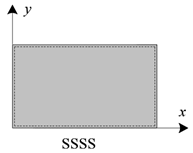
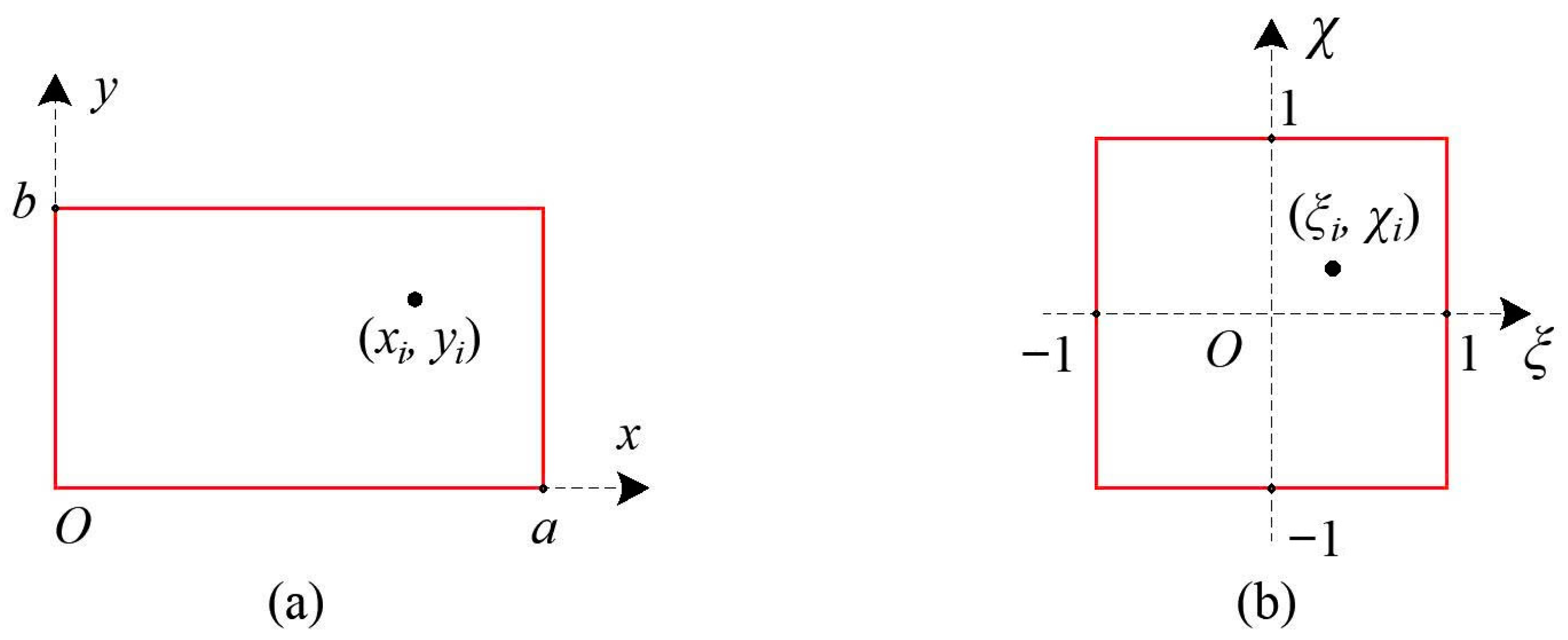
In this study, the pb-2 Ritz method is employed to derive the governing equations of the SD-AuCNT plate, providing a versatile solution framework capable of accommodating general boundary conditions. Figure 2 illustrates the coordinate transformation from an actual Cartesian coordinate system (x, y) to the dimensionless natural coordinate system (ξ, χ). This transformation maps the physical domain of the sandwich plate onto a normalized square domain defined over the interval [1, −1] in both ξ and χ directions, thereby facilitating the implementation of admissible Ritz functions. The corresponding transformation relations are given by:
ξ = 2 x a 1 ; χ = 2 y b 1
By utilizing this normalized domain, the evaluation of spatial integrals in the pb-2 Ritz method is significantly simplified. Accordingly, the generalized displacement components are approximated as follows [42]:
U 0 ( ξ , χ , t ) = p = 0 N q = 0 p U ¯ p q ( t ) Ψ p q u ( ξ , χ ) = i = 1 M U ¯ i ( t ) Ψ i u ( ξ , χ ) V 0 ( ξ , χ , t ) = p = 0 N q = 0 p V ¯ p q ( t ) Ψ p q v ( ξ , χ ) = i = 1 M V ¯ i ( t ) Ψ i v ( ξ , χ ) W 0 ( ξ , χ , t ) = p = 0 N q = 0 p W ¯ p q ( t ) Ψ p q w ( ξ , χ ) = i = 1 M W ¯ i ( t ) Ψ i w ( ξ , χ ) Φ x ( ξ , χ , t ) = p = 0 N q = 0 p X ¯ p q ( t ) Ψ p q ϕ x ( ξ , χ ) = i = 1 M X ¯ i ( t ) Ψ i ϕ x ( ξ , χ ) Φ y ( ξ , χ , t ) = p = 0 N q = 0 p Y ¯ p q ( t ) Ψ p q ϕ y ( ξ , χ ) = i = 1 M Y ¯ i ( t ) Ψ i ϕ y ( ξ , χ )
where N is polynomial degree, and U ¯ i , V ¯ i , W ¯ i , X ¯ i , Y ¯ i are the unknown Ritz coefficients to be identified. The index i is defined by:
i = ( p + 1 ) ( p + 2 ) 2 ( p q )
and dimension M is:
M = 1 2 ( N + 1 ) ( N + 2 )
The pb-2 Ritz shape functions Ψ i α α = u , v , w , ϕ x , ϕ y consist of a two-dimensional polynomial part and a basic boundary function:
Ψ i α ( ξ , χ ) = B α ( ξ , χ ) ξ p q χ q
The admissible basic function B α ( ξ , χ ) is constructed to satisfy the geometric BCs along the plate edges. To accommodate fully arbitrary boundary conditions, these functions are explicitly defined as follows:
B u ξ , χ = χ + 1 s 1 ξ 1 s 2 χ 1 s 3 ξ + 1 s 4 ; B v ξ , χ = χ + 1 s 5 ξ 1 s 6 χ 1 s 7 ξ + 1 s 8 ; B w ξ , χ = χ + 1 s 9 ξ 1 s 10 χ 1 s 11 ξ + 1 s 12 ; B ϕ x ξ , χ = χ + 1 s 13 ξ 1 s 14 χ 1 s 15 ξ + 1 s 16 ; B ϕ y ξ , χ = χ + 1 s 17 ξ 1 s 18 χ 1 s 19 ξ + 1 s 20 ;
where the exponents sj (j = 1, 2…20) are determined according to the specific boundary conditions of the SD-AuCNT plate. The corresponding values sj for various BCs are summarized in Table 2, where the boundary condition for each edge is denoted by C, S, and F, representing clamped, simply supported, and free edges, respectively.

2.5. Governing Equations

Substituting the pb-2 Ritz approximation Equation (18) into the energy functional Equation (12) and minimizing with respect to the unknown displacement coefficients:
Π q i d d t Π q ˙ i = 0 ; q i U ¯ i , V ¯ i , W ¯ i , X ¯ i , Y ¯ i ; i = 1 , 2 , 3 , , M
The governing equations are obtained in the matrix form:
M q ¨ + K q = F
where q and F are the vectors of displacement coefficients and the external load, respectively. The global stiffness matrix K and mass matrix M (Appendix A) are the stiffness and mass matrices of the SD-AuCNT sandwich plate:
K = K U U K U V K U W K U Φ x K U Φ y K V U K V V K V W K V Φ x K V Φ y K W U K W V K W W K W Φ x K W Φ y K Φ x U K Φ x V K Φ x W K Φ x Φ x K Φ x Φ y K Φ y U K Φ y V K Φ y W K Φ y Φ x K Φ y Φ y ; q = U ¯ V ¯ W ¯ X ¯ Y ¯ M = M U U 0 M U W M U Φ x 0 0 M V V M V W 0 M V Φ y M W U M W V M W W M W Φ x M W Φ y M Φ x U 0 M Φ x W M Φ x Φ x 0 0 M Φ y V M Φ y W 0 M Φ y Φ y ; F = 0 0 F W 0 0
For the free vibration analysis, the generalized eigenvalue problem is obtained by neglecting the external loading and assuming a harmonic solution q = q ¯ e i ω t of the form:
K ω 2 M q ¯ = 0
The natural frequencies ω are subsequently determined as the square roots of the corresponding eigenvalues.
For the transient response of the SD-AuCNT plate under time-dependent loading, Equation (24), including the effect of energy dissipation, is considered as:
M q ¨ + C q ˙ + K q = F ( t )
where C denotes the global damping matrix. In the present study, the Rayleigh proportional damping model is adopted, in which the damping matrix is expressed as a linear combination of the mass and stiffness matrices:
C = δ M + γ K
where δ and γ are the Rayleigh damping coefficients, which are calibrated to achieve a target modal damping ratio ζ and ensure the damping effects are accurately represented for the dominant vibration modes.
The Rayleigh coefficients are determined from the standard relations:
δ = 2 ζ ω 1 ω 2 ω 1 + ω 2 ;       γ = 2 ζ ω 1 + ω 2
where (ω1, ω2) are the first two natural frequencies of the plate.
In the absence of specimen-specific measurements, a representative value ζ = 0.02 is adopted, which lies within the commonly reported range for laminated composites and sandwich structures (1–5%) [43]. The calibrated coefficients ensure that the prescribed damping is matched at ω1 and ω2 while providing a smooth frequency-dependent damping elsewhere.
The resulting system of second-order differential equations is integrated in time using the Newmark-β time-integration method with parameters β = 0.25 and γ = 0.5 to ensure unconditional stability. The initial conditions are specified as: q ( 0 ) = { 0 } ; q ˙ ( 0 ) = { 0 } .
To evaluate the transient response of the SD-AuCNT plate, a time-dependent external step load is defined as [44]:
q 0 ( t ) = p 0 ; 0 t r t p 0 ; t < 0 , t > r t p
where p0 denotes the peak pressure, r represents a pulse-length coefficient and tp stands for the unit time.

3. Numerical Results and Discussion

This section presents benchmark studies to verify the convergence and the accuracy of the present semi-analytical solution for the free vibration and transient response of the SD-AuCNT plate. Following validation, extensive parametric investigations are conducted to highlight the influences of material distributions, geometric dimensions, and boundary conditions on the structural natural frequencies and dynamic behaviors.

3.1. Convergence Study

Consider a rectangular SD-AuCNT plate, which has a total thickness of h = 0.1 m, with geometric ratios defined as a/h = 20 and a/b = 2. The thickness ratio of the face sheet–core–face sheet is specified as hf:hc:hf = 1:8:1. The face sheets consist of antisymmetric laminated FG-CNTRC layers, where a polymethylmethacrylate (PMMA) matrix is reinforced by armchair (10, 10) single-walled carbon nanotubes (SWCNTs). The CNT distribution pattern is a uniform distribution (UD). The mechanical properties of the PMMA matrix are Em = 2.5 GPa, νm = 0.34, ρm = 1150 kg/m3, while those of SWCNT are provided as: G 12 C N T = 1.9445     TPa ;   E 11 C N T = 5.6466     TPa ; E 22 C N T = 7.0800     TPa ;   ν 12 C N T = 0.175 [33]. The material properties (aluminum) of the auxetic honeycomb core are given as follows: E c = 70   GPa ;   G c = 26   GPa ;   ν c = 0.33 ;   ρ c = 2700   kg / m 3 ;   η 1 = h 0 / l 0 = 1 ;   η 3 = t / l 0 = 0.0138751 .
The dimensionless fundamental frequency is defined as:
ω ¯ = ω 0 h ρ m E m
Table 3 and Table 4 present the dimensionless fundamental natural frequencies (DFNFs) ω ¯ for the cross-ply and angle-ply SD-AuCNT rectangular plates under various boundary conditions (BCs) as the polynomial degree N increases from 1 to 10. It can be observed that the DFF values converge and stabilize as N increases. A polynomial degree of N = 10 is found to yield sufficiently converged results with negligible discrepancies for all considered laminate configurations and boundary conditions. Consequently, N = 10 is adopted in all subsequent free vibration and transient response analyses to ensure an optimal balance between computational efficiency and numerical accuracy.

3.2. Validated Examples

As no direct benchmark data exist in the existing literature for the free vibration and the dynamic response of the proposed SD-AuCNT plate, the verification of the present pb-2 Ritz formulation and Newmark integration scheme is carried out progressively through three fundamental reference cases: (i) free vibration analysis of laminated FG-CNTRC plates, (ii) evaluation of natural frequencies of sandwich plates featuring auxetic cores and isotropic face sheets, and (iii) transient response analysis of an isotropic plate.
First, the validation focuses on evaluating the DFNFs of SSSS laminated FG-CNTRC square plates. To demonstrate the accuracy of the proposed pb-2 Ritz method, the results are compared with the Navier solutions available in Huang et al. [33] for simply supported boundary conditions. In this study, two typical plate configurations are investigated, namely cross-ply [0°/90°]2 and angle-ply [45°/−45°]2. The DFNFs are presented in Table 5 for various CNT distribution patterns. The plates have geometric dimensions a = b = 50 h. Four CNT distribution patterns are considered, including UD, FG-V, FG-X, and FG-O with V C N T * = 0.11 . The material properties correspond to armchair (10,10) single-walled carbon nanotubes (SWCNTs) as reported in [33]:
E 11 C N T = 5.6466   TPa ;   E 22 C N T = 7.0800   TPa ;   G 12 C N T = 1.9445   TPa ;   ν 12 C N T = 0.175 .
E m = 2.5   GPa ;   ν m = 0.34 ;   ρ m = 1150   kg / m 3 .
The formulations of DFNF are as follows:
ω ¯ = ω b 2 / h ρ m / E m
The obtained results are benchmarked against those reported by Huang et al. [33], who used a simple four-variable first-order SDT in combination with the Navier method for analyzing cross-ply and angle-ply FG-CNTRC laminates.
It is evident that the present results exhibit excellent agreement with those reported in the literature, with only small discrepancies observed across all CNT distribution patterns. Such deviations are mainly attributed to differences in the underlying plate theories and associated kinematic assumptions adopted in the respective formulations.
Next, to validate the structural modeling of the auxetic core, the fundamental natural frequencies (FNFs) of a SSSS sandwich plate with an AH core and isotropic face sheets are investigated. The corresponding results are summarized in Table 6. The face sheets are assigned equal thickness hf while the core thickness is denoted as hc, with the total plate thickness defined as h = hc + 2 hf and hc = 1.5 hf. The isotropic face sheets are characterized by the following material properties: Young’s modulus E = 69 GPa, shear modulus G = 26 GPa, Poisson’s ratio ν = 0.33, and mass density ρ = 2700 kg/m3. A hexagonal auxetic honeycomb unit cell is considered, characterized by an inclined angle θ and various geometric ratios of h0/l0.
The results are benchmarked against those reported by Thanh Trung and co-workers [12], who employed FEM based on the first-order SDT. A close agreement is observed between the two sets of results, with only minor discrepancies. These differences are primarily attributed to the use of shear correction factors in the first-order SDT-based formulation, whereas the present model is developed within a higher-order SDT framework.
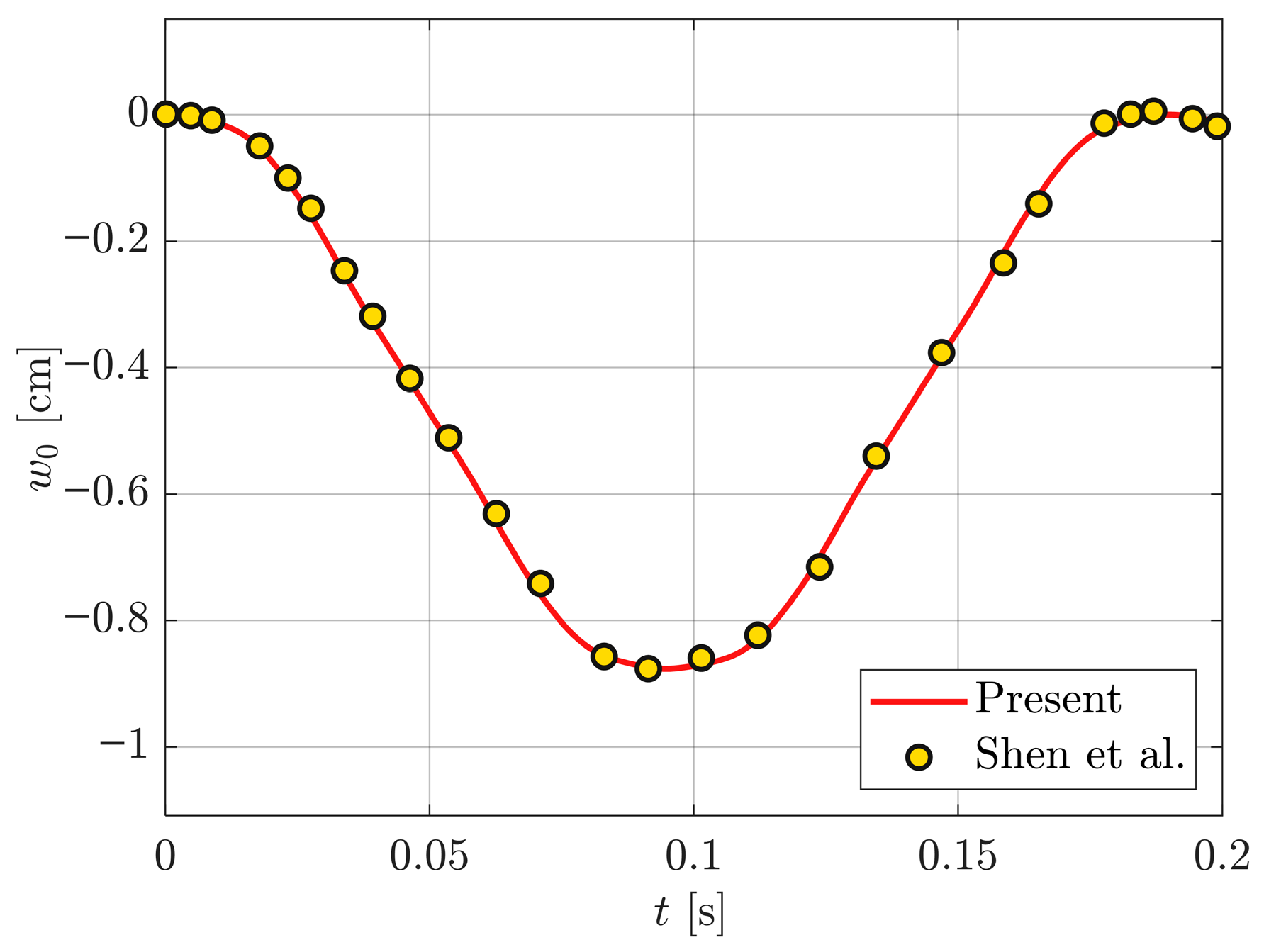
Finally, the transient response of an SSSS isotropic square plate under a uniformly distributed step load (E = 70.3 GPa, ρ = 2547 kg/m3, ν = 0.25, h = 6.35 mm, a = b = 2.438 m, q = 48.82 Pa, applied from t = 0 to 0.2 s) is examined. As illustrated in Figure 3, the present central deflection time-history curve shows excellent agreement with those reported by Shen et al. [45]. This validation further confirms the accuracy and reliability of the proposed semi-analytical approach as well as the proposed MATLAB code. Subsequently, the following numerical examples are caried out to investigate the dynamic response of SD-AuCNT sandwich plates subjected to step loading.

3.3. Parametric Study on Vibration Analysis

This section presents the free vibration analysis of SD-AuCNT plates. For each case, two laminate configurations of the FG-CNTRC face sheets are considered: a cross-ply [0°/90°/Core/90°/0°] configuration and an angle-ply [45°/−45°/Core/−45°/45°] configuration. Unless otherwise specified, all geometric parameters of the auxetic core, face sheets, overall plate dimensions, and sandwich configuration are kept constant and consistent with those defined in Section 3.1.
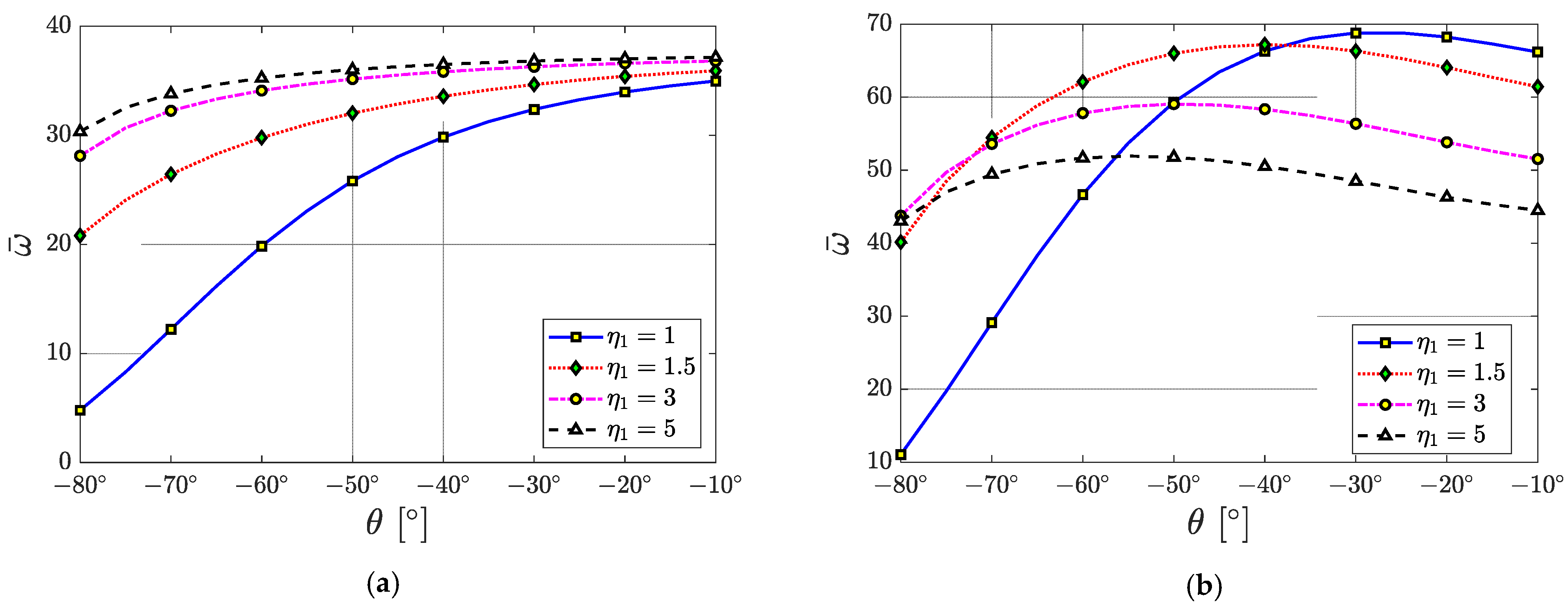
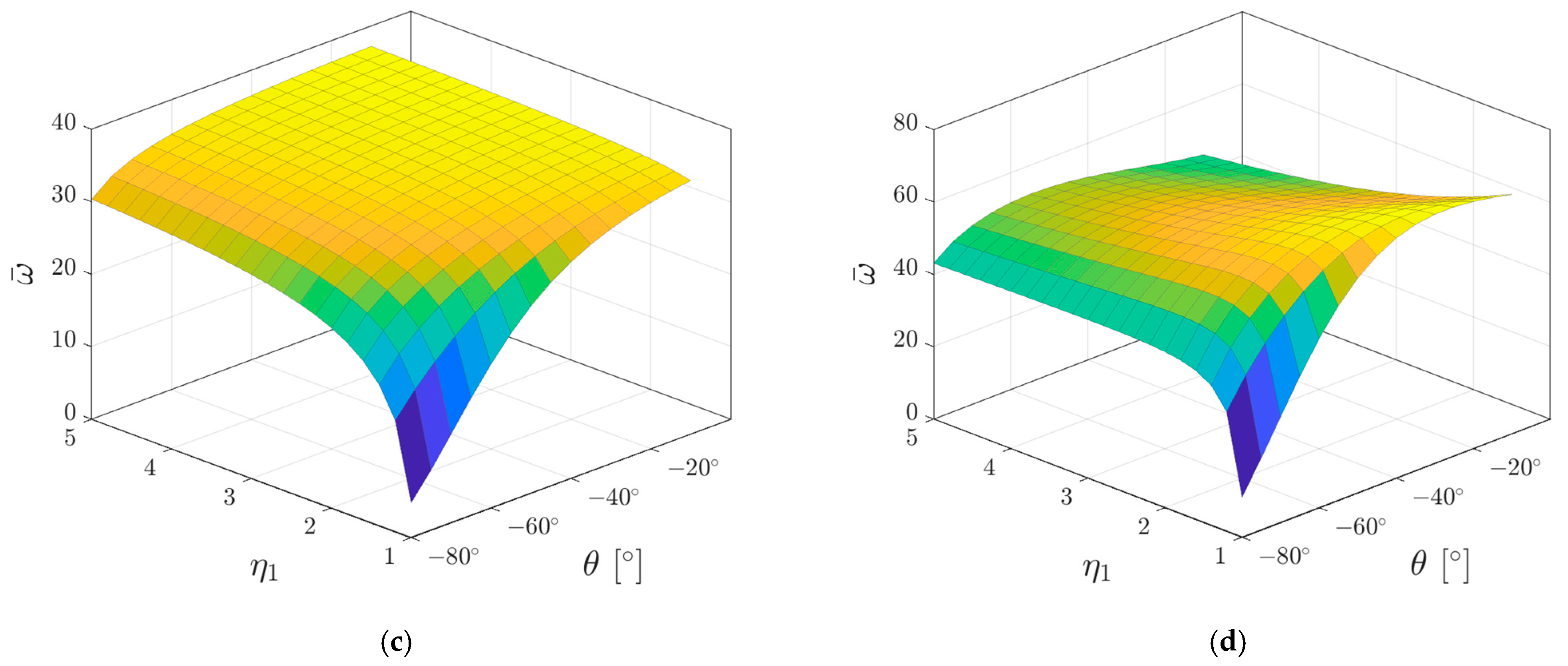
The DFNFs of the SSSS SD-AuCNT plate, corresponding to various inclined cell angles θ, geometric parameter η1 = h0/l0 of the AH unit cell, and two laminate configurations, cross-ply and angle-ply FG-CNTRC face sheets, are tabulated in Table 7 and illustrated in Figure 4. In addition, three-dimensional surface plots are provided to offer a more comprehensive visualization of the coupled effects of these parameters. The results clearly demonstrate that both θ and η1 significantly affect the vibration characteristics of the SD-AuCNT sandwich plates through their influence on the equivalent bending stiffness, transverse shear stiffness, and mass distribution of the structure.
For the cross-ply configuration, the DFNF ω ¯ increases monotonically as θ varies from −80° to −10° across all considered values of η1. This trend can be attributed to the progressive enhancement of the core’s effective in-plane and bending stiffness as the re-entrant angle decreases. At highly negative re-entrant angles, the inclined cell ribs deform mainly through bending and rotational mechanisms, resulting in relatively low effective in-plane and transverse shear stiffness. Increasing η1 effectively increases the vertical cell-wall contribution relative to the inclined ribs, thereby enhancing the load-transfer capability and transverse shear resistance of the auxetic core. This improvement in core stiffness becomes particularly important for thick sandwich structures, where transverse shear deformation contributes significantly to the overall response. The influence of η1 is most significant at large inclination angles (near θ = −80°), where the frequency span ranges from ω ¯ = 4.788 (η1 = 1) to 30.347 (η1 = 5). As θ approaches −10°, the four curves converge, indicating that the structural rigidity becomes less sensitive to η1 at lower inclination magnitudes.
Compared with the cross-ply configuration, the angle-ply SD-AuCNT plate consistently yields substantially higher DFNFs across the entire parametric domain. The peak frequency of the angle-ply plate is nearly twice the maximum value achieved by the cross-ply plate, confirming that the CNT fiber orientation in the face sheets plays a critical role in governing the dynamic characteristics of the sandwich structure. This difference originates from the anisotropic stiffness characteristics and coupling effects induced by the CNT orientation in the FG-CNTRC face sheets. In the cross-ply laminate, the stiffness contribution is primarily aligned with the principal orthogonal directions, producing a relatively conventional bending response. In contrast, the angle-ply configuration introduces strong bending–twisting coupling, which redistributes the in-plane and bending stresses more efficiently throughout the laminate. Moreover, the ±45° CNT orientation enhances the extensional–shear coupling stiffness components, thereby increasing the effective stiffness-to-mass ratio governing the vibration behavior.
Unlike the monotonic behavior observed in the cross-ply plate, the angle-ply configuration exhibits a non-monotonic variation in DFNFs with respect to θ due to strong bending–twisting coupling, which amplifies the plate’s sensitivity to core geometry variations. Specifically, for η1 = 1, the frequency reaches a maximum near θ = −30° before decreasing. This trend can be explained by the competing effects of stiffness and mass: within a certain range of θ, the stiffness enhancement from the auxetic core exceeds the added mass, increasing the frequency; beyond this range, the mass effect becomes dominant, causing the frequency to decrease.
Another important observation is the strong interaction between the auxetic core and the FG-CNTRC face sheets. The auxetic core primarily governs the transverse shear rigidity and load redistribution capability of the sandwich structure, whereas the FG-CNTRC face sheets dominate the bending stiffness due to the CNT-enhanced material properties concentrated near the outer surfaces. The coupling between these two components produces a synergistic stiffening effect, particularly for the angle-ply laminates, where the enhanced in-plane shear coupling complements the auxetic deformation mechanism of the core. This interaction explains why the angle-ply SD-AuCNT plates achieve frequencies nearly twice those of the cross-ply configurations under certain geometric conditions.
Furthermore, the 3D plots provide a comprehensive visualization of the coupled effects of cell geometry parameters for cross-ply and angle-ply laminations. For the cross-ply SD-AuCNT plate, the surface exhibits a smooth, monotonically rising topology from the (θ = −80°, η1 = 1) corner toward the (θ = −10°, η1 = 5) region, indicating a straightforward path for frequency maximization. Unlike the cross-ply configuration, the angle-ply SD-AuCNT plate surface is characterized by a prominent ridge formation, with the peak frequency ridge located along θ ranging from approximately −30° to −40°, depending on η1. This feature clearly visualizes the optimal auxetic core geometry for maximizing the fundamental frequency under angle-ply face sheet configurations.
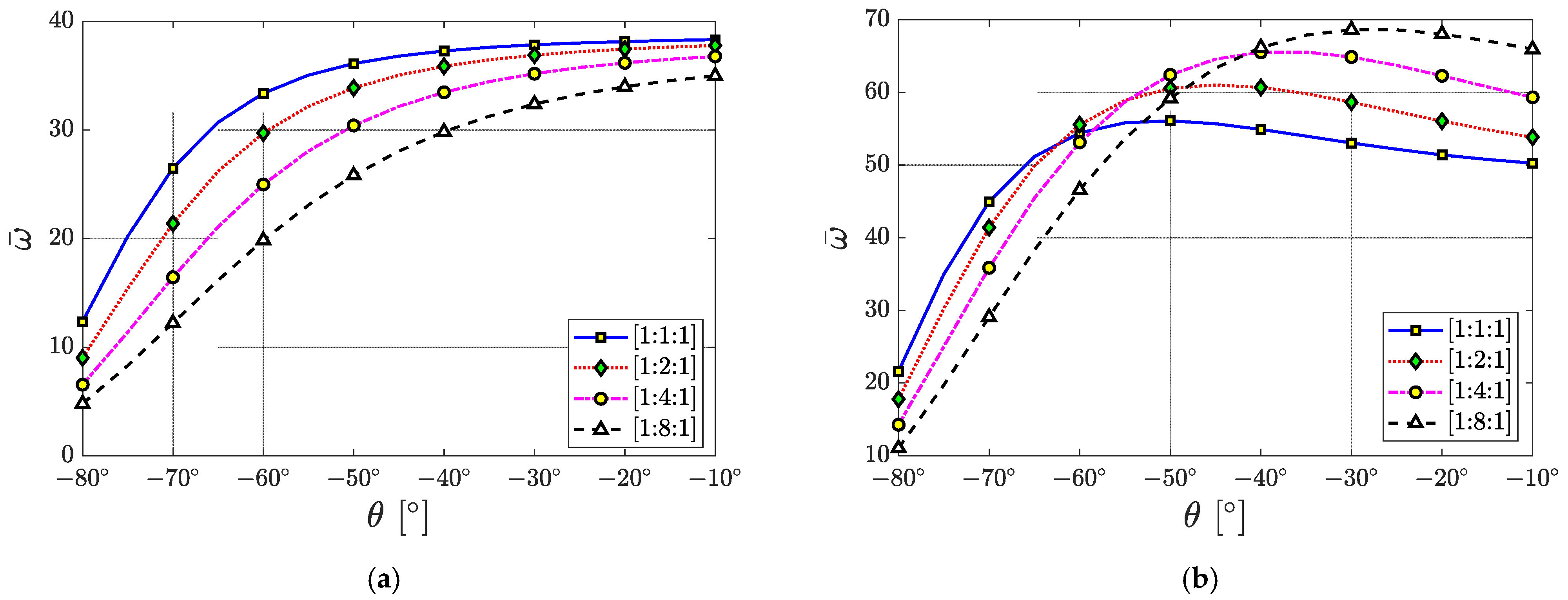
Table 8 and Figure 5 present the variation in the DFNFs of SSSS cross-ply and angle-ply SD-AuCNT sandwich plates with different sandwich configurations and inclined cell angle θ (η1 = 1). For the cross-ply configuration, DFNF decreases consistently as the core proportion increases. This is attributed to the replacement of the high-stiffness FG-CNTRC face sheets with the more compliant auxetic honeycomb material, which reduces the overall bending rigidity. All thickness ratios exhibit a similar upward trend as θ varies from −80° to −10°. All the curves converge as θ approaches −10°, suggesting that at small inclination angles, the structural response becomes less sensitive to the face-to-core ratio.
On the other hand, the angle-ply configuration shows a more complex behavior characterized by a crossover phenomenon. When θ is relatively small (approximately from −10° to −65°), increasing the core thickness contributes to higher natural frequency. This behavior is associated with the coupled interaction between the angle-ply FG-CNTRC face sheets and the auxetic honeycomb core. Unlike the cross-ply configuration, the angle-ply laminates introduce significant bending–twisting and extensional–shear coupling effects due to the ±45° CNT orientations. These coupling mechanisms enable more efficient stress redistribution between the face sheets and the auxetic core, thereby enhancing the global stiffness of the sandwich structure.
However, as θ progresses beyond −65°, the mechanical behavior of the auxetic core changes significantly. At highly negative re-entrant angles, the cell walls undergo pronounced bending and rotational deformation, causing a substantial reduction in the equivalent in-plane and transverse shear stiffness of the core. Under these conditions, increasing the core thickness contributes primarily to the overall mass rather than to effective stiffness enhancement. As a result, the stiffness-to-mass ratio decreases, and the inertia effect becomes dominant, leading to a reduction in the natural frequency.
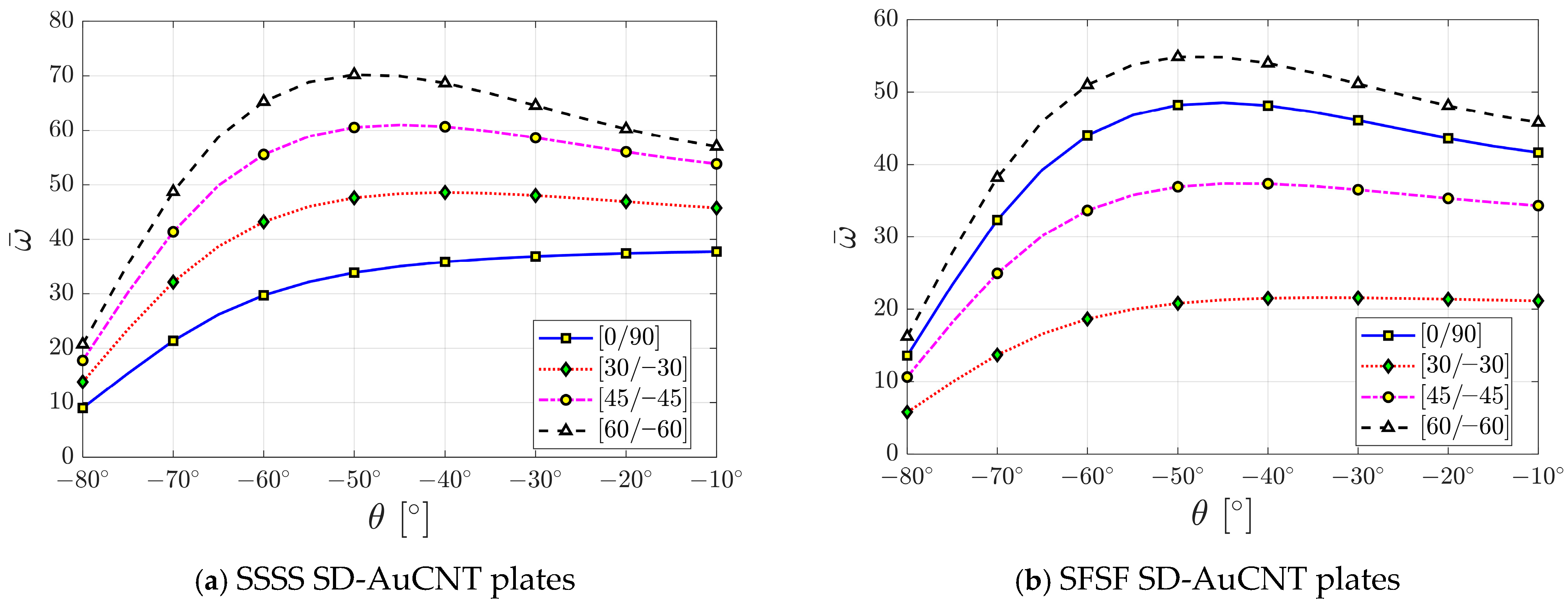
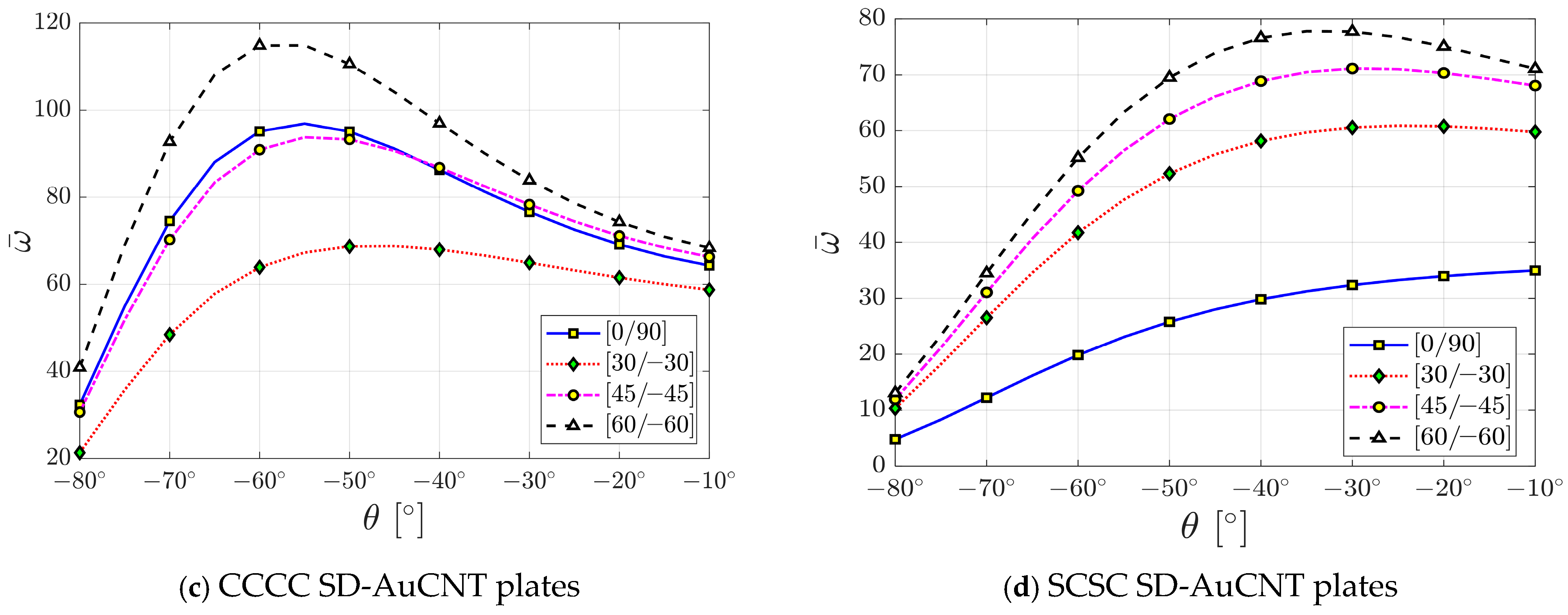
Figure 6 and Table 9 present the DFNFs of SD-AuCNT plates under different BCs and various lamination schemes. The results reveal consistent ordering among angle-ply configurations, namely [60°/−60°] > [45°/−45°] > [30°/−30°] across all BCs.
This trend indicates that increasing the CNT orientation angle enhances the effective extensional–shear and bending–twisting coupling stiffness of the FG-CNTRC face sheets, thereby improving the global structural rigidity and vibration resistance of the sandwich plate.
In contrast, the performance of the cross-ply [0°/90°] laminate is highly sensitive to the edge restraints. Although it lacks bending–twisting coupling stiffness, it provides maximum stiffness along the principal material directions. Therefore, its dynamic performance depends strongly on whether the imposed boundary conditions promote bending-dominated or twisting-dominated deformation modes.
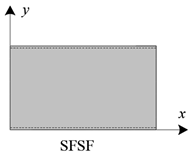
Consequently, under SSSS and SCSC boundary conditions, where the plate is more prone to twisting deformation, the cross-ply laminate exhibits relatively lower fundamental frequencies. However, under SFSF and CCCC boundary conditions, which either emphasize bending-dominated behavior or impose strong rotational constraints, the high axial stiffness of the cross-ply configuration becomes more effective, allowing it to remain competitive with, or even outperform, certain angle-ply configurations.
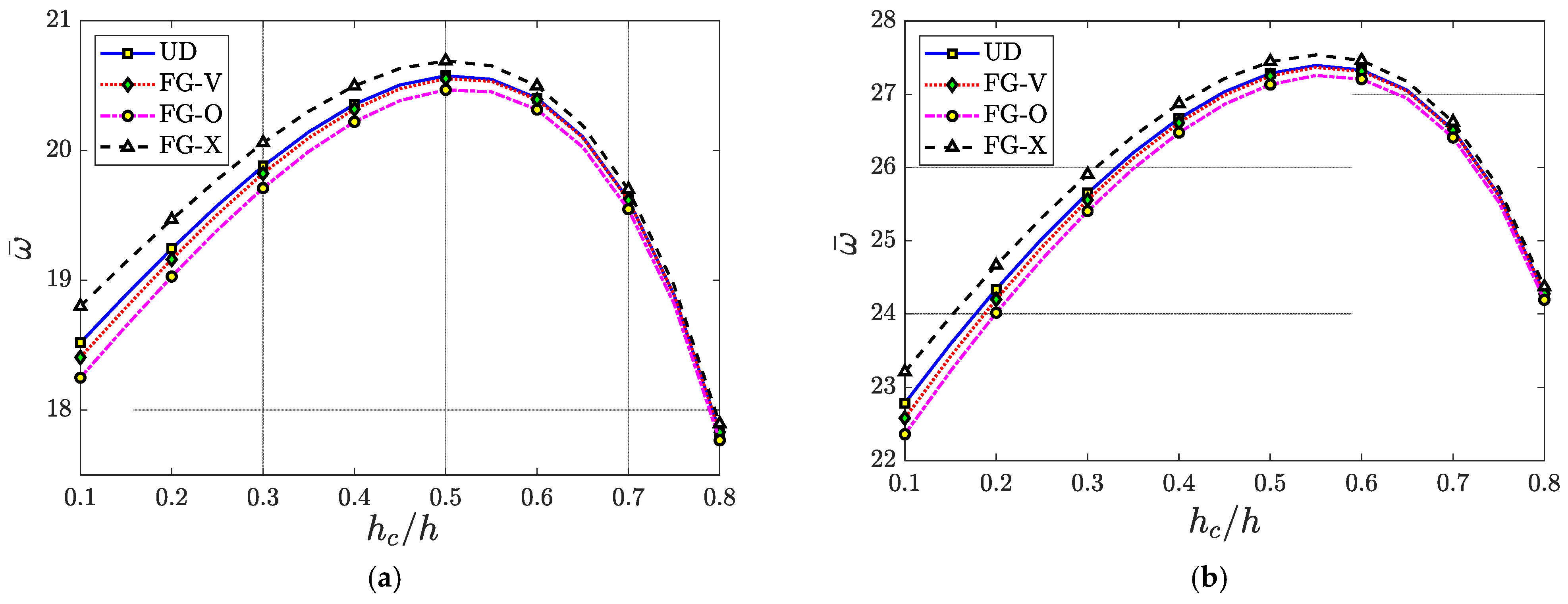
Table 10 and Figure 7 illustrate the variation in the DFNFs ω ¯ with respect to the core-to-total-thickness ratio hc/h for four CNT distributions at θ = −55°. By adopting hc/h as the governing parameter, the relative structural contribution of the face sheets is systematically evaluated.
For both SSSS cross-ply and angle-ply laminates at θ = −55°, the DFNFs exhibit a non-monotonic trend with respect to hc/h. As hc/h increases from 0.1 to an optimal range of approximately 0.5–0.6, the DFNFs increase, followed by a gradual decline beyond this range. This behavior can be attributed to the competition between two opposing mechanisms: geometric stiffening and material softening. At relatively small values of hc/h, increasing the core thickness enlarges the distance between the FG-CNTRC face sheets and the neutral plane, thereby increasing the sectional moment of inertia and enhancing the global bending rigidity of the sandwich plate. In this regime, the face sheets remain sufficiently thick to effectively carry bending stresses, while the auxetic core provides efficient transverse shear transfer between the outer layers. Consequently, the combined stiffness-to-mass ratio increases, leading to higher natural frequencies.
However, beyond the optimal hc/h ratio, the thickness of the FG-CNTRC face sheets becomes excessively small. Since the face sheets are the primary bending-resistant components and are located far from the neutral axis, reducing their thickness significantly decreases the effective bending stiffness of the sandwich plate. Under these conditions, the stiffness reduction in the face sheets outweighs the geometric advantage provided by the thicker core. Furthermore, the increasing contribution of the comparatively compliant auxetic core leads to a reduction in the overall stiffness-to-mass ratio, resulting in lower natural frequencies.
Regarding CNT distribution patterns, the hierarchy FG-X > UD > FG-V > FG-O is consistently observed across all values of hc/h. The FG-X configuration yields the highest DFNFs, as it concentrates CNT reinforcements near the outer surfaces, thereby maximizing bending stiffness. In contrast, the FG-O pattern, with CNTs distributed closer to the neutral axis, results in the lowest frequencies due to its reduced contribution to flexural rigidity. The influence of CNT distribution is most pronounced within the intermediate range of hc/h (approximately 0.1–0.6). At extreme values, the frequency curves tend to converge, indicating a diminished sensitivity to CNT distribution patterns when the face sheets become sufficiently thin.

3.4. Parametric Study of Transient Response Analysis

This section investigates the transient dynamic response of SD-AuCNT plates. The baseline configurations, including geometric dimensions, layer thickness ratios, boundary conditions, and constituent material properties, are kept consistent with those defined in Section 3.1. A uniformly distributed step load of p0 = −105 Pa is applied to the top surface of the plate. The step loading profile adopted here represents an idealized sudden-onset pressure, which is widely used in analytical and numerical studies of plates and sandwich structures to approximate impact- and blast-type loading scenarios where the load rise time is negligibly short compared to the fundamental vibration period of the structure.
The time-history response is obtained using the Newmark–β integration scheme to solve the global equations of motion. To account for energy dissipation, the Rayleigh damping model is incorporated into the formulation.
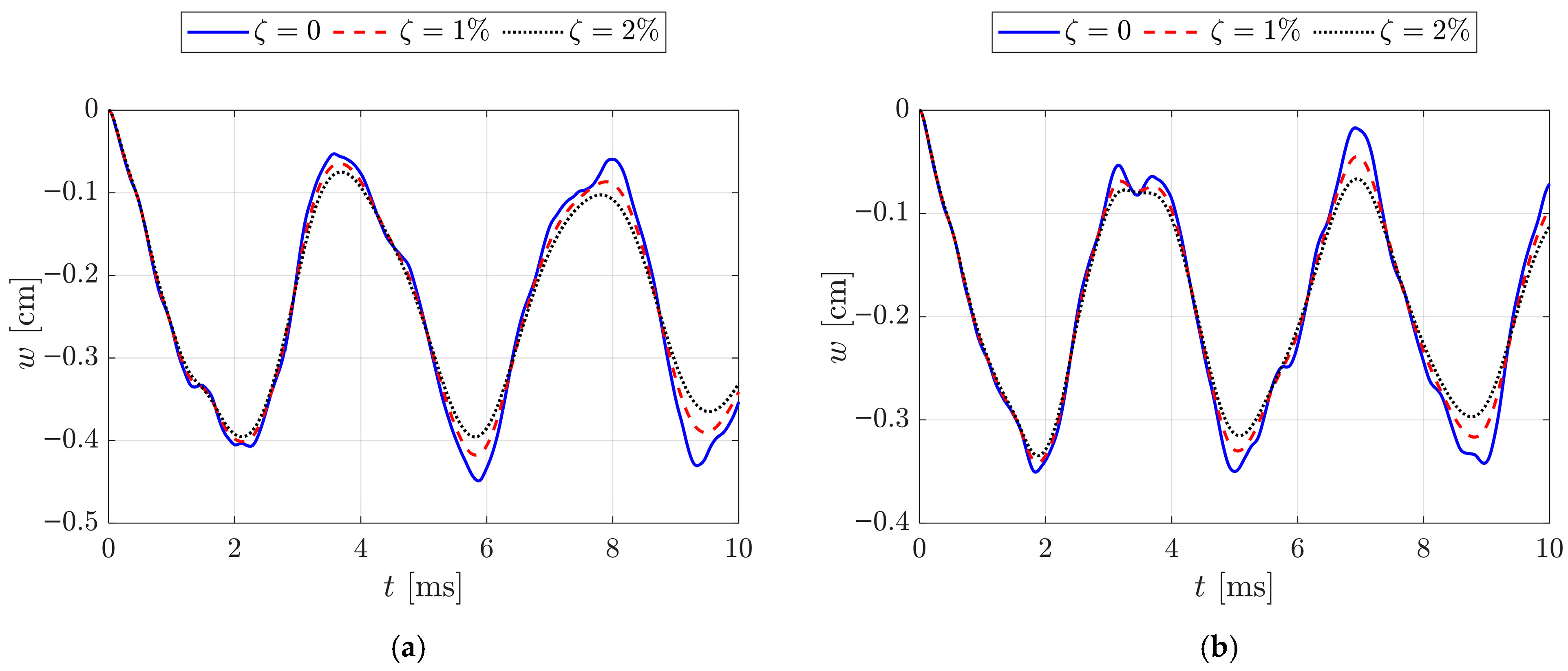
Prior to parametric investigations, the influence of the damping ratio ζ on the transient response is first examined to determine an appropriate value for subsequent analyses. Figure 8 clearly demonstrates the influence of the damping ratio ξ on the transient deflection response of the SSSS SD-AuCNT plate. It can be observed that all three cases (ζ = 0, 1% and 2%) exhibit nearly identical vibration frequencies and phase characteristics, indicating that the damping ratio has a negligible effect on the natural frequency of the system within this range.
However, the effect of damping becomes evident in the amplitude evolution over time. As ζ increases, the rate of amplitude decay becomes more pronounced, resulting in a faster attenuation of the vibration response. In the undamped case ζ = 0, the oscillations persist with relatively large amplitudes, whereas for ζ = 1% and ζ = 2%, the response exhibits progressively reduced peak deflections and a smoother decay envelope. A constant damping ratio of ζ = 2%, typical for composite and sandwich structures, is used in all subsequent analyses. This value is consistent with those reported in the literature [29] for CNT-reinforced composite and auxetic sandwich structures and is further justified by the fact that auxetic re-entrant cores and CNT–matrix interfaces inherently contribute to enhanced internal energy dissipation, making a small but nonzero modal damping ratio physically appropriate for the SD-AuCNT plate.
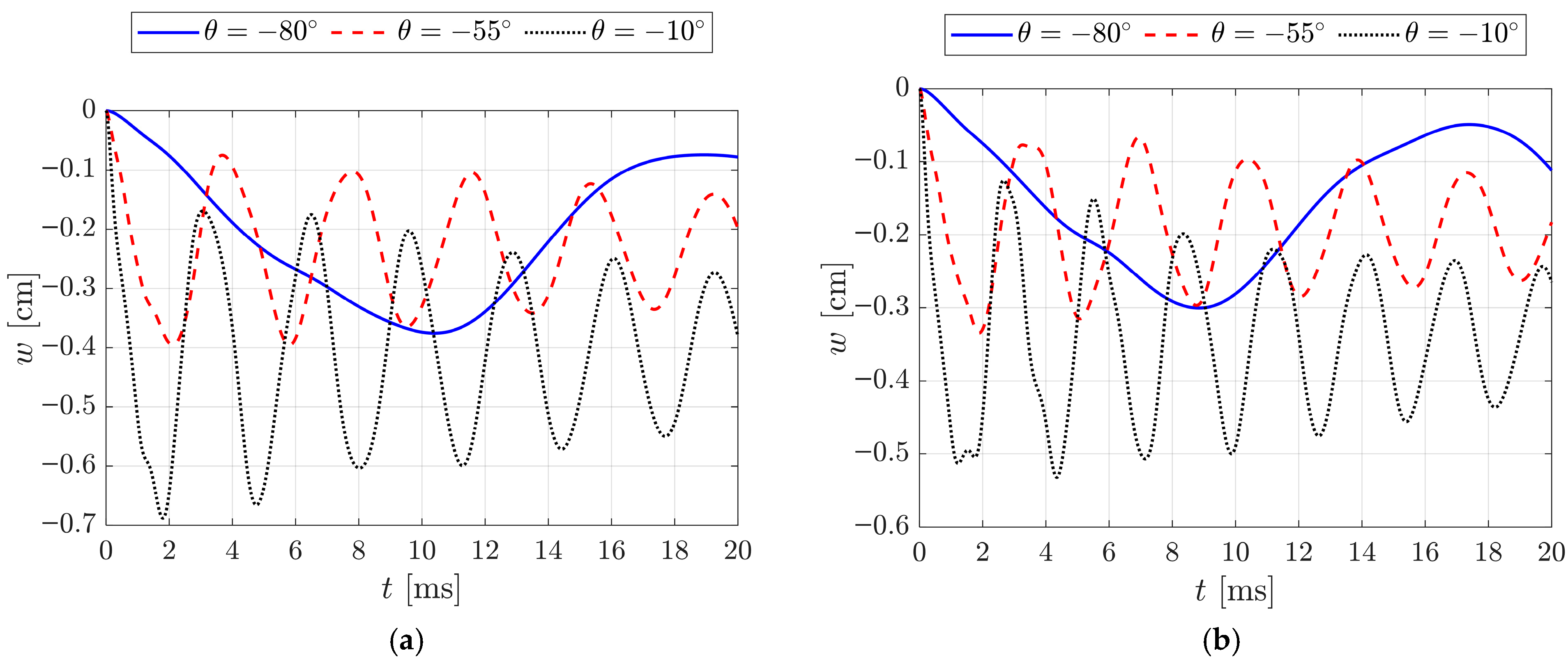
Figure 9 illustrates the influence of the unit cell inclination angle θ on the time-history response of the central deflection of SSSS SD-AuCNT plates for both (a) cross-ply and (b) angle-ply configurations. It is evident that the inclination angle has a significant impact on both the amplitude and frequency characteristics of the transient response.
As inclination angle θ increases from −80° to −10°, the vibration frequency noticeably increases, indicating an enhancement in the overall structural stiffness of the sandwich plate. This behavior can be attributed to the modification of the auxetic honeycomb geometry, where smaller absolute inclination angles lead to a stiffer cellular structure and improved load transfer efficiency between the core and face sheets. In terms of amplitude, plates with lower inclination angles (e.g., θ = −10°) exhibit reduced peak deflections, whereas larger negative angles (e.g., θ = −80°) result in significantly higher deflection amplitudes. This trend further confirms that the auxetic core becomes more compliant as the cell walls approach a highly re-entrant configuration, thereby reducing the effective stiffness of the structure.
Notably, the lamination scheme plays a crucial role in the dynamic resisting capacity. Under the same loading conditions, the angle-ply configuration demonstrates a superior dynamic performance, yielding a noticeably smaller maximum deflection (approximately −0.4 cm at θ = −10°) compared to its cross-ply counterpart (approximately −0.5 cm). This phenomenon highlights the structural efficiency of the angle-ply arrangement, where the off-axis fiber orientation provides an enhanced bending–twisting coupling stiffness, thereby improving the overall transient load resistance of the sandwich plate.
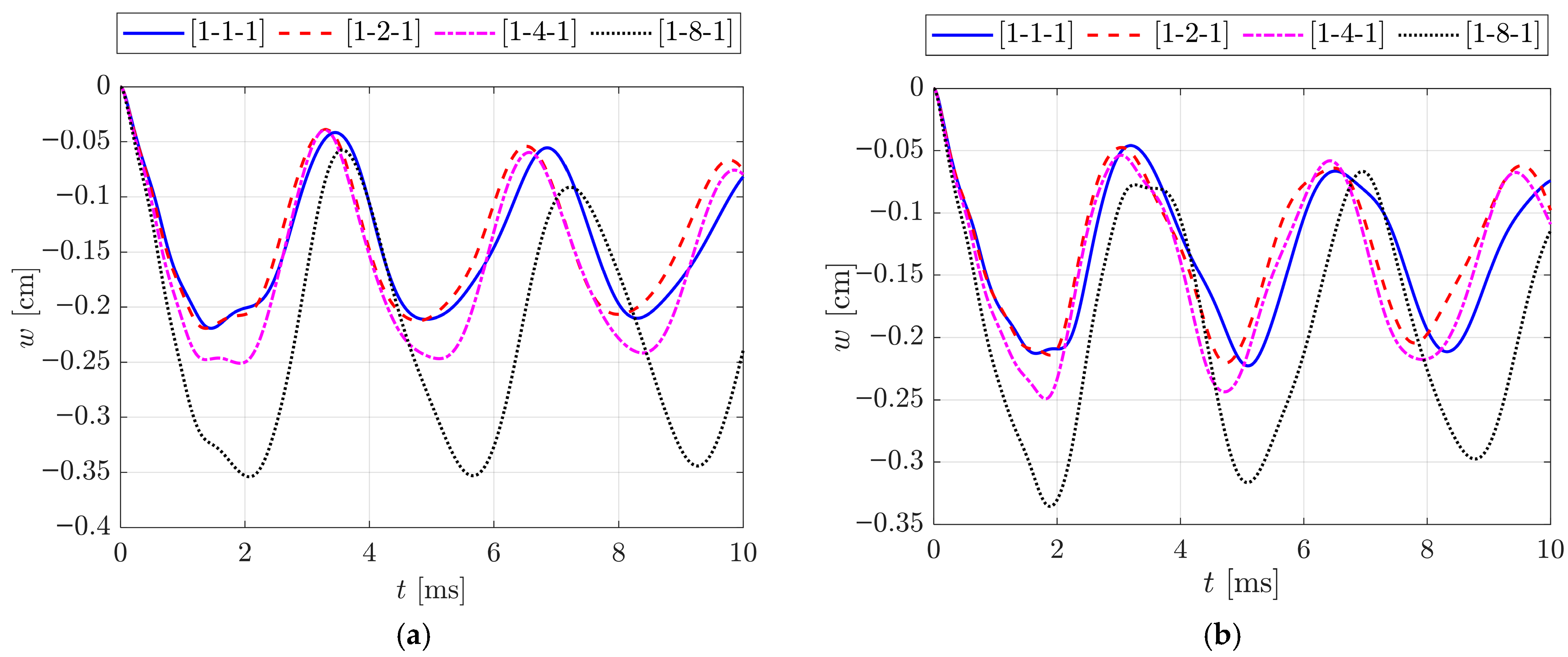
Figure 10 illustrates the influence of different sandwich configurations, characterized by varying face sheet–core–face sheet thickness ratios hf:hc:hf, on the time-history response of the central deflection of SSSS SD-AuCNT plates for both (a) cross-ply and (b) angle-ply laminates. It is evident that the sandwich configuration has a pronounced effect on both the amplitude and frequency of the transient response.
As the core-to-face thickness ratio increases (e.g., from [1-1-1] to [1-8-1]), the deflection amplitude increases significantly, accompanied by a noticeable reduction in vibration frequency. This trend indicates a decrease in overall structural stiffness as the face sheets become relatively thinner and the core dominates the structural response. Although a thicker core enhances the geometric separation between face sheets, the insufficient stiffness of the auxetic core compared to the CNT-reinforced face sheets leads to a reduction in the effective bending rigidity. In contrast, configurations with relatively thicker face sheets (e.g., [1-1-1] and [1-2-1]) exhibit smaller deflection amplitudes and higher vibration frequencies, reflecting improved stiffness and load-carrying capacity. This behavior highlights the dominant role of the FG-CNTRC face sheets in governing the flexural response of the sandwich plate.
A comparison between cross-ply and angle-ply configurations reveals similar qualitative trends; however, angle-ply laminates generally demonstrate slightly reduced deflection amplitudes and higher frequencies, indicating enhanced stiffness due to bending–twisting coupling effects.
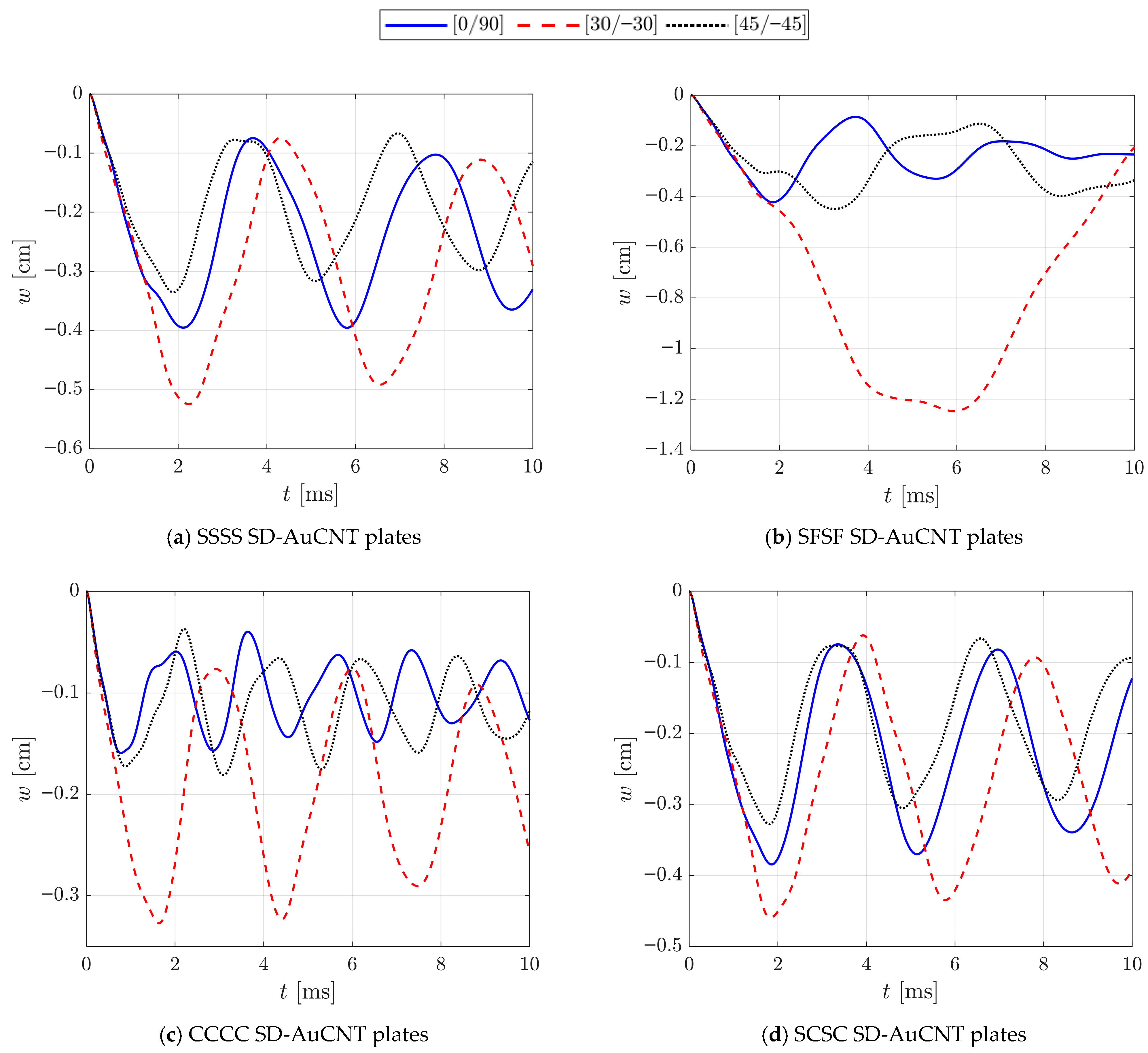
Figure 11 illustrates the influence of different lamination schemes on the time-history response of the central deflection of SD-AuCNT plates under various BCs. It is evident that the stacking sequence significantly affects both the amplitude and oscillatory characteristics of the transient response.
Across all BCs, the angle-ply configuration [30°/−30°] consistently exhibits the largest deflection amplitudes and the lowest oscillation frequencies, indicating relatively lower effective stiffness. In contrast, the [45°/−45°] configuration generally shows reduced deflection amplitudes and higher frequencies, reflecting enhanced stiffness due to stronger bending–twisting coupling effects. The cross-ply [0°/90°] laminate demonstrates intermediate behavior, with its performance strongly dependent on the imposed boundary conditions.
The influence of BCs is also pronounced. Under fully simply supported (SSSS) and mixed (SCSC) boundary conditions, where twisting deformation is more significant, angle-ply laminates with higher fiber orientation angles provide improved stiffness and reduced deflections. Conversely, under clamped (CCCC) boundary conditions, the differences between lamination schemes become less pronounced due to the dominant constraint effect, which suppresses deformation and enhances overall stiffness. For the SFSF case, the absence of constraints along certain edges leads to substantially larger deflections, particularly for the [30°/−30°] configuration, highlighting its susceptibility to bending-dominated deformation.
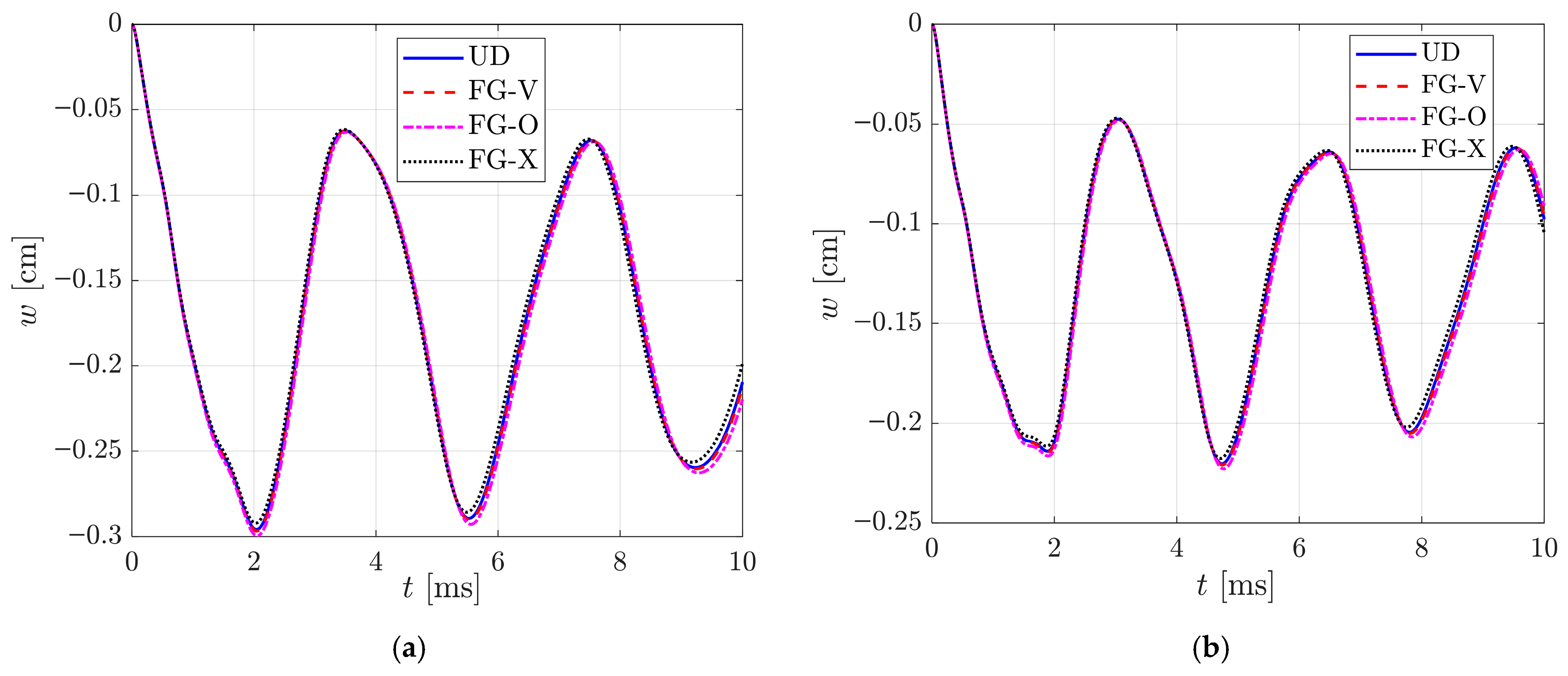
Figure 12 depicts the influence of different CNT distribution patterns on the time-history response of the central deflection of SSSS SD-AuCNT plates for both (a) cross-ply and (b) angle-ply configurations. To amplify the relative contribution of the face sheets, a sandwich configuration of 1:2:1 (hc/h = 0.5) is adopted.
As observed, the four CNT distribution patterns (UD, FG-V, FG-O, and FG-X) produce very similar deflection histories for both laminate configurations, with only slight differences in the peak amplitudes and vibration attenuation characteristics. This behavior indicates that, under step loading, the global transient response of the SD-AuCNT plate is governed primarily by the overall structural stiffness and inertia rather than by local variations in the through-thickness CNT distribution.
The FG-X pattern yields the smallest peak deflection, reflecting its superior bending stiffness due to the surface-concentrated CNT reinforcement, while FG-O exhibits the largest amplitude. However, the differences among the four CNT distribution patterns remain relatively small. This limited sensitivity can be explained by the dominant role of the auxetic honeycomb core and the global sandwich geometry in controlling the transient response under step loading conditions.
In addition, the angle-ply laminates generally exhibit slightly smaller deflection amplitudes than the corresponding cross-ply configurations. This behavior is attributed to the additional bending–twisting and extensional–shear coupling stiffness generated by the angle-ply CNT orientations, which enhances stress redistribution and improves the dynamic stiffness of the SD-AuCNT sandwich plate under transient loading.

4. Conclusions

This study developed a novel semi-analytical framework for the free vibration and transient dynamic analysis of SD-AuCNT sandwich plates, integrating an AH core with laminated FG-CNTRC face sheets. The theoretical model was formulated based on Reddy’s third-order SDT, enabling accurate representation of transverse shear effects without the need for shear correction factors. In addition, the pb-2 Ritz method and the principle of minimum potential energy were employed to derive the governing equation, offering high flexibility in handling various BCs, while the Newmark integration scheme was utilized to efficiently capture transient responses under step loading. The accuracy and reliability of the proposed formulation were validated through benchmark problems involving FG-CNTRC plates, AH sandwich plates, and the transient responses of isotropic plates. Comprehensive parametric investigations were conducted to evaluate the coupled effects of geometric, material, and lamination parameters. The main findings can be outlined as follows:
  • Structural stiffness is significantly influenced by the interaction between boundary conditions and laminate configurations, resulting in a pronounced frequency crossover phenomenon. Angle-ply laminates (e.g., [60°/−60°]) exhibit enhanced stiffness under biaxial bending (SSSS, CCCC), whereas cross-ply configurations are more favorable under cylindrical bending conditions (SFSF).
  • The auxetic core geometry, particularly the unit cell inclination angle θ and geometric ratio η1, significantly affects both natural frequencies and transient deflection amplitudes, demonstrating the important role of negative Poisson’s ratio effects in dynamic response. For example, in the cross-ply configuration, increasing θ from −80° to −10° increases the DFNF from 4.788 to 34.974 for η1 = 1, corresponding to an increase of approximately 630%. Similarly, increasing η1 from 1 to 5 at θ = −80° raises the DFNF from 4.788 to 30.347, representing an enhancement of more than 530%. These improvements are attributed to the transition of the auxetic cell deformation mechanism from bending-dominated to stretching-dominated behavior, which substantially enhances the equivalent bending and transverse shear stiffness of the sandwich plate.
  • CNT distribution patterns offer an efficient means of controlling structural stiffness, with the FG-X configuration consistently yielding the highest flexural rigidity due to reinforcement concentration near the outer surfaces.
  • The face-sheet-to-core thickness ratio critically influences the structural behavior of the SD-AuCNT sandwich plates through the competition between geometric stiffening and material softening effects. Increasing the core thickness initially enhances the flexural rigidity by enlarging the distance between the FG-CNTRC face sheets and the neutral plane, thereby increasing the sectional moment of inertia. Consequently, the DFNF increases as hc/h rises from 0.1 to approximately 0.5–0.6. For example, in the angle-ply FG-X configuration, the DFNF increases from 23.210 at hc/h = 0.1 to a peak value of 27.462 at h c / h   =   0.6 , corresponding to an increase of approximately 18.3%. However, further increasing the core proportion causes the FG-CNTRC face sheets to become excessively thin, reducing the effective bending stiffness of the sandwich plate. As a result, the DFNF decreases to 24.371 at hc/h = 0.8, while the transient deflection amplitude correspondingly increases. These results indicate the existence of an optimal face-sheet-to-core thickness ratio that maximizes the stiffness-to-mass ratio and dynamic performance of the SD-AuCNT structure.
  • Under step loading, the SD-AuCNT plates exhibit significant vibration responses, and their amplitudes can be effectively tuned by optimizing both auxetic core parameters and CNT-reinforced face sheets, resulting in improved energy dissipation capability.
  • In the transient regime, the lamination scheme and sandwich configuration play a central role in controlling deflection amplitudes. Under step loading, angle-ply configurations can reduce the peak central deflection by about 20% compared with cross-ply laminates for the same auxetic core geometry, and increasing the core-to-face thickness ratio from 1-1-1 to 1-8-1 may lead to a several-fold increase in maximum deflection, reflecting a significant reduction in effective flexural stiffness.
In summary, this work provides deeper insight into the coupled effects of auxetic core architectures and nanocomposite face sheet design in governing the dynamic behavior of sandwich structures. The proposed semi-analytical framework offers a powerful and efficient tool for the analysis and optimal design of advanced lightweight structures, with potential applications in aerospace, defense, and smart engineering systems.

Author Contributions

Conceptualization and methodology, V.-T.T., H.-N.N. and M.-T.T.; software, validation, formal analysis and investigation, H.-N.N.; resources, V.-T.T.; data curation, T.-T.P.; writing—original draft preparation, H.-N.N. and M.-T.T.; writing—review and editing, M.-T.T.; supervision and project administration, T.-T.P.; funding acquisition, V.-T.T. All authors have read and agreed to the published version of the manuscript.

Funding

This research is funded by the Ministry of Education and Training under grantd number B2024.XDA.11. The APC was funded by B2024.XDA.11.

Data Availability Statement

The original contributions presented in this study are included in the article. Further inquiries can be directed to the corresponding author.

Acknowledgments

The authors would like to thank Hanoi University of Civil Engineering for the technical support provided during this study.

Conflicts of Interest

The authors declare no conflict of interest.

Appendix A

The coefficients of the global stiffness matrix K, the global mass matrix M and the generalized load vector F in Equation (25):
K U U = a b 4 1 1 1 1 A 11 4 a 2 Ψ , ξ u Ψ , ξ u T + A 16 4 a b Ψ , ξ u Ψ , χ u T + Ψ , χ u Ψ , ξ u T + A 66 4 b 2 Ψ , χ u Ψ , χ u T d ξ d χ ; K V V = a b 4 1 1 1 1 A 22 4 b 2 Ψ , χ v Ψ , χ v T + A 26 4 a b Ψ , χ v Ψ , ξ v T + Ψ , ξ v Ψ , χ v T + A 66 4 a 2 Ψ , ξ v Ψ , ξ v T d ξ d χ ; K U V = a b 4 1 1 1 1 A 12 4 a b Ψ , ξ u Ψ , χ v T + A 16 4 a 2 Ψ , ξ u Ψ , ξ v T + A 26 4 b 2 Ψ , χ u Ψ , χ v T + A 66 4 a b Ψ , χ u Ψ , ξ v T d ξ d χ ; K V U = ( K U V ) T .
K U U = a b 4 1 1 1 1 A 11 4 a 2 Ψ , ξ u Ψ , ξ u T + A 16 4 a b Ψ , ξ u Ψ , χ u T + Ψ , χ u Ψ , ξ u T + A 66 4 b 2 Ψ , χ u Ψ , χ u T d ξ d χ ; K V V = a b 4 1 1 1 1 A 22 4 b 2 Ψ , χ v Ψ , χ v T + A 26 4 a b Ψ , χ v Ψ , ξ v T + Ψ , ξ v Ψ , χ v T + A 66 4 a 2 Ψ , ξ v Ψ , ξ v T d ξ d χ ; K U V = a b 4 1 1 1 1 A 12 4 a b Ψ , ξ u Ψ , χ v T + A 16 4 a 2 Ψ , ξ u Ψ , ξ v T + A 26 4 b 2 Ψ , χ u Ψ , χ v T + A 66 4 a b Ψ , χ u Ψ , ξ v T d ξ d χ ; K V U = ( K U V ) T . K U W = a b 4 k 1 1 1 1 1 E 11 8 a 3 Ψ , ξ u Ψ , ξ ξ w T + E 12 8 a b 2 Ψ , ξ u Ψ , χ χ w T + E 16 16 a 2 b Ψ , ξ u Ψ , ξ χ w T + E 16 8 a 2 b Ψ , χ u Ψ , ξ ξ w T + E 26 8 b 3 Ψ , χ u Ψ , χ χ w T + E 66 16 a b 2 Ψ , χ u Ψ , ξ χ w T d ξ d χ ; K V W = a b 4 k 1 1 1 1 1 E 12 8 a 2 b Ψ , χ v Ψ , ξ ξ w T + E 22 8 b 3 Ψ , χ v Ψ , χ χ w T + E 26 16 a b 2 Ψ , χ v Ψ , ξ χ w T + E 16 8 a 3 Ψ , ξ v Ψ , ξ ξ w T + E 26 8 a b 2 Ψ , ξ v Ψ , χ χ w T + E 66 16 a 2 b Ψ , ξ v Ψ , ξ χ w T d ξ d χ ; K W U = ( K U W ) T , K W V = ( K V W ) T .
K U Φ x = a b 4 1 1 1 1 B ^ 11 4 a 2 Ψ , ξ u Ψ , ξ ϕ x T + B ^ 16 4 a b Ψ , ξ u Ψ , χ ϕ x T + B ^ 16 4 a b Ψ , χ u Ψ , ξ ϕ x T + B ^ 66 4 b 2 Ψ , χ u Ψ , χ ϕ x T d ξ d χ ; K U Φ y = a b 4 1 1 1 1 B ^ 12 4 a b Ψ , ξ u Ψ , χ ϕ y T + B ^ 16 4 a 2 Ψ , ξ u Ψ , ξ ϕ y T + B ^ 26 4 b 2 Ψ , χ u Ψ , χ ϕ y T + B ^ 66 4 a b Ψ , χ u Ψ , ξ ϕ y T d ξ d χ ;
K V Φ x = a b 4 1 1 1 1 B ^ 12 4 a b Ψ , χ v Ψ , ξ ϕ x T + B ^ 26 4 b 2 Ψ , χ v Ψ , χ ϕ x T + B ^ 16 4 a 2 Ψ , ξ v Ψ , ξ ϕ x T + B ^ 66 4 a b Ψ , ξ v Ψ , χ ϕ x T d ξ d χ ; K V Φ y = a b 4 1 1 1 1 B ^ 22 4 b 2 Ψ , χ v Ψ , χ ϕ y T + B ^ 26 4 a b Ψ , χ v Ψ , ξ ϕ y T + Ψ , ξ v Ψ , χ ϕ y T + B ^ 66 4 a 2 Ψ , ξ v Ψ , ξ ϕ y T d ξ d χ ; K Φ x U = ( K U Φ x ) T , K Φ y U = ( K U Φ y ) T , K Φ x V = ( K V Φ x ) T , K Φ y V = ( K V Φ y ) T .
K W W = a b 4 1 1 1 1 k 1 2 H 11 16 a 4 Ψ , ξ ξ w Ψ , ξ ξ w T + H 12 16 a 2 b 2 Ψ , ξ ξ w Ψ , χ χ w T + Ψ , χ χ w Ψ , ξ ξ w T + H 16 32 a 3 b Ψ , ξ ξ w Ψ , ξ χ w T + Ψ , ξ χ w Ψ , ξ ξ w T + H 22 16 b 4 Ψ , χ χ w Ψ , χ χ w T + H 26 32 a b 3 Ψ , χ χ w Ψ , ξ χ w T + Ψ , ξ χ w Ψ , χ χ w T + H 66 64 a 2 b 2 Ψ , ξ χ w Ψ , ξ χ w T + A ^ 55 s 4 a 2 Ψ , ξ w Ψ , ξ w T + A ^ 45 s 4 a b Ψ , ξ w Ψ , χ w T + Ψ , χ w Ψ , ξ w T + A ^ 44 s 4 b 2 Ψ , χ w Ψ , χ w T d ξ d χ ;
K Φ x Φ x = a b 4 1 1 1 1 D ^ 11 4 a 2 Ψ , ξ ϕ x Ψ , ξ ϕ x T + D ^ 16 4 a b Ψ , ξ ϕ x Ψ , χ ϕ x T + Ψ , χ ϕ x Ψ , ξ ϕ x T + D ^ 66 4 b 2 Ψ , χ ϕ x Ψ , χ ϕ x T + A ^ 55 s Ψ ϕ x Ψ ϕ x T d ξ d χ ; K Φ y Φ y = a b 4 1 1 1 1 D ^ 22 4 b 2 Ψ , χ ϕ y Ψ , χ ϕ y T + D ^ 26 4 a b Ψ , χ ϕ y Ψ , ξ ϕ y T + Ψ , ξ ϕ y Ψ , χ ϕ y T + D ^ 66 4 a 2 Ψ , ξ ϕ y Ψ , ξ ϕ y T + A ^ 44 s Ψ ϕ y Ψ ϕ y T d ξ d χ ; K Φ x Φ y = a b 4 1 1 1 1 D ^ 12 4 a b Ψ , ξ ϕ x Ψ , χ ϕ y T + D ^ 16 4 a 2 Ψ , ξ ϕ x Ψ , ξ ϕ y T + D ^ 26 4 b 2 Ψ , χ ϕ x Ψ , χ ϕ y T + D ^ 66 4 a b Ψ , χ ϕ x Ψ , ξ ϕ y T + A ^ 45 s Ψ ϕ x Ψ ϕ y T d ξ d χ ; K Φ y Φ x = ( K Φ x Φ y ) T .
K W Φ x = a b 4 1 1 1 1 E ^ 11 8 a 3 Ψ , ξ ξ w Ψ , ξ ϕ x T + E ^ 16 8 a 2 b Ψ , ξ ξ w Ψ , χ ϕ x T + E ^ 12 8 a 2 b Ψ , χ χ w Ψ , ξ ϕ x T + E ^ 26 8 b 3 Ψ , χ χ w Ψ , χ ϕ x T + E ^ 16 16 a 2 b Ψ , ξ χ w Ψ , ξ ϕ x T + E ^ 66 16 a b 2 Ψ , ξ χ w Ψ , χ ϕ x T + A ^ 55 s 2 a Ψ , ξ w Ψ ϕ x T + A ^ 45 s 2 b Ψ , χ w Ψ ϕ x T d ξ d χ ; K W Φ y = a b 4 1 1 1 1 E ^ 12 8 a b 2 Ψ , ξ ξ w Ψ , χ ϕ y T + E ^ 16 8 a 3 Ψ , ξ ξ w Ψ , ξ ϕ y T + E ^ 22 8 b 3 Ψ , χ χ w Ψ , χ ϕ y T + E ^ 26 8 a b 2 Ψ , χ χ w Ψ , ξ ϕ y T + E ^ 26 16 a b 2 Ψ , ξ χ w Ψ , χ ϕ y T + E ^ 66 16 a 2 b Ψ , ξ χ w Ψ , ξ ϕ y T + A ^ 45 s 2 a Ψ , ξ w Ψ ϕ y T + A ^ 44 s 2 b Ψ , χ w Ψ ϕ y T d ξ d χ ; K Φ x W = ( K W Φ x ) T , K Φ y W = ( K W Φ y ) T .
M U U = a b 4 1 1 1 1 I 0 Ψ u Ψ u T d ξ d χ ; M V V = a b 4 1 1 1 1 I 0 Ψ v Ψ v T d ξ d χ , M U W = a b 4 1 1 1 1 k 1 I 3 2 a Ψ u Ψ , ξ w T d ξ d χ ; M V W = a b 4 1 1 1 1 k 1 I 3 2 b Ψ v Ψ , χ w T d ξ d χ , M U Φ x = a b 4 1 1 1 1 J 1 Ψ u Ψ ϕ x T d ξ d χ ; M V Φ y = a b 4 1 1 1 1 J 1 Ψ v Ψ ϕ y T d ξ d χ , M W W = a b 4 1 1 1 1 I 0 Ψ w Ψ w T + k 1 2 I 6 4 a 2 Ψ , ξ w Ψ , ξ w T + 4 b 2 Ψ , χ w Ψ , χ w T d ξ d χ , M W Φ x = a b 4 1 1 1 1 k 1 J 4 2 a Ψ , ξ w Ψ ϕ x T d ξ d χ ; M W Φ y = a b 4 1 1 1 1 k 1 J 4 2 b Ψ , χ w Ψ ϕ y T d ξ d χ , M Φ x Φ x = a b 4 1 1 1 1 K 2 Ψ ϕ x Ψ ϕ x T d ξ d χ ; M Φ y Φ y = a b 4 1 1 1 1 K 2 Ψ ϕ y Ψ ϕ y T d ξ d χ , M W U = ( M U W ) T ; M W V = ( M V W ) T ; M Φ x U = ( M U Φ x ) T , M Φ y V = ( M V Φ y ) T ; M Φ x W = ( M W Φ x ) T ; M Φ y W = ( M W Φ y ) T . F = 0 0 F W 0 0 T , F W = a b 4 1 1 1 1 q ( ξ , χ , t ) Ψ w d ξ d χ .

References

  1. Zenkert, D. An Introduction to Sandwich Structures; Engineering Materials Advisory Services (EMAS) Ltd.: Warley, UK, 1995. [Google Scholar]
  2. Noor, A.K.; Burton, W.S.; Bert, C.W. Computational Models for Sandwich Panels and Shells. Appl. Mech. Rev. 1996, 49, 155–199. [Google Scholar] [CrossRef]
  3. Lakes, R. Foam structures with a negative Poisson’s ratio. Science 1987, 235, 1038–1040. [Google Scholar] [CrossRef]
  4. Evans, K.E.; Alderson, A. Auxetic materials: Functional materials and structures from lateral thinking! Adv. Mater. 2000, 12, 617–628. [Google Scholar]
  5. Alderson, A.; Alderson, K.L. Auxetic materials. Proc. Inst. Mech. Eng. Part G J. Aerosp. Eng. 2007, 221, 565–575. [Google Scholar] [CrossRef]
  6. Lira, C.; Innocenti, P.; Scarpa, F. Transverse elastic shear of auxetic multi re-entrant honeycombs. Compos. Struct. 2009, 90, 314–322. [Google Scholar] [CrossRef]
  7. Wahl, L.; Maas, S.; Waldmann, D.; Zürbes, A.; Frères, P. Shear stresses in honeycomb sandwich plates: Analytical solution, finite element method and experimental verification. J. Sandw. Struct. Mater. 2012, 14, 449–468. [Google Scholar] [CrossRef]
  8. Strek, T.; Jopek, H.; Nienartowicz, M. Dynamic response of sandwich panels with auxetic cores. Phys. Status Solidi (B) 2015, 252, 1540–1550. [Google Scholar] [CrossRef]
  9. Jin, X.; Wang, Z.; Ning, J.; Xiao, G.; Liu, E.; Shu, X. Dynamic response of sandwich structures with graded auxetic honeycomb cores under blast loading. Compos. Part B Eng. 2016, 106, 206–217. [Google Scholar] [CrossRef]
  10. Nguyen, D.D.; Pham, C.H. Nonlinear dynamic response and vibration of sandwich composite plates with negative Poisson’s ratio in auxetic honeycombs. J. Sandw. Struct. Mater. 2018, 20, 692–717. [Google Scholar] [CrossRef]
  11. Zhu, X.; Zhang, J.; Zhang, W.; Chen, J. Vibration frequencies and energies of an auxetic honeycomb sandwich plate. Mech. Adv. Mater. Struct. 2019, 26, 1951–1957. [Google Scholar] [CrossRef]
  12. Tran, T.T.; Pham, Q.H.; Nguyen-Thoi, T.; Tran, T.-V. Dynamic analysis of sandwich auxetic honeycomb plates subjected to moving oscillator load on elastic foundation. Adv. Mater. Sci. Eng. 2020, 2020, 6309130. [Google Scholar] [CrossRef]
  13. Quoc, T.H.; Tu, T.M.; Van Tham, V. Free vibration and dynamic response of sandwich composite plates with auxetic honeycomb core. J. Sci. Technol. Civ. Eng. (JSTCE)-HUCE 2021, 15, 1–14. [Google Scholar] [CrossRef]
  14. Khoshgoftar, M.J.; Barkhordari, A.; Limuti, M.; Buccino, F.; Vergani, L.; Mirzaali, M.J. Bending analysis of sandwich panel composite with a re-entrant lattice core using zig-zag theory. Sci. Rep. 2022, 12, 15796. [Google Scholar] [CrossRef] [PubMed]
  15. Pham, Q.-H.; Nguyen, P.-C.; Tran, T.T. Free vibration response of auxetic honeycomb sandwich plates using an improved higher-order ES-MITC3 element and artificial neural network. Thin-Walled Struct. 2022, 175, 109203. [Google Scholar] [CrossRef]
  16. Pakrooyan, A.; Yousefi, P.; Khorshidi, K.; Najafizadeh, M.M.; Nezamabadi, A. Free vibration analysis of an auxetic honeycomb sandwich plate placed at the wall of a fluid tank. Ocean Eng. 2022, 263, 112353. [Google Scholar] [CrossRef]
  17. Jiang, W.; Zhou, J.; Liu, J.; Zhang, M.; Huang, W. Free vibration behaviours of composite sandwich plates with reentrant honeycomb cores. Appl. Math. Model. 2023, 116, 547–568. [Google Scholar] [CrossRef]
  18. Karimi, M.; Khoshgoftar, M.J.; Karimi, M.; Mirzaali, M.J.; Javanbakht, Z. An analytical model for the static behaviour of honeycomb sandwich plates with auxetic cores using higher-order shear deformation theories. Int. J. Mech. Mater. Des. 2023, 19, 951–969. [Google Scholar] [CrossRef]
  19. Wang, X.; Fu, T.; Chen, J. Analytical investigation of sound insulation of sandwich plates enhanced by auxetic re-entrant cores. Adv. Eng. Softw. 2025, 206, 103926. [Google Scholar] [CrossRef]
  20. Novak, N.; Starčevič, L.; Vesenjak, M.; Ren, Z. Blast response study of the sandwich composite panels with 3D chiral auxetic core. Compos. Struct. 2019, 210, 167–178. [Google Scholar] [CrossRef]
  21. Yolcu, D.A.; Öztürk, B.; Sarı, G.; Baba, B.O. Free vibration response of sandwich composites with auxetic chiral core. Eur. J. Mech.-A/Solids 2025, 113, 105700. [Google Scholar] [CrossRef]
  22. Ertenli, M.F. Investigation of thermo-mechanical buckling behavior of FGM sandwich plates with anti-tri-chiral auxetic core layer based on three-dimensional high shear deformation theory. Acta Mech. 2026, 1–32. [Google Scholar] [CrossRef]
  23. Ma, R.; Jin, Q. Buckling analysis of sandwich plates with functionally graded graphene reinforced composite face sheets based on a five-unknown plate theory. Mech. Adv. Mater. Struct. 2022, 29, 7431–7440. [Google Scholar] [CrossRef]
  24. Torabi, J.; Ansari, R.; Hasrati, E. Mechanical buckling analyses of sandwich annular plates with functionally graded carbon nanotube-reinforced composite face sheets resting on elastic foundation based on the higher-order shear deformation plate theory. J. Sandw. Struct. Mater. 2020, 22, 1812–1837. [Google Scholar]
  25. Wang, Y.; Chen, Y.; Huang, Y.; Zhao, Q.; Zhang, J. Blast response of rectangular graded foam sandwich plate with fiber-metal laminate face-sheets. Mech. Adv. Mater. Struct. 2026, 33, 2442494. [Google Scholar]
  26. Nguyen, N.V.; Nguyen-Xuan, H.; Nguyen, T.N.; Kang, J.; Lee, J. A comprehensive analysis of auxetic honeycomb sandwich plates with graphene nanoplatelets reinforcement. Compos. Struct. 2021, 259, 113213. [Google Scholar] [CrossRef]
  27. Hajmohammad, M.H.; Nouri, A.H.; Zarei, M.S.; Kolahchi, R. A new numerical approach and visco-refined zigzag theory for blast analysis of auxetic honeycomb plates integrated by multiphase nanocomposite facesheets in hygrothermal environment. Eng. Comput. 2018, 35, 1141–1157. [Google Scholar] [CrossRef]
  28. Hajmohammad, M.H.; Kolahchi, R.; Zarei, M.S.; Nouri, A.H. Dynamic response of auxetic honeycomb plates integrated with agglomerated CNT-reinforced face sheets subjected to blast load based on visco-sinusoidal theory. Int. J. Mech. Sci. 2019, 153, 391–401. [Google Scholar]
  29. Pham, Q.-H.; Tran, V.K.; Tran, T.T. Vibration characteristics of sandwich plates with an auxetic honeycomb core and laminated three-phase skin layers under blast load. Def. Technol. 2023, 24, 148–163. [Google Scholar] [CrossRef]
  30. Yang, C.; Ma, W.; Zhang, Z.; Zhong, J. Low-Velocity Impact Behavior of Sandwich Plates with FG-CNTRC Face Sheets and Negative Poisson’s Ratio Auxetic Honeycombs Core. Polymers 2022, 14, 2938. [Google Scholar] [CrossRef] [PubMed]
  31. Mirfatah, S.M.; Tayebikhorami, S.; Shahmohammadi, M.A.; Salehipour, H.; Civalek, Ö. Geometrically nonlinear analysis of sandwich panels with auxetic honeycomb core and nanocomposite enriched face-sheets under periodic and impulsive loads. Aerosp. Sci. Technol. 2023, 135, 108195. [Google Scholar] [CrossRef]
  32. Sarafraz, M.; Seidi, H.; Kakavand, F.; Viliani, N.S. Free vibration and buckling analyses of a rectangular sandwich plate with an auxetic honeycomb core and laminated three-phase polymer/GNP/fiber face sheets. Thin-Walled Struct. 2023, 183, 110331. [Google Scholar]
  33. Huang, B.; Guo, Y.; Wang, J.; Du, J.; Qian, Z.; Ma, T.; Yi, L. Bending and free vibration analyses of antisymmetrically laminated carbon nanotube-reinforced functionally graded plates. J. Compos. Mater. 2016, 51, 3111–3125. [Google Scholar] [CrossRef]
  34. Di Sciuva, M.; Sorrenti, M. Bending, free vibration and buckling of functionally graded carbon nanotube-reinforced sandwich plates, using the extended Refined Zigzag Theory. Compos. Struct. 2019, 227, 111324. [Google Scholar] [CrossRef]
  35. Torquato, S.; Gibiansky, L.V.; Silva, M.J.; Gibson, L.J. Effective mechanical and transport properties of cellular solids. Int. J. Mech. Sci. 1998, 40, 71–82. [Google Scholar] [CrossRef]
  36. Ingrole, A.; Hao, A.; Liang, R. Design and modeling of auxetic and hybrid honeycomb structures for in-plane property enhancement. Mater. Des. 2017, 117, 72–83. [Google Scholar] [CrossRef]
  37. Dos Reis, F.; Ganghoffer, J.-F. Equivalent mechanical properties of auxetic lattices from discrete homogenization. Comput. Mater. Sci. 2012, 51, 314–321. [Google Scholar] [CrossRef]
  38. Masters, I.G.; Evans, K.E. Models for the elastic deformation of honeycombs. Compos. Struct. 1996, 35, 403–422. [Google Scholar] [CrossRef]
  39. Qing, T.D.; Zhi, C.Y. Wave propagation in sandwich panel with auxetic core. J. Solid Mech. 2010, 2, 393–402. [Google Scholar]
  40. Reddy, J.N. Mechanics of Laminated Composite Plates and Shells: Theory and Analysis, 2nd ed.; CRC Press: Boca Raton, FL, USA, 2003. [Google Scholar]
  41. Şimşek, M. Vibration analysis of a functionally graded beam under a moving mass by using different beam theories. Compos. Struct. 2010, 92, 904–917. [Google Scholar] [CrossRef]
  42. Wu, L.; Lu, Y. Free vibration analysis of rectangular plates with internal columns and uniform elastic edge supports by pb-2 Ritz method. Int. J. Mech. Sci. 2011, 53, 494–504. [Google Scholar] [CrossRef]
  43. Li, Z.; Crocker, M.J. A review on vibration damping in sandwich composite structures. Int. J. Acoust. Vib. 2005, 10, 159–169. [Google Scholar] [CrossRef]
  44. Baştürk, S.; Uyanık, H.; Kazancı, Z. An analytical model for predicting the deflection of laminated basalt composite plates under dynamic loads. Compos. Struct. 2014, 116, 273–285. [Google Scholar] [CrossRef]
  45. Shen, Z.; Xia, J.; Cheng, P. Geometrically nonlinear dynamic analysis of FG-CNTRC plates subjected to blast loads using the weak form quadrature element method. Compos. Struct. 2019, 209, 775–788. [Google Scholar] [CrossRef]
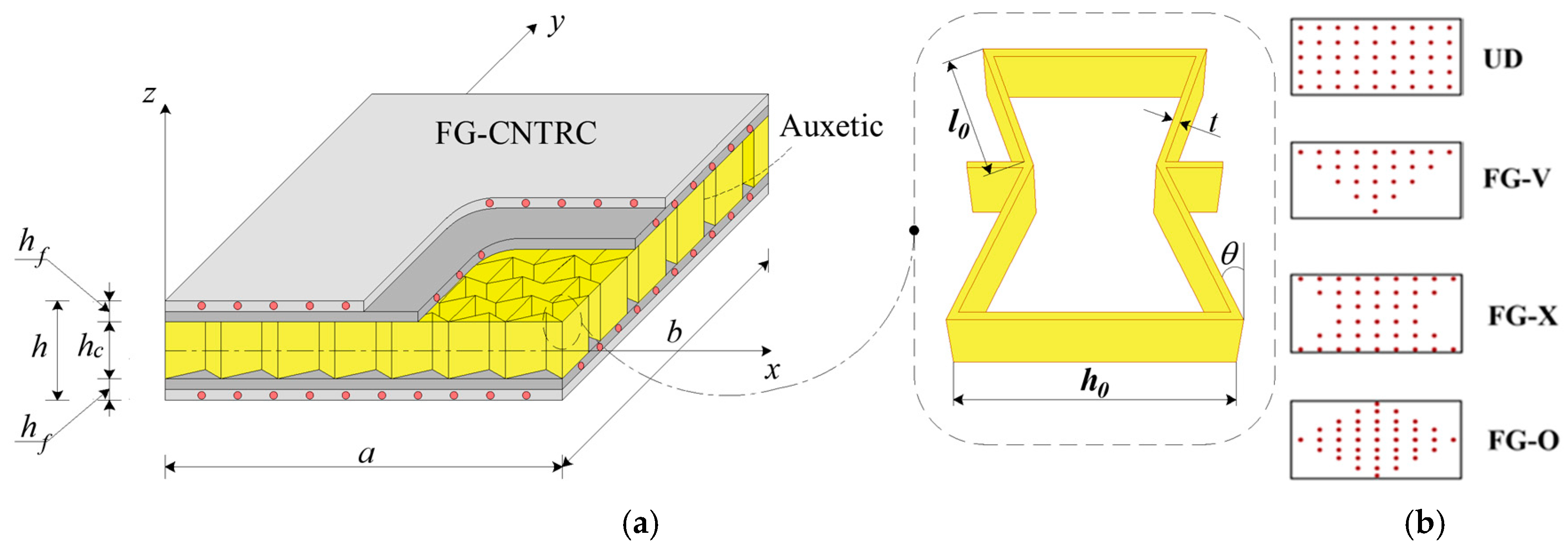
Figure 1. Sandwich plate with auxetic core and FG-CNTRC face sheets: (a) SD-AuCNT plate and detailed auxetic honeycomb unit cell; (b) FG-CNTRC face sheets.
Jcs 10 00277 g001
Figure 2. Coordinate mapping from (a) the physical plate to (b) the normalized square plate.
Jcs 10 00277 g002
Figure 3. Time history of the central deflection of an isotropic plate under step loading [45].
Jcs 10 00277 g003
Figure 4. Effects of auxetic core geometric parameters θ and η1 on the DFNFs of the SSSS SD-AuCNT plates. (a) Cross-ply SD-AuCNT plates [0°/90°/Core/90°/0°]. (b) Angle-ply SD-AuCNT plates [45°/−45°/Core/−45°/45°]. (c) 3D surface for the cross-ply plate. (d) 3D surface for the angle-ply plate.
Jcs 10 00277 g004aJcs 10 00277 g004b
Figure 5. Effects of inclined angles θ and sandwich configurations on the DFNFs of the SSSS SD-AuCNT plates. (a) Cross-ply SD-AuCNT plates [0°/90°/Core/90°/0°]. (b) Angle-ply SD-AuCNT plates [45°/−45°/Core/−45°/45°].
Jcs 10 00277 g005
Figure 6. Variations in the DFNFs with respect to the unit cell inclination angle θ and different lamination schemes for the SD-AuCNT plates under various BCs: (a) SSSS; (b) SFSF; (c) CCCC and (d) SCSC.
Jcs 10 00277 g006aJcs 10 00277 g006b
Figure 7. Effects of CNT distribution types on the DFNFs of the SSSS SD-AuCNT plates. (a) Cross-ply SD-AuCNT plates. (b) Angle-ply SD-AuCNT plates.
Jcs 10 00277 g007
Figure 8. Transient response of the central deflection w (cm) of the SSSS SD-AuCNT sandwich plates with different damping ratios, ξ. (a) Cross-ply SD-AuCNT plates. (b) Angle-ply SD-AuCNT plates.
Jcs 10 00277 g008
Figure 9. Effect of inclined angle θ on the time-history central deflection of the SSSS SD-AuCNT plates. (a) Cross-ply SD-AuCNT plates. (b) Angle-ply SD-AuCNT plates.
Jcs 10 00277 g009
Figure 10. Effect of different sandwich configurations on the time-history central deflection of the SSSS SD-AuCNT plates. (a) Cross-ply SD-AuCNT plates. (b) Angle-ply SD-AuCNT plates.
Jcs 10 00277 g010
Figure 11. Effect of different lamination schemes on the time-history central deflection of the SD-AuCNT plates under: (a) SSSS; (b) SFSF; (c) CCCC and (d) SCSC boundary conditions.
Jcs 10 00277 g011
Figure 12. Effect of CNT distribution patterns on the time-history central deflection of the SSSS SD-AuCNT plates. (a) Cross-ply SD-AuCNT plates [0°/90°/Core/90°/0°]. (b) Angle-ply SD-AuCNT plates [45°/−45°/Core/−45°/45°].
Jcs 10 00277 g012
Table 1. The efficiency parameters of CNTs [33].
V C N T * ξ 1 ξ 2 ξ 3
0.110.1490.9340.934
0.140.1500.9410.941
0.170.1491.3811.381
Table 2. Values of exponent sj for various BCs of the SD-AuCNT plate.
Boundary ConditionAt y = 0
(χ = −1)
At x = a
(ξ = 1)
At y = b
(χ = 1)
At x = 0
(ξ = −1)
Jcs 10 00277 i001(C)
s 1 = 1 s 5 = 1 s 9 = 2 s 13 = 1 s 17 = 1
(C)
s 2 = 1 s 6 = 1 s 10 = 2 s 14 = 1 s 18 = 1
(C)
s 3 = 1 s 7 = 1 s 11 = 2 s 15 = 1 s 19 = 1
(C)
s 4 = 1 s 8 = 1 s 12 = 2 s 16 = 1 s 20 = 1
Jcs 10 00277 i002(S)
s 1 = 1 s 5 = 0 s 9 = 1 s 13 = 0 s 17 = 1
(C)
s 2 = 1 s 6 = 1 s 10 = 2 s 14 = 1 s 18 = 1
(S)
s 3 = 1 s 7 = 0 s 11 = 1 s 15 = 0 s 19 = 1
(C)
s 4 = 1 s 8 = 1 s 12 = 2 s 16 = 1 s 20 = 1
Jcs 10 00277 i003(S)
s 1 = 1 s 5 = 0 s 9 = 1 s 13 = 0 s 17 = 1
(S)
s 2 = 0 s 6 = 1 s 10 = 1 s 14 = 0 s 18 = 1
(S)
s 3 = 1 s 7 = 0 s 11 = 1 s 15 = 0 s 19 = 1
(S)
s 4 = 0 s 8 = 1 s 12 = 1 s 16 = 0 s 20 = 1
Jcs 10 00277 i004(S)
s 1 = 1 s 5 = 0 s 9 = 1 s 13 = 0 s 17 = 1
(F)
s 2 = 0 s 6 = 0 s 10 = 0 s 14 = 0 s 18 = 0
(S)
s 3 = 1 s 7 = 0 s 11 = 1 s 15 = 0 s 19 = 1
(F)
s 4 = 0 s 8 = 0 s 12 = 0 s 16 = 0 s 20 = 0
Table 3. Convergence of the DFNFs with respect to the polynomial degree N for the antisymmetric cross-ply [0°/90°]2 SD-AuCNT plates.
N Boundary Condition
SSSSCCCCSCSCSFSF
119.651642.403623.235213.0402
219.512340.935623.083413.0044
317.834537.961723.083411.7657
417.833637.890823.083311.7655
517.827037.867723.083311.7622
617.827037.841523.083311.7622
717.827037.827923.083311.7622
817.827037.815923.083311.7622
917.827037.816023.083311.7622
1017.827037.816023.083311.7622
Table 4. Convergence of the DFNFs with respect to the polynomial degree N for the antisymmetric angle-ply [45°/−45°]2 SD-AuCNT plates.
N Boundary Condition
SSSSCCCCSCSCSFSF
125.265239.809134.01599.9239
225.198238.082832.55079.6602
324.300836.322430.57057.8180
424.297936.195430.45267.3861
524.290336.110130.40497.3665
624.287636.051230.36837.3413
724.287036.024530.34897.2714
824.284435.997130.33097.2700
924.283635.997130.33097.2317
1024.283635.997130.33097.2317
Table 5. DFNFs ω ¯ for SSSS antisymmetric cross-ply [0°/90°]2 and angle-ply [45°/−45°]2 FG-CNTRC laminated plates for different CNT distribution patterns.
Antisymmetric cross-ply FG-CNTRC laminated plate [0°/90°]2
 UDFG-VFG-OFG-X
Present17.69517.51717.34217.424
Huang et al. [30]17.71417.49517.97517.378
Discrepancy [%]0.110.133.520.26
Antisymmetric angle-ply FG-CNTRC laminated plate [45°/−45°]2
 UDFG-VFG-OFG-X
Present25.07324.80724.57725.571
Huang et al. [30]24.18023.94623.76124.601
Discrepancy [%]3.693.603.433.94
Table 6. FNFs (Hz) of an SSSS AH sandwich plate with isotropic face sheets (h = 0.1 m; a = b = 20 h; t/l0 = 0.01385; h0/l0 = 4).
θ
θ = −10°θ = −35°θ = −55°θ = −80°
Present145.472145.276144.867142.053
Trung et al. [12]152.407152.196150.651147.648
Discrepancy [%]4.554.553.843.79
Table 7. DFNFs of the SSSS SD-AuCNT plate with different values of θ and η1 of the auxetic honeycomb unit cell.
η1 θ
−80°−70°−60°−50°−40°−30°−20°−10°
Cross-ply14.78812.21819.84325.81329.83432.37733.97034.974
1.520.80726.42629.77832.02433.57634.65335.40035.913
328.11632.24734.09935.15335.82536.27936.59336.807
530.34733.80735.24136.01736.49536.80737.01637.152
Angle-ply111.04229.12046.66459.30066.30568.79868.23666.192
1.540.14854.45162.10566.00467.19866.31464.05761.433
343.76853.60557.82159.05558.34656.36953.82951.535
543.04349.42851.67251.77350.52448.50146.29044.492
Table 8. DFNFs of the SSSS SD-AuCNT plate with different values of θ and sandwich configurations.
θ
−80°−70°−60°−50°−40°−30°−20°−10°
Cross-ply[1:1:1]12.34326.47633.37136.09937.26637.82838.12738.298
[1:2:1]9.01721.37829.70433.85935.85736.87837.43937.765
[1:4:1]6.55016.43424.97530.40133.46235.17536.16736.761
[1:8:1]4.78812.21819.84325.81329.83432.37733.97034.974
Angle-ply[1:1:1]21.60944.95254.41056.07554.89853.03351.38950.236
[1:2:1]17.77541.39055.54060.55060.68158.64256.04153.825
[1:4:1]14.25735.84653.11262.40165.52064.86062.27559.310
[1:8:1]11.02829.08146.59359.19566.16368.61868.01965.945
Table 9. DFNFs of the SD-AuCNT plate with different values of θ and η1 of the auxetic unit cell.
θ
−80°−70°−60°−50°−40°−30°−20°−10°
SSSS[0°/90°]4.78812.21819.84325.81329.83432.37733.97034.974
[30°/−30°]8.62222.69936.39546.44452.42455.27356.01955.551
[45°/−45°]11.02829.08146.59359.19566.16368.61868.01965.945
[60°/−60°]12.69033.62453.92968.19175.26176.42573.79869.869
SFSF[0°/90°]9.29124.24039.36850.90356.70958.19156.75254.145
[30°/−30°]3.5079.31014.99919.22121.81623.18023.74423.870
[45°/−45°]6.44617.06127.31434.67738.84840.54140.59939.873
[60°/−60°]9.82926.03841.63852.45857.85658.97657.35554.717
CCCC[0°/90°]21.82657.31889.408107.250109.834102.69392.39983.501
[30°/−30°]13.46434.86054.99168.87875.93777.69876.05972.991
[45°/−45°]19.00949.63478.01195.749101.48898.33590.88283.342
[60°/−60°]24.97265.210100.683118.881119.345109.25396.38085.737
SCSC[0°/90°]4.78812.21819.84325.81329.83432.37733.97034.974
[30°/−30°]10.31726.55241.72752.31258.15160.54360.75459.758
[45°/−45°]11.91731.06549.26462.05268.89971.13770.33668.088
[60°/−60°]13.06234.49055.14169.53676.60477.72575.05771.088
Table 10. DFNFs of the SSSS SD-AuCNT plate with different CNT distribution types and core-to-total-thickness ratios hc/h.
hc/h
CNT Types0.10.20.30.40.50.60.70.8
Cross-plyUD18.51919.24319.88020.35620.57520.40319.62017.827
FG-V18.40519.16119.82220.31820.55320.39219.61717.828
FG-O18.24919.02919.71020.22120.46720.31519.54717.767
FG-X18.80019.46820.05820.49820.69120.49719.69917.893
Angle-plyUD22.78224.33825.65226.67027.28727.33226.51424.281
FG-V22.58024.19925.55926.61027.25027.31226.50624.279
FG-O22.35824.01725.40526.47727.13327.20726.41024.194
FG-X23.21024.66625.90626.86927.44627.46226.62224.371
Disclaimer/Publisher’s Note: The statements, opinions and data contained in all publications are solely those of the individual author(s) and contributor(s) and not of MDPI and/or the editor(s). MDPI and/or the editor(s) disclaim responsibility for any injury to people or property resulting from any ideas, methods, instructions or products referred to in the content.