Article

Precise Defect Reconstruction of CPVs by Adaptive Ultrasonic Imaging

1
The School of Materials Science and Engineering, Southeast University, Nanjing 211189, China
2
Shanghai Research Institute of Materials Co., Ltd., Shanghai 200437, China
3
The School of Power and Mechanical Engineering, Wuhan University, Wuhan 430072, China
*
Author to whom correspondence should be addressed.
J. Compos. Sci. 2026, 10(5), 269; https://doi.org/10.3390/jcs10050269
Submission received: 8 April 2026 / Revised: 29 April 2026 / Accepted: 6 May 2026 / Published: 15 May 2026
(This article belongs to the Section Composites Modelling and Characterization)

Abstract

Composite hydrogen storage vessels exhibit pronounced anisotropy, multilayered winding architectures, and strong ultrasonic attenuation, which severely degrade the focusing accuracy and defect visibility of the conventional isotropic total focusing method (TFM). To address these challenges, this study proposes an enhanced TFM framework for defect inspection in composite hydrogen storage vessels by integrating anisotropic delay correction, Gray-code coded excitation, and coherence-weighted reconstruction. First, an anisotropic propagation delay model is established using forward ray tracing to compensate for beam deviation and focusing mismatch induced by the anisotropic winding structure. Then, Gray-code excitation and pulse compression are introduced to improve signal energy and echo detectability under high-attenuation conditions. Finally, coherence-weighted imaging is applied to suppress incoherent background noise and structural artifacts, thereby enhancing defect contrast and image readability. The proposed method is validated on hydrogen storage vessel specimens containing artificial defects, with CT results used as references. Experimental results show that, compared with conventional isotropic TFM, the proposed collaborative approach significantly improves defect imaging quality for defects of different sizes and depths. The signal-to-noise ratio is increased from 7.2, 12.8, 14.8, and 7.4 dB for isotropic TFM to 32.5, 29.9, 52.6, and 42.7 dB, respectively, for the combined anisotropic, coded-excitation, and coherence-weighted TFM. In addition, the defect depth estimation remains stable and agrees well with the CT references, yielding approximately 9.0–9.6 mm for shallow defects and 18.7–19.3 mm for deeper defects. These results demonstrate that the proposed method can effectively improve defect detectability, image contrast, and depth characterization for embedded delamination-like artificial defects in composite hydrogen storage vessels, providing a promising ultrasonic imaging strategy for thick-walled anisotropic composite pressure structures.

1. Introduction

Type IV composite pressure vessels (CPVs) have become one of the most important solutions for high-pressure hydrogen storage because they combine a lightweight polymer liner with a carbon-fiber-reinforced polymer (CFRP) overwrap, thereby offering high specific strength, corrosion resistance, and improved storage efficiency compared with conventional metallic vessels [1,2,3,4]. In these structures, the CFRP overwrap acts as the primary load-bearing component, and its integrity directly determines the safety and service reliability of the vessel. During manufacturing, transportation, installation, and long-term service, the CFRP overwrap is subjected to low-velocity impact, cyclic internal pressure, local stress concentration, and environmental aging. These service-related conditions promote the initiation and evolution of hidden damage mechanisms, including matrix cracking, fiber–matrix debonding, interlaminar delamination, fiber breakage, and progressive fatigue degradation [5,6,7,8,9]. Because these damage mechanisms develop within the thick composite overwrap and are difficult to identify from external surface indications, accurate internal defect reconstruction is critical for evaluating the structural integrity and service safety of CPVs. Owing to the filament-winding manufacturing process, the CFRP layer usually exhibits multi-angle winding, spatial thickness variation, and pronounced material heterogeneity, especially in the transition region between the cylindrical section and the dome. These features substantially complicate wave propagation and pose significant challenges for in-service nondestructive evaluation and structural integrity assessment [2,3,4,10,11].
To identify such hidden damage and support structural integrity assessment, a variety of nondestructive testing (NDT) techniques have been explored for composite structures and composite pressure vessels, including digital image correlation, X-ray computed tomography, microwave testing, fiber-optic monitoring, and ultrasonic inspection [10,11,12,13,14,15]. Among them, ultrasonic testing remains particularly attractive for field inspection of composite hydrogen tanks because it provides relatively high penetration capability, flexible deployment, and compatibility with portable phased-array systems [12,13]. In recent years, full matrix capture (FMC) combined with the total focusing method (TFM) has become an important route for high-resolution ultrasonic imaging. By synthetically focusing at every pixel within the region of interest, TFM can achieve improved lateral resolution and enhanced defect visibility compared with conventional phased-array beamforming, and it has shown strong potential in the inspection of composites and other complex engineering structures [16,17,18,19,20].
Despite these advantages, ultrasonic imaging of thick CFRP remains highly challenging. Unlike isotropic metals, CFRP exhibits strong directional dependence in elastic and acoustic properties because of fiber reinforcement, ply architecture, and multi-angle stacking or winding. In addition, thick CFRP structures suffer from severe attenuation, waveform distortion, inter-ply scattering, and low signal-to-noise ratio (SNR), particularly for deep defects or long propagation paths [12,13,17,21,22,23,24]. As a result, the delay laws assumed in conventional isotropic TFM often become inaccurate in thick CFRP, leading to beam skewing, phase mismatch, defocusing, artifact generation, and erroneous defect localization [17,21,22,23,24]. These problems are even more pronounced in Type IV CPVs, where the winding architecture is more complex than that of standard laminated aerospace panels and where access to precise manufacturing details is often limited in practical inspection scenarios [2,10,11].
To improve TFM imaging in anisotropic composites, substantial effort has been devoted to velocity correction and adaptive focusing. Existing studies have shown that the direction-dependent group velocity in CFRP can be estimated from elastic constants and wave-propagation models and then incorporated into delay-law design to improve image reconstruction quality [21,22,23,24,25]. Li et al. demonstrated that modifying TFM to account for directional velocity dependence can improve the detectability of small defects in composite laminates [21]. Lin et al. further proposed a model-based travel-time correction strategy for multidirectional CFRP laminates, showing that anisotropy-corrected TFM can substantially enhance defect imaging accuracy [22]. More recently, Xu et al. reported an omni-directional velocity correction approach for the quantitative evaluation of buried delamination defects in composite structures [23], while phase-coherence-weighted TFM has also been introduced to further suppress incoherent background components in CFRP imaging [24]. However, most of these methods were developed for laminates or other composite specimens with relatively well-defined structural parameters. For thick filament-wound Type IV vessels, anisotropy correction is necessary but not sufficient, because weak echoes caused by long propagation distances and severe attenuation often remain a limiting factor even after the delay law is improved [2,17,22,23].
A complementary strategy for highly attenuative media is coded excitation. By transmitting a longer coded waveform and subsequently applying pulse compression, coded excitation can increase the injected acoustic energy while retaining axial resolution after matched filtering [26]. Recent reviews have highlighted the value of coded excitation in ultrasonic testing, including bulk-wave and phased-array applications [27,28,29,30]. For thick CFRP, Rizwan et al. demonstrated that pulse-compression-based phased-array imaging can improve the detectability of internal defects and provide better image quality than standard pulse-echo excitation [28]. Nevertheless, coded excitation also introduces an important side effect: after pulse compression, sidelobes and associated clutter may become more pronounced, and these can degrade image contrast and mask weak defect responses when TFM is applied directly [27,28,30]. Therefore, in thick anisotropic CFRP, coded excitation should not be regarded as an isolated solution; rather, it should be integrated with focusing correction and image-quality enhancement strategies that can suppress the accompanying sidelobe contamination [27,28,29,30].
Coherence-based weighting offers such a possibility. The underlying idea is that, after appropriate delay compensation, signals scattered from a true reflector tend to exhibit higher coherence across array channels than structural noise, clutter, or sidelobe-dominated responses. On this basis, coherence factors and phase-coherence-based weighting schemes have been widely studied to improve ultrasonic image contrast and suppress incoherent artifacts [24,31,32,33,34]. In CFRP inspection, Tian et al. showed that phase-coherence-weighted TFM can enhance defect visibility by suppressing structural noise and interlaminar interference [24]. This characteristic is especially relevant when coded excitation is used, because sidelobe-related components after pulse compression are generally less phase-consistent than the main focused response [35]. Consequently, combining coherence weighting with anisotropy-corrected TFM provides a physically meaningful route to preserving the penetration benefit of coded excitation while mitigating its negative effect on sidelobe contamination [24,31,32,33,34].
Based on the above considerations, this study proposes an ultrasonic imaging framework for thick CFRP regions in Type IV hydrogen storage vessels by integrating adaptive focusing, coded excitation, and Coherence Factor Weighting. In the proposed scheme, anisotropy-corrected adaptive focusing is first used as the baseline imaging condition to compensate for direction-dependent wave propagation in the CFRP overwrap. On this basis, coded excitation and pulse compression are introduced to enhance the echo energy of deep reflectors and improve the detectability of weak indications. Finally, Coherence Factor Weighting is incorporated into TFM reconstruction to suppress sidelobes and non-coherent artifacts generated during propagation and pulse compression. In this way, the three components address three consecutive bottlenecks in thick CFRP inspection, namely focal mismatch, insufficient penetration, and image contamination. Experiments on Type IV COPV specimens with representative artificial defects are conducted to evaluate the proposed framework. The results show that the integrated strategy can significantly improve image clarity, defect visibility, and overall SNR compared with conventional TFM and partially enhanced imaging schemes.

2. Methodology

2.1. Anisotropic Velocity Representation in CFRP

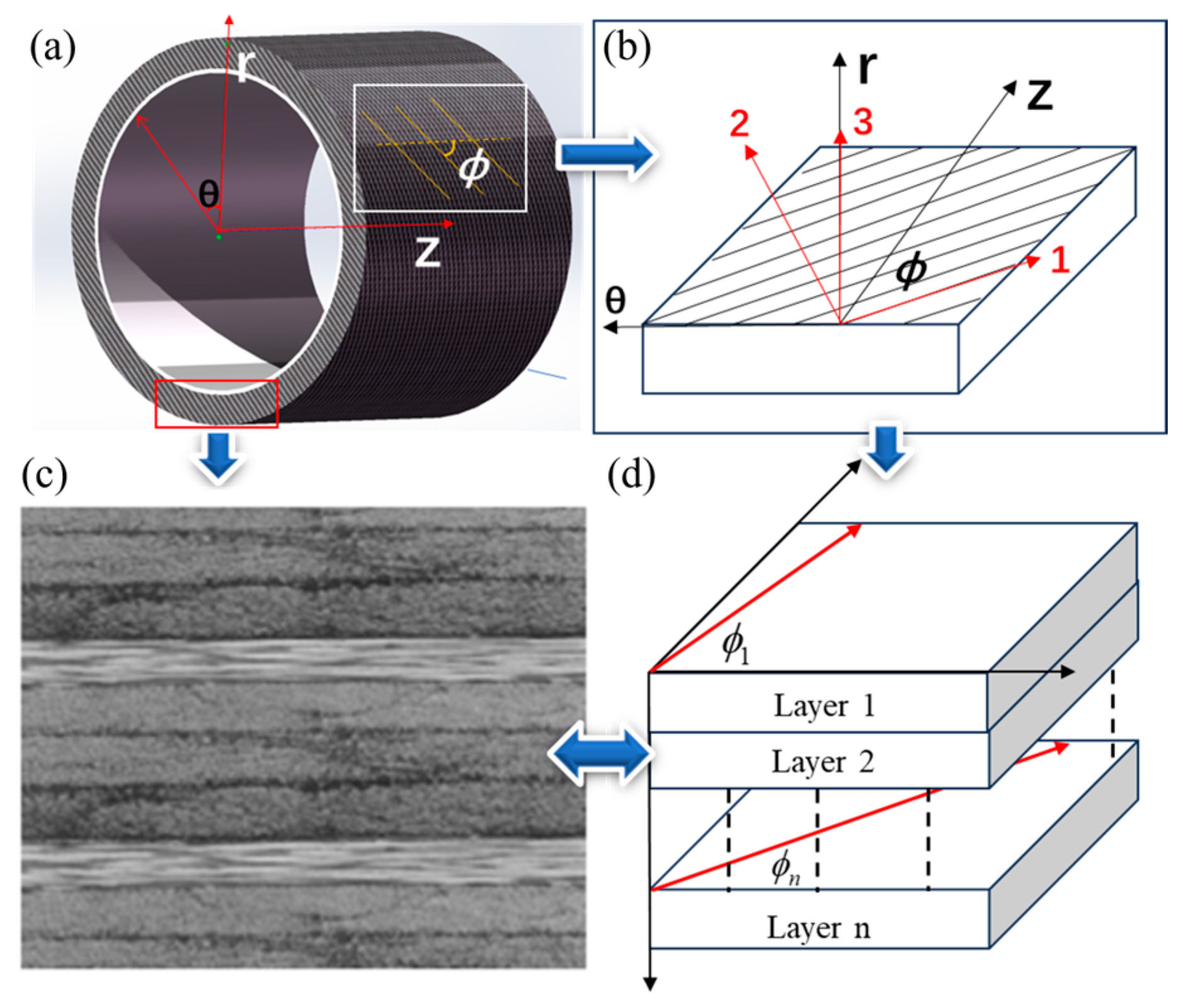
The filament-wound composite structures in the body section of CPVs are anisotropic, multi-angle, alternating winding structures. From a macroscopic perspective, CFRP layers with the same winding angle can be regarded as transversely isotropic materials with three orthogonal planes. In some CPVs, an orthogonal alternating winding method is also employed, where CFRP layers with orthogonal orientations exhibit consistent anisotropic velocity distributions. Figure 1 illustrates the reference coordinate system for CPVs. For a single ply with a uniform winding angle, the fiber direction is designated as the 1-axis, and the direction perpendicular to the fibers is the 2-axis. For the overall vessel, the longitudinal direction of the body is denoted as the z-axis, and the radial direction as the r-axis. The angle between the 1-axis and the z-axis, denoted as ф, represents the fiber winding angle. When the fiber direction aligns with the r-axis, the constitutive relationship of a single ply can be expressed in matrix form as follows:
σ = σ 1 σ 2 σ 3 τ 23 τ 31 τ 12 = C 11 C 12 C 13 0 0 0 C 12 C 22 C 23 0 0 0 C 13 C 23 C 33 0 0 0 0 0 0 C 44 0 0 0 0 0 0 C 55 0 0 0 0 0 0 C 66 ε 1 ε 2 ε 3 ε 23 ε 13 ε 12 = C ε 1 ε 2 ε 3 ε 23 ε 13 ε 12
Once the stiffness matrix for a single ply at any winding angle is obtained, the Christoffel equation can be used to determine the phase velocities and polarization characteristics of the longitudinal wave (QP) and the two shear waves (QSH, QSV). The equation can be expressed in matrix form:
Γ 11 ρ v 2 Γ 12 Γ 13 Γ 12 Γ 22 ρ v 2 Γ 23 Γ 13 Γ 23 Γ 33 ρ v 2 U x U y U z = 0
The Christoffel equation is formally analogous to an eigenvalue problem, where ρ represents the material density, and v represents the phase velocity, which is also the eigenvalue of the matrix. The polarization vector U = (Ux,Uy,Uz) corresponds to the three components of the eigenvector. The Christoffel coefficients Γij can be expressed in terms of the stiffness matrix coefficients using the following formula:
Γ 11 = C 11 ϕ n 1 2 + C 66 ϕ n 2 2 + C 55 ϕ n 3 2 + 2 C 16 ϕ n 1 n 2 Γ 22 = C 66 ϕ n 1 2 + C 22 ϕ n 2 2 + C 44 ϕ n 3 2 + 2 C 26 ϕ n 1 n 2 Γ 33 = C 55 ϕ n 1 2 + C 44 ϕ n 2 2 + C 33 ϕ n 3 2 + 2 C 45 ϕ n 1 n 2 Γ 12 = C 16 ϕ n 1 2 + C 26 ϕ n 2 2 + C 45 ϕ n 3 2 + ( C 12 ϕ + C 66 ϕ ) n 1 n 2 Γ 13 = ( C 45 ϕ + C 36 ϕ ) n 2 n 3 + ( C 13 ϕ + C 55 ϕ ) n 1 n 3 Γ 23 = ( C 44 ϕ + C 23 ϕ ) n 2 n 3 + ( C 36 ϕ + C 45 ϕ ) n 1 n 3
In the equation, n1, n2, n3 represent the cosines of the propagation angle along the z, θ, and r axes, respectively. Since the array elements of the linear probe are distributed along the vessel’s axial direction, there is no wave propagation component in the n2 direction for the inspection plane. If the propagation angle is φ , then the wave vector in the inspection plane can be expressed as n = n 1 n 2 n 3 = cos ( φ ) 0 sin ( φ ) . By simultaneously solving Equations (2) and (3), the eigenvalues and eigenvectors of the matrix can be obtained, leading to the phase velocity distribution and corresponding polarization direction for a single ply at any winding angle. However, due to the significant wave dispersion in composite materials, the main velocity and direction of wave energy are determined by the group velocity. In the present algorithm, the inspection is performed in the (z-r) plane. Accordingly, the group velocity is evaluated in terms of its in-plane components. Although the theoretical definition of group velocity is given by the gradient of the angular frequency with respect to the wave vector, the following expression is written in its numerical implementation form for the (z-r) inspection plane. The angular derivative of the phase velocity is evaluated using a finite-difference approximation, which directly provides the in-plane group-velocity magnitude and direction required for the subsequent ray-tracing procedure:
v ¯ ( φ ) = v 2 ( φ ) + ( v φ ) 2
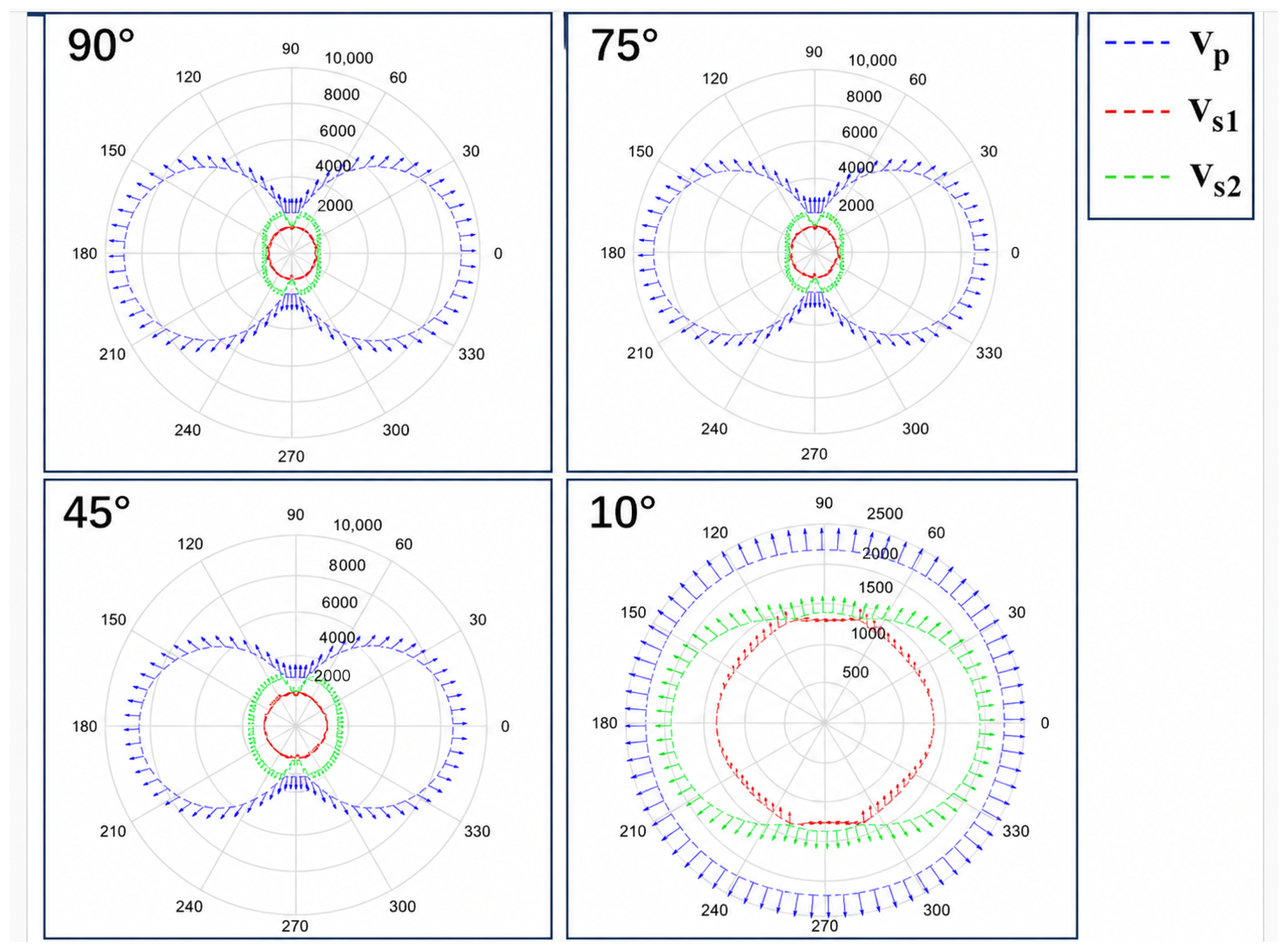
Through the proposed coordinate transformation, the stiffness matrix of a CFRP ply can be expressed in the global reference coordinate system for any fiber orientation. By solving the Christoffel equation based on the transformed stiffness matrix, the directional phase velocity distributions of different wave modes can be obtained. Figure 2 presents the calculated anisotropic velocity distributions using representative elastic constants of a typical CFRP ply. The results show that the wave velocity varies significantly with propagation direction, and that the quasi-longitudinal and quasi-shear modes exhibit distinct angular characteristics. In particular, the quasi-longitudinal wave shows the highest velocity and the strongest directional dependence. These results demonstrate that ultrasonic propagation in CFRP is strongly anisotropic and cannot be described by a constant velocity model. Accordingly, the proposed method provides the necessary velocity input for subsequent anisotropic travel-time calculation and adaptive focusing in multilayer CFRP structures.
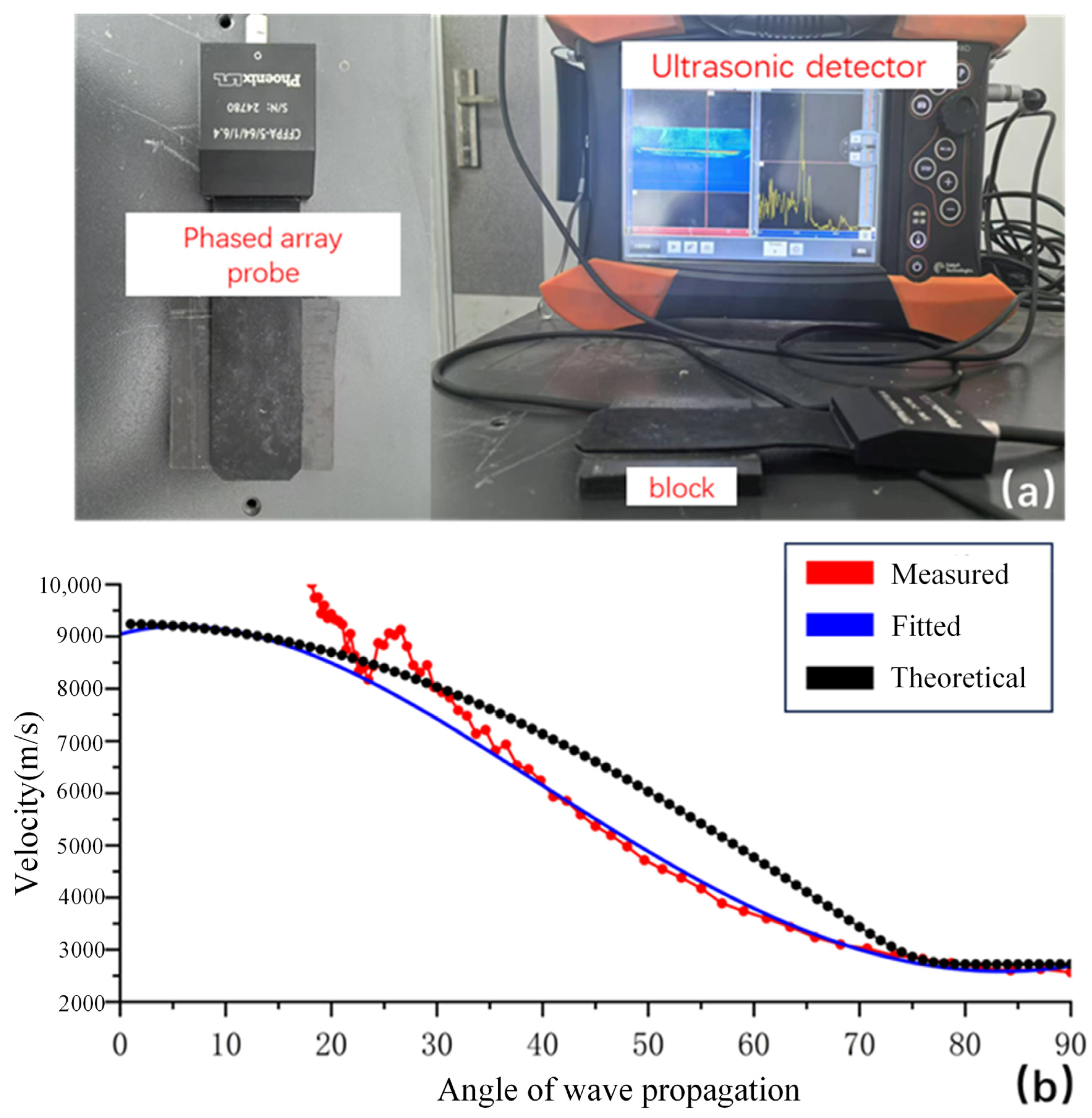
To verify the engineering validity of the anisotropic velocity model used in the ray-tracing procedure, an additional velocity measurement experiment was conducted on a unidirectional CFRP plate, as shown in Figure 3a. Full matrix capture data were acquired using a 64-element phased-array probe, and the acoustic velocities corresponding to different sound beam angles were estimated from the time-of-flight information of different transmit–receive element pairs. The measured velocities were then compared with the theoretical velocity distribution calculated from the transformed stiffness matrix and the Christoffel-based anisotropic model.
As shown in Figure 3b, the measured velocity distribution agrees well with the theoretical prediction in both trend and magnitude. The fitted experimental curve follows the theoretical curve over most of the angular range, confirming that the proposed model can reasonably represent the direction-dependent velocity variation in CFRP. Minor deviations are mainly attributed to experimental uncertainties such as coupling variation, finite aperture effects, material heterogeneity, and time-of-flight picking errors. This validation provides engineering support for the use of the proposed anisotropic velocity model in the subsequent ray-tracing-based adaptive delay correction.

2.2. Integrated TFM Imaging Framework

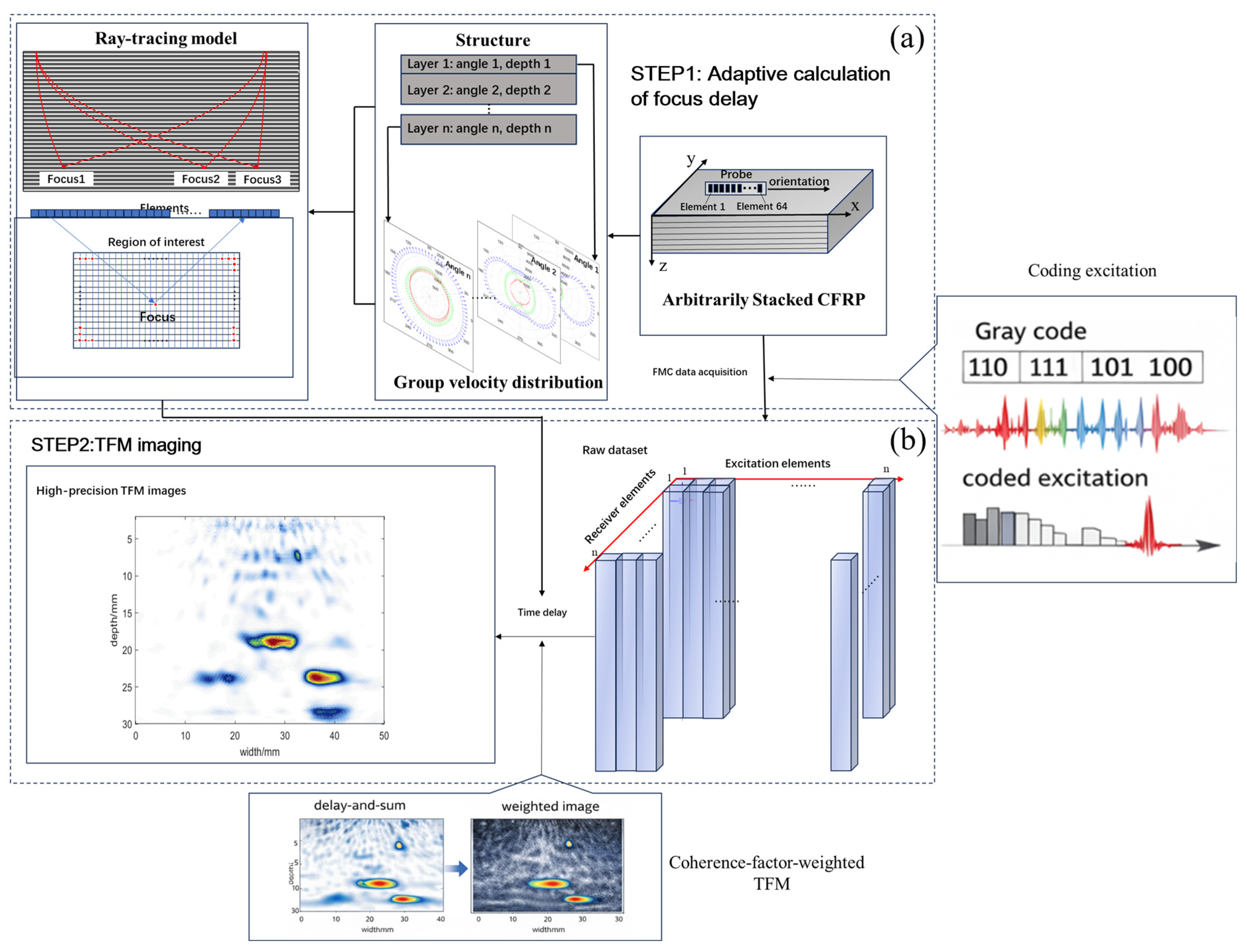
To achieve accurate defect imaging in multilayer CFRP structures with arbitrary stacking sequences, an integrated TFM imaging framework was established, as illustrated in Figure 4. The framework combines anisotropic velocity modeling, layer-wise propagation description, adaptive delay calculation, coded excitation enhancement, and coherence-factor-weighted reconstruction into a unified imaging procedure.
First, the multilayer structure is described in a layer-by-layer manner according to the stacking sequence, where each layer is characterized by its fiber angle and thickness. Based on the coordinate transformation and Christoffel-based solution introduced in Section 2.1, the directional velocity distribution corresponding to each ply is determined individually. In this way, the multilayer CFRP specimen is represented as a heterogeneous anisotropic medium in which the acoustic velocity varies from layer to layer and depends on the propagation direction within each layer.
Second, the probe orientation and imaging region are defined with respect to the specimen surface. For each transmitting–receiving element pair and for each imaging pixel, the ultrasonic propagation path is determined using an anisotropic forward model. Unlike conventional isotropic TFM, in which a single constant velocity is used for all paths, the present method takes into account the layer-dependent velocity distribution and the variation in propagation direction across different plies. The travel time is therefore calculated adaptively according to the actual multilayer anisotropic propagation path, providing a physically consistent delay law for image reconstruction.
After the anisotropic delay law is obtained, the acquired full matrix capture (FMC) data are processed within the integrated framework. Gray-code coded excitation is introduced at the signal acquisition stage to improve transmitted energy and enhance echo detectability in thick and highly attenuative composite structures. After pulse compression, the reconstructed signals are combined with the anisotropic delay compensation to generate the delay-and-sum TFM image. Subsequently, coherence-factor weighting is applied to the delayed signals in order to suppress incoherent background noise and structural artifacts.
Through this procedure, the proposed framework establishes a complete imaging chain from anisotropic material representation to enhanced TFM reconstruction. The role of each component is complementary. The layer-wise anisotropic velocity model provides the basis for accurate delay calculation, adaptive forward propagation improves focusing consistency in complex multilayer media, coded excitation increases signal strength under strong attenuation, and coherence weighting further enhances image contrast by reducing incoherent interference. As a result, the framework is able to improve both defect detectability and image readability for thick-walled CFRP structures.

2.2.1. Coded Excitation and Pulse Compression

For thick CFRP structures such as composite pressure vessels, ultrasonic wave propagation is accompanied by strong attenuation and scattering, which often results in weak defect echoes when conventional short-pulse excitation is used. To improve the effective transmitted energy while maintaining temporal resolution, Gray-code coded excitation was introduced in this study.
The transmitted coded signal can be expressed as
s t = k = 1 M a k p ( t k T )
where M is the code length, a k denotes the k -th Gray-code coefficient, p ( t ) is the elementary excitation pulse, and T is the pulse interval. Compared with conventional short-pulse excitation, coded excitation increases the total transmitted energy by extending the excitation duration, thereby improving the detectability of weak echoes in attenuative composite media.
To recover axial resolution after coded transmission, pulse compression was performed by matched filtering. The compressed output can be written as
y ( t ) = r ( t ) h ( t )
where r ( t ) is the received coded response, h ( t ) is the matched filter corresponding to the transmitted code, and denotes correlation or matched-filter processing. Through this operation, the dispersed coded waveform is compressed into a sharper pulse-like response, so that signal enhancement and temporal focusing can be achieved simultaneously.
In the proposed framework, Gray-code coded excitation was used primarily as a signal-enhancement strategy to improve defect echo visibility before TFM reconstruction. This is particularly important for composite pressure vessels, where the combination of large thickness, multilayer interfaces, and material attenuation can significantly reduce the signal-to-noise ratio of defect-related responses. By combining coded excitation with subsequent adaptive delay correction and coherence weighting, the reconstructed images can benefit from both increased signal energy and improved focusing performance.

2.2.2. Adaptive Delay Correction

For multilayer CFRP structures with arbitrary stacking sequences, the assumption of a constant acoustic velocity is no longer valid, since the propagation velocity varies with both fiber orientation and beam direction. As a result, conventional isotropic TFM introduces significant travel-time errors, which lead to defocusing, distorted defect indications, and inaccurate depth localization. To overcome this limitation, an adaptive delay correction scheme based on anisotropic ray tracing was employed in this study.
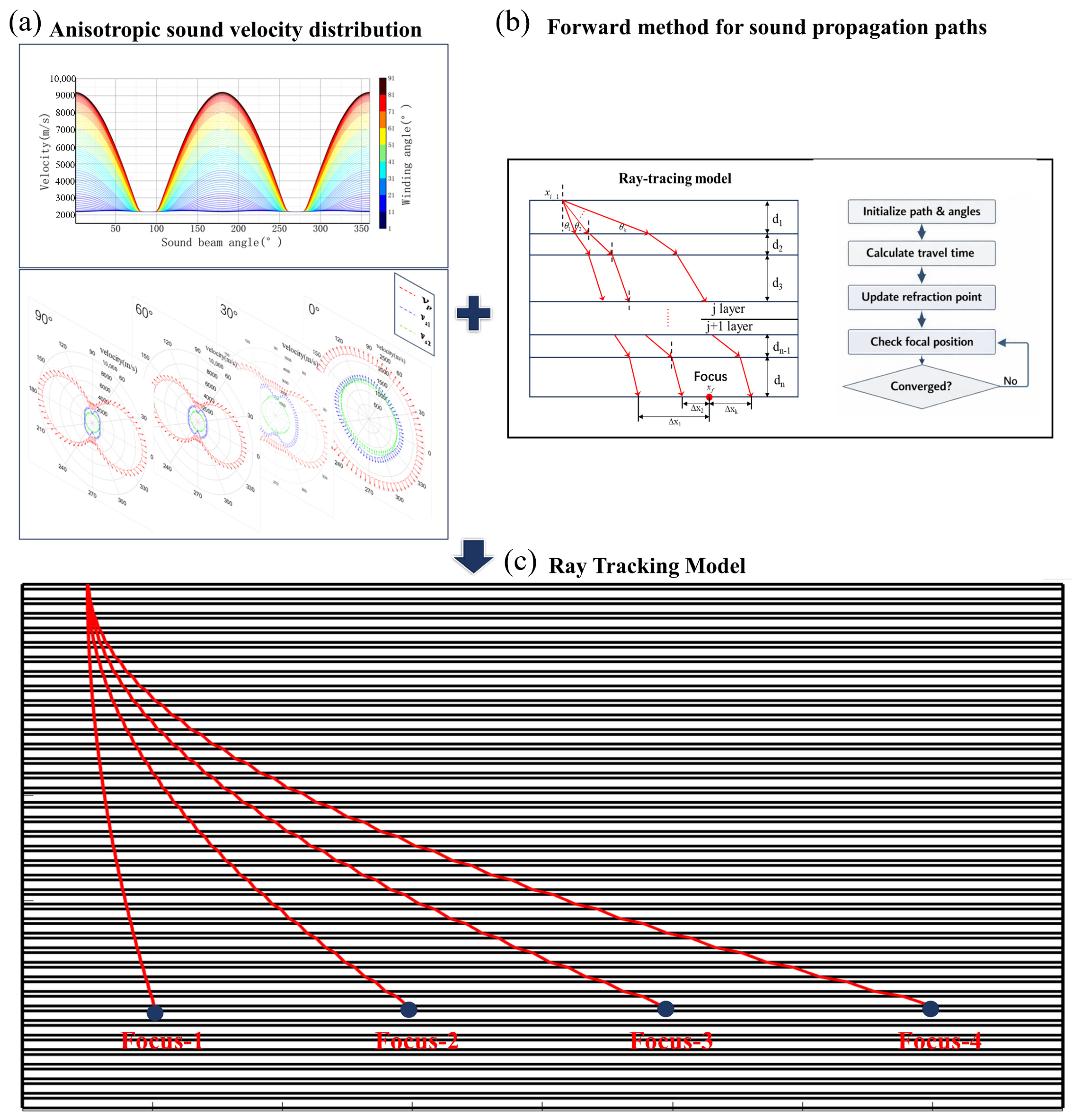
As illustrated in Figure 5, the anisotropic velocity distributions of individual plies, obtained from the coordinate transformation and Christoffel-based solution, were first assigned to the corresponding layers according to their thickness and fiber orientation. The multilayer CFRP specimen was therefore modeled as a stack of anisotropic layers with layer-dependent directional velocity distributions. In this work, each individual CFRP ply was regarded as the minimum homogenized anisotropic unit. This homogenization assumption is based on the scale relationship between the ply thickness and the ultrasonic wavelength: when the nominal ply thickness is much smaller than the wavelength used for inspection, the interaction between the ultrasonic wave and sub-ply-scale heterogeneity is limited for the prediction of the main propagation path.
For each imaging point and each transmitting–receiving channel, the ultrasonic propagation path was then determined using a forward ray-tracing model. Unlike the straight-line assumption used in isotropic media, the actual propagation path in the present structure is direction-dependent and undergoes refraction at each anisotropic interface.
For a given transmit–receive channel and a target imaging point, the total travel time was calculated as the sum of the propagation times in all crossed layers, i.e.,
t m n ( x , z ) = t m ( x , z ) + t n ( x , z )
where t m ( x , z ) and t n ( x , z ) denote the transmit and receive travel times, respectively. For each branch, the travel time was further expressed as
t = j = 1 L l j v j ( θ j )
where L is the number of crossed layers, l j is the ray path length in the j -th layer, and v j ( θ j ) is the direction-dependent velocity in that layer for the local propagation angle θ j . In this way, the delay law is no longer defined by a single constant velocity but is adaptively updated according to the actual propagation direction and the anisotropic properties of each layer.
At the interfaces between adjacent plies, the propagation direction was updated according to the anisotropic refraction condition. Since both the velocity magnitude and the energy propagation direction vary with incident angle, an iterative ray-tracing procedure was adopted to determine the incident points and refracted paths layer by layer until the target imaging point was reached. The bottom part of Figure 5 illustrates the resulting ray paths for several representative focusing points, showing that deeper focusing positions require increasingly curved and direction-dependent propagation trajectories. This behavior further demonstrates that the conventional straight-ray delay model is insufficient for multilayer anisotropic CFRP structures.
After the adaptive travel time t m n ( x , z ) was obtained for every imaging point and every channel, it was incorporated into the TFM reconstruction as
I x , z = m = 1 N n = 1 N s m n ( t m n ( x , z ) )
where s m n is the signal corresponding to the m -th transmit and n -th receive element pair, and N is the number of array elements. By replacing the conventional constant-velocity delay with the anisotropy-corrected travel time, the focusing delay becomes consistent with the actual wave propagation behavior in the multilayer CFRP structure.

2.2.3. Coherence Factor Weighting for Sidelobe Suppression

Although adaptive delay correction improves focusing accuracy, the reconstructed images may still contain sidelobes, structural clutter, and incoherent background noise. To further enhance defect contrast, coherence factor (CF) weighting was introduced after delay-and-sum reconstruction.
For each imaging point ( x , z ) , the delayed signals from different channels were first aligned. A true defect response generally exhibits higher coherence after delay compensation, whereas sidelobes and background interference remain less coherent. Based on this difference, the coherence factor was calculated as
C F ( x , z ) = i = 1 N S i ( x , z ) 2 N i = 1 N S i ( x , z ) 2
where S i ( x , z ) is the delayed signal contribution of the i -th channel and N is the number of effective channels. The final weighted image was then obtained by
I w ( x , z ) = C F ( x , z ) I T F M ( x , z )
Through this operation, coherent defect responses are enhanced, while sidelobes and incoherent clutter are suppressed. In the present study, CF weighting was used as the final image-enhancement step after coded excitation and adaptive anisotropic focusing, in order to improve defect-background separation and image readability in multilayer CFRP structures.

2.3. Experimental Configuration and Validation on CPVs

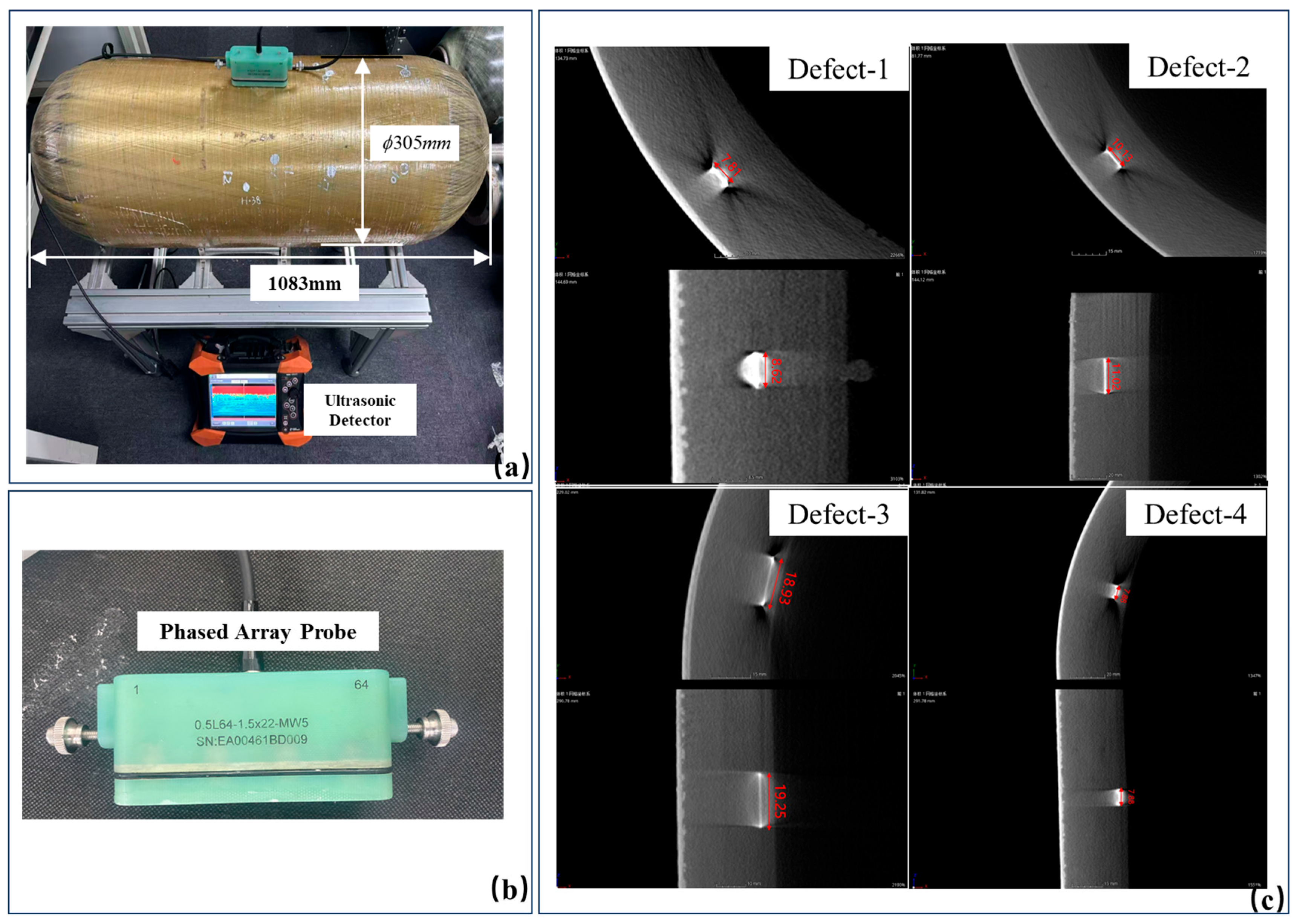
To validate the proposed imaging framework on realistic curved composite structures, experiments were conducted on a Type IV composite pressure vessel (CPV) containing artificial embedded defects. As shown in Figure 6, the tested vessel had an overall length of 1083 mm and an outer diameter of 305 mm. The specimen was a filament-wound hydrogen storage vessel, and the total thickness of the composite overwrap was 24.61 mm. The winding architecture consisted primarily of hoop plies with a winding angle of approximately 89° and a nominal single-ply thickness of 0.23 mm, together with helical plies with a winding angle of approximately 12° and a nominal single-ply thickness of 0.46 mm. This layup produced a thick, multilayered anisotropic structure representative of practical hydrogen storage vessels and therefore provided a suitable platform for evaluating the performance of the proposed ultrasonic imaging method under realistic propagation conditions.
Accurate material parameters are essential for the proposed imaging algorithm, because the anisotropic velocity distribution and ray-tracing-based travel-time calculation depend on the density and elastic coefficient matrix of each ply. In this study, the density of the CPV composite overwrap was measured as 1580 kg/m3 using the Archimedes buoyancy method on vessel-body specimens fabricated with the same filament-winding process and layup scheme as the tested CPV. The elastic coefficient matrix of the reference 0° CFRP ply was constructed from tensile-test-derived elastic parameters. Tensile tests were conducted on 10 mm thick plate-shaped CFRP specimens fabricated using the same filament winding process as the CPV overwrap, using a universal testing machine, to obtain the stress–strain curves. The modulus parameters required to construct the elastic coefficient matrix of the 0° ply were extracted from these curves, as listed in Table 1. For plies with arbitrary winding angles, the corresponding elastic coefficient matrices were obtained by applying the standard Bond transformation to the 0° ply elastic coefficient matrix and were then assigned to each layer according to its winding angle and thickness.
Ultrasonic inspection was performed using an M2M phased-array ultrasonic testing system equipped with a 64-element linear array probe. The probe had a center frequency of 0.5 MHz and an element pitch of 1.5 mm, as shown in Figure 6b. The center frequency was selected to balance penetration and spatial resolution in the 24.61 mm thick CFRP overwrap. Because ultrasonic waves undergo strong attenuation and scattering in thick filament-wound CFRP, a relatively low frequency of 0.5 MHz was adopted to improve the penetration capability and preserve detectable echoes from defects located at different depths. Using the equivalent longitudinal-wave velocity of 2300 m/s adopted in the isotropic reference reconstruction, the corresponding wavelength is approximately 4.6 mm. Therefore, the 1.5 mm element pitch is smaller than one half of the wavelength, which reduces the risk of spatial aliasing and grating-lobe artifacts during phased-array focusing. The constant velocity of 2300 m/s was used only for the conventional isotropic TFM reconstruction as a reference baseline. This value was obtained from preliminary pulse-echo calibration on the CPV specimen by using the known wall thickness and the measured back-wall echo time-of-flight and represents an equivalent through-thickness average velocity of the multilayer CFRP overwrap. In the proposed anisotropic reconstruction, this constant-velocity assumption was replaced by the layer-wise anisotropic velocity model described in Section 2.1 and Section 2.2. During the experiments, full matrix capture (FMC) data were acquired on the external surface of the vessel and subsequently processed using the different reconstruction schemes described in the previous sections, including isotropic TFM, adaptive focusing based on anisotropic delay correction, coded excitation enhancement, and coherence-factor-weighted imaging.
To assess the defect imaging capability quantitatively, four PTFE artificial defects were embedded in the composite structure at different depths and with different lateral dimensions. The PTFE inserts were used as controlled delamination-like artificial defects, because PTFE/Teflon films are widely adopted in composite NDT studies as embedded inserts for simulating interlaminar delamination or delamination-like defects. This design provides repeatable defect geometry and known reference positions for evaluating the proposed ultrasonic reconstruction framework. Their geometric information, as determined from CT characterization, is summarized in Table 2. Specifically, Defects #1 and #2 were located at a depth of 10.0 mm, with lengths of 8.2 mm and 10.5 mm, respectively, whereas Defects #3 and #4 were located at a depth of 20.0 mm, with lengths of 19.1 mm and 7.8 mm, respectively. By including both shallow and relatively deep defects, as well as different defect sizes, the specimen enabled a systematic evaluation of defect detectability, depth estimation, and apparent defect extent under different processing schemes.
X-ray computed tomography (CT) was employed as the reference method for defect validation. Representative CT images of the four defects are shown in Figure 6c, where both the defect depth and lateral dimension can be identified. The CT results served as the geometric ground truth for subsequent comparison with ultrasonic imaging results. In particular, the defect depth obtained from CT was used to evaluate the reliability of the reconstructed depth position, while the CT-observed defect extent provided a reference for interpreting the apparent defect extent measured from the ultrasonic images. Through this configuration, the CPV experiment provided both realistic structural complexity and reliable reference data, thereby enabling a comprehensive validation of the proposed collaborative ultrasonic imaging strategy.
Overall, the experimental setup was designed to reflect the main challenges encountered in practical inspection of composite hydrogen storage vessels, including strong anisotropy, multilayer wave propagation, curved geometry, and significant attenuation. Therefore, the results obtained from this CPV specimen can provide meaningful evidence for assessing the applicability of the proposed method to defect inspection in thick-walled composite pressure vessels.

3. Results and Discussion

3.1. Imaging Results Under Different Processing Schemes

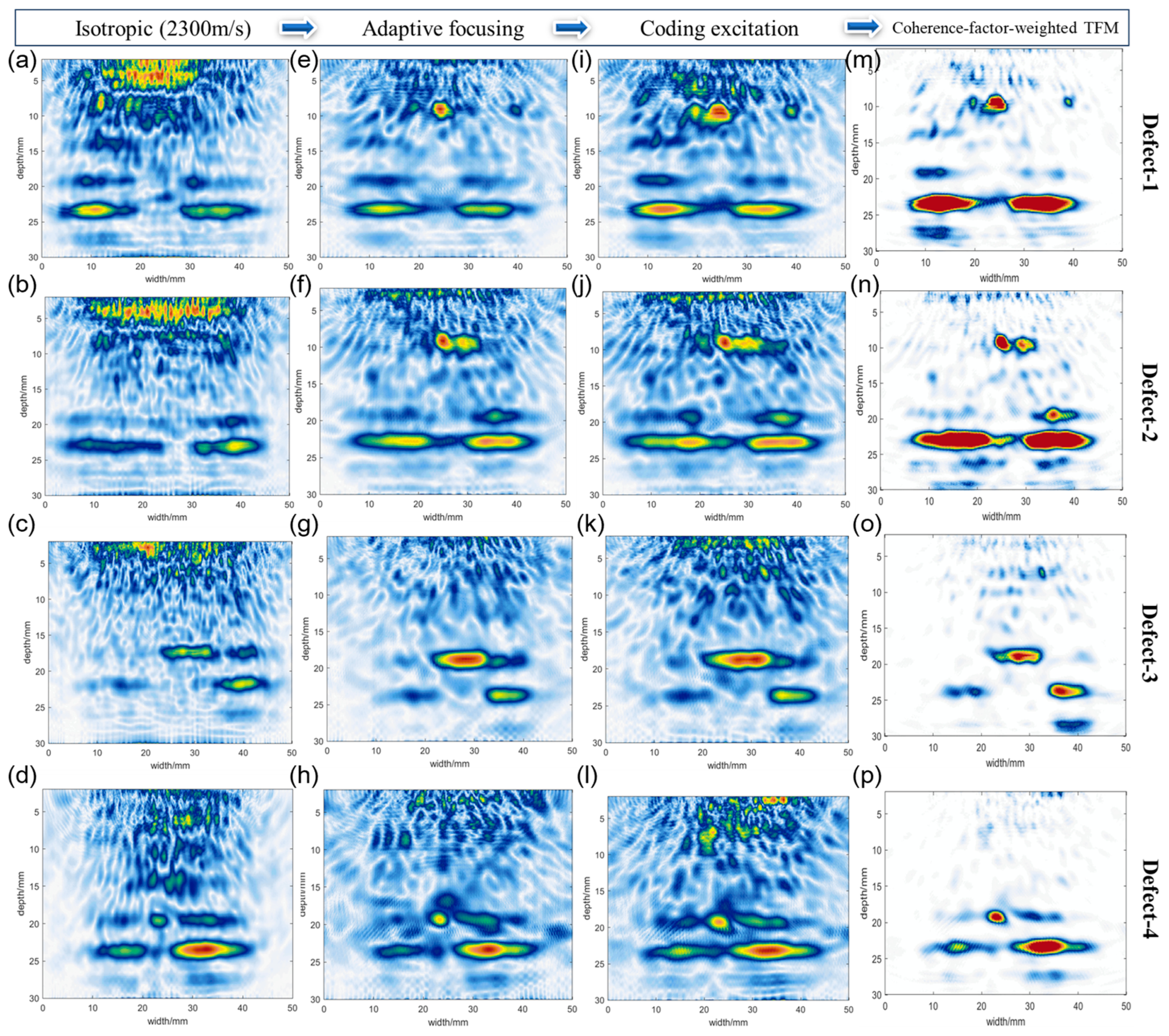
To visually compare the contribution of each processing stage, the imaging results for four representative defects are arranged row by row in Figure 7, while the four reconstruction schemes are displayed column by column, namely isotropic TFM using a constant velocity of 2300 m/s, adaptive focusing based on anisotropic delay correction, anisotropic reconstruction with coded excitation, and coherence-factor-weighted imaging. As the processing scheme progresses from left to right, a consistent improvement in defect visibility, focusing quality, and background suppression can be observed for all defect cases. For the isotropic reconstruction, the defect responses are poorly focused and strongly affected by structural clutter. The use of a constant acoustic velocity fails to describe the anisotropic wave propagation behavior in the wound composite structure of the hydrogen storage vessel, resulting in obvious image spreading, weak defect localization, and substantial interference from structural echoes. In several cases, the upper near-surface responses and strong bottom-related indications dominate the image, making the true defect signatures difficult to distinguish reliably. These results indicate that the conventional isotropic TFM is inadequate for defect imaging in thick, multilayered composite vessels.
After anisotropic adaptive focusing is introduced, the defect responses become noticeably more concentrated. Compared with the isotropic images, the defect indications in the second column are better localized and less diffuse, and the separation between defect-related responses and the surrounding background is visibly improved. This confirms that anisotropic delay correction based on forward ray tracing is essential for compensating for the travel-time mismatch caused by the winding-induced anisotropic structure. At this stage, the basic defect position and depth become much clearer, although background clutter and residual structural noise are still present in several cases.
When coded excitation is further incorporated, the main defect indications become brighter and more continuous. This enhancement is particularly evident for the deeper or weaker defect responses, where the signal energy improvement provided by Gray-code excitation contributes to better visual detectability. However, although the defect echoes are strengthened, some background interference remains in the image, indicating that signal enhancement alone is not sufficient to fully resolve the clutter problem in such complex anisotropic structures. In other words, coded excitation improves defect visibility, but it does not by itself guarantee the highest image contrast.
The best imaging performance is obtained after coherence-factor weighting. In the fourth column of Figure 7, incoherent background noise and structural artifacts are significantly suppressed, while the dominant defect responses are preserved and further highlighted. As a result, the defect indications become more compact, more isolated from the surrounding interference field, and easier to interpret. This improvement is particularly obvious in the upper and intermediate regions of the images, where the diffuse clutter observed in the previous schemes is greatly reduced. Overall, the coherence-factor-weighted results provide the clearest representation of defect location and depth among the four schemes.
Taken together, Figure 7 reveals a clear step-by-step enhancement trend. The isotropic TFM produces the poorest defect visibility because of severe focusing errors. Adaptive anisotropic focusing substantially improves defect localization and structural consistency. Coded excitation further enhances the defect response amplitude under attenuation conditions. Finally, coherence-factor weighting yields the cleanest defect representation by suppressing incoherent background components and increasing image contrast. These observations indicate that the proposed collaborative processing strategy is effective for ultrasonic imaging of defects in composite hydrogen storage vessels, where anisotropy, attenuation, and structural clutter jointly limit the performance of conventional TFM.
To further verify the above observations, quantitative metrics including SNR, estimated defect depth, and apparent defect extent were extracted from the reconstructed images and are summarized in Table 3.

3.2. Quantitative Comparison of Imaging Performance

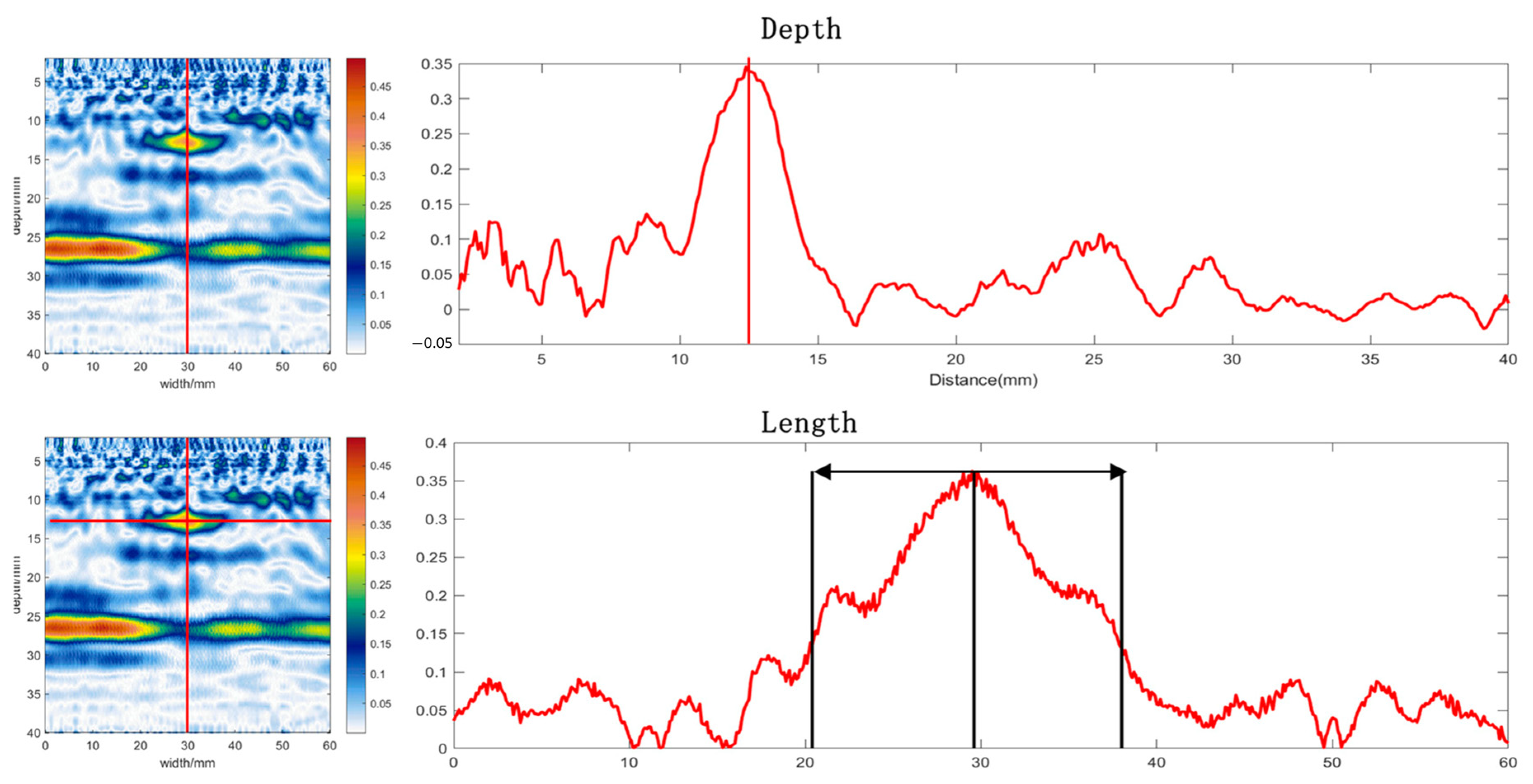
Table 3 summarizes the quantitative results for the four representative defects under different processing schemes, and the quantitative method is shown in Figure 8. The quantitative trends are fully consistent with the image-level observations in Figure 7, demonstrating that the proposed collaborative framework improves not only the visual readability of the images but also the quantitative detectability and depth-related characterization of the defects.
The most direct improvement is reflected in the SNR values. For all four defects, isotropic TFM gives the lowest SNRs, i.e., 7.2, 12.8, 14.8, and 7.4 dB for Defects 1–4, respectively. After adaptive anisotropic focusing, the SNRs increase markedly to 22.3, 19.7, 26.0, and 18.6 dB, confirming that anisotropic delay correction effectively compensates for the focusing mismatch caused by the wound composite structure and provides the main improvement in imaging quality.
With coded excitation, the defect echoes are further enhanced, although the SNR does not increase monotonically in all cases. The corresponding SNR values are 20.5, 17.5, 23.4, and 21.8 dB for Defects 1–4, respectively. This indicates that Gray-code excitation mainly improves signal energy and echo visibility under attenuative conditions, while the final SNR is still affected by residual structural clutter and incoherent background noise.
The highest SNR values are obtained after coherence-factor weighting, reaching 32.5, 29.9, 52.6, and 42.7 dB for Defects 1–4, respectively. These results clearly demonstrate the effectiveness of coherence weighting in suppressing incoherent background noise and enhancing dominant defect responses. The improvement is especially significant for the deeper defects, confirming the advantage of the proposed method for thick composite structures with strong attenuation and complex interference.
The defect depth estimation also becomes stable once anisotropic delay correction is introduced. As shown in Table 4, for the shallower defects, the estimated depths remain within 9.0–9.6 mm across the three anisotropy-based schemes, while for the deeper defects they remain within 18.7–19.3 mm. The small variation among these schemes indicates that, once the anisotropic propagation path is properly compensated, the depth information becomes robust and is only weakly affected by subsequent signal enhancement and coherence weighting. In contrast, isotropic reconstruction fails to provide reliable depth characterization, further demonstrating the inadequacy of a constant-velocity model for the present hydrogen storage vessel specimen.
To further quantify the depth estimation performance, the CT-measured depths were used as references to calculate the depth errors of the final coherence-factor-weighted TFM results. For Defects 1–4, the estimated depths were 9.6, 9.3, 18.8, and 19.2 mm, respectively, while the corresponding CT reference depths were 10.0, 10.0, 20.0, and 20.0 mm. The absolute errors were therefore 0.4, 0.7, 1.2, and 0.8 mm, respectively, resulting in a mean absolute error of 0.775 mm and a maximum absolute error of 1.2 mm. The relative errors were within 7.0% for all investigated defects. These results indicate that the proposed method provides consistent depth estimation for the tested defects under the present experimental conditions. However, since the current validation is based on a limited number of artificial defects, further repeated measurements and statistical analysis are still required to fully evaluate the repeatability and robustness of the method.
Compared with SNR and depth estimation, the apparent defect extent shows a more gradual variation. For Defects 1–4, the apparent extent increases from 3.3 to 4.8 mm, from 4.5 to 9.8 mm, from 9.7 to 14.2 mm, and from 3.9 to 6.3 mm, respectively, as the processing scheme progresses from adaptive focusing to coded excitation and coherence weighting. This suggests that the proposed strategy makes the lateral defect indication more continuous and distinguishable. However, this parameter should be regarded as an apparent defect extent extracted from the ultrasonic image rather than the physical defect size measured by CT. The CT-measured length is used as the physical reference, whereas the apparent defect extent represents the lateral range of the visible ultrasonic indication under the selected image-processing and thresholding criteria. Specifically, thresholding determines the image region counted as the defect indication; weak edge responses below the selected threshold are excluded, which can lead to an underestimated apparent extent. Image weighting, especially coherence-factor weighting, suppresses incoherent and weakly coherent components and therefore changes the lateral amplitude distribution of the defect response. Contrast enhancement improves the visual separation between the defect and background, but the extracted extent remains dependent on the display range and normalization criterion.
Overall, the quantitative results confirm the complementary roles of the three enhancement steps. Adaptive anisotropic focusing provides the essential improvement in defect localization and depth estimation, coded excitation increases echo strength under attenuation, and coherence-factor weighting delivers the most significant gain in SNR and image contrast by suppressing incoherent interference. Their combination therefore provides the most effective reconstruction strategy among the four schemes evaluated in this study.

4. Conclusions

An enhanced total focusing framework for defect inspection in composite hydrogen storage vessels was proposed by combining anisotropic delay correction based on forward ray tracing, Gray-code coded excitation, and coherence-weighted reconstruction. The main conclusions are summarized as follows.
Conventional isotropic TFM is inadequate for composite hydrogen storage vessels because the anisotropic winding structure causes significant beam deviation, focusing mismatch, and weak defect responses. In contrast, anisotropic delay correction provides a substantial improvement in defect localization and focusing quality, serving as the essential basis for subsequent image enhancement. On the basis of anisotropic focusing, Gray-code coded excitation further improves echo energy and defect visibility under strong attenuation conditions. This enhancement is particularly beneficial for thick-walled composite structures, where conventional excitation often yields insufficient defect response amplitude. Coherence-weighted reconstruction further suppresses incoherent background noise and structural artifacts, leading to clearer defect indications and improved image readability. With the full collaborative strategy, the signal-to-noise ratios reach 32.5, 29.9, 52.6, and 42.7 dB for the investigated defects, which are significantly higher than those obtained by isotropic TFM.
The proposed method demonstrates CT-consistent defect depth estimation. The estimated depths are approximately 9.0–9.6 mm for shallow defects and 18.7–19.3 mm for deeper defects, showing good agreement with the CT references. This indicates that the proposed approach is effective not only for defect detection but also for depth-related characterization in anisotropic composite vessels.
Overall, the proposed collaborative TFM framework significantly improves defect detectability, image contrast, and depth estimation capability for composite hydrogen storage vessels. The method therefore provides a promising technical basis for ultrasonic inspection of thick, multilayered, and anisotropic composite pressure structures. However, the present validation was conducted using controlled PTFE artificial defects and CT references. Although such PTFE inserts are commonly used to simulate delamination-like interlaminar defects in composite NDT studies, they do not fully represent all possible service-induced damage modes in CPVs, such as fiber fracture, impact damage, porosity, or ligament rupture. Future work will focus on improving quantitative characterization of defect lateral dimensions and extending the method to more realistic service-induced damage conditions.

Author Contributions

Conceptualization, J.D. and J.C. (Jiancheng Cao); methodology, J.D., J.C. (Jiancheng Cao) and J.C. (Jinming Cao); software, J.C. (Jiancheng Cao); validation, J.D., J.C. (Jiancheng Cao) and J.C. (Jinming Cao); formal analysis, J.C. (Jinming Cao); investigation, J.C. (Jiancheng Cao) and J.C. (Jinming Cao); resources, J.Y. and H.D.; data curation, J.D.; writing—original draft preparation, J.D., J.C. (Jiancheng Cao) and J.C. (Jinming Cao); writing—review and editing, J.C. (Jiancheng Cao) and J.C. (Jinming Cao); visualization, J.C. (Jiancheng Cao) and J.C. (Jinming Cao); supervision, J.Z. and H.D.; project administration, J.Z. and H.D.; funding acquisition, J.Y. and H.D. All authors have read and agreed to the published version of the manuscript.

Funding

This research was funded by the National Key Research and Development Program of China grant number 2023YFC3010300 And The APC was funded by the National Key Research and Development Program of China.

Data Availability Statement

The original contributions presented in this study are included in the article. Further inquiries can be directed to the corresponding author.

Acknowledgments

This work was supported by the National Key Research and Development Program of China (No. 2023YFC3010300).

Conflicts of Interest

Authors Jie Ding and Jinming Cao were employed by the Shanghai Research Institute of Materials Co., Ltd., Shanghai, China. The remaining authors declare that the research was conducted in the absence of any commercial or financial relationships that could be construed as potential conflicts of interest.

References

  1. John, E.A.; Epaarachchi, J.; Jeewantha, J.; Zeng, X. A review of type IV composite overwrapped pressure vessels. Int. J. Hydrogen Energy 2025, 109, 551–573. [Google Scholar] [CrossRef]
  2. Sun, W.X.; Li, Y.T.; Huang, W.J.; Zhang, Y.M.; Fan, M.; Xiao, Z.M.; Li, W.G. Advances in failure assessment of Type IV hydrogen storage vessels: A critical review. Renew. Sustain. Energy Rev. 2026, 226, 116353. [Google Scholar] [CrossRef]
  3. Hu, D.; Shao, W.; Lu, D.; Xu, Y.; Wang, J. Design and material optimization of carbon fiber composite winding reinforcement layer for vehicle type-IV hydrogen storage vessels. J. Energy Storage 2024, 100, 113459. [Google Scholar] [CrossRef]
  4. Aramburu, A.B.; da Cruz, J.A.; da Silva, A.A.X.; Acosta, A.P.; Minillo, L.Q.; de Avila Delucis, R. Non-destructive testing techniques for pressure vessels manufactured with polymer composite materials: A systematic review. Measurement 2025, 246, 116729. [Google Scholar] [CrossRef]
  5. Sepetcioglu, H.; Tarakcioglu, N. Effect of Graphene Nanoplatelets on Progressive Failure Behavior under Internal Pressure of Composite Cylindrical Pressure Vessels. J. Mater. Eng. Perform. 2022, 31, 2225–2239. [Google Scholar] [CrossRef]
  6. Sepetcioglu, H.; Tarakcioglu, N.; Rafiee, R. Experimental investigation of graphene nanoplatelets effect on the fatigue behavior of basalt/epoxy composite pressure vessels. Thin-Walled Struct. 2022, 171, 108672. [Google Scholar] [CrossRef]
  7. Sepetcioglu, H. Experimental study on the effect of graphene nanoplatelets on the low-velocity impact response of prestressed filament wound basalt-based composite pressure vessels. Polym. Compos. 2021, 42, 5527–5540. [Google Scholar] [CrossRef]
  8. Sepetcioglu, H.; Tarakcioglu, N. Fatigue behavior of graphene nanoplatelets reinforced and unreinforced basalt/epoxy composite pressure vessels subjected to low-velocity impact under internal pressure. J. Compos. Mater. 2021, 55, 4361–4373. [Google Scholar] [CrossRef]
  9. Gunoz, A.; Kepir, Y.; Sepetcioglu, H.; Kara, M. Durability enhancement in aged composite pipes: Low-velocity impact performance of basalt fiber reinforced polymer modified by graphene nanoplatelets. J. Compos. Mater. 2025. [Google Scholar] [CrossRef]
  10. Waqar, M.; Memon, A.M.; Sabih, M.; Alhems, L.M. Composite pipelines: Analyzing defects and advancements in non-destructive testing techniques. Eng. Fail. Anal. 2024, 157, 107914. [Google Scholar] [CrossRef]
  11. Mizutani, Y.; Sugimoto, S.; Matsuzaki, R.; Todoroki, A. Fundamental study on integrity evaluation method for COPVs by means of acoustic emission testing. J. Acoust. Emiss. 2009, 27, 89–97. [Google Scholar]
  12. Qambela, C.J.; Heyns, P.S.; Inglis, H.M. Damage Detection for Laminated Composites Using Full-Field Digital Image Correlation. J. Nondestruct. Eval. 2021, 40, 56. [Google Scholar] [CrossRef]
  13. Li, R.; Hu, H.; Zheng, K.; Chen, H.; Liu, H.; Li, H.; Zhang, Y.; Li, S. A novel embedded optical fibre sensors network and integration strategy for in-situ monitoring of hydrogen storage 70 MPa type IV composite pressure vessels. Int. J. Hydrogen Energy 2026, 212, 153662. [Google Scholar] [CrossRef]
  14. Hu, C.; Fu, X.; Yuan, Y.; Xiao, B.; Sun, M.; Yang, B. A novel damage localization technique for type III composite pressure vessels based on guided wave mode-matching method. Compos. Struct. 2024, 346, 118414. [Google Scholar] [CrossRef]
  15. Hu, C.; Yang, B.; Yang, L.; Wang, Z.; Hu, W.; Biao, X.; Yuan, Y.; Sun, M. Anti-interference damage localization in composite overwrapped pressure vessels using machine learning and ultrasonic guided waves. NDT E Int. 2023, 140, 102961. [Google Scholar] [CrossRef]
  16. Bouhala, L.; Karatrantos, A.; Reinhardt, H.; Schramm, N.; Akin, B.; Rauscher, A.; Mauersberger, A.; Taşkıran, S.T.; Ulaşlı, M.E.; Aktaş, E. Advancement in the modeling and design of composite pressure vessels for hydrogen storage: A comprehensive review. J. Compos. Sci. 2024, 8, 339. [Google Scholar] [CrossRef]
  17. Ono, K. Ultrasonic Attenuation of Carbon-Fiber Reinforced Composites. J. Compos. Sci. 2023, 7, 479. [Google Scholar] [CrossRef]
  18. Cao, J.; Jiang, L.; Zhuang, Z.; Fei, Q.; Zhang, J.; Yan, J.; Yan, Y.; Li, M.; Ding, H. A new winding angles and layer thickness determination method for composite pressure vessels through anisotropic acoustic velocity matching. Compos. Struct. 2025, 372, 119529. [Google Scholar] [CrossRef]
  19. Shen, P.; Wu, Y.; Luo, Z.; Wu, Z.; Jing, J.; Zhang, H. Advanced orthogonal frequency and phase modulated waveform for ultrasonic phased array TFM detection in CFRP composites. IEEE Trans. Instrum. Meas. 2024, 73, 4504410. [Google Scholar] [CrossRef]
  20. Yang, H.J.; Yang, L.; Yang, Z.Y.; Shan, Y.N.; Gu, H.S.; Ma, J.T. Ultrasonic detection methods for mechanical characterization and damage diagnosis of advanced composite materials: A review. Compos. Struct. 2023, 324, 117554. [Google Scholar] [CrossRef]
  21. Li, C.; Pain, D.; Wilcox, P.D.; Drinkwater, B.W. Imaging composite material using ultrasonic arrays. NDT E Int. 2013, 53, 8–17. [Google Scholar] [CrossRef]
  22. Lin, L.; Cao, H.; Luo, Z. Total focusing method imaging of multidirectional CFRP laminate with model-based time delay correction. NDT E Int. 2018, 97, 51–58. [Google Scholar] [CrossRef]
  23. Xu, X.T.; Fan, Z.C.; Chen, X.D.; Cheng, J.W.; Bu, Y.G. Ultrasonic phased array imaging approach using omni-directional velocity correction for quantitative evaluation of delamination in composite structure. Sensors 2023, 23, 1777. [Google Scholar] [CrossRef] [PubMed]
  24. Tian, J.; Chen, Z.; Lu, S.; Qi, X.; Pu, S.; Liu, M. Phase coherence weighted ultrasound total focusing method towards the improved imaging of CFRP defects. Compos. Commun. 2023, 43, 101736. [Google Scholar] [CrossRef]
  25. Rabe, U.; Pudovikov, S. Application of the total focusing method for quantitative nondestructive testing of anisotropic welds with ultrasound. TM-Tech. Mess. 2020, 87, 438–450. [Google Scholar] [CrossRef]
  26. Kiefer, D.A.; Fink, M.; Rupitsch, S.J. Simultaneous ultrasonic measurement of thickness and speed of sound in elastic plates using coded excitation signals. IEEE Trans. Ultrason. Ferroelectr. Freq. Control 2017, 64, 1744–1757. [Google Scholar] [CrossRef]
  27. Weng, C.X.; Gu, X.; Jin, H.R. Coded excitation for ultrasonic testing: A review. Sensors 2024, 24, 2167. [Google Scholar] [CrossRef] [PubMed]
  28. Rizwan, M.K.; Laureti, S.; Mooshofer, H.; Goldammer, M.; Ricci, M. Ultrasonic imaging of thick carbon fiber reinforced polymers through pulse-compression-based phased array. Appl. Sci. 2021, 11, 1508. [Google Scholar] [CrossRef]
  29. Fan, Z.; Niu, X.D.; Miao, B.C.; Meng, H.Y. Hybrid coded excitation of the torsional guided wave mode T(0,1) for oil and gas pipeline inspection. Appl. Sci. 2022, 12, 777. [Google Scholar] [CrossRef]
  30. Sumana, A.; Kumar, A. Phased array ultrasonic imaging using angle beam virtual source full matrix capture-total focusing method. NDT E Int. 2020, 116, 102324. [Google Scholar] [CrossRef]
  31. Zhou, J.X.; Xue, J.; Bi, X.Y.; Hu, N. Angle weighted sign coherence factor-based ultrasonic fusion imaging for crack detection. Measurement 2025, 253, 117594. [Google Scholar] [CrossRef]
  32. Huang, C.Y.; di Scalea, F.L. Application of sparse synthetic aperture focusing techniques to ultrasound imaging in solids using a transducer wedge. IEEE Trans. Ultrason. Ferroelectr. Freq. Control 2024, 71, 280–294. [Google Scholar] [CrossRef] [PubMed]
  33. Fang, B.K.; Chen, M.; Ma, X.Z.; Liu, Y.; Chen, J.; Tian, S.H. Fast multi-mode coded-excitation ultrasonic imaging for coated composite materials. NDT E Int. 2026, 160, 103686. [Google Scholar] [CrossRef]
  34. Zhu, W.F.; Xiang, Y.X.; Zhang, H.Y.; Zhang, M.K.; Fan, G.P.; Zhang, H. Super-resolution ultrasonic Lamb wave imaging based on sign coherence factor and total focusing method. Mech. Syst. Signal Process. 2023, 190, 110121. [Google Scholar] [CrossRef]
  35. Chen, G.; Liu, Y.L.; Li, Z.X.; Zhang, J.; Liu, X.Y.; Deng, M.X. Precise localization of closed cracks: A nonlinear ultrasonic total focusing imaging technique integrated with phase coherence. NDT E Int. 2026, 161, 103721. [Google Scholar] [CrossRef]
Figure 1. Schematical illustration of coordinate system under vessel axis and fiber axis: (a) global vessel coordinates; (b) local ply coordinates; (c) cross-sectional overwrap image; (d) layer-wise overwrap model.
Jcs 10 00269 g001
Figure 2. Calculated anisotropic velocity distributions of a typical CFRP ply based on the transformed stiffness matrix and the Christoffel equation.
Jcs 10 00269 g002
Figure 3. Experimental validation of the anisotropic velocity model: (a) ultrasonic measurement setup using a 64-element phased-array probe on a unidirectional CFRP plate; (b) comparison of measured, fitted, and theoretical angle-dependent acoustic velocities.
Jcs 10 00269 g003
Figure 4. Schematic of the integrated TFM imaging framework for multilayer CFRP structures, including layer-wise anisotropic velocity representation, adaptive delay calculation, coded excitation with pulse compression, and coherence-factor-weighted image reconstruction. Step 1: (a) Adaptive delay calculation with coded excitation; step 2: (b) TFM imaging with coherence-factor weighting.
Jcs 10 00269 g004
Figure 5. Schematic of the adaptive delay correction procedure based on anisotropic ray tracing, including layer-wise directional velocity input, anisotropic refraction at ply interfaces, iterative path updating, and the resulting propagation paths for different focusing points.
Jcs 10 00269 g005
Figure 6. Experimental configuration and CT-based validation for the Type IV composite pressure vessel (CPV): (a) photograph of the tested CPV specimen and ultrasonic inspection setup; (b) 64-element phased-array probe used in the experiment; (c) CT images of Defects #1–#4 used as geometric references for defect length and depth characterization.
Jcs 10 00269 g006
Figure 7. TFM imaging results of four representative defects under stepwise processing schemes: (ad) were the results of isotropic reconstruction, (eh) were the results of anisotropic adaptive focusing, (il) were the results of anisotropic adaptive focusing with coded excitation, and (mp) were the results of anisotropic adaptive focusing with coded excitation and coherence-factor weighting.
Jcs 10 00269 g007
Figure 8. Quantitative evaluation procedure based on SNR, estimated depth, and apparent defect extent extracted from the reconstructed images.
Jcs 10 00269 g008
Table 1. Measured mechanical parameters of the CFRP specimen.
Mechanical ParametersMaterial
Young’s modulus (GPa)Ex = 125.82, Ey = 6.45, Ez = 6.45
Poisson’s ratiovxy = 0.28, vxz = 0.28, vyz = 0.30
Shear modulus (GPa)Gxy = 2.41, Gxz = 2.41, Gyz = 2.89
Table 2. Geometrical information of artificial defects in the Type IV CPV specimen determined by CT.
Defect NumberMaterialLength (mm)Depth (mm)
#1PTFE8.210.0
#210.510.0
#319.120.0
#47.820.0
Table 3. Quantitative comparison of imaging performance under different processing schemes.
Imaging MethodSNR (dB)Apparent Defect Extent (mm)Defect Depth (mm)
Defect-1Isotropic (2300 m/s)7.2/ 
Adaptive focusing22.33.39.0
Adaptive focusing + Coded excitation20.54.49.3
Coherence-factor-weighted TFM32.54.89.6
Defect-2Isotropic (2300 m/s)12.8//
Adaptive focusing19.74.59.1
Adaptive focusing + Coded excitation17.59.69.0
Coherence-factor-weighted TFM29.99.89.3
Defect-3Isotropic (2300 m/s)14.8//
Adaptive focusing26.09.718.7
Adaptive focusing + Coded excitation23.412.818.7
Coherence-factor-weighted TFM52.614.218.8
Defect-4Isotropic (2300 m/s)7.4//
Adaptive focusing18.63.919.3
Adaptive focusing + Coded excitation21.84.819.2
Coherence-factor-weighted TFM42.76.319.2
Table 4. Depth estimation errors of the final coherence-factor-weighted TFM results with respect to CT references.
DefectCT Depth (mm)Estimated Depth (mm)Absolute Error (mm)Relative Error (%)
Defect 110.09.60.44.0
Defect 210.09.30.77.0
Defect 320.018.81.26.0
Defect 420.019.20.84.0
Disclaimer/Publisher’s Note: The statements, opinions and data contained in all publications are solely those of the individual author(s) and contributor(s) and not of MDPI and/or the editor(s). MDPI and/or the editor(s) disclaim responsibility for any injury to people or property resulting from any ideas, methods, instructions or products referred to in the content.