
Thermoresistive Characterization of Carbon Nanotube Yarn Monofilament Composites for Temperature Sensing

 , ,
, ,  ,
, 
Abstract
1. Introduction
2. Materials and Methods
2.1. Materials
2.2. Raman Spectroscopy
2.3. Fabrication of CNTY Monofilament Composites
2.4. Experimental Setup for Thermoresistive Characterization
2.5. Temperature Programs for Thermoresistive Characterization
2.6. Evaluation of CNTY Monofilament Composites as Potential Temperature Sensors
2.7. Swelling Characterization
2.8. Scanning Electron Microscopy
3. Results
3.1. Raman Spectroscopy Characterization
3.2. Effect of Temperature Dwells on Thermoresistive Response of CNTY Monofilament Composites
3.3. Swelling Behavior of Vinyl Ester Resin Matrix
3.4. Cyclic Thermoresistive Characterization of CNTY Monofilament Composites
3.5. Effect of Heating Rate on Thermoresistive Response of CNTY Monofilament Composites
3.6. Integrated Temperature Sensing
4. Conclusions
Author Contributions
Funding
Data Availability Statement
Acknowledgments
Conflicts of Interest
References
- Vilatela, J.J.; Khare, R.; Windle, A.H. The hierarchical structure and properties of multifunctional carbon nanotube fibre composites. Carbon 2012, 50, 1227–1234. [Google Scholar] [CrossRef] [Scilit]
- Zhang, M.; Atkinson, K.R.; Baughman, R.H. Multifunctional carbon nanotube yarns by downsizing an ancient technology. Science 2004, 306, 1358–1361. [Google Scholar] [CrossRef] [Scilit]
- Anike, J.C.; Belay, K.; Abot, J.L. Effect of twist on the electromechanical properties of carbon nanotube yarns. Carbon 2019, 142, 491–503. [Google Scholar] [CrossRef] [Scilit]
- Miao, M. Yarn spun from carbon nanotube forests: Production, structure, properties and applications. Particuology 2013, 11, 378–393. [Google Scholar] [CrossRef] [Scilit]
- Behabtu, N.; Young, C.C.; Tsentalovich, D.E.; Kleinerman, O.; Wang, X.; Ma, A.W.K.; Bengio, E.A.; Waarbeek, R.F.T.; de Jong, J.J.; Hoogerwerf, R.E.; et al. Strong, light, multifunctional fibers of carbon nanotubes with ultrahigh conductivity. Science 2013, 339, 182–186. [Google Scholar] [CrossRef] [Scilit] [PubMed]
- Abot, J.L.; Schulz, M.J.; Song, Y.; Medikonda, S.; Rooy, N. Novel distributed strain sensing in polymeric materials. Smart Mater. Struct. 2010, 19, 085007. [Google Scholar] [CrossRef] [Scilit]
- Anike, J.C.; Le, H.H.; Brodeur, G.E.; Kadavan, M.M.; Abot, J.L. Piezoresistive response of integrated CNT yarns under compression and tension: The effect of lateral constraint. C 2017, 3, 14. [Google Scholar] [CrossRef] [Scilit]
- Anike, J.C.; Bajar, A.; Abot, J.L. Time-dependent effects on the coupled mechanical-electrical response of carbon nanotube yarns under tensile loading. C 2016, 2, 3. [Google Scholar] [CrossRef] [Scilit]
- Abot, J.L.; Alosh, T.; Belay, K. Strain dependence of electrical resistance in carbon nanotube yarns. Carbon 2014, 70, 95–102. [Google Scholar] [CrossRef] [Scilit]
- Lu, W.; Zu, M.; Byun, J.-H.; Kim, B.-S.; Chou, T.-W. State of the art of carbon nanotube fibers: Opportunities and challenges. Adv. Mater. 2012, 24, 1805–1833. [Google Scholar] [CrossRef] [Scilit]
- Can-Ortiz, A.; Abot, J.L.; Avilés, F. Electrical characterization of carbon-based fibers and their application for sensing relaxation-induced piezoresistivity in polymer composites. Carbon 2019, 145, 119–130. [Google Scholar] [CrossRef] [Scilit]
- Liu, K.; Sun, Y.; Lin, X.; Zhou, R.; Wang, J.; Fan, S.; Jiang, K. Scratch-resistant, highly conductive, and high-strength carbon nanotube-based composite yarns. ACS Nano 2010, 4, 5827–5834. [Google Scholar] [CrossRef] [Scilit] [PubMed]
- Foroughi, J.; Spinks, G.M.; Aziz, S.; Mirabedini, A.; Jeiranikhameneh, A.; Wallace, G.G.; Kozlov, M.E.; Baughman, R.H. Knitted carbon-nanotube-sheath/spandex-core elastomeric yarns for artificial muscles and strain sensing. ACS Nano 2016, 10, 9129–9135. [Google Scholar] [CrossRef] [Scilit]
- Sheng, P. Fluctuation-induced tunneling conduction in disordered materials. Phys. Rev. B 1980, 21, 2180–2195. [Google Scholar] [CrossRef] [Scilit]
- Smithyman, J.; Liang, R. Flexible supercapacitor yarns with coaxial carbon nanotube network electrodes. Mater. Sci. Eng. B 2014, 184, 34–43. [Google Scholar] [CrossRef] [Scilit]
- Li, Q.W.; Li, Y.; Zhang, X.F.; Chikkannanavar, S.B.; Zhao, Y.H.; Dangelewicz, A.M.; Zheng, L.; Doorn, S.K.; Jia, Q.; Peterson, D.E.; et al. Structure-dependent electrical properties of carbon nanotube fibers. Adv. Mater. 2007, 19, 3358–3363. [Google Scholar] [CrossRef] [Scilit]
- Miaudet, P.; Bartholome, C.; Derré, A.; Maugey, M.; Sigaud, G.; Zakri, C.; Poulin, P. Thermo-electrical properties of PVA–nanotube composite fibers. Polymer 2007, 48, 4068–4074. [Google Scholar] [CrossRef] [Scilit]
- Lekawa-Raus, A.; Walczak, K.; Kozlowski, G.; Wozniak, M.; Hopkins, S.C.; Koziol, K.K. Resistance-temperature dependence in carbon nanotube fibres. Carbon 2015, 84, 118–123. [Google Scholar] [CrossRef] [Scilit]
- Badaire, S.; Pichot, V.; Zakri, C.; Poulin, P.; Launois, P.; Vavro, J.; Guthy, C.; Chen, M.; Fischer, J.E. Correlation of properties with preferred orientation in coagulated and stretch-aligned single-wall carbon nanotubes. J. Appl. Phys. 2004, 96, 7509–7513. [Google Scholar] [CrossRef] [Scilit]
- Prudenziati, M.; Taroni, A.; Zanarini, G. Semiconductor sensors: I—Thermoresistive devices. IEEE Trans. Ind. Electron. Control Instrum. 1970, 17, 407–414. [Google Scholar] [CrossRef] [Scilit]
- Brantov, S.K.; Yakimov, E.B. Thermoresistive semiconductor SiC/Si composite material. Semiconductors 2019, 53, 220–223. [Google Scholar] [CrossRef] [Scilit]
- Balam, A.; Cen-Puc, M.; Rodríguez-Uicab, O.; Abot, J.L.; Avilés, F. Cyclic thermoresistivity of freestanding and polymer embedded carbon nanotube yarns. Adv. Eng. Mater. 2020, 22, 2000220. [Google Scholar] [CrossRef] [Scilit]
- Aliev, A.E.; Guthy, C.; Zhang, M.; Fang, S.; Zakhidov, A.A.; Fischer, J.E.; Baughman, R.H. Thermal transport in MWCNT sheets and yarns. Carbon 2007, 45, 2880–2888. [Google Scholar] [CrossRef] [Scilit]
- Ebbesen, T.W.; Lezec, H.J.; Hiura, H.; Bennett, J.W.; Ghaemi, H.F.; Thio, T. Electrical conductivity of individual carbon nanotubes. Nature 1996, 382, 54–56. [Google Scholar] [CrossRef] [Scilit]
- Nysten, B.; Issi, J.P.; Barton, R.; Boyington, D.R. Microstructure and negative magnetoresistance in pitch-derived carbon fibres. J. Phys. D Appl. Phys. 1991, 24, 714–718. [Google Scholar] [CrossRef] [Scilit]
- Zhang, X.; Yang, L.; Liu, H. High-temperature conduction behavior of carbon nanotube fiber from 25 °C to 1100 °C. Appl. Phys. Lett. 2018, 112, 164103. [Google Scholar] [CrossRef] [Scilit]
- Yosida, Y.; Oguro, I. Variable range hopping conduction in multiwalled carbon nanotubes. J. Appl. Phys. 1998, 83, 4985–4987. [Google Scholar] [CrossRef] [Scilit]
- Miao, M. Electrical conductivity of pure carbon nanotube yarns. Carbon 2011, 49, 3755–3761. [Google Scholar] [CrossRef] [Scilit]
- DERAKANE MOMENTUM™ 470-300 Epoxy Vinyl Ester Resin Technical Data Sheet. Available online: https://storage.kz.prom.st/27735_tds_dm_470300_english.pdf (accessed on 23 March 2026).
- Tayyarian, T.; Rodríguez-Uicab, O.; Abot, J.L. Monitoring of curing and cyclic thermoresistive response using monofilament carbon nanotube yarn silicone composites. C 2021, 7, 60. [Google Scholar] [CrossRef] [Scilit]
- Rodríguez-Uicab, O.; Abot, J.L.; Avilés, F. Electrical resistance sensing of epoxy curing using an embedded carbon nanotube yarn. Sensors 2020, 20, 3230. [Google Scholar] [CrossRef] [Scilit]
- Rodriguez-Uicab, O.; Tayyarian, T.; Abot, J.L. Effect of curing temperature of epoxy matrix on the electrical response of carbon nanotube yarn monofilament composites. J. Compos. Sci. 2022, 6, 43. [Google Scholar] [CrossRef] [Scilit]
- Dresselhaus, M.S.; Dresselhaus, G.; Saito, R.; Jorio, A. Raman spectroscopy of carbon nanotubes. Phys. Rep. 2005, 409, 47–99. [Google Scholar] [CrossRef] [Scilit]
- Ankara, A.; Weisgerber, D.; Vilsmeier, J. Effect of post-curing on properties of carbon fibre–epoxy composites. Mater. Sci. Technol. 1986, 2, 647–652. [Google Scholar] [CrossRef]
- Zhang, Y.; Ding, H.; Yan, B.; Lin, P.; Wu, D.; Shi, Z.; Chen, X.; Tian, Y.; Li, X. Nanoarchitectonics with MWCNT and Ecoflex film for flexible strain sensors. Appl. Phys. A 2022, 128, 885. [Google Scholar] [CrossRef] [Scilit]
- Alía, C.; Jofre-Reche, J.A.; Suárez, J.C.; Arenas, J.M.; Martín-Martínez, J.M. Influence of post-curing temperature on the structure, properties and adhesion of vinyl ester adhesive. J. Adhes. Sci. Technol. 2015, 29, 518–531. [Google Scholar] [CrossRef] [Scilit]
- Li, H.; Rosario, A.C.; Davis, S.V.; Glass, T.; Holland, T.V.; Davis, R.M.; Lesko, J.J.; Riffle, J.S.; Florio, J. Network formation of vinylester-styrene composite matrix resins. J. Adv. Mater. 1997, 28, 55–62. [Google Scholar]
- Zhang, X.; Bitaraf, V.; Wei, S.; Guo, Z.; Colorado, H.A. Vinyl ester resin: Rheological behaviors, curing kinetics, thermomechanical, and tensile properties. AIChE J. 2014, 60, 266–274. [Google Scholar] [CrossRef] [Scilit]
- Ziaee, S.; Palmese, G.R. Effects of temperature on cure kinetics and mechanical properties of vinyl-ester resins. J. Polym. Sci. Part B Polym. Phys. 1999, 37, 725–744. [Google Scholar] [CrossRef] [Scilit]
- Jung, Y.; Kim, T.; Park, C.R. Effect of polymer infiltration on structure and properties of carbon nanotube yarns. Carbon 2015, 88, 60–69. [Google Scholar] [CrossRef] [Scilit]
- Abdelkader, A.; White, J.R. Curing characteristics and internal stresses in epoxy coatings: Effect of crosslinking agent. J. Mater. Sci. 2005, 40, 1843–1854. [Google Scholar] [CrossRef] [Scilit]
- Terrones, J.; Elliott, J.A.; Vilatela, J.J.; Windle, A.H. Electric field-modulated non-ohmic behavior of carbon nanotube fibers in polar liquids. ACS Nano 2014, 8, 8497–8504. [Google Scholar] [CrossRef] [Scilit]
- Wang, X.; Chung, D.D.L. Real-time monitoring of fatigue damage and dynamic strain in carbon fiber polymer-matrix composite by electrical resistance measurement. Smart Mater. Struct. 1997, 6, 504–508. [Google Scholar] [CrossRef] [Scilit]
- Kumar, D.S.; Shukla, M.J.; Mahato, K.K.; Rathore, D.K.; Prusty, R.K.; Ray, B.C. Effect of post-curing on thermal and mechanical behavior of GFRP composites. IOP Conf. Ser. Mater. Sci. Eng. 2015, 75, 012012. [Google Scholar] [CrossRef] [Scilit]
- Yi, W.; Lu, L.; Zhang, D.-L.; Pan, Z.W.; Xie, S.S. Linear specific heat of carbon nanotubes. Phys. Rev. B 1999, 59, R9015–R9018. [Google Scholar] [CrossRef] [Scilit]
- Balam, A.; Cen-Puc, M.; May-Pat, A.; Abot, J.L.; Avilés, F. Influence of polymer matrix on the sensing capabilities of carbon nanotube polymeric thermistors. Smart Mater. Struct. 2020, 29, 015012. [Google Scholar] [CrossRef] [Scilit]
- Zhang, R.; Bin, Y.; Chen, R.; Matsuo, M. Evaluation by tunneling effect for the temperature-dependent electric conductivity of polymer-carbon fiber composites with visco-elastic properties. Polym. J. 2013, 45, 1120–1134. [Google Scholar] [CrossRef] [Scilit]
- Mott, N.F. Conduction in non-crystalline systems. I. Localized electronic states in disordered systems. Philos. Mag. 1968, 17, 1259–1268. [Google Scholar] [CrossRef] [Scilit]
- Qiu, L.; Wang, X.; Tang, D.; Zheng, X.; Norris, P.M.; Wen, D.; Zhao, J.; Zhang, X.; Li, Q. Functionalization and densification of inter-bundle interfaces for improvement in electrical and thermal transport of carbon nanotube fibers. Carbon 2016, 105, 248–259. [Google Scholar] [CrossRef] [Scilit]
- Kaiser, B.; Park, Y.W.; Kim, G.T.; Choi, E.S.; Düsberg, G.; Roth, S. Electronic transport in carbon nanotube ropes and mats. Synth. Met. 1999, 103, 2547–2550. [Google Scholar] [CrossRef] [Scilit]
- Wisnom, M.R.; Gigliotti, M.; Ersoy, N.; Campbell, M.; Potter, K.D. Mechanisms generating residual stresses and distortion during manufacture of polymer-matrix composite structures. Compos. Part A Appl. Sci. Manuf. 2006, 37, 522–529. [Google Scholar] [CrossRef] [Scilit]





| Solvent | CNTY/VER-PC dsw (%) | CNTY/VER dsw (%) |
|---|---|---|
| Dichloromethane | 4.50 ± 1.20 | 18.11 ± 4.10 |
| Material | βH × 10−4 [°C−1] | βC × 10−4 [°C−1] | (ΔR/R0)max [%] | (ΔR/R0)res [%] | HN [%] |
|---|---|---|---|---|---|
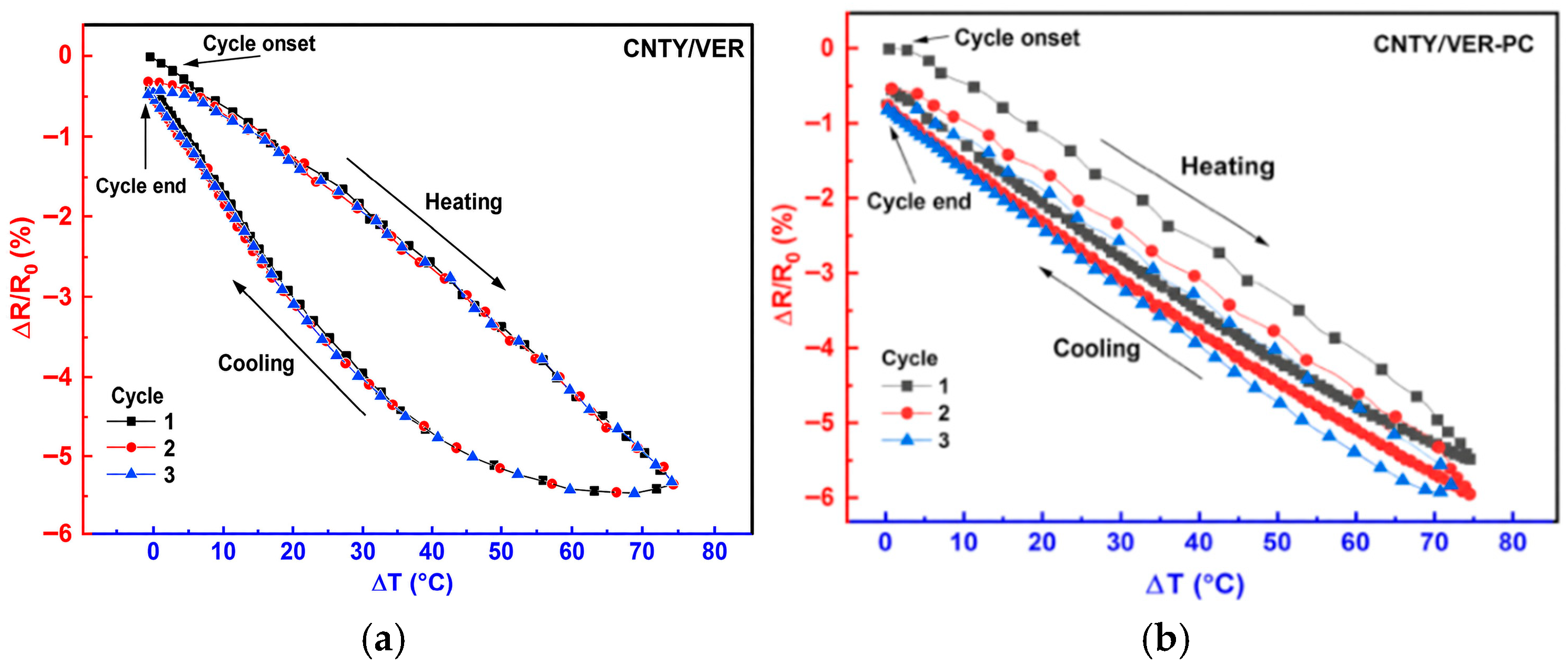
| CNTY/VER | −7.98 ± 0.07 | −8.32 ± 0.41 | −5.94 ± 0.14 | −0.13 ± 0.08 | 21.65 ± 2.5 |
| CNTY/VER-PC | −7.93 ± 0.21 | −7.13 ± 0.06 | −5.91 ± 0.07 | −0.20 ± 0.09 | 12.49 ± 1.4 |
Disclaimer/Publisher’s Note: The statements, opinions and data contained in all publications are solely those of the individual author(s) and contributor(s) and not of MDPI and/or the editor(s). MDPI and/or the editor(s) disclaim responsibility for any injury to people or property resulting from any ideas, methods, instructions or products referred to in the content. |
© 2026 by the authors. Licensee MDPI, Basel, Switzerland. This article is an open access article distributed under the terms and conditions of the Creative Commons Attribution (CC BY) license.
Share and Cite
Alowaid, M.; Tayyarian, T.; Guerra, I.G.; Erquiaga, M.A.; Alhabradi, N.; Kyabutwa, P.L.; Binfaris, A.S.; Zou, S.; Rodríguez Uicab, O.; Abot, J.L. Thermoresistive Characterization of Carbon Nanotube Yarn Monofilament Composites for Temperature Sensing. J. Compos. Sci. 2026, 10, 268. https://doi.org/10.3390/jcs10050268
Alowaid M, Tayyarian T, Guerra IG, Erquiaga MA, Alhabradi N, Kyabutwa PL, Binfaris AS, Zou S, Rodríguez Uicab O, Abot JL. Thermoresistive Characterization of Carbon Nanotube Yarn Monofilament Composites for Temperature Sensing. Journal of Composites Science. 2026; 10(5):268. https://doi.org/10.3390/jcs10050268
Chicago/Turabian StyleAlowaid, Majed, Tannaz Tayyarian, Iriana García Guerra, Maria Alexandra Erquiaga, Nader Alhabradi, Pythagore L. Kyabutwa, Abdulrahman S. Binfaris, Shouzhong Zou, Omar Rodríguez Uicab, and Jandro L. Abot. 2026. "Thermoresistive Characterization of Carbon Nanotube Yarn Monofilament Composites for Temperature Sensing" Journal of Composites Science 10, no. 5: 268. https://doi.org/10.3390/jcs10050268
APA StyleAlowaid, M., Tayyarian, T., Guerra, I. G., Erquiaga, M. A., Alhabradi, N., Kyabutwa, P. L., Binfaris, A. S., Zou, S., Rodríguez Uicab, O., & Abot, J. L. (2026). Thermoresistive Characterization of Carbon Nanotube Yarn Monofilament Composites for Temperature Sensing. Journal of Composites Science, 10(5), 268. https://doi.org/10.3390/jcs10050268