Article

Synthesis, Microstructure and Properties of Non-Stoichiometric High-Entropy Carbide (Nb0.2Ta0.2Ti0.2W0.2Zr0.2)Cx Powder


1
College of Materials Science & Engineering, North Minzu University, Yinchuan 750021, China
2
Institute of Semiconductor Crystals and Ceramic Materials, Helanshan Laboratory, Yinchuan 750021, China
3
Ningxia Key Laboratory of Intelligent Design and Manufacturing of Powder Materials, North Minzu University, Yinchuan 750021, China
*
Author to whom correspondence should be addressed.
J. Compos. Sci. 2026, 10(5), 258; https://doi.org/10.3390/jcs10050258
Submission received: 14 April 2026 / Revised: 1 May 2026 / Accepted: 6 May 2026 / Published: 10 May 2026

Abstract

Non-stoichiometric high-entropy carbides (Nb0.2Ta0.2Ti0.2W0.2Zr0.2)Cx (x = 0.71–0.85) nanoscale powders were prepared using oxides and carbon as raw materials via carbothermal reduction. The (Nb0.2Ta0.2Ti0.2W0.2Zr0.2)C0.73 synthesized at 1700 °C exhibited a grain size of approximately 400 nm, an oxygen content of 0.3 wt.%, and uniform nanoscale distribution of the five metal elements. After ball milling, (Nb0.2Ta0.2Ti0.2W0.2Zr0.2)C0.73 powder was sintered by spark plasma sintering to produce high-entropy ceramics with a relative density of 98.1% and an average particle size of about 5.3 μm. The Vickers hardness, nano-hardness, Young’s modulus, and fracture toughness were 17.6 GPa, 29.1 GPa, 514 GPa, and 5.3 MPa·m1/2, respectively. The thermal conductivity of the ceramic at room-temperature was as low as 8.5 W/m·K.

1. Introduction

High-entropy carbides are composed of multiple metal elements and carbon. Through flexible design of metal components and carbon content, their mechanical, thermal, and other properties can be controlled precisely [1,2]. Owing to their excellent high-temperature resistance, oxidation resistance, and wear resistance, high-entropy carbide ceramics show broad application prospects in thermal protection, thermal management components, and high-end cutting tools [3].
Compared to the exploration of multiple metal formulations [1,2,3,4,5], the significant influence of carbon vacancies on the densification, microstructure, mechanical and thermal properties of high-entropy carbides has attracted increasing attention [6,7,8,9]. The introduction of carbon vacancies lowers the densification temperature of high-entropy carbides [6], reduces their thermal conductivity [7], while also tuning their mechanical properties [8,9].
High-entropy carbide nanopowder is key to the preparation and performance improvement of high-entropy ceramics. Due to the size effect of nano-powder, the sintering temperature was reduced significantly, which solves the difficulty in densification of high-entropy carbides effectively [10], and ensuring compositional uniformity and phase stability [11]. In terms of performance, the synergy of nanostructure and high-entropy effect, through the combination of fine-grain strengthening and lattice distortion, has led to breakthrough improvements in the hardness, strength and toughness of the material [12]. At the same time, the high-density grain boundaries have significantly reduced the thermal conductivity [7]. These advantages provide a key material foundation for the application of high-entropy carbides in advanced fields such as ultra-high temperature components and thermal barrier coatings.
High-entropy carbide powders can be synthesized by carbothermal reduction [13,14,15,16,17,18], mechanical alloying [19], and precursor pyrolysis [20]. The carbothermal reduction method is currently the most mainstream approach. The molar ratio of carbon to metal oxide is controlled precisely, slightly below the theoretical value required for the complete reduction and formation of stoichiometric carbides [14,15,16]. Carbon-deficient (TiZrHfNbTa)Cₓ (x < 1) powders with uniform composition were synthesized via carbothermal reduction using five oxide powders and an insufficient amount of carbon black at 1700–2200 °C [17]. (ZrTiTaNbMo)C powders were synthesized via a magnesiothermic reduction process by Li et al. [18], which were a single-phase face-centered cubic (fcc) structure with an oxygen content of only 0.35 wt% and a particle size range of 5 to 60 μm. Research on the synthesis of carbon-deficient high-entropy carbide powders is still in its early stages, and the study of reduction reaction mechanisms and influencing factors is a key focus. The effects of carbon content and reaction temperature on the phase composition and microstructure of the synthesized powders remain to be clarified.
In this paper, high-entropy carbide nanoscale powders were prepared by carbothermal reduction, and the effects of synthesis temperature and carbon content on the phase and microstructure of the synthesized powders were investigated. In order to investigate the sinterability of the as-synthesized powder, it was sintered into high-entropy ceramics by SPS, and their mechanical and thermal properties were studied. The research results provide guidance for the preparation of high-entropy carbide powders and ceramics.

2. Materials and Methods

2.1. Synthesis

High-entropy carbide (Nb0.2Ta0.2Ti0.2W0.2Zr0.2)Cx powder was prepared by carbothermal reduction using Nb2O5 (purity > 99.9%, d50 = 1.0 μm), Ta2O5 (purity > 99.9%, d50 = 2.0 μm), TiO2 (purity > 99.9%, d50 = 1.0 μm), WO3 (purity > 99.9%, d50 = 1.5 μm), ZrO2 (purity > 99.9%, d50 = 1.0 μm), and carbon black (purity > 99.9%, d50 = 4.7 μm) as raw materials. The involved chemical equations are shown in Equations (1)–(6).
0.5Nb2O5 + 3.5C → NbC + 2.5CO
0.5Ta2O5 + 3.5C → TaC + 2.5CO
TiO2 + 3C → TiC + 2CO
WO3 + 4C → WC + 3CO
ZrO2 + 3C → ZrC + 2CO
0.2NbC + 0.2TaC + 0.2TiC + 0.2WC + 0.2ZrC → (Nb0.2Ta0.2Ti0.2W0.2Zr0.2)Cx
In the mixture, the metal atoms are in an equimolar ratio. The molar ratio of each oxide to C is 0.5:0.5:1:1:1:17. Preliminary experiments indicated that in this mixed oxide system, if the reaction is carried out according to the above ratio, there is a tendency for excess carbon in the sintered body. Therefore, to ensure complete carbothermal reduction and no residual carbon in the product, it is necessary to clarify the influence of the synthesis temperature (1500 °C–1700 °C) and the amount of C added (11.9–14.5, 70–85%) on the carbothermal reduction. The optimal formula of (Nb0.2Ta0.2Ti0.2W0.2Zr0.2)Cx was determined through phase analysis. The ratios of raw powders and sintering temperatures of (Nb0.2Ta0.2Ti0.2W0.2Zr0.2)Cx are listed in Table 1.
The five metal oxides and carbon powder were precisely weighed in the desired molar ratio. The weighed raw materials were placed in a WC-Co hard alloy ball milling jar, and the corresponding WC-Co hard alloy grinding balls were added with a ball-to-material ratio of 5:1. An appropriate amount of anhydrous ethanol was added as the ball milling medium, and the mixture was stirred for 10 h in a planetary ball mill. After ball milling, the obtained slurry was dried in an oven at 80 °C. Then, it was ground and sieved through a standard 200-mesh sieve.
Table 1. Ratios of raw powders and sintering temperatures of (Nb0.2Ta0.2Ti0.2W0.2Zr0.2)Cx.
No.Nominal Chemical FormulaRatio of Nb2O5, Ta2O5, TiO2, WO3, ZrO2, C (In Mole)Sintering Temperature
P70-15(Nb0.2Ta0.2Ti0.2W0.2Zr0.2)C0.700.5:0.5:1:1:1:11.91500
P70-155(Nb0.2Ta0.2Ti0.2W0.2Zr0.2)C0.700.5:0.5:1:1:1:11.91550
P70-16(Nb0.2Ta0.2Ti0.2W0.2Zr0.2)C0.700.5:0.5:1:1:1:11.91600
P70-165(Nb0.2Ta0.2Ti0.2W0.2Zr0.2)C0.700.5:0.5:1:1:1:11.91650
P70-17(Nb0.2Ta0.2Ti0.2W0.2Zr0.2)C0.700.5:0.5:1:1:1:11.91700
P71-17(Nb0.2Ta0.2Ti0.2W0.2Zr0.2)C0.710.5:0.5:1:1:1:121700
P73-17(Nb0.2Ta0.2Ti0.2W0.2Zr0.2)C0.730.5:0.5:1:1:1:12.41700
P75-17(Nb0.2Ta0.2Ti0.2W0.2Zr0.2)C0.750.5:0.5:1:1:1:12.81700
P77-17(Nb0.2Ta0.2Ti0.2W0.2Zr0.2)C0.770.5:0.5:1:1:1:13.11700
P80-17(Nb0.2Ta0.2Ti0.2W0.2Zr0.2)C0.800.5:0.5:1:1:1:13.61700
P85-17(Nb0.2Ta0.2Ti0.2W0.2Zr0.2)C0.850.5:0.5:1:1:1:14.51700
The sieved mixed powder was placed into a graphite crucible with a diameter of 35 mm and a height of 30 mm. This small crucible was placed inside a larger graphite crucible (Φ130 mm). Finally, the nested crucibles were transferred to a vacuum pressureless furnace (ZTY-50-23, Shanghai Chenrong, Shanghai, China), and the furnace atmosphere was set to high vacuum (<10−2 Pa). The temperature was raised at a constant rate of 10 °C/min to the target reaction temperature (1500–1700 °C) and held for 1 h. Then, the heating was stopped, and the furnace was allowed to cool naturally to room temperature. The reaction-sintered product was crushed and then finely ground in an agate mortar. Finally, it was sieved through a 200 mesh sieve to obtain the required high-entropy carbide (Nb0.2Ta0.2Ti0.2W0.2Zr0.2)Cx nanopowder.
A certain amount of the sieved high-entropy carbide powder was taken and placed into a cylindrical graphite mold with an inner diameter of 25 mm. Graphite paper was placed between the powder and the inner wall of the mold for isolation. Then, the assembled graphite mold was placed in the center of the SPS system (SPS-4, Shanghai Chenhua, Shanghai, China). At the initial stage, a minimum pre-pressure of 0.9 kN was applied to fix the mold. The vacuum was drawn to below 20 Pa. The temperature was raised at a rate of 100 °C/min to 600 °C. Simultaneously, the pressure was linearly increased from the initial pre-pressure to 30 MPa. Then, the temperature was further raised at a rate of 80 °C/min to 1950 °C, and the constant axial pressure of 30 MPa was maintained during this stage. Finally, the sample was held at the target sintering temperature of 1950 °C for 10 min under 30 MPa. After sintering, the heating and pressure systems were turned off, and the sample was naturally cooled to room temperature inside the furnace. After cooling, the sample was removed, and a planar grinding machine was used to remove approximately 1 mm from the top and bottom of the sample to eliminate possible oxidation or heat-affected layers. This ceramic block was labeled as C73-195 (Table 2).
In addition, to demonstrate the advantages of the reduction-sintering process in densifying carbide ceramics, a certain amount of the mixed and dried oxide–carbon powder (formula P73-17) was also sintered using SPS to obtain a ceramic block, labeled as C73-17-195 (Table 2). The sintering conditions were essentially the same as those for C73-195, except for the addition of a 10 min holding step at 1700 °C under 30 MPa.

2.2. Characterization and Analysis

To simulate the carbothermal reduction reaction between oxide and carbon in the mixed powder, differential thermal analysis–thermogravimetric analysis (TG-DSC) was conducted on the mixed powders after ball milling of the five oxides. The temperature range for thermal analysis was from 25 °C to 1450 °C. The heating rate was 30 °C/min from room temperature to 800 °C and 5 °C/min from 800 °C to 1450 °C under a nitrogen atmosphere. The phase composition of the sintered ceramic bulk was analyzed by X-ray diffraction (XRD, XRD-6000, Shimadzu, Japan) using a Cu-Kα radiation source (λ = 0.15405 nm), with an accelerating voltage of 40 kV and a current of 30 mA. The scanning range was from 10° to 80° at a rate of 2°/min. The diffraction patterns were analyzed using Jade (V6.2, Materials Data Inc., Livermore, CA, USA) with the Rietveld method, and the lattice parameters were calculated based on the positions of diffraction peaks (such as (111), (200), (220), (311), and (222)) The theoretical density of the high-entropy carbide ceramics was then calculated in combination with the chemical composition of the material. The actual density of the sintered ceramic was determined by the Archimedes method, and the relative density of the ceramic samples was calculated accordingly.
The grain size was analyzed by Nano Measurer software (Nano Measurer, 1.2, Department of Chemistry of Fudan University, Shanghai, China) based on Scanning electron microscopy (SEM) micrographs of the polished surface of the ceramic samples. More than 200 grains were randomly selected and their equivalent diameters were measured. The microstructure and crystallographic information of the ceramics were observed and analyzed with field emission scanning electron microscopy (FESEM, Zeiss Supra55, Carl Zeiss, Jena, Germany), high-resolution transmission electron microscopy (HRTEM, Talos F200X, FEI, Hillsboro, OR, USA), and selected area electron diffraction (SAED). Energy-dispersive X-ray spectroscopy (EDS, Octane Super, EDAX, Mahwah, NJ, USA) was used for elemental analysis to evaluate the uniformity of element distribution.
The micro-Vickers hardness tester (432SVD, Shanghai Wobert, Shanghai, China) was used to measure the hardness (Hv) on the polished surface. The indentation load was 98 N (10 kgf), and the holding time was 10 s. At least five different positions were tested for each sample, and the average value was taken as the final hardness. The nano-hardness (Hnano) and elastic modulus (E) were measured by nanoindentation using a nanoindentation tester (NST3, Anton Paar, Graz, Austria). The maximum load was 4.00 mN, the loading/unloading rate was 8.00 mN/min, and Poisson’s ratio was 0.3. The fracture toughness of the ceramic bulk was evaluated by the Vickers indentation method, and the fracture toughness of the ceramics was calculated according to the Anstis formula [21]. Since the Anstis formula is particularly suitable for calculating the fracture toughness of ceramic materials with a hardness of 16–20 GPa and a relative crack length ratio c/a of 2.5–3, the elastic modulus E and hardness H were measured and the formula was used to calculate the fracture toughness of high-entropy ceramics. The thermal conductivity of the ceramic samples was measured with a laser flash method thermal conductivity meter (LFA 467 HT, NETZSCH, Waldkraiburg, Germany) under a protective atmosphere of nitrogen, with a test temperature range of 25–1200 °C.

3. Results and Discussion

3.1. Thermal Analysis of Mixed Powders

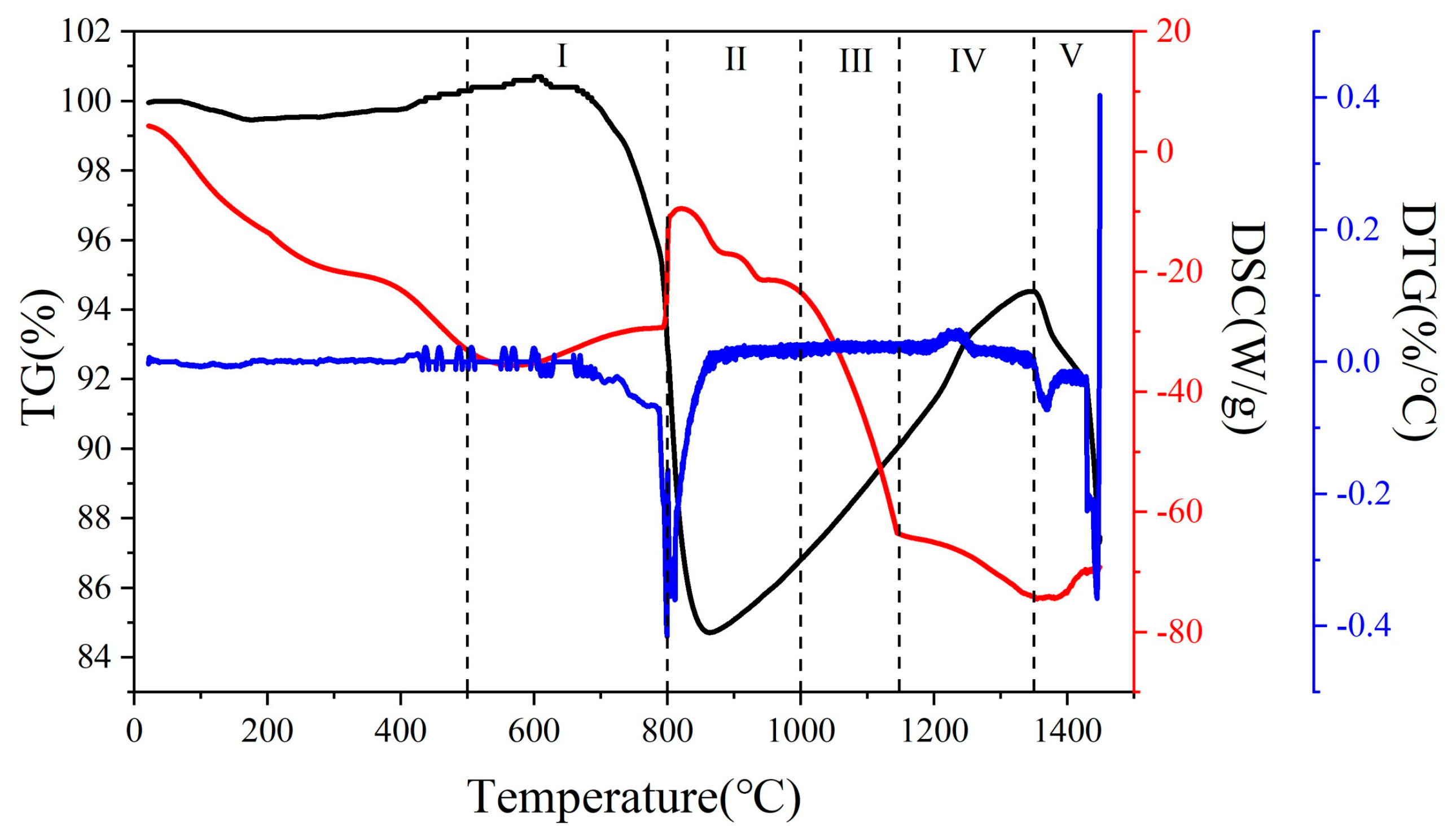
The thermal analysis results are shown in Figure 1.
In Figure 1, the reduction process of the mixed oxides can be divided into five stages based on the slope of the DSC curve. In Stage I, from 400 °C to 500 °C, the exothermic peak corresponds to the carbothermal reduction in WO3 in the mixture (Equation (4)) [22]. In Stage II, from 600 °C to 800 °C, the exothermic peak at 600 °C, accompanied by an increase in the weight loss rate, corresponds to the carbothermal reduction in Nb2O5 (Equation (1)) [23]. In Stage III, from 800 °C to 1000 °C, the exothermic peak at 900 °C corresponds to the carbothermal reduction in Ta2O5 (Equation (2)) [24]. In Stage IV, from 1000 °C to 1150 °C, the change in the exothermic rate and weight loss rate indicates that Ta2O5 and TiO2 undergo carbothermal reduction (Equations (2) and (3)) [22,25]. The exothermic rate and weight loss rate change again from 1300 °C to 1450 °C, corresponding to the carbothermal reduction in ZrO2 (Equation (5)) [26,27,28]. Thus, as the temperature increases, the reduction sequence of metal oxides is WO3, Nb2O5, Ta2O5 and TiO2, then ZrO2 in order.

3.2. (Nb0.2Ta0.2Ti0.2W0.2Zr0.2)Cx Powder

3.2.1. Phase Composition

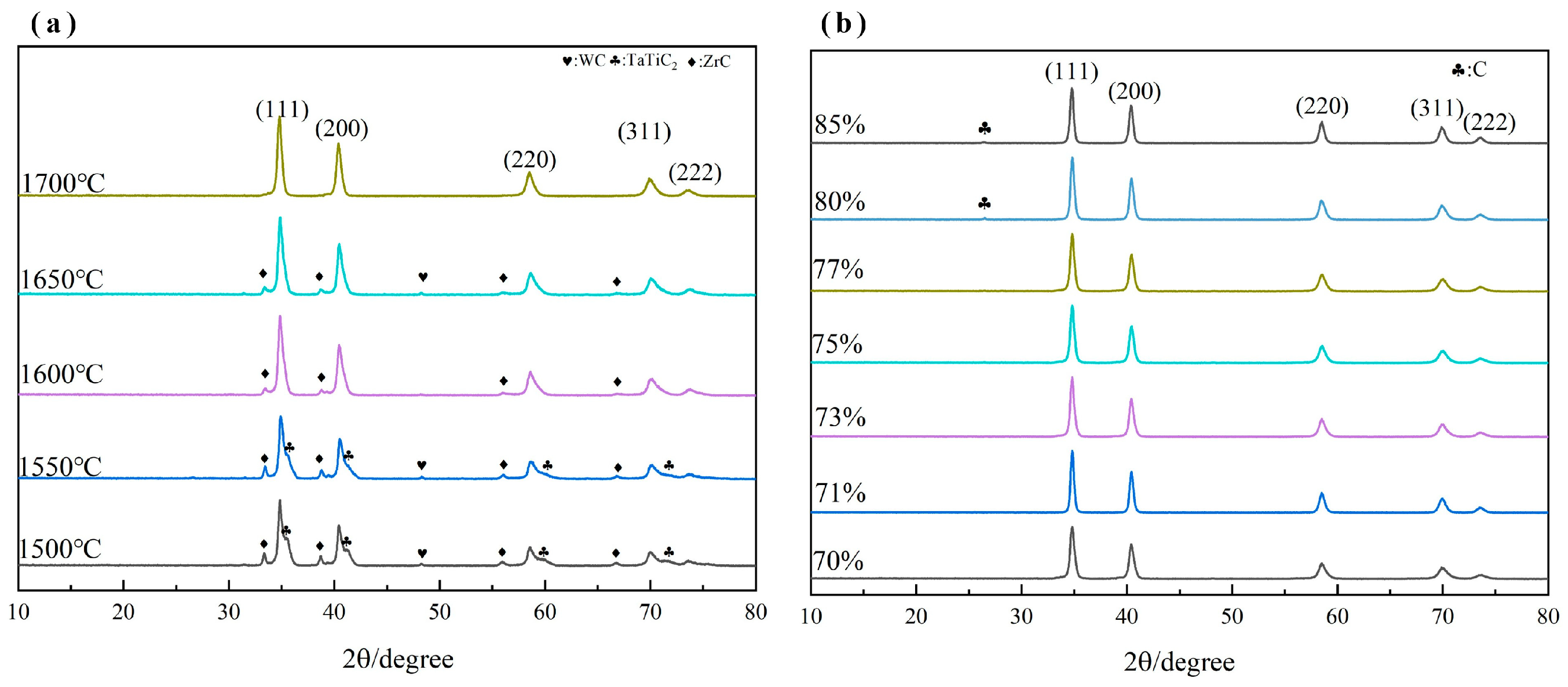
The phase composition of (Nb0.2Ta0.2Ti0.2W0.2Zr0.2)Cx powders synthesized at 1500 °C to 1700 °C with a carbon addition of 70% to 85% is shown in Figure 2.
In Figure 2, when the reaction temperature is 1500 °C, there are no obvious peaks of oxides in the products of formula P70-15, which indicates that all five oxides were converted into carbides at 1500 °C. This is consistent with the results calculated by Factsage during the carbothermal reduction process. In Figure 2, the high-entropy phase (Nb0.2Ta0.2Ti0.2W0.2Zr0.2)Cx and solid solution (TiTa)C2 [27,29] can be observed, as well as the diffraction peaks corresponding to WC and ZrC. The temperature of carbothermal reduction temperature of ZrO2 is the highest, and the formed ZrC cannot be completely dissolved into the high-entropy phase (Nb0.2Ta0.2Ti0.2W0.2Zr0.2)Cx or (TiTa)C2. The presence of WC may be due to the slow diffusion rate of W atoms in WC [28,30], which cannot be completely dissolved at low temperatures. As the reduction temperature increases, the solid solution (TiTa)C2 disappears at 1600 °C, and WC and ZrC disappear at 1700 °C. The half-peak width of the characteristic peaks of each crystal plane of the high-entropy phase narrows. Thus, an increase in the reduction temperature promotes the solid solution of carbides.
As the carbon addition gradually increases to 77%, the reduction products of P71-17 to P77-17 are similar to those with a carbon addition amount of 70%, all being a single high-entropy phase. When the carbon addition amount is further increased, residual C is observed in formulas P80-17 to P85-17. It indicates that in the oxide reduction system of this paper, no carbon residue occurs when the carbon content is 77% or less. Subsequent composition and microstructure analyses focused on P70-17 to P77-17.
When the reduction temperature is 1700 °C, the lattice constant and oxygen content of the high-entropy phase in the obtained (Nb0.2Ta0.2Ti0.2W0.2Zr0.2)Cx powder increase with increasing carbon addition. The lattice constants of the high-entropy phase in P70-17, P73-17, and P77-17 are 4.7380 Å, 4.7420 Å, and 4.7543 Å, respectively. The oxygen content of (Nb0.2Ta0.2Ti0.2W0.2Zr0.2)Cx powder is relatively low, initially decreasing from 0.36 wt% (P70-17) to 0.30 wt% (P73-17), and then increasing to 0.34 wt% (P77-17). Overall, the oxygen content of P71-17 to P77-17 remains stable at approximately 0.32 wt%.

3.2.2. Microstructure

SEM
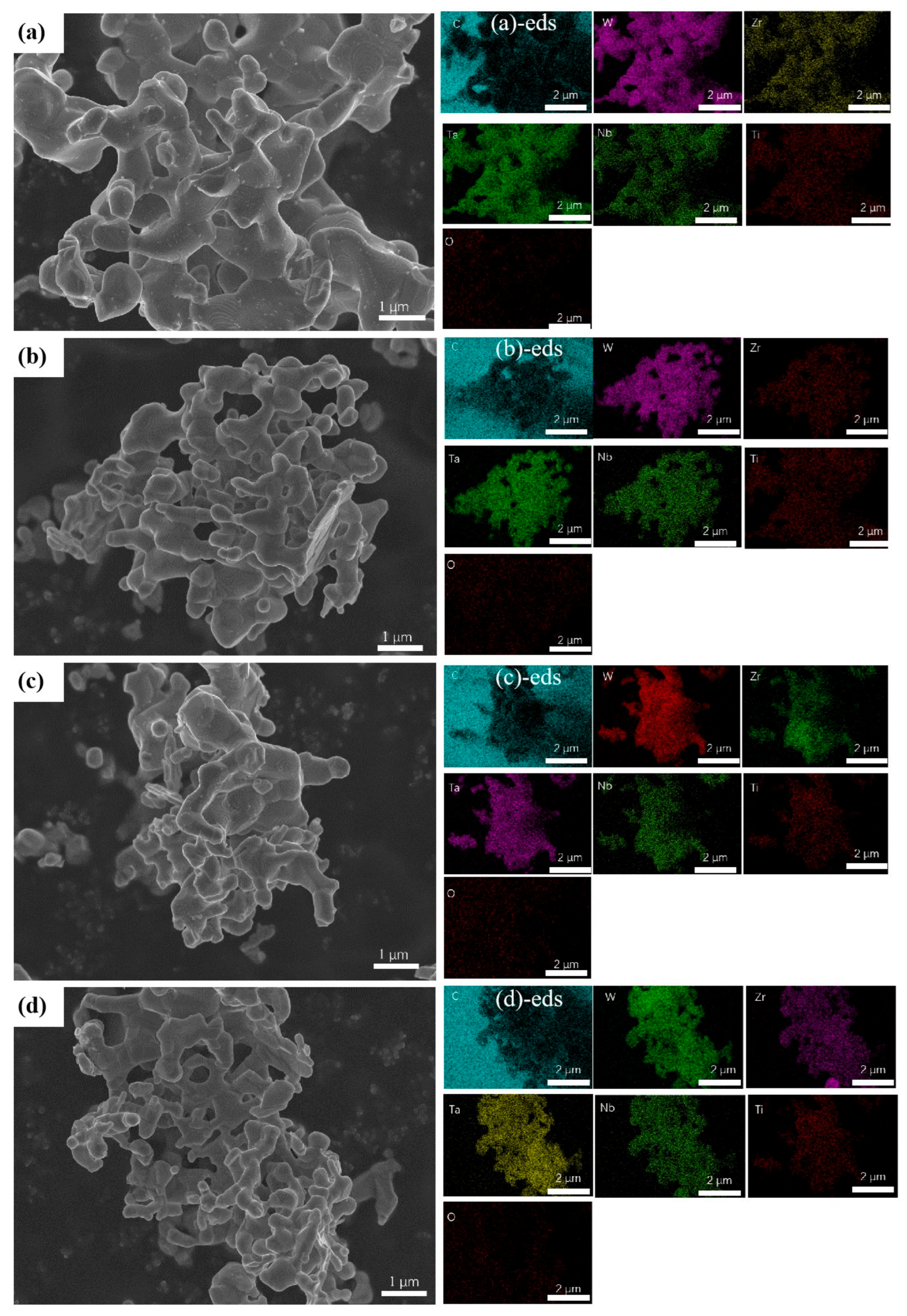
Figure 3a shows the SEM and EDS images of (Nb0.2Ta0.2Ti0.2W0.2Zr0.2)Cx prepared at a reduction temperature of 1700 °C.
As shown in Figure 3, the as-prepared (Nb0.2Ta0.2Ti0.2W0.2Zr0.2)Cx powder is a nano-powder with coral-like particles and hexagonal and spiral steps on the particle surface. Thus, during the carbon thermal reduction process for preparing high-entropy powder, the high-entropy carbide powder exhibits a screw dislocation growth mechanism [27]. As seen in Figure 3, Nb, Ti, Ta, Zr and W are distributed uniformly, and no segregation of any metal element is observed at the micrometer scale.
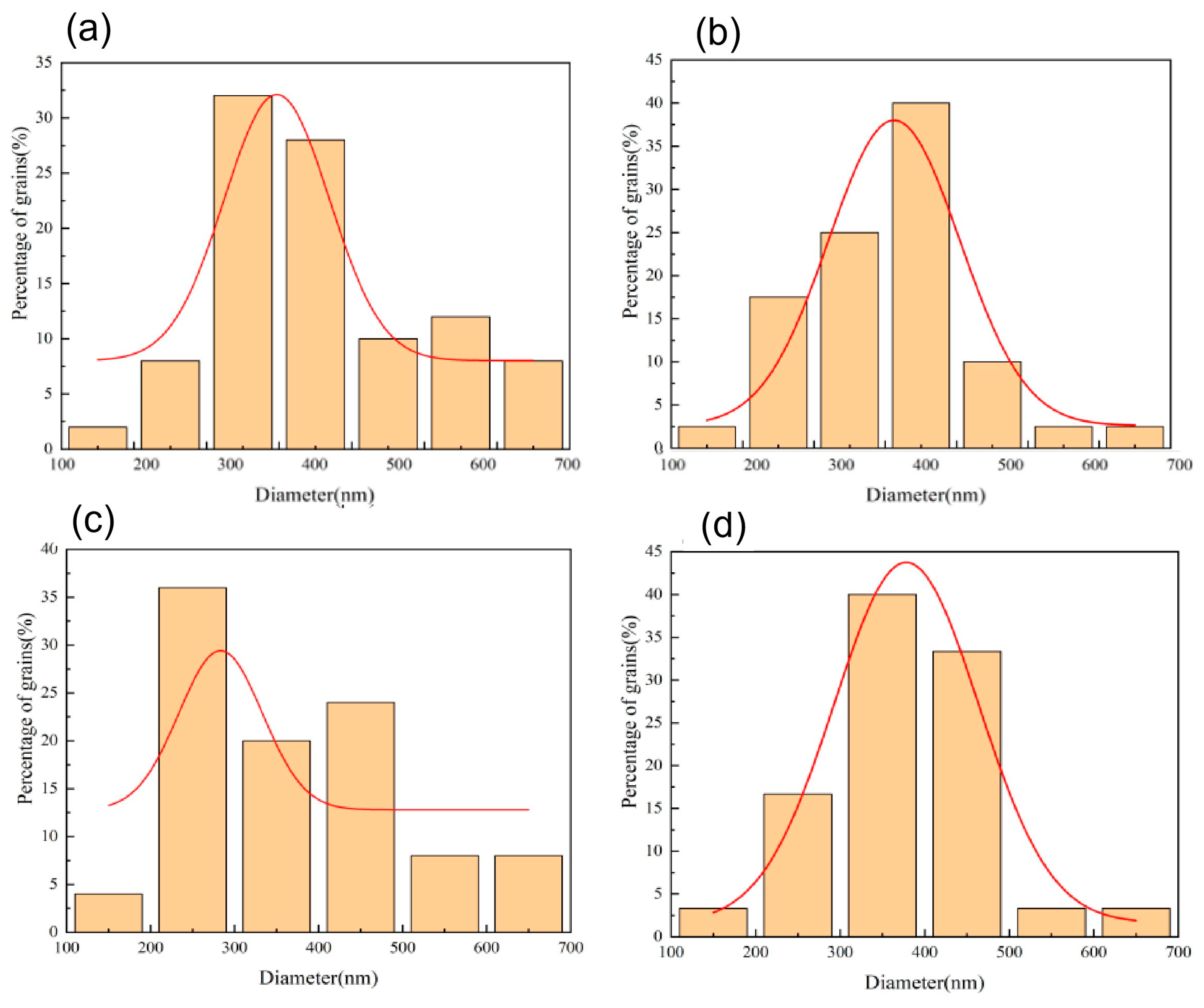
The phases of P70-17 to P77-17 are pure high-entropy phases. Therefore, the grain size of (Nb0.2Ta0.2Ti0.2W0.2Zr0.2)Cx was statistically analyzed by image analysis, and the results are shown in Figure 4. The average grain sizes of P71-17 to P77-17 are 350 ± 130 nm (P71-17), 400 ± 100 nm (P73-17), 430 ± 110 nm (P75-17), and 380 ± 100 nm (P77-17), respectively. Therefore, the carbon thermal reduction method can be used to prepare high-entropy carbide powder with a grain size of approximately 400 nm, and the grain size first increases and then decreases with increasing C addition. The possible reason for this variation is the competition between the reaction kinetics and thermodynamics under different carbon source conditions. When the carbon source is insufficient, residual oxygen impurities act as sintering promoters, causing the particles to grow larger [31]; when the carbon source is moderate, the crystallinity of the carbides increases and they grow fully through Ostwald ripening, resulting in the average particle size reaching its peak [32]; and when the carbon source is excessive, the excess carbon inhibits grain growth, causing the average particle size to decrease [33].
TEM
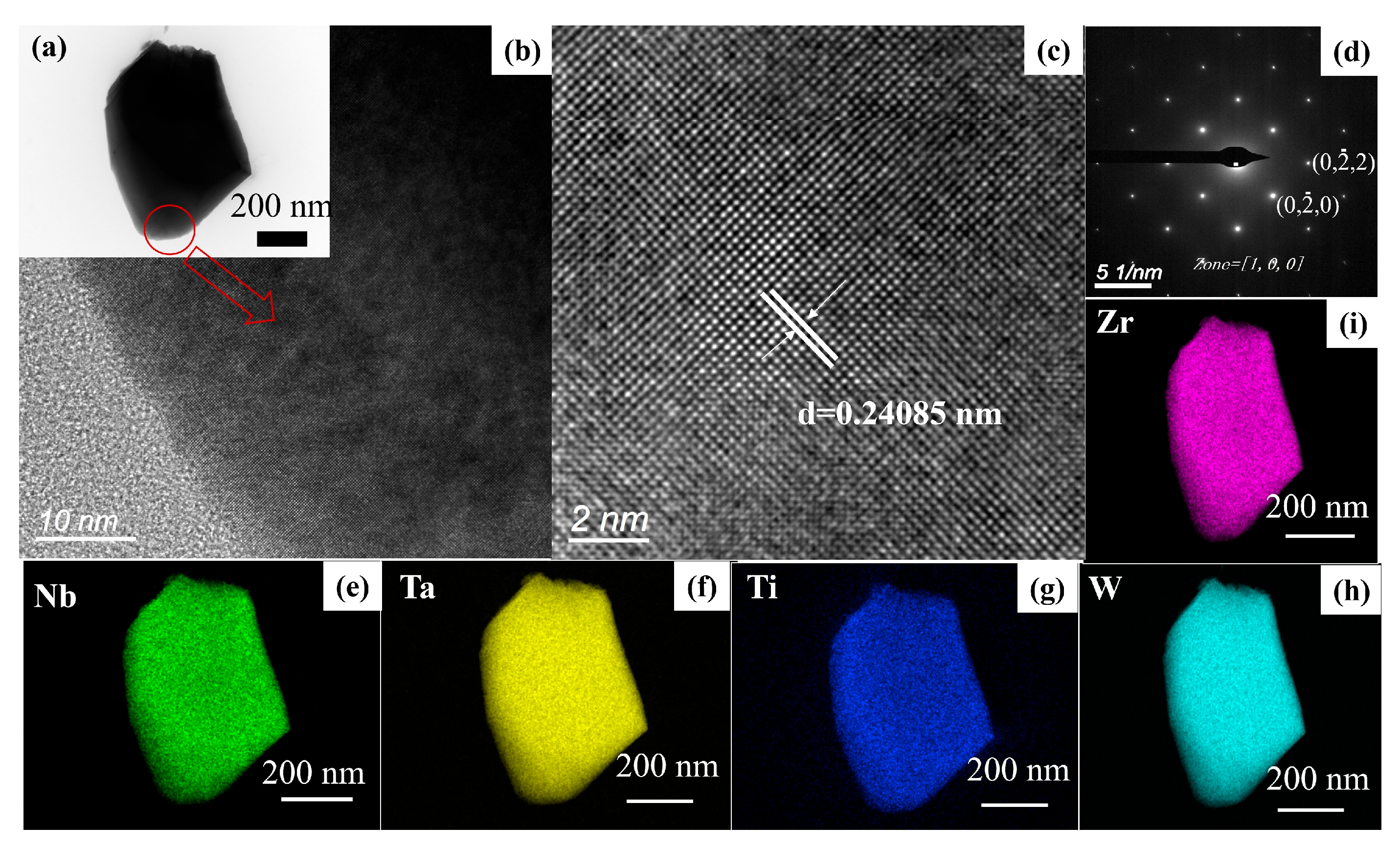
To analyze the crystal structure and nanoscale composition of the prepared (Nb0.2Ta0.2Ti0.2W0.2Zr0.2)Cx powder, TEM, EDS, and SAED characterization were conducted on the high-entropy carbide powder with a carbon addition of 73%, and the results are shown in Figure 5. Figure 5a shows the morphology of the P73-17 particle and its magnified image. In Figure 5b, the electron diffraction pattern of P73-17 is clear, indicating that the atoms in the crystal are arranged periodically. In Figure 5c, the lattice spacing d of P73-17 is 0.2409 nm, and the calculated lattice parameter is 4.6820 Å, which is comparable to the lattice parameter calculated by XRD (4.7420 Å). Figure 5d is the SAED pattern corresponding to Figure 5c, and its diffraction spot matrix is labeled as (0,0,2), (0,2(-),2), (0,2(-),0), corresponding to the fcc structure. No superlattice spots are observed in Figure 5d, indicating that the five metal atoms in the high-entropy carbide powder are randomly arranged with no fixed sequences at the lattice sites. As shown in Figure 5e–i, the elements Nb, Ti, Ta, Zr, and W in the high-entropy carbide are uniformly distributed at the nanoscale without segregation.

3.3. (Nb0.2Ta0.2Ti0.2W0.2Zr0.2)C0.73 Ceramics

3.3.1. Phase

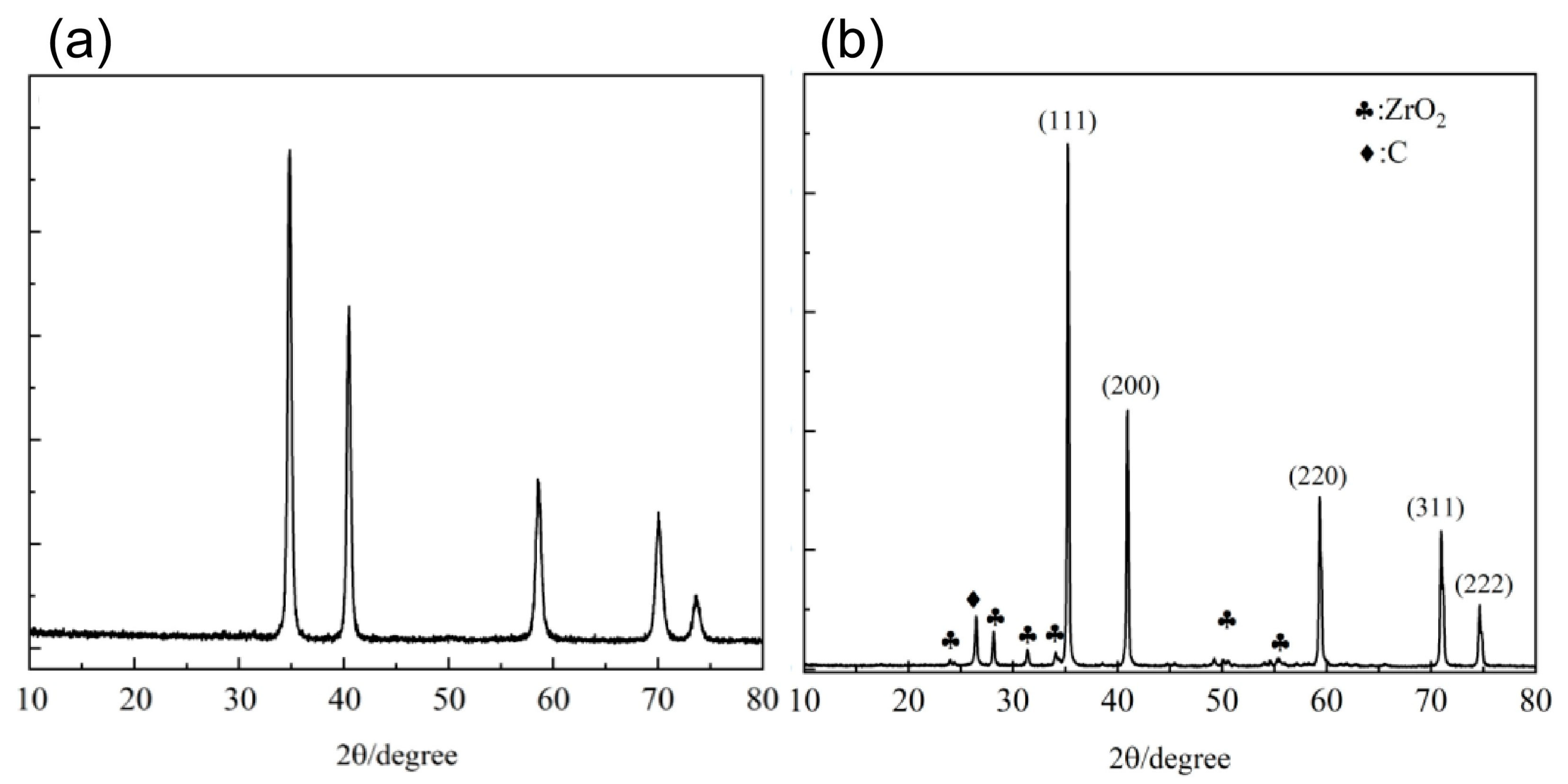
The P73-17 powder was sintered by SPS to form C73-17-195 ceramics and compared with C73-195 ceramics prepared by in situ reaction of oxides and carbon. The XRD patterns of C73-17-195 and C73-195 are shown in Figure 6, and the corresponding lattice constants are listed in Table 3. In Figure 6, the XRD pattern of C73-195 shows five characteristic peaks of the fcc structure in the range of 10° to 80°, with peaks at 35.2°, 40.9°, 59.3°, 70.9° and 74.6° corresponding to the (111), (200), (220), (311), and (222) planes, respectively. Its lattice constant is 4.404 Å. There are still relatively obvious diffraction peaks of ZrO2 and C, indicating that ZrO2 and C cannot react fully in this sintering process. Correspondingly, in the XRD pattern of C73-17-195, the five characteristic peaks shift to the left, the half-peak width narrows and the crystallinity is better. Its lattice constant is 4.457 Å.

3.3.2. Microstructure

The density and grain size of C73-195 and C73-17-195 are shown in Table 3. As indicated in Table 3, the relative density of C73-17-195 is 84.6%, while that of C73-195 is 98.1%. This indicates that the carbon thermal reduction method cannot fully react the oxides and achieve full densification under the conditions in Table 1. It may be related to gas evolution. However, under the same conditions, a relative density higher than 98% is achieved for C73-195, suggesting that the preparation process involves first preparing high-entropy nanoscale powders and then sintering them into bulk materials to improve the relative density of high-entropy carbides.
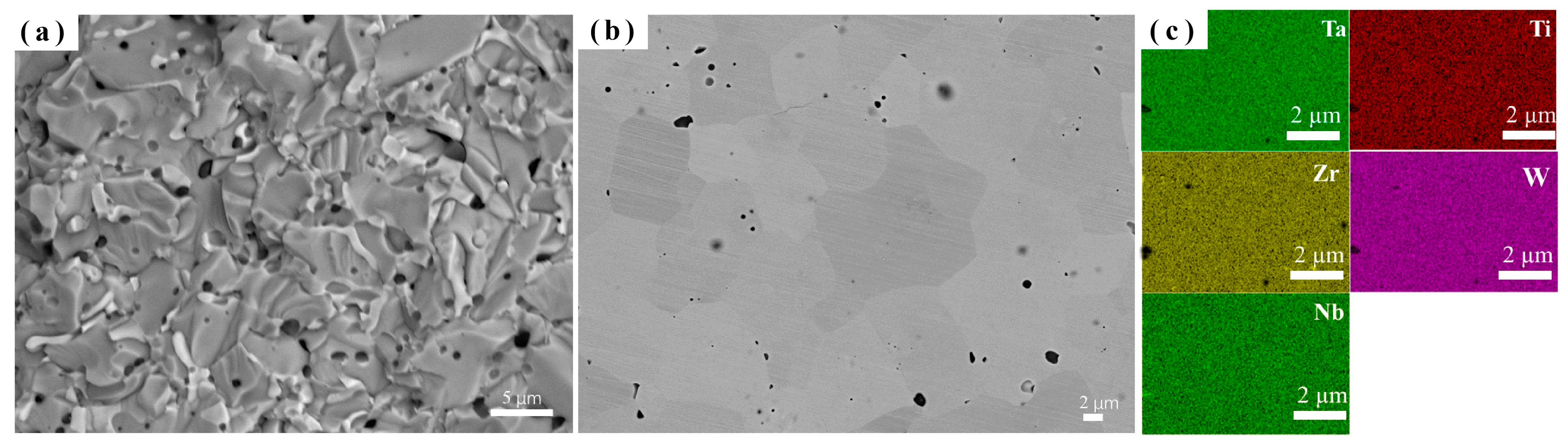
Figure 7 shows fractured and polished surfaces of the C73-195 and the corresponding elemental distribution on the polished surface. As shown in Figure 7a, there are many nanoscale pores on the fracture surface of C73-195, although its relative density is as high as 98.1% (Table 3). The fracture mode of C73-195 is mainly transgranular. In Figure 7b, the polished surface of C73-195 shows that the pores exist mainly within the high-entropy carbide grains. (Nb0.2Ta0.2Ti0.2W0.2Zr0.2)C0.73 shows equiaxed grains with uniform size and no abnormal growth, with an average grain size of 5.5 μm. In Figure 7c, the metal elements in C73-195 are uniformly distributed without segregation.
Due to the high relative density and uniform microstructure of C73-195, the evaluation of mechanical and thermal properties mainly focuses on C73-195 in this paper.

3.3.3. Mechanical and Thermal Properties

The mechanical properties and thermal conductivity of C73-195 are presented in Table 4 and Table 5, respectively. In Table 4, the Vickers hardness, nano-hardness, and Young’s modulus of C73-195 are approximately 17.6 GPa, 29.1 GPa, and 514 GPa, respectively. Its fracture toughness is 5.3 MPa·m1/2. The hardness is slightly lower than that of (TiVNbMoW)C4.375 reported by Li et al. [34], which is 19.4 GPa, but its toughness is higher than that of the latter (4.0 MPa·m1/2). The increase in carbon vacancies leads to a decrease in the hardness and modulus of high-entropy carbides, but an increase in ductility [35,36].
In Table 5, at 25 °C, the thermal conductivity of C73-195 is 8.5 W/m·K. The value is slightly higher than the 6.5 W/m·K of (Hf0.2Zr0.2Ta0.2Nb0.2Ti0.2)C reported by Yan et al. [37] and the 5.9 W/m·K of (Mo0.2Nb0.2Ta0.2Ti0.2W0.2)C0.9 reported by Hai et al. [16,30], but lower than the 9.1 W/m·K of (Zr0.25Ta0.25Nb0.25Ti0.25)C reported by Cody et al. [38]. With increasing temperature, the thermal conductivity of C73-195 gradually increases. At 1000 °C, the thermal conductivity of C73-195 is 20.6 W/m·K, slightly higher than the (16–19.5) W/m·K of (Mo0.2Ta0.2Ti0.2V0.2W0.2)C0.6–1.2 reported by Chen et al. [30]. At 1200 °C, the thermal conductivity of C73-195 is 22.9 W/m·K, which is lower than the 26.4 W/m·K of (Mo0.2Nb0.2Ta0.2Ti0.2W0.2)C0.9 reported by Hai et al. [16].

4. Conclusions

(1) High-purity (Nb0.2Ta0.2Ti0.2W0.2Zr0.2)Cx high-entropy carbide powder was prepared by carbothermal reduction using oxides and carbon as raw materials. The crystal structure is fcc. The grain size of (Nb0.2Ta0.2Ti0.2W0.2Zr0.2)C0.73 synthesized at 1700 °C is approximately 400 nm, with an oxygen content of 0.3 wt.%, and the five metal elements are uniformly distributed at the nanoscale.
(2) After the ball milling and SPS of (Nb0.2Ta0.2Ti0.2W0.2Zr0.2)C0.73 high-entropy powder, the relative density of the resulting (Nb0.2Ta0.2Ti0.2W0.2Zr0.2)C0.73 high-entropy ceramic is 98.1%, with an average grain size of approximately 5.3 μm. Its Vickers hardness is 17.6 GPa, nano-hardness is 29.1 GPa, Young’s modulus is 514 GPa, fracture toughness is 5.3 MPa·m1/2, and the thermal conductivity at room temperature is only 8.5 W/(m·K).

Author Contributions

Conceptualization, W.H.; writing—original draft preparation, W.H. and T.H.; writing—review and editing, S.Z., Z.Z., Z.M., B.H., C.H. and W.H.; supervision, W.H.; project administration, T.H.; funding acquisition, W.H. All authors have read and agreed to the published version of the manuscript.

Funding

This study was funded by the Natural Science Foundation of Ningxia Province, China (2025AAC030004), and the National-level College students’ Innovation and Entrepreneurship Training Program Project in 2025 (202511407002).

Data Availability Statement

All data generated or analyzed during this study are included in this published article.

Conflicts of Interest

The authors declare no conflicts of interest.

References

  1. Harrington, T.J.; Gild, J.; Sarker, P.; Toher, C.; Rost, C.M.; Dippo, O.F.; McElfresh, C.; Kaufmann, K.; Marin, E.; Borowski, L.; et al. Phase stability and mechanical properties of novel high entropy transition metal carbides. Acta Mater. 2019, 166, 271–280. [Google Scholar] [CrossRef]
  2. Hu, J.; Yang, Q.; Zhu, S.; Zhang, Y.; Yan, D.; Gan, K.; Li, Z. Superhard bulk high-entropy carbides with enhanced toughness via metastable in-situ particles. Nat. Commun. 2023, 14, 5717. [Google Scholar] [CrossRef] [PubMed]
  3. Wen, Z.; Liu, Y.; Yang, J.; Chen, Y.; Fu, Y.; Zhuang, L.; Yu, H.; Chu, Y. Exceptional Oxidation Resistance of High-Entropy Carbides up to 3600 °C. Adv. Mater. 2025, 37, 2507254. [Google Scholar] [CrossRef]
  4. Sarker, P.; Harrington, T.; Toher, C.; Oses, C.; Samiee, M.; Maria, J.-P.; Brenner, D.W.; Vecchio, K.S.; Curtarolo, S. High-entropy high-hardness metal carbides discovered by entropy descriptors. Nat. Commun. 2018, 9, 4980. [Google Scholar] [CrossRef] [PubMed]
  5. Cai, F.; Ni, D.; Dong, S. Research Progress of High-entropy Carbide Ultra-high Temperature Ceramics. J. Inorg. Mater. 2024, 39, 591–608. [Google Scholar] [CrossRef]
  6. Cao, Z.; Sun, J.; Meng, L.; Zhang, K.; Zhao, J.; Huang, Z.; Yun, X. Progress in densification and toughening of high entropy carbide ceramics. J. Mater. Sci. Technol. 2023, 161, 10–43. [Google Scholar] [CrossRef]
  7. Chen, L.; Zhang, W.; Lu, W.; Zhang, Q.; Zhou, F. Low thermal conductivity of dense (TiZrHfVNbTa)Cx high-entropy carbides by tailoring carbon stoichiometry. J. Adv. Ceram. 2023, 12, 49–58. [Google Scholar] [CrossRef]
  8. Hossain, M.D.; Borman, T.; Kumar, A.; Chen, X.; Khosravani, A.; Kalidindi, S.; Paisley, E.; Esters, M.; Oses, C.; Toher, C.; et al. Carbon stoichiometry and mechanical properties of high entropy carbides. Acta Mater. 2021, 215, 117051. [Google Scholar] [CrossRef]
  9. Csanadi, T.; Castle, E.; Reece, M.J.; Dusza, J. Strength enhancement and slip behaviour of high-entropy carbide grains during micro-compression. Sci. Rep. 2019, 9, 10200. [Google Scholar] [CrossRef]
  10. Kulyk, V.; Duriagina, Z.; Vasyliv, B.; Vavrukh, V.; Kovbasiuk, T.; Lyutyy, P.; Vira, V. The Effect of Sintering Temperature on the Phase Composition, Microstructure, and Mechanical Properties of Yttria-Stabilized Zirconia. Materials 2022, 15, 2707. [Google Scholar] [CrossRef]
  11. Chow, G.M. Chemical Synthesis and Processing of Nanostructured Particles and Coatings. In Nanostructured Materials; Chow, G.M., Noskova, N.I., Eds.; NATO ASI Series; Springer: Dordrecht, The Netherlands, 1998; Volume 50. [Google Scholar]
  12. Toher, C.; Oses, C.; Esters, M.; Hicks, D.; Kotsonis, G.N.; Rost, C.M.; Brenner, D.W.; Maria, J.-P.; Curtarolo, S. High-entropy ceramics: Propelling applications through disorder. MRS Bull. 2022, 47, 194–202. [Google Scholar] [CrossRef]
  13. Feng, L.; Fahrenholtz, W.G.; Hilmas, G.E.; Zhou, Y. Synthesis of single-phase high-entropy carbide powders. Scr. Mater. 2019, 162, 90–93. [Google Scholar] [CrossRef]
  14. Wei, X.-F.; Liu, J.-X.; Li, F.; Qin, Y.; Liang, Y.-C.; Zhang, G.-J. High entropy carbide ceramics from different starting materials. J. Eur. Ceram. Soc. 2019, 39, 2989–2994. [Google Scholar] [CrossRef]
  15. Song, J.; Chen, G.; Xiang, H.; Dai, F.; Dong, S.; Han, W.; Zhang, X.; Zhou, Y. Regulating the formation ability and mechanical properties of high-entropy transition metal carbides by carbon stoichiometry. J. Mater. Sci. Technol. 2022, 121, 181–189. [Google Scholar] [CrossRef]
  16. Hai, W.; Zhang, S.; Gong, M.; Feng, M.; Liu, M.; Chen, Y. Synthesis, microstructure, properties of nonstoichiometry high entropy carbide (MoNbTaTiW)C4.5. Int. J. Appl. Ceram. Technol. 2024, 21, 3152–3161. [Google Scholar] [CrossRef]
  17. Chicardi, E.; García-Garrido, C.; Gotor, F.J. Low temperature synthesis of an equiatomic (TiZrHfVNb)C5 high entropy carbide by a mechanically-induced carbon diffusion route. Ceram. Int. 2019, 45, 21858–21863. [Google Scholar] [CrossRef]
  18. Li, B.; Liu, C.; Fang, Z.; Yang, Z.; Ding, F.; Bai, L.; Wang, C.; Yuan, F. Synthesis of single-phase (ZrTi-TaNbMo)C high-entropy carbide powders via magnesiothermic reduction process. J. Eur. Ceram. Soc. 2022, 42, 6767–6773. [Google Scholar] [CrossRef]
  19. Dong, A.; Wang, G.; Liu, X.; Wang, J.; Shen, S.; Yu, Z.; Chen, B.; Liu, S. Research Progress on the Preparation and Application of High-Entropy Carbides. Mater. Sci. 2025, 15, 1667–1678. [Google Scholar]
  20. Sun, Y.; Ye, L.; Zhao, W.; Chen, F.; Qiu, W.; Han, W.; Liu, W.; Zhao, T. Preparation of High-Entropy Carbide Nanopowders by Liquid Polymer Precursor Method. J. Inorg. Mater. 2021, 36, 393–398. [Google Scholar] [CrossRef]
  21. Anstis, G.R.; Chantikul, P.; Lawn, B.R.; Marshall, D.B. A critical evaluation of indentation techniques for measuring fracture toughness: I, Direct crack measurements. J. Am. Ceram. Soc. 1981, 64, 533–538. [Google Scholar] [CrossRef]
  22. Wang, Q.; Wu, H.; Qin, M.; Li, Z.; Jia, B.; Chu, A.; Qu, X. Study on influencing factors and mechanism of high-quality tungsten carbide nanopowders synthesized via carbothermal reduction. J. Alloys Compd. 2021, 867, 158959. [Google Scholar] [CrossRef]
  23. Kwon, H.; Kim, W.; Kim, J. Stability Domains of NbC and Nb(CN) During Carbothermal Reduction of Niobium Oxide. J. Am. Ceram. Soc. 2015, 98, 315–319. [Google Scholar] [CrossRef]
  24. Feng, L.; Lee, S.H.; Yoon, B.L. Nano-TaC powder synthesized using modified spark plasma sintering apparatus and its densification. Ceram. Int. 2015, 41, 11637–11645. [Google Scholar] [CrossRef]
  25. Kim, B.S.; Woo, Y.C.; Kim, D.J. Synthesis of Ultra Fine TiC Powders by Carbothermal Reduction. Mater. Sci. Forum 2007, 534–536, 141–144. [Google Scholar] [CrossRef]
  26. Liu, S.-Y.; Zhang, S.; Liu, S.; Li, D.-J.; Niu, Z.; Li, Y.; Wang, S. Stability and mechanical properties of single-phase quinary high-entropy metal carbides: First-principles theory and thermodynamics. J. Eur. Ceram. Soc. 2022, 42, 3089–3098. [Google Scholar] [CrossRef]
  27. Wang, S.; Liu, M.; Liu, X.; Jia, Q.; Zhang, S. Carbothermal reduction synthesis of high porosity and low thermal conductivity ZrC-SiC ceramics via an one-step sintering technique. J. Eur. Ceram. Soc. 2022, 42, 4465–4471. [Google Scholar] [CrossRef]
  28. Liu, S.-Y.; Zhang, S.; Liu, S.; Li, D.-J.; Li, Y.; Wang, S. Phase stability, mechanical properties and melting points of high-entropy quaternary metal carbides from first-principles. J. Eur. Ceram. Soc. 2021, 41, 6267–6274. [Google Scholar] [CrossRef]
  29. Ye, B.; Ning, S.; Liu, D.; Wen, T.; Chu, Y. One-step synthesis of coral-like high-entropy metal carbide powders. J. Am. Ceram. Soc. 2019, 102, 6372–6378. [Google Scholar] [CrossRef]
  30. Chen, H.; Wu, Z.; Liu, M.; Hai, W.; Sun, W. Synthesis, microstructure and mechanical properties of high-entropy (VNbTaMoW)C5 ceramics. J. Eur. Ceram. Soc. 2021, 41, 7498–7506. [Google Scholar] [CrossRef]
  31. Xie, Z.; Zhou, D.; Yang, W.; Zhou, J.; Liu, C.; Hua, S. Preparation of nano-TiC powders by in-situ carbothermal reduction in vacuum. Iron Steel Vanadium Titan. 2017, 38, 38–42. [Google Scholar] [CrossRef]
  32. Li, J.; Luo, Y.; Su, Z.; Zhao, Z.; Chen, A.; Liu, X.; He, L.; Sun, F.; Chen, X. Preparation of ultrafine nano-scale tungsten carbide by hydrothermal synthesis of tungsten precursor—Carbothermal reduction—Carbonization. Rare Metal. Mat. Eng. 2024, 53, 321–329. [Google Scholar]
  33. Hassold, G.; Holm, E.; Srolovitz, D. Effects of particle size on inhibited grain growth. Scr. Metall. Et Mater. 1990, 24, 101–106. [Google Scholar] [CrossRef]
  34. Li, J.; Zhou, Y.; Su, Y.; Chen, S.; Sun, Q.; Fan, H.; Song, J.; Hu, L.; Zhang, Y. Synthesis and mechanical and elevated temperature tribological properties of a novel high-entropy (TiVNbMoW)C4.375 with carbon stoichiometry deviation. J. Adv. Ceram. 2023, 12, 242–257. [Google Scholar] [CrossRef]
  35. Chen, J.; Zhu, Y.; Chai, J.; Niu, L.; Yan, T.; Chen, B.; Shen, T.; Zang, H. Microstructure, mechanical, and thermal properties of (MoTaTiVW)Cx high entropy ceramics with different carbon stoichiometries. Ceram. Int. 2024, 50, 28168–28176. [Google Scholar] [CrossRef]
  36. Bai, Y.; Liang, Y.; Bi, J.; Cui, B.; Lu, Z.; Li, B. Role of carbon vacancies in determining the structural, mechanical, and thermodynamic properties of (HfTaZrNb)C1−x high entropy carbides: A first-principles study. J. Mater. Sci. 2024, 59, 19112–19124. [Google Scholar] [CrossRef]
  37. Yan, X.; Constantin, L.; Lu, Y.; Silvain, J.-F.; Nastasi, M.; Cui, B. (Hf0.2Zr0.2Ta0.2Nb0.2Ti0.2)C high-entropy ceramics with low thermal conductivity. J. Am. Ceram. Soc. 2018, 101, 4486–4491. [Google Scholar] [CrossRef]
  38. Dennett, C.A.; Hua, Z.; Lang, E.; Wang, F.; Cui, B. Thermal conductivity reduction in (Zr0.25Ta0.25Nb0.25Ti0.25)C high entropy carbide from extrinsic lattice defects. Mater. Res. Lett. 2022, 10, 611–617. [Google Scholar] [CrossRef]
Figure 1. Thermogravimetric curve of oxide mixture reacting with carbon.
Jcs 10 00258 g001
Figure 2. XRD patterns of (a) (Nb0.2Ta0.2Ti0.2W0.2Zr0.2)C0.70 synthesized at 1500 °C to 1700 °C, and (b) (Nb0.2Ta0.2Ti0.2W0.2Zr0.2)C0.70–0.85 synthesized at 1700 °C.
Jcs 10 00258 g002
Figure 3. SEM and EDS images of (Nb0.2Ta0.2Ti0.2W0.2Zr0.2)Cx sintered at 1700 °C, (a) P71-17, (b) P73-17, (c) P75-17, and (d) P77-17.
Jcs 10 00258 g003
Figure 4. Particle size distribution (a) P71-17, (b) P73-17, (c) P75-17, and (d) P77-17.
Jcs 10 00258 g004
Figure 5. The TEM images of P73-17, (ac) TEM images, (d) SAED patterns (c), and (ei) EDS mapping of metal elements.
Jcs 10 00258 g005
Figure 6. XRD patterns of (a) C73-17-195 and (b) C73-195 ceramics.
Jcs 10 00258 g006
Figure 7. SEM images and EDS mappings of C73-195, (a) SEM of fracture surface, (b) SEM image of polished surface, and (c) EDS mappings of elements.
Jcs 10 00258 g007
Table 2. Sintering conditions of (Nb0.2Ta0.2Ti0.2W0.2Zr0.2)Cx ceramics.
No.Nominal Chemical FormulaRatio of Nb2O5, Ta2O5, TiO2, WO3, ZrO2, C (In Mole)Sintering Condition
C73-195(Nb0.2Ta0.2Ti0.2W0.2Zr0.2)C0.730.5:0.5:1:1:1:12.41700 (PL, 1 h), 1950 (SPS, 30 MPa, 10 min)
C73-17-195(Nb0.2Ta0.2Ti0.2W0.2Zr0.2)C0.730.5:0.5:1:1:1:12.41700 (SPS, 30 MPa, 10 min), 1950 (SPS, 30 MPa, 10 min)
Table 3. Lattice parameters, density and grain size of (Nb0.2Ta0.2Ti0.2W0.2Zr0.2)C0.73 ceramics.
No.Lattice Parameter
Theoretical Density
/g/cm3
Measured Density
/g/cm3
Relative Density
/%
Grain Size
/μm
C73-17-1954.4049.377.93 ± 0.0384.6 ± 0.3-
C73-1954.4579.869.67 ± 0.0298.1 ± 0.15.5 ± 1.0
Table 4. Mechanical properties of C73-195.
Hv/GPaHnano/GPaYoung’s Modulus/GPaFracture Toughness/MPa·m1/2
17.6 ± 1.429.1 ± 2.3514 ± 335.3 ± 0.8
Table 5. Thermal conductivity of C73-195.
Temperature/°C2520040060080010001200
Thermal conductivity
/W/(m·K)
8.511.513.916.518.620.622.9
Disclaimer/Publisher’s Note: The statements, opinions and data contained in all publications are solely those of the individual author(s) and contributor(s) and not of MDPI and/or the editor(s). MDPI and/or the editor(s) disclaim responsibility for any injury to people or property resulting from any ideas, methods, instructions or products referred to in the content.