

One-Step Plasma–Solution Synthesis of Prussian Blue and Copper Hexacyanoferrate Composites for Selective Photocatalytic Dye Degradation

 , , ,
, , ,
Abstract
1. Introduction
2. Materials and Methods
3. Results and Discussions
3.1. Optical Emission Spectroscopy of Discharge
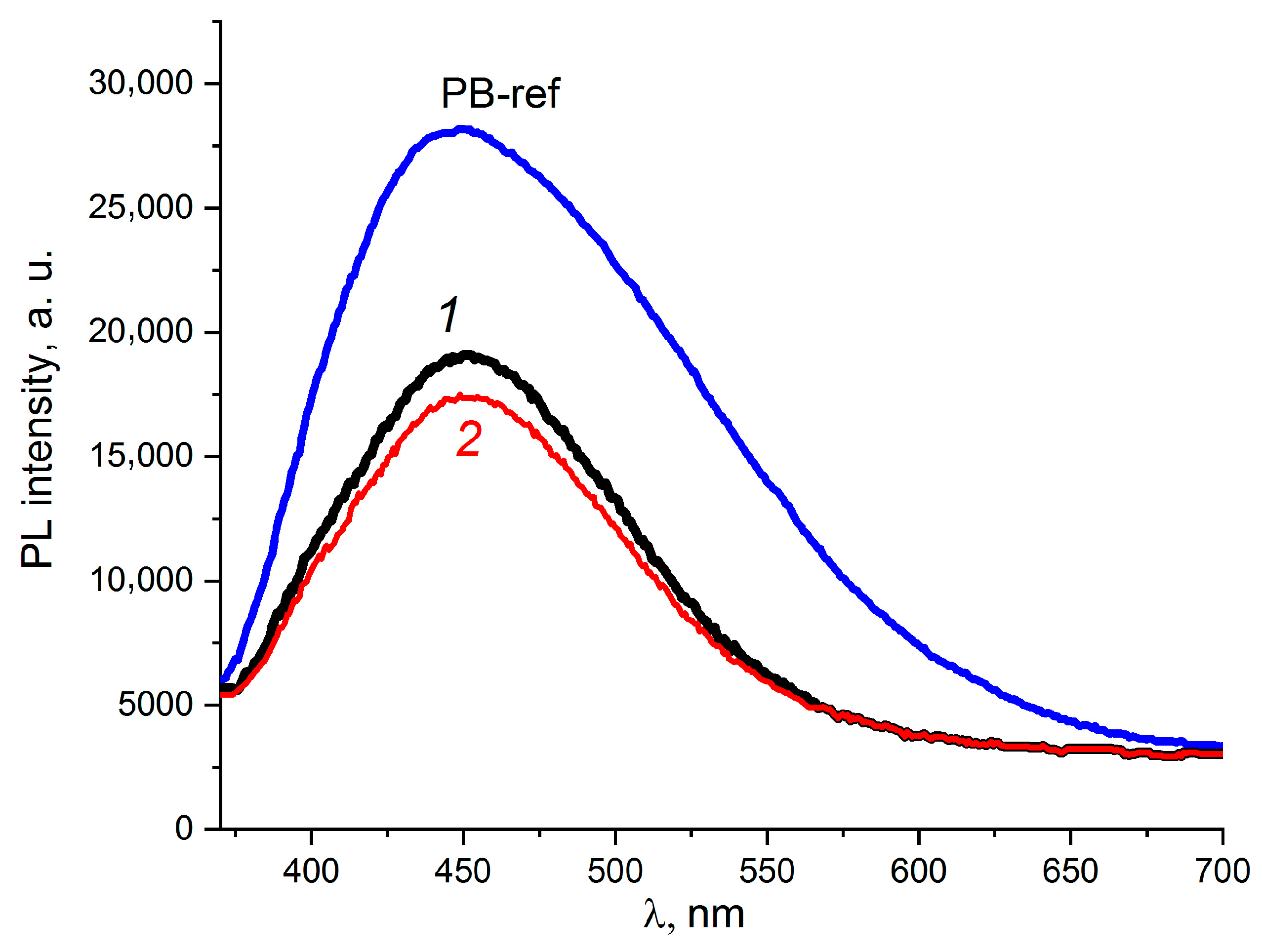
3.2. Optical Properties of Samples
3.3. Structural Features of Synthesized Composites
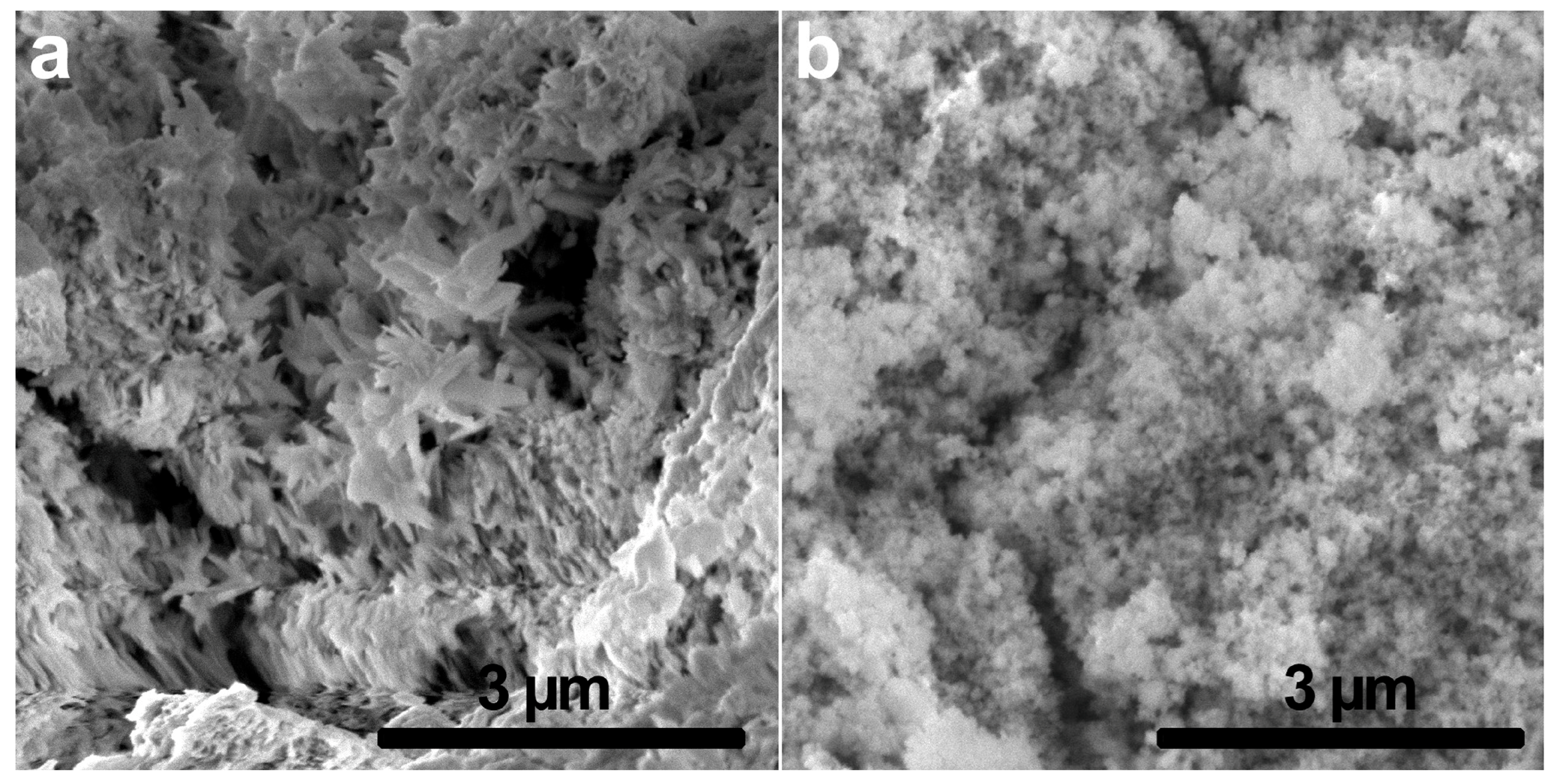
3.4. Morphological Features of Synthesized Samples
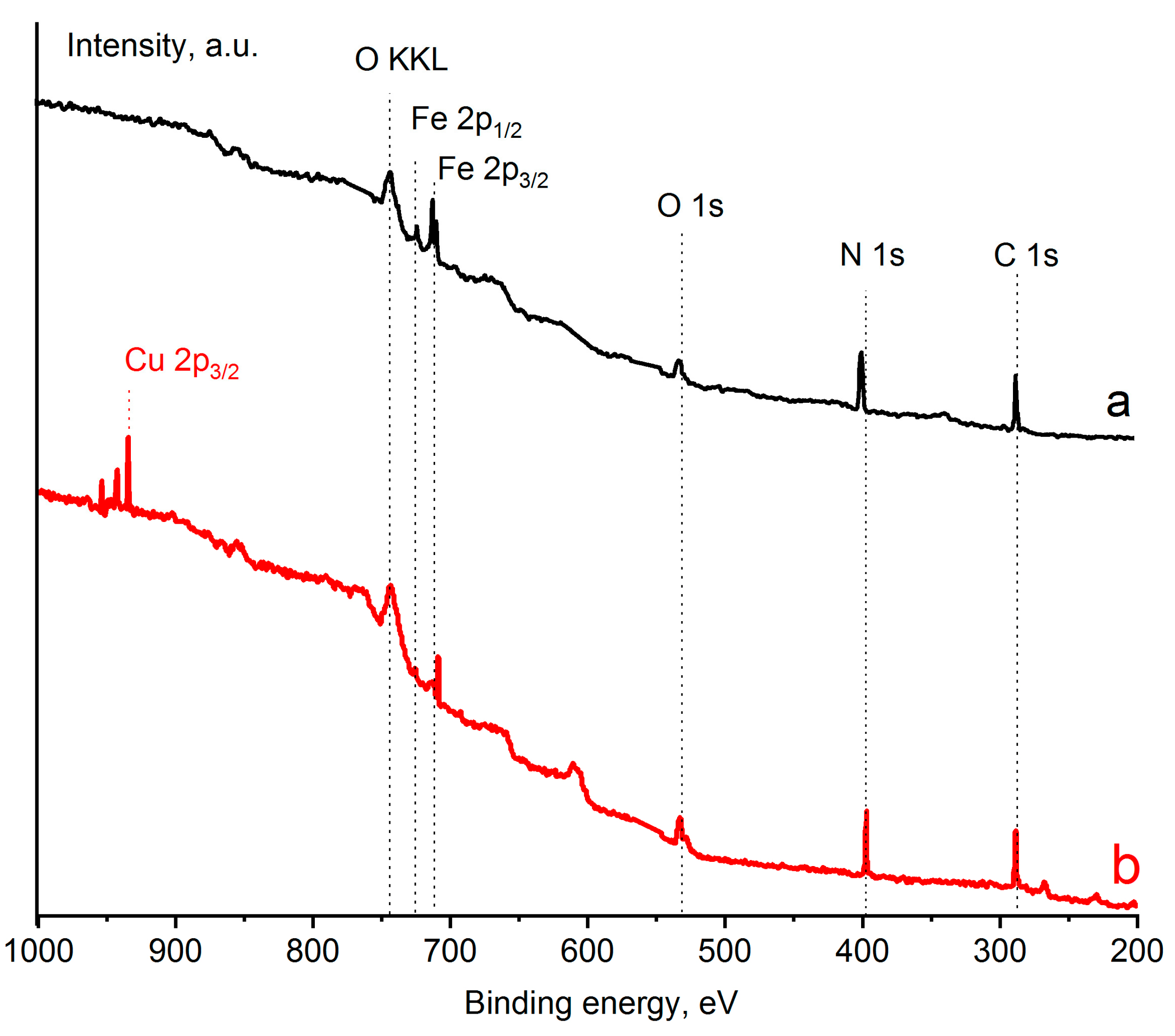
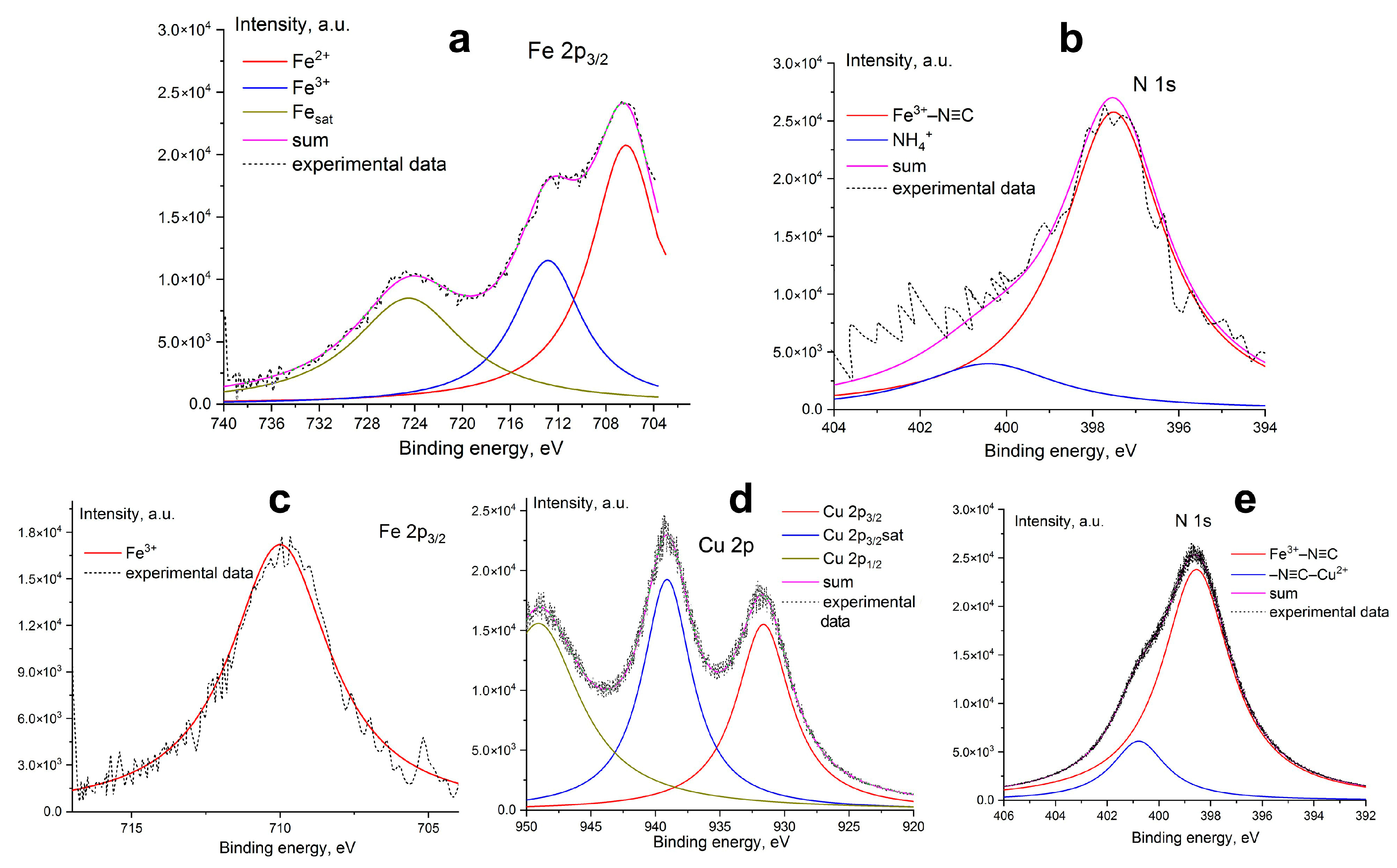
3.5. X-Ray Photoelectron Spectroscopy Studies of Samples
3.6. Proposed Mechanism of Composite Formation During Plasma–Liquid Synthesis
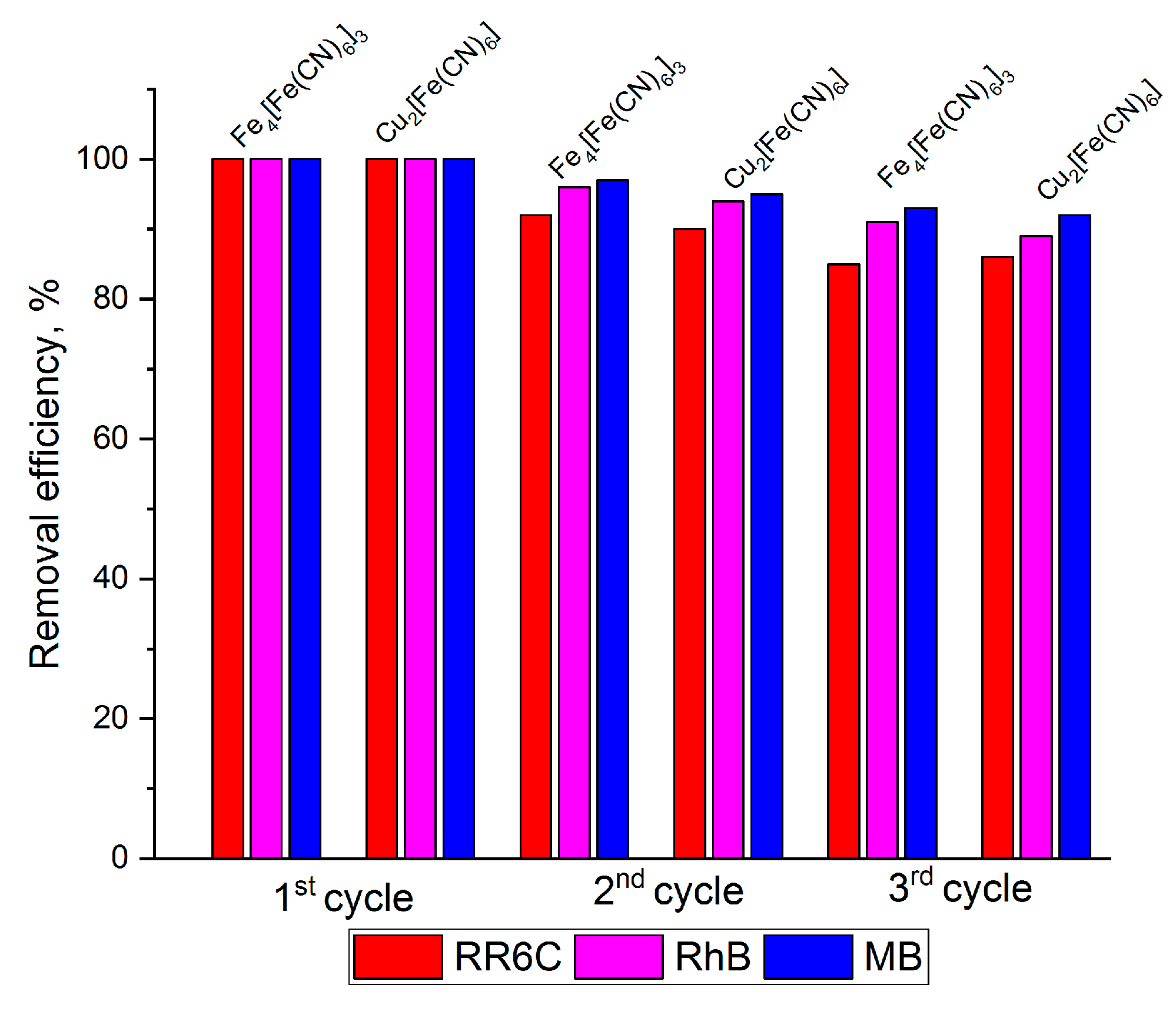
3.7. Photocatalytic Activity of Synthesized Materials
4. Conclusions
Author Contributions
Funding
Data Availability Statement
Acknowledgments
Conflicts of Interest
References
- Grandjean, F.; Samain, L.; Long, G.J. Characterization and utilization of Prussian blue and its pigments. Dalton Trans. 2016, 45, 18018–18044. [Google Scholar] [CrossRef]
- Keggin, J.F.; Miles, F.D. Structures and Formulæ of the Prussian Blues and Related Compounds. Nature 1936, 137, 577–578. [Google Scholar] [CrossRef]
- Buser, H.J.; Schwarzenbach, D.; Petter, W.; Ludi, A. The crystal structure of Prussian Blue: Fe4[Fe(CN)6]3·xH2O. Inorg. Chem. 1977, 16, 2704–2710. [Google Scholar] [CrossRef]
- Mansour, A.N.; Ko, J.K.; Waller, G.H.; Martin, C.A.; Zhang, C.; Qiao, X.; Wang, Y.; Zhou, X.; Balasubramanian, M. Structural Analysis of K4Fe(CN)6·3H2O, K3Fe(CN)6 and Prussian Blue. ECS J. Solid State Sci. Technol. 2021, 10, 103002. [Google Scholar] [CrossRef]
- Robin, M.B.; Day, P. Mixed Valence Chemistry-A Survey and Classification. In Mixed-Valence Chemistry-A Survey and Classification; Academic Press: Cambridge, MA, USA, 1968; pp. 247–422. [Google Scholar]
- Itaya, K.; Uchida, I.; Neff, V.D. Electrochemistry of polynuclear transition metal cyanides: Prussian blue and its analogues. Acc. Chem. Res. 1986, 19, 162–168. [Google Scholar] [CrossRef]
- Aguilà, D.; Prado, Y.; Koumousi, E.S.; Mathonière, C.; Clérac, R. Switchable Fe/Co Prussian blue networks and molecular analogues. Chem. Soc. Rev. 2016, 45, 203–224. [Google Scholar] [CrossRef]
- Ma, F.; Li, Q.; Wang, T.; Zhang, H.; Wu, G. Energy storage materials derived from Prussian blue analogues. Sci. Bull. 2017, 62, 358–368. [Google Scholar] [CrossRef]
- Guo, X.; Wang, Z.; Deng, Z.; Li, X.; Wang, B.; Chen, X.; Ong, S.P. Water contributes to higher energy density and cycling stability of Prussian blue analogue cathodes for aqueous sodium-ion batteries. Chem. Mater. 2019, 31, 5933–5942. [Google Scholar] [CrossRef]
- Wang, Q.; Li, J.; Jin, H.; Xin, S.; Gao, H. Prussian-blue materials: Revealing new opportunities for rechargeable batteries. InfoMat 2022, 4, e12311. [Google Scholar] [CrossRef]
- Li, D.; Liu, M.; Li, W.; Fu, Q.; Wang, L.; Lai, E.; Zhao, W.; Zhang, K. Synthesis of Prussian Blue Nanoparticles and Their Antibacterial, Antiinflammation and Antitumor Applications. Pharmaceuticals 2022, 15, 769. [Google Scholar] [CrossRef] [PubMed]
- Farah, A.M.; Billing, C.; Dikio, C.W.; Dibofori-Orji, A.N.; Oyedeji, O.O.; Wankasi, D.; Mtunzi, F.M.; Dikio, E.D. Synthesis of Prussian Blue and Its Electrochemical Detection of Hydrogen Peroxide Based on Cetyltrimethylammonium Bromide (CTAB) Modified Glassy Carbon Electrode. Int. J. Electrochem. Sci. 2013, 8, 12132–12146. [Google Scholar] [CrossRef]
- Adak, S.; Daemen, L.L.; Hartl, M.; Williams, D.; Summerhill, J.; Nakotte, H. Thermal expansion in 3d-metal Prussian Blue Analogs—A survey study. J. Solid State Chem. 2011, 184, 2854–2861. [Google Scholar] [CrossRef]
- Le, L.H.T.; Nguyen, S.A.; Nguyen, T.D.; Le, V.C.T.; Van Cao, H.; Nguyen, N.B.; Le, T.P.T. Prussian Blue Analogues of A2[Fe(CN)6] (A: Cu2+, Co2+, and Ni2+) and Their Composition-Dependent Sorption Performances towards Cs+, Sr2+, and Co2+. J. Nanomater. 2021, 2021, 5533620. [Google Scholar] [CrossRef]
- Karyakin, A.A. Prussian Blue and Its Analogues: Electrochemistry and Analytical Applications. Electroanalysis 2001, 13, 813–819. [Google Scholar] [CrossRef]
- Zakaria, M.B.; Hu, M.; Hayashi, N.; Tsujimoto, Y.; Ishihara, S.; Imura, M.; Suzuki, N.; Huang, Y.Y.; Sakka, Y.; Ariga, K.; et al. Thermal Conversion of Hollow Prussian Blue Nanoparticles into Nanoporous Iron Oxides with Crystallized Hematite Phase. Eur. J. Inorg. Chem. 2014, 2014, 1137–1141. [Google Scholar] [CrossRef]
- Arbenin, A.; Egorov, S.; Prikhodko, I.; Fedorova, A.; Penkova, A.; Selyutin, A. Prussian Blue Analogues Based on 3d-Metals as Cathode Materials for Magnesium Ion Batteries. Energies 2025, 18, 711. [Google Scholar] [CrossRef]
- Xu, S.; Qian, X.; Li, G. Size and morphology-controlled Ni2[Fe(CN)6]·xH2O Prussian Blue analogue fabricated via a hydrothermal route. Mater. Res. Bull. 2008, 43, 135–140. [Google Scholar] [CrossRef]
- Hu, L.; Zhang, P.; Chen, Q.-wang; Mei, J.-yang; Yan, N. Room-temperature synthesis of Prussian blue analogue Co3[Co(CN)6]2 porous nanostructures and their CO2 storage properties. RSC Adv. 2011, 1, 1574. [Google Scholar] [CrossRef]
- de Tacconi, N.R.; Rajeshwar, K.; Lezna, R.O. Metal Hexacyanoferrates: Electrosynthesis, in Situ Characterization, and Applications. Chem. Mater. 2003, 15, 3046–3062. [Google Scholar] [CrossRef]
- Han, L.; Galán-Mascarós, J.R. The Positive Effect of Iron Doping in the Electrocatalytic Activity of Cobalt Hexacyanoferrate. Catalysts 2020, 10, 130. [Google Scholar] [CrossRef]
- Rani, M.; Shanker, U. Insight in to sunlight-driven rapid photocatalytic degradation of organic dyes by hexacyanoferrate-based nanoparticles. Environ. Sci. Pollut. Res. 2021, 28, 5637–5650. [Google Scholar] [CrossRef]
- Vincent, T.; Vincent, C.; Barré, Y.; Guari, Y.; Le Saout, G.; Guibal, E. Immobilization of metal hexacyanoferrates in chitin beads for cesium sorption: Synthesis and characterization. J. Mater. Chem. A 2014, 2, 10007. [Google Scholar] [CrossRef]
- Torad, N.L.; Hu, M.; Imura, M.; Naito, M.; Yamauchi, Y. Large Cs adsorption capability of nanostructured Prussian Blue particles with high accessible surface areas. J. Mater. Chem. 2012, 22, 18261. [Google Scholar] [CrossRef]
- Sun, X.; Duffort, V.; Nazar, L.F. Prussian Blue Mg–Li Hybrid Batteries. Adv. Sci. 2016, 3, 1600044. [Google Scholar] [CrossRef] [PubMed]
- Wang, X.; Gao, C.; Zhang, S.; Li, J.; Wang, J.; Lin, S.; Lee, S.; Kang, F.; Zhai, D. Scalable mechanochemical synthesis of high-quality Prussian blue analogues for high-energy and durable potassium-ion batteries. Energy Environ. Sci. 2025, 18, 7869–7881. [Google Scholar] [CrossRef]
- Yang, Q.; Ma, Y.; Ye, Q.; Liu, Y.; Luo, Y.; Wu, Y.; Lin, X. Prussian blue analogues derived MO/MFe2O4 (M = Ni, Cu, Zn) nanoparticles as a high-performance anode material for enhanced lithium storage. Chin. J. Struct. Chem. 2025, 44, 100631. [Google Scholar] [CrossRef]
- Wessells, C.D.; Peddada, S.V.; McDowell, M.T.; Huggins, R.A.; Cui, Y. The Effect of Insertion Species on Nanostructured Open Framework Hexacyanoferrate Battery Electrodes. J. Electrochem. Soc. 2011, 159, A98–A103. [Google Scholar] [CrossRef]
- Zheng, H.; Zhang, G.; Yan, B.; Pang, H. Tailoring Prussian blue derivatives: Synthesis strategies and emerging applications. Adv. Funct. Mater. 2026, 36, e22461. [Google Scholar] [CrossRef]
- Wang, R.Y.; Shyam, B.; Stone, K.H.; Weker, J.N.; Pasta, M.; Lee, H.W.; Toney, M.F.; Cui, Y. Reversible Multivalent (Monovalent, Divalent, Trivalent) Ion Insertion in Open Framework Materials. Adv. Energy Mater. 2015, 5, 1401869. [Google Scholar] [CrossRef]
- Omarova, M.; Koishybay, A.; Yesibolati, N.; Mentbayeva, A.; Umirov, N.; Ismailov, K.; Adair, D.; Babaa, M.-R.; Kurmanbayeva, I.; Bakenov, Z. Nickel Hexacyanoferrate Nanoparticles as a Low Cost Cathode Material for Lithium-Ion Batteries. Electrochim. Acta 2015, 184, 58–63. [Google Scholar] [CrossRef]
- Mizuno, Y.; Okubo, M.; Hosono, E.; Kudo, T.; Zhou, H.; Oh-ishi, K. Suppressed Activation Energy for Interfacial Charge Transfer of a Prussian Blue Analog Thin Film Electrode with Hydrated Ions (Li+, Na+, and Mg2+). J. Phys. Chem. C 2013, 117, 10877–10882. [Google Scholar] [CrossRef]
- Lipson, A.L.; Han, S.-D.; Kim, S.; Pan, B.; Sa, N.; Liao, C.; Fister, T.T.; Burrell, A.K.; Vaughey, J.T.; Ingram, B.J. Nickel hexacyanoferrate, a versatile intercalation host for divalent ions from nonaqueous electrolytes. J. Power Sources 2016, 325, 646–652. [Google Scholar] [CrossRef]
- Wang, J.; Zhuang, S.; Liu, Y. Metal hexacyanoferrates-based adsorbents for cesium removal. Coord. Chem. Rev. 2018, 374, 430–438. [Google Scholar] [CrossRef]
- Liu, J.; Li, X.; Rykov, A.I.; Fan, Q.; Xu, W.; Cong, W.; Jin, C.; Tang, H.; Zhu, K.; Ganeshraja, A.S.; et al. Zinc-modulated Fe–Co Prussian blue analogues with well-controlled morphologies for the efficient sorption of cesium. J. Mater. Chem. A 2017, 5, 3284–3292. [Google Scholar] [CrossRef]
- Yang, H.; Sun, L.; Zhai, J.; Li, H.; Zhao, Y.; Yu, H. In situ controllable synthesis of magnetic Prussian blue/graphene oxide nanocomposites for removal of radioactive cesium in water. J. Mater. Chem. A 2014, 2, 326. [Google Scholar] [CrossRef]
- Liu, X.; Chen, G.-R.; Lee, D.-J.; Kawamoto, T.; Tanaka, H.; Chen, M.-L.; Luo, Y.-K. Adsorption removal of cesium from drinking waters: A mini review on use of biosorbents and other adsorbents. Bioresour. Technol. 2014, 160, 142–149. [Google Scholar] [CrossRef]
- Ayrault, S.; Jimenez, B.; Garnier, E.; Fedoroff, M.; Jones, D.J.; Loos-Neskovic, C. Sorption Mechanisms of Cesium on CuII2FeII(CN)6 and CuII3[FeIII(CN)6]2 Hexacyanoferrates and Their Relation to the Crystalline Structure. J. Solid State Chem. 1998, 141, 475–485. [Google Scholar] [CrossRef]
- Shanker, U.; Rani, M.; Jassal, V. Degradation of hazardous organic dyes in water by nanomaterials. Environ. Chem. Lett. 2017, 15, 623–642. [Google Scholar] [CrossRef]
- Rachna; Rani, M.; Shanker, U. Synergistic effects of zinc oxide coupled copper hexacyanoferrate nanocomposite: Robust visible-light driven dye degradation. J. Colloid Interface Sci. 2021, 584, 67–79. [Google Scholar] [CrossRef]
- Han, X.; He, W.-W.; Zhou, T.; Ma, S. Prussian blue analogue-derived materials for photocatalysis. Inorg. Chem. Front. 2024, 11, 3707–3730. [Google Scholar] [CrossRef]
- Vaijayanthi, K.; Dhivakar, G.; Kumar, M.D. Boosting the photocatalytic activity of Ce-PBA via hybridization with bio-derived N, P-doped carbon for efficient degradation of multi-target pollutants. J. Mater. Sci. Mater. Electron. 2026, 37, 165. [Google Scholar] [CrossRef]
- Sato, O.; Einaga, Y.; Fujishima, A.; Hashimoto, K. Photoinduced Long-Range Magnetic Ordering of a Cobalt−Iron Cyanide. Inorg. Chem. 1999, 38, 4405–4412. [Google Scholar] [CrossRef]
- Hegner, F.S.; Herraiz-Cardona, I.; Cardenas-Morcoso, D.; López, N.; Galán-Mascarós, J.-R.; Gimenez, S. Cobalt Hexacyanoferrate on BiVO4 Photoanodes for Robust Water Splitting. ACS Appl. Mater. Interfaces 2017, 9, 37671–37681. [Google Scholar] [CrossRef] [PubMed]
- Moss, B.; Hegner, F.S.; Corby, S.; Selim, S.; Francàs, L.; López, N.; Giménez, S.; Galán-Mascarós, J.-R.; Durrant, J.R. Unraveling Charge Transfer in CoFe Prussian Blue Modified BiVO4 Photoanodes. ACS Energy Lett. 2019, 4, 337–342. [Google Scholar] [CrossRef]
- Akbari, S.S.; Unal, U.; Karadas, F. Photocatalytic Water Oxidation with a CoFe Prussian Blue Analogue–Layered Niobate Hybrid Material. ACS Appl. Energy Mater. 2021, 4, 12383–12390. [Google Scholar] [CrossRef]
- Phul, R.; Jia, G.; Sekercileroglu, E.U.; Carstensen, Y.; De, R.; Dellith, A.; Dellith, J.; Plentz, J.; Karadaş, F.; Dietzek-Ivanšić, B. Photocatalytic Oxygen Evolution with Prussian Blue Coated ZnO Origami Core-Shell Nanostructures. ChemPhysChem 2025, 26, e202400847. [Google Scholar] [CrossRef] [PubMed]
- Matsuoka, H.; Tomita, O.; Tabe, H.; Suzuki, H.; Yamada, Y.; Abe, R. Cobalt hexacyanoferrate as an effective cocatalyst boosting water oxidation on oxynitride TaON photocatalyst under visible light. J. Photochem. Photobiol. A 2022, 426, 113753. [Google Scholar] [CrossRef]
- Sirotkin, N.A.; Khlyustova, A.V.; Titov, V.A.; Krayev, A.S.; Nikitin, D.I.; Dmitrieva, O.A.; Agafonov, A.V. Synthesis and Photocatalytic Activity of WO3 Nanoparticles Prepared by Underwater Impulse Discharge. Plasma Chem. Plasma Process. 2020, 40, 571–587. [Google Scholar] [CrossRef]
- Wiese, W.L. The Expanding NIST Atomic Spectra Database. Phys. Scr. 2003, T105, 85. [Google Scholar] [CrossRef]
- Khlyustova, A.; Sirotkin, N.; Kraev, A.; Titov, V.; Agafonov, A. Parameters of underwater plasma as a factor determining the structure of oxides (Al, Cu, and Fe). Materialia 2021, 16, 101081. [Google Scholar] [CrossRef]
- Wojdeł, J.C.; Moreira, I.d.P.R.; Bromley, S.T.; Illas, F. On the prediction of the crystal and electronic structure of mixed-valence materials by periodic density functional calculations: The case of Prussian Blue. J. Chem. Phys. 2008, 128, 044713. [Google Scholar] [CrossRef]
- Baioni, A.P.; Vidotti, M.; Fiorito, P.A.; Ponzio, E.A.; Córdoba de Torresi, S.I. Synthesis and Characterization of Copper Hexacyanoferrate Nanoparticles for Building Up Long-Term Stability Electrochromic Electrodes. Langmuir 2007, 23, 6796–6800. [Google Scholar] [CrossRef] [PubMed]
- Welegergs, G.G.; Akoba, R.; Sacky, J.; Nuru, Z.Y. Structural and optical properties of copper oxide (CuO) nanocoatings as selective solar absorber. Mater. Today Proc. 2021, 36, 509–513. [Google Scholar] [CrossRef]
- Bhatt, P.; Kumar, A.; Yusuf, S.M. Multifunctional Properties and Potential Applications of Prussian Blue Analogue Magnets. Chem. Mater. 2025, 37, 551–576. [Google Scholar] [CrossRef]
- Dacarro, G.; Taglietti, A.; Pallavicini, P. Prussian Blue Nanoparticles as a Versatile Photothermal Tool. Molecules 2018, 23, 1414. [Google Scholar] [CrossRef]
- Issler, M.V.C.; Vicente, C.; Brandt, I.S.; Baggio, B.F.; Faccio, R.; Tumelero, M.A.; Pasa, A.A. Dependence of the crystal structure of Prussian blue on the occupation of interstitial sites. Phys. Chem. Chem. Phys. 2025, 27, 15204–15212. [Google Scholar] [CrossRef]
- Cudennec, Y.; Lecerf, A. The transformation of Cu(OH)2 into CuO, revisited. Solid State Sci. 2003, 5, 1471–1474. [Google Scholar] [CrossRef]
- Agafonov, A.V.; Sirotkin, N.A.; Titov, V.A.; Khlyustova, A.V. Low-Temperature Underwater Plasma as an Instrument to Manufacture Inorganic Nanomaterials. Russ. J. Inorg. Chem. 2022, 67, 253–261. [Google Scholar] [CrossRef]
- Kettle, S.F.A.; Diana, E.; Boccaleri, E.; Stanghellini, P.L. The Vibrational Spectra of the Cyanide Ligand Revisited. Bridging Cyanides. Inorg. Chem. 2007, 46, 2409–2416. [Google Scholar] [CrossRef]
- Escax, V.; Bleuzen, A.; Cartier dit Moulin, C.; Villain, F.; Goujon, A.; Varret, F.; Verdaguer, M. Photoinduced Ferrimagnetic Systems in Prussian Blue Analogues CIxCoy[Fe(CN)6]z (CI = Alkali Cation). 3. Control of the Photo- and Thermally Induced Electron Transfer by the [Fe(CN)6] Vacancies in Cesium Derivatives. J. Am. Chem. Soc. 2001, 123, 12536–12543. [Google Scholar] [CrossRef]
- Nakamoto, K. Infrared and Raman Spectra of Inorganic and Coordination Compounds. Part A: Theory and Applications in Inorganic Chemistry, 6th ed.; Wiley: Hoboken, NJ, USA, 2009; ISBN 978-0-470-74339-2. [Google Scholar]
- Moeser, B.; Janoschka, A.; Wolny, J.A.; Paulsen, H.; Filippov, I.; Berry, R.E.; Zhang, H.; Chumakov, A.I.; Walker, F.A.; Schünemann, V. Nuclear Inelastic Scattering and Mössbauer Spectroscopy as Local Probes for Ligand Binding Modes and Electronic Properties in Proteins: Vibrational Behavior of a Ferriheme Center inside a β-Barrel Protein. J. Am. Chem. Soc. 2012, 134, 4216–4228. [Google Scholar] [CrossRef]
- Rodrigues, W.V.; Nascimento, S.Q.; Silva, W.Y.S.; Quinzeiro, S.F.L.; Luz, R.A.S.; Cantanhêde, W. Structural reorganization of CuO/Cu2[Fe(CN)6] nanocomposite: Characterization and electrocatalytic effect for the hydrogen peroxide reduction. An. Acad. Bras. Cienc. 2020, 92, e20190433. [Google Scholar] [CrossRef]
- Lejeune, J.; Brubach, J.-B.; Roy, P.; Bleuzen, A. Application of the infrared spectroscopy to the structural study of Prussian blue analogues. Comptes Rendus Chim. 2014, 17, 534–540. [Google Scholar] [CrossRef]
- Oliver, B.G.; Davis, A.R. Vibrational Spectroscopic Studies of Aqueous Alkali Metal Bicarbonate and Carbonate Solutions. Can. J. Chem. 1973, 51, 698–702. [Google Scholar] [CrossRef]
- Liang, G.; Li, X.; Bao, S.; Gao, H.; Zhu, F.; Wu, Q. Large-scale synthesis of organometallic polymer flowers with ultrathin petals for hydrogen peroxide sensing. Polym. Chem. 2015, 6, 4447–4454. [Google Scholar] [CrossRef]
- Shen, Y.-M.; Gao, M.-Y.; Chen, X.; Shen, A.-G.; Hu, J.-M. Fine synthesis of Prussian-blue analogue coated gold nanoparticles (Au@PBA NPs) for sorting specific cancer cell subtypes. Spectrochim. Acta A Mol. Biomol. Spectrosc. 2021, 252, 119566. [Google Scholar] [CrossRef] [PubMed]
- Ma, S.-W.; Wang, S.-L.; Yang, X.-L.; Gou, L.-Q.; Huang, Q.; Tao, G.-H.; He, L. Prussian blue analog-based ionic liquid for highly efficient cesium removal from wastewater. Chem. Eng. J. 2025, 504, 158803. [Google Scholar] [CrossRef]
- Kettle, S.F.A.; Diana, E.; Marchese, E.M.C.; Boccaleri, E.; Stanghellini, P.L. The vibrational spectra of the cyanide ligand revisited: The ν(CN) infrared and Raman spectroscopy of Prussian blue and its analogues. J. Raman Spectrosc. 2011, 42, 2006–2014. [Google Scholar] [CrossRef]
- Kaye, S.S.; Long, J.R. Hydrogen Storage in the Dehydrated Prussian Blue Analogues M3[Co(CN)6]2 (M = Mn, Fe, Co, Ni, Cu, Zn). J. Am. Chem. Soc. 2005, 127, 6506–6507. [Google Scholar] [CrossRef]
- Gayda, G.; Demkiv, O.; Stasyuk, N.; Klepach, H.; Serkiz, R.; Nakonechny, F.; Gonchar, M.; Nisnevitch, M. Copper Hexacyanoferrates Obtained via Flavocytochrome b2 Assistance: Characterization and Application. Biosensors 2025, 15, 157. [Google Scholar] [CrossRef]
- Zhang, Y.; Jin, F.; Liu, H.; Jin, Z. In-situ XPS monitoring bimetallic Prussian blue analogs and metal oxides heterojunction for photocatalytic hydrogen production. Fuel 2024, 361, 130655. [Google Scholar] [CrossRef]
- Baker, M.A.; Fakhouri, H.; Grilli, R.; Pulpytel, J.; Smith, W.; Arefi-Khonsari, F. Effect of total gas pressure and O2/N2 flow rate on the nanostructure of N-doped TiO2 thin films deposited by reactive sputtering. Thin Solid Films 2014, 552, 10–17. [Google Scholar] [CrossRef]





| Parameter | Sample | |
|---|---|---|
| Fe4[Fe(CN)6]3 | Cu2[Fe(CN)6] | |
| SBET (m2/g) | 8.74 | 3.82 |
| SBJH (m2/g) | 6.57 | 2.87 |
| Dpore (nm) | 4.05 | 4.82 |
| Vpore (cm3/g) | 0.011 | 0.005 |
| Dye | k1, min−1 | R12 | k2, L mg−1 min−1 | R22 |
|---|---|---|---|---|
| Fe4[Fe(CN)6]3 | ||||
| RR6C | 0.041 ± 0.003 | 0.95 | 0.0042 ± 0.0005 | 0.89 |
| RhB | 0.044 ± 0.007 | 0.94 | 0.0048 ± 0.0006 | 0.87 |
| MB | 0.038 ± 0.002 | 0.93 | 0.0039 ± 0.0004 | 0.88 |
| Cu2[Fe(CN)6] | ||||
| RR6C | 0.048 ± 0.005 | 0.96 | 0.0050 ± 0.0005 | 0.91 |
| RhB | 0.045 ± 0.008 | 0.95 | 0.0046 ± 0.0007 | 0.88 |
| MB | 0.032 ± 0.003 | 0.92 | 0.0021 ± 0.0003 | 0.84 |
| Parameter | Co-Precipitation [11,12] | Hydrothermal [18,19] | Electrochemical [20,21] | Mechanochemical [24] | This Work (Plasma–Liquid) |
|---|---|---|---|---|---|
| Synthesis time | Minutes–hours | Hours–days | Minutes–hours | 10–60 min | 30 min |
| Number of steps | ≥2 | ≥2 | 1–2 | 1 | 1 |
| Organic solvents | Often | Often | Rarely | No | No |
| Additional reagents (stabilizers, reducers) | Yes | Yes | No | No | No |
| Product yield, % | 60–90 | 70–95 | 50–80 | 70–90 | 75–79 |
| SBET, m2/g | 200–600 | 150–500 | 100–400 | 50–200 | 3.8–8.7 |
| Scalability | High | Moderate | Moderate | High | Potentially scalable |
Disclaimer/Publisher’s Note: The statements, opinions and data contained in all publications are solely those of the individual author(s) and contributor(s) and not of MDPI and/or the editor(s). MDPI and/or the editor(s) disclaim responsibility for any injury to people or property resulting from any ideas, methods, instructions or products referred to in the content. |
© 2026 by the authors. Licensee MDPI, Basel, Switzerland. This article is an open access article distributed under the terms and conditions of the Creative Commons Attribution (CC BY) license.
Share and Cite
Sirotkin, N.; Khlyustova, A.; Aisina, V.; Kraev, A.; Kriukov, R.; Shkapina, A.; Agafonov, A. One-Step Plasma–Solution Synthesis of Prussian Blue and Copper Hexacyanoferrate Composites for Selective Photocatalytic Dye Degradation. J. Compos. Sci. 2026, 10, 257. https://doi.org/10.3390/jcs10050257
Sirotkin N, Khlyustova A, Aisina V, Kraev A, Kriukov R, Shkapina A, Agafonov A. One-Step Plasma–Solution Synthesis of Prussian Blue and Copper Hexacyanoferrate Composites for Selective Photocatalytic Dye Degradation. Journal of Composites Science. 2026; 10(5):257. https://doi.org/10.3390/jcs10050257
Chicago/Turabian StyleSirotkin, Nikolay, Anna Khlyustova, Valeriya Aisina, Anton Kraev, Ruslan Kriukov, Alena Shkapina, and Alexander Agafonov. 2026. "One-Step Plasma–Solution Synthesis of Prussian Blue and Copper Hexacyanoferrate Composites for Selective Photocatalytic Dye Degradation" Journal of Composites Science 10, no. 5: 257. https://doi.org/10.3390/jcs10050257
APA StyleSirotkin, N., Khlyustova, A., Aisina, V., Kraev, A., Kriukov, R., Shkapina, A., & Agafonov, A. (2026). One-Step Plasma–Solution Synthesis of Prussian Blue and Copper Hexacyanoferrate Composites for Selective Photocatalytic Dye Degradation. Journal of Composites Science, 10(5), 257. https://doi.org/10.3390/jcs10050257