Article

DFT Analysis of Frontier Orbitals (HOMO-LUMO) of Polylactic Acid Functionalized with N-Hydroxysuccinimide and N-Sulfosuccinimide for the Adsorption of the Heavy Metals Nickel, Arsenic, and Lead

by
Yuly Maldonado-Morales
1,
Rodrigo Ortega-Toro
2 and
Joaquin Hernandez-Fernandez
1,3,*
1
Chemistry Program, Department of Natural and Exact Sciences, University of Cartagena, San Pablo Campus, Cartagena de Indias 130015, Colombia
2
Food Packaging and Shelf-Life Research Group (FP&SL), Food Engineering Program, University of Cartagena, Cartagena de Indias 130015, Colombia
3
Department of Natural and Exact Science, Universidad de la Costa, Barranquilla 080002, Colombia
*
Author to whom correspondence should be addressed.
J. Compos. Sci. 2026, 10(5), 252; https://doi.org/10.3390/jcs10050252
Submission received: 27 February 2026 / Revised: 26 April 2026 / Accepted: 27 April 2026 / Published: 7 May 2026
(This article belongs to the Section Polymer Composites)

Abstract

Polylactic acid (PLA) is a biopolymer made from starch that is both sustainable and low-cost. But its chemical inertness limits its application in the removal of heavy metals from aqueous environments. This study addresses the limitations by functionalizing PLA with N-hydroxysuccinimide (NHS) and N-sulfosuccinimide (S-NHS). It is hypothesized that introducing the sulfonate group using S-NHS increases the electron-donating capabilities of PLA, optimizing its adsorption capabilities for heavy metals. Density Functional Theory (DFT) calculations of energy, optimization, frequencies and NBOs in Gaussian 16 (M05-2X/LanL2DZ) and Multiwfn 4.0 were used for the electronic properties of the pristine and functionalized polymer and their interactions with a simplified system of hexahydrated ions of nickel (Ni2+), arsenic (As3+), and lead (Pb2+) cations were analyzed. The results indicated that PLA-S-NHS has an energy gap (Egap) of 3.31 eV, being lower than that of PLA (5.51 eV) and PLA-NHS (4.42 eV), signaling an increase in its adsorption capabilities. Its total dipole moment (TDM) reached 196.16 Debye. The metal–polymer complexes exhibit high TDMs, such as 1104.78 Debye with Pb in PLA-S-NHS, confirming greater interactions. The NBO analysis shows that S-NHS functionalization strengthens the donor–acceptor interactions with the sulfonate group oxygens acting as a primary donor, enhancing the adsorption of heavy metals; this is shown by the adsorption energies (Eads), confirming that functionalization with S-NHS enhances the interaction with metal ions, with negative Eads values observed for all complexes, especially for Pb2+, indicating thermodynamically favorable adsorption. The functionalization with S-NHS optimizes the electronic properties of PLA for heavy-metal adsorption, thereby validating the hypothesis and providing a molecular basis for the rational design of advanced bioadsorbents. These results indicate the potential application of these functionalized PLA polymers, especially as membranes, for the selective extraction of heavy metals from aqueous solutions.

1. Introduction

Polylactic acid (PLA) is a biopolymer derived from the starch of natural materials like wheat, straw, corn, and sorghum. It is environmentally friendly and can be broken down by microorganisms into water and carbon dioxide [1]. PLA has garnered significant attention as a sustainable substitute for widely utilized petroleum-derived polymers [2]. Currently, bioplastics represent a promising substitute for conventional plastics, offering important advantages such as a reduced carbon footprint and improved waste-management options. Although their production is currently only 1% of the 320 million tons of plastic produced annually, market growth is expected as the demand of bioplastics increases and new materials continue to be developed [3]. In that regard, polylactic acid (PLA) has emerged as one of the most important bioplastics for applications in food packaging [4], medical implants [5], drug-delivery systems [6], 3D printing [7], and heavy-metal removal [8], among others.
Compared with other widely studied biopolymers, such as chitosan and alginates, which offer advantages in terms of chemical reactivity and metal-ion adsorption capacity [9,10], PLA stands out for its excellent processability, which facilitates the fabrication of structures with high porosity and large surface area [11], both essential properties for adsorption. Its remarkable mechanical strength makes it a great structural support, while its chemical versatility allows for surface functionalization with active groups. These properties make PLA a promising material for emerging applications in the treatment of polluted water [12]. However, its low chemical reactivity limits its reaction toward inorganic contaminants, particularly heavy metals such as lead (Pb2+), nickel (Ni2+), and arsenic (As+3) [13]. The main issue with PLA inhibiting the adsorption of heavy metals is that its aliphatic polyester primary component is chemically inert. This means that it has a limited number of highly polar or strongly coordinating sites that can form stable interactions with metal-containing species.
These heavy metals are a big problem for the environment and public health because they stay in the environment for a long time, are poisonous, and bioaccumulate [14,15,16]. Lead levels in urban and mining wastewater are usually between 0.05 and 1.0 mg·L−1. However, in some mining areas, levels as high as 11.4 mg·L−1 have been found, which is much higher than the World Health Organization’s (WHO) maximum safe limit of 0.01 mg·L−1 for drinking water [17,18,19]. In the case of arsenic, concentrations of up to 488 µg·L−1 have been detected in regions with significant geogenic or mining influence, whereas the WHO recommended limit is 10 µg·L−1 [17,20]. These figures highlight the urgent need to develop innovative and efficient strategies for the removal of such contaminants from the environment.
In this context, the surface functionalization of PLA with N-hydroxysuccinimide (NHS) and N-sulfosuccinimide (S-NHS) is suggested as a method to address its chemical inertness by incorporating heteroatom-rich functionalities into the polymer matrix [21]. These changes add functionals that contain nitrogen and sulfur and can act as active interaction sites. This makes the polymer better able to interact with metal-containing species. The sulfonate group (-SO3−) in the S-NHS derivative not only makes the material more polar and soluble in water [22,23], but it may also be a preferred coordination site based on the hard-soft acid-base principle [24]. The sulfonate group increases the local negative electrostatic potential of the modified polymer because it has a strong electron-withdrawing property and several oxygen lone electron pairs. This makes ion-dipole interactions and coordination with positively charged heavy-metal species more likely.
Based on these considerations, the central hypothesis of this study is that the incorporation of the sulfonated fragment through S-NHS modifies the electronic structure of PLA in a way that promotes adsorption. In particular, the introduction of this group is expected to reduce the HOMO-LUMO energy gap, increase the molecular dipole moment, and generate a more reactive and polarized surface with stronger electrostatic affinity toward metal-containing species. Compared with NHS alone, S-NHS is therefore expected to provide a more favorable adsorption environment by concentrating electron density in oxygen-rich regions and enhancing the overall polarity of the system.
Even though polylactic acid (PLA) has the potential to be a long-lasting and flexible structural platform, scientists still do not fully understand how functionalization makes it more attractive to metal-containing aqueous species. This study assesses the influence of N-hydroxysuccinimide (NHS) and N-sulfosuccinimide (S-NHS) functionalization on the electronic structure, polarity, and coordination behavior of polylactic acid (PLA) with hydrated Ni2+, Pb2+, and As3+ cations. The primary hypothesis in this study suggests that the addition of the sulfonate group (S-NHS) will increment PLA’s electron-donating ability, increasing its efficacy for metal ion adsorption. To evaluate this hypothesis, Density Functional Theory (DFT) calculations were used to examine optimized structures, adsorption energies, frontier molecular orbitals, Natural Bond Orbital (NBO) interactions, molecular electrostatic potential (MEP) maps, projected density of states (PDOS), and theoretical vibrational spectra. The MEP maps can show where nucleophilic and electrophilic areas are, as well as how functionalization changes the distribution of negative charge density. This information can help to find the most likely places for metal ions to be absorbed. PDOS analysis also shows how functional groups change the polymer’s interaction profile by changing the frontier electronic structure. These results give us a molecular basis for making better bioadsorbents, which will help us make functionalized PLA beads, membranes, or electrospun materials that can be used in packed-bed or filtration systems to selectively remove toxic metals from industrial wastewater in the future.

2. Materials and Methods

Computational Methods

All calculations in Density Functional Theory (DFT) were performed using the Gaussian 16 package [25,26]. The initial structures of the pristine and functionalized PLA molecules were constructed in GaussView 6.0.16. For the electronic description, the hybrid meta-GGA M05-2X functional developed by Truhlar et al. [27] was used, as it offers a reliable balance between accuracy and computational cost in modeling non-covalent interactions, hydrogen bonds, and dispersion effects [28,29]. This functional has demonstrated competitive performance compared to other hybrids, such as B3LYP and M06-2X, in organic, organometallic, and heavy-metal complex molecular systems. It is particularly suitable for studying interactions between polymers and metal species [30]. The chosen basis set was LanL2DZ, which uses effective core potentials that work well for heavy elements like Pb2+, Ni2+, and As3+. This makes the calculations much easier without losing accuracy in the electronic properties of metals. For light atoms like C, H, O, N, and S, LanL2DZ gives a consistent way to handle electron density that is good enough to describe the inductive effects of sulfonation and metal coordination with the level of accuracy needed for chemisorption studies [31,32,33,34]. Each system underwent comprehensive geometric optimizations, succeeded by vibrational frequency calculations, which validated that all structures represented a genuine minimum on the potential energy surface, as indicated by the lack of imaginary frequencies. These results ensured the validity of the stationary states and the stability of the configurations studied. All calculations were carried out in the gas phase. From the optimized geometries, the energies of the HOMO and LUMO frontier orbitals were determined, as well as the energy gap (Egap = ELUMO − EHOMO), a key descriptor of electronic reactivity and the ability to donate/accept electrons in adsorption interactions.
In addition, the adsorption energy (Eads) was calculated to evaluate the thermodynamic favorability of the interaction between the functionalized polymers and the hydrated metal-containing species, according to Equation (1): Eads = Ecomplex − (Epolymer + Emetal) + BSSE, where Ecomplex corresponds to the total energy of the optimized complex, Epolymer to the energy of the isolated polymer, and Emetal to the energy of the corresponding hydrated metal species. To improve the reliability of interaction energies, Basis Set Superposition Error (BSSE) corrections were applied using the Counterpoise method of Boys and Bernardi as implemented in Gaussian 16. The corrected adsorption energies were obtained directly from the complexation energy (corrected) values, ensuring that the artificial stabilization due to basis set overlap between fragments was removed. Natural Bond Orbital (NBO) analysis was also performed to examine the main donor–acceptor interactions involved in the polymer–metal interaction and to identify the most relevant reactive sites contributing to complex stabilization. Theoretical FTIR spectra were also calculated, which are useful for comparison with experimental spectra and for validating structural modifications and complex formation [35,36]. Using the Multiwfn 4.0 program [37], a subsequent in-depth analysis of the electronic nature was carried out. The frontier molecular orbitals and molecular electrostatic potential maps were examined to identify nucleophilic/electrophilic regions and possible coordination sites for metal cations. The projected state densities (PDOS) were obtained, allowing the electronic contribution of specific atoms and functional groups, such as carbonyls and sulfonates, to be assigned to the total state density, providing a detailed mechanistic view of the adsorption process and polymer–metal interaction [38].

3. Results

3.1. Model Structures

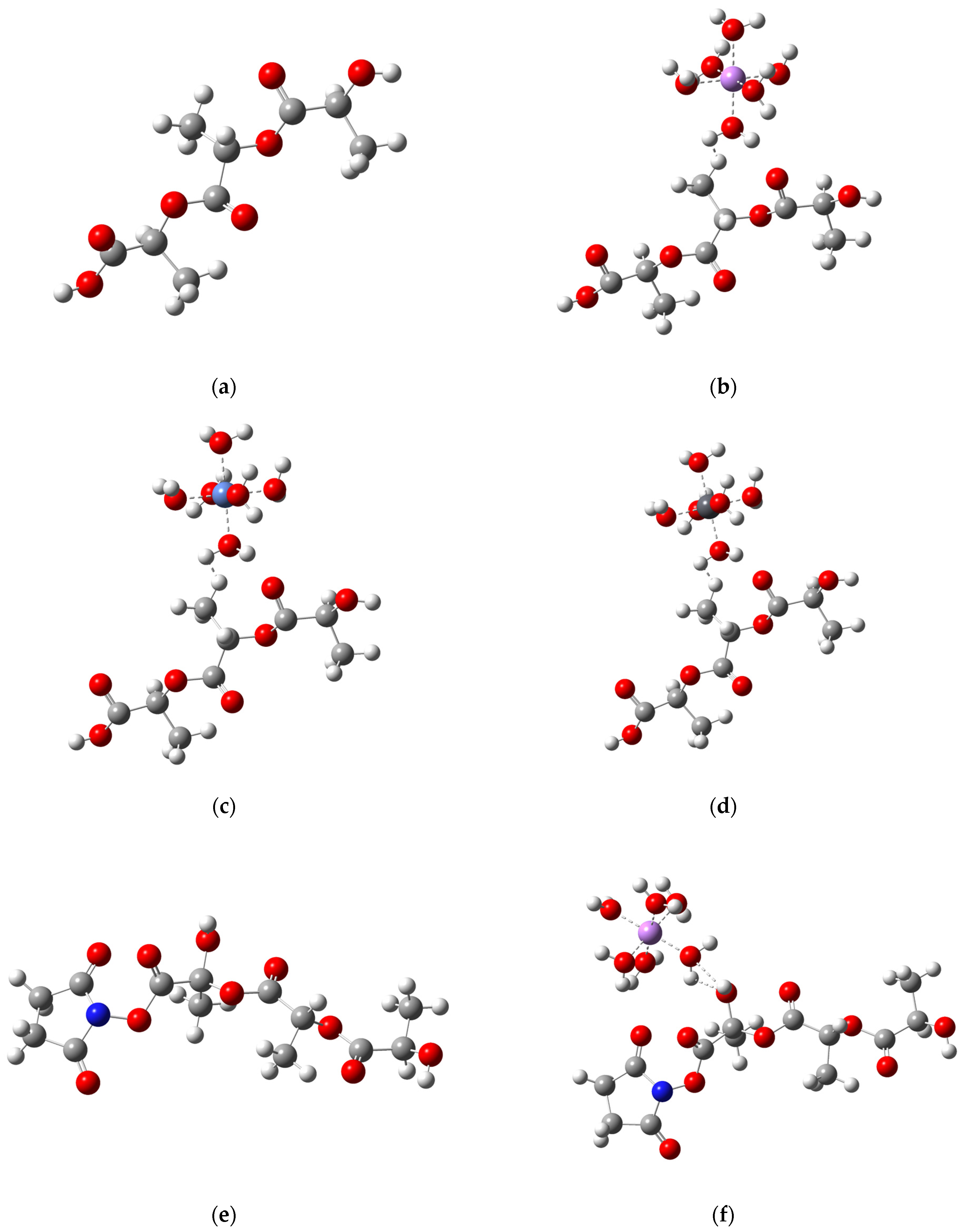
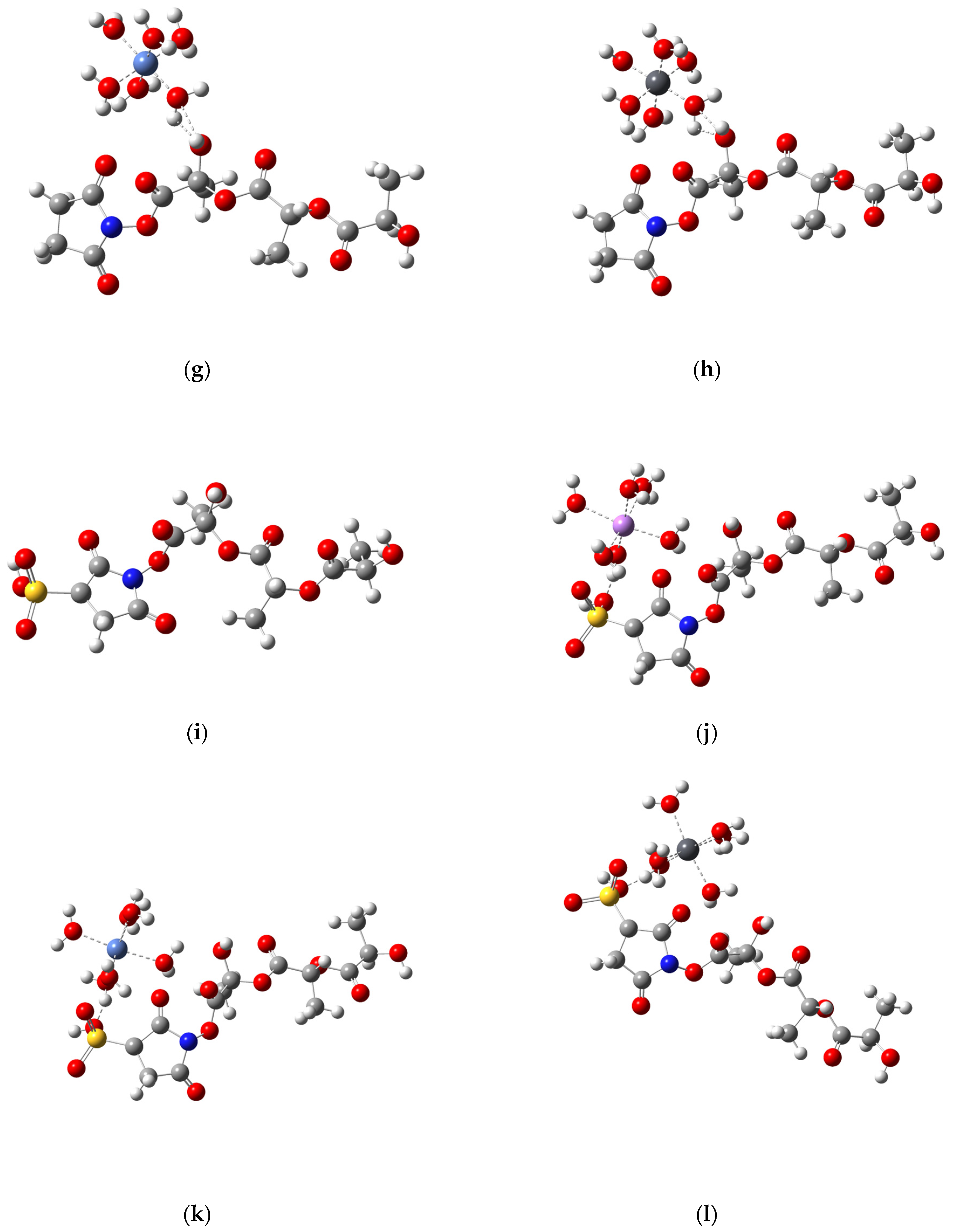
To model the molecular properties of polymers, using the Density Functional Theory (DFT), the M05-2X hybrid functional and the basis set LanL2DZ to optimize the geometries of the functionalized PLA (Polylactic acid). These trimer models were thought to be a good representation of the polymer chain because they struck a good balance between accuracy and speed in the simulation. We did optimization and vibrational frequency calculations for each structure to make sure that the stationary points were at a real minimum on the potential energy surface. This made sure that the geometries we got were stable. In order to model interactions in water, heavy metal ions like nickel (Ni2+), arsenic (As3+), and lead (Pb2+) were modeled with six water molecules each. The interactions between the functionalized polymers and hydrated metal ions showed two types of bonding behavior. In some systems, single-bond coordination was formed, while in others, complexes with more than one anchor point were formed. Figure 1 shows the best adsorption complexes of PLA, PLA-NHS, and PLA-S-NHS, both on their own and with the metal complexes.
To gain a detailed understanding of the reactivity and electronic stability of the modeled polymer trimers, Density Functional Theory (DFT) calculations were employed. Using the M05-2X hybrid functional in combination with the LanL2DZ basis set, key electronic parameters were calculated. These included the molecular electrostatic potential (MEP), total dipole moment, and molecular frontier orbitals (HOMO-LUMO), along with their energy gap. Such parameters are crucial indicators of a compound’s intrinsic chemical behavior, electronic stability, reactivity, and the nature of its electron donation or acceptance sites.
Table 1 shows the bond lengths between the metal ions (As3+, Ni2+, and Pb2+) and the functionalized PLA systems (PLA, PLA-NHS, and PLA-S-NHS). These bond lengths show how far apart the metal centers and the oxygen donor atoms in the polymer are. The results show that PLA-S-NHS has the shortest bond lengths with all metal ions. This means that it interacts more strongly and can hold onto more of them.
The bond length for Pb in PLA-S-NHS is 4.414 Å, which is the shortest bond length of any complex. This means that the sulfonate group adsorbs to Pb2+ better. PLA-NHS’s bond lengths are shorter than PLA’s, but they are not as effective as PLA-S-NHS’s. This means that adding the sulfonate group to S-NHS is important for making metal cations bind more strongly. PLA still has the longest bond lengths, which shows that pure PLA is not chemically active. This makes it harder for PLA to absorb heavy metals well without being functionalized. So, these bond lengths show that adding S-NHS to PLA makes it much better at adsorbing by making binding sites for metal cations stronger and easier to reach.

3.2. Adsorption Energy Analysis

To evaluate the thermodynamic favorability of the interaction between the functionalized PLA systems and the hydrated metal-containing species, the adsorption energy (Eads) was calculated for all complexes this can be seen in Table 2. In this convention, negative Eads values indicate energetically favorable adsorption, whereas positive values indicate that the interaction is thermodynamically unfavorable. The obtained results reveal a clear effect of functionalization on the stability of the polymer–metal complexes.
Pristine PLA exhibited favorable adsorption only toward arsenic, with an Eads value of −0.7363 eV, while the PLA-Ni and PLA-Pb complexes showed positive values of 0.8018 and 0.6466 eV, respectively, indicating that the native polymer does not provide a sufficiently favorable interaction environment for these metal species. This behavior is consistent with the low intrinsic reactivity of the PLA backbone, which contains a limited number of highly polar and strongly coordinating sites.
A similar trend was observed for PLANHS, where adsorption was only favorable for arsenic, with an Eads value of −1.0108 eV. In contrast, PLANHS-Ni and PLANHS-Pb showed values of 0.0650 and −0.0286 eV, respectively, the latter being close to zero and therefore indicative of a very weak interaction. Although the incorporation of the NHS group modifies the local electronic environment of the polymer, these results indicate that this functionalization alone is not sufficient to generate a consistently favorable interaction with all the studied species. In other words, while the NHS introduces additional heteroatom-containing functionalities, the resulting coordination environment remains limited in its ability to stabilize metal complexes effectively.
On the other hand, the sulfonated derivative showed a differentiated behavior depending on the metal. While S-PLANHS-Ni and S-PLANHS-Pb exhibited strongly negative adsorption energies of −3.5841 and −2.8469 eV, respectively, indicating highly favorable and possibly strong chemisorption interactions, the S-PLANHS-As complex presented a positive value of 0.7697 eV, suggesting that sulfonation does not enhance arsenic adsorption in this configuration. The markedly lower adsorption energies for Ni and Pb suggest that the introduction of the sulfonate group significantly improves the interaction with these metals, likely due to an increase in local negative electrostatic potential and the presence of oxygen-rich coordination sites.
Overall, the adsorption energy analysis demonstrates that sulfonation enhances the interaction of PLA-based systems with transition metals such as Ni and Pb, while pristine PLA and PLA-NHS derivatives show limited or selective adsorption behavior. These results confirm that sulfonation is the most effective modification among the systems tested for improving metal adsorption, as it creates a more polar and electronically favorable coordination environment, although its effect is not universally beneficial for all species, such as arsenic.

3.3. Frontier Molecular Orbital Analysis

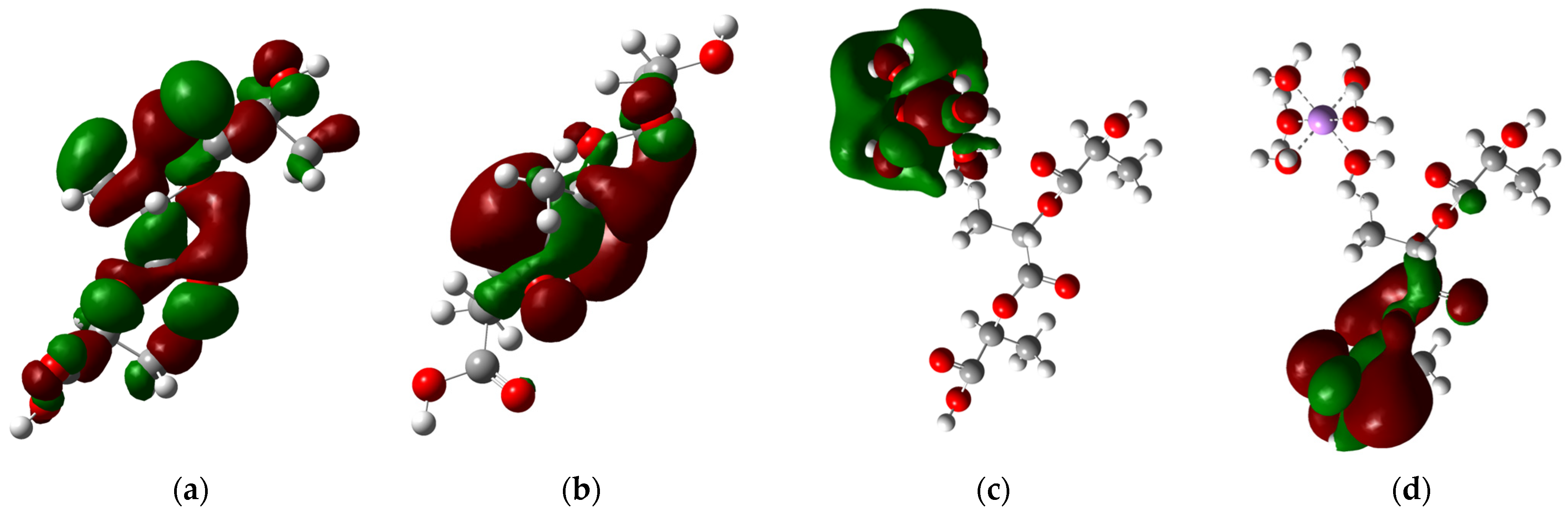
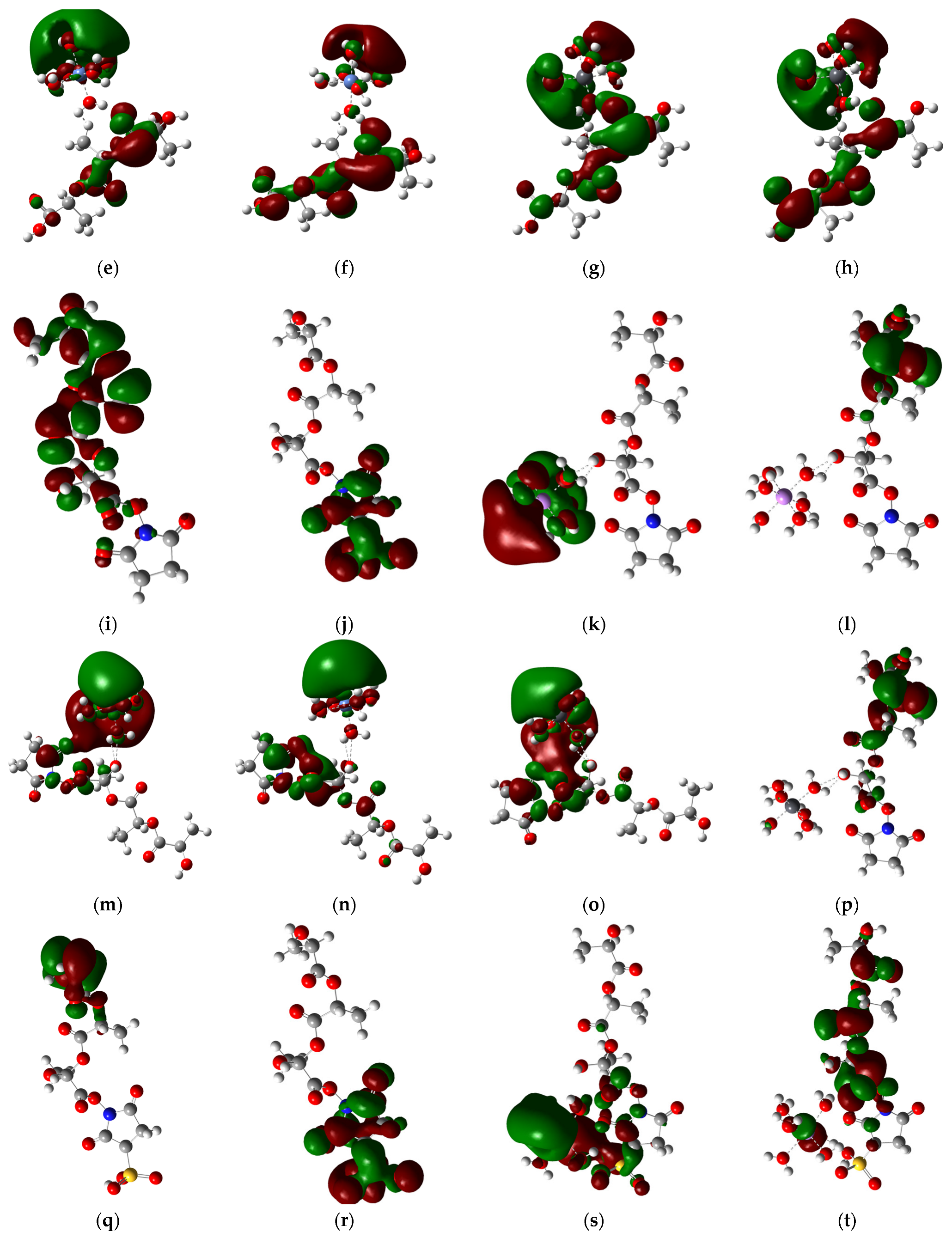
To understand the electronic interactions that influence metal adsorption, HOMO-LUMO energy gaps and total dipole moments (TDM) were calculated for complexes formed between functionalized PLA trimers and heavy metal ions nickel (Ni2+), arsenic (As3+), and lead (Pb3+), modeled in their hexahydrated states. All calculations were performed with identical computational parameters to ensure consistent comparison between molecules. Figure 2 shows visual representations of these frontier molecular orbitals, while Table 1 summarizes their energies and calculated TDMs.
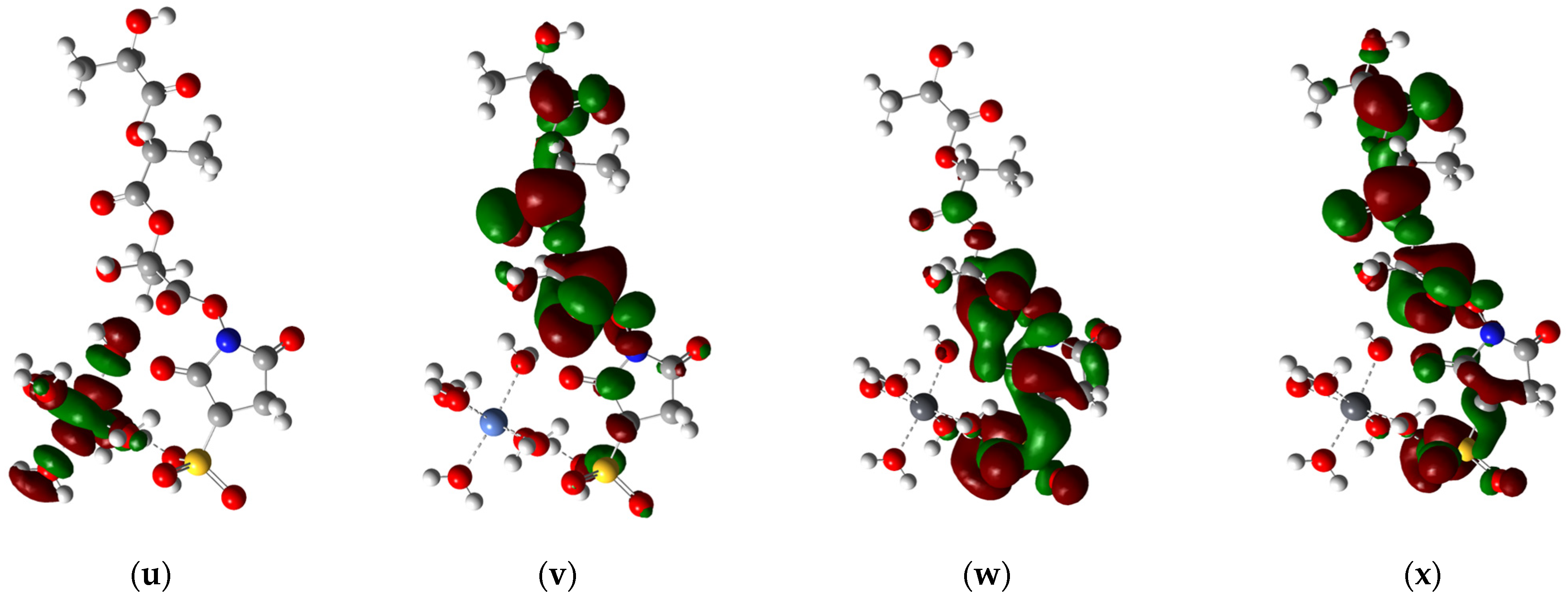
Figure 2 illustrates the spatial distribution of the highest occupied molecular orbitals (HOMO) and lowest unoccupied molecular orbitals (LUMO) for PLA, PLA-NHS, and PLA-S-NHS trimers, both in their free state and in adsorption complexes with heavy metal ions. Visualizing the location of these orbitals is essential for interpreting the intrinsic reactivity of polymers and the nature of electronic interactions with metal cations.
In unfunctionalized PLA, HOMO is distributed globally throughout the polymer chain, suggesting a homogeneous delocalization of valence electrons. In contrast, the LUMO is predominantly located at the center of the molecule, indicating a preferential site for electron donation. This marked spatial and energetic separation is consistent with the insulating nature of PLA and its lower intrinsic reactivity. In metal complexes, the location of the frontier orbitals is significantly modified. For PLA-As, the HOMO is located around the arsenic ion, suggesting the participation of the metal in the stabilization of the occupied orbitals. In contrast, the LUMO is located at one end of the trimer. In the PLA-Ni complex, the HOMO is distributed between the metal ion and a portion of the PLA molecule, and the LUMO is observed in both the hydration water molecules and the entire PLA trimer, indicating multiple pathways for electron acceptance. Finally, in the PLA-Pb complex, the HOMO is located in the lead ion and the polymer chain, with a LUMO that has a similar distribution to the HOMO, which could suggest a more cohesive interaction or a more diffuse charge transfer. Compared to functionalized derivatives, PLA exhibits a less specific interaction with metals, limited by the global delocalization of its orbitals. The incorporation of N-hydroxysuccinimide into PLA-NHS crucially alters the frontier orbital profile, introducing a specificity not present in pure PLA. In uncomplexed PLA-NHS, the HOMO is mainly located in the PLA backbone section, while the LUMO is specifically concentrated in the NHS group. This spatial differentiation of the frontier orbitals highlights the NHS group as an activation center for electron transfer or nucleophilic attack, establishing it as a crucial interaction site for metals, unlike in non-functionalized PLA. When forming complexes, these locations adapt to the interaction. In PLA-NHS-As, the HOMO is located around the metal ion, indicating that electron donation is focused on arsenic, while the LUMO remains concentrated in the NHS group. For PLA-NHS-Ni, both the HOMO and LUMO are located in the nickel ion and the NHS portion of the molecule, demonstrating a strong involvement of the functional group in charge transfer. In PLA-NHS-Pb, the HOMO is localized on the lead ion and the NHS group. In contrast, the LUMO is localized in the PLA backbone, suggesting a more distributed interaction and possible reactivity across different sites within the complex.
For PLA-S-NHS, the influence of the sulfonate group on overall reactivity and electron acceptance capacity is clearly evident, surpassing the characteristics of PLA-NHS. In uncomplexed PLA-S-NHS, the HOMO is localized in the PLA backbone, similar to PLA-NHS. However, the LUMO is markedly localized in the S-NHS group, highlighting the influence of the sulfonate group on electron-acceptance capacity and overall reactivity. This concentration in the sulfonated group is even more pronounced than in PLA-NHS, indicating greater selectivity in the interaction. In their complexes, the orbital profile is highly revealing. In PLA-S-NHS-As, the HOMO is located in the arsenic ion and the NHS group, and the LUMO is found in the PLA backbone, suggesting that the interaction is centered on the functional group with extension to the polymer backbone. For PLA-S-NHS-Ni, the HOMO is predominantly located in the nickel ion, while the LUMO is distributed throughout the molecule. This could indicate a strong interaction with the metal and a greater capacity to accept delocalized electrons. Finally, in the PLA-S-NHS-Pb complex, the HOMO is located in the PLA backbone, and the LUMO is distributed throughout the molecule. This pattern suggests that the interaction with lead is more widespread, affecting the entire polymer system.
The analysis of the location of the HOMO and LUMO orbitals, as shown in Figure 2, reveals that the functionalization of PLA, particularly with the S-NHS group, induces a fundamental and progressive modification in the electronic distribution of the polymer. These changes not only influence the intrinsic reactivity of the polymers but also direct and optimize interactions with metal ions. The concentration of frontier orbitals in the functional groups and in the vicinity of metal ions in the adsorption complexes provides direct evidence of the formation of efficient coordination bonds and the improved ability of functionalized polymers to act as adsorbents.
Table 3 presents an analysis of the intrinsic electronic properties of polymers and their adsorption complexes with heavy metal ions. The evaluation of these parameters (HOMO, LUMO, energy gap, total dipole moment, and polarizability) is essential for understanding the reactivity and nature of interactions at the molecular level.
When comparing the properties of metal-free functionalized polymers, clear trends are observed that support this study’s hypothesis. S-PLANHS exhibits a HOMO energy of −9.62930 eV, indicating a greater propensity to donate electrons compared to pristine PLA. This superior intrinsic reactivity is reinforced by the energy gap of 7.84804 eV, which, while characteristic of an insulator, represents a significant electronic tuning from the base polymer (PLA Egap = 7.49892 eV). Additionally, the total dipole moment (TDM) of S-PLANHS is 196.15612 Debye, confirming that the incorporation of the sulfonate group significantly increases the molecule’s polarity, a critical quality for interactions in aqueous environments. This contraction of the Egap upon complexation, together with the massive increase in total dipole moment (reaching 1104.77879 Debye for S-PLANHS-Pb), is consistent with greater polarity and negative charge density available in the environments of the -COO groups and, especially, in the -SO3 groups. This electronic signature typically confers greater reactivity and adsorption affinity, as it facilitates coordination/chemisorption with metal cations and the stabilization of complex species [39,40]. Recent literature on sulfonated polymers confirms that the incorporation of -SO3 groups not only enhances the capture of “hard” and “borderline” cations, but also modifies wettability and interfacial transport, i.e., the formation of ion channels and greater moisture retention, with direct consequences on kinetics and adsorption capacity [40]. Several experimental studies have shown that a higher degree of sulfonation increases the density of accessible negative charge on the surface and promotes the formation of anionic sites that interact strongly with Pb2+, Cd2+ and other metals, increasing capture capacity and selectivity [41]. At the electronic level, work combining quantum modeling and experimental characterization shows that polymer–metal interactions can induce charge reorganization and modifications in key electronic properties, such as variations in band gap (Egap) and total dipole moment. These are associated with processes of electronic stiffening/localization at the interface. These variations, including specific increases in dipole moment (23.69683 Debye for the S-PLANHS-Pb complex) and changes in Egap (dropping to 1.90072 eV in the same complex), are consistent with the stabilization of localized electronic states that favor chemisorption and the formation of coordinated complexes [42]. The combination of strongly chemisorbent sites such as sulfonate/carboxylate, site heterogeneity, and surface conditions often leads to a better fit to empirical models such as the Freundlich and pseudo-second-order kinetics, especially in systems with high affinity for Pb2+/Cd2+. This reflects the coexistence of multilocal adsorption and specific chemisorption processes in sulfonated polymers [43,44]. Under the principle of hard and soft acids and bases (HSAB), the SO3 group, being a hard base, shows a high affinity for Ni2+, a hard/borderline acid, and good interaction with Pb2+, a borderline/slightly soft acid [45]. For As in the form of hard oxoanions such as HAsO42−/H2AsO4, the contribution to adsorption is mainly due to electrostatic interactions and through hydrates, rather than direct chelation [43]. The observed trends of lower Egap in S-PLANHS and high TDM in the complexes are consistent with this mechanistic interpretation, suggesting that the presence of sulfonate groups creates specific and efficient binding sites for metal ions. Several studies show that electrospun meshes of polymers such as chitosan efficiently adsorb Pb2+/Ni2+ through interactions of functional groups such as NH2 and -OH, with the polymeric component providing the mechanical integrity and processability necessary for these adsorbent materials [45,46]. The decreases in Egap upon functionalizing PLA and the elevated TDMs after complexation with metals are consistent with what has been observed in these systems: a more polar, charged surface correlates directly with improved capture capacity and PSO-type kinetic adjustments [47].
Table 4 presents a series of global reactivity descriptors derived from the energies of the frontier molecular orbitals. These parameters are essential for understanding polymers’ propensity to participate in chemical interactions, as well as their electronic stability and ease of donating or accepting electrons. Their analysis allows us to quantify the impact of functionalization and heavy-metal complexation on the chemical behavior of the modeled systems. The global chemical reactivity descriptors were calculated from the energies of the frontier orbitals (HOMO and LUMO), obtained through DFT calculations using the M05-2X functional. The conceptual density functional theory equations used for these calculations are as follows:
Ionization   potential   ( I ) :   I   =   E H O M O
Electronic   affinity   ( A ) :   A = E L U M O
Final   electronegativity   ( χ ) :     χ = I + A 2
Chemical   potential   ( μ ) :   μ = I + A   2
Hardness   ( η ) :   η = I A 2
Softness   ( S ) :   S = 1 η
Electrophilicity   index   ( ω ) :   ω = μ 2 2 η
When examining the polymers in the absence of metals (PLA, PLANHS, and S-PLANHS), distinctive patterns in their reactivity properties are observed (Table 2). The Ionization Potential (I), which measures the energy required to remove an electron, is lower in PLANHS (9.44317 eV) and S-PLANHS (9.62930 eV) than in PLA (9.79774 eV), suggesting a greater ease of electron donation in the functionalized derivatives. In contrast, the Electron Affinity (A), indicating the ability to accept an electron, is lowest for PLANHS (1.00410 eV), suggesting a lower intrinsic tendency to accept additional charge compared to the pristine PLA (2.29882 eV). Chemical Hardness (η) and Softness (S) are primary indicators of molecular stability and reactivity; generally, “softer” molecules are more polarizable. In this study, PLANHS exhibits the highest hardness (4.21954 eV) among the free polymers, characterizing it as the most intrinsically stable species. S-PLANHS sits in an intermediate position with a hardness of 3.92402 eV. The Electrophilicity Index (ω), which quantifies the energy stabilization when a system acquires additional electronic charge, is notably high for S-PLANHS (63.86381) and PLANHS (57.56792) compared to pristine PLA (4.87825), suggesting that functionalization drastically alters the reactivity profile of the PLA backbone by introducing active heterocyclic and sulfonated sites. The formation of complexes with heavy metal ions induces drastic changes in all global reactivity descriptors, underscoring the significant interaction between the polymer and the metal. A universal feature observed across all systems is the marked decrease in Hardness (η) upon complexation. For example, the hardness of PLA collapses from 3.74946 eV to 0.56872 eV in the PLA-Ni complex. This robust transition indicates that the complexed systems are considerably more polarizable and facilitate more efficient charge-transfer processes during the adsorption mechanism. When comparing the functionalized systems, the S-PLANHS-Ni complex exhibits a unique electronic profile with a hardness of 2.11147 eV. While the numerical hardness values for some PLA complexes appear lower, the S-PLANHS complexes maintain a significantly higher electrophilicity and a more negative chemical potential, suggesting a more robust and stable coordination environment provided by the sulfonate group. Furthermore, the significant reduction in Ionization Potentials (I) and Electron Affinities (A) in the complexes compared to the free polymers implies a lower energy barrier for internal electron transfer within the coordination sphere.
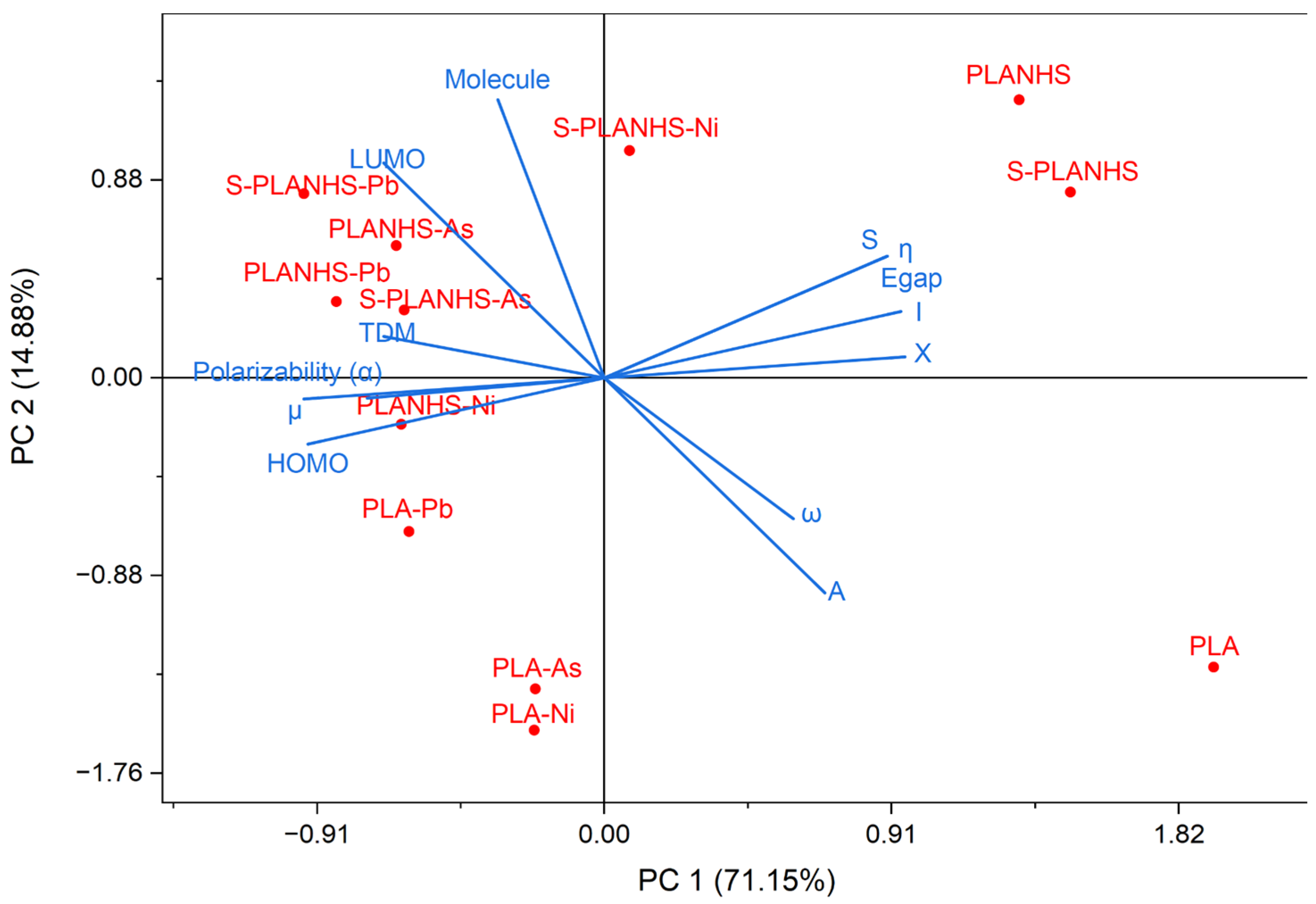
The principal component analysis of the electronic properties (HOMO, LUMO, Egap}, TDM, and polarizability) and the molecular reactivity parameters (μ, I, χ, A, ω, η, S) is shown in Figure 3. PCA applied to these descriptors for the polymers and their complexes with As3+, Ni2+ and Pb2+ reveals clear patterns in the electronic reorganization induced by heavy metals. The first two components explain 93.2% of the total variance (PC1: 77.1% and PC2: 16.1%), indicating that the model captures nearly all the relevant chemical information and confirming the distinct electronic signatures of the sulfonated complexes.
PC1 (77.1%) reflects variations in global stability and polarizability, being strongly correlated with the energy gap (Egap), chemical hardness (η), softness (S), and polarizability (α). This indicates that the most significant variations in this study occur in the biopolymer’s overall electronic stability and its response to external coordination fields. As observed in the Biplot, the pure polymers (PLA, PLANHS, and S-PLANHS) are clearly separated from their complexes along this axis, situated in the region of high Egap and η. This confirms that coordination with heavy metals (Ni+2, As+2, and Pb+2) drastically alters electronic stability, inducing a transition toward a “softer” and more polarizable state.
PC2 (16.1%) is dominated by the electrophilicity index (ω) and electron affinity (A), which govern the capacity of the systems to act as electron acceptors. This axis effectively discriminates between the different coordination environments. For instance, the nickel (Ni2+) complexes show a notable shift along PC2, reflecting its specific ability to modify localized electrophilic levels. In contrast, the interaction with lead (Pb+2+) induces changes primarily associated with global dipole reorganization (TDM) and electronic softening. The Biplot confirms these trends: the variables with the greatest weight in the stability of the isolated polymers point toward the left quadrant (Egap and η), while the variables driving the adsorption efficiency point toward the right (TDM, S, and α). Consequently, PLA and PLANHS show high sensitivity to coordination through alterations in their frontier levels. In contrast, S-PLANHS exhibits the highest sensitivity to Pb, as evidenced by its extreme position on the right of the plot, aligning with the maximum values of TDM and electronic softness. This demonstrates that the sulfonated functionalization optimizes the biopolymer for the sequestration of lead by creating a highly responsive and polar coordination site.

3.4. Partial Density of States Analysis

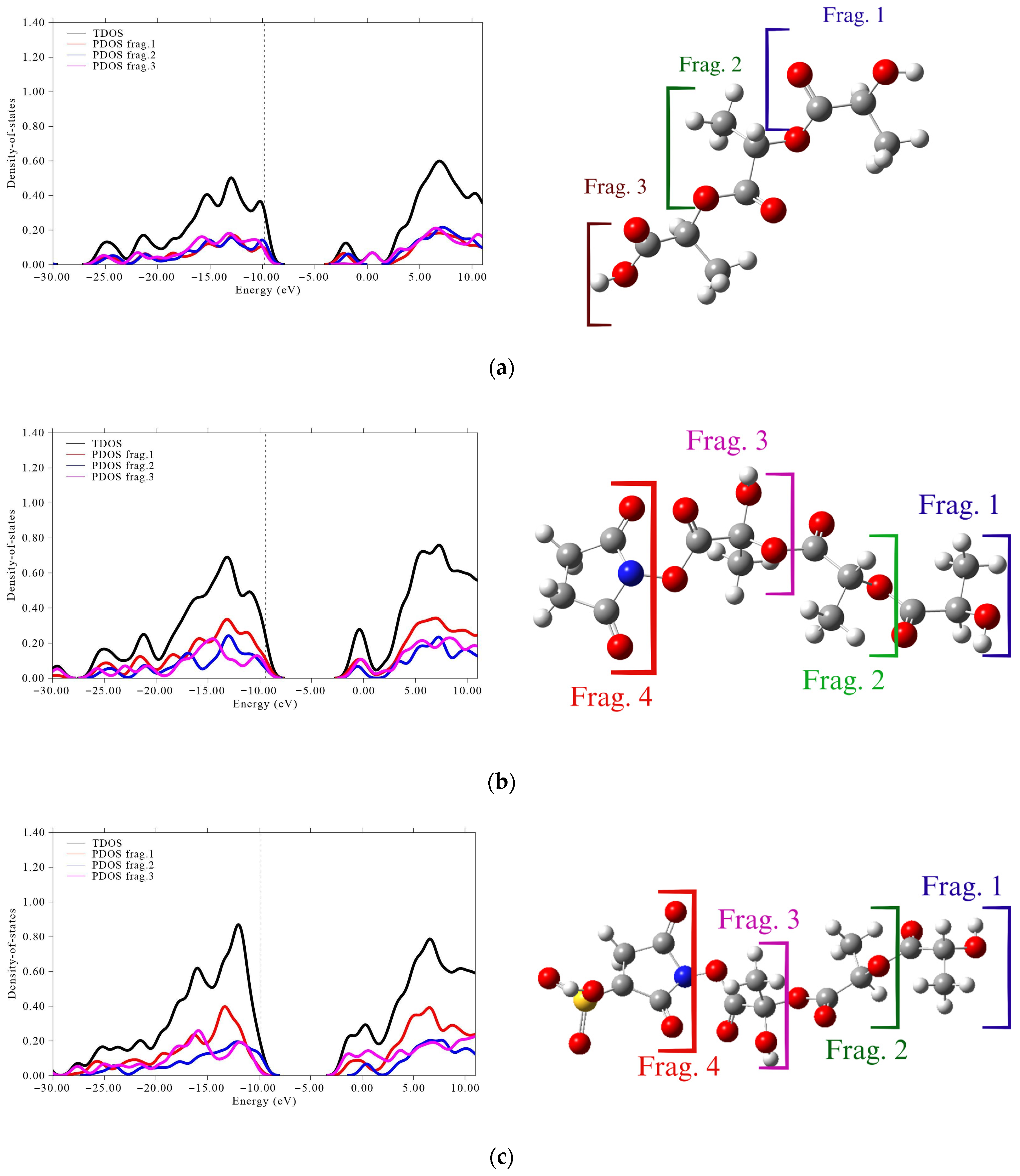
To gain a deep understanding of the electronic architecture of the modeled polymers, a projected density of states (PDOS) analysis was performed. This approach allowed us to assign chemical contributions to the respective energy bands and correlate the material’s intrinsic properties with its reactivity profile. Figure 4 shows the total density of states (TDOS) together with the fragment projections (PDOS) for the PLA monomers, the NHS group, and the S-NHS group. In these figures, occupied states are located at negative energies (valence band) and unoccupied states at positive energies (conduction band), allowing for clear chemical assignment of the bands and localization of the electron density.
The PDOS of pure PLA reveals a band structure typical of an aliphatic ester polymer. The valence band consists of σ states of the C-C and C-O backbone, while the valence edge (approx. −6 to 0 eV) shows an increase in contributions from the p orbitals of O and C associated with the carbonyl group (C=O). The fragment projections (PDOS frag. 1–3, corresponding to the PLA monomers) indicate that the electron density in the valence band is delocalized along the chain, with each monomer contributing similarly. However, at the upper edge of the valence band (HOMO), the peaks with the highest weight are concentrated in the carbonyl oxygens of each monomer, suggesting that the HOMO state is a combination of equivalent contributions from the three monomers. Above 0 eV, the first unoccupied states (LUMO) exhibit a π*(C=O) character, which is consistent with the insulating nature of PLA and its wide energy gap. These findings imply that the active sites for cation interaction are the carbonyl oxygens, which are uniformly distributed, probably favoring monodentate ion capture per monomer. The observation of the PLA valence band, which is dominated by backbone states (σ of C-C and C-O), and that the p orbitals of O/C of the carbonyl strongly contribute to the upper edge of the valence (HOMO), is consistent with DFT studies on PLA systems and PLA-modified composites, which show that carbonyl oxygens are the main contributors to frontier states and act as preferred interaction points for bond formation with surfaces/oxides. In particular, DFT work on PLA/GO and PLA/oxides shows HOMO/LUMO analysis, and MESP maps that assign charge and O contributions to energies near the HOMO [47].
The introduction of the NHS fragment (frag. 4) into the polymer significantly alters the electronic profile. In the PDOS of PLA-NHS, the NHS fragment introduces well-defined peaks in the valence edge region and in the conduction band, which were not present in pure PLA. The relative weight of PLA monomers (frag. 1–3) in the HOMO region decreases in favor of a greater contribution from the NHS fragment. The overlap of peaks from the NHS and PLA fragments in this energy zone indicates partial hybridization: the HOMO acquires a mixed character, with contributions from the non-bonding O/N pairs of the NHS and the p(C=O) orbitals of the PLA, while the LUMO is dominated by the π*(C=O) character of the imide ring of the NHS. This rearrangement of states narrows the energy gap, creating a more pronounced reactivity center. The location of the frontier states in the NHS fragment suggests that this will be the site of greatest affinity for coordination with metals. The presence of multiple carbonyls and an ester oxygen in the vicinity of the nitrogen in the imide ring could enable the formation of bidentate complexes, thereby improving affinity and selectivity towards cations such as Ni and Pb. The observation that the PLA valence band is dominated by backbone states (σ of C-C and C-O) and that the p orbitals of O/C of the carbonyl contribute strongly to the upper edge of the valence (HOMO) edge, is consistent with DFT studies on PLA systems and PLA-modified composites showing that carbonyl oxygens are the main contributors to frontier states and act as preferred interaction points (bond formation with surfaces/oxides). In particular, DFT work on PLA/GO and PLA/oxides shows HOMO/LUMO analysis, and MESP maps that assign charge and O contributions to energies near the HOMO [45,46].
Functionalization with the sulfonate group (-SO3) in PLA-S-NHS produces the most drastic and favorable change in the reactivity profile. The S-NHS fragment (Frag. 4) completely dominates the frontier-state region. The PDOS shows that this fragment introduces an intense density of states at the valence edge, shifting the HOMO towards a more anionic character, centered on the sulfonate oxygens and the imide carbonyls. The LUMO becomes even more accessible due to the hybridization of the π*(C=O) antibonding orbitals with the antibonding states of the S=O group, resulting in the narrowest energy gap of the three systems. The high negative charge density and hybrid nature of the frontier orbitals suggest that PLA-Sulfo-NHS not only offers a site of high electrostatic affinity, but also can form more stable multidentate complexes with metal cations [46,47].
The PDOS shows that the polyester backbone (Frag. 1–3) acts as a stable electronic support in all three systems, maintaining its dominant contribution in the valence body. However, the contributions to the frontier states (HOMO and LUMO) are progressively modified by functionalization. While the HOMO of PLA is distributed almost equally among the carbonyls of the monomers, that of PLA-NHS acquires significant weight in the NHS fragment. In PLA-S-NHS, the HOMO is dominated by the contributions of the sulfonate. Similarly, the LUMO and the first conduction bands reflect a progressive dominance of the functional groups, with a clear and quantifiable reduction in the energy gap in the order PLA > PLA-NHS > PLA-S-NHS. These findings provide solid theoretical evidence that the introduction of the sulfonate group improves polarity, increases reactivity, and creates high-affinity sites for heavy-metal adsorption, positioning PLA-S-NHS as the material with the highest theoretical ion-capture capacity.

3.5. Natural Bond Orbital Analysis

Table 5 presents the NBO analysis for all optimized adsorption complexes and summarizes the main electronic parameters governing the interaction between the PLA-based matrices and the adsorbed metal or metalloid species. Specifically, the table includes the charge on the metal/metalloid center, the main donor atoms involved in the interaction, the strongest donor–acceptor interaction identified from second-order perturbation theory, and the corresponding maximum stabilization energy, (E(2)). These descriptors provide a direct picture of how charge transfer contributes to adsorption at the molecular level.
The NBO results show that adsorption is consistently dominated by oxygen-centered donor sites. In all complexes, the principal donor atoms correspond to oxygen atoms located either in the polymer backbone, in the functional groups introduced by NHS or S-NHS, or in the local oxygen-rich coordination environment. This indicates that the adsorption mechanism is mainly controlled by lone-pair donation from oxygen atoms toward acceptor orbitals associated with the adsorbed species. Therefore, the role of functionalization is not simply to increase polarity, but to reorganize the electronic structure of the adsorption site in a way that improves donor–acceptor coupling.
For the pristine PLA systems, the three adsorbates exhibit distinct electronic behaviors. In PLA-As, the arsenic center remains strongly electron-deficient, as indicated by its positive charge of +0.94977, and the strongest interaction is LP(2) O34 to LP*(4)As31 with an (E2) value of 52.17 kcal·mol−1. This suggests a moderate but clear stabilization through oxygen-to-arsenic donation. In PLA-Ni, the strongest interaction increases markedly to 76.58 kcal·mol−1, corresponding to LP(2) O39 to LP*(6)Ni49, which indicates stronger orbital coupling and more effective charge transfer. Similarly, PLA-Pb shows a high stabilization energy of 78.96 kcal·mol−1, arising from LP(2) O31 to LP(1)Pb49. Taken together, these values indicate that pristine PLA can already establish significant donor–acceptor interactions with Ni and Pb, whereas the interaction with As is comparatively weaker.
The NHS-functionalized systems show the most favorable donor–acceptor interactions overall. In PLA-NHS-As, the maximum stabilization energy rises to 60.64 kcal·mol−1, associated with LP(2) O43 to LP(2)As42, indicating that NHS improves the electronic environment for arsenic interaction relative to pristine PLA. The most notable case is PLA-NHS-Ni, which exhibits the highest (E2) value in the entire series, 102.54 kcal·mol−1, for the interaction LP(2) O42 to LP*(7)Ni60. This result demonstrates that NHS functionalization greatly enhances the electronic stabilization of nickel adsorption by generating a highly favorable oxygen-donor site. In PLA-NHS-Pb, the strongest interaction remains very high, 77.09 kcal·mol−1, through LP(2) O42 to LP(1)Pb60, confirming that the NHS-functionalized matrix also preserves strong affinity toward lead. Thus, among all systems studied, PLA-NHS provides the most effective electronic environment for adsorption, particularly for Ni.
A different trend is observed for the S-PLA-NHS complexes. In S-PLA-NHS-As, the maximum stabilization energy is 51.27 kcal·mol−1, associated with LP(2) O53 to LP*(3)As42, which is comparable to the pristine PLA-As system and lower than the corresponding PLA-NHS-As complex. More importantly, in S-PLA-NHS-Ni and S-PLA-NHS-Pb, the (E2) values decrease drastically to 7.33 and 6.01 kcal·mol−1, respectively. These much smaller stabilization energies indicate that, although oxygen atoms remain the main donor sites, the donor–acceptor overlap is considerably weaker in the sulfonated derivatives for these two metals. This suggests that incorporating the sulfonated group does not necessarily improve adsorption from an orbital-interaction perspective and may even reduce charge-transfer efficiency if the resulting geometry or orbital orientation becomes less favorable.
Overall, the NBO analysis demonstrates that the magnitude of the donor–acceptor interaction between oxygen lone pairs and the acceptor orbitals of the adsorbed species strongly influences adsorption. Higher (E2) values reflect greater charge-transfer stabilization and, therefore, a more favorable adsorption process. From this perspective, the results indicate that NHS functionalization is the most effective strategy for enhancing adsorption, especially for Ni. At the same time, sulfonation does not provide a universal improvement and appears to weaken the electronic stabilization for Ni and Pb in the systems examined. Accordingly, Table 3 confirms that the adsorption capacity of the PLA-based materials is governed not only by the presence of polar groups, but also by the specific electronic coupling established at the adsorption site.

3.6. Map of Electrostatic Potential

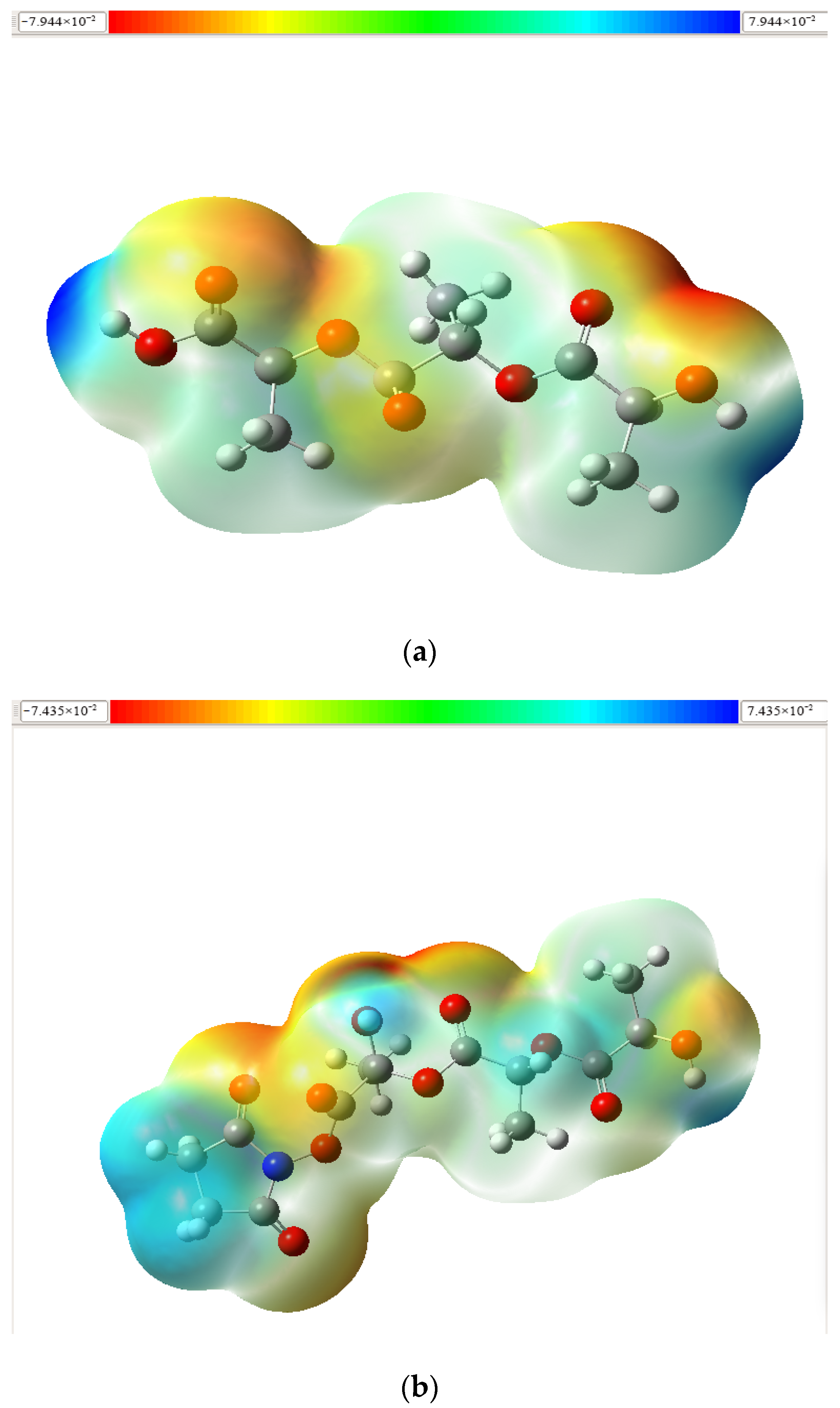
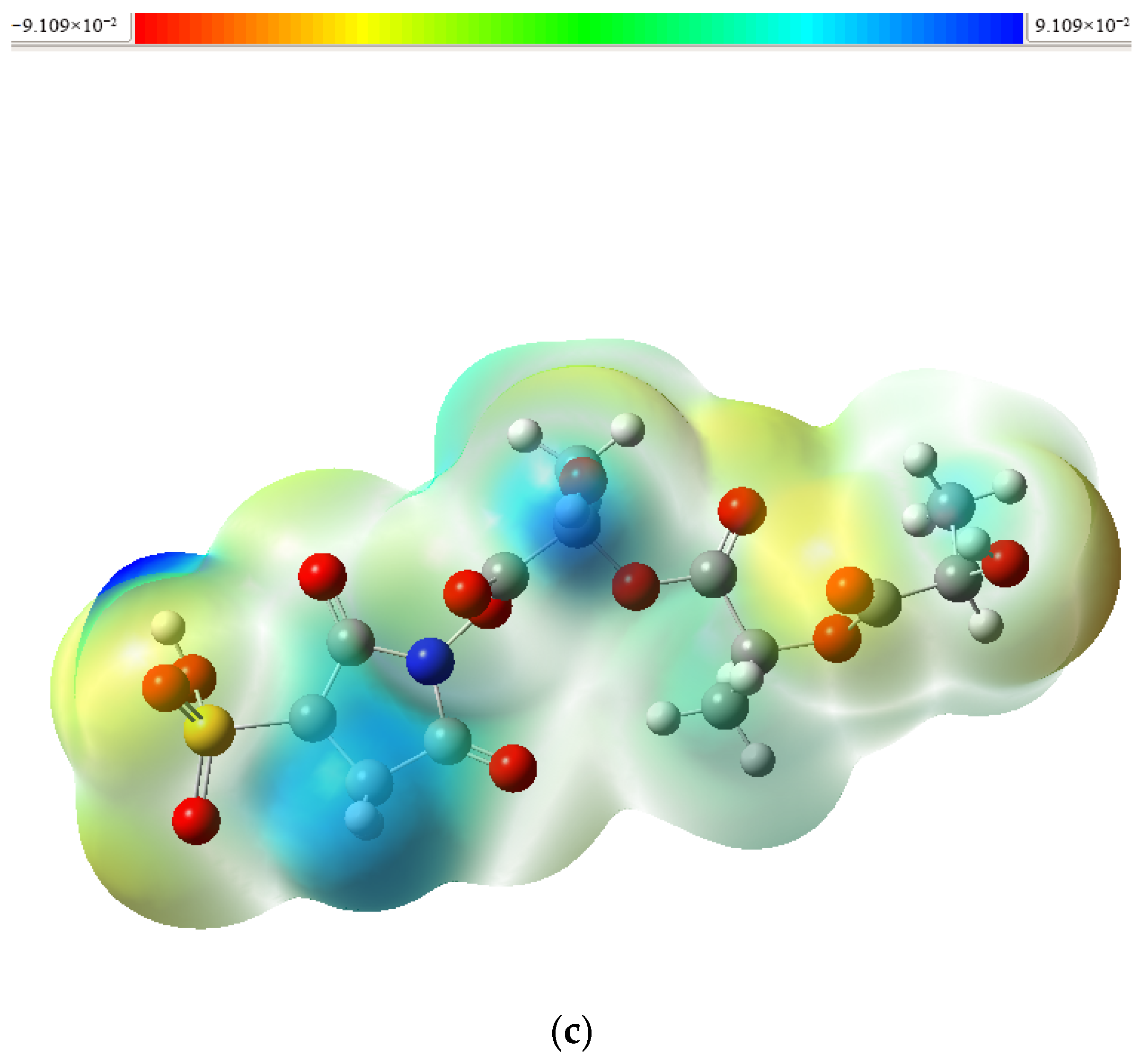
Molecular Electrostatic Potential (MEP) maps provide a visual representation of the electrostatic environment around a molecule, highlighting regions of electron density and charge distribution. In these maps, the red regions represent areas of high electron density, typically nucleophilic sites where the molecule can donate electrons, as shown in Figure 5. Conversely, the blue regions indicate electron-deficient areas, often associated with electrophilic sites that are more likely to accept electrons. The yellow and green regions represent regions of intermediate potential, often indicating neutral or weakly reactive areas. These MEP maps are particularly useful for identifying the most likely adsorption sites for metal ions, as regions with high negative potential (red areas) are more likely to interact with positively charged species such as metal cations.
The Molecular Electrostatic Potential (ESP) maps are crucial to the understanding of how the functionalized PLA systems adsorb heavy metals. These maps show how the electron density is spread out, which can help guess how the polymer will react with charged particles like metal cations. The numbers for the three PLA variants clearly show how negative potential regions change over time. These changes are directly related to the presence of functional groups like carbonyls, heteroatoms, and sulfonate groups.
The ESP map for pristine PLA shows distinct negative areas, mostly around the oxygen atoms of the carbonyl groups. These areas are shown in deep red on the map. These negative areas could be places where metal cations could stick. The polymer cannot form multidentate complexes as well as it could because the PLA backbone is hydrophobic and the molecules are isolated. This makes PLA less effective as a metal adsorbent overall. In short, the fact that there are not any negative potential regions limits PLA’s ability to interact with water, which makes it less useful for removing heavy metals.
Adding N-hydroxysuccinimide (NHS) to PLA (making PLA-NHS) makes the surface polarization much higher. The ESP map now shows that the anionic areas around the imidic carbonyls and N-O group are bigger and more connected. These changes create larger areas with higher negative charge density, which helps the polymer stay stable while interacting with metal cations at the same time. The bigger negative potential areas in PLA-NHS allow it to make bidentate or multidentate complexes. These complexes have a stronger attraction to metal ions and are more selective than the original PLA structure. This shows that adding NHS to PLA not only makes the adsorption sites easier to reach, but it also makes PLA better at coordinating, which makes it a better adsorbent for heavy metals.
S-nitration (S-NHS) adds the sulfonate group (-SO3), which makes the strongest and most stable negative potential regions in the ESP map. The sulfonate group adds a large anionic domain, making it easier for the polymer to interact with highly charged metal cations. PLA-S-NHS is very good at making electrostatic and coordination bonds with metal cations because the sulfonate group has a formal negative charge, and the imide group has a high polarity. Also, the sulfonate group’s ability to attract water makes the polymer more compatible with water-based solutions. This makes it easier for metal ions to interact with the polymer surface and lowers the desolvation barrier. This makes adsorption kinetics faster and more efficient.
The overall change in the ESP profile from PLA to PLA-NHS to PLA-S-NHS indicates that the polarity gradient is becoming stronger and the negative charge density is becoming easier to reach. PLA has separate sites where molecules can interact. At the same time, PLA-NHS introduces the possibility of multidentate anchoring, and PLA-S-NHS creates continuous electrostatic domains, making it easier for metal ions to adhere to surfaces. The changes in the electrostatic environment directly explain why the functionalized PLA systems, especially PLA-S-NHS, are better at adsorbing heavy metals from water. PLA-S-NHS has the highest theoretical capacity for doing this. The simultaneous interactions among the carbonyl, imide, and sulfonate groups create an excellent environment for adsorbing highly charged metal cations. This makes PLA-S-NHS even better at removing heavy metals.

3.7. Fourier-Transform Infrared

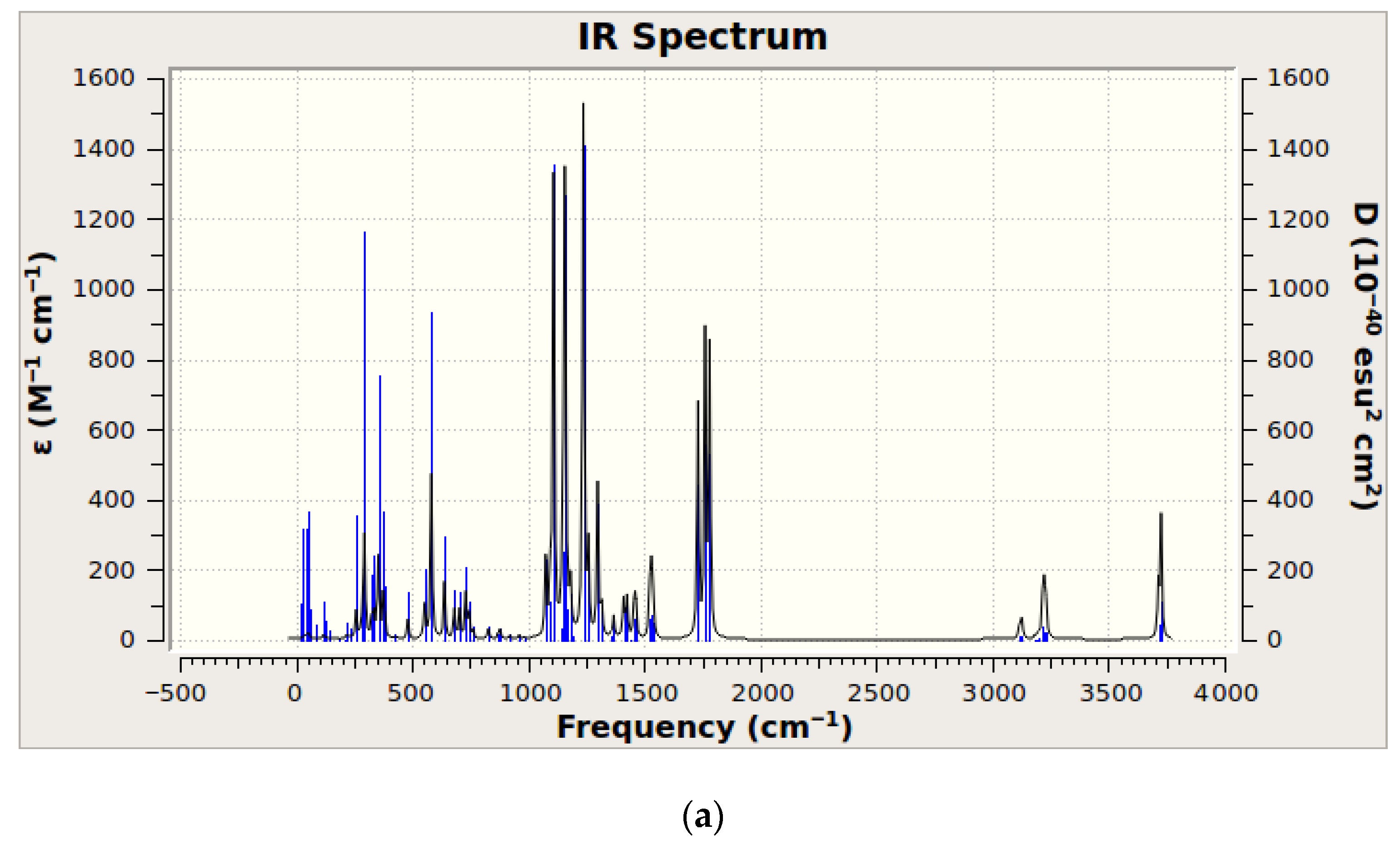
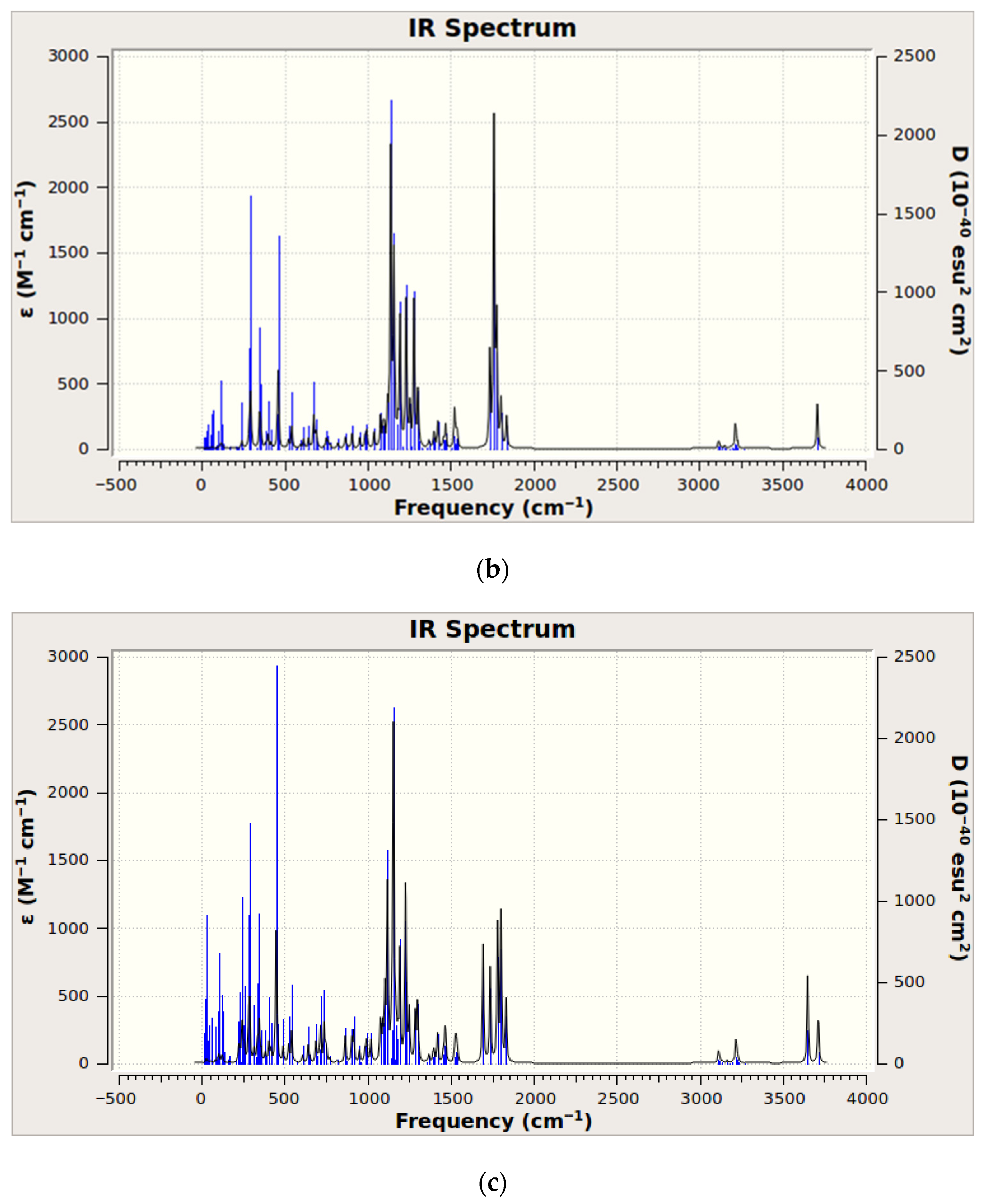
The infrared spectra of the three polymers, shown in the range of 0–4000 cm−1, present the calculated relative intensities and contributions of the dipole oscillators. Although all retain the typical vibrational signature of a polyester, the modifications with NHS and S-NHS introduce new peaks and shifts that clearly confirm the incorporation of the functional groups, as shown in Figure 6.
The spectrum of pure PLA exhibits an intense signal at 1750–1760 cm−1, corresponding to the stretching mode of the ester carbonyl (C=O), the most relevant band of this polymer. In the region of 1000–1300 cm−1, multiple bands appear associated with C-O stretches and C-C-O deformations, characteristic of the polyester backbone. Towards 2900–3000 cm−1, weaker peaks are observed, corresponding to aliphatic C-H stretches. It is important to note the absence of intense bands in the 3300–3500 cm−1 range, which confirms the absence of free -OH groups in the main structure.
With the incorporation of the N-hydroxysuccinimide (NHS) group, the spectrum shows new contributions that confirm functionalization. A peak is observed in the range 1650–1700 cm−1 associated with the stretching of the imidic carbonyls (C=O) of the NHS, which is slightly split with respect to the carbonyl of the ester. In addition, the 3200–3500 cm−1 region shows an intensification attributed to the N-H/O-H stretching of the N-O-H group. The C-N and N-O vibration modes also contribute new absorptions in the 1000–1200 cm−1 range, confirming the successful incorporation of the activating group.
The PLA-S-NHS spectrum retains the characteristic signals of PLA and imide but also exhibits distinctive features of the sulfonate group. Intense and broad bands are observed in the regions of 1180–1250 cm−1 and 1040–1080 cm−1, corresponding to the asymmetric and symmetric S=O stretching modes, respectively. These absorptions are clear evidence of the sulfonation of the NHS group. Although the contributions of N-H/O-H at the edge of the vibrational valence remain, they are modulated by the interaction with the sulfonate. Although the ester carbonyl at ~1750 cm−1 is still visible, it is superimposed with the imide modes and the effects of the sulfonate.
Comparison of the three FTIR spectra demonstrates how systematic functionalization modifies the polymer’s vibrational signature. PLA provides the base with the vibrations of the carbonyl ester and aliphatic skeleton. PLA-NHS adds the characteristic vibrations of the imide modes, while PLA-S-NHS introduces the clear vibrations of the S=O bonds. These variations not only confirm the successful incorporation of the functional groups but also validate the change in polarity and interaction capacity at the vibrational level. The presence of the carbonyl and imide groups and, crucially, the sulfonate groups provides the coordination and affinity sites necessary for interaction with metal ions. These FTIR results are in full agreement with the electronic and adsorption properties predicted by computational analyses, reinforcing the hypothesis that the functionality of these materials is ideal for contaminant removal.


4. Conclusions

Polylactic acid (PLA) is a biopolymer that comes from starch and is cheap, easy to find, and good for the environment. But because it does not react easily with other compounds, it has limited use, such as removing heavy metals from water, like in industrial wastewater. This research mitigates this constraint by modifying PLA with N-hydroxysuccinimide (NHS) and N-sulfosuccinimide (S-NHS). It is postulated that the incorporation of the sulfonate group via S-NHS enhances the electron-donating properties of PLA, thereby improving its adsorption capacity for heavy metals.
To evaluate this hypothesis, Density Functional Theory (DFT) calculations were performed using Gaussian 16 (M05-2X/LanL2DZ) and Multiwfn 4.0 to examine the electronic properties of both pristine and functionalized PLA. We also looked at how PLA interacts with a simpler system of hexahydrated ions of nickel (Ni2+), arsenic (As3+), and lead (Pb2+). The findings reveal that PLA-S-NHS exhibits a notably smaller energy gap (Egap) of 3.31 eV, compared with PLA (5.51 eV) and PLA-NHS (4.42 eV), indicating enhanced adsorption properties. The total dipole moment (TDM) of PLA-S-NHS was found to be 196.16 Debye, supporting the idea that its adsorption ability has improved.
The Projected Density of States (PDOS) analysis showed that the sulfonate group occupies most of the frontier orbitals, where the negative charge resides. This effect makes metal–polymer interactions stronger, with high TDM values such as 1104.78 Debye for Pb2+ in PLA-S-NHS, indicating strong interactions. The Natural Bond Orbital (NBO) analysis demonstrates that S-NHS functionalization strengthens donor–acceptor interactions, with the oxygen atoms of the sulfonate group serving as the principal electron donors, thereby enhancing the polymer’s capacity to adsorb heavy metals. The adsorption energies (Eads) also support this, with negative Eads.
The values seen for all complexes, especially Pb2+, show that adsorption is thermodynamically favorable. Molecular Electrostatic Potential (MEP) maps and FTIR spectra also show that effective coordination sites have been made and help us see how these interactions work. The functionalization with S-NHS improves the electronic properties of PLA for heavy-metal adsorption, supporting the hypothesis. These results provide scientists with a molecular basis for developing better bioadsorbents. They also show that these functionalized PLA polymers could be used as membranes to remove heavy metals from water, providing a long-lasting way to clean up the environment.

Author Contributions

Conceptualization, Y.M.-M., R.O.-T. and J.H.-F.; Methodology, Y.M.-M., R.O.-T. and J.H.-F.; Software, Y.M.-M., and J.H.-F.; Validation, Y.M.-M. and J.H.-F.; Formal analysis, Y.M.-M., R.O.-T. and J.H.-F.; Investigation, Y.M.-M., R.O.-T. and J.H.-F.; Resources, Y.M.-M., R.O.-T. and J.H.-F.; Data curation, Y.M.-M. and J.H.-F.; Writing—original draft, Y.M.-M., R.O.-T. and J.H.-F.; Writing—review & editing, Y.M.-M. and J.H.-F.; Visualization, Y.M.-M. and J.H.-F.; Supervision, J.H.-F.; Project administration, J.H.-F.; Funding acquisition, J.H.-F. All authors have read and agreed to the published version of the manuscript.

Funding

This research received no external funding.

Data Availability Statement

The original contributions presented in this study are included in the article. Further inquiries can be directed to the corresponding authors.

Conflicts of Interest

The authors declare no conflict of interest.

References

  1. Li, G.; Zhao, M.; Xu, F.; Yang, B.; Li, X.; Meng, X.; Teng, L.; Sun, F.; Li, Y. Synthesis and Biological Application of Polylactic Acid. Molecules 2020, 25, 5023. [Google Scholar] [CrossRef] [PubMed]
  2. Sreekumar, K.; Bindhu, B.; Veluraja, K. Perspectives of polylactic acid from structure to applications. Polym. Renew. Resour. 2021, 12, 60–74. [Google Scholar] [CrossRef]
  3. Fahim, I.S.; Chbib, H.; Mahmoud, H.M. The synthesis, production & economic feasibility of manufacturing PLA from agricultural waste. Sustain. Chem. Pharm. 2019, 12, 100142. [Google Scholar] [CrossRef]
  4. Ghomi, E.R.R.; Khosravi, F.; Ardahaei, A.S.; Dai, Y.; Neisiany, R.E.; Foroughi, F.; Wu, M.; Das, O.; Ramakrishna, S. The Life Cycle Assessment for Polylactic Acid (PLA) to Make It a Low-Carbon Material. Polymers 2021, 13, 1854. [Google Scholar] [CrossRef]
  5. DeStefano, V.; Khan, S.; Tabada, A. Applications of PLA in modern medicine. Eng. Regen. 2020, 1, 76–87. [Google Scholar] [CrossRef]
  6. Sahini, M.G. Polylactic acid (PLA)-based materials: A review on the synthesis and drug delivery applications. Emergent Mater. 2023, 6, 1461–1479. [Google Scholar] [CrossRef]
  7. Subramaniam, S.R.; Samykano, M.; Selvamani, S.K.; Ngui, W.K.; Kadirgama, K.; Sudhakar, K.; Idris, M.S. 3D printing: Overview of PLA progress. In AIP Conference Proceedings; AIP Publishing LLC: Melville, NY, USA, 2019; Available online: https://pubs.aip.org/aip/acp/article-abstract/2059/1/020015/790435/3D-printing-Overview-of-PLA-progress (accessed on 5 February 2026). [CrossRef]
  8. Wang, Y.; Wang, Y.; Qiu, S.; Wang, C.; Zhang, H.; Guo, J.; Wang, S.; Ma, H. 3D-Printed Filters for Efficient Heavy Metal Removal from Water Using PLA@CS/HAP Composites. Polymers 2023, 15, 4144. [Google Scholar] [CrossRef]
  9. De Vargas Brião, G.; De Andrade, J.R.; Da Silva, M.G.C.; Vieira, M.G.A. Removal of toxic metals from water using chitosan-based magnetic adsorbents. A review. Environ. Chem. Lett. 2020, 18, 1145–1168. [Google Scholar] [CrossRef]
  10. Zhang, W.; Ou, J.; Wang, B.; Wang, H.; He, Q.; Song, J.; Zhang, H.; Tang, M.; Zhou, L.; Gao, Y.; et al. Efficient heavy metal removal from water by alginate-based porous nanocomposite hydrogels: The enhanced removal mechanism and influencing factor insight. J. Hazard. Mater. 2021, 418, 126358. [Google Scholar] [CrossRef] [PubMed]
  11. Khouri, N.G.; Bahú, J.O.; Blanco-Llamero, C.; Severino, P.; Concha, V.O.C.; Souto, E.B. Polylactic acid (PLA): Properties, synthesis, and biomedical applications—A review of the literature. J. Mol. Struct. 2024, 1309, 138243. [Google Scholar] [CrossRef]
  12. Qin, Q.; Yang, Y.; Yang, C.; Zhang, L.; Yin, H.; Yu, F.; Ma, J. Degradation and adsorption behavior of biodegradable plastic PLA under conventional weathering conditions. Sci. Total Environ. 2022, 842, 156775. [Google Scholar] [CrossRef]
  13. Al-Makishah, N.H.; Taleb, M.A.; Barakat, M.A. Arsenic bioaccumulation in arsenic-contaminated soil: A review. Chem. Pap. 2020, 74, 2743–2757. [Google Scholar] [CrossRef]
  14. Zhang, H.; Zhang, L.-L.; Li, J.; Chen, M.; An, R.-D. Comparative study on the bioaccumulation of lead, cadmium, and nickel and their toxic effects on the growth and enzyme defence strategies of a heavy metal accumulator, Hydrilla verticillatai (L.f.) Royle. Environ. Sci. Pollut. Res. 2020, 27, 9853–9865. [Google Scholar] [CrossRef]
  15. Collin, M.S.; Venkatraman, S.K.; Vijayakumar, N.; Kanimozhi, V.; Arbaaz, S.M.; Stacey, R.G.S.; Anusha, J.; Choudhary, R.; Lvov, V.; Tovar, G.I.; et al. Bioaccumulation of lead (Pb) and its effects on human: A review. J. Hazard. Mater. Adv. 2022, 7, 100094. [Google Scholar] [CrossRef]
  16. Sadee, B.A.; Zebari, S.M.S.; Galali, Y.; Saleem, M.F. A review on arsenic contamination in drinking water: Sources, health impacts, and remediation approaches. RSC Adv. 2025, 15, 2684–2703. [Google Scholar] [CrossRef] [PubMed]
  17. Obasi, P.N.; Akudinobi, B.B. Potential health risk and levels of heavy metals in water resources of lead-zinc mining communities of Abakaliki, southeast Nigeria. Appl. Water Sci. 2020, 10, 184. [Google Scholar] [CrossRef]
  18. Awual, M.R. An efficient composite material for selective lead(II) monitoring and removal from wastewater. J. Environ. Chem. Eng. 2019, 7, 103087. [Google Scholar] [CrossRef]
  19. Bobadilla, M.C.; Lorza, R.L.; Gómez, F.S.; García, R.E. Adsorption of Nickel in Wastewater by Olive Stone Waste: Optimization through Multi-Response Surface Methodology Using Desirability Functions. Water 2020, 12, 1320. [Google Scholar] [CrossRef]
  20. Nguyen, H.; Nguyen, B.Q.; Duong, T.T.; Bui, A.T.K.; Nguyen, H.T.A.; Cao, H.T.; Mai, N.T.; Nguyen, K.M.; Pham, T.T.; Kim, K.-W. Pilot-Scale Removal of Arsenic and Heavy Metals from Mining Wastewater Using Adsorption Combined with Constructed Wetland. Minerals 2019, 9, 379. [Google Scholar] [CrossRef]
  21. Tanaka, T. Recent Advances in Polymers Bearing Activated Esters for the Synthesis of Glycopolymers by Postpolymerization Modification. Polymers 2024, 16, 1100. [Google Scholar] [CrossRef] [PubMed]
  22. Hiza, J.C.S.; Benavides, R.; Acosta, D.M.; DaSilva, L.; Hernández-Ramírez, A. Solvent Polarity Effect on Physicochemical and Morphological Properties for Casted Sulfonated (Styrene-co-butyl Acrylate) Ionomer Membranes. ChemistrySelect 2025, 10, 26. [Google Scholar] [CrossRef]
  23. Ban, T.; Guo, M.; Wang, Y.; Zhang, Y.; Zhu, X. High-performance aromatic proton exchange membranes bearing multiple flexible pendant sulfonate groups: Exploring side chain length and main chain polarity. J. Membr. Sci. 2022, 668, 121255. [Google Scholar] [CrossRef]
  24. Alfarra, A.; Frackowiak, E.; Béguin, F. The HSAB concept as a means to interpret the adsorption of metal ions onto activated carbons. Appl. Surf. Sci. 2004, 228, 84–92. [Google Scholar] [CrossRef]
  25. Curtiss, L.A.; Raghavachari, K.; Trucks, G.W.; Pople, J.A. Gaussian-2 theory for molecular energies of first- and second-row compounds. J. Chem. Phys. 1991, 94, 7221–7230. [Google Scholar] [CrossRef]
  26. Becke, A.D. Density-functional thermochemistry. I. The effect of the exchange-only gradient correction. J. Chem. Phys. 1992, 96, 2155–2160. [Google Scholar] [CrossRef]
  27. Zhao, Y.; Truhlar, D.G. A new local density functional for main-group thermochemistry, transition metal bonding, thermochemical kinetics, and noncovalent interactions. J. Chem. Phys. 2006, 125, 194101. [Google Scholar] [CrossRef]
  28. Hohenstein, E.G.; Chill, S.T.; Sherrill, C.D. Assessment of the Performance of the M05-2X and M06-2X Exchange-Correlation Functionals for Noncovalent Interactions in Biomolecules. J. Chem. Theory Comput. 2008, 4, 1996–2000. [Google Scholar] [CrossRef]
  29. Huang, F.; Jiang, J.; Wen, M.; Wang, Z.-X. Assessing the performance of commonly used DFT functionals in studying the chemistry of frustrated Lewis pairs. J. Theor. Comput. Chem. 2013, 13, 1350074. [Google Scholar] [CrossRef]
  30. Schaefer, H.F., III. Modern Theoretical Chemistry; Plenum: Frankfurt am Main, Germany, 1976; Volume 3. [Google Scholar]
  31. Kokalj, A. On the alleged importance of the molecular electron-donating ability and the HOMO-LUMO gap in corrosion inhibition studies. Corros. Sci. 2020, 180, 109016. [Google Scholar] [CrossRef]
  32. Miar, M.; Shiroudi, A.; Pourshamsian, K.; Oliaey, A.R.; Hatamjafari, F. Theoretical investigations on the HOMO-LUMO gap and global reactivity descriptor studies, natural bond orbital, and nucleus-independent chemical shifts analyses of 3-phenylbenzo[d]thiazole-2(3H)-imine and itspara-substituted derivatives: Solvent and substituent effects. J. Chem. Res. 2020, 45, 147–158. [Google Scholar] [CrossRef]
  33. Kyhoiesh, H.A.K.; Salem, K.H.; Elnaggar, A.Y.; Al-Kubaisi, A.A.; El Azab, I.H.; Mahmoud, M.H.; Hamoodah, Z.J.; Nief, A.H. An explainable machine learning data mining to generate new organic donors of organic dyes with lowest possible HOMO-LUMO gaps. Chem. Phys. Lett. 2025, 877, 142291. [Google Scholar] [CrossRef]
  34. Kowalczuk, D.; Pitucha, M. Application of FTIR Method for the Assessment of Immobilization of Active Substances in the Matrix of Biomedical Materials. Materials 2019, 12, 2972. [Google Scholar] [CrossRef]
  35. Mamand, D. Theoretical Calculations and Spectroscopic Analysis of Gaussian Computational Examination-NMR, FTIR, UV-Visible, MEP on 2,4,6-Nitrophenol. Available online: https://dergipark.org.tr/en/pub/jphcfum/issue/50562/645745 (accessed on 16 December 2019).
  36. Lu, T.; Chen, F. Multiwfn: A multifunctional wavefunction analyzer. J. Comput. Chem. 2011, 33, 580–592. [Google Scholar] [CrossRef] [PubMed]
  37. Christopher Jeyaseelan, S.; Milton Franklin Benial, A.; Kaviyarasu, K. Vibrational, spectroscopic, chemical reactivity, molecular docking and in vitro anticancer activity studies against A549 lung cancer cell lines of 5-Bromo-indole-3-carboxaldehyde. J. Mol. Recognit. 2020, 34, e2873. [Google Scholar] [CrossRef]
  38. Kumar, A.; Chang, D.W. Active Polymers Decorated with Major Acid Groups for Water Treatment: Potentials and Challenges. Polymers 2024, 17, 29. [Google Scholar] [CrossRef]
  39. Fraser, A.C.; Yankey, J.; Coronell, O.; Dingemans, T.J. A Sulfonated All-Aromatic Polyamide for Heavy Metal Capture: A Model Study with Pb(II). ACS Appl. Polym. Mater. 2022, 5, 856–865. [Google Scholar] [CrossRef]
  40. Li, X.; Ye, T.; Meng, X.; He, D.; Li, L.; Song, K.; Jiang, J.; Sun, C. Advances in the application of sulfonated Poly(Ether Ether ketone) (SPEEK) and its organic composite membranes for proton exchange membrane fuel cells (PEMFCs). Polymers 2024, 16, 2840. [Google Scholar] [CrossRef]
  41. Talukder, M.E.; Pervez, N.; Jianming, W.; Stylios, G.K.; Hassan, M.M.; Song, H.; Naddeo, V.; Figoli, A. Ag nanoparticles immobilized sulfonated polyethersulfone/polyethersulfone electrospun nanofiber membrane for the removal of heavy metals. Sci. Rep. 2022, 12, 5814. [Google Scholar] [CrossRef]
  42. Gouda, M.; Al-Bokheet, W.; Al-Omair, M. In-Situ Deposition of Metal Oxides Nanoparticles in Cellulose Derivative and Its Utilization for Wastewater Disinfection. Polymers 2020, 12, 1834. [Google Scholar] [CrossRef] [PubMed]
  43. ALSamman, M.T.; Sánchez, J. Adsorption of Copper and Arsenic from Water Using a Semi-Interpenetrating Polymer Network Based on Alginate and Chitosan. Polymers 2023, 15, 2192. [Google Scholar] [CrossRef]
  44. Amin, K.S.; Yassin, M.M.; Abdallah, Y.M.; Alsayyad, Y.M.; Elhaes, H.; Ibrahim, M.A. Application of PLA/GO/ZnO and PLA/GO/Cu2O as sensor. Sci. Rep. 2024, 14, 22022. [Google Scholar] [CrossRef] [PubMed]
  45. Mohanapriya, E.; Elangovan, S.; Janczak, J.; Sukumar, K.; Kanagathara, N.; Ragavendran, V.; Marchewka, M. Structure, DFT calculations, spectroscopic characterization, and solvent-dependent HOMO-LUMO studies of 3-(hydroxymethyl) pyridinium 4-hydroxybenzenesulfonate. Mater. Today Commun. 2024, 41, 110632. [Google Scholar] [CrossRef]
  46. Radhakrishnan, S.; Lakshmy, S.; Santhosh, S.; Kalarikkal, N.; Chakraborty, B.; Rout, C.S. Recent Developments and Future Perspective on Electrochemical Glucose Sensors Based on 2D Materials. Biosensors 2022, 12, 467. [Google Scholar] [CrossRef] [PubMed]
  47. Lyakurwa, M.; Numbury, S.B. DFT and TD-DFT study of Optical and Electronic Properties of new donor-acceptor-donor (D-A-D′) monomers for polymer solar cells. Oxf. Open Mater. Sci. 2023, 3, itad003. [Google Scholar] [CrossRef]
Figure 1. Optimized structure of a PLA trimer (a), PLA-As (b), PLA-Ni (c), PLA-Pb (d), PLA-NHS (e), PLA-NHS-As (f), PLA-NHS-Ni (g), PLA-NHS-Pb (h), PLA-S-NHS (i), PLA-S-NHS-As (j), PLA-S-NHS-Ni (k), PLA-S-NHS-Pb (l), showing the coordination bonds. Color code: C (grey), O (red), N (blue), S (yellow), H (white), Ni (light blue), Pb (dark grey), and As (purple). Solid lines represent covalent bonds, whereas dashed lines indicate weak, non-covalent interactions.
Jcs 10 00252 g001aJcs 10 00252 g001b
Figure 2. HOMO-LUMO energy levels of PLA trimers (a,b), PLA-As (c,d), PLA-Ni (e,f), PLA-Pb (g,h), PLA-NHS (i,j), PLA-NHS-As (k,l), PLA-NHS-Ni (m,n), PLA-NHS-Pb (o,p), PLA-Sulfo-NHS (q,r), PLA-S-NHS-As (s,t), PLA-S-NHS-Ni (u,v), PLA-S-NHS-Pb (w,x). Color code: C (grey), O (red), N (blue), S (yellow), H (white), Ni (light blue), Pb (dark grey), and As (purple). In the HOMO and LUMO plots, red and green regions correspond to opposite phases of the molecular orbital wavefunction, representing positive and negative signs, respectively.
Jcs 10 00252 g002aJcs 10 00252 g002bJcs 10 00252 g002c
Figure 3. PCA biplot of electronic and global reactivity descriptors for PLA, PLANHS, S-PLANHS, and their metal complexes. Red points represent individual polymers and their complexes, while blue vectors correspond to the variables (descriptors).
Jcs 10 00252 g003
Figure 4. Partial density of states of PLA (a), PLA-NHS (b), PLA-S-NHS (c), showing the coordination bonds. Color code: C (grey), O (red), N (blue), S (yellow) and H (white). The dashed lines in the graphs are used to indicate the boundaries of each fragment.
Jcs 10 00252 g004
Figure 5. Molecular electrostatic potential (MEP) maps of non-functionalized and functionalized PLA (a), PLA-NHS (b), and PLA-S-NHS (c) trimers. Color code: C (grey), O (red), N (blue), S (yellow), H (white), Ni (light blue), Pb (dark grey), and As (purple).
Jcs 10 00252 g005aJcs 10 00252 g005b
Figure 6. Molecular electrostatic potential (MEP) maps of PLA (a), PLA-NHS (b), and PLA-S-NHS (c) trimers.
Jcs 10 00252 g006aJcs 10 00252 g006b
Table 1. Bond Lengths (Å) for Different Functionalized PLA Systems with Metal Cations.
Metal IonPLAPLA-NHSPLA-S-NHS
As4.0504.0713.368
Ni4.0414.0523.830
Pb4.0724.0854.414
Table 2. Calculated adsorption energies (Eads) for the polymer–metal complexes. Negative values indicate thermodynamically favorable adsorption.
ComplexEads (eV)
PLA-As−0.7363
PLA-Ni0.8018
PLA-Pb0.6466
PLANHS-As−1.0108
PLANHS-Ni0.0650
PLANHS-Pb−0.0286
S-PLANHS-As0.7697
S-PLANHS-Ni−3.58405065
S-PLANHS-Pb−2.84685935
Table 3. Calculated electronic properties of polymers and their adsorption complexes with heavy metal ions.
MoleculeHOMOLUMOEgapPolarizability (α)TDM (Debye)
PLA−9.79774−2.298827.49892107.996295.51465
PLA-As−2.85257−1.575541.27703305.9787514.03821
PLA-Ni−2.89121−1.753771.13744748.966997.62169
PLA-Pb−2.30399−1.042201.26179657.8944018.27191
PLANHS−9.44317−1.004108.43907161.992724.42243
PLANHS-As−2.68821−0.223952.46426478.6364817.47630
PLANHS-Ni−2.26072−0.794841.46588932.163536.94838
PLANHS-Pb−1.68166−0.340141.34152640.2728110.79303
S-PLANHS−9.62930−1.781267.84804196.156123.30836
S-PLANHS-As−2.42345−0.783141.64030518.4031415.38551
S-PLANHS-Ni−5.10350−0.880564.22294251.3284014.09697
S-PLANHS-Pb−2.45692−0.55621.900721104.7787923.69683
Table 4. Global reactivity parameters calculated for polymers and their complexes with heavy metal ions.
MoleculeChemical Potential (μ)Ionization Potential
(I)
Electronegativity
(χ)
Electronic Affinity (A)Electrophilicity
(ω)
Hardness (η)Softness (S)
PLA−6.048289.797746.048282.298824.8782593.749461.87473
PLA-As−2.214062.852572.214061.575541.5650150.638520.31926
PLA-Ni−2.322492.891212.322491.753771.5338260.568720.28436
PLA-Pb−1.673092.303991.673091.042200.8830150.630900.31545
PLANHS−5.223649.443175.223641.0041057.5679224.219542.10977
PLANHS-As−1.456082.688211.456080.223951.3061681.232130.61607
PLANHS-Ni−1.527782.260721.527780.794840.8553850.732940.36647
PLANHS-Pb−1.010901.681661.010900.340140.3427340.670760.33538
S-PLANHS−5.705289.629305.705281.7812663.8638153.924021.96201
S-PLANHS-As−1.603302.423451.603300.783141.0541230.820150.41008
S-PLANHS-Ni−2.992035.103502.992030.880569.4511872.111471.05573
S-PLANHS-Pb−1.506562.456921.506560.556201.0785240.950360.47518
Table 5. Summary of NBO Analysis for the PLA-based Complexes: Charge on Metal Center, Main Donor Atoms, Strongest Donor–Acceptor Interactions, and E2 Stabilization Energies.
ComplexCharge on Metal/Metalloid CenterMain Donor AtomsStrongest Donor–Acceptor Interaction(E2) Max (kcal·mol−1)
PLA-AsAs31 (+0.94977)O32, O34, O36, O38, O40LP(2) O3452.17
LP*(4)As31
PLA-NiNi49 (−0.366768)O35, O39, O41LP(2) O3976.58
LP*(6)Ni49
PLA-PbPb49 (+1.522302)O31, O35, O33LP(2) O3178.96
LP(1)Pb49
PLA-NHS-AsAs42 (+0.97320)O43, O53, O47LP(2) O4360.64
LP(2)As42
PLA-NHS-NiNi60 (−0.17918)O42, O44, O46LP(2) O42102.54
LP*(7)Ni60
PLA-NHS-PbPb60 (+1.04652)O42, O44, O46LP(2) O4277.09
LP(1)Pb60
S-PLA-NHS-AsAs63 (+0.844789)O43, O47, O53LP(2) O5351.27
LP*(3)As42
S-PLA-NHS-NiNi63 (−0.08559)O49, O45, O51LP(2) O497.33
LP*(6)Ni63
S-PLA-NHS-PbPb63 (+0.87115)O49, O45, O51LP(2) O516.01
LP*(4)Pb63
Disclaimer/Publisher’s Note: The statements, opinions and data contained in all publications are solely those of the individual author(s) and contributor(s) and not of MDPI and/or the editor(s). MDPI and/or the editor(s) disclaim responsibility for any injury to people or property resulting from any ideas, methods, instructions or products referred to in the content.