Systematic Review

Sustainable Recycling and Reuse of Marble Waste in the Construction Industry: A Systematic Review Towards a Circular Economy


1
Faculty of Engineering and Digital Technologies, University of Bradford, Bradford BD71DP, UK
2
Department of Civil Engineering, Shri Jagdishprasad Jhabarmal Tibrewala University, Jhunjhunu 333001, India
*
Author to whom correspondence should be addressed.
J. Compos. Sci. 2026, 10(5), 221; https://doi.org/10.3390/jcs10050221
Submission received: 9 March 2026 / Revised: 6 April 2026 / Accepted: 15 April 2026 / Published: 22 April 2026
(This article belongs to the Special Issue Sustainable Composite Construction Materials, 3rd Edition)

Abstract

The global construction sector, a major consumer of virgin raw materials, is under increasing pressure to transition from a linear to a circular economy model. Marble waste, generated in large quantities during quarrying, cutting, and polishing operations, represents a promising secondary resource for sustainable construction applications. This systematic review was conducted in accordance with the PRISMA 2020 reporting guidelines to critically evaluate the utilization of marble waste in concrete and other building materials. A comprehensive literature search was performed using major scientific databases, and relevant studies published between 2000 and 2025 were analyzed. The findings consistently indicate that marble waste performs most effectively as a fine aggregate replacement at 10–20%, resulting in improved compressive strength, pore refinement, and durability. As a cement substitute, the optimum replacement level is generally 5–10%, beyond which dilution effects may adversely affect strength development. The performance is primarily attributed to improved particle packing and microstructural refinement. This review further highlights future pathways for industrial-scale implementation, mix optimization, standardisation, and policy integration to accelerate circular construction practices. These findings support the potential of marble waste as a sustainable material in advancing circular economy principles in the construction industry.

1. Introduction

1.1. Background

Rapid global population growth, urbanization, and industrial modernization have led to a significant increase in industrial waste generation. With each U.S. citizen disposing of an average of 808 kg of waste annually, the World Bank predicts a 70% increase in global waste generation by 2050 without immediate intervention [1,2]. The European Union (EU) alone generates approximately 3000 Mt of waste annually [3]. Efficient management of this mounting waste is essential to shift from a linear economy (LE) to a circular economy (CE), ensuring cost-effective end-products.
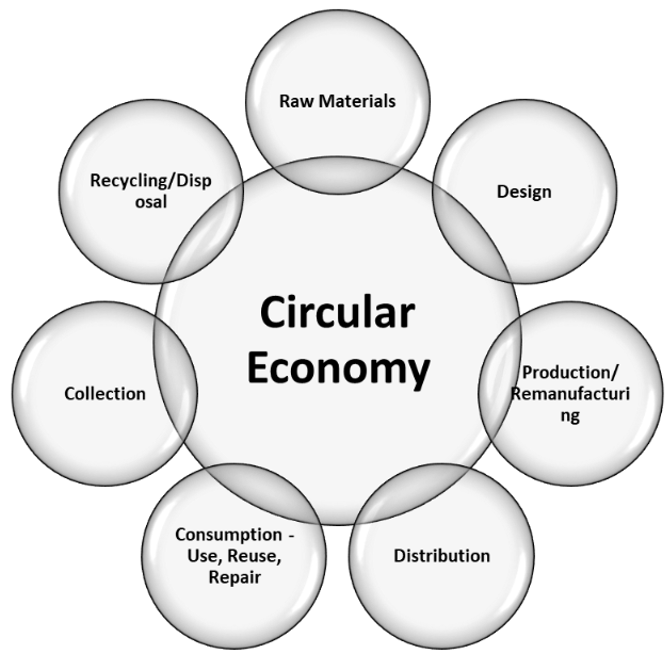
The concept of incorporating diverse waste from various sources is gaining traction internationally. The EU’s Sustainable Development Strategy aims for “zero waste” in harmony with the life cycle concept, encouraging waste reuse and recycling [4]. CE, an innovative framework, emphasizes sharing, leasing, repairing, refurbishing, reusing, and recycling products and materials, leading to waste mitigation and resource optimization. CE not only reduces toxic waste and environmental contamination but also conserves natural resources, preserves ecosystems, and promotes biodiversity [5]. The Circular Economy Action Plan (CEAP) released by the European Commission (EC) is being welcomed by Zero Waste Europe (ZWE) (Figure 1) as a crucial initiative to enhance the circularity of European Union (EU) nations.
Sustainability is a critical consideration across all sectors globally. Quite recently, the sustainable eco-construction has become a key focus for civil and environmental professionals because the construction and infrastructure industries are dealing with the consumption of unprocessed materials and are also huge producers of waste [6,7,8,9]. Most of this waste is linked to severe adverse ecological consequences, compelling concrete researchers to develop a numerous number of solutions for its mitigation [8,9].
Marble waste (MW) from the marble industry, comprising marble sludge (MS), marble powder (MP), and other dusts, presents a valuable opportunity for sustainable recycling. Marble, being resilient and weather-resistant, has historically been a vital construction material. However, the escalating demand for marble has led to a sudden increase in MW generation. This waste, if not managed systematically, can cause significant environmental pollution [10], affecting air, water, soil, vegetation, animals, and human health. Marble waste (MW) is primarily generated during quarry crushing operations, with 40% of it being small, valueless pieces discarded in landfills, causing environmental issues and agricultural degradation [11,12,13]. MW is also produced during marble cutting, leading to slurry, dust, and irregular stones, creating environmental challenges and health risks [14,15,16,17]. The predicted global industrial MW generation is around 25 billion tons by 2025 [18,19].

1.2. Importance of Recycling Marble Waste

The construction industry, a major consumer of raw materials, plays a pivotal role in the efficient use of resources. Traditional concrete production relies heavily on natural resources, which cannot sustain the growing global demands. Integrating MW into concrete manufacturing offers a sustainable solution. Marble sludge, in particular, has been extensively researched as a substitute for cement [20,21,22,23] and fine-sized natural aggregates. The proper utilization of MW not only reduces production costs but also reduces pollution significantly, making it a viable option for a circular economy [24,25].

1.3. Global Exigency for Marble and Growth of Marble Industry

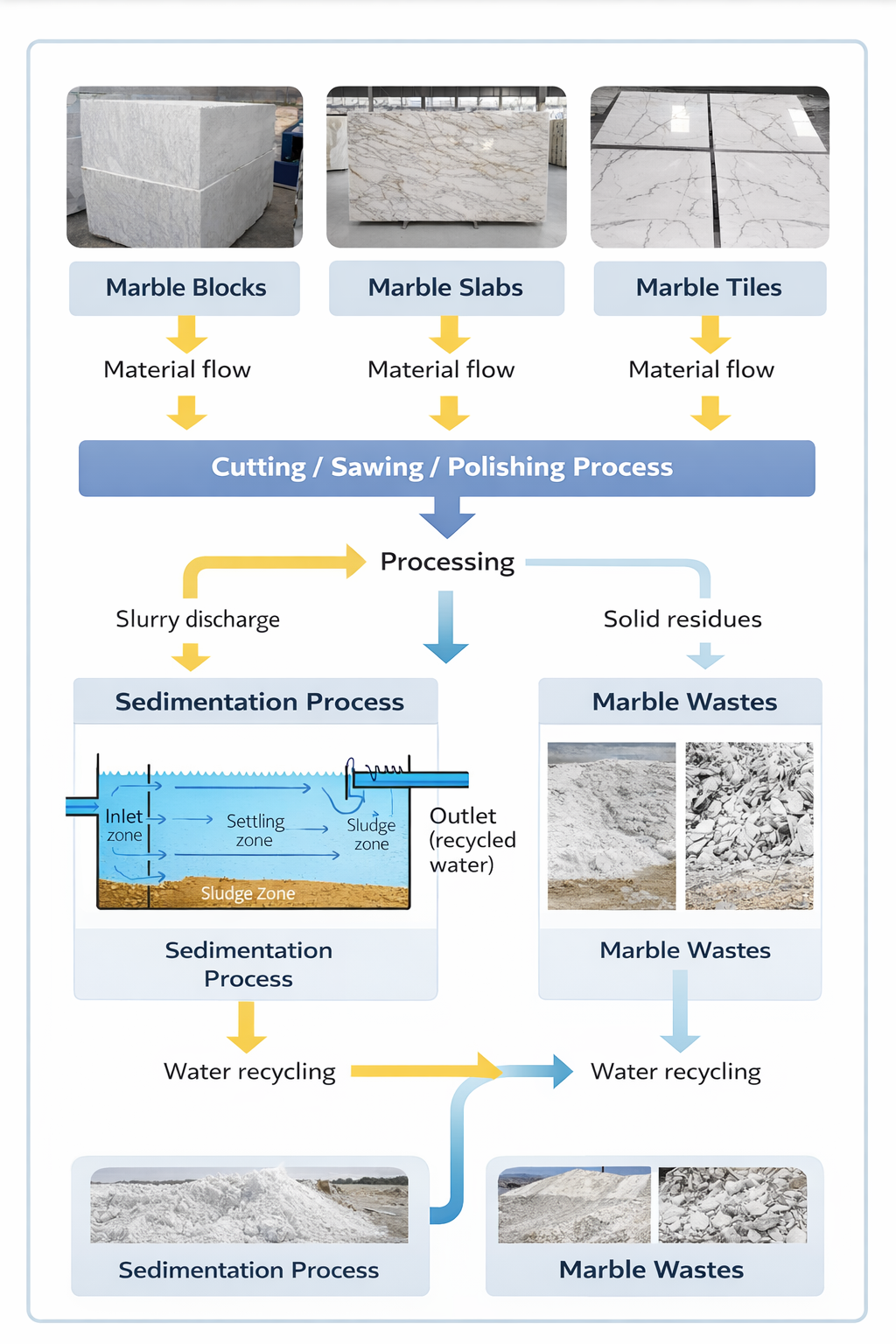
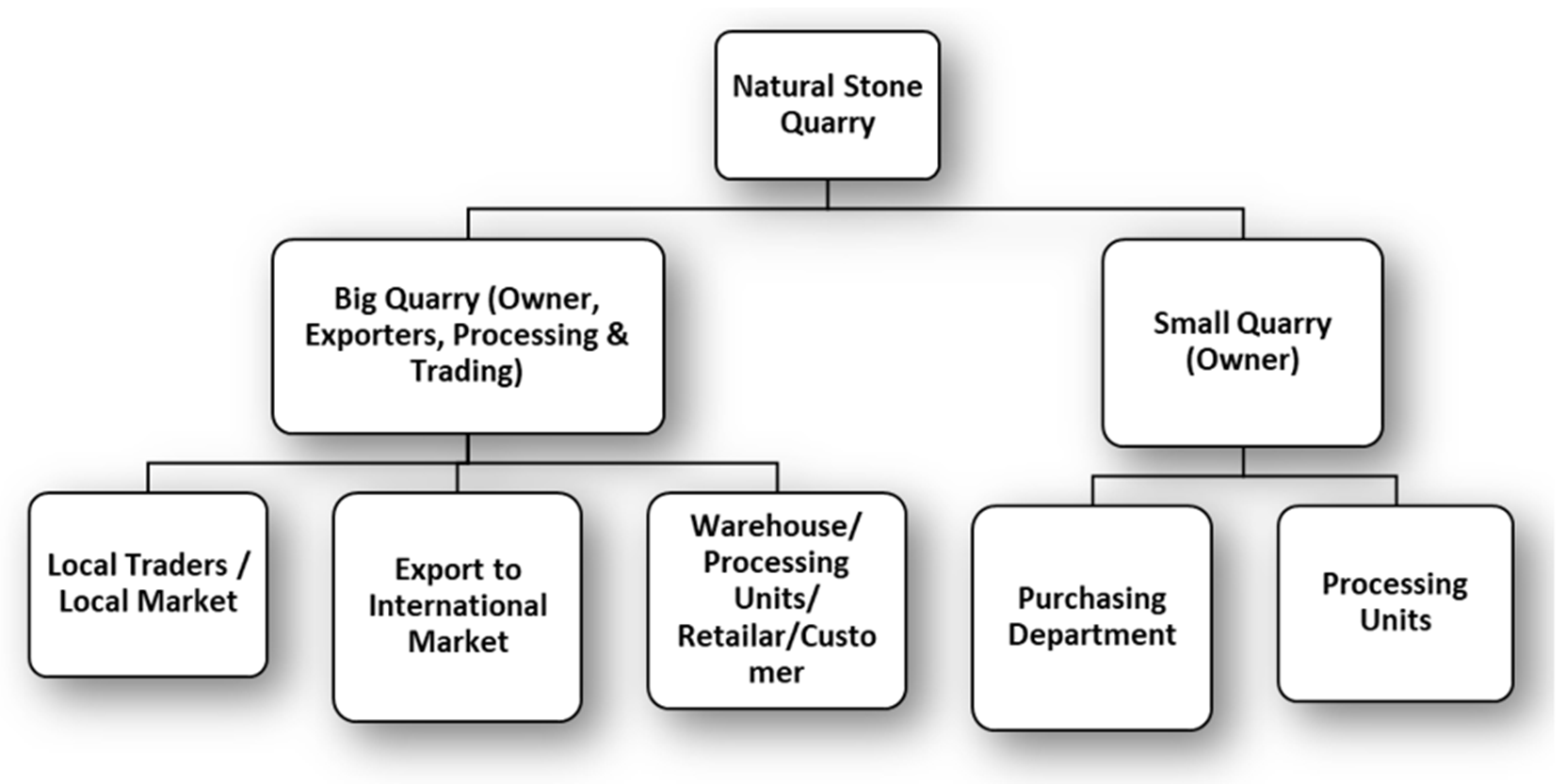
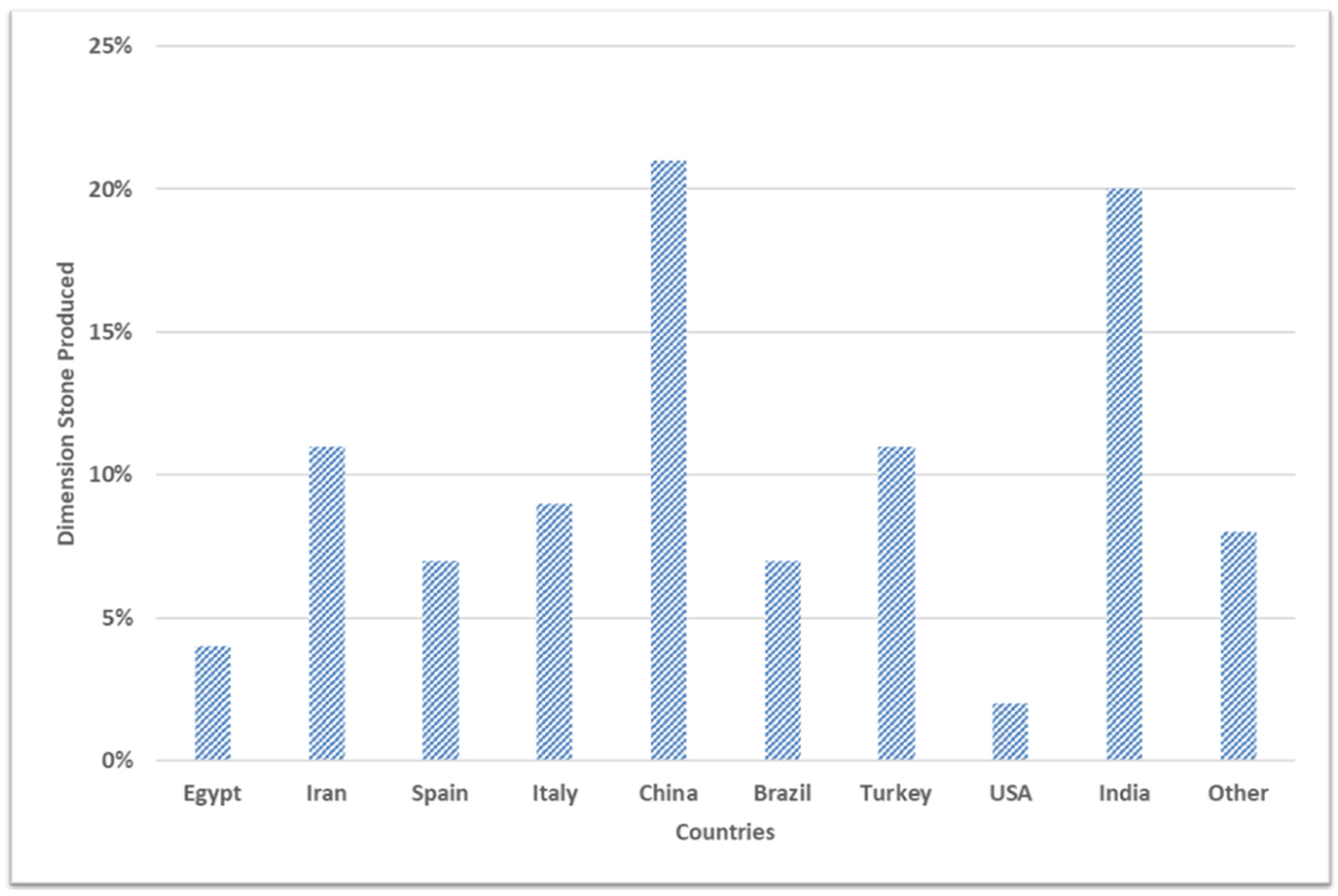
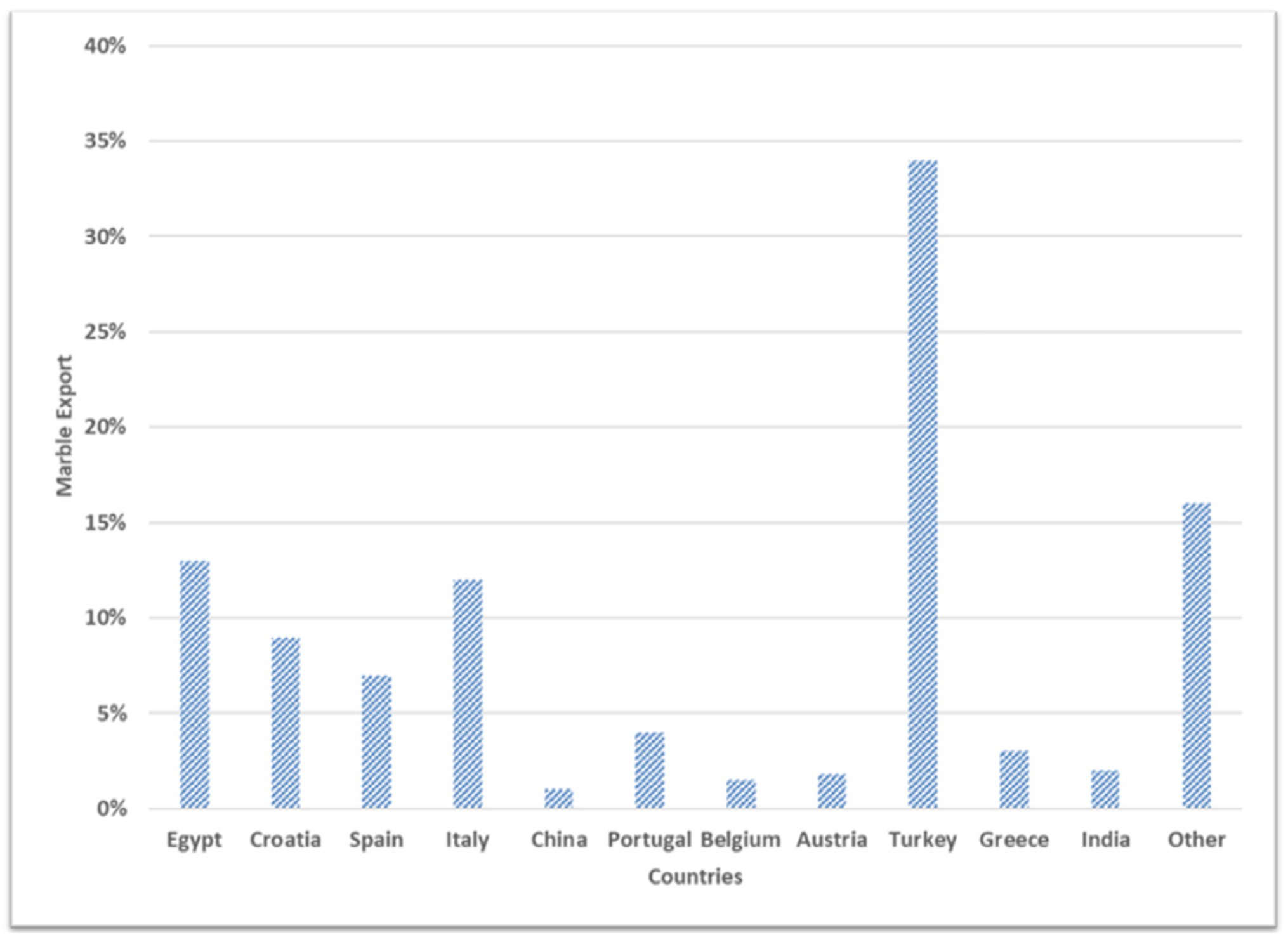
The marble industry is witnessing significant growth globally, leading to substantial waste generation, particularly in countries like the U.S.A., India, Egypt, Turkey, Brazil, and various EU nations (Table 1). India stands as the third-largest marble producer worldwide, contributing 10% of the global MP production [26]. The flowchart for marble processing and waste generation is shown in Figure 2 and Figure 3. Several other countries, including China, Iran, Italy, and Spain, are key players in the marble industry (Figure 4 and Figure 5) [27,28,29]. With vast marble reserves and a considerable annual generation of MW, addressing this waste is crucial for environmental preservation and economic advancement.

1.4. Scope of the Review

This review comprehensively explores the application of MW in concrete manufacturing and other areas, emphasizing its potential to prevent environmental pollution, improve concrete properties, reduce production costs, and promote human health. This study explores chemical, mechanical, microstructural, fire-resistant, thermal, and workability aspects of concrete incorporating MW. Additionally, this review evaluates MW’s recycling for replacing natural limited aggregates and cementitious products in various types of concrete. This review aims to provide valuable insights into sustainable waste management practices, paving the way for a circular economy and a greener future.

1.5. Research Gap and Novel Contribution

Although several experimental studies and previous reviews have explored the incorporation of marble waste in cementitious composites, most of the available literature primarily reports isolated findings on strength, workability, or durability without developing a unified mechanistic and performance-based understanding. A systematic critical synthesis connecting chemical composition, particle characteristics, replacement pathways, fresh-state behavior, strength evolution, durability trade-offs, and sustainability implications remains limited. In addition, contradictory observations regarding carbonation resistance, permeability, and optimum dosage levels are frequently reported without adequate mechanistic explanation. Therefore, this review addresses these gaps by critically comparing published findings, identifying optimum replacement ranges for different construction applications, explaining inconsistencies through filler densification and clinker dilution mechanisms, and proposing future industrial, standardization, and policy pathways for large-scale adoption within a circular economy framework.

2. Methodology

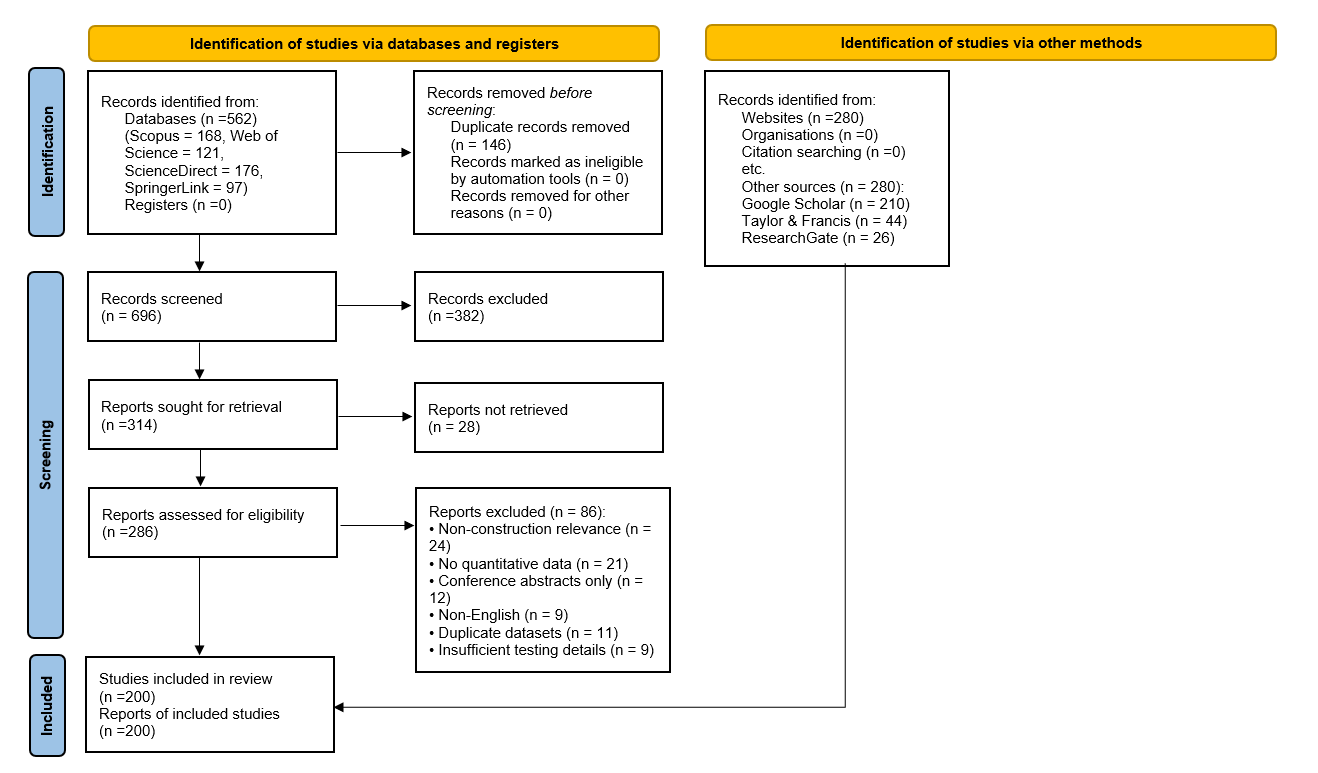
This systematic review was conducted in accordance with the Preferred Reporting Items for Systematic Reviews and Meta-Analyses (PRISMA 2020) [39] guidelines to ensure transparency, reproducibility, and methodological rigor. The study selection process followed the four-stage PRISMA approach, including identification, screening, eligibility, and inclusion. The PRISMA 2020 checklist is provided in the Supplementary Materials (Table S1). The literature survey was performed using major scientific databases, including Scopus, Web of Science, ScienceDirect, SpringerLink, and Google Scholar.
The primary search string used was: (“marble waste” OR “MP” OR “marble dust” OR “marble slurry”) AND (“concrete” OR “cement replacement” OR “fine aggregate” OR “coarse aggregate” OR “durability”).
Additional keyword combinations included stone waste, self-compacting concrete, mortar, polymer concrete, and recycled building materials. This review considered studies published in English between 2000 and 2025, including peer-reviewed journal articles and relevant experimental studies.
The inclusion criteria focused on studies reporting the use of marble waste in cement replacement, fine/coarse aggregate substitution, durability enhancement, microstructural modification, and sustainable building material applications. Duplicate records, non-English publications, purely geological studies without construction relevance, and conference abstracts lacking quantitative data were excluded.
The selected studies were critically evaluated based on marble waste type, particle fineness, replacement level, curing age, testing parameters, and reporting completeness, allowing the robust comparison of mechanical, rheological, and durability trends. The adopted methodology aligns with the principles of waste valorization, circular economy, and resource-efficient construction, as summarized in the PRISMA-based study selection process (see Figure 6). The screening and data extraction were conducted independently by the authors, and any uncertainties were resolved through discussion to ensure consistency and accuracy.
The study selection process was conducted in a structured and systematic manner. Initially, all retrieved records were screened based on titles and abstracts to remove irrelevant studies. Subsequently, full-text articles were assessed for eligibility according to the predefined inclusion and exclusion criteria. The screening and eligibility assessment were performed carefully to ensure consistency and minimize bias. Any ambiguities in study relevance were resolved through the critical evaluation of the study objectives, methodology, and reported results.
Data extraction was carried out systematically from the selected studies. The key information including marble waste type, replacement level, material characteristics, testing conditions, and reported mechanical and durability properties was collected. The extracted data were organized in a structured format to enable comparative analysis across studies. Only studies with sufficient experimental detail and clarity were included in the final synthesis.
The methodological quality and potential risk of bias in the included studies were qualitatively assessed based on reporting clarity, experimental design, sample size adequacy, curing conditions, and consistency in testing procedures. Studies lacking sufficient methodological detail or presenting incomplete datasets were considered to have a higher risk of bias and were interpreted with caution during the comparative analysis.
A narrative synthesis approach was adopted to analyze and interpret the findings of the included studies. Due to heterogeneity in experimental conditions, material properties, and reporting formats, a quantitative meta-analysis was not considered appropriate. Instead, results were synthesized based on observed trends in mechanical performance, durability characteristics, and material behavior across different marble waste replacement levels.
Potential reporting bias was considered during the interpretation of results, particularly in cases where studies reported selective outcomes or lacked complete datasets. The overall certainty of evidence was qualitatively evaluated based on the consistency of findings across multiple independent studies, with greater confidence assigned to trends repeatedly observed under similar experimental conditions.
A PRISMA 2020 flow diagram illustrating the study selection process is presented in Figure 6. This diagram provides a detailed overview of the number of records identified, screened, assessed for eligibility, and included in the final review. This systematic review was not registered in any formal registry (e.g., PROSPERO), as such platforms are primarily intended for clinical and health-related research. Therefore, no registration number or registration date is applicable. However, this review strictly adheres to the PRISMA 2020 reporting guidelines to ensure transparency and methodological rigor.

3. Chemical Attributes

Marble, a metamorphic rock widely used in construction and decorative applications [40,41,42,43,44,45,46,47], exhibits distinct chemical and mineralogical characteristics that strongly influence its performance in cementitious systems. The representative oxide compositions and physical properties of marble waste reported in Table 2 and Table 3 indicate a predominantly calcite-rich composition, generally characterized by high CaO-equivalent content and elevated loss on ignition (LOI). These chemical attributes are crucial for understanding its behavior as a largely inert filler, low-reactivity cement substitute, or fine aggregate replacement in concrete formulations. In particular, the high calcium carbonate content contributes to particle packing improvement, nucleation support, and interfacial densification, whereas excessive replacement levels may introduce clinker dilution effects. Therefore, a critical interpretation of the chemical composition is essential for correlating marble waste chemistry with fresh-state behavior, mechanical performance, and long-term durability outcomes.
The high LOI values reported for several marble waste sources in Table 2 (commonly 37–43%) strongly confirm the dominance of calcium carbonate-rich calcite phases, indicating that most marble waste is non-pozzolanic or only weakly reactive. Consequently, their beneficial contribution in concrete is primarily governed by micro-filler densification, nucleation support, and pore refinement, rather than direct hydraulic reactivity. This mechanistically explains the superior performance generally observed at 5–10% cement replacement and when marble waste is used as a fine aggregate substitute, whereas excessive dosages may induce clinker dilution and associated strength loss. Beyond oxide percentages and LOI values, the performance variability of marble waste is also strongly influenced by its phase assemblage, particle fineness, local Ca/Si interaction, and moisture-dependent dispersion behavior [41,42,43,44,45,46,47,52,53,54,55]. XRD-based studies consistently identify calcite as the dominant crystalline phase, with occasional dolomite and quartz traces depending on the geological origin and processing route of the parent stone [42,43,44,45,46,47]. This phase composition confirms the largely inert filler nature of marble waste and explains its limited intrinsic pozzolanic reactivity. In addition, the particle size distribution plays a critical role, where finely ground fractions, particularly those below 75 µm or with higher Blaine fineness, promote superior packing density, nucleation-assisted hydration, and interfacial transition zone densification [52,53,54,55]. The effective Ca/Si balance within the surrounding cement matrix may also be indirectly modified through dilution and micro-filler effects, thereby influencing calcium silicate hydrate gel formation and long-term durability. Furthermore, the residual moisture state of marble fines can affect dispersion, workability, and the effective water-to-binder ratio, which ultimately governs hydration kinetics and hardened-state performance [52,53,54,55]. These chemical and phase characteristics are further complemented by the physical properties summarized in Table 3, which govern water demand, particle packing, and setting behavior.
Table 3. Properties of marble waste.
Sr. No.Physical Properties[52][53][55][54]
1Specific gravity3.123.153.123.12
2Standard consistency (%)3431.53033
3Initial setting time40 min91 min50 min85 min
4Final setting time262 min211 min520 min270 min
The chemical composition confirms that marble waste behaves predominantly as an inert or low-reactivity material. Its contribution to concrete performance is therefore governed mainly by physical effects such as particle packing and microstructural refinement, rather than chemical reactivity. These characteristics provide the basis for interpreting the fresh and hardened properties discussed in subsequent sections.

4. Rheological Characteristics

4.1. Slump and Flowability

Numerous investigations have examined the use of marble dust (MD) and MP as partial replacements for fine aggregate or Portland cement, with substitution levels reaching up to 60% [48,49,50]. In most cases, low-to-moderate incorporation levels improved slump, flowability, and self-compacting performance, mainly due to the smooth particle morphology and filler-assisted lubrication effect [51,56,57]. Concrete incorporating MD often exhibited fresh-state stability comparable to reference mixtures [28]. However, excessive marble waste incorporation may reduce slump and air content over time because of increased surface area and water demand [45].
MD is employed in different forms, with substitution levels reaching up to 60%. Previous research conducted by Gesoglu et al. [51] indicated that substituting PC with MD up to 20% led to a decrease in slump. Seghir et al. [28] demonstrated that concrete incorporating MD exhibited similar stability to its reference mixtures. Moreover, the incorporation of MD had improved the fresh characteristics of concrete, aligning with the findings of Alyamac et al. [58]. Silva et al. [14] observed the negative impact of MP on workability due to its poor wear resistance and smooth texture. Andre et al. [59] suggested that workability is not significantly affected and does not exhibit a defined trend when coarse marble aggregate is incorporated into the concrete mix. However, there is still an increase in workability observed for the 20% incorporation ratio, indicating a slight improvement in the ease of handling and placing the concrete. Binici et al. [45] discovered a significant loss in both slump and air content over time for all the concrete mixtures containing marble waste. This indicates that the workability and air content of the concrete mixes decreased as time progressed, possibly due to various factors such as the absorption of water by the marble waste particles or changes in the concrete’s rheological properties over time.

4.2. SCC and Mortar Rheology

In SCC and mortar systems, marble cutting slurry waste (MCSW) and waste marble dust (WMD) generally maintain or improve flowability when used at controlled dosages, particularly in the presence of superplasticizers [16,37,51,60,61]. The filler action of marble particles contributes to improved particle packing and reduced segregation, enabling satisfactory self-compacting performance even at replacement levels approaching 30–50% in selected systems. Gesoglu et al. [51] evaluated the fresh properties of self-compacting concrete (SCC) produced using fly ash (FA), limestone powder (L.S.), and marble cutting slurry waste (MCSW). They found that the integration of MCSW as a cement substitute resulted in a systematic decrease in the properties of concrete. Usyal and Sumer [60] studied the impact of mineral admixtures on fresh properties and found that MCSW integration of up to 10% offered good workability. Sadek et al. [61] studied the reuse of granite waste (GW) and MCSW in SCC as additional minerals. They found a slightly positive effect on SCC’s fresh properties up to a 50% transition using MCSW as a cement substitute, attributed to the filler action by MP waste. Valdez [37] investigated the application of waste from the marble industry in SCC, with 30% cement substitution by MW showing the excellent flowability of SCC mix. Corinaldesi et al. [16] supplemented waste marble dust (WMD) in SCC for mortar production using a superplasticizer. The workability of mortar was maintained with different additives while the sand/cement ratio remained constant at 3:1.

4.3. Viscosity and Setting Behavior

Rheological studies on cement grout systems further indicate that marble waste incorporation increases plastic viscosity, particularly at higher replacement levels, owing to increased powder content and surface interaction [62]. Similarly, the incorporation of waste marble powder (WMP) was found to improve fluidity and modify setting behavior at low dosages [63]. Cinar et al. [62] measured the characteristics of cement grout containing WMD. WMD addition in quantities ranging from 5% to 25% with different water-to-binder ratios positively influenced the rheological properties of the cement grout. An increase in MP waste content led to an increase in the cement-based grout’s plastic viscosity for all water-to-binder ratios, whereas an increase in the water-to-binder ratio caused a decrease in plastic viscosity for a specific composition.
Ma and his team [63] aimed to enhance the mechanical strength of concrete by partially substituting cement with nano-silica and WMP. They found that blending WMP with concrete improved fluidity and setting time but negatively influenced compressive strength when the substitution exceeded 10%. However, adding a very small quantity of nano-silica increased compressive strength and reduced the setting time and fluidity of the mixture. Their study revealed that a combination of 10% WMP and 3% nano-silica achieved optimal compressive strength.
The rheological response of marble-waste-modified systems is primarily governed by particle fineness, replacement route, water demand, and superplasticizer compatibility, with optimum fresh-state performance generally observed at low-to-moderate replacement levels.

5. Mechanical and Durability Performance of Marble Waste-Based Concrete

5.1. Mechanical Characteristics

Concrete researchers have extensively explored the potential of marble waste (MW) as a substitute material for natural aggregates and/or cement, with its inert structure making it more suitable for fine aggregates [64,65]. Large marble particles can be crushed and utilized as coarse or fine aggregates in concrete production [65,66,67,68]. Studies have shown that concrete manufactured using waste marble powder (WMP) as a sand replacement exhibited improved mechanical properties compared to WMP used as a cement replacement [40] (Table 4).
Studies also revealed that WMP, when used as both a cement and a sand substitute, enhanced the concrete’s performance [68,69,70,71,72,73,74]. Researchers found that MW can be utilized as fine aggregates, significantly reducing carbon dioxide emissions and production costs [35]. Waste marble dust (WMD) was found to enhance compressive strength, reduce porosity, and increase the unit weight of concrete when used as a fine aggregate substitute [69]. Additionally, the incorporation of MW in concrete led to a reduction in porosity due to its “filler effect” and role in hydration [69,72,75,76,77].
Marble slurry waste (MSW) has been investigated for construction composites, showing improved mechanical attributes in concrete [23]. Integrating MSW in self-compacting concrete (SCC) [43,78,79,80,81,82,83] reduced cement and river sand consumption, benefiting the ecosystem [78]. In the context of self-compacting concrete (SCC) with MP as a mineral additive, Haddadou et al. [81] reported noteworthy performance, particularly in the hardened state. An improvement in compressive strength was observed in concrete during Ergün’s study [22] when 5.0% and 7.5% of marble dust waste was used as the partial substitution for cement.
The research conducted by Aliabdo et al. [40] explored the impact of marble dust waste as the partial substitution for cement or sand at mass percentages of 5%, 7.5%, 10%, and 15%. This incorporation led to an enhancement in the mechanical characteristics of concrete, primarily due to a filler effect. Additionally, both compressive and splitting tensile strengths of concrete samples increased when marble dust waste was used up to 10% as the partial substitution for cement [40,52]. These findings indicate the positive influence of marble dust waste on the mechanical properties of concrete.
In a study conducted by Khodabakhsian et al. [84], the influence of replacing cement with waste marble powder (WMP) at ratios of 0%, 5%, 10%, and 20% was investigated. The research concluded that a mere 5% substitution could enhance the compressive strength, while a 10% substitution would slightly degrade the compressive load-bearing capacity. They reported that, considering the ecological and economical benefits of integrating WMP with concrete, up to 20% substitution of cement would be a reasonable choice for optimizing compressive strength.
Additionally, employing Data Mining (DM) and Machine Learning (ML) techniques can enhance the efficiency of analyzing such behaviors in terms of both time and cost. These techniques provide effective tools for simulating and understanding the impact of incorporating WMP in concrete, enabling more informed decision making in the field of construction materials. Machine Learning (ML) models have been explored to predict concrete behavior incorporating MW, demonstrating the potential of ML techniques in this domain [85,86,87,88,89,90,91,92,93,94,95]. However, the complexity and computational demands of deep neural networks pose challenges, emphasizing the need for simpler and more practical models for in situ applications [95].
Studies have also explored the impact of MD and silica fume (SF) on concrete properties. Incorporating MD and diatomite as partial substitutes for Ordinary Portland Cement (OPC) improved compressive and flexural strengths due to their void-filling effect and pozzolanic activity [22]. MD was found to have a more significant impact on compressive strength when used as a sand substitute rather than as a cement replacement [40]. The use of MS as a cement substitute improved compressive strength up to 20% but decreased at higher substitution ratios [43]. Integrating MW with natural pozzolan reduced compressive strength, indicating the importance of careful selection and proportioning of waste materials for optimal concrete performance [94].
Soliman [95] studied the impact of MP substitution for cement in concrete. Up to 7.5% substitution increased compressive strength by 25%, but exceeding 7.5% led to a 26% decrease. Tensile strength and modulus of elasticity (MOE) increased with 7.5% MP, but diminished for higher ratios. Ashish et al. [96] investigated concrete with MP replacing cement and sand at 10% and 15%. Slight improvements in splitting tensile and flexural strengths were observed. These studies highlight the complex relationship between MP substitution and concrete properties, emphasizing the need for careful mix design optimization.
Table 4. Mechanical test from related studies.
Marble Powder (%)Tests on Hardened ConcreteTesting Age (Days)Ref.
Compressive Strength (MPa)Tensile Strength (N/mm2)Flexural Strength (MPa)
10645.556[40]
5556.2 90[97]
504028[98]
60273.790[99]
0.5351.3428[100]
254228[101]
1006390[69]
10494.2128[102]
202414[103]
15634.4 28[104]
2076365[105]
25483.628[106]
5425 28[107]
207228[57]
104028[76]
254728[108,109]
5334.528[110]
2533456[111]
1036 28[112]
In summary, MW, WMP, MSW, and other marble waste materials show promise as sustainable substitutes in concrete production. The selection of appropriate substitution ratios and the careful consideration of material properties are crucial for achieving desirable mechanical properties and environmental benefits in concrete applications. Future research should focus on developing simpler ML models and exploring innovative techniques, such as the “paste replacement method,” to enhance the utilization of marble waste in concrete technology [32].
Table 4 indicates that the optimum mechanical performance of marble-powder-modified concrete is generally achieved within the 5–15% replacement range, where compressive strengths commonly vary between 40 and 64 MPa, while selected SCC systems exceed 80 MPa at later curing ages [40,57,60,69,76,97,98,99,100,101,102,103,104,105,106,107,108,109,110,111,112]. Across the compiled studies summarized in Table 4, trength enhancement is most consistently observed at 5–15% cement replacement and 10–20% fine aggregate replacement, where the combined effects of micro-filler densification, improved particle packing, and interfacial transition zone (ITZ) refinement dominate the mechanical response. The available literature indicates that these optimum ranges provide the most reliable improvements in compressive, tensile, and flexural strengths, particularly at 28 days of curing. However, higher replacement dosages show increasingly divergent outcomes, largely depending on particle fineness, the water-to-binder ratio, curing duration, and the replacement route adopted. This variability explains the contradictory strength trends reported in some studies and highlights that the mechanical benefits of marble waste are governed more by microstructural optimization than by replacement percentage alone.
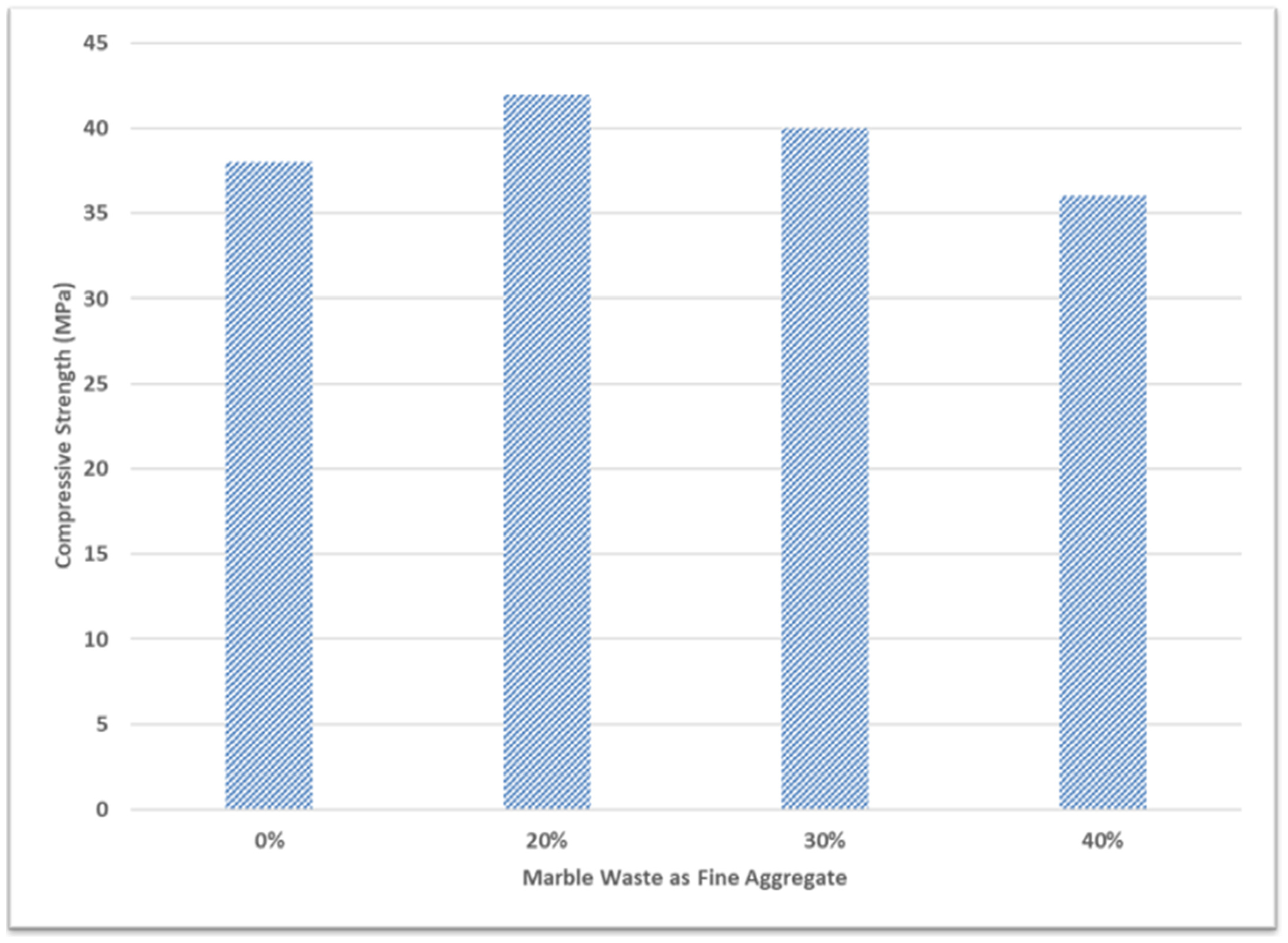
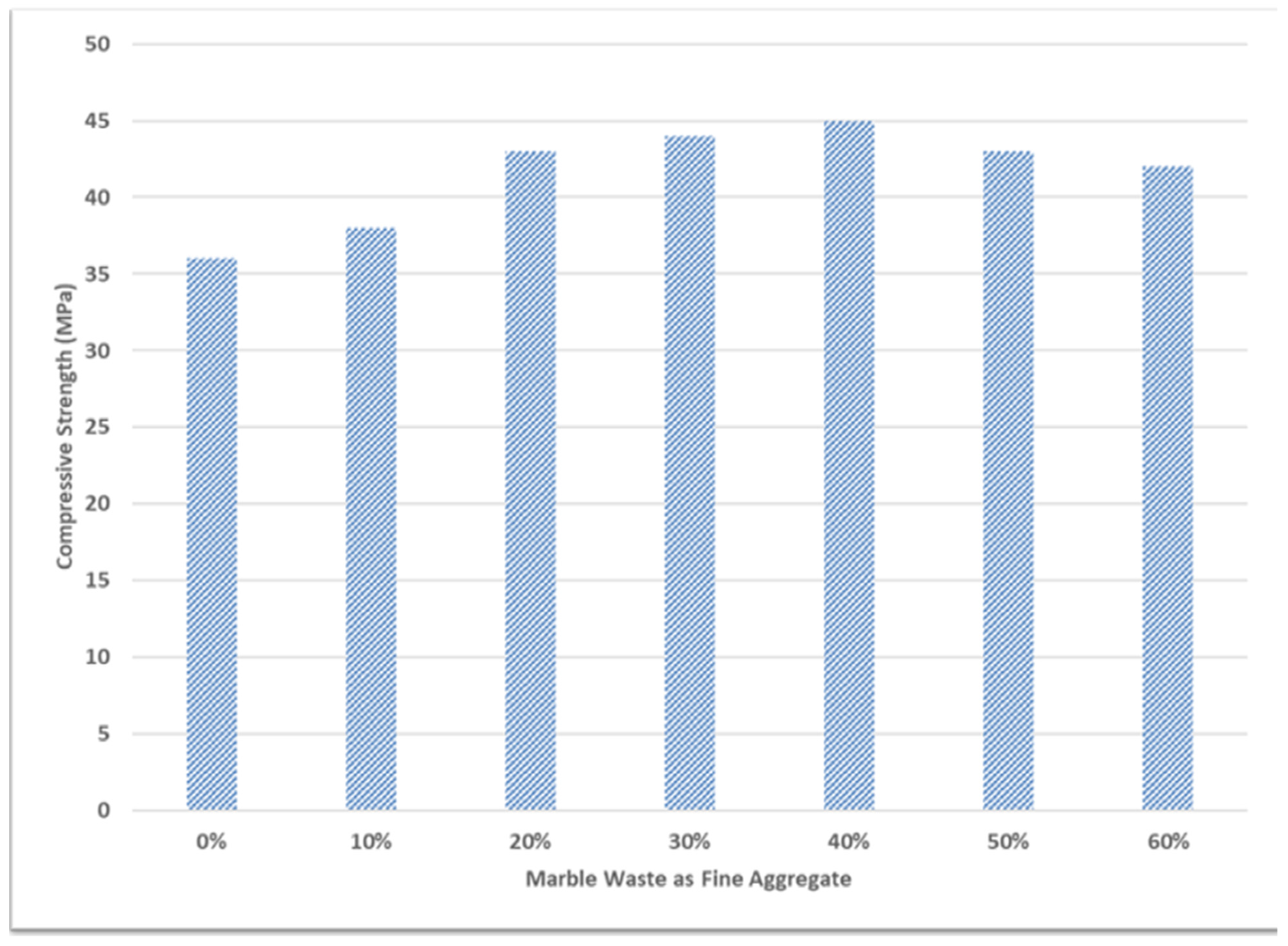
Uysal and Sumer [60] found that self-compacting concrete (SCC) with 10% MP exhibited comparable compressive strength to classical concrete, even after 400 days of aging. They observed a compressive strength of 82 MPa on the 90th day for the reference concrete, while SCC with 10%, 20%, and 30% MP showed strengths of 84 MPa, 81 MPa, and 80 MPa, respectively. Figure 7 shows the compressive strength of self-compacted concrete incorporating marble waste as a fine aggregate.
Corinaldesi et al. [16] demonstrated that using MD as a filler material resulted in improved concrete properties. With 5% MP as a filling material, they observed a reduction in porosity and an increase in bending and compressive strengths by 12% and 5%, respectively.
Rai et al. [55] reported a 5% increase in compressive strength and a 25% increase in bending strength for concrete specimens with 15% marble waste (MW) substitution for sand on the 28th day. Additionally, the slump value of the specimens increased with a higher proportion of MW.
These findings collectively suggest that incorporating marble powder or marble waste in concrete mixes positively affects various mechanical properties and workability of the concrete. The studies conducted by Hebhoub et al. [13] demonstrated that incorporating marble waste (MW) in concrete improved its compressive strength significantly. Specimens with 25%, 50%, and 75% MW exhibited enhanced compressive strength compared to the reference samples without marble powder. Similarly, Demirel [69] utilized 100% MW with a water/cement ratio of 0.51 and reported a 9.7% increase in compressive strength and a 25% increase in elasticity modulus on the 28th day. The porosity decreased by 8%, and the splitting tensile strength increased by 13%, 33%, and 11% on the 90th day for specimens with varying percentages of MW. Similar optimum trends within the 10–15% range were also confirmed by multiple independent studies [52,69,95,113], whereas strength reduction beyond 20% was mainly linked to dilution and increased water demand.
Chavhan and Bhole [113] found that traditional concrete had a compressive strength of 30.1 MPa on the 14th day and 28.2 MPa on the 28th day, with a splitting tensile strength of 4.7 MPa on the 28th day. When 50% MP was added to the concrete mix, the compressive strength increased to 33.1 MPa on the 14th day and 35.7 MPa on the 28th day. Additionally, when 50% MP and gravel were used, the splitting tensile strength reached 5.7 MPa on the 28th day.
Belachia and Hebhoub [114] incorporated 25% MW into concrete with a water-to-cement ratio of 0.45, resulting in an increased compressive strength of 36 MPa compared to 33 MPa for specimens without MW. These findings highlight the positive impact of marble powder on concrete’s mechanical properties, including compressive and splitting tensile strengths. The studies conducted by various researchers highlight the impact of marble waste (MW) on the mechanical properties of concrete. When Omar et al. [115] used 15% MP in concrete, they observed an increase in the modulus of elasticity (MOE) of 1.2% to 5.1%, although it led to a decrease in workability. Specimens blended with 10% MP exhibited a strength increase of 17%, 15%, and 15% in various aspects, while those blended with 15% MP showed enhancements of 22%, 17%, and 17% in respective properties. The splitting tensile strength also increased by 10% for both MP ratios. The replacement of fine aggregate with 50% marble sludge powder and 50% quarry rock dust improves strength performance. However, increasing marble sludge powder beyond 50% enhances workability but reduces compressive and split tensile strength [116].
Shirule et al. [52] replaced 10% of Portland cement (PC) with marble dust and reported a 17% increase in compressive strength and an 11.5% increase in tensile strength on the 28th day. Dhoka [116] used a 50–50 blend of marble dust and stone dust as a substitute for fine aggregates, leading to a 7.7% increase in compressive strength and a 25% increase in splitting tensile strength compared to the reference samples.
Soliman [95] utilized varying percentages of waste marble powder (2.5%, 5%, 7.5%, 10%, 12.5%, 17.5%, and 20%) to replace Portland cement in concrete mixtures. The compressive strength increased by 24.9% on the 28th day when 2.5% waste MP was used. The strength also increased by 8% with 7.5% waste MP. However, as the percentage of waste MP increased to 20%, the splitting tensile strength dropped to 2 MPa, indicating a balance between the percentage of waste marble powder and the concrete’s mechanical properties. In the research conducted by Aliabdo et al. [40], the velocity of ultrasonic pulses remained relatively constant when 15% MP was used to replace both Portland cement and natural sand. Concrete’s compressive strength increased by 14% when 10% MP was used to replace sand, and the strength of the mixtures with a lower water/cement ratio increased by 22%. Additionally, they observed a 15% increase in splitting tensile strength when MP was used at a 10% replacement level for both PC and natural sand. These results demonstrated superior performance compared to traditional concrete, especially when lower water-to-cement ratios were used.
Uygunoglu et al. [117] prepared mixtures with varying water/cement ratios (0.31, 0.34, 0.37, and 0.40) incorporating recycled aggregates and marble waste (MW) aggregates. They found that specimens prepared with recycled aggregates and a water/cement ratio of 0.31 exhibited compressive strengths of 49 MPa on the 7th day and 54 MPa on the 28th day. Similarly, specimens prepared with marble aggregates achieved compressive strengths of 44 MPa on the 7th day and 53.5 MPa on the 28th day. The results indicated that compressive strengths decreased with an increase in the water/cement ratio.
Ergun [22] revealed that the highest compressive strength was achieved when 5% marble powder was used as a substitute for Portland cement. Talah et al. [118] compared reference specimens with no MP to testing samples containing 15% MP. The compressive strengths of the reference specimens on the 7th, 28th, 90th, 180th, and 365th day were 26 MPa, 38 MPa, 44 MPa, 46 MPa, and 48 MPa, respectively. In contrast, the testing specimens showed consistent results with compressive strengths of 39 MPa, 52 MPa, 58 MPa, 62 MPa, and 65 MPa on the corresponding days, indicating an improvement in compressive strength values over time.
Marble cement (MC) was used to make mixtures by Khan et al. [119]. After 28 days of curing, they found that the MC mortar’s compressive strength was 6.03 MPa. After a year, MC mortar’s compressive strength was 20.67 MPa, just 17% lower than OPC mortar. When up to 80% MW was added, the specimens’ compressive strength was considerably enhanced.
Tennich et al. [120] found that using MP as a filler in self-compacting concrete (SCC) increased compressive strength by 42.7% compared to traditional SCC when it was used at around 75% of the weight of Portland cement. However, the velocity rate of ultrasonic pulse decreased by 2.6%, while dynamic and static modulus of elasticity (MOE) reduced by 12.8% and 16%, respectively. The splitting tensile strength increased by 41%.
Similarly, Wu [121] observed an enhancement in dynamic modulus of elasticity for specimens with MP. On the other hand, Demirel [69] reported a 10% increase in the velocity of ultrasonic pulse when MP was used. Elyamany et al. [57] conducted experiments on the use of MD as a filling material in the production of self-compacting concrete (SCC) and analyzed its impact on the concrete’s physical and mechanical properties. They added 30 kg/m3 (7.5%), 40 kg/m3 (10%), and 60 kg/m3 (15%) of MD to a 400 kg/m3 Portland cement (PC) mixture and also added 50 kg/m3 (10%) of MD to a 500 kg/m3 PC mixture. On the 7th day, the compressive strength of mixtures containing both silica fume (SF) and MD at a rate of 15% was 31 MPa and 36.5 MPa, respectively. By the 56th day, the compressive strengths increased to 47.5 MPa and 46.5 MPa, respectively. They observed that the type of filling material influenced segregation and bleeding in the SCC.
Sadek et al. [61] found that the addition of marble and granite dust (MGD) at specific ratios resulted in an improvement in compressive strength. On the 28th day, the improvement in compressive strength was 1.7%, 3.9%, and 9.5%, respectively, when 30%, 40%, and 50% of MD was added. They concluded that the optimal waste additive rate was 50% by weight for a PC quantity of 400 kg/cubic meter, regardless of the material type. In general, the compressive strength increased when the quantity of MD waste was increased up to 10%. The optimum compressive strength was typically achieved with the use of 10% MD waste, although in some studies, 5% was considered the optimal value.
The improvement in compressive strength was associated with the rate of MD waste used in some studies, while in others, the increase was nominal. The data suggested that there was a continuous increase in compressive strength even with a 100% substitution of aggregates with MD. Furthermore, the results indicated that the boost in compressive strength could be up to 40% higher than the initial value. It was anticipated that the increase in compressive strength through the recycling of MD in PC is attributed to its higher content of calcium carbonate (CaCO3), which is naturally found in marble chemistry.

5.2. Durability Attributes

The potential applications of marble waste in concrete technology have been extensively studied by researchers globally. One of the fitting uses for marble waste is as a replacement for fine aggregates due to its inert structure, as demonstrated in numerous research studies [64,65]. By crushing marble waste, large particles can be transformed and utilized in concrete manufacturing as either fine or coarse aggregates [66,67]. Researchers have observed that the enhancement of properties is more significant in concrete where marble waste is used as a substitution for sand rather than as a replacement for Portland cement (PC) [68].
To assess the durability of concrete incorporating marble waste, experiments were conducted to evaluate its performance as a sand replacement. Gameiro [71] conducted studies and found that the concrete’s durability and resistance against carbonation improved when sand was replaced with 20% marble waste, leading to enhanced capillarity as well. Another study by Vardhan et al. [67] reported a 20% increase in strength and a 30% reduction in shrinkage in concrete where 20% marble waste was used, demonstrating the positive impact of marble waste on concrete properties when utilized as a sand replacement.
The utilization of marble waste (MW) in concrete technology has been extensively studied by researchers worldwide. Previous studies have reported the replacement of both natural aggregates [48] and Portland cement (PC) [46] with MD at varying levels, often up to 60% substitution. Li et al. [57] proposed an innovative technique that involves substituting the paste, allowing for a reduction of up to 33% in the quantity of PC while enhancing the utilization of marble waste, and resulting in improved strength and durability properties of the concrete. However, it is worth noting that the decrease in hydration products can lead to an increase in porosity when 15% of marble powder is used [28].
Researchers have observed a reduction in the rate of water absorption due to the incorporation of MD waste, and this blending of MD waste has been found to enhance the thermal conductivity of the resulting concrete [32,122]. The primary objective of these studies is to focus on replacing Ordinary Portland Cement (OPC) in concrete to reduce environmental carbon footprints, promoting greener, user-friendly, and eco-friendly supplementary cementitious building materials.
Additionally, researchers have explored the use of marble waste as an alternative fine aggregate [69,71], offering dual benefits. Firstly, the proportion of fine-sized aggregates inside concrete is often higher than that of PC, making it feasible to blend a significant amount of MW in concrete as a substitution for fine aggregates. Secondly, the natural inertness of marble materials makes them more suitable as a substitution of fine aggregates than replacing PC. In concrete, MD acts as a filler without significantly participating in the hydration process [40]. The incorporation of MD as a sand replacement, as studied by Gameiro, resulted in concrete with enhanced durability, increased water absorption through capillary suction, reduced drying shrinkage, and improved resistance against carbonation [71]. Similarly, Ulubeyli et al. [73] reported improved durability characteristics such as permeability, resistance to chloride penetration, sulfate attack, and water absorption by integrating MW as fine aggregates in concrete. These findings demonstrate the potential of marble waste as a valuable and versatile material in the realm of concrete technology.
Recent broader studies on waste rock fines also confirm similar pore refinement and climatic durability mechanisms, further validating the durability enhancement observed in marble waste-based concrete [123,124].
A study conducted by Hameed et al. [82] investigated the permeability of self-compacting concrete (SCC) incorporating MCSW. The partial replacement of natural fine aggregates with MCSW led to a reduction in permeability while maintaining constant compressive strength.
These studies collectively indicate the potential of marble cutting slurry waste as a suitable material for the partial substitution in concrete mixtures, enhancing both strength and durability properties, particularly in specific environmental conditions.
The use of MD as a substitution material for sand in concrete has been studied extensively, focusing not only on strength and durability but also on parameters like drying shrinkage, which plays a crucial role in the overall integrity and cost-effectiveness of structures.
In research conducted by Gameiro, it was found that substituting 20% of sand with MD enhanced the durability properties of concrete, particularly in terms of water absorption through capillary suction and resistance against carbonation [125].
Drying shrinkage is a critical factor that influences the overall performance and integrity of concrete structures [126,127,128,129]. It occurs as a result of the loss of moisture from the concrete [130], leading to dimensional changes and the development of tensile stresses, which can ultimately result in cracking. Drying shrinkage is influenced by various factors, including the characteristics of cementitious materials, type and quantity of aggregates, curing conditions, member geometry, and the presence of mineral admixtures [131,132]. The observations made by Kou et al. [133] revealed a reduction in shrinkage strain by an average of 15% to 20% in mixtures incorporating fly ash (FA). This reduction in shrinkage strain indicates the positive influence of FA on mitigating shrinkage-related issues in concrete mixtures.
Studies have shown that the addition of mineral admixtures, such as fly ash (FA) and ground granulated blast furnace slag (GGBFS), can influence the structural arrangement of concrete pores and, consequently, affect drying and shrinking characteristics [129]. For example, concrete mixes containing FA exhibited superior drying and shrinking properties compared to those containing slag [129]. The addition of GGBFS reduced shrinkage strain by 15% to 50% in comparison with the reference concrete [134].
According to the reports of Yuan et al. [135], there was a significant mitigation of 20% to 35% in terms of shrinking strain observed in mixes where sixty percent of the volume of Portland Cement (PC) was substituted with slag. This reduction highlights the effectiveness of slag in minimizing shrinkage-related concerns within concrete mixes. Additionally, the type of aggregates, including both finer and coarser aggregates, has been found to impact concrete shrinkage characteristics [136,137].
In summary, the use of marble dust in concrete not only affects strength and durability but also plays a role in mitigating drying shrinkage, making it an important consideration for sustainable and resilient concrete construction.
The utilization of MP in concrete has been extensively studied, focusing on its impact on compressive strength, workability, sorptivity, and other durability-related properties. Researchers have explored various substitution levels of sand and Portland cement (PC) with MP waste to determine the optimal proportions for enhancing concrete properties while minimizing environmental impact.
In the study conducted by Alyamaç and Aydin, an improvement in compressive strength was observed of up to 10.5% by weight of MP at different curing times. However, as the substitution level increased beyond 20%, workability significantly decreased. The sorptivity property of concrete showed a minor effect with increasing MP waste content [24].
Binici et al. found that incorporating 15% MP waste as a substitution for sand resulted in concrete with compressive strength of up to 1.7 times higher than the control mix. However, there was a decrease in resistance to abrasion despite enhancements in resistance to sulfate attack [138].
Aliabdo et al. evaluated the use of MP waste as both a PC and a sand substitution. They concluded that utilizing MP waste as the partial substitution for sand yielded better results due to its filler effect, with the optimal substitution level being 10%. However, the partial replacement of PC led to a decrease in cementitious materials due to PC dilution [40].
Furthermore, researchers have advocated reducing Ordinary Portland Cement (OPC) consumption by reusing MP waste as a supplementary cementitious material (SCM). This approach helps mitigate the environmental impact associated with OPC production, including CO2 emissions, a significant greenhouse gas [139].
In summary, the studies indicate that the utilization of MP waste in concrete can enhance its mechanical properties and durability characteristics. However, the careful consideration of substitution levels is necessary to balance the improvements in properties with potential drawbacks such as reduced workability and resistance to abrasion. Additionally, the reuse of MP waste as an SCM presents a sustainable solution to reduce OPC consumption and minimize environmental impact.
In a research investigation, Vardhan et al. [65] incorporated municipal solid (MS) waste as a substitute for finer aggregate in conventional vibrated concrete (CVC) and analyzed its impact on the drying shrinkage property. Their results demonstrated a positive influence on drying shrinkage of up to a substitution level of 60%. Singh et al. [23] explored the influence of MS waste on the compressive strength and drying shrinkage of Portland cement (PC) mortar and PC–concrete mixtures. They observed that increasing the content of MS waste in the substitution of PC in mortar led to reduced values of drying shrinkage but resulted in enhanced carbonation depth.
Numerous studies have investigated the durability performance of self-consolidating concrete (SCC) and CVC incorporating MS waste. Alyousef et al. [140] examined the durability performance of SCC incorporating MS waste and limestone powder, constituting 20% of the filler in the cementitious matrix. They observed increased resistance to carbonation depth and water penetration depth with the addition of MS waste. Paradoxically, these findings contradict the results outlined by Singh et al. [23] concerning mortar mixtures. Ghorbani et al.’s study [41] on the corrosion behavior of self-consolidating concrete (SCC) mixtures incorporating municipal solid (MS) waste concluded that a substitution of up to 10% of Portland cement (PC) with MS waste accelerated the resistance against corrosion in the SCC mixture. Li et al. [32] focused on the durability performance of mortar mixtures incorporating MS waste. They replaced PC in mortar with MS waste at varying proportions of 0%, 5%, 10%, 15%, and 20%. Their study indicated a significant decrease in the depth of carbonation at a 20% replacement level, along with reduced drying shrinkage due to the integration of MS waste.
Taji et al. [141] investigated the corrosion behavior of conventional vibrated concrete (CVC) blended with MS waste and granite waste. They reported that substituting up to 20% of PC with MS waste improved the resistance to corrosion in the CVC mixture. Ashish [142] conducted a study assessing the durability of CVC incorporating MS and silica fume (SF) waste. Their findings revealed that incorporating 10% SF in CVC as a replacement for PC enhanced resistance to carbonation. Additionally, the carbonation resistance of the CVC mixture was noted to improve with a 10% substitution of PC with MS waste. Massana et al. [143] investigated the impact of silica in both nano and micro forms as an additive on the carbonation depth of high-performance self-consolidating concrete (SCC). Their study revealed the absence of carbonation penetration even after exposure to CO2 for 60 days, indicating the effectiveness of silica supplementation in SCC durability. The literature provides insights into various durability parameters of SCC, conventional vibrated concrete (CVC), and mortar incorporating municipal solid (MS) waste either as a replacement for Portland cement (PC) or sand. However, the substitution of PC with MS waste or fly ash (FA) in SCC demonstrated improved results, whereas the simultaneous use of MS waste, FA, and silica fume (SF) showed insignificant improvements in durability performance. Generally, MS waste is considered inert due to the absence of pozzolanic properties. Numerous research studies suggest that the enhancements achieved through the incorporation of MS waste in concrete are primarily attributed to their filler effect.
The research conducted by Alyamac and Tugrul [144] showed promising results, indicating that the production of esthetically pleasing, environmentally friendly, and durable concrete is achievable by utilizing manufacturing debris (MD) and fragments of broken municipal waste (MW) as replacements for aggregates. Ashish [75] utilized MD waste to replace both Portland cement (PC) and aggregates, reporting optimal outcomes when 20% MD was used to replace 10% of the fine aggregates and 10% of PC. Singh et al. [52] provided an overview of investigations focusing on the partial substitution of PC and sand with MD waste in concrete.
Gameiro et al. [68] utilized MW obtained from quarries to substitute aggregates at various percentage ratios, including 0%, 20%, 50%, and 100%. To characterize the fresh and hardened concrete aggregates, they conducted specific examinations. The addition of marble aggregates had a positive impact on the water absorption attribute. Their findings revealed that concrete properties improved significantly when MW aggregates replaced fine-sized aggregates, particularly in the range of fifty to one hundred percent substitution.
Kelestemur et al. [48] conducted a study on the influence of glass fiber and mineral powder (MP) in Portland cement (PC) mortars exposed to high temperatures. They investigated the effects of MP, with weight percentages ranging from zero, 20, 40, to 50, replacing sand, on the mechanical properties of concrete under varying temperature conditions. In summary, MW, WMP, MSW, and other marble waste materials show promise as sustainable substitutes in concrete production. To critically reconcile the variability and contradictions reported across previous studies, a comparative synthesis of the most consistently observed optimum marble waste replacement ranges is presented in Table 5. The table consolidates replacement pathways, performance trends, and durability outcomes. This synthesis provides a practical evidence-based framework for the mix optimization and large-scale implementation of marble waste in sustainable concrete production. The synthesized trends clearly indicate that fine aggregate replacement offers the most reliable balance between mechanical enhancement and durability improvement, whereas cement replacement should generally remain below 10% to avoid clinker dilution effects.

6. Marble Waste as Aggregate and Cementitious Replacement Material

6.1. Utilization of Marble Waste as Fine and Coarse Aggregates

In the early stages, the utilization of waste marble powder (WMP) as a filler in concrete exhibited promising results. Studies, such as those conducted by Corinaldesi et al. [16], demonstrated increased strength in concrete and mortar when MS waste substituted ten percent of the sand. Hebhoub et al. [13] investigated the incorporation of waste marble as aggregates in concrete mixtures. Various series of concrete mixes with different proportions of waste marble aggregates (25%, 50%, 75%, and 100%) were studied, indicating positive strength results, particularly up to 75% substitution.
In the realm of polymer concrete technology, researchers like Soykan and Özel [145] explored recycling options for waste marble powder as aggregates. They mixed MS waste with different grain sizes with “PolyPol 314,” a polyester-based resin filler, to prepare polymeric concrete. The experiments demonstrated that MS waste with grain sizes ranging from 0.075 mm to 0.150 mm exhibited superior physical and mechanical properties in polymer-based concrete.
Furthermore, studies by Omar et al. [115] investigated the use of limestone slurry (L.S.) waste as a substitute for finer concrete aggregates. They incorporated 5%, 10%, and 15% of waste marble powder into concrete mixes, substituting sand with L.S. waste in varying proportions (25%, 50%, and 75%). The results indicated improved fresh and hardened properties of concrete, including flexural, compressive, splitting, and tensile strengths, as well as examinations related to permeability.
Additionally, researchers like Ural et al. [72] explored the utilization of clayey natured soil within WMP to substitute finer aggregates in concrete. Physico-mechanical and physico-chemical attributes of the resulting product were tested, demonstrating a definite enhancement in the behavior of clay-like soil. These studies collectively suggest that marble waste can be valuable as a filler to replace fine aggregates in concrete production, with an optimal marble waste ratio found to be five percent.
Studies by Silva et al. [14] examined the mechanical strength of concrete with marble-waste-substituted as an aggregates at various replacement ratios. The results demonstrated improvements in concrete strength properties with substitutions of up to 60%. Moreover, research by Uysal [146] investigated the influence of coarser aggregates, including marble, limestone, dolomite, sand, and basalt, on self-consolidating concrete (SCC) in both fresh and hardened states. The integration of marble powder was found to significantly enhance compressive strength.
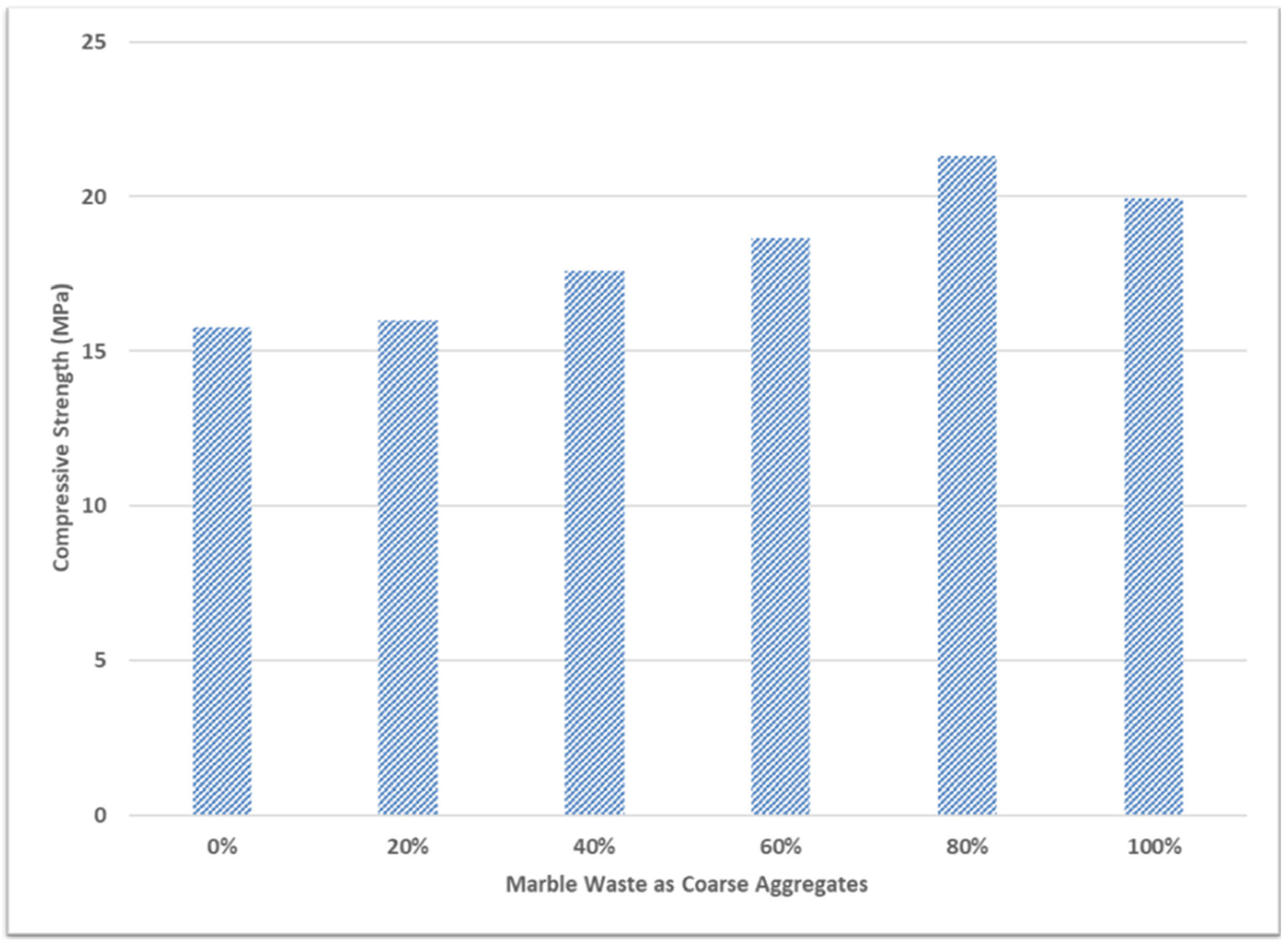
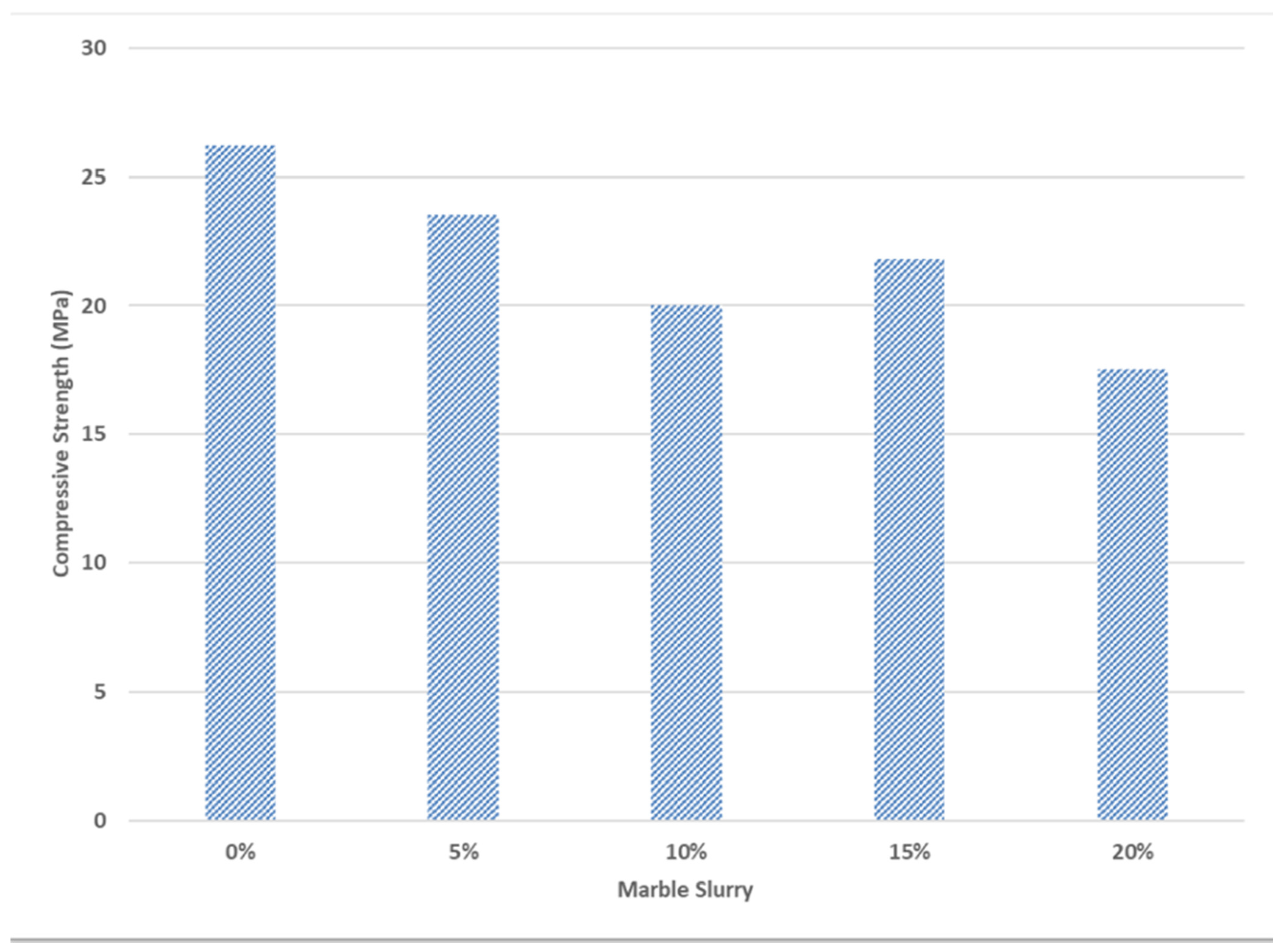
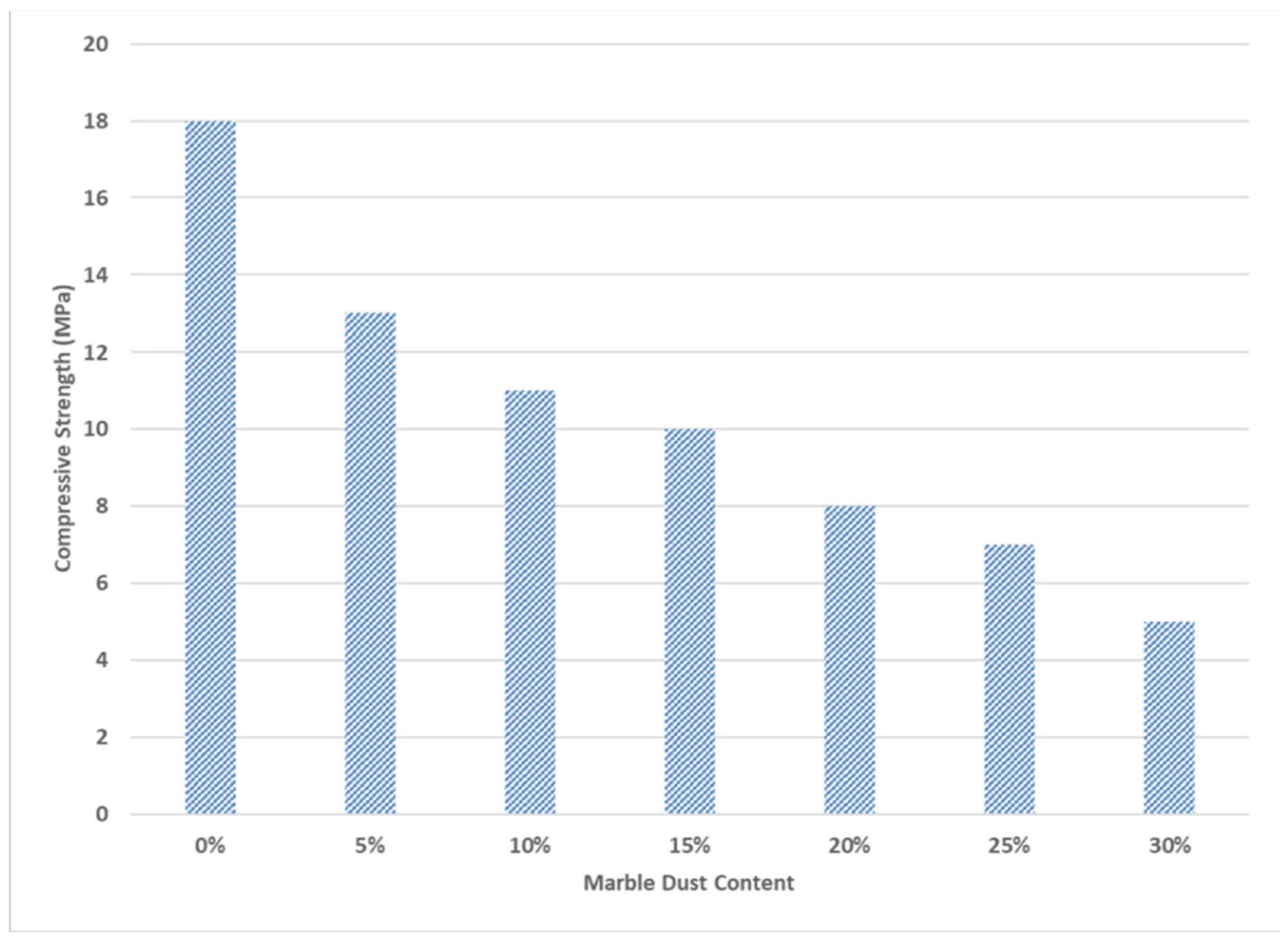
For a considerable duration, the substitution of both fine-sized and coarse aggregates with mineral dust (MD) has been actively implemented in the field of construction. Numerous investigations have been conducted to explore this concept in the past (Figure 8 and Figure 9). Vigneshpandian et al. [147] examined the strength characteristics of hardened concrete undergoing the replacement of fine-sized aggregate with MD waste. Their study revealed that a fifty percent replacement by weight resulted in optimal strength for the concrete in its hardened state. Arel [148] investigated the influence of MD supplementation as both fine and coarse aggregates, leading to enhanced mechanical properties of concrete. Concrete strength exhibited increases of 20–26% and 10–15% in compressive and splitting tensile strength, respectively, at 15% and 75% replacement of fine aggregate with MD. Notably, a more substantial improvement in concrete’s mechanical characteristics was observed when mineral dust was employed as coarse aggregates rather than fine aggregates [149].
Saran et al. [150] investigated the impact of using MD in concrete for structural applications in acidic environments. They conducted tests on the tensile and compressive behaviors of composite slabs with and without MD, replacing a portion of the fine-sized aggregates. MD was used in varying percentages (10%, 20%, 30%, 40%, and 50% by weight) as a substitute for fine-sized aggregates. Among these, composite structures incorporating 50% MD as a fine aggregate replacement exhibited superior strength compared to other proportions. The researchers recommended not exceeding a 50% substitution of fine aggregates with MD to achieve optimal strength.
Chavhan et al. [113] observed discrepancies in the strength properties of M25-grade concrete with different ratios of MD replacing sand. They reported an increase in compressive strength with higher levels of MD substitution of up to 50%. However, the concrete’s optimal tensile strength after 28 days was achieved with a 45% substitution level.
Chahour and Safi [151] conducted experiments involving the complete substitution of natural sand aggregates with mineral dust (MD) of up to 100%. The performance of the resulting concrete was assessed in terms of strength, compactness, durability, and workability at different curing times of up to 56 days. It was observed that superior compactness, compressive strength, and flexural strength were achieved when sand aggregates were replaced with MD at proportions of 50% and 100%. However, the highest punching strength for the concrete was attained when the replacement ratio was set at 70%, equivalent to the strength of standard mortar containing entirely sand aggregates.
A review by Tunc [79] on mineral waste (MW) recycling as a source material for replacing base materials in construction emphasized that using MW as a fine aggregate or as a partial cement (PC) replacement in concrete production is suitable for enhancing concrete strength and supporting economic efficiency. The study indicated that a 10% replacement provided optimal strength when MW was used as a cement replacement, and a 20% substitution significantly influenced strength enhancement.
Demirel studied the impact of adding MD waste to concrete, replacing fine aggregates. Various concrete mixes were prepared with 0%, 25%, 50%, and 100% by weight of MD waste particles smaller than 0.25 mm. The physical properties of the specimens were analyzed, and compressive strength was measured at 3, 7, 28, and 90 days of curing, with comparisons made to standardized concrete. The addition of MD reduced the porosity of the concrete, and the modulus of elasticity and ultrasonic pulse velocity of the concrete increased with the quantity of filler and curing period. The resulting concrete exhibited higher compressive strength than the standard one when MD waste was incorporated. Extended curing periods led to further improvements in these properties.
Garas et al. [152] explored the use of MD waste in the production of green concrete, replacing both coarser and fine aggregates. They discovered that substituting MD for fine-sized aggregates was more advantageous than its replacement for cement or coarse aggregates. Aliabdo et al. [40] explored the feasibility of utilizing mineral dust (MD) waste as a replacement for fine aggregates and cement in concrete manufacturing. Concrete incorporating MD as a substitute for cement exhibited more favorable properties compared to traditional concrete [153]. MD-based mortar, replacing fine aggregates, enhanced the physico-mechanical characteristics of the resulting concrete.
Martins et al. [154] studied the mechano-physical properties of concrete partially and fully substituting coarse aggregates with waste marble particles. Concrete blocks were prepared with 20%, 50%, and 100% marble particles, and various tests were conducted. It was observed that the modulus of elasticity (MOE), split tensile strength, and compressive strength of the products decreased due to the use of waste marble. The slump density of the mix increased for a 20% substitution level but decreased beyond this level.
AL-Luhybi [155] examined the influence of adding waste marble and porcelain materials as replacements for fine aggregates on the mechanical properties of concrete. Recycled coarse aggregates were used in combination with these waste materials, and a comparison was made with standard concrete based on naturally occurring fine and coarse aggregates. The study revealed that the use of recycled coarse aggregates increased concrete’s compressive strength and modulus of rupture by 5.1% and 19.5%, respectively, compared to standard concrete. However, tensile strength decreased by 35%. The application of porcelain waste did not significantly impact concrete’s compressive strength, but the use of mineral waste (MW) increased it by approximately 5.1%. Both marble and porcelain waste increased concrete’s tensile strength by 35% and 17.6%, respectively, with the modulus of rupture increasing by 24% and 19.5%, respectively.
Singh et al. [156] explored the feasibility of utilizing ground calcium waste (GCW) and marble slurry (MS) as replacements for fine-sized aggregates in concrete manufacturing. They found that using up to 25% GCW and 15% MS as substitutes for fine aggregates improved the concrete properties. However, the irregular shapes of GCW and MS particles necessitated a higher water content in the mix, leading to reduced workability.
In experiments conducted by Binici et al. [138], mineral dust (MD) and limestone slurry (L.S.) were used to replace sand in mortar mixtures to prepare concrete blocks. Additions of 5%, 10%, and 15% of marble dust plus limestone slurry enhanced abrasion resistance and workability compared to the standard mix. The concrete’s resistance to corrosion improved with higher filler concentrations, and long-term compressive strength was reported to increase.
Evram et al. [104] investigated the impact of electronic waste plastics and MD waste on the behavior and mechanical properties of hardened concrete. They observed a decrease in mechanical strength, concrete weight, and elastic modulus with the addition of e-waste, with the most significant decrease occurring at a 20% addition level. However, these parameters partially improved with the inclusion of MD waste.
In a study by Varadharajan [157], the eco-impact of using MD and fly ash (FA) waste as substitute materials in concrete production was examined. The addition of MD significantly improved the mechanical strength of concrete and had a positive impact on eco-friendliness.
Varadharajan et al. [158] used rice husk ash (RHA) for partial cement (PC) substitution and MD waste for fine aggregates (sand) in concrete production. Their report revealed an optimum enhancement in compressive, tensile, and flexural strengths by 44.4%, 60%, and 46.13%, respectively, for the maximum combination of 15% RHA and 30% MD waste.
Rajkumar et al. [159] studied the effect of MD waste addition on the flexural behavior of reinforced concrete beams. MD waste was added to partially substitute fine aggregates at proportions of 0%, 5%, 10%, 15%, and 20% by weight. They reported that the addition of 20% MD waste resulted in superior compressive strength of the concrete, while flexural strength and concrete deflection increased with the addition of MD waste. Shukla et al. [160] investigated the impact of substituting mineral dust (MD) for fine-sized aggregates in concrete preparation. They observed improvements in concrete’s compressive and tensile strengths through MD blending, with the optimal level confirmed at 100% substitution.
In a study by Binici and Aksogan [12], granite, MP waste, basalt, and silica sand were considered as fine aggregates for concrete production. The physical and mechanical attributes of the resulting products were evaluated to monitor the influences of these various filling materials. It was noted that the addition of fillers positively influenced concrete’s compressive strength while significantly reducing its corrosion resistance and water absorption. The authors suggested that these fillers could be suitable for prospective use as filling materials in concrete manufacturing.
Bostanci [101] conducted investigations on concrete performance using MD and recycled glass particles to replace fine aggregates. They revealed that the addition of MD and recycled glass particles led to a 17% and an 8% enhancement, respectively, in overall concrete performance.

6.2. Utilization of Marble Waste as Cement

Aliabdo et al. [40] conducted a study involving the substitution of Portland cement (PC) and sand at various weight percentages (0, 5, 7.5, 10, and 15) with MP, while maintaining water/powder and water/cement ratios at 0.50 and 0.40, respectively. Thermal gravimetric analysis (TGA), X-ray diffraction (XRD), and scanning electron microscopy (SEM) analyses were performed on the mixes. The results indicated that incorporating MP, especially as a sand replacement, led to overall improvements in the mechanical properties of concrete.
Corinaldesi et al. [16] investigated the addition of MD to replace PC in mortar and concrete, with various additives considered. Different mortar mixtures were compared, all with a sand-to-cement ratio of 3:1, to assess their mechanical properties. The study revealed that the highest compressive strength was achieved when 10% of MP replaced PC in concrete.
Aruntas et al. [46] explored the integration of MP waste into concrete by substituting PC at percentages of 2.5, 5, 7.5, and 10 by weight. The physical, mechanical, and chemical attributes of the resulting cement specimens were studied and compared with controlled samples and cements containing waste MD. The research showed that the highest compressive strength was achieved when 10% of MP replaced PC in concrete.
Ergun [22] extensively studied the partial use of MD waste and diatomite rocks as substitutes for PC in concrete mixtures. Various ratios of water to cement were employed to determine the optimal proportion of MP and diatomite, either individually or combined. Concrete specimens with 10% diatomite and 5% MD waste displayed the best compressive and bending strengths.
Singh et al. [23] suggested that PC in concrete could be replaced with MD waste by up to 15%. Bacarji et al. [161] investigated the integration of 5%, 10%, and 20% marble and granitic waste (MGW) to replace PC in concrete. MGW-based concrete exhibited optimal mechanical attributes such as elasticity modulus, abrasion resistance, rheology, and compressive strength with a 5% proportion.
Pathan and Pathan [162] found enhanced splitting tensile and compressive strengths for specimens containing 10% MP waste as a cement replacement. Khodabakhshian et al. [84] verified that substituting PC with MP waste at percentages of 0, 5, 10, and 20 improved the mechanical characteristics of concrete.
Rodrigues et al. [43] investigated the substitution of PC with marble slurry (MS) at volume percentages of 0, 5, 10, and 15, extracted from a marble quarry and mixed with plastic. Concrete’s mechanical behavior showed improvements in strength properties with up to 10% substitution based on current ratings.
Since its invention in the mid-19th century, Portland cement-based mortar gained popularity for its strength compared to other available alternatives at the time. Before the widespread use of cement mortar, gypsum [163] and pozzolana-lime [164] were commonly used in construction activities. Cement–mortar gradually replaced lime mortar in new constructions due to its superior physico-mechanical attributes. In recent years, research studies have focused on enhancing the mechanical and physical attributes of mortar. In these efforts, Portland cement (PC) and other cementitious materials have been partially substituted with waste materials and mineral dust (WMGD).
Deshamukh et al. [165] conducted experiments on the mechanical behavior of M20-grade concrete with the partial integration of mineral dust (MD) as a collective substitution for sand and PC. They found that the optimal strength in the hardened state of concrete was achieved by replacing PC with MD at a ratio of four percent by weight as a binder and ten percent by weight in concrete as a substitution for fine aggregates (Figure 10).
Shreyas [166] analyzed the physico-mechanical properties of PC–concrete filled with various quantities of MD. The optimal compressive strength of the resulting PC–concrete was recorded with the addition of 10% MD by weight after 28 days of curing.
Ulubeyli and Artir [167] conducted a study to evaluate the effect of utilizing mineral dust (MD) waste on different types of concrete, including traditional, self-compacting, and polymer-based. They used MP waste as additives in concrete, replacing both fine and coarse aggregates as well as Portland cement (PC). Their experiments showed that the properties of traditional concrete improved with the use of MP as aggregates or binders. However, the mechanical characteristics of self-compacting concrete (SCC) and polymer-based concrete were hindered by MP utilization.
Chandrasekaran [168] assessed the strength characteristics of concrete using micro-sized MP to replace PC, with MP ratios of 5%, 10%, and 15% by weight. Concrete strengths were measured at 7 and 28 days. They found that concrete’s compressive strength increased with the use of up to 10% MP to replace PC, while split tensile strength and flexural strength improved with a 15% substitution. The 28th-day strength was superior to the 7th-day strength.
Kumar and Thakur [169] conducted examinations on concrete strength with MD used as the partial replacement for PC, adding up to 30% by weight, with an increment of 7.5%. Compressive, tensile, and flexural strengths of the hardened concrete were measured over the curing period. A 7.5% addition of MD to replace PC significantly improved concrete strength with the curing period.
Khodabakhshian et al. [84] utilized MP waste and silica fume (SF) as partial replacements for PC to evaluate the mechanical attributes of hardened concrete. An addition of over 10% MP negatively impacted the mechanical characteristics of concrete in the hardened stage. However, supplementing it with 10% SF resulted in enhanced compressive, split, and tensile strengths during the early curing periods. Additionally, substituting 5% to 20% of mineral waste (MW) with 2.5% SF offered the highest modulus of elasticity (MOE) for the concrete.
Sanchez et al. [170] studied the impact of using mineral dust (MD) as a substitution for Portland cement (PC) in concrete. They found that the workability of the mix increased with the addition of MD. The compressive, tensile, and flexural strengths of the resulting concrete improved with a 10% substitution of MD. Curing time had a positive influence on the mechanical properties of the concrete.
Taji et al. [141] investigated the effects of marble and granite dust (MGD) on concrete characteristics. They manufactured concrete blocks with up to 30% MGWD substitution for PC. At the 20% substitution level, the mechanical attributes of the concrete remained constant. However, adding 10% of each waste as a PC substitution exhibited stronger resistance against the corrosion of steel bars used for reinforcement.
Contrary to the literature, Danish et al. [171] reported that incorporating MGD with concrete as a replacement for PC or cementitious materials reduced the mortar’s workability and increased water requirements. The packing density and specific surface area of concrete containing MGD were higher compared to the standard mix. Although mechanical characteristics decreased, concrete durability improved when exposed to acidic environments.
Khaliq et al. [172] evaluated the physical and mechanical attributes, along with permeability, of concrete blended with MD waste as a PC replacement. They noted that the compressive and tensile strengths of concrete decreased by 12% and 6%, respectively, with the integration of 5% MD in PC. The reduction was even greater with higher MD content. However, the best results were achieved with a 10% substitution, where strengths remained unaffected compared to the standard mix, while concrete permeability increased.
Ghorbani et al. [41] examined the mechanical properties and resistance to corrosion of concrete manufactured using MGD waste as a substitution material for PC. Despite a negative impact on compressive strength, it significantly improved corrosion resistance.

7. Specialized Concrete Applications

7.1. Utilization of Marble Waste in Fiber-Reinforced Concrete

Sheike et al. [173] explored the impact of specific proportions of MD as a substitute for PC in concrete on its strength. The study aimed to identify the ratios of steel fibers (SFs) and MP that yielded the highest concrete strength. Optimal compressive strengths were obtained on the 7th and 28th day with 8% MP and 8% SFs blending as PC replacements in concrete.
Sounthararajan et al. [174] investigated the efficacy of steel fibers incorporated into reinforced concrete production, where natural sand was replaced with mineral dust (MD) and a portion of foundry waste sand. The number of reinforced steel fibers remained constant, and it was observed that a 10% blend of MD and 20% foundry waste sand, along with a chemical admixture, yielded the highest compressive strength in concrete. The achieved strength was approximately 7.4% higher than the control sample. Additionally, the elastic modulus and bending strength of the composites were enhanced with this substitution ratio, confirming it as the optimal configuration exhibiting superior characteristics [69].
Furthermore, investigations by Haddadou et al. [175] focused on the effect of incorporating MS in concrete on SCC using different sizes of steel fibers. Their findings indicated that the addition of MS enhanced ultrasonic impact velocity and improved compressive, split tensile, and bending strengths, particularly when using thirty-millimeter fibers with an eight percent rate.

7.2. Utilization of Marble Waste in Asphalt-Based Concrete

Moghadas Nejad et al. [176] conducted research to examine the application of hot asphalt mixtures containing recycled marble aggregates in road constructions with moderate traffic. They explored substitution percentages of 15, 25, 40, and 60 and conducted tests on dynamic creep, indirect tensile strength, resilient modulus, and fatigue. Marble aggregates, due to their lower silica content, exhibited enhanced splitting tensile strength when used as recycled materials.
Chandra and Choudhary [177] investigated the influence of recycling MP waste as a filler in bituminous concrete. Comparisons were made with stone dust and lime as fillers to replace MP. Various tests, including direct tensile, fatigue, free compression, and Marshall stability tests, were conducted. The results favored the use of MP waste as a filling material, showing increased modulus of elasticity (MOE) and compressive and tensile strengths. The optimal compressive strength was achieved with 5% MP waste, while the highest MOE and optimum tensile strength were obtained with 7% MP. Consequently, the integration of MP waste in bituminous concrete was recommended, demonstrating enhanced strength in the resultant concrete.
Ustunkol and Turabi [178] utilized recycled marble aggregates to substitute pure aggregates in hot mix asphalt. They studied the physico-mechanical effects of industrial waste materials such as MP, fly ash (FA), glass powder, and “phosphogypsum” on the wearing surface of asphalt-based concrete. The Marshall method was adopted for specimen preparation, determining the optimum bitumen content as 4.9%. The study assessed stability and creep deviations in the samples. Their findings indicated that the highest strength was achieved in bituminous coal-based hot mixtures containing seven percent of waste as the filler material.
Fırat et al. [179] performed experiments to determine the strength and hardness of base strata stabilized with FA, sand, and MP waste. These materials were added at rates of 5%, 10%, 15%, and 20%. Each specimen was examined through the California Bearing Ratio (CBR) test to measure permeable competence and swelling proportions, exploring the engineering characteristics of the waste mixtures. X-ray diffraction (XRD) and scanning electron microscopy (SEM) analyses were also carried out for specimens containing 15% of additives. The results of this study suggested that waste could be safely employed in road construction projects.

8. Emerging Non-Structural and Cross-Disciplinary Applications

In industrial brick production, recycling of marble waste (MW) holds significant importance. Bilgin et al. [180] conducted a study on the application of MP waste as an additive in brick compositions. They investigated the mineralogy, physical and mechanical properties, and sintering attributes of bricks produced by adding MP waste in percentages ranging from 20 to 100. The results indicated a substantial enhancement in the physico-mechanical properties of bricks as the amount of utilized marble waste increased (Figure 11). The study concluded that the use of recycled marble waste in industrial brick manufacturing is permissible, contributing to eco-balancing and economic benefits.
Quesada et al. [181] explored the suitability of various waste, including sawdust, used earth oil filtration, MW, and compost, for the production of lightweight bricks. They evaluated parameters such as bulk density, linear shrinkage, compressive strength, SEM findings, and water absorption to assess the influence of these additives on the technical characteristics of the bricks. The optimal mechanical properties were achieved with five percent sawdust, ten percent compost, and fifteen percent MW, along with used earth oil filtration in the brick composition.
Buyuksagis et al. [64] used MD as a source material for producing mortars for insulating panels, finding it more economical and suitable than dolomite. Gandhi [182] explored the South Gujarat region of India near Surat, a common soil stabilization area. Marble powder and rice husk ash were utilized as additive materials to address specific soil issues in the area. The findings suggested that the application of both marble powder and rice husk ash could effectively and cost-effectively stabilize the soil.
Ahmed et al. [183] focused on the development of hybrid products using agricultural and industrial wastes, including MW sludge and rice husk, in specific proportions or as full replacements. Tozsin et al. [184] investigated the influence of marble waste on Turkish soil characteristics and hazelnut production. The results indicated significant improvements in soil neutralization and hazelnut production upon adding marble waste to the soil.
Yeşilay et al. [185] found it suitable to use marble dust waste up to 27% in the clay mix for ceramic artwork production. Munir et al. [36] utilized marble slurry (MS) waste for the industrial-scale production of energy-efficient fired clay bricks. Munir et al. [186] studied the application of marble dust waste in brick production, exploring percentages ranging from five to twenty-five. Çınar and Kar [122] demonstrated the possibility of manufacturing composites using Polyethylene Terephthalate bottles and marble dust.
In the existing literature, most research efforts have been focused on using marble waste for substituting aggregates, while minimal studies have explored its use in asphalt production. This is primarily due to the optimal results achieved through marble waste recycling as a substitute for concrete aggregates. However, it is worth noting that marble waste is predominantly available in the industry as marble powder.
Various published research reports have highlighted the applications of natural stone dusts, such as marble, granite, silica sand (S.S.), and limestone slurry (L.S.), in various construction-related activities beyond their use as replacement materials for aggregates and cementitious yields in concrete technology.
One study conducted by Buyuksagis et al. [64] focused on the importance of MP as a material for replacing dolomite in adhesive mortars used in insulation boards. Their findings revealed that adding MP to the mortar increased the water requirement during manufacturing. The increase in MP content led to higher compressive and bending strengths during prolonged curing periods. Additionally, the water absorption by the resulting concrete increased with the escalation of MP content. A 40% addition of MP was deemed suitable for enhanced durability and strength.
Lu et al. [187] prepared stoneware by incorporating MP and observed an increase in fracture toughness and strength in the resulting products due to this addition.
The potential of marble dust waste for applications in rubber, tire, and paper industries was explored in experimental investigations conducted by Marras et al. [188]. They reported that marble dust waste is suitable in terms of chemical, physical, and mineralogical properties for use in these industries because it contains calcium carbonate (CaCO3), which fulfills the necessary requirements.
Priyadarshini et al. [189] evaluated the impact of industrial waste such as marble dust and fly ash on the compressive strength of non-conventional bricks. The inclusion of this waste led to the deterioration in the compressive strength of the bricks.
Yesilay et al. [185] assessed the possibility of recycling marble dust waste for stone-ware clay bodies used in ceramic artworks. They considered different ratios of marble waste, up to 27%, for preparing artworks and evaluated the characteristics of the end-products, including physical, thermal, and microstructural properties. They concluded that marble waste could be a viable source material for artworks. Segadaes et al. [190] conducted experiments to assess the modifications in the characteristics of a mixture based on red clay used in the manufacture of floor tiles. They blended the clay with the waste generated from cutting marble and granite stones in a ratio of 30% and subjected the mixture to sintering in an electric furnace at temperatures ranging from approximately 1100 °C to 1150 °C. The study revealed an increase in the strength characteristics of the tiles, and water absorption decreased with the addition of this waste.
Bilgin et al. [191] explored the utilization of MD waste as a potential filler for industrial-scale brick manufacturing and evaluated the physico-mechanical characteristics of the resulting bricks. They found that the MD waste could be added up to 80% by weight in the mortar for industrial brick production. Bricks were sintered at temperatures of 900 °C, 1000 °C, and 1100 °C, and the addition of MD up to 10% positively influenced the brick properties. However, MD content exceeding 10% increased water absorption and reduced the mechanical characteristics of the bricks.
Baghel et al. [192] conducted a similar study evaluating the thermo-mechanical attributes of bricks manufactured using marble slurry (MS) and mill scale, an industrial waste powder of iron oxide. The bricks produced were not only environmentally friendly but also safe for human health. The addition of 20% marble slurry to the bricks increased their compressive strength. These low-cost bricks were useful for constructing thermally insulated structures.
El-Mahllawy et al. [193] used marble waste from cutting operations in combination with clay and hydrated lime to manufacture bricks. Bricks were tested for various characteristics on the 14th and 28th day of curing. The application of 15% marble waste as a replacement for hydrated lime resulted in bricks with optimal properties, exhibiting maximum strength and improved water absorption resistance.The incorporation of marble waste fines as a partial replacement of sand (2–12%) has been reported to enhance the mechanical performance of sand concrete, with an optimum content yielding maximum strength [194].
André et al. [59] utilized marble waste as coarse aggregates, which led to enhanced workability due to the lower absorption and smoother surface of this waste. Corinaldesi et al. [16] emphasized that marble waste contributed to increased cohesiveness in resultant concrete and mortar. The attributes of self-compacting concrete blended with marble waste were investigated by Topçu et al. [80], who conclusively reported that the presence of marble waste reduced bulk density and increased air content in the resulting self-compacting concrete. They recommended a maximum quantity of 200 Kg/m3 for marble waste content. Gencel et al. [195] attributed the decline in bulk density to the lower density of marble waste compared to other aggregates.
The study conducted by Ergun [22], supported by other researchers, indicated that integrating 5% of marble waste led to a 12% increase in the compressive strength of the resulting concrete. Similar enhancements in concrete strength were reported by Corinaldesi et al. [16] and Boughamsa et al. [196]. The increase in mechanical characteristics of marble waste-based concrete was attributed to the formation of carbo-aluminates in the presence of marble waste, which possess definite binding competence.
Aliabdo et al. [40] demonstrated that the utilization of marble waste significantly enhances the tensile strength of concrete. According to Vardhan et al. [67], marble waste is more suitable for replacing ordinary fine aggregates in concrete due to its filler effect. Ince et al. [105] studied the partial replacement of fine-sized aggregates with marble waste in concrete and found that this concept enhances properties related to resistance against sulfate attack and freeze–thaw cycles in concrete. Singh et al. [197] clarified that marble waste decreases water permeability and sorptivity, with the optimum rate observed at fifteen percent, as confirmed by Gameiro et al. [71]. Marble waste fines have been utilized in sand concrete as an alternative material, highlighting their potential in sustainable construction practices and cross-disciplinary applications aimed at resource conservation and waste valorization [194]
On the other hand, when MD is used as a filler and binder in self-compacting concrete (SCC), the compressive strength gradually decreases as the MD content increases [80]. However, when MD is utilized as a mineral additive in manufacturing SCC, it was found to increase the 28th-day compressive strength by 1.7%, 3.9%, and 9.5% at 30%, 40%, and 50% additions, respectively, due to its filler effect [61].
Due to its pore-filling effect, a 5% replacement of Portland cement (PC) with MD in concrete mixes with water-to-binder ratios of 0.50 and 0.45 resulted in reduced porosity and improved compressive strength. However, a decrease in compressive strength was reported at substitution levels beyond 5%, specifically for levels ranging from 7.5% to 20% [22,84]. Additionally, at the 5% substitution level, the splitting tensile strength reached its highest value at each curing age, while the lowest splitting tensile strength was recorded at the twenty percent replacement level [84].
Mixtures incorporating marble waste exhibited denser microstructures with enhanced filler effects and improved binding capabilities due to the presence of the calcium carbo-aluminate phase [65]. Therefore, incorporating marble dust as a filler and an additive alongside an aggregate substitution with electronic plastic in concrete manufacturing would positively impact the strength development based on the supplementation level.
A few researchers have focused on the partial replacement of Portland cement (PC) and sand with MP. When marble waste is utilized as aggregates in PC-based materials, an improvement in mechanical characteristics is observed. The use of nano-calcium carbonate incorporating marble powder as raw materials is not widely produced yet. Tunc [79] summarized research studies on the recycling of marble waste, indicating its rich composition of CaCO3, making it a potential source for calcium carbonate-based products [198]. Marble waste has gained increasing attention in the construction industry and is used for decoration to achieve esthetics, eco-friendliness, improved mechanical attributes, and potentially high-value products in the future industrial growth.
Researchers generally suggest that ten to fifteen percent of PC can be efficiently substituted with marble waste. Uysal and Yılmaz [56] conducted cost analyses for traditional concrete on the 28th day, indicating a cost of 0.58 MPa/cubic meter in American dollars. They found that concrete specimens containing 10%, 20%, and 30% marble powder by weight reduced the costs to 0.52, 0.48, and 0.47 MPa/cubic meter, respectively. Consequently, the findings suggest that concrete containing marble waste is approximately 15% cheaper than traditional concrete. Vardhan et al. [67] reported that marble waste constitutes around 20% to 30% of the total production from the global marble industry.
Worldwide, concrete researchers have been actively investigating the utilization of various waste materials such as MP, pond ash, and foundry sand, as partial or full substitutes for fine aggregates like sand. Studies have shown that substituting 10% of sand with marble powder resulted in the highest compressive strength while maintaining the same workability and setting time for Portland cement (PC) paste [16]. Additionally, substituting sand with marble powder up to 15% by weight led to increased compressive strength in concrete mixes [199]. Furthermore, concrete incorporating marble dust exhibited lower porosity compared to concrete without it, enhancing its durability characteristics [40]. However, some studies have reported a reduction in strength properties as the proportion of marble dust increased in the concrete mix [199,200].
Extensive research has been conducted on the replacement of sand with marble powder, with the literature focusing on strength attributes in comparison to durability properties. The existing studies highlight an increase in strength accompanied by a decrease in durability characteristics when marble powder is used to replace sand by up to 15% in concrete [186].
In the context of precast concrete blocks, researchers such as Uygunoglu et al. [77] explored different materials, including MW, waste concrete, crushed steel slag, and fly ash, as substitutes for aggregates. MW aggregate was found to have a positive impact on the mechanical attributes, including compressive and splitting tensile strengths, of concrete blocks. Similarly, the application of powdery MS was studied by Mishra et al. [86], revealing enhanced compressive strength with increased MP content.

9. Conclusions

This comprehensive review confirms that marble waste is a technically viable and sustainable secondary resource for concrete and other construction composites. Across the evaluated literature, the most reliable performance enhancement is consistently observed when marble waste is used as a fine aggregate replacement (10–20%), where improved particle packing, interfacial transition zone densification, and pore refinement lead to superior mechanical strength and durability. When used as a cement replacement, the optimum level generally remains within 5–10%, beyond which clinker dilution effects may adversely affect long-term strength development and durability performance.
The overall evidence indicates that the beneficial behavior of marble waste is primarily governed by its calcite-rich inert filler nature, smooth particle morphology, and nucleation-assisted densification mechanisms, rather than true pozzolanic reactivity. This mechanistic interpretation also helps explain the contradictory findings reported in the literature regarding carbonation resistance, permeability, shrinkage, and long-term durability, which are strongly influenced by particle fineness, replacement route, curing age, and the water-to-binder ratio.
From a sustainability and industrial perspective, marble waste utilization offers simultaneous environmental and economic benefits through reduced landfill disposal, conservation of virgin aggregates, lower cement demand, and decreased production costs. However, successful translation from laboratory-scale findings to field implementation requires standardized material classification, optimum replacement guidelines, pilot-scale demonstrations, life cycle assessment, and policy-supported circular construction frameworks.
Future research should prioritize phase-based reactivity analysis, machine learning-assisted mix optimization, long-term field durability validation, and the development of design-code recommendations to accelerate the safe and large-scale adoption of marble waste-based green construction materials.
In conclusion, the systematic recycling and utilization of marble waste as the partial replacement for natural aggregates, cement, and other cementitious materials provide a technically feasible and sustainable pathway for advanced concrete production. This strategy ensures acceptable-to-enhanced strength, durability, workability, and other essential performance attributes while simultaneously supporting efficient marble waste management. In many cases, marble waste-based concrete demonstrates performance comparable to, or even superior to, conventional concrete, while also mitigating environmental pollution, water contamination, and health hazards associated with uncontrolled marble waste disposal.
Nevertheless, significant opportunities remain for future research and large-scale implementation of marble waste-based sustainable composites in construction and infrastructure applications. The continued development of durable, performance-optimized, and resource-efficient marble waste composites can contribute substantially to the conservation of limited natural geological resources and the advancement of circular construction practices. Furthermore, such approaches support economic growth, industrial sustainability, and global circular economy objectives, representing an important step towards a more sustainable and environmentally responsible built environment. Moreover, it contributes to international economic expansion, aligning with the principles of the global circular economy and the ethos of “Go Green, Live Green!” This holistic approach serves as a pivotal step towards a more sustainable and eco-friendly future.

Supplementary Materials

The following supporting information can be downloaded at: https://www.mdpi.com/article/10.3390/jcs10050221/s1, Table S1: PRISMA 2020 checklist for the systematic review.

Author Contributions

Conceptualization, S.L. and I.L.; methodology, S.L. and I.L.; software, S.L.; validation, S.L. and I.L.; formal analysis, S.L.; investigation, S.L. and I.L.; resources, S.L. and I.L.; data curation, S.L.; writing—original draft preparation, S.L.; writing—review and editing, I.L.; visualization, S.L.; supervision, I.L. All authors have read and agreed to the published version of the manuscript.

Funding

This research received no external funding.

Data Availability Statement

No new data were created or analyzed in this study. Data sharing is not applicable to this article.

Acknowledgments

The authors sincerely acknowledge Kypros Pilakoutas and Maurizio Guadagnini for their insightful academic discussions.

Conflicts of Interest

The authors declare no conflicts of interest.

Abbreviations

MS: marble sludge waste; MP: marble powder waste; MGD: dust of marble plus granite waste; MGW: marble plus granite waste; MCSW: marble cutting slurry waste; GW: granite waste; FA: fly ash; GGBFS: ground granulated blast furnace slag; ISFS: imperial smelting furnace slag; SF: silica fume; RHA: rice husk ash; CVC: conventional vibrated concrete; HPC: high-performance concrete; CE: circular economy; LE: linear economy; CEAP: Circular Economy Action Plan; ZWE: Zero Waste Europe; WB: World Bank.

References

  1. Sensoneo. The Biggest Waste Producers Worldwide: Sensonseo Global Waste Index 2019; Sensoneo: Bratislava, Slovakia, 2020. [Google Scholar]
  2. The World Bank. Global Waste to Grow by 70 Percent by 2050 Unless Urgent Action Is Taken: World Bank Report; The World Bank: Washington, DC, USA, 2018. [Google Scholar]
  3. Bravo, M.; de Brito, J.; Pontes, J.; Evangelista, L. Mechanical performance of concrete made with aggregates from construction and demolition waste recycling plants. J. Clean. Prod. 2015, 99, 59–74. [Google Scholar] [CrossRef]
  4. European Commission (EC). Report from the Commission to the European Parliament, the European Economic and Social Committee and the Committee of the Regions on the Thematic Strategy on the Prevention and Recycling of Waste; The Directorate-General Environment of the European Commission: Brussels, Belgium, 2011. [Google Scholar]
  5. European Union (EU). Directive 2008/98/EC of the European Parliament and of the council, of 19 November 2008 on waste and repealing certain directives. Off. J. Eur. Union 2008, L 312, 28. [Google Scholar]
  6. Cachim, P.B. Mechanical properties of brick aggregate concrete. Constr. Build. Mater. 2009, 23, 1292–1297. [Google Scholar] [CrossRef]
  7. Kwan, W.H.; Ramli, M.; Kam, K.J.; Sulieman, M.Z. Influence of the amount of recycled coarse aggregate in concrete design and durability properties. Constr. Build. Mater. 2012, 26, 565–573. [Google Scholar] [CrossRef]
  8. Rafieizonooz, M.; Mirza, J.; Salim, M.R.; Hussin, M.W.; Khankhaje, E. Investigation of coal bottom ash and fly ash in concrete as replacement for sand and cement. Constr. Build. Mater. 2016, 116, 15–24. [Google Scholar] [CrossRef]
  9. Brundtland, G.H. Report of the World Commission on Environment and Development: Our Common Future; United Nations: Oslo, Norway, 1987. [Google Scholar]
  10. Cárcamo, E.A.B.; Peñabaena-Niebles, R. Opportunities and challenges for the waste management in emerging and frontier countries through industrial symbiosis. J. Clean. Prod. 2022, 363, 132607. [Google Scholar]
  11. Sutcu, M.; Alptekin, H.; Erdogmus, E.; Er, Y.; Gencel, O. Characteristics of fired clay bricks with waste marble powder addition as building materials. Constr. Build. Mater. 2015, 82, 1–8. [Google Scholar] [CrossRef]
  12. Binici, H.; Aksogan, O. Durability of concrete made with natural granular granite, silica sand and powders of waste marble and basalt as fine aggregate. J. Build. Eng. 2018, 19, 109–121. [Google Scholar] [CrossRef]
  13. Hebhoub, H.; Aoun, H.; Belachia, M.; Houari, H.; Ghorbel, E. Use of waste marble aggregates in concrete. Constr. Build. Mater. 2011, 25, 1167–1171. [Google Scholar] [CrossRef]
  14. Silva, D.; Gameiro, F.; de Brito, J. Mechanical Properties of Structural Concrete Containing Fine Aggregates from Waste Generated by the Marble Quarrying Industry. J. Mater. Civ. Eng. 2014, 26, 04014008. [Google Scholar] [CrossRef]
  15. Dino, G.A.; Chiappino, C.; Rossetti, P. Quarry waste management and recovery: First results connected to Carrara marble ravaneti (Italy). Geophys. Res. Abstr. 2017, 19, EGU2017-3982. [Google Scholar]
  16. Corinaldesi, V.; Moriconi, G.; Naik, T.R. Characterization of marble powder for its use in mortar and concrete. Constr. Build. Mater. 2010, 24, 113–117. [Google Scholar] [CrossRef]
  17. Mehta, D.; Paliwal, D.; Sankhla, V.S.; Tege, S. Study of marble waste and its utilization. Int. Res. J. Eng. Technol. (IRJET) 2020, 7, 5. [Google Scholar]
  18. Yoshizawa, S.; Tanaka, M.; Shekdar, A.V. Global trends in waste generation. In Recycling, Waste Treatment and Clean Technology; Gaballah, I., Mishar, B., Solozabal, R., Tanaka, M., Eds.; TMS Mineral, Metals and Materials Publishers: Pittsburgh, PA, USA, 2004; pp. 1541–1552 (II). [Google Scholar]
  19. Pappu, A.; Saxena, M.; Asolekar, S.R. Solid wastes generation in India and their recycling potential in building materials. Build. Environ. 2007, 42, 2311–2320. [Google Scholar] [CrossRef]
  20. Demirel, B.; Alyamaç, K.E. Waste marble powder/dust. In Waste and Supplementary Cementitious Materials in Concrete; Woodhead Publishing: Sawston, UK, 2018; pp. 181–197. [Google Scholar]
  21. Khan, K.; Ahmad, W.; Amin, M.N.; Ahmad, A.; Nazar, S.; Alabdullah, A.A.; Abu Arab, A.M. Exploring the Use of Waste Marble Powder in Concrete and Predicting Its Strength with Different Advanced Algorithms. Materials 2022, 15, 4108. [Google Scholar] [CrossRef] [PubMed]
  22. Ergün, A. Effects of the usage of diatomite and waste marble powder as partial replacement of cement on the mechanical properties of concrete. Constr. Build. Mater. 2011, 25, 806–812. [Google Scholar] [CrossRef]
  23. Singh, M.; Srivastava, A.; Bhunia, D. An investigation on effect of partial replacement of cement by waste marble slurry. Constr. Build. Mater. 2017, 134, 471–488. [Google Scholar] [CrossRef]
  24. Alyamaç, K.E.; Aydin, A.B. Concrete properties containing fine aggregate marble powder. KSCE J. Civ. Eng. 2015, 19, 2208–2216. [Google Scholar] [CrossRef]
  25. Mashaly, A.O.; El-Kaliouby, B.A.; Shalaby, B.N.; El-Gohary, A.M.; Rashwan, M.A. Effects of marble sludge incorporation on the properties of cement composites and concrete paving blocks. J. Clean. Prod. 2016, 112, 731–741. [Google Scholar] [CrossRef]
  26. Alzlfawi, A.; Sobuz, M.H.R.; Kawsarul, M.; Kabbo, I.; Khatun, M.; Abubakar, S.A.; Jameel, M.; Miah, M.J. Prediction and parametric modeling of compressive strength of waste marble dust concrete through machine learning and experimental analysis. Sci. Rep. 2025, 15, 42982. [Google Scholar]
  27. Munir, M.J.; Kazmi, S.M.S.; Wu, Y.-F.; Hanif, A.; Khan, M.U.A. Thermally efficient fired clay bricks incorporating waste marble sludge: An industrial-scale study. J. Clean. Prod. 2018, 174, 1122–1135. [Google Scholar] [CrossRef]
  28. Seghir, N.T.; Mellas, M.; Sadowski, Ł.; Żak, A. Effects of marble powder on the properties of the air-cured blended cement paste. J. Clean. Prod. 2018, 183, 858–868. [Google Scholar] [CrossRef]
  29. Çelik, M.Y.; Sabah, E. Geological and technical characterisation of Iscehisar (Afyon-Turkey) marble deposits and the impact of marble waste on environmental pollution. J. Environ. Manag. 2008, 87, 106–116. [Google Scholar] [CrossRef] [PubMed]
  30. USGS. Stone (Dimension), Dimension Stone Statistics and Information; Mineral Commodity Summaries; U.S. Geological Survey: Reston, VA, USA, 2018. Available online: https://minerals.usgs.gov/minerals/pubs/commodity/stone_dimension/mcs-2018stond.pdf (accessed on 14 April 2026).
  31. IBM. Indian Minerals Yearbook 2016 (Parte III: Mineral Reviews), 55th ed.; Marble; Ministry of Mines, Indian Bureau of Mines, Government of India: Nagpur, India, 2018. Available online: https://ibm.gov.in/writereaddata/files/05152018165102Marble2016.pdf (accessed on 14 April 2026).
  32. Li, L.; Huang, Z.; Tan, Y.; Kwan, A.; Liu, F. Use of marble dust as paste replacement for recycling waste and improving durability and dimensional stability of mortar. Constr. Build. Mater. 2018, 166, 423–432. [Google Scholar] [CrossRef]
  33. Mehdi, A.; Chaudhry, M.A. Diagnostic Study Marble & Granite Cluster Rawalpindie Pakistan; Developed under UNIDOeSMEDA Cluster Development Programme: Rawalpindi, Pakistan, 2006. [Google Scholar]
  34. Khodabakhshian, A.; Ghalehnovi, M.; de Brito, J.; Shamsabadi, E.A. Durability performance of structural concrete containing silica fume and marble industry waste powder. J. Clean. Prod. 2018, 170, 42–60. [Google Scholar] [CrossRef]
  35. Arel, H.Ş. Recyclability of waste marble in concrete production. J. Clean. Prod. 2016, 131, 179–188. [Google Scholar] [CrossRef]
  36. Al-Akhras, N.M.; Ababneh, A.; Alaraji, W.A. Using burnt stone slurry in mortar mixes. Constr. Build. Mater. 2010, 24, 2658–2663. [Google Scholar] [CrossRef]
  37. Valdez, P.; Barragan, B.; Girbes, I.; Shuttleworth, N.; Cockburn, A. Use of waste from the marble industry as filler for the production of self-compacting concretes. Mater. Constr. 2011, 61, 61–76. [Google Scholar] [CrossRef]
  38. Zhang, S.; Cao, K.; Wang, C.; Wang, X.; Wang, J.; Sun, B. Effect of silica fume and waste marble powder on the mechanical and durability properties of cellular concrete. Constr. Build. Mater. 2020, 241. [Google Scholar]
  39. Page, M.J.; McKenzie, J.E.; Bossuyt, P.M.; Boutron, I.; Hoffmann, T.C.; Mulrow, C.D.; Shamseer, L.; Tetzlaff, J.M.; Akl, E.A.; Brennan, S.E.; et al. The PRISMA 2020 statement: An updated guideline for reporting systematic reviews. BMJ 2021, 372. [Google Scholar]
  40. Aliabdo, A.A.; Abd Elmoaty, M.; Auda, E.M. Re-use of waste marble dust in the production of cement and concrete. Constr. Build. Mater. 2014, 50, 28–41. [Google Scholar] [CrossRef]
  41. Ghorbani, S.; Taji, I.; Tavakkolizadeh, M.; Davodi, A.; de Brito, J. Improving corrosion resistance of steel rebars in concrete with marble and granite waste dust as partial cement replacement. Constr. Build. Mater. 2018, 185, 110–119. [Google Scholar] [CrossRef]
  42. Ghorbani, S.; Mohammadi-Khatami, M.; Ghorbani, S.; Elmi, A.; Farzan, M.; Soleimani, V.; Negahban, M.; Tam, V.W.; Tavakkolizadeh, M. Effect of magnetized water on the fresh, hardened and durability properties of mortar mixes with marble waste dust as partial replacement of cement. Constr. Build. Mater. 2021, 267, 121049. [Google Scholar] [CrossRef]
  43. Rodrigues, R.; de Brito, J.; Sardinha, M. Mechanical properties of structural concrete containing very fine aggregates from marble cutting sludge. Constr. Build. Mater. 2015, 77, 349–356. [Google Scholar] [CrossRef]
  44. Sardinha, M.; de Brito, J.; Rodrigues, R. Durability properties of structural concrete containing very fine aggregates of marble sludge. Constr. Build. Mater. 2016, 119, 45–52. [Google Scholar] [CrossRef]
  45. Binici, H.; Shah, T.; Aksogan, O.; Kaplan, H. Durability of concrete made with granite and marble as recycle aggregates. J. Mech. Work. Technol. 2008, 208, 299–308. [Google Scholar] [CrossRef]
  46. Aruntaş, H.Y.; Gürü, M.; Dayı, M.; Tekin, I. Utilization of waste marble dust as an additive in cement production. Mater. Des. 2010, 31, 4039–4042. [Google Scholar] [CrossRef]
  47. Basaran, B.; Kalkan, I.; Aksoylu, C.; Özkılıç, Y.O.; Sabri, M.M.S. Effects of Waste Powder, Fine and Coarse Marble Aggregates on Concrete Compressive Strength. Sustainability 2022, 14, 14388. [Google Scholar] [CrossRef]
  48. Keleştemur, O.; Arıcı, E.; Yıldız, S.; Gökçer, B. Performance evaluation of cement mortars containing marble dust and glass fiber exposed to high temperature by using Taguchi method. Constr. Build. Mater. 2014, 60, 17–24. [Google Scholar] [CrossRef]
  49. Boukhelkhal, A.; Azzouz, L.; Belaïdi, A.S.E.; Benabed, B. Effects of marble powder as a partial replacement of cement on some engineering properties of self-compacting concrete. J. Adhes. Sci. Technol. 2016, 30, 2405–2419. [Google Scholar] [CrossRef]
  50. Aydin, E. Effects of elevated temperature for the marble cement paste products for better sustainable construction. J. Polytech. 2018, 22, 259–267. [Google Scholar] [CrossRef]
  51. Gesoğlu, M.; Güneyisi, E.; Kocabağ, M.E.; Bayram, V.; Mermerdaş, K. Fresh and hardened characteristics of self compacting concretes made with combined use of marble powder, limestone filler, and fly ash. Constr. Build. Mater. 2012, 37, 160–170. [Google Scholar] [CrossRef]
  52. Shirule, P.A.; Rahman, A.; Gupta, R.D. Partial replacement of cement with marble dust powder. Int. J. Adv. Eng. Res. Stud. 2012, 1, 2249. [Google Scholar]
  53. Patel, A.N.; Pitroda, J. Stone waste in India for concrete with value creation opportunities. Int. J. Latest Trends Eng. Technol. 2013, 2, 113–120. [Google Scholar]
  54. Vaidevi, C. Study on marble dust as partial replacement of cement in concrete. Indian J. Eng. 2013, 4, 14–16. [Google Scholar]
  55. Baboo, R.; Khan, H.N.; Kr, A.; Rushad, S.T.; Duggal, S.K. Influence of marble powder/granules in Concrete mix. Int. J. Civil Struct. Eng. 2011, 1, 827–834. [Google Scholar]
  56. Uysal, M.; Yilmaz, K. Effect of mineral admixtures on properties of self-compacting concrete. Cem. Concr. Compos. 2011, 33, 771–776. [Google Scholar] [CrossRef]
  57. Li, L.; Huang, Z.; Tan, Y.; Kwan, A.; Chen, H. Recycling of marble dust as paste replacement for improving strength, microstructure and eco-friendliness of mortar. J. Clean. Prod. 2019, 210, 55–65. [Google Scholar] [CrossRef]
  58. Alyamac, K.E.; Ghafari, E.; Ince, R. Development of eco-efficient self-compacting concrete with waste marble powder using the response surface method. J. Clean. Prod. 2017, 144, 192–202. [Google Scholar] [CrossRef]
  59. André, A.; de Brito, J.; Rosa, A.; Pedro, D. Durability performance of concrete incorporating coarse aggregates from marble industry waste. J. Clean. Prod. 2014, 65, 389–396. [Google Scholar] [CrossRef]
  60. Uysal, M.; Sumer, M. Performance of self-compacting concrete containing different mineral admixtures. Constr. Build. Mater. 2011, 25, 4112–4120. [Google Scholar] [CrossRef]
  61. Sadek, D.M.; El-Attar, M.M.; Ali, H.A. Reusing of marble and granite powders in self-compacting concrete for sustainable development. J. Clean. Prod. 2016, 121, 19–32. [Google Scholar] [CrossRef]
  62. Çınar, M.; Karpuzcu, M.; Çanakcı, H. The measurement of fresh properties of cement-based grout containing waste marble powder. Measurement 2020, 150, 106833. [Google Scholar] [CrossRef]
  63. Ma, B.; Wang, J.; Tan, H.; Li, X.; Cai, L.; Zhou, Y.; Chu, Z. Utilization of waste marble powder in cement-based materials by incorporating nano silica. Constr. Build. Mater. 2019, 211, 139–149. [Google Scholar] [CrossRef]
  64. Buyuksagis, I.S.; Uygunoglu, T.; Tatar, E. Investigation on the usage of waste marble powder in cement-based adhesive mortar. Constr. Build. Mater. 2017, 154, 734–742. [Google Scholar] [CrossRef]
  65. Vardhan, K.; Siddique, R.; Goyal, S. Influence of marble waste as partial replacement of fine aggregates on strength and drying shrinkage of concrete. Constr. Build. Mater. 2019, 228, 116730. [Google Scholar] [CrossRef]
  66. Tekin, I.; Gencel, O.; Gholampour, A.; Oren, O.H.; Koksal, F.; Ozbakkaloglu, T. Recycling zeolitic tuff and marble waste in the production of eco-friendly geopolymer concretes. J. Clean. Prod. 2020, 268, 122298. [Google Scholar] [CrossRef]
  67. Vardhan, K.; Siddique, R.; Goyal, S. Strength, permeation and microstructural characteristics of concrete incorporating waste marble. Constr. Build. Mater. 2019, 203, 45–55. [Google Scholar] [CrossRef]
  68. Costa, J.; Pinelo, C.; Rodriguez, A. Characterization of the Estremoz, Borba and Vila Viçosa Region Marble Quarrying Dump; National Laboratory for Civil Engineering (LNEC): Lisbon, Portugal, 1991. [Google Scholar]
  69. Demirel, B. The effect of the using waste marble dust as fine sand on the mechanical properties of the concrete. Int. J. Phys. Sci. 2010, 5, 1372–1380. [Google Scholar]
  70. Rahman, M.E.; Muntohar, A.S.; Pakrashi, V.; Nagaratnam, B.H.; Sujan, D. Self compacting concrete from uncontrolled burning of rice husk and blended fine aggregate. Mater. Des. 2014, 55, 410–415. [Google Scholar] [CrossRef]
  71. Gameiro, F.; de Brito, J.; da Silva, D.C. Durability performance of structural concrete containing fine aggregates from waste generated by marble quarrying industry. Eng. Struct. 2014, 59, 654–662. [Google Scholar] [CrossRef]
  72. Ural, N.; Karakurt, C.; Cömert, A.T. Influence of marble wastes on soil improvement and concrete production. J. Mater. Cycles Waste Manag. 2013, 16, 500–508. [Google Scholar] [CrossRef]
  73. Ulubeyli, G.C.; Bilir, T.; Artir, R. Durability Properties of Concrete Produced by Marble Waste as Aggregate or Mineral Additives. Procedia Eng. 2016, 161, 543–548. [Google Scholar] [CrossRef]
  74. Sakalkale, A.D.; Dhawale, G.D.; Kedar, R.S. Experimental study on use of waste marble dust in concrete. Int. J. Eng. Res. Appl. 2014, 4, 44–50. [Google Scholar]
  75. Ashish, D.K. Feasibility of waste marble powder in concrete as partial substitution of cement and sand amalgam for sustainable growth. J. Build. Eng. 2018, 15, 236–242. [Google Scholar] [CrossRef]
  76. Mishra, A.; Pandey, A.; Maheshwari, P.; Chouhan, A.; Suresh, S.; Das, S. Green cement for sustainable concrete using marble dust. Int. J. ChemTech Res. 2013, 5, 616–622. [Google Scholar]
  77. Uygunoğlu, T.; Topcu, I.B.; Gencel, O.; Brostow, W. The effect of fly ash content and types of aggregates on the properties of pre-fabricated concrete interlocking blocks (PCIBs). Constr. Build. Mater. 2012, 30, 180–187. [Google Scholar] [CrossRef]
  78. Singh, M.; Choudhary, K.; Srivastava, A.; Sangwan, K.S.; Bhunia, D. A study on environmental and economic impacts of using waste marble powder in concrete. J. Build. Eng. 2017, 13, 87–95. [Google Scholar] [CrossRef]
  79. Tunc, E.T. Recycling of marble waste: A review based on strength of concrete containing marble waste. J. Environ. Manag. 2019, 231, 86–97. [Google Scholar] [CrossRef] [PubMed]
  80. Bilir, T.; Uygunog, T. Effect of waste marble dust content as filler on properties of self-compacting concrete. Constr. Build. Mater. 2009, 23, 1947–1953. [Google Scholar] [CrossRef]
  81. Haddadou, N.; Chaid, R.; Ghernouti, Y.; Adjou, N.; Bouzoualegh, M. Fresh and hardened properties of self-compacting concrete with different mineral additions and fibers. J. Build. Mater. Struct. 2016, 2, 41–50. [Google Scholar] [CrossRef]
  82. Hameed, M.S.; Sekar, A.S.S.; Saraswathy, V. Strength and Permeability Characteristics Study of Self-Compacting Concrete Using Crusher Rock Dust and Marble Sludge Powder. Arab. J. Sci. Eng. 2012, 37, 561–574. [Google Scholar] [CrossRef]
  83. Uysal, M.; Tanyildizi, H. Estimation of compressive strength of self compacting concrete containing polypropylene fiber and mineral additives exposed to high temperature using artificial neural network. Constr. Build. Mater. 2012, 27, 404–414. [Google Scholar] [CrossRef]
  84. Khodabakhshian, A.; de Brito, J.; Ghalehnovi, M.; Shamsabadi, E.A. Mechanical, environmental and economic performance of structural concrete containing silica fume and marble industry waste powder. Constr. Build. Mater. 2018, 169, 237–251. [Google Scholar] [CrossRef]
  85. Yeh, I.-C. Modeling of strength of high-performance concrete using artificial neural networks. Cem. Concr. Res. 1998, 28, 1797–1808. [Google Scholar] [CrossRef]
  86. Shahmansouri, A.A.; Yazdani, M.; Ghanbari, S.; Bengar, H.A.; Jafari, A.; Ghatte, H.F. Artificial neural network model to predict the compressive strength of eco-friendly geopolymer concrete incorporating silica fume and natural zeolite. J. Clean. Prod. 2021, 279, 123697. [Google Scholar] [CrossRef]
  87. Ziolkowski, P.; Niedostatkiewicz, M. Machine Learning Techniques in Concrete Mix Design. Materials 2019, 12, 1256. [Google Scholar] [CrossRef]
  88. Kandiri, A.; Golafshani, E.M.; Behnood, A. Estimation of the compressive strength of concretes containing ground granulated blast furnace slag using hybridized multi-objective ANN and salp swarm algorithm. Constr. Build. Mater. 2020, 248, 118676. [Google Scholar] [CrossRef]
  89. Abuodeh, O.R.; Abdalla, J.A.; Hawileh, R.A. Assessment of compressive strength of Ultra-high Performance Concrete using deep machine learning techniques. Appl. Soft Comput. 2020, 95, 106552. [Google Scholar] [CrossRef]
  90. Shamsabadi, E.A.; Roshan, N.; Hadigheh, S.A.; Nehdi, M.L.; Khodabakhshian, A.; Ghalehnovi, M. Machine learning-based compressive strength modelling of concrete incorporating waste marble powder. Constr. Build. Mater. 2022, 126592. [Google Scholar]
  91. Feng, D.-C.; Liu, Z.-T.; Wang, X.-D.; Chen, Y.; Chang, J.-Q.; Wei, D.-F.; Jiang, Z.-M. Machine learning-based compressive strength prediction for concrete: An adaptive boosting approach. Constr. Build. Mater. 2020, 230, 117000. [Google Scholar] [CrossRef]
  92. Shahmansouri, A.A.; Bengar, H.A.; Jahani, E. Predicting compressive strength and electrical resistivity of eco-friendly concrete containing natural zeolite via GEP algorithm. Constr. Build. Mater. 2019, 229, 116883. [Google Scholar] [CrossRef]
  93. Behnood, A.; Golafshani, E.M. Machine learning study of the mechanical properties of concretes containing waste foundry sand. Constr. Build. Mater. 2020, 243, 118152. [Google Scholar] [CrossRef]
  94. Vardhan, K.; Goyal, S.; Siddique, R.; Singh, M. Mechanical properties and microstructural analysis of cement mortar incororating marble powder as partial replacement of cement. Constr. Build. Mater. 2015, 96, 615–621. [Google Scholar] [CrossRef]
  95. Soliman, N.M. Effect of using marble powder in concrete mixes on the behavior and strength of RC slabs. Int. J. Curr. Eng. Technol. 2013, 3, 1863–1870. [Google Scholar]
  96. Ashish, D.K.; Verma, S.K.; Kumar, R.; Sharma, N. Properties of concrete incorporating sand and cement with waste marble powder. Adv. Concr. Constr. 2016, 4, 145–160. [Google Scholar] [CrossRef]
  97. Alyamaç, K.E.; Ince, R. A preliminary concrete mix design for SCC with marble powders. Constr. Build. Mater. 2009, 23, 1201–1210. [Google Scholar] [CrossRef]
  98. Awad, A.; El-Gamasy, R.; El-Wahab, A.A.A.; Abdellatif, M.H. Mechanical behavior of PP reinforced with marble dust. Constr. Build. Mater. 2019, 228, 116766. [Google Scholar] [CrossRef]
  99. Aydin, E.; Arel, H.Ş. High-volume marble substitution in cement-paste: Towards a better sustainability. J. Clean. Prod. 2019, 237, 117801. [Google Scholar] [CrossRef]
  100. Balkis, A.P. The effects of waste marble dust and polypropylene fiber contents on mechanical properties of gypsum stabilized earthen. Constr. Build. Mater. 2017, 134, 556–562. [Google Scholar] [CrossRef]
  101. Bostanci, S.C. Use of waste marble dust and recycled glass for sustainable concrete production. J. Clean. Prod. 2020, 251, 119785. [Google Scholar] [CrossRef]
  102. Demirel, V.M. Effect of the lime content in marble powder for producing high strength concrete. ARPN J. Eng. Appl. Sci. 2013, 8, 260–264. [Google Scholar]
  103. Elfaki, Z.K.Z. Enhancement of concrete brick with marble waste. MATEC Web Conf. 2017, 120, 03011. [Google Scholar] [CrossRef]
  104. Evram, A.; Akçaoğlu, T.; Ramyar, K.; Çubukçuoğlu, B. Effects of waste electronic plastic and marble dust on hardened properties of high strength concrete. Constr. Build. Mater. 2020, 263, 120928. [Google Scholar] [CrossRef]
  105. Ince, C.; Hamza, A.; Derogar, S.; Ball, R.J. Utilisation of waste marble dust for improved durability and cost efficiency of pozzolanic concrete. J. Clean. Prod. 2020, 270, 122213. [Google Scholar] [CrossRef]
  106. Kavya, C.; Mohan, U.V. Properties of SCC with marble powder as a marginal material. Mater. Today Proc. 2022, 60, 2167–2170. [Google Scholar] [CrossRef]
  107. Kumar, V.; Singla, S.; Garg, R. Strength and microstructure correlation of binary cement blends in presence of waste marble powder. Mater. Today Proc. 2021, 43, 857–862. [Google Scholar] [CrossRef]
  108. Murugesan, T.; Vidjeapriya, R.; Bahurudeen, A. Sustainable use of sugarcane bagasse ash and marble slurry dust in crusher sand based concrete. Struct. Concr. 2020, 22, E183–E192. [Google Scholar] [CrossRef]
  109. Nasr, M.S.; Shubbar, A.A.; Abed, Z.A.-A.R.; Ibrahim, M.S. Properties of eco-friendly cement mortar contained recycled materials from different sources. J. Build. Eng. 2020, 31, 101444. [Google Scholar] [CrossRef]
  110. Ofuyatan, O.M.; Olowofoyeku, A.M.; Obatoki, J.; Oluwafemi, J. Utilization of marble dust powder in concrete. IOP Conf. Ser. Mater. Sci. Eng. 2019, 640, 012053. [Google Scholar] [CrossRef]
  111. Patel, D.; Bodiwala, P.; Joshi, T. To study the properties of concrete as a replacement of cement with the marble dust powder. Technology 2016, 7, 199–207. [Google Scholar]
  112. Rajawat, A.S.; Singh, S.; Gangil, B.; Ranakoti, L.; Sharma, S.; Asyraf, M.R.M.; Razman, M.R. Effect of Marble Dust on the Mechanical, Morphological, and Wear Performance of Basalt Fibre-Reinforced Epoxy Composites for Structural Applications. Polymers 2022, 14, 1325. [Google Scholar] [CrossRef]
  113. Chavhan, P.J.; Bhole, S.D. To study the behaviour of marble powder as supplementry cementitious material in concrete. Int. J. Eng. Res. Appl. 2014, 4, 377–381. [Google Scholar]
  114. Belachia, M.; Hebhoub, H. Use of marble wastes in the hydraulic concrete. In Proceedings of the 6th International Advanced Technologies Symposium (IATS’11), Elazig, Turkey, 16–18 May 2011. [Google Scholar]
  115. Omar, O.M.; Elhameed, G.D.A.; Sherif, M.A.; Mohamadien, H.A. Influence of limestone waste as partial replacement material for sand and marble powder in concrete properties. HBRC J. 2012, 8, 193–203. [Google Scholar] [CrossRef]
  116. Dhoka, M.M.C. Green concrete: Using industrial waste of marble powder, quarry dust and paper pulp. Int. J. Eng. Sci. 2013, 2, 67–70. [Google Scholar]
  117. Uygunoğlu, T.; Topçu, I.B.; Çelik, A.G. Use of waste marble and recycled aggregates in self-compacting concrete for environmental sustainability. J. Clean. Prod. 2014, 84, 691–700. [Google Scholar] [CrossRef]
  118. Talah, A.; Kharchi, F.; Chaid, R. Influence of Marble Powder on High Performance Concrete Behavior. Procedia Eng. 2015, 114, 685–690. [Google Scholar] [CrossRef]
  119. Khan, M.A.; Khan, B.; Shahzada, K.; Khan, S.W.; Wahab, N.; Ahmad, M.I. Conversion of Waste Marble Powder into a Binding Material. Civ. Eng. J. 2020, 6, 431–445. [Google Scholar] [CrossRef]
  120. Tennich, M.; Kallel, A.; Ben Ouezdou, M. Incorporation of fillers from marble and tile wastes in the composition of self-compacting concretes. Constr. Build. Mater. 2015, 91, 65–70. [Google Scholar] [CrossRef]
  121. Wu, K.-R.; Chen, B.; Yao, W.; Zhang, D. Effect of coarse aggregate type on mechanical properties of high-performance concrete. Cem. Concr. Res. 2001, 31, 1421–1425. [Google Scholar] [CrossRef]
  122. Çınar, M.E.; Kar, F. Characterization of composite produced from waste PET and marble dust. Constr. Build. Mater. 2018, 163, 734–741. [Google Scholar] [CrossRef]
  123. Wu, J.; Zhang, S.; Tan, Y.; Deng, Y.; Wang, D.; Ming, H. Effect of anionic polyacrylamide amendment on the climatic durability of solidified waste rock fine. Constr. Build. Mater. 2024, 451, 138738. [Google Scholar] [CrossRef]
  124. Zhang, S.; Tan, Y.; Deng, Y.; Ming, H.; Li, H.; Wu, J. Effect of clay fraction on the mechanical properties and microstructural characteristics of waste rock fine-based brick. J. Clean. Prod. 2023, 424, 138771. [Google Scholar] [CrossRef]
  125. Elyamany, H.E.; Elmoaty, A.E.M.A.; Mohamed, B. Effect of filler types on physical, mechanical and microstructure of self compacting concrete and Flow-able concrete. Alex. Eng. J. 2014, 53, 295–307. [Google Scholar] [CrossRef]
  126. Mastali, M.; Kinnunen, P.; Dalvand, A.; Firouz, R.M.; Illikainen, M. Drying shrinkage in alkali-activated binders—A critical review. Constr. Build. Mater. 2018, 190, 533–550. [Google Scholar] [CrossRef]
  127. ACI Committee 209. Report on Factors Affecting Shrinkage and Creep of Hardened Concrete; American Concrete Institute (ACI): Farmington Hills, MI, USA, 2005. [Google Scholar]
  128. Videla, C.; Aguilar, C. An updated look at drying shrinkage of Portland and blended Portland cement concretes. Mag. Concr. Res. 2006, 58, 459–476. [Google Scholar] [CrossRef]
  129. Mokarem, D.W.; Weyers, R.E.; Lane, D.S. Development of a shrinkage performance specifications and prediction model analysis for supplemental cementitious material concrete mixtures. Cem. Concr. Res. 2005, 35, 918–925. [Google Scholar] [CrossRef]
  130. Silva, R.; de Brito, J.; Dhir, R. Prediction of the shrinkage behavior of recycled aggregate concrete: A review. Constr. Build. Mater. 2015, 77, 327–339. [Google Scholar] [CrossRef]
  131. Kwan, A.; Fung, W.; Wong, H. Reducing drying shrinkage of concrete by treatment of aggregate. Mag. Concr. Res. 2010, 62, 435–442. [Google Scholar] [CrossRef]
  132. Lee, K.; Lee, H.; Lee, S.; Kim, G. Autogenous shrinkage of concrete containing granulated blast-furnace slag. Cem. Concr. Res. 2006, 36, 1279–1285. [Google Scholar] [CrossRef]
  133. Kou, S.C.; Poon, C.; Lam, L.; Chan, D. Hardened properties of recycled aggregate concrete prepared with fly ash. In Sustainable Waste Management and Recycling: Construction Demolition Waste; Limbachiya, M.C., Roberts, J.J., Eds.; Thomas Telford: London, UK, 2004; pp. 189–197. [Google Scholar]
  134. Shariq, M.; Prasad, J.; Abbas, H. Creep and drying shrinkage of concrete containing GGBFS. Cem. Concr. Compos. 2016, 68, 35–45. [Google Scholar] [CrossRef]
  135. Yuan, J.; Lindquist, W.; Darwin, D.; Browning, J. Effect of Slag Cement on Drying Shrinkage of Concrete. ACI Mater. J. 2015, 112, 267–276. [Google Scholar] [CrossRef]
  136. Zhang, W.; Zakaria, M.; Hama, Y. Influence of aggregate materials characteristics on the drying shrinkage properties of mortar and concrete. Constr. Build. Mater. 2013, 49, 500–510. [Google Scholar] [CrossRef]
  137. Khay, S.E.E.; Neji, J.; Loulizi, A. Shrinkage properties of compacted sand concrete used in pavements. Constr. Build. Mater. 2010, 24, 1790–1795. [Google Scholar] [CrossRef]
  138. Binici, H.; Kaplan, H. Influence of marble and limestone dusts as additives on some mechanical properties of concrete. Sci. Res. Essays 2007, 2, 372–379. [Google Scholar]
  139. Shahmansouri, A.A.; Bengar, H.A.; AzariJafari, H. Life cycle assessment of eco-friendly concrete mixtures incorporating natural zeolite in sulfate-aggressive environment. Constr. Build. Mater. 2021, 268, 121136. [Google Scholar] [CrossRef]
  140. Alyousef, R.; Benjeddou, O.; Soussi, C.; Khadimallah, M.A.; Mohamed, A.M. Effects of Incorporation of Marble Powder Obtained by Recycling Waste Sludge and Limestone Powder on Rheology, Compressive Strength, and Durability of Self-Compacting Concrete. Adv. Mater. Sci. Eng. 2019, 2019, 4609353. [Google Scholar] [CrossRef]
  141. Taji, I.; Ghorbani, S.; de Brito, J.; Tam, V.W.; Sharifi, S.; Davoodi, A.; Tavakkolizadeh, M. Application of statistical analysis to evaluate the corrosion resistance of steel rebars embedded in concrete with marble and granite waste dust. J. Clean. Prod. 2019, 210, 837–846. [Google Scholar] [CrossRef]
  142. Ashish, D.K. Concrete made with waste marble powder and supplementary cementitious material for sustainable development. J. Clean. Prod. 2019, 211, 716–729. [Google Scholar] [CrossRef]
  143. Massana, J.; Reyes, E.; Bernal, J.; Le’on, N.; S’anchez-Espinosa, E. Influence of nano- and micro-silica additions on the durability of a high-performance self-compacting concrete. Constr. Build. Mater. 2018, 165, 93–103. [Google Scholar] [CrossRef]
  144. Alyamac, K.E.; Tugrul, E. A durable, eco-friendly and aesthetic concrete work: Marble concrete. In Proceedings of the 11th International Congress on Advances in Civil Engineering (ACE 2014), Istanbul, Turkey, 21–25 October 2014; Volume 50, pp. 21–25. [Google Scholar]
  145. Soykan, O.; Özel, C. Effects to polymer concrete properties of particle size of marble dust. SDU Int. J. Technol. Sci. 2012, 4, 102–111. [Google Scholar]
  146. Uysal, M. The influence of coarse aggregate type on mechanical properties of fly ash additive self-compacting concrete. Constr. Build. Mater. 2012, 37, 533–540. [Google Scholar] [CrossRef]
  147. Vigneshpandian, G.V.; Shruthi, E.A.; Venkatasubramanian, C.; Muthu, D. Utilisation of Waste Marble Dust as Fine Aggregate in Concrete. IOP Conf. Ser. Earth Environ. Sci. 2017, 80, 012007. [Google Scholar] [CrossRef]
  148. Arel, H.S. Re-use of waste marble in producing green concrete. Int. J. Civ. Environ. Eng. 2016, 10, 1377–1386. [Google Scholar]
  149. Suman, B.K.; Singh, A.K.; Srivastava, V. Stone dust as fine aggregate replacement in concrete: Effect on compressive strength. Int. J. Eng. Appl. Sci. 2016, 3, 57–62. [Google Scholar]
  150. Saran, T.N.S.S.; Venkat Das, T. Experimental investigation on concrete with partial replacement of fine aggregate by marble dust powder. Int. J. Recent Technol. Eng. 2019, 7, 85–91. [Google Scholar]
  151. Chahour, K.; Safi, B. Mechanical behavior and chemical durability of marble-based mortar: Application to panels subjected to punching. Constr. Build. Mater. 2020, 232, 117245. [Google Scholar] [CrossRef]
  152. Garas, G.L.; Allam, M.E.; Bakhoum, E.S. Studies undertaken to incorporate marble and granite wastes in green concrete production. ARPN J. Eng. Appl. Sci. 2014, 9, 1559–1564. [Google Scholar]
  153. Ali, S.; Ahmad, S.; Ullah, I. Utilization of waste marble dust as cement and sand replacement in concrete. Discov. Civ. Eng. 2024, 1, 15. [Google Scholar] [CrossRef]
  154. Martins, P.; de Brito, J.; Rosa, A.; Pedro, D. Mechanical performance of concrete with incorporation of coarse waste from the marble industry. Mater. Res. 2014, 17, 1093–1101. [Google Scholar] [CrossRef]
  155. Al-Luhybi, A. Studying the Effect of Adding Marble and Porcelain Waste on Mechanical Properties of Concrete Containing Recycled Aggregate. Eng. Technol. J. 2017, 35, 668–674. [Google Scholar] [CrossRef]
  156. Singh, S.; Tiwari, A.; Nagar, R.; Agrawal, V. Feasibility as a Potential Substitute for Natural Sand: A Comparative Study between Granite Cutting Waste and Marble Slurry. Procedia Environ. Sci. 2016, 35, 571–582. [Google Scholar] [CrossRef]
  157. Varadharajan, S. Determination of mechanical properties and environmental impact due to inclusion of flyash and marble waste powder in concrete. Structures 2020, 25, 613–630. [Google Scholar] [CrossRef]
  158. Varadharajan, S.; Jaiswal, A.; Verma, S. Assessment of mechanical properties and environmental benefits of using rice husk ash and marble dust in concrete. Structures 2020, 28, 389–406. [Google Scholar] [CrossRef]
  159. Rajkumar, R.; Umamaheswari, N.; Kumar, A.; Kumar, M.; Gupta, L.V.; Pandey, R. Flexural behaviour of reinforced concrete beams with partial replacements of metakaolin and marble powder. Mater. Today Proc. 2021, 34, 550–555. [Google Scholar] [CrossRef]
  160. Shukla, A.; Gupta, N.; Gupta, A. Development of green concrete using waste marble dust. Mater. Today Proc. 2020, 26, 2590–2594. [Google Scholar] [CrossRef]
  161. Bacarji, E.; Filho, R.T.; Koenders, E.; Figueiredo, E.; Lopes, J. Sustainability perspective of marble and granite residues as concrete fillers. Constr. Build. Mater. 2013, 45, 1–10. [Google Scholar] [CrossRef]
  162. Pathan, V.G.; Pathan, G. Feasibility and need of use of waste marble powder in concrete production. IOSR J. Mech. Civ. Eng. (IOSR-JMCE) 2014, 6, 23–26. [Google Scholar]
  163. Moropoulou, A.; Bakolas, A.; Anagnostopoulou, S. Composite materials in ancient structures. Cem. Concr. Compos. 2005, 27, 295–300. [Google Scholar] [CrossRef]
  164. Ballester, P.; Mármol, I.; Morales, J.; Sánchez, L. Use of limestone obtained from waste of the mussel cannery industry for the production of mortars. Cem. Concr. Res. 2007, 37, 559–564. [Google Scholar] [CrossRef]
  165. Deshamukh, S.P. Mechanical Behaviour of Marble Dust in Partial Replacement of Cement and Sand in M-20 Grade Concrete. Int. J. Res. Appl. Sci. Eng. Technol. 2018, 6, 2207–2212. [Google Scholar] [CrossRef]
  166. Shreyas, K. Impact of marble dust on cement concrete. IJSTE—Int. J. Sci. Technol. Eng. 2017, 4, 6–11. [Google Scholar]
  167. Ulubeyli, G.C.; Artir, R. Properties of Hardened Concrete Produced by Waste Marble Powder. Procedia—Soc. Behav. Sci. 2015, 195, 2181–2190. [Google Scholar] [CrossRef]
  168. Chandrasekaran, V. Partial Replacement of Cement with Marble Powder in Concrete. Int. J. Technol. 2017, 7, 47–50. [Google Scholar] [CrossRef]
  169. Kumar, A.; Thakur, A. Strength behaviour of concrete produced with marble dust powder. Int. J. Civ. Eng. Technol. 2018, 9, 1058–1065. [Google Scholar]
  170. Ruiz-Sánchez, A.; Sánchez-Polo, M.; Rozalen, M. Waste marble dust: An interesting residue to produce cement. Constr. Build. Mater. 2019, 224, 99–108. [Google Scholar] [CrossRef]
  171. Danish, A.; Mosaberpanah, M.A.; Salim, M.U.; Fediuk, R.; Rashid, M.F.; Waqas, R.M. Reusing marble and granite dust as cement replacement in cementitious composites: A review on sustainability benefits and critical challenges. J. Build. Eng. 2021, 44, 102600. [Google Scholar] [CrossRef]
  172. Khaliq, S.U.; Shahzada, K.; Alam, B.; Bilal, F.; Zeb, M.; Akbar, F. Marble powder’s effect on permeability and mechanical properties of concrete. Int. J. Civ. Environ. Eng. 2016, 10, 537–542. [Google Scholar]
  173. Sheike, V.M.; Pawde, P.Y.; Shrivastava, R.R. Effect of marble powder with and without silica fume on mechanical properties of concrete. J. Mech. Civ. Eng. 2012, 1, 40–45. [Google Scholar]
  174. Sounthararajan, V.; Ramadasu, T.; Sivasankar, S. Efficiency of Fiber Reinforced Concrete Containing Waste Marble dust and Waste Foundry Sand. Int. J. Eng. Adv. Technol. 2019, 8, 2384–2390. [Google Scholar] [CrossRef]
  175. Haddadou, N.; Chaid, R.; Ghernouti, Y. Experimental study on steel fibre reinforced self-compacting concrete incorporating high volume of marble powder. Eur. J. Environ. Civ. Eng. 2014, 19, 48–64. [Google Scholar] [CrossRef]
  176. Nejad, F.M.; Azarhoosh, A.R.; Hamedi, G.H. Laboratory Evaluation of Using Recycled Marble Aggregates on the Mechanical Properties of Hot Mix Asphalt. J. Mater. Civ. Eng. 2013, 25, 741–746. [Google Scholar] [CrossRef]
  177. Chandra, S.; Choudhary, R. Performance Characteristics of Bituminous Concrete with Industrial Wastes as Filler. J. Mater. Civ. Eng. 2013, 25, 1666–1673. [Google Scholar] [CrossRef]
  178. Ustunkol, F.N.; Turabi, A. Investigatıon of Usage of Industrial Waste Filler Materials; 2010. [Google Scholar]
  179. Fırat, S.; Yılmaz, G.; Cömert, A.T.; Sümer, M. Utilization of marble dust, fly ash and waste sand (Silt-Quartz) in road subbase filling materials. KSCE J. Civ. Eng. 2012, 16, 1143–1151. [Google Scholar] [CrossRef]
  180. Bilgin, N. Using Waste Marble Dust in Building Materials. Master’s Thesis, Yildiz Technical University, Istanbul, Türkiye, 2010. [Google Scholar]
  181. Eliche-Quesada, D.; Corpas-Iglesias, F.A.; Pérez-Villarejo, L.; Iglesias-Godino, F.J. Recycling of sawdust, spent earth from oil filtration, compost and marble residues for brick manufacturing. Constr. Build. Mater. 2012, 34, 275–284. [Google Scholar] [CrossRef]
  182. Gandhi, K.S. Stabilization of expansive soil of Surat region using rice husk ash & marble dust. Int. J. Curr. Eng. Technol. 2013, 3, 1516–1521. [Google Scholar]
  183. Ahmed, K.; Nizami, S.S.; Raza, N.Z.; Kamaluddin, S.; Mahmood, K. An assessment of rice husk ash modified, marble sludge loaded natural rubber hybrid composites. J. Mater. Environ. Sci. 2013, 4, 205–216 . [Google Scholar]
  184. Tozsin, G.; Arol, A.I.; Oztas, T.; Kalkan, E. Using marble wastes as a soil amendment for acidic soil neutralization. J. Environ. Manag. 2014, 133, 374–377. [Google Scholar] [CrossRef] [PubMed]
  185. Yeşilay, S.; Çakı, M.; Ergun, H. Usage of marble wastes in traditional artistic stoneware clay body. Ceram. Int. 2017, 43, 8912–8921. [Google Scholar] [CrossRef]
  186. Munir, M.J.; Abbas, S.; Nehdi, M.L.; Kazmi, S.M.S.; Khitab, A. Development of Eco-Friendly Fired Clay Bricks Incorporating Recycled Marble Powder. J. Mater. Civ. Eng. 2018, 30, 04018069. [Google Scholar] [CrossRef]
  187. Lu, J.; Li, Y.; Cong, X.; Hao, Y.; Wang, C. Influence of different reinforcements on toughening and strengthening of sintered stoneware from modified marble powder. Constr. Build. Mater. 2018, 159, 99–106. [Google Scholar] [CrossRef]
  188. Marras, G.; Bortolussi, A.; Peretti, R.; Careddu, N. Characterization methodology for re-using marble slurry in industrial applications. Energy Procedia 2017, 125, 656–665. [Google Scholar] [CrossRef]
  189. Priyadarshini, M.; Giri, J.P.; Patnaik, M. Variability in the compressive strength of non-conventional bricks containing agro and industrial waste. Case Stud. Constr. Mater. 2021, 14, e00506. [Google Scholar] [CrossRef]
  190. Segadães, A.; Carvalho, M.; Acchar, W. Using marble and granite rejects to enhance the processing of clay products. Appl. Clay Sci. 2005, 30, 42–52. [Google Scholar] [CrossRef]
  191. Bilgin, N.; Yeprem, H.; Arslan, S.; Bilgin, A.; Günay, E.; Marşoglu, M. Use of waste marble powder in brick industry. Constr. Build. Mater. 2012, 29, 449–457. [Google Scholar] [CrossRef]
  192. Baghel, R.; Pandel, U.; Vashistha, A. Manufacturing of sustainable bricks: Utilization of mill scale and marble slurry. Mater. Today Proc. 2020, 26, 2136–2139. [Google Scholar] [CrossRef]
  193. El-Mahllawy, M.S.; Kandeel, A.M.; Latif, M.L.A.; El Nagar, A.M. The Feasibility of Using Marble Cutting Waste in a Sustainable Building Clay Industry. Recycling 2018, 3, 39. [Google Scholar] [CrossRef]
  194. Djebien, R.; Belachia, M.; Hebhoub, H. Effect of marble waste fines on rheological and hardened properties of sand concrete. Struct. Eng. Mech. 2015, 53, 1241–1251. [Google Scholar] [CrossRef]
  195. Gencel, O.; Ozel, C.; Koksal, F.; Erdogmus, E.; Martínez-Barrera, G.; Brostow, W. Properties of concrete paving blocks made with waste marble. J. Clean. Prod. 2012, 21, 62–70. [Google Scholar] [CrossRef]
  196. Boughamsa, O.; Hebhoub, H.; Kherref, L.; Belachia, M.; Abdelouahed, A.; Chaher, R. Valorization of marble’s waste as a substitute in sand concrete. Adv. Concr. Constr. 2020, 9, 217–225. [Google Scholar]
  197. Singh, M.; Srivastava, A.; Bhunia, D. Long term strength and durability parameters of hardened concrete on partially replacing cement by dried waste marble powder slurry. Constr. Build. Mater. 2019, 198, 553–569. [Google Scholar] [CrossRef]
  198. Lu, J.; Li, Y.; Zhang, Z.; Liu, Z.; Wang, C. Recovery and formation mechanism of high brightness calcite powders from marble waste by the alkaline hydrothermal treatment. J. Clean. Prod. 2018, 197, 1–7. [Google Scholar] [CrossRef]
  199. Ashish, D.K.; Verma, S.K. An overview on mixture design of self-compacting concrete. Struct. Concr. 2018, 20, 371–395. [Google Scholar] [CrossRef]
  200. Almeida, N.; Branco, F.; Santos, J.R. Recycling of stone slurry in industrial activities: Application to concrete mixtures. Build. Environ. 2007, 42, 810–819. [Google Scholar] [CrossRef]
Figure 1. A step forward towards global circular economy: A “zero waste” concept for the world in general and Europe in particular.
Jcs 10 00221 g001
Figure 2. Flowchart of marble processing and waste generation.
Jcs 10 00221 g002
Figure 3. Stone industry supply chain.
Jcs 10 00221 g003
Figure 4. Dimension stone produced worldwide (2024).
Jcs 10 00221 g004
Figure 5. Main countries exporting marble (2024).
Jcs 10 00221 g005
Figure 6. PRISMA 2020 flow diagram showing the identification, screening, eligibility assessment, and final inclusion of 200 studies related to marble waste utilization in construction materials.
Jcs 10 00221 g006
Figure 7. Compressive strength of self-compacted concrete incorporating marble waste as fine aggregate.
Jcs 10 00221 g007
Figure 8. Compressive strength of marble-based concrete.
Jcs 10 00221 g008
Figure 9. Compressive strength of concrete incorporating marble waste as fine aggregate.
Jcs 10 00221 g009
Figure 10. Compressive strength of cement paste incorporating marble slurry.
Jcs 10 00221 g010
Figure 11. Marble-based brick compressive strength.
Jcs 10 00221 g011
Table 1. A global production scenario of marble.
CountryMarble Production/Reserve/WasteReferences
ItalyMarble production: 140,500,000 t in 2014[30]
IndiaMarble resources: 1,945,892,000 t in 2015[31]
ChinaProduced approximately 350,000,000 sq. meters of marble planks in 2015[32]
PakistanMarble reserves: more than 160,000,000 t in 2006[33]
IranEstimated 4,857,594 t from 473 marble stone quarries in 2012–2013[34]
TurkeyReserves: approximately 3,872,000,000 cubic meters of marble[35]
TurkeyOver 5000 processing units quarrying millions of tons of marble annually[24]
EgyptExporting almost 1,360,500 t of stones annually[25]
JordanSolid waste marble powder generated from 1000 quarries: 47,680 t annually[36]
SpainDisposing of over 700,000 t of marble industrial waste annually[37]
ChinaApproximately 1 million tons of marble waste disposed forcibly annually[38]
Table 2. Chemical composition of marble waste.
Marble Waste TypeAverage Chemical Composition (%)Reference
Calcium Oxide (CaO)Silicon di Oxide (SiO2)Aluminum Oxide (Al2O3)Iron Oxide (Fe2O3)Sodium Oxide (Na2O)Potassium OxideMagnesium Oxide (MgO)Sulfur Trioxide (SO3)(LOI)
(K2O)
Marble waste powder41.645.770.560.8210.070.07315.550.11-[1]
Marble waste powder41.838.380.670.650.60.0710.360.33-[2]
Marble waste powder54.50.50.60.10.010.020.20.0743[4]
Marble waste powder41.545.870.560.80.070.07315.550.11-[6]
Marble waste49.467.360.460.66-0.110.230.08-[7]
Marble tiles waste47.093.780.580.06-0.094.620.41-[7]
Marble waste powder41.979.772.211.140.720.425.760.2437.31[8]
Marble aggregates18.0152.59.95---5.65--[9]
Marble waste sand55.290.530.140.0900.010.20.0443.4[11]
Marble powder40.4528.350.179.70.050.0116.250.024.84[13]
Marble waste powder55.640.120.090.210.01-0.08--[17]
Marble waste powder61.838.380.670.650.60.0714.360.3313.02[22]
Marble waste powder52.52.790.680.080.120.220.620.0942.8[23]
Waste marble dust56.10.1940.1230.0550.03330.01810.9260.0213 [24]
Marble dust52.610.20.20.060.04--43.63[41]
Marble dust69.270.6350.4150.0450.5950.05--22.9[42,43]
Marble dust85.31.30.60.40.10.1--2.4[44,45]
Marble dust54.21.390.320.14<0.04<0.06--42.6[46,47]
Marble dust37.645.217.5612.444.720.21--29.88[48,49,50,51]
Table 5. Comparative synthesis of optimum marble waste replacement modes and performance trends.
Replacement ModeOptimum Replacement (%)Strength EffectDurability Effect
Cement replacement5–10Improvement at low dosage; reduction beyond 10% due to dilutionLow-to-moderate improvement depending on permeability and carbonation resistance
Fine aggregate replacement10–20Highest and most consistent improvement in compressive and tensile strengthBest overall durability performance with reduced porosity and improved resistance to water ingress
SCC filler/mortar additive10–15Improved flowability with stable or slightly enhanced strengthGood durability with reduced segregation and permeability 
Disclaimer/Publisher’s Note: The statements, opinions and data contained in all publications are solely those of the individual author(s) and contributor(s) and not of MDPI and/or the editor(s). MDPI and/or the editor(s) disclaim responsibility for any injury to people or property resulting from any ideas, methods, instructions or products referred to in the content.