3.1. Stiffened Panel Configuration
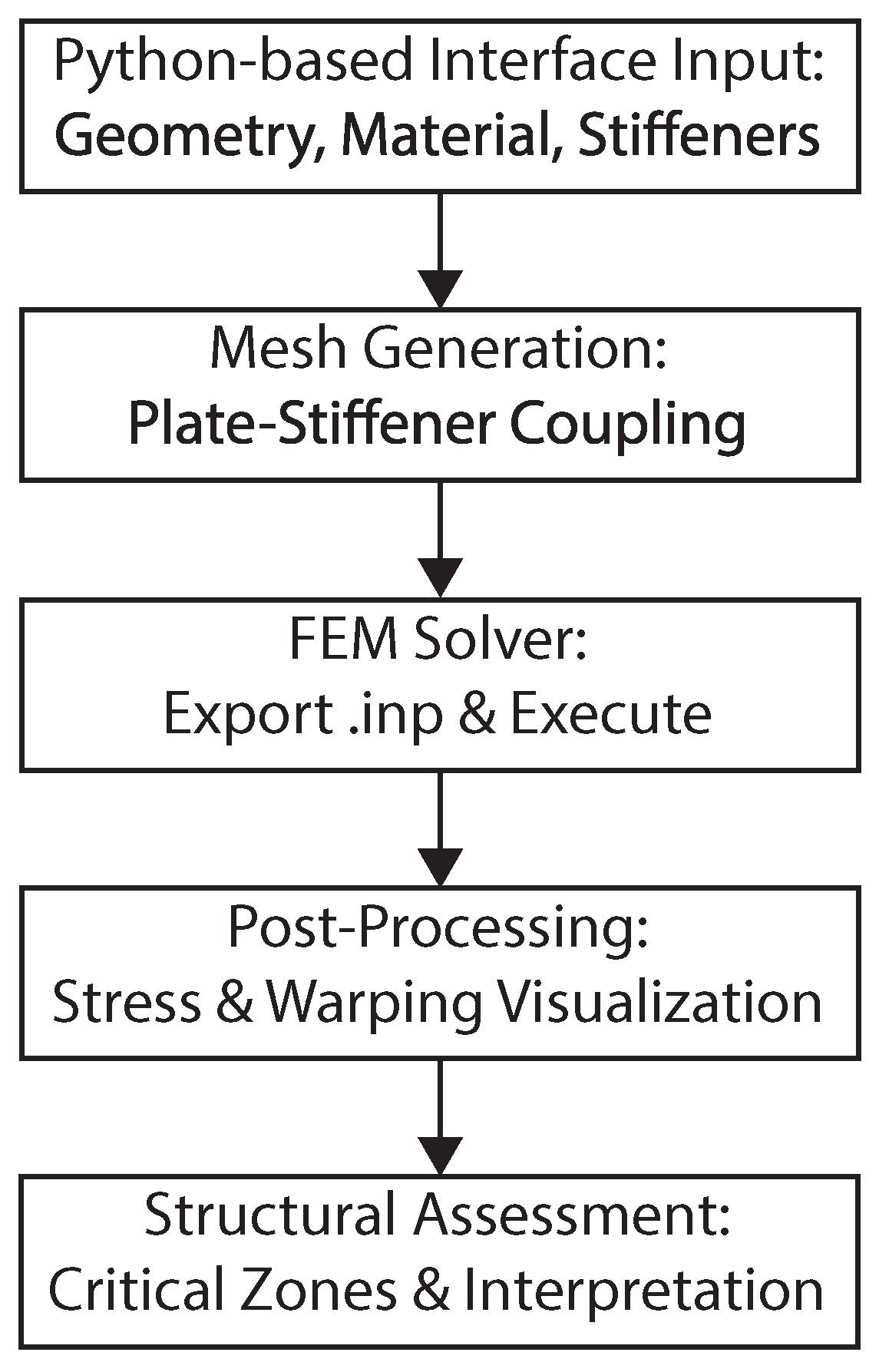
The finite element modeling process was conducted using a macro-based recording system for reproducibility, supported by a Python-based interface that facilitates geometry creation, meshing, material assignment, and solver execution. The stiffened panel was modeled as a 3D deformable shell, allowing both bending and membrane behavior to be captured under torsional loading. S4R shell elements were employed, with plates and stiffeners discretized as a single integrated unit and coupled via shared nodes, resulting in a continuous mesh. This modeling strategy ensures realistic transfer of shear, bending, and warping-induced stresses while improving computational efficiency by eliminating the need for master–slave surface definitions.
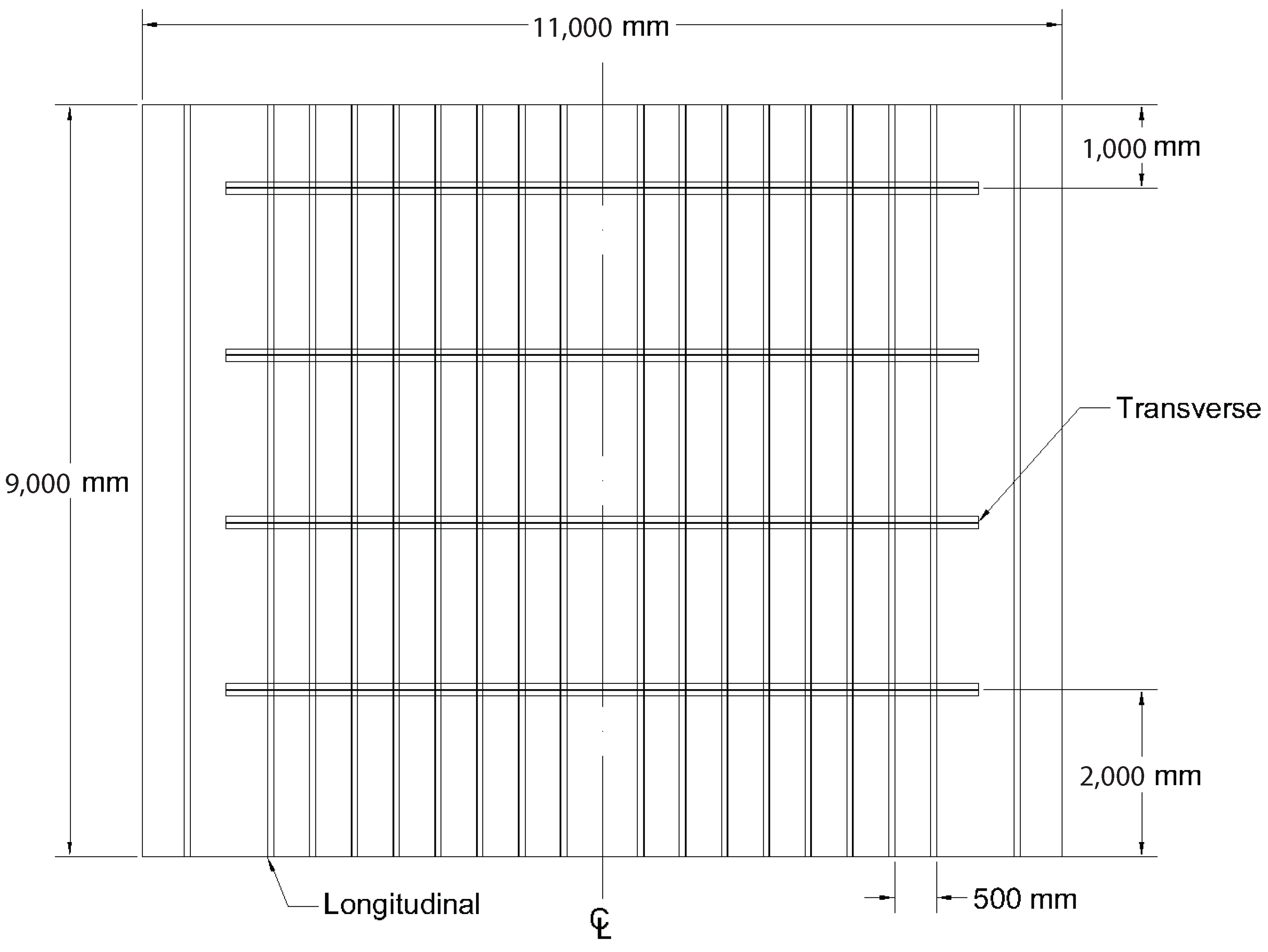
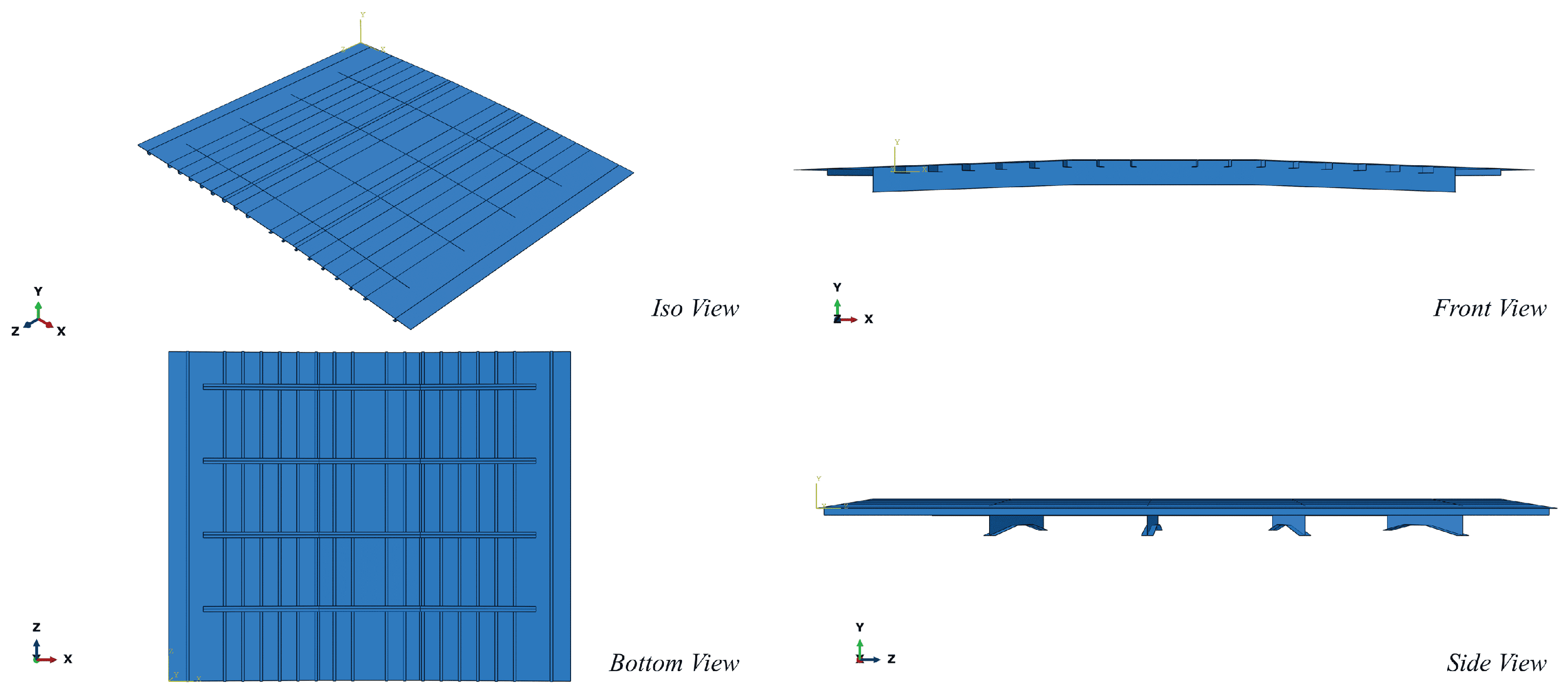
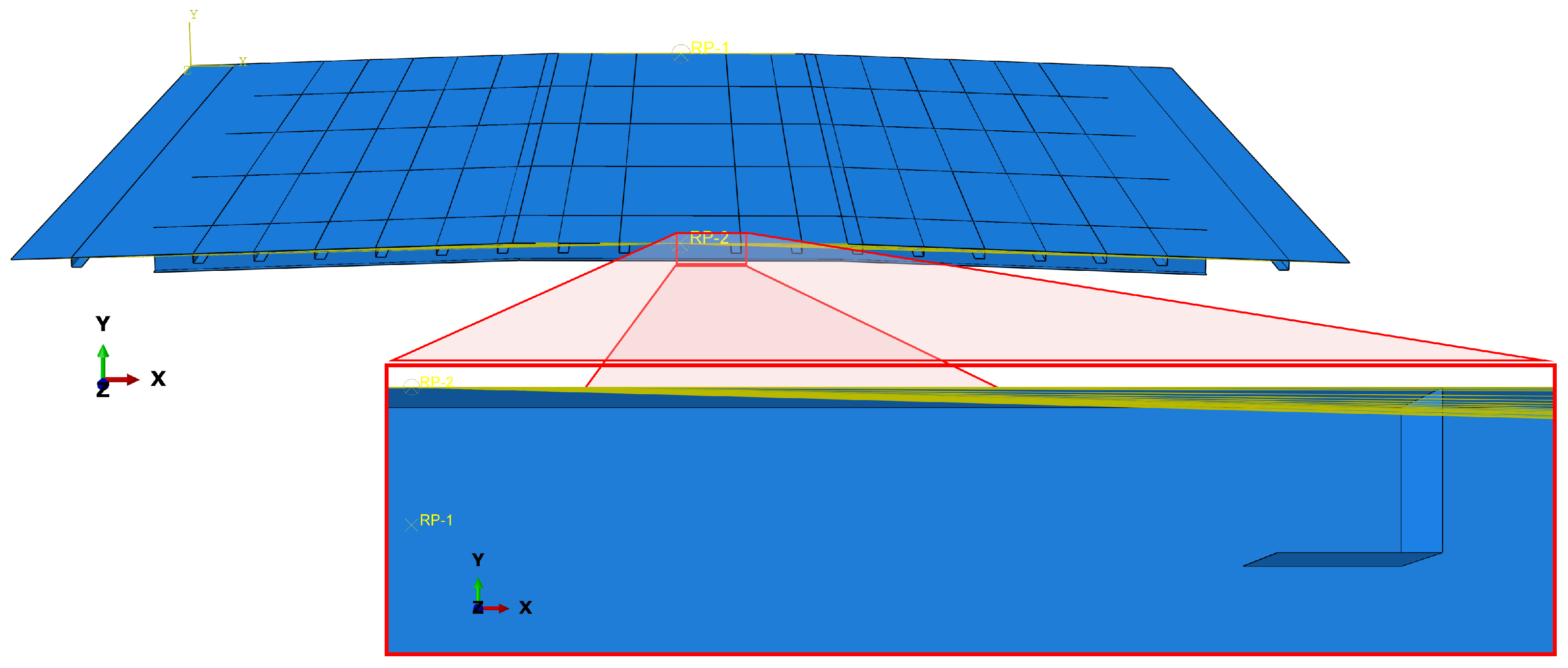
Figure 2 illustrates the finite element representation of the stiffened panel used in the structural analysis. The model consists of a flat plate reinforced by longitudinal and transverse stiffeners, with nodal connectivity employed to ensure proper interaction between membrane and bending responses. The panel geometry was generated using the interface-based modeling system, and each structural component was defined as a 3D deformable shell.
The corresponding geometric dimensions and scantling data used for the model construction are summarized in
Table 3. These input parameters were embedded within the Python-based interface and directly exported to the solver, enabling consistent reproduction of the stiffened panel configuration and facilitating numerical evaluation of stress distribution and deformation.
Structural steel grade AH36 was selected as the material for the entire model due to its reliable ductility and widespread use in marine and offshore structures, standardized by classification societies for marine applications. Both linear elastic and nonlinear plasticity properties were included to enable strength assessment and post-yield response under torsional loading. The material properties adopted in the numerical simulation are summarized in
Table 4.
To represent the nonlinear hardening behavior, the stress–strain relationship was defined using incremental data points suitable for elastic–plastic FEM analysis. The values used in the model are presented in
Table 5, and are compatible with standard material input formats used in commercial solvers such as Abaqus, ANSYS, and MSC Nastran.
These nonlinear data points were embedded within the Python-based interface and automatically exported to the solver during model generation. With the inclusion of both elastic and post-yield material behavior, the model is capable of capturing stress redistribution, strain localization, and potential failure mechanisms under torsional loading.
3.2. Scripting and GUI-Based Automation Framework
The Python-based interface developed in this study operates through a parametric Python scripting framework that replaces fixed macro-recorded commands with user-defined parameters. Macro recording in the finite element software produces a long sequence of instructions containing fixed numerical inputs and redundant operations. To support automated model generation, these scripts must be rewritten so that all geometric, material, boundary condition, and mesh definitions depend entirely on parameters supplied through the interface.
Geometry scripting. The modeling of the stiffened panel begins with the conversion of coordinate-based macro commands into parameterized syntax. This approach enables users to modify plate width, camber length, camber height, and stiffener spacing. The example below shows the parametric form used to construct the main plate geometry:
panjang_miring = (lebar_pelat - panjang_camber)/2
s1.Line(point1=(0.0,0.0), point2=(panjang_miring, tinggi_camber))
s1.Line(point1=(panjang_miring, tinggi_camber),
        point2=(panjang_miring + panjang_camber, tinggi_camber))
s1.Line(point1=(panjang_miring + panjang_camber, tinggi_camber),
        point2=(lebar_pelat,0.0))
Through parametric scripting, the geometry automatically adjusts to any user-defined input from the interface.
Material and section scripting. The material module converts density, elastic modulus, Poisson’s ratio, and plate thickness into modifiable parameters, allowing AH36 steel properties to be assigned programmatically:
mdb.models[nama_model].materials['Steel'].Density(
    table=((density_material,),))
mdb.models[nama_model].materials['Steel'].Elastic(
    table=((young_modulus*1e9, poisson_ratio),))
mdb.models[nama_model].HomogeneousShellSection(
    name='Pelat', material='Steel', thickness=tebal_pelat)
This ensures consistency between material definition and GUI input.
Assembly scripting. Macro-recorded patterns and translations are replaced with loop-based commands, allowing the number and spacing of stiffeners to be varied:
for i in range(jumlah_pelintang):
    instance_name = 'Profile-T-' + str(i+1)
    a.Instance(name=instance_name, part=part, dependent=OFF)
    posisi_z = (i + 1) * jarak_profile_T
    a.translate(instanceList=(instance_name,),
                vector=(0.0,0.0,posisi_z))
This modular structure greatly enhances flexibility compared with fixed macro commands.
Interaction scripting. Coupling constraints between reference points (RP) and the plate edges are defined using set-based region assignments, which remain valid even if the geometry changes:
region1 = a.Set(referencePoints=refPoints1_RP1, name='m_Set-cou1')
region2 = a.sets['Set-1ref1']
mdb.models[nama_model].Coupling(
    name='Coupling-1', controlPoint=region1, surface=region2,
    couplingType=KINEMATIC, u1=ON, u2=ON, u3=ON,
    ur1=ON, ur2=ON, ur3=ON)
Boundary condition scripting. Rotation is entered by users in degrees and automatically converted to radians:
rotasi_radian = derajat_rotasi*(3.14159/180)
mdb.models[nama_model].DisplacementBC(
    name='BC-Rotasi', region=region1,
    u1=0.0, u2=0.0, u3=0.0,
    ur1=0.0, ur2=0.0, ur3=rotasi_radian)
This enables torsional deformation to be applied consistently.
Step and output scripting. Only the output variables needed for structural analysis are enabled:
mdb.models[nama_model].fieldOutputRequests['F-Output-1'].setValues(
    variables=('S','PE','PEEQ','U','RF','RM'))
mdb.models[nama_model].historyOutputRequests['H-Output-1'].setValues(
    variables=('UR3','RM3'))
The rotation–reaction moment relationship is used to evaluate global torsional response.
Mesh scripting. Mesh density and refinement parameters are defined as the Python-based interface inputs:
a.seedPartInstance(regions=partInstances,
                   size=ukuran_mesh,
                   deviationFactor=0.1,
                   minSizeFactor=0.1)
Job scripting. The final executable job is created automatically using the model name:
job_name = nama_model + '_Torsion'
mdb.Job(name=job_name, model=nama_model)
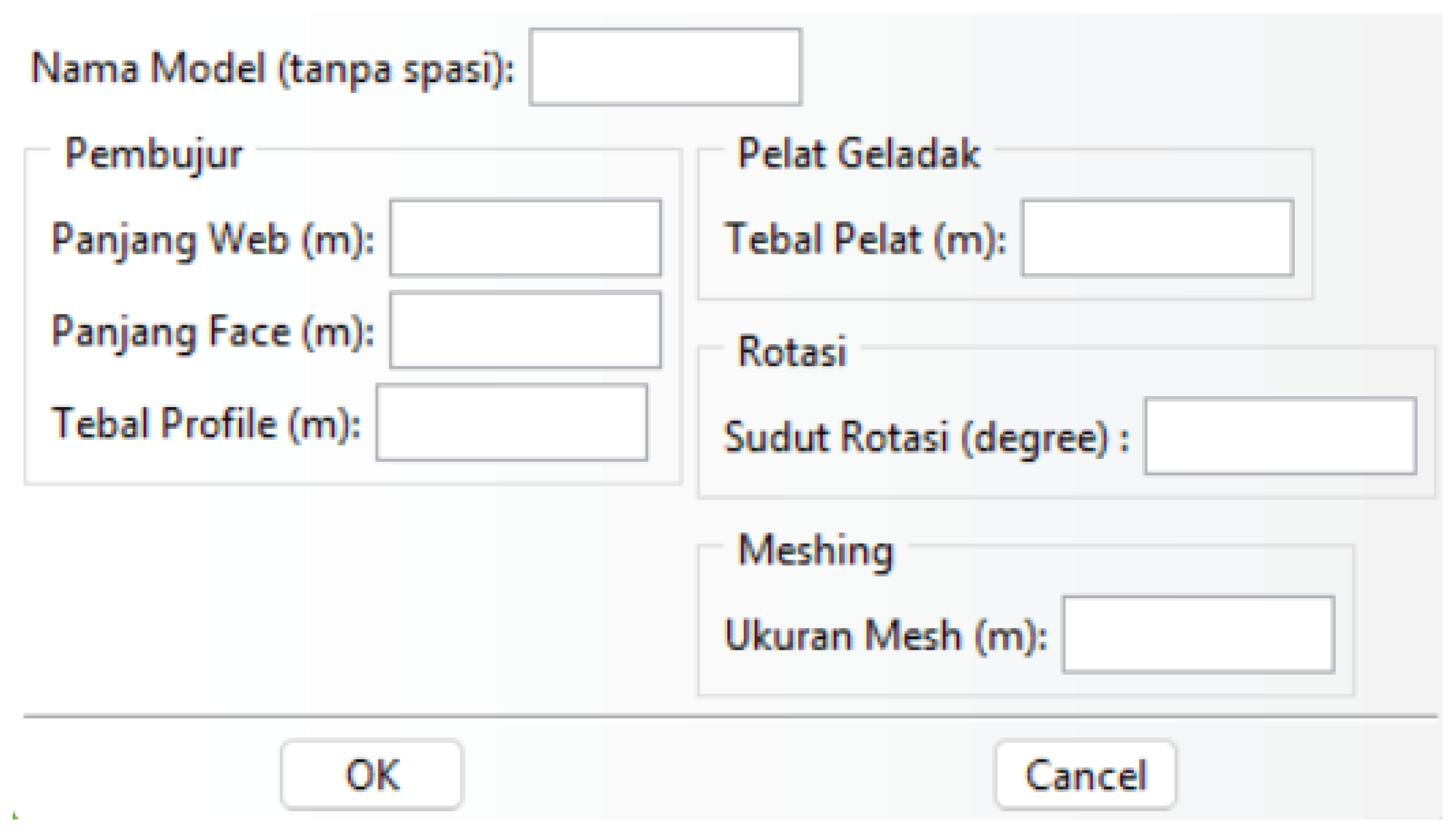
All scripting modules are fully integrated within the Python-based interface framework. Users control geometry, material parameters, boundary conditions, mesh density, and solver execution entirely from the interface, while the underlying script ensures consistent and reproducible finite element model generation. The inputs in the interface were adjusted to suit the requirements of this study. These inputs are shown in
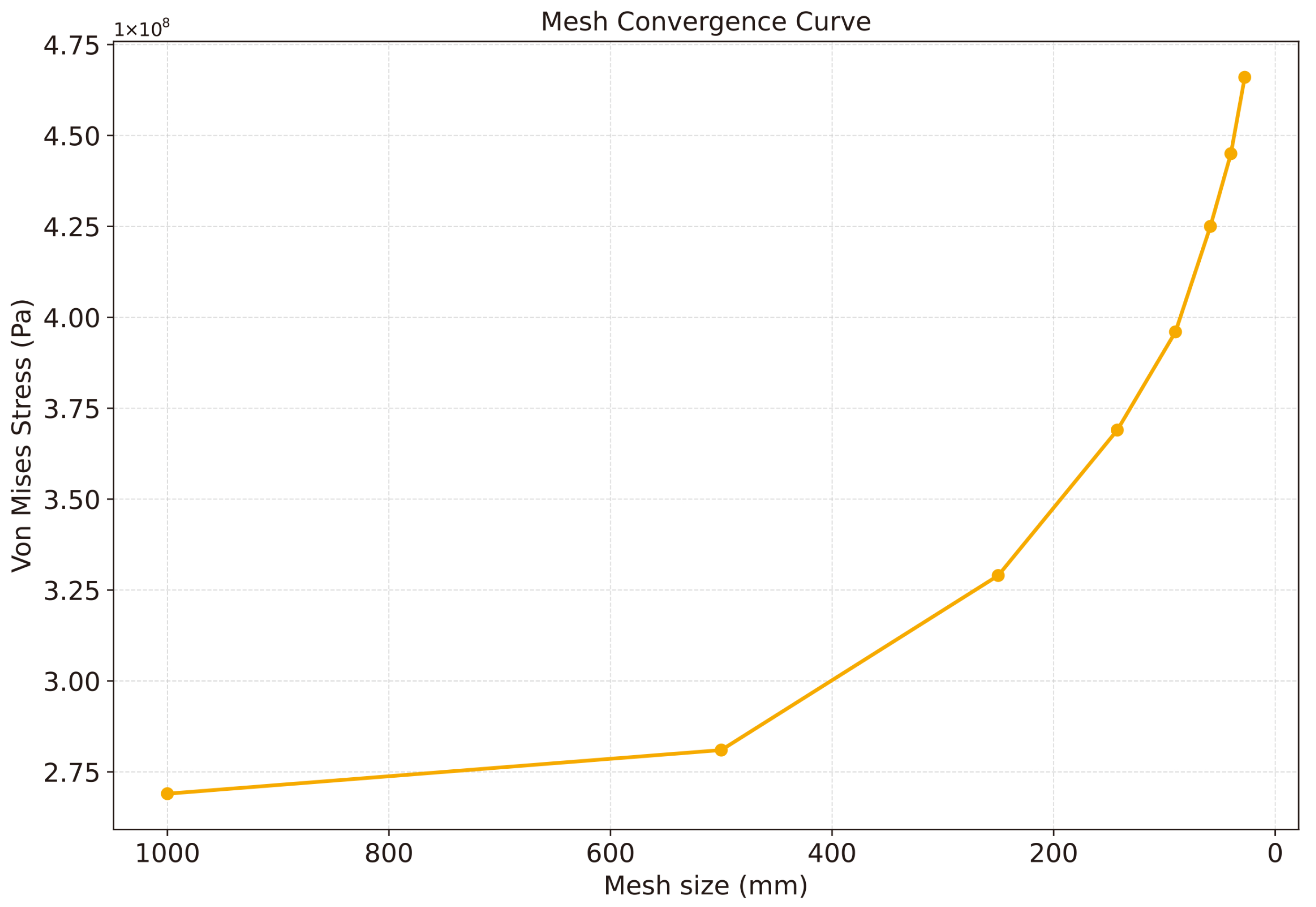
Figure 3, which contains information related to model naming, longitudinal dimensions consisting of web length, face length, and thickness. In addition, there are plate thickness, rotation angle, and mesh size to facilitate the mesh convergence study. Nevertheless, the interface architecture is modular and can be further expanded for other needs in the future.
The developed interface-based program is designed to streamline the finite element modeling workflow for torsional analysis of stiffened deck panels. The tool provides dedicated input fields for key geometric and analysis parameters, including stiffener web and face dimensions, plate thickness, torsional rotation angle, and mesh size control. Through a parametric input system, the program automatically generates the structural model, assigns the required loading in the form of rotational deformation, and prepares the meshing configuration without requiring manual scripting. This function-oriented interface reduces repetitive modeling steps, improves input consistency, and enables faster evaluation of multiple panel configurations. By focusing on torsion-specific modeling tasks, the program enhances usability and repeatability compared to conventional general-purpose FEM workflows.
3.3. Loading Application
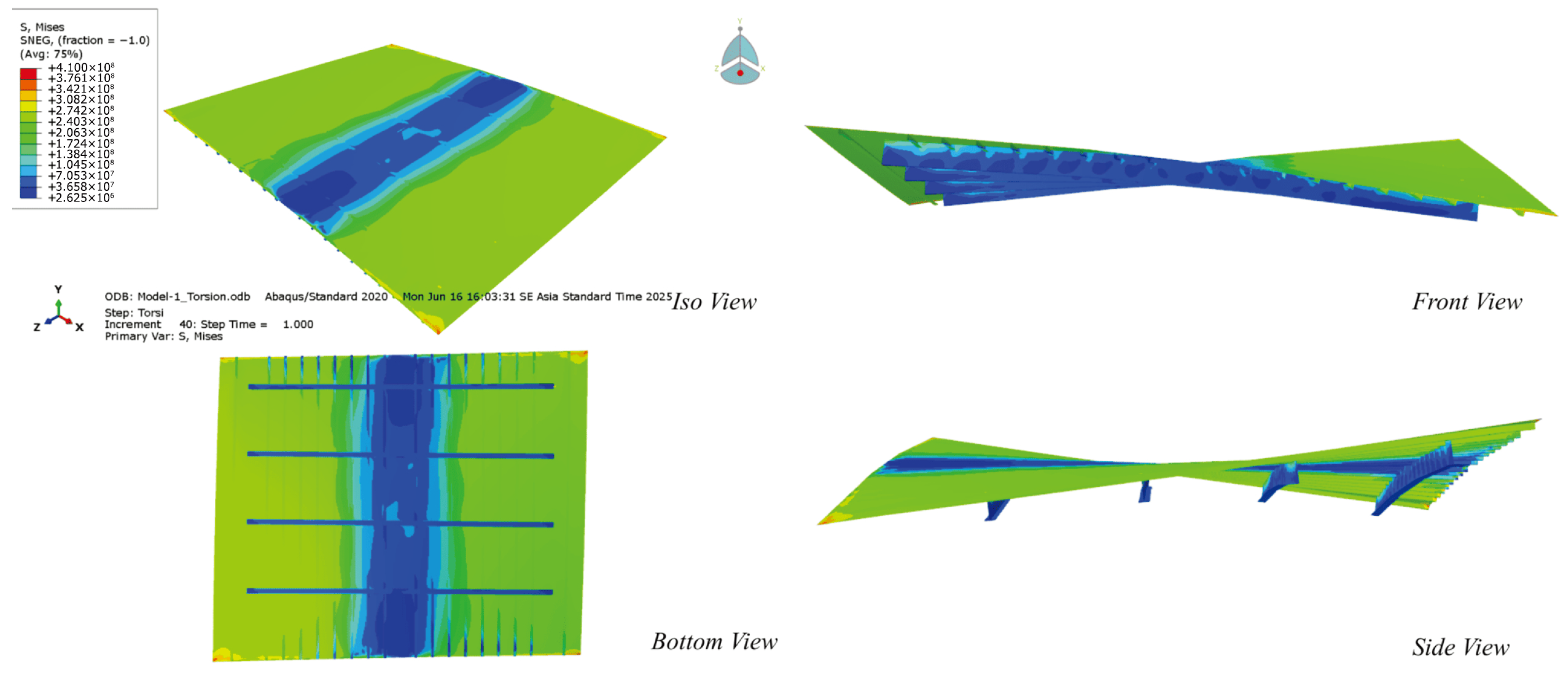
Figure 4 shows the complete configuration of the stiffened panel formed by the combination of plate, longitudinal stiffeners, and transverse stiffeners. The objective of the analysis is to evaluate the structural response of the panel when subjected exclusively to torsional deformation, while other loading conditions are intentionally neglected.
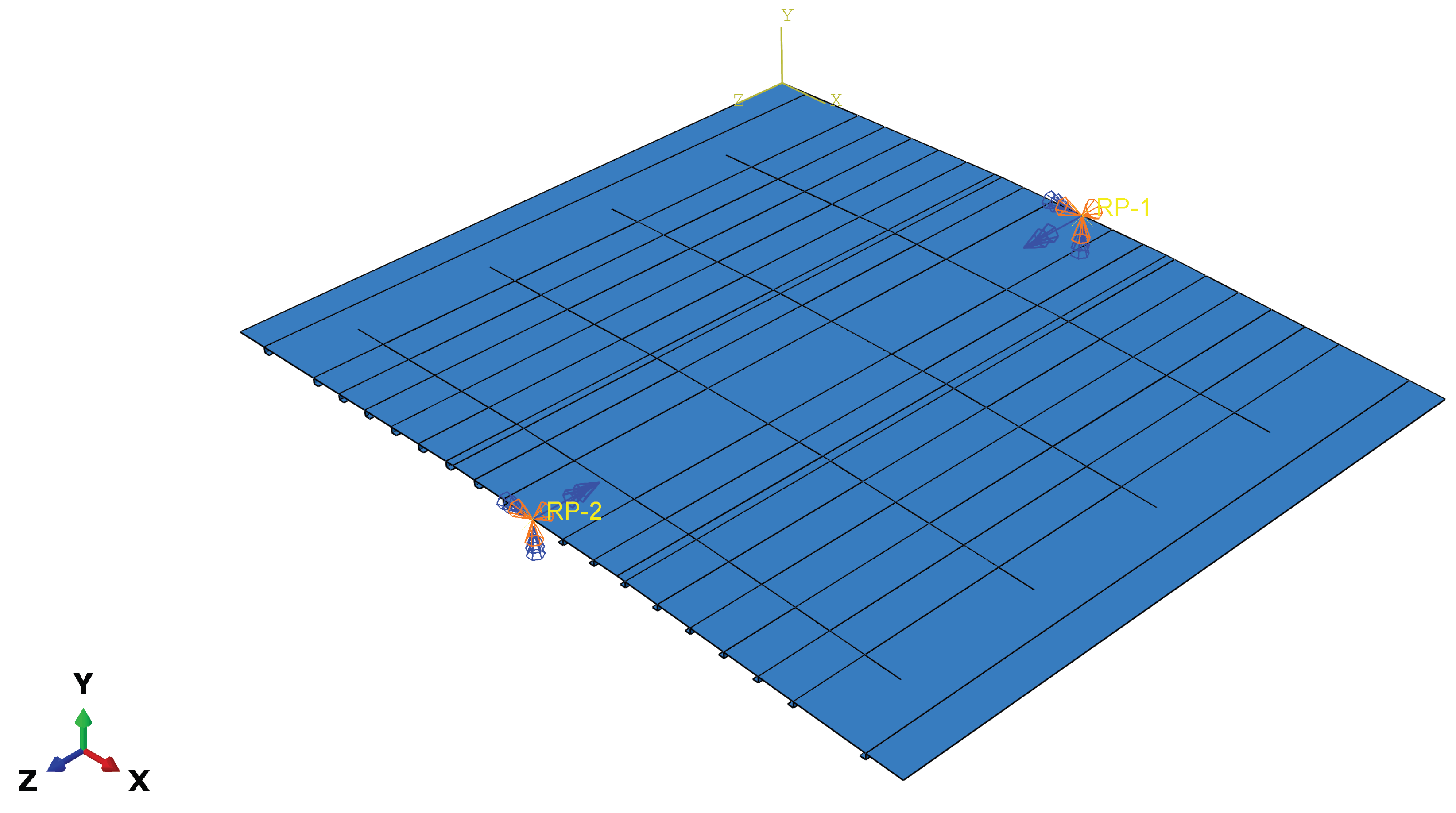
Boundary conditions and torsional loading are applied using interaction couplings that connect both ends of the panel to two reference points, denoted as RP-1 and RP-2 (see
Figure 5). The applied constraints are
meaning that all translational and rotational degrees of freedom are restricted except for the rotation about the
z-axis. Controlled torsional deformation is introduced by prescribing rotational displacement about the
z-axis (URz) at RP-1 with values explained in
Table 6.
While the corresponding values at RP-2 are assigned with opposite signs, these angles represent incremental torsional loading levels, where the last value indicates the critical deformation threshold used to capture maximum stress distribution. This displacement-controlled approach simulates global hull girder torsion acting on a continuous deck structure, where the local response of the stiffened panel is governed by deformation compatibility rather than by externally applied torque.
The boundary conditions and rotational loading are applied simultaneously through reference points (RPs), as illustrated in
Figure 6. Two reference points are defined to control the torsional response, where RP-1 is assigned for positive rotation and RP-2 for negative rotation. Each RP is coupled to the corresponding panel edge so that the prescribed rotational displacement is consistently transferred to the structural model. This approach enables controlled torsional loading without imposing fully rigid edge constraints. The coupling scheme is defined to eliminate rigid body motion while not completely suppressing cross-sectional warping deformation, allowing the torsion-induced stiffness and stress distribution to develop naturally. Therefore, the resulting response more realistically represents the torsional and warping behavior of the stiffened panel rather than artificial stiffness caused by excessive boundary restraints.
In the present analysis, the large-deformation (NLGEOM) option was activated to permit significant rotational deformation of the stiffened panel under torsional loading, ensuring accurate representation of the structural response at higher twist levels and maintaining numerical stability throughout the loading process. This setting enables an appropriate kinematic description under substantial angular deformation. However, geometric nonlinearity effects associated with initial geometric imperfections, residual stresses, or imperfection-sensitive instability behavior were not incorporated into the model. The simulations therefore focus on large-deformation response driven by applied torsion and nonlinear material behavior, without explicitly addressing instability phenomena related to imperfections or residual stress effects.



 ,
,