Article

Study of a Polymer Composite with Carbon Nanotubes and a Mixed Filler Using a Composite Piezoelectric Oscillator at a Frequency of 100 kHz


by
Vladimir V. Kaminskii
1,
Alexandr V. Shchegolkov
2,*,
Dmitrii A. Kalganov
1,
Dmitrii I. Panov
1,
Maksim V. Dorogov
1 and
Aleksei V. Shchegolkov
3,*
1
Institute of Advanced Data Transfer Systems, ITMO University, St. Petersburg 197101, Russia
2
Institute of Power Engineering, Instrumentation and Radioelectronics, Tambov State Technical University, Tambov 392000, Russia
3
Center for Project Activities, Scientific Research Department, Advanced Engineering School of Electric Transport, Moscow Polytechnic University, Moscow 107023, Russia
*
Authors to whom correspondence should be addressed.
J. Compos. Sci. 2026, 10(2), 87; https://doi.org/10.3390/jcs10020087
Submission received: 29 October 2025 / Revised: 27 January 2026 / Accepted: 31 January 2026 / Published: 6 February 2026

Abstract

This article presents an investigation of the thermomechanical properties of silicone elastomer-based polymer composites modified with carbon nanotubes (CNTs) and mixed fillers (CNTs, bronze, graphite). The primary technique employed was the composite piezoelectric oscillator (CPO) method at approximately 100 kHz. This approach enabled precise measurements of the polymers’ forced oscillation frequency and logarithmic damping decrement (internal friction) across a wide temperature range (80–300 K). The application of this method is novel for this specific class of materials. Scanning electron microscopy confirmed the uniform distribution of the fillers within the polymer matrix. Differential scanning calorimetry (DSC) showed that the fillers modify the thermal stability of the composite. The systematic decrease in the enthalpy of the endothermic decomposition peak suggests a retardation of degradation kinetics, most likely due to a barrier effect of the filler network. Electrical measurements revealed a distinct contrast: the hybrid composite exhibited a frequency-independent conductivity plateau (~1.8 × 10⁻¹ S/m), confirming a robust percolating network, unlike the strong frequency dependence observed for the CNT-only composite. Research shows that the fillers effectively suppress relaxation processes linked to crystallization (205–215 K) and glass transition (165–170 K), as evidenced by a significant reduction in the amplitude of the corresponding internal friction peaks. The most pronounced effect was observed in the composite with mixed fillers, attributable to a synergistic effect between constituents. Furthermore, amplitude-dependent internal friction was found to occur predominantly below the glass transition temperature. The primary objective of the present study is to investigate the dynamic mechanical and damping behavior of CNT-filled silicone composites with mixed fillers under high-frequency loading, using the CPO method. These findings demonstrate the potential for tailoring the stiffness and damping characteristics of these composites for advanced applications in soft robotics and portable electronics.

1. Introduction

Polymer composites incorporating carbon nanotubes (CNTs) constitute a promising class of materials that synergize the mechanical properties of the polymer matrix—such as strength, flexibility, and elasticity—with the superior thermal and electrical conductivity of the nanofillers [1]. This combination makes them particularly attractive for developing high-performance strain gauges (strain resistors), which demand high sensitivity, mechanical robustness, and stable performance across wide load ranges [2,3,4].
The integration of CNTs into a polymer matrix significantly enhances the composite’s properties, leading to an improvement of several orders of magnitude in electrical conductivity, elastic modulus, strength, and thermal stability [1,5,6]. A sharp increase in electrical conductivity upon CNT addition typically signals the attainment of the percolation threshold [7,8,9], which is classically described by a power-law equation [10]:
σ = σ 0 φ φ c t ,
where
σ is the electrical conductivity of the composite, S/m;
σ0 is the electrical conductivity of the CNTs or the conductivity of an ideal network, S/m;
φ is the volume fraction (concentration) of CNTs in the composite, vol. %;
φc is the critical volume fraction at which an infinite conducting cluster forms in the system and conductivity increases sharply, vol. %;
t is the critical exponent, a dimensionless parameter that depends on the filler geometry and system dimensionality.
Equation (1) enables the prediction of conductivity and extraction of key CNT network parameters, which is crucial for designing strain-sensitive materials. However, a significant challenge remains: establishing experimental methodologies to determine the optimal material parameters for reliable strain sensing under dynamic conditions.
The combination of enhanced conductivity and excellent mechanical properties positions CNT composites as candidates for sensing elements, particularly for applications in soft robotics and wearable electronics that operate under dynamic loads [11,12,13,14]. Recent studies on CNT-based strain sensors highlight this potential. For instance, flexible and self-adhesive hydrogels containing CNTs demonstrate high sensitivity and stability for wearable motion sensing [15]. Similarly, advanced strain sensor designs with CNT-based sensing layers achieve high sensitivity over a wide strain range, along with waterproof functionality crucial for practical applications [16]. These works exemplify the ongoing efforts to harness the piezoresistive effect in CNT–polymer systems for real-world sensing.
Beyond single fillers, synergistic combinations of carbon nanomaterials (CNMs) with other additives are frequently employed to tailor composite performance [17,18]. For example, silicon dioxide (SiO2) nanoparticles can improve CNT–matrix adhesion and dispersion [19]. The addition of graphene or metallic particles creates mixed filler networks that enhance both electrical conductivity and mechanical properties through synergistic effects [20,21,22]. These combinations enable the design of conductive polymer composites with customized anisotropic or isotropic properties for specialized sensing applications [22].
In turn, understanding the relaxation behavior of polymer composites is complicated by the strong interdependence of their viscoelastic properties with temperature and frequency. To analyze this, modern practice employs complex experimental and modeling approaches, such as the frequency–temperature superposition principle, to extend the effective frequency range [23]. The development of resonant methods, particularly modern modifications of composite piezoelectric oscillators, is aimed at the precise and rapid determination of viscoelastic characteristics (moduli and internal friction) as a function of temperature at high frequencies (tens to hundreds of kHz). This ensures the necessary reproducibility for investigating the dynamic behavior of materials [24].
Contemporary research demonstrates a consistent trend towards the deliberate hybridization of fillers, which enables control over the architecture of conductive networks, mechanical losses, and the overall stability of the composite. This strategy, based on synergistic effects (e.g., combining nano- and micro-particles or creating island-bridgestructures), is supported by both review articles and experimental studies aimed at creating more controllable and efficient functional materials [1,2,3,4,25].
A comprehensive investigation of the mechanical properties of these composites, especially under high-frequency dynamic loading, represents a crucial step in developing reliable strain sensors [4,26,27,28]. This high-frequency characterization is particularly important as modern sensors increasingly operate under dynamic and cyclic loads, requiring a rapid and accurate response [29,30]. Material behavior measured under static or low-frequency conditions [31] can differ substantially from its response at high frequencies (10–100 kHz) due to intrinsic polymer relaxation processes and inertial effects [23,32,33,34].
Unlike most studies [24,25,35,36,37] focusing on the quasi-static characteristics and properties of CNT-elastomer strain gauge. This work presents a comprehensive investigation of the high-frequency (~100 kHz) dynamic properties of silicone composites containing mixed fillers (CNTs + microparticles) using the CPO method. We establish correlations between their microstructure, dynamic elastic modulus, internal friction, and electrical conductivity. A key finding is that the mixed filler forms a more developed conductive network and effectively suppresses the relaxation peaks in internal friction, which significantly enhances the stability of the piezoresistive response under dynamic loading and temperature fluctuations.
The aim of this work is the experimental investigation of the mechanical properties of silicone elastomer composites modified with CNTs and mixed fillers (graphite and bronze). These filler materials are highly attractive for effectively enhancing the electrical and thermophysical properties of strain-sensitive polymer composites.
To achieve this aim, the following tasks were formulated and accomplished:
-
To establish a correlation between the composite microstructure and its mechanical characteristics.
-
To implement and validate the CPO method for high-frequency characterization of these novel composite materials.
This study contributes to the understanding of how mixed fillers influence the high-frequency behavior of polymer composites and demonstrates CPO as an effective characterization tool. This opens new avenues for designing materials with precisely tailored damping and elastic properties.

2. Materials and Methods

This work utilizes the CPO method at a frequency of approximately 100 kHz for the comprehensive mechanical characterization of CNT-based polymer composites. This technique enables the simultaneous and highly accurate measurement of two key parameters:
-
The forced oscillation frequency, which determines the material’s stiffness;
-
The logarithmic damping decrement, which characterizes its internal friction.
These measurements are performed across a range of temperatures and strain amplitudes.
Furthermore, these parameters are highly sensitive to phase transitions, such as glass transition and crystallization, highlighting their utility in monitoring the material’s thermomechanical evolution. By performing these measurements over a controlled temperature range, it is possible to establish correlations between the composite’s structure—including the uniformity of nanotube distribution and interfacial adhesion strength—and its functional performance. This approach provides a direct pathway for optimizing composite composition to develop reliable and highly sensitive strain gauges.
The method is strictly constrained to operate at 100 kHz. This limitation arises from the fundamental design of setup, which utilizes a CPO driven at the primary resonance frequency of its quartz element. This resonance is inherently fixed within a narrow band centered around 100 kHz. Consequently, our approach yields single-frequency (ultrasonic) data, as opposed to a broadband frequency sweep.

2.1. Materials

This study utilized the following materials: the organosilicon elastomer «Silagerm 8030» (LLC «ELEMENT14», Moscow, Russia), which features a polar Si-O-Si backbone. The elastomer was modified with a mixture of CNTs) and needle-shaped bronze powder (NBP) with an average particle size of ~5 µm, as well as thermally expandable graphite EG-350 (TG) with a particle size of 0.3 mm and an expansion ratio of 350 mL·g−1. The CNTs were synthesized as described in [22]. The elemental composition of the bronze powder and graphite is provided in Table 1.

2.2. Sample Preparation

The samples were fabricated using a two-component mixing procedure. The base component—silicone fluid «Silagerm 8030»—was loaded with either CNTs alone or a mixed filler system (NBP and TG), and then mixed with a hardener (catalyst). The silicone elastomer matrix was based on the two-component RTV compound Silagerm 8030. The components were mixed at a mass ratio of 1:1 (Component A: base; Component B: curing agent/catalyst), in strict accordance with the manufacturer’s instructions [38].
To ensure electrical conductivity, the CNT-filled composite (S2) contained 3 vol.% CNTs. The hybrid composite (S3) was formulated with 3 vol.% CNTs and an additional 3 vol.% of the mixed NBP/TG filler. Each mixture was stirred for 15 min using an IKA EUROSTAR 100 control overhead stirrer (IKA Werke, Staufen im Breisgau, Germany). During this process, chemical polymerization transformed the liquid silicone into a flexible, elastic, and conductive composite.
The procedure for determining the optimal filler concentration is described in detail in [22]. The study evaluated three sample types (Table 2). Sample S1, the unfilled polymer, served as a reference for comparison with the modified samples S2 and S3. All samples were prepared as rectangular parallelepipeds with dimensions of 1 × 2 × 7 mm3.
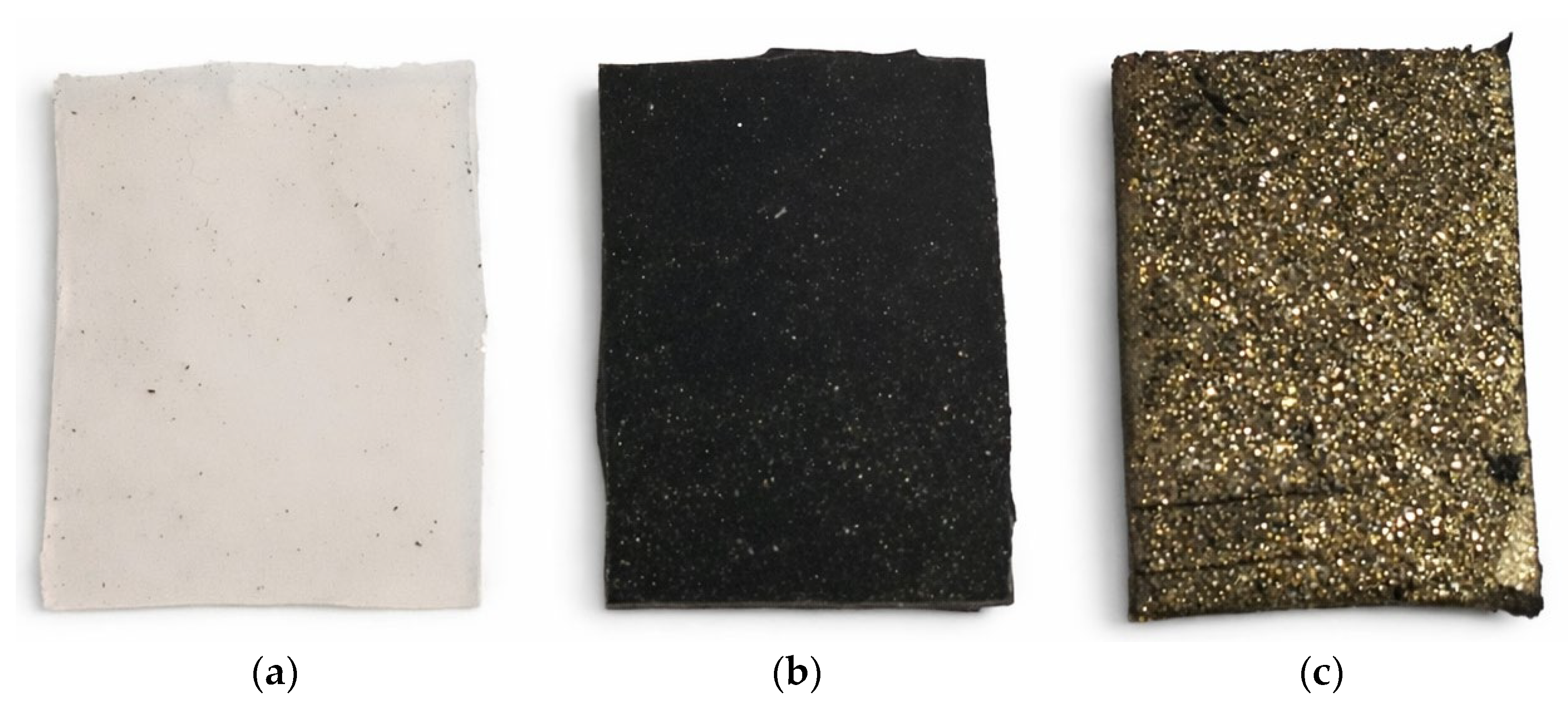
The volume fractions of the three fillers are additive. The total filler content is within the typical range used for hybrid CNT/elastomer particle composites, and their uniform dispersion was achieved through high-shear mixing. Figure 1 presents the obtained samples. All samples were prepared using an identical protocol to minimize the influence of varying mechanical pre-history. Furthermore, the stability of their properties was confirmed post-factum by reproducible cyclic CPO measurements.
To minimize such effects, all samples were prepared using the same protocol and were not mechanically preloaded prior to CPO testing. Reproducibility was evaluated by repeating full temperature scans (cooling/heating cycles) for each sample. The resonant frequency and damping curves were highly reproducible; deviations at characteristic features (peak positions and amplitudes) remained within approximately 2% between cycles. This indicates that the measured response is stable and that no significant irreversible structural changes occurred during the first measurement cycle within the investigated temperature range.

2.3. Composite Piezoelectric Oscillator Method

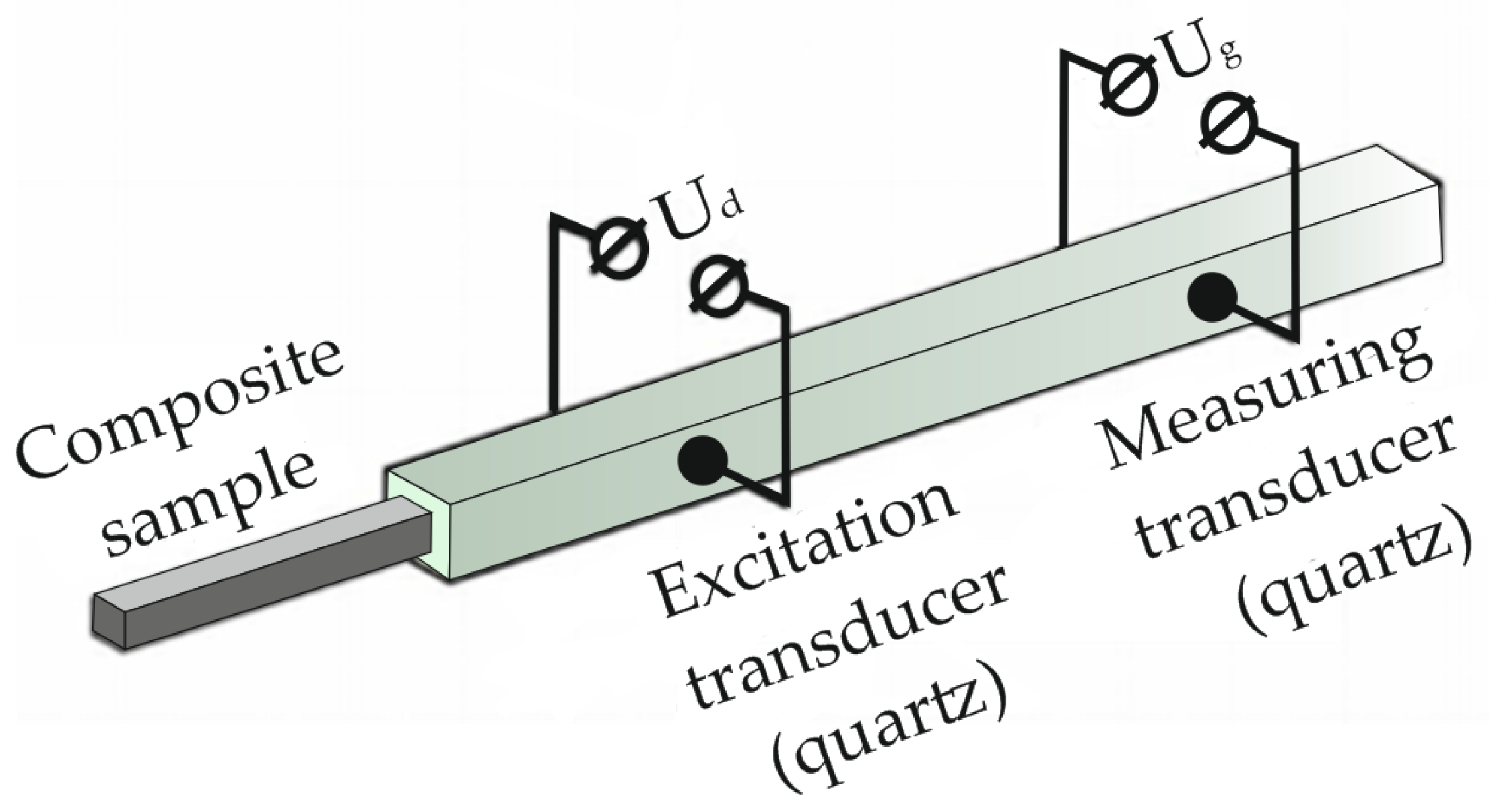
The primary research method employed in this work was the CPO technique, operating at a resonant frequency of 100 kHz, which is optimal for high-sensitivity measurements [39,40]. The CPO constitutes a complex oscillatory system comprising several mechanically linked piezoelectric elements (resonators). In this setup, a composite quartz transducer, shaped as a parallelepiped measuring 3 × 3 × 24.5 mm3, transmits oscillations upon excitation. These oscillations are conveyed to a second monocrystal, which functions to sustain the oscillations via a feedback loop, and simultaneously to the sample, which is securely fixed using a specialized adhesive (Figure 2).
While the classical CPO configuration generates longitudinal standing waves at resonant frequency within the quartz-sample system, the present setup maintains resonant oscillations in the quartz monocrystals, which are coupled to the sample under investigation, thereby driving its forced oscillations.
The fundamental principle of the composite piezoelectric oscillator (CPO) method is based on the precise measurement of internal friction, which is quantified by the damping of mechanical oscillations. This relationship is formally expressed by the following equation:
δ = k δ U d U g
where
Ud is the driving voltage, V;
Ug is the measured voltage across the quartz, V;
kδ is a constant depending on the transducer geometry, quartz crystal characteristics, and electrical impedance.
The resonant frequency and logarithmic damping decrement of the sample under study are derived from the measured resonant frequency and damping of the entire composite oscillator system using the following relationships:
m o s c δ o s c = m q δ q + m s δ s
m o s c f o s c = m q f q + m s f s
where
mosc is the mass of the entire oscillator, g;
mq is the mass of the quartz, g;
ms is the mass of the sample, g;
δosc is the damping of the entire oscillator;
δq is the damping of the quartz;
δs is the damping of the sample;
fosc is the frequency of the entire oscillator, Hz;
fq is the frequency of the quartz, Hz;
fs is the frequency of the sample, Hz.
For high-quality quartz monocrystals, the intrinsic damping decrement (δ) is significantly lower than that of the polymer samples under investigation. This property enables the determination of the sample’s oscillation damping and frequency with high precision, achieving an accuracy of up to 0.1%. All experiments were conducted in a gaseous helium environment to enhance thermal exchange and minimize the system’s thermal inertia.
The CPO method was used to measure the forced oscillation frequency and the logarithmic damping decrement (internal friction) of the composites with high accuracy across a wide temperature range (80–300 K).

2.4. Temperature Measurement

The sample temperature was monitored and controlled using a system built around a programmable Eurotherm 3216 controller (Euroterm Ltd., Worthing, West Sussex, UK). Temperature was measured with a PT-100 platinum resistance thermometer positioned in close proximity to the sample. Regulation was achieved through a PID algorithm, where the controller continuously compared the measured temperature to the target setpoint and computed the necessary corrective power output. This control signal was then amplified to adjust the voltage supplied to the heating furnace. For data acquisition, the controller was interfaced with a computer via an RS-232 serial connection, enabling the real-time recording of temperature readings. The system provided a temperature measurement resolution of 0.01 K.

2.5. Differential Scanning Calorimetry

The thermal degradation behavior of samples S1–S3 over the temperature range of 303–673 K was evaluated using a DSC3 instrument (Mettler-Toledo International Inc., Columbus, OH, USA). Measurements were conducted under a continuous argon purge at a flow rate of 20 mL/min, with heating rates up to 10 °C/min. To ensure reproducibility, all samples were prepared in standardized aluminum crucibles, and the system was calibrated following the manufacturer’s protocol prior to the experiment.

2.6. Electrophysical Characteristics

The electrophysical properties of the composite materials were characterized using a dielectric spectroscopy system designed for nanocomposites and semiconductors, based on an alternating current measurement methodology. The measurements were conducted over a frequency range of 50 Hz to 1 MHz and a temperature interval from 15 to 375 K. A comprehensive description of the experimental setup is available in [41].

2.7. Characterization of Samples

Scanning electron microscopy (SEM) was employed as a complementary characterization technique. The analysis was performed using a MIRA 3 TESCAN (Brno, Czech Republic) electron microscope. Imaging was conducted in secondary electron (SE) mode with an accelerating voltage of 10.0 kV and a working distance (WD) of 7.70 mm. Standard preparation protocols for non-conductive polymer composites were followed to ensure image clarity and prevent surface charging of the specimens.
For SEM analysis, the samples were prepared using a fracturing method: a notch was first introduced using a blade, followed by mechanical cleavage to obtain a fresh cross-sectional surface that was not subjected to mechanical polishing. This approach avoided potential distortions and artifacts introduced by conventional preparation techniques and allowed for the visualization of the true internal structure [42,43].
Elemental analysis of the studied samples was conducted using an energy-dispersive X-ray spectroscopy (EDS) detector integrated into a Thermo Scientific Apreo SEM from Thermo Fisher Scientific, Waltham, MA, USA. The analysis was performed at an accelerating voltage of 15 kV, which is optimal for the simultaneous and efficient excitation of characteristic X-ray radiation from both light and heavy elements.

3. Results and Discussion

3.1. Morphological and Elemental Composition Analysis

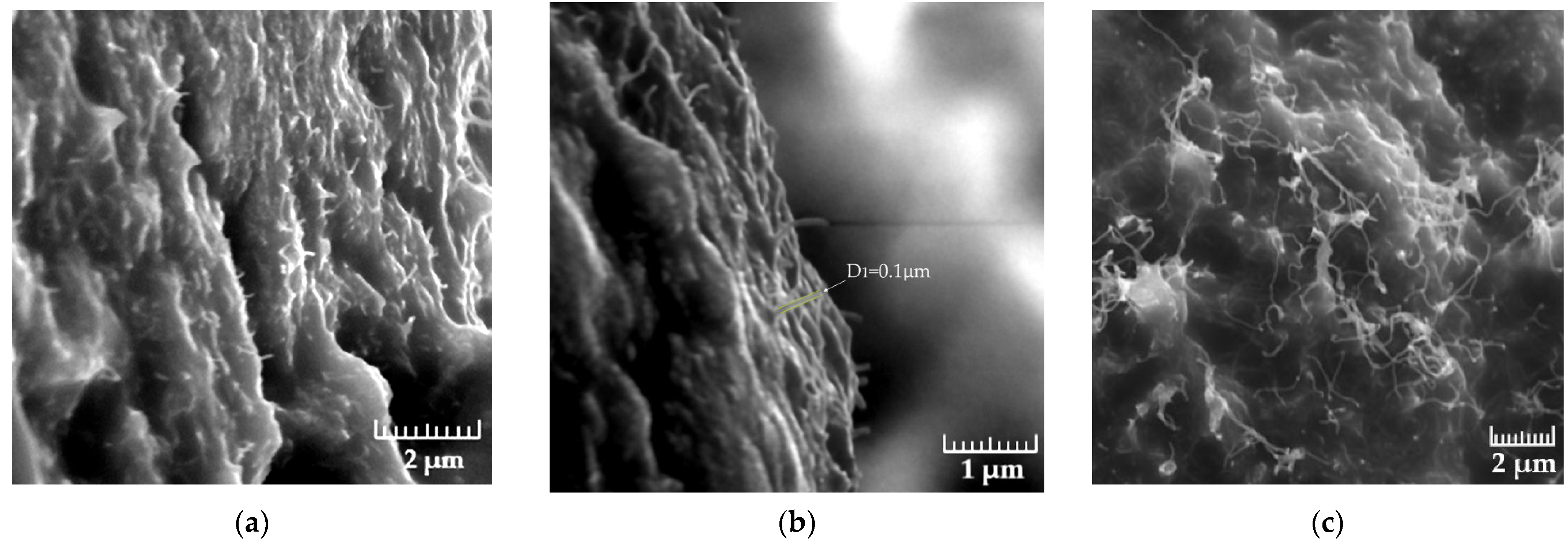
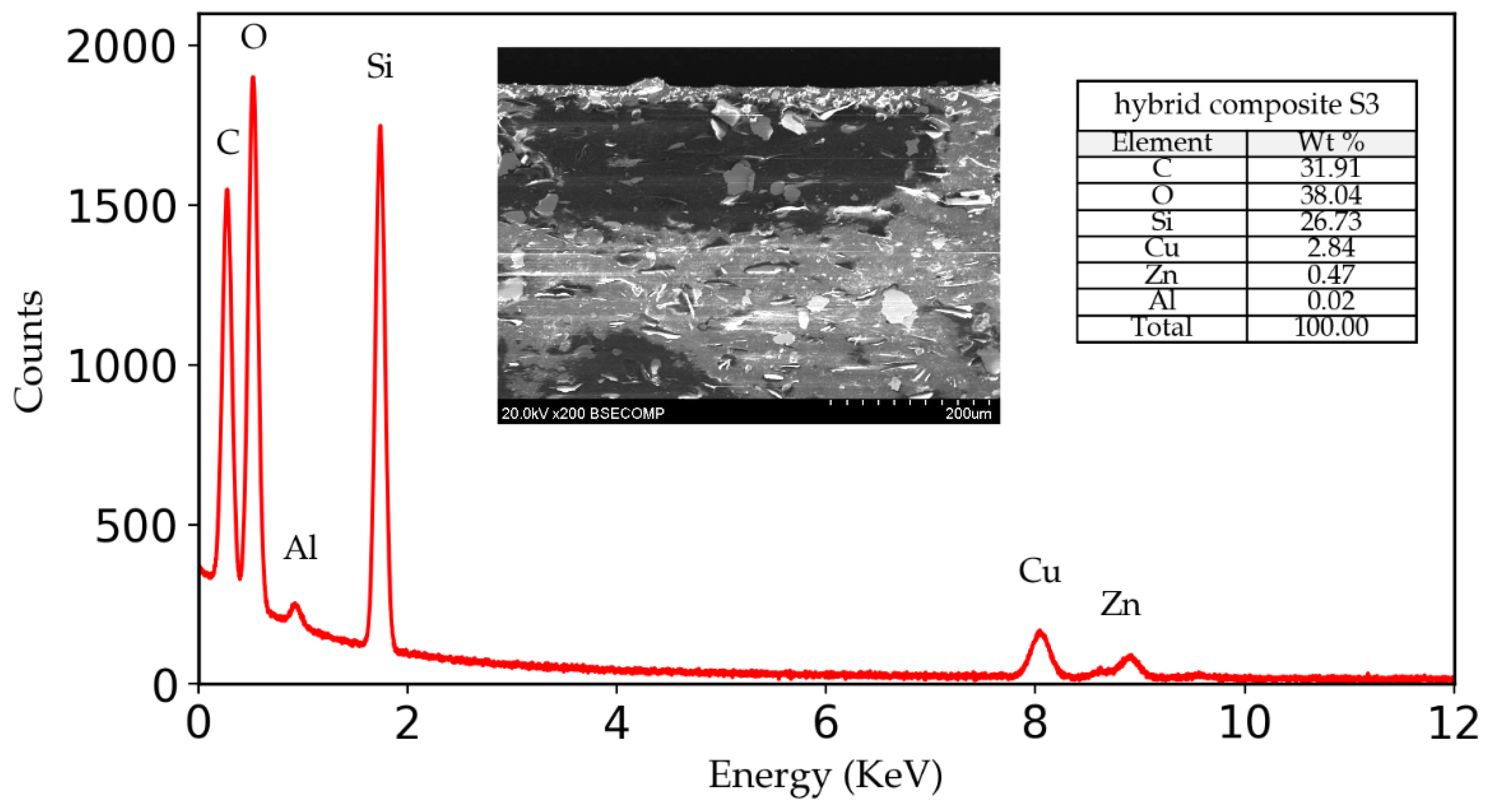
The SEM analysis results (Figure 3) confirm a uniform distribution of CNTs within the polymer matrix. The observed CNTs exhibited an average diameter of approximately 100 nm [22]. This homogeneous dispersion of nanotubes at the 100 nm scale is a critical factor in achieving the electrical percolation threshold—defined as the minimum filler concentration (φ) required to form a continuous conductive network throughout the composite, as described by Equation (1). The EDS spectra for sample S3 are presented in Figure 4.
Complementary EDS analysis of the hybrid composite S3 corroborates the successful incorporation of all designed filler components into the silicone (Si–O–Si) matrix. The semi-quantitative EDS results (norm. wt.%) show dominant peaks of carbon (C, 31.91%), oxygen (O, 38.04%), and silicon (Si, 26.73%), characteristic of the organosilicon elastomer and carbon-based fillers (CNTs and graphite). Additionally, the presence of copper (Cu, 2.84%) and trace amounts of zinc (Zn, 0.47%) and aluminum (Al, 0.02%) in the spectrum, identified by their characteristic Kα lines (~8.05 keV and ~8.64 keV for Cu and Zn, respectively), confirms the inclusion of the bronze (CuAl) powder particles within the analyzed volume. This direct elemental evidence aligns with the intended composition of the hybrid filler system (CNT/TG/CuAl) and supports the microstructural model of a co-continuous network [44], where metallic and graphite particles can act as conductive bridges between CNT agglomerates, which is crucial for the observed synergistic enhancement of electrical and thermomechanical properties discussed in subsequent sections.

3.2. CPO Method

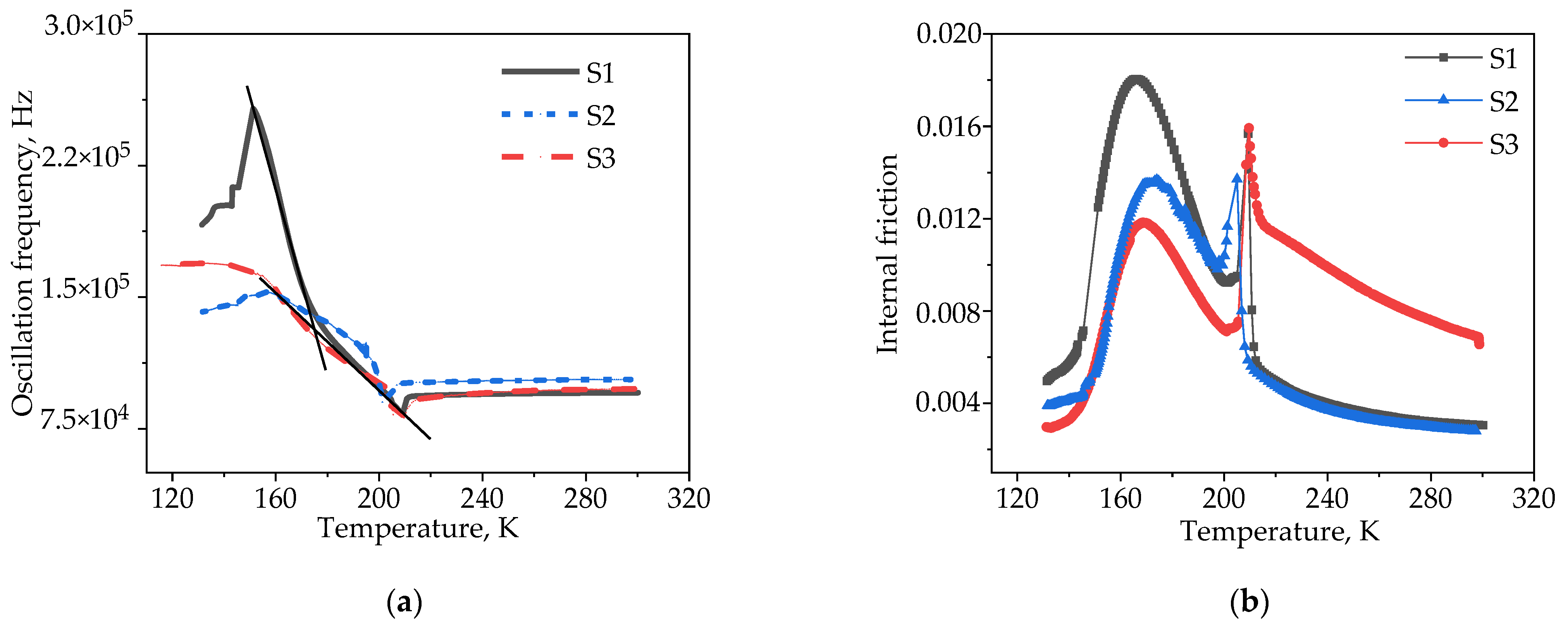
The samples were subsequently characterized using the composite piezoelectric oscillator (CPO) method, as illustrated in Figure 5. Investigation of the three sample types (S1–S3) yielded the temperature-dependent profiles of both oscillation frequency and internal friction. The CPO data thereby establish a critical link between the composite morphology and the analysis of their dynamic mechanical properties and relaxation behavior.
The analysis of the temperature-dependent dynamic mechanical properties reveals several key features common to all samples, as shown in Figure 5b. Upon initial cooling from T0 = 290 K, all samples exhibit a decrease in oscillation frequency and a concurrent increase in internal friction. A distinct internal friction peak, accompanied by a substantial decrease in oscillation frequency, is observed in the temperature range of 205–215 K. This phenomenon is most pronounced for the unfilled reference sample S1.
With further cooling, the internal friction of all samples increases smoothly, culminating in a well-defined peak within the 165–170 K range, after which it decreases. Concurrently, below 215 K, the oscillation frequency demonstrates a smooth, monotonic increase. Sample S1 shows a notable inflection point in its frequency–temperature dependence (approximating line in Figure 5a), indicating an increased rate of change below 175 K. This inflection is less pronounced in samples S2 and S3, which instead display a steeper, more rapid increase in oscillation frequency at lower temperatures. The characteristic changes in the frequency dependence are directly correlated with the internal friction peaks and serve as critical indicators of the relaxation processes occurring within the filled composites S2 and S3.
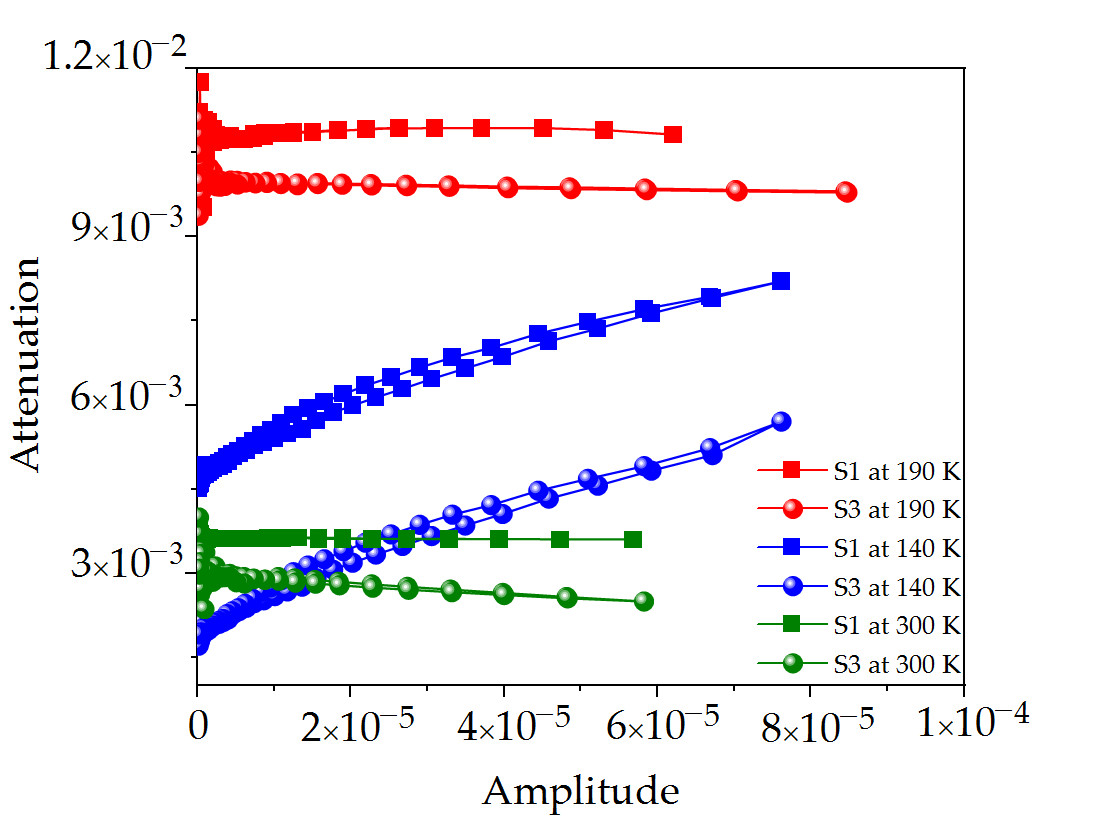
To investigate the amplitude-dependent mechanical behavior, the internal friction was measured as a function of strain amplitude at selected temperatures corresponding to key stages identified in Figure 5b. For clarity, Figure 5 presents data for the pure polymer (S1) and the composite with the highest filler content (S3), as the amplitude dependence for samples S2 and S3 showed no significant differences.
Two distinct regimes are evident in the presented curves. At higher temperatures, the δ(ε) curves exhibit only an amplitude-independent regime, where internal friction remains constant with increasing strain amplitude. In contrast, the δ(ε) dependence at T = 140 K displays both amplitude-independent and amplitude-dependent regimes, characterized by a noticeable increase in internal friction with rising strain amplitude. The absolute values of internal friction shown in Figure 6 are consistent with those presented in the temperature spectra of Figure 6.
Crucially, the amplitude-dependent internal friction emerges at temperatures below the glass transition, which is marked by the internal friction peak at 165–170 K in Figure 6. This indicates that the mechanical energy dissipation becomes sensitive to strain amplitude only in the glassy state of the polymer.

3.3. Thermal Behavior and Stability of Composites

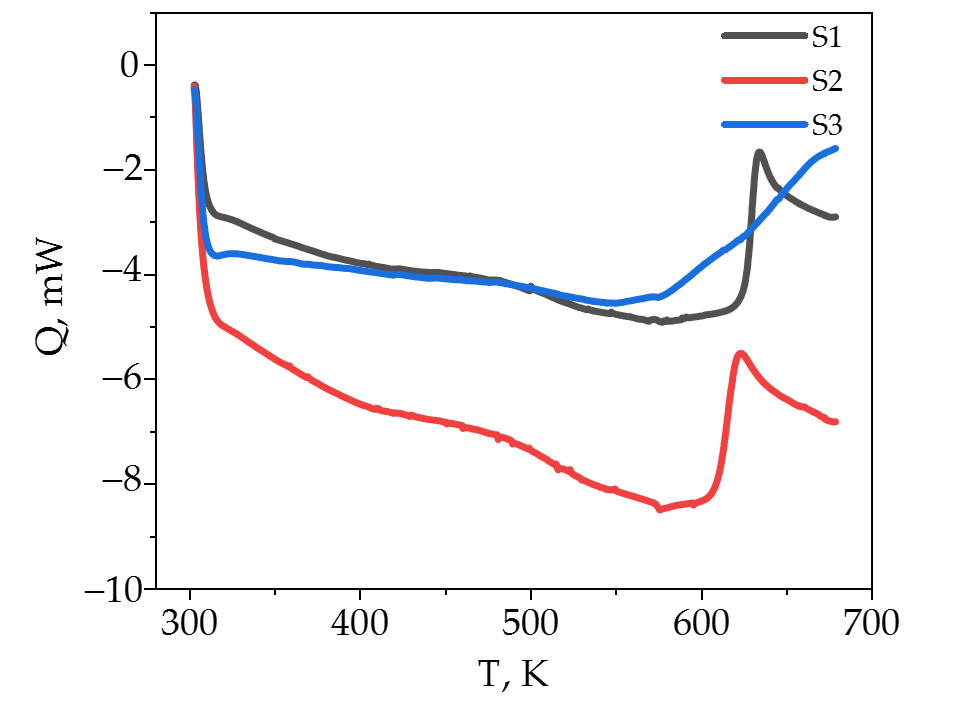
Figure 7 presents the DSC thermograms for the unfilled polymer (S1) and the composites with CNTs (S2) and the mixed CNT/NBP/TG filler system (S3).
DSC thermograms revealed significant changes in the thermal degradation behavior of the composites (Figure 7). The observed endothermic peaks in the high-temperature range correspond to the onset of thermal decomposition of the silicone elastomer matrix, which is an amorphous material. A clear trend is observed: the enthalpy of this decomposition peak progressively decreases from the unfilled polymer (S1) to the CNT-filled (S2) and, most notably, to the hybrid composite (S3). This systematic reduction indicates that the incorporated fillers alter the thermal stability and degradation kinetics of the matrix. The most pronounced effect for the hybrid composite S3 suggests that the synergistic mixed filler network acts as a more effective barrier, likely by hindering heat transfer and the diffusion of volatile decomposition products. Thus, this thermal analysis provides complementary evidence for the enhanced filler–matrix interactions and restricted polymer chain mobility initially inferred from the suppression of mechanical relaxation peaks in the CPO data, coherently supporting the conclusion of a strong synergistic effect in the hybrid system.

3.4. Electrophysical Characteristics

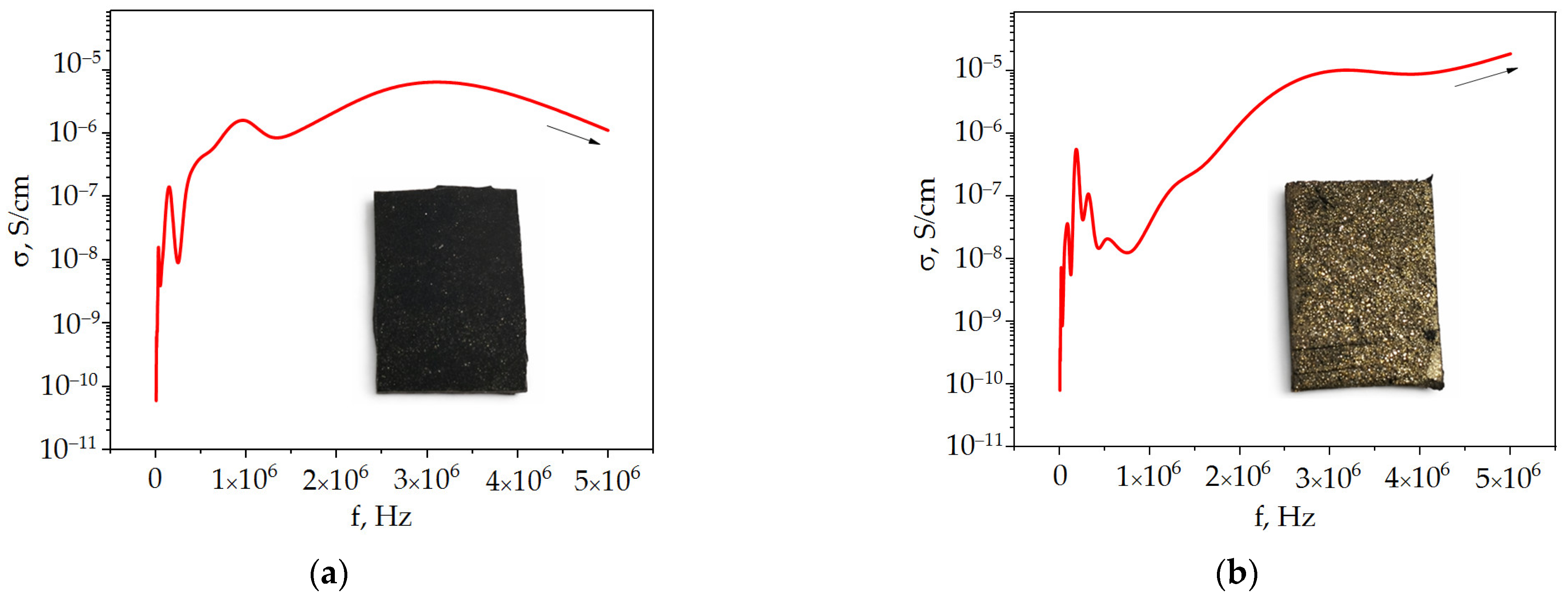
The electrophysical measurement results for samples S2 and S3 were obtained following the methodology outlined in Section 2. Figure 8 presents the frequency dependence of the specific electrical conductivity, σ(f)
Analysis of this frequency-dependent conductivity revealed distinct behaviors for the two polymer composites. Sample S2 exhibits a strong frequency dependence of σ’(f) across the 50 Hz to 1 MHz range, with conductivity increasing with frequency. This behavior is characteristic of dielectrics with limited conduction and indicates the formation of an incomplete percolation network. Extrapolating this trend to zero frequency yields an estimated DC conductivity of approximately 2.5 × 10⁻³ S/m.
In contrast, the S3 composite, based on the mixed filler system, displays a qualitatively different response. Its conductivity remains virtually constant, reaching a frequency-independent plateau across a broad low- and mid-frequency range. This plateau is a definitive signature of a fully formed, three-dimensional conductive network that has surpassed the electrical percolation threshold. The conductivity value within this plateau region is ~1.8 × 10⁻¹ S/m, nearly two orders of magnitude higher than that of sample S2.
The stark contrast in both the frequency dispersion and the absolute magnitude of σ’ provides clear evidence of a synergistic effect within the mixed filler. The bronze and graphite particles effectively act as conductive bridges between CNT agglomerates, facilitating the creation of a more extensive and robust conductive network. The obtained conductivity values, particularly the frequency-independent character of σ’ for sample S3, conclusively confirm this synergistic enhancement.

4. Discussion

Microstructural analysis confirmed the successful incorporation of nanofillers into the polymer matrix. The SEM images reveal good interfacial interaction, showing areas of polymer penetration into CNT agglomerates (Figure 3). This indicates the development of interfacial adhesion, which facilitates efficient stress transfer from the matrix to the filler under load, a finding consistent with previous studies [19]. Modern research confirms that while homogeneous dispersion and good interfacial adhesion—as observed in sample S2—are necessary prerequisites for a stable sensor, they are not sufficient on their own [45,46]. The definitive factors are the percolation threshold, the absolute level of specific electrical conductivity, and, crucially, its stability under cyclic deformation. The uniform morphology of S2 established a foundational network; however, as demonstrated by the electrophysical measurements (Section 3.4), its conductive properties significantly lag behind those of the hybrid system S3.
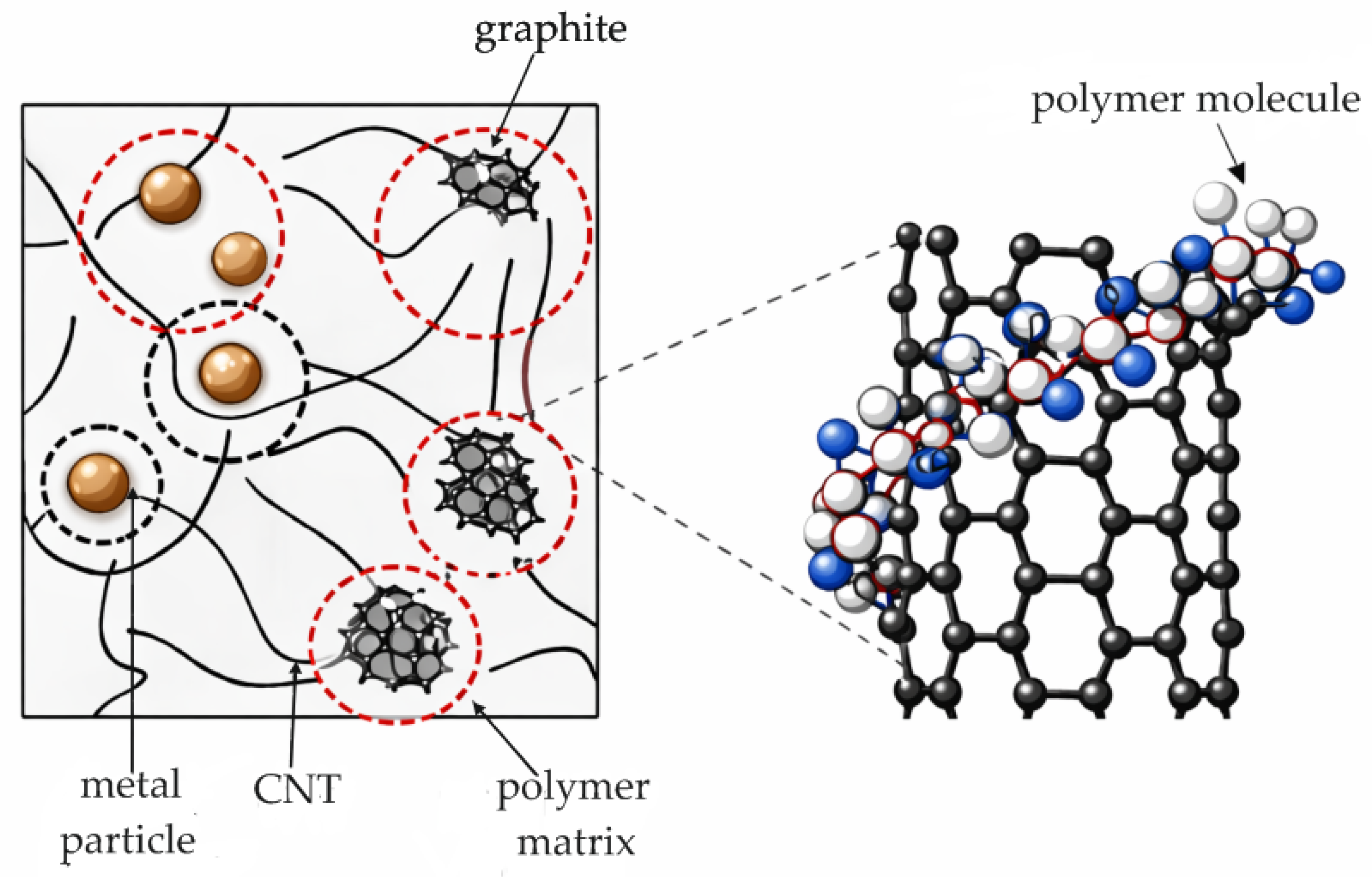
This observation is crucial for understanding the reinforcement mechanism, as the physicochemical compatibility of the components directly determines the modification efficiency (Figure 9). Furthermore, filler distribution analysis demonstrates its uniformity in S2.
A synergistic effect is observed in sample S3, which contains a mixed filler system (CNTs, graphite, bronze). This synergy manifests as the formation of a unified multifunctional network (Figure 9), where each component enhances the others. The CNTs form a highly sensitive conductive network, while the graphite and bronze microparticles act as additional conductive «bridges», increasing contact density and redistributing mechanical stress. This leads to a superadditive enhancement of key properties for strain sensing: sensitivity of the electromechanical response, as well as material reliability and durability.
The bridging model proposed in this work (Figure 8) for the TG/CuAl particles is conceptually aligned with established strategies for stabilizing conductive networks. As evidenced in systems such as CNT/Ag or CNT/CCB (carbon black), where microparticles also function as conductive bridges between nanotube agglomerates, this architecture not only enhances overall conductivity but also significantly improves the durability of the piezoresistive response (exceeding 10,000 cycles) and increases the gauge factor (GF) to values around 30–45 [47,48]. Therefore, the synergistic effect observed in composite S3 represents a specific instance of a broader trend, where the hybridization of fillers enables the deliberate engineering of conductive network architecture for superior functional performance.
The reduction in the amplitude of the relaxation peaks in the internal friction and oscillation frequency dependencies for samples S2 and S3, compared to the pure polymer (S1), provides direct evidence of the effective suppression of polymer chain mobility by the fillers, further confirming the synergistic effect in this system.
The investigation of the dynamic mechanical properties of polymer composites over a wide temperature range (130–290 K) revealed several significant patterns. The CPO method detected a pronounced transition in the 200–215 K interval, manifested by a sharp decrease in oscillation frequency and a simultaneous increase in internal friction [49]. The observed reduction in dynamic stiffness contradicts the classical understanding of static modulus increasing upon cooling. This is explained by the fundamental difference in deformation mechanisms: during static testing, the polymer matrix has time to relax, whereas under high-frequency oscillations (~100 kHz), molecular segments cannot «adjust» to the applied load quickly enough. The identified transition in the 200–215 K range indicates a critical temperature interval where substantial changes occur in the composite’s mechanical properties. For practical strain gauge applications, this implies potential measurement instability and sensitivity variations within this temperature window due to the phase transition [50]. Consequently, increasing the filler content promotes transformation of the nucleation regime and significantly affects both the temperature and rate of crystallization in the polymer nanocomposite system [51]. The abrupt change in mechanical properties near the phase transition at ~210 K will inevitably affect the piezoresistive response. The literature indicates a strong coupling between thermo-resistive and thermo-piezoresistive sensitivity in CNT-based composites [52]. Changes in the contact resistance between filler particles due to temperature-induced matrix deformation can lead to significant signal drift unrelated to the measured mechanical strain. Consequently, the identified “critical temperature window” represents a zone of potential instability for the sensor. In practice, this necessitates either electronic temperature compensation in the circuit or calibration using a two-parameter model, R(ε,T), to decouple strain and temperature effects [53].
The detected transition is likely associated with a phase transition in the polymer system. The sharp nature of the internal friction peak and the concomitant decrease in oscillation frequency suggest a crystallization process. Potential causes include crystallization of matrix components, the hardener, CuAl/TG additives, or the formation of ordered structures in the interphase layer around the CNTs.
The results obtained in this study are in good agreement with the findings reported in prior research [54,55], which investigated similar mechanisms of filler–polymer interaction and relaxation suppression in nanocomposite systems. This consistency not only validates the present experimental approach and data interpretation but also reinforces the established understanding of how hybrid filler networks influence the viscoelastic and thermal properties of polymer matrices.
Comparative analysis of the temperature dependencies demonstrates significant suppression of relaxation processes in the presence of nanofillers. This is most evident in the reduced amplitude of the internal friction peaks corresponding to both crystallization (200–215 K) and glass transition (165–170 K). The introduction of fillers, especially the hybrid CNT/TG/CuAl system, restricts the molecular mobility of polymer chains through several mechanisms: the formation of an interphase layer with constrained mobility around the filler particles [56], the creation of additional physical bonds between the filler and polymer chains [57], and altered crystallization kinetics via transformation of the nucleation regime [58]. The greatest suppression efficiency is observed in sample S3 with the hybrid filler, which is explained by a synergistic effect and the formation of a unified multifunctional network.
The study of the amplitude dependence of internal friction revealed a clear correlation with the glass transition temperature. The amplitude-dependent regime is observed exclusively below the glass transition temperature (~160 K). In the glassy state, energy dissipation at low amplitudes is governed by local intra- and intermolecular processes, whereas with increasing oscillation amplitude, the loss mechanism becomes nonlinear. The presence of fillers enhances the amplitude dependence of internal friction, which is associated with the creation of additional stress concentration centers and deformation heterogeneity near the filler particles [59,60].
The identified transition in the 200–215 K range defines a critical temperature window for the operation of strain gauges based on the studied composites [61,62]. The presence of a phase transition in this interval can cause instability in readings and changes in sensor sensitivity. From a practical standpoint, the discovered effects suggest two possible solutions: the targeted development of damping materials for operation under specific temperature conditions, or modification of the composite composition to shift or eliminate the phase transition within the operational temperature range. The obtained results demonstrate the possibility of controlling the functional characteristics of strain gauges by varying the composition and structure of the polymer matrix, opening prospects for creating materials with predetermined thermomechanical properties.
Contemporary studies indicate that, for the successful integration of polymeric CNT strain sensors into practical applications, the primary hurdles are not solely high sensitivity GF but rather engineering reliability. This encompasses ensuring long-term signal reproducibility, achieving stable electrode adhesion with minimal contact resistance drift, and implementing robust packaging (encapsulation) for protection against humidity, chemicals, and mechanical wear [63,64]. Consequently, the logical next step in this research is the engineering development, calibration, and performance validation of a prototype sensor based on the optimal hybrid composite S3 under simulated operational conditions. This practical focus on device implementation and reliability assessment is central to the current advancement of functional flexible electronics [65].

5. Perspectives and Future for the CPO Method in Polymer Composite Research

The CPO method presents distinct prospects for advancing both fundamental understanding and applied development of polymer composites. Its primary base and practical strength lie in the high-frequency (ultrasonic) characterization of dynamic mechanical properties, which is crucial for applications involving vibration, impact, or rapid cyclic loading. This makes CPO an indispensable tool for designing and optimizing functional materials such as advanced damping nanocomposites for noise/vibration control and robust sensing elements for dynamic strain gauges in fields like soft robotics and structural health monitoring.
While the method’s inherent constraints—operating at a fixed resonance frequency and providing bulk-averaged properties—limit its universality, these are offset by its exceptional precision and sensitivity. The CPO technique excels in detecting minute changes in stiffness and internal friction, offering direct insight into interfacial phenomena and relaxation processes at frequencies relevant to real-world dynamic performance. To fully realize its potential and construct a complete viscoelastic profile, the future of the CPO methodology lies in synergistic integration within a broader characterization framework. The most powerful approach is its systematic combination with the following:
(1)
Low-frequency dynamic mechanical analysis (DMA), enabling the construction of master curves over an extended frequency range via time–temperature dependence.
(2)
Advanced structural and chemical analysis (e.g., SEM, TEM, micro-CT), which correlates the measured high-frequency response directly with specific microstructural and morphological features.
This optimal strategy allows for the establishment of definitive process–structure–property relationships, paving the way for the rational design of next-generation polymer composites with precisely tailored high-frequency dynamic performance.

6. Conclusions

This study demonstrates the efficacy of the CPO method for the detailed characterization of dynamic mechanical properties of polymer nanocomposites. The investigation of silicone elastomers modified with CNTs and a mixed filler system (CNT/TG/CuAl) revealed several key findings:
  • The introduction of fillers, particularly the hybrid system, effectively suppresses molecular relaxation processes associated with crystallization (~205–215 K) and glass transition (~165–170 K), as evidenced by a significant reduction in the corresponding internal friction peaks.
  • A synergistic effect was observed in the hybrid composite (S3), where the combination of fillers creates a multifunctional network that enhances both the mechanical reinforcement and the damping characteristics.
  • The onset of amplitude-dependent internal friction was identified below the glass transition temperature, a phenomenon more pronounced in filled composites due to additional stress concentration centers.
  • DSC conducted within the investigated temperature range (303–673 K) provided complementary thermodynamic data. The observed progressive reduction in the enthalpy of the matrix thermal decomposition peak, most pronounced for the composite S3, indicates an alteration in thermal stability and degradation kinetics due to the fillers. This trend qualitatively agrees with the conclusion drawn from the CPO method regarding the restricted mobility of polymer chains and enhanced interaction at the interface in the system with a mixed filler.
  • Electrical characterization demonstrates a fundamental contrast: S3 exhibits a frequency-independent conductivity plateau (~1.8 × 10⁻¹ S/m), two orders of magnitude higher than the frequency-dependent conductivity of S2 (~2.5 × 10⁻³ S/m). This confirms the formation of a robust percolating network in S3, where bronze and graphite particles act as conductive bridges, demonstrating clear electrical synergy.
These results confirm that the strategic use of mixed fillers provides a powerful pathway for precisely tuning the viscoelastic properties—namely, stiffness and damping—of polymer composites. This control over dynamic mechanical behavior opens avenues for designing advanced functional materials with predictable performance across a wide temperature range, suitable for demanding applications in soft robotics, wearable devices, and adaptive structural components. The study confirms the significant potential of the CPO method for the precise high-frequency (100 kHz) characterization of dynamic viscoelastic properties in novel polymer composites. Its sensitivity to subtle phase transitions and relaxation processes, validated here by complementary DSC and electrical measurements, establishes CPO as a powerful tool for fundamental research and the targeted development of advanced functional materials.

Author Contributions

Conceptualization, validation, writing—original draft preparation V.V.K.; data curation, formal analysis A.V.S. (Alexandr V. Shchegolkov); funding acquisition, investigation D.A.K.; supervision, visualization D.I.P.; resources, software M.V.D.; methodology, project administration, writing–review & editing A.V.S. (Aleksei V. Shchegolkov). All authors have read and agreed to the published version of the manuscript.

Funding

This work was carried out with the financial support of the Ministry of Science and Higher Education of the Russian Federation (State Assignment of the Ministry of Education and Science of the Russian Federation FZRR-2024-0003).

Data Availability Statement

The data presented in this study are available on request from the first author.

Acknowledgments

This work was carried out with the financial support of the Ministry of Science and Higher Education of the Russian Federation (State Assignment of the Ministry of Education and Science of the Russian Federation FZRR-2024-0003).

Conflicts of Interest

The authors declare no conflicts of interest.

Abbreviations

The following abbreviations are used in this manuscript:
DMAdynamic mechanical analysis
EDSenergy-dispersive X-ray spectroscopy
CCBcarbon black 
CNMcarbon nanomaterials
CNTcarbon nanotubes
CPOcomposite piezoelectric oscillator
DSCdifferential scanning calorimetry
GFgauge factor
MWCNTmulti-walled carbon nanotubes
NPBneedle bronze powder
RTVroom temperature vulcanizing
SEMscanning electron microscopy
TGthermally expandable graphite

References

  1. Shchegolkov, A.V.; Shchegolkov, A.V.; Kaminskii, V.V.; Iturralde, P.; Chumak, M.A. Advances in Electrically and Thermally Conductive Functional Nanocomposites Based on Carbon Nanotubes. Polymers 2024, 17, 71. [Google Scholar] [CrossRef]
  2. Kumar, A.; Sharma, K.; Dixit, A.R. A review on the mechanical properties of polymer composites reinforced by carbon nanotubes and graphene. Carbon Lett. 2020, 31, 149–165. [Google Scholar] [CrossRef]
  3. Arana, G.; Gamboa, F.; Avilés, F. Piezoresistive and thermoresistive responses of carbon nanotube-based strain gauges with different grid geometric parameters. Sens. Actuators A Phys. 2023, 359, 114477. [Google Scholar] [CrossRef]
  4. Shchegolkov, A.V.; Shchegolkov, A.V.; Kaminskii, V.V.; Chumak, M.A. Polymer Composites with Nanomaterials for Strain Gauging: A Review. J. Compos. Sci. 2025, 9, 8. [Google Scholar] [CrossRef]
  5. Alamusi; Hu, N.; Fukunaga, H.; Atobe, S.; Liu, Y.; Li, J. Piezoresistive Strain Sensors Made from Carbon Nanotubes Based Polymer Nanocomposites. Sensors 2011, 11, 10691–10723. [Google Scholar] [CrossRef] [PubMed]
  6. Arana, G.; Mora, A.; Pérez, I.; Avilés, F. Design and analysis of a carbon nanotube-based strain gauge via multiscale model-ing. Meccanica 2023, 58, 1717–1732. [Google Scholar] [CrossRef]
  7. Kyrylyuk, A.V.; van der Schoot, P. Continuum percolation of carbon nanotubes in polymeric and colloidal media. Proc. Natl. Acad. Sci. USA 2008, 105, 8221–8226. [Google Scholar] [CrossRef] [PubMed]
  8. Bauhofer, W.; Kovacs, J.Z. A review and analysis of electrical percolation in carbon nanotube polymer composites. Compos. Sci. Technol. 2009, 69, 1486–1498. [Google Scholar] [CrossRef]
  9. Cui, C.-H.; Pang, H.; Yan, D.-X.; Jia, L.-C.; Jiang, X.; Lei, J.; Li, Z.-M. Percolation and resistivity-temperature behaviours of carbon nanotube-carbon black hybrid loaded ultrahigh molecular weight polyethylene composites with segregated struc-tures. RSC Adv. 2015, 5, 61318–61323. [Google Scholar] [CrossRef]
  10. Mamunya, E.; Davidenko, V.; Lebedev, E. Effect of polymer-filler interface interactions on percolation conductivity of ther-moplastics filled with carbon black. Compos. Interfaces 1996, 4, 169–176. [Google Scholar] [CrossRef]
  11. Choi, J.H.; Noh, J.H.; Choi, C. Highly elastically deformable coiled CNT/Polymer fibers for wearable strain sensors and stretchable supercapacitors. Sensors 2023, 23, 2359. [Google Scholar] [CrossRef]
  12. Coppola, B.; Di Maio, L.; Incarnato, L.; Tulliani, J.-M. Preparation and Characterization of Polypropylene/Carbon Nanotubes (PP/CNTs) Nanocomposites as Potential Strain Gauges for Structural Health Monitoring. Nanomaterials 2020, 10, 814. [Google Scholar] [CrossRef]
  13. Schintke, S.; Mujovi, B.; Loiko, D.; del Rossi, S. Graphite- and Graphene-Based Polymer Nanocomposites for Flexible Sensors and Actuators in Health Care and Soft Robotics Applications. Mater. Sci. Forum 2023, 1107, 15–20. [Google Scholar] [CrossRef]
  14. Shukla, P.; Saxena, P. Polymer Nanocomposites in Sensor Applications: A Review on Present Trends and Future Scope. Chin. J. Polym. Sci. 2021, 39, 665–691. [Google Scholar] [CrossRef]
  15. Zeng, G.; Yi, N.; Guo, Q.; Han, F.; Weng, M. Poly(Vinyl Alcohol)–Carbon nanotube Self−Adhesive hydrogels for wearable strain sensors. Polymers 2025, 17, 2249. [Google Scholar] [CrossRef]
  16. Yuan, Z.; Li, H.; Duan, Z.; Huang, Q.; Zhang, M.; Zhang, H.; Guo, J.; Jiang, Y.; Tai, H. High sensitivity, wide range and waterproof strain sensor with inner surface sensing layer for motion detection and gesture reconstruction. Sens. Actuators A Phys. 2024, 369, 115202. [Google Scholar] [CrossRef]
  17. Bommegowda, K.B.; Renukappa, N.M.; Rajan, J.S. Role of Fillers in Controlling the Properties of Polymer Compo-Sites: A Review; Springer: Berlin/Heidelberg, Germany, 2021; pp. 637–648. [Google Scholar] [CrossRef]
  18. Ilyas, R.A.; Sapuan, S.M.; Asyraf, M.R.M.; Dayana, D.A.Z.N.; Amelia, J.J.N.; Rani, M.S.A.; Norrrahim, M.N.F.; Nurazzi, N.M.; Aisyah, H.A.; Sharma, S.; et al. Polymer Composites Filled with Metal Derivatives: A Review of Flame Retard-ants. Polymers 2021, 13, 1701. [Google Scholar] [CrossRef] [PubMed]
  19. Khun, N.W.; Loong, P.Y.; Liu, E.; Li, L. Enhancing electrical and tribological properties of poly(methyl methacrylate) matrix nanocomposite films by co-incorporation of multiwalled carbon nanotubes and silicon dioxide microparticles. J. Polym. Eng. 2015, 36, 23–30. [Google Scholar] [CrossRef]
  20. Ekrem, M.; Koyunbakan, M.; Ünal, B. Investigation of the mechanical and thermal properties of epoxy adhesives reinforced by carbon nanotubes and silicon dioxide nanoparticles in single-lap joints. J. Adhes. Sci. Technol. 2024, 38, 3860–3875. [Google Scholar] [CrossRef]
  21. Luo, X.; Yang, G.; Schubert, D.W. Electrically conductive polymer composite containing hybrid graphene nanoplatelets and carbon nanotubes: Synergistic effect and tunable conductivity anisotropy. Adv. Compos. Hybrid Mater. 2021, 5, 250–262. [Google Scholar] [CrossRef]
  22. Shchegolkov, A.V.; Shchegolkov, A.V.; Parfimovich, I.D.; Komarov, F.F.; Novikov, L.S.; Chernik, V.N. Functional Characteristics of Conductive Polymer Composites with Built-In Carbon Nanotubes and Metallic Particles. J. Compos. Sci. 2025, 9, 429. [Google Scholar] [CrossRef]
  23. Naresh, K.; Khan, K.A.; Umer, R.; Vasudevan, A. Temperature-Frequency–Dependent viscoelastic properties of neat epoxy and fiber reinforced polymer composites: Experimental characterization and theoretical predictions. Polymers 2020, 12, 1700. [Google Scholar] [CrossRef]
  24. Xie, M.; Li, F. A modified piezoelectric ultrasonic composite oscillator technique for simultaneous measurement of elastic moduli and internal frictions at varied temperature. Rev. Sci. Instrum. 2020, 91, 015110. [Google Scholar] [CrossRef] [PubMed]
  25. Ali, Z.; Yaqoob, S.; Yu, J.; D’Amore, A. Critical review on the characterization, preparation, and enhanced mechanical, thermal, and electrical properties of carbon nanotubes and their hybrid filler polymer composites for various applications. Compos. Part C Open Access 2024, 13, 100434. [Google Scholar] [CrossRef]
  26. Quirós-Solano, W.F.; Gaio, N.; Silvestri, C.; Pandraud, G.; Dekker, R.; Sarro, P.M. Metal and Polymeric Strain Gauges for Si-Based, Monolithically Fabricated Organs-on-Chips. Micromachines 2019, 10, 536. [Google Scholar] [CrossRef]
  27. Seghir, R.; Pierron, F. A Novel Image-based Ultrasonic Test to Map Material Mechanical Properties at High Strain-rates. Exp. Mech. 2017, 58, 183–206. [Google Scholar] [CrossRef]
  28. Kondratov, A.P.; Lozitskaya, A.V.; Samokhin, V.N.; Volinsky, A.A. Mullins effect in polymer large deformation strain gauges. J. Polym. Res. 2022, 30, 36. [Google Scholar] [CrossRef]
  29. Liu, X.; Zhang, Z.; Wang, J.; Wang, M.; Lin, T.; Liu, Y.; Tan, Q.; Qi, R.; Liu, Z.; Tian, B. Future development directions of high-temperature strain gauges: A comprehensive review of structure and performance characteristics. Nanoscale Adv. 2025, 7, 4232–4251. [Google Scholar] [CrossRef]
  30. Neilson, J.; Cataldi, P.; Derby, B. Graphene-Based Transparent Flexible Strain Gauges with Tunable Sensitivity and Strain Range. ACS Appl. Nano Mater. 2023, 6, 21763–21774. [Google Scholar] [CrossRef]
  31. Mishra, S.; Mishra, P.; Mohapatra, D.K.; Mishra, D.K.; Shadangi, K.P. Study of frequency dependence properties of CCTO-BT/polymer composites. Proc. Inst. Mech. Eng. Part C: J. Mech. Eng. Sci. 2023, 238, 2140–2149. [Google Scholar] [CrossRef]
  32. Rajmohan, T.; Vijayan, D.; Mohan, K.; Vijayabhaskar, S.; Palanikumar, K. Dynamic Mechanical Analysis (DMA) of Natural Fibre Reinforced Polymer Matrix Composites (NFRPMC)-Review. In Composites Science and Technology; Springer: Berlin/Heidelberg, Germany, 2022; pp. 301–318. [Google Scholar] [CrossRef]
  33. Kucher, M.; Dannemann, M.; Böhm, R.; Modler, N. An Experimental Approach for the Determination of the Mechanical Properties of Base-Excited Polymeric Specimens at Higher Frequency Modes. Vibration 2022, 5, 429–441. [Google Scholar] [CrossRef]
  34. Klimm, W.J.; Kwok, K. Relaxation of Electrical Resistance in Carbon Nanotube Polymer Composites. In Proceedings of the AIAA SCITECH 2022 Forum, San Diego, CA, USA, 3–7 January 2022. [Google Scholar]
  35. Alqaderi, A.I.; Ramakrishnan, N. Carbon-based flexible strain sensors: Recent advances and performance insights in human motion detection. Chem. Eng. J. 2025, 513, 162609. [Google Scholar] [CrossRef]
  36. Afolabi, O.A.; Ndou, N. Synergy of Hybrid Fillers for Emerging Composite and Nanocomposite Materials—A Review. Polymers 2024, 16, 1907. [Google Scholar] [CrossRef]
  37. Yun, G.; Tang, S.; Lu, H.; Zhang, S.; Dickey, M.D.; Li, W. Hybrid-Filler stretchable conductive composites: From fabrication to application. Small Sci. 2021, 1, 2000080. [Google Scholar] [CrossRef]
  38. Available online: https://silagerm.com/products/25832550# (accessed on 23 July 2024).
  39. Robinson, W.; Edgar, A. The Piezoelectric Method of Determining Mechanical Damping at Frequencies of 30 to 200 KHz. IEEE Trans. Sonics Ultrason. 1974, 21, 98–105. [Google Scholar] [CrossRef]
  40. Tyapunina, N.A.; Zinenkova, G.M.; Shtrom, E.V. Dislocation multiplication in alkali halide crystals exposed to ultrasonic waves. The original stage. Phys. Status Solidi A 1978, 46, 327–336. [Google Scholar] [CrossRef]
  41. Koltunowicz, T.N. Test Station for Frequency-Domain Dielectric Spectroscopy of Nanocomposites and Semiconductors. J. Appl. Spectrosc. 2015, 82, 653–658. [Google Scholar] [CrossRef]
  42. Wu, T.; Chen, B. Autonomous self-healing multiwalled carbon nanotube nanocomposites with piezoresistive effect. RSC Adv. 2017, 7, 20422–20429. [Google Scholar] [CrossRef]
  43. Evgin, T.; Mičušík, M.; Machata, P.; Peidayesh, H.; Preťo, J.; Omastová, M. Morphological, Mechanical and Gas Penetration Properties of Elastomer Composites with Hybrid Fillers. Polymers 2022, 14, 4043. [Google Scholar] [CrossRef] [PubMed]
  44. Tariq, M.; Utkarsh Syed, N.A.; Behravesh, A.H.; Pop-Iliev, R.; Rizvi, G. Optimization of filler compositions of electrically conductive polypropylene composites for the manufacturing of bipolar plates. Polymers 2023, 15, 3076. [Google Scholar] [CrossRef]
  45. Parente, J.M.; Nunes-Pereira, J.; Silva, A.P.; Reis, P.N.B. Synergistic effects of graphene and carbon nanotubes on the piezoresistive strain sensing of epoxy composite laminates under bending loads. Compos. Part A Appl. Sci. Manuf. 2025, 198, 109136. [Google Scholar] [CrossRef]
  46. Banks, J.D.; Emami, A. Carbon-Based Piezoresistive Polymer Nanocomposites by Extrusion Additive Manufacturing. 3D Print. Addit. Manuf. 2024, 11, e548–e571. [Google Scholar] [CrossRef]
  47. Promsung, R.; Georgopoulou, A.; Nakaramontri, Y.; Kalkornsurapranee, E.; Clemens, F. Piezoresistive properties for soft structures using hybrid CCB/CNT-based natural rubber latex composites. Appl. Mater. Today 2024, 39, 102302. [Google Scholar] [CrossRef]
  48. Kim, D.; Chhetry, A.; Zahed, M.A.; Sharma, S.; Jeong, S.; Song, H.; Park, J.Y. Highly sensitive and reliable piezoresistive strain sensor based on Cobalt nanoporous Carbon-Incorporated Laser-Induced graphene for smart healthcare wearables. ACS Appl. Mater. Interfaces 2022, 15, 1475–1485. [Google Scholar] [CrossRef]
  49. Ming, Y.; Zhou, Z.; Hao, T.; Nie, Y. Polymer Nanocomposites: Role of modified filler content and interfacial interaction on crystallization. Eur. Polym. J. 2022, 162, 110894. [Google Scholar] [CrossRef]
  50. Bashir, M.A. Use of Dynamic Mechanical Analysis (DMA) for Characterizing Interfacial Interactions in Filled Poly-mers. Solids 2021, 2, 108–120. [Google Scholar] [CrossRef]
  51. Mir, I.A.; Kumar, D. Carbon nanotube-filled conductive adhesives for electronic applications. Nanosci. Methods 2012, 1, 183–193. [Google Scholar] [CrossRef]
  52. Verma, P.; Schiffer, A.; Kumar, S. Thermo-resistive and thermo-piezoresistive sensitivity of carbon nanostructure engineered thermoplastic composites processed via additive manufacturing. Polym. Test. 2020, 93, 106961. [Google Scholar] [CrossRef]
  53. Jang, S.; Li, L. Self-Sensing carbon nanotube composites exposed to glass transition temperature. Materials 2020, 13, 259. [Google Scholar] [CrossRef] [PubMed]
  54. Roland, C.M.; Aronson, C.A. Crystallization of polydimethylsiloxane end-linked networks. Polym. Bull. 2000, 45, 439–445. [Google Scholar] [CrossRef]
  55. Clarson, S.; Dodgson, K.; Semlyen, J. Studies of cyclic and linear poly(dimethylsiloxanes): 19. Glass transition temperatures and crystallization behaviour. Polymer 1985, 26, 930–934. [Google Scholar] [CrossRef]
  56. Riekeberg, S.; Büttner, J.; Müller, J. A carbon nanotube based temperature independent strain sensor on a flexible polymer. In Proceedings of the 2010 Ninth IEEE Sensors Conference (SENSORS 2010), Waikoloa, HI, USA, 1–4 November 2010; pp. 647–651. [Google Scholar]
  57. Bru, T.; Hellström, P.; Gutkin, R.; Ramantani, D.; Peterson, G. Characterisation of the mechanical and fracture properties of a uni-weave carbon fibre/epoxy non-crimp fabric composite. Data Brief. 2016, 6, 680–695. [Google Scholar] [CrossRef]
  58. Tan, W.; Falzon, B.G. Modelling the crush behaviour of thermoplastic composites. Compos. Sci. Technol. 2016, 134, 57–71. [Google Scholar] [CrossRef]
  59. Dean, G.; Turner, P. The elastic properties of carbon fibres and their composites. Composites 1973, 4, 174–180. [Google Scholar] [CrossRef]
  60. Peppas, N.A.; Hilt, J.Z.; Khademhosseini, A.; Langer, R. Hydrogels in Biology and Medicine: From Molecular Principles to Bionanotechnology. Adv. Mater. 2006, 18, 1345–1360. [Google Scholar] [CrossRef]
  61. Ding, W.; Calabri, L.; Kohlhaas, K.M.; Chen, X.; Dikin, D.A.; Ruoff, R.S. Modulus, Fracture Strength, and Brittle vs. Plastic Response of the Outer Shell of Arc-grown Multi-walled Carbon Nanotubes. Exp. Mech. 2006, 47, 25–36. [Google Scholar] [CrossRef]
  62. Kang, I.; Schulz, M.J.; Kim, J.H.; Shanov, V.; Shi, D. A carbon nanotube strain sensor for structural health monitoring. Smart Mater. Struct. 2006, 15, 737–748. [Google Scholar] [CrossRef]
  63. Kang, B.; Jeong, I.; Park, S. Design of a Smart Conducting Nanocomposite with an Extended Strain Sensing Range by Conjugating Hybrid Structures. Polymers 2022, 14, 2551. [Google Scholar] [CrossRef]
  64. Sam-Daliri, O.; Kelly, C.; Walls, M.; Flanagan, T.; Finnegan, W.; Harrison, N.M.; Ghabezi, P. Carbon nanotubes–Elium nanocomposite sensor for structural health monitoring of unidirectional glass fibre reinforced epoxy composite. Compos. Commun. 2025, 58, 102503. [Google Scholar] [CrossRef]
  65. Bibi, M.; Hassan, G.; Asif, A.; Shuja, A.; Ahmad, H.; Mushtaq, B.; Sajid, M. Strain Sensing Technologies: Recent developments in materials, performance, and applications. ICCK Trans. Sens. Commun. Control. 2025, 2, 168. [Google Scholar] [CrossRef]
Figure 1. Samples of nanocomposites: (a) S1; (b) S2; (c) S3.
Jcs 10 00087 g001
Figure 2. Composite piezoelectric oscillator.
Jcs 10 00087 g002
Figure 3. SEM images of the CNT-filled polymer composite at different magnifications: (a) overview at 2 µm scale, (b) detailed view at 1 µm scale, showing the uniform distribution and individual carbon nanotubes within the polymer matrix, and (c) detailed view at 2 µm scale, showing an advanced network of CNTs (S2).
Jcs 10 00087 g003
Figure 4. EDS spectra of S3.
Jcs 10 00087 g004
Figure 5. Temperature dependence of the dynamic mechanical properties for the studied composites: (a) resonant oscillation frequency, (b) logarithmic damping decrement (internal friction).
Jcs 10 00087 g005
Figure 6. Amplitude dependence of the logarithmic damping decrement (internal friction) for samples S1 and S3 measured at different temperatures.
Jcs 10 00087 g006
Figure 7. DSC tomograms of polymer composites (S1, S2, and S3).
Jcs 10 00087 g007
Figure 8. Frequency dependence of the specific electrical conductivity σ’(f): (a) S2; (b) S3.
Jcs 10 00087 g008
Figure 9. Schematic diagram illustrating the proposed conductive network within the polymer matrix for the hybrid CNT/TG/CuAl filler system (S3). The model depicts a synergistic mechanism where TG and CuAl particles act as bridging elements between CNTs, enhancing the overall network connectivity.
Jcs 10 00087 g009
Table 1. Modifying fillers.
PowderElemental Composition, wt.%
AlFeCuPbC
1TG----95
2NBP2.50.049790.049-
Table 2. Sample composition.
DesignationSample Composition
1S1unfilled polymer
2S23 vol. % CNTs
3S33 vol. % CNTs, 3 vol. % NBP, 3 vol. % TG
Disclaimer/Publisher’s Note: The statements, opinions and data contained in all publications are solely those of the individual author(s) and contributor(s) and not of MDPI and/or the editor(s). MDPI and/or the editor(s) disclaim responsibility for any injury to people or property resulting from any ideas, methods, instructions or products referred to in the content.