


Advancing Sustainable Materials Engineering with Natural-Fiber Biocomposites


Abstract
1. Introduction
1.1. Natural Fiber Reinforcements
1.2. Polymer Matrices for Biocomposites
1.3. Fiber–Matrix Interactions and Composite Performance
1.4. Interfacial Challenges and Modification Strategies
1.5. Scope of This Review
2. Materials for Bio-Based Composites
2.1. Definitions
2.2. Plant-Based Fibers
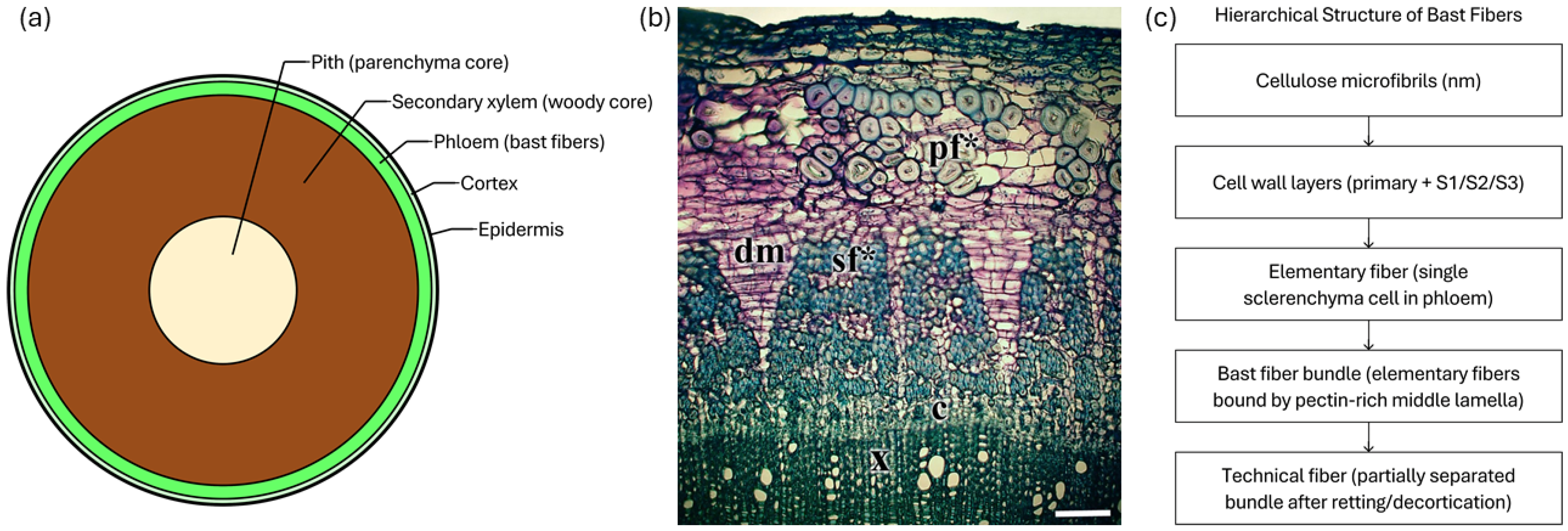
2.2.1. Hierarchical Structure of Bast Fibers in Plant Stems
2.2.2. Cell-Wall Architecture of Elementary Bast Fibers
2.2.3. Fiber Extraction and Retting Processes
2.2.4. Chemical Composition of Bast Fibers
2.2.5. Microfibrillar Angle and Structural Anisotropy
2.2.6. Influence of Composition and Microfibrillar Angle on Fiber Mechanics

| Fiber | Young’s Modulus (GPa) | Tensile Strength (MPa) | MFA (°) | Cellulose (wt%) | Crystallinity (%) | References |
|---|---|---|---|---|---|---|
| Flax (elementary) | 41.0–75.0 | 663–1454 | 8.5–9.5 | 64.6–77.4 | 50–90 | [50,51,56] |
| Hemp (elementary) | 11.2 | 66.0–72.5 | 50–90 | [50,51,56,57] | ||
| Jute | 28.4 | 331–414 | ≈8 | 58.0–71.5 | 50–80 | [59,64,68] |
| Ramie (bundle) | ≈8 | ≈76 | ≈64 | [64,67] | ||
| Kenaf (bundle) | ≈8–10 | 55–65 | ≈60 | [64,67] | ||
| Sisal (bundle) | 10–25 | 66–78 | 50–70 | [64,67] | ||
| Banana (bundle) | – | – | ≈11 | 44–64 | 45–55 | [64] |
| Pineapple leaf (bundle) | 12–14 | 70–82 | 44–60 | [67] | ||
| Coir (bundle) | 30–49 | 32–43 | 27–33 | [64,67] |
2.3. Animal-Based Fibers
2.3.1. Protein Fiber Architecture
2.3.2. Hygroscopicity, Damping, and Functional Behavior
2.3.3. Composite Performance of Animal Fibers
2.3.4. High-Performance and Interfacial Engineering
2.4. Fungal Fibers and Bio-Based Fillers
2.4.1. Mycelium-Based Structural Composites
2.4.2. Bio-Derived Particulate and Nanoscale Fillers
2.5. Relative Depth of the Available Literature
2.6. Bio-Based Polymer Matrices
2.6.1. PLA as a Benchmark Bio-Based and Biodegradable Thermoplastic
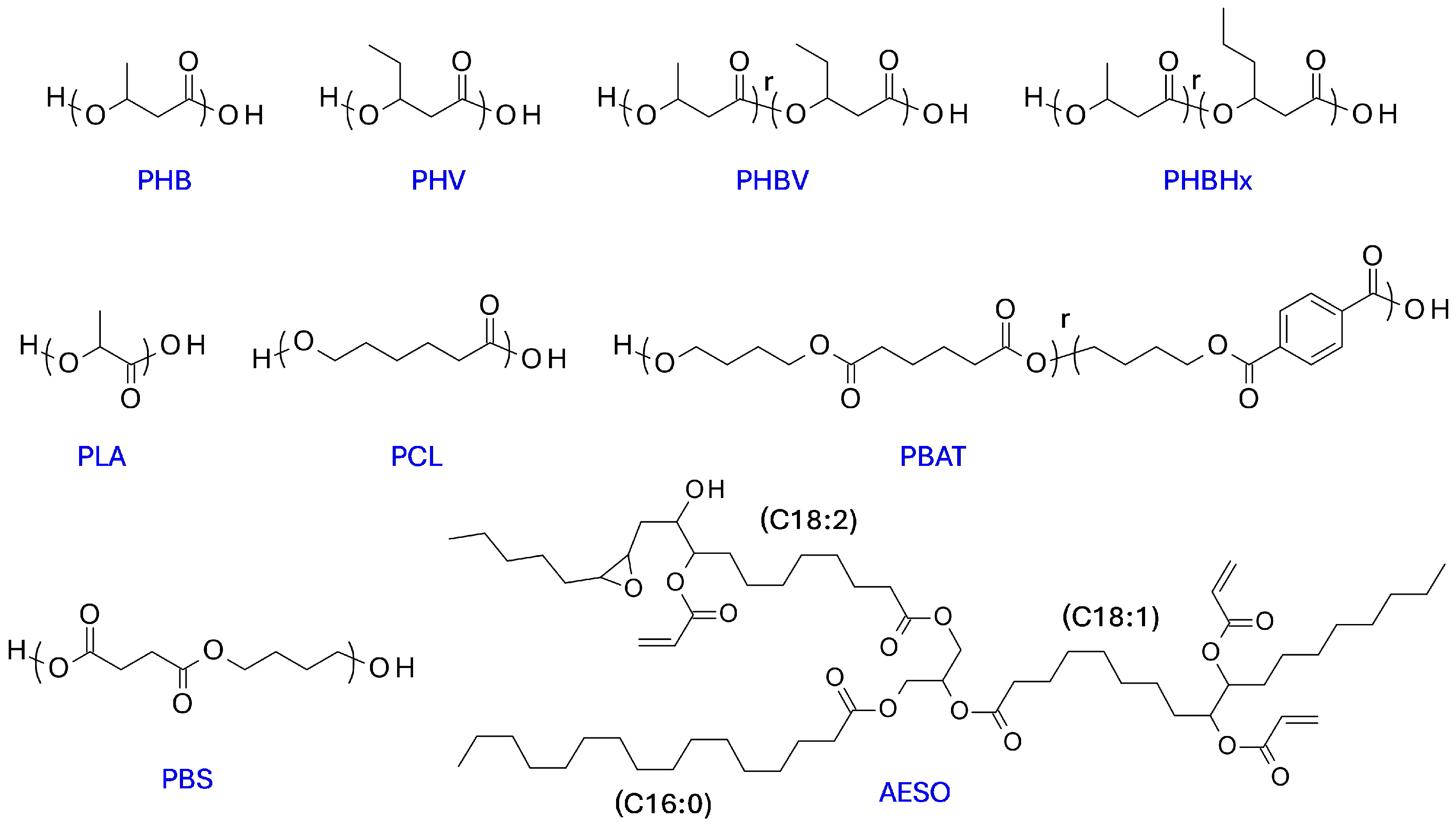
2.6.2. Polyhydroxyalkanoates (PHB, PHBV, and PHBHx)
2.6.3. Vegetable-Oil-Derived Thermosets
2.6.4. Other Biodegradable Thermoplastics (TPS, PCL, PBS, PBAT)
2.6.5. Matrix Selection as a Design Variable
3. Fiber–Matrix Interfacial Engineering
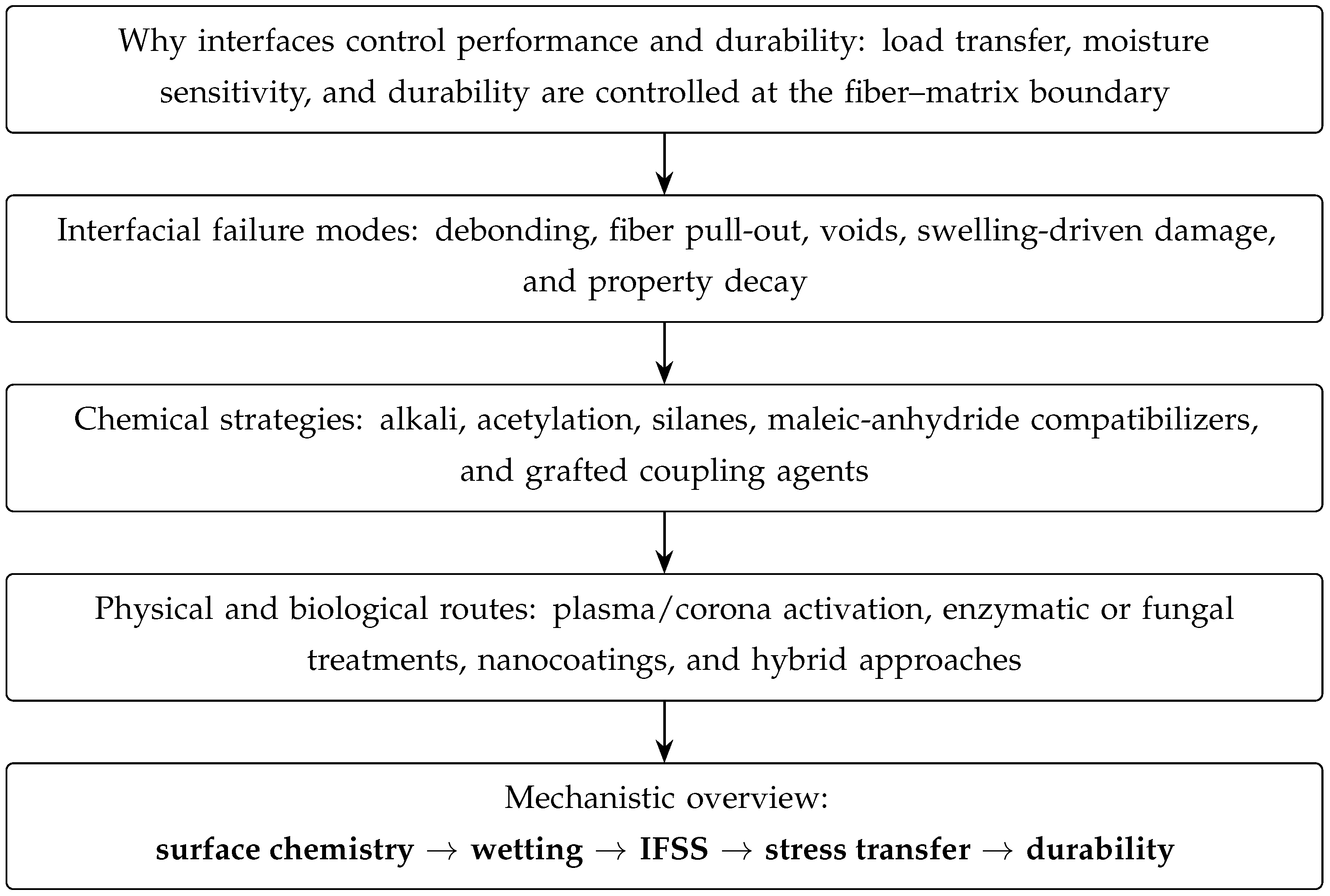
3.1. Why Interfaces Control Performance and Durability
3.2. Interfacial Modification Strategies in Natural-Fiber Composites
3.3. Interfacial Engineering of Lignocellulosic Fibers
3.3.1. Alkali Treatment (Mercerization)
Modeling Note: Rule-of-Mixtures Bounds
Matrix-Dependent Interfacial Response
3.3.2. Acetylation
3.3.3. Coupling Agents
Silane-Based Interfacial Coupling
Maleic Anhydride Coupling
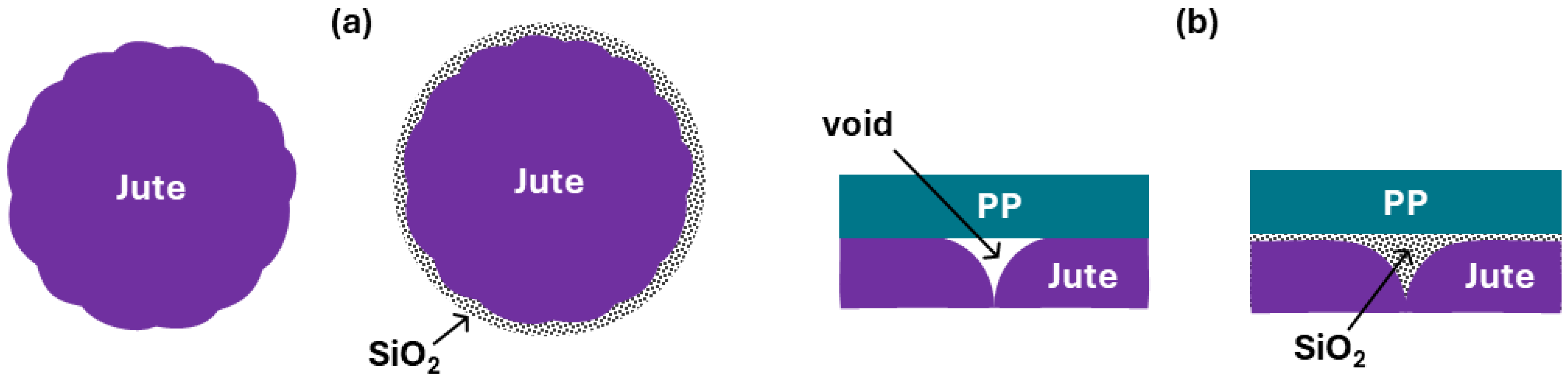
3.3.4. Hybrid and Nanostructured Interphases in Composite Systems
3.3.5. Bio-Based and Biomolecular Coupling Strategies
3.3.6. Thermal Surface Restructuring and Interfacial Stabilization
3.3.7. Plasma-Based Interfacial Activation and In-Line Processing
3.4. Interfacial Strategies for Protein-Based (Animal) Fibers
3.5. Matrix Modification and Molecular Design Strategies
3.6. Mesostructural Strategies for Interfacial Enhancement
3.7. Reinforcement Effects of Nanofillers in Natural-Fiber Composites
3.8. Summary of Interfacial and Nanoscale Reinforcement Strategies
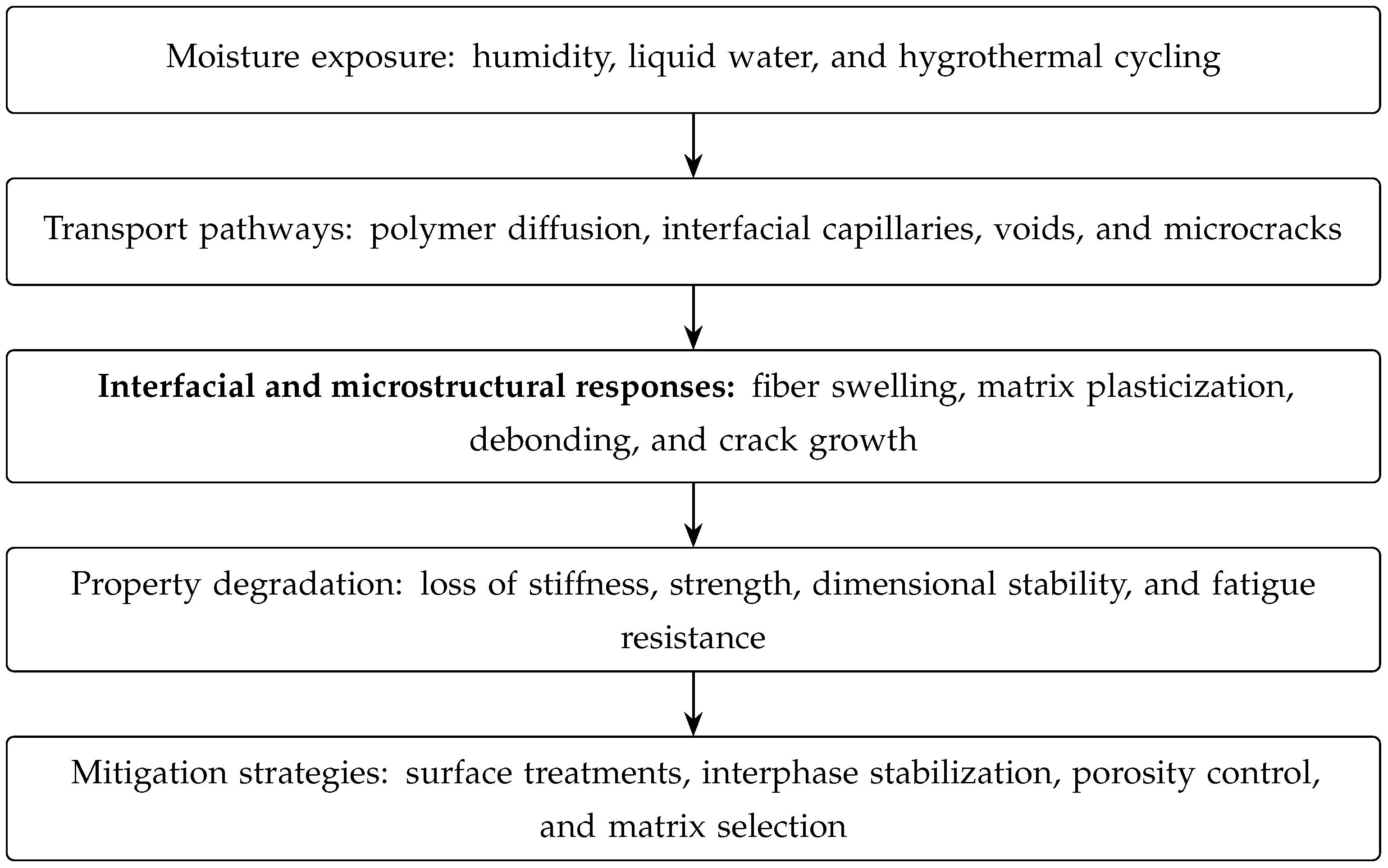
4. Moisture Resistance and Transport Behavior in Natural Fiber Composites
4.1. Diffusion-Based Descriptions of Moisture Transport
4.1.1. Fickian Analysis of Moisture Uptake
4.1.2. Diffusion Coefficients and the Role of Fiber Content and Orientation
4.2. Multi-Year Hygrothermal Ageing and Lifetime Prediction
4.3. Fiber–Water and Fiber–Polymer Interfacial Energy Analysis and Correlation to Adhesion
5. Processing Techniques for Natural-Fiber–Reinforced Biocomposites
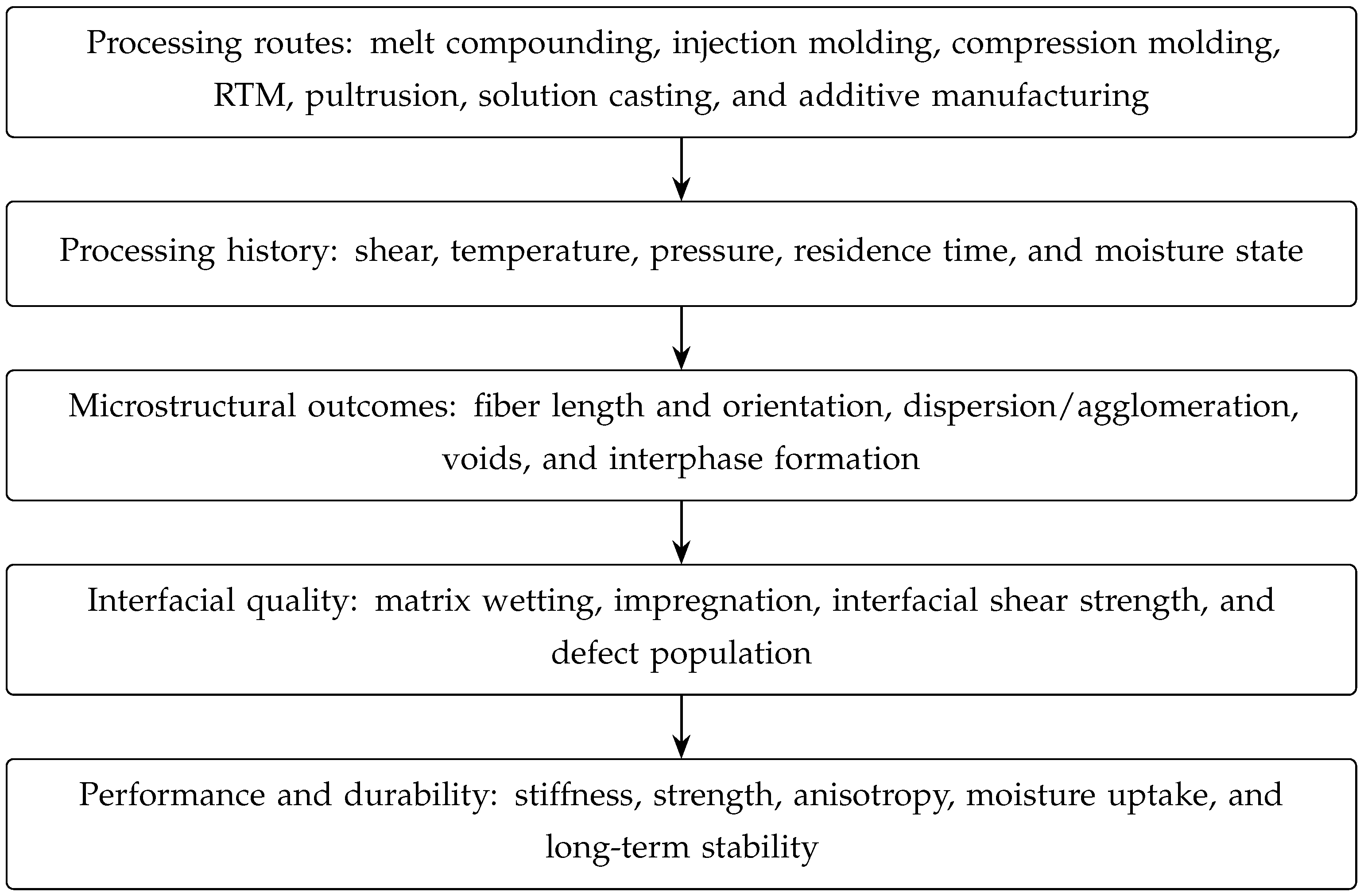
5.1. Process–Microstructure–Performance Framework
5.2. Classification of Processing Routes
5.3. Solvent-Based Processing
5.4. Melt Processing of Thermoplastic Natural-Fiber Composites
5.5. Continuous Fiber Liquid Molding
5.5.1. Pultrusion
5.5.2. Resin Transfer Molding (RTM)
5.6. Mat and Fabric Consolidation
Compression Molding
5.7. Additive Manufacturing (FDM/FFF)
5.8. Outlook and Processing Trade-Offs
6. Degradation, End-of-Life, and Circularity
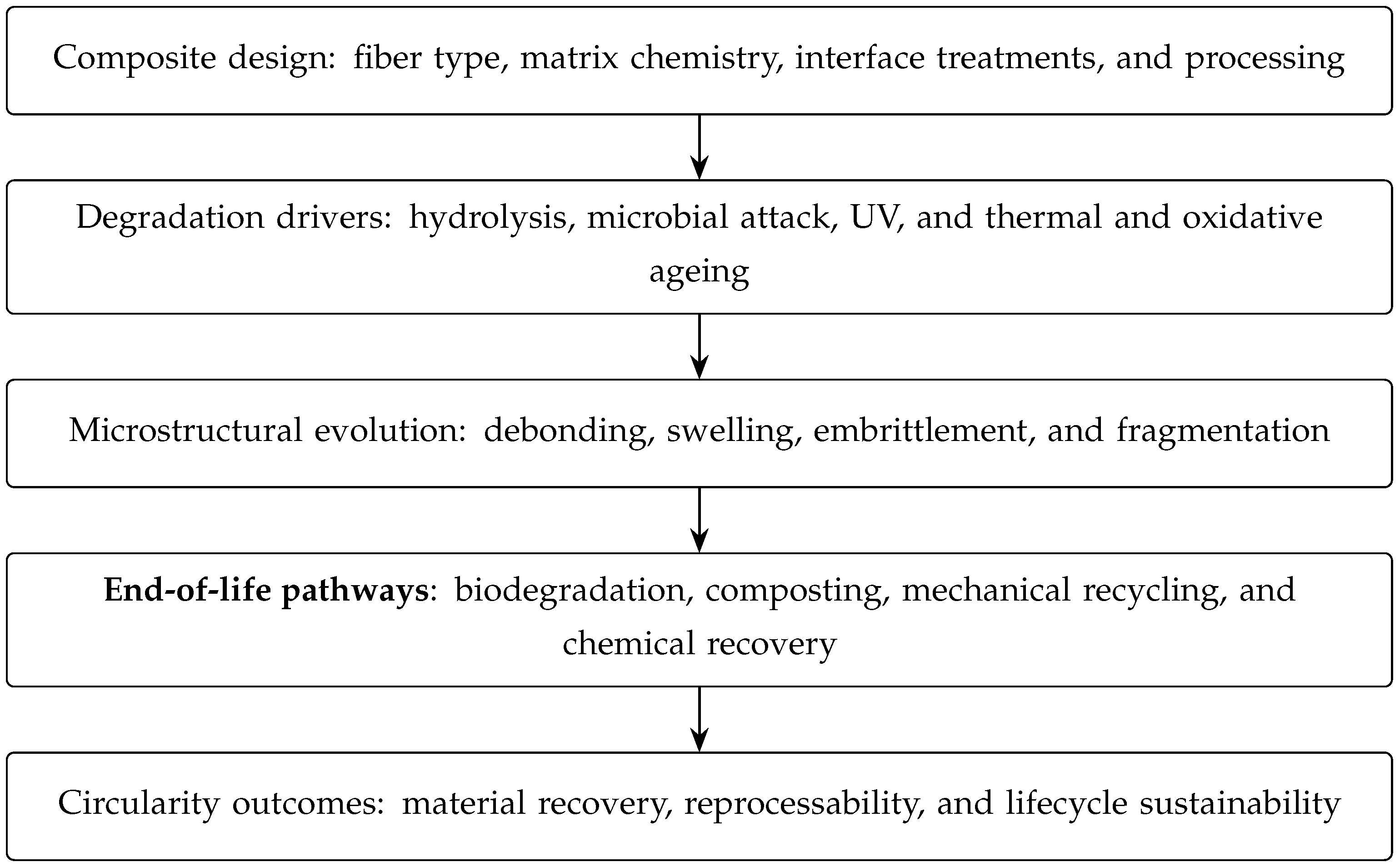
6.1. Circularity Framework and End-of-Life Pathways
6.2. Life-Cycle Assessment and Circular Materials Selection
6.2.1. Environmental Burdens of Natural-Fiber Supply Chains
6.2.2. Allocation Methods and LCA Sensitivity
6.3. Environmental Controls on Polymer Biodegradation
Matrix-Dependent Biodegradation Pathways
6.4. Microbial Attack in Natural Fiber Composites
6.4.1. Microbial Degradation of Lignocellulosic Reinforcements
6.4.2. Bio-Fillers as Degradation Initiation Sites in Composite Matrices
6.5. Durability Versus Degradability in Bio-Based and Recycled Composites
6.5.1. Hygrothermal and UV-Driven Aging of Flax Composites
6.5.2. Moisture-Driven Interfacial Failure in Recycled and Textile-Based Systems
6.6. Engineering the Degradation Rate
6.6.1. Chemical and Interfacial Control of Biodegradation
6.6.2. Additive-Driven Stabilization and Environmental Shielding
6.6.3. Designed Acceleration and Triggered Compostability
6.6.4. Microstructural Design and the Strength–Degradation Trade-Off
6.7. Thermal Decomposition of Lignocellulosic Fibers
6.8. Trade-Offs and Future Directions
7. Applications of Natural-Fiber–Reinforced Composites
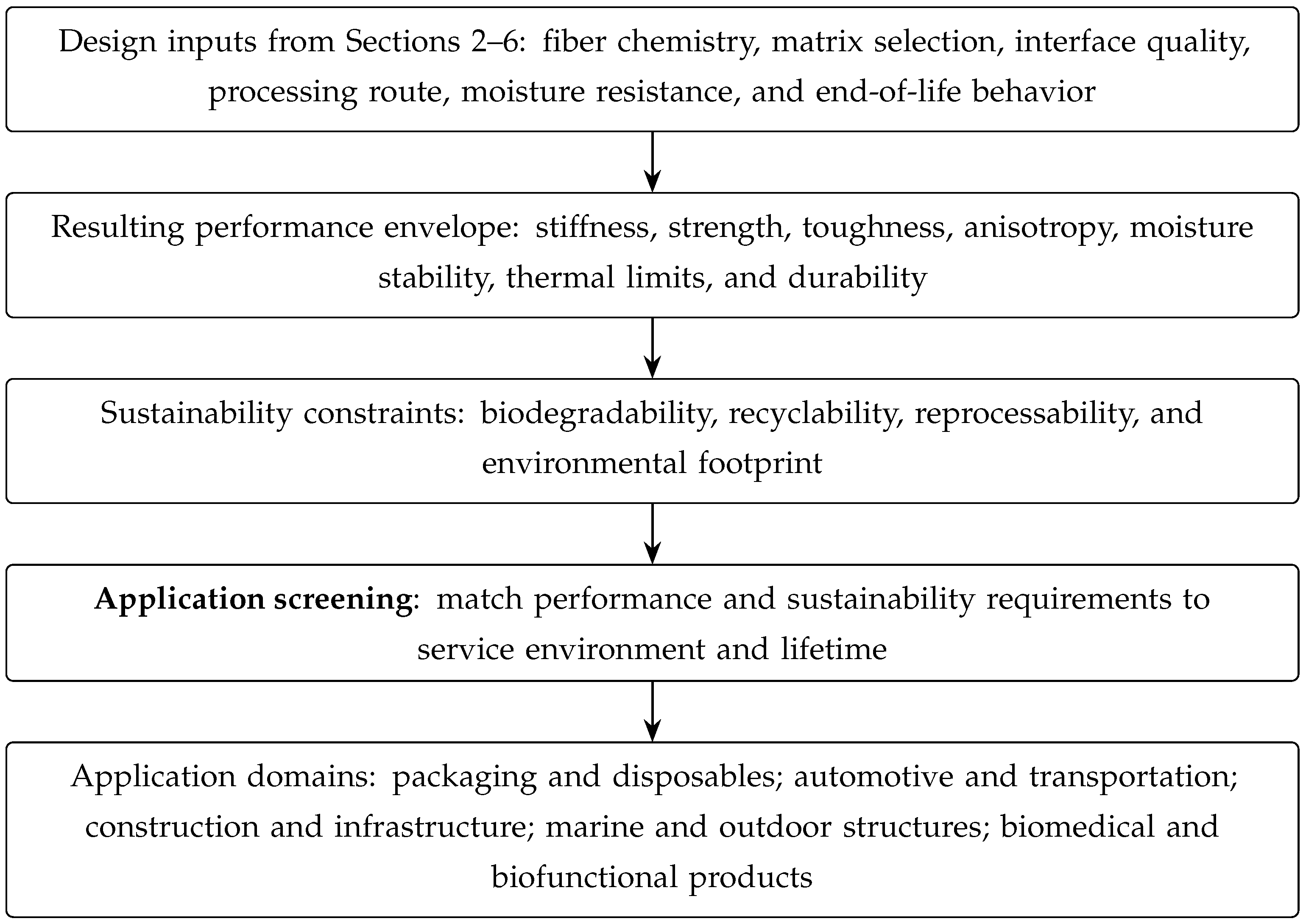
7.1. Application-Level Design Constraints
7.1.1. Regulatory and Safety Constraints
7.1.2. Technology Readiness and Qualification
7.1.3. Scalability and Manufacturing Constraints
7.1.4. Food-Contact and Packaging-Specific Constraints
7.2. Packaging
7.2.1. Food Packaging and Functional Films
7.2.2. Consumer and Structural Packaging
7.2.3. Processing and Performance Optimization
7.2.4. Outlook for Sustainable Bio-Composite Packaging Technologies
7.3. Automotive, Aerospace, Marine, and Construction Applications
7.3.1. Automotive
7.3.2. Aerospace
7.3.3. Marine
7.3.4. Construction
7.4. Biomedical Applications
7.5. Environmental Remediation and Cleanup Applications
8. Conclusions and Outlook
Author Contributions
Funding
Data Availability Statement
Conflicts of Interest
Abbreviations
| AM | additive manufacturing |
| ACNF | acetylated cellulose nanofiber |
| AESO | acrylated epoxidized soybean oil |
| APPJ | atmospheric-pressure plasma jet |
| ATBC | acetyl tributyl citrate |
| ATH | aluminum trihydrate (aluminum hydroxide), Al(OH)3 |
| BBF | banana bunch fiber |
| CNC | cellulose nanocrystal |
| CNF | cellulose nanofiber |
| CNSL | cashew nut shell liquid |
| CSM | chopped strand mat |
| DCPD | dicyclopentadiene |
| ELO | epoxidized linseed oil |
| FAR | Federal Aviation Regulation |
| FDM | fused deposition modeling |
| FFRC | flax-fiber–reinforced composite |
| FFRP | flax-fiber–reinforced polymer |
| FFF | fused filament fabrication |
| GFRP | glass-fiber–reinforced polymer |
| GO | graphene oxide |
| GTA | glyrcerol triacetate |
| HFRP | hemp-fiber–reinforced polymer |
| IFR | intumescent flame retardant |
| IFSS | interfacial shear strength |
| ILSS | interlaminar shear strength |
| IM | injection molding |
| LCA | life-cycle analysis |
| LCC | life-cycle costing |
| LCE | life-cycle engineering |
| LDH | layered double hydroxides |
| LLDPE | linear low-density polyethylene |
| LOI | limiting oxygen index |
| MA | maleic anhydride |
| MAPP | maleic anhydride-grafted polypropylene |
| MBC | mycelium-based composite |
| MCC | microcrystalline cellulose |
| MFA | microfibrillar angle |
| MWCNT | multi-walled carbon nanotubes |
| NFRC | natural-fiber–reinforced composite |
| PA6 | polyamide 6 [Nylon-6; poly(-caprolactam)] |
| PALF | pineapple leaf fiber |
| PAN | polyacrylonitrile |
| PBAT | poly(butylene adipate-co-terephthalate) |
| PBS | polybutylene succinate |
| PCL | polycaprolactone |
| PE | polyethylene |
| PET | poly(ethylene terephthalate) |
| PHA | polyhydroxyalkanoate |
| PHB | polyhydroxybutyrate |
| PHBHx | poly(3-hydroxybutyrate-co-3-hydroxyhexanoate) (also PHBHHx or PHBH) |
| PHBV | poly(3-hydroxybutyrate-co-3-hydroxyvalerate) |
| PLA | poly(lactic acid) |
| PMBL | poly(-methylene--butyrolactone) |
| PMMA | poly(methyl methacrylate) |
| PP | polypropylene |
| PVA | poly(vinyl alcohol) |
| rPP | recycled polypropylene |
| RH | relative humidity |
| RL | reflection loss |
| RTM | resin transfer molding |
| SEM | scanning electron microscopy |
| SMC | sheet molding compound |
| SPF | sugar palm fiber |
| TPS | thermoplastic starch |
| TPAS | thermoplastic arrowroot starch |
| VARI | vacuum-assisted resin infusion |
| VARTM | vacuum-assisted resin transfer molding |
| WF | wood flour |
| WPC | wood–polymer composite |
| WVP | water vapor permeability |
| WVTR | water vapor transmission rate |
| CT | X-ray micro–computed tomography |
References
- Ajayi, N.E.; Rusnakova, S.; Ajayi, A.E.; Ogunleye, R.O.; Agu, S.O.; Amenaghawon, A.N. A Comprehensive Review of Natural Fiber Reinforced Polymer Composites as Emerging Materials for Sustainable Applications. Appl. Mater. Today 2025, 43, 102666. [Google Scholar] [CrossRef] [Scilit]
- Wong, D.; Anwar, M.; Debnath, S.; Hamid, A.; Izman, S. A Review: Recent Development of Natural Fiber-Reinforced Polymer Nanocomposites. JOM 2021, 73, 2504–2515. [Google Scholar] [CrossRef] [Scilit]
- Behera, A.K.; Das, N.; Manna, S. Evaluation of Mechanical, Morphological, and Biodegradation Properties of Natural Fiber Reinforced Nano-Biocomposites. SPE Polym. 2022, 3, 65–74. [Google Scholar] [CrossRef] [Scilit]
- Wagh, J.; Madgule, M.; Awadhani, L. Investigative Studies on the Mechanical Behavior of Jute, Sisal, Hemp, and Glass Fiber-Based Composite Material. Mater. Today Proc. 2023, 77, 969–976. [Google Scholar] [CrossRef] [Scilit]
- Akhil, U.V.; Radhika, N.; Saleh, B.; Aravind Krishna, S.; Noble, N.; Rajeshkumar, L. A Comprehensive Review on Plant-Based Natural Fiber Reinforced Polymer Composites: Fabrication, Properties, and Applications. Polym. Compos. 2023, 44, 2598–2633. [Google Scholar] [CrossRef] [Scilit]
- Olanrewaju, O.; Oladele, I.O.; Adelani, S.O. Natural Fiber Biocomposites: A Comprehensive Review of Current Developments and Material Properties of Plant and Animal Fiber Reinforcements in Cement Concrete, and Ultra-High-Performance Concrete. Next Mater. 2025, 9, 101337. [Google Scholar] [CrossRef] [Scilit]
- Puttegowda, M. Eco-Friendly Composites: Exploring the Potential of Natural Fiber Reinforcement. Discov. Appl. Sci. 2025, 7, 401. [Google Scholar] [CrossRef] [Scilit]
- Thapliyal, D.; Verma, S.; Sen, P.; Kumar, R.; Thakur, A.; Tiwari, A.K.; Singh, D.; Verros, G.D.; Arya, R.K. Natural Fibers Composites: Origin, Importance, Consumption Pattern, and Challenges. J. Compos. Sci. 2023, 7, 506. [Google Scholar] [CrossRef] [Scilit]
- Kamarudin, S.H.; Mohd Basri, M.S.; Rayung, M.; Abu, F.; Ahmad, S.; Norizan, M.N.; Osman, S.; Sarifuddin, N.; Desa, M.S.Z.M.; Abdullah, U.H.; et al. A Review on Natural Fiber Reinforced Polymer Composites (NFRPC) for Sustainable Industrial Applications. Polymers 2022, 14, 3698. [Google Scholar] [CrossRef] [Scilit]
- Mahmud, S.; Hasan, K.M.F.; Jahid, M.A.; Mohiuddin, K.; Zhang, R.; Zhu, J. Comprehensive Review on Plant Fiber-Reinforced Polymeric Biocomposites. J. Mater. Sci. 2021, 56, 7231–7264. [Google Scholar] [CrossRef] [Scilit]
- Birniwa, A.H.; Abdullahi, S.S.; Ali, M.; Mohammad, R.E.A.; Jagaba, A.H.; Amran, M.; Avudaiappan, S.; Maureira-Carsalade, N.; Flores, E.I.S. Recent Trends in Treatment and Fabrication of Plant-Based Fiber-Reinforced Epoxy Composite: A Review. J. Compos. Sci. 2023, 7, 120. [Google Scholar] [CrossRef] [Scilit]
- Elser, I.; Buchmeiser, M.R. Toward Sustainable Fiber-Reinforced Polymer Composites. Macromol. Mater. Eng. 2024, 309, 2400013. [Google Scholar] [CrossRef] [Scilit]
- Rosenboom, J.; Langer, R.; Traverso, G. Bioplastics for a Circular Economy. Nat. Rev. Mater. 2022, 7, 117–137. [Google Scholar] [CrossRef] [Scilit] [PubMed]
- Lotfi, A.; Li, H.; Dao, D.V.; Prusty, G. Natural Fiber–Reinforced Composites: A Review on Material, Manufacturing, and Machinability. J. Thermoplast. Compos. Mater. 2021, 34, 238–284. [Google Scholar] [CrossRef] [Scilit]
- Xu, D.; He, S.; Leng, W.; Chen, Y.; Wu, Z. Replacing Plastic with Bamboo: A Review of the Properties and Green Applications of Bamboo-Fiber-Reinforced Polymer Composites. Polymers 2023, 15, 4276. [Google Scholar] [CrossRef] [Scilit]
- Bharath, K.N.; Basavarajappa, S. Applications of Biocomposite Materials Based on Natural Fibers from Renewable Resources: A Review. Sci. Eng. Compos. Mater. 2016, 23, 123–133. [Google Scholar] [CrossRef] [Scilit]
- Boey, J.Y.; Lee, C.K.; Tay, G.S. Factors Affecting Mechanical Properties of Reinforced Bioplastics: A Review. Polymers 2022, 14, 3737. [Google Scholar] [CrossRef] [Scilit]
- Shelly, D.; Singhal, V.; Jaidka, S.; Banea, M.D.; Lee, S.Y.; Park, S.J. Mechanical Performance of Bio-based Fiber Reinforced Polymer Composites: A Review. Polym. Compos. 2025, 46, S9–S43. [Google Scholar] [CrossRef] [Scilit]
- Zhu, S.; Xie, J.; Sun, Q.; Zhang, Z.; Wan, J.; Zhou, Z.; Lu, J.; Chen, J.; Xu, J.; Chen, K.; et al. Recent Advances on Bast Fiber Composites: Engineering Innovations, Applications and Perspectives. Compos. Part B Eng. 2024, 284, 111738. [Google Scholar] [CrossRef] [Scilit]
- Aisyah, H.A.; Paridah, M.T.; Sapuan, S.M.; Ilyas, R.A.; Khalina, A.; Nurazzi, N.M.; Lee, S.H.; Lee, C.H. A Comprehensive Review on Advanced Sustainable Woven Natural Fibre Polymer Composites. Polymers 2021, 13, 471. [Google Scholar] [CrossRef] [Scilit]
- Lee, C.H.; Khalina, A.; Lee, S.H.; Liu, M. A Comprehensive Review on Bast Fibre Retting Process for Optimal Performance in Fibre-Reinforced Polymer Composites. Adv. Mater. Sci. Eng. 2020, 2020, 6074063. [Google Scholar] [CrossRef] [Scilit]
- Kerni, L.; Singh, S.; Patnaik, A.; Kumar, N. A Review on Natural Fiber Reinforced Composites. Mater. Today Proc. 2020, 28, 1616–1621. [Google Scholar] [CrossRef] [Scilit]
- Azman, M.A.; Asyraf, M.R.M.; Khalina, A.; Petrů, M.; Ruzaidi, C.M.; Sapuan, S.M.; Wan Nik, W.B.; Ishak, M.R.; Ilyas, R.A.; Suriani, M.J. Natural Fiber Reinforced Composite Material for Product Design: A Short Review. Polymers 2021, 13, 1917. [Google Scholar] [CrossRef] [Scilit] [PubMed]
- Lyu, P.; Zhang, Y.; Wang, X.; Hurren, C. Degumming Methods for Bast Fibers—A Mini Review. Ind. Crops Prod. 2021, 174, 114158. [Google Scholar] [CrossRef] [Scilit]
- Palanisamy, S.; Kalimuthu, M.; Santulli, C.; Nagarajan, R.; Karuppiah, G. Effect of Extraction Methods on the Properties of Bast Fibres. In Bast Fibers and Their Composites: Processing, Properties and Applications; Rajeshkumar, G., Devnani, G.L., Sinha, S., Sanjay, M.R., Siengchin, S., Eds.; Springer Nature Singapore: Singapore, 2022; pp. 17–37. [Google Scholar] [CrossRef] [Scilit]
- Shrivastava, A.; Dondapati, S. Biodegradable Composites Based on Biopolymers and Natural Bast Fibres: A Review. Mater. Today Proc. 2021, 46, 1420–1428. [Google Scholar] [CrossRef] [Scilit]
- Shahinur, S.; Sayeed, M.M.A.; Hasan, M.; Sayem, A.S.M.; Haider, J.; Ura, S. Current Development and Future Perspective on Natural Jute Fibers and Their Biocomposites. Polymers 2022, 14, 1445. [Google Scholar] [CrossRef] [Scilit]
- Pokharel, A.; Falua, K.J.; Babaei-Ghazvini, A.; Acharya, B. Bio-based Polymer Composites: A Review. J. Compos. Sci. 2022, 6, 255. [Google Scholar] [CrossRef] [Scilit]
- Talabi, S.I.; Ismail, S.O.; Akpan, E.I.; Hassen, A.A. Quest for Environmentally Sustainable Materials: A Case for Animal-Based Fillers and Fibers in Polymeric Biocomposites. Compos. Part A Appl. Sci. Manuf. 2024, 183, 108216. [Google Scholar] [CrossRef] [Scilit]
- Mann, G.S.; Azum, N.; Khan, A.; Rub, M.A.; Hassan, M.I.; Fatima, K.; Asiri, A.M. Green Composites Based on Animal Fiber and Their Applications for a Sustainable Future. Polymers 2023, 15, 601. [Google Scholar] [CrossRef] [Scilit]
- DeFrates, K.G.; Moore, R.; Borgesi, J.; Lin, G.; Mulderig, T.; Beachley, V.; Hu, X. Protein-Based Fiber Materials in Medicine: A Review. Nanomaterials 2018, 8, 457. [Google Scholar] [CrossRef] [Scilit]
- Antor, R.I.; Bithi, A.M.; Nahin, A.M. Variation in Mechanical Properties of Polymer Composites with Reinforcements from Different Animal Origins—A Comprehensive Review. Int. J. Polym. Sci. 2025, 2025, 4184239. [Google Scholar] [CrossRef] [Scilit]
- Antico, F.; Rojas, P.; Briones, F.; Araya-Letelier, G. Animal Fibers as Water Reservoirs for Internal Curing of Mortars and Their Limits Caused by Fiber Clustering. Constr. Build. Mater. 2021, 267, 120918. [Google Scholar] [CrossRef] [Scilit]
- Thimmegowda, D.Y.; Hindi, J.; Markunti, G.B.; Kakunje, M. Enhancement of Mechanical Properties of Natural Fiber Reinforced Polymer Composites Using Different Approaches—A Review. J. Compos. Sci. 2025, 9, 220. [Google Scholar] [CrossRef] [Scilit]
- Islam, T.; Chaion, M.H.; Jalil, M.A.; Rafi, A.S.; Mushtari, F.; Dhar, A.K.; Hossain, S. Advancements and Challenges in Natural Fiber-Reinforced Hybrid Composites: A Comprehensive Review. SPE Polym. 2024, 5, 481–506. [Google Scholar] [CrossRef] [Scilit]
- Faruk, O.; Bledzki, A.K.; Fink, H.P.; Sain, M. Biocomposites Reinforced with Natural Fibers: 2000–2010. Prog. Polym. Sci. 2012, 37, 1552–1596. [Google Scholar] [CrossRef] [Scilit]
- Pickering, K.; Efendy, M.A.; Le, T. A Review of Recent Developments in Natural Fibre Composites and Their Mechanical Performance. Compos. Part A Appl. Sci. Manuf. 2016, 83, 98–112. [Google Scholar] [CrossRef] [Scilit]
- Ahmed, R.; Manik, K.H.; Nath, A.; Shohag, J.R.; Mim, J.J.; Hossain, N. Recent Advances in Sustainable Natural Fiber Composites: Environmental Benefits, Applications, and Future Prospects. Mater. Today Sustain. 2025, 32, 101220. [Google Scholar] [CrossRef] [Scilit]
- Suriani, M.J.; Ilyas, R.A.; Zuhri, M.Y.M.; Khalina, A.; Sultan, M.T.H.; Sapuan, S.M.; Ruzaidi, C.M.; Wan, F.N.; Zulkifli, F.; Harussani, M.M.; et al. Critical Review of Natural Fiber Reinforced Hybrid Composites: Processing, Properties, Applications and Cost. Polymers 2021, 13, 3514. [Google Scholar] [CrossRef] [Scilit]
- Ead, A.S.; Appel, R.; Alex, N.; Ayranci, C.; Carey, J.P. Life Cycle Analysis for Green Composites: A Review of Literature Including Considerations for Local and Global Agricultural Use. J. Eng. Fibers Fabr. 2021, 16, 15589250211026940. [Google Scholar] [CrossRef] [Scilit]
- Ahmad, H.; Chhipi-Shrestha, G.; Hewage, K.; Sadiq, R. A Comprehensive Review on Construction Applications and Life Cycle Sustainability of Natural Fiber Biocomposites. Sustainability 2022, 14, 15905. [Google Scholar] [CrossRef] [Scilit]
- Thiebat, F.; Fregonara, E.; Masoero, A.; Morselli, F.; Senatore, C.; Giordano, R. Circular Design for Natural Fibers: A Literature Review on Life Cycle Evaluation Approaches for Environmental, Social, and Economic Sustainability. Preprints 2024. [Google Scholar] [CrossRef] [Scilit]
- Radhakrishnan, N.; Chellapandian, M.; Bright Singh, S. Engineering characteristics, techno-economic feasibility and life cycle assessment of bio-fiber based green engineered cementitious composites. J. Build. Eng. 2024, 96, 110521. [Google Scholar] [CrossRef] [Scilit]
- ISO 17088:2021; Plastics–Organic Recycling–Specifications for Compostable Plastics. International Organization for Standardization: Geneva, Switzerland, 2021.
- ASTM D6400-21; Standard Specification for Labeling of Plastics Designed to Be Aerobically Composted in Municipal or Industrial Facilities. ASTM International: West Conshohocken, PA, USA, 2021.
- Snegireva, A.; Chernova, T.; Ageeva, M.; Lev-Yadun, S.; Gorshkova, T. Intrusive Growth of Primary and Secondary Phloem Fibres in Hemp Stem Determines Fibre-Bundle Formation and Structure. AoB Plants 2015, 7, plv061. [Google Scholar] [CrossRef] [Scilit] [PubMed]
- Goudenhooft, C.; Bourmaud, A.; Baley, C. Flax (Linum usitatissimum L.) Fibers for Composite Reinforcement: Exploring the Link Between Plant Growth, Cell Wall Development, and Fiber Properties. Front. Plant Sci. 2019, 10, 411. [Google Scholar] [CrossRef] [Scilit]
- Zimniewska, M.; Romanowska, B. Bast Fiber Textiles Addressed Improvement of Human Life. In Natural Fiber; Jeon, H.Y., Ed.; IntechOpen: London, UK, 2022; Chapter 3. [Google Scholar] [CrossRef] [Scilit]
- Wertz, J.L.; Bédué, O.; Mercier, J.P. Section 3.3.3: Plant Cell Walls. In Cellulose Science and Technology; EPFL Press: Lausanne, Switzerland, 2010; Chapter 3. [Google Scholar] [CrossRef] [Scilit]
- Bourmaud, A.; Morvan, C.; Bouali, A.; Placet, V.; Perré, P.; Baley, C. Relationships Between Micro-Fibrillar Angle, Mechanical Properties and Biochemical Composition of Flax Fibers. Ind. Crops Prod. 2013, 44, 343–351. [Google Scholar] [CrossRef] [Scilit]
- Djafari Petroudy, S. Physical and Mechanical Properties of Natural Fibers. In Advanced High Strength Natural Fibre Composites in Construction; Fan, M., Fu, F., Eds.; Woodhead Publishing: Sawston, UK, 2017; pp. 59–83. [Google Scholar] [CrossRef] [Scilit]
- Manian, A.P.; Cordin, M.; Pham, T. Extraction of Cellulose Fibers from Flax and Hemp: A Review. Cellulose 2021, 28, 8275–8294. [Google Scholar] [CrossRef] [Scilit]
- Jaiswal, D.; Devnani, G.; Rajeshkumar, G.; Sanjay, M.; Siengchin, S. Review on Extraction, Characterization, Surface Treatment and Thermal Degradation Analysis of New Cellulosic Fibers as Sustainable Reinforcement in Polymer Composites. Curr. Res. Green Sustain. Chem. 2022, 5, 100271. [Google Scholar] [CrossRef] [Scilit]
- Tavares, T.D.; Antunes, J.C.; Ferreira, F.; Felgueiras, H.P. Biofunctionalization of Natural Fiber-Reinforced Biocomposites for Biomedical Applications. Biomolecules 2020, 10, 148. [Google Scholar] [CrossRef] [Scilit]
- Liu, M.; Fernando, D.; Daniel, G.; Madsen, B.; Meyer, A.S.; Ale, M.T.; Thygesen, A. Effect of Harvest Time and Field Retting Duration on the Chemical Composition, Morphology and Mechanical Properties of Hemp Fibers. Ind. Crops Prod. 2015, 69, 29–39. [Google Scholar] [CrossRef] [Scilit]
- Zimniewska, M. Hemp Fibre Properties and Processing Target Textile: A Review. Materials 2022, 15, 1901. [Google Scholar] [CrossRef] [Scilit]
- Liu, M.; Thygesen, A.; Summerscales, J.; Meyer, A.S. Targeted Pre-Treatment of Hemp Bast Fibres for Optimal Performance in Biocomposite Materials: A Review. Ind. Crops Prod. 2017, 108, 660–683. [Google Scholar] [CrossRef] [Scilit]
- Van Soest, P.; Robertson, J.; Lewis, B. Methods for Dietary Fiber, Neutral Detergent Fiber, and Nonstarch Polysaccharides in Relation to Animal Nutrition. J. Dairy Sci. 1991, 74, 3583–3597. [Google Scholar] [CrossRef] [Scilit] [PubMed]
- Islam, M.H.; Islam, M.R.; Dulal, M.; Afroj, S.; Karim, N. The Effect of Surface Treatments and Graphene-based Modifications on Mechanical Properties of Natural Jute Fiber Composites: A Review. iScience 2022, 25, 103597. [Google Scholar] [CrossRef] [Scilit] [PubMed]
- Kian, L.K.; Saba, N.; Jawaid, M.; Sultan, M.T.H. A Review on Processing Techniques of Bast Fibers Nanocellulose and Its Polylactic Acid (PLA) Nanocomposites. Int. J. Biol. Macromol. 2019, 121, 1314–1328. [Google Scholar] [CrossRef] [Scilit]
- Zwawi, M. A Review on Natural Fiber Bio-Composites, Surface Modifications and Applications. Molecules 2021, 26, 404. [Google Scholar] [CrossRef] [Scilit]
- Cave, I.D. Theory of X-ray Measurement of Microfibril Angle in Wood. Wood Sci. Technol. 1997, 31, 143–152. [Google Scholar] [CrossRef]
- Cave, I.D. The Anisotropic Elasticity of the Plant Cell Wall. Wood Sci. Technol. 1968, 2, 268–278. [Google Scholar] [CrossRef] [Scilit]
- Gassan, J.; Chate, A.; Bledzki, A.K. Calculation of Elastic Properties of Natural Fibers. J. Mater. Sci. 2001, 36, 3715–3720. [Google Scholar] [CrossRef] [Scilit]
- Xu, P.; Liu, H. Models of Microfibril Elastic Modulus Parallel to the Cell Axis. Wood Sci. Technol. 2004, 38, 363–374. [Google Scholar] [CrossRef] [Scilit]
- Hsieh, Y.C.; Yano, H.; Nogi, M.; Eichhorn, S.J. An Estimation of the Young’s Modulus of Bacterial Cellulose Filaments. Cellulose 2008, 15, 507–513. [Google Scholar] [CrossRef] [Scilit]
- Munawar, S.S.; Umemura, K.; Kawai, S. Characterization of the Morphological, Physical, and Mechanical Properties of Seven Nonwood Plant Fiber Bundles. J. Wood Sci. 2007, 53, 108–113. [Google Scholar] [CrossRef] [Scilit]
- Biswas, S.; Ahsan, Q.; Cenna, A.; Hasan, M.; Hassan, A. Physical and Mechanical Properties of Jute, Bamboo and Coir Natural Fiber. Fibers Polym. 2013, 14, 1762–1767. [Google Scholar] [CrossRef] [Scilit]
- Banasaz, S.; Ferraro, V. Keratin From Animal By-Products: Structure, Characterization, Extraction and Application—A Review. Polymers 2024, 16, 1999. [Google Scholar] [CrossRef] [Scilit] [PubMed]
- Eleutério, T.; Trota, M.J.; Meirelles, M.G.; Vasconcelos, H.C. A Review of Natural Fibers: Classification, Composition, Extraction, Treatments, and Applications. Fibers 2025, 13, 119. [Google Scholar] [CrossRef] [Scilit]
- Zoccola, M.; Bhavsar, P.; Anceschi, A.; Patrucco, A. Analytical Methods for the Identification and Quantitative Determination of Wool and Fine Animal Fibers: A Review. Fibers 2023, 11, 67. [Google Scholar] [CrossRef] [Scilit]
- Rodopoulos, D.C.; Karathanasopoulos, N. Strength, Ductility and Cyclic Loading Performance of Plant and Animal-based, Natural Fiber Structures. Case Stud. Constr. Mater. 2025, 22, e04216. [Google Scholar] [CrossRef] [Scilit]
- Shubhra, Q.T.H.; Alam, A.K.M.M.; Gafur, M.A.; Shamsuddin, S.M.; Khan, M.A.; Saha, M.; Saha, D.; Quaiyyum, M.A.; Khan, J.A.; Ashaduzzaman, M. Characterization of Plant and Animal Based Natural Fibers Reinforced Polypropylene Composites and Their Comparative Study. Fibers Polym. 2010, 11, 725–731. [Google Scholar] [CrossRef] [Scilit]
- Kishor Sharma, Y.; Meena, A.; Sahu, M.; Dalai, A. Experimental Investigation on Mechanical and Thermal Characteristics of Waste Sheep Wool Fiber-Filled Epoxy Composites. Mater. Today Proc. 2023; in press. [CrossRef] [Scilit]
- Ruiz-Herrera, J.; Ortiz-Castellanos, L. Cell Wall Glucans of Fungi. A Review. Cell Surf. 2019, 5, 100022. [Google Scholar] [CrossRef] [Scilit]
- Yang, L.; Park, D.; Qin, Z. Material Function of Mycelium-Based Bio-Composite: A Review. Front. Mater. 2021, 8, 737377. [Google Scholar] [CrossRef] [Scilit]
- Nguyen, M.T.; Solueva, D.; Spyridonos, E.; Dahy, H. Mycomerge: Fabrication of Mycelium-Based Natural Fiber Reinforced Composites on a Rattan Framework. Biomimetics 2022, 7, 42. [Google Scholar] [CrossRef] [Scilit]
- Sienkiewicz, N.; Dominic, M.; Parameswaranpillai, J. Natural Fillers as Potential Modifying Agents for Epoxy Composition: A Review. Polymers 2022, 14, 265. [Google Scholar] [CrossRef] [Scilit] [PubMed]
- Moeini, A.; Mallardo, S.; Cimmino, A.; Dal Poggetto, G.; Masi, M.; Di Biase, M.; van Reenen, A.; Lavermicocca, P.; Valerio, F.; Evidente, A.; et al. Thermoplastic Starch and Bioactive Chitosan Sub-microparticle Biocomposites: Antifungal and Chemico-Physical Properties of the Films. Carbohydr. Polym. 2020, 230, 115627. [Google Scholar] [CrossRef] [Scilit] [PubMed]
- Karan, H.; Funk, C.; Grabert, M.; Oey, M.; Hankamer, B. Green Bioplastics as Part of a Circular Bioeconomy. Trends Plant Sci. 2019, 24, 237–249. [Google Scholar] [CrossRef] [Scilit] [PubMed]
- Vilpoux, O.; Averous, L. Starch-Based Plastics. In Technology, Use and Potentialities of Latin American Starchy Tubers; NGO Raızes and Cargill Foundation: São Paulo, Brazil, 2004; Volume 3, pp. 521–553. [Google Scholar]
- Mashouf Roudsari, G.; Mohanty, A.K.; Misra, M. Green Approaches to Engineer Tough Biobased Epoxies: A Review. ACS Sustain. Chem. Eng. 2017, 5, 9528–9541. [Google Scholar] [CrossRef] [Scilit]
- Laycock, B.; Pratt, S.; Halley, P. A Perspective on Biodegradable Polymer Biocomposites—From Processing to Degradation. Funct. Compos. Mater. 2023, 4, 10. [Google Scholar] [CrossRef] [Scilit]
- Wodag, A.F.; Adera, Y.; Wang, Y.; Yimer, T.T.; Xu, F. A Review of Flax Fiber Reinforced Polylactic Acid Composites as Green Polymeric Materials: Ageing Properties, Sustainability, Challenges and Future Perspectives. Mater. Today Sustain. 2025, 31, 101198. [Google Scholar] [CrossRef] [Scilit]
- Su, S.; Kopitzky, R.; Tolga, S.; Kabasci, S. Polylactide (PLA) and Its Blends with Poly(butylene succinate) (PBS): A Brief Review. Polymers 2019, 11, 1193. [Google Scholar] [CrossRef] [Scilit]
- Finnerty, J.; Rowe, S.; Howard, T.; Connolly, S.; Doran, C.; Devine, D.M.; Gately, N.M.; Chyzna, V.; Portela, A.; Bezerra, G.S.N.; et al. Effect of Mechanical Recycling on the Mechanical Properties of PLA-Based Natural Fiber-Reinforced Composites. J. Compos. Sci. 2023, 7, 141. [Google Scholar] [CrossRef] [Scilit]
- Agaliotis, E.M.; Ake-Concha, B.D.; May-Pat, A.; Morales-Arias, J.P.; Bernal, C.; Valadez-Gonzalez, A.; Herrera-Franco, P.J.; Proust, G.; Koh-Dzul, J.F.; Carrillo, J.G.; et al. Tensile Behavior of 3D Printed Polylactic Acid (PLA) Based Composites Reinforced with Natural Fiber. Polymers 2022, 14, 3976. [Google Scholar] [CrossRef] [Scilit]
- Sánchez-Safont, E.L.; Aldureid, A.; Lagarón, J.M.; Cabedo, L.; Gámez-Pérez, J. Study of the Compatibilization Effect of Different Reactive Agents in PHB/Natural Fiber-Based Composites. Polymers 2020, 12, 1967. [Google Scholar] [CrossRef] [Scilit]
- Coats, E.R.; Loge, F.J.; Wolcott, M.P.; Englund, K.; McDonald, A.G. Production of Natural Fiber Reinforced Thermoplastic Composites Through the Use of Polyhydroxybutyrate-Rich Biomass. Bioresour. Technol. 2008, 99, 2680–2686. [Google Scholar] [CrossRef] [Scilit] [PubMed]
- Zytner, P.; Kumar, D.; Elsayed, A.; Mohanty, A.; Ramarao, B.V.; Misra, M. A review on polyhydroxyalkanoate (PHA) production through the use of lignocellulosic biomass. RSC Sustain. 2023, 1, 2120–2134. [Google Scholar] [CrossRef] [Scilit]
- Abalache, A.; Zembouai, I.; Touati, N.; Berrabah, I.; Kervoelen, A.; Bruzaud, S. Development of Eco-Friendly PHBV Biocomposites Reinforced With Spanish Broom Fibers: From Natural Source to Sustainable Performance. Polym. Eng. Sci. 2026, 66, 1242–1254. [Google Scholar] [CrossRef] [Scilit]
- Eraslan, K.; Aversa, C.; Nofar, M.; Barletta, M.; Gisario, A.; Salehiyan, R.; Alkan Göksu, Y. Poly(3-hydroxybutyrate-co-3-hydroxyhexanoate) (PHBH): Synthesis, Properties, and Applications. Eur. Polym. J. 2022, 167, 111044. [Google Scholar] [CrossRef] [Scilit]
- Tang, H.J.; Neoh, S.Z.; Sudesh, K. A Review on Poly(3-hydroxybutyrate-co-3-hydroxyhexanoate) and Genetic Modifications That Affect Its Production. Front. Bioeng. Biotechnol. 2022, 10, 1057067. [Google Scholar] [CrossRef] [Scilit]
- Zini, E.; Focarete, M.L.; Noda, I.; Scandola, M. Biocomposites of Bacterial Poly(3-hydroxybutyrate-co-3-hydroxyhexanoate) Reinforced with Vegetable Fibers. Compos. Sci. Technol. 2007, 67, 2085–2094. [Google Scholar] [CrossRef] [Scilit]
- Idres, C.; Kaci, M.; Dehouche, N.; Lainé, C.; Bruzaud, S. Effect of Agave americana Fiber Content on the Morphology and Mechanical, Rheological, and Thermal Properties of Poly(3-hydroxybutyrate-co-3-hydroxyhexanoate) Biocomposites. Polym. Renew. Resour. 2022, 13, 191–205. [Google Scholar] [CrossRef] [Scilit]
- Champa-Bujaico, E.; Díez-Pascual, A.M.; Garcia-Diaz, P. Poly(3-hydroxybutyrate-co-3-hydroxyhexanoate) Bionanocomposites with Crystalline Nanocellulose and Graphene Oxide: Experimental Results and Support Vector Machine Modeling. Polymers 2023, 15, 3746. [Google Scholar] [CrossRef] [Scilit]
- Karacor, B.; Ozcanli, M. The Use of Bioresin Composites Created with Five Different Vegetable Oils Such as Soybean Oil, Palm Oil, Rapeseed Oil, Cottonseed Oil, Linseed Oil in the Automotive Industry. Polym. Compos. 2025, 46, 7091–7107. [Google Scholar] [CrossRef] [Scilit]
- Kousaalya, A.; Zheng, T.; Ayalew, B.; Pilla, S. Ultraviolet-Initiated Curing of Natural Fiber-Reinforced Acrylated Epoxidized Soybean Oil Composites. SAE Int. J. Mater. Manuf. 2021, 14, 407–414. [Google Scholar] [CrossRef] [Scilit]
- Kumarage, S.H.; Godakumbura, P.I.; Prashantha, M.A.B. A Novel Banana Fiber Reinforced Green Composite from Maleated Castor Oil and Linseed Oil. Sustain. Chem. Eng. 2023, 5, 70–87. [Google Scholar] [CrossRef] [Scilit]
- Chemiru, G.; Gonfa, G. Preparation and Characterization of Glycerol-Plasticized Yam Starch-Based Films Reinforced with Titanium Dioxide Nanofiller. Carbohydr. Polym. Technol. Appl. 2023, 5, 100300. [Google Scholar] [CrossRef] [Scilit]
- Surendren, A.; Mohanty, A.K.; Liu, Q.; Misra, M. A review of biodegradable thermoplastic starches, their blends and composites: Recent developments and opportunities for single-use plastic packaging alternatives. Green Chem. 2022, 24, 8606–8636. [Google Scholar] [CrossRef] [Scilit]
- Jayarathna, S.; Andersson, M.; Andersson, R. Recent Advances in Starch-Based Blends and Composites for Bioplastics Applications. Polymers 2022, 14, 4557. [Google Scholar] [CrossRef] [Scilit]
- Onyeaka, H.; Obileke, K.; Makaka, G.; Nwokolo, N. Current Research and Applications of Starch-Based Biodegradable Films for Food Packaging. Polymers 2022, 14, 1126. [Google Scholar] [CrossRef] [Scilit] [PubMed]
- Bangar, S.P.; Purewal, S.S.; Trif, M.; Maqsood, S.; Kumar, M.; Manjunatha, V.; Rusu, A.V. Functionality and Applicability of Starch-Based Films: An Eco-Friendly Approach. Foods 2021, 10, 2181. [Google Scholar] [CrossRef] [Scilit] [PubMed]
- Muller, J.; González-Martínez, C.; Chiralt, A. Combination of Poly(actic acid) and Starch for Biodegradable Food Packaging. Materials 2017, 10, 952. [Google Scholar] [CrossRef] [Scilit] [PubMed]
- Rytlewski, P.; Stepczyńska, M.; Moraczewski, K.; Malinowski, R.; Jagodziński, B.; Żenkiewicz, M. Mechanical Properties and Biodegradability of Flax Fiber-Reinforced Composite of Polylactide and Polycaprolactone. Polimery 2018, 63, 603–610. [Google Scholar] [CrossRef] [Scilit]
- Dhakal, H.N.; Ismail, S.O.; Beaugrand, J.; Zhang, Z.; Zekonyte, J. Characterization of Nano-Mechanical, Surface and Thermal Properties of Hemp Fiber-Reinforced Polycaprolactone (HF/PCL) Biocomposites. Appl. Sci. 2020, 10, 2636. [Google Scholar] [CrossRef] [Scilit]
- Kotcharat, P.; Chuysinuan, P.; Thanyacharoen, T.; Techasakul, S.; Ummartyotin, S. Development of Bacterial Cellulose and Polycaprolactone (PCL) Based Composite for Medical Material. Sustain. Chem. Pharm. 2021, 20, 100404. [Google Scholar] [CrossRef] [Scilit]
- Aliotta, L.; Seggiani, M.; Lazzeri, A.; Gigante, V.; Cinelli, P. A Brief Review of Poly (Butylene Succinate) (PBS) and Its Main Copolymers: Synthesis, Blends, Composites, Biodegradability, and Applications. Polymers 2022, 14, 844. [Google Scholar] [CrossRef] [Scilit]
- Ferreira, F.V.; Pinheiro, I.F.; Mariano, M.; Cividanes, L.S.; Costa, J.C.; Nascimento, N.R.; Kimura, S.P.; Neto, J.C.; Lona, L.M. Environmentally friendly polymer composites based on PBAT reinforced with natural fibers from the amazon forest. Polym. Compos. 2019, 40, 3351–3360. [Google Scholar] [CrossRef] [Scilit]
- Botta, L.; Titone, V.; Mistretta, M.C.; La Mantia, F.P.; Modica, A.; Bruno, M.; Sottile, F.; Lopresti, F. PBAT Based Composites Reinforced with Microcrystalline Cellulose Obtained from Softwood Almond Shells. Polymers 2021, 13, 2643. [Google Scholar] [CrossRef] [Scilit]
- Ibrahim, H.; Mehanny, S.; Darwish, L.; Farag, M. A Comparative Study on the Mechanical and Biodegradation Characteristics of Starch-Based Composites Reinforced with Different Lignocellulosic Fibers. J. Polym. Environ. 2018, 26, 2434–2447. [Google Scholar] [CrossRef] [Scilit]
- Frackowiak, S.; Ludwiczak, J.; Leluk, K. Man-Made and Natural Fibres as a Reinforcement in Fully Biodegradable Polymer Composites: A Concise Study. J. Polym. Environ. 2018, 26, 4360–4368. [Google Scholar] [CrossRef] [Scilit]
- Arunachalam, S.J.; Saravanan, R.; Anbuchezhiyan, G. An Overview on Chemical Treatment in Natural Fiber Composites. Mater. Today Proc. 2024; in press. [CrossRef] [Scilit]
- Mohanty, A.; Khan, M.; Hinrichsen, G. Influence of Chemical Surface Modification on the Properties of Biodegradable Jute Fabrics–Polyester Amide Composites. Compos. Part A Appl. Sci. Manuf. 2000, 31, 143–150. [Google Scholar] [CrossRef] [Scilit]
- Deshmukh, G.S. Advancement in Hemp Fibre Polymer Composites: A Comprehensive Review. J. Polym. Eng. 2022, 42, 575–598. [Google Scholar] [CrossRef] [Scilit]
- Ramachandran, A.; Mavinkere Rangappa, S.; Kushvaha, V.; Khan, A.; Seingchin, S.; Dhakal, H.N. Modification of Fibers and Matrices in Natural Fiber Reinforced Polymer Composites: A Comprehensive Review. Macromol. Rapid Commun. 2022, 43, 2100862. [Google Scholar] [CrossRef] [Scilit]
- Lakshmi Narayana, V.; Bhaskara Rao, L. A Brief Review on the Effect of Alkali Treatment on Mechanical Properties of Various Natural Fiber Reinforced Polymer Composites. Mater. Today Proc. 2021, 44, 1988–1994. [Google Scholar] [CrossRef] [Scilit]
- Nwankwo, C.; Mahachi, J.; Olukanni, D.; Musonda, I. Alkali Treatment of Flax Fibres: Effects on Tensile Strength, Thermal Performance, and Moisture Absorption. Compos. Interfaces 2025, 32, 1329–1346. [Google Scholar] [CrossRef] [Scilit]
- Kovuru, R.; Schuster, J. Enhancing Mechanical Properties of Hemp and Sisal Fiber-Reinforced Composites Through Alkali and Fungal Treatments for Sustainable Applications. J. Manuf. Mater. Process. 2025, 9, 191. [Google Scholar] [CrossRef] [Scilit]
- Suwan, T.; Maichin, P.; Fan, M.; Jitsangiam, P.; Tangchirapat, W.; Chindaprasirt, P. Influence of Alkalinity on Self-Treatment Process of Natural Fiber and Properties of Its Geopolymeric Composites. Constr. Build. Mater. 2022, 316, 125817. [Google Scholar] [CrossRef] [Scilit]
- Rahman, M.Z.; Hannan, M.A.; Mollah, M.Z.I.; Hoque, M.B.; Al-mugren, K.S.; Faruque, M.R.I. Evaluating Physico-Mechanical Properties of NaOH-Treated Natural Fibres: Effects of Polyolefin. Heliyon 2024, 10, e39673. [Google Scholar] [CrossRef] [Scilit] [PubMed]
- Shrivastava, R.; Parashar, V. Effect of Alkali Treatment on Tensile Strength of Epoxy Composite Reinforced with Coir Fiber. Polym. Bull. 2023, 80, 541–553. [Google Scholar] [CrossRef] [Scilit]
- Bhuvaneshwaran, M.; Sampath, P.S.; Sagadevan, S. Influence of Fiber Length, Fiber Content and Alkali Treatment on Mechanical Properties of Natural Fiber-Reinforced Epoxy Composites. Polimery 2021, 64, 93–99. [Google Scholar] [CrossRef] [Scilit]
- Pokhriyal, M.; Rakesh, P.K.; Rangappa, S.M.; Siengchin, S. Effect of Alkali Treatment on Novel Natural Fiber Extracted from Himalayacalamus Falconeri culms for Polymer Composite Applications. Biomass Convers. Biorefinery 2024, 14, 18481–18497. [Google Scholar] [CrossRef] [Scilit]
- Zaman, H.U.; Khan, R.A. Acetylation Used for Natural Fiber/Polymer Composites. J. Thermoplast. Compos. Mater. 2021, 34, 3–23. [Google Scholar] [CrossRef] [Scilit]
- Then, Y.Y.; Ibrahim, N.A.; Zainuddin, N.; Chieng, B.W.; Ariffin, H.; Wan Yunus, W.M.Z. Influence of Alkaline-Peroxide Treatment of Fiber on the Mechanical Properties of Oil Palm Mesocarp Fiber/Poly(butylene succinate) Biocomposite. BioResources 2015, 10, 1730–1746. [Google Scholar] [CrossRef] [Scilit]
- Fiore, V.; Di Bella, G.; Valenza, A. The Effect of Alkaline Treatment on Mechanical Properties of Kenaf Fibers and Their Epoxy Composites. Compos. Part B Eng. 2015, 68, 14–21. [Google Scholar] [CrossRef] [Scilit]
- Lebga-Nebane, J.L.; Sankarasubramanian, M.; Chojecki, G.; Ning, B.; Yuya, P.A.; Moosbrugger, J.C.; Rasmussen, D.H.; Krishnan, S. Polyetheretherketone, hexagonal boron nitride, and tungsten carbide cobalt chromium composite coatings: Mechanical and tribological properties. J. Appl. Polym. Sci. 2021, 138, 50504. [Google Scholar] [CrossRef] [Scilit]
- Andre, N.; Ishak, Z.M. Predicting the Tensile Modulus of Randomly Oriented Nonwoven Kenaf/Epoxy Composites. Procedia Chem. 2016, 19, 419–425. [Google Scholar] [CrossRef] [Scilit]
- Madsen, B.; Thygesen, A.; Lilholt, H. Plant fibre composites–porosity and stiffness. Compos. Sci. Technol. 2009, 69, 1057–1069. [Google Scholar] [CrossRef] [Scilit]
- Osman, Z.; Elamin, M.; Ghorbel, E.; Charrier, B. Influence of Alkaline Treatment and Fiber Morphology on the Mechanical, Physical, and Thermal Properties of Polypropylene and Polylactic Acid Biocomposites Reinforced with Kenaf, Bagasse, Hemp Fibers and Softwood. Polymers 2025, 17, 844. [Google Scholar] [CrossRef] [Scilit]
- Frącz, W.; Janowski, G.; Bąk, Ł. Influence of the Alkali Treatment of Flax and Hemp Fibers on the Properties of PHBV Based Biocomposites. Polymers 2021, 13, 1965. [Google Scholar] [CrossRef] [Scilit]
- Tserki, V.; Zafeiropoulos, N.E.; Simon, F.; Panayiotou, C. A Study of the Effect of Acetylation and Propionylation Surface Treatments on Natural Fibres. Compos. Part A Appl. Sci. Manuf. 2005, 36, 1110–1118. [Google Scholar] [CrossRef] [Scilit]
- Bledzki, A.K.; Mamun, A.A.; Lucka-Gabor, M.; Gutowski, V.S. The Effects of Acetylation on Properties of Flax Fibre and Its Polypropylene Composites. Express Polym. Lett. 2008, 2, 413–422. [Google Scholar] [CrossRef] [Scilit]
- Joffre, T.; Segerholm, K.; Persson, C.; Bardage, S.L.; Luengo Hendriks, C.L.; Isaksson, P. Characterization of Interfacial Stress Transfer Ability in Acetylation-Treated Wood Fibre Composites Using X-ray Microtomography. Ind. Crops Prod. 2017, 95, 43–49. [Google Scholar] [CrossRef] [Scilit]
- Loong, M.L.; Cree, D. Enhancement of Mechanical Properties of Bio-Resin Epoxy/Flax Fiber Composites Using Acetic Anhydride. J. Polym. Environ. 2018, 26, 224–234. [Google Scholar] [CrossRef] [Scilit]
- Oladele, I.O.; Michael, O.S.; Adediran, A.A.; Balogun, O.P.; Ajagbe, F.O. Acetylation Treatment for the Batch Processing of Natural Fibers: Effects on Constituents, Tensile Properties and Surface Morphology of Selected Plant Stem Fibers. Fibers 2020, 8, 73. [Google Scholar] [CrossRef] [Scilit]
- Jung, J.S.; Song, K.H.; Kim, S.H. Biodegradable Acetylated Kenaf Fiber Composites. Fibers Polym. 2021, 22, 3437–3443. [Google Scholar] [CrossRef] [Scilit]
- Ehman, N.; Rodríguez-Fabià, S.; Zehner, J.; Chinga-Carrasco, G. Chemical Compatibility between Poly(Ethylene) and Cellulose Nanofibers from Kraft Pulps Containing Varying Amounts of Lignin: An Aqueous Acetylation Strategy and Its Effect on Biocomposite Properties. Compos. Part A Appl. Sci. Manuf. 2024, 184, 108247. [Google Scholar] [CrossRef] [Scilit]
- Sukmawan, R.; Kusmono; Wildan, M.W. Synergistic Effects of Acetylation Treatment and Acetylated Cellulose Nanofibers on Mechanical and Thermal Characteristics of Epoxy/Unidirectional Acetylated Sisal Fabric Composites. J. Mater. Res. Technol. 2025, 35, 1764–1775. [Google Scholar] [CrossRef] [Scilit]
- Boussehel, H.; Guerira, B.; Jawaid, M.; Fouad, H.; Khiari, R. Effect of Benzoyl Chloride Treatment on Morphological, Thermal, Mechanical, and Hydrothermal Aging Properties of Date Palm/Polyvinyl Chloride (PVC) Composites. Sci. Rep. 2024, 14, 20384. [Google Scholar] [CrossRef] [Scilit] [PubMed]
- Marin, D.; Chiarello, L.M.; Wiggers, V.R.; Oliveira, A.D.d.; Botton, V. Effect of Coupling Agents on Properties of Vegetable Fiber Polymeric Composites. Polímeros 2023, 33, e20230012. [Google Scholar] [CrossRef] [Scilit]
- Wirawan, W.A.; Setyabudi, S.A.; Widodo, T.D.; Choiron, M.A. Surface Modification with Silane Coupling Agent on Tensile Properties of Natural Fiber Composite. J. Energy Mech. Mater. Manuf. Eng. 2017, 2, 97–104. [Google Scholar] [CrossRef] [Scilit]
- Fang, C.; Song, X.; Zou, T.; yuan Li, Y.; Wang, P.; Zhang, Y. Natural Jute Fiber Treated with Silane Coupling Agent KH570 Reinforced Polylactic Acid Composites: Mechanical and Thermal Properties. Text. Res. J. 2022, 92, 4041–4050. [Google Scholar] [CrossRef] [Scilit]
- Rauf, F.; Umair, M.; Shaker, K.; Nawab, Y.; Ullah, T.; Ahmad, S. Investigation of Chemical Treatments to Enhance the Mechanical Properties of Natural Fiber Composites. Int. J. Polym. Sci. 2023, 2023, 4719481. [Google Scholar] [CrossRef] [Scilit]
- Darsan, R.S.; Retnam, B.S.J. Effect of Maleic Anhydride (MA) and Glycerol Triacetate (GTA) Compatibilisers on the Properties of Compression molded Pineapple Leaf Fibre Reinforced Polylactic Acid Green Composite. Plast. Rubber Compos. 2021, 50, 441–454. [Google Scholar] [CrossRef] [Scilit]
- Oliver-Ortega, H.; Reixach, R.; Espinach, F.X.; Méndez, J.A. Maleic Anhydride Polylactic Acid Coupling Agent Prepared from Solvent Reaction: Synthesis, Characterization and Composite Performance. Materials 2022, 15, 1161. [Google Scholar] [CrossRef] [Scilit]
- Ali, A.; Islam, M.S.; Hamdan, S.; Abdullah, M. Enhancing the Performance of Hybrid Bio-Composites Reinforced with Natural Fibers by Using Coupling Agents. Mater. Res. Express 2025, 12, 035504. [Google Scholar] [CrossRef] [Scilit]
- Die, J.; Ma, J.; Li, H.; Zhang, Y.; Li, F.; Cao, Y.; Hao, W.; Tu, J.; Zhang, K.; Yu, R. Effects of Maleic Anhydride-Grafted Polyethylene on the Properties of Artificial Marble Waste Powder/Linear Low-Density Polyethylene Composites with Ultra-High Filling Content. Materials 2023, 16, 4036. [Google Scholar] [CrossRef] [Scilit]
- da Silveira, P.H.P.M.; dos Santos, M.C.C.; Chaves, Y.S.; Ribeiro, M.P.; Marchi, B.Z.; Monteiro, S.N.; Gomes, A.V.; Tapanes, N.d.L.C.O.; Pereira, P.S.d.C.; Bastos, D.C. Characterization of Thermo-Mechanical and Chemical Properties of Polypropylene/Hemp Fiber Biocomposites: Impact of Maleic Anhydride Compatibilizer and Fiber Content. Polymers 2023, 15, 3271. [Google Scholar] [CrossRef] [Scilit] [PubMed]
- Sanadi, A.R.; Stelte, W. Effect of the Characteristics of Maleic Anhydride-Grafted Polypropylene (MAPP) Compatibilizer on the Properties of Highly Filled (85%) Kenaf–Polypropylene Composites. Mater. Res. 2023, 26, e20220428. [Google Scholar] [CrossRef] [Scilit]
- Fajardo Cabrera de Lima, L.d.P.; Santana, R.M.C.; Chamorro Rodríguez, C.D. Influence of Coupling Agent in Mechanical, Physical and Thermal Properties of Polypropylene/Bamboo Fiber Composites: Under Natural Outdoor Aging. Polymers 2020, 12, 929. [Google Scholar] [CrossRef] [Scilit]
- Morales, M.A.; Porras, J.; Maranon, A.; Casas, J.P.; Hernandez, C.; Michaud, V.; Porras, A. Effect of Polypropylene-Grafted-Maleic Anhydride and Rice Husk Particle Size on 3D-Printing Filament Composites From Recycled Polypropylene. Polym. Compos. 2025, 46, 15125–15141. [Google Scholar] [CrossRef] [Scilit]
- Li, M.; He, B.; Zhao, L. One-Pot Treatment with Maleic Anhydride vs. the Interfacial Compatibility of Polycaprolactone–Microcrystalline Cellulose Composites. BioResources 2022, 17, 4989–4999. [Google Scholar] [CrossRef] [Scilit]
- Prasad, V.; Sekar, K.; Joseph, M. Mechanical and Water Absorption Properties of Nano TiO2 coated flax fibre epoxy composites. Constr. Build. Mater. 2021, 284, 122803. [Google Scholar] [CrossRef] [Scilit]
- Islam, M.A.; Islam, M.; Islam, M.S.; Islam, T. Enhanced Properties of Bamboo Short Fiber Reinforced Polymer Composites with Alkali and Graphene Oxide. Mater. Adv. 2025, 6, 4738–4754. [Google Scholar] [CrossRef] [Scilit]
- Simonini, L.; Dorigato, A. Surface Modification of Wood Fibers with Citric Acid as a Sustainable Approach to Developing Novel Polycaprolactone-Based Composites for Packaging Applications. J. Compos. Sci. 2025, 9, 274. [Google Scholar] [CrossRef] [Scilit]
- Martin, E.; Badel, E.; Léger, S.; Dubessay, P.; Delattre, C.; Audonnet, F.; Hartmann, F.; Bertrand, E.; Sciara, G.; Garajova, S.; et al. Effect of Laccase Pre-Treatment on the Mechanical Properties of Lignin-Based Agrocomposites Reinforced with Wood Fibers. Ind. Crops Prod. 2022, 189, 115876. [Google Scholar] [CrossRef] [Scilit]
- Meng, X.; Hu, F.; Liu, B.; Cao, Y.; Xu, H.; Li, L.; Yu, L. Study on the Characterization of Physical, Mechanical, and Mildew Resistance Properties of Enzymatically Treated Bamboo Fiber-Reinforced Polypropylene Composites. Forests 2024, 15, 60. [Google Scholar] [CrossRef] [Scilit]
- Younesi-Kordkheili, H.; Pizzi, A. Ionic Liquid-Modified Lignin as a Bio-Coupling Agent for Natural Fiber–Recycled Polypropylene Composites. Compos. Part B Eng. 2020, 181, 107587. [Google Scholar] [CrossRef] [Scilit]
- Shifa, S.S.; Hasan Kanok, M.M.; Haque, M.S.; Sultan, T.; Pritha, K.F.; Mubasshira; Al Yeamin, M.; Dipta, S.D. Influence of Heat Treatment and Water Absorption on Mechanical Properties of Cotton-Glass Fiber Reinforced Epoxy Hybrid Composites: An Eco-Friendly Approach for Industrial Materials. Hybrid Adv. 2024, 5, 100181. [Google Scholar] [CrossRef] [Scilit]
- Nyssanbek, M.; Kuzina, N.; Kondrashchenko, V.; Azimov, A. Effects of Plasma Treatment on Biodegradation of Natural and Synthetic Fibers. npj Mater. Degrad. 2024, 8, 23. [Google Scholar] [CrossRef] [Scilit]
- Pitto, M.; Kim, N.K.; Ashraf, J.; Bickerton, S.; Allen, T.; Williams, C.; Pang, H.; Verbeek, C.J.R. Novel In-line Plasma Compounding of Flax Fibre-Reinforced PA6 Composites. Compos. Part B Eng. 2025, 306, 112753. [Google Scholar] [CrossRef] [Scilit]
- Karthik, K.; Rajamanikkam, R.K.; Venkatesan, E.P.; Bishwakarma, S.; Krishnaiah, R.; Saleel, C.A.; Soudagar, M.E.M.; Kalam, M.A.; Ali, M.M.; Bashir, M.N. State of the Art: Natural Fibre-Reinforced Composites in Advanced Development and Their Physical, Chemical, and Mechanical Properties. Chin. J. Anal. Chem. 2024, 52, 100415. [Google Scholar] [CrossRef] [Scilit]
- Abdulrazzaq, Z.A.; Khalaf, B.S. Evaluation of Impact, Tensile, and Flexural Strength of Natural Wool Fiber Reinforced Polymethyl Methacrylate Denture Base Material: An In Vitro Study. Dent. Hypotheses 2024, 15, 63–66. [Google Scholar] [CrossRef] [Scilit]
- Ali, M.F.; Hossain, M.S.; Lithi, I.J.; Ahmed, S.; Chowdhury, A.M.S. Fabrication and Characterization of Sustainable Composites from Animal Fibers Reinforced Unsaturated Polyester Resin. Heliyon 2024, 10, e33441. [Google Scholar] [CrossRef] [Scilit]
- Arbelaiz, A.; Yurramendi, T.; Larruscain, A.; Arrizabalaga, A.; Eceiza, A.; Peña-Rodriguez, C. Preparation and Characterization of Novel Poly(lactic acid) Composites Reinforced with “Latxa” Sheep Wool Fibers: The Effect of Peroxide Surface Treatments and Fiber Content. Materials 2024, 17, 4912. [Google Scholar] [CrossRef] [Scilit]
- Nair, S.N.; Dasari, A. Development and Characterization of Natural-Fiber-Based Composite Panels. Polymers 2022, 14, 2079. [Google Scholar] [CrossRef] [Scilit]
- Diyana, Z.N.; Jumaidin, R.; Selamat, M.Z.; Ghazali, I.; Julmohammad, N.; Huda, N.; Ilyas, R.A. Physical Properties of Thermoplastic Starch Derived from Natural Resources and Its Blends: A Review. Polymers 2021, 13, 1396. [Google Scholar] [CrossRef] [Scilit]
- Park, M.; Choi, I.; Lee, S.; Hong, S.j.; Kim, A.; Shin, J.; Kang, H.C.; Kim, Y.W. Renewable Malic Acid-based Plasticizers for Both PVC and PLA Polymers. J. Ind. Eng. Chem. 2020, 88, 148–158. [Google Scholar] [CrossRef] [Scilit]
- Tomietto, P.; Loulergue, P.; Paugam, L.; Audic, J.L. Biobased Polyhydroxyalkanoate (PHA) Membranes: Structure/Performances Relationship. Sep. Purif. Technol. 2020, 252, 117419. [Google Scholar] [CrossRef] [Scilit]
- Amiandamhen, S.O.; Meincken, M.; Tyhoda, L. Natural Fibre Modification and Its Influence on Fibre–Matrix Interfacial Properties in Biocomposite Materials. Fibers Polym. 2020, 21, 677–689. [Google Scholar] [CrossRef] [Scilit]
- Fu, S.; Song, P.; Liu, X. 19-Thermal and Flame Retardancy Properties of Thermoplastics/Natural Fiber Biocomposites. In Advanced High Strength Natural Fibre Composites in Construction; Fan, M., Fu, F., Eds.; Woodhead Publishing: Sawston, UK, 2017; pp. 479–508. [Google Scholar] [CrossRef] [Scilit]
- Villamil Watson, D.A.; Schiraldi, D.A. Biomolecules as Flame Retardant Additives for Polymers: A Review. Polymers 2020, 12, 849. [Google Scholar] [CrossRef] [Scilit]
- Kenned, J.J.; Sankaranarayanasamy, K.; Binoj, J.; Chelliah, S.K. Thermo-Mechanical and Morphological Characterization of Needle Punched Nonwoven Banana Fiber Reinforced Polymer Composites. Compos. Sci. Technol. 2020, 185, 107890. [Google Scholar] [CrossRef] [Scilit]
- Aravindh, M.; Sathish, S.; Prabhu, L.; Raj, R.R.; Bharani, M.; Patil, P.P.; Karthick, A.; Luque, R. Effect of Various Factors on Plant Fibre-Reinforced Composites with Nanofillers and Its Industrial Applications: A Critical Review. J. Nanomater. 2022, 2022, 4455106. [Google Scholar] [CrossRef] [Scilit]
- Venkatram, B.; Kailasanathan, C.; Seenikannan, P.; Paramasamy, S. Study on the Evaluation of Mechanical and Thermal Properties of Natural Sisal Fiber/General Polymer Composites Reinforced with Nanoclay. Int. J. Polym. Anal. Charact. 2016, 21, 647–656. [Google Scholar] [CrossRef] [Scilit]
- Hosseini, S.B.; Hedjazi, S.; Jamalirad, L.; Sukhtesaraie, A. Effect of Nano-SiO2 on Physical and Mechanical Properties of Fiber Reinforced Composites (FRCs). J. Indian Acad. Wood Sci. 2014, 11, 116–121. [Google Scholar] [CrossRef] [Scilit]
- Vilakati, G.D.; Mishra, A.K.; Mishra, S.B.; Mamba, B.B.; Thwala, J.M. Influence of TiO2-Modification on the Mechanical and Thermal Properties of Sugarcane Bagasse–EVA Composites. J. Inorg. Organomet. Polym. Mater. 2010, 20, 802–808. [Google Scholar] [CrossRef] [Scilit]
- Shen, X.; Jia, J.; Chen, C.; Li, Y.; Kim, J.K. Enhancement of Mechanical Properties of Natural Fiber Composites via Carbon Nanotube Addition. J. Mater. Sci. 2014, 49, 3225–3233. [Google Scholar] [CrossRef] [Scilit]
- Chaharmahali, M.; Hamzeh, Y.; Ebrahimi, G.; Ashori, A.; Ghasemi, I. Effects of Nano-Graphene on the Physico-Mechanical Properties of Bagasse/Polypropylene Composites. Polym. Bull. 2014, 71, 337–349. [Google Scholar] [CrossRef] [Scilit]
- Sridharan, V.; Raja, T.; Muthukrishnan, N. Study of the Effect of Matrix, Fibre Treatment and Graphene on Delamination by Drilling Jute/Epoxy Nanohybrid Composite. Arab. J. Sci. Eng. 2016, 41, 1883–1894. [Google Scholar] [CrossRef] [Scilit]
- Ashori, A.; Nourbakhsh, A. Preparation and Characterization of Polypropylene/Wood Flour/Nanoclay Composites. Eur. J. Wood Wood Prod. 2011, 69, 663–666. [Google Scholar] [CrossRef] [Scilit]
- Mohan, T.P.; Kanny, K. Water Barrier Properties of Nanoclay Filled Sisal Fibre Reinforced Epoxy Composites. Compos. Part A Appl. Sci. Manuf. 2011, 42, 385–393. [Google Scholar] [CrossRef] [Scilit]
- Haq, M.; Burgueño, R.; Mohanty, A.K.; Misra, M. Hybrid Bio-Based Composites from Blends of Unsaturated Polyester and Soybean Oil Reinforced with Nanoclay and Natural Fibers. Compos. Sci. Technol. 2008, 68, 3344–3351. [Google Scholar] [CrossRef] [Scilit]
- Zhang, Z.; Cai, S.; Li, Y.; Wang, Z.; Long, Y.; Yu, T.; Shen, Y. High Performances of Plant Fiber Reinforced Composites—A New Insight from Hierarchical Microstructures. Compos. Sci. Technol. 2020, 194, 108151. [Google Scholar] [CrossRef] [Scilit]
- Pankaj; Jawalkar, C.S.; Kant, S. Critical Review on Chemical Treatment of Natural Fibers to Enhance Mechanical Properties of Bio Composites. Silicon 2022, 14, 5103–5124. [Google Scholar] [CrossRef] [Scilit]
- Dhakal, H.; Zhang, Z.; Richardson, M. Effect of Water Absorption on the Mechanical Properties of Hemp Fibre Reinforced Unsaturated Polyester Composites. Compos. Sci. Technol. 2007, 67, 1674–1683. [Google Scholar] [CrossRef] [Scilit]
- Pavlovic, A.; Valzania, L.; Minak, G. Effects of Moisture Absorption on the Mechanical and Fatigue Properties of Natural Fiber Composites: A Review. Polymers 2025, 17, 1996. [Google Scholar] [CrossRef] [Scilit] [PubMed]
- Viscusi, G.; Gorrasi, G. A Novel Approach to Design Sustainable Fiber Reinforced Materials from Renewable Sources: Mathematical Modeling for the Evaluation of the Effect of Fiber Content on Biocomposite Properties. J. Mater. Res. Technol. 2021, 12, 717–726. [Google Scholar] [CrossRef] [Scilit]
- Alothman, O.Y.; Awad, S.; Siakeng, R.; Khalaf, E.M.; Fouad, H.; Abd El-salam, N.M.; Ahmed, F.; Jawaid, M. Fabrication and Characterization of Polylactic Acid/Natural Fiber Extruded Composites. Polym. Eng. Sci. 2023, 63, 1234–1245. [Google Scholar] [CrossRef] [Scilit]
- Assarar, M.; Scida, D.; El Mahi, A.; Poilâne, C.; Ayad, R. Influence of Water Ageing on Mechanical Properties and Damage Events of Two Reinforced Composite Materials: Flax Fibres and Glass Fibres. Mater. Des. 2011, 32, 788–795. [Google Scholar] [CrossRef] [Scilit]
- Scida, D.; Assarar, M.; Poilâne, C.; Ayad, R. Influence of Hygrothermal Ageing on the Damage Mechanisms of Flax-Fibre Reinforced Epoxy Composite. Compos. Part B Eng. 2013, 48, 51–58. [Google Scholar] [CrossRef] [Scilit]
- Das, S.C.; Srivastava, C.; Goutianos, S.; La Rosa, A.D.; Grammatikos, S. On the Response to Hygrothermal Ageing of Fully Recyclable Flax and Glass Fibre Reinforced Polymer Composites. Materials 2023, 16, 5848. [Google Scholar] [CrossRef] [Scilit]
- Fourari, A.; Chakkour, M.; Ould Moussa, M.; Khay, I.; Ben Zineb, T. A Comprehensive Review on Thermal and Hygro/Hydrothermal Aging of Plant Fiber Composites: Properties, Degradation Mechanisms, and Service Life Prediction. Polym. Compos. 2025, 46, 14576–14620. [Google Scholar] [CrossRef] [Scilit]
- Cadu, T.; Van Schoors, L.; Sicot, O.; Moscardelli, S.; Divet, L.; Fontaine, S. Cyclic Hygrothermal Ageing of Flax Fibers’ Bundles and Unidirectional Flax/Epoxy Composite. Are bio-based reinforced composites so sensitive? Ind. Crops Prod. 2019, 141, 111730. [Google Scholar] [CrossRef] [Scilit]
- Calabrese, L.; Fiore, V.; Piperopoulos, E.; Badagliacco, D.; Palamara, D.; Valenza, A.; Proverbio, E. In Situ Monitoring of Moisture Uptake of Flax Fiber Reinforced Composites under Humid/Dry Conditions. J. Appl. Polym. Sci. 2022, 139, 51969. [Google Scholar] [CrossRef] [Scilit]
- Ochoa-Martínez, C.I.; Ramaswamy, H.S.; Ayala-Aponte, A.A. Suitability of Crank’s solutions to Fick’s second law for water diffusivity calculation and moisture loss prediction in osmotic dehydration of fruits. J. Food Process Eng. 2009, 32, 933–943. [Google Scholar] [CrossRef] [Scilit]
- Oun, A.; Manalo, A.; Alajarmeh, O.; Abousnina, R.; Gerdes, A. Long-Term Water Absorption of Hybrid Flax Fibre-Reinforced Epoxy Composites with Graphene and Its Influence on Mechanical Properties. Polymers 2022, 14, 3679. [Google Scholar] [CrossRef] [Scilit] [PubMed]
- Wang, Y.Y.; Zhou, Z.H.; Zhu, J.L.; Sun, W.J.; Yan, D.X.; Dai, K.; Li, Z.M. Low-temperature Carbonized Carbon Nanotube/Cellulose Aerogel for Efficient Microwave Absorption. Compos. Part B Eng. 2021, 220, 108985. [Google Scholar] [CrossRef] [Scilit]
- Cai, M.; Guo, Y.; Wang, L.; Ma, Q.; Sun, B.; Waterhouse, G.I.N. Recent Advances in Hygrothermal Aging of Plant Fiber Reinforced Composites. Appl. Compos. Mater. 2025, 32, 1949–1974. [Google Scholar] [CrossRef] [Scilit]
- Muñoz, E.; García-Manrique, J.A. Water Absorption Behaviour and Its Effect on the Mechanical Properties of Flax Fibre Reinforced Bioepoxy Composites. Int. J. Polym. Sci. 2015, 2015, 390275. [Google Scholar] [CrossRef] [Scilit]
- Zhang, Y.; Liu, Y.; Hou, S.; Geng, J.; Wang, P. Study on Moisture Absorption Characteristics of Glass Fibre-Reinforced Epoxy Resin Material for Composite Insulators Based on the 3D-Fick Model. High Volt. 2024, 9, 888–901. [Google Scholar] [CrossRef] [Scilit]
- Zhang, S.; Liu, Y.; Feng, P.; Prabhakar, P. Moisture Diffusion in Multi-layered Materials: The Role of Layer Stacking and Composition. Compos. Part B Eng. 2025, 293, 112128. [Google Scholar] [CrossRef] [Scilit]
- Karbhari, V.M.; Xian, G. Hygrothermal Effects on High VF Pultruded Unidirectional Carbon/Epoxy Composites: Moisture Uptake. Compos. Part B Eng. 2009, 40, 41–49. [Google Scholar] [CrossRef] [Scilit]
- Fan, Y.; Gomez, A.; Ferraro, S.; Pinto, B.; Muliana, A.; La Saponara, V. Diffusion of Water in Glass Fiber Reinforced Polymer Composites at Different Temperatures. J. Compos. Mater. 2019, 53, 1097–1110. [Google Scholar] [CrossRef] [Scilit]
- Le Duigou, A.; Bourmaud, A.; Davies, P.; Baley, C. Long Term Immersion in Natural Seawater of Flax/PLA Biocomposite. Ocean. Eng. 2014, 90, 140–148. [Google Scholar] [CrossRef] [Scilit]
- Chlela, R.; Bigaud, D.; Riahi, H.; Quiertant, M.; Curtil, L.; Benzarti, K. Durability and Lifetime Prediction of Flax Fiber Reinforced Polymer Composites. In 10th International Conference on FRP Composites in Civil Engineering; Ilki, A., Ispir, M., Inci, P., Eds.; Springer: Cham, Switzerland, 2022; pp. 695–705. [Google Scholar] [CrossRef] [Scilit]
- Yan, W.; Riahi, H.; Benzarti, K.; Chlela, R.; Curtil, L.; Bigaud, D. Durability and Reliability Estimation of Flax Fiber Reinforced Composites Using Tweedie Exponential Dispersion Degradation Process. Math. Probl. Eng. 2021, 2021, 6629637. [Google Scholar] [CrossRef] [Scilit]
- Liu, X.; Fang, Y.; Gao, H. Effect of SiO2 Nano-interphase on the Water Absorption Mechanism of Natural Fiber Reinforced Composites: A Multi-Scale Study. Appl. Surf. Sci. 2023, 637, 157942. [Google Scholar] [CrossRef] [Scilit]
- Igboke, O.J.; Odejobi, O.J.; Orimolade, T.; Prevatt, G.H.; Krishnan, S. Composition and Morphological Characteristics of Sulfonated Coconut Shell Biochar and Its Use for Corncob Hydrolysis. Waste Biomass Valoriz. 2023, 14, 3097–3113. [Google Scholar] [CrossRef] [Scilit]
- Mylsamy, B.; Shanmugam, S.K.M.; Aruchamy, K.; Palanisamy, S.; Nagarajan, R.; Ayrilmis, N. A Review on Natural Fiber Composites: Polymer Matrices, Fiber Surface Treatments, Fabrication Methods, Properties, and Applications. Polym. Eng. Sci. 2024, 64, 2345–2373. [Google Scholar] [CrossRef] [Scilit]
- Thomason, J.L.; Rudeiros-Fernández, J.L. Thermal Degradation Behaviour of Natural Fibres at Thermoplastic Composite Processing Temperatures. Polym. Degrad. Stab. 2021, 188, 109594. [Google Scholar] [CrossRef] [Scilit]
- po Ho, M.; Wang, H.; Lee, J.H.; kit Ho, C.; tak Lau, K.; Leng, J.; Hui, D. Critical Factors on Manufacturing Processes of Natural Fibre Composites. Compos. Part B Eng. 2012, 43, 3549–3562. [Google Scholar] [CrossRef] [Scilit]
- Chauhan, V.; Kärki, T.; Varis, J. Review of Natural Fiber-Reinforced Engineering Plastic Composites, Their Applications in the Transportation Sector and Processing Techniques. J. Thermoplast. Compos. Mater. 2022, 35, 1169–1209. [Google Scholar] [CrossRef] [Scilit]
- Dasore, A.; Rajak, U.; Balijepalli, R.; Verma, T.N.; Ramakrishna, K. An Overview of Refinements, Processing Methods and Properties of Natural Fiber Composites. Mater. Today Proc. 2022, 49, 296–300. [Google Scholar] [CrossRef] [Scilit]
- Fairuz, A.M.; Sapuan, S.M.; Zainudin, E.S.; Jaafar, C.N.A. Polymer Composite Manufacturing Using a Pultrusion Process: A Review. Am. J. Appl. Sci. 2014, 11, 1798–1810. [Google Scholar] [CrossRef] [Scilit]
- Vedernikov, A.; Safonov, A.; Tucci, F.; Carlone, P.; Akhatov, I. Pultruded Materials and Structures: A Review. J. Compos. Mater. 2020, 54, 4081–4117. [Google Scholar] [CrossRef] [Scilit]
- Volk, M.; Yuksel, O.; Baran, I.; Hattel, J.H.; Spangenberg, J.; Sandberg, M. Cost-Efficient, Automated, and Sustainable Composite Profile Manufacture: A Review of the State of the Art, Innovations, and Future of Pultrusion Technologies. Compos. Part B Eng. 2022, 240, 110135. [Google Scholar] [CrossRef] [Scilit]
- Kennedy, S.M.; Wilson, L.A.; Joemax Agu, M.; Rajeev, D.; Jeen Robert, R.B.; Balamurugan, S. Natural Fiber Filaments Transforming the Future of Sustainable 3D Printing. MethodsX 2025, 14, 103385. [Google Scholar] [CrossRef] [Scilit] [PubMed]
- Kong, I.; Tshai, K.Y.; Hoque, M.E. Manufacturing of Natural Fibre-Reinforced Polymer Composites by Solvent Casting Method. In Manufacturing of Natural Fibre Reinforced Polymer Composites; Salit, M.S., Jawaid, M., Yusoff, N.B., Hoque, M.E., Eds.; Springer International Publishing: Cham, Switzerland, 2015; pp. 331–349. [Google Scholar] [CrossRef] [Scilit]
- Pokharel, A.; Falua, K.J.; Babaei-Ghazvini, A.; Nikkhah Dafchahi, M.; Tabil, L.G.; Meda, V.; Acharya, B. Development of Polylactic Acid Films with Alkali- and Acetylation-Treated Flax and Hemp Fillers via Solution Casting Technique. Polymers 2024, 16, 996. [Google Scholar] [CrossRef] [Scilit] [PubMed]
- Nicosia, C.; Pulvirenti, A.; Licciardello, F. Development of Solvent-Cast Antimicrobial PHBV Films for the Inhibition of Spoilage Microflora. LWT 2025, 218, 117486. [Google Scholar] [CrossRef] [Scilit]
- Berzin, F.; David, C.; Vergnes, B. Use of Flow Modeling to Optimize the Twin-Screw Extrusion Process for the Preparation of Lignocellulosic Fiber-Based Composites. Front. Mater. 2020, 7, 218. [Google Scholar] [CrossRef] [Scilit]
- Janowski, G.; Frącz, W.; Bąk, Ł.; Trzepieciński, T. The Effect of the Extrusion Method on Processing and Selected Properties of Poly(3-hydroxybutyric-co-3-hydroxyvaleric Acid)-Based Biocomposites with Flax and Hemp Fibers. Polymers 2022, 14, 5370. [Google Scholar] [CrossRef] [Scilit]
- Nafis, Z.A.S.; Nuzaimah, M.; Kudus, S.I.A.; Yusuf, Y.; Ilyas, R.A.; Knight, V.F.; Norrrahim, M.N.F. Effect of Wood Dust Fibre Treatments Reinforcement on the Properties of Recycled Polypropylene Composite (r-WoPPC) Filament for Fused Deposition Modelling (FDM). Materials 2023, 16, 479. [Google Scholar] [CrossRef] [Scilit]
- Gamboa-Suárez, M.A.; Rubiano, N.C.; Suárez-Rodríguez, S.J.; Blanco-Tirado, C.; Sierra, C.A.; Quintero-Silva, M.J.; Combariza, M.Y. Modified Biogenic Nanocellulose and PHB from Cacao Fruit Waste for Enhanced Mechanical and Barrier Performance of PHBV Films. Carbohydr. Polym. Technol. Appl. 2025, 12, 101010. [Google Scholar] [CrossRef] [Scilit]
- Höftberger, T.; Dietrich, F.; Zitzenbacher, G.; Burgstaller, C. Influence of Fiber Content and Dosing Position on the the Mechanical Properties of Short-Carbon-Fiber Polypropylene Compounds. Polymers 2022, 14, 4877. [Google Scholar] [CrossRef] [Scilit]
- Wang, F.; Luo, W.; Zou, B.; Yang, J.; Huang, A. Multiscale Performance Analysis and Optimization of a Composite Clamp Plate for Leaf Spring Assembly Considering Fiber Orientation Distribution. Sci. Rep. 2025, 15, 28198. [Google Scholar] [CrossRef] [Scilit]
- Spyridonos, E.; Witt, M.U.; Dippon, K.; Milwich, M.; Gresser, G.T.; Dahy, H. Natural Fibre Pultruded Profiles: Illustration of Optimisation Processes to Develop High-Performance Biocomposites for Architectural and Structural Applications. Compos. Part C Open Access 2024, 14, 100492. [Google Scholar] [CrossRef] [Scilit]
- Spyridonos, E.; Dahy, H. Application of Natural Fibre Pultruded Profiles in Diverse Lightweight Structures and Architectural Scenarios. Archit. Struct. Constr. 2025, 5, 2. [Google Scholar] [CrossRef] [Scilit]
- Kirschnick, U.; Feuchter, M.; Ravindran, B.; Salzmann, M.; Duretek, I.; Fauster, E.; Schledjewski, R. Manufacturing Bio-Based Fiber-Reinforced Polymer Composites: Process Performance in RTM and VARI Processes. Adv. Manuf. Polym. Compos. Sci. 2024, 10, 2379205. [Google Scholar] [CrossRef] [Scilit]
- Miranda Campos, B.; Beauvois, J.; Bourbigot, S.; Fontaine, G.; Stoclet, G.; Bonnet, F. One Step Production from the Monomer of Poly(L-lactide)/Flax Biocomposites by Thermoplastic Resin Transfer Molding: Mechanical Properties and Aging. Polym. Compos. 2024, 45, 13392–13404. [Google Scholar] [CrossRef] [Scilit]
- Türkhan, N.; Tuna, K.; Arıkan, H.; Uzun, Y. Mechanical and Environmental Comparison of Natural Fibers and Glass Fiber in the L-RTM Method. Eur. J. Res. Dev. 2025, 5, 84–94. [Google Scholar] [CrossRef] [Scilit]
- Ichim, M.; Muresan, E.I.; Codau, E. Natural-Fiber-Reinforced Polymer Composites for Furniture Applications. Polymers 2024, 16, 3113. [Google Scholar] [CrossRef] [Scilit]
- Cabrera, F.L.; Arellano, M.T.; Franco-Urquiza, E.A. PLA/Jute Fabric Laminate Composites: Influence of Weight Percentage on Mechanical Properties and Fracture Behavior. Discov. Mech. Eng. 2025, 4, 21. [Google Scholar] [CrossRef] [Scilit]
- Li, W.; Feng, T.; Lu, T.; Zhao, F.; Zhao, J.; Guo, W.; Hua, L. Optimization of Compression Molding Parameters and Lifecycle Carbon Impact Assessment of Bamboo Fiber-Reinforced Polypropylene Composites. Polymers 2024, 16, 3435. [Google Scholar] [CrossRef] [Scilit]
- Chandradass, J.; Thirugnanasambandham, T.; Mariappan, R.; Jawahar, P.; Nageswaran, M. Processing and Evaluation of Hybrid Fiber Reinforced PLA Composites Using Compression Molding Technique. J. Mech. Sci. Technol. 2025, 39, 5891–5896. [Google Scholar] [CrossRef] [Scilit]
- Grubb, C.A.; Keffer, D.J.; Webb, C.D.; Kardos, M.; Mainka, H.; Harper, D.P. Paper Fiber-Reinforced Polypropylene Composites from Nonwoven Preforms: A Study on Compression Molding Optimization from a Manufacturing Perspective. Compos. Part A Appl. Sci. Manuf. 2024, 185, 108339. [Google Scholar] [CrossRef] [Scilit]
- Khilji, I.A.; Chilakamarry, C.R.; Surendran, A.N.; Kate, K.; Satyavolu, J. Natural Fiber Composite Filaments for Additive Manufacturing: A Comprehensive Review. Sustainability 2023, 15, 16171. [Google Scholar] [CrossRef] [Scilit]
- Srivastava, P.; Arumugam, A.B.; Agrawal, A.P.; Ntumba, Z.N. Development of Hemp Fiber Reinforced PLA Composites for Sustainable 3D Printing: Mechanical and Microstructural Properties. J. Nat. Fibers 2025, 22, 2558214. [Google Scholar] [CrossRef] [Scilit]
- Garofalo, E.; Di Maio, L.; Incarnato, L. PLA/PBS Biocomposites for 3D FDM Manufacturing: Effect of Hemp Shive Content and Process Parameters on Printing Quality and Performances. Polymers 2025, 17, 2280. [Google Scholar] [CrossRef] [Scilit] [PubMed]
- Karaca, M.M.; Öztürk, F.H. Layer-Paused FFF-Based Manufacturing of PLA-Hemp Composites: Mechanical Behavior and Failure Morphology. Gazi Univ. J. Sci. Part C Des. Technol. 2025, 13, 1431–1440. [Google Scholar] [CrossRef] [Scilit]
- Mian, S.H.; bin Jumah, A.; Saleh, M.; Mohammed, J.A. Fabrication of PLA–Date Fiber Biocomposite via Extrusion Filament Maker for 3D Printing and Its Characterization for Eco-Friendly and Sustainable Applications. Polymers 2025, 17, 2707. [Google Scholar] [CrossRef] [Scilit]
- Chien, Y.C.; Yang, T.C. Properties of Heat-Treated Wood Fiber–Polylactic Acid Composite Filaments and 3D-Printed Parts Using Fused Filament Fabrication. Polymers 2024, 16, 302. [Google Scholar] [CrossRef] [Scilit]
- Dokl, M.; Copot, A.; Krajnc, D.; Fan, Y.V.; Vujanović, A.; Aviso, K.B.; Tan, R.R.; Kravanja, Z.; Čuček, L. Global Projections of Plastic Use, End-of-Life Fate and Potential Changes in Consumption, Reduction, Recycling and Replacement with Bioplastics to 2050. Sustain. Prod. Consum. 2024, 51, 498–518. [Google Scholar] [CrossRef] [Scilit]
- Chaitanya, S.; Singh, I.; Song, J.I. Recyclability Analysis of PLA/Sisal Fiber Biocomposites. Compos. Part B Eng. 2019, 173, 106895. [Google Scholar] [CrossRef] [Scilit]
- Zykova, A.K.; Pantyukhov, P.V.; Kolesnikova, N.N.; Monakhova, T.V.; Popov, A.A. Influence of Filler Particle Size on Physical Properties and Biodegradation of Biocomposites Based on Low-Density Polyethylene and Lignocellulosic Fillers. J. Polym. Environ. 2018, 26, 1343–1354. [Google Scholar] [CrossRef] [Scilit]
- La Rosa, A.D.; Cicala, G. LCA of Fibre-Reinforced Composites. In Handbook of Life Cycle Assessment (LCA) of Textiles and Clothing; Woodhead Publishing Series in Textiles; Muthu, S.S., Ed.; Woodhead Publishing: Sawston, UK, 2015; pp. 301–323. [Google Scholar] [CrossRef] [Scilit]
- Rodriguez, L.J.; Peças, P.; Carvalho, H.; Orrego, C.E. A Literature Review on Life Cycle Tools Fostering Holistic Sustainability Assessment: An Application in Biocomposite Materials. J. Environ. Manag. 2020, 262, 110308. [Google Scholar] [CrossRef] [Scilit]
- Shanmugam, V.; Mensah, R.A.; Försth, M.; Sas, G.; Restás, Á.; Addy, C.; Xu, Q.; Jiang, L.; Neisiany, R.E.; Singha, S.; et al. Circular Economy in Biocomposite Development: State of the Art, Challenges, and Emerging Trends. Compos. Part C Open Access 2021, 5, 100138. [Google Scholar] [CrossRef] [Scilit]
- Arya, M.; Skrifvars, M.; Khalili, P. Performance and Life Cycle Assessment of Composites Reinforced with Natural Fibers and End-of-Life Textiles. J. Compos. Sci. 2024, 8, 196. [Google Scholar] [CrossRef] [Scilit]
- Dissanayake, N.P.J.; Summerscales, J.; Grove, S.M.; Singh, M.M. Energy Use in the Production of Flax Fiber for the Reinforcement of Composites. J. Nat. Fibers 2009, 6, 331–346. [Google Scholar] [CrossRef] [Scilit]
- Summerscales, J.; Dissanayake, N.P.J. Allocation in the Life Cycle Assessment (LCA) of Flax Fibres for the Reinforcement of Composites. In Advances in Natural Fibre Composites; Fangueiro, R., Rana, S., Eds.; Springer: Cham, Switzerland, 2018; pp. 223–235. [Google Scholar] [CrossRef] [Scilit]
- Regazzi, A.; Corn, S.; Ienny, P.; Bénézet, J.C.; Bergeret, A. Reversible and Irreversible Changes in Physical and Mechanical Properties of Biocomposites During Hydrothermal Aging. Ind. Crops Prod. 2016, 84, 358–365. [Google Scholar] [CrossRef] [Scilit]
- Akonda, M.; Alimuzzaman, S.; Shah, D.U.; Rahman, A.N.M.M. Physico-Mechanical, Thermal and Biodegradation Performance of Random Flax/Polylactic Acid and Unidirectional Flax/Polylactic Acid Biocomposites. Fibers 2018, 6, 98. [Google Scholar] [CrossRef] [Scilit]
- Brdlík, P.; Borůvka, M.; Běhálek, L.; Lenfeld, P. Biodegradation of Poly(lactic acid) Biocomposites under Controlled Composting Conditions and Freshwater Biotope. Polymers 2021, 13, 594. [Google Scholar] [CrossRef] [Scilit]
- Kittikorn, T.; Malakul, R.; Strömberg, E.; Ek, M.; Karlsson, S. Enhancement of Mechanical, Thermal and Antibacterial Properties of Sisal/PHBV Biocomposite by Fibre Modification. J. Met. Mater. Miner. 2018, 28, 52–61. [Google Scholar]
- Harmaen, A.S.; Khalina, A.; Ali, H.M.; Azowa, I.N. Thermal, Morphological, and Biodegradability Properties of Bioplastic Fertilizer Composites Made of Oil Palm Biomass, Fertilizer, and Poly(hydroxybutyrate-co-valerate). Int. J. Polym. Sci. 2016, 2016, 3230109. [Google Scholar] [CrossRef] [Scilit]
- Odalanowska, M.; Cofta, G.; Woźniak, M.; Ratajczak, I.; Rydzkowski, T.; Borysiak, S. Bioactive Propolis-Silane System as Antifungal Agent in Lignocellulosic-Polymer Composites. Materials 2022, 15, 3435. [Google Scholar] [CrossRef] [Scilit]
- Torres, F.G.; Arroyo, O.H.; Grande, C.; Esparza, E. Bio- and Photo-Degradation of Natural Fiber Reinforced Starch-Based Biocomposites. Int. J. Polym. Mater. Polym. Biomater. 2006, 55, 1115–1132. [Google Scholar] [CrossRef] [Scilit]
- Tarique, J.; Sapuan, S.; Khalina, A.; Ilyas, R.; Zainudin, E. Thermal, Flammability, and Antimicrobial Properties of Arrowroot (Maranta arundinacea) Fiber Reinforced Arrowroot Starch Biopolymer Composites for Food Packaging Applications. Int. J. Biol. Macromol. 2022, 213, 1–10. [Google Scholar] [CrossRef] [Scilit]
- Jantasrirad, S.; Mayakun, J.; Numnuam, A.; Kaewtatip, K. Effect of Filler and Sonication Time on the Performance of Brown Alga (Sargassum plagiophyllum) Filled Cassava Starch Biocomposites. Algal Res. 2021, 56, 102321. [Google Scholar] [CrossRef] [Scilit]
- Yang, F.; Long, H.; Xie, B.; Zhou, W.; Luo, Y.; Zhang, C.; Dong, X. Mechanical and Biodegradation Properties of Bamboo Fiber-Reinforced Starch/Polypropylene Biodegradable Composites. J. Appl. Polym. Sci. 2020, 137, 48694. [Google Scholar] [CrossRef] [Scilit]
- Naik, N.; Bhat, R.; Shivamurthy, B.; Thimmappa, B.H.S.; Shetty, N.; Kaushik, Y. Biodegradability of Musa acuminata (Banana) Fiber-Reinforced Bio-Based Epoxy Composites: The Influence of Montmorillonite Clay. Eng. Proc. 2023, 59, 6. [Google Scholar] [CrossRef] [Scilit]
- Rułka, K.; Siciński, M.; Bieliński, D.; Bielecki, S.; Masek, A. Enhanced Biodegradability and Thermal Stability of Epoxy Resin Composites Reinforced with Modified Bacterial Cellulose. J. Nat. Fibers 2025, 22, 2547245. [Google Scholar] [CrossRef] [Scilit]
- Das, S.C.; La Rosa, A.D.; Goutianos, S.; Grammatikos, S. Effect of Accelerated Weathering on the Performance of Natural Fibre Reinforced Recyclable Polymer Composites and Comparison with Conventional Composites. Compos. Part C Open Access 2023, 12, 100378. [Google Scholar] [CrossRef] [Scilit]
- Bari, E.; Sistani, A.; Morrell, J.J.; Pizzi, A.; Akbari, M.R.; Ribera, J. Current Strategies for the Production of Sustainable Biopolymer Composites. Polymers 2021, 13, 2878. [Google Scholar] [CrossRef] [Scilit]
- Candelier, K.; Atli, A.; Alteyrac, J. Termite and Decay Resistance of Bioplast–Spruce Green Wood–Plastic Composites. Eur. J. Wood Wood Prod. 2019, 77, 157–169. [Google Scholar] [CrossRef] [Scilit]
- Sahi, S.; Djidjelli, H.; Boukerrou, A. Biodegradation Study of Bio-Corn Flour Filled Low Density Polyethylene Composites Assessed by Natural Soil. J. Polym. Eng. 2016, 36, 245–252. [Google Scholar] [CrossRef] [Scilit]
- Moudood, A.; Rahman, A.; Khanlou, H.M.; Hall, W.; Öchsner, A.; Francucci, G. Environmental Effects on the Durability and the Mechanical Performance of Flax Fiber/Bio-Epoxy Composites. Compos. Part B Eng. 2019, 171, 284–293. [Google Scholar] [CrossRef] [Scilit]
- Todor, M.P.; Kiss, I.; Cioata, V.G. Development of Fabric-reinforced Polymer Matrix Composites Using Bio-Based Components from Post-Consumer Textile Waste. Mater. Today Proc. 2021, 45, 4150–4156. [Google Scholar] [CrossRef] [Scilit]
- Broda, M. Natural Compounds for Wood Protection Against Fungi—A Review. Molecules 2020, 25, 3538. [Google Scholar] [CrossRef] [Scilit]
- Poletto, M.; Júnior, H.L.O.; Zattera, A.J. Thermal Decomposition of Natural Fibers: Kinetics and Degradation Mechanisms. In Reactions and Mechanisms in Thermal Analysis of Advanced Materials; Tiwari, A., Raj, B., Eds.; Wiley: Hoboken, NJ, USA, 2015; pp. 515–545. [Google Scholar] [CrossRef] [Scilit]
- Mulla, M.H.; Norizan, M.N.; Mohammad Rawi, N.F.; Mohamad Kassim, M.H.; Abdullah, C.K.; Abdullah, N.; Norrrahim, M.N.F. A Review of Fire Performance of Plant-Based Natural Fibre Reinforced Polymer Composites. Int. J. Biol. Macromol. 2025, 305, 141130. [Google Scholar] [CrossRef] [Scilit]
- Zhang, M.; Biesold, G.M.; Choi, W.; Yu, J.; Deng, Y.; Silvestre, C.; Lin, Z. Recent advances in polymers and polymer composites for food packaging. Mater. Today 2022, 53, 134–161. [Google Scholar] [CrossRef] [Scilit]
- Vert, M.; Doi, Y.; Hellwich, K.H.; Hess, M.; Hodge, P.; Kubisa, P.; Rinaudo, M.; Schué, F. Terminology for Biorelated Polymers and Applications (IUPAC Recommendations 2012). Pure Appl. Chem. 2012, 84, 377–410. [Google Scholar] [CrossRef] [Scilit]
- Ratner, B.D.; Hoffman, A.S.; Schoen, F.J.; Lemons, J.E. Biomaterials Science: An Introduction to Materials in Medicine, 3rd ed.; Elsevier: Amsterdam, The Netherlands, 2012. [Google Scholar]
- Regulation (EC) No 1935/2004; Regulation (EC) No 1935/2004 of the European Parliament and of the Council of 27 October 2004 on Materials and Articles Intended to Come into Contact with Food and Repealing Directives 80/590/EEC and 89/109/EEC; Publications Office of the European Union: Luxembourg, 2004.
- Commission Regulation (EU) No 10/2011; Commission Regulation (EU) No 10/2011 of 14 January 2011 on Plastic Materials and Articles Intended to Come into Contact with Food (Text with EEA Relevance); Publications Office of the European Union: Luxembourg, 2011.
- González-López, M.E.; Calva-Estrada, S.d.J.; Gradilla-Hernández, M.S.; Barajas-Álvarez, P. Current Trends in Biopolymers for Food Packaging: A Review. Front. Sustain. Food Syst. 2023, 7, 1225371. [Google Scholar] [CrossRef] [Scilit]
- Jamwal, V.; Mittal, A.; Dhaundiyal, A. Valorization of Agro-Industrial Waste in Composite Films for Sustainable Packaging Applications. Mater. Today Proc. 2024, 113, 94–100. [Google Scholar] [CrossRef] [Scilit]
- Arun, R.; Shruthy, R.; Preetha, R.; Sreejit, V. Biodegradable Nano Composite Reinforced with Cellulose Nano Fiber from Coconut Industry Waste for Replacing Synthetic Plastic Food Packaging. Chemosphere 2022, 291, 132786. [Google Scholar] [CrossRef] [Scilit]
- Srivastava, V.; Singh, S.; Das, D. Rice Husk Fiber-Reinforced Starch Antimicrobial Biocomposite Film for Active Food Packaging. J. Clean. Prod. 2023, 421, 138525. [Google Scholar] [CrossRef] [Scilit]
- Shang, H.; Xu, K.; Li, X.; Lu, S.; Ke, L.; Yang, H.R.; Gao, J.; Tang, D.; Huang, D.; He, X.; et al. UV-Protective and High-Transparency Poly(lactic acid) Biocomposites for Ecofriendly Packaging of Perishable Fruits. Int. J. Biol. Macromol. 2022, 222, 927–937. [Google Scholar] [CrossRef] [Scilit]
- Palaniyappan, S.; Sivakumar, N.K.; Bodaghi, M.; Rahaman, M.; Pandiaraj, S. Preparation and Performance Evaluation of 3D-Printed Poly(lactic acid) Composites Reinforced with Silane Functionalized Walnut Shell for Food Packaging Applications. Food Packag. Shelf Life 2024, 41, 101226. [Google Scholar] [CrossRef] [Scilit]
- Bhavsar, P.; Balan, T.; Dalla Fontana, G.; Zoccola, M.; Patrucco, A.; Tonin, C. Sustainably Processed Waste Wool Fiber–Reinforced Biocomposites for Agriculture and Packaging Applications. Fibers 2021, 9, 55. [Google Scholar] [CrossRef] [Scilit]
- Dixit, S.; Mishra, G.; Yadav, V.L. Optimization of Novel Bio-Composite Packaging Film Based on Alkali-Treated Hemp Fiber/Polyethylene/Polypropylene Using Response Surface Methodology Approach. Polym. Bull. 2022, 79, 2559–2583. [Google Scholar] [CrossRef] [Scilit]
- Abdul Khalil, H.P.S.; Saurabh, C.K.; Syakir, M.I.; Fazita, M.R.N.; Bhat, A.; Banerjee, A.; Fizree, H.M.; Rizal, S.; Tahir, P.M. Barrier Properties of Biocomposites/Hybrid Films. In Mechanical and Physical Testing of Biocomposites, Fibre-Reinforced Composites and Hybrid Composites; Jawaid, M., Thariq, M., Saba, N., Eds.; Woodhead Publishing: Sawston, UK, 2019; pp. 241–258. [Google Scholar] [CrossRef] [Scilit]
- Boonsiriwit, A.; Lee, M.; Kim, M.; Inthamat, P.; Siripatrawan, U.; Lee, Y.S. Hydroxypropyl Methylcellulose/Microcrystalline Cellulose Biocomposite Film Incorporated with Butterfly Pea Anthocyanin as a Sustainable pH-Responsive Indicator for Intelligent Food-Packaging Applications. Food Biosci. 2021, 44, 101392. [Google Scholar] [CrossRef] [Scilit]
- Mayilswamy, N.; Kandasubramanian, B. Green Composites Prepared from Soy Protein, Polylactic Acid (PLA), Starch, Cellulose, Chitin: A Review. Emergent Mater. 2022, 5, 727–753. [Google Scholar] [CrossRef] [Scilit]
- Sukhanova, A.; Bozrova, S.; Sokolov, P.; Berestovoy, M.; Karaulov, A.; Nabiev, I. Dependence of Nanoparticle Toxicity on Their Physical and Chemical Properties. Nanoscale Res. Lett. 2018, 13, 44. [Google Scholar] [CrossRef] [Scilit]
- Parbin, S.; Kirtania, S.; Kashyap, S. Analytical and Finite Element Analysis of Natural Fiber Reinforced Composites for Application in Food Packaging Industry. J. Inst. Eng. Ser. D 2025, 106, 157–166. [Google Scholar] [CrossRef] [Scilit]
- Guo, A.; Tao, X.; Kong, H.; Zhou, X.; Wang, H.; Li, J.; Li, F.; Hu, Y. Effects of Aluminum Hydroxide on Mechanical, Water Resistance, and Thermal Properties of Starch-Based Fiber-Reinforced Composites with Foam Structures. J. Mater. Res. Technol. 2023, 23, 1570–1583. [Google Scholar] [CrossRef] [Scilit]
- Sivaprasad, S.; Byju, S.K.; Prajith, C.; Shaju, J.; Rejeesh, C. Development of a Novel Mycelium Bio-Composite Material to Substitute for Polystyrene in Packaging Applications. Mater. Today Proc. 2021, 47, 5038–5044. [Google Scholar] [CrossRef] [Scilit]
- Chou, C.T.; Shi, S.C.; Chen, T.H.; Chen, C.K. Nanocellulose-Reinforced, Multilayered Poly(vinyl alcohol)-Based Hydrophobic Composites as an Alternative Sealing Film. Sci. Prog. 2023, 106, 00368504231157142. [Google Scholar] [CrossRef] [Scilit]
- Mahardika, M.; Masruchin, N.; Amelia, D.; Ilyas, R.A.; Septevani, A.A.; Syafri, E.; Hastuti, N.; Karina, M.; Khan, M.A.; Jeon, B.H.; et al. Nanocellulose Reinforced Polyvinyl Alcohol-Based Bio-Nanocomposite Films: Improved Mechanical, UV-Light Barrier, and Thermal Properties. RSC Adv. 2024, 14, 23232–23239. [Google Scholar] [CrossRef] [Scilit]
- Carrasco, S.; Amaro-Gahete, J.; Espinosa, E.; Benítez, A.; Romero-Salguero, F.J.; Rodríguez, A. Engineering PVA–CNF–MOF Composite Films for Active Packaging: Enhancing Mechanical Strength, Barrier Performance, and Stability for Fresh Produce Preservation. Molecules 2025, 30, 3971. [Google Scholar] [CrossRef] [Scilit] [PubMed]
- Murad, M.S.; Hamzat, A.K.; Asmatulu, E.; Asmatulu, R. Flame-Retardant Fiber Composites: Synergistic Effects of Additives on Mechanical, Thermal, Chemical, and Structural Properties. Adv. Compos. Hybrid Mater. 2025, 8, 31. [Google Scholar] [CrossRef] [Scilit]
- 14 CFR Part 25.853; Airworthiness Standards: Transport Category Airplanes—Compartment Interiors. Federal Aviation Administration: Washington, DC, USA, 2020.
- ASTM E662; Standard Test Method for Specific Optical Density of Smoke Generated by Solid Materials. ASTM International: West Conshohocken, PA, USA, 2019.
- Priyadarsini, M.; Biswal, T.; Acharya, S. Study of Mechanical Properties of Reinforced Polypropylene (PP)/Nettle Fibers Biocomposites and Its Application in Automobile Industry. Mater. Today Proc. 2023, 74, 980–984. [Google Scholar] [CrossRef] [Scilit]
- Dehury, J.; Mohanty, J.R.; Nayak, S.; Dehury, S. Development of Natural Fiber Reinforced Polymer Composites with Enhanced Mechanical and Thermal Properties for Automotive Industry Application. Polym. Compos. 2022, 43, 4756–4765. [Google Scholar] [CrossRef] [Scilit]
- Uzoma, A.E.; Nwaeche, C.F.; Al-Amin, M.; Muniru, O.S.; Olatunji, O.; Nzeh, S.O. Development of Interior and Exterior Automotive Plastics Parts Using Kenaf Fiber Reinforced Polymer Composite. Eng 2023, 4, 1698–1710. [Google Scholar] [CrossRef] [Scilit]
- Hasan, M.M.; Islam, M.A.; Hassan, T. Analysis of Jute–Glass Fiber Reinforced Epoxy Hybrid Composite. Heliyon 2024, 10, e40924. [Google Scholar] [CrossRef] [Scilit]
- Schulte, S.; Schäfer, H.; Vogel, C.; Shah, V.; Kroll, S.; Siebert-Raths, A. Environmentally Resistant Flax Fiber-Reinforced Composites for Aircraft Applications: Aviation Stress Tests with Optical and Mechanical Analyses. Appl. Compos. Mater. 2025, 32, 1975–1995. [Google Scholar] [CrossRef] [Scilit]
- Thulo, M.; Webo, W.; Khoathane, M.C.; Malwela, T. Epoxy Reinforced Flax Fibre Composites for Interior Lining Panels of an Aircraft: Flammability Study. J. Eng. 2025, 2025, e70092. [Google Scholar] [CrossRef] [Scilit]
- Ramanan, G.; Akshatha, R.; Manvi, A.U.; Suhas, B.; Pruthvi, D. Investigation of Bio Degradable Natural Fibers Reinforced Hybrid Composites for Aircraft Structures. Mater. Today Proc. 2022, 52, 1211–1215. [Google Scholar] [CrossRef] [Scilit]
- Zhang, Z.; Tan, J.; Gu, W.; Zhao, H.; Zheng, J.; Zhang, B.; Ji, G. Cellulose–Chitosan Framework/Polyaniline Hybrid Aerogel toward Thermal Insulation and Microwave Absorbing Application. Chem. Eng. J. 2020, 395, 125190. [Google Scholar] [CrossRef] [Scilit]
- Haramina, T.; Hadžić, N.; Keran, Z. Epoxy Resin Biocomposites Reinforced with Flax and Hemp Fibers for Marine Applications. J. Mar. Sci. Eng. 2023, 11, 382. [Google Scholar] [CrossRef] [Scilit]
- Scheibe, M.; Urbaniak, M.; Kukulka, W.; Bledzki, A. Application of Natural (Plant) Fibers Particularly Hemp Fiber as Reinforcement in Hybrid Polymer Composites—Part III. Investigations of Physical and Mechanical Properties of Composites Reinforced with Hemp Fibers. J. Nat. Fibers 2024, 21, 2414194. [Google Scholar] [CrossRef] [Scilit]
- Scheibe, M.; Dobrzynska, R.; Urbaniak, M.; Bledzki, A. Polymer Structural Composites Reinforced with Hemp Fibres—Impact Tests of Composites After Long-Term Storage in Representative Aqueous Environments and Fire Tests in the Context of Their Disposal by Energy Recycling Methods. Polymers 2025, 17, 276. [Google Scholar] [CrossRef] [Scilit] [PubMed]
- Krishnan, S. Marine Bioadhesion on Polymer Surfaces and Strategies for Its Prevention. In Polymer Adhesion, Friction, and Lubrication; Zeng, H., Ed.; John Wiley & Sons: Hoboken, NJ, USA, 2013; Chapter 6; pp. 227–281. [Google Scholar] [CrossRef] [Scilit]
- Luhar, S.; Suntharalingam, T.; Navaratnam, S.; Luhar, I.; Thamboo, J.; Poologanathan, K.; Gatheeshgar, P. Sustainable and Renewable Bio-Based Natural Fibres and Its Application for 3D Printed Concrete: A Review. Sustainability 2020, 12, 10485. [Google Scholar] [CrossRef] [Scilit]
- Ansbert, C.R.; Machunda, R.L.; Madsen, B. Reinforcement Efficiency of Sisal Fibres in Composites for Structural Applications. Ind. Crops Prod. 2025, 234, 121513. [Google Scholar] [CrossRef] [Scilit]
- Hassan, T.; Jamshaid, H.; Mishra, R.; Khan, M.Q.; Petru, M.; Novak, J.; Choteborsky, R.; Hromasova, M. Acoustic, Mechanical and Thermal Properties of Green Composites Reinforced with Natural Fibers Waste. Polymers 2020, 12, 654. [Google Scholar] [CrossRef] [Scilit]
- Haghighat, M.; Samaei, S.E.; Amininasab, S.; Faridan, M.; Mehrzad, S.; Sheikhmozafari, M.J.; Taban, E. The Impact of Fiber Size on the Sound Absorption Behavior of Composites Made from Sugarcane Bagasse Wastes Fibers. J. Nat. Fibers 2023, 20, 2175760. [Google Scholar] [CrossRef] [Scilit]
- Elsacker, E.; Vandelook, S.; Brancart, J.; Peeters, E.; Laet, L.D. Mechanical, Physical, and Chemical Characterisation of Mycelium-Based Composites with Different Types of Lignocellulosic Substrates. PLoS ONE 2019, 14, e0213954. [Google Scholar] [CrossRef] [Scilit]
- Appels, F.V.W.; Camere, S.; Montalti, M.; Karana, E.; Jansen, K.M.B.; Dijksterhuis, J.F.; Krijgsheld, P.; Wösten, H.A.B. Fabrication Factors Influencing Mechanical, Moisture-, and Water-Related Properties of Mycelium-Based Composites. Mater. Des. 2019, 161, 64–71. [Google Scholar] [CrossRef] [Scilit]
- Horszczaruk, E.; Strzałkowski, J.; Głowacka, A.; Paszkiewicz, O.; Markowska-Szczupak, A. Investigation of Durability Properties for Lightweight Structural Concrete with Hemp Shives Instead of Aggregate. Appl. Sci. 2023, 13, 8447. [Google Scholar] [CrossRef] [Scilit]
- Song, H.; Nair, S.G.; Kim, T.; Nguyen, Q.D.; Gan, Y.; Zhong, H.; Irga, P.J.; da Rocha, C.G.; Torpy, F.R.; Wilkinson, S.; et al. Thermal and Mechanical Properties of Hempcrete with Low-Carbon Binders: Effects of 3D Distribution and Orientation of Hemp Shivs and Microstructures of Hempcrete. J. Build. Eng. 2025, 112, 113863. [Google Scholar] [CrossRef] [Scilit]
- Piątkiewicz, W.; Piotrowski, A.; Narloch, P. Determination of Compressive Strength in Hemp–Lime Composites: Comparative Study of Testing Methodologies and Proposal of Improved Approach. Appl. Sci. 2026, 16, 306. [Google Scholar] [CrossRef] [Scilit]
- Walker, R.; Pavia, S.; Mitchell, R. Mechanical properties and durability of hemp-lime concretes. Constr. Build. Mater. 2014, 61, 340–348. [Google Scholar] [CrossRef] [Scilit]
- Jami, T.; Karade, S.; Singh, L. A Review of the Properties of Hemp Concrete for Green Building Applications. J. Clean. Prod. 2019, 239, 117852. [Google Scholar] [CrossRef] [Scilit]
- Madusanka, C.; Udayanga, D.; Nilmini, R.; Rajapaksha, S.; Hewawasam, C.; Manamgoda, D.; Vasco-Correa, J. A Review of Recent Advances in Fungal Mycelium Based Composites. Discov. Mater. 2024, 4, 13. [Google Scholar] [CrossRef] [Scilit]
- Namvar, F.; Jawaid, M.; Md Tahir, P.; Mohamad, R.; Azizi, S.; Khodavandi, A.; Rahman, H.S.; Nayeri, M.D. Potential Use of Plant Fibres and Their Composites for Biomedical Applications. BioResources 2014, 9, 5688–5706. [Google Scholar]
- Natrayan, L.; Ameen, F.; Chinta, N.D.; Teja, N.B.; Muthu, G.; Kaliappan, S.; Ali, S.; Vadiveloo, A. Antibacterial and Dynamical Behaviour of Silicon Nanoparticles Influenced Sustainable Waste Flax Fibre–Reinforced Epoxy Composite for Biomedical Application. Green Process. Synth. 2024, 13, 20230214. [Google Scholar] [CrossRef] [Scilit]
- Vendra, V.K.; Wu, L.; Krishnan, S. Polymer Thin Films for Biomedical Applications. In Nanotechnologies for the Life Sciences; Kumar, C.S.S.R., Ed.; John Wiley & Sons: Hoboken, NJ, USA, 2011; Chapter 1; pp. 1–54. [Google Scholar] [CrossRef] [Scilit]
- Krishnan, S. Biofilm Formation on Medical Devices and Infection: Preventive Approaches. In Biofilm and Materials Science; Kanematsu, H., Barry, D.M., Eds.; Springer International Publishing: Cham, Switzerland, 2015; pp. 93–108. [Google Scholar] [CrossRef] [Scilit]
- Ranakoti, L.; Gangil, B.; Rajesh, P.K.; Singh, T.; Sharma, S.; Li, C.; Ilyas, R.; Mahmoud, O. Effect of Surface Treatment and Fiber Loading on the Physical, Mechanical, Sliding Wear, and Morphological Characteristics of Tasar Silk Fiber Waste–Epoxy Composites for Multifaceted Biomedical and Engineering Applications: Fabrication and Characterizations. J. Mater. Res. Technol. 2022, 19, 2863–2876. [Google Scholar] [CrossRef] [Scilit]
- Mahalingam, J. Mechanical, Thermal, and Water Absorption Properties of Hybrid Short Coconut Tree Primary Flower Leaf Stalk Fiber/Glass Fiber–Reinforced Unsaturated Polyester Composites for Biomedical Applications. Biomass Convers. Biorefinery 2024, 14, 7543–7554. [Google Scholar] [CrossRef] [Scilit]
- Anand, P.B.; Nagaraja, S.; Jayaram, N.; Sreenivasa, S.P.; Almakayeel, N.; Khan, T.M.Y.; Kumar, R.; Kumar, R.; Ammarullah, M.I. Kenaf Fiber and Hemp Fiber Multi-Walled Carbon Nanotube Filler–Reinforced Epoxy-Based Hybrid Composites for Biomedical Applications: Morphological and Mechanical Characterization. J. Compos. Sci. 2023, 7, 324. [Google Scholar] [CrossRef] [Scilit]
- Fitriyana, D.F.; Nugraha, F.W.; Laroybafih, M.B.; Ismail, R.; Bayuseno, A.P.; Muhamadin, R.C.; Ramadan, M.B.; Qudus, A.R.; Siregar, J.P. The Effect of Hydroxyapatite Concentration on the Mechanical Properties and Degradation Rate of Biocomposite for Biomedical Applications. IOP Conf. Ser. Earth Environ. Sci. 2022, 969, 012045. [Google Scholar] [CrossRef] [Scilit]
- Sarasini, F.; Tirillò, J.; Puglia, D.; Kenny, J.M.; Dominici, F.; Santulli, C.; Tofani, M.; De Santis, R. Effect of Different Lignocellulosic Fibres on Poly(ε-caprolactone)-Based Composites for Potential Applications in Orthotics. RSC Adv. 2015, 5, 23798–23809. [Google Scholar] [CrossRef] [Scilit]
- Rahman, M.M.; Afrin, S.; Haque, P.; Islam, M.M.; Islam, M.S.; Gafur, M.A. Preparation and Characterization of Jute Cellulose Crystals–Reinforced Poly(L-lactic acid) Biocomposite for Biomedical Applications. Int. J. Chem. Eng. 2014, 2014, 842147. [Google Scholar] [CrossRef] [Scilit]
- Syafiq, R.; Sapuan, S.M.; Zuhri, M.Y.M.; Ilyas, R.A.; Nazrin, A.; Sherwani, S.F.K.; Khalina, A. Antimicrobial Activities of Starch-Based Biopolymers and Biocomposites Incorporated with Plant Essential Oils: A Review. Polymers 2020, 12, 2403. [Google Scholar] [CrossRef] [Scilit] [PubMed]
- Ayrilmis, N.; Yurttas, E.; Tetik, N.; Ozdemir, F.; Palanisamy, S.; Alagarsamy, A.; Ramasamy, S.; Sillanpaa, M.; Al-Farraj, S.A. Antibacterial Performance of Biodegradable Polymer and Hazelnut Husk Flour Antibacterial Biofilm with Silver Nanoparticles. BioResources 2024, 19, 8812–8826. [Google Scholar] [CrossRef] [Scilit]
- Bischof, S.; Bušac, T.; Ivanković, T.; Rolland du Roscoat, S.; Lukic, B.; Kovačević, Z. PLA-Based Green Antimicrobial and Flame-Retardant Biocomposites Reinforced with Sida hermaphrodita Fibers. Coatings 2025, 15, 595. [Google Scholar] [CrossRef] [Scilit]
- Soudagar, M.E.M.; Bashir, M.N.; Vijayan, D.; Hossain, I.; Kannan, S.; Obaid, S.A.; Lee, J.S. Study of Antimicrobial and Mechanical Behaviors on Kapok Fiber Reinforced Bran Particulates Blended Epoxy Matrix Composite. Therm. Sci. Eng. Prog. 2025, 57, 103123. [Google Scholar] [CrossRef] [Scilit]
- Chatterjee, S.; Gupta, A.; Mohanta, T.; Mitra, R.; Samanta, D.; Mandal, A.B.; Majumder, M.; Rawat, R.; Singha, N.R. Scalable Synthesis of Hide Substance–Chitosan–Hydroxyapatite: Novel Biocomposite from Industrial Wastes and Its Efficiency in Dye Removal. ACS Omega 2018, 3, 11486–11496. [Google Scholar] [CrossRef] [Scilit]
- Aadnan, I.; Zegaoui, O.; Daou, I.; Esteves da Silva, J.C.G. Synthesis and Physicochemical Characterization of a ZnO-Chitosan Hybrid-Biocomposite Used as an Environmentally Friendly Photocatalyst under UA-A and Visible Light Irradiations. J. Environ. Chem. Eng. 2020, 8, 104260. [Google Scholar] [CrossRef] [Scilit]
- Kassa, A.; Engida, A.; Endaye, M. Eco-Friendly Adsorbents for Industrial Dye Removal: A Comprehensive Review of Low-Cost Alternatives. Desalin. Water Treat. 2025, 323, 101362. [Google Scholar] [CrossRef] [Scilit]
- Adeoye, J.B.; Lau, S.Y.; Tan, Y.H.; Tan, Y.Y.; Chiong, T.; Mubarak, N.M.; Khalid, M.; Ng, J.T.W. Efficient Dye Removal from Aqueous Solution Using a Hybrid GA@ZnO-AC Nanocomposite. Sci. Rep. 2025, 15, 31754. [Google Scholar] [CrossRef] [Scilit]
- Gendron, D.; Zakharova, M. Polymeric and Crystalline Materials for Effective and Sustainable CO2 Capture. AppliedChem 2024, 4, 236–269. [Google Scholar] [CrossRef] [Scilit]
- Al-Majed, A.A.; Adebayo, A.R.; Hossain, M.E. A Sustainable Approach to Controlling Oil Spills. J. Environ. Manag. 2012, 113, 213–227. [Google Scholar] [CrossRef] [Scilit]
- Dedov, A.G.; Ivanova, E.A.; Sandzhieva, D.A.; Lobakova, E.S.; Kashcheeva, P.B.; Kirpichnikov, M.P.; Ishkov, A.G.; Buznik, V.M. New Materials and Ecology: Biocomposites for Aquatic Remediation. Theor. Found. Chem. Eng. 2017, 51, 617–630. [Google Scholar] [CrossRef] [Scilit]
- Irtiseva, K.; Mosina, M.; Tumilovica, A.; Lapkovskis, V.; Mironofs, V.; Ozolins, J.; Stepanova, V.; Shishkin, A. Application of Granular Biocomposites Based on Homogenised Peat for Absorption of Oil Products. Materials 2022, 15, 1306. [Google Scholar] [CrossRef] [Scilit]


| Domain | Criterion | Natural Fibers | Synthetic Fibers | Primary Advantage |
|---|---|---|---|---|
| Mechanical | Density/specific weight | Low density; favorable specific properties | Higher density | Natural |
| Strength/stiffness (typical) | Moderate | High | Synthetic | |
| Long-term durability (fatigue, ageing) | Moderate; moisture- and interface-sensitive | High; environmentally stable | Synthetic | |
| Environmental | Feedstock origin | Renewable | Petrochemical | Natural |
| Embodied energy/carbon footprint | Lower | Higher | Natural | |
| End-of-life pathways | Biodegradable and/or recyclable (system-dependent) | Persistent; recycling varies by system | Natural | |
| Processing and safety | Manufacturing control and consistency | Simpler processing; higher feedstock variability | Tighter control; consistent properties | Synthetic |
| Moisture sensitivity (processing and service) | Higher | Lower | Synthetic | |
| Health, cost, and availability (typical) | Lower hazard; lower cost; widely available | Higher cost; potential handling concerns; region-dependent | Natural |
| Category | Plant Part (Origin) | Examples of Fibers | Source Plants (Examples) | Typical Uses |
|---|---|---|---|---|
| Seed Fibers | Hair-like fibers from seed or fruit surface | Cotton, coir (from coconut husk), kapok | Gossypium spp., Cocos nucifera, Ceiba pentandra | Textiles, padding, ropes |
| Bast Fibers (Phloem Fibers) | Inner bark (phloem) of dicot stems | Flax, jute, hemp, kenaf, ramie, roselle | Linum usitatissimum, Corchorus capsularis, Cannabis sativa, Hibiscus cannabinus, Boehmeria nivea, Hibiscus sabdariffa | Ropes, sacks, composites, linen |
| Leaf Fibers | Fibers from vascular bundles of leaves | Sisal, abacá, henequen, pineapple (PALF) | Agave sisalana, Musa textilis, Agave fourcroydes, Ananas comosus | Cordage, mats, composites |
| Fruit Fibers | From fruit mesocarp or husk | Coir (coconut), oil palm fiber | Cocos nucifera, Elaeis guineensis | Brushes, mats, insulation |
| Grass and Reed Fibers | Stems of monocots, including grasses | Bamboo, bagasse, rice husk, wheat straw | Bambusa spp., Saccharum officinarum, Oryza sativa, Triticum aestivum | Pulp, boards, paper, composites |
| Wood Fibers | Xylem tissue of trees | Softwood and hardwood pulp | Pinus spp., Eucalyptus spp. | Paper, rayon, viscose |
| Other Specialty Fibers | Various plant parts | Banana pseudostem, nettle, kapok, mycelium (emerging) | Musa paradisiaca, Urtica dioica, Ceiba pentandra, fungal species | Textiles, biocomposites |
| Category | Biological Source | Examples | Principal Protein | Typical Applications |
|---|---|---|---|---|
| Hair and Wool Fibers | Mammalian body hair and fleece | Wool (sheep), cashmere (goat undercoat), mohair (Angora goat), alpaca, camel, llama, vicuña | -Keratin | Textiles, insulation, high-performance fabrics |
| Silk Fibers | Secretions from silkworm or spider glands forming continuous filaments | Mulberry silk (Bombyx mori), tussar silk, eri silk, muga silk, spider silk | Fibroin (core) and sericin (gum coating) | Luxury textiles, sutures, biomedical scaffolds |
| Avian Fibers (Feather, Down) | Epidermal appendages of birds | Chicken feather fibers, duck and goose down | -Keratin | Thermal insulation, lightweight composites |
| Insect Fibers (Non-Silk) | Secreted structural or defensive fibers from insects | Honeybee cocoon silk, wasp silk (non-commercial) | Fibroin-like proteins | Bio-inspired materials, experimental fibers |
| Marine Animal Fibers (Byssus, Sponge, Shell Fibers) | Secretions or structural fibers from marine organisms | Byssus threads (Pinna nobilis), sponge spicules, chitinous crab or prawn fibers | Byssal proteins, spongin, chitin | Adhesives, composites, biomedical materials |
| Other Animal Secretions and Derived Fibers | Structural or processed animal biopolymers | Collagen, elastin, chitosan fibers | Collagen, elastin, chitosan (from chitin) | Wound dressings, tissue engineering, biodegradable composites |
| Category | Origin/Description | Representative Polymers | Key Features and Applications |
|---|---|---|---|
| Bio-Based and Biodegradable | Derived from renewable biological feedstocks and degradable under microbial or enzymatic action | Polylactic acid (PLA), polyhydroxyalkanoates (PHB, PHBV, PHBHx), poly(butylene succinate) (PBS), thermoplastic starch (TPS) | Renewable and compostable; widely used in packaging, biomedical devices, and short-lifetime structural composites |
| Bio-Based and Non-Biodegradable | Derived partly or wholly from renewable resources but chemically durable | Bio-polyethylene (Bio-PE), bio-polypropylene (Bio-PP), bio-poly(ethylene terephthalate) (Bio-PET), epoxidized soybean oil-based resins | Renewable carbon feedstocks combined with long-term durability; used in automotive and structural biocomposites |
| Petrochemical-Based but Biodegradable | Synthetic origin but designed to degrade under environmental or biological conditions | Polycaprolactone (PCL), poly(butylene adipate-co-terephthalate) (PBAT), poly(vinyl alcohol) (PVA) | Flexible and biodegradable; common in biomedical, packaging, and agricultural composites |
| Petrochemical-Based and Non-Biodegradable | Conventional synthetic matrices combined with natural fibers for partial sustainability | Polypropylene (PP), polyethylene (PE), epoxy, unsaturated polyester, polyurethane (PU) | High mechanical and thermal performance; widely used in automotive, marine, and construction biocomposites |
| Natural Polymer Matrices | Polymers obtained directly from biological sources, with or without chemical modification | Cellulose, chitosan, alginate, gelatin, soy protein isolate | Fully renewable and biocompatible; applied in biomedical scaffolds, films, and environmentally friendly composites |
| Label | Representative Reaction Equation |
|---|---|
| (a) | |
| (b) | |
| (c) | |
| (d) | |
| (e) | |
| (f) | |
| (g) | |
| (h) | |
| (i) | |
| (j) | |
| (k) | |
| (l) | |
| Matrix Class | Fibers Studied | Typical Response to Alkalization | Mechanical Trend and Key Limitations | Ref. |
|---|---|---|---|---|
| Polyolefin (PP) | Kenaf, hemp, bagasse, softwood | Mild NaOH treatment (5% for 1 h) removes surface impurities and increases fiber surface roughness; SEM of fracture surfaces shows no statistically significant morphological differences between treated and untreated fiber–PP composites under the applied conditions, despite improved fiber cleanliness and contact. All PP composites were compatibilized with 3 wt% PP-g-MA. | At 25 wt% fiber loading, tensile strength increased from 23.4 MPa (neat PP) to 40.1 MPa (kenaf), 30.1 MPa (softwood), 28.7 MPa (bagasse), and 28.2 MPa (hemp); however, no statistically significant differences in tensile strength or Young’s modulus were observed between treated and untreated fiber–PP composites at this fiber content. | [132] |
| Biopolyester (PLA) | Natural fiber mats (same as PP comparison) | Alkali-treated fiber mats were incorporated without compatibilizers; although surface chemistry was modified, SEM revealed only limited improvement in interfacial adhesion, with matrix stiffness and crystallinity dominating composite response and constraining gains achievable through NaOH treatment alone. | Neat PLA tensile strength and modulus were 71.2 MPa and 3630 MPa; incorporation of treated fibers produced only slight modulus increases relative to untreated-fiber composites, indicating a narrow optimization window. | [132] |
| Biopolyester (PHBV) | Hemp and flax fibers | Mercerization (2–10 wt% NaOH, 1 h) strongly altered fiber geometry and surface chemistry in a fiber-dependent manner; SEM showed progressive surface etching and fibrillation, with excessive treatment causing severe fiber thinning and degradation of interfacial integrity, particularly for flax fibers. | For hemp/PHBV (15 wt% fiber), tensile strength increased by ≈1.5% and modulus by ≈5% at 10 wt% NaOH, with impact tensile strength increasing by ≈12% and water absorption decreasing by ≈16%. For flax/PHBV, 10 wt% NaOH reduced fiber diameter by ≈51%, decreased impact tensile strength by up to ≈62%, and increased water absorption by up to ≈133%. | [133] |
| Thermoset (epoxy) | Kenaf fibers | Alkali treatment (6 wt% NaOH, room temperature) for 48 h produced cleaner fiber surfaces and altered surface morphology as observed by SEM; prolonged treatment (144 h) caused surface cracking and severe fiber damage. No chemical composition analysis was performed; effects are inferred from morphology rather than directly quantified chemical removal. | Relative to composites reinforced with untreated kenaf fibers, 48 h alkali treatment increased tensile strength by 36% (randomly oriented fiber mat laminates) and 11% (UD laminates), with modulus increases of 12% and 3.5%, respectively. Fibers treated for 144 h showed degraded single-fiber properties, but composites using these fibers were not fabricated. | [128] |
| Mechanism | Representative Conditions | Reported Effects | Ref. |
|---|---|---|---|
| Esterification of accessible hydroxyl groups increases fiber hydrophobicity and alters surface chemistry. | Solvent-free acetic or propionic anhydride treatment (120 °C, 30–180 min) applied to flax, hemp, and wood fibers. | ATR–FTIR and XPS confirmed ester formation; SEM showed removal of non-crystalline surface components; no composite mechanical testing. | [134] |
| Partial acetylation reduces fiber hydrophilicity; excessive acetylation degrades cellulose integrity and induces fiber cracking. | Flax fibers acetylated using acetic anhydride/toluene with perchloric-acid catalyst; polypropylene composites contained 30 wt% fiber and MAPP (5 wt% of fiber) as coupling agent. | Tensile and flexural strengths increased with degree of acetylation to an optimum at ≈18% acetyl content, then decreased at higher levels due to fiber degradation. Charpy impact strength decreased monotonically with acetylation. MAPP increased tensile and flexural strengths by ≈20–35% relative to uncoupled composites. | [135] |
| Esterification limits moisture-induced swelling and enhances interfacial stress transfer under wet conditions. | Wood fibers acetylated in boiling acetic anhydride; washed, dried, and compounded with PLA (20 wt% fiber). | Tensile strength of water-soaked composites increased by >30%; X-ray microtomography showed reduced fiber pull-out. | [136] |
| Substitution of fiber –OH groups with acetyl groups reduces moisture affinity and enhances fiber–epoxy interfacial adhesion. | Flax fiber mats were soaked for 60 min at 20 °C in aqueous acetic anhydride solutions (1–4 wt%), dried at 105 °C for 12 h, and vacuum-bagged into unidirectional epoxy laminates. | At optimal treatment, tensile strength increased by 55%, modulus by 58%, and bond shear strength by 7%; moisture resistance improved by ≈65%. | [137] |
| Chemical modification alters fiber constituents and surface morphology; moderate treatment improves tensile behavior, while excessive treatment degrades properties. | Fibers treated at room temperature for 3 h in dilute acetic anhydride media (2, 4, and 6 vol%; solvent not specified in the original study). | Optimal concentration reported as 4 wt% for most fibers; Combretum racemosum reached tensile strength 155 MPa and strain 0.046 at 4 wt%; tensile strength typically decreased beyond 4 wt%. | [138] |
| Acetylation induces fiber swelling, surface roughening, and void formation, enhancing kenaf–starch interfacial adhesion primarily through mechanical interlocking. | Kenaf powder (<1 mm) acetylated in acetic anhydride/toluene with perchloric acid catalyst at 60 °C for 3 h; composites compression molded at 130 °C and 3000 psi. | Interfacial adhesion and mechanical performance improved; PVA and PEG plasticizers did not enhance properties. Biodegradability was highest under moist soil (soil + water) conditions, reaching ≈80%. | [139] |
| Partial esterification of cellulose and CNF hydroxyl groups reduces hydrophilicity and improves compatibility with polyethylene matrices. | Aqueous alkaline acetylation using NaOH and acetic anhydride (70–80 °C, ≈120 min); treated kraft fibers and CNFs compounded with HDPE. | Composite tensile strength increased from ≈19 to 30–40 MPa; water absorption reduced to ≈0.6 wt% after 10 days; improved ductility. | [140] |
| Fiber acetylation improves fiber–epoxy adhesion; acetylated cellulose nanofibers provide nanoscale reinforcement and further enhance interfacial binding. | Hand lay-up followed by hot pressing; acetylated sisal fabric composites with acetylated CNF (0.5–1 wt%). | With 0.5 wt% acetylated CNF, tensile/flexural/impact strengths increased by 331%/118%/265% vs. neat epoxy. | [141] |
| Bulky aromatic ester groups reduce fiber hydroxyl density and enhance compatibility with PVC. | Alkali pretreatment followed by benzoyl chloride treatment; 2 h at 140 °C; 10 wt% fiber loading. | Tensile strength increased from 11.3 to 12.8 MPa; tensile modulus increased from 112 to 305 MPa; water uptake reduced to ≈0.65%. | [142] |
| Alkali pretreatment enhances surface roughness and cellulose exposure; subsequent acetylation reduces fiber polarity and improves compatibility with polypropylene. | Unidirectionally oriented nonwoven BBF/PP composites. BBF mercerized in 5% NaOH (RT, 2 h; solution–BBF = 15:1 w/w), then acetylated using acetic anhydride/toluene with perchloric acid catalyst (60%) at 70 °C for 3 h. | For acetylated (alkali-pretreated) BBF/PP, tensile strength and modulus increased up to 40 wt% fiber, then decreased at higher loading. Alkali-treated BBF/PP showed a similar trend, reaching 38.3 MPa tensile strength at 40 wt% fiber (+33.2% vs. neat PP). | [126] |
| Interface Modification | Representative Conditions | Reported Effects | Ref. |
|---|---|---|---|
| Methacryloxy silane (waru bark fiber/polyester): Sequential alkali–silane treatment improves fiber–polyester interfacial bonding, as indicated by SEM-observed cleaner, denser fiber surfaces; tensile behavior is governed primarily by continuous-fiber orientation. | Waru (Hibiscus tiliaceus) bark fibers treated with 6 % NaOH (120 min), then immersed in ≈0.75 wt% methacryloxypropyltrimethoxysilane solution (pH 3.4–4.5) for 4 h and oven-dried at 70 °C; polyester composites fabricated by vacuum-assisted resin infusion. | Interfacial bonding improved relative to alkali-only fibers. Tensile strength was strongly orientation-dependent, reaching 401.4 MPa for unidirectional composites and decreasing to 65.2 MPa for 45° /45° laminates. | [144] |
| KH570 silane (jute/PLA): Methacryloxy silane coupling enhances fiber–PLA adhesion and reduces fiber hydrophilicity. | KH570 at 1–9 wt% in ethanol–water (2:3); 1 h immersion; oven-dried at 80 °C. | Tensile strength increased by 10–15%; flexural strength by 40–60%; moisture uptake reduced. | [145] |
| Glymo silane (flax/epoxy): Epoxy-functional silane enables covalent coupling with the epoxy matrix and suppresses moisture sensitivity. | Dynasylan® Glymo at 20–60 g/L; pad–dry–cure process (120 °C drying, 150 °C curing). | Tensile strength increased by 15%; flexural strength by 117%; impact strength by 20%; moisture uptake reduced. | [146] |
| Interface Modification | Representative Conditions | Reported Effects | Ref. |
|---|---|---|---|
| MA and glycerol triacetate (GTA) compatibilizers (PALF/PLA): MA forms polar interactions with fiber hydroxyl groups, whereas GTA primarily plasticizes the PLA matrix. | Compression-molded PALF/PLA composites with MA or GTA additives. | MA increased tensile strength by ≈3.9% and impact strength by ≈3.3%, while GTA increased impact strength by ≈6.5% but reduced tensile strength by ≈1.4%; SEM confirmed improved adhesion only with MA. | [147] |
| PLA-g-MA: Covalent grafting introduces anhydride groups that chemically couple PLA to cellulose fibers. | PLA-g-MA (MA grafting ≤ 3.5%) compounded with 10 wt% cellulose fibers. | Cellulose increased tensile strength by ≈15%, while addition of 4 wt% PLA-g-MA increased tensile strength by up to ≈24% relative to neat PLA, with reduced fiber pull-out. | [148] |
| MA coupling-agent treatment of jute and kenaf fibers (hybrid fiber/PLA biocomposites): MA-modified fibers used to improve fiber–matrix interaction. | Chopped jute and kenaf fibers (≈2 mm) treated in 5% MA solution with 0.5% NaOH catalyst (1 h; MA:fiber = 1:20, w/w), dried at 60 °C; hot-compressed PLA composites with 50 wt% PLA + 25 wt% jute + 25 wt% kenaf. | Tensile strength +35%, tensile modulus +15%, and impact strength +20% relative to untreated composites; FTIR showed increased C=O intensity after MA treatment and SEM indicated improved fiber dispersion/adhesion; water absorption was reduced (qualitative). | [149] |
| MA-grafted polyolefin compatibilizer in agave-fiber/LLDPE composites: Anhydride groups improve fiber wetting and interfacial stress transfer in nonpolar matrices. | LLDPE composites with ≈70 wt% agave fiber and MA-grafted compatibilizer. | Tensile strength increased to ≈18.5 MPa and impact strength to ≈51.6 kJ m−2, accompanied by reduced interfacial voids observed by SEM. | [150] |
| MAPP in hemp-fiber/PP composites: MAPP improves fiber dispersion and chemical coupling via anhydride–hydroxyl interactions. | Extruded and compression-molded PP/hemp composites with 3–5 wt% MAPP. | Optimal MAPP (3–5 wt%) increased impact resistance and hardness, suppressed PP -phase formation, and improved dispersion; excessive MAPP (10 wt%) reduced hardness. | [151] |
| MAPP grade selection in highly filled kenaf/PP boards: Compatibilizer efficiency depends on anhydride content and molecular weight. | Hot-pressed PP boards with 85 wt% kenaf fiber and 5 wt% MAPP. | Optimized MAPP grade yielded flexural strength ≈ 24 MPa and flexural modulus ≈ 3.5 GPa, demonstrating effective stress transfer at ultra-high fiber loading. | [152] |
| MAPP in bamboo-fiber/PP composites under natural ageing: Improved interfacial bonding limits damage accumulation during environmental exposure. | PP/bamboo-fiber composites (30 wt% fiber) with 3 wt% MAPP, aged outdoors for 6–12 months. | After ageing, MAPP-containing composites showed reduced losses in Young’s modulus (≈23%), tensile strength (≈18%), and impact strength (≈6%) relative to uncompatibilized systems. | [153] |
| PP-g-MA in recycled-PP/rice-husk composites (3D printing): Compatibilization improves particle dispersion and interfacial load transfer while mitigating shrinkage-driven warping via reduced crystallinity. | Fused-filament fabrication using rPP with 10 wt% rice-husk particles (sieved to 150 and 250 m) and 5 wt% PP-g-MA; particle sizes below 250 m were identified as suitable for filament production. | For 150 m rice-husk composites, PP-g-MA increased tensile strength from 11.67 to 20.36 MPa and improved warping by 62% relative to rPP; the 250 m rice-husk composite without compatibilizer could not be printed into specimens due to filament nonuniformity and nozzle blockage. | [154] |
| MA-grafted PCL with particulate cellulose (MCC): One-pot MA grafting introduces anhydride functionality on PCL, improving polymer–particle compatibility and encapsulation of microcrystalline cellulose. | One-pot MA grafting of PCL followed by incorporation of MCC; solvent-cast composite films. | Tensile strength increased by ≈77.8%; surface roughness reduced by ≈66.7%; water contact angle increased to ≈87.5°; DSC and TGA show melting temperature (≈59 °C) and thermal stability unchanged relative to neat PCL. | [155] |
| Interface Modification | Primary Mechanism | Representative Conditions | Reported Property Changes | Ref. |
|---|---|---|---|---|
| Acetylated sisal fabric + acetylated cellulose nanofiber (ACNF) hybrid interphase | Acetylation reduces fiber hydrophilicity and improves chemical compatibility with epoxy; dispersed ACNF forms a nanostructured interphase that enhances stress transfer and shifts failure from fiber pull-out toward fiber breakage. | Sisal fabrics acetylated with acetic anhydride; ACNF added at 0–1 wt% (optimum 0.5 wt%); laminates fabricated by hand lay-up and hot pressing (90 °C, 1 MPa) followed by post-curing at 105 °C; fiber content ≈ 33 wt%. | Tensile strength increased from 112.0 to 126.6 MPa after acetylation and further ↑ by ≈22% at 0.5 wt% ACNF; flexural strength and ILSS increase relative to untreated laminates (ILSS ≈ 21.4 MPa); impact strength ↑ by ≈15%; fracture mode shifts from fiber pull-out to fiber breakage at optimal ACNF loading. | [141] |
| Silane–TiO2 nanocoating (dip-coated flax fibers) | Silane coupling generates Si–O–C (cellulose), Si–O–Ti (TiO2), and Si–O–Si linkages, enabling nanoparticle grafting and enhanced interfacial mechanical interlocking with epoxy. | Dip coating in ethanol–silane = 10:1 (vol.) with dispersed TiO2; TiO2 = 0.2–2 wt% (optimum 0.2–0.8 wt%); 30 min immersion, oven-dried at 110 °C for 8 h; laminates compression-molded (5 MPa, 100 °C), . | Tensile strength +22% (max. at 0.4 wt% TiO2); flexural strength +24% (73→91 MPa) and ILSS +16% (14.29→16.64 MPa) at 0.6 wt% TiO2; water diffusion coefficient reduced by ≈42% (0.6 wt% TiO2). | [156] |
| Graphene oxide coating (after alkali treatment) | Oxygen-rich GO nanosheets introduce hydrogen bonding and mechanical interlocking, increasing surface energy and crack-bridging capability. | 5 wt% NaOH (100 °C, 1 h) followed by 1 wt% GO dip coating (30 min). | Tensile strength +113%; flexural strength +93%; increased impact resistance; water absorption reduced to ≈2%. | [157] |
| Citric-acid esterification (wood fibers) | Citric acid carboxyl groups esterify fiber –OH groups (FTIR C=O at 1720 cm−1; –OH ↓), reducing hydrophilicity and strengthening PCL–fiber interfacial adhesion via improved wetting and stress transfer. | Wood fibers soaked in citric-acid aqueous solution (0.05–1.00 M, 1 h, RT), dried (40 °C, 24 h, vacuum), thermally treated for esterification (30 min; 80 °C identified as optimum), washed to neutral pH, and re-dried; composites melt compounded (80 °C, 9 min, 50 rpm) and compression molded (80 °C, 6 min, 2 MPa). | Yield strength ↑ up to ≈30% at 0 °C and ↑ ≈21% at 25 °C relative to PCL composites with identical 10 wt% untreated wood-fiber content; Vicat softening temperature ↑ ≈6 °C vs. neat PCL; water uptake ↓ (90-day immersion: 7.44%→3.22%) and water contact angle ↑ (51.2°→61.2°). | [158] |
| Fluorocarbon treatment | Application of a fluorocarbon finish to reduce fiber hydrophilicity and modify the fiber–matrix interphase. | Commercial fluorocarbon textile finish (Ruco Guard® AFR6, Rudolf Group) applied by pad–dry–cure at concentrations of 80–120 g L−1. | Reinforcement moisture regain reduced to ∼3%; reinforcement tensile strength increased by ≈35%. In epoxy composites, moisture regain decreased to ≈0.4% with tensile, flexural, and impact strength increases of ≈23%, ≈149%, and ≈31%, respectively. | [146] |
| Laccase-mediated enzymatic treatment | Laccase-induced oxidation modifies lignin-rich surface regions, increasing interfacial reactivity and compatibility with polymer matrices. | Aqueous laccase treatment under controlled temperature and pH conditions. | Enhanced fiber–matrix adhesion and improved interfacial performance, supported by spectroscopic evidence and reduced interfacial defects observed in microscopy. | [159] |
| Multienzyme retting (xylanase, laccase, lipase) | Selective enzymatic removal of pectin and hemicellulose improves surface cleanliness and fiber–matrix contact while preserving cellulose microfibrils. | Mixed enzyme system applied under mild aqueous conditions (≈17 h). | Flexural strength increased by ≈10–15%, accompanied by reduced water absorption and improved surface resistance to biological degradation relative to untreated fibers. | [160] |
| Ionic-liquid-modified lignin (bio-coupling agent) | [Emim][OAc] modifies lignin chemistry, increasing interfacial reactivity and dispersion in recycled PP matrices. | Lignin modified with [Emim][OAc] (20:1–30:1); composites with 60 wt% bagasse fiber and 1–5 wt% IL-lignin. | Flexural strength up to 41 MPa; flexural modulus up to 2.75 GPa; tensile strength ≈ 25 MPa; water absorption reduced by 8–34%. | [161] |
| Heat treatment | Thermally induced stress relaxation, reduced void content, and partial reduction in accessible hydroxyl groups. | 80 °C for 8 h with controlled cooling. | Tensile and flexural strength increases of ≈20–30%; improved thermal and hydrothermal stability. | [162] |
| Low-temperature plasma treatment and biodegradation response | Plasma-induced surface oxidation enhances fiber–matrix adhesion and increases biological accessibility. | Low-temperature plasma applied to natural fibers; biodegradation assessed by 30-day soil burial; SEM analysis. | Plasma treatment amplified tensile strength gains from fiber reinforcement and accelerated biodegradation onset relative to untreated composites. | [163] |
| In-line plasma strategies during compounding | Plasma activation improves interfacial bonding, with effectiveness dependent on direct fiber treatment. | Plasma treatment of flax fibers, PA6 matrix, or both during melt compounding. | Direct plasma treatment of flax fibers or in-line treatment during compounding significantly increased tensile and flexural strength, whereas plasma treatment of PA6 alone had limited effect. | [164] |
| Matrix/Fiber | Fiber vol% (wt%) | Measurement | Diffusion Coefficient (m2 s−1) | Ref. |
|---|---|---|---|---|
| None/flax bundle | 100 (100) | DVS, , 30 °C | [198] | |
| Epoxy/flax | n.r. | DVS, , 30 °C | [198] | |
| Bio-epoxy/flax | ≈35 (40) | Through-thickness, water immersion, 23 °C | [203] | |
| Bio-epoxy/flax | ≈50 (55) | Through-thickness, water immersion, 23 °C | [203] | |
| Epoxy/glass (UD rod) | 80–85 (≈76–82) | Fiber-parallel diffusion () | [204] | |
| Epoxy/glass (UD rod) | 80–85 (≈76–82) | Fiber-transverse diffusion () | [204] | |
| Epoxy/none (neat resin) | 0 (0) | Bulk resin reference () | [204] | |
| Epoxy/flax (UD laminate) | 51 (≈56.5) | Through-thickness diffusion () | [193] | |
| Epoxy/glass (UD laminate) | 33 (≈51) | Through-thickness diffusion () | [207] | |
| Epoxy/carbon (UD laminate) | 69 (≈77) | Through-thickness diffusion () | [206] | |
| Epoxy/none (neat resin) | 0 (0) | Through-thickness diffusion (neat resin) | [207] | |
| Polyester (EL-400)/glass CSM layer | n.r. | Through-thickness layer () | [205] | |
| Polyester (EL-400)/glass roving (UD layer) | n.r. | Through-thickness layer () | [205] |
| Phase | |||
|---|---|---|---|
| Jute | 30.0 | 4.4 | 34.4 |
| Jute–SiO2 | 43.4 | 6.6 | 50.0 |
| PP | 1.0 | 29.9 | 30.9 |
| Water | 51.0 | 21.8 | 72.8 |
| Interface | S | |
|---|---|---|
| Jute/PP | 31.4 | |
| Jute/Water | 9.4 | |
| Jute–SiO2/PP | 39.6 | |
| Jute–SiO2/Water | 4.7 |
| Processing Strategy | Matrix/Fiber | Processing Conditions | Structure–Processing–Property Response | Typical Applications | Ref. |
|---|---|---|---|---|---|
| Solution casting of PLA composite films reinforced with milled flax or hemp fillers. | PLA/flax or hemp (particle sizes < 75 m and 149–210 m; loadings 2.5–30 wt%). | Ambient drying after casting. | Low filler loadings (2.5–5 wt%) gave the most favorable balance of mechanical and barrier properties; higher loadings increased moisture sensitivity and brittleness. | Sustainable packaging films and valorization of agricultural by-products. | [223] |
| Solvent casting of antimicrobial PHBV films incorporating ethyl lauroyl arginate (LAE) to control spoilage bacteria after package opening. | PHBV/LAE (5 wt% LAE, based on polymer). | Solvent casting from chloroform or formic acid; film thickness ≈ 35–42 m. | LAE-containing films showed strong inhibition of Listeria monocytogenes and Pseudomonas sp. in broth and in an almond beverage system; antimicrobial performance depended on release time and food–polymer interactions. | Active biodegradable packaging for extension of secondary shelf life of plant-based beverages. | [224] |
| Processing Strategy | Matrix/Fiber | Processing Conditions | Reported Property Trends | Ref. |
|---|---|---|---|---|
| Twin-screw compounding analyzed by thermomechanical extrusion modeling to define a feasible processing window for PP/flax composites. | PP/PP-g-MA + flax (20 wt%). | Barrel setpoint ≈ 180 °C; constrained to °C. | Optimized condition ( kg h−1, rpm) yields a predicted die-exit flax fiber length of 1.46 mm (from ≈4 mm initial) and diameter of ∼100 m. | [225] |
| Single- and twin-screw extrusion compared for PHBV biocomposites to quantify the effect of processing route on fiber dimensions and mechanical response. | PHBV/hemp or flax (15 wt%). | Twin-screw extrusion with barrel zones at 145–160 °C and feed zone at 50 °C; single-screw extrusion operated with a head temperature of 170 °C at 100 rpm. | Single-screw processing yielded higher stiffness (31–36%) and tensile strength (2.5–9%) than twin-screw processing. | [226] |
| Twin-screw extrusion used to produce recycled polypropylene/wood-dust filaments for evaluating the influence of surface treatments on filament properties. | Recycled PP/wood dust (3 wt%). | Extruder barrel temperatures of 160–200 °C and nozzle temperature of 180–190 °C; filament diameter ≈ 1.75 mm. | Silane-treated formulations exhibited the highest wire-pull strength (35.2% above untreated) and lower water uptake. | [227] |
| Two-step pellet extrusion followed by single-screw film extrusion used to fabricate PHBV-based blend films for transport-property evaluation. | PHBV/PHB (20 wt%)/BC-TOCN-AMD C-18 (5 wt%). | Four-zone extrusion profile: 170/185/200/210 °C. | Ternary PHBV/PHB/BC-TOCN-AMD C-18 films exhibited lower water-vapor and oxygen permeability (10.47% and 9.54% below neat PHBV). | [228] |
| Processing Strategy | Matrix/Fiber | Processing Conditions | Reported Property Trends | Ref. |
|---|---|---|---|---|
| Moisture diffusion and durability of pultruded multilayer composite plates, linking laminate architecture to transport behavior. | Unsaturated polyester reinforced with E-glass fibers; inner unidirectional roving core with chopped-strand-mat surface layers. | Water immersion with diffusion analysis using combined experiments and finite-element modeling. | Outer chopped-strand layers exhibited higher effective diffusivity than the roving core; overall moisture uptake governed by layer sequence and thickness rather than bulk-average properties. | [205] |
| Laboratory-scale pultrusion of solid natural-fiber round profiles to assess stiffness and elastic bendability as functions of fiber form and processing conditions. | Hemp bast fibers (kemafiled strips, 3800–4500 tex) in a bio-based thermosetting resin system (with mineral filler/flame retardant); fiber volume fraction ≈ 32%. | Pultrusion; solid circular profile, 6 mm diameter (continuous length). | Density ≈ 1.2 g cm−3; flexural strength 270 MPa; bending modulus 21.5 GPa; elastic bending to radii ≈ 0.5 m demonstrated. | [231] |
| Industrial-scale evaluation of pultruded natural-fiber biocomposite profiles for structural applications, including mechanical performance and moisture-durability screening. | Natural-fiber-reinforced bio-based resin system; round hollow profile geometry optimized for axial and bending loads. | Pultrusion; round hollow profile, 25 mm outer diameter, 4 mm wall thickness (continuous length). | Compression strength 31.2 kN; compression modulus 118 MPa; flexural strength 300 MPa; bending modulus 30 GPa; minimum bending radius ≈ 2.4 m. Water immersion (up to 4 months): ∼2% mass gain for clean-cut surfaces vs. up to ∼60% for scratched specimens, indicating strong sensitivity to surface integrity. | [232] |
| Processing Strategy | Matrix/Fiber | Processing Conditions | Reported Property Trends | Typical Applications | Ref. |
|---|---|---|---|---|---|
| Direct comparison of RTM and VARI highlighting effects of pressure and temperature on impregnation uniformity. | Partially bio-based epoxy/flax textiles. | Tool temperature 60 or 100 °C; cure time 30 or 180 min; RTM at 6 bar; VARI under vacuum. | RTM increases tensile and flexural properties; VARI improves impregnation homogeneity and ILSS. | Structural laminates requiring reproducibility. | [233] |
| TP-RTM via in situ ring-opening polymerization enabling thermoplastic matrices from low-viscosity monomers. | PLLA (in situ)/flax fabrics (UD, twill). | Polymerization at 185 °C for 2 h. | High conversion and stiffness; meso-scale voids persist due to flax heterogeneity. | Fully compostable thermoplastic composites. | [234] |
| Light RTM (L-RTM): vacuum-assisted closed-mold process for smooth dual-surface laminates. | Unsaturated polyester/flax (glass-fiber comparison). | Room-temperature processing; vacuum ≈ 0.8 bar; cure ≥ 24 h. | Void-free laminates with moderate strength; moisture sensitivity limits durability. | Outdoor panels; water-slide structures. | [235] |
| Processing Strategy | Matrix/Fiber | Processing Conditions | Reported Property Trends | Ref. |
|---|---|---|---|---|
| Thermoplastic laminate compression molding from discrete pellets and woven fabrics; laminate quality governed by charge configuration and melt infiltration without fiber damage. | PLA/jute woven fabric laminates | Pellets and fabrics dried 24 h at 80 °C; molding at 190 °C and 1000 psi for 3.5 min; cooling under pressure 15 min; optimal sandwich charge (PLA/fabric stack/PLA). | Charge configuration governs laminate quality: interleaved pellets → incomplete melting and fabric damage; pellets beneath the stack → buckling; sandwich layout (PLA/fabric/PLA) → uniform fiber distribution and void-free laminates. Stiffness ↑ (up to +145% vs. neat PLA), ductility ↓, and impact strength ↓ at low fabric content but ↑ (≤9%) at higher fabric layer counts. | [237] |
| Process optimization of plant-fiber felt laminates; preheating and pressure- hold stages control consolidation, strength, and moisture resistance; integrated with life-cycle assessment (LCA). | PP/bamboo fiber felt (45:55 bamboo–PP; 2 mm panels) | Orthogonal design: preheat 200–240 °C; preheat time 180–300 s; hold 20–60 s at 20 MPa. Optimum: 220 °C, 210–240 s preheat, 40–50 s hold. | At optimum: tensile strength 35 MPa; flexural strength 45 MPa; ↓ water absorption by ≈15%. LCA identifies energy use, compression molding, and material composition as dominant environmental impact contributors. | [238] |
| Hybrid laminate compression molding combining natural and synthetic fibers; mechanical response dictated by hybrid architecture and fiber fraction. | PLA/bidirectional hemp–glass fiber mats | PLA dissolved in dichloromethane and impregnated into mats; consolidation at 180 °C and 10 MPa for 20 min; cooling under pressure for 40 min. | ↑ Glass-fiber fraction → strong gains in mechanical performance. Hybrid laminate (25% hemp/75% glass): tensile strength 49 MPa; impact strength 7.21 kJ m−2; moisture absorption 0.36%. | [239] |
| Manufacturing-oriented optimization of wet-formed nonwoven fiber/PP laminates; response-surface modeling quantifies effects of fiber content and molding variables. | PP fibers/wet-formed paper fiber mats (market pulp) | Central composite design: fiber content 45–70 wt%; temperature 185–195 °C; pressure 0.69–2.07 MPa; molding time 2–8 min. | Wide property envelope across design space: water uptake (24 h) 4–117%; flexural modulus 320–3800 MPa; yield strength 1.8–30.5 MPa; Izod impact strength 12.2–41.4 kJ m−2. Fiber content dominates response, followed by molding time, pressure, and temperature. | [240] |
| Processing Strategy | Matrix/Fiber | Processing Conditions | Reported Property Trends | Ref. |
|---|---|---|---|---|
| Short-fiber filament design illustrating printability-limited reinforcement due to agglomeration and filament brittleness. | PLA/hemp powder (2.5, 5 wt%) | Loadings > 5 wt% cause unstable extrusion and nozzle clogging; printing parameters must be re-tuned with increasing fiber content. | Demonstrates a practical upper bound on natural-fiber loading and the dominance of filament integrity over reinforcement efficiency. | [242] |
| Particle-filled formulation (hemp shive) linking melt rheology and interlayer diffusion to print quality. | PLA, PBS, PLA/PBS (50/50)/hemp shive (3, 5 wt%) | Defect-free printing achieved only within a narrow thermal window; higher temperatures risk filler degradation. | Optimal window improves print quality while hemp increases stiffness but modestly reduces strength when adhesion is limited. | [243] |
| Continuous-fiber reinforcement via layer-paused FFF without special filament. | PLA/continuous hemp fiber | Manual fiber insertion into CAD-defined internal channels during printing. | Maximum tensile force increases by ≈30%, while displacement at peak load decreases by ≈9%; failure dominated by fiber pull-out and interfacial separation. | [244] |
| Process-window shift for biocomposite filaments relative to neat PLA. | PLA/date-palm fiber | Low-speed filament extrusion and higher effective melt temperatures required for stable printing relative to neat PLA. | Neat-PLA parameter sets are not transferable; fiber hygroscopicity increases water uptake and reduces tensile strength. | [245] |
| Fiber heat treatment to reduce hygroscopicity and suppress porosity-driven defects. | PLA/heat-treated wood fibers (20 wt%) | Pre-treatment modifies fiber chemistry and moisture response prior to compounding. | Crystallinity increases 23.4%→34.0–43.9%; 24 h water uptake decreases 3.9%→3.2%, improving dimensional stability of printed parts. | [246] |
| Matrix | Fiber | Degradation Rate | Mechanical Property Retention | Ref. |
|---|---|---|---|---|
| PLA | Flax | Hydrothermal aging in water (20–50 °C, 144 h): water uptake and swelling increase with fiber content; tensile strength loss increases with temperature; specimens aged at 50 °C fracture prematurely during testing. | Tensile strength retention of ≈47–80% after 144 h at 20–35 °C; mechanical retention not measurable after aging at 50 °C. | [256] |
| PLA | Flax (aligned vs. random) | Compost soil burial (120 days): mass loss of 19% (aligned) and 27% (random); surface erosion and fiber pull-out observed. | Residual flexural strength of ≈43% (aligned) and 20% (random) after 120 days. | [257] |
| PLA blends | None/CaCO3/lignin-coated CNC | Freshwater exposure and industrial composting (58 °C): neat PLA shows minimal freshwater degradation; PLA/ATBC/CaCO3 reaches 94% biodegradation after 60 days in compost. | Mechanical retention not reported; SEM, FTIR, and DSC show surface erosion, ester bond scission, and reduced . | [258] |
| Recycled PLA | Sisal (NaHCO3-treated) | Repeated melt reprocessing (up to 8 cycles): progressive chain scission; decreases from 68.9 to 61.8 °C by 8 cycles. | Tensile and flexural strength decrease by ≈21% after 3 cycles; elastic modulus remains approximately stable up to 4 cycles. | [248] |
| PHBV | Sisal (propionylated) | Chemical modification reduces hydrophilicity and bacterial attachment (S. aureus, E. coli); thermal stability increases (: 265→274 °C). | Tensile strength increases from 21 to 26 MPa; elastic modulus increases from 1.69 to 1.92 GPa. | [259] |
| PHBV | Oil-palm empty fruit bunch fiber | Soil burial (16 weeks, 25–30 °C): mass loss increases from ≈69% (neat PHBV) to ≈99% with 10 wt% fiber; enhanced water uptake and microbial attack via fiber–matrix gaps. | Mechanical retention not reported; SEM shows interfacial debonding and fiber exposure during degradation. | [260] |
| PHB | Jute | Soil burial (45 days): ≈65% mass loss. | Flexural strength retention of ≈50% after 45 days. | [261] |
| Plasticized starch (potato, sweet potato, corn; glycerol/water/glycols) | Sisal/Jute/Cabuya | Compost exposure (30–40 days): initial moisture uptake during first ≈7 days followed by net mass loss of ≈14–17%; jute- and cabuya- reinforced composites show slightly higher loss than sisal; microbial colonization and matrix erosion observed by microscopy. | Mechanical retention not quantitatively reported; morphological damage includes surface cracking, matrix deterioration, and fiber protrusion, while fibers remain largely intact. | [262] |
| TPS (glycerol–water) | Flax/Date palm/Banana/Bagasse (50 wt%) | Soil burial (6 weeks): residual mass of 59% (flax), 47% (palm), 46% (banana), and 35% (bagasse); progressive matrix erosion and fiber exposure observed by SEM. | Tensile strength and modulus decrease by >50% within the first week for all composites; flax-reinforced TPS retains the highest relative mechanical integrity throughout burial. | [112] |
| Arrowroot starch (plasticized, solution-cast film) | Arrowroot fiber (2–10 wt%) | Soil burial (up to 12 days): rapid mass loss; neat TPAS loses 64% mass by day 8, while TPAS/AF-10 loses 78.7% by day 8 and fully disintegrates by day 12. | Mechanical properties after degradation were not reported; no post-burial tensile testing was performed. | [263] |
| TPS (cassava starch) | Milled brown algae | Accelerated weathering (24 h): mass loss of 51.4% for neat TPS and 20.7% for TPS with 10 wt% algae. | Tensile strength increases up to 2.22 MPa (10 wt% algae, sonicated); reduced embrittlement relative to neat TPS. | [264] |
| Recycled LDPE | Flax straw/wood flour | Soil burial: biodegradation rate correlates with filler particle size (). | Elastic modulus exceeds 200 MPa; tensile strength decreases with agglomeration. | [249] |
| PP | Pine wood + propolis–silane | UV and fungal exposure: fungal mass loss reduced from 3.5% to 1.5%. | ≈90% retention of tensile strength and modulus after combined UV and fungal exposure. | [261] |
| PP/starch resin/PCL blend | Bamboo fiber | Soil burial (90 days): mass loss up to ≈19% (23.1 wt% fiber); surface fading and pit formation. Microbial exposure (≤49 days): progressive mass loss and surface erosion. | Tensile strength decreases with fiber content; elongation at break decreases sharply during microbial exposure. | [265] |
| Cashew nut shell liquid (CNSL) epoxy | Banana fiber | Aerobic composting and mud exposure (60 days): mass loss up to ≈19 wt%. | Mechanical retention not reported. | [266] |
| Epoxy (NEMresin 1011) | Bacterial cellulose | Aerobic respirometric testing (33 days): CO2 evolution approximately twice that of glass–epoxy reference. | Mechanical retention not reported. | [267] |
| Epoxy, bio-epoxy, or acrylic resin | Flax fiber (UD laminate) | Water immersion (23–60 °C, 56 days): progressive moisture uptake and fiber swelling; matrix plasticization and interfacial debonding. | Flexural strength retention of ≈27–38% after 56 days; glass-fiber composites retain substantially higher strength. | [195] |
| Epoxy, bio-epoxy, or acrylic resin | Flax fiber (UD laminate) | Accelerated UV/condensation weathering (56 days): photo-oxidation, resin erosion, cracking, and fiber exposure. | Flexural strength decreases by ≈25–50%, depending on matrix chemistry; glass-fiber composites show superior retention. | [268] |
| Matrix | Fiber/Filler | Tensile Strength (MPa) | Barrier Performance | Biodegradability | Ref. |
|---|---|---|---|---|---|
| Soy resin | Jute felt + 5% Cloisite 15A nanoclay | 59.2 | Water absorption: 41.66%; contact angle: 72.9° | 56.8% after 60 days (compost) | [3] |
| Arrowroot starch (thermoplastic) | Arrowroot-derived fiber (10%) | Not reported | WVP †: (30% reduction) | 100% after 12 days (compost) | [263] |
| PVA | Coconut-shell cellulose nanofibers + linseed and lemon oil (2% CNF, 1% oils) | 6.72 | Contact angle: 91.3°; swelling ratio: 3.19 | 87.3% after 45 days (soil burial) | [284] |
| Corn starch | Rice husk fiber (20%) + benzalkonium chloride (0.05%) | 1.08 | Contact angle increased to 64°; moderate transparency | 100% after 30 days (compost) | [285] |
| PLA | Microwave-functionalized wood fibers (10–20%) | 54.5 | WVP: ; nearly 100% UV blocking | Not reported | [286] |
| PLA | Silane-treated walnut-shell powder (10%) | 29.2 | Contact angle decrease with higher loading | 17–19% after 60 days (soil burial) | [287] |
| Kraft pulp | Hydrolyzed wool fibers | 56.2 (tensile index *) | Not quantified | 100% after 90 days (soil burial) | [288] |
| PE/PP blend | Alkali-treated hemp fiber | 49.7 | WVP: ; WVTR ‡: 51; contact angle: 119° | Not biodegradable; recyclable | [289] |
| Application | Matrix | Fiber | Performance Attributes | Ref. |
|---|---|---|---|---|
| Automotive interior components | PP | Nettle (5–30 wt%) | Tensile strength decreases with fiber loading (32.9→15.3 MPa), while tensile modulus increases to a maximum of 2203 MPa at 15 wt% nettle fiber; flexural modulus reaches 2429 MPa at 30 wt%; impact strength peaks at 27.9 J m−1 (30 wt%); enhanced stiffness relative to neat PP supports suitability for injection- and compression-molded interior automotive components. | [303] |
| Automotive lightweight components | Epoxy | Sea purslane (NaOH + acrylic-acid treated) | Tensile strength 49.6 MPa; flexural strength 56 MPa; modulus 2.38 GPa; impact strength 9.86 kJ m−2; microhardness 24.2 HV; increased crystallinity and thermal stability (onset 280–450 °C); optimum performance at 20 wt% due to strong interfacial adhesion and low void content; treated fibers exhibit lower moisture uptake than untreated. | [304] |
| Automotive interior and exterior components | PP/MAPP (IM) or polyester/epoxy (RTM) | Kenaf (10–60 wt%) | IM: tensile strength 38 MPa; RTM: 55 MPa. Flexural and impact properties peak at 20–30 wt% fiber content; RTM provides superior wet-out and higher ductility. Treated fibers reduce moisture uptake, and RTM parts exhibit lower water absorption than injection-molded parts. | [305] |
| Automotive interior components | Epoxy | Jute–glass hybrid laminates (glass skins) | Glass outer plies enhance stiffness, strength, and moisture resistance; tensile strength ≈115 MPa and flexural strength ≈217 MPa; the optimal G–J–J–G stacking sequence maximizes impact strength (378 kJ m−2). | [306] |
| Application | Matrix | Fiber | Performance Attributes | Ref. |
|---|---|---|---|---|
| External aircraft components (environmental resistance) | Epoxy | Flax fabric (2/2 twill FFRC) | Chemically stable in jet fuel and hydraulic fluid; water exposure causes up to 16% uptake with swelling and delamination; UV induces photo-oxidation, gloss loss, erosion, and microcracking. Fossil and partially bio-based coatings markedly improve moisture and UV resistance, preserving hardness and adhesion; coated FFRC exhibits substantially enhanced durability relative to uncoated laminate. | [307] |
| Non-structural aircraft interior components | Epoxy + flame-retardant treatments (FR A, FR B) | Flax/epoxy composite | Vertical burn lengths are well below FAR 25.853 limits for all samples (untreated and FR-treated). However, smoke density exceeds the FAR limit (Ds > 200) for both FR A and FR B, and all panels exhibit high peak heat release rates (PHRR = 131–158 kW m−2), far above the 65 kW m−2 requirement. FR treatments reduce CO, NOx, and SO2 emissions relative to untreated panels but do not sufficiently suppress smoke or heat release. | [308] |
| Aircraft interior and secondary structural components | Epoxy | Banana–sisal hybrid | Tensile strength 18–31.5 MPa; flexural strength up to 46.5 MPa; impact strength 32–42 J m−2; hardness 40–54 HRB; the hybrid composite (12 wt% banana + 5 wt% sisal) exhibits the highest mechanical performance due to improved fiber load sharing and fiber–matrix bonding. | [309] |
| EM attenuation and thermal insulation | Cellulose–chitosan aerogel | PANI coating | Reflection loss up to dB at 13.8 GHz; strong dielectric attenuation; ultralight porous network; effective absorption across the X–Ku bands (8–18 GHz). | [310] |
| EM interference mitigation | Carbon aerogel | CNT/cellulose (carbonized) | RLmin = dB (3 mm); effective absorption bandwidth 7.42 GHz; hierarchical micro/mesoporous structure; improved dielectric loss and impedance matching from CNT incorporation; carbonized at 550 °C. | [201] |
| Application | Matrix | Fiber | Performance Attributes | Ref. |
|---|---|---|---|---|
| Marine structural components (hull materials) | Epoxy (28% bio-based carbon) | Flax fabric | Seawater uptake ≈ 7.5%; tensile strength 68.6→70.4 MPa (dry→wet); flexural strength decreases from 73.8→39.1 MPa; apparent interlaminar shear strength increases from 10.4→20.7 MPa after seawater conditioning; impact energy rises from 1.72→3.73 J. Flax/epoxy shows good retention of wet mechanical properties and substantially reduced biofouling mass when protected by antifouling coating. | [311] |
| Marine structural components (hull materials) | Epoxy (28% bio-based carbon) | Hemp fabric | Seawater uptake ≈ 9.8%; tensile strength 45.7→31.3 MPa (dry→wet); flexural strength 81.2→60.4 MPa; apparent interlaminar shear strength decreases from 9.27→6.0 MPa; impact resistance remains nearly unchanged (1.85→1.93 J). Hemp/epoxy exhibits moderate retention of wet mechanical properties and benefits substantially from antifouling coatings, although overall durability is lower than that of flax. | [311] |
| Shipbuilding components (yachts and motorboats; non-load-bearing structural and lining elements) | DCPD polyester (yacht resin) | Hemp fabric (unmodified vs. NaOH-treated) | Unmodified hemp: tensile strength 81–86 MPa and flexural strength 11–41 MPa; NaOH-treated hemp exhibits reduced strength but increased elongation (12% vs. 4%) and higher impact energy (17–34 J cm−2); flexural load capacity increases with the number of fabric layers. | [312] |
| Shipbuilding components (impact and fire performance) | DCPD polyester (yacht resin) | Hemp fabrics (unmodified or NaOH-modified) | Impact strength after 3-month immersion: 35.4 J cm−2 (unmodified, HFRP) and 53.4 J cm−2 (modified, HFRPm); stable performance in fresh and brackish water; high total heat release (239–252 MJ m−2); nearly complete combustion (HFRP 96%, HFRPm 83%) in the context of energy-recovery disposal. | [313] |
| Application | Matrix | Fiber | Performance Attributes | Ref. |
|---|---|---|---|---|
| Structural panels | Epoxy | Sisal (technical fibers) | Tensile strength 80–220 MPa; modulus 6–15 GPa; strain 1.4–2.0%; lumen impregnation reduces porosity and enhances interfacial bonding, enabling predictable stiffness scaling with fiber volume fraction. | [316] |
| Acoustic panels | Green epoxy | Coconut/cotton/ bagasse | Sound absorption up to 0.18 at 1600 Hz; cotton provides highest flexural and impact strength, coconut provides highest damping due to intrinsic porosity; thermally stable to ≈300 °C. | [317] |
| Acoustic panels | Acrylic resin | Oil-palm fiber | Porous lightweight panels with NRC up to 0.37; good impact and indentation resistance; stable under room-temperature water immersion; severe flexural degradation above 60 °C. | [169] |
| Acoustic panels | PVA binder | Sugarcane bagasse | NRC increases with decreasing particle size; finest particles (0.29–0.37 mm) yield highest absorption and flow resistivity (6750 N s m−4); low-density panels (200 kg m−3). | [318] |
| Thermal/acoustic insulation | Lignocellulosic substrate | Fungal mycelium | Lightweight bio-composites (density ≈ 90–180 kg m−3); thermal conductivity ≈ 0.04–0.06 W m−1K−1; compressive stiffness and water uptake governed primarily by substrate type and extent of mycelial colonization. | [319] |
| Thermal/acoustic insulation | Lignocellulosic substrate | Fungal mycelium | Processing-controlled bio-foams with tunable density and moisture resistance; heat pressing increases stiffness and reduces water uptake; mechanical response governed by fungal species, substrate, and consolidation history. | [320] |
| Structural/insulation | Cement–lime binder | Hemp shives | Density 380–1030 kg m−3; compressive strength up to 9.6 MPa at ≤15 vol% shiv content; thermal conductivity 0.08–0.16 W m−1 K−1; intrinsic antimicrobial resistance. | [321] |
| Insulation/envelope | Low-carbon mineral binders | Hemp shives | Alkali-activated systems show ≈4× higher compressive strength and ≈31% lower thermal conductivity than hydrated lime; CT attributes strength–insulation synergy to phase connectivity and shiv orientation. | [322] |
| Insulation/infill | Lime-based binder | Hemp shives | Compressive strength 0.22–0.35 MPa at densities 350–600 kg m−3; strength variability dominated by testing definitions; permanent-strain criterion improves reproducibility and design relevance. | [323] |
| Matrix | Filler | Key Property Enhancements | Biomedical Relevance | Ref. |
|---|---|---|---|---|
| External supports and housings | ||||
| Unsaturated polyester (UP) | Coconut flower leaf-stalk fiber + glass fiber (hybrid) | Glass-rich hybrids show higher tensile, flexural, and impact strength; alkali treatment and higher glass fraction reduce water uptake, while increased coconut fiber raises moisture absorption. | Non-implant external supports and orthotic housings requiring impact resistance and moderate moisture tolerance. | [332] |
| Epoxy | Waste flax fiber + nano-SiO2 (0–5 wt%) | Mode I interfacial fracture toughness increases (max at 3 wt% nano-SiO2); antibacterial activity observed against Gram-positive and Gram-negative strains via inhibition-zone testing. | Damage-tolerant, contact-safe external housings with antibacterial surface functionality (biocompatibility not fully assessed). | [328] |
| Epoxy | Kenaf + hemp fibers with MWCNT (0.5–1 wt%) | Hybridization with low MWCNT loading increases tensile (to ≈42 MPa), flexural (to ≈56–60 MPa), and impact strength, with reduced porosity across formulations. | External fixation and support components where stiffness and impact resistance are critical, subject to nanoparticle safety evaluation. | [333] |
| Resorbable and orthopedic biomaterial systems | ||||
| PLA/PCL | Hydroxyapatite particles (5–20 wt%) | HA increases flexural strength and modulus and shifts density toward cortical-bone values; higher HA contents accelerate hydrolytic degradation during saline immersion. | Resorbable bone-fixation and scaffold systems with stiffness and degradation rate tunable via HA loading. | [334] |
| Biofunctional and antimicrobial strategies | ||||
| PCL | Lignocellulosic fibers (sisal, hemp, coir; 10–30 wt%) | At 30 wt% sisal, tensile strength and modulus increase substantially, while hardness remains comparable to commercial splinting sheets; elongation at break decreases markedly. | Thermoformable orthotic and splinting components combining bio-based reinforcement with clinically relevant stiffness. | [335] |
| PLA | Jute-derived crystalline cellulose (micro-/ nanocrystals; 3–15 wt%) | Cellulose acts as a nucleating agent, increasing crystallinity, hardness, and yield strength; antibacterial activity observed only at high loading, with limited interfacial adhesion. | Resorbable plates or thin biomedical components where stiffness and surface hardness are prioritized over ductility. | [336] |
| PLA (film) | Ag-nanoparticle-modified hazelnut husk flour (10–40 wt%) | Strong antibacterial activity against S. aureus, increasing monotonically with filler content (up to ≈100% reduction); Ag loading quantified by ICP-OES. | Antimicrobial bio-based films for hygiene-sensitive applications such as packaging or contact surfaces. | [338] |
| PLA (hot-pressed) | Sida hermaphrodita fibers with ZnO/cork/MMT additives | Significant bacterial log-reduction against S. aureus and K. pneumoniae after 24 h contact; antimicrobial effect observed across multiple composite variants. | Rigid antimicrobial biocomposites for non-implant contact surfaces and housings. | [339] |
| Epoxy | Kapok fiber + rice-bran particulate filler | Antibacterial inhibition against K. pneumoniae demonstrated by agar diffusion testing; tensile strength varies with formulation (21.7–34.0 MPa). | Hygiene-relevant composite concepts for contact-use environments requiring both mechanical integrity and antimicrobial screening. | [340] |
Disclaimer/Publisher’s Note: The statements, opinions and data contained in all publications are solely those of the individual author(s) and contributor(s) and not of MDPI and/or the editor(s). MDPI and/or the editor(s) disclaim responsibility for any injury to people or property resulting from any ideas, methods, instructions or products referred to in the content. |
© 2026 by the authors. Licensee MDPI, Basel, Switzerland. This article is an open access article distributed under the terms and conditions of the Creative Commons Attribution (CC BY) license.
Share and Cite
Bonyani, M.; Marincic, I.C.; Krishnan, S. Advancing Sustainable Materials Engineering with Natural-Fiber Biocomposites. J. Compos. Sci. 2026, 10, 86. https://doi.org/10.3390/jcs10020086
Bonyani M, Marincic IC, Krishnan S. Advancing Sustainable Materials Engineering with Natural-Fiber Biocomposites. Journal of Composites Science. 2026; 10(2):86. https://doi.org/10.3390/jcs10020086
Chicago/Turabian StyleBonyani, Maryam, Ian Colvin Marincic, and Sitaraman Krishnan. 2026. "Advancing Sustainable Materials Engineering with Natural-Fiber Biocomposites" Journal of Composites Science 10, no. 2: 86. https://doi.org/10.3390/jcs10020086
APA StyleBonyani, M., Marincic, I. C., & Krishnan, S. (2026). Advancing Sustainable Materials Engineering with Natural-Fiber Biocomposites. Journal of Composites Science, 10(2), 86. https://doi.org/10.3390/jcs10020086