
Article

Comparative DFT Study of Lignocellulosic Binders on N- and S-Monodoped Graphene for Sustainable Li-Ion Battery Electrodes


by
Joaquín Alejandro Hernández Fernández
1,2,3,*,
Juan Carrascal
3 and
Jose Alfonso Prieto Palomo
1,*
1
Chemistry Program, Department of Natural and Exact Sciences, San Pablo Campus, Universidad de Cartagena, Cartagena de Indias D.T. y C., Cartagena 130015, Colombia
2
Department of Natural and Exact Science, Universidad de la Costa, Barranquilla 080002, Colombia
3
Grupo de Investigación GIA, Fundacion Universitaria Tecnologico Comfenalco, Cr 44 D N 30A, 91, Cartagena 130015, Colombia
*
Authors to whom correspondence should be addressed.
J. Compos. Sci. 2026, 10(2), 70; https://doi.org/10.3390/jcs10020070 (registering DOI)
Submission received: 13 December 2025 / Revised: 22 January 2026 / Accepted: 27 January 2026 / Published: 31 January 2026
(This article belongs to the Section Composites Applications)

Abstract

Heteroatom functionalization of graphene is an effective strategy for designing more sustainable lithium-ion battery electrodes, as it can tune both interfacial adhesion and the electronic features of the carbon lattice. In this work, we investigated the interfacial compatibility between three graphene sheets—pristine graphene, graphene doped with one nitrogen atom (Graphene–N), and graphene doped with one sulfur atom (Graphene–S)—and three lignocellulosic binders (carboxymethylcellulose (CMC); coniferyl alcohol (LcnA); and sinapyl alcohol (LsiA)) using density functional theory (DFT). Geometries were optimized using CAM-B3LYP and M06-2X in combination with the LANL2DZ basis set, while ωB97X-D/LANL2DZ was employed for dispersion-consistent single-point refinements. The computed adsorption energies indicate that all binder–surface combinations are thermodynamically favorable within the present finite-model framework (ΔEint ≈ −22.6 to −31.1 kcal·mol−1), with LSiA consistently showing the strongest stabilization across surfaces. Nitrogen doping produces a modest but systematic strengthening of adsorption relative to pristine graphene for all binders and is accompanied by electronic signatures consistent with localized donor/basic sites while preserving the delocalized π framework. In contrast, sulfur doping yields a more binder-dependent response: it maintains strong stabilization for LSiA but weakens LCnA relative to pristine/N-doped sheets, consistent with an S-induced local distortion/polarizability pattern that can alter optimal π–π registry depending on the adsorption geometry. A combined interpretation of adsorption energies, electronic descriptors (including ΔEgap as a model-dependent HOMO–LUMO separation), and topological analyses (AIM, ELF, LOL, and MEP) supports that Graphene–N provides the best overall balance between electronic continuity and chemically active interfacial sites, whereas Graphene–S can enhance localized anchoring but introduces more heterogeneous, lone-pair–dominated domains that may partially perturb electronic connectivity.

1. Introduction

In lithium-ion batteries, binders prevent the electrode from disintegrating. Their primary function is to hold the active material and conductive additives together so that the electrode maintains its shape and strength during charging and discharging. Although they do not participate in the chemical reactions, they do influence how the electrode behaves; they affect its mechanical stability, its internal strength, and ultimately, how much energy it delivers and how long it lasts [1,2,3,4]. The problem is that the most commonly used binders, such as PVDF and other fluorinated polymers, require toxic organic solvents and generate environmental impacts and costs that are currently difficult to justify [5,6]. Such an issue has led to increased interest in cleaner alternatives, made from renewable materials and better aligned with the concept of a circular economy [7,8,9,10].
Among these alternatives, lignocellulosic materials derived from biomass have gained ground. Carboxymethylcellulose (CMC) is a beneficial example; it is already used in commercial anodes because it disperses well in water and because its carboxylate and hydroxyl groups can form hydrogen bonds and electrostatic contacts with carbonaceous materials [11,12,13,14]. Furthermore, lignin monomers such as coniferyl alcohol (LCnA) and sinapyl alcohol (LSiA) combine an aromatic core with oxygenated groups, which favors their interaction with graphene-like surfaces through π–π stacking and other non-covalent interactions. This combination of aromatic parts and polar regions makes them intriguing candidates for creating more adhesive hybrid binders with improved electronic communication.
However, it has also been shown that doping the graphene surface with heteroatoms such as nitrogen or sulfur improves its electronic properties and its interaction with organic molecules. These dopants induce localized alterations in electron density, generate active sites, and modify conductivity, affecting charge transfer at the electrode [15,16]. Nitrogen tends to bind to basic sites, slightly reducing the band gap. At the same time, sulfur offers more polarizable electron pairs, modifying the electrostatic response and improving the anchoring of organic molecules [17,18,19].
To understand these interactions in detail, density functional theory (DFT) has become the tool of choice. It allows for the calculation of adsorption energies, charge distribution, frontier orbitals, and local reactivity descriptors, enabling a rational evaluation of which combinations are more stable and efficient [20,21]. The adsorption of aromatic molecules and lignin derivatives onto graphene has already been studied, demonstrating the importance of π–π interactions and surface functionalization with defects or dopants [21,22,23]. However, few studies have investigated how binders such as CMC, LCnA, and LSiA interact with virgin graphene and graphene doped with a single N or S atom. However, these binders have enormous potential for creating more sustainable electrodes.
With this gap in mind, this work studied, using DFT, the interactions between CMC and the lignin monomers LCnA and LSiA with three types of surfaces: pristine graphene, graphene doped with a nitrogen atom (Graphene-N), and graphene doped with a sulfur atom (Graphene-S). Using AIM descriptors, we evaluated the most stable structures, adsorption energies, changes in electronic distribution (HOMO–LUMO, MEP, ELF, LOL), and the nature of the interactions. These results provide a clear comparison that allows us to identify which binder-surface combinations offer better adhesion, better electronic continuity, and a more sustainable profile, with a view to designing next-generation electrodes for lithium-ion batteries.

2. Computational Details

2.1. System Selection and Model Generation

This study used electronic structure calculations based on density functional theory (DFT), implemented in Gaussian 16 [24]. Three lignocellulosic binders were considered: carboxymethylcellulose (CMC) and two lignin-derived monomers (LCnA and sinapyl alcohol, LSiA). Because CMC is a high-molecular-weight polysaccharide binder, it cannot be treated as a full polymer chain at the DFT level. Therefore, CMC was represented by a finite oligomeric fragment chosen to preserve the local chemistry, i.e., the glucopyranose carboxymethyl substituent and hydroxyl groups that dominate interfacial interactions with carbonaceous surfaces. In polymeric binders, adsorption is largely controlled by these local functional motifs (–OH and –COO/–COOH) rather than by the total chain length; thus, the selected CMC fragment captures the relevant hydrogen-bonding and electrostatic/dispersion contributions governing binder–graphene adhesion, while keeping the model computationally tractable. In contrast, LCnA and LSiA are monomeric by definition and were treated as complete molecular units.
A passivated graphene sheet (C66H20) was used as a support [25,26,27]. From this model, doped variants were constructed by substituting carbon atoms with nitrogen or sulfur. The doping sites were selected following stability and symmetry criteria previously reported in the literature [28,29,30].

2.2. Geometric Optimization Protocol

To determine a computationally affordable yet physically consistent level of theory for describing the non-covalent interactions between lignocellulosic binders (CMC, LCnA, and LSiA) and graphene surfaces (pristine and N-/S-monodoped), we performed independent geometry optimizations for each binder, surface, and adsorbate–surface complex using the CAM-B3LYP, M06-2X, and ωB97X-D functionals in combination with the LANL2DZ basis set. Although LANL2DZ is widely recognized for incorporating effective core potentials (ECPs) for many heavier elements, its use here is primarily motivated by the large size of the graphene models and the need to explore multiple adsorption complexes at a feasible cost, and methodological consistency across pristine, N-doped, and S-doped sheets. Notably, for H, C, N, and O, the LANL2DZ implementation is typically all-electron, whereas for third-row atoms such as S, it employs an ECP description of the core; this choice reduces the electron count and enables systematic screening of the S-doped interfaces within the same computational framework [31,32,33].
We emphasize that non-covalent interaction energies can be sensitive to basis-set flexibility (polarization/diffuse functions) and to basis-set superposition error (BSSE). Therefore, when using a compact basis such as LANL2DZ, the absolute interaction energies may carry a systematic uncertainty and can be biased in magnitude (often tending to over-stabilize binding in supramolecular calculations). Dispersion interactions were treated as follows: Grimme’s D3 correction was added only to CAM-B3LYP and M06-2X calculations to improve the description of long-range non-covalent contributions. In contrast, ωB97X-D already incorporates an empirical dispersion term by construction, and therefore, no additional D3 correction was applied to ωB97X-D results.
Geometric optimizations, performed using an UltraFine mesh and convergence criteria of forces < 4.5 × 10⁻⁴ a.u. and displacements < 1.8 × 10⁻³ a.u., began by arranging the ligands in a parallel orientation with respect to the graphene plane, at an initial separation of approximately 3.0 Å. After releasing all degrees of freedom, the equilibrium distance converged to 2.9–3.3 Å, confirming that dispersion forces primarily dominate the adsorption process. Furthermore, the electronic, enthalpic, entropic, and Gibbs free energies obtained for each system were compared (Table 1 and Table 2), and the M06-2X/LANL2DZ level was identified as the most reliable. This level was therefore adopted for the final optimization of all structures.

2.3. Single-Point Energy and Interaction Energy Calculations

To evaluate the interaction energy between lignocellulosic binders and doped and undoped graphene surfaces, single-point energy calculations were performed on the most stable geometries using the ωB97X-D functional in combination with the LANL2DZ basis, widely recognized for its reliability in describing non-covalent interactions in π-conjugated systems [34]. The interaction energy ( Δ E i n t ) was determined using the following expression:
Δ E i n t =   E G B ( E G + E B )
where EGB is the total electronic energy of the surface-ligand complex, and EG and EB correspond to the energies of the isolated surface and the ligand, respectively [35].

2.4. Topological Analysis and Local Functions

The resulting .fchk files were processed with Multiwfn 3.9 [36,37]. Using the AIM (Atoms in Molecules) methodology, critical bonding points (Pc) were located, and the electron density (Pc), its Laplacian (∇2Pc), and the potential (V), kinetic (G), and total (H) energy densities were calculated. The ratio |V|/G was used to classify the bond’s nature [38,39]. Additionally, ∇2Pc contour maps were generated to identify regions of electron accumulation or depletion, and shaded projection ELF and LOL maps were constructed, which helped analyze the redistribution of electrons induced by heteroatomic doping [40,41,42]. Multi-theoretical optimizations, refined energy calculations, and orbito-topological analyses (AIM, ELF, LOL) were coherently integrated to provide robust criteria for linking thermodynamic stability, electronic character, and bond nature with the number and type of dopant.

3. Results and Discussion

3.1. Comparison of Theoretical Methods

To identify the most appropriate level of theory, the electronic, enthalpy, entropy, and Gibbs free energies of pristine graphene, Graphene-N, and Graphene-S, along with the isolated molecules CMC, LCnA, and LSiA, were evaluated using the functionals CAM-B3LYP, M06-2X, and ωB97X-D with the basis set LANL2DZ. In all cases, M06-2X consistently provided more stabilized free energy values for the doped surfaces and consistently described the entropy variations associated with doping; therefore, it was adopted as the production level for the final optimizations.
In pristine graphene, all three functionals predict a nearly flat sheet with moderate entropy and a free energy that reflects the system’s high stability. The introduction of a single nitrogen atom (Graphene-N) leads to further stabilization (more negative ΔG) accompanied by a moderate increase in entropy, consistent with a local redistribution of electron density that does not break the overall π conjugation. Conversely, doping with a sulfur atom (Graphene-S) increases entropy to a greater extent. It slightly penalizes overall stability, in line with sulfur’s tendency to induce slight out-of-plane buckling and to concentrate lone pairs around the doped site [43,44,45]. From an electronic perspective, calculations at the M06-2X/LANL2DZ level indicate that pristine graphene has a HOMO–LUMO gap of 0.19052 eV. In comparison, graphene-N and graphene-S reduce this value to approximately 0.144 eV. This narrowing of the gap in the case of Graphene-N is accompanied by a shift in the HOMO towards less negative energies and a slight stabilization of the LUMO, reinforcing the capacity of the N-doped sheet to transfer charge to the lignocellulosic binders. In Graphene-S, the gap narrowing is comparable in magnitude. However, the MEP, ELF, and LOL maps show that the charge density is more strongly localized around the sulfur atom, partially fragmenting the π lattice and favoring an interaction characterized by scattering and polarization components rather than uniform conjugation.

3.2. Optimized Structures

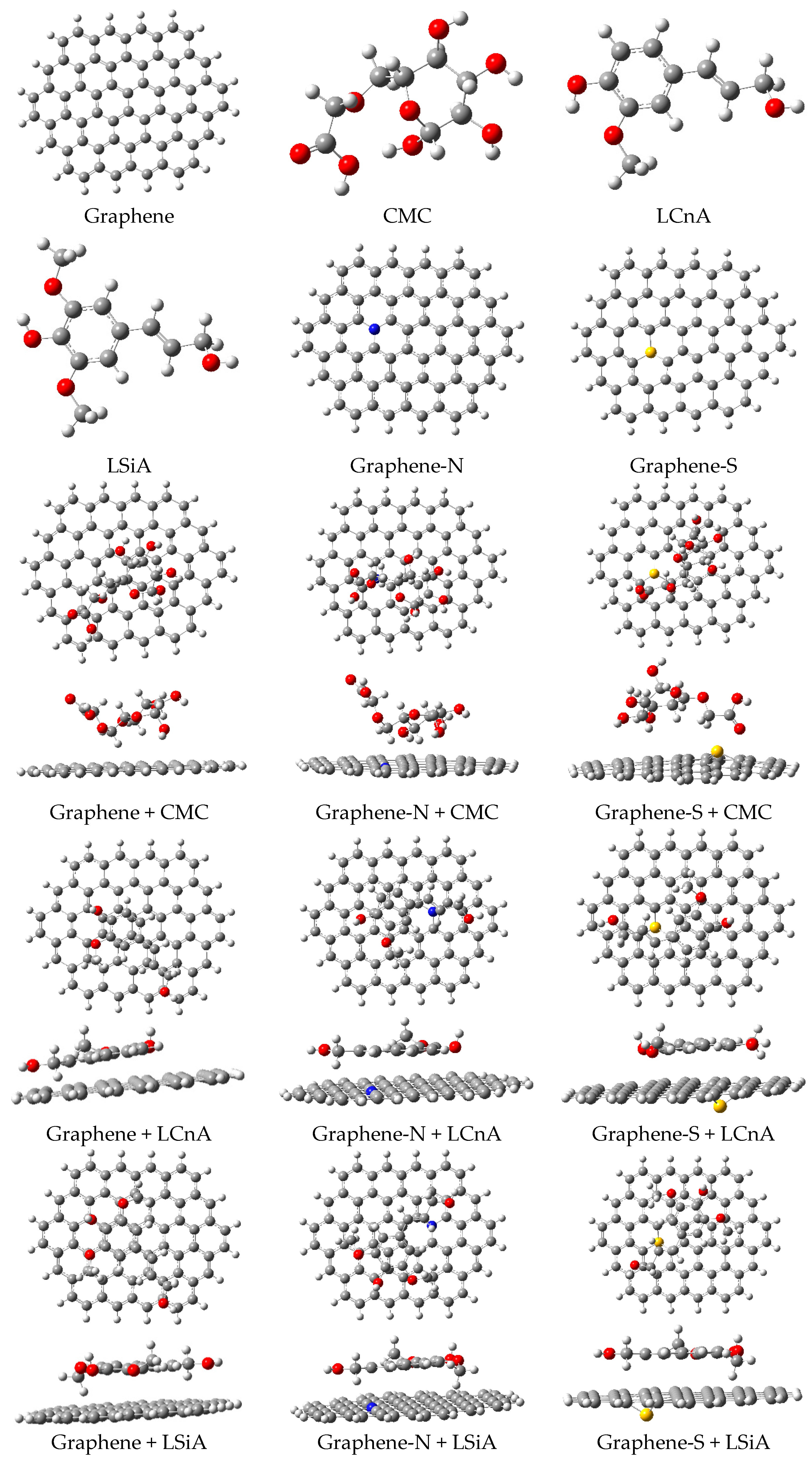
Figure 1 presents the minimum energy geometries calculated at the M06-2X/LANL2DZ level for pure graphene, nitrogen-doped (Graphene-N) and sulfur-doped (Graphene-S) variants, the three lignocellulosic binders considered (CMC and the monomers LCnA and LSiA), and the most stable surface-binder complexes obtained after exploring only parallel arrangements. The top and side views included for each species allow for the observation of flatness, induced curvatures, and anchoring mode.
In the absence of doping, pristine graphene retains the characteristic hexagonal flatness of its conjugated network, which favors the near-coplanar adsorption of the aromatic ligands LCnA and LSiA. In these configurations, the phenolic core stacks face-to-face on the sheet with average C···C distances on the order of 3.3–3.4 Å, consistent with a stable π–π stacking typical of graphitic materials. Similarly, CMC, due to its flexible, highly hydroxylated polymeric nature, tends to partially curve but maintains chain segments close to the graphene plane through a combination of dispersive interactions and intra- and intermolecular hydrogen-bonding networks. Upon the introduction of a single nitrogen atom (Graphene-N), local undulations appear around the doped site, without compromising the overall continuity of the π network. The smaller covalent radius of nitrogen and the shortening of the C–N bond (≈1.37 Å compared to ≈1.42 Å in C-C) increase the basal electron density and allow for a slightly more compact stacking of the aromatic rings. In this environment, LCnA and LSiA lie almost coplanar with the support. At the same time, CMC reduces its tilt angle (≤15°) with respect to the plane, stabilized by directed hydrogen-bond networks of the N···H-O type and electrostatic interactions with the carboxylate and hydroxyl groups.
In contrast, the insertion of a sulfur atom (Graphene-S) generates out-of-plane protrusions with local buckling that can reach ~0.4–0.5 Å due to its larger radius and weaker sp2 hybridization. The resulting roughness partially disrupts π conjugation and displaces the electronic centroid, forcing the ligands to attach in a trestle-like arrangement. In this arrangement, the aromatic core of LCnA and LSiA remains almost parallel to the surface, but with a slight tilt. At the same time, the hydroxylated and methoxylated groups rotate into the gaps created around the S, maximizing polarizable O···S interactions. The overall effect is an increase in the interlayer distance (~3.6–3.8 Å) and more pronounced ligand twists, consistent with descriptions of S-doped defects as more heterogeneous and less favorable adsorption sites for extended organic adsorbates than their N-doped analogs.

3.3. HOMO–LUMO Calculations

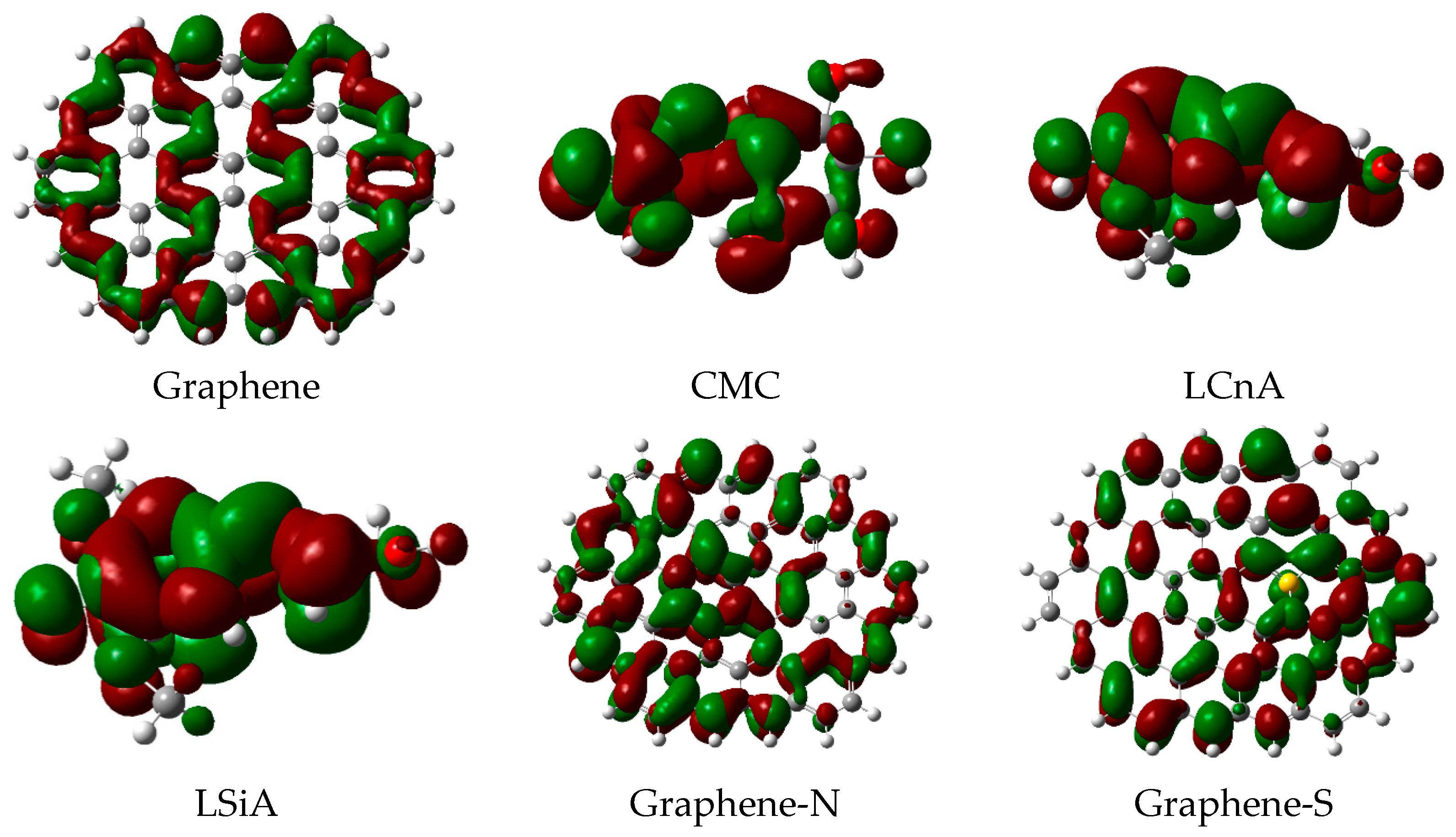
Figure 2 shows the frontier orbital isosurfaces for pristine graphene, surfaces doped with one N atom (Graphene–N) and one S atom (Graphene–S), as well as for the three lignocellulosic binders considered (CMC, LCnA, and LSiA). These representations allow visualization of how electron density is spatially distributed and to what extent the delocalization characteristic of each system is maintained or disrupted, highlighting the areas most likely to participate in charge-transfer processes or non-covalent interactions with the counterpart.
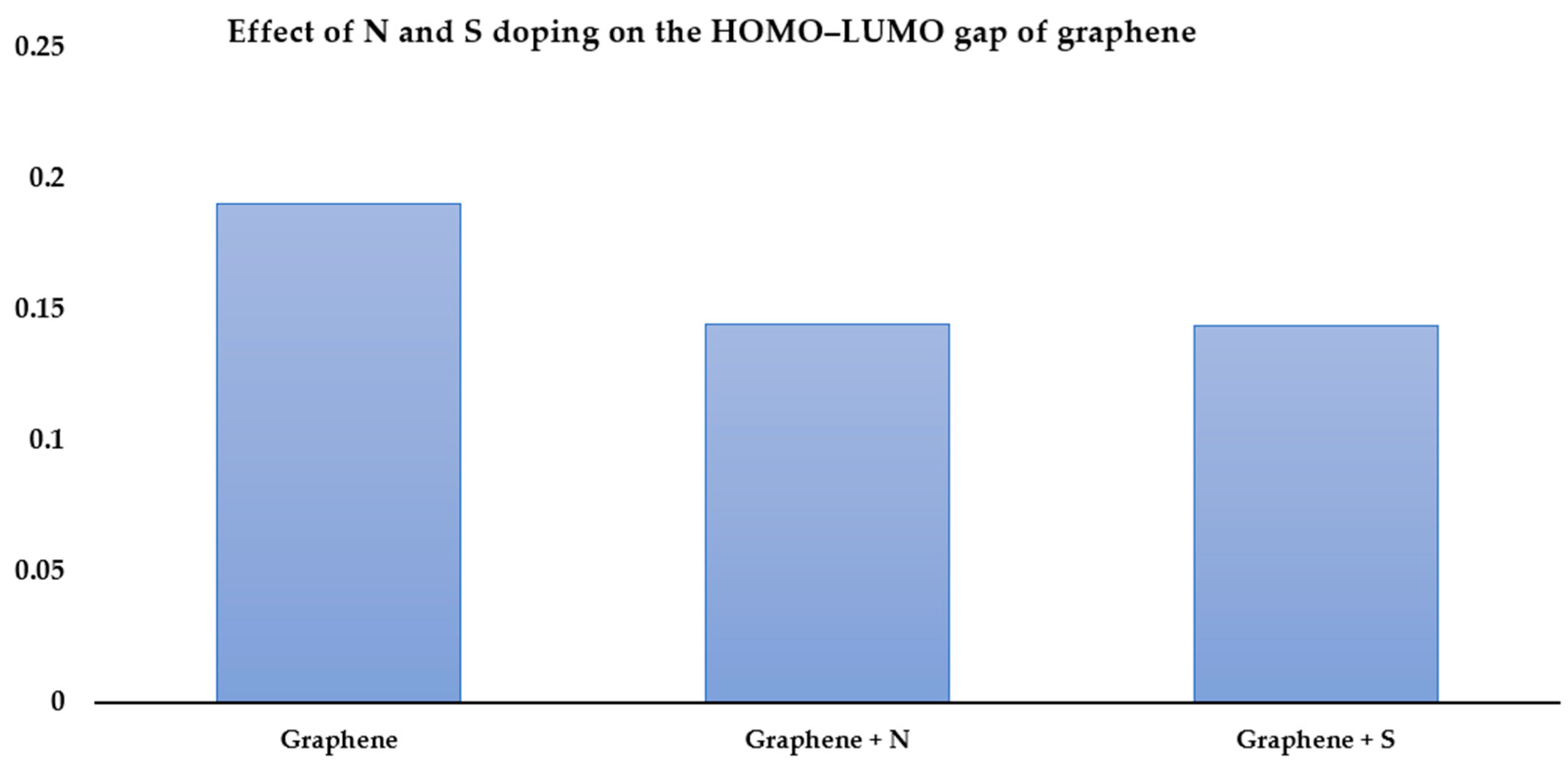
As supplementary information, Table 3 and Figure 3 summarize the numerical values of the HOMO and LUMO energies, as well as the energy gap (ΔEgap), calculated at the M06-2X/LANL2DZ level. Because the graphene sheets are modeled as finite clusters, a nonzero HOMO–LUMO separation is inherently expected and depends on model features such as size, edge termination, and dopant position; therefore, the reported ΔEgap values should be interpreted as model-dependent electronic descriptors (useful for internal comparison across surfaces) rather than as true band gaps of extended graphene. The combined interpretation of these graphical and tabulated data provides a complete picture of how doping with N or S and the type of ligand alter the global and local electronic reactivity of the analyzed surfaces.
DFT calculations with the M06-2X functional indicate that pure graphene has an electronic gap of 0.19052 eV, with the HOMO at −0.24528 eV and the LUMO at −0.05476 eV. While perfect graphene is a semimetal with no gap, these small gaps are common in finite models and arise from quantum confinement. Comparing these results with those reported in the literature reveals consistent behavior, although it is susceptible to the type of perturbation applied. For example, Choi [46] demonstrated that in bilayer graphene subjected to asymmetric deformations, the gap can be mechanically adjusted: a 4% strain generates an indirect gap of 0.076 eV; increasing to 5%, the gap increases to ~0.14 eV. If the strain continues to increase (6.25–11.1%), the gap decreases again to values close to or below 0.14 eV due to stacking and structural overlap effects. Complementarily, Shemella [47] showed that in nanoribbons confined in two dimensions, edge and length effects appear that significantly widen the HOMO–LUMO gap: for a 2.6 nm armchair nanoribbon with a width N = 8, which in the one-dimensional limit would be considered metallic, the gap can reach 0.60–0.62 eV. These studies make it clear that size and confinement significantly modify the electron gap. In this context, the value found in this study (0.19052 eV) falls somewhere in between; it is larger than the gaps induced by moderate strain in bilayers (0.076–0.14 eV according to Choi), but much smaller than those generated by extreme confinement in nanoribbons (≈0.60 eV in Shemella). Inserting a single dopant atom (nitrogen or sulfur) shifts the position of the frontier orbitals. For graphene-N, the HOMO shifts to less negative energies (−0.17806 eV), and the LUMO approaches the vacuum level (−0.03369 eV), decreasing the gap to 0.14437 eV. A similar phenomenon occurs for Graphene-S; the HOMO becomes more superficial (−0.21082 eV), and the LUMO decreases slightly (−0.06724 eV), resulting in a gap of 0.14358 eV. In both cases, the ΔEgap narrows to approximately 0.046 eV compared to pristine graphene, suggesting a higher density of states near the Fermi level and, therefore, a more favorable interface for charge transfer. This behavior is analogous to that observed in orbital isosurfaces, where additional lobes form around doped atoms without disrupting π conjugation. Other studies have also demonstrated this trend; in nitrogen-doped graphene, optical gaps of 0.05–0.08 eV have been found, depending on the dopant configuration (Zhang et al., 2021), and Lin (2018) showed that the type of nitrogen (pyridine or graphitic) affects the stability and displacements of the frontier orbitals [48,49].
Experimentally, Witjaksono et al. (2021) found that in nitrogen-doped reduced graphene oxides, the optical gap progressively decreases from 3.4 eV (GO) to 3.1, 2.5, and 2.2 eV as the N concentration increases up to 5.51 at.%, with higher conductivity (~0.781 S/cm) [50]. In contrast, the values calculated here for pristine graphene, graphene-N, and graphene-S (0.143–0.191 eV) are in a much smaller range, comparable to that of theoretical models of perfect, oxygen-free, or defective graphene. This difference is understandable, since DFT calculations start with clean structures, whereas real materials contain partial oxidation, vacancies, and disorder. For lignocellulosic binders, HOMO values range from −0.35190 to −0.26704 eV, and LUMO values are positive (0.03403–0.04151 eV). CMC exhibits the most significant gap (0.39341 eV), as expected given its saturated nature and poor electronic conjugation, which causes the frontier orbitals to be localized on hydroxyl and carboxylate groups. In contrast, the lignin monomers LCnA and LSiA have HOMO and LUMO values located on aromatic rings and methoxyl groups, favoring π–π interaction with graphic surfaces and improving electronic coupling at the interface. This behavior is consistent with reports on the adsorption of aromatics on 2D materials, where extended conjugation and π domains promote charge transport and more stable adsorption [21].

3.4. Molecular Electrostatic Potential

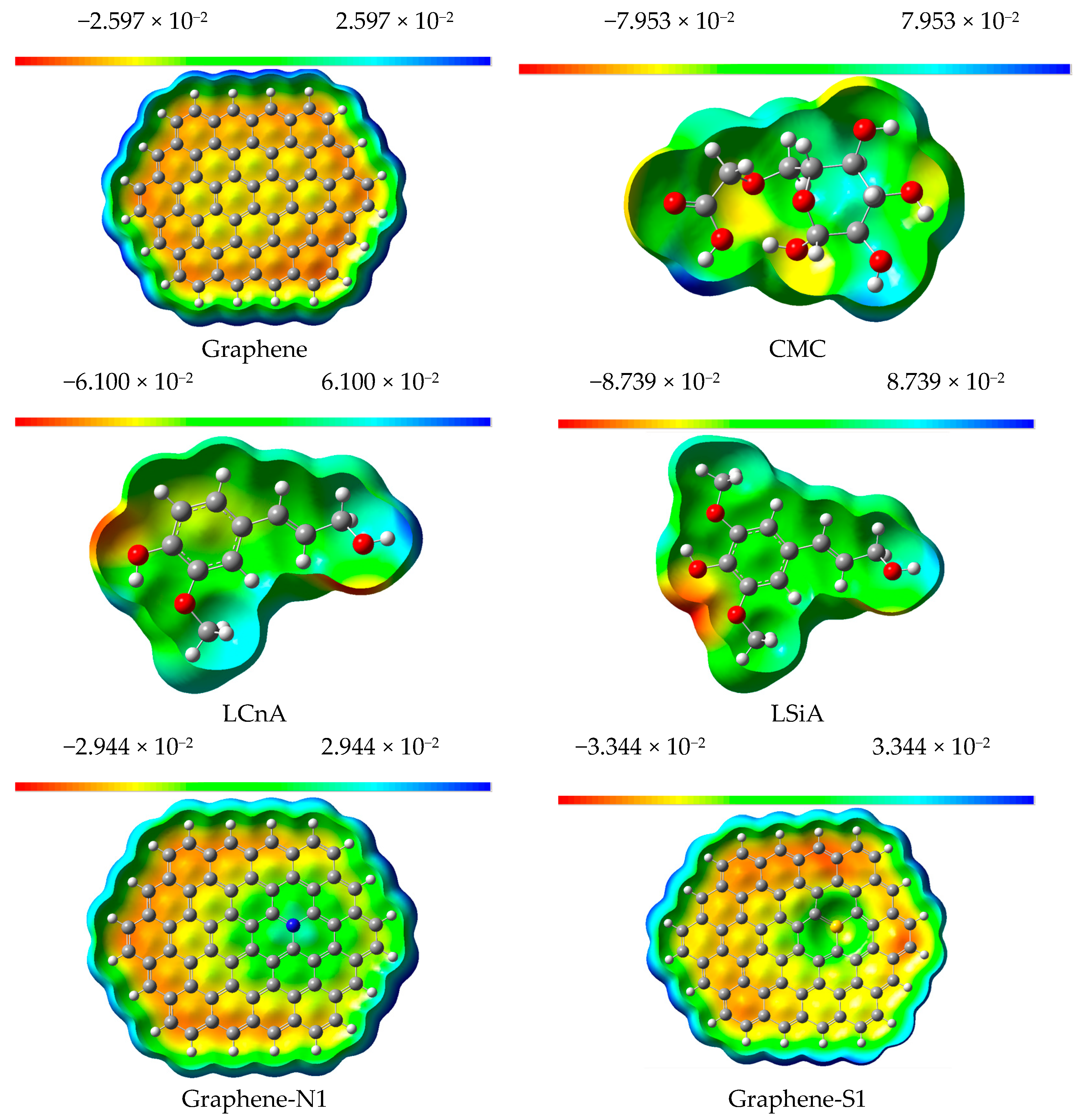
Molecular electrostatic potential (MEP) surfaces (Figure 4) clearly visualize the influence of heteroatomic doping on the redistribution of electron density in graphene sheets, as well as the effects induced by the chemical nature of the lignocellulosic binders. Pure graphene exhibits a relatively homogeneous electrostatic potential distribution, with predominantly yellow and green hues reflecting its overall nonpolar character, and slightly negative areas associated with the conjugated π density in the aromatic rings.
Replacing a single carbon atom with a nitrogen atom in the graphene lattice (Graphene-N) significantly alters the electron density, creating highly negative regions around the doped spot. Localized red and orange spots are observed in the nitrogen in the electrostatic potential maps, demonstrating its ability to attract electron density and create highly reactive nucleophilic centers. This behavior aligns with the increased HOMO level and the decreased electron gap (ΔEgap) observed in the frontier orbital analysis, suggesting that N-doped surfaces possess high localized reactivity and improved overall electron mobility conditions conducive to efficient charge transfer.
For sulfur-doped graphene (Graphene-S), the electrostatic maps are more erratic. The most negative potential zones are located on the S atom, associated with highly localized lone pairs, while the surrounding area has moderate potentials and strong gradients towards the interior of the sheet. This dispersion is consistent with a partial interruption of the π conjugation and corresponds to the intermediate contraction of the ΔEgap for Graphene-S; highly active electrostatic centers are created, capable of strongly anchoring ligands but contributing less than in Graphene-N to the total conductivity, favoring polarizable and dispersive coupling mechanisms over uniform electron transport. Lignocellulosic binders, on the other hand, exhibit electrostatic profiles consistent with their molecular structure. Carboxymethylcellulose (CMC) is highly polar, with negative charges localized on the oxygenated groups (hydroxyls and carboxylates), which favors the formation of dense networks of hydrogen bonds and electrostatic contacts with surfaces. Conversely, lignin derivatives LCnA and LSiA exhibit more balanced electrostatic surfaces; the aromatic rings possess moderately negative regions, while the methoxyl and hydroxyl groups concentrate the charge density at the ends of the molecule. This orientation allows for synergistic π–π, hydrogen bonding, and electrostatic coupling with pristine graphene, graphene-N, and graphene-S, enhancing their capacity as binders that can interact stably with graphic surfaces.

3.5. Electronic Localization Function (ELF) Maps

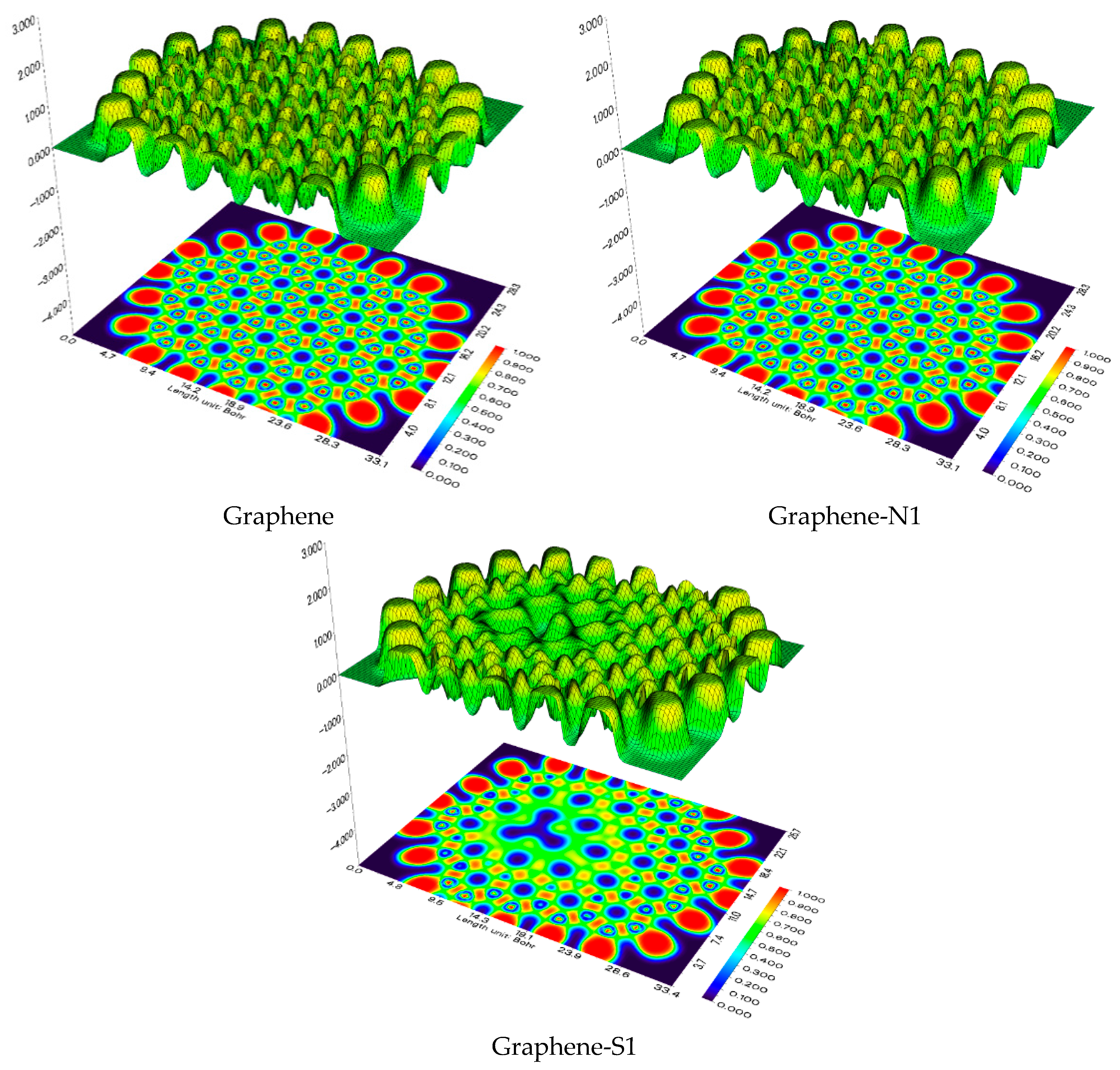
Three-dimensional maps of the electronic localization function (ELF), presented in shaded projections for pure graphene and sheets doped with nitrogen and sulfur, allow characterization of the redistribution of the probability of finding localized electron pairs after the incorporation of heteroatoms (Figure 5). On this scale, values close to 1.0 (red-orange areas) reflect strong localization, those close to 0.5 (green-yellow) correspond to moderate shared density, and those below 0.2 (blue) indicate electronically empty regions.
In pristine graphene, the expected pattern for a conjugated π system is observed. ELF peaks close to 0.80 are identified, associated with C-C σ bonds, and a virtually continuous upper surface with plateaus around 0.55 is attributable to the delocalized π cloud. This flat relief confirms the stability of the aromatic conjugation and its almost semimetallic character, consistent with the small electron gap found in this work (ΔEgap = 0.19052 eV) and with the nearly uniform MEP described above.
When the lattice is doped with a single nitrogen atom (Graphene-N), the ELF shows high-intensity lobes (~0.90) around the dopant and its neighboring carbons. This feature indicates greater electron localization and some contribution from lone pairs in the basal plane. However, the mesh of intermediate values, approximately 0.5, connecting the hexagons remains continuous, demonstrating that the overall π lattice remains intact. The result is a sheet in which strongly nucleophilic sites, capable of concentrating density, coexist with extended, uninterrupted conjugation. This behavior is consistent with the moderate contraction of ΔEgap to 0.14437 eV and with the negative potential foci observed in the MEP maps. In electronic terms, nitrogen acts as a donor center, strengthening conjugation and enabling more efficient transport pathways without sacrificing the integrity of the π system. The behavior differs in the case of sulfur-doped graphene (Graphene-S). At the first doping level, the ELF (Electron Localization Function) exhibits very high values (>0.90) around the sulfur atom. At the same time, the interior of nearby rings shows blue–green regions with a significantly lower ELF, reflecting a reduction in the shared density within the π lattice. The lobes around sulfur adopt open boomerang-like geometries, consistent with strongly localized lone-pair domains, and the immediate surroundings form a cavity with ELF < 0.30, indicating locally weakened conjugation. The resulting topology is more heterogeneous than in graphene-N, as highly localized regions coexist with π-dense domains. This phenomenon explains why, although the electronic gap is also reduced (ΔEgap = 0.14358 eV), the contribution of sulfur doping to the overall conductivity is less uniform and is dominated by polarizable coupling mechanisms concentrated around the doped site.

3.6. Relief Maps of the Localized Orbital Locator (LOL)

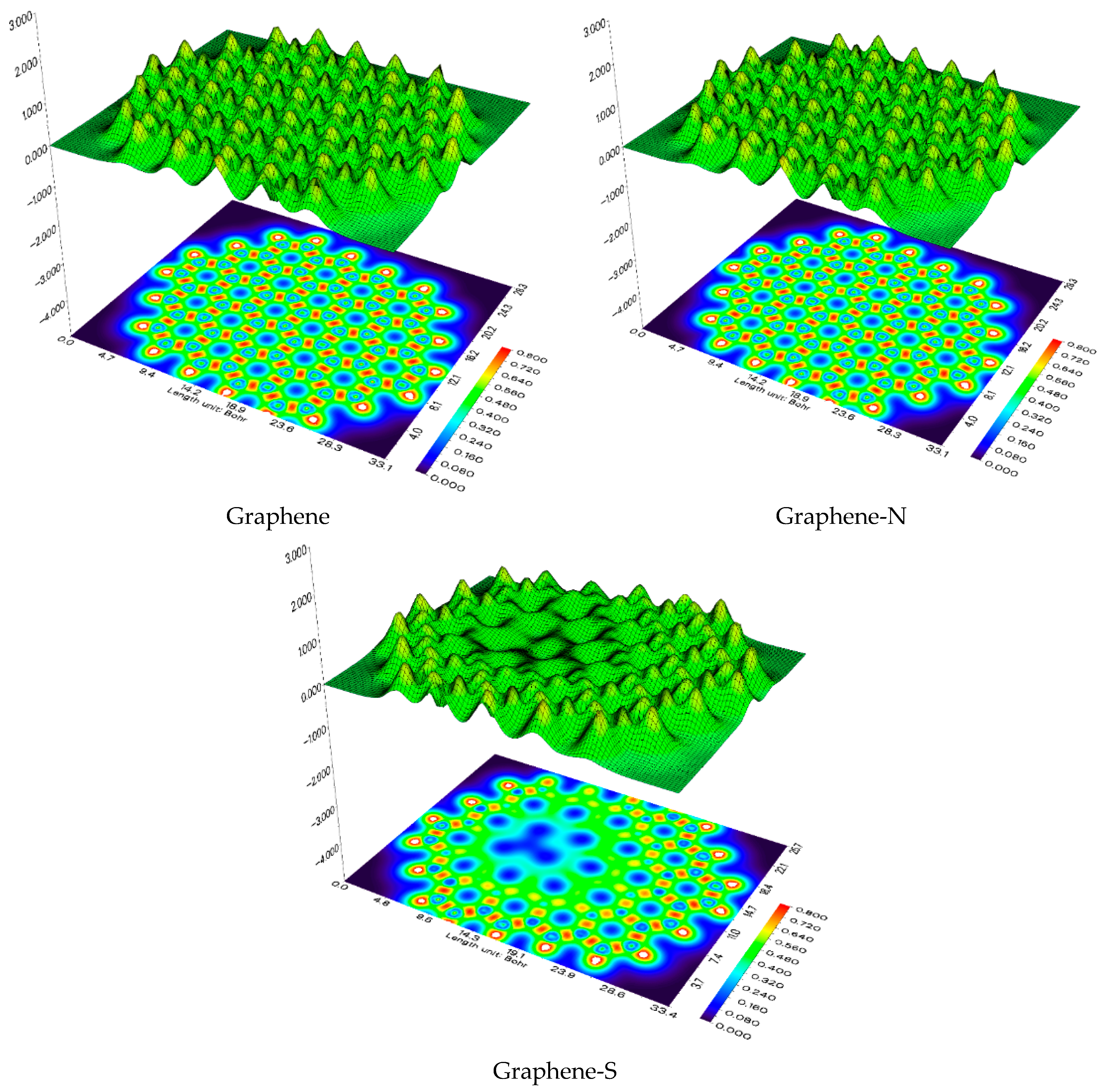
The relief maps of the Localized Orbital Locator (LOL) show how the progressive insertion of nitrogen or sulfur modulates the distribution of localized electron pairs in the graphene lattice (Figure 6). In pure graphene, the typical response of a π-conjugated system is observed: homogeneous LOL peaks ≈ 0.70–0.75 associated with the C-C σ bonds and an upper plateau with intermediate values (≈0.45–0.50), indicative of uniform electron delocalization along the hexagonal lattice.
When a nitrogen atom is introduced into the graphene lattice, the LOL function pattern changes markedly compared to pristine graphene. In the graphene-N system, the peaks near the dopant become more intense and acquire a brighter yellow color, with LOL values exceeding 0.75. This indicates a higher local electron density around the nitrogen atom. Even so, the surface associated with the π cloud remains continuous throughout the rest of the sheet, with no signs of disruption in the delocalization channels. These results indicate that nitrogen acts as a donor center, redistributing electron density in its immediate vicinity. It strengthens the π channels, but without altering the overall conjugation of the structure. The combined reading of these textures with ELF maps, HOMO–LUMO descriptors, and AIM analysis supports the idea of an N-doped surface that combines localized nucleophilic sites with efficient electron transport pathways and a partially covalent character in its interactions with aromatic ligands such as LCnA and LSiA. In sulfur-doped graphene, the LOL response is qualitatively different. In S-graphene, orange domes emerge around the sulfur atom, with values in the range of 0.80 to 0.85, characteristic of strongly localized lone pairs. At the same time, the central region of neighboring rings is abruptly depressed to values below 0.30, generating a blue-green belt associated with a loss of shared density in the core of the sheet. This combination of highly localized maxima at the sulfide site and low-localization cavities within the lattice indicates a fragmentation of the π channels and a more rugged topology than in N-type graphene. Consequently, the intrinsic conductivity becomes less homogeneous, and polarizing and dispersive coupling mechanisms predominate around the dopant, in complete agreement with what was previously described from the MEP and ELF maps.

3.7. Interaction Energy

The interaction energies (ΔEint) calculated using the supermolecular scheme (Table 4) allow quantification of the thermodynamic affinity between pure or nitrogen- or sulfur-doped graphene surfaces and lignocellulosic binders (CMC, LCnA, LSiA). All geometries were optimized at the ωB97X-D/LANL2DZ level and evaluated in their minimum energy configurations. By convention, a negative ΔEint value reflects exothermic and therefore spontaneous adsorption, while a positive value indicates a weak or repulsive interaction.
In pristine graphene, the calculated interaction energies (Table 4; negative values indicate exothermic/favorable adsorption by our convention) reveal a coherent and consistently favorable adsorption landscape across the three binders, with ΔEint = −23.7 kcal·mol−1 (CMC), −26.3 kcal·mol−1 (LCnA), and −30.4 kcal·mol−1 (LSiA). Under the minimum-energy configurations obtained at the ωB97X-D/LANL2DZ level, the affinity follows LSiA > LCnA > CMC, which is chemically consistent with the increasing contribution of aromatic/π-rich domains and polar oxygenated functionalities that can cooperate through π–π stacking and secondary electrostatic/hydrogen-bond contacts at the interface. This point is important because aromatic lignin derivatives are generally expected to benefit from π–π interactions on sp2 carbon substrates; indeed, lignin–graphene aerogels have been reported to exhibit very high methylene blue adsorption capacities (>1185 mg·g−1 at 303 K), described by Langmuir behavior and pseudo-second-order kinetics with correlation coefficients close to unity, and an overall spontaneous, slightly endothermic process with negative ΔG°and ΔH° around 3.22 kJ·mol−1 [51]. In contrast, the comparatively weaker binding of CMC on pristine graphene is consistent with its lack of extended aromatic domains and its stronger reliance on hydrogen-bond and electrostatic networks; oxidized-graphene/CMC aerogel beads, for example, show a much lower maximum adsorption capacity (222.7 mg·g−1), with kinetics consistent with a chemisorption mechanism and an activation energy of 55.6 kJ·mol−1 [52].
When a nitrogen atom is introduced into the sheet (Graphene-N1), the adsorption remains uniformly exergonic and exhibits a subtle but systematic stabilization relative to pristine graphene for all three binders: ΔEint = −25.7 kcal·mol−1 (CMC), −26.6 kcal·mol−1 (LCnA), and −31.1 kcal·mol−1 (LSiA). Although the magnitude of the change is modest (within a few kcal·mol−1), the trend is chemically meaningful because N-doping can introduce more basic/polar sites and localized charge-density perturbations that strengthen multipoint coupling (π–π stacking plus auxiliary hydrogen-bond/electrostatic contacts), consistent with three-dimensional lignin–graphene materials where Pb(II) adsorption follows Langmuir behavior with maximum capacities on the order of 135 mg·g−1 and pseudo-second-order kinetics (R2 ≈ 0.999), attributed to oxygenated groups and basic sites that stabilize surface complexes and hydrogen bonds [53]. In our systems, the concomitant contraction of the HOMO–LUMO gap and the appearance of nucleophilic foci in MEP/ELF maps provide a physically consistent rationale for why N-doping improves adsorption trends without requiring overdoping levels that would compromise π conjugation.
Upon sulfur doping (Graphene-S1), the interaction energies remain negative for all binders, confirming stable adsorption, but the response becomes more binder-dependent: ΔEint = −24.1 kcal·mol−1 (CMC), −22.6 kcal·mol−1 (LCnA), and −30.6 kcal·mol−1 (LSiA). In this regime, LSiA preserves the strongest affinity (comparable to pristine graphene), whereas LCnA shows a measurable attenuation relative to pristine and N-doped sheets, consistent with sulfur-induced out-of-plane distortion and local polarizability that can either enhance anchoring or, depending on the specific adsorption geometry, partially disrupt optimal π–π registry for certain aromatic motifs. This pattern is consistent with sulfur creating highly polarizable, out-of-plane perturbed domains that act as anchoring sites, strengthening multipoint coupling with aromatic lignin derivatives, as also discussed for sulfide-graphene/lignin composites, where defect-mediated polarization is invoked to enhance the fixation of aromatic and metallic species [52,53].
Finally, the results for CMC reaffirm its lower relative affinity compared with lignin derivatives; across pristine graphene, graphene-N1, and graphene-S1, adsorption is consistently favorable but remains less exergonic than for LSiA, indicating that the absence of extended π domains limits the stacking contribution and concentrates stabilization in hydrogen-bond/electrostatic networks (ΔEint ≈ −23.7 to −25.7 kcal·mol−1). The small sensitivity of CMC to doping in this dataset is compatible with a binding mechanism dominated by polar contacts rather than by strict π-registry, and it aligns with reports for carbonized CMC-based composites (CMC-CNF type) that display high monolayer capacities (917.4 mg·g−1) with Langmuir behavior (R2 = 0.9992) and spontaneous thermodynamics (ΔG between −5.9 and −6.6 kJ·mol−1), slightly endothermic character (ΔH ≈ 7.25 kJ·mol−1) and entropic gain (ΔS ≈ 44.8 J·mol−1·K−1) [54].
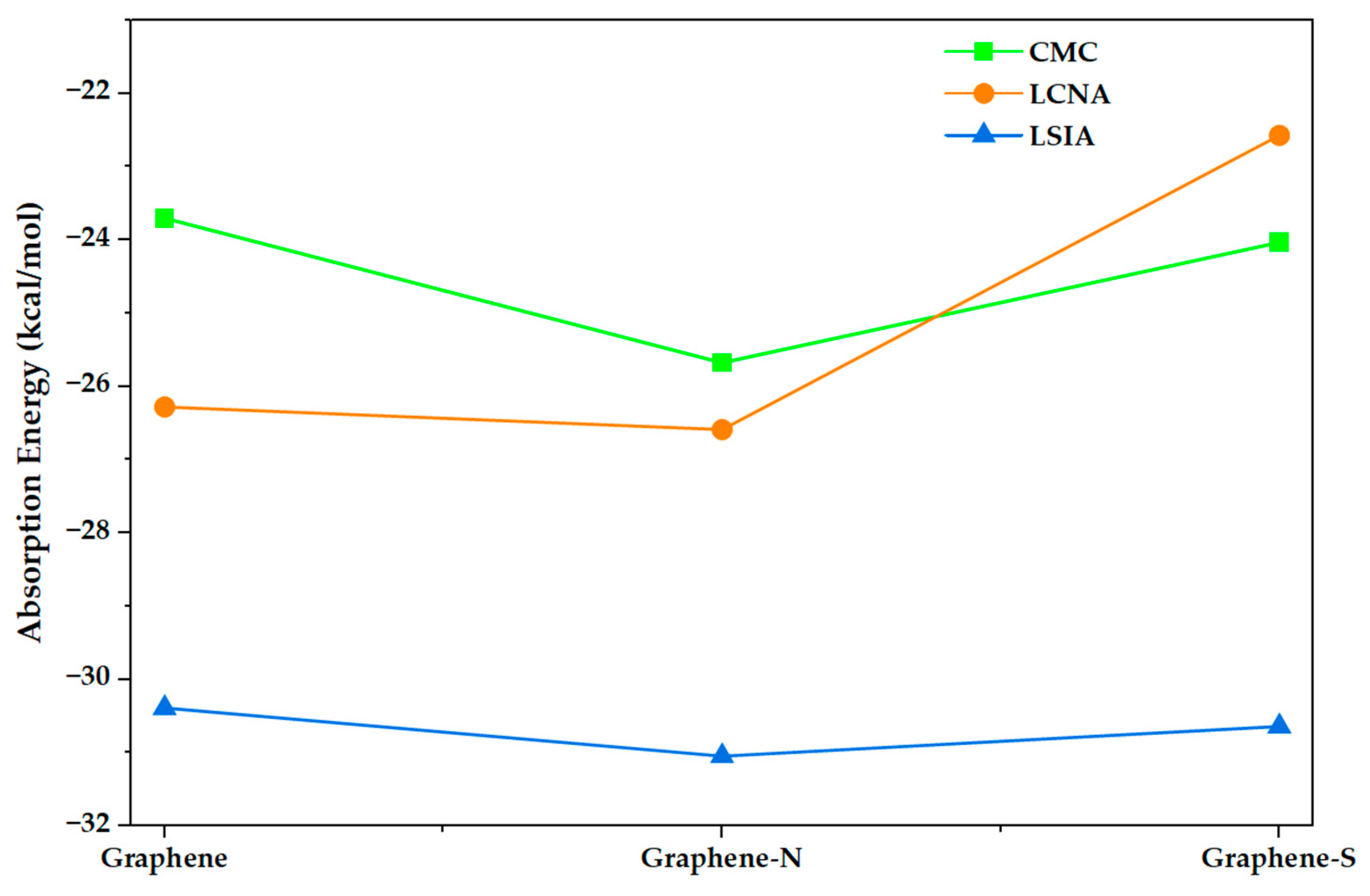
The results shown in the revised Figure 7 indicate that adsorption is consistently exergonic for all lignocellulosic binders on the three graphene variants, and that the variability is governed mainly by binder identity rather than by a change in adsorption sign. Across the dataset, adsorption energies remain negative in a relatively narrow window (≈−22.6 to −31.1 kcal·mol−1), evidencing thermodynamically favorable interfacial coupling for CMC, LCnA, and LSiA on pristine graphene, graphene-N, and graphene-S.
On pristine graphene, the affinity follows LSiA (−30.4) > LCnA (−26.3) > CMC (−23.7), consistent with the stronger stabilization expected for lignin-derived aromatic motifs, where π-rich domains and oxygenated functionalities can cooperate through π–π interactions plus secondary polar contacts, relative to the more polysaccharide-like CMC fragment. Introducing nitrogen (graphene-N) produces a modest but systematic strengthening for all binders (CMC: −25.7; LCnA: −26.6; LSiA: −31.1), which is compatible with N-induced local polarization/basicity that can enhance multipoint coupling without fundamentally reshaping the interaction hierarchy.
In contrast, sulfur doping (graphene-S) yields a binder-dependent response. While LSiA remains strongly bound (−30.6; essentially unchanged within <1 kcal·mol−1), LCnA becomes noticeably less stabilized (−22.6), and CMC shows a slight weakening relative to graphene-N (−24.1). This non-monotonic behavior is chemically plausible for finite doped graphene models; S insertion can introduce out-of-plane distortion and altered local polarizability that may either reinforce anchoring or, depending on the optimized contact geometry, reduce optimal π–π registry for certain aromatic motifs (as suggested here for LCnA), whereas ligands capable of stronger multipoint polar coupling (LSiA) retain high stabilization. Overall, Figure 7 supports that graphene doping tunes interaction strength within a few kcal·mol−1, enabling selective modulation (especially for LCnA on S-doped sites), while the dominant determinant of adsorption magnitude remains the binder’s chemical architecture.

3.8. AIM Analysis

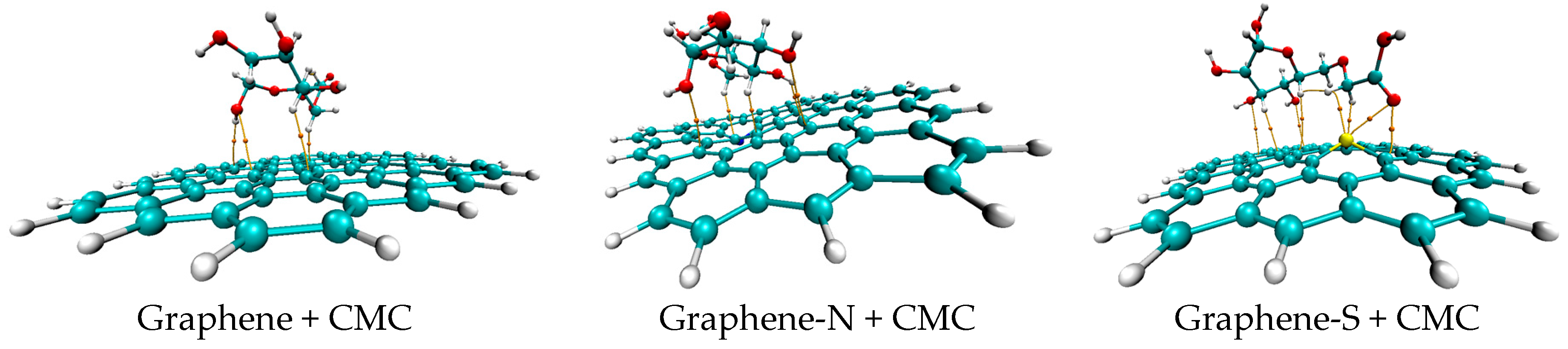
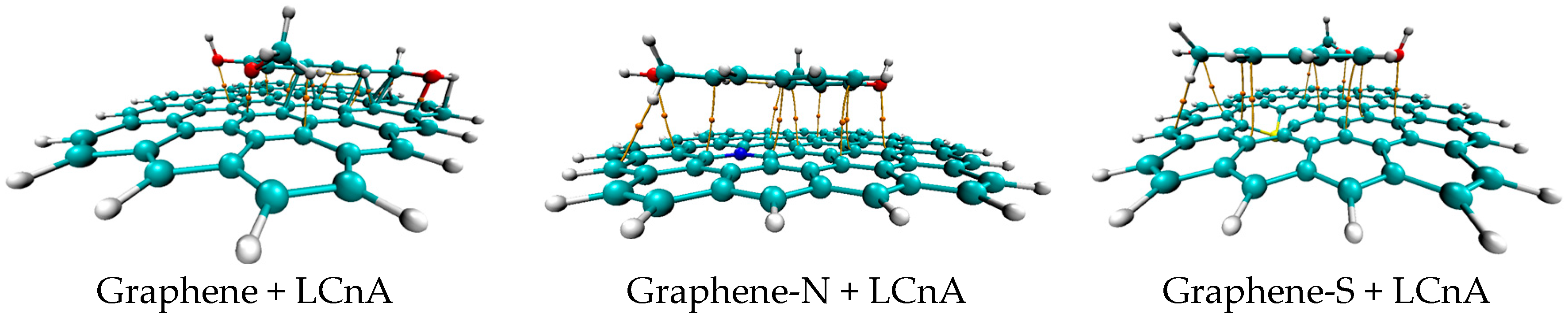
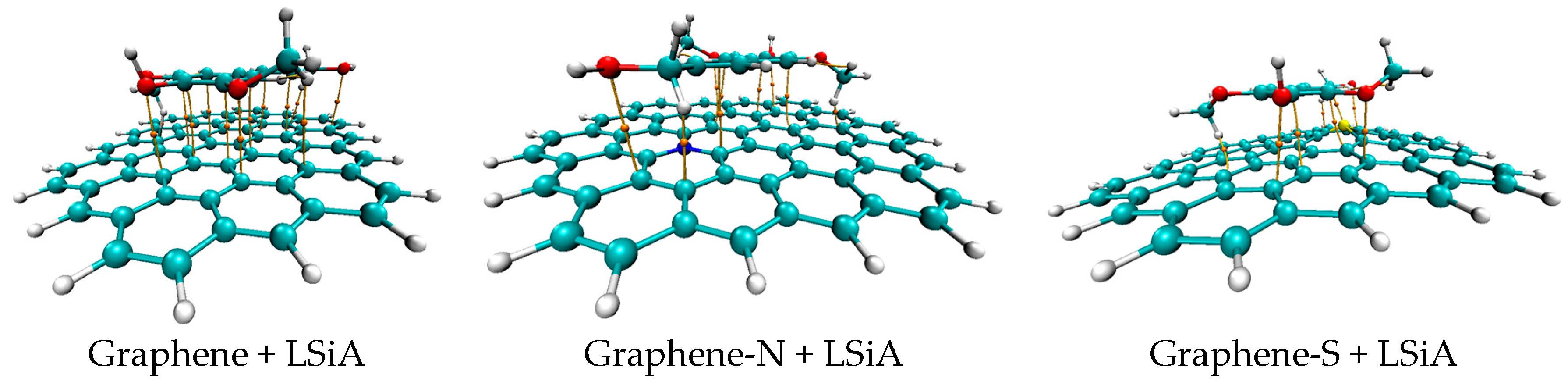
Topological analysis using AIM (Atoms In Molecules) theory enabled precise characterization of the electronic nature of interactions between graphene surfaces (pure, N-, and S-doped) and lignocellulosic binders (Figure 8, Figure 9 and Figure 10). Table 5 reports the electron density values at the critical bond point (PC), Laplacian (∇2PC), total energy density (H), potential energy (V), and kinetic energy (G) contributions, along with the descriptor |V|/G, which constitute reliable criteria for distinguishing closed non-covalent interactions from contacts with a partially covalent character.
The results obtained show that the complexes formed with CMC exhibit electron densities at the critical bonding points (Pc) on the order of 0.03–0.13 a.u., values that, on average, are two to three times lower than those recorded for the aromatic binders LCnA and LSiA. V/G ratios accompany this behavior in the approximate range of 0.74–0.92, which confirms that the interactions are predominantly non-covalent and are governed by electrostatic and dispersion contributions, in accordance with the criteria of the QTAIM theory for “closed-shell” bonds [55,56]. Only in point configurations on doped surfaces, primarily when CMC interacts with graphene-S, is a slight increase in |V|/G observed, approaching values close to or just slightly above 1. This decrease is accompanied by weakly negative local total energies H, suggesting the onset of a partially covalent character that does not yet dominate the nature of the contact.
In contrast, lignin-aromatic binders exhibit a substantial increase in the intensity of the electronic interaction. LCnA reaches significantly higher Pc values than CMC, with several-fold increases in the critical points associated with π–π contacts between the phenolic ring and the graphene surface. In these regions, the ratio ∣V∣/G can easily exceed unity, approaching values on the order of 1.5–1.7, indicating a significant contribution from electron sharing and the presence of robust π–π contacts, in line with previous studies of aromatic adsorption on graphene where interaction energies of −40 to −55 kJ·mol−1 have been reported for simple π–π interactions, which are intensified in the presence of dopants or structural defects [57,58]. LSiA maintains an intermediate but highly consistent pattern, with typical Pc values clearly higher than those of CMC (between three and five times higher) and with |V|/G values that, in certain combinations with N-graphene, exceed the threshold of 2, accompanied by negative Laplacians, unequivocal evidence of the formation of partially covalent bonds at the interface, consistent with what has been reported for graphene defects that reinforce π–π interactions [59].
These topological descriptors clearly reflect the effect of doping. In the presence of nitrogen, a systematic increase in electron sharing is observed for aromatic ligands; in LSiA systems, the |V|/G ratio increases from values slightly below one on pristine graphene to values above one on N-graphene, while Pc increases markedly, indicating a densification of electronic connectivity at interfacial contacts. A similar trend is observed in LCnA, with |V|/G increasing from typically subunit values or close to 1 to values slightly above unity when the ligand couples to the N-doped surface. These results are consistent with the literature, indicating that nitrogen doping introduces localized electronic states that can enhance charge transfer and increase affinity for aromatic compounds, leading to adsorption energy increases of tens of meV per doped site [60,61].
In sulfur doping, however, most contacts remain in an essentially non-covalent regime. The |V|/G values for LCnA and LSiA on graphene-S are mainly distributed between 0.82 and 1.08, that is, close to unity, indicating reinforced interactions that are still dominated by dispersion and electrostatic contributions rather than by a fully developed covalent bond. Only in specific cases are values greater than 1 observed, accompanied by negative Laplacians, reflecting a moderate, partially covalent character. This behavior aligns with the literature, which describes sulfur, due to its high polarizability, as especially effective at stabilizing π–π interactions and hydrogen bond networks but not to the same extent as nitrogen in the graphene network [62,63,64,65,66,67].

4. Conclusions

The comprehensive evaluation of interaction energies, electronic descriptors, and topological analyses enables the formulation of clear, quantitative selection criteria for graphene–lignocellulosic binder systems. Overall, the results indicate that interfacial performance is governed by the combined effects of the binder’s aromaticity/functional-group density and heteroatom-driven electronic modulation of the graphene lattice. Within the present dataset, sinapyl alcohol (LSiA) consistently exhibits the strongest adhesion, whereas CMC and LCnA show weaker and more surface-sensitive affinities, reflecting differences in aromatic π-content and in the availability of multipoint polar contacts. Importantly, the interaction energies remain exergonic for all binder–surface pairs (≈−22.6 to −31.1 kcal·mol−1), indicating that the main discriminant is the magnitude of stabilization rather than a change in adsorption sign.
From the surface perspective, nitrogen doping produces a small but systematic strengthening of adsorption for all binders (relative to pristine graphene), consistent with the introduction of localized donor/basic sites that can enhance multipoint coupling while largely preserving the delocalized π framework of the finite graphene model. In contrast, sulfur doping yields a more heterogeneous response, in which LSiA preserves strong stabilization, whereas LCnA becomes less stabilized, consistent with S-induced out-of-plane distortion and localized lone-pair/polarizability domains that may alter the optimal π–π registry depending on the specific adsorption geometry. Accordingly, when adhesion strength is considered jointly with electronic/topological indicators of lattice perturbation, N-doped graphene provides the most balanced surface in terms of maintaining electronic integrity while modestly improving interfacial stabilization, whereas S-doped graphene can introduce more localized electronic features that are not uniformly beneficial across binders.
These findings underscore that the most energetically stable interface is not automatically the most electronically optimal one, and that nitrogen-doped graphene combined with aromatic lignin-derived binders particularly LSiA offers the best compromise between interfacial cohesion and preserved charge-transport pathways. This dual optimization establishes a rational framework for selecting sustainable binder–graphene combinations and highlights graphene-N/LSiA as a particularly promising candidate for next-generation lithium-ion battery electrodes.
From an application-oriented standpoint, the present results help bridge molecular-scale insights and practical electrode design by emphasizing co-optimization of binder chemistry and graphene electronic structure. Rather than treating the binder and the conductive additive as independent components, the trends identified here indicate that aromatic character and controlled electronic activation of graphene are decisive for robust and functional interfaces. In this context, heteroatom engineering should be viewed not merely as a strategy to strengthen adsorption, but as a lever to fine-tune the balance between interfacial cohesion and electronic connectivity. When translated to electrode fabrication, this implies that binder selection should be aligned with the electronic nature of the graphene surface to avoid interfacial over-stabilization at the expense of conductivity. Such a co-design strategy provides a realistic pathway toward mechanically stable, electronically efficient, and environmentally sustainable electrodes, offering actionable guidance for the rational development of next-generation lithium-ion battery materials.

Author Contributions

Conceptualization, J.A.H.F. and J.A.P.P.; Methodology, J.A.H.F. and J.A.P.P.; Software, J.A.H.F. and J.A.P.P.; Validation, J.A.H.F. and J.A.P.P.; Formal analysis, J.A.H.F., J.C. and J.A.P.P.; Investigation, J.A.H.F. and J.C.; Resources, J.A.H.F. and J.C.; Data curation, J.A.H.F., J.C. and J.A.P.P.; Writing—original draft, J.A.H.F., J.C. and J.A.P.P.; Writing—review & editing, J.A.H.F. and J.A.P.P.; Visualization, J.A.H.F. and J.C.; Supervision, J.A.H.F.; Project administration, J.A.H.F. and J.A.P.P.; Funding acquisition, J.A.H.F. All authors have read and agreed to the published version of the manuscript.

Funding

This research received no external funding.

Data Availability Statement

The original contributions presented in this study are included in the article. Further inquiries can be directed to the corresponding authors.

Conflicts of Interest

The authors declare no conflict of interest.

References

  1. Fu, X.; Zhong, W. Biomaterials for High-Energy Lithium-Based Batteries: Strategies, Challenges, and Perspectives. Adv. Energy Mater. 2019, 9, 1901774. [Google Scholar] [CrossRef]
  2. Wang, Y.; Yang, Q.; Guo, X.; Yang, S.; Chen, A.; Liang, G.; Zhi, C. Strategies of binder design for high-performance lithium-ion batteries: A mini review. Rare Met. 2021, 41, 745–761. [Google Scholar] [CrossRef]
  3. Nguyen, V.A.; Kuss, C. Review—Conducting Polymer-Based Binders for Lithium-Ion Batteries and Beyond. J. Electrochem. Soc. 2020, 167, 065501. [Google Scholar] [CrossRef]
  4. Dou, W.; Zheng, M.; Zhang, W.; Liu, T.; Wang, F.; Wan, G.; Liu, Y.; Tao, X. Review on the Binders for Sustainable High-Energy-Density Lithium Ion Batteries: Status, Solutions, and Prospects. Adv. Funct. Mater. 2023, 33, 2305161. [Google Scholar] [CrossRef]
  5. Wang, M.; Liu, K.; Yu, J.; Zhang, Q.; Zhang, Y.; Valix, M.; Tsang, D.C. Challenges in Recycling Spent Lithium-Ion Batteries: Spotlight on Polyvinylidene Fluoride Removal. Glob. Chall. 2023, 7, 2200237. [Google Scholar] [CrossRef]
  6. Wang, M.; Tan, Q.; Liu, L.; Li, J. A Facile, Environmentally Friendly, and Low-Temperature Approach for Decomposition of Polyvinylidene Fluoride from the Cathode Electrode of Spent Lithium-ion Batteries. ACS Sustain. Chem. Eng. 2019, 7, 12799–12806. [Google Scholar] [CrossRef]
  7. Jin, C.; Nai, J.; Sheng, O.; Yuan, H.; Zhang, W.; Tao, X.; Lou, X.W. Biomass-based materials for green lithium secondary batteries. Energy Environ. Sci. 2021, 14, 1326–1379. [Google Scholar] [CrossRef]
  8. Tao, X.S.; Chu, F.; Wang, S.; Fang, X.; Zhang, J.; Meng, J.; Sha, J.; Chen, Y. Advances in high-temperature shock technology for structural engineering of electrode materials: A review. Energy Z 2025, 1, 100003. [Google Scholar] [CrossRef]
  9. Kim, Y.; Nam, S.; Jeon, Y.; Jung, J.; Han, D.-Y.; Park, S. Improving silicon anode durability through uniform dispersion and binding enhancement with polyacrylamide-grafted carbon nanotubes. Energy Mater. 2025, 5, 500071. [Google Scholar] [CrossRef]
  10. Weir, A.; Carrión, A.J.d.B.; Queffélec, C.; Bujoli, B.; Chailleux, E.; Uguna, C.; Snape, C.; Airey, G. Renewable binders from waste biomass for road construction: A review on thermochemical conversion technologies and current developments. Constr. Build. Mater. 2022, 330, 127076. [Google Scholar] [CrossRef]
  11. Qiu, L.; Shao, Z.; Wang, D.; Wang, F.; Wang, W.; Wang, J. Novel polymer Li-ion binder carboxymethyl cellulose derivative enhanced electrochemical performance for Li-ion batteries. Carbohydr. Polym. 2014, 112, 532–538. [Google Scholar] [CrossRef]
  12. Paganelli, S.; Massimi, N.; Di Michele, A.; Piccolo, O.; Rampazzo, R.; Facchin, M.; Beghetto, V. Use of carboxymethyl cellulose as binder for the production of water-soluble catalysts. Int. J. Biol. Macromol. 2024, 270, 132541. [Google Scholar] [CrossRef] [PubMed]
  13. Park, J.H.; Kim, S.H.; Ahn, K.H. Role of carboxymethyl cellulose binder and its effect on the preparation process of anode slurries for Li-ion batteries. Colloids Surf. A Physicochem. Eng. Asp. 2023, 664, 131130. [Google Scholar] [CrossRef]
  14. Luo, C.; Du, L.; Wu, W.; Xu, H.; Zhang, G.; Li, S.; Wang, C.; Lu, Z.; Deng, Y. Novel Lignin-Derived Water-Soluble Binder for Micro Silicon Anode in Lithium-Ion Batteries. ACS Sustain. Chem. Eng. 2018, 6, 12621–12629. [Google Scholar] [CrossRef]
  15. Kumar, Y.A.; Alagarasan, J.K.; Ramachandran, T.; Rezeq, M.; Bajaber, M.A.; Alalwiat, A.A.; Moniruzzaman; Lee, M. The landscape of energy storage: Insights into carbon electrode materials and future directions. J. Energy Storage 2024, 86, 111119. [Google Scholar] [CrossRef]
  16. Lv, Y.; Wang, J.; Ji, D.; Li, J.; Zhao, S.; Zhao, Y.; Cai, Z.; He, X.; Sun, X. Carbonaceous electrode materials for supercapacitor: Preparation and surface functionalization. Front. Energy Res. 2023, 10, 957032. [Google Scholar] [CrossRef]
  17. Liu, L.; Zhang, W.; Lu, B.; Cheng, Z.; Cao, H.; Li, J.; Fan, Z.; An, X. Controllable heteroatoms doped electrodes engineered by biomass based carbon for advanced supercapacitors: A review. Biomass-Bioenergy 2024, 186, 107265. [Google Scholar] [CrossRef]
  18. Wang, J.; Han, W. A Review of Heteroatom Doped Materials for Advanced Lithium-Sulfur Batteries. Adv. Funct. Mater. 2021, 32, 2107166. [Google Scholar] [CrossRef]
  19. Ai, W.; Luo, Z.; Jiang, J.; Zhu, J.; Du, Z.; Fan, Z.; Xie, L.; Zhang, H.; Huang, W.; Yu, T. Nitrogen and Sulfur Codoped Graphene: Multifunctional Electrode Materials for High-Performance Li-Ion Batteries and Oxygen Reduction Reaction. Adv. Mater. 2014, 26, 6186–6192. [Google Scholar] [CrossRef] [PubMed]
  20. He, Q.; Yu, B.; Li, Z.; Zhao, Y. Density Functional Theory for Battery Materials. Energy Environ. Mater. 2019, 2, 264–279. [Google Scholar] [CrossRef]
  21. Fernández, J.A.H.; Palomo, J.A.P. Synthesis and Characterization of MAPTAC-Modified Cationic Corn Starch: An Integrated DFT-Based Experimental and Theoretical approach for wastewater treatment applications. J. Compos. Sci. 2025, 9, 240. [Google Scholar] [CrossRef]
  22. Montejo-Alvaro, F.; Oliva, J.; Herrera-Trejo, M.; Hdz-García, H.M.; Mtz-Enriquez, A.I. DFT study of small gas molecules adsorbed on undoped and N-, Si-, B-, and Al-doped graphene quantum dots. Theor. Chem. Acc. 2019, 138, 37. [Google Scholar] [CrossRef]
  23. Fernández, J.A.H.; Palomo, J.A.P.; Ortega-Toro, R. Application of DFT and Experimental Tests for the Study of Compost Formation Between Chitosan-1,3-dichloroketone with Uses for the Removal of Heavy Metals in Wastewater. J. Compos. Sci. 2025, 9, 91. [Google Scholar] [CrossRef]
  24. Frisch, M.J.; Trucks, G.W.; Schlegel, H.B.; Scuseria, G.E.; Robb, M.A.; Cheeseman, J.R.; Scalmani, G.; Barone, V.; Petersson, G.A.; Nakatsuji, H.; et al. Gaussian 16, Revision B.01. Fox, D.J. GaussView 5.0. Gaussian, Inc.: Wallingford, CT, 2016. Available online: https://scirp.org/reference/referencespapers?referenceid=2418053 (accessed on 20 November 2025).
  25. Chen, Z.; Li, S.; Zhang, G.; Yang, Y.; Qian, Y. Renewable lignocellulose based binders for advanced battery systems. Green Chem. 2024, 26, 9993–10005. [Google Scholar] [CrossRef]
  26. Kumar, A.; Kumar, D. Interaction of modified nucleic bases with graphene and doped graphenes: A DFT study. Bull. Mater. Sci. 2020, 43, 1–16. [Google Scholar] [CrossRef]
  27. Gao, Y.; Xu, D.; Cui, T.; Li, D. Stability of hydrogen-terminated graphene edges. Phys. Chem. Chem. Phys. 2021, 23, 13261–13266. [Google Scholar] [CrossRef] [PubMed]
  28. Deokar, G.; Jin, J.; Schwingenschlögl, U.; Costa, P.M.F.J. Chemical vapor deposition-grown nitrogen-doped graphene’s synthesis, characterization and applications. npj 2D Mater. Appl. 2022, 6, 1–17. [Google Scholar] [CrossRef]
  29. Gong, Y.; Ma, W.; Xu, Z.; Wang, Y. Understanding the interaction of N-doped graphene and sulfur compounds in a lithium-sulfur battery: A density functional theory investigation. New J. Chem. 2022, 46, 12300–12310. [Google Scholar] [CrossRef]
  30. Lee, J.H.; Kwon, S.H.; Kwon, S.; Cho, M.; Kim, K.H.; Han, T.H.; Lee, S.G. Tunable Electronic Properties of nitrogen and sulfur doped graphene: Density Functional Theory Approach. Nanomaterials 2019, 9, 268. [Google Scholar] [CrossRef]
  31. Hanuza, J.; Godlewska, P.; Lisiecki, R.; Ryba-Romanowski, W.; Kadłubański, P.; Lorenc, J.; Łukowiak, A.; Macalik, L.; Gerasymchuk, Y.; Legendziewicz, J. DFT study of electron absorption and emission spectra of pyramidal LnPc(OAc) complexes of some lanthanide ions in the solid state. Spectrochim. Acta Part A Mol. Biomol. Spectrosc. 2018, 196, 202–208. [Google Scholar] [CrossRef]
  32. Wu, J.; Kucukkal, M.U.; Clark, A.E. H2 Adsorbed Site-to-Site Electronic Delocalization within IRMOF-1: Understanding Non-Negligible Interactions at High Pressure. Materials 2016, 9, 578. [Google Scholar] [CrossRef]
  33. Farrokhpour, H.; Jouypazadeh, H. Description of adenine and cytosine on Au(111) nano surface using different DFT functionals (PW91PW91, wB97XD, M06-2X, M06-L and CAM-B3LYP) in the framework of ONIOM scheme: Non-periodic calculations. Chem. Phys. 2017, 488–489, 1–10. [Google Scholar] [CrossRef]
  34. Jackson, K.; Jaffar, S.K.; Paton, R.S. Computational organic chemistry. Annu. Rep. Sect. B Org. Chem. 2013, 109, 235–255. [Google Scholar] [CrossRef]
  35. Mudedla, S.K.; Balamurugan, K.; Subramanian, V. Computational Study on the Interaction of Modified Nucleobases with Graphene and Doped Graphenes. J. Phys. Chem. C 2014, 118, 16165–16174. [Google Scholar] [CrossRef]
  36. Lu, T.; Chen, F. Multiwfn: A multifunctional wavefunction analyzer. J. Comput. Chem. 2012, 33, 580–592. [Google Scholar] [CrossRef]
  37. Lu, T. A comprehensive electron wavefunction analysis toolbox for chemists. Multiwfn. J. Chem. Phys. 2024, 161. [Google Scholar] [CrossRef]
  38. Popelier, P.L.A.; Aicken, F.M.; O’Brien, S. Atoms in Molecules. ResearchGate, 2000. Available online: https://www.researchgate.net/publication/313666825_Atoms_in_molecules (accessed on 20 November 2025).
  39. Chocks, J. Atoms_in_Molecules_A_Quantum_Theory_1990_Bader, Scribd. Available online: https://es.scribd.com/document/477366285/Atoms-in-Molecules-A-Quantum-Theory-1990-Bader (accessed on 20 November 2025).
  40. Savin, A.; Nesper, R.; Wengert, S.; Fässler, T.F. ELF: The Electron Localization Function. Angew. Chem. Int. Ed. Engl. 1997, 36, 1808–1832. [Google Scholar] [CrossRef]
  41. Jacobsen, H. Localized-orbital locator (LOL) profiles of chemical bonding. Can. J. Chem. 2008, 86, 695–702. [Google Scholar] [CrossRef]
  42. Arulaabaranam, K.; Mani, G.; Muthu, S. Computational assessment on wave function (ELF, LOL) analysis, molecular confirmation and molecular docking explores on 2-(5-Amino-2- Methylanilino)-4-(3-pyridyl) pyrimidine. Chem. Data Collect. 2020, 29, 100525. [Google Scholar] [CrossRef]
  43. Alsaati, S.; Abdoon, R.S.; Hussein, E.H.; Abduljalil, H.M.; Mohammad, R.K.; Al-Seady, M.A.; Jasim, A.N.; Saleh, N.A.-H.; Allan, L. Unveiling the potential of graphene and S-doped graphene nanostructures for toxic gas sensing and solar sensitizer cell devices: Insights from DFT calculations. J. Mol. Model. 2024, 30, 1–15. [Google Scholar] [CrossRef] [PubMed]
  44. Safronov, A.P.; Tyukova, I.S.; Suvorova, A.I. The nature of thermodynamic compatibility of components of aqueous solutions of starch and cellulose carboxymethyl derivatives. Polym. Sci. Ser. A 2009, 51, 174–181. [Google Scholar] [CrossRef]
  45. Zhang, Z.; Duan, H.; Zhang, Y.; Guo, X.; Yu, X.; Zhang, X.; Rahman, M.; Cai, J. Investigation of kinetic compensation effect in lignocellulosic biomass torrefaction: Kinetic and thermodynamic analyses. Energy 2020, 207, 118290. [Google Scholar] [CrossRef]
  46. Choi, S.-M.; Jhi, S.-H.; Son, Y.-W. Controlling Energy Gap of Bilayer Graphene by Strain. Nano Lett. 2010, 10, 3486–3489. [Google Scholar] [CrossRef] [PubMed]
  47. Shemella, P.; Zhang, Y.; Mailman, M.; Ajayan, P.M.; Nayak, S.K. Energy gaps in zero-dimensional graphene nanoribbons. Appl. Phys. Lett. 2007, 91, 042101. [Google Scholar] [CrossRef]
  48. Zhang, R.; Zhu, M.; Pu, J.; He, Z.; Xiong, L. A new strategy for achieving N modified graphene and as protective coating for Cu: First-principles investigations. Surf. Interfaces 2021, 24, 101048. [Google Scholar] [CrossRef]
  49. Lin, C. Theoretical study of nitrogen-doped graphene nanoflakes: Stability and spectroscopy depending on dopant types and flake sizes. J. Comput. Chem. 2018, 39, 1387–1397. [Google Scholar] [CrossRef]
  50. Witjaksono, G.; Junaid, M.; Khir, M.H.; Ullah, Z.; Tansu, N.; Saheed, M.S.B.M.; Siddiqui, M.A.; Ba-Hashwan, S.S.; Algamili, A.S.; Magsi, S.A.; et al. Effect of Nitrogen Doping on the Optical Bandgap and Electrical Conductivity of Nitrogen-Doped Reduced Graphene Oxide. Molecules 2021, 26, 6424. [Google Scholar] [CrossRef]
  51. Wu, Z.; Huang, W.; Shan, X.; Li, Z. Preparation of a porous graphene oxide/alkali lignin aerogel composite and its adsorption properties for methylene blue. Int. J. Biol. Macromol. 2020, 143, 325–333. [Google Scholar] [CrossRef]
  52. Liu, H.; Tian, X.; Xiang, X.; Chen, S. Preparation of carboxymethyl cellulose/graphene composite aerogel beads and their adsorption for methylene blue. Int. J. Biol. Macromol. 2022, 202, 632–643. [Google Scholar] [CrossRef]
  53. Zhou, F.; Yu, J.; Jiang, X. Green synthesis of 3D porous graphene/lignin composites with improved adsorption capacity for heavy metal ions in aqueous solution. Desalinat. Water Treat. 2018, 103, 175–181. [Google Scholar] [CrossRef]
  54. Gan, L.; Zhou, M.; Yang, D.; Qiu, X. Adsorption characteristics of carboxymethylated lignin at a hydrophobic solid/water interface. Iran. Polym. J. 2013, 23, 47–52. [Google Scholar] [CrossRef]
  55. Koch, U.; Popelier, P.L.A. Characterization of C-H-O Hydrogen Bonds on the Basis of the Charge Density. J. Phys. Chem. 1995, 99, 9747–9754. [Google Scholar] [CrossRef]
  56. Latosińska, J.N.; Seliger, J.; Žagar, V.; Burchardt, D.V. A comparative study of the hydrogen-bonding patterns and prototropism in solid 2-thiocytosine (potential antileukemic agent) and cytosine, as studied by 1H-14N NQDR and QTAIM/DFT. J. Mol. Model. 2011, 18, 11–26. [Google Scholar] [CrossRef] [PubMed]
  57. Hackenstrass, K.; Jonasson, N.T.; Hartwig-Nair, M.; Rosén, T.; Florisson, S.; Wohlert, M. Analysing π-π stacking interactions in lignin nanoparticles from molecular simulations—Insights and lessons learned. Faraday Discuss. 2025, 263, 52–64. [Google Scholar] [CrossRef] [PubMed]
  58. Tang, H.; Zhao, Y.; Shan, S.; Yang, X.; Liu, D.; Cui, F.; Xing, B. Theoretical insight into the adsorption of aromatic compounds on graphene oxide. Environ. Sci. Nano 2018, 5, 2357–2367. [Google Scholar] [CrossRef]
  59. Wang, W.; Zhang, Y.; Wang, Y.-B. Noncovalent π⋅⋅⋅π interaction between graphene and aromatic molecule: Structure, energy, and nature. J. Chem. Phys. 2014, 140, 094302. [Google Scholar] [CrossRef]
  60. Petrushenko, I.K. A DFT Study of Hydrogen Adsorption onto Graphene: Effect of Nitrogen Doping. J. Nano-Electron. Phys. 2017, 9, 03018-1-03018-5. [Google Scholar] [CrossRef]
  61. Pham, T.T.; Chihaia, V.; Vu, Q.A.; Trinh, T.T.; Pham, T.T.; Van Thang, L.; Son, D.N. How do the doping concentrations of N and B in graphene modify the water adsorption? RSC Adv. 2021, 11, 19560–19568. [Google Scholar] [CrossRef]
  62. Yang, Z.; Yao, Z.; Li, G.; Fang, G.; Nie, H.; Liu, Z.; Zhou, X.; Chen, X.; Huang, S. Sulfur-Doped Graphene as an Efficient Metal-free Cathode Catalyst for Oxygen Reduction. ACS Nano 2011, 6, 205–211. [Google Scholar] [CrossRef]
  63. Hidayat, Y.; Rahmawati, F.; Heraldy, E.; Nugrahaningtyas, K.; Nurcahyo, I. The Effect of Sulphur (S) Doping and K+ Adsorption to the Electronic Properties of Graphene: A Study by DFTB Method. J. Ris. Kim. 2022, 13, 130–137. [Google Scholar] [CrossRef]
  64. Hernandez-Fernandez, J.; Lambis, H.; Reyes, R.V. Application of Pyrolysis for the Evaluation of Organic Compounds in Medical Plastic Waste Generated in the City of Cartagena-Colombia Applying TG-GC/MS. Int. J. Mol. Sci. 2023, 24, 5397. [Google Scholar] [CrossRef] [PubMed]
  65. Fernández, J.A.H.; Palomo, J.A.P.; Ortega-Toro, R. Application of Computational Studies Using Density Functional Theory (DFT) to Evaluate the Catalytic Degradation of Polystyrene. Polymers 2025, 17, 923. [Google Scholar] [CrossRef] [PubMed]
  66. Hernández-Fernández, J.A.; Pérez, J.S.G.; Marquez, E. Computational Study of Graphene Quantum Dots (GQDs) Functionalized with Thiol and Amino Groups for the Selective Detection of Heavy Metals in Wastewater. Molecules 2025, 30, 4661. [Google Scholar] [CrossRef]
  67. Fernández, J.A.H.; Palomo, J.A.P.; Toloza, C.A.T. Theoretical/Experimental Study of the Heavy Metals in Poly(vinylalcohol)/Carboxymethyl Starch-g-Poly(vinyl imidazole)-Based Magnetic Hydrogel Microspheres. J. Compos. Sci. 2025, 9, 193. [Google Scholar] [CrossRef]
Figure 1. Optimized structures, calculated at the M06-2X/LANL2DZ level, corresponding to pure graphene and nitrogen-doped (Graphene-N) and sulfur-doped (Graphene-S) variants, the lignocellulosic binders CMC, LCnA, and LSiA, as well as the lowest-energy surface-binder complexes obtained by considering only parallel orientations. Top and side views are included to highlight the flatness or curvature of the sheet, the dopant-induced protrusions, and the binder anchoring mode. Color code: gray = C; blue = N; yellow = S; red = O; white = H.
Jcs 10 00070 g001
Figure 2. Isosurfaces of the frontier orbitals HOMO (green) and LUMO (red) calculated at the M06-2X/LANL2DZ level for pure graphene and nitrogen- and sulfur-doped graphene, as well as for the lignocellulosic binders CMC, LCnA, and LSiA.
Jcs 10 00070 g002
Figure 3. Effect of N and S doping on the HOMO–LUMO gap of graphene.
Jcs 10 00070 g003
Figure 4. Molecular Electrostatic Potential (MEP) surfaces obtained at the M06-2X/LANL2DZ level for pure graphene and nitrogen- and sulfur-doped graphene, as well as for the lignocellulosic binders CMC, LCnA, and LSiA.
Jcs 10 00070 g004
Figure 5. Shaded relief maps of the electronic localization function (ELF) for pure graphene and nitrogen- and sulfur-doped sheets, calculated at the ωB97X-D/LANL2DZ level.
Jcs 10 00070 g005
Figure 6. Relief maps of the Localized Orbital Locator (LOL) for pure graphene and N- and S-doped sheets, calculated at the ωB97X-D/LANL2DZ level.
Jcs 10 00070 g006
Figure 7. Adsorption energies of lignocellulosic ligands (CMC, LCnA, LSiA) on pristine and doped graphene surfaces. Negative values indicate favorable adsorption interactions.
Jcs 10 00070 g007
Figure 8. AIM analysis of graphene and its modifications in the presence of CMC.
Jcs 10 00070 g008
Figure 9. AIM analysis of graphene and its modifications in the presence of LCnA.
Jcs 10 00070 g009
Figure 10. AIM analysis of graphene and its modifications in the presence of LSiA.
Jcs 10 00070 g010
Table 1. Electronic system energies, enthalpies, entropies, and Gibbs free energies were calculated for pure graphene and graphene doped with nitrogen (Graphene-N) and sulfur (Graphene-S) using the CAM-B3LYP, M06-2X, and ωB97X-D functionals with the LANL2DZ basis set. Energies are reported in Hartree units and entropies in cal mol−1 K−1.
Graphene MoleculesCAM-B3LYPM06-2XωB97XD
GrapheneE. System−2525.070242−2525.631416−2525.602649
E. Enthalpy−2525.069298−2525.630472−2525.601705
E. Entropy192.301195.952193.928
E. Gibbs−2525.160667−2525.723575−2525.693847
Graphene-NE. System−2541.667447−2542.218369−2542.192991
E. Enthalpy−2541.666503−2542.217424−2542.192047
E. Entropy195.931199.227197.468
E. Gibbs−2541.759595−2542.312084−2542.285870
Graphene-SE. System−2496.887002−2497.426230−2497.438151
E. Enthalpy−2496.886058−2497.425286−2497.437206
E. Entropy197.623200.263198.944
E. Gibbs−2496.979955−2497.520437−2497.531731
Table 2. Electronic energies of the system, enthalpies, entropies, and Gibbs free energies were obtained for the lignocellulosic binders CMC, LCnA, and LSiA with the functionals CAM-B3LYP, M06-2X, and ωB97X-D at the LANL2DZ level. Energies are expressed in Hartree and entropies in cal mol−1 K−1.
BindersCAM-B3LYPM06-2XωB97XD
CMCE. System−914.305956−914.340581−914.393782
E. Enthalpy−914.305012−914.339637−914.392838
E. Entropy127.146127.343126.777
E. Gibbs−914.365423−914.400142−914.453073
LCnAE. System−613.310837−613.374933−613.417156
E. Enthalpy−613.309893−613.373989−613.416212
E. Entropy114.181114.236114.975
E. Gibbs−613.364144−613.428266−613.470840
LSiAE. System−727.727454−727.794325−727.844400
E. Enthalpy−727.726510−727.793381−727.843456
E. Entropy127.493128.242128.308
E. Gibbs−727.787086−727.854313−727.904419
Table 3. Frontier orbital energies (HOMO and LUMO) and electron gap ΔEgap = EL − EH are calculated at the M06-2X/LANL2DZ level for pure graphene and its doped variants (Graphene-N and Graphene-S), as well as for the lignocellulosic binders CMC, LCnA, and LSiA.
MoleculeHOMO (eV)LUMO (eV)EL–EH (eV)
Graphene−0.24528−0.054760.19052
CMC−0.351900.041510.39341
LCnA−0.274210.034030.30824
LSiA−0.267040.034490.30153
Graphene-N−0.17806−0.033690.14437
Graphene-S−0.21082−0.067240.14358
Table 4. Interaction energies (ΔEint, kcal mol−1) between the three binders and the nine graphene surfaces considered.
SuperficieCMCLCnALSiA
Graphene−23.7−26.3−30.4
Graphene-N1−25.7−26.6−31.1
Graphene-S1−24.1−22.6−30.6
Table 5. Calculated sums of electron density (Pc) and Laplacian (∇2Pc), total energy density (H), potential energy density (V), Lagrangian form of kinetic energy density (G), and descriptor |V|/G.
MoleculeBinderPC2PCHVG|V|/G
GrapheneCMC4.14 × 10−21.51 × 10−13.98 × 10−3−2.97 × 10−23.37 × 10−28.82 × 10⁻¹
LCnA1.32 × 1001.26 × 100−7.46 × 10⁻¹−1.81 × 1001.06 × 1001.70 × 100
LSiA2.44 × 10−17.96 × 10⁻¹−2.96 × 10⁻³−2.05 × 10−12.02 × 10−11.01 × 100
Graphene-N1CMC6.77 × 10−22.40 × 10−14.89 × 10−3−5.03 × 10−25.52 × 10−29.11 × 10⁻¹
LCnA1.25 × 10−14.63 × 10−11.55 × 10−2−8.49 × 10−21.00 × 10−18.46 × 10⁻¹
LSiA1.45 × 10−15.29 × 10−18.14 × 10−3−1.16 × 10−11.24 × 10−19.34 × 10⁻¹
Graphene-S1CMC1.04 × 10−14.46 × 10−11.43 × 10−2−8.30 × 10−29.73 × 10−28.53 × 10⁻¹
LCnA1.17 × 10−14.37 × 10−11.59 × 10−2−7.73 × 10−29.32 × 10−28.29 × 10⁻¹
LSiA2.33 × 10−17.80 × 10⁻¹−1.40 × 10⁻²−2.23 × 10−12.09 × 10−11.07 × 100
Disclaimer/Publisher’s Note: The statements, opinions and data contained in all publications are solely those of the individual author(s) and contributor(s) and not of MDPI and/or the editor(s). MDPI and/or the editor(s) disclaim responsibility for any injury to people or property resulting from any ideas, methods, instructions or products referred to in the content.