
Article

Surface Aware Triboinformatics Framework for Wear Prediction of MWCNT Reinforced Epoxy Composites Using Run-Wise AFM Descriptors and Machine Learning


Manipal Institute of Technology, Manipal Academy of Higher Education, Manipal, India
*
Author to whom correspondence should be addressed.
J. Compos. Sci. 2026, 10(2), 113; https://doi.org/10.3390/jcs10020113
Submission received: 20 January 2026 / Revised: 4 February 2026 / Accepted: 10 February 2026 / Published: 23 February 2026
(This article belongs to the Section Carbon Composites)

Abstract

Accurate prediction of wear behavior in polymer nanocomposites remains challenging due to the coupled influence of operating conditions and evolving surface morphology. In this study, a surface-aware triboinformatics framework is proposed to predict the dry sliding wear behavior of multi-walled carbon nanotube (MWCNT) reinforced epoxy composites by integrating operating parameters with run-wise atomic force microscopy (AFM) surface descriptors. Wear experiments were conducted using a Taguchi L16 design by varying CNT content (0–0.75 wt.%), applied load (10–40 N), sliding speed (183–458 rpm), and sliding distance (500–1250 m). AFM-derived parameters, including Ra, Rq, Z-range, and surface area difference, were extracted from the worn surface corresponding to each experimental run. Multiple regression-based machine learning models were evaluated using leave-one-out cross-validation, with ensemble-based models providing the best predictive performance (R2 > 0.85 with low RMSE and MAE). Feature importance and partial dependence analyses identified CNT content as the dominant factor controlling wear reduction, followed by Z-range and Ra, highlighting the critical role of surface damage severity. Neat epoxy exhibited a maximum wear loss of 0.444 mg, whereas the 0.75 wt.% CNT composite showed values as low as 0.003 mg under comparable conditions, corresponding to a reduction of approximately 99%. The proposed framework enables mechanistically interpretable wear prediction and supports the design of durable polymer composites, contributing to SDG 9 (Industry, Innovation and Infrastructure) and SDG 12 (Responsible Consumption and Production).

1. Introduction

Polymer-based composites are widely employed in tribological applications such as bearings, coatings, and sliding components due to their low density, corrosion resistance, and ease of processing [1]. Among thermosetting polymers, epoxy resins are particularly attractive because of their good mechanical strength, dimensional stability, and chemical resistance [2,3]. However, neat epoxy systems often exhibit limited wear resistance under dry sliding conditions, especially under moderate-to-high contact loads. This inherent limitation has driven extensive research into the incorporation of micro- and nanoscale fillers to enhance the tribological performance of epoxy-based composites [4,5].
Carbon-based nanofillers, particularly multi-walled carbon nanotubes (MWCNTs), have emerged as effective reinforcements for epoxy matrices owing to their high aspect ratio, excellent mechanical properties, and ability to modify interfacial interactions during sliding [6]. Numerous studies have shown that even small additions of MWCNTs can reduce wear loss and coefficient of friction through improved load transfer, crack-bridging effects, and the formation of protective surface layers or tribofilms [7,8]. Nevertheless, the tribological response of CNT-reinforced epoxy composites remains strongly dependent on multiple interacting parameters, including CNT content, applied load, sliding speed, and sliding distance. The coupled influence of these parameters introduces significant nonlinearity, making accurate wear prediction challenging using conventional analytical or empirical models [9,10].
To systematically investigate such multi-parameter effects, statistical design of experiments (DoE) techniques, including Taguchi methods and response surface methodology, have been widely adopted in polymer composite tribology [11]. These approaches are effective in identifying statistically significant factors and reducing experimental effort. However, they are inherently limited in capturing complex nonlinear relationships and typically treat surface morphology as a qualitative outcome rather than a quantitative contributor to wear behavior. In practice, wear is governed not only by externally imposed operating conditions but also by the evolving surface state, which includes asperity deformation, material transfer, debris formation, and surface roughness development during sliding [12,13].
In parallel with advances in experimental tribology, machine learning (ML) techniques have gained increasing attention in materials research due to their ability to capture nonlinear relationships across composition processing property spaces [14,15]. Foundational studies have demonstrated that supervised learning methods can effectively learn structure property mappings from experimental data, provided that appropriate validation strategies and physically meaningful features are employed. Within tribology, this paradigm has evolved into the concept of triboinformatics, where data-driven models are used to predict friction and wear behavior based on experimental inputs [16].
Several ML-based tribology studies have successfully applied algorithms such as support vector machines, random forests, k-nearest neighbors, and artificial neural networks to predict friction coefficients and wear rates of polymers and composites [17,18]. These models often outperform traditional regression approaches in terms of prediction accuracy, particularly when multiple interacting parameters are involved. However, a common limitation across many existing studies is the exclusive reliance on operating or processing parameters as model inputs [19]. As a result, wear is frequently treated as a black-box response, and the physical connection between surface evolution and tribological performance is largely overlooked. In some cases, high prediction accuracy is achieved through dataset interpolation or synthetic data generation, which, while useful for visualization, can raise concerns regarding physical interpretability [20].
Surface roughness parameters obtained from atomic force microscopy (AFM) offer a direct and quantitative description of wear-induced surface evolution. Metrics such as arithmetic mean roughness (Ra), root mean square roughness (Rq), and peak-to-valley height reflect the severity of surface damage, asperity interaction, and material removal mechanisms during sliding [21]. Experimental studies on polymer and polymer–nanocomposite systems have consistently demonstrated strong correlations between surface roughness evolution and wear performance. Despite their clear mechanistic relevance, such surface descriptors are rarely incorporated as predictive features in ML-based tribology models [22,23].
Recent triboinformatics studies and reviews have explicitly highlighted this gap, emphasizing that friction and wear are governed by evolving surface states rather than operating parameters alone [15]. Emerging ML applications in epoxy MWCNT systems further indicate that reviewers and the research community are increasingly receptive to data-driven approaches, provided that predictions remain grounded in experimentally observed wear mechanisms. This creates an opportunity for more physically informed modeling strategies that integrate surface-related descriptors with conventional operating variables. However, most existing ML-based tribology studies do not incorporate run-wise surface roughness measurements, limiting the ability of data-driven models to directly capture surface evolution during sliding.
Against this background, the present study develops a hybrid triboinformatics framework to predict the wear behavior of MWCNT-reinforced epoxy composites by integrating operating parameters with AFM-derived surface roughness descriptors. Unlike many ML-based tribology studies that rely mainly on test conditions, this work incorporates quantitative surface evolution metrics as predictive inputs, linking data-driven prediction to physically observed damage mechanisms. This addresses a key gap where wear is often modeled without direct representation of the wear-evolved surface state. The novelty lies in treating surface roughness parameters as integral predictive features rather than post-test characterization, improving interpretability and reliability, especially for limited datasets. By combining tribological testing, surface metrology, and machine learning, the study offers a practical, mechanism-informed pathway for polymer composite wear prediction and design.

2. Background Study

Early tribological investigations on epoxy resins established that neat epoxy exhibits poor resistance to material removal under dry sliding conditions, primarily due to matrix smearing and micro-ploughing. Tian and co-workers [24] reported that epoxy surfaces undergo progressive damage with increasing sliding distance, leading to unstable friction behavior and rapid wear accumulation. These foundational observations motivated the search for reinforcement strategies capable of stabilizing the contact interface and reducing wear.
The introduction of carbon nanotubes as nanoscale reinforcements marked a major advancement in epoxy tribology. Sulong et al. [25] investigated chemically functionalized multi-walled carbon nanotubes (MWCNTs) in epoxy matrices and demonstrated that low CNT contents improved wear resistance by suppressing matrix deformation and debris formation, whereas excessive CNT loading promoted agglomeration and localized surface damage. Building on this, Cui et al. [26] systematically studied the effect of CNT functionalization and dispersion quality and showed that well-dispersed CNTs significantly reduced both wear loss and coefficient of friction compared to neat epoxy, while poorly dispersed systems offered only marginal improvement.
A detailed quantitative assessment of CNT loading effects was later provided by Mucha et al. [27], who examined epoxy composites reinforced with 0–2 wt.% MWCNTs. They identified an optimal reinforcement window at 0.25–0.5 wt.% CNT, where wear loss was reduced by approximately 29% relative to neat epoxy, and tensile strength increased by nearly 69% at 0.25 wt.% CNT. Their results clearly demonstrated the non-monotonic relationship between CNT content and tribological performance, emphasizing the detrimental role of CNT agglomeration at higher loadings.
To further enhance epoxy tribology, several researchers explored hybrid filler systems combining carbon nanomaterials with layered or lubricating phases. Tong et al. [28] investigated epoxy composites reinforced with a combination of MXene and graphene oxide and reported a wear-rate reduction of approximately 97% and a coefficient of friction reduction of about 31% compared to neat epoxy. These improvements were attributed to the formation of a stable lubricating tribofilm and reduced asperity interaction at the sliding interface.
Parallel developments focused on self-lubricating epoxy systems using microcapsule technology. Zhang et al. [29] incorporated oil-filled microcapsules into epoxy and achieved a dramatic reduction in friction coefficient from 0.71 to 0.028, while the wear rate decreased from 2.7 × 10⁻⁴ to 6.7 × 10⁻⁷ mm3 (N·m)−1. Importantly, they quantified surface evolution using AFM and reported a reduction in surface roughness (Ra) from 744 nm to 82 nm, directly linking surface smoothing to improved wear resistance.
In a study, Yang et al. [30] prepared double-core microcapsules via in situ polymerization and incorporated them into epoxy composites, demonstrating significant improvements in tribological performance through combined self-lubricating and self-healing mechanisms, and providing a valuable guideline for the design of self-lubricating epoxy nanocomposites. In a related work on linseed-oil microcapsules, the coefficient of friction of epoxy resin decreased from 0.634 to 0.0459 and the wear rate reduced from 7.16 × 10⁻⁴ to 1.74 × 10⁻⁵ mm3 (N·m)−1 with the inclusion of 10 wt.% microcapsules, confirming the effectiveness of controlled lubricant release in stabilizing sliding interfaces [31].
Carbon-based solid lubricants have also been extensively studied in epoxy matrices. Upadhyay and Kumar [32] investigated ternary epoxy–graphene–MoS2 composites and reported that the inclusion of layered fillers led to significant improvements in friction and wear behavior relative to neat epoxy, with tribological performance strongly dependent on composite composition and environmental humidity conditions. Optimization-driven studies have further quantified the role of hybrid fillers in enhancing tribological performance. Mahmood [33] employed response surface methodology to optimize epoxy composites containing nano-graphene oxide, nano-Al2O3, and MoS2 fillers, achieving a minimal coefficient of friction of approximately 0.12, a wear rate of 2.3 × 10⁻⁶ mm3/(N·m), and improved tensile strength exceeding 75 MPa in the optimal formulation.
With increasing experimental complexity, machine learning (ML) techniques began to emerge as predictive tools in tribology. Borjali et al. [34] developed data-driven models to predict pin-on-disc wear using a dataset compiled from 29 independent experimental studies, reporting that interpretable models such as classification and regression trees achieved mean absolute errors as low as approximately 1.95 mg per million cycles. While their study primarily relied on operating and material descriptors available across heterogeneous sources, it highlighted the importance of surface-related factors in governing wear behavior. In contrast, the present study employs run-wise AFM measurements obtained from a single Taguchi experimental campaign, enabling a controlled and mechanism-linked feature set rather than compiled multi-source inputs.
More recent ML studies have focused specifically on epoxy-based systems. Jayasinghe and Ramezani [35] applied artificial intelligence methods to predict the tribological performance of functionalized epoxy–MWCNT composites, reporting prediction accuracies approaching R2 ≈ 0.98 for the coefficient of friction and R2 ≈ 0.78 for the wear rate, and noting that wear prediction remains more challenging due to its strong dependence on surface damage evolution.
The broader conceptual framework for such studies has been articulated within the field of triboinformatics. Hasan and Nosonovsky [36] reviewed data-centric approaches to tribology and emphasized that friction and wear are governed by evolving surface states rather than operating parameters alone. They explicitly highlighted surface roughness and topography as critical descriptors that should be integrated into future ML-based tribological models to enhance physical interpretability.
Recent advances in polymer and composite materials research increasingly emphasize multifunctional reinforcement strategies and data-assisted material design. For instance, recent studies have explored advanced composite architectures and functional enhancements in polymer-based systems, including additive manufacturing and smart composite design frameworks. Emerging works also highlight the growing role of data-driven and machine-assisted approaches in composite development and performance optimization. These developments collectively indicate a broader shift toward intelligent design and performance prediction in advanced composite materials, aligning with the triboinformatics perspective adopted in the present study.
Collectively, these studies demonstrate that epoxy-based composites can achieve reductions in wear rates ranging from approximately 30% to over 98%, coefficient of friction reductions between 20% and 95%, and surface roughness reductions exceeding 80% when appropriate fillers and surface-engineering strategies are employed. At the same time, ML-based tribology studies consistently report high predictive accuracy but often rely solely on operating parameters, limiting mechanistic insight. The quantitative evidence across the literature clearly indicates that surface roughness evolution is tightly coupled with wear behavior, yet remains underutilized as a predictive input. This gap provides a strong and well-justified basis for integrating AFM-derived surface roughness parameters with operating variables in a machine learning framework, as pursued in the present study.

3. Materials, Methods, and Methodology

3.1. Materials

The experimental data used in the present work are adopted from the authors’ previously published study on the wear behavior of MWCNT-reinforced bio-based epoxy composites [37]. The same materials, compositions, and testing conditions are retained to ensure consistency and comparability, while the present study focuses on extending the analysis through a machine learning-based triboinformatics framework. The matrix material was a commercially available bio-based epoxy resin system (FormuLITE series Cardolite Corporation, Newark, NJ, USA) along with its compatible curing agent. The epoxy system exhibited a bio-content of 36.6% and was selected due to its balanced mechanical performance and suitability for tribological applications. Multi-walled carbon nanotubes (MWCNTs) were used as nanoscale reinforcement. The MWCNTs possessed an average diameter of approximately 120 nm, a length of up to 1 mm, and an aspect ratio of about 400. All materials were used as received, without additional chemical functionalization.

3.2. Composite Preparation

MWCNT-reinforced epoxy composites were fabricated with four different CNT contents: 0, 0.25, 0.50, and 0.75 wt.%. The fabrication procedure followed the same protocol as reported in the earlier experimental study. The required amount of MWCNTs was gradually added to the epoxy resin and mechanically stirred, followed by ultrasonication to improve dispersion and minimize agglomeration. After degassing, the curing agent was added in the recommended stoichiometric ratio and mixed thoroughly. The mixture was cast into molds and cured at room temperature for 24 h, followed by post-curing at 80 °C for 2 h to ensure complete cross-linking. The cured samples were machined into cylindrical pin specimens suitable for wear testing.

3.3. Wear Testing and Experimental Design

Dry sliding wear tests were conducted using a pin-on-disc tribometer in accordance with ASTM G99 standards. Cylindrical pins of 10 mm diameter and 25 mm length were tested against a hardened steel disc. The wear behavior was evaluated under varying operating conditions of applied load, sliding speed, and sliding distance. A Taguchi L16 orthogonal array was employed to systematically study the combined influence of CNT content, load, speed, and distance while minimizing experimental runs. Wear loss, expressed as weight loss (mg), was selected as the response parameter.

3.4. Construction of Machine Learning Dataset (Hybrid Triboinformatics)

To extend the experimental findings, a supervised machine learning framework was developed using the experimental dataset reported in Table 1. The novelty of this extension lies in the integration of operating parameters with quantitative surface roughness descriptors, enabling mechanism-aware wear prediction. AFM measurements were performed on the worn surface corresponding to each Taguchi experimental run, and the resulting surface roughness parameters (Ra, Rq, Z-range, and surface area difference) were used as quantitative descriptors. The target variable was wear loss (mg). In severity the representation is, L-Low, M-Medium, H-High, VH-Veryhigh.
Multiple regression-based machine learning models were evaluated, including linear regularized models (Ridge, Lasso, and ElasticNet), ensemble-based methods (Random Forest and Extra Trees), instance-based approaches (k-nearest neighbors), kernel-based regression (support vector regression), and artificial neural networks. Random Forest and Support Vector Regression are presented as representative baseline models, while comprehensive benchmarking across all algorithms was conducted to identify the most reliable predictors of wear loss. Model training and evaluation were carried out using leave-one-out cross-validation (LOOCV) for all models due to the limited dataset size. Model performance was assessed using the coefficient of determination (R2), root mean square error (RMSE) and mean absolute error (MAE). Feature importance analysis was performed using tree-based models to evaluate the relative influence of operating parameters and surface roughness descriptors, enabling interpretation of ML predictions in terms of underlying wear mechanisms rather than purely statistical correlations.

4. Results and Discussion

4.1. Machine Learning-Based Wear Prediction

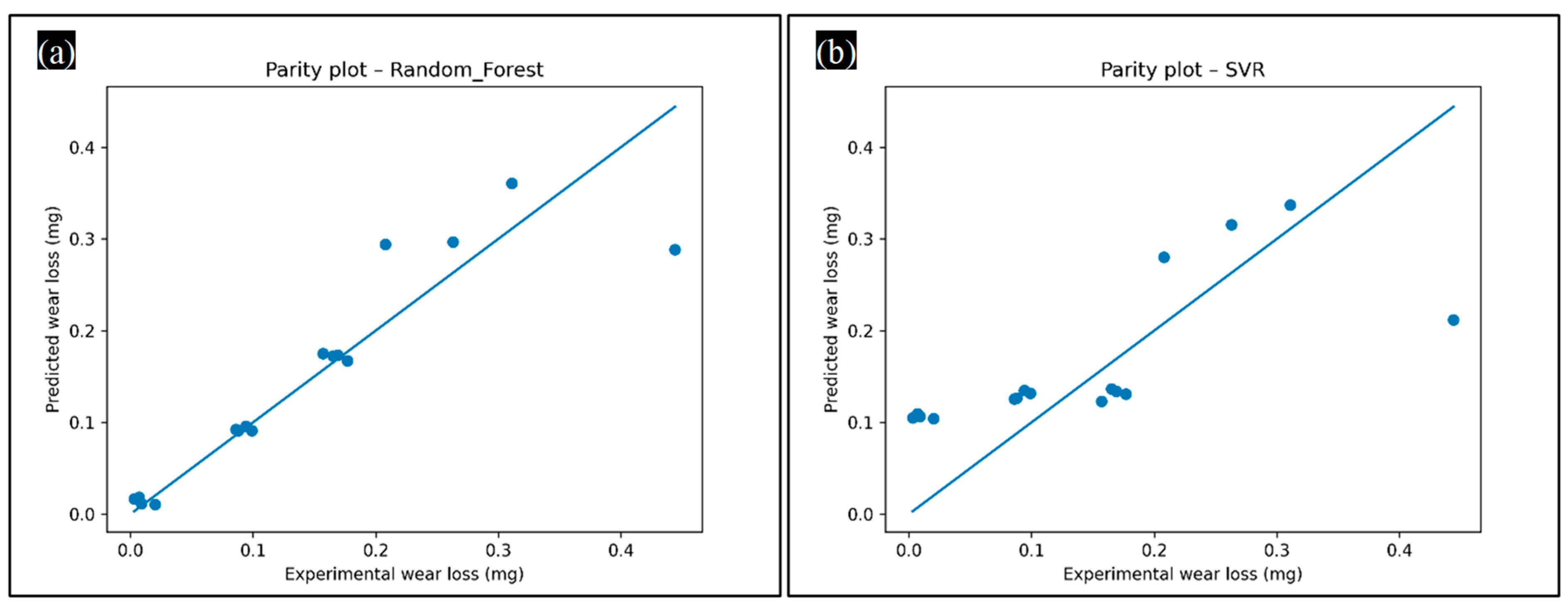
Machine learning regression models were developed to predict wear loss using the combined dataset comprising operating parameters and AFM-derived surface descriptors (Table 1). Given the limited dataset size (16 samples), leave-one-out cross-validation (LOOCV) was adopted to ensure robust and unbiased model evaluation. Representative regression algorithms, including Random Forest (RF) and Support Vector Regression (SVR), were first examined, followed by a comprehensive benchmarking of multiple models. The predictive performance of the ML models is summarized by the coefficient of determination (R2), root mean square error (RMSE) and mean absolute error (MAE). Among the initially examined models, the Random Forest model shows strong predictive performance, achieving an R2 of 0.84, with an RMSE of 0.048 mg and an MAE of 0.026 mg. In contrast, the SVR model yields a lower R2 of 0.50, accompanied by higher RMSE and MAE values. This difference in performance can be attributed to the ability of the Random Forest algorithm to capture nonlinear interactions between operating parameters and surface roughness descriptors, whereas SVR performance is more sensitive to kernel choice and data density. The consistency between LOOCV predictions and experimental trends suggests limited overfitting, although some uncertainty is expected given the small dataset size (n = 16), which is a common concern when ML models are applied to small experimental datasets.
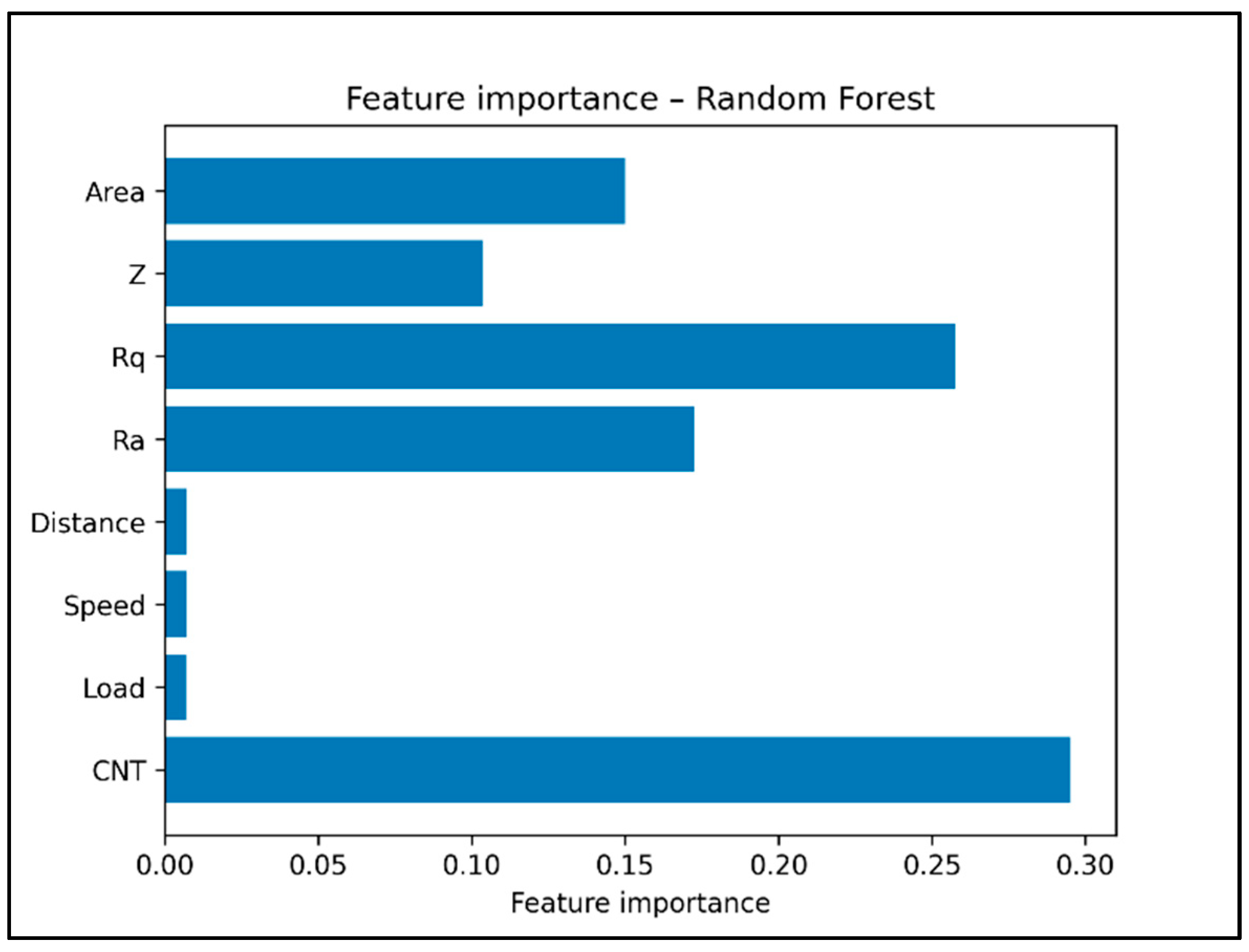
Parity plots comparing experimental and predicted wear loss values for both models are presented in Figure 1a,b. The Random Forest model shows a closer clustering of data points around the ideal parity line, indicating reliable prediction across the full range of wear values. Minor deviations are observed at higher wear levels corresponding to neat epoxy under severe sliding conditions, which is expected due to increased variability in surface damage mechanisms. In contrast, the SVR parity plot exhibits larger scatter, particularly for low-wear regimes associated with higher CNT contents. This suggests that SVR is less effective in capturing the combined influence of surface roughness and operating parameters under low-damage conditions. Figure 2 illustrates the feature importance obtained from the Random Forest model. CNT content emerges as the most influential parameter, followed by AFM-derived surface descriptors, particularly Z-range and Ra, while applied load remains an important but secondary contributor. Notably, AFM-derived surface descriptors (Ra, Rq, Z-range, and surface area difference) collectively contribute significantly to wear prediction, exhibiting comparable importance to conventional operating parameters such as sliding speed and distance.

4.2. Comparative Performance of Machine Learning Models

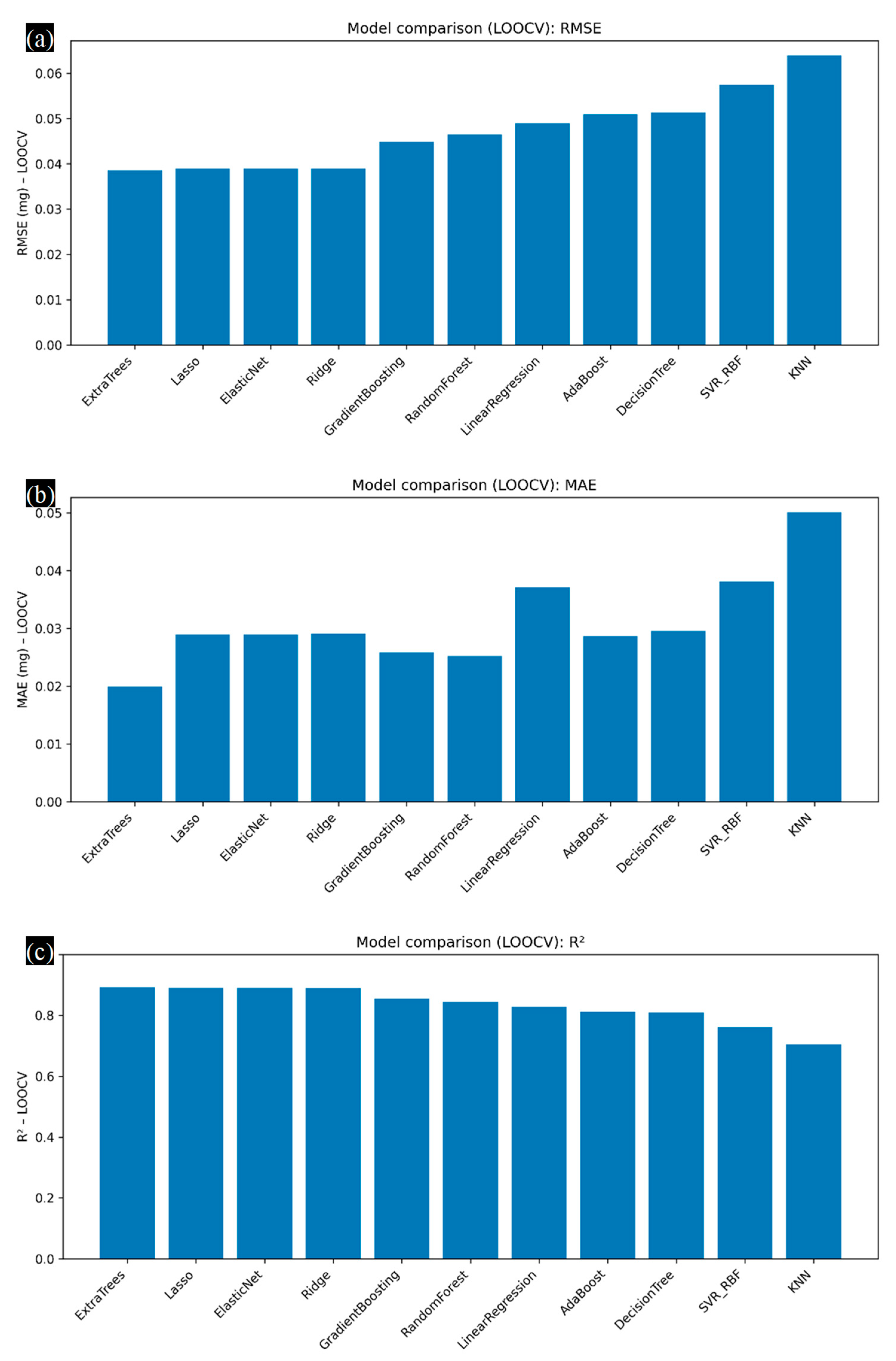
To evaluate the predictive capability of different machine learning algorithms for wear loss prediction, multiple regression models were benchmarked using leave-one-out cross-validation. The comparative performance of the models is summarized in Figure 3a–c, which present the RMSE, MAE, and coefficient of determination (R2), respectively. Figure 3a shows the root mean square error (RMSE) obtained for each model. Ensemble-based models, particularly Extra Trees and Random Forest, exhibit the lowest RMSE values, indicating superior prediction accuracy. Linear models such as Ridge, Lasso, and ElasticNet also demonstrate competitive performance, suggesting that a substantial portion of the wear behavior can be captured through linear combinations of the selected features. In contrast, instance-based and kernel-based models show comparatively higher RMSE values, reflecting their sensitivity to data sparsity and nonlinear feature interactions in small experimental datasets.
The mean absolute error (MAE) comparison in Figure 3b follows a similar trend. Ensemble models consistently yield lower MAE values, indicating reduced average deviation between predicted and experimental wear loss. The close agreement between RMSE and MAE rankings suggests that model errors are uniformly distributed rather than dominated by a few extreme outliers. Figure 3c presents the R2 values for all models, providing insight into the proportion of variance in wear loss explained by each algorithm. The highest R2 values are achieved by the Extra Trees and Random Forest models, confirming their ability to capture nonlinear interactions between operating parameters and surface roughness descriptors. Linear regularized models also show relatively high R2 values, indicating stable and physically meaningful correlations within the dataset. Overall, the benchmarking results demonstrate that ensemble-based regressors provide the most reliable wear predictions for the present dataset, while regularized linear models offer a good balance between prediction accuracy and interpretability. These results establish a robust foundation for subsequent parity and error analysis.

4.3. Parity Analysis of Predicted and Experimental Wear Loss

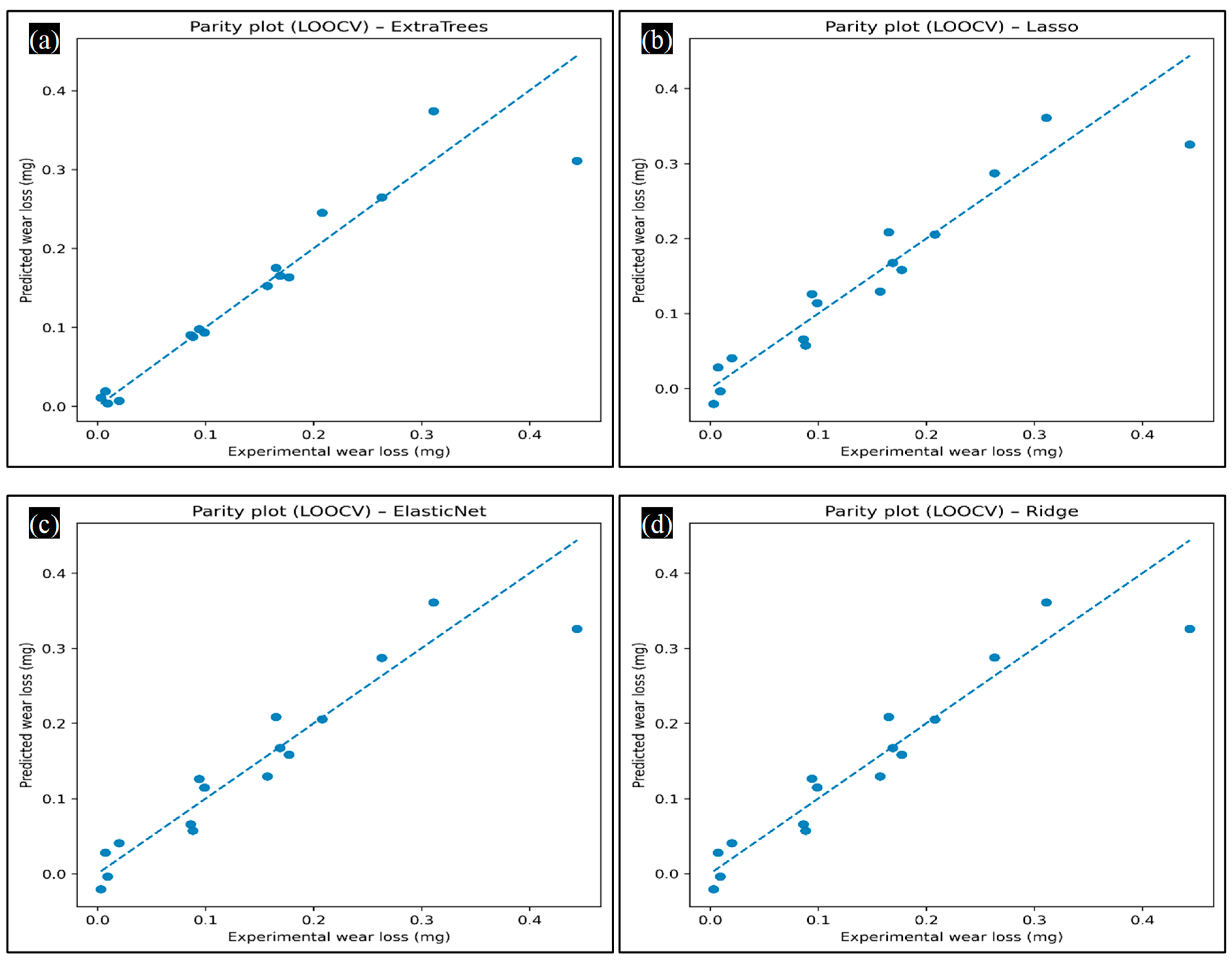
Parity plots are widely used to assess the agreement between predicted and experimentally measured values in regression-based machine learning studies. Figure 4a–d present parity plots for the four best-performing models, Extra Trees, Lasso, ElasticNet, and Ridge, using leave-one-out cross-validation predictions. The parity plot for the Extra Trees model (Figure 4a) shows a close clustering of data points around the ideal parity line, indicating strong agreement between predicted and experimental wear loss across the full range of values. Minor deviations are observed at higher wear loss levels corresponding to the neat epoxy tested under severe sliding conditions. Such deviations are expected due to increased variability in wear mechanisms at high contact stresses, where surface damage becomes more heterogeneous.
Figure 4b–d illustrate parity plots for Lasso, ElasticNet, and Ridge regression models. Despite their linear nature, these models demonstrate reasonably good alignment with the parity line, particularly in the low-to-moderate wear regime associated with CNT-reinforced composites. The slight increase in scatter compared to the Extra Trees model suggests that purely linear models are less effective in capturing higher-order interactions between surface roughness parameters and operating conditions. Nevertheless, their stable behavior and absence of extreme prediction errors indicate that the selected input features retain strong physical relevance. Across all parity plots, no systematic bias toward overprediction or underprediction is observed, confirming the robustness of the modeling framework. The consistency between ensemble-based and regularized linear models further reinforces the reliability of the dataset and validates the integration of AFM-derived surface descriptors into the machine learning pipeline.

4.4. Residual Analysis and Prediction Stability

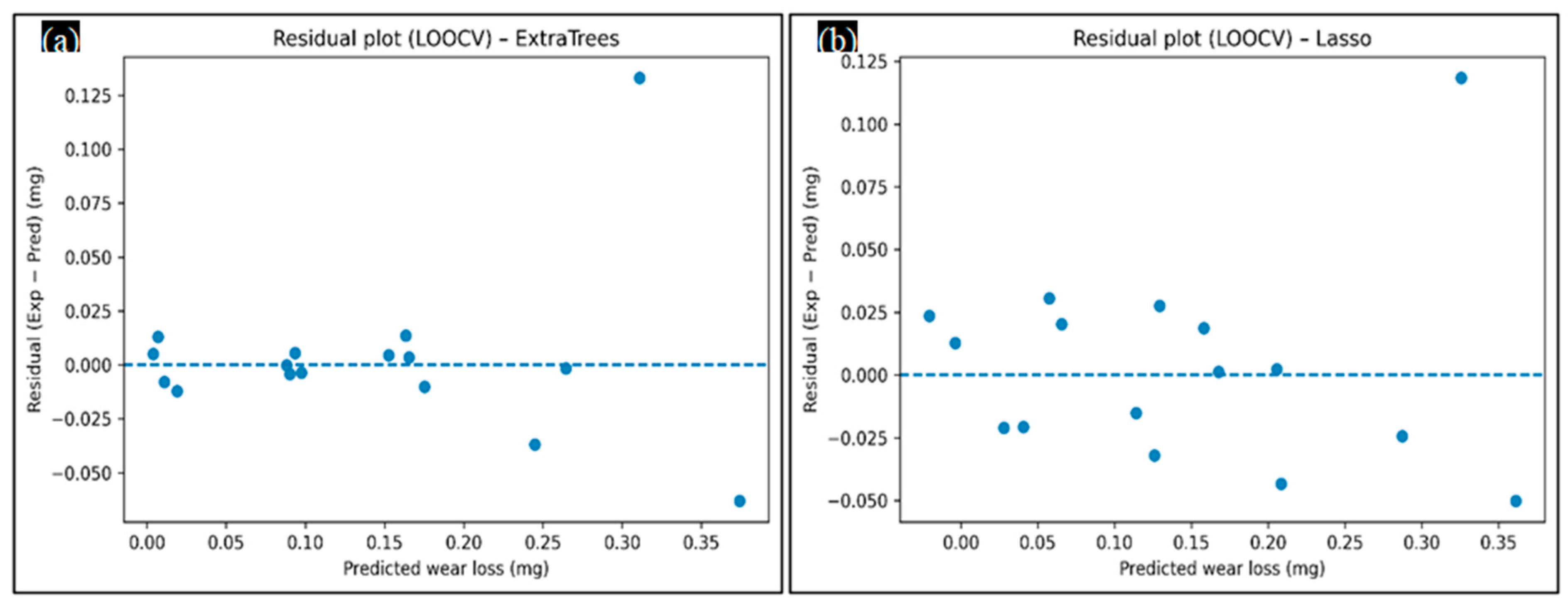
While parity plots provide an overall measure of prediction accuracy, residual analysis offers deeper insight into model reliability by revealing error structure and potential bias. Figure 5a,b present the residual plots for the two best-performing models, Extra Trees and Lasso regression, respectively. For the Extra Trees model (Figure 5a), residuals are symmetrically distributed around zero across the full range of predicted wear loss values, indicating the absence of systematic overprediction or underprediction. Larger residuals are primarily associated with high-wear conditions, particularly neat epoxy tested under severe sliding parameters. This behavior is expected, as wear mechanisms under high load and long sliding distance are inherently more stochastic due to unstable debris formation and localized surface failure. The residual plot for the Lasso model (Figure 5b) exhibits a slightly broader spread, especially at higher wear levels. Nevertheless, residuals remain reasonably centered around zero, confirming that even linear regularized models capture the dominant wear trends without introducing strong bias. The comparison between ensemble-based and linear models reinforces the conclusion that the selected input features, particularly surface roughness descriptors, provide a stable foundation for wear prediction. Overall, the residual analysis confirms that the machine learning models exhibit robust predictive behavior across different operating regimes, with error magnitudes increasing only under extreme wear conditions where experimental variability is naturally higher. The residual spread observed in the prediction errors indicates a reasonable but non-zero uncertainty range, which is typical for small experimental datasets and reflects the inherent variability in tribological measurements.

4.5. Relationship Between Surface Roughness, Operating Parameters, and Wear Behavior

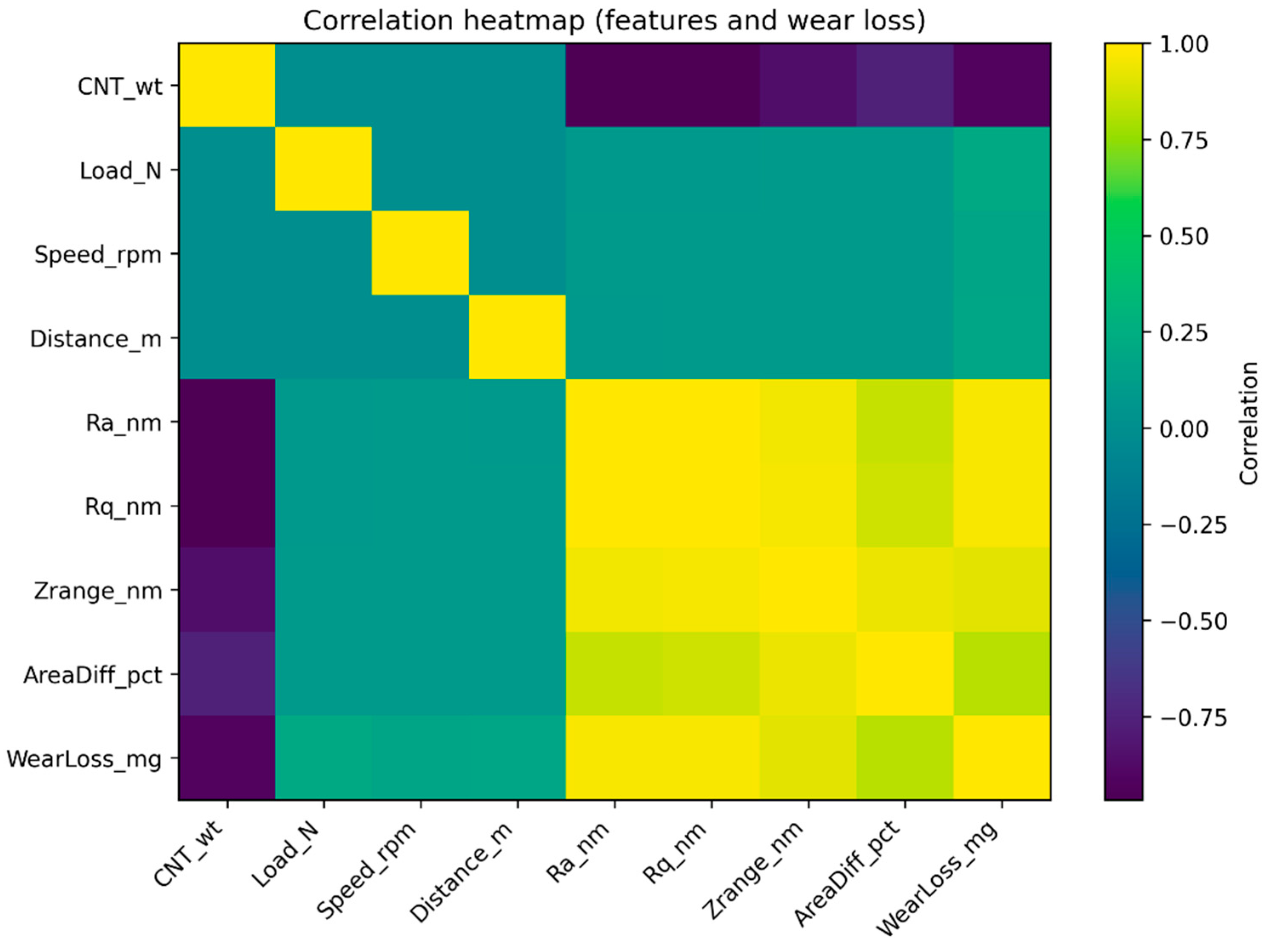
To establish the physical consistency of the machine learning predictions, the relationships between operating parameters, AFM-derived surface descriptors, and wear loss were examined using correlation and multivariate visualization techniques. Figure 6 presents the correlation heatmap constructed from all input variables and the wear response. A strong positive correlation is observed between wear loss and surface roughness parameters, particularly Ra, Rq, and Z-range, confirming that surface damage severity plays a critical role in governing wear behavior. Among these, Z-range exhibits the strongest correlation with wear loss, indicating that peak-to-valley height variation is a sensitive descriptor of material removal and third-body abrasion. Applied load also shows a strong positive correlation with wear loss, reflecting increased contact stress and intensified asperity interaction. In contrast, CNT content exhibits a strong negative correlation with both wear loss and surface roughness parameters, highlighting its effectiveness in stabilizing the sliding interface and suppressing surface degradation. Sliding speed and distance show moderate correlations, suggesting that their influence is primarily indirect, acting through cumulative damage and frictional heating.
AFM-derived roughness descriptors improved both prediction accuracy and interpretability of the models. Unlike operating parameters, these metrics capture the actual wear-evolved surface state. Feature-importance analysis ranked Z-range and Ra among the most influential predictors, and partial dependence plots showed that higher roughness corresponds to higher wear loss. This confirms that AFM descriptors act as physically meaningful links between test conditions and wear response.

4.6. Multivariate Trends and Tribological Consistency

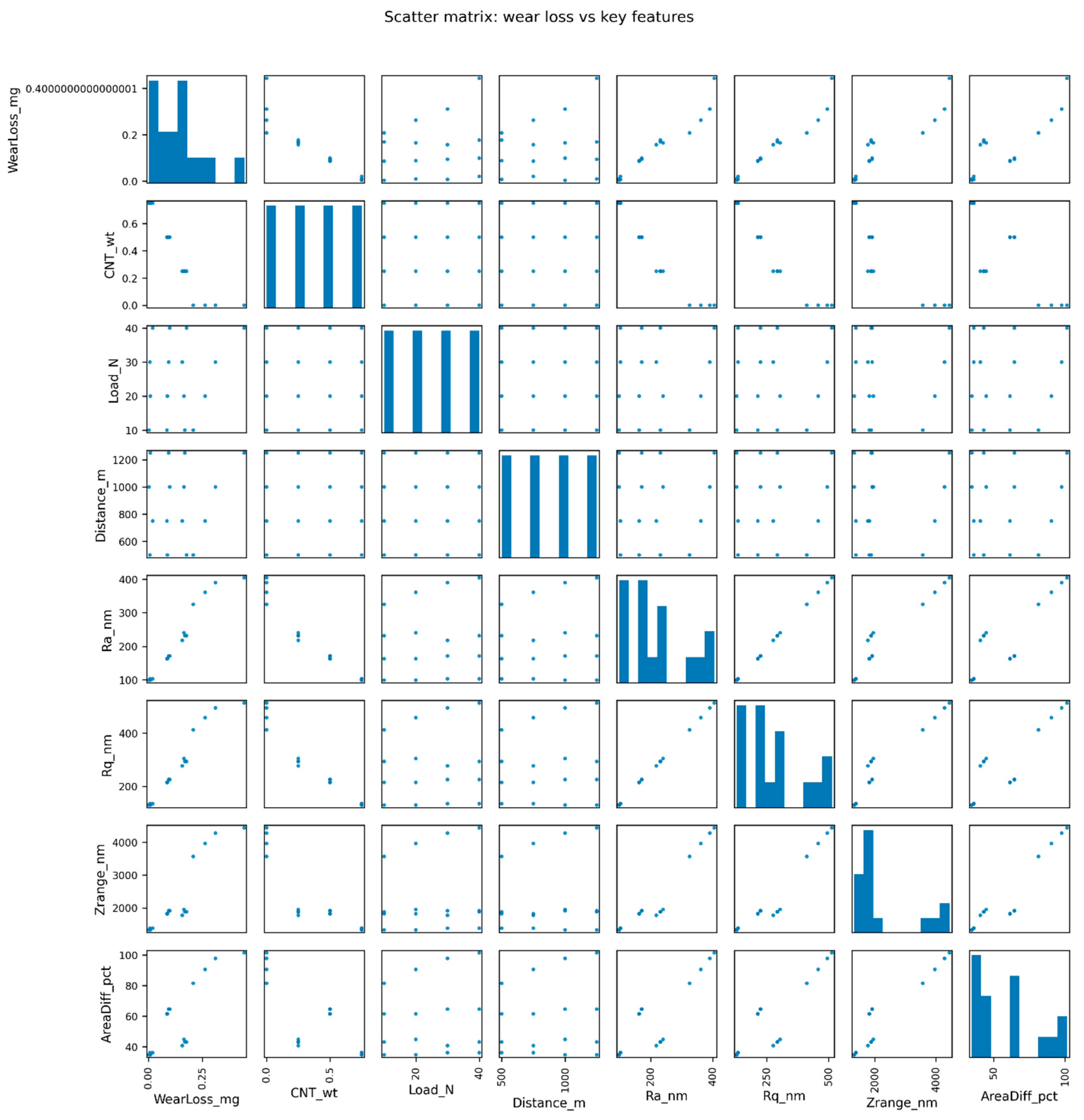
Figure 7 presents a scatter matrix illustrating pairwise relationships among key variables. Clear monotonic trends are evident between wear loss and surface roughness parameters, particularly Ra and Z-range, across all compositions. The clustering of data points according to CNT content further indicates that nanotube reinforcement systematically shifts the system toward a low-wear, low-roughness regime. Importantly, the scatter matrix reveals that CNT-reinforced composites exhibit narrower data dispersion compared to neat epoxy, suggesting more stable surface evolution under varying sliding conditions. This behavior explains why machine learning models achieve higher predictive stability for CNT-containing systems.

4.7. Effect of CNT Content and Load on Wear Behavior

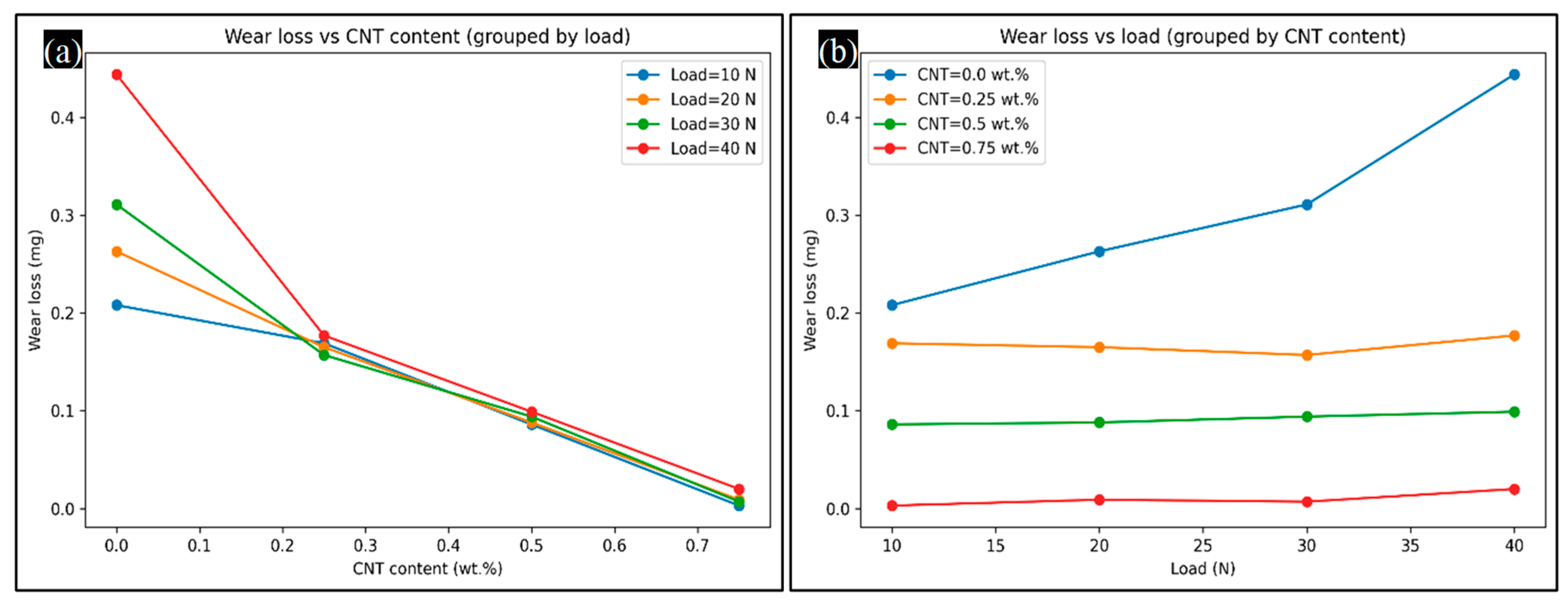
The influence of CNT content and applied load on wear loss is further illustrated in Figure 8a,b. Figure 8a shows wear loss as a function of CNT content for different applied loads. For all load levels, wear loss decreases monotonically with increasing CNT content, confirming the reinforcing and surface-stabilizing role of MWCNTs. The reduction in wear loss is particularly pronounced at higher CNT contents, where the sensitivity to applied load is significantly reduced. Figure 8b presents wear loss as a function of applied load for different CNT contents. Neat epoxy exhibits a steep increase in wear loss with increasing load, whereas CNT-reinforced composites display a more gradual increase. This behavior reflects improved load-sharing capability and reduced surface damage in CNT-containing systems. Together, these figures provide classical tribological validation of the dataset and reinforce the physical basis of the machine learning predictions.

4.8. Three-Dimensional Interaction Effects

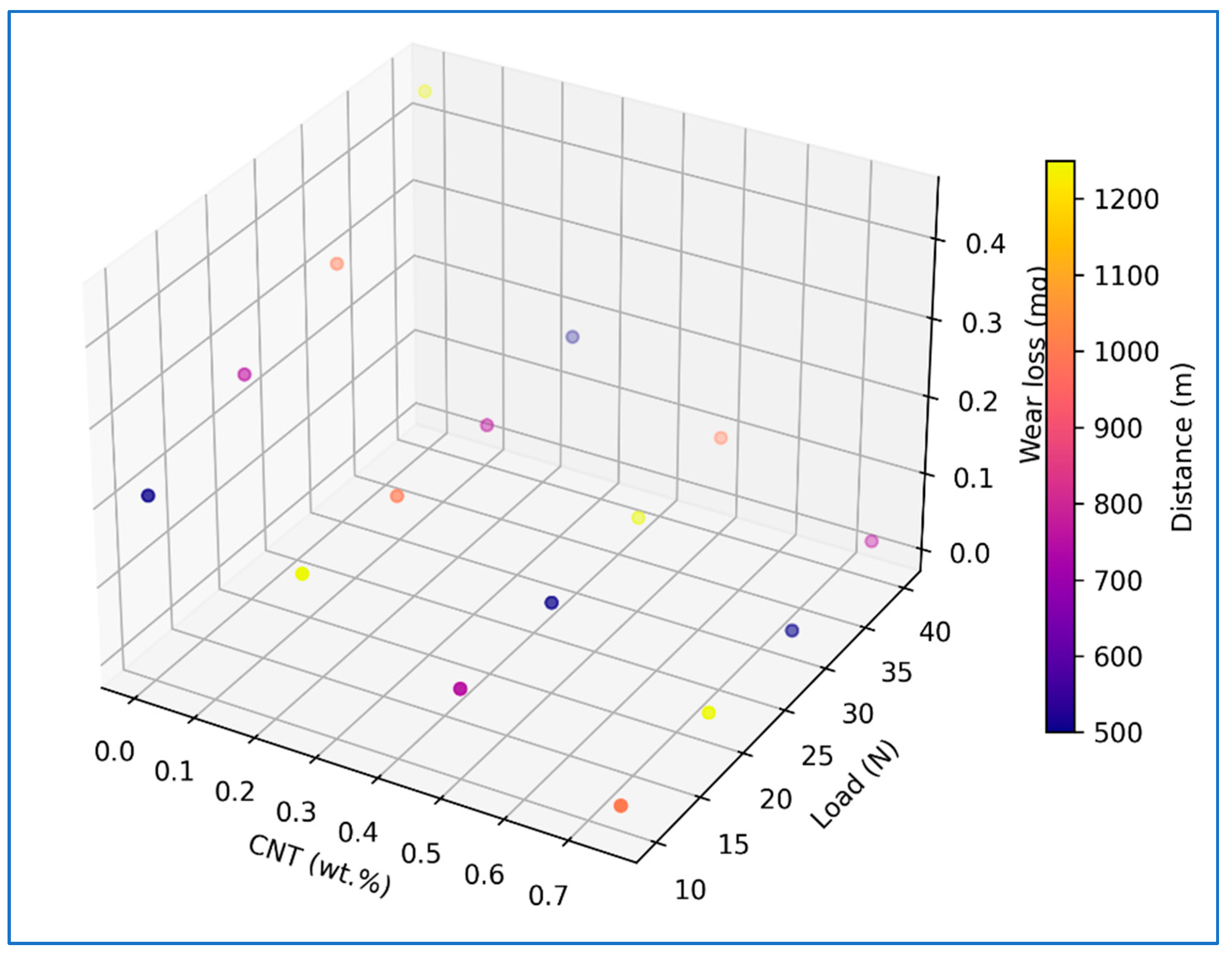
To visualize higher-order interactions between composition, contact conditions, and wear response, a three-dimensional scatter plot is presented in Figure 9. The figure illustrates wear loss as a function of CNT content and applied load, with sliding distance represented by the color scale. The highest wear loss is observed at low CNT content and high load, particularly for longer sliding distances. Increasing CNT content shifts the system toward a low-wear regime even under relatively severe sliding conditions, highlighting the effectiveness of CNT reinforcement in mitigating cumulative damage effects. This three-dimensional visualization provides an intuitive representation of the multivariate design space explored in this study and complements the two-dimensional trend analyses.

4.9. Feature Importance and Mechanistic Interpretation

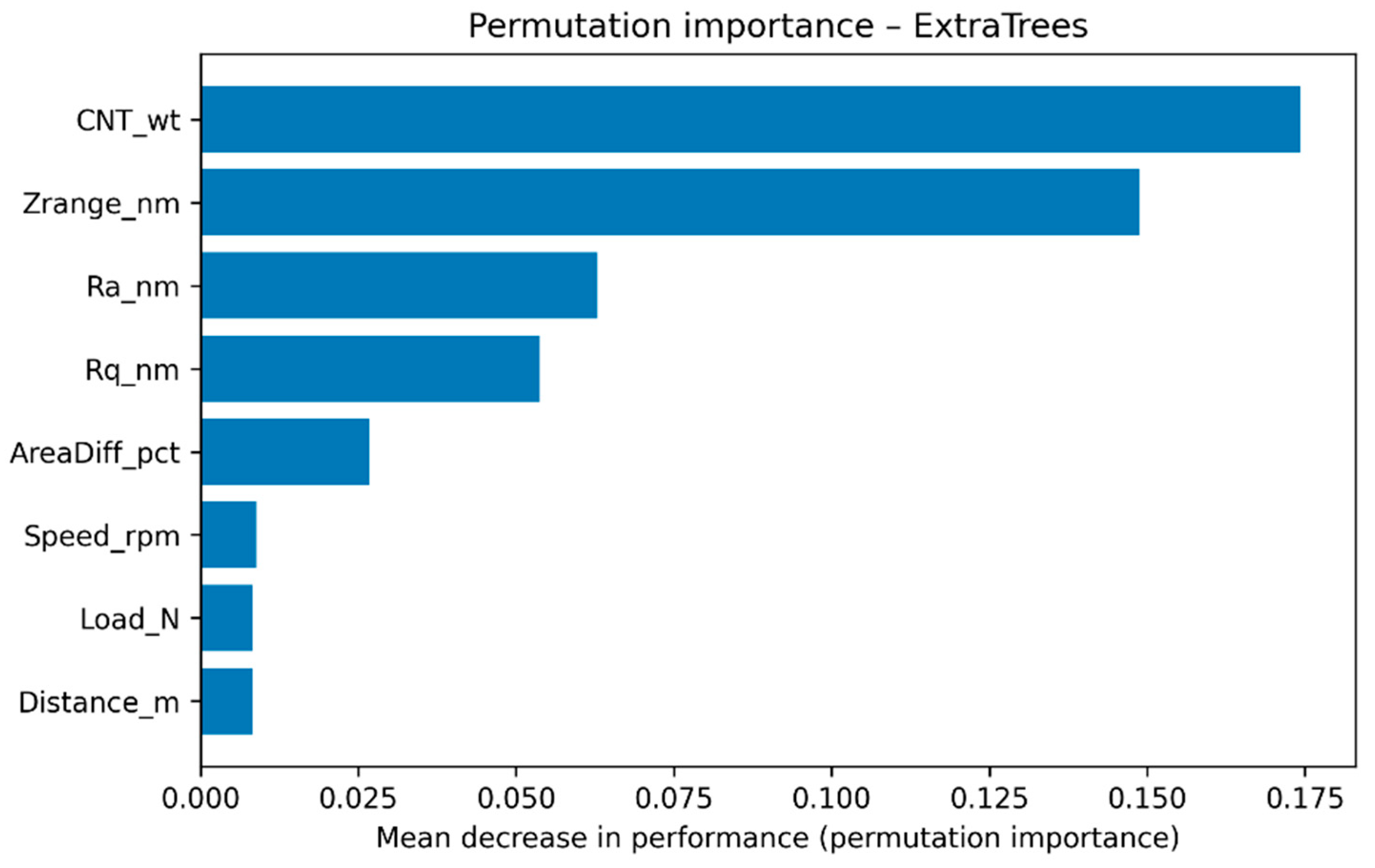
To identify the most influential parameters governing wear prediction, permutation-based feature importance analysis was performed for the best-performing model. The resulting importance ranking is shown in Figure 10. CNT content emerges as the most influential feature, reflecting its central role in reinforcing the epoxy matrix and stabilizing surface evolution. Surface roughness descriptors, particularly Z-range and Ra, also exhibit high importance, confirming that surface height variation and asperity damage strongly influence wear loss. Rq and surface area difference contribute to a lesser extent but remain physically meaningful descriptors of surface morphology. The prominence of surface roughness parameters in the importance ranking demonstrates that the machine learning model captures mechanistically relevant information rather than relying solely on externally imposed operating conditions.

4.10. Partial Dependence Analysis of Dominant Features

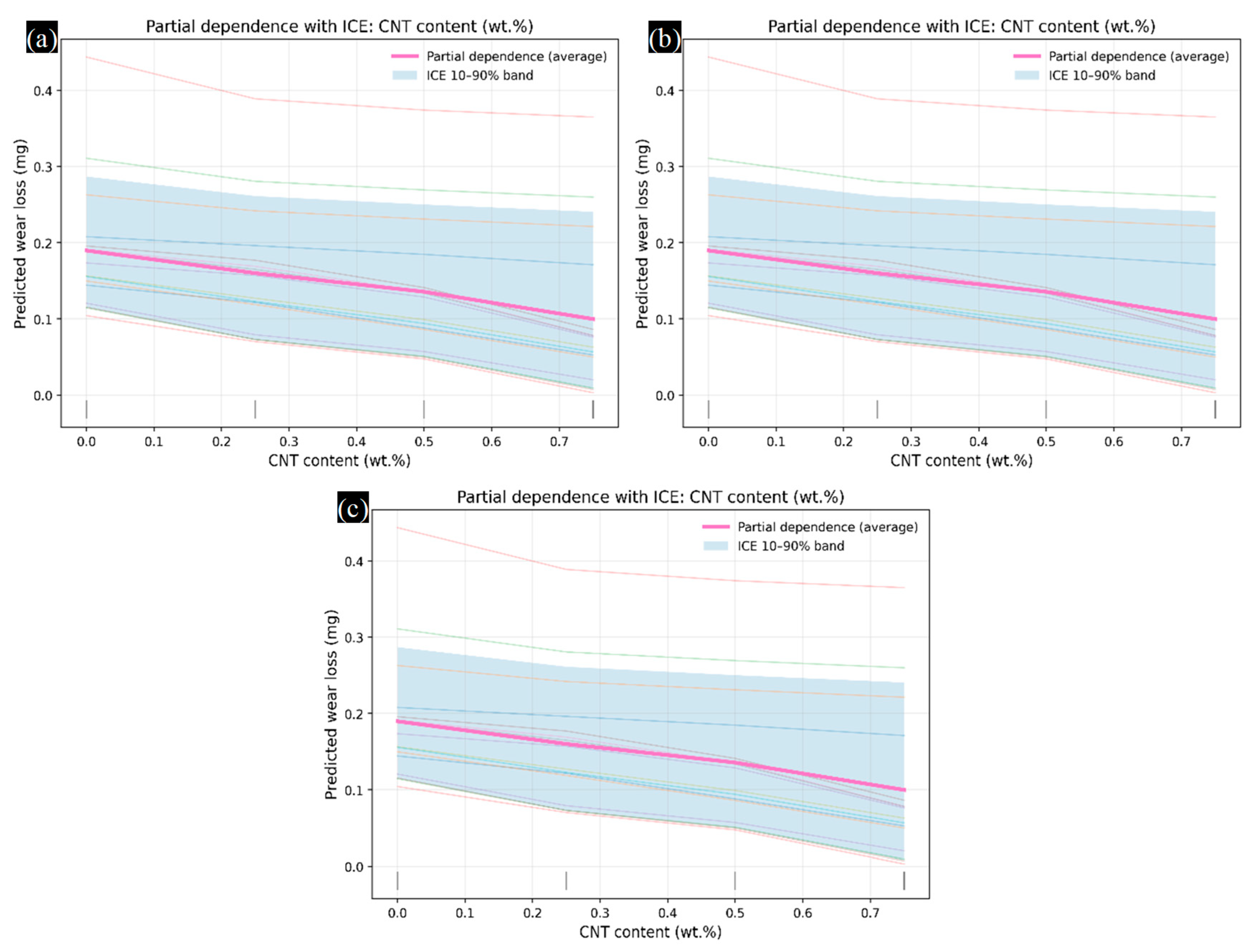
Partial dependence plots were employed to elucidate how individual features influence wear loss while averaging out the effects of other variables. Figure 11a–c present partial dependence plots for CNT content, Z-range, and Ra, respectively, augmented with individual conditional expectation (ICE) curves to illustrate prediction variability across different experimental conditions. Figure 11a shows a nonlinear decrease in wear loss with increasing CNT content, with a pronounced reduction beyond approximately 0.5 wt.% CNT. While the average trend indicates improved wear resistance at higher CNT contents, the spread of ICE curves at lower CNT levels reflects greater variability in surface damage under severe sliding conditions. At higher CNT contents, the convergence of ICE curves indicates a more stable and predictable wear response. Figure 11b reveals a strong positive dependence of wear loss on Z-range, demonstrating that peak-to-valley surface height variation is a dominant contributor to material removal. The relatively narrow uncertainty band over most of the Z-range domain suggests that Z-range is a robust descriptor of wear severity across different operating conditions. Figure 11c presents a similar increasing trend between Ra and wear loss. Compared to Z-range, a slightly broader spread of ICE curves is observed, indicating that average roughness captures surface damage severity but is somewhat more sensitive to variations in sliding conditions and debris formation.
Overall, the partial dependence analysis confirms that CNT content primarily governs wear mitigation through surface stabilization, while AFM-derived roughness parameters, particularly Z-range and Ra, control wear progression by capturing the extent of asperity damage and surface height variation. The combined trends and variability illustrated in Figure 11a–c demonstrate that the machine learning model learns physically meaningful relationships rather than relying on spurious correlations.

4.11. Run-Wise Comparison of Experimental and Predicted Wear Loss

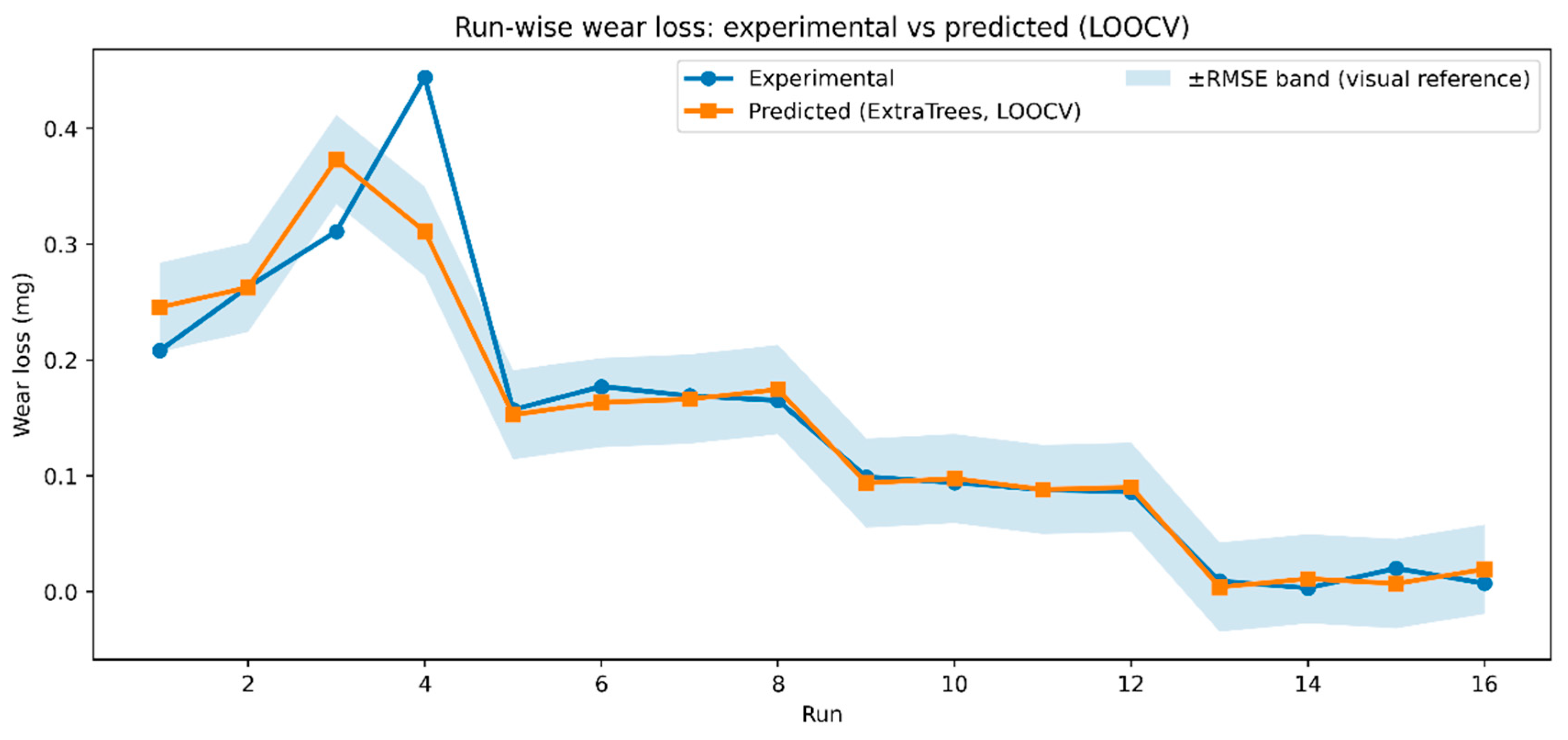
Figure 12 presents a run-wise comparison between experimentally measured wear loss and corresponding predictions obtained using leave-one-out cross-validation. The predicted values closely follow the experimental trend across all sixteen runs, indicating strong agreement between model output and measured data. Slight deviations are observed for high-severity runs involving neat epoxy, which is attributed to the inherently unstable wear mechanisms under extreme contact conditions. Importantly, CNT-reinforced composites exhibit close agreement across all runs, further confirming that CNT addition enhances not only wear resistance but also the predictability of tribological behavior.

4.12. Three-Dimensional Response Surface Analysis of Operating Parameters

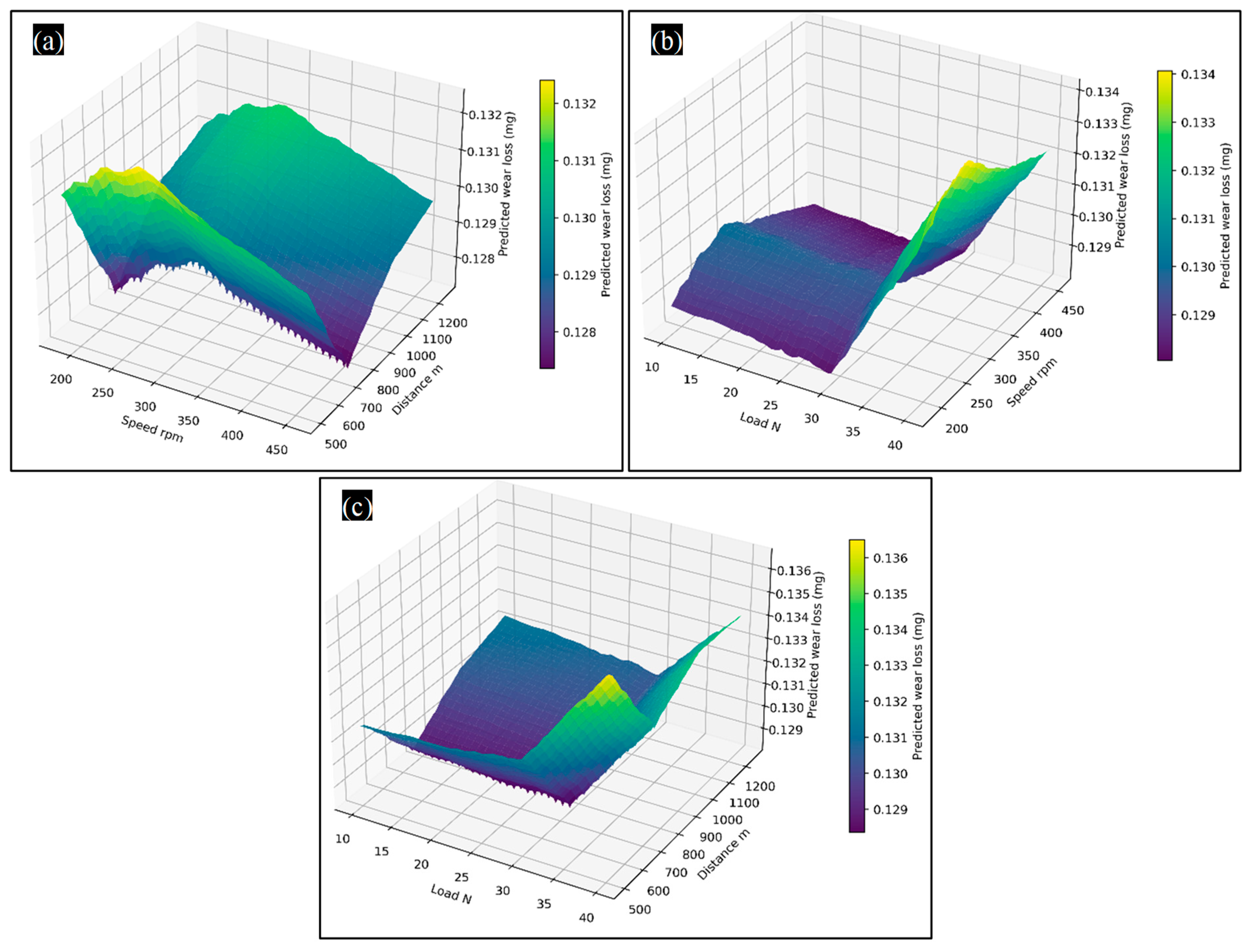
Three-dimensional response surface plots were developed to examine the combined influence of sliding speed, sliding distance, and applied load on wear loss while fixing CNT content at an intermediate level (CNT wt.% ≈ 0.375). These surfaces were generated using the trained ensemble regression model and provide a continuous representation of wear behavior within the experimentally explored domain. Figure 13a illustrates the interaction between sliding speed and sliding distance at a fixed load of approximately 25 N. Wear loss increases gradually with increasing sliding distance, indicating cumulative material removal with prolonged sliding, while the influence of sliding speed remains relatively moderate within the investigated range. This suggests that wear progression under reinforced epoxy conditions is governed primarily by sliding exposure rather than velocity.
Figure 13b presents the load–speed interaction at a fixed sliding distance of approximately 875 m. A pronounced increase in wear loss with increasing load is evident, confirming applied load as a dominant factor controlling contact stress and surface damage. The effect of speed becomes more noticeable at higher loads, indicating a secondary interaction that intensifies wear once critical stress levels are exceeded. Figure 13c shows the combined effect of load and sliding distance. Wear loss increases strongly with load across all distances, with the highest wear occurring at the simultaneous combination of high load and long sliding distance. This trend reflects the synergistic influence of increased contact stress and cumulative sliding, leading to accelerated surface degradation.

5. Conclusions

This study establishes a surface-aware triboinformatics framework for predicting the dry sliding wear behavior of MWCNT-reinforced epoxy composites by explicitly integrating operating parameters with run-wise AFM-derived surface roughness descriptors. Systematic wear testing based on a Taguchi L16 design demonstrated that CNT reinforcement plays a decisive role in stabilizing surface evolution and mitigating material loss under sliding conditions. In particular, neat epoxy showed wear losses in the range of 0.208–0.444 mg, whereas the 0.75 wt.% MWCNT composite exhibited much lower values of 0.003–0.02 mg depending on operating conditions, corresponding to reductions greater than 95%. This improvement was accompanied by marked reductions in surface roughness, with Ra decreasing from ~325–405 nm to ~99–103 nm and Z-range reducing from ~3567–4439 nm to ~1325–1378 nm, indicating effective suppression of asperity damage and severe surface deformation. Machine learning models trained using leave-one-out cross-validation exhibited strong predictive performance despite the limited experimental dataset. Ensemble-based regressors outperformed linear and kernel-based approaches, achieving coefficients of determination of up to R2 ≈ 0.90–0.95, with RMSE values below ~0.03 mg and MAE values on the order of ~0.02 mg for wear loss prediction. Comparative benchmarking across models confirmed the robustness of the developed framework and highlighted the advantage of ensemble learning in capturing nonlinear tribological interactions.
Feature-importance analysis consistently identified CNT wt.% as the most influential parameter governing wear behavior, followed by AFM-derived Z-range and Ra, while applied load emerged as a secondary but still significant contributor. Partial dependence analysis further revealed nonlinear trends, showing a sharp decrease in wear loss with increasing CNT content and increasing surface damage severity, thereby confirming that wear progression is jointly controlled by CNT-induced reinforcement and surface morphology evolution rather than operating parameters alone. By treating surface morphology as a first-class input rather than a post hoc descriptor, the proposed framework advances beyond conventional parameter-driven wear prediction approaches and delivers physically interpretable, mechanism-consistent insights. From a sustainability perspective, these findings directly support SDG 9 (Industry, Innovation and Infrastructure) through data-enabled materials engineering and SDG 12 (Responsible Consumption and Production) by promoting extended component lifetimes, reduced wear-induced failures, and more efficient utilization of polymer-based tribological materials.

Author Contributions

Conceptualization, P.H.; Methodology, P.H. and S.S.H.; Software, K.K., S.S., S.S.H. and A.H.S.; Validation, A.H.S.; Formal analysis, K.K., S.S. and S.K.; Investigation, K.K., S.S. and S.K.; Resources, J.P.K. and A.H.S.; Data curation, K.K., J.P.K., S.K. and A.H.S.; Writing—original draft, K.K.; Writing—review & editing, P.H.; Visualization, J.P.K. and S.S.H.; Supervision, P.H.; Project administration, P.H. All authors have read and agreed to the published version of the manuscript.

Funding

The authors declare that no specific funding was received for this work.

Institutional Review Board Statement

This study does not involve human participants or animals and therefore does not require ethical approval.

Data Availability Statement

The datasets generated and analyzed during the current study are available from the corresponding author upon reasonable request.

Conflicts of Interest

The authors declare that they have no known competing financial interests or personal relationships that could have appeared to influence the work reported in this paper.

Abbreviations

The following abbreviations are used in this manuscript:
AFMAtomic Force Microscopy
ANNArtificial Neural Network
CNTCarbon Nanotube
COFCoefficient of Friction
DoEDesign of Experiments
ETExtra Trees (regression)
LOOCVLeave-One-Out Cross-Validation
MAEMean Absolute Error
MLMachine Learning
MWCNTMulti-Walled Carbon Nanotube
PDPPartial Dependence Plot
RaArithmetic Average Surface Roughness
RqRoot Mean Square Surface Roughness
RFRandom Forest
RMSERoot Mean Square Error
R2Coefficient of Determination
SDGSustainable Development Goal
SEMScanning Electron Microscopy
SVRSupport Vector Regression

References

  1. Ren, Y.; Zhang, L.; Xie, G.; Li, Z.; Chen, H.; Gong, H.; Xu, W.; Guo, D.; Luo, J. A review on tribology of polymer composite coatings. Friction 2021, 9, 429–470. [Google Scholar] [CrossRef]
  2. Aziz, T.; Haq, F.; Farid, A.; Cheng, L.; Chuah, L.F.; Bokhari, A.; Mubashir, M.; Tang, D.Y.Y.; Show, P.L. The epoxy resin system: Function and role of curing agents. Carbon Lett. 2024, 34, 477–494. [Google Scholar] [CrossRef]
  3. Liu, J.; Zhang, L.; Shun, W.; Dai, J.; Peng, Y.; Liu, X. Recent development on bio-based thermosetting resins. J. Polym. Sci. 2021, 59, 1474–1490. [Google Scholar] [CrossRef]
  4. Dhairiyasamy, R.; Bassi, W.; Algethami, A.A.; Saleh, B.; Jaganathan, S.; Varshney, D.; Singh, S. Advanced epoxy composites for tribological Applications: Investigating the role of hybrid ceramic and lubricant fillers. Polym. Test. 2025, 150, 108932. [Google Scholar] [CrossRef]
  5. Kumar, S.S.; Shyamala, P.; Pati, P.R.; Mishra, D.K.; Sharma, V.; Tank, G.; Kanan, M. Investigation and machine learning-based prediction of mechanical properties in hybrid natural fiber composites. Sci. Rep. 2025, 15, 33700. [Google Scholar] [CrossRef]
  6. Shukla, M.K.; Sharma, K. Effect of Carbon Nanofillers on the Mechanical and Interfacial Properties of Epoxy Based Nanocomposites: A Review. Polym. Sci. Ser. A 2019, 61, 439–460. [Google Scholar] [CrossRef]
  7. Sallakhniknezhad, R.; Ahmadian, H.; Zhou, T.; Weijia, G.; Anantharajan, S.K.; Sadoun, A.M.; Abdelfattah, W.M.; Fathy, A. Recent Advances and Applications of Carbon Nanotubes (CNTs) in Machining Processes: A Review. J. Manuf. Mater. Process. 2024, 8, 282. [Google Scholar] [CrossRef]
  8. Leena, S.; Nanoth, R.; Karingamanna, J.; B, S.N.; Bhagavatula, S.G.K.; Rajan, K.P.; Gopanna, A. Investigations on morphology, tribology, rheology, thermo-mechanical properties, and EMI shielding of WC/MWCNT nanohybrids in polypropylene. J. Reinf. Plast. Compos. 2025, 44, 1603–1631. [Google Scholar] [CrossRef]
  9. Duan, K.; Li, L.; Wang, F.; Liu, S.; Hu, Y.; Wang, X. New insights into interface interactions of CNT-reinforced epoxy nanocomposites. Compos. Sci. Technol. 2021, 204, 108638. [Google Scholar] [CrossRef]
  10. Agrawal, S.; Singh, N.; Singh, Y.; Upadhyay, R. Tribological study and parameters optimisation of CNT added glass fibre reinforced polymer composite sliding under inert environment. Adv. Mater. Process. Technol. 2023, 9, 1283–1298. [Google Scholar] [CrossRef]
  11. Boublia, A.; Lebouachera, S.E.I.; Haddaoui, N.; Guezzout, Z.; Ghriga, M.A.; Hasanzadeh, M.; Benguerba, Y.; Drouiche, N. State-of-the-art review on recent advances in polymer engineering: Modeling and optimization through response surface methodology approach. Polym. Bull. 2023, 80, 5999–6031. [Google Scholar] [CrossRef]
  12. Choudhari, A.; Gupta, A.K.; Kumar, A.; Kumar, A.; Gupta, A.; Chowdhury, N.; Kumar, A. Wear and Friction Mechanism Study in Knee and Hip Rehabilitation: A Comprehensive Review. In Applications of Biotribology in Biomedical Systems; Springer Nature Switzerland: Cham, Switzerland, 2024; pp. 345–432. [Google Scholar]
  13. Olejnik, P.; Desta, Y.D. Friction-induced interactions: Acoustic emissions, vibrations, and wear—A multiscale review. Nonlinear Dyn. 2025, 113, 24101–24140. [Google Scholar] [CrossRef]
  14. Paturi, U.M.R.; Palakurthy, S.T.; Reddy, N.S. The Role of Machine Learning in Tribology: A Systematic Review. Arch. Comput. Methods Eng. 2023, 30, 1345–1397. [Google Scholar] [CrossRef]
  15. Sose, A.T.; Joshi, S.Y.; Kunche, L.K.; Wang, F.; Deshmukh, S.A. A review of recent advances and applications of machine learning in tribology. Phys. Chem. Chem. Phys. 2023, 25, 4408–4443. [Google Scholar] [CrossRef]
  16. Marian, M.; Tremmel, S. Current Trends and Applications of Machine Learning in Tribology—A Review. Lubricants 2021, 9, 86. [Google Scholar] [CrossRef]
  17. Singh, K.S.K.; Kumar, S.; Singh, K.K. Computational data-driven based optimization of tribological performance of graphene filled glass fiber reinforced polymer composite using machine learning approach. Mater. Today Proc. 2022, 66, 3838–3846. [Google Scholar] [CrossRef]
  18. Sharma, H.; Arora, G.; Singh, M.K.; Ayyappan, V.; Bhowmik, P.; Rangappa, S.M.; Siengchin, S. Review of machine learning approaches for predicting mechanical behavior of composite materials. Discov. Appl. Sci. 2025, 7, 1238. [Google Scholar] [CrossRef]
  19. Huang, J.-C.; Ko, K.-M.; Shu, M.-H.; Hsu, B.-M. Application and comparison of several machine learning algorithms and their integration models in regression problems. Neural Comput. Appl. 2020, 32, 5461–5469. [Google Scholar] [CrossRef]
  20. Karuppusamy, M.; Thirumalaisamy, R.; Palanisamy, S.; Nagamalai, S.; El Sayed Massoud, E.; Ayrilmis, N. A review of machine learning applications in polymer composites: Advancements, challenges, and future prospects. J. Mater. Chem. A 2025, 13, 16290–16308. [Google Scholar] [CrossRef]
  21. Florea, V.A.; Toderaș, M.; Danciu, C. The Influence of Roughness of Surfaces on Wear Mechanisms in Metal–Rock Interactions. Coatings 2025, 15, 150. [Google Scholar] [CrossRef]
  22. Çevik, Z.A.; Sarıışık, G. A Machine Learning-Driven Optimization of Machining Parameters for Nanoclay-Glass Fiber Polymer-Reinforced Composites for Performance Prediction and Process Enhancement. J. Tribol. 2025, 147, 091117. [Google Scholar] [CrossRef]
  23. Nguyen, T.A.; Bui, T.T.T.; Nguyen, T.H.; Dam, X.T.; Dang, H.T. Artificial intelligence-assisted design of green-chemically treated banana fiber/epoxy composites for enhanced mechanical and fire-resistant performance. Polym. Bull. 2026, 83, 94. [Google Scholar] [CrossRef]
  24. Tian, J.; Qi, X.; Li, C.; Xian, G. Friction behaviors and wear mechanisms of multi-filler reinforced epoxy composites under dry and wet conditions: Effects of loads, sliding speeds, temperatures, water lubrication. Tribol. Int. 2023, 179, 108148. [Google Scholar] [CrossRef]
  25. Sulong, A.B.; Park, J.; Lee, N.; Goak, J. Wear Behavior of Functionalized Multi-walled Carbon Nanotube Reinforced Epoxy Matrix Composites. J. Compos. Mater. 2006, 40, 1947–1960. [Google Scholar] [CrossRef]
  26. Cui, L.-J.; Geng, H.-Z.; Wang, W.-Y.; Chen, L.-T.; Gao, J. Functionalization of multi-wall carbon nanotubes to reduce the coefficient of the friction and improve the wear resistance of multi-wall carbon nanotube/epoxy composites. Carbon 2013, 54, 277–282. [Google Scholar] [CrossRef]
  27. Mucha, M.; Krzyzak, A.; Kosicka, E.; Coy, E.; Kościński, M.; Sterzyński, T.; Sałaciński, M. Effect of MWCNTs on Wear Behavior of Epoxy Resin for Aircraft Applications. Materials 2020, 13, 2696. [Google Scholar] [CrossRef]
  28. Tong, Z.; Du, J.; Li, X.; Liu, Z.; Yan, C.; Lei, W. Fabrication and Tribological Properties of Epoxy Nanocomposites Reinforced by MoS2 Nanosheets and Aligned MWCNTs. Materials 2024, 17, 4745. [Google Scholar] [CrossRef]
  29. Zhang, L.; Xie, G.; Wu, S.; Peng, S.; Zhang, X.; Guo, D.; Wen, S.; Luo, J. Ultralow friction polymer composites incorporated with monodispersed oil microcapsules. Friction 2021, 9, 29–40. [Google Scholar] [CrossRef]
  30. Yang, K.; Niu, Y.; Li, Y.; Wang, X.; Du, S.; Zhang, Y. Preparation of double-core microcapsules and tribological properties of epoxy composites. Tribol. Int. 2023, 186, 108597. [Google Scholar] [CrossRef]
  31. Yang, K.; Niu, Y.; Wang, X.; Du, S.; Zhang, Y.; Zhang, J.; Cai, J. Self-lubricating epoxy composite coating with linseed oil microcapsule self-healing functionality. J. Appl. Polym. Sci. 2024, 141, e54927. [Google Scholar] [CrossRef]
  32. Upadhyay, R.K.; Kumar, A. Effect of humidity on the synergy of friction and wear properties in ternary epoxy-graphene-MoS2 composites. Carbon 2019, 146, 717–727. [Google Scholar] [CrossRef]
  33. Mahmood, O.A. Modeling and optimization of the tribological properties of an epoxy resin reinforced with nano graphene oxide nano Al2O3/MoS2 particles by RSM. AIMS Mater. Sci. 2025, 12, 1107–1125. [Google Scholar] [CrossRef]
  34. Borjali, A.; Monson, K.; Raeymaekers, B. Predicting the polyethylene wear rate in pin-on-disc experiments in the context of prosthetic hip implants: Deriving a data-driven model using machine learning methods. Tribol. Int. 2019, 133, 101–110. [Google Scholar] [CrossRef] [PubMed]
  35. Jayasinghe, R.; Ramezani, M. AI-powered prediction of friction and wear in functionalized Epoxy-MWCNT composites. Wear 2025, 582–583, 206333. [Google Scholar] [CrossRef]
  36. Hasan, M.S.; Nosonovsky, M. Triboinformatics: Machine learning algorithms and data topology methods for tribology. Surf. Innov. 2022, 10, 229–242. [Google Scholar] [CrossRef]
  37. Hiremath, P.; Ranjan, R.; DeSouza, V.; Bhat, R.; Patil, S.; Maddodi, B.; Shivamurthy, B.; Perez, T.C.; Naik, N. Enhanced Wear Resistance in Carbon Nanotube-Filled Bio-Epoxy Composites: A Comprehensive Analysis via Scanning Electron Microscopy and Atomic Force Microscopy. J. Compos. Sci. 2023, 7, 478. [Google Scholar] [CrossRef]
Figure 1. Parity plots: (a) Random Forest parity plot; (b) SVR parity plot.
Jcs 10 00113 g001
Figure 2. Random Forest feature importance plot.
Jcs 10 00113 g002
Figure 3. Comparison across machine learning models: (a) RMSE; (b) MAE; (c) R2.
Jcs 10 00113 g003
Figure 4. Parity plots: (a) Extra Trees regression; (b) Lasso regression; (c) ElasticNet regression; (d) Ridge regression.
Jcs 10 00113 g004
Figure 5. Residual plots: (a) Extra Trees regression; (b) Lasso regression.
Jcs 10 00113 g005
Figure 6. Correlation heatmap of operating parameters, surface roughness descriptors, and wear loss.
Jcs 10 00113 g006
Figure 7. Scatter matrix showing multivariate relationships between wear loss, operating parameters, and AFM roughness metrics.
Jcs 10 00113 g007
Figure 8. Wear behavior: (a) Wear loss vs. CNT content at different applied loads; (b) Wear loss vs. applied load at different CNT contents.
Jcs 10 00113 g008
Figure 9. Three-dimensional plot of wear loss as a function of CNT content and load, colored by sliding distance.
Jcs 10 00113 g009
Figure 10. Permutation-based feature importance ranking for the best-performing model.
Jcs 10 00113 g010
Figure 11. Partial dependence of wear loss: (a) CNT content; (b) Z–range; (c) Ra.
Jcs 10 00113 g011
Figure 12. Run-wise comparison of experimental and predicted wear loss.
Jcs 10 00113 g012
Figure 13. Three-dimensional response surfaces of predicted wear loss showing parameter interactions: (a) speed—distance, (b) load—speed, and (c) load—distance.
Jcs 10 00113 g013
Table 1. Combined wear test parameters, surface roughness descriptors, and wear loss data used for machine learning analysis.
RunCNT wt.%Load (N)Speed (rpm)Distance (m)SeverityRa (nm)Rq (nm)Z-Range (nm)Area Diff. (%)Wear Loss (mg)
1010183500L324.9412.2356781.50.208
2020275750M361458396390.60.263
30303671000H389.9494.6428097.80.311
40404581250VH404.35134439101.50.444
50.2530183750M218277177240.70.157
60.2540275500H231.1293.6187843.10.177
70.25103671250H231.1293.6187843.10.169
80.25204581000VH239.8304.7194944.80.165
90.5401831000H171.2225.8191064.60.099
100.5302751250H171.2225.8191064.60.094
110.520367500M163215181961.50.088
120.510458750M163215181961.50.086
130.75201831250M98.8130132534.70.009
140.75102751000M98.8130132534.70.003
150.7540367750H102.8135.2137836.10.02
160.7530458500H102.8135.2137836.10.007
Disclaimer/Publisher’s Note: The statements, opinions and data contained in all publications are solely those of the individual author(s) and contributor(s) and not of MDPI and/or the editor(s). MDPI and/or the editor(s) disclaim responsibility for any injury to people or property resulting from any ideas, methods, instructions or products referred to in the content.