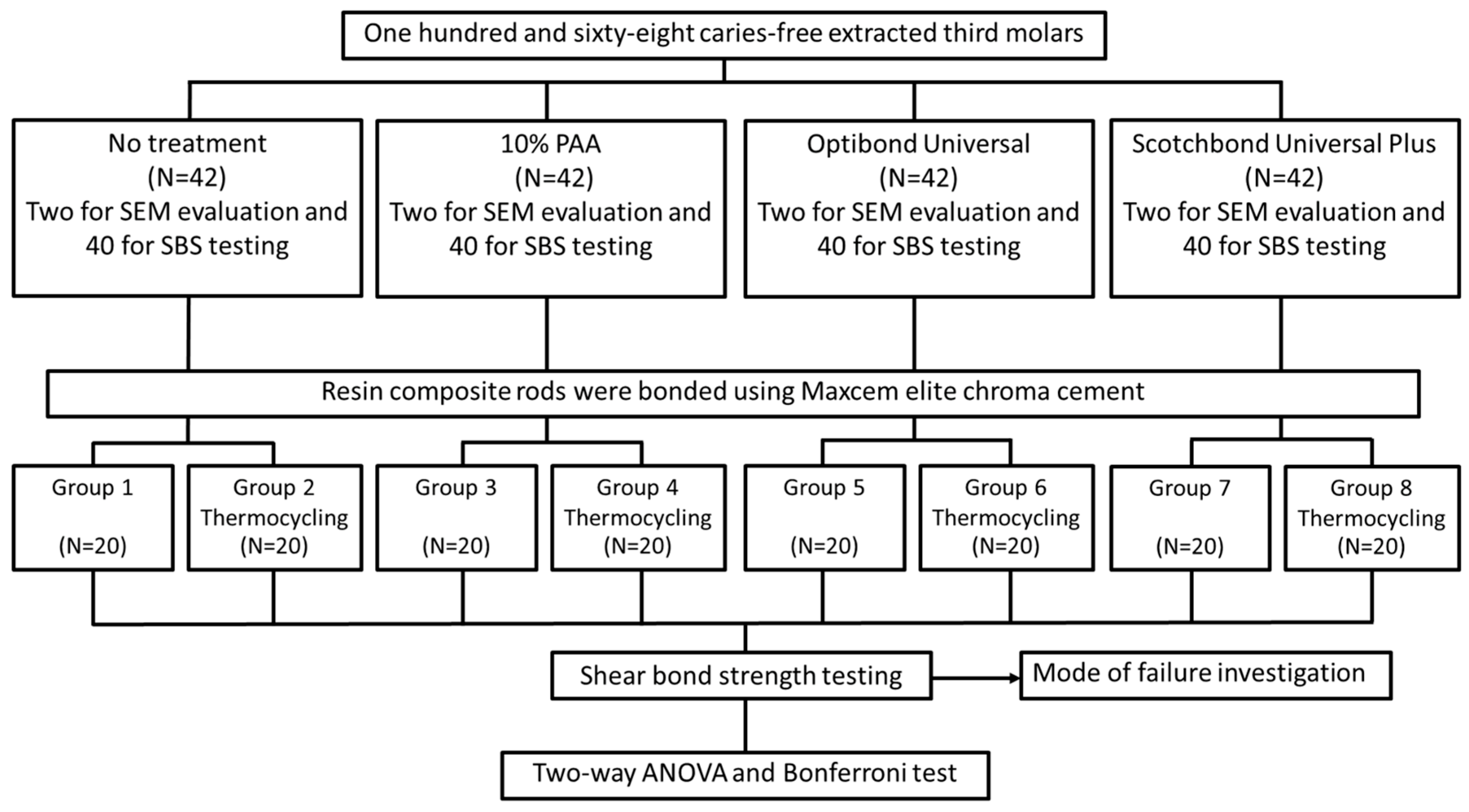

Effect of Dentin Surface Pretreatments and Thermocycling on the Shear Bond Strength of Resin Cement: An In Vitro Study


 ,
,
Abstract
1. Introduction
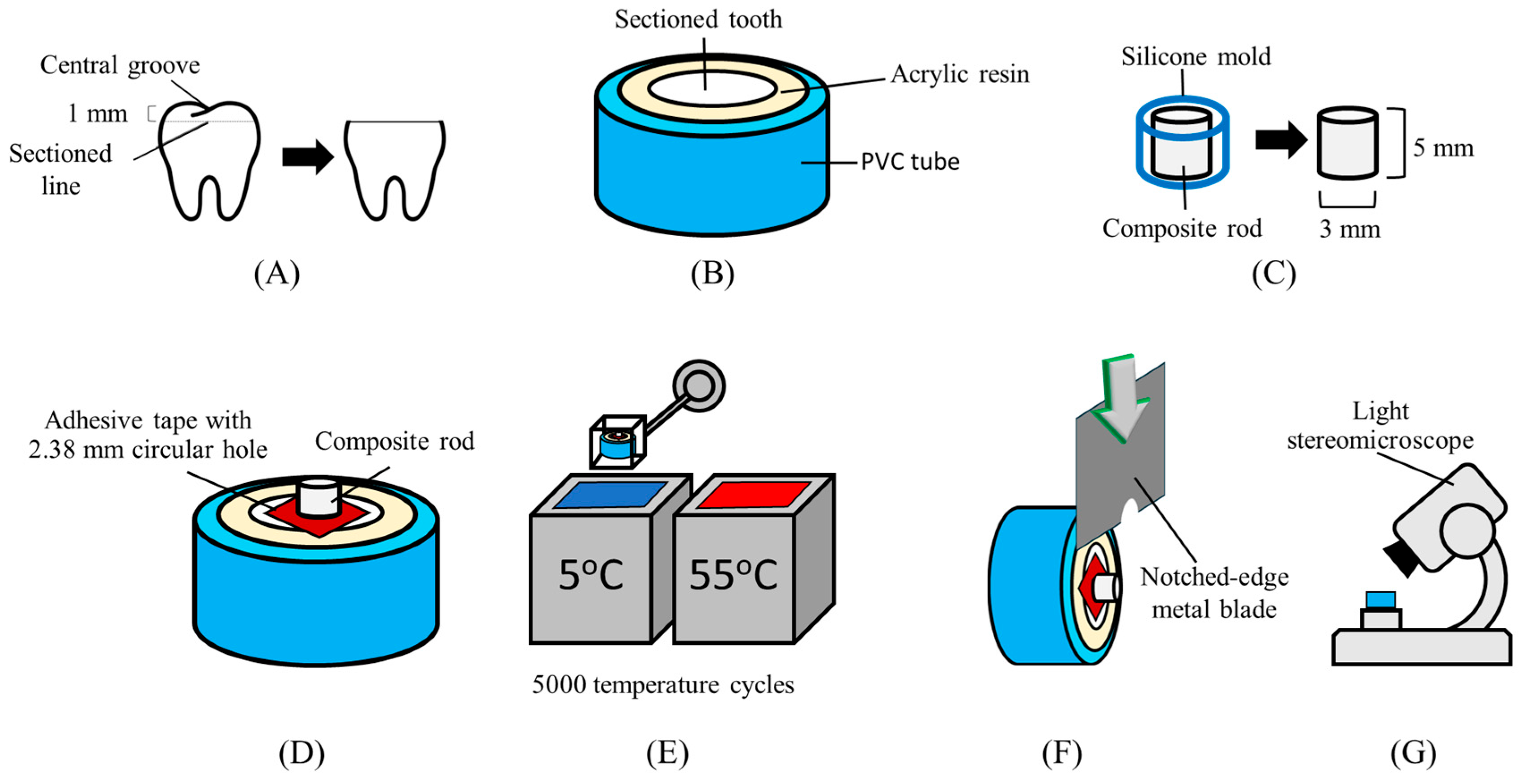
2. Materials and Methods
2.1. Tooth Preparation
2.2. Scanning Electron Microscopy (SEM) Evaluation
2.3. Composite Specimen Preparation
2.4. Sample Size Calculation
2.5. Surface Treatment and Bonding Process
2.6. Artificial Aging by Thermocycling
2.7. Shear Bond Strength Testing
2.8. Failure Mode Analysis
2.9. Statistical Analysis
3. Result
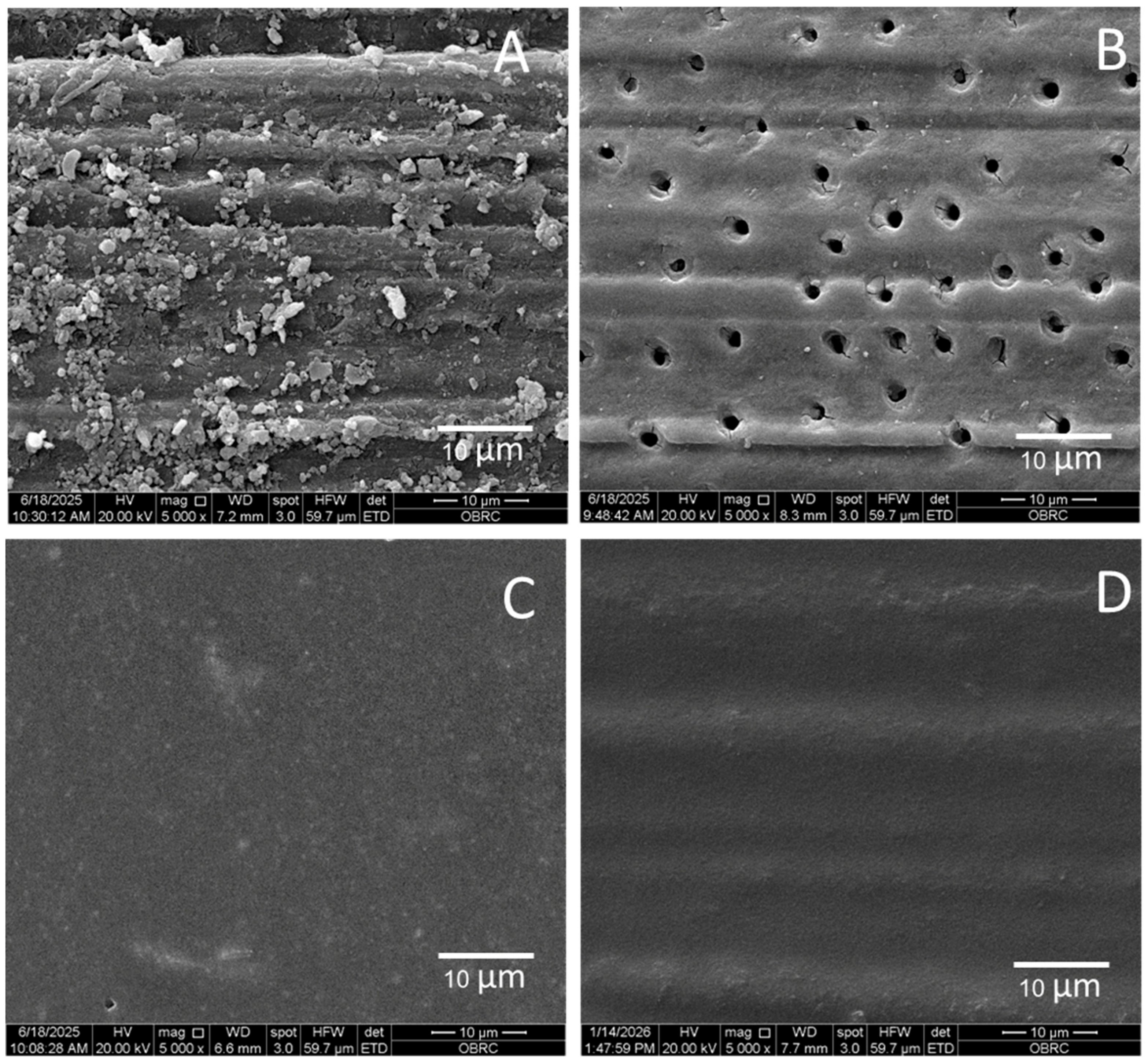
3.1. SEM Evaluation
3.2. Shear Bond Strength Values

| Group | Mean SBS ± SD (MPa) | SBS Reduction After Thermocycling (%) | Failure Mode Percentage (%) | ||
|---|---|---|---|---|---|
| Adhesive | Mixed | Cohesive | |||
| Group 1: No treatment (N) | 9.75 ± 0.73 A | 16 (80) | 4 (20) | 0 | |
| Group 2: No treatment and thermocycling (NT) | 6.61 ± 0.55 B | 32.21% | 15 (75) | 5 (25) | 0 |
| Group 3: 10% polyacrylic acid and rinse (PAA) | 4.04 ± 0.28 C | 20 (100) | 0 | 0 | |
| Group 4: 10% polyacrylic acid, rinse and thermocycling (PAAT) | 2.69 ± 0.39 D | 33.42% | 20 (100) | 0 | 0 |
| Group 5: Optibond universal adhesive (OU) | 18.71 ± 0.43 E | 11 (55) | 9 (45) | 0 | |
| Group 6: Optibond universal adhesive and thermocycling (OUT) | 13.78 ± 0.97 F | 26.35% | 13 (65) | 7 (35) | 0 |
| Group 7: Scotchbond universal plus adhesive (SUP) | 11.08 ± 0.69 G | 17 (85) | 3 (15) | 0 | |
| Group 8: Scotchbond universal plus adhesive and thermocycling (SUPT) | 8.01 ± 0.87 H | 27.71% | 16(80) | 4 (20) | 0 |
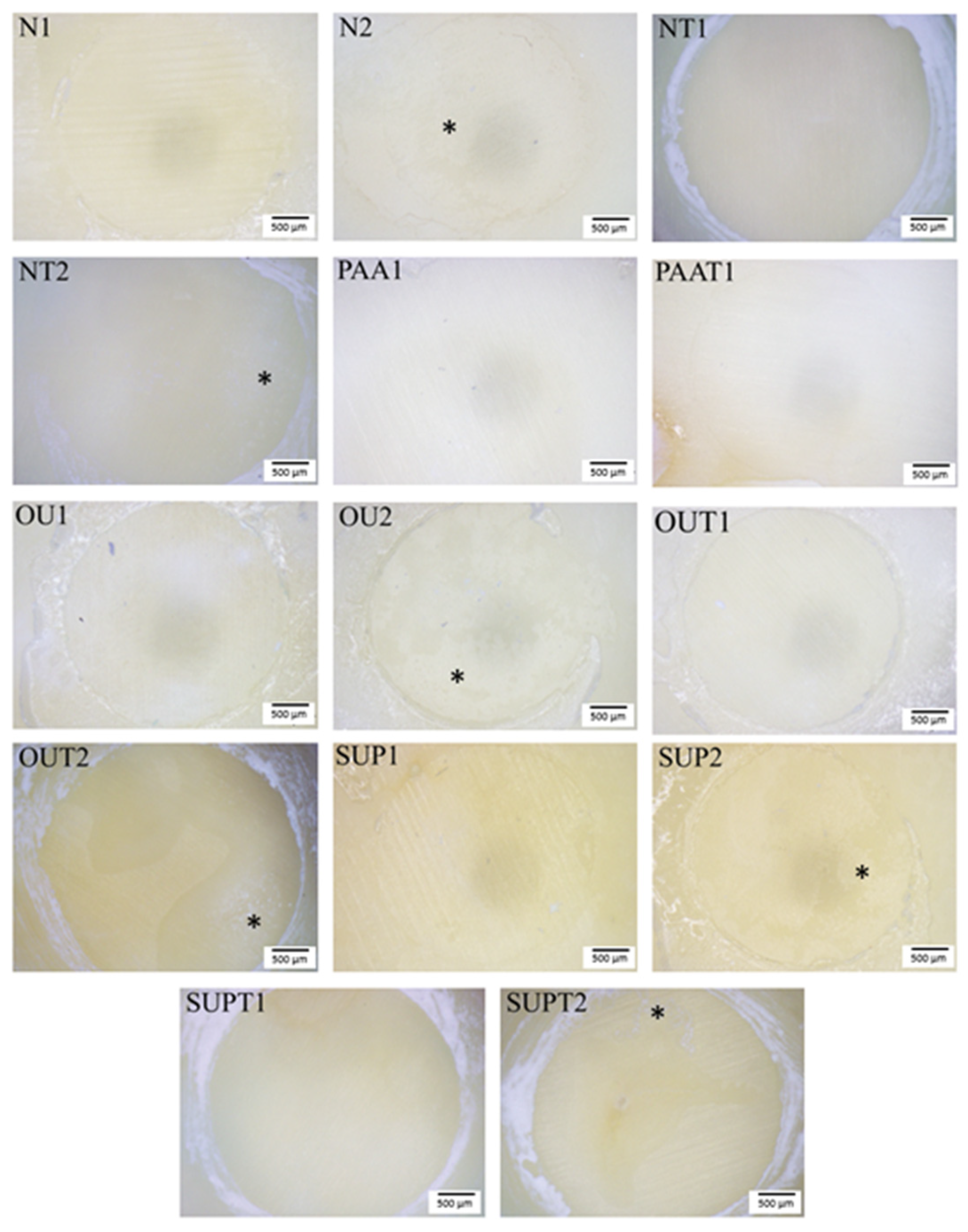
3.3. Mode of Failure
4. Discussion
5. Conclusions
- The SBS of Maxcem elite chroma resin cement decreased following dentin conditioning with 10% polyacrylic acid.
- Within the tested materials, dentin pretreatment with Optibond universal adhesive consistently resulted in the highest SBS values when used with Maxcem elite chroma resin cement, regardless of thermocycling.
- Thermocycling (5000 cycles) significantly reduced SBS under identical dentin pretreatment conditions.
- For the specific resin cement and adhesive systems evaluated in this study, dentin pretreatment with a compatible universal adhesive demonstrated more favorable interfacial stability than polyacrylic acid pretreatment, which appeared insufficient for optimizing bonding performance.
Author Contributions
Funding
Institutional Review Board Statement
Data Availability Statement
Acknowledgments
Conflicts of Interest
References
- Heboyan, A.; Vardanyan, A.; Karobari, M.I.; Marya, A.; Avagyan, T.; Tebyaniyan, H.; Mustafa, M.; Rokaya, D.; Avetisyan, A. Dental Luting Cements: An Updated Comprehensive Review. Molecules 2023, 28, 1619. [Google Scholar] [CrossRef] [PubMed]
- Tarjányi, T.; Mészáros, C.; Kiss, R.A.; Tóth, Z.; Pelsőczi, I. Mechanical Behaviour of Dental Luting Cements: Static, Dynamic, and Finite Element Studies. Dent. J. 2025, 13, 601. [Google Scholar] [CrossRef] [PubMed]
- Makkar, S.; Malhotra, N. Self-Adhesive Resin Cements: A New Perspective in Luting Technology. Dent. Update 2013, 40, 758–760+763–764+767–768. [Google Scholar] [CrossRef] [PubMed]
- Sriamporn, T.; Thamrongananskul, N.; Klaisiri, A. The Effectiveness of Various Functional Monomers in Self-Adhesive Resin Cements on Prosthetic Materials. J. Int. Soc. Prev. Community Dent. 2022, 12, 332–335. [Google Scholar] [CrossRef]
- Maravić, T.; Mazzitelli, C.; Mancuso, E.; Del Bianco, F.; Josić, U.; Cadenaro, M.; Breschi, L.; Mazzoni, A. Resin Composite Cements: Current Status and a Novel Classification Proposal. J. Esthet. Restor. Dent. 2023, 35, 1085–1097. [Google Scholar] [CrossRef]
- Maletin, A.; Knežević, M.J.; Koprivica, D.Đ.; Veljović, T.; Puškar, T.; Milekić, B.; Ristić, I. Dental Resin-Based Luting Materials—Review. Polymers 2023, 15, 4156. [Google Scholar] [CrossRef]
- Ferracane, J.L.; Stansbury, J.W.; Burke, F.J.T. Self-adhesive resin cements—Chemistry, properties and clinical considerations. J. Oral Rehabil. 2011, 38, 295–314. [Google Scholar] [CrossRef]
- Duarte, S., Jr.; Sartori, N.; Sadan, A. Adhesive resin cements for bonding esthetic restorations: A review. Quintessence Dent. Technol. 2011, 34, 87–98. [Google Scholar]
- Toanan, S.; Prawatvatchara, W.; Klaisiri, A.; Chaiteerapapkul, P.; Sriamporn, T.; Thamrongananskul, N. Effect of four chemical reagents on the shear bond strength of four different metal alloys bonded with self-adhesive resin cement. BMC Oral Health 2026, 26, 17. [Google Scholar] [CrossRef]
- Amaral, R.; Ozcan, M.; Valandro, L.F.; Bottino, M.A. Effect of conditioning methods on the microtensile bond strength of phosphate monomer-based cement on zirconia ceramic in dry and aged conditions. J. Biomed. Mater. Res. Part B Appl. Biomater 2008, 85, 1–9. [Google Scholar]
- Monticelli, F.; Toledano, M.; Osorio, R.; Ferrari, M. Comparison of Bond Strength of Self-Etch and Self-Adhesive Cements Bonded to Lithium Disilicate, Enamel and Dentin. J. Adhes. Dent. 2016, 18, 335–341. [Google Scholar]
- Miotti, L.L.; Follak, A.C.; Montagner, A.F.; Pozzobon, R.T.; da Silveira, B.L.; Susin, A.H. Is Conventional Resin Cement Adhesive Performance to Dentin Better Than Self-Adhesive? A Systematic Review and Meta-Analysis of Laboratory Studies. Oper. Dent. 2020, 45, 484–495. [Google Scholar] [CrossRef] [PubMed]
- Ikeda, M.; Kurokawa, H.; Sunada, N.; Tamura, Y.; Takimoto, M.; Murayama, R.; Ando, S.; Miyazaki, M. Influence of previous acid etching on dentin bond strength of self-etch adhesives. J. Oral Sci. 2009, 51, 527–534. [Google Scholar] [CrossRef] [PubMed]
- Betancourt, D.E.; Baldion, P.A.; Castellanos, J.E. Resin-Dentin Bonding Interface: Mechanisms of Degradation and Strategies for Stabilization of the Hybrid Layer. Int. J. Biomater. 2019, 2019, 5268342. [Google Scholar] [CrossRef]
- Lee, I.S.; Son, S.A.; Hur, B.; Kwon, Y.H.; Park, J.K. The Effect of Additional Etching and Curing Mechanism of Composite Resin on the Dentin Bond Strength. J. Adv. Prosthodont. 2013, 5, 479–484. [Google Scholar] [CrossRef]
- Perdigão, J. Current perspectives on dental adhesion: (1) Dentin adhesion - not there yet. Jpn. Dent. Sci. Rev. 2020, 56, 190–207. [Google Scholar]
- De Sousa Vieira, R.; Arrais, C.A.; Dias, C.; Hara, A.T.; Silva, G.R.F. Bonding Reactions of Dental Self-Adhesive Cements with Synthetic Hydroxyapatite as a Function of the Polymerization Protocol. Clin. Oral Investig. 2022, 26, 3151–3160. [Google Scholar]
- Xuan, G.H.; Wang, H.H. The Effect of Acid Etching on Bond Strength of Different Self-Adhesive Resin Cements to Dentin. Shanghai Kou Qiang Yi Xue 2015, 24, 302–306. [Google Scholar]
- Radovic, I.; Monticelli, F.; Goracci, C.; Vulicevic, Z.R.; Ferrari, M. Self-Adhesive Resin Cements: A Literature Review. J. Adhes. Dent. 2008, 10, 251–258. [Google Scholar]
- Rodrigues, R.F.; Ramos, C.M.; Francisconi, P.A.; Borges, A.F. The Shear Bond Strength of Self-Adhesive Resin Cements to Dentin and Enamel: An In Vitro Study. J. Prosthet. Dent. 2015, 113, 220–227. [Google Scholar] [CrossRef]
- Van Meerbeek, B.; De Munck, J.; Yoshida, Y.; Inoue, S.; Vargas, M.; Vijay, P.; Van Landuyt, K.; Lambrechts, P.; Vanherle, G. Buonocore Memorial Lecture: Adhesion to Enamel and Dentin: Current Status and Future Challenges. Oper. Dent. 2003, 28, 215–235. [Google Scholar] [PubMed]
- Klaisiri, A.; Krajangta, N. Self-adhesive resin cements. J. Dent. Assoc. Thai. 2015, 65, 11–20. [Google Scholar]
- Özcan, S.; Seseogullari-Dirihan, R.; Uctasli, M.; Tay, F.R.; Pashley, D.H.; Tezvergil Mutluay, A. Effect of Polyacrylic Acid on Dentin Protease Activities. Dent. Mater. 2015, 31, 901–906. [Google Scholar] [CrossRef] [PubMed]
- Sauro, S.; Faus-Matoses, V.; Makeeva, I.; Nuñez Martí, J.M.; Gonzalez Martínez, R.; García Bautista, J.A.; Faus-Llácer, V. Effects of Polyacrylic Acid Pre-Treatment on Bonded-Dentine Interfaces Created with a Modern Bioactive Resin-Modified Glass Ionomer Cement and Subjected to Cycling Mechanical Stress. Materials 2018, 11, 1884. [Google Scholar] [CrossRef]
- Moda, M.D.; Fagundes, T.C.; Briso, A.L.F.; Dos Santos, P.H. Analysis of the Bond Interface between Self-Adhesive Resin Cement and Dentin In Vitro. PLoS ONE 2018, 13, e0208024. [Google Scholar] [CrossRef]
- Pavan, S.; dos Santos, P.H.; Berger, S.; Bedran-Russo, A.K. The Effect of Dentin Pretreatment on the Microtensile Bond Strength of Self-Adhesive Resin Cements. J. Prosthet. Dent. 2010, 104, 258–264. [Google Scholar] [CrossRef]
- Hammal, M.; Chlup, Z.; Ingr, T.; Staněk, J.; Mounajjed, R. Effectiveness of Dentin Pre-Treatment on Bond Strength of Two Self-Adhesive Resin Cements Compared to an Etch-and-Rinse System: An In Vitro Study. PeerJ 2021, 9, e11736. [Google Scholar] [CrossRef]
- Stona, P.; Borges, G.A.; Montes, M.A.; Júnior, L.H.; Weber, J.B.; Spohr, A.M. Effect of Polyacrylic Acid on the Interface and Bond Strength of Self-Adhesive Resin Cements to Dentin. J. Adhes. Dent. 2013, 15, 221–227. [Google Scholar] [CrossRef]
- Monticelli, F.; Osorio, R.; Mazzitelli, C.; Ferrari, M.; Toledano, M. Limited Decalcification/Diffusion of Self-Adhesive Cements into Dentin. J. Dent. Res. 2008, 87, 974–979. [Google Scholar] [CrossRef]
- El-Guindy, J.; Selim, M.; El-Agroudi, M. Alternative Pretreatment Modalities with a Self-Adhesive System to Promote Dentin/Alloy Shear Bond Strength. J. Prosthodont. 2010, 19, 205–211. [Google Scholar] [CrossRef]
- Atalay, C.; Koc Vural, U.; Miletic, I.; Gurgan, S. Shear Bond Strengths of Two Newly Marketed Self-Adhesive Resin Cements to Different Substrates: A Light and Scanning Electron Microscopy Evaluation. Microsc. Res. Tech. 2022, 85, 1694–1702. [Google Scholar] [CrossRef] [PubMed]
- ISO/TS 11405:2015; Dentistry—Testing of Adhesion to Tooth Structure. International Organization for Standardization: Geneva, Switzerland, 2015. Available online: https://standards.iteh.ai/catalog/standards/sist/d726cfb6-773b-4195-b42a-25ba34cc787e/iso-ts-11405-2015 (accessed on 16 March 2024).
- Elraggal, A.; Raheem, I.A.; Holiel, A.; Alhotan, A.; Alshabib, A.; Silikas, N.; Watts, D.C.; Alharbi, N.; Afifi, R.R. Bond strength, microleakage, microgaps, and marginal adaptation of self-adhesive resin composites to tooth substrates with and without preconditioning with universal adhesives. J. Adhes. Dent. 2024, 26, 4949691. [Google Scholar]
- ISO 3696:1987; Water for Analytical Laboratory Use—Specification Test Methods. International Organization for Standardization: Geneva, Switzerland, 1987. Available online: https://cdn.standards.iteh.ai/samples/9169/c86dc332be2847eebd009b52ef8b00a5/ISO-3696-1987.pdf (accessed on 16 March 2024).
- ISO 29022:2013; Dentistry—Adhesion—Notched-Edge Shear Bond Strength Test. International Organization for Standardization: Geneva, Switzerland, 2013. Available online: https://www.iso.org/standard/45285.html (accessed on 16 March 2024).
- Matinlinna, J.P.; Lassila, L.V. Enhanced Resin-Composite Bonding to Zirconia Framework after Pretreatment with Selected Silane Monomers. Dent. Mater. 2011, 27, 273–280. [Google Scholar] [CrossRef] [PubMed]
- Klaisiri, A.; Suebnukarn, S.; Krajangta, N.; Rakmanee, T.; Sriamporn, T.; Thamrongananskul, N. The effect of morpholine on composite-to-composite repair strength contaminated with saliva. Polymers 2022, 14, 4718. [Google Scholar] [CrossRef]
- Cohen, J. Statistical Power Analysis for the Behavioral Sciences, 2nd ed.; Routledge Academic: New York, NY, USA, 1988. [Google Scholar]
- Fernandes, N.A.; Vally, Z.I.; Sykes, L.M. The Longevity of Restorations—A Literature Review. South Afr. Dent. J. 2015, 70, 410–413. [Google Scholar]
- Santos, M.J.M.C.; Zare, E.; McDermott, P.; Santos Júnior, G.C. Multifactorial Contributors to the Longevity of Dental Restorations: An Integrated Review of Related Factors. Dent. J. 2024, 12, 291. [Google Scholar] [CrossRef]
- Acar, Ö.; Özdemir, E. Bonding Strength of Self-Adhesive Resin Cements to Human Dentin: A Critical Review. Rev. Adhes. Adhes. 2024, 1, 346–364. [Google Scholar] [CrossRef]
- Alshabib, A.; AlDosary, K.; Algamaiah, H. A Comprehensive Review of Resin Luting Agents: Bonding Mechanisms and Polymerisation Reactions. Saudi Dent. J. 2024, 36, 234–239. [Google Scholar] [CrossRef]
- Goracci, C.; Cury, A.H.; Cantoro, A.; Papacchini, F.; Tay, F.R.; Ferrari, M. Microtensile Bond Strength and Interfacial Properties of Self-Etching and Self-Adhesive Resin Cements Used to Lute Composite Onlays under Different Seating Forces. J. Adhes. Dent. 2006, 8, 327–335. [Google Scholar]
- Viotti, R.G.; Kasaz, A.; Pena, C.E.; Alexandre, R.S.; Arrais, C.A.; Reis, A.F. Microtensile Bond Strength of New Self-Adhesive Luting Agents and Conventional Multistep Systems. J. Prosthet. Dent. 2009, 102, 306–312. [Google Scholar] [CrossRef]
- Han, L.; Okamoto, A.; Fukushima, M.; Okiji, T. Evaluation of Physical Properties and Surface Degradation of Self-Adhesive Resin Cements. Dent. Mater. J. 2007, 26, 906–914. [Google Scholar] [CrossRef] [PubMed]
- Hashimoto, M.; Fujita, S.; Kaga, M.; Yawaka, Y. Effect of Water on Bonding of One-Bottle Self-Etching Adhesives. Dent. Mater. J. 2008, 27, 172–178. [Google Scholar] [CrossRef] [PubMed]
- Choque-Apaza, W.; Sánchez-Tito, M. Effect of Dentin Surface Pretreatment with Four Conditioning Agents on Micro-Shear Bond Strength of a Self-Adhesive Cement. J. Clin. Exp. Dent. 2022, 14, e390–e395. [Google Scholar] [CrossRef] [PubMed]
- Rosa, W.L.; Piva, E.; Silva, A.F. Bond Strength of Universal Adhesives: A Systematic Review and Meta-Analysis. J. Dent. 2015, 43, 765–776. [Google Scholar] [CrossRef]
- Takamizawa, T.; Latta, M.A.; Barkmeier, W.W.; Ishii, R.; Shibasaki, S.; Kasahara, Y.; Suzuki, S.; Miyazaki, M. Universal Adhesive Application and Curing Mode Affect Shear Bond Strength and Shear Fatigue Bond Strength of Self-Adhesive Resin Luting Cements to Dentin. Dent. Mater. 2025, 41, 1213–1221. [Google Scholar] [CrossRef]
- Pheerarangsikul, N.; Wayakanon, P.; Wayakanon, K. Effects of Various Functional Monomers on Adhesion between Immediate Dentin Sealing and Resin Cement. Oper. Dent. 2022, 47, 562–573. [Google Scholar] [CrossRef]
- Fundingsland, J.W. The Effect of High Humidity on Adhesion to Dentin. J. Dent. Res. 1992, 71, 665. [Google Scholar]
- Muñoz, M.A.; Luque, I.; Hass, V.; Reis, A.; Loguercio, A.D.; Bombarda, N.H. Immediate Bonding Properties of Universal Adhesives to Dentine. J. Dent. 2013, 41, 404–411. [Google Scholar] [CrossRef]
- Mazzitelli, C.; Monticelli, F.; Toledano, M.; Ferrari, M.; Osorio, R. Dentin Treatment Effects on the Bonding Performance of Self-Adhesive Resin Cements. Eur. J. Oral Sci. 2010, 118, 80–86. [Google Scholar] [CrossRef]
- Hattar, S.; Hatamleh, M.M.; Sawair, F.; Al-Rabab’ah, M. Bond Strength of Self-Adhesive Resin Cements to Tooth Structure. Saudi Dent. J. 2015, 27, 70–74. [Google Scholar] [CrossRef]



| Type | Name (Lot Number) | Manufacturer | Composition | Application Method |
|---|---|---|---|---|
| Self-adhesive resin cement | Maxcem elite® chroma (9651612) | Kerr, Orange, CA, USA | HEMA, GDMA, UDMA, TEGDMA, GPDM, TMBHP, fluoroaluminosilicate glass, barium glass filler, fumed silica (69 wt%) | 1. Apply automixed cement onto the tooth substrate and position the resin composite rod with a constant load of 1000 g. 2. Cure with light for 20 s. |
| Polyacrylic acid | Dentin Conditioner (2303111) | GC Corporation, Tokyo, Japan | 10% polyacrylic acid | 1. Apply the acid to the tooth surface using the disposable applicator brush, employing agitating motion for 10 s. 2. Rinse thoroughly. |
| Universal adhesive | Optibond universal adhesive (9243902) | Kerr, Orange, CA, USA | GPDM, GDMA, HEMA water, acetone, ethanol, initiators | 1. Apply the adhesive to the tooth surface using a disposable applicator brush with agitating motion for 20 s. 2. Air-thin for 5 s from a distance of 10 mm, until the adhesive no longer moves. 3. Light-cure for 20 s. |
| Scotchbond universal plus adhesive | 3M Oral Care, St. Paul, MN, USA (9446762) | Bis-GMA, 10-MDP, HEMA, Vitrebond copolymer, ethanol, water, initiators, fillers | 1. Apply the adhesive on the tooth surface using the disposable applicator brush with agitating motion for 20 s. 2. Air-thin for 5 s from a distance of 10 mm until the adhesive no longer moves. 3. Light-cure for 20 s. |
| Source | Type III Sum of Squares | df | Mean Square | F | Sig. | Partial Eta Squared |
|---|---|---|---|---|---|---|
| Corrected Model | 3845.908 | 7 | 549.415 | 1282.589 | <0.001 | 0.983 |
| Intercept | 13,942.943 | 1 | 13,942.943 | 32,549.253 | <0.001 | 0.995 |
| Surface_treatment | 3392.063 | 3 | 1130.688 | 2639.546 | <0.001 | 0.981 |
| Thermocycling | 389.719 | 1 | 389.719 | 909.784 | <0.001 | 0.857 |
| Surface_treatment interaction Thermocycling | 64.126 | 3 | 21.375 | 49.900 | <0.001 | 0.496 |
| Error | 65.111 | 152 | 0.428 | |||
| Total | 17,853.962 | 160 | ||||
| Corrected Total | 3911.020 | 159 |
Disclaimer/Publisher’s Note: The statements, opinions and data contained in all publications are solely those of the individual author(s) and contributor(s) and not of MDPI and/or the editor(s). MDPI and/or the editor(s) disclaim responsibility for any injury to people or property resulting from any ideas, methods, instructions or products referred to in the content. |
© 2026 by the authors. Licensee MDPI, Basel, Switzerland. This article is an open access article distributed under the terms and conditions of the Creative Commons Attribution (CC BY) license.
Share and Cite
Thatphet, P.; Prawatvatchara, W.; Klaisiri, A.; Sriamporn, T.; Thamrongananskul, N. Effect of Dentin Surface Pretreatments and Thermocycling on the Shear Bond Strength of Resin Cement: An In Vitro Study. J. Compos. Sci. 2026, 10, 106. https://doi.org/10.3390/jcs10020106
Thatphet P, Prawatvatchara W, Klaisiri A, Sriamporn T, Thamrongananskul N. Effect of Dentin Surface Pretreatments and Thermocycling on the Shear Bond Strength of Resin Cement: An In Vitro Study. Journal of Composites Science. 2026; 10(2):106. https://doi.org/10.3390/jcs10020106
Chicago/Turabian StyleThatphet, Pimchanok, Wisarut Prawatvatchara, Awiruth Klaisiri, Tool Sriamporn, and Niyom Thamrongananskul. 2026. "Effect of Dentin Surface Pretreatments and Thermocycling on the Shear Bond Strength of Resin Cement: An In Vitro Study" Journal of Composites Science 10, no. 2: 106. https://doi.org/10.3390/jcs10020106
APA StyleThatphet, P., Prawatvatchara, W., Klaisiri, A., Sriamporn, T., & Thamrongananskul, N. (2026). Effect of Dentin Surface Pretreatments and Thermocycling on the Shear Bond Strength of Resin Cement: An In Vitro Study. Journal of Composites Science, 10(2), 106. https://doi.org/10.3390/jcs10020106