Article

Load-Bearing Performance of Segmental Prestressed Concrete-Filled Steel Tube Chords in Lattice Wind Turbine Towers

1
Zhejiang Huadong Xinneng Technology Co., Ltd., Hangzhou 311122, China
2
School of Civil Engineering, Chongqing University, Chongqing 400045, China
*
Author to whom correspondence should be addressed.
J. Compos. Sci. 2026, 10(1), 54; https://doi.org/10.3390/jcs10010054
Submission received: 24 October 2025 / Revised: 7 December 2025 / Accepted: 15 December 2025 / Published: 19 January 2026
(This article belongs to the Section Composites Applications)

Abstract

To address the combined demands of lightweighting, modular construction, and durability in ultra-tall wind-turbine towers, a segmental prestressed concrete-filled steel-tube (PCFST) chord for lattice towers is investigated in this study. A finite-element approach is validated against published tests on CFST columns, showing close agreement in load–displacement response and failure modes. Based on this validation, a finite-element model of the segmental PCFST chord is developed to clarify load-bearing mechanisms and parameters under axial compression and tension. The results show that, in compression, the concrete core governs the response; after steel yielding, the tube undergoes multiaxial stress redistribution—rising hoop stress and falling axial stress—consistent with von Mises yielding and dilation of confined concrete. In tension, load sharing is dominated by the steel tube and tendons, with limited concrete contribution. Parametric analyses indicate that end stiffeners markedly improve tensile behavior: with eight stiffeners, initial stiffness and peak tensile load increase by 1.8 times and 1.3 times relative to no stiffener, while effects in compression are minor. Increasing initial prestress improves tensile performance but shows diminishing returns beyond a moderate level and reduces compressive yield capacity. Increasing flange thickness enhances tensile performance with negligible compressive effect, whereas greater tube thickness increases both capacities and the initial stiffness.

1. Introduction

As wind turbines increase in nameplate capacity and rotor diameter, tower heights have risen from several tens of meters to well above 100 m. The resulting increases in force, moment, and wind-induced vibration impose more stringent demands on structural strength and lateral stiffness. Meeting these requirements with conventional conical steel monopoles typically necessitates substantially increasing the steel tube wall thickness and enlarging the tube diameter, which leads to excessive self-weight and higher cost and causes oversize transportation and heavy-lift erection challenges [1]. Consequently, there is a pressing need for a tower system that simultaneously reduces self-weight and enhances mechanical performance, while remaining amenable to segmental fabrication and rapid on-site assembly, thereby enabling safe, economical, and reliable operation of ultra-tall towers.
Prestressing technology [2] introduces pre-compression into concrete members to counteract tensile stresses induced by external loads, thereby enhancing load-carrying capacity and effectively controlling cracking, deflection, and vibration. In long-span structures [3,4], prestress is employed to establish initial self-stress and geometric stiffness, enabling lighter systems with controlled deformations that satisfy the serviceability requirements of large indoor spaces such as auditoria and stadiums. In the bridge domain [5,6,7], prestressed concrete (PSC) has been widely adopted for its advantages in shorter construction periods, greater durability, and reduced maintenance, with mature practice particularly in precast segmental box girders and segmental construction. In recent years, applications of prestressing to hybrid wind turbine towers [8,9,10,11] have also expanded rapidly. Studies indicate that prestressed concrete–steel hybrid (PCSH) towers provide an efficient alternative for ultra-tall turbines: with a rational layout of prestressing strands to “lock” concrete segments, PCSH systems increase global bending stiffness and fatigue resistance while significantly reducing tower moments and vibration response.
Concrete-filled steel tube (CFST) construction, which places a concrete core within a steel tube to combine the core’s compressive resistance with the tube’s confinement, offers high load-bearing capacity and excellent ductility, together with favorable fire and corrosion performance [12]. Research on its mechanics has focused on the confinement-induced enhancement of CFST load-bearing capacity and ductility [13]; the influence of cross-sectional forms—circular [14], square [15], and double-skin (hollow-sandwich) configurations [16]—and the failure modes under axial compression [17]; combined bending–torsion [18]; and cyclic loading [19]. In practice, CFST systems are widely used in high-rise building columns [20], long-span bridges [21], and transmission towers [22], where their ease of construction (the tube can serve as a permanent formwork), efficient section utilization, and robust wind and seismic performance make them an attractive option. With the growing demands for lightweighting and vibration control in wind turbine towers, CFST towers have also become a research hotspot, offering new solutions for ultra-tall tower design. Deng et al. conducted a systematic study on tapered concrete-filled double-skin steel tubular (CFDST) tower segments with a large hollow ratio, developing a strength-prediction framework that accounts for the interaction of axial force, bending moment, shear, and torsion, and validating it with experimental and numerical results [23]; thus, a design-oriented assessment approach was proposed. Complementarily, Li et al. performed aeroelastic wind tunnel tests and numerical simulations on an integrated tower–blade–nacelle system under simulated typhoon winds [24,25], comparing CFDST towers and conventional steel towers; the results indicate that CFDST configurations show greater potential in tuning natural frequencies and mitigating wind-induced responses.
Lattice structures are assembled from members interconnected in triangular units to form a spatial frame. Compared with solid (monolithic) systems, they offer lower self-weight, higher material efficiency, superior bending–torsional performance, and reduced wind drag. Research on their mechanics has primarily focused on connection behavior [26], member-level optimization [27], and fatigue and dynamic responses [28]. In practice, lattice systems are widely employed in transmission and telecommunication towers, and are increasingly being explored for wind turbine towers.
Concrete-filled steel tube (CFST) lattice wind turbine towers [29] synergize the concrete core’s high compressive resistance with the steel tube’s tensile capacity and confinement. By arranging members in a grid to form a spatial frame, they achieve substantial weight reduction—on the order of 30–40% less steel than a cylindrical monopole of comparable height—while significantly increasing global stiffness and lateral wind resistance, thereby mitigating vortex-induced vibrations and fatigue accumulation. Recently, PCFST lattice towers [30] have attracted growing interest: the chords adopt double-skin CFST sections, and post-tensioned strands are placed in the hollow annulus to pre-compensate wind- and gravity-induced bending and deflection, enhancing overall bending stiffness and fatigue performance. Taken together, PCFST lattice towers combine lightweight construction, fatigue resistance, and wind–seismic robustness, offering a promising pathway for ultra-tall onshore and offshore turbine tower design.
In parallel with these developments, several innovative wind-turbine support concepts [31] have emerged that exploit advanced materials and hybrid structural configurations. Recent studies on FRP-reinforced UHPC floating foundations have demonstrated that combining ultra-high-performance concrete with fiber-reinforced polymers enables tailored stiffness, improved durability, and enhanced fatigue resistance for offshore turbines. Hybrid double-skin tubular members, composite shell systems, and other lightweight composite supports have also been proposed as alternatives to conventional steel or concrete towers, aiming to reduce mass while maintaining or improving global dynamic performance. These concepts primarily target offshore foundations or tubular tower configurations and focus on global stiffness tuning, fatigue mitigation, and material efficiency.
In contrast, the present study focuses on onshore lattice systems and, more specifically, on the axial behavior and end-region detailing of factory-prestressed, multi-segment PCFST chords—the primary load-bearing components in such towers. By clarifying the load-transfer mechanisms and stress-redistribution characteristics of these chord members, the proposed configuration complements the above innovative support systems and offers a practical, fabrication-friendly option compatible with conventional steel lattice assembly and rapid on-site erection.
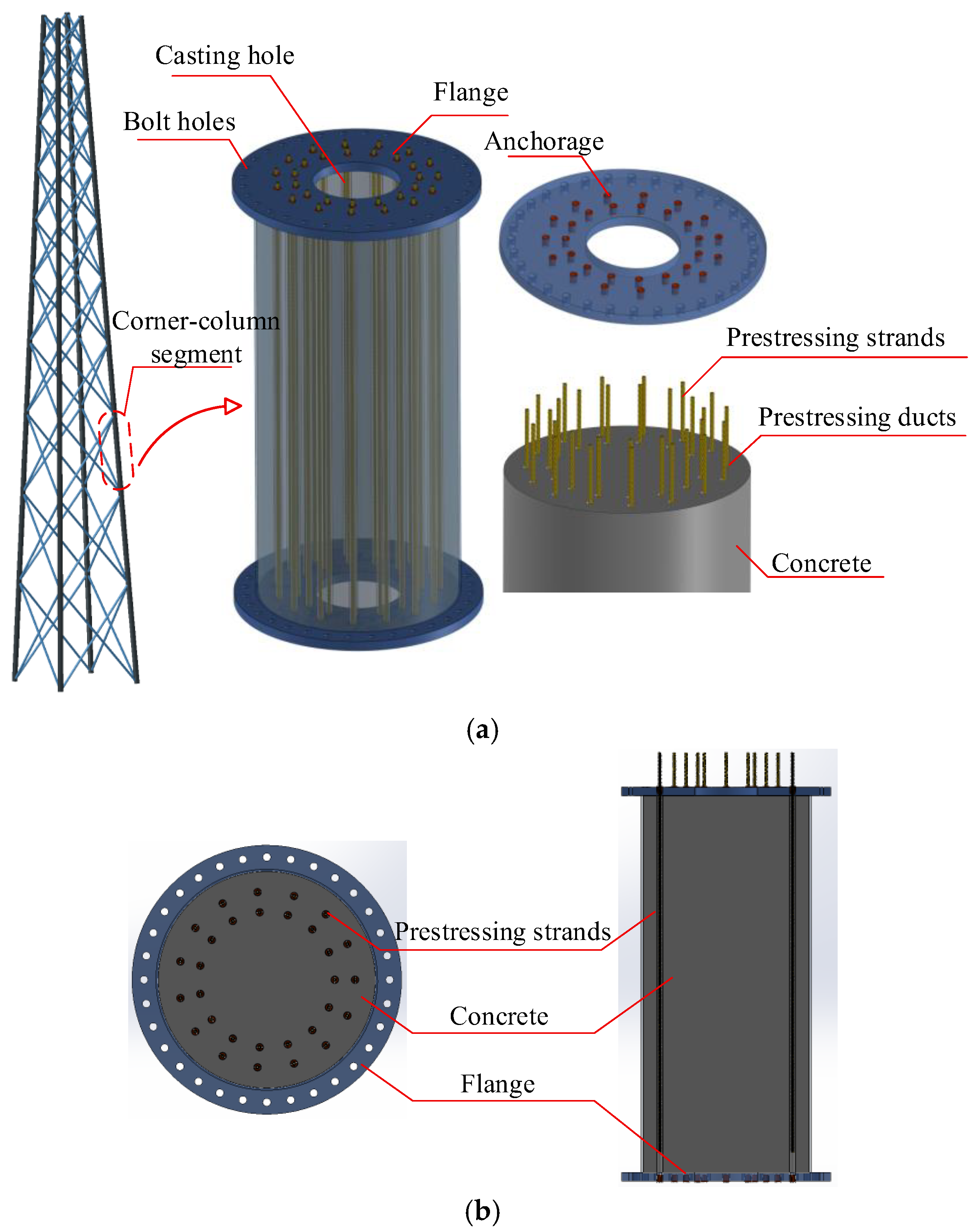
Building on the above, this study proposes an innovative segmental prestressed concrete-filled steel tube (PCFST) chord configuration for lattice wind-turbine towers (Figure 1). Unlike existing PCFST lattice towers—where prestressing tendons are installed and tensioned continuously only after the full-height chord columns are assembled on site—the proposed configuration applies prestressing within each segment in the factory. In this scheme, the tendons are pre-installed and tensioned segment by segment, and the prestressed segments are subsequently connected through bolted flanges, thereby eliminating the need for continuous on-site stressing. This segmented approach leverages the restraining action of prestress together with the confinement benefits of CFST, while substantially reducing erection complexity, alignment sensitivity, and construction time, offering notable logistical and safety advantages for ultra-tall onshore towers.
To the best of the authors’ knowledge, no prior research has systematically investigated the mechanical behavior, stress redistribution, or design implications of such factory-prestressed, multi-segment PCFST chords. The present study establishes a dedicated three-dimensional finite-element framework to elucidate static performance, failure mechanisms, and load-transfer processes of the proposed configuration, followed by a comprehensive parametric analysis. Based on these numerical insights, the study formulates design-oriented recommendations regarding prestress levels, end-region detailing, and the influence of flange and tube thickness—thus providing a new structural option and practical guidance for the engineering application of segmental PCFST lattice turbine towers.

2. Validation of the Finite-Element Modeling Approach

To verify the reliability of the segmental PCFST numerical model, this section benchmarks the model against published axial-compression tests on concrete-filled double-skin steel tube (CFDST) short columns reported in [32]. The circular specimen CC3-6 is selected for comparison. The accuracy and applicability of the proposed modeling scheme—covering element types, contact, constitutive laws, and boundary conditions—are assessed through an item-by-item comparison between simulated and experimental load–displacement curves and failure morphology. The benchmarking also sets the computational settings and error-control targets adopted in the subsequent parametric analyses.

2.1. Overview of the Reference Test

The specimen was a circular-in-circular CFDST short column. The outer tube had an outside diameter D o = 140   m m and wall thickness t o = 3.0   m m ; the inner tube had D i = 76   m m and t i = 3.75   m m . The total height was H = 420   m m   ( H / D o 3 ) , and the inner-tube steel ratio was approximately 6.4 % . Q235 steel was used for both tubes; material tests reported a measured yield strength f y , o = 329   M P a and elastic modulus E s , o = 225   G P a for the outer tube, and f y , i = 345   M P a , E s , i = 216   G P a for the inner tube. The concrete was C50, with a tested cube strength f c u = 55.4   M P a at the time of testing. Monotonic axial compression under displacement control was applied, and the resulting axial load–strain response and failure morphology were recorded for comparison with the numerical results.

2.2. Geometry, Elements, and Meshing

Given that both the inner and outer tubes are thin-walled, they were modeled using S4R shell elements. The concrete core and the top/bottom end plates were discretized with C3D8R three-dimensional solid elements. A structured mesh was adopted for the entire model, with a baseline element size set to D o / 12 (i.e., approximately 12 mm for the present specimen).

2.3. Material Constitutive Models and Damage Parameters

Both the outer and inner steel tubes were modeled as ideal elastic–plastic materials. In the elastic range, the elastic modulus E and Poisson’s ratio ν were taken from the coupon tests; the yield strength f y was set to the measured value. Von Mises yielding with isotropic perfectly plastic hardening (i.e., no post-yield hardening) was adopted.
Concrete was described using the Concrete Damaged Plasticity (CDP) model. The compressive stress–strain law followed the CFST-oriented relationship calibrated for ABAQUS in [33], while the tensile response employed an energy-based fracture criterion to ensure mesh-objective softening [34]. Confinement was incorporated via effectiveness coefficients: the annular (sandwich) concrete confined by the outer tube was represented by ξ o (defined in Equation (1)), and the core concrete simultaneously confined by the inner and outer tubes was represented by ξ c (defined in Equation (2)) [35].
ξ o = A so f yo A cc f cko
ξ c = A cc A ( k e A so f yo A cc f cko + A si f yi A ci f cki )
In Equations (1) and (2), A , A c c , A s i   ( A o ) , A c , and A c i denote, respectively, the gross cross-sectional area, the area enclosed by the outer steel tube, the area of the inner (outer) steel tube, the annular concrete area, and the core concrete area; f y , i and f y , o are the yield strengths of the inner and outer tubes; f c k , i and f c k , 0 are the axial compressive strengths of the core and annular concrete, respectively. A reduction factor k e is applied to account for the cross-sectional shape of the outer tube: k e = 1.0 for circular sections, and k e = 0.7 for square sections as recommended in [36].

2.4. Boundary Conditions, Contact, and Loading

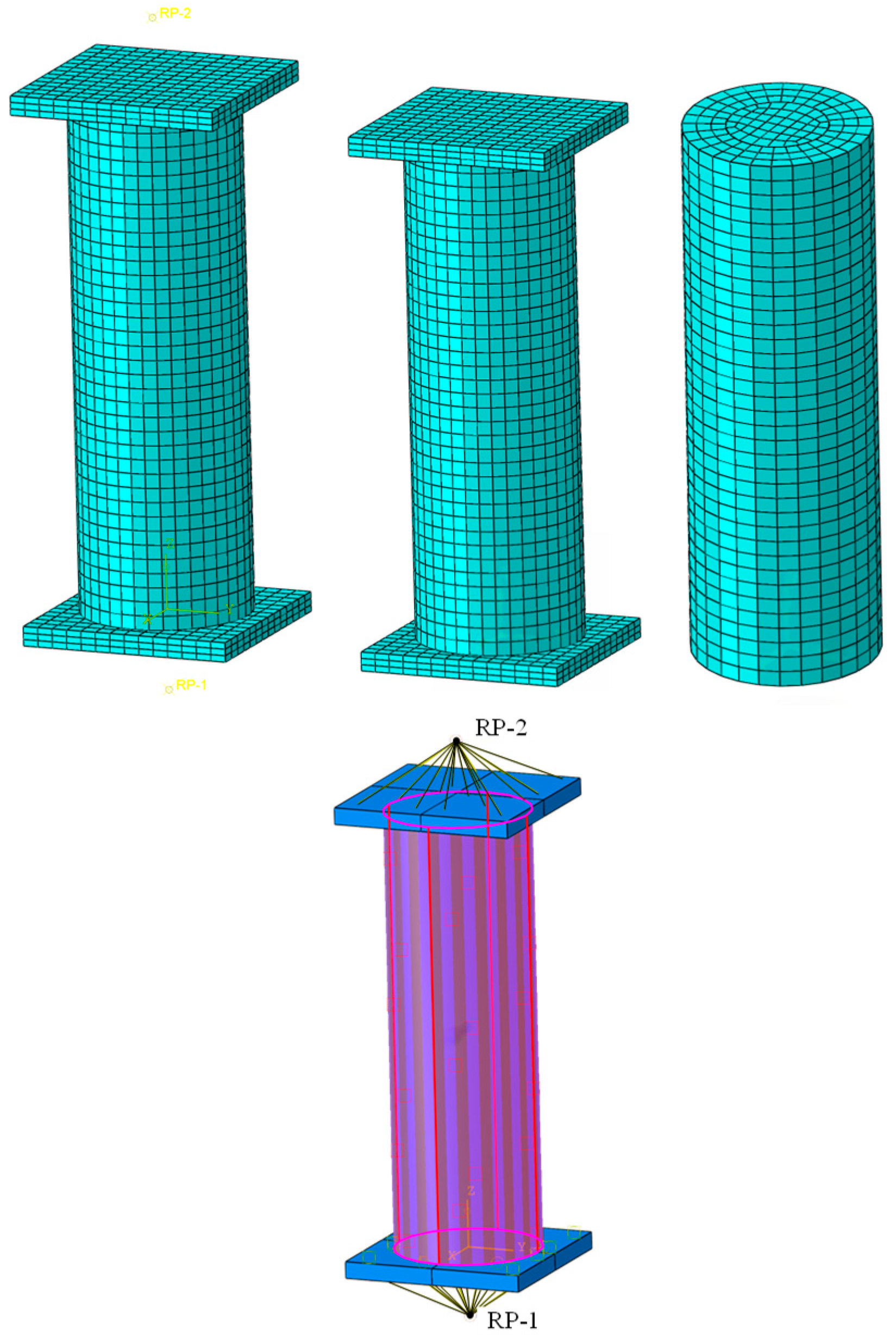
The boundary and loading conditions were modeled to replicate the test setup (Figure 2). The bottom end plate was fully restrained against translation in all three directions while remaining free to rotate. The top end plate was coupled to a reference point (RP) over its compressed surface and subjected to displacement control in the vertical direction consistent with the experiment; the target displacement was δ m a x = 21   m m . The global reaction was accumulated at the RP to construct the N δ and N ε curves. Steel–concrete interfaces were defined with surface-to-surface contact. For the outer-tube–annular concrete, inner-tube–annular concrete, and inner-tube–core concrete pairs, hard contact was used in the normal direction and Coulomb friction in tangential slip with μ = 0.6 , capturing compaction and relative sliding. The end plates–concrete end faces also used surface-to-surface contact with hard normal behavior. The end plates–steel tube ends were modeled using Tie constraints. Where the physical specimen involved interference fits or continuous welds, the model can equivalently include an initial geometric interference or an expanded Tie region. Regarding solution controls, a Static, General step was adopted. A small viscosity regularization was introduced in the CDP model to improve convergence and enable post-peak tracking. Automatic stabilization was activated with the stabilization energy limited to <0.5% of external work, and adaptive time incrementation was used so that the step size automatically reduced during local buckling and softening to maintain Newton convergence. Default Abaqus tolerances were retained for force residuals and energy balance, while the external–internal work discrepancy was monitored to remain within an engineering-acceptable range (<5%). These settings allow the analysis to pass smoothly through the peak and post-peak stages without introducing non-physical stiffness, yielding overall responses and failure evolution consistent with the tests.

2.5. Results and Comparison with Tests

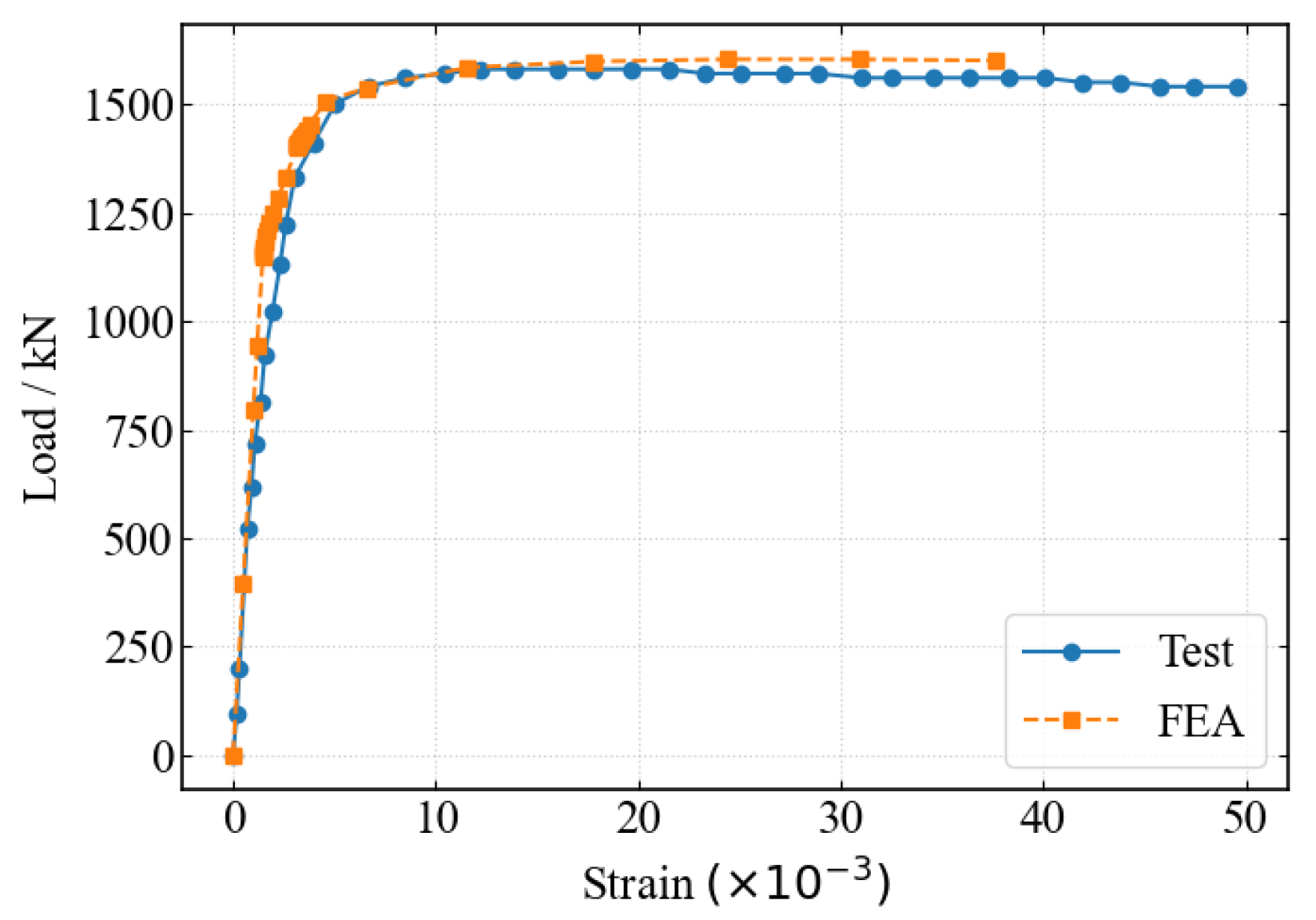
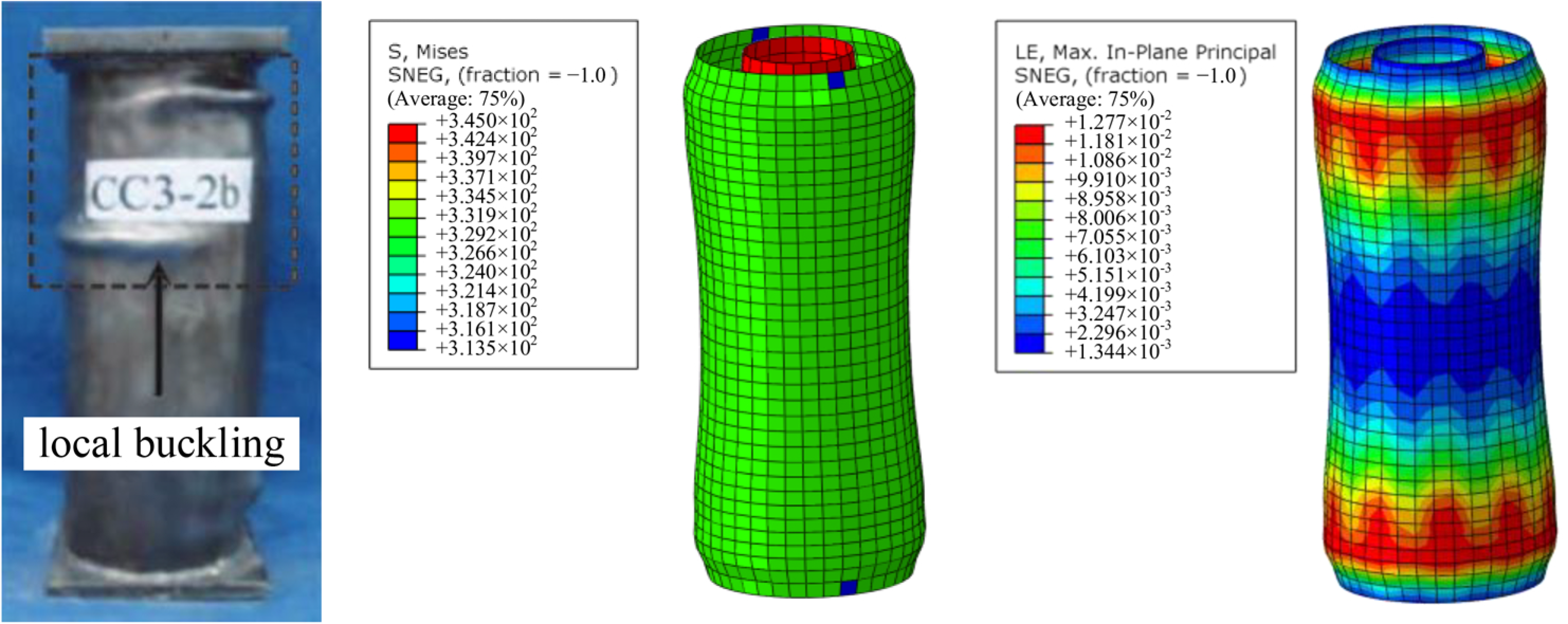
The force–displacement data at the top reference point were converted to an N-ε curve with ε = δ/H and superposed on the experimental result (Figure 3). Overall, the simulation reproduces the characteristic “rapid rise–quasi-plateau–gradual decay” response observed in the test. Quantitatively, the experimental peak load was 1580 kN, whereas the model predicted 1602.8 kN, yielding a relative error of 1.4%. The failure pattern is also captured: within 0.4H–0.6H, the outer tube develops multi-wave local buckling consistent with the test; the annular (sandwich) concrete forms a crushing band beneath the buckles, and the peak equivalent compressive strain of the core concrete likewise concentrates in this region (Figure 4). Buckling amplitudes of the inner tube are noticeably smaller than those of the outer tube, reflecting the typical dual-confinement behavior reported experimentally. In terms of stress transfer and interaction, the axial and circumferential strains of the outer tube grow rapidly around the peak; the normal contact pressure at the steel–concrete interface attains a maximum near the peak and then slightly decreases as local buckling progresses. Nevertheless, the core concrete maintains a high level of equivalent compressive stress, underpinning the post-peak plateau-like resistance. At present, experimental data for segmental or continuous PCFST/CFST chord members under axial tension are not available, and full-scale tensile testing of multi-segment prestressed chords lies beyond the scope of this concept-level study. However, the composite interaction mechanisms calibrated here in compression—namely, steel–concrete confinement, contact behavior, and instability evolution—are directly relevant to the chord response under both compression and tension, while the tensile resistance is governed primarily by the steel tube and tendons, for which well-established constitutive laws are adopted. These comparisons indicate that, with the adopted constitutive models, contact definitions, and boundary conditions, the FE model accurately captures the key mechanics and instability evolution of the short column, and is therefore suitable as a reliable tool for subsequent parametric analyses in this concept-level investigation.

3. Segmentally Post-Tensioned Tendon Chord Configuration and FE Modeling

3.1. Finite-Element Modeling of the Segmentally Post-Tensioned PCFST Chord

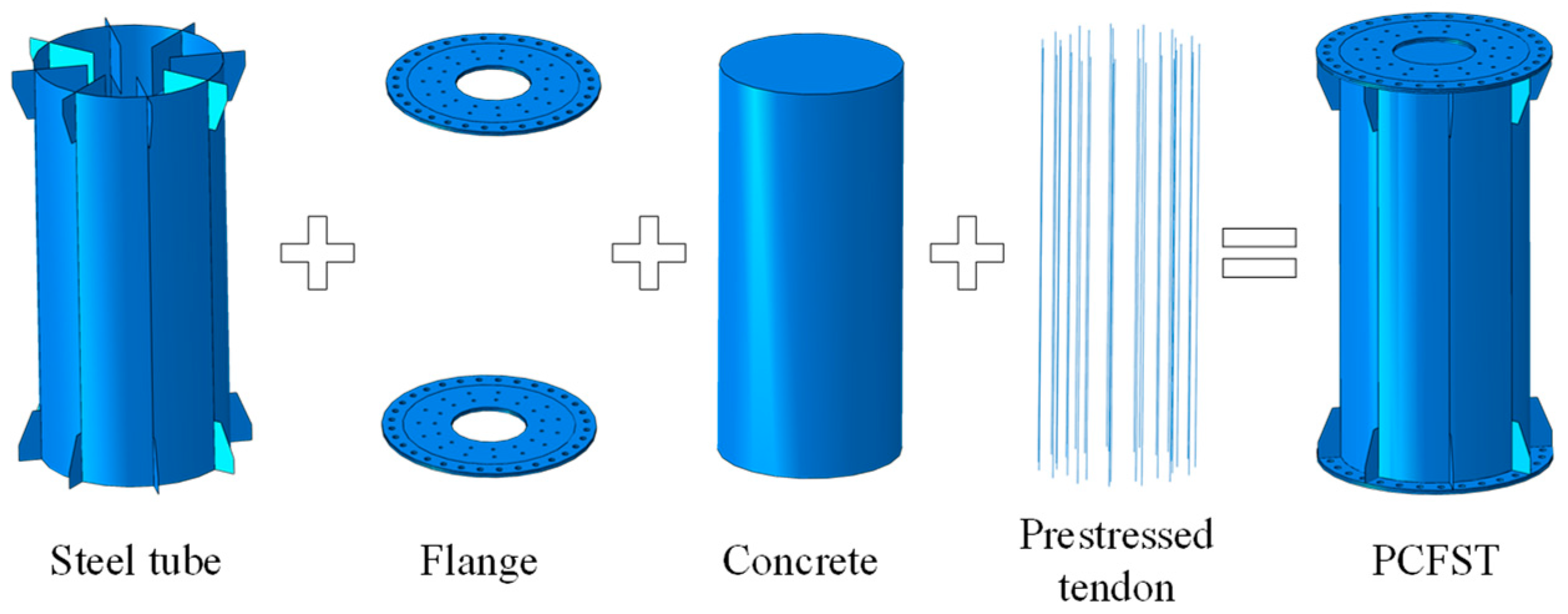
A three-dimensional FE model of the prestressed concrete-filled steel tube (PCFST) chord was established, comprising the steel tube, flanges, concrete core, and prestressing tendons (Figure 5). In accordance with the measured engineering dimensions, the outer tube has a diameter of 910 mm and a wall thickness of 10 mm. At both ends of the chord, inward-projecting stiffeners (10 mm thick) are embedded into the concrete to enhance steel–concrete interaction. The top and bottom flanges (20 mm thick) are welded to the tube and include bolt holes, tendon anchorage holes, and concrete pouring holes. To reduce computational complexity and improve convergence, the prestressing ducts are not explicitly modeled within the concrete; given their small diameter relative to the cross-section, this simplification has a negligible effect on global load and deformation responses while avoiding local mesh distortion and contact-induced divergence.
Regarding discretization, the steel tube is modeled with S4R four-node reduced-integration shell elements to capture thin-walled behavior and local buckling; the flanges and concrete are modeled with C3D8R eight-node reduced-integration solid elements; the tendons are modeled with T3D2 two-node 3D truss elements. A shell–solid coupling is assigned at the tube ends to represent continuous welds and to ensure compatible transfer of in-plane forces and bending moments across the interface. Surface-to-surface contact is defined between the tube outer wall and the concrete surface, with hard contact in the normal direction (to prevent penetration) and a penalty Coulomb friction law in tangential slip with a friction coefficient of 0.6. The tendon ends are kinematically coupled to the anchorage regions of the flanges, allowing the resultant prestress to be transferred directly into the composite end region without explicitly modeling wedge action or local bearing stresses. A perfect bond is assumed between the tendons and the surrounding concrete/steel through the coupling constraints, consistent with common FE practice for prestressed members.
For material constitutive laws, the steel is taken as ideal elastic–plastic material with E = 206,000 MPa, ν = 0.30 , and f y = 355 MPa. The concrete follows the Concrete Damaged Plasticity (CDP) model; the yield criterion, viscosity parameter, dilation angle, and tension/compression laws are identical to those specified in Section 2.3. In tension, concrete is modeled as linear elastic up to the specified tensile strength, followed by a tension-softening branch that represents cracking and tension stiffening in an average sense. The post-cracking response in CDP is known to be mesh-sensitive; accordingly, the mesh size adopted here is kept consistent with that used in the verification analyses, and the resulting tensile contribution of concrete is interpreted qualitatively rather than as an exact design value. The tendons are modeled as linear elastic with E = 195,000 MPa and ν = 0.30, and are defined with the “no compression” option so that only tensile forces can develop, preventing spurious compressive stresses. Prestress is applied via the thermal-shrinkage method: a thermal expansion coefficient of 1.0 × 10⁻⁵ is assigned to the tendons, and an equivalent temperature drop is imposed in the initial step so that, under the relative constraint with the flanges, the target locked-in stress develops. This procedure yields an idealized effective-prestress state in which long-term losses due to creep, shrinkage, and relaxation are not explicitly simulated. Once stabilized, the analysis proceeds to the external loading step. It should be noted that this thermal-shrinkage approach represents an idealized state in which the full effective prestress is present at the analysis time. Time-dependent losses—such as creep, shrinkage, and relaxation—together with anchorage seating and staged-erection effects, are not explicitly simulated. Therefore, the prestress levels examined herein should be interpreted as upper-bound effective prestress states, used to investigate structural response trends rather than to prescribe a detailed jacking procedure.
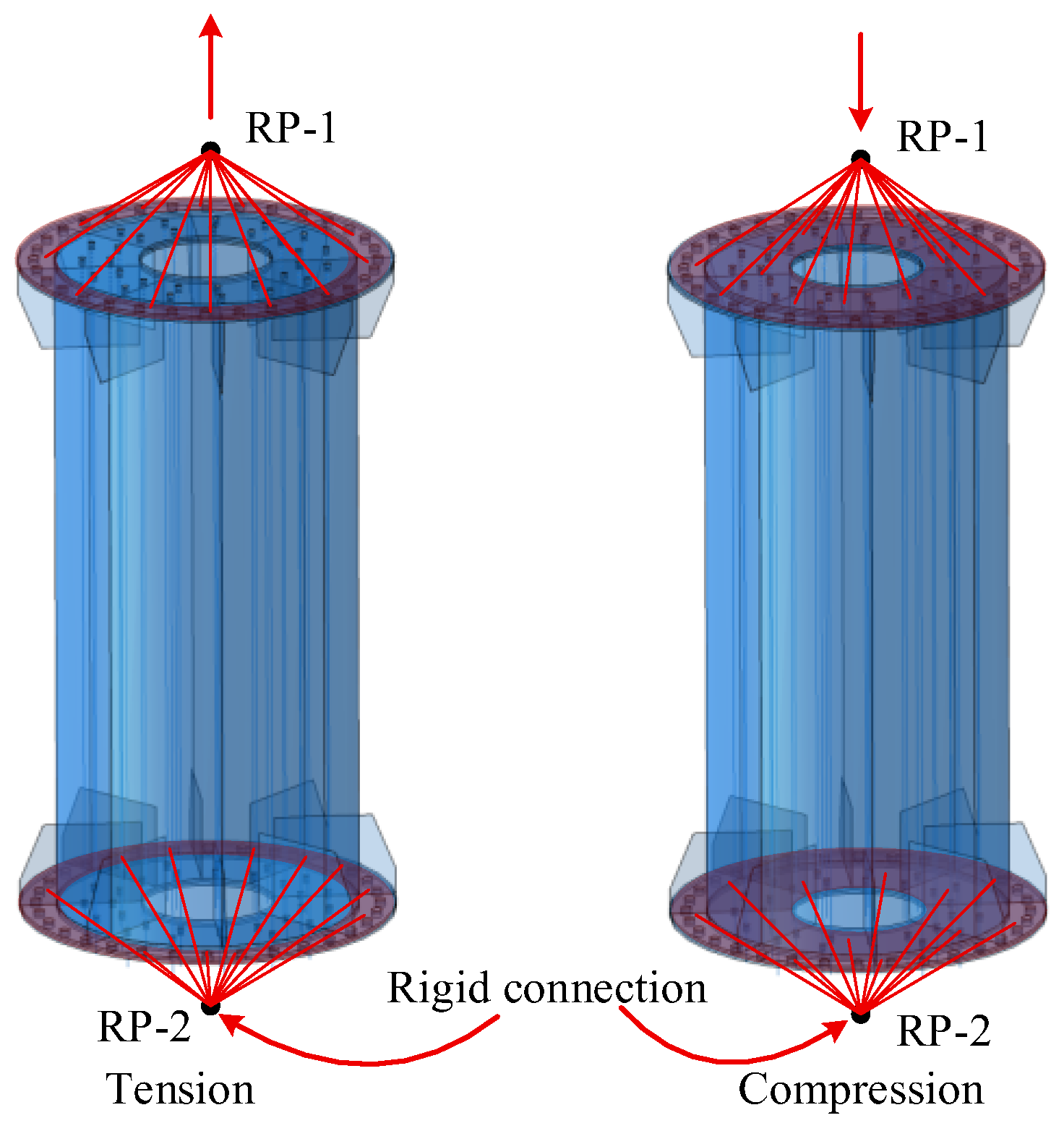
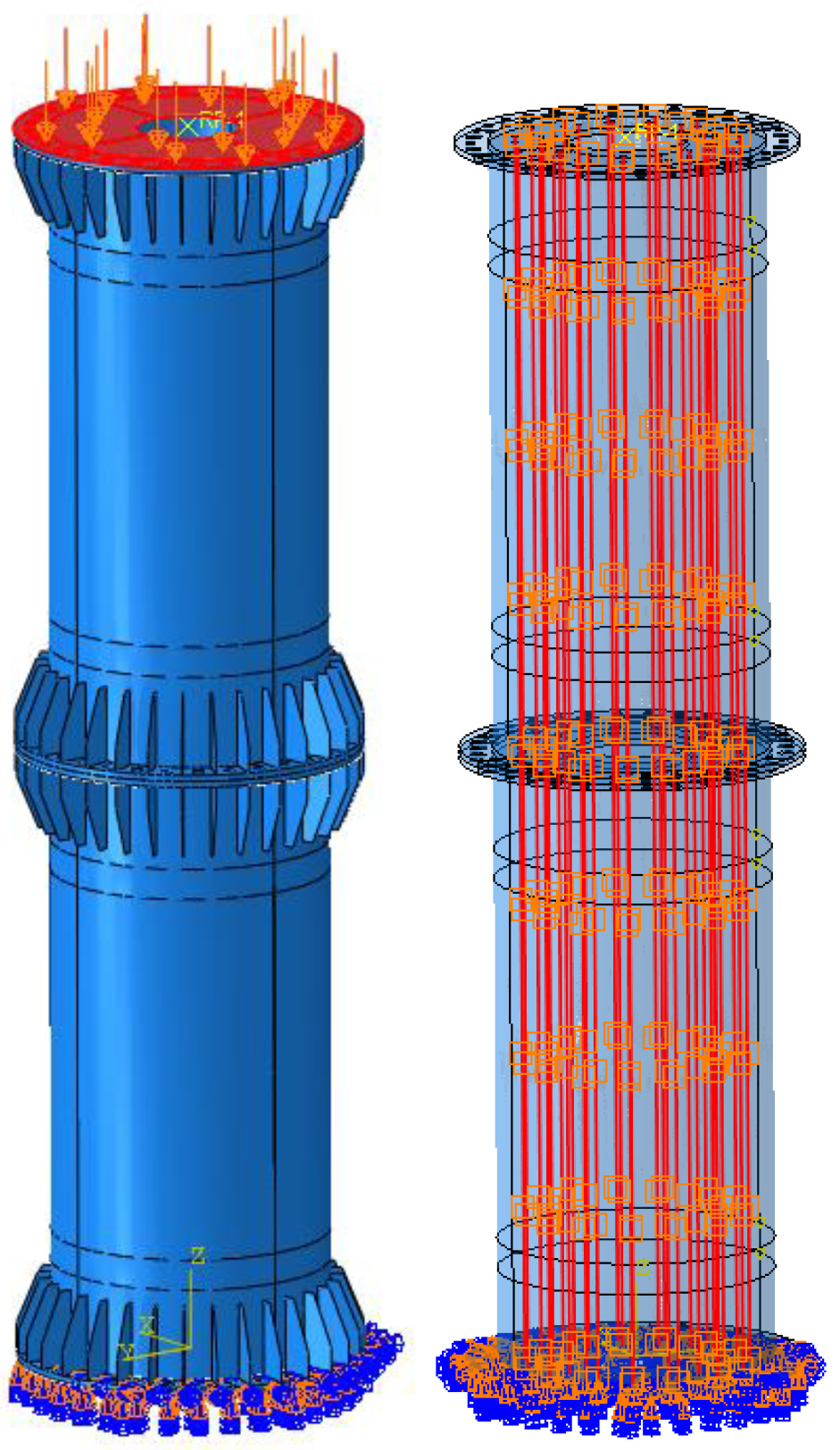
Boundary and loading conditions reflect the engineering connection scheme (Figure 6). A reference point (RP) is placed at each end (top and bottom) and coupled to the corresponding flange surface region to achieve equivalent transfer of displacement and force. Under compression, the RP is coupled to the entire flange bearing surface; under tension, the RP is coupled only to the bolt-load-transfer face to represent the fact that adjacent segments transmit tension through the flange bolt ring. The bottom RP is fully fixed, and the top RP is subjected to axial displacement control. The tensile load is applied only after the prestress field has reached equilibrium, and the external tensile displacement is superimposed on the pre-existing prestress field. As the imposed tensile displacement increases, tendon elongation leads to a progressive increase in tendon force beyond the initial prestress level. Prestress application and external loading are executed in separate analysis steps to clearly distinguish the initial locked-in prestress from the additional deformation-induced tendon force.

3.2. Compressive Load–Displacement Response of the Model

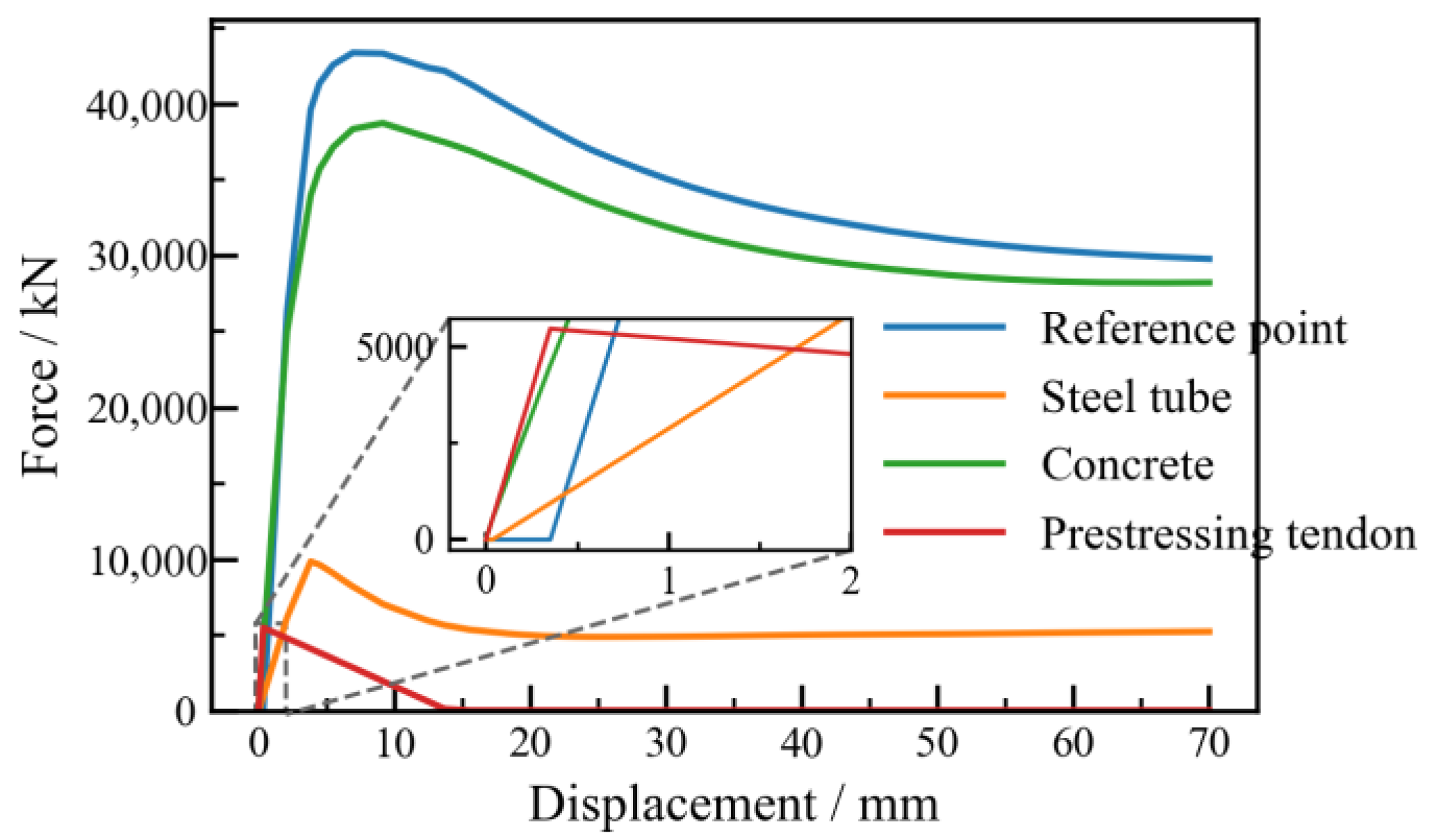
The axial force–displacement histories of the top reference point (RP), steel tube, concrete, and prestressing tendons are plotted in Figure 7. The RP curve is initially linear, indicating elastic behavior; as the load approaches ≈40,000 kN, plasticity develops and the chord attains a peak capacity of 43,403 kN at a displacement of 6.9 mm. Thereafter, the resistance degrades gradually; at 25 mm, the load has decreased to ≈85% of the peak. The concrete force–displacement response follows the RP trend, reaching 38,753 kN at 9.1 mm. In contrast, the steel tube exhibits a different pattern: its axial force increases nearly linearly up to 9830 kN at 3.8 mm (about 23% of the concrete peak), confirming that the compressive capacity is dominated by the concrete core; with further displacement, the tube force decreases and stabilizes near 5000 kN.
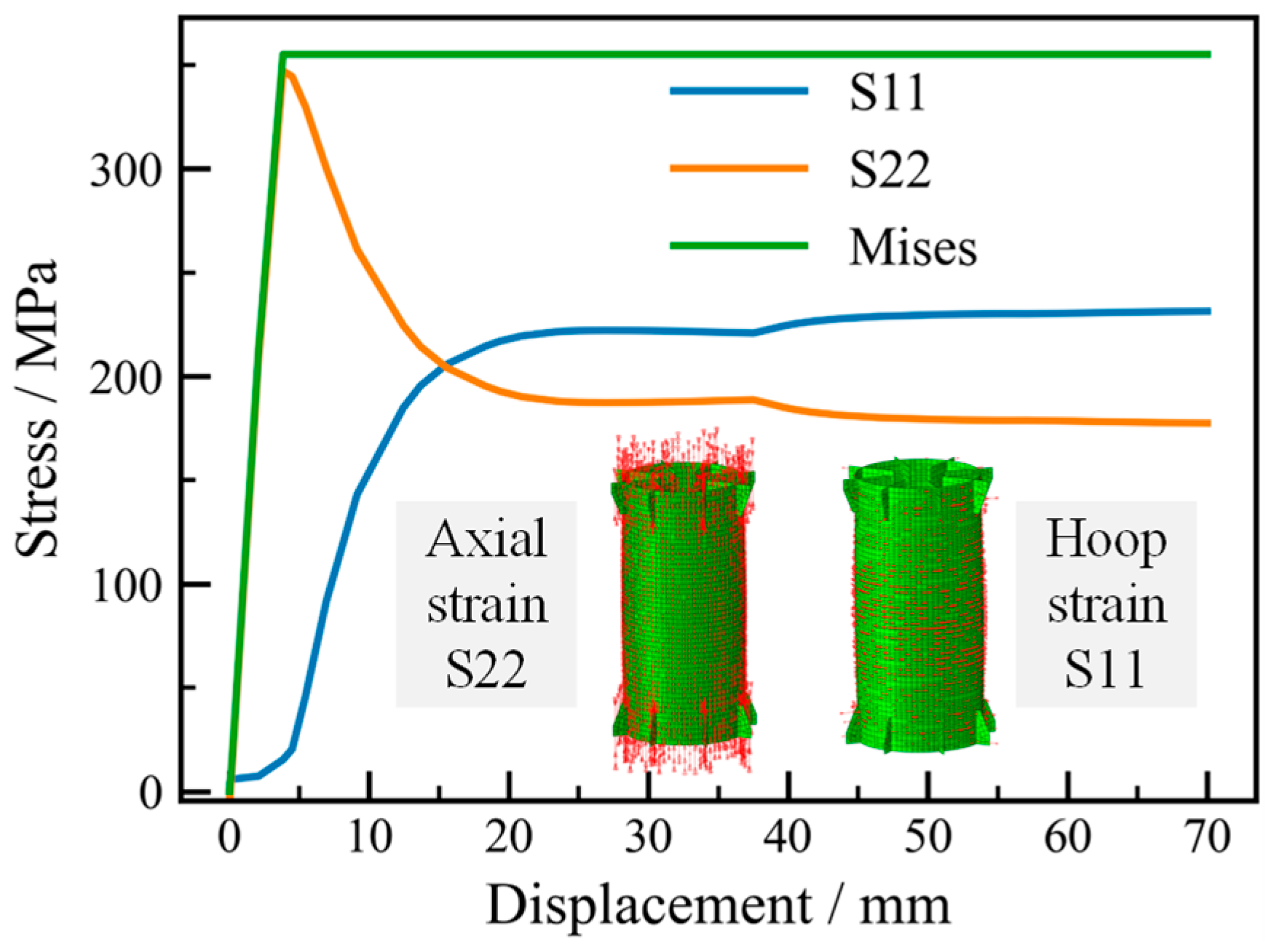
The post-peak reduction in steel axial force is attributed to concrete bulging under compression and the associated hoop restraint provided by the tube. As the hoop stress S 11 rises, the tube satisfies the von Mises yield condition by reducing its axial stress S 22 . The evolution of S 22 , S 11 , and von Mises stress at mid-height is shown in Figure 8: within the elastic stage, von Mises stress and S 22 increase linearly; after yielding, von Mises stress remains essentially constant, S 22 progressively decreases, while S 11 keeps increasing and approaches a plateau at an applied displacement of 20 mm.
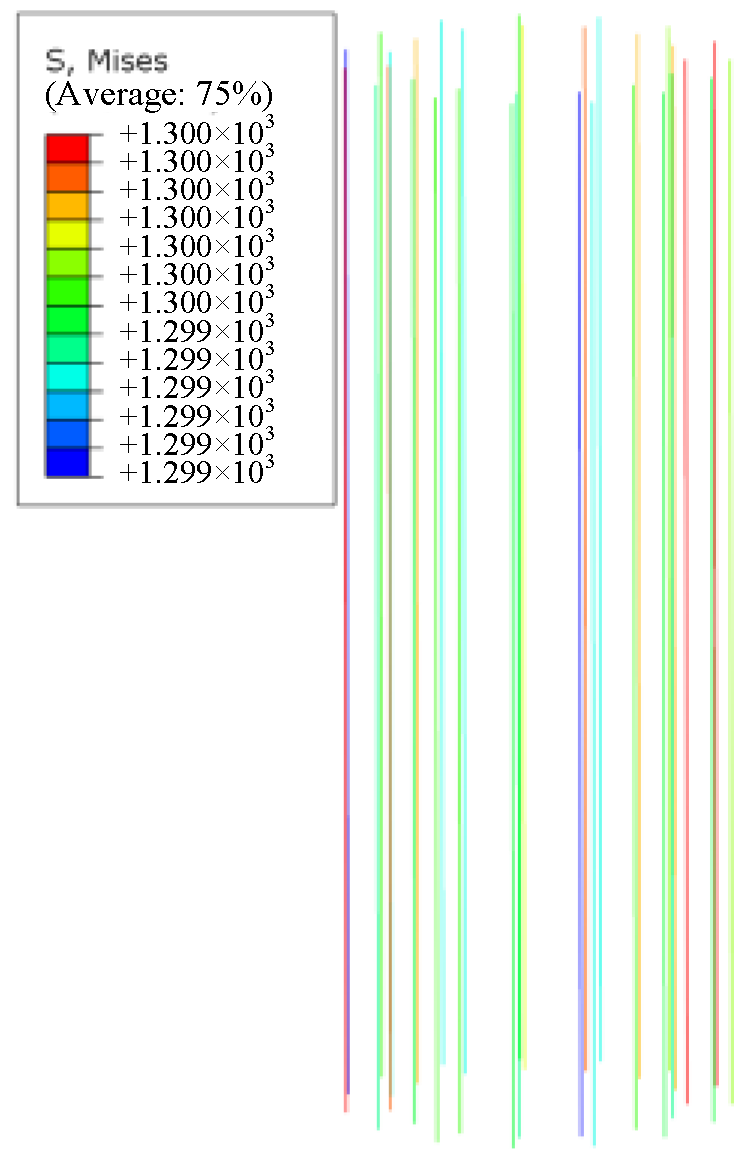
For the prestressing tendons, the axial force peaks at the end of the prestress application step. The corresponding von Mises stress field is given in Figure 9, indicating 1300 MPa per tendon and a peak total tendon force of 5460 kN. During subsequent loading, the tendon force continuously decreases; at 13.7 mm, it drops to zero, implying that the tendons have gone completely slack. Thereafter, the tendon force remains zero throughout loading, confirming the effectiveness of the tension-only modeling assumption.
Finally, the inset of Figure 7 shows that, at small displacements, the steel tube stiffness is evidently lower than that of the concrete, so the initial axial compressive stiffness of the member is governed by the concrete core. This observation is consistent with the overall role of the two constituents: the concrete carries the bulk of the compressive load, whereas the steel tube primarily constrains lateral dilation, providing hoop confinement that enhances the composite response.

3.3. Compressive Stress Distribution in the Steel Tube

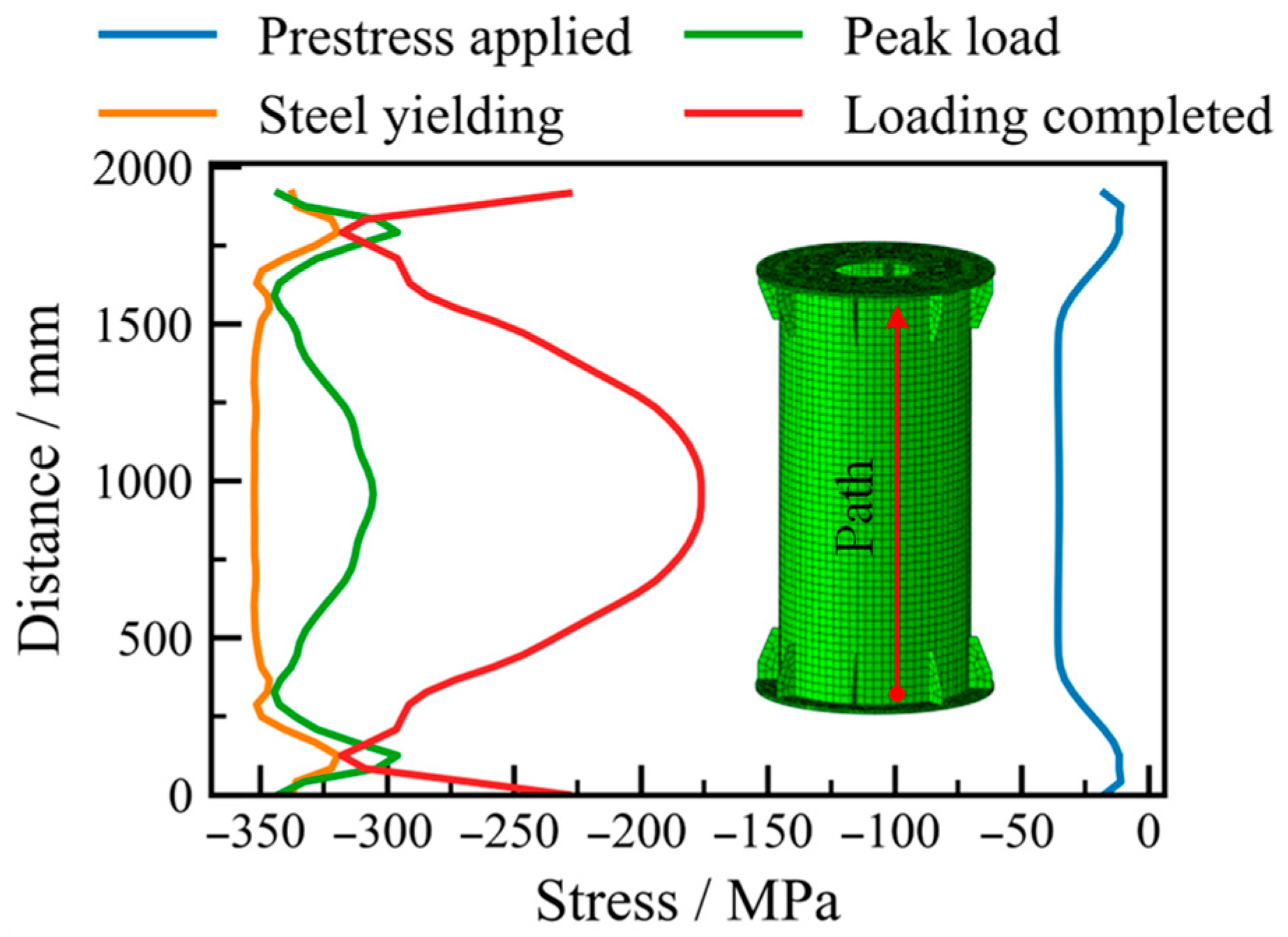
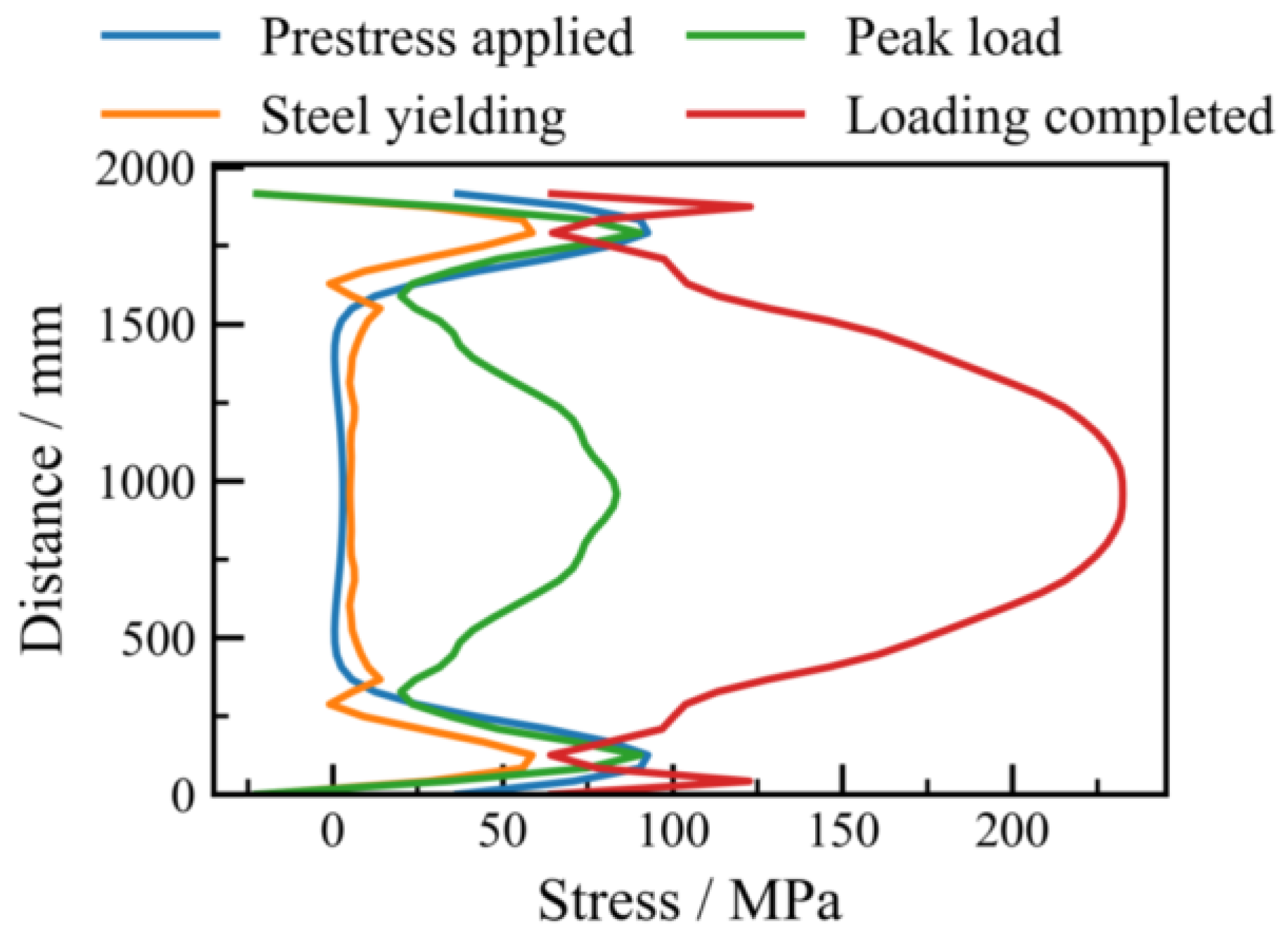
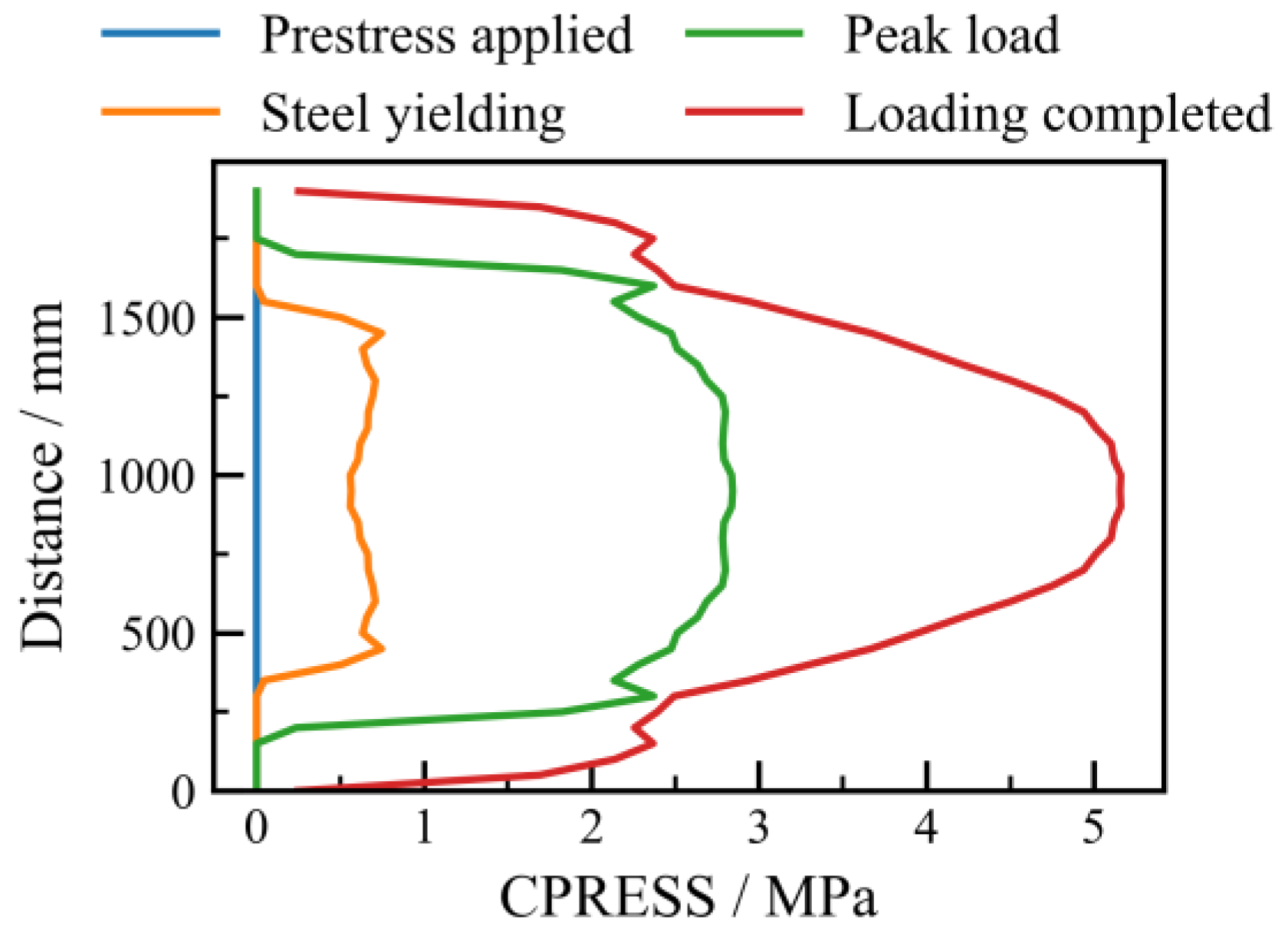
To elucidate the through-height stress characteristics of the tube, axial stress ( S 22 ) and circumferential (hoop) stress ( S 11 ) distributions along the member height were extracted at four characteristic stages—Prestress applied, Steel yielding, Peak load, and Loading complete—as shown in Figure 10 and Figure 11.
At Prestress applied, both S 22 and S 11 are small over the height, but discernible differences arise between the end regions and the mid-height. This nonuniformity stems from the end stiffeners embedded into the concrete, which locally increase stiffness at the tube ends and thus alter the end–midspan stress levels.
Once Steel yielding initiates, the axial stress S 22 becomes nearly uniform along the height (about −350 MPa), while the hoop stress S 11 remains low. This indicates that prior to extensive yielding, the tube and the concrete core deform in a largely compatible manner, and the tube’s confinement on the concrete is still limited.
At Peak load, S 22 exhibits a larger-at-ends, smaller-at-midspan pattern, whereas S 11 shows an opposite larger-at-midspan, smaller-at-ends distribution. This reflects the composite action after plasticity develops because the Poisson’s ratio of concrete exceeds that of steel, the concrete tends to undergo greater lateral dilation, and the tube responds by providing hoop restraint that suppresses radial expansion. In an axially compressed member, lateral dilation is theoretically most pronounced near mid-height, leading to the observed stress layouts.
By the stage of Loading complete (displacement ≈ 70 mm), the overall trends of S 22 and S 11 remain similar to those at peak, but the contrast between mid-height and the ends is further amplified, evidencing intensified plastic deformation. Complementarily, Figure 12 presents the contact stress along the concrete surface versus height at the same four stages; the magnitude of this contact stress indicates the degree of confinement imparted by the tube. It is evident that significant confinement develops only after the tube yields, which is consistent with—and corroborated by—the stress-distribution analysis above.

3.4. Tensile Load–Displacement Response of the Model

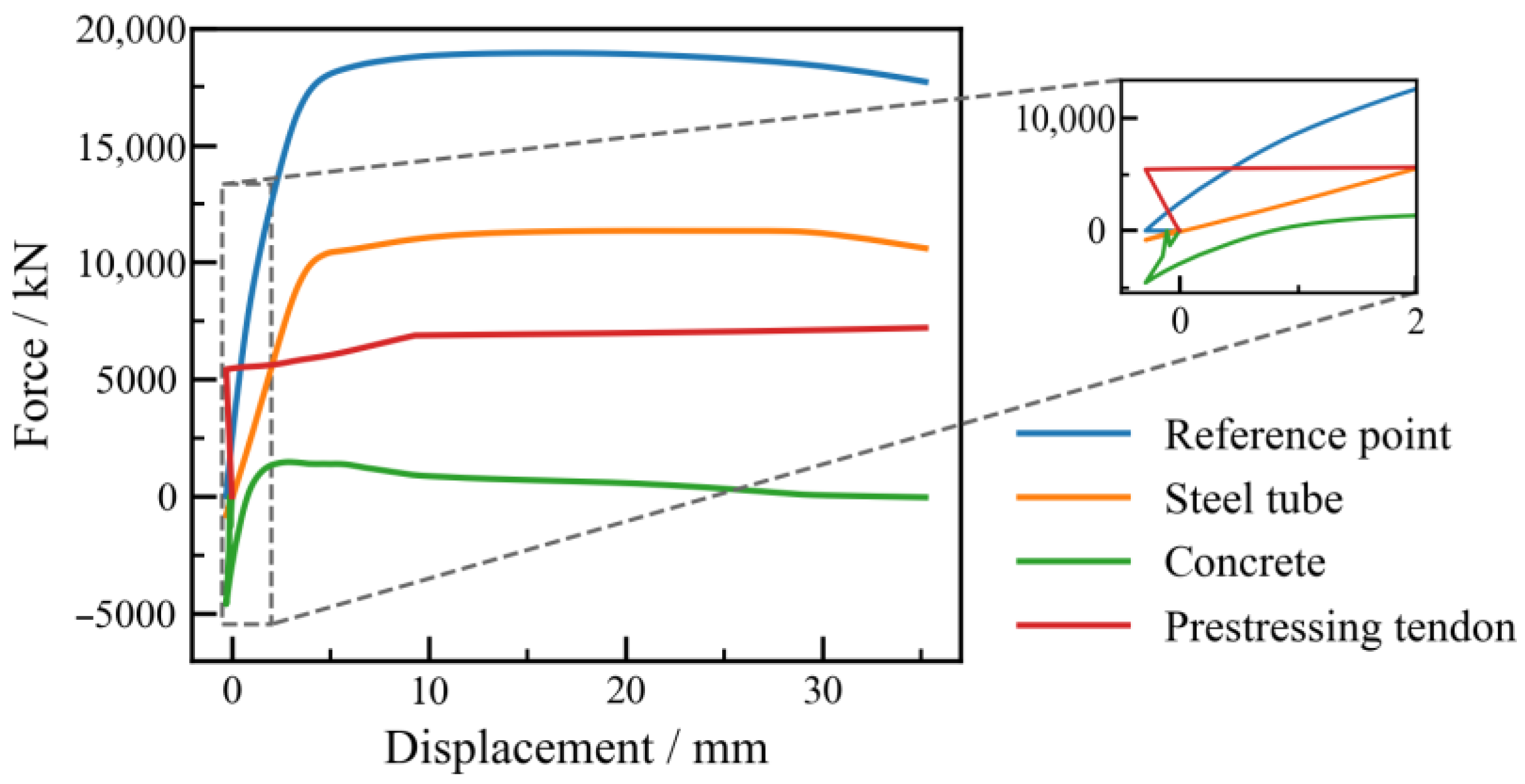
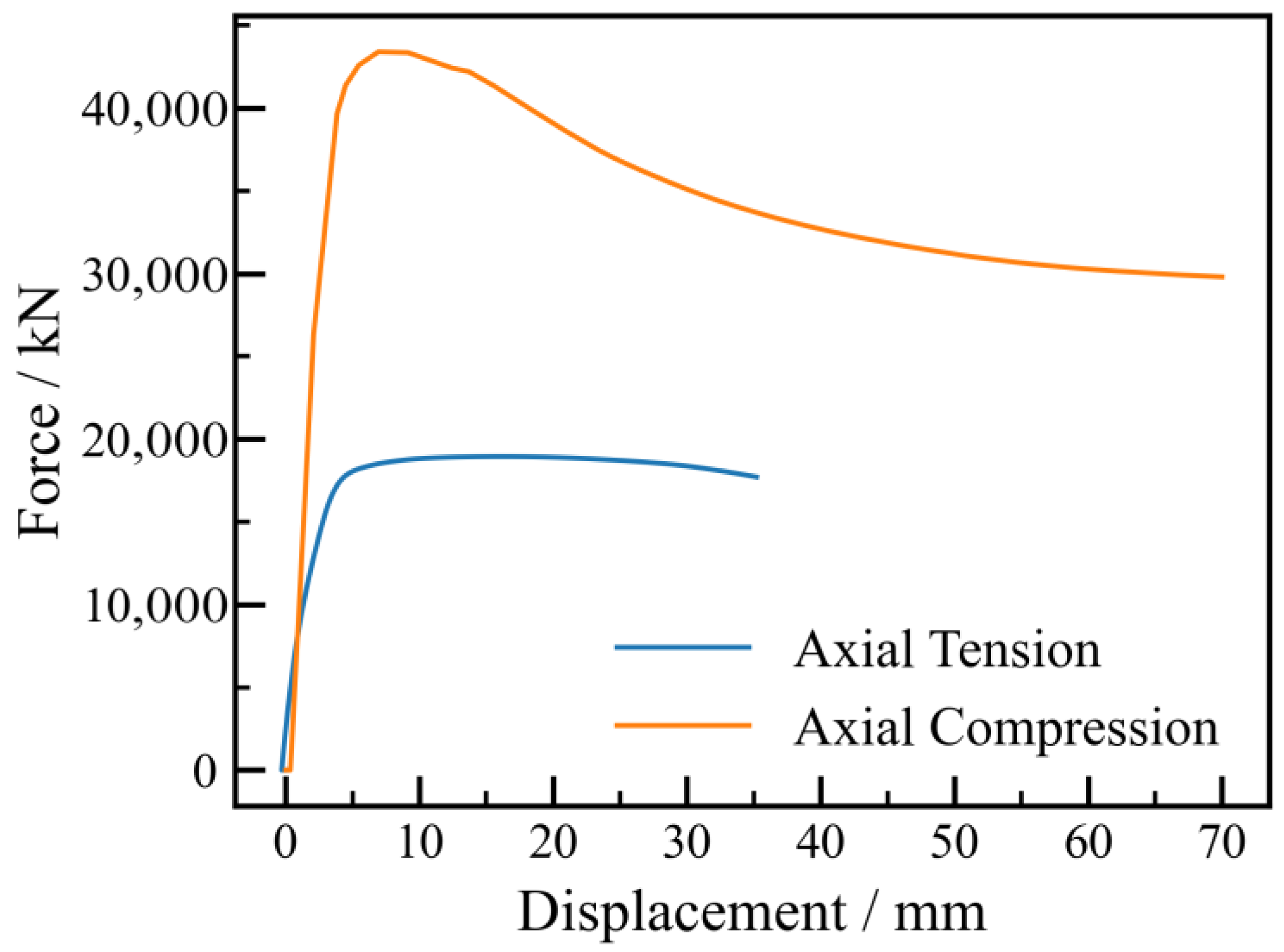
To evaluate the global and component responses of the PCFST chord under axial tension, the displacement evolutions of the RP reaction, steel-tube axial force, concrete axial force, and total tendon force were compiled (Figure 13). The force–displacement curve departs from linearity at a displacement of 3.3 mm—marking the onset of plasticity—with a reaction of 17,760 kN; the peak tensile load of 18,940 kN is reached at 16 mm, followed by a gradual decline. A comparison with axial compression (Figure 14) indicates that both the initial stiffness and peak capacity in compression are markedly higher than in tension, with the peak differing by more than a factor of two. Under the adopted mesh density and CDP tension-softening assumptions, the infill concrete carries only a very small fraction of the axial tensile resistance—approximately 3–4% at peak—reflecting its highly limited role after cracking. This value should be interpreted as an indicative upper bound because the post-cracking tensile response in CDP is mesh-sensitive. Accordingly, the axial tension is resisted primarily by the tube–prestress system, with load sharing at the tensile peak being steel tube 59.8%, tendons 36.7%, and concrete only a minor contribution. The total tendon force increases with displacement in the elastic range and, after reaching 6880 kN, enters plastic response with a reduced growth rate.
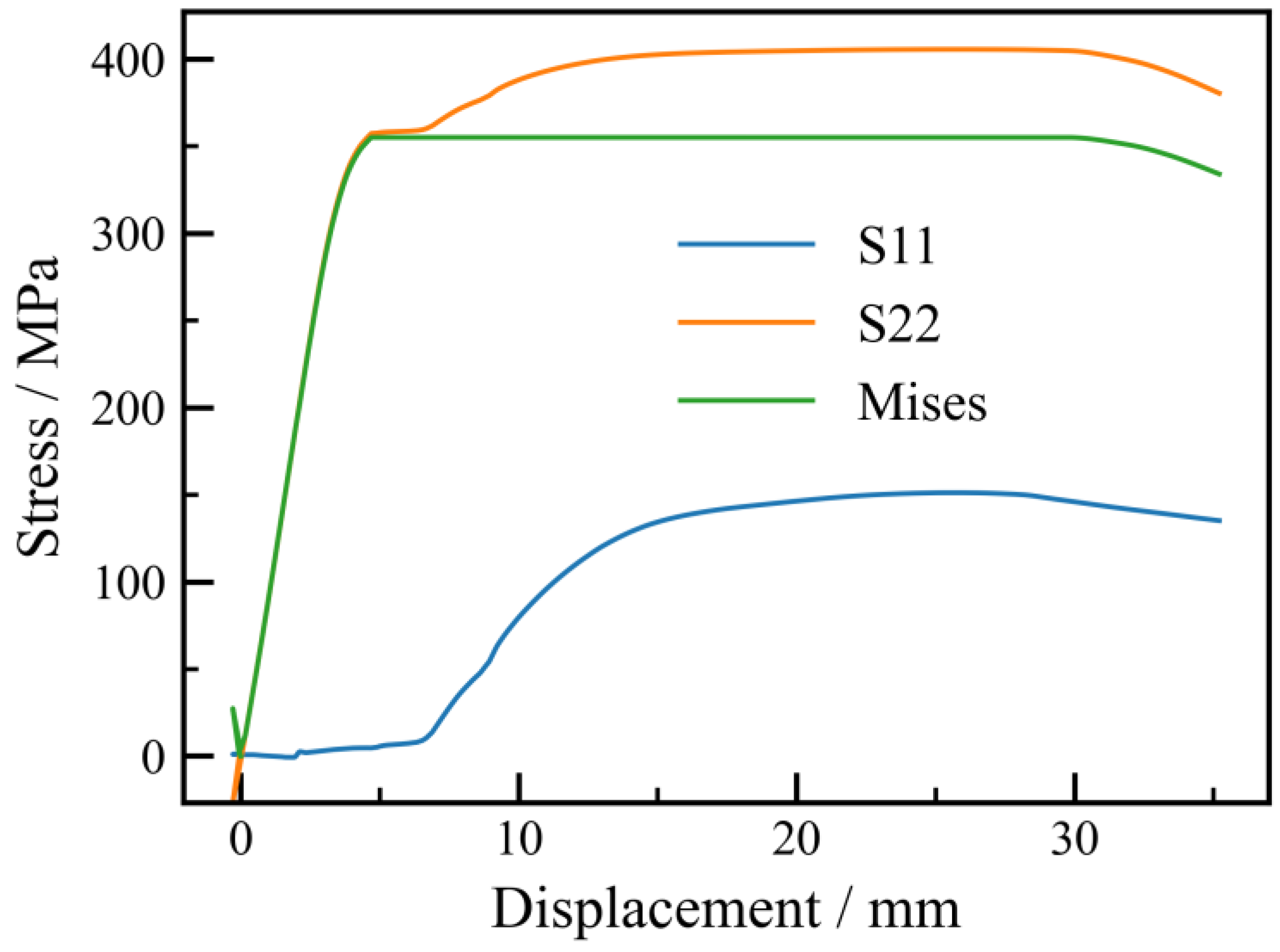
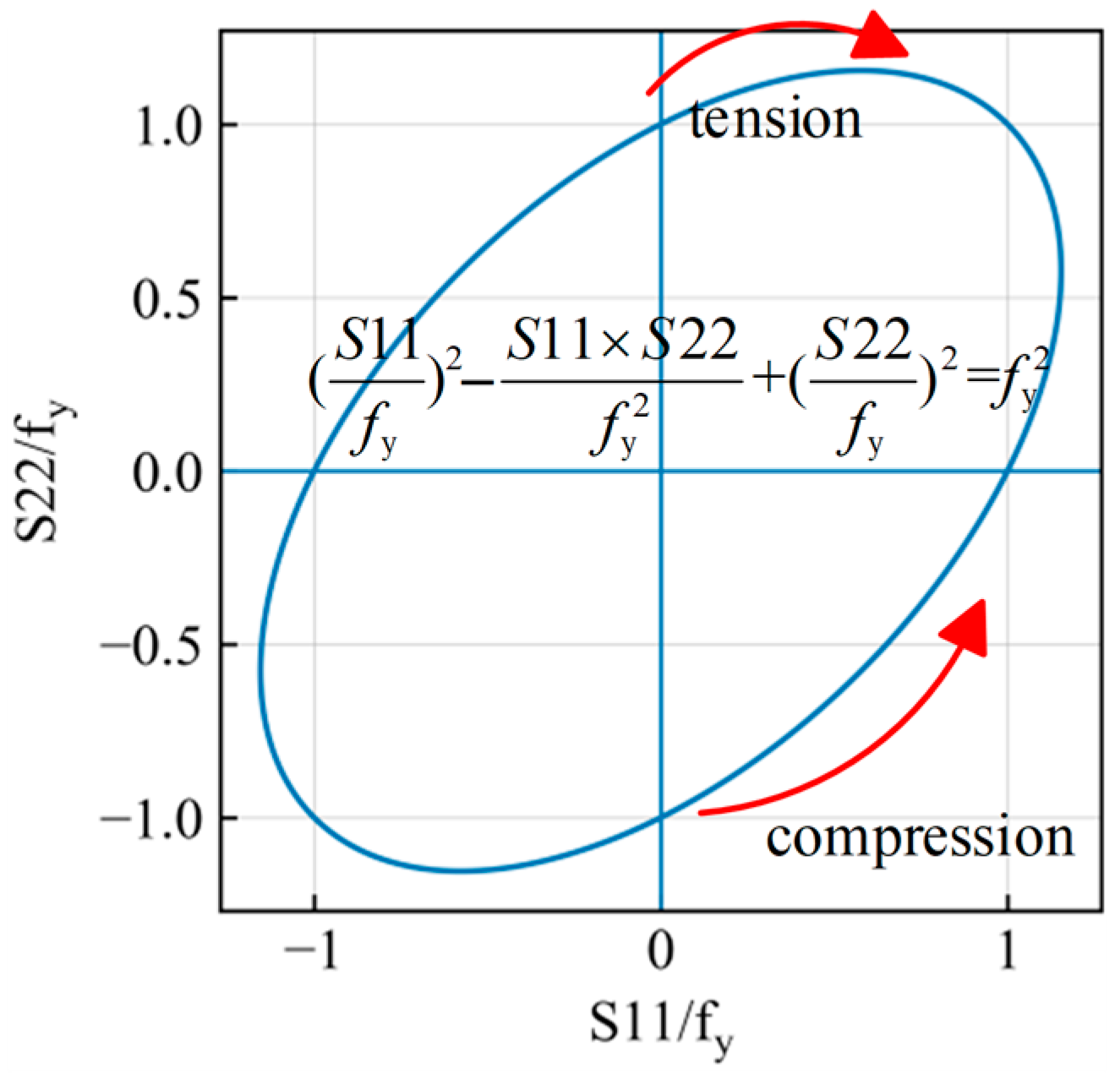
The evolution of S 22 (axial), S 11 (hoop), and von Mises stress at mid-height (Figure 15) shows that, in the early stage, S 22 and the equivalent stress rise linearly while S 11 0 . After yielding, multiaxial redistribution develops and, as the concrete restrains tube necking, the tube progressively takes tensile hoop stress S 11 , and S 22 , initially near the yield level, increases further and stabilizes at ≈400 MPa. This is consistent with the von Mises criterion: under biaxial tension, a principal component may exceed the uniaxial yield strength while the equivalent stress remains bounded by the yield surface. The schematic yield surface in Figure 16 further clarifies the contrast with compression: in compression, the tube commonly experiences hoop tension with axial compression, so increasing S 11 drives S 22 down; in tension, both components are tensile and may increase concurrently, hence observations of S 22 / f y > 1 are not contradictory.

4. Parametric Study

4.1. Effect of End Stiffeners

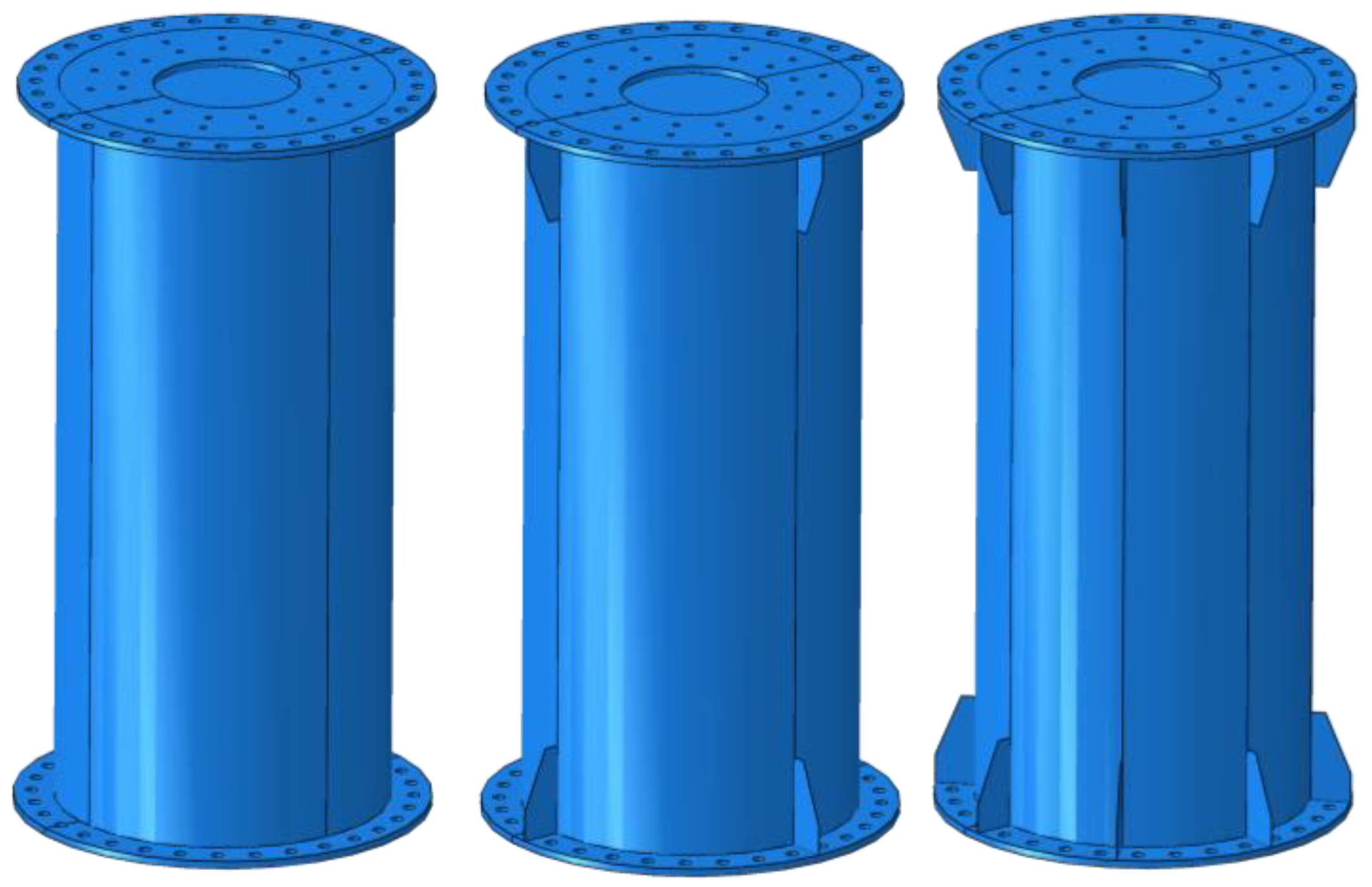
To examine how end detailing affects the load path and overall performance, three numerical models were constructed with different numbers of end stiffeners—0, 4, and 8 (see Figure 17). The stiffeners are welded to the steel tube and flange and extend into the tube to anchor in the concrete, thereby establishing a stronger steel–concrete interaction and a more efficient load-transfer path at the ends.
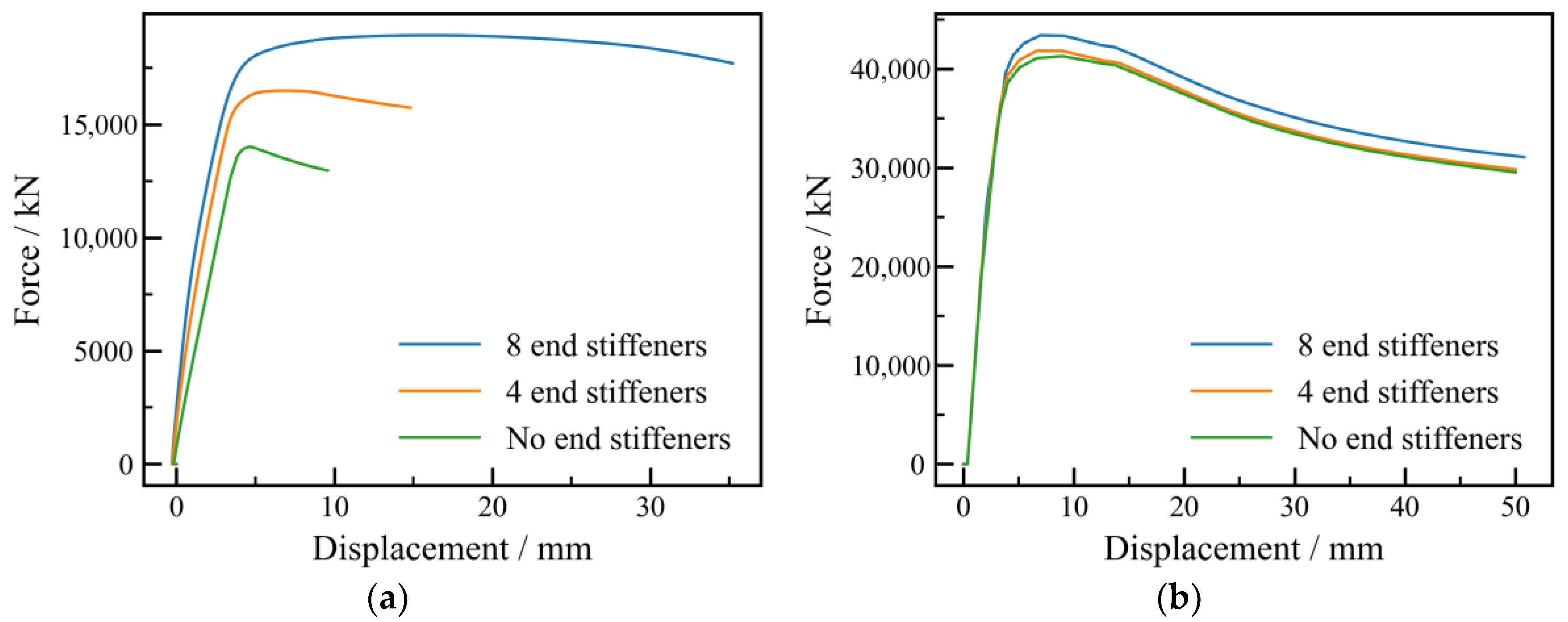
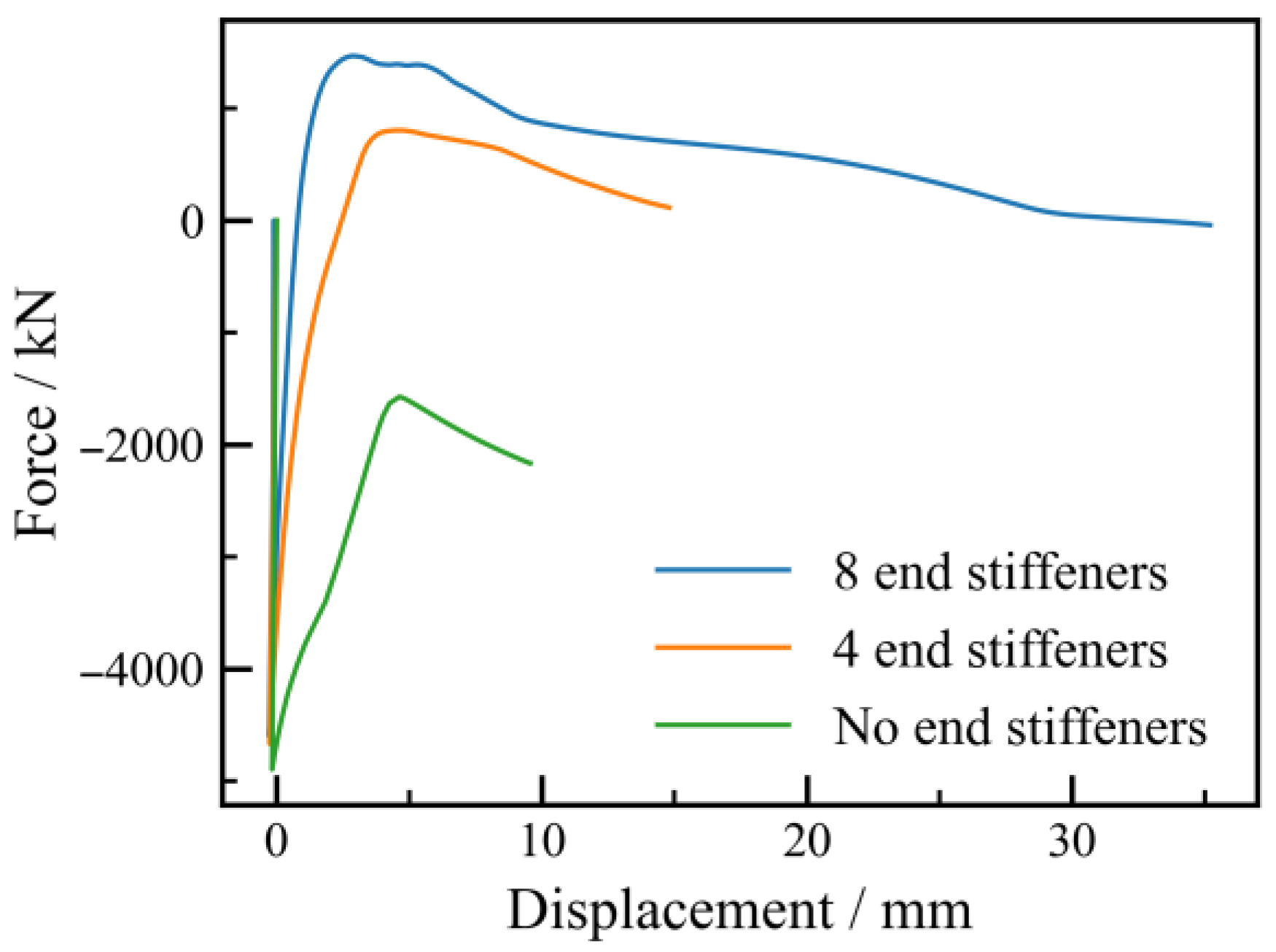
Under axial tension and compression, the load–displacement curves for the three models are shown in Figure 18. End stiffeners markedly enhance the tensile response: relative to the no-stiffener case, the 8-stiffener model exhibits increase of approximately 1.8 times in initial stiffness K 0 and 1.3 times in peak load P u , with the 4-stiffener model lying in between. The mechanism is corroborated by the concrete axial force–displacement responses (Figure 19): upon completion of prestress application, all three models show comparable compressive forces in the concrete; as displacement increases, the concrete in the stiffened models transitions from compression to tension, indicating that the end stiffeners channel tensile force from the flange–tube assembly more effectively into the concrete core, thereby strengthening steel–concrete compatibility and cooperative action at the ends. In contrast, the no-stiffener model relies mainly on interface friction, so the concrete remains largely in compression throughout and contributes little to tensile resistance. Hence, for this chord type, end stiffeners are recommended to improve steel–concrete coupling and, in turn, enhance overall tensile stiffness and capacity.
Under compression, the load–displacement curves indicate that the number of end stiffeners has a limited effect: the responses of the 4-stiffener and no-stiffener models are nearly identical, and the 8-stiffener model shows only about a 3% increase in P u over the 4-stiffener case. This suggests that, in compression, axial force is transmitted primarily through end bearing and circumferential confinement; the through-height steel–concrete composite action is already well mobilized, leaving only marginal benefit from additional end stiffening in terms of global compressive stiffness and ultimate capacity.

4.2. Effect of Prestress Level

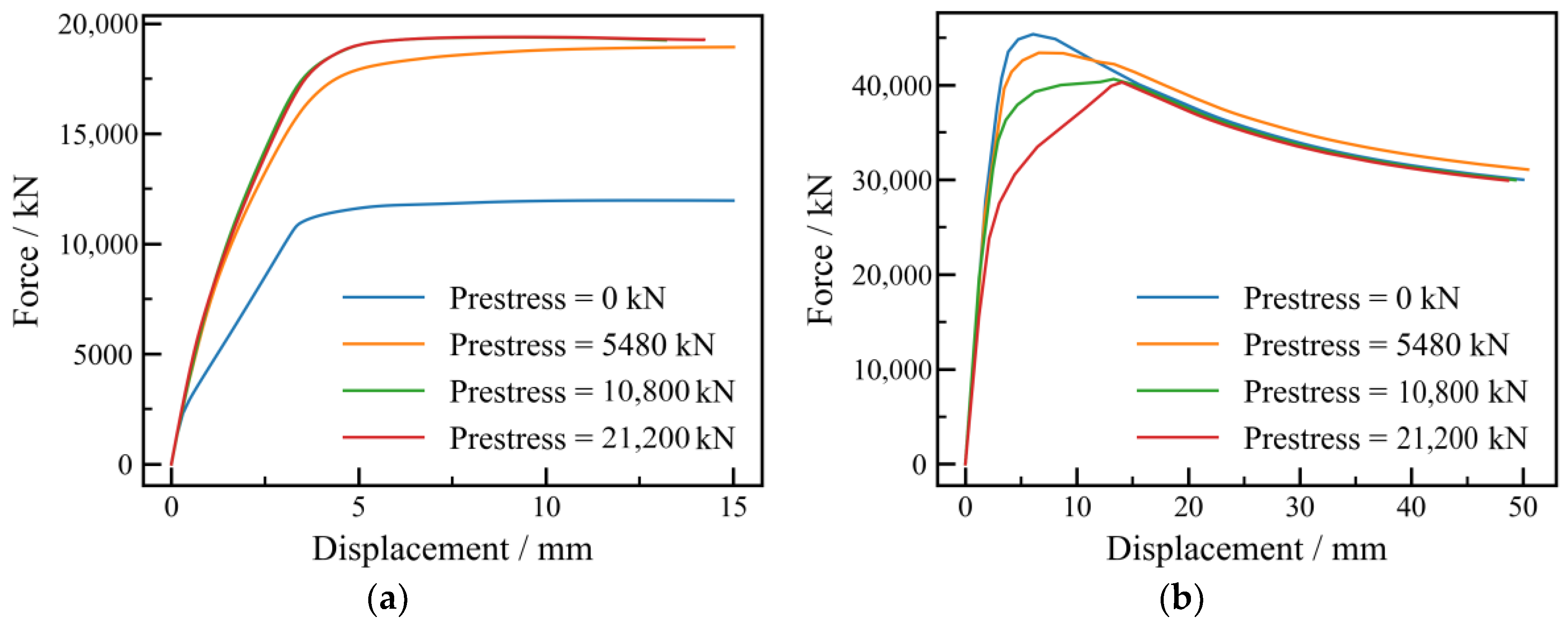
To evaluate the influence of prestress on the axial performance of PCFST chords, four FE models were constructed with initial prestress levels of 0, 5480, 10,800, and 21,200 kN. The load–displacement responses under axial tension and axial compression are compared in Figure 20. Under tension, moderate prestress markedly improves capacity: relative to the no-prestress case, the 5480 kN scheme increases the peak tensile load by ≈58%. Further increases yield rapidly diminishing returns: 10,800 kN provides only ≈2% additional gain over 5480 kN, and the 21,200 kN and 10,800 kN curves are nearly coincident, exhibiting a classic saturation after initial gain.
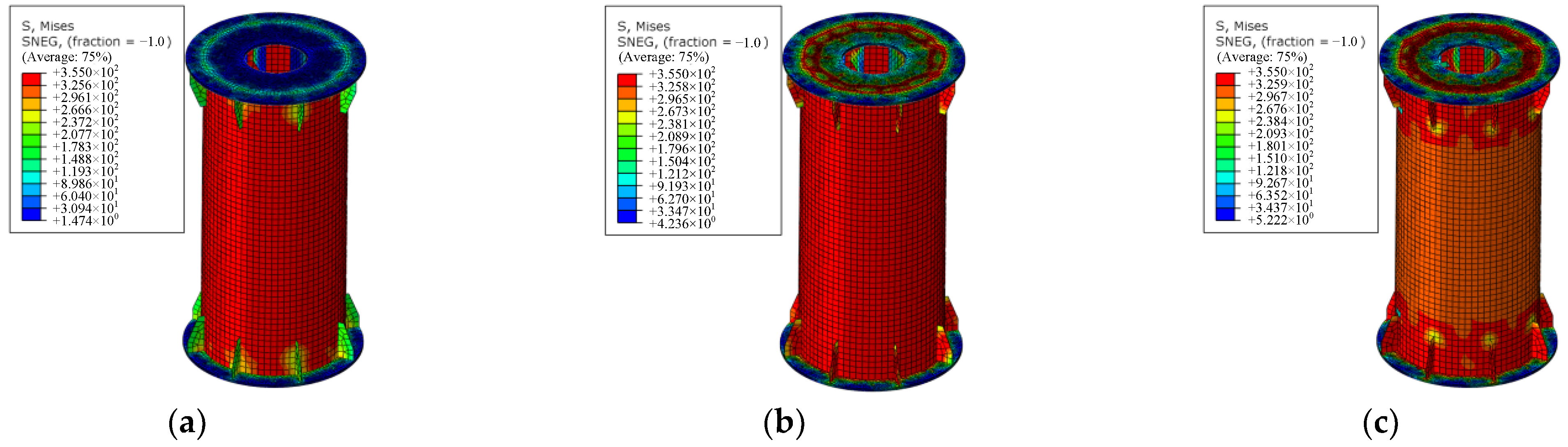
The mechanism is clarified by the steel stress contours and the displacement field of the loaded flange at peak load for the 0, 5480, and 10,800 kN cases (Figure 21 and Figure 22). With 10,800 kN prestress, the mid-height tube remains largely elastic while local yielding initiates in the loaded flange; with 5480 kN, the tube is broadly yielded, and the flange yields only around the tendon anchorage holes; without prestress, the tube widely yields, whereas the flange stays elastic. The contrast arises because prestress is anchored directly in the flange: as prestress increases, the flange carries larger additional tension and bending, intensifying local deformation and stress concentration and gradually shifting the governing limit state from tube yielding to flange-controlled yielding/instability. Since the external axial tension is also transmitted through the bolt ring, excessive prestress causes the flange to consume deformation capacity prematurely, limiting any further increase in global tensile capacity—hence the near overlap of the 10,800 and 21,200 kN curves.
Under compression, prestress is detrimental to the yielding capacity: higher initial prestress lowers the compressive yield point. Physically, the imposed tensile prestress reduces the effective compressive reserve of the tube and flange and weakens the beneficial triaxial confinement mobilized by steel–concrete interaction in compression; when the end flange simultaneously sustains substantial pre-tension, its local stiffness and stability are further compromised, advancing the onset of compressive yielding.
In summary, prestress imparts a pronounced benefit-then-plateau effect in tension but is overall adverse in compression. Within the idealized fully effective prestress assumed in this study, increasing prestress enhances tensile capacity and axial stiffness up to a certain level, beyond which the gains diminish while the compressive demands on the concrete and flanges increase. For design, the prestress level should therefore be chosen within a range that significantly improves tensile performance without inducing flange-controlled yielding or premature end-region failure. When compression governs—or when both tension and compression are critical—the strength and stiffness reserve of the flange must be verified to avoid early compressive yielding.
These observations represent qualitative trends under an idealized effective prestress state; time-dependent prestress losses, anchorage seating, and staged construction effects are beyond the scope of the present FE framework. Accordingly, while the trends provide useful guidance for selecting effective-but-not-excessive prestress levels, the determination of jacking stress and long-term effective prestress in practical design should follow the relevant codes and loss-calculation procedures for post-tensioned structures.

4.3. Effect of Flange Thickness

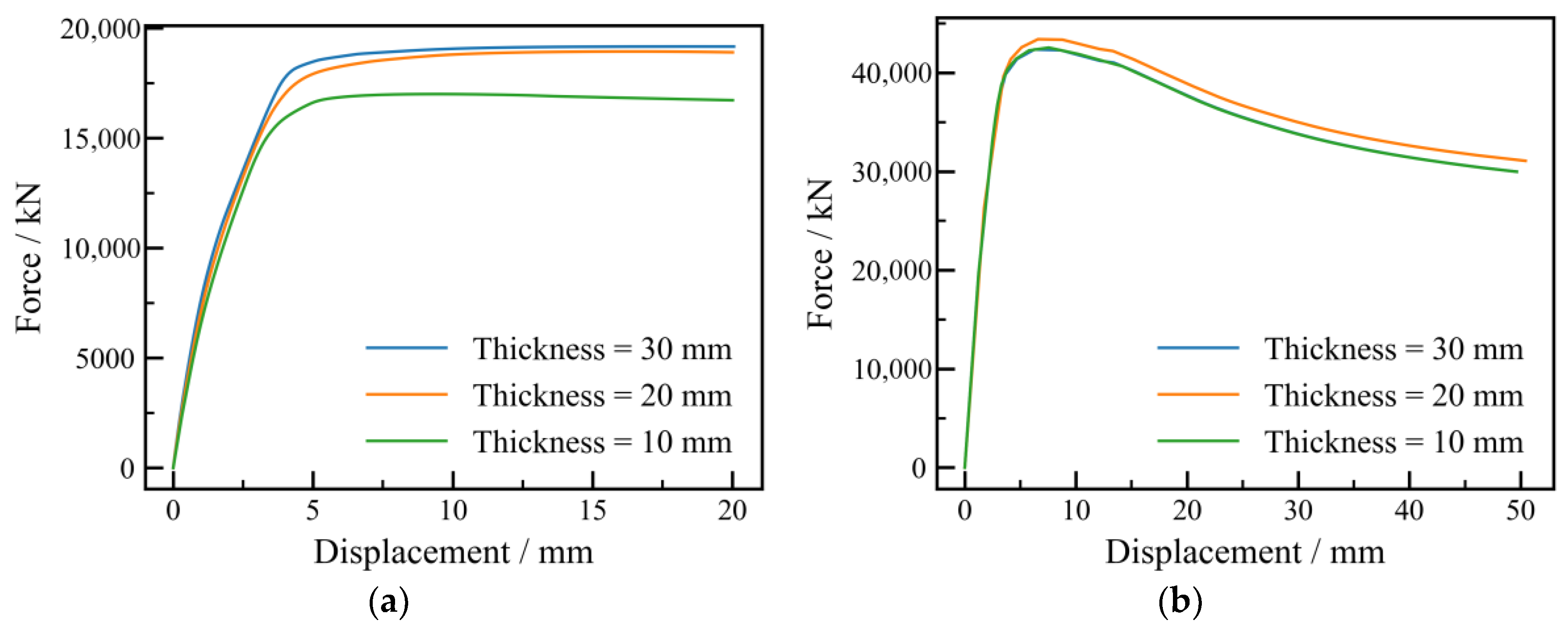
To assess the role of end-flange stiffness on the axial performance of PCFST chords, three FE models with flange thicknesses of 10 mm, 20 mm, and 30 mm were analyzed, and their load–displacement responses under axial tension and axial compression were compared (Figure 23). Under tension, increasing the flange thickness from 10 mm to 20 mm raises the tensile yielding capacity by ≈9%, and a further increase from 20 mm to 30 mm yields an additional ≈4% gain. This trend indicates that thickening the flange effectively increases the local bending–torsional stiffness at the loaded end, mitigates stress concentrations and out-of-plane deformation around the bolt circle and anchorage holes, and thus delays end-region yielding/local instability—improving both the tensile yield point and the ultimate tensile capacity. However, the enhancement diminishes at larger thicknesses, reflecting diminishing returns.
Under compression, the three thickness cases produce nearly coincident load–displacement curves (Figure 23b), indicating a minor influence of flange thickness on the global stress–displacement response. In compression, axial force is transmitted primarily through end bearing and the composite confinement of the steel tube and concrete; overall performance depends more on cross-sectional dimensions, tube-wall stability, and steel–concrete compatibility than on the in-plane/out-of-plane stiffness of the end flange.
In summary, flange thickening has a clear but diminishing positive effect in tension, while its impact in compression is negligible. For engineering applications, when tension governs or when increased end-region tensile capacity and ductility are desired, a moderate increase in flange thickness is recommended. When compression governs, flange thickness may be kept economical—subject to connection strength and detailing requirements—to avoid unnecessary weight and cost.

4.4. Effect of Steel Tube Thickness

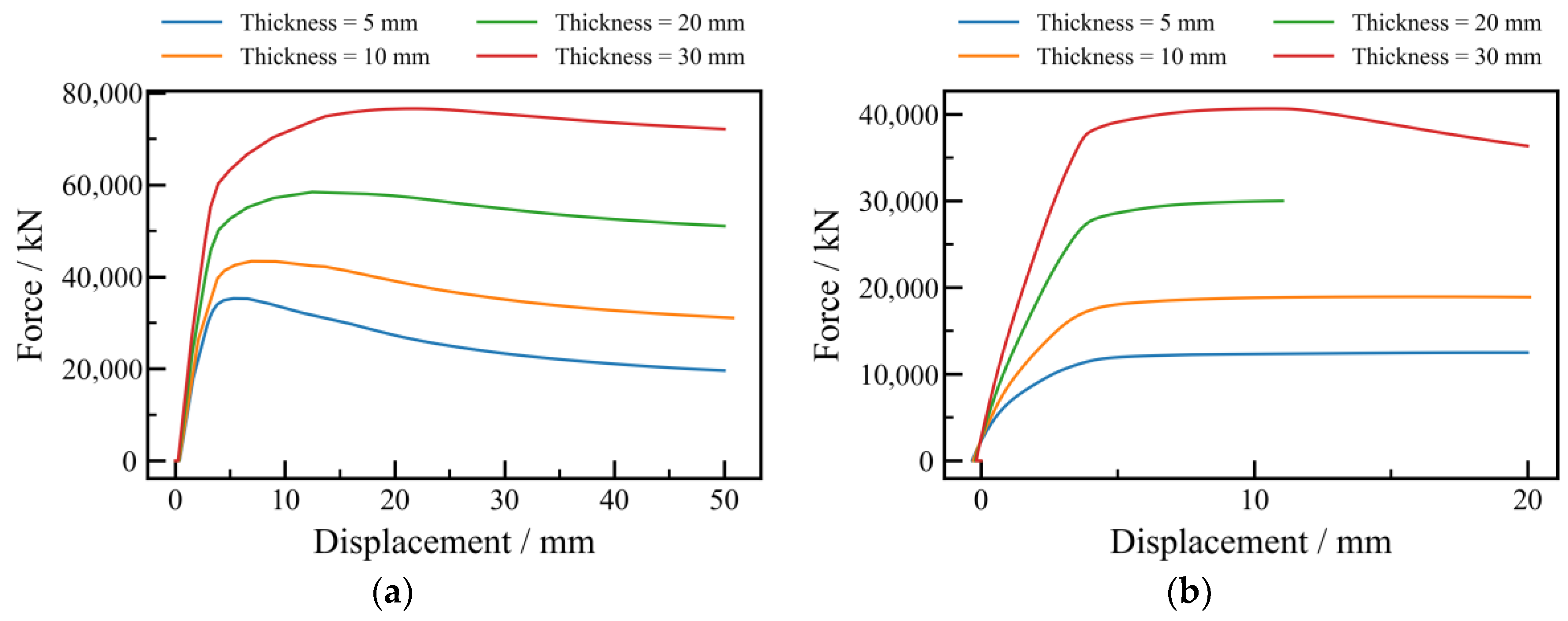
To evaluate the influence of steel tube thickness on the axial performance of PCFST chords, four FE models with t = 5 , 10 , 20 , and 30 mm were compared under axial tension and axial compression (see Figure 24). The results show a monotonic increase in both yield and ultimate capacities, accompanied by a rise in initial stiffness, as t increases in either loading regime. This trend stems from (i) the direct strengthening and stability reserve provided by a thicker tube (greater section area and higher local-buckling critical load), and (ii) the enhanced confinement mobilization of the core concrete: the tube’s hoop (membrane) stiffness and bending stiffness scale approximately with t and t 3 , respectively, enabling more effective suppression of lateral dilation in the plastic range. Consequently, triaxial confinement is intensified in compression, and out-of-plane deformation and local yielding near the tension-end region are delayed.

5. Comparative Analysis of Segmental Post-Tensioned Chord Connections

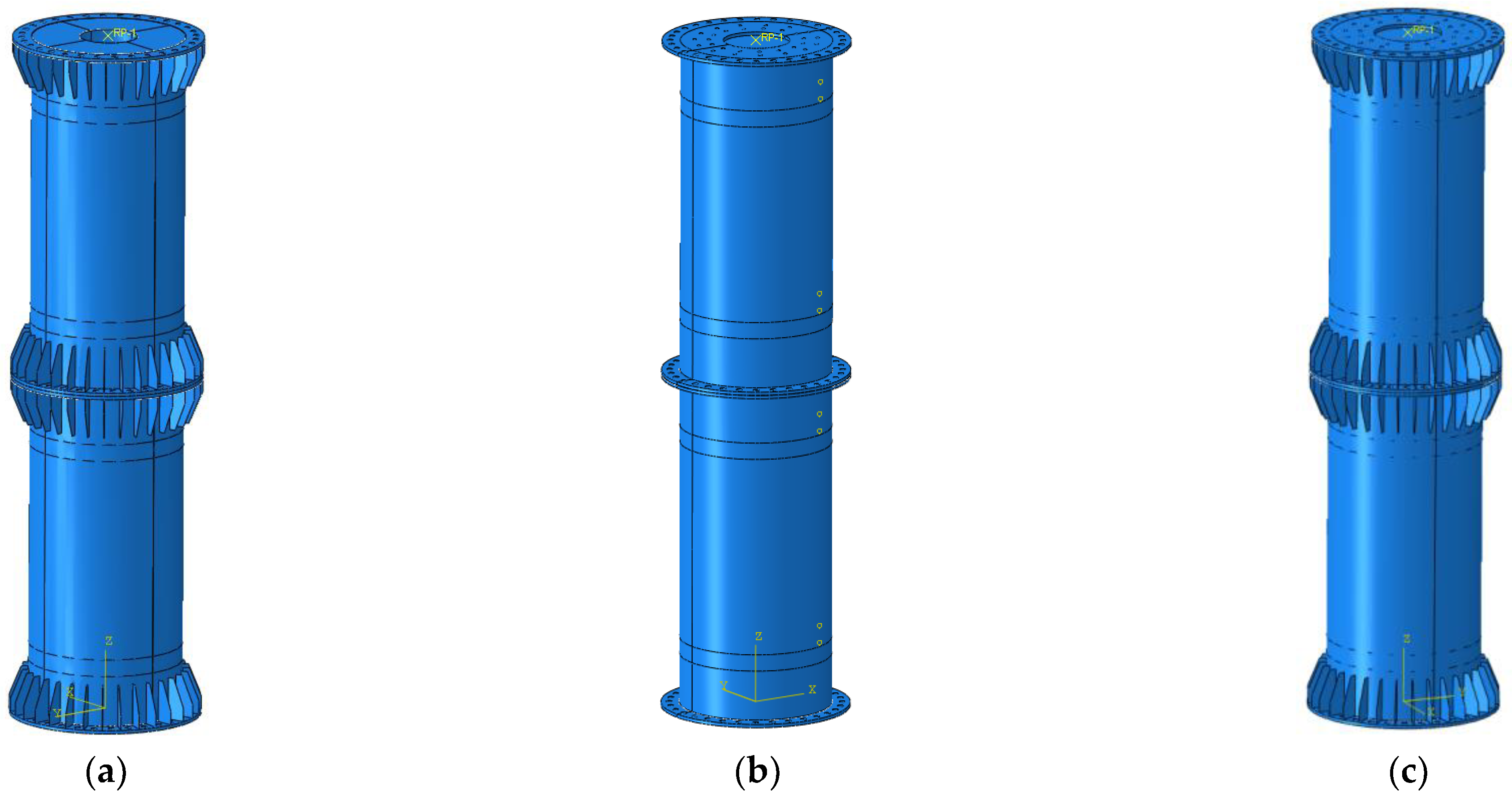
In practical lattice wind-turbine towers, each chord comprises multiple segments bolted together via end flanges; therefore, beyond the behavior of a single segment, the connection performance between adjacent segments must also be assessed. To compare alternative detailing strategies, three chord configurations were established (Figure 25): a concrete-filled double-skin steel tubular chord (CFDST), a segmental prestressed CFST chord (PCFST), and a modified segmental prestressed chord (MPCST) that strengthens the PCFST end region. The three share identical geometry and boundary conditions: outer-tube diameter 910 mm, wall thickness 10 mm, single-segment height 2000 mm, and external flange connections between segments. In the MPCST, inner projecting stiffeners are arranged circumferentially near the flanges (embedded into the concrete, see Figure 25), and the outer-tube wall thickness is increased to 20 mm within 300 mm of each end to suppress local buckling and stress concentration. The tube and stiffeners are modeled with S4R shell elements; tendons with T3D2 truss elements; and the concrete and end plates with C3D8R solid elements. Steel is taken as an ideal elastic–plastic material with a yield strength of 305 MPa, and the concrete follows the CDP model. High-strength flange bolts are represented by tie (binding) constraints in the global model, and the flange–tube peripheral welds are likewise tied. Steel–concrete interfaces are defined as surface-to-surface contact with hard normal behavior and Coulomb friction ( μ = 0.6 ). The base is fully fixed; at the top, a reference point (RP) is kinematically coupled to the top flange and subjected to an axial tensile load of 10,000 kN, which represents the typical maximum chord tension in 8–10 MW onshore lattice wind-turbine towers under ultimate load conditions. This load level is therefore used as a realistic benchmark for comparing the global responses of the three configurations.
The prestress application differs by configuration. For CFDST, an equivalent uniform pressure is applied at the chord top to reproduce an 8000 kN prestress effect “locked” into the composite steel–concrete system, consistent with an integral (non-segmental) loading path. For PCFST and MPCST, an identical 8000 kN prestress is introduced in the segmental tendons using the thermal-shrinkage method; the temperature drop is calibrated from the thermo-mechanical properties so that the tendons reach the target force level before external loading. The two application paths are schematically illustrated in Figure 26.
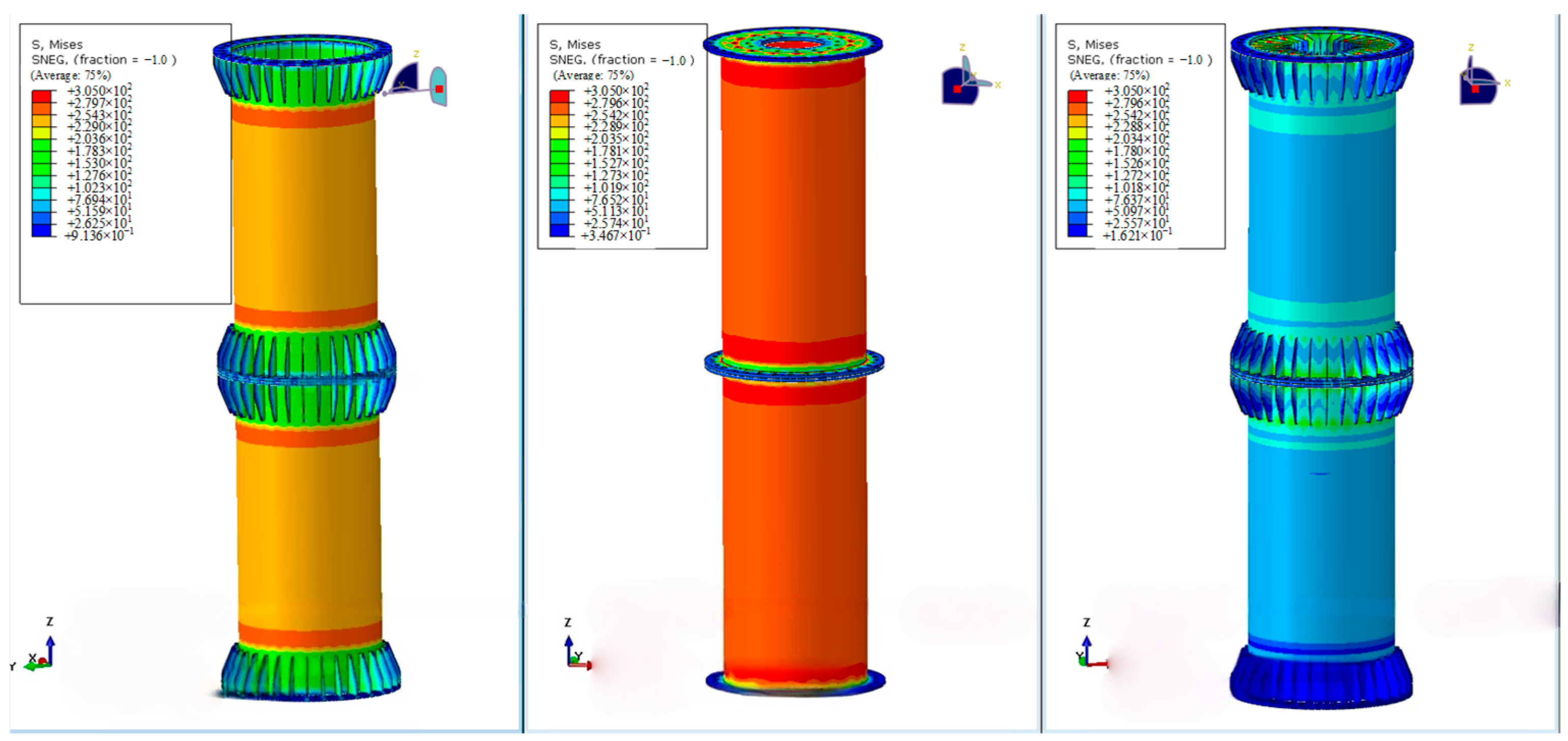
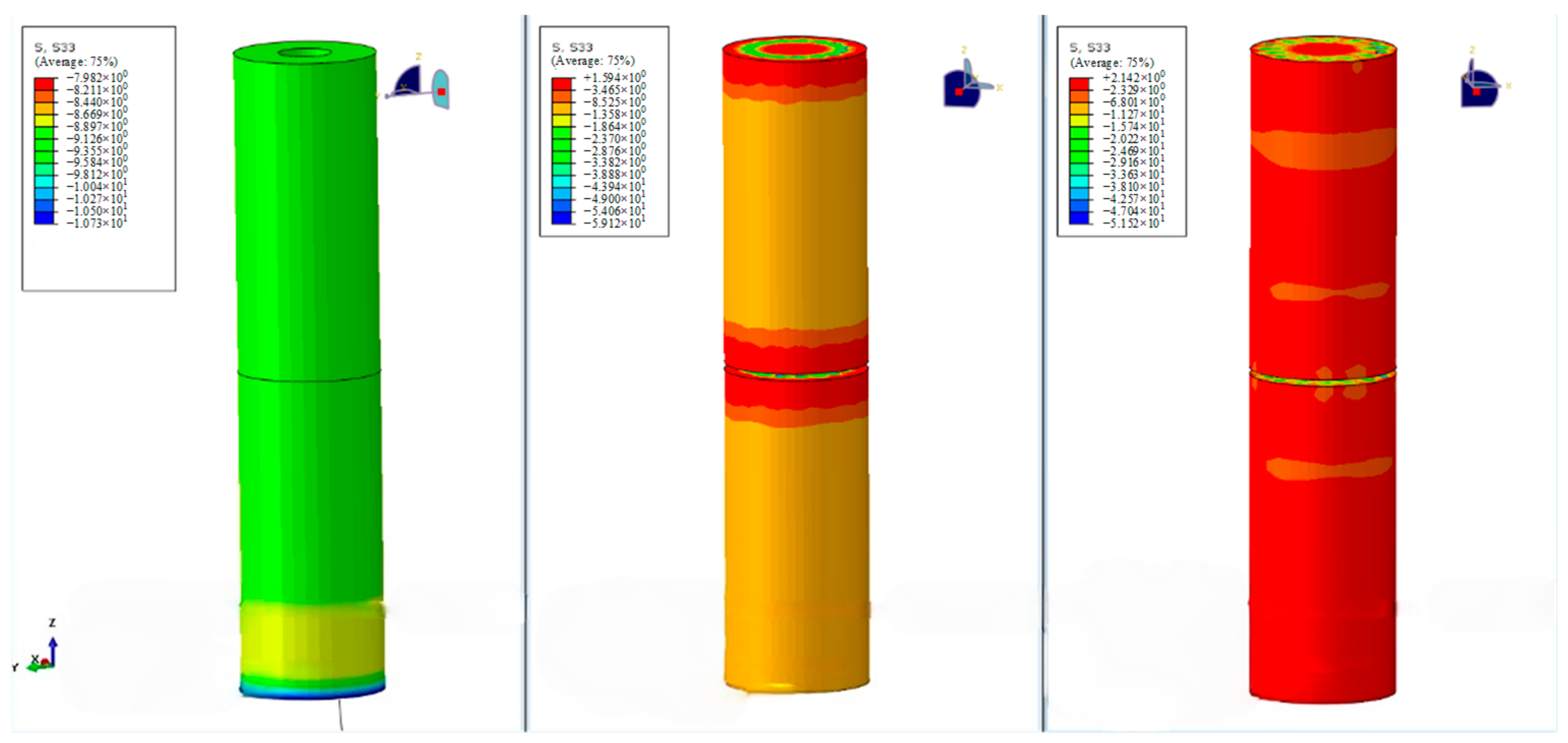
Under a common external tensile load of 10,000 kN, the von Mises stress fields of the steel tube and the principal compressive stress contours of the concrete for the three configurations are shown in Figure 27 and Figure 28. In the CFDST, the outer tube remains essentially elastic, with a mid-height steel stress of about 230 MPa, while the concrete experiences slight compression (≈−9.3 MPa). This indicates that the external tension is carried predominantly by the steel tube; interface friction transfers only a small portion to the concrete, which stays in compression and maintains a stable composite action. In the PCFST, an extensive yielding band develops near the flange region, the mid-height steel stress rises to ≈280 MPa, and the concrete compressive stress increases to ≈−13 MPa. Because the segmental prestress is locked primarily into concrete and is not fully canceled by the external tension at the end region, the flange-adjacent tube must carry higher tensile stress, leading to pronounced local concentration. By contrast, in the MPCST, steel stresses are markedly reduced, with only localized peaks at the stiffener tips; the mid-height steel stress drops to ≈70 MPa, and the concrete shifts from slight compression to mild tension (≈2 MPa). These patterns show that the modified detailing allows end-region prestress to first counteract the external tension, after which the residual tension is co-shared by steel and concrete, thereby weakening stress concentrations near the flange and homogenizing the overall stress distribution.
At the global level, the CFDST exhibits a “steel-dominated tension with concrete remaining in compression” response; the PCFST tends to develop yielding spread in the flange–tube transition, revealing the sensitivity of segmental prestress layouts to end-region detailing; and the MPCST, via the locally thickened tube plus inner projecting stiffeners, establishes a stiffer force-turning region at the flange, enabling effective anchorage of prestress and mechanical cancelation/reallocation with the external load, which suppresses the growth of yielding bands. Overall, the comparison highlights that end-region strengthening is the key to realizing the desired “prestress cancellation first, steel–concrete cooperation thereafter” in segmental prestressed chords.
These results indicate that, in segmental PCFST chords, the end anchorage and stiffness transition directly govern the coupling path between prestress and external tension. Adopting the MPCST detailing—with locally thickened tube ends and inner projecting stiffeners—reduces the risk of flange-neighborhood yielding and markedly lowers the mid-height steel–concrete stress levels, thereby better meeting the modular erection and safety requirements of ultra-tall towers.

6. Conclusions

This study employs a three-dimensional finite-element framework to investigate the load-transfer mechanisms of segmental prestressed concrete-filled steel tube (PCFST) chords under axial compression and tension, and to quantify the effects of end detailing, prestress level, flange thickness, and tube thickness. The model robustly reproduces global responses, componentwise load sharing, and multiaxial stress redistribution, providing design-relevant insights. The main conclusions are as follows:
  • Mechanisms and model fidelity. The model captures the elastic–plastic transition, post-peak softening, and local yielding/instability at the ends. Under compression, capacity is governed by the concrete core while the steel tube provides hoop confinement and, after yielding, exhibits von-Mises-consistent redistribution ( S 11 increases as S 22 decreases). Under tension, resistance is dominated by the steel tube and prestressing tendons, with a limited concrete contribution.
  • Effect of end stiffeners (tension-critical). Increasing the number of end stiffeners markedly improves tensile performance by strengthening the flange–tube–concrete transmission path; with eight stiffeners, the initial stiffness and peak tensile load rise by approximately 1.8 times and 1.3 times, respectively, relative to the no-stiffener case. The influence of compression is minor.
  • Prestress as a double-edged parameter. Under the idealized fully effective prestress assumed in this study, tensile performance shows a clear benefit-then-saturation trend: about 5480 kN is highly effective, while further increases to 10,800–21,200 kN offer only limited additional gains. Excessive prestress also promotes flange-controlled yielding and reduces compressive capacity; hence, prestress should be kept within an effective-but-not-excessive range. These findings reflect qualitative trends under an idealized prestress state, and actual jacking and effective prestress levels should follow design codes and prestress-loss calculations.
  • Flange thickness. Thickening the flange mitigates out-of-plane deformation and stress concentrations near the bolt circle/anchorage holes, providing moderate improvements to tensile yielding and ultimate resistance (more pronounced from 10 to 20 mm, with diminishing returns from 20 to 30 mm). Its effect in compression is negligible.
  • Tube thickness and design guidance. Increasing tube thickness monotonically enhances tensile and compressive capacities and the initial stiffness; once the tube is sufficiently thick, the performance bottleneck shifts to flange stiffness and connection details. Practically, the stiffeners–flange–prestress ensemble should be co-optimized, and the tube thickness and prestress level should be selected according to the governing load case (tension vs. compression) to achieve higher capacity with adequate ductility reserves.
  • Segmental post-tensioned connection. Under a common external tensile load of 10,000 kN, the MPCST detailing (locally thickened ends plus inner projecting stiffeners) enables end-region cancelation between prestress and external tension; markedly suppresses yielding bands near the flange, lowers mid-height tube stress; and homogenizes steel–concrete stresses. Compared with CFDST and baseline PCFST, it provides a safer, more rational load path and is recommended as a preferred end-connection scheme for segmental prestressed chords.

7. Future Work

Building upon the concept-level investigation presented in this study, future research will focus on the following aspects:
1.
Experimental validation:
A series of full-scale or sub-scale segmental PCFST chord specimens will be designed and tested under both axial compression and axial tension to validate the FE-predicted load-bearing mechanisms, load sharing, and end-region behavior, and to quantify the influence of prestressing and segmental assembly. These tests will provide the missing tensile validation that is not yet available in existing experimental databases.
In addition, cyclic and low-cycle fatigue tests will be conducted to examine stiffness degradation, damage accumulation, and force-transfer mechanisms under repeated loading.
2.
Extended parametric analysis:
A broader numerical parameter space—covering tendon layouts, interface conditions, segment lengths, flange detailing, and material variability—will be explored to establish robust quantitative relationships.
In particular, additional analyses will be carried out to quantify the interactive effects of prestress, stiffener rigidity, and flange/tube thickness beyond the qualitative trends identified in the present study.
Future studies will also consider cyclic loading histories representative of wind-induced load reversals to assess fatigue-sensitive parameters and long-term stability.
3.
Development of simplified design models:
Based on combined experimental and numerical evidence, quantitative formulations and simplified design expressions will be derived to support practical engineering design of segmental PCFST chords.
These efforts will include the establishment of dimensionless performance indices (e.g., axial resistance, stiffness, and end-region stress indices) to unify the effects of geometry, material properties, and prestress characteristics.
Long-term effects—such as creep, shrinkage, and tendon relaxation—will be incorporated into refined constitutive models to enable more realistic prediction of effective prestress and long-term chord behavior.
4.
Design-oriented charts and preliminary design procedures:
Design charts relating the dimensionless indices to normalized prestress level, stiffener rigidity, and flange thickness will be produced to offer direct guidance for selecting effective-but-not-excessive prestress levels and for determining end-region detailing. A preliminary design workflow—linking target axial capacity and stiffness to appropriate prestress ranges and component detailing—will also be developed to facilitate early-stage engineering application.
Additional design considerations for cyclic and fatigue loading, flange-joint durability under repeated force transfer, and time-dependent prestress reduction will be included to expand the applicability of the proposed design framework.
These efforts will further advance the structural understanding of segmental PCFST lattice towers and enable the development of validated, quantitative, and design-ready methods for engineering practice.

Author Contributions

Conceptualization, J.Z.; methodology, J.L.; software, D.Z.; validation, H.W.; formal analysis, Y.W.; investigation, K.F.; resources, C.H. All authors have read and agreed to the published version of the manuscript.

Funding

This research was funded by the National Key Research and Development Program of China, Grant No. 2024YFF0505400; the Chongqing Municipal Science and Technology Bureau, Grant No. 2024NSCQ-JQX0096; and the Fundamental Research Funds for the Central Universities, Grant No. 2024CDJYXTD-005.

Data Availability Statement

The original contributions presented in the study are included in the article; further inquiries can be directed to the corresponding author.

Acknowledgments

The authors declare that this study received funding from the National Key Research and Development Program of China, the Chongqing Municipal Science and Technology Bureau, and the Fundamental Research Funds for the Central Universities. The funders provided financial support for the research.

Conflicts of Interest

Authors Jiawei Zhang, Junlin Li, Dongliang Zhang, Kun Fu and Cirong Huang were employed by the company Zhejiang Huadong Xinneng Technology Co., Ltd. The remaining authors declare that the research was conducted in the absence of any commercial or financial relationships that could be construed as a potential conflict of interest.

References

  1. Yue, Y.; Li, C.; Jia, K.; Zhang, Y.; Tian, J. Optimization of the seismic performance of a steel-concrete wind turbine tower with the tuned mass damper. Buildings 2022, 12, 1474. [Google Scholar] [CrossRef]
  2. Vázquez-Herrero, C.; Martínez-Lage, I.; Martínez-Abella, F. Transfer length in pretensioned prestressed concrete structures composed of high performance lightweight and normal-weight concrete. Eng. Struct. 2013, 56, 983–992. [Google Scholar] [CrossRef]
  3. Habibi, T.; Rhode-Barbarigos, L.; Keller, T. Effects of prestress implementation on self-stress state in large-scale tensegrity structure. Eng. Struct. 2023, 288, 116222. [Google Scholar] [CrossRef]
  4. Zhang, Q.; Wang, X.; Cai, J.; Yang, R.; Feng, J. Prestress design for cable-strut structures by grouping elements. Eng. Struct. 2021, 244, 112010. [Google Scholar] [CrossRef]
  5. Chávez, A.A.; Gonzalez-Libreros, J.; Wang, C.; Capacci, L.; Biondini, F.; Elfgren, L.; Sas, G. Assessment of residual prestress in existing concrete bridges: The Kalix bridge. Eng. Struct. 2024, 311, 118194. [Google Scholar] [CrossRef]
  6. Wang, Y.; Zhu, J.; Jia, S.; Akiyama, M. Time-dependent deflection prediction of long-span prestressed concrete bridges considering the environmental effects. Eng. Struct. 2024, 322, 119163. [Google Scholar] [CrossRef]
  7. Ahmed, G.H.; Aziz, O.Q. Shear strength of joints in precast posttensioned segmental bridges during 1959–2019, review and analysis. Structures 2019, 20, 527–542. [Google Scholar] [CrossRef]
  8. Li, Z.; Xu, B.; Wang, J.; Chen, H.; Ge, H. Experimental and two-scale numerical studies on the behavior of prestressed concrete-steel hybrid wind turbine tower models. Eng. Struct. 2023, 279, 115622. [Google Scholar] [CrossRef]
  9. Wang, Y.; Xu, S.; Zhou, X.; Zhang, L.; Huang, X. Lateral load behavior of prestressed segmental concrete towers with hollow tapered geometry. Thin-Walled Struct. 2025, 209, 112914. [Google Scholar] [CrossRef]
  10. Huang, X.; Li, B.; Zhou, X.; Wang, Y.; Bai, J.; Bai, Y.; Deng, X. Computational study of steel–Concrete hybrid wind turbine tower seismic performance. J. Earthq. Eng. 2022, 27, 2796–2817. [Google Scholar] [CrossRef]
  11. Klein, F.; Fürll, F.; Betz, T.; Marx, S. Experimental study on the joint bearing behavior of segmented tower structures subjected to normal and bending shear loads. Struct. Concr. 2022, 23, 1370–1384. [Google Scholar] [CrossRef]
  12. Han, L.H.; Li, W.; Bjorhovde, R. Developments and advanced applications of concrete-filled steel tubular (CFST) structures: Members. J. Constr. Steel Res. 2014, 100, 211–228. [Google Scholar] [CrossRef]
  13. Pinto, C.; Fonseca, J. The Mechanical behavior of high-strength concrete-filled steel tubes: A review. CivilEng 2024, 5, 591–608. [Google Scholar] [CrossRef]
  14. Wei, J.; Luo, X.; Lai, Z.; Varma, A.H. Experimental behavior and design of high-strength circular concrete-filled steel tube short columns. J. Struct. Eng. 2020, 146, 04019184. [Google Scholar] [CrossRef]
  15. Du, Y.; Gao, D.; Chen, Z.; Deng, X.-F.; Qian, K. Experimental study on the flexural behavior of square high-strength concrete-filled steel tube beams with different CFRP wrapping schemes. Compos. Struct. 2022, 304, 116325. [Google Scholar] [CrossRef]
  16. Bhat, P.; Jamatia, R. Compressive behavior of concrete-filled double skin steel tubular columns: An analytical approach. J. Constr. Steel Res. 2024, 214, 108483. [Google Scholar] [CrossRef]
  17. Huang, C.; Shao, Y.; Ou, J.; Bi, X. Axial compressive behavior of circular concrete-filled steel tubular stubs strengthened with CFRP considering preloading and corrosion. Structures 2024, 62, 106281. [Google Scholar] [CrossRef]
  18. Xin, N.; Yu-Hang, W.; Shuo, L.; Ju, C. Coupled bending-shear-torsion bearing capacity of concrete filled steel tube short columns. Thin-Walled Struct. 2018, 123, 305–316. [Google Scholar] [CrossRef]
  19. Yang, S.L.; Zhang, L.; Zhang, J.W.; Bo, F.; Tong, G.-S.; Jing, T. Seismic behavior of concrete-filled wide rectangular steel tubular (CFWRST) stub columns. J. Constr. Steel Res. 2022, 196, 107402. [Google Scholar] [CrossRef]
  20. Lei, M.; Li, Y.L.; Li, Y.Q.; Zhang, J.; Lin, Z.; Zhou, T.; Luan, W. Experimental study on concrete-filled L-shaped steel tubular columns and beam-columns. J. Build. Eng. 2024, 96, 110626. [Google Scholar] [CrossRef]
  21. Joseph, J.R.; Henderson, J.H. Concrete–filled steel tube truss girders—A state-of-the-art review. J. Eng. Appl. Sci. 2023, 70, 49. [Google Scholar] [CrossRef]
  22. Xu, F.; Wang, J.; Chen, J.; Wang, Y.-H. Load-transfer mechanism in angle-encased CFST members under axial tension. Eng. Struct. 2019, 178, 162–178. [Google Scholar] [CrossRef]
  23. Deng, R.; Zhou, X.H.; Ji, W.D.; Li, R.-F.; Zheng, S.-Q.; Wang, Y.-H. Coupled behaviour and strength prediction of tapered CFDST columns with large hollow ratios for wind turbine towers. Eng. Struct. 2023, 289, 116287. [Google Scholar] [CrossRef]
  24. Li, D.; Fang, S.; Sun, C.; Xu, F.; Zhao, J.; Lai, Z. Aeroelastic wind tunnel study and numerical simulation of Concrete-Filled Double-Skin Tubular (CFDST) wind turbine system. Structures 2025, 74, 108581. [Google Scholar] [CrossRef]
  25. Li, D.; Sang, Y.; Fang, S.; Sun, C.; Wang, H. Wind tunnel test research on the aerodynamic behavior of concrete-filled double-skin steel (CFDST) wind turbine towers. Buildings 2024, 14, 2372. [Google Scholar] [CrossRef]
  26. Li, J.-X.; Zhang, C.; Wang, S.-H.; Yin, S.-Q. Numerical Study on the Mechanical Properties of Transmission Tower K-Joints under Cyclic Loading. Shock. Vib. 2021, 2021, 7403365. [Google Scholar] [CrossRef]
  27. Rodríguez, N.F.; Couceiro, I.; Nogueira, X.; Colominas, I. Structural Optimization and Comparison Study of Different Configurations of Offshore Wind Turbine Jacket Substructures. Wind. Energy 2025, 28, e70014. [Google Scholar] [CrossRef]
  28. Zhang, M.; Xie, C.; Li, T.; Hossain, N.; Zhao, G. Wind-induced response analysis and fatigue life prediction of a hybrid wind turbine tower combining an upper steel tube with a lower steel truss. Buildings 2024, 14, 1441. [Google Scholar] [CrossRef]
  29. Li, M.; Zhang, W.; Wang, H.; Wen, Y. Research on the stress performance of lattice-type steel-tube-concrete ball-slab node four-limbed column wind turbine towers. Ain Shams Eng. J. 2024, 15, 102960. [Google Scholar] [CrossRef]
  30. Liu, Y.S.; Zhou, X.H.; Wang, Y.H.; Zhou, Y.; Lan, Y.-S.; Li, Q. Seismic behavior of prestressed concrete filled steel tubular lattice tower subjected to combined compression-bending-torsion. J. Constr. Steel Res. 2023, 204, 107883. [Google Scholar] [CrossRef]
  31. Fan, T.H.; Zeng, J.J.; Su, T.H.; Hu, X.; Yan, X.-K.; Sun, H.-Q. Innovative FRP reinforced UHPC floating wind turbine foundation: A comparative study. Ocean. Eng. 2025, 326, 120799. [Google Scholar] [CrossRef]
  32. Shi, Y.; Li, X.; Wang, W.; Ji, S. Axial compressive behavior of concrete-filled double-skin steel tubular short columns. J. Build. Struct. 2023, 44, 129–141. (In Chinese) [Google Scholar]
  33. Han, L. Concrete Filled Steel Tubular Structures: Theory and Practice, 3rd ed.; Science Press: Beijing, China, 2018; pp. 109–114. (In Chinese) [Google Scholar]
  34. Hillerborg, A.; Modéer, M.; Petersson, P.-E. Analysis of crack formation and crack growth in concrete by means of fracture mechanics and finite elements. Cem. Concr. Res. 1976, 6, 773–781. [Google Scholar] [CrossRef]
  35. Mander, J.B.; Priestley, M.J.N.; Park, R. Theoretical stress-strain model for confined concrete. J. Struct. Eng. 1988, 114, 1804–1826. [Google Scholar] [CrossRef]
  36. Xu, H. Study on the Axial Compression Performance of Concrete Filled Multi-Barrel Steel Tubular Short Columns; Harbin Institute of Technology: Harbin, China, 2015; pp. 59–60. (In Chinese) [Google Scholar]
Figure 1. Configuration of the segmental PCFST chord: (a) 3D schematic; (b) cross-sectional and longitudinal sectional views.
Jcs 10 00054 g001
Figure 2. Finite-element mesh and interaction definitions of the numerical model.
Jcs 10 00054 g002
Figure 3. Comparison of load–strain curves between the test and the numerical simulation.
Jcs 10 00054 g003
Figure 4. Test failure mode and simulated stress/strain contours.
Jcs 10 00054 g004
Figure 5. Schematic of the finite-element model.
Jcs 10 00054 g005
Figure 6. Loading scheme of the finite-element model.
Jcs 10 00054 g006
Figure 7. Axial-force evolution of the reference point, steel tube, concrete core, and prestressing tendons versus displacement under axial compression.
Jcs 10 00054 g007
Figure 8. Axial stress S22, circumferential stress S11, and von Mises stress at mid-height of the steel tube versus displacement under axial compression.
Jcs 10 00054 g008
Figure 9. Stress contour of the prestressing tendons.
Jcs 10 00054 g009
Figure 10. Load–displacement curves of the model under axial compression.
Jcs 10 00054 g010
Figure 11. Steel tube stress–displacement curves under axial compression.
Jcs 10 00054 g011
Figure 12. Contact stress distribution along the concrete surface.
Jcs 10 00054 g012
Figure 13. Axial-force evolution of the reference point, steel tube, concrete core, and prestressing tendons versus displacement under axial tension.
Jcs 10 00054 g013
Figure 14. Comparison of load–displacement curves under axial compression and axial tension.
Jcs 10 00054 g014
Figure 15. Axial stress S22, circumferential stress S11, and von Mises stress at mid-height of the steel tube versus displacement under axial tension.
Jcs 10 00054 g015
Figure 16. von Mises Yield Surface in the S11/fy-S22/fy Plane.
Jcs 10 00054 g016
Figure 17. Finite-element models with different numbers of end stiffeners.
Jcs 10 00054 g017
Figure 18. Load–displacement curves for models with different numbers of end stiffeners: (a) axial tension; (b) axial compression.
Jcs 10 00054 g018
Figure 19. Concrete axial force–displacement curves under axial tension (comparison of end-stiffener numbers).
Jcs 10 00054 g019
Figure 20. Load–displacement curves for models with different prestress levels: (a) axial tension; (b) axial compression.
Jcs 10 00054 g020
Figure 21. Stress contours of the steel components at the tensile peak for different prestress levels: (a) prestress = 0 kN; (b) prestress = 5480 kN; (c) prestress = 10,800 kN.
Jcs 10 00054 g021
Figure 22. Vertical displacement contours of the loaded-end flange at the tensile peak for different prestress levels: (a) prestress = 0 kN; (b) prestress = 5480 kN; (c) prestress = 10,800 kN.
Jcs 10 00054 g022
Figure 23. Load–displacement curves for models with different flange thicknesses: (a) axial tension kN; (b) axial compression.
Jcs 10 00054 g023
Figure 24. Load–displacement curves for models with different steel tube thicknesses: (a) axial tension kN; (b) axial compression.
Jcs 10 00054 g024
Figure 25. Finite-element models of the three configurations: (a) CFDST; (b) PCFST; (c) MPCST.
Jcs 10 00054 g025
Figure 26. Schematic of prestress application methods.
Jcs 10 00054 g026
Figure 27. Steel tube stress contours under an external tensile load of 10,000 kN.
Jcs 10 00054 g027
Figure 28. Concrete stress contours under an external tensile load of 10,000 kN.
Jcs 10 00054 g028
Disclaimer/Publisher’s Note: The statements, opinions and data contained in all publications are solely those of the individual author(s) and contributor(s) and not of MDPI and/or the editor(s). MDPI and/or the editor(s) disclaim responsibility for any injury to people or property resulting from any ideas, methods, instructions or products referred to in the content.