
Article

Development and Mechanical Testing of Synthetic 3D-Printed Models of Healthy and Metastatic Vertebrae

by
Daniela Bruno
1,
Riccardo Forni
2,
Marco Palanca
1,*,
Luca Cristofolini
1 and
Paolo Gargiulo
2,3
1
Department of Industrial Engineering, Alma Mater Studiorum—University of Bologna, 40131 Bologna, Italy
2
Institute of Biomedical and Neural Engineering, Reykjavik University, 102 Reykjavik, Iceland
3
Department of Science, Landspitalin, University Hospital of Iceland, 105 Reykjavik, Iceland
*
Author to whom correspondence should be addressed.
J. Manuf. Mater. Process. 2025, 9(11), 373; https://doi.org/10.3390/jmmp9110373
Submission received: 30 September 2025 / Revised: 5 November 2025 / Accepted: 11 November 2025 / Published: 13 November 2025

Abstract

Experimental characterisation of ex vivo specimens is limited by specimen availability and high costs, whereas 3D printing provides a cost-effective alternative for producing multiple replicas. This study aimed to develop a methodology for evaluating the individual and combined effects of material composition and geometry on the biomechanical performance of 3D-printed vertebrae. CT scans of healthy human vertebrae and with lytic metastases were segmented to fabricate synthetic models through Digital Anatomy Printing. Three types of 3D-printed models were produced: Healthy vertebrae, Metastatic vertebrae, and Healed vertebrae (metastatic geometry filled with healthy material). All models were tested under axial compression to measure the strength, stiffness, and strain. Repeatability across replicas was assessed as well as comparison of mechanical properties among the different vertebral types. Results showed excellent repeatability, with coefficients of variation below 5% for strength and stiffness-related parameters. The Metastatic models exhibited significant reductions in strength compared to Healthy ones, while stiffness remained similar, consistent with ex vivo data trends. Healed models highlighted the role of material composition in driving mechanical behaviour, independently of geometry. This work provides the first quantitative assessment of 3D-printed vertebrae with metastatic lesions, supporting their future potential as standardised alternatives to cadaveric testing.

1. Introduction

The spine is among the most frequent sites of bone metastases (87%) [1]. These lesions are typically found in the thoracic (60–80%) and lumbar spine (15–30%) [2,3], and are predominantly located in the vertebral bodies rather than in the posterior elements [4]. Lytic metastasis is associated with the highest risk of vertebral fracture [4,5,6,7,8], as it affects the microarchitecture of the bone by locally reducing the bone mineral density [1,9,10,11,12].
The effects of the metastases on the biomechanics of the vertebrae have been investigated using both experimental [5,6,7,13] and computational studies [4,14,15]. Ex vivo experimental testing allows for direct measurement of apparent properties (e.g., stiffness, strength) and local properties (e.g., surface or volumetric strains). However, it faces challenges such as limited availability of human specimens, high costs, intra-specimen variability, and a trade-off between time-consuming procedures and tissue deterioration. Moreover, since destructive tests can only be performed once, the quantification of the mechanical properties depends on the specific applied scenario (i.e., loading rate, loading direction, etc.). As a result, these failure-based measures prevent comprehensive characterisation of the mechanical response and may hide some effects [13].
FE models allow for multiple predictions on the same specimen. However, current modelling challenges in accurately predicting the complex mechanical behaviour of metastatic vertebrae restrict their clinical application [14].
Given these challenges, the use of 3D-printed (3DP) synthetic models has emerged as a promising alternative. Additive manufacturing, or 3D printing, allows for the fabrication of customised models that reflect individual anatomical variability, using patient-specific medical images [16,17,18]. This technology allows for the production of large numbers of identical replicas at relatively low cost [19,20], thereby facilitating controlled and repeatable biomechanical testing under a wide spectrum of loading conditions [21,22]. Furthermore, the introduction of multi-material 3D printing allows the fabrication of objects with a wide range of heterogeneous material properties and functionalities [23], decreasing the production time without extra cost for the fabrications of complex morphologies [24]. Recently, various multi-material additive manufacturing technologies for polymers have been developed and implemented in different applications, enabling the clinical adoption of patient-specific anatomical models and guides, particularly for surgical planning and dentistry or maxillofacial procedures, where multi-material contrasts enhance visual and tactile realism and support procedural rehearsal [23,25].
Complex structures such as the cortical-like shells with trabecular-like interiors, including pathological features like the metastases, can be produced incorporating tailored materials to enhance both anatomical and mechanical realism [26,27,28]. Despite this capacity, the 3D printing is adopted in the biomedical field mainly for surgical simulation and anatomical reconstruction [29,30]. Its potential in biomechanical testing remains only partially explored. There is still a lack of systematic evaluation regarding the mechanical characterisation of these printed models in biomechanical testing contexts.
This study aims to develop a robust methodology for evaluating the individual and combined effects of material composition and geometry on the biomechanical performance of 3DP vertebrae. To achieve this aim, the investigation is organised across two objectives:
  • Evaluation of the repeatability of mechanical parameters across replicas of the same vertebra.
  • Assessment of the influence of material composition and geometry on the mechanical behaviour of the synthetic models emulating healthy, pathological, and treated vertebrae.

2. Materials and Methods

2.1. Clinical Data

Four spines from donors with an history of vertebral metastases were obtained through an ethically approved donation program (Anatomic Gifts Registry, Hanover, MD, USA). Five spine segments (Table 1) consisting in one vertebra with lytic metastases and one adjacent healthy vertebra were prepared. The spine segments were imaged with a Computed Tomography (CT) (AquilonOne, Toshiba, Japan) following an optimised bone imaging protocol [6,13] (voltage: 120 kVp, current: 200 mA, slice thickness: 1 mm, in-plane resolution: around 0.45 mm, matrix size: 512 × 512).

2.2. Segmentation

Each CT scan in 16-bit was imported into Mimics software (version 26.0; Materialise, Leuven, Belgium) to enable construction of a 3D virtual model. The vertebral bodies and the metastatic lesions were segmented by the same expert operator (DB) to ensure consistency across all samples. A standardised protocol was followed (Figure 1): firstly, the bone tissue (cortical and trabecular) was segmented using a semi-automated Hounsfield Unit (HU) threshold-based approach with a range of 200 to 1780 HU [31,32]. Then, a Region of Interest (ROI) was defined by isolating the segmented bone tissue of the two central adjacent vertebrae, the healthy and the metastatic ones. After that, a 3D region-growing algorithm was applied to each vertebra included in the ROI, followed by an automatic hole-filling tool to refine the bone tissue mask.
The metastatic lesion was segmented using the same semi-automated protocol (HU: −100 ÷ 200). A Boolean operation was applied to avoid overlaps between the bone and lesion tissue, followed by a visual inspection of each 2D axial slice to verify the accuracy of this separation. Subsequently, the segmented masks underwent mesh smoothing (5 iterations; smoothing factor: 0.4) to eliminate surface artefacts and mesh wrapping (smallest detail size: 0.5 mm; gap-closing distance: 0.25 mm) to establish a uniform cortical layer of 1–2 mm thick and minimise the risk of stress concentrations.
After the segmentation, the cross-sectional area and volume of each vertebra were calculated. The cross-sectional area was measured using the CT scans as the minimum cross-section area of the vertebra. In the case of metastatic vertebrae, the metastasis was included.
The volume was calculated for the healthy vertebrae, the metastatic vertebrae (excluding the volume of the metastasis), and the metastases from the CT scans. The metastasis volume was then expressed as a percentage of the total volume of the vertebral body. Lastly, the 3D virtual models were exported in Standard Tessellation Language (STL) format for 3D printing.

2.3. Material Assignment

Material assignment within each vertebra model was managed using GrabCAD Digital Anatomy Creator (DAC) 1.73 software (Stratasys, Eden Prairie, MN, USA), which enables voxel-level control over material distribution to mimic the heterogeneous architecture of biological tissues [33].
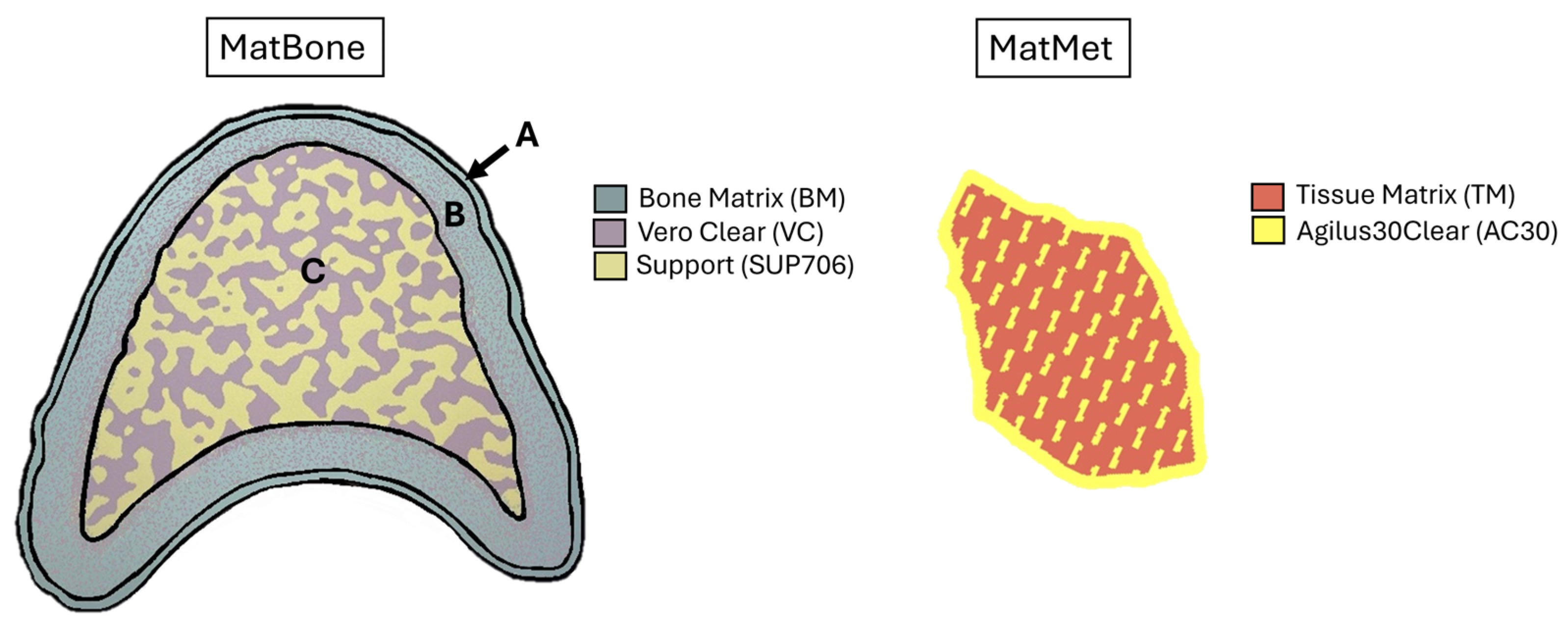
Two material blends were selected to emulate the mechanical behaviour and structural composition of the vertebrae and metastases: MatBone (preset Dense Vertebra, DAC, Stratasys), designed to emulate the bone tissue, and MatMet (preset Highly Contractible, DAC, Stratasys), intended to emulate the lytic lesions (Figure 2). MatBone was recommended by the manufacturer for bone-mimicking applications. The preset provides a dense outer shell and a more porous inner structure, analogous to the cortical and trabecular regions, respectively. Specifically, MatBone had a layered structure consisting of:
  • An outer layer (0.35 mm) made entirely of BoneMatrix (BM), an elastoplastic polymer with a Young’s modulus of around 250 MPa [28]. This layer provides shape memory and elastic recovery properties.
  • A transitional layer (1.65 mm) made from a blend of 90% BM and 10% of VeroClear (VC) (Young’s modulus ≈ 500 MPa) [28].
  • An inner porous layer composed of VC combined with a wax-support material (SUP706) (Young’s modulus ≈ 200 MPa), designed to emulate the architecture of trabecular bone.
MatMet was chosen for printing the metastatic tissue due to its lower-stiffness and elastoplastic behaviour (Young’s Modulus ≈ 0.3 MPa) [28,34] typical of the lytic metastases [35,36]. MatMet featured a gyroid infill pattern, a type of triply periodic minimal surface (TPMS) lattice structure, composed of a 1:1 blend of TissueMatrix (TM), a soft-gel and highly deformable elastomer (Shore 00 = 30), and Agilus30Clear (AC30) [28].

2.4. 3DP Models

All the 3DP vertebra models were fabricated using a Stratasys J850 Digital Anatomy Printer (Stratasys, Eden Prairie, MN, USA), a multi-material jetting 3D printing system based on PolyJet technology [26]. Each STL model was digitally sliced into thin layers (0.014 mm) in which the printer selectively deposits microscopic droplets of photopolymer material, either single resin or blend. Following deposition, each layer was immediately cured by ultraviolet (UV) light exposure, and the build platform was incrementally lowered to enable sequential layer-by-layer construction [37].
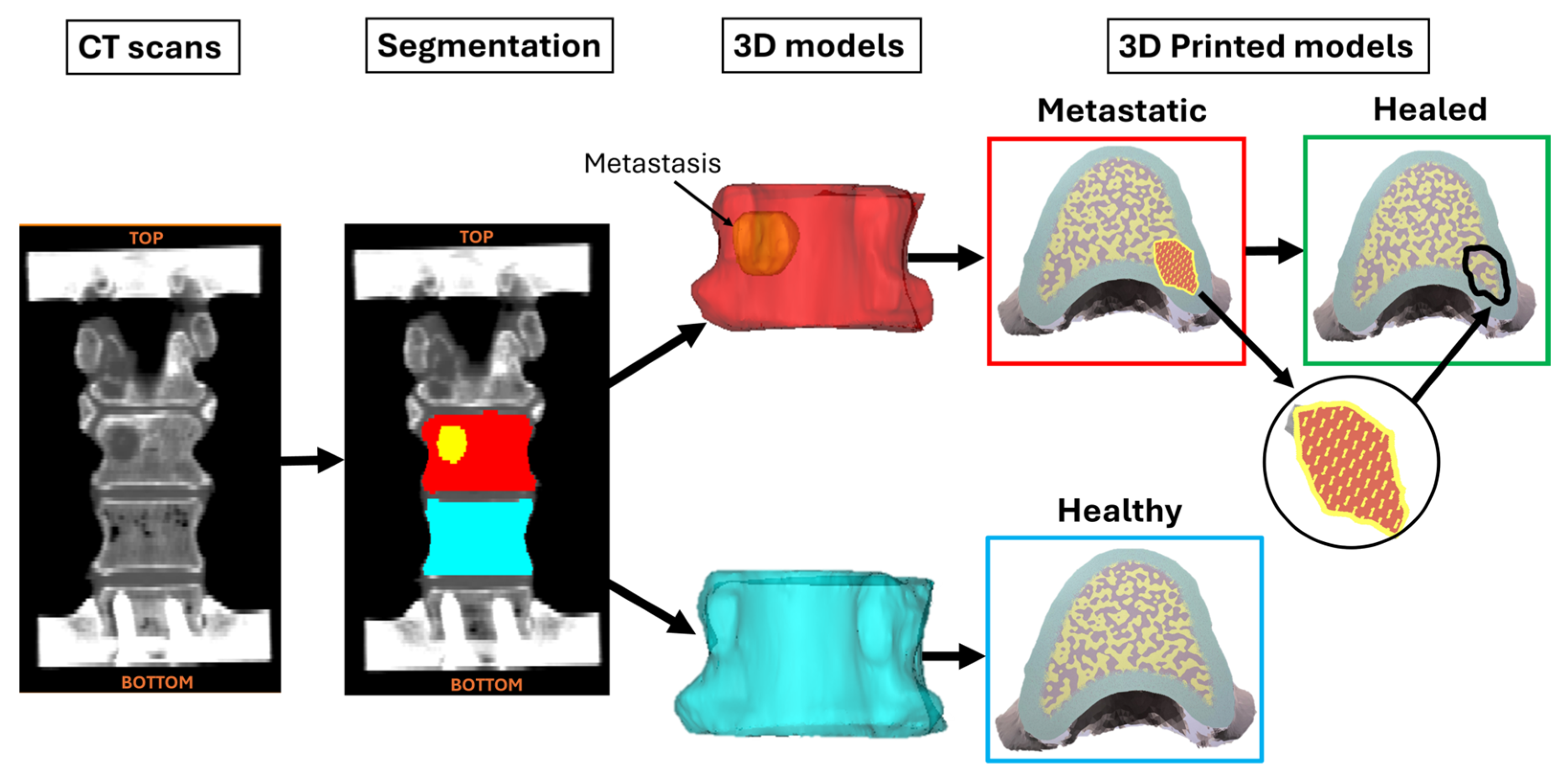
Three types of 3DP vertebral models were fabricated (Figure 3):
  • Healthy vertebrae, which had the geometry of the healthy vertebrae and were printed entirely with MatBone.
  • Metastatic vertebrae, which had the geometry of the metastatic vertebrae and were printed using MatBone for the bone structure and MatMet for the metastatic lesions.
  • Healed vertebrae, which had the same geometry as the metastatic models, but they were made exclusively of MatBone, thereby replacing the material used for the metastatic tissue with the material used for the healthy tissue.
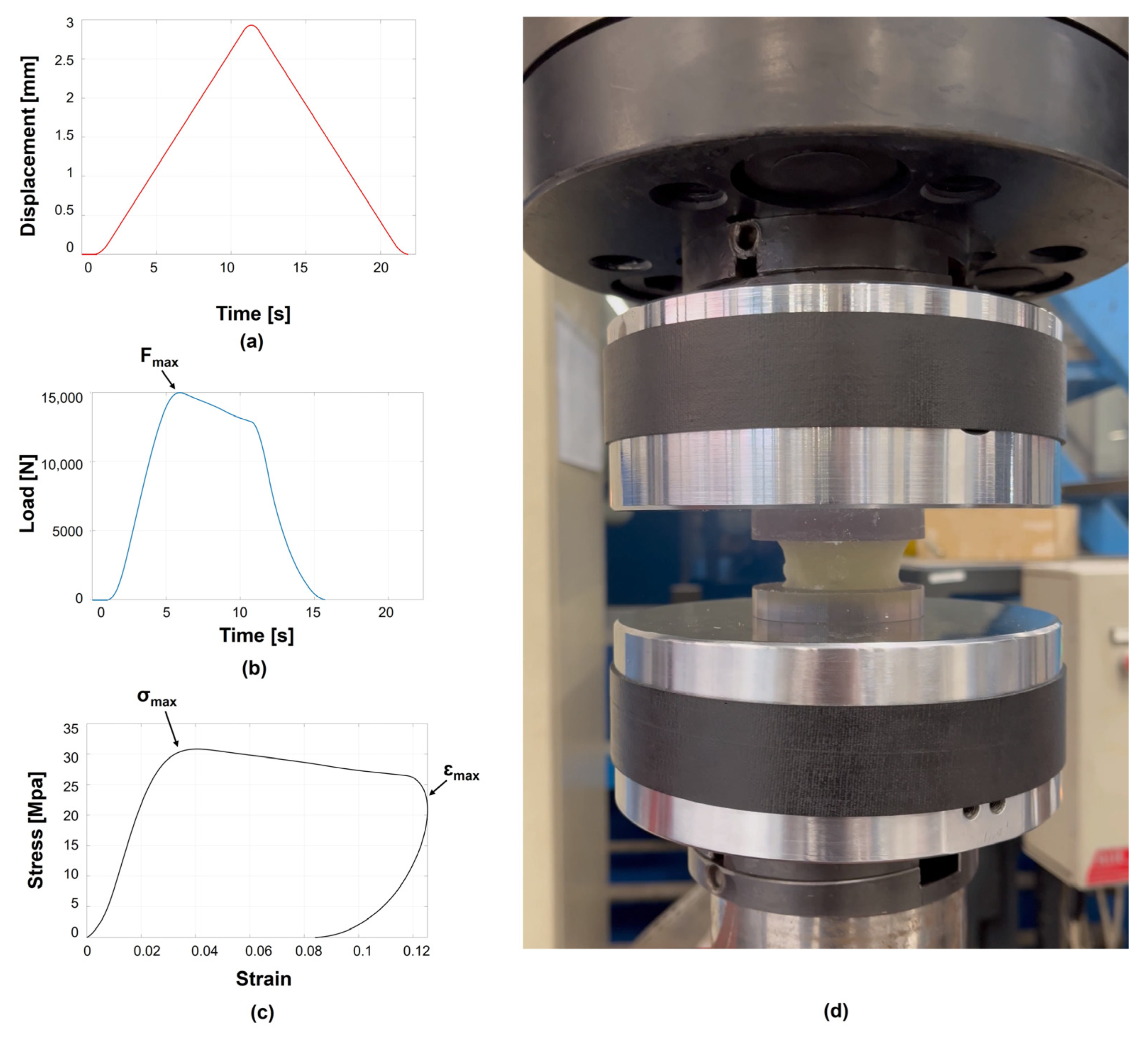
For each vertebra model (Healthy, Metastatic, and Healed), three replicas were printed resulting in a total of 45 specimens across five distinct spinal segments. In order to avoid local stress concentrations arising from the contact between the irregular shape of the vertebral endplates and the loading plates, and to ensure a uniform load-bearing surface during mechanical testing, all 3DP vertebral models were placed between VC cylindrical pots, which had dimensions of 10 mm in height and 50 mm in diameter (Figure 4). The pots were designed using commercial Computer-Aided Design (CAD) software (PTC Creo 7.0, PTC Inc., Boston, MA, USA) and featured internal cavities that were precisely matched to the vertebra endplates geometry to ensure a precise fit. To avoid any interfacial gaps or misalignments that could impair load transmission, both the vertebrae and the cylinders were printed as one integrated structure simultaneously. By using this method, there was perfect continuity between the contact surfaces, which minimised the risk of stress concentration or interface separation during testing.

2.5. Mechanical Testing Protocol and Metrics

Each 3DP vertebra was tested under axial compression. A uniaxial servo-hydraulic testing machine (Instron 8500 controller, Instron, Buckinghamshire, UK), equipped with a 100 kN load cell and a custom loading setup comprising two parallel flat plates, was used (Figure 4). The mechanical testing protocol consisted of a displacement-controlled trapezoidal load ramp: involving a 3 mm displacement applied at a rate of 0.3 mm/s, followed by a holding phase of 1 s, and an unloading ramp at 0.3 mm/s (Figure 4). This load-hold-unload profile was chosen to assess elastic and viscoelastic response characteristics of the printed models. For each 3DP model, force and displacement signals were acquired using a multichannel data acquisition system (PXIe, National Instruments, Austin, TX, USA). Signals were acquired at a frequency of 100 Hz and filtered using a 50-point moving average to minimise high-frequency noise. To isolate the mechanical response of the vertebral body, the displacement was corrected by subtracting the initial offset and the contribution of the supporting cylindrical pots. For each pot was estimated the height reduction associated to the compression, using the following formula:
Δ = F × h E × A
where Δ is the displacement of the pot, F is the applied force, h is the height of the pot, E is the Young’s Modulus of the VC (Young’s Modulus ≈ 1500 MPa), and A is the cross-section of the cylindrical pot.
The height reduction of the two cylinders was subtracted from the measured test displacement. Finally, the corrected displacement was used to calculate the mechanical properties of the vertebrae.
Based on force-displacement data, four apparent properties were computed: maximum force (Fmax), maximum stress (σmax), maximum strain (εmax), and Young’s modulus (E). Stress (σ) was calculated by dividing the applied force by the minimum cross-sectional area of the respective vertebra. Strain (ε) was calculated as the displacement divided by the height of the vertebral body. Young’s modulus (E) was calculated as the slope of the linear regression between 20% and 80% of the maximum stress on the loading portion of the stress–strain curve. The range between 20% and 80% of the maximum stress represents the linear elastic region of the stress–strain curve, which excludes the initial adjustments of the testing machine [38].

2.6. Statistical Analysis

To evaluate measurements repeatability among the three replicas of the same vertebra, the coefficient of variation (CV%) was calculated, for each parameter, as follows:
C V % = 100 × S t a n d a r d   d e v i a t i o n M e a n
A CV below 5% was considered indicative of good repeatability [39].
Subsequently, data normality and homogeneity of variance were assessed using the Shapiro-Wilk test and Levene’s test, respectively. Based on these results, non-parametric tests were used for Fmax, σmax, and εmax, while parametric tests were applied for E. Comparisons between the different types of vertebrae were performed, accordingly:
  • To evaluate the material effect, Metastatic vs. Healed types were compared. The two groups were treated as paired, as both models were obtained from the same vertebrae but printed them in different ways. Therefore, the Wilcoxon signed-rank test was applied to Fmax, σmax, and εmax, while paired t-test was applied to E.
  • To evaluate the geometry effect, Healthy vs. Healed types were compared. The two groups were treated as independent since they are based on different vertebrae, therefore, the Mann-Whitney U test was used to Fmax, σmax, and εmax, while an independent t-test was applied to E.
  • To evaluate the combined effect of material and geometry, Healthy vs. Metastatic types were compared. They were considered independent, hence the Mann-Whitney U test was used to Fmax, σmax, and εmax, while an independent t-test was applied to E.
All statistical analyses were performed in Matlab (MATLAB R2022a, The MathWorks Inc., Natick, MA, USA) with a level of significance of 0.05.

3. Results

3.1. Geometrical Parameters

The volume of the Healthy vertebrae ranged from 11,645 mm3 to 25,810 mm3 (Table 2). In comparison, Metastatic vertebrae showed smaller volumes, ranging from 10,059 mm3 to 23,185 mm3, except for specimen #5 in which the Metastatic vertebra had a slightly larger volume than the healthy one (13,980 mm3 vs. 13,970 mm3). Healed vertebrae exhibited volumes ranging from 10,585 mm3 to 26,991 mm3, exceeding those of Healthy vertebrae in specimens #3 and #5.
The size of lytic metastases ranged from 526 mm3 to 3806 mm3, corresponding to 4.9% to 14.1% of the total volume of the vertebral body. All lesions were focal and localised in the vertebral body, with no clear prevalence of a particular position observed across specimens.
The minimum cross-sectional area of the vertebrae followed a similar trend: healthy vertebrae ranged from 532 mm2 to 848 mm2, while Metastatic vertebrae, and consequently also Healed vertebrae ranged from 486 mm2 to 828 mm2. Similarly, in specimen #5, the Metastatic vertebra showed a larger area (623 mm2) than the corresponding Healthy one (598 mm2).

3.2. Repeatability of Mechanical Parameters on Vertebrae Replicas

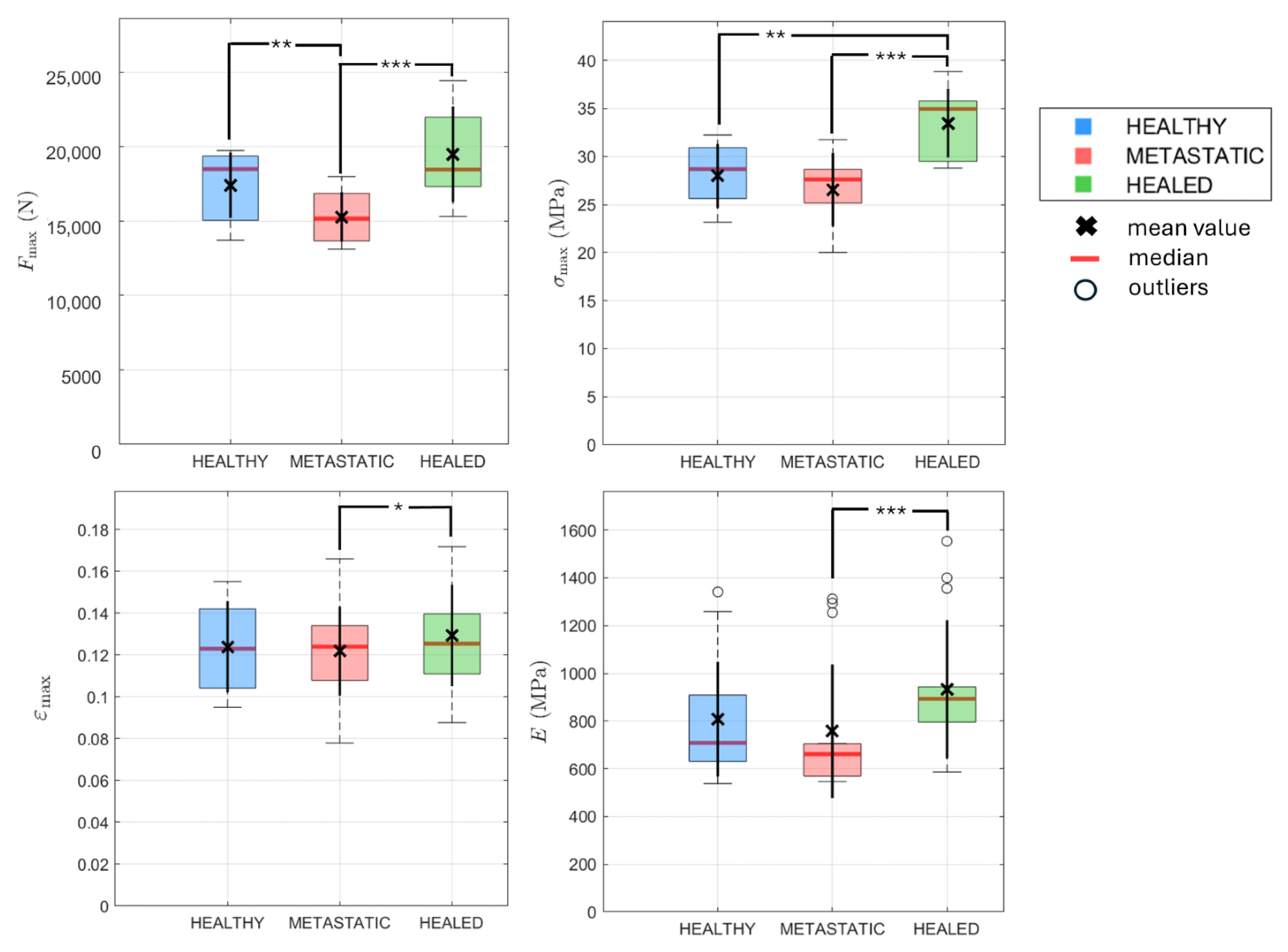
All four biomechanical parameters (Fmax, σmax, εmax, and E) were evaluated for all specimens across the three vertebral types (Healthy, Metastatic, Healed) (Figure 5 and Table 3).
Regarding Fmax, the Healthy type showed a median value of approximately 17.4 kN, with a distribution ranging 14.8 kN to 19.7 kN, the Metastatic specimens a median of 15 kN with a range 13.4 to 17.2 kN, the Healed specimens a median of 19.5 kN with a range 15.5 kN to 24.3 kN.
For σmax, the Healthy specimens displayed a median value of approximately 28.0 MPa with a range 23.2 to 31.4 MPa, the Metastatic specimens a median of 26.5 MPa with a range 20.1 MPa to 31.2 MPa, the Healed type had a median value of 33.5 MPa with a range 29.3 MPa to 37.9 MPa).
εmax values were relatively consistent across the three typologies, with only minor variations in both median and range. The median strain value observed for the Healthy type was 0.12, for the Metastatic type 0.13, and for the Healed type 0.12.
E for the Healthy type showed a median of 1259 MPa and ranged from 626 to 1259 MPa, for Metastatic type the median was 1294 MPa and ranged 561 to 1294 MPa and for Healed type the median was 1400 MPa and ranged 595 to 1400 MPa.
Across the five healthy vertebrae, Fmax and σmax exhibited CV between replicas consistently below 5% (Table 4), except for specimen #1, which showed a CV of 8.4%. εmax showed slightly more variability, with CVs ranging from 1.2% to 19.0%. The highest value was observed in specimen #2. E values ranged from 0.1% to 16.5%, with specimens #1 and #4 exceeding the 5% threshold. Among the metastatic vertebrae, Fmax and σmax exhibited low variation, with CV values between 0.6% and 3.2%. While εmax showed greater variability, ranging from 0.6% to 15.4%. In contrast, E exhibited excellent repeatability, with all values remaining below 3%. Healed vertebrae followed a similar trend to the metastatic vertebrae: Fmax and σmax presented CV values below 2.7%, while εmax exhibited increased variability. In particular, specimen #2 reached a CV of 23.3%, the highest across all typologies. E values were below 3% in all specimens, except for specimen #1, which had a CV of 7.2%.
Overall, all three types demonstrated excellent repeatability in strength-related metrics (Fmax and σmax) and stiffness. Strain measures, instead, showed lower consistency.

3.3. Influence of Material Composition and Geometry on the Mechanical Behaviour

Pairwise statistical analyses showed significant differences among the 3DP vertebrae types for most parameters (Figure 5).
The Metastatic type showed a 17% reduction of the Fmax (Mann-Whitney U test, p < 0.01) with respect to Healthy type and a 19% reduction (Wilcoxon test, p < 0.001) with respect to the Healed type. No significant difference was observed between Healthy and Healed types (Mann-Whitney U test, p = 0.16).
The Metastatic specimens showed a 23% reduction of the σmax (Wilcoxon test, p < 0.001) compared to the Healed type. While the Healthy type showed a 20% reduction of the σmax (Mann-Whitney U test, p < 0.01) with respect to the Healed type. No significant difference was found between Metastatic and Healthy types (Mann-Whitney U test, p = 0.40).
The Metastatic type showed a 8% reduction of the εmax (Wilcoxon test, p < 0.05) compared to the Healed type. No statistically significant differences were detected between Healthy and Metastatic types (Mann-Whitney U test, p = 0.80) or between Healthy and Healed types (Mann-Whitney U test, p = 0.67).
Finally, the Metastatic type showed a reduction of 34% of the E (paired t test, p < 0.001) with respect to the Healed type. Conversely, no statistical differences were found between Healthy and Healed types (independent t-test, p = 0.21) or between Healthy and Metastatic types (independent t-test, p = 0.60).

4. Discussion

This study aimed to create a reliable method for assessing the biomechanical performance of 3DP vertebrae models. The objectives were to: (1) determine the repeatability of mechanical parameters among vertebra replicas, and (2) examine how material composition and geometry influence the mechanical behaviour of various vertebrae.
A total of forty-five vertebrae, emulating Healthy, Metastatic, and Healed conditions, were reconstructed from CT scans, 3D-printed, and mechanically tested.
Our findings demonstrate that 3DP models comply with the mechanical trends observed in human vertebrae, supporting their use in future biomechanical investigations, either as a complement to or an alternative to ex vivo testing. Indeed, the repeatability analysis confirmed excellent consistency in strength-related metrics (Fmax and σmax) and stiffness across replicas, with CV values below the 5% threshold (Table 4) [39]. This low variability confirmed good manufacturing repeatability, ensuring identical geometry and controlled materials. This enables multiple destructive tests on replicas of the same vertebra geometry, which is not otherwise feasible with ex vivo specimens [13,40]. On the other hand, higher variability was observed for strain measurements (εmax), which can be attributed to the material viscoelastic behaviour and the lack of preconditioning before testing.
The comparative analysis among the vertebral types revealed clear trends: the metastatic models exhibited significant reductions in the maximum force compared to the healthy ones, while their Young’s modulus remained similar (Figure 5). This trend is consistent with ex vivo studies, where lytic metastases reduce vertebral strength while having a limited effect on the global stiffness [6].
In general, the strength and the elastic properties of 3DP models were higher in absolute terms than those reported for human vertebrae in the literature. This difference could be expected due to the elastoplastic behaviour and the homogeneous nature of the used polymeric materials, which lack the viscoelastic behaviour and trabecular microstructure typical of real bone tissue. In the healthy models, the median Fmax reached 19.5 kN (range: 15.5–24.3 kN), compared to 2.2 ± 0.9 kN reported by [5] and 6.2 ± 3.0 kN predicted by [41]. In the same way, the Metastatic models (median: 15.2 kN; range: 13.4–17.2 kN) exceeded ex vivo measurements (1.4 ± 0.7 kN [5], 1.2 ± 0.9 kN [7], 5.8 kN (range: 3.0–6.2 kN) [15]), and in silico prediction (6.1 ± 3.5 kN [41]). In this study, the σmax exhibited trends similar to those of Fmax, but with absolute values higher than those reported in the literature (Healthy vertebra: 28.0 MPa vs. 7.7 MPa; Metastatic vertebra: 26.5 MPa vs. 4.5 MPa [42]). For εmax, the 3DP models exhibited medians of 0.13 in Metastatic types and 0.12 in Healthy ones, compared to 0.008 ± 0.005 for metastatic and 0.003 ± 0.009 for healthy in ex vivo human vertebrae [6]. Although the absolute εmax values are substantially higher, the proportional increase in strain from Healthy to Metastatic models nonetheless parallels the trends reported in the literature. In terms of Young’s modulus, the 3DP models decreased from 626–1259 MPa in the Healthy vertebrae to 561–1294 MPa in the Metastatic vertebrae, consistent with ex vivo findings: ref. [5] reported 382 ± 194 MPa (healthy) versus 250 ± 130 MPa (metastatic), and ref. [42] reported 855 ± 360 MPa versus 667 ± 121 MPa. The Healed models, which preserve the geometry of the Metastatic vertebra but replace the metastasis tissue with healthy material, showed significant increases in all biomechanical parameters compared to both Metastatic and Healthy vertebrae (Figure 5), highlighting the role of material properties in determining vertebral mechanical properties. In addition, the use of ’Healed’ models provided an unique opportunity to isolate the effects of material composition and, due to its identical size, a valuable comparison to the metastatic condition [13]. This approach overcomes a common limitation in ex vivo studies where adjacent vertebrae, frequently used as controls, which often differ in bone density, trabecular architecture, and endplate morphology, thereby confounding interpretation exhibit differing mechanical properties [13]. On the other hand, maximum stress (σmax) was significantly influenced by the geometry, likely due to its dependence on the minimum cross-sectional area used in its calculation. Instead, maximum force (Fmax), was conditioned by both material properties and geometry. This pattern may be explained by the higher load-bearing capacity and more uniform stress distribution of the rigid polymer used to simulate healthy trabecular bone, compared to the softer pathological material emulating the lytic lesions.
To the best of our knowledge, quantitative assessments of the strength and stiffness of 3DP vertebrae, particularly in the presence of metastatic lesions, were missing. Previous works have only focused on the visual and tactile feedback of synthetic models [43,44].
This study has some limitations. First, the available printable materials do not fully replicate the anisotropy and viscoelasticity of trabecular and cortical bone, nor those of the metastatic lesions. Although Digital Anatomy Printing allows the reproduction of heterogeneous structures with voxel-level control [33], the mechanical properties of the resulting models still differ from those of biological tissues (Figure 5). Second, some variability may have been introduced during the segmentation phase. Despite the use of a standardised HU thresholding protocol and the fact that all segmentations were performed by an experienced operator, minor variations in CT slice thickness, threshold selection, or user-dependent operation could lead to subtle geometric deviations. Furthermore, segmentation of bone metastases is challenging due to the lack of a validated protocol and by the significant overlap of HU values between tumoral tissue and native bone marrow [15,33]. As highlighted by [45], segmentation remains a critical source of geometric inaccuracies in medical 3D-printing workflows, particularly when modelling complex morphologies such as metastatic lesions. Third, mechanical testing was limited to uniaxial compression. While this setup facilitates direct comparisons across specimens, it does not reproduce the complex multi-axial loading conditions (e.g., lateral bending or flexion) typically experienced by the vertebrae [13]. Finally, the study included a relatively small sample size (n = 5). A power analysis was performed to determine the required sample size. Assuming that vertebrae with lytic metastases exhibit approximately 50% of the strength of healthy vertebrae (≈2500 N [6]), with a variability of 1000 N in healthy vertebrae, a Type I error rate of 5%, and a Type II error rate of 20%, a minimum of five specimens per group was sufficient to detect statistically significant differences. Nevertheless, a larger sample size is mandatory to assess the inter-specimen variability of the 3DP models.
Future studies should focus on tuning the properties of artificial materials on biological ones to better emulate the mechanical behaviour of biological tissue. In addition, expanding mechanical testing to include different loading conditions and incorporating spinal segments with multiple vertebrae, intervertebral discs, and ligaments. This would better replicate the complex physiological conditions.

5. Conclusions

In this work, we have quantified for the first time the mechanical properties of synthetic 3DP models of vertebrae. This approach demonstrated excellent repeatability and confirmed that the mechanical performance of the 3DP models is highly dependent on material properties. This study provides a unique framework to isolate the effects of metastatic lesions in vertebrae. The observed trends mirrored those of human vertebrae, with Metastatic models showing a reduction in strength compared to healthy ones but a similar Young’s modulus. This study supports the potential of the 3DP models as a cost-effective alternative to ex vivo for biomechanical testing, as well as a promising tool for preclinical evaluation.

Author Contributions

Conceptualization, D.B., R.F., M.P., L.C. and P.G.; methodology, D.B., R.F. and M.P.; software, R.F. and P.G.; validation, R.F., M.P. and D.B.; formal analysis, D.B.; investigation, D.B., M.P. and R.F.; resources, R.F. and M.P.; data curation, D.B. and M.P.; writing—original draft preparation, D.B.; writing—review and editing, D.B., M.P., R.F. and L.C.; visualization, D.B.; supervision, M.P., L.C. and P.G.; project administration, L.C. and P.G. All authors have read and agreed to the published version of the manuscript.

Funding

The study was partially supported by the AOSpine Discovery and Innovation Awards (AOSDIA 2019_063_TUM_Palanca, 2019), Marie Skłodowska-Curie Individual Fellowship (MetaSpine, MSCA-IF-EF-ST, 832430/2018, 2018) and by the METASTRA project (EU H2022 grant ID 101080135).

Data Availability Statement

The original contributions presented in this study are included in the article. Further inquiries can be directed to the corresponding author.

Acknowledgments

The authors thank Enrico Dall’Ara for kindly sharing the clinical images.

Conflicts of Interest

The authors declare no conflicts of interest.

Abbreviations

The following abbreviations are used in this manuscript:
3DThree-dimensional
FEFinite Element
CTComputed Tomography
HUHounsfield Unit
ROIRegion of Interest
STLStandard Tessellation Language
UVUltraviolet
DACDigital Anatomy Creator
BMBoneMatrix
VCVeroClear
SUP706Support
TPMSTriply Periodic Minimal Surface
TMTissueMatrix
AC30Agilus30Clear
3DPThree-dimensional Printed
CADComputer-Aided Design
CVCoefficient of Variation
VBVertebral Body

References

  1. Coleman, R.E.; Croucher, P.I.; Padhani, A.R.; Clézardin, P.; Chow, E.; Fallon, M.; Guise, T.; Colangeli, S.; Capanna, R.; Costa, L. Bone Metastases. Nat. Rev. Dis. Primer 2020, 6, 83. [Google Scholar] [CrossRef] [PubMed]
  2. Perrin, R.G.; Laxton, A.W. Metastatic Spine Disease: Epidemiology, Pathophysiology, and Evaluation of Patients. Neurosurg. Clin. N. Am. 2004, 15, 365–373. [Google Scholar] [CrossRef]
  3. Sutcliffe, P.; Connock, M.; Shyangdan, D.; Court, R.; Kandala, N.-B.; Clarke, A. A Systematic Review of Evidence on Malignant Spinal Metastases: Natural History and Technologies for Identifying Patients at High Risk of Vertebral Fracture and Spinal Cord Compression. Health Technol. Assess. 2013, 17, 42. [Google Scholar] [CrossRef]
  4. Galbusera, F.; Qian, Z.; Casaroli, G.; Bassani, T.; Costa, F.; Schlager, B.; Wilke, H.-J. The Role of the Size and Location of the Tumors and of the Vertebral Anatomy in Determining the Structural Stability of the Metastatically Involved Spine: A Finite Element Study. Transl. Oncol. 2018, 11, 639–646. [Google Scholar] [CrossRef]
  5. Alkalay, R.N. Effect of the Metastatic Defect on the Structural Response and Failure Process of Human Vertebrae: An Experimental Study. Clin. Biomech. 2015, 30, 121–128. [Google Scholar] [CrossRef]
  6. Palanca, M.; Cavazzoni, G.; Dall’Ara, E. The Role of Bone Metastases on the Mechanical Competence of Human Vertebrae. Bone 2023, 173, 116814. [Google Scholar] [CrossRef]
  7. Palanca, M.; Barbanti-Bròdano, G.; Cristofolini, L. The Size of Simulated Lytic Metastases Affects the Strain Distribution on the Anterior Surface of the Vertebra. J. Biomech. Eng. 2018, 140, 111005. [Google Scholar] [CrossRef]
  8. Randall, R.L. (Ed.) Metastatic Bone Disease: An Integrated Approach to Patient Care; Springer International Publishing: Cham, Switzerland, 2024; ISBN 978-3-031-52000-6. [Google Scholar]
  9. Whyne, C.M. Biomechanics of Metastatic Disease in the Vertebral Column. Neurol. Res. 2014, 36, 493–501. [Google Scholar] [CrossRef]
  10. Macedo, F.; Ladeira, K.; Pinho, F.; Saraiva, N.; Bonito, N.; Pinto, L.; Gonçalves, F. Bone Metastases: An Overview. Oncol. Rev. 2017, 11, 321. [Google Scholar] [CrossRef] [PubMed]
  11. Bailey, S.; Stadelmann, M.A.; Zysset, P.K.; Vashishth, D.; Alkalay, R.N. Influence of Metastatic Bone Lesion Type and Tumor Origin on Human Vertebral Bone Architecture, Matrix Quality, and Mechanical Properties. J. Bone Miner. Res. 2020, 37, 896–907. [Google Scholar] [CrossRef] [PubMed]
  12. Cavazzoni, G.; Dall’Ara, E.; Palanca, M. Microstructure of the Human Metastatic Vertebral Body. Front. Endocrinol. 2025, 15, 1508504. [Google Scholar] [CrossRef]
  13. Palanca, M.; Barbanti-Bròdano, G.; Marras, D.; Marciante, M.; Serra, M.; Gasbarrini, A.; Dall’Ara, E.; Cristofolini, L. Type, Size, and Position of Metastatic Lesions Explain the Deformation of the Vertebrae under Complex Loading Conditions. Bone 2021, 151, 116028. [Google Scholar] [CrossRef] [PubMed]
  14. Costa, M.C.; Campello, L.B.B.; Ryan, M.; Rochester, J.; Viceconti, M.; Dall’Ara, E. Effect of Size and Location of Simulated Lytic Lesions on the Structural Properties of Human Vertebral Bodies, a Micro-Finite Element Study. Bone Rep. 2020, 12, 100257. [Google Scholar] [CrossRef] [PubMed]
  15. Stadelmann, M.A.; Schenk, D.E.; Maquer, G.; Lenherr, C.; Buck, F.M.; Bosshardt, D.D.; Hoppe, S.; Theumann, N.; Alkalay, R.N.; Zysset, P.K. Conventional Finite Element Models Estimate the Strength of Metastatic Human Vertebrae despite Alterations of the Bone’s Tissue and Structure. Bone 2020, 141, 115598. [Google Scholar] [CrossRef]
  16. Tejo-Otero, A.; Buj-Corral, I.; Fenollosa-Artés, F. 3D Printing in Medicine for Preoperative Surgical Planning: A Review. Ann. Biomed. Eng. 2020, 48, 536–555. [Google Scholar] [CrossRef]
  17. Kabra, A.; Mehta, N.; Garg, B. 3D Printing in Spine Care: A Review of Current Applications. J. Clin. Orthop. Trauma 2022, 35, 102044. [Google Scholar] [CrossRef] [PubMed]
  18. Dolino, G.; Coato, D.; Forni, R.; Boretti, G.; Ciliberti, F.K.; Gargiulo, P. Designing a Synthetic 3D-Printed Knee Cartilage: FEA Model, Micro-Structure and Mechanical Characteristics. Appl. Sci. 2023, 14, 331. [Google Scholar] [CrossRef]
  19. Tack, P.; Victor, J.; Gemmel, P.; Annemans, L. 3D-Printing Techniques in a Medical Setting: A Systematic Literature Review. Biomed. Eng. OnLine 2016, 15, 115. [Google Scholar] [CrossRef]
  20. Serrano, C.; Fontenay, S.; Van Den Brink, H.; Pineau, J.; Prognon, P.; Martelli, N. Evaluation of 3D Printing Costs in Surgery: A Systematic Review. Int. J. Technol. Assess. Health Care 2020, 36, 349–355. [Google Scholar] [CrossRef]
  21. Metzner, F.; Neupetsch, C.; Carabello, A.; Pietsch, M.; Wendler, T.; Drossel, W.-G. Biomechanical Validation of Additively Manufactured Artificial Femoral Bones. BMC Biomed. Eng. 2022, 4, 6. [Google Scholar] [CrossRef]
  22. Wahbeh, J.M.; Hookasian, E.; Lama, J.; Alam, L.; Park, S.; Sangiorgio, S.N.; Ebramzadeh, E. An Additively Manufactured Model for Preclinical Testing of Cervical Devices. JOR SPINE 2024, 7, e1285. [Google Scholar] [CrossRef] [PubMed]
  23. Zheng, Y.; Zhang, W.; Baca Lopez, D.M.; Ahmad, R. Scientometric Analysis and Systematic Review of Multi-Material Additive Manufacturing of Polymers. Polymers 2021, 13, 1957. [Google Scholar] [CrossRef] [PubMed]
  24. Rafiee, M. Multi Material 3D and 4D Printing: A Survey. Adv. Sci. 2020, 7, 1902307. [Google Scholar] [CrossRef]
  25. Tee, Y.L.; Peng, C.; Pille, P.; Leary, M.; Tran, P. PolyJet 3D Printing of Composite Materials: Experimental and Modelling Approach. JOM 2020, 72, 1105–1117. [Google Scholar] [CrossRef]
  26. Ghimire, A.; Chen, P.-Y. Mechanical Properties of Additively Manufactured Multi-Material Stiff-Soft Interfaces: Guidelines to Manufacture Complex Interface Composites with Tunable Properties. Mater. Des. 2024, 238, 112677. [Google Scholar] [CrossRef]
  27. Forni, R.; Calderonel, D.; Coato, D.; Dolino, G.; Cesarelli, G.; Ricciardi, C.; Cesarelli, M.; Gargiulo, P. Towards Bio-Mimetic 3D Printable Human Anatomies. In Proceedings of the 2024 IEEE International Conference on Metrology for eXtended Reality, Artificial Intelligence and Neural Engineering (MetroXRAINE), St Albans, UK, 21 October 2024; pp. 1016–1021. [Google Scholar]
  28. García-Collado, A.; Blanco, J.M.; Gupta, M.K.; Dorado-Vicente, R. Advances in Polymers Based Multi-Material Additive-Manufacturing Techniques: State-of-Art Review on Properties and Applications. Addit. Manuf. 2022, 50, 102577. [Google Scholar] [CrossRef]
  29. Jacobs, S.; Grunert, R.; Mohr, F.W.; Falk, V. 3D-Imaging of Cardiac Structures Using 3D Heart Models for Planning in Heart Surgery: A Preliminary Study. Interact. Cardiovasc. Thorac. Surg. 2008, 7, 6–9. [Google Scholar] [CrossRef]
  30. Cui, J.; Chen, L.; Guan, X.; Ye, L.; Wang, H.; Liu, L. Surgical Planning, Three-Dimensional Model Surgery and Preshaped Implants in Treatment of Bilateral Craniomaxillofacial Post-Traumatic Deformities. J. Oral Maxillofac. Surg. 2014, 72, 1138.e1–1138.e14. [Google Scholar] [CrossRef]
  31. Hangartner, T.N. Thresholding Technique for Accurate Analysis of Density and Geometry in QCT, pQCT and ÌCT Images. J. Musculoskelet Neuronal Interact. 2007, 7, 9–16. [Google Scholar]
  32. Van Eijnatten, M.; Van Dijk, R.; Dobbe, J.; Streekstra, G.; Koivisto, J.; Wolff, J. CT Image Segmentation Methods for Bone Used in Medical Additive Manufacturing. Med. Eng. Phys. 2018, 51, 6–16. [Google Scholar] [CrossRef] [PubMed]
  33. Heo, H.; Jin, Y.; Yang, D.; Wier, C.; Minard, A.; Dahotre, N.B.; Neogi, A. Manufacturing and Characterization of Hybrid Bulk Voxelated Biomaterials Printed by Digital Anatomy 3D Printing. Polymers 2020, 13, 123. [Google Scholar] [CrossRef] [PubMed]
  34. Forni, R.; Pavan, G.; Gunnarsson, A.; Ricciardi, C.; Corsi, C.; Gargiulo, P. Advanced 3D Printing of Patient-Specific Human Heart for Improved Surgical Planning. In Proceedings of the 2023 IEEE International Conference on Metrology for eXtended Reality, Artificial Intelligence and Neural Engineering (MetroXRAINE), Milano, Italy, 25 October 2023; pp. 473–478. [Google Scholar]
  35. La Barbera, L.; Villa, T.; Costa, F.; Boschetti, F.; De Robertis, M.; Anselmi, L.; Capo, G.; Pancetti, S.; Fornari, M. Poroelastic Characterization of Human Vertebral Metastases to Inform a Transdisciplinary Assessment of Spinal Tumors. J. Clin. Med. 2025, 14, 2913. [Google Scholar] [CrossRef]
  36. Whyne, C.M.; Hu, S.S.; Workman, K.L.; Lotz, J.C. Biphasic Material Properties of Lytic Bone Metastases. Ann. Biomed. Eng. 2000, 28, 1154–1158. [Google Scholar] [CrossRef] [PubMed]
  37. Yap, Y.L.; Yeong, W.Y. Shape Recovery Effect of 3D Printed Polymeric Honeycomb: This Paper Studies the Elastic Behaviour of Different Honeycomb Structures Produced by PolyJet Technology. Virtual Phys. Prototyp. 2015, 10, 91–99. [Google Scholar] [CrossRef]
  38. Farsi, A.; Pullen, A.D.; Latham, J.P.; Bowen, J.; Carlsson, M.; Stitt, E.H.; Marigo, M. Full Deflection Profile Calculation and Young’s Modulus Optimisation for Engineered High Performance Materials. Sci. Rep. 2017, 7, 46190. [Google Scholar] [CrossRef] [PubMed]
  39. Machin, D.; Campbell, M.J.; Walters, S.J. Medical Statistics; Wiley-Blackwell: Hoboken, NJ, USA, 2007. [Google Scholar]
  40. Cook, D.; Julias, M.; Nauman, E. Biological Variability in Biomechanical Engineering Research: Significance and Meta-Analysis of Current Modeling Practices. J. Biomech. 2014, 47, 1241–1250. [Google Scholar] [CrossRef]
  41. Costa, M.C.; Eltes, P.; Lazary, A.; Varga, P.P.; Viceconti, M.; Dall’Ara, E. Biomechanical Assessment of Vertebrae with Lytic Metastases with Subject-Specific Finite Element Models. J. Mech. Behav. Biomed. Mater. 2019, 98, 268–290. [Google Scholar] [CrossRef]
  42. Kaneko, T.S.; Bell, J.S.; Pejcic, M.R.; Tehranzadeh, J.; Keyak, J.H. Mechanical Properties, Density and Quantitative CT Scan Data of Trabecular Bone with and without Metastases. J. Biomech. 2004, 37, 523–530. [Google Scholar] [CrossRef]
  43. Brouwers, L.; Teutelink, A.; Van Tilborg, F.A.J.B.; De Jongh, M.A.C.; Lansink, K.W.W.; Bemelman, M. Validation Study of 3D-Printed Anatomical Models Using 2 PLA Printers for Preoperative Planning in Trauma Surgery, a Human Cadaver Study. Eur. J. Trauma Emerg. Surg. 2019, 45, 1013–1020. [Google Scholar] [CrossRef]
  44. Molinari, L.; Falcinelli, C. On the Human Vertebra Computational Modeling: A Literature Review. Meccanica 2022, 57, 599–622. [Google Scholar] [CrossRef]
  45. Juergensen, L.; Rischen, R.; Hasselmann, J.; Toennemann, M.; Pollmanns, A.; Gosheger, G.; Schulze, M. Insights into Geometric Deviations of Medical 3d-Printing: A Phantom Study Utilizing Error Propagation Analysis. 3D Print. Med. 2024, 10, 38. [Google Scholar] [CrossRef] [PubMed]
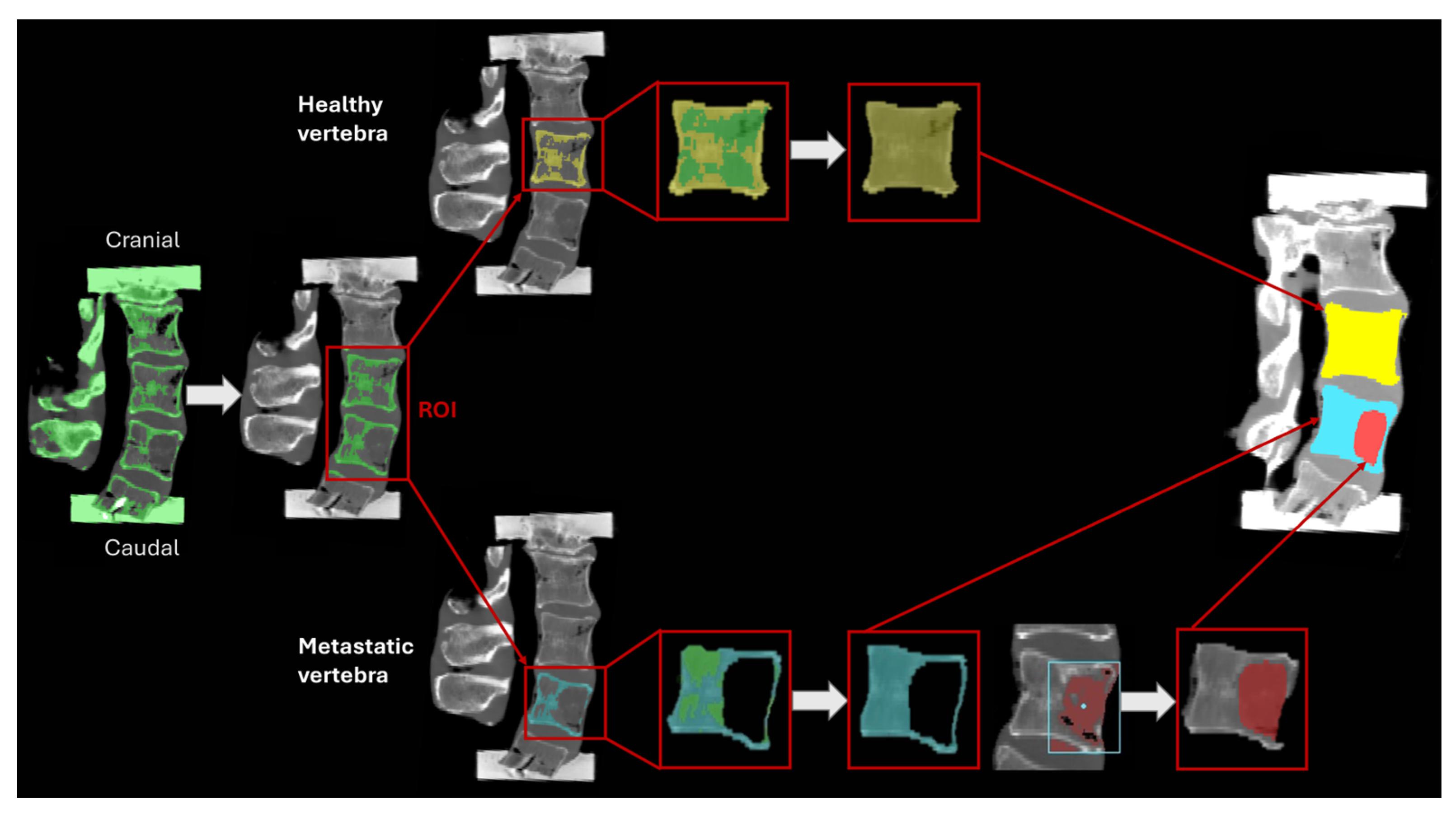
Figure 1. CT-based segmentation protocol. From the left, a global bone mask (green) is generated using a threshold of [200–1780] HU, and the ROI (healthy and metastatic vertebra) is defined. In the upper row, region growing is applied to extract the healthy vertebra (yellow). In the lower row, region growing extracts the metastatic vertebra (blue), holes are filled, and the metastasis is additionally segmented (red). On the right, the final segmentation displays the three components together.
Jmmp 09 00373 g001
Figure 2. On the left: material blend MatBone, with layers A (outer layer), B (transitional layer), C (inner layer), in which blue represents BM, purple VC and yellow SUP706. On the right: material blend MatMet, in which red represents TM and yellow AC30.
Jmmp 09 00373 g002
Figure 3. Workflow for printing 3D vertebral models. From left to right: coronal CT slice; segmented masks showing the metastatic vertebra (red), metastasis (yellow), and healthy vertebra (blue); 3D virtual model of the metastatic vertebra (top) with metastasis inside, and healthy vertebrae (bottom); corresponding 3DP models, with internal structure highlighted in cross section for the three model types (Healthy, Metastatic, Healed).
Jmmp 09 00373 g003
Figure 4. Mechanical test loading protocol: (a) imposed displacement-time curve, (b) load-time curve for a typical specimen, (c) stress-strain curve for a typical specimen, (d) mechanical setup.
Jmmp 09 00373 g004
Figure 5. Distribution of maximum force (Fmax), maximum stress (σmax), maximum strain (εmax) and Young’s modulus (E) across the three vertebral typologies: Healthy (blue), Metastatic (red), and Healed (green). The data are represented as box plots, where the red line indicates the median, the black cross denotes the mean, and circles identify outliers, defined as values beyond 1.5 times the interquartile range (IQR). Whiskers extend to the most extreme data points within this range. Each type includes n = 15 specimens. Statistical significance levels are indicated as follows: * p < 0.05, ** p < 0.01, *** p < 0.001.
Jmmp 09 00373 g005
Table 1. Clinical data of the donors, level of the healthy, and metastatic vertebrae.
IDDonorPrimary TumourSexAge (yr)BMI (kg/m2)Healthy VertebraMetastatic Vertebra
#1ANasopharyngealM7216T7T6
#2BBreastF8222T7T6
#3BBreastF8222L3L4
#4CAdenocarcinomaF6257T6T5
#5DBreastF5517T7T8
Table 2. Geometrical parameters of each vertebra in each segment: minimum cross-sectional area, volume, and percentage of metastatic lesion in the vertebral body (VB).
IDTypologiesMinimum Cross-Sectional Area (mm2)Volume of the Vertebra (mm3)Volume of the Metastasis (mm3) (VB%)
#1Healthy53211,645-
Metastatic48610,059526 (4.9)
Healed48610,585-
#2Healthy57012,363-
Metastatic49310,481737 (6.6)
Healed49311,218-
#3Healthy84825,810-
Metastatic82823,1853806 (14.1)
Healed82826,991-
#4Healthy60614,323-
Metastatic52410,280696 (6.3)
Healed52410,976-
#5Healthy59813,970-
Metastatic62313,980912 (6.1)
Healed62314,892-
Table 3. Median values and range for each biomechanical parameter, calculated across replicas for each spine segment and typology (Healthy, Metastatic, Healed).
IDFmax (kN)σmax (MPa)εmaxE (MPa)
Healthy#115.2 (13.7–16.2)28.7 (25.8–30.5)0.14 (0.14–0.14)1259 (1006–1499)
#214.8 (14.6–15.0)26.1 (25.6–26.3)0.12 (0.10–0.14)655 (643–664)
#319.7 (19.6–19.7)23.2 (23.2–23.3)0.10 (0.09–0.11)626 (626–627)
#418.7 (18.2–19.5)30.8 (30.1–32.2)0.15 (0.14–0.16)708 (537–742)
#518.8 (18.5–18.9)31.4 (30.9–31.6)0.11 (0.10–0.12)906 (871–908)
Metastatic#115.2 (15.0–15.4)31.2 (30.8–31.7)0.12 (0.12–0.13)1294 (1258–1323)
#213.7 (13.7–13.8)27.8 (27.7–28.0)0.12 (0.10–0.13)699 (695–706)
#316.7 (16.6–17.0)20.1 (20.0–20.5)0.09 (0.08–0.11)561 (546–568)
#413.4 (13.1–13.7)25.6 (25.0–26.1)0.14 (0.14–0.17)572 (549–584)
#517.2 (16.9–18.0)27.6 (27.2–28.9)0.12 (0.11–0.14)661 (658–695)
Healed#118.5 (17.9–18.9)37.9 (36.8–38.9)0.12 (0.12–0.13)1400 (1328–1499)
#217.6 (17.2–17.6)35.7 (34.9–35.8)0.13 (0.09–0.14)942 (933–941)
#324.3 (23.8–24.4)29.3 (28.8–29.5)0.10 (0.10–0.11)803 (791–807)
#415.5 (15.3–15.9)29.5 (29.2–30.4)0.17 (0.16–0.17)595 (589–620)
#521.8 (21.5–22.0)35.0 (34.6–35.4)0.13 (0.12–0.14)893 (873–900)
Table 4. Coefficient of variation (CV%) for each biomechanical parameter, calculated across replicas for each spine segment and typology (Healthy, Metastatic, Healed). Bold values indicate values above 5%.
IDFmaxσmaxεmaxE
Healthy#18.4%8.4%1.2%14.6%
#21.4%1.4%19.0%1.5%
#30.2%0.2%5.7%0.1%
#43.5%3.5%7.0%16.5%
#51.1%1.1%6.0%2.5%
Metastatic#11.5%1.5%0.6%2.3%
#20.6%0.6%10.9%1.0%
#31.3%1.3%15.4%2.0%
#42.1%2.1%9.7%2.9%
#53.2%3.2%9.4%2.8%
Healed#12.7%2.7%0.9%7.2%
#21.3%1.3%23.3%0.6%
#31.3%1.3%3.0%1.0%
#42.0%2.0%3.5%2.7%
#51.1%1.1%6.0%1.3%
Disclaimer/Publisher’s Note: The statements, opinions and data contained in all publications are solely those of the individual author(s) and contributor(s) and not of MDPI and/or the editor(s). MDPI and/or the editor(s) disclaim responsibility for any injury to people or property resulting from any ideas, methods, instructions or products referred to in the content.