1. Introduction
With the rapid advancement of modern manufacturing technologies, particularly additive manufacturing and digital fabrication, engineering design methodologies must evolve to keep pace with the increasing demand for innovative, high-performance structures. Advanced manufacturing systems enable the fabrication of geometrically complex components that were previously impractical or impossible to produce using conventional manufacturing processes. As a result, there is a growing need for computational design approaches capable of fully exploiting this expanded design freedom while maintaining structural efficiency, manufacturability, and material economy.
Topology optimisation has therefore emerged as one of the most influential computational design methodologies in modern engineering. Its central objective is to determine the optimal distribution of material within a prescribed design domain such that structural or multiphysical performance criteria are satisfied while respecting constraints on material usage. By systematically identifying where material should be retained or removed, topology optimisation enables the discovery of highly efficient structural configurations that balance mechanical performance, lightweight design, and functional requirements [
1]. Unlike traditional structural design approaches, which rely heavily on designer intuition and incremental geometric refinement, topology optimisation enables the discovery of entirely new structural configurations that would rarely be conceived through conventional engineering practice [
2,
3]. By systematically evaluating how material should be distributed within a domain, the method allows engineers to create structures that exhibit remarkable efficiency, combining minimal material consumption with superior mechanical or thermal performance [
4].
The significance of topology optimisation has become particularly evident in recent decades, with the emergence of advanced manufacturing technologies [
5]. In particular, the integration of topology optimisation with additive manufacturing has fundamentally transformed the design space available to engineers [
6]. Additive manufacturing enables the fabrication of highly complex geometries that cannot be produced using traditional subtractive or formative manufacturing processes [
7]. Consequently, structures generated through topology optimisation, which often possess intricate internal architectures and organic load paths, can now be manufactured with high fidelity. This synergy between computational design and digital fabrication has enabled the development of porous structural plates, lightweight aerospace components, heat exchangers with complex flow paths, and thermally efficient heat sinks that exploit electromagnetic or geometric effects to enhance heat transfer performance [
8,
9].
One of the defining characteristics of topology optimisation is its ability to produce structures with exceptional mechanical performance relative to their weight. By distributing material precisely along the load paths dictated by mechanical equilibrium, topology optimisation often results in structures that resemble natural forms such as trabecular bone or plant stems [
10,
11]. These biologically inspired morphologies are not intentionally designed but rather emerge from the optimisation process itself. As a result, topology optimisation has been widely adopted in aerospace engineering, automotive design, biomedical implants, and energy systems, where structural efficiency and weight reduction are critical performance factors.
Despite these remarkable successes, the classical framework of topology optimisation remains fundamentally dependent on the numerical evaluation of physical fields through discretised mathematical models. In most implementations, the design domain is discretised into a large number of finite elements that represent potential material or void regions. Physical behaviour, such as structural deformation or heat conduction, is evaluated through the solution of governing equations that describe the underlying physical phenomena [
12,
13]. These equations are typically expressed in variational form and solved numerically through finite element analysis. The resulting field solutions provide the information required to compute objective functions and constraint values that guide the optimisation process.
A critical component of this framework is sensitivity analysis, which determines how changes in design variables influence the objective function and constraints [
14]. Sensitivity analysis provides gradient information that directs the optimisation algorithm toward improved material distributions. Methods such as the Method of Moving Asymptotes [
15] and other gradient-based optimisation [
16] techniques rely heavily on accurate sensitivity information to ensure stable and efficient convergence. While this approach has proven to be mathematically rigorous and effective for many classes of engineering problems, it also introduces significant computational demands. The computational cost of topology optimisation arises primarily from the need to repeatedly evaluate the physical model throughout the optimisation process. Each design iteration typically requires the solution of a large system of equations representing the discretised physical behaviour of the structure. When the design domain contains thousands or even millions of elements, these numerical simulations can become extremely expensive in terms of both computation time and memory requirements [
17]. This challenge becomes even more pronounced when multiphysics interactions are involved, such as coupled thermal–fluid–structural phenomena or electromagnetic interactions.
Furthermore, the reliance on detailed physical simulation limits the speed at which new design concepts can be explored. In many engineering contexts, particularly during early-stage conceptual design, engineers are more interested in rapidly generating a range of plausible structural configurations rather than obtaining a fully optimised numerical solution. However, traditional topology optimisation methods are not inherently suited for such rapid exploration because each candidate design requires a full numerical analysis. Consequently, the computational burden can restrict the practical use of topology optimisation in situations where rapid iteration and conceptual creativity are essential.
A further limitation concerns the range of problems that can be effectively treated within classical topology optimisation frameworks. Despite considerable advances toward incorporating multiphysics interactions and manufacturing constraints, these approaches remain fundamentally dependent on explicitly defined governing equations that must be discretised and solved through numerical methods [
18]. Many real engineering problems involve complex interactions, uncertain boundary conditions, or qualitative design considerations that are difficult to represent explicitly within a mathematical optimisation framework. As engineering systems become increasingly complex, particularly in the context of intelligent manufacturing and cyber-physical production systems, the limitations of purely simulation-based optimisation approaches become more apparent.
In response to these challenges, researchers have explored several alternative strategies aimed at reducing the computational burden of topology optimisation while maintaining its design capabilities. One such approach involves the use of metaheuristic optimisation algorithms [
19,
20], including genetic algorithms, particle swarm optimisation, and other stochastic search methods. These techniques do not rely on gradient information and therefore avoid the need for sensitivity analysis. Instead, they explore the design space through probabilistic sampling and evolutionary mechanisms that mimic natural processes.
Although metaheuristic methods offer certain advantages in terms of conceptual simplicity and flexibility, they encounter significant difficulties when applied to topology optimisation problems. The primary challenge lies in the extremely large number of design variables associated with discretised material distributions. When each element within the design domain represents a potential design variable, the resulting search space becomes extraordinarily large. Metaheuristic algorithms generally require extensive sampling of this space in order to identify promising design regions, which can lead to very slow convergence and unstable optimisation behaviour. Consequently, purely stochastic optimisation approaches are rarely able to compete with gradient-based methods for large-scale topology optimisation problems.
Recent advances in data-driven modelling have demonstrated the capability of machine learning approaches to approximate or replace computationally intensive physics-based simulations in engineering design. In particular, models based on Convolutional Neural Networks have been successfully employed to learn complex mappings between process parameters, geometry, and resulting physical fields, thereby bypassing the need for repeated numerical solutions using numerical discretization approaches such as finite element and finite volume methods [
21,
22], as well as in additive manufacturing processes [
22].
In addition to steady-state and simplified scenarios, recent studies have demonstrated that trained machine learning models are capable of approximating highly complex and computationally intensive simulations, including transient and time-dependent multiphysical processes [
23]. Once trained on sufficiently representative datasets, such models can learn the temporal evolution of physical systems and provide rapid predictions of field variables without explicitly solving the governing differential equations at each time step. Deep learning architectures, especially those based on Convolutional Neural Networks and recurrent or sequence-aware models, have been successfully applied to capture spatiotemporal dependencies in dynamic systems [
24].
Building upon these developments, the present work extends the concept of data-driven acceleration beyond surrogate modelling of physical fields toward the direct generation of structural layouts. Unlike conventional learning-based approaches that aim to approximate simulation outputs, the proposed framework leverages a large language model to construct candidate topologies in a symbolic and interpretable manner. This shifts the role of artificial intelligence from that of a predictive surrogate to an active participant in the design process. As a result, the framework enables rapid exploration of the design space without relying on repeated high-fidelity simulations while still maintaining consistency with underlying physical principles through subsequent evaluation and refinement stages [
25,
26].
In this paradigm, machine learning models are trained to predict optimal material distributions based on previously generated topology optimisation solutions [
27,
28]. Once trained, these models can generate approximate structural layouts much more rapidly than traditional optimisation algorithms. Such approaches have the potential to accelerate the design process and enable real-time design exploration.
However, the effectiveness of data-driven methods depends strongly on the availability and quality of training data [
29]. In most cases, the training datasets are generated using conventional topology optimisation algorithms applied to relatively simplified problem settings. As a result, the machine learning model learns patterns that reflect the limitations of the original optimisation framework [
30]. Although this strategy may reduce computational cost, it does not fundamentally overcome the conceptual constraints associated with traditional topology optimisation formulations. The model can only reproduce design patterns that were already present within the training data, which restricts its ability to generalise to entirely new classes of engineering problems.
These limitations highlight the need for alternative design methodologies that can retain the conceptual strengths of topology optimisation while overcoming its computational and representational constraints. Such methodologies should ideally enable rapid exploration of structural configurations, accommodate qualitative design reasoning, and operate without requiring repeated high-fidelity numerical simulations. Achieving these objectives requires a shift in perspective regarding how structural design decisions are generated and evaluated.
In this context, recent developments in artificial intelligence, particularly in the field of large language models, present an intriguing opportunity. Large language models are trained on vast corpora of textual information and possess the ability to perform sophisticated forms of logical reasoning and pattern recognition. Although originally developed for natural language processing tasks, these models have demonstrated remarkable capabilities in generating structured solutions to complex problems when provided with appropriate contextual information.
The key insight underlying the present research is that topology optimisation can be interpreted as a logical decision-making process regarding the placement or removal of material within a design domain. Traditional optimisation methods determine this distribution through mathematical sensitivity analysis derived from physical simulations. However, experienced engineers and designers often make similar decisions through qualitative reasoning based on an understanding of load paths, stress flow, and structural stability. In many cases, a skilled designer can anticipate the general layout of an efficient structure without performing a full numerical analysis.
Large language models have the potential to emulate this type of reasoning process. By analysing descriptions of boundary conditions, load cases, and design objectives, a language model can generate plausible structural configurations that satisfy the logical principles governing material distribution. For example, regions subjected to high structural load should contain material to ensure stiffness and stability, while regions that contribute little to load transfer may be removed to reduce weight. These decisions are not purely numerical but involve a conceptual understanding of structural behaviour.
Within the proposed framework, the design domain is discretised into a finite grid that defines the admissible material locations. Unlike classical formulations, the generation of structural layouts is governed by a token-based sequence process inherent to large language models. Each grid cell or group of cells is represented through symbolic tokens, and the construction of a topology corresponds to the sequential prediction of these tokens. As a result, the complexity of the design generation process scales with the size of the design domain. In particular, as the resolution of the grid increases, the number of required tokens grows, and the search space expands combinatorially. This leads to an effective logarithmic increase in generation complexity with respect to the design space, reflecting the autoregressive nature of token prediction and contextual dependency within the model.
From a computational perspective, this token dependency introduces important scalability considerations. Larger design domains require longer token sequences and richer contextual representations, which in turn demand language models with higher representational capacity. Consequently, the use of larger models becomes necessary to maintain coherence, structural reasoning, and global consistency across the generated topology. This requirement is accompanied by the need for accelerated computational hardware, as inference cost increases significantly with both model size and sequence length.
Within this context, the current framework can be extended naturally to three-dimensional topology generation. However, such an extension substantially increases the dimensionality of the token space, as volumetric discretisation introduces an additional degree of freedom and significantly larger symbolic representations. To effectively capture the increased structural complexity and maintain meaningful spatial reasoning in three dimensions, the deployment of large-scale models becomes essential. Models with very high parameter counts, such as DeepSeek V3 with hundreds of billions of parameters, provide the necessary capacity to encode long-range dependencies, spatial coherence, and multi-scale structural patterns required for three-dimensional topology synthesis. Therefore, while the proposed method is fundamentally extensible to more serious dimensional problems, its practical realisation is closely linked to advances in large-scale language models and high-performance inference hardware.
This approach can be viewed as a form of symbolic or reasoning-based topology optimisation, in which the optimisation process is guided by logical inference rather than gradient-based numerical computation. The language model effectively acts as a conceptual structural designer that interprets design requirements and proposes structural layouts consistent with fundamental engineering principles. Such a methodology has the potential to dramatically reduce the computational cost associated with topology optimisation, particularly during early-stage design exploration.
Another important advantage of this approach lies in its flexibility. Because the reasoning process is based on qualitative descriptions rather than strictly defined mathematical models, it becomes possible to incorporate a broader range of design considerations. Factors such as manufacturability, structural robustness, and design heuristics can be integrated into the reasoning process through appropriate prompting strategies. This capability aligns closely with the evolving needs of intelligent manufacturing systems, where design decisions often involve multiple interacting criteria that are difficult to capture within a single mathematical formulation. The research presented in this work represents an initial investigation into the feasibility of this concept. By exploring how large language models (LLMs) can be used to generate material distributions within discretised design domains, the study aims to evaluate whether logical reasoning alone can produce structurally meaningful topologies. The goal is not to replace traditional topology optimisation methods entirely, but rather to introduce a complementary approach that can accelerate conceptual design and expand the range of problems that can be addressed. The novelty of this work, therefore, lies in the reinterpretation of topology optimisation as a reasoning-driven design task rather than a purely numerical optimisation problem. By leveraging the pattern recognition and logical inference capabilities of large language models, it becomes possible to generate structural concepts that reflect fundamental physical principles without relying on repeated finite element simulations. If successful, this paradigm could open new pathways for integrating artificial intelligence into engineering design workflows.
The proposed framework demonstrates that reasoning-driven topology generation can substantially reduce the computational cost associated with solving multiphysics optimisation problems, particularly by eliminating the need for repeated high-fidelity numerical simulations. This reduction is evident in the presented case studies, where the method produces competitive structural and thermal designs while relying on symbolic generation and lightweight evaluation metrics. The performance and efficiency of the approach are discussed in detail within the numerical examples section. In addition, the generated topologies exhibit continuous load paths, coherent connectivity, and geometries compatible with practical manufacturing processes, confirming that the method produces designs that are not only computationally efficient but also directly manufacturable.
3. LLM-Based Topology Optimisation Framework
Topology optimisation traditionally relies on gradient-based numerical optimisation coupled with finite element analysis in order to determine the optimal material distribution inside a design domain. Although such methods have demonstrated remarkable success in producing lightweight and mechanically efficient structures, they also introduce several well-known numerical challenges. Among these challenges are the occurrence of checkerboard patterns, the formation of disconnected structural members, the emergence of isolated material islands, and the presence of artificially thin members that do not represent physically meaningful structures. These artefacts arise because the optimisation algorithm operates on discretised numerical fields and often lacks global structural reasoning.
Furthermore, classical methods require repeated finite element analysis at every optimisation iteration. For large design domains, this process becomes computationally expensive and therefore limits the possibility of rapid conceptual exploration during early stages of engineering design. The framework proposed here introduces an alternative perspective in which large language models participate in the generation of candidate structural layouts through symbolic reasoning. Instead of relying entirely on numerical optimisation, the method constructs a symbolic representation of the topology and evaluates structural quality using computationally inexpensive heuristic indicators that approximate desirable structural behaviour.
In recent years, LLMs have been explored beyond their original scope of natural language processing and have shown emerging capability in assisting with physics-related tasks, including symbolic reasoning, equation interpretation, and simplified physical modelling. These developments suggest that such models are not limited to passive data-driven approximation but can actively participate in structured reasoning processes that resemble aspects of engineering analysis. In particular, their ability to infer relationships between boundary conditions, constraints, and system behaviour enables them to operate on representations that encode physical meaning, even in the absence of explicit numerical simulation [
38,
39,
40].
From an engineering perspective, design is not solely a numerical optimisation task but fundamentally a reasoning-driven process. Engineers routinely rely on qualitative understanding of load transfer, structural stability, and functional requirements to propose initial design concepts before engaging in detailed analysis. This logical reasoning forms the foundation of conceptual design, where decisions are guided by principles such as continuity of load paths, efficient material distribution, and avoidance of structurally inactive regions. Such reasoning processes are inherently symbolic and relational, rather than purely numerical.
Large language models provide a mechanism to emulate this aspect of engineering practice by transforming structured problem descriptions into candidate design configurations through learned patterns of reasoning. By interpreting the relationships between loads, supports, and constraints, the model can generate topologies that reflect fundamental structural principles without explicitly solving the governing equations. In this sense, the model assumes a more active and robust role within the design process, acting not merely as a surrogate predictor but as a conceptual generator that encodes engineering logic.
This shift enables the design process to be initiated through reasoning rather than computation, allowing rapid exploration of structurally meaningful configurations prior to detailed numerical validation. It also opens the possibility of integrating qualitative design knowledge, heuristics, and manufacturability considerations directly into the generation stage. As a result, large language models can serve as a bridge between human design intuition and computational evaluation, providing a new pathway for achieving efficient and flexible engineering design workflows.
As such, the proposed LLM-based topology optimisation framework therefore combines symbolic structural representation, generative structural reasoning, and lightweight algorithmic refinement. Each component addresses a specific limitation of classical topology optimisation, and together they form a hybrid design strategy capable of rapidly producing structurally meaningful topologies.
3.1. Symbolic Representation of Structural Topology
The first step in the proposed framework is the construction of a symbolic representation of the structural domain. The design region is discretised into a rectangular grid composed of
columns and
rows. Each grid element corresponds to a small region of physical space that may either contain structural material or remain empty. Unlike traditional topology optimisation, where each element contains a continuous density variable between zero and one, the proposed approach adopts a strictly binary representation. Each cell, therefore, assumes one of two possible states: material or void. The structural topology can therefore be expressed as a binary field
where
This binary formulation provides several advantages in the context of symbolic reasoning. First, it allows the structural layout to be represented as a discrete grid that can be directly generated by a language model. Second, it eliminates intermediate density values that often produce grey regions requiring additional penalisation schemes in classical topology optimisation. The amount of material used in the structure is controlled through a volume fraction constraint. The volume fraction of the design is defined as
which represents the ratio of material cells to the total number of cells in the domain. In engineering design, the volume fraction typically represents weight or material usage constraints. The optimisation goal is to ensure that the generated topology satisfies
where
denotes the prescribed target volume fraction. Maintaining this constraint ensures that the structure remains lightweight while still forming an effective load-carrying system. The symbolic representation is essential for the proposed approach because it allows the topology to be generated directly by the language model without the need for gradient-based numerical updates. The resulting grid becomes the fundamental structural description used throughout the optimisation process.
3.2. Large Language Models Guided Topology Generation
Once the symbolic representation of the design domain has been established, the structural topology is generated using a large language model (LLM) that functions as a conceptual structural designer. Rather than solving a numerical optimisation problem through gradient-based iterations, the model interprets a structured textual description of the engineering problem and produces a candidate structural layout in symbolic form. In this framework, the language model acts as a reasoning engine capable of proposing plausible structural configurations based on qualitative understanding of load transfer, structural connectivity, and material efficiency.
The input provided to the model consists of a textual specification describing the essential characteristics of the structural design problem. This description defines the geometric and mechanical constraints that govern the topology generation process. In practice, the problem specification includes several key elements. The first element is the size of the design domain, which determines the spatial region within which structural material may be placed. The domain is discretised into a rectangular grid that defines the resolution of the symbolic topology representation. The second element specifies the support locations. These represent boundary conditions where the structure is fixed or constrained. From a structural mechanics perspective, the supports provide the reaction forces that balance the externally applied loads, and therefore, they represent essential anchors of the load transfer mechanism.
The third component describes the positions of the applied loads. These loads define the locations where external forces act on the structure. The resulting topology must therefore create material pathways capable of transmitting these forces efficiently toward the supports. Another important parameter is the target material volume fraction, which determines the amount of material allowed within the design domain. This constraint ensures that the resulting structure remains lightweight while still maintaining sufficient structural integrity. Finally, the problem description may include qualitative structural design rules that guide the topology generation process. These rules encode general principles of structural mechanics, such as maintaining continuous load paths between loads and supports, avoiding disconnected clusters of material that do not contribute to load transfer, and distributing material in regions where stresses are expected to be significant. Incorporating such qualitative guidelines helps the generative process produce structures that resemble mechanically meaningful load-bearing systems. From a mathematical standpoint, the topology generation process can be interpreted as a mapping between the textual description of the structural problem and the resulting symbolic topology. Let
denote the textual problem description containing the geometric constraints, loading conditions, and design rules. The language model then produces a topology
, represented by the binary structural grid introduced previously. This relationship may therefore be expressed as
where
denotes the generative function implemented by the language model. Through this mapping, the model transforms a qualitative engineering description into a discrete structural layout that serves as the initial candidate topology for subsequent structural evaluation and refinement. The language model uses its internal representation of structural patterns to propose candidate layouts that resemble common load-carrying forms such as trusses, arches, or branching structural networks. Such patterns often appear in classical topology optimisation solutions and represent efficient mechanical load transfer mechanisms. This stage replaces the expensive iterative numerical search used in conventional optimisation methods with a generative reasoning process capable of rapidly producing candidate structural configurations. However, because the topology is generated symbolically rather than computed through mechanical simulation, the resulting design must be evaluated using alternative structural indicators that approximate desirable mechanical behaviour.
To ensure reproducibility and clarity of the proposed framework, the interaction with the large language model is defined through a structured prompt format. The prompt encodes the essential elements of the topology optimisation problem, including the design domain discretisation, boundary conditions, loading scenarios, and material constraints. This structured formulation allows the model to interpret the problem in a consistent manner and generate candidate topologies in a predefined symbolic format.
The prompt is divided into system-level instructions, which define the physical and geometric problem setup, and user-level instructions, which specify the design objectives and constraints. The model output is constrained to a binary grid representation to ensure compatibility with the symbolic topology framework and subsequent evaluation metrics.
The general prompt structure used in this study is provided below:
--- Start Prompt ---
SYSTEM:
Define design domain Ω with discretisation (H × W)
Specify boundary conditions (supports, loads)
Specify target volume fraction V*
Define material representation ρ(x,y) ∈ {0,1}
USER:
Generate a topology that satisfies:
- connectivity between load and support
- efficient material distribution
- manufacturable structure
- compliance with volume constraint
OUTPUT FORMAT:
GRID_START
<binary grid>
GRID_END
--- End Prompt ---
3.3. Symbolic Structural Quality Metrics
In order to assess the quality of the generated structural layouts without resorting to computationally expensive finite element simulations, a set of heuristic structural evaluation metrics is introduced. These indicators quantify geometric, topological, and connectivity-related characteristics that are known to correlate strongly with mechanically meaningful structural behaviour. Rather than directly computing stresses or displacements, the metrics estimate structural plausibility by analysing the spatial arrangement of material within the symbolic grid.
The introduction of such indicators is essential because structures generated through purely generative processes may exhibit artefacts similar to those commonly observed in conventional topology optimisation. Typical issues include disconnected material regions that cannot transmit loads, excessively indirect load paths that reduce structural efficiency, isolated clusters of material that contribute no mechanical function, and fragmented patterns that do not represent realistic structural members. The proposed metrics, therefore, act as surrogate measures of structural quality. By capturing key structural properties such as connectivity, continuity, and efficient load transmission, they provide a computationally inexpensive mechanism for evaluating candidate topologies while preserving the physical intuition underlying structural mechanics. This enables rapid assessment and iterative improvement of the generated designs without the need for repeated numerical simulations.
3.4. Connectivity Score
A physically meaningful structure must provide a continuous path for load transfer between the point of force application and the supports. Without such connectivity, the structure would fail to transmit loads and would therefore be mechanically invalid. Let
denote the set of support cells and
represent the load cell. Connectivity is evaluated by constructing a graph where each material cell corresponds to a node and neighbouring material cells are connected through edges. A graph traversal algorithm determines whether a path exists between
and any element of
. The connectivity score can therefore be defined as
This metric prevents the generation of disconnected structural layouts and therefore eliminates one of the major deficiencies observed in unconstrained generative designs.
3.5. Load Path Efficiency
Even when connectivity exists, the load path may be inefficient. Structures that transfer forces through long or highly indirect routes tend to exhibit poor mechanical performance. Let
denote the shortest material path length between the load cell and the nearest support cell. Efficient structural configurations minimise this path length relative to the geometric distance. The load path efficiency score is therefore defined as
where
represents the ideal shortest geometric distance. This metric penalises unnecessarily long or tortuous load paths and encourages direct structural force transmission.
3.6. Volume Consistency
Because the topology is generated by a language model rather than by a constrained optimisation algorithm, the resulting material usage may deviate from the desired volume fraction. To enforce material efficiency, a penalty is introduced
where
represents a tolerance parameter. This metric ensures that the structure respects the prescribed material usage while allowing small deviations.
3.7. Island Penalty
A common problem in both generative and classical topology optimisation is the presence of isolated clusters of material that are not connected to the primary structural load path [
41,
42]. These islands contribute to material consumption without providing structural benefit. Let
, and
represent the size of the largest connected material component and the total number of material cells, respectively. The island penalty metric is defined as
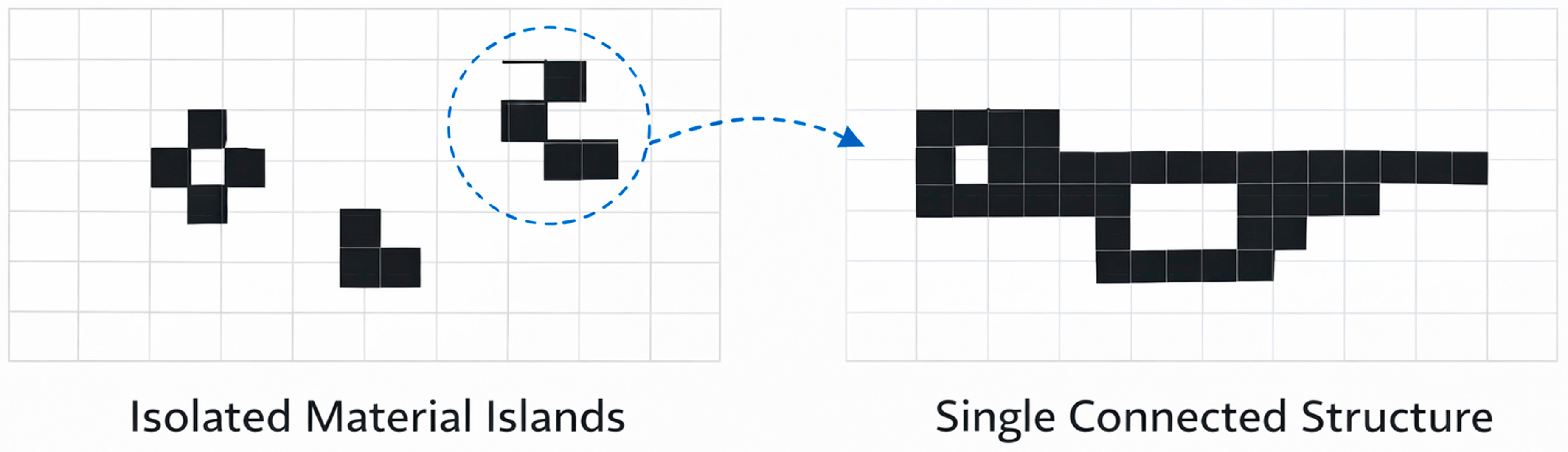
When all material cells belong to a single connected component (as shown in
Figure 1), the metric approaches one. When multiple disconnected islands exist, the value decreases. This encourages the formation of a single coherent structural body.
3.8. Structural Continuity
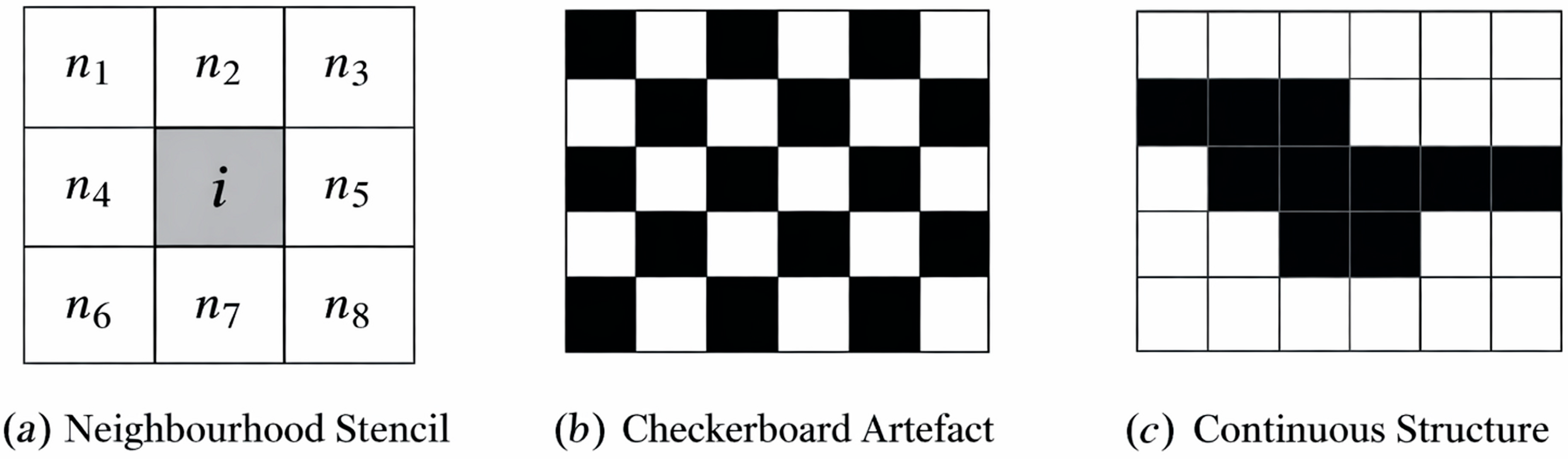
Another artefact commonly encountered in topology optimisation is the appearance of fragmented patterns or checkerboard-like structures [
42,
43]. Such patterns arise from numerical discretisation and do not represent realistic load-carrying members. To address this issue, a structural continuity measure is introduced. For each material cell, the local material density within a neighbourhood region is computed
where
denotes the neighbourhood surrounding cell.
The overall continuity score becomes
where
represents the number of material cells and
denotes the set of all material locations. This metric suppresses checkerboard artefacts and promotes continuous structural members. The neighbourhood
is defined as the standard 8-connected Moore neighbourhood, including all adjacent cells surrounding the location
in both orthogonal and diagonal directions, as illustrated in
Figure 2a.
3.9. Global Structural Objective Function
The individual structural indicators are combined into a single global objective function
where
present weighting parameters that control the relative contribution of each metric within the overall evaluation. These coefficients allow the relative importance of structural connectivity, load path efficiency, continuity, and other structural quality indicators to be adjusted according to the design requirements. The topology optimisation problem can therefore be formulated as
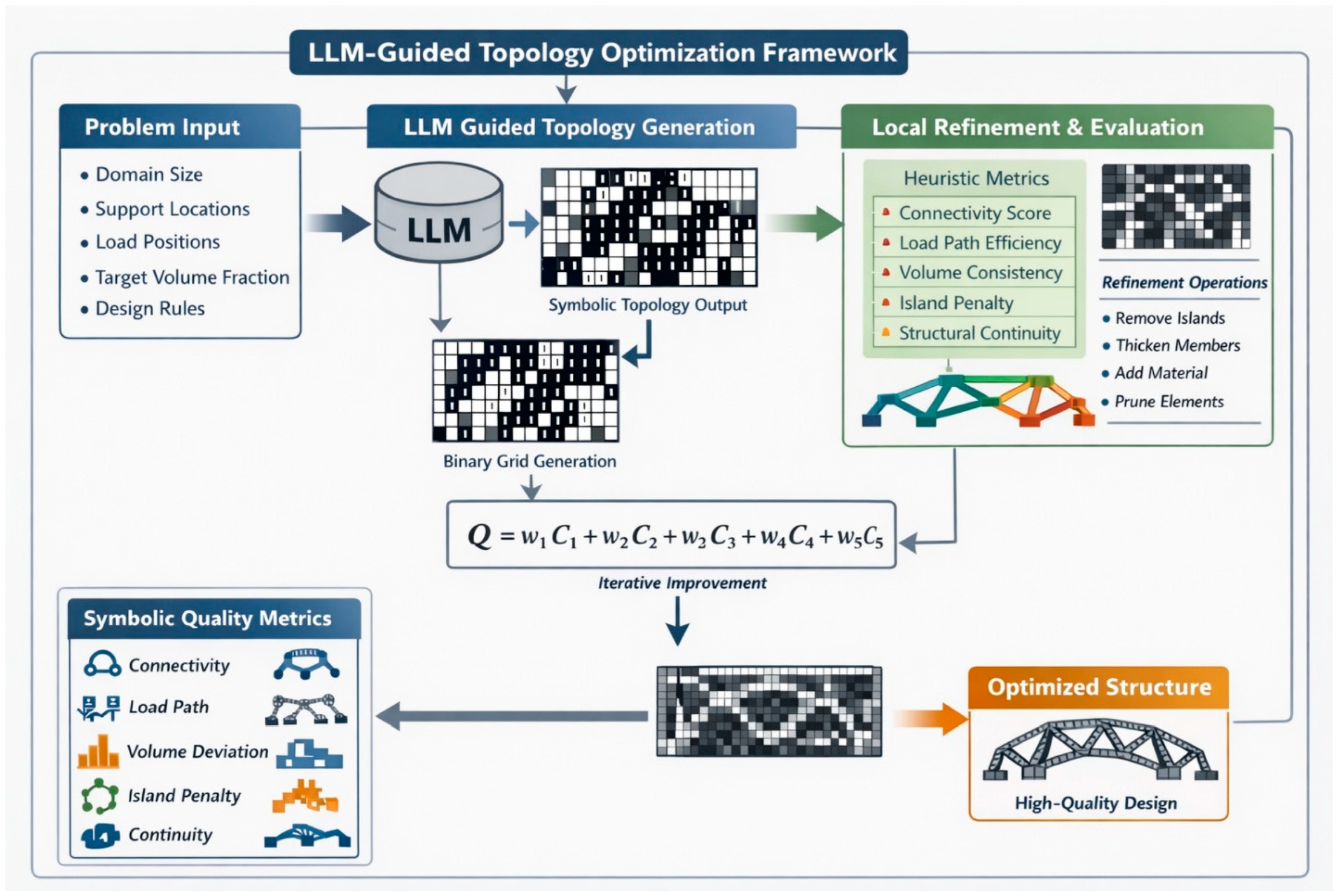
In this formulation, the objective function acts as a surrogate measure of structural performance. Rather than relying on repeated finite element simulations to evaluate mechanical behaviour, the proposed formulation assesses the structural quality of candidate designs through a set of physically motivated metrics. This enables rapid evaluation of many possible material distributions within the design domain while maintaining a meaningful representation of structural behaviour. As a result, the optimisation framework significantly reduces the computational burden typically associated with conventional topology optimisation approaches while still guiding the search toward structurally efficient configurations.
To ensure clarity and reproducibility of the refinement stage, the local topology transformations are defined through explicit rule-based operations applied to the binary structural grid.
Moreover, the refinement process operates directly on the generated topology and consists of the following steps:
- 1-
Island Removal
Disconnected material regions are identified using a connected component analysis. Only the largest connected structure linking the load and support regions is retained, while all smaller isolated clusters are removed. This ensures that all remaining material contributes to load transfer.
- 2-
Connectivity Enforcement
If a continuous path between load and support regions does not exist, a connection is introduced by adding material along the shortest path identified within the grid. This guarantees global structural connectivity.
- 3-
Member Thickening
Thin or weak structural members are reinforced by examining the local neighbourhood of each material cell. If a cell is surrounded by insufficient neighbouring material, adjacent void cells are converted into material to improve robustness and manufacturability.
- 4-
Redundant Material Removal
Material regions that do not contribute to structural connectivity or effective load transfer are selectively removed. This step improves material efficiency and helps satisfy the volume constraint.
- 5-
Smoothing and Continuity Enhancement
To eliminate fragmented patterns and checkerboard artefacts, a local smoothing operation is applied. Each cell is updated based on the dominant state of its neighbouring cells, promoting continuous structural members.
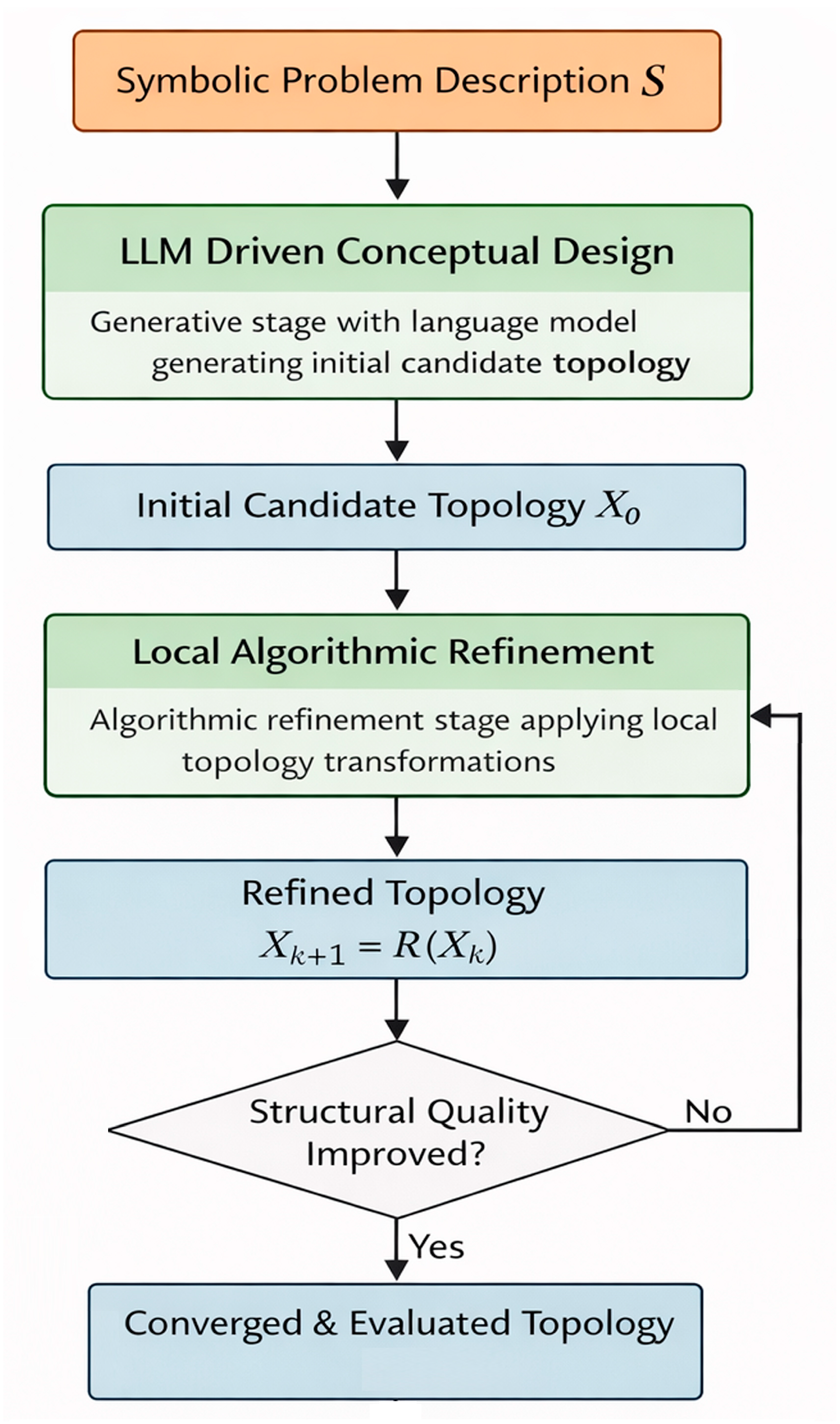
These refinement operations are applied sequentially at each iteration (as shown in
Figure 3). The updated topology is accepted only if it improves the overall structural quality as defined by the evaluation metrics. This rule-based refinement process provides a computationally efficient mechanism for improving structural coherence while preserving the conceptual design generated by the language model.
The pseudo-code outlines the logical refinement process applied to the binary topology. The input grid, along with load and support definitions, guides iterative operations that improve connectivity, structural continuity, and material efficiency.
INPUT:
X ← binary grid (0 = void, 1 = material)
Load ← load cell location
Support ← set of support cells
τ ← neighbour threshold
max_iter ← number of refinement iterations
FOR k = 1 to max_iter:
# 1. Island Removal
components ← find_connected_components(X)
main_component ← component connected to Load and Support
X ← keep_only(main_component)
# 2. Connectivity Enforcement
IF not exists_path(X, Load, Support):
path ← shortest_path(X, Load, Support)
FOR each cell p in path:
X[p] ← 1
# 3. Member Thickening
FOR each cell (i,j) where X[i,j] = 1:
neighbours ← count_material_neighbours(X, i, j)
IF neighbours < τ:
FOR each adjacent cell (m,n):
X[m,n] ← 1
# 4. Redundant Material Removal
FOR each cell (i,j) where X[i,j] = 1:
IF removing_cell_preserves_connectivity(X, i, j):
IF local_contribution(i,j) is low:
X[i,j] ← 0
# 5. Smoothing (Continuity Enhancement)
FOR each cell (i,j):
X[i,j] ← majority_state_of_neighbours(X, i, j)
# Evaluate improvement
IF Q(X_new) ≤ Q(X_old):
BREAK
OUTPUT:
Refined topology X
3.10. Optimisation Strategy
The final stage of the proposed framework introduces a hybrid optimisation strategy that combines generative reasoning with algorithmic refinement. The objective of this stage is to integrate the conceptual design capability of large language models with a systematic refinement mechanism that incrementally improves structural quality. In contrast to conventional topology optimisation methods that rely on repeated physical simulations and sensitivity analysis, the present strategy separates the design process into two complementary stages. The first stage generates structurally meaningful candidate layouts using reasoning based on structural logic, while the second stage refines these layouts using lightweight algorithmic transformations that improve connectivity, load path efficiency, and overall structural consistency. In the initial stage of the framework, the large language model acts as a conceptual structural designer. Based on a symbolic description of the design problem, including boundary conditions, load locations, support regions, and target material volume fraction, the model generates one or more candidate material distributions within the design domain. The model draws upon learned patterns associated with efficient structural behaviour, such as the tendency for forces to propagate along continuous load paths and the preference for arch-like or truss-like configurations that minimise bending and maximise axial load transfer. Let the design domain be discretised into a set of cells representing possible material locations. The topology generated by the language model may therefore be expressed as a binary material distribution
where
denotes the material state of cell
, with
representing material and
representing the void, and
denotes the total number of cells within the design domain.
Given the symbolic problem description S, the generative stage of the framework may be expressed conceptually as
denotes the initial candidate topology produced by the model. Because the model has internalised structural patterns associated with efficient force transfer, the generated topologies often exhibit configurations resembling classical engineering structures such as truss networks, arch structures, or branching load paths. This stage, therefore, acts as a conceptual design generator capable of producing meaningful structural layouts without performing iterative numerical optimisation. The generated topologies provide a useful starting point that already satisfies many qualitative structural requirements. Although the language model is capable of producing structurally plausible configurations, additional refinement can significantly improve structural quality and remove undesirable artefacts. A second stage of the framework, therefore, introduces a set of local transformation operations that modify the topology in order to improve structural continuity, connectivity, and load path efficiency. Let
denote the structural topology at refinement iteration k. The refinement process applies a transformation operator that modifies the topology according to a set of structural heuristics. The iterative refinement process may therefore be written as
where
represents the refinement operator responsible for improving the structural configuration. The refinement operator consists of a collection of local topology transformations designed to eliminate undesirable structural patterns while preserving meaningful load-carrying members. Typical refinement operations include removal of disconnected material islands that do not contribute to load transfer, thickening of slender structural members that may lack mechanical robustness, addition of material along critical load paths to strengthen structural continuity, and removal of redundant material regions that do not contribute significantly to structural performance. These transformations are applied locally within the design domain and therefore incur minimal computational cost compared with global optimisation procedures. Each transformation modifies only a limited region of the topology, allowing rapid evaluation and efficient exploration of improved structural configurations. To evaluate the quality of the evolving topology, a structural objective function Q(X) is defined as a surrogate measure of structural performance. This function combines several structural metrics, including connectivity, load path efficiency, and structural continuity, into a single evaluation measure. The refinement procedure, therefore, aims to improve the value of this structural quality function throughout the iterative process. After each refinement step, the objective function is evaluated as
The refinement procedure continues as long as the structural quality improves. Convergence is reached when the improvement between successive iterations becomes sufficiently small. This convergence criterion may be expressed as
where
denotes a small tolerance parameter indicating that further refinement no longer produces meaningful structural improvement. Once this condition is satisfied, the topology is considered structurally consistent according to the evaluation metrics defined within the framework. The resulting hybrid framework, therefore, combines the strengths of generative reasoning and algorithmic optimisation. The language model provides a powerful mechanism for rapidly generating structurally meaningful conceptual layouts based on a qualitative understanding of load transfer mechanisms (as illustrated in
Figure 4). The refinement stage then improves these layouts through targeted local modifications that enhance structural quality while avoiding unnecessary computational expense.
4. Numerical Investigation
In this work, a new approach for topology optimisation based on large language models is investigated through the proposed Large Language Model-Driven Symbolic Topology Optimisation (LLM-DSTO) framework. The method explores the use of language models as conceptual design generators capable of producing symbolic structural layouts that can subsequently be refined through algorithmic evaluation. Large language models have recently been explored in a wide range of scientific and engineering applications, and new methodologies continue to emerge that leverage their generative reasoning capabilities [
44,
45]. This trend has been further accelerated by the development of compact models that can be executed locally on standard computational hardware.
The numerical investigation in the present study is therefore conducted using a locally deployed large language model in order to evaluate the feasibility of symbolic topology generation without relying on external cloud-based inference services. The model used in this work is DeepSeek R1 0528 Qwen3 8B, executed through a local inference framework to enable controlled experimentation without reliance on external infrastructure. The model was primarily run on a workstation equipped with a 24-core Intel Core i7-13700 CPU and 64 GB of system memory. In addition, the system includes an NVIDIA RTX PRO 6000 Blackwell Workstation Edition graphics card with 96 GB GDDR7 memory. The computational cost associated with topology generation, therefore, remains acceptable for exploration design investigations. In this section, three two-dimensional case studies are investigated: structural stiffness maximisation for a cantilever beam, heat sink design, and thermofluid channel design.
4.1. Maximisation of Structural Stiffness
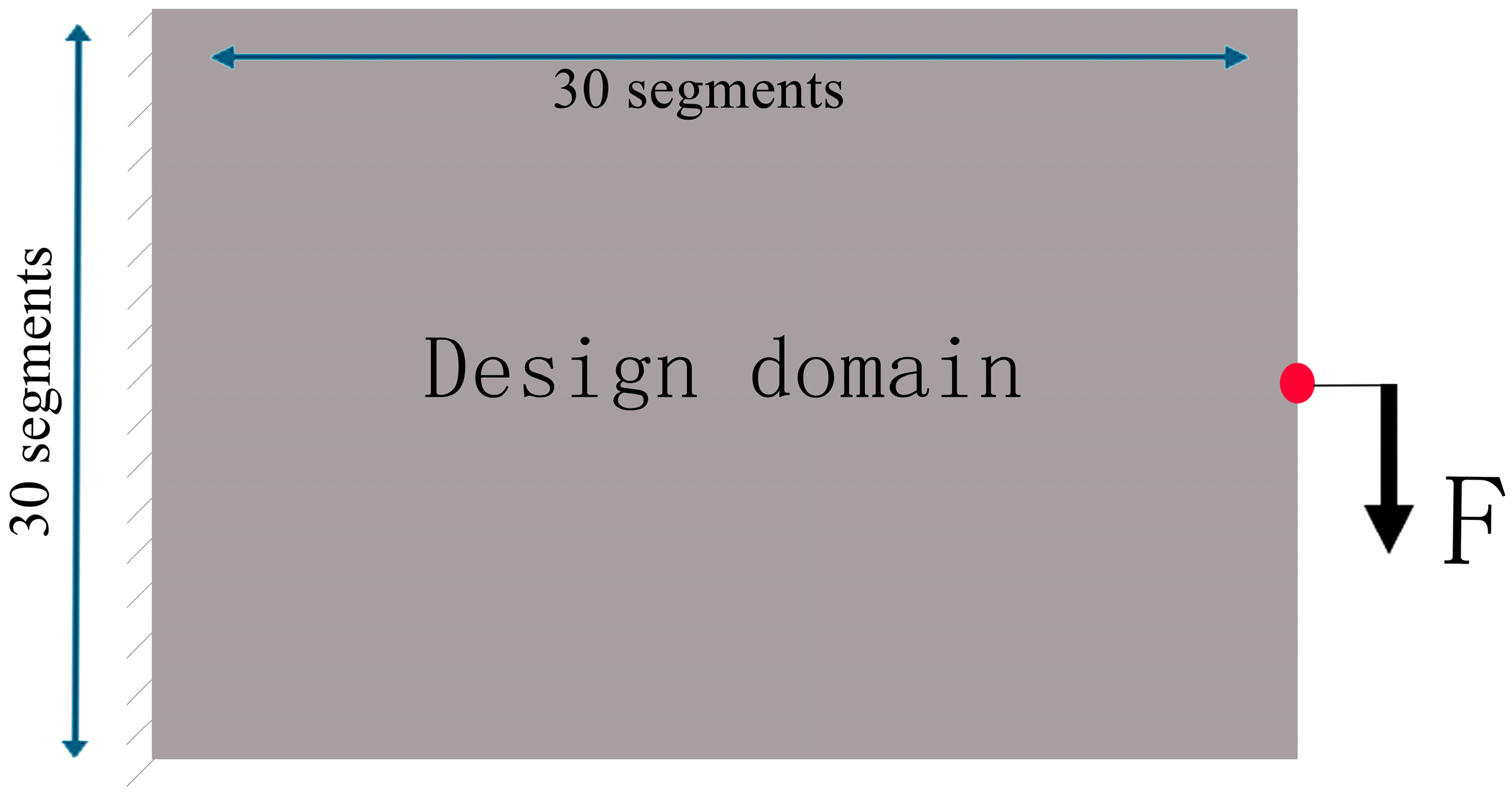
The optimisation problem considered in this study is based on the classical two-dimensional cantilever beam benchmark, which is widely used for evaluating topology optimisation methods. In this configuration, the left boundary of the design domain is fully fixed, while a unit load is applied at the centre of the right boundary, as illustrated in
Figure 5. The design domain is discretised into a grid of 30 by 20 segments in order to maintain computational efficiency when employing a locally executed language model within a CPU-based computational environment. The objective is to determine an optimal distribution of material that maximises structural stiffness while satisfying a prescribed material volume limitation. Since structural stiffness is inversely related to compliance, the optimisation problem is formulated as a compliance minimisation problem, which seeks the stiffest possible structural configuration under the specified loading and boundary conditions. The classical formulation of topology optimisation can be expressed as
subject to
where
denotes the material density distribution within the design domain
,
is the compliance or structural objective function, and
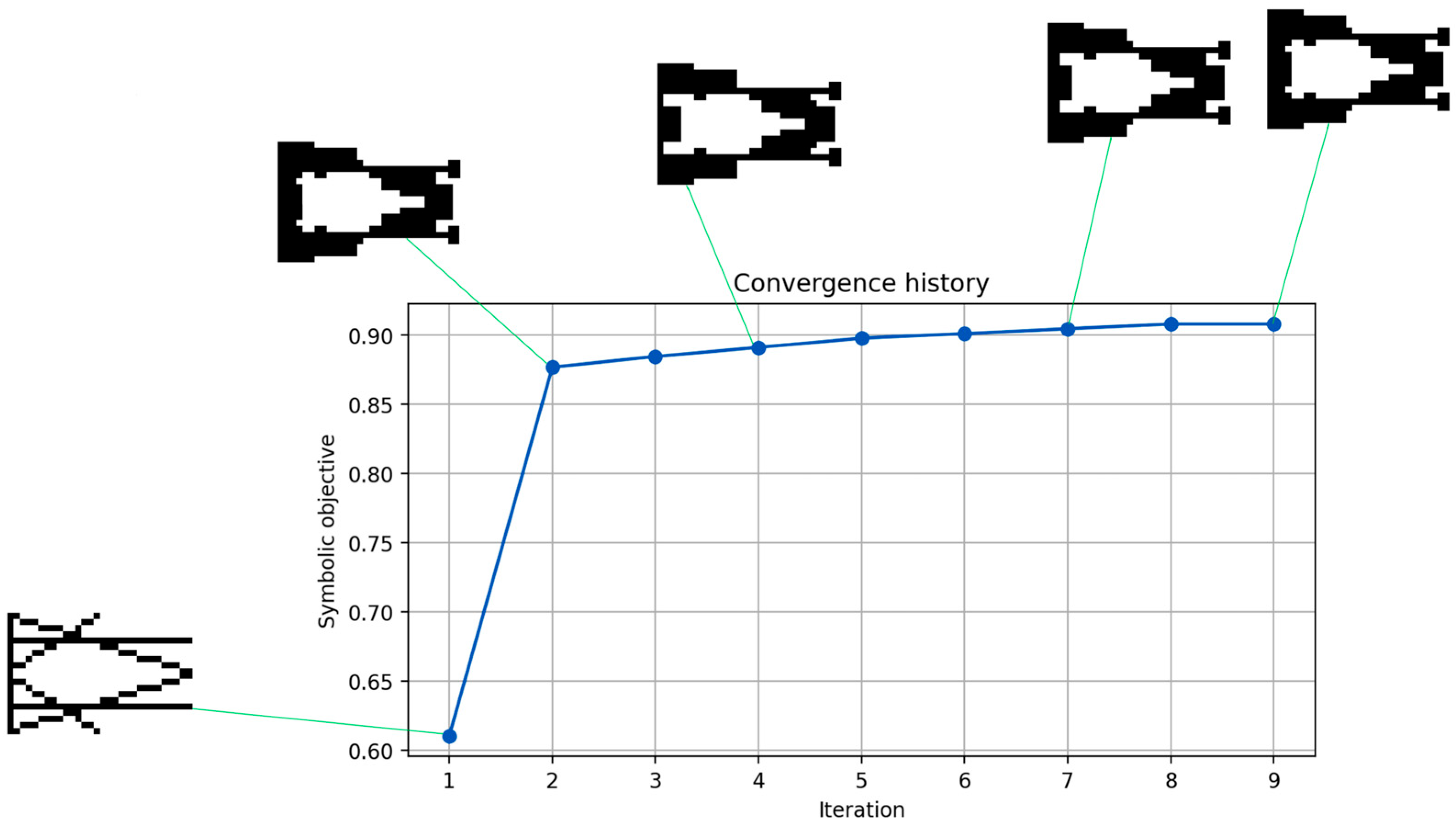
is the allowable material volume. The results and the iterative design history produced by the proposed LLM-DSTO framework applied to a two-dimensional cantilever structure are presented in
Figure 6. At each iteration, the language model generates a candidate symbolic material distribution. The convergence curve shows a rapid improvement in the symbolic objective during the early iterations, indicating that the model quickly identifies meaningful load-carrying paths between the support and the applied load. Subsequent iterations introduce smaller geometric refinements that gradually improve the structural connectivity and material distribution. As the process progresses, the objective value approaches a stable plateau, suggesting that the generated topology has reached a near-optimal structural configuration. As such, the design history demonstrates that the proposed symbolic optimisation framework can efficiently guide the evolution of structural layouts toward mechanically meaningful topologies with minimal computational cost. The rapid convergence behaviour indicates that large language models can capture qualitative structural reasoning and generate progressively improved designs, enabling fast conceptual exploration of high-stiffness structural configurations without the need for repeated finite element optimisation cycles.
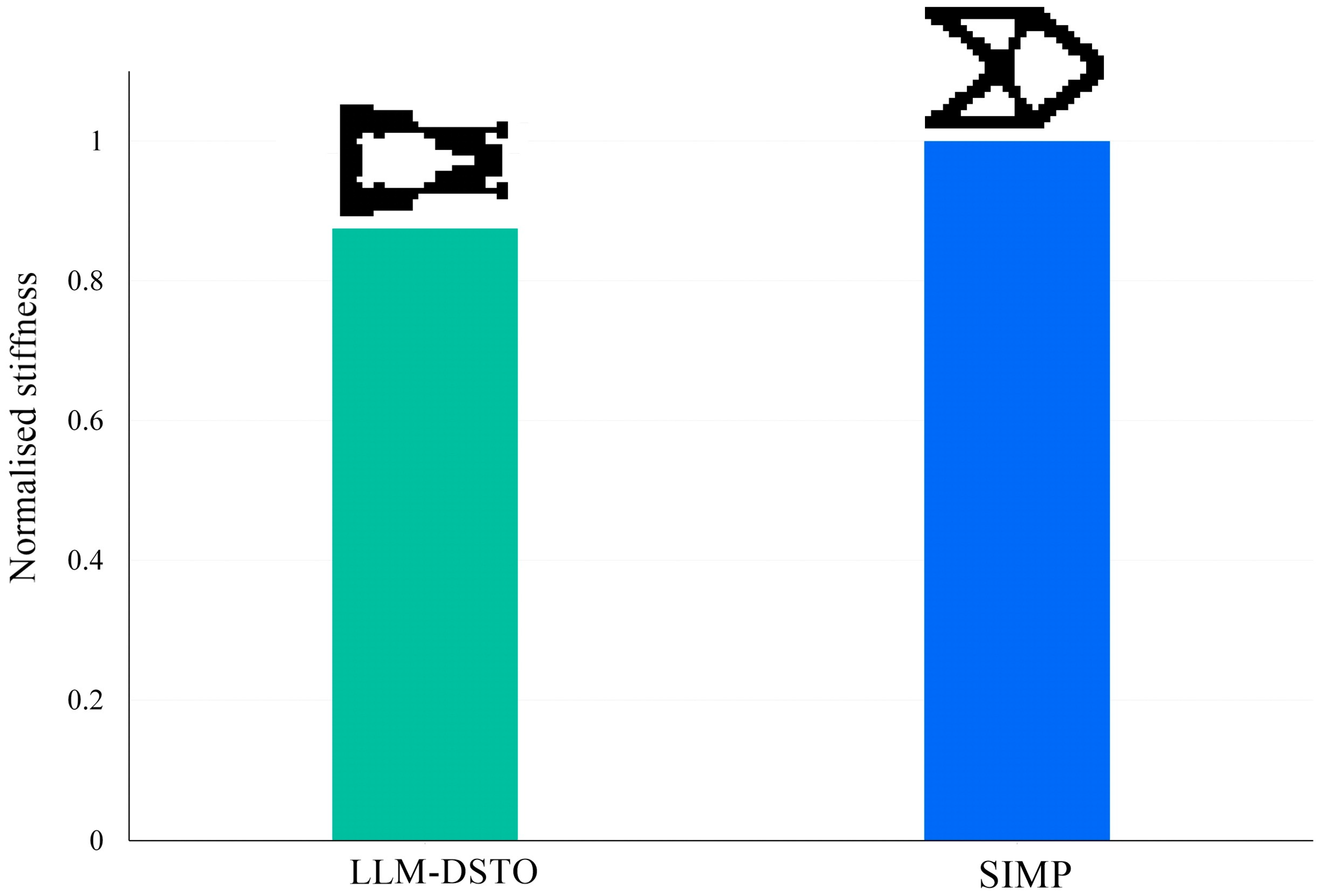
The structural topology obtained using the traditional SIMP method is illustrated in
Figure 7. The stiffness performance of the SIMP design is compared with the structure generated by the proposed LLM-DSTO framework. The results indicate that the SIMP solution achieves slightly higher stiffness than the LLM-DSTO-generated structure. The normalised stiffness of the SIMP design is taken as the reference value of 1.0, while the LLM-DSTO structure reaches a value of 0.875. This corresponds to approximately 87.5 percent of the stiffness obtained by the SIMP solution, or a difference of about 12.5 percent. Although the SIMP method produces the highest stiffness in this benchmark problem, the LLM-DSTO approach still generates a structurally meaningful topology with competitive performance. This result suggests that large language model-driven symbolic optimisation can produce efficient structural concepts without relying on conventional gradient-based topology optimisation procedures.
4.2. Heat Sink Design by Minimisation of Thermal Resistance
In addition to structural optimisation, the proposed framework is applied to the design of heat sink topologies. In this case, the objective is to minimise the overall thermal resistance within the design domain in order to enhance heat dissipation from a prescribed heat source to the surrounding boundary. The optimisation therefore seeks a material distribution that facilitates efficient heat conduction while satisfying a prescribed volume limitation.
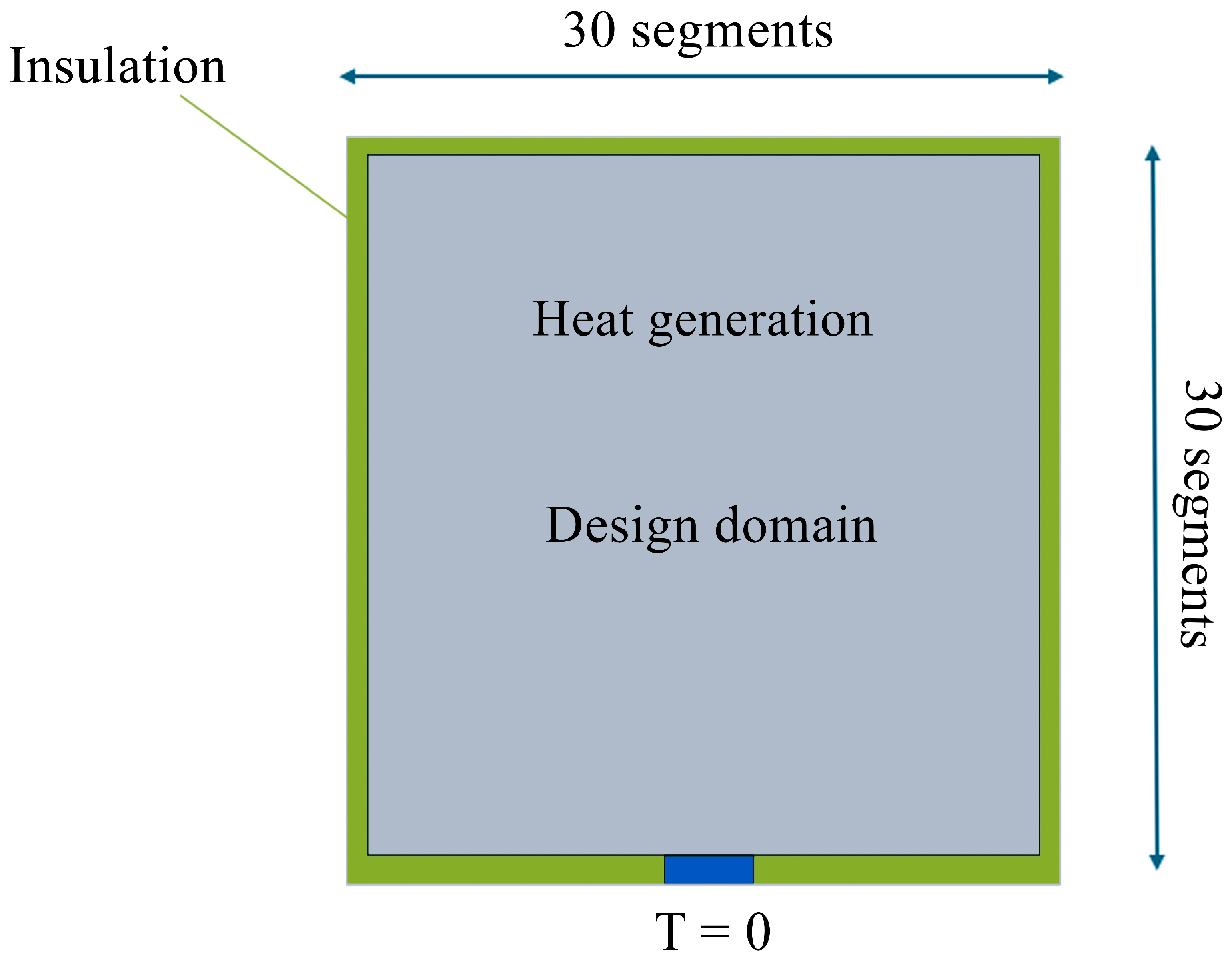
The design domain represents a two-dimensional heat transfer region in which a heat source is applied at a specified location while the remaining boundaries act as thermal sinks (as illustrated in
Figure 8). The objective of the optimisation process is to generate conductive pathways that efficiently transfer heat from the source to the cooling boundaries.
The thermal topology optimisation problem can be expressed as the minimisation of the global thermal resistance of the system
subject to the steady state heat conduction equation
In this formulation,
denotes the material distribution,
is the temperature field,
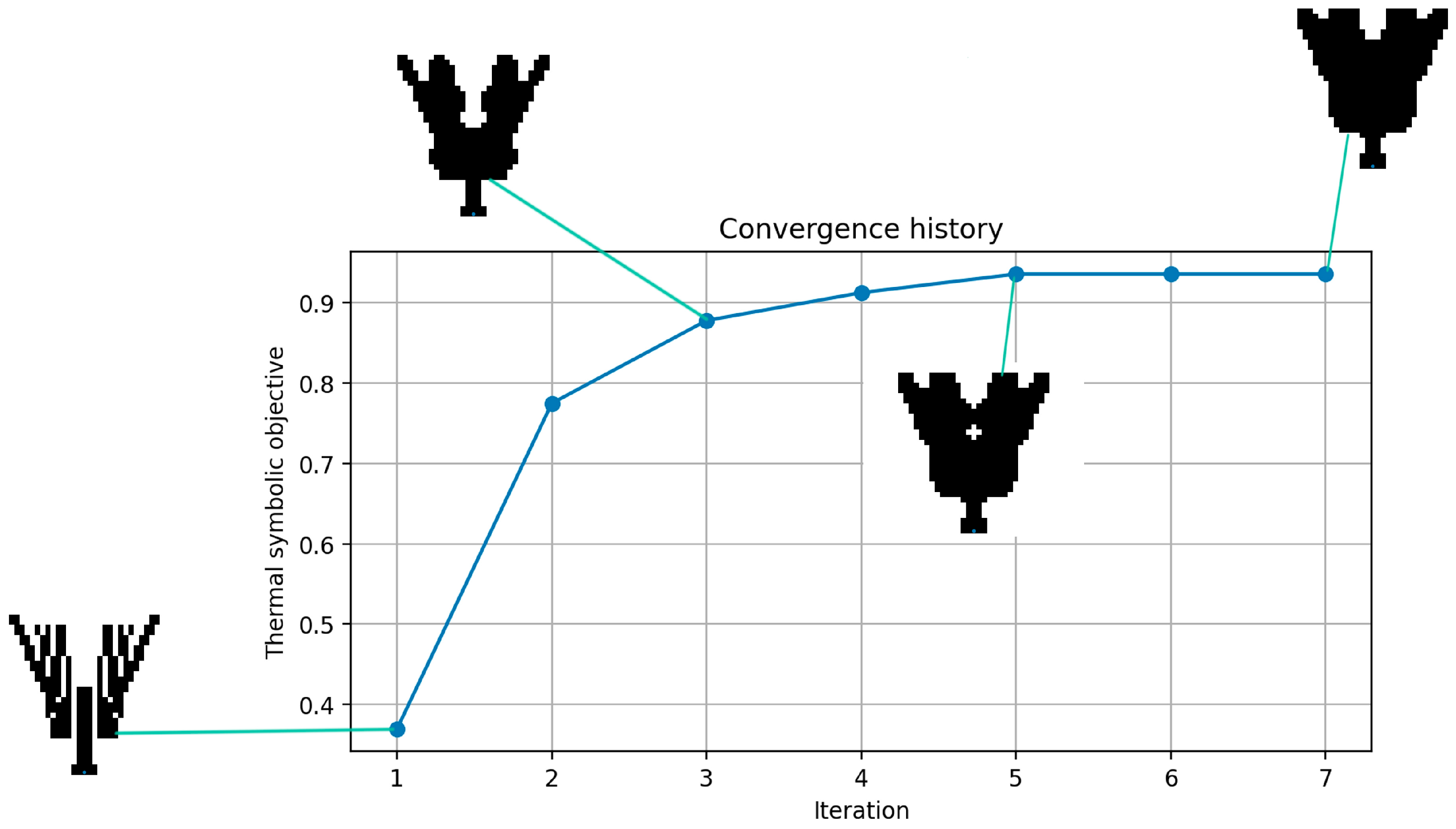
represents the effective thermal conductivity, and q denotes the internal heat generation. The optimisation process is also performed using the proposed LLM-DSTO. The resulting design evolution and the iterative design history are presented in
Figure 9. At each iteration, the language model generates a candidate symbolic material distribution representing potential heat conduction paths between the heat source and the cooling boundaries.
The convergence behaviour shows a rapid improvement of the thermal objective during the early iterations, indicating that the model quickly identifies effective conductive pathways. Later iterations introduce smaller refinements that improve the connectivity and continuity of the thermal transport network. As the process progresses, the objective function approaches a stable value, suggesting that the generated topology converges toward a thermally efficient configuration.
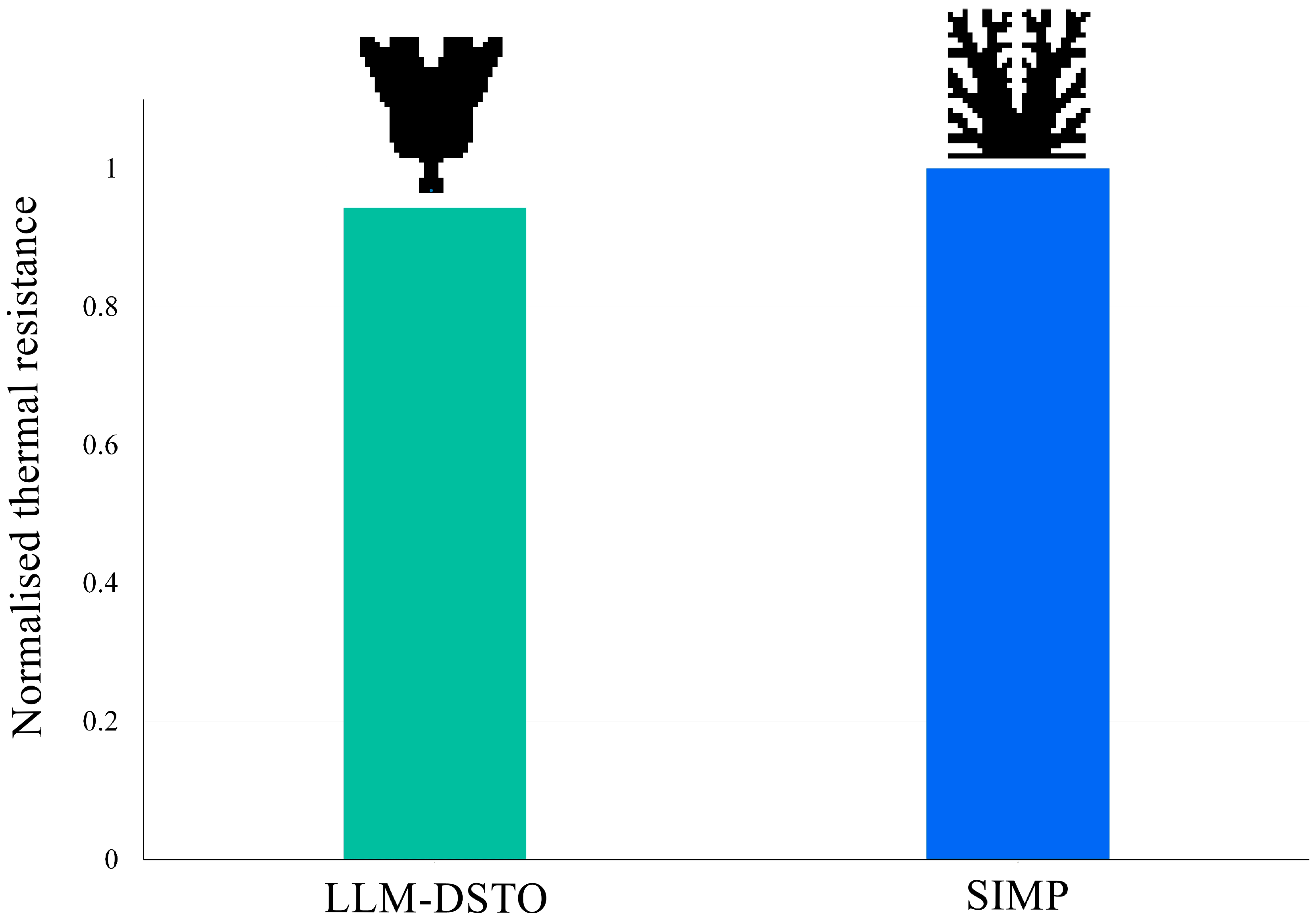
A comparison with the traditional Solid Isotropic Material with Penalisation method is presented in
Figure 10. The SIMP solution is used as the reference design for the thermal optimisation problem. The results show that the LLM-DSTO design reaches a normalised thermal resistance of 0.9432 relative to the SIMP solution. This corresponds to about 5.7% outperformance of SIMP over LLM-DSTO.
Despite this comparatively small outperformance, the LLM-DSTO framework generates a meaningful heat sink topology with clear conductive pathways between the heat source and the cooling boundaries. The performance is therefore comparable to classical topology optimisation approaches. In fact, other established methods, such as Evolutionary Structural Optimisation and Level Set-based methods, are often reported to produce solutions up to about 20 percent less efficient than SIMP [
46,
47]. In this context, the LLM-DSTO result demonstrates competitive behaviour and indicates that symbolically large language model-driven optimisation can produce thermally efficient designs with relatively low computational cost. As such, in terms of computational performance, the proposed LLM-DSTO framework demonstrates high efficiency for this thermofluid problem. The average runtime per iteration for topology generation is approximately 1.5 s on the described CPU-based system, with the majority of the time attributed to token processing and input–output handling. By comparison, traditional topology optimisation methods typically require around 5 s per iteration for numerical computation alone, excluding additional costs associated with sensitivity analysis and solver convergence.
4.3. Thermofluid Channel Design Using Darcy Flow
The third problem corresponds to the design of internal cooling channels governed by coupled fluid flow and heat transfer phenomena. The design of such systems is inherently challenging because effective thermal management requires the formation of multiple interconnected channels that originate from a single inlet and terminate at a single outlet. Achieving efficient heat removal while maintaining uniform flow distribution within the design domain, therefore, demands complex channel branching and spatial distribution.
In addition, the generation of multiple channels under a single inlet and outlet configuration typically requires strict volumetric constraints in order to control the amount of solid material removed from the domain. Within traditional topology optimisation frameworks, these constraints introduce significant difficulty in the sensitivity analysis stage. The coupling between fluid transport, heat transfer, and volumetric restrictions leads to highly nonlinear behaviour in the design variables, making the computation of reliable sensitivities particularly challenging. Consequently, the optimisation of such thermofluid channel systems represents a demanding problem for conventional topology optimisation approaches.
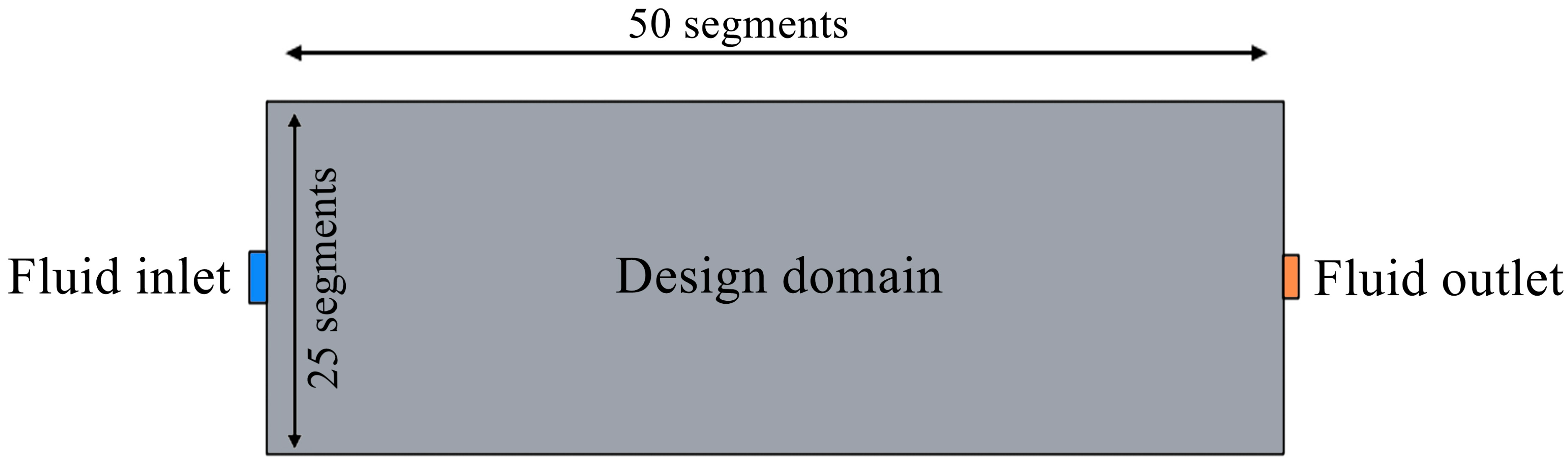
As such, the objective is to generate flow pathways that efficiently transport coolant through the design domain while maintaining effective heat removal. The design domain is discretised into a grid of 25 segments in width and 50 segments in length, as illustrated in
Figure 11.
Fluid motion is classically described by the incompressible steady Navier–Stokes equations
where
is the velocity field,
the pressure variation,
the dynamic viscosity, and
the body force per unit mass. Although fluid viscosity may depend on temperature, an isothermal approximation is adopted here since temperature variations remain moderate within the domain.
In practical cooling systems driven by forced circulation, turbulent flow typically governs the heat transfer process due to strong mixing and thin thermal boundary layers near the channel walls. Accurate modelling, therefore, requires turbulence closures such as Reynolds–averaged Navier–Stokes formulations. However, the nonlinear nature and high computational cost of these models make them impractical for topology optimisation, where the governing equations must be solved repeatedly during early design exploration.
To enable efficient optimisation, the flow is approximated using Darcy-type transport
where the velocity is proportional to the pressure gradient, scaled by the permeability
and viscosity. Substituting this relation into the continuity equation yields the pressure governing equation
This Darcy-based representation produces a nearly uniform velocity field within the channels and eliminates the need to resolve boundary layers. By assigning appropriate permeability values to fluid and solid regions, the model captures the dominant transport behaviour of the cooling flow while maintaining high computational efficiency. This simplified formulation is therefore particularly suitable for topology optimisation-driven design of thermofluid channels.
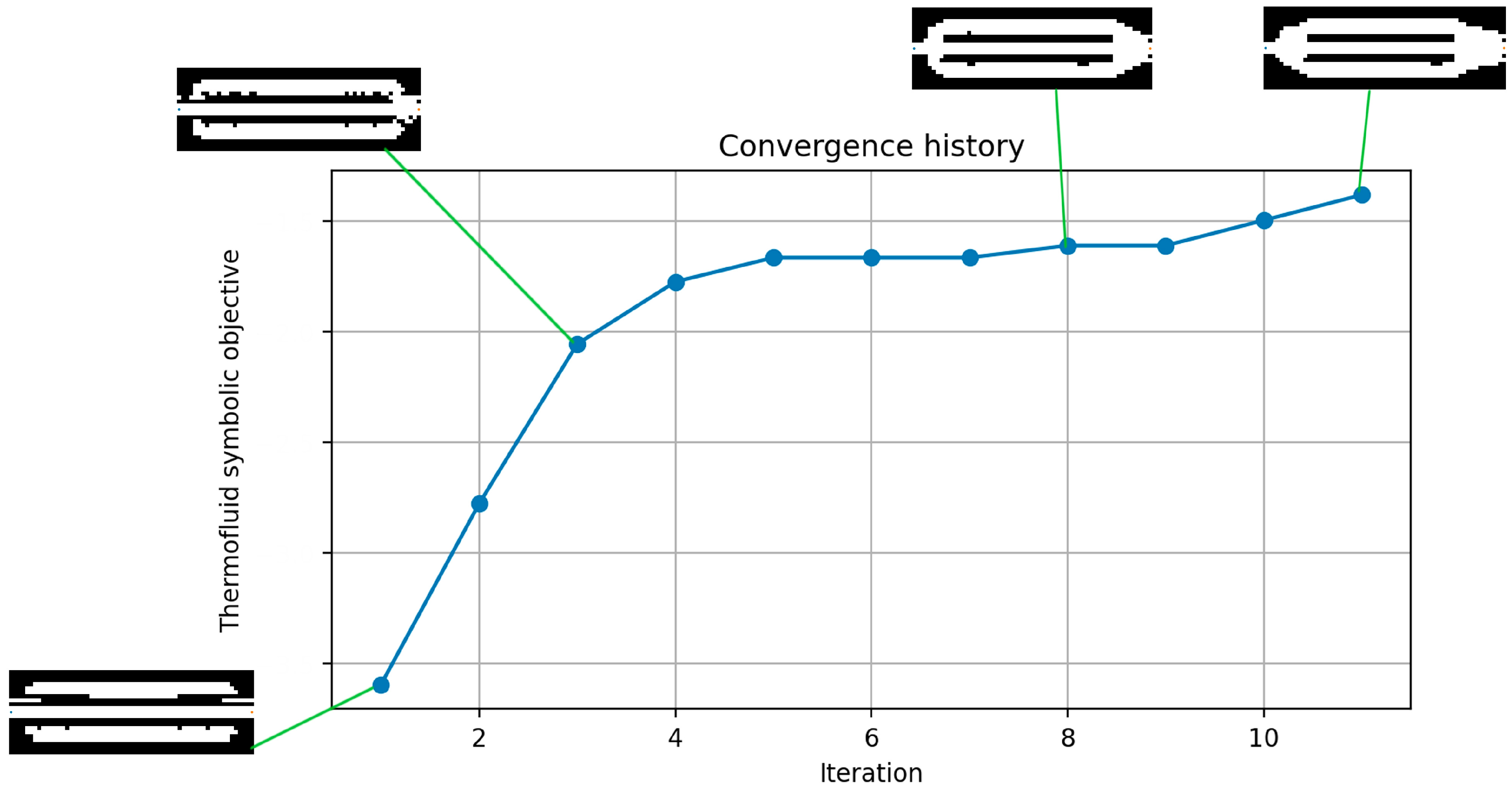
The optimisation process is performed using the proposed LLM-DSTO framework. The resulting design evolution and the corresponding iterative design history are shown in
Figure 12. This thermofluid topology optimisation problem is generally challenging and often requires extensive parameter tuning and filtering techniques in conventional topology optimisation approaches [
48,
49,
50,
51]. In contrast, the proposed method generates meaningful design candidates in a direct and stable manner. At each iteration, the language model produces a symbolic material distribution that represents potential fluid channels and heat transfer paths within the design domain. These candidate layouts progressively evolve toward configurations that promote effective transport between the heat source and the cooling boundaries, leading to a coherent channel network without the need for complex numerical tuning procedures.
In terms of computational performance, the proposed LLM-DSTO framework exhibits high efficiency for the thermofluid design problem. The average runtime per iteration for topology generation ranges from approximately 3 to 8 s on the described CPU-based system, with overall convergence achieved within a few minutes. In contrast, conventional topology optimisation methods for thermofluid channel design—particularly those based on Navier–Stokes or coupled multiphysics formulations—require repeated numerical simulations and sensitivity analysis, leading to computational costs that can extend to several hours, depending on mesh resolution and solver complexity. These results highlight the effectiveness of the proposed approach for rapid conceptual design exploration [
52].
4.4. Complaint Mechanism Design Problem
The design of compliant mechanisms within a topology optimisation framework can be formulated by considering the distribution of material within a prescribed domain
, where
or 3 for 3d case, such that the structure transforms an input force into a desired output displacement through elastic deformation. In the context of large language model-driven topology optimisation, the role of the generative model is to propose candidate material layouts
, while the governing physics and optimisation criteria remain rooted in continuum mechanics and variational principles [
53,
54,
55]. The structural response is governed by the equilibrium equation derived from linear elasticity, expressed in discretised finite element form as
where
is the global stiffness matrix assembled from element contributions,
is the nodal displacement vector, and
is the applied load vector. Within the SIMP interpolation scheme, the stiffness matrix is parameterised by the material density field such that
where
is the penalisation exponent enforcing near-binary designs [
56,
57] and
is the stiffness matrix of a fully solid element. This formulation enables the continuous relaxation of the otherwise discrete topology optimisation problem.
For compliant mechanism synthesis, the objective is not merely to maximise stiffness, but rather to achieve controlled flexibility. This is typically quantified through the concept of mutual potential energy (MPE), which measures the effectiveness of force transmission between input and output ports. The MPE is defined as
subject to the equilibrium constraints
where
is the displacement induced by the input force
, and
corresponds to a virtual displacement field associated with a dummy output load
. Maximisation of MPE ensures that the structure effectively transfers input energy to the output location, thereby achieving the desired functional motion.
Within the LLM-assisted framework, the density field is not solely updated through gradient-based methods but may also be proposed via symbolic or textual representations generated by the model. These proposals can be interpreted as structured priors over the design space, effectively guiding the optimisation toward physically meaningful configurations such as continuous load paths and distributed compliance regions. This introduces a hybrid optimisation loop where the LLM acts as a high-level design generator, while the physics-based solver evaluates feasibility and performance.
To enable iterative refinement, sensitivity analysis is required. The gradient of the MPE with respect to the density variable is expressed as
In the present LLM-driven topology optimisation framework, the large language model is not merely a passive generator of candidate designs, but is explicitly embedded within the optimisation loop as an objective-seeking agent. Its role can be mathematically interpreted as approximating the maximisation of the global performance functional through the structured symbolic generation of . Unlike classical gradient-based solvers, the LLM operates in a discrete–symbolic design space, yet it implicitly targets the same objective defined by the physics-based formulation.
This combines flexibility and stiffness requirements. This formulation is consistent with energy-based topology optimisation approaches for compliant mechanisms, where mutual potential energy drives motion transmission and eigenvalues enforce structural rigidity.
In the LLM-based paradigm, the optimisation process can be reformulated as a sequence generation problem, where the model produces candidate designs
conditioned on the problem description
, such that
where
represents the LLM with parameters
, and
denotes the historical context, including previous designs and their evaluations.
The key aspect is that the LLM implicitly seeks to maximise the objective quality, which can be expressed as
where the quality function
is defined as the negative of the optimisation objective
Thus, substituting the formulation of
, the LLM effectively attempts to maximise
This interpretation is critical: the LLM is not explicitly solving the optimisation equations but rather learning to generate structures that increase , guided by feedback from the physics solver.
Provided that the generated candidates progressively improve the objective. This establishes a rigorous mathematical interpretation of the LLM as an objective-maximising agent embedded within topology optimisation, bridging generative AI and computational mechanics in a unified framework.
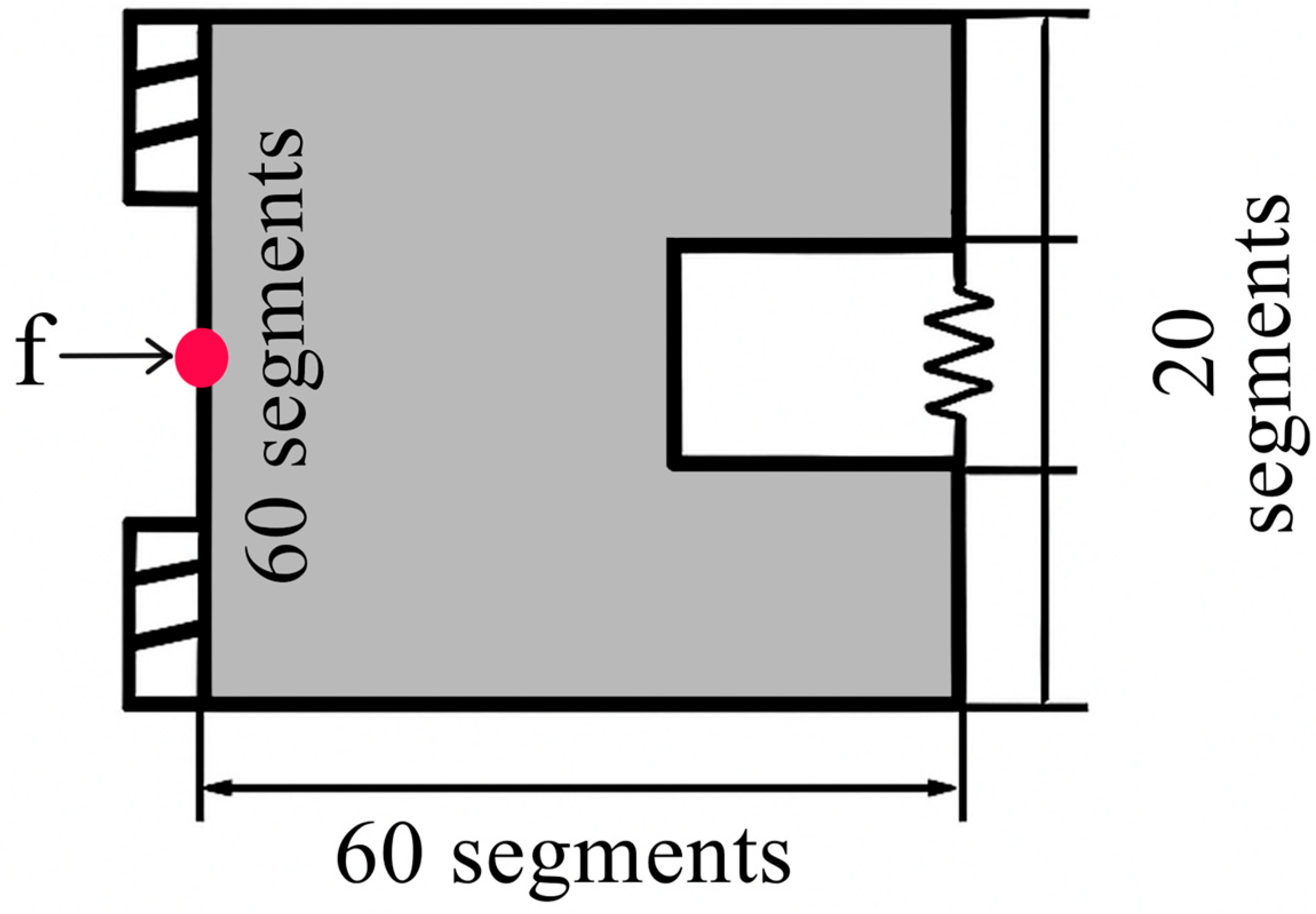
As such, the design problem is as described in
Figure 13. The compliant mechanism design domain is defined as a rectangular, discretised region composed of 60 by 60 segments, representing the allowable material distribution space. The left boundary includes fixed support regions, while an external input force is applied at a designated point along the left edge. The right side contains an output port connected to a compliant spring element, representing the functional displacement objective.
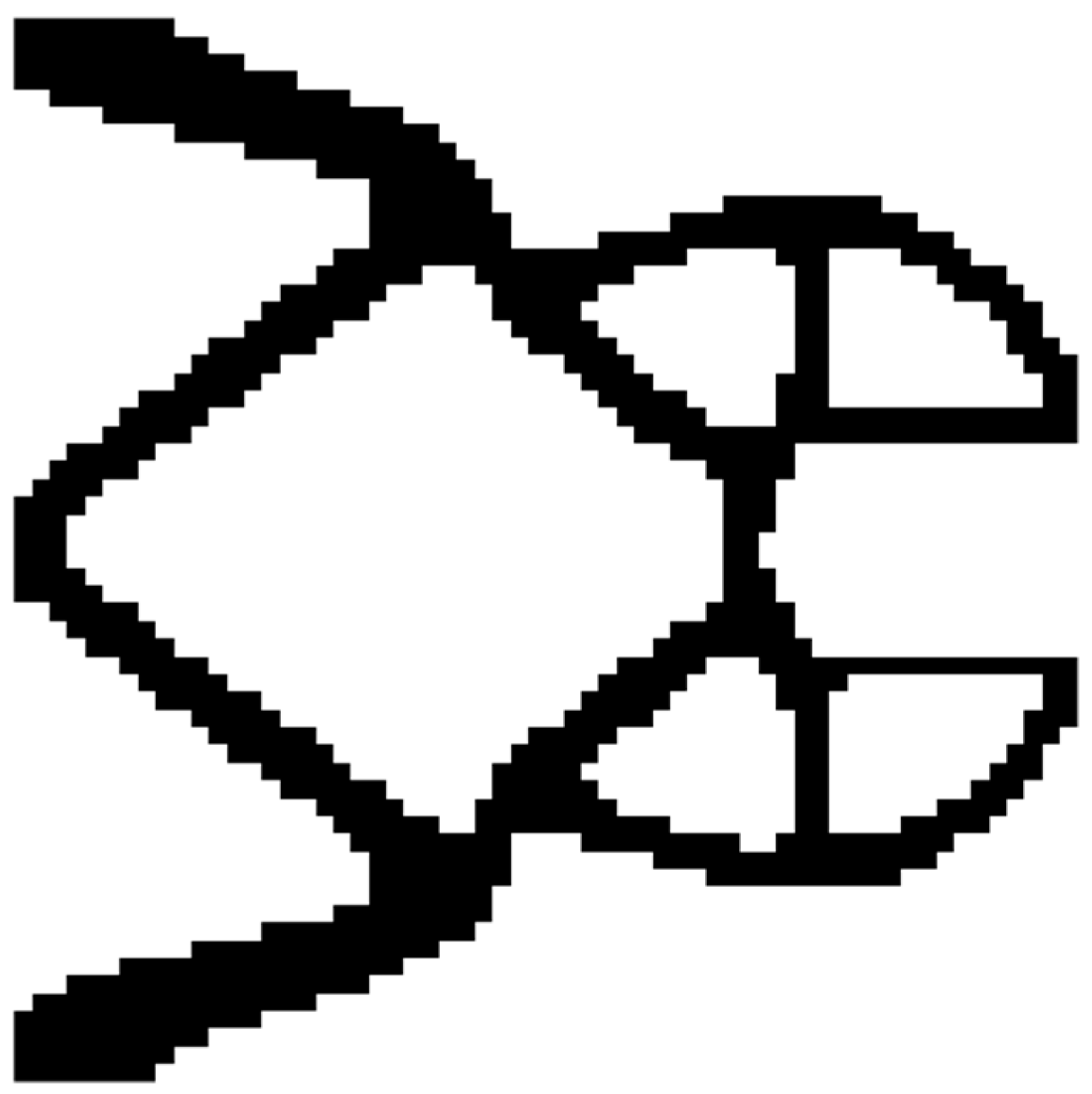
Within the LLM-DSTO framework, this domain is treated symbolically, where material is distributed to form continuous load paths that transfer input force to the output location. The method seeks to generate flexible yet connected structures that enable controlled deformation while maintaining structural integrity. The results are shown in
Figure 14, where the generated topology exhibits a clear compliant mechanism behaviour characterised by continuous load paths connecting the input and output regions. The structure forms a curved, flexure-dominated configuration that enables effective force transmission while allowing controlled deformation. Notably, the design avoids disconnected material islands and checkerboard artefacts, indicating the effectiveness of the proposed structural metrics and refinement strategy. The branching members provide stiffness where required, while slender regions facilitate flexibility, resulting in a balanced structural response. The output region is well defined, demonstrating that the LLM-DSTO approach successfully captures the essential functional requirements of compliant mechanism design without reliance on finite element-based optimisation.
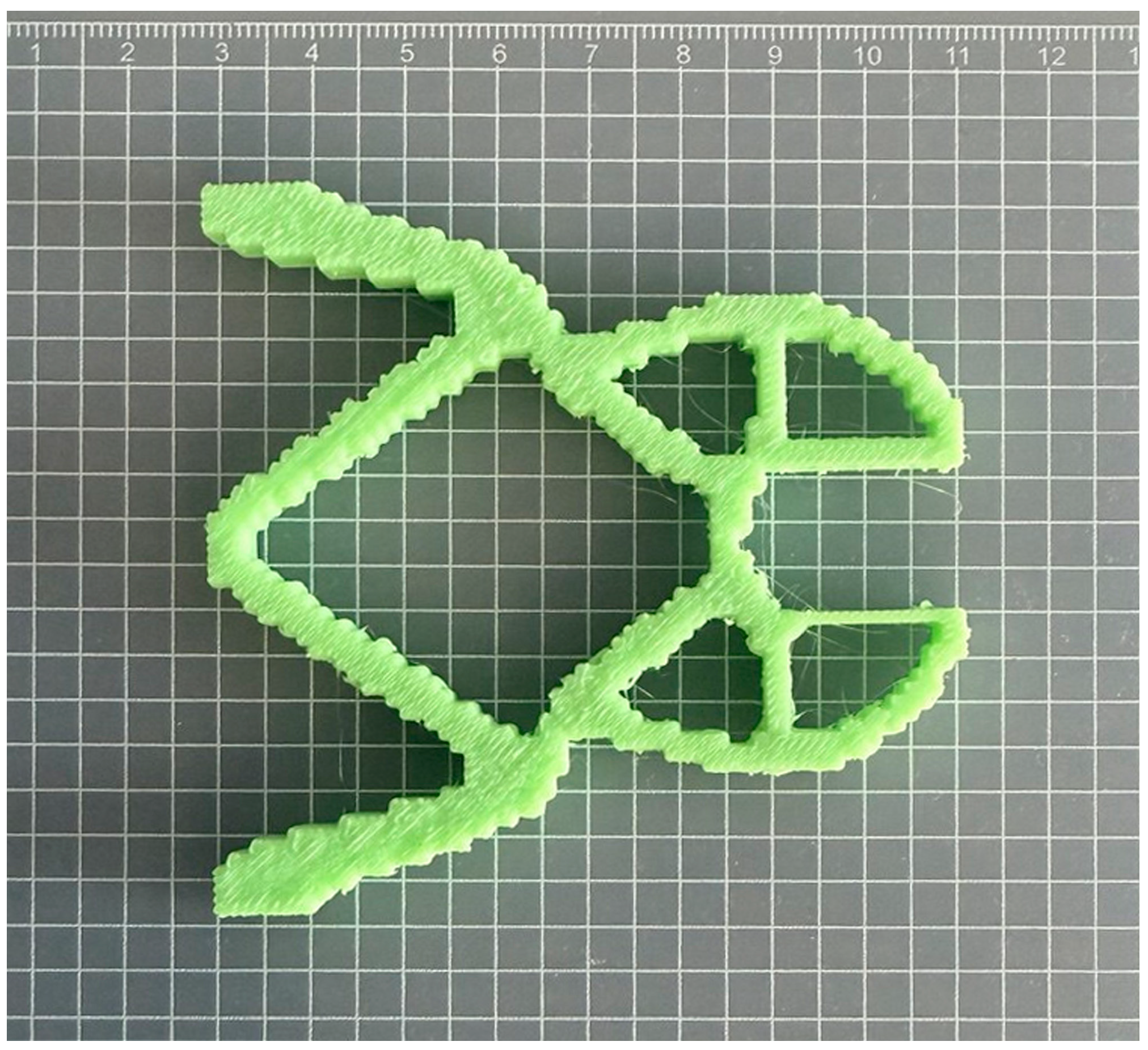
The topology generated for the complaint mechanism optimisation example using the proposed LLM-DSTO framework was fabricated using additive manufacturing to evaluate its physical realisation (as depicted in
Figure 15). The printed prototype preserves the key structural features observed in the computational design, including continuous load paths and compliant flexure regions. Despite minor surface roughness inherent to the printing process, the structure maintains geometric integrity and connectivity, confirming the manufacturability of the generated topology. This result demonstrates that the proposed method produces designs that are not only computationally meaningful but also physically feasible.
4.5. Three Dimensional Case
The design of compliant mechanisms within a topology optimisation framework can be formulated by considering the distribution of material within a prescribed domain.
Three-dimensional topology optimisation extends the classical material distribution problem into volumetric design domains, enabling the generation of structures with enhanced stiffness-to-weight performance and improved load transfer characteristics. In this work, a symbolic large language model-driven framework is employed to construct three-dimensional topology candidates through discretised voxel representations, where the design domain is defined as a structured grid
with resolution
. The material distribution is described by a binary field
where
denotes solid material and
represents a void.
The optimisation objective is formulated in analogy to compliance minimisation problems, where the structural response is implicitly approximated through geometric and connectivity-based surrogate indicators. Instead of solving the equilibrium equation
the proposed approach replaces repeated finite element evaluations with symbolic reasoning guided by physically informed constraints. The language model is prompted to generate candidate three-dimensional topologies that satisfy prescribed boundary conditions, including fixed supports at the cantilever root and external loading at the free end, while adhering to a target volume fraction constraint
To ensure computational feasibility on limited hardware, the volumetric topology is constructed through a slice-based strategy. Specifically, the model generates a set of representative two-dimensional cross sections in the plane at selected locations along the thickness direction . These anchor slices capture the primary structural features, such as load-bearing arches, compliant regions, and internal voids. The full three-dimensional structure is then reconstructed via interpolation between slices, producing a continuous voxelised geometry.
Post-processing operations, including morphological filtering and connectivity enforcement, are applied to eliminate isolated material regions and ensure a single connected load path from the fixed boundary to the loading region. The resulting topology exhibits characteristic features of three-dimensional topology-optimised cantilever beams, including tapered load paths, internal cavities, and hierarchical structural organisation.
This slice-driven LLM framework provides a computationally efficient alternative to traditional density-based methods for early-stage conceptual design. While it does not replace high-fidelity finite element analysis, it enables rapid exploration of three-dimensional structural layouts and serves as a generative front end for subsequent physics-based optimisation and validation.
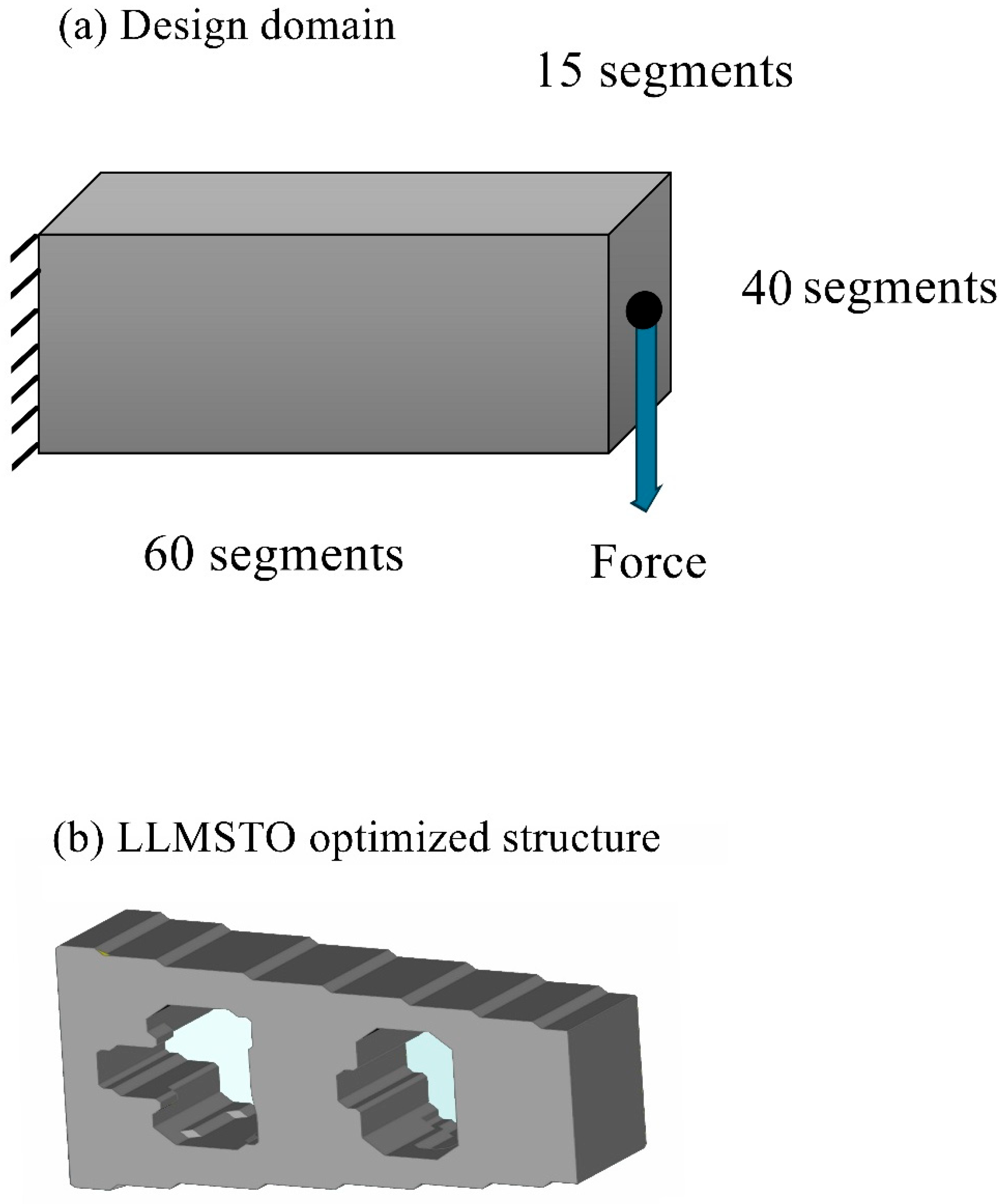
The considered problem corresponds to a three-dimensional cantilever beam topology optimisation task. The design domain is discretised into a structured grid, with a resolution of 60 by 40 by 15 segments (as illustrated in
Figure 16a), defining the allowable space for material distribution. One end of the beam is fully fixed, representing the support boundary condition, while an external load is applied at the opposite free end.
The objective of the optimisation is to determine the optimal material layout that maximises structural stiffness under the applied loading conditions while satisfying a strict material constraint. In this case, a target weight reduction of 50% is imposed, meaning that only half of the initial design domain volume is permitted to remain as solid material. This constraint enforces the generation of an efficient load-bearing structure that balances stiffness and material usage, leading to the emergence of optimal load paths within the three-dimensional domain.
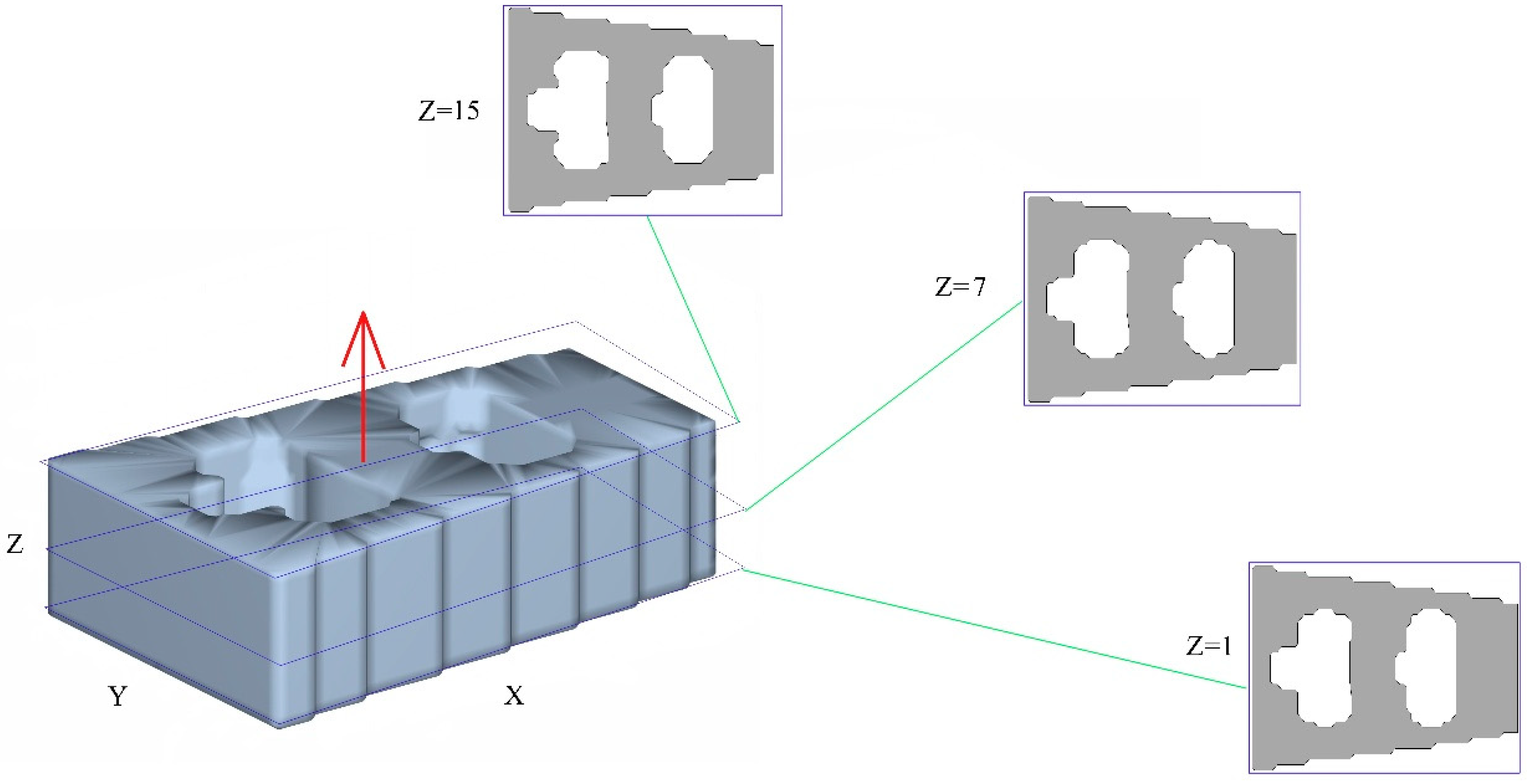
The figure illustrates the three-dimensional topology generated using the proposed LLM-Driven Symbolic Topology Optimisation (LLM-DSTO) framework. The design domain is discretised into a volumetric grid, where material distribution is determined through symbolic reasoning guided by the relationships between loading conditions, supports, and structural connectivity.
The resulting structure exhibits a clear formation of internal load-bearing pathways aligned with the direction of the applied force, as indicated by the vertical loading arrow. Material is strategically retained in regions that contribute to load transfer, while non-essential regions are removed to satisfy the imposed 50% weight reduction constraint. This leads to the emergence of a lightweight yet mechanically efficient structure.
The cross-sectional views at different depths (Z = 1, Z = 7, and Z = 15) reveal the evolution of internal topology along the thickness of the domain (as depicted in
Figure 17). These slices demonstrate that the model is capable of maintaining structural continuity in three dimensions, forming interconnected cavities and load paths rather than isolated or fragmented regions. The internal voids are distributed in a manner that preserves global stiffness while reducing material usage, indicating that the LLM successfully captures volumetric structural reasoning.
Importantly, the generated geometry avoids common artefacts such as disconnected material islands and excessive fragmentation, which are typical challenges in both classical and generative topology optimisation. The smooth transition of structural features across layers further highlights the ability of the framework to produce coherent three-dimensional designs.
5. Challenges of LLMs in Multiphysics Topology Optimisation
While the proposed framework highlights the potential of large language models in engineering design, several challenges arise when extending their application to multiphysics optimisation problems. Large language models primarily operate through pattern recognition and logical inference, enabling them to generate structurally meaningful configurations based on relationships between loads, supports, and connectivity. However, multiphysics optimisation involves the interaction of multiple coupled physical phenomena, such as structural mechanics, heat transfer, and fluid flow, each governed by different and often nonlinear equations. Capturing these interactions through purely symbolic reasoning remains inherently challenging, as the model does not explicitly solve the governing equations but instead approximates behaviour based on learned patterns.
Another key challenge lies in the representation of competing objectives and constraints. In multiphysics problems, design decisions often require balancing conflicting requirements, such as stiffness versus thermal performance or flow efficiency versus pressure loss. While the proposed framework incorporates heuristic metrics to approximate these trade-offs, the ability of the model to consistently resolve complex interactions across different physical domains depends strongly on the formulation of the problem and the structure of the input prompt.
Manufacturing constraints further complicate this process. In real-world applications, feasible designs must satisfy process-specific limitations that extend beyond general structural reasoning. These include considerations such as support requirements, build direction, residual stresses, and fabrication tolerances. Such constraints are typically informed by designer experience and are difficult to encode directly into a generalised generative model. As a result, their incorporation relies heavily on carefully constructed prompts, which act as a bridge between engineering knowledge and model output. This introduces variability, as the quality of the generated design becomes dependent on the clarity and completeness of the provided instructions.
In addition, the scalability of large language models presents a practical challenge. Multiphysics problems, particularly in three-dimensional domains, require significantly larger design spaces and more complex representations. This increases the number of tokens required to describe and generate the topology, leading to higher computational cost and longer inference times. Addressing such scenarios may require larger models and more advanced computational resources to maintain coherent reasoning across the design domain.
These challenges indicate that, while large language models offer a powerful tool for conceptual design, their application to multiphysics topology optimisation remains an evolving area. Future work will focus on improving the integration of physics-informed reasoning, enhancing prompt design strategies, and combining generative approaches with numerical validation to achieve more robust and reliable engineering solutions.