1. Introduction
The automotive industry is undergoing major changes driven by market shifts, new regulatory demands, and rapid progress in alternative powertrain, connectivity, and driver-assistance systems. At the same time, the rising customer demand for individualized vehicles leads to more variants, smaller volumes, and shorter lifecycles. These developments create challenges for traditional Original Equipment Manufacturers (OEMs), as fluctuating or declining volumes can lead to capacity underutilization. On the other hand, new market entrants typically begin with low volumes but must scale production quickly without committing to disproportionately high upfront investments. Contract manufacturers such as the Magna plant in Graz provide OEMs with the ability to outsource serial production, manage ramp-downs, or test new vehicle concepts without placing additional loads on their own production networks. For new entrants, such partnerships mitigate risk by providing access to established operations, skilled personnel, and robust supply chains. The Magna plant in Graz features a body-in-white (BIW) paint shop and general assembly operations, enabling complete vehicle manufacturing from individual supplier parts. As part of the Tier 1 automotive supplier Magna, the plant specializes in the efficient production of low-volume vehicle programs across various models. The site can integrate all powertrain technologies on a single assembly line while flexibly balancing production loads across different products to a certain extent [
1,
2].
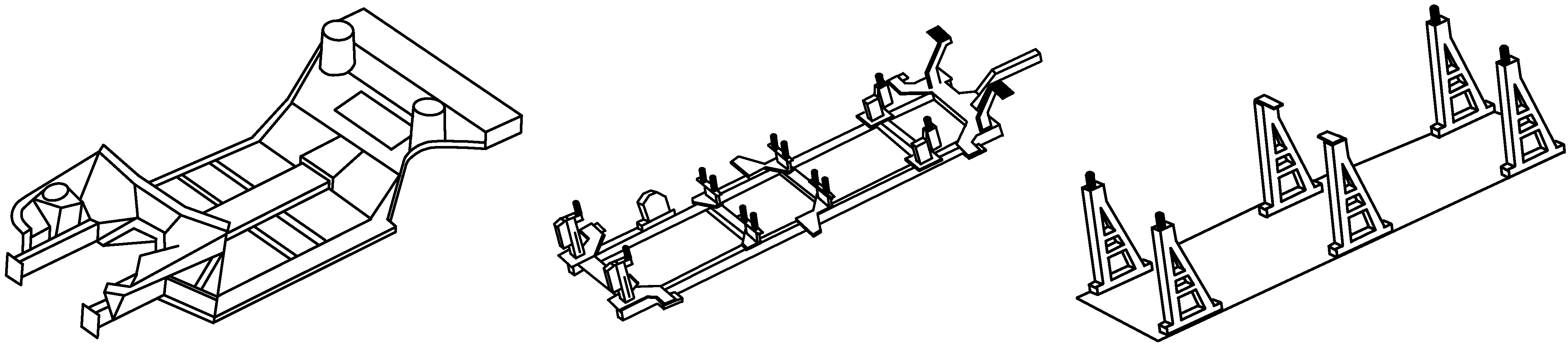
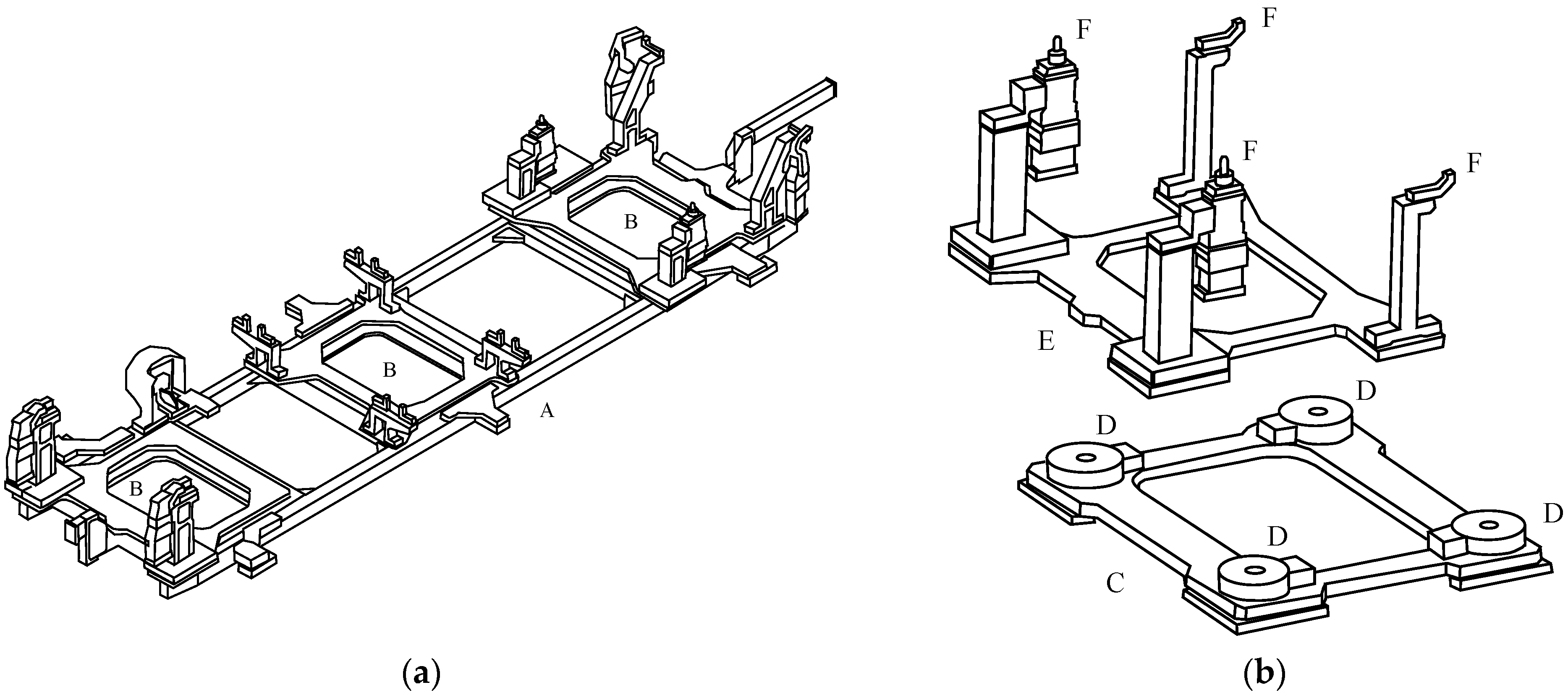
Contract manufacturing introduces unique technological complexities, particularly when multiple vehicle variants are processed on a shared production line. In the automotive shell construction method, commonly applied in passenger car manufacturing, the body is assembled step by step from sheet metal components and subassemblies, beginning with the underbody. To ensure dimensional accuracy and structural stability, the geometric position of the body base must be maintained consistently and with high precision in reference to the vehicle coordinate system at every stage. This alignment is crucial not only during part positioning and joining operations but also for dimensional inline and offline inspections. Typically, this is achieved by geometrically aligning and clamping the body base to stationary jigs via central mounting points throughout the process. However, when different variants are manufactured on the same production line, an additional construction element becomes necessary: transportable positioning devices (TPDs). These devices act as part carriers that adapt the varying body bases to a uniform mounting and clamping concept and maintain geometric alignment at each station of the BIW process. The key elements of this multi-product alignment are illustrated in
Figure 1 [
1,
3].
Upon entering the body shop, each underbody is assigned to a dedicated TPD, which accompanies it through the entire BIW process until it is handed over to the paint shop. The positioning devices are systematically rotated, with surplus units stored and reintroduced into production as required. According to established internal guidelines for BIW manufacturing, the evaluated facility can operate roughly 50 TPDs simultaneously per product when manufactured alongside one or two additional models, depending on the model mix and volume. Geometric deviations of TPDs, which may result from wear, tear or other production-related effects, translate directly into proportional deviations in the resulting vehicle structure. Such deviations can lead to quality related costs, including scrap or rework, throughout the value chain of complete vehicle manufacturing. The complexity is further increased by the fact that the relevant TPD locators used for geometrically aligning the underbody via openings in the body base cannot be accessed for measurement during production. As a result, a time- and cost-intensive offline inspection and maintenance procedure is required, during which each TPD is removed from production, typically at semi-annual intervals [
1].
This article is an extended version of the conference paper [
1] presented at the 7th International Conference Industry of the Future and Smart Manufacturing. The conference contribution introduced a patented cyber-physical inspection system for identifying and ejecting deviating TPDs. The system was developed and integrated into high-volume serial production at the multi-OEM BIW process in Graz, with the final product added in 2023. TPD inaccessibility was addressed by mapping causal geometric relationships between TPDs and products, enabling the extrapolation of deviations from available measurement data using big data analytics. Operational data collected over a 15-month observation period was analyzed, and the review of physical and computational elements was structured around four modules for automating quality control processes. These modules, which constitute one of the key conceptual outcomes of the earlier conference publication [
1], were originally proposed and defined by the authors based on experience from system development and implementation and do not originate from the external literature.
This extended article adds a second use case within the same domain: a patented cyber-physical assembly system that enables the on-demand configuration of advanced, flexible TPDs through precision part matching, thereby preventing the systematic influence originally addressed. While the first use case employed advanced digital technologies to mitigate the impact on product quality in real time, the second use case, successfully prototyped between 2021 and 2023, demonstrates how closed-loop systems can facilitate the industrialization of on-demand assembly. The development process of the advanced TPD version is explained, and the second system is examined in detail, structured around the same four key modules. These modules, now referred to as building blocks, are refined and assessed for applicability beyond quality control across different manufacturing processes and project phases, from conceptual design to full serial deployment. The generalizability of the building blocks is validated through cross-case analysis, and their industrial relevance is contextualized with the existing literature. The results related to key performance indicators (KPIs) and deliverables are presented to evaluate the effectiveness and impact of individual building blocks and the overall systems. Additionally, challenges and insights encountered during project phases and critical success factors are discussed.
The primary contribution of this work is a scientific analysis of two industry-driven applications that advance beyond measurement, simulation and prediction to actual process intervention. A review of the literature, case histories and the patent process indicates that studies on the implementation of Industry 4.0 in small- and medium-sized enterprises and large enterprises are limited and tend to be conventional in scope [
4,
5,
6]. Although research on this topic has grown, the best practices for integrating quality and lean manufacturing with advanced technologies remain underrepresented in the literature [
7]. Research on cyber-physical systems (CPSs) in manufacturing is still in its early stages, with efforts centered on modeling, ideation and exploitation rather than practical application [
8]. By validating the building blocks for both closed-loop assembly and quality control processes, this work aims to provide industry with a proven, scalable framework that bridges conceptual design and practical implementation of CPSs for zero-defect manufacturing.
Creating efficient and self-regulating closed control loops is a key objective in the digital transformation of quality and process excellence in automated manufacturing processes [
9]. In closed-loop concepts, the immediate adaptation of process parameters based on process or product data is expected to reduce the time between the occurrence, detection and correction of deviations [
10]. The objective is the transition from a reactive strategy to a preventive strategy by achieving process control, rather than detecting and correcting deviations in the products [
11]. This can be achieved by leveraging Industry 4.0 technologies, including artificial intelligence, the Internet of Things, big data analytics, digital twins and CPSs, that facilitate a transition to Quality 4.0, characterized by enhanced precision, agility and sustained excellence [
12]. This approach aligns with the concept of digital lean manufacturing, which enhances lean principles through advanced digital technologies for data acquisition, processing and visualization to detect, predict and prevent process deviations and quality issues within defined tolerance ranges [
13,
14].
2. Materials and Methods
Relevant information about the manufacturing domain, including the BIW process, jig and fixture design, and the flexible TPD, is provided to facilitate an understanding of the core features of both applications. The cyber-physical inspection system previously described in [
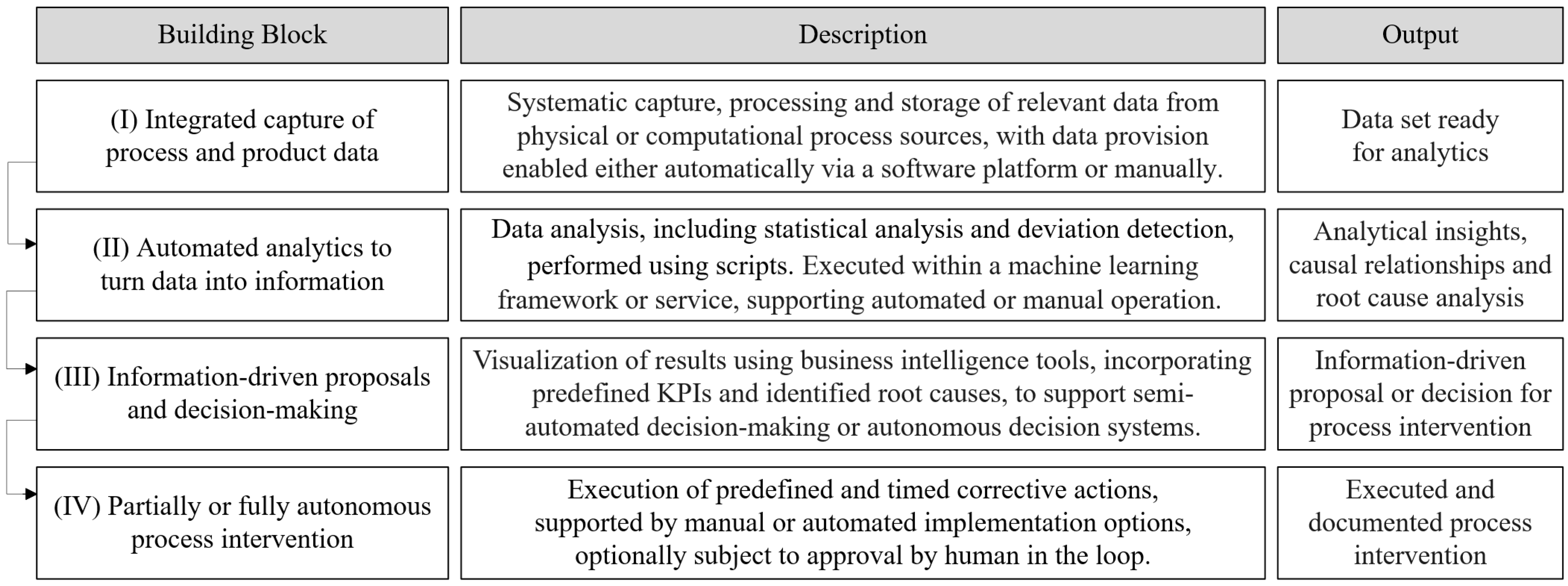
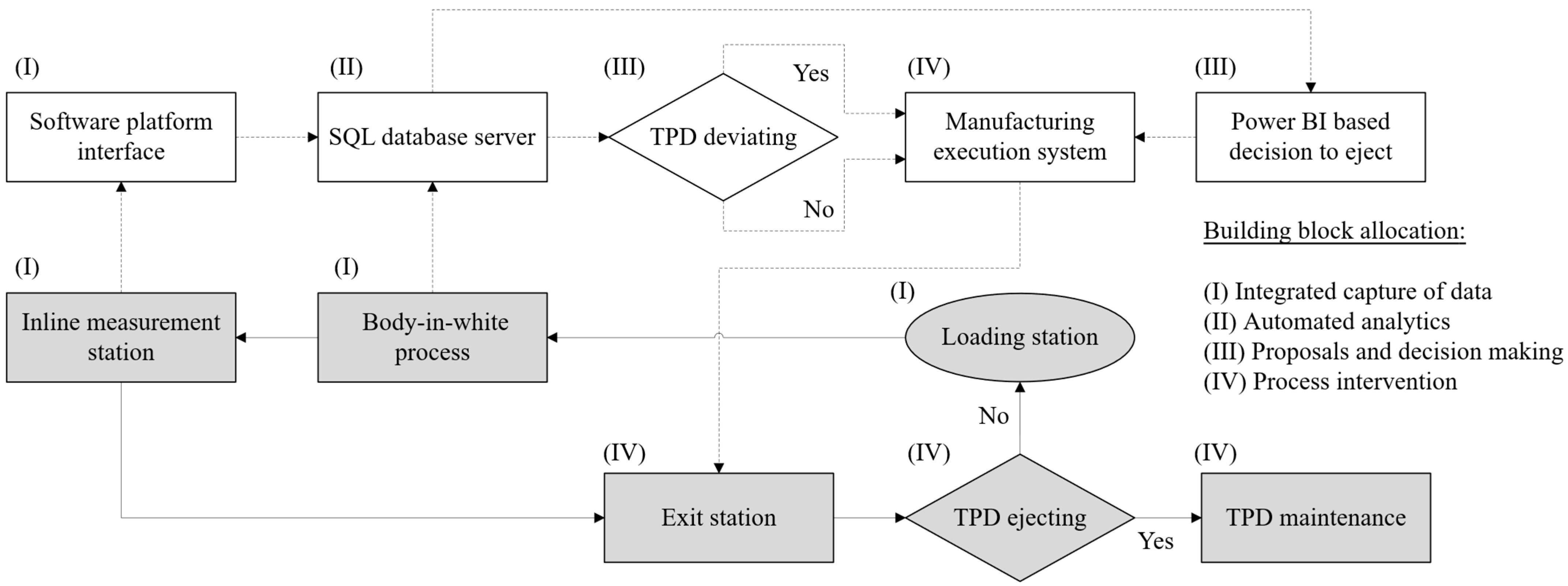
1] is summarized, whereas the new cyber-physical assembly system, introduced as one of the main contributions of this work, is discussed in greater depth. Both use cases are elaborated regarding their specifications for design, development, and implementation, structured according to the four building blocks. These have been adapted and generalized to accommodate varying requirements across different project phases and process scopes. As illustrated in
Figure 2, each building block relies on the outputs of the preceding one to ensure the proper functioning of the system. This dependency framework serves as a foundation for the cross-system comparison presented in the Results Section and in the research directions addressed in the Discussion Section.
For each use case, KPIs and deliverables were defined to validate building block functionality before deployment and to monitor system effectiveness during operation. Detailed KPI calculations and deliverable elements, such as data science metrics, are beyond the scope of this paper but are addressed in the Discussion. Production-related data, including product quality, volumes, take rates, model types, overall equipment effectiveness, and cycle times are not provided due to confidentiality constraints. Design decisions related to processes, products, or systems outside the scope of the cyber-physical system use cases are not evaluated. Aspects such as operational quality control strategies, equipment, and infrastructure are treated as predefined requirements, standardized according to customer specifications, industry standards such as International Automotive Task Force (IATF) 16949 [
15], handbooks from the German Association of the Automotive Industry (VDA) or Automotive Industry Action Group (AIAG), and established best practices. All criteria were validated by the project team to confirm feasibility for implementation [
1].
2.1. Body-in-White Manufacturing Process
At the BIW plant at Magna in Graz, the automotive shell construction follows a sequential process, beginning with single parts and ending with the finished body. Sheet metal parts and pre-assemblies are joined to form subgroups, which are assembled into the underbody. Allocated to a TPD, the underbody is processed through fully automated framing and welding stations. Side panels from pre-assemblies are integrated using mechanical joining methods, doors and flaps are mounted, and surface machining is completed before handover to the paint shop. Product sequence and identification are managed via the Manufacturing Execution System (MES), with tracking achieved through barcodes, radio frequency, or directly at the programmable logic controller (PLC) [
1].
In an automotive body shop, geometric quality control traditionally relies on offline 3D coordinate measurement machines (CMMs), with sample bodies or assembly groups ejected from the process for measurement. Based on these measurements, process interventions are defined, executed, verified, and documented. Following the facility’s standard BIW quality control practice, 0.1–0.5% of sub-assemblies and 1–2% of full bodies are sampled, with tolerances for positional deviations set at ±0.1 mm. However, deviations caused by individual TPDs cannot be reliably detected through sampling because their occurrence probability is too low relative to the sample size. They require fixed-interval control and maintenance activities, typically conducted at semi-annual intervals [
1].
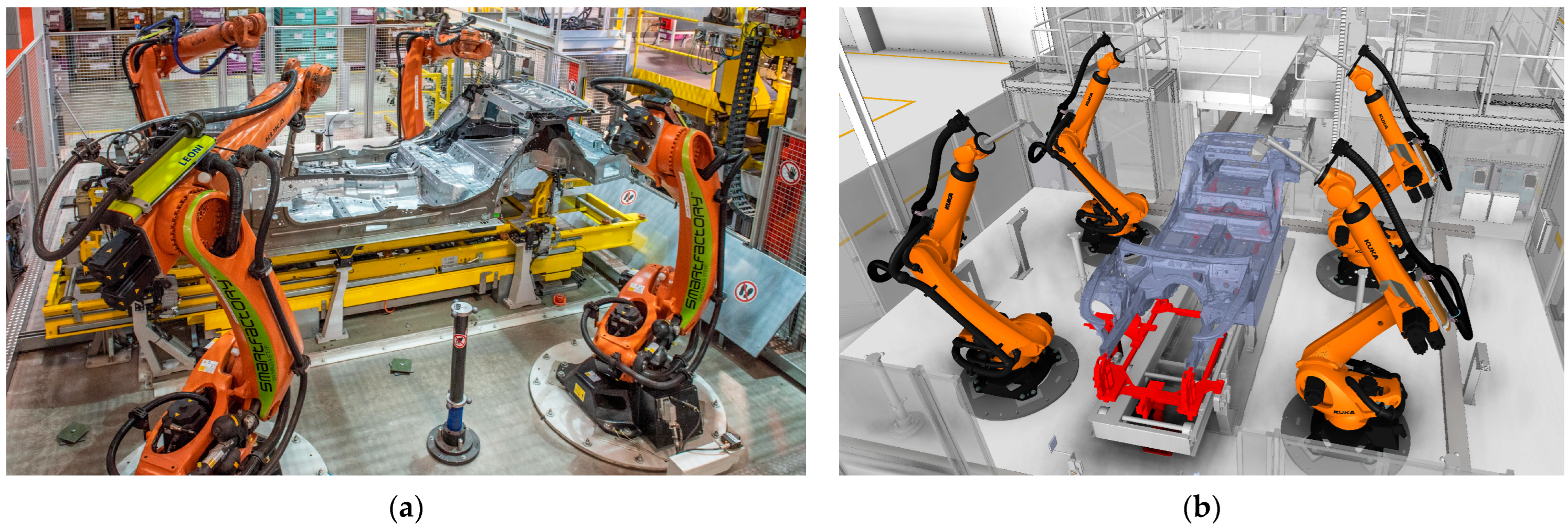
Between 2016 and 2018, three robot-based optical inline measurement stations were implemented in the BIW process at Magna in Graz to accelerate process stabilization, improve process control, ensure complete documentation of delivery quality, and minimize scrap, rework and downtime. Each station, located at critical points in the process flow, uses four robots equipped with high-accuracy optical sensors for image processing, line triangulation, and shadow analysis to monitor approximately 100 key features, with each feature measured in 3–4 s. Repeatability, traceability, and stability are verified regularly per industry standards such as VDA 5.1:2024 [
16]. Measurement accuracy is ±0.25 mm for correlation with coordinate systems, ±0.2 mm for static tests, and ±0.3 mm for dynamic process tests [
1]. The inline measurement stations incorporate state-of-the-art compensation mechanisms to maintain metrological reliability over extended operating periods. Each station employs calibration artifacts that enable the compensation of robot-induced thermal drift and support automated recalibration routines. These internal compensation cycles are complemented by regular external verification procedures performed in accordance with VDA 5.1:2024, including correlation checks with CMMs. No systematic deviations beyond the specified tolerances were detected during the data acquisition period. All maintenance and calibration events were logged and evaluated to ensure the stability, traceability and robustness of the measurement data used in this study. This is particularly critical because the geometric data from the underbody inline measurement station, shown in
Figure 3, is the key data source for the use case detailed in
Section 2.2.
2.1.1. Fixture Concept and Alignment via TPD
A reference system is maintained throughout all manufacturing, joining and quality stations to ensure consistent alignment, mounting and clamping of parts relative to the vehicle coordinate system. Body dimensional accuracy is achieved through stationary jigs and TPDs that position parts according to specified tolerances, following the functional dimension concept. The jig design and manufacturing adhere to the standards of the International Organization for Standardization (ISO), specifically ISO 14638 [
17], ISO 5459 [
18], and ISO 1101 [
19], with a tolerance for geometrical jig deviations of ±0.2 mm [
1].
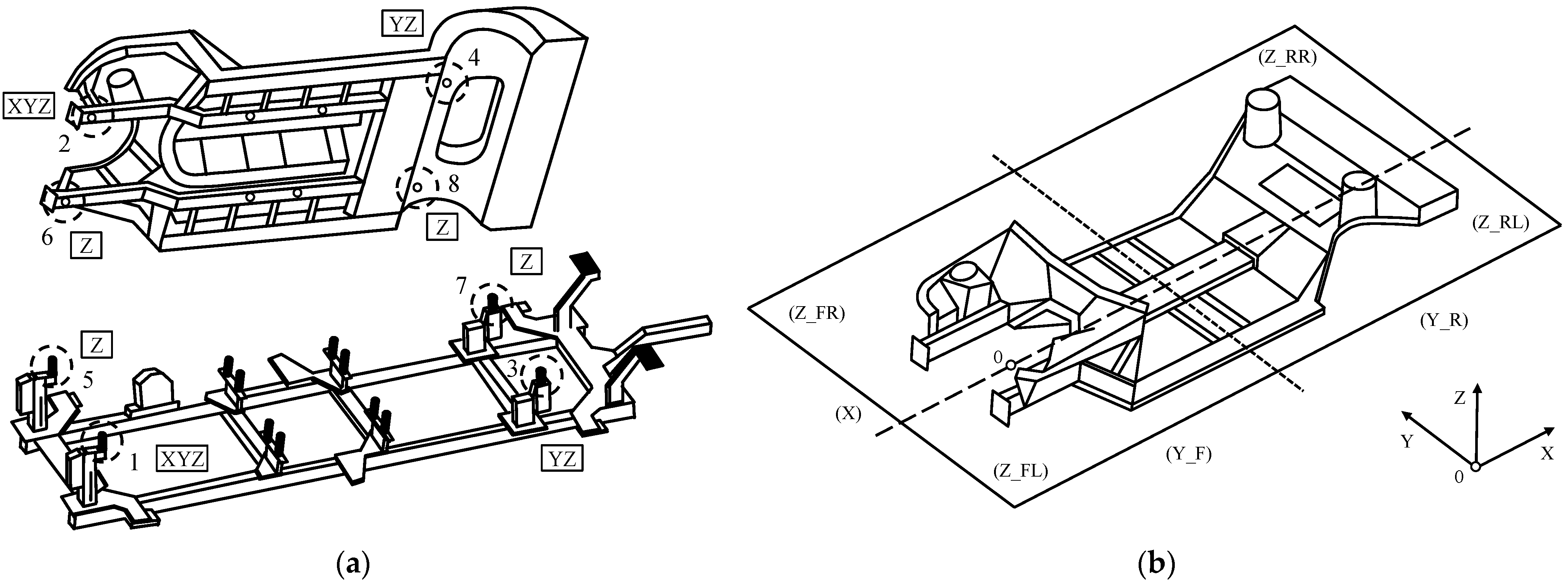
The positioning of an underbody via TPD locators within the vehicle coordinate system in the X-, Y- and Z-directions is shown in
Figure 4a. Orientation is achieved through the alignment of underbody openings 2, 4, 6, and 8 with corresponding TPD locators 1, 3, 5, and 7 following the orthogonal 3-2-1 locating scheme [
20]. Additional support points in the Z-direction prevent sagging but do not influence geometric orientation. The 3-2-1 scheme creates a cause-and-effect relationship between the four main locators of a TPD, 1, 3, 5, and 7, and seven defined zones on the underbody, as illustrated in
Figure 4b: the entire X-direction (X), front Y (Y_F), rear Y (Y_R), front left Z (Z_FL), front right Z (Z_FR), rear left Z (Z_RL) and rear right Z (Z_RR). Alignment in X-direction is achieved through main TPD locator 1, which positions the underbody in all three directions, with the round hole 2 at the front left. A deviation of a TPD in the X-direction affects the entire underbody (X). Y-direction orientation occurs as well at the front via locator 1, with deviations impacting the front zone (Y_F). The rearward Y-direction is additionally established by TPD locator 3 and slotted hole 4, with deviations only influencing the rear zone (Y_R). In the Z-direction, alignment is achieved through all four locators and their respective underbody holes. A Z-deviation at the front left (Z_FL) caused by locator 1 does not affect other zones, as the front right (Z_FR), rear left (Z_RL) and rear right (Z_RR) are oriented by locators 3, 5 and 7. This principle applies vice versa to the other three locators in the Z-direction [
1,
5].
2.1.2. FTPD Specifications
The original TPD concept, as described in
Section 2.1.1, requires substantial design adaptation for each new product variant, as well as the commissioning of an external supplier for manufacturing. As a set number of TPDs must be ordered based on planned take rates and production volumes, little flexibility exists to accommodate fluctuations in unit quantities or changes in the production program over the course of a multi-year project. To enhance process efficiency and increase adaptability to both fluctuations and flexible low-volume manufacturing bids, an advanced TPD version has been developed. Selected constructional elements disclosed in patent [
21] are described in this section to provide the functional context needed to explain the cyber-physical assembly system. The so-called flexible transportation positioning device (FTPD) enables rapid, model-specific reconfiguration within the BIW manufacturing process, as illustrated in
Figure 5.
Its functional concept allows efficient adaptation to different vehicle types using interchangeable docking plates equipped with variant-specific receptacles. At the core of the system is a rigid main frame that can accommodate multiple main modules. Each module provides a precise mechanical interface for attaching interchangeable docking plates, which represent the central reconfigurable element of the FTPD. The docking plates carry bearing faces, consoles and tensioning elements that enable the accurate alignment, mounting and clamping of different underbody types relative to the vehicle coordinate system. The docking plates are designed as plate-shaped elements that can be mounted onto a main module either manually or through automated handling systems. For precise positioning, each docking plate incorporates retractable clamping bolts on its underside, projecting vertically downward. These bolts engage with corresponding zero-point clamping and locking mechanisms, also known as quick change pallet systems. These mechanisms are integrated into the main module, ensuring repeatable positioning within defined tolerance limits. The main modules are equipped with integrated media interfaces that supply compressed air, electrical power and signal transmission. Once the bolts are pneumatically engaged, the docking plate forms a mechanically rigid and precision-aligned docking module together with the main module fixed to the main frame.
The design allows different docking plates to be used with a single main module. As a result, different docking plates equipped with variant-specific receptacles can be exchanged in a positionally accurate manner without modifying the main frame or the main modules. This enables the production of different vehicle types using the same structural equipment. The device consists of at least three main modules and three interchangeable docking plates with one plate per module. To reconfigure the FTPD for a new model variant, only the clamped docking plates, hereafter referred to as docking plate set, need to be exchanged. The main frame and main modules remain unchanged, allowing significant reductions in changeover time and initial investment. Furthermore, the systematic effects on product quality caused by geometrical deviations of the TPD over time are reduced, and the offline maintenance and verification process is simplified [
21].
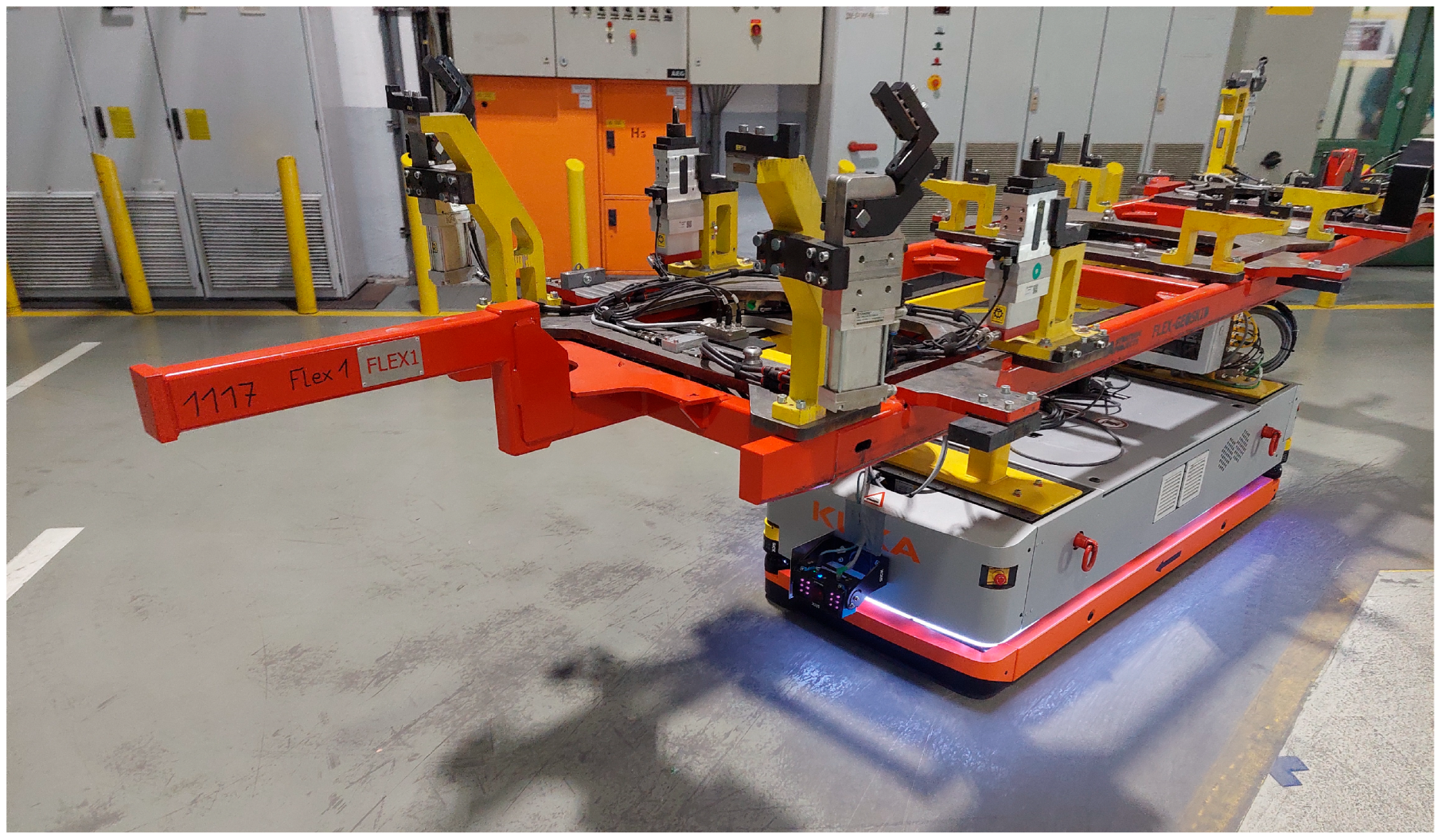
FTPD design and manufacturing adhere to ISO 14638, ISO 5459, and ISO 1101 standards and maintain a tolerance for geometrical fixture deviations at ±0.2 mm, consistent with the original TPD. The first manually assembled prototypes, one of which is shown in
Figure 6, were completed in 2020 to test geometry, mass distribution, clamping behavior, material characteristics, and tolerance performance under maximum acceleration forces. The first batch of FTPDs was tested alongside TPDs during serial production in 2023, after validation and adaptation of the BIW process stations to meet new weight and geometry requirements in 2022. The automation of FTPD type changes through interchangeable docking plates, implemented via a cyber-physical assembly system, is described in
Section 2.3.
2.2. Cyber-Physical Inspection System
As detailed in [
1], a multi-year project to develop and deploy an automated quality control system within the multi-OEM BIW process at Graz was successfully completed, with the latest product integrated in 2023. The system, designed to identify and eject deviating TPDs in real time via big data analytics, was implemented as a scalable, modular platform. To address TPD inaccessibility, the causal geometric relationships between TPDs and products were mapped, enabling deviation extrapolation from underbody measurement data via the methods described in this section. The physical and computational elements are visualized in
Figure 7, structured according to the building blocks introduced in
Figure 2. The core components possess all characteristics of a CPS, defined as engineered networks of physical and computational elements [
22]. Data are captured by sensors, processed, and utilized for environmental interaction through actuators or digital interfaces [
23]. To emphasize its focus on quality assurance, the subcategory “cyber-physical inspection systems” is introduced, distinguishing it from cyber-physical production systems that focus on manufacturing [
1].
2.2.1. Data Capture
The data categories required to identify deviating TPDs, visualize results and support partial or full autonomous ejection from the process are summarized in
Table 1.
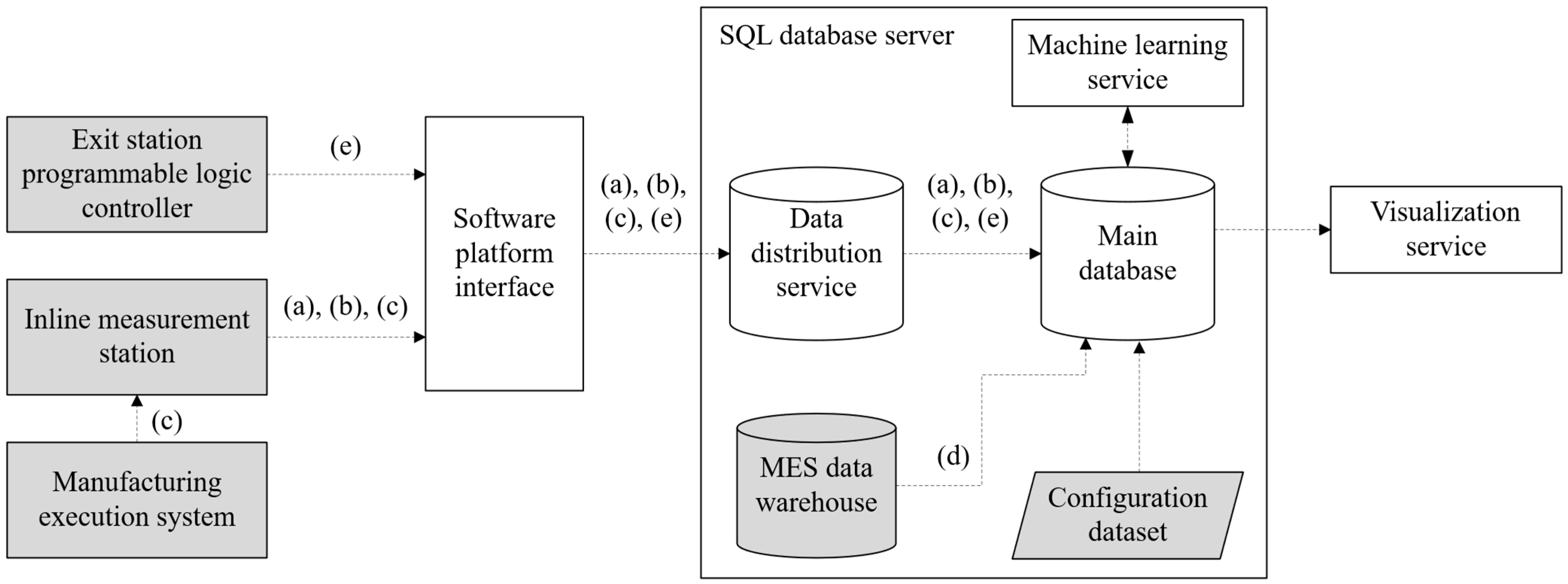
The combination of data categories (a) to (d) provides the geometric condition of each product aligned by a specific TPD at the time of measurement. Combining categories (d) and (e) allows the scheduling of TPD data resets following maintenance. Data processing occurs on a Microsoft SQL server, where all collected data are either transformed via the data distribution service and imported into the main database or directly processed. Product configuration data are also integrated and accessed by the machine learning service, which runs a Python 3.10 script executed daily before the first shift. Visualization is conducted using Microsoft Power BI with daily updates via an on-premises report server. Data older than 36 months are archived monthly and stored in Microsoft Azure Blob Storage [
1]. The flowchart illustrating data types (a) through (e) is presented in
Figure 8.
Since the daily update frequency fulfills all operational requirements, the system can be considered real-time according to the joint definition of ISO, the International Electrotechnical Commission (IEC), and the Institute of Electrical and Electronics Engineers (IEEE). This definition describes a real-time system as “a system that is concurrent and has timing constraints whereby incoming events must be processed within a given timeframe” so that “the computation results can be used to control, monitor, or respond in a timely manner to the external process” [
24] (p. 292).
2.2.2. Data Analytics
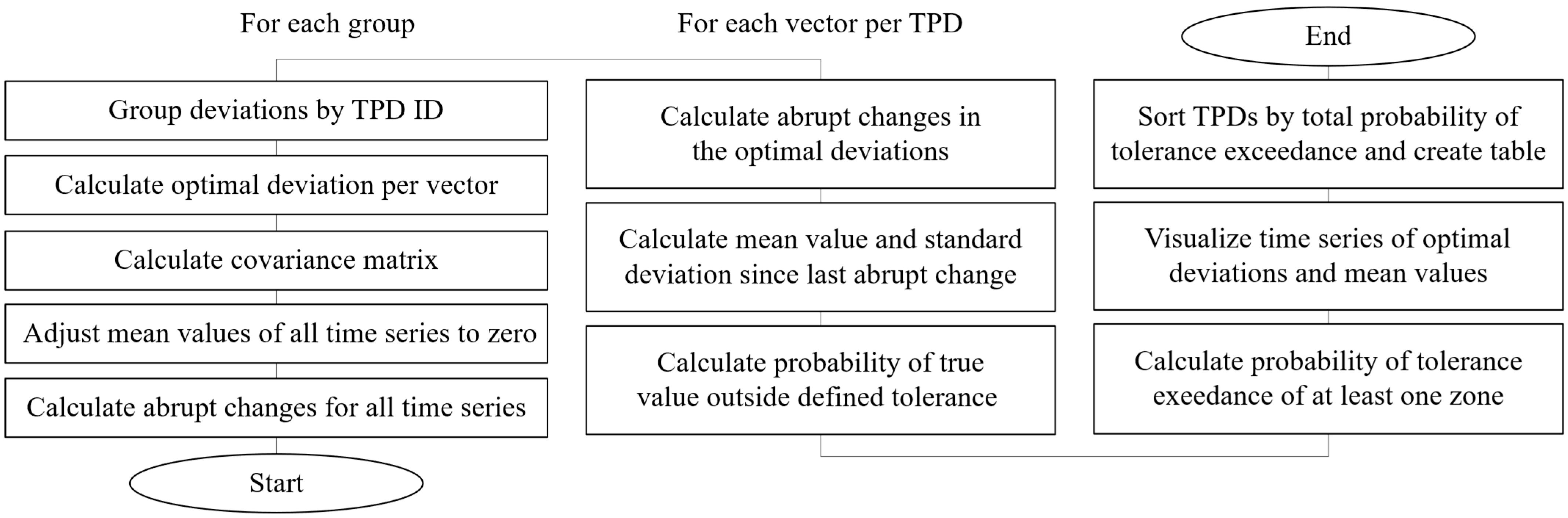
A Python script within the machine learning service detects deviating TPDs based on data input and configuration datasets, with the latter assigning measurement points to the seven geometrical cause-and-effect zones described in
Section 2.1.1. In addition, a weighting factor is applied to each point to account for the structural leverage effect of the underbody. The program sequence is visualized in
Figure 9.
Measurement data series are affected by process variations and interventions, resulting in unstable mean values. To obtain a zero-centered distribution, data are cleaned using offline change point detection with the Ruptures library, minimizing a Gaussian kernel-based cost function. Measurement points per group are combined into vectors, with the Mahalanobis distance assessing their fit to the overall normal distribution. Shifts are applied to vectors until they appear normal, estimating individual TPD influence. Monitoring the same TPD across multiple runs helps identify systematic deviations: consistent shifts indicate deviations, while random fluctuations suggest no systematic influence. Change points are detected per group and TPD to avoid external distortions, with mean shifts computed since the last detected change. Two KPIs quantify deviation probability: (a) KPI 1, the deviation probability per zone, and (b) KPI 2, the total deviation probability per TPD. Both KPIs are derived from deviations exceeding the tolerance of ±0.2 mm. Long-term observations confirmed that external factors such as material batches or environmental conditions did not affect the results. The algorithm was validated by ejecting TPDs and verifying the corresponding deviations through CMM measurement [
1].
2.2.3. Decision-Making
In Microsoft Power BI, all TPDs are displayed in descending order based on KPI 2, as illustrated in
Table 2. Selecting a TPD reveals detailed information on KPI 1 per cause-and-effect zone. The visualization indicates KPI 3, the number of measurement cycles used for calculation, differentiating between total measurements and those since the last abrupt change. The deviation probabilities and cycle count reset when a TPD is removed for maintenance, with abrupt changes, such as fixture breaks or interventions, detected through outline analysis and reflected in cycle counts. Data are updated daily, with calculations typically based on approximately the past six weeks [
1].
2.2.4. Process Intervention
Deviating TPDs are selected via MES, identified at the RFID reading station and ejected by the exit station’s PLC for offline maintenance. Selection and ejection may be either manual or automatic when a TPD exceeds a predefined limit for KPI 2. The three possible automation levels are summarized in
Table 3 and detailed in the Results Section.
2.2.5. System Validation and Performance Metrics
Table 4 summarizes the defined deliverables for the first use case across the four building blocks. The system boundary is limited to the development, deployment, and operation of the core application for identifying deviating TPDs, while supporting processes such as the inline measurement system or the exit station are excluded. Relevant KPIs within the scope of this paper are assigned to the respective deliverables and are detailed in
Table 5. While each deliverable is associated with a larger set of potential KPIs, such as algorithm-specific data science metrics, these were deliberately excluded because they do not contribute to the system-level analysis presented in this paper. In addition, each deliverable is classified according to whether it contributes to validation during the project phase, monitoring during operation, or both.
Definition and selection of KPIs and deliverables were derived from established criteria such as relevance, measurability, and operational alignment, according to ISO 22400 for manufacturing operations management [
25,
26]. However, the final selection and prioritization of KPIs were determined by the project team in close collaboration with shopfloor experts. Additional considerations such as the formal validation and optimization of KPIs, as well as the generalization of deliverables across multiple use cases, are examined in greater detail in the results and discussion sections.
2.3. Cyber-Physical Assembly System
In parallel with the construction and testing of FTPD prototypes, a project was initiated to develop an industrial solution for automating the configuration and best-fit matching of interchangeable docking plates, with a patent granted for the process in 2021 [
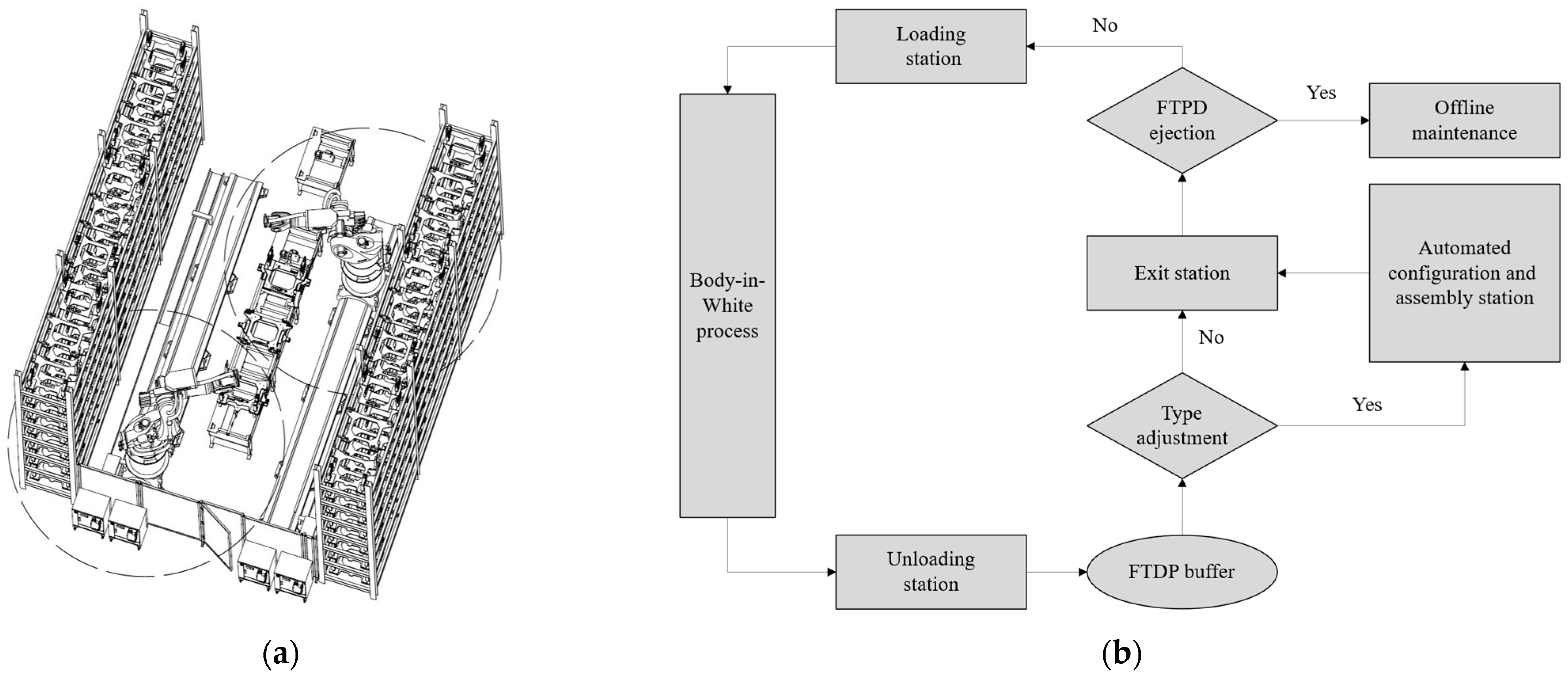
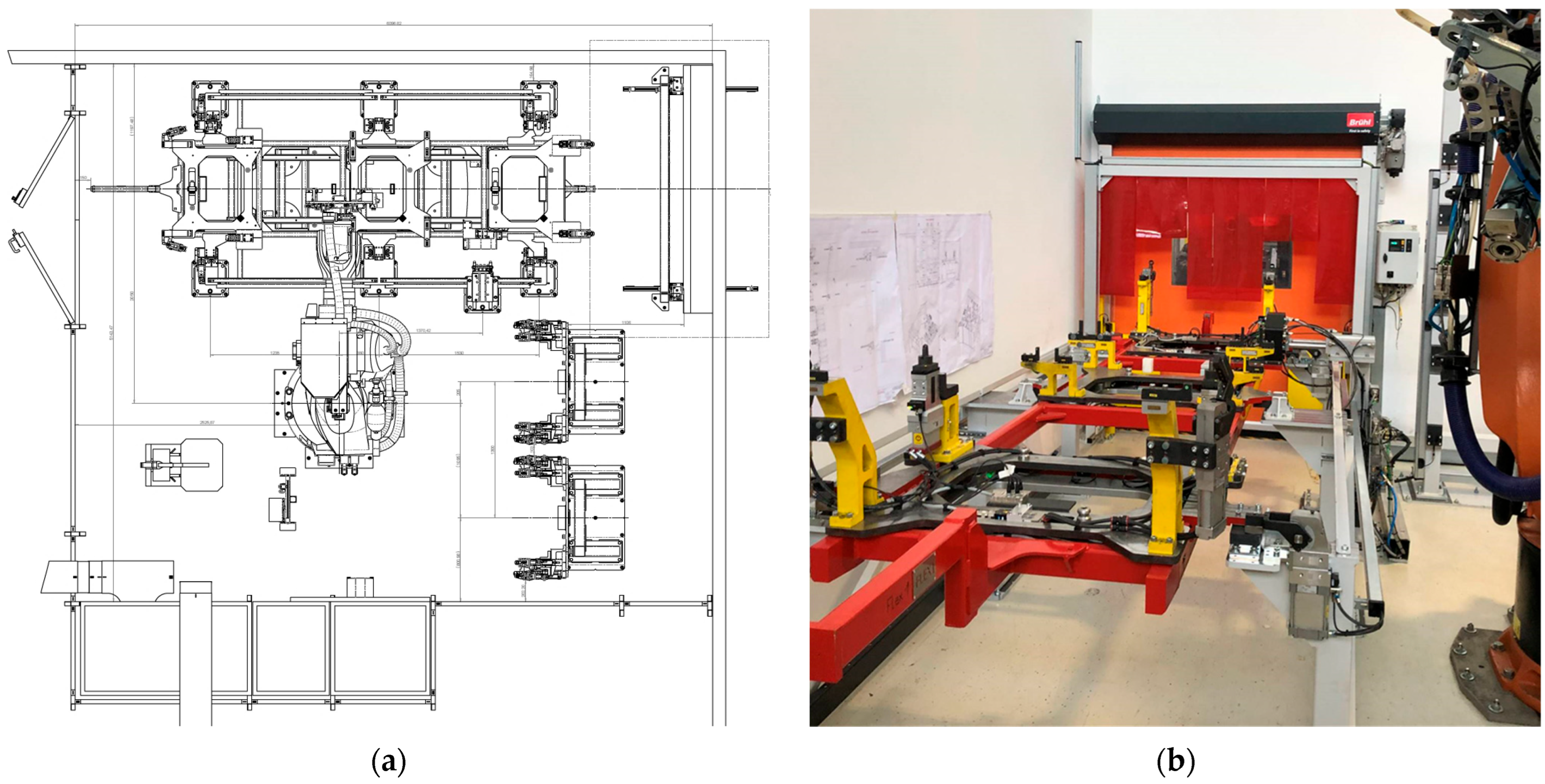
6]. The on-demand configuration and assembly of FTPDs is centered around a parts storage magazine consisting of interchangeable docking plates tailored to specific product types. The core process involves selecting appropriate docking plates and matching them precisely to generic main frames with the target of minimizing tolerance chains between components. The selection by the warehouse management system is driven by big data analytics, utilizing measurement data from an automated optical measurement system. The geometry of docking plates on incoming FTPDs is measured. Subsequently, the geometry of the main modules attached to the main frames is measured after the disassembly of the docking plates. The best-fit docking plate set for the current main frame is identified via a matching algorithm. Disassembly and assembly are performed automatically via robotic grippers, with joining and disjoining executed pneumatically, enabled by the design of the FTDP. After completion, a verification measurement of outbound FTPDs is performed prior to their introduction into the manufacturing process.
Figure 10a illustrates the top view of a conceptual layout, while
Figure 10b depicts the system integration and FTPD control process within the body shop via a simplified flowchart.
Individual components of the system were evaluated in several test series within a production-related environment between 2021 and 2023, confirming the practical feasibility of the prototype application. The specifications and limitations are systematically summarized in the following subsections, aligned with the established building block structure. The cyber-physical assembly system is currently at procurement readiness, with full system setup and pilot deployment planned for the next customer order in the multi-OEM BIW manufacturing process.
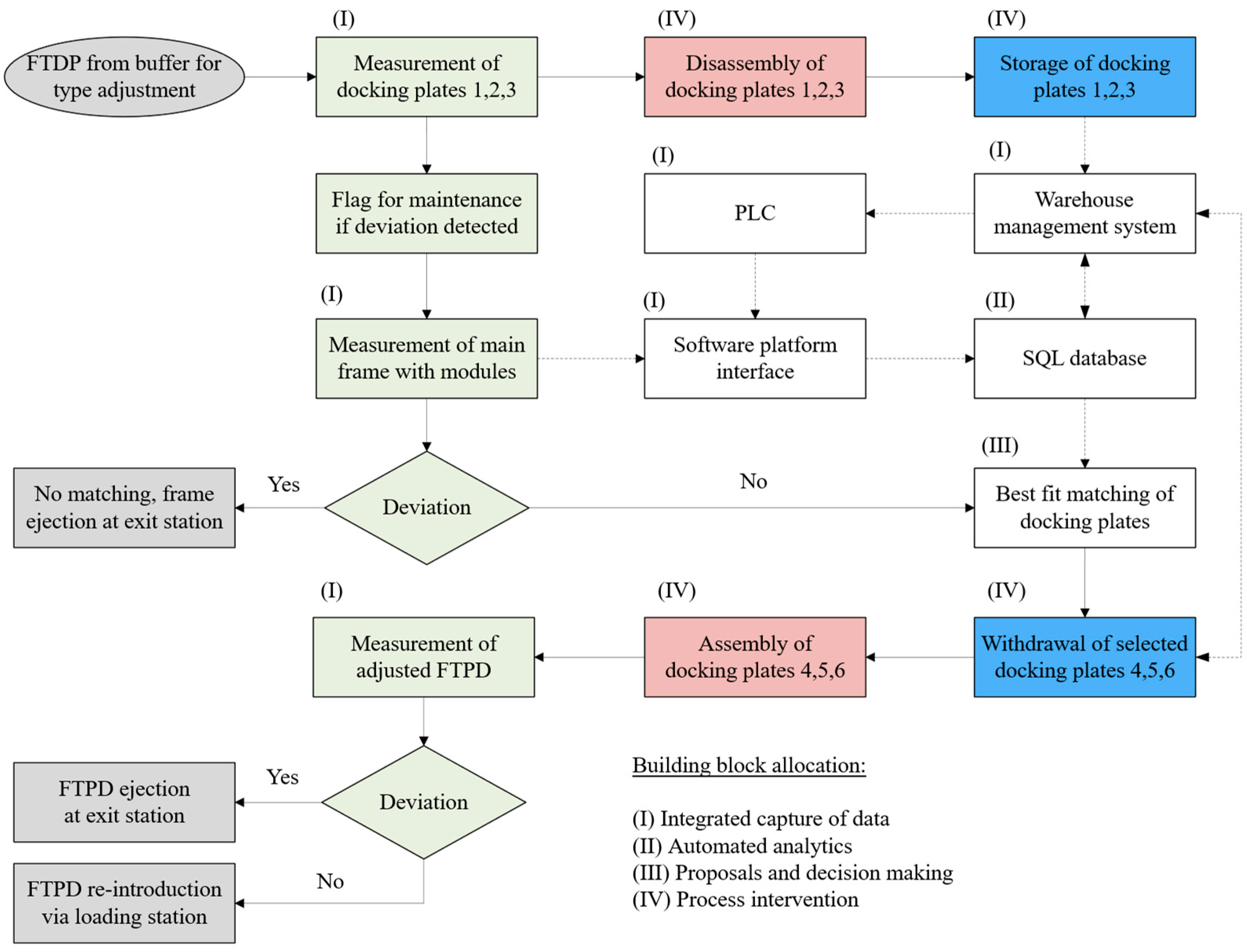
Figure 11 illustrates the station flowchart for replacing a complete set of docking plates, transitioning from plates 1–3 to plates 4–6. The relevant physical and computational elements as well as deliverables and KPIs are described in the following subsections.
2.3.1. Data Capture
The data categories necessary for configuring and best-fit matching variable FTPDs and visualizing results are illustrated in
Table 6. Data (a), (b) and (e) enable the configuration of optimized FTPDs, while (d) from the warehouse management system (WMS) facilitates the storage and withdrawal of docking plates. Category (c) is needed for validating the matching process and for release to production. Categories (f) and (g) support the reporting, visualization, and scheduling of component maintenance and calibration of the measurement system, ensuring consistency between the station and the CMM. This is comparable to state-of-the-art procedures employed in inline measurement stations.
Contrary to the fully operational and implemented inspection system described in
Section 2.1, a detailed data processing workflow is not provided here. The workflow is not needed in the prototype phase but is established during brownfield implementation. For data analytics and decision subsections, production-relevant datasets and historical data were used. The computational elements in the flowchart in
Figure 11 were selected to ensure comparability with the flowchart in
Figure 7. However, a modern Information Technology (IT) and Operational Technology (OT) infrastructure that utilizes standard enterprise architectures, including central data platforms, a unified namespace, and lightweight network protocols, is preferred. The system must, in any case, meet the requirements specified by the ISO/IEC/IEEE for real-time operation, as detailed in
Section 2.1.1.
2.3.2. Data Analytics
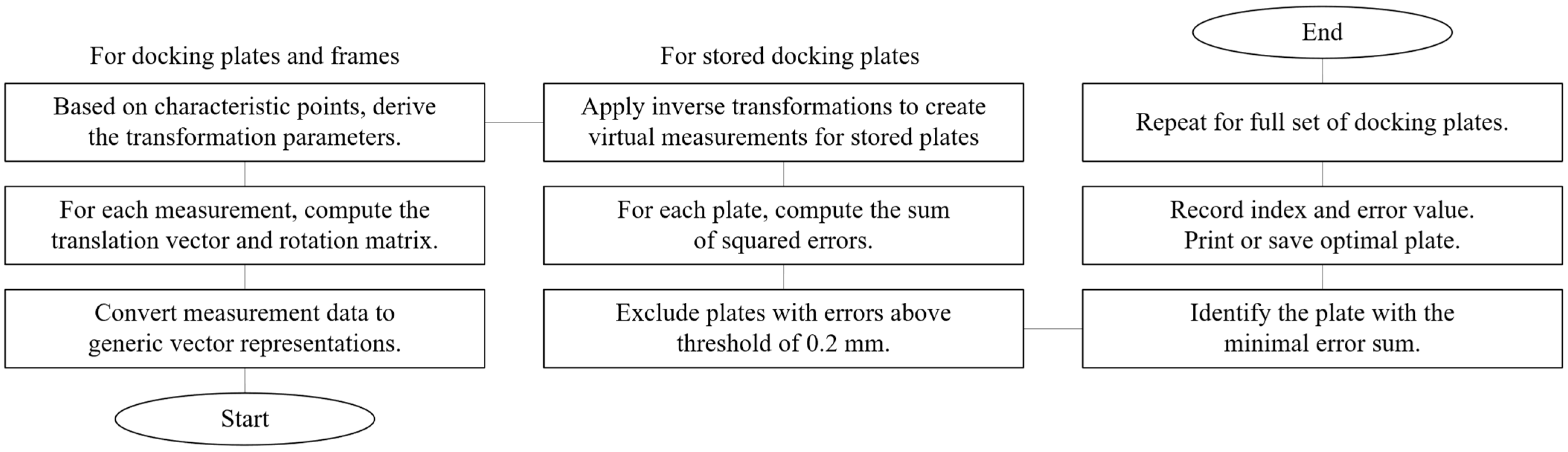
The objective of the best-fit matching algorithm is to compensate for deviations in single components by selecting the most appropriate combination of modules and docking plates in terms of tolerance. The tolerance for geometrical deviations of individual parts is set at ±0.1 mm, while the tolerance for the assembled combination is set at ±0.2 mm. It is assumed that a docking plate may be slightly shifted, rotated, or tilted relative to the reference target at the four mounting points on the module. Using data categories (a) and (b), the algorithm aligns the measured geometries by computing a rigid body transformation, consisting of translation and rotation, via a least-squares optimization. This transformation minimizes the Euclidean distance between corresponding points for accuracy. The alignment employs the Python function scipy.spatial.transform.Rotation.align_vectors from the SciPy module, which uses the Kabsch algorithm to determine the best-fit rotation. Transformation parameters are derived from defined characteristic measurement point pairs to account for systematic deviations. The measured values are then rotated and translated into a common coordinate system, and virtual measurements are generated for each stored plate configuration by applying the inverse transformation. A scalar quality function evaluates these virtual measurements, and the algorithm searches for the plate with the minimal error sum while excluding those exceeding a combined tolerance of >0.2 mm. The best-fit plate is then selected and mounted on the respective modules, with the process repeated for the full set of plates. For algorithm validation, a large dataset for data categories (a) and (b) was generated by extrapolating measurement data from serial production TPDs and prototype FTPDs using CMMs, with random numbers added to simulate variability. The data were imported into a Python environment, and the program sequence illustrated in
Figure 12 was tested by processing the FTPD measurement data in CSV format.
In addition to developing the algorithm, the analytics phase included two complementary approaches for determining the system’s storage capacity and the required number of base frames and docking plates. The first approach involved a statistical calculation to determine the required storage capacity of docking plates, ensuring that at least one available set meets the geometric requirements for optimal best fit matching. Assuming a ±0.1 mm tolerance for individual parts and ±0.2 mm for combined FTPDs, the probability of a fitting plate was evaluated using the Gaussian error integral at a 95% confidence level, with all tolerances corresponding to 4σ limits of a normal distribution to account for process variability. The second approach further introduced production parameters such as station availability, production volumes and take rates for multi-product scenarios.
2.3.3. Decision-Making
Based on the lessons learned from algorithm testing, a Power BI visualization was created in a testing environment to allow operators to monitor the operation. The visualization is based on prototype testing data and does not yet reflect live production data. As illustrated in
Table 7, the overview shows the configuration date, cycles since last configuration, and FTDP geometry status after matching. The drill-down menu offers detailed information about FTDP configuration and single-part dimensional accuracy.
2.3.4. Process Intervention
FTPDs are fed into the configuration and assembly station based on the type deployment rate regulated by the MES. Type adjustment involving the selection and replacement of the docking plate set is only performed when geometric requirements are met during prior measurement steps. Therefore, there are two different types of process intervention involved, as defined by building block (IV):
A discrete yes/no intervention triggered by deviations detected during measurement steps, resulting in flagging the docking plate for maintenance or ejecting the main frame or newly configurated FTPD via the exit station’s PLC.
An algorithm-driven configuration and assembly of best-fit docking plates to the main modules for type adjustment supported by robotic grippers and WMS.
The discrete interventions triggered by measurement results are state-of-the-art and have been sufficiently tested across various applications. However, the algorithm-driven configuration and assembly of the docking plates was validated in a production-like prototype testing environment, as shown in
Figure 13. Between 2021 and 2022, the system’s best-fit matching process was validated through the repeated assembly and disassembly of two main frames and four docking plate sets, totaling 12 docking plates. The focus was on evaluating the functionality and feasibility of mechanical components, automated material handling, and pneumatic locking mechanisms. Additionally optical sensors mounted on robots and fixed sensor scanning were tested to assess point accessibility, process speed, and measurement repeatability.
In contrast to the first use case, user intervention within the key process, specifically during the selection and matching of docking plates, is not intended in the second use case. Nevertheless, three automation levels, as illustrated in
Table 8, are considered. All are triggered by the FTPD type deployment rate regulated by the MES.
In the autonomous process, FTPDs are automatically fed from a buffer into the configuration and assembly station, and the process is executed according to the workflow illustrated in
Figure 11. Measurement, configuration, and mechanical handling are fully integrated within the cyber-physical assembly system, enabling the automated selection and best-fit matching of docking plates without operator intervention.
In the manual process, FTPDs need to be ejected from the BIW process for manual, offline type reconfiguration. All measurement operations are performed in an offline measurement laboratory using a CMM. Additional docking plates are stored in a separate warehouse and are retrieved after a preliminary matching step conducted using Microsoft Excel. Disassembly and reassembly are carried out by operators using a handling device manipulator, while documentation and reporting are also performed manually.
The semi-autonomous process is likewise performed offline following the ejection of the FTPD from the BIW process and relies on CMM-based measurement. In this case, the configuration and selection of the best-fit docking plates are supported by an algorithm. Mechanical handling is performed using an automated disassembly and assembly robot station located near the measurement laboratory. Despite this partial automation, operators are still required to retrieve the selected docking plates from the separate warehouse.
As discussed in the Results Section, the difference between the levels is demonstrated by a completion time KPI and highlights the key difference between the two use cases. Whereas the first use case enhances the effectiveness of an existing process, the second use case enables a process that is not feasible to perform manually, primarily due to its significant time demands and the associated increase in costs.
2.3.5. System Validation and Performance Metrics
Table 9 summarizes the deliverables for the second use case, reusing those identical to the ones defined in
Table 4 for the first use case and introducing additional deliverables specific to this scenario. The system boundary is limited to the discrete interventions triggered by measurement deviations as well as the configuration and matching processes executed via robots and storage systems. Deliverables D 11–14 differ due to the changed task of the core algorithm, D 15–16 reflect the additional hardware and software that must be considered, and D 17 captures the different outcome and system performance metrics.
Table 10 depicts the KPIs for the second use case. The same methodology as the first use case (
Section 2.2.5) was applied. Approaches for estimating storage capacity and system dimensioning, which serve as the basis for KPIs 8–10, as well as the details for KPI 11, are presented in the Results Section.
2.4. Cross-System Framework Validation
The cross-system validation method consists of a systematic comparative analysis of building block deliverables across the two cyber-physical system use cases. The primary objective is to validate the applicability and generalizability of the framework across different manufacturing processes and project phases, ranging from proof of concept to full operation in a serial production environment. To support a structured comparison, deliverables were grouped into shared metric or framework dimensions. Additionally, two further automotive use cases from Magna in Graz are introduced in the Results Section but are not described in detail. One targets an application in the paint shop, and the other addresses general assembly. Both projects were halted during the proof-of-concept phase because one of the relevant building block deliverables failed validation.
3. Results
The cyber-physical inspection system project resulted in substantial reductions in time, effort, and cost, although these metrics are not quantified in this paper due to confidentiality constraints. The indirect testing method for TPDs was successfully implemented, validated in serial production, and patented as company intellectual property. The cyber-physical assembly system completed prototype testing and is ready for procurement, with full system setup and pilot deployment planned for the next customer project. The design of the FTPD, along with the patented configuration and best-fit matching method, demonstrated stability and suitability for high-volume deployment. Relevant results from both use cases are presented, focusing on system feasibility and effectiveness.
Furthermore, a cross-system comparative analysis is conducted to illustrate the applicability of the building block framework across diverse manufacturing processes and project phases, including two additional short use cases. To enable comparability, generalized metric dimensions are derived from the deliverables defined in
Section 2. Finally, the seven critical success factors from the original conference paper are evaluated through a qualitative coverage assessment to demonstrate the progress achieved.
3.1. Operational Results of the Cyber-Physical Inspection System
The operational observation period spanned from January 2023 to March 2024. During this time, overlapping ramp-up and phase-out activities resulted in four product variants used across three platform types at peak operation. Approximately 50,000 underbody measurements were collected via inline measurement station. The data were exported to CSV files, analyzed using Microsoft Excel, and validated by dimensional engineers through TPD measurement records and maintenance logs from the dimensional data repository. To evaluate overall system effectiveness, the results for KPIs 4–6 are summarized in
Table 11. KPI 6 compares the number of TPDs ejected for maintenance against a fixed-maintenance-interval strategy of 180 days over the 15-month observation period, expressing the resulting reduction as a percentage. The fixed-interval reference value was calculated based on the total number of TPDs per platform type in the dataset. The higher ejection rate observed for Product A is attributed to construction-related issues associated with the TPD concept following its initial market launch. Platform C was phased out during the observation period and therefore could not be included in the KPI 6 evaluation.
The mean residence times characterize the system’s detection performance by quantifying both the early identification of deviating TPDs (NOK) and the time non-deviating TPDs (OK), which remain in the process before ejection. The results demonstrate a high system efficiency, with deviating TPDs identified and ejected significantly earlier than the 180-day threshold, while resources for non-deviating TPDs were minimized unless strictly necessary. Platform B is the most representative, as it was in serial production over the entire observation period. To determine residence times, additional historical data were required to trace each TPD back to its most recent ejection and maintenance event. Therefore, data from June 2022 to January 2023 were included in the analysis of KPIs 4 and 5.
The system met all defined operational requirements for stability and accuracy. It was originally designed to support production ramp-up phases by identifying significant deviations arising from constructional issues typically observed in newly integrated TPDs. However, the system demonstrated robust performance under stable serial production conditions, effectively capturing standard process deviations. The analyzed dataset encompassed multiple operational scenarios, including the ramp-up phase of platform A, the stable serial operation of platform B, and the ramp-down phase of platform C.
To evaluate the impact of the automation levels introduced in
Table 3, a qualitative, time scale-based assessment of the system’s reaction time was conducted and is summarized in
Table 12. Due to confidentiality constraints, reaction times are expressed using high-level time scales and qualitative performance categories rather than exact values. The evaluation included two aspects: (a) the time between the occurrence and the detection of a deviation, and (b) the time from detection to the process intervention. Supported by operational results, the primary significance lies in time (a), where both semi-autonomous and autonomous levels significantly reduce the detection time of deviating TPDs from several months to just a few hours or days, depending on the production volume. This reduction significantly impacts product quality, especially if a TPD passes through the BIW process once per day, causing a geometrical deviation with each cycle.
Time (b), however, remains nearly identical across all levels. When the TPD is ejected for measurement as part of the 180-day fixed-interval strategy, maintenance can be conducted during the same or subsequent shift without incurring additional production risk, as the TPD is already outside the BIW process. Consequently, it is categorized as immediately in
Table 12. Due to fixed data processing intervals, limited to once daily by system throughput times and the brownfield infrastructure, the primary difference between semi-autonomous and autonomous modes is the timing of the operator’s review and decision for ejection, which occurs at the start of the next day’s shift. Although data processing takes place before the shift starts after the day of detection, there remains a risk of TPD reintroduction before the manual intervention. In both cases, deviations are identified swiftly enough that one or two affected products remain within the body shop boundaries and can be flagged for additional quality control. This contrasts with manual operations, where an unknown number of affected bodies could have already incurred quality costs across the entire vehicle assembly value chain over several weeks or months. Consequently, KPI 7 (reaction time) is classified as slow for manual operation and fast for both automation levels supported by the cyber-physical inspection system. While real-time intervention through enhanced IT/OT integration would be technically feasible for the semi-autonomous and autonomous levels, the required investment is considered disproportionate to the associated risk reduction in this specific use case [
1].
3.2. Prototype Results of the Cyber-Physical Assembly System
A key outcome of the prototype evaluation is the demonstration that the early estimation of storage capacity is critical during the prototype phase to assess feasibility for industrial application. The calculation and simulation of the system’s storage capacity, together with the required number of base frames and docking plates, provide the basis for evaluating whether the prototype can be scaled to realistic production programs and can support informed planning and sourcing decisions for real-world implementation. The results obtained from both approaches, following the methods described in
Section 2.3.2, are summarized in
Table 13 and
Table 14.
Table 13 presents the results of the probabilistic tolerance matching analysis used to estimate the required number of docking plates under different combined tolerance assumptions. The results highlight the importance of validating FTPD design tolerances as a key design validation step prior to production-driven system sizing. The realized combined tolerance of ±0.2 mm results in a feasible number of required docking plates, whereas a strict combined tolerance of ±0.1 mm would lead to an impractically high number, rendering the system infeasible from a storage, cost, and operational perspective.
Table 14 illustrates the results of the production-driven system dimensioning analysis based on an FTPD volume simulation. The evaluated production program assumes four different body base variants and, consequently, four FTPD types being processed simultaneously within the system. The results quantify the required number of storage locations and docking plate sets for different base frame volumes, including the maximum capacity of the brownfield BIW process, and form the basis for both system performance and operation cost benefit KPIs 8–10.
The most relevant outcome for the scope of this paper from the system’s best-fit matching experiments conducted between 2021 and 2022 is the set of recorded process times, which form the basis for the qualitative, time scale-based assessment applied to KPI 11 as presented below. In total, 150 FTPD type changes were executed across three measurement systems in the matching prototype testing environment, with 50 disassembles and assemblies per system. While mechanical functionality, automated material handling, and measurement system performance were evaluated, only the resulting time data are reported due to confidentiality constraints.
To evaluate the impact of the varying levels of automation introduced in
Table 8, a different methodological approach was adopted for the second use case. In contrast to the first use case, where reaction time was linked to the occurrence, identification, and correction of deviations, the analysis in this case focused on the total completion time of selected assembly and configuration tasks. Based on this perspective, system effectiveness is evaluated using KPI 11 (assembly and configuration completion time). This KPI represents the time required to complete the key process steps influenced by the combined degree of automation of (a) the execution of measurement operations, (b) the selection of the appropriate docking plate, and (c) mechanical handling during the assembly, disassembly and storage manipulation of docking plates. Time (a) comprises all measurement processes described in
Section 2.3, including the measurement of docking plates, the measurement of the main frame, and the verification measurement of the fully assembled FTPD.
Although KPI 11 allows a direct quantitative comparison across the defined automation levels, the results are reported as time ranges and qualitative performance categories to comply with confidentiality requirements. The values summarized in
Table 15 are based on the previously described testing phase and are complemented by industry best practices, benchmarking studies, and operational experience with robotic automation.
The autonomous operation level cannot be meaningfully compared with either the manual or semi-autonomous levels across any of the three evaluated time categories (a) to (c). Only the autonomous system achieves completion times compatible with serial production requirements. This is particularly relevant for the previously presented capacity-planning results, including the determination of the required number of FTPDs in the system and the associated FTPD type availability as a function of production volume and take-rate simulations. Measurement operations, configuration and selection, as well as mechanical handling, can all be completed within seconds under autonomous operation. Although differences between the manual and semi-autonomous levels are observable for times (b) and (c), tasks that require manual labor dominate the overall completion time. Required personnel deployment, CMM capacity reservations, and associated operational costs render both manual and semi-autonomous approaches infeasible, as long cycle times directly limit throughput and require disproportionate personnel resources.
Furthermore, additional indirect costs such as personnel breaks, documentation effort, and reporting activities were not included in the core system evaluation presented in
Table 15. They would further increase the economic disadvantage of manual and semi-autonomous levels. In contrast, these activities are fully incorporated into the autonomous system. As a result, completion time is classified as slow for the manual and semi-autonomous levels, whereas only the autonomous level attains a fast completion time classification consistent with operational requirements.
3.3. Cross-System Framework Validation
For the employed comparative analysis, two further use cases are introduced that both were halted during the proof-of-concept phase due to the failure of validation for one of the framework’s building blocks, as summarized in
Table 16.
The objective of use case 3, originating from a general assembly application, is to leverage hull curves from an automated electronically commutated (EC) torque system for advanced analytics extending beyond conventional maximum torque and angle evaluations. Specifically, the use case aims to identify false-positive OK assessments in which maximum torque and angle criteria are met, but the hull curve exhibits atypical or deviating characteristics indicative of underlying process or quality issues. While the algorithm model had been fully developed, the project was put on hold due to the lack of an automated interface in the underlying data system. The manual export of hull curve data was not considered feasible. A modification of the export functionality is under development.
The lessons learned from use case 3 show that successful analytics rely on the early availability of a sufficient dataset size, as incorporated in the framework as deliverable D 2. Although the analytical model was complete, the lack of a scalable interface prevented access to the required data volume because the underlying system was proprietary and relied on third-party data. Data access, interface specifications and long-term exportability must be clarified already during equipment procurement to avoid limiting analytical deployment.
Use case 4 originates from the paint shop and aims to reduce the dependence on fixed-interval assessments of dryer performance, which currently require multiple product-specific, sensor-equipped test bodies. To address this limitation, large-scale data analysis is applied to identify correlations between the temperature–time profiles of various products and the corresponding oven process parameters. These insights are intended to support the development of a single, multi-product sensor-equipped test body capable of representing all product classes, thereby substantially improving measurement efficiency and reducing operational complexity. Although relevant process and quality data were available, a feasibility assessment of the intended correlation analysis yielded negative results. Specifically, the time–temperature curves could not be reliably synchronized due to missing timestamps in the quality data. The integration of additional sensors is underway to enable accurate temporal alignment and data matching.
Learnings from use case 4 demonstrate that correlation-based evaluations depend not only on data availability but also on consistent data semantics across systems. Although relevant process and quality data were available, the absence of synchronized timestamps prevented the required matching of temperature–time curves. This showed why deliverable D 3 must be fulfilled before entering the algorithm development phase. Timestamp standards, semantic definitions, and sensor integration need to be addressed early to ensure analytical feasibility.
Table 17 presents the cross-system comparative analysis across the four use cases. Based on the deliverables and KPIs introduced in
Section 2, generalized dimensions were defined for each building block and systematically mapped to the corresponding metrics. The results indicate strong similarities in the early building blocks (I) and (II), as well as consistent performance with respect to stability testing deliverable D 5 and the usability and operator-oriented functionality of the visualization tool deliverable D 7. A comparable level of alignment is also observed in the final assessment of business effectiveness and automation maturity with respect to D 9–12. System performance deliverables D 8 and D 17 differ due to different targets and outcomes. These observations are supported by lessons learned from use cases 3 and 4, which are not discussed in detail at the individual metric level but exhibit the same deliverables D 1–3 for data capture and early data analytics building blocks. Differences emerging during subsequent algorithm development, testing and automation can be attributed to variations in manufacturing processes, system scope, analytical objectives, and targeted levels of automation. Empty entries indicate that the respective requirement is not applicable to a certain use case.
To complement the deliverable-based comparison,
Table 18 provides a consolidated overview of all KPIs across use cases 1 and 2. The table summarizes KPI definitions, data availability and corresponding sources in the manuscript.
Using the proposed building block framework, all four use cases can be systematically reviewed and compared, despite differing objectives, application domains, and project maturity levels ranging from fully operational and integrated systems to validated prototypes and proof-of-concept projects. The definition of generalized dimensions enables a structured comparison of metrics across the use cases and supports the identification of key differences in implementation and performance. In addition, several deliverables are shown to be transferable and applicable across use cases. The structure further enables the clear visualization of critical process steps that may lead to project delays or failure, or that require targeted corrective actions to be addressed.
3.4. Integration of the Original Critical Success Factors
The developed metric dimensions and the cross-case comparative analysis address a substantial share of the seven critical success factors initially introduced in the conference paper [
1].
Table 19 summarizes these factors and maps them to the corresponding metric dimensions derived from the deliverables and KPIs. The level of coverage reflects a qualitative assessment by the authors of how much the framework already addresses these factors, and it highlights areas where further refinement is needed.
4. Discussion
The cross-system comparative analysis of four use cases across three different automotive manufacturing domains demonstrates that the previously defined key modules for automating quality control have been successfully developed into building blocks applicable to multiple manufacturing processes. Furthermore, validation at different project phases, ranging from early proof of concept to full serial production, confirms the adaptability of the building blocks throughout different phases of technology projects. Defining KPIs and translating them into deliverables for each building block, and subsequently aggregating these deliverables into generalized metric dimensions, constitute a first step toward transforming the building block framework into an operational roadmap.
A key direction for future research is the continued refinement of the framework and its translation into a scalable, industry-aligned roadmap that supports the effective transition of conceptual ideas into implementation projects in both brownfield and greenfield environments. Scalability is achieved through the flexibility to select and combine an appropriate amount of building blocks. For certain problem statements, it may be sufficient to employ only data capture and analytics to identify unquantified correlations and mitigate systematic influences, while decision-making and process intervention remain optional. Where causal relationships are already well understood and visualized, the decision-making and process intervention building blocks can be leveraged to introduce higher degrees of automation and unlock further operational savings.
Within the broader research field, the overall objective is to position cyber-physical systems as a technological enabler for addressing complex industrial challenges in Industry 4.0 environments, supported by smart manufacturing capabilities in data acquisition, analytics, and process intervention. Irrespective of the specific task, manufacturing domain, or system complexity, the proposed CADI (Capture–Analyze–Decide–Intervene) framework provides a structured and technology-independent guide for the design and implementation of CPSs. While the framework structure has been described in the preceding sections, the designation CADI is introduced here for the first time as a unifying label for the proposed approach that encompasses KPIs, deliverables, and generalized metric dimensions for the following building blocks: integrated data capture, automated analytics, automated decision-making, and autonomous process intervention.
A comparable and exemplary reference from the field of quality management, in terms of its level of detail, is the PDCA (Plan–Do–Check–Act) cycle [
27]. Despite its conceptual simplicity, it provides a universally applicable structure that forms the foundation of a wide range of established problem-solving and continuous improvement methodologies, including 8D, Six Sigma, Red X, and Kaizen, and continues to be applied in complex Industry 4.0 industrial environments [
28,
29]. The proposed CADI framework is applicable to entire sections of the production process and is not limited to a single station, unlike level- or layer-based approaches that are typically designed and validated at the individual machine level or focus on individual building block elements [
30,
31].
Standard-driven approaches such as IEEE 2755.2-2020 [
32], ISO 22301:2019 [
33] or National Institute of Standards and Technology Special Publication 1500-201 and the International Society of Automation’s ISA-95 standard provide normative guidance at the management system and architectural levels, while axiomatic design models operate primarily at a conceptual and theoretical level [
22,
34,
35]. In comparison, CADI emphasizes an application-oriented structuring logic grounded in industrial implementation experience. A logical next step is the systematic review and integration of the CADI framework with established best-practice approaches, including timing- and complexity-based frameworks for resilient CPS, as well as frameworks addressing conceptual enablers and control system architectures [
36,
37,
38]. In this context, the systematic validation and refinement of operational KPIs using formal methods, such as labeled transition systems, can enhance the robustness and comparability of performance evaluation across implementations [
39].
These activities form the foundation for a structured roadmap that links theoretical design models with practical industrial implementation, including the planned development of a step-by-step application roadmap as part of future research. A detailed, systematic comparison between the CADI building blocks and established frameworks mentioned is beyond the scope of this empirically focused study and will also be addressed in future work. The present manuscript centers on the industrial use cases that motivated the initial formulation of the CADI framework, with the aim of documenting the empirical observations and practical requirements from which the four building blocks emerged.
The detailed review of two cyber-physical systems, developed to address complex challenges within the automotive BIW domain, responds to the notable gap in the literature, where best practices and practical implementations remain underrepresented [
4]. This work therefore contributes to advancing both research and practice in the field by providing empirically based examples. These examples support the progress of cyber-physical systems in manufacturing from the “Trough of Disillusionment” toward the “Slope of Enlightenment” phase, as described in the Gartner Hype Cycle for Manufacturing Operations Strategy 2025. The Gartner Hype Cycle conceptualizes the maturation of emerging technologies over time [
40]. According to recent assessments, the prior phase of the “Peak of Inflated Expectations” was surpassed between 2024 and 2025, following challenges and shortcomings in experimental and industrial implementations that failed to meet initial expectations. It is expected that the “Plateau of Productivity” may be reached within the next five years, given continued successful industrial implementations [
41]. A key barrier addressed by this work is the lack of structured guidance for translating conceptual CPS designs into operational solutions. The CADI approach helps overcome this challenge by providing a systematic, modular pathway that supports industry-ready concepts.
In terms of practical impact, the serial implementation of the cyber-physical inspection system led to significant reductions in time, effort, and costs. Residence times for deviating and non-deviating TPDs were optimized to improve cost efficiency while simultaneously enhancing product quality. The results facilitated a transition from a fixed-interval testing strategy to a dynamic, risk-based TPD testing approach across the entire BIW process at the reviewed production site. Furthermore, the development and prototype validation of the cyber-physical assembly provide a viable solution for the industrial application of advanced FTPDs ready for deployment. Storage capacity and system dimensioning were validated, and all system elements were tested to achieve an optimal configuration completion time that is both technically and financially feasible.
A limitation of this study is that the second use case was not fully implemented and therefore lacks an operational IT/OT framework. However, this also represents an opportunity to assess the applicability of the proposed framework across different project phases. Furthermore, the industry scope of this work is limited to automotive contract manufacturing, as all empirical evidence originates from a single production site. Similar process structures and quality-relevant dependencies occur in a range of discrete-manufacturing industries, where fixture, carrier or die alignment governs product quality in a manner analogous to the described BIW production. These parallels indicate that the underlying problem statement is not domain-specific and that the CADI approach can be applied to comparable data-driven decision cycles in other industry environments. Relevant examples include printed circuit board assembly, semiconductor wafer processing, robotic welding, sheet metal stamping, injection molding or additive manufacturing, where product quality depends on systematic alignment, consistent fixture positioning, robust sensor integration and data-informed process intervention. This limitation is already being addressed in ongoing research through the abstraction of the CADI framework for deployment in the Learning and Research Factory at the Institute of Production Engineering at Graz University of Technology. Within this context, the automated quality control loop will be adapted and applied on a smaller scale to enable effective teaching scenarios for the design of cyber-physical systems. A key prerequisite for this transfer has already been established by developing a dedicated component group along with a corresponding positioning and clamping concept. This setup enables the controlled adjustment of product-related influences using component carriers [
42].
The original conference paper [
1] was substantially extended through the addition of a second, detailed use case from the same manufacturing domain, the introduction of building block-specific deliverables, the systematic mapping of previously identified critical success factors to newly defined metric dimensions, and cross-system analysis and validation, thereby establishing the foundation for the CADI framework approach.




 ,
,